June 2019: Component 3

120 marks for each student (100 in Section A plus one 20-mark option; all four options are here) · 73 question parts · Paper, mark scheme and report on Eduqas's site · Have the Data Booklet beside you

Question by question

QTopicMarksAOType
1(a) The nature of waves 2AO1=2Definition
1(b)(i) The nature of waves 1AO1=1Short answer
1(b)(ii) The nature of waves 1AO1=1Short answer
1(b)(iii) The nature of waves 3AO1=1,AO2=2Calculation
1(c)(i) The nature of waves 1AO1=1Diagram or graph
1(c)(ii) The nature of waves 1AO1=1Short answer
2(a)(i) Wave properties: diffraction, interference and stationary waves 2AO1=2Explanation
2(a)(ii) Wave properties: diffraction, interference and stationary waves 1AO1=1Short answer
2(b) Wave properties: diffraction, interference and stationary waves 2AO2=2Short answer
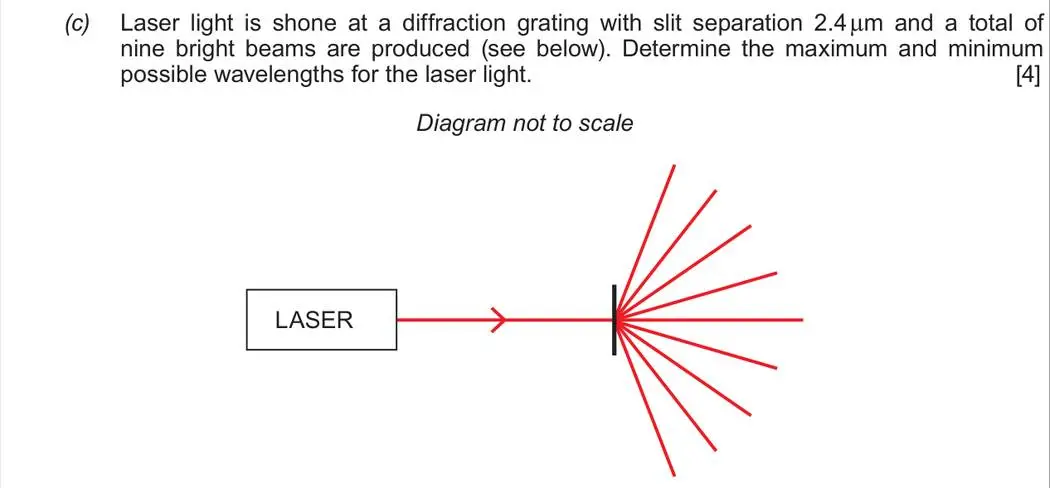
2(c) Wave properties: diffraction, interference and stationary waves 4AO1=1,AO2=3Calculation
3(a)(i) Lasers 2AO1=2Explanation
3(a)(ii) Lasers 2AO1=2Short answer
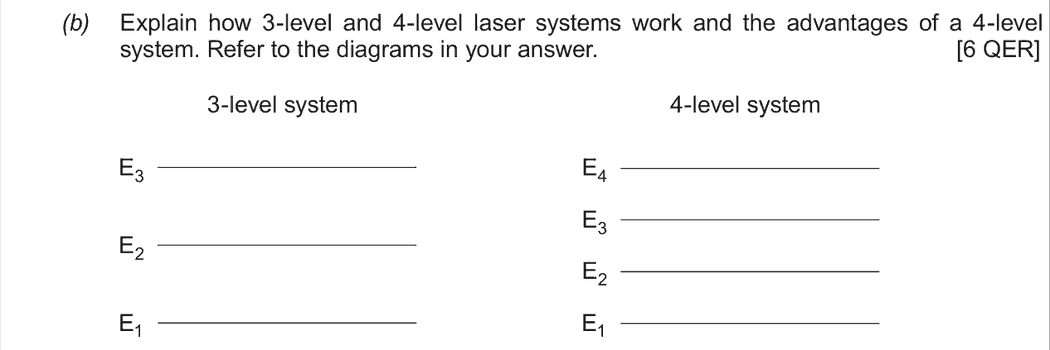
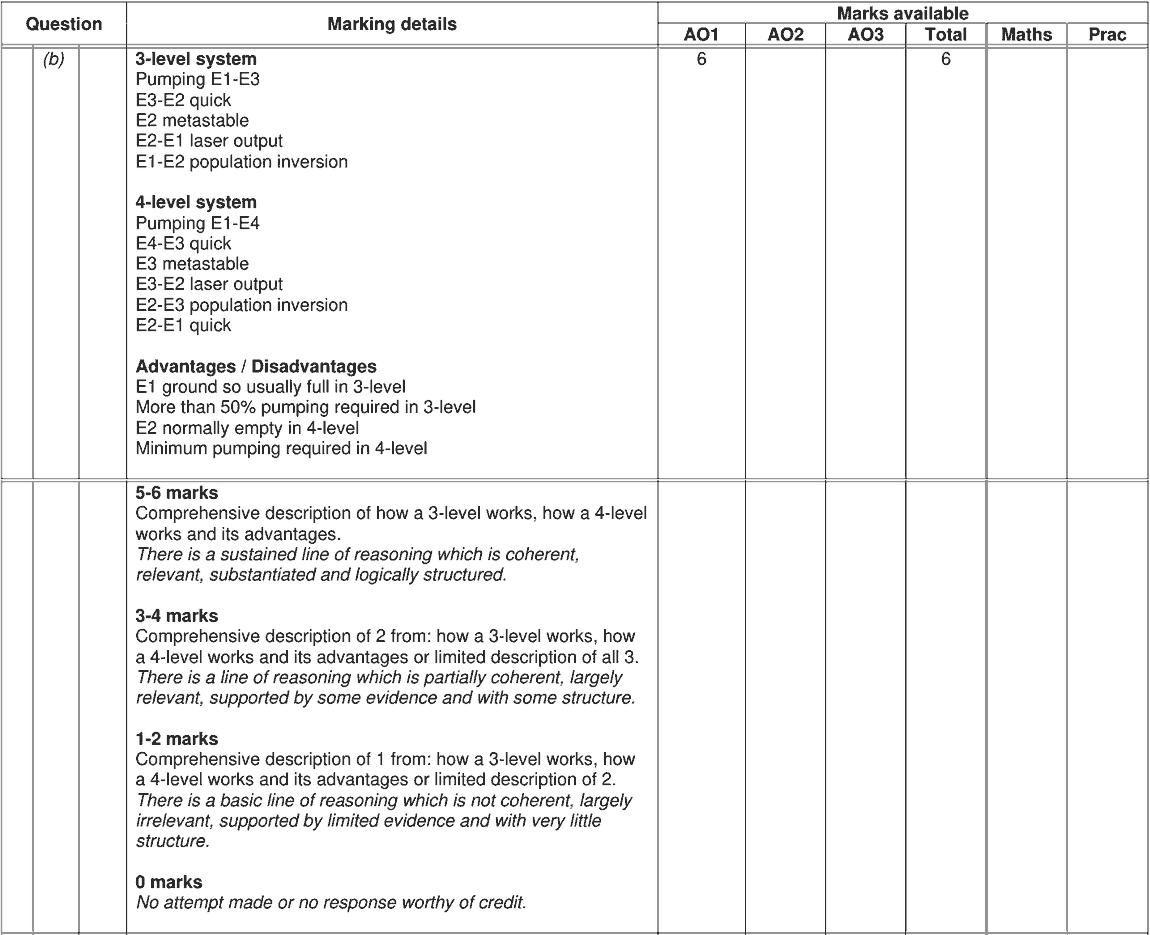
3(b) Lasers 6AO1=6Extended response
4(a) Nuclear decay 3AO1=1,AO2=2Explanation
4(b)(i) Nuclear decay 3AO2=3Show that
4(b)(ii) Nuclear decay 4AO3=4Calculation
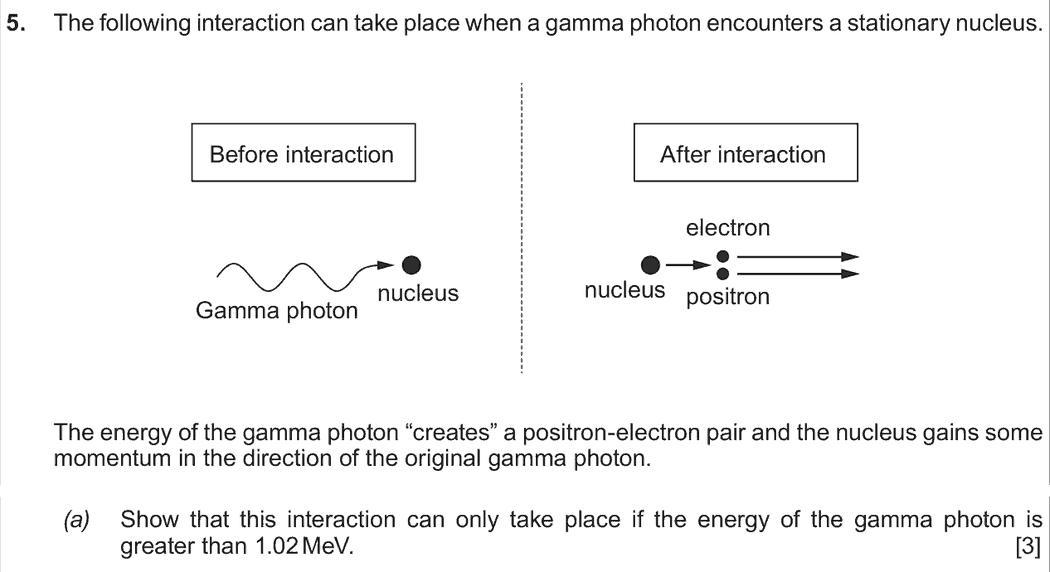
5(a) Nuclear energy 3AO2=3Show that
5(b) Nuclear energy 2AO2=2Explanation
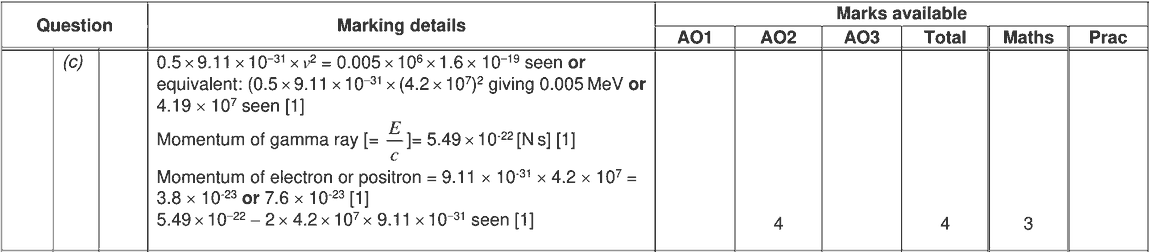
5(c) Photons, Dynamics: forces and momentum 4AO2=4Show that
5(d) Energy concepts, Dynamics: forces and momentum 2AO3=2Calculation
6(a) Particles and nuclear structure 1AO2=1Explanation
6(b) Particles and nuclear structure 2AO3=2Short answer
6(c) Particles and nuclear structure 2AO3=2Short answer
6(d) Particles and nuclear structure 3AO3=3Explanation
7(a)(i) Photons 2AO3=2Practical and data analysis
7(a)(ii) Photons 2AO2=2Diagram or graph
7(a)(iii) Photons 2AO2=2Diagram or graph
7(b)(i) Photons 5AO3=5Practical and data analysis
7(b)(ii) Photons 4AO3=4Practical and data analysis
7(c) Photons 1AO3=1Practical and data analysis
7(d)(i) Photons 2AO2=2Calculation
7(d)(ii) Photons 3AO1=2,AO2=1Explanation
8(a) Photons 2AO2=2Calculation
8(b) Photons 3AO2=3Calculation
8(c) Photons 3AO2=3Explanation
9(a) Magnetic fields 4AO1=4Explanation
9(b) Conduction of electricity 2AO2=2Calculation
9(c) Magnetic fields 3AO2=3Calculation
10(a) Electromagnetic induction 2AO1=2Show that
10(b) Electromagnetic induction 1AO2=1Explanation
10(c) Electromagnetic induction 2AO2=2Calculation
11(a) Alternating currents 3AO1=3Show that
11(b)(i) Alternating currents 1AO2=1Calculation
11(b)(ii) Alternating currents 4AO2=4Calculation
11(b)(iii) Alternating currents 2AO1=1,AO2=1Calculation
11(b)(iv) Alternating currents 3AO1=2,AO2=1Diagram or graph
11(b)(v) Alternating currents 2AO2=2Diagram or graph
11(c) Alternating currents 5AO3=5Calculation
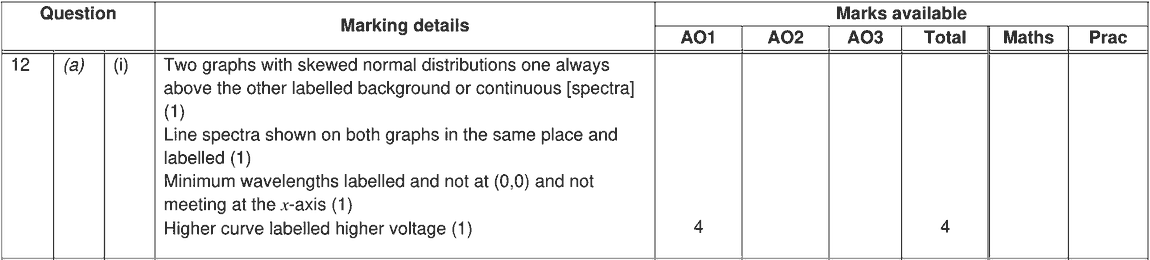
12(a)(i) Medical physics 4AO1=4Diagram or graph
12(a)(ii) Medical physics 2AO2=2Calculation
12(a)(iii) Medical physics 2AO2=2Calculation
12(b)(i) Medical physics 2AO3=2Explanation
12(b)(ii) Medical physics 3AO2=3Calculation
12(c)(i) Medical physics 2AO1=2Explanation
12(c)(ii) Medical physics 3AO2=2,AO3=1Calculation
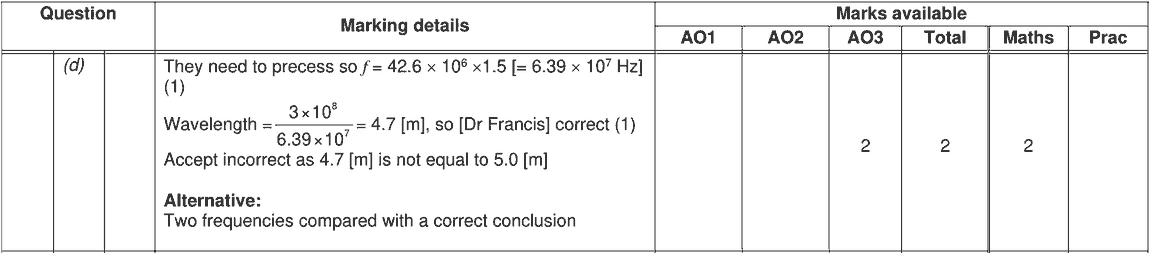
12(d) Medical physics 2AO3=2Calculation
13(a) The physics of sports 3AO1=1,AO2=2Calculation
13(b)(i) The physics of sports 1AO1=1Definition
13(b)(ii) The physics of sports 2AO2=2Calculation
13(b)(iii) The physics of sports 3AO1=1,AO2=2Calculation
13(c)(i) The physics of sports 4AO1=2,AO2=2Calculation
13(c)(ii) The physics of sports 5AO3=5Calculation
13(c)(iii) The physics of sports 2AO1=1,AO2=1Calculation
14(a)(i) Energy and the environment 1AO1=1Definition
14(a)(ii) Energy and the environment 2AO2=2Show that
14(a)(iii) Energy and the environment 2AO2=2Calculation
14(b)(i) Energy and the environment 2AO2=2Show that
14(b)(ii) Energy and the environment 3AO3=3Explanation
14(c)(i) Energy and the environment 2AO1=2Explanation
14(c)(ii) Energy and the environment 3AO2=3Show that
14(c)(iii) Energy and the environment 1AO1=1Short answer
14(d)(i) Energy and the environment 2AO1=2Explanation
14(d)(ii) Energy and the environment 2AO3=2Explanation

The questions

1(a)1(b)(i)1(b)(ii)1(b)(iii)1(c)(i)1(c)(ii)2(a)(i)2(a)(ii)2(b)2(c)3(a)(i)3(a)(ii)3(b)4(a)4(b)(i)4(b)(ii)5(a)5(b)5(c)5(d)6(a)6(b)6(c)6(d)7(a)(i)7(a)(ii)7(a)(iii)7(b)(i)7(b)(ii)7(c)7(d)(i)7(d)(ii)8(a)8(b)8(c)9(a)9(b)9(c)10(a)10(b)10(c)11(a)11(b)(i)11(b)(ii)11(b)(iii)11(b)(iv)11(b)(v)11(c)12(a)(i)12(a)(ii)12(a)(iii)12(b)(i)12(b)(ii)12(c)(i)12(c)(ii)12(d)13(a)13(b)(i)13(b)(ii)13(b)(iii)13(c)(i)13(c)(ii)13(c)(iii)14(a)(i)14(a)(ii)14(a)(iii)14(b)(i)14(b)(ii)14(c)(i)14(c)(ii)14(c)(iii)14(d)(i)14(d)(ii)
June 2019 · Component 3 · Q1(a) 2 marks AO1=2 Definition nature of waves
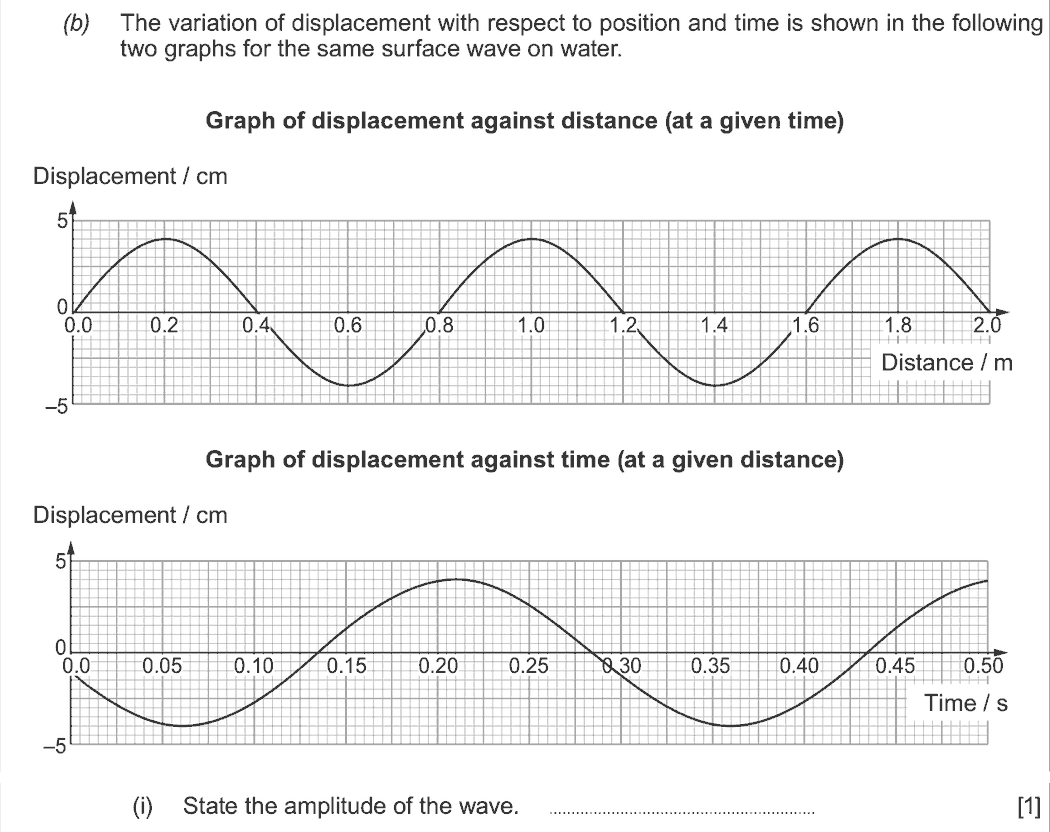
1. (a) State the difference between transverse and longitudinal waves. [2]
June 2019 · Component 3 · Q1(b)(i) 1 mark AO1=1 Short answer nature of waves
Earlier part of question 1 that this part usesEarlier part of June 2019 Component 3 question 1
(b) The variation of displacement with respect to position and time is shown in the following two graphs for the same surface wave on water. Graph of displacement against distance (at a given time) Displacement / cm 5 0 0.0 0.2 0.4 0.6 0.8 1.0 1.2 1.4 1.6 1.8 2.0 Distance / m –5 Graph of displacement against time (at a given distance) Displacement / cm 5 0 0.0 0.05 0.10 0.15 0.20 0.25 0.30 0.35 0.40 0.45 0.50 Time / s –5 (i) State the amplitude of the wave. [1]
June 2019 · Component 3 · Q1(b)(ii) 1 mark AO1=1 Short answer nature of waves
Earlier parts of question 1 that this part usesEarlier part of June 2019 Component 3 question 1Earlier part of June 2019 Component 3 question 1
(ii) State the wavelength of the wave. [1]
June 2019 · Component 3 · Q1(b)(iii) 3 marks AO1=1, AO2=2 Calculation nature of waves
Earlier parts of question 1 that this part usesEarlier part of June 2019 Component 3 question 1Earlier part of June 2019 Component 3 question 1
(iii) Calculate the speed of the wave. [3]
June 2019 · Component 3 · Q1(c)(i) 1 mark AO1=1 Diagram or graph nature of waves
Earlier parts of question 1 that this part usesEarlier part of June 2019 Component 3 question 1Earlier part of June 2019 Component 3 question 1
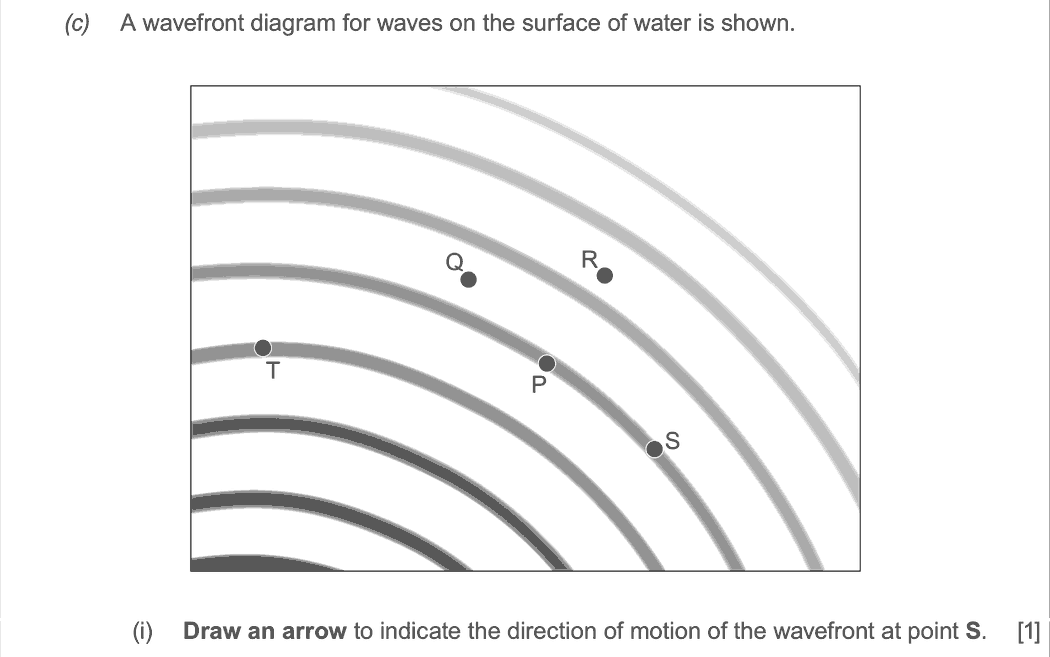
(c) A wavefront diagram for waves on the surface of water is shown. Q R T P S (i) Draw an arrow to indicate the direction of motion of the wavefront at point S. [1]
June 2019 · Component 3 · Q1(c)(ii) 1 mark AO1=1 Short answer nature of waves
Earlier parts of question 1 that this part usesEarlier part of June 2019 Component 3 question 1Earlier part of June 2019 Component 3 question 1Earlier part of June 2019 Component 3 question 1
(ii) State the point(s) oscillating in phase with point P. [1]
June 2019 · Component 3 · Q2(a)(i) 2 marks AO1=2 Explanation wave properties
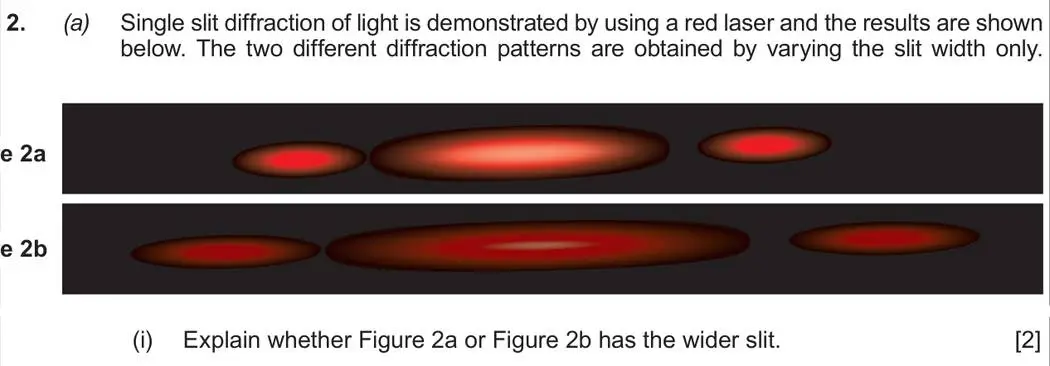
2. (a) Single slit diffraction of light is demonstrated by using a red laser and the results are shown below. The two different diffraction patterns are obtained by varying the slit width only. Figure 2a Figure 2b (i) Explain whether Figure 2a or Figure 2b has the wider slit. [2]
June 2019 · Component 3 · Q2(a)(ii) 1 mark AO1=1 Short answer wave properties
Earlier part of question 2 that this part usesEarlier part of June 2019 Component 3 question 2
(ii) State what can be done to the single slit to obtain the greatest amount of diffraction. [1]
June 2019 · Component 3 · Q2(b) 2 marks AO2=2 Short answer wave properties
Earlier part of question 2 that this part usesEarlier part of June 2019 Component 3 question 2
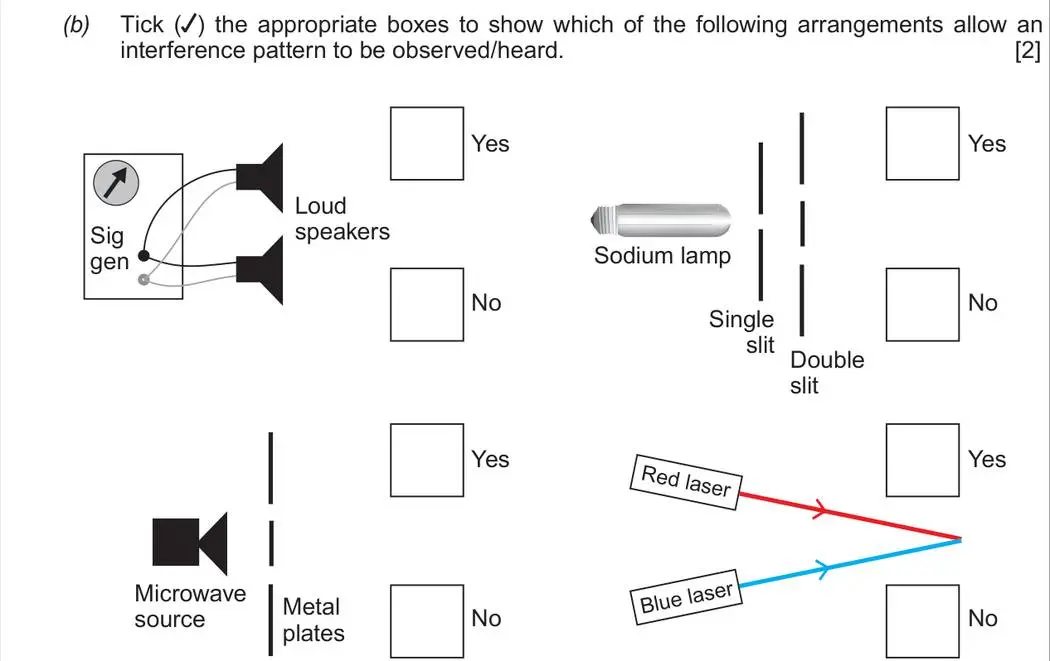
(b) Tick (√) the appropriate boxes to show which of the following arrangements allow an interference pattern to be observed/heard. [2] Yes Yes Loud Sig speakers gen Sodium lamp No No Single slit Double slit Yes Yes Red laser Microwave laser Metal Blue source No No plates
June 2019 · Component 3 · Q2(c) 4 marks AO1=1, AO2=3 Calculation wave properties
Earlier parts of question 2 that this part usesEarlier part of June 2019 Component 3 question 2Earlier part of June 2019 Component 3 question 2
(c) Laser light is shone at a diffraction grating with slit separation 2.4 µm and a total of nine bright beams are produced (see below). Determine the maximum and minimum possible wavelengths for the laser light. [4] Diagram not to scale LASER
June 2019 · Component 3 · Q3(a)(i) 2 marks AO1=2 Explanation lasers
3. (a) (i) Explain why a population inversion is not usually possible with a 2-level energy system pumped using light. [2]
June 2019 · Component 3 · Q3(a)(ii) 2 marks AO1=2 Short answer lasers
Earlier part of question 3 that this part usesEarlier part of June 2019 Component 3 question 3
(ii) State an advantage of semiconductor lasers and an example of their use. [2]
June 2019 · Component 3 · Q3(b) 6 marks AO1=6 6-mark extended response lasers
Earlier part of question 3 that this part usesEarlier part of June 2019 Component 3 question 3
(b) Explain how 3-level and 4-level laser systems work and the advantages of a 4-level system. Refer to the diagrams in your answer. [6 QER] 3-level system 4-level system E3 E4 E3 E2 E2 E1 E1
June 2019 · Component 3 · Q4(a) 3 marks AO1=1, AO2=2 Explanation nuclear decay
4. (a) It is possible to distinguish between α, β and γ radiation by their different absorption properties. Explain briefly one other method of differentiating between α, β and γ radiation. [3] Space for diagram
June 2019 · Component 3 · Q4(b)(i) 3 marks AO2=3 Show that nuclear decay
Earlier part of question 4 that this part usesEarlier part of June 2019 Component 3 question 4
(b) The half-life of beryllium-7 is 53.1 days. The initial count rate with a beryllium-7 source in position is measured as 3.50 counts per second (cps) and this dropped to 1.50 cps after 84 days. (i) Show that this final count rate is approximately 0.33 cps higher than would be expected from beryllium alone (approximately 1.17 cps). [3]
June 2019 · Component 3 · Q4(b)(ii) 4 marks AO3=4 Calculation nuclear decay
Earlier parts of question 4 that this part usesEarlier part of June 2019 Component 3 question 4Earlier part of June 2019 Component 3 question 4
(ii) The discrepancy between the measured count of 1.50 cps and the expected count of 1.17 cps is due to background radiation. Given that the background count rate is a constant 0.50 cps, determine whether the final measured count rate of 1.50 cps is exactly as expected. [4]
June 2019 · Component 3 · Q5(a) 3 marks AO2=3 Show that nuclear energy
5. The following interaction can take place when a gamma photon encounters a stationary nucleus. Before interaction After interaction electron nucleus nucleus positron Gamma photon The energy of the gamma photon “creates” a positron-electron pair and the nucleus gains some momentum in the direction of the original gamma photon. (a) Show that this interaction can only take place if the energy of the gamma photon is greater than 1.02 MeV. [3]
June 2019 · Component 3 · Q5(b) 2 marks AO2=2 Explanation nuclear energy
Earlier part of question 5 that this part usesEarlier part of June 2019 Component 3 question 5
(b) The actual energy of the incident gamma photon is 1.03 MeV. Assuming that the kinetic energy of the nucleus after the interaction is negligible, explain briefly why the kinetic energies of the positron and electron are approximately 0.005 MeV each. [2]
June 2019 · Component 3 · Q5(c) 4 marks AO2=4 Show that photonsdynamics
Earlier part of question 5 that this part usesEarlier part of June 2019 Component 3 question 5
(c) Use the kinetic energies of 0.005 MeV and conservation of momentum to show that the speeds of the positron and electron are 4.2 × 10⁷ m s–1 and that the momentum of the nucleus after the collision is 4.7 × 10⁻²² kg m s–1. [4]
June 2019 · Component 3 · Q5(d) 2 marks AO3=2 Calculation energy conceptsdynamics
Earlier part of question 5 that this part usesEarlier part of June 2019 Component 3 question 5
(d) The momentum of the nucleus (4.7 × 10⁻²² kg m s–1) is essential otherwise conservation of momentum would be impossible. Deduce whether or not the assumption in part (b) is valid (the mass of the nucleus is 3.3 × 10⁻²⁵ kg). [2]
June 2019 · Component 3 · Q6(a) 1 mark AO2=1 Explanation particles and nuclear structure
6. (a) The anti-∆++ is an anti-baryon and a first-generation particle which has a charge of –2e. Explain why the only possible quark make-up of the anti-∆++ is ūūū. [1]
June 2019 · Component 3 · Q6(b) 2 marks AO3=2 Short answer particles and nuclear structure
Earlier part of question 6 that this part usesEarlier part of June 2019 Component 3 question 6
(b) The anti-∆++ has a lifetime of approximately 6 × 10–24 s and decays into a π meson and another anti-baryon. Deduce the quark make-up of the π meson and the anti-baryon and name them. [2]
June 2019 · Component 3 · Q6(c) 2 marks AO3=2 Short answer particles and nuclear structure
Earlier part of question 6 that this part usesEarlier part of June 2019 Component 3 question 6
(c) State which force is responsible for the decay of the anti-∆++ into a π meson and anti- baryon, giving a reason for your answer. [2]
June 2019 · Component 3 · Q6(d) 3 marks AO3=3 Explanation particles and nuclear structure
Earlier part of question 6 that this part usesEarlier part of June 2019 Component 3 question 6
(d) In 2011, a highly respected international research collaboration reported that they had measured neutrinos travelling at speeds greater than that of light. This report was met by caution from the scientific community and then the result was disproved. Explain briefly why the result was met with caution and how the results might have been disproved. [3]
June 2019 · Component 3 · Q7(a)(i) 2 marks AO3=2 Practical and data analysis photons
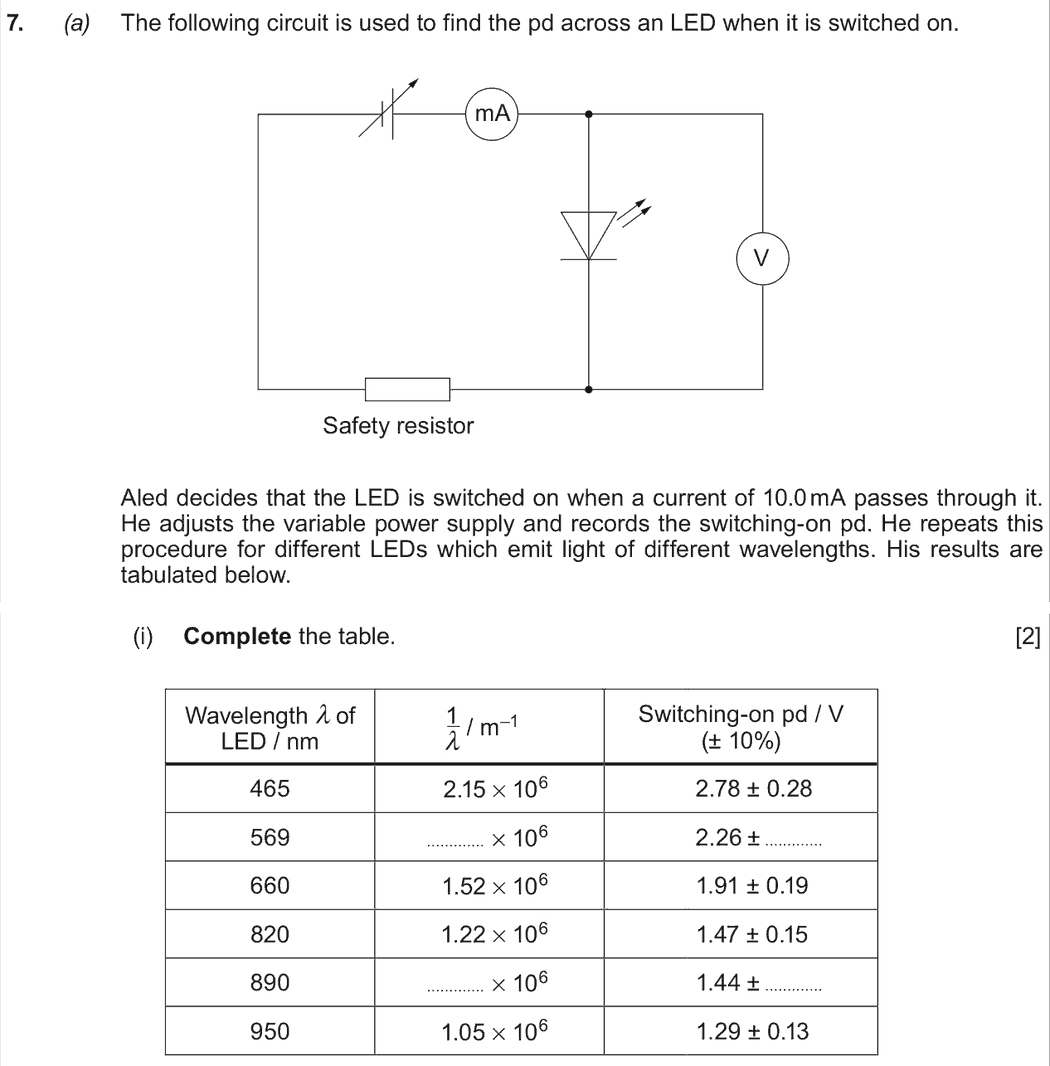
7. (a) The following circuit is used to find the pd across an LED when it is switched on. mA V Safety resistor Aled decides that the LED is switched on when a current of 10.0 mA passes through it. He adjusts the variable power supply and records the switching-on pd. He repeats this procedure for different LEDs which emit light of different wavelengths. His results are tabulated below. (i) Complete the table. [2] Wavelength λ of 1 Switching-on pd / V / m–1 LED / nm λ (± 10%) 465 2.15 × 10⁶ 2.78 ± 0.28 569 × 106 2.26 ± 660 1.52 × 10⁶ 1.91 ± 0.19 820 1.22 × 10⁶ 1.47 ± 0.15 890 × 106 1.44 ± 950 1.05 × 10⁶ 1.29 ± 0.13
June 2019 · Component 3 · Q7(a)(ii) 2 marks AO2=2 Diagram or graph photons
Earlier part of question 7 that this part usesEarlier part of June 2019 Component 3 question 7
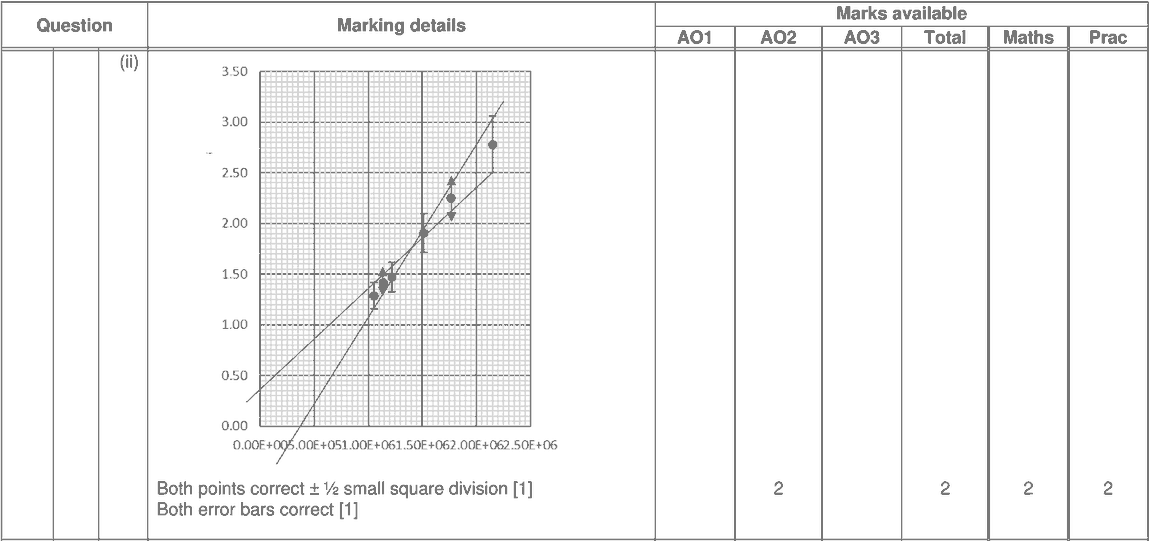
(ii) Complete the graph by plotting the two missing points whose values you have calculated together with their error bars. [2]
June 2019 · Component 3 · Q7(a)(iii) 2 marks AO2=2 Diagram or graph photons
Earlier part of question 7 that this part usesEarlier part of June 2019 Component 3 question 7
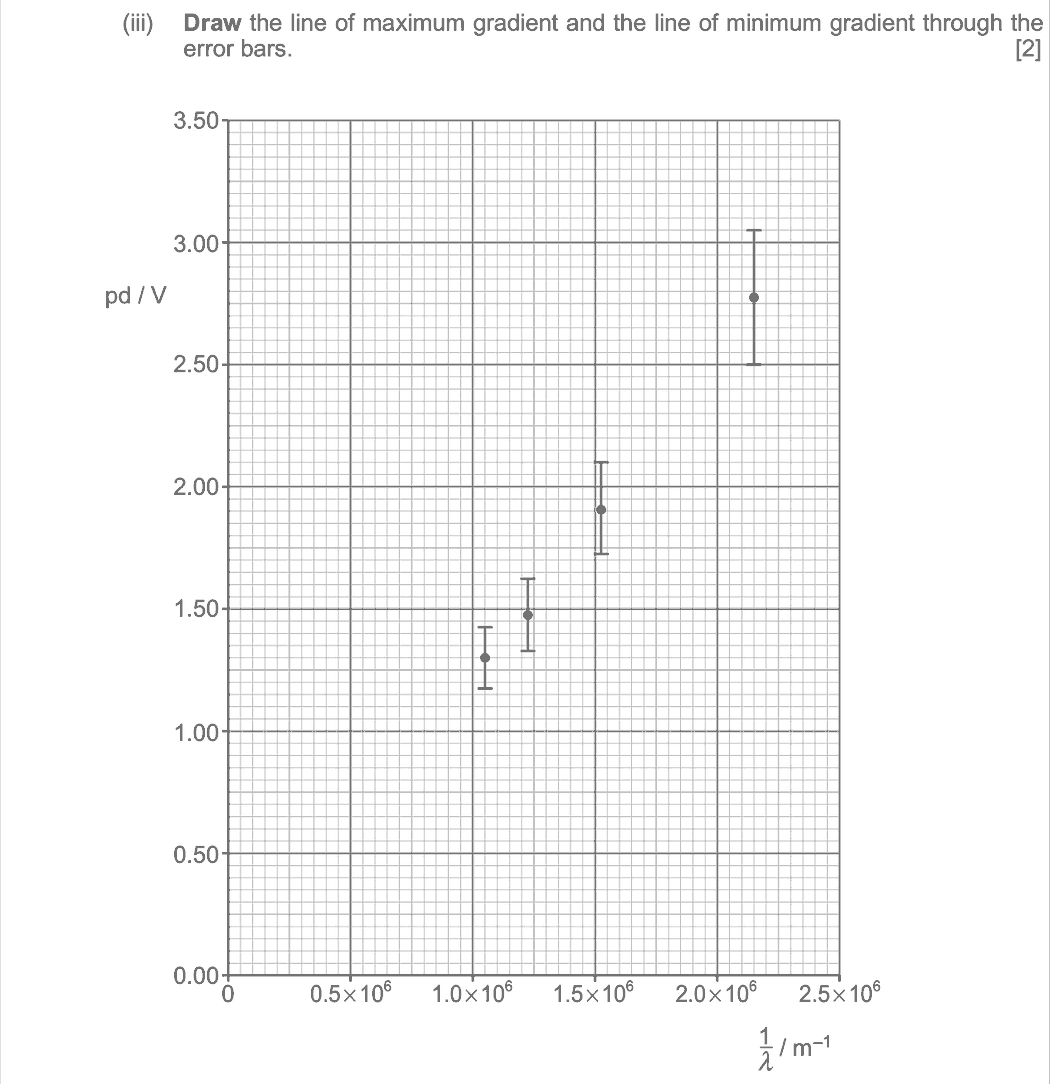
(iii) Draw the line of maximum gradient and the line of minimum gradient through the error bars. [2] 3.50 3.00 pd / V 2.50 2.00 1.50 1.00 0.50 0.00 0 0.5 × 10⁶ 1.0 × 10⁶ 1.5 × 10⁶ 2.0 × 10⁶ 2.5 × 10⁶ 1 / m–1 λ
June 2019 · Component 3 · Q7(b)(i) 5 marks AO3=5 Practical and data analysis photons
Earlier parts of question 7 that this part usesEarlier part of June 2019 Component 3 question 7Earlier part of June 2019 Component 3 question 7
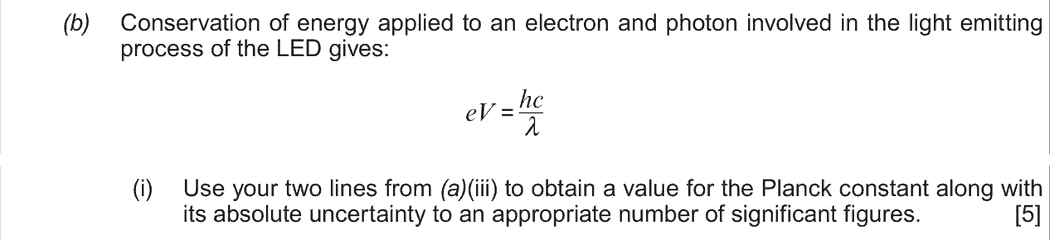
(b) Conservation of energy applied to an electron and photon involved in the light emitting process of the LED gives: hc eV = λ (i) Use your two lines from (a)(iii) to obtain a value for the Planck constant along with its absolute uncertainty to an appropriate number of significant figures. [5]
June 2019 · Component 3 · Q7(b)(ii) 4 marks AO3=4 Practical and data analysis photons
Earlier parts of question 7 that this part usesEarlier part of June 2019 Component 3 question 7Earlier part of June 2019 Component 3 question 7Earlier part of June 2019 Component 3 question 7
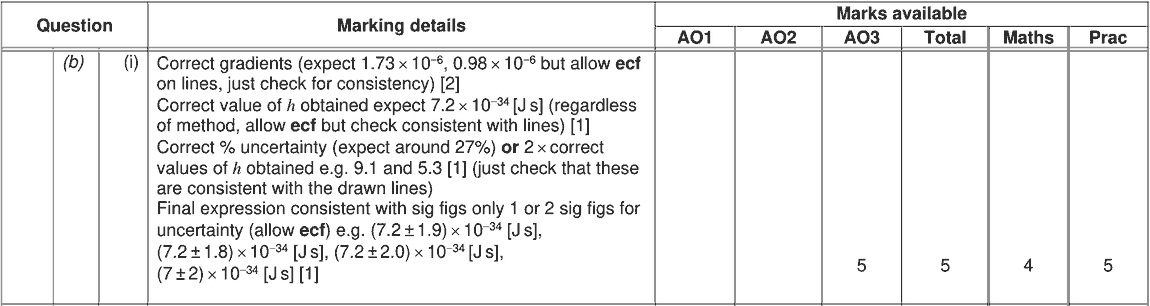
(ii) Explain to what extent Aled’s data displayed in the graph confirm the relationship. [4] hc eV = λ
June 2019 · Component 3 · Q7(c) 1 mark AO3=1 Practical and data analysis photons
Earlier parts of question 7 that this part usesEarlier part of June 2019 Component 3 question 7Earlier part of June 2019 Component 3 question 7
(c) Suggest one reason why choosing a constant current of 10.0 mA is better than using your eye to detect the emitted radiation for these LEDs. [1]
June 2019 · Component 3 · Q7(d)(i) 2 marks AO2=2 Calculation photons
Earlier parts of question 7 that this part usesEarlier part of June 2019 Component 3 question 7Earlier part of June 2019 Component 3 question 7
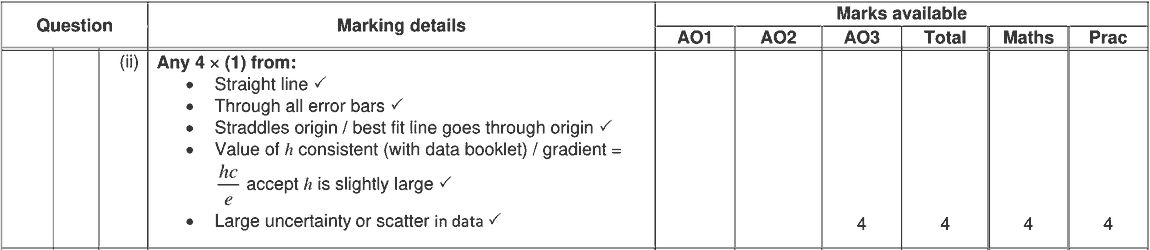
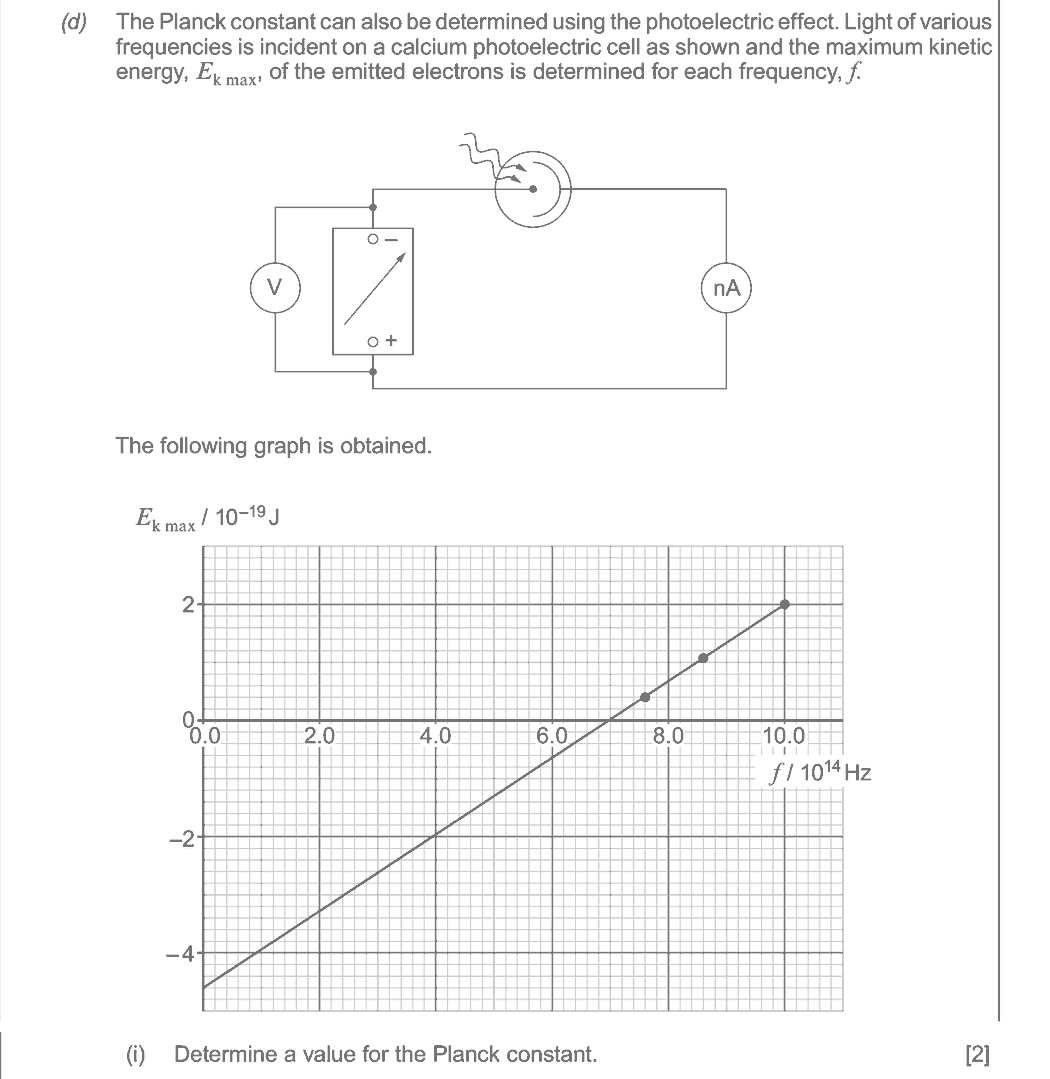
(d) The Planck constant can also be determined using the photoelectric effect. Light of various frequencies is incident on a calcium photoelectric cell as shown and the maximum kinetic energy, Ek max, of the emitted electrons is determined for each frequency, f. – V nA + The following graph is obtained. Ek / 10–19 J max 2 0 0.0 2.0 4.0 6.0 8.0 10.0 f / 1014 Hz –2 – 4 (i) Determine a value for the Planck constant. [2]
June 2019 · Component 3 · Q7(d)(ii) 3 marks AO1=2, AO2=1 Explanation photons
Earlier parts of question 7 that this part usesEarlier part of June 2019 Component 3 question 7Earlier part of June 2019 Component 3 question 7Earlier part of June 2019 Component 3 question 7
(ii) Determine a value of the work function of calcium and explain why no data points are possible below a frequency of 6.9 × 10¹⁴ Hz. [3]
June 2019 · Component 3 · Q8(a) 2 marks AO2=2 Calculation photons
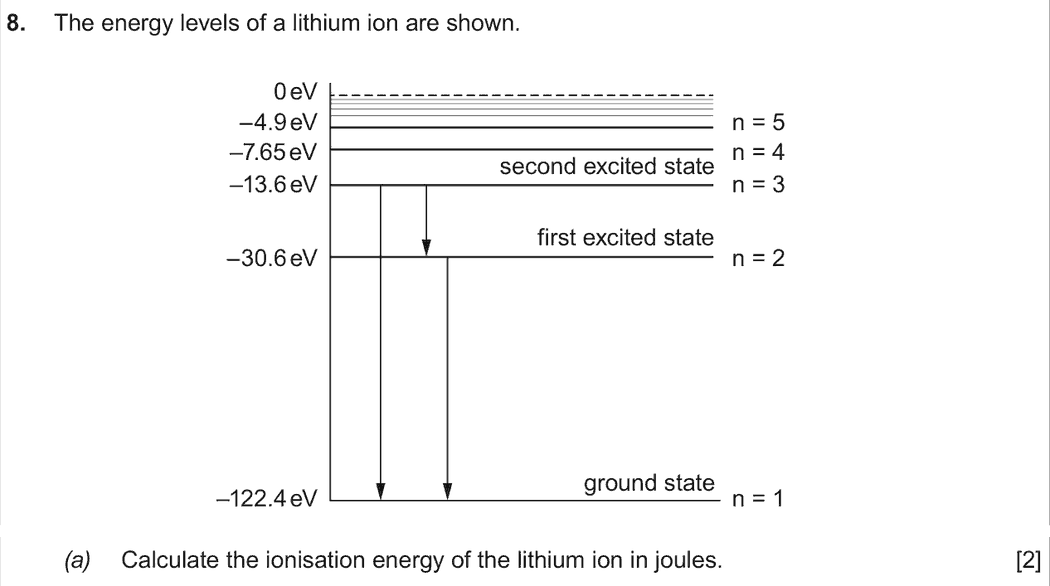
8. The energy levels of a lithium ion are shown. 0 eV –4.9 eV n = 5 –7.65 eV n = 4 second excited state –13.6 eV n = 3 first excited state –30.6 eV n = 2 ground state –122.4 eV n = 1 (a) Calculate the ionisation energy of the lithium ion in joules. [2]
June 2019 · Component 3 · Q8(b) 3 marks AO2=3 Calculation photons
Earlier part of question 8 that this part usesEarlier part of June 2019 Component 3 question 8
(b) Calculate the wavelength of the electromagnetic radiation emitted when an electron drops from the second excited state (n = 3) to the first excited state (n = 2) and state the region of the electromagnetic spectrum to which it belongs. [3]
June 2019 · Component 3 · Q8(c) 3 marks AO2=3 Explanation photons
Earlier part of question 8 that this part usesEarlier part of June 2019 Component 3 question 8
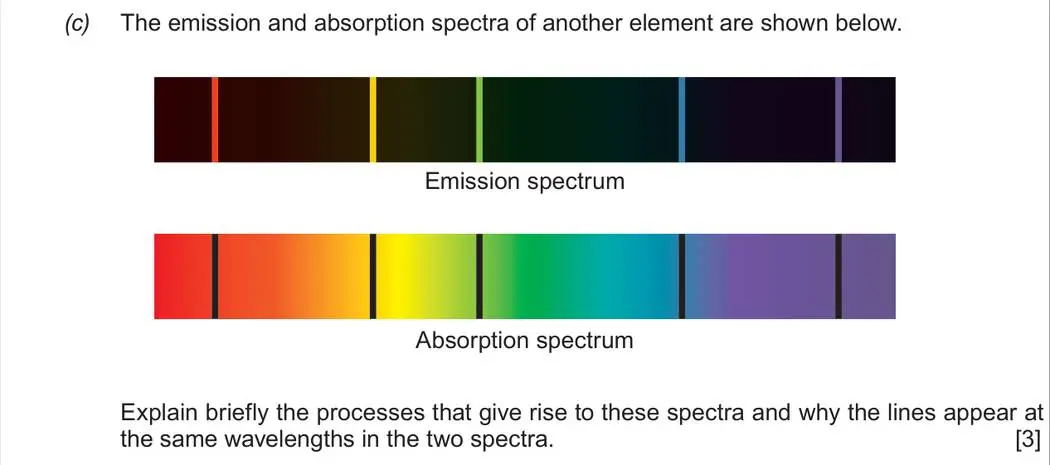
(c) The emission and absorption spectra of another element are shown below. Emission spectrum Absorption spectrum Explain briefly the processes that give rise to these spectra and why the lines appear at the same wavelengths in the two spectra. [3]
June 2019 · Component 3 · Q9(a) 4 marks AO1=4 Explanation magnetic fields
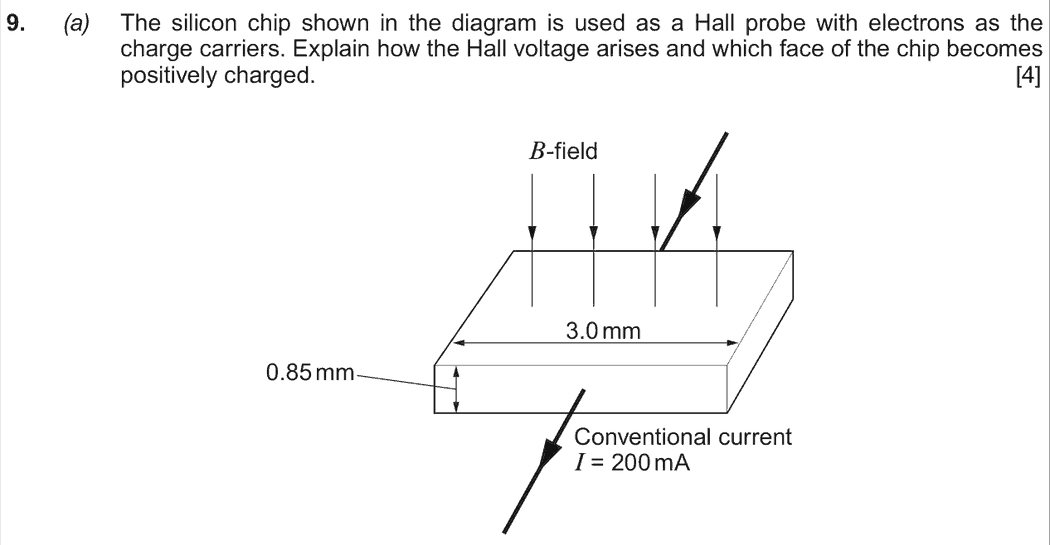
9. (a) The silicon chip shown in the diagram is used as a Hall probe with electrons as the charge carriers. Explain how the Hall voltage arises and which face of the chip becomes positively charged. [4] B-field 3.0 mm 0.85 mm Conventional current I = 200 mA
June 2019 · Component 3 · Q9(b) 2 marks AO2=2 Calculation conduction of electricity
Earlier part of question 9 that this part usesEarlier part of June 2019 Component 3 question 9
(b) The concentration of conduction electrons is 2.4 × 1024 m–3. Calculate the mean drift velocity of the electrons. [2]
June 2019 · Component 3 · Q9(c) 3 marks AO2=3 Calculation magnetic fields
Earlier part of question 9 that this part usesEarlier part of June 2019 Component 3 question 9
(c) The Hall voltage, VH, for this chip can be expressed as: VH = kB where k is a constant and B is the magnetic flux density. Calculate a value for k and state its unit. [3]
June 2019 · Component 3 · Q10(a) 2 marks AO1=2 Show that electromagnetic induction
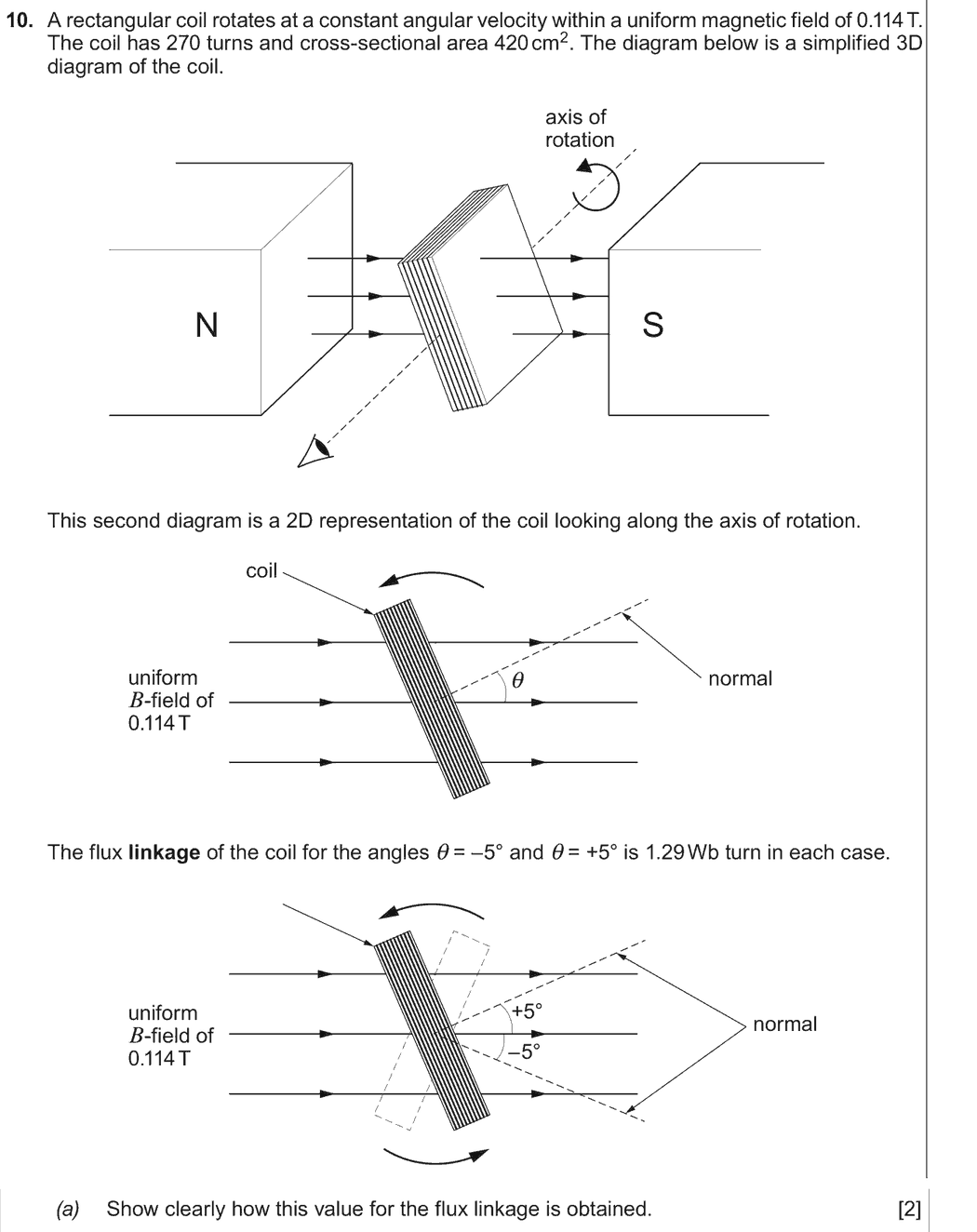
10. A rectangular coil rotates at a constant angular velocity within a uniform magnetic field of 0.114 T. The coil has 270 turns and cross-sectional area 420 cm2. The diagram below is a simplified 3D diagram of the coil. axis of rotation N S This second diagram is a 2D representation of the coil looking along the axis of rotation. coil uniform θ normal B-field of 0.114 T The flux linkage of the coil for the angles θ = –5° and θ = +5° is 1.29 Wb turn in each case. uniform +5° normal B-field of –5° 0.114 T (a) Show clearly how this value for the flux linkage is obtained. [2]
June 2019 · Component 3 · Q10(b) 1 mark AO2=1 Explanation electromagnetic induction
Earlier part of question 10 that this part usesEarlier part of June 2019 Component 3 question 10
(b) Explain why the induced emf is zero when θ = 0. [1]
June 2019 · Component 3 · Q10(c) 2 marks AO2=2 Calculation electromagnetic induction
Earlier part of question 10 that this part usesEarlier part of June 2019 Component 3 question 10
(c) The flux linkage of the coil for the angles θ = 85° and θ = 95° are 0.11 Wb turn and –0.11 Wb turn respectively. The coil rotates 10° in a time of 5.8 ms. Calculate the mean induced emf when rotating between θ = 85° and θ = 95°. [2]
June 2019 · Component 3 · Q11(a) 3 marks AO1=3 Show that alternating currents
11. (a) Derive the expression for the resonance frequency, f0, of a series RCL circuit. [3] 1 f0 = 2π LC
June 2019 · Component 3 · Q11(b)(i) 1 mark AO2=1 Calculation alternating currents
Earlier part of question 11 that this part usesEarlier part of June 2019 Component 3 question 11
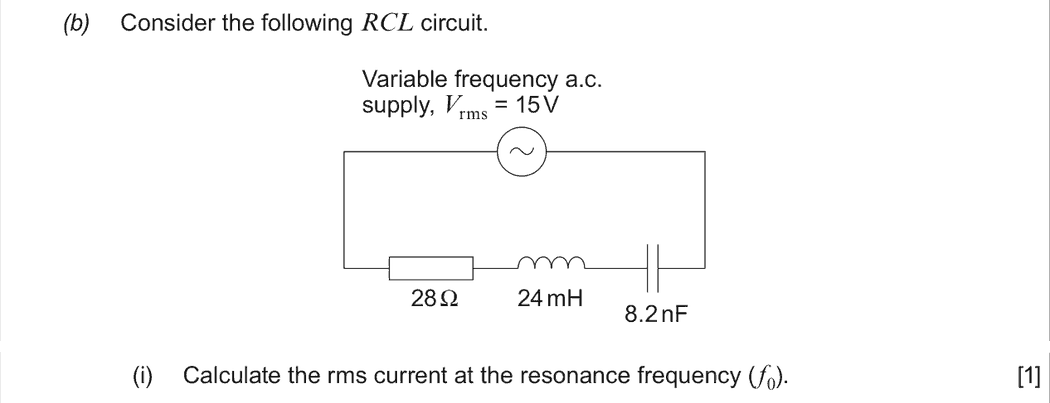
(b) Consider the following RCL circuit. Variable frequency a.c. supply, Vrms = 15 V 28 Ω 24 mH 8.2 nF (i) Calculate the rms current at the resonance frequency (f0). [1]
June 2019 · Component 3 · Q11(b)(ii) 4 marks AO2=4 Calculation alternating currents
Earlier parts of question 11 that this part usesEarlier part of June 2019 Component 3 question 11Earlier part of June 2019 Component 3 question 11
(ii) Calculate the rms current at twice the resonance frequency (2f0). [4]
June 2019 · Component 3 · Q11(b)(iii) 2 marks AO1=1, AO2=1 Calculation alternating currents
Earlier parts of question 11 that this part usesEarlier part of June 2019 Component 3 question 11Earlier part of June 2019 Component 3 question 11
(iii) Calculate the Q factor of the RCL circuit. [2]
June 2019 · Component 3 · Q11(b)(iv) 3 marks AO1=2, AO2=1 Diagram or graph alternating currents
Earlier parts of question 11 that this part usesEarlier part of June 2019 Component 3 question 11Earlier part of June 2019 Component 3 question 11
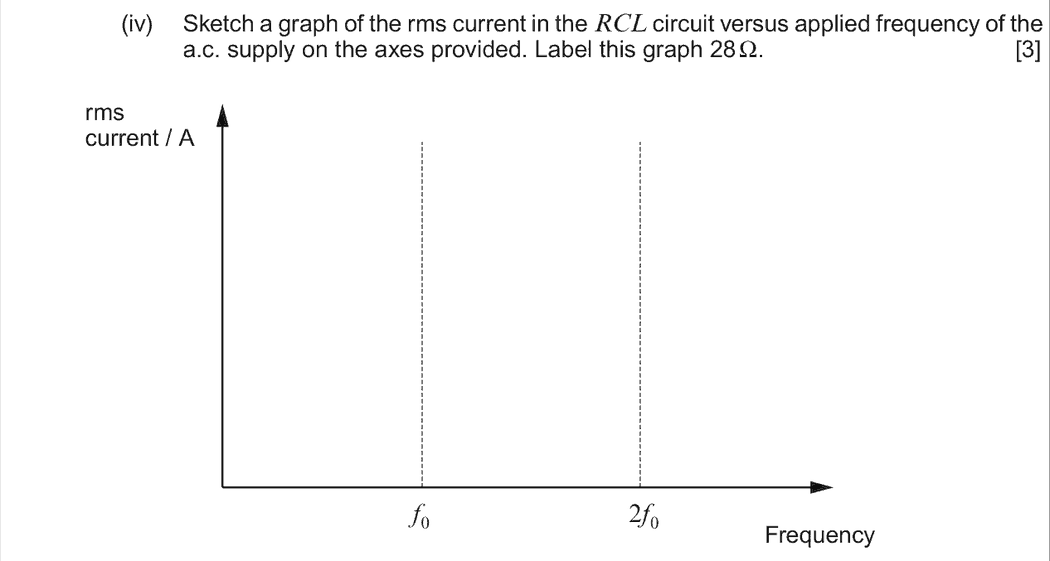
(iv) Sketch a graph of the rms current in the RCL circuit versus applied frequency of the a.c. supply on the axes provided. Label this graph 28 Ω. [3] rms current / A f0 2f0 Frequency
June 2019 · Component 3 · Q11(b)(v) 2 marks AO2=2 Diagram or graph alternating currents
Earlier parts of question 11 that this part usesEarlier part of June 2019 Component 3 question 11Earlier part of June 2019 Component 3 question 11Earlier part of June 2019 Component 3 question 11
(v) The 28 Ω resistor is replaced by a 56 Ω resistor. On the same axes, sketch and label a second graph showing the rms current versus frequency for the new circuit. [2]
June 2019 · Component 3 · Q11(c) 5 marks AO3=5 Calculation alternating currents
Earlier parts of question 11 that this part usesEarlier part of June 2019 Component 3 question 11Earlier part of June 2019 Component 3 question 11Earlier part of June 2019 Component 3 question 11
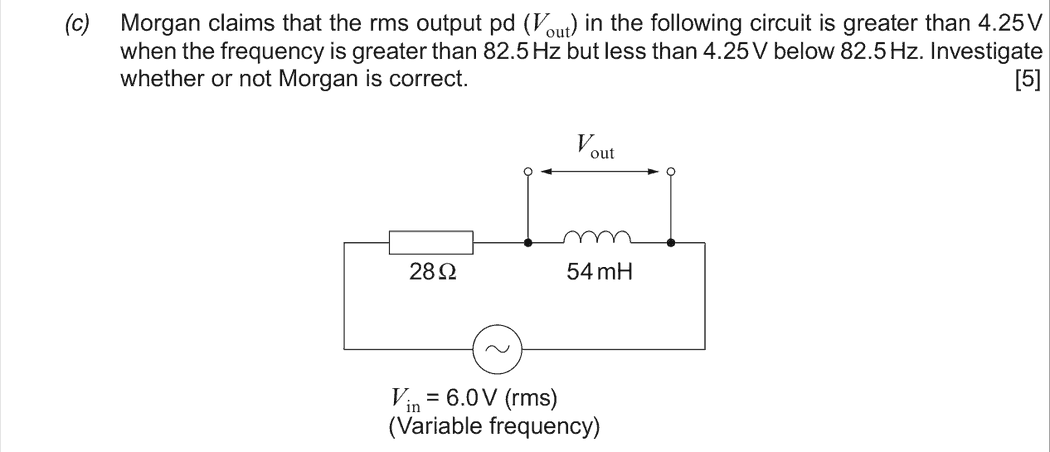
(c) Morgan claims that the rms output pd (Vout) in the following circuit is greater than 4.25 V when the frequency is greater than 82.5 Hz but less than 4.25 V below 82.5 Hz. Investigate whether or not Morgan is correct. [5] Vout 28 Ω 54 mH Vin = 6.0 V (rms) (Variable frequency)
June 2019 · Component 3 · Q12(a)(i) 4 marks AO1=4 Diagram or graph medical physics
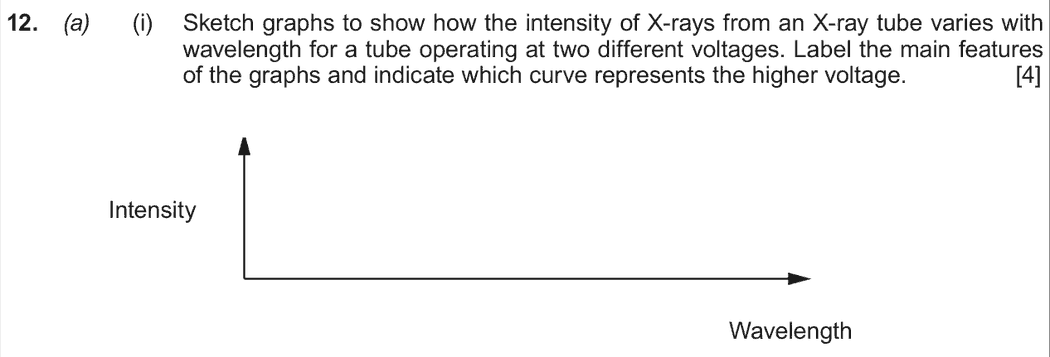
12. (a) (i) Sketch graphs to show how the intensity of X-rays from an X-ray tube varies with wavelength for a tube operating at two different voltages. Label the main features of the graphs and indicate which curve represents the higher voltage. [4] Intensity Wavelength
June 2019 · Component 3 · Q12(a)(ii) 2 marks AO2=2 Calculation medical physics
Earlier part of question 12 that this part usesEarlier part of June 2019 Component 3 question 12
(ii) The lower voltage tube operates at 20 kV. Determine the velocity with which the electrons strike the target. [2]
June 2019 · Component 3 · Q12(a)(iii) 2 marks AO2=2 Calculation medical physics
Earlier part of question 12 that this part usesEarlier part of June 2019 Component 3 question 12
(iii) Calculate the minimum wavelength of the X-ray photons produced by these electrons. [2]
June 2019 · Component 3 · Q12(b)(i) 2 marks AO3=2 Explanation medical physics
Earlier part of question 12 that this part usesEarlier part of June 2019 Component 3 question 12
(b) (i) Ultrasound can be used to carry out either an amplitude scan (A-scan) or a brightness scan (B-scan). Explain which of these two methods you would use to determine the depth of the tumour. Justify your answer. [2]
June 2019 · Component 3 · Q12(b)(ii) 3 marks AO2=3 Calculation medical physics
Earlier parts of question 12 that this part usesEarlier part of June 2019 Component 3 question 12Earlier part of June 2019 Component 3 question 12
(ii) An ultrasound scan can be used to indicate the thickness of fat on a person’s body. Typically fat has a density of 930 kg m–3 and an acoustic impedance of 1.35 × 10⁶ kg m–2 s–1. If the time delay for the ultrasound pulse is 0.040 ms. Determine the thickness of fat. [3]
June 2019 · Component 3 · Q12(c)(i) 2 marks AO1=2 Explanation medical physics
Earlier part of question 12 that this part usesEarlier part of June 2019 Component 3 question 12
(c) (i) Explain two properties of a radioactive isotope used as a tracer in medicine. [2]
June 2019 · Component 3 · Q12(c)(ii) 3 marks AO2=2, AO3=1 Calculation medical physics
Earlier parts of question 12 that this part usesEarlier part of June 2019 Component 3 question 12Earlier part of June 2019 Component 3 question 12
(ii) A small volume of Human Serum Albumin (HSA) labelled with iodine-125 of activity 160 Bq is injected into the bloodstream of a patient. A sample of 0.8 cm3 of blood was taken a few hours later and was found to have an activity of 0.025 Bq. If the half-life of iodine-125 is 60 days, calculate the volume of blood in the patient. State any assumptions you make. [3]
June 2019 · Component 3 · Q12(d) 2 marks AO3=2 Calculation medical physics
Earlier part of question 12 that this part usesEarlier part of June 2019 Component 3 question 12
(d) In a magnetic resonance imaging (MRI) scanner a large magnetic field of 1.5 T is used along with short pulses of radio waves. Dr Francis suggests that radio waves of wavelength approximately 5 m would be suitable for this MRI scanner. Determine whether or not Dr Francis is correct. [2]
June 2019 · Component 3 · Q13(a) 3 marks AO1=1, AO2=2 Calculation physics of sports
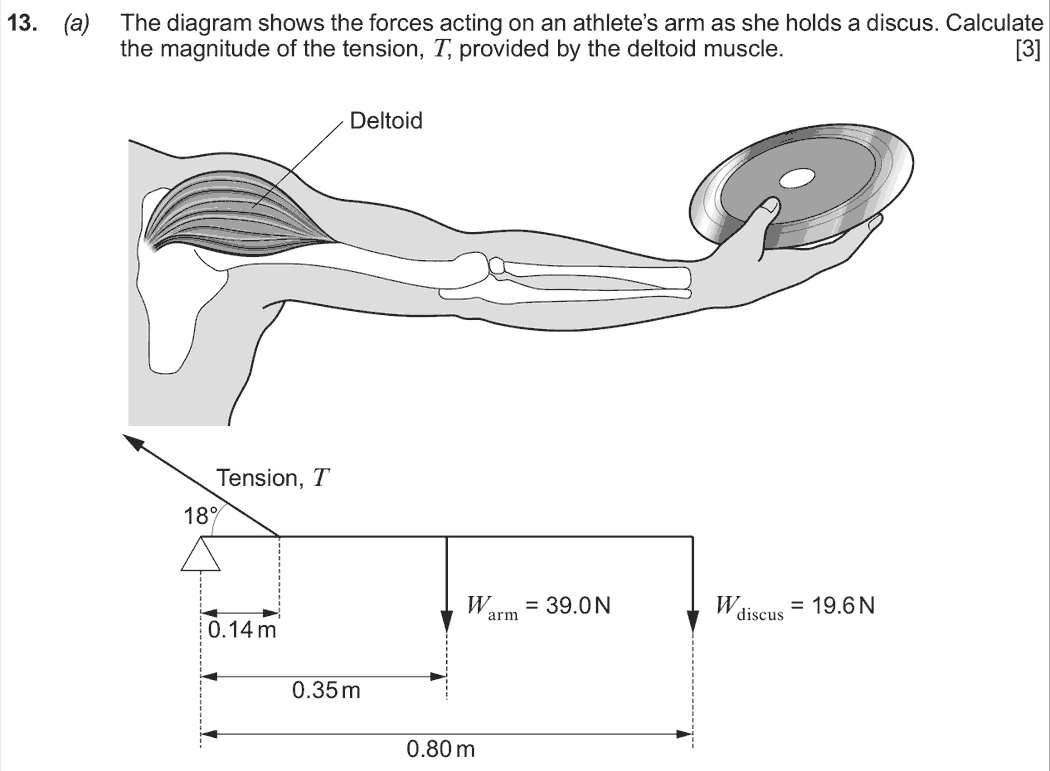
13. (a) The diagram shows the forces acting on an athlete’s arm as she holds a discus. Calculate the magnitude of the tension, T, provided by the deltoid muscle. [3] Deltoid Tension, T 18° Warm = 39.0 N Wdiscus = 19.6 N 0.14 m 0.35 m 0.80 m
June 2019 · Component 3 · Q13(b)(i) 1 mark AO1=1 Definition physics of sports
Earlier part of question 13 that this part usesEarlier part of June 2019 Component 3 question 13
(b) (i) Define angular acceleration. [1]
June 2019 · Component 3 · Q13(b)(ii) 2 marks AO2=2 Calculation physics of sports
Earlier parts of question 13 that this part usesEarlier part of June 2019 Component 3 question 13Earlier part of June 2019 Component 3 question 13
(ii) When thrown, the discus experiences an angular acceleration. It accelerates from rest to 2.3 revolutions per second in a time of 0.27 s. Calculate the angular acceleration of the discus. [2]
June 2019 · Component 3 · Q13(b)(iii) 3 marks AO1=1, AO2=2 Calculation physics of sports
Earlier parts of question 13 that this part usesEarlier part of June 2019 Component 3 question 13Earlier part of June 2019 Component 3 question 13
(iii) Calculate the mean torque applied to the discus of mass 2.0 kg and radius 11 cm. mr2 The moment of inertia is given by the equation I = . [3] 2
June 2019 · Component 3 · Q13(c)(i) 4 marks AO1=2, AO2=2 Calculation physics of sports
Earlier part of question 13 that this part usesEarlier part of June 2019 Component 3 question 13
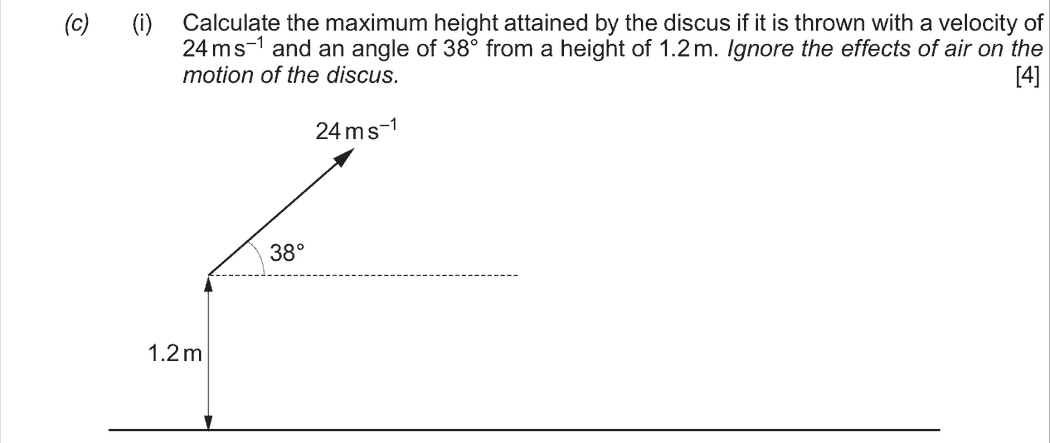
(c) (i) Calculate the maximum height attained by the discus if it is thrown with a velocity of 24 m s–1 and an angle of 38° from a height of 1.2 m. Ignore the effects of air on the motion of the discus. [4] 24 m s–1 38° 1.2 m
June 2019 · Component 3 · Q13(c)(ii) 5 marks AO3=5 Calculation physics of sports
Earlier parts of question 13 that this part usesEarlier part of June 2019 Component 3 question 13Earlier part of June 2019 Component 3 question 13
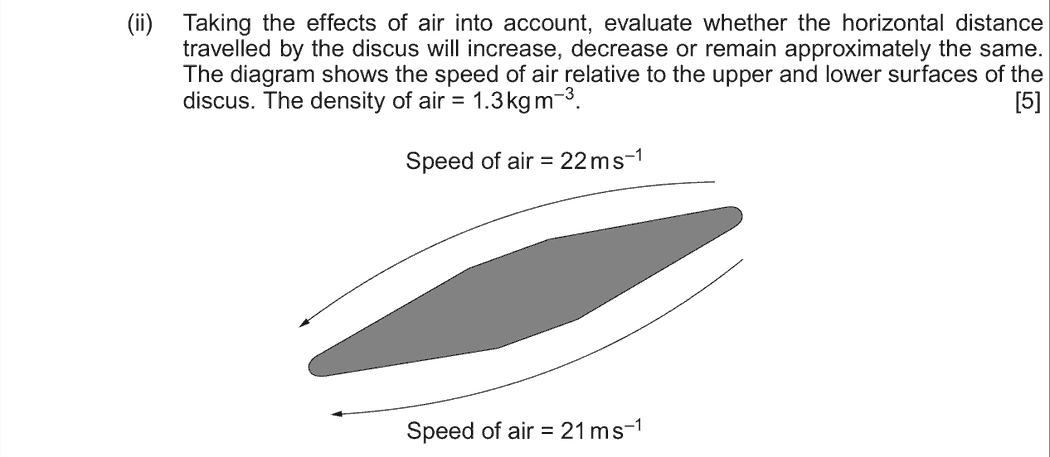
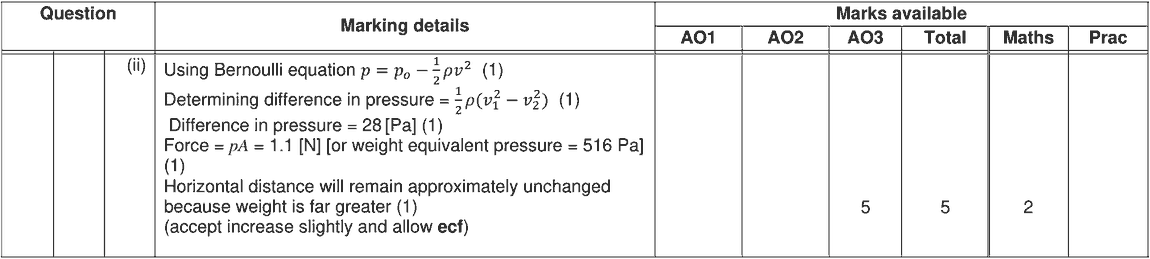
(ii) Taking the effects of air into account, evaluate whether the horizontal distance travelled by the discus will increase, decrease or remain approximately the same. The diagram shows the speed of air relative to the upper and lower surfaces of the discus. The density of air = 1.3 kg m–3. [5] Speed of air = 22 m s–1 Speed of air = 21 m s–1
June 2019 · Component 3 · Q13(c)(iii) 2 marks AO1=1, AO2=1 Calculation physics of sports
Earlier parts of question 13 that this part usesEarlier part of June 2019 Component 3 question 13Earlier part of June 2019 Component 3 question 13Earlier part of June 2019 Component 3 question 13
(iii) A wind tunnel is used to examine the motion of the discus in a wind speed of 20 m s–1. Calculate the factor by which the drag force increases if the speed of the wind is increased to 30 m s–1 and all other factors are kept constant. [2]
June 2019 · Component 3 · Q14(a)(i) 1 mark AO1=1 Definition energy and the environment
14. (a) (i) Solar energy resources are considered to be renewable resources. State what is meant by a renewable energy resource. [1]
June 2019 · Component 3 · Q14(a)(ii) 2 marks AO2=2 Show that energy and the environment
Earlier part of question 14 that this part usesEarlier part of June 2019 Component 3 question 14
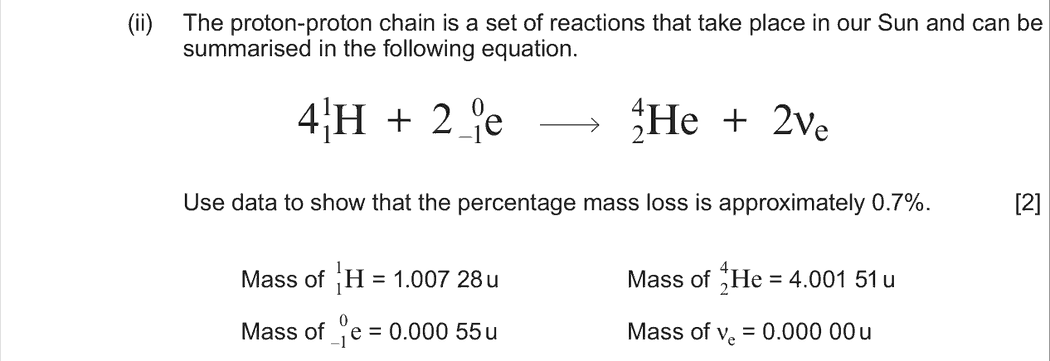
(ii) The proton-proton chain is a set of reactions that take place in our Sun and can be summarised in the following equation. 41 H + 2 –1e 0 4 He + 2νe 1 2 Use data to show that the percentage mass loss is approximately 0.7%. [2] 1 H 4 He Mass of = 1.007 28 u Mass of = 4.001 51 u 1 2 Mass of 0 e = 0.000 55 u Mass of νe = 0.000 00 u –1
June 2019 · Component 3 · Q14(a)(iii) 2 marks AO2=2 Calculation energy and the environment
Earlier part of question 14 that this part usesEarlier part of June 2019 Component 3 question 14
(iii) The Sun can be assumed to have come to the end of its life when it has lost 0.7 % of its mass to radiated energy. Estimate the lifetime of the Sun in years. Take the mass of the Sun to be 2.0 × 1030 kg and assume it to have a constant power output of 3.8 × 1026 W. [2]
June 2019 · Component 3 · Q14(b)(i) 2 marks AO2=2 Show that energy and the environment
Earlier part of question 14 that this part usesEarlier part of June 2019 Component 3 question 14
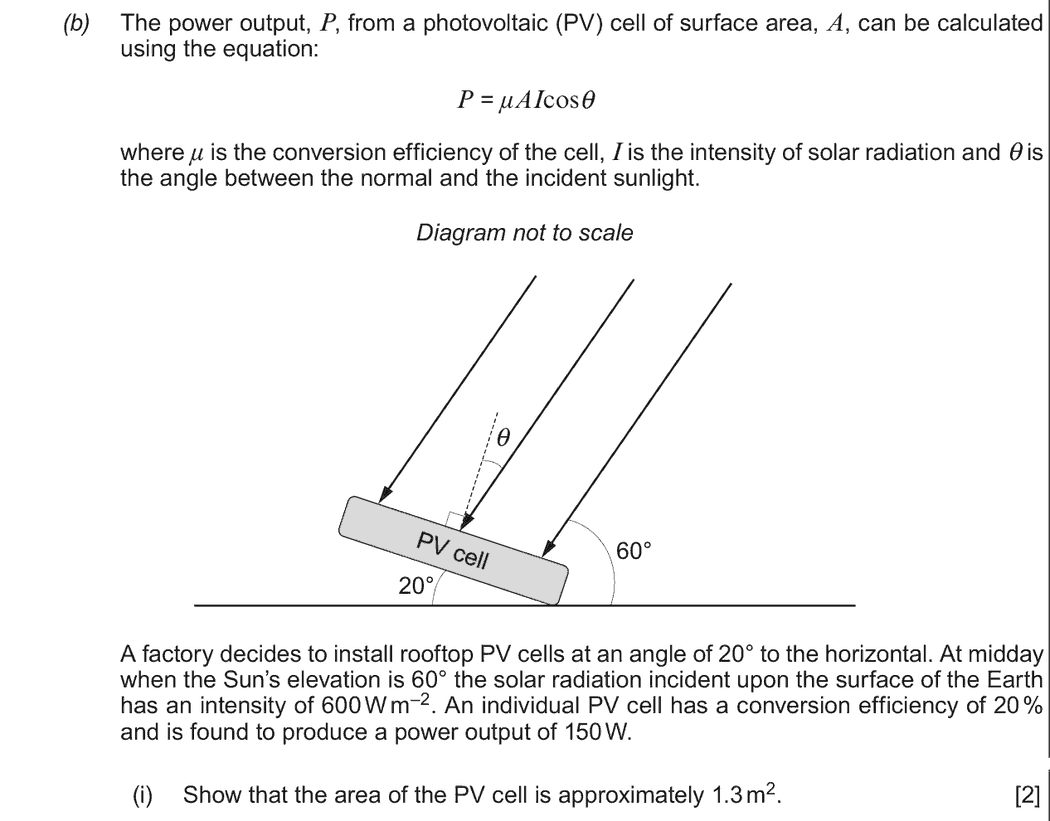
(b) The power output, P, from a photovoltaic (PV) cell of surface area, A, can be calculated using the equation: P = μAIcosθ where μ is the conversion efficiency of the cell, I is the intensity of solar radiation and θ is the angle between the normal and the incident sunlight. Diagram not to scale θ PV cell 60° 20° A factory decides to install rooftop PV cells at an angle of 20° to the horizontal. At midday when the Sun’s elevation is 60° the solar radiation incident upon the surface of the Earth has an intensity of 600 W m–2. An individual PV cell has a conversion efficiency of 20 % and is found to produce a power output of 150 W. (i) Show that the area of the PV cell is approximately 1.3 m2. [2]
June 2019 · Component 3 · Q14(b)(ii) 3 marks AO3=3 Explanation energy and the environment
Earlier parts of question 14 that this part usesEarlier part of June 2019 Component 3 question 14Earlier part of June 2019 Component 3 question 14
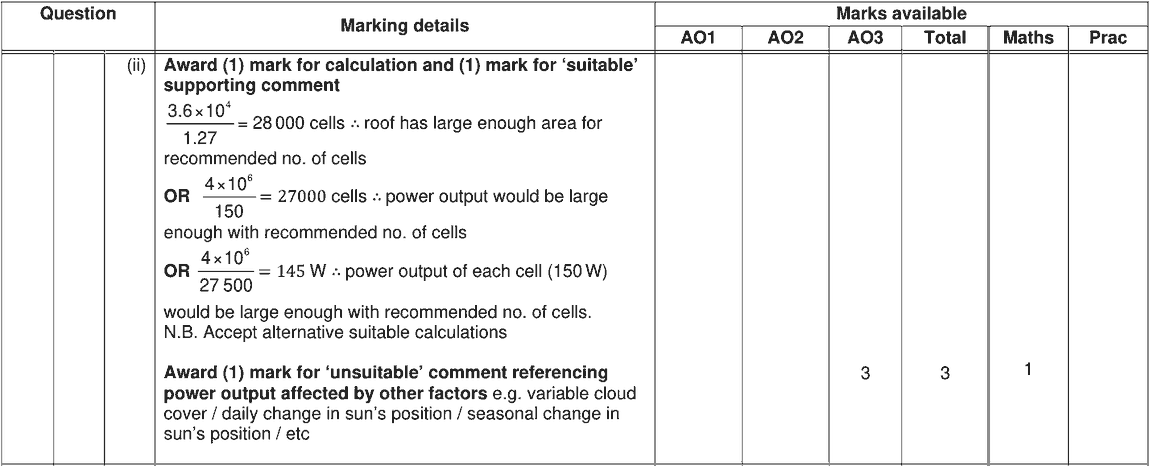
(ii) The factory roof covers an area of 3.6 × 10⁴ m2 and the factory owner plans for the installation to produce a mean power output of 4.0 MW. It is suggested that the company should install 27 500 of these PV cells. Discuss whether or not you believe this to be suitable. [3]
June 2019 · Component 3 · Q14(c)(i) 2 marks AO1=2 Explanation energy and the environment
Earlier parts of question 14 that this part usesEarlier part of June 2019 Component 3 question 14Earlier part of June 2019 Component 3 question 14
(c) (i) Describe what is meant by the enrichment of uranium and explain why it is necessary. [2]
June 2019 · Component 3 · Q14(c)(ii) 3 marks AO2=3 Show that energy and the environment
Earlier parts of question 14 that this part usesEarlier part of June 2019 Component 3 question 14Earlier part of June 2019 Component 3 question 14Earlier part of June 2019 Component 3 question 14
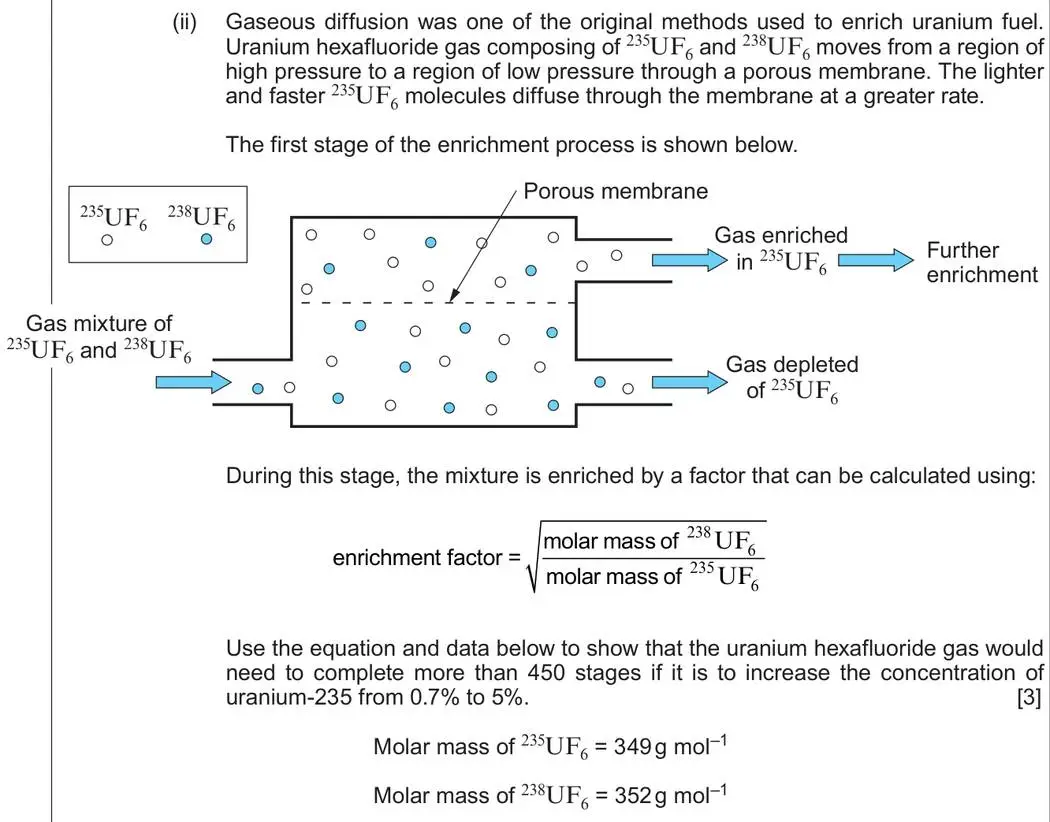
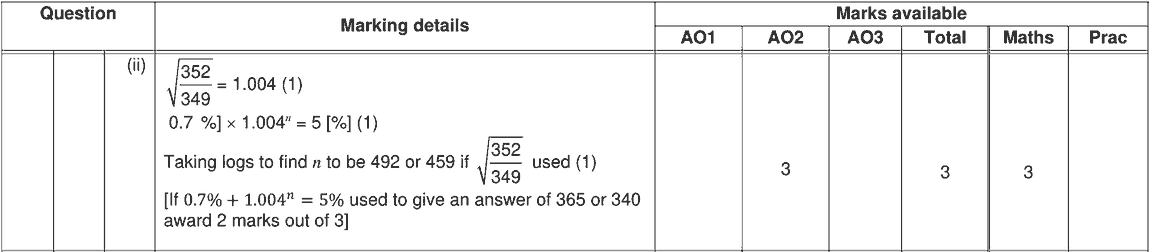
(ii) Gaseous diffusion was one of the original methods used to enrich uranium fuel. Uranium hexafluoride gas composing of 235UF6 and 238UF6 moves from a region of high pressure to a region of low pressure through a porous membrane. The lighter and faster 235UF6 molecules diffuse through the membrane at a greater rate. The first stage of the enrichment process is shown below. Porous membrane 235UF6 238UF6 Gas enriched Further in 235UF6 enrichment Gas mixture of 235UF6 and 238UF6 Gas depleted of 235UF6 During this stage, the mixture is enriched by a factor that can be calculated using: molar mass of 238UF6 enrichment factor = molar mass of 235UF6 Use the equation and data below to show that the uranium hexafluoride gas would need to complete more than 450 stages if it is to increase the concentration of uranium-235 from 0.7% to 5%. [3] Molar mass of 235UF6 = 349 g mol–1 Molar mass of 238UF6 = 352 g mol–1
June 2019 · Component 3 · Q14(c)(iii) 1 mark AO1=1 Short answer energy and the environment
Earlier parts of question 14 that this part usesEarlier part of June 2019 Component 3 question 14Earlier part of June 2019 Component 3 question 14Earlier part of June 2019 Component 3 question 14Earlier part of June 2019 Component 3 question 14
(iii) State an alternative method for the enrichment of uranium. [1]
June 2019 · Component 3 · Q14(d)(i) 2 marks AO1=2 Explanation energy and the environment
Earlier parts of question 14 that this part usesEarlier part of June 2019 Component 3 question 14Earlier part of June 2019 Component 3 question 14Earlier part of June 2019 Component 3 question 14
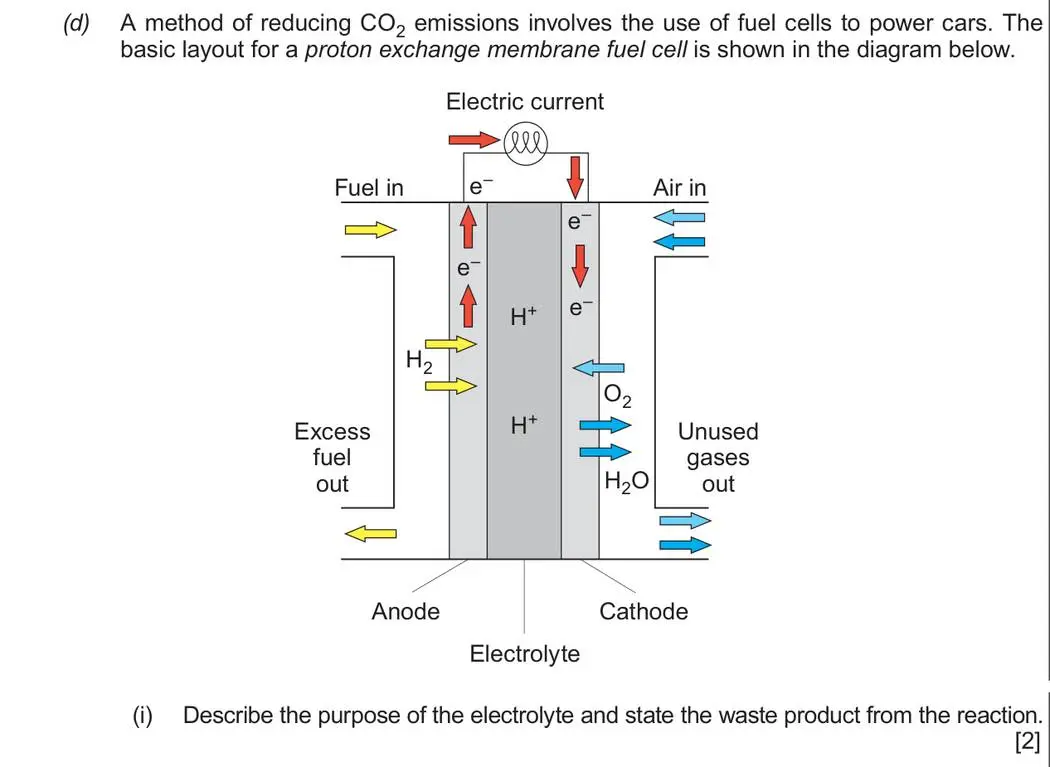
(d) A method of reducing CO2 emissions involves the use of fuel cells to power cars. The basic layout for a proton exchange membrane fuel cell is shown in the diagram below. Electric current Fuel in e– Air in e– e– e– H+ H2 O2 H+ Excess Unused fuel gases out H2O out Anode Cathode Electrolyte (i) Describe the purpose of the electrolyte and state the waste product from the reaction. [2]
June 2019 · Component 3 · Q14(d)(ii) 2 marks AO3=2 Explanation energy and the environment
Earlier parts of question 14 that this part usesEarlier part of June 2019 Component 3 question 14Earlier part of June 2019 Component 3 question 14Earlier part of June 2019 Component 3 question 14Earlier part of June 2019 Component 3 question 14
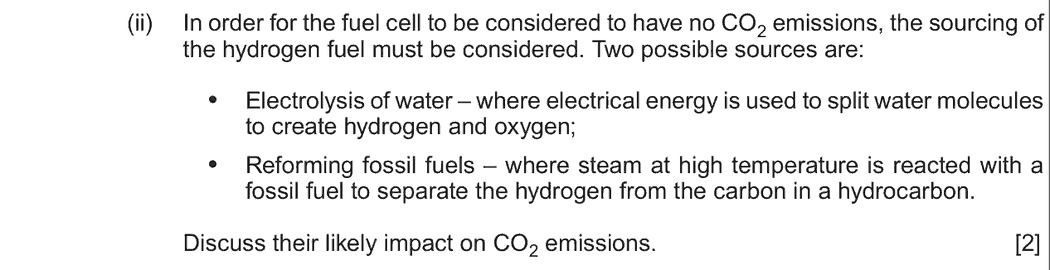
(ii) In order for the fuel cell to be considered to have no CO2 emissions, the sourcing of the hydrogen fuel must be considered. Two possible sources are: • Electrolysis of water – where electrical energy is used to split water molecules to create hydrogen and oxygen; • Reforming fossil fuels – where steam at high temperature is reacted with a fossil fuel to separate the hydrogen from the carbon in a hydrocarbon. Discuss their likely impact on CO2 emissions. [2]

Work with an Eduqas physics tutor

Want a paper marked and gone through with you? Message us.

Prefer email? Send an enquiry

If you are under 18, please include a parent's contact details. Enquiries go to enquiries@physicsaleveltutor.com and are deleted once handled. All tutoring is online.