Examiner's comment
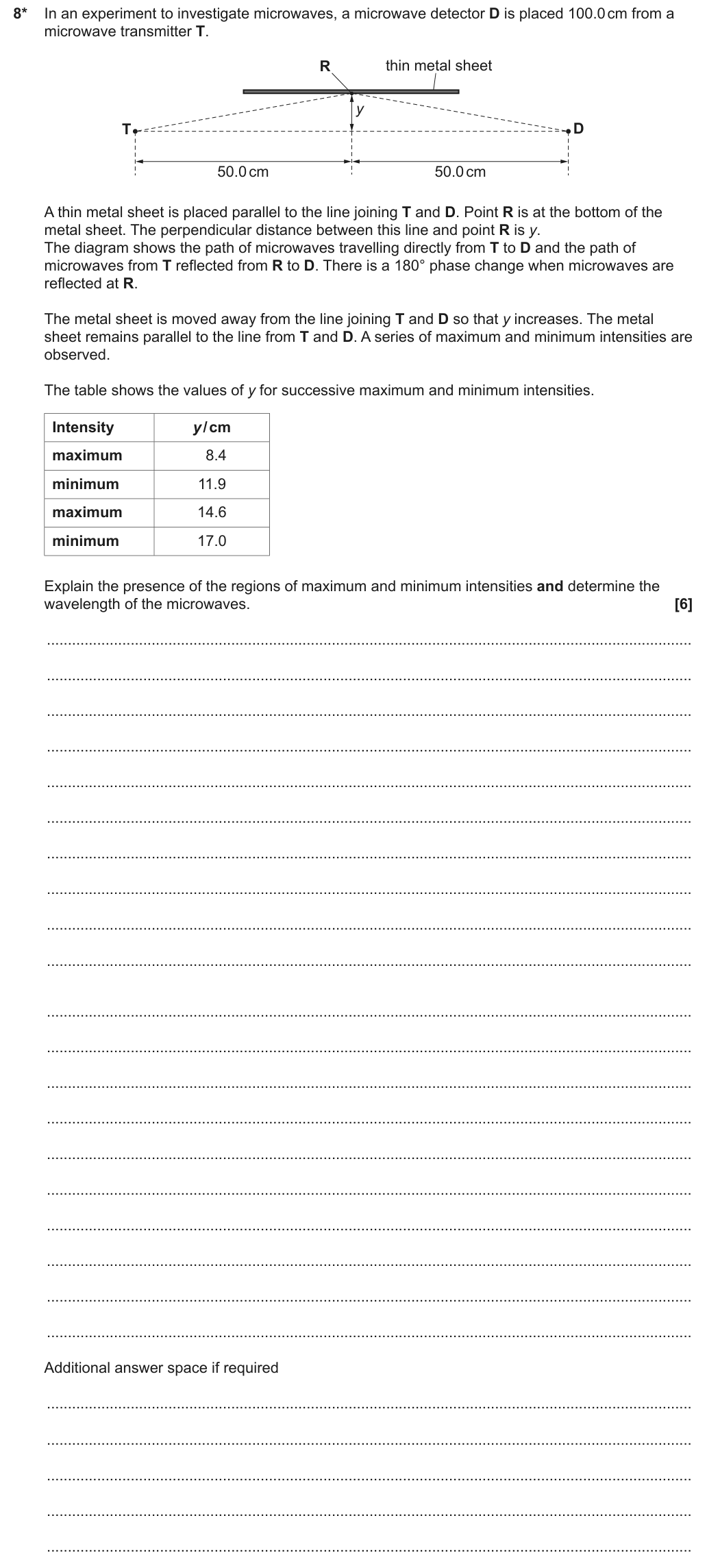
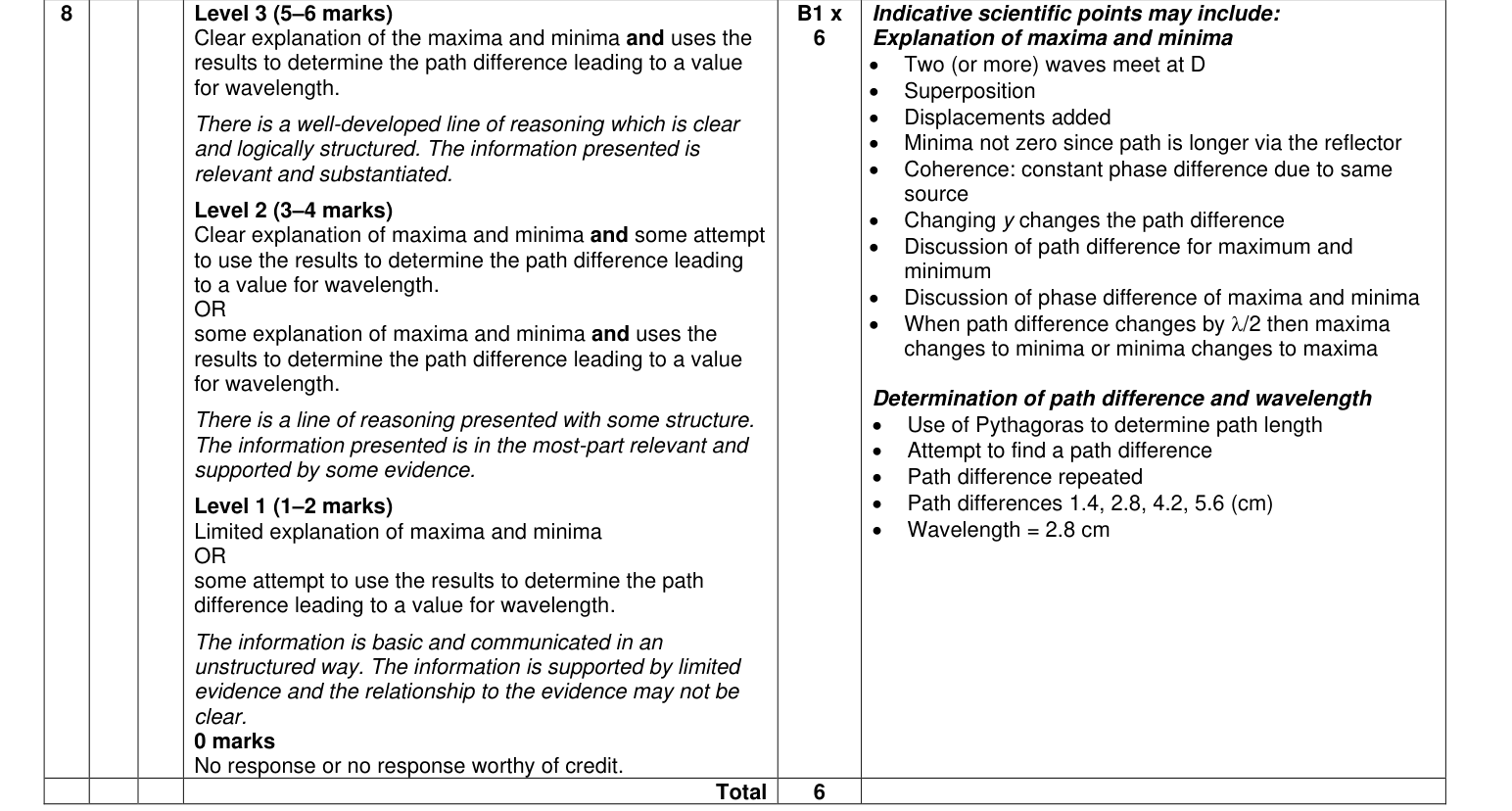
To answer this question well, candidates needed to explain why there were maxima and minima. Many correctly explained the different paths but some were confused between phase difference and path difference. A significant number of candidates incorrectly discussed standing waves or two source interference. Most successful candidates clearly used the data correctly using Pythagoras to work out path differences and they realised that the difference between the two maxima or the two minima was the wavelength, however other candidates often just stated 14.6 – 8.4 was the wavelength or 11.9 – 8.4 x 2 was the wavelength. This candidate scored full marks – the scientific content of the response meets the Level 3 descriptor, and the communication statement is also met so six marks. The candidate structures the response by initially describing the experimental arrangement. There is appropriate scientific detail explaining how waves arrive at D. Importantly the candidate states that the resultant displacement is equal to the sum of the displacements of the individual waves. Although the phase change has not been discussed, there is a sensible discussion of path difference using the data given. Towards the end of the response the candidate clearly demonstrates how the wavelength of the microwaves may be calculated using Pythagoras calculations of the path difference and relating the path difference to the wavelength. If any of your students’ results are not as expected, you may wish to consider one of our post-results services. For full information about the options available visit the OCR website. We send a weekly roundup to tell you about important updates. You can also sign up for your subject specific updates. If you haven’t already, sign up here. Attend one of our popular CPD courses to hear directly from a senior assessor or drop in to a Q&A session. Most of our courses are delivered live via an online platform, so you can attend from any location. Please find details for all our courses on the relevant subject page on our website or visit OCR professional development. ExamBuilder is the question builder platform for a range of our GCSE, A Level, Cambridge Nationals and Cambridge Technicals qualifications. Find out more. ExamBuilder is free for all OCR centres with an Interchange account and gives you unlimited users per centre. We need an Interchange username to validate the identity of your centre's first user account for ExamBuilder. If you do not have an Interchange account please contact your centre administrator (usually the Exams Officer) to request a username, or nominate an existing Interchange user in your department. Review students' exam performance with our free online results analysis tool. It is available for all GCSEs, AS and A Levels and Cambridge Nationals. It allows you to: • review and run analysis reports on exam performance • analyse results at question and/or topic level • compare your centre with OCR national averages • identify trends across the centre • facilitate effective planning and delivery of courses • identify areas of the curriculum where students excel or struggle • help pinpoint strengths and weaknesses of students and teaching departments. Find out more. Post-results services Keep up-to-date OCR Professional Development Signed up for ExamBuilder?