
June 2016: AS Paper 2

70 marks · 52 question parts · Paper, mark scheme and report on AQA's site · Have the data and formulae booklet beside you

Question by question

QTopicMarksAOType
1.1 Materials, stress, strain and the Young modulus, Measurements, units and uncertainties 1Practical and data analysis
1.2 Materials, stress, strain and the Young modulus 1Practical and data analysis
1.3 Measurements, units and uncertainties 1Practical and data analysis
1.4 Materials, stress, strain and the Young modulus 4Practical and data analysis
1.5 Measurements, units and uncertainties 4Practical and data analysis
2.1 Measurements, units and uncertainties 1Practical and data analysis
2.2 Measurements, units and uncertainties 1Practical and data analysis
2.3 Measurements, units and uncertainties 1Practical and data analysis
2.4 Measurements, units and uncertainties, Motion along a straight line and projectile motion 1Practical and data analysis
2.5 Measurements, units and uncertainties 2Practical and data analysis
2.6 Current, potential difference, I-V characteristics and resistivity, Measurements, units and uncertainties 1Practical and data analysis
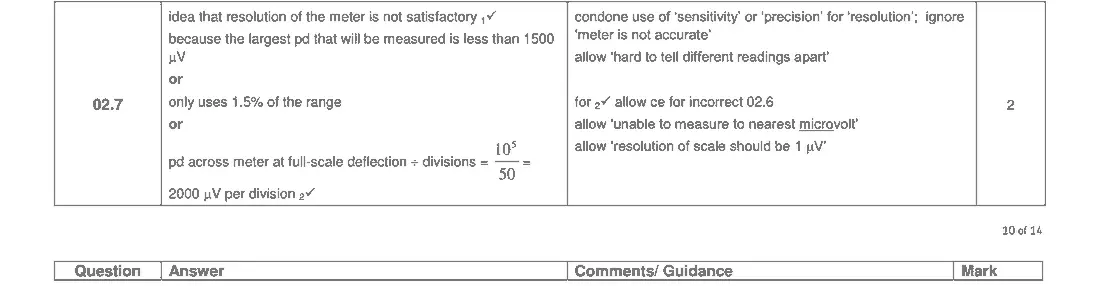
2.7 Measurements, units and uncertainties 2Practical and data analysis
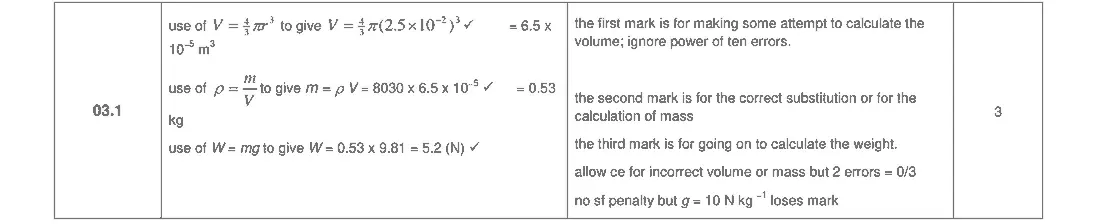
3.1 Materials, stress, strain and the Young modulus 3Show that
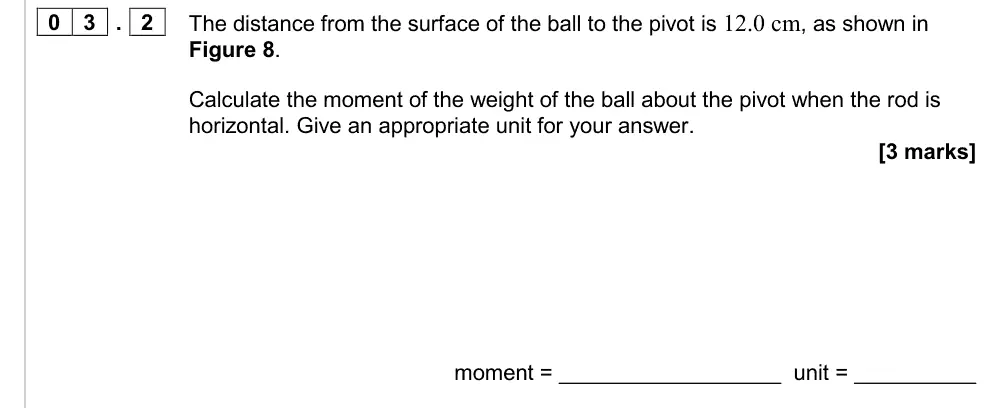
3.2 Scalars, vectors and moments 3Calculation
3.3 Scalars, vectors and moments, Materials, stress, strain and the Young modulus 3Calculation
3.4 Newton's laws of motion and momentum 2Explanation
4.1 Atomic structure and stable nuclei 2Short answer
4.2 Work, energy, power and conservation of energy 1Calculation
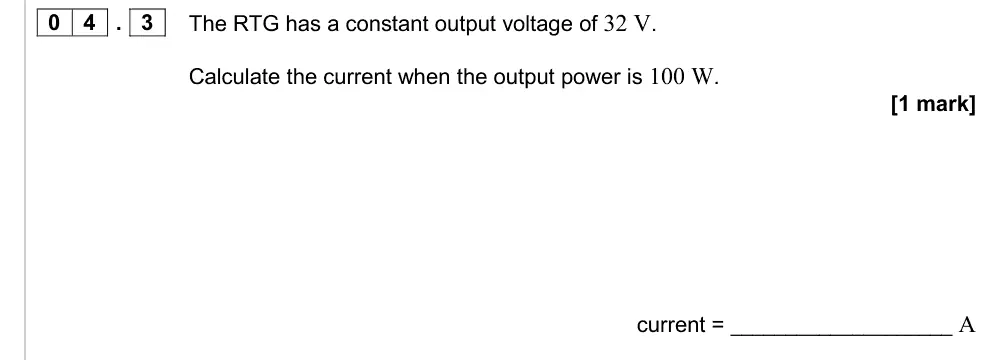
4.3 Circuits and potential dividers 1Calculation
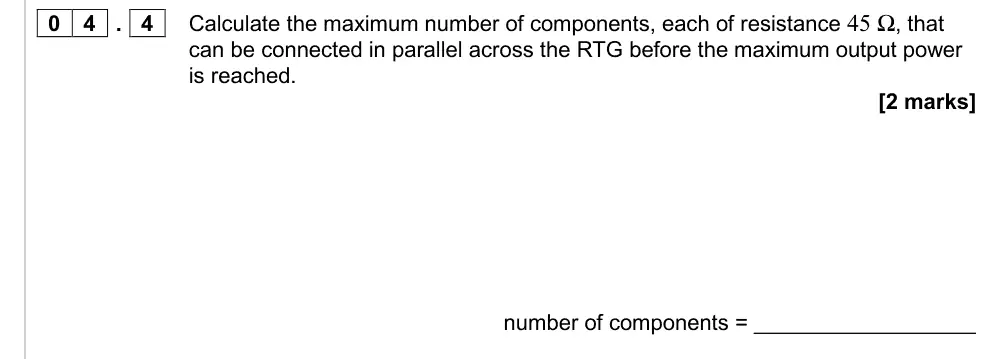
4.4 Circuits and potential dividers 2Calculation
4.5 Work, energy, power and conservation of energy, Measurements, units and uncertainties 2Calculation
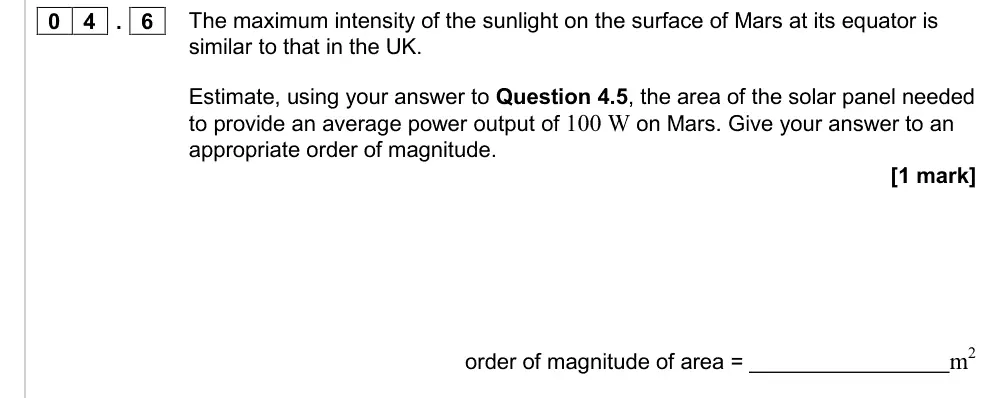
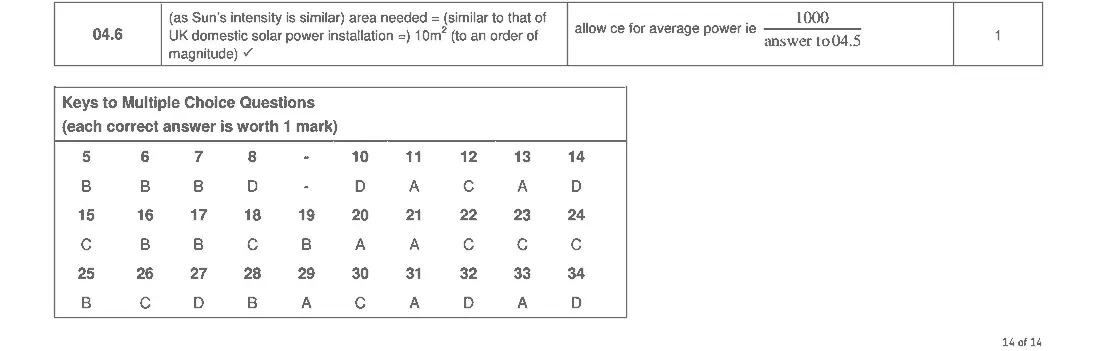
4.6 Measurements, units and uncertainties 1Short answer
5 Atomic structure and stable nuclei 1Multiple choice
6 Particles, antiparticles and particle interactions 1Multiple choice
7 Classification of particles, quarks and conservation laws 1Multiple choice
8 Classification of particles, quarks and conservation laws 1Multiple choice
9 Classification of particles, quarks and conservation laws 1Multiple choice
10 Excitation, energy levels and wave-particle duality 1Multiple choice
11 Excitation, energy levels and wave-particle duality 1Multiple choice
12 Progressive waves, longitudinal and transverse waves 1Multiple choice
13 Superposition and stationary waves 1Multiple choice
14 Interference, diffraction and the diffraction grating 1Multiple choice
15 Interference, diffraction and the diffraction grating 1Multiple choice
16 Refraction, total internal reflection and optical fibres 1Multiple choice
17 Refraction, total internal reflection and optical fibres 1Multiple choice
18 Scalars, vectors and moments 1Multiple choice
19 Motion along a straight line and projectile motion 1Multiple choice
20 Motion along a straight line and projectile motion 1Multiple choice
21 Motion along a straight line and projectile motion 1Multiple choice
22 Motion along a straight line and projectile motion, Newton's laws of motion and momentum 1Multiple choice
23 Newton's laws of motion and momentum 1Multiple choice
24 Work, energy, power and conservation of energy 1Multiple choice
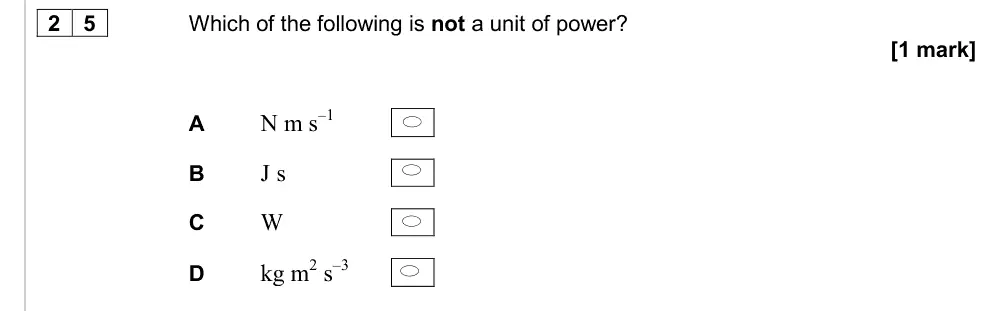
25 Work, energy, power and conservation of energy, Measurements, units and uncertainties 1Multiple choice
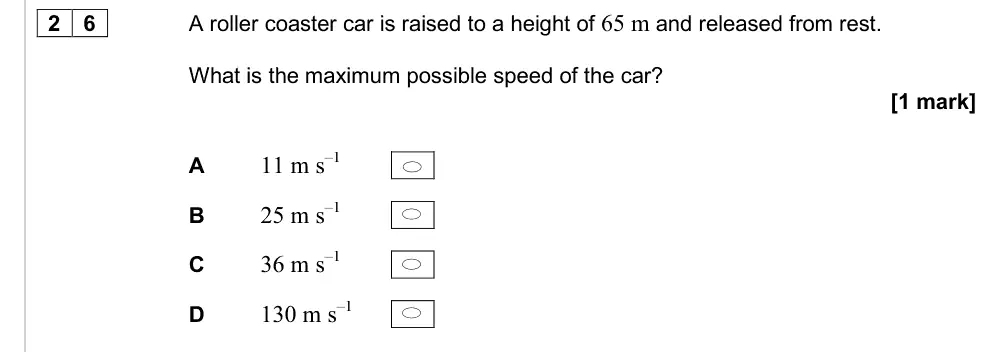
26 Work, energy, power and conservation of energy 1Multiple choice
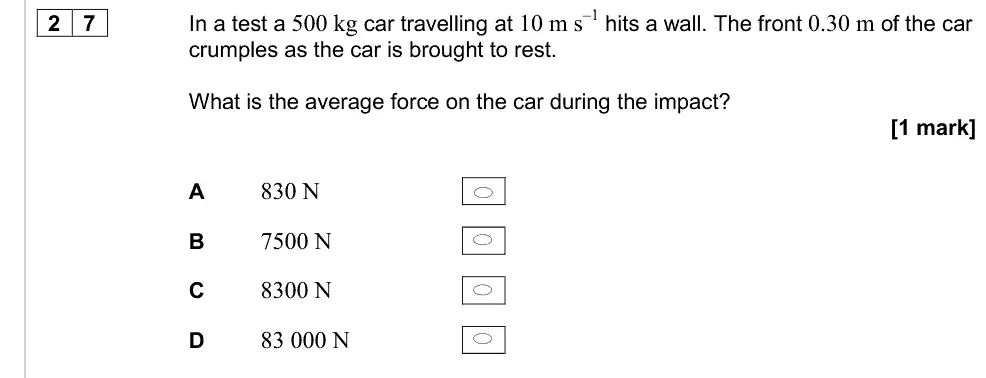
27 Work, energy, power and conservation of energy 1Multiple choice
28 Current, potential difference, I-V characteristics and resistivity 1Multiple choice
29 Current, potential difference, I-V characteristics and resistivity 1Multiple choice
30 Current, potential difference, I-V characteristics and resistivity, Circuits and potential dividers 1Multiple choice
31 Circuits and potential dividers, Current, potential difference, I-V characteristics and resistivity 1Multiple choice
32 Circuits and potential dividers 1Multiple choice
33 Electromotive force and internal resistance 1Multiple choice
34 Electromotive force and internal resistance 1Multiple choice

The questions

1.11.21.31.41.52.12.22.32.42.52.62.73.13.23.33.44.14.24.34.44.54.65678910111213141516171819202122232425262728293031323334
June 2016 · AS Paper 2 · Q1.1 1 mark Practical and data analysis materials and young modulusmeasurements and uncertainties
This question is about the determination of the Young modulus of the metal
of a wire.
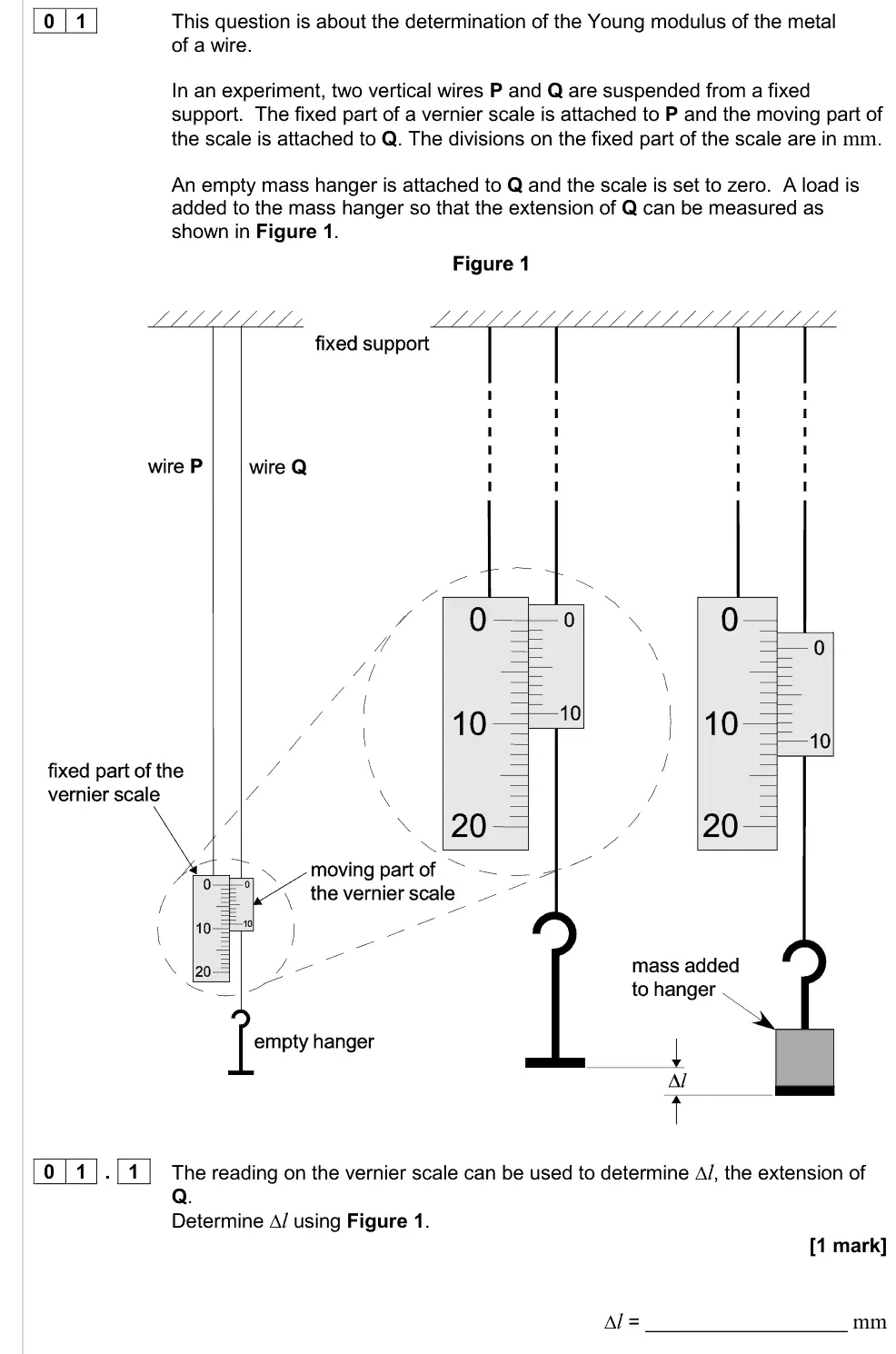
In an experiment, two vertical wires P and Q are suspended from a fixed
support.  The fixed part of a vernier scale is attached to P and the moving part of
the scale is attached to Q. The divisions on the fixed part of the scale are in mm.
An empty mass hanger is attached to Q and the scale is set to zero.  A load is
added to the mass hanger so that the extension of Q can be measured as
shown in Figure 1.
The reading on the vernier scale can be used to determine ∆l, the extension of
Q.
Determine ∆l using Figure 1.
[1 mark]
∆l =  mm
June 2016 · AS Paper 2 · Q1.2 1 mark Practical and data analysis materials and young modulus
Earlier part of question 1 that this part usesEarlier part of June 2016 Paper 2 question 1
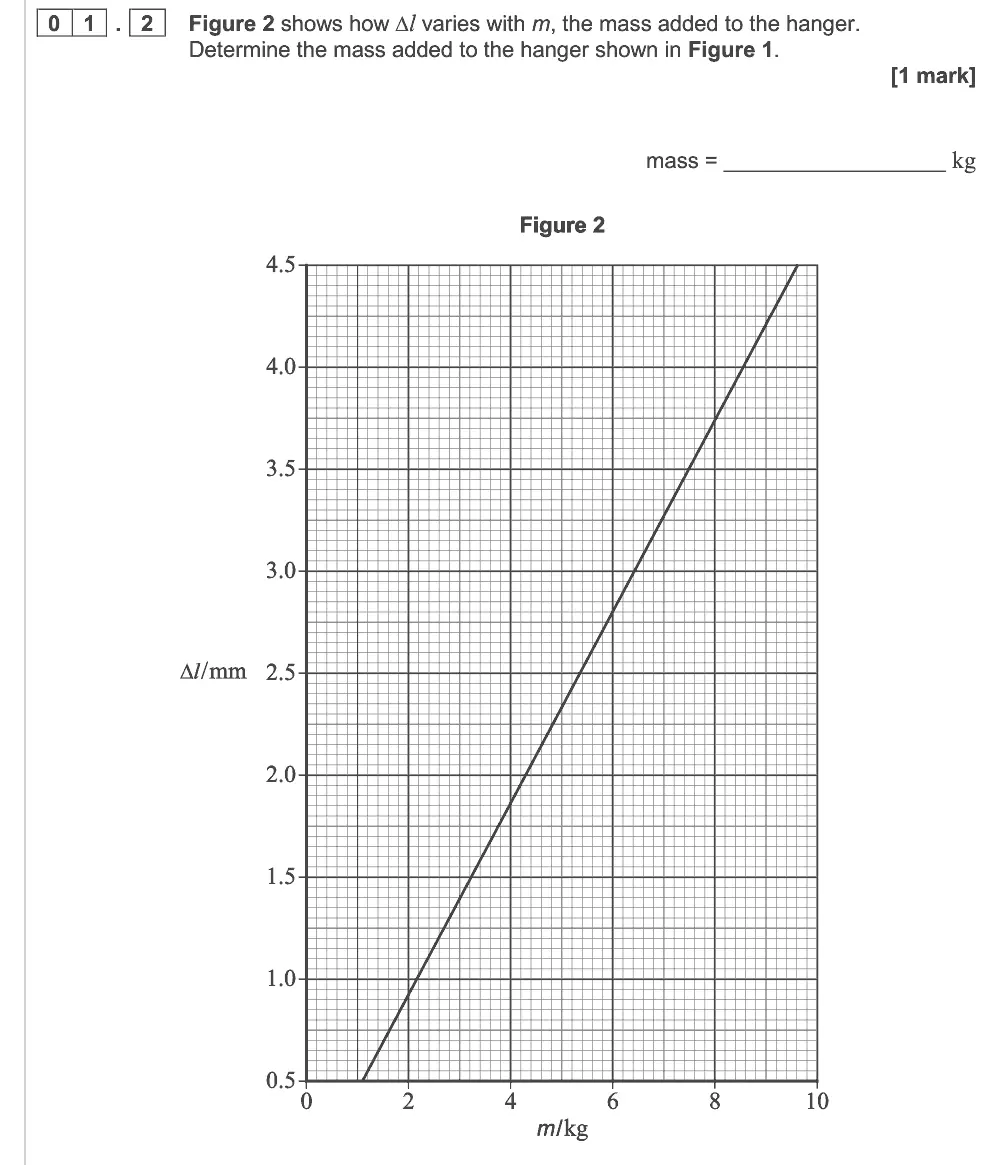
Figure 2 shows how ∆l varies with m, the mass added to the hanger.
Determine the mass added to the hanger shown in Figure 1.
[1 mark]
mass =  kg
June 2016 · AS Paper 2 · Q1.3 1 mark Practical and data analysis measurements and uncertainties
Earlier part of question 1 that this part usesEarlier part of June 2016 Paper 2 question 1
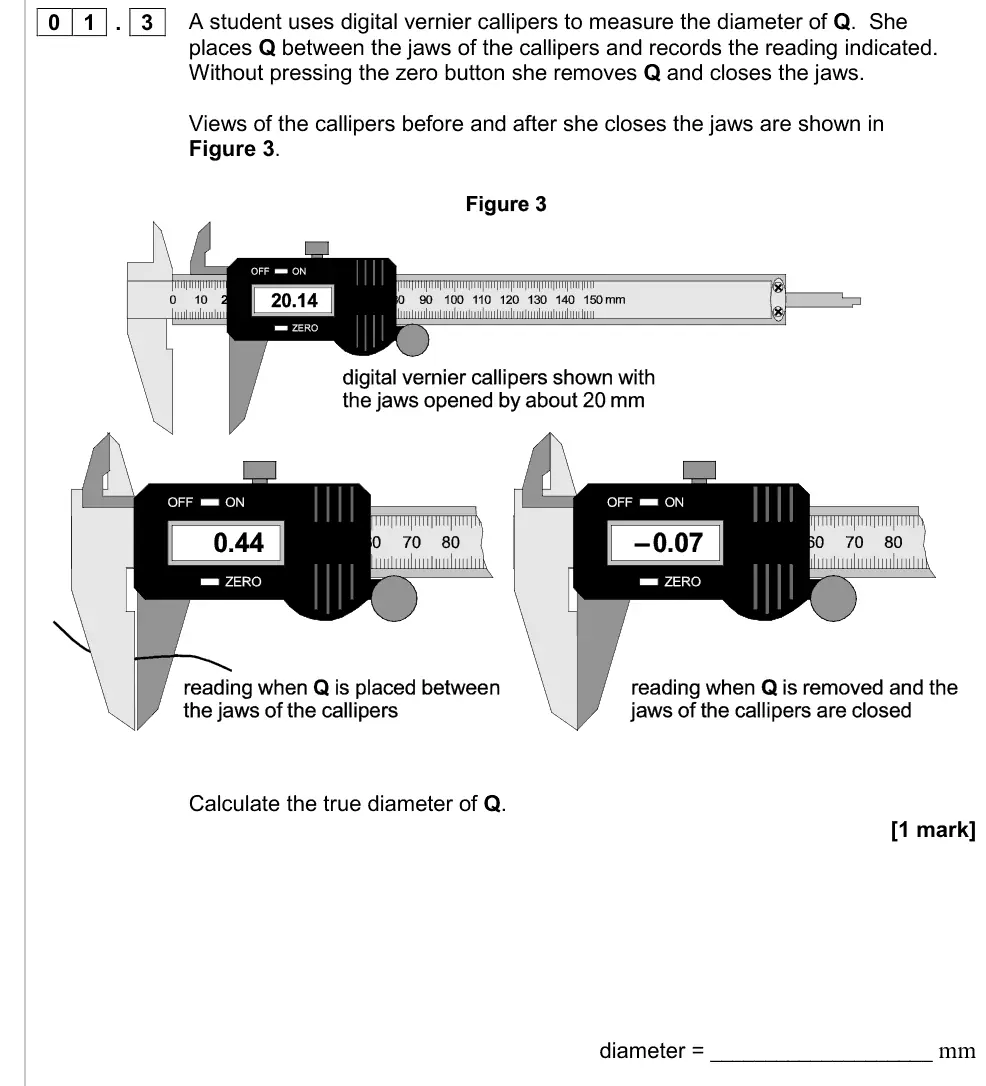
A student uses digital vernier callipers to measure the diameter of Q.  She
places Q between the jaws of the callipers and records the reading indicated.
Without pressing the zero button she removes Q and closes the jaws.
Views of the callipers before and after she closes the jaws are shown in
Figure 3.
Calculate the true diameter of Q.
[1 mark]
diameter =  mm
June 2016 · AS Paper 2 · Q1.4 4 marks Practical and data analysis materials and young modulus
Earlier part of question 1 that this part usesEarlier part of June 2016 Paper 2 question 1
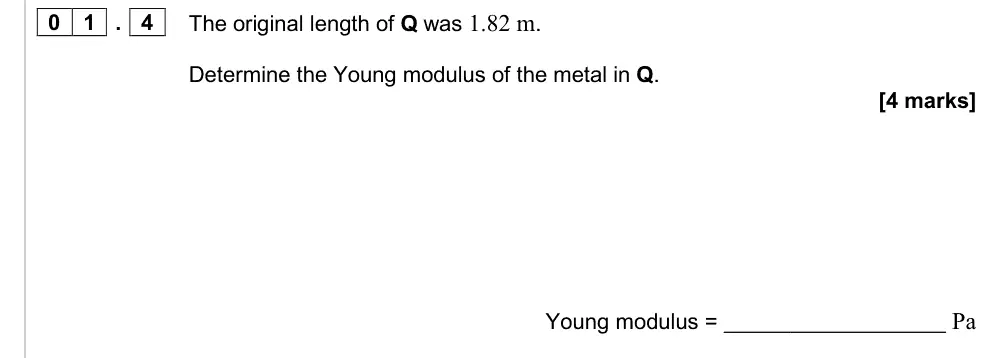
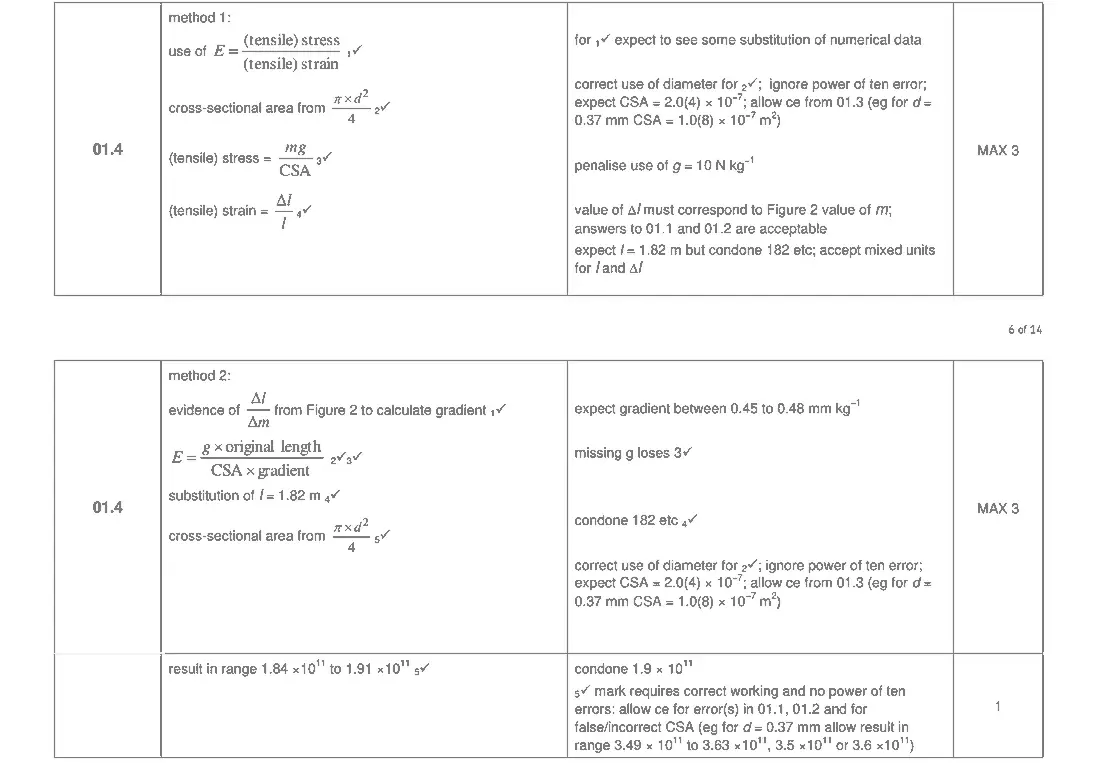
The original length of Q was 1.82 m.
Determine the Young modulus of the metal in Q.
[4 marks]
Young modulus =  Pa
June 2016 · AS Paper 2 · Q1.5 4 marks Practical and data analysis measurements and uncertainties
Earlier part of question 1 that this part usesEarlier part of June 2016 Paper 2 question 1
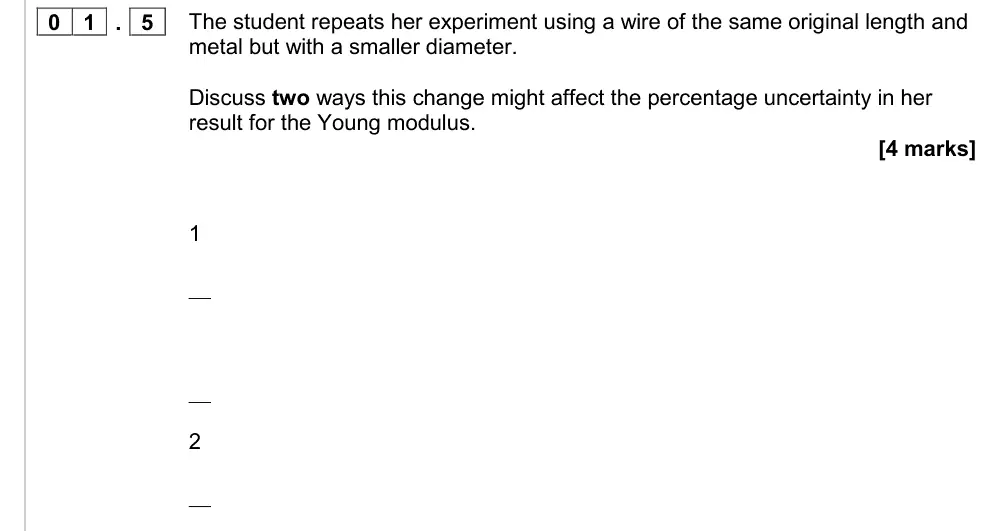
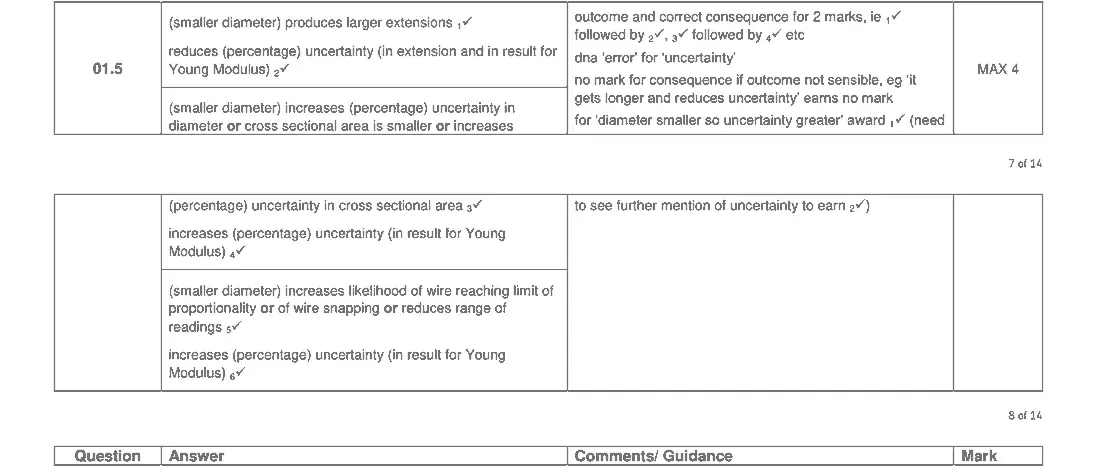
The student repeats her experiment using a wire of the same original length and
metal but with a smaller diameter.
Discuss two ways this change might affect the percentage uncertainty in her
result for the Young modulus.
[4 marks]
1
2
June 2016 · AS Paper 2 · Q2.1 1 mark Practical and data analysis measurements and uncertainties
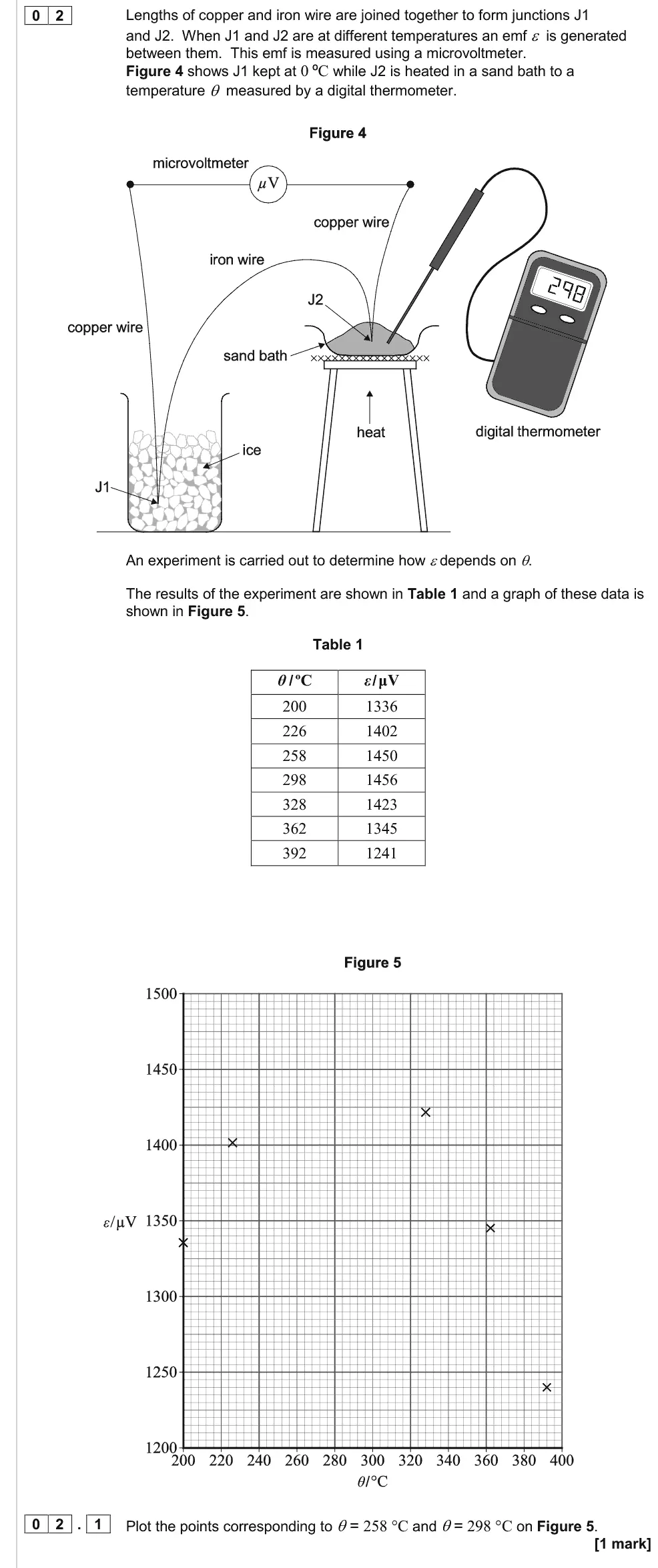
Lengths of copper and iron wire are joined together to form junctions J1
and J2.  When J1 and J2 are at different temperatures an emf ε  is generated
between them.  This emf is measured using a microvoltmeter.
Figure 4 shows J1 kept at 0 ºC while J2 is heated in a sand bath to a
temperature θ  measured by a digital thermometer.
An experiment is carried out to determine how ε depends on θ.
The results of the experiment are shown in Table 1 and a graph of these data is
shown in Figure 5.
Table 1
θ  / ºC
ε / μV
200
1336
226
1402
258
1450
298
1456
328
1423
362
1345
392
1241
Plot the points corresponding to θ = 258 °C and θ = 298 °C on Figure 5.
[1 mark]
June 2016 · AS Paper 2 · Q2.2 1 mark Practical and data analysis measurements and uncertainties
Earlier part of question 2 that this part usesEarlier part of June 2016 Paper 2 question 2
Draw a suitable best fit line on Figure 5.
[1 mark]
June 2016 · AS Paper 2 · Q2.3 1 mark Practical and data analysis measurements and uncertainties
Earlier part of question 2 that this part usesEarlier part of June 2016 Paper 2 question 2
Determine the maximum value of ε.
[1 mark]
maximum value of ε =  µV
June 2016 · AS Paper 2 · Q2.4 1 mark Practical and data analysis measurements and uncertaintiesmotion and projectiles
Earlier part of question 2 that this part usesEarlier part of June 2016 Paper 2 question 2
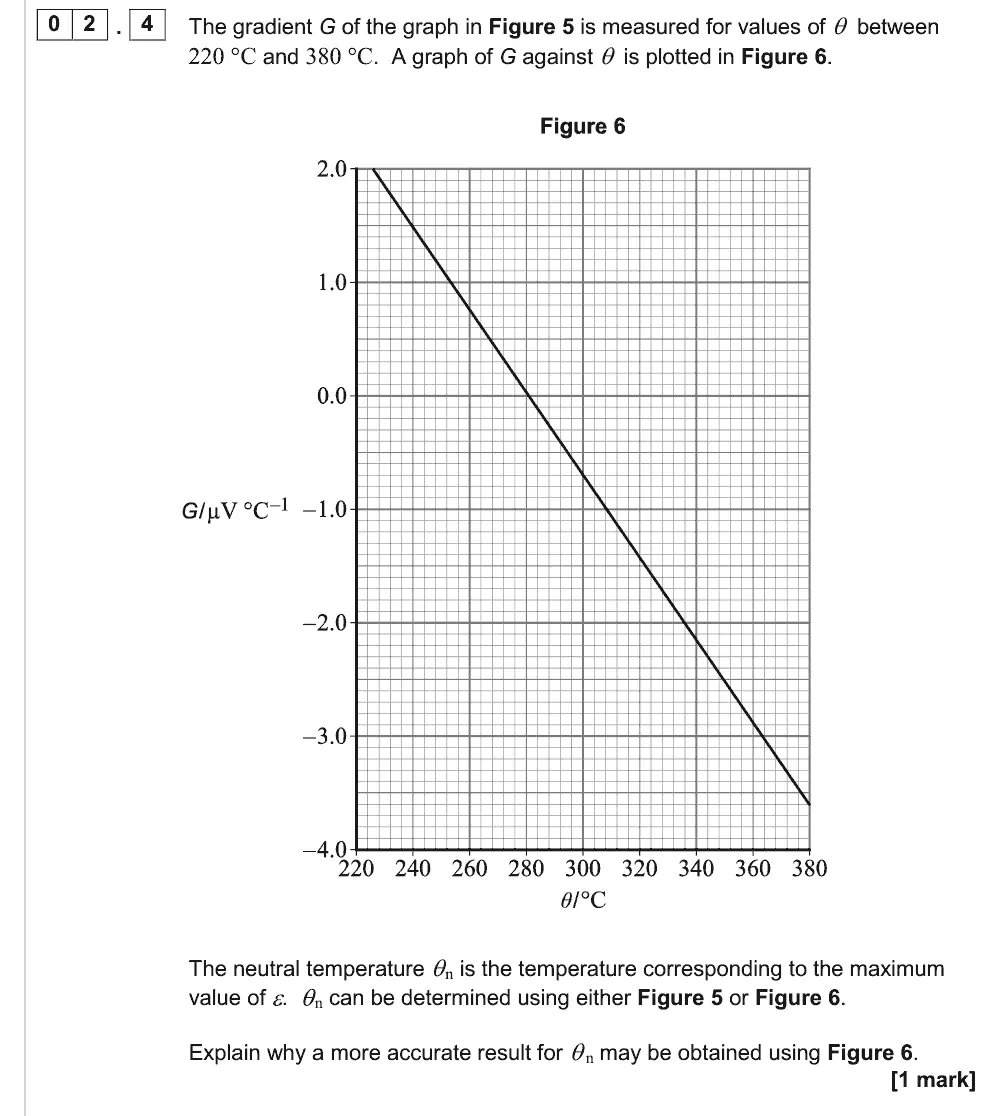
The gradient G of the graph in Figure 5 is measured for values of θ  between
220 °C and 380 °C.  A graph of G against θ  is plotted in Figure 6.
The neutral temperature θ  n is the temperature corresponding to the maximum
value of ε.  θ  n can be determined using either Figure 5 or Figure 6.
Explain why a more accurate result for θ n may be obtained using Figure 6.
[1 mark]
June 2016 · AS Paper 2 · Q2.5 2 marks Practical and data analysis measurements and uncertainties
Earlier part of question 2 that this part usesEarlier part of June 2016 Paper 2 question 2
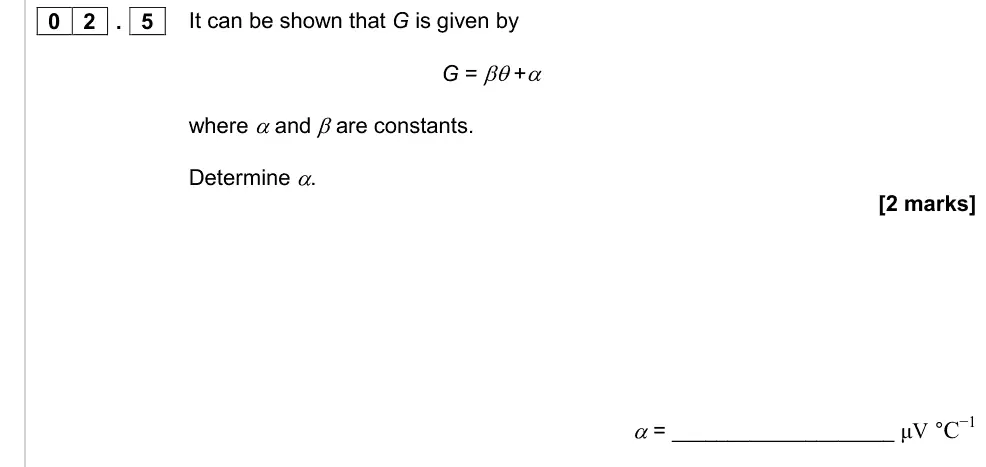
It can be shown that G is given by
G = βθ +α
where α and β are constants.
Determine α.
[2 marks]
α =  μV °C−1
June 2016 · AS Paper 2 · Q2.6 1 mark Practical and data analysis current voltage and resistivitymeasurements and uncertainties
Earlier part of question 2 that this part usesEarlier part of June 2016 Paper 2 question 2
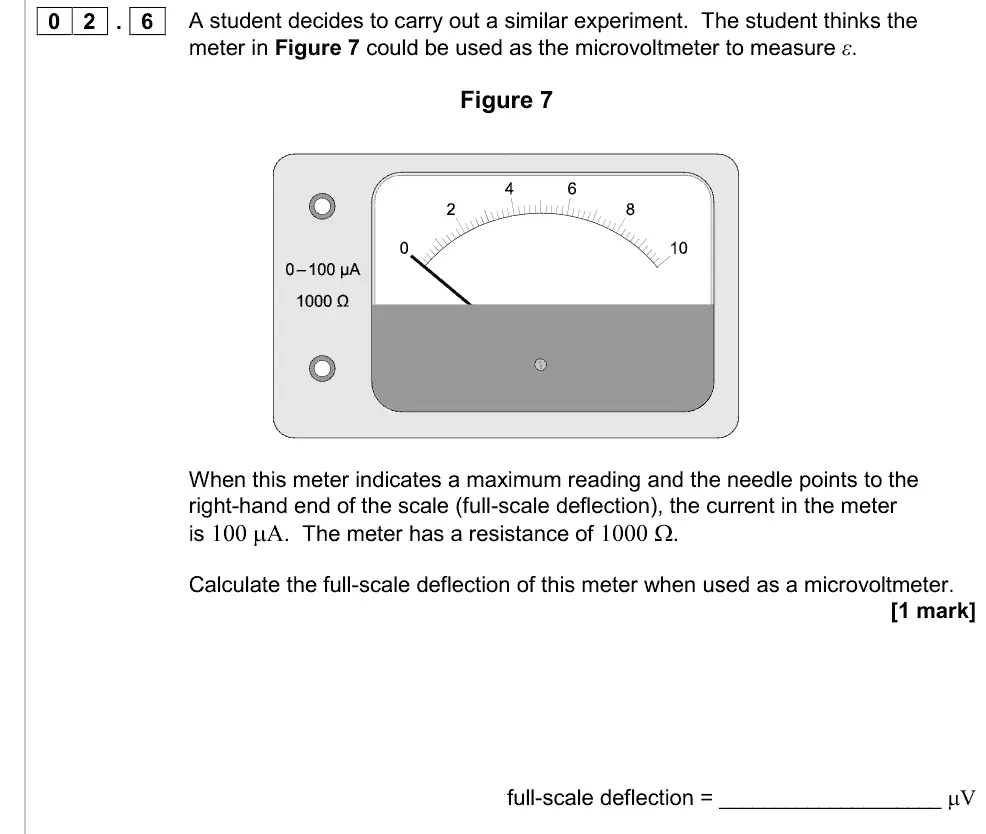
A student decides to carry out a similar experiment.  The student thinks the
meter in Figure 7 could be used as the microvoltmeter to measure ε.
Figure 7
When this meter indicates a maximum reading and the needle points to the
right-hand end of the scale (full-scale deflection), the current in the meter
is 100 µA.  The meter has a resistance of 1000 Ω.
Calculate the full-scale deflection of this meter when used as a microvoltmeter.
[1 mark]
full-scale deflection =  µV
June 2016 · AS Paper 2 · Q2.7 2 marks Practical and data analysis measurements and uncertainties
Earlier part of question 2 that this part usesEarlier part of June 2016 Paper 2 question 2
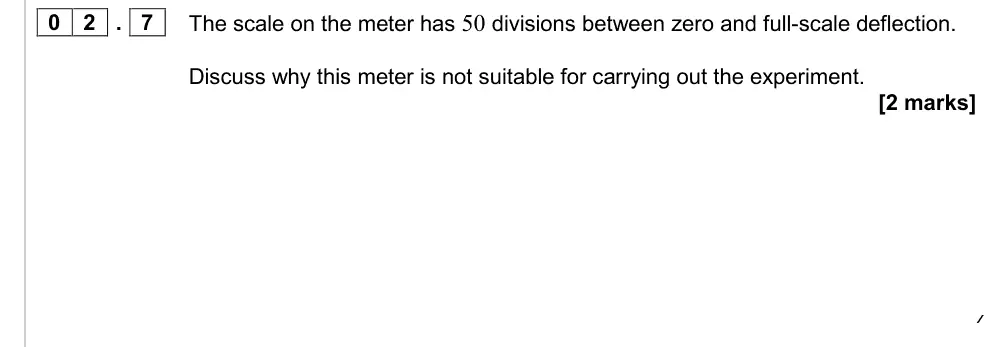
The scale on the meter has 50 divisions between zero and full-scale deflection.
Discuss why this meter is not suitable for carrying out the experiment.
[2 marks]
June 2016 · AS Paper 2 · Q3.1 3 marks Show that materials and young modulus
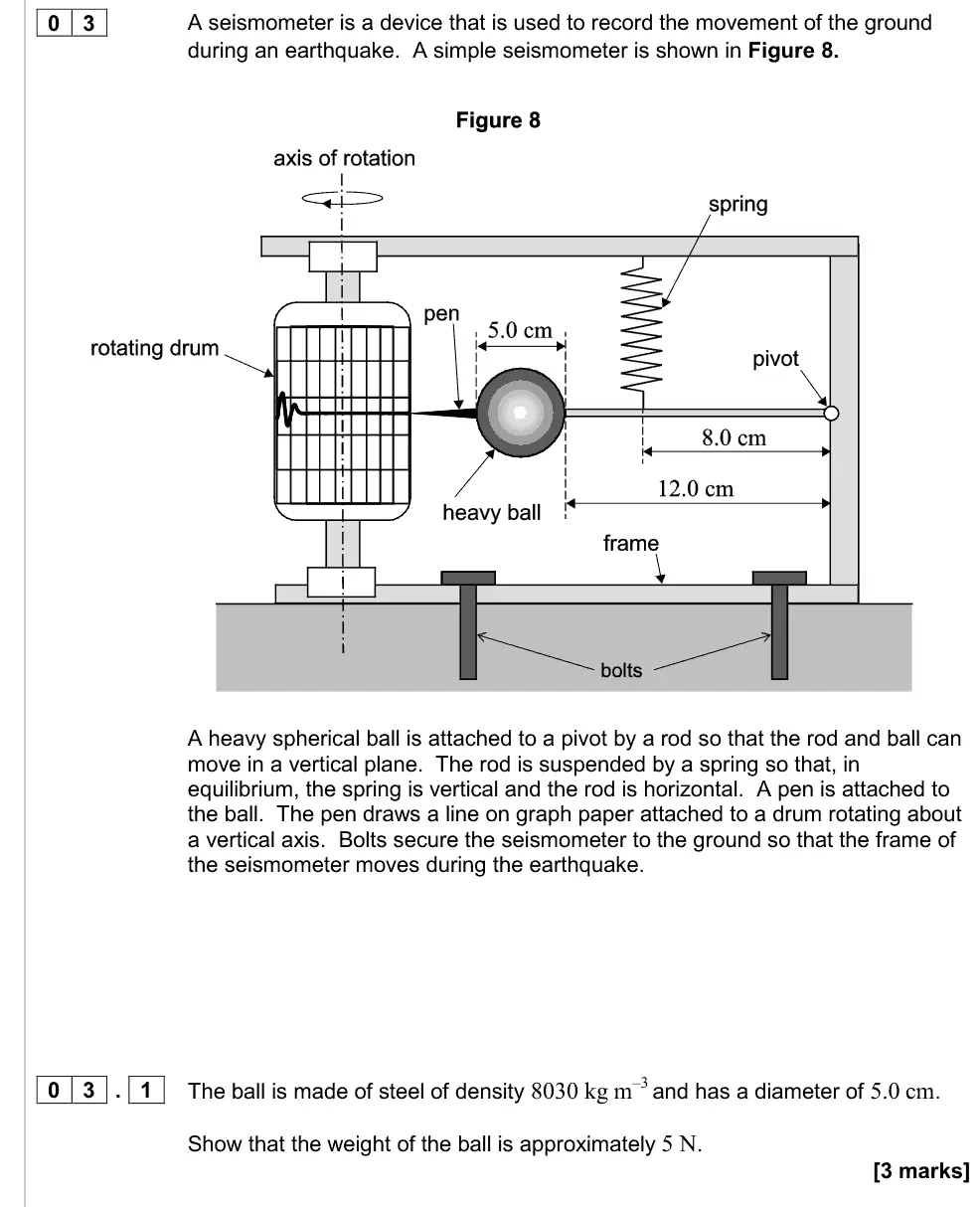
A seismometer is a device that is used to record the movement of the ground
during an earthquake.  A simple seismometer is shown in Figure 8.
A heavy spherical ball is attached to a pivot by a rod so that the rod and ball can
move in a vertical plane.  The rod is suspended by a spring so that, in
equilibrium, the spring is vertical and the rod is horizontal.  A pen is attached to
the ball.  The pen draws a line on graph paper attached to a drum rotating about
a vertical axis.  Bolts secure the seismometer to the ground so that the frame of
the seismometer moves during the earthquake.
The ball is made of steel of density 8030 kg m–3 and has a diameter of 5.0 cm.
Show that the weight of the ball is approximately 5 N.
[3 marks]
June 2016 · AS Paper 2 · Q3.2 3 marks Calculation vectors and moments
Earlier part of question 3 that this part usesEarlier part of June 2016 Paper 2 question 3
The distance from the surface of the ball to the pivot is 12.0 cm, as shown in
Figure 8.
Calculate the moment of the weight of the ball about the pivot when the rod is
horizontal. Give an appropriate unit for your answer.
[3 marks]
moment =   unit =
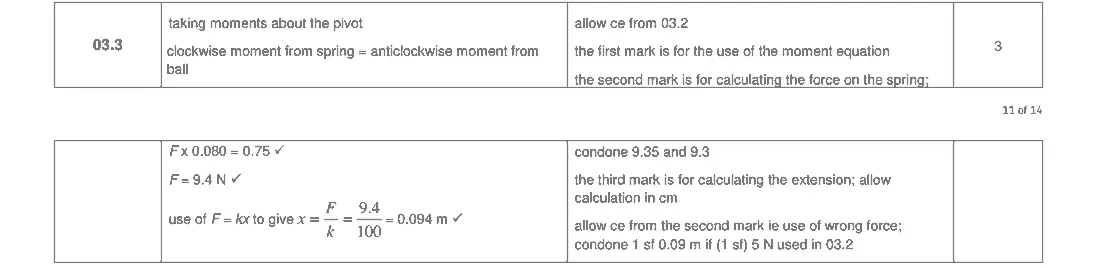
June 2016 · AS Paper 2 · Q3.3 3 marks Calculation vectors and momentsmaterials and young modulus
Earlier part of question 3 that this part usesEarlier part of June 2016 Paper 2 question 3
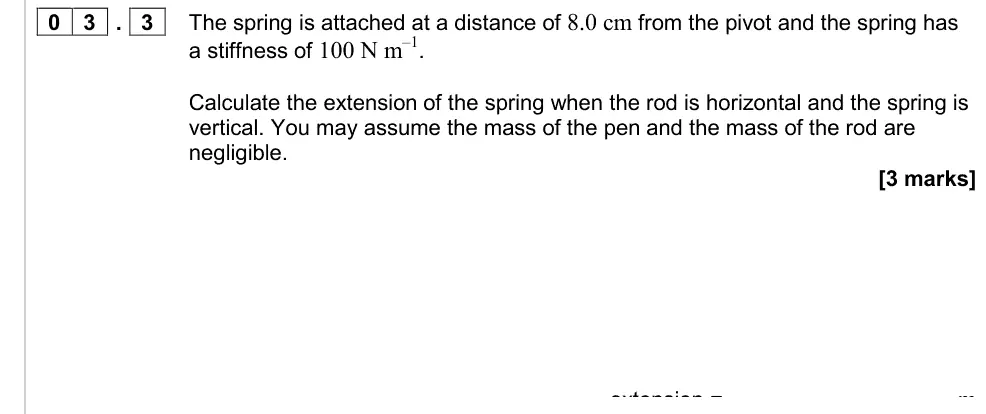
The spring is attached at a distance of 8.0 cm from the pivot and the spring has
a stiffness of 100 N m–1.
Calculate the extension of the spring when the rod is horizontal and the spring is
vertical. You may assume the mass of the pen and the mass of the rod are
negligible.
[3 marks]
extension =  m
June 2016 · AS Paper 2 · Q3.4 2 marks Explanation newtons laws and momentum
Earlier part of question 3 that this part usesEarlier part of June 2016 Paper 2 question 3
Before an earthquake occurs, the line being drawn on the graph paper is
horizontal.
Explain what happens to the line on the graph paper when an earthquake is
detected and the frame of the seismometer accelerates rapidly downwards.
[2 marks]
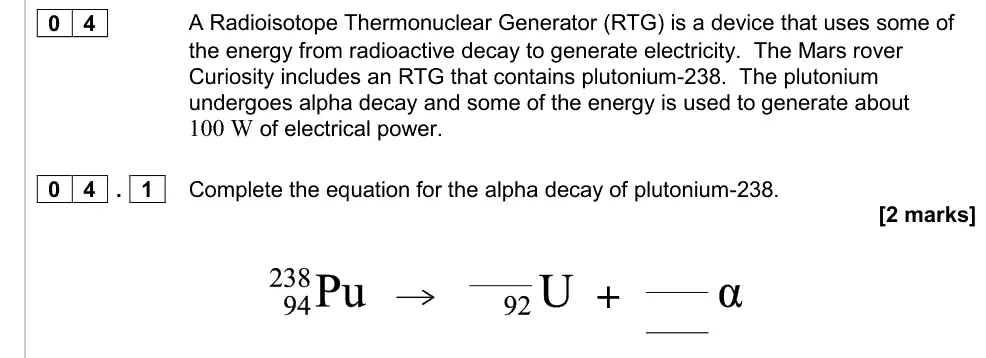
June 2016 · AS Paper 2 · Q4.1 2 marks Short answer atomic structure and stable nuclei
A Radioisotope Thermonuclear Generator (RTG) is a device that uses some of
the energy from radioactive decay to generate electricity.  The Mars rover
Curiosity includes an RTG that contains plutonium-238.  The plutonium
undergoes alpha decay and some of the energy is used to generate about
100 W of electrical power.
Complete the equation for the alpha decay of plutonium-238.
[2 marks]
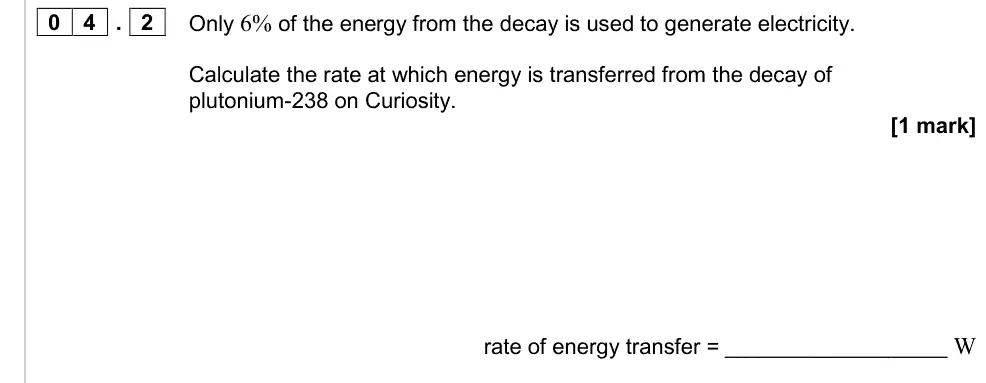
June 2016 · AS Paper 2 · Q4.2 1 mark Calculation work energy and power
Earlier part of question 4 that this part usesEarlier part of June 2016 Paper 2 question 4
Only 6% of the energy from the decay is used to generate electricity.
Calculate the rate at which energy is transferred from the decay of
plutonium-238 on Curiosity.
[1 mark]
rate of energy transfer =  W
June 2016 · AS Paper 2 · Q4.3 1 mark Calculation circuits and potential dividers
Earlier part of question 4 that this part usesEarlier part of June 2016 Paper 2 question 4
The RTG has a constant output voltage of 32 V.
Calculate the current when the output power is 100 W.
[1 mark]
current =  A
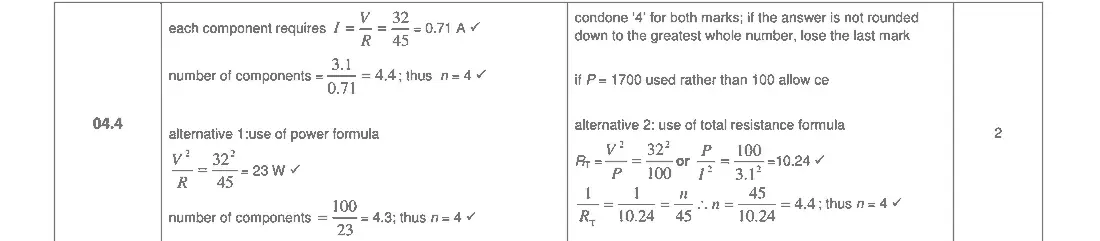
June 2016 · AS Paper 2 · Q4.4 2 marks Calculation circuits and potential dividers
Earlier part of question 4 that this part usesEarlier part of June 2016 Paper 2 question 4
Calculate the maximum number of components, each of resistance 45 Ω, that
can be connected in parallel across the RTG before the maximum output power
is reached.
[2 marks]
number of components =
June 2016 · AS Paper 2 · Q4.5 2 marks Calculation work energy and powermeasurements and uncertainties
Earlier part of question 4 that this part usesEarlier part of June 2016 Paper 2 question 4
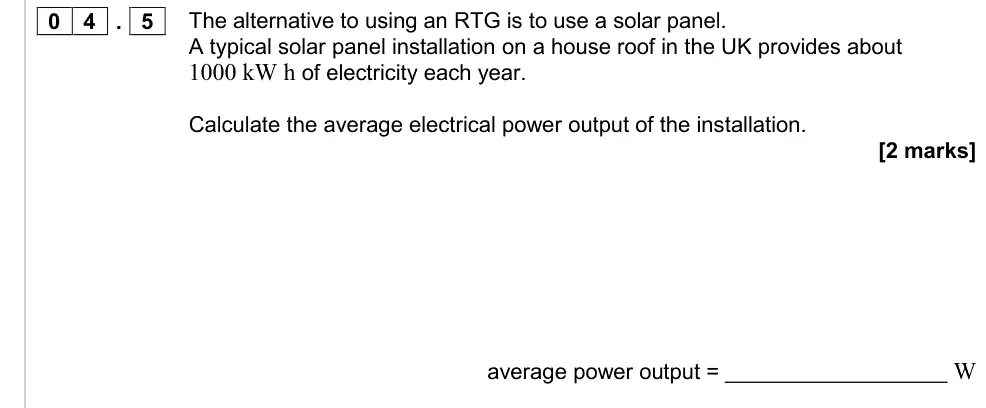
The alternative to using an RTG is to use a solar panel.
A typical solar panel installation on a house roof in the UK provides about
1000 kW h of electricity each year.
Calculate the average electrical power output of the installation.
[2 marks]
average power output =  W
June 2016 · AS Paper 2 · Q4.6 1 mark Short answer measurements and uncertainties
Earlier part of question 4 that this part usesEarlier part of June 2016 Paper 2 question 4
The maximum intensity of the sunlight on the surface of Mars at its equator is
similar to that in the UK.
Estimate, using your answer to Question 4.5, the area of the solar panel needed
to provide an average power output of 100 W on Mars. Give your answer to an
appropriate order of magnitude.
[1 mark]
order of magnitude of area = m2
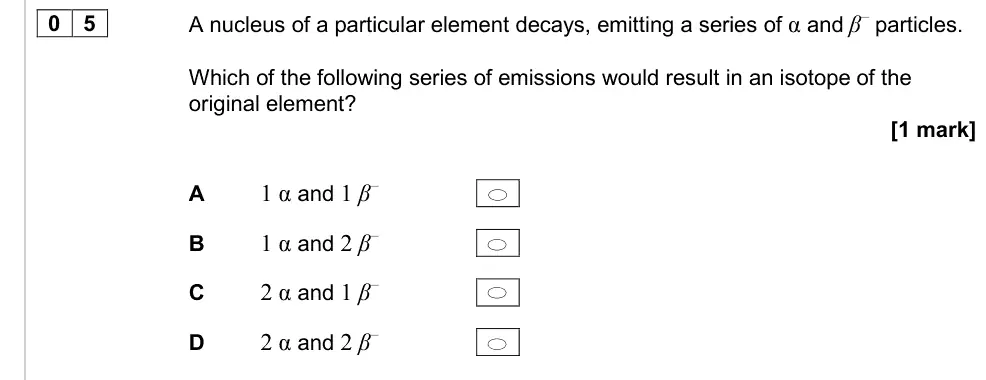
June 2016 · AS Paper 2 · Q5 1 mark Multiple choice atomic structure and stable nuclei
A nucleus of a particular element decays, emitting a series of α and β– particles.
Which of the following series of emissions would result in an isotope of the
original element?
[1 mark]
A
1 α and 1 β–
B
1 α and 2 β–
C
2 α and 1 β–
D
2 α and 2 β–
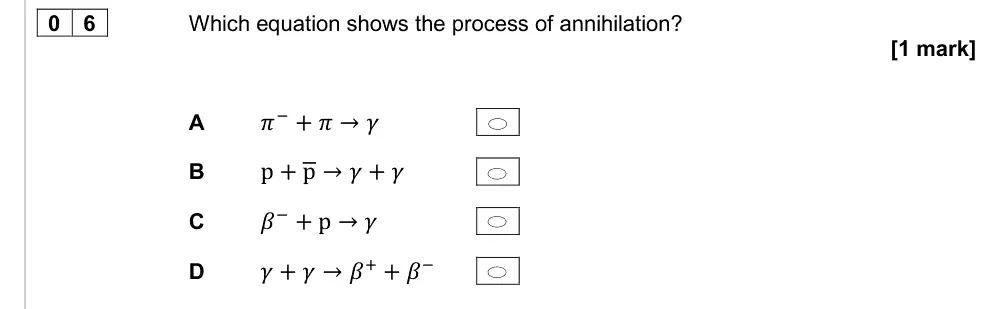
June 2016 · AS Paper 2 · Q6 1 mark Multiple choice Easy particles antiparticles and interactions
Which equation shows the process of annihilation?
[1 mark]
A
𝜋−+ 𝜋→𝛾
B
p + p →𝛾+ 𝛾
C
𝛽−+ p →𝛾
D
𝛾+ 𝛾→𝛽+ + 𝛽−
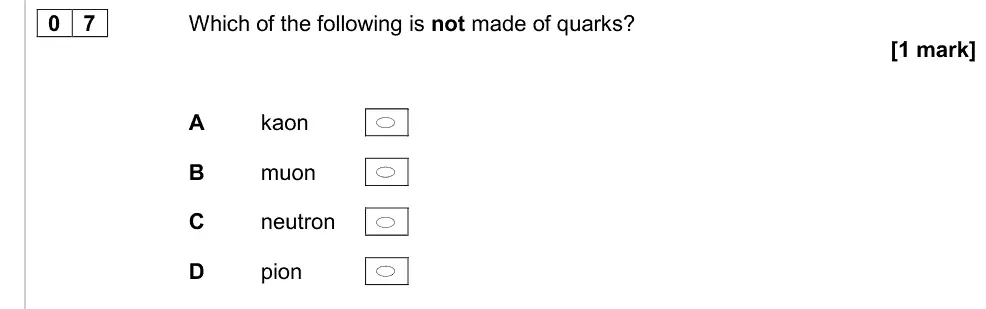
June 2016 · AS Paper 2 · Q7 1 mark Multiple choice Easy classification of particles and quarks
Which of the following is not made of quarks?
[1 mark]
A
kaon
B
muon
C
neutron
D
pion
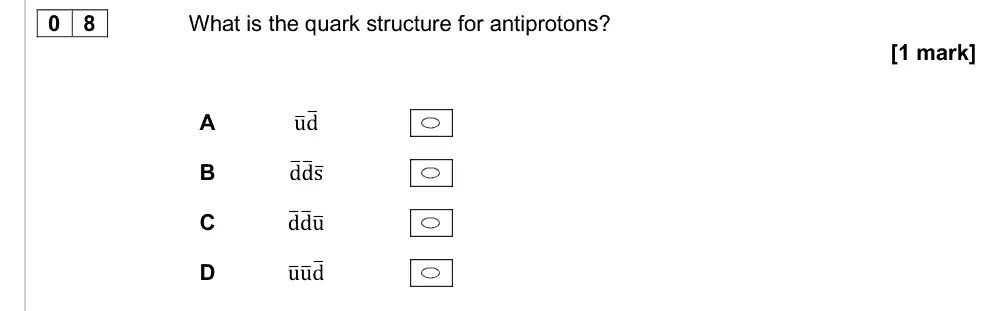
June 2016 · AS Paper 2 · Q8 1 mark Multiple choice Easy classification of particles and quarks
What is the quark structure for antiprotons?
[1 mark]
A
uതdത
B
dതdതs̅
C
dതdതuത
D
uതuതdത
June 2016 · AS Paper 2 · Q9 1 mark Multiple choice classification of particles and quarks
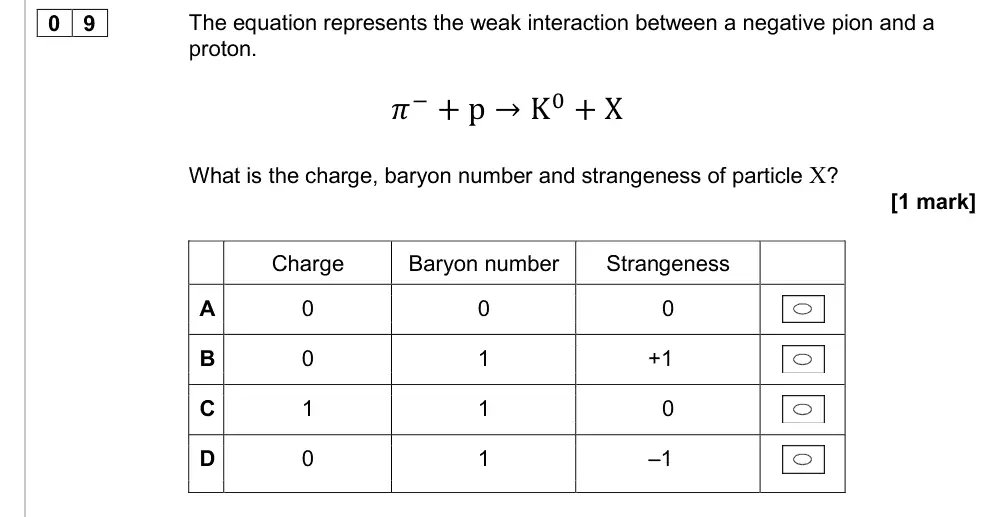
The equation represents the weak interaction between a negative pion and a
proton.
𝜋−+ p →K0 + X
What is the charge, baryon number and strangeness of particle X?
[1 mark]
Charge
Baryon number
Strangeness
A
0
0
0
B
0
1
+1
C
1
1
0
D
0
1
–1
June 2016 · AS Paper 2 · Q10 1 mark Multiple choice Easy energy levels and wave particle duality
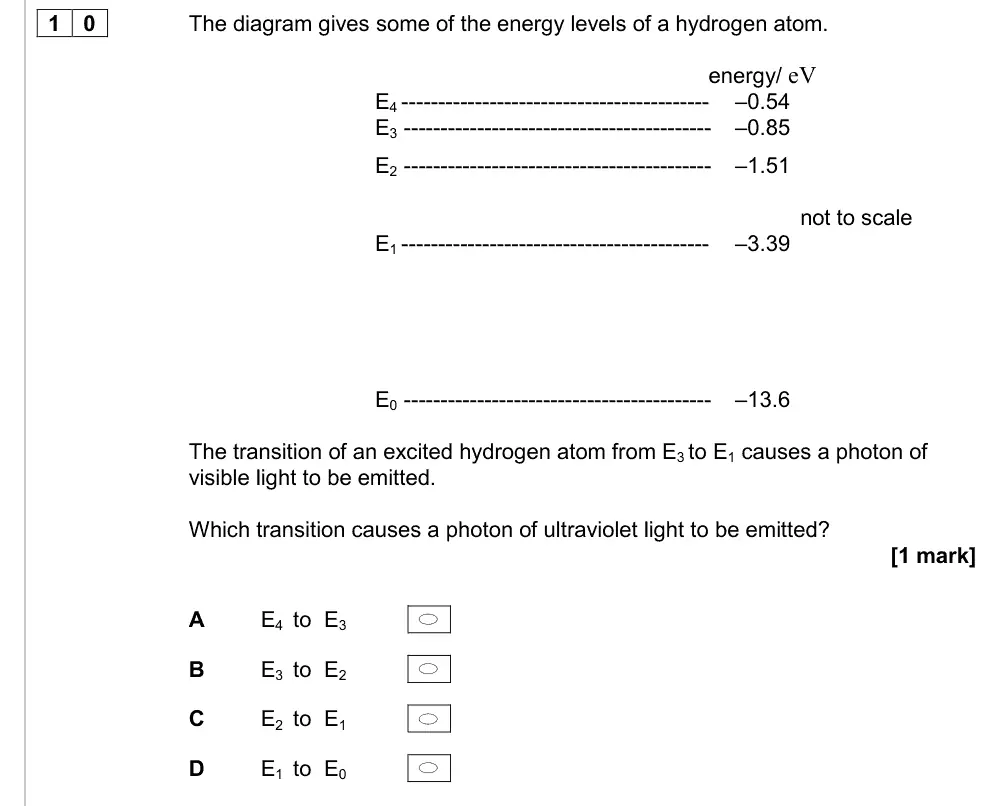
The diagram gives some of the energy levels of a hydrogen atom.
energy/ eV
E4 ------------------------------------------
–0.54
E3 ------------------------------------------ –0.85
E2 ------------------------------------------ –1.51
not to scale
E1 ------------------------------------------
–3.39
E0 ------------------------------------------ –13.6
The transition of an excited hydrogen atom from E3 to E1 causes a photon of
visible light to be emitted.
Which transition causes a photon of ultraviolet light to be emitted?
[1 mark]
A
E4  to  E3
B
E3  to  E2
C
E2  to  E1
D
E1  to  E0
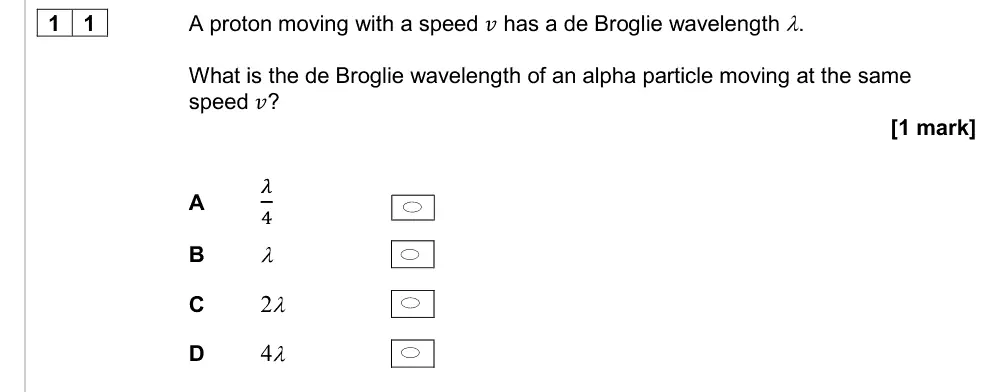
A proton moving with a speed 𝑣 has a de Broglie wavelength λ.
June 2016 · AS Paper 2 · Q11 1 mark Multiple choice energy levels and wave particle duality
What is the de Broglie wavelength of an alpha particle moving at the same
speed 𝑣?
[1 mark]
A
𝜆
4
B
λ
C
2λ
D
4λ
June 2016 · AS Paper 2 · Q12 1 mark Multiple choice progressive waves and polarisation
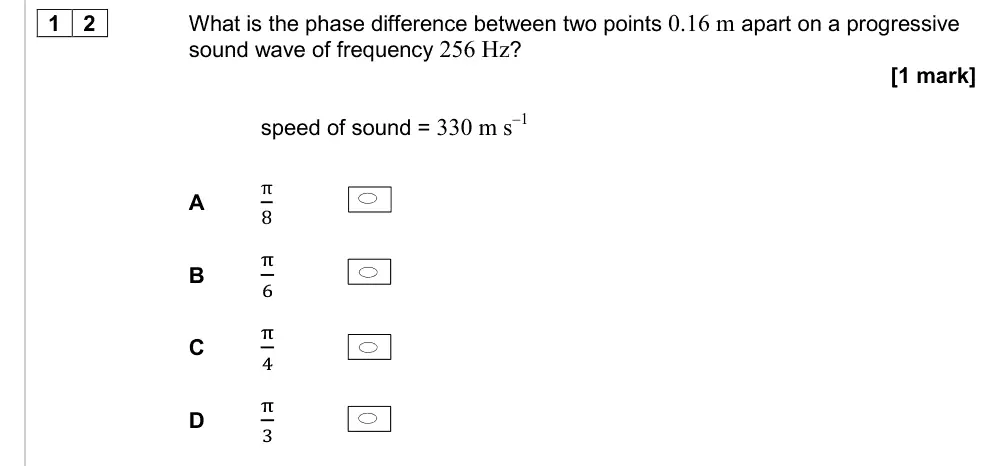
What is the phase difference between two points 0.16 m apart on a progressive
sound wave of frequency 256 Hz?
[1 mark]
speed of sound = 330 m s–1
A
π
8
B
π
6
C
π
4
D
π
3
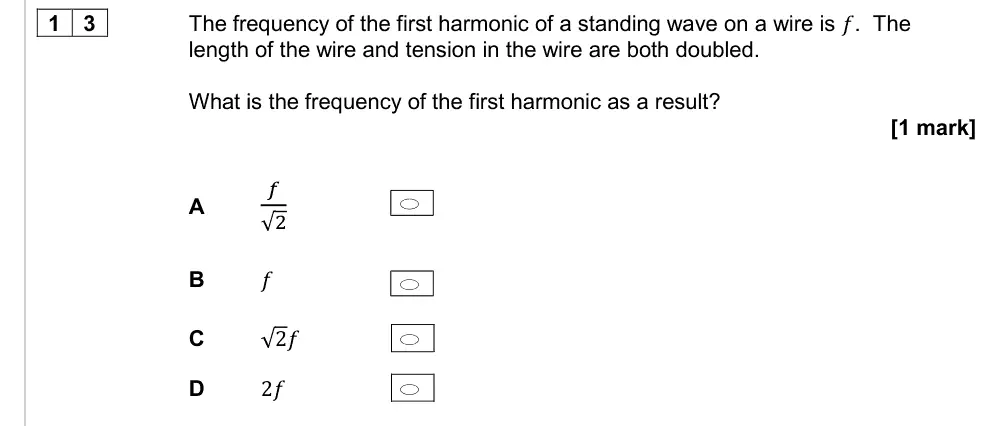
The frequency of the first harmonic of a standing wave on a wire is 𝑓.  The
June 2016 · AS Paper 2 · Q13 1 mark Multiple choice stationary waves
length of the wire and tension in the wire are both doubled.
What is the frequency of the first harmonic as a result?
[1 mark]
A
𝑓
√2
B
𝑓
C
√2𝑓
D
2𝑓
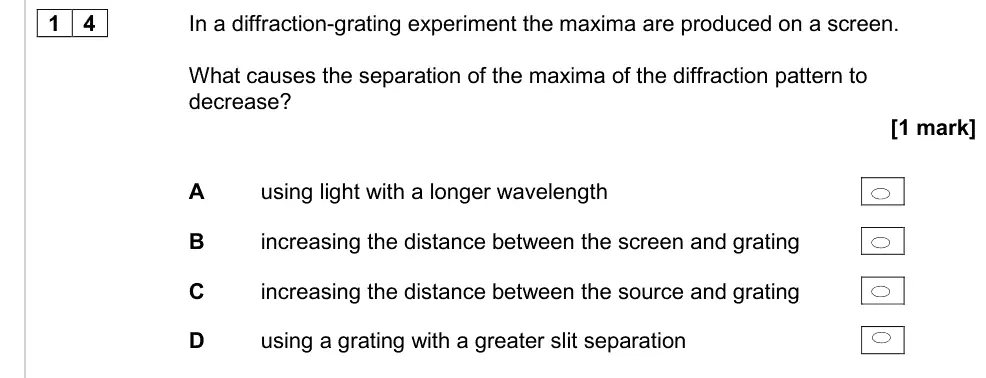
June 2016 · AS Paper 2 · Q14 1 mark Multiple choice interference and diffraction
In a diffraction-grating experiment the maxima are produced on a screen.
What causes the separation of the maxima of the diffraction pattern to
decrease?
[1 mark]
A
using light with a longer wavelength
B
increasing the distance between the screen and grating
C
increasing the distance between the source and grating
D
using a grating with a greater slit separation
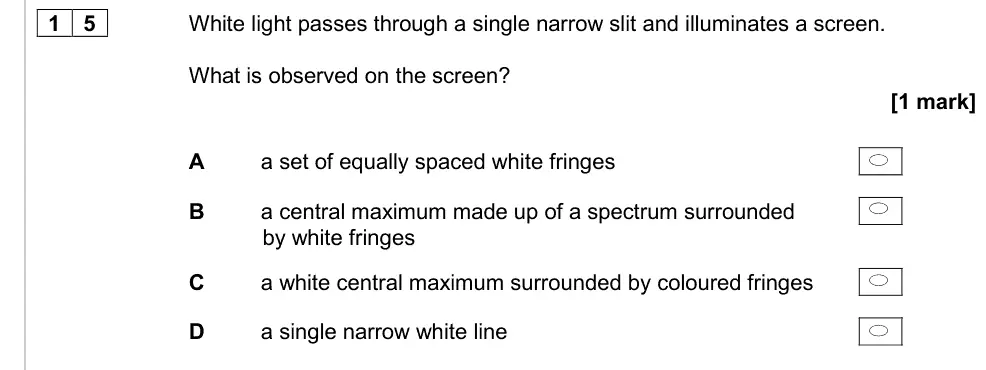
June 2016 · AS Paper 2 · Q15 1 mark Multiple choice Easy interference and diffraction
White light passes through a single narrow slit and illuminates a screen.
What is observed on the screen?
[1 mark]
A
a set of equally spaced white fringes
B
a central maximum made up of a spectrum surrounded
by white fringes
C
a white central maximum surrounded by coloured fringes
D
a single narrow white line
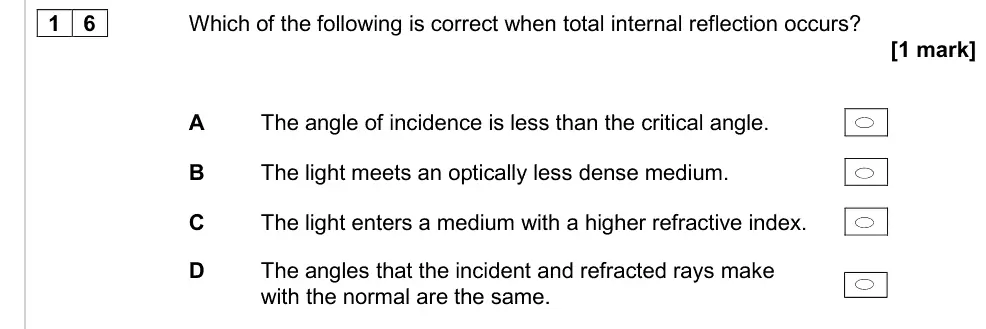
June 2016 · AS Paper 2 · Q16 1 mark Multiple choice refraction and optical fibres
Which of the following is correct when total internal reflection occurs?
[1 mark]
A
The angle of incidence is less than the critical angle.
B
The light meets an optically less dense medium.
C
The light enters a medium with a higher refractive index.
D
The angles that the incident and refracted rays make
with the normal are the same.
June 2016 · AS Paper 2 · Q17 1 mark Multiple choice Easy refraction and optical fibres
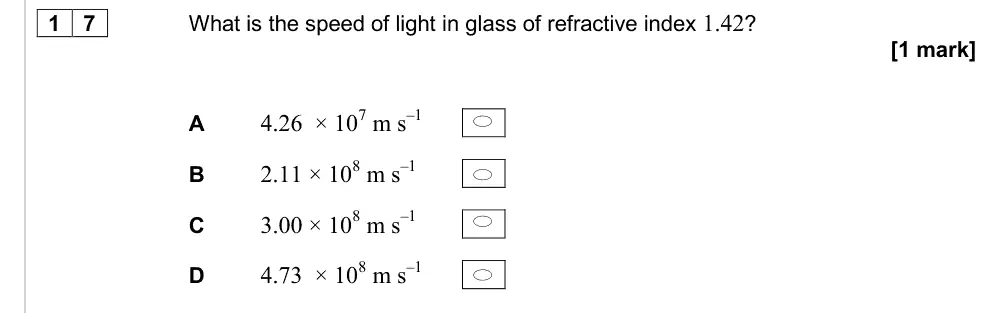
What is the speed of light in glass of refractive index 1.42?
[1 mark]
A
4.26  × 107 m s–1
B
2.11 × 10⁸ m s–1
C
3.00 × 10⁸ m s–1
D
4.73  × 108 m s–1
June 2016 · AS Paper 2 · Q18 1 mark Multiple choice Easy vectors and moments
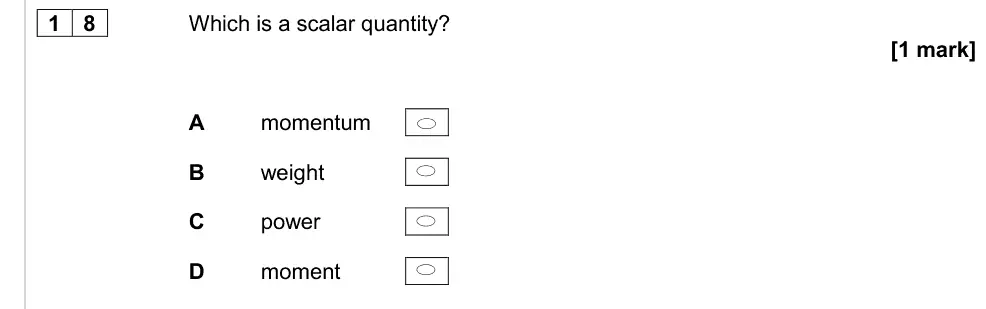
Which is a scalar quantity?
[1 mark]
A
momentum
B
weight
C
power
D
moment
June 2016 · AS Paper 2 · Q19 1 mark Multiple choice motion and projectiles
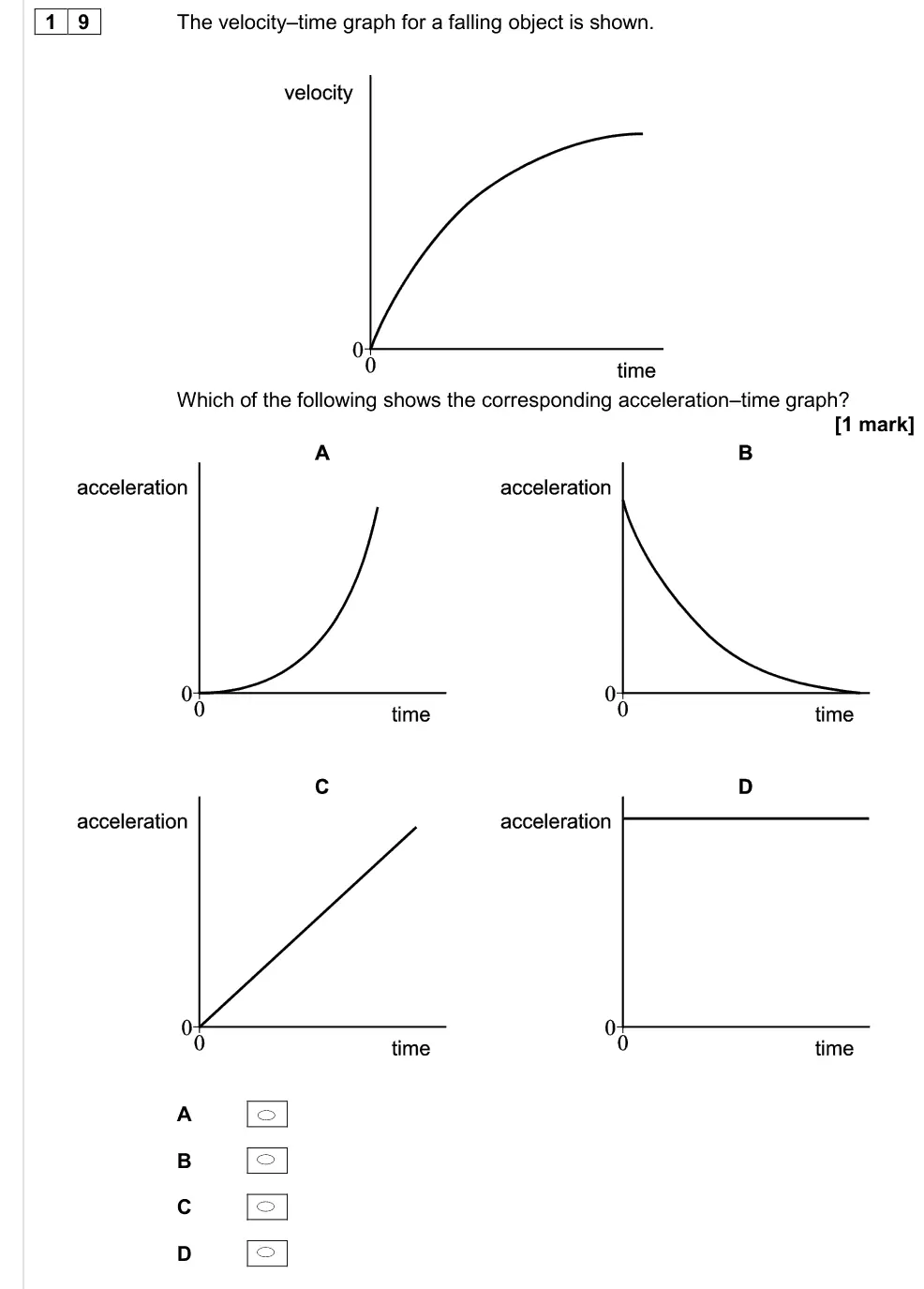
The velocity–time graph for a falling object is shown.
Which of the following shows the corresponding acceleration–time graph?
[1 mark]
A
B
C
D
June 2016 · AS Paper 2 · Q20 1 mark Multiple choice motion and projectiles
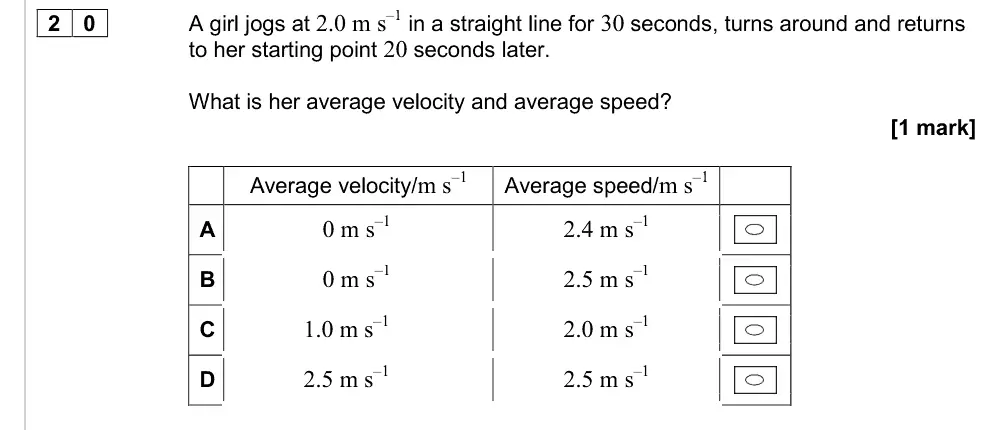
A girl jogs at 2.0 m s–1 in a straight line for 30 seconds, turns around and returns
to her starting point 20 seconds later.
What is her average velocity and average speed?
[1 mark]
Average velocity/m s–1
Average speed/m s–1
A
0 m s–1
2.4 m s–1
B
0 m s–1
2.5 m s–1
C             1.0 m s–1
2.0 m s–1
D
2.5 m s–1
2.5 m s–1
June 2016 · AS Paper 2 · Q21 1 mark Multiple choice Hard motion and projectiles
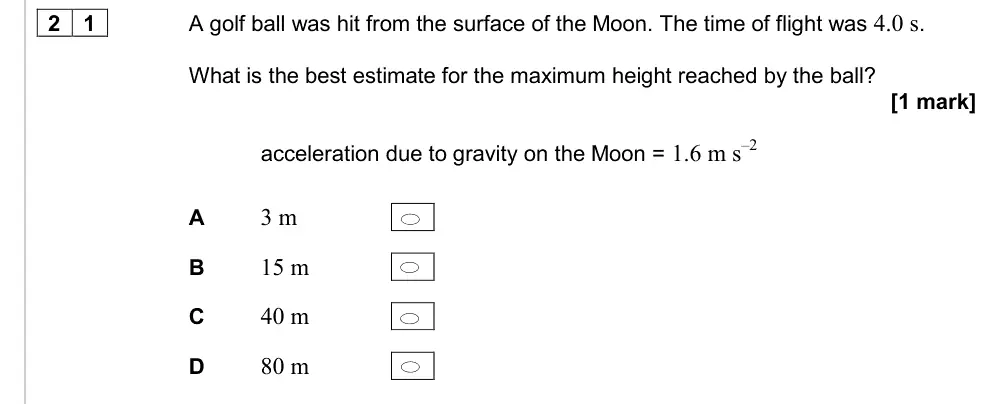
A golf ball was hit from the surface of the Moon. The time of flight was 4.0 s.
What is the best estimate for the maximum height reached by the ball?
[1 mark]
acceleration due to gravity on the Moon = 1.6 m s–2
A
3 m
B
15 m
C
40 m
D
80 m
June 2016 · AS Paper 2 · Q22 1 mark Multiple choice Easy motion and projectilesnewtons laws and momentum
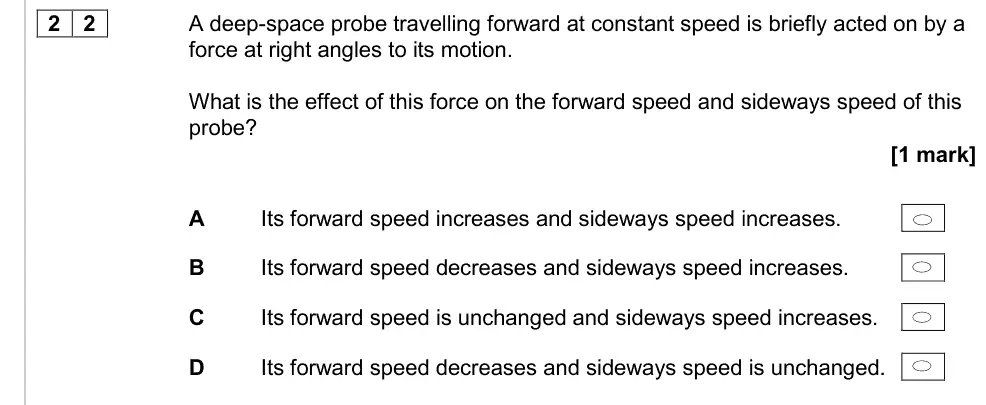
A deep-space probe travelling forward at constant speed is briefly acted on by a
force at right angles to its motion.
What is the effect of this force on the forward speed and sideways speed of this
probe?
[1 mark]
A
Its forward speed increases and sideways speed increases.
B
Its forward speed decreases and sideways speed increases.
C
Its forward speed is unchanged and sideways speed increases.
D
Its forward speed decreases and sideways speed is unchanged.
June 2016 · AS Paper 2 · Q23 1 mark Multiple choice newtons laws and momentum
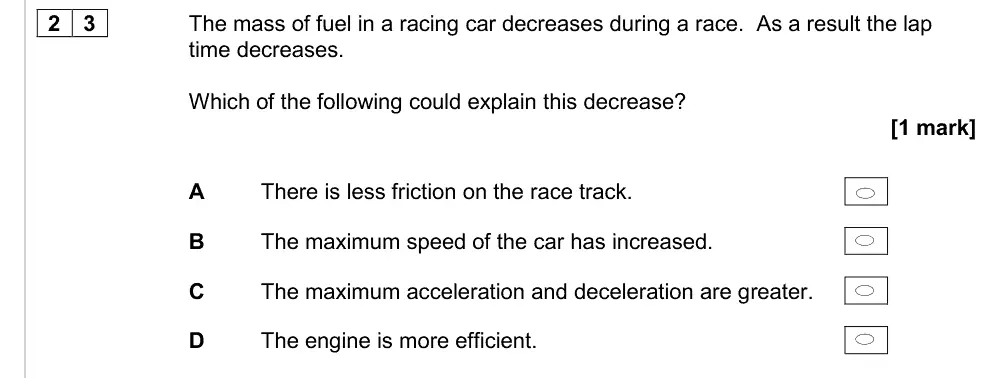
The mass of fuel in a racing car decreases during a race.  As a result the lap
time decreases.
Which of the following could explain this decrease?
[1 mark]
A
There is less friction on the race track.
B
The maximum speed of the car has increased.
C
The maximum acceleration and deceleration are greater.
D
The engine is more efficient.
June 2016 · AS Paper 2 · Q24 1 mark Multiple choice Easy work energy and power
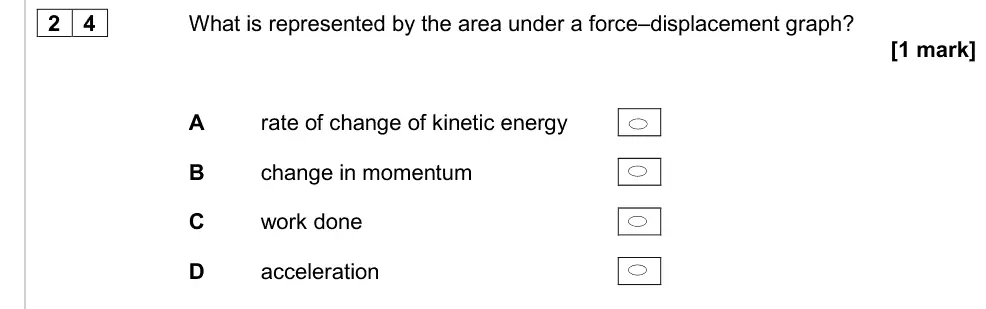
What is represented by the area under a force–displacement graph?
[1 mark]
A
rate of change of kinetic energy
B
change in momentum
C
work done
D
acceleration
June 2016 · AS Paper 2 · Q25 1 mark Multiple choice work energy and powermeasurements and uncertainties
Which of the following is not a unit of power?
[1 mark]
A
N m s–1
B
J s
C
W
D
kg m2 s–3
June 2016 · AS Paper 2 · Q26 1 mark Multiple choice Easy work energy and power
A roller coaster car is raised to a height of 65 m and released from rest.
What is the maximum possible speed of the car?
[1 mark]
A
11 m s–1
B
25 m s–1
C
36 m s–1
D
130 m s–1
June 2016 · AS Paper 2 · Q27 1 mark Multiple choice Hard work energy and power
In a test a 500 kg car travelling at 10 m s–1 hits a wall. The front 0.30 m of the car
crumples as the car is brought to rest.
What is the average force on the car during the impact?
[1 mark]
A
830 N
B
7500 N
C
8300 N
D
83 000 N
June 2016 · AS Paper 2 · Q28 1 mark Multiple choice current voltage and resistivity
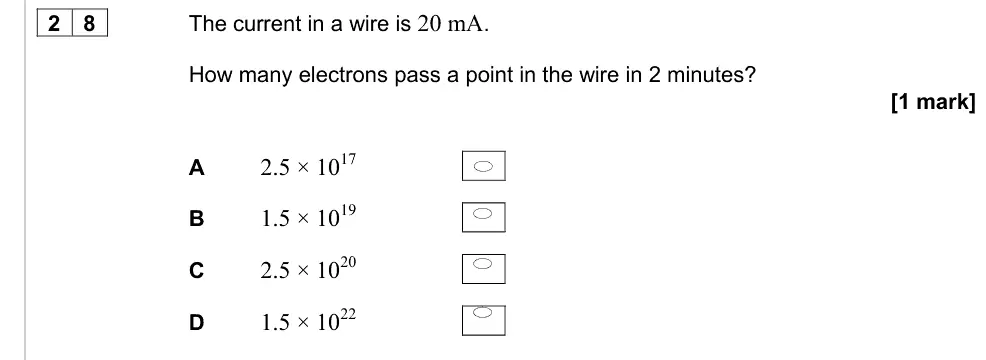
The current in a wire is 20 mA.
How many electrons pass a point in the wire in 2 minutes?
[1 mark]
A
2.5 × 10¹⁷
B
1.5 × 10¹⁹
C
2.5 × 10²⁰
D
1.5 × 10²²
June 2016 · AS Paper 2 · Q29 1 mark Multiple choice current voltage and resistivity
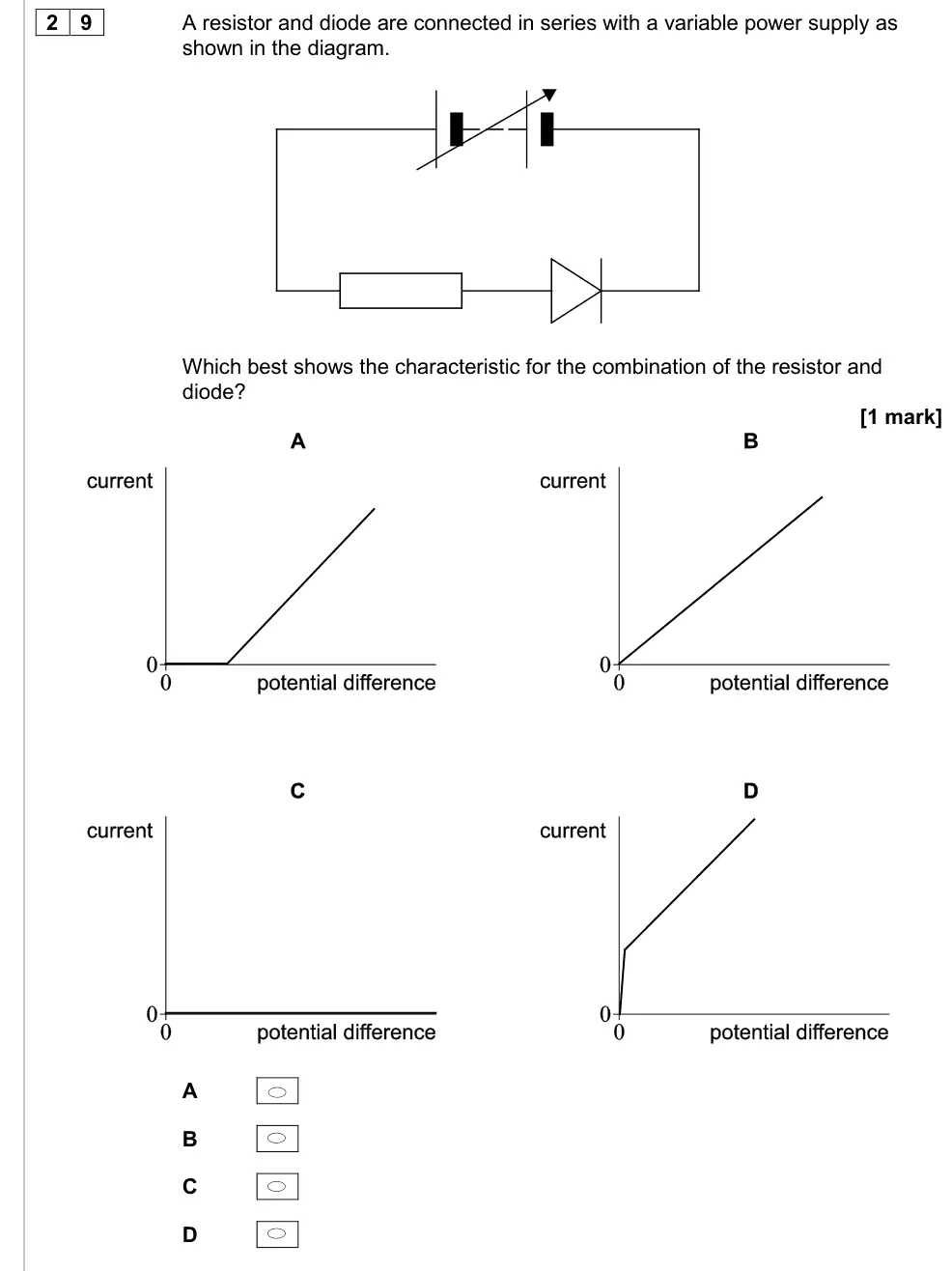
A resistor and diode are connected in series with a variable power supply as
shown in the diagram.
Which best shows the characteristic for the combination of the resistor and
diode?
[1 mark]
A
B
C
D
June 2016 · AS Paper 2 · Q30 1 mark Multiple choice current voltage and resistivitycircuits and potential dividers
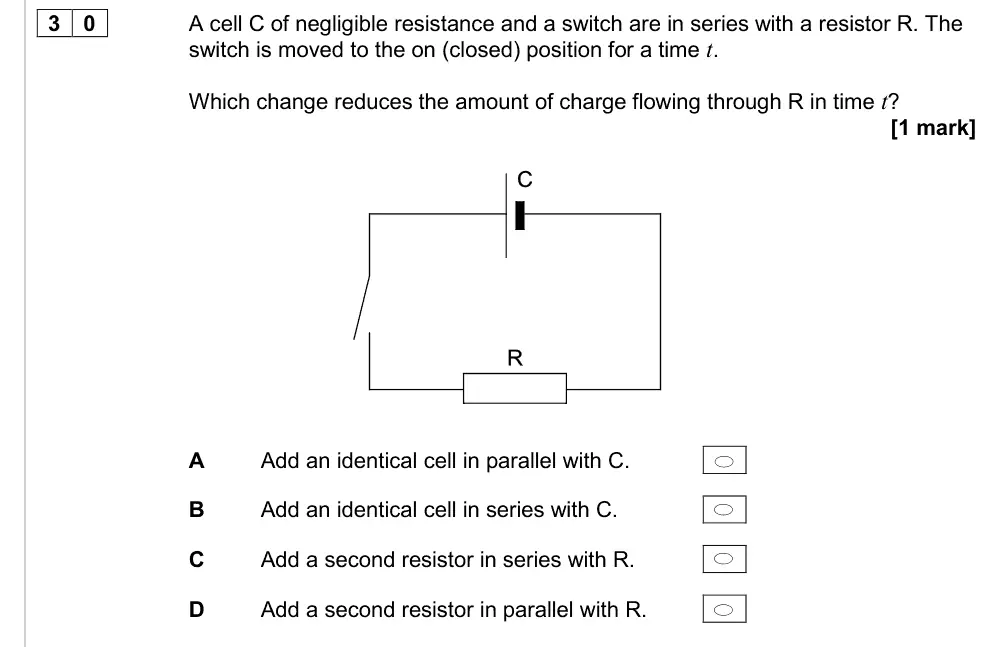
A cell C of negligible resistance and a switch are in series with a resistor R. The
switch is moved to the on (closed) position for a time t.
Which change reduces the amount of charge flowing through R in time t?
[1 mark]
A
Add an identical cell in parallel with C.
B
Add an identical cell in series with C.
C
Add a second resistor in series with R.
D
Add a second resistor in parallel with R.
June 2016 · AS Paper 2 · Q31 1 mark Multiple choice Hard circuits and potential dividerscurrent voltage and resistivity
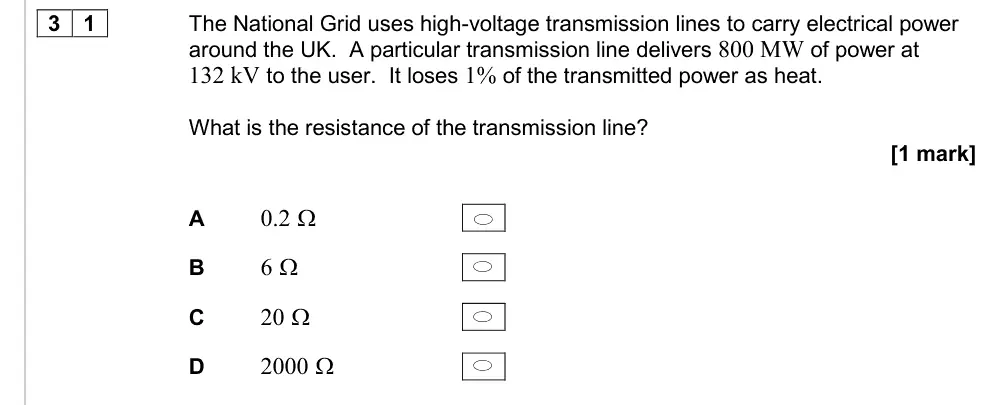
The National Grid uses high-voltage transmission lines to carry electrical power
around the UK.  A particular transmission line delivers 800 MW of power at
132 kV to the user.  It loses 1% of the transmitted power as heat.
What is the resistance of the transmission line?
[1 mark]
A
0.2 Ω
B
6 Ω
C
20 Ω
D
2000 Ω
June 2016 · AS Paper 2 · Q32 1 mark Multiple choice circuits and potential dividers
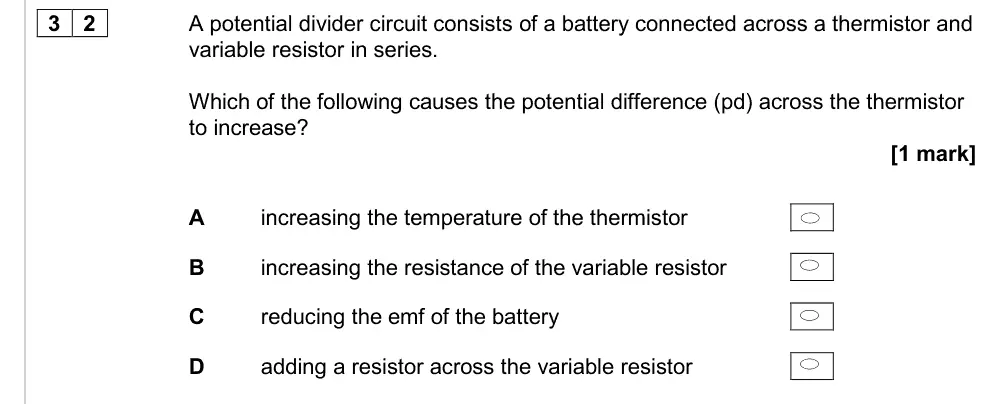
A potential divider circuit consists of a battery connected across a thermistor and
variable resistor in series.
Which of the following causes the potential difference (pd) across the thermistor
to increase?
[1 mark]
A
increasing the temperature of the thermistor
B
increasing the resistance of the variable resistor
C
reducing the emf of the battery
D
adding a resistor across the variable resistor
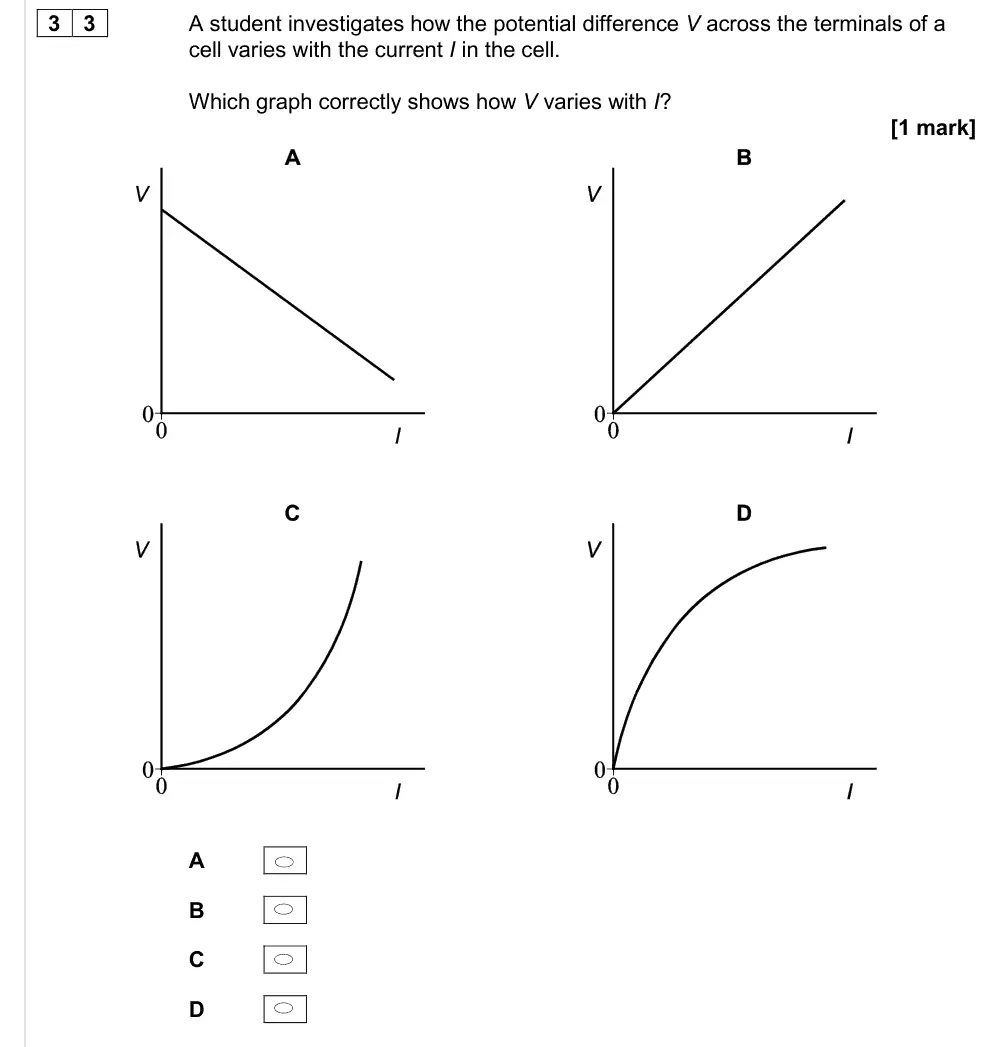
June 2016 · AS Paper 2 · Q33 1 mark Multiple choice emf and internal resistance
A student investigates how the potential difference V across the terminals of a
cell varies with the current I in the cell.
Which graph correctly shows how V varies with I?
[1 mark]
A
B
C
D
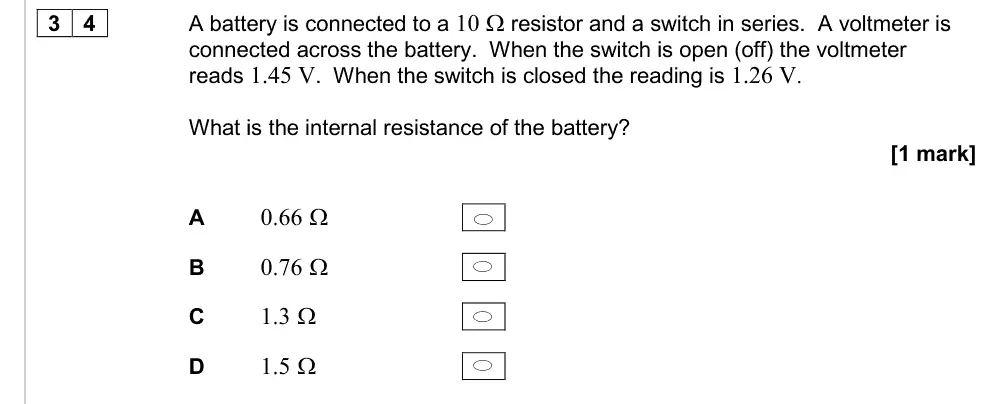
June 2016 · AS Paper 2 · Q34 1 mark Multiple choice Hard emf and internal resistance
A battery is connected to a 10 Ω resistor and a switch in series.  A voltmeter is
connected across the battery.  When the switch is open (off) the voltmeter
reads 1.45 V.  When the switch is closed the reading is 1.26 V.
What is the internal resistance of the battery?
[1 mark]
A
0.66 Ω
B
0.76 Ω
C
1.3 Ω
D
1.5 Ω

Work with an AQA physics tutor

Want a paper marked and gone through with you? Message us.

Prefer email? Send an enquiry

If you are under 18, please include a parent's contact details. Enquiries go to enquiries@physicsaleveltutor.com and are deleted once handled. All tutoring is online.