June 2025: AS Paper 2

70 marks · 49 question parts · Paper, mark scheme and report on AQA's site · Have the data and formulae booklet beside you

Question by question

QTopicMarksAOType
1.1 Interference, diffraction and the diffraction grating 1AO1=1Short answer
1.2 Measurements, units and uncertainties 2AO1=1,AO3=1Practical and data analysis
1.3 Interference, diffraction and the diffraction grating 3AO2=2,AO3=1Calculation
1.4 Interference, diffraction and the diffraction grating 2AO3=2Calculation
2.1 Measurements, units and uncertainties 1AO1=1Practical and data analysis
2.2 Measurements, units and uncertainties, Scalars, vectors and moments 2AO1=2Practical and data analysis
2.3 Scalars, vectors and moments 2AO2=2Diagram or graph
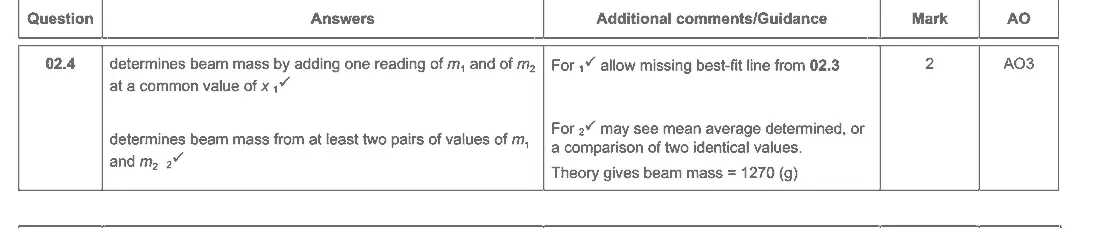
2.4 Scalars, vectors and moments 2AO3=2Practical and data analysis
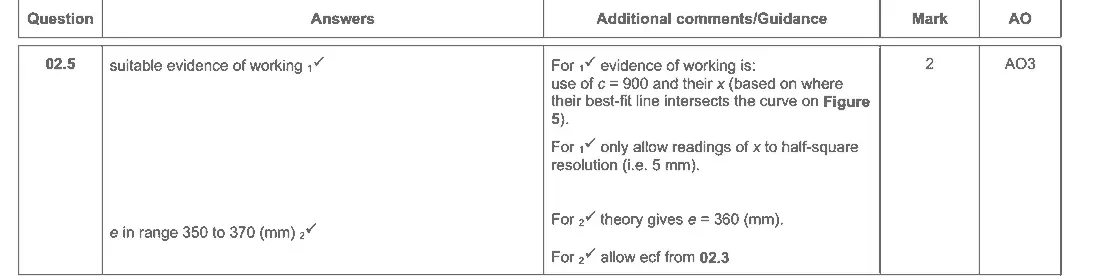
2.5 Scalars, vectors and moments 2AO3=2Practical and data analysis
2.6 Measurements, units and uncertainties 1AO1=1Practical and data analysis
2.7 Measurements, units and uncertainties, Scalars, vectors and moments 2AO3=2Practical and data analysis
3.1 Electromotive force and internal resistance, Circuits and potential dividers 2AO1=1,AO2=1Explanation
3.2 Electromotive force and internal resistance 2AO1=1,AO2=1Show that
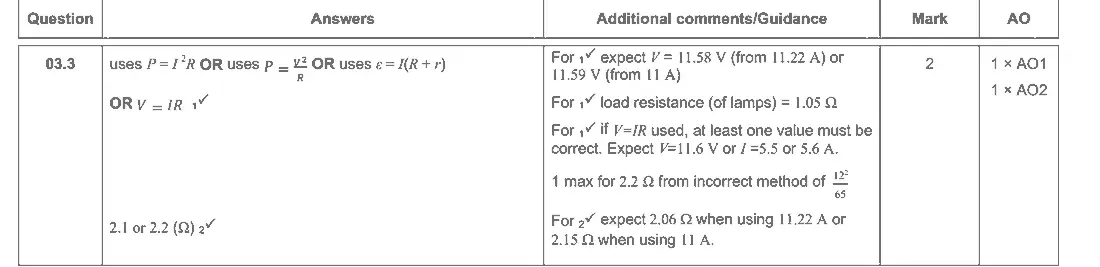
3.3 Circuits and potential dividers, Electromotive force and internal resistance 2AO1=1,AO2=1Calculation
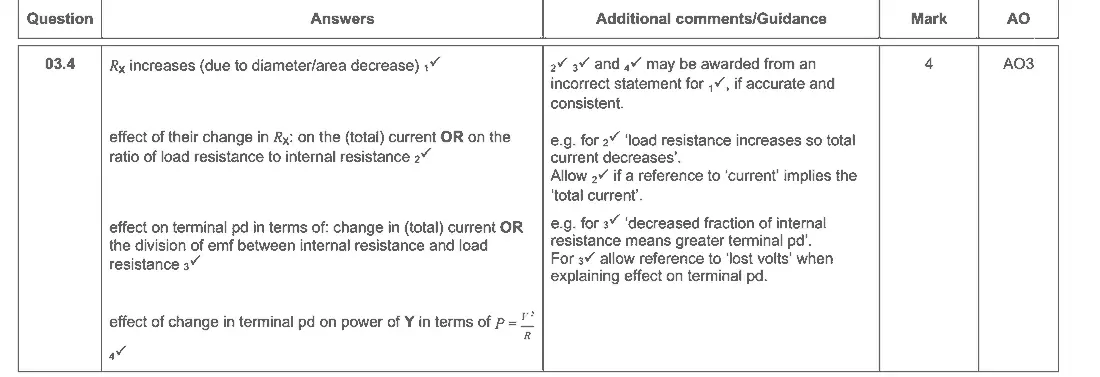
3.4 Electromotive force and internal resistance, Current, potential difference, I-V characteristics and resistivity 4AO3=4Explanation
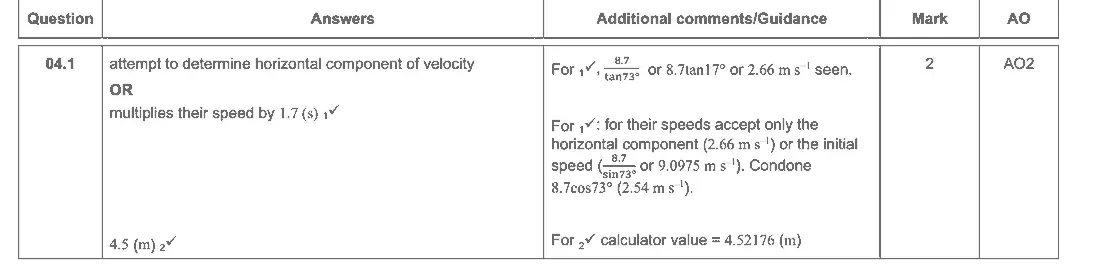
4.1 Motion along a straight line and projectile motion, Scalars, vectors and moments 2AO2=2Calculation
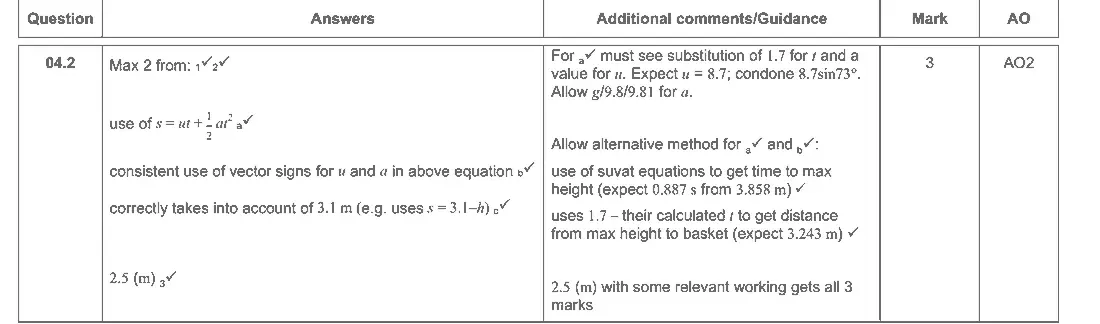
4.2 Motion along a straight line and projectile motion 3AO2=3Calculation
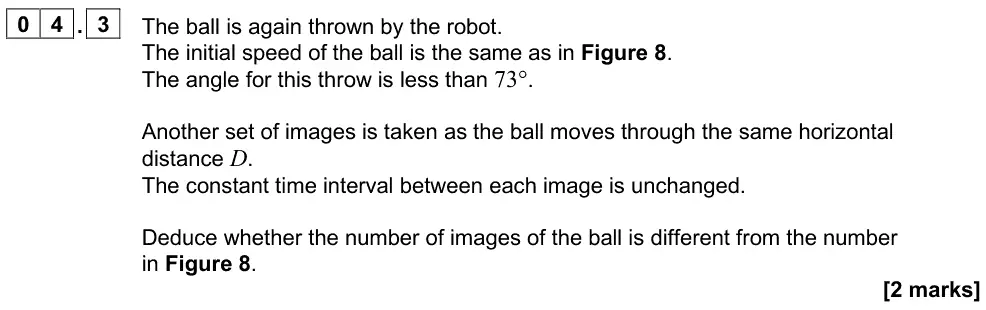
4.3 Motion along a straight line and projectile motion, Scalars, vectors and moments 2AO3=2Explanation
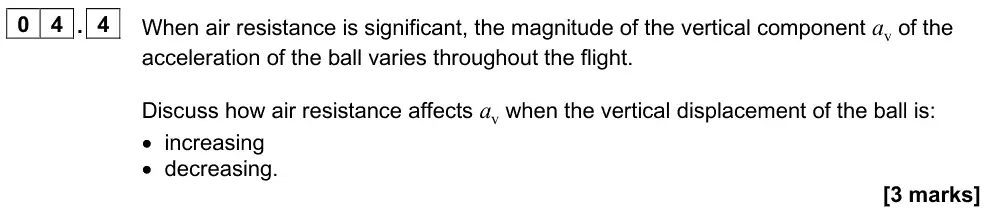
4.4 Motion along a straight line and projectile motion 3AO1=1,AO2=2Explanation
5 Superposition and stationary waves 1AO2=1Multiple choice
6 Excitation, energy levels and wave-particle duality 1AO1=1Multiple choice
7 Circuits and potential dividers 1AO2=1Multiple choice
8 Particles, antiparticles and particle interactions 1AO1=1Multiple choice
9 Progressive waves, longitudinal and transverse waves 1AO1=1Multiple choice
10 Excitation, energy levels and wave-particle duality 1AO2=1Multiple choice
11 Progressive waves, longitudinal and transverse waves, Interference, diffraction and the diffraction grating 1AO2=1Multiple choice
12 Progressive waves, longitudinal and transverse waves 1AO1=1Multiple choice
13 Motion along a straight line and projectile motion 1AO2=1Multiple choice
14 Refraction, total internal reflection and optical fibres, Progressive waves, longitudinal and transverse waves 1AO1=1Multiple choice
15 Progressive waves, longitudinal and transverse waves 1AO2=1Multiple choice
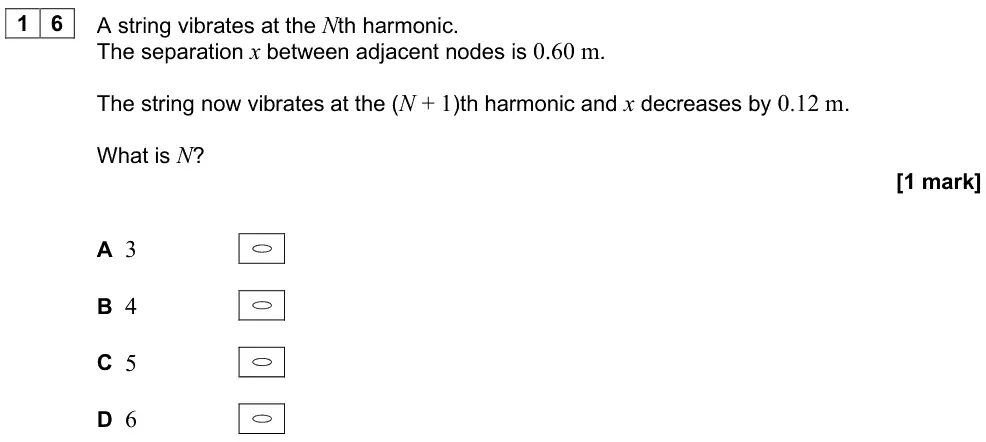
16 Superposition and stationary waves 1AO2=1Multiple choice
17 Measurements, units and uncertainties 1AO1=1Multiple choice
18 Current, potential difference, I-V characteristics and resistivity 1AO2=1Multiple choice
19 Newton's laws of motion and momentum 1AO1=1Multiple choice
20 Motion along a straight line and projectile motion, Work, energy, power and conservation of energy 1AO2=1Multiple choice
21 Materials, stress, strain and the Young modulus 1AO1=1Multiple choice
22 Progressive waves, longitudinal and transverse waves 1AO1=1Multiple choice
23 Scalars, vectors and moments 1AO2=1Multiple choice
24 Materials, stress, strain and the Young modulus 1AO2=1Multiple choice
25 Scalars, vectors and moments 1AO2=1Multiple choice
26 Circuits and potential dividers 1AO1=1Multiple choice
27 Measurements, units and uncertainties, Current, potential difference, I-V characteristics and resistivity 1AO2=1Multiple choice
28 Classification of particles, quarks and conservation laws, Atomic structure and stable nuclei 1AO1=1Multiple choice
29 Materials, stress, strain and the Young modulus 1AO1=1Multiple choice
30 Circuits and potential dividers 1AO2=1Multiple choice
31 Work, energy, power and conservation of energy 1AO2=1Multiple choice
32 Atomic structure and stable nuclei 1AO1=1Multiple choice
33 Circuits and potential dividers, Current, potential difference, I-V characteristics and resistivity 1AO2=1Multiple choice
34 Work, energy, power and conservation of energy, Scalars, vectors and moments 1AO2=1Multiple choice

The questions

1.11.21.31.42.12.22.32.42.52.62.73.13.23.33.44.14.24.34.45678910111213141516171819202122232425262728293031323334
June 2025 · AS Paper 2 · Q1.1 1 mark AO1=1 Short answer interference and diffraction
This question is about a method to investigate interference by a diffraction grating
(required practical activity 2).
Light from a laser is shone onto the diffraction grating at normal incidence.
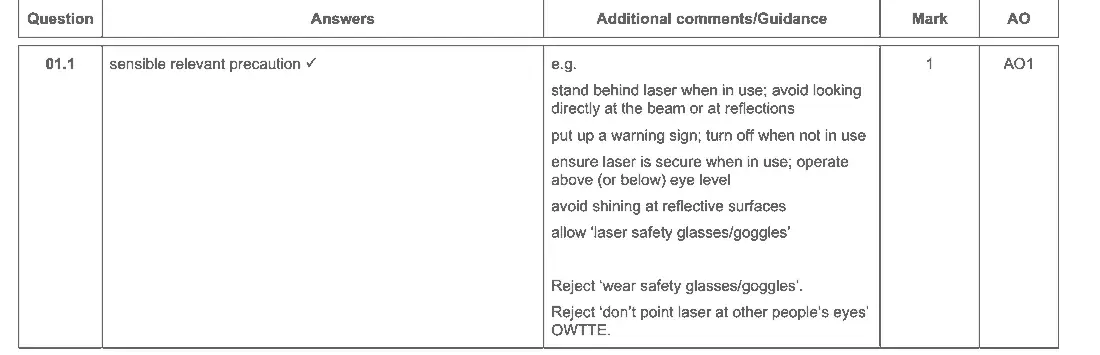
State one safety precaution when using a laser in a school laboratory.
[1 mark]
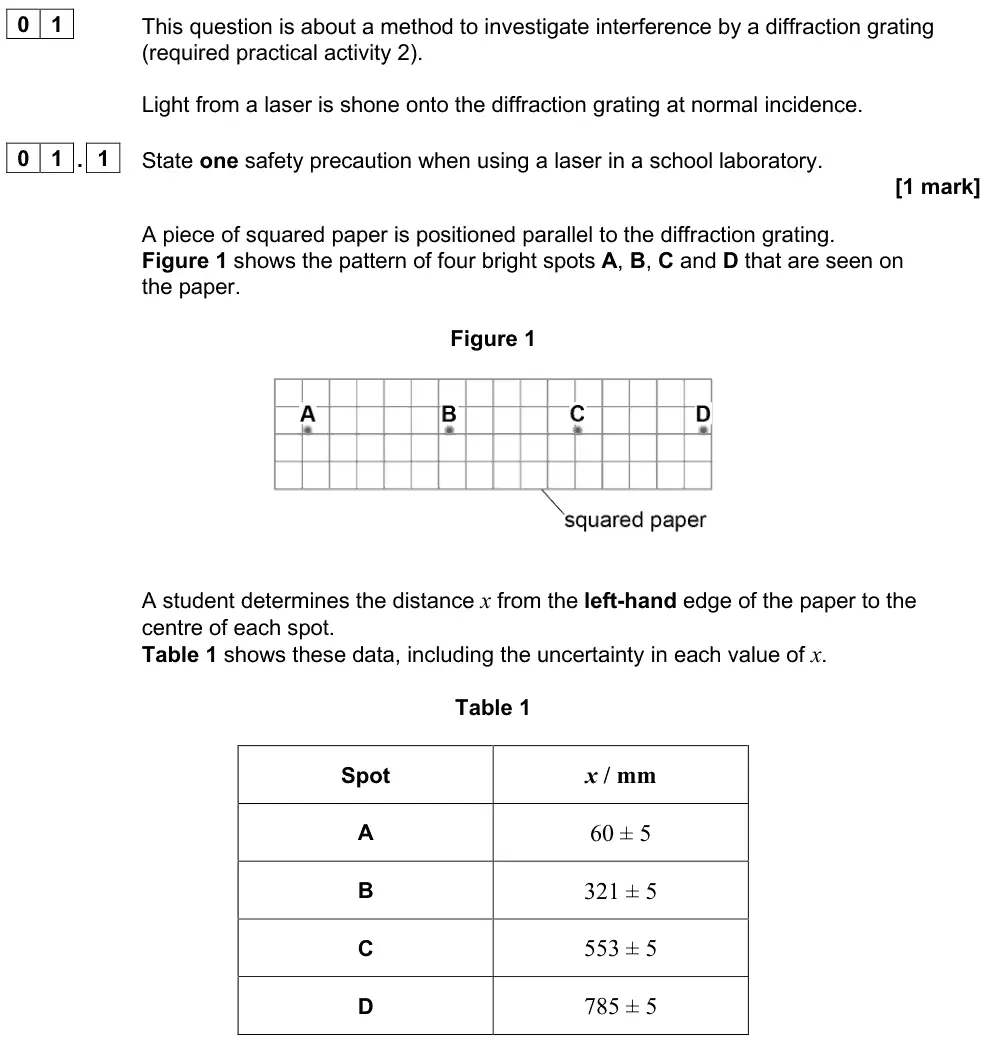
A piece of squared paper is positioned parallel to the diffraction grating.
Figure 1 shows the pattern of four bright spots A, B, C and D that are seen on
the paper.
Figure 1
A student determines the distance x from the left-hand edge of the paper to the
centre of each spot.
Table 1 shows these data, including the uncertainty in each value of x.
Table 1
Spot
x / mm
A
60 ± 5
B
321 ± 5
C
553 ± 5
D
785 ± 5
June 2025 · AS Paper 2 · Q1.2 2 marks AO1=1, AO3=1 Practical and data analysis measurements and uncertainties
Earlier part of question 1 that this part usesEarlier part of June 2025 Paper 2 question 1
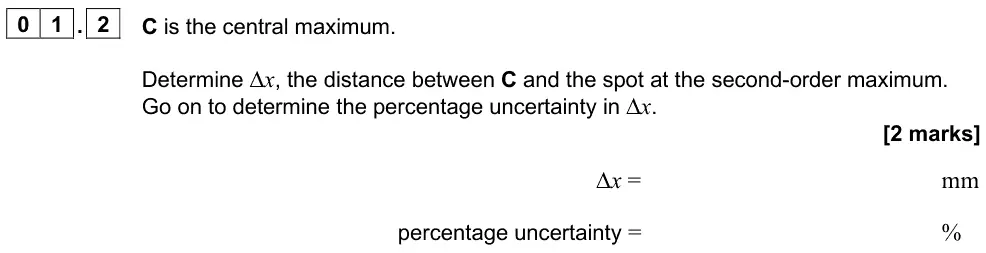
C is the central maximum.
Determine ∆x, the distance between C and the spot at the second-order maximum.
Go on to determine the percentage uncertainty in ∆x.
[2 marks]
∆x =
mm
percentage uncertainty =
%
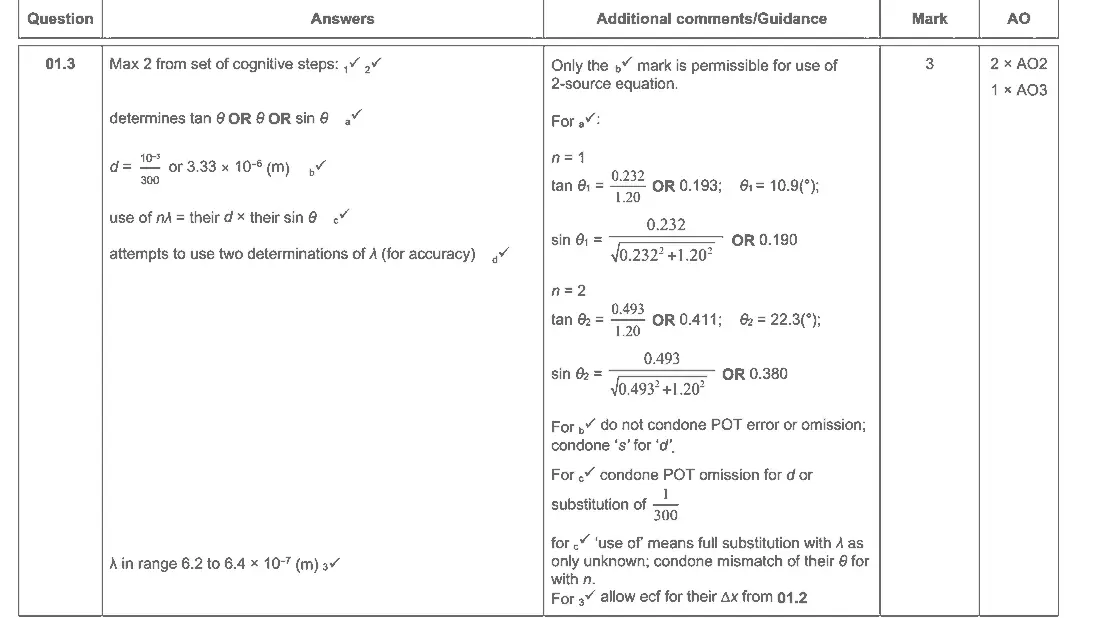
June 2025 · AS Paper 2 · Q1.3 3 marks AO2=2, AO3=1 Calculation Hard interference and diffraction
Earlier part of question 1 that this part usesEarlier part of June 2025 Paper 2 question 1
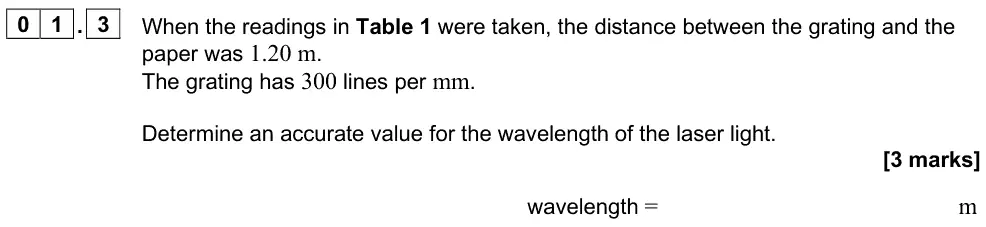
When the readings in Table 1 were taken, the distance between the grating and the
paper was 1.20 m.
The grating has 300 lines per mm.
Determine an accurate value for the wavelength of the laser light.
[3 marks]
wavelength =
m
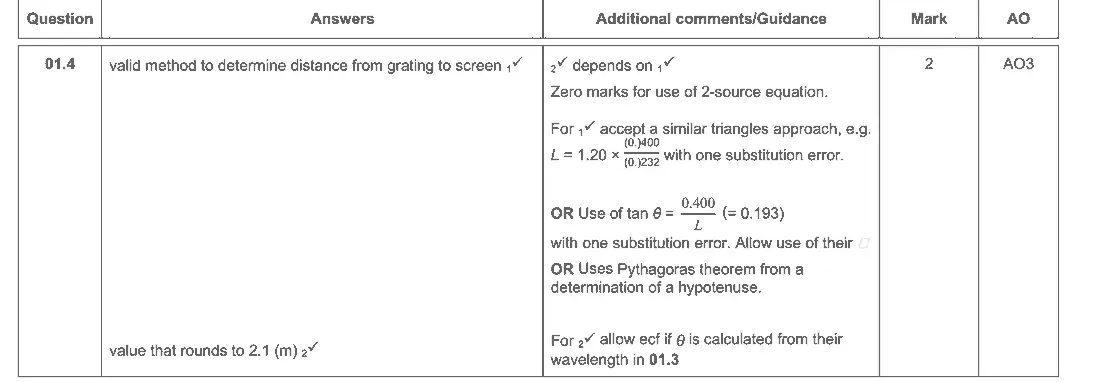
June 2025 · AS Paper 2 · Q1.4 2 marks AO3=2 Calculation Hard interference and diffraction
Earlier part of question 1 that this part usesEarlier part of June 2025 Paper 2 question 1
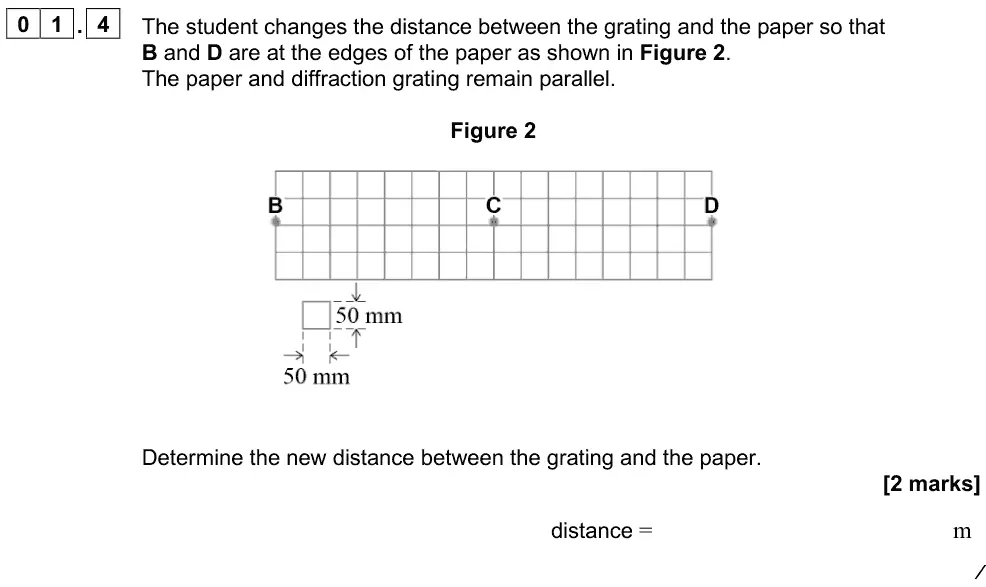
The student changes the distance between the grating and the paper so that
B and D are at the edges of the paper as shown in Figure 2.
The paper and diffraction grating remain parallel.
Figure 2
Determine the new distance between the grating and the paper.
[2 marks]
distance =
m
June 2025 · AS Paper 2 · Q2.1 1 mark AO1=1 Practical and data analysis measurements and uncertainties
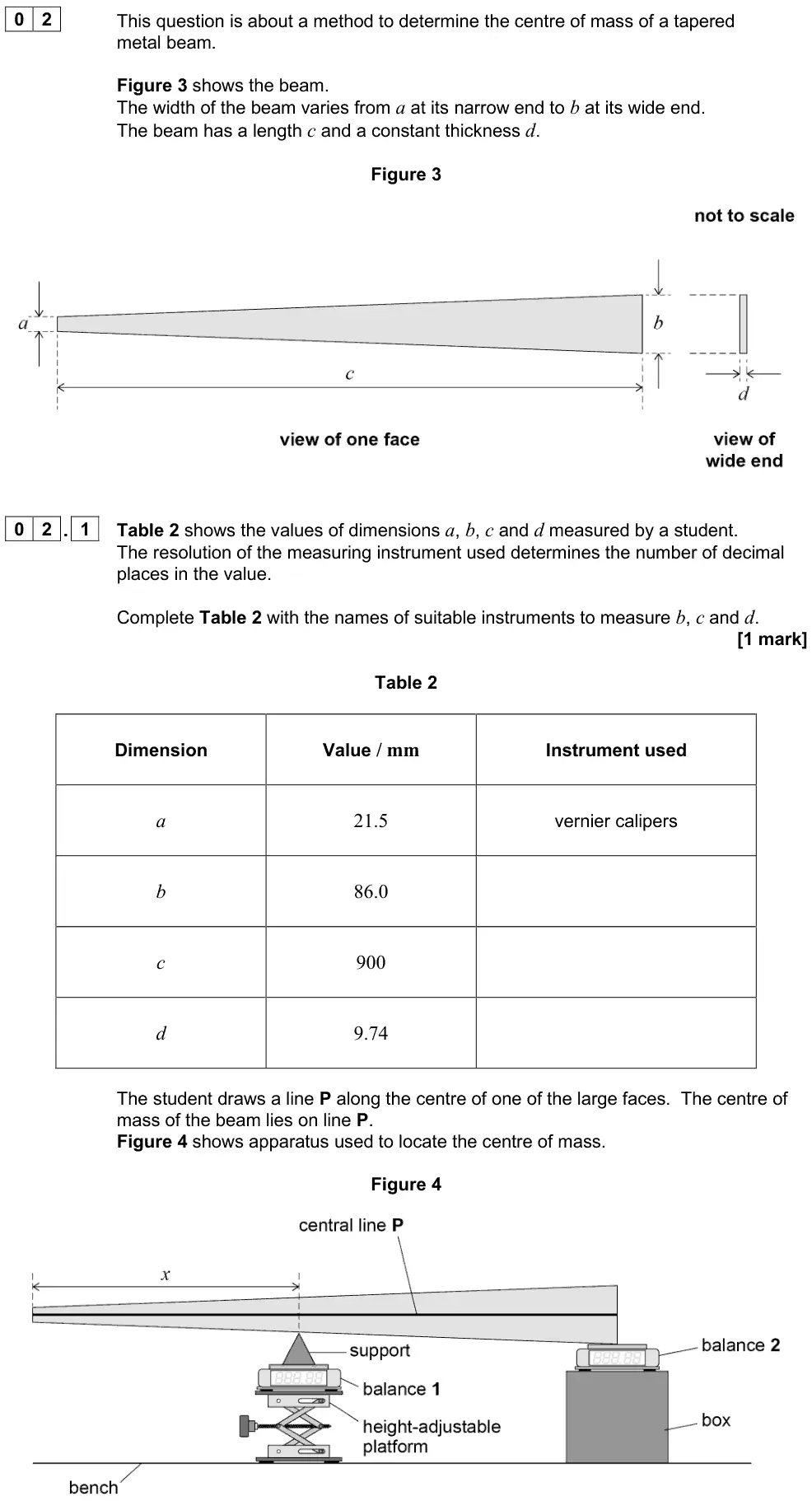
This question is about a method to determine the centre of mass of a tapered
metal beam.
Figure 3 shows the beam.
The width of the beam varies from a at its narrow end to b at its wide end.
The beam has a length c and a constant thickness d.
Figure 3
Table 2 shows the values of dimensions a, b, c and d measured by a student.
The resolution of the measuring instrument used determines the number of decimal
places in the value.
Complete Table 2 with the names of suitable instruments to measure b, c and d.
[1 mark]
Table 2
Dimension
Value / mm
Instrument used
a
21.5
vernier calipers
b
86.0
c
900
d
9.74
The student draws a line P along the centre of one of the large faces.  The centre of
mass of the beam lies on line P.
Figure 4 shows apparatus used to locate the centre of mass.
Figure 4
June 2025 · AS Paper 2 · Q2.2 2 marks AO1=2 Practical and data analysis Hard measurements and uncertaintiesvectors and moments
Earlier part of question 2 that this part usesEarlier part of June 2025 Paper 2 question 2
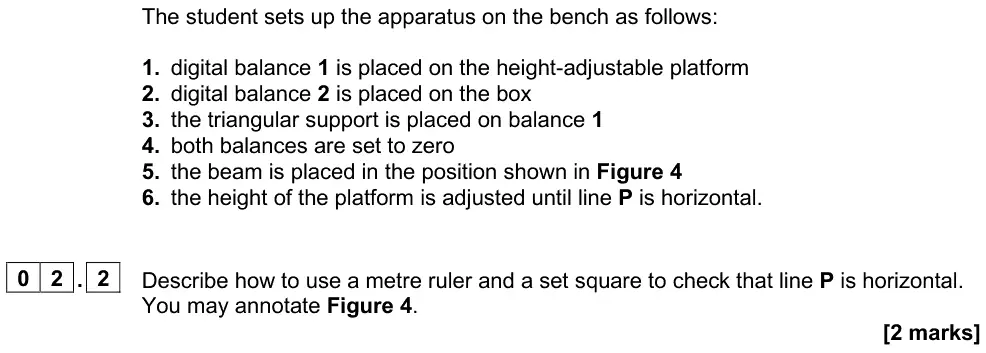
The student sets up the apparatus on the bench as follows:
1.  digital balance 1 is placed on the height-adjustable platform
2.  digital balance 2 is placed on the box
3.  the triangular support is placed on balance 1
4.  both balances are set to zero
5.  the beam is placed in the position shown in Figure 4
6.  the height of the platform is adjusted until line P is horizontal.
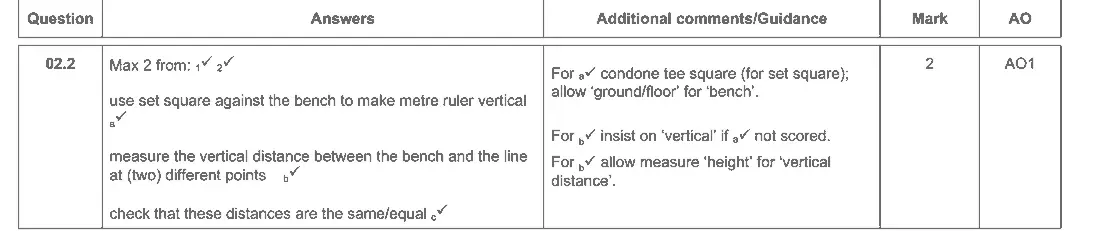
Describe how to use a metre ruler and a set square to check that line P is horizontal.
You may annotate Figure 4.
[2 marks]
June 2025 · AS Paper 2 · Q2.3 2 marks AO2=2 Diagram or graph Easy vectors and moments
Earlier part of question 2 that this part usesEarlier part of June 2025 Paper 2 question 2
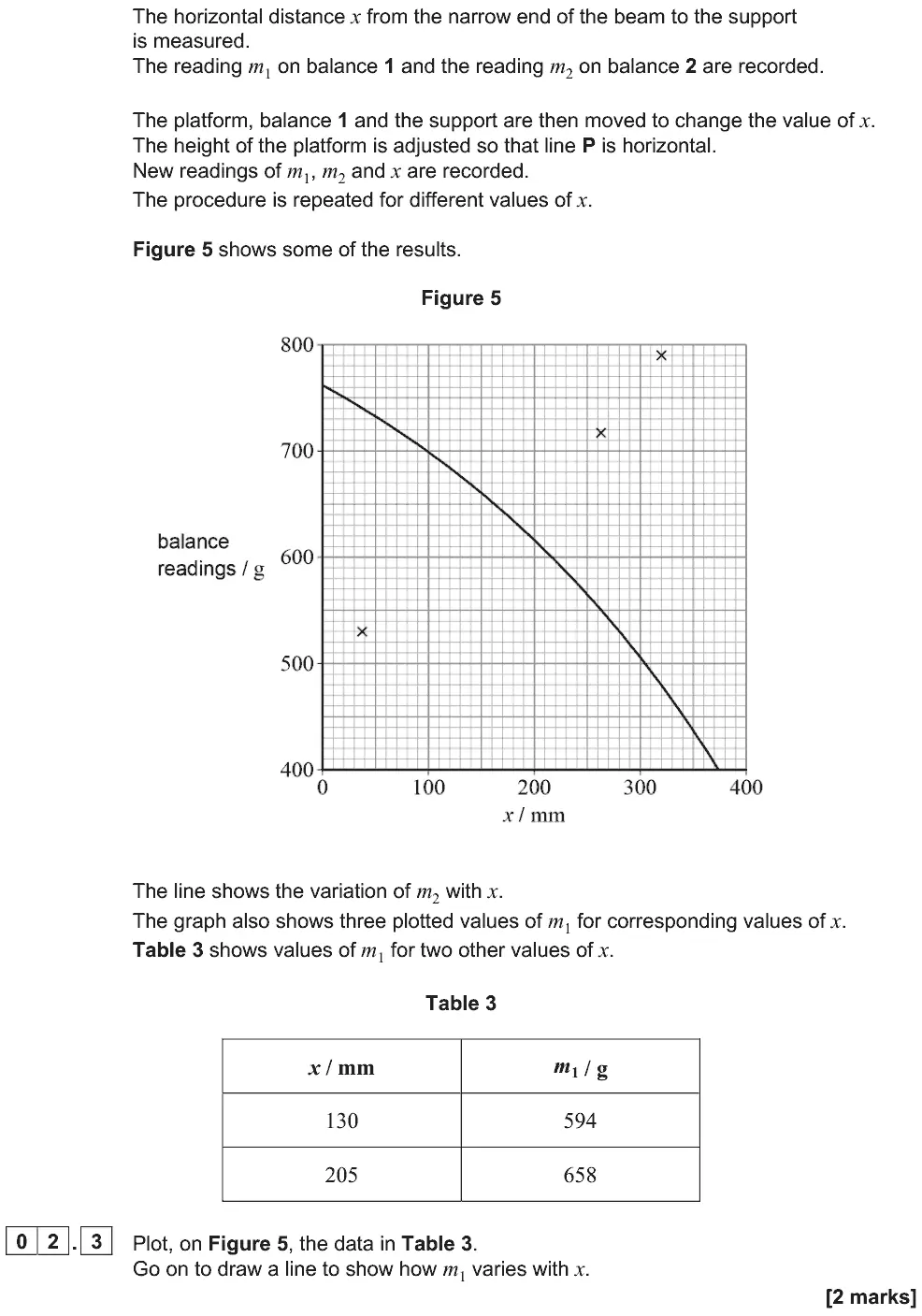
The horizontal distance x from the narrow end of the beam to the support
is measured.
The reading m1 on balance 1 and the reading m2 on balance 2 are recorded.
The platform, balance 1 and the support are then moved to change the value of x.
The height of the platform is adjusted so that line P is horizontal.
New readings of m1, m2 and x are recorded.
The procedure is repeated for different values of x.
Figure 5 shows some of the results.
Figure 5
The line shows the variation of m2 with x.
The graph also shows three plotted values of m1 for corresponding values of x.
Table 3 shows values of m1 for two other values of x.
Table 3
x / mm
m1 / g
130
594
205
658
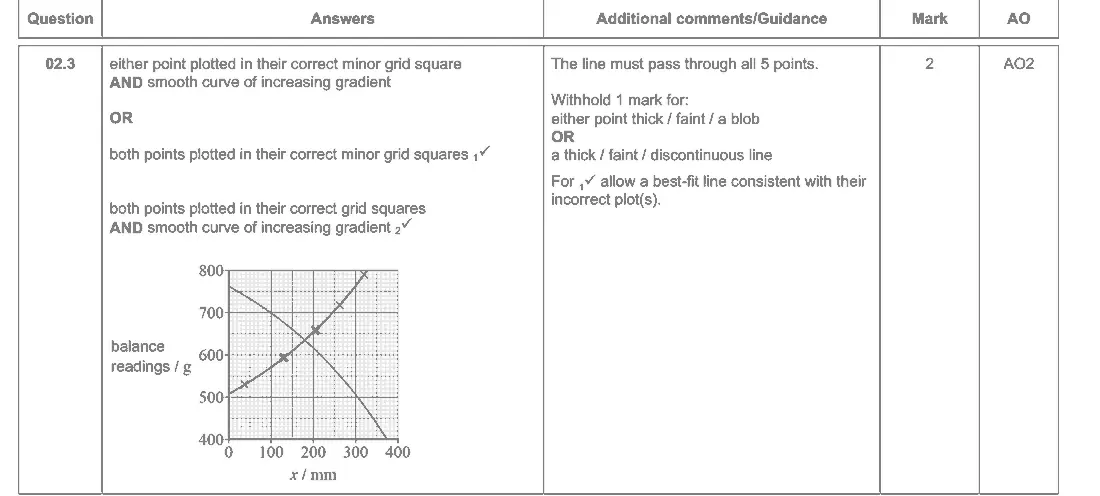
Plot, on Figure 5, the data in Table 3.
Go on to draw a line to show how m1 varies with x.
[2 marks]
June 2025 · AS Paper 2 · Q2.4 2 marks AO3=2 Practical and data analysis Hard vectors and moments
Earlier part of question 2 that this part usesEarlier part of June 2025 Paper 2 question 2
Determine an accurate value for the mass of the beam.
[2 marks]
mass of the beam =
g
June 2025 · AS Paper 2 · Q2.5 2 marks AO3=2 Practical and data analysis Easy vectors and moments
Earlier part of question 2 that this part usesEarlier part of June 2025 Paper 2 question 2
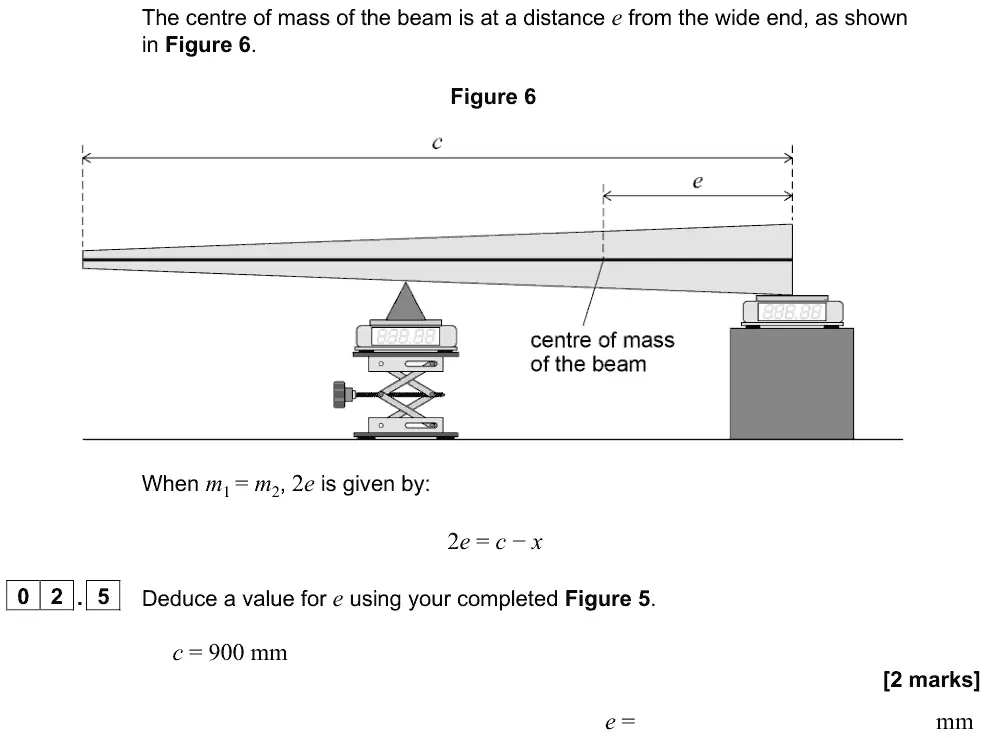
The centre of mass of the beam is at a distance e from the wide end, as shown
in Figure 6.
Figure 6
When m1 = m2, 2e is given by:
2e = c − x
Deduce a value for e using your completed Figure 5.
c = 900 mm
[2 marks]
e =
mm
June 2025 · AS Paper 2 · Q2.6 1 mark AO1=1 Practical and data analysis measurements and uncertainties
Earlier part of question 2 that this part usesEarlier part of June 2025 Paper 2 question 2
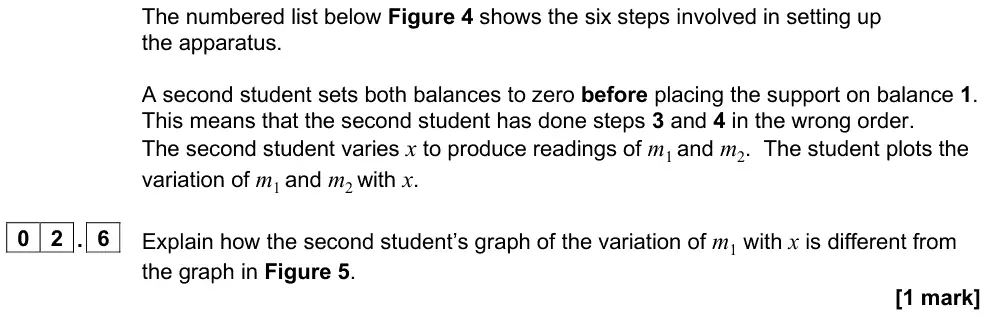
The numbered list below Figure 4 shows the six steps involved in setting up
the apparatus.
A second student sets both balances to zero before placing the support on balance 1.
This means that the second student has done steps 3 and 4 in the wrong order.
The second student varies x to produce readings of m1 and m2.  The student plots the
variation of m1 and m2 with x.
Explain how the second student’s graph of the variation of m1 with x is different from
the graph in Figure 5.
[1 mark]
June 2025 · AS Paper 2 · Q2.7 2 marks AO3=2 Practical and data analysis measurements and uncertaintiesvectors and moments
Earlier part of question 2 that this part usesEarlier part of June 2025 Paper 2 question 2
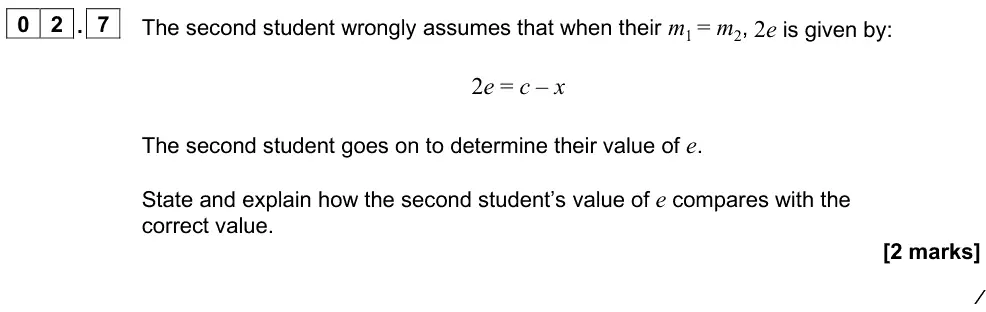
The second student wrongly assumes that when their m1 = m2, 2e is given by:
2e = c – x
The second student goes on to determine their value of e.
State and explain how the second student’s value of e compares with the
correct value.
[2 marks]
June 2025 · AS Paper 2 · Q3.1 2 marks AO1=1, AO2=1 Explanation emf and internal resistancecircuits and potential dividers
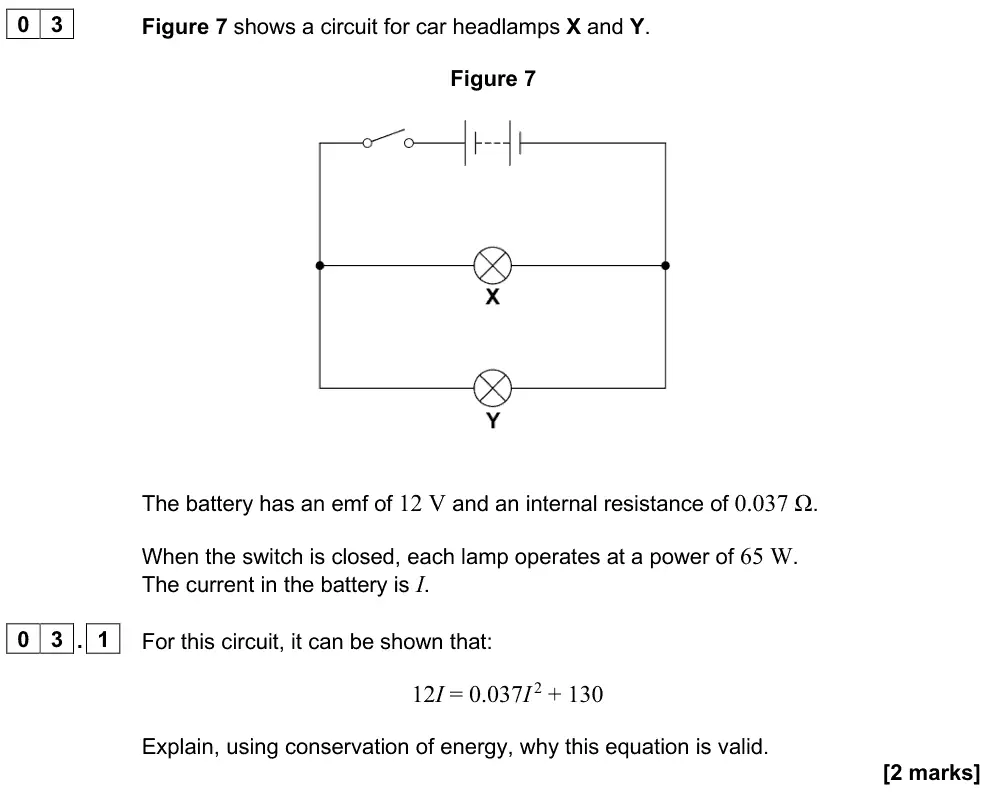
Figure 7 shows a circuit for car headlamps X and Y.
Figure 7
The battery has an emf of 12 V and an internal resistance of 0.037 Ω.
When the switch is closed, each lamp operates at a power of 65 W.
The current in the battery is I.
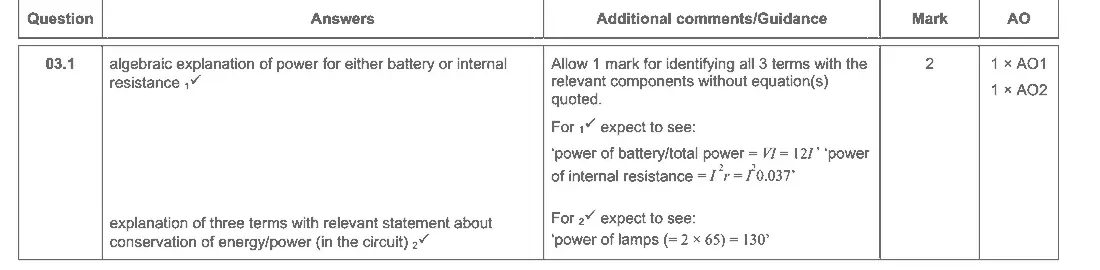
For this circuit, it can be shown that:
12I = 0.037I 2 + 130
Explain, using conservation of energy, why this equation is valid.
[2 marks]
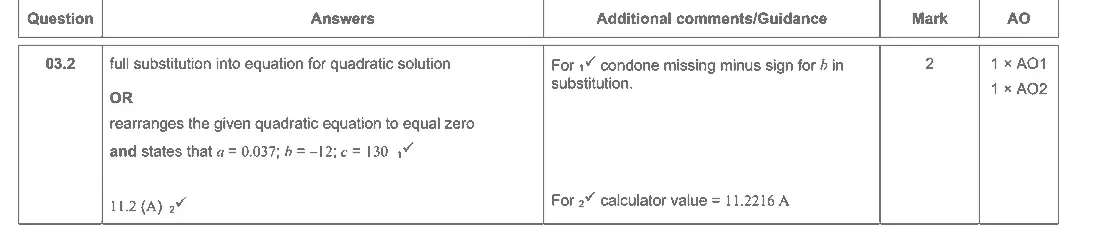
June 2025 · AS Paper 2 · Q3.2 2 marks AO1=1, AO2=1 Show that emf and internal resistance
Earlier part of question 3 that this part usesEarlier part of June 2025 Paper 2 question 3
Show that I is approximately 11 A.
[2 marks]
June 2025 · AS Paper 2 · Q3.3 2 marks AO1=1, AO2=1 Calculation Hard circuits and potential dividersemf and internal resistance
Earlier part of question 3 that this part usesEarlier part of June 2025 Paper 2 question 3
Determine the resistance of X when it operates at a power of 65 W.
[2 marks]
resistance of X =
Ω
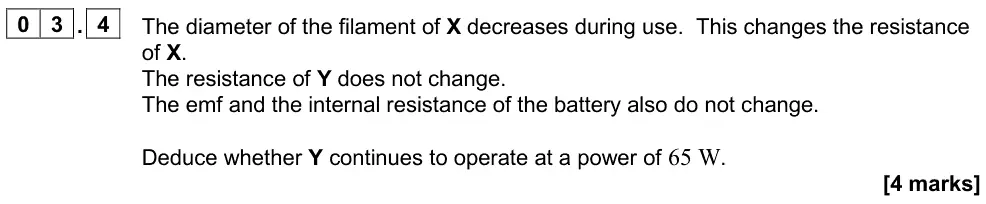
June 2025 · AS Paper 2 · Q3.4 4 marks AO3=4 Explanation Hard emf and internal resistancecurrent voltage and resistivity
Earlier part of question 3 that this part usesEarlier part of June 2025 Paper 2 question 3
The diameter of the filament of X decreases during use.  This changes the resistance
of X.
The resistance of Y does not change.
The emf and the internal resistance of the battery also do not change.
Deduce whether Y continues to operate at a power of 65 W.
[4 marks]
June 2025 · AS Paper 2 · Q4.1 2 marks AO2=2 Calculation motion and projectilesvectors and moments
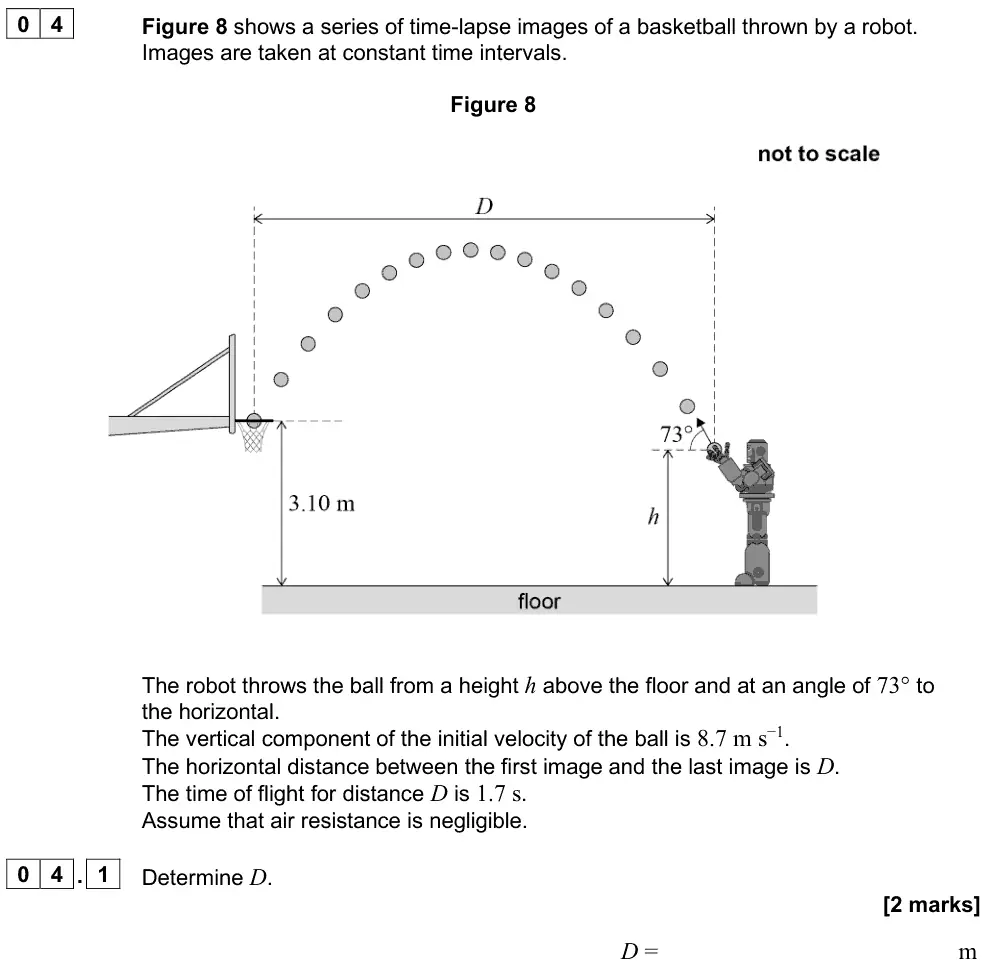
Figure 8 shows a series of time-lapse images of a basketball thrown by a robot.
Images are taken at constant time intervals.
Figure 8
The robot throws the ball from a height h above the floor and at an angle of 73° to
the horizontal.
The vertical component of the initial velocity of the ball is 8.7 m s−1.
The horizontal distance between the first image and the last image is D.
The time of flight for distance D is 1.7 s.
Assume that air resistance is negligible.
Determine D.
[2 marks]
D =
m
June 2025 · AS Paper 2 · Q4.2 3 marks AO2=3 Calculation Hard motion and projectiles
Earlier part of question 4 that this part usesEarlier part of June 2025 Paper 2 question 4
The vertical displacement of the ball from the floor in the last image is 3.10 m.
Determine h.
[3 marks]
h =
m
June 2025 · AS Paper 2 · Q4.3 2 marks AO3=2 Explanation motion and projectilesvectors and moments
Earlier part of question 4 that this part usesEarlier part of June 2025 Paper 2 question 4
The ball is again thrown by the robot.
The initial speed of the ball is the same as in Figure 8.
The angle for this throw is less than 73°.
Another set of images is taken as the ball moves through the same horizontal
distance D.
The constant time interval between each image is unchanged.
Deduce whether the number of images of the ball is different from the number
in Figure 8.
[2 marks]
June 2025 · AS Paper 2 · Q4.4 3 marks AO1=1, AO2=2 Explanation motion and projectiles
Earlier part of question 4 that this part usesEarlier part of June 2025 Paper 2 question 4
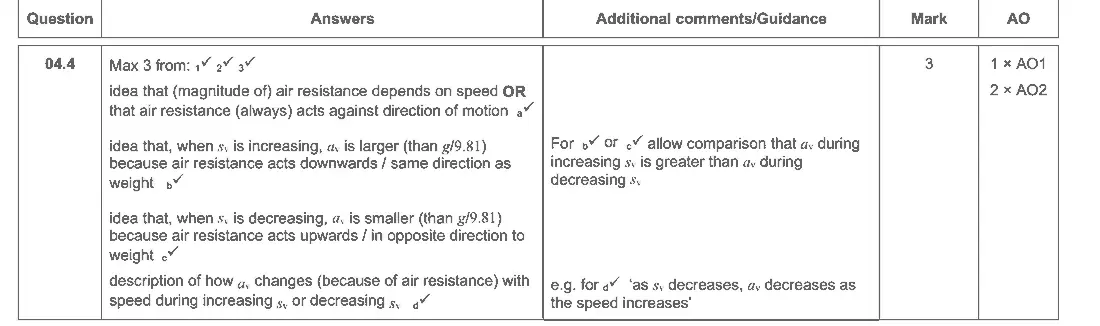
When air resistance is significant, the magnitude of the vertical component av of the
acceleration of the ball varies throughout the flight.
Discuss how air resistance affects av when the vertical displacement of the ball is:
• increasing
• decreasing.
[3 marks]
June 2025 · AS Paper 2 · Q5 1 mark AO2=1 Multiple choice stationary waves
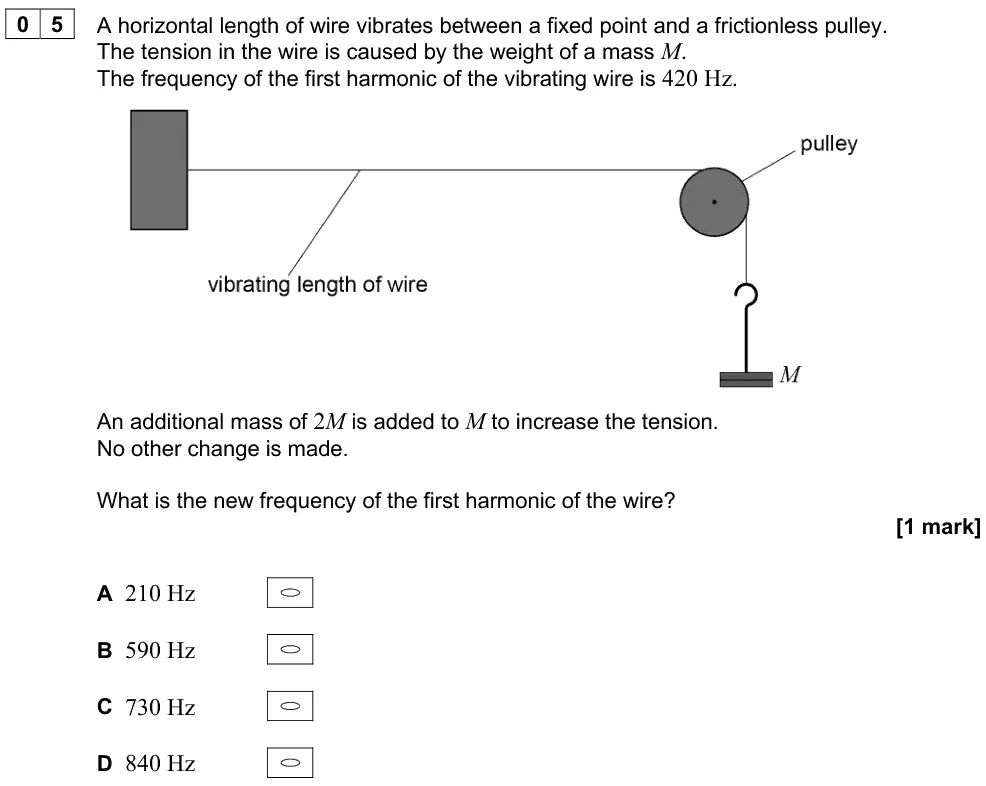
A horizontal length of wire vibrates between a fixed point and a frictionless pulley.
The tension in the wire is caused by the weight of a mass M.
The frequency of the first harmonic of the vibrating wire is 420 Hz.
An additional mass of 2M is added to M to increase the tension.
No other change is made.
What is the new frequency of the first harmonic of the wire?
[1 mark]
A 210 Hz
B 590 Hz
C 730 Hz
D 840 Hz
June 2025 · AS Paper 2 · Q6 1 mark AO1=1 Multiple choice energy levels and wave particle duality
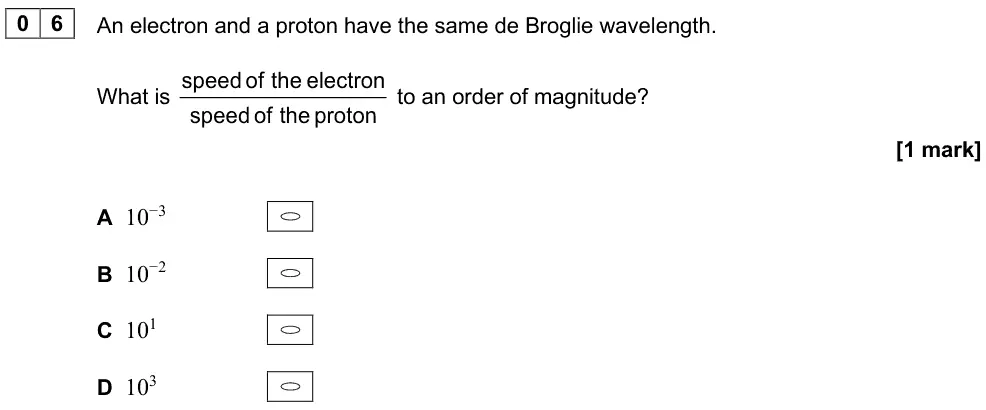
An electron and a proton have the same de Broglie wavelength.
What is speed of the electron
speed of the proton
to an order of magnitude?
[1 mark]
A 10−3
B 10−2
C 101
D 103
June 2025 · AS Paper 2 · Q7 1 mark AO2=1 Multiple choice circuits and potential dividers
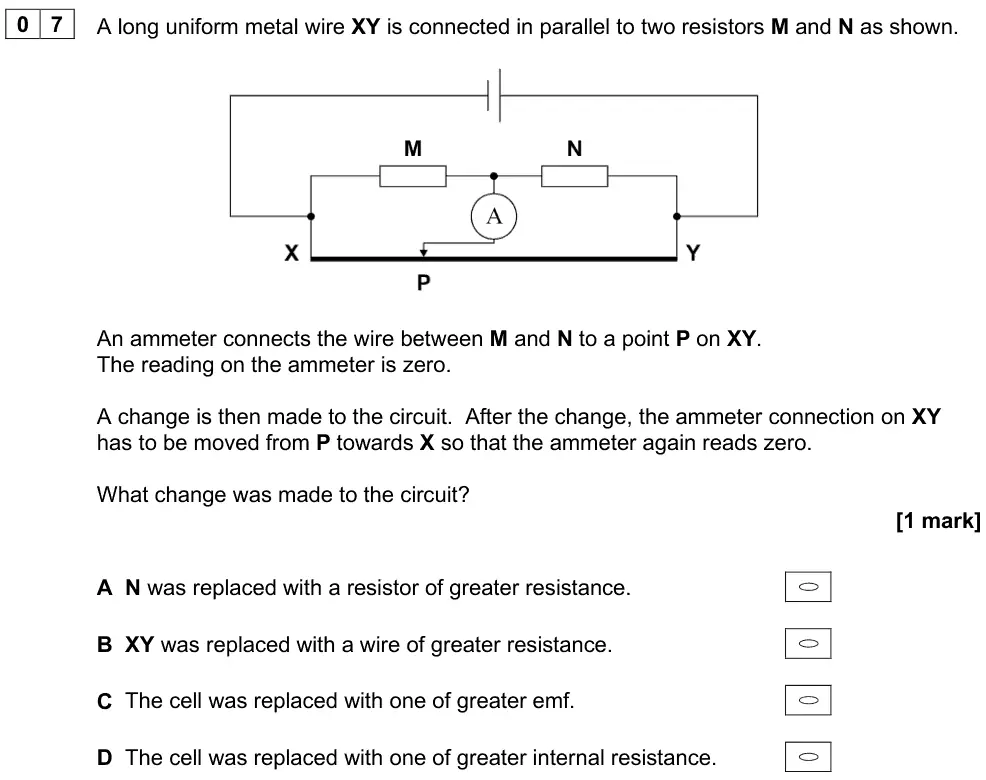
A long uniform metal wire XY is connected in parallel to two resistors M and N as shown.
An ammeter connects the wire between M and N to a point P on XY.
The reading on the ammeter is zero.
A change is then made to the circuit.  After the change, the ammeter connection on XY
has to be moved from P towards X so that the ammeter again reads zero.
What change was made to the circuit?
[1 mark]
A N was replaced with a resistor of greater resistance.
B XY was replaced with a wire of greater resistance.
C The cell was replaced with one of greater emf.
D The cell was replaced with one of greater internal resistance.
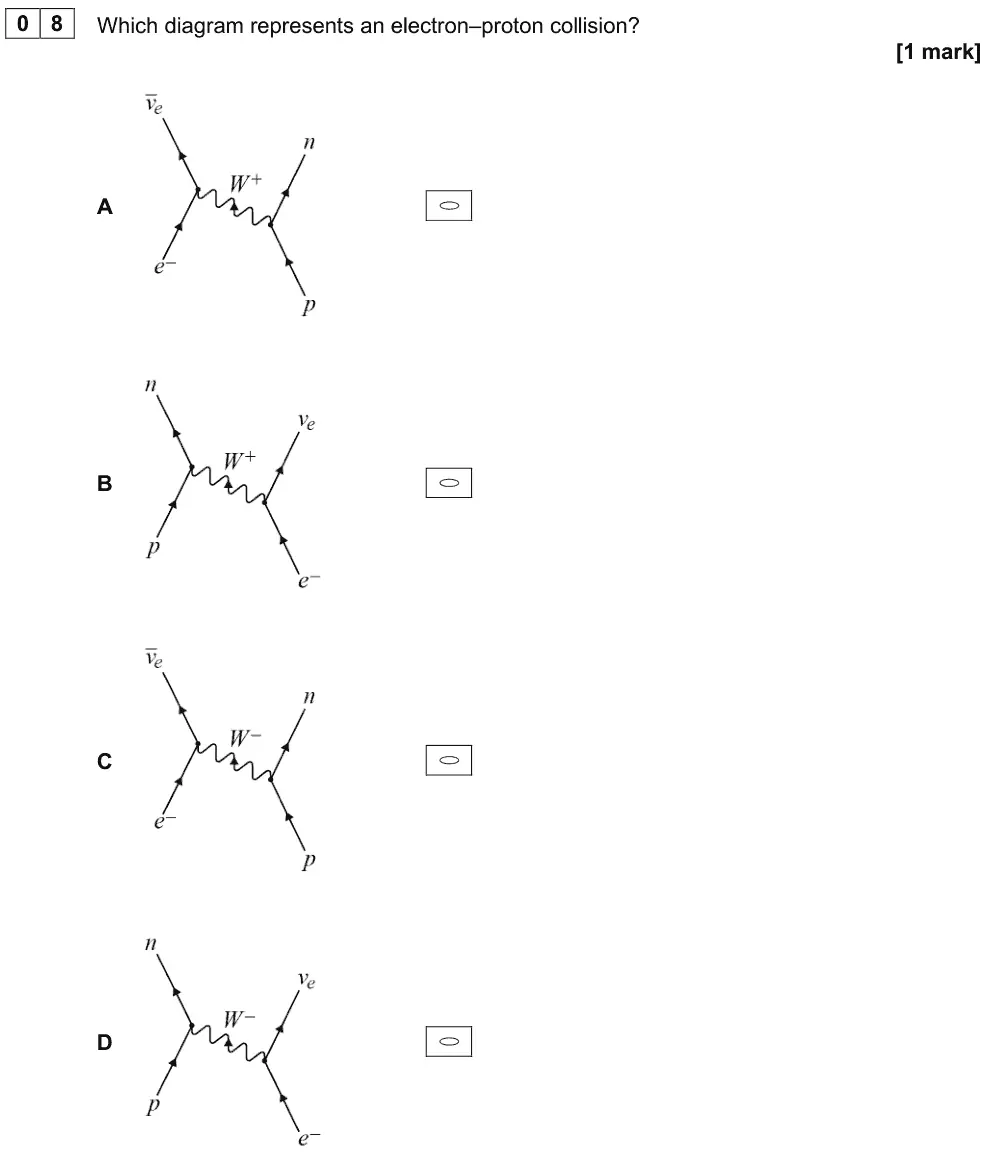
June 2025 · AS Paper 2 · Q8 1 mark AO1=1 Multiple choice particles antiparticles and interactions
Which diagram represents an electron–proton collision?
[1 mark]
A
B
C
D
June 2025 · AS Paper 2 · Q9 1 mark AO1=1 Multiple choice progressive waves and polarisation
The minimum distance between two points on a progressive wave with a phase difference
of π
2
is 0.040 m.
The frequency of the wave is 400 Hz.
What is the speed of the wave?
[1 mark]
A 16 m s−1
B 32 m s−1
C 64 m s−1
D 128 m s−1
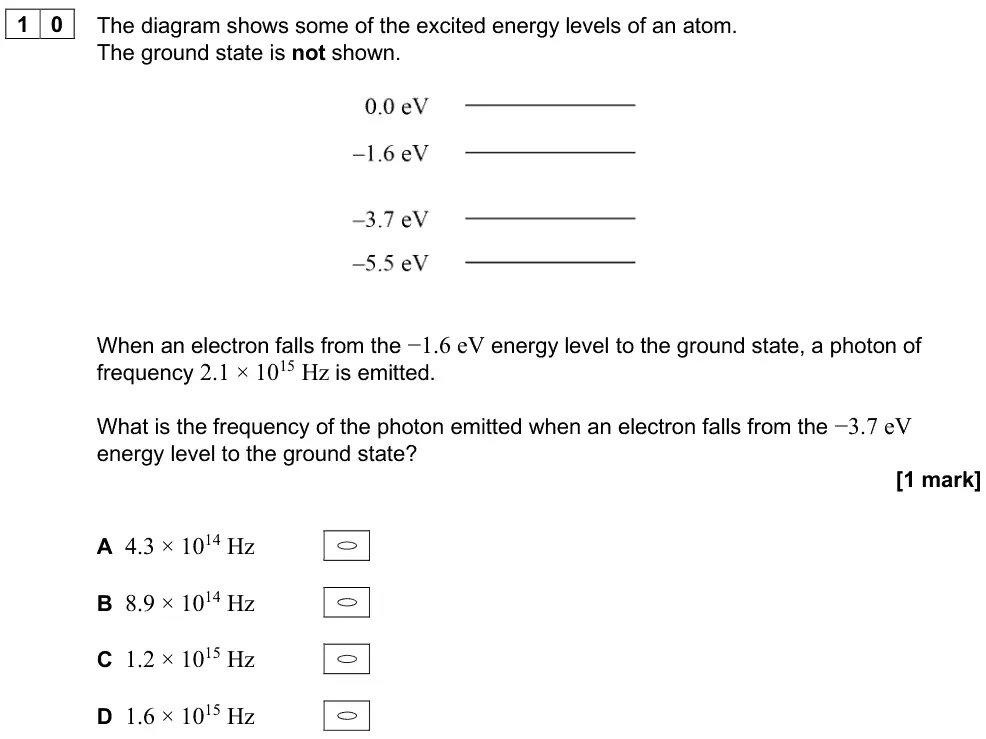
June 2025 · AS Paper 2 · Q10 1 mark AO2=1 Multiple choice energy levels and wave particle duality
The diagram shows some of the excited energy levels of an atom.
The ground state is not shown.
When an electron falls from the −1.6 eV energy level to the ground state, a photon of
frequency 2.1 × 10¹⁵ Hz is emitted.
What is the frequency of the photon emitted when an electron falls from the −3.7 eV
energy level to the ground state?
[1 mark]
A 4.3 × 10¹⁴ Hz
B 8.9 × 10¹⁴ Hz
C 1.2 × 10¹⁵ Hz
D 1.6 × 10¹⁵ Hz
June 2025 · AS Paper 2 · Q11 1 mark AO2=1 Multiple choice progressive waves and polarisationinterference and diffraction
Two coherent sources generate sound waves of wavelength 0.40 m.
The waves are in phase when they leave the sources.
The path difference between a detector and each of the two sources is 2.0 m.
What is the phase difference between the waves arriving at the detector?
[1 mark]
A zero
B 45°
C 90°
D 180°
June 2025 · AS Paper 2 · Q12 1 mark AO1=1 Multiple choice progressive waves and polarisation
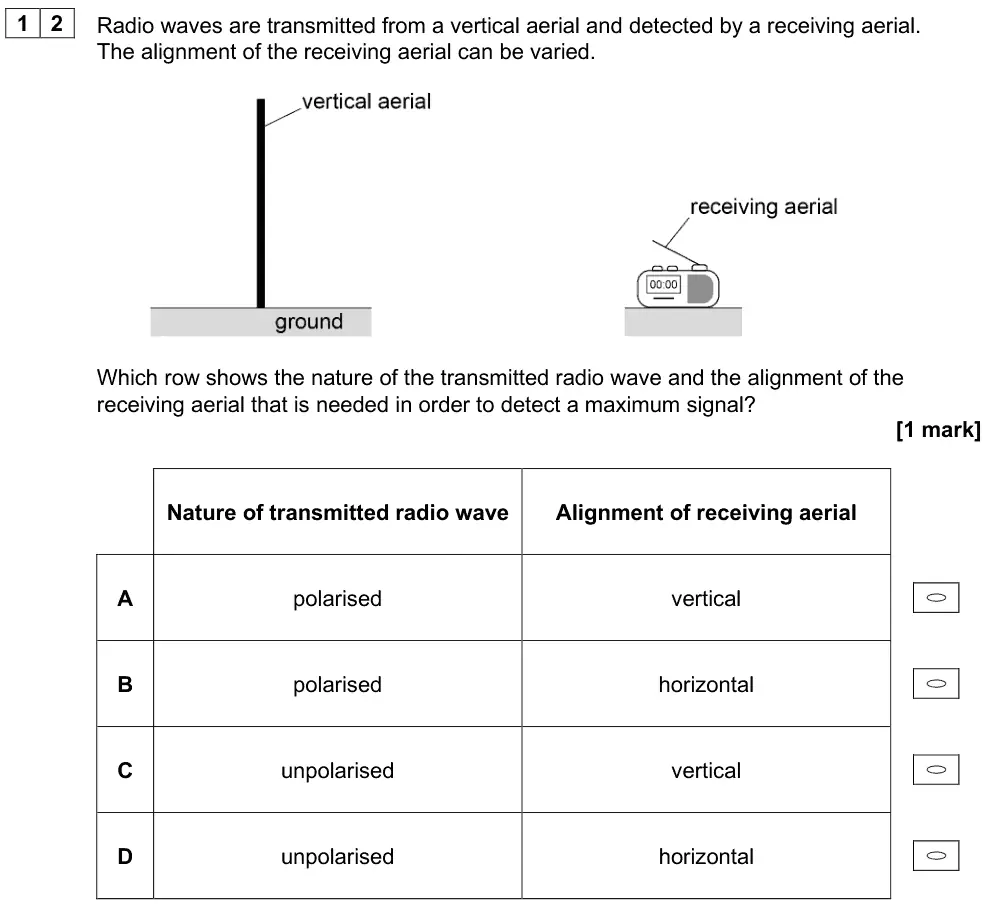
Radio waves are transmitted from a vertical aerial and detected by a receiving aerial.
The alignment of the receiving aerial can be varied.
Which row shows the nature of the transmitted radio wave and the alignment of the
receiving aerial that is needed in order to detect a maximum signal?
[1 mark]
Nature of transmitted radio wave
Alignment of receiving aerial
A
polarised
vertical
B
polarised
horizontal
C
unpolarised
vertical
D
unpolarised
horizontal
June 2025 · AS Paper 2 · Q13 1 mark AO2=1 Multiple choice motion and projectiles
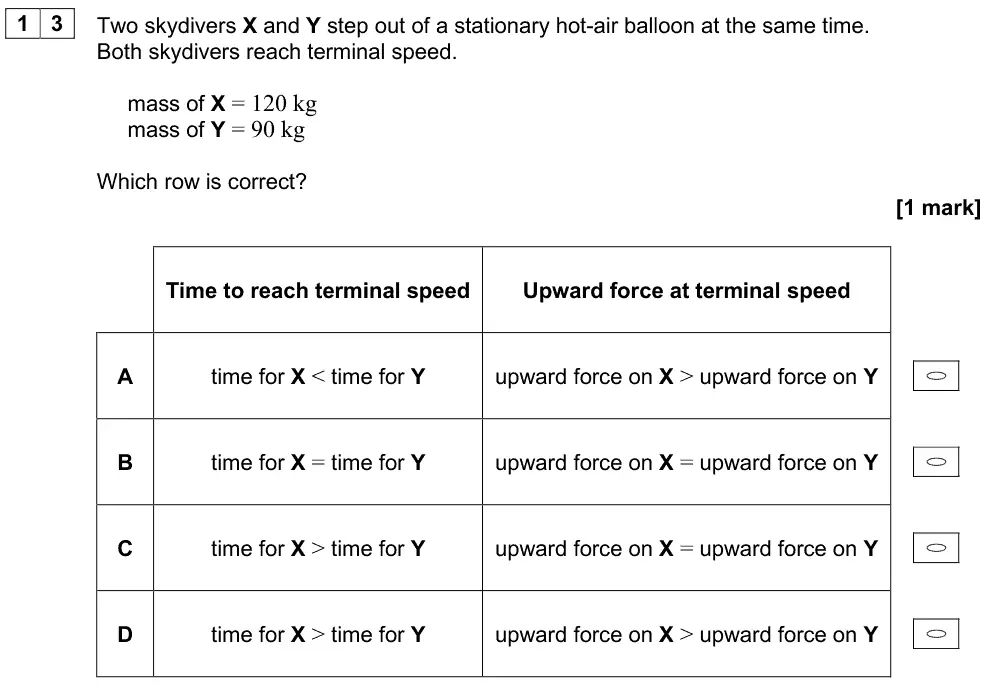
Two skydivers X and Y step out of a stationary hot-air balloon at the same time.
Both skydivers reach terminal speed.
mass of X = 120 kg
mass of Y = 90 kg
Which row is correct?
[1 mark]
Time to reach terminal speed
Upward force at terminal speed
A
time for X < time for Y
upward force on X > upward force on Y
B
time for X = time for Y
upward force on X = upward force on Y
C
time for X > time for Y
upward force on X = upward force on Y
D
time for X > time for Y
upward force on X > upward force on Y
June 2025 · AS Paper 2 · Q14 1 mark AO1=1 Multiple choice refraction and optical fibresprogressive waves and polarisation
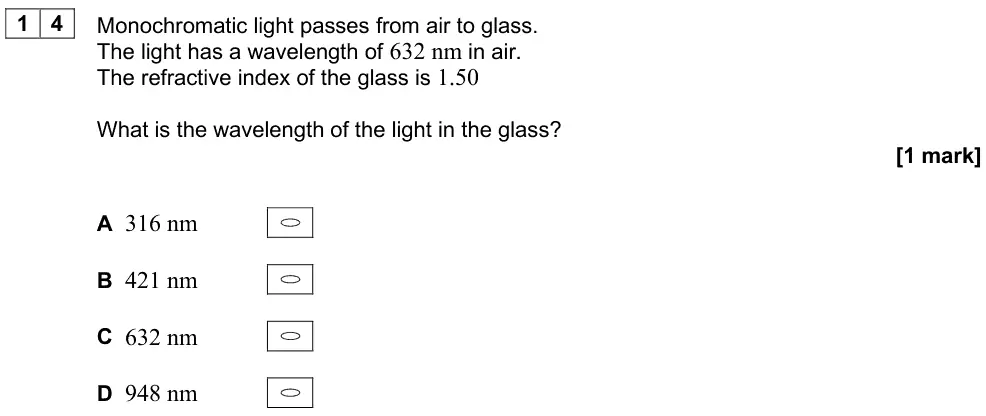
Monochromatic light passes from air to glass.
The light has a wavelength of 632 nm in air.
The refractive index of the glass is 1.50
What is the wavelength of the light in the glass?
[1 mark]
A 316 nm
B 421 nm
C 632 nm
D 948 nm
June 2025 · AS Paper 2 · Q15 1 mark AO2=1 Multiple choice progressive waves and polarisation
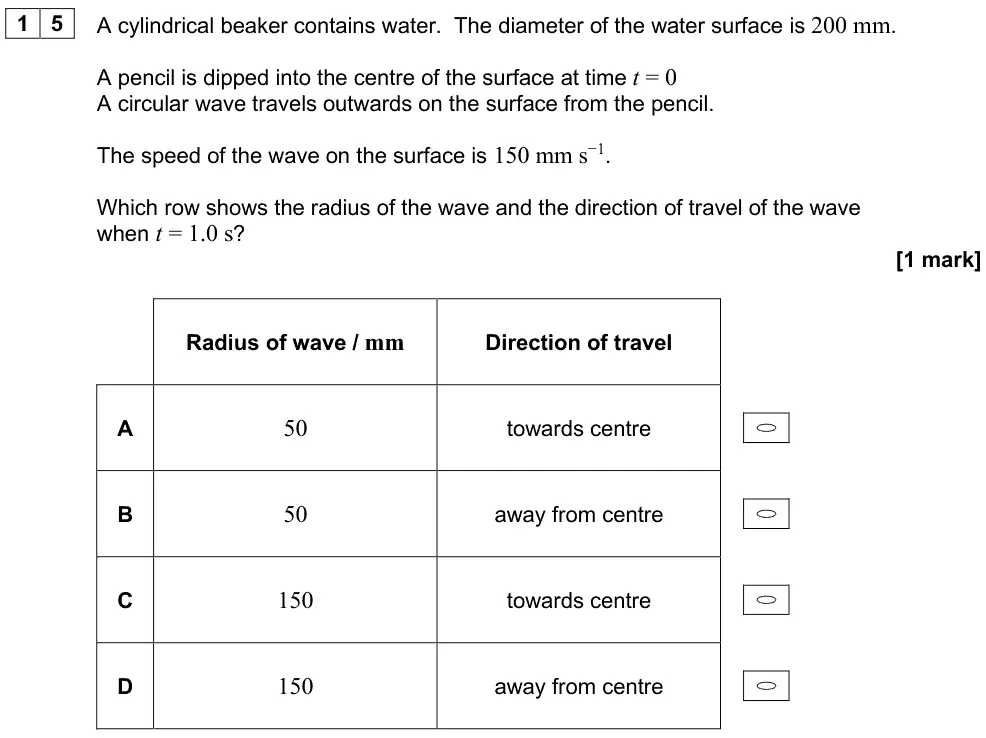
A cylindrical beaker contains water.  The diameter of the water surface is 200 mm.
A pencil is dipped into the centre of the surface at time t = 0
A circular wave travels outwards on the surface from the pencil.
The speed of the wave on the surface is 150 mm s−1.
Which row shows the radius of the wave and the direction of travel of the wave
when t = 1.0 s?
[1 mark]
Radius of wave / mm
Direction of travel
A
50
towards centre
B
50
away from centre
C
150
towards centre
D
150
away from centre
June 2025 · AS Paper 2 · Q16 1 mark AO2=1 Multiple choice stationary waves
A string vibrates at the Nth harmonic.
The separation x between adjacent nodes is 0.60 m.
The string now vibrates at the (N + 1)th harmonic and x decreases by 0.12 m.
What is N?
[1 mark]
A 3
B 4
C 5
D 6
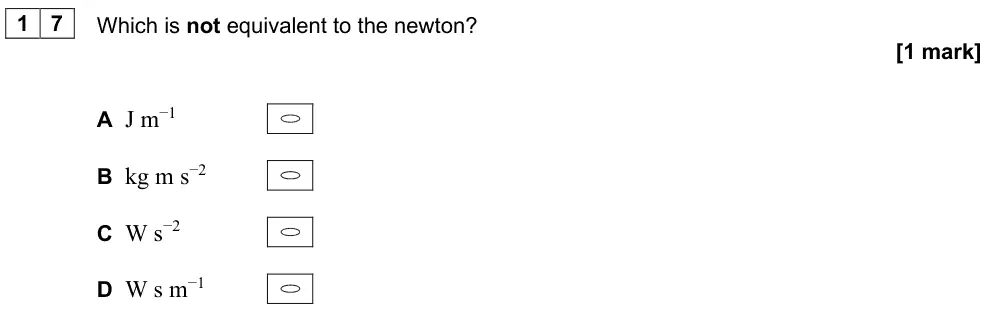
June 2025 · AS Paper 2 · Q17 1 mark AO1=1 Multiple choice measurements and uncertainties
Which is not equivalent to the newton?
[1 mark]
A J m−1
B kg m s−2
C W s−2
D W s m−1
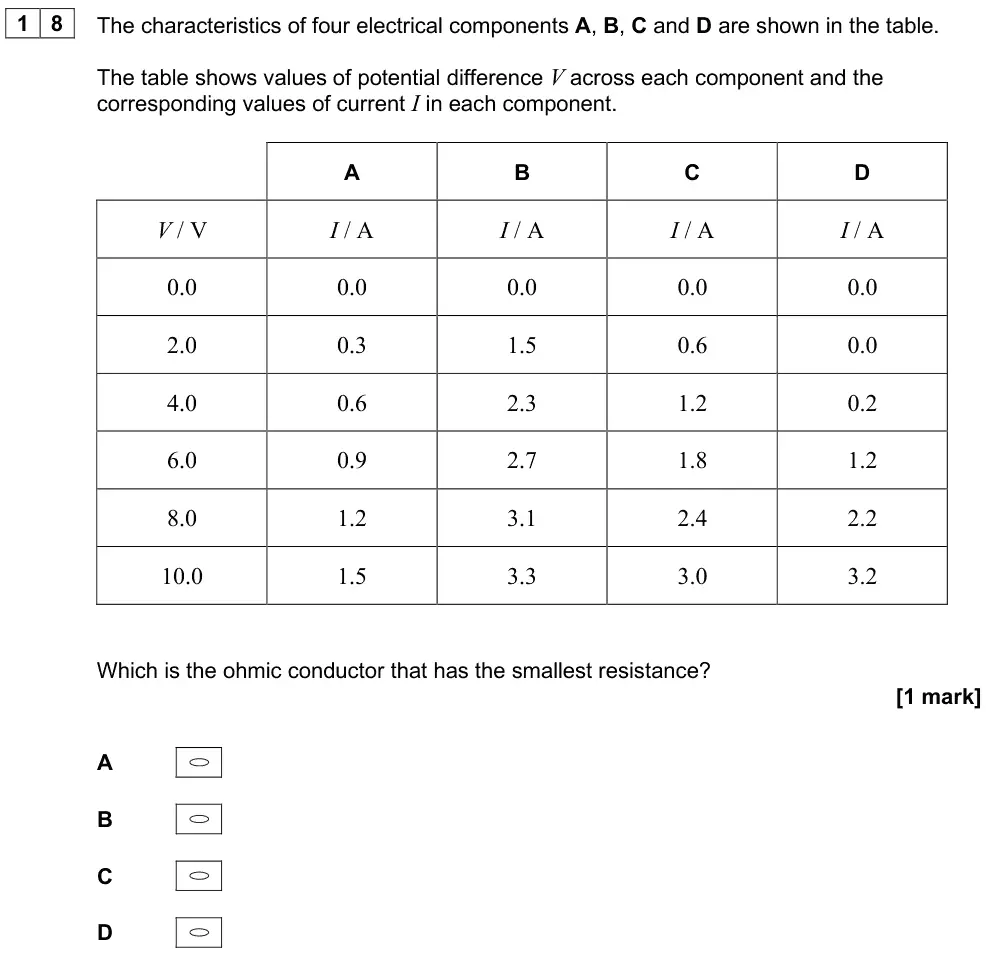
June 2025 · AS Paper 2 · Q18 1 mark AO2=1 Multiple choice current voltage and resistivity
The characteristics of four electrical components A, B, C and D are shown in the table.
The table shows values of potential difference V across each component and the
corresponding values of current I in each component.
A
B
C
D
V / V
I / A
I / A
I / A
I / A
0.0
0.0
0.0
0.0
0.0
2.0
0.3
1.5
0.6
0.0
4.0
0.6
2.3
1.2
0.2
6.0
0.9
2.7
1.8
1.2
8.0
1.2
3.1
2.4
2.2
10.0
1.5
3.3
3.0
3.2
Which is the ohmic conductor that has the smallest resistance?
[1 mark]
A
B
C
D
June 2025 · AS Paper 2 · Q19 1 mark AO1=1 Multiple choice newtons laws and momentum
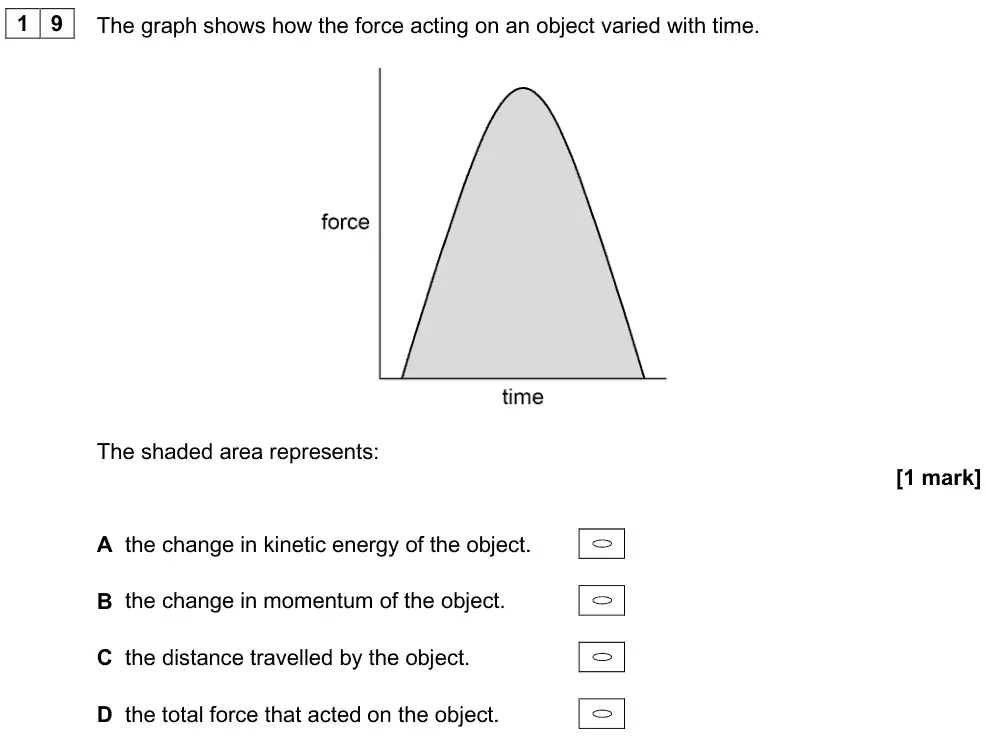
The graph shows how the force acting on an object varied with time.
The shaded area represents:
[1 mark]
A the change in kinetic energy of the object.
B the change in momentum of the object.
C the distance travelled by the object.
D the total force that acted on the object.
June 2025 · AS Paper 2 · Q20 1 mark AO2=1 Multiple choice motion and projectileswork energy and power
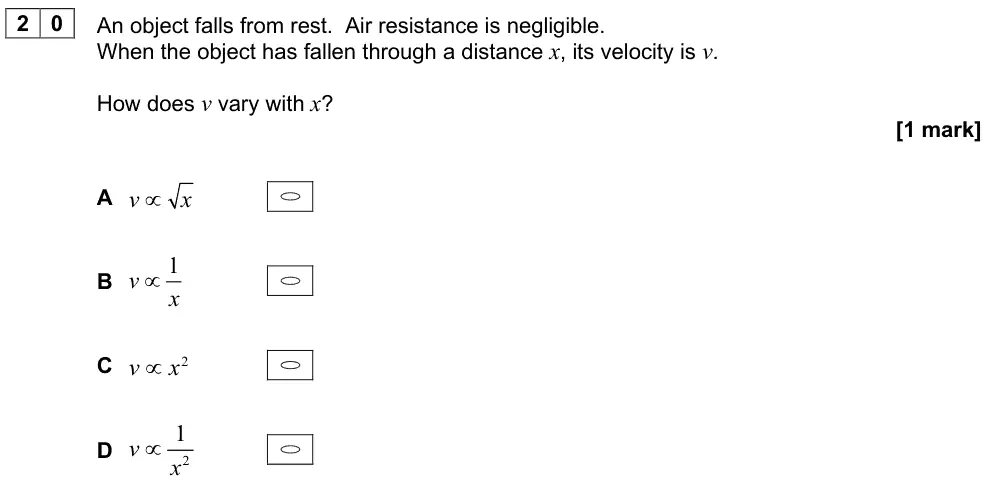
An object falls from rest.  Air resistance is negligible.
When the object has fallen through a distance x, its velocity is v.
How does v vary with x?
[1 mark]
A v
x
∝
B
1
v
x
∝
C
2
v
x
∝
D
2
1
v
x
∝
June 2025 · AS Paper 2 · Q21 1 mark AO1=1 Multiple choice materials and young modulus
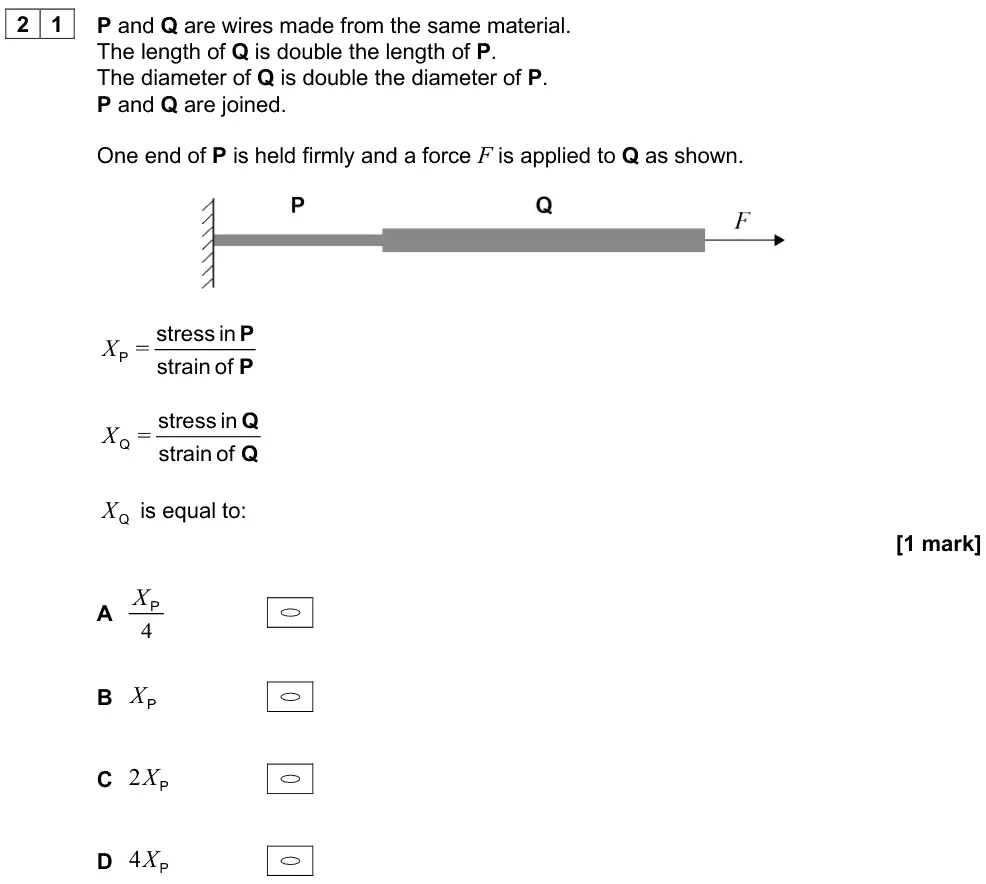
P and Q are wires made from the same material.
The length of Q is double the length of P.
The diameter of Q is double the diameter of P.
P and Q are joined.
One end of P is held firmly and a force F is applied to Q as shown.
=
XP
stress in
strain of
P
P
=
X Q
stress in
strain of
Q
Q
X Q is equal to:
[1 mark]
A
4
XP
B XP
C 2XP
D 4XP
June 2025 · AS Paper 2 · Q22 1 mark AO1=1 Multiple choice progressive waves and polarisation
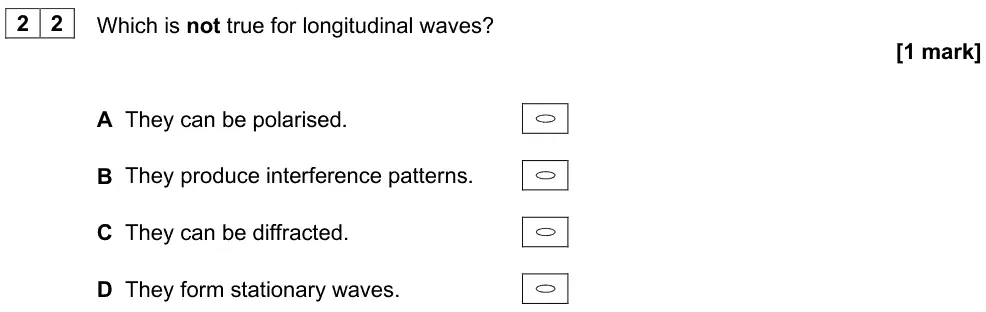
Which is not true for longitudinal waves?
[1 mark]
A They can be polarised.
B They produce interference patterns.
C They can be diffracted.
D They form stationary waves.
June 2025 · AS Paper 2 · Q23 1 mark AO2=1 Multiple choice vectors and moments
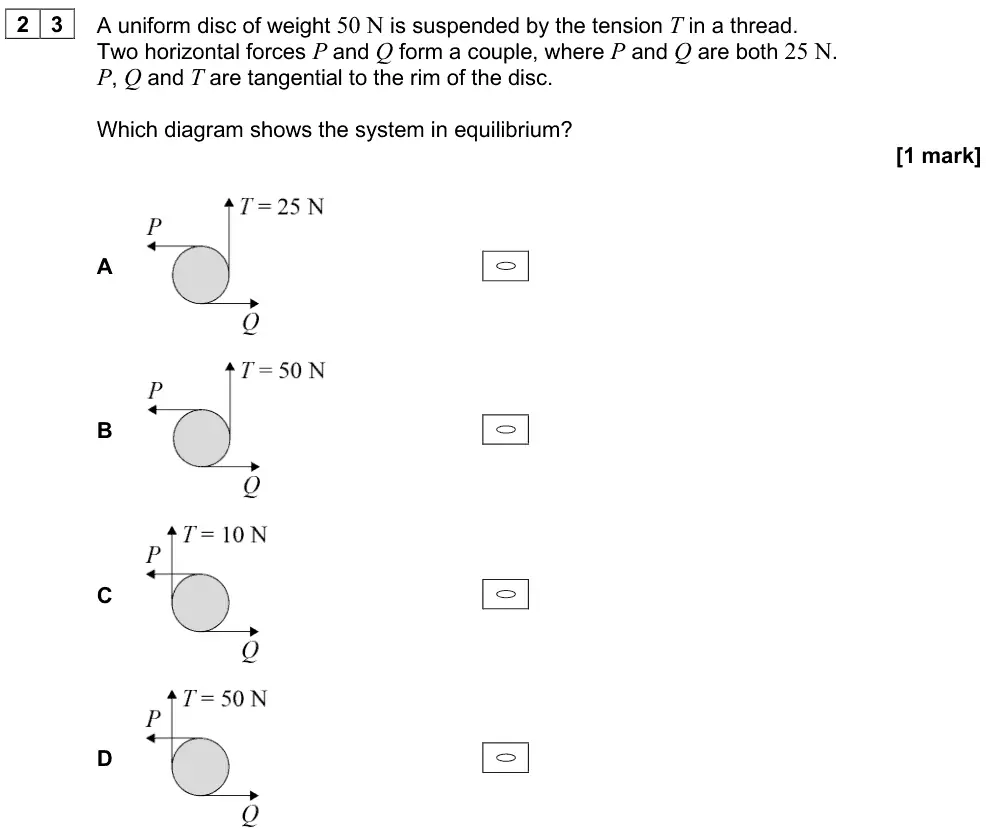
A uniform disc of weight 50 N is suspended by the tension T in a thread.
Two horizontal forces P and Q form a couple, where P and Q are both 25 N.
P, Q and T are tangential to the rim of the disc.
Which diagram shows the system in equilibrium?
[1 mark]
A
B
C
D
June 2025 · AS Paper 2 · Q24 1 mark AO2=1 Multiple choice materials and young modulus
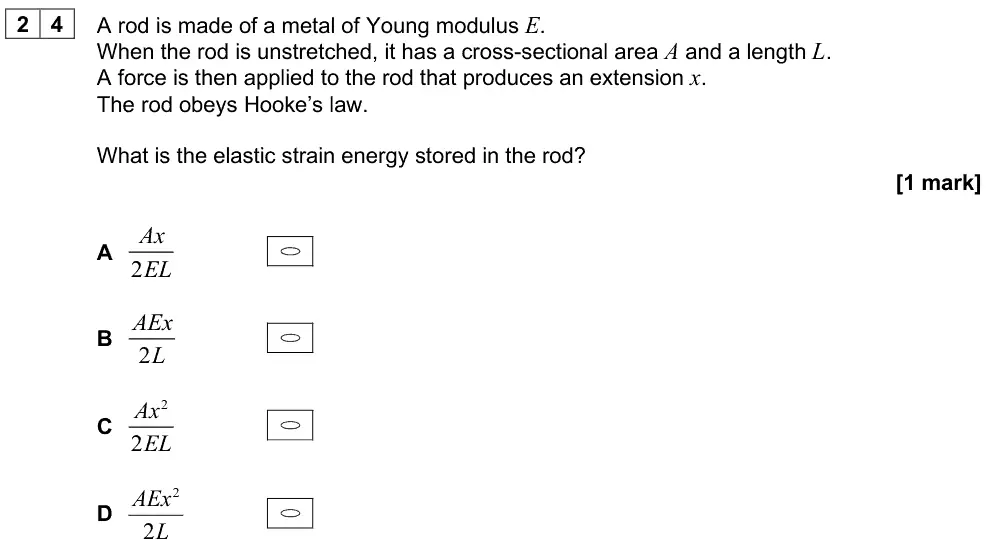
A rod is made of a metal of Young modulus E.
When the rod is unstretched, it has a cross-sectional area A and a length L.
A force is then applied to the rod that produces an extension x.
The rod obeys Hooke’s law.
What is the elastic strain energy stored in the rod?
[1 mark]
A 2
Ax
EL
B
2
AEx
L
C
2
2
Ax
EL
D
2
2
AEx
L
June 2025 · AS Paper 2 · Q25 1 mark AO2=1 Multiple choice vectors and moments
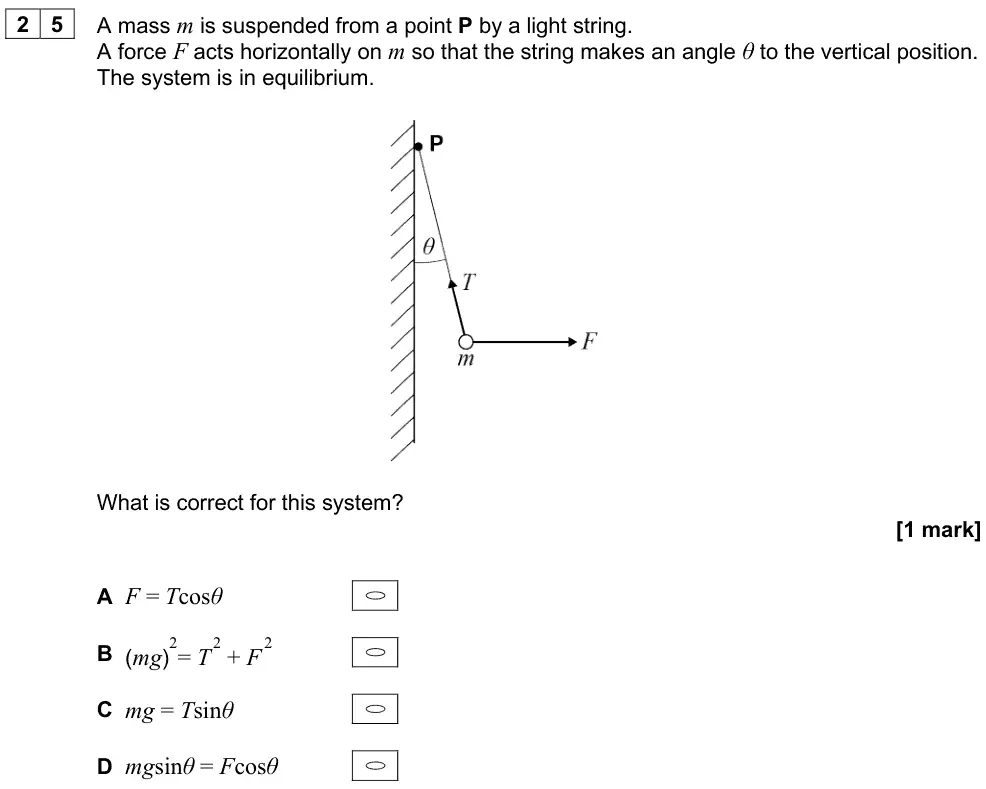
A mass m is suspended from a point P by a light string.
A force F acts horizontally on m so that the string makes an angle θ to the vertical position.
The system is in equilibrium.
What is correct for this system?
[1 mark]
A F = Tcosθ
B (mg)
2= T
2 + F
2
C mg = Tsinθ
D mgsinθ = Fcosθ
June 2025 · AS Paper 2 · Q26 1 mark AO1=1 Multiple choice circuits and potential dividers
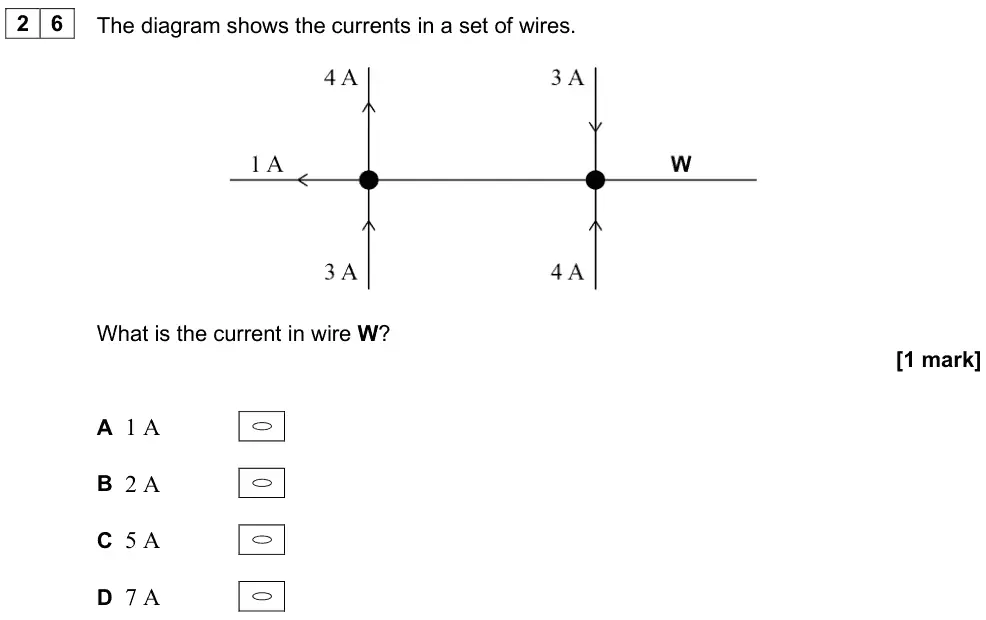
The diagram shows the currents in a set of wires.
What is the current in wire W?
[1 mark]
A 1 A
B 2 A
C 5 A
D 7 A
June 2025 · AS Paper 2 · Q27 1 mark AO2=1 Multiple choice measurements and uncertaintiescurrent voltage and resistivity
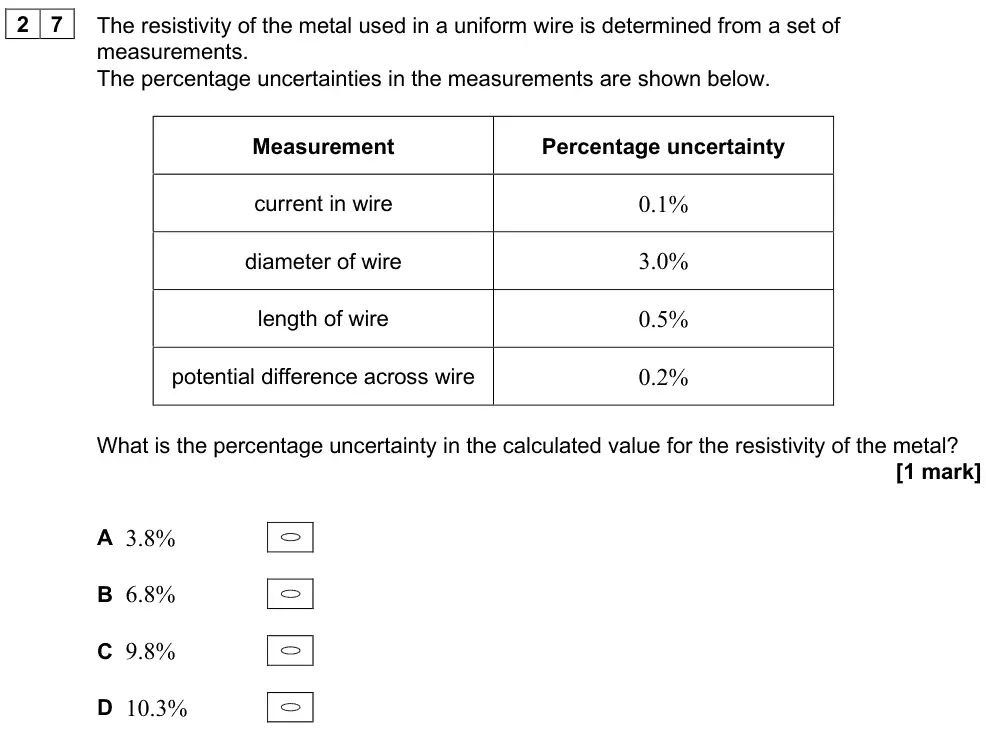
The resistivity of the metal used in a uniform wire is determined from a set of
measurements.
The percentage uncertainties in the measurements are shown below.
Measurement
Percentage uncertainty
current in wire
0.1%
diameter of wire
3.0%
length of wire
0.5%
potential difference across wire
0.2%
What is the percentage uncertainty in the calculated value for the resistivity of the metal?
[1 mark]
A 3.8%
B 6.8%
C 9.8%
D 10.3%
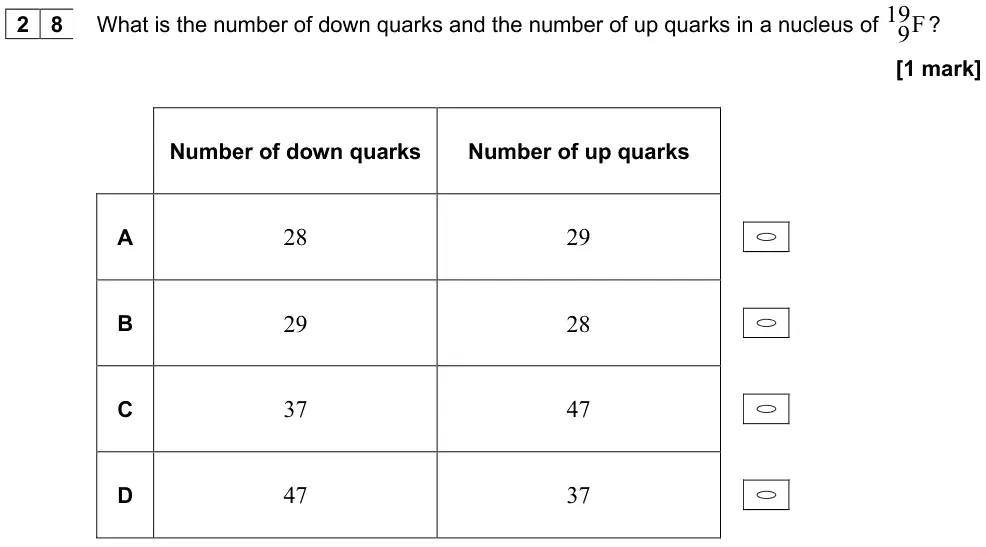
What is the number of down quarks and the number of up quarks in a nucleus of 19F
June 2025 · AS Paper 2 · Q28 1 mark AO1=1 Multiple choice classification of particles and quarksatomic structure and stable nuclei
9
?
[1 mark]
Number of down quarks
Number of up quarks
A
28
29
B
29
28
C
37
47
D
47
37
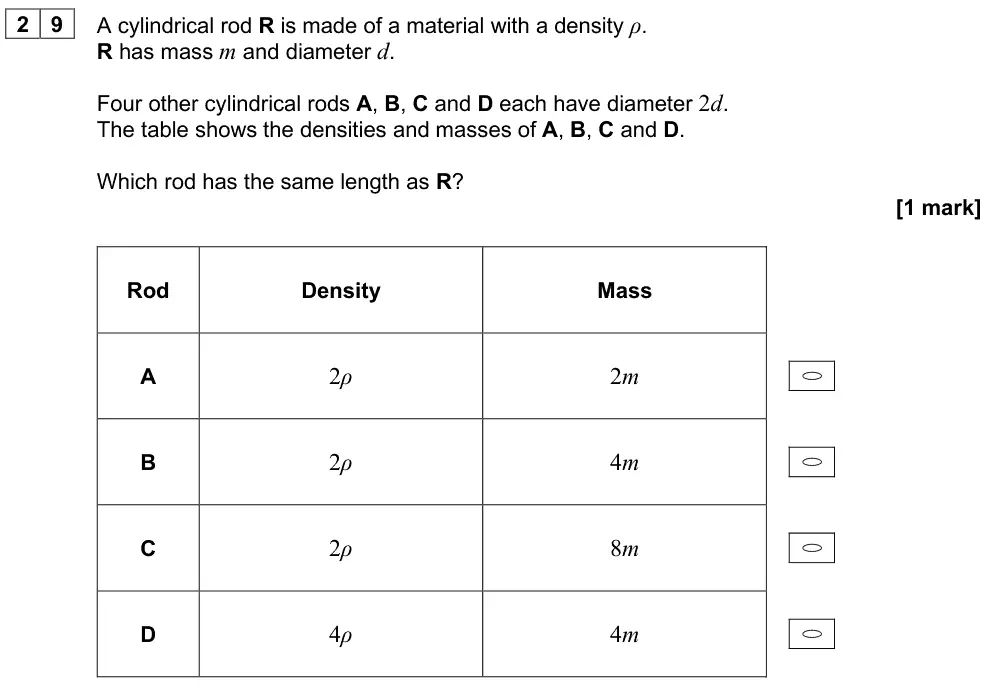
June 2025 · AS Paper 2 · Q29 1 mark AO1=1 Multiple choice materials and young modulus
A cylindrical rod R is made of a material with a density ρ.
R has mass m and diameter d.
Four other cylindrical rods A, B, C and D each have diameter 2d.
The table shows the densities and masses of A, B, C and D.
Which rod has the same length as R?
[1 mark]
Rod
Density
Mass
A
2ρ
2m
B
2ρ
4m
C
2ρ
8m
D
4ρ
4m
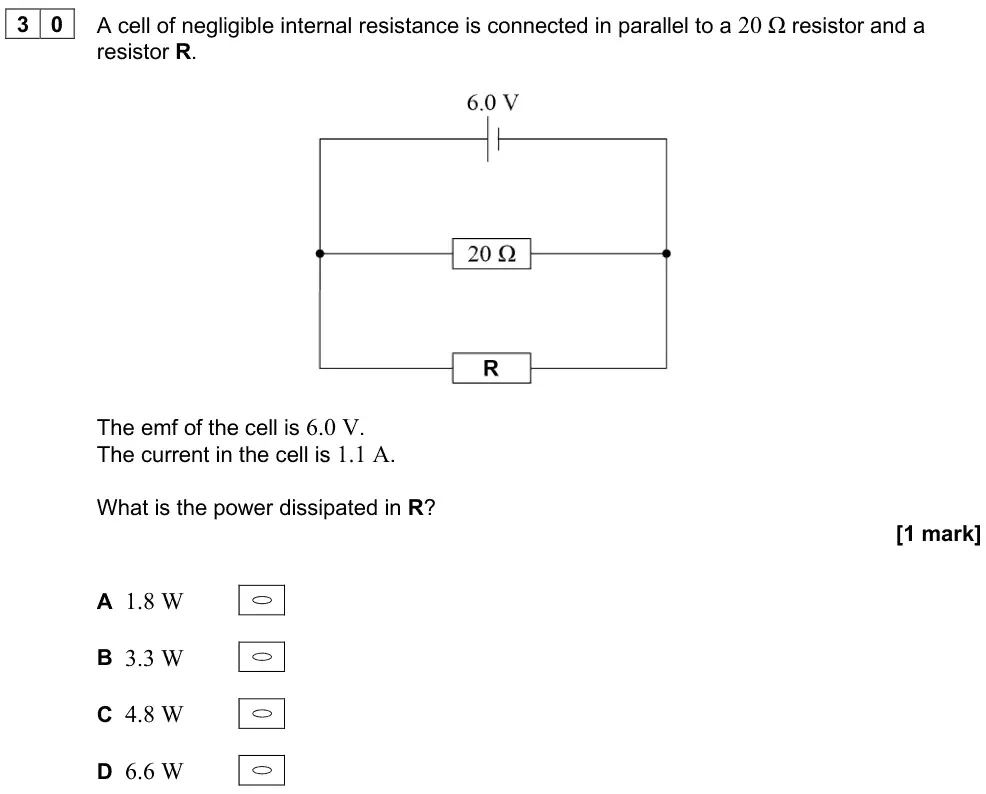
June 2025 · AS Paper 2 · Q30 1 mark AO2=1 Multiple choice circuits and potential dividers
A cell of negligible internal resistance is connected in parallel to a 20 Ω resistor and a
resistor R.
The emf of the cell is 6.0 V.
The current in the cell is 1.1 A.
What is the power dissipated in R?
[1 mark]
A 1.8 W
B 3.3 W
C 4.8 W
D 6.6 W
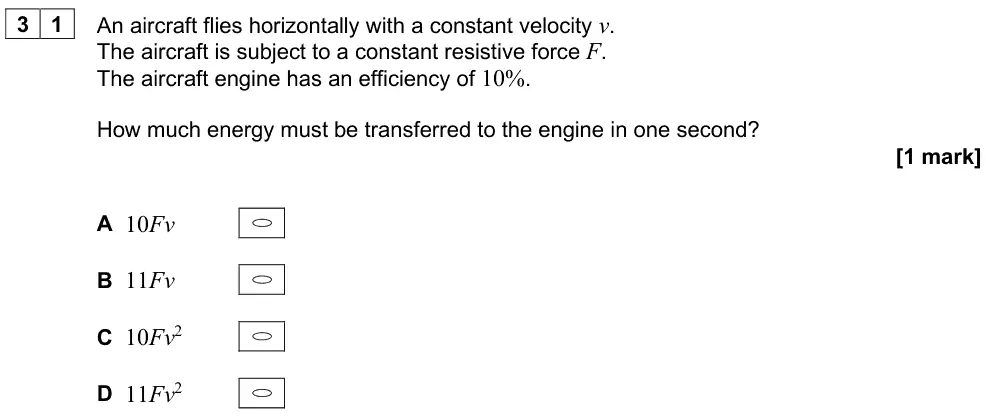
June 2025 · AS Paper 2 · Q31 1 mark AO2=1 Multiple choice work energy and power
An aircraft flies horizontally with a constant velocity v.
The aircraft is subject to a constant resistive force F.
The aircraft engine has an efficiency of 10%.
How much energy must be transferred to the engine in one second?
[1 mark]
A 10Fv
B 11Fv
C 10Fv2
D 11Fv2
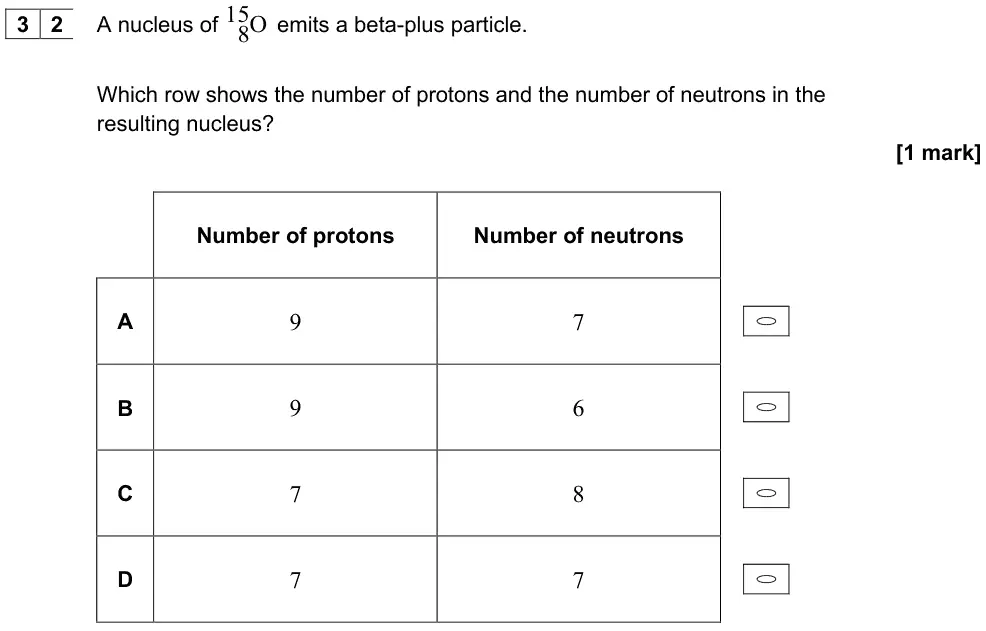
A nucleus of 15O
June 2025 · AS Paper 2 · Q32 1 mark AO1=1 Multiple choice atomic structure and stable nuclei
8
emits a beta-plus particle.
Which row shows the number of protons and the number of neutrons in the
resulting nucleus?
[1 mark]
Number of protons
Number of neutrons
A
9
7
B
9
6
C
7
8
D
7
7
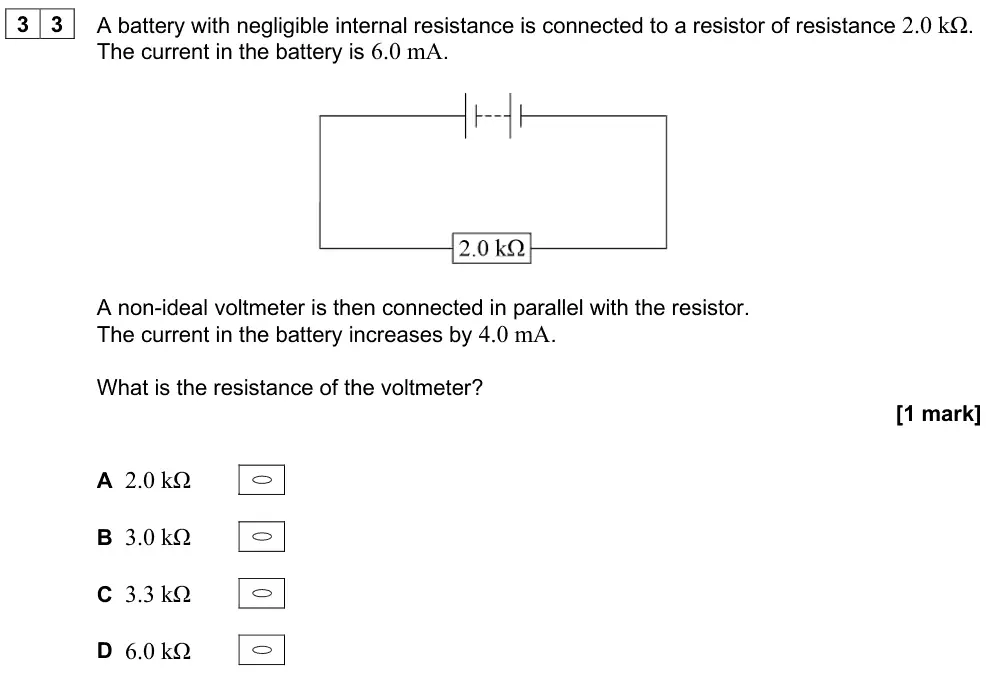
June 2025 · AS Paper 2 · Q33 1 mark AO2=1 Multiple choice circuits and potential dividerscurrent voltage and resistivity
A battery with negligible internal resistance is connected to a resistor of resistance 2.0 kΩ.
The current in the battery is 6.0 mA.
A non-ideal voltmeter is then connected in parallel with the resistor.
The current in the battery increases by 4.0 mA.
What is the resistance of the voltmeter?
[1 mark]
A 2.0 kΩ
B 3.0 kΩ
C 3.3 kΩ
D 6.0 kΩ
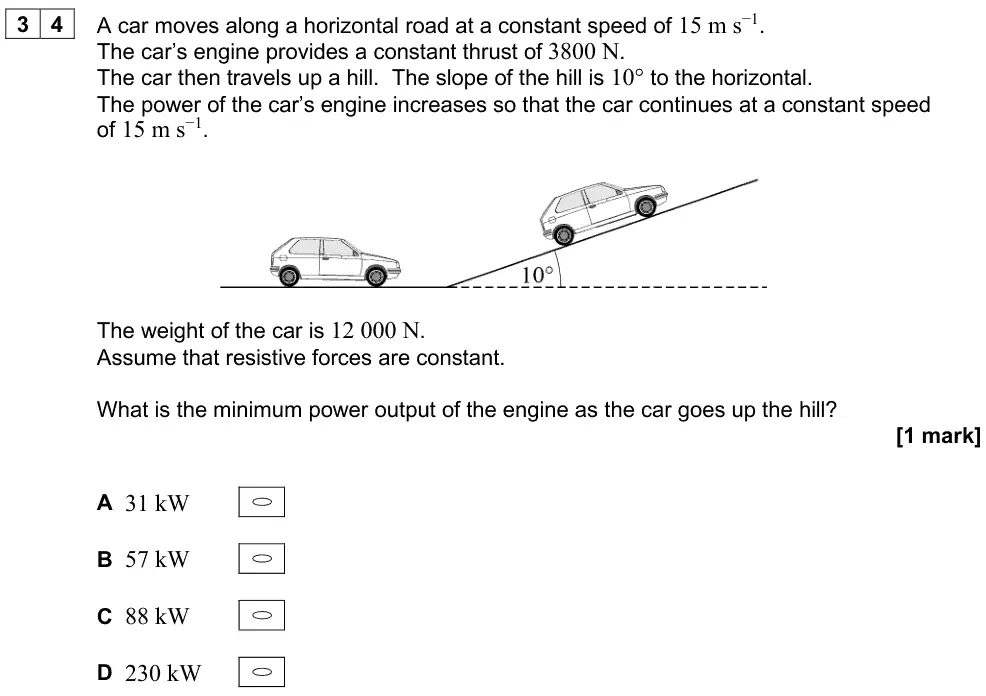
June 2025 · AS Paper 2 · Q34 1 mark AO2=1 Multiple choice work energy and powervectors and moments
A car moves along a horizontal road at a constant speed of 15 m s−1.
The car’s engine provides a constant thrust of 3800 N.
The car then travels up a hill.  The slope of the hill is 10° to the horizontal.
The power of the car’s engine increases so that the car continues at a constant speed
of 15 m s−1.
The weight of the car is 12 000 N.
Assume that resistive forces are constant.
What is the minimum power output of the engine as the car goes up the hill?
[1 mark]
A 31 kW
B 57 kW
C 88 kW
D 230 kW

Work with an AQA physics tutor

Want a paper marked and gone through with you? Message us.

Prefer email? Send an enquiry

If you are under 18, please include a parent's contact details. Enquiries go to enquiries@physicsaleveltutor.com and are deleted once handled. All tutoring is online.