November 2020: AS Paper 2

70 marks · 47 question parts · Paper, mark scheme and report on AQA's site · An autumn series using the paper written for the cancelled summer exams · Have the data and formulae booklet beside you
Question by question

QTopicMarksAOType
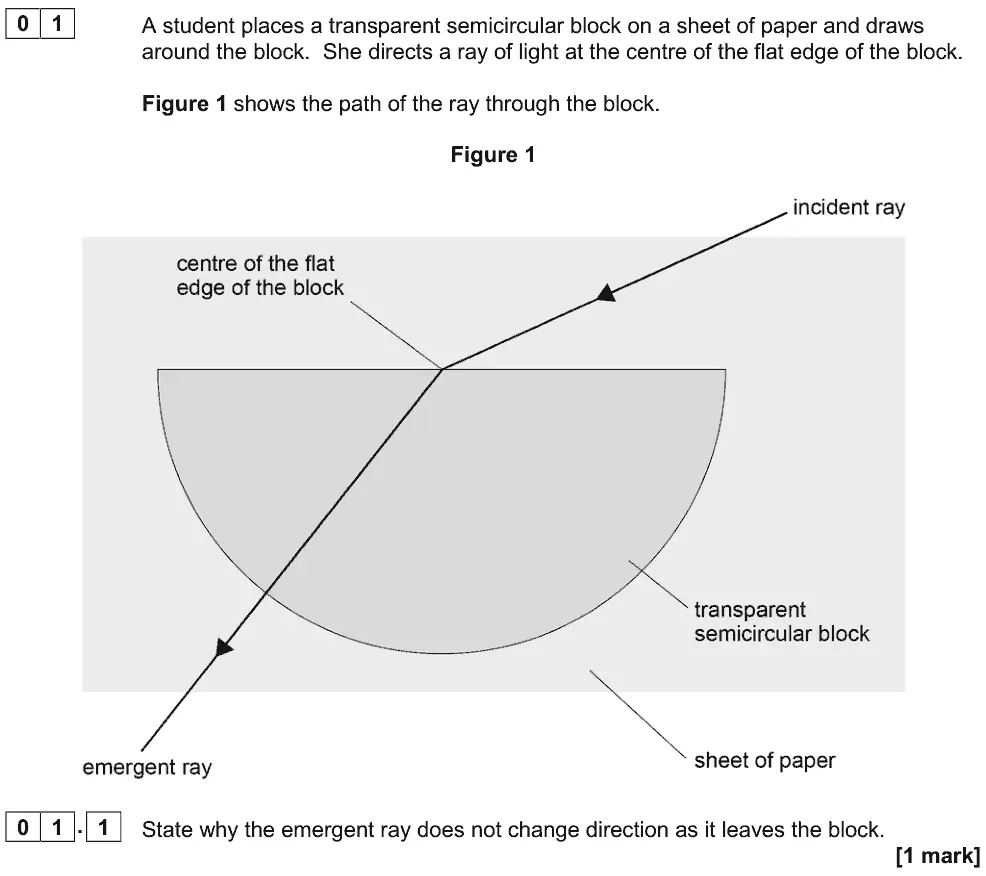
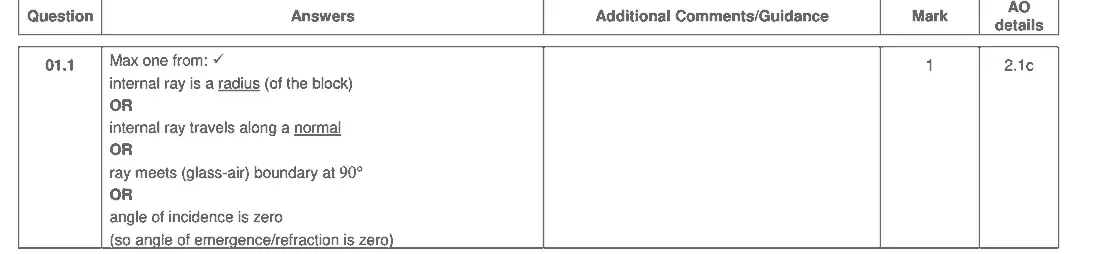
1.1 Refraction, total internal reflection and optical fibres 1Short answer
1.2 Refraction, total internal reflection and optical fibres 4Practical and data analysis
1.3 Refraction, total internal reflection and optical fibres 1Calculation
1.4 Measurements, units and uncertainties 1Short answer
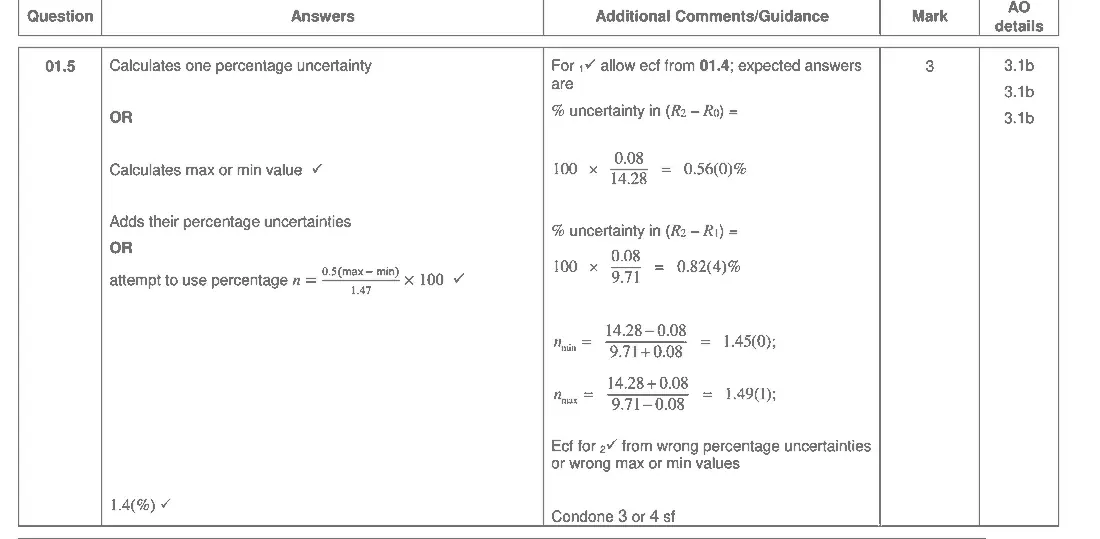
1.5 Measurements, units and uncertainties 3Calculation
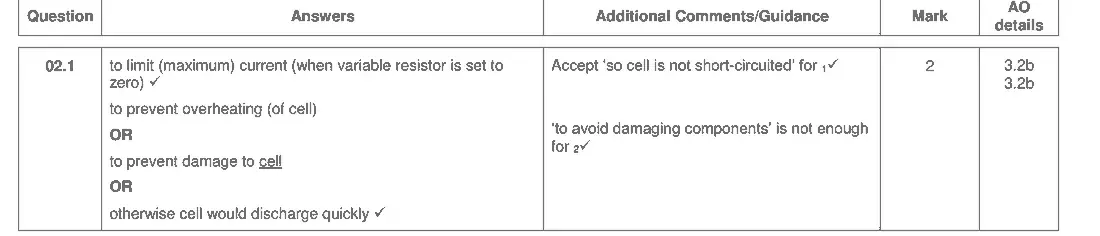
2.1 Electromotive force and internal resistance 2Practical and data analysis
2.2 Measurements, units and uncertainties 3Practical and data analysis
2.3 Electromotive force and internal resistance, Measurements, units and uncertainties 2Calculation
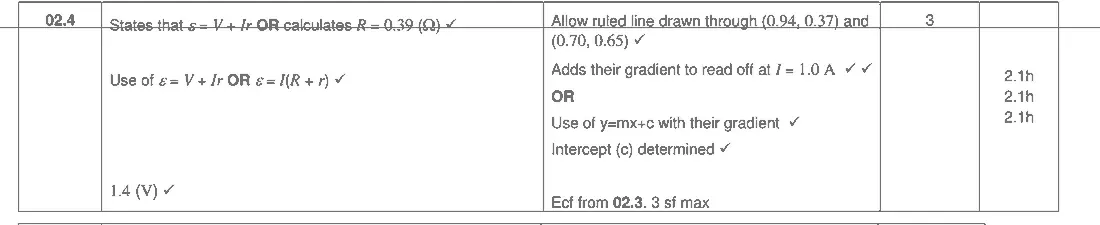
2.4 Electromotive force and internal resistance 3Calculation
3.1 Scalars, vectors and moments 2Calculation
3.2 Materials, stress, strain and the Young modulus 2Calculation
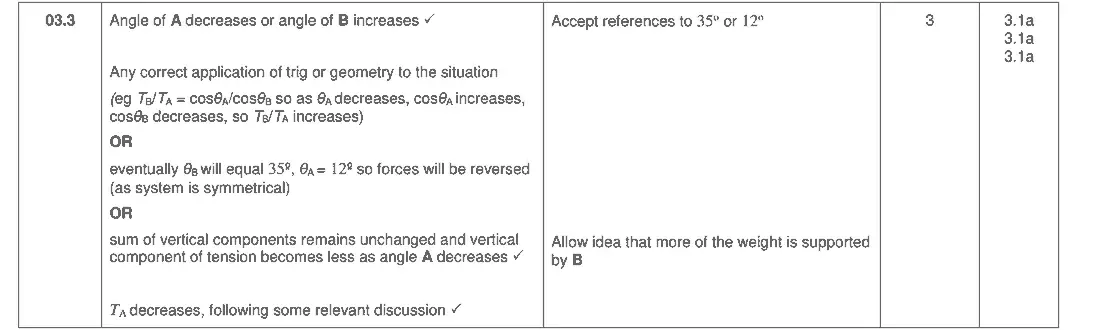
3.3 Scalars, vectors and moments 3Explanation
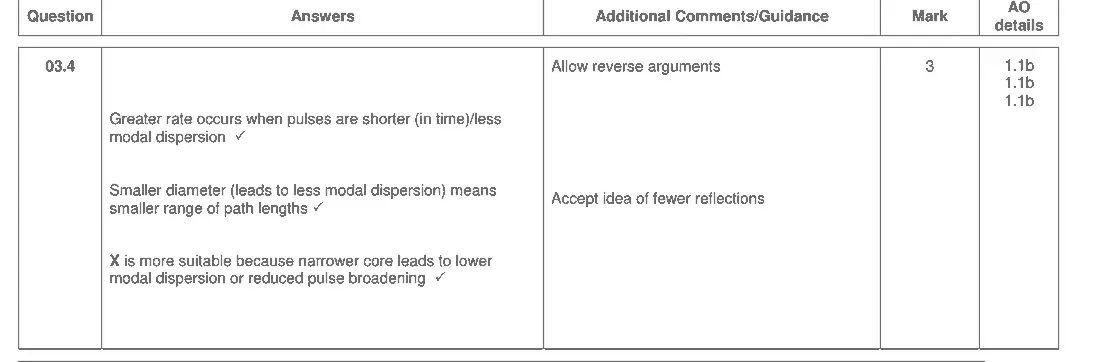
3.4 Refraction, total internal reflection and optical fibres 3Explanation
4.1 Excitation, energy levels and wave-particle duality 2Explanation
4.2 Particles, antiparticles and particle interactions, The photoelectric effect 2Calculation
4.3 Current, potential difference, I-V characteristics and resistivity, Circuits and potential dividers 2Calculation
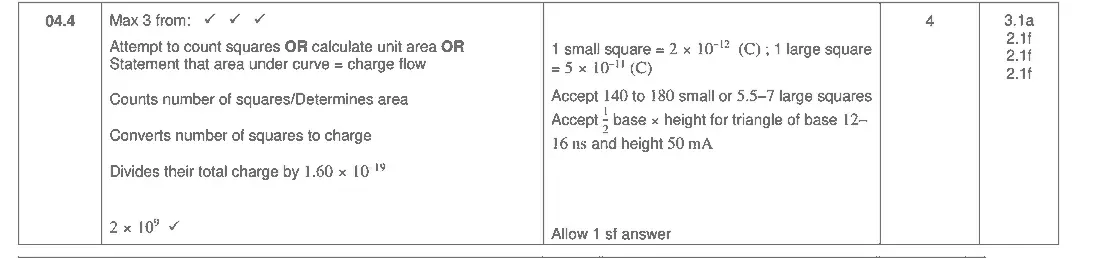
4.4 Current, potential difference, I-V characteristics and resistivity 4Calculation
5 Measurements, units and uncertainties 1Multiple choice
6 Particles, antiparticles and particle interactions 1Multiple choice
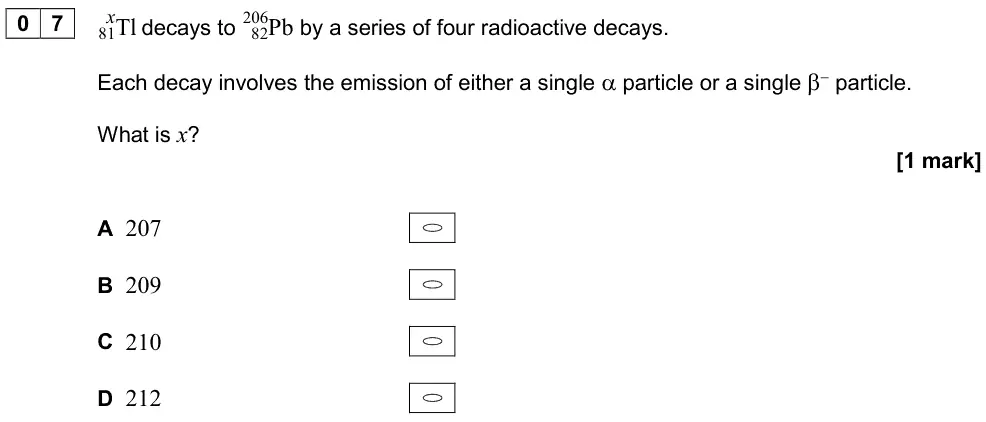
7 Atomic structure and stable nuclei 1Multiple choice
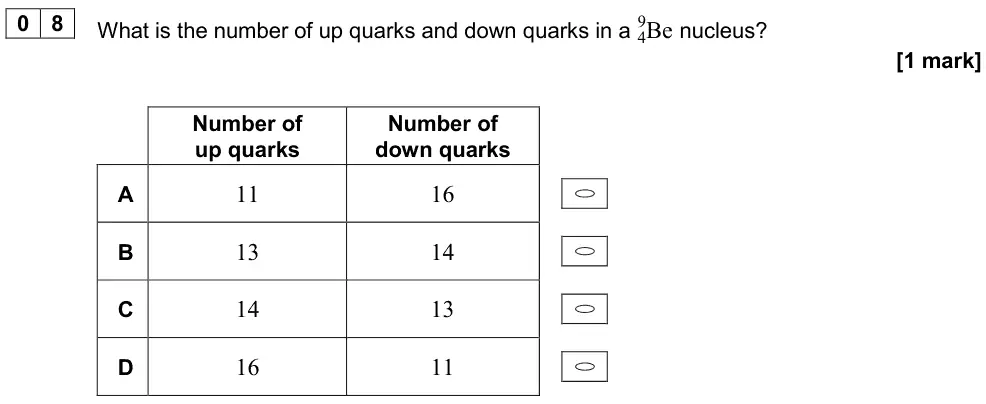
8 Classification of particles, quarks and conservation laws 1Multiple choice
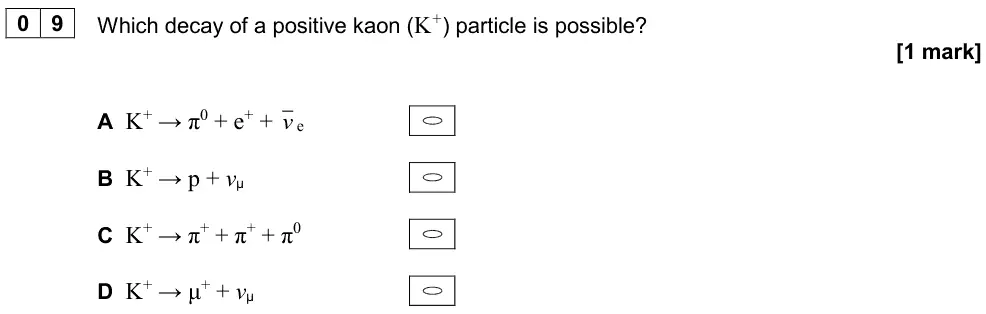
9 Classification of particles, quarks and conservation laws 1Multiple choice
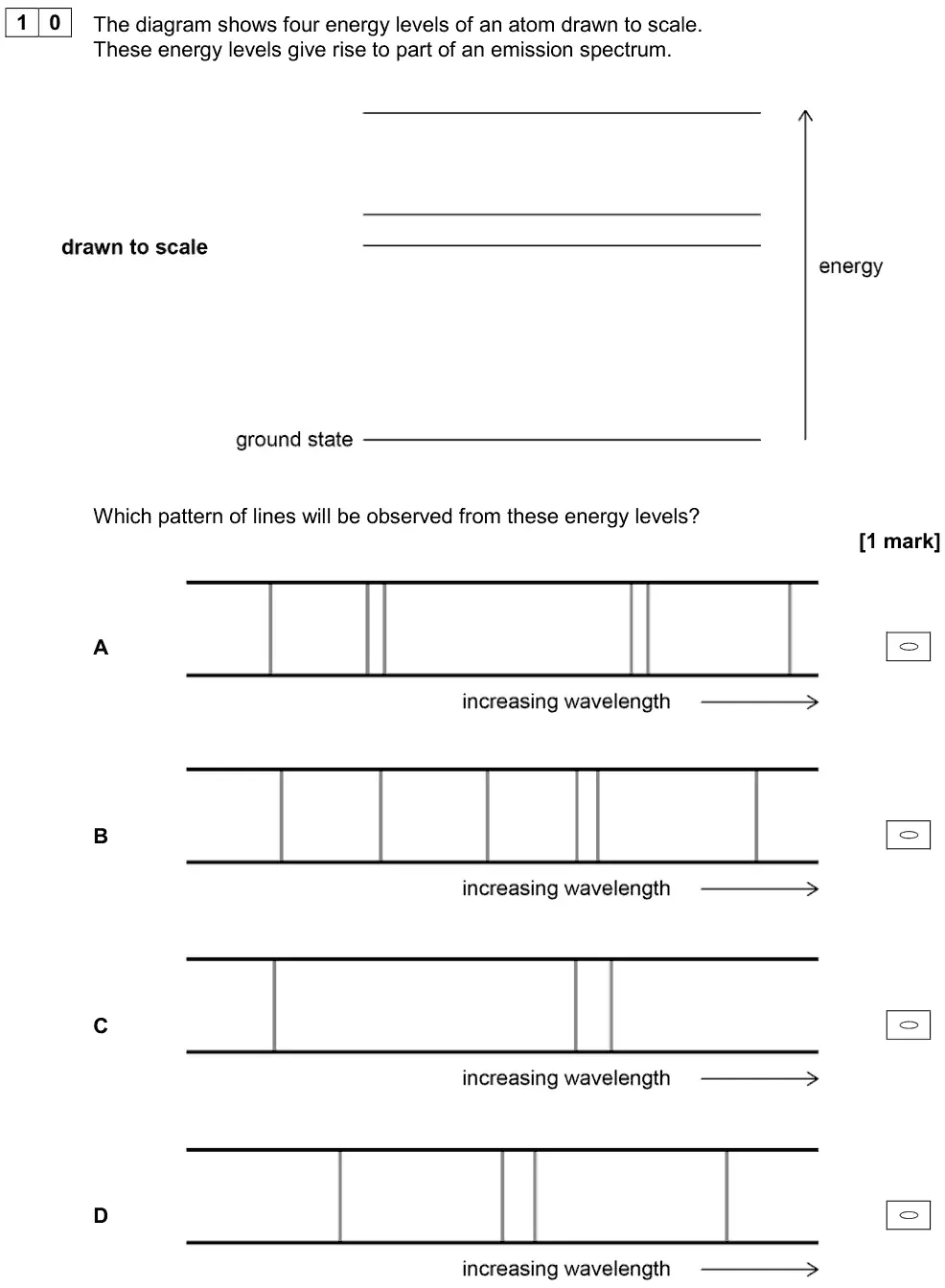
10 Excitation, energy levels and wave-particle duality 1Multiple choice
11 Excitation, energy levels and wave-particle duality 1Multiple choice
12 Progressive waves, longitudinal and transverse waves 1Multiple choice
13 Progressive waves, longitudinal and transverse waves 1Multiple choice
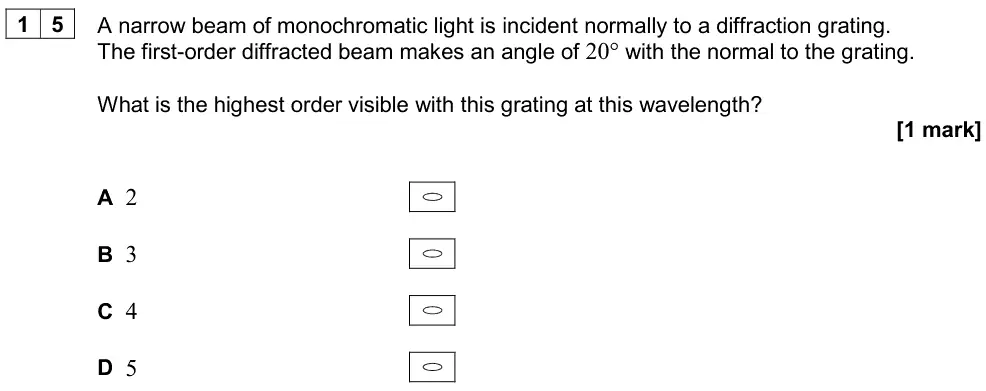
14 Interference, diffraction and the diffraction grating 1Multiple choice
15 Interference, diffraction and the diffraction grating 1Multiple choice
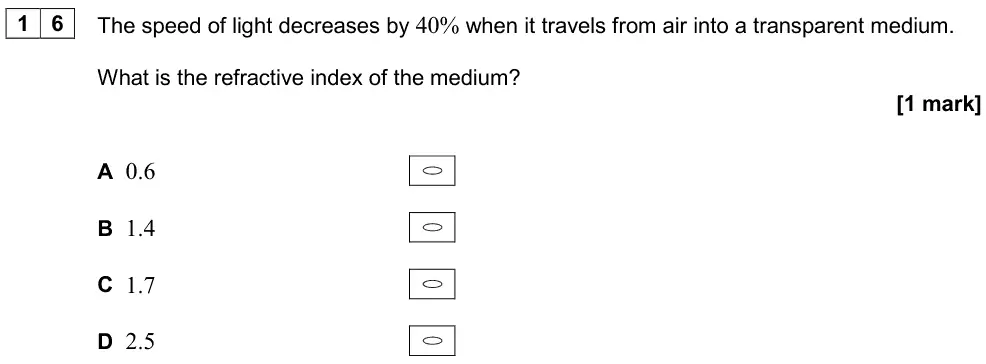
16 Refraction, total internal reflection and optical fibres 1Multiple choice
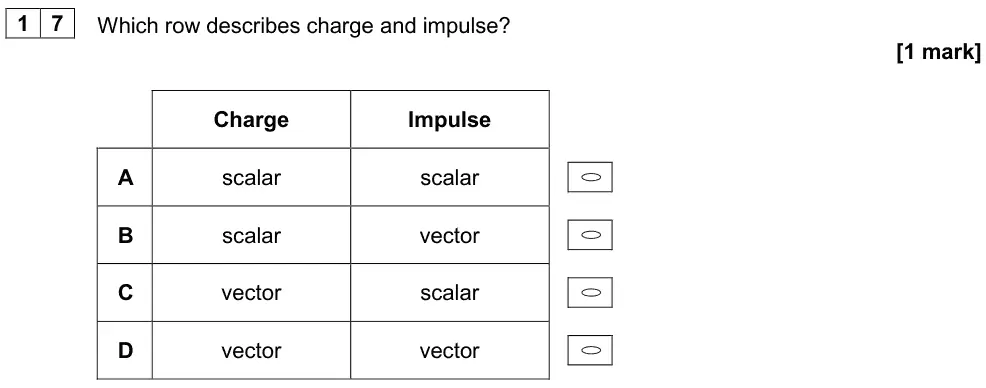
17 Scalars, vectors and moments 1Multiple choice
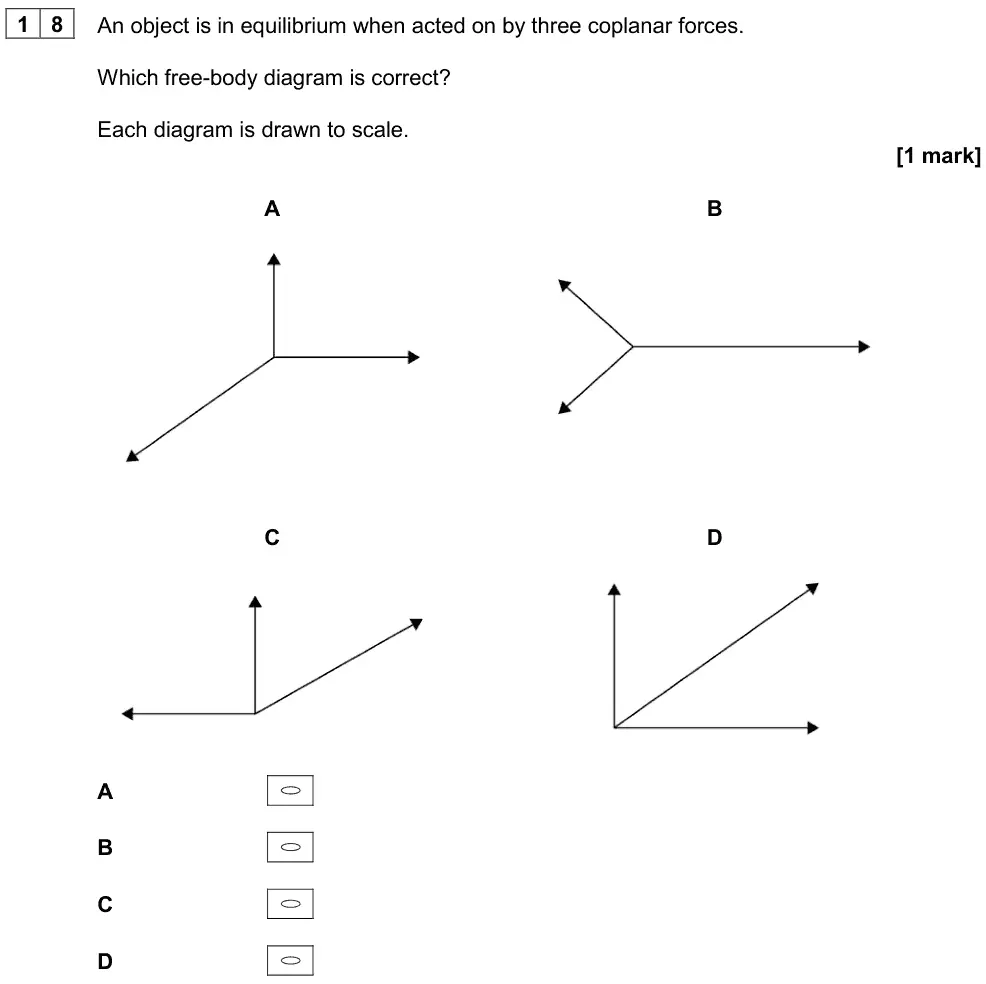
18 Scalars, vectors and moments 1Multiple choice
19 Newton's laws of motion and momentum 1Multiple choice
20 Scalars, vectors and moments 1Multiple choice
21 Scalars, vectors and moments 1Multiple choice
22 Motion along a straight line and projectile motion 1Multiple choice
23 Motion along a straight line and projectile motion, Newton's laws of motion and momentum 1Multiple choice
24 Newton's laws of motion and momentum 1Multiple choice
25 Work, energy, power and conservation of energy, Motion along a straight line and projectile motion 1Multiple choice
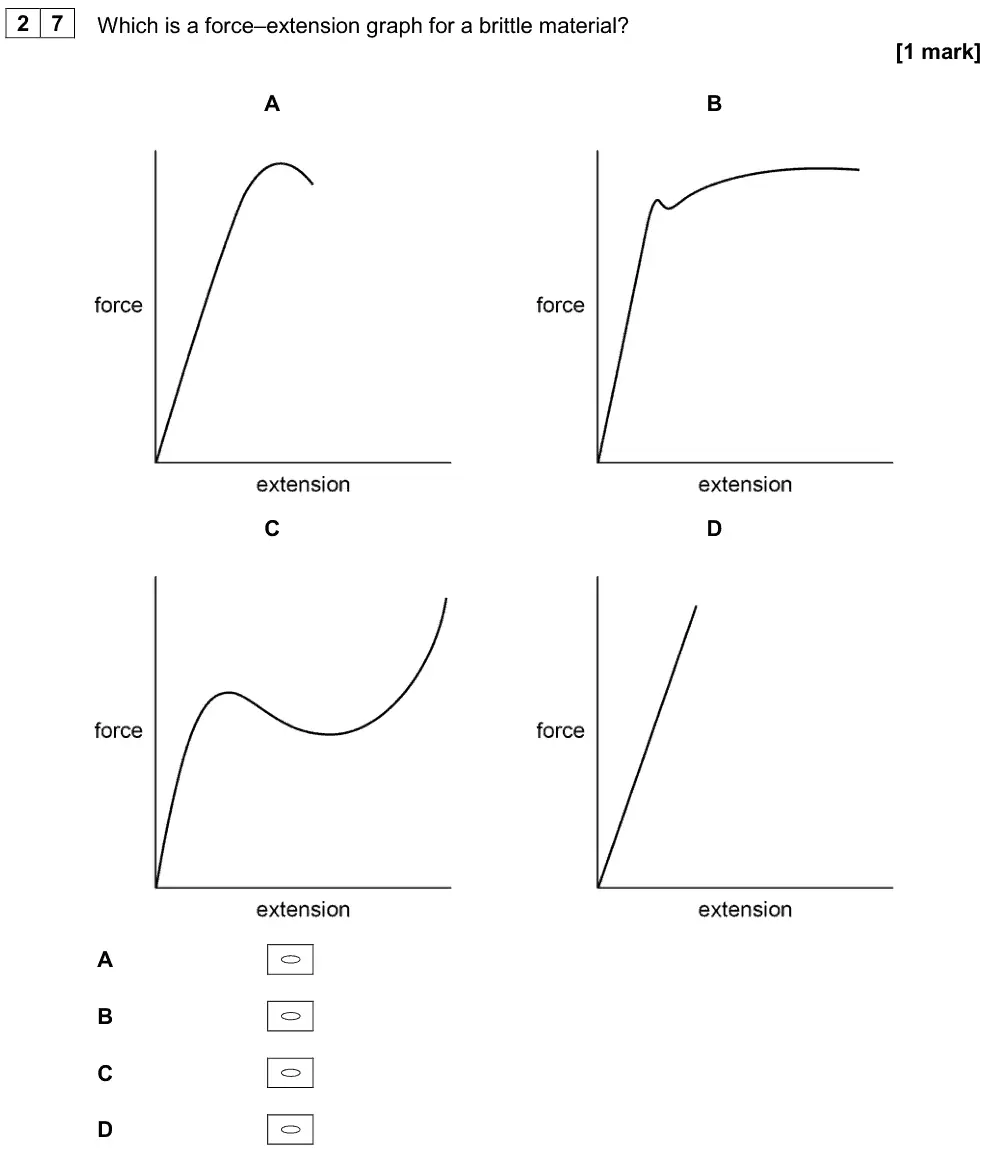
26 Materials, stress, strain and the Young modulus 1Multiple choice
27 Materials, stress, strain and the Young modulus 1Multiple choice
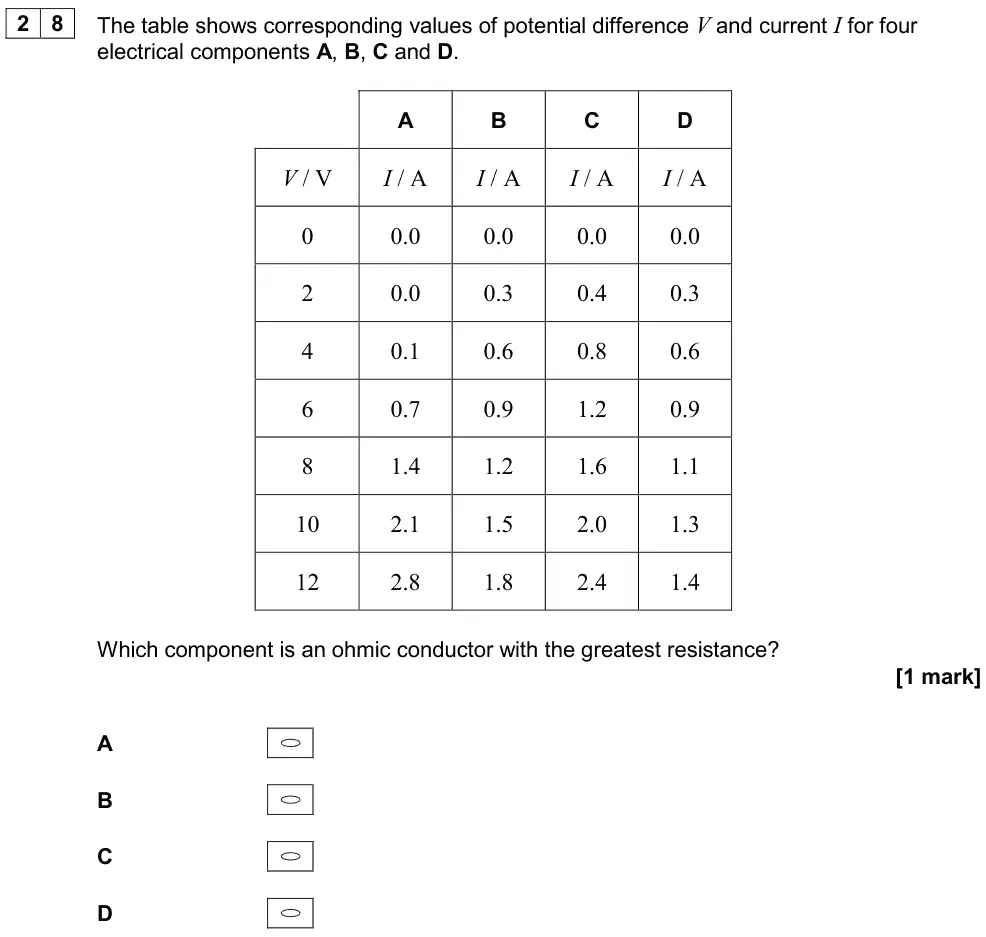
28 Current, potential difference, I-V characteristics and resistivity 1Multiple choice
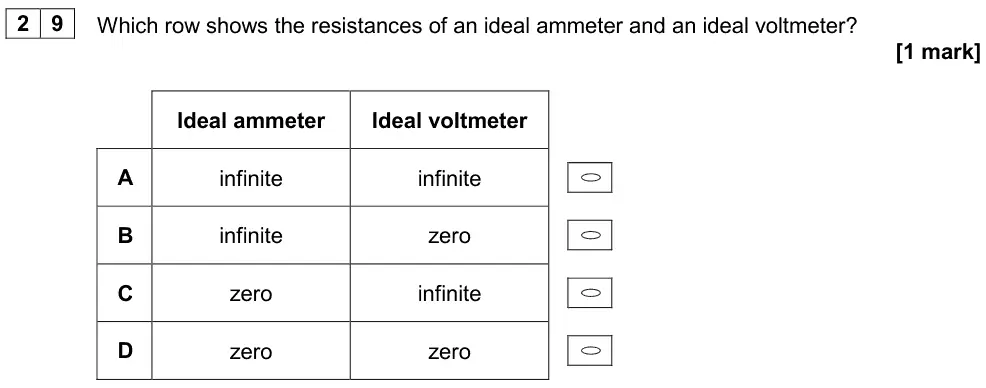
29 Current, potential difference, I-V characteristics and resistivity 1Multiple choice
30 Circuits and potential dividers, Measurements, units and uncertainties 1Multiple choice
31 Circuits and potential dividers, Current, potential difference, I-V characteristics and resistivity 1Multiple choice
32 Current, potential difference, I-V characteristics and resistivity 1Multiple choice
33 Circuits and potential dividers 1Multiple choice
34 Current, potential difference, I-V characteristics and resistivity, Circuits and potential dividers 1Multiple choice

The questions

1.11.21.31.41.52.12.22.32.43.13.23.33.44.14.24.34.45678910111213141516171819202122232425262728293031323334
November 2020 · AS Paper 2 · Q1.1 1 mark Short answer refraction and optical fibres
A student places a transparent semicircular block on a sheet of paper and draws
around the block.  She directs a ray of light at the centre of the flat edge of the block.
Figure 1 shows the path of the ray through the block.
Figure 1
State why the emergent ray does not change direction as it leaves the block.
[1 mark]
November 2020 · AS Paper 2 · Q1.2 4 marks Practical and data analysis refraction and optical fibres
Earlier part of question 1 that this part usesEarlier part of November 2020 Paper 2 question 1
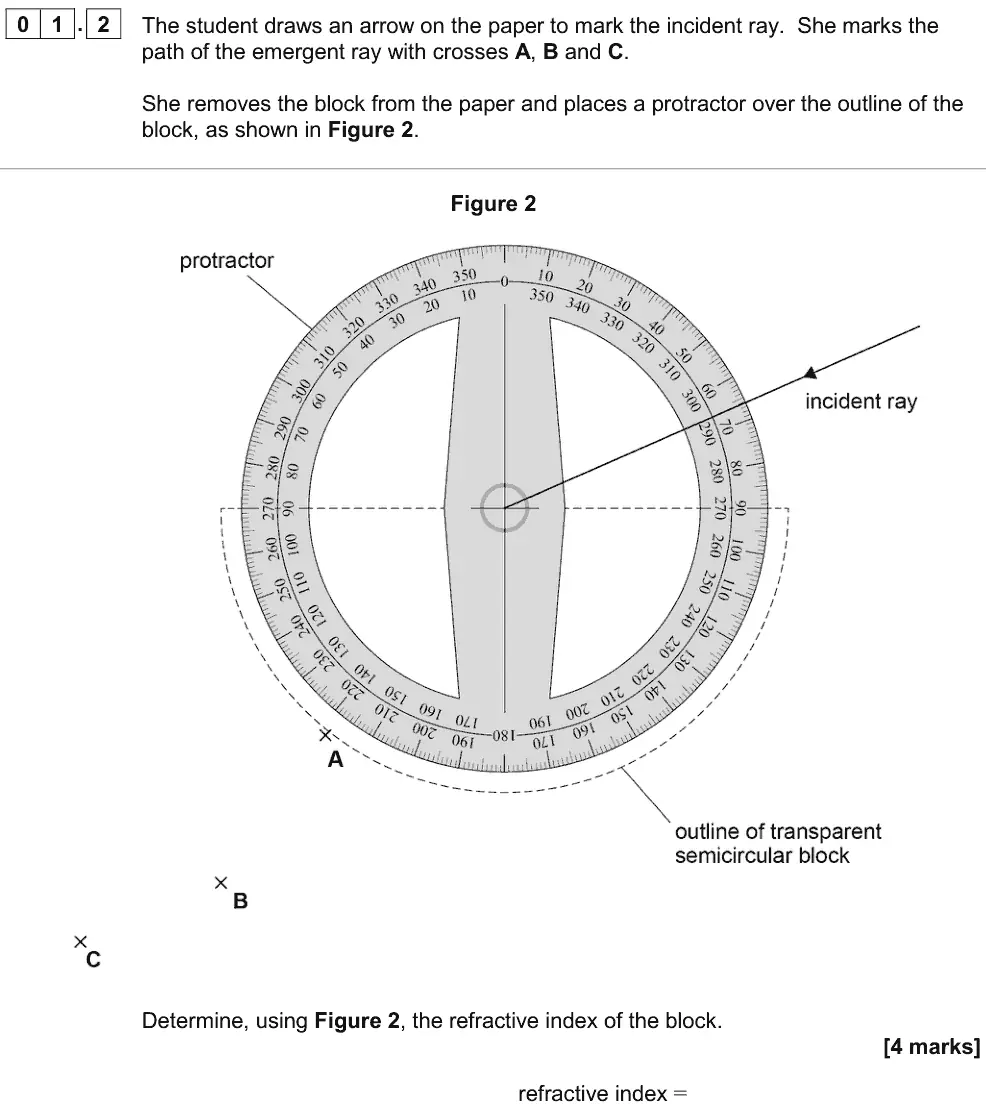
The student draws an arrow on the paper to mark the incident ray.  She marks the
path of the emergent ray with crosses A, B and C.
She removes the block from the paper and places a protractor over the outline of the
block, as shown in Figure 2.
Figure 2
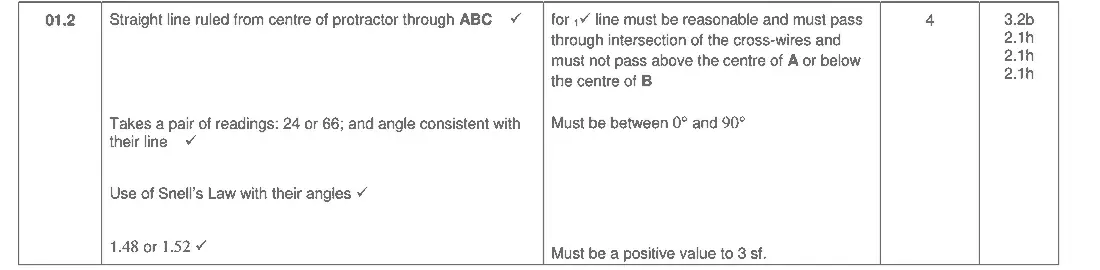
Determine, using Figure 2, the refractive index of the block.
[4 marks]
refractive index =
November 2020 · AS Paper 2 · Q1.3 1 mark Calculation refraction and optical fibres
Earlier part of question 1 that this part usesEarlier part of November 2020 Paper 2 question 1
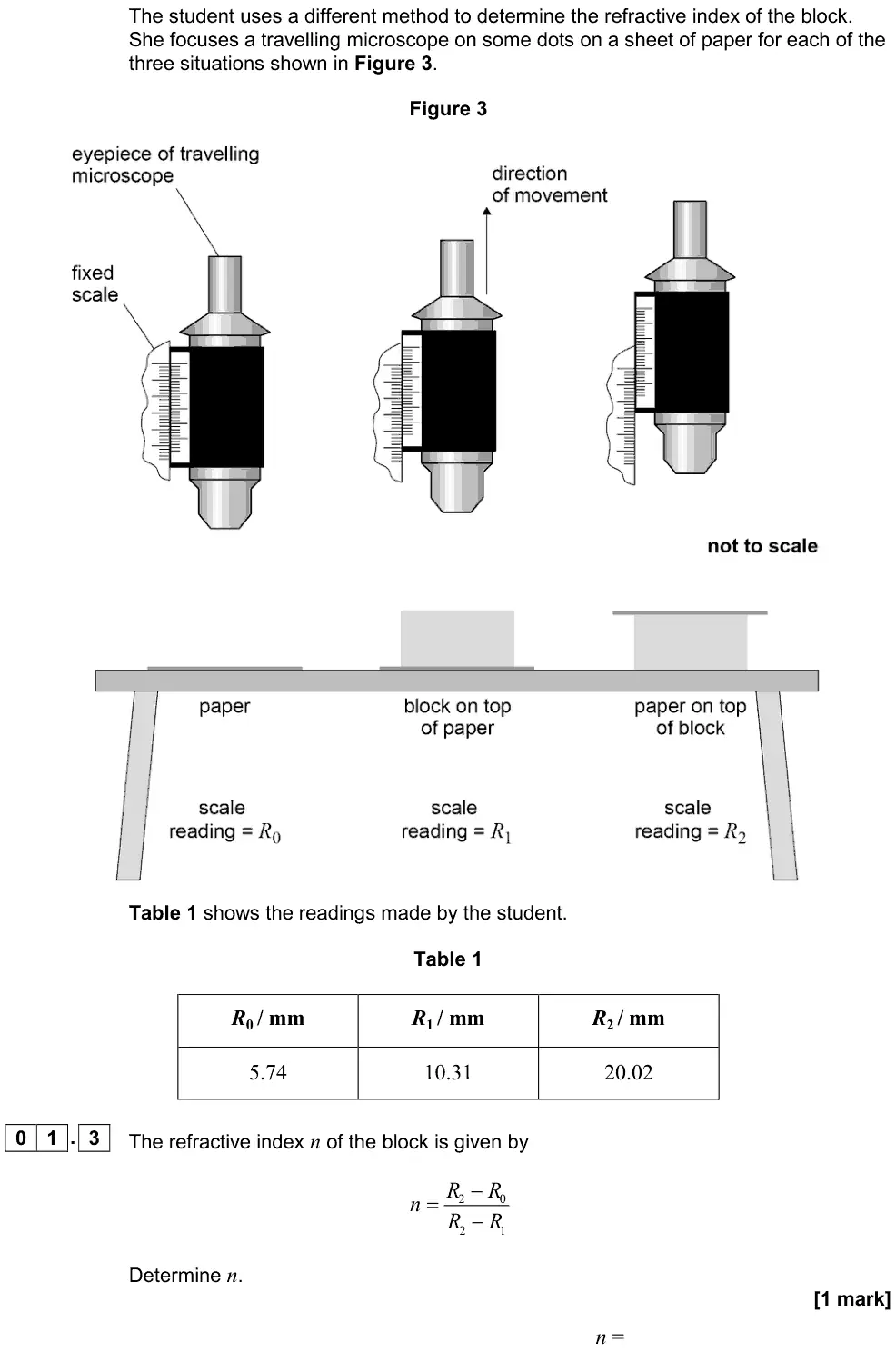
The student uses a different method to determine the refractive index of the block.
She focuses a travelling microscope on some dots on a sheet of paper for each of the
three situations shown in Figure 3.
Figure 3
Table 1 shows the readings made by the student.
Table 1
R0 / mm
R1 / mm
R2 / mm
5.74
10.31
20.02
The refractive index n of the block is given by
2
0
2
1
R
R
n
R
R
−
=
−
Determine n.
[1 mark]
n =
November 2020 · AS Paper 2 · Q1.4 1 mark Short answer measurements and uncertainties
Earlier part of question 1 that this part usesEarlier part of November 2020 Paper 2 question 1
The absolute uncertainty in each of the readings R0, R1 and R2 is 0.04 mm.
State the absolute uncertainty in R2 – R0.
[1 mark]
absolute uncertainty in R2 – R0 =
mm
November 2020 · AS Paper 2 · Q1.5 3 marks Calculation measurements and uncertainties
Earlier part of question 1 that this part usesEarlier part of November 2020 Paper 2 question 1
The absolute uncertainty in R2 – R1 is the same as the absolute uncertainty in R2 – R0.
Calculate the percentage uncertainty in n.
[3 marks]
percentage uncertainty in n =
%
November 2020 · AS Paper 2 · Q2.1 2 marks Practical and data analysis emf and internal resistance
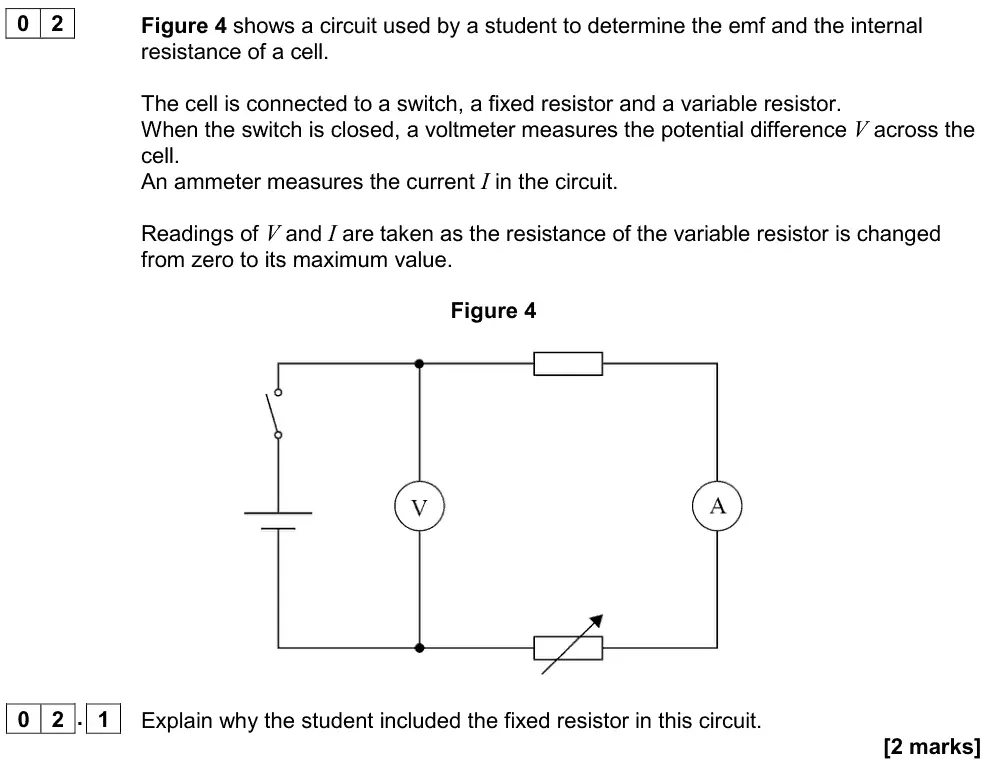
Figure 4 shows a circuit used by a student to determine the emf and the internal
resistance of a cell.
The cell is connected to a switch, a fixed resistor and a variable resistor.
When the switch is closed, a voltmeter measures the potential difference V across the
cell.
An ammeter measures the current I in the circuit.
Readings of V and I are taken as the resistance of the variable resistor is changed
from zero to its maximum value.
Figure 4
Explain why the student included the fixed resistor in this circuit.
[2 marks]
November 2020 · AS Paper 2 · Q2.2 3 marks Practical and data analysis measurements and uncertainties
Earlier part of question 2 that this part usesEarlier part of November 2020 Paper 2 question 2
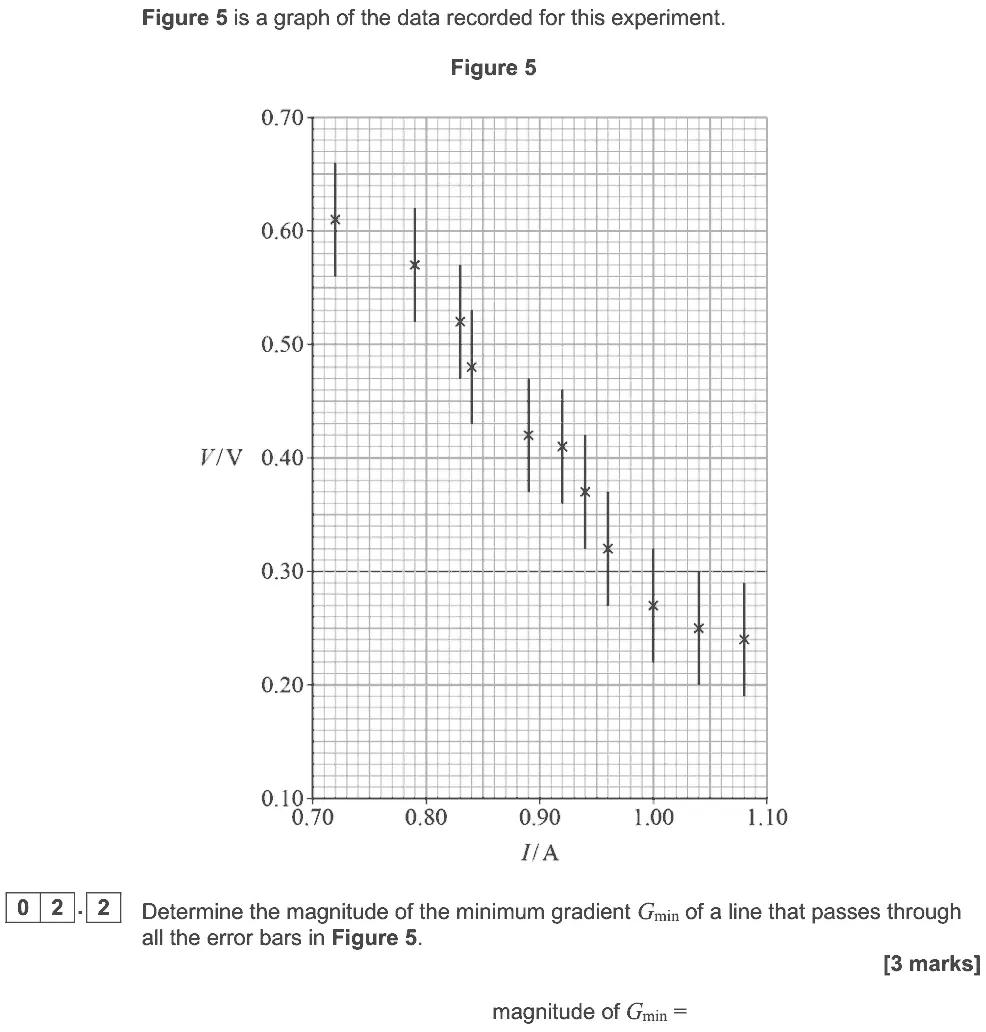
Figure 5 is a graph of the data recorded for this experiment.
Figure 5
Determine the magnitude of the minimum gradient Gmin of a line that passes through
all the error bars in Figure 5.
[3 marks]
magnitude of Gmin =
November 2020 · AS Paper 2 · Q2.3 2 marks Calculation emf and internal resistancemeasurements and uncertainties
Earlier part of question 2 that this part usesEarlier part of November 2020 Paper 2 question 2
The maximum gradient Gmax / V A−1 of a line passing through all the error bars in
Figure 5 is –1.3
Determine, using Gmax and Gmin, the internal resistance of the cell.
[2 marks]
internal resistance =
Ω
November 2020 · AS Paper 2 · Q2.4 3 marks Calculation emf and internal resistance
Earlier part of question 2 that this part usesEarlier part of November 2020 Paper 2 question 2
The line of best fit passes through the data point (0.94, 0.37).
Determine the emf of the cell.
[3 marks]
emf =
V
November 2020 · AS Paper 2 · Q3.1 2 marks Calculation vectors and moments
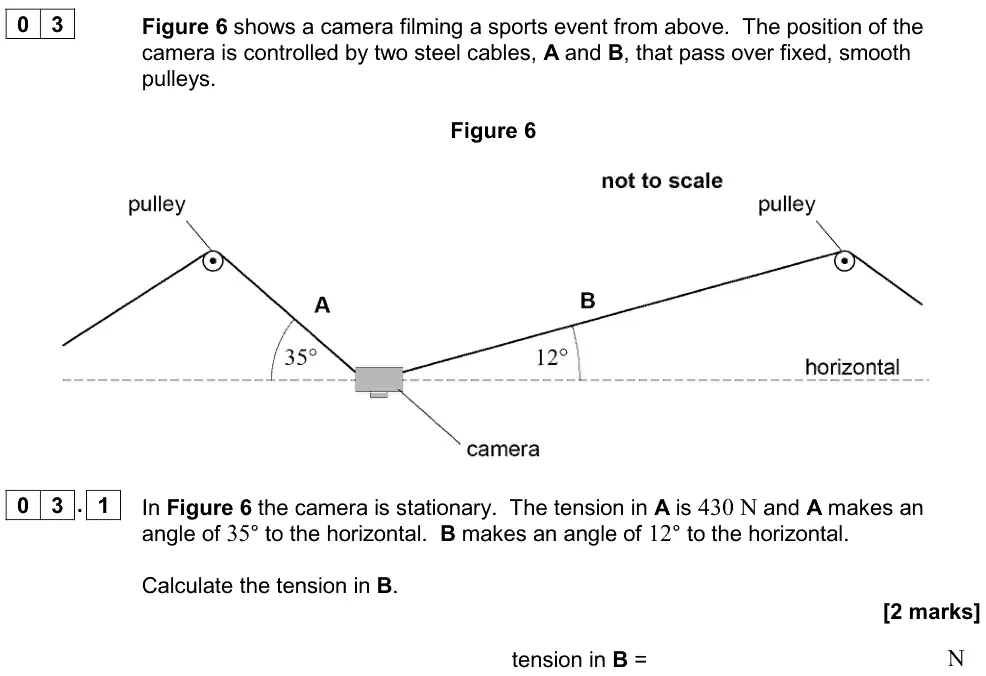
Figure 6 shows a camera filming a sports event from above.  The position of the
camera is controlled by two steel cables, A and B, that pass over fixed, smooth
pulleys.
Figure 6
In Figure 6 the camera is stationary.  The tension in A is 430 N and A makes an
angle of 35° to the horizontal.  B makes an angle of 12° to the horizontal.
Calculate the tension in B.
[2 marks]
tension in B =
N
November 2020 · AS Paper 2 · Q3.2 2 marks Calculation materials and young modulus
Earlier part of question 3 that this part usesEarlier part of November 2020 Paper 2 question 3
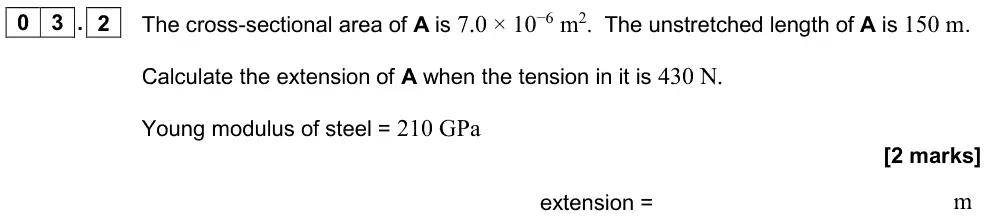
The cross-sectional area of A is 7.0 × 10⁻⁶ m2.  The unstretched length of A is 150 m.
Calculate the extension of A when the tension in it is 430 N.
Young modulus of steel = 210 GPa
[2 marks]
extension =
m
November 2020 · AS Paper 2 · Q3.3 3 marks Explanation vectors and moments
Earlier part of question 3 that this part usesEarlier part of November 2020 Paper 2 question 3
The camera is moved horizontally to the right to a new stationary position.
The tension in A is now different from that in Figure 6.
Deduce whether the tension in A has increased or decreased.
[3 marks]
November 2020 · AS Paper 2 · Q3.4 3 marks Explanation refraction and optical fibres
Earlier part of question 3 that this part usesEarlier part of November 2020 Paper 2 question 3
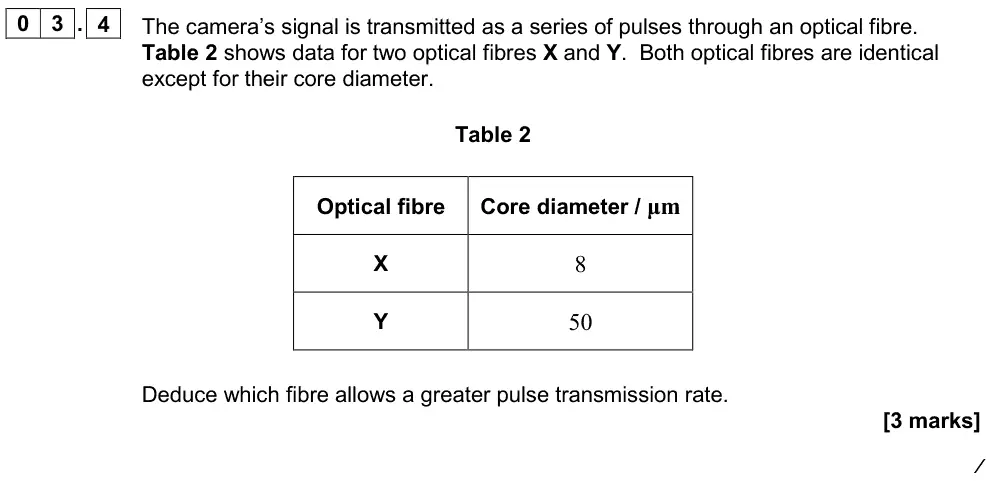
The camera’s signal is transmitted as a series of pulses through an optical fibre.
Table 2 shows data for two optical fibres X and Y.  Both optical fibres are identical
except for their core diameter.
Table 2
Optical fibre
Core diameter / μm
X
8
Y
50
Deduce which fibre allows a greater pulse transmission rate.
[3 marks]
November 2020 · AS Paper 2 · Q4.1 2 marks Explanation energy levels and wave particle duality
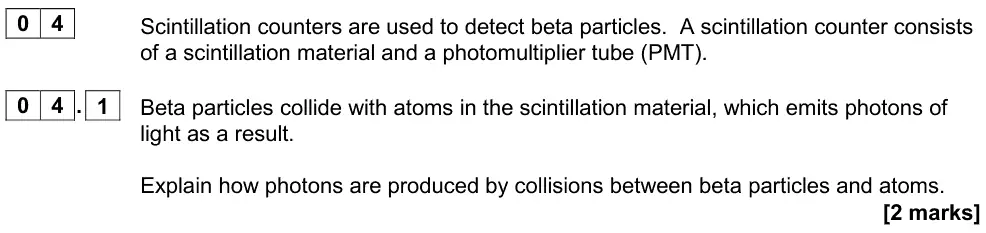
Scintillation counters are used to detect beta particles.  A scintillation counter consists
of a scintillation material and a photomultiplier tube (PMT).
Beta particles collide with atoms in the scintillation material, which emits photons of
light as a result.
Explain how photons are produced by collisions between beta particles and atoms.
[2 marks]
November 2020 · AS Paper 2 · Q4.2 2 marks Calculation particles antiparticles and interactionsphotoelectric effect
Earlier part of question 4 that this part usesEarlier part of November 2020 Paper 2 question 4
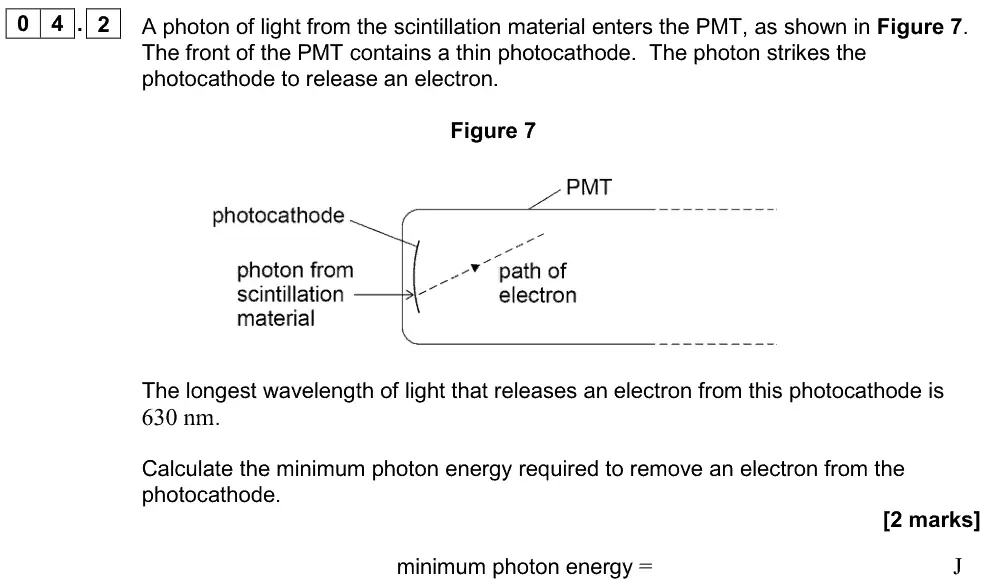
A photon of light from the scintillation material enters the PMT, as shown in Figure 7.
The front of the PMT contains a thin photocathode.  The photon strikes the
photocathode to release an electron.
Figure 7
The longest wavelength of light that releases an electron from this photocathode is
630 nm.
Calculate the minimum photon energy required to remove an electron from the
photocathode.
[2 marks]
minimum photon energy =
J
November 2020 · AS Paper 2 · Q4.3 2 marks Calculation current voltage and resistivitycircuits and potential dividers
Earlier part of question 4 that this part usesEarlier part of November 2020 Paper 2 question 4
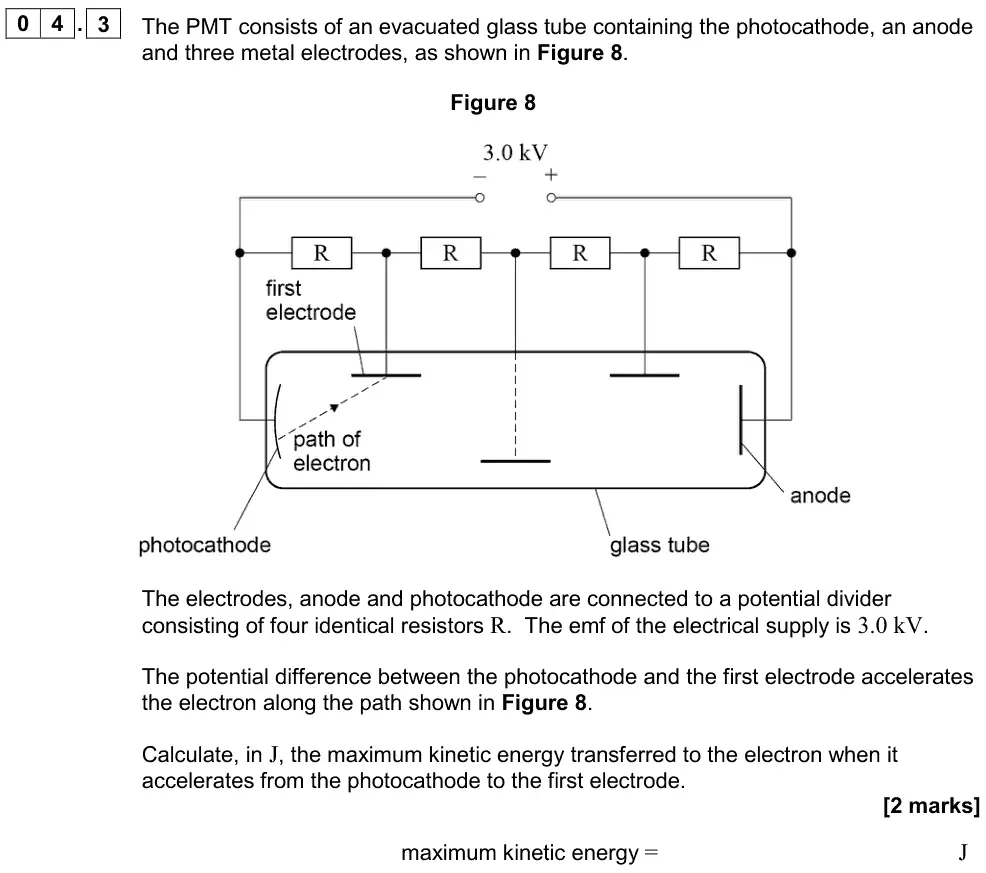
The PMT consists of an evacuated glass tube containing the photocathode, an anode
and three metal electrodes, as shown in Figure 8.
Figure 8
The electrodes, anode and photocathode are connected to a potential divider
consisting of four identical resistors R.  The emf of the electrical supply is 3.0 kV.
The potential difference between the photocathode and the first electrode accelerates
the electron along the path shown in Figure 8.
Calculate, in J, the maximum kinetic energy transferred to the electron when it
accelerates from the photocathode to the first electrode.
[2 marks]
maximum kinetic energy =
J
November 2020 · AS Paper 2 · Q4.4 4 marks Calculation current voltage and resistivity
Earlier part of question 4 that this part usesEarlier part of November 2020 Paper 2 question 4
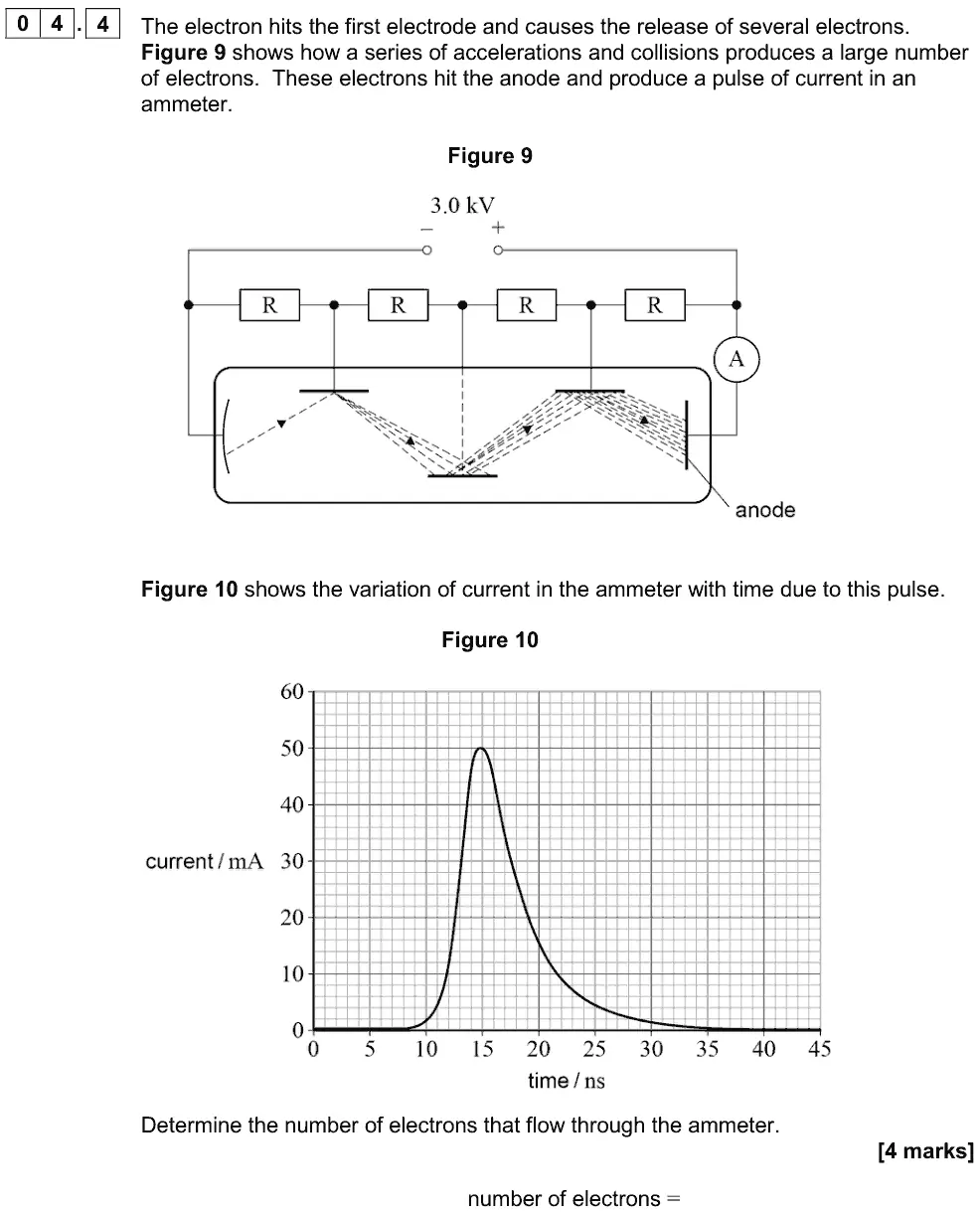
The electron hits the first electrode and causes the release of several electrons.
Figure 9 shows how a series of accelerations and collisions produces a large number
of electrons.  These electrons hit the anode and produce a pulse of current in an
ammeter.
Figure 9
Figure 10 shows the variation of current in the ammeter with time due to this pulse.
Figure 10
Determine the number of electrons that flow through the ammeter.
[4 marks]
number of electrons =
November 2020 · AS Paper 2 · Q5 1 mark Multiple choice measurements and uncertainties
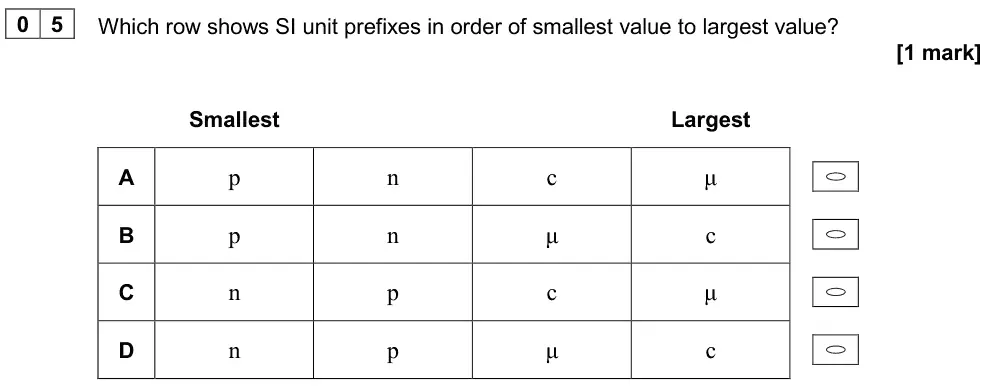
Which row shows SI unit prefixes in order of smallest value to largest value?
[1 mark]
Smallest
Largest
A
p
n
c
μ
B
p
n
μ
c
C
n
p
c
μ
D
n
p
μ
c
November 2020 · AS Paper 2 · Q6 1 mark Multiple choice particles antiparticles and interactions
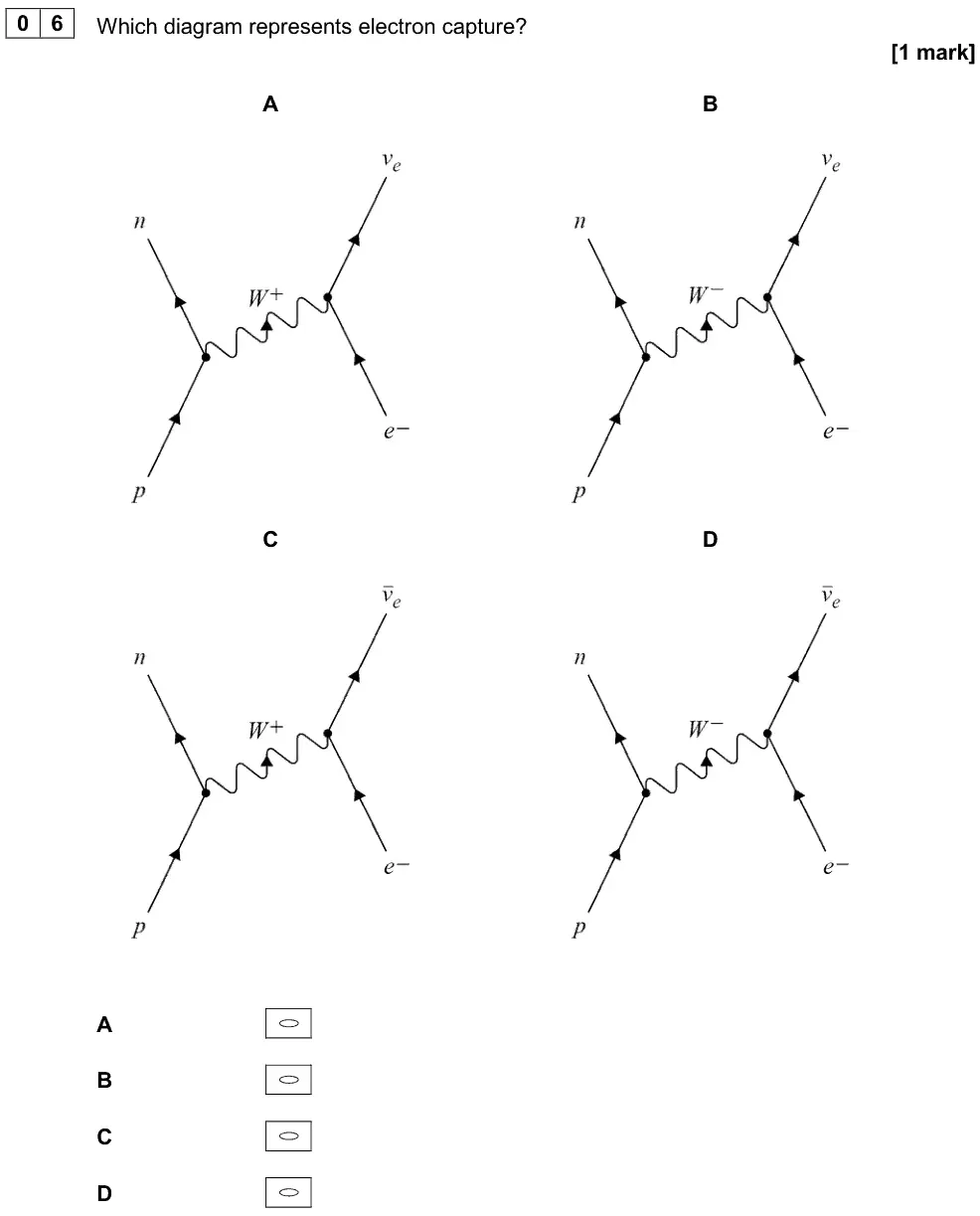
Which diagram represents electron capture?
[1 mark]
A
B
C
D
A
B
C
D
November 2020 · AS Paper 2 · Q7 1 mark Multiple choice atomic structure and stable nuclei
Tl
81
x
Pb
82
206
by a series of four radioactive decays.
Each decay involves the emission of either a single α particle or a single β− particle.
What is x?
[1 mark]
A 207
B 209
C 210
D 212
November 2020 · AS Paper 2 · Q8 1 mark Multiple choice classification of particles and quarks
What is the number of up quarks and down quarks in a Be
4
9
nucleus?
[1 mark]
Number of
up quarks
Number of
down quarks
A
11
16
B
13
14
C
14
13
D
16
11
November 2020 · AS Paper 2 · Q9 1 mark Multiple choice classification of particles and quarks
Which decay of a positive kaon (K+) particle is possible?
[1 mark]
A K+ → π0 + e+ + v e
B K+ → p + vμ
C K+ → π+ + π+ + π0
D K+ → μ+ + vμ
November 2020 · AS Paper 2 · Q10 1 mark Multiple choice energy levels and wave particle duality
The diagram shows four energy levels of an atom drawn to scale.
These energy levels give rise to part of an emission spectrum.
Which pattern of lines will be observed from these energy levels?
[1 mark]
A
B
C
D
November 2020 · AS Paper 2 · Q11 1 mark Multiple choice energy levels and wave particle duality
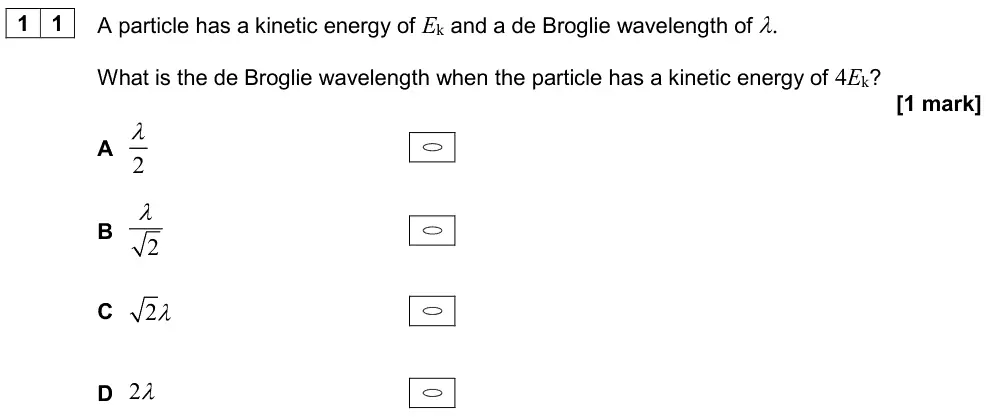
A particle has a kinetic energy of Ek and a de Broglie wavelength of .
What is the de Broglie wavelength when the particle has a kinetic energy of 4Ek?
[1 mark]
A 2
B
2
C
2
D 2
November 2020 · AS Paper 2 · Q12 1 mark Multiple choice progressive waves and polarisation
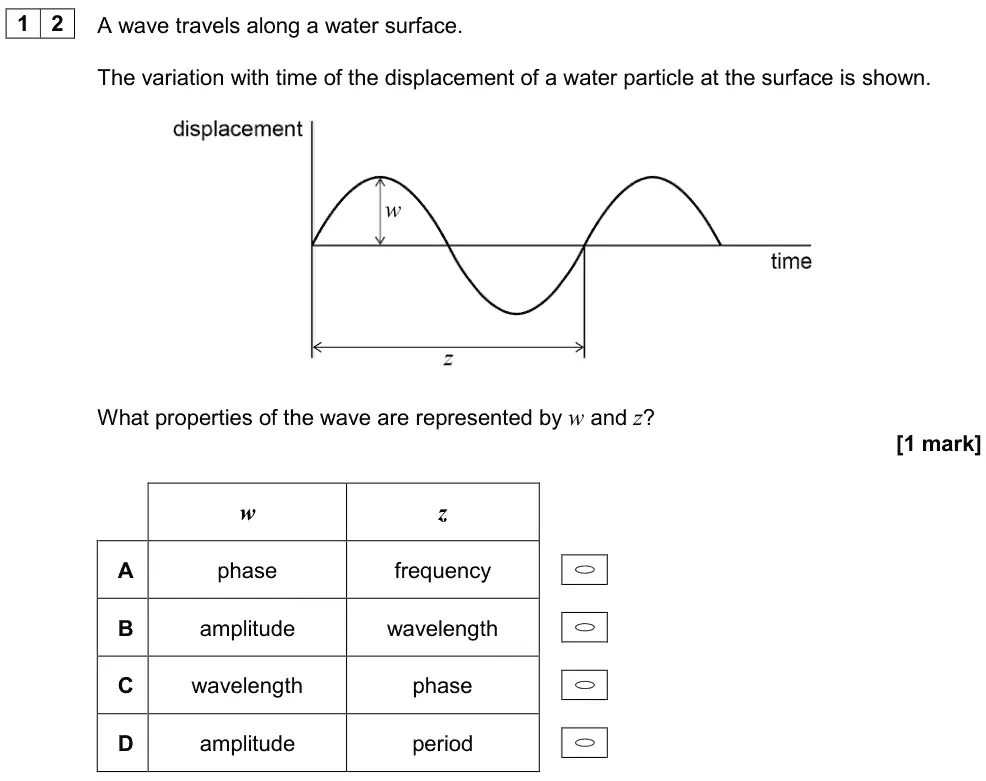
A wave travels along a water surface.
The variation with time of the displacement of a water particle at the surface is shown.
What properties of the wave are represented by w and z?
[1 mark]
w
z
A
phase
frequency
B
amplitude
wavelength
C
wavelength
phase
D
amplitude
period
November 2020 · AS Paper 2 · Q13 1 mark Multiple choice progressive waves and polarisation
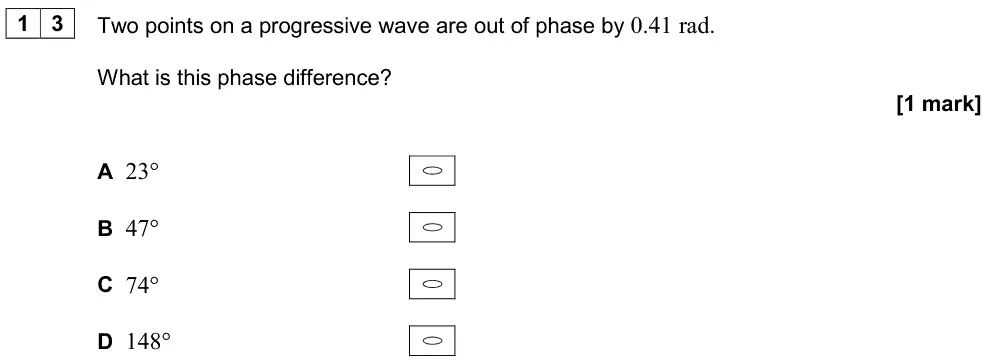
Two points on a progressive wave are out of phase by 0.41 rad.
What is this phase difference?
[1 mark]
A 23°
B 47°
C 74°
D 148°
November 2020 · AS Paper 2 · Q14 1 mark Multiple choice interference and diffraction
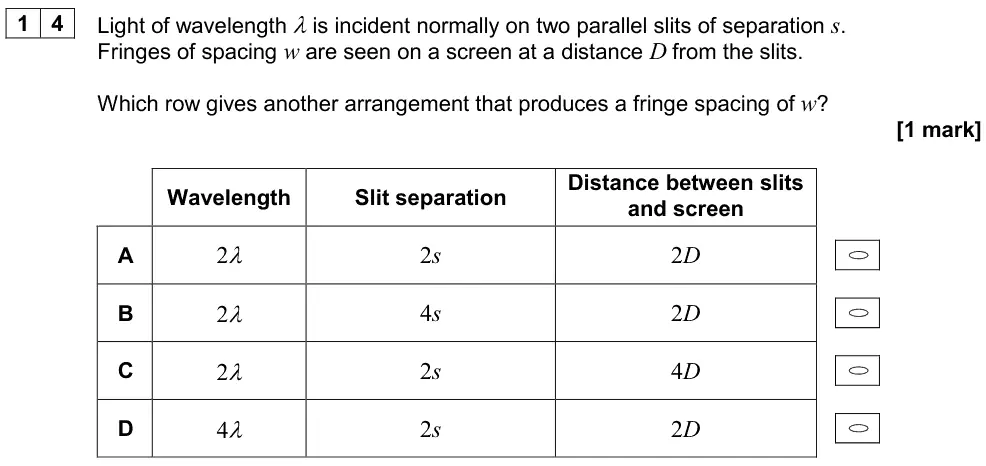
Light of wavelength  is incident normally on two parallel slits of separation s.
Fringes of spacing w are seen on a screen at a distance D from the slits.
Which row gives another arrangement that produces a fringe spacing of w?
[1 mark]
Wavelength
Slit separation
Distance between slits
and screen
A
2
2s
2D
B
2
4s
2D
C
2
2s
4D
D
4
2s
2D
November 2020 · AS Paper 2 · Q15 1 mark Multiple choice interference and diffraction
A narrow beam of monochromatic light is incident normally to a diffraction grating.
The first-order diffracted beam makes an angle of 20° with the normal to the grating.
What is the highest order visible with this grating at this wavelength?
[1 mark]
A 2
B 3
C 4
D 5
November 2020 · AS Paper 2 · Q16 1 mark Multiple choice refraction and optical fibres
The speed of light decreases by 40% when it travels from air into a transparent medium.
What is the refractive index of the medium?
[1 mark]
A 0.6
B 1.4
C 1.7
D 2.5
November 2020 · AS Paper 2 · Q17 1 mark Multiple choice vectors and moments
Which row describes charge and impulse?
[1 mark]
Charge
Impulse
A
scalar
scalar
B
scalar
vector
C
vector
scalar
D
vector
vector
November 2020 · AS Paper 2 · Q18 1 mark Multiple choice vectors and moments
An object is in equilibrium when acted on by three coplanar forces.
Which free-body diagram is correct?
Each diagram is drawn to scale.
[1 mark]
A
B
C
D
A
B
C
D
November 2020 · AS Paper 2 · Q19 1 mark Multiple choice newtons laws and momentum
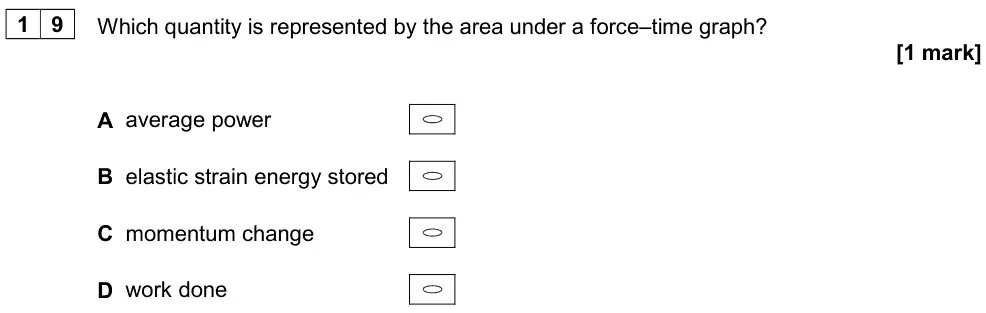
Which quantity is represented by the area under a force–time graph?
[1 mark]
A average power
B elastic strain energy stored
C momentum change
D work done
November 2020 · AS Paper 2 · Q20 1 mark Multiple choice vectors and moments
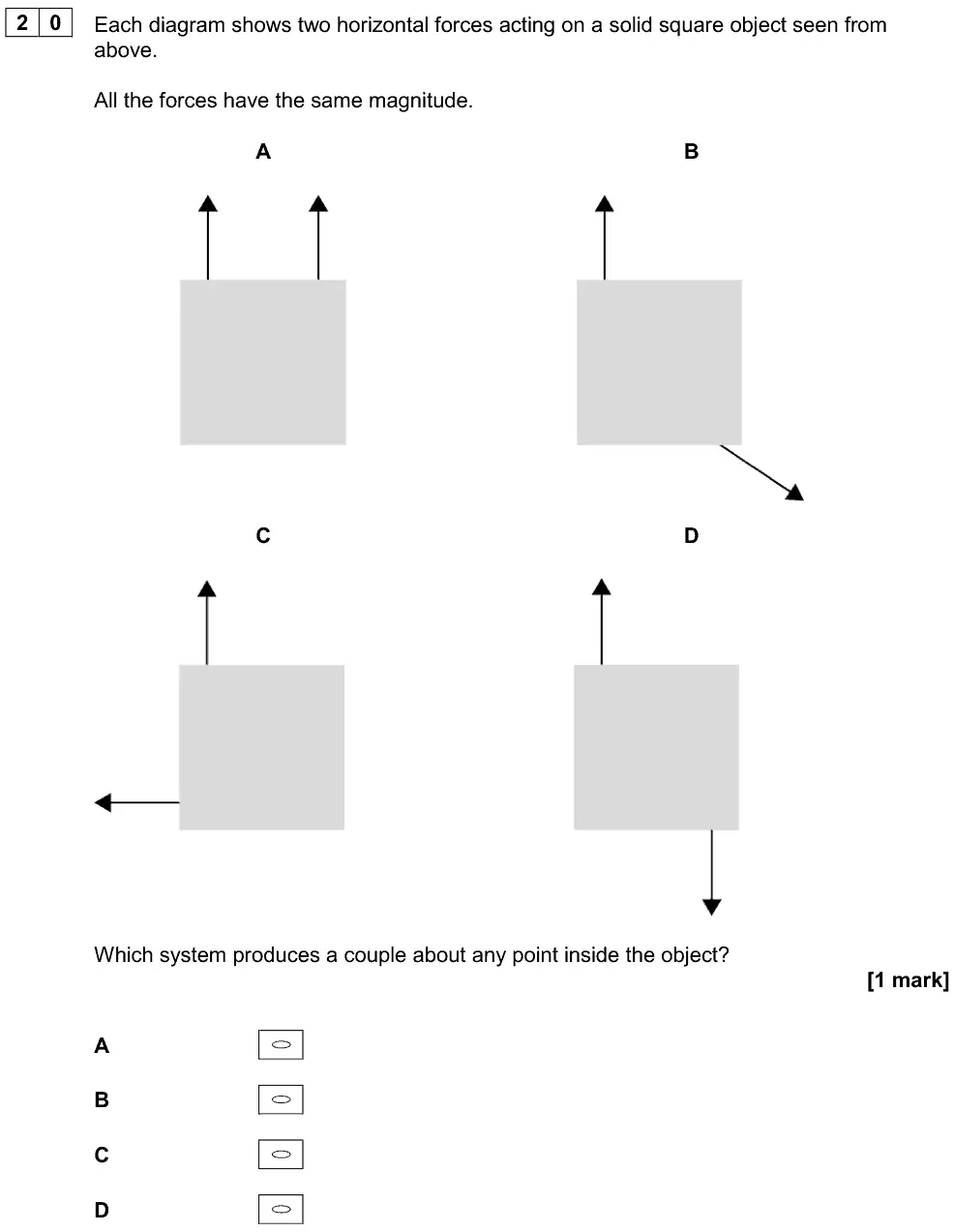
Each diagram shows two horizontal forces acting on a solid square object seen from
above.
All the forces have the same magnitude.
A
B
C
D
Which system produces a couple about any point inside the object?
[1 mark]
A
B
C
D
November 2020 · AS Paper 2 · Q21 1 mark Multiple choice vectors and moments
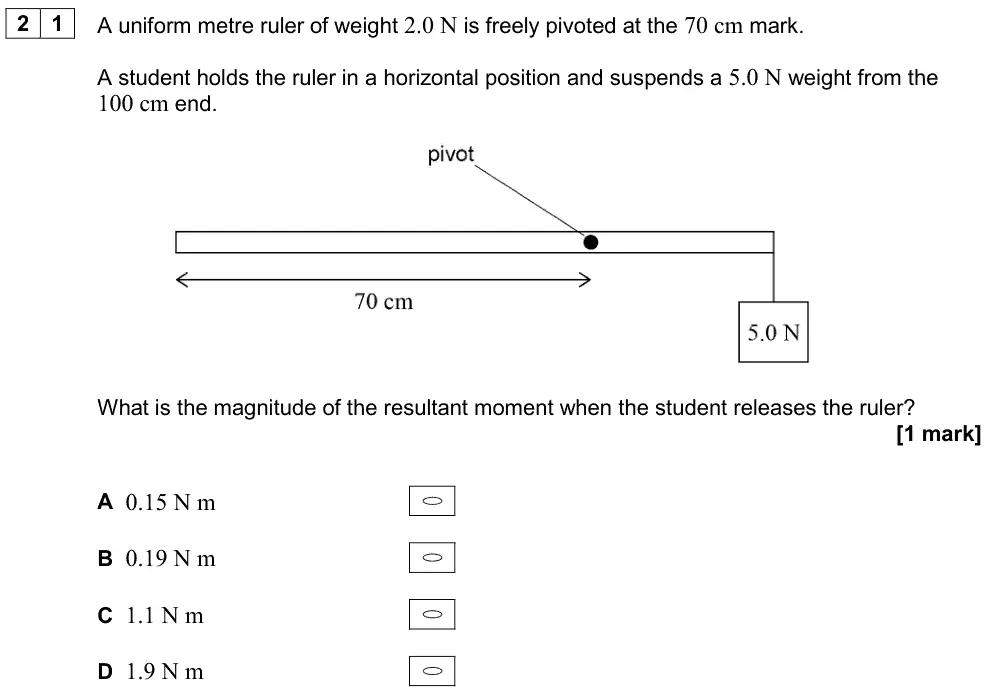
A uniform metre ruler of weight 2.0 N is freely pivoted at the 70 cm mark.
A student holds the ruler in a horizontal position and suspends a 5.0 N weight from the
100 cm end.
What is the magnitude of the resultant moment when the student releases the ruler?
[1 mark]
A 0.15 N m
B 0.19 N m
C 1.1 N m
D 1.9 N m
November 2020 · AS Paper 2 · Q22 1 mark Multiple choice motion and projectiles
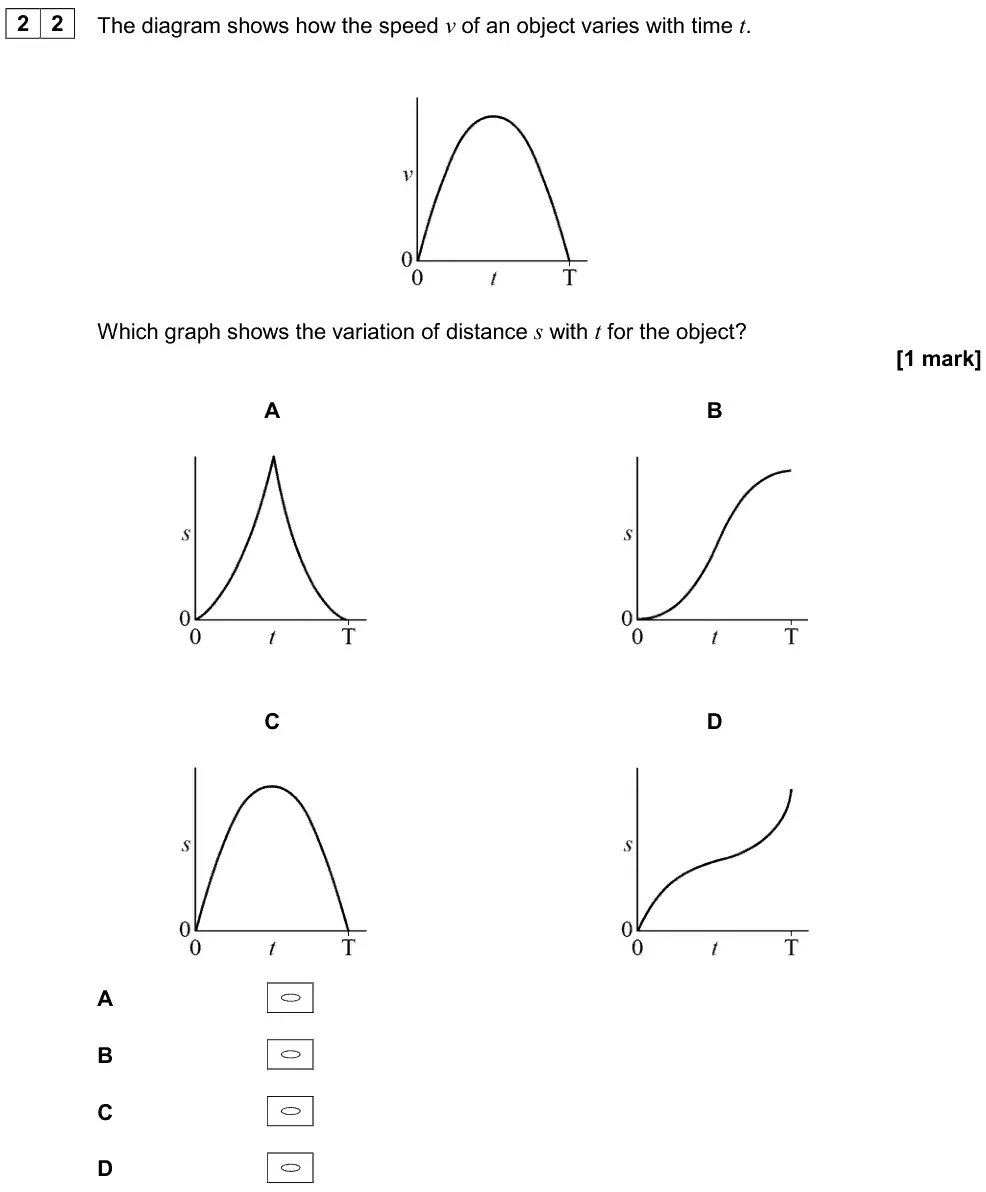
The diagram shows how the speed v of an object varies with time t.
Which graph shows the variation of distance s with t for the object?
[1 mark]
A
B
C
D
A
B
C
D
November 2020 · AS Paper 2 · Q23 1 mark Multiple choice motion and projectilesnewtons laws and momentum
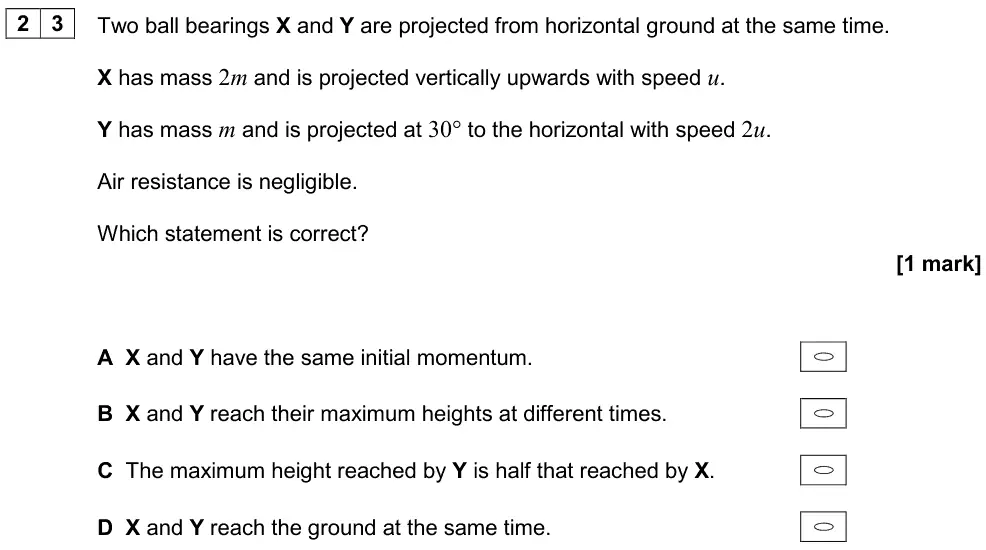
Two ball bearings X and Y are projected from horizontal ground at the same time.
X has mass 2m and is projected vertically upwards with speed u.
Y has mass m and is projected at 30° to the horizontal with speed 2u.
Air resistance is negligible.
Which statement is correct?
[1 mark]
A X and Y have the same initial momentum.
B X and Y reach their maximum heights at different times.
C The maximum height reached by Y is half that reached by X.
D X and Y reach the ground at the same time.
November 2020 · AS Paper 2 · Q24 1 mark Multiple choice newtons laws and momentum
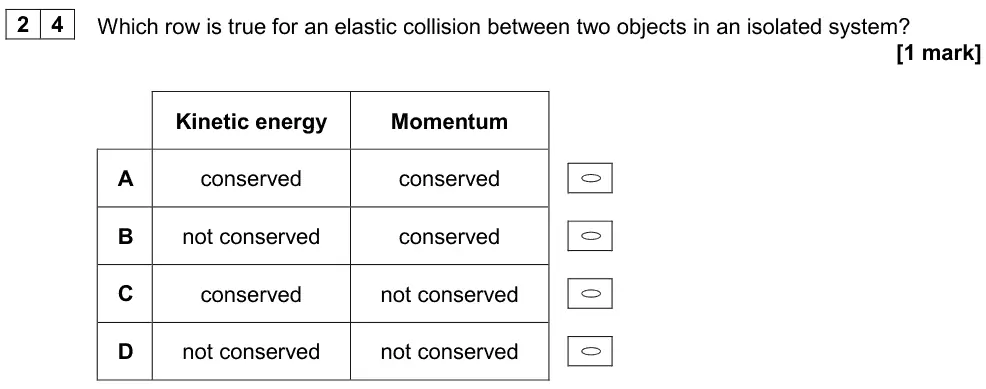
Which row is true for an elastic collision between two objects in an isolated system?
[1 mark]
Kinetic energy
Momentum
A
conserved
conserved
B
not conserved
conserved
C
conserved
not conserved
D
not conserved
not conserved
November 2020 · AS Paper 2 · Q25 1 mark Multiple choice work energy and powermotion and projectiles
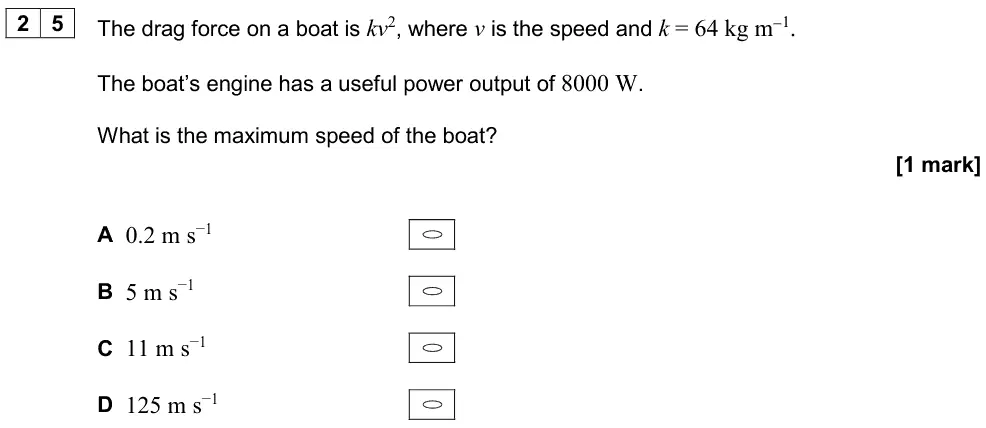
The drag force on a boat is kv2, where v is the speed and k = 64 kg m−1.
The boat’s engine has a useful power output of 8000 W.
What is the maximum speed of the boat?
[1 mark]
A 0.2 m s−1
B 5 m s−1
C 11 m s−1
D 125 m s−1
November 2020 · AS Paper 2 · Q26 1 mark Multiple choice materials and young modulus
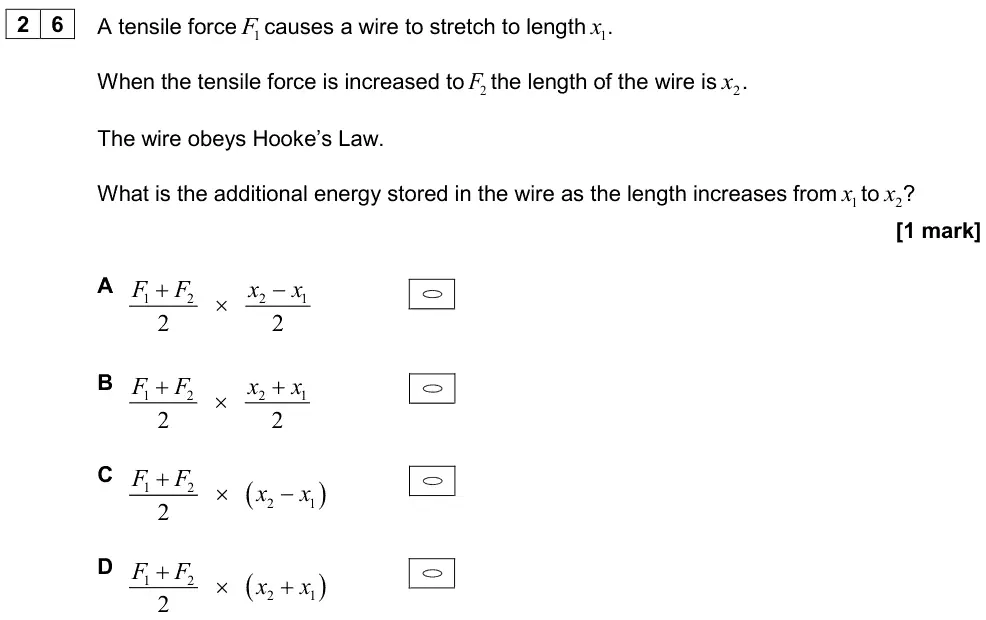
A tensile force
1F causes a wire to stretch to length
1x .
When the tensile force is increased to
2F the length of the wire is
2x .
The wire obeys Hooke’s Law.
What is the additional energy stored in the wire as the length increases from
1x to
2x ?
[1 mark]
A
1
2
2
1
2
2
F
F
x
x
+
−
×
B
1
2
2
1
2
2
F
F
x
x
+
+
×
C
(
)
1
2
2
1
2
F
F
x
x
+
×
−
D
(
)
1
2
2
1
2
F
F
x
x
+
×
+
November 2020 · AS Paper 2 · Q27 1 mark Multiple choice materials and young modulus
Which is a force–extension graph for a brittle material?
[1 mark]
A
B
C
D
A
B
C
D
November 2020 · AS Paper 2 · Q28 1 mark Multiple choice current voltage and resistivity
The table shows corresponding values of potential difference V and current I for four
electrical components A, B, C and D.
A
B
C
D
V / V
I / A
I / A
I / A
I / A
0
0.0
0.0
0.0
0.0
2
0.0
0.3
0.4
0.3
4
0.1
0.6
0.8
0.6
6
0.7
0.9
1.2
0.9
8
1.4
1.2
1.6
1.1
10
2.1
1.5
2.0
1.3
12
2.8
1.8
2.4
1.4
Which component is an ohmic conductor with the greatest resistance?
[1 mark]
A
B
C
D
November 2020 · AS Paper 2 · Q29 1 mark Multiple choice current voltage and resistivity
Which row shows the resistances of an ideal ammeter and an ideal voltmeter?
[1 mark]
Ideal ammeter
Ideal voltmeter
A
infinite
infinite
B
infinite
zero
C
zero
infinite
D
zero
zero
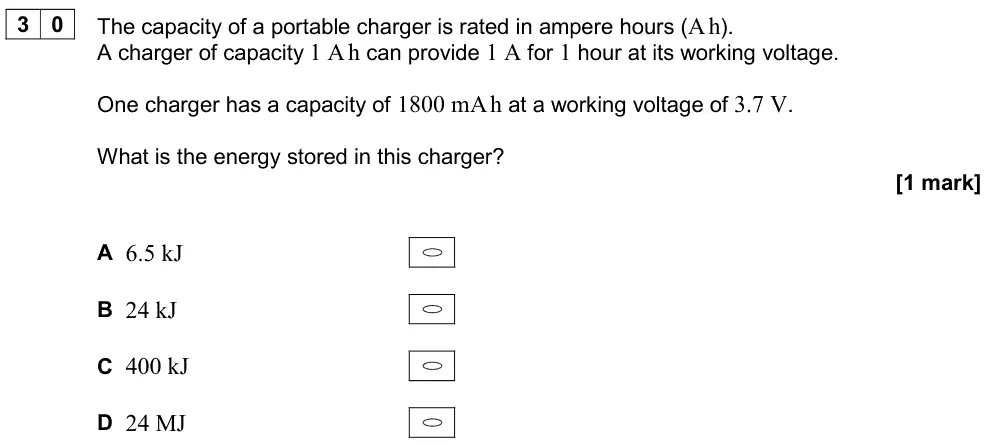
November 2020 · AS Paper 2 · Q30 1 mark Multiple choice circuits and potential dividersmeasurements and uncertainties
The capacity of a portable charger is rated in ampere hours (A h).
A charger of capacity 1 A h can provide 1 A for 1 hour at its working voltage.
One charger has a capacity of 1800 mA h at a working voltage of 3.7 V.
What is the energy stored in this charger?
[1 mark]
A 6.5 kJ
B 24 kJ
C 400 kJ
D 24 MJ
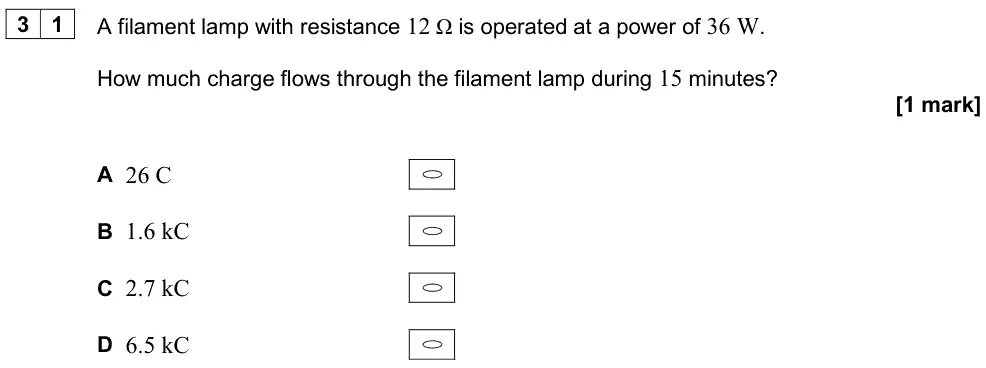
November 2020 · AS Paper 2 · Q31 1 mark Multiple choice circuits and potential dividerscurrent voltage and resistivity
A filament lamp with resistance 12 Ω is operated at a power of 36 W.
How much charge flows through the filament lamp during 15 minutes?
[1 mark]
A 26 C
B 1.6 kC
C 2.7 kC
D 6.5 kC
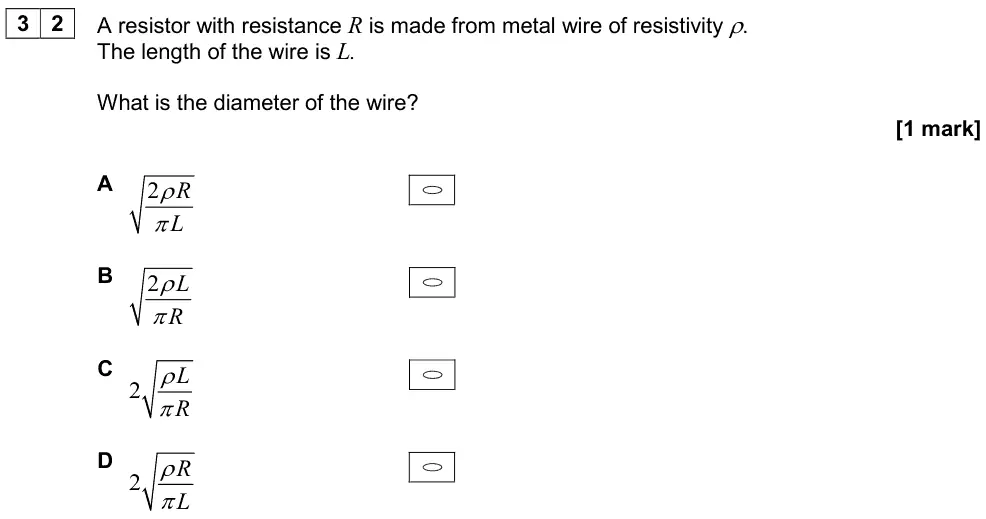
November 2020 · AS Paper 2 · Q32 1 mark Multiple choice current voltage and resistivity
A resistor with resistance R is made from metal wire of resistivity .
The length of the wire is L.
What is the diameter of the wire?
[1 mark]
A
2 R
L
B
2 L
R
C
2
L
R
D
2
R
L
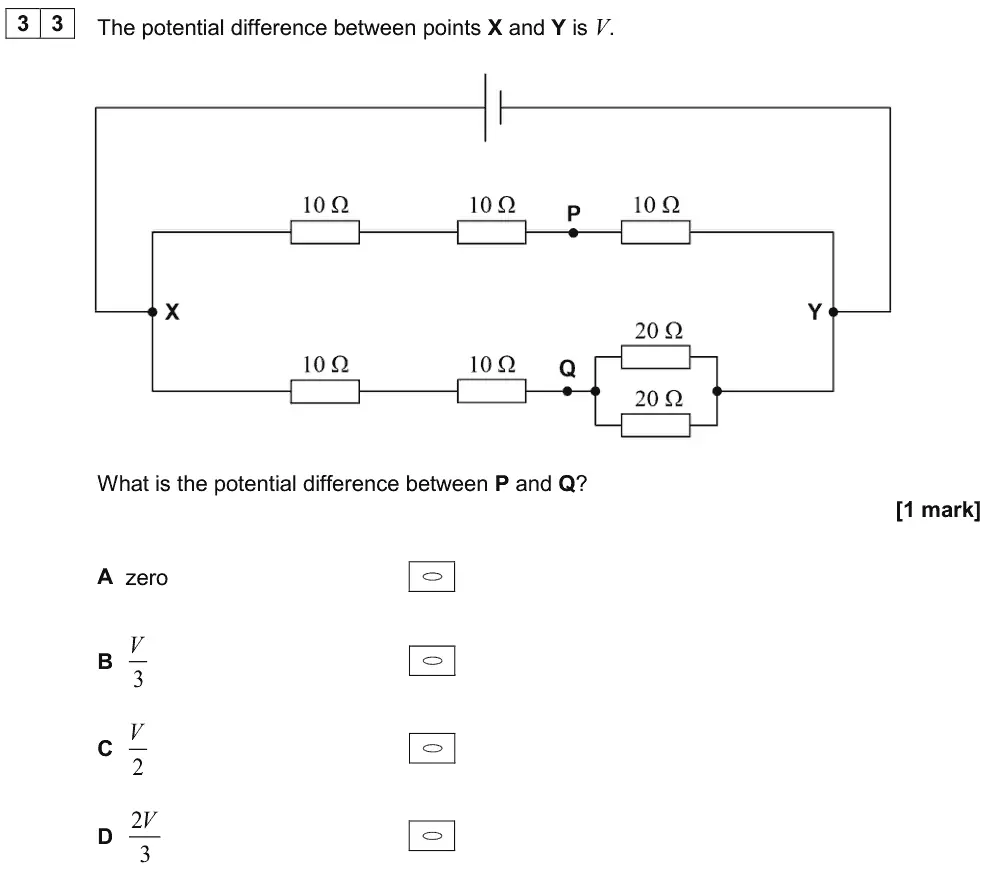
November 2020 · AS Paper 2 · Q33 1 mark Multiple choice circuits and potential dividers
The potential difference between points X and Y is V.
What is the potential difference between P and Q?
[1 mark]
A zero
B 3
V
C 2
V
D 2
3
V
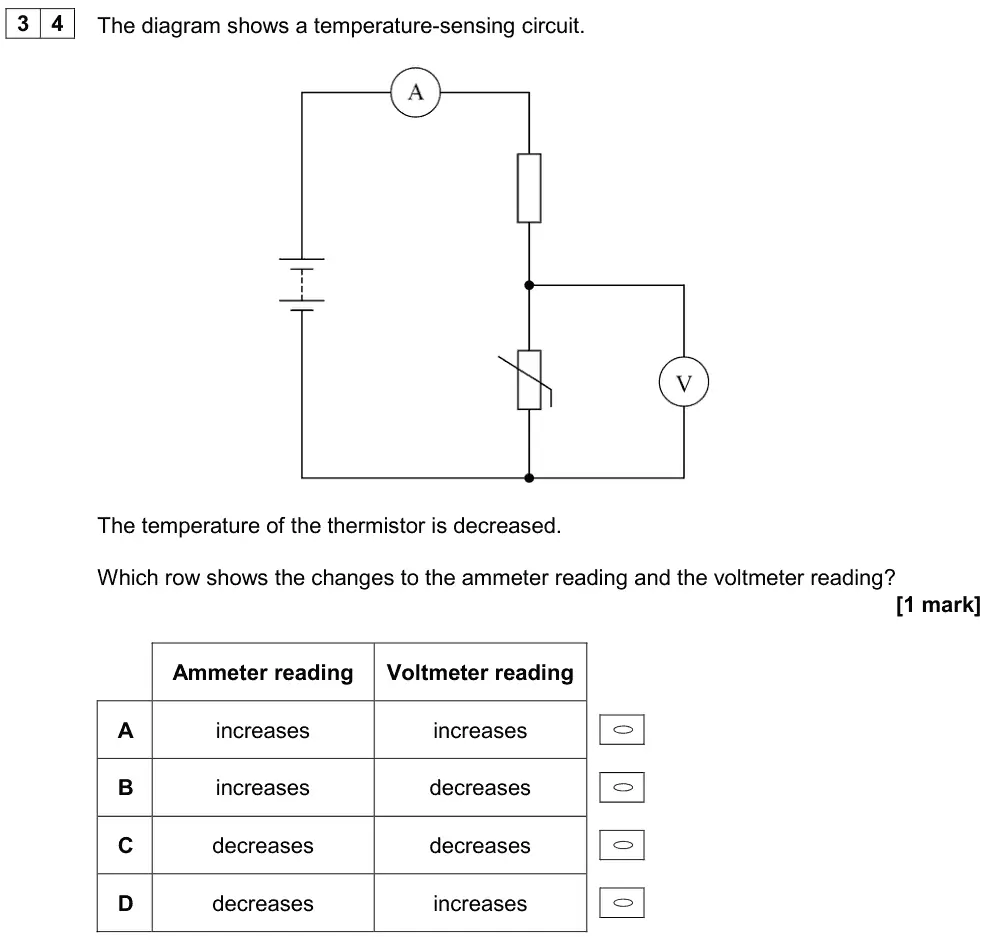
November 2020 · AS Paper 2 · Q34 1 mark Multiple choice current voltage and resistivitycircuits and potential dividers
The diagram shows a temperature-sensing circuit.
The temperature of the thermistor is decreased.
Which row shows the changes to the ammeter reading and the voltmeter reading?
[1 mark]
Ammeter reading
Voltmeter reading
A
increases
increases
B
increases
decreases
C
decreases
decreases
D
decreases
increases

Work with an AQA physics tutor

Want a paper marked and gone through with you? Message us.
Prefer email? Send an enquiry

If you are under 18, please include a parent's contact details. Enquiries go to enquiries@physicsaleveltutor.com and are deleted once handled. All tutoring is online.