June 2018: Component 3

120 marks for each student (100 in Section A plus one 20-mark option; all four options are here) · 68 question parts · Paper, mark scheme and report on Eduqas's site · Have the Data Booklet beside you

Question by question

QTopicMarksAOType
1(a) Wave properties: diffraction, interference and stationary waves 1AO1=1Definition
1(b) Wave properties: diffraction, interference and stationary waves 2AO1=2Explanation
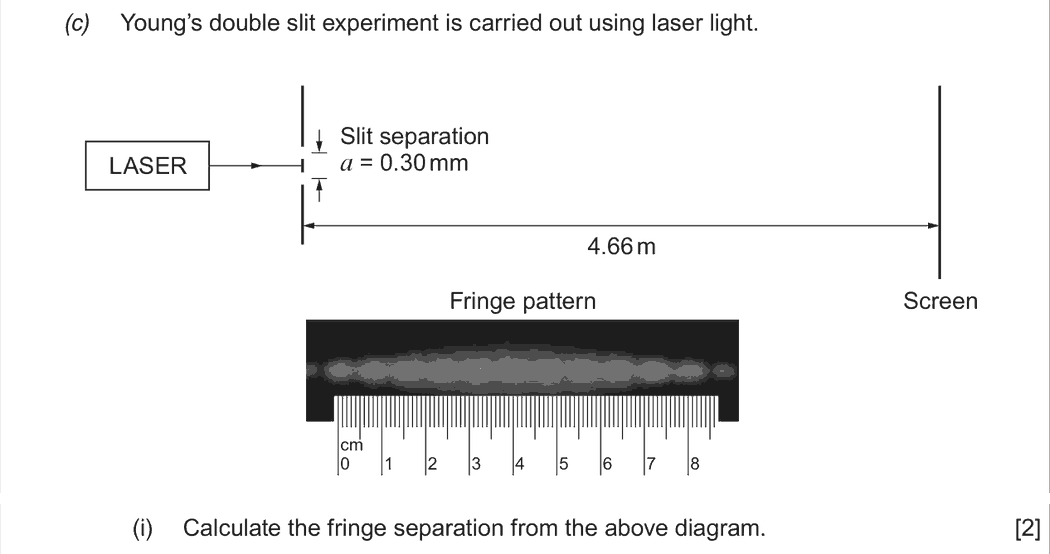
1(c)(i) Wave properties: diffraction, interference and stationary waves 2AO2=2Practical and data analysis
1(c)(ii) Wave properties: diffraction, interference and stationary waves 2AO1=1,AO2=1Calculation
1(c)(iii) Wave properties: diffraction, interference and stationary waves 2AO3=2Practical and data analysis
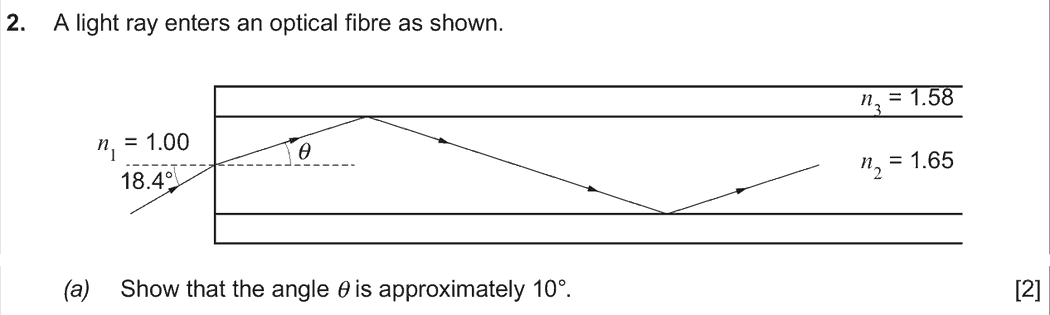
2(a) Refraction of light 2AO1=1,AO2=1Show that
2(b) Refraction of light 4Calculation
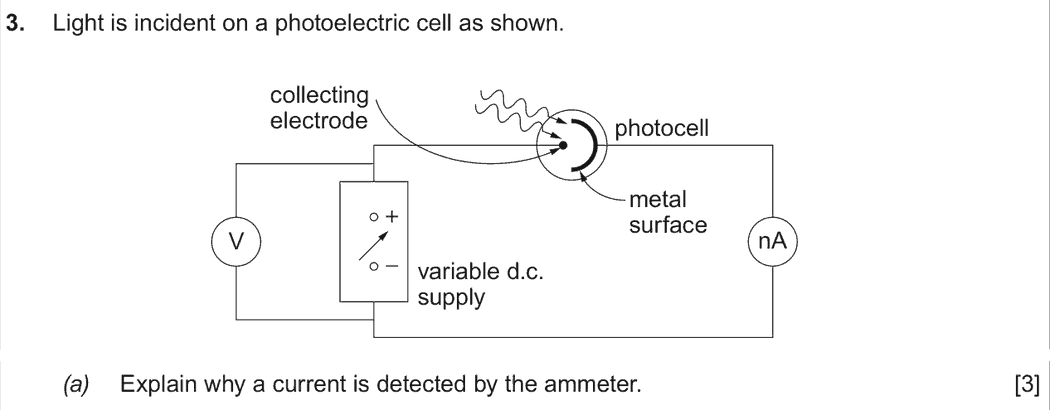
3(a) Photons 3AO1=2,AO2=1Explanation
3(b) Photons 3AO1=1,AO2=2Calculation
3(c)(i) Photons 3AO2=3Practical and data analysis
3(c)(ii) Photons 3AO3=3Explanation
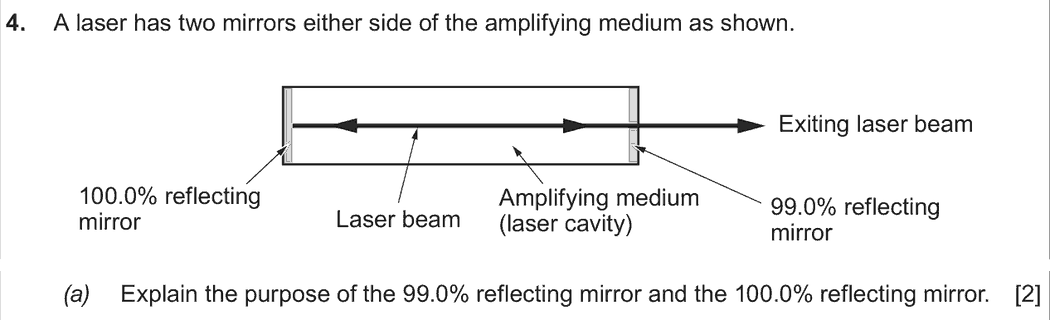
4(a) Lasers 2AO1=2Explanation
4(b) Lasers 3AO1=3Explanation
4(c)(i) Photons 2AO2=2Show that
4(c)(ii) Photons 1AO2=1Show that
4(c)(iii) Photons 2AO2=2Show that
4(c)(iv) Solids under stress 3AO1=2,AO2=1Calculation
5(a) Wave properties: diffraction, interference and stationary waves 3AO1=3Explanation
5(b) Wave properties: diffraction, interference and stationary waves, The nature of waves 3AO2=3Show that
5(c) Wave properties: diffraction, interference and stationary waves 3AO3=3Practical and data analysis
5(d) Wave properties: diffraction, interference and stationary waves 3AO2=3Explanation
5(e) 3AO3=3Short answer
6(a) Nuclear decay 2AO2=2Short answer
6(b) Nuclear decay 5AO1=2,AO2=3Calculation
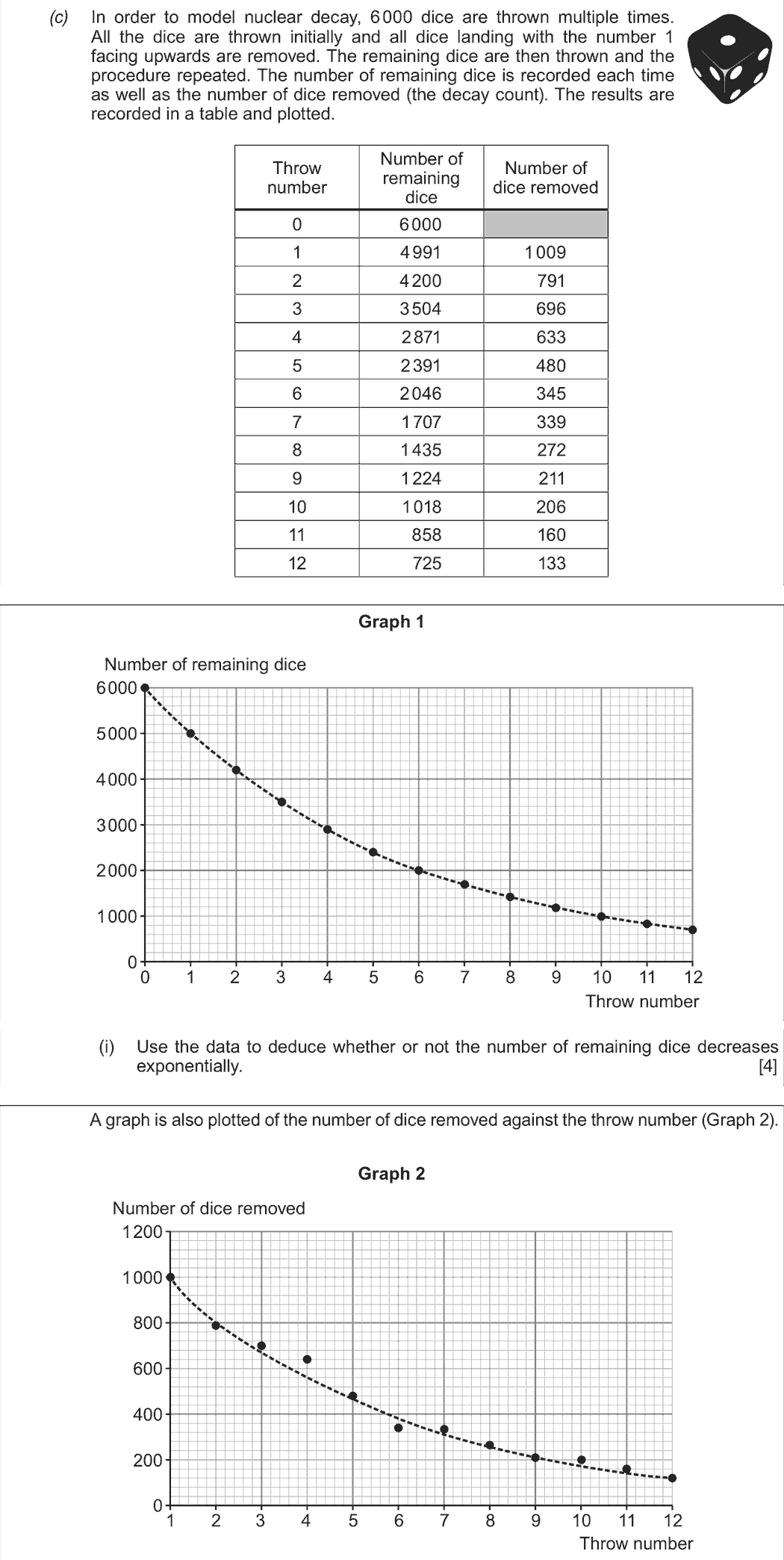
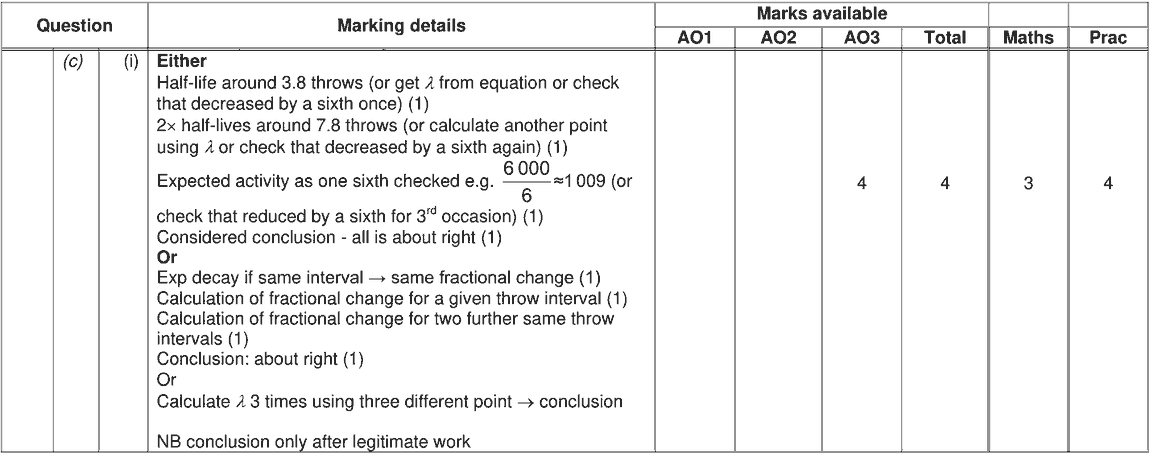
6(c)(i) Nuclear decay 4AO3=4Practical and data analysis
6(c)(ii) Nuclear decay 2AO3=2Practical and data analysis
7(a) Nuclear energy 2AO1=2Explanation
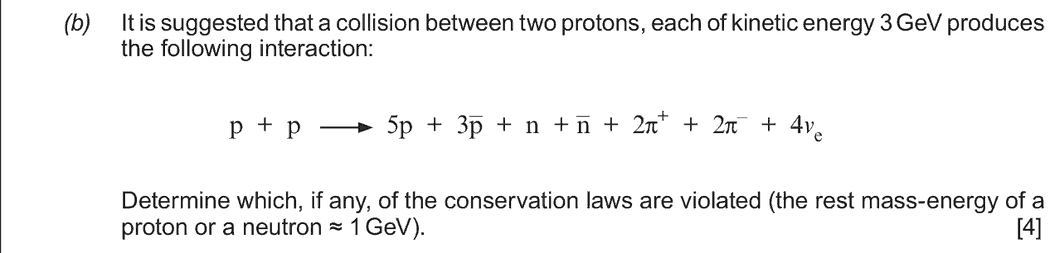
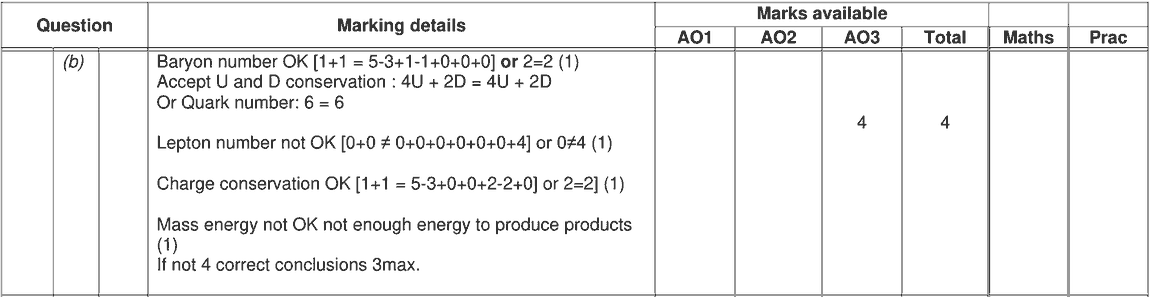
7(b) Particles and nuclear structure, Nuclear energy 4AO3=4Explanation
8 Nuclear energy 6AO1=6Extended response
9(a) Energy concepts 3AO2=3Calculation
9(b) Magnetic fields 3AO2=3Calculation
9(c) Magnetic fields 3AO2=3Calculation
10(a) Electromagnetic induction 4AO2=4Explanation
10(b) Electromagnetic induction 2AO2=2Explanation
10(c) Resistance 2AO1=1,AO2=1Show that
10(d) Electromagnetic induction 3AO1=1,AO2=2Calculation
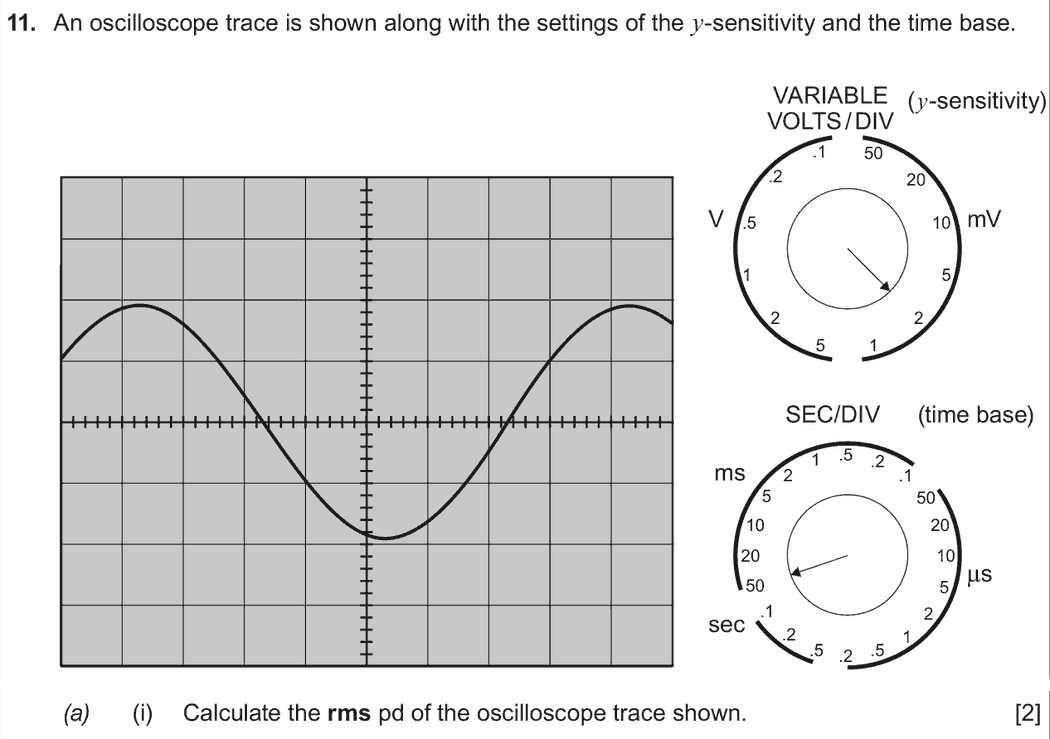
11(a)(i) Alternating currents 2AO2=2Calculation
11(a)(ii) Alternating currents 2AO2=2Calculation
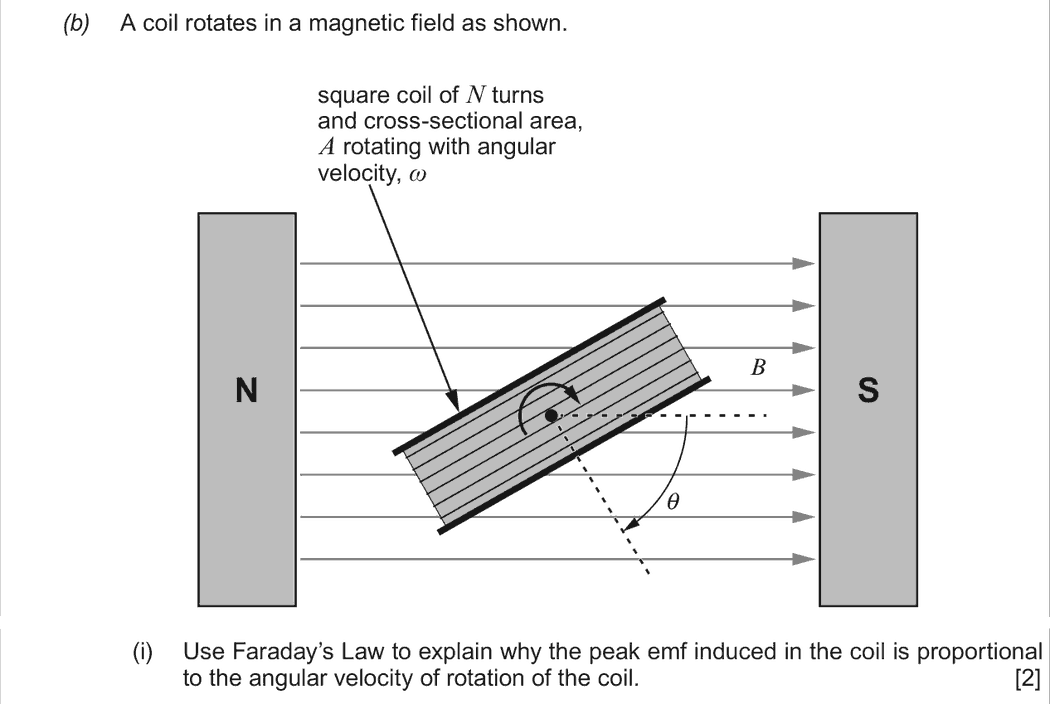
11(b)(i) Alternating currents 2AO1=2Explanation
11(b)(ii) Alternating currents 2AO1=2Explanation
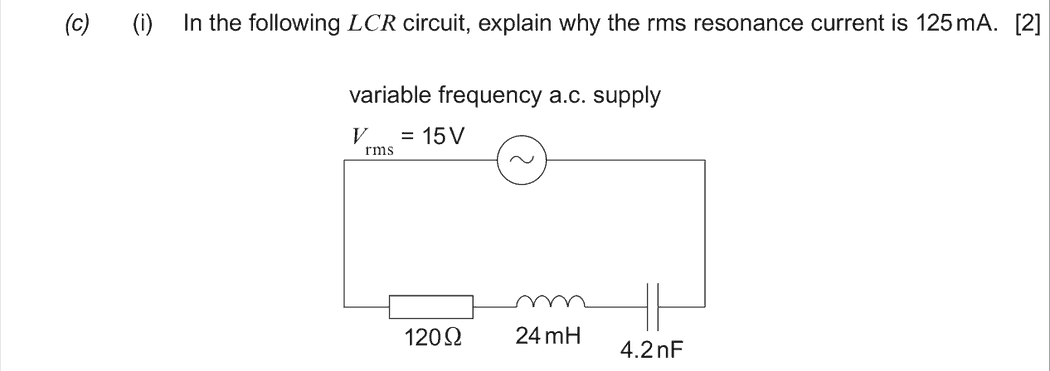
11(c)(i) Alternating currents 2AO1=1,AO2=1Explanation
11(c)(ii) Alternating currents 2AO2=2Calculation
11(c)(iii) Alternating currents 3AO1=1,AO2=2Show that
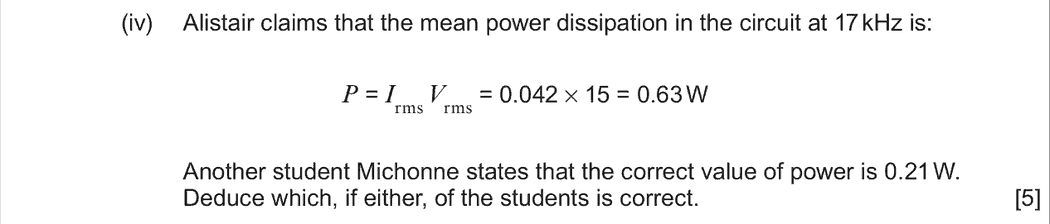
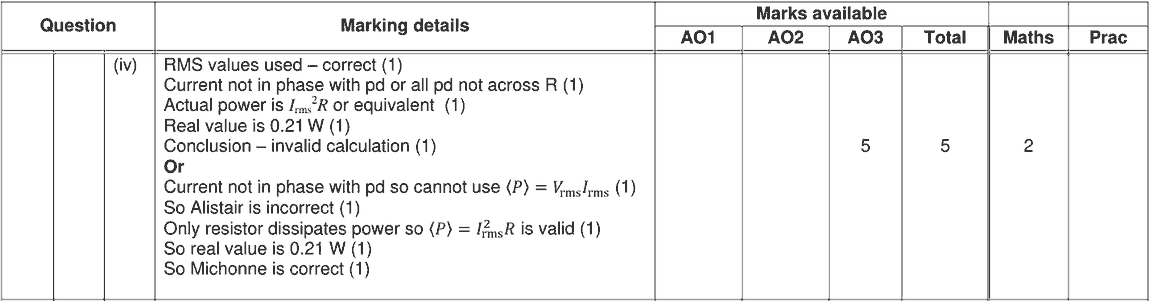
11(c)(iv) Alternating currents 5AO3=5Calculation
12(a) Medical physics 4AO1=4Explanation
12(b)(i) Medical physics 2AO1=1,AO2=1Calculation
12(b)(ii) Medical physics 3AO2=3Calculation
12(c) Medical physics 5AO3=5Explanation
12(d)(i) Medical physics 1AO1=1Short answer
12(d)(ii) Medical physics 3AO2=3Calculation
12(d)(iii) Medical physics 2AO2=2Calculation
13(a) The physics of sports 1AO1=1Short answer
13(b)(i) The physics of sports 2AO1=2Definition
13(b)(ii) The physics of sports 3AO2=3Calculation
13(b)(iii) The physics of sports 3AO1=1,AO2=2Calculation
13(c)(i) The physics of sports 3AO1=1,AO2=2Calculation
13(c)(ii) The physics of sports 3AO1=1,AO2=2Calculation
13(d) The physics of sports 5AO3=5Calculation
14(a)(i) Energy and the environment 1AO1=1Definition
14(a)(ii)I Energy and the environment 2Show that
14(a)(ii)II Energy and the environment 2Calculation
14(b)(i) Energy and the environment 2AO1=2Show that
14(b)(ii) Energy and the environment 2AO2=2Explanation
14(b)(iii) Energy and the environment 3AO2=3Calculation
14(b)(iv) Energy and the environment 1AO3=1Short answer
14(c)(i) Energy and the environment 2AO1=2Show that
14(c)(ii) Energy and the environment 3AO1=1,AO2=2Show that
14(c)(iii) Energy and the environment 2AO3=2Calculation

The questions

1(a)1(b)1(c)(i)1(c)(ii)1(c)(iii)2(a)2(b)3(a)3(b)3(c)(i)3(c)(ii)4(a)4(b)4(c)(i)4(c)(ii)4(c)(iii)4(c)(iv)5(a)5(b)5(c)5(d)5(e)6(a)6(b)6(c)(i)6(c)(ii)7(a)7(b)89(a)9(b)9(c)10(a)10(b)10(c)10(d)11(a)(i)11(a)(ii)11(b)(i)11(b)(ii)11(c)(i)11(c)(ii)11(c)(iii)11(c)(iv)12(a)12(b)(i)12(b)(ii)12(c)12(d)(i)12(d)(ii)12(d)(iii)13(a)13(b)(i)13(b)(ii)13(b)(iii)13(c)(i)13(c)(ii)13(d)14(a)(i)14(a)(ii)I14(a)(ii)II14(b)(i)14(b)(ii)14(b)(iii)14(b)(iv)14(c)(i)14(c)(ii)14(c)(iii)
June 2018 · Component 3 · Q1(a) 1 mark AO1=1 Definition wave properties
1. (a) State what is meant by two coherent sources. [1]
June 2018 · Component 3 · Q1(b) 2 marks AO1=2 Explanation wave properties
Earlier part of question 1 that this part usesEarlier part of June 2018 Component 3 question 1
(b) In the 1700s, light was thought to consist of a stream of particles. In the 1800s, it was said to be a wave but since the early 1900s it has been accepted that light behaves both like a wave and like a particle (wave particle duality). Explain briefly the part that Young’s double slit experiment played in this history. [2]


June 2018 · Component 3 · Q1(c)(i) 2 marks AO2=2 Practical and data analysis wave properties
Earlier part of question 1 that this part usesEarlier part of June 2018 Component 3 question 1
(c) Young’s double slit experiment is carried out using laser light. Slit separation LASER a = 0.30 mm 4.66 m Fringe pattern Screen cm 0 1 2 3 4 5 6 7 8 (i) Calculate the fringe separation from the above diagram. [2]
June 2018 · Component 3 · Q1(c)(ii) 2 marks AO1=1, AO2=1 Calculation wave properties
Earlier parts of question 1 that this part usesEarlier part of June 2018 Component 3 question 1Earlier part of June 2018 Component 3 question 1
(ii) The distance between the slits and the screen is 4.66 m. Calculate the wavelength of the laser light. [2]
June 2018 · Component 3 · Q1(c)(iii) 2 marks AO3=2 Practical and data analysis wave properties
Earlier parts of question 1 that this part usesEarlier part of June 2018 Component 3 question 1Earlier part of June 2018 Component 3 question 1
(iii) State one advantage and one disadvantage of using a large slit-to-screen distance. [2]
June 2018 · Component 3 · Q2(a) 2 marks AO1=1, AO2=1 Show that refraction of light
2. A light ray enters an optical fibre as shown. n3 = 1.58 n1 = 1.00 θ n2 = 1.65 18.4° (a) Show that the angle θ is approximately 10°. [2]
June 2018 · Component 3 · Q2(b) 4 marks Calculation refraction of light
Earlier part of question 2 that this part usesEarlier part of June 2018 Component 3 question 2
(b) Deduce whether or not this light will propagate along the length of the optical fibre with total internal reflection as shown. [4]
June 2018 · Component 3 · Q3(a) 3 marks AO1=2, AO2=1 Explanation photons
3. Light is incident on a photoelectric cell as shown. collecting electrode photocell metal surface V nA variable d.c. supply (a) Explain why a current is detected by the ammeter. [3]
June 2018 · Component 3 · Q3(b) 3 marks AO1=1, AO2=2 Calculation photons
Earlier part of question 3 that this part usesEarlier part of June 2018 Component 3 question 3
(b) The work function of the metal surface is 2.7 eV and electrons are emitted with a maximum kinetic energy of 1.2 eV. Calculate the frequency of the incident photons. [3]
June 2018 · Component 3 · Q3(c)(i) 3 marks AO2=3 Practical and data analysis photons
Earlier part of question 3 that this part usesEarlier part of June 2018 Component 3 question 3
(c) (i) Explain how you would modify and use the circuit opposite to measure the stopping potential. [3]
June 2018 · Component 3 · Q3(c)(ii) 3 marks AO3=3 Explanation photons
Earlier parts of question 3 that this part usesEarlier part of June 2018 Component 3 question 3Earlier part of June 2018 Component 3 question 3
(ii) The metal surface of the photocell is radioactive and emits alpha particles some of which arrive at the collecting electrode. Explain briefly what effect this would have on measuring the stopping potential and what could be done to reduce this effect. [3]
June 2018 · Component 3 · Q4(a) 2 marks AO1=2 Explanation lasers
4. A laser has two mirrors either side of the amplifying medium as shown. Exiting laser beam 100.0% reflecting Amplifying medium 99.0% reflecting mirror Laser beam (laser cavity) mirror (a) Explain the purpose of the 99.0% reflecting mirror and the 100.0% reflecting mirror. [2]
June 2018 · Component 3 · Q4(b) 3 marks AO1=3 Explanation lasers
Earlier part of question 4 that this part usesEarlier part of June 2018 Component 3 question 4
(b) Explain the purpose of a population inversion in the laser cavity. [3]
June 2018 · Component 3 · Q4(c)(i) 2 marks AO2=2 Show that photons
Earlier part of question 4 that this part usesEarlier part of June 2018 Component 3 question 4
(c) (i) The light intensity inside a powerful laser is 2.0 × 10¹⁵ W and its wavelength is 1.05 μm. Show that this corresponds to approximately 1 × 1034 photons per second. [2]
June 2018 · Component 3 · Q4(c)(ii) 1 mark AO2=1 Show that photons
Earlier parts of question 4 that this part usesEarlier part of June 2018 Component 3 question 4Earlier part of June 2018 Component 3 question 4
(ii) Show that the momentum of a 1.05 μm photon is approximately 6 × 10–28 kg m s–1. [1]
June 2018 · Component 3 · Q4(c)(iii) 2 marks AO2=2 Show that photons
Earlier parts of question 4 that this part usesEarlier part of June 2018 Component 3 question 4Earlier part of June 2018 Component 3 question 4
(iii) Show that the force exerted on a 100.0% reflecting mirror by a beam of power 2.0 × 10¹⁵ W is approximately 1 × 10⁷ N. [2]
June 2018 · Component 3 · Q4(c)(iv) 3 marks AO1=2, AO2=1 Calculation solids under stress
Earlier parts of question 4 that this part usesEarlier part of June 2018 Component 3 question 4Earlier part of June 2018 Component 3 question 4
(iv) Calculate the strain produced in a laser structure if the power of the beam between the mirrors is 2.0 × 10¹⁵ W. You may assume that the structure of the laser cavity has a cross-sectional area of 43 cm2 and is made of a material with Young modulus 2.8 × 10¹¹ Pa. [3]
June 2018 · Component 3 · Q5(a) 3 marks AO1=3 Explanation wave properties
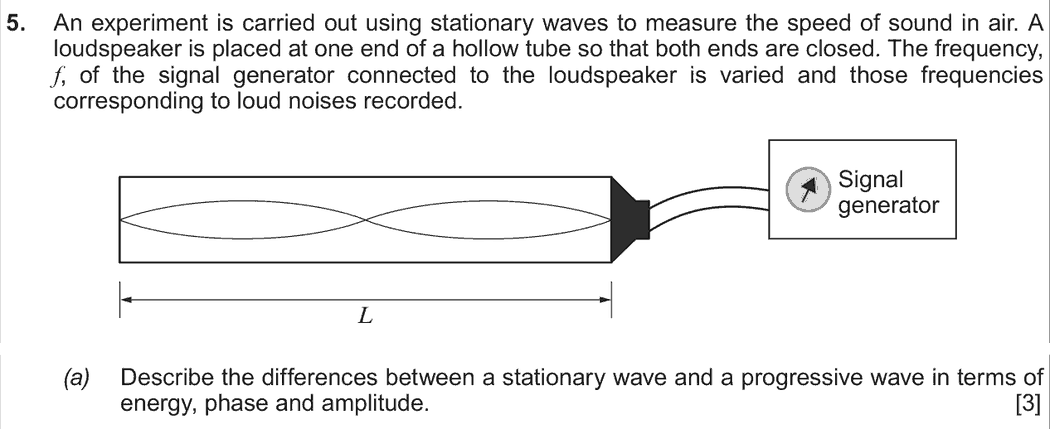
5. An experiment is carried out using stationary waves to measure the speed of sound in air. A loudspeaker is placed at one end of a hollow tube so that both ends are closed. The frequency, f, of the signal generator connected to the loudspeaker is varied and those frequencies corresponding to loud noises recorded. Signal generator L (a) Describe the differences between a stationary wave and a progressive wave in terms of energy, phase and amplitude. [3]
June 2018 · Component 3 · Q5(b) 3 marks AO2=3 Show that wave propertiesnature of waves
Earlier part of question 5 that this part usesEarlier part of June 2018 Component 3 question 5
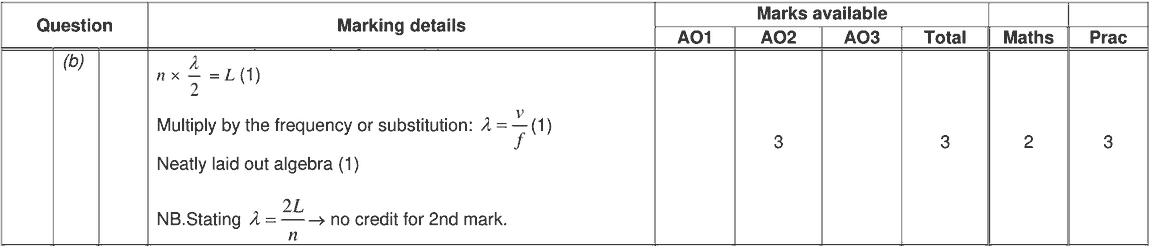
(b) Show that the frequencies corresponding to stationary waves are given by: v f = n 2L where n is any whole number (n = 2 in the above diagram). [3]
June 2018 · Component 3 · Q5(c) 3 marks AO3=3 Practical and data analysis wave properties
Earlier part of question 5 that this part usesEarlier part of June 2018 Component 3 question 5
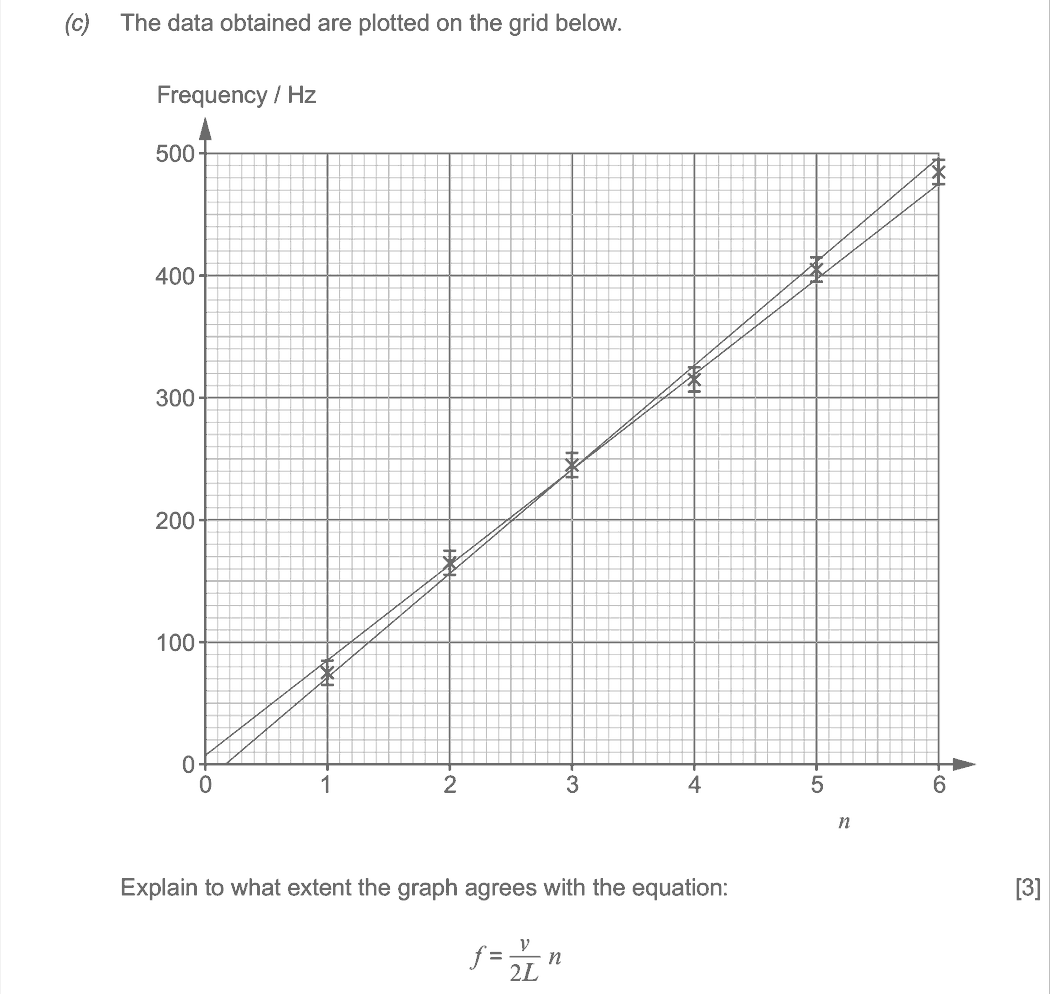
(c) The data obtained are plotted on the grid below. Frequency / Hz 500 400 300 200 100 0 0 1 2 3 4 5 6 n Explain to what extent the graph agrees with the equation: [3] v f = n 2L
June 2018 · Component 3 · Q5(d) 3 marks AO2=3 Explanation wave properties
Earlier parts of question 5 that this part usesEarlier part of June 2018 Component 3 question 5Earlier part of June 2018 Component 3 question 5
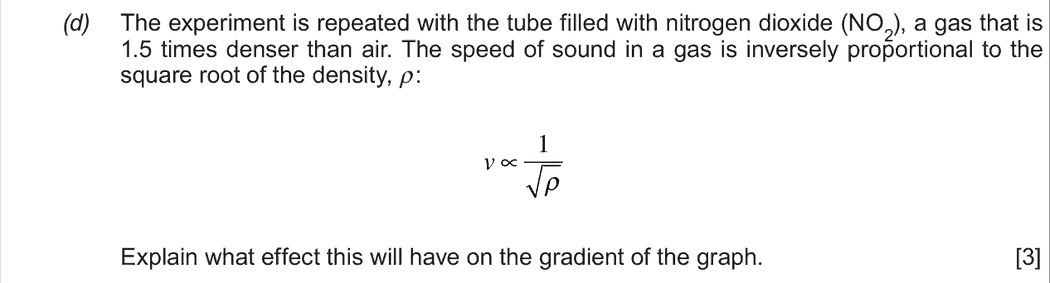
(d) The experiment is repeated with the tube filled with nitrogen dioxide (NO2), a gas that is 1.5 times denser than air. The speed of sound in a gas is inversely proportional to the square root of the density, ρ : ∝1 v ρ Explain what effect this will have on the gradient of the graph. [3]
June 2018 · Component 3 · Q5(e) 3 marks AO3=3 Short answer
Earlier parts of question 5 that this part usesEarlier part of June 2018 Component 3 question 5Earlier part of June 2018 Component 3 question 5
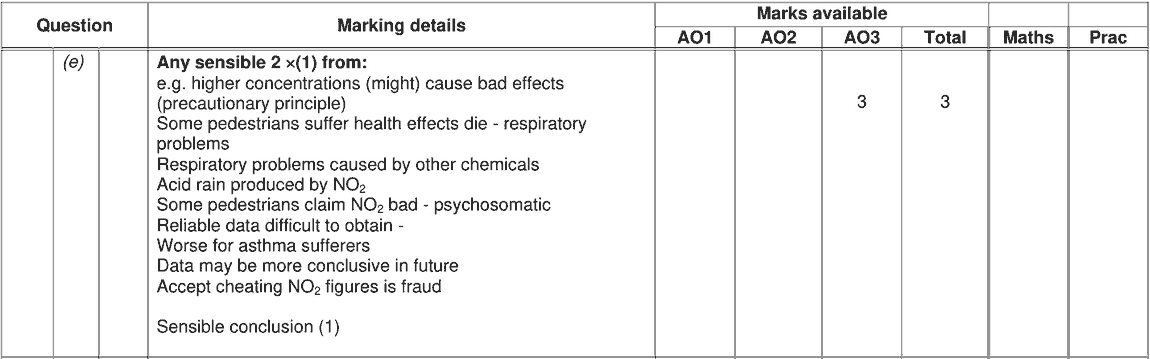
(e) A car company is fined £15 billion for excessive NO2 emissions of its diesel engines. However, there is little or no reliable evidence that NO2 produces any detrimental health effects at the concentration levels present in the atmosphere. Discuss whether or not the car company or pedestrians have been treated unfairly. [3]
June 2018 · Component 3 · Q6(a) 2 marks AO2=2 Short answer nuclear decay
6. (a) A radioactive isotope of thorium decays to a stable lead nucleus ( 208 Pb) via 6 alpha 82 decays and 4 beta decays. Complete the equation below. [2] 208 Th Pb + 6 He + 4 e– 82
June 2018 · Component 3 · Q6(b) 5 marks AO1=2, AO2=3 Calculation nuclear decay
Earlier part of question 6 that this part usesEarlier part of June 2018 Component 3 question 6
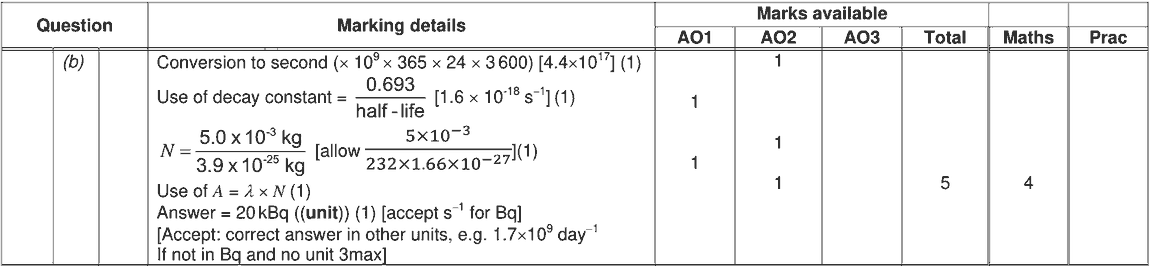
(b) The half-life of the thorium nucleus is 14.1 × 10⁹ years. Calculate the activity of 5.0 × 10⁻³ kg of the radioactive thorium (the mass of the thorium atom is approximately 3.9 × 10⁻²⁵ kg). [5]
June 2018 · Component 3 · Q6(c)(i) 4 marks AO3=4 Practical and data analysis nuclear decay
Earlier part of question 6 that this part usesEarlier part of June 2018 Component 3 question 6
(c) In order to model nuclear decay, 6 000 dice are thrown multiple times. All the dice are thrown initially and all dice landing with the number 1 facing upwards are removed. The remaining dice are then thrown and the procedure repeated. The number of remaining dice is recorded each time as well as the number of dice removed (the decay count). The results are recorded in a table and plotted. Number of Throw Number of remaining number dice removed dice 0 6 000 1 4 991 1 009 2 4 200 791 3 3 504 696 4 2 871 633 5 2 391 480 6 2 046 345 7 1 707 339 8 1 435 272 9 1 224 211 10 1 018 206 11 858 160 12 725 133 Graph 1 Number of remaining dice 6000 5000 4000 3000 2000 1000 0 0 1 2 3 4 5 6 7 8 9 10 11 12 Throw number (i) Use the data to deduce whether or not the number of remaining dice decreases exponentially. [4] A graph is also plotted of the number of dice removed against the throw number (Graph 2). Graph 2 Number of dice removed 1200 1000 800 600 400 200 0 1 2 3 4 5 6 7 8 9 10 11 12 Throw number
June 2018 · Component 3 · Q6(c)(ii) 2 marks AO3=2 Practical and data analysis nuclear decay
Earlier parts of question 6 that this part usesEarlier part of June 2018 Component 3 question 6Earlier part of June 2018 Component 3 question 6
(ii) Suggest why there is more scatter in Graph 2 than Graph 1. [2]
June 2018 · Component 3 · Q7(a) 2 marks AO1=2 Explanation nuclear energy
7. (a) Explain briefly what is meant by conservation of mass-energy. [2]
June 2018 · Component 3 · Q7(b) 4 marks AO3=4 Explanation particles and nuclear structurenuclear energy
Earlier part of question 7 that this part usesEarlier part of June 2018 Component 3 question 7
(b) It is suggested that a collision between two protons, each of kinetic energy 3 GeV produces the following interaction: 3p– n– 2π+ 2π– p + p 5p + + n + + + + 4ve Determine which, if any, of the conservation laws are violated (the rest mass-energy of a proton or a neutron ≈ 1 GeV). [4]
June 2018 · Component 3 · Q8 6 marks AO1=6 6-mark extended response nuclear energy
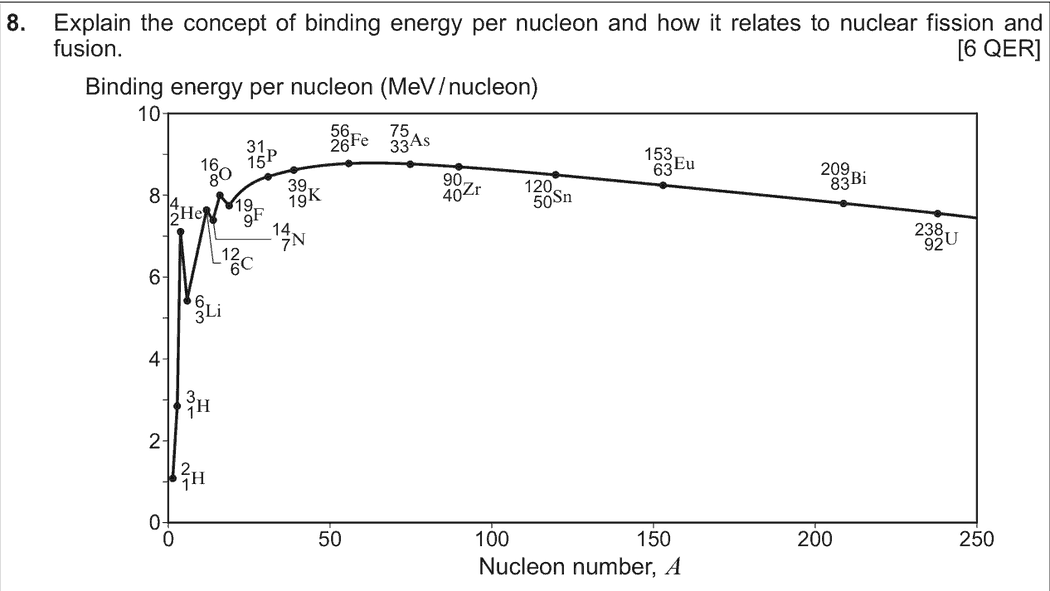
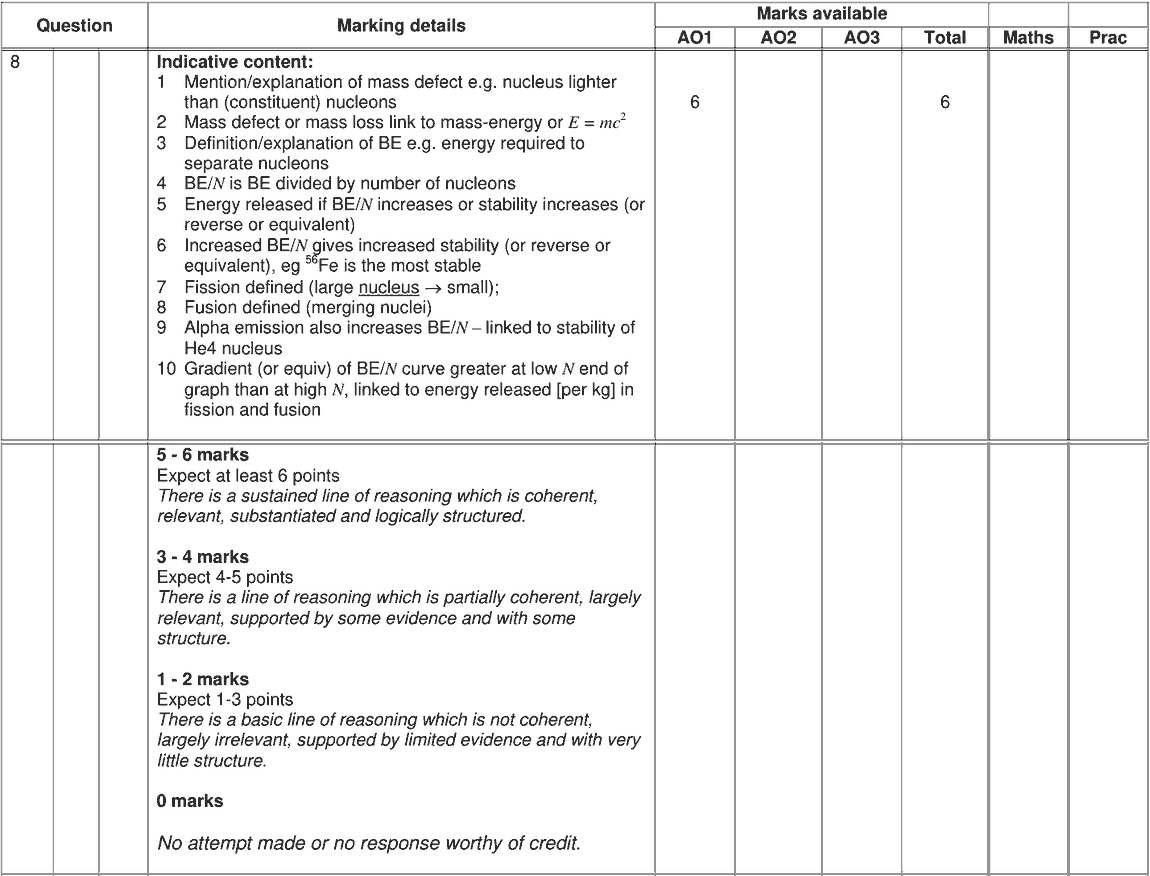
8. Explain the concept of binding energy per nucleon and how it relates to nuclear fission and fusion. [6 QER] Binding energy per nucleon (MeV / nucleon) 10 56 75 31 26Fe 33As 15P 153 16 63Eu 209 8O 90 83Bi 39 40Zr 120 8 19K 50Sn 4 19 2He 9F 14 238 7N 92U 12 6C 6 6 3Li 4 3 1H 2 2 1H 0 0 50 100 150 200 250 Nucleon number, A
June 2018 · Component 3 · Q9(a) 3 marks AO2=3 Calculation energy concepts
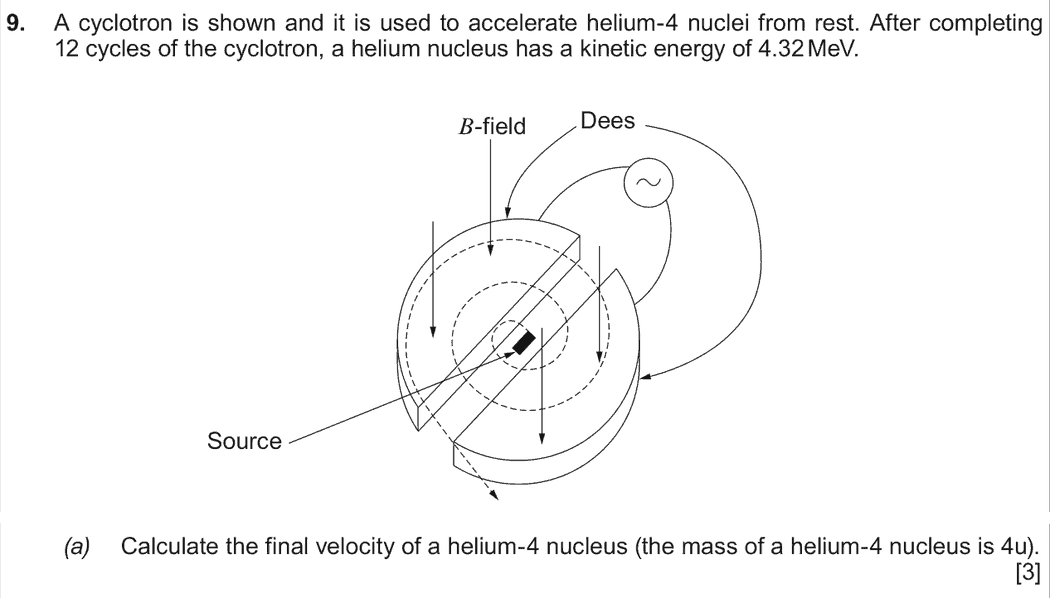
9. A cyclotron is shown and it is used to accelerate helium-4 nuclei from rest. After completing 12 cycles of the cyclotron, a helium nucleus has a kinetic energy of 4.32 MeV. B-field Dees Source (a) Calculate the final velocity of a helium-4 nucleus (the mass of a helium-4 nucleus is 4u). [3]
June 2018 · Component 3 · Q9(b) 3 marks AO2=3 Calculation magnetic fields
Earlier part of question 9 that this part usesEarlier part of June 2018 Component 3 question 9
(b) Calculate the pd between the dees. [3]
June 2018 · Component 3 · Q9(c) 3 marks AO2=3 Calculation magnetic fields
Earlier part of question 9 that this part usesEarlier part of June 2018 Component 3 question 9
(c) The uniform magnetic flux density is 0.47 T. Calculate the frequency of the alternating pd applied to the dees. [3]
June 2018 · Component 3 · Q10(a) 4 marks AO2=4 Explanation electromagnetic induction
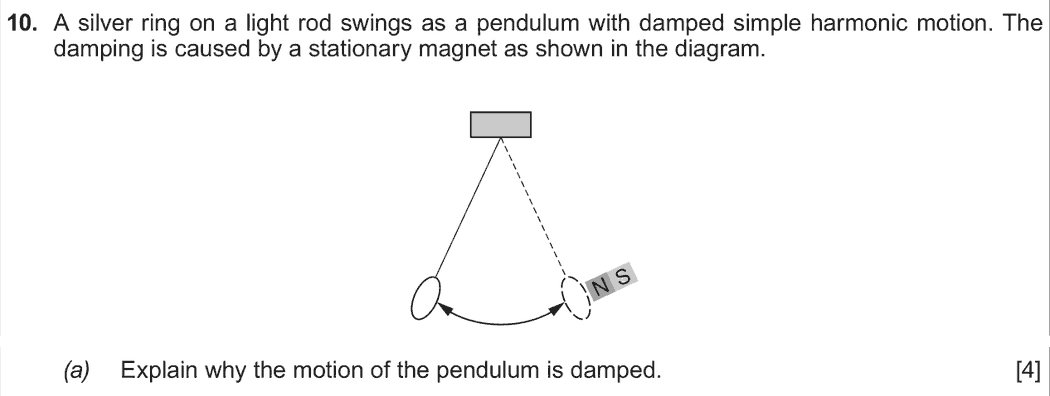
10. A silver ring on a light rod swings as a pendulum with damped simple harmonic motion. The damping is caused by a stationary magnet as shown in the diagram. S N (a) Explain why the motion of the pendulum is damped. [4]
June 2018 · Component 3 · Q10(b) 2 marks AO2=2 Explanation electromagnetic induction
Earlier part of question 10 that this part usesEarlier part of June 2018 Component 3 question 10
(b) Explain what, if anything, would happen to the motion of the pendulum if the bar magnet were reversed. [2]
June 2018 · Component 3 · Q10(c) 2 marks AO1=1, AO2=1 Show that resistance
Earlier part of question 10 that this part usesEarlier part of June 2018 Component 3 question 10
(c) The resistivity of silver is 1.59 × 10⁻⁸ Ω m, the radius of the silver ring is 2.5 cm and the cross-sectional area of the silver wire of the ring is 2.4 × 10⁻⁵ m2. Show clearly that the resistance of the silver ring is approximately 0.1 × 10⁻³ Ω. [2]
June 2018 · Component 3 · Q10(d) 3 marks AO1=1, AO2=2 Calculation electromagnetic induction
Earlier part of question 10 that this part usesEarlier part of June 2018 Component 3 question 10
(d) The maximum current induced in the silver ring is 5.5 A. Calculate the maximum rate at which the magnetic flux density inside the ring changes. [3]
June 2018 · Component 3 · Q11(a)(i) 2 marks AO2=2 Calculation alternating currents
11. An oscilloscope trace is shown along with the settings of the y-sensitivity and the time base. VARIABLE (y-sensitivity) VOLTS / DIV .1 50 .2 20 V mV .5 10 1 5 2 2 5 1 SEC/DIV (time base) 1 .5 .2 ms 2 .1 5 50 10 20 20 10 µs 50 5 .1 2 sec .2 1 .5 .2 .5 (a) (i) Calculate the rms pd of the oscilloscope trace shown. [2]
June 2018 · Component 3 · Q11(a)(ii) 2 marks AO2=2 Calculation alternating currents
Earlier part of question 11 that this part usesEarlier part of June 2018 Component 3 question 11
(ii) Calculate the frequency of the oscilloscope trace shown. [2]
June 2018 · Component 3 · Q11(b)(i) 2 marks AO1=2 Explanation alternating currents
Earlier part of question 11 that this part usesEarlier part of June 2018 Component 3 question 11
(b) A coil rotates in a magnetic field as shown. square coil of N turns and cross-sectional area, A rotating with angular velocity, ω B N S θ (i) Use Faraday’s Law to explain why the peak emf induced in the coil is proportional to the angular velocity of rotation of the coil. [2]
June 2018 · Component 3 · Q11(b)(ii) 2 marks AO1=2 Explanation alternating currents
Earlier parts of question 11 that this part usesEarlier part of June 2018 Component 3 question 11Earlier part of June 2018 Component 3 question 11
(ii) Use Faraday’s Law to explain why the emf induced in the coil depends on the angle, θ. [2]
June 2018 · Component 3 · Q11(c)(i) 2 marks AO1=1, AO2=1 Explanation alternating currents
Earlier parts of question 11 that this part usesEarlier part of June 2018 Component 3 question 11Earlier part of June 2018 Component 3 question 11
(c) (i) In the following LCR circuit, explain why the rms resonance current is 125 mA. [2] variable frequency a.c. supply Vrms = 15 V 120 Ω 24 mH 4.2 nF
June 2018 · Component 3 · Q11(c)(ii) 2 marks AO2=2 Calculation alternating currents
Earlier parts of question 11 that this part usesEarlier part of June 2018 Component 3 question 11Earlier part of June 2018 Component 3 question 11Earlier part of June 2018 Component 3 question 11
(ii) Calculate the resonance frequency of the circuit. [2]
June 2018 · Component 3 · Q11(c)(iii) 3 marks AO1=1, AO2=2 Show that alternating currents
Earlier parts of question 11 that this part usesEarlier part of June 2018 Component 3 question 11Earlier part of June 2018 Component 3 question 11Earlier part of June 2018 Component 3 question 11
(iii) Show that the rms current is 42 mA when the frequency of the supply is 17 kHz. [3]
June 2018 · Component 3 · Q11(c)(iv) 5 marks AO3=5 Calculation alternating currents
Earlier parts of question 11 that this part usesEarlier part of June 2018 Component 3 question 11Earlier part of June 2018 Component 3 question 11Earlier part of June 2018 Component 3 question 11
(iv) Alistair claims that the mean power dissipation in the circuit at 17 kHz is: P = Irms Vrms = 0.042 × 15 = 0.63 W Another student Michonne states that the correct value of power is 0.21 W. Deduce which, if either, of the students is correct. [5]
June 2018 · Component 3 · Q12(a) 4 marks AO1=4 Explanation medical physics
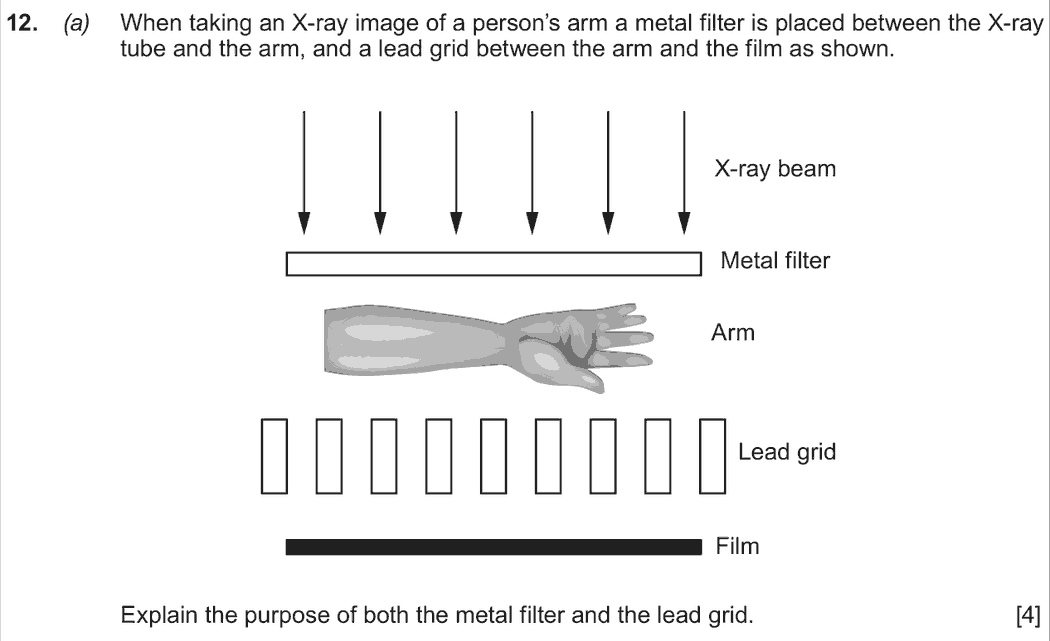
12. (a) When taking an X-ray image of a person’s arm a metal filter is placed between the X-ray tube and the arm, and a lead grid between the arm and the film as shown. X-ray beam Metal filter Arm Lead grid Film Explain the purpose of both the metal filter and the lead grid. [4]
June 2018 · Component 3 · Q12(b)(i) 2 marks AO1=1, AO2=1 Calculation medical physics
Earlier part of question 12 that this part usesEarlier part of June 2018 Component 3 question 12
(b) An X-ray tube operates at a pd of 30 kV producing a tube current of 15 mA. (i) Calculate the number of electrons that strike the target element every second. [2]
June 2018 · Component 3 · Q12(b)(ii) 3 marks AO2=3 Calculation medical physics
Earlier parts of question 12 that this part usesEarlier part of June 2018 Component 3 question 12Earlier part of June 2018 Component 3 question 12
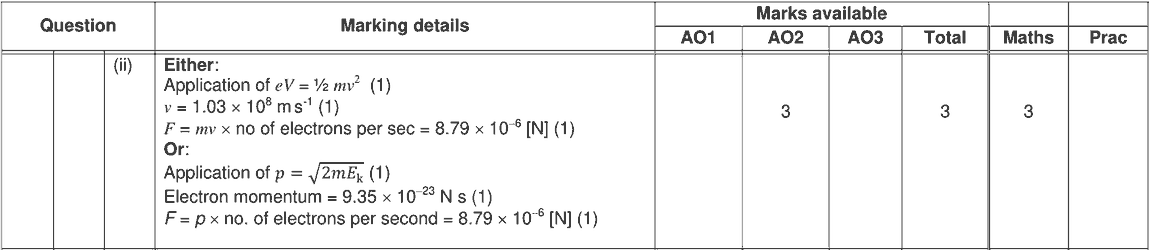
(ii) Calculate the force exerted by the electron beam on the target. [3]
June 2018 · Component 3 · Q12(c) 5 marks AO3=5 Explanation medical physics
Earlier part of question 12 that this part usesEarlier part of June 2018 Component 3 question 12
(c) You have the choice of the following forms of medical imaging available: MRI scan PET scan ultrasound B-scan CT scan Evaluate the effectiveness of each type of imaging in detecting a cancerous tumour on a person’s lung. [5]
June 2018 · Component 3 · Q12(d)(i) 1 mark AO1=1 Short answer medical physics
Earlier part of question 12 that this part usesEarlier part of June 2018 Component 3 question 12
(d) (i) Radioactive tracers can be used to measure the volume of blood in a patient. Describe one other use of radioactive tracers naming the part of the body they are diagnosing. [1]
June 2018 · Component 3 · Q12(d)(ii) 3 marks AO2=3 Calculation medical physics
Earlier parts of question 12 that this part usesEarlier part of June 2018 Component 3 question 12Earlier part of June 2018 Component 3 question 12
(ii) An isotope of sodium, Na-24, has a half-life of 15 hours and an initial activity of 160 Bq when injected into a patient. Seven hours later a sample of 5 cm3 of blood was taken and found to have an activity of 0.12 Bq. Estimate the volume of blood in the patient. [3]
June 2018 · Component 3 · Q12(d)(iii) 2 marks AO2=2 Calculation medical physics
Earlier parts of question 12 that this part usesEarlier part of June 2018 Component 3 question 12Earlier part of June 2018 Component 3 question 12
(iii) Ultrasound of frequency 3.0 MHz was used to measure the rate of flow of blood. A shift of 0.50 kHz was detected. The measurement was taken at an angle of 30° to the direction of flow and the speed of ultrasound through the blood is 1 500 m s–1. Calculate the speed of blood flow. [2]
June 2018 · Component 3 · Q13(a) 1 mark AO1=1 Short answer physics of sports
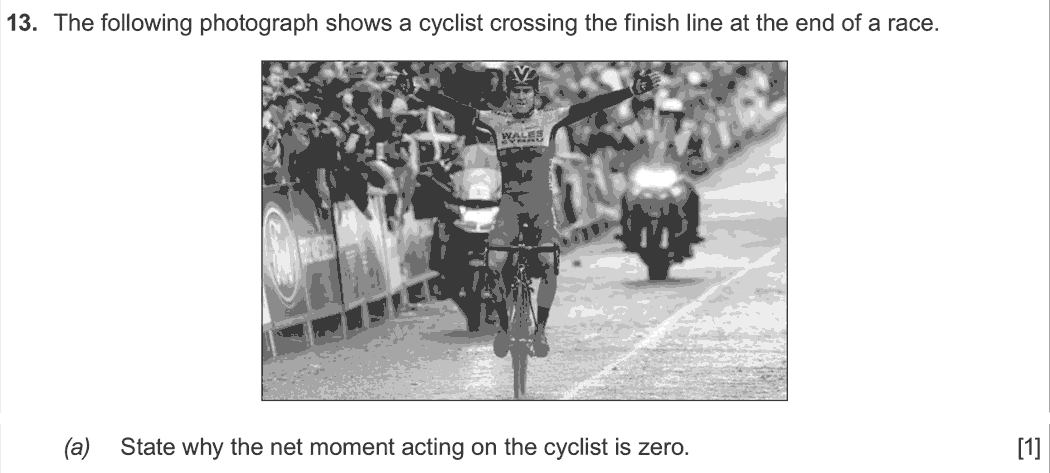
13. The following photograph shows a cyclist crossing the finish line at the end of a race. (a) State why the net moment acting on the cyclist is zero. [1]
June 2018 · Component 3 · Q13(b)(i) 2 marks AO1=2 Definition physics of sports
Earlier part of question 13 that this part usesEarlier part of June 2018 Component 3 question 13
(b) (i) State what is meant by the moment of inertia of an object. [2]
June 2018 · Component 3 · Q13(b)(ii) 3 marks AO2=3 Calculation physics of sports
Earlier parts of question 13 that this part usesEarlier part of June 2018 Component 3 question 13Earlier part of June 2018 Component 3 question 13
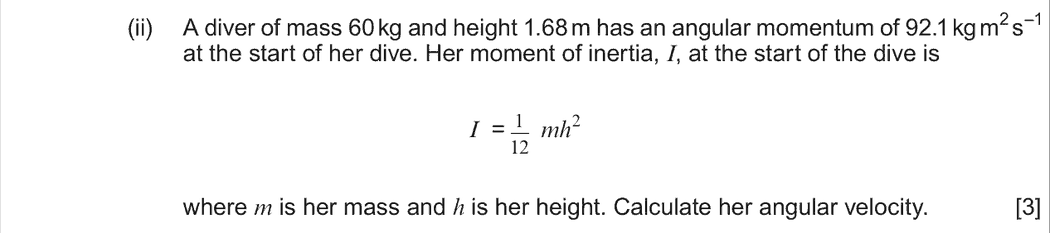
(ii) A diver of mass 60 kg and height 1.68 m has an angular momentum of 92.1 kg m2 s–1 at the start of her dive. Her moment of inertia, I, at the start of the dive is I = 1 mh2 12 where m is her mass and h is her height. Calculate her angular velocity. [3]
June 2018 · Component 3 · Q13(b)(iii) 3 marks AO1=1, AO2=2 Calculation physics of sports
Earlier parts of question 13 that this part usesEarlier part of June 2018 Component 3 question 13Earlier part of June 2018 Component 3 question 13
(iii) During the dive, the diver tucks in her arms and legs and reduces the moment of inertia to 2.7 kg m2. Calculate the final angular velocity of the diver. [3]
June 2018 · Component 3 · Q13(c)(i) 3 marks AO1=1, AO2=2 Calculation physics of sports
Earlier part of question 13 that this part usesEarlier part of June 2018 Component 3 question 13
(c) The wheel of a Formula 1 car has a moment of inertia of 1.10 kg m2. As the car approaches a corner and brakes, its angular velocity decreases from 220 rad s–1 to 170 rad s–1 in a time of 0.310 s. (i) Calculate the resultant torque on the wheel of the car during the braking process. [3]
June 2018 · Component 3 · Q13(c)(ii) 3 marks AO1=1, AO2=2 Calculation physics of sports
Earlier parts of question 13 that this part usesEarlier part of June 2018 Component 3 question 13Earlier part of June 2018 Component 3 question 13
(ii) Determine the total rotational kinetic energy lost by the wheels of the car during the above braking process assuming all the wheels have the same moment of inertia. [3]
June 2018 · Component 3 · Q13(d) 5 marks AO3=5 Calculation physics of sports
Earlier part of question 13 that this part usesEarlier part of June 2018 Component 3 question 13
(d) During a Grand Prix a driver loses control of the car when approaching a bend and crashes but escapes with minor injuries. The speed reduces from 213 km hr –1 to zero in a time of 0.651 s. The mass of the car is 640 kg and the driver’s mass is 70 kg. Use the given data to evaluate why Grand Prix race circuits have large areas of grass or loose stone chippings around certain corners. [5]
June 2018 · Component 3 · Q14(a)(i) 1 mark AO1=1 Definition energy and the environment
14. (a) (i) State the principle of Archimedes. [1]
June 2018 · Component 3 · Q14(a)(ii)I 2 marks Show that energy and the environment
Earlier part of question 14 that this part usesEarlier part of June 2018 Component 3 question 14
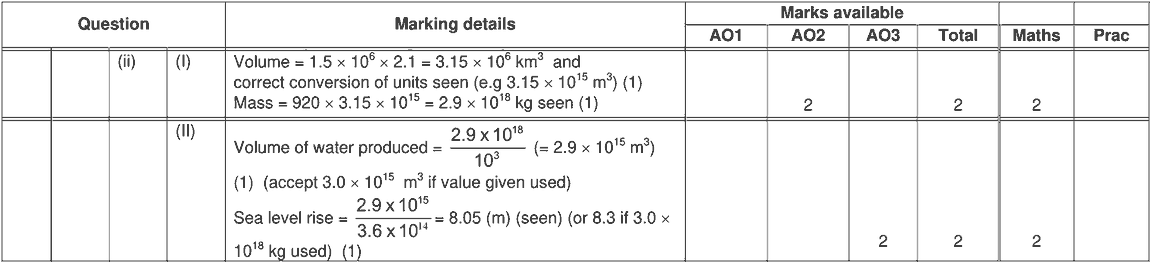
(ii) The Greenland ice sheet is estimated to have an area of 1.5 × 10⁶ km2 and a mean thickness of 2.1 km. I. Show that the mass of the Greenland ice sheet is approximately 3 × 10¹⁸ kg. [Density of ice = 920 kg m–3] [2]
June 2018 · Component 3 · Q14(a)(ii)II 2 marks Calculation energy and the environment
Earlier parts of question 14 that this part usesEarlier part of June 2018 Component 3 question 14Earlier part of June 2018 Component 3 question 14
II. Scientists predict that sea levels would rise by about 8 metres if all the Greenland ice sheet were to melt. Use the following information to justify their prediction. [2] [Density of water = 1 000 kg m–3; Surface area of ocean on Earth = 3.6 × 10⁸ km2]
June 2018 · Component 3 · Q14(b)(i) 2 marks AO1=2 Show that energy and the environment
Earlier part of question 14 that this part usesEarlier part of June 2018 Component 3 question 14
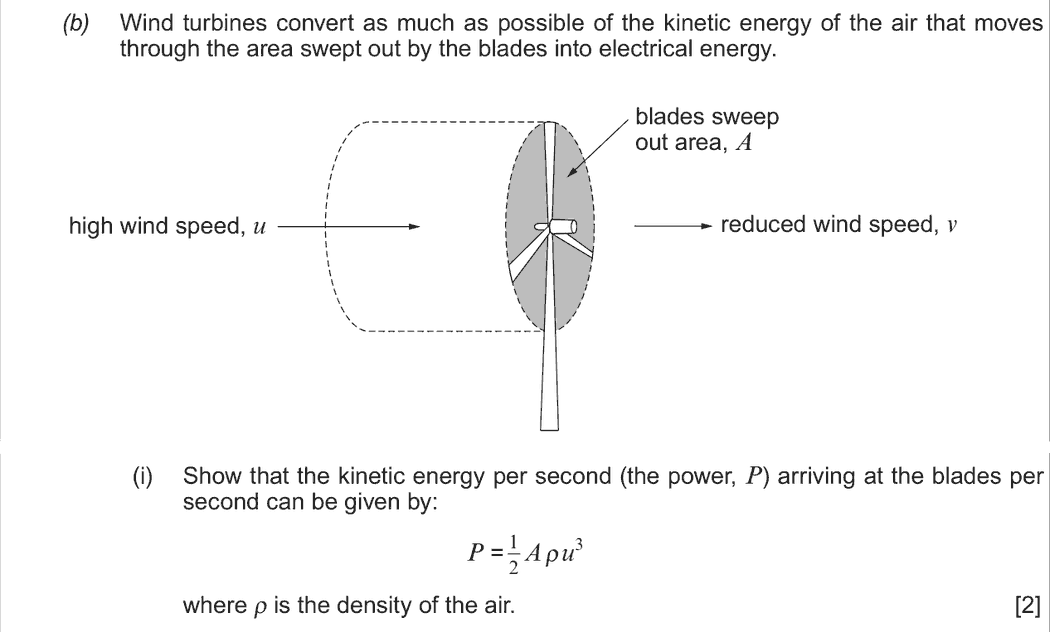
(b) Wind turbines convert as much as possible of the kinetic energy of the air that moves through the area swept out by the blades into electrical energy. blades sweep out area, A high wind speed, u reduced wind speed, v (i) Show that the kinetic energy per second (the power, P) arriving at the blades per second can be given by: 1 A ρ u3 P = 2 where ρ is the density of the air. [2]
June 2018 · Component 3 · Q14(b)(ii) 2 marks AO2=2 Explanation energy and the environment
Earlier parts of question 14 that this part usesEarlier part of June 2018 Component 3 question 14Earlier part of June 2018 Component 3 question 14
(ii) Use the above equation to determine whether doubling the length of the blades or doubling the wind speed would have the greater effect on the power available to be converted into electrical energy. [2]
June 2018 · Component 3 · Q14(b)(iii) 3 marks AO2=3 Calculation energy and the environment
Earlier parts of question 14 that this part usesEarlier part of June 2018 Component 3 question 14Earlier part of June 2018 Component 3 question 14
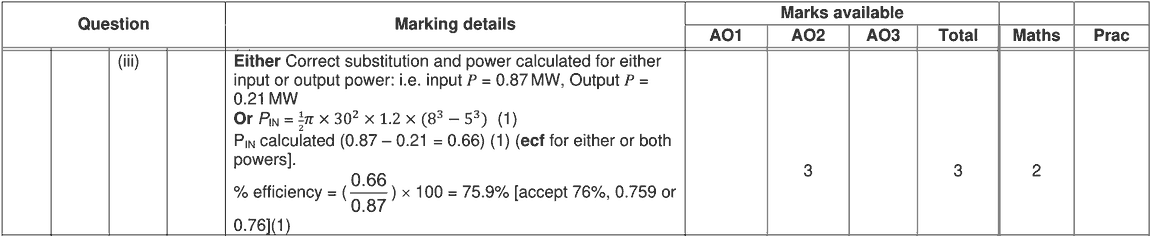
(iii) A wind turbine has blades of length 30 m. Wind of speed 8.0 m s–1 arrives at the blades, which is reduced to 5.0 m s–1 after passing through the blades. Calculate the maximum possible efficiency of this wind turbine. [Density of air = 1.2 kg m–3]. [3]
June 2018 · Component 3 · Q14(b)(iv) 1 mark AO3=1 Short answer energy and the environment
Earlier parts of question 14 that this part usesEarlier part of June 2018 Component 3 question 14Earlier part of June 2018 Component 3 question 14
(iv) Explain why the actual efficiency of the turbine is less than your answer to (b)(iii). [1]
June 2018 · Component 3 · Q14(c)(i) 2 marks AO1=2 Show that energy and the environment
Earlier parts of question 14 that this part usesEarlier part of June 2018 Component 3 question 14Earlier part of June 2018 Component 3 question 14
(c) (i) Use an appropriate equation to show that the unit of the coefficient of thermal conductivity, K, is W m–1 K–1. [2]
June 2018 · Component 3 · Q14(c)(ii) 3 marks AO1=1, AO2=2 Show that energy and the environment
Earlier parts of question 14 that this part usesEarlier part of June 2018 Component 3 question 14Earlier part of June 2018 Component 3 question 14Earlier part of June 2018 Component 3 question 14
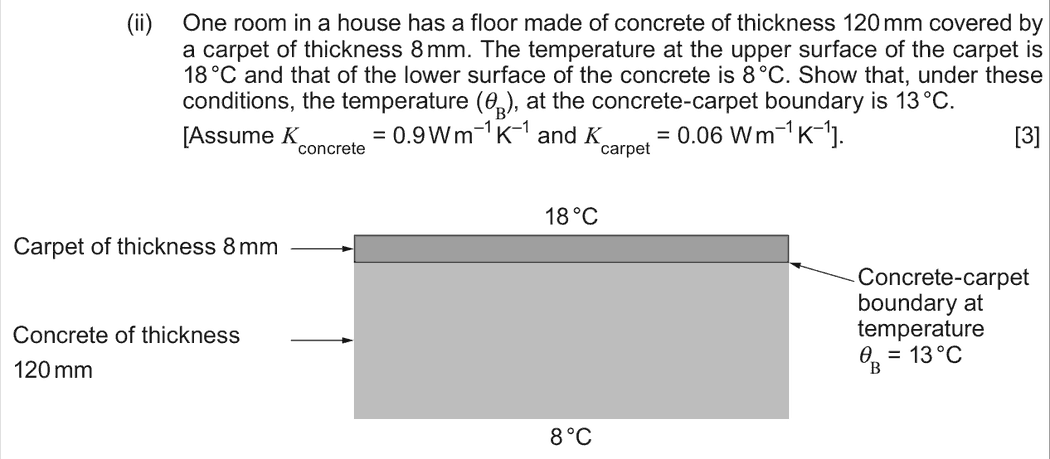
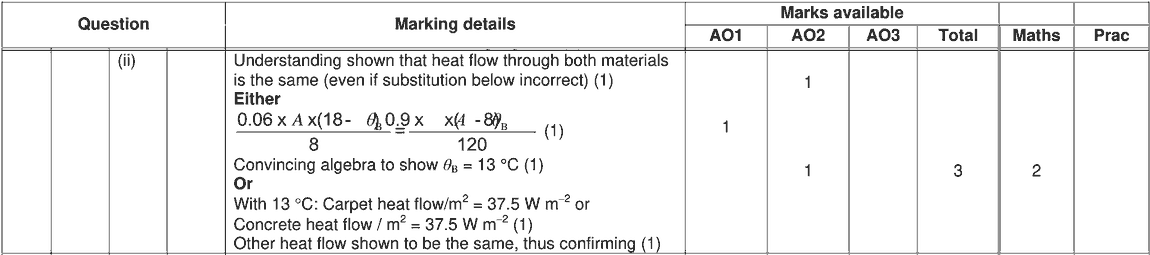
(ii) One room in a house has a floor made of concrete of thickness 120 mm covered by a carpet of thickness 8 mm. The temperature at the upper surface of the carpet is 18 °C and that of the lower surface of the concrete is 8 °C. Show that, under these conditions, the temperature (θB), at the concrete-carpet boundary is 13 °C. [Assume Kconcrete = 0.9 W m–1 K–1 and Kcarpet = 0.06 W m–1 K–1]. [3] 18 °C Carpet of thickness 8 mm Concrete-carpet boundary at Concrete of thickness temperature θB = 13 °C 120 mm 8 °C
June 2018 · Component 3 · Q14(c)(iii) 2 marks AO3=2 Calculation energy and the environment
Earlier parts of question 14 that this part usesEarlier part of June 2018 Component 3 question 14Earlier part of June 2018 Component 3 question 14Earlier part of June 2018 Component 3 question 14Earlier part of June 2018 Component 3 question 14
(iii) Without the carpet, thermal energy is conducted through the concrete floor (of dimensions 6 m × 8 m) at a rate of 3.6 kW. The carpet manufacturer claims that fitting the carpet would reduce the rate at which energy is transferred by about 50%. Use the above conditions to test their claim. [2]

Work with an Eduqas physics tutor

Want a paper marked and gone through with you? Message us.

Prefer email? Send an enquiry

If you are under 18, please include a parent's contact details. Enquiries go to enquiries@physicsaleveltutor.com and are deleted once handled. All tutoring is online.