Answer
A
Mark scheme

Examiner's comment
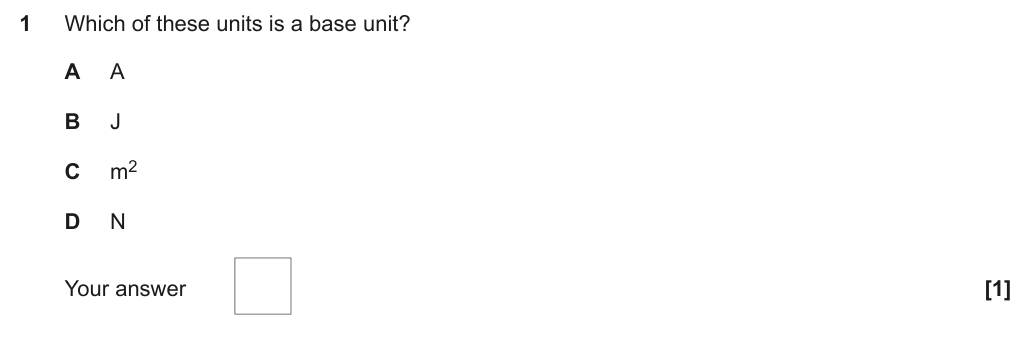
The majority of candidates were able to correctly recall the ampere as the correct base unit. C was a common distractor, most likely as it contains the obvious metre.
100 marks · 54 question parts · Paper, mark scheme and report on OCR's site · Have the Data, Formulae and Relationships Booklet beside you
A
The majority of candidates were able to correctly recall the ampere as the correct base unit. C was a common distractor, most likely as it contains the obvious metre.
C
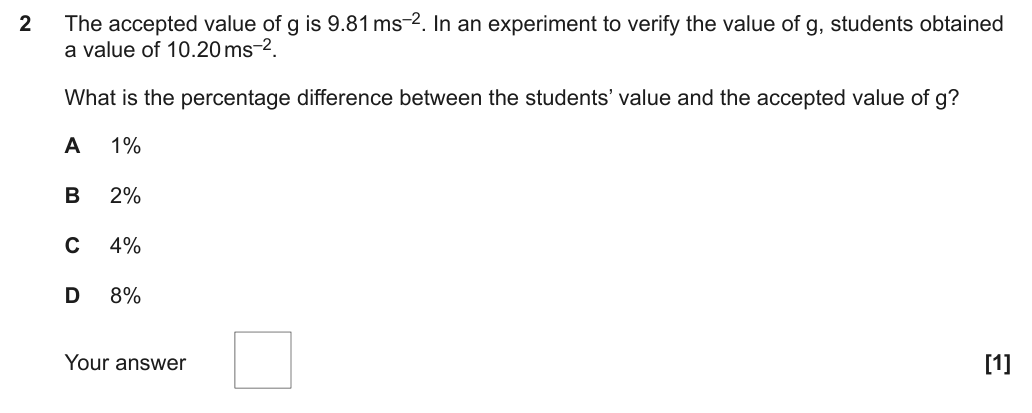
This question was answered correctly by the vast majority of candidates and it was encouraging to see detailed working at the side of the question.
C
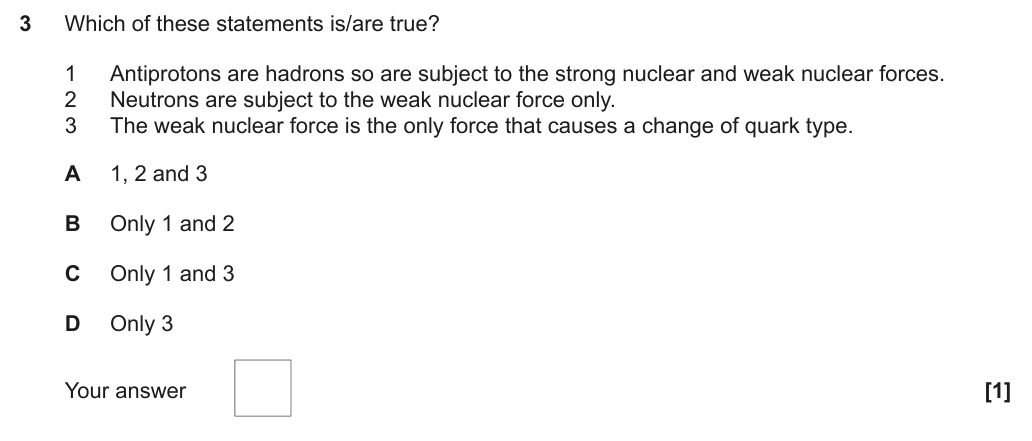
A good proportion of candidates were able to answer this correctly. Good practice in this style of questions is to tick the statements that the candidates are sure is correct and try a ‘best fit’. Most candidates knew statement 3 was correct and so response B was fairly uncommon as an incorrect response.
A
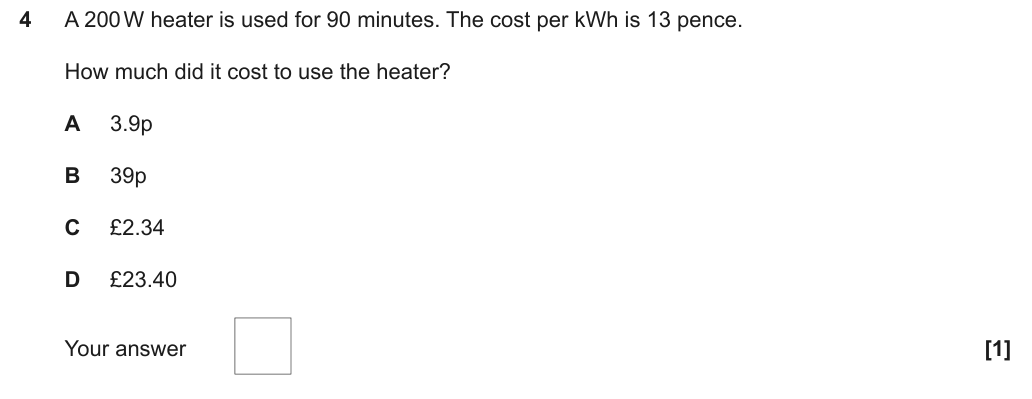
This relatively simple calculation was done correctly by a large majority of the candidates. It is good to see candidate’s workings on the question, as there are potential pitfalls in this. A number of candidates answered with response D, which showed a lack of appreciation of their calculation with actual costings.
A
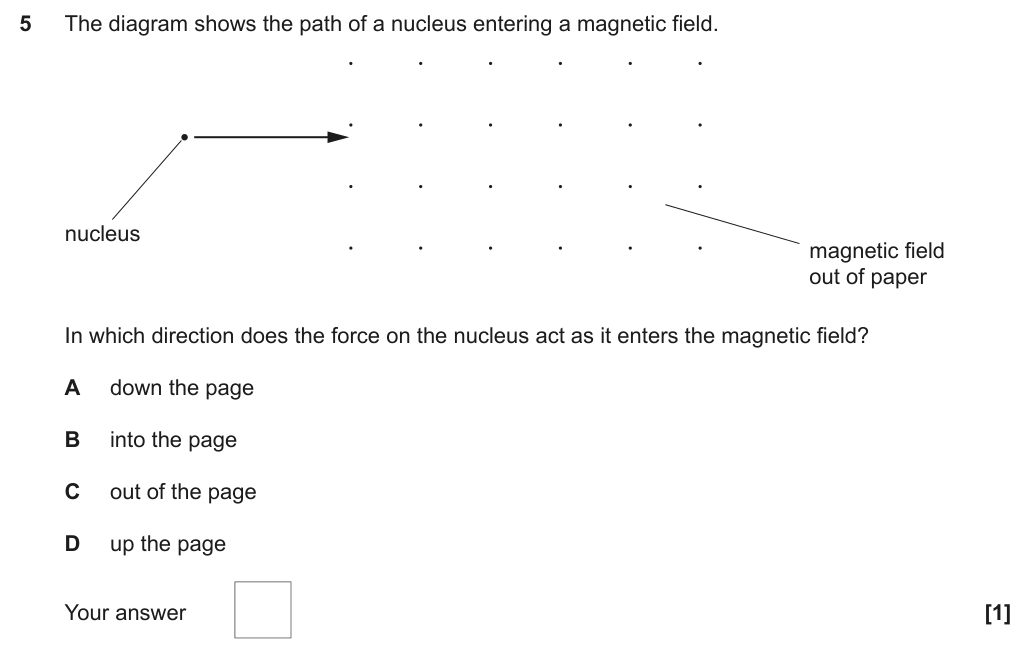
Just over half of the candidates correctly applied Fleming’s Left Hand Rule to obtain the correct response. Candidates should be familiar with the terms ‘into, down, out of, up’ in relation to directions in this style of question.
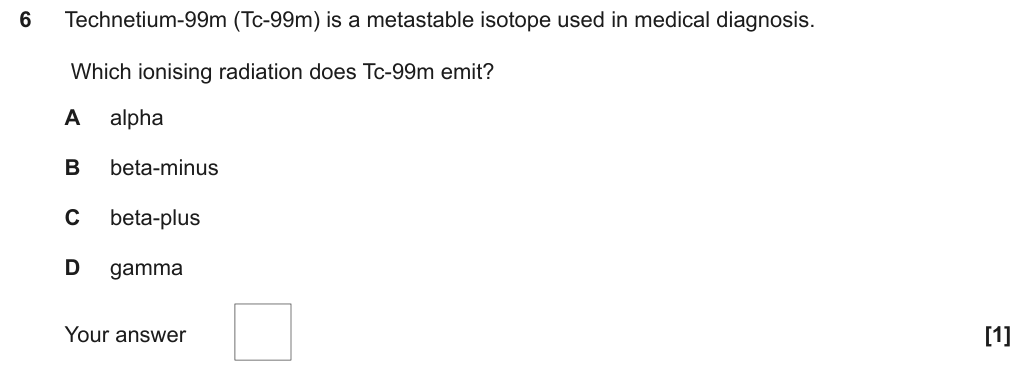
D
The majority of candidates were able to recall the correct emission, with the remaining responses being fairly well split across the other options, suggesting some guess work was involved.
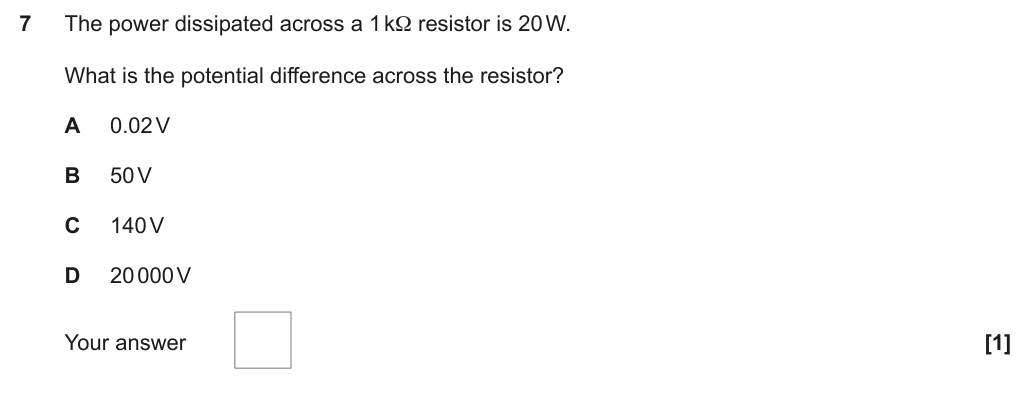
C
This is a relatively simple calculation and was answered correctly by the vast majority of candidates. Although it is quite possible to do this in one calculation on a calculator, it is always good practice to show working as it is less likely to result in a ‘power of ten’ or ‘transcription‘ error.
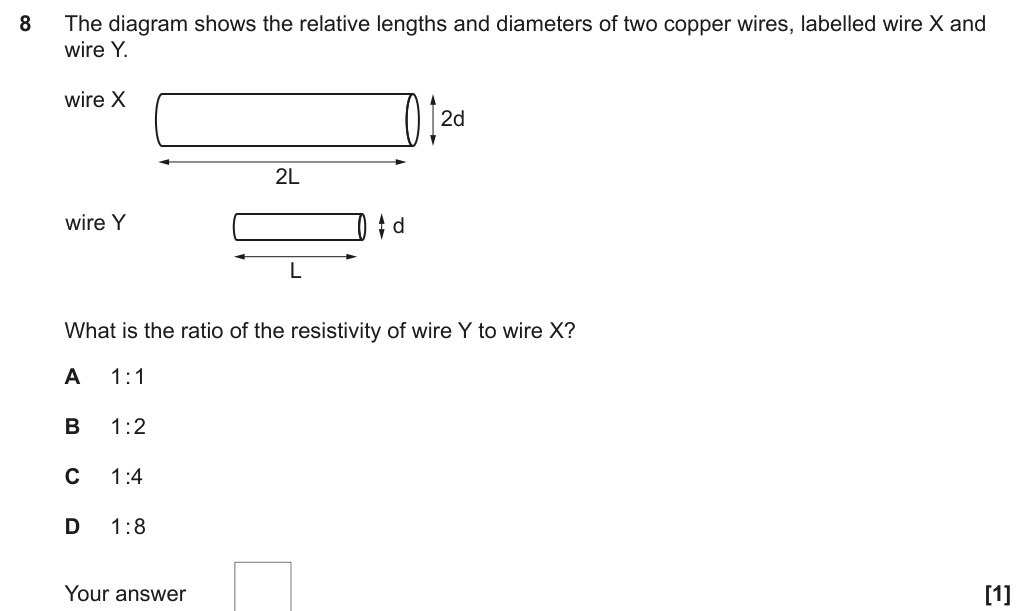
A
This question will have looked familiar to many candidates, as it involves changing dimensions of wire to calculate a value. Here, however, the question is asking about the resistivity of the wire which (given that they are both copper) remains the same. Only a little over one quarter of the candidates appreciated this; by far the majority calculated the ratio of resistances and gave the response B. This highlights the importance of reading the question carefully and not assuming that it is the same as one they have previously seen.
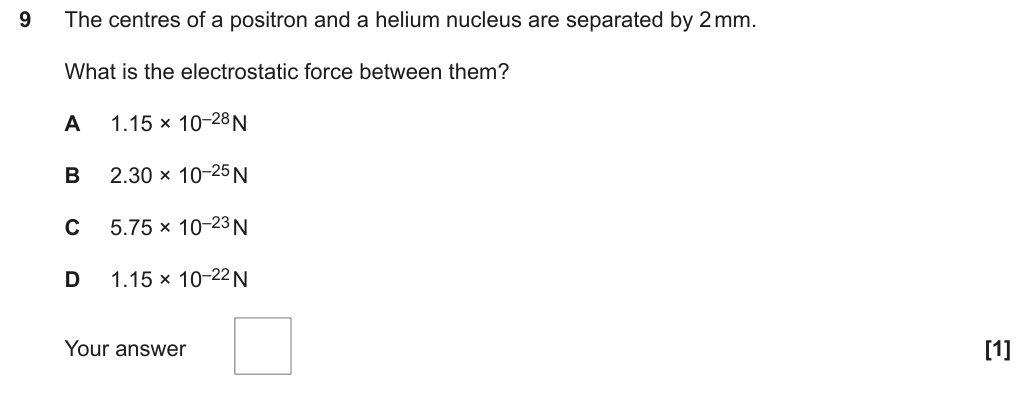
D
Around two thirds of candidates were able to correctly apply Coulomb’s law and obtain the correct response. Response C was a common distractor and this was evident for working as the charge on the helium nucleus was given as a single multiple of the fundamental charge.
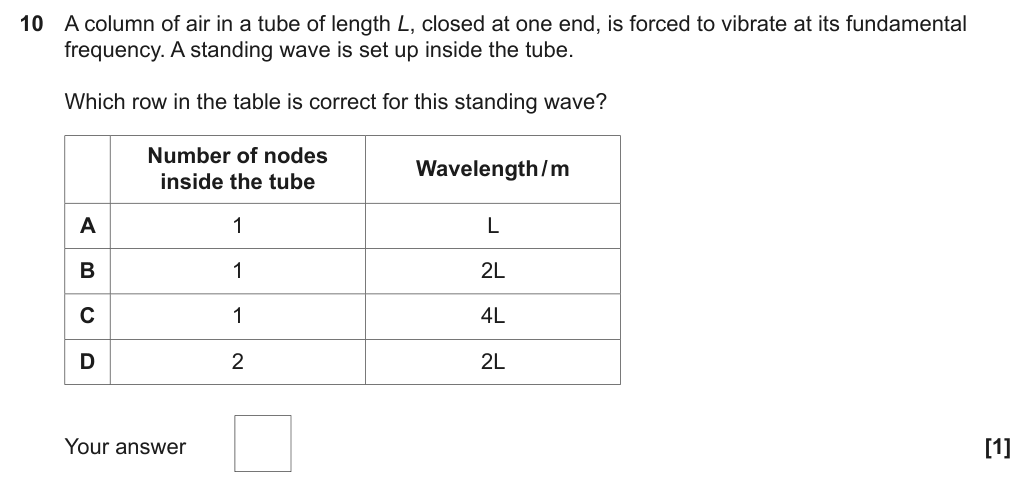
C
A large number of candidates were able to correctly identify the correct response and many drew a diagram to support their answer.
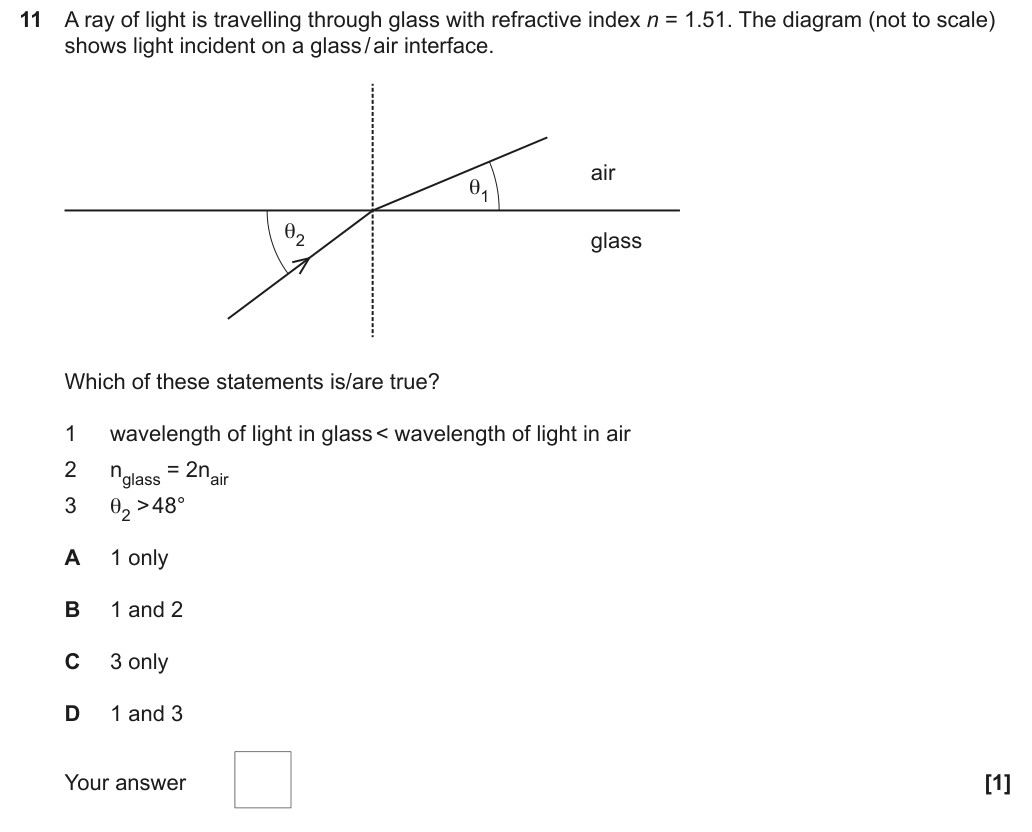
D
Around one third of candidates were able to identify the correct response; the main difficulty appeared to be that the given angle in the glass was not given relative to the normal (as is usual) and this meant that a common distractor was A.
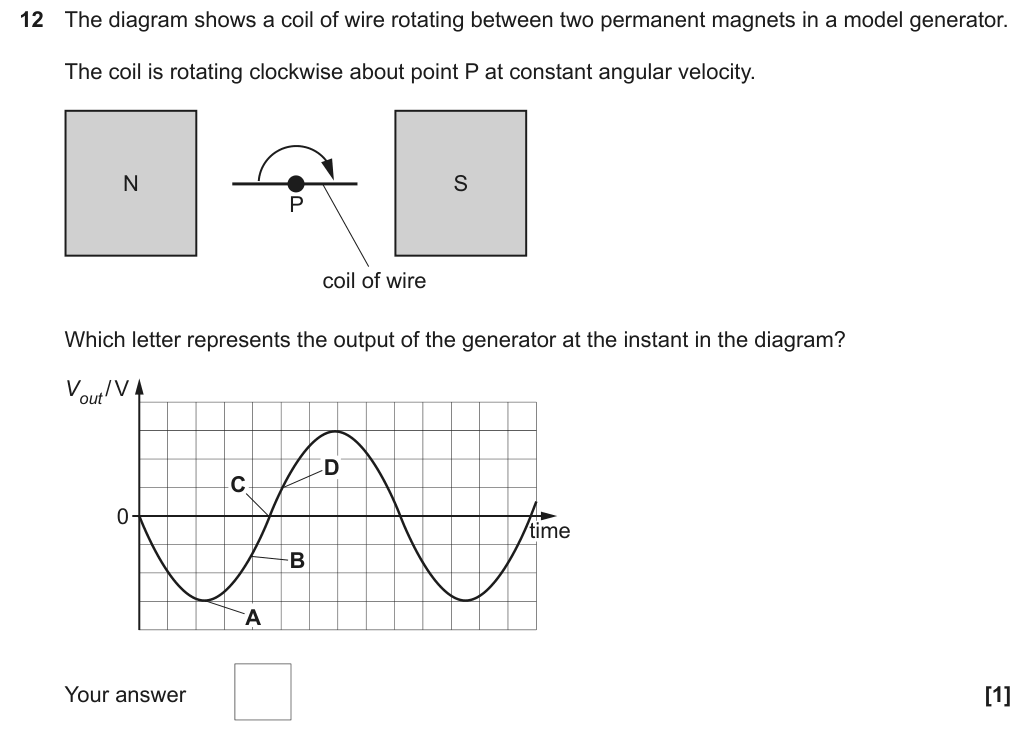
A
A majority of candidates were able to identify the correct response. The vast majority of incorrect responses were C, probably from the flux linkage at that point, rather than the rate of change of flux linkage.
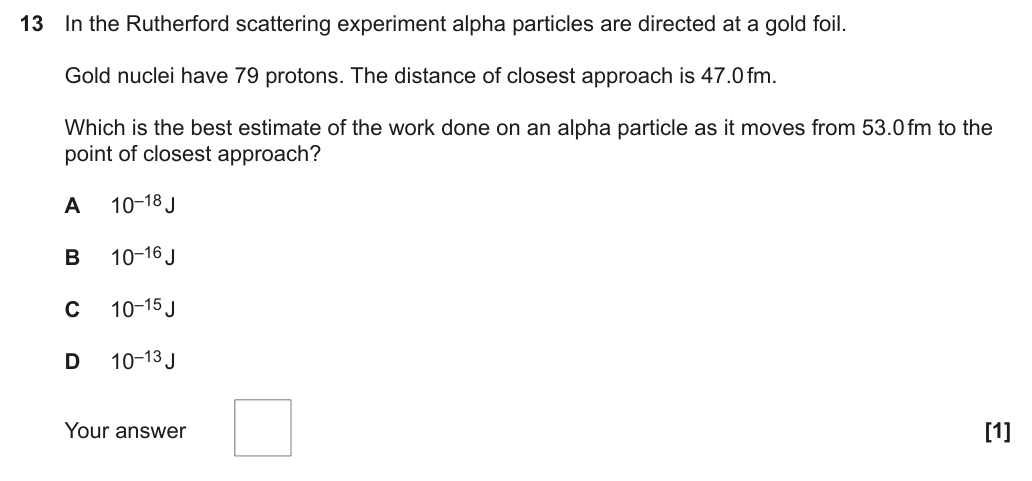
D
A little under half of the candidates were able to calculate and select the correct response. The most common incorrect response was B, although it was not entirely clear why this was the case from candidates working. A very small minority of candidates did not answer this question.
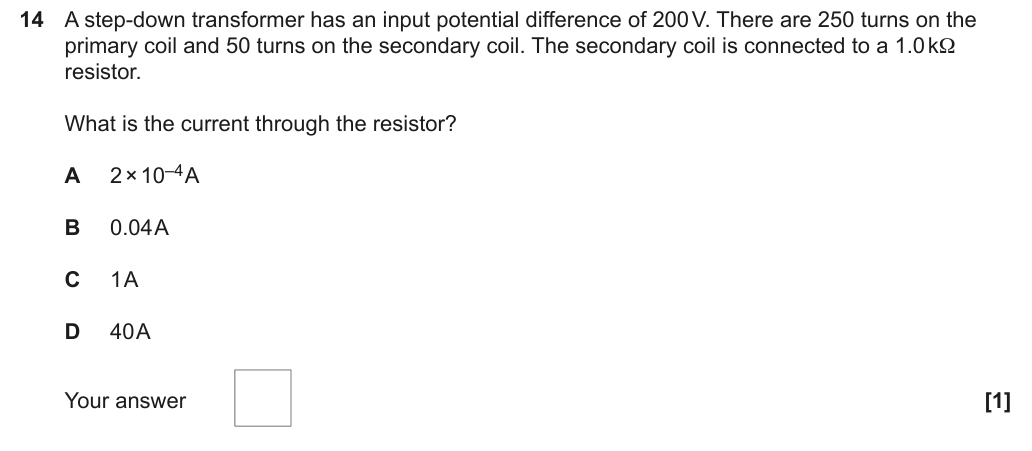
B
This question was correctly answered by a good proportion of the candidates, as it was a relatively simple two step calculation. The vast majority of incorrect responses showed little useful working, showing a lack of knowledge of transformers.
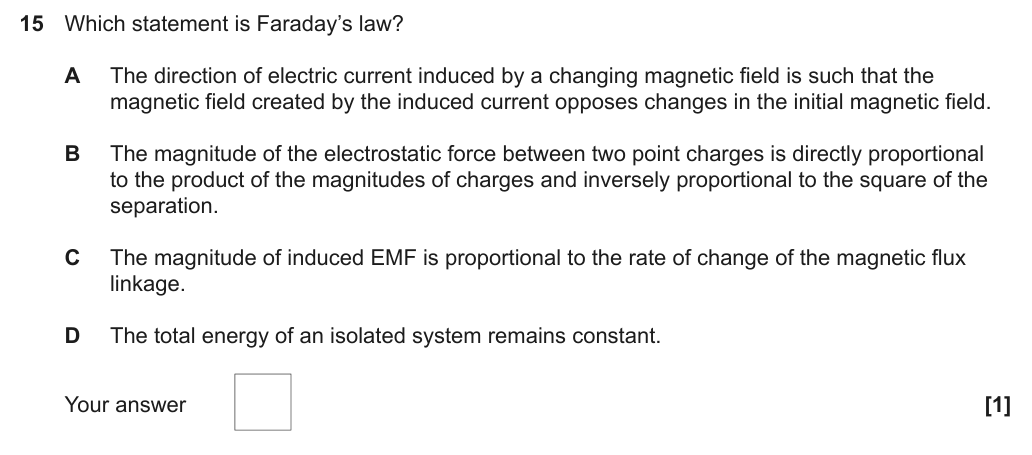
C
The majority of candidates were correctly able to identify Faraday’s law from a list of physical laws. Many candidates knew that it was related to electromagnetism and so the majority of incorrect responses were A.
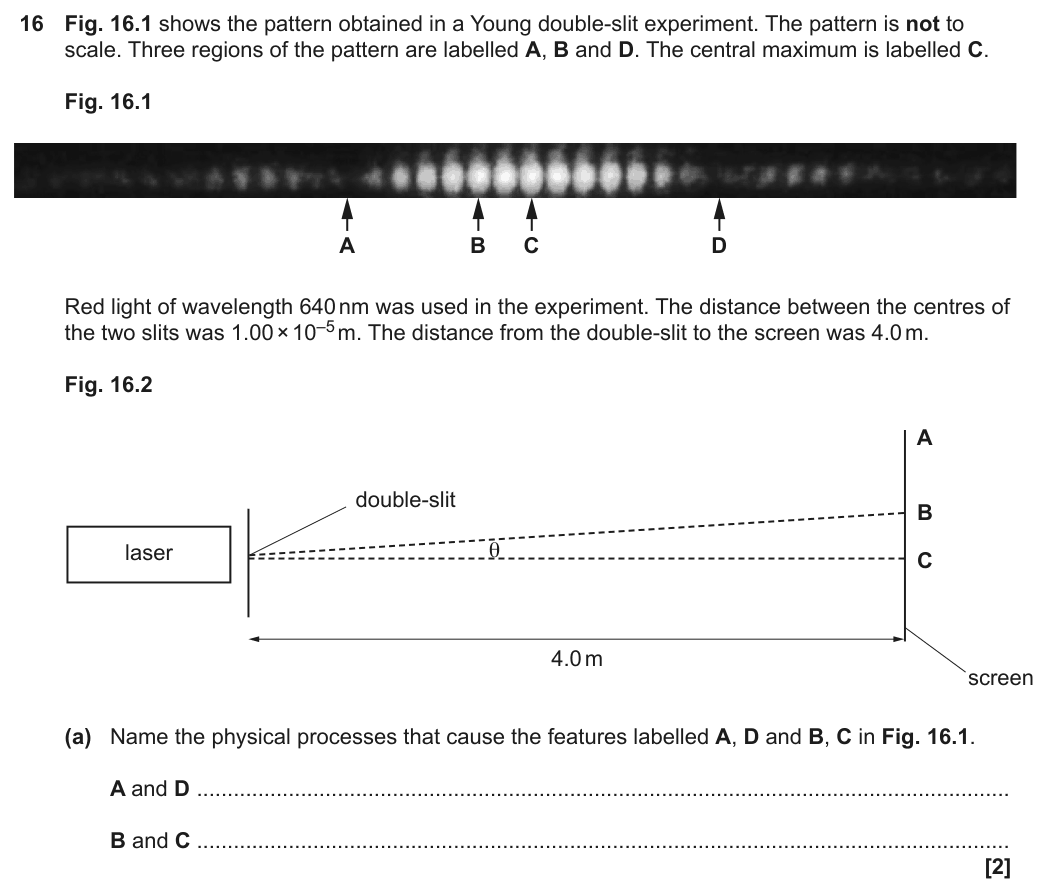
Most candidates were able to appreciate that the pattern in Fig. 16.1 was an interference pattern and that the ‘dark and light’ were the result of interference. The first mark could also be credited for the use of the term ‘diffraction’ as at that point the single slit diffraction pattern is dominant.

Coherence is a term that candidates will likely have come across many times in their study of waves. While many candidates had an appreciation that it was related to phase, there were many responses that it was when two waves were in phase. Around half of candidates were able to correctly explain coherence.
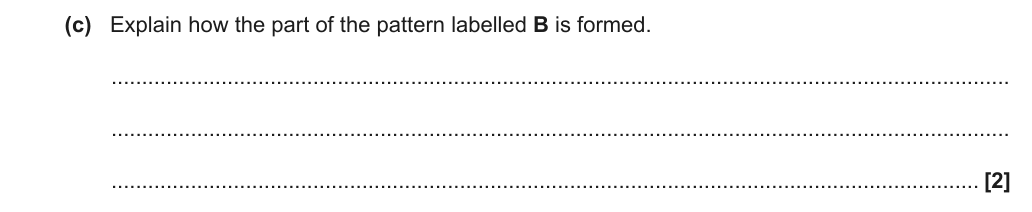
Around half of the candidates were able to achieve at least 1 mark and had a good idea that the waves must arrive in phase. Some candidates confused path difference and phase, giving statements such as ‘the phase difference is one wavelength’. Only a small number of candidates appreciated that this was a maximum two away from the central maximum and so had a path difference of 2 × wavelengths (or equivalent in phase). Many candidates who did not score gave responses in terms of superposition but gave little detail beyond the use of the terms.
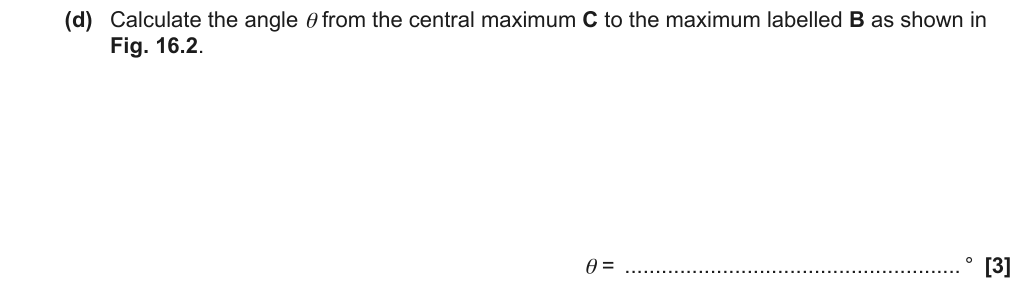
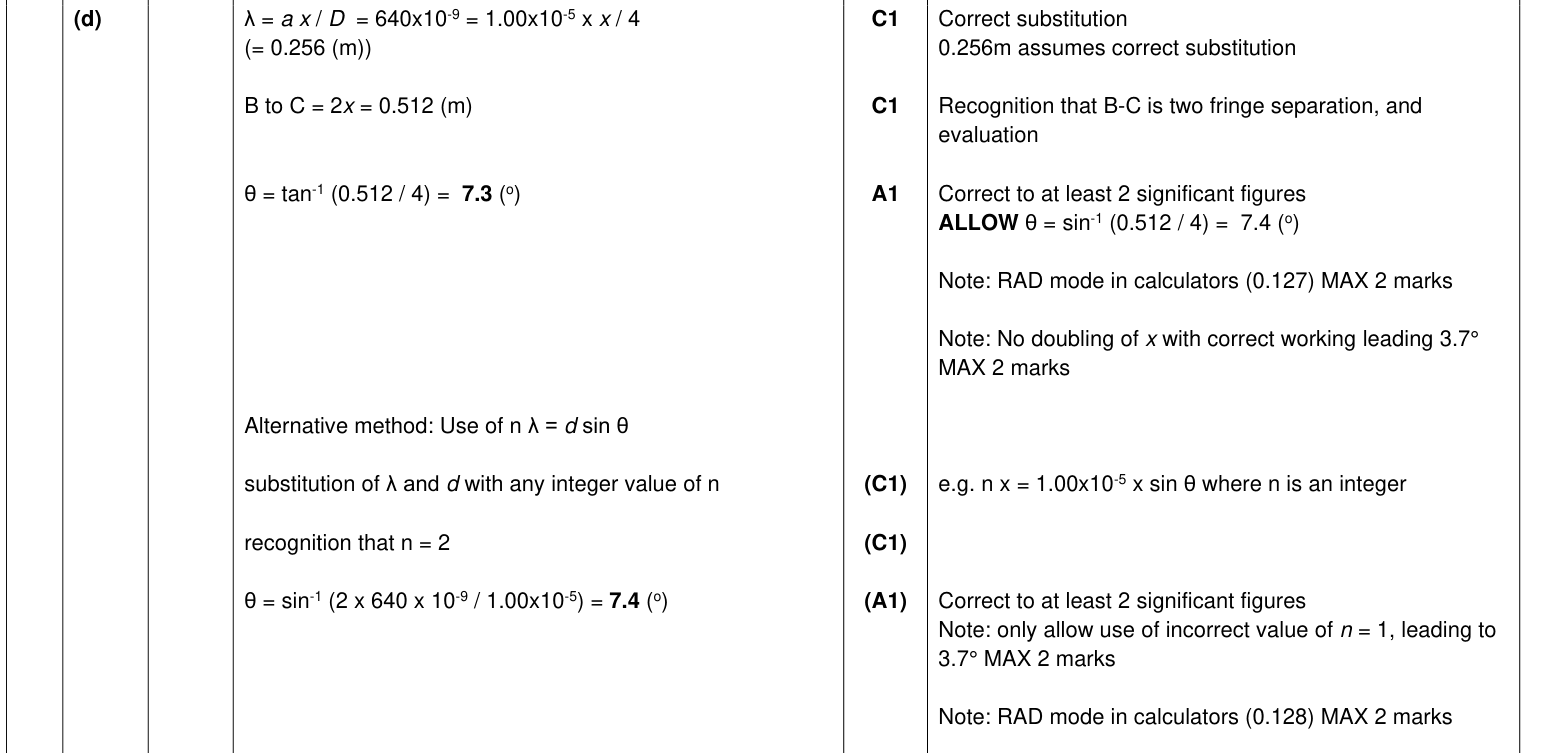
There was a roughly equal spread between 0, 1, 2 and 3 marks on this question and it illustrated the variety of ways in which the candidates attempted it. This calculation could be attempted in a number of ways; each of which would produce the correct final value. Most candidates who made an attempt were able to determine the fringe separation distance on the screen, generally by using the double slit formula. Only around a quarter of candidates appreciated that maximum B was the two away from the central maximum which was needed for the correct answer. Use of the diffraction grating formula gave a similar mark distribution. It is to be noted that, in general¸ incorrect answers with no working will gain no marks and it is very important that candidates who show no working run the risk of not gaining marks. In this case, an incorrect response of 3.7° could gain 2 marks as it was very evident where it came from.
Skills: M0.6 Use calculators to handle sin x, cos x and tan x when x is expressed in degrees or radians; M2.3 Substitute numerical values into algebraic equations using appropriate units for physical quantities; M4.5 Use sin, cos and tan in physical problems
Many candidates attempted to answer this question in terms of the use of ultrasound, presumably prompted by the first line of the question. While many good responses were given along these lines, it was not the purpose of the question. Many candidates gave vague answers such as ‘outside of the human hearing range’ but a little under a half of candidates knew (and wrote) the value of 20 kHz. Only around one fifth were able to state it was a longitudinal wave.
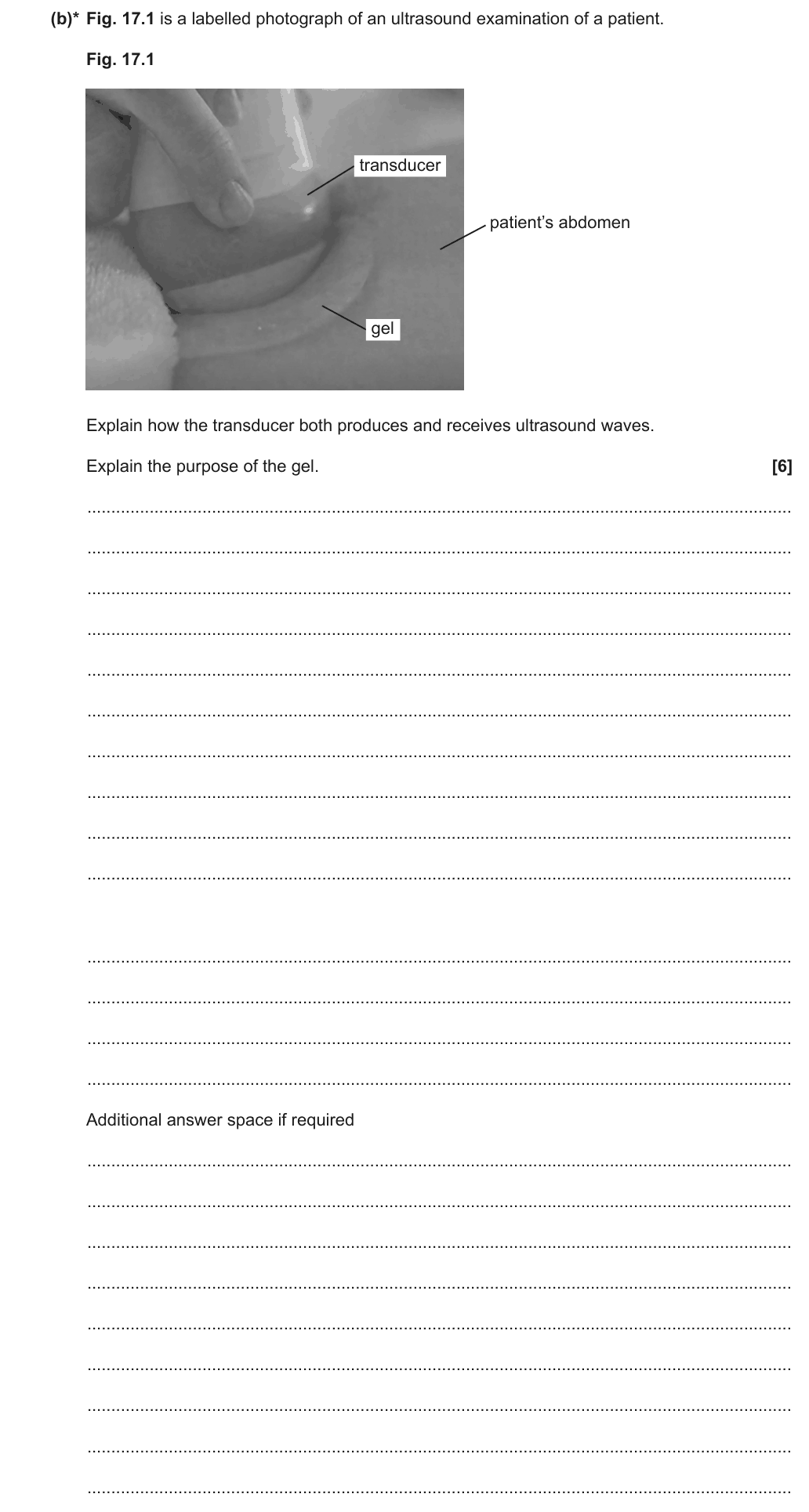
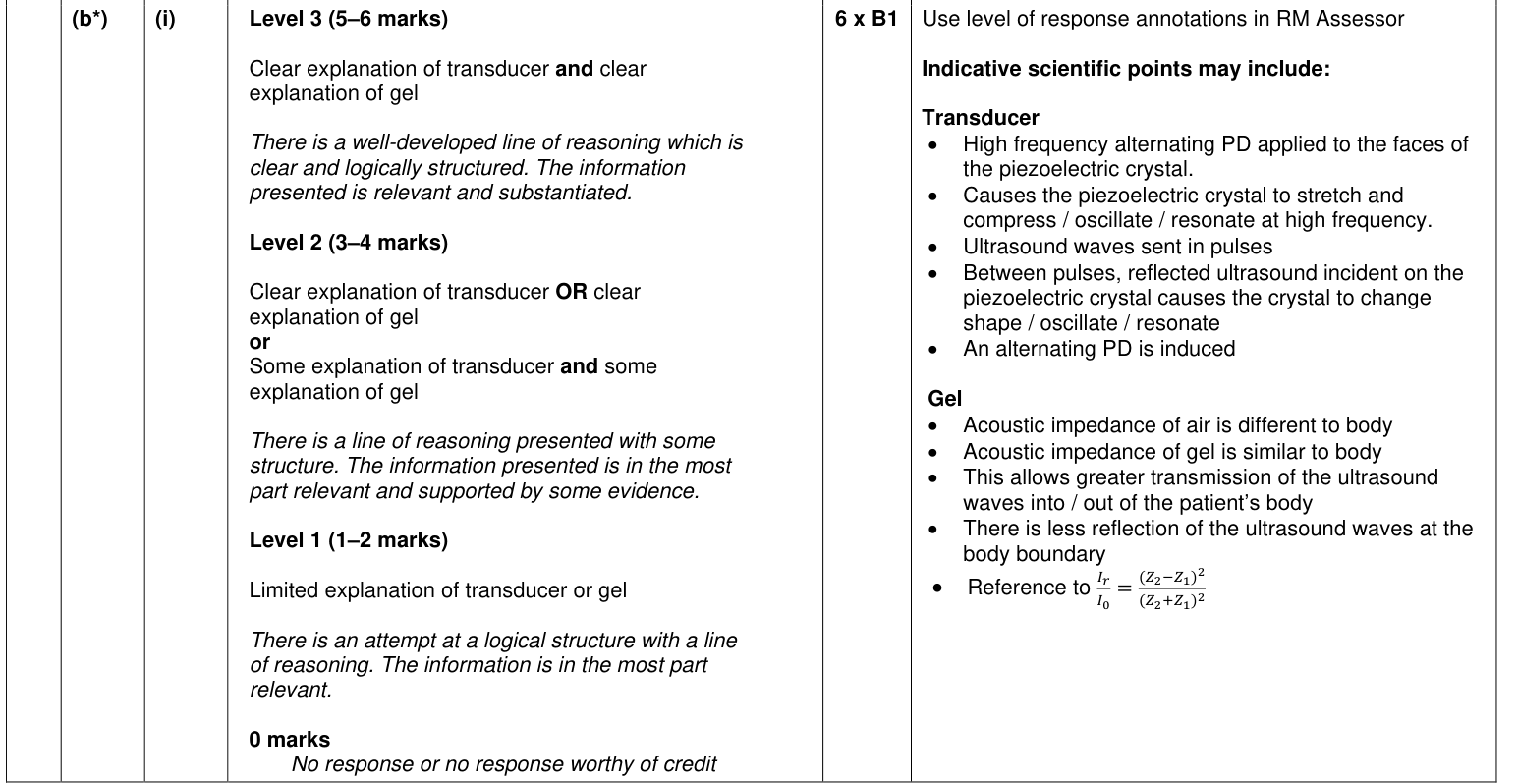
This level of response (LoR) question was designed to assess Section 6.5.3 (b), (e) and (f) of the specification. A holistic approach to marking is used, with marks given according to answers matching the descriptors for the various levels. No one answer is perfect for this question and examiners will expect a varied approach. The indicative scientific points are used as a basis; however other correct, relevant physics may also be taken into account. The nature of this question is such that it can be conveniently separated into two sections; a description of producing and receiving ultrasound by the transducer, and the purpose of the gel in this case. The key points in the production and receiving of ultrasound that examiners were looking for were: • an explanation of the piezoelectric effect • what causes it, and the effect on the crystal • how this produces the ultrasound waves • how a reverse of this will lead to its detection. The key points in the purpose of the gel were:- an explanation of acoustic impedance and an idea of what would happen if no gel were to be used – some idea of the term impedance matching and how this occurs with the gel. It was clear that many candidates had a good knowledge and understanding the use of ultrasound in this context and were able to describe this well, leading to a good number of candidates being given Level 3. The very best answers were detailed and well-structured and made every attempt to fully answer each section of the question using correct scientific terms. Many candidates wasted time and space describing how the ultrasound was reflected in the body, which is not required, or other irrelevant detail. Some drew diagrams, which can be helpful, but in this case did not really add to the text. For the most part, the description of the gel was done better than the description of production, most likely because the piezoelectric effect can be difficult to explain clearly. Candidates were not penalised for the use of incorrect values in the frequency of ultrasound here, or in any values of size (or voltage applied to) the transducer. The equation for reflection of ultrasound was given by several candidates but was not always explained to support the answer. Many strong candidates only answered one part of the question; this highlights the need to read it carefully – there will nearly always be two parts – and make sure that, as far as possible, equal weighting is given to both.
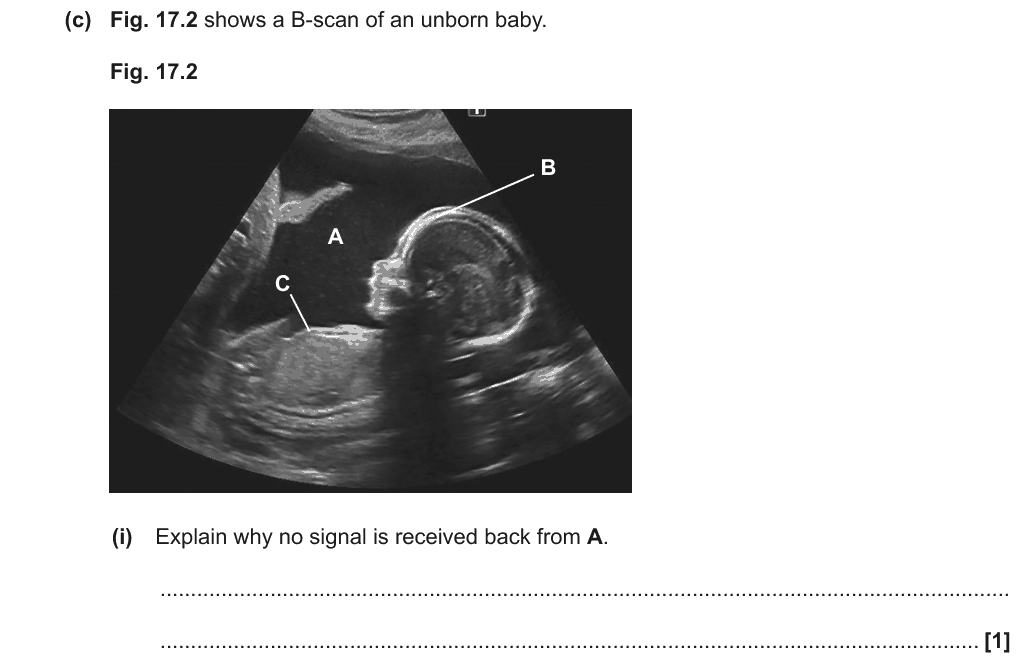
Many candidates gave vague answers such as ‘it’s all the same’ or ‘it is all air’. This response did require the idea that a boundary or some change must be present for the reflection to occur. Several candidates thought that it was absorbed at A. Around half of the candidates were able to score a mark on this question.
This question required the use of the term ‘acoustic impedance’ for any marks as this would lead to crediting quality responses. The term ‘attenuation coefficient’ was used by a large number of candidates in place of the acoustic impedance. Only around 40% used the term correctly and only half of this appreciated that this was the difference between B and C and their surrounding mediums rather than simply the difference between B and C. This question highlights the need for correct terminology and not vague statements.
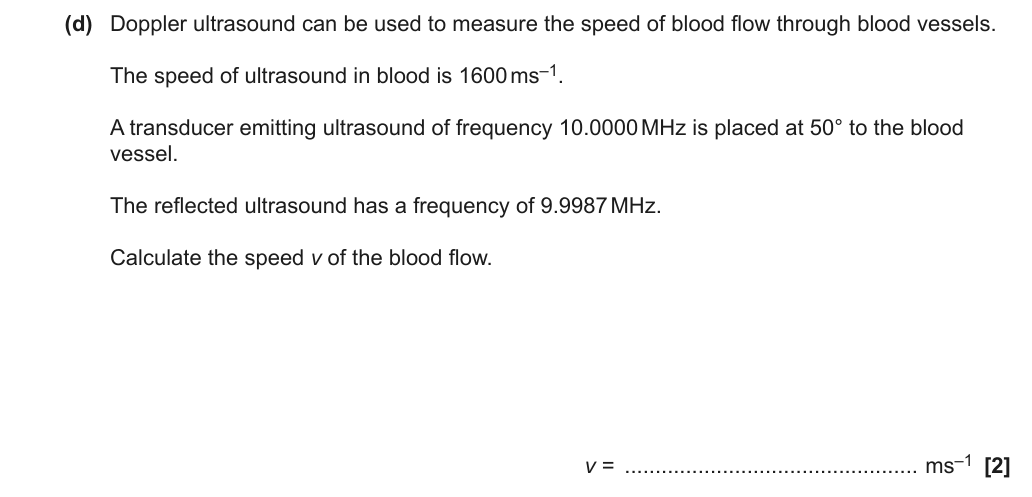
This question was correctly done by around two thirds of candidates. Although not a particularly complex calculation, there are some challenges in it. Common mistakes were using the speed of light for c, using the reflected frequency for the change of frequency, power of ten errors and using the reflected frequency in the denominator. Many candidates wrote out the formula and rearranged it for v before substituting the numbers which help with the calculation. Those who avoided this occasionally made substitution/transcription errors.
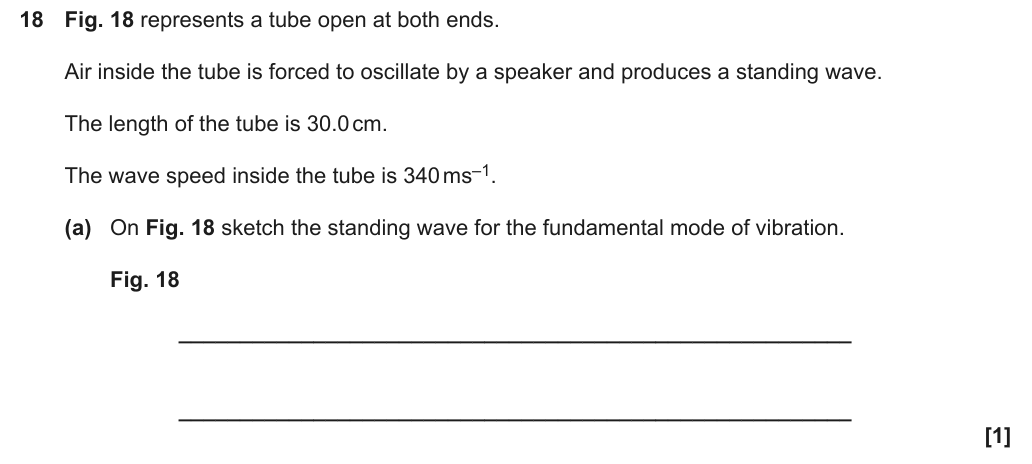
The majority of candidates were able to correctly identify and draw the fundamental mode in between the two given lines. Examiners were fairly generous on this; however the following would be penalised: not drawing the node in the centre, having the wrong curvature, and drawing straight lines. This is a relatively simple sketch, but candidates must take care. Some candidates attempted a longitudinal wave sketch and several others just drew a large number of waves, indicating they had not really appreciated the question. As always, it is recommended that candidates use pencil; those who made mistakes often drew another set of a parallel lines and then put in their answer. Examiners will always consider this; however it is better to use the original question image.
Skills: M3.12 Sketch relationships which are modelled by y = k/x, y = kx², y = k/x², y = kx, y = sin x, y = cos x, y = e^(±x) and y = sin²x, y = cos²x as applied to physical relationships
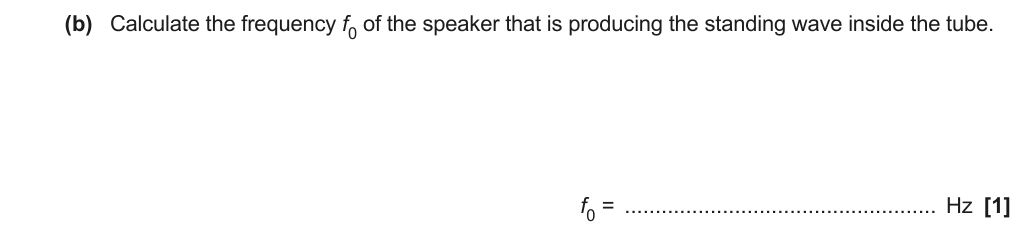
Around two thirds of candidates were able to calculate this correctly. The majority of incorrect responses were naturally when using 0.30 m as the wavelength. Relatively few candidates did not change their wavelength into metres, but a significant number were unable to rearrange the formula correctly.
Skills: M0.1 Recognise and make use of appropriate units in calculations; M2.3 Substitute numerical values into algebraic equations using appropriate units for physical quantities
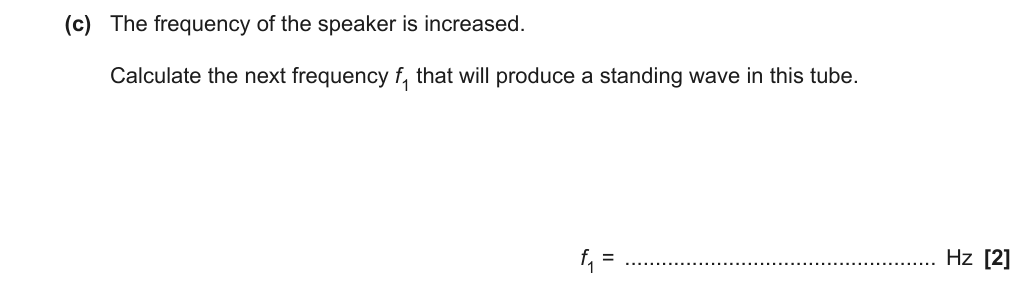
Most candidates appreciated that the wavelength would be smaller (and many drew a sketch) to produce the next frequency. However, it was difficult to score marks on this if the previous answers were incorrect. Error carried forward is often applied, but in this case major errors will compound and it is not possible to work through the candidates thinking.
Skills: M2.3 Substitute numerical values into algebraic equations using appropriate units for physical quantities
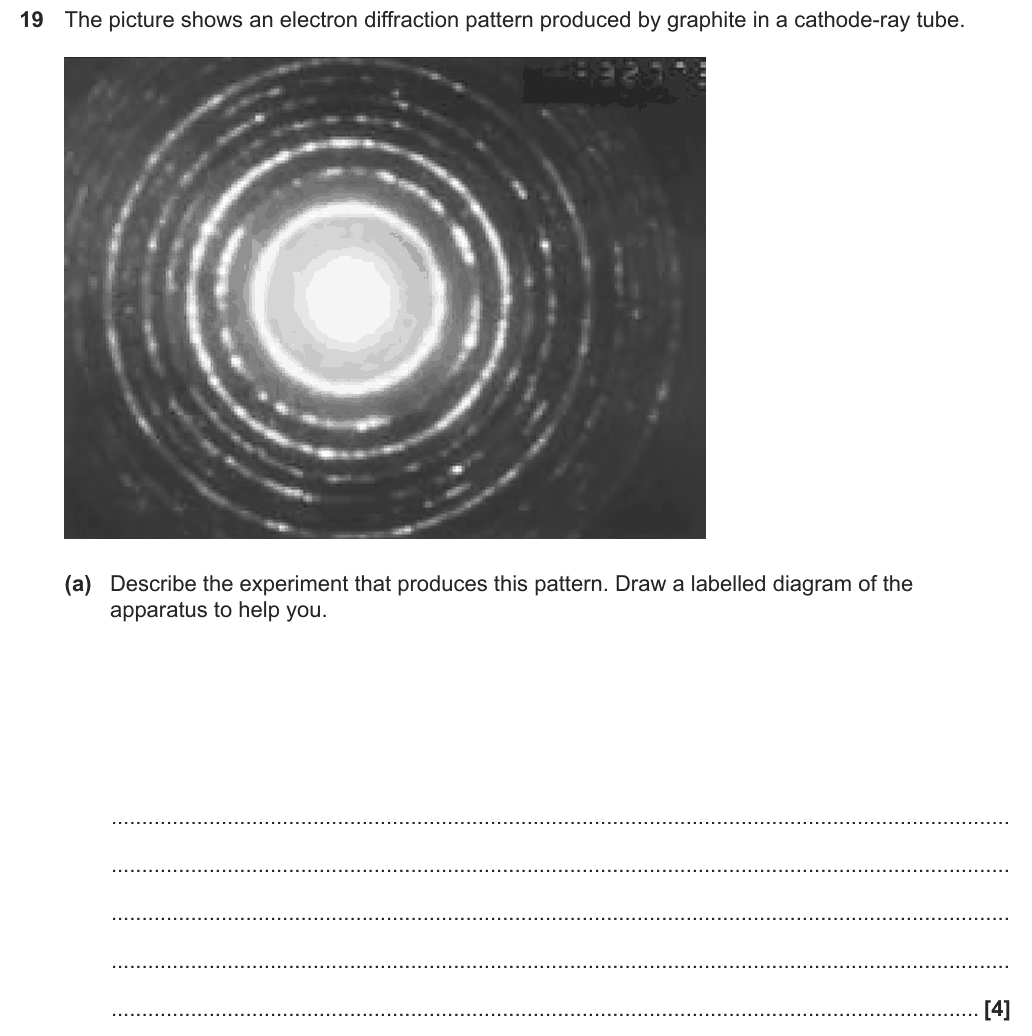
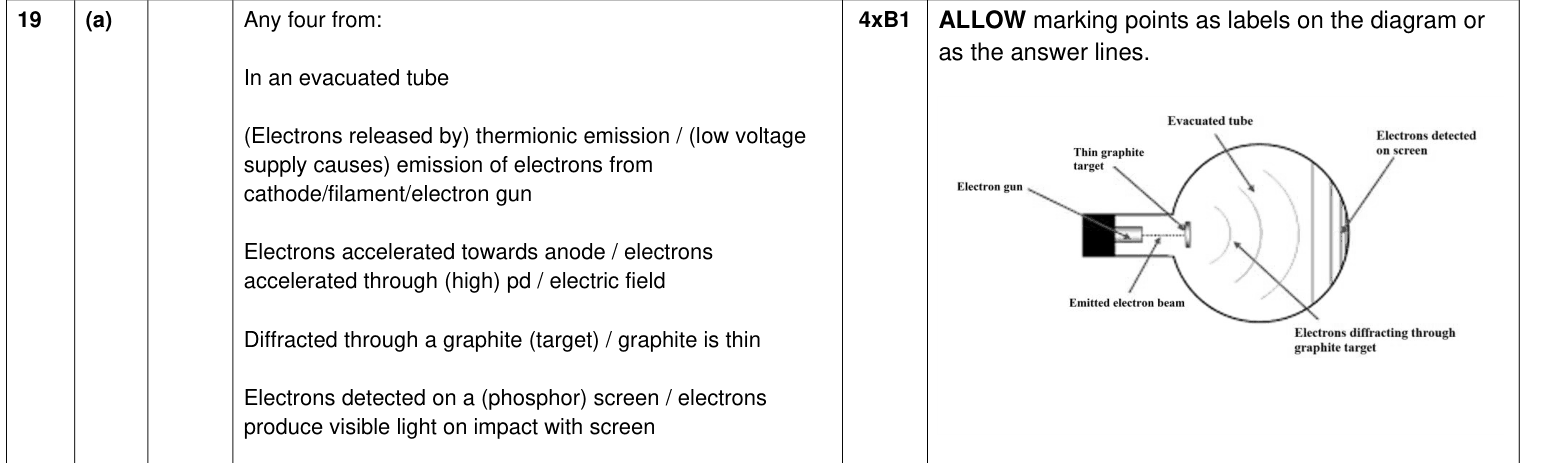
A diagram is always helpful if suggested and candidates who drew a labelled diagram were often able to score marks that they would not have gained in the text. Candidates who had seen this experimental set- up were at an advantage and often gave good descriptions, although relatively few gained full marks. Several candidates confused anode and cathode and others assumed that the graphite was in some way responsible for the production of the electrons. Nearly one third of candidates scored no marks on this question; those who did often had little knowledge of the experiment although it is specifically mentioned in the specification. Incorrect responses included considering it as a ripple tank. This response shows a candidate using a diagram to gain marks that would not otherwise be covered in the text. The word ‘vacuum’ will score the first mark for the evacuated tube.
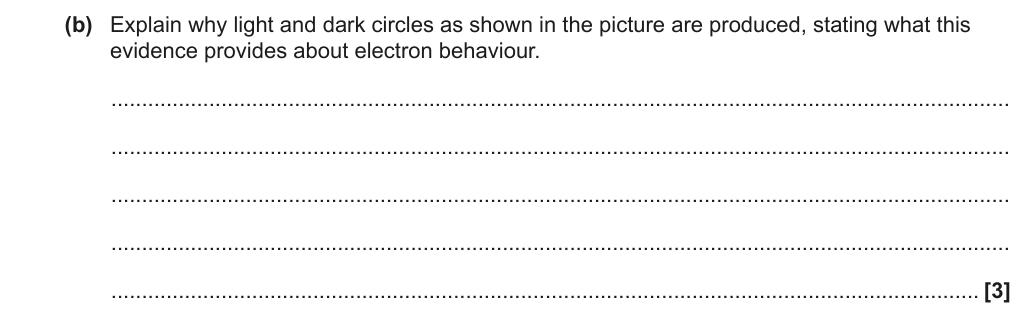
Most candidates appreciated that this was evidence of the wave nature of electrons, although a simple statement of ‘wave-particle duality’ does not really explain what the evidence provides. Although the circles could be described in terms of probability of electrons arriving, in the context of the question the concept of interference of the electron-waves was sufficient and was clearly the explanation that many candidates had been given and close to one half of candidates were able to achieve full marks.
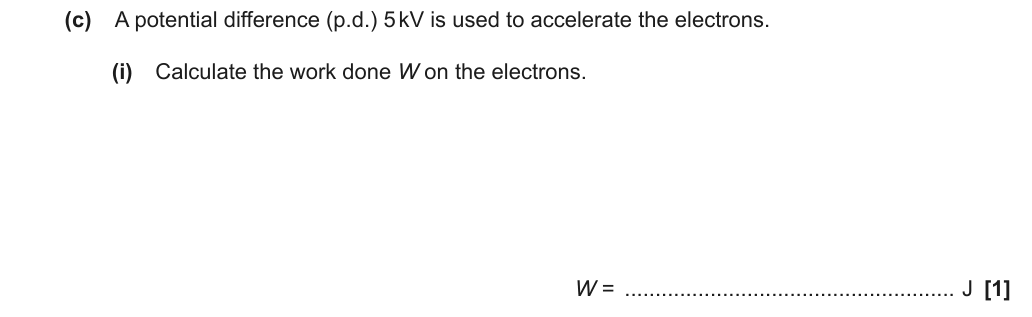
The vast majority of candidates were able to carry out this simple calculation; most errors came from an incorrect conversion of kV rather than lack of knowledge of the calculation.
Skills: M0.1 Recognise and make use of appropriate units in calculations; M2.3 Substitute numerical values into algebraic equations using appropriate units for physical quantities
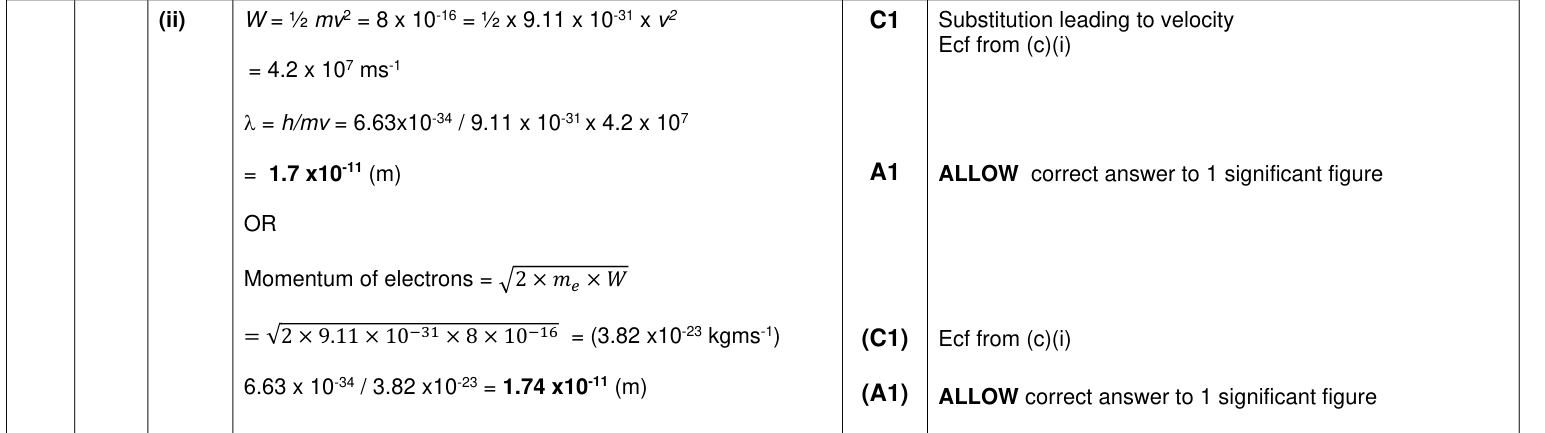
Around one half of candidates were able to correctly calculate the de Broglie wavelength. This is potentially difficult for the average candidate to carry out in a single calculation, so it is very helpful to show the working in a slightly extended calculation. Most candidates calculated the electron speed first from the kinetic energy equation and then correctly substituted it. Several candidates used the proton rest mass in place of the electron rest mass, but the majority of incorrect responses came from using the speed of light for the speed. This is a physics error which can score no marks.
Skills: M0.5 Use calculators to find and use power, exponential and logarithmic functions; M2.2 Change the subject of an equation, including non-linear equations; M2.3 Substitute numerical values into algebraic equations using appropriate units for physical quantities
The justification for the spacing is in the context of the question and so must relate to their previously calculated value. Around half of the candidates correctly gave a value and supporting reason, which needed to relate their wavelength to the process of diffraction. Common incorrect answers included values of around 1fm (irrespective of their calculation) presumably from their knowledge of the nuclear radius.
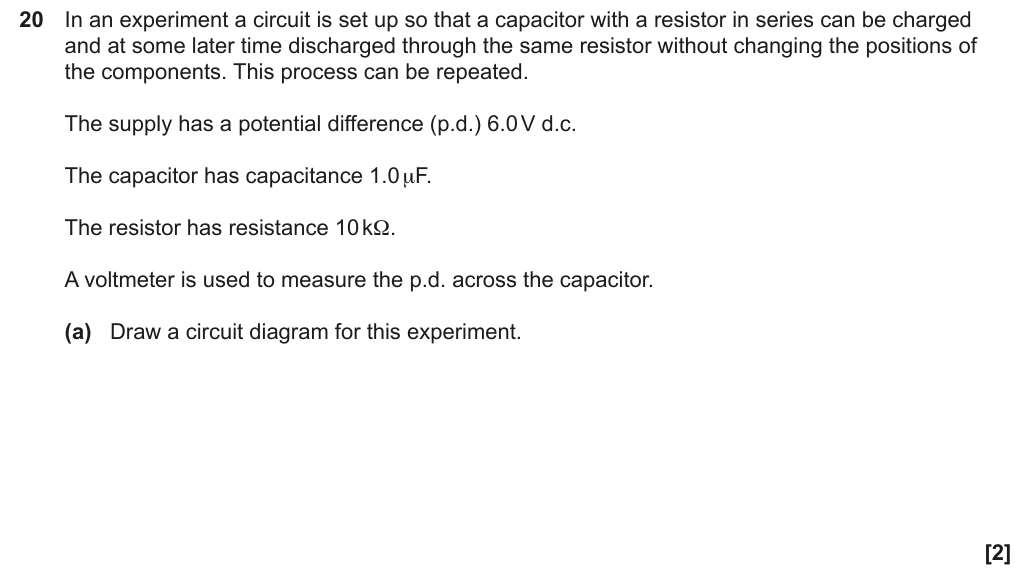
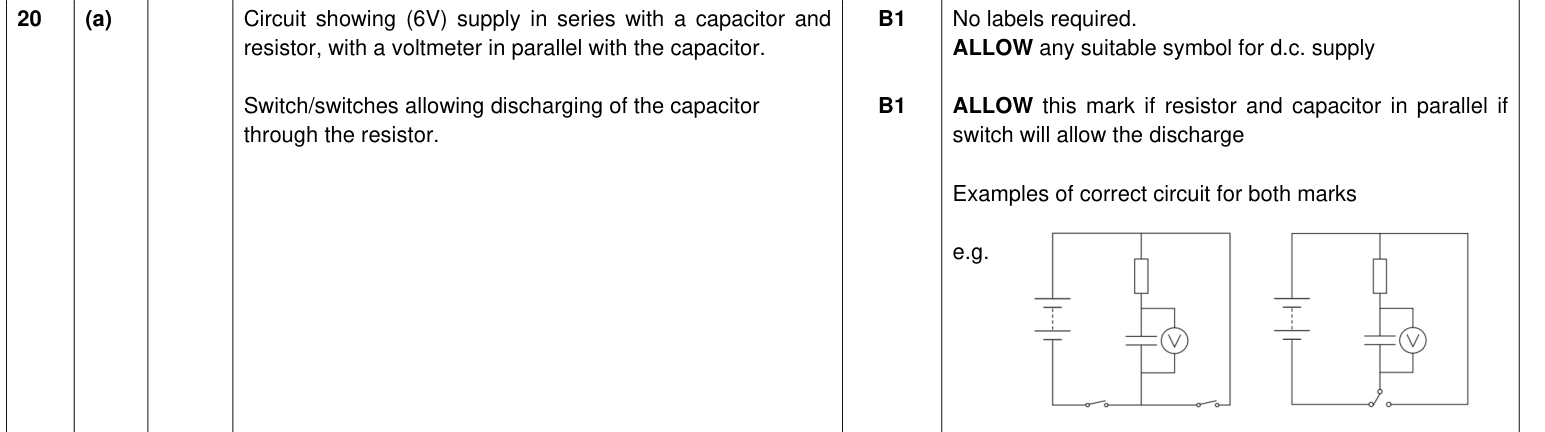
Many candidates were able to correctly draw the supply, capacitor, and resistor in series with a voltmeter in parallel for a single mark. The position of a switch/switches to allow a discharge was less simple and many candidates had a single switch in series with their components. There are several ways to correctly draw this, and examiners allowed the use of double throw type switches as long as the idea was clear. Placing the capacitor and resistor in parallel with the supply may have allowed access to the second marking point as it would allow the discharge but not the charging. As always, clarity of the diagram makes it easier for examiners to understand. Several candidates appeared not to know the symbol for the capacitor and used a capital C in a circle. Less than one fifth of candidates were able to correctly draw the required diagram.
Skills: PAG9 Investigating capacitors
The vast majority of candidates were able to calculate this correctly and the main reason for not awarding the mark tended to be from a power of ten error.
Skills: M0.1 Recognise and make use of appropriate units in calculations; M2.3 Substitute numerical values into algebraic equations using appropriate units for physical quantities
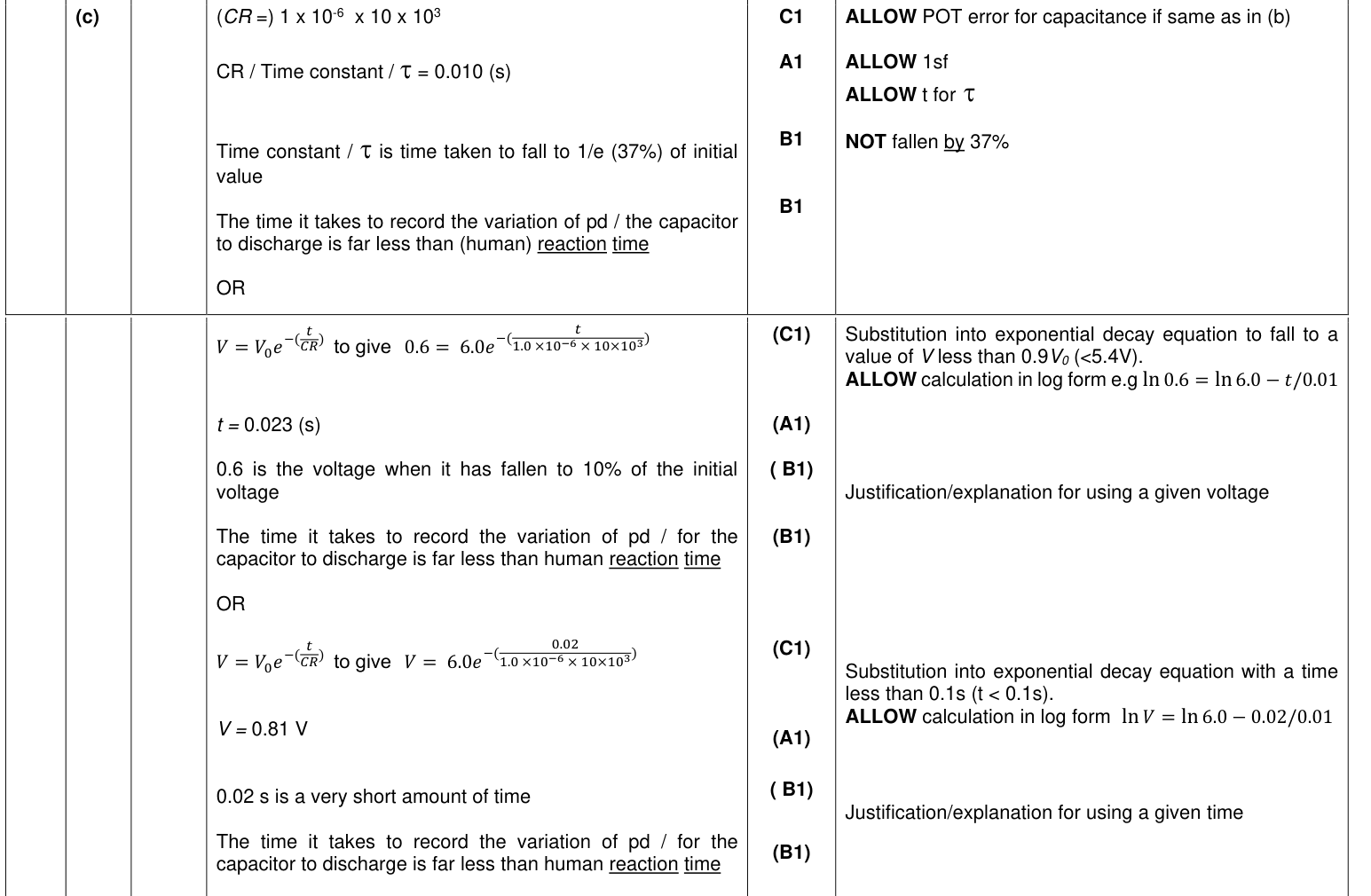
Candidates were credited with calculations that produced a time or voltage that showed the time for decay was rapid. There were many possible routes to an answer and candidates were credited with any method that would produce a correct solution. As the question also included an explanation, it was often necessary to justify candidates’ values for further credit rather than simply determine a numerical answer. The calculations were, in general, completed well and a good number of candidates were able to score 2 or more marks. Explanations in terms of reaction time were quite rare and often a vague answer such as ‘the time is short’ or ‘human error’ was given. Many candidates also related it to the precision of the stopwatch rather than the limitations of their use due to human reaction time. In this response the candidate has chosen to determine the time taken to fall to 1 V. The calculation has been done correctly for the first 2 marks (although there is no unit, it is clear what t is). The third marking point has not been satisfied – a comment would be needed (however brief) on why 1 V was chosen. The final marking point is given for the idea that this is time is less than human reaction time.
Skills: M0.5 Use calculators to find and use power, exponential and logarithmic functions; M2.3 Substitute numerical values into algebraic equations using appropriate units for physical quantities; PAG9 Investigating capacitors

While changing the value of the resistor or capacitor would increase the charging time, that would alter ‘this experiment’ and as such was not credited. In the context of this question, it is how the variation can be determined using the given values. Few candidates appreciated this, however there were significant numbers who knew that an oscilloscope could be used in place of the voltmeter.
Skills: PAG9 Investigating capacitors
Most candidates were able to calculate the correct time for the discharge, by taking substituting values into the logarithmic equation. Common errors included incorrect taking of logs by division rather than subtraction (depending on their original set-up) and power of ten errors or transcription errors in the values of C or R. As with many calculations, those who spent a little time setting out the working carefully were more likely to get the correct answer.
Skills: M0.5 Use calculators to find and use power, exponential and logarithmic functions; M2.2 Change the subject of an equation, including non-linear equations; M2.5 Use logarithms in relation to quantities that range over several orders of magnitude
Only around one third of candidates were able to correctly calculate this answer. By far the most common error was to calculate the change in energy using the difference in voltages (using 1.88 V) rather than calculating the separate energies and then subtracting. Several candidates left their answer at this point, rather than going on to divide by their value for the time.
Skills: M0.2 Recognise and use expressions in decimal and standard form; M2.3 Substitute numerical values into algebraic equations using appropriate units for physical quantities
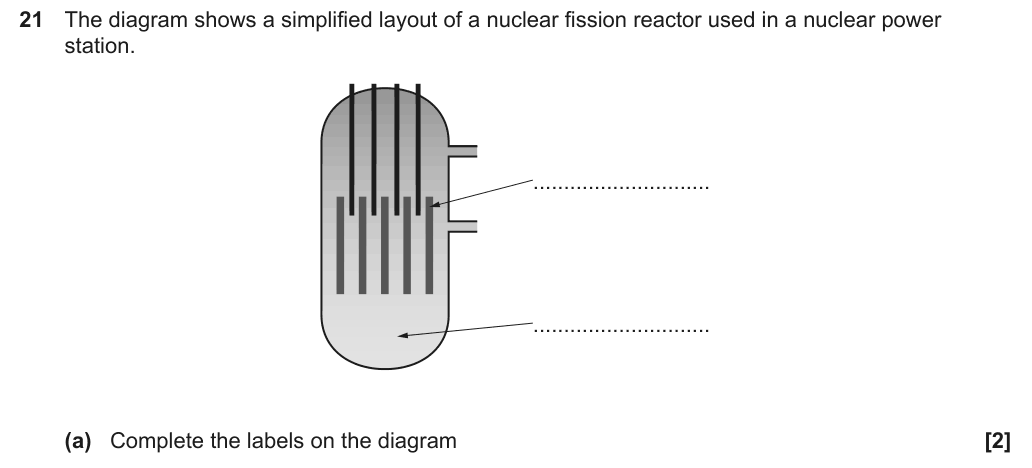
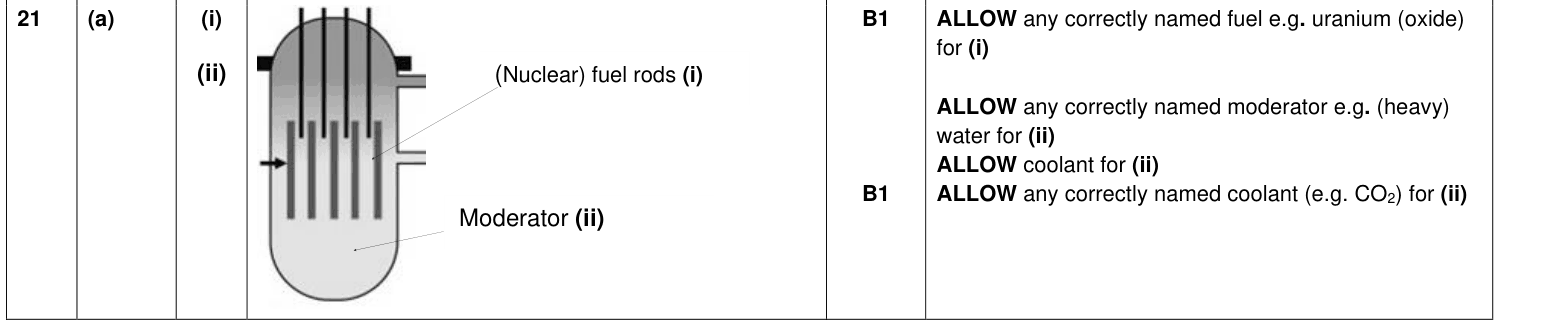
Many candidates were able to demonstrate their knowledge of the internal structure of a fission reactor and correctly label the components or the material they are made from. Simple answers such as ‘reactor core’ or ‘fluid’ are not sufficient at this level.
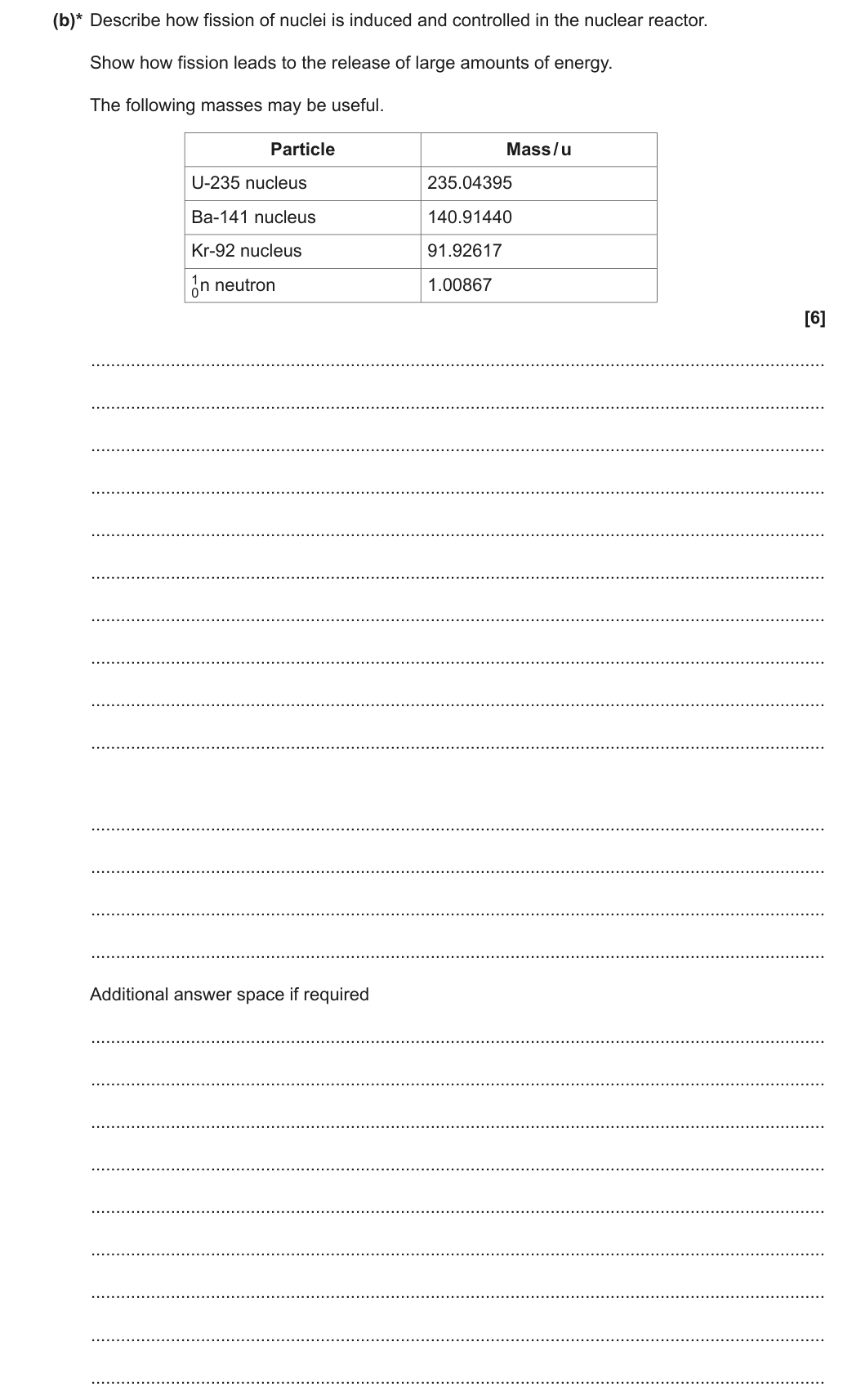
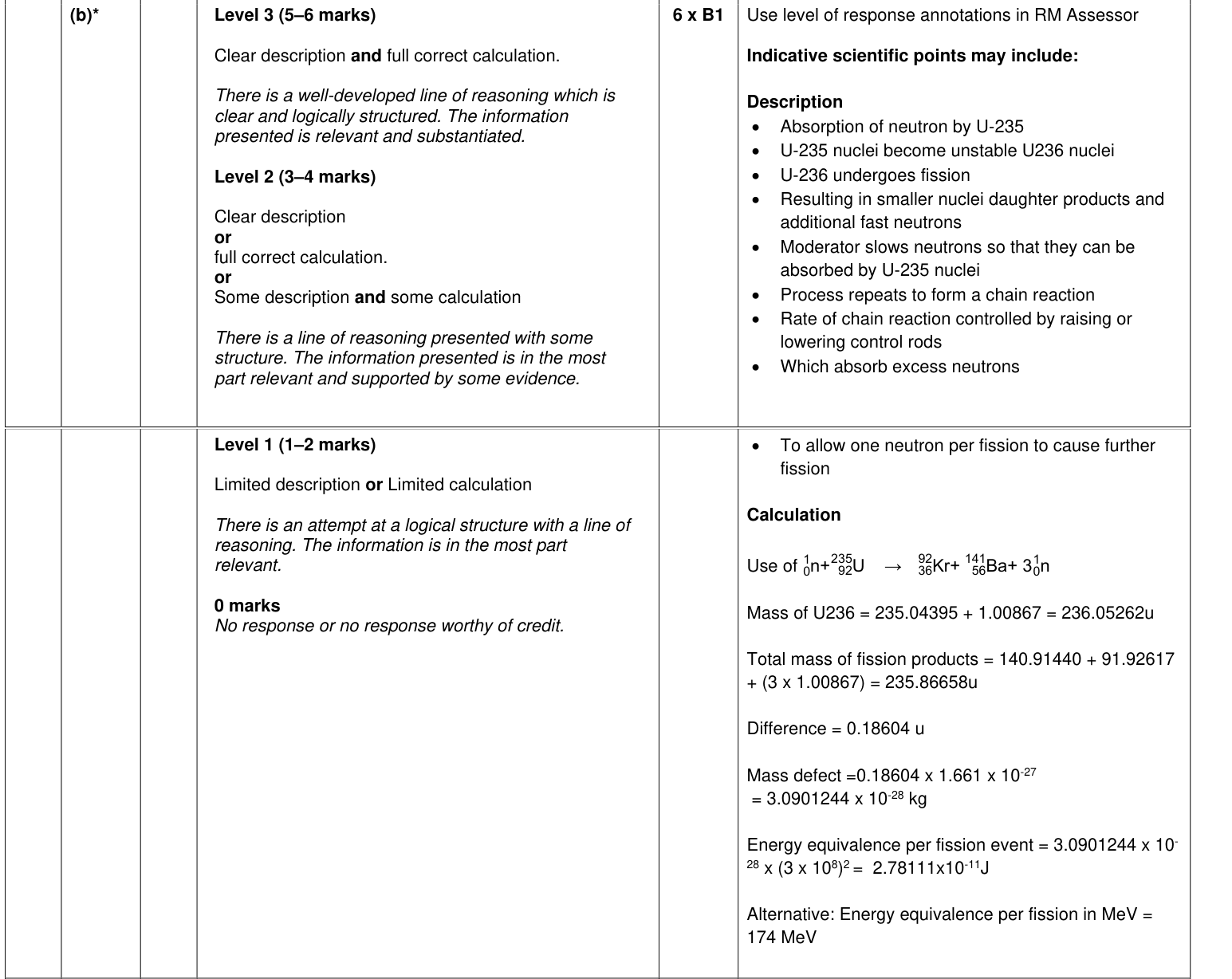
This is the second level of response (LoR) question in this paper, and was designed to assess nuclear physics, specifically Sections 6.4.4 (a), (b), (g) and (h). In particular, there are two parts (description and calculation) both of which need to be answered to obtain a Level 3. As previous, there are no specific marking points and examiners use a ‘best fit’ approach to the marking. Indicative scientific points are given in the mark scheme as a guidance to what to expect, but not all need to be satisfied for full credit, however for full credit for the calculation, the energy released per fission is the minimum end point. Incorrect physics can be expected to be penalised, however. Candidates should always be encouraged to structure their answers carefully and in calculations aim to give explanation of each stage rather than just produce a number. The two separate sections can be separated into a description of the induction and control, and calculation of the energy released. The key points in the description that examiners were looking for were: - idea of induced fission by a thermal neutron– the chain reaction leading to more neutrons released - a description of the role of the moderator – a description of the role of the control rods. The key points in the calculation that examiners were looking for were: - calculation of the mass before fission – calculation of the mass after the fission – difference between these two masses – calculation of the energy equivalent (hence released) from this mass difference. The descriptions of the induction and control varied hugely both in quality and quantity. Many candidates did not start from U-235 but went straight into the fission. Most candidates were aware that extra neutrons were released in fission and had a good idea of the absorption of the extra neutrons by the control rods, but there was often confusion about the role of the moderator (by explaining that it simply ‘controlled the reaction’) and a significant number did not appreciate why a slower neutron was needed. However, there were many excellent explanations covering all of the indicative points and going beyond. The calculations were attempted well by many candidates and obtaining the energy equivalence of one fission was a suitable point to stop the calculation. A comment supporting the size of the energy compared to this number of fissions per second helped to confirm the large release of energy. Several candidates took this further and calculated the energy per kg, showing how large this was. The main source of error was in not accounting for the mass of the initial neutron in the reaction and so the energy calculated was one ‘neutron mass equivalence’ too high. Several candidates ended their calculation with a mass difference, or even attempted to calculate the mass defect in the formation of U-235, but this led nowhere. There was a fair number of candidates who made no attempt on the calculation despite having given a good description and it can be assumed that they hadn’t fully read what they were asked to do. Similarly there were some excellent calculations but no with no description. Candidates are always encouraged to consider both parts of any LoR question. This is an example of a Level 2 response to a LoR question. The candidate has given a clear calculation with a good structure but has forgotten to add the neutron mass to the uranium mass to give the initial mass. The remainder of the calculation is correct, giving a final value for the energy per fission which is incorrect by a value of the neutron mass-energy. The explanation of the induction and control is good, if a little brief and lacking in real detail. On the holistic approach taken to the LoR questions, this is a clear Level 2. The communication is good and the setting out of the response is clear.
Skills: M0.1 Recognise and make use of appropriate units in calculations; M0.2 Recognise and use expressions in decimal and standard form; M2.3 Substitute numerical values into algebraic equations using appropriate units for physical quantities
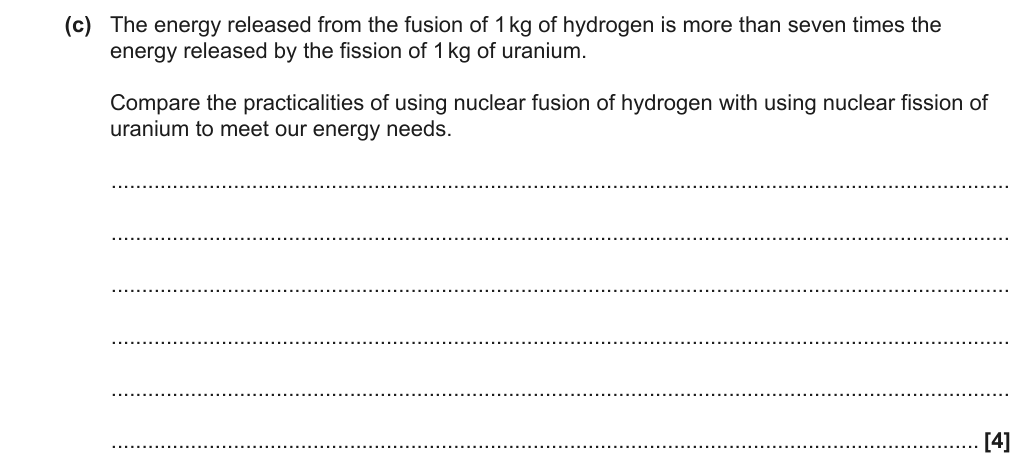
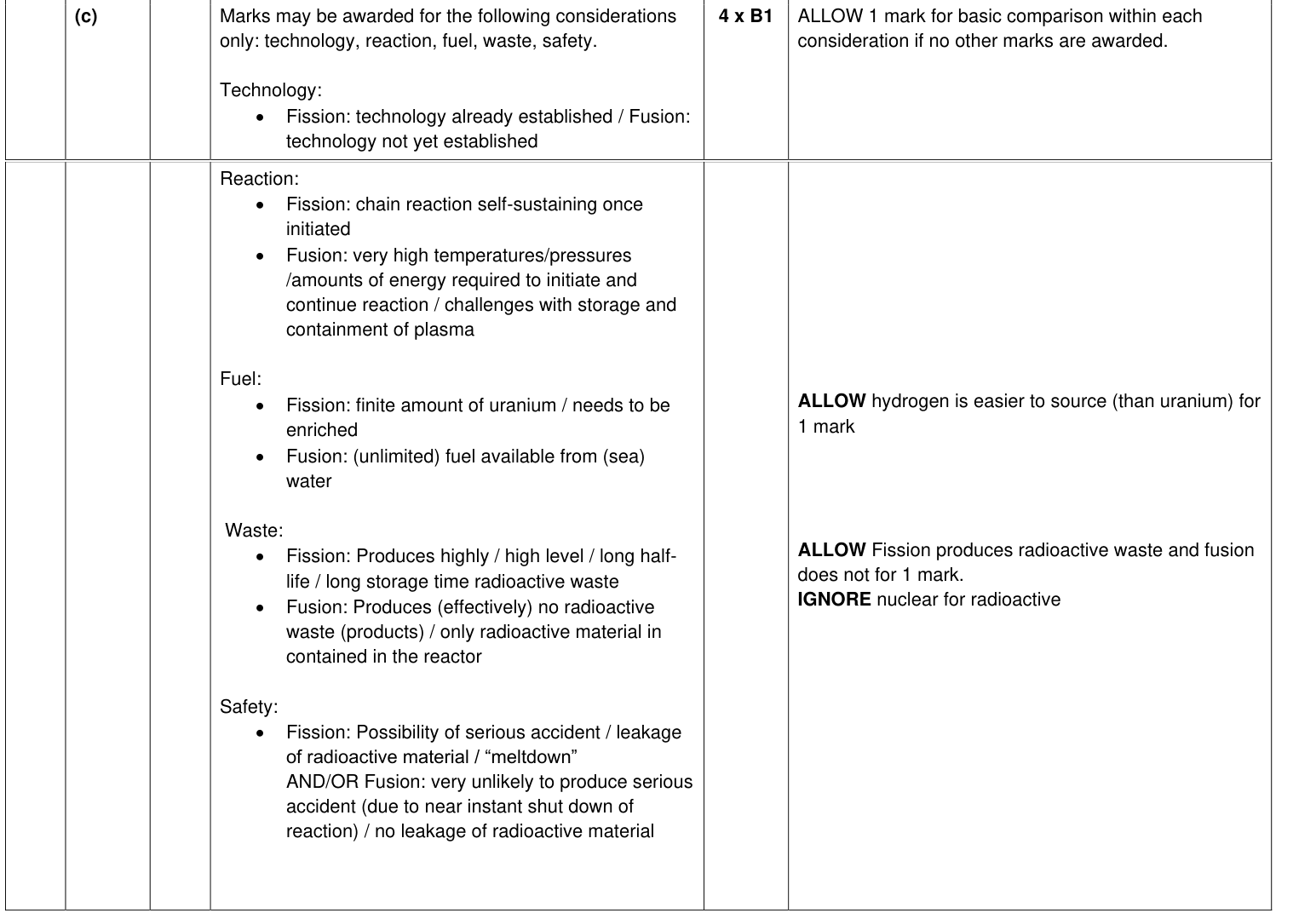
This question needed candidates to use appropriate scientific knowledge and understanding to discuss the differences between fission and fusion in terms of the practicalities. Many candidates were able to give good responses to several of the main points with careful comparisons. One of the key features of this question is to avoid social and economic arguments and base the points on ideas from the course. It is not a ‘compare and contrast’ question, but many of the marking points can be gained that way. A relatively small number of candidates gained full marks on this, as may be expected, however a good fraction gained 2 or more marks. Responses which could not be credited were simple statements like ‘safer’, ‘easier to use’, ‘no toxic waste’ and ‘renewable’. Examiners will have worked strictly to the mark scheme, and so given marks consistently.
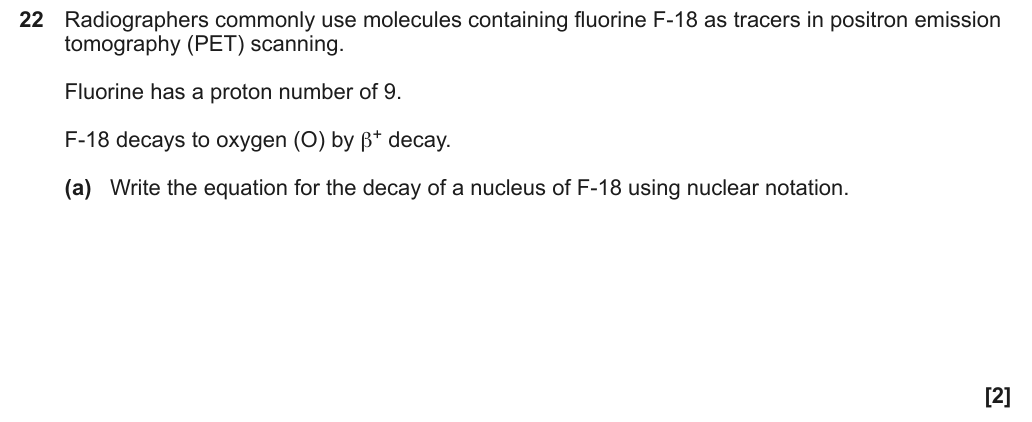
Most candidates will have gained the first mark for the correct isotope of fluorine. Those who didn’t likely reversed the positions of the nucleon and proton number. It was noticeable that a large number of candidates were unable to balance the equation and while they had the correct values for the positron, the oxygen isotope was incorrect.
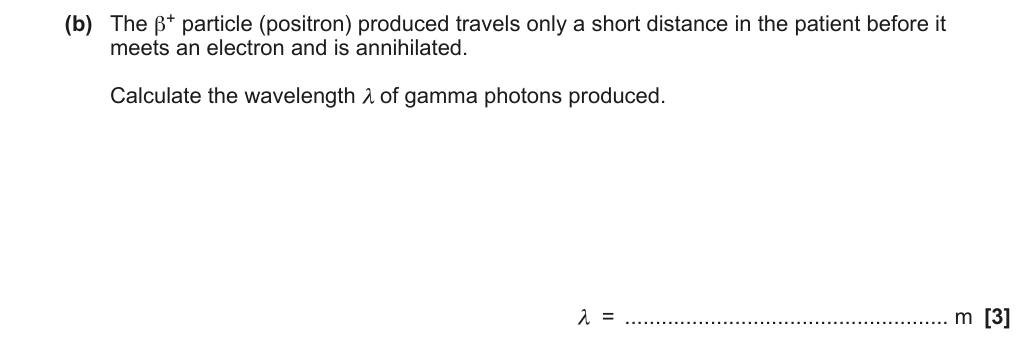
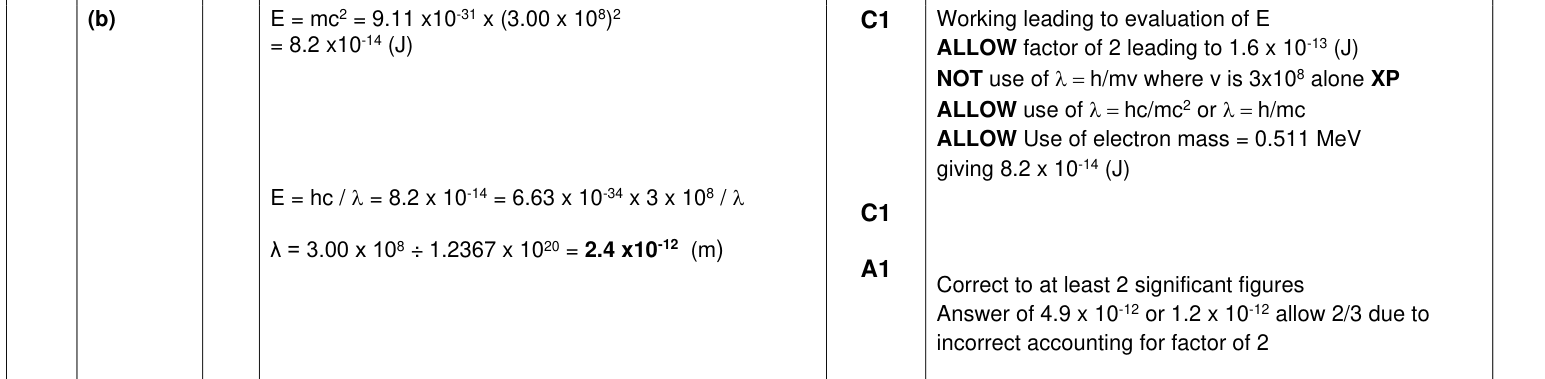
Well over half of the candidates were able to score 2 or more marks on this question. A great deal scored 2 marks due to the inclusion of a factor of two, which was then not removed (or vice versa). Some candidates used the formula for kinetic energy – which by coincidence may give the correct answer – however this was not credited, nor was the more common use of the de Broglie formula. Examiners sometimes had a difficult decision on this question, whether the response was a physics error or not, and if in doubt a candidate would be awarded the marks.
Skills: M0.2 Recognise and use expressions in decimal and standard form; M2.2 Change the subject of an equation, including non-linear equations; M2.3 Substitute numerical values into algebraic equations using appropriate units for physical quantities
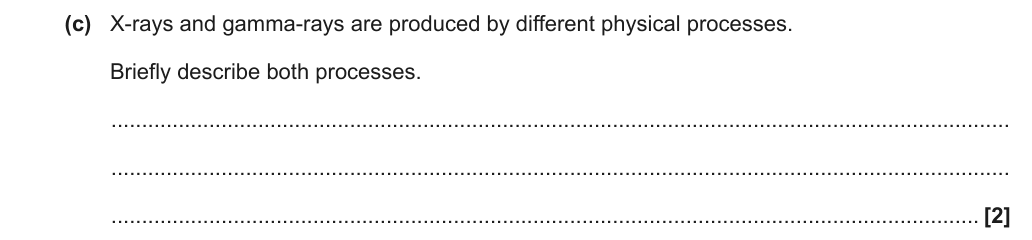
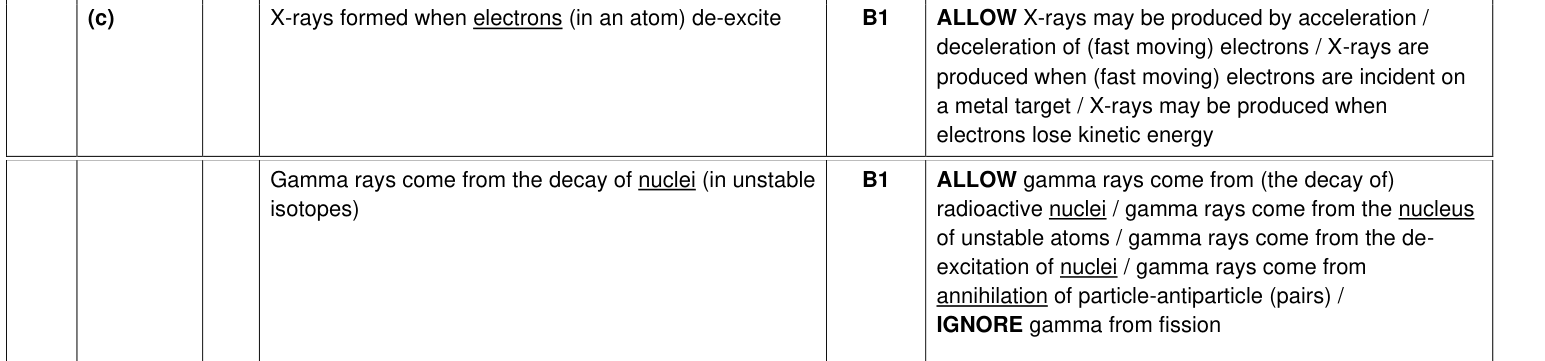
The main principle behind this question was to distinguish between the X-ray production by electrons and gamma ray production by nuclei. Fairly specific details were required for each, although a wide range of answers were accepted. This question discriminated well among the candidates with roughly equal fractions getting 0, 1 and 2 marks.
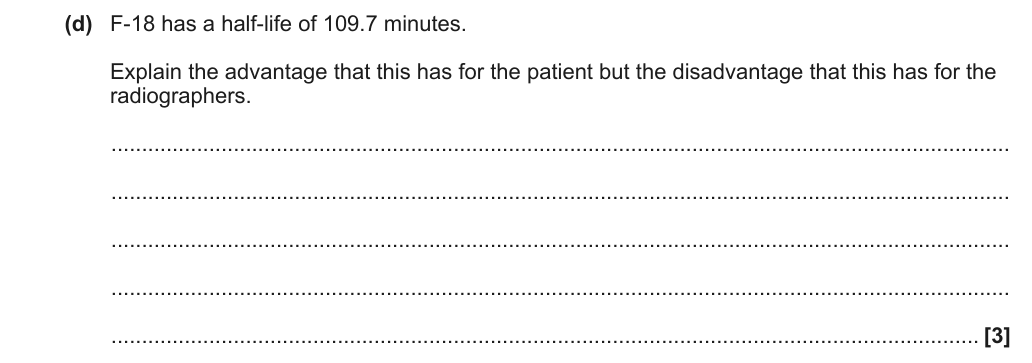
Although apparently a simple set of ideas, the detail required for this question meant that only a small fraction of candidates were able to gain full marks. It was necessary to state that the half-life was (relatively) short, which many of the stronger candidates did not do. The advantage to the patient requires the use of the term ‘ionising’ as this is the fundamental issue with the radiation. Similarly, candidates had to make it clear that the disadvantage was due to the short time to carry out the scan rather than just a statement of needing to work quickly.
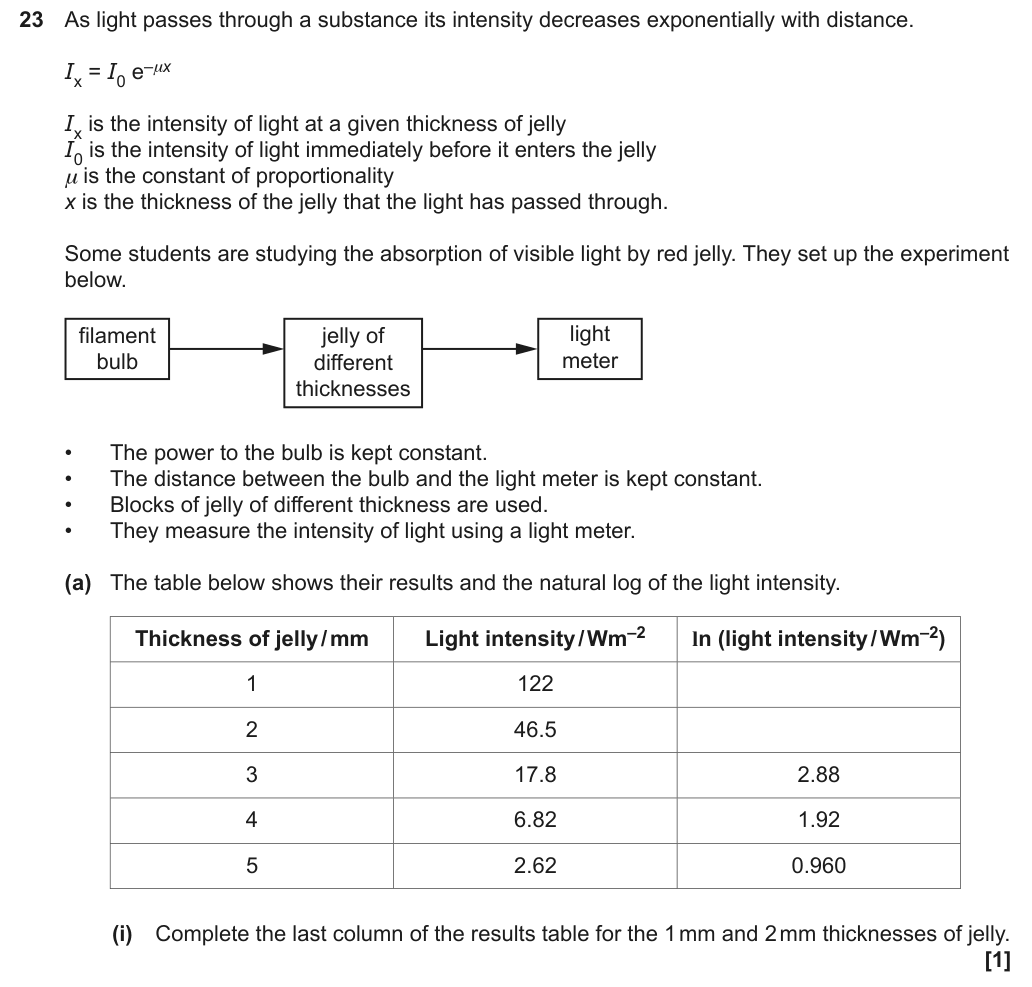
Very few candidates made calculation errors here; the main reason for not gaining marks was usually due to the number of significant figures used. As a general rule, 3sf is usually the number for a logarithmic calculation however it would also be appropriate to match the number to any data already given.
Skills: M0.5 Use calculators to find and use power, exponential and logarithmic functions; M2.5 Use logarithms in relation to quantities that range over several orders of magnitude
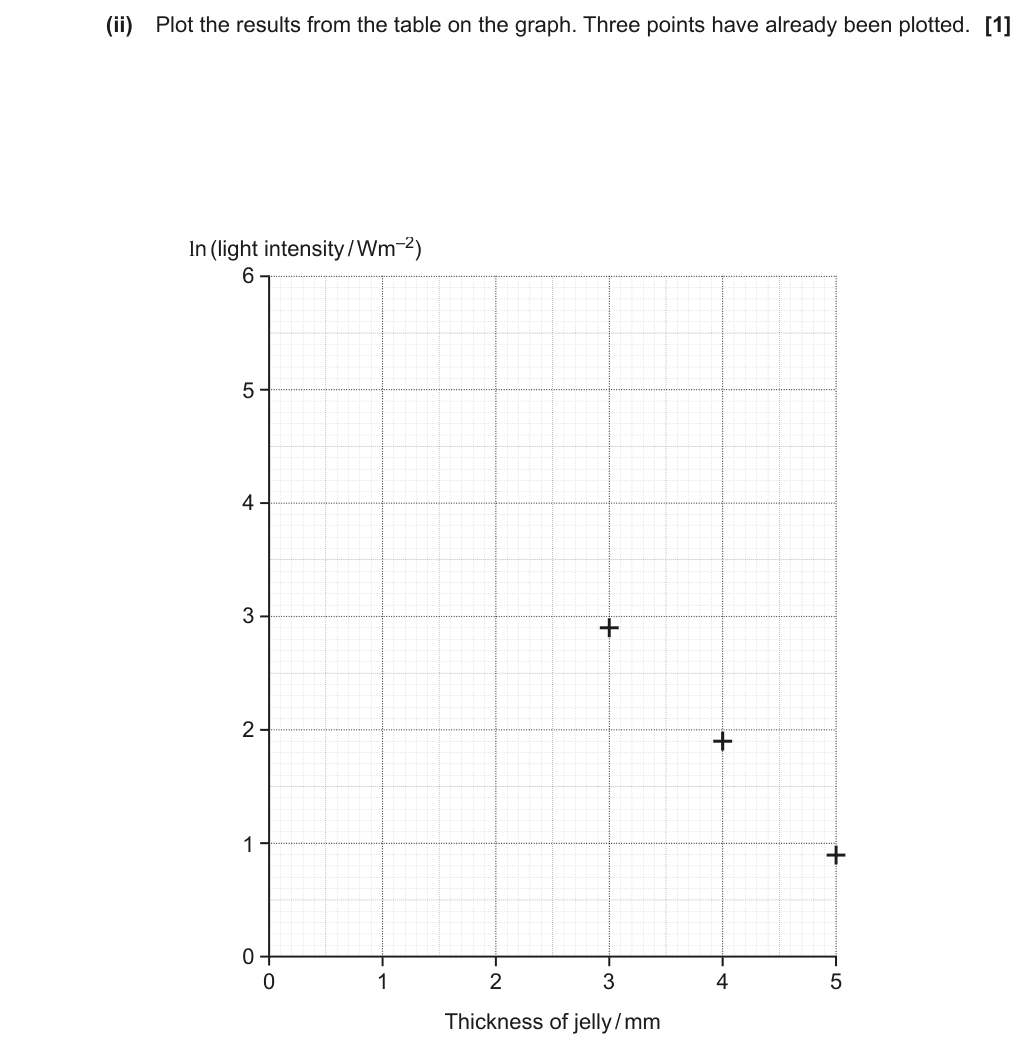
The relatively simple scales meant that practically all of the candidates gained this mark. The most common fault was in the placing of the x-value.
Skills: M3.2 Plot two variables from experimental or other data

A best-fit line should, as far as possible with a fair distribution and no anomalies, have equal numbers of points on either side of the line. Candidates should be wary of simply joining up the first and last points – in this case, it is likely to not have scored the mark as the points at 2 and 3 mm would be above the line. This resulted in only around two thirds of the candidates being given this mark.
Skills: M3.2 Plot two variables from experimental or other data; M3.3 Understand that y = mx + c represents a linear relationship
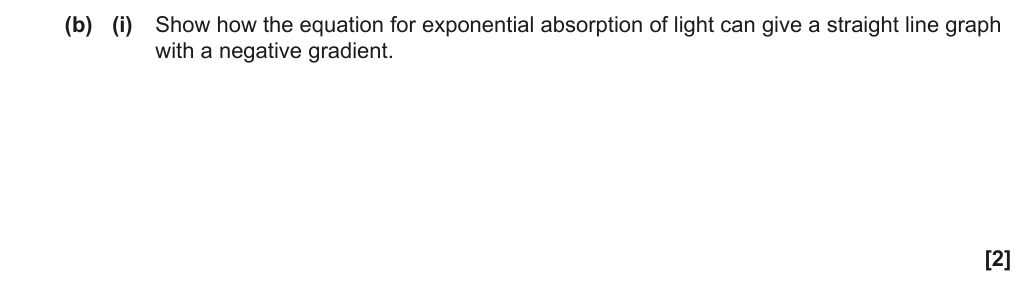
Most candidates were able to take logs correctly and produce a linear formula. This style of question generally needs the formula to be written in the form of y = mx + c, and then related to the equation of the straight line. Many candidates drew arrows between the two formulae to show how they are related which is good.
Skills: M2.5 Use logarithms in relation to quantities that range over several orders of magnitude; M3.11 Use logarithmic plots to test exponential and power law variations; M3.3 Understand that y = mx + c represents a linear relationship

The majority of candidates were able to appreciate that the initial intensity came from the intercept and were able to read and calculate it correctly. A small number simply wrote their value of the intercept as their final answer.
Skills: M0.5 Use calculators to find and use power, exponential and logarithmic functions; M3.10 Interpret logarithmic plots; M3.4 Determine the slope and intercept of a linear graph

Gradient calculations should always be done from the line, rather than points in the table, and covering more than half of the axes. Most candidates used the change in x as the full range of 5 (mm) and used their intercept from the previous question and the y-value from the line. The easy scale meant that this was a relatively simple task although those using the tabulated values would not gain this mark. The constant was the positive value of the gradient and a fair number gave it as negative.
Skills: M3.11 Use logarithmic plots to test exponential and power law variations; M3.4 Determine the slope and intercept of a linear graph
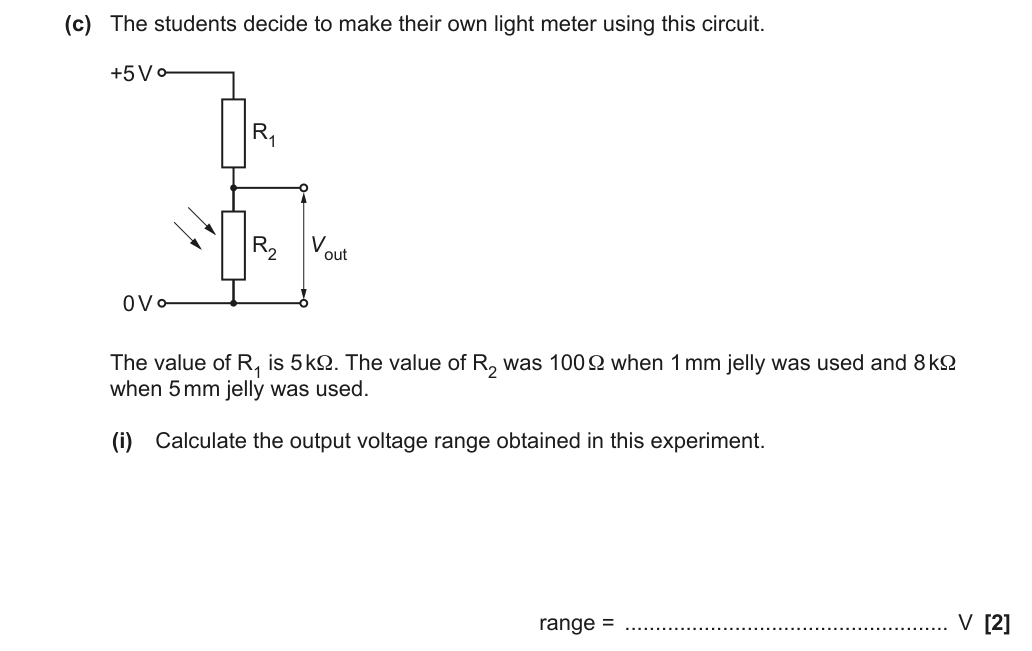
This was correctly done by around three quarters of the candidates. Most used a version of the potential divider formula twice and then either gave these two values as the extremities or the difference between them. There were some clear calculational errors despite the equation being used correctly. Some candidates had a value of the maximum voltage above the supply voltage which should have alerted them to a problem.
Skills: M0.1 Recognise and make use of appropriate units in calculations; M2.3 Substitute numerical values into algebraic equations using appropriate units for physical quantities; PAG4 Investigating electrical circuits
Candidates should make sure that they only give the required number of responses when prompted, as any incorrect responses may invalidate correct ones. It is important to make sure that the sense of change of any quantity is given, rather than simply a change. Over three quarters of candidates were able to achieve at least 1 mark on this question.
Skills: PAG4 Investigating electrical circuits
Although many candidates had a good understanding of this response, only around a third were able to give a complete and structured response. Three points needed to be made: how the light intensity varies, its effect on the resistance of the LDR and the effect on the output p.d.. Many candidates mentioned just changes rather than the sense of change, and also missed out some detail making the explanation incomplete.
Skills: PAG4 Investigating electrical circuits
Want a paper marked and gone through with you? Message us.