June 2025: AS Paper 2, Depth in physics

70 marks · 31 question parts · Paper, mark scheme and report on OCR's site · Have the Data, Formulae and Relationships Booklet beside you

Question by question

QTopicMarksAOType
1(a) Kinematics: displacement, velocity and motion graphs 1Calculation
1(b) Kinematics: displacement, velocity and motion graphs, Linear motion: the suvat equations and free fall 2Calculation
1(c) Kinematics: displacement, velocity and motion graphs 2Explanation
2(a)(i) Density, pressure and upthrust, Practical skills: planning, analysis and evaluation 2Show that
2(a)(ii) Measurements and uncertainties 2Calculation
2(b)(i) Density, pressure and upthrust, Equilibrium: moments, couples and centre of mass 3Calculation
2(b)(ii) Density, pressure and upthrust 2Explanation
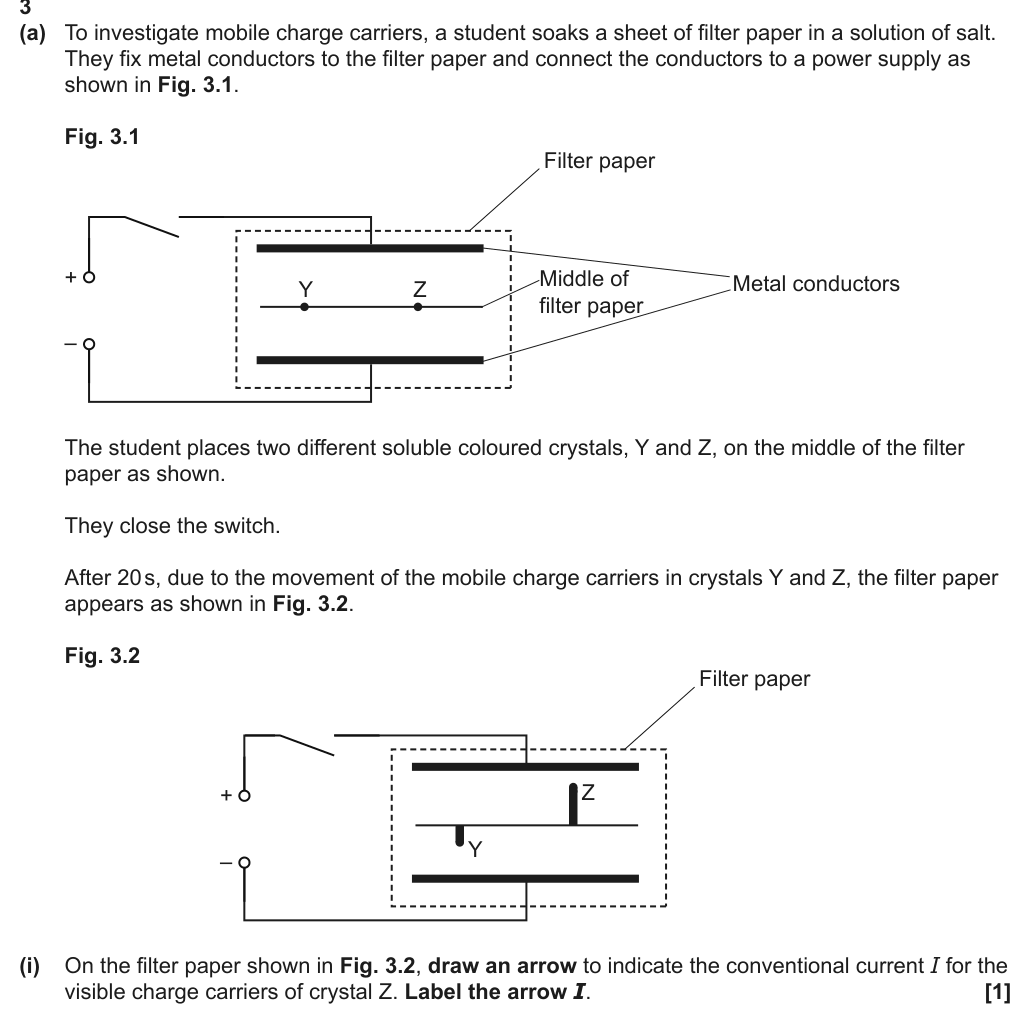
3(a)(i) Charge, current and mean drift velocity 1Diagram or graph
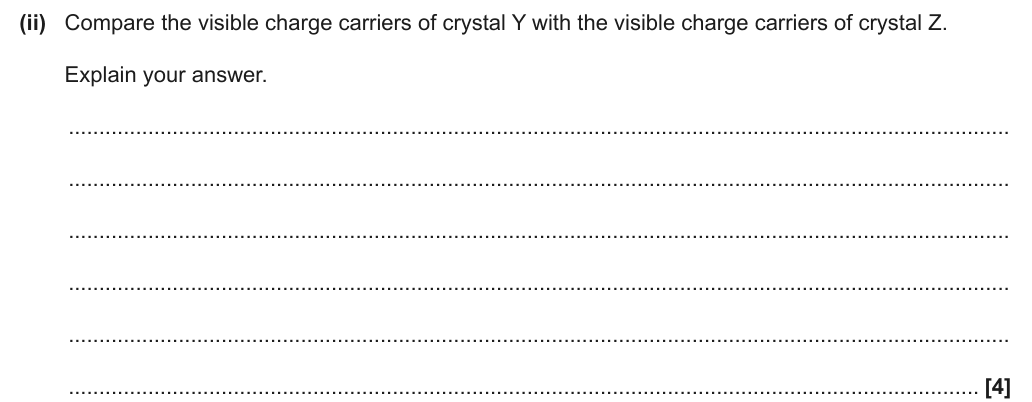
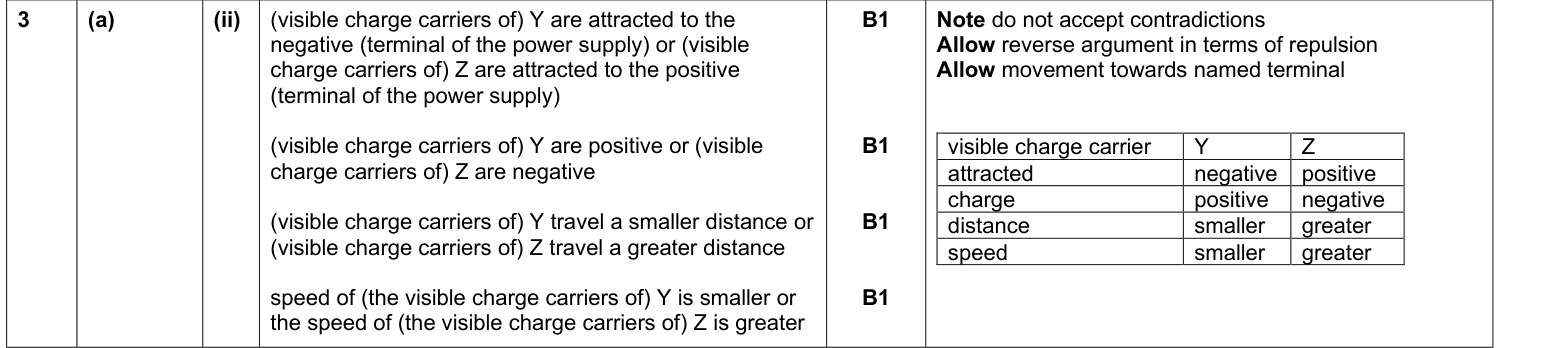
3(a)(ii) Charge, current and mean drift velocity 4Explanation
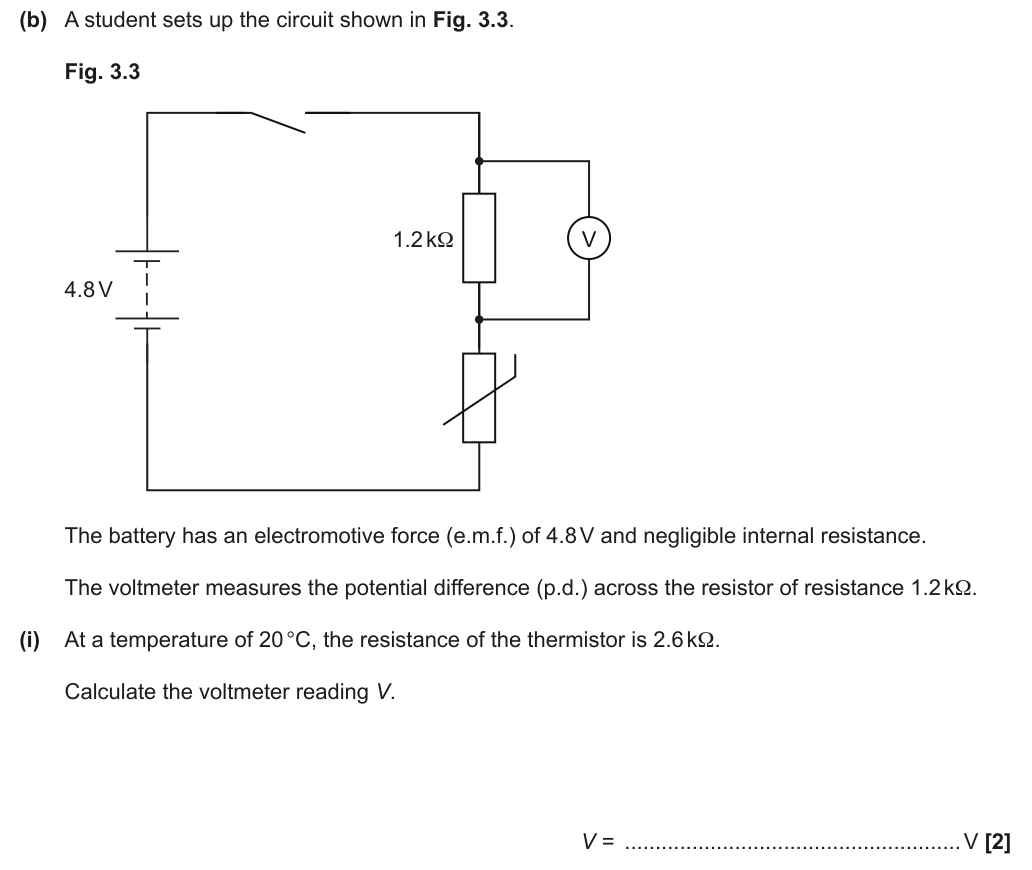
3(b)(i) Potential dividers 2Calculation
3(b)(ii) Potential dividers 2Calculation
3(b)(iii) Potential dividers, Practical skills: planning, analysis and evaluation 2Explanation
4(a) E.m.f., p.d., resistance and I–V characteristics 2Explanation
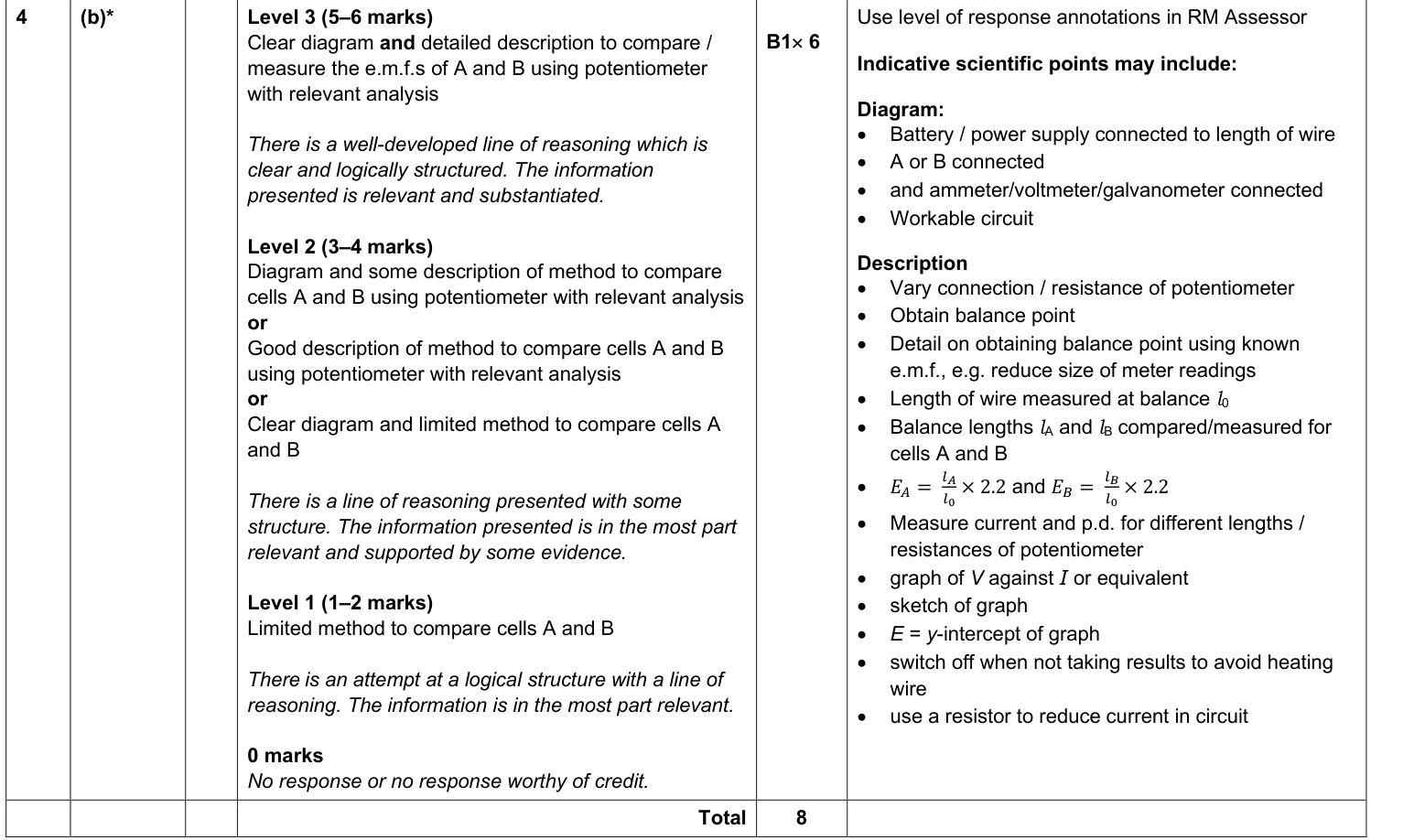
4(b) Potential dividers, Practical skills: planning, analysis and evaluation, E.m.f., p.d., resistance and I–V characteristics 6Extended response
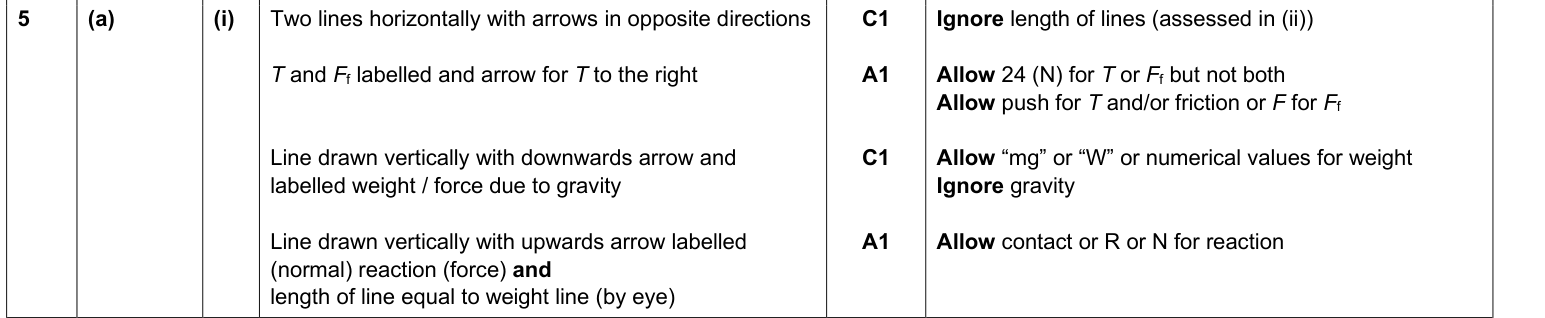
5(a)(i) Dynamics, drag and terminal velocity 4Diagram or graph
5(a)(ii) Newton's laws of motion and momentum, Equilibrium: moments, couples and centre of mass 1Calculation
5(b)(i) Work, energy and power 2Short answer
5(b)(ii) Work, energy and power, Scalars and vectors 2Calculation
5(b)(iii) Work, energy and power 2Calculation
6(a) Collisions: conservation of momentum 2Short answer
6(b)(i) Newton's laws of motion and momentum, Kinematics: displacement, velocity and motion graphs 1Show that
6(b)(ii) Newton's laws of motion and momentum, Collisions: conservation of momentum 2Calculation
6(b)(iii) Newton's laws of motion and momentum 1Calculation
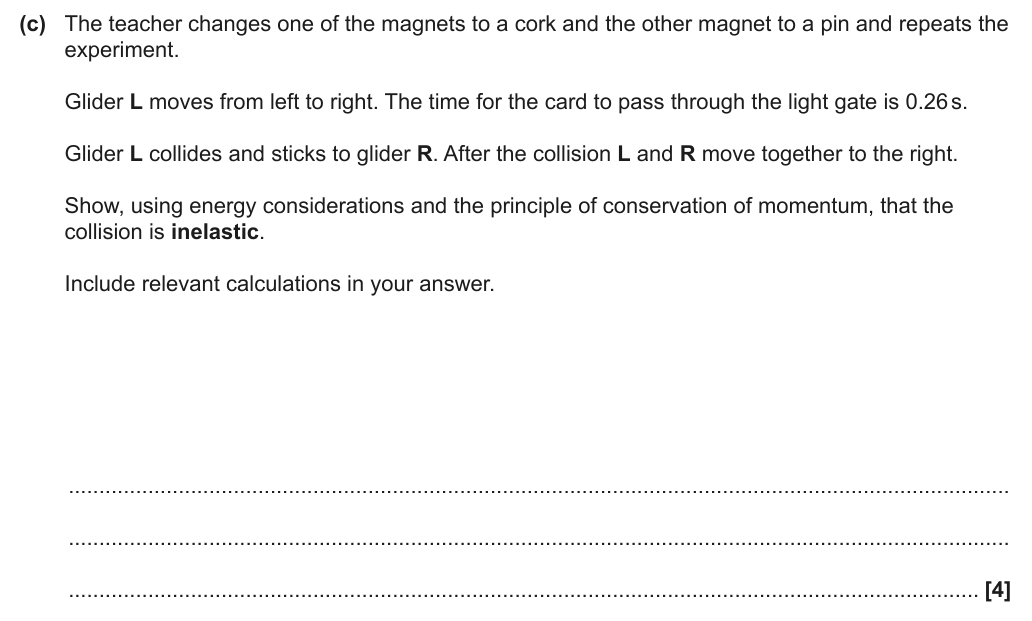
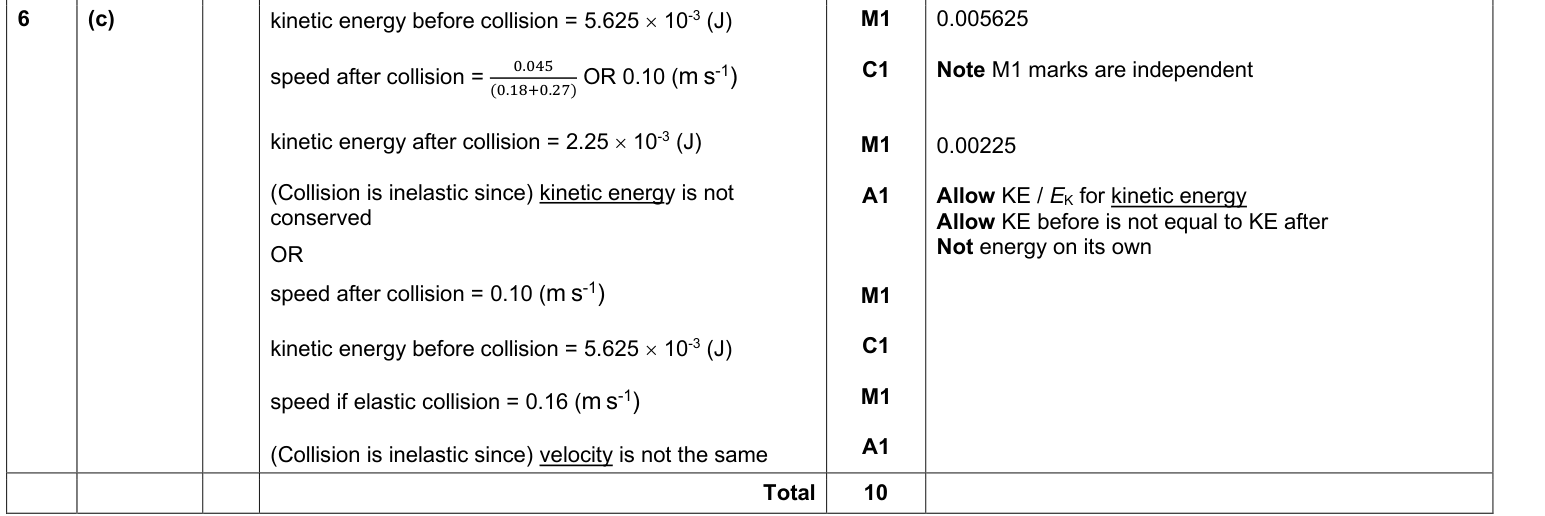
6(c) Collisions: conservation of momentum, Work, energy and power, Newton's laws of motion and momentum 4Short answer
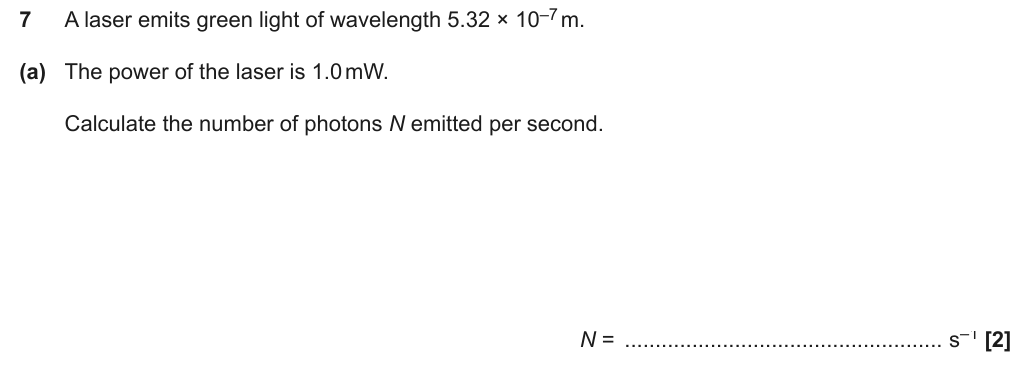
7(a) Photons and the Planck constant 2Calculation
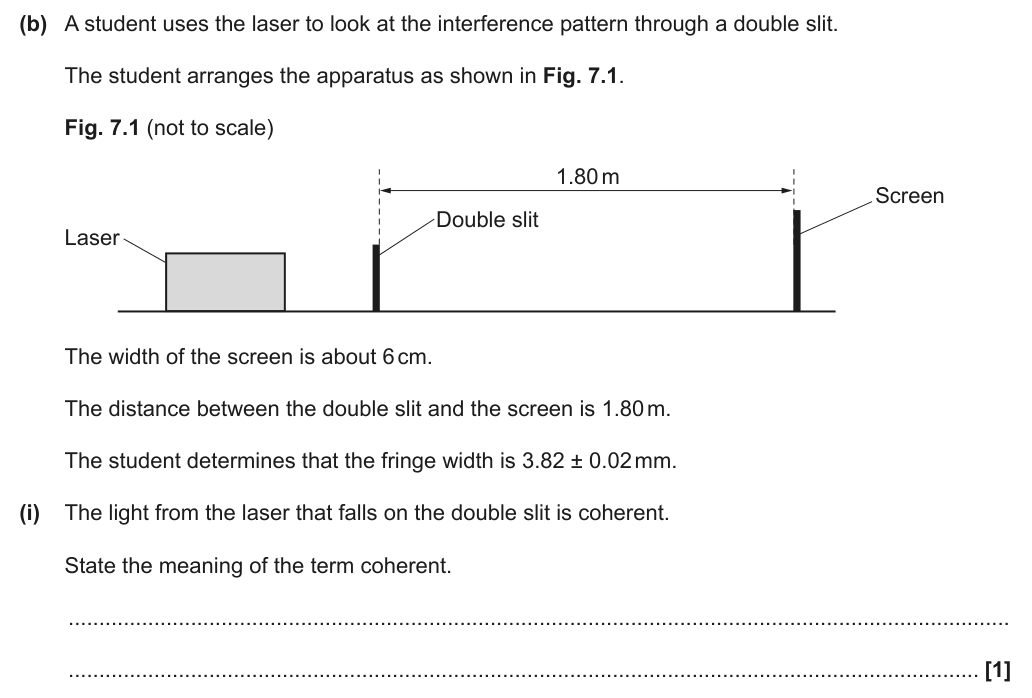
7(b)(i) Superposition, interference and the double slit 1Short answer
7(b)(ii) Superposition, interference and the double slit, Practical skills: planning, analysis and evaluation 2Explanation
7(b)(iii) Superposition, interference and the double slit, Practical skills: planning, analysis and evaluation 2Calculation
7(c)(i) Electromagnetic waves, polarisation and refraction, Wave motion: progressive waves, the wave equation and intensity 1Calculation
7(c)(ii) Electromagnetic waves, polarisation and refraction 2Calculation
8 Photons and the Planck constant, Practical skills: planning, analysis and evaluation, Measurements and uncertainties 6Extended response

The questions

1(a)1(b)1(c)2(a)(i)2(a)(ii)2(b)(i)2(b)(ii)3(a)(i)3(a)(ii)3(b)(i)3(b)(ii)3(b)(iii)4(a)4(b)5(a)(i)5(a)(ii)5(b)(i)5(b)(ii)5(b)(iii)6(a)6(b)(i)6(b)(ii)6(b)(iii)6(c)7(a)7(b)(i)7(b)(ii)7(b)(iii)7(c)(i)7(c)(ii)8
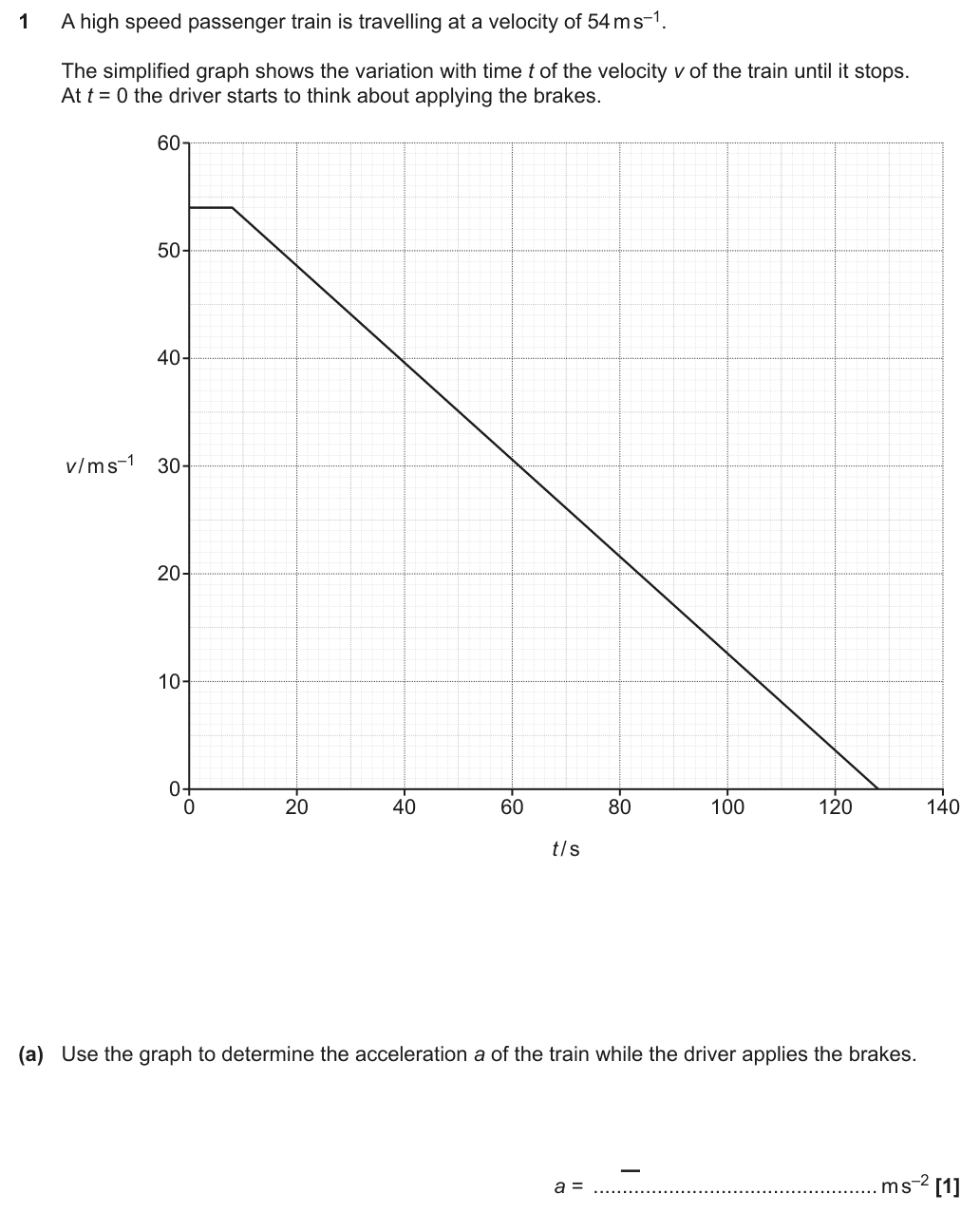
June 2025 · AS Paper 2 · Q1(a) 1 mark Calculation Medium kinematics
1 A high speed passenger train is travelling at a velocity of 54 m s–1.
The simplified graph shows the variation with time t of the velocity v of the train until it stops.
At t = 0 the driver starts to think about applying the brakes.
60
50
40
v / m s–1 30
20
10
0
0 20 40 60 80 100 120 140
t / s
(a) Use the graph to determine the acceleration a of the train while the driver applies the brakes.
–
a =  ................................................. m s–2 [1]
June 2025 · AS Paper 2 · Q1(b) 2 marks Calculation Medium kinematicslinear motion
Earlier part of question 1 that this part usesEarlier part of June 2025 Paper 2 question 1
(b) Use the graph to determine the total stopping distance d of the train from t = 0.
d =  ...................................................... m [2]
June 2025 · AS Paper 2 · Q1(c) 2 marks Explanation Medium kinematics
Earlier part of question 1 that this part usesEarlier part of June 2025 Paper 2 question 1
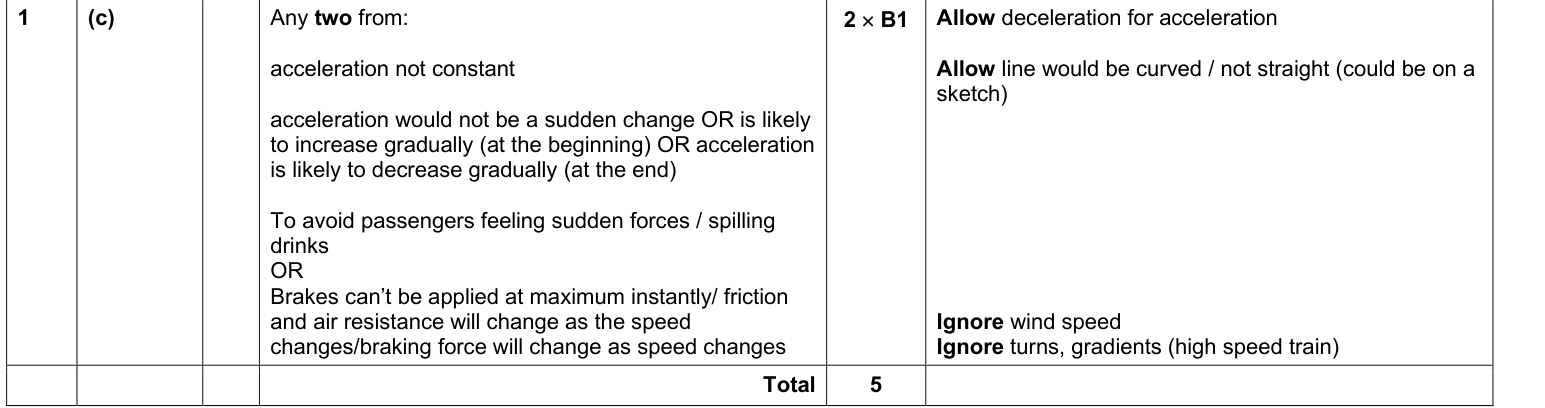
(c) Suggest why the graph does not show the real motion of the train.
..........................................................................................................................................................
..........................................................................................................................................................
..................................................................................................................................................... [2]
June 2025 · AS Paper 2 · Q2(a)(i) 2 marks Show that Medium density and pressurepractical skills
2
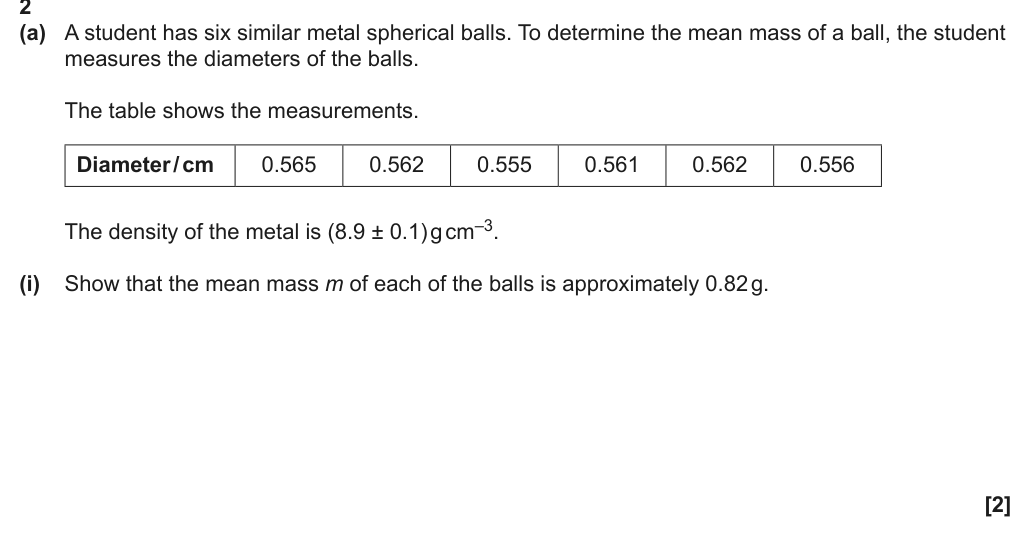
(a) A student has six similar metal spherical balls. To determine the mean mass of a ball, the student
measures the diameters of the balls.
The table shows the measurements.
Diameter / cm 0.565 0.562 0.555 0.561 0.562 0.556
The density of the metal is (8.9 ± 0.1) g cm–3.
(i) Show that the mean mass m of each of the balls is approximately 0.82 g.
[2]
June 2025 · AS Paper 2 · Q2(a)(ii) 2 marks Calculation Hard measurements and uncertainties

Earlier part of question 2 that this part usesEarlier part of June 2025 Paper 2 question 2
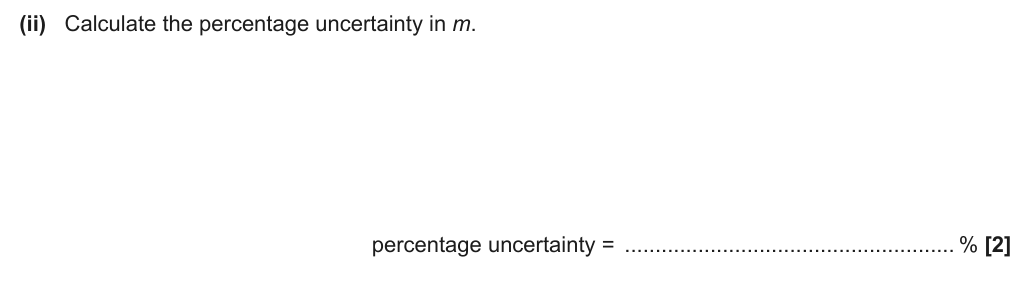
(ii) Calculate the percentage uncertainty in m.
percentage uncertainty =  ...................................................... % [2]
June 2025 · AS Paper 2 · Q2(b)(i) 3 marks Calculation Medium density and pressureequilibrium and moments
Earlier part of question 2 that this part usesEarlier part of June 2025 Paper 2 question 2
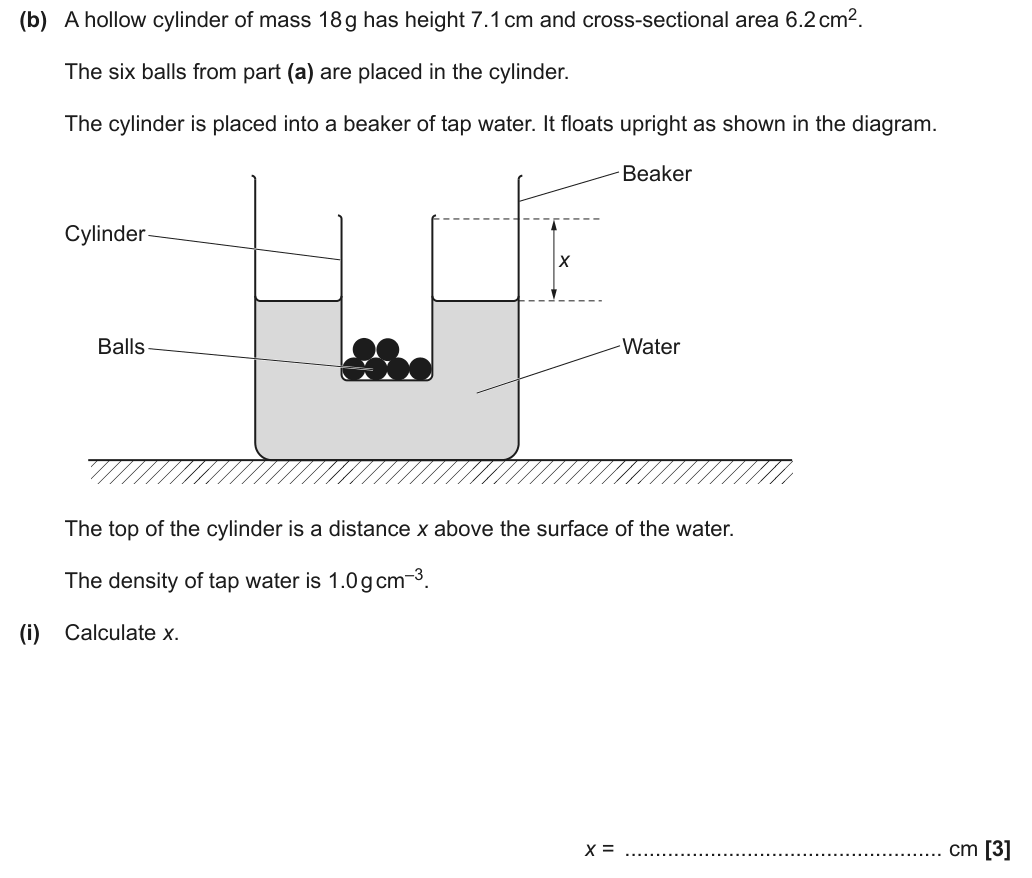
(b) A hollow cylinder of mass 18 g has height 7.1 cm and cross-sectional area 6.2 cm2.
The six balls from part (a) are placed in the cylinder.
The cylinder is placed into a beaker of tap water. It floats upright as shown in the diagram.
Beaker
Cylinder
x
Balls Water
The top of the cylinder is a distance x above the surface of the water.
The density of tap water is 1.0 g cm–3.
(i) Calculate x.
x =  .................................................... cm [3]
June 2025 · AS Paper 2 · Q2(b)(ii) 2 marks Explanation Hard density and pressure
Earlier part of question 2 that this part usesEarlier part of June 2025 Paper 2 question 2
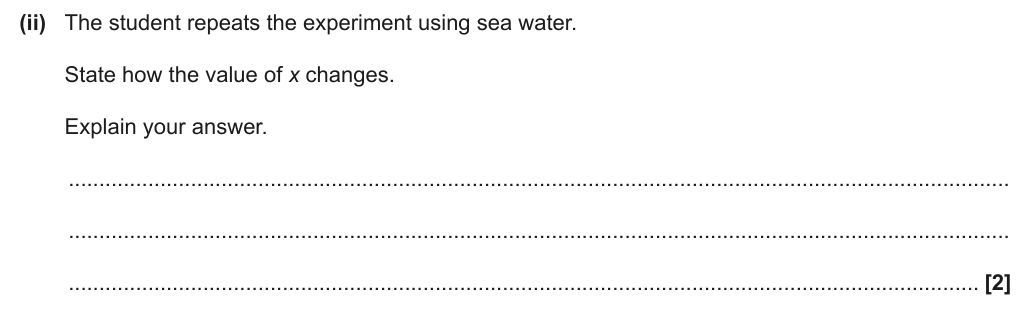
(ii) The student repeats the experiment using sea water.
State how the value of x changes.
Explain your answer.
..........................................................................................................................................................
..........................................................................................................................................................
..................................................................................................................................................... [2]
June 2025 · AS Paper 2 · Q3(a)(i) 1 mark Diagram or graph Medium charge and current
3
(a) To investigate mobile charge carriers, a student soaks a sheet of filter paper in a solution of salt.
They fix metal conductors to the filter paper and connect the conductors to a power supply as
shown in Fig. 3.1.
Fig. 3.1
Filter paper
+ Middle of Metal conductors
Y Z
filter paper
–
The student places two different soluble coloured crystals, Y and Z, on the middle of the filter
paper as shown.
They close the switch.
After 20 s, due to the movement of the mobile charge carriers in crystals Y and Z, the filter paper
appears as shown in Fig. 3.2.
Fig. 3.2
Filter paper
+ Z
Y
–
(i) On the filter paper shown in Fig. 3.2, draw an arrow to indicate the conventional current I for the
visible charge carriers of crystal Z. Label the arrow I. [1]
June 2025 · AS Paper 2 · Q3(a)(ii) 4 marks Explanation Hard charge and current
Earlier part of question 3 that this part usesEarlier part of June 2025 Paper 2 question 3
(ii) Compare the visible charge carriers of crystal Y with the visible charge carriers of crystal Z.
Explain your answer.
..........................................................................................................................................................
..........................................................................................................................................................
..........................................................................................................................................................
..........................................................................................................................................................
..........................................................................................................................................................
..................................................................................................................................................... [4]
June 2025 · AS Paper 2 · Q3(b)(i) 2 marks Calculation Easy potential dividers
(b) A student sets up the circuit shown in Fig. 3.3.
Fig. 3.3
1.2 kΩ V
4.8 V
The battery has an electromotive force (e.m.f.) of 4.8 V and negligible internal resistance.
The voltmeter measures the potential difference (p.d.) across the resistor of resistance 1.2 kΩ.
(i) At a temperature of 20 °C, the resistance of the thermistor is 2.6 kΩ.
Calculate the voltmeter reading V.
V =  ....................................................... V [2]
June 2025 · AS Paper 2 · Q3(b)(ii) 2 marks Calculation Medium potential dividers
Earlier part of question 3 that this part usesEarlier part of June 2025 Paper 2 question 3
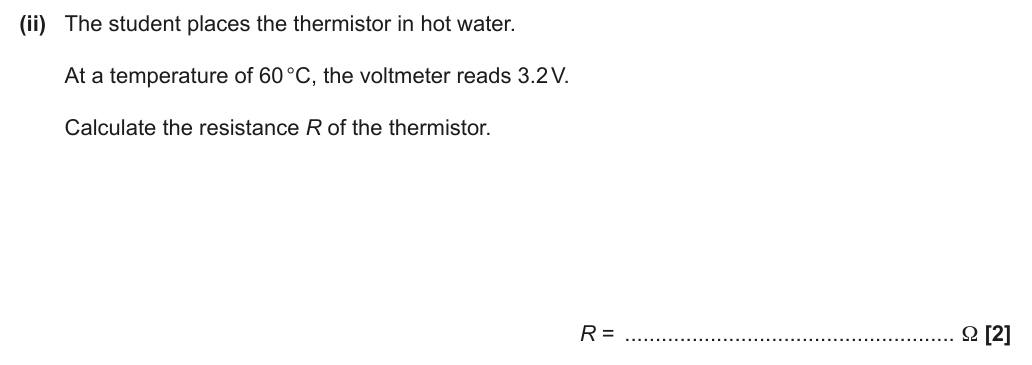
(ii) The student places the thermistor in hot water.
At a temperature of 60 °C, the voltmeter reads 3.2 V.
Calculate the resistance R of the thermistor.
R =  ...................................................... Ω [2]
June 2025 · AS Paper 2 · Q3(b)(iii) 2 marks Explanation Hard potential dividerspractical skills
Earlier parts of question 3 that this part usesEarlier part of June 2025 Paper 2 question 3Earlier part of June 2025 Paper 2 question 3
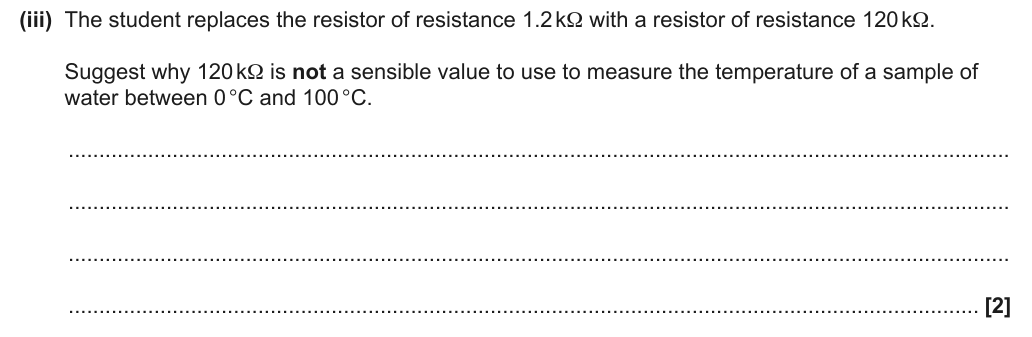
(iii) The student replaces the resistor of resistance 1.2 kΩ with a resistor of resistance 120 kΩ.
Suggest why 120 kΩ is not a sensible value to use to measure the temperature of a sample of
water between 0 °C and 100 °C.
..........................................................................................................................................................
..........................................................................................................................................................
..........................................................................................................................................................
..................................................................................................................................................... [2]
June 2025 · AS Paper 2 · Q4(a) 2 marks Explanation Hard emf pd and resistance
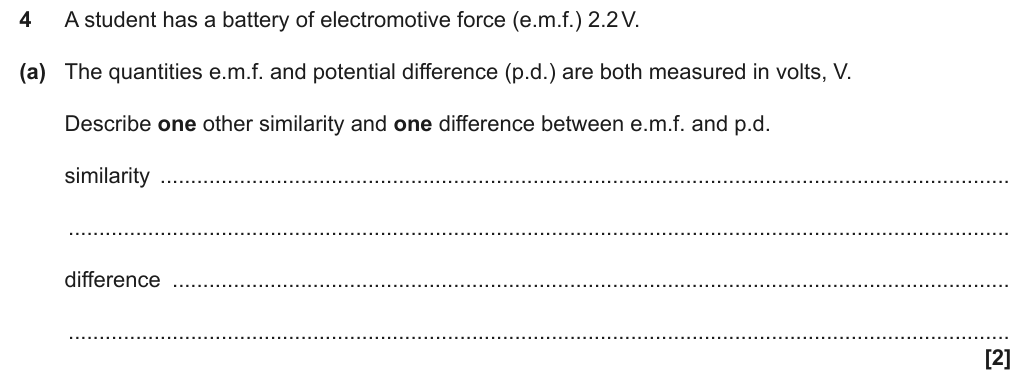
4 A student has a battery of electromotive force (e.m.f.) 2.2 V.
(a) The quantities e.m.f. and potential difference (p.d.) are both measured in volts, V.
Describe one other similarity and one difference between e.m.f. and p.d.
similarity  ...........................................................................................................................................
..........................................................................................................................................................
difference  .........................................................................................................................................
..........................................................................................................................................................
[2]
June 2025 · AS Paper 2 · Q4(b) 6 marks 6-mark extended response Hard potential dividerspractical skillsemf pd and resistance
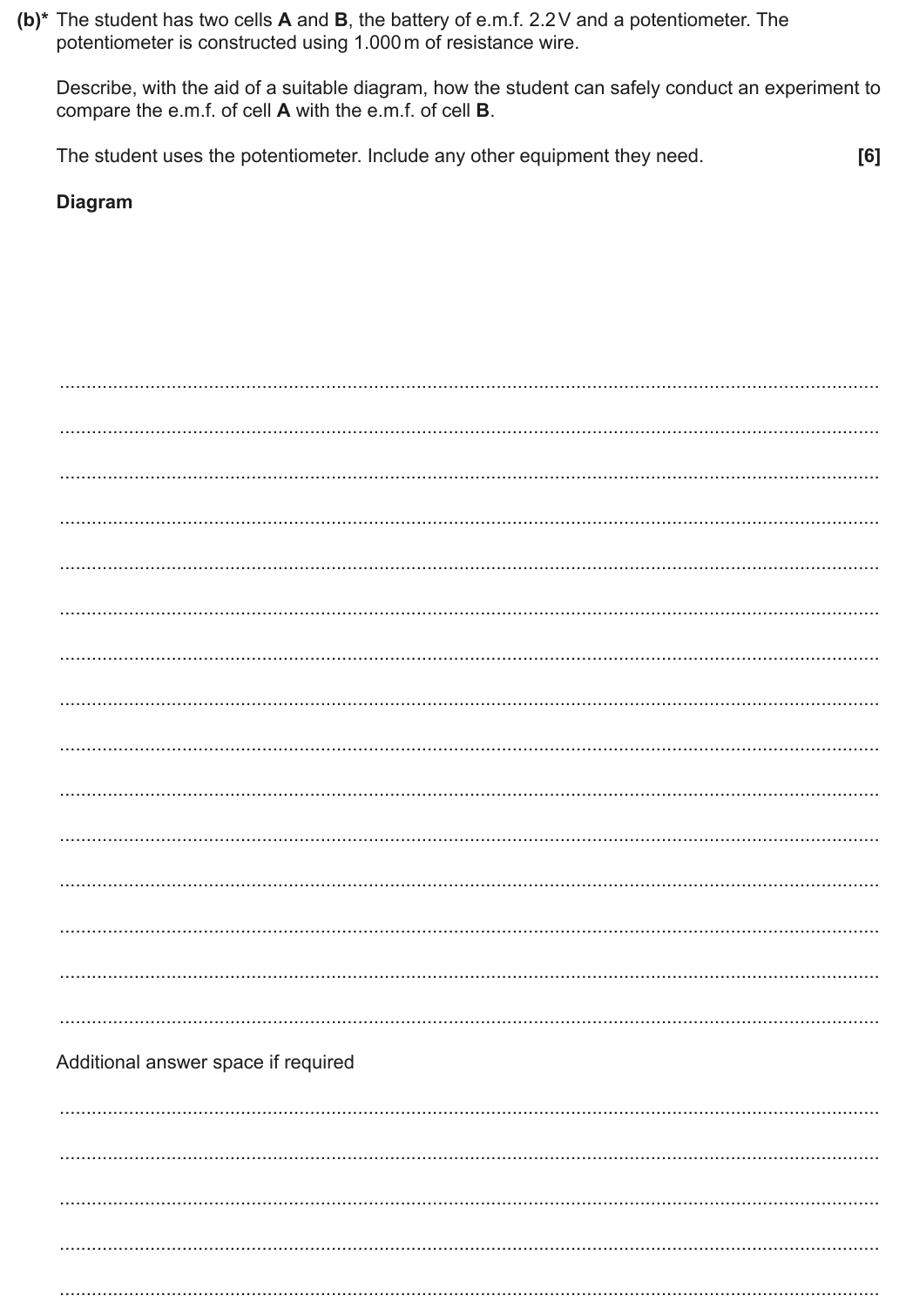
(b)* The student has two cells A and B, the battery of e.m.f. 2.2 V and a potentiometer. The
potentiometer is constructed using 1.000 m of resistance wire.
Describe, with the aid of a suitable diagram, how the student can safely conduct an experiment to
compare the e.m.f. of cell A with the e.m.f. of cell B.
The student uses the potentiometer. Include any other equipment they need. [6]
June 2025 · AS Paper 2 · Q5(a)(i) 4 marks Diagram or graph Medium dynamics and terminal velocity
Diagram
..........................................................................................................................................................
..........................................................................................................................................................
..........................................................................................................................................................
..........................................................................................................................................................
..........................................................................................................................................................
..........................................................................................................................................................
..........................................................................................................................................................
..........................................................................................................................................................
..........................................................................................................................................................
..........................................................................................................................................................
..........................................................................................................................................................
..........................................................................................................................................................
..........................................................................................................................................................
..........................................................................................................................................................
..........................................................................................................................................................
Additional answer space if required
..........................................................................................................................................................
..........................................................................................................................................................
..........................................................................................................................................................
..........................................................................................................................................................
..........................................................................................................................................................
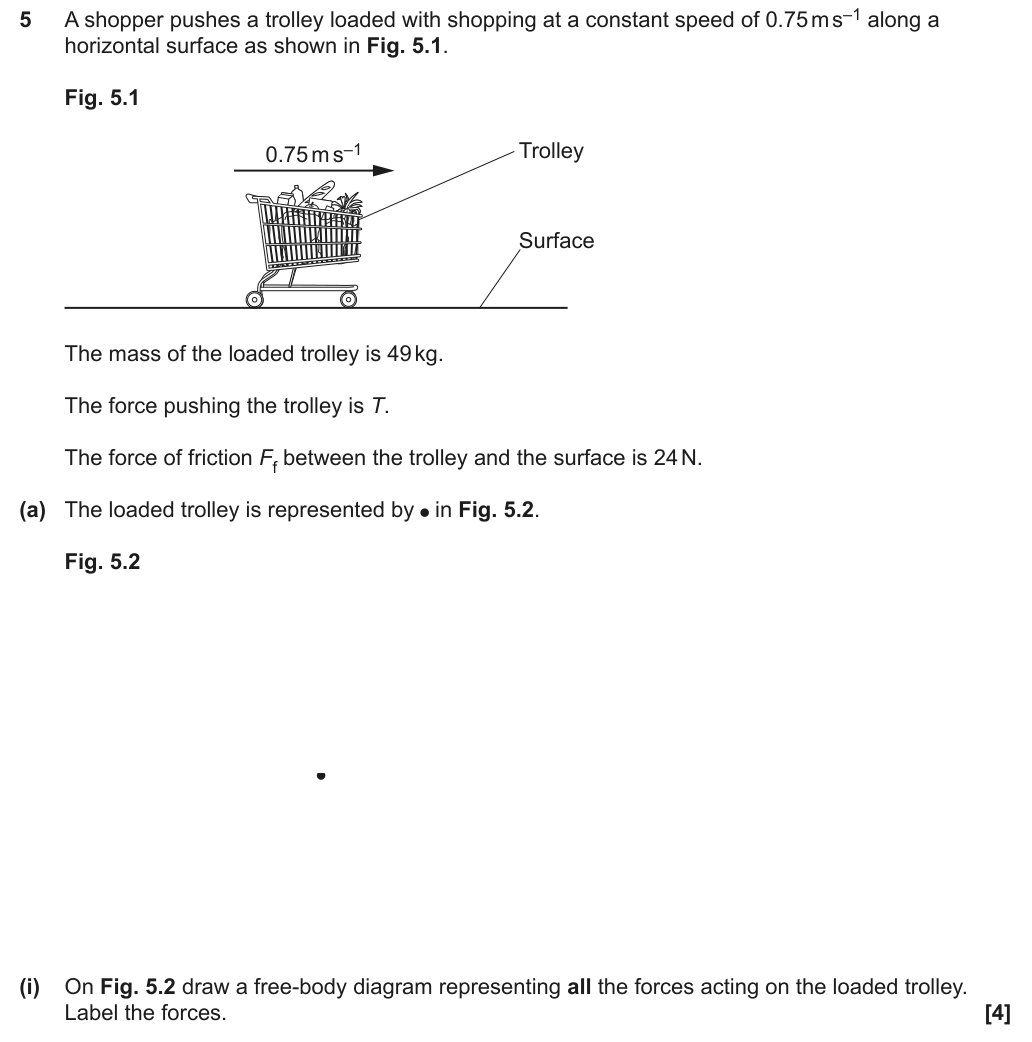
5 A shopper pushes a trolley loaded with shopping at a constant speed of 0.75 m s–1 along a
horizontal surface as shown in Fig. 5.1.
Fig. 5.1
0.75 m s–1 Trolley
Surface
The mass of the loaded trolley is 49 kg.
The force pushing the trolley is T.
The force of friction Ff between the trolley and the surface is 24 N.
(a) The loaded trolley is represented by  in Fig. 5.2.
Fig. 5.2
(i) On Fig. 5.2 draw a free-body diagram representing all the forces acting on the loaded trolley.
Label the forces. [4]
June 2025 · AS Paper 2 · Q5(a)(ii) 1 mark Calculation Medium newtons laws and momentumequilibrium and moments
Earlier part of question 5 that this part usesEarlier part of June 2025 Paper 2 question 5
(ii) State the value of T.
T =  ...................................................... N [1]
June 2025 · AS Paper 2 · Q5(b)(i) 2 marks Short answer Medium work energy and power
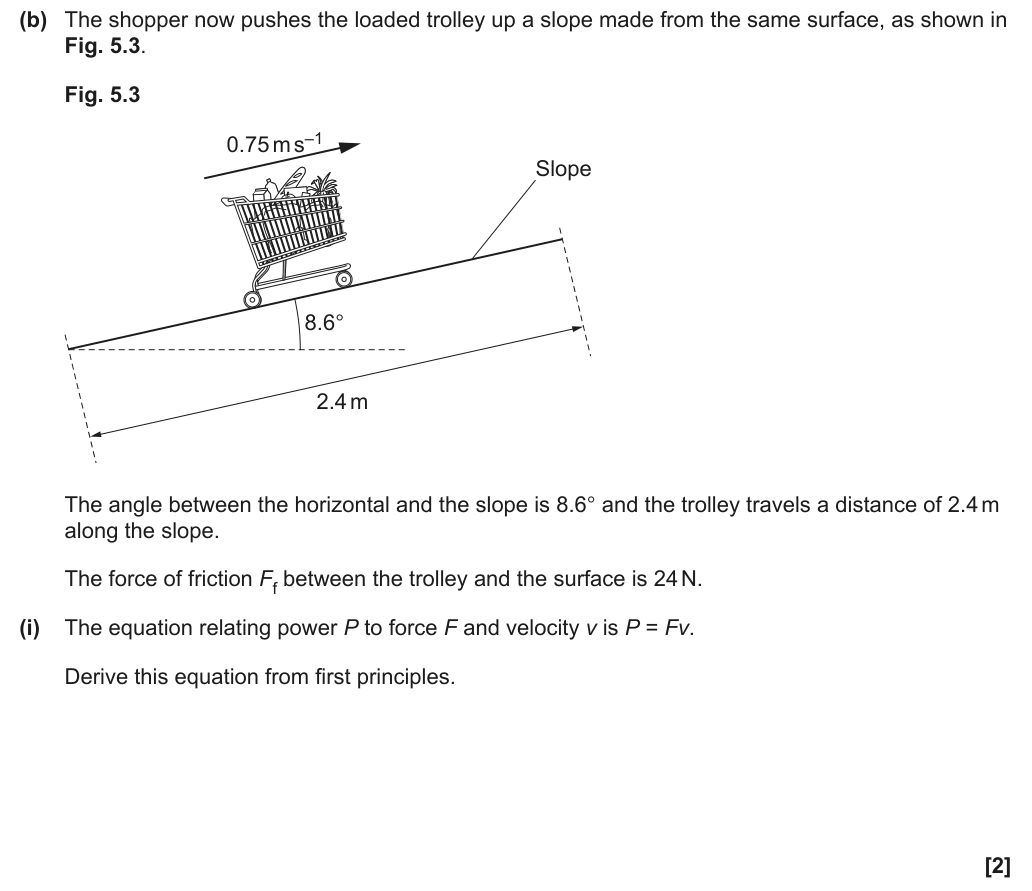
(b) The shopper now pushes the loaded trolley up a slope made from the same surface, as shown in
Fig. 5.3.
Fig. 5.3
0.75 m s–1
Slope
8.6°
2.4 m
The angle between the horizontal and the slope is 8.6° and the trolley travels a distance of 2.4 m
along the slope.
The force of friction Ff between the trolley and the surface is 24 N.
(i) The equation relating power P to force F and velocity v is P = Fv.
Derive this equation from first principles.
[2]
June 2025 · AS Paper 2 · Q5(b)(ii) 2 marks Calculation Medium work energy and powerscalars and vectors
Earlier parts of question 5 that this part usesEarlier part of June 2025 Paper 2 question 5Earlier part of June 2025 Paper 2 question 5
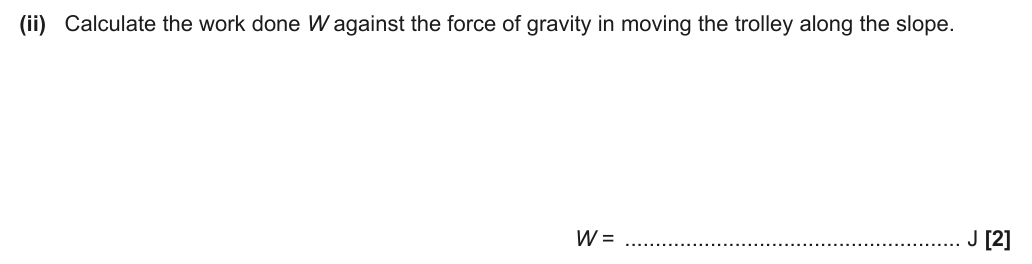
(ii) Calculate the work done W against the force of gravity in moving the trolley along the slope.
W =  ....................................................... J [2]
June 2025 · AS Paper 2 · Q5(b)(iii) 2 marks Calculation Hard work energy and power
Earlier parts of question 5 that this part usesEarlier part of June 2025 Paper 2 question 5Earlier part of June 2025 Paper 2 question 5
(iii) Calculate the total power P needed to push the trolley up the slope at a constant speed of
0.75 m s–1.
P =  ...................................................... W [2]
June 2025 · AS Paper 2 · Q6(a) 2 marks Short answer Medium collisions
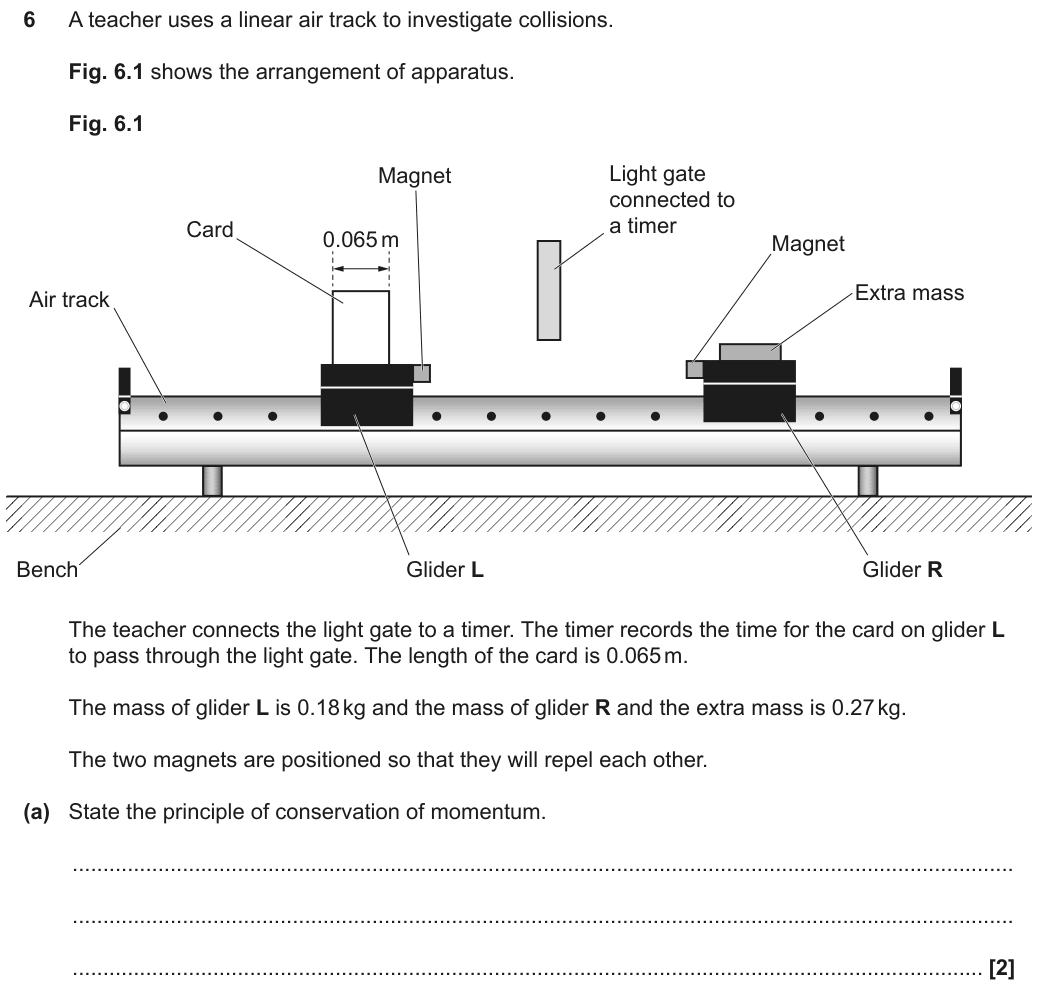
6 A teacher uses a linear air track to investigate collisions.
Fig. 6.1 shows the arrangement of apparatus.
Fig. 6.1
Magnet Light gate
connected to
Card a timer
0.065 m Magnet
Extra mass
Air track
Bench Glider L Glider R
The teacher connects the light gate to a timer. The timer records the time for the card on glider L
to pass through the light gate. The length of the card is 0.065 m.
The mass of glider L is 0.18 kg and the mass of glider R and the extra mass is 0.27 kg.
The two magnets are positioned so that they will repel each other.
(a) State the principle of conservation of momentum.
..........................................................................................................................................................
..........................................................................................................................................................
..................................................................................................................................................... [2]
June 2025 · AS Paper 2 · Q6(b)(i) 1 mark Show that Medium newtons laws and momentumkinematics
Earlier part of question 6 that this part usesEarlier part of June 2025 Paper 2 question 6
(b) Glider R is stationary. Glider L moves at velocity u from left to right and collides with R.
After the collision L rebounds and passes back through the light gate and R moves to the right.
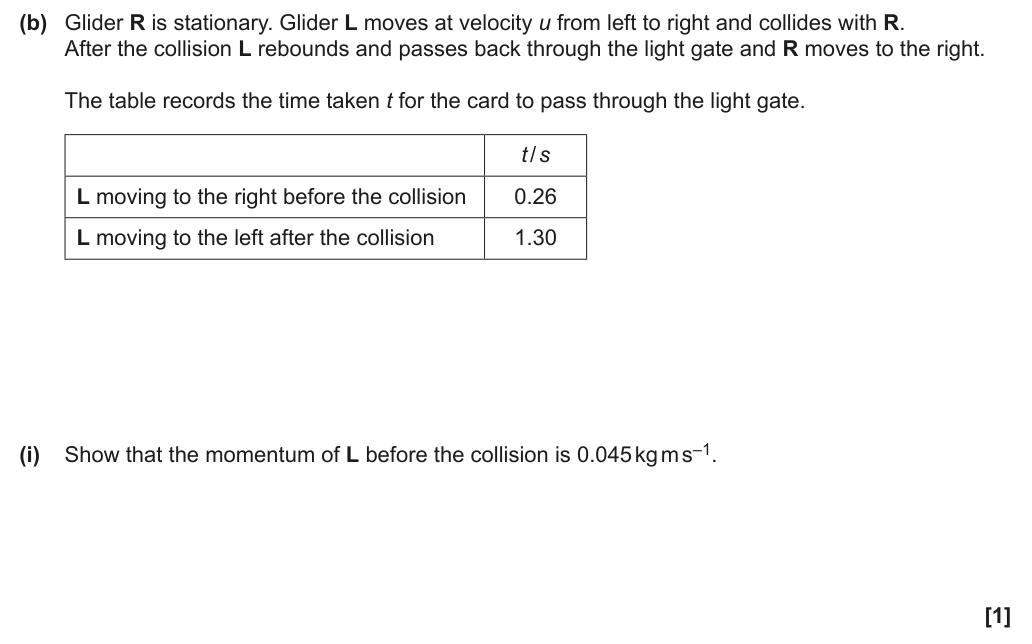
The table records the time taken t for the card to pass through the light gate.
t / s
L moving to the right before the collision 0.26
L moving to the left after the collision 1.30
(i) Show that the momentum of L before the collision is 0.045 kg m s–1.
[1]
June 2025 · AS Paper 2 · Q6(b)(ii) 2 marks Calculation Medium newtons laws and momentumcollisions
Earlier parts of question 6 that this part usesEarlier part of June 2025 Paper 2 question 6Earlier part of June 2025 Paper 2 question 6
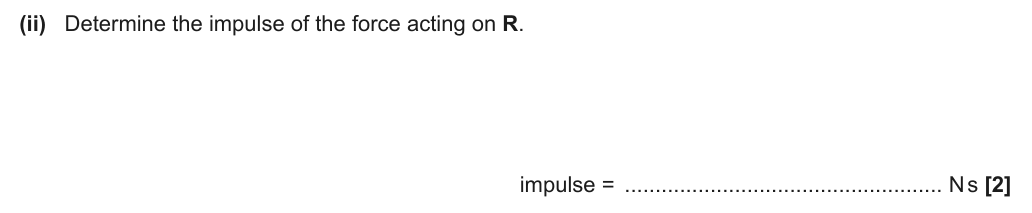
(ii) Determine the impulse of the force acting on R.
impulse =  .................................................... N s [2]
June 2025 · AS Paper 2 · Q6(b)(iii) 1 mark Calculation Medium newtons laws and momentum
Earlier parts of question 6 that this part usesEarlier part of June 2025 Paper 2 question 6Earlier part of June 2025 Paper 2 question 6
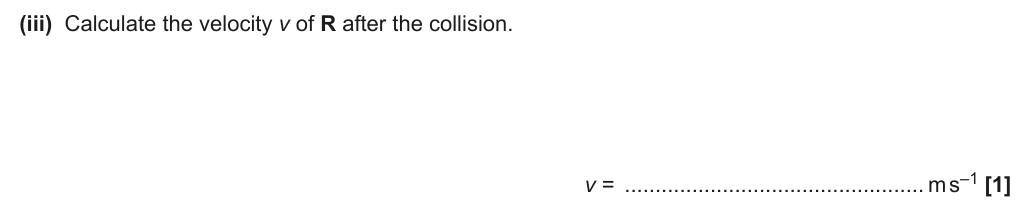
(iii) Calculate the velocity v of R after the collision.
v =  ................................................. m s–1 [1]
June 2025 · AS Paper 2 · Q6(c) 4 marks Short answer Medium collisionswork energy and powernewtons laws and momentum
Earlier parts of question 6 that this part usesEarlier part of June 2025 Paper 2 question 6Earlier part of June 2025 Paper 2 question 6
(c) The teacher changes one of the magnets to a cork and the other magnet to a pin and repeats the
experiment.
Glider L moves from left to right. The time for the card to pass through the light gate is 0.26 s.
Glider L collides and sticks to glider R. After the collision L and R move together to the right.
Show, using energy considerations and the principle of conservation of momentum, that the
collision is inelastic.
Include relevant calculations in your answer.
..........................................................................................................................................................
..........................................................................................................................................................
..................................................................................................................................................... [4]
June 2025 · AS Paper 2 · Q7(a) 2 marks Calculation Medium photons
7 A laser emits green light of wavelength 5.32 × 10⁻⁷ m.
(a) The power of the laser is 1.0 mW.
Calculate the number of photons N emitted per second.
N =  .................................................... s–1 [2]
June 2025 · AS Paper 2 · Q7(b)(i) 1 mark Short answer Medium superposition and interference
(b) A student uses the laser to look at the interference pattern through a double slit.
The student arranges the apparatus as shown in Fig. 7.1.
Fig. 7.1 (not to scale)
1.80 m
Screen
Double slit
Laser
The width of the screen is about 6 cm.
The distance between the double slit and the screen is 1.80 m.
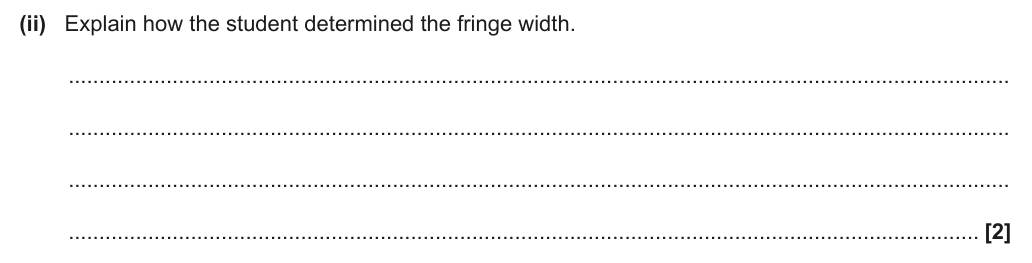
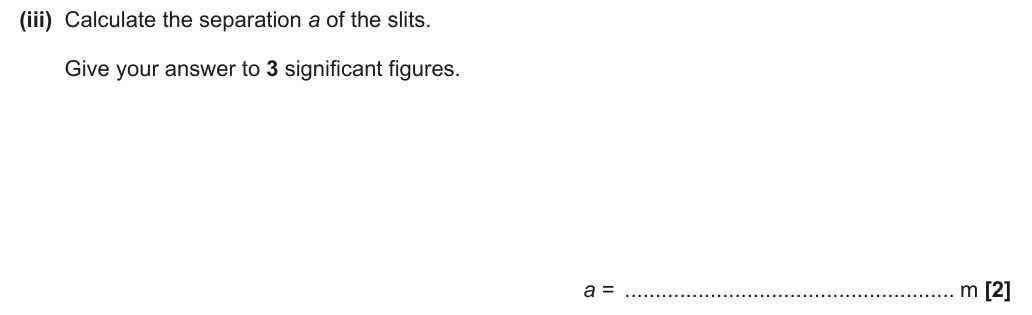
The student determines that the fringe width is 3.82 ± 0.02 mm.
(i) The light from the laser that falls on the double slit is coherent.
State the meaning of the term coherent.
..........................................................................................................................................................
..................................................................................................................................................... [1]
June 2025 · AS Paper 2 · Q7(b)(ii) 2 marks Explanation Hard superposition and interferencepractical skills
Earlier part of question 7 that this part usesEarlier part of June 2025 Paper 2 question 7
(ii) Explain how the student determined the fringe width.
..........................................................................................................................................................
..........................................................................................................................................................
..........................................................................................................................................................
..................................................................................................................................................... [2]
June 2025 · AS Paper 2 · Q7(b)(iii) 2 marks Calculation Easy superposition and interferencepractical skills
Earlier parts of question 7 that this part usesEarlier part of June 2025 Paper 2 question 7Earlier part of June 2025 Paper 2 question 7
(iii) Calculate the separation a of the slits.
Give your answer to 3 significant figures.
a =  ...................................................... m [2]
June 2025 · AS Paper 2 · Q7(c)(i) 1 mark Calculation Hard electromagnetic waves and refractionwave motion
Earlier part of question 7 that this part usesEarlier part of June 2025 Paper 2 question 7
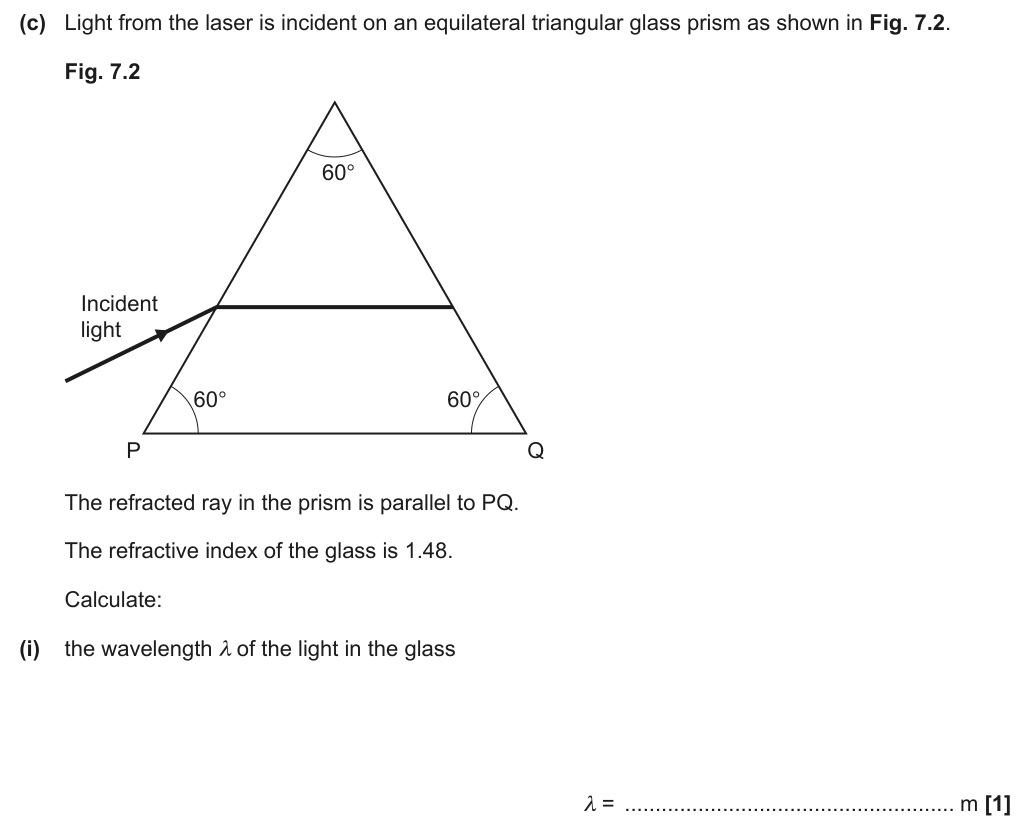
(c) Light from the laser is incident on an equilateral triangular glass prism as shown in Fig. 7.2.
Fig. 7.2
60°
Incident
light
60° 60°
P Q
The refracted ray in the prism is parallel to PQ.
The refractive index of the glass is 1.48.
Calculate:
(i) the wavelength λ of the light in the glass
λ =  ...................................................... m [1]
June 2025 · AS Paper 2 · Q7(c)(ii) 2 marks Calculation Medium electromagnetic waves and refraction
Earlier part of question 7 that this part usesEarlier part of June 2025 Paper 2 question 7
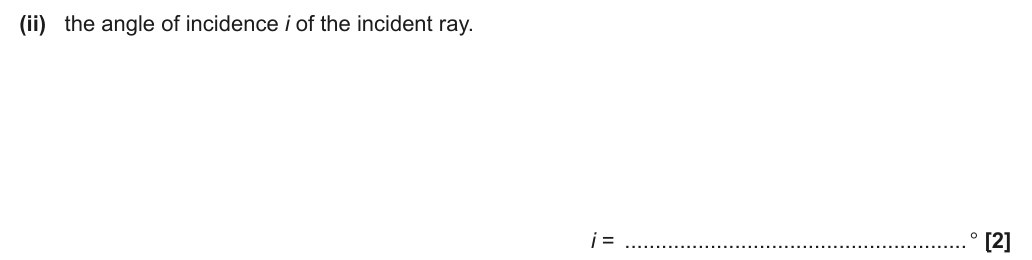
(ii) the angle of incidence i of the incident ray.
i =  ........................................................° [2]
June 2025 · AS Paper 2 · Q8 6 marks 6-mark extended response Medium photonspractical skillsmeasurements and uncertainties
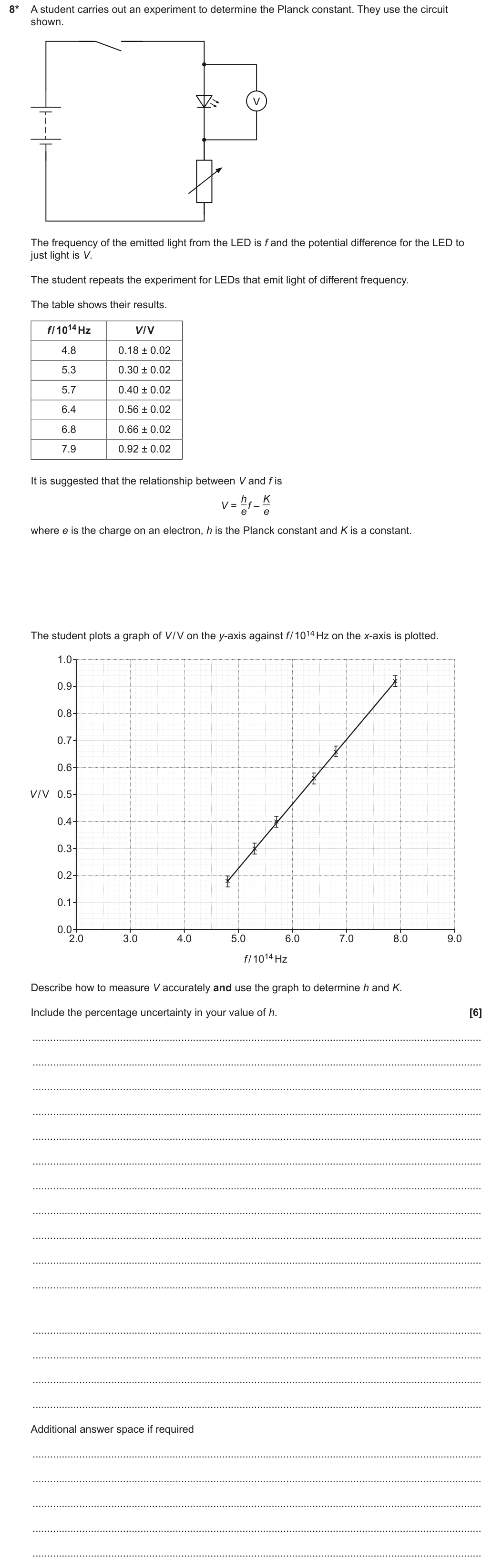
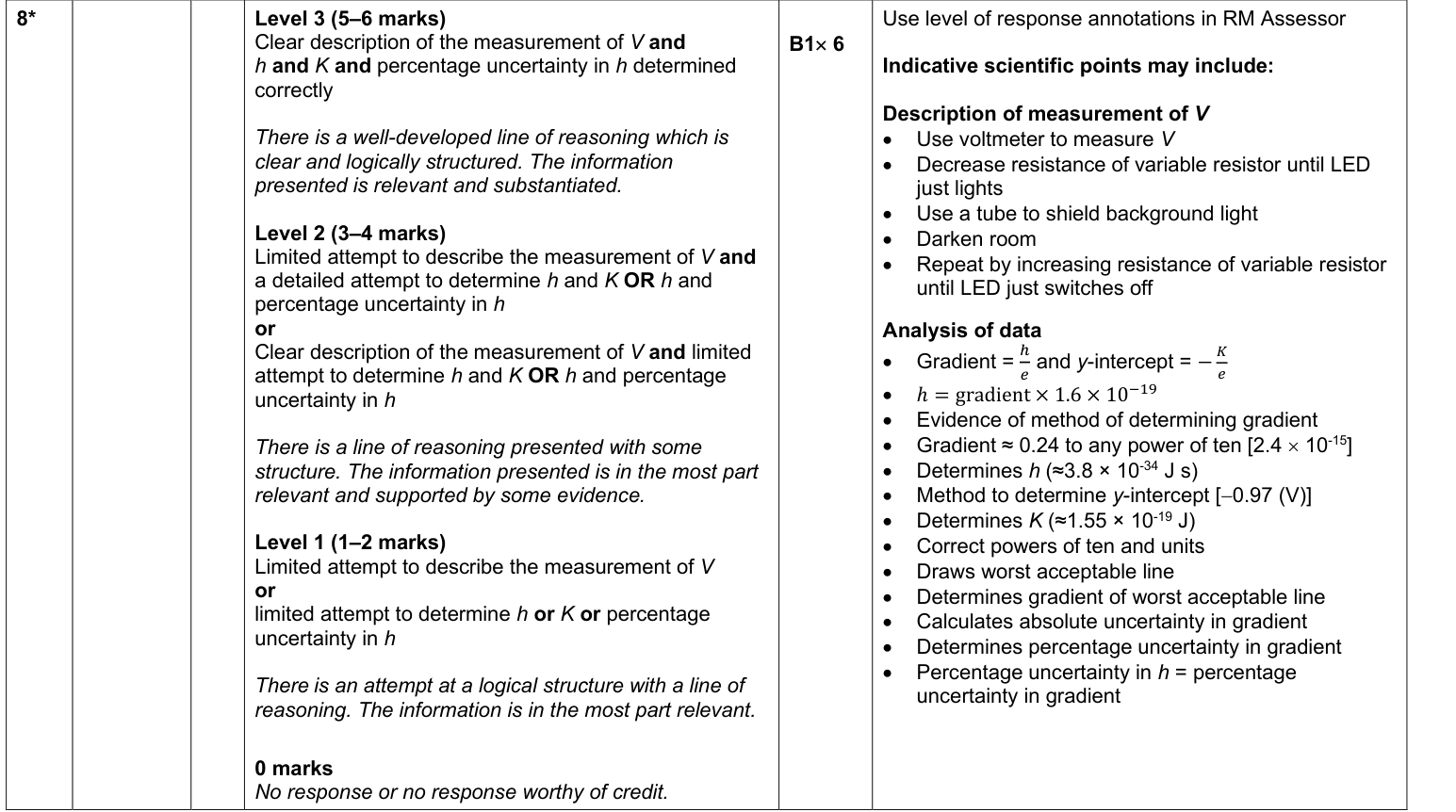
8* A student carries out an experiment to determine the Planck constant. They use the circuit
shown.
V
The frequency of the emitted light from the LED is f and the potential difference for the LED to
just light is V.
The student repeats the experiment for LEDs that emit light of different frequency.
The table shows their results.
f / 1014 Hz V / V
4.8 0.18 ± 0.02
5.3 0.30 ± 0.02
5.7 0.40 ± 0.02
6.4 0.56 ± 0.02
6.8 0.66 ± 0.02
7.9 0.92 ± 0.02
It is suggested that the relationship between V and f is
V = h ef – K
e
where e is the charge on an electron, h is the Planck constant and K is a constant.
The student plots a graph of V / V on the y-axis against f / 1014 Hz on the x-axis is plotted.
1.0
0.9
0.8
0.7
0.6
V / V 0.5
0.4
0.3
0.2
0.1
0.0
2.0 3.0 4.0 5.0 6.0 7.0 8.0 9.0
f / 1014 Hz
Describe how to measure V accurately and use the graph to determine h and K.
Include the percentage uncertainty in your value of h. [6]
..........................................................................................................................................................
..........................................................................................................................................................
..........................................................................................................................................................
..........................................................................................................................................................
..........................................................................................................................................................
..........................................................................................................................................................
..........................................................................................................................................................
..........................................................................................................................................................
..........................................................................................................................................................
..........................................................................................................................................................
..........................................................................................................................................................
..........................................................................................................................................................
..........................................................................................................................................................
..........................................................................................................................................................
..........................................................................................................................................................
Additional answer space if required
..........................................................................................................................................................
..........................................................................................................................................................
..........................................................................................................................................................
..........................................................................................................................................................
..........................................................................................................................................................

Work with an OCR physics tutor

Want a paper marked and gone through with you? Message us.

Prefer email? Send an enquiry

If you are under 18, please include a parent's contact details. Enquiries go to enquiries@physicsaleveltutor.com and are deleted once handled. All tutoring is online.