June 2018: AS Paper 2

70 marks · 47 question parts · Paper, mark scheme and report on AQA's site · Have the data and formulae booklet beside you

Question by question

QTopicMarksAOType
1.1 Motion along a straight line and projectile motion 3Calculation
1.2 Motion along a straight line and projectile motion 2Practical and data analysis
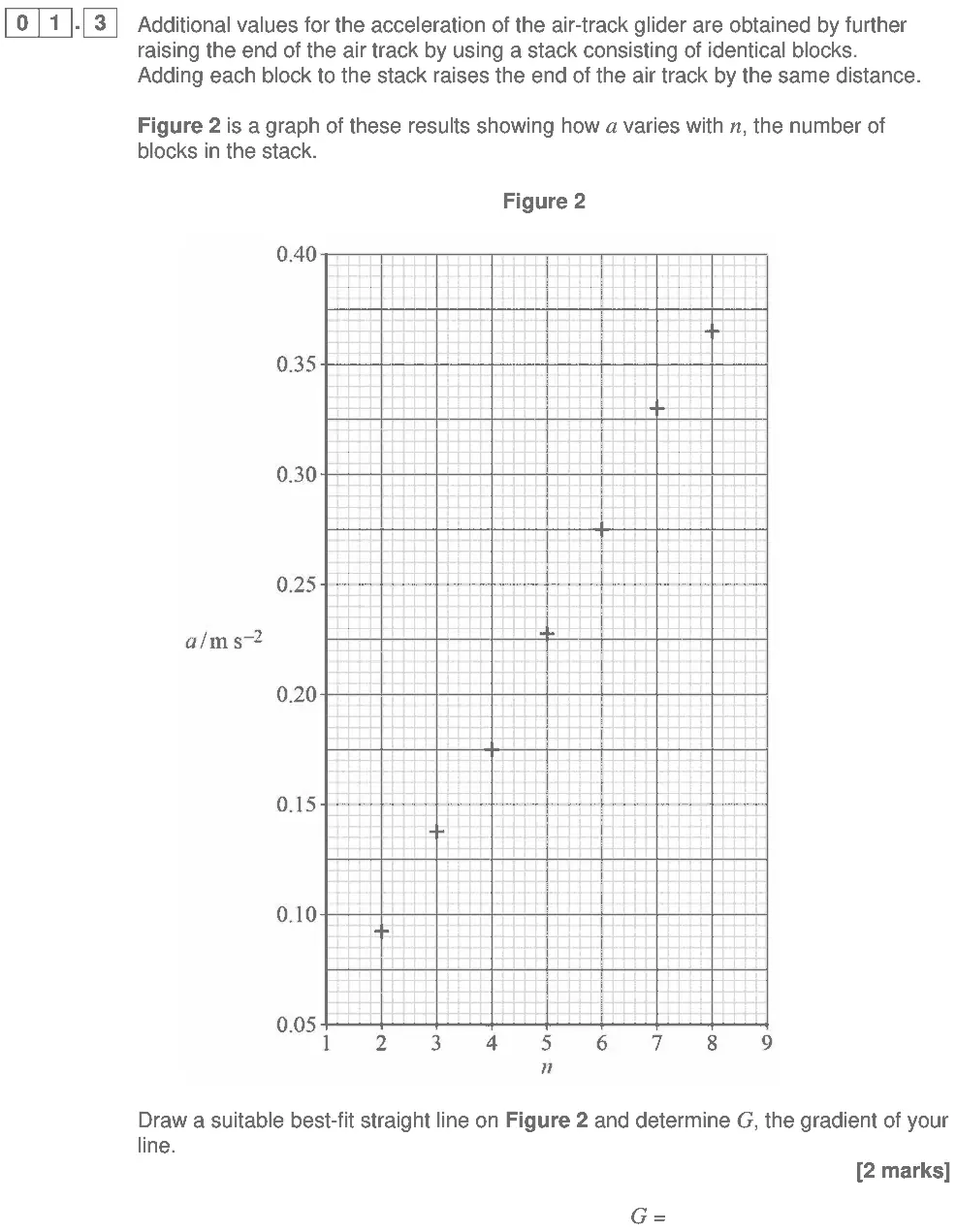
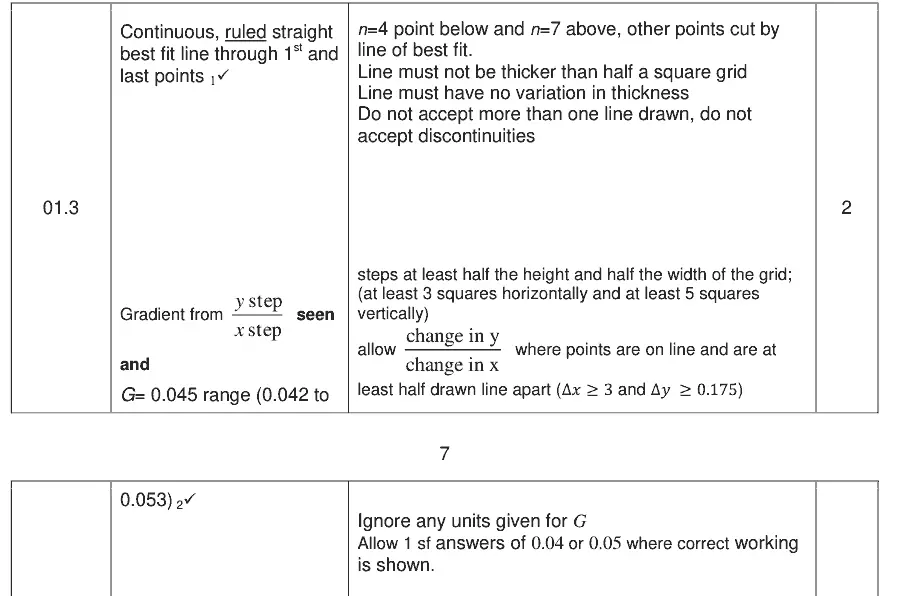
1.3 Motion along a straight line and projectile motion 2Diagram or graph
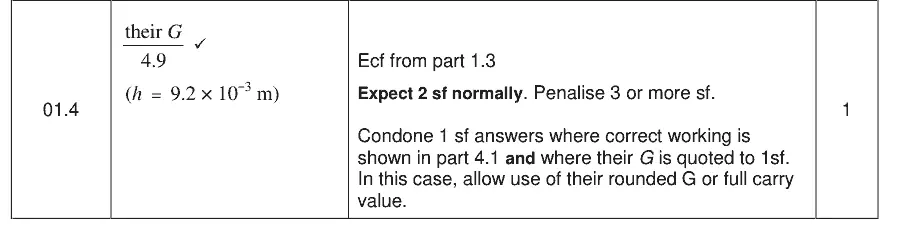
1.4 Motion along a straight line and projectile motion 1Calculation
1.5 Motion along a straight line and projectile motion 1Practical and data analysis
2.1 Measurements, units and uncertainties 2Practical and data analysis
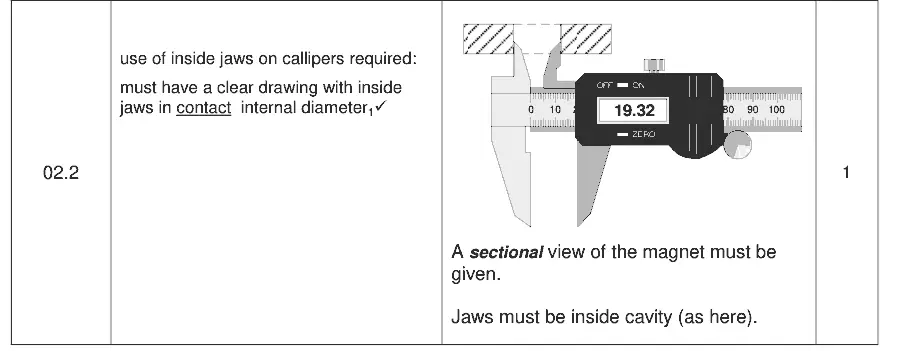
2.2 Measurements, units and uncertainties 1Diagram or graph
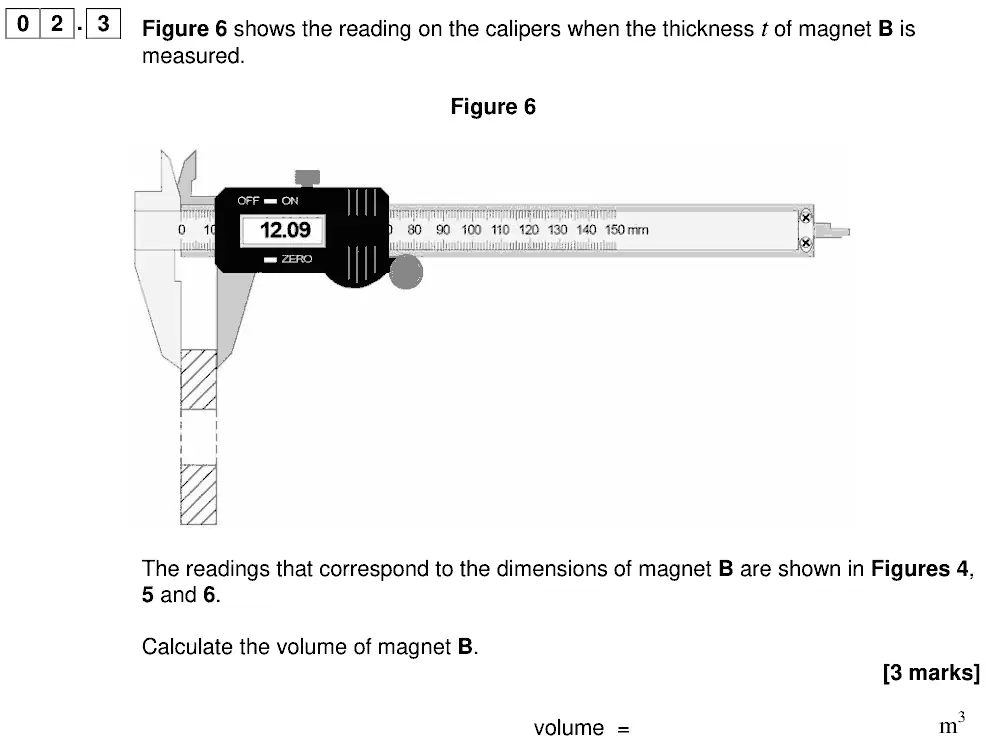
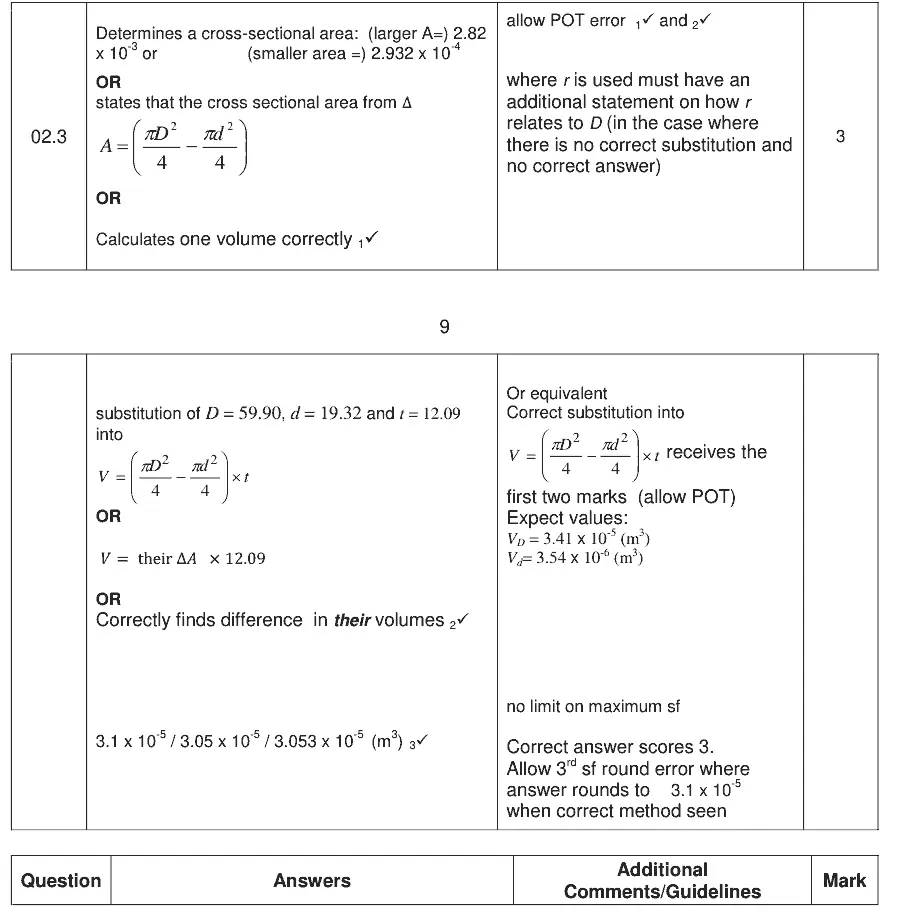
2.3 Measurements, units and uncertainties 3Calculation
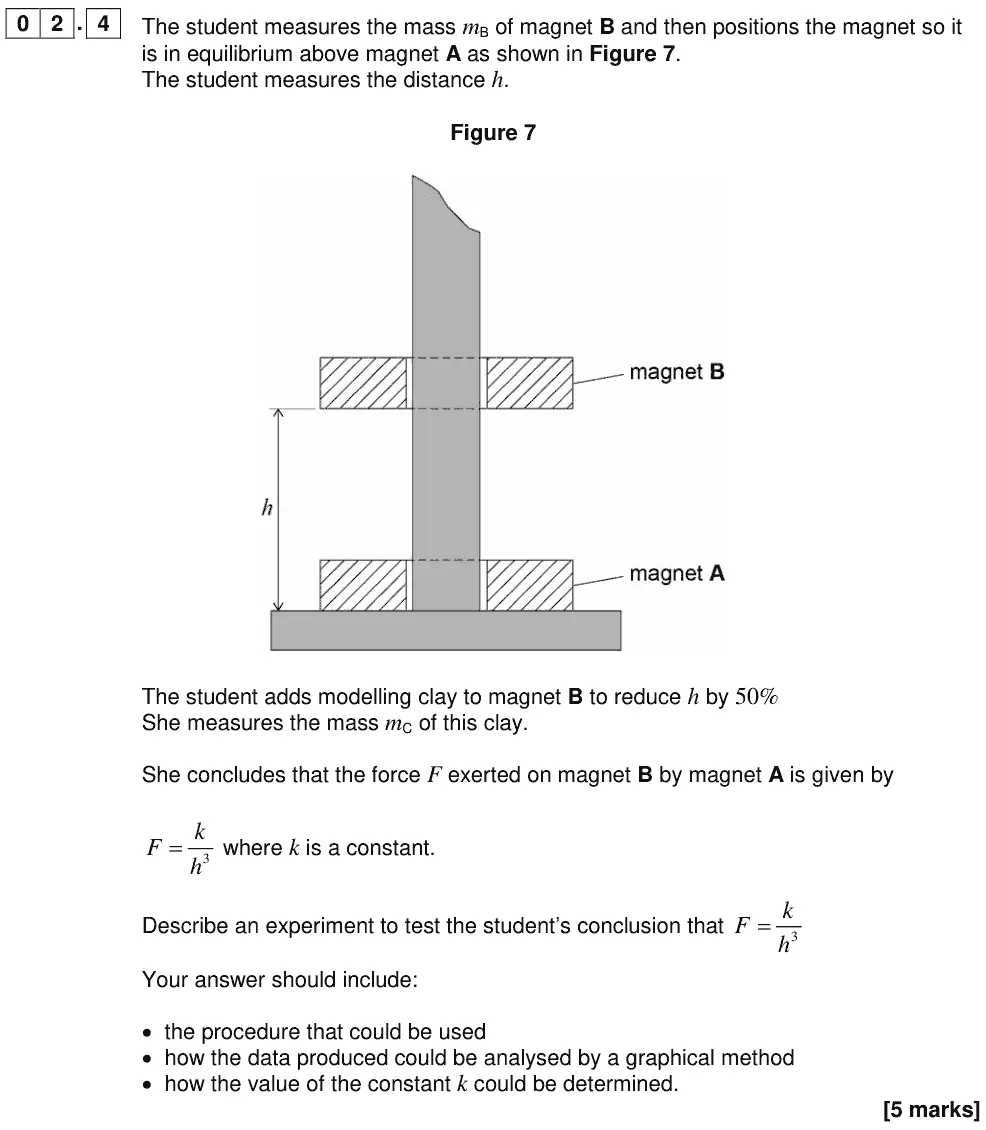
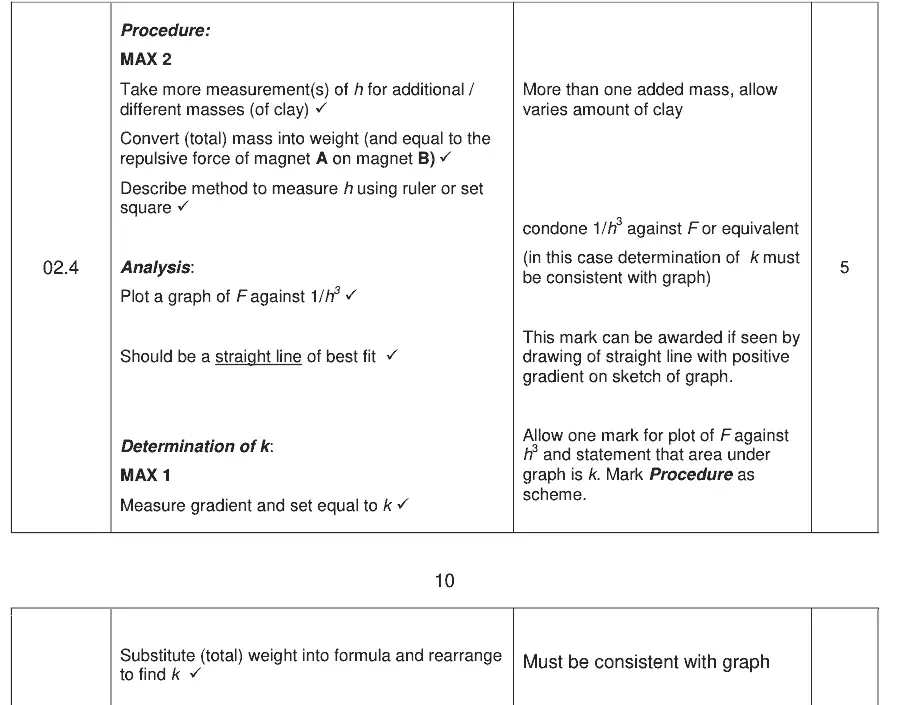
2.4 Scalars, vectors and moments, Newton's laws of motion and momentum 5Practical and data analysis
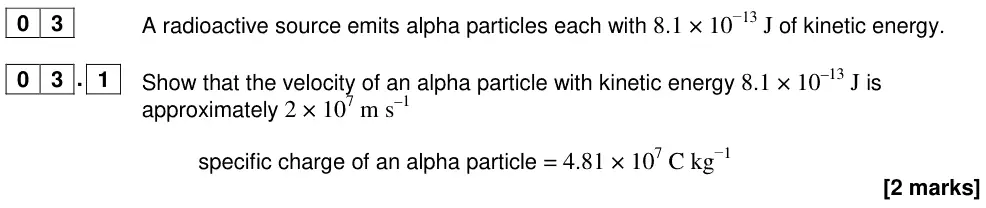
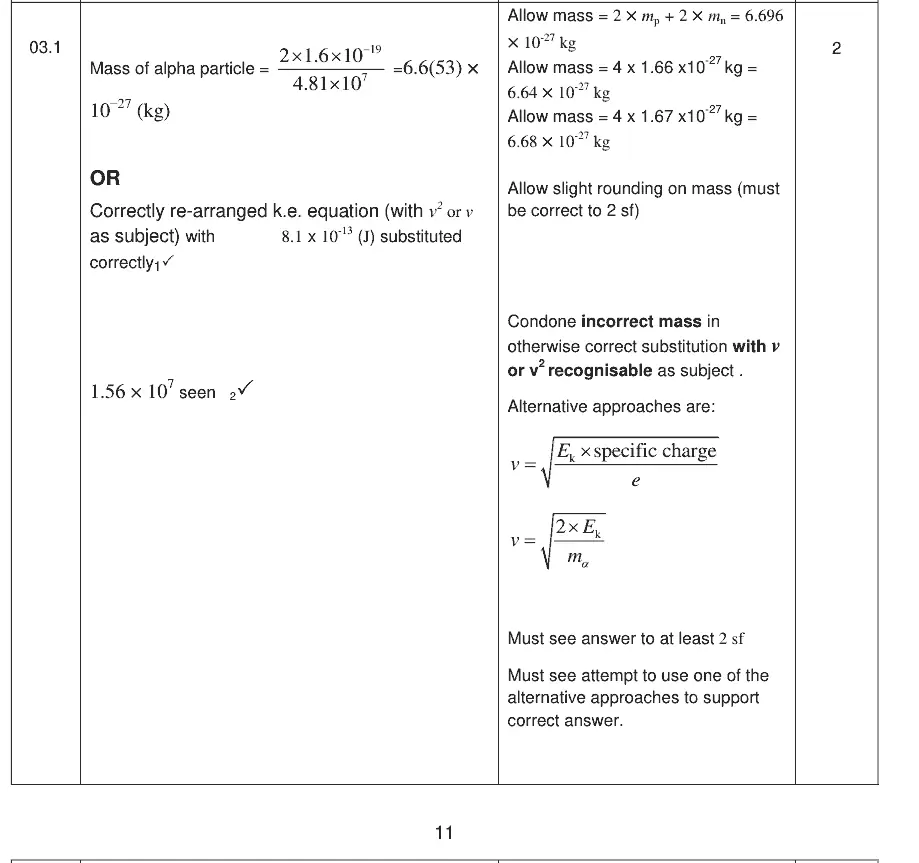
3.1 Work, energy, power and conservation of energy, Atomic structure and stable nuclei 2Show that
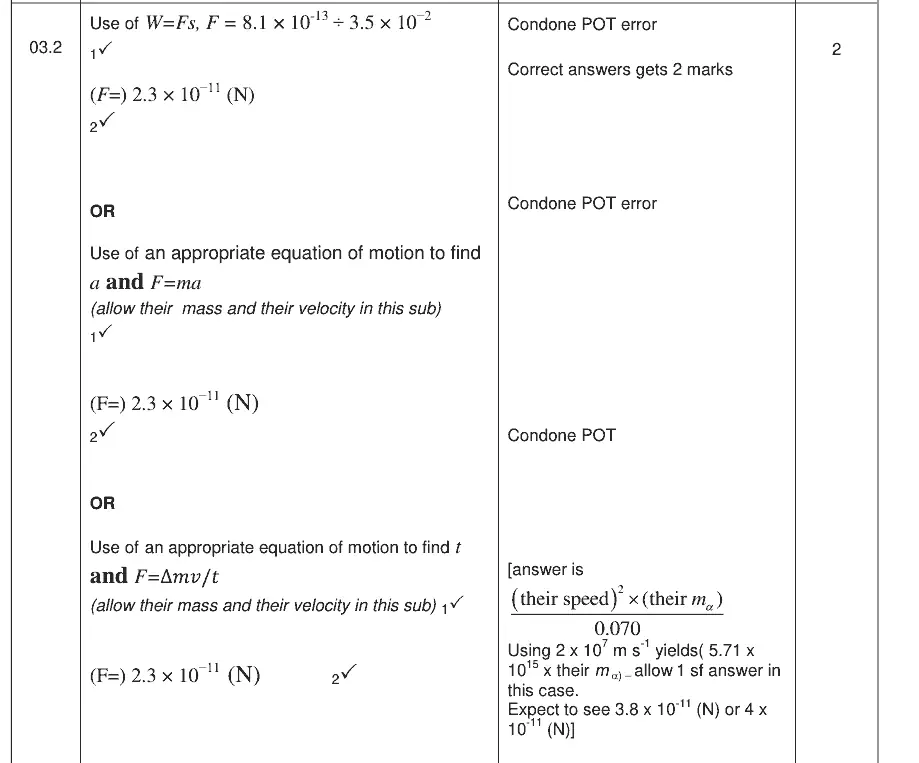
3.2 Work, energy, power and conservation of energy 2Calculation
3.3 Excitation, energy levels and wave-particle duality 3Calculation
3.4 Current, potential difference, I-V characteristics and resistivity 2Calculation
3.5 Circuits and potential dividers 3Explanation
4.1 Refraction, total internal reflection and optical fibres 3Calculation
4.2 Materials, stress, strain and the Young modulus, Newton's laws of motion and momentum 3Explanation
4.3 Materials, stress, strain and the Young modulus 2Explanation
5 Atomic structure and stable nuclei 1Multiple choice
6 Atomic structure and stable nuclei 1Multiple choice
7 Particles, antiparticles and particle interactions 1Multiple choice
8 Classification of particles, quarks and conservation laws 1Multiple choice
9 The photoelectric effect 1Multiple choice
10 Excitation, energy levels and wave-particle duality 1Multiple choice
11 Excitation, energy levels and wave-particle duality 1Multiple choice
12 Excitation, energy levels and wave-particle duality 1Multiple choice
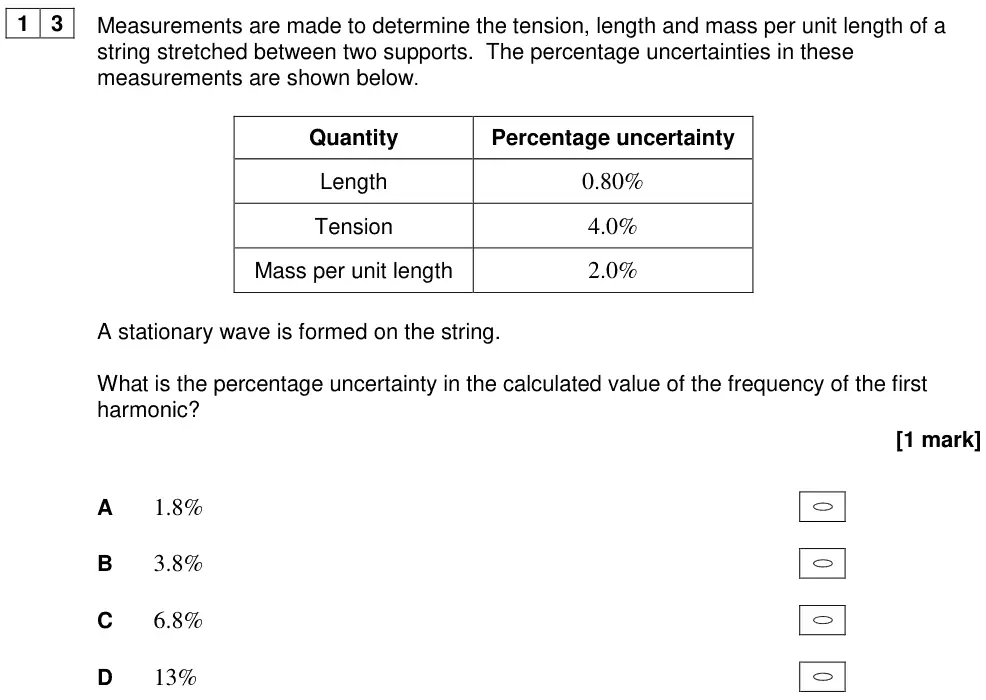
13 Measurements, units and uncertainties 1Multiple choice
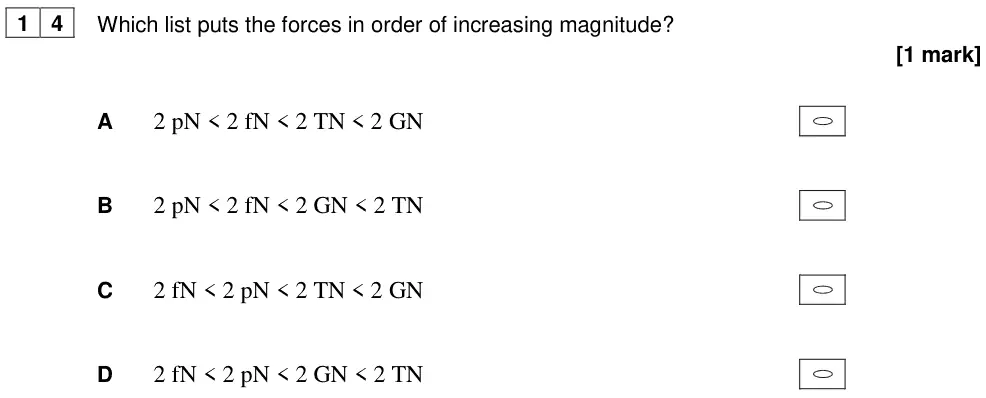
14 Measurements, units and uncertainties 1Multiple choice
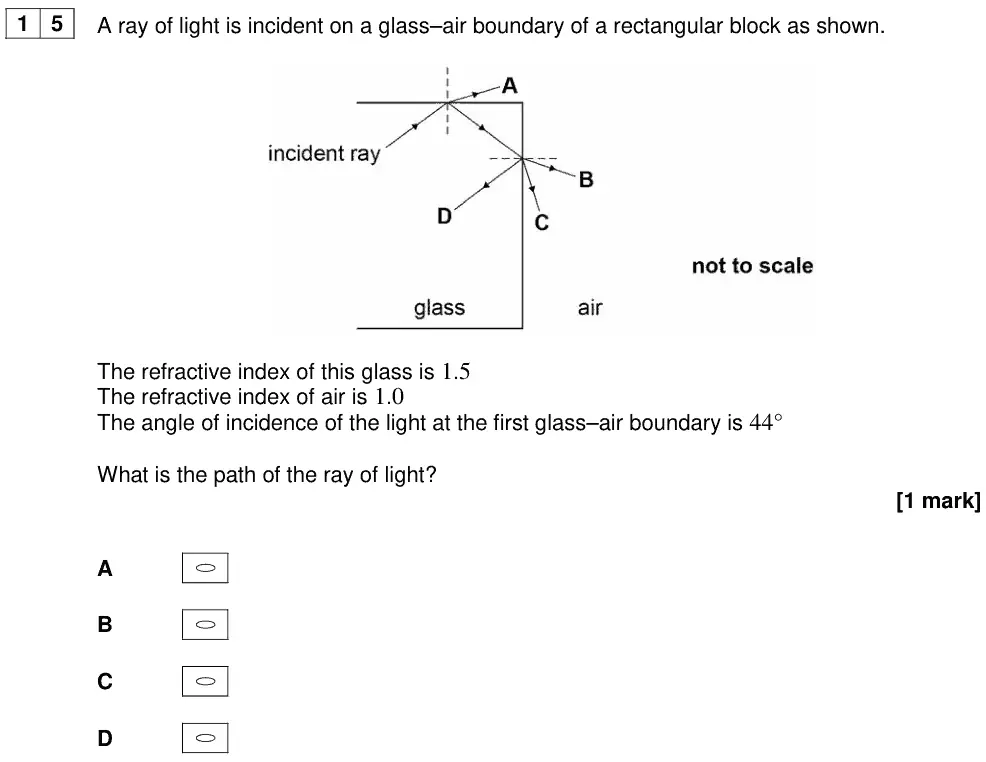
15 Refraction, total internal reflection and optical fibres 1Multiple choice
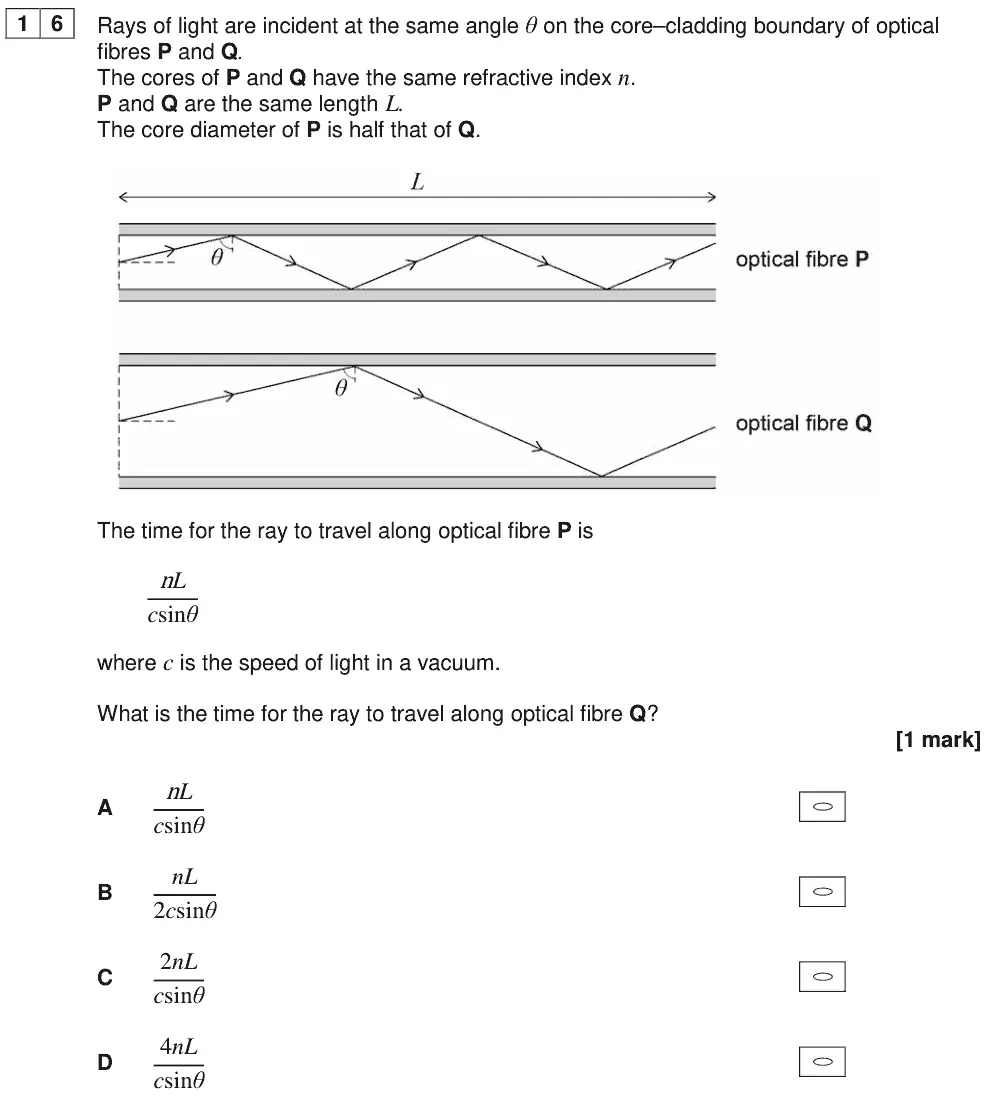
16 Refraction, total internal reflection and optical fibres 1Multiple choice
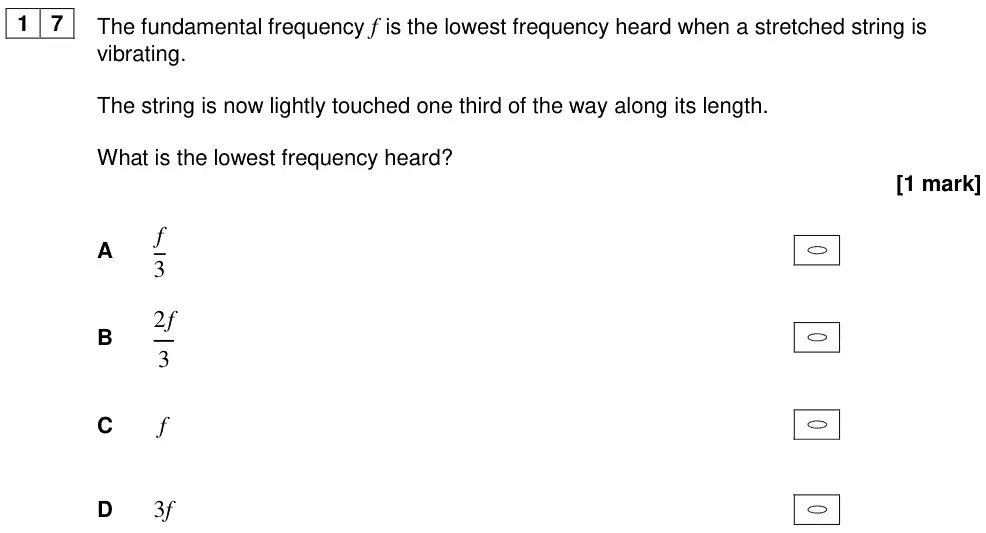
17 Superposition and stationary waves 1Multiple choice
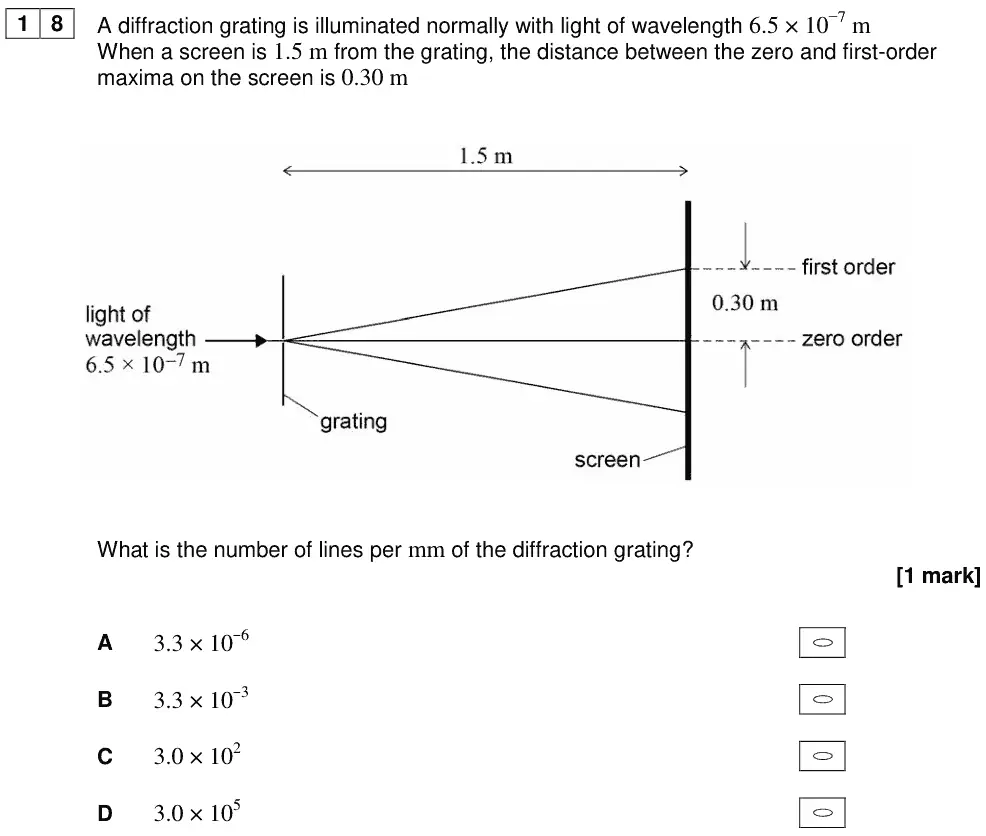
18 Interference, diffraction and the diffraction grating 1Multiple choice
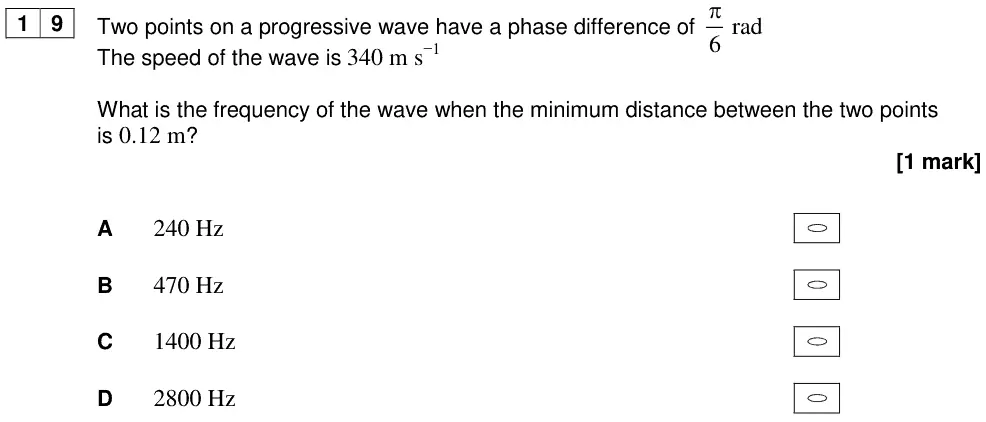
19 Progressive waves, longitudinal and transverse waves 1Multiple choice
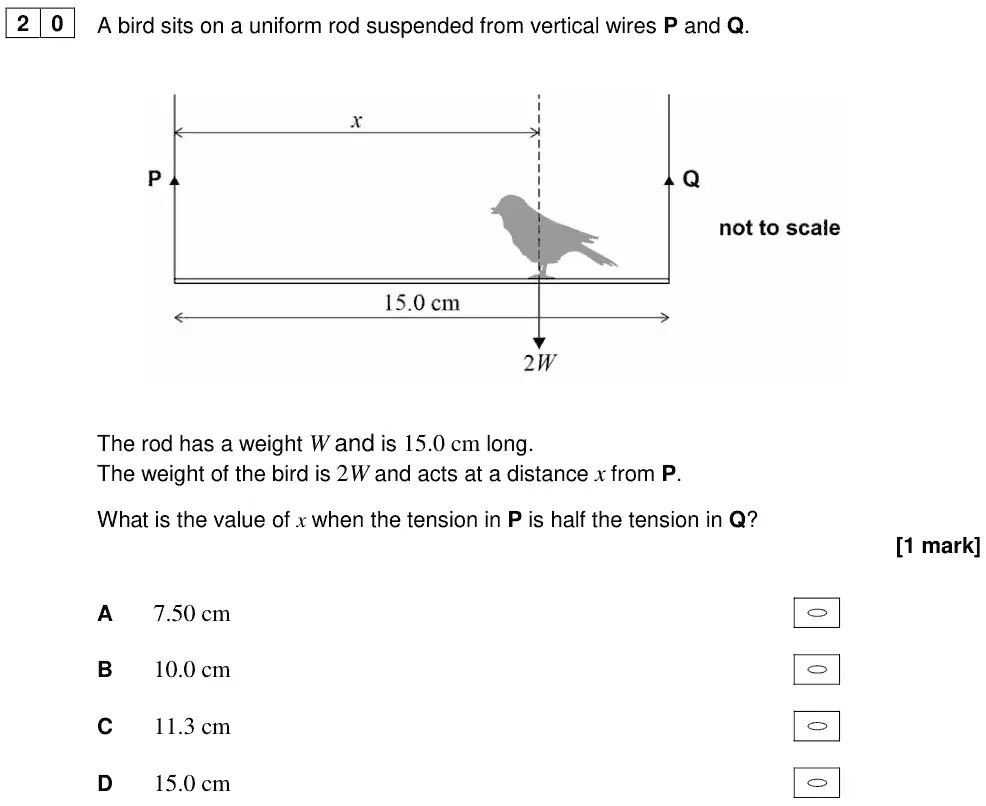
20 Scalars, vectors and moments 1Multiple choice
21 Work, energy, power and conservation of energy, Scalars, vectors and moments 1Multiple choice
22 Motion along a straight line and projectile motion, Newton's laws of motion and momentum 1Multiple choice
23 Materials, stress, strain and the Young modulus 1Multiple choice
24 Motion along a straight line and projectile motion 1Multiple choice
25 Scalars, vectors and moments 1Multiple choice
26 Newton's laws of motion and momentum 1Multiple choice
27 Newton's laws of motion and momentum, Work, energy, power and conservation of energy 1Multiple choice
28 Circuits and potential dividers, Current, potential difference, I-V characteristics and resistivity 1Multiple choice
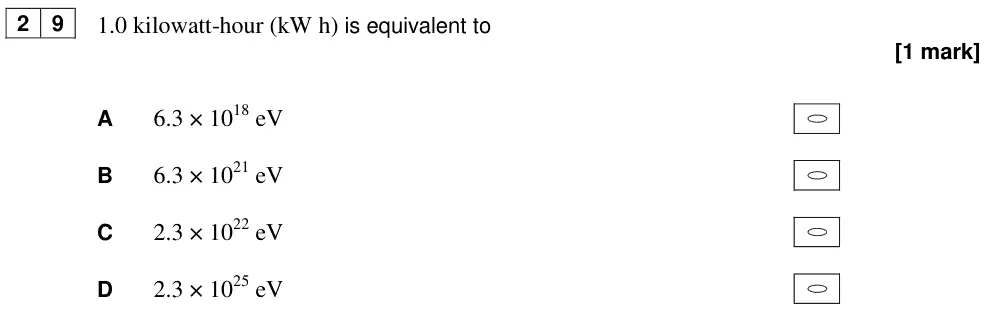
29 Measurements, units and uncertainties, Excitation, energy levels and wave-particle duality 1Multiple choice
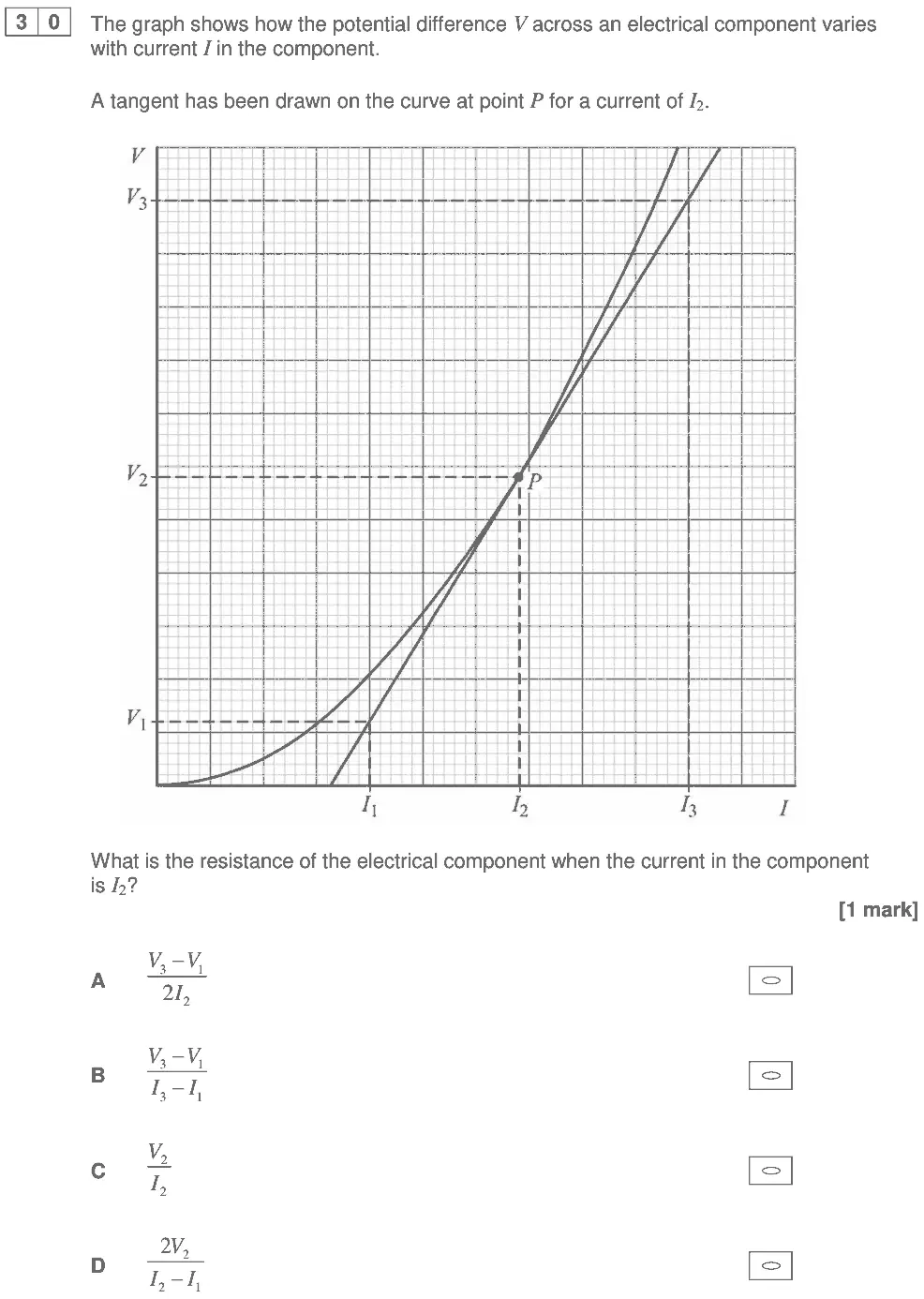
30 Current, potential difference, I-V characteristics and resistivity 1Multiple choice
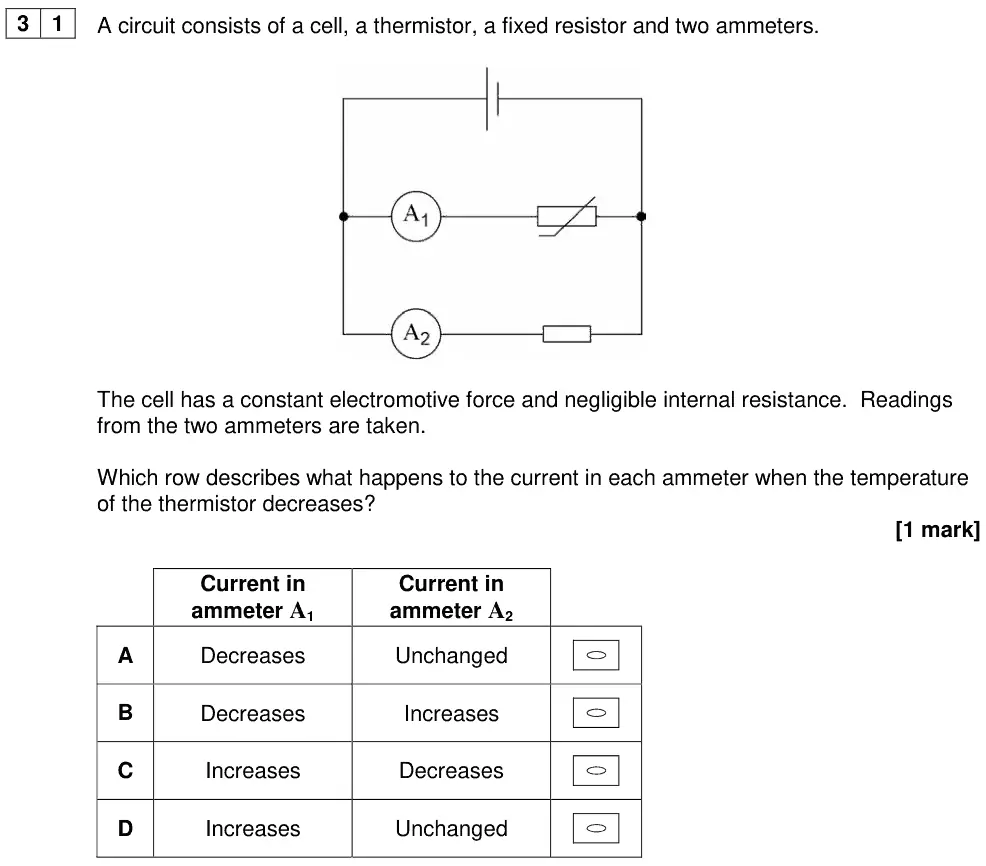
31 Current, potential difference, I-V characteristics and resistivity, Circuits and potential dividers 1Multiple choice
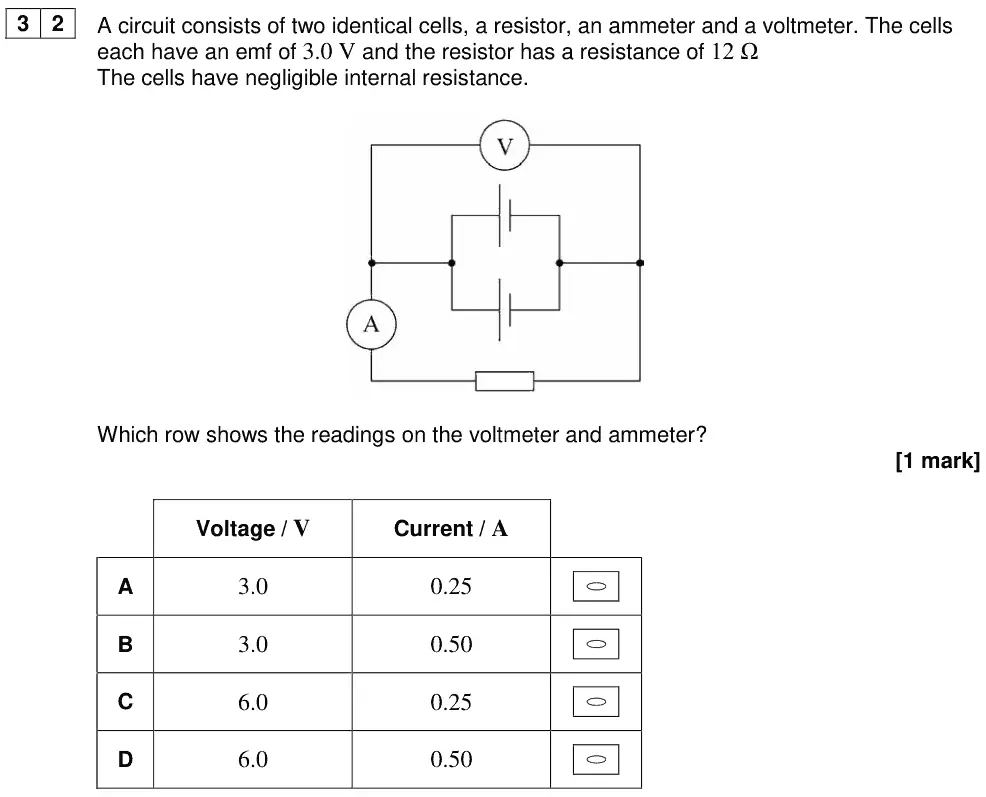
32 Circuits and potential dividers, Electromotive force and internal resistance 1Multiple choice
33 Measurements, units and uncertainties, Current, potential difference, I-V characteristics and resistivity 1Multiple choice
34 Current, potential difference, I-V characteristics and resistivity, Circuits and potential dividers 1Multiple choice

The questions

1.11.21.31.41.52.12.22.32.43.13.23.33.43.54.14.24.35678910111213141516171819202122232425262728293031323334
June 2018 · AS Paper 2 · Q1.1 3 marks Calculation Hard motion and projectiles
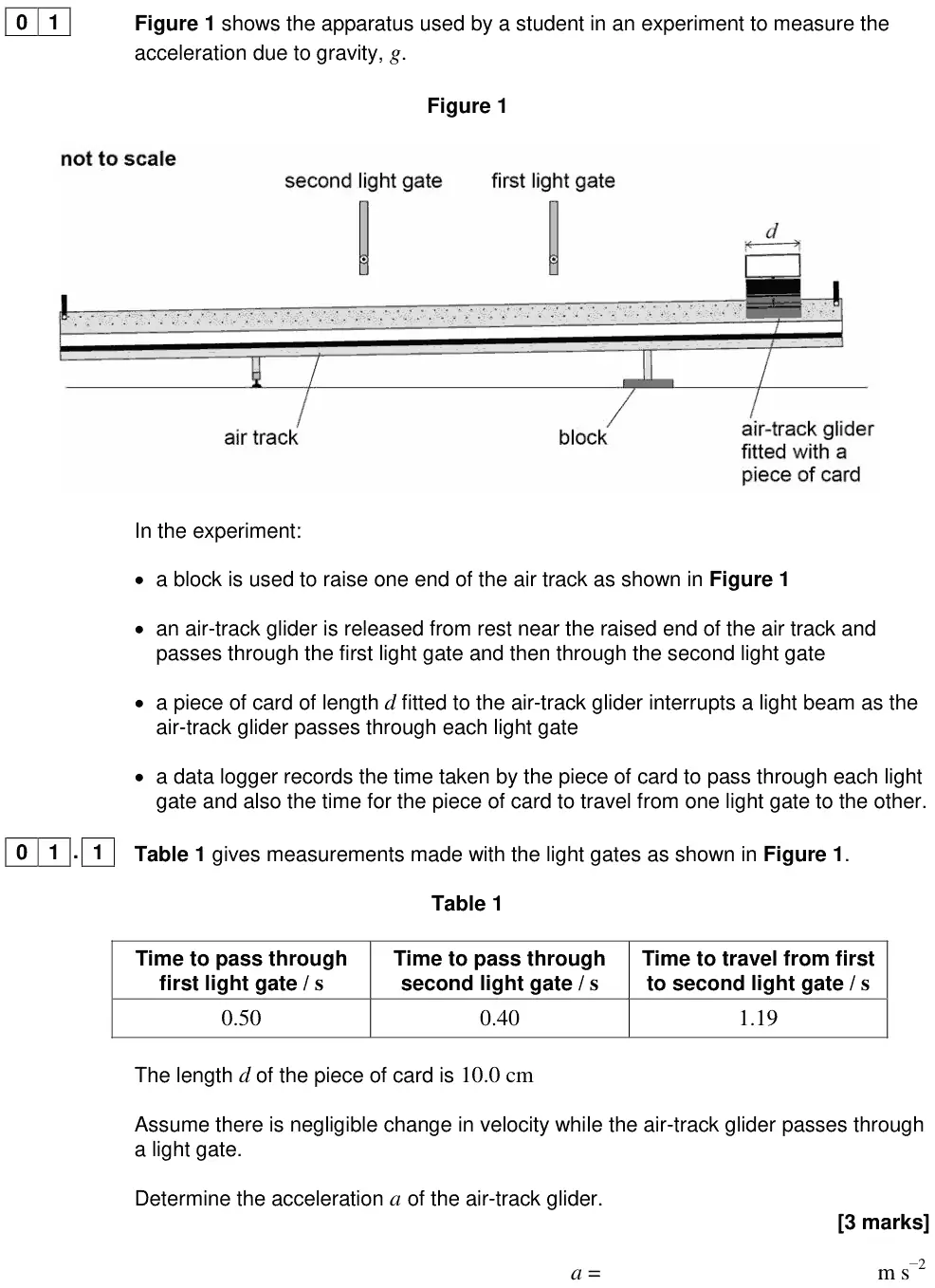
Figure 1 shows the apparatus used by a student in an experiment to measure the
acceleration due to gravity, g.
Figure 1
In the experiment:
• a block is used to raise one end of the air track as shown in Figure 1
• an air-track glider is released from rest near the raised end of the air track and
passes through the first light gate and then through the second light gate
• a piece of card of length d fitted to the air-track glider interrupts a light beam as the
air-track glider passes through each light gate
• a data logger records the time taken by the piece of card to pass through each light
gate and also the time for the piece of card to travel from one light gate to the other.
Table 1 gives measurements made with the light gates as shown in Figure 1.
Table 1
Time to pass through
first light gate / s
Time to pass through
second light gate / s
Time to travel from first
to second light gate / s
0.50
0.40
1.19
The length d of the piece of card is 10.0 cm
Assume there is negligible change in velocity while the air-track glider passes through
a light gate.
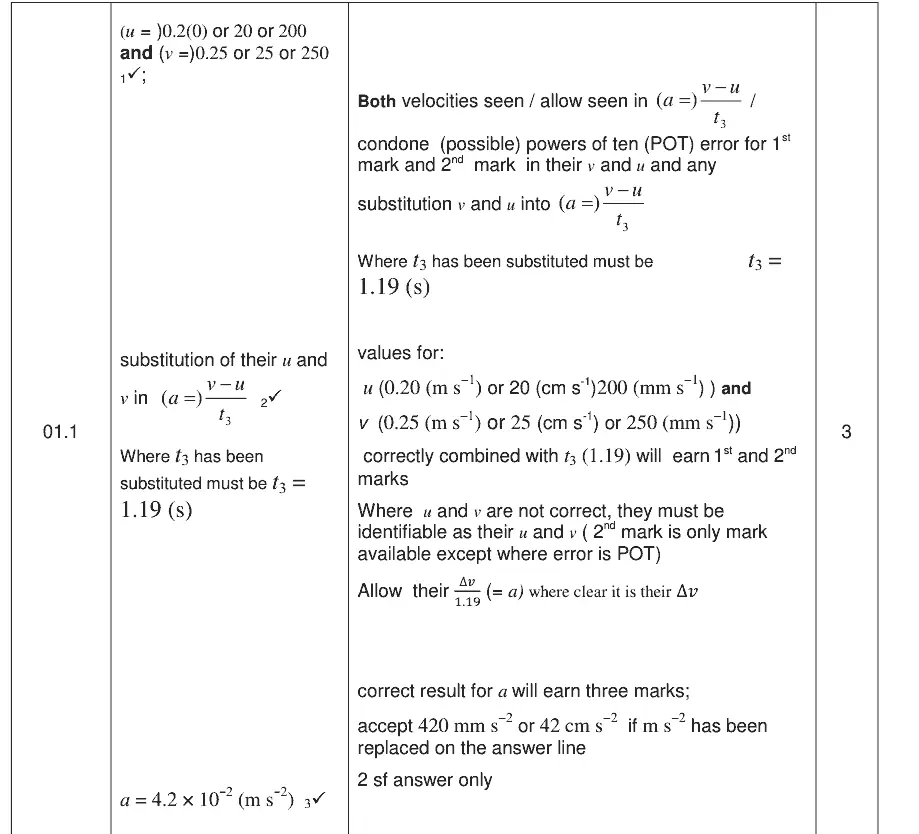
Determine the acceleration a of the air-track glider.
[3 marks]
a =
m s−2
June 2018 · AS Paper 2 · Q1.2 2 marks Practical and data analysis Hard motion and projectiles
Earlier part of question 1 that this part usesEarlier part of June 2018 Paper 2 question 1
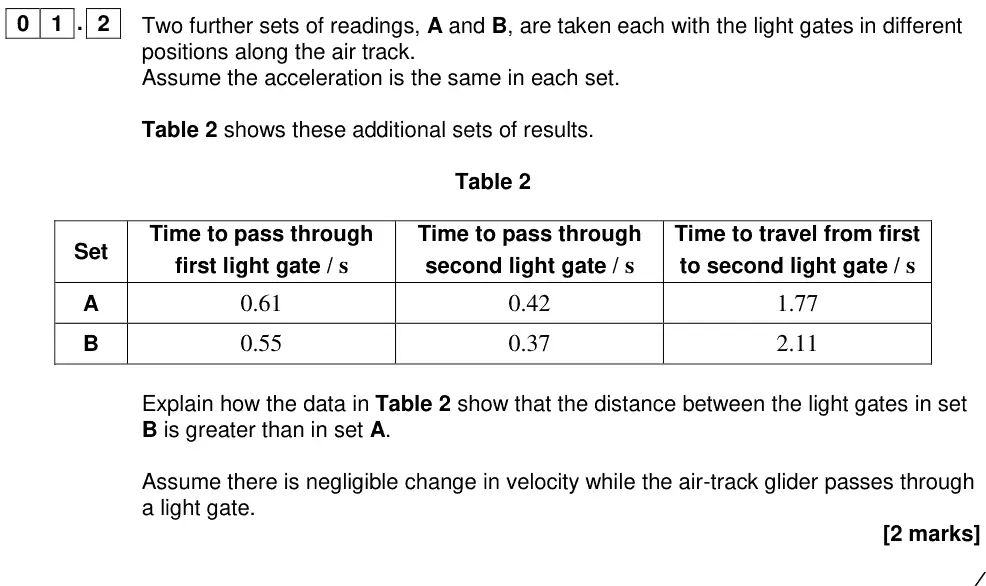
Two further sets of readings, A and B, are taken each with the light gates in different
positions along the air track.
Assume the acceleration is the same in each set.
Table 2 shows these additional sets of results.
Table 2
Set
Time to pass through
first light gate / s
Time to pass through
second light gate / s
Time to travel from first
to second light gate / s
A
0.61
0.42
1.77
B
0.55
0.37
2.11
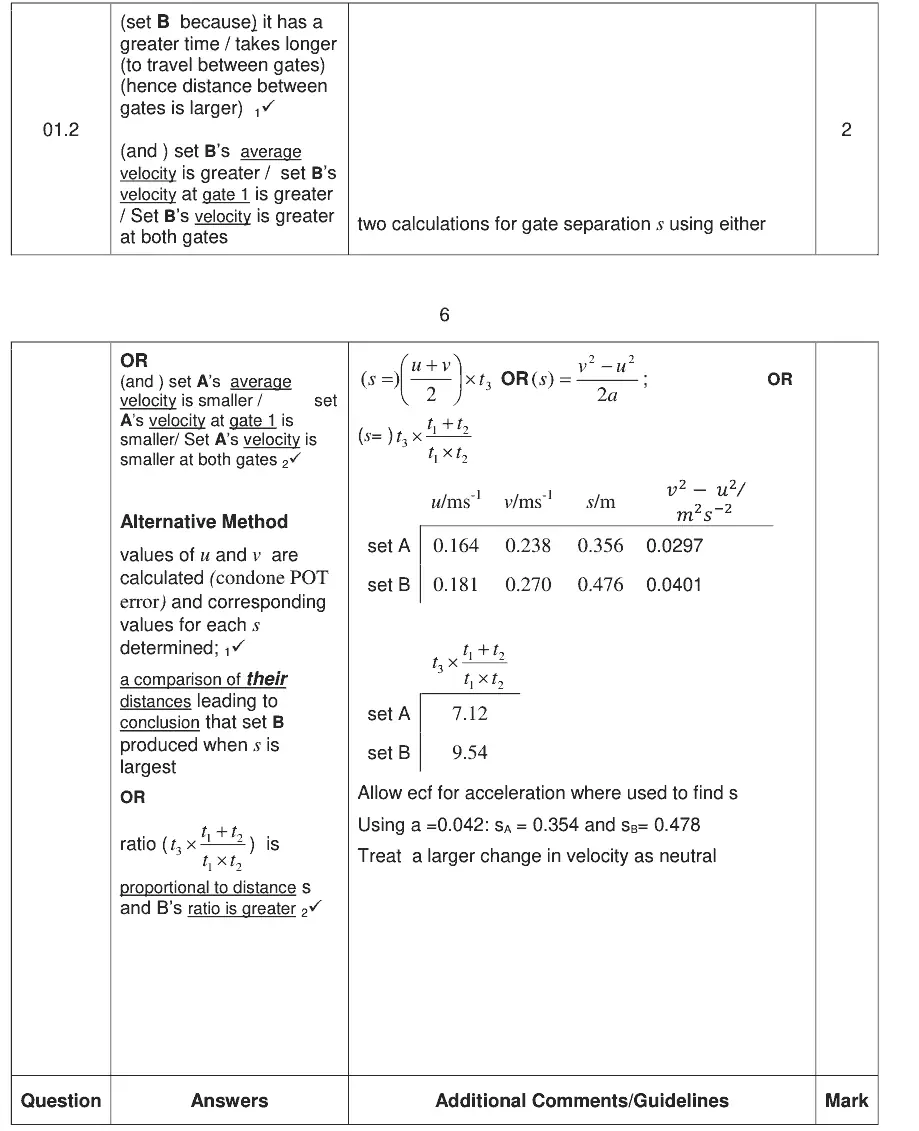
Explain how the data in Table 2 show that the distance between the light gates in set
B is greater than in set A.
Assume there is negligible change in velocity while the air-track glider passes through
a light gate.
[2 marks]
June 2018 · AS Paper 2 · Q1.3 2 marks Diagram or graph Easy motion and projectiles
Earlier part of question 1 that this part usesEarlier part of June 2018 Paper 2 question 1
Additional values for the acceleration of the air-track glider are obtained by further
raising the end of the air track by using a stack consisting of identical blocks.
Adding each block to the stack raises the end of the air track by the same distance.
Figure 2 is a graph of these results showing how a varies with n, the number of
blocks in the stack.
Figure 2
Draw a suitable best-fit straight line on Figure 2 and determine G, the gradient of your
line.
[2 marks]
G =
June 2018 · AS Paper 2 · Q1.4 1 mark Calculation motion and projectiles
Earlier part of question 1 that this part usesEarlier part of June 2018 Paper 2 question 1
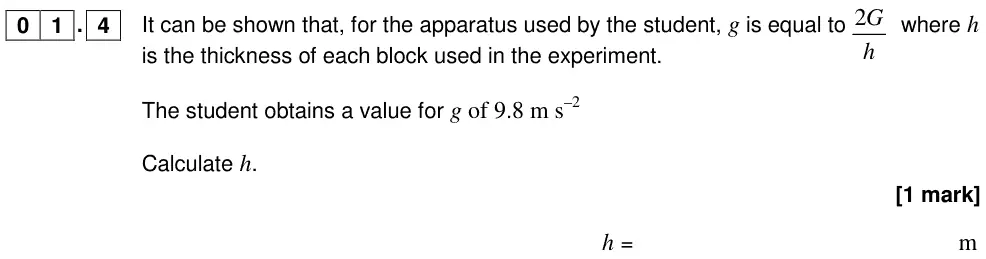
It can be shown that, for the apparatus used by the student, g is equal to         where h
is the thickness of each block used in the experiment.
The student obtains a value for g of 9.8 m s–2
Calculate h.
[1 mark]
h =
m
2G
h
June 2018 · AS Paper 2 · Q1.5 1 mark Practical and data analysis Hard motion and projectiles
Earlier part of question 1 that this part usesEarlier part of June 2018 Paper 2 question 1
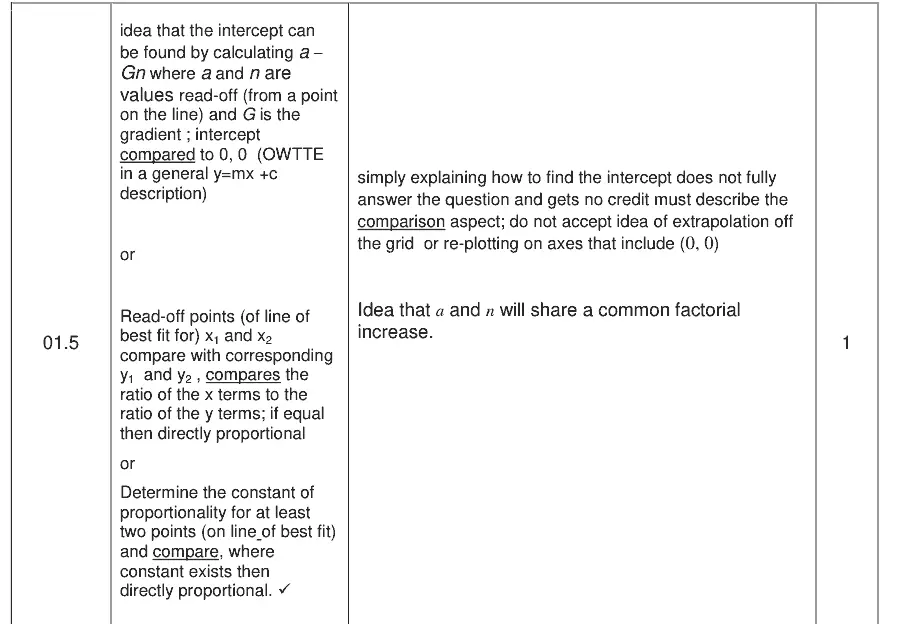
Explain how you could find out, without drawing another graph, whether the data
presented in the graph in Figure 2 support the suggestion that a is directly
proportional to n.
[1 mark]
June 2018 · AS Paper 2 · Q2.1 2 marks Practical and data analysis Hard measurements and uncertainties
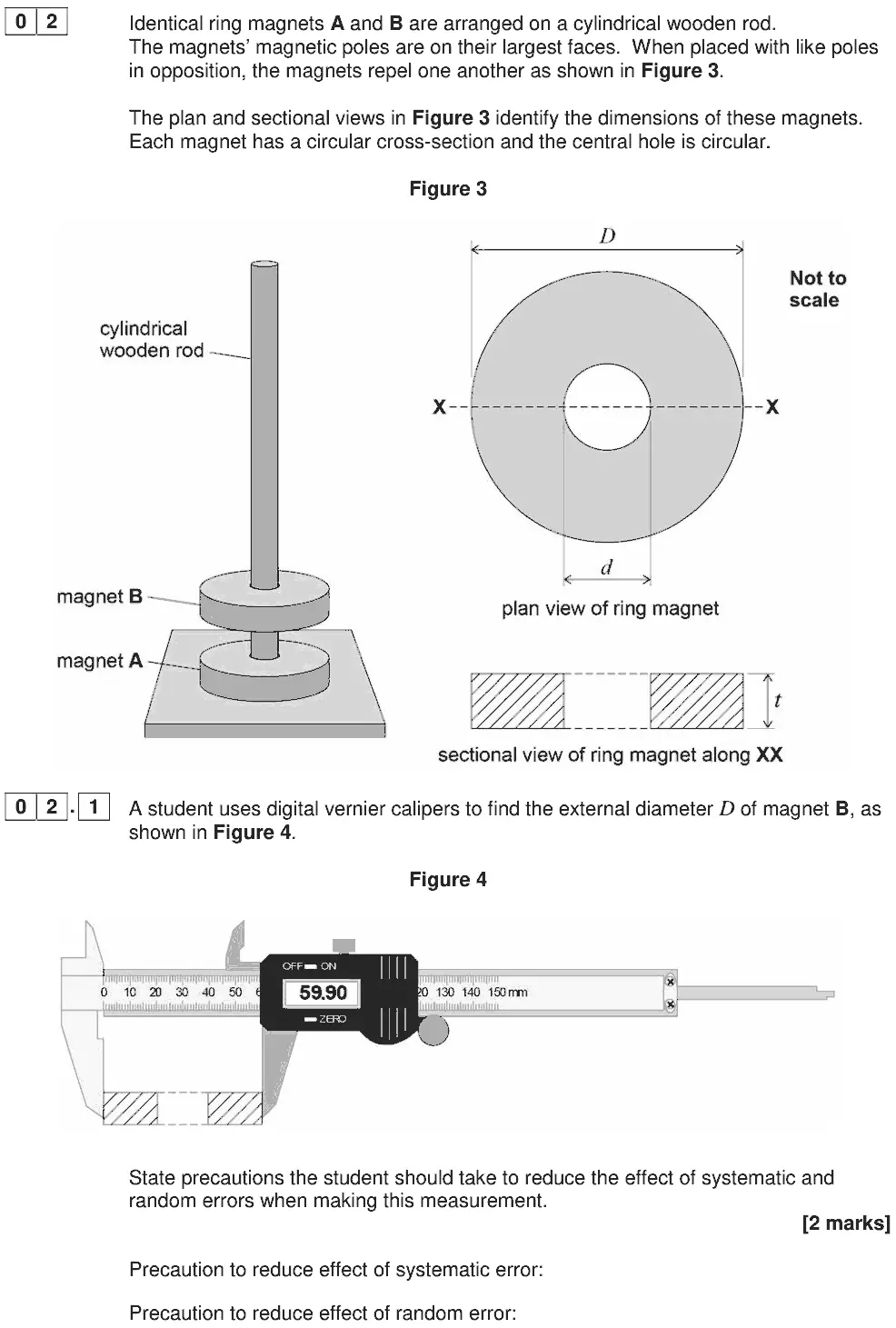
Identical ring magnets A and B are arranged on a cylindrical wooden rod.
The magnets’ magnetic poles are on their largest faces.  When placed with like poles
in opposition, the magnets repel one another as shown in Figure 3.
The plan and sectional views in Figure 3 identify the dimensions of these magnets.
Each magnet has a circular cross-section and the central hole is circular.
Figure 3
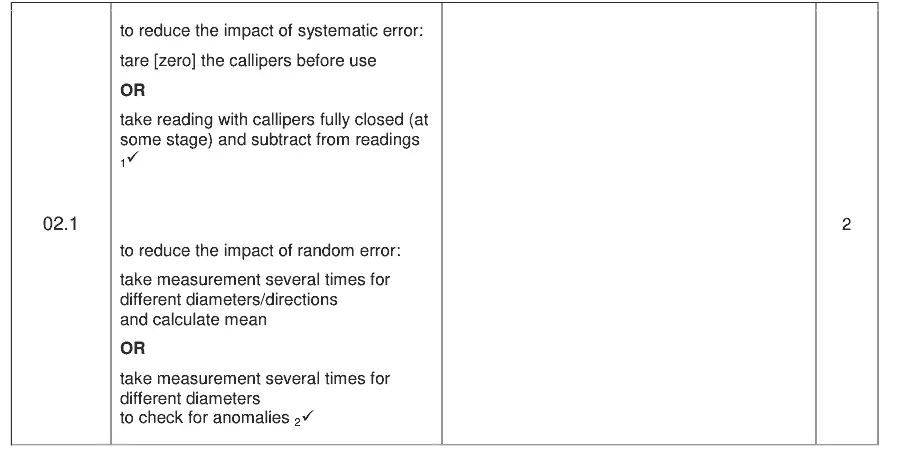
A student uses digital vernier calipers to find the external diameter D of magnet B, as
shown in Figure 4.
Figure 4
State precautions the student should take to reduce the effect of systematic and
random errors when making this measurement.
[2 marks]
Precaution to reduce effect of systematic error:
Precaution to reduce effect of random error:
June 2018 · AS Paper 2 · Q2.2 1 mark Diagram or graph Hard measurements and uncertainties
Earlier part of question 2 that this part usesEarlier part of June 2018 Paper 2 question 2
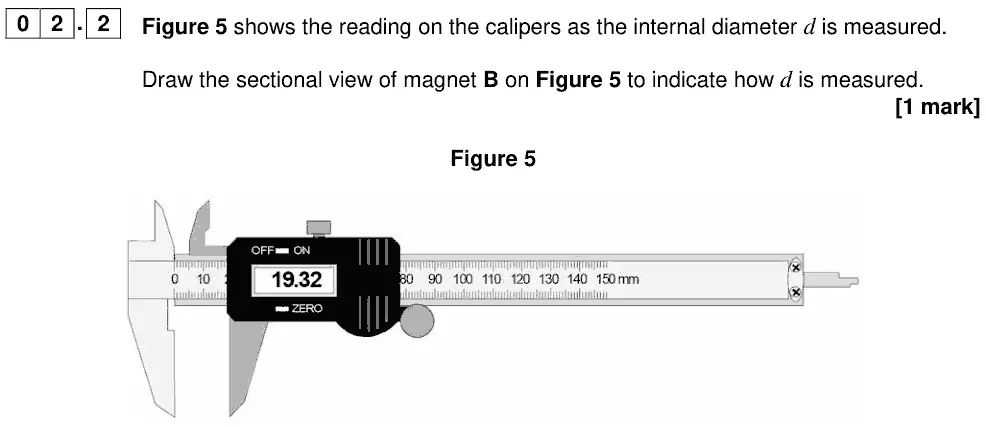
Figure 5 shows the reading on the calipers as the internal diameter d is measured.
Draw the sectional view of magnet B on Figure 5 to indicate how d is measured.
[1 mark]
Figure 5
June 2018 · AS Paper 2 · Q2.3 3 marks Calculation measurements and uncertainties
Earlier part of question 2 that this part usesEarlier part of June 2018 Paper 2 question 2
Figure 6 shows the reading on the calipers when the thickness t of magnet B is
measured.
Figure 6
The readings that correspond to the dimensions of magnet B are shown in Figures 4,
5 and 6.
Calculate the volume of magnet B.
[3 marks]
volume  =
m3
June 2018 · AS Paper 2 · Q2.4 5 marks Practical and data analysis vectors and momentsnewtons laws and momentum
Earlier part of question 2 that this part usesEarlier part of June 2018 Paper 2 question 2
The student measures the mass mB of magnet B and then positions the magnet so it
is in equilibrium above magnet A as shown in Figure 7.
The student measures the distance h.
Figure 7
The student adds modelling clay to magnet B to reduce h by 50%
She measures the mass mC of this clay.
She concludes that the force F exerted on magnet B by magnet A is given by
3
k
F
h
=
where k is a constant.
Describe an experiment to test the student’s conclusion that
3
k
F
h
=
Your answer should include:
• the procedure that could be used
• how the data produced could be analysed by a graphical method
• how the value of the constant k could be determined.
[5 marks]
June 2018 · AS Paper 2 · Q3.1 2 marks Show that work energy and poweratomic structure and stable nuclei
A radioactive source emits alpha particles each with 8.1 × 10⁻¹³ J of kinetic energy.
Show that the velocity of an alpha particle with kinetic energy 8.1 × 10⁻¹³ J is
approximately 2 × 10⁷ m s–1
specific charge of an alpha particle = 4.81 × 10⁷ C kg−1
[2 marks]
June 2018 · AS Paper 2 · Q3.2 2 marks Calculation Hard work energy and power
Earlier part of question 3 that this part usesEarlier part of June 2018 Paper 2 question 3
The alpha particles travel through air in straight lines with a range of 3.5 cm
Calculate the average force exerted on an alpha particle as it is stopped by the air.
[2 marks]
average force =
N
June 2018 · AS Paper 2 · Q3.3 3 marks Calculation Hard energy levels and wave particle duality
Earlier part of question 3 that this part usesEarlier part of June 2018 Paper 2 question 3
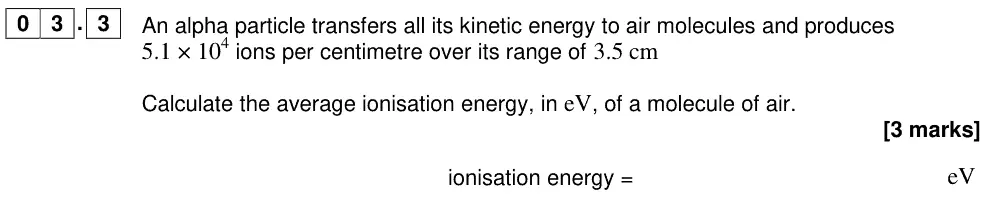
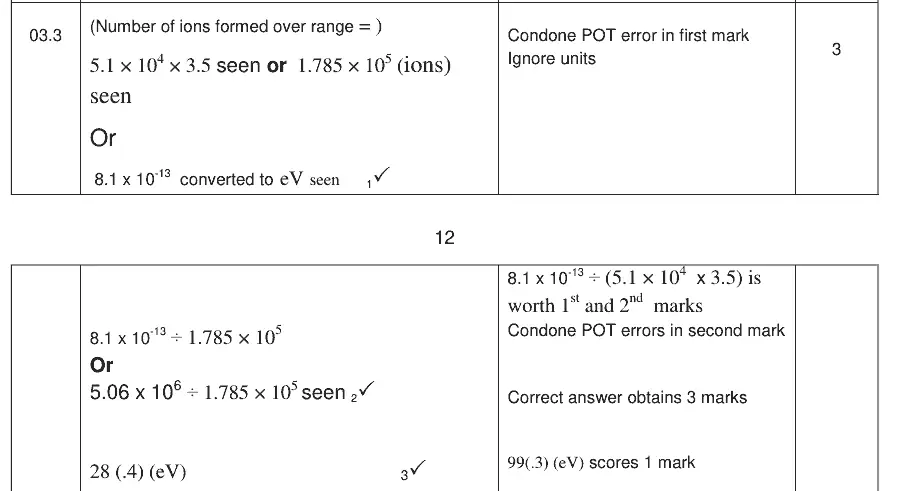
An alpha particle transfers all its kinetic energy to air molecules and produces
5.1 × 10⁴ ions per centimetre over its range of 3.5 cm
Calculate the average ionisation energy, in eV, of a molecule of air.
[3 marks]
ionisation energy =
eV
June 2018 · AS Paper 2 · Q3.4 2 marks Calculation current voltage and resistivity
Earlier part of question 3 that this part usesEarlier part of June 2018 Paper 2 question 3
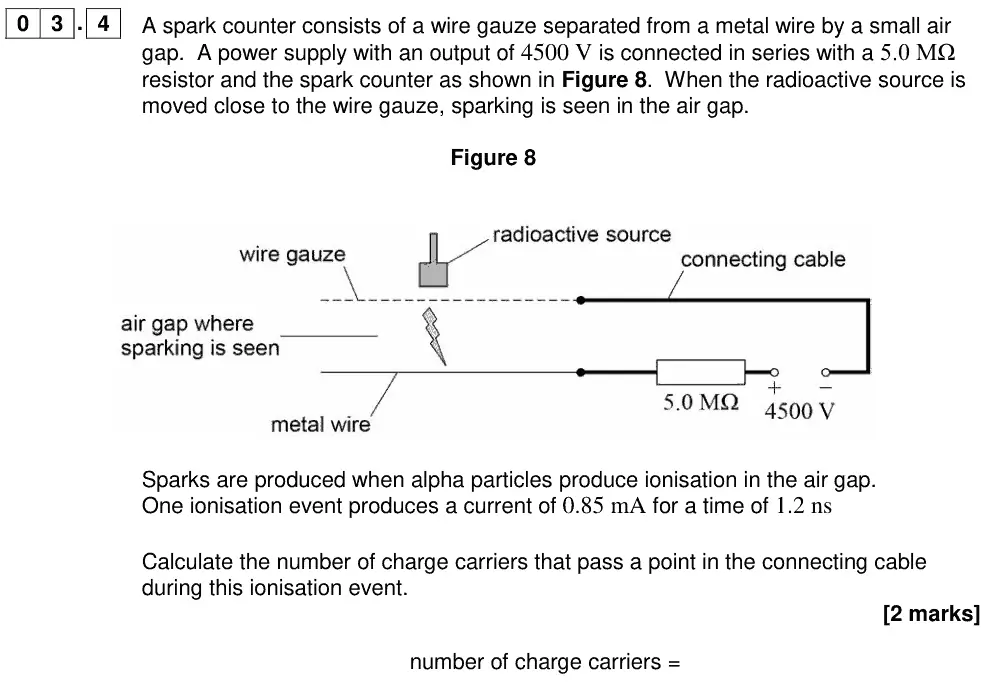
A spark counter consists of a wire gauze separated from a metal wire by a small air
gap.  A power supply with an output of 4500 V is connected in series with a 5.0 MΩ
resistor and the spark counter as shown in Figure 8.  When the radioactive source is
moved close to the wire gauze, sparking is seen in the air gap.
Figure 8
Sparks are produced when alpha particles produce ionisation in the air gap.
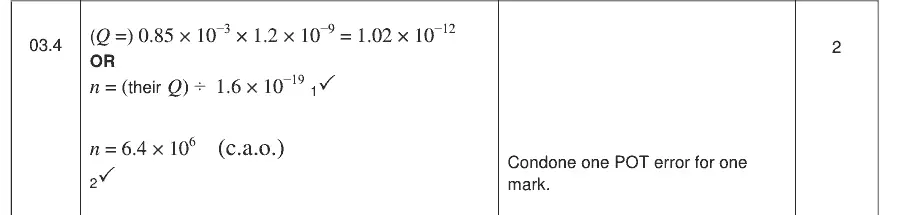
One ionisation event produces a current of 0.85 mA for a time of 1.2 ns
Calculate the number of charge carriers that pass a point in the connecting cable
during this ionisation event.
[2 marks]
number of charge carriers =
June 2018 · AS Paper 2 · Q3.5 3 marks Explanation Hard circuits and potential dividers
Earlier part of question 3 that this part usesEarlier part of June 2018 Paper 2 question 3
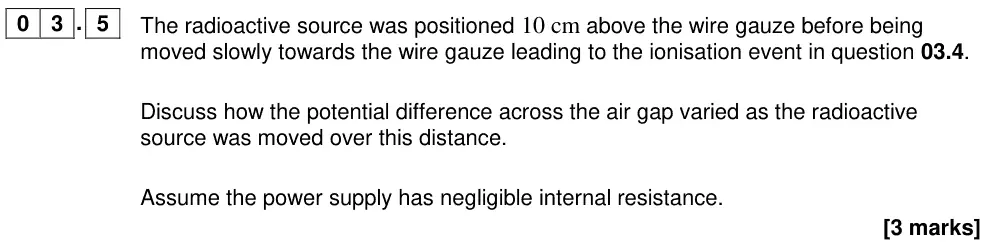
The radioactive source was positioned 10 cm above the wire gauze before being
moved slowly towards the wire gauze leading to the ionisation event in question 03.4.
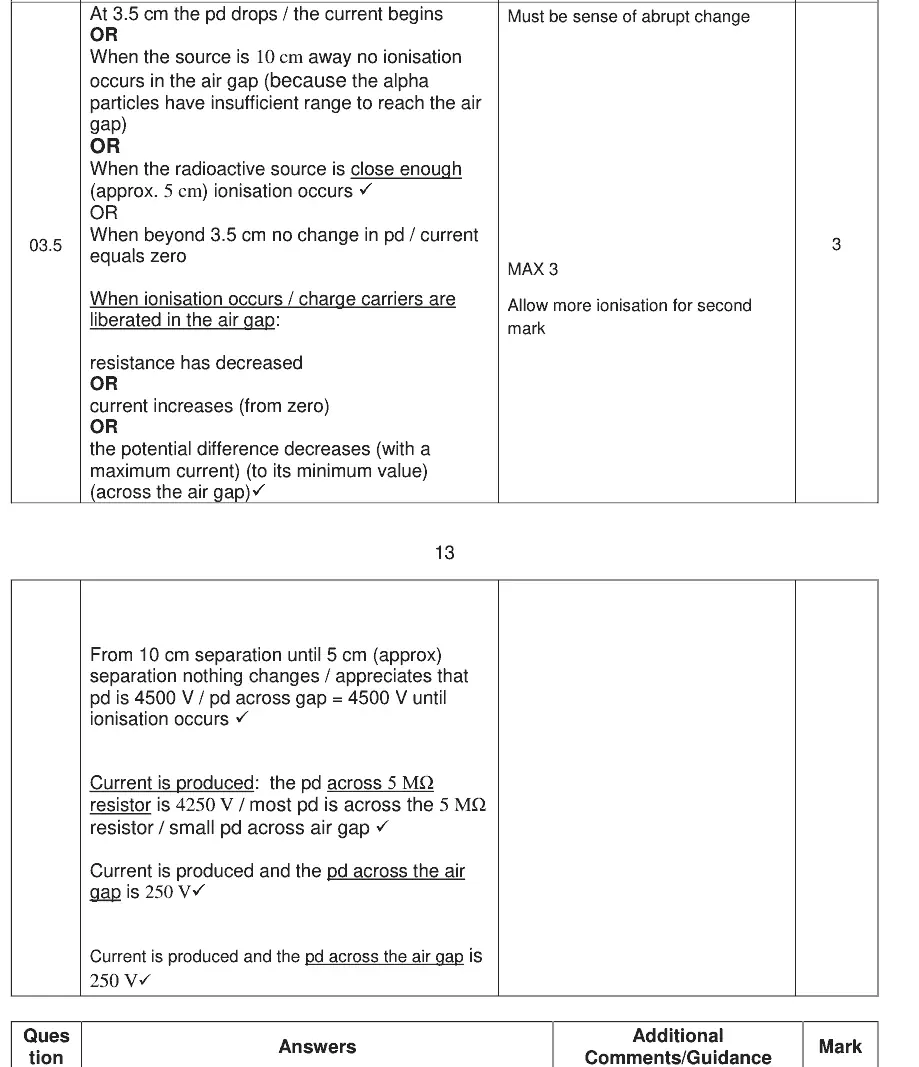
Discuss how the potential difference across the air gap varied as the radioactive
source was moved over this distance.
Assume the power supply has negligible internal resistance.
[3 marks]
June 2018 · AS Paper 2 · Q4.1 3 marks Calculation refraction and optical fibres
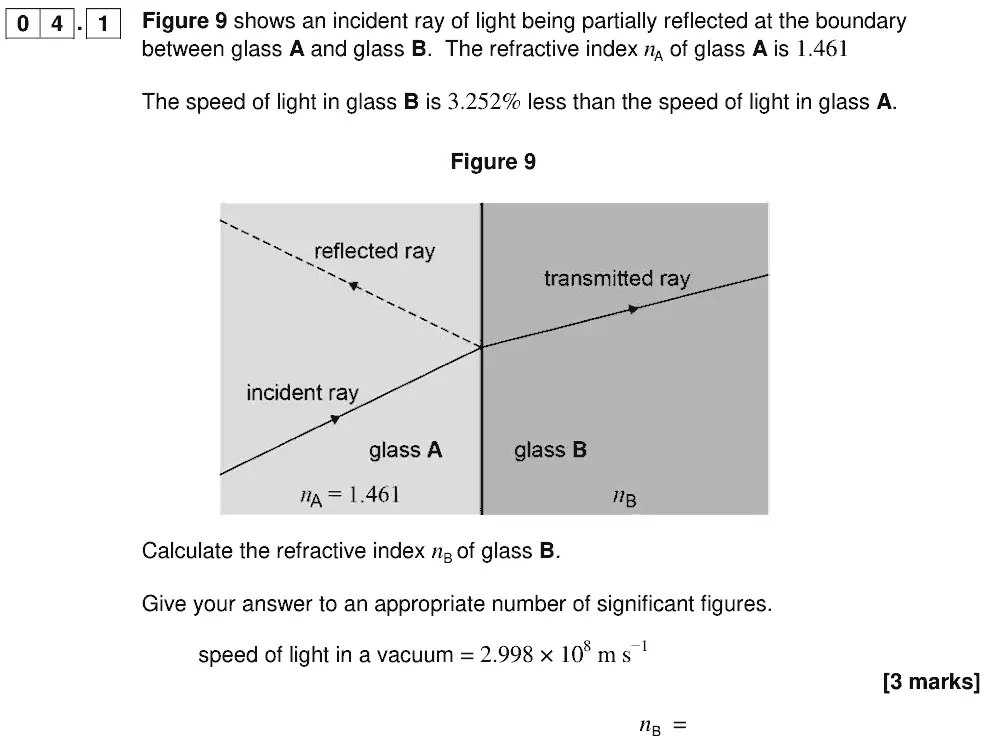
Figure 9 shows an incident ray of light being partially reflected at the boundary
between glass A and glass B.  The refractive index nA of glass A is 1.461
The speed of light in glass B is 3.252% less than the speed of light in glass A.
Figure 9
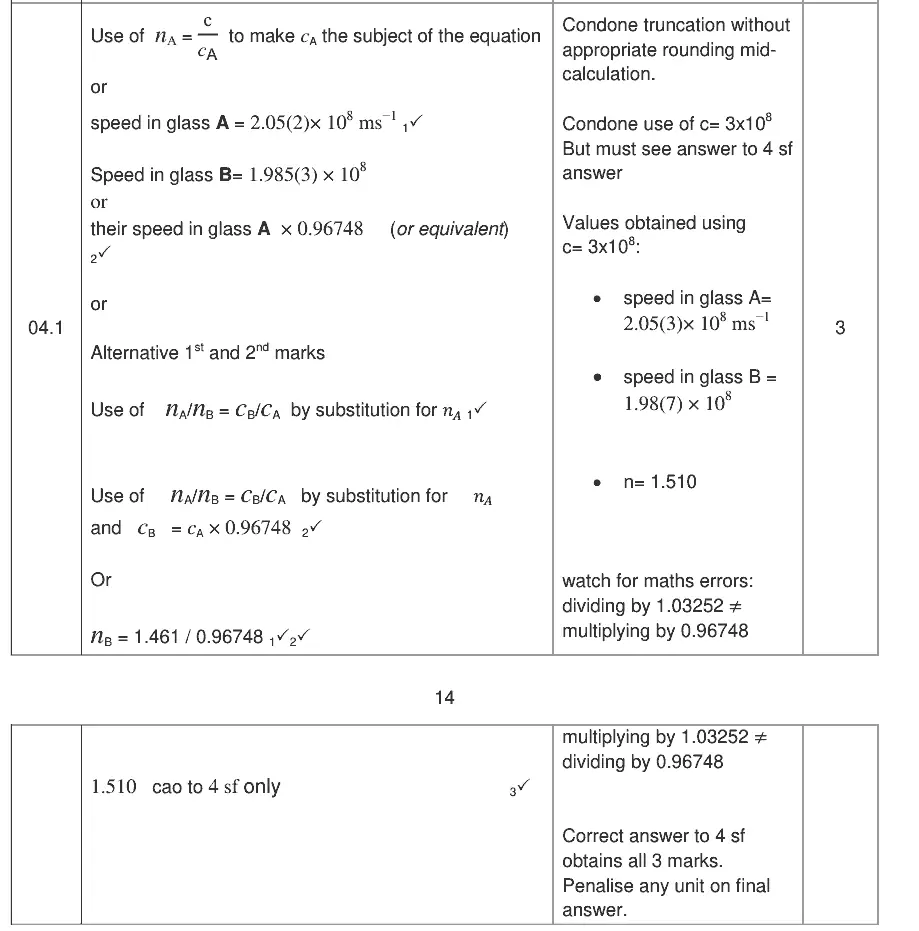
Calculate the refractive index nB of glass B.
Give your answer to an appropriate number of significant figures.
speed of light in a vacuum = 2.998 × 10⁸ m s−1
[3 marks]
nB  =
June 2018 · AS Paper 2 · Q4.2 3 marks Explanation Hard materials and young modulusnewtons laws and momentum
Earlier part of question 4 that this part usesEarlier part of June 2018 Paper 2 question 4
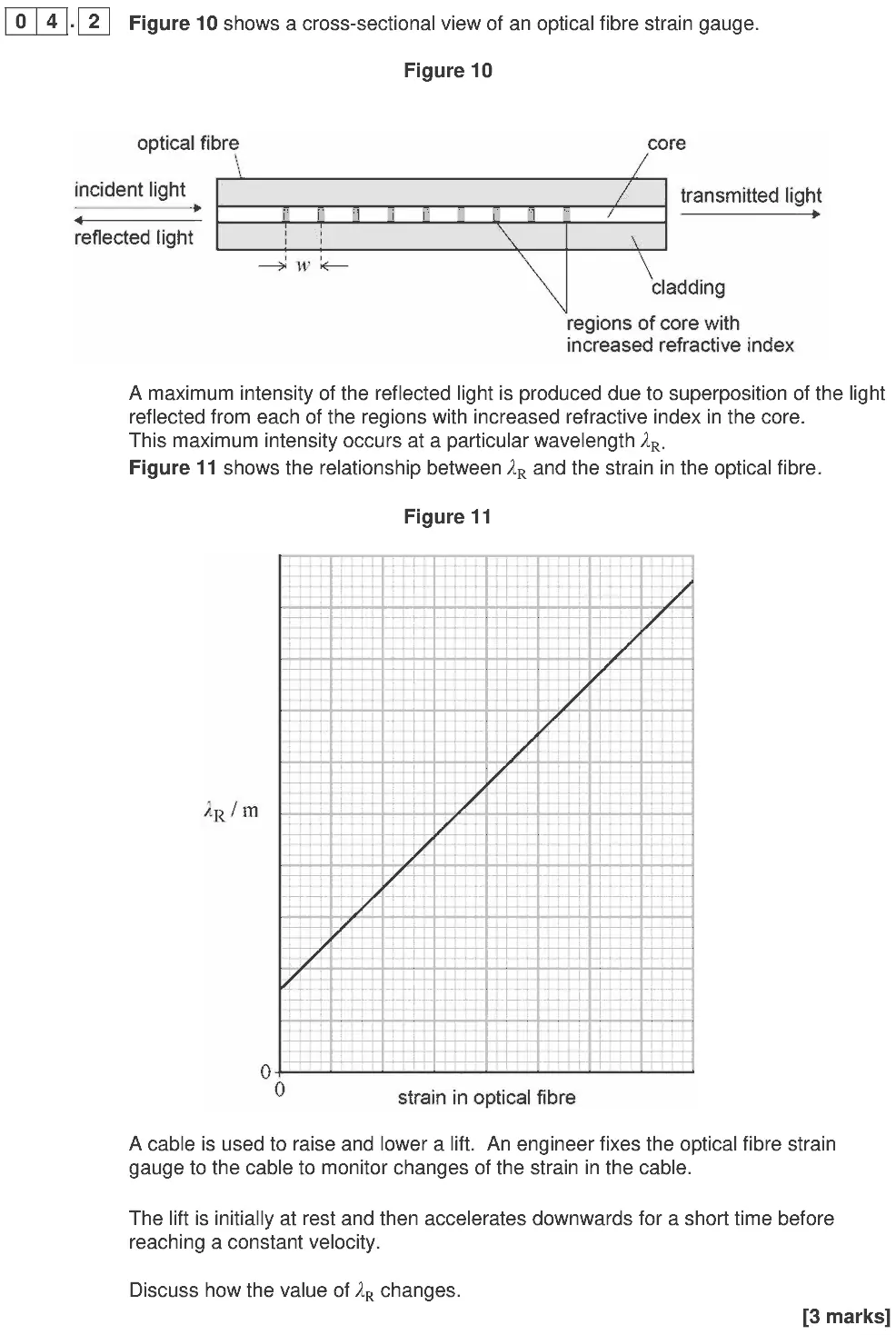
Figure 10 shows a cross-sectional view of an optical fibre strain gauge.
Figure 10
A maximum intensity of the reflected light is produced due to superposition of the light
reflected from each of the regions with increased refractive index in the core.
This maximum intensity occurs at a particular wavelength λR.
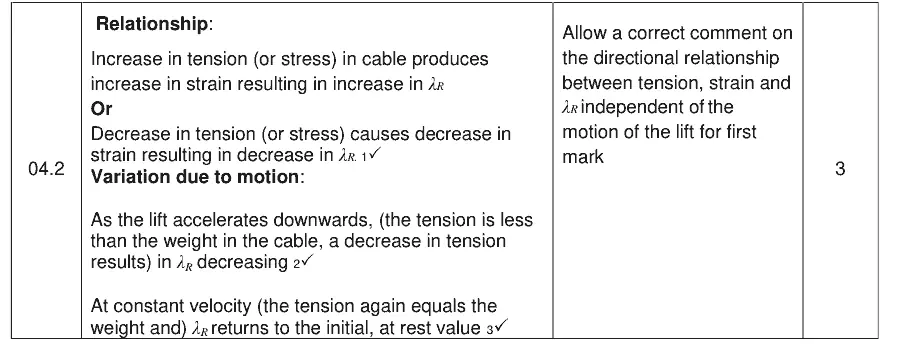
Figure 11 shows the relationship between λR and the strain in the optical fibre.
Figure 11
A cable is used to raise and lower a lift.  An engineer fixes the optical fibre strain
gauge to the cable to monitor changes of the strain in the cable.
The lift is initially at rest and then accelerates downwards for a short time before
reaching a constant velocity.
Discuss how the value of λR changes.
[3 marks]
June 2018 · AS Paper 2 · Q4.3 2 marks Explanation materials and young modulus
Earlier part of question 4 that this part usesEarlier part of June 2018 Paper 2 question 4
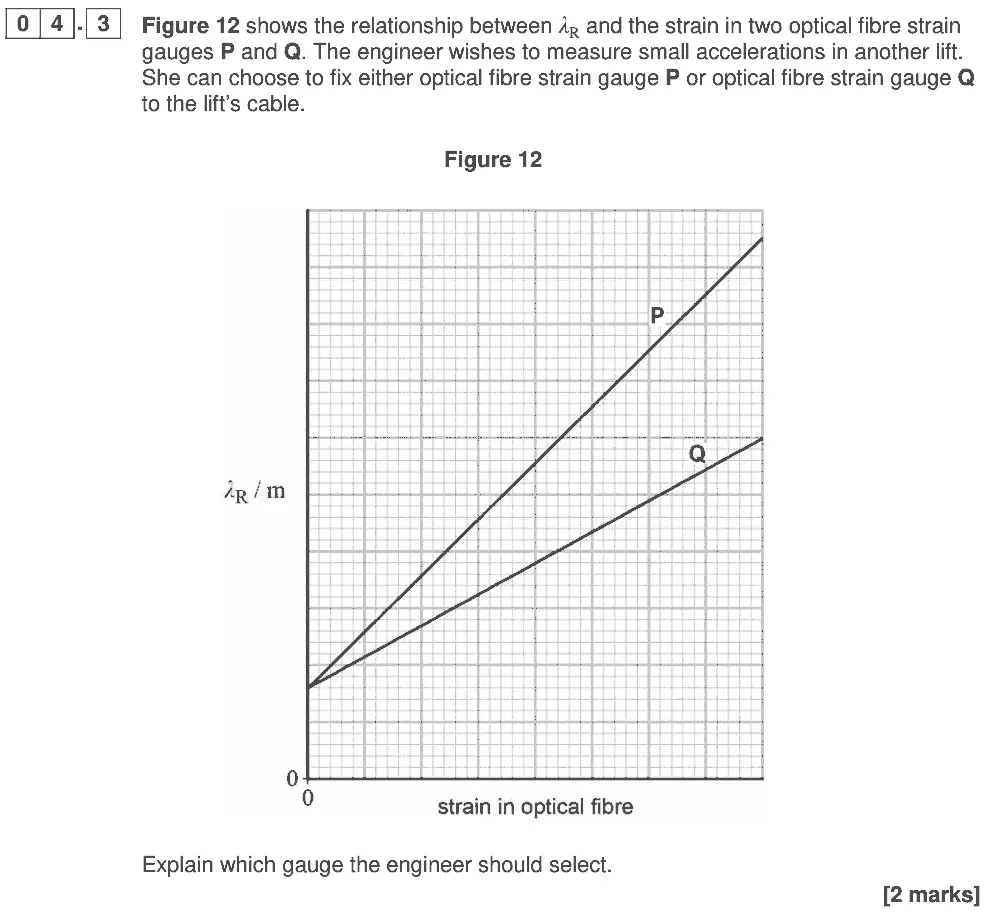
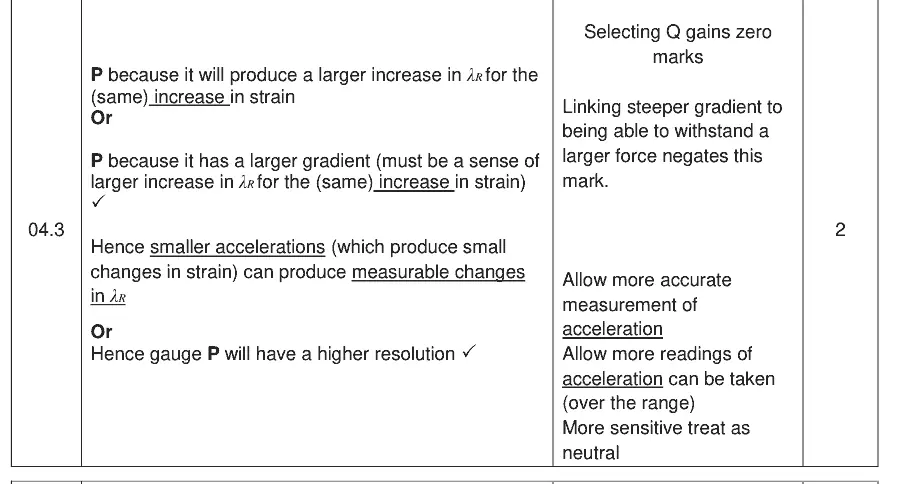
Figure 12 shows the relationship between λR and the strain in two optical fibre strain
gauges P and Q. The engineer wishes to measure small accelerations in another lift.
She can choose to fix either optical fibre strain gauge P or optical fibre strain gauge Q
to the lift’s cable.
Figure 12
Explain which gauge the engineer should select.
[2 marks]
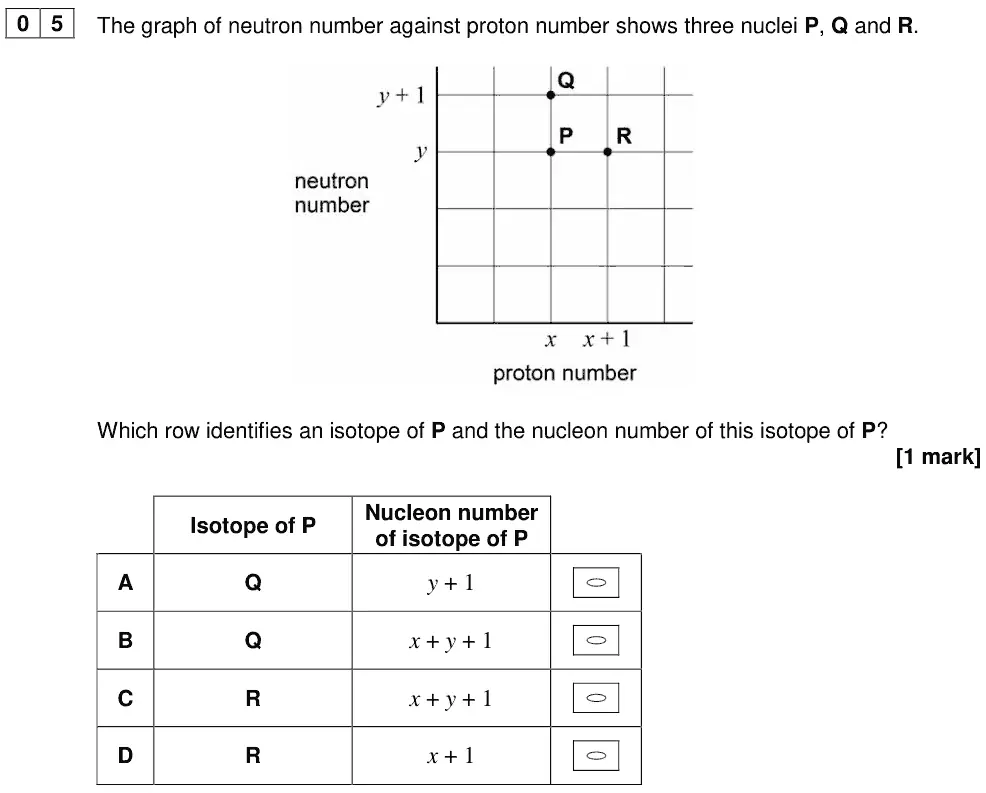
June 2018 · AS Paper 2 · Q5 1 mark Multiple choice atomic structure and stable nuclei
The graph of neutron number against proton number shows three nuclei P, Q and R.
Which row identifies an isotope of P and the nucleon number of this isotope of P?
[1 mark]
Isotope of P
Nucleon number
of isotope of P
A
Q
y + 1
B
Q
x + y + 1
C
R
x + y + 1
D
R
x + 1
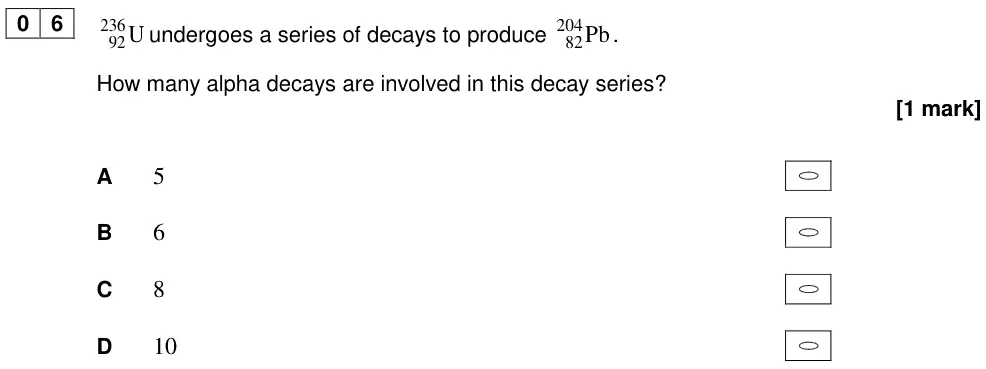
June 2018 · AS Paper 2 · Q6 1 mark Multiple choice atomic structure and stable nuclei
236
92U undergoes a series of decays to produce 204
82Pb.
How many alpha decays are involved in this decay series?
[1 mark]
A
5
B
6
C
8
D
10
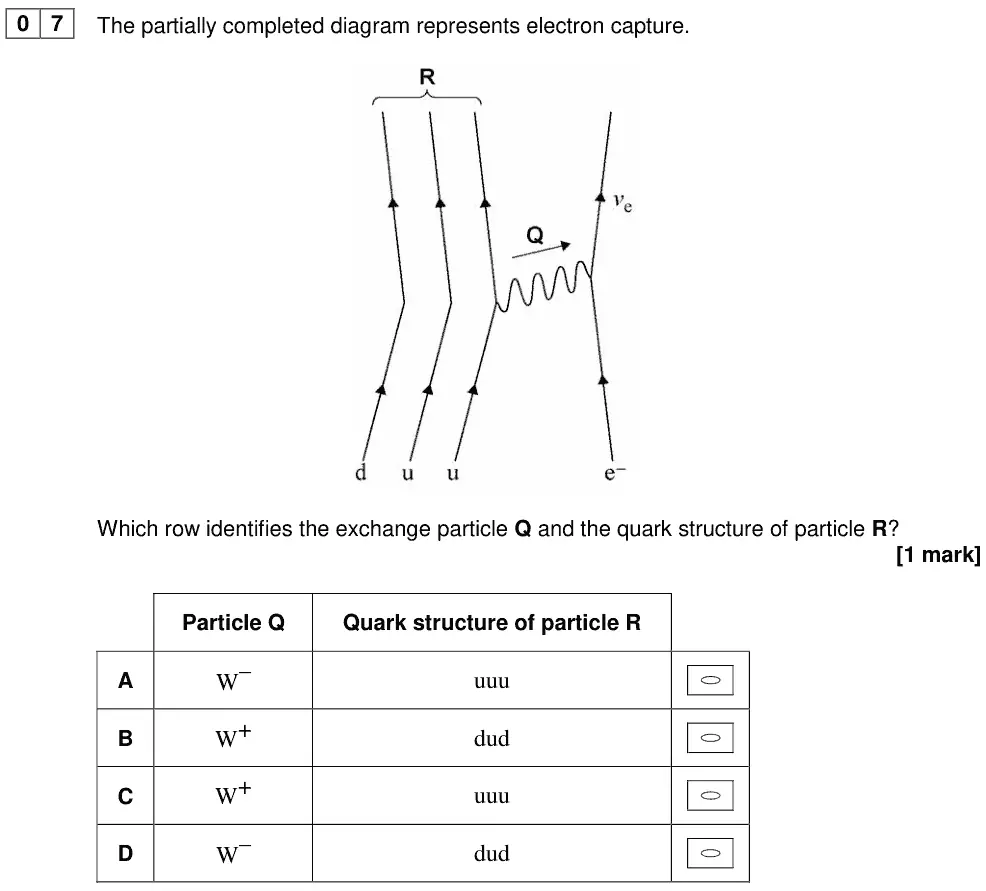
June 2018 · AS Paper 2 · Q7 1 mark Multiple choice particles antiparticles and interactions
The partially completed diagram represents electron capture.
Which row identifies the exchange particle Q and the quark structure of particle R?
[1 mark]
Particle Q
Quark structure of particle R
A
W–
uuu
B
W+
dud
C
W+
uuu
D
W–
dud
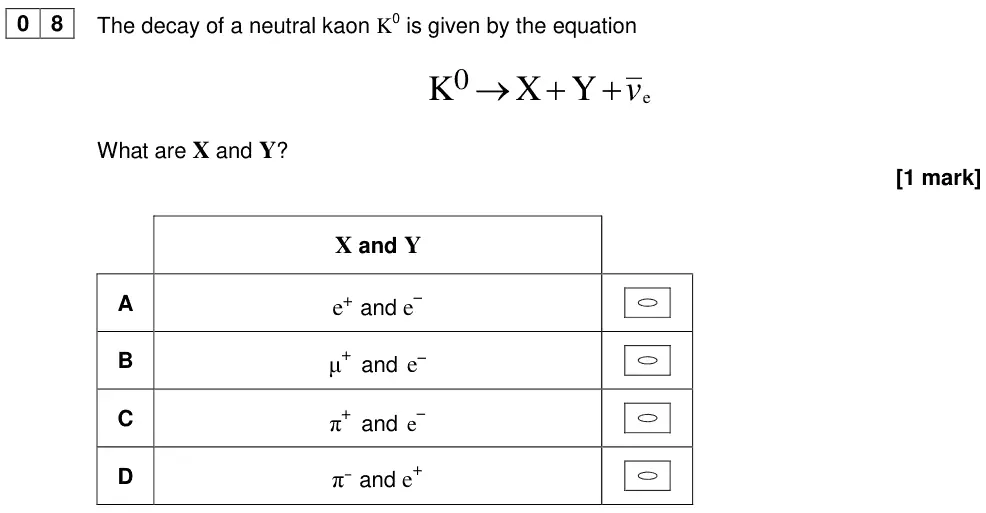
June 2018 · AS Paper 2 · Q8 1 mark Multiple choice classification of particles and quarks
The decay of a neutral kaon K0 is given by the equation
e
0
K
X
Y
→
+
+v
What are X and Y?
[1 mark]
X and Y
A
e+ and e–
B
μ+ and e–
C
π+ and e–
D
π– and e+
June 2018 · AS Paper 2 · Q9 1 mark Multiple choice photoelectric effect
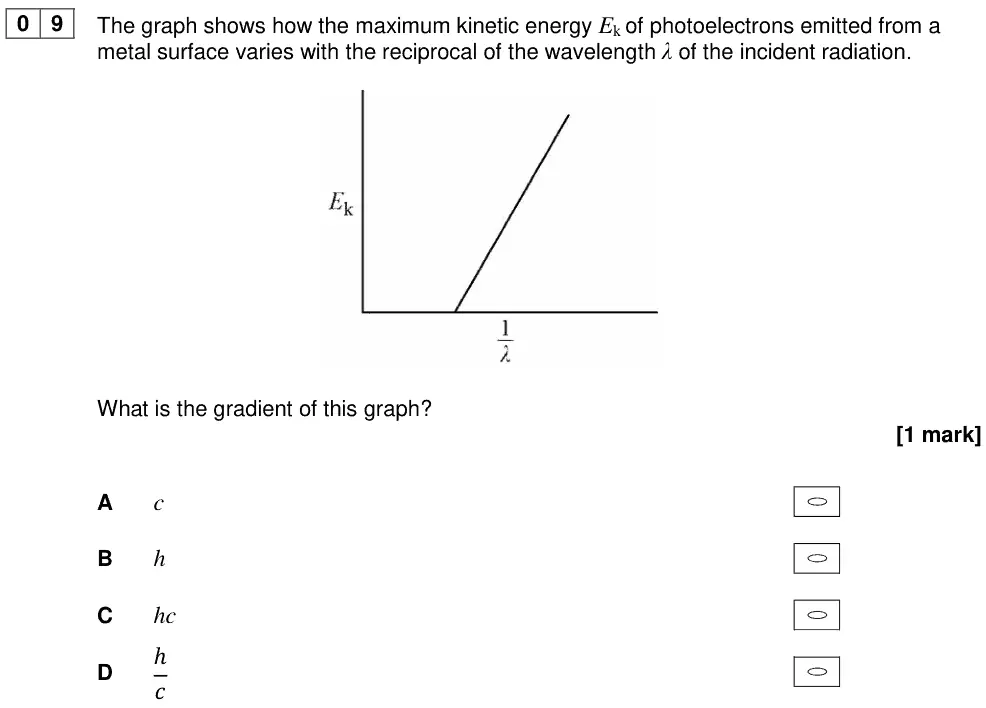
The graph shows how the maximum kinetic energy Ek of photoelectrons emitted from a
metal surface varies with the reciprocal of the wavelength λ of the incident radiation.
What is the gradient of this graph?
[1 mark]
A
c
B
h
C
hc
D
ℎ
𝑐
June 2018 · AS Paper 2 · Q10 1 mark Multiple choice energy levels and wave particle duality
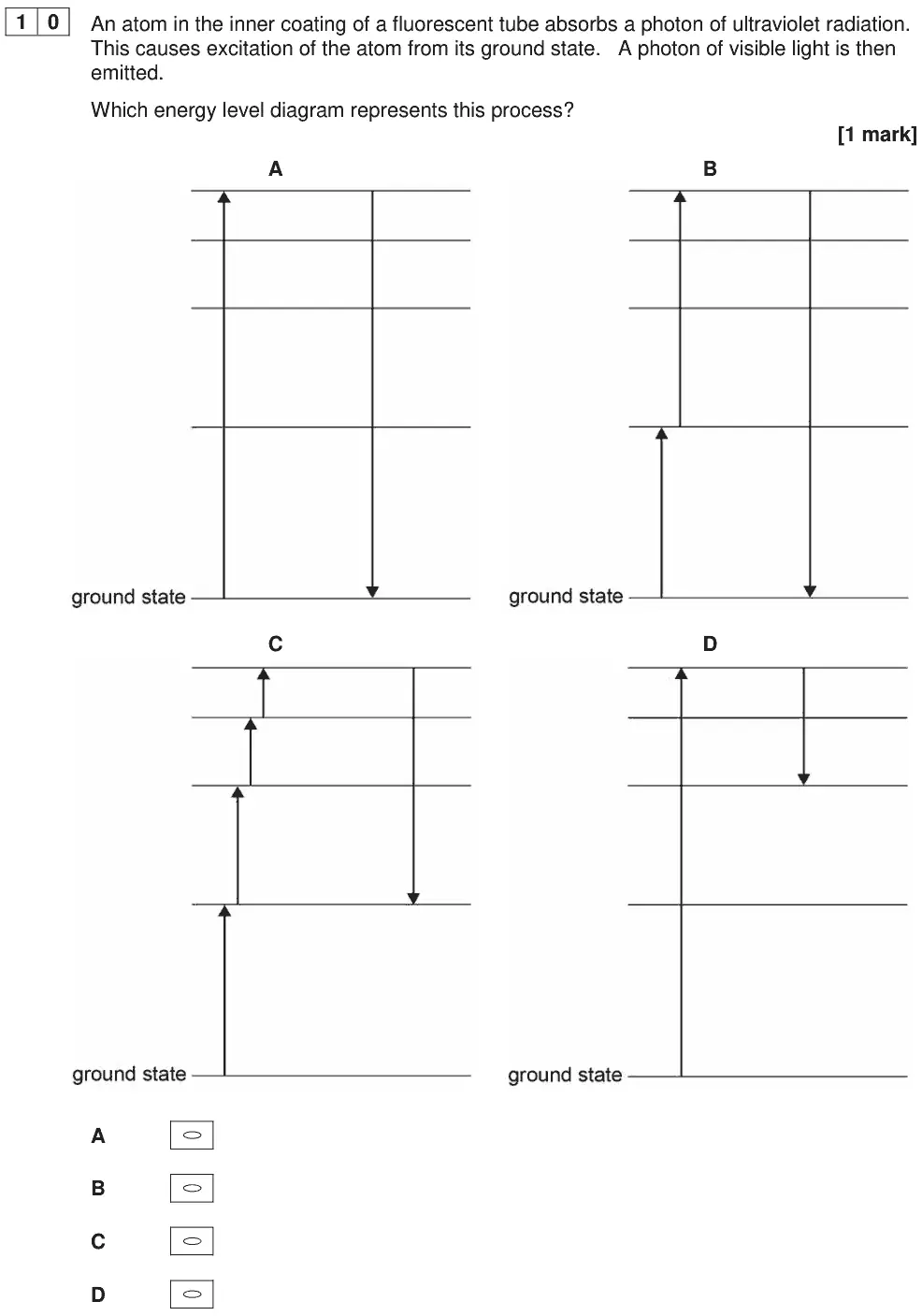
An atom in the inner coating of a fluorescent tube absorbs a photon of ultraviolet radiation.
This causes excitation of the atom from its ground state.   A photon of visible light is then
emitted.
Which energy level diagram represents this process?
[1 mark]
A
B
C
D
A
B
C
D
June 2018 · AS Paper 2 · Q11 1 mark Multiple choice energy levels and wave particle duality
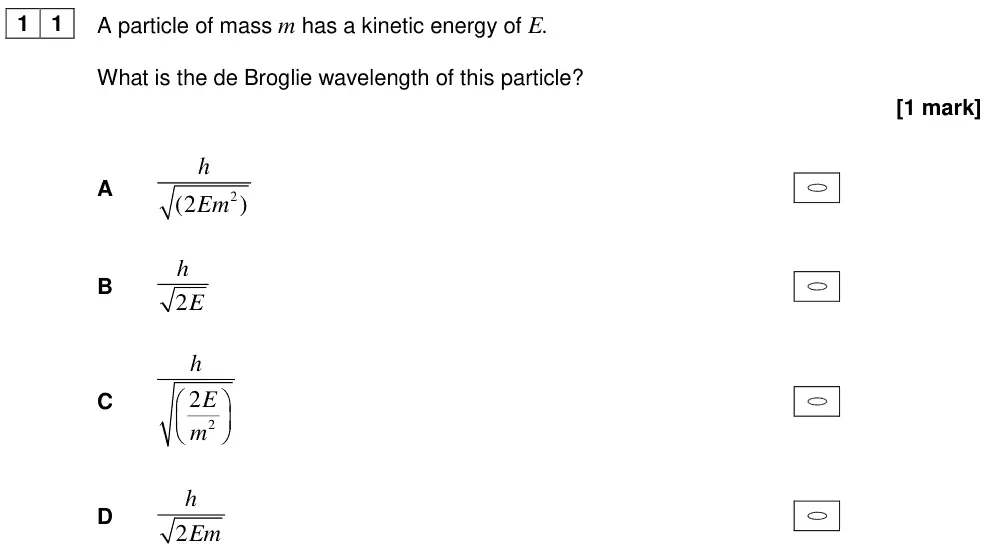
A particle of mass m has a kinetic energy of E.
What is the de Broglie wavelength of this particle?
[1 mark]
A
2
(2
)
h
Em
B
2
h
E
C
2
2
h
E
m






D
2
h
Em
June 2018 · AS Paper 2 · Q12 1 mark Multiple choice energy levels and wave particle duality
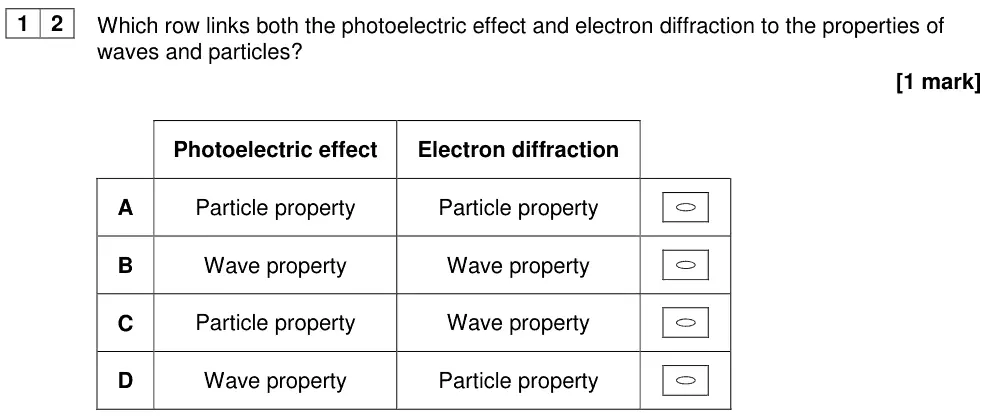
Which row links both the photoelectric effect and electron diffraction to the properties of
waves and particles?
[1 mark]
Photoelectric effect
Electron diffraction
A
Particle property
Particle property
B
Wave property
Wave property
C
Particle property
Wave property
D
Wave property
Particle property
June 2018 · AS Paper 2 · Q13 1 mark Multiple choice measurements and uncertainties
Measurements are made to determine the tension, length and mass per unit length of a
string stretched between two supports.  The percentage uncertainties in these
measurements are shown below.
Quantity
Percentage uncertainty
Length
0.80%
Tension
4.0%
Mass per unit length
2.0%
A stationary wave is formed on the string.
What is the percentage uncertainty in the calculated value of the frequency of the first
harmonic?
[1 mark]
A
1.8%
B
3.8%
C
6.8%
D
13%
June 2018 · AS Paper 2 · Q14 1 mark Multiple choice measurements and uncertainties
Which list puts the forces in order of increasing magnitude?
[1 mark]
A
2 pN < 2 fN < 2 TN < 2 GN
B
2 pN < 2 fN < 2 GN < 2 TN
C
2 fN < 2 pN < 2 TN < 2 GN
D
2 fN < 2 pN < 2 GN < 2 TN
June 2018 · AS Paper 2 · Q15 1 mark Multiple choice refraction and optical fibres
A ray of light is incident on a glass–air boundary of a rectangular block as shown.
The refractive index of this glass is 1.5
The refractive index of air is 1.0
The angle of incidence of the light at the first glass–air boundary is 44°
What is the path of the ray of light?
[1 mark]
A
B
C
D
June 2018 · AS Paper 2 · Q16 1 mark Multiple choice refraction and optical fibres
Rays of light are incident at the same angle θ on the core–cladding boundary of optical
fibres P and Q.
The cores of P and Q have the same refractive index n.
P and Q are the same length L.
The core diameter of P is half that of Q.
The time for the ray to travel along optical fibre P is
L
csinθ
where c is the speed of light in a vacuum.
What is the time for the ray to travel along optical fibre Q?
[1 mark]
A
L
csinθ
B
nL
2csinθ
C
2nL
csinθ
D
4nL
csinθ
June 2018 · AS Paper 2 · Q17 1 mark Multiple choice stationary waves
The fundamental frequency f is the lowest frequency heard when a stretched string is
vibrating.
The string is now lightly touched one third of the way along its length.
What is the lowest frequency heard?
[1 mark]
A
f
3
B
2 f
3
C
f
D
3f
June 2018 · AS Paper 2 · Q18 1 mark Multiple choice interference and diffraction
A diffraction grating is illuminated normally with light of wavelength 6.5 × 10⁻⁷ m
When a screen is 1.5 m from the grating, the distance between the zero and first-order
maxima on the screen is 0.30 m
What is the number of lines per mm of the diffraction grating?
[1 mark]
A
3.3 × 10⁻⁶
B
3.3 × 10⁻³
C
3.0 × 10²
D
3.0 × 10⁵
π
June 2018 · AS Paper 2 · Q19 1 mark Multiple choice progressive waves and polarisation
Two points on a progressive wave have a phase difference of      rad
The speed of the wave is 340 m s−1
What is the frequency of the wave when the minimum distance between the two points
is 0.12 m?
[1 mark]
A
240 Hz
B
470 Hz
C
1400 Hz
D
2800 Hz
6
June 2018 · AS Paper 2 · Q20 1 mark Multiple choice vectors and moments
A bird sits on a uniform rod suspended from vertical wires P and Q.
The rod has a weight W and is 15.0 cm long.
The weight of the bird is 2W and acts at a distance x from P.
What is the value of x when the tension in P is half the tension in Q?
[1 mark]
A
7.50 cm
B
10.0 cm
C
11.3 cm
D
15.0 cm
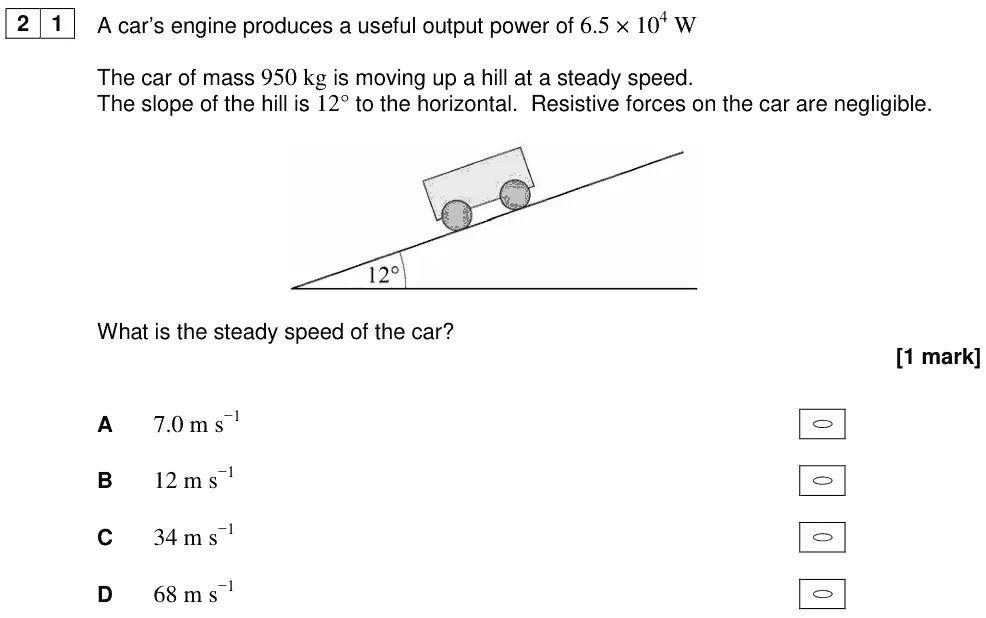
June 2018 · AS Paper 2 · Q21 1 mark Multiple choice work energy and powervectors and moments
A car’s engine produces a useful output power of 6.5 × 10⁴ W
The car of mass 950 kg is moving up a hill at a steady speed.
The slope of the hill is 12° to the horizontal.  Resistive forces on the car are negligible.
What is the steady speed of the car?
[1 mark]
A
7.0 m s−1
B
12 m s−1
C
34 m s−1
D
68 m s−1
June 2018 · AS Paper 2 · Q22 1 mark Multiple choice motion and projectilesnewtons laws and momentum
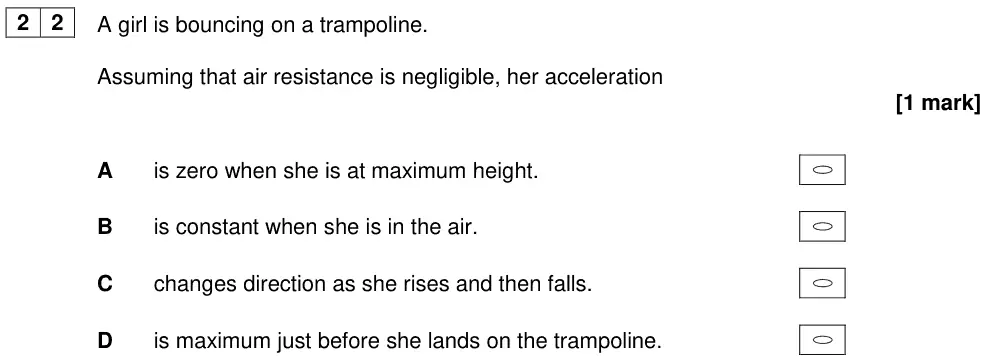
A girl is bouncing on a trampoline.
Assuming that air resistance is negligible, her acceleration
[1 mark]
A
is zero when she is at maximum height.
B
is constant when she is in the air.
C
changes direction as she rises and then falls.
D
is maximum just before she lands on the trampoline.
June 2018 · AS Paper 2 · Q23 1 mark Multiple choice materials and young modulus
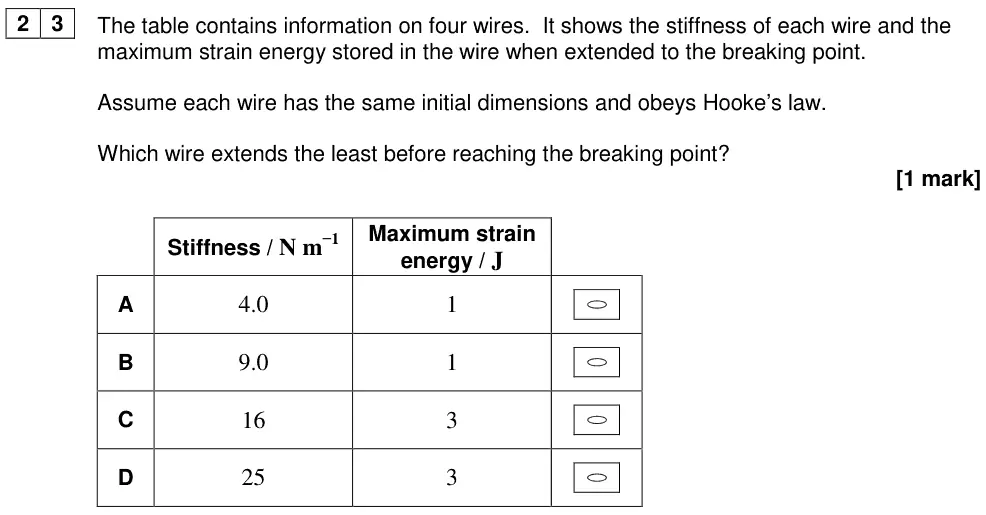
The table contains information on four wires.  It shows the stiffness of each wire and the
maximum strain energy stored in the wire when extended to the breaking point.
Assume each wire has the same initial dimensions and obeys Hooke’s law.
Which wire extends the least before reaching the breaking point?
[1 mark]
Stiffness / N m−1
Maximum strain
energy / J
A
4.0
1
B
9.0
1
C
16
3
D
25
3
June 2018 · AS Paper 2 · Q24 1 mark Multiple choice motion and projectiles
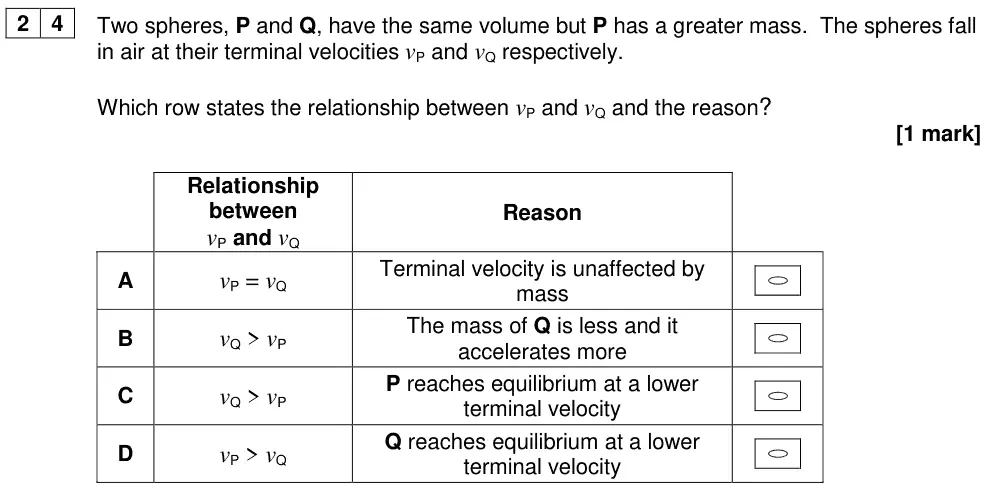
Two spheres, P and Q, have the same volume but P has a greater mass.  The spheres fall
in air at their terminal velocities vP and vQ respectively.
Which row states the relationship between vP and vQ and the reason?
[1 mark]
Relationship
between
vP and vQ
Reason
A
vP = vQ
Terminal velocity is unaffected by
mass
B
vQ > vP
The mass of Q is less and it
accelerates more
C
vQ > vP
P reaches equilibrium at a lower
terminal velocity
D
vP > vQ
Q reaches equilibrium at a lower
terminal velocity
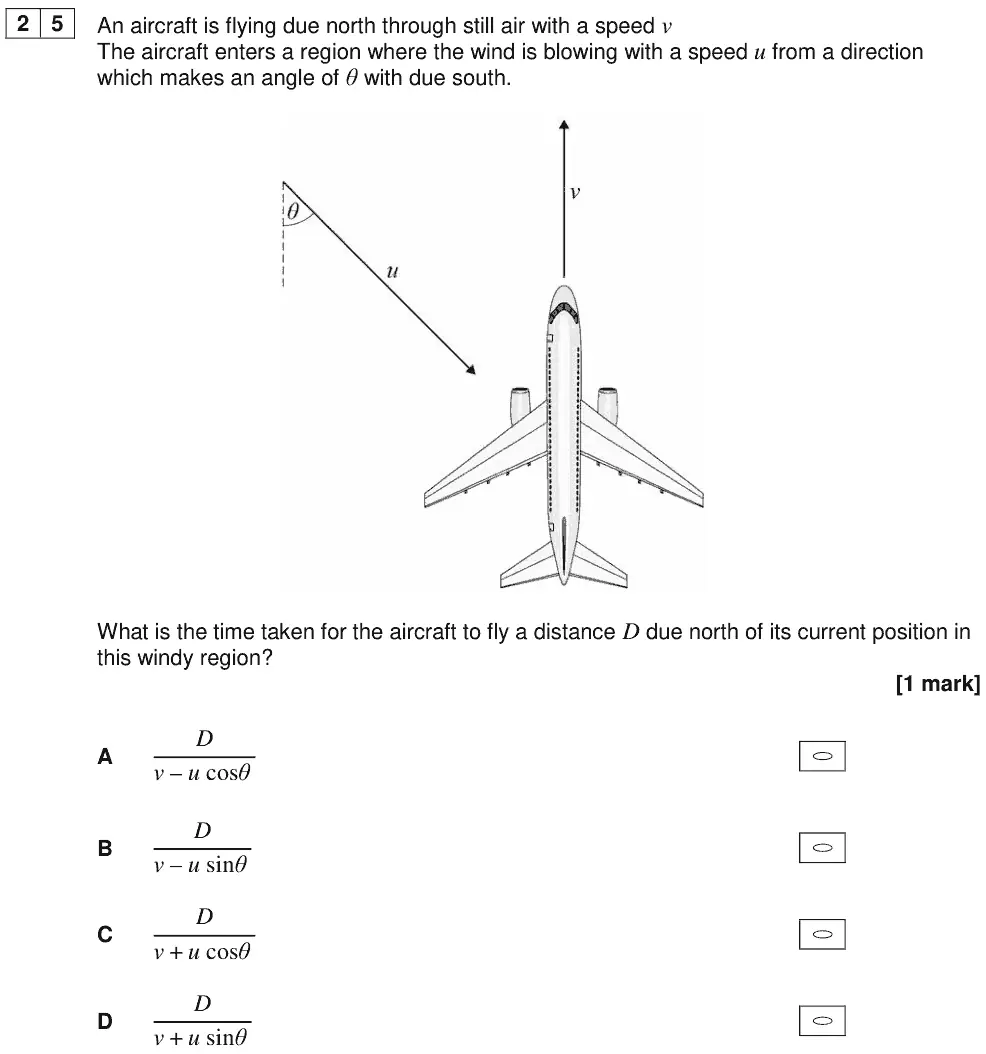
June 2018 · AS Paper 2 · Q25 1 mark Multiple choice vectors and moments
An aircraft is flying due north through still air with a speed v
The aircraft enters a region where the wind is blowing with a speed u from a direction
which makes an angle of θ with due south.
What is the time taken for the aircraft to fly a distance D due north of its current position in
this windy region?
[1 mark]
A
D
v – u cosθ
B
D
v – u sinθ
C
D
v + u cosθ
D
D
v + u sinθ
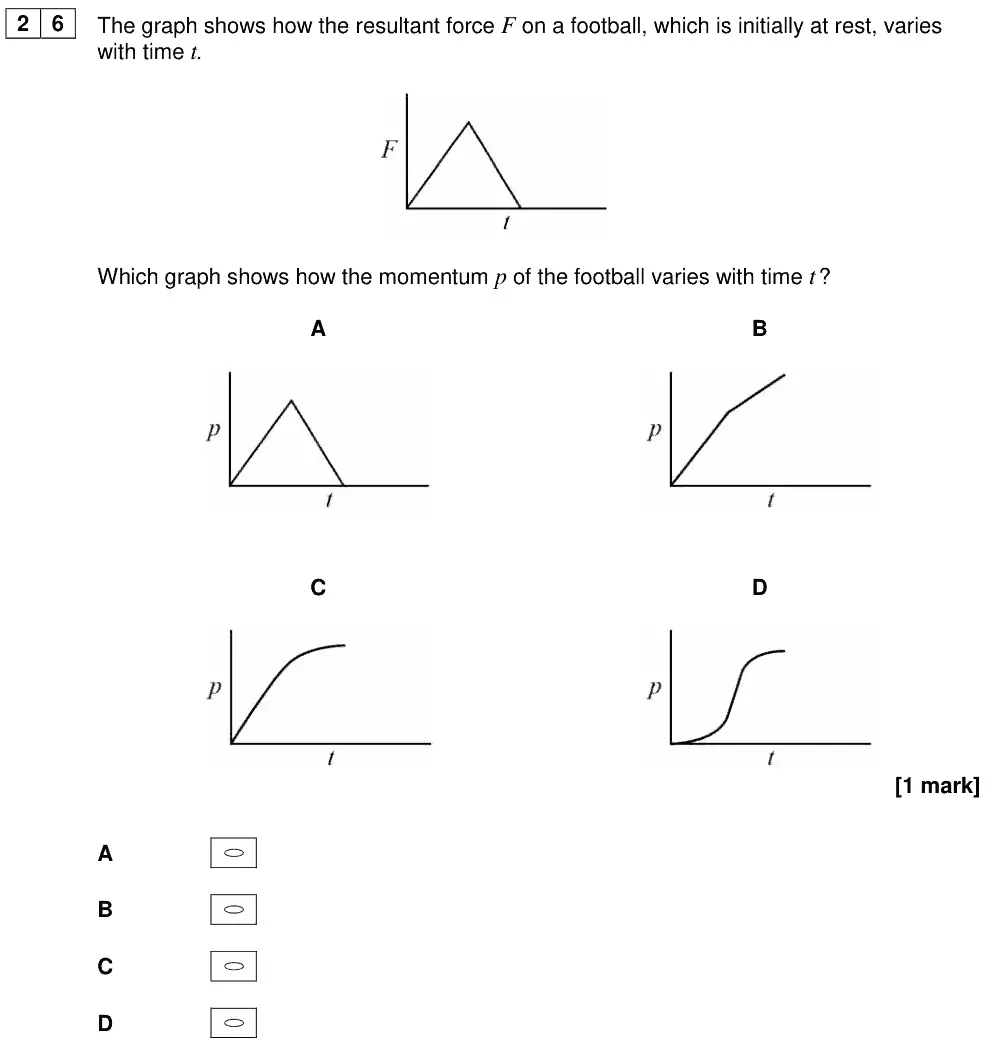
June 2018 · AS Paper 2 · Q26 1 mark Multiple choice newtons laws and momentum
The graph shows how the resultant force F on a football, which is initially at rest, varies
with time t.
Which graph shows how the momentum p of the football varies with time t ?
A
B
C
D
[1 mark]
A
B
C
D
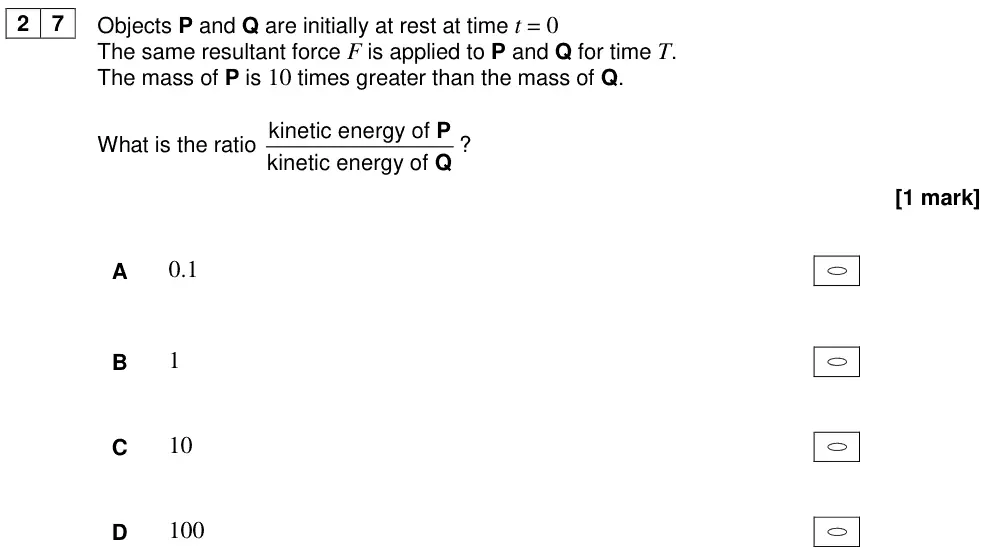
June 2018 · AS Paper 2 · Q27 1 mark Multiple choice newtons laws and momentumwork energy and power
Objects P and Q are initially at rest at time t = 0
The same resultant force F is applied to P and Q for time T.
The mass of P is 10 times greater than the mass of Q.
What is the ratio kinetic energy of
kinetic energy of
P
Q ?
[1 mark]
A
0.1
B
1
C
10
D
100
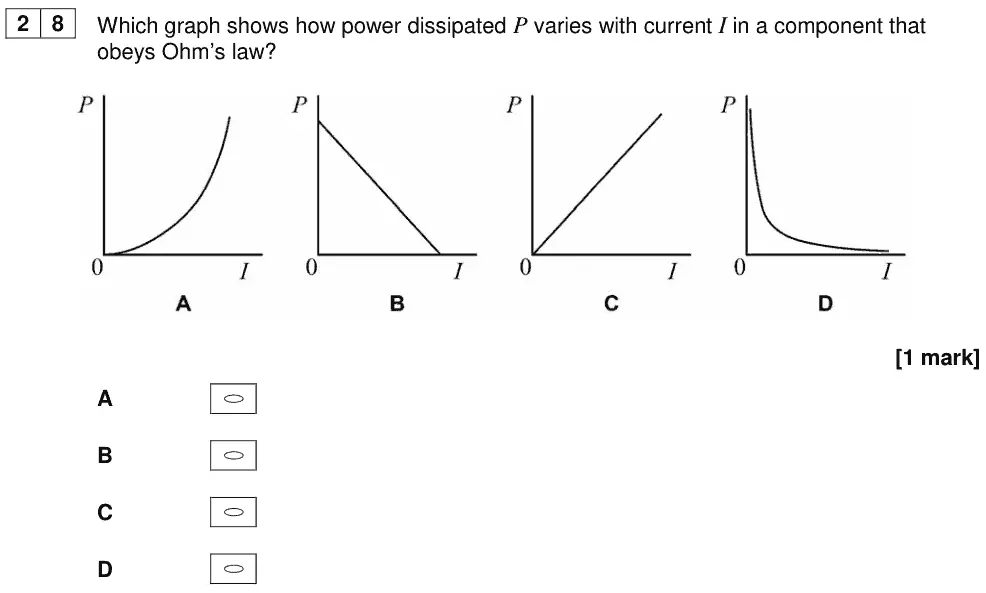
June 2018 · AS Paper 2 · Q28 1 mark Multiple choice circuits and potential dividerscurrent voltage and resistivity
Which graph shows how power dissipated P varies with current I in a component that
obeys Ohm’s law?
[1 mark]
A
B
C
D
June 2018 · AS Paper 2 · Q29 1 mark Multiple choice measurements and uncertaintiesenergy levels and wave particle duality
1.0 kilowatt-hour (kW h) is equivalent to
[1 mark]
A
6.3 × 10¹⁸ eV
B
6.3 × 10²¹ eV
C
2.3 × 10²² eV
D
2.3 × 1025 eV
June 2018 · AS Paper 2 · Q30 1 mark Multiple choice current voltage and resistivity
The graph shows how the potential difference V across an electrical component varies
with current I in the component.
A tangent has been drawn on the curve at point P for a current of I2.
What is the resistance of the electrical component when the current in the component
is I2?
[1 mark]
A
3
1
2
2
V
V
I
−
B
3
1
3
1
V
V
I
I
−
−
C
2
2
V
I
D
2
2
1
2V
I
I
−
June 2018 · AS Paper 2 · Q31 1 mark Multiple choice current voltage and resistivitycircuits and potential dividers
A circuit consists of a cell, a thermistor, a fixed resistor and two ammeters.
The cell has a constant electromotive force and negligible internal resistance.  Readings
from the two ammeters are taken.
Which row describes what happens to the current in each ammeter when the temperature
of the thermistor decreases?
[1 mark]
Current in
ammeter A1
Current in
ammeter A2
A
Decreases
Unchanged
B
Decreases
Increases
C
Increases
Decreases
D
Increases
Unchanged
June 2018 · AS Paper 2 · Q32 1 mark Multiple choice circuits and potential dividersemf and internal resistance
A circuit consists of two identical cells, a resistor, an ammeter and a voltmeter. The cells
each have an emf of 3.0 V and the resistor has a resistance of 12 Ω
The cells have negligible internal resistance.
Which row shows the readings on the voltmeter and ammeter?
[1 mark]
Voltage / V
Current / A
A
3.0
0.25
B
3.0
0.50
C
6.0
0.25
D
6.0
0.50
June 2018 · AS Paper 2 · Q33 1 mark Multiple choice measurements and uncertaintiescurrent voltage and resistivity
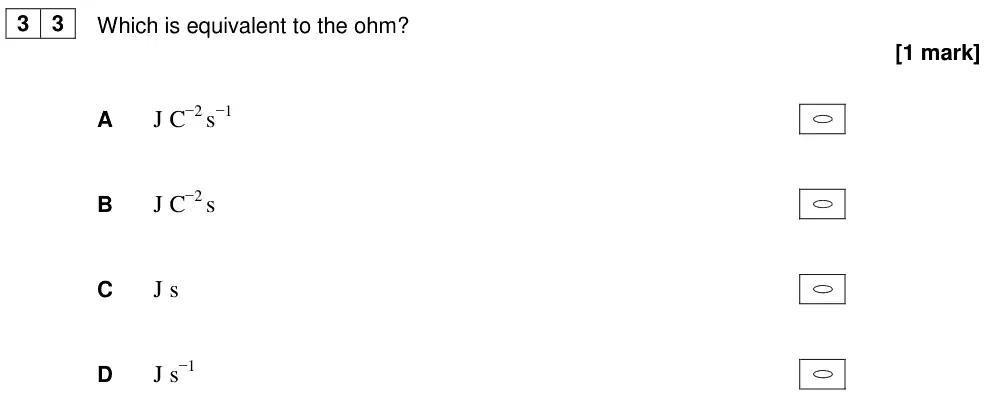
Which is equivalent to the ohm?
[1 mark]
A
J C−2 s−1
B
J C−2 s
C
J s
D
J s−1
June 2018 · AS Paper 2 · Q34 1 mark Multiple choice current voltage and resistivitycircuits and potential dividers
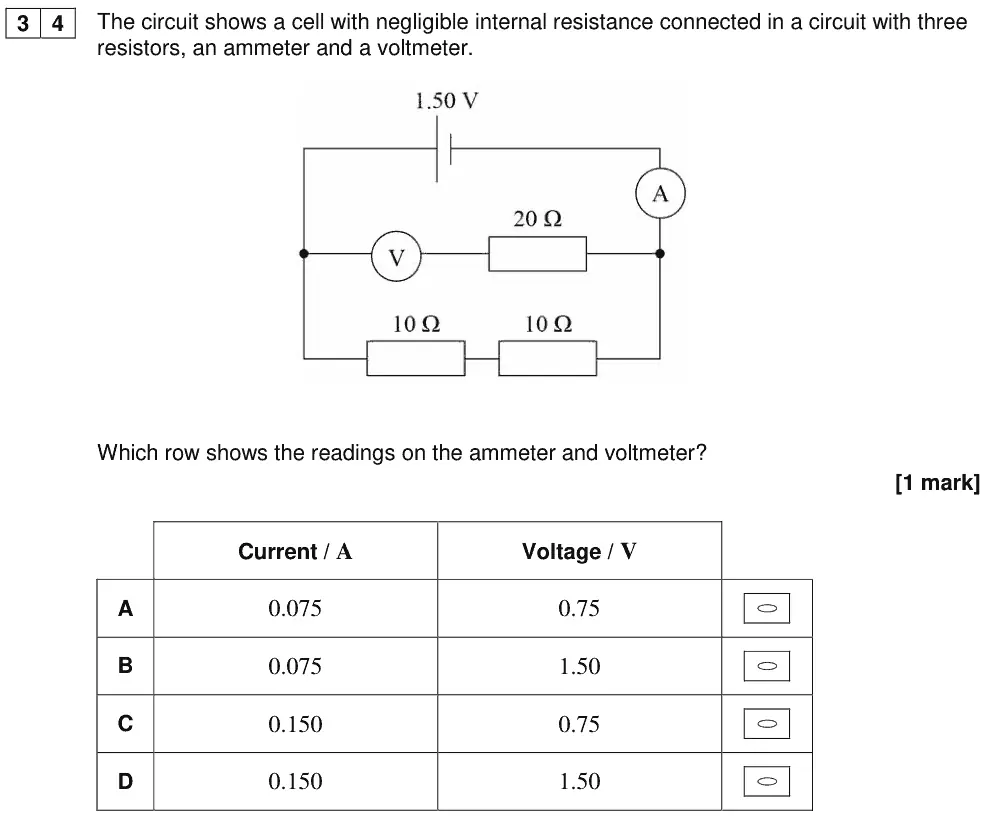
The circuit shows a cell with negligible internal resistance connected in a circuit with three
resistors, an ammeter and a voltmeter.
Which row shows the readings on the ammeter and voltmeter?
[1 mark]
Current / A
Voltage / V
A
0.075
0.75
B
0.075
1.50
C
0.150
0.75
D
0.150
1.50

Work with an AQA physics tutor

Want a paper marked and gone through with you? Message us.

Prefer email? Send an enquiry

If you are under 18, please include a parent's contact details. Enquiries go to enquiries@physicsaleveltutor.com and are deleted once handled. All tutoring is online.