June 2019: AS Paper 2

70 marks · 50 question parts · Paper, mark scheme and report on AQA's site · Have the data and formulae booklet beside you

Question by question

QTopicMarksAOType
1.1 Measurements, units and uncertainties 2Practical and data analysis
1.2 Measurements, units and uncertainties 2Calculation
1.3 Measurements, units and uncertainties 2Practical and data analysis
1.4 Interference, diffraction and the diffraction grating 1Short answer
1.5 Interference, diffraction and the diffraction grating 1Calculation
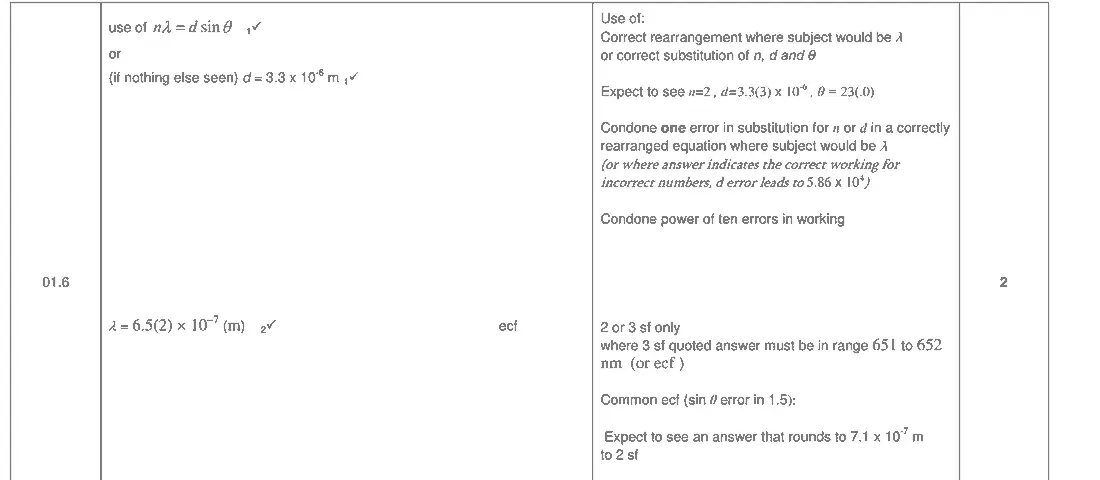
1.6 Interference, diffraction and the diffraction grating 2Calculation
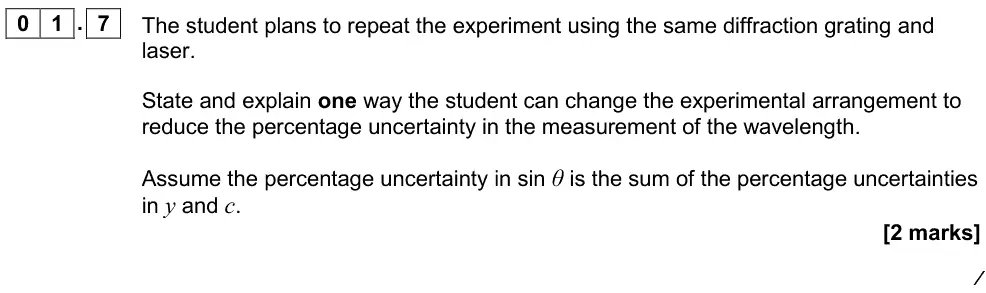
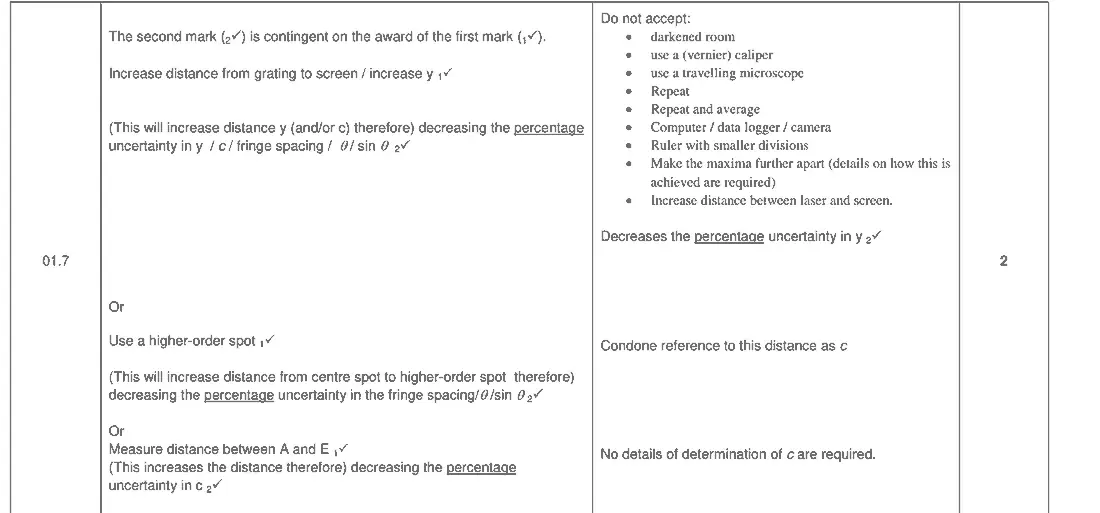
1.7 Measurements, units and uncertainties, Interference, diffraction and the diffraction grating 2Practical and data analysis
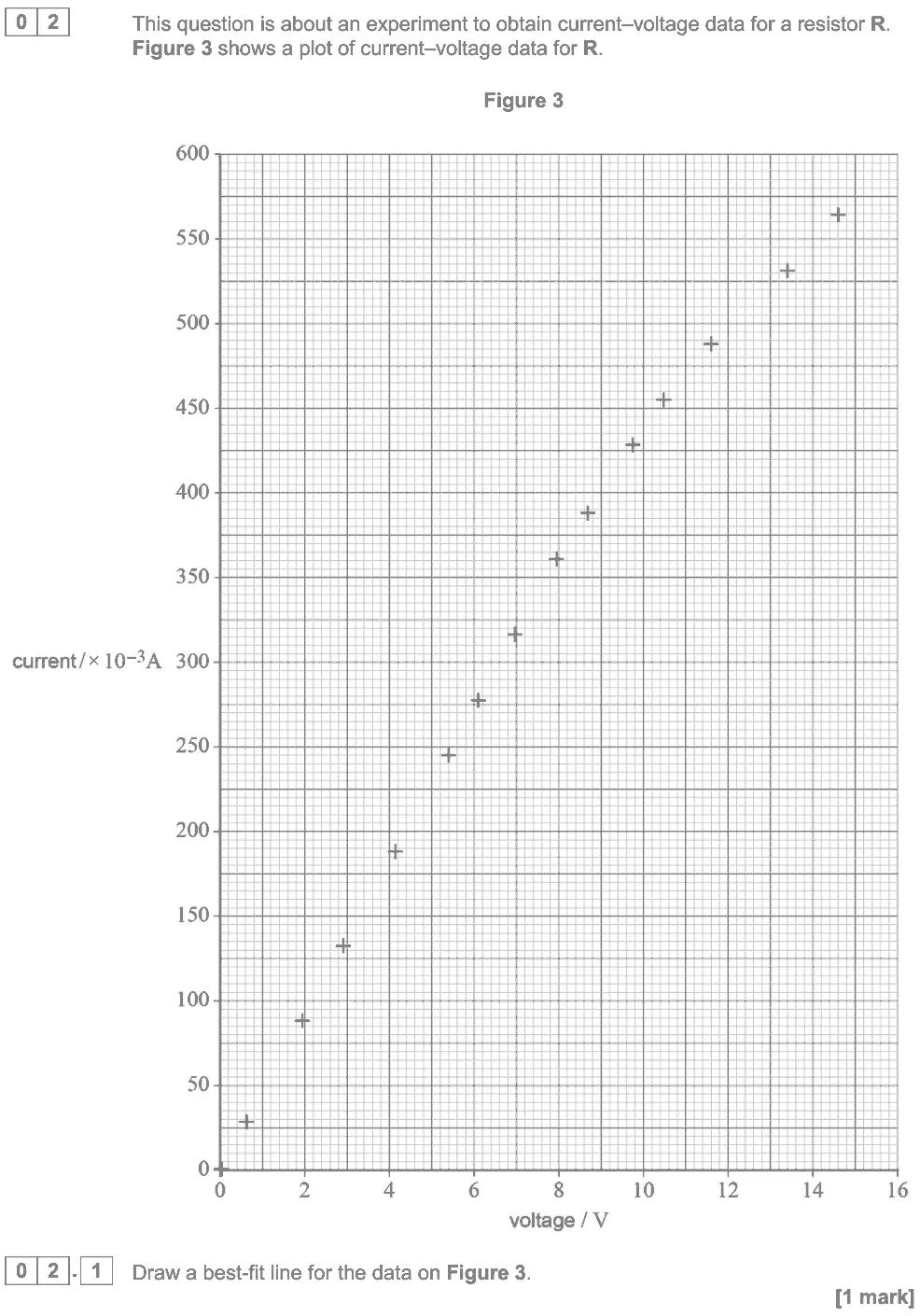
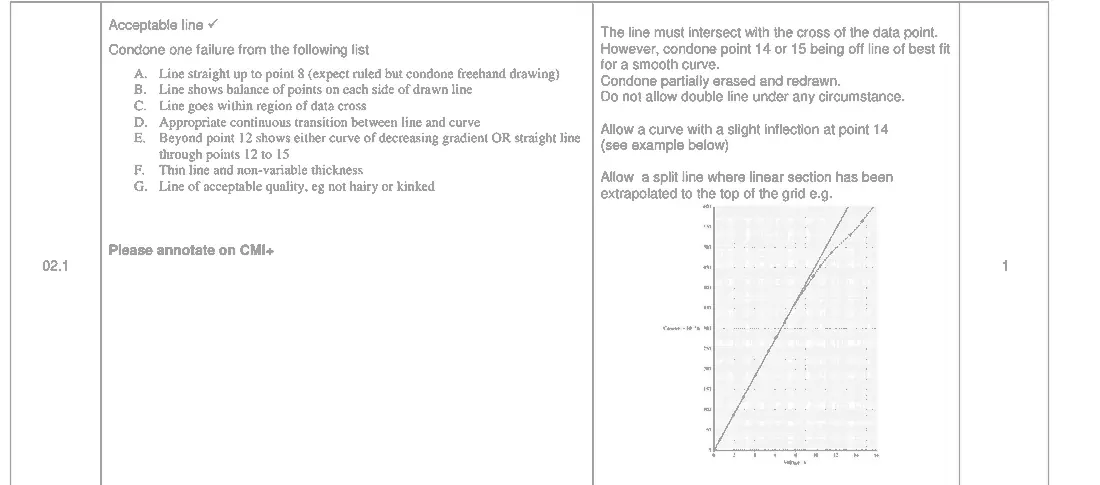
2.1 Current, potential difference, I-V characteristics and resistivity 1Diagram or graph
2.2 Current, potential difference, I-V characteristics and resistivity 1Diagram or graph
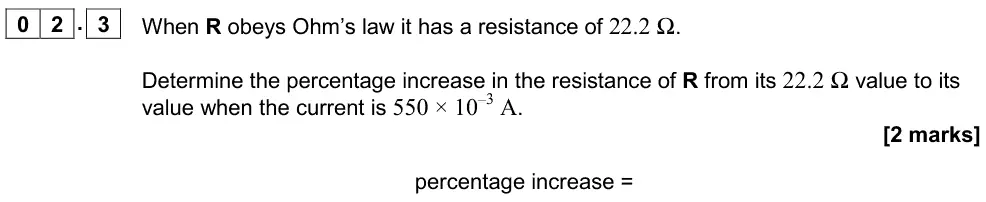
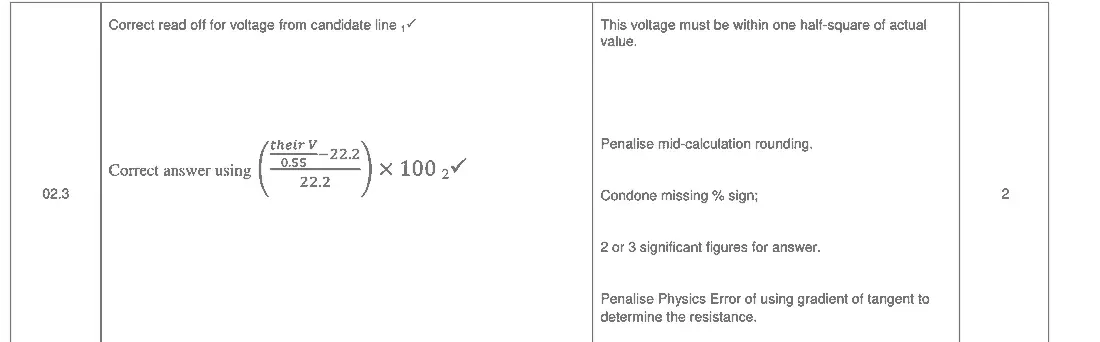
2.3 Current, potential difference, I-V characteristics and resistivity 2Calculation
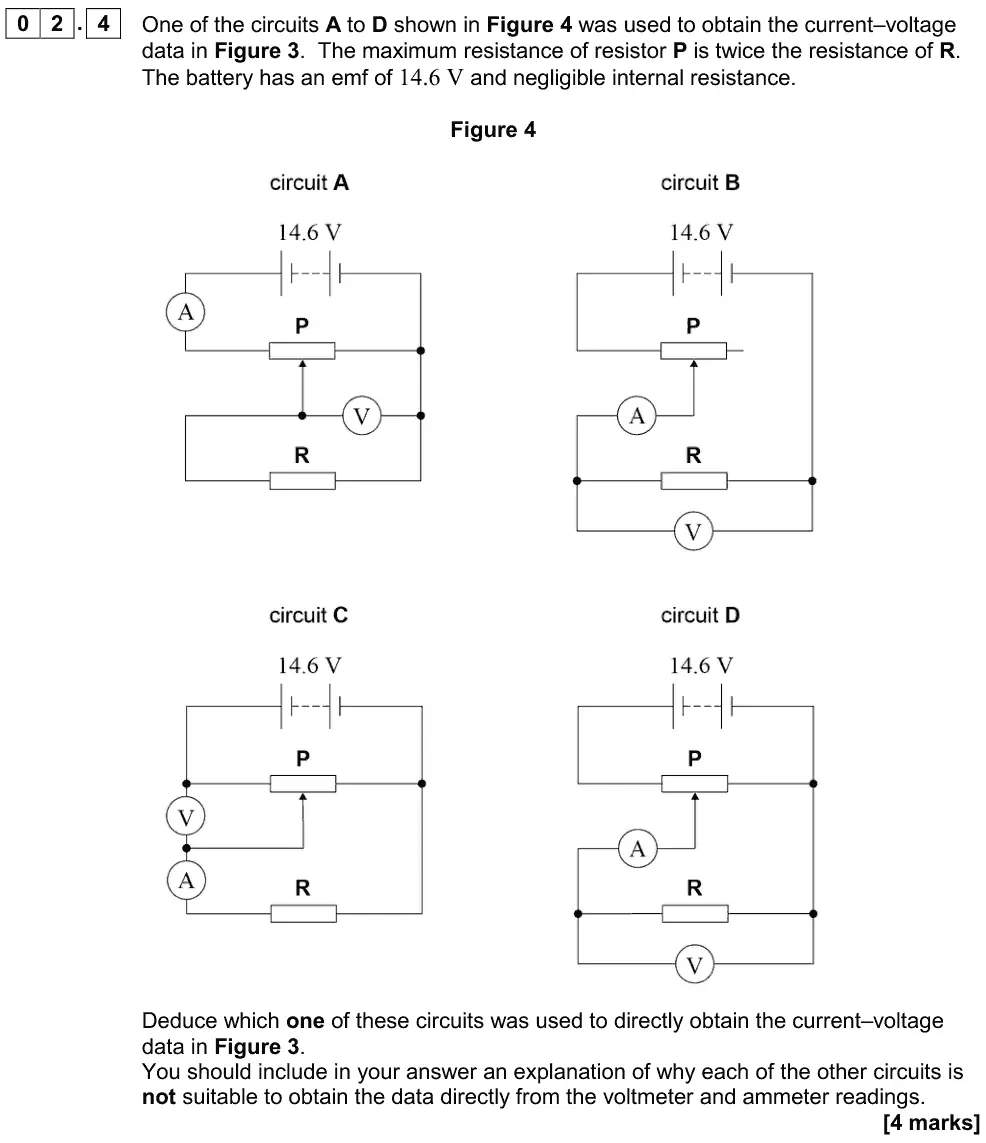
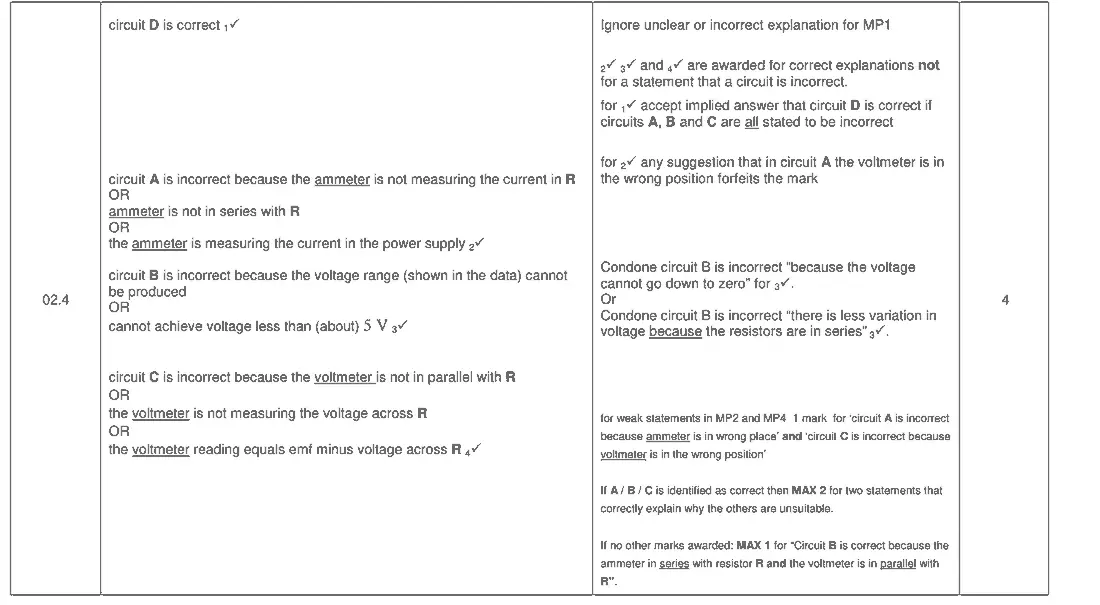
2.4 Circuits and potential dividers, Current, potential difference, I-V characteristics and resistivity 4Practical and data analysis
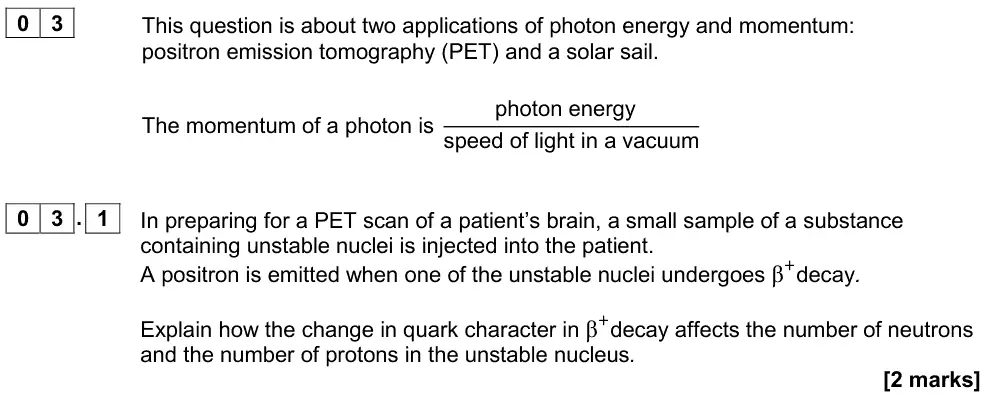
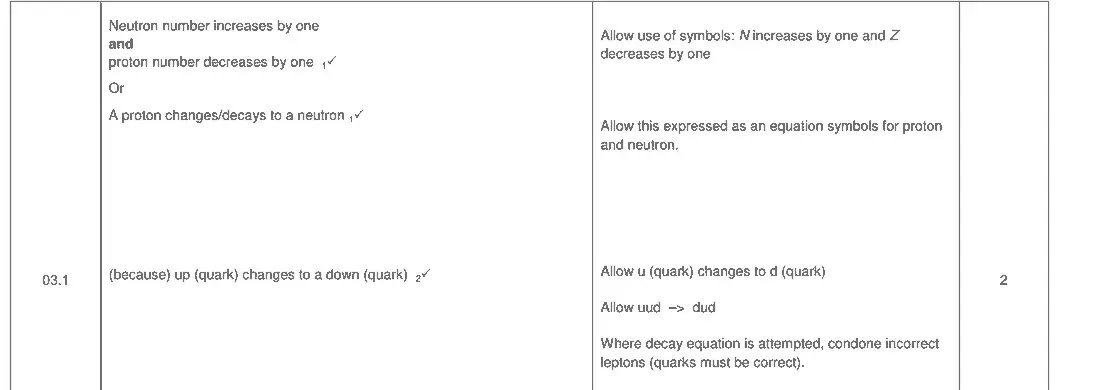
3.1 Classification of particles, quarks and conservation laws, Particles, antiparticles and particle interactions 2Explanation
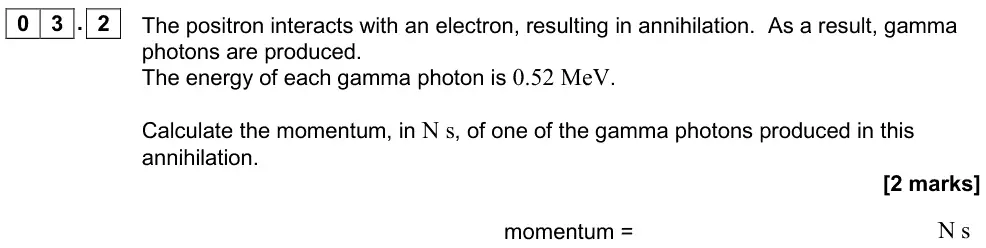
3.2 Particles, antiparticles and particle interactions, Excitation, energy levels and wave-particle duality 2Calculation
3.3 Particles, antiparticles and particle interactions 1Diagram or graph
3.4 Particles, antiparticles and particle interactions, Newton's laws of motion and momentum 2Explanation
3.5 Motion along a straight line and projectile motion 2Calculation
3.6 Newton's laws of motion and momentum 2Explanation
4.1 Circuits and potential dividers, Current, potential difference, I-V characteristics and resistivity 3Calculation
4.2 Work, energy, power and conservation of energy 3Calculation
4.3 Current, potential difference, I-V characteristics and resistivity 3Explanation
5 Measurements, units and uncertainties, Materials, stress, strain and the Young modulus 1Multiple choice
6 Atomic structure and stable nuclei 1Multiple choice
7 Atomic structure and stable nuclei 1Multiple choice
8 Classification of particles, quarks and conservation laws 1Multiple choice
9 Classification of particles, quarks and conservation laws 1Multiple choice
10 Classification of particles, quarks and conservation laws 1Multiple choice
11 The photoelectric effect 1Multiple choice
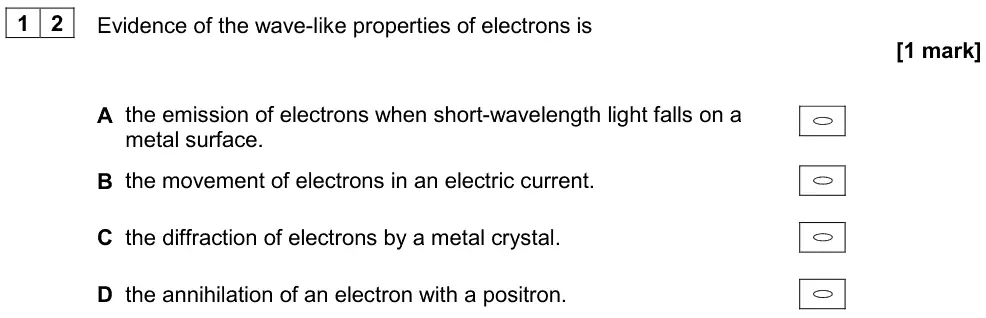
12 Excitation, energy levels and wave-particle duality 1Multiple choice
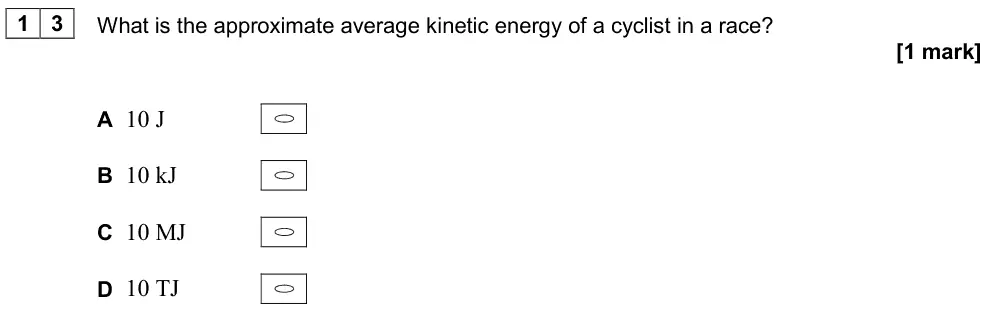
13 Measurements, units and uncertainties 1Multiple choice
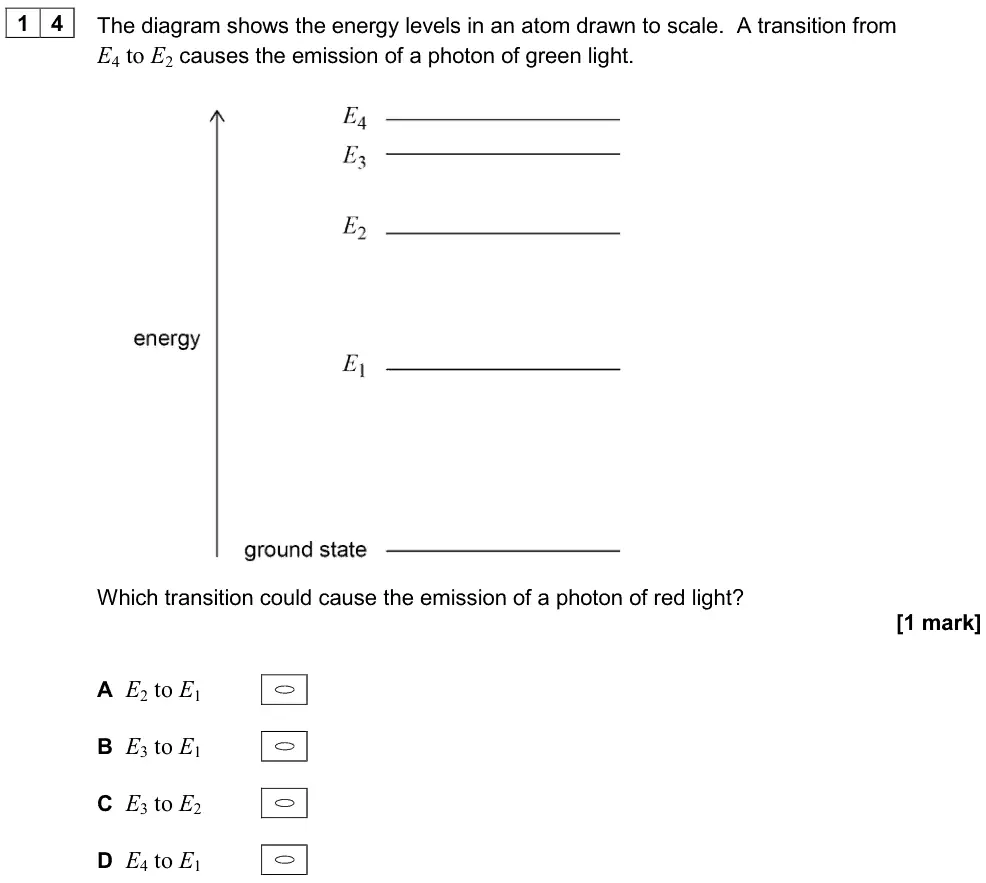
14 Excitation, energy levels and wave-particle duality, Particles, antiparticles and particle interactions 1Multiple choice
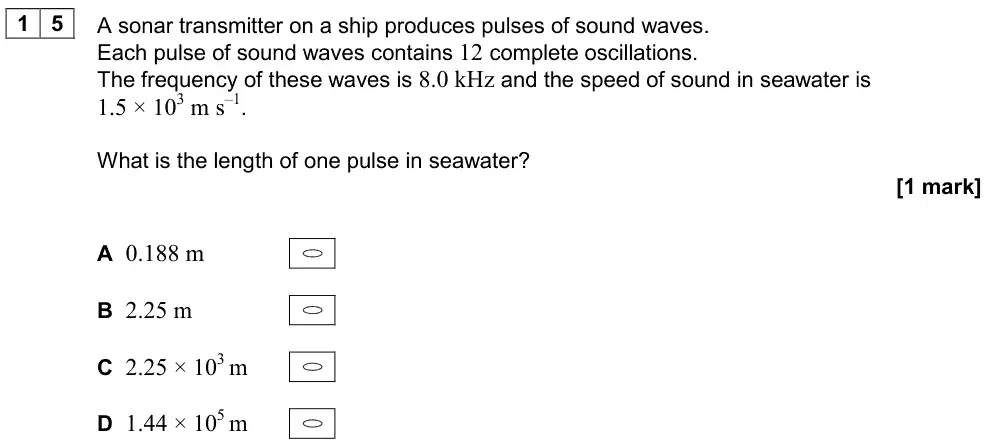
15 Progressive waves, longitudinal and transverse waves 1Multiple choice
16 Progressive waves, longitudinal and transverse waves 1Multiple choice
17 Superposition and stationary waves 1Multiple choice
18 Interference, diffraction and the diffraction grating 1Multiple choice
19 Interference, diffraction and the diffraction grating 1Multiple choice
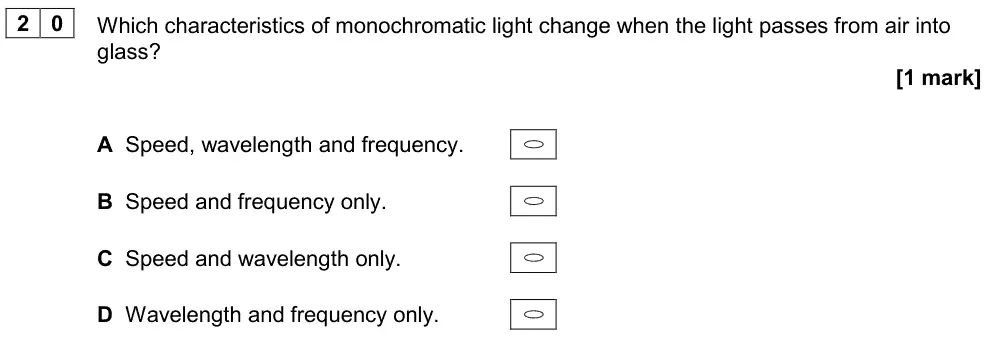
20 Refraction, total internal reflection and optical fibres 1Multiple choice
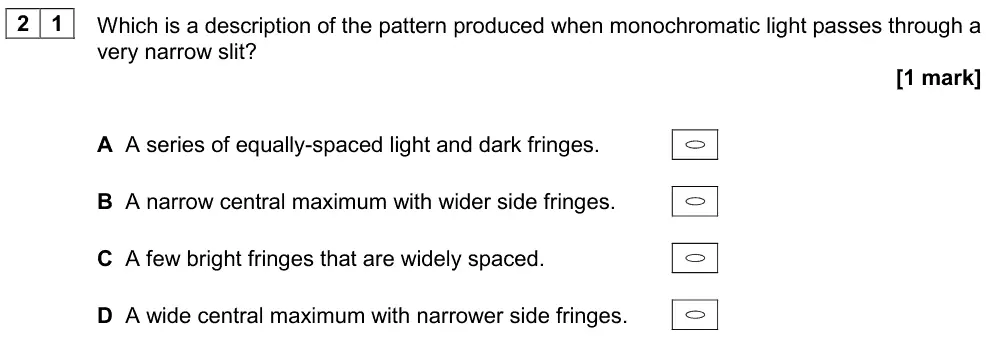
21 Interference, diffraction and the diffraction grating 1Multiple choice
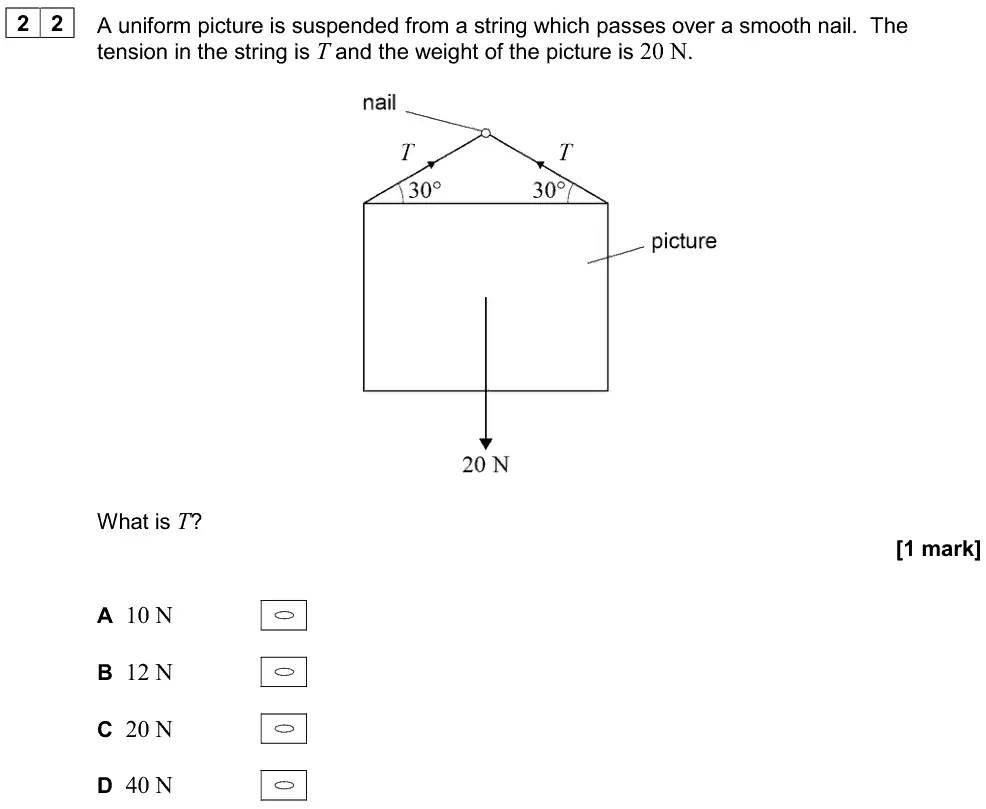
22 Scalars, vectors and moments 1Multiple choice
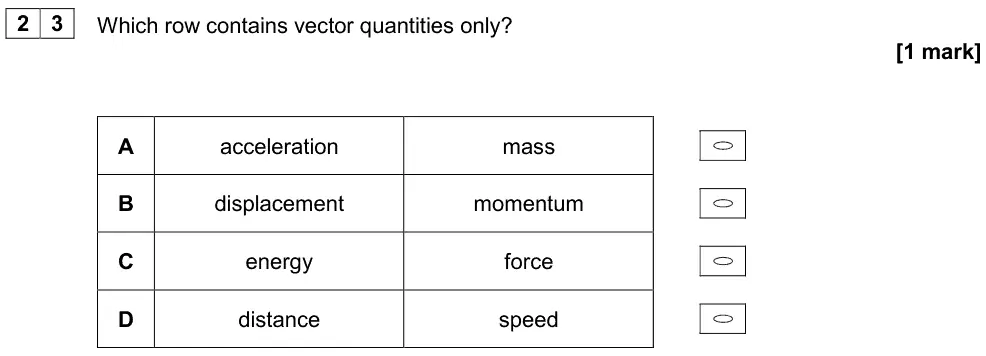
23 Scalars, vectors and moments 1Multiple choice
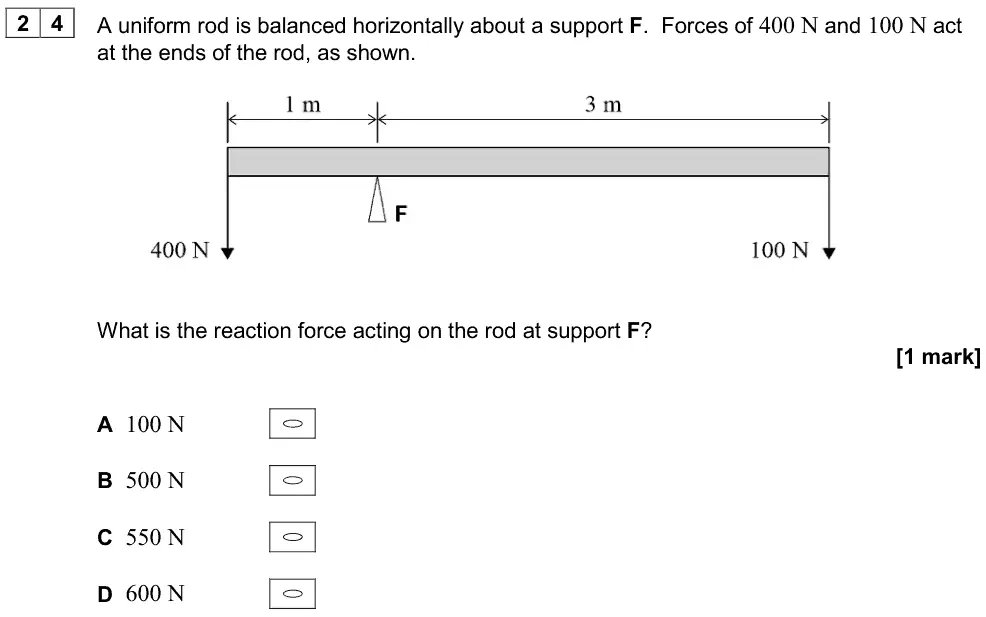
24 Scalars, vectors and moments 1Multiple choice
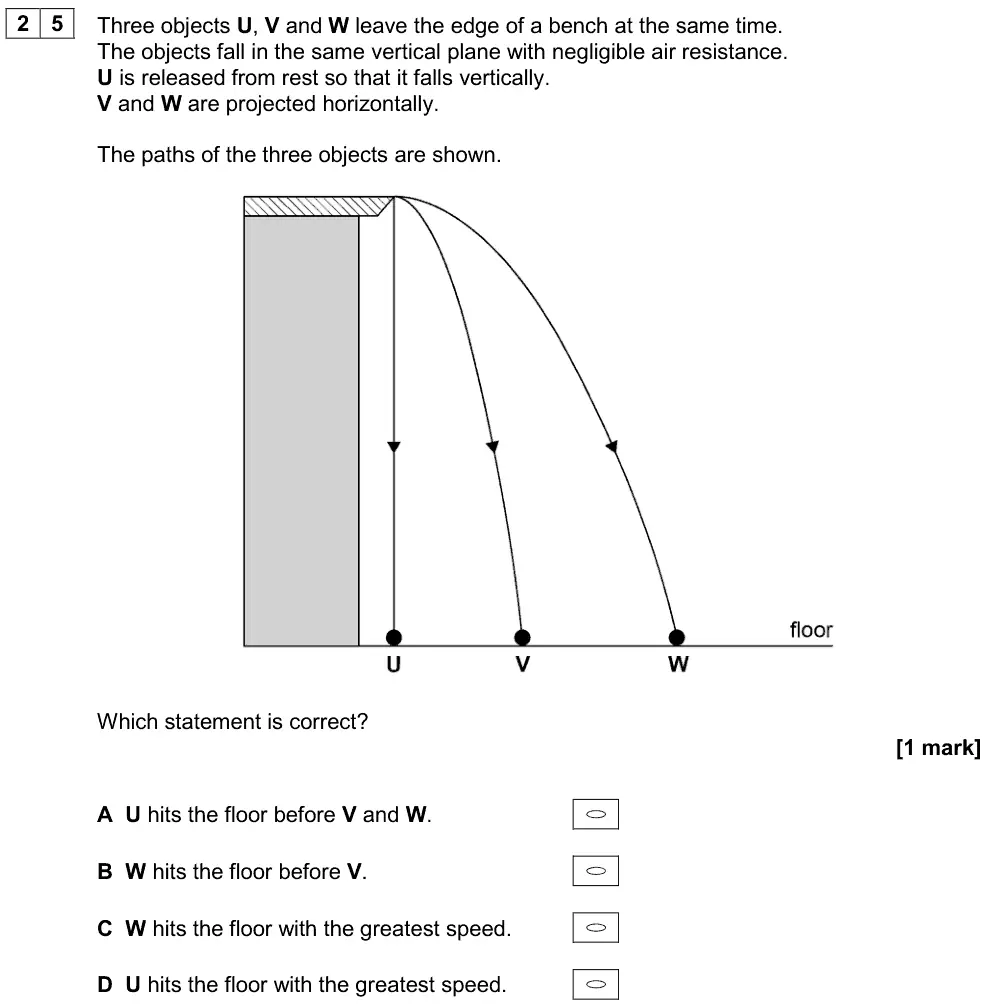
25 Motion along a straight line and projectile motion 1Multiple choice
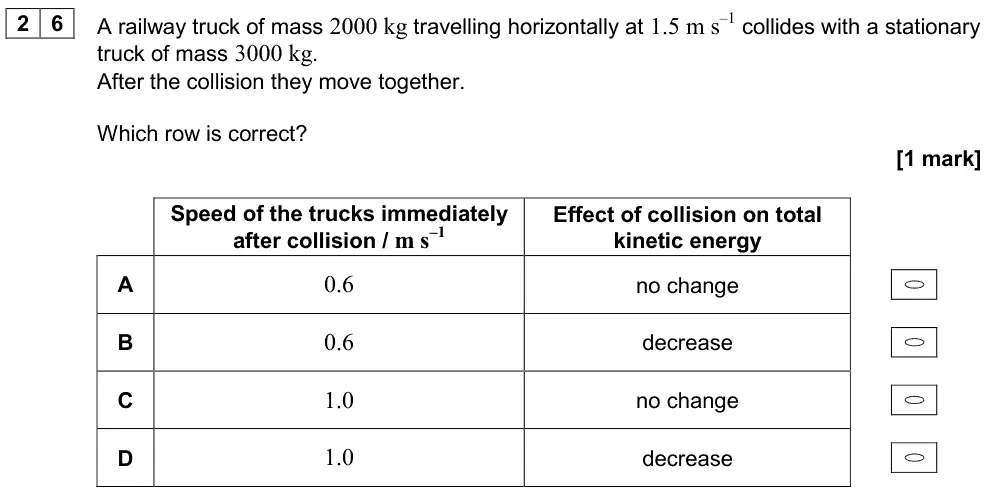
26 Newton's laws of motion and momentum 1Multiple choice
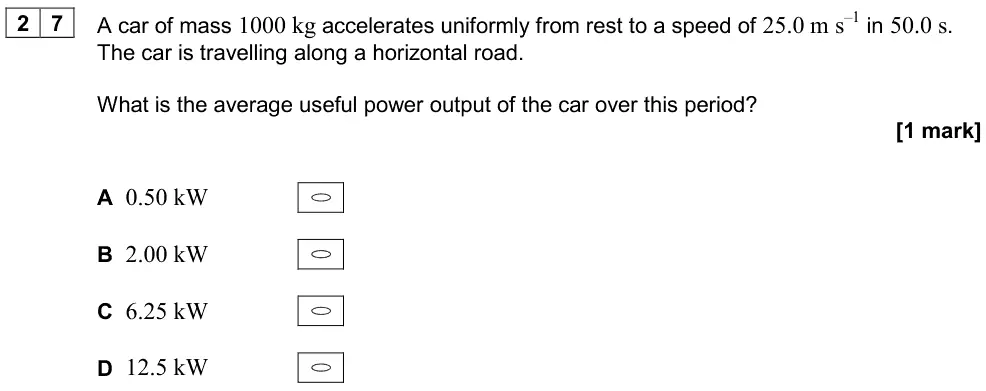
27 Work, energy, power and conservation of energy 1Multiple choice
28 Materials, stress, strain and the Young modulus 1Multiple choice
29 Current, potential difference, I-V characteristics and resistivity 1Multiple choice
30 Electromotive force and internal resistance 1Multiple choice
31 Circuits and potential dividers 1Multiple choice
32 Circuits and potential dividers 1Multiple choice
33 Electromotive force and internal resistance 1Multiple choice
34 Circuits and potential dividers 1Multiple choice

The questions

1.11.21.31.41.51.61.72.12.22.32.43.13.23.33.43.53.64.14.24.35678910111213141516171819202122232425262728293031323334
June 2019 · AS Paper 2 · Q1.1 2 marks Practical and data analysis measurements and uncertainties
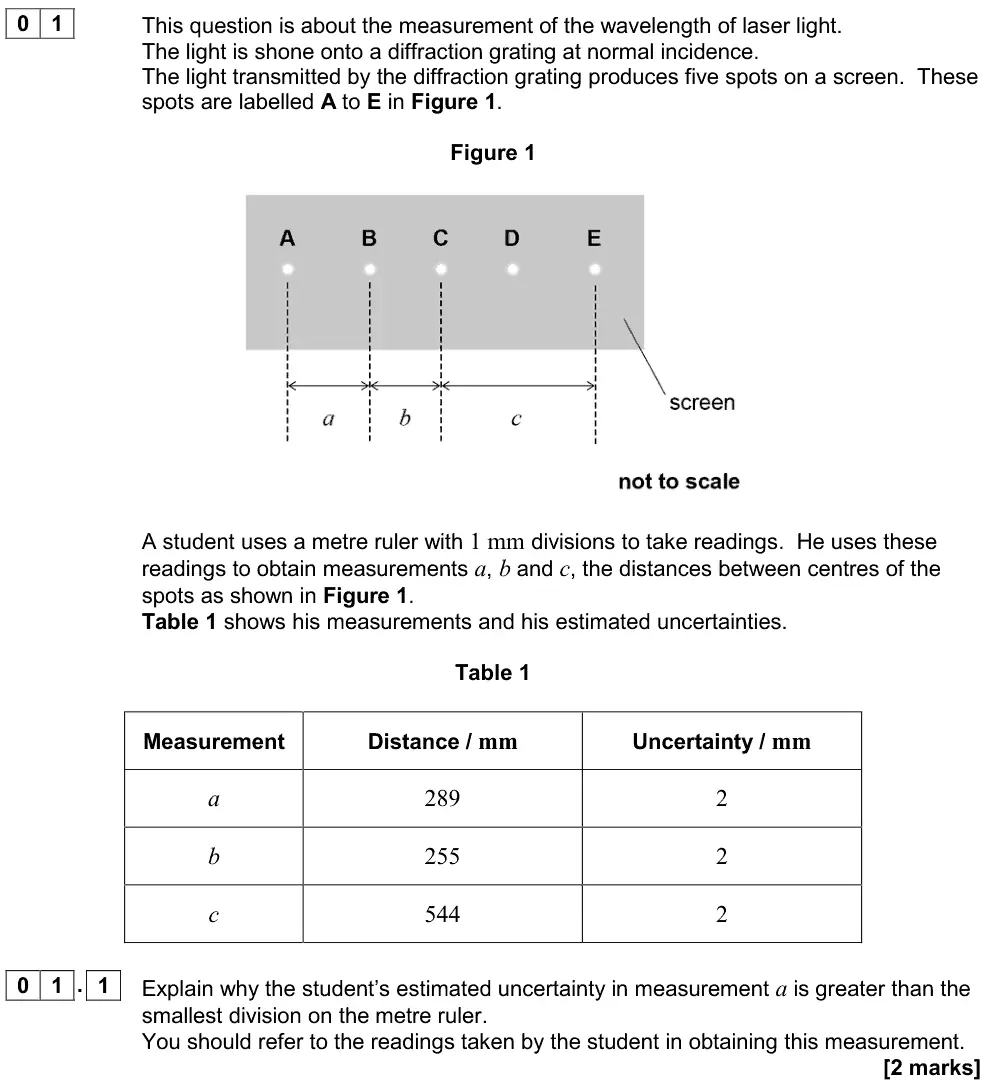
This question is about the measurement of the wavelength of laser light.
The light is shone onto a diffraction grating at normal incidence.
The light transmitted by the diffraction grating produces five spots on a screen.  These
spots are labelled A to E in Figure 1.
Figure 1
A student uses a metre ruler with 1 mm divisions to take readings.  He uses these
readings to obtain measurements a, b and c, the distances between centres of the
spots as shown in Figure 1.
Table 1 shows his measurements and his estimated uncertainties.
Table 1
Measurement
Distance / mm
Uncertainty / mm
a
289
2
b
255
2
c
544
2
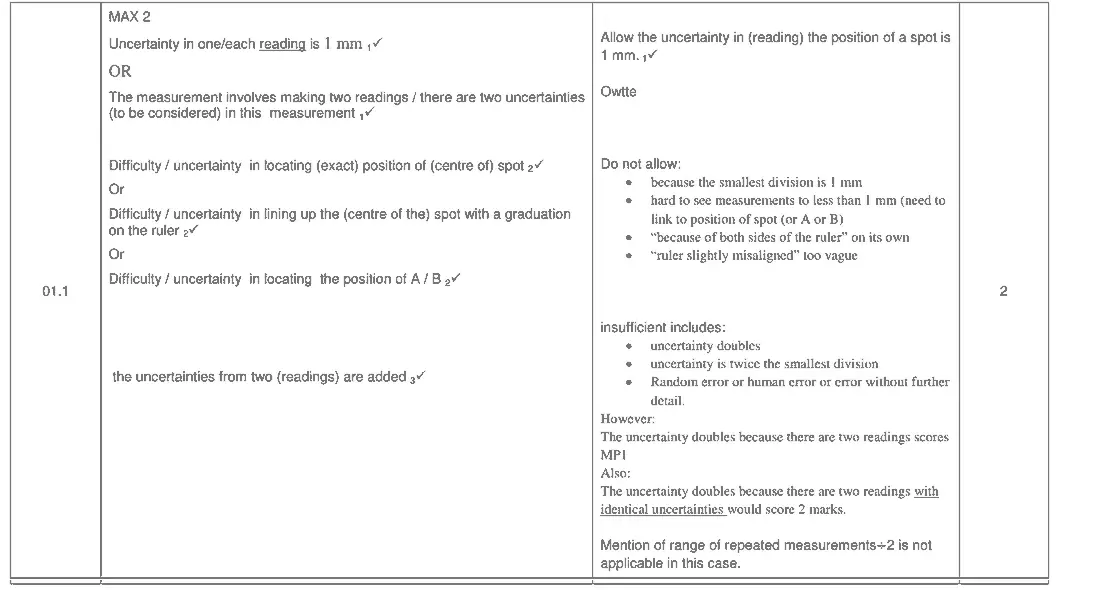
Explain why the student’s estimated uncertainty in measurement a is greater than the
smallest division on the metre ruler.
You should refer to the readings taken by the student in obtaining this measurement.
[2 marks]
June 2019 · AS Paper 2 · Q1.2 2 marks Calculation measurements and uncertainties
Earlier part of question 1 that this part usesEarlier part of June 2019 Paper 2 question 1
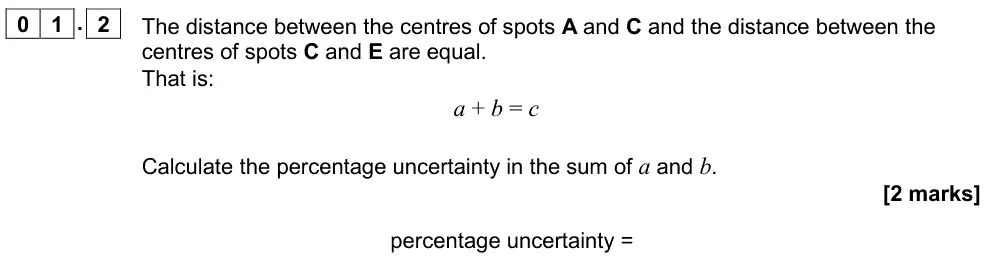
The distance between the centres of spots A and C and the distance between the
centres of spots C and E are equal.
That is:
a + b = c
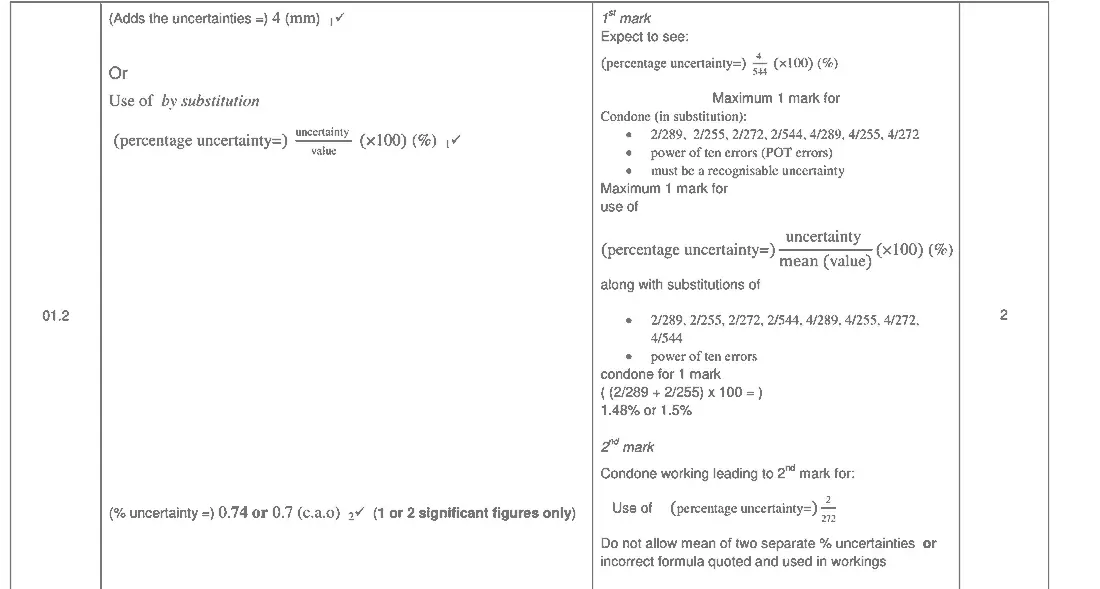
Calculate the percentage uncertainty in the sum of a and b.
[2 marks]
percentage uncertainty =
June 2019 · AS Paper 2 · Q1.3 2 marks Practical and data analysis measurements and uncertainties
Earlier part of question 1 that this part usesEarlier part of June 2019 Paper 2 question 1
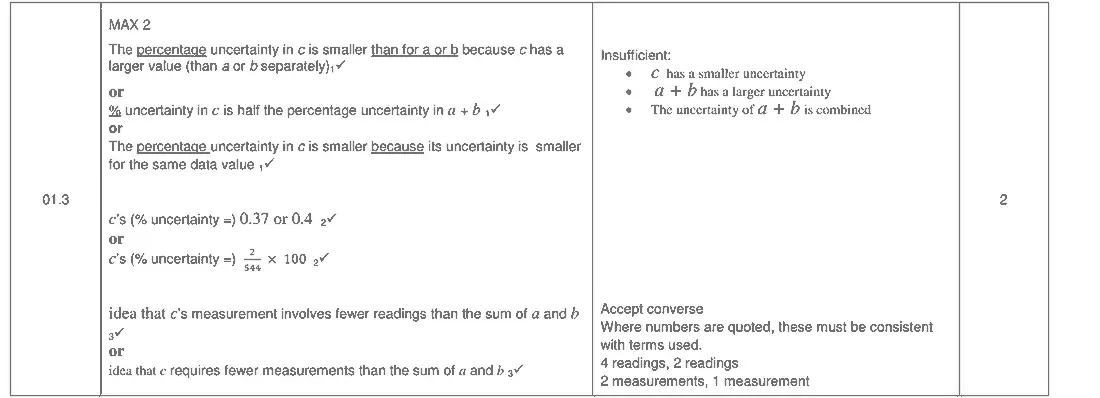
Discuss why the experimental measurements lead to a different percentage
uncertainty in c compared to that in a + b.
[2 marks]
June 2019 · AS Paper 2 · Q1.4 1 mark Short answer interference and diffraction
Earlier part of question 1 that this part usesEarlier part of June 2019 Paper 2 question 1
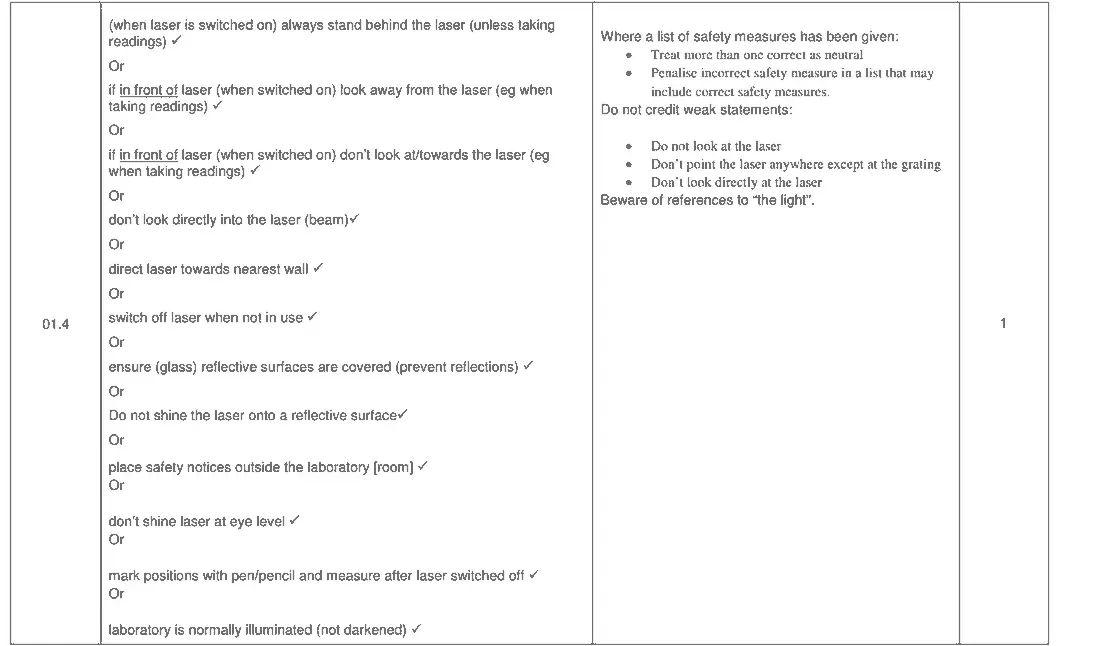
Eye protection should be used to prevent eye damage when using a laser.
Describe one other safety measure to minimise the risk of eye damage when using a
laser in the laboratory.
[1 mark]
June 2019 · AS Paper 2 · Q1.5 1 mark Calculation interference and diffraction
Earlier part of question 1 that this part usesEarlier part of June 2019 Paper 2 question 1
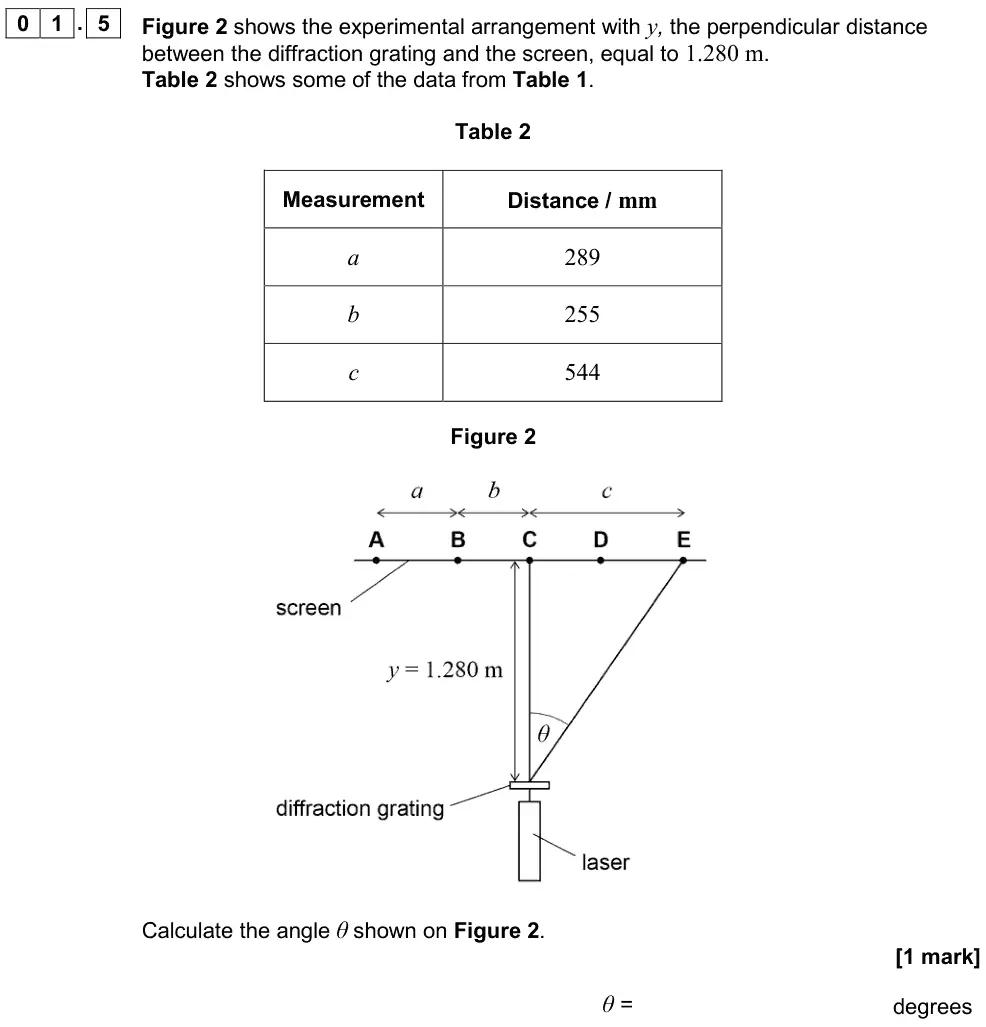
Figure 2 shows the experimental arrangement with y, the perpendicular distance
between the diffraction grating and the screen, equal to 1.280 m.
Table 2 shows some of the data from Table 1.
Table 2
Measurement
Distance / mm
a
289
b
255
c
544
Figure 2
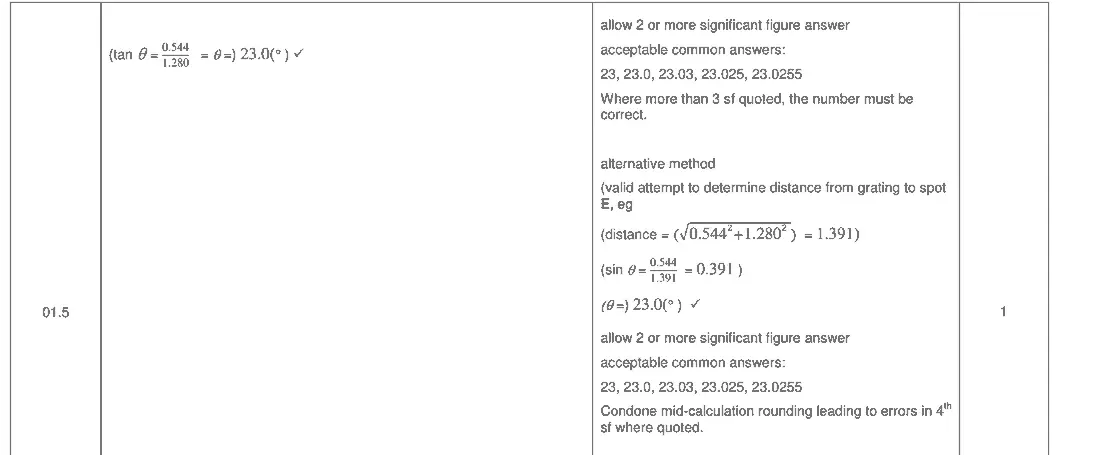
Calculate the angle θ shown on Figure 2.
[1 mark]
θ =
degrees
June 2019 · AS Paper 2 · Q1.6 2 marks Calculation interference and diffraction
Earlier part of question 1 that this part usesEarlier part of June 2019 Paper 2 question 1
Spot E is the second-order maximum.
The diffraction grating has 3.00 × 10⁵ lines per metre.
Calculate the wavelength of the laser light.
[2 marks]
wavelength =
m
June 2019 · AS Paper 2 · Q1.7 2 marks Practical and data analysis measurements and uncertaintiesinterference and diffraction
Earlier part of question 1 that this part usesEarlier part of June 2019 Paper 2 question 1
The student plans to repeat the experiment using the same diffraction grating and
laser.
State and explain one way the student can change the experimental arrangement to
reduce the percentage uncertainty in the measurement of the wavelength.
Assume the percentage uncertainty in sin θ is the sum of the percentage uncertainties
in y and c.
[2 marks]
June 2019 · AS Paper 2 · Q2.1 1 mark Diagram or graph current voltage and resistivity
This question is about an experiment to obtain current–voltage data for a resistor R.
Figure 3 shows a plot of current–voltage data for R.
Figure 3
Draw a best-fit line for the data on Figure 3.
[1 mark]
June 2019 · AS Paper 2 · Q2.2 1 mark Diagram or graph current voltage and resistivity
Earlier part of question 2 that this part usesEarlier part of June 2019 Paper 2 question 2
Identify the data point with the greatest value of current and voltage at which R obeys
Ohm’s law.
Draw a circle around this data point on Figure 3.
[1 mark]
June 2019 · AS Paper 2 · Q2.3 2 marks Calculation current voltage and resistivity
Earlier part of question 2 that this part usesEarlier part of June 2019 Paper 2 question 2
When R obeys Ohm’s law it has a resistance of 22.2 Ω.
Determine the percentage increase in the resistance of R from its 22.2 Ω value to its
value when the current is 550 × 10–3 A.
[2 marks]
percentage increase =
June 2019 · AS Paper 2 · Q2.4 4 marks Practical and data analysis circuits and potential dividerscurrent voltage and resistivity
Earlier part of question 2 that this part usesEarlier part of June 2019 Paper 2 question 2
One of the circuits A to D shown in Figure 4 was used to obtain the current–voltage
data in Figure 3.  The maximum resistance of resistor P is twice the resistance of R.
The battery has an emf of 14.6 V and negligible internal resistance.
Figure 4
Deduce which one of these circuits was used to directly obtain the current–voltage
data in Figure 3.
You should include in your answer an explanation of why each of the other circuits is
not suitable to obtain the data directly from the voltmeter and ammeter readings.
[4 marks]
June 2019 · AS Paper 2 · Q3.1 2 marks Explanation classification of particles and quarksparticles antiparticles and interactions
This question is about two applications of photon energy and momentum:
positron emission tomography (PET) and a solar sail.
The momentum of a photon is
photon energy
speed of light in a vacuum
In preparing for a PET scan of a patient’s brain, a small sample of a substance
containing unstable nuclei is injected into the patient.
A positron is emitted when one of the unstable nuclei undergoes β+decay.
Explain how the change in quark character in β+decay affects the number of neutrons
and the number of protons in the unstable nucleus.
[2 marks]
June 2019 · AS Paper 2 · Q3.2 2 marks Calculation particles antiparticles and interactionsenergy levels and wave particle duality
Earlier part of question 3 that this part usesEarlier part of June 2019 Paper 2 question 3
The positron interacts with an electron, resulting in annihilation.  As a result, gamma
photons are produced.
The energy of each gamma photon is 0.52 MeV.
Calculate the momentum, in N s, of one of the gamma photons produced in this
annihilation.
[2 marks]
momentum =
N s
June 2019 · AS Paper 2 · Q3.3 1 mark Diagram or graph Easy particles antiparticles and interactions
Earlier part of question 3 that this part usesEarlier part of June 2019 Paper 2 question 3
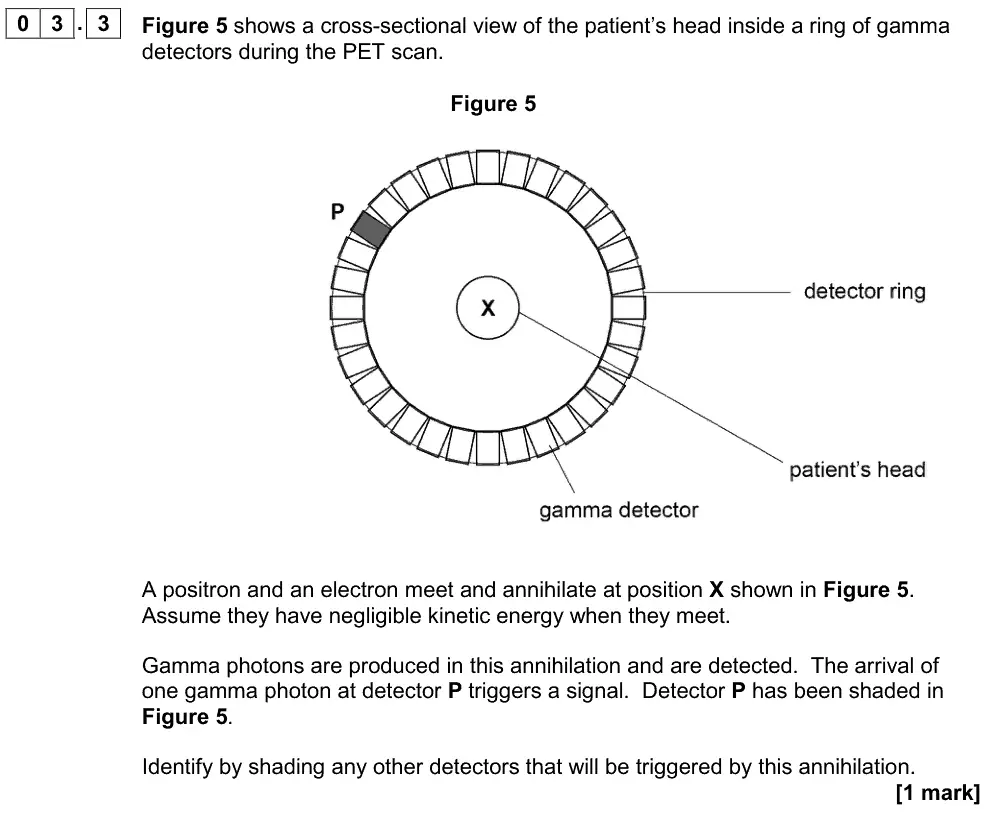
Figure 5 shows a cross-sectional view of the patient’s head inside a ring of gamma
detectors during the PET scan.
Figure 5
A positron and an electron meet and annihilate at position X shown in Figure 5.
Assume they have negligible kinetic energy when they meet.
Gamma photons are produced in this annihilation and are detected.  The arrival of
one gamma photon at detector P triggers a signal.  Detector P has been shaded in
Figure 5.
Identify by shading any other detectors that will be triggered by this annihilation.
[1 mark]
June 2019 · AS Paper 2 · Q3.4 2 marks Explanation particles antiparticles and interactionsnewtons laws and momentum
Earlier part of question 3 that this part usesEarlier part of June 2019 Paper 2 question 3
Explain your answer to question 03.3.
[2 marks]
June 2019 · AS Paper 2 · Q3.5 2 marks Calculation motion and projectiles
Earlier part of question 3 that this part usesEarlier part of June 2019 Paper 2 question 3
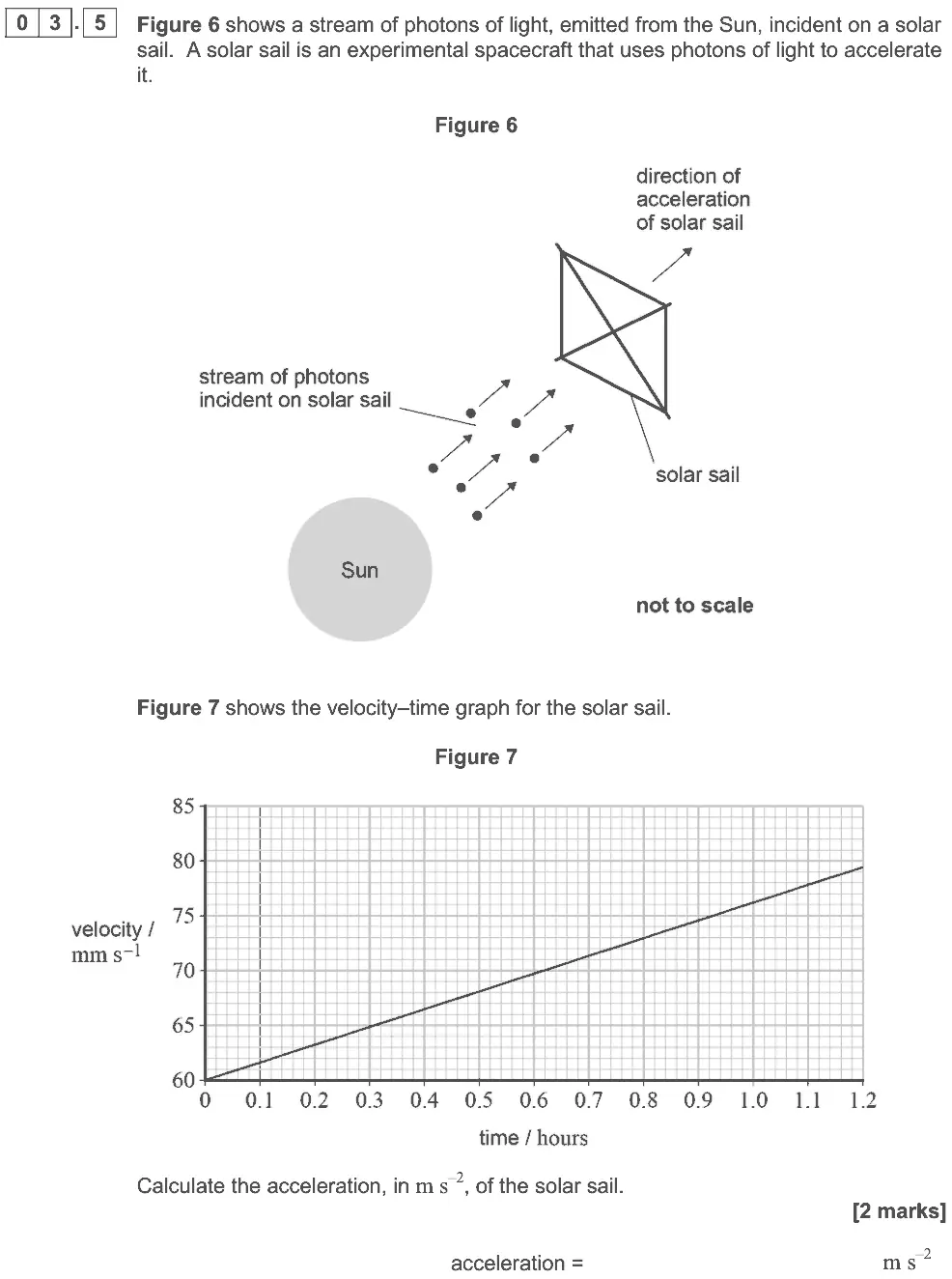
Figure 6 shows a stream of photons of light, emitted from the Sun, incident on a solar
sail.  A solar sail is an experimental spacecraft that uses photons of light to accelerate
it.
Figure 6
Figure 7 shows the velocity–time graph for the solar sail.
Figure 7
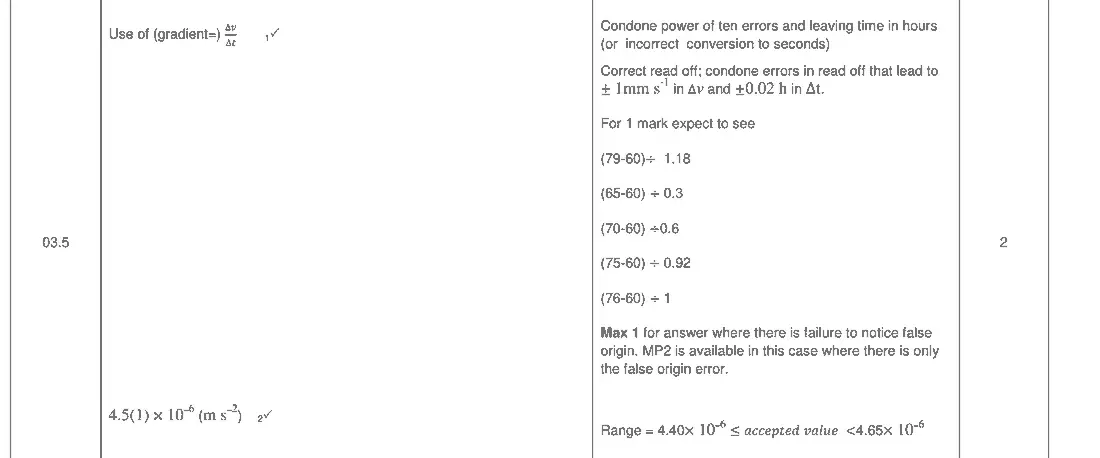
Calculate the acceleration, in m s–2, of the solar sail.
[2 marks]
acceleration =
m s–2
June 2019 · AS Paper 2 · Q3.6 2 marks Explanation newtons laws and momentum
Earlier part of question 3 that this part usesEarlier part of June 2019 Paper 2 question 3
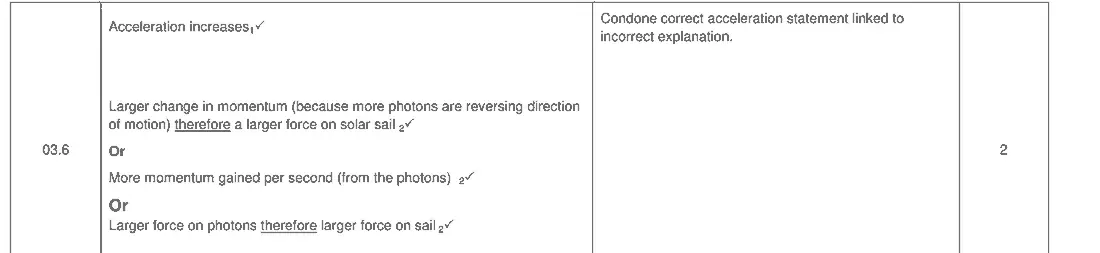
The reflectance of a surface is proportional to the percentage of incident photons that
are reflected off the surface.
Explain the effect of increasing the reflectance of the solar sail on the acceleration.
Assume gravity has negligible effect on the solar sail.
[2 marks]
June 2019 · AS Paper 2 · Q4.1 3 marks Calculation circuits and potential dividerscurrent voltage and resistivity
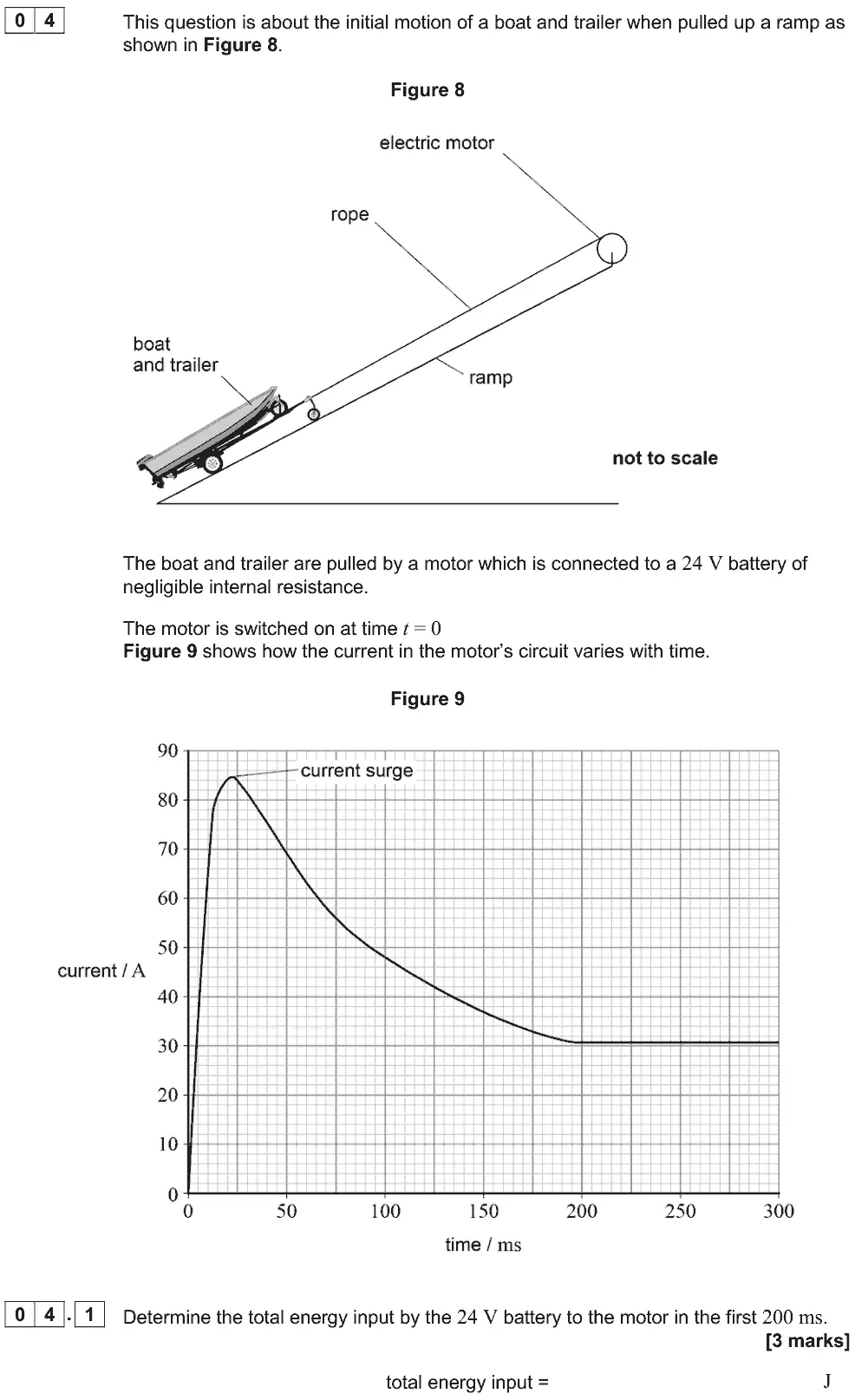
This question is about the initial motion of a boat and trailer when pulled up a ramp as
shown in Figure 8.
Figure 8
The boat and trailer are pulled by a motor which is connected to a 24 V battery of
negligible internal resistance.
The motor is switched on at time t = 0
Figure 9 shows how the current in the motor’s circuit varies with time.
Figure 9
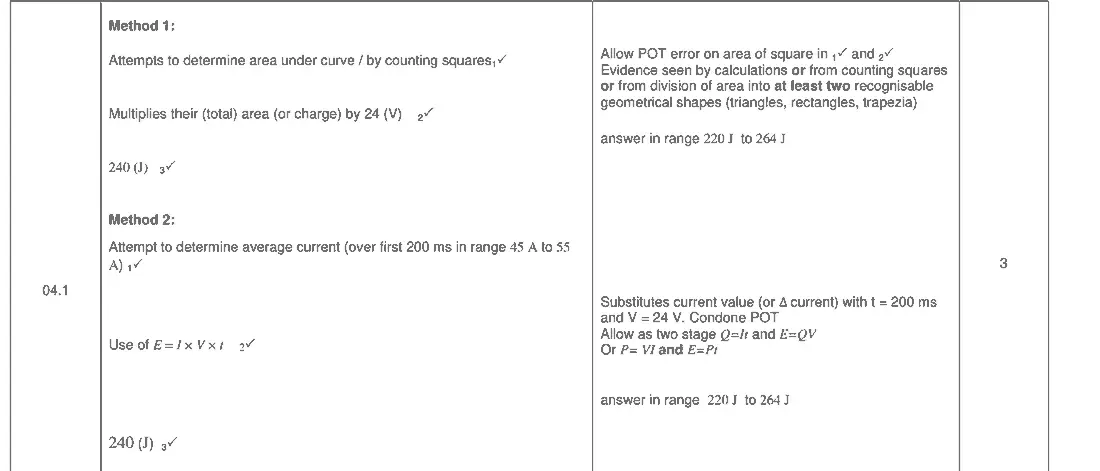
Determine the total energy input by the 24 V battery to the motor in the first 200 ms.
[3 marks]
total energy input =
J
June 2019 · AS Paper 2 · Q4.2 3 marks Calculation work energy and power
Earlier part of question 4 that this part usesEarlier part of June 2019 Paper 2 question 4
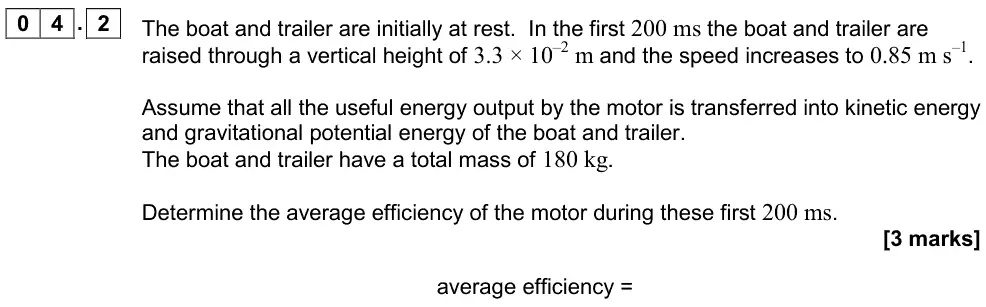
The boat and trailer are initially at rest.  In the first 200 ms the boat and trailer are
raised through a vertical height of 3.3 × 10⁻² m and the speed increases to 0.85 m s–1.
Assume that all the useful energy output by the motor is transferred into kinetic energy
and gravitational potential energy of the boat and trailer.
The boat and trailer have a total mass of 180 kg.
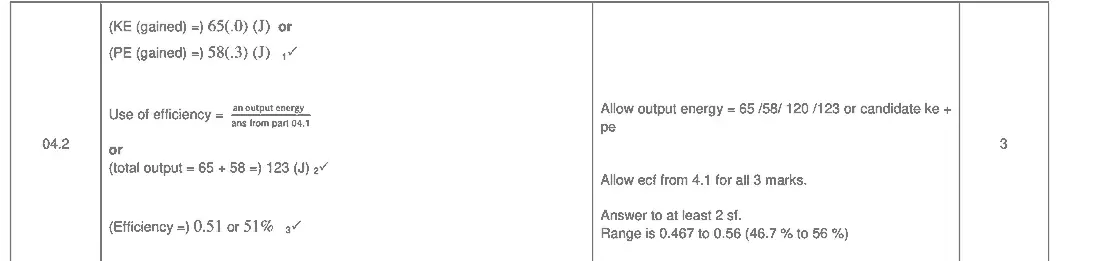
Determine the average efficiency of the motor during these first 200 ms.
[3 marks]
average efficiency =
June 2019 · AS Paper 2 · Q4.3 3 marks Explanation current voltage and resistivity
Earlier part of question 4 that this part usesEarlier part of June 2019 Paper 2 question 4
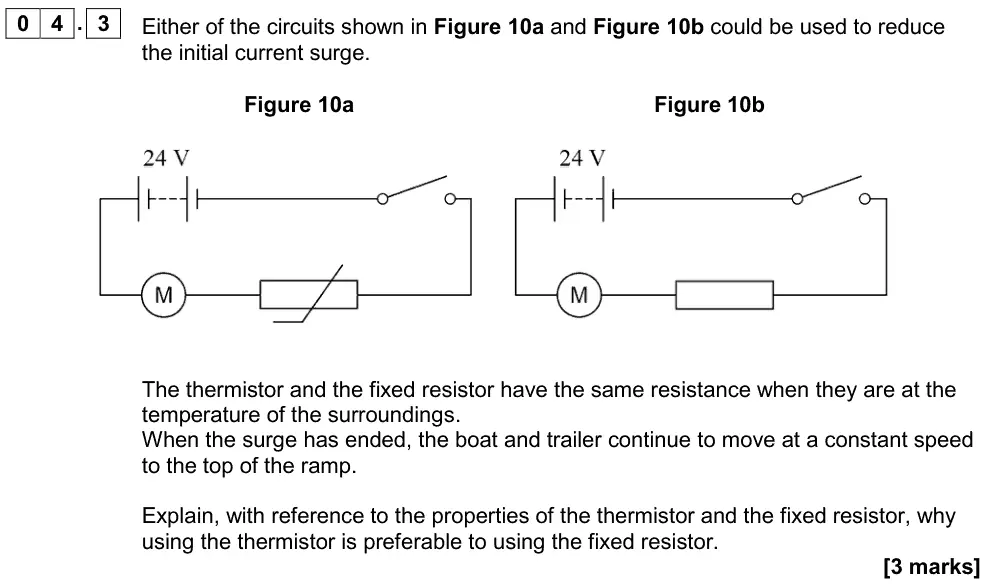
Either of the circuits shown in Figure 10a and Figure 10b could be used to reduce
the initial current surge.
Figure 10a                                                 Figure 10b
The thermistor and the fixed resistor have the same resistance when they are at the
temperature of the surroundings.
When the surge has ended, the boat and trailer continue to move at a constant speed
to the top of the ramp.
Explain, with reference to the properties of the thermistor and the fixed resistor, why
using the thermistor is preferable to using the fixed resistor.
[3 marks]
June 2019 · AS Paper 2 · Q5 1 mark Multiple choice measurements and uncertaintiesmaterials and young modulus
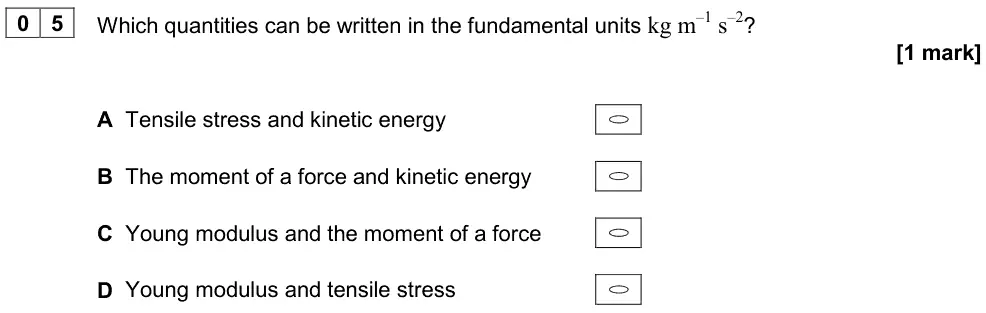
Which quantities can be written in the fundamental units kg m–1 s–2?
[1 mark]
A Tensile stress and kinetic energy
B The moment of a force and kinetic energy
C Young modulus and the moment of a force
D Young modulus and tensile stress
June 2019 · AS Paper 2 · Q6 1 mark Multiple choice atomic structure and stable nuclei
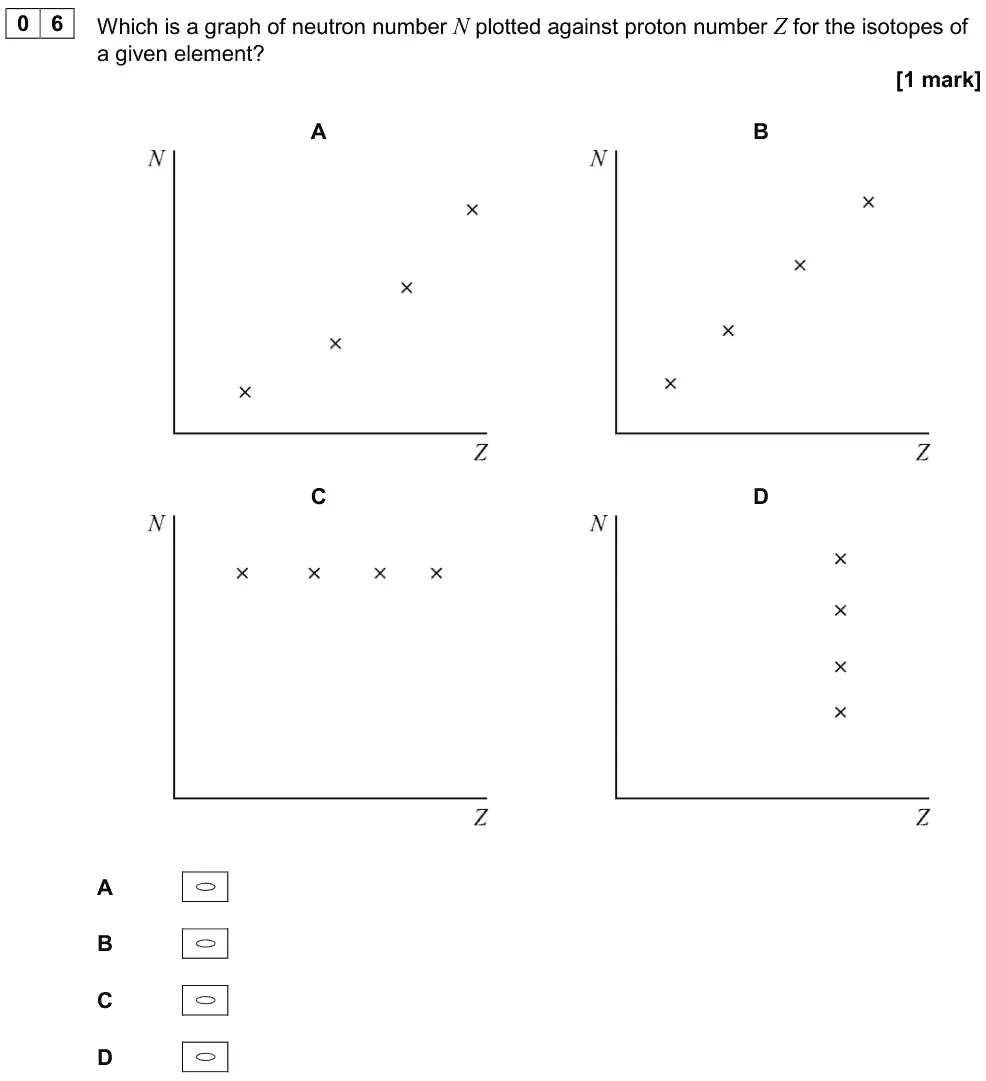
Which is a graph of neutron number N plotted against proton number Z for the isotopes of
a given element?
[1 mark]
A
B
C
D
A
B
C
D
June 2019 · AS Paper 2 · Q7 1 mark Multiple choice atomic structure and stable nuclei
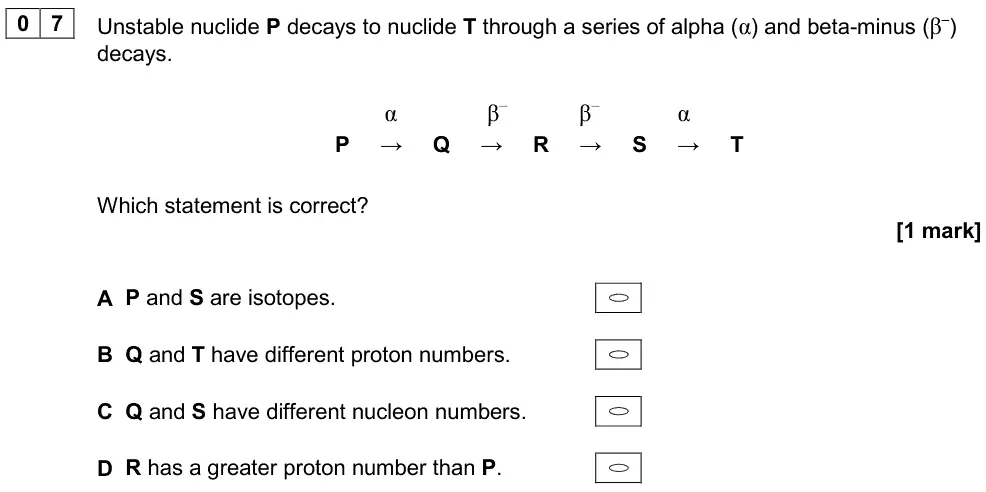
Unstable nuclide P decays to nuclide T through a series of alpha (α) and beta-minus (β–)
decays.
α               β–            β–             α
P     →     Q     →     R     →     S     →     T
Which statement is correct?
[1 mark]
A P and S are isotopes.
B Q and T have different proton numbers.
C Q and S have different nucleon numbers.
D R has a greater proton number than P.
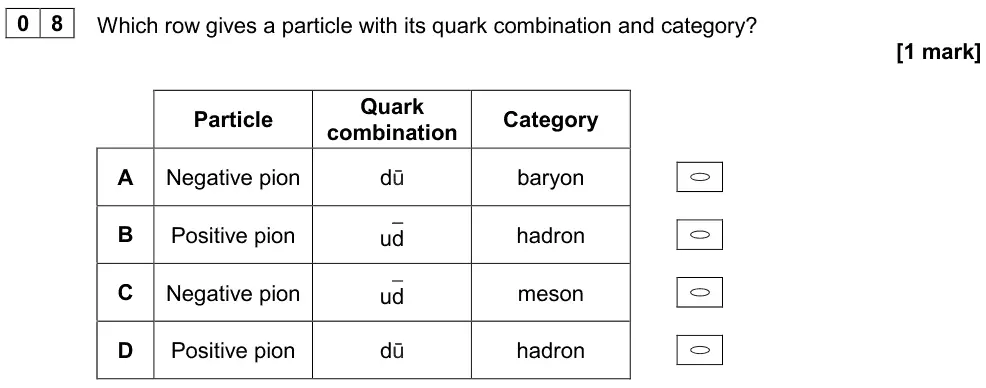
June 2019 · AS Paper 2 · Q8 1 mark Multiple choice classification of particles and quarks
Which row gives a particle with its quark combination and category?
[1 mark]
Particle
Quark
combination
Category
A
Negative pion
dū
baryon
B
Positive pion
ud
hadron
C
Negative pion
ud
meson
D
Positive pion
dū
hadron
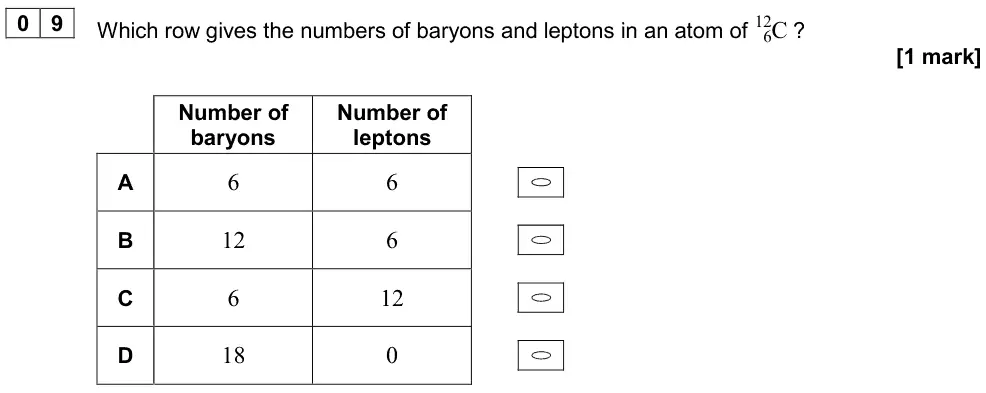
12 ?
June 2019 · AS Paper 2 · Q9 1 mark Multiple choice classification of particles and quarks
Which row gives the numbers of baryons and leptons in an atom of C
6
[1 mark]
Number of
baryons
Number of
leptons
A
6
6
B
12
6
C
6
12
D
18
0
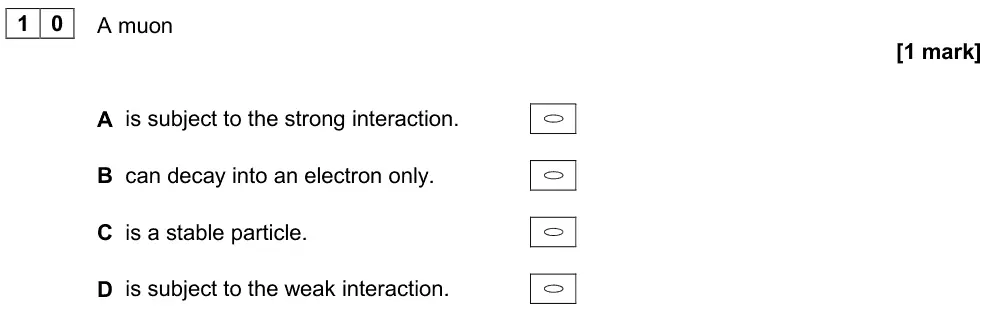
June 2019 · AS Paper 2 · Q10 1 mark Multiple choice classification of particles and quarks
A muon
[1 mark]
A is subject to the strong interaction.
B can decay into an electron only.
C is a stable particle.
D is subject to the weak interaction.
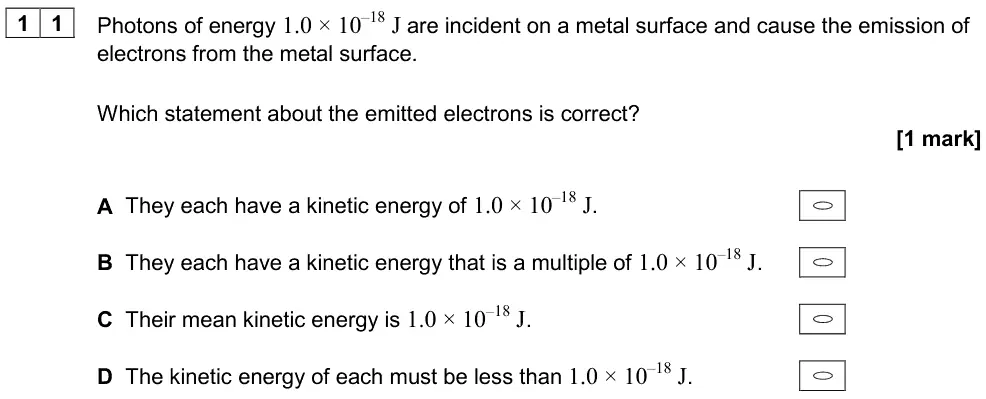
June 2019 · AS Paper 2 · Q11 1 mark Multiple choice photoelectric effect
Photons of energy 1.0 × 10⁻¹⁸ J are incident on a metal surface and cause the emission of
electrons from the metal surface.
Which statement about the emitted electrons is correct?
[1 mark]
A They each have a kinetic energy of 1.0 × 10⁻¹⁸ J.
B They each have a kinetic energy that is a multiple of 1.0 × 10⁻¹⁸ J.
C Their mean kinetic energy is 1.0 × 10⁻¹⁸ J.
D The kinetic energy of each must be less than 1.0 × 10⁻¹⁸ J.
June 2019 · AS Paper 2 · Q12 1 mark Multiple choice energy levels and wave particle duality
Evidence of the wave-like properties of electrons is
[1 mark]
A the emission of electrons when short-wavelength light falls on a
metal surface.
B the movement of electrons in an electric current.
C the diffraction of electrons by a metal crystal.
D the annihilation of an electron with a positron.
June 2019 · AS Paper 2 · Q13 1 mark Multiple choice measurements and uncertainties
What is the approximate average kinetic energy of a cyclist in a race?
[1 mark]
A 10 J
B 10 kJ
C 10 MJ
D 10 TJ
June 2019 · AS Paper 2 · Q14 1 mark Multiple choice energy levels and wave particle dualityparticles antiparticles and interactions
The diagram shows the energy levels in an atom drawn to scale.  A transition from
E4 to E2 causes the emission of a photon of green light.
Which transition could cause the emission of a photon of red light?
[1 mark]
A E2 to E1
B E3 to E1
C E3 to E2
D E4 to E1
June 2019 · AS Paper 2 · Q15 1 mark Multiple choice progressive waves and polarisation
A sonar transmitter on a ship produces pulses of sound waves.
Each pulse of sound waves contains 12 complete oscillations.
The frequency of these waves is 8.0 kHz and the speed of sound in seawater is
1.5 × 10³ m s–1.
What is the length of one pulse in seawater?
[1 mark]
A 0.188 m
B 2.25 m
C 2.25 × 10³ m
D 1.44 × 10⁵ m
June 2019 · AS Paper 2 · Q16 1 mark Multiple choice progressive waves and polarisation
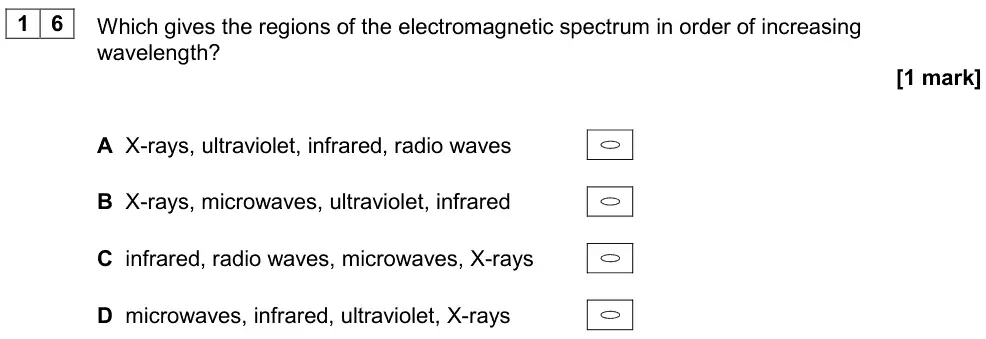
Which gives the regions of the electromagnetic spectrum in order of increasing
wavelength?
[1 mark]
A X-rays, ultraviolet, infrared, radio waves
B X-rays, microwaves, ultraviolet, infrared
C infrared, radio waves, microwaves, X-rays
D microwaves, infrared, ultraviolet, X-rays
June 2019 · AS Paper 2 · Q17 1 mark Multiple choice stationary waves
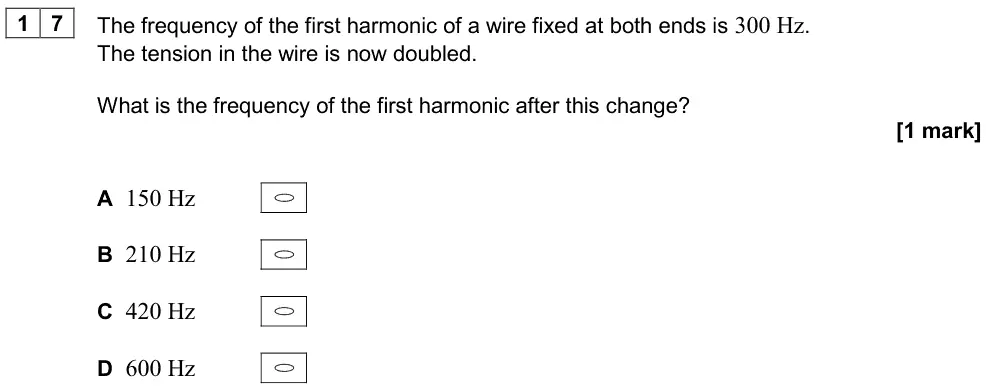
The frequency of the first harmonic of a wire fixed at both ends is 300 Hz.
The tension in the wire is now doubled.
What is the frequency of the first harmonic after this change?
[1 mark]
A 150 Hz
B 210 Hz
C 420 Hz
D 600 Hz
June 2019 · AS Paper 2 · Q18 1 mark Multiple choice interference and diffraction
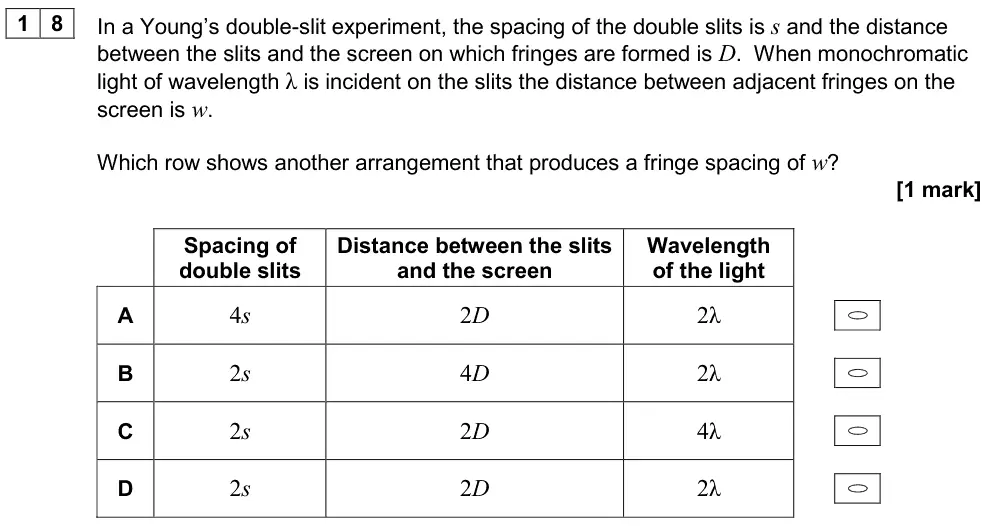
In a Young’s double-slit experiment, the spacing of the double slits is s and the distance
between the slits and the screen on which fringes are formed is D.  When monochromatic
light of wavelength λ is incident on the slits the distance between adjacent fringes on the
screen is w.
Which row shows another arrangement that produces a fringe spacing of w?
[1 mark]
Spacing of
double slits
Distance between the slits
and the screen
Wavelength
of the light
A
4s
2D
2λ
B
2s
4D
2λ
C
2s
2D
4λ
D
2s
2D
2λ
June 2019 · AS Paper 2 · Q19 1 mark Multiple choice interference and diffraction
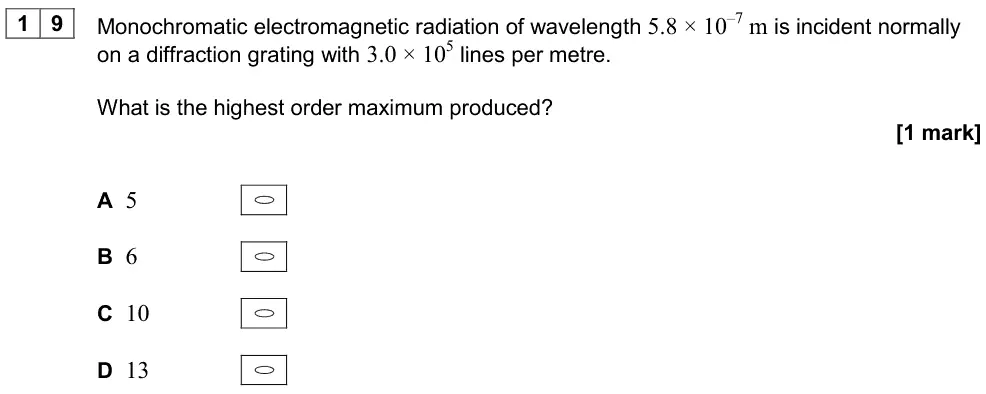
Monochromatic electromagnetic radiation of wavelength 5.8 × 10⁻⁷ m is incident normally
on a diffraction grating with 3.0 × 10⁵ lines per metre.
What is the highest order maximum produced?
[1 mark]
A 5
B 6
C 10
D 13
June 2019 · AS Paper 2 · Q20 1 mark Multiple choice refraction and optical fibres
Which characteristics of monochromatic light change when the light passes from air into
glass?
[1 mark]
A Speed, wavelength and frequency.
B Speed and frequency only.
C Speed and wavelength only.
D Wavelength and frequency only.
June 2019 · AS Paper 2 · Q21 1 mark Multiple choice interference and diffraction
Which is a description of the pattern produced when monochromatic light passes through a
very narrow slit?
[1 mark]
A A series of equally-spaced light and dark fringes.
B A narrow central maximum with wider side fringes.
C A few bright fringes that are widely spaced.
D A wide central maximum with narrower side fringes.
June 2019 · AS Paper 2 · Q22 1 mark Multiple choice vectors and moments
A uniform picture is suspended from a string which passes over a smooth nail.  The
tension in the string is T and the weight of the picture is 20 N.
What is T?
[1 mark]
A 10 N
B 12 N
C 20 N
D 40 N
June 2019 · AS Paper 2 · Q23 1 mark Multiple choice vectors and moments
Which row contains vector quantities only?
[1 mark]
A
acceleration
mass
B
displacement
momentum
C
energy
force
D
distance
speed
June 2019 · AS Paper 2 · Q24 1 mark Multiple choice vectors and moments
A uniform rod is balanced horizontally about a support F.  Forces of 400 N and 100 N act
at the ends of the rod, as shown.
What is the reaction force acting on the rod at support F?
[1 mark]
A 100 N
B 500 N
C 550 N
D 600 N
June 2019 · AS Paper 2 · Q25 1 mark Multiple choice motion and projectiles
Three objects U, V and W leave the edge of a bench at the same time.
The objects fall in the same vertical plane with negligible air resistance.
U is released from rest so that it falls vertically.
V and W are projected horizontally.
The paths of the three objects are shown.
Which statement is correct?
[1 mark]
A U hits the floor before V and W.
B W hits the floor before V.
C W hits the floor with the greatest speed.
D U hits the floor with the greatest speed.
June 2019 · AS Paper 2 · Q26 1 mark Multiple choice newtons laws and momentum
A railway truck of mass 2000 kg travelling horizontally at 1.5 m s–1 collides with a stationary
truck of mass 3000 kg.
After the collision they move together.
Which row is correct?
[1 mark]
Speed of the trucks immediately
after collision / m s–1
Effect of collision on total
kinetic energy
A
0.6
no change
B
0.6
decrease
C
1.0
no change
D
1.0
decrease
June 2019 · AS Paper 2 · Q27 1 mark Multiple choice work energy and power
A car of mass 1000 kg accelerates uniformly from rest to a speed of 25.0 m s–1 in 50.0 s.
The car is travelling along a horizontal road.
What is the average useful power output of the car over this period?
[1 mark]
A 0.50 kW
B 2.00 kW
C 6.25 kW
D 12.5 kW
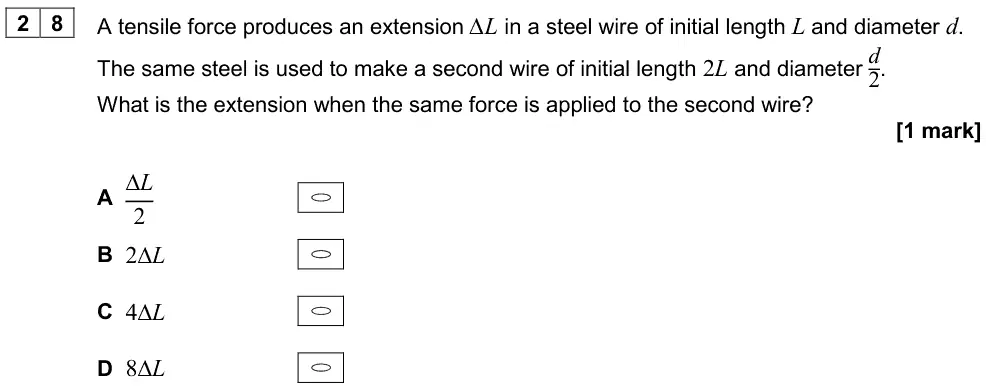
June 2019 · AS Paper 2 · Q28 1 mark Multiple choice materials and young modulus
A tensile force produces an extension ∆L in a steel wire of initial length L and diameter d.
The same steel is used to make a second wire of initial length 2L and diameter d
2.
What is the extension when the same force is applied to the second wire?
[1 mark]
A ∆L
2
B 2∆L
C 4∆L
D 8∆L
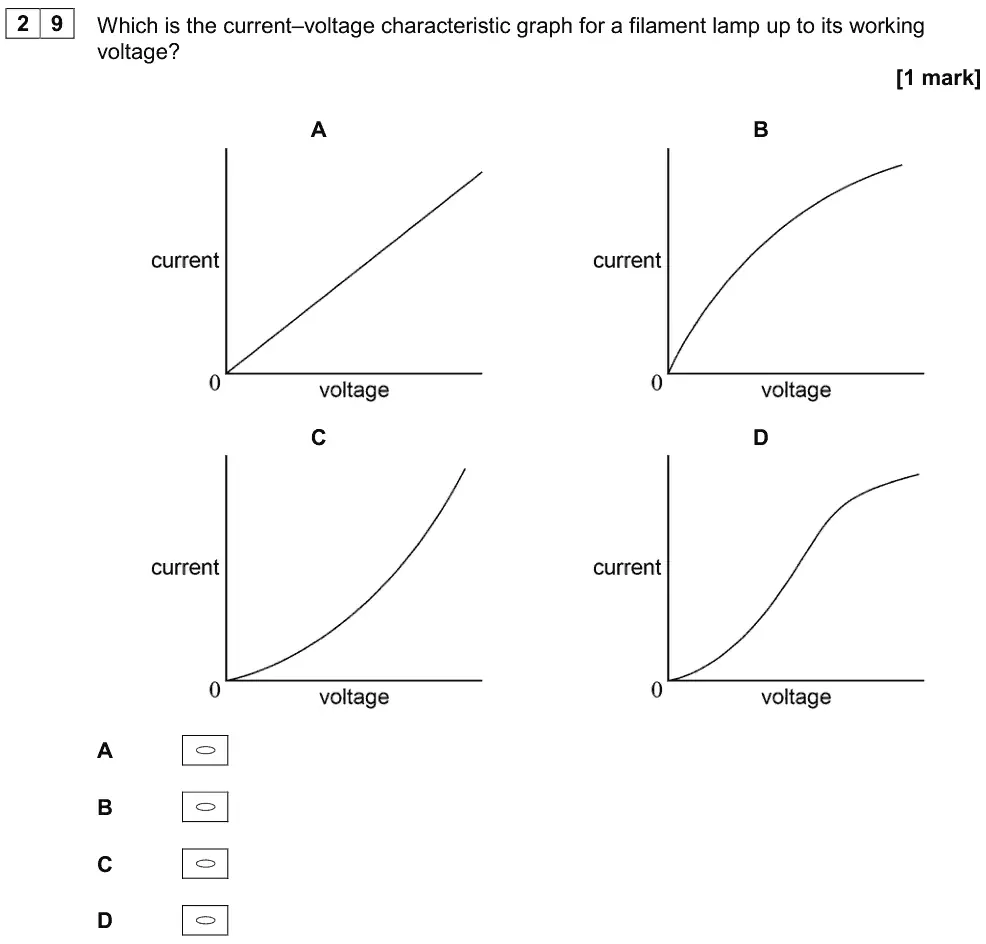
June 2019 · AS Paper 2 · Q29 1 mark Multiple choice current voltage and resistivity
Which is the current–voltage characteristic graph for a filament lamp up to its working
voltage?
[1 mark]
A
B
C
D
A
B
C
D
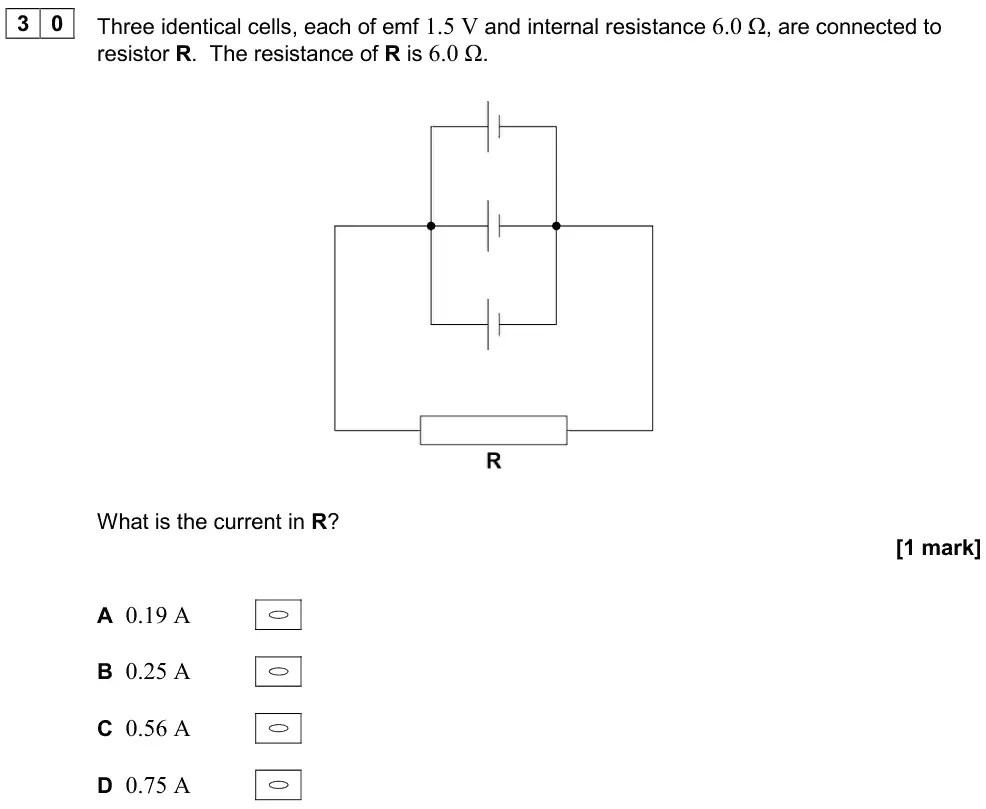
June 2019 · AS Paper 2 · Q30 1 mark Multiple choice emf and internal resistance
Three identical cells, each of emf 1.5 V and internal resistance 6.0 Ω, are connected to
resistor R.  The resistance of R is 6.0 Ω.
What is the current in R?
[1 mark]
A 0.19 A
B 0.25 A
C 0.56 A
D 0.75 A
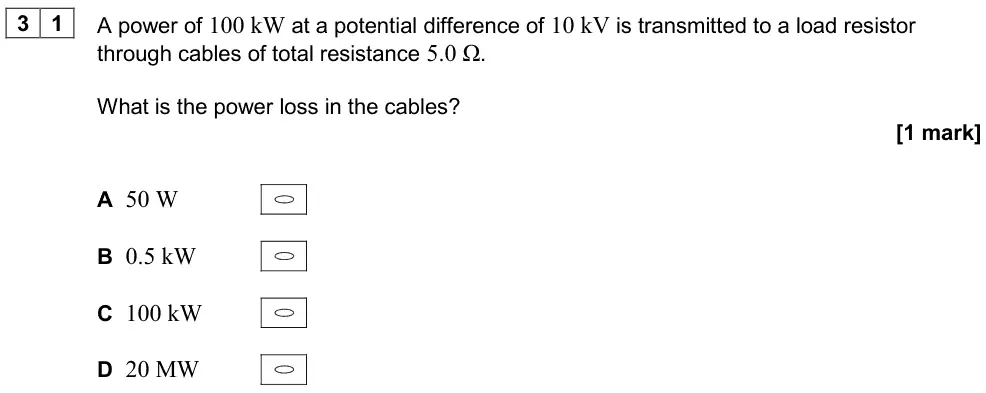
June 2019 · AS Paper 2 · Q31 1 mark Multiple choice circuits and potential dividers
A power of 100 kW at a potential difference of 10 kV is transmitted to a load resistor
through cables of total resistance 5.0 Ω.
What is the power loss in the cables?
[1 mark]
A 50 W
B 0.5 kW
C 100 kW
D 20 MW
June 2019 · AS Paper 2 · Q32 1 mark Multiple choice circuits and potential dividers
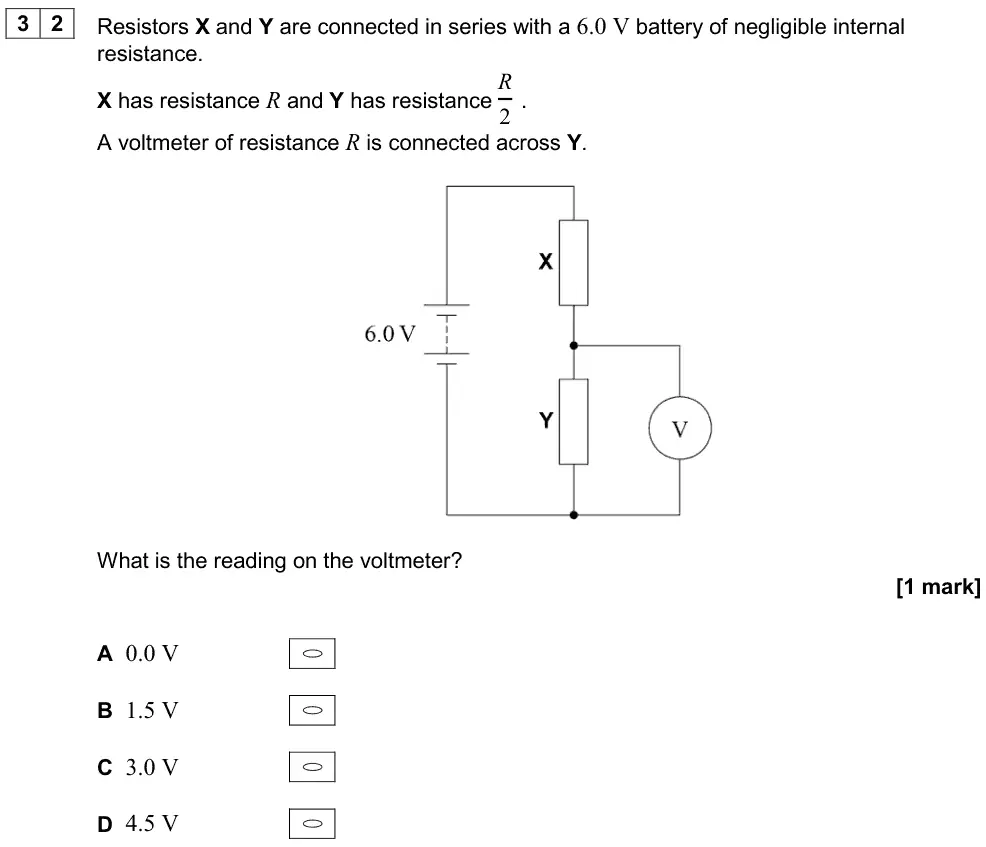
Resistors X and Y are connected in series with a 6.0 V battery of negligible internal
resistance.
X has resistance R and Y has resistance
R
2 .
A voltmeter of resistance R is connected across Y.
What is the reading on the voltmeter?
[1 mark]
A 0.0 V
B 1.5 V
C 3.0 V
D 4.5 V
June 2019 · AS Paper 2 · Q33 1 mark Multiple choice emf and internal resistance
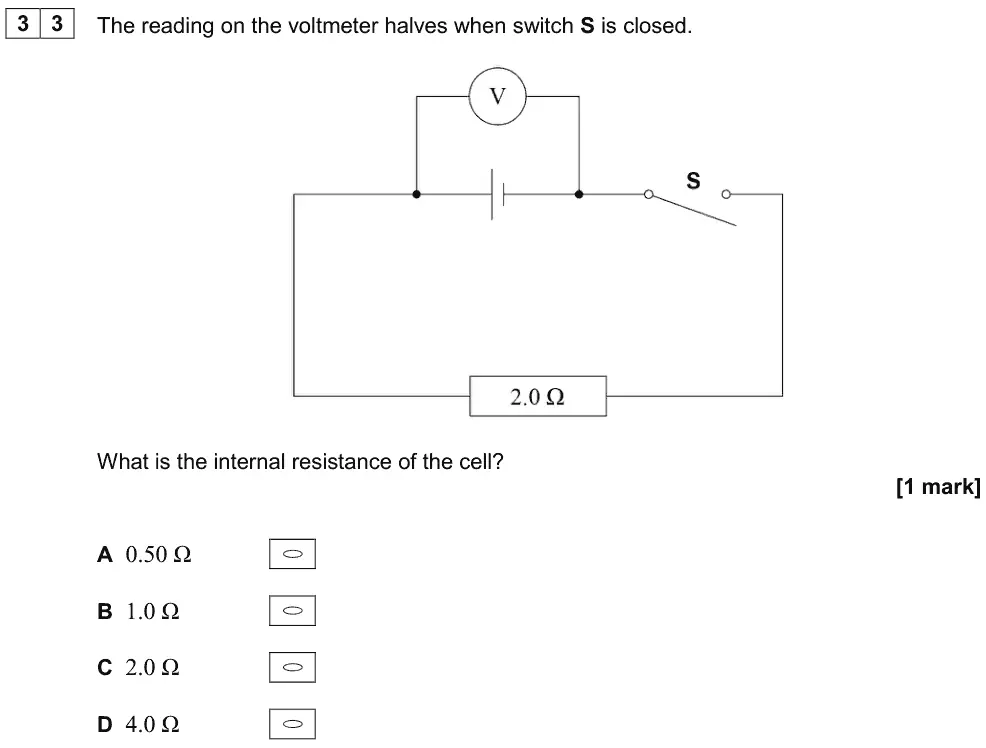
The reading on the voltmeter halves when switch S is closed.
What is the internal resistance of the cell?
[1 mark]
A 0.50 Ω
B 1.0 Ω
C 2.0 Ω
D 4.0 Ω
June 2019 · AS Paper 2 · Q34 1 mark Multiple choice circuits and potential dividers
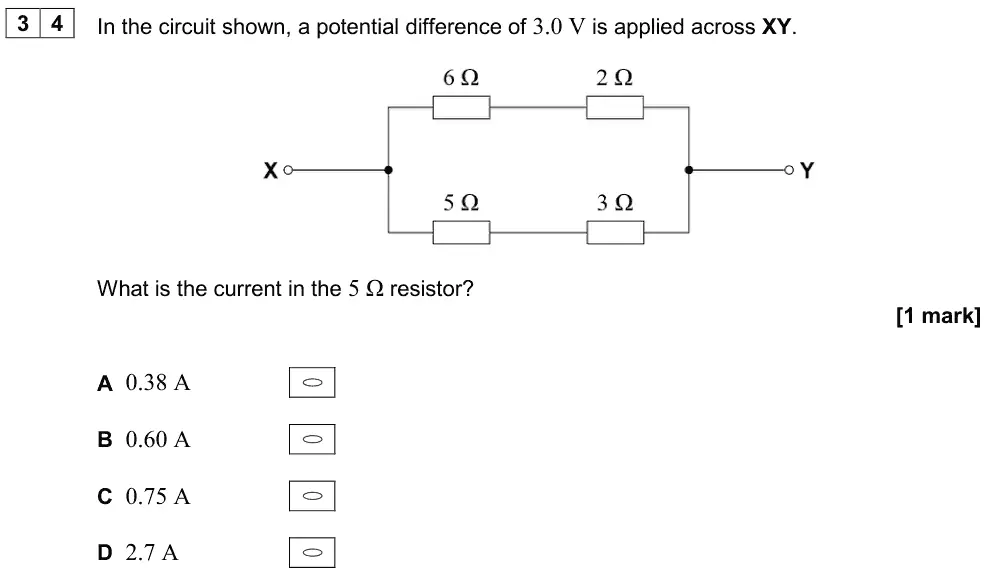
In the circuit shown, a potential difference of 3.0 V is applied across XY.
What is the current in the 5 Ω resistor?
[1 mark]
A 0.38 A
B 0.60 A
C 0.75 A
D 2.7 A

Work with an AQA physics tutor

Want a paper marked and gone through with you? Message us.

Prefer email? Send an enquiry

If you are under 18, please include a parent's contact details. Enquiries go to enquiries@physicsaleveltutor.com and are deleted once handled. All tutoring is online.