June 2019: Paper 1

85 marks · 53 question parts · Paper, mark scheme and report on AQA's site · Have the data and formulae booklet beside you

Question by question

QTopicMarksAOType
1.1 Atomic structure and stable nuclei 1Short answer
1.2 Atomic structure and stable nuclei 1Short answer
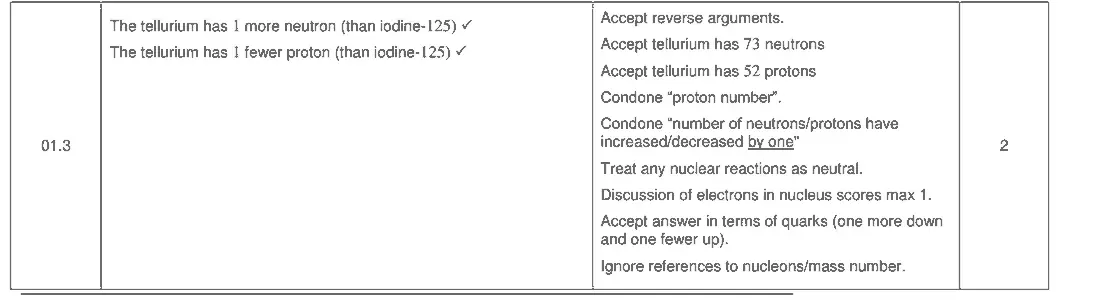
1.3 Particles, antiparticles and particle interactions, Atomic structure and stable nuclei 2Short answer
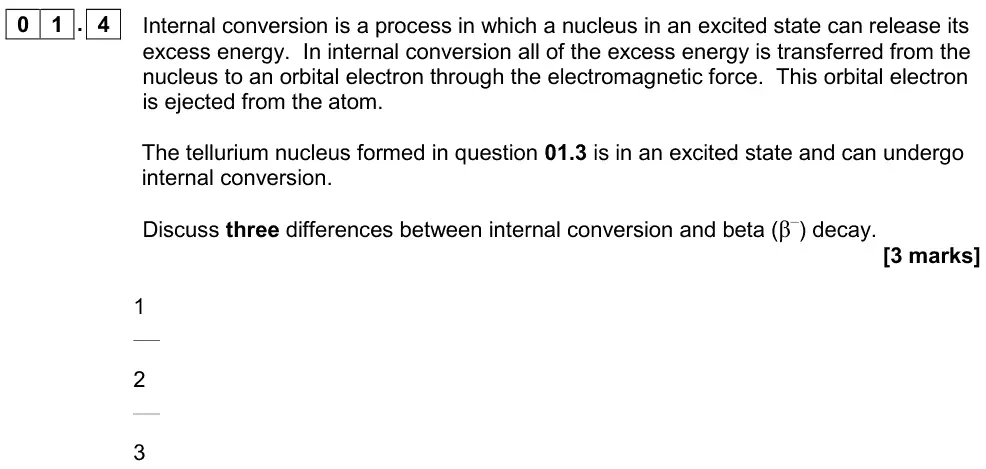
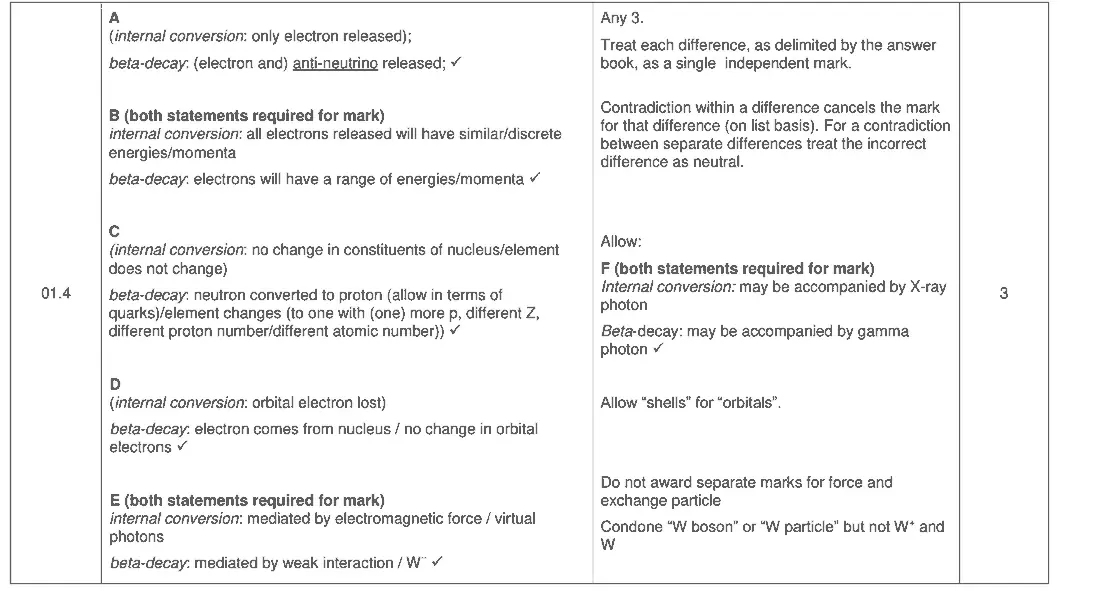
1.4 Particles, antiparticles and particle interactions, Atomic structure and stable nuclei 3Explanation
2.1 Refraction, total internal reflection and optical fibres 1Short answer
2.2 Refraction, total internal reflection and optical fibres 2Short answer
2.3 Refraction, total internal reflection and optical fibres 2Explanation
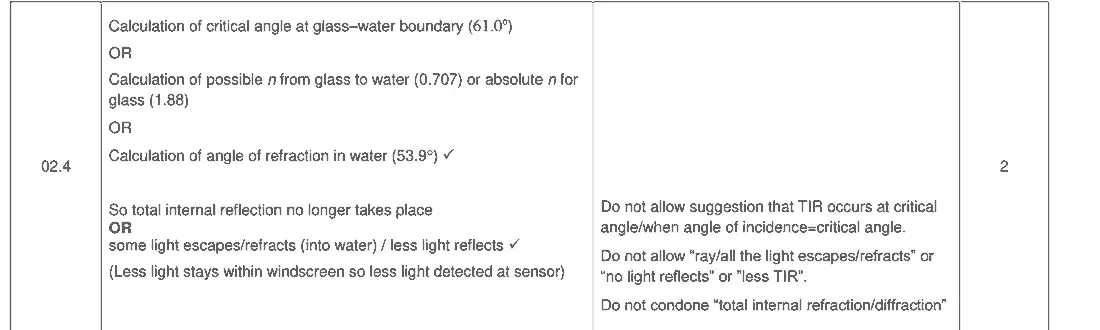
2.4 Refraction, total internal reflection and optical fibres 2Explanation
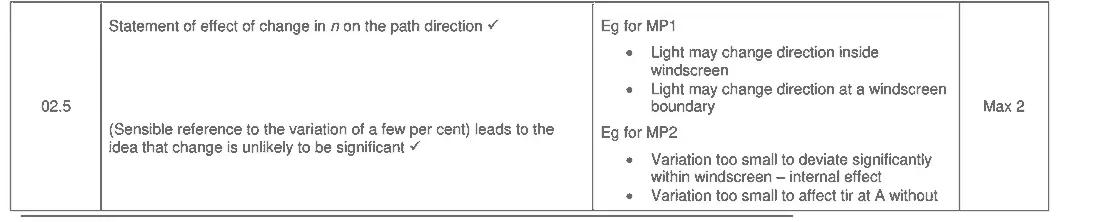
2.5 Refraction, total internal reflection and optical fibres 2Explanation
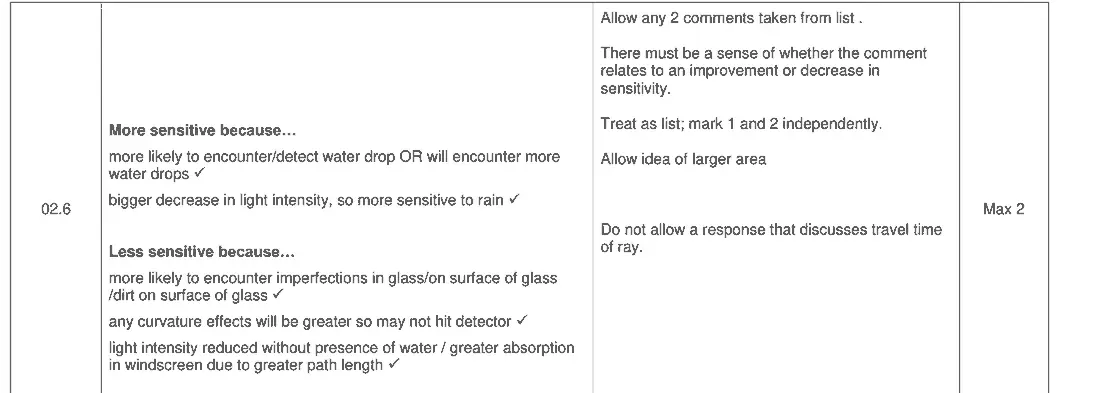
2.6 Refraction, total internal reflection and optical fibres 2Explanation
3.1 Interference, diffraction and the diffraction grating 2Short answer
3.2 Interference, diffraction and the diffraction grating 2Short answer
3.3 Interference, diffraction and the diffraction grating 2Calculation
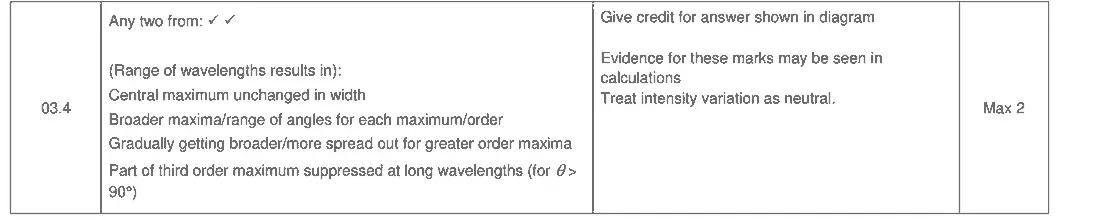
3.4 Interference, diffraction and the diffraction grating 2Explanation
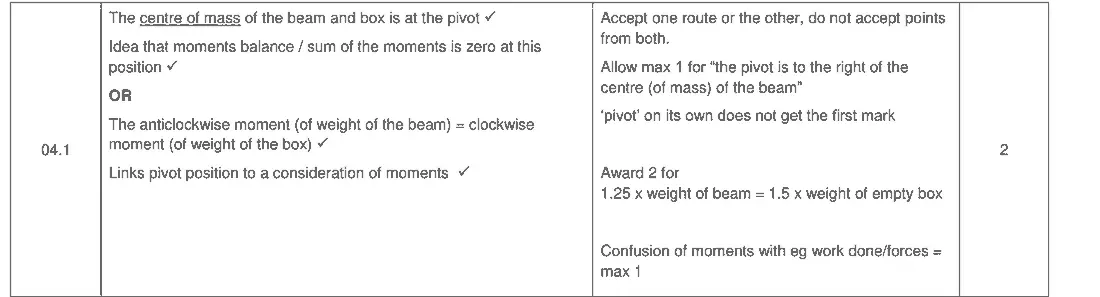
4.1 Scalars, vectors and moments 2Explanation
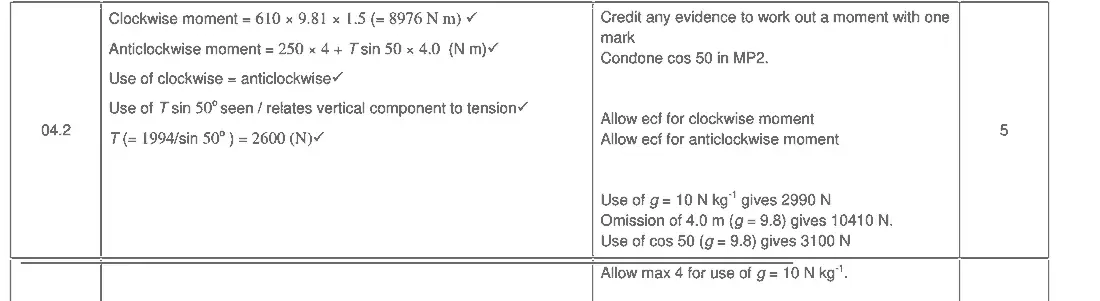
4.2 Scalars, vectors and moments 5Calculation
4.3 Motion along a straight line and projectile motion 2Calculation
4.4 Motion along a straight line and projectile motion 3Explanation
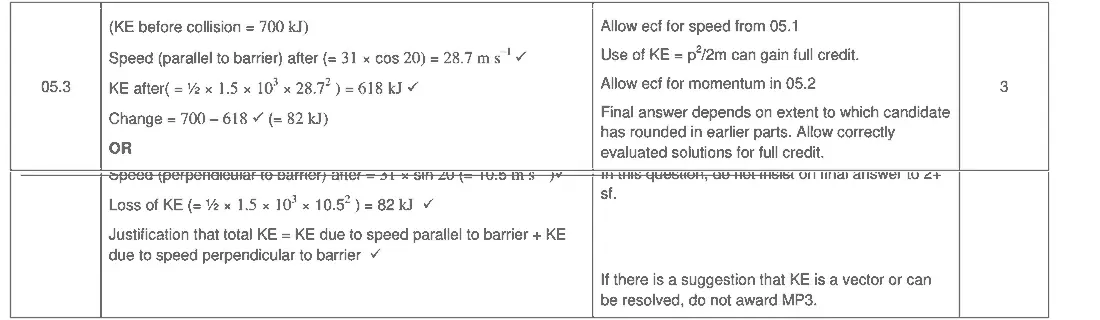
5.1 Work, energy, power and conservation of energy 2Show that
5.2 Newton's laws of motion and momentum, Scalars, vectors and moments 3Calculation
5.3 Work, energy, power and conservation of energy, Scalars, vectors and moments 3Show that
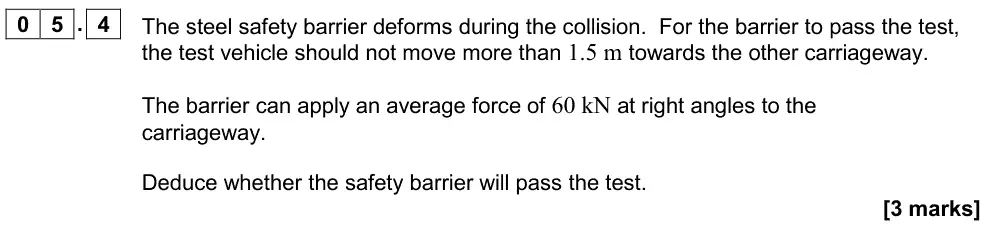
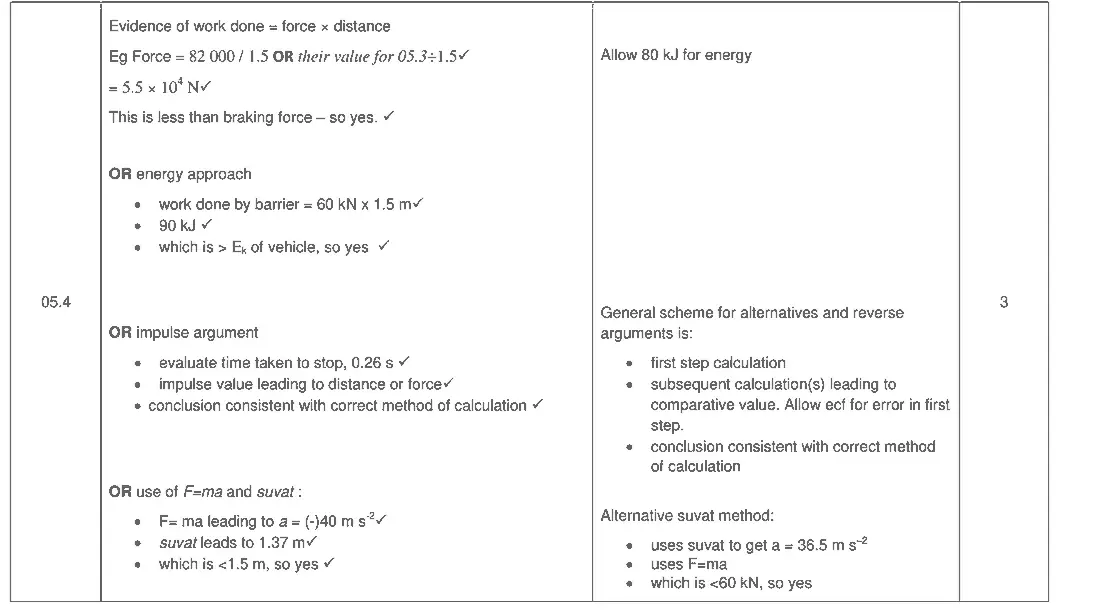
5.4 Work, energy, power and conservation of energy, Newton's laws of motion and momentum 3Calculation
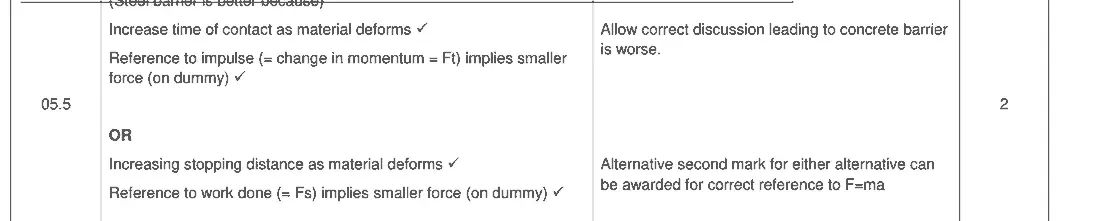
5.5 Newton's laws of motion and momentum 2Explanation
6.1 Simple harmonic motion, forced vibrations and resonance 1Short answer
6.2 Simple harmonic motion, forced vibrations and resonance 3Calculation
6.3 Progressive waves, longitudinal and transverse waves 1Short answer
7.1 Electromotive force and internal resistance 2Explanation
7.2 Electromotive force and internal resistance, Circuits and potential dividers 2Explanation
8 Particles, antiparticles and particle interactions 1Multiple choice
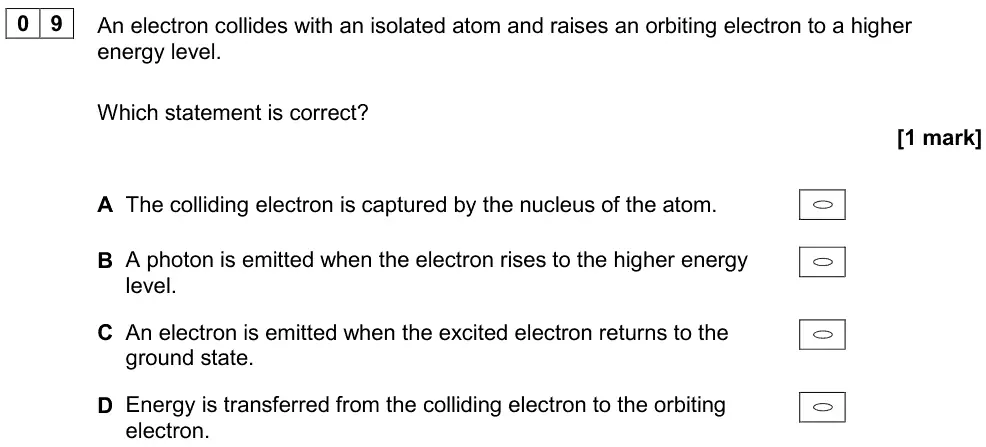
9 Excitation, energy levels and wave-particle duality 1Multiple choice
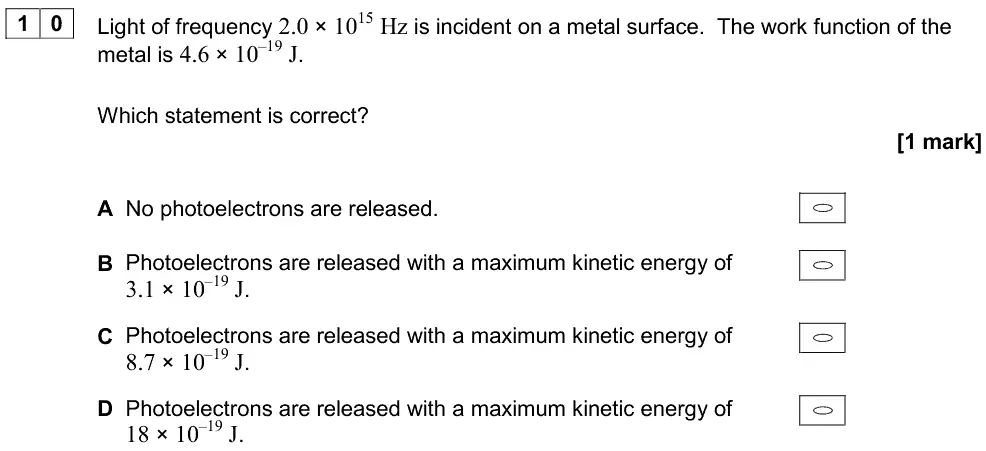
10 The photoelectric effect, Particles, antiparticles and particle interactions 1Multiple choice
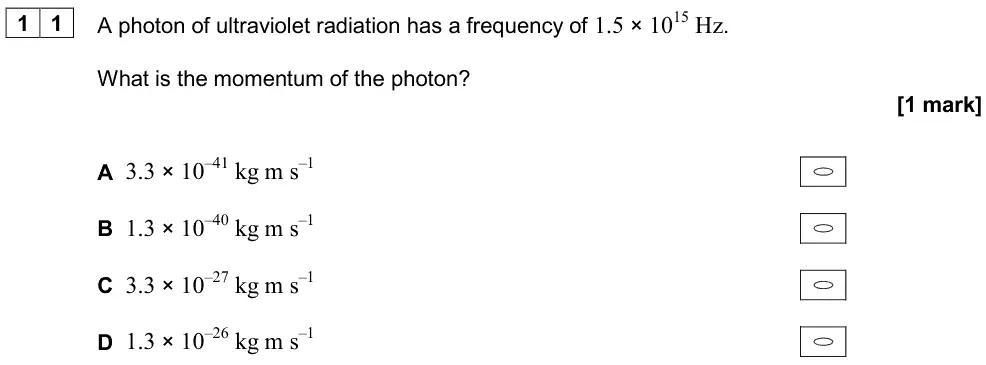
11 Particles, antiparticles and particle interactions, Excitation, energy levels and wave-particle duality 1Multiple choice
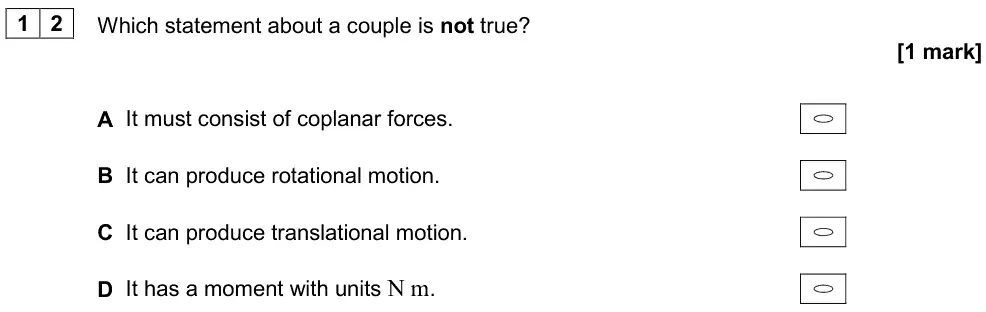
12 Scalars, vectors and moments 1Multiple choice
13 Motion along a straight line and projectile motion 1Multiple choice
14 Newton's laws of motion and momentum, Materials, stress, strain and the Young modulus 1Multiple choice
15 Newton's laws of motion and momentum 1Multiple choice
16 Newton's laws of motion and momentum 1Multiple choice
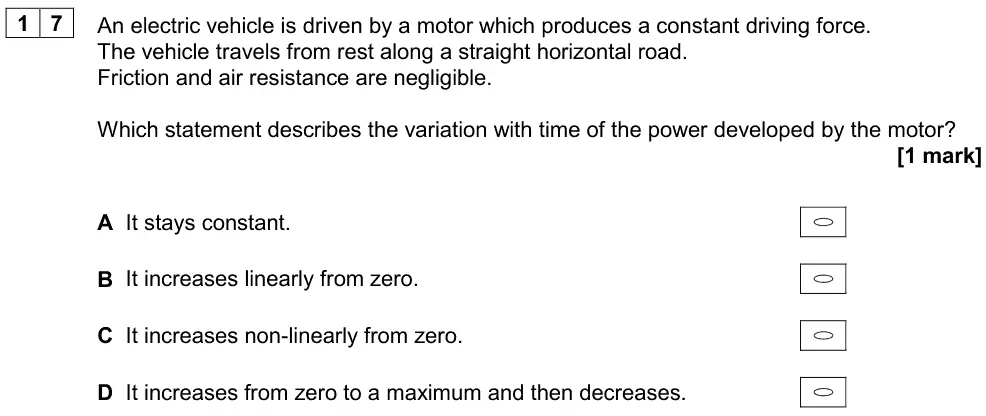
17 Work, energy, power and conservation of energy, Newton's laws of motion and momentum 1Multiple choice
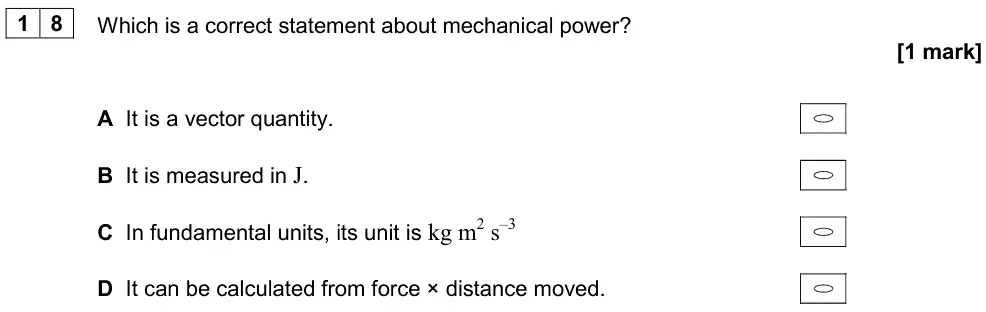
18 Work, energy, power and conservation of energy, Measurements, units and uncertainties 1Multiple choice
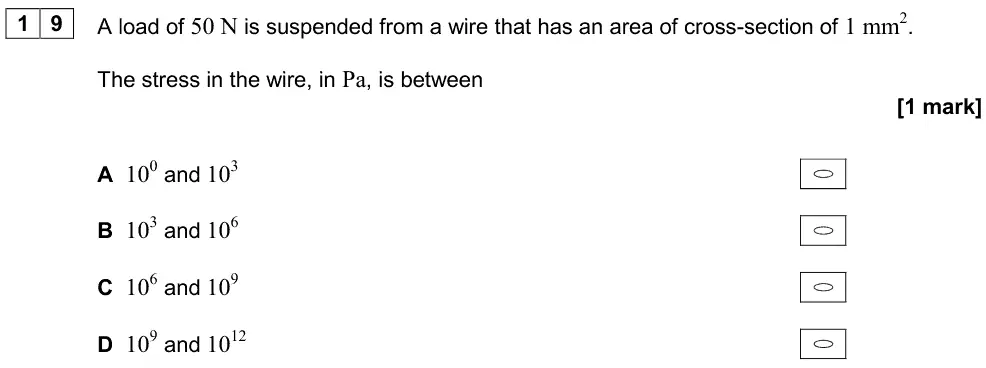
19 Materials, stress, strain and the Young modulus 1Multiple choice
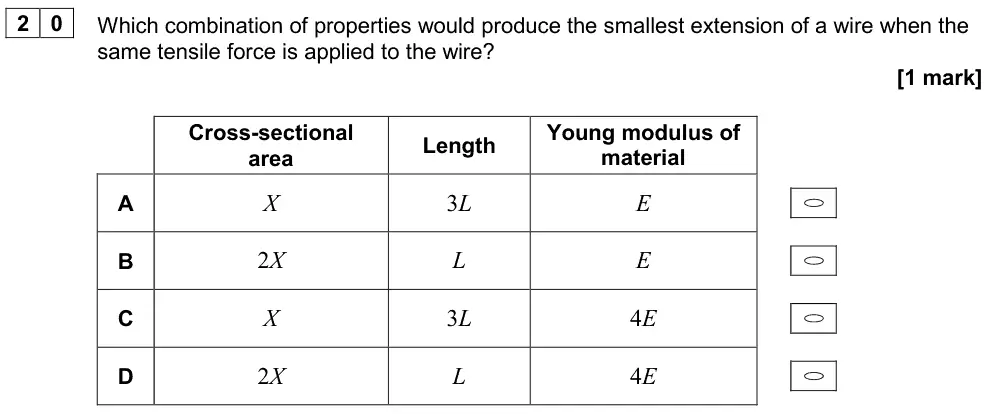
20 Materials, stress, strain and the Young modulus 1Multiple choice
21 Current, potential difference, I-V characteristics and resistivity 1Multiple choice
22 Current, potential difference, I-V characteristics and resistivity, Excitation, energy levels and wave-particle duality 1Multiple choice
23 Circuits and potential dividers, Current, potential difference, I-V characteristics and resistivity 1Multiple choice
24 Circuits and potential dividers 1Multiple choice
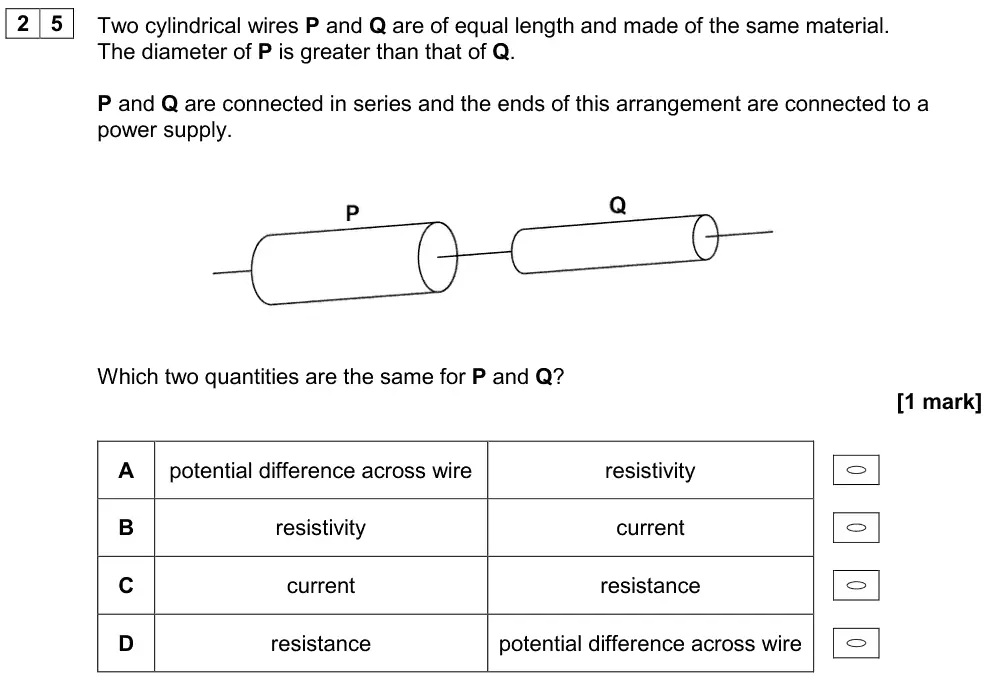
25 Current, potential difference, I-V characteristics and resistivity, Circuits and potential dividers 1Multiple choice
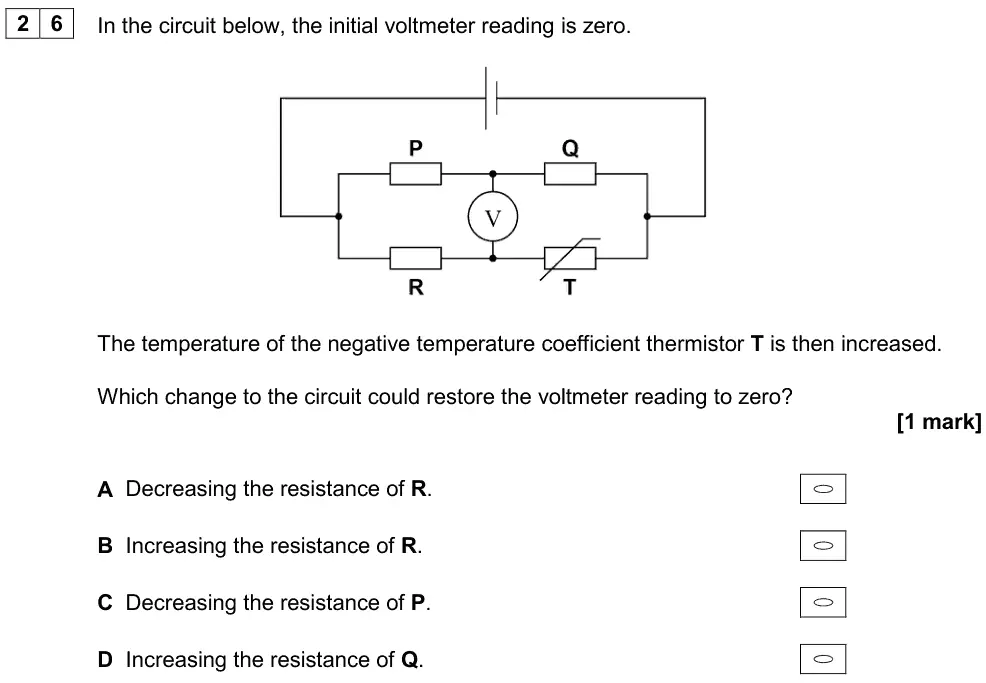
26 Circuits and potential dividers, Current, potential difference, I-V characteristics and resistivity 1Multiple choice
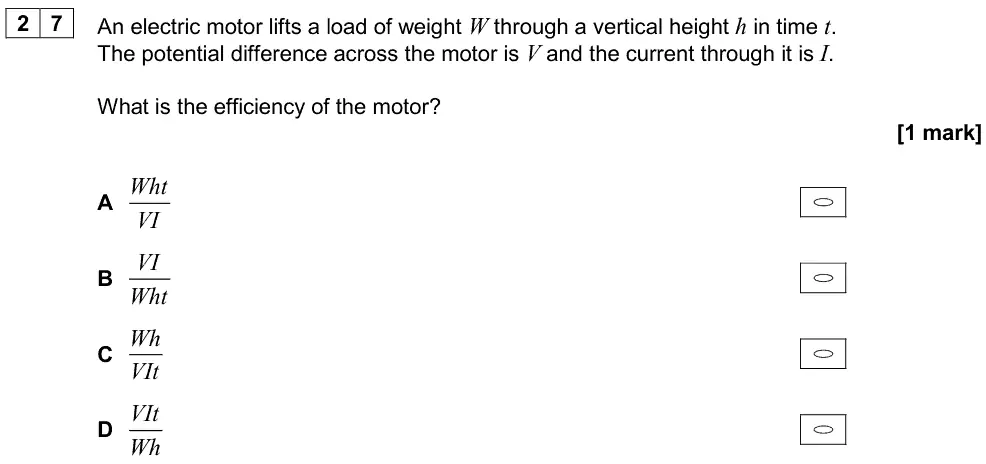
27 Work, energy, power and conservation of energy, Circuits and potential dividers 1Multiple choice
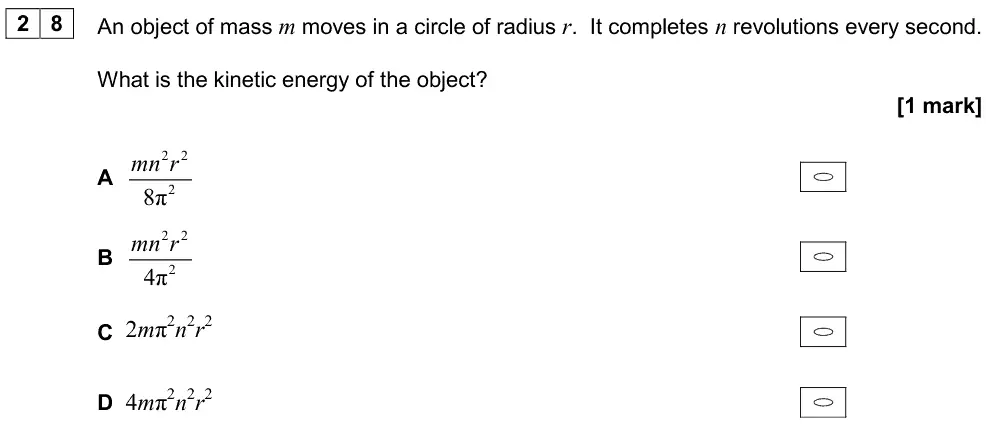
28 Circular motion, Work, energy, power and conservation of energy 1Multiple choice
29 Simple harmonic motion, forced vibrations and resonance 1Multiple choice
30 Simple harmonic motion, forced vibrations and resonance, Circular motion 1Multiple choice
31 Simple harmonic motion, forced vibrations and resonance 1Multiple choice
32 Simple harmonic motion, forced vibrations and resonance 1Multiple choice

The questions

1.11.21.31.42.12.22.32.42.52.63.13.23.33.44.14.24.34.45.15.25.35.45.56.16.26.37.17.2891011121314151617181920212223242526272829303132
June 2019 · Paper 1 · Q1.1 1 mark Short answer atomic structure and stable nuclei
Two isotopes of iodine are 125
53 I and 131
53 I.
Determine, for these two isotopes, the difference between the constituents of the
nuclei.
[1 mark]
June 2019 · Paper 1 · Q1.2 1 mark Short answer atomic structure and stable nuclei
Earlier part of question 1 that this part usesEarlier part of June 2019 Paper 1 question 1
A 131
53 I nuclide undergoes beta (β–) decay to form a xenon nuclide.
State the nucleon number of the xenon nuclide.
[1 mark]
June 2019 · Paper 1 · Q1.3 2 marks Short answer particles antiparticles and interactionsatomic structure and stable nuclei
Earlier part of question 1 that this part usesEarlier part of June 2019 Paper 1 question 1
A 125
53 I nuclide decays by electron capture to form a tellurium nuclide.
State two differences between the constituents of the iodine nucleus and the tellurium
nucleus it decays into.
[2 marks]
June 2019 · Paper 1 · Q1.4 3 marks Explanation particles antiparticles and interactionsatomic structure and stable nuclei
Earlier part of question 1 that this part usesEarlier part of June 2019 Paper 1 question 1
Internal conversion is a process in which a nucleus in an excited state can release its
excess energy.  In internal conversion all of the excess energy is transferred from the
nucleus to an orbital electron through the electromagnetic force.  This orbital electron
is ejected from the atom.
The tellurium nucleus formed in question 01.3 is in an excited state and can undergo
internal conversion.
Discuss three differences between internal conversion and beta (β–) decay.
[3 marks]
1
2
3
June 2019 · Paper 1 · Q2.1 1 mark Short answer refraction and optical fibres
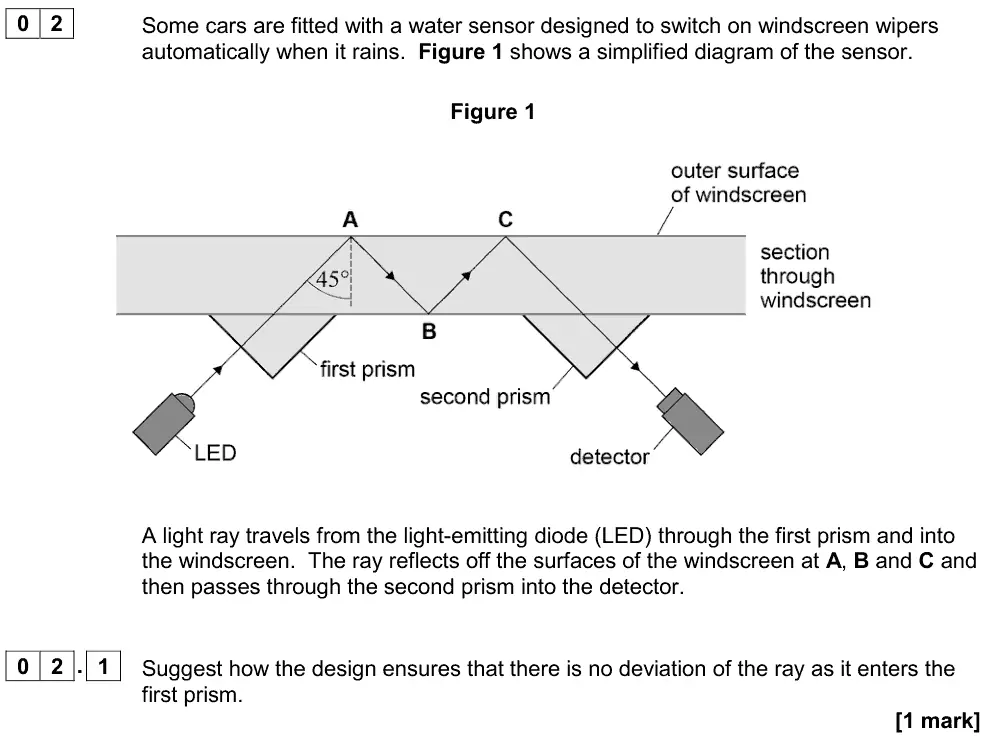
Some cars are fitted with a water sensor designed to switch on windscreen wipers
automatically when it rains.  Figure 1 shows a simplified diagram of the sensor.
Figure 1
A light ray travels from the light-emitting diode (LED) through the first prism and into
the windscreen.  The ray reflects off the surfaces of the windscreen at A, B and C and
then passes through the second prism into the detector.
Suggest how the design ensures that there is no deviation of the ray as it enters the
first prism.
[1 mark]
June 2019 · Paper 1 · Q2.2 2 marks Short answer refraction and optical fibres
Earlier part of question 2 that this part usesEarlier part of June 2019 Paper 1 question 2
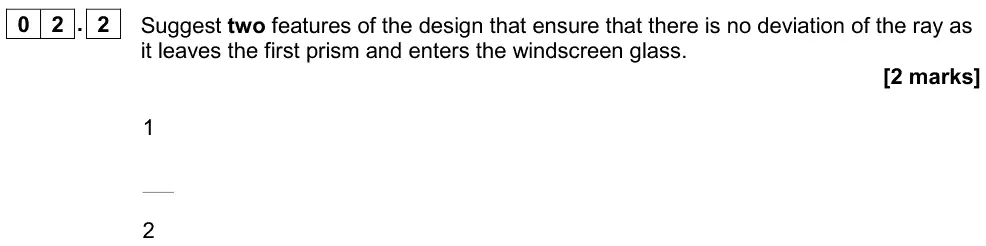
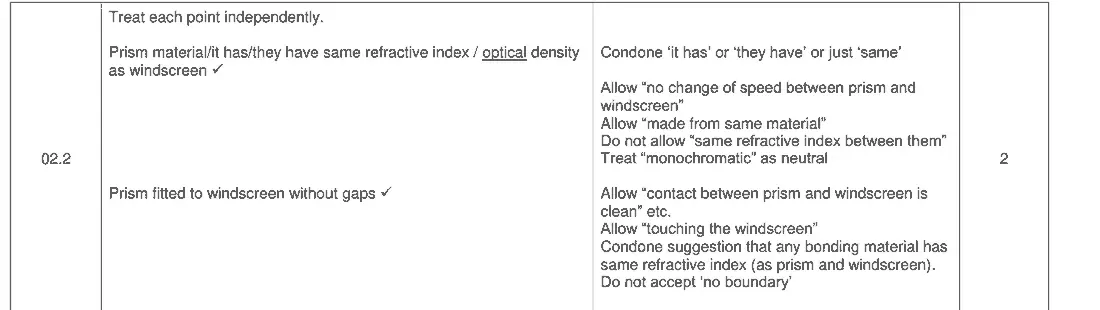
Suggest two features of the design that ensure that there is no deviation of the ray as
it leaves the first prism and enters the windscreen glass.
[2 marks]
1
2
June 2019 · Paper 1 · Q2.3 2 marks Explanation refraction and optical fibres
Earlier part of question 2 that this part usesEarlier part of June 2019 Paper 1 question 2
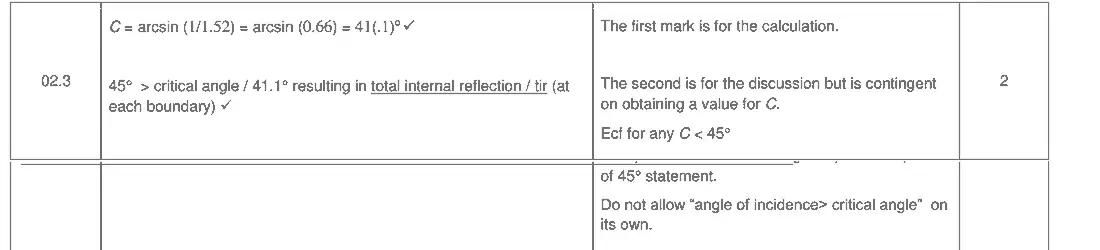
The refractive index of the windscreen glass is 1.52
Explain why the ray follows the path shown inside the windscreen glass in Figure 1.
Support your answer with a suitable calculation.
[2 marks]
June 2019 · Paper 1 · Q2.4 2 marks Explanation refraction and optical fibres
Earlier part of question 2 that this part usesEarlier part of June 2019 Paper 1 question 2
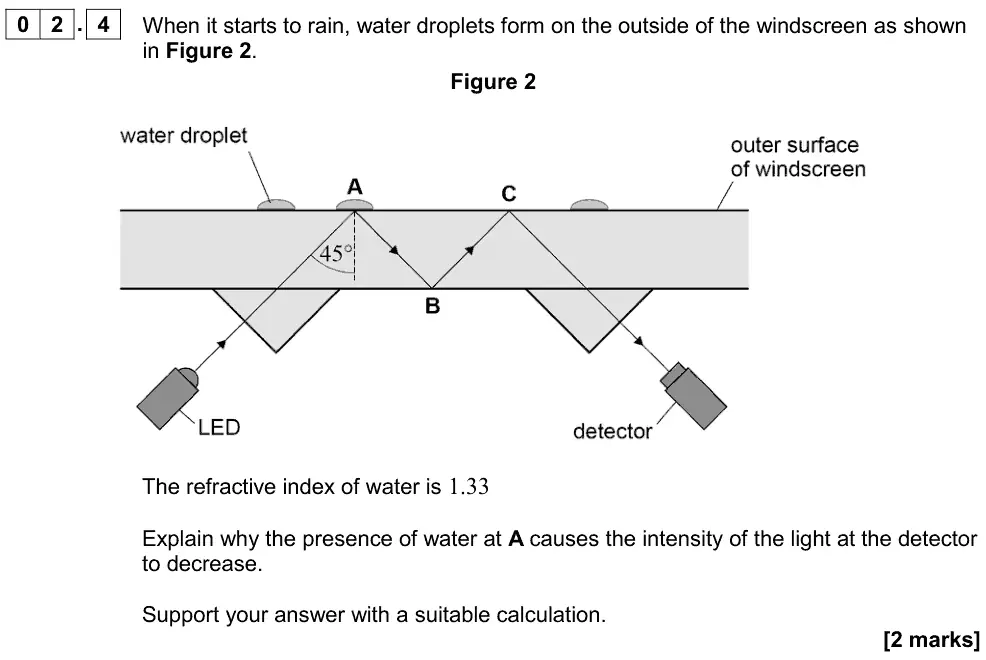
When it starts to rain, water droplets form on the outside of the windscreen as shown
in Figure 2.
Figure 2
The refractive index of water is 1.33
Explain why the presence of water at A causes the intensity of the light at the detector
to decrease.
Support your answer with a suitable calculation.
[2 marks]
June 2019 · Paper 1 · Q2.5 2 marks Explanation refraction and optical fibres
Earlier part of question 2 that this part usesEarlier part of June 2019 Paper 1 question 2
The refractive index of the windscreen glass can vary by a few per cent across the
thickness of the glass.
Discuss how this variation may affect the path of the ray through the windscreen
glass.
[2 marks]
June 2019 · Paper 1 · Q2.6 2 marks Explanation refraction and optical fibres
Earlier part of question 2 that this part usesEarlier part of June 2019 Paper 1 question 2
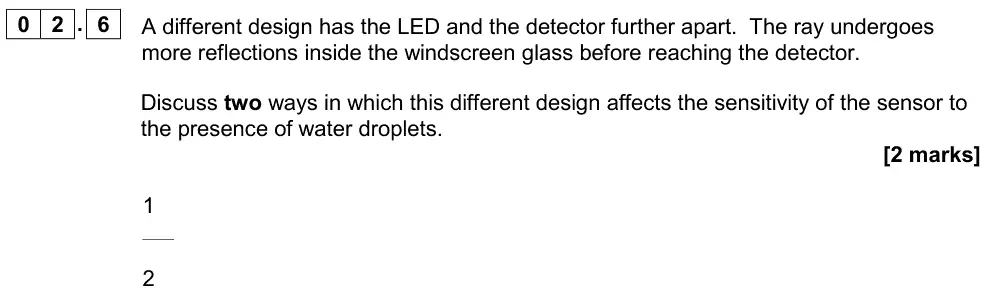
A different design has the LED and the detector further apart.  The ray undergoes
more reflections inside the windscreen glass before reaching the detector.
Discuss two ways in which this different design affects the sensitivity of the sensor to
the presence of water droplets.
[2 marks]
1
2
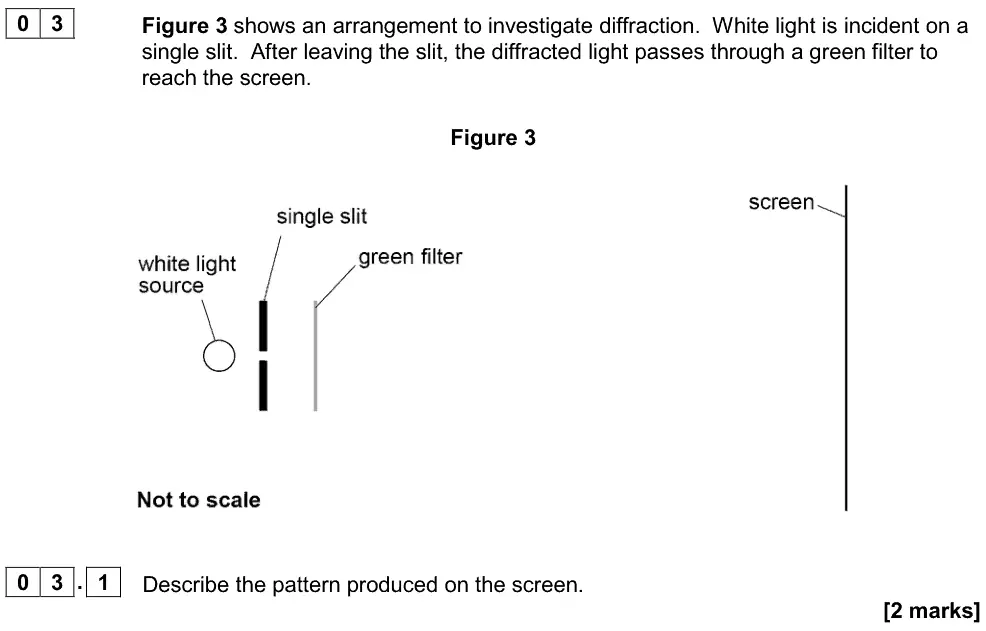
June 2019 · Paper 1 · Q3.1 2 marks Short answer interference and diffraction
Figure 3 shows an arrangement to investigate diffraction.  White light is incident on a
single slit.  After leaving the slit, the diffracted light passes through a green filter to
reach the screen.
Figure 3
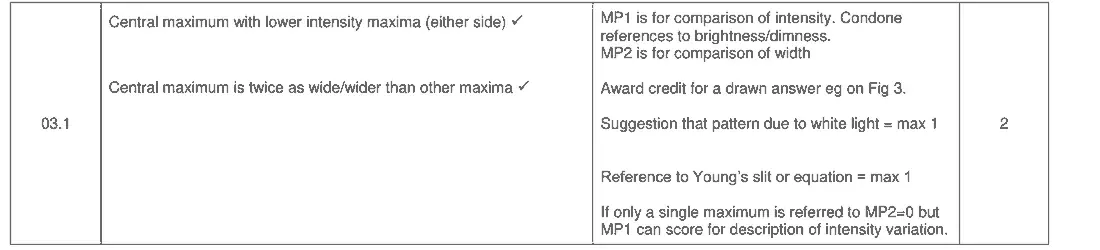
Describe the pattern produced on the screen.
[2 marks]
June 2019 · Paper 1 · Q3.2 2 marks Short answer interference and diffraction
Earlier part of question 3 that this part usesEarlier part of June 2019 Paper 1 question 3
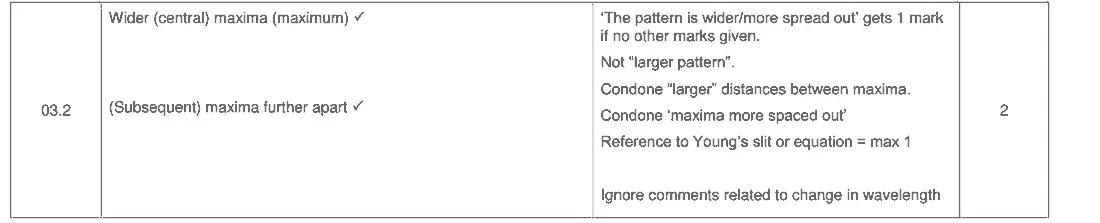
The green filter is replaced with a red filter.
Describe the change in the pattern produced on the screen.
[2 marks]
June 2019 · Paper 1 · Q3.3 2 marks Calculation interference and diffraction
Earlier part of question 3 that this part usesEarlier part of June 2019 Paper 1 question 3
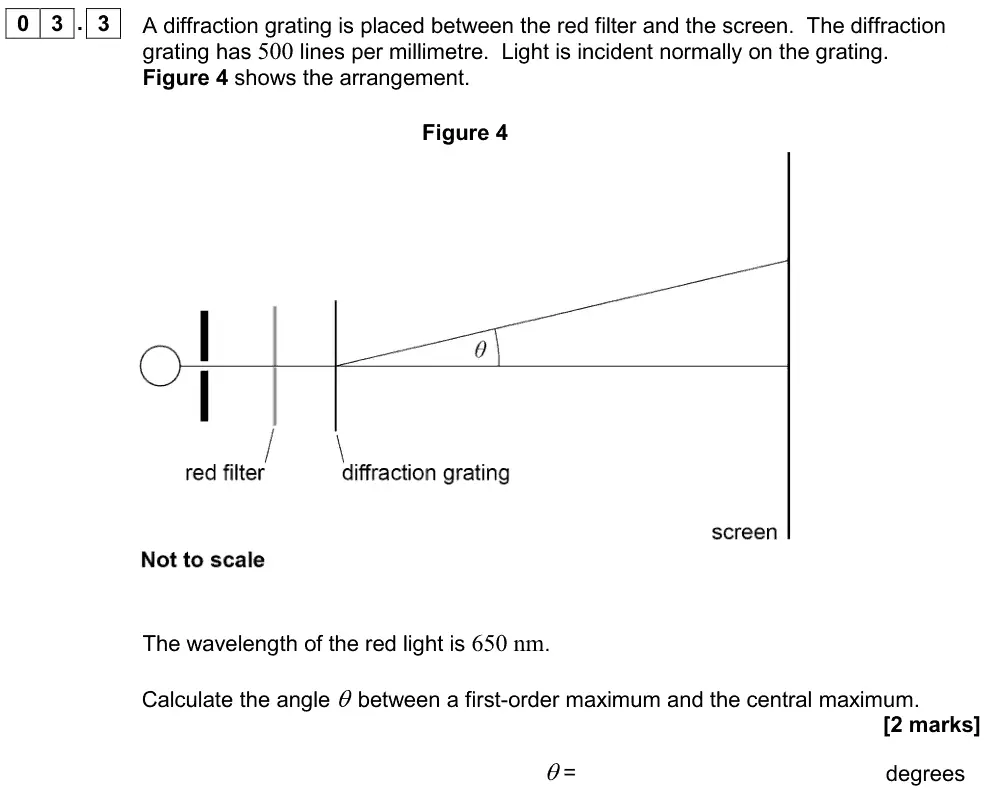
A diffraction grating is placed between the red filter and the screen.  The diffraction
grating has 500 lines per millimetre.  Light is incident normally on the grating.
Figure 4 shows the arrangement.
Figure 4
The wavelength of the red light is 650 nm.
Calculate the angle  between a first-order maximum and the central maximum.
[2 marks]
=
degrees
June 2019 · Paper 1 · Q3.4 2 marks Explanation interference and diffraction
Earlier part of question 3 that this part usesEarlier part of June 2019 Paper 1 question 3
In practice, the filter transmits red light with wavelengths in the range 600 nm to
700 nm.
Suggest how this affects the appearance of the maxima.
[2 marks]
June 2019 · Paper 1 · Q4.1 2 marks Explanation vectors and moments
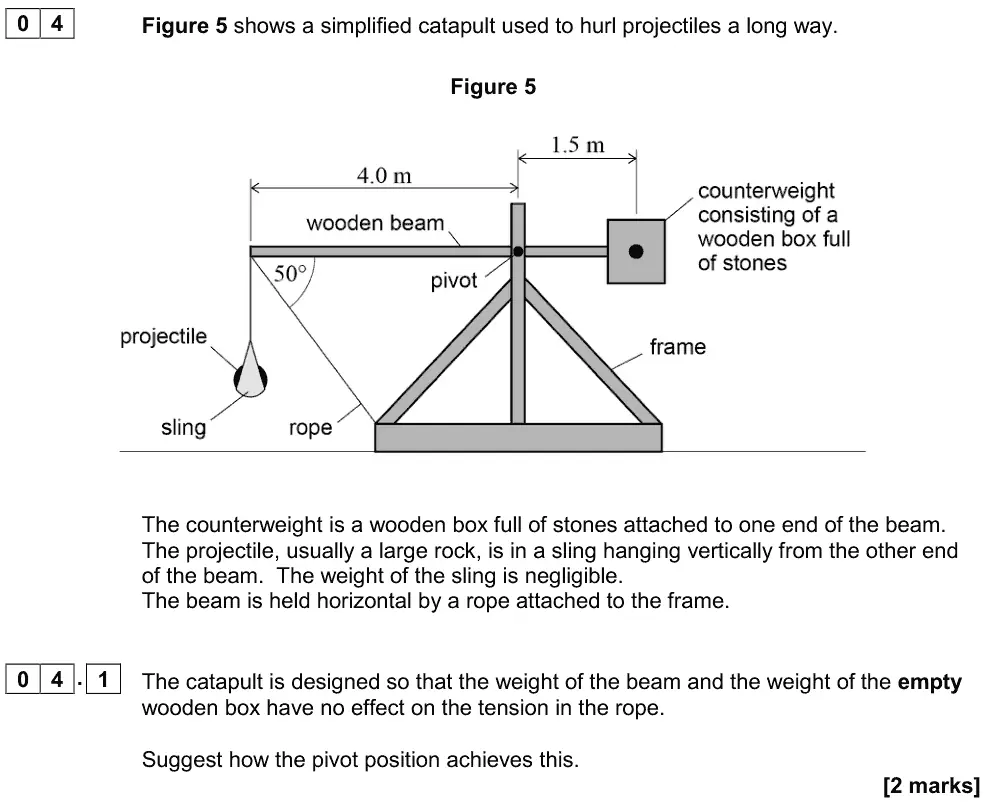
Figure 5 shows a simplified catapult used to hurl projectiles a long way.
Figure 5
The counterweight is a wooden box full of stones attached to one end of the beam.
The projectile, usually a large rock, is in a sling hanging vertically from the other end
of the beam.  The weight of the sling is negligible.
The beam is held horizontal by a rope attached to the frame.
The catapult is designed so that the weight of the beam and the weight of the empty
wooden box have no effect on the tension in the rope.
Suggest how the pivot position achieves this.
[2 marks]
June 2019 · Paper 1 · Q4.2 5 marks Calculation vectors and moments
Earlier part of question 4 that this part usesEarlier part of June 2019 Paper 1 question 4
The stones in the counterweight have a total mass of 610 kg and the projectile weighs
250 N.
Calculate the tension in the rope.
[5 marks]
tension =
N
June 2019 · Paper 1 · Q4.3 2 marks Calculation motion and projectiles
Earlier part of question 4 that this part usesEarlier part of June 2019 Paper 1 question 4
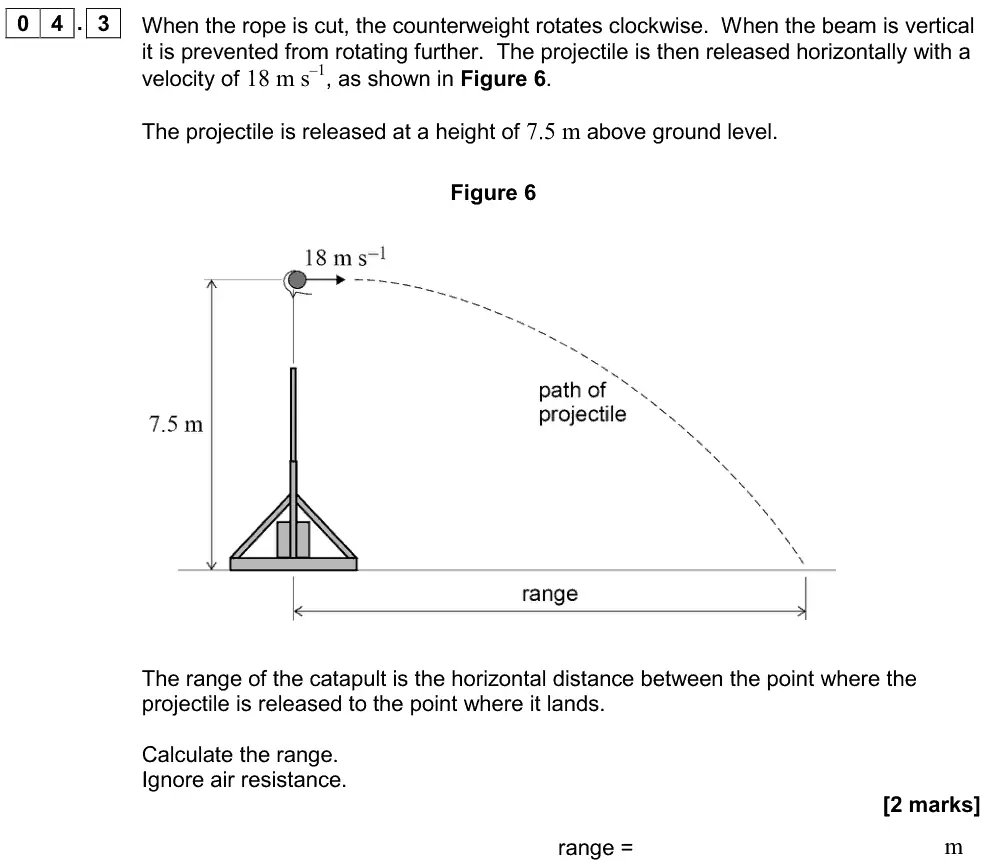
When the rope is cut, the counterweight rotates clockwise.  When the beam is vertical
it is prevented from rotating further.  The projectile is then released horizontally with a
velocity of 18 m s–1, as shown in Figure 6.
The projectile is released at a height of 7.5 m above ground level.
Figure 6
The range of the catapult is the horizontal distance between the point where the
projectile is released to the point where it lands.
Calculate the range.
Ignore air resistance.
[2 marks]
range =
m
June 2019 · Paper 1 · Q4.4 3 marks Explanation motion and projectiles
Earlier part of question 4 that this part usesEarlier part of June 2019 Paper 1 question 4
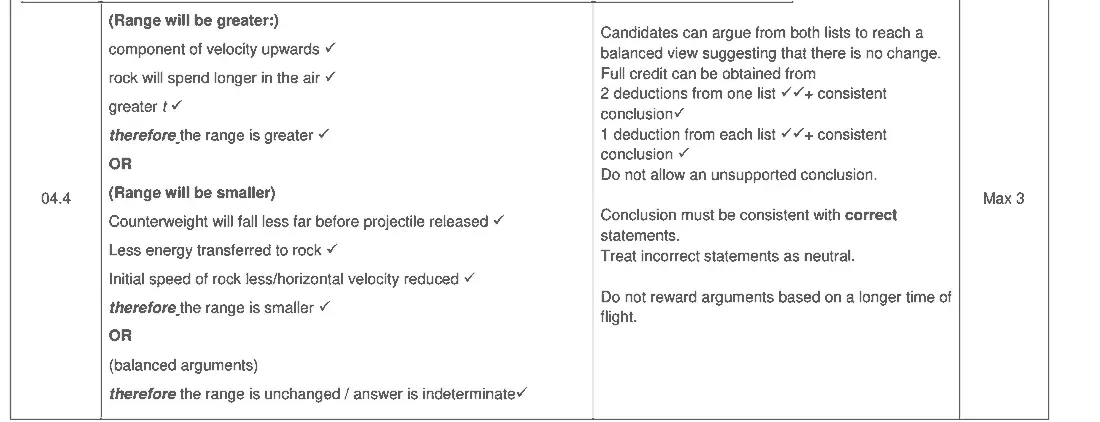
In another release, the sling is adjusted so that a projectile of the same mass is
released just before the wooden beam is vertical.  The projectile is not released
horizontally.
Discuss the effect this change has on the range of the catapult.
[3 marks]
June 2019 · Paper 1 · Q5.1 2 marks Show that work energy and power
Safety barriers are used on UK motorways to prevent vehicles crossing from one
carriageway to the other carriageway.  The barriers also absorb some of the kinetic
energy of a vehicle and deflect vehicles along the barrier.
The standard test of a safety barrier uses a vehicle that contains dummies.  The total
mass of the vehicle and its contents is 1.5 × 10³ kg and its initial speed is 110 km h–1.
Show that the initial kinetic energy of the test vehicle is 700 kJ.
[2 marks]
June 2019 · Paper 1 · Q5.2 3 marks Calculation newtons laws and momentumvectors and moments
Earlier part of question 5 that this part usesEarlier part of June 2019 Paper 1 question 5
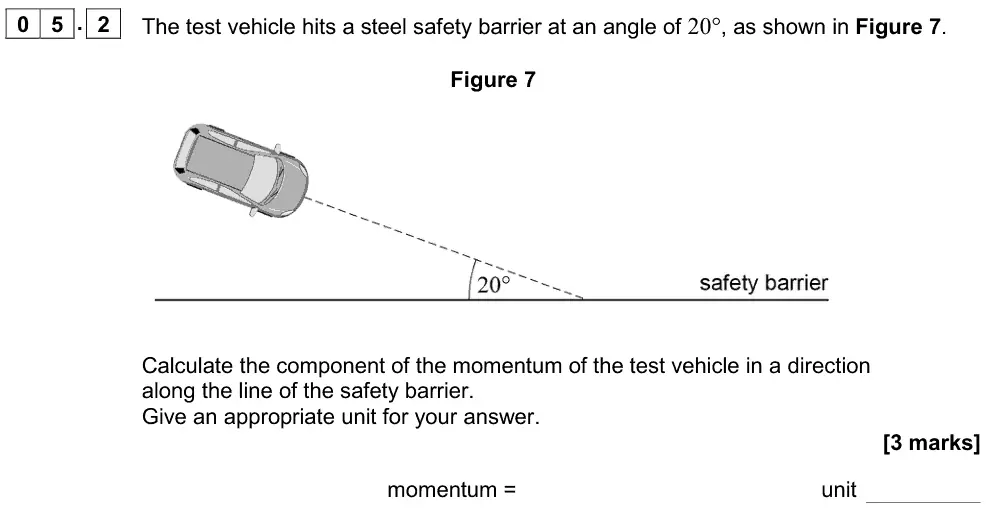
The test vehicle hits a steel safety barrier at an angle of 20°, as shown in Figure 7.
Figure 7
Calculate the component of the momentum of the test vehicle in a direction
along the line of the safety barrier.
Give an appropriate unit for your answer.
[3 marks]
momentum =
unit
June 2019 · Paper 1 · Q5.3 3 marks Show that work energy and powervectors and moments
Earlier part of question 5 that this part usesEarlier part of June 2019 Paper 1 question 5
Immediately after the collision, the test vehicle moves along the safety barrier with no
change in its momentum in this direction.
Show that the kinetic energy lost in the collision is about 80 kJ.
[3 marks]
June 2019 · Paper 1 · Q5.4 3 marks Calculation work energy and powernewtons laws and momentum
Earlier part of question 5 that this part usesEarlier part of June 2019 Paper 1 question 5
The steel safety barrier deforms during the collision.  For the barrier to pass the test,
the test vehicle should not move more than 1.5 m towards the other carriageway.
The barrier can apply an average force of 60 kN at right angles to the
carriageway.
Deduce whether the safety barrier will pass the test.
[3 marks]
June 2019 · Paper 1 · Q5.5 2 marks Explanation newtons laws and momentum
Earlier part of question 5 that this part usesEarlier part of June 2019 Paper 1 question 5
A different safety barrier uses a solid concrete wall which does not deform.
The same standard test is carried out on a concrete wall.
Discuss which type of barrier would cause less damage to the dummies in the
test.
[2 marks]
June 2019 · Paper 1 · Q6.1 1 mark Short answer simple harmonic motion
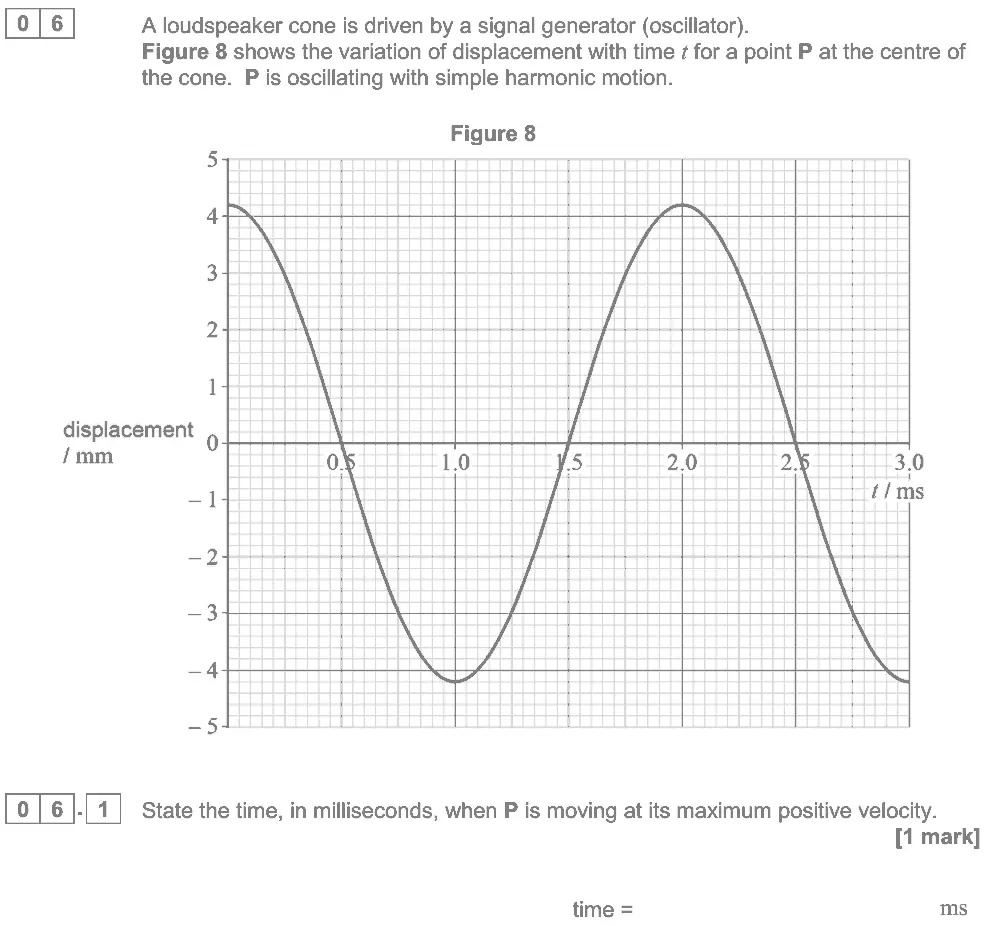
A loudspeaker cone is driven by a signal generator (oscillator).
Figure 8 shows the variation of displacement with time t for a point P at the centre of
the cone.  P is oscillating with simple harmonic motion.
Figure 8
State the time, in milliseconds, when P is moving at its maximum positive velocity.
[1 mark]
time =
ms
June 2019 · Paper 1 · Q6.2 3 marks Calculation simple harmonic motion
Earlier part of question 6 that this part usesEarlier part of June 2019 Paper 1 question 6
Calculate the maximum acceleration of P.
[3 marks]
acceleration =
m s–2
June 2019 · Paper 1 · Q6.3 1 mark Short answer progressive waves and polarisation
Earlier part of question 6 that this part usesEarlier part of June 2019 Paper 1 question 6
The loudspeaker creates variations in pressure and produces a sound wave in the air
around it.
State the type of wave produced and describe the motion of the particles in this type
of wave.
[1 mark]
June 2019 · Paper 1 · Q7.1 2 marks Explanation emf and internal resistance
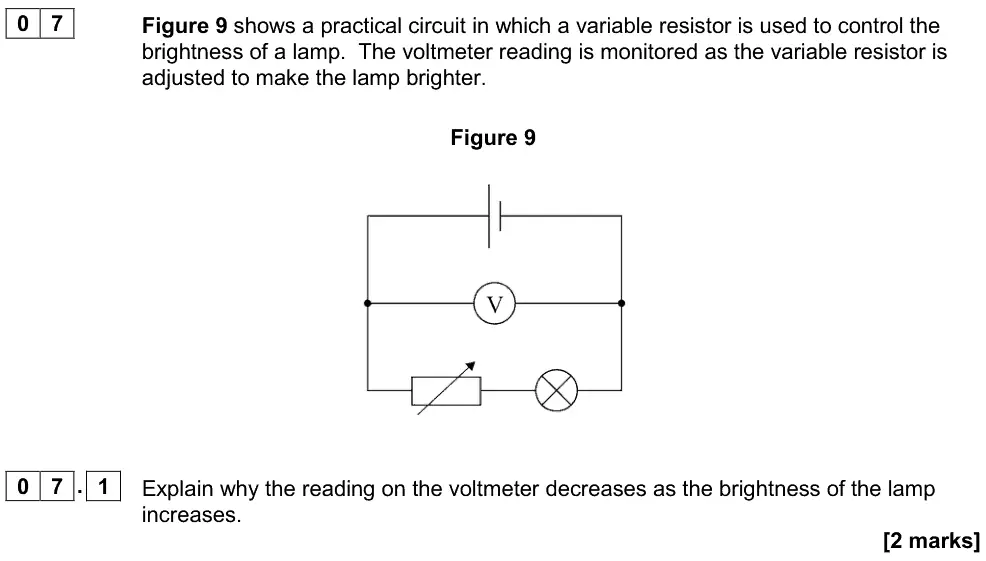
Figure 9 shows a practical circuit in which a variable resistor is used to control the
brightness of a lamp.  The voltmeter reading is monitored as the variable resistor is
adjusted to make the lamp brighter.
Figure 9
Explain why the reading on the voltmeter decreases as the brightness of the lamp
increases.
[2 marks]
June 2019 · Paper 1 · Q7.2 2 marks Explanation emf and internal resistancecircuits and potential dividers
Earlier part of question 7 that this part usesEarlier part of June 2019 Paper 1 question 7
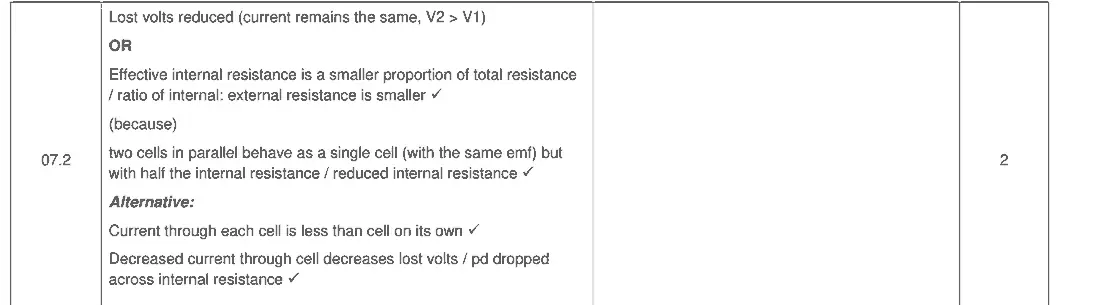
The variable resistor is adjusted so that the lamp is at its brightest.  The reading V1 on
the voltmeter is noted.  A second identical cell is then connected in parallel with the
cell in Figure 9.  The new reading V2 on the voltmeter is noted.
Explain why V2 is greater than V1.
[2 marks]
June 2019 · Paper 1 · Q8 1 mark Multiple choice particles antiparticles and interactions
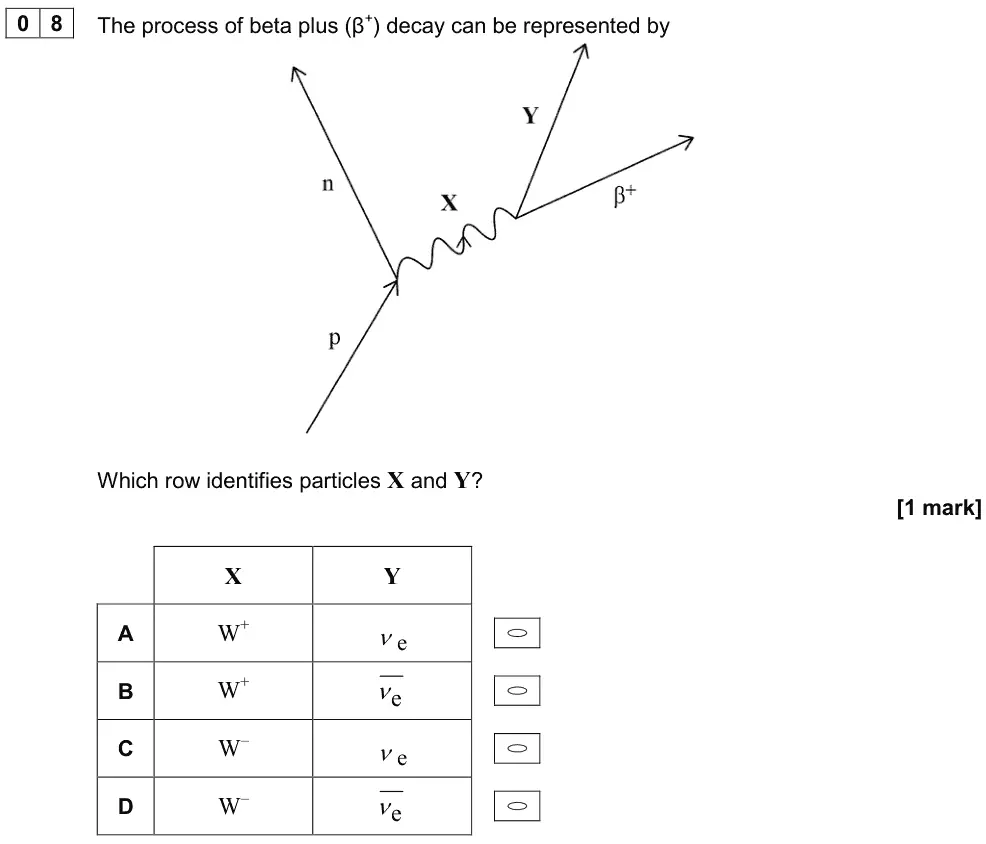
The process of beta plus (β+) decay can be represented by
Which row identifies particles X and Y?
[1 mark]
X
Y
A
W+
e
B
W+
e
C
W–
e
D
W–
e
June 2019 · Paper 1 · Q9 1 mark Multiple choice energy levels and wave particle duality
An electron collides with an isolated atom and raises an orbiting electron to a higher
energy level.
Which statement is correct?
[1 mark]
A The colliding electron is captured by the nucleus of the atom.
B A photon is emitted when the electron rises to the higher energy
level.
C An electron is emitted when the excited electron returns to the
ground state.
D Energy is transferred from the colliding electron to the orbiting
electron.
June 2019 · Paper 1 · Q10 1 mark Multiple choice photoelectric effectparticles antiparticles and interactions
Light of frequency 2.0 × 10¹⁵ Hz is incident on a metal surface.  The work function of the
metal is 4.6 × 10⁻¹⁹ J.
Which statement is correct?
[1 mark]
A No photoelectrons are released.
B Photoelectrons are released with a maximum kinetic energy of
3.1 × 10⁻¹⁹ J.
C Photoelectrons are released with a maximum kinetic energy of
8.7 × 10⁻¹⁹ J.
D Photoelectrons are released with a maximum kinetic energy of
18 × 10–19 J.
June 2019 · Paper 1 · Q11 1 mark Multiple choice particles antiparticles and interactionsenergy levels and wave particle duality
A photon of ultraviolet radiation has a frequency of 1.5 × 10¹⁵ Hz.
What is the momentum of the photon?
[1 mark]
A 3.3 × 10–41 kg m s–1
B 1.3 × 10–40 kg m s–1
C 3.3 × 10⁻²⁷ kg m s–1
D 1.3 × 10⁻²⁶ kg m s–1
June 2019 · Paper 1 · Q12 1 mark Multiple choice vectors and moments
Which statement about a couple is not true?
[1 mark]
A It must consist of coplanar forces.
B It can produce rotational motion.
C It can produce translational motion.
D It has a moment with units N m.
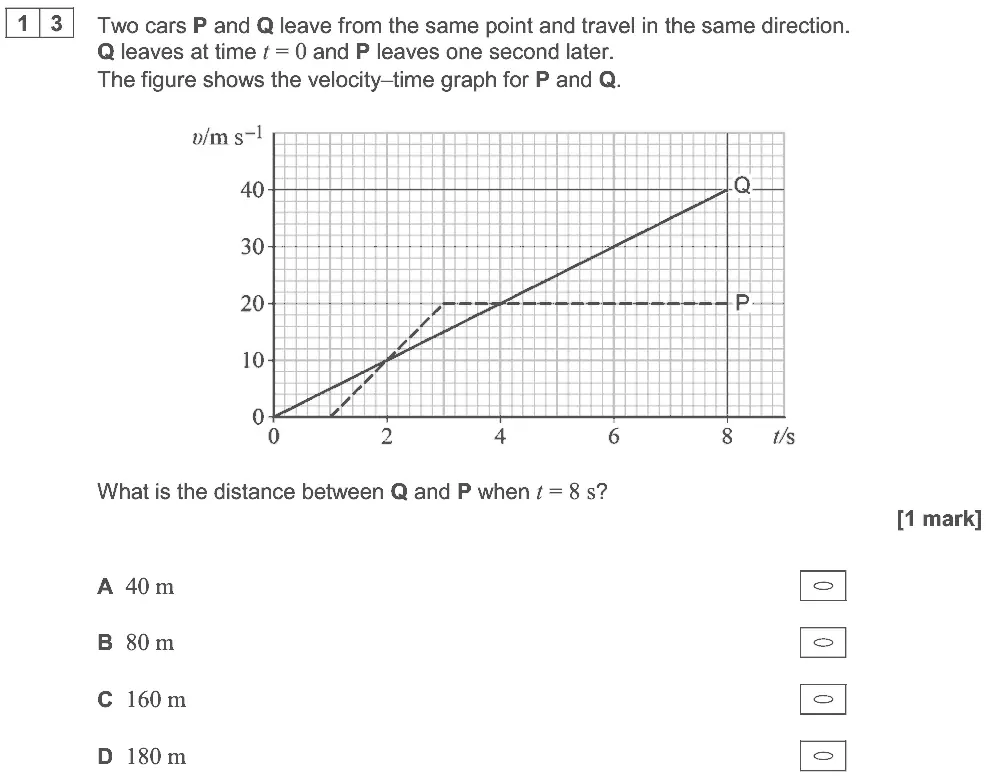
June 2019 · Paper 1 · Q13 1 mark Multiple choice motion and projectiles
Two cars P and Q leave from the same point and travel in the same direction.
Q leaves at time t = 0 and P leaves one second later.
The figure shows the velocity–time graph for P and Q.
What is the distance between Q and P when t = 8 s?
[1 mark]
A 40 m
B 80 m
C 160 m
D 180 m
June 2019 · Paper 1 · Q14 1 mark Multiple choice newtons laws and momentummaterials and young modulus
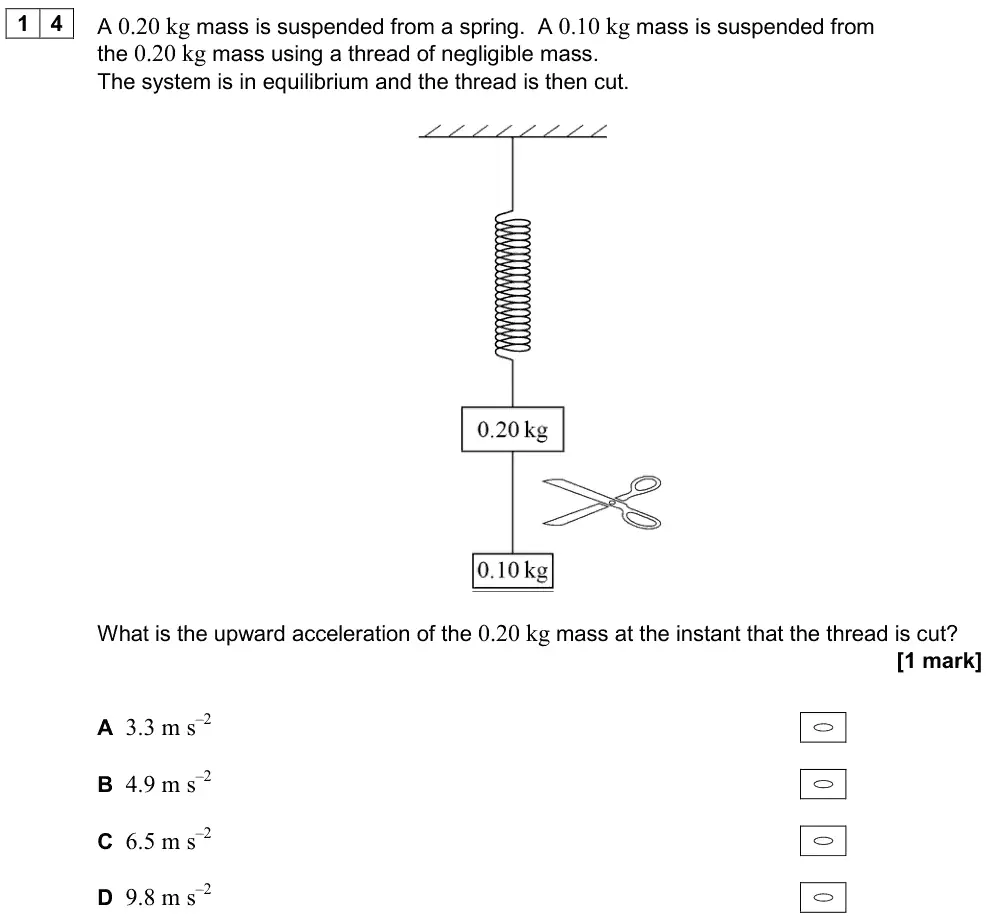
A 0.20 kg mass is suspended from a spring.  A 0.10 kg mass is suspended from
the 0.20 kg mass using a thread of negligible mass.
The system is in equilibrium and the thread is then cut.
What is the upward acceleration of the 0.20 kg mass at the instant that the thread is cut?
[1 mark]
A 3.3 m s–2
B 4.9 m s–2
C 6.5 m s–2
D 9.8 m s–2
June 2019 · Paper 1 · Q15 1 mark Multiple choice newtons laws and momentum
A lift of mass M is suspended from a cable.  The lift descends with a downward
acceleration, a.  A frictional force F acts on the lift.
What is the tension T in the cable?
[1 mark]
A T = Ma + F
B T = Ma – F
C T = M (g + a) – F
D T = M (g – a) – F
June 2019 · Paper 1 · Q16 1 mark Multiple choice newtons laws and momentum
A body of constant mass falls freely due to gravity.
The rate of change of momentum of the body is equal to its
[1 mark]
A kinetic energy.
B mass.
C gravitational potential energy.
D weight.
June 2019 · Paper 1 · Q17 1 mark Multiple choice work energy and powernewtons laws and momentum
An electric vehicle is driven by a motor which produces a constant driving force.
The vehicle travels from rest along a straight horizontal road.
Friction and air resistance are negligible.
Which statement describes the variation with time of the power developed by the motor?
[1 mark]
A It stays constant.
B It increases linearly from zero.
C It increases non-linearly from zero.
D It increases from zero to a maximum and then decreases.
June 2019 · Paper 1 · Q18 1 mark Multiple choice work energy and powermeasurements and uncertainties
Which is a correct statement about mechanical power?
[1 mark]
A It is a vector quantity.
B It is measured in J.
C In fundamental units, its unit is kg m2 s–3
D It can be calculated from force × distance moved.
June 2019 · Paper 1 · Q19 1 mark Multiple choice materials and young modulus
A load of 50 N is suspended from a wire that has an area of cross-section of 1 mm2.
The stress in the wire, in Pa, is between
[1 mark]
A 100 and 103
B 103 and 106
C 106 and 109
D 109 and 1012
June 2019 · Paper 1 · Q20 1 mark Multiple choice materials and young modulus
Which combination of properties would produce the smallest extension of a wire when the
same tensile force is applied to the wire?
[1 mark]
Cross-sectional
area
Length
Young modulus of
material
A
X
3L
E
B
2X
L
E
C
X
3L
4E
D
2X
L
4E
June 2019 · Paper 1 · Q21 1 mark Multiple choice current voltage and resistivity
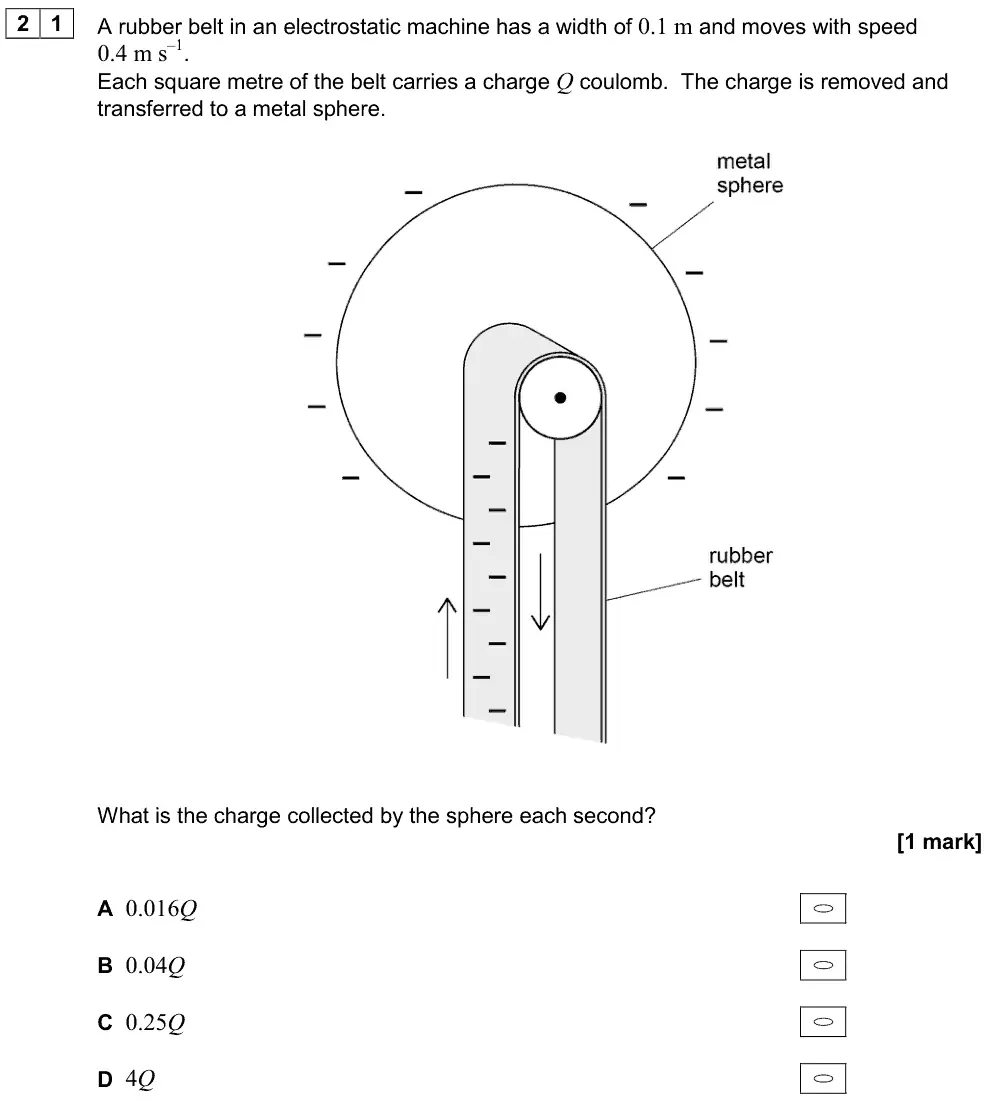
A rubber belt in an electrostatic machine has a width of 0.1 m and moves with speed
0.4 m s–1.
Each square metre of the belt carries a charge Q coulomb.  The charge is removed and
transferred to a metal sphere.
What is the charge collected by the sphere each second?
[1 mark]
A 0.016Q
B 0.04Q
C 0.25Q
D 4Q
June 2019 · Paper 1 · Q22 1 mark Multiple choice current voltage and resistivityenergy levels and wave particle duality
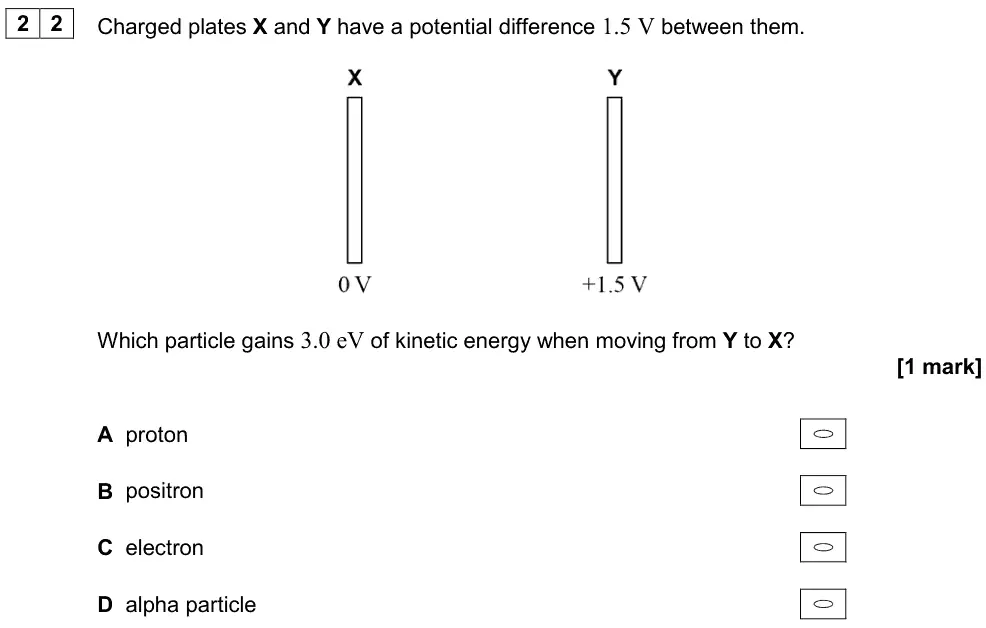
Charged plates X and Y have a potential difference 1.5 V between them.
Which particle gains 3.0 eV of kinetic energy when moving from Y to X?
[1 mark]
A proton
B positron
C electron
D alpha particle
June 2019 · Paper 1 · Q23 1 mark Multiple choice circuits and potential dividerscurrent voltage and resistivity
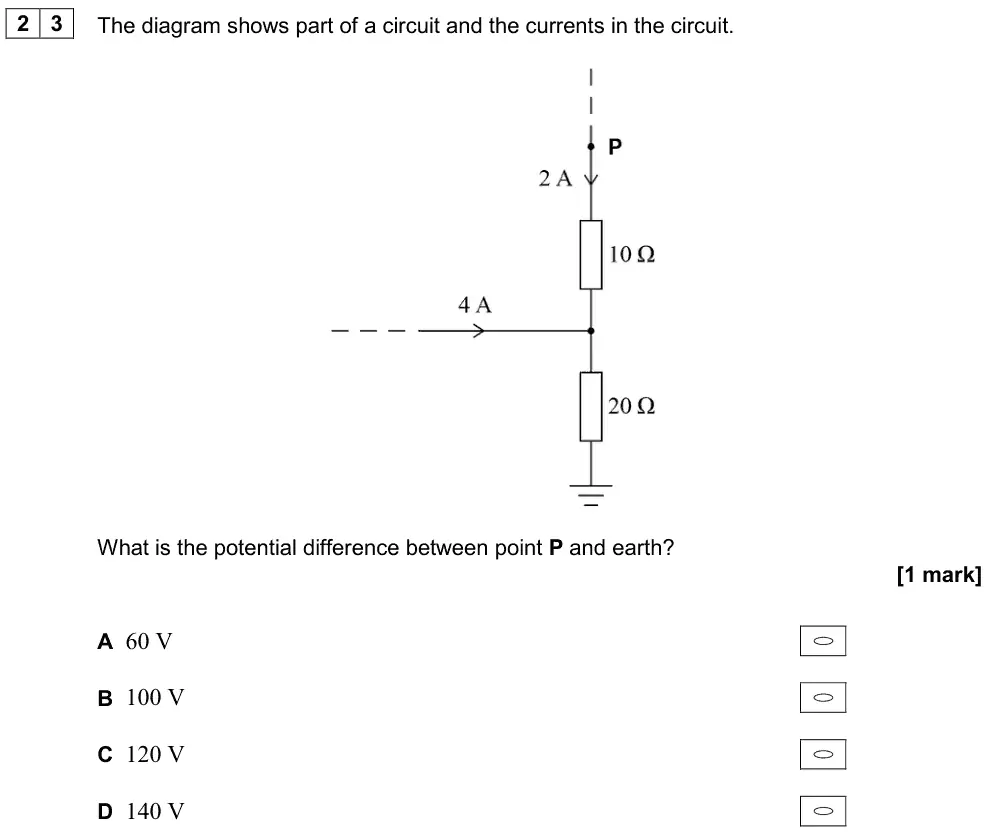
The diagram shows part of a circuit and the currents in the circuit.
What is the potential difference between point P and earth?
[1 mark]
A 60 V
B 100 V
C 120 V
D 140 V
June 2019 · Paper 1 · Q24 1 mark Multiple choice circuits and potential dividers
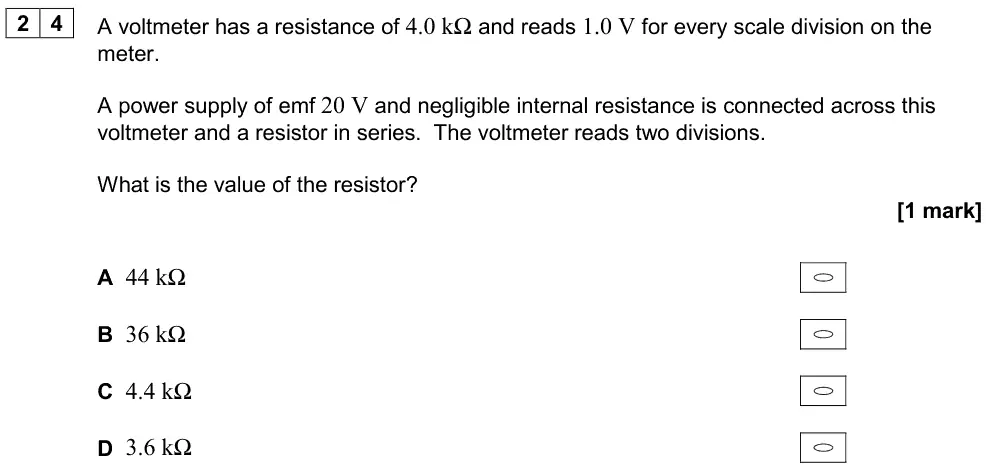
A voltmeter has a resistance of 4.0 kΩ and reads 1.0 V for every scale division on the
meter.
A power supply of emf 20 V and negligible internal resistance is connected across this
voltmeter and a resistor in series.  The voltmeter reads two divisions.
What is the value of the resistor?
[1 mark]
A 44 kΩ
B 36 kΩ
C 4.4 kΩ
D 3.6 kΩ
June 2019 · Paper 1 · Q25 1 mark Multiple choice current voltage and resistivitycircuits and potential dividers
Two cylindrical wires P and Q are of equal length and made of the same material.
The diameter of P is greater than that of Q.
P and Q are connected in series and the ends of this arrangement are connected to a
power supply.
Which two quantities are the same for P and Q?
[1 mark]
A
potential difference across wire
resistivity
B
resistivity
current
C
current
resistance
D
resistance
potential difference across wire
June 2019 · Paper 1 · Q26 1 mark Multiple choice circuits and potential dividerscurrent voltage and resistivity
In the circuit below, the initial voltmeter reading is zero.
The temperature of the negative temperature coefficient thermistor T is then increased.
Which change to the circuit could restore the voltmeter reading to zero?
[1 mark]
A Decreasing the resistance of R.
B Increasing the resistance of R.
C Decreasing the resistance of P.
D Increasing the resistance of Q.
June 2019 · Paper 1 · Q27 1 mark Multiple choice work energy and powercircuits and potential dividers
An electric motor lifts a load of weight W through a vertical height h in time t.
The potential difference across the motor is V and the current through it is I.
What is the efficiency of the motor?
[1 mark]
A Wht
VI
B VI
Wht
C Wh
VIt
D VIt
Wh
June 2019 · Paper 1 · Q28 1 mark Multiple choice circular motionwork energy and power
An object of mass m moves in a circle of radius r.  It completes n revolutions every second.
What is the kinetic energy of the object?
[1 mark]
A
2
2
2
8π
mn r
B
2
2
2
4π
mn r
C 2mπ2n2r2
D 4mπ2n2r2
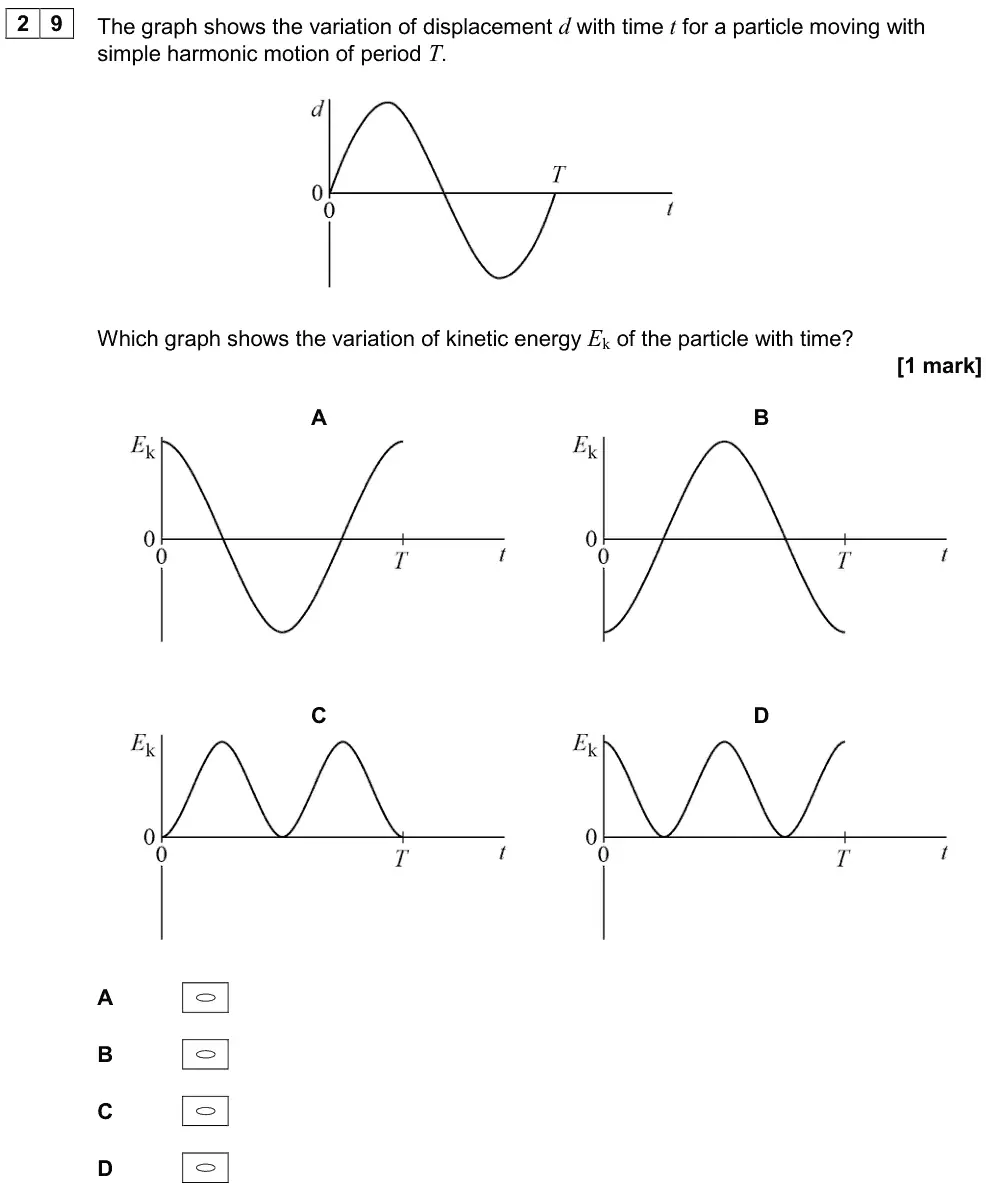
June 2019 · Paper 1 · Q29 1 mark Multiple choice simple harmonic motion
The graph shows the variation of displacement d with time t for a particle moving with
simple harmonic motion of period T.
Which graph shows the variation of kinetic energy Ek of the particle with time?
[1 mark]
A
B
C
D
A
B
C
D
June 2019 · Paper 1 · Q30 1 mark Multiple choice simple harmonic motioncircular motion
Two pendulums A and B oscillate with simple harmonic motion.
The time period of A is 2.00 s and the time period of B is 1.98 s.
A and B are released in phase.
What is the number of oscillations of A before A and B are next in phase?
[1 mark]
A 49
B 50
C 99
D 100
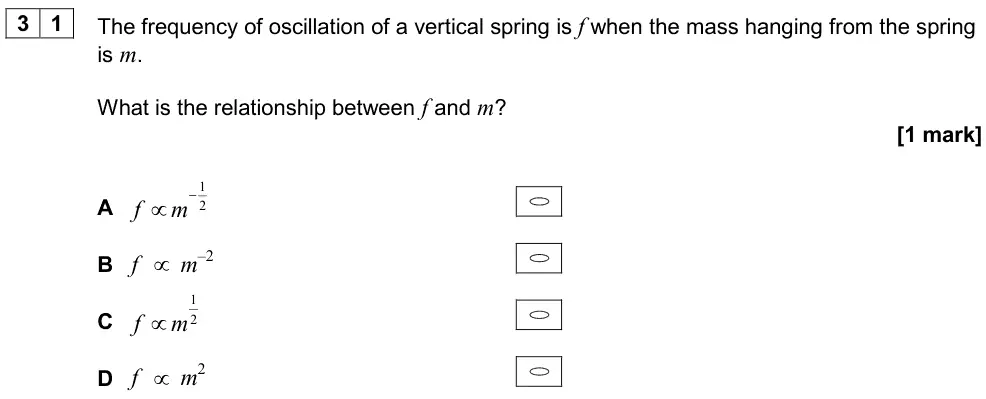
June 2019 · Paper 1 · Q31 1 mark Multiple choice simple harmonic motion
The frequency of oscillation of a vertical spring is f when the mass hanging from the spring
is m.
What is the relationship between f and m?
[1 mark]
A
1
2
f
m
−
∝
B f  ∝ m–2
C
1
2
f
m
∝
D f  ∝ m2
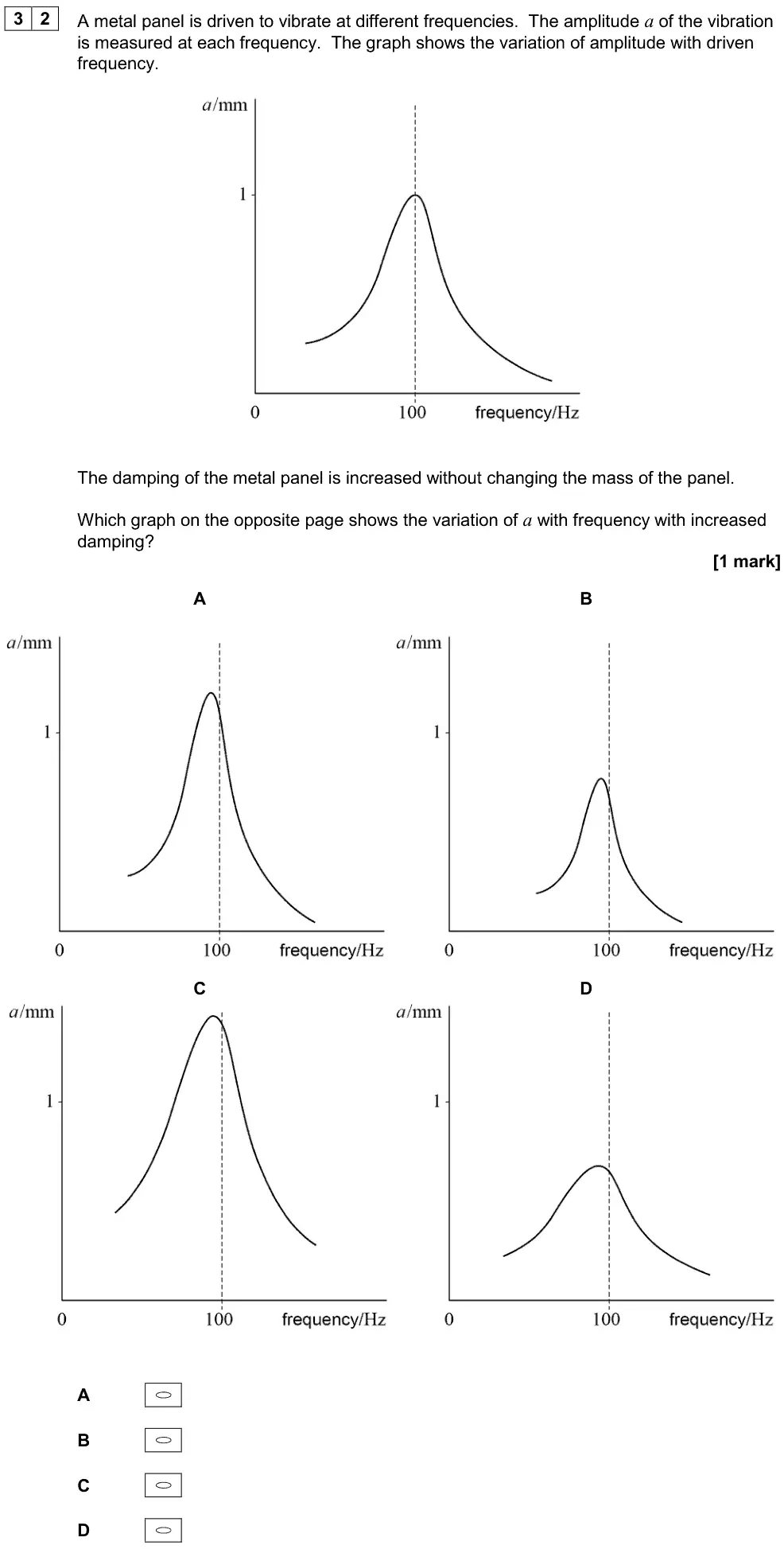
June 2019 · Paper 1 · Q32 1 mark Multiple choice simple harmonic motion
A metal panel is driven to vibrate at different frequencies.  The amplitude a of the vibration
is measured at each frequency.  The graph shows the variation of amplitude with driven
frequency.
The damping of the metal panel is increased without changing the mass of the panel.
Which graph on the opposite page shows the variation of a with frequency with increased
damping?
[1 mark]
A
B
C
D
A
B
C
D

Work with an AQA physics tutor

Want a paper marked and gone through with you? Message us.

Prefer email? Send an enquiry

If you are under 18, please include a parent's contact details. Enquiries go to enquiries@physicsaleveltutor.com and are deleted once handled. All tutoring is online.