June 2019: Paper 2

85 marks · 51 question parts · Paper, mark scheme and report on AQA's site · Have the data and formulae booklet beside you

Question by question

QTopicMarksAOType
1.1 Thermal energy transfer and ideal gases 5Calculation
1.2 Thermal energy transfer and ideal gases, Materials, stress, strain and the Young modulus 4Calculation
2.1 Thermal energy transfer and ideal gases, Molecular kinetic theory 2Short answer
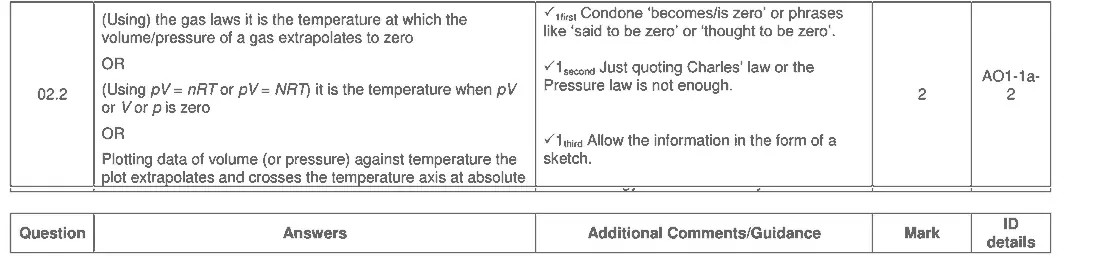
2.2 Thermal energy transfer and ideal gases, Molecular kinetic theory 2Short answer
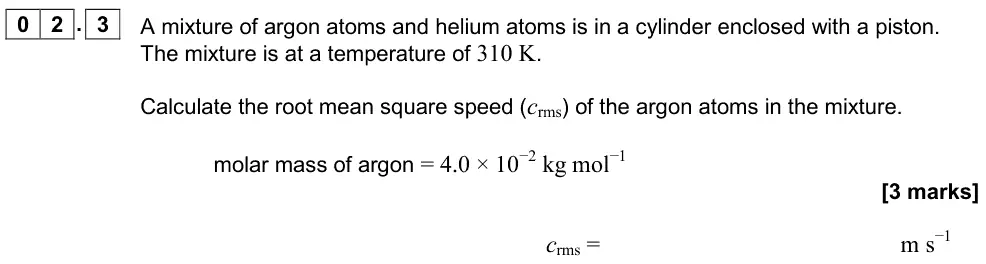
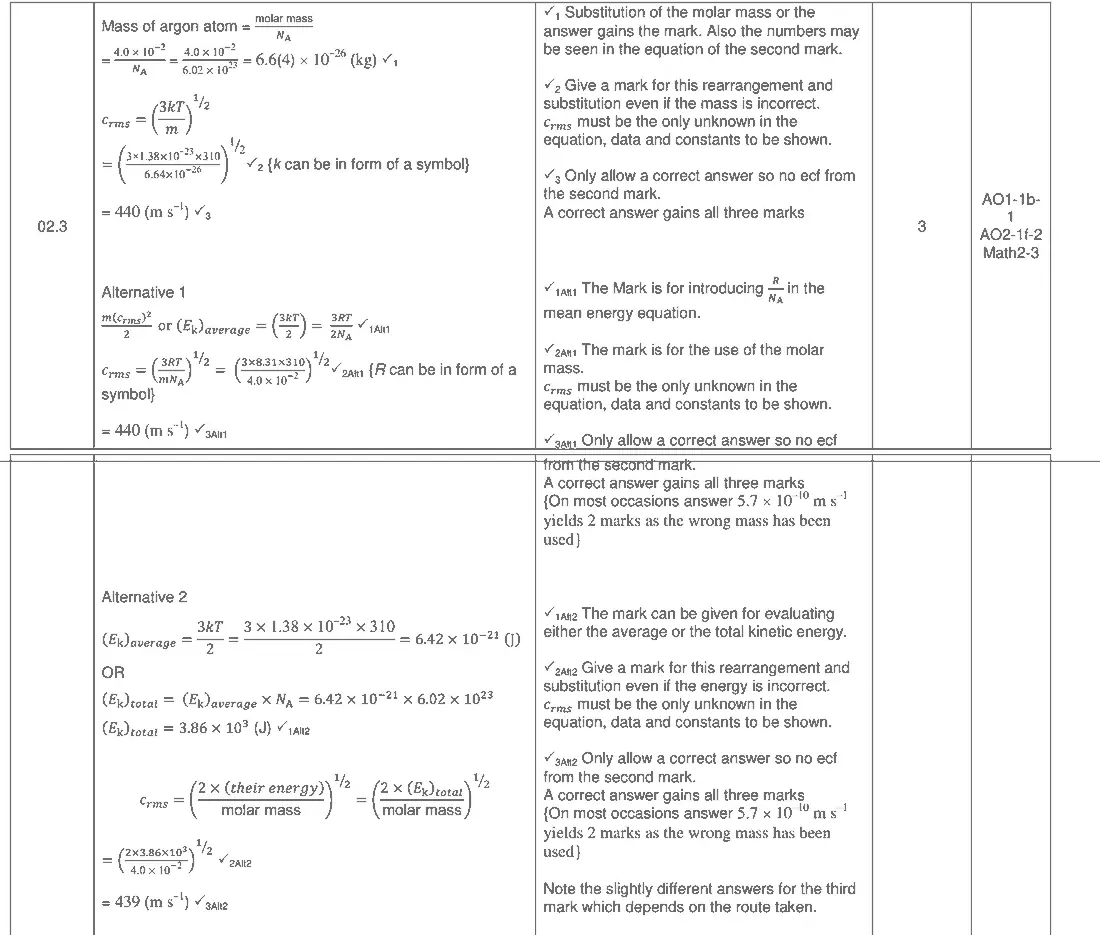
2.3 Molecular kinetic theory, Thermal energy transfer and ideal gases 3Calculation
2.4 Molecular kinetic theory 1Short answer
2.5 Molecular kinetic theory 3Explanation
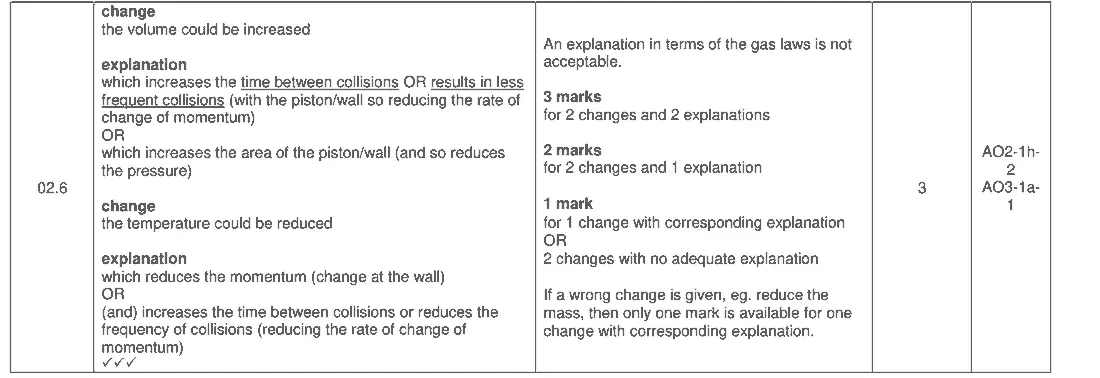
2.6 Molecular kinetic theory 3Explanation
3.1 Gravitational fields and orbits 1Short answer
3.2 Gravitational fields and orbits 1Short answer
3.3 Gravitational fields and orbits 4Calculation
4.1 Capacitance and capacitor charge and discharge, Electric fields and electric potential 3Calculation
4.2 Electric fields and electric potential, Scalars, vectors and moments 2Diagram or graph
4.3 Measurements, units and uncertainties 2Short answer
4.4 Electric fields and electric potential 3Show that
4.5 Scalars, vectors and moments 2Calculation
4.6 Electric fields and electric potential, Gravitational fields and orbits 2Calculation
5.1 Electromagnetic induction, alternating currents and transformers 2Calculation
5.2 Electromagnetic induction, alternating currents and transformers 1Calculation
5.3 Electromagnetic induction, alternating currents and transformers 2Calculation
5.4 Electromagnetic induction, alternating currents and transformers 1Diagram or graph
6.1 Mass and energy, binding energy, fission and safety 1Short answer
6.2 Mass and energy, binding energy, fission and safety 2Calculation
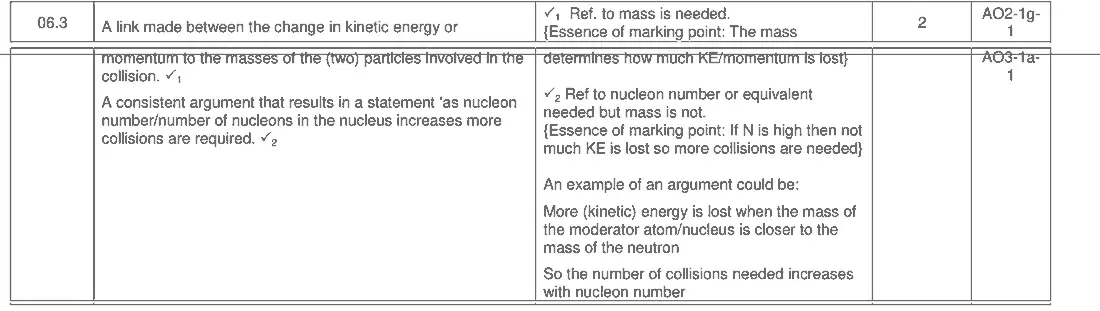
6.3 Mass and energy, binding energy, fission and safety 2Explanation
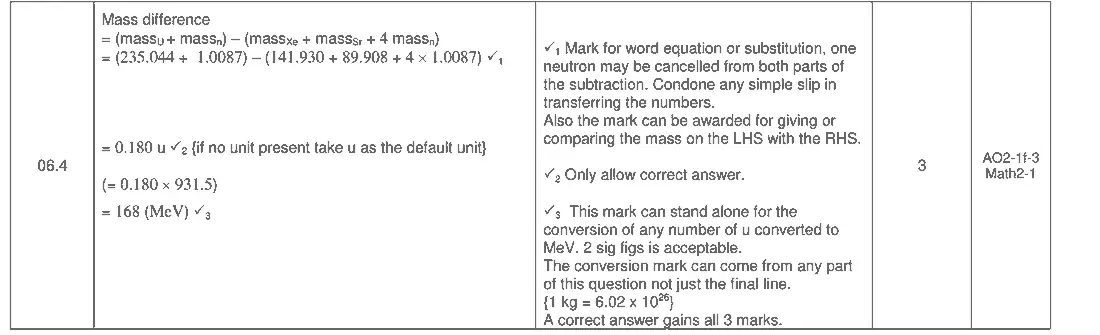
6.4 Mass and energy, binding energy, fission and safety 3Calculation
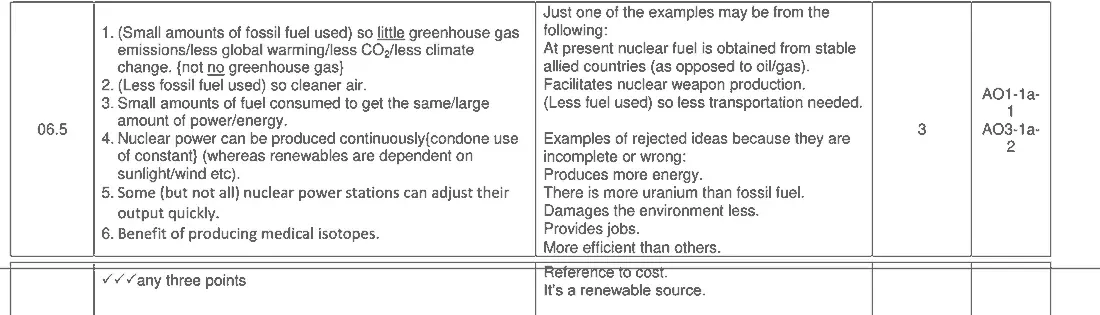
6.5 Mass and energy, binding energy, fission and safety 3Short answer
7 Molecular kinetic theory 1Multiple choice
8 Gravitational fields and orbits, Scalars, vectors and moments 1Multiple choice
9 Gravitational fields and orbits, Circular motion 1Multiple choice
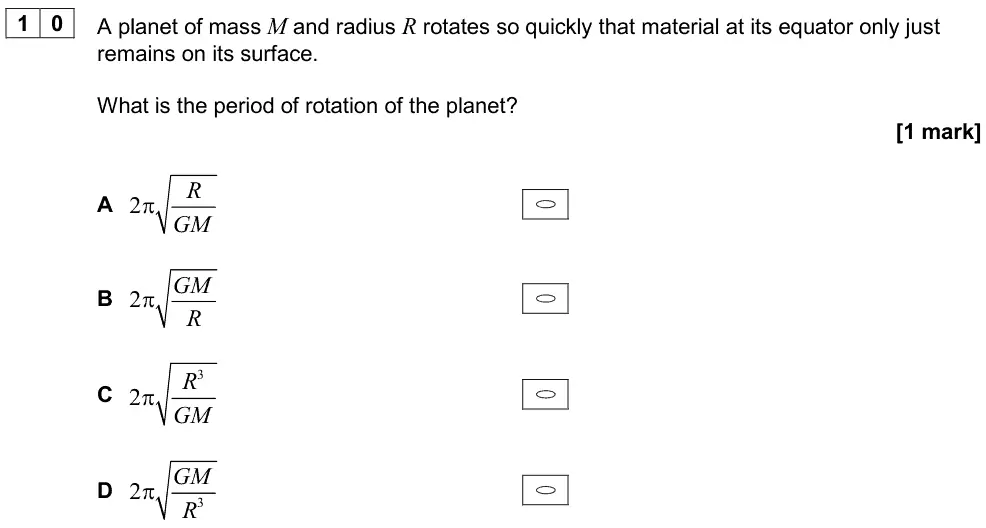
10 Circular motion, Gravitational fields and orbits 1Multiple choice
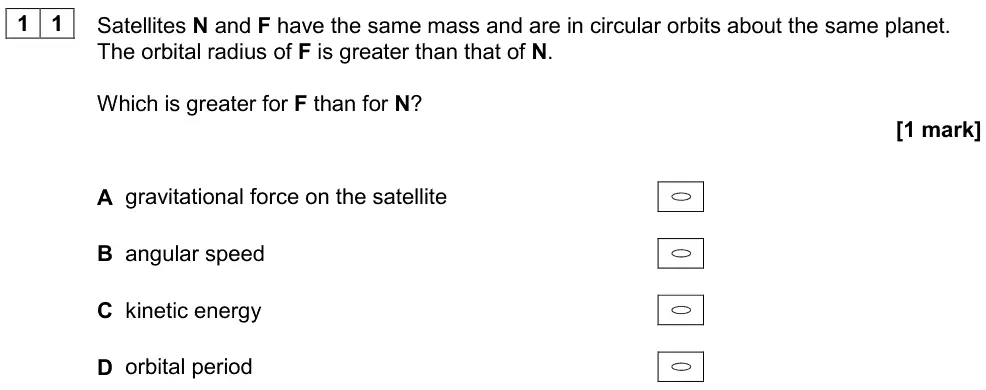
11 Gravitational fields and orbits 1Multiple choice
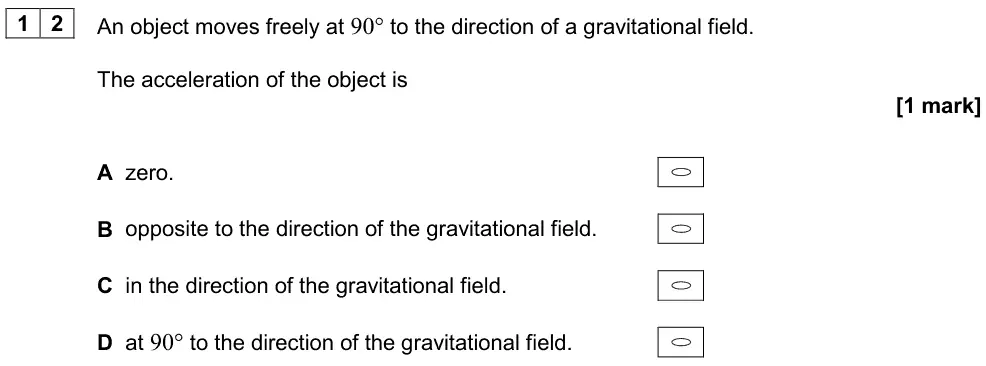
12 Gravitational fields and orbits 1Multiple choice
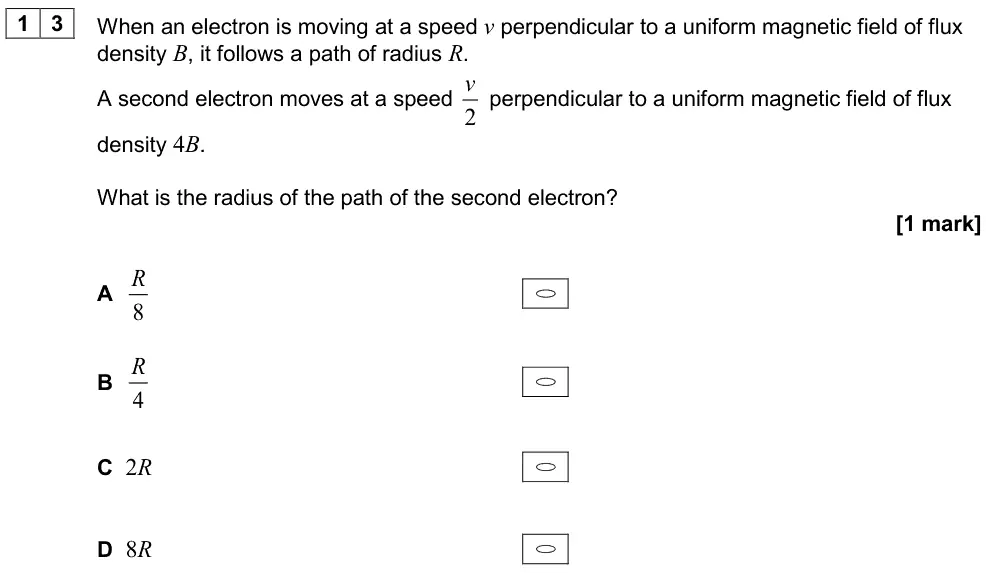
13 Magnetic flux density and moving charges in a magnetic field 1Multiple choice
14 Electric fields and electric potential 1Multiple choice
15 Electric fields and electric potential 1Multiple choice
16 Electric fields and electric potential 1Multiple choice
17 Excitation, energy levels and wave-particle duality, Work, energy, power and conservation of energy 1Multiple choice
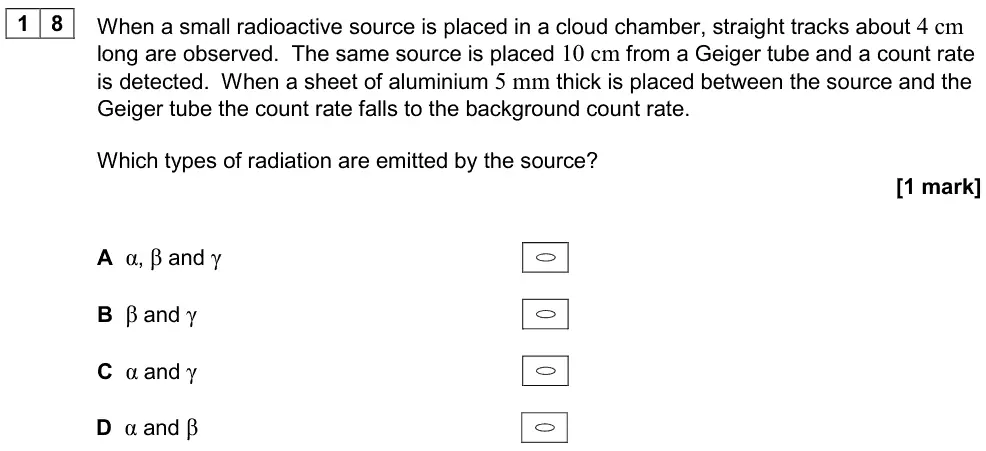
18 Rutherford scattering, alpha, beta and gamma radiation 1Multiple choice
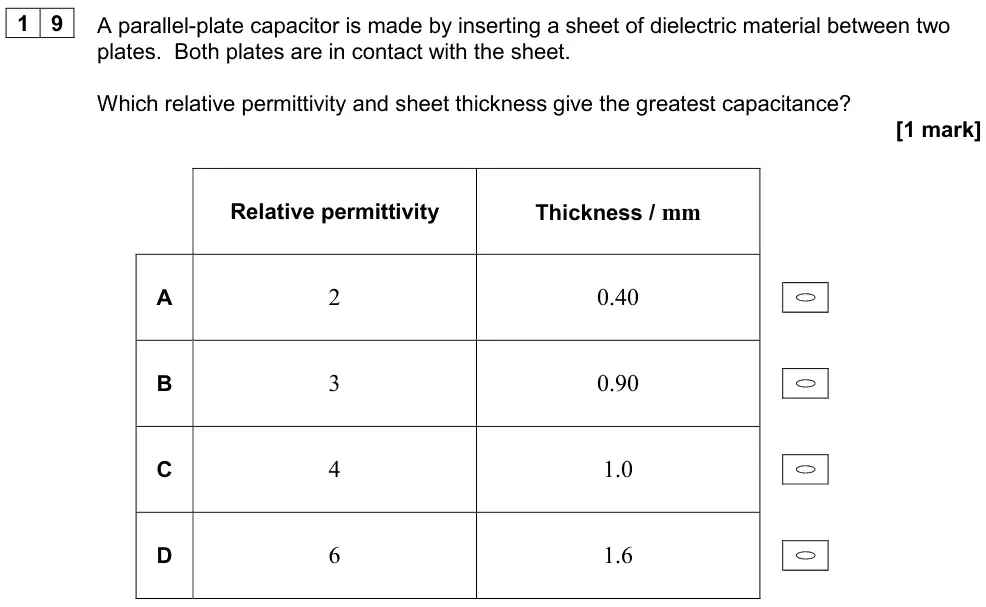
19 Capacitance and capacitor charge and discharge 1Multiple choice
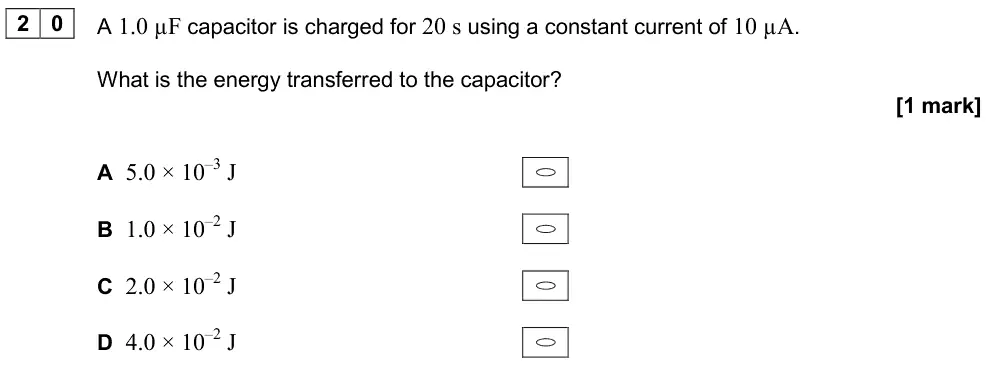
20 Capacitance and capacitor charge and discharge, Current, potential difference, I-V characteristics and resistivity 1Multiple choice
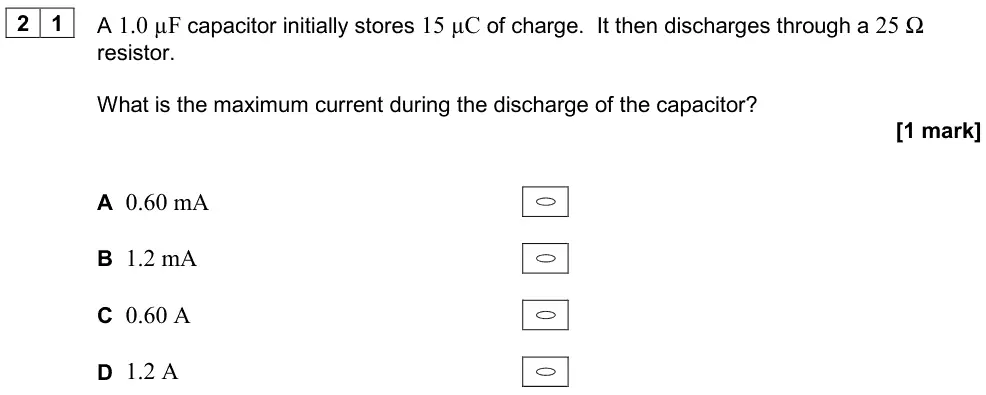
21 Capacitance and capacitor charge and discharge 1Multiple choice
22 Capacitance and capacitor charge and discharge 1Multiple choice
23 Magnetic flux density and moving charges in a magnetic field 1Multiple choice
24 Magnetic flux density and moving charges in a magnetic field 1Multiple choice
25 Molecular kinetic theory 1Multiple choice
26 Electromagnetic induction, alternating currents and transformers 1Multiple choice
27 Electromagnetic induction, alternating currents and transformers 1Multiple choice
28 Electromagnetic induction, alternating currents and transformers, Circuits and potential dividers 1Multiple choice
29 Electromagnetic induction, alternating currents and transformers 1Multiple choice
30 Mass and energy, binding energy, fission and safety, Classification of particles, quarks and conservation laws 1Multiple choice
31 Mass and energy, binding energy, fission and safety 1Multiple choice

The questions

1.11.22.12.22.32.42.52.63.13.23.34.14.24.34.44.54.65.15.25.35.46.16.26.36.46.578910111213141516171819202122232425262728293031
June 2019 · Paper 2 · Q1.1 5 marks Calculation thermal energy and ideal gases
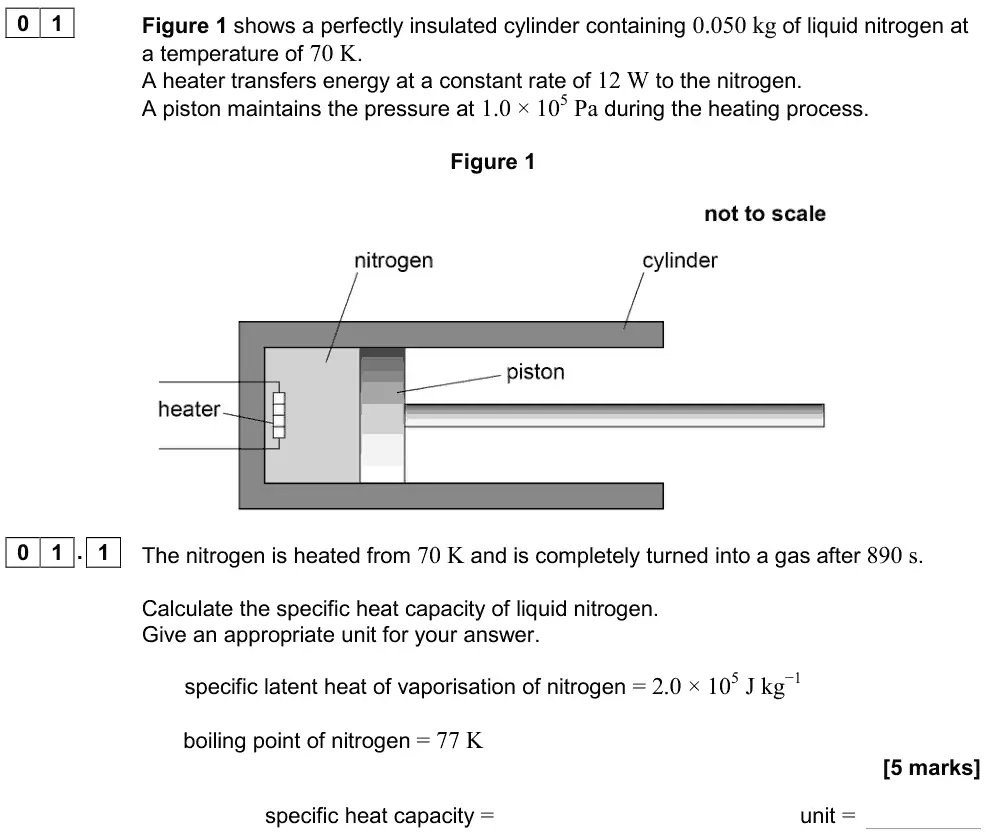
Figure 1 shows a perfectly insulated cylinder containing 0.050 kg of liquid nitrogen at
a temperature of 70 K.
A heater transfers energy at a constant rate of 12 W to the nitrogen.
A piston maintains the pressure at 1.0 × 10⁵ Pa during the heating process.
Figure 1
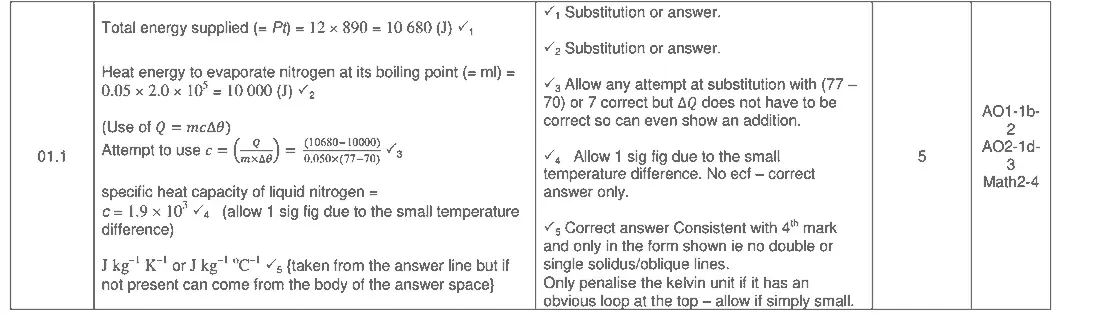
The nitrogen is heated from 70 K and is completely turned into a gas after 890 s.
Calculate the specific heat capacity of liquid nitrogen.
Give an appropriate unit for your answer.
specific latent heat of vaporisation of nitrogen = 2.0 × 10⁵ J kg−1
boiling point of nitrogen = 77 K
[5 marks]
specific heat capacity =
unit =
June 2019 · Paper 2 · Q1.2 4 marks Calculation thermal energy and ideal gasesmaterials and young modulus
Earlier part of question 1 that this part usesEarlier part of June 2019 Paper 2 question 1
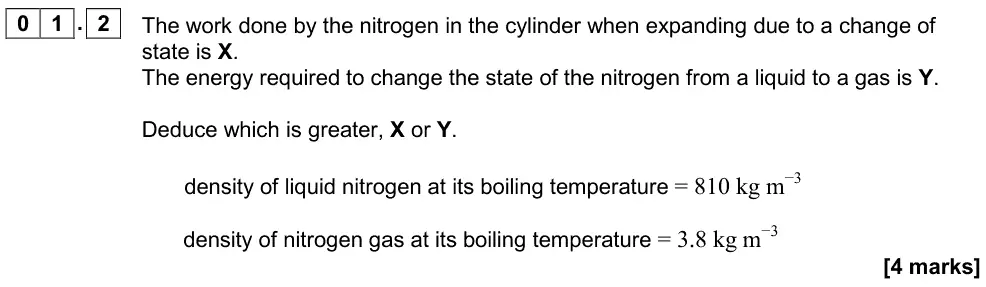
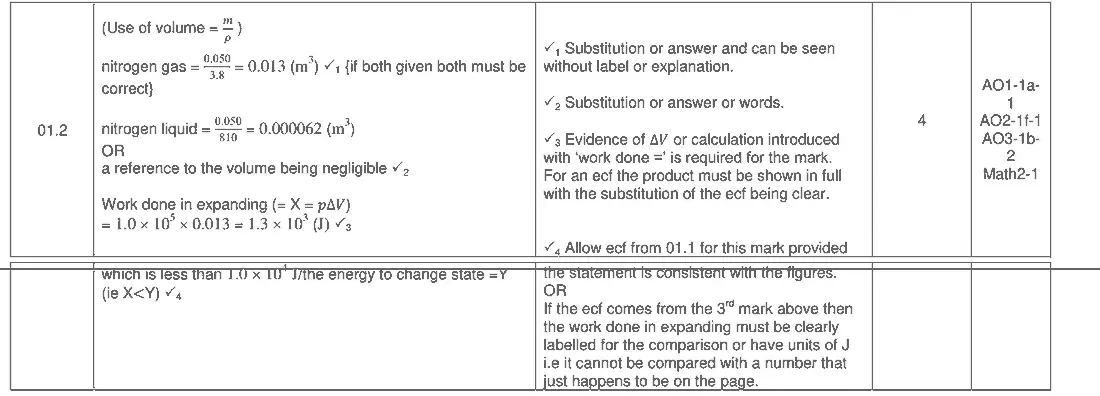
The work done by the nitrogen in the cylinder when expanding due to a change of
state is X.
The energy required to change the state of the nitrogen from a liquid to a gas is Y.
Deduce which is greater, X or Y.
density of liquid nitrogen at its boiling temperature = 810 kg m−3
density of nitrogen gas at its boiling temperature = 3.8 kg m−3
[4 marks]
June 2019 · Paper 2 · Q2.1 2 marks Short answer Easy thermal energy and ideal gaseskinetic theory
State what is meant by the internal energy of a gas.
[2 marks]
June 2019 · Paper 2 · Q2.2 2 marks Short answer thermal energy and ideal gaseskinetic theory
Earlier part of question 2 that this part usesEarlier part of June 2019 Paper 2 question 2
Absolute zero of temperature can be interpreted in terms of the ideal gas laws or the
kinetic energy of particles in an ideal gas.
Describe these two interpretations of absolute zero of temperature.
[2 marks]
June 2019 · Paper 2 · Q2.3 3 marks Calculation Hard kinetic theorythermal energy and ideal gases
Earlier part of question 2 that this part usesEarlier part of June 2019 Paper 2 question 2
A mixture of argon atoms and helium atoms is in a cylinder enclosed with a piston.
The mixture is at a temperature of 310 K.
Calculate the root mean square speed (crms) of the argon atoms in the mixture.
molar mass of argon = 4.0 × 10⁻² kg mol−1
[3 marks]
crms =
m s−1
June 2019 · Paper 2 · Q2.4 1 mark Short answer kinetic theory
Earlier part of question 2 that this part usesEarlier part of June 2019 Paper 2 question 2
Compare the mean kinetic energy of the argon atoms and the helium atoms in the
mixture.
[1 mark]
June 2019 · Paper 2 · Q2.5 3 marks Explanation kinetic theory
Earlier part of question 2 that this part usesEarlier part of June 2019 Paper 2 question 2
Explain, in terms of the kinetic theory model, why a pressure is exerted by the gas on
the piston.
[3 marks]
June 2019 · Paper 2 · Q2.6 3 marks Explanation kinetic theory
Earlier part of question 2 that this part usesEarlier part of June 2019 Paper 2 question 2
The mixture of gases in the cylinder stays the same.
Explain, using the kinetic theory model, two changes that can be made independently
to reduce the pressure exerted by the gas.
[3 marks]
June 2019 · Paper 2 · Q3.1 1 mark Short answer gravitational fields
Define gravitational potential at a point.
[1 mark]
June 2019 · Paper 2 · Q3.2 1 mark Short answer gravitational fields
Earlier part of question 3 that this part usesEarlier part of June 2019 Paper 2 question 3
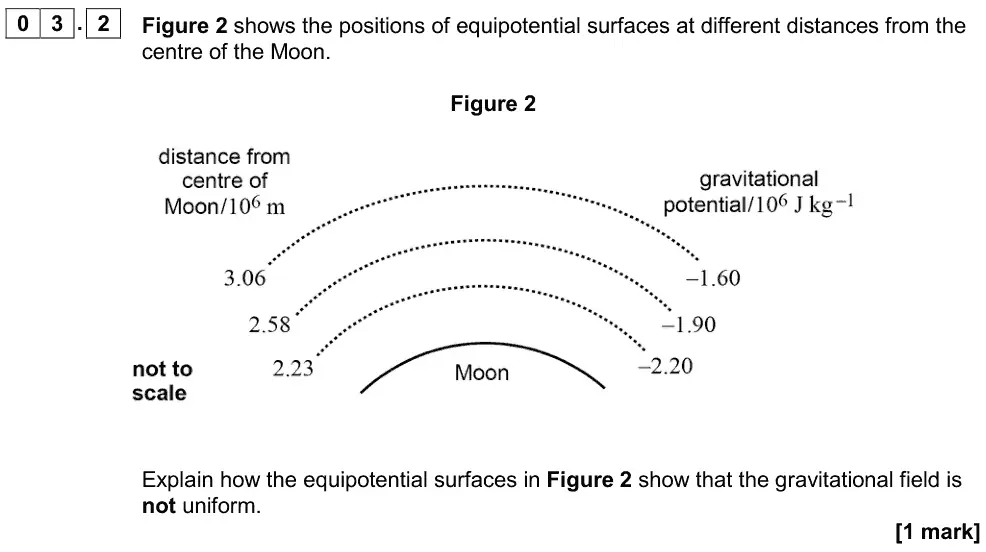
Figure 2 shows the positions of equipotential surfaces at different distances from the
centre of the Moon.
Figure 2
Explain how the equipotential surfaces in Figure 2 show that the gravitational field is
not uniform.
[1 mark]
June 2019 · Paper 2 · Q3.3 4 marks Calculation gravitational fields
Earlier part of question 3 that this part usesEarlier part of June 2019 Paper 2 question 3
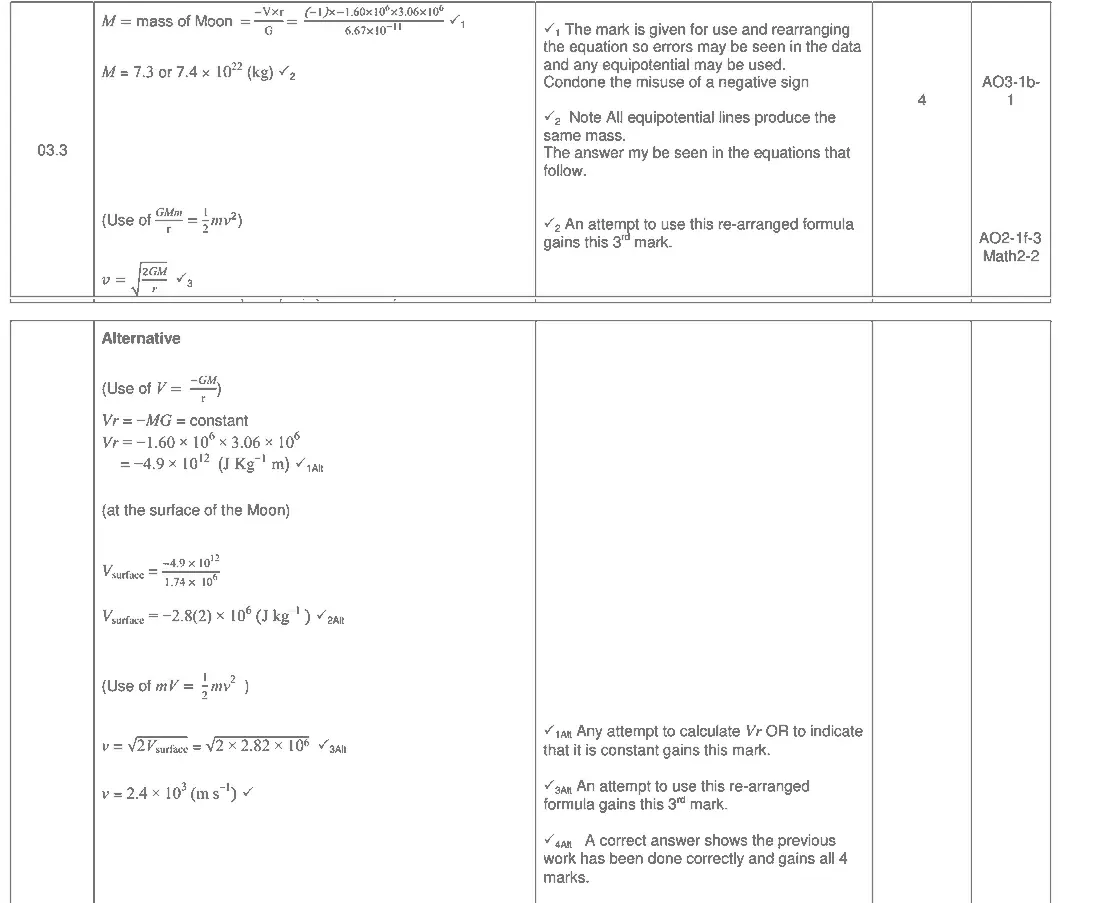
Calculate, using Figure 2, the escape velocity at the surface of the Moon.
radius of Moon = 1.74 × 10⁶ m
[4 marks]
escape velocity =
m s−1
June 2019 · Paper 2 · Q4.1 3 marks Calculation Easy capacitorselectric fields
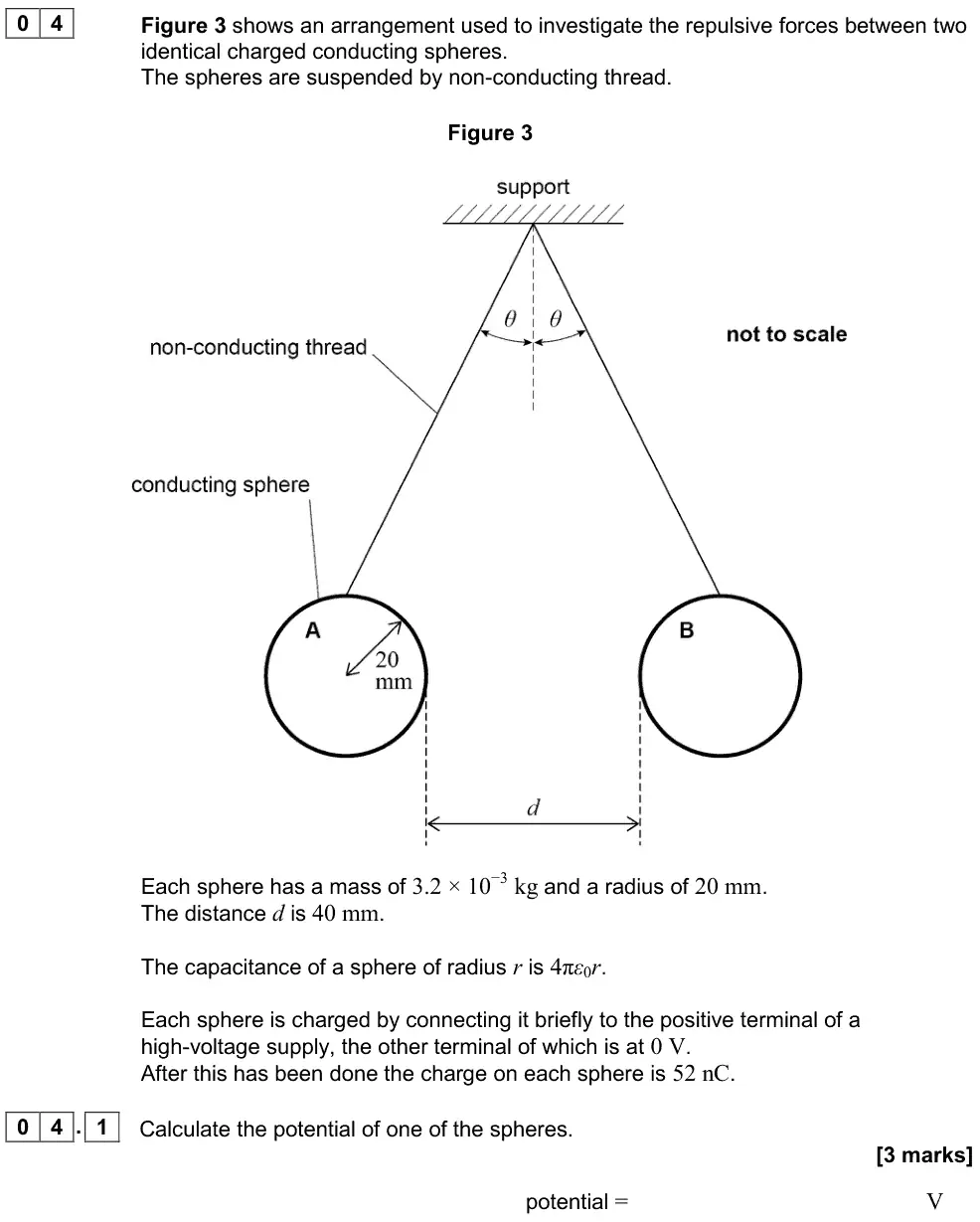
Figure 3 shows an arrangement used to investigate the repulsive forces between two
identical charged conducting spheres.
The spheres are suspended by non-conducting thread.
Figure 3
Each sphere has a mass of 3.2 × 10⁻³ kg and a radius of 20 mm.
The distance d is 40 mm.
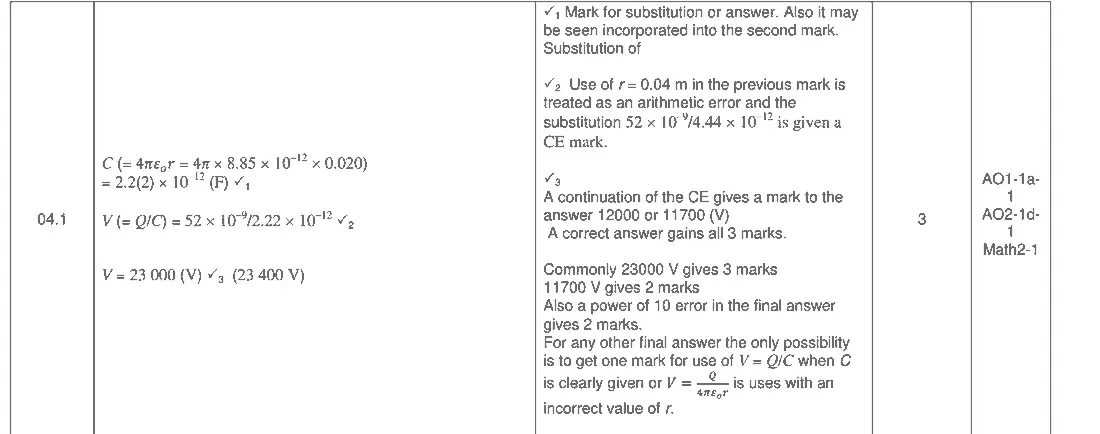
The capacitance of a sphere of radius r is 4πε0r.
Each sphere is charged by connecting it briefly to the positive terminal of a
high-voltage supply, the other terminal of which is at 0 V.
After this has been done the charge on each sphere is 52 nC.
Calculate the potential of one of the spheres.
[3 marks]
potential =
V
June 2019 · Paper 2 · Q4.2 2 marks Diagram or graph Hard electric fieldsvectors and moments
Earlier part of question 4 that this part usesEarlier part of June 2019 Paper 2 question 4
The charged spheres in Figure 3 are at equilibrium.
Draw labelled arrows on Figure 3 to show the forces on sphere B.
[2 marks]
June 2019 · Paper 2 · Q4.3 2 marks Short answer measurements and uncertainties
Earlier part of question 4 that this part usesEarlier part of June 2019 Paper 2 question 4
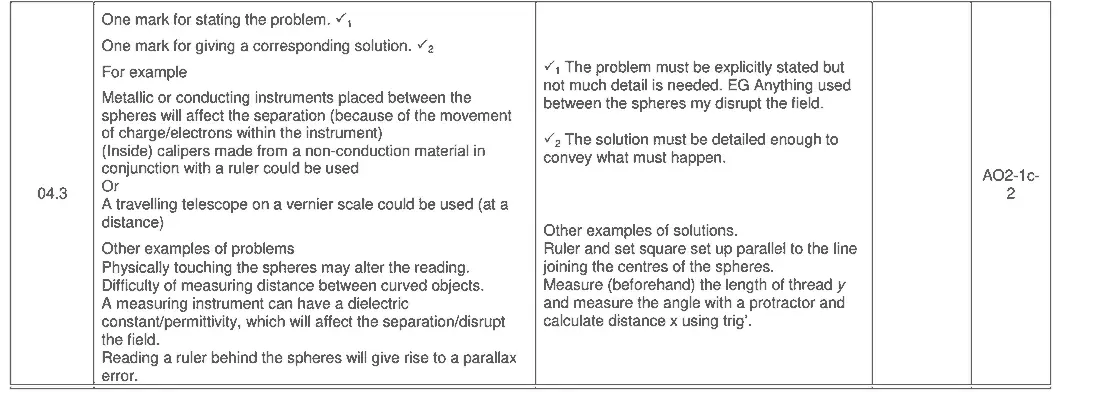
Suggest a solution to one problem involved in the measurement of d in Figure 3.
[2 marks]
June 2019 · Paper 2 · Q4.4 3 marks Show that Easy electric fields
Earlier part of question 4 that this part usesEarlier part of June 2019 Paper 2 question 4
Show that the magnitude of the electrostatic force on each sphere is about 4 × 10⁻³ N.
[3 marks]
June 2019 · Paper 2 · Q4.5 2 marks Calculation vectors and moments
Earlier part of question 4 that this part usesEarlier part of June 2019 Paper 2 question 4
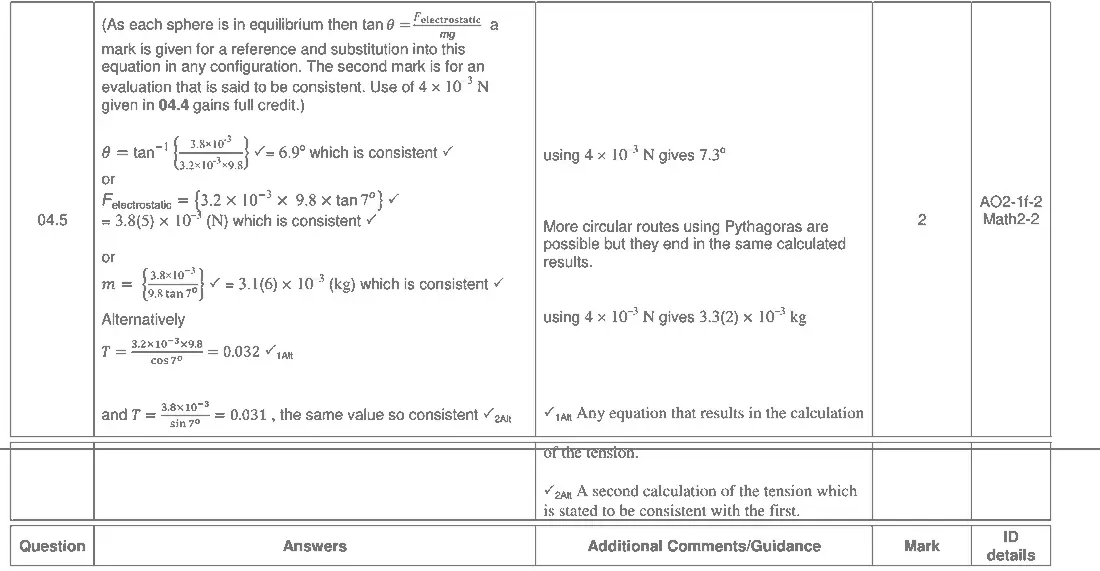
A student measures the angle θ when the apparatus in Figure 3 is at equilibrium.
The student records θ as 7°.
Discuss whether this measurement is consistent with the other data in this
investigation.
[2 marks]
June 2019 · Paper 2 · Q4.6 2 marks Calculation electric fieldsgravitational fields
Earlier part of question 4 that this part usesEarlier part of June 2019 Paper 2 question 4
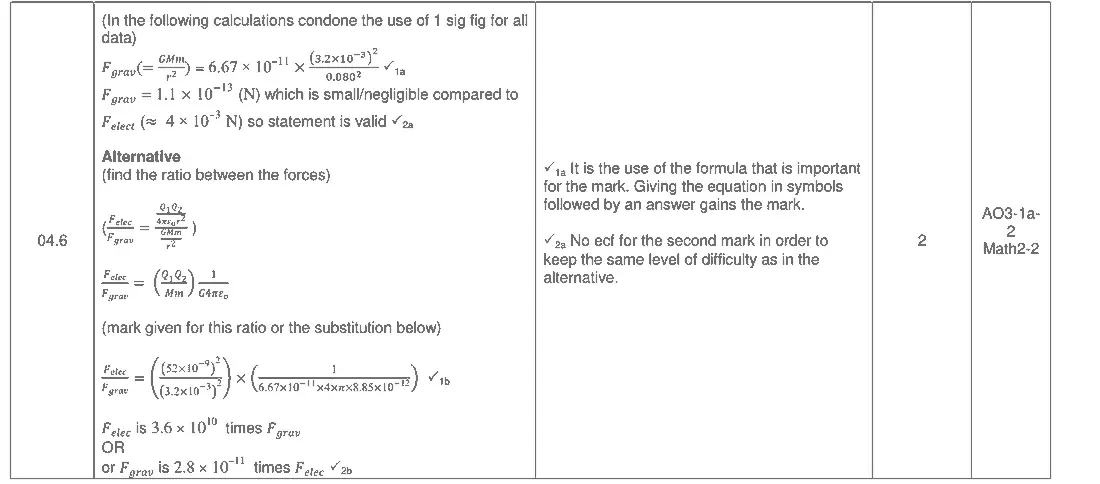
The student says that the gravitational force between the two spheres has no
significant effect on the angle at which the spheres are in equilibrium.
Deduce with a calculation whether this statement is valid.
[2 marks]
June 2019 · Paper 2 · Q5.1 2 marks Calculation Easy electromagnetic induction
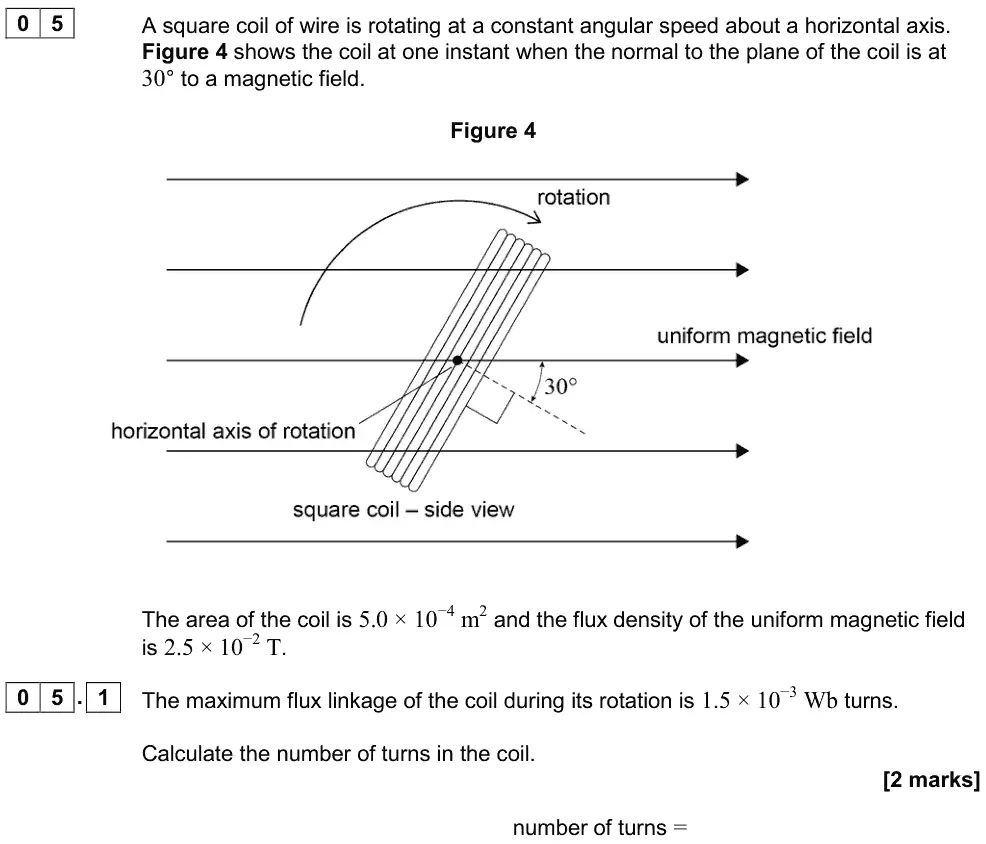
A square coil of wire is rotating at a constant angular speed about a horizontal axis.
Figure 4 shows the coil at one instant when the normal to the plane of the coil is at
30° to a magnetic field.
Figure 4
The area of the coil is 5.0 × 10⁻⁴ m2 and the flux density of the uniform magnetic field
is 2.5 × 10⁻² T.
The maximum flux linkage of the coil during its rotation is 1.5 × 10⁻³ Wb turns.
Calculate the number of turns in the coil.
[2 marks]
number of turns =
June 2019 · Paper 2 · Q5.2 1 mark Calculation electromagnetic induction
Earlier part of question 5 that this part usesEarlier part of June 2019 Paper 2 question 5
Calculate the flux linkage of the coil at the instant shown in Figure 4.
[1 mark]
flux linkage =
Wb turns
June 2019 · Paper 2 · Q5.3 2 marks Calculation electromagnetic induction
Earlier part of question 5 that this part usesEarlier part of June 2019 Paper 2 question 5
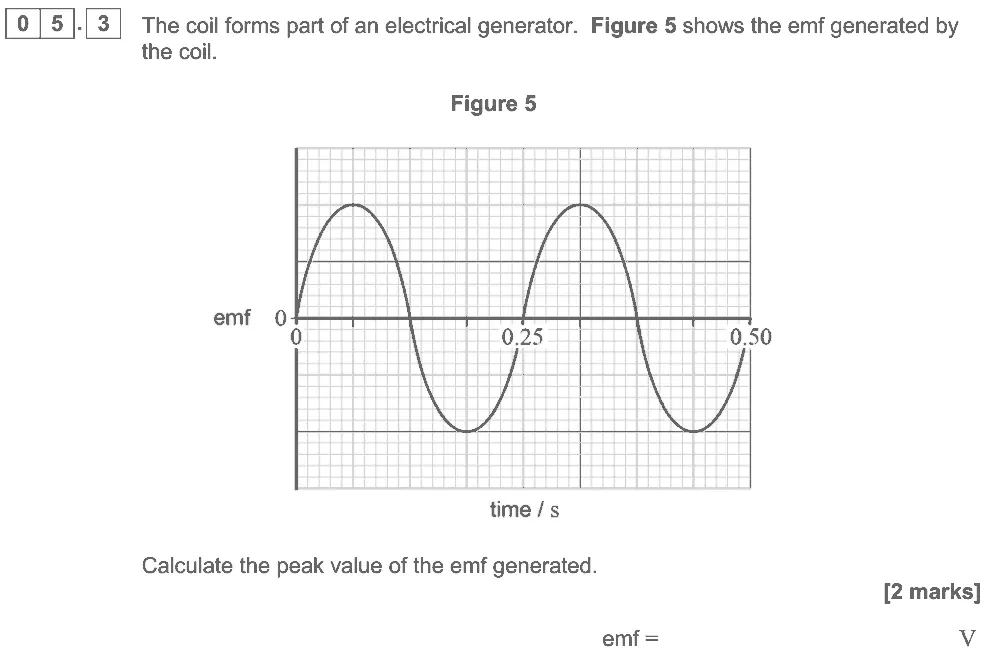
The coil forms part of an electrical generator.  Figure 5 shows the emf generated by
the coil.
Figure 5
Calculate the peak value of the emf generated.
[2 marks]
emf =
V
June 2019 · Paper 2 · Q5.4 1 mark Diagram or graph Easy electromagnetic induction
Earlier part of question 5 that this part usesEarlier part of June 2019 Paper 2 question 5
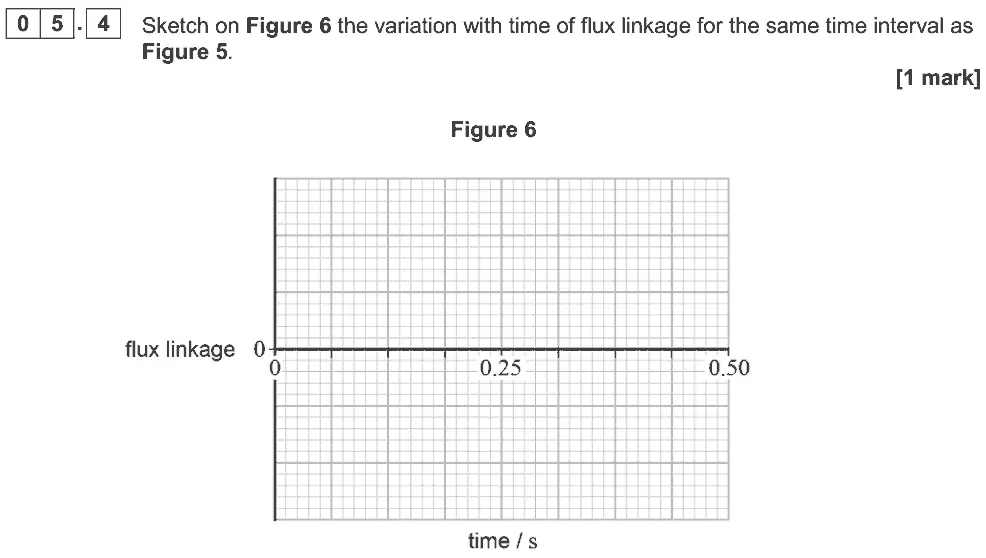
Sketch on Figure 6 the variation with time of flux linkage for the same time interval as
Figure 5.
[1 mark]
Figure 6
June 2019 · Paper 2 · Q6.1 1 mark Short answer Hard mass energy and fission
A thermal nuclear reactor uses a moderator to lower the kinetic energy of fast-moving
neutrons.
Explain why the kinetic energy of neutrons must be reduced in a thermal nuclear
reactor.
[1 mark]
June 2019 · Paper 2 · Q6.2 2 marks Calculation mass energy and fission
Earlier part of question 6 that this part usesEarlier part of June 2019 Paper 2 question 6
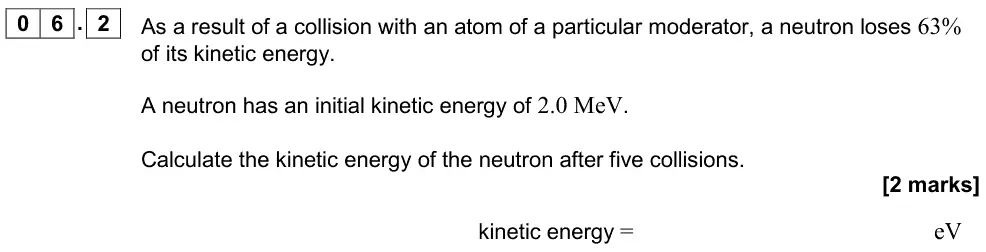
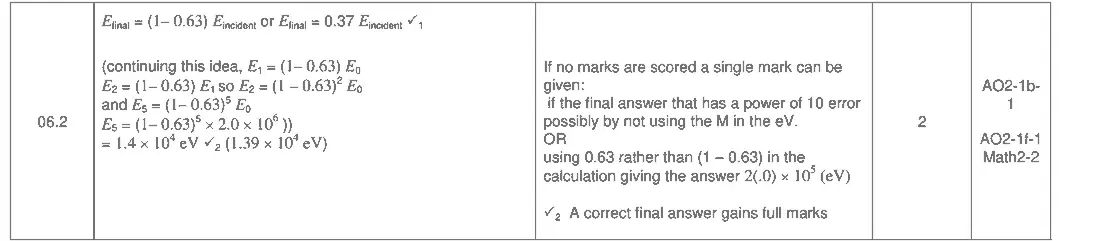
As a result of a collision with an atom of a particular moderator, a neutron loses 63%
of its kinetic energy.
A neutron has an initial kinetic energy of 2.0 MeV.
Calculate the kinetic energy of the neutron after five collisions.
[2 marks]
kinetic energy =
eV
June 2019 · Paper 2 · Q6.3 2 marks Explanation mass energy and fission
Earlier part of question 6 that this part usesEarlier part of June 2019 Paper 2 question 6
The kinetic energy of a neutron in a thermal nuclear reactor is reduced from about
2 MeV to about 1 eV.
Explain why the number of collisions needed to do this depends on the nucleon
number of the moderator atoms.
[2 marks]
June 2019 · Paper 2 · Q6.4 3 marks Calculation Easy mass energy and fission
Earlier part of question 6 that this part usesEarlier part of June 2019 Paper 2 question 6
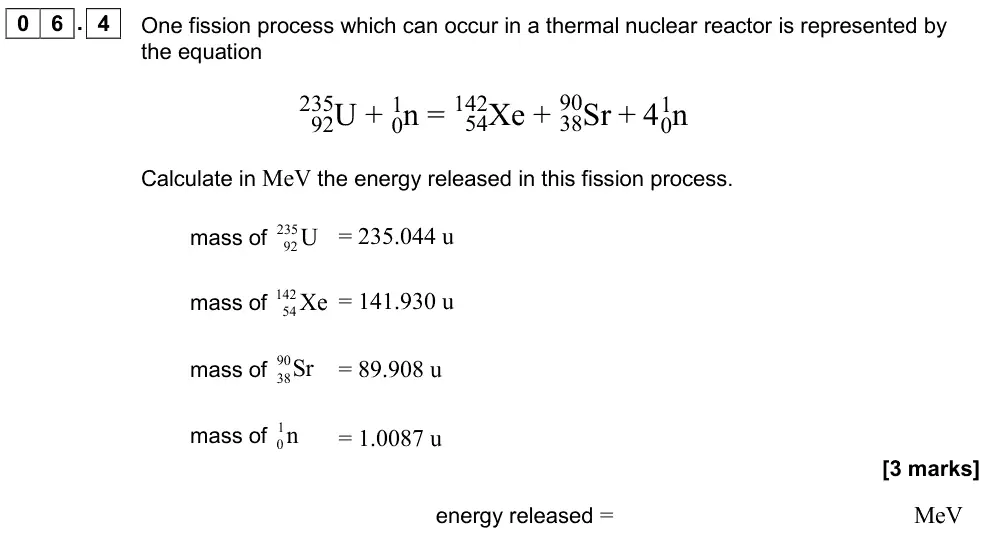
One fission process which can occur in a thermal nuclear reactor is represented by
the equation
U
92
235 + n
0
1 =
Xe
54
142
+ Sr
38
90
+ 4 n
0
1
Calculate in MeV the energy released in this fission process.
mass of 235
92U
mass of 142
54Xe
mass of 90
38Sr
mass of 1
0n
= 235.044 u
= 141.930 u
= 89.908 u
= 1.0087 u
[3 marks]
energy released =
MeV
June 2019 · Paper 2 · Q6.5 3 marks Short answer mass energy and fission
Earlier part of question 6 that this part usesEarlier part of June 2019 Paper 2 question 6
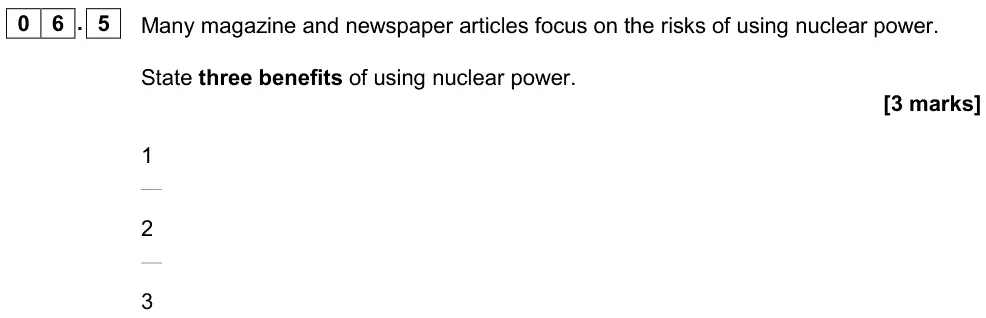
Many magazine and newspaper articles focus on the risks of using nuclear power.
State three benefits of using nuclear power.
[3 marks]
1
2
3
June 2019 · Paper 2 · Q7 1 mark Multiple choice kinetic theory
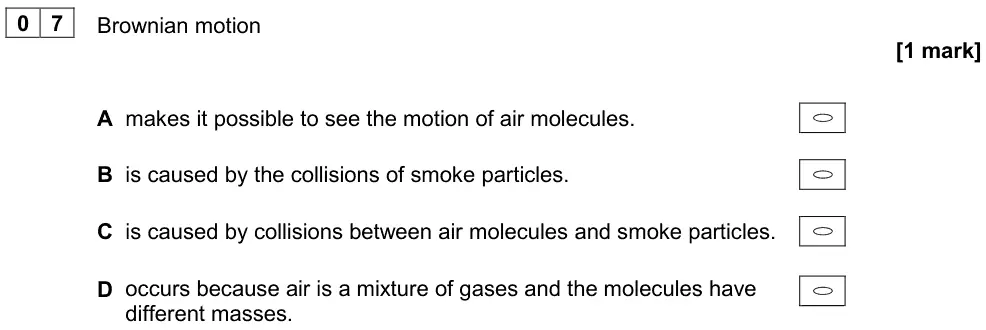
Brownian motion
[1 mark]
A makes it possible to see the motion of air molecules.
B is caused by the collisions of smoke particles.
C is caused by collisions between air molecules and smoke particles.
D occurs because air is a mixture of gases and the molecules have
different masses.
June 2019 · Paper 2 · Q8 1 mark Multiple choice gravitational fieldsvectors and moments
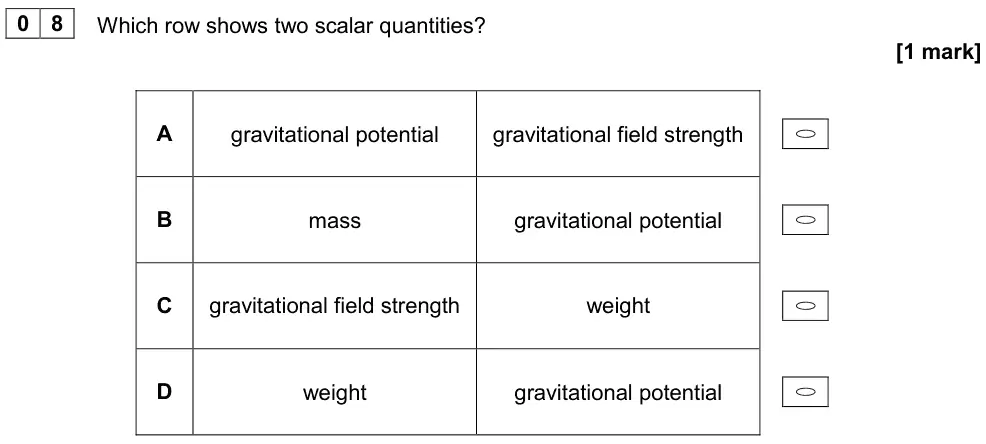
Which row shows two scalar quantities?
[1 mark]
A
gravitational potential
gravitational field strength
B
mass
gravitational potential
C
gravitational field strength
weight
D
weight
gravitational potential
June 2019 · Paper 2 · Q9 1 mark Multiple choice gravitational fieldscircular motion
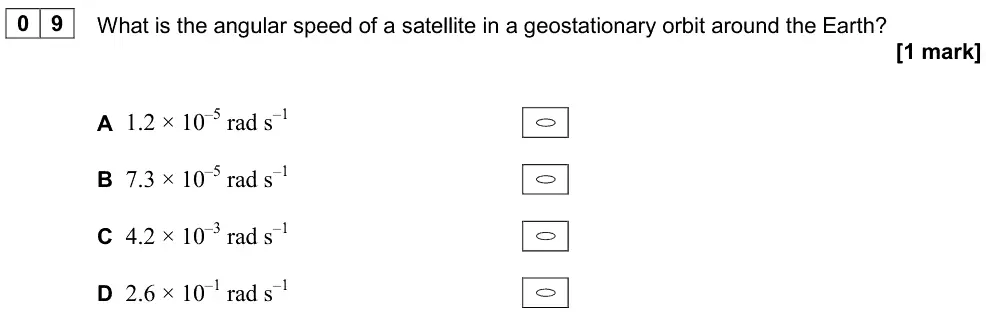
What is the angular speed of a satellite in a geostationary orbit around the Earth?
[1 mark]
A 1.2 × 10⁻⁵ rad s–1
B 7.3 × 10⁻⁵ rad s–1
C 4.2 × 10⁻³ rad s–1
D 2.6 × 10⁻¹ rad s–1
June 2019 · Paper 2 · Q10 1 mark Multiple choice circular motiongravitational fields
A planet of mass M and radius R rotates so quickly that material at its equator only just
remains on its surface.
What is the period of rotation of the planet?
[1 mark]
A 2
R
GM
π
B 2
GM
R
π
C
3
2
R
GM
π
D
3
2
GM
R
π
June 2019 · Paper 2 · Q11 1 mark Multiple choice gravitational fields
Satellites N and F have the same mass and are in circular orbits about the same planet.
The orbital radius of F is greater than that of N.
Which is greater for F than for N?
[1 mark]
A gravitational force on the satellite
B angular speed
C kinetic energy
D orbital period
June 2019 · Paper 2 · Q12 1 mark Multiple choice gravitational fields
An object moves freely at 90° to the direction of a gravitational field.
The acceleration of the object is
[1 mark]
A zero.
B opposite to the direction of the gravitational field.
C in the direction of the gravitational field.
D at 90° to the direction of the gravitational field.
June 2019 · Paper 2 · Q13 1 mark Multiple choice magnetic fields
When an electron is moving at a speed v perpendicular to a uniform magnetic field of flux
density B, it follows a path of radius R.
A second electron moves at a speed 2
v perpendicular to a uniform magnetic field of flux
density 4B.
What is the radius of the path of the second electron?
[1 mark]
A 8
R
B 4
R
C 2R
D 8R
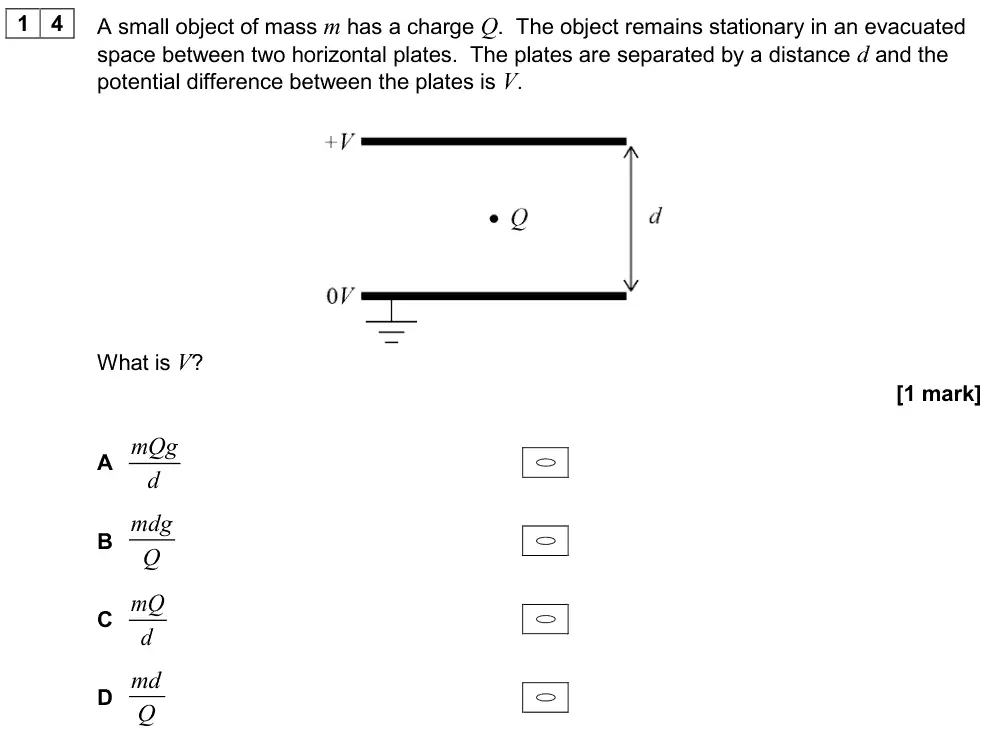
June 2019 · Paper 2 · Q14 1 mark Multiple choice electric fields
A small object of mass m has a charge Q.  The object remains stationary in an evacuated
space between two horizontal plates.  The plates are separated by a distance d and the
potential difference between the plates is V.
What is V?
[1 mark]
A mQg
d
B mdg
Q
C mQ
d
D md
Q
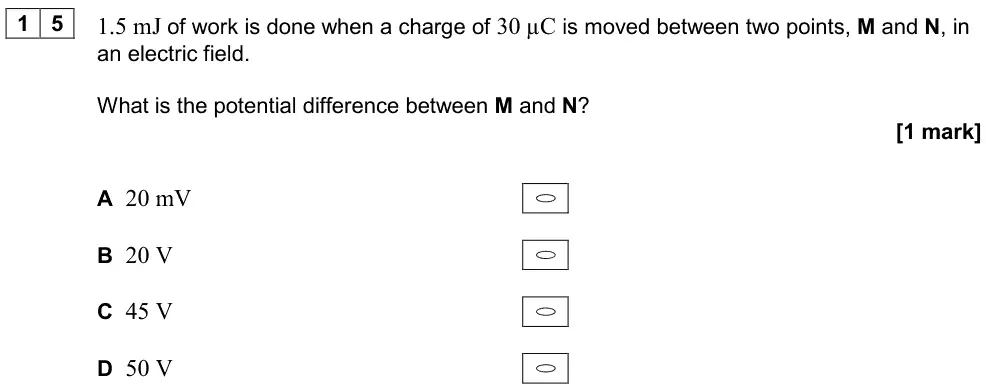
June 2019 · Paper 2 · Q15 1 mark Multiple choice electric fields
1.5 mJ of work is done when a charge of 30 µC is moved between two points, M and N, in
an electric field.
What is the potential difference between M and N?
[1 mark]
A 20 mV
B 20 V
C 45 V
D 50 V
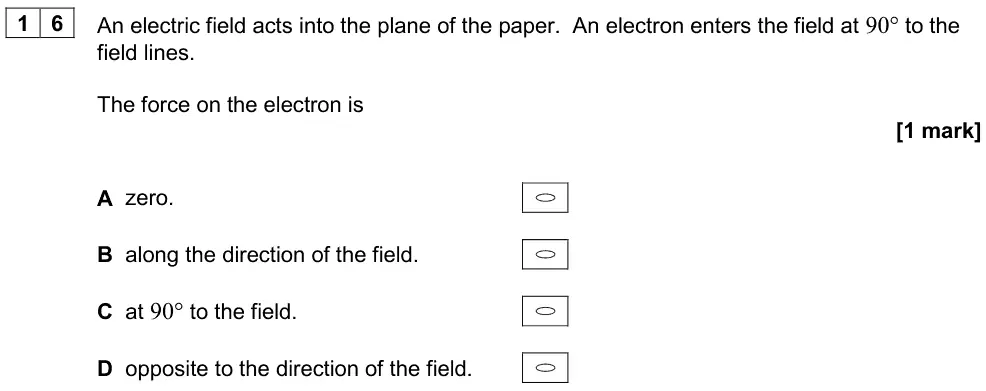
June 2019 · Paper 2 · Q16 1 mark Multiple choice electric fields
An electric field acts into the plane of the paper.  An electron enters the field at 90° to the
field lines.
The force on the electron is
[1 mark]
A zero.
B along the direction of the field.
C at 90° to the field.
D opposite to the direction of the field.
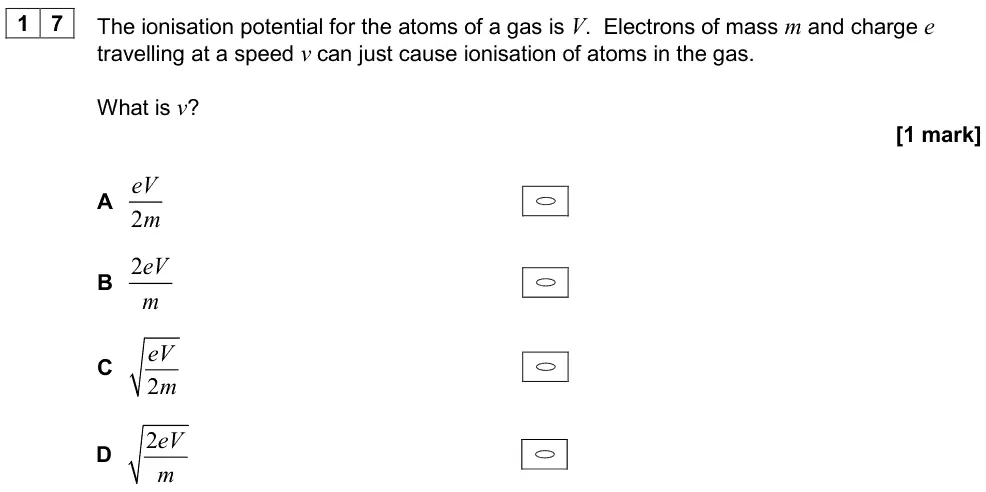
June 2019 · Paper 2 · Q17 1 mark Multiple choice energy levels and wave particle dualitywork energy and power
The ionisation potential for the atoms of a gas is V.  Electrons of mass m and charge e
travelling at a speed v can just cause ionisation of atoms in the gas.
What is v?
[1 mark]
A 2
eV
m
B 2eV
m
C
2
eV
m
D
2eV
m
June 2019 · Paper 2 · Q18 1 mark Multiple choice rutherford scattering and radiation
When a small radioactive source is placed in a cloud chamber, straight tracks about 4 cm
long are observed.  The same source is placed 10 cm from a Geiger tube and a count rate
is detected.  When a sheet of aluminium 5 mm thick is placed between the source and the
Geiger tube the count rate falls to the background count rate.
Which types of radiation are emitted by the source?
[1 mark]
A α, β and γ
B β and γ
C α and γ
D α and β
June 2019 · Paper 2 · Q19 1 mark Multiple choice capacitors
A parallel-plate capacitor is made by inserting a sheet of dielectric material between two
plates.  Both plates are in contact with the sheet.
Which relative permittivity and sheet thickness give the greatest capacitance?
[1 mark]
Relative permittivity
Thickness / mm
A
2
0.40
B
3
0.90
C
4
1.0
D
6
1.6
June 2019 · Paper 2 · Q20 1 mark Multiple choice capacitorscurrent voltage and resistivity
A 1.0 µF capacitor is charged for 20 s using a constant current of 10 µA.
What is the energy transferred to the capacitor?
[1 mark]
A 5.0 × 10⁻³ J
B 1.0 × 10⁻² J
C 2.0 × 10⁻² J
D 4.0 × 10⁻² J
June 2019 · Paper 2 · Q21 1 mark Multiple choice capacitors
A 1.0 µF capacitor initially stores 15 µC of charge.  It then discharges through a 25 Ω
resistor.
What is the maximum current during the discharge of the capacitor?
[1 mark]
A 0.60 mA
B 1.2 mA
C 0.60 A
D 1.2 A
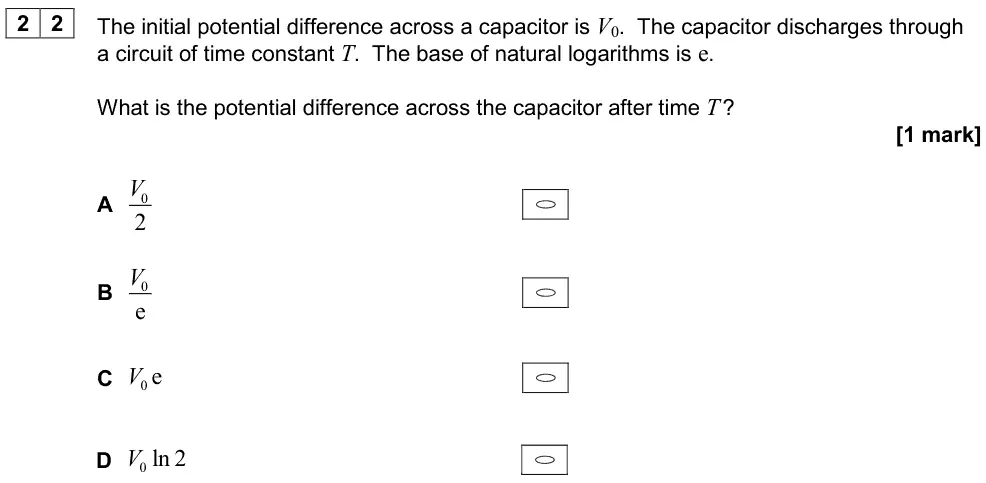
June 2019 · Paper 2 · Q22 1 mark Multiple choice capacitors
The initial potential difference across a capacitor is V0.  The capacitor discharges through
a circuit of time constant T.  The base of natural logarithms is e.
What is the potential difference across the capacitor after time T ?
[1 mark]
A
0
2
V
B
0
e
V
C
0
V e
D
0 ln 2
V
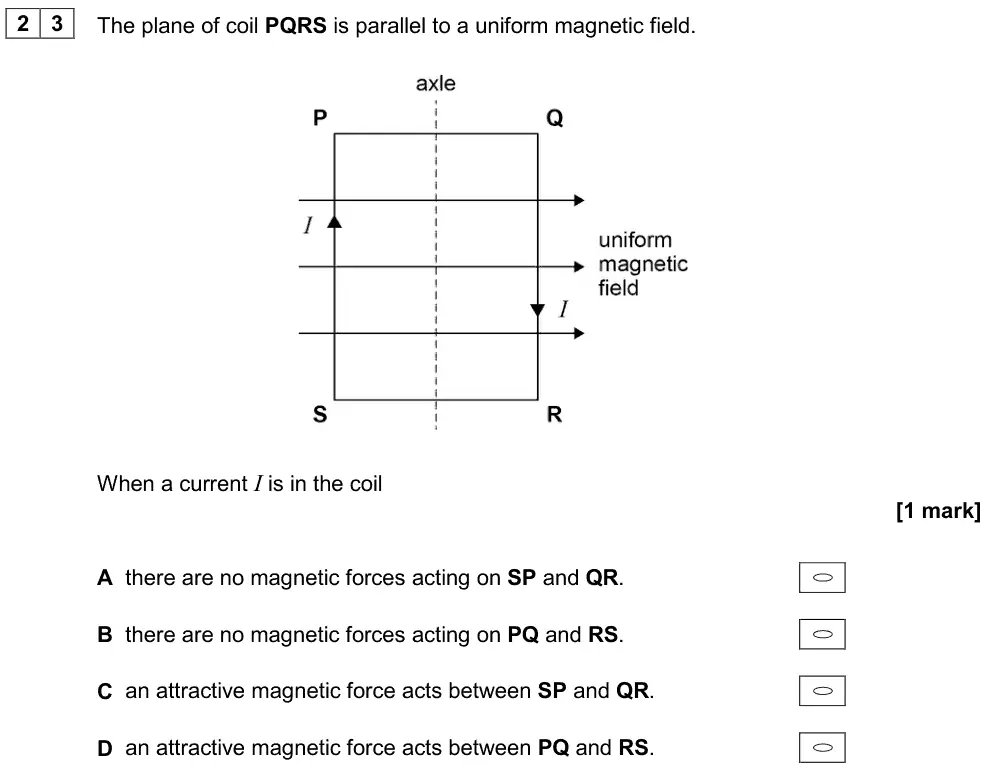
June 2019 · Paper 2 · Q23 1 mark Multiple choice magnetic fields
The plane of coil PQRS is parallel to a uniform magnetic field.
When a current I is in the coil
[1 mark]
A there are no magnetic forces acting on SP and QR.
B there are no magnetic forces acting on PQ and RS.
C an attractive magnetic force acts between SP and QR.
D an attractive magnetic force acts between PQ and RS.
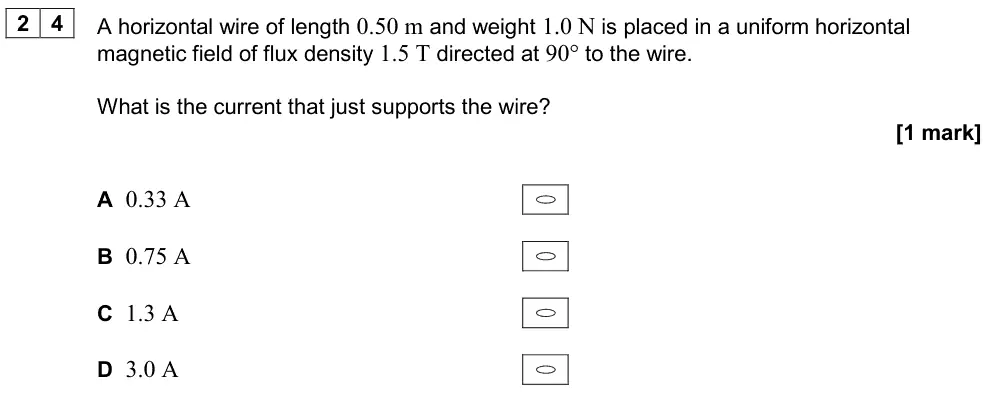
June 2019 · Paper 2 · Q24 1 mark Multiple choice magnetic fields
A horizontal wire of length 0.50 m and weight 1.0 N is placed in a uniform horizontal
magnetic field of flux density 1.5 T directed at 90° to the wire.
What is the current that just supports the wire?
[1 mark]
A 0.33 A
B 0.75 A
C 1.3 A
D 3.0 A
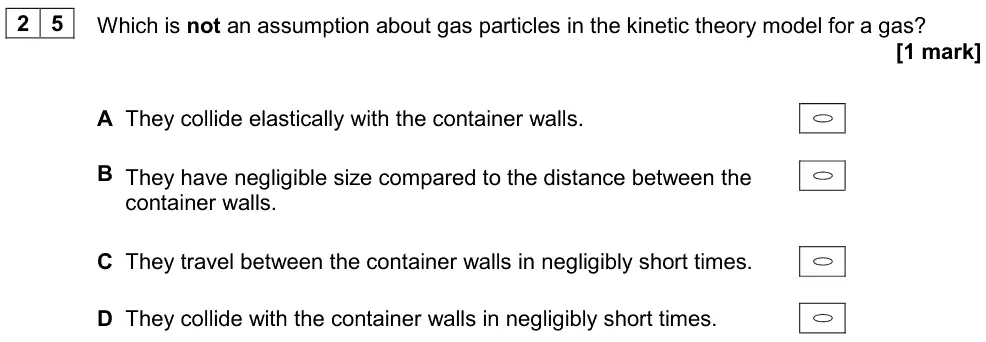
June 2019 · Paper 2 · Q25 1 mark Multiple choice kinetic theory
Which is not an assumption about gas particles in the kinetic theory model for a gas?
[1 mark]
A They collide elastically with the container walls.
B They have negligible size compared to the distance between the
container walls.
C They travel between the container walls in negligibly short times.
D They collide with the container walls in negligibly short times.
June 2019 · Paper 2 · Q26 1 mark Multiple choice electromagnetic induction
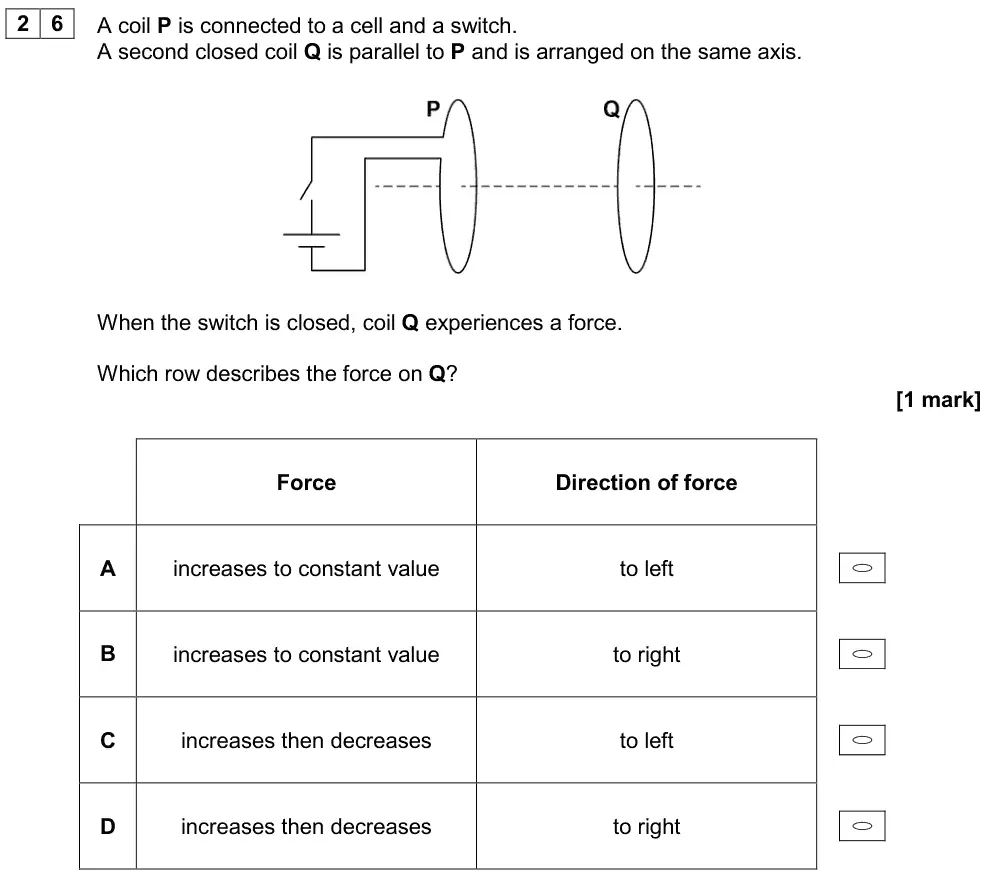
A coil P is connected to a cell and a switch.
A second closed coil Q is parallel to P and is arranged on the same axis.
When the switch is closed, coil Q experiences a force.
Which row describes the force on Q?
[1 mark]
Force
Direction of force
A
increases to constant value
to left
B
increases to constant value
to right
C
increases then decreases
to left
D
increases then decreases
to right
June 2019 · Paper 2 · Q27 1 mark Multiple choice electromagnetic induction
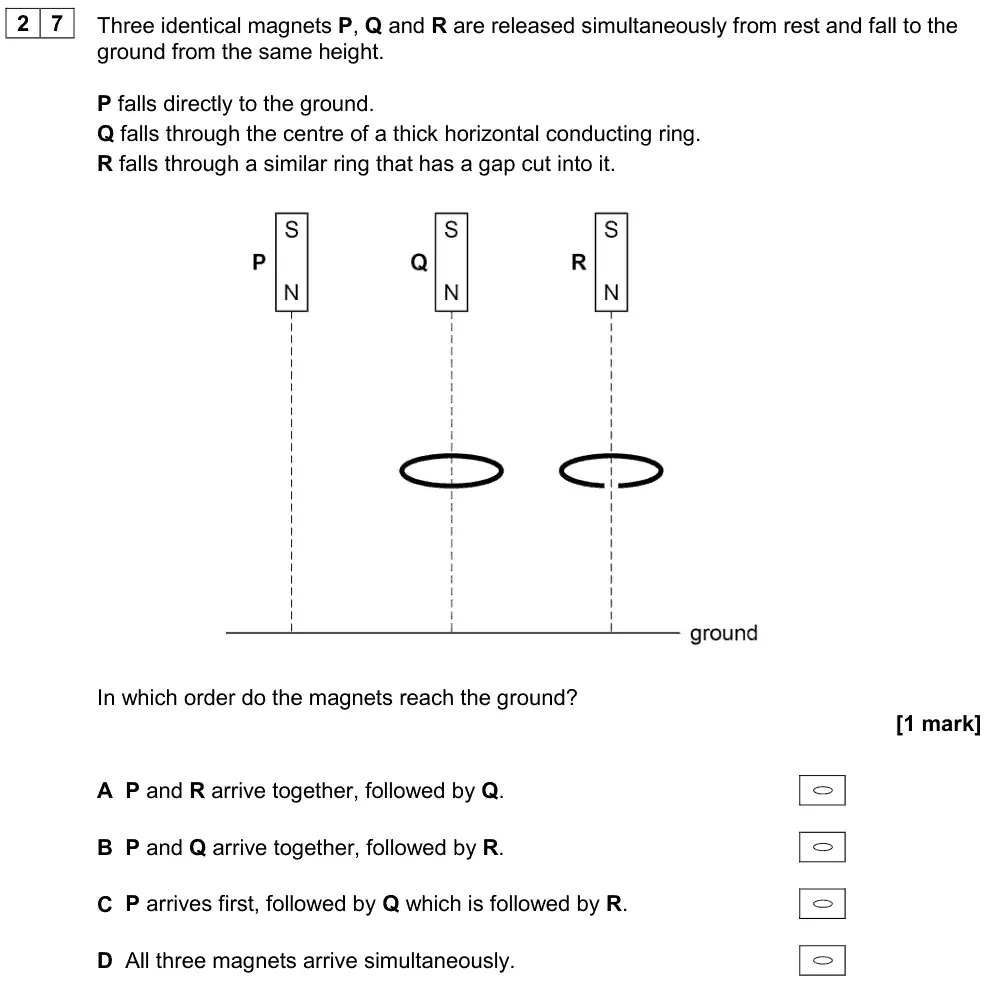
Three identical magnets P, Q and R are released simultaneously from rest and fall to the
ground from the same height.
P falls directly to the ground.
Q falls through the centre of a thick horizontal conducting ring.
R falls through a similar ring that has a gap cut into it.
In which order do the magnets reach the ground?
[1 mark]
A P and R arrive together, followed by Q.
B P and Q arrive together, followed by R.
C P arrives first, followed by Q which is followed by R.
D All three magnets arrive simultaneously.
June 2019 · Paper 2 · Q28 1 mark Multiple choice electromagnetic inductioncircuits and potential dividers
A steady current I dissipates power P in a resistor of resistance R.
An alternating current through a resistor of resistance 2R has a peak value of I.
What is the power dissipated in the second resistor?
[1 mark]
A
2
P
B P
C
2 P
D 2P
June 2019 · Paper 2 · Q29 1 mark Multiple choice electromagnetic induction
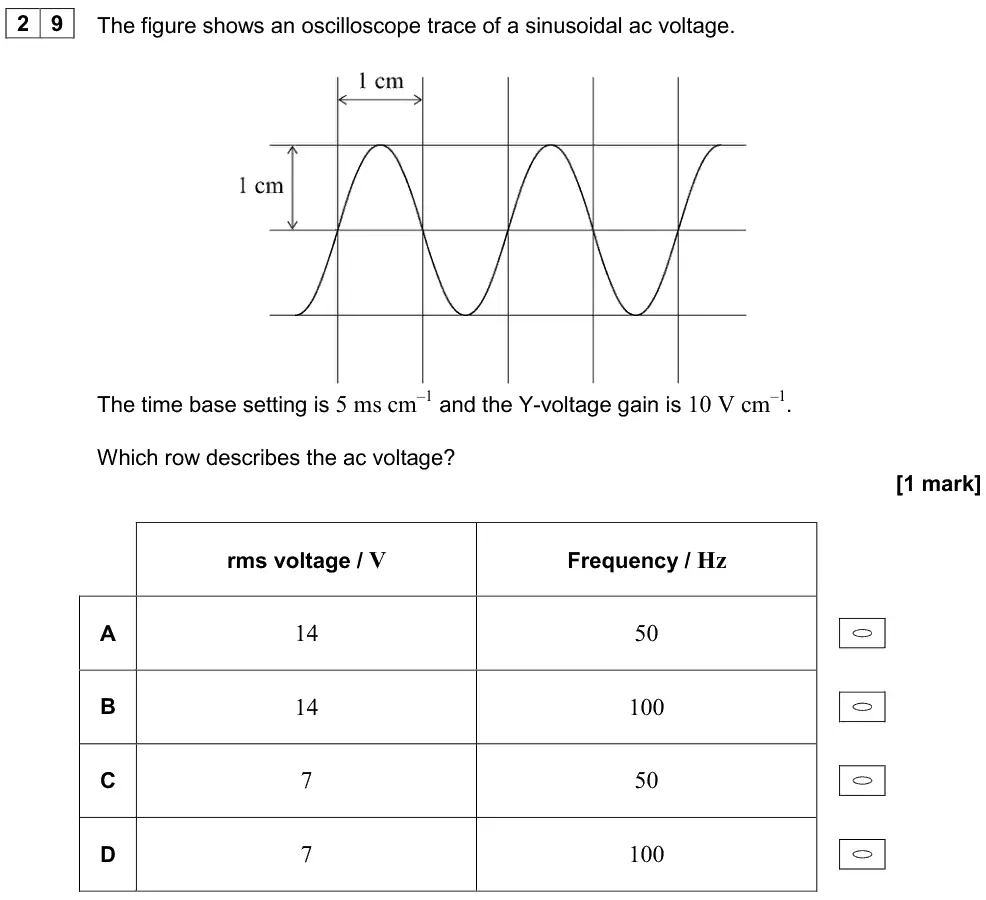
The figure shows an oscilloscope trace of a sinusoidal ac voltage.
The time base setting is 5 ms cm–1 and the Y-voltage gain is 10 V cm–1.
Which row describes the ac voltage?
[1 mark]
rms voltage / V
Frequency / Hz
A
14
50
B
14
100
C
7
50
D
7
100
June 2019 · Paper 2 · Q30 1 mark Multiple choice mass energy and fissionclassification of particles and quarks
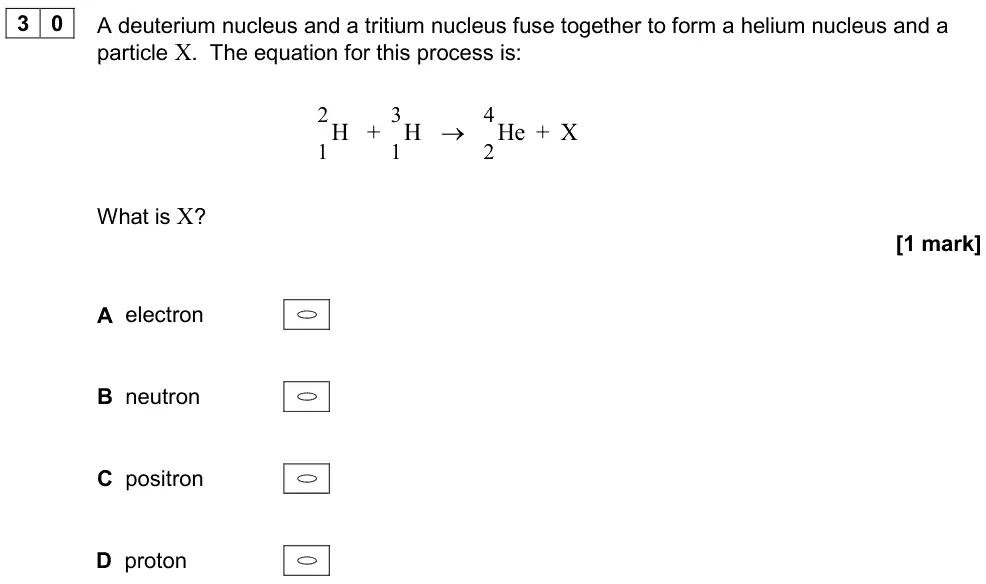
A deuterium nucleus and a tritium nucleus fuse together to form a helium nucleus and a
particle X.  The equation for this process is:
2
3
4
1
1
2
H +  H
He  +  X
→
What is X?
[1 mark]
A electron
B neutron
C positron
D proton
June 2019 · Paper 2 · Q31 1 mark Multiple choice mass energy and fission
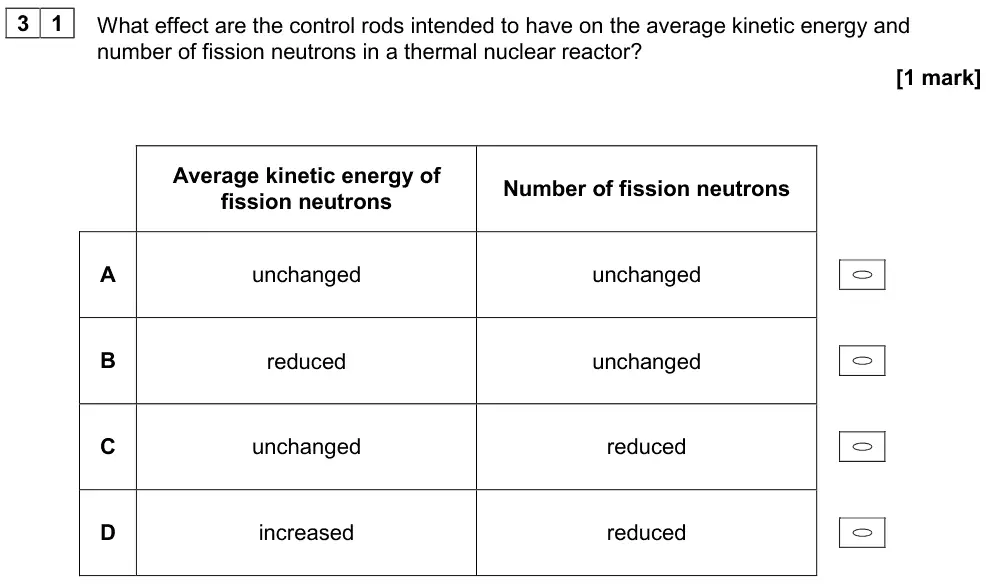
What effect are the control rods intended to have on the average kinetic energy and
number of fission neutrons in a thermal nuclear reactor?
[1 mark]
Average kinetic energy of
fission neutrons
Number of fission neutrons
A
unchanged
unchanged
B
reduced
unchanged
C
unchanged
reduced
D
increased
reduced

Work with an AQA physics tutor

Want a paper marked and gone through with you? Message us.

Prefer email? Send an enquiry

If you are under 18, please include a parent's contact details. Enquiries go to enquiries@physicsaleveltutor.com and are deleted once handled. All tutoring is online.