June 2023: AS Paper 2

70 marks · 50 question parts · Paper, mark scheme and report on AQA's site · Have the data and formulae booklet beside you

Question by question

QTopicMarksAOType
1.1 Measurements, units and uncertainties 1AO3=1Practical and data analysis
1.2 Measurements, units and uncertainties 1AO1=1Practical and data analysis
1.3 Measurements, units and uncertainties 2AO2=2Calculation
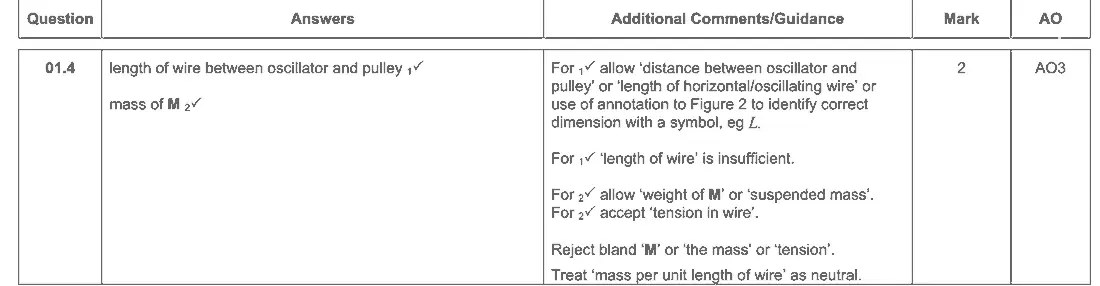
1.4 Superposition and stationary waves 2AO3=2Practical and data analysis
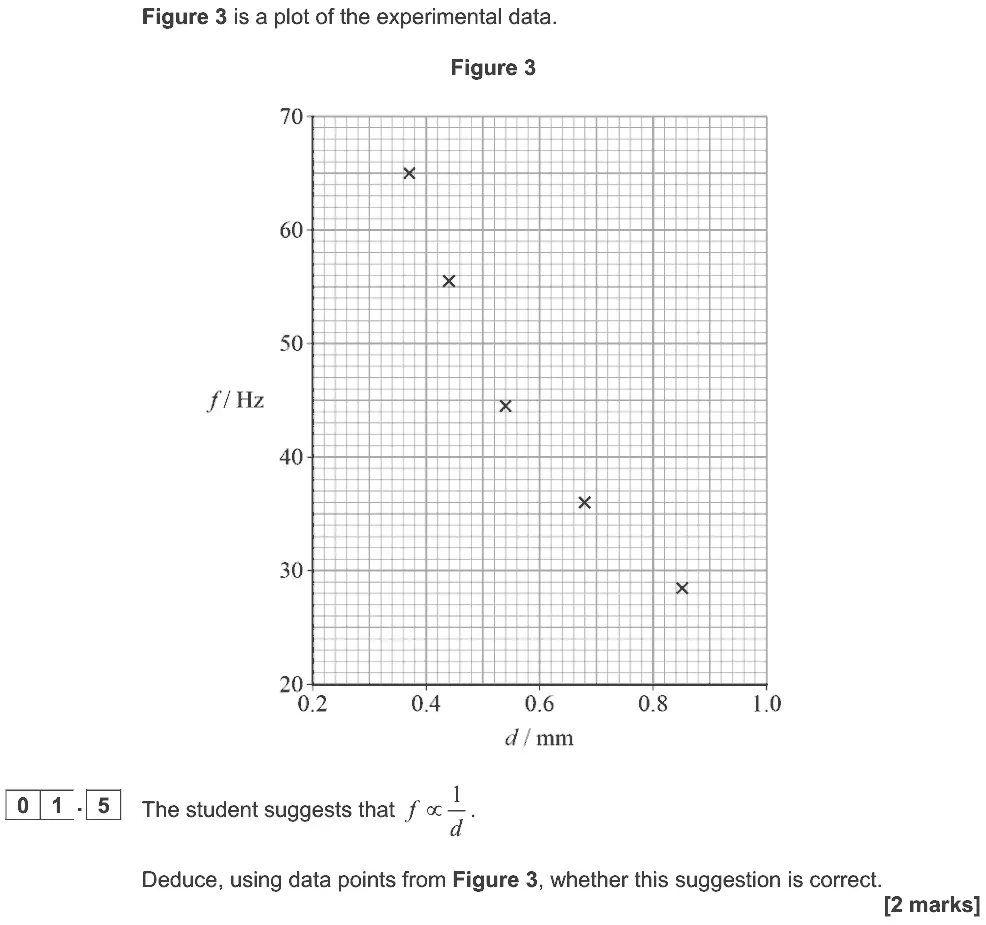
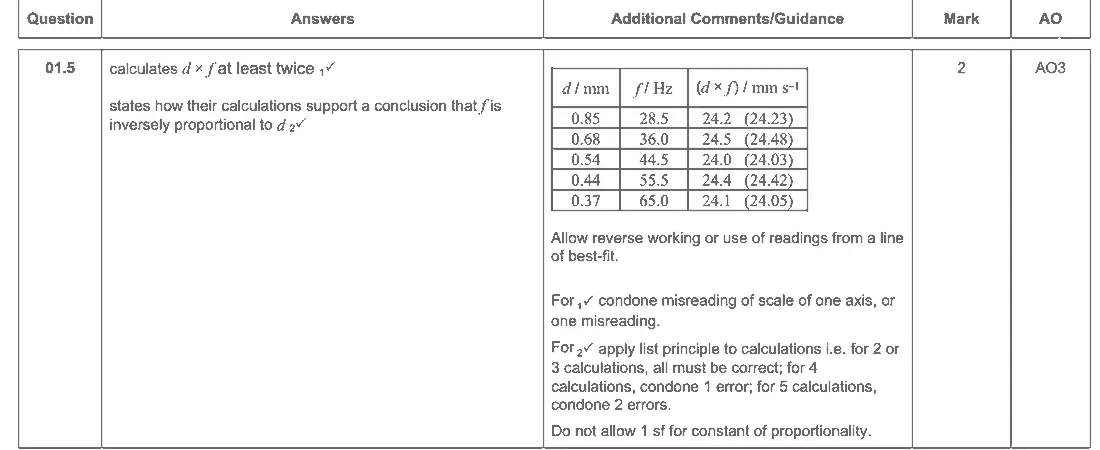
1.5 Superposition and stationary waves 2AO3=2Practical and data analysis
1.6 Superposition and stationary waves 2AO3=2Explanation
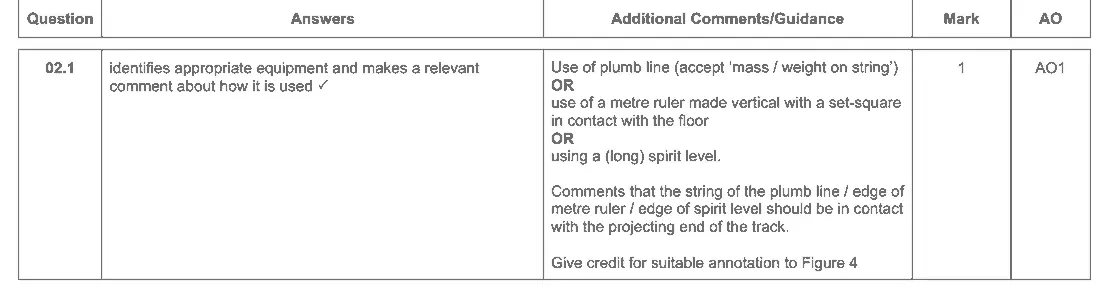
2.1 Motion along a straight line and projectile motion 1AO1=1Practical and data analysis
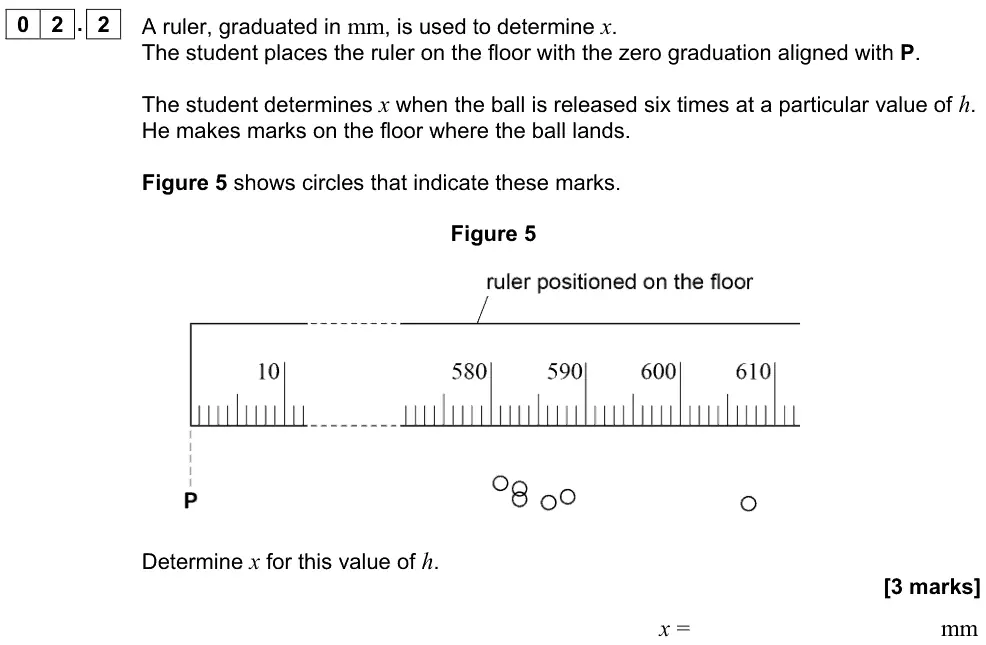
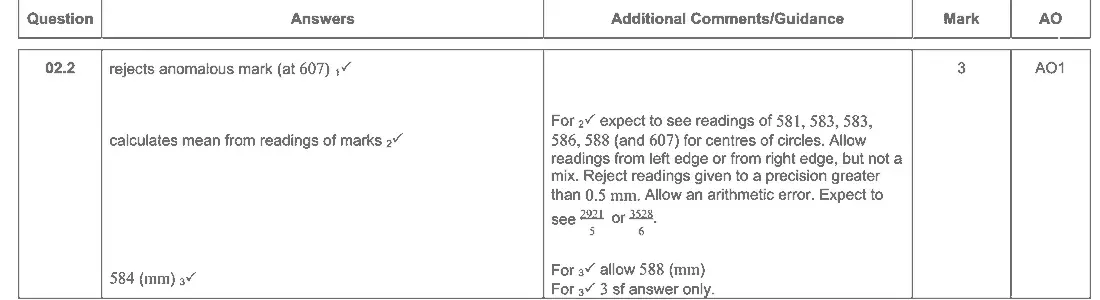
2.2 Measurements, units and uncertainties 3AO1=3Practical and data analysis
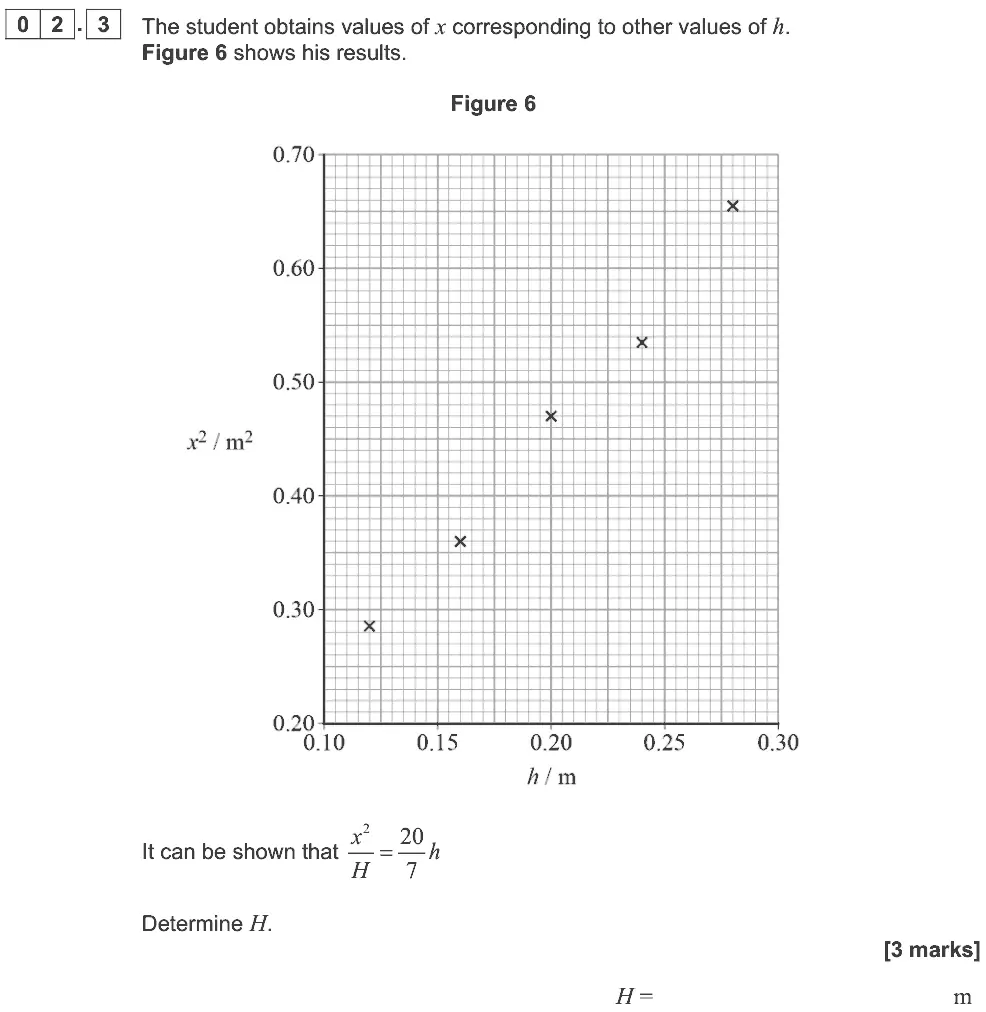
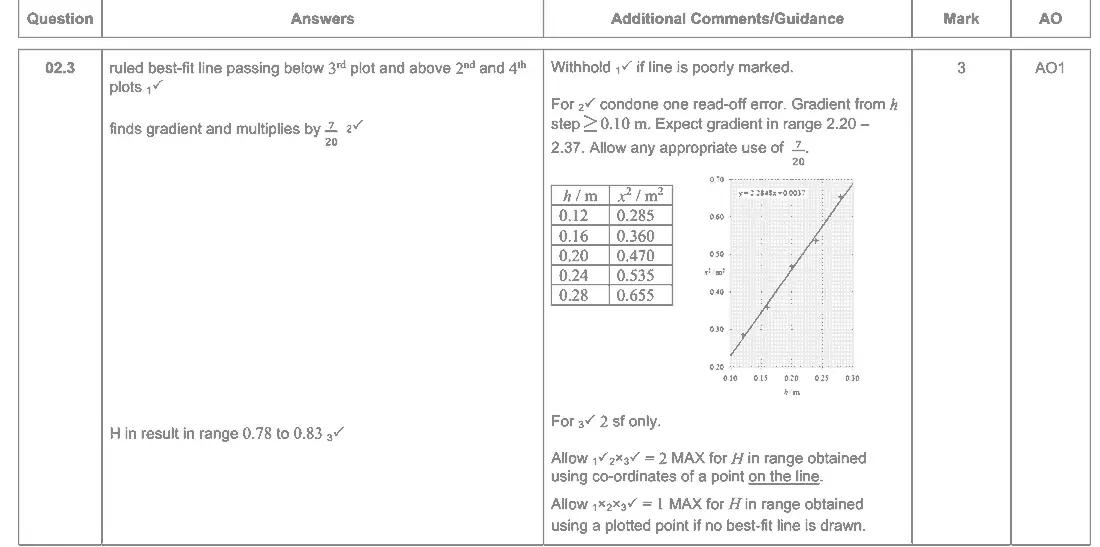
2.3 Motion along a straight line and projectile motion 3AO1=3Practical and data analysis
2.4 Measurements, units and uncertainties 1AO1=1Short answer
2.5 Motion along a straight line and projectile motion, Measurements, units and uncertainties 2AO2=2Practical and data analysis
3.1 Scalars, vectors and moments 2AO1=2Explanation
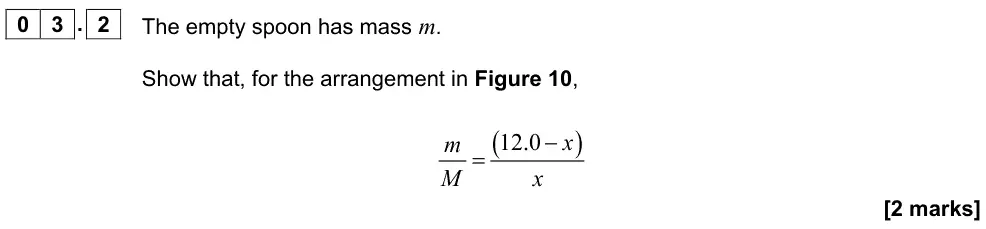
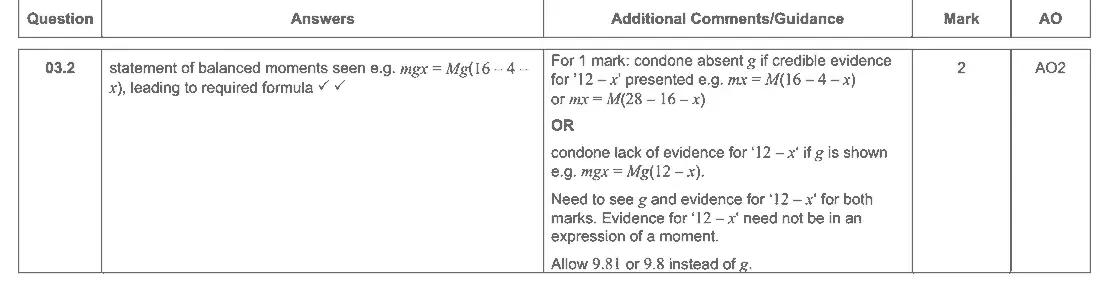
3.2 Scalars, vectors and moments 2AO2=2Show that
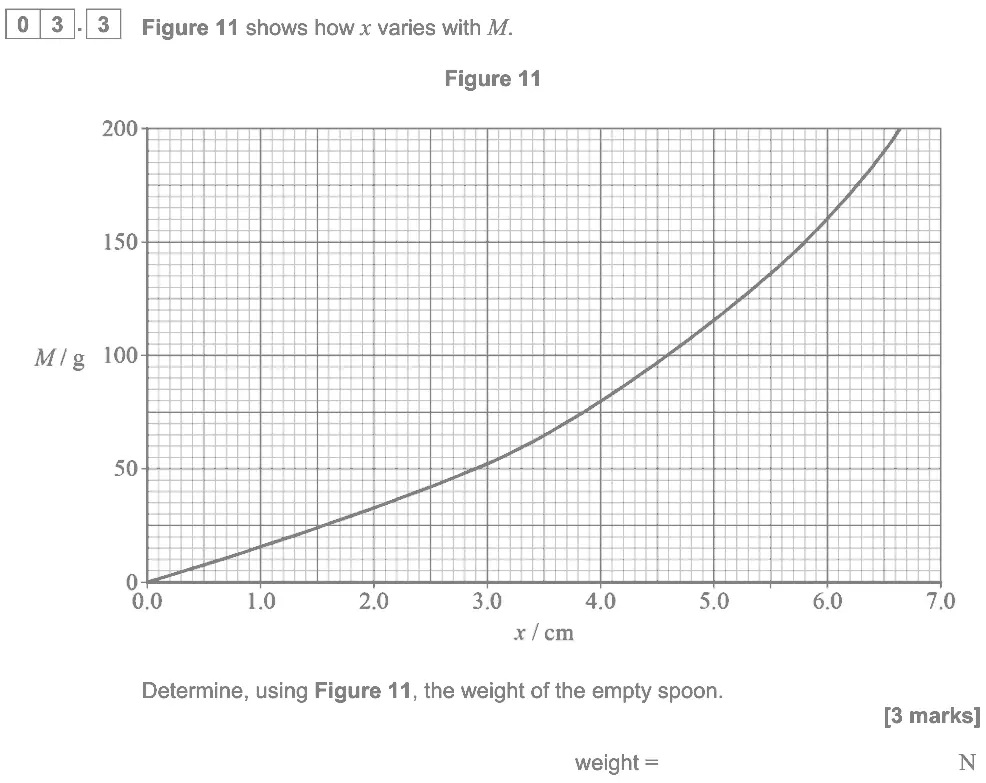
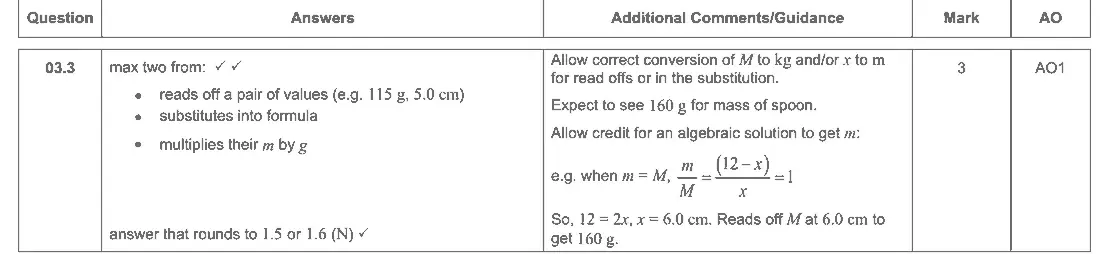
3.3 Scalars, vectors and moments 3AO1=3Calculation
3.4 Measurements, units and uncertainties 3AO3=3Explanation
4.1 Refraction, total internal reflection and optical fibres 1AO1=1Short answer
4.2 Refraction, total internal reflection and optical fibres 2AO2=2Calculation
4.3 Refraction, total internal reflection and optical fibres 2AO2=2Explanation
4.4 Refraction, total internal reflection and optical fibres 2AO2=2Explanation
4.5 Refraction, total internal reflection and optical fibres 3AO3=3Calculation
5 Interference, diffraction and the diffraction grating 1Multiple choice
6 Interference, diffraction and the diffraction grating 1Multiple choice
7 Superposition and stationary waves 1Multiple choice
8 Newton's laws of motion and momentum 1Multiple choice
9 Scalars, vectors and moments 1Multiple choice
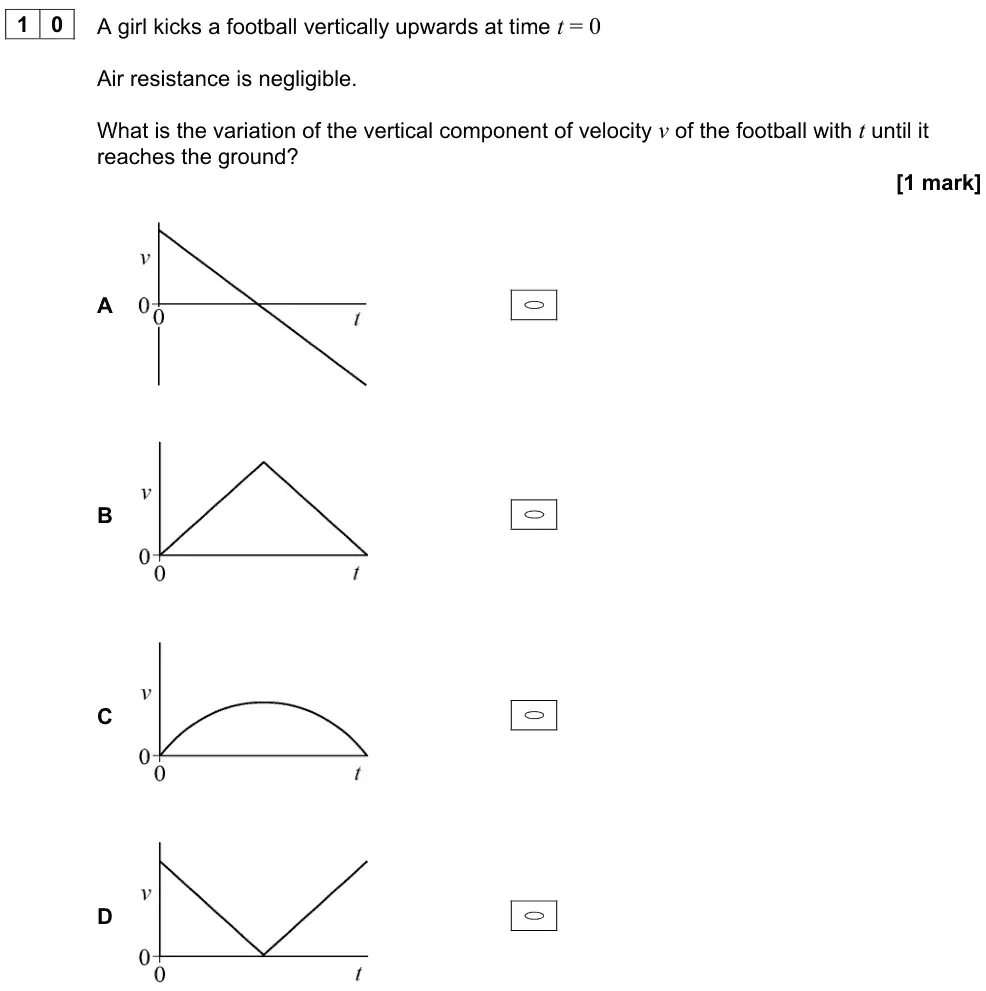
10 Motion along a straight line and projectile motion 1Multiple choice
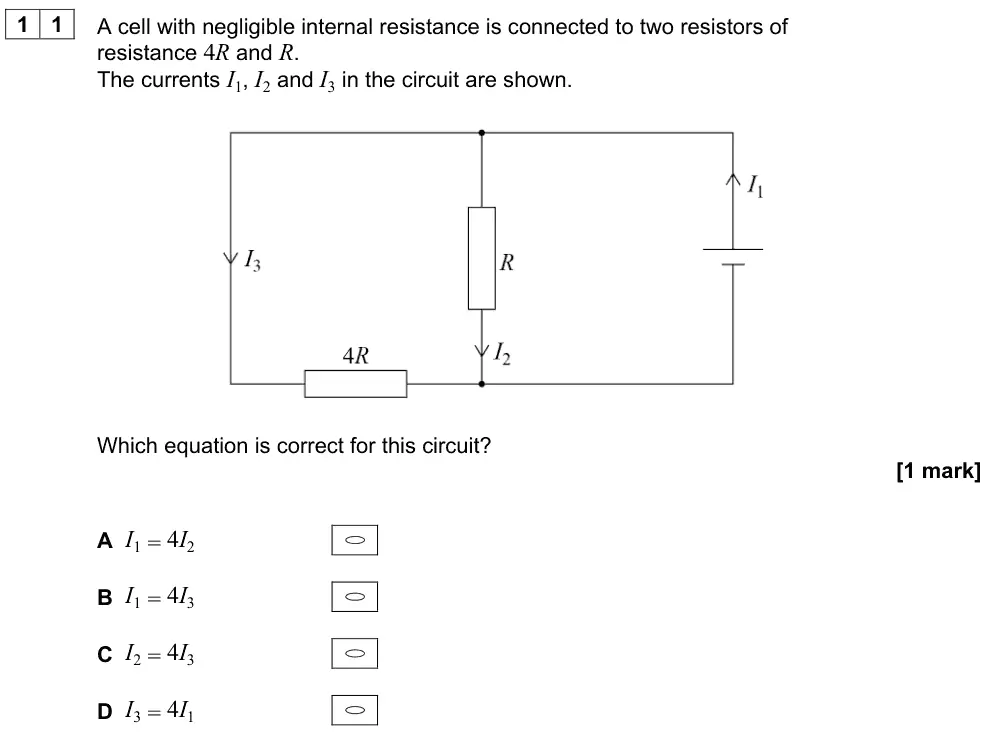
11 Circuits and potential dividers 1Multiple choice
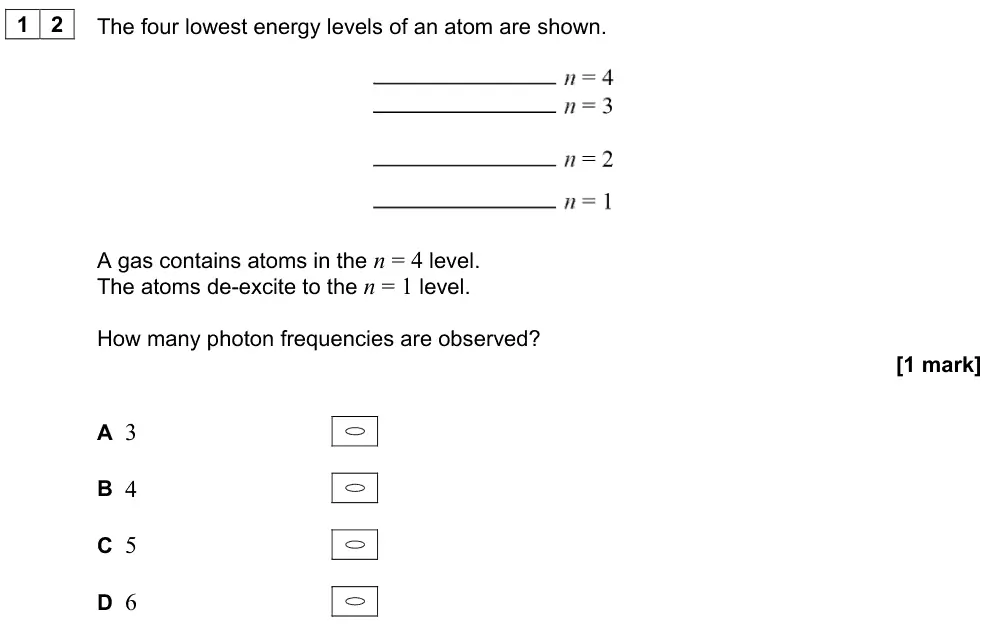
12 Excitation, energy levels and wave-particle duality 1Multiple choice
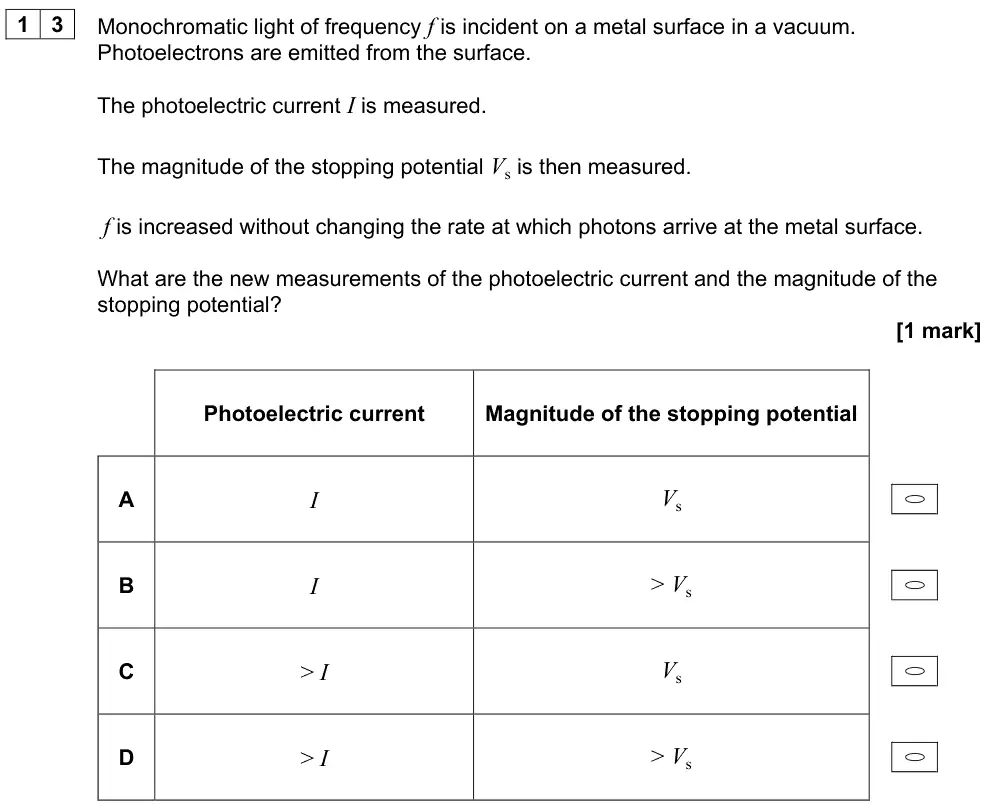
13 The photoelectric effect 1Multiple choice
14 Particles, antiparticles and particle interactions, Classification of particles, quarks and conservation laws 1Multiple choice
15 Particles, antiparticles and particle interactions 1Multiple choice
16 Classification of particles, quarks and conservation laws, Atomic structure and stable nuclei 1Multiple choice
17 Progressive waves, longitudinal and transverse waves 1Multiple choice
18 Circuits and potential dividers, Current, potential difference, I-V characteristics and resistivity 1Multiple choice
19 Current, potential difference, I-V characteristics and resistivity 1Multiple choice
20 Current, potential difference, I-V characteristics and resistivity 1Multiple choice
21 Circuits and potential dividers 1Multiple choice
22 Atomic structure and stable nuclei 1Multiple choice
23 Particles, antiparticles and particle interactions 1Multiple choice
24 Superposition and stationary waves, Progressive waves, longitudinal and transverse waves 1Multiple choice
25 Interference, diffraction and the diffraction grating 1Multiple choice
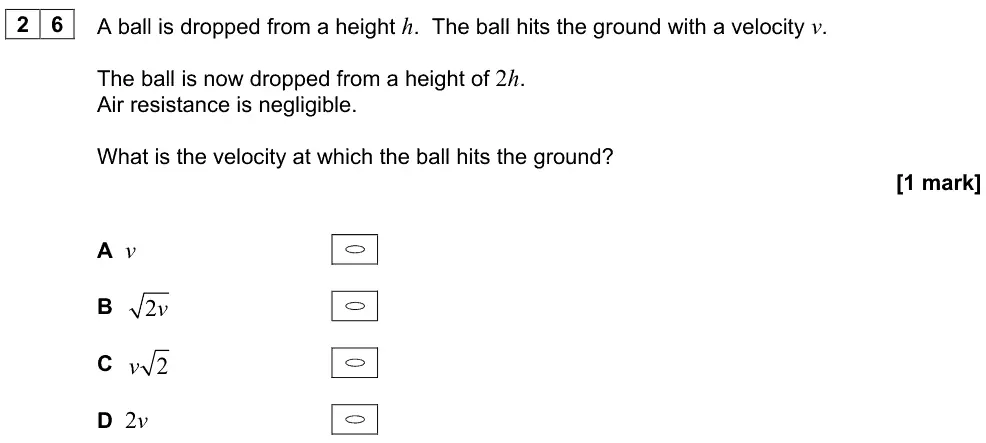
26 Work, energy, power and conservation of energy, Motion along a straight line and projectile motion 1Multiple choice
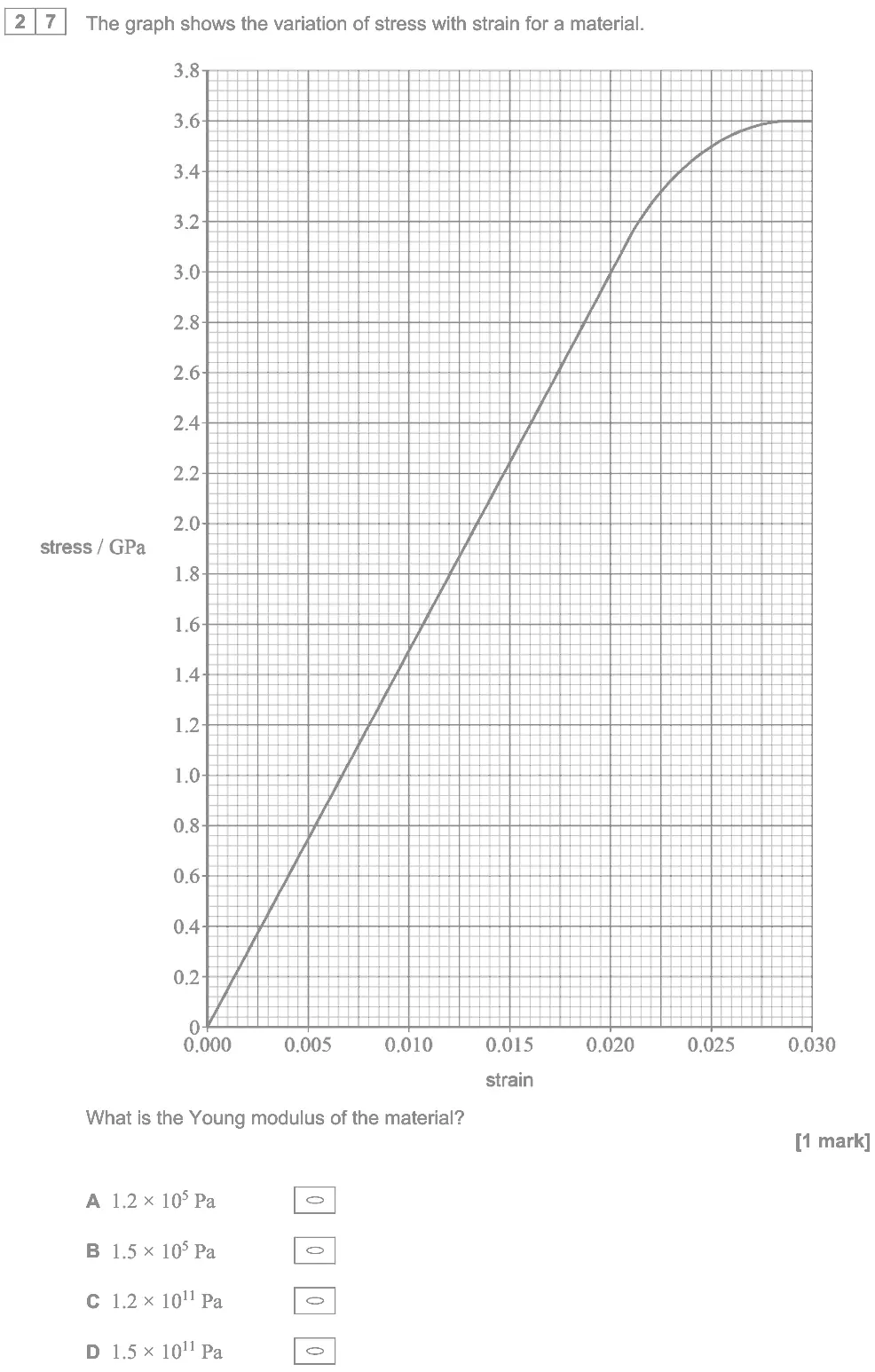
27 Materials, stress, strain and the Young modulus 1Multiple choice
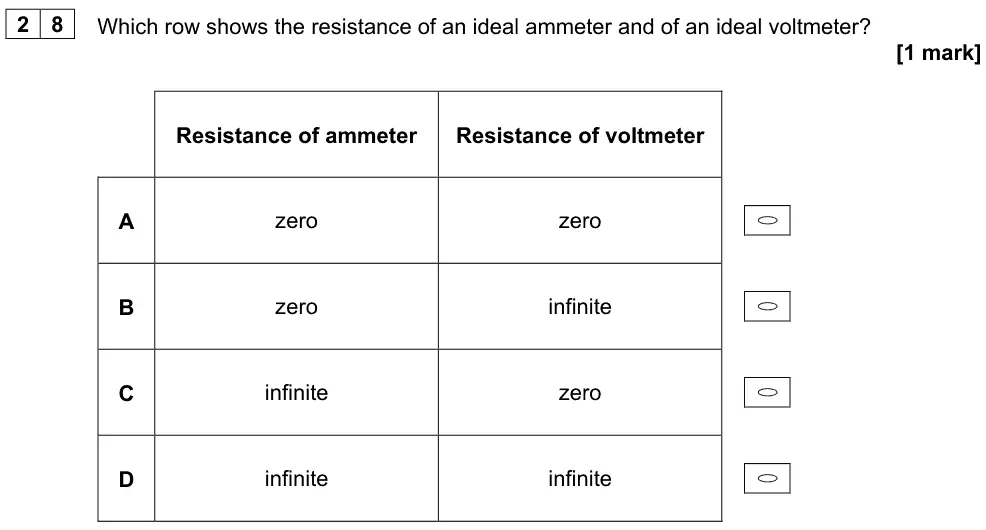
28 Current, potential difference, I-V characteristics and resistivity 1Multiple choice
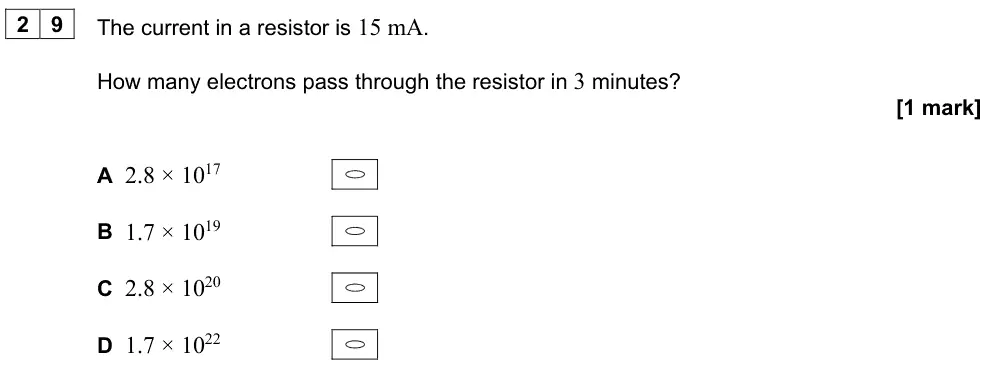
29 Current, potential difference, I-V characteristics and resistivity 1Multiple choice
30 Circuits and potential dividers 1Multiple choice
31 Circuits and potential dividers, Current, potential difference, I-V characteristics and resistivity 1Multiple choice
32 Circuits and potential dividers 1Multiple choice
33 Work, energy, power and conservation of energy 1Multiple choice
34 Work, energy, power and conservation of energy 1Multiple choice

The questions

1.11.21.31.41.51.62.12.22.32.42.53.13.23.33.44.14.24.34.44.55678910111213141516171819202122232425262728293031323334
June 2023 · AS Paper 2 · Q1.1 1 mark AO3=1 Practical and data analysis Easy measurements and uncertainties
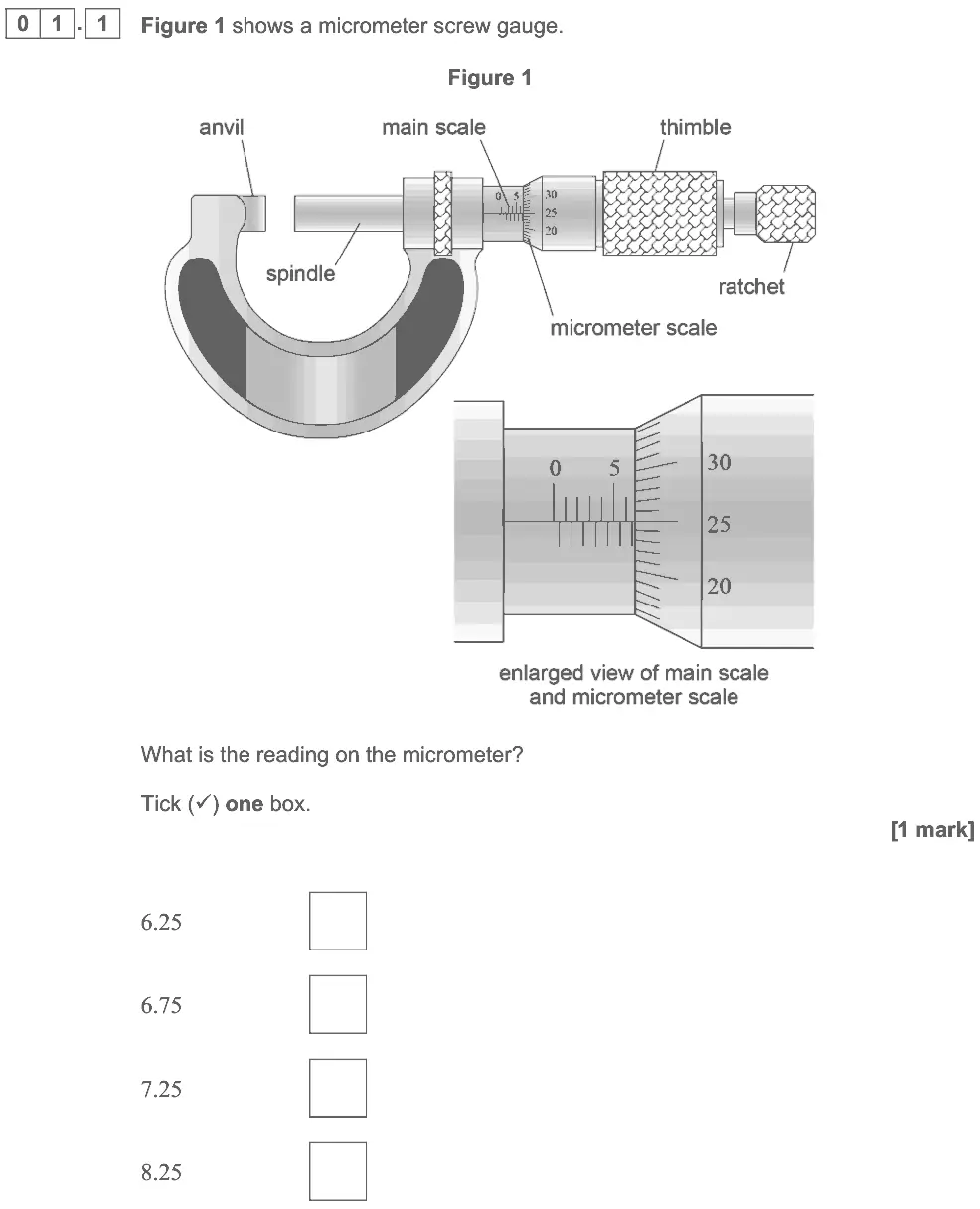
Figure 1 shows a micrometer screw gauge.
Figure 1
What is the reading on the micrometer?
Tick () one box.
[1 mark]
6.25
6.75
7.25
8.25
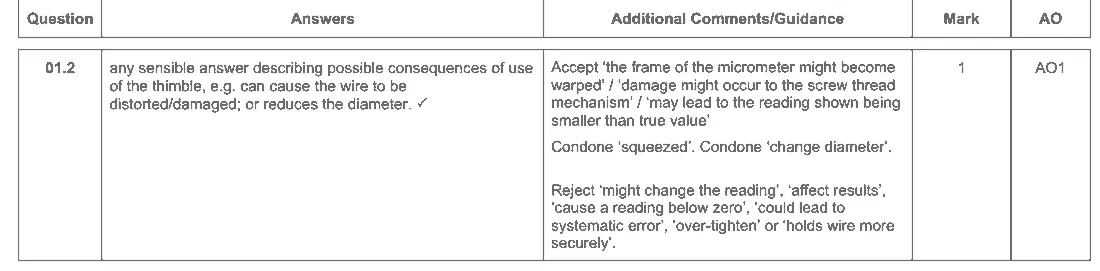
June 2023 · AS Paper 2 · Q1.2 1 mark AO1=1 Practical and data analysis Hard measurements and uncertainties
Earlier part of question 1 that this part usesEarlier part of June 2023 Paper 2 question 1
A metal wire of diameter d is held in the gap between the anvil and the spindle.
Just before the reading of d is taken, the gap is closed using the ratchet and not the
thimble.
Explain why the gap is closed in this way.
[1 mark]
June 2023 · AS Paper 2 · Q1.3 2 marks AO2=2 Calculation measurements and uncertainties
Earlier part of question 1 that this part usesEarlier part of June 2023 Paper 2 question 1
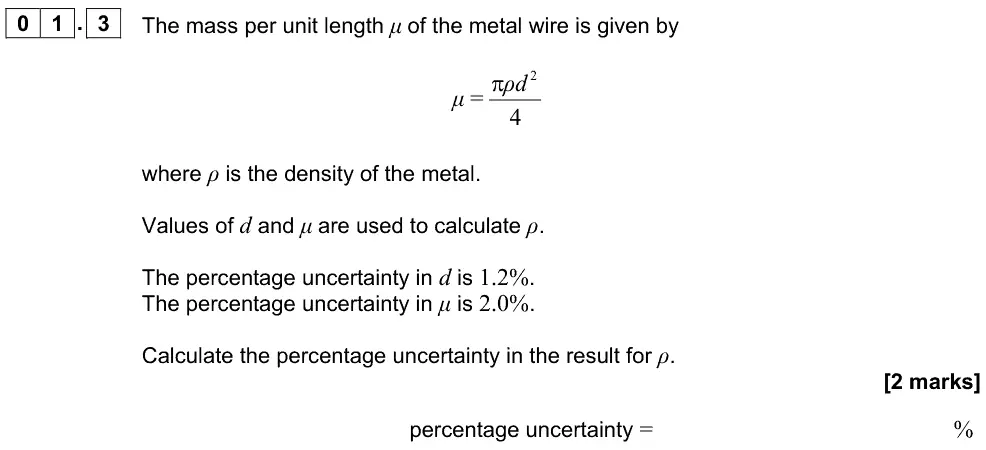
The mass per unit length μ of the metal wire is given by
2
4
μ =
ρd
π
where ρ is the density of the metal.
Values of d and μ are used to calculate ρ.
The percentage uncertainty in d is 1.2%.
The percentage uncertainty in μ is 2.0%.
Calculate the percentage uncertainty in the result for ρ.
[2 marks]
percentage uncertainty =
%
June 2023 · AS Paper 2 · Q1.4 2 marks AO3=2 Practical and data analysis Hard stationary waves
Earlier part of question 1 that this part usesEarlier part of June 2023 Paper 2 question 1
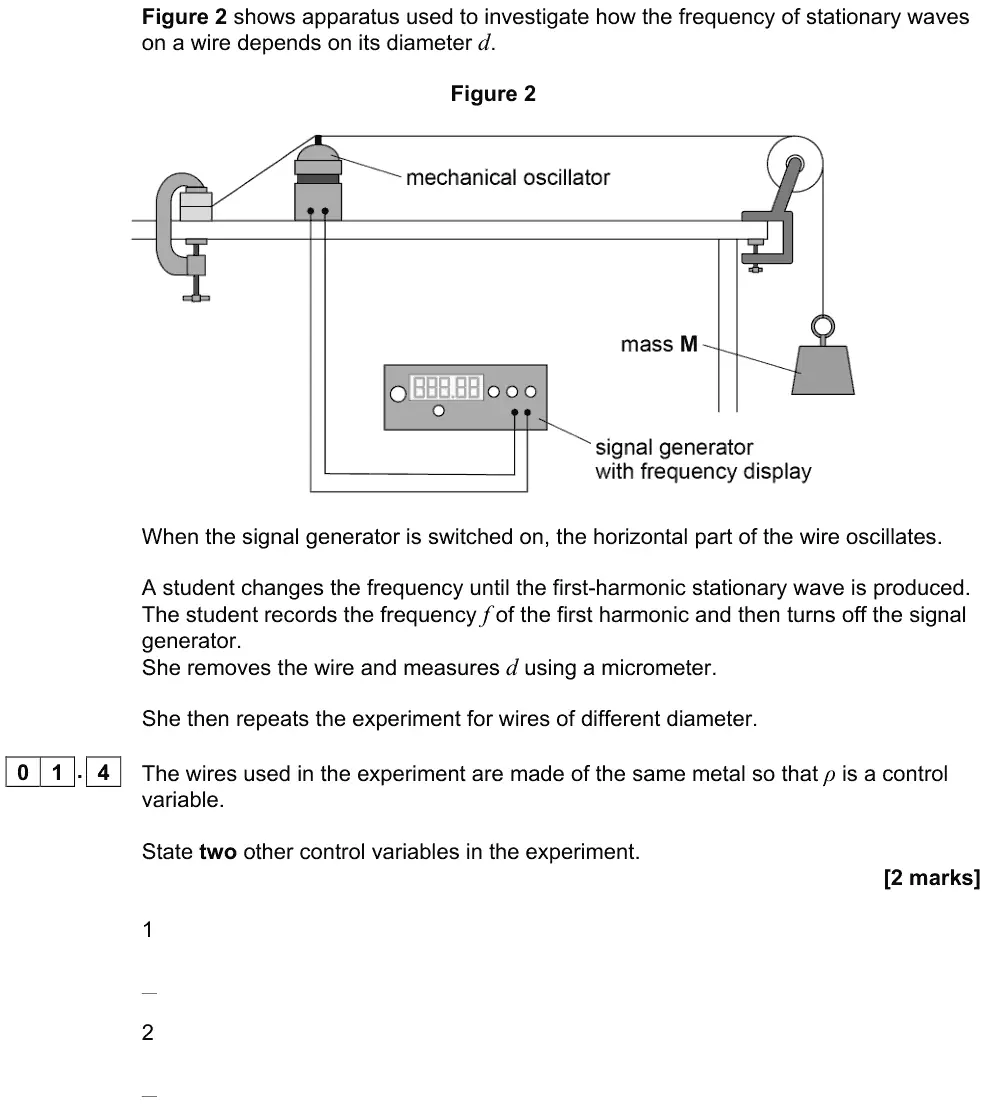
Figure 2 shows apparatus used to investigate how the frequency of stationary waves
on a wire depends on its diameter d.
Figure 2
When the signal generator is switched on, the horizontal part of the wire oscillates.
A student changes the frequency until the first-harmonic stationary wave is produced.
The student records the frequency f of the first harmonic and then turns off the signal
generator.
She removes the wire and measures d using a micrometer.
She then repeats the experiment for wires of different diameter.
The wires used in the experiment are made of the same metal so that ρ is a control
variable.
State two other control variables in the experiment.
[2 marks]
1
2
June 2023 · AS Paper 2 · Q1.5 2 marks AO3=2 Practical and data analysis Hard stationary waves
Earlier part of question 1 that this part usesEarlier part of June 2023 Paper 2 question 1
Figure 3 is a plot of the experimental data.
Figure 3
The student suggests that
1
f
d
∝
.
Deduce, using data points from Figure 3, whether this suggestion is correct.
[2 marks]
June 2023 · AS Paper 2 · Q1.6 2 marks AO3=2 Explanation stationary waves
Earlier part of question 1 that this part usesEarlier part of June 2023 Paper 2 question 1
Another student repeats the experiment with the mass of M doubled.
Explain how this student’s plotted data compare with Figure 3.
[2 marks]
June 2023 · AS Paper 2 · Q2.1 1 mark AO1=1 Practical and data analysis Hard motion and projectiles
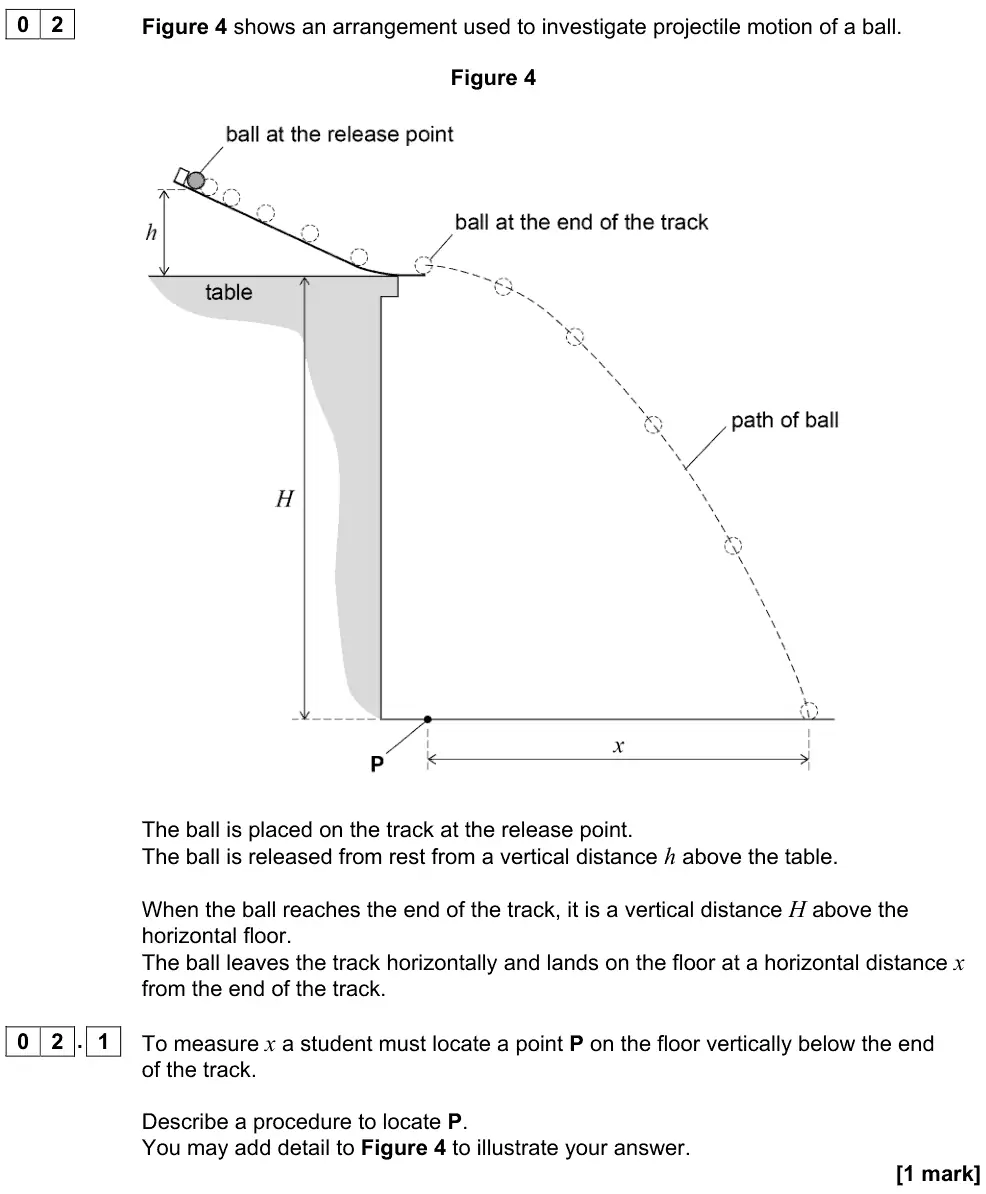
Figure 4 shows an arrangement used to investigate projectile motion of a ball.
Figure 4
The ball is placed on the track at the release point.
The ball is released from rest from a vertical distance h above the table.
When the ball reaches the end of the track, it is a vertical distance H above the
horizontal floor.
The ball leaves the track horizontally and lands on the floor at a horizontal distance x
from the end of the track.
To measure x a student must locate a point P on the floor vertically below the end
of the track.
Describe a procedure to locate P.
You may add detail to Figure 4 to illustrate your answer.
[1 mark]
June 2023 · AS Paper 2 · Q2.2 3 marks AO1=3 Practical and data analysis Easy measurements and uncertainties
Earlier part of question 2 that this part usesEarlier part of June 2023 Paper 2 question 2
A ruler, graduated in mm, is used to determine x.
The student places the ruler on the floor with the zero graduation aligned with P.
The student determines x when the ball is released six times at a particular value of h.
He makes marks on the floor where the ball lands.
Figure 5 shows circles that indicate these marks.
Figure 5
Determine x for this value of h.
[3 marks]
x =
mm
June 2023 · AS Paper 2 · Q2.3 3 marks AO1=3 Practical and data analysis motion and projectiles
Earlier part of question 2 that this part usesEarlier part of June 2023 Paper 2 question 2
The student obtains values of x corresponding to other values of h.
Figure 6 shows his results.
Figure 6
It can be shown that
2
20
7
x
h
H =
Determine H.
[3 marks]
H =
m
June 2023 · AS Paper 2 · Q2.4 1 mark AO1=1 Short answer Hard measurements and uncertainties
Earlier part of question 2 that this part usesEarlier part of June 2023 Paper 2 question 2
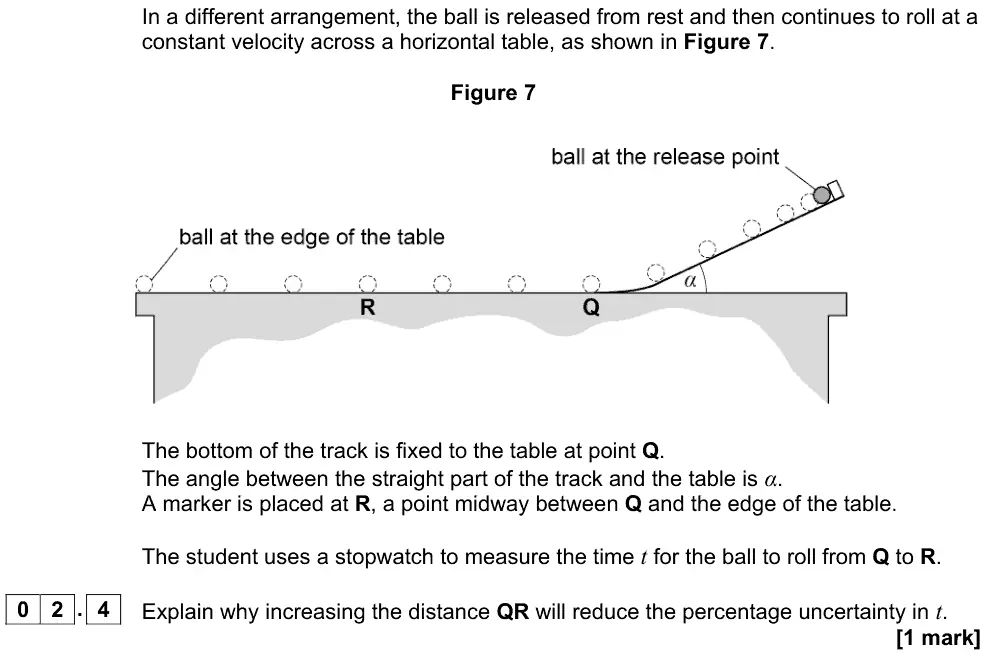
In a different arrangement, the ball is released from rest and then continues to roll at a
constant velocity across a horizontal table, as shown in Figure 7.
Figure 7
The bottom of the track is fixed to the table at point Q.
The angle between the straight part of the track and the table is α.
A marker is placed at R, a point midway between Q and the edge of the table.
The student uses a stopwatch to measure the time t for the ball to roll from Q to R.
Explain why increasing the distance QR will reduce the percentage uncertainty in t.
[1 mark]
June 2023 · AS Paper 2 · Q2.5 2 marks AO2=2 Practical and data analysis motion and projectilesmeasurements and uncertainties
Earlier part of question 2 that this part usesEarlier part of June 2023 Paper 2 question 2
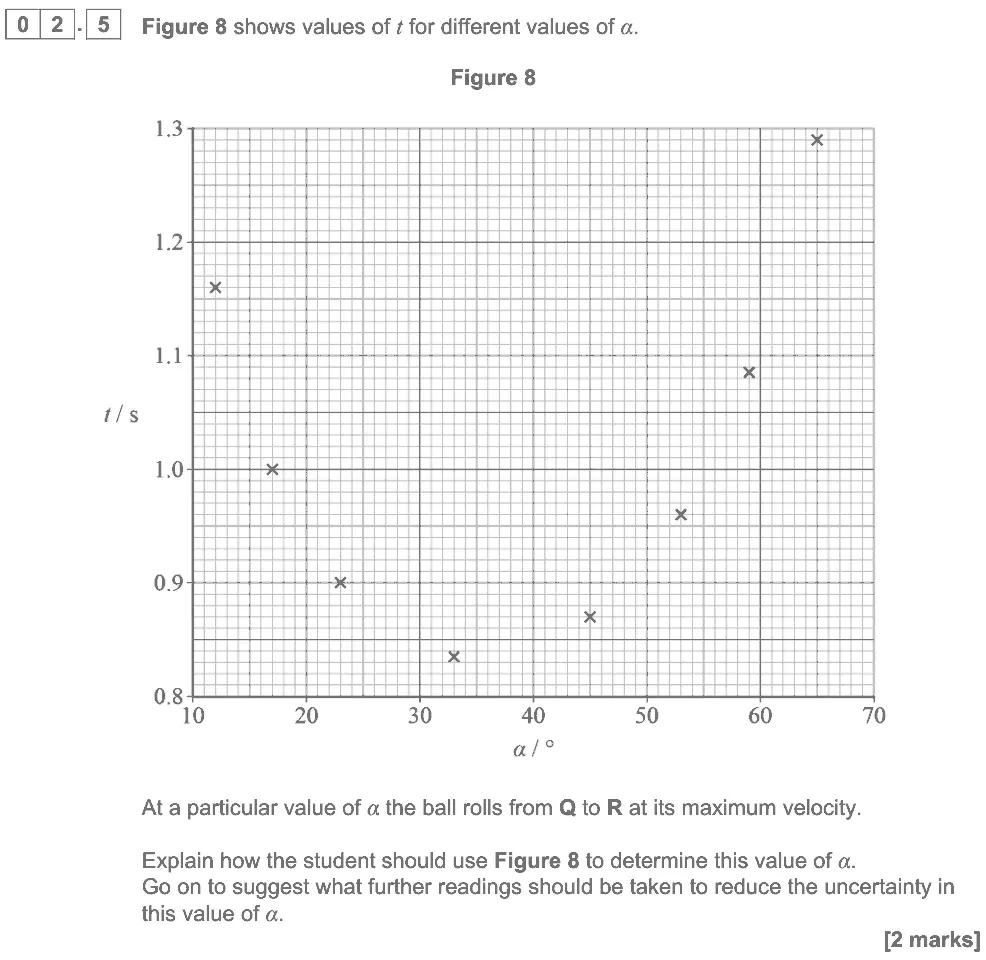
Figure 8 shows values of t for different values of α.
Figure 8
At a particular value of α the ball rolls from Q to R at its maximum velocity.
Explain how the student should use Figure 8 to determine this value of α.
Go on to suggest what further readings should be taken to reduce the uncertainty in
this value of α.
[2 marks]
June 2023 · AS Paper 2 · Q3.1 2 marks AO1=2 Explanation vectors and moments
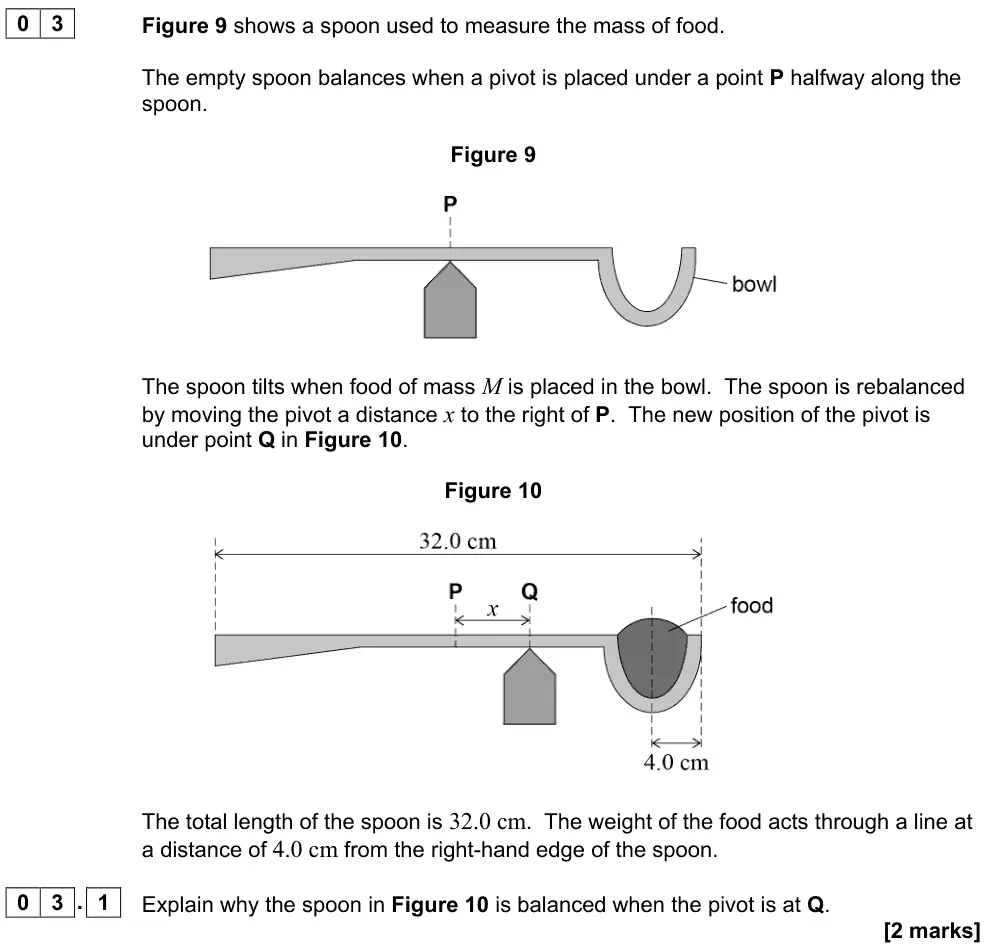
Figure 9 shows a spoon used to measure the mass of food.
The empty spoon balances when a pivot is placed under a point P halfway along the
spoon.
Figure 9
The spoon tilts when food of mass M is placed in the bowl.  The spoon is rebalanced
by moving the pivot a distance x to the right of P.  The new position of the pivot is
under point Q in Figure 10.
Figure 10
The total length of the spoon is 32.0 cm.  The weight of the food acts through a line at
a distance of 4.0 cm from the right-hand edge of the spoon.
Explain why the spoon in Figure 10 is balanced when the pivot is at Q.
[2 marks]
June 2023 · AS Paper 2 · Q3.2 2 marks AO2=2 Show that vectors and moments
Earlier part of question 3 that this part usesEarlier part of June 2023 Paper 2 question 3
The empty spoon has mass m.
Show that, for the arrangement in Figure 10,
(
)
12.0
m
x
M
x
=
−
[2 marks]
June 2023 · AS Paper 2 · Q3.3 3 marks AO1=3 Calculation vectors and moments
Earlier part of question 3 that this part usesEarlier part of June 2023 Paper 2 question 3
Figure 11 shows how x varies with M.
Figure 11
Determine, using Figure 11, the weight of the empty spoon.
[3 marks]
weight =
N
June 2023 · AS Paper 2 · Q3.4 3 marks AO3=3 Explanation measurements and uncertainties
Earlier part of question 3 that this part usesEarlier part of June 2023 Paper 2 question 3
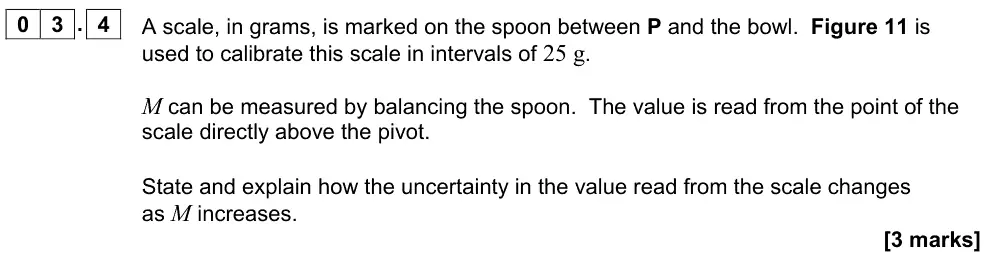
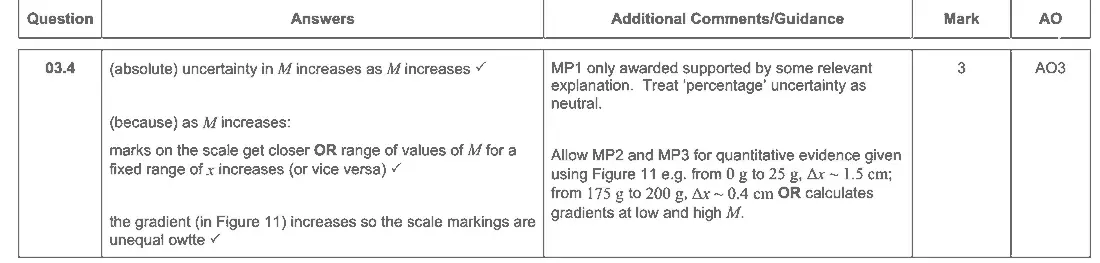
A scale, in grams, is marked on the spoon between P and the bowl.  Figure 11 is
used to calibrate this scale in intervals of 25 g.
M can be measured by balancing the spoon.  The value is read from the point of the
scale directly above the pivot.
State and explain how the uncertainty in the value read from the scale changes
as M increases.
[3 marks]
June 2023 · AS Paper 2 · Q4.1 1 mark AO1=1 Short answer refraction and optical fibres
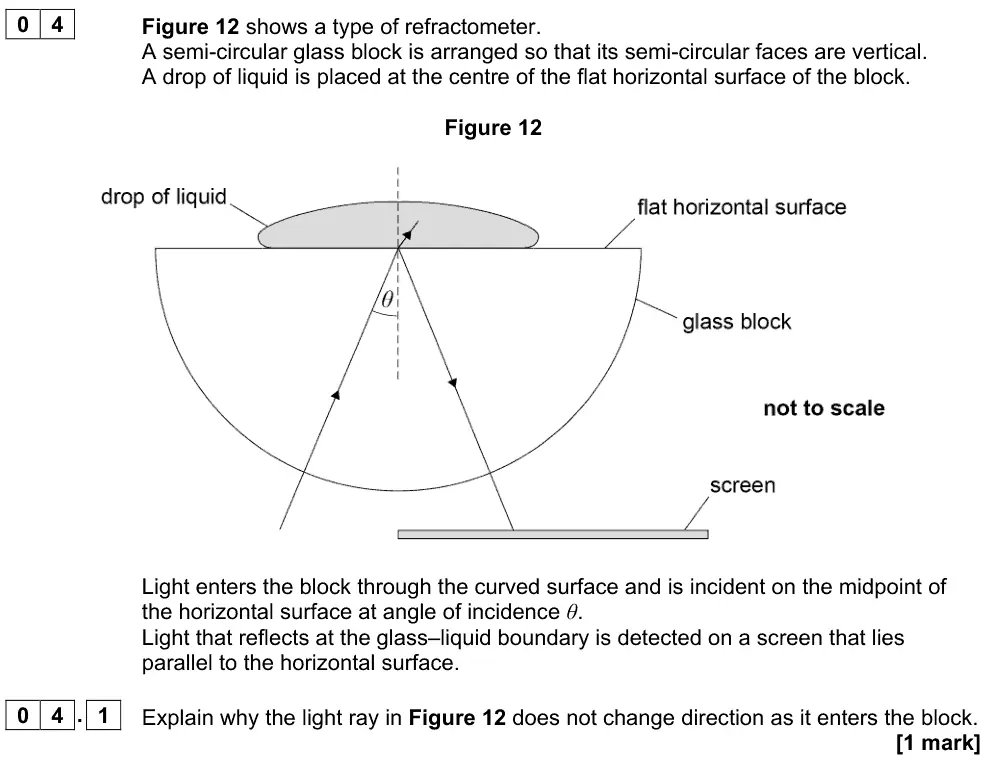
Figure 12 shows a type of refractometer.
A semi-circular glass block is arranged so that its semi-circular faces are vertical.
A drop of liquid is placed at the centre of the flat horizontal surface of the block.
Figure 12
Light enters the block through the curved surface and is incident on the midpoint of
the horizontal surface at angle of incidence θ.
Light that reflects at the glass–liquid boundary is detected on a screen that lies
parallel to the horizontal surface.
Explain why the light ray in Figure 12 does not change direction as it enters the block.
[1 mark]
June 2023 · AS Paper 2 · Q4.2 2 marks AO2=2 Calculation Easy refraction and optical fibres
Earlier part of question 4 that this part usesEarlier part of June 2023 Paper 2 question 4
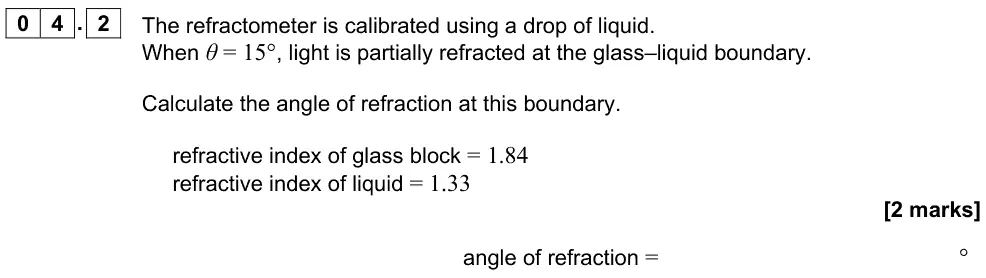
The refractometer is calibrated using a drop of liquid.
When θ = 15°, light is partially refracted at the glass–liquid boundary.
Calculate the angle of refraction at this boundary.
refractive index of glass block = 1.84
refractive index of liquid = 1.33
[2 marks]
angle of refraction =
°
June 2023 · AS Paper 2 · Q4.3 2 marks AO2=2 Explanation refraction and optical fibres
Earlier part of question 4 that this part usesEarlier part of June 2023 Paper 2 question 4
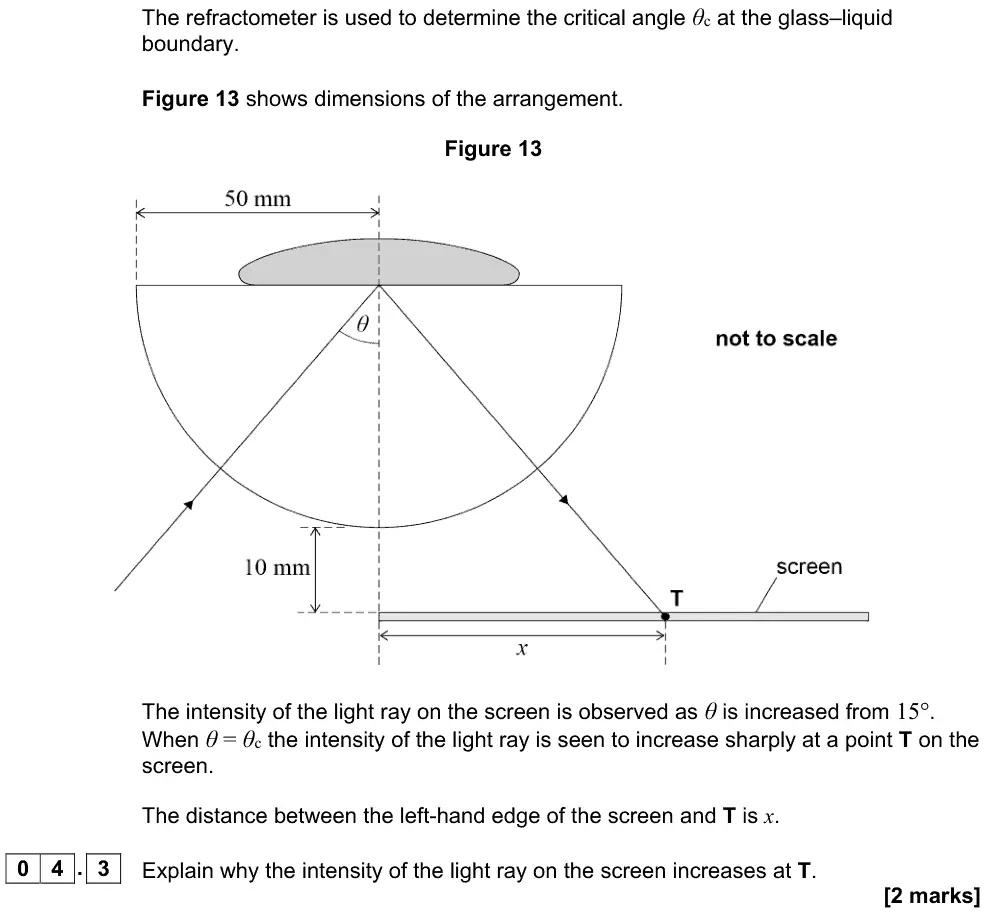
The refractometer is used to determine the critical angle θc at the glass–liquid
boundary.
Figure 13 shows dimensions of the arrangement.
Figure 13
The intensity of the light ray on the screen is observed as θ is increased from 15°.
When θ = θc the intensity of the light ray is seen to increase sharply at a point T on the
screen.
The distance between the left-hand edge of the screen and T is x.
Explain why the intensity of the light ray on the screen increases at T.
[2 marks]
June 2023 · AS Paper 2 · Q4.4 2 marks AO2=2 Explanation refraction and optical fibres
Earlier part of question 4 that this part usesEarlier part of June 2023 Paper 2 question 4
The liquid is replaced with a drop of sugar solution.
The refractive index of the sugar solution is greater than 1.33
Deduce how this change affects the position at which the sharp increase in intensity is
observed on the screen.
[2 marks]
June 2023 · AS Paper 2 · Q4.5 3 marks AO3=3 Calculation Hard refraction and optical fibres
Earlier part of question 4 that this part usesEarlier part of June 2023 Paper 2 question 4
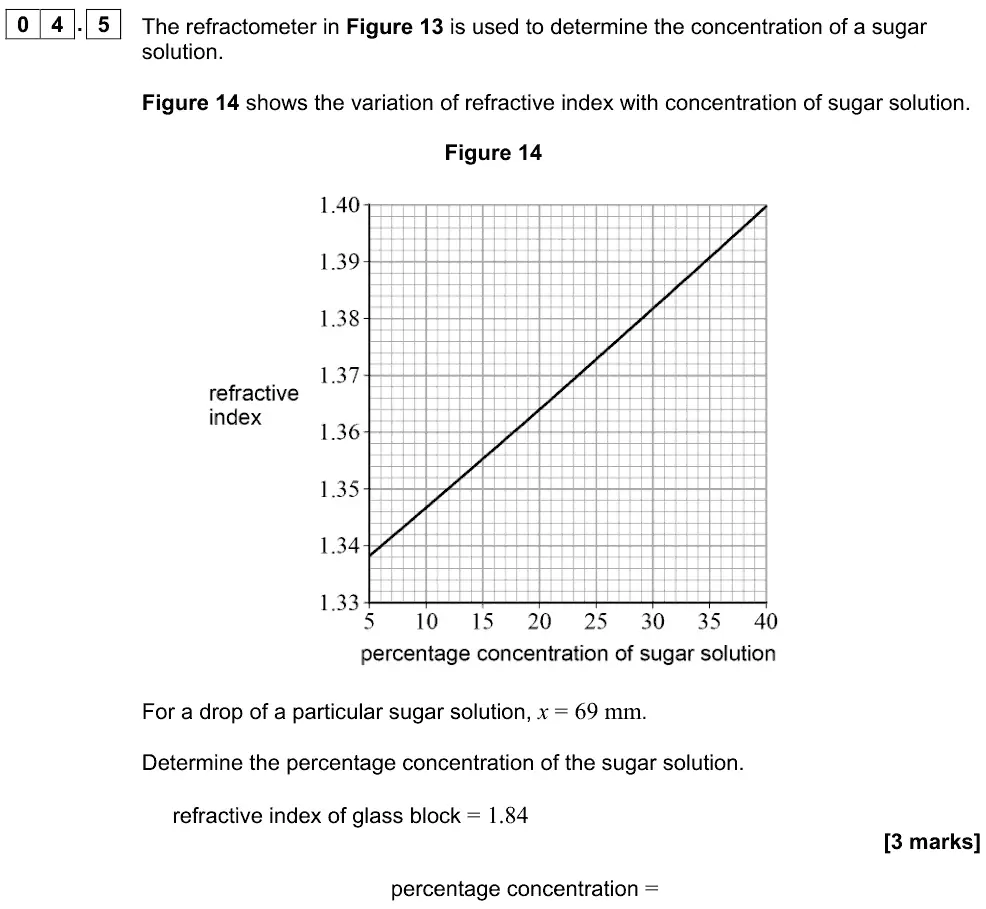
The refractometer in Figure 13 is used to determine the concentration of a sugar
solution.
Figure 14 shows the variation of refractive index with concentration of sugar solution.
Figure 14
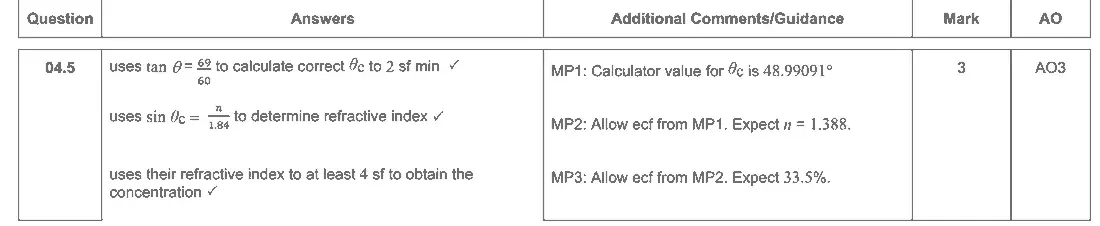
For a drop of a particular sugar solution, x = 69 mm.
Determine the percentage concentration of the sugar solution.
refractive index of glass block = 1.84
[3 marks]
percentage concentration =
June 2023 · AS Paper 2 · Q5 1 mark Multiple choice interference and diffraction
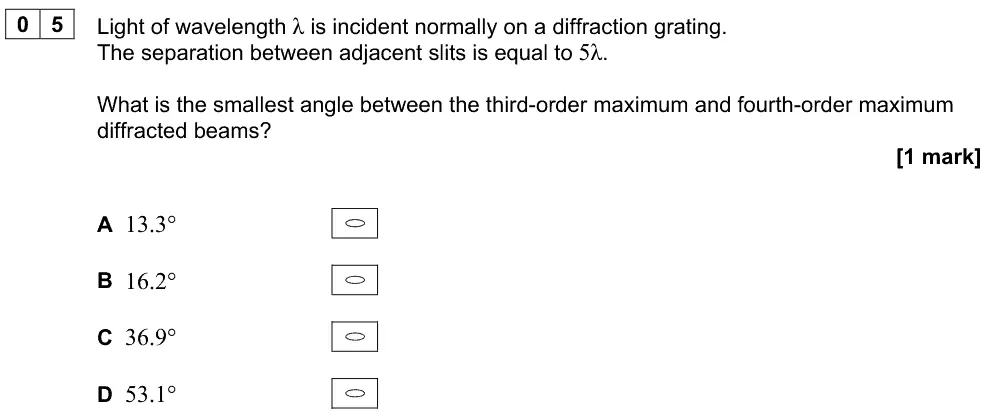
Light of wavelength λ is incident normally on a diffraction grating.
The separation between adjacent slits is equal to 5λ.
What is the smallest angle between the third-order maximum and fourth-order maximum
diffracted beams?
[1 mark]
A 13.3°
B 16.2°
C 36.9°
D 53.1°
June 2023 · AS Paper 2 · Q6 1 mark Multiple choice Hard interference and diffraction
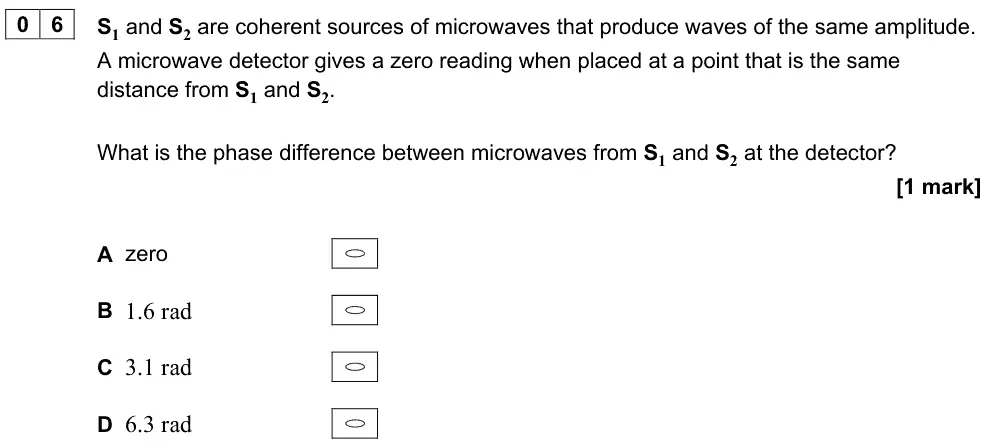
S1 and S2 are coherent sources of microwaves that produce waves of the same amplitude.
A microwave detector gives a zero reading when placed at a point that is the same
distance from S1 and S2.
What is the phase difference between microwaves from S1 and S2 at the detector?
[1 mark]
A zero
B 1.6 rad
C 3.1 rad
D 6.3 rad
June 2023 · AS Paper 2 · Q7 1 mark Multiple choice Hard stationary waves
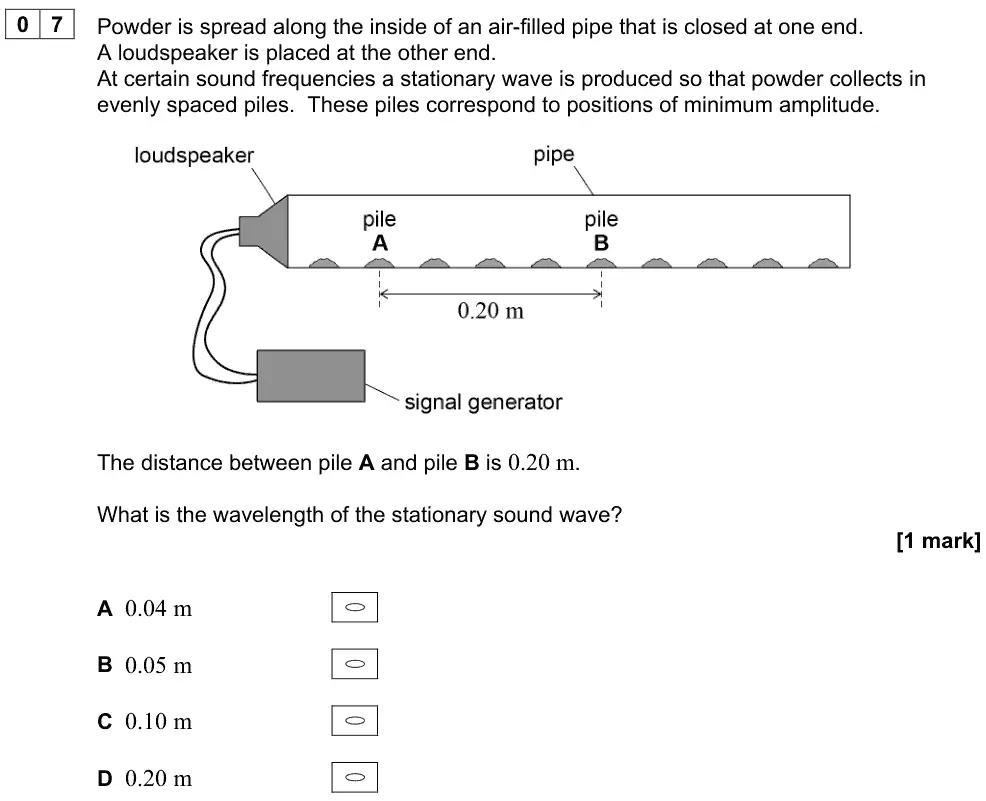
Powder is spread along the inside of an air-filled pipe that is closed at one end.
A loudspeaker is placed at the other end.
At certain sound frequencies a stationary wave is produced so that powder collects in
evenly spaced piles.  These piles correspond to positions of minimum amplitude.
The distance between pile A and pile B is 0.20 m.
What is the wavelength of the stationary sound wave?
[1 mark]
A 0.04 m
B 0.05 m
C 0.10 m
D 0.20 m
June 2023 · AS Paper 2 · Q8 1 mark Multiple choice newtons laws and momentum
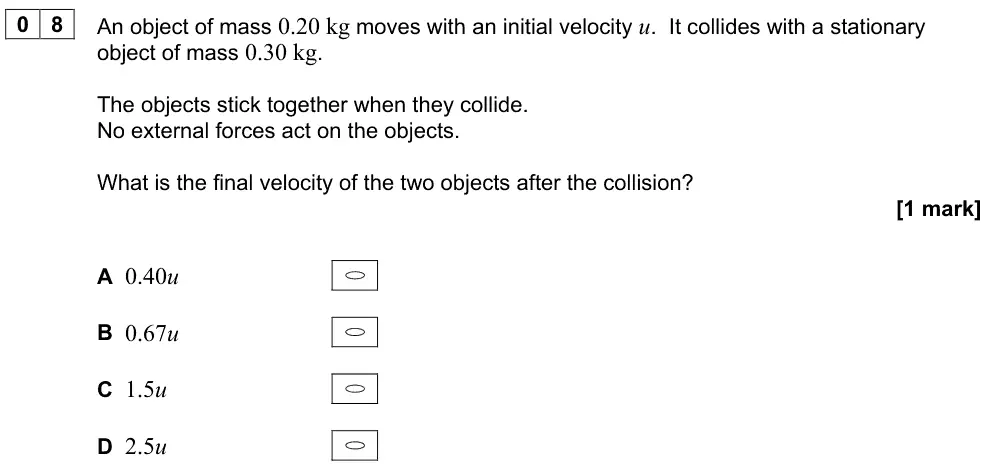
An object of mass 0.20 kg moves with an initial velocity u.  It collides with a stationary
object of mass 0.30 kg.
The objects stick together when they collide.
No external forces act on the objects.
What is the final velocity of the two objects after the collision?
[1 mark]
A 0.40u
B 0.67u
C 1.5u
D 2.5u
June 2023 · AS Paper 2 · Q9 1 mark Multiple choice Easy vectors and moments
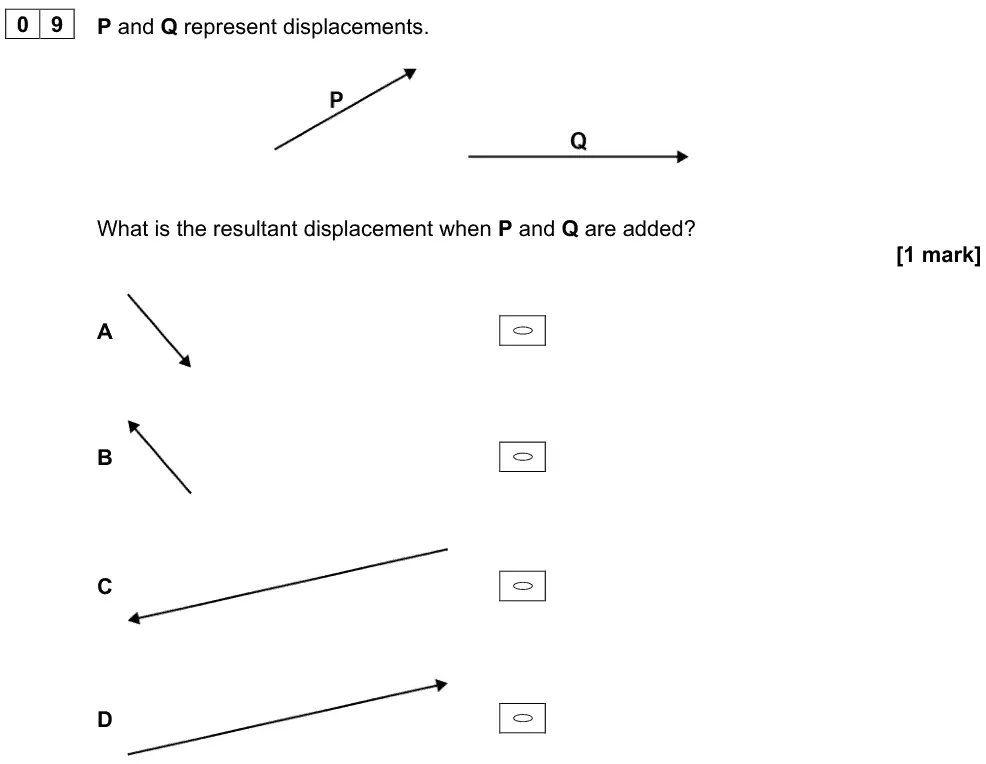
P and Q represent displacements.
What is the resultant displacement when P and Q are added?
[1 mark]
A
B
C
D
June 2023 · AS Paper 2 · Q10 1 mark Multiple choice motion and projectiles
A girl kicks a football vertically upwards at time t = 0
Air resistance is negligible.
What is the variation of the vertical component of velocity v of the football with t until it
reaches the ground?
[1 mark]
A
B
C
D
June 2023 · AS Paper 2 · Q11 1 mark Multiple choice circuits and potential dividers
A cell with negligible internal resistance is connected to two resistors of
resistance 4R and R.
The currents I1, I2 and I3 in the circuit are shown.
Which equation is correct for this circuit?
[1 mark]
A I1 = 4I2
B I1 = 4I3
C I2 = 4I3
D I3 = 4I1
June 2023 · AS Paper 2 · Q12 1 mark Multiple choice energy levels and wave particle duality
The four lowest energy levels of an atom are shown.
A gas contains atoms in the n = 4 level.
The atoms de-excite to the n = 1 level.
How many photon frequencies are observed?
[1 mark]
A 3
B 4
C 5
D 6
June 2023 · AS Paper 2 · Q13 1 mark Multiple choice photoelectric effect
Monochromatic light of frequency f is incident on a metal surface in a vacuum.
Photoelectrons are emitted from the surface.
The photoelectric current I is measured.
The magnitude of the stopping potential Vs is then measured.
f is increased without changing the rate at which photons arrive at the metal surface.
What are the new measurements of the photoelectric current and the magnitude of the
stopping potential?
[1 mark]
Photoelectric current
Magnitude of the stopping potential
A
I
Vs
B
I
> Vs
C
> I
Vs
D
> I
> Vs
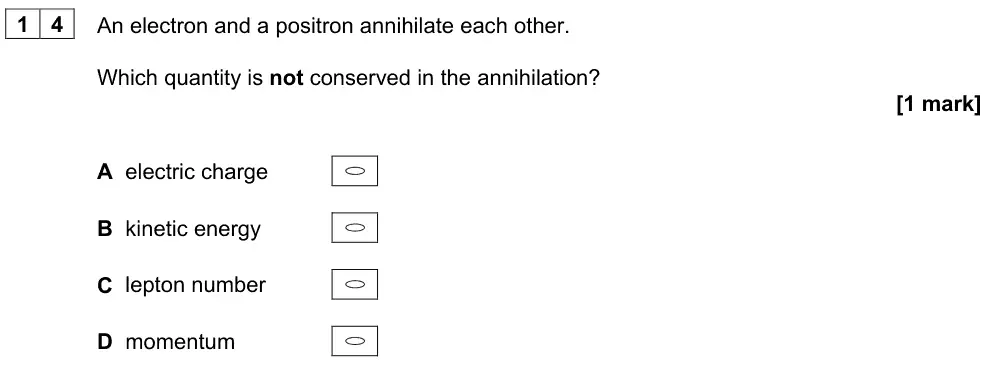
June 2023 · AS Paper 2 · Q14 1 mark Multiple choice particles antiparticles and interactionsclassification of particles and quarks
An electron and a positron annihilate each other.
Which quantity is not conserved in the annihilation?
[1 mark]
A electric charge
B kinetic energy
C lepton number
D momentum
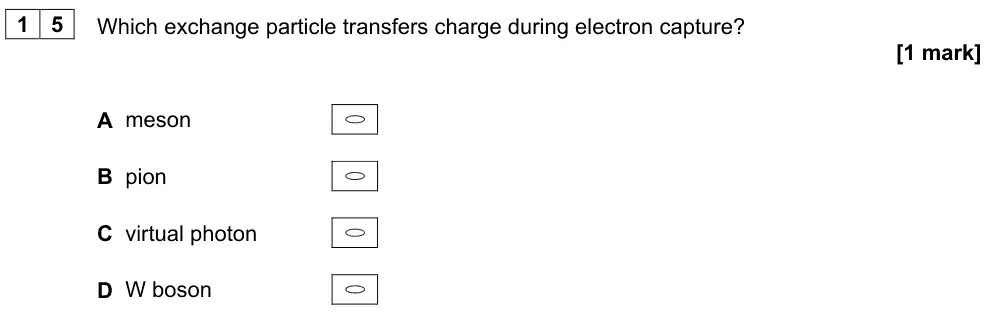
June 2023 · AS Paper 2 · Q15 1 mark Multiple choice particles antiparticles and interactions
Which exchange particle transfers charge during electron capture?
[1 mark]
A meson
B pion
C virtual photon
D W boson
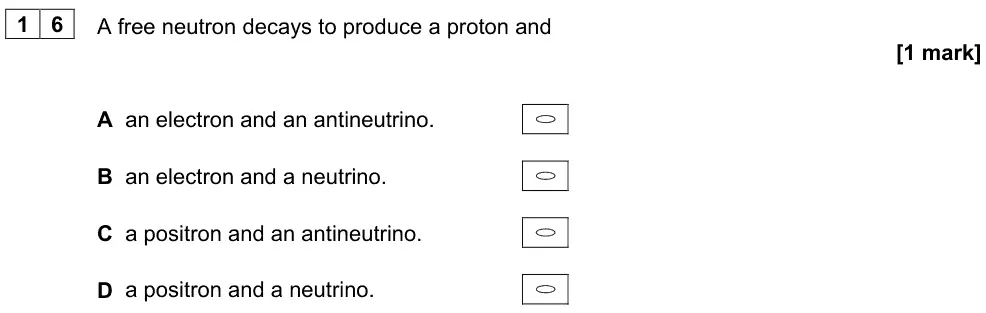
June 2023 · AS Paper 2 · Q16 1 mark Multiple choice classification of particles and quarksatomic structure and stable nuclei
A free neutron decays to produce a proton and
[1 mark]
A an electron and an antineutrino.
B an electron and a neutrino.
C a positron and an antineutrino.
D a positron and a neutrino.
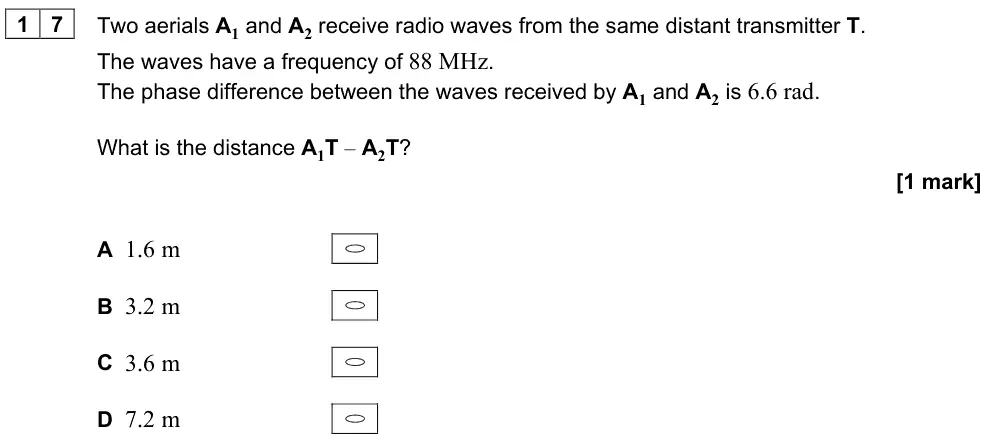
June 2023 · AS Paper 2 · Q17 1 mark Multiple choice progressive waves and polarisation
Two aerials A1 and A2 receive radio waves from the same distant transmitter T.
The waves have a frequency of 88 MHz.
The phase difference between the waves received by A1 and A2 is 6.6 rad.
What is the distance A1T – A2T?
[1 mark]
A 1.6 m
B 3.2 m
C 3.6 m
D 7.2 m
June 2023 · AS Paper 2 · Q18 1 mark Multiple choice Hard circuits and potential dividerscurrent voltage and resistivity
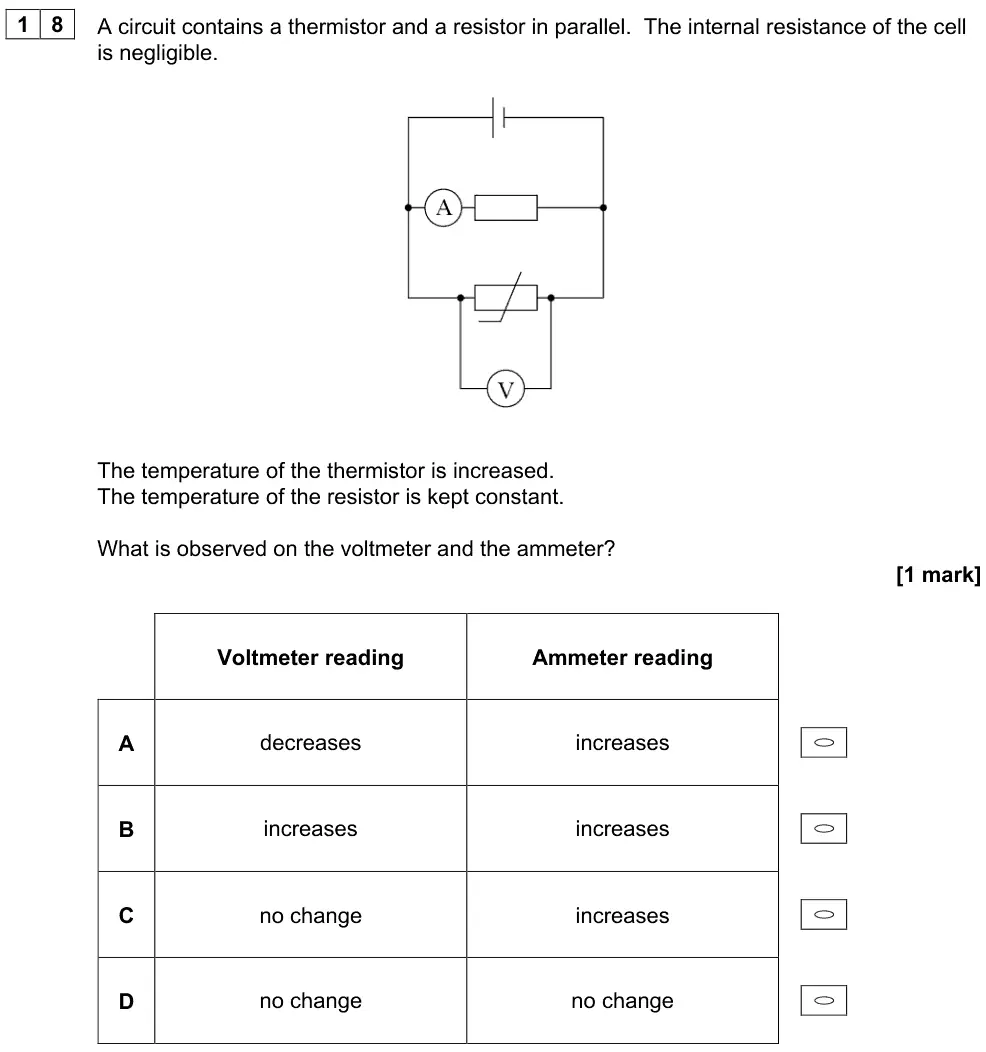
A circuit contains a thermistor and a resistor in parallel.  The internal resistance of the cell
is negligible.
The temperature of the thermistor is increased.
The temperature of the resistor is kept constant.
What is observed on the voltmeter and the ammeter?
[1 mark]
Voltmeter reading
Ammeter reading
A
decreases
increases
B
increases
increases
C
no change
increases
D
no change
no change
June 2023 · AS Paper 2 · Q19 1 mark Multiple choice current voltage and resistivity
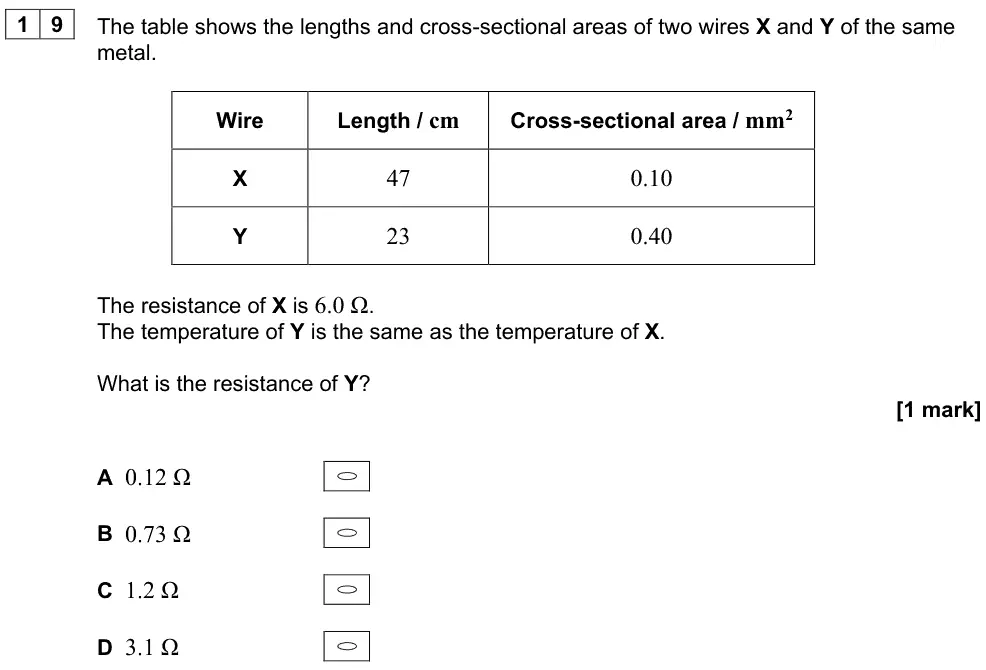
The table shows the lengths and cross-sectional areas of two wires X and Y of the same
metal.
Wire
Length / cm
Cross-sectional area / mm2
X
47
0.10
Y
23
0.40
The resistance of X is 6.0 Ω.
The temperature of Y is the same as the temperature of X.
What is the resistance of Y?
[1 mark]
A 0.12 Ω
B 0.73 Ω
C 1.2 Ω
D 3.1 Ω
June 2023 · AS Paper 2 · Q20 1 mark Multiple choice current voltage and resistivity
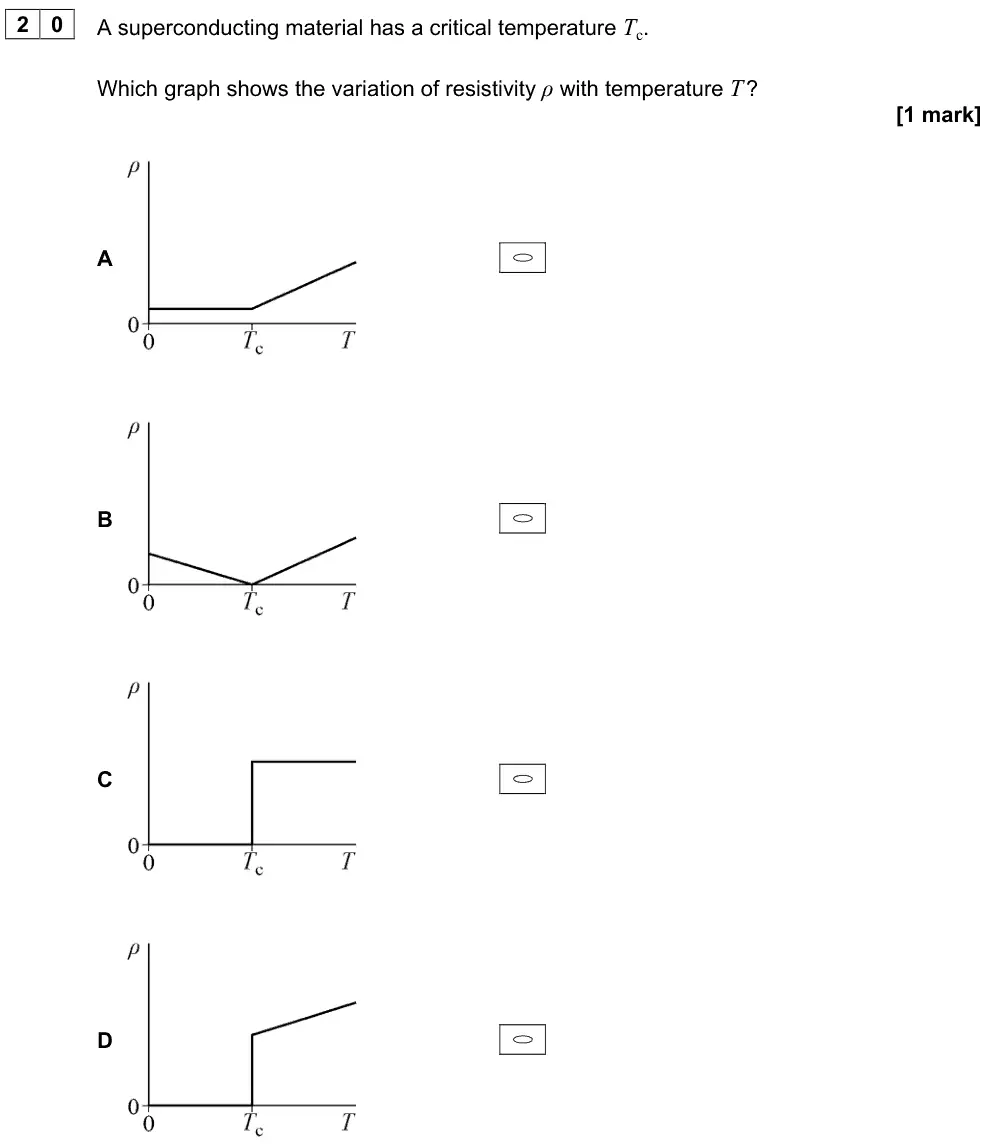
A superconducting material has a critical temperature Tc.
Which graph shows the variation of resistivity ρ with temperature T ?
[1 mark]
A
B
C
D
June 2023 · AS Paper 2 · Q21 1 mark Multiple choice circuits and potential dividers
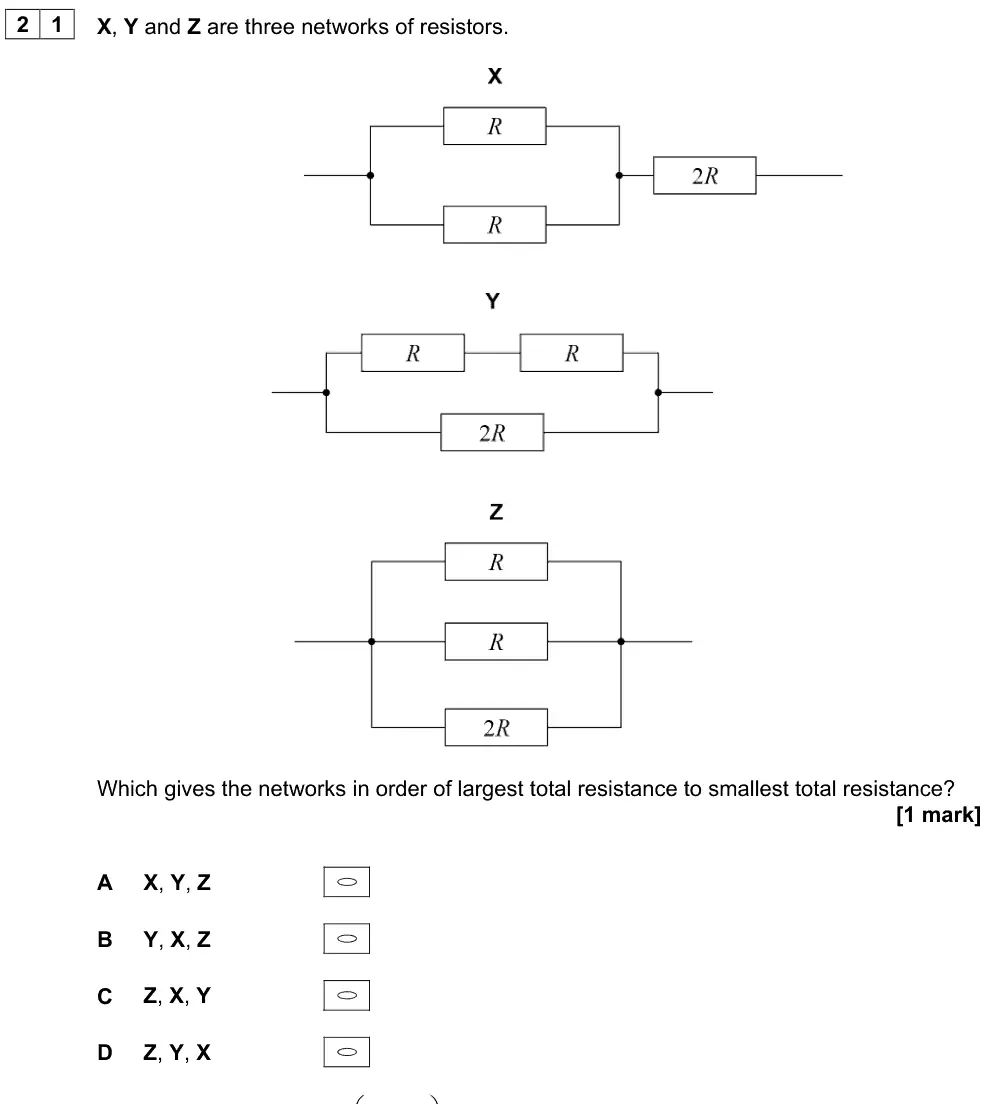
X, Y and Z are three networks of resistors.
Which gives the networks in order of largest total resistance to smallest total resistance?
[1 mark]
A   X, Y, Z
B   Y, X, Z
C   Z, X, Y
D   Z, Y, X
A nucleus of bismuth-209 209Bi


June 2023 · AS Paper 2 · Q22 1 mark Multiple choice atomic structure and stable nuclei
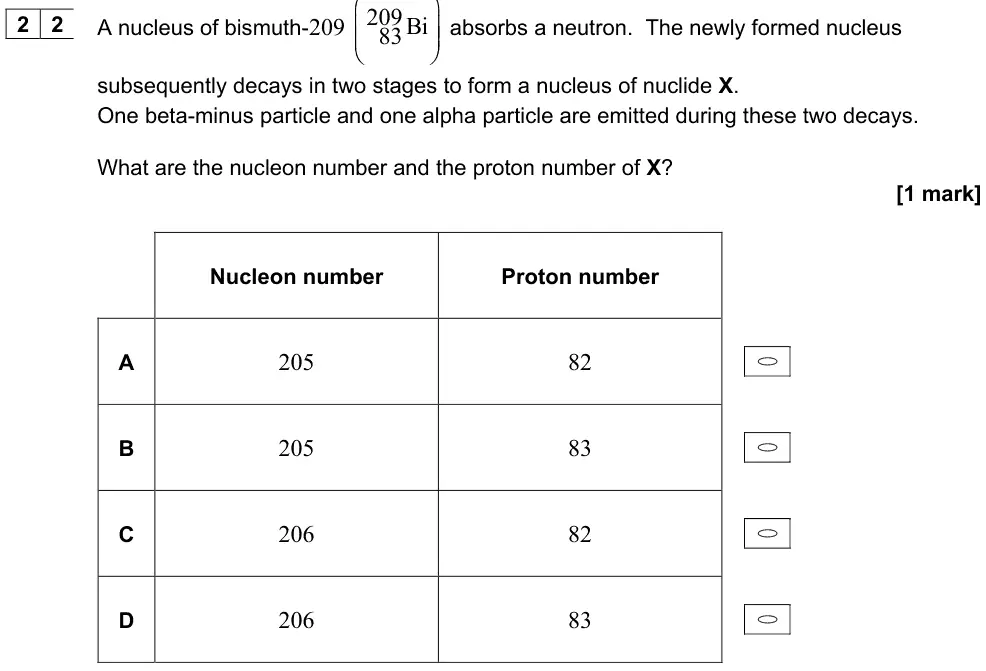
A nucleus of bismuth-209 209Bi
83






absorbs a neutron.  The newly formed nucleus
subsequently decays in two stages to form a nucleus of nuclide X.
One beta-minus particle and one alpha particle are emitted during these two decays.
What are the nucleon number and the proton number of X?
[1 mark]
Nucleon number
Proton number
A
205
82
B
205
83
C
206
82
D
206
83
June 2023 · AS Paper 2 · Q23 1 mark Multiple choice Hard particles antiparticles and interactions
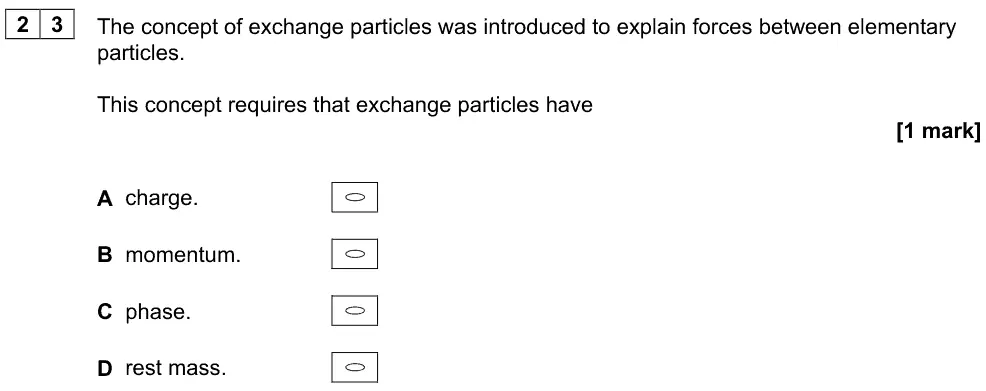
The concept of exchange particles was introduced to explain forces between elementary
particles.
This concept requires that exchange particles have
[1 mark]
A charge.
B momentum.
C phase.
D rest mass.
June 2023 · AS Paper 2 · Q24 1 mark Multiple choice stationary wavesprogressive waves and polarisation
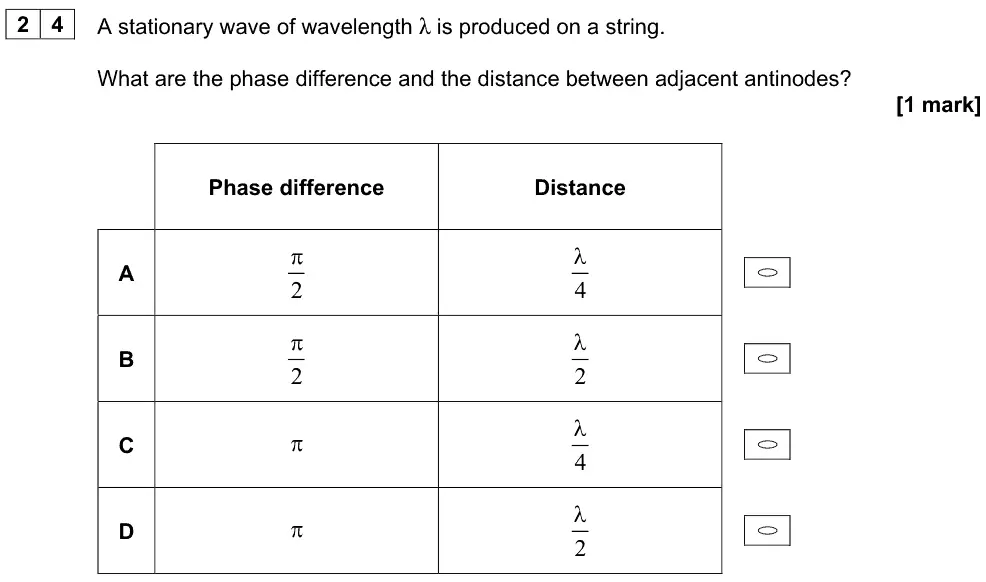
A stationary wave of wavelength λ is produced on a string.
What are the phase difference and the distance between adjacent antinodes?
[1 mark]
Phase difference
Distance
A
2
π
4
λ
B
2
π
2
λ
C
π
4
λ
D
π
2
λ
June 2023 · AS Paper 2 · Q25 1 mark Multiple choice interference and diffraction
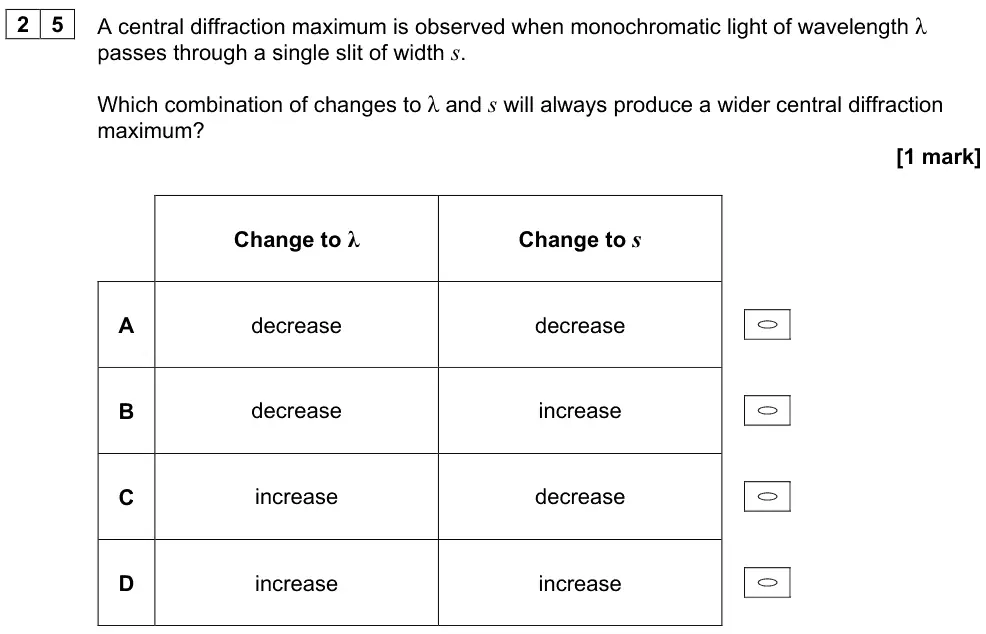
A central diffraction maximum is observed when monochromatic light of wavelength λ
passes through a single slit of width s.
Which combination of changes to λ and s will always produce a wider central diffraction
maximum?
[1 mark]
Change to λ
Change to s
A
decrease
decrease
B
decrease
increase
C
increase
decrease
D
increase
increase
June 2023 · AS Paper 2 · Q26 1 mark Multiple choice work energy and powermotion and projectiles
A ball is dropped from a height h.  The ball hits the ground with a velocity v.
The ball is now dropped from a height of 2h.
Air resistance is negligible.
What is the velocity at which the ball hits the ground?
[1 mark]
A v
B
2v
C
2
v
D 2v
June 2023 · AS Paper 2 · Q27 1 mark Multiple choice Easy materials and young modulus
The graph shows the variation of stress with strain for a material.
What is the Young modulus of the material?
[1 mark]
A 1.2 × 10⁵ Pa
B 1.5 × 10⁵ Pa
C 1.2 × 10¹¹ Pa
D 1.5 × 10¹¹ Pa
June 2023 · AS Paper 2 · Q28 1 mark Multiple choice Easy current voltage and resistivity
Which row shows the resistance of an ideal ammeter and of an ideal voltmeter?
[1 mark]
Resistance of ammeter
Resistance of voltmeter
A
zero
zero
B
zero
infinite
C
infinite
zero
D
infinite
infinite
June 2023 · AS Paper 2 · Q29 1 mark Multiple choice current voltage and resistivity
The current in a resistor is 15 mA.
How many electrons pass through the resistor in 3 minutes?
[1 mark]
A 2.8 × 10¹⁷
B 1.7 × 10¹⁹
C 2.8 × 10²⁰
D 1.7 × 10²²
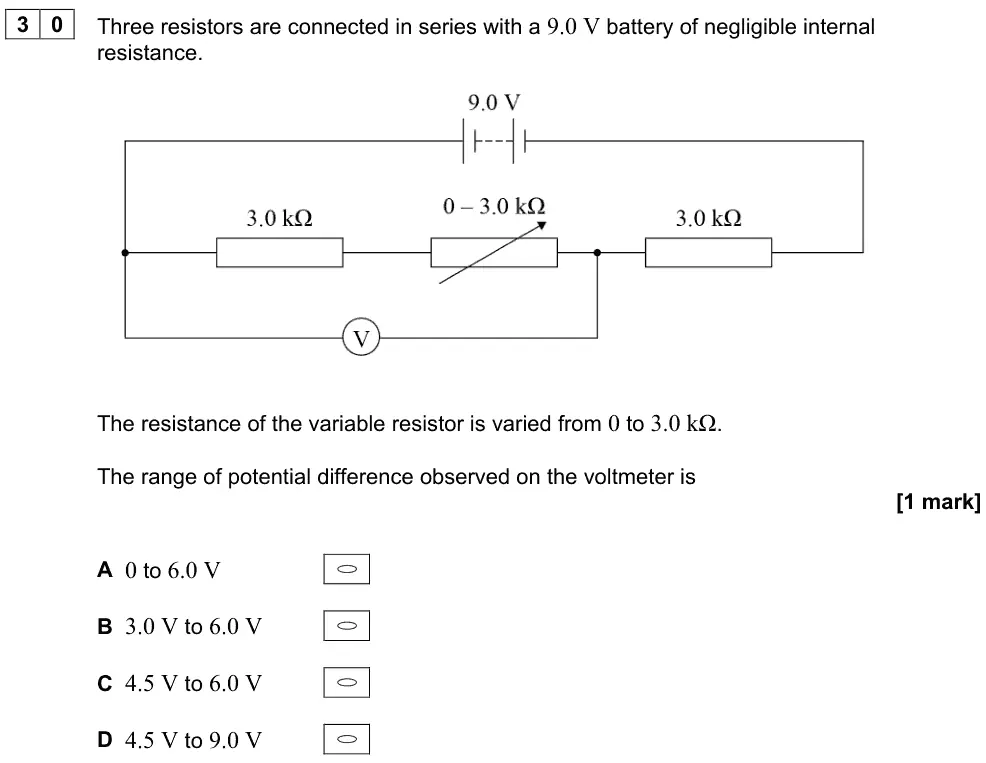
June 2023 · AS Paper 2 · Q30 1 mark Multiple choice circuits and potential dividers
Three resistors are connected in series with a 9.0 V battery of negligible internal
resistance.
The resistance of the variable resistor is varied from 0 to 3.0 kΩ.
The range of potential difference observed on the voltmeter is
[1 mark]
A 0 to 6.0 V
B 3.0 V to 6.0 V
C 4.5 V to 6.0 V
D 4.5 V to 9.0 V
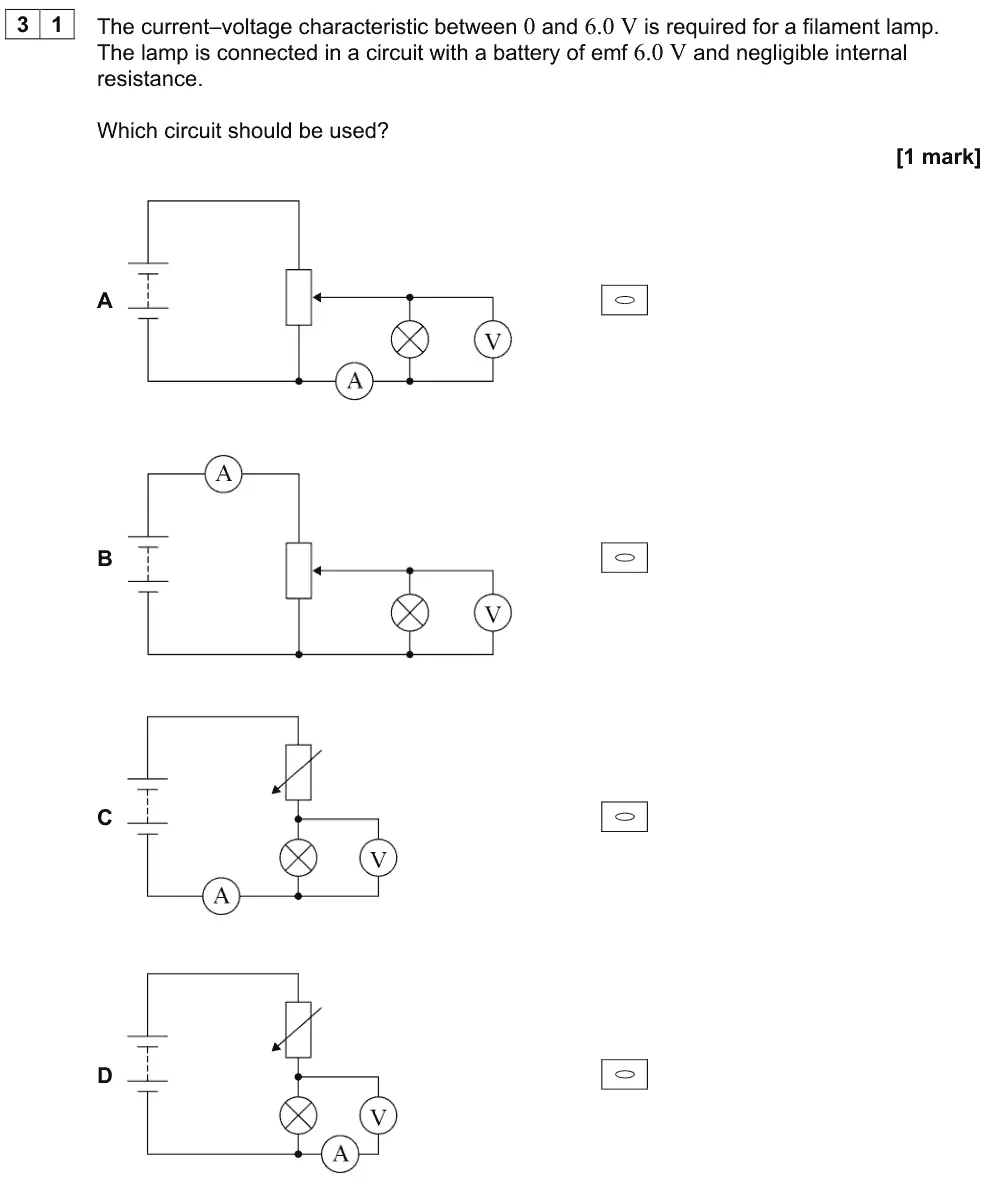
June 2023 · AS Paper 2 · Q31 1 mark Multiple choice Hard circuits and potential dividerscurrent voltage and resistivity
The current–voltage characteristic between 0 and 6.0 V is required for a filament lamp.
The lamp is connected in a circuit with a battery of emf 6.0 V and negligible internal
resistance.
Which circuit should be used?
[1 mark]
A
B
C
D
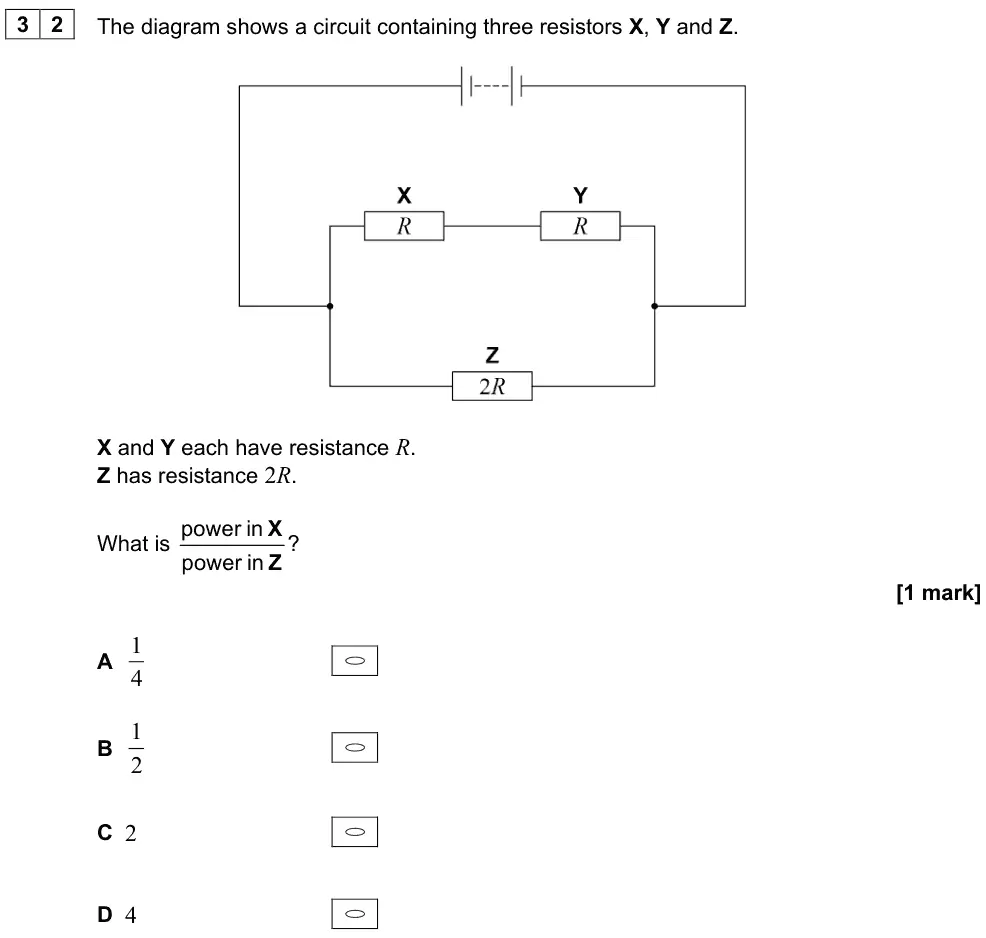
June 2023 · AS Paper 2 · Q32 1 mark Multiple choice circuits and potential dividers
The diagram shows a circuit containing three resistors X, Y and Z.
X and Y each have resistance R.
Z has resistance 2R.
What is power in
?
power in
X
Z
[1 mark]
A 1
4
B 1
2
C 2
D 4
June 2023 · AS Paper 2 · Q33 1 mark Multiple choice work energy and power
A pellet of mass 25 g travelling horizontally at 40 m s−1 enters a fixed wooden block.  The
pellet stops after travelling a horizontal distance of 2.5 cm in the block.
What is the average resistive force acting on the pellet?
[1 mark]
A 20 N
B 800 N
C 1600 N
D 8000 N
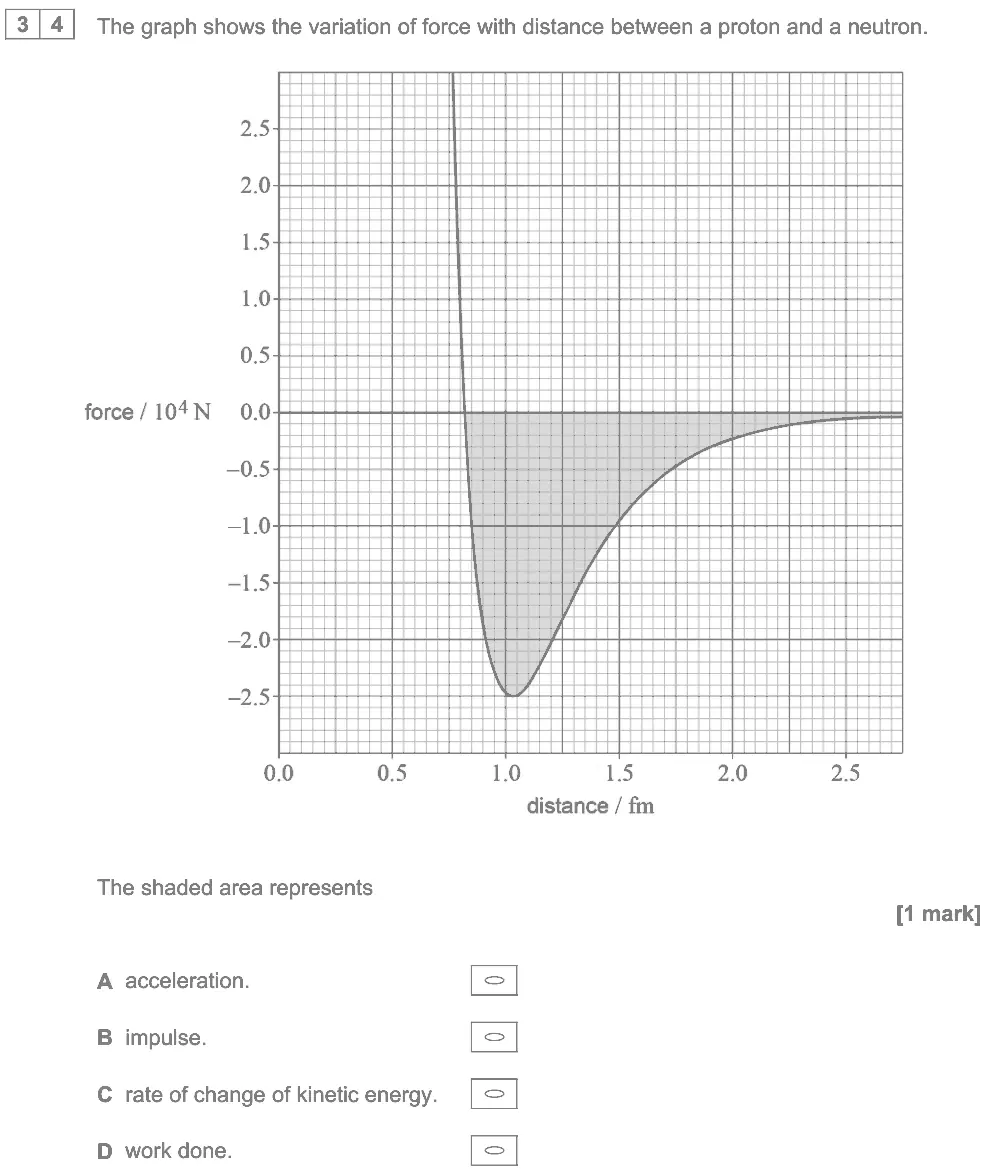
June 2023 · AS Paper 2 · Q34 1 mark Multiple choice work energy and power
The graph shows the variation of force with distance between a proton and a neutron.
The shaded area represents
[1 mark]
A acceleration.
B impulse.
C rate of change of kinetic energy.
D work done.

Work with an AQA physics tutor

Want a paper marked and gone through with you? Message us.

Prefer email? Send an enquiry

If you are under 18, please include a parent's contact details. Enquiries go to enquiries@physicsaleveltutor.com and are deleted once handled. All tutoring is online.