June 2024: AS Paper 2

70 marks · 49 question parts · Paper, mark scheme and report on AQA's site · Have the data and formulae booklet beside you

Question by question

QTopicMarksAOType
1.1 Measurements, units and uncertainties, Progressive waves, longitudinal and transverse waves 1AO2=1Show that
1.2 Progressive waves, longitudinal and transverse waves 2AO3=2Calculation
1.3 Measurements, units and uncertainties 1AO2=1Short answer
1.4 Motion along a straight line and projectile motion 2AO2=2Calculation
1.5 Measurements, units and uncertainties 2AO1=2Practical and data analysis
1.6 Measurements, units and uncertainties 2AO3=2Calculation
1.7 Newton's laws of motion and momentum, Scalars, vectors and moments 2AO3=2Explanation
2.1 Measurements, units and uncertainties 1AO2=1Calculation
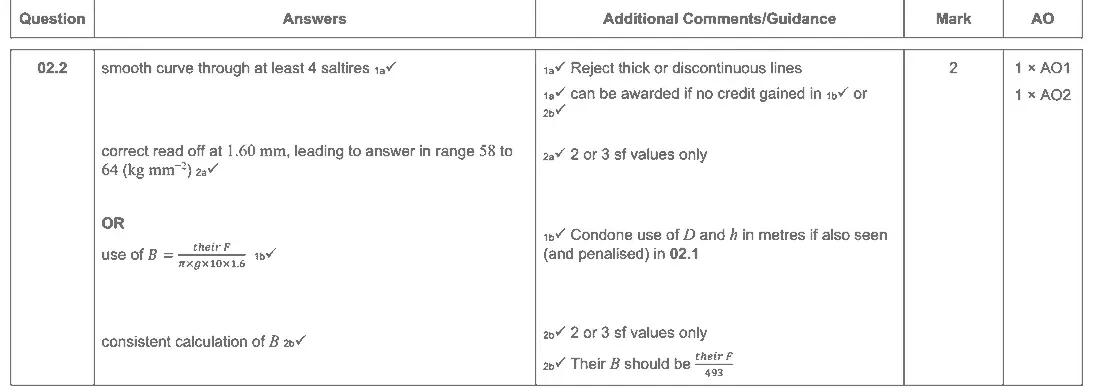
2.2 Measurements, units and uncertainties 2AO1=1,AO2=1Calculation
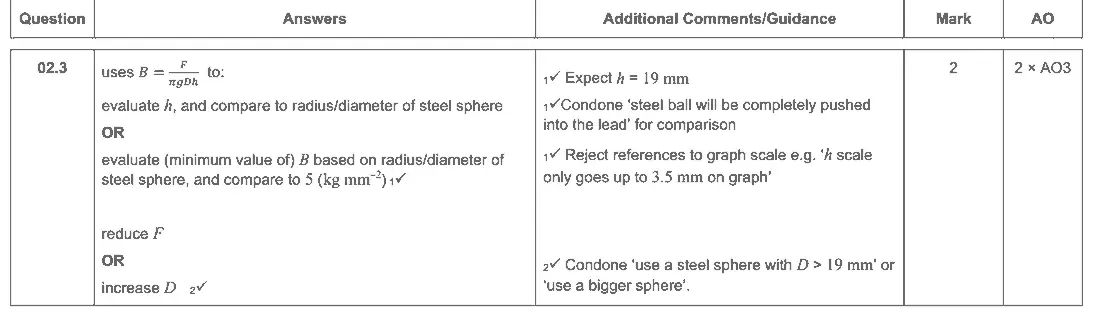
2.3 Measurements, units and uncertainties 2AO3=2Explanation
2.4 Measurements, units and uncertainties 1AO1=1Short answer
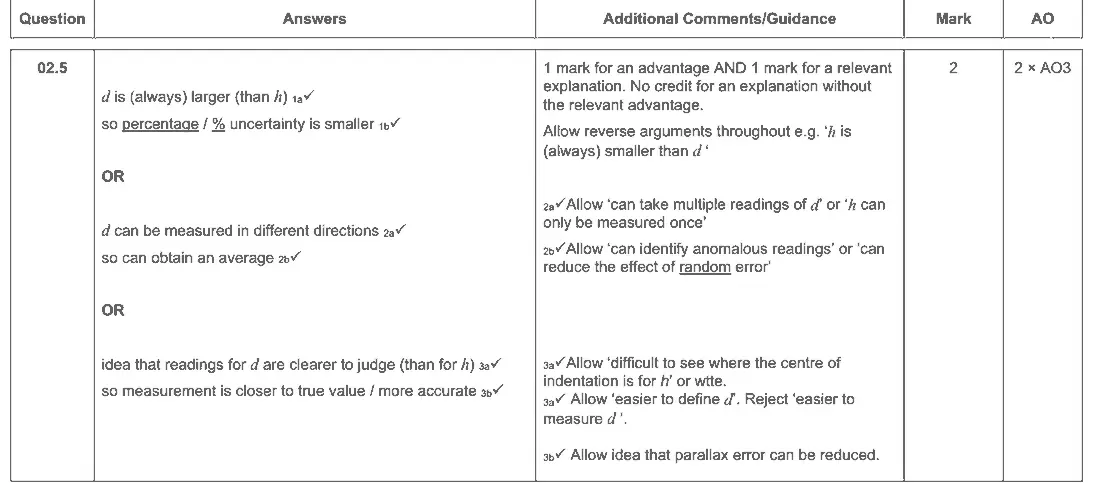
2.5 Measurements, units and uncertainties 2AO3=2Practical and data analysis
3.1 Materials, stress, strain and the Young modulus 2AO2=2Calculation
3.2 Newton's laws of motion and momentum 4AO2=4Calculation
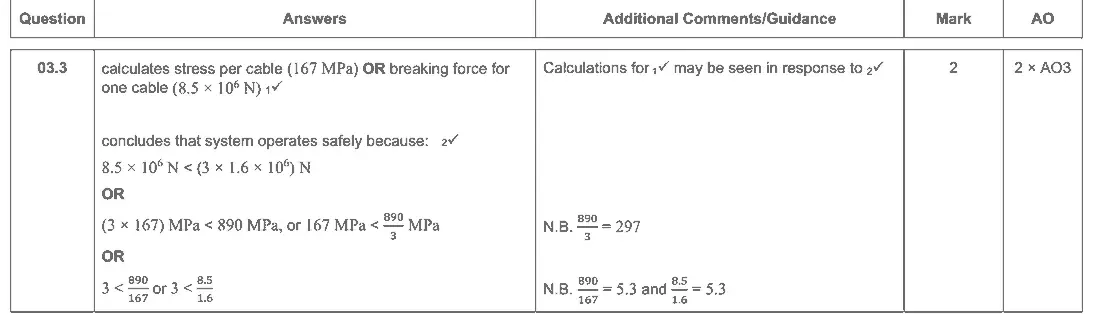
3.3 Materials, stress, strain and the Young modulus 2AO3=2Explanation
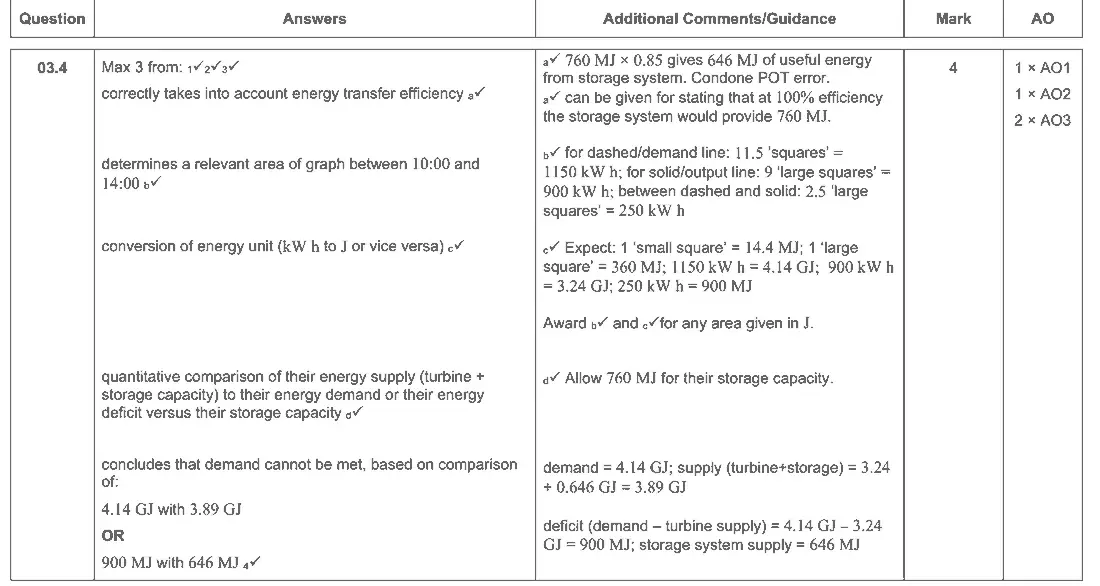
3.4 Work, energy, power and conservation of energy 4AO1=1,AO2=1,AO3=2Calculation
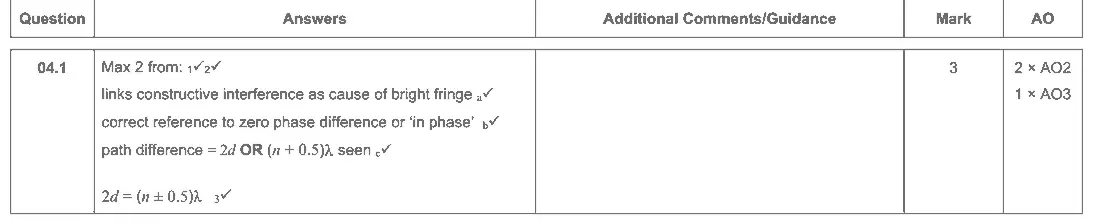
4.1 Interference, diffraction and the diffraction grating, Progressive waves, longitudinal and transverse waves 3AO2=2,AO3=1Explanation
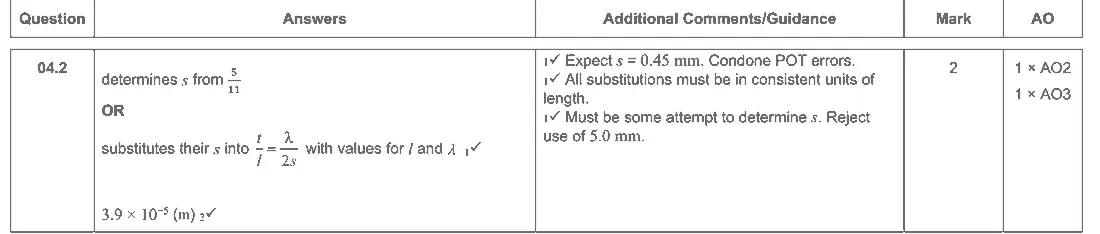
4.2 Interference, diffraction and the diffraction grating 2AO2=1,AO3=1Calculation
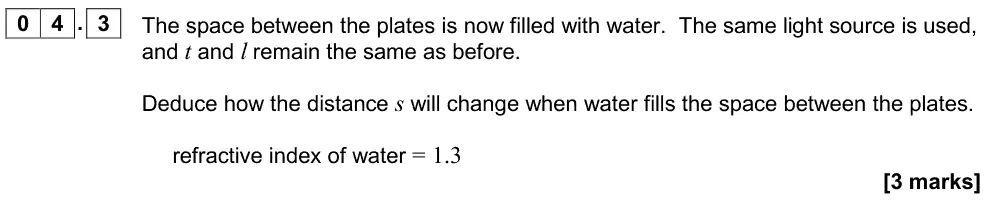
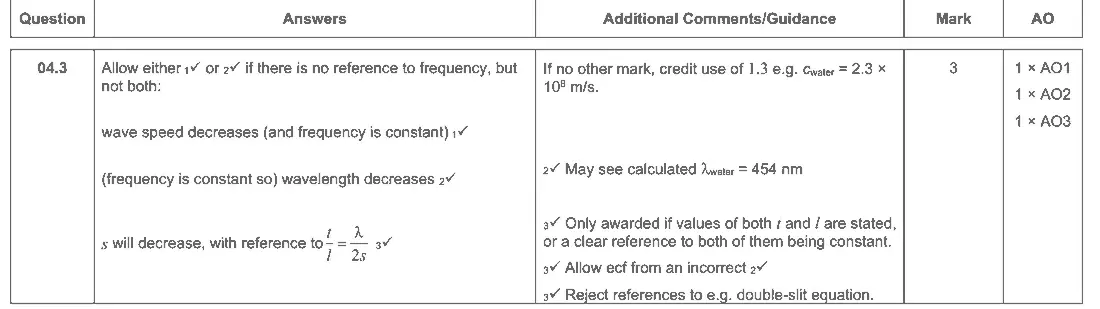
4.3 Refraction, total internal reflection and optical fibres, Progressive waves, longitudinal and transverse waves 3AO1=1,AO2=1,AO3=1Explanation
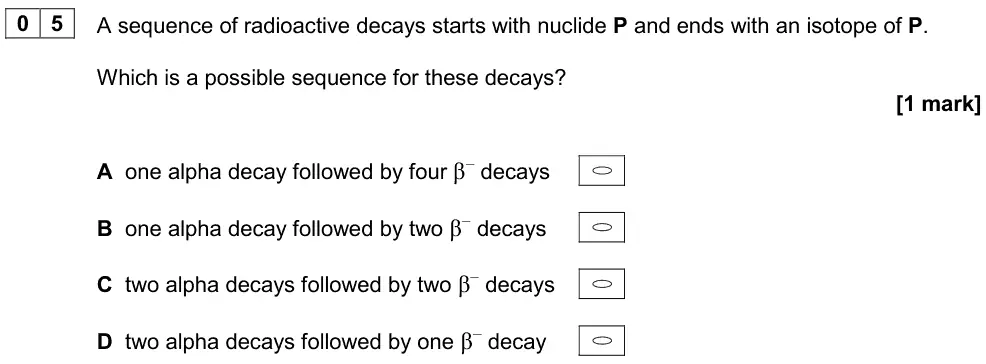
5 Atomic structure and stable nuclei 1Multiple choice
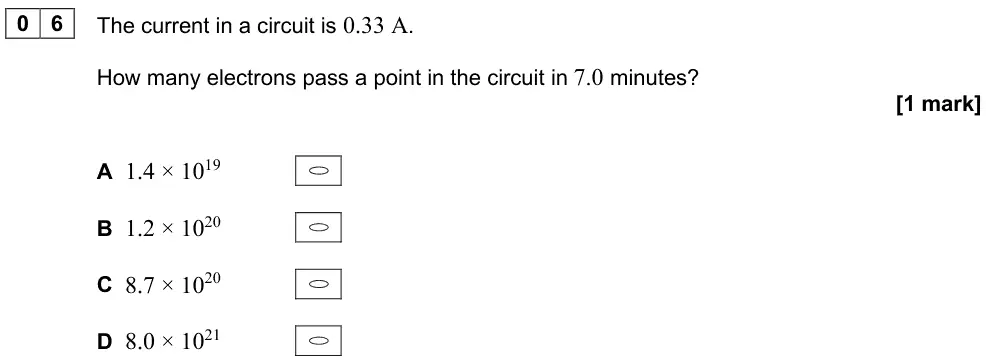
6 Current, potential difference, I-V characteristics and resistivity 1Multiple choice
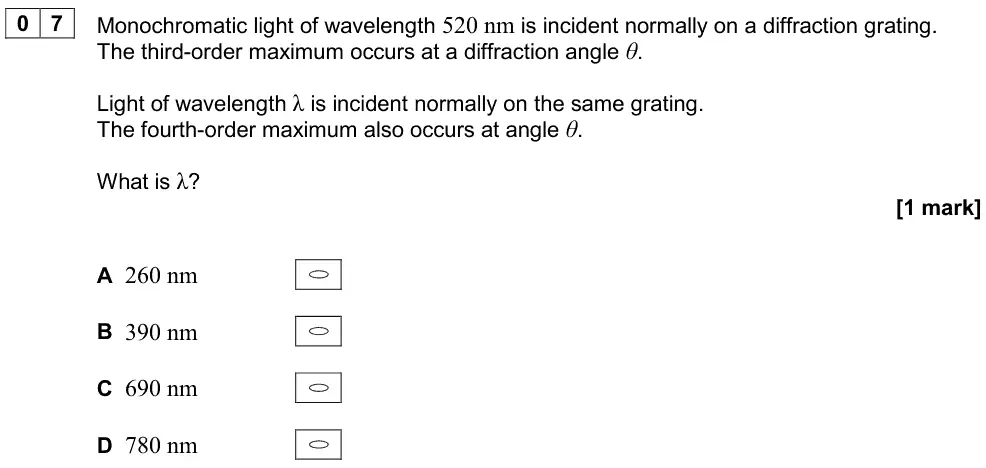
7 Interference, diffraction and the diffraction grating 1Multiple choice
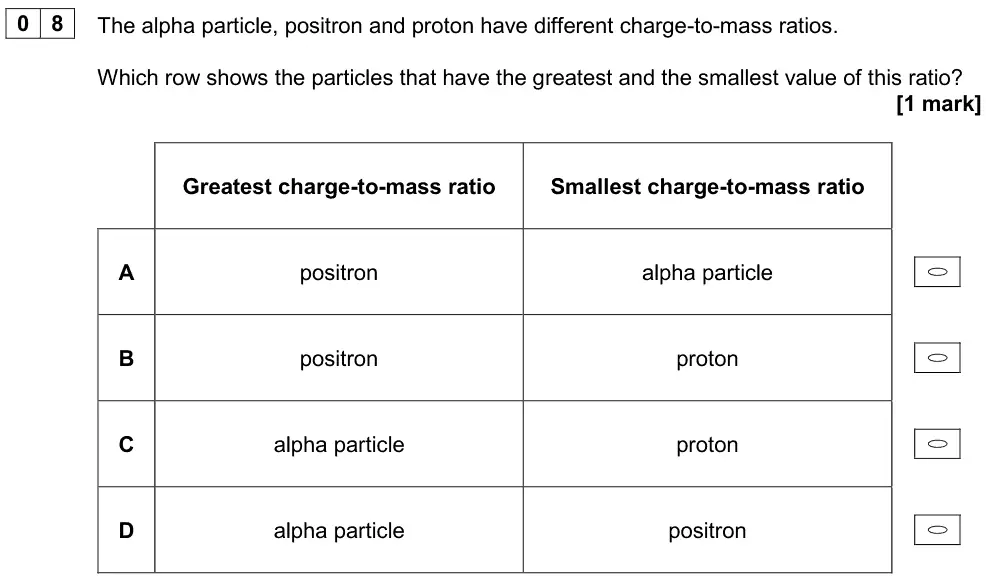
8 Atomic structure and stable nuclei 1Multiple choice
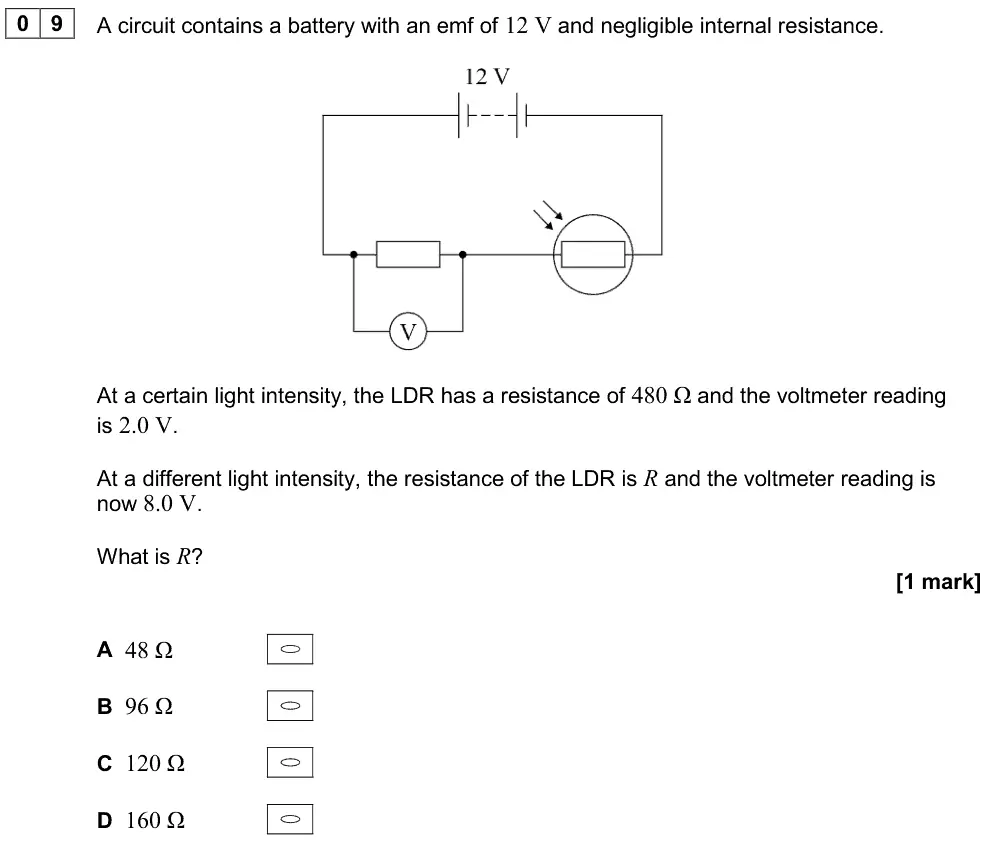
9 Circuits and potential dividers 1Multiple choice
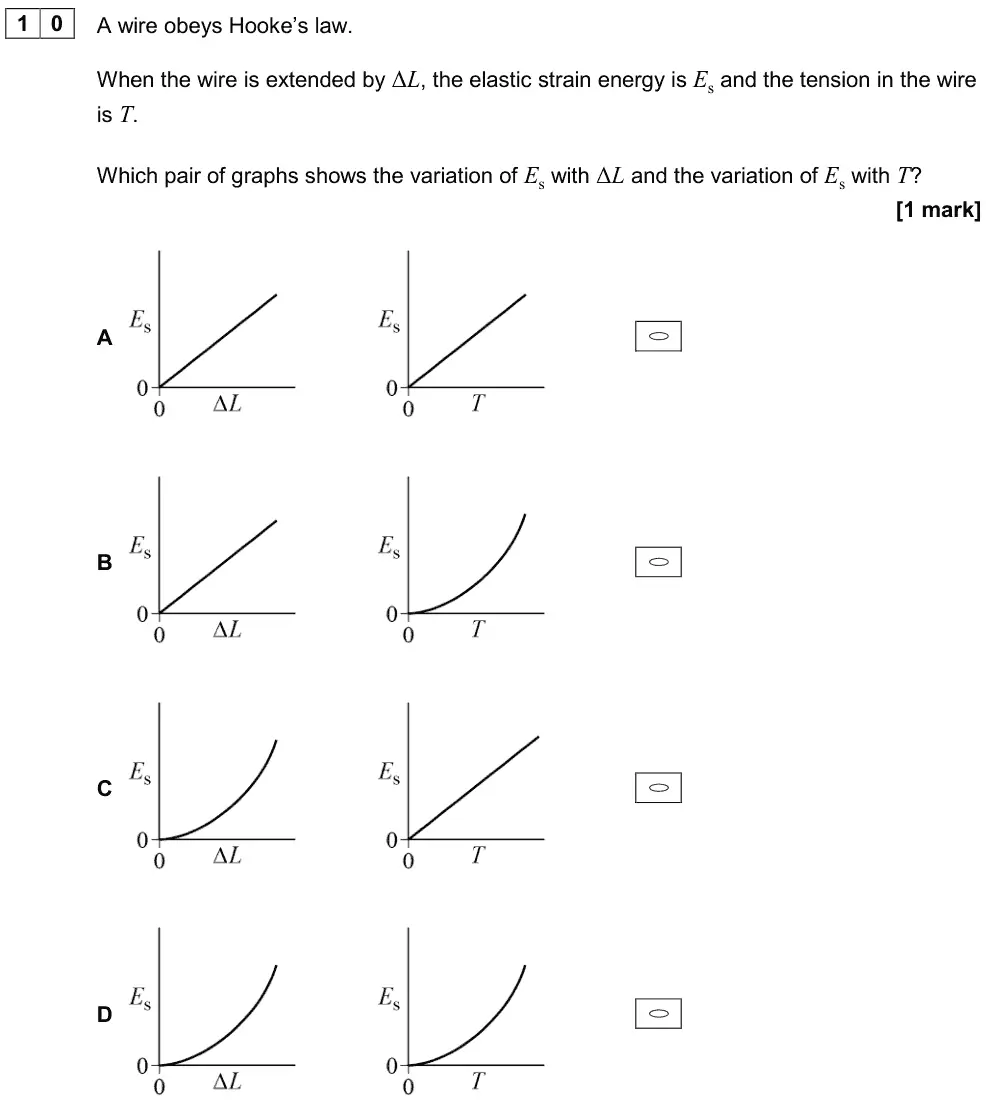
10 Materials, stress, strain and the Young modulus 1Multiple choice
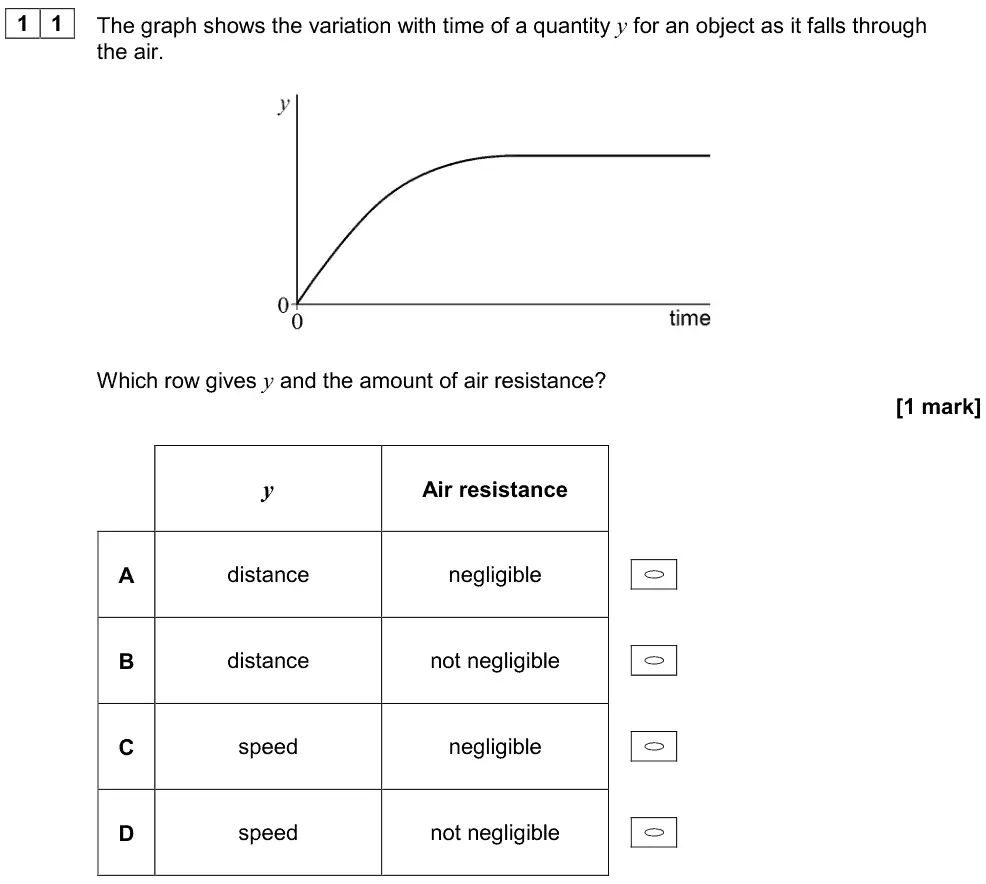
11 Motion along a straight line and projectile motion 1Multiple choice
12 Work, energy, power and conservation of energy 1Multiple choice
13 Circuits and potential dividers 1Multiple choice
14 The photoelectric effect 1Multiple choice
15 Interference, diffraction and the diffraction grating 1Multiple choice
16 Classification of particles, quarks and conservation laws, Particles, antiparticles and particle interactions 1Multiple choice
17 Excitation, energy levels and wave-particle duality 1Multiple choice
18 Circuits and potential dividers 1Multiple choice
19 Motion along a straight line and projectile motion 1Multiple choice
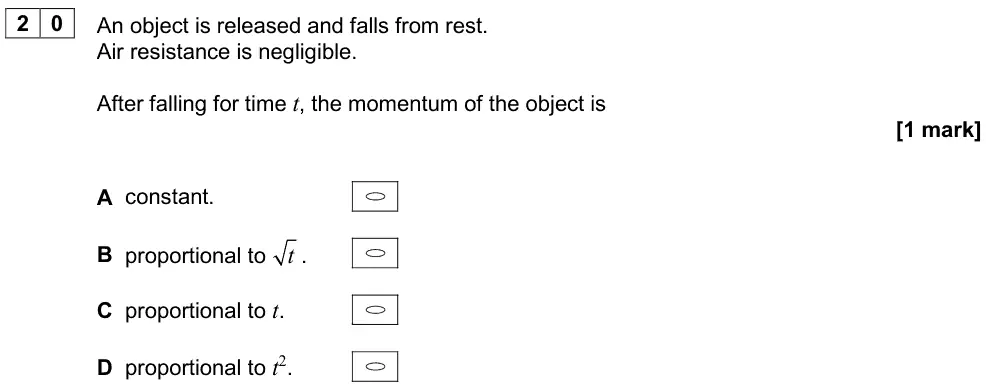
20 Newton's laws of motion and momentum, Motion along a straight line and projectile motion 1Multiple choice
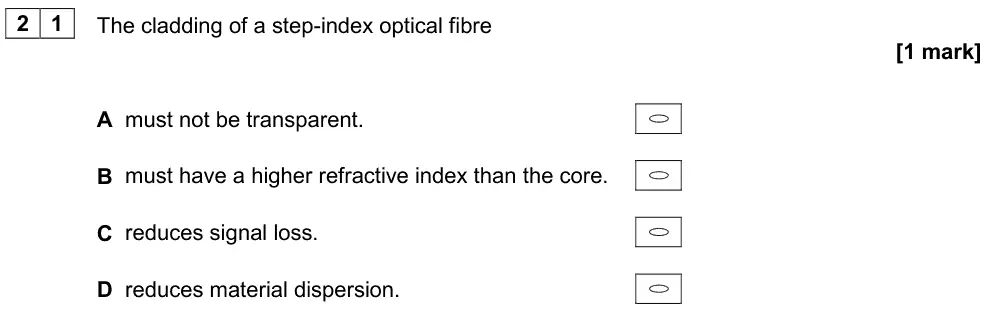
21 Refraction, total internal reflection and optical fibres 1Multiple choice
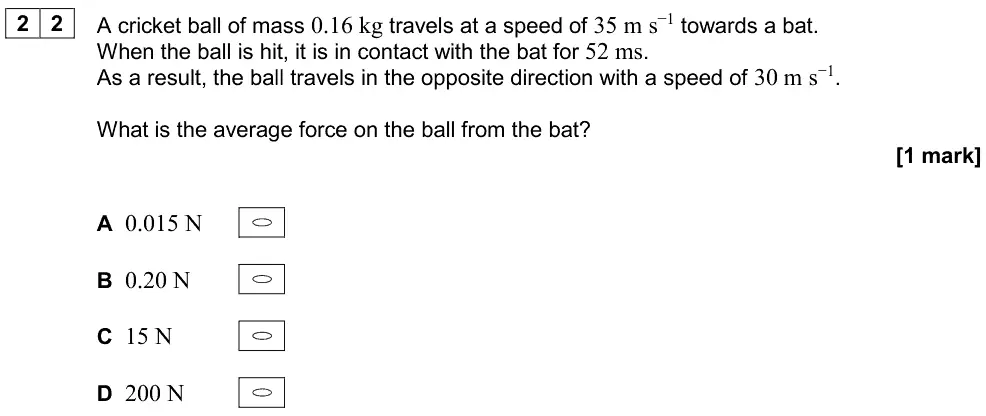
22 Newton's laws of motion and momentum 1Multiple choice
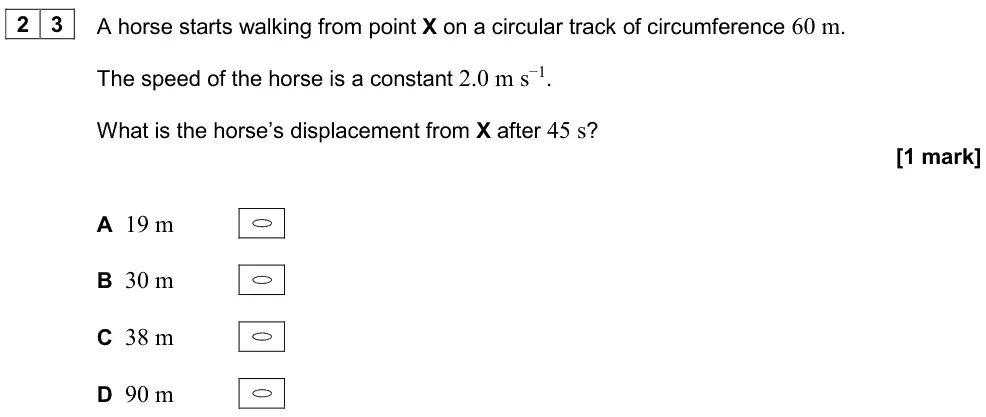
23 Motion along a straight line and projectile motion 1Multiple choice
24 Materials, stress, strain and the Young modulus 1Multiple choice
25 Scalars, vectors and moments 1Multiple choice
26 Circuits and potential dividers, Current, potential difference, I-V characteristics and resistivity 1Multiple choice
27 Work, energy, power and conservation of energy 1Multiple choice
28 Current, potential difference, I-V characteristics and resistivity 1Multiple choice
29 Newton's laws of motion and momentum 1Multiple choice
30 Superposition and stationary waves, Progressive waves, longitudinal and transverse waves 1Multiple choice
31 Scalars, vectors and moments 1Multiple choice
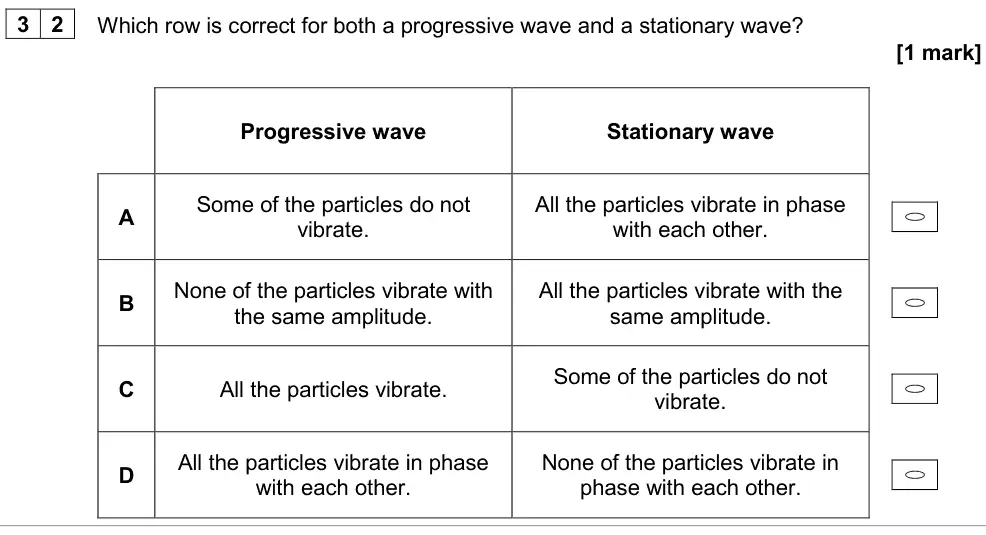
32 Superposition and stationary waves, Progressive waves, longitudinal and transverse waves 1Multiple choice
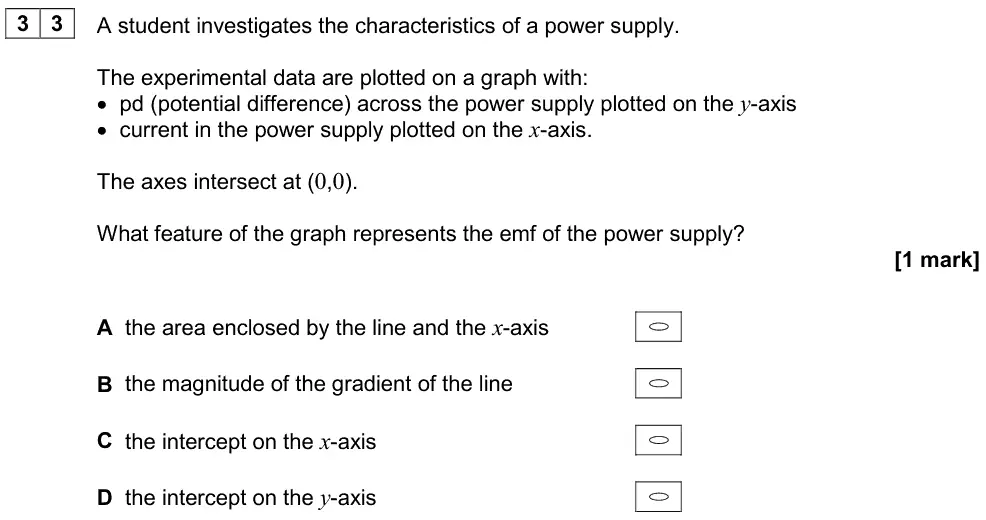
33 Electromotive force and internal resistance 1Multiple choice
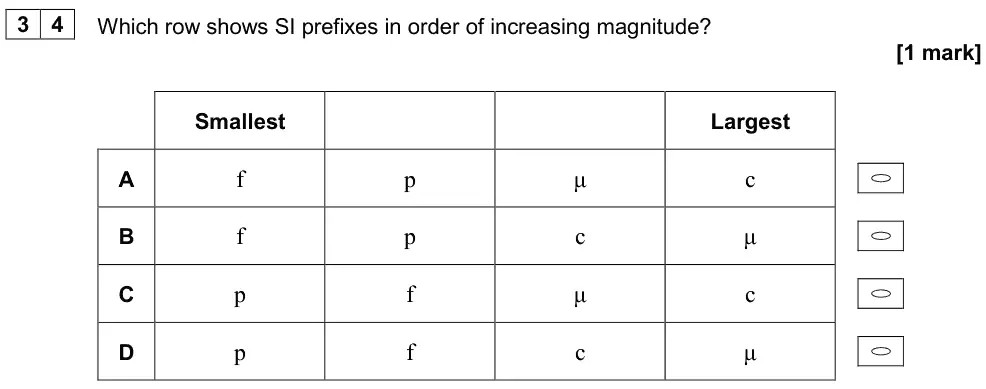
34 Measurements, units and uncertainties 1Multiple choice

The questions

1.11.21.31.41.51.61.72.12.22.32.42.53.13.23.33.44.14.24.35678910111213141516171819202122232425262728293031323334
June 2024 · AS Paper 2 · Q1.1 1 mark AO2=1 Show that Easy measurements and uncertaintiesprogressive waves and polarisation
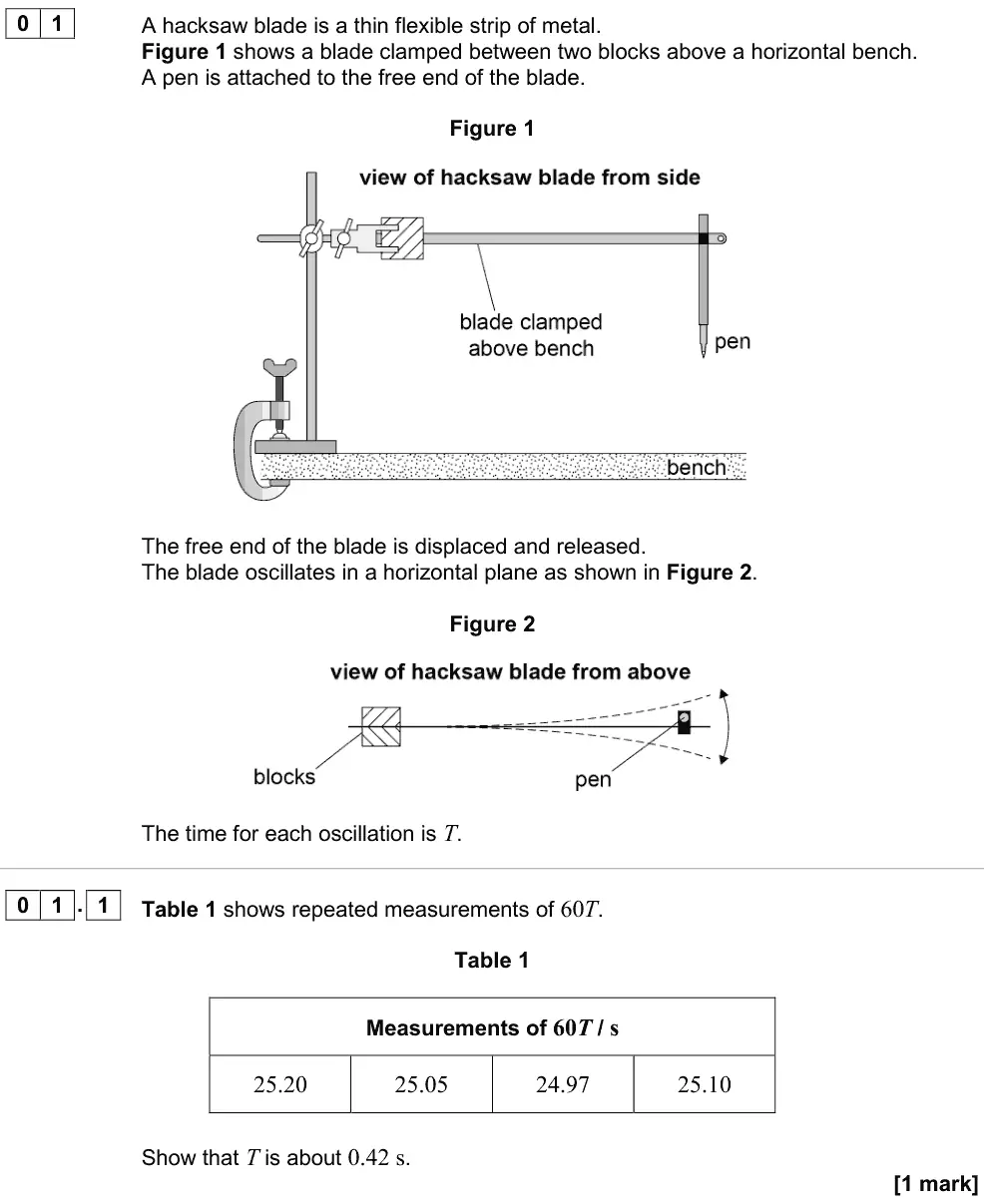
A hacksaw blade is a thin flexible strip of metal.
Figure 1 shows a blade clamped between two blocks above a horizontal bench.
A pen is attached to the free end of the blade.
Figure 1
The free end of the blade is displaced and released.
The blade oscillates in a horizontal plane as shown in Figure 2.
Figure 2
The time for each oscillation is T.
Table 1 shows repeated measurements of 60T.
Table 1
Measurements of 60T / s
25.20
25.05
24.97
25.10
Show that T is about 0.42 s.
[1 mark]
June 2024 · AS Paper 2 · Q1.2 2 marks AO3=2 Calculation progressive waves and polarisation
Earlier part of question 1 that this part usesEarlier part of June 2024 Paper 2 question 1
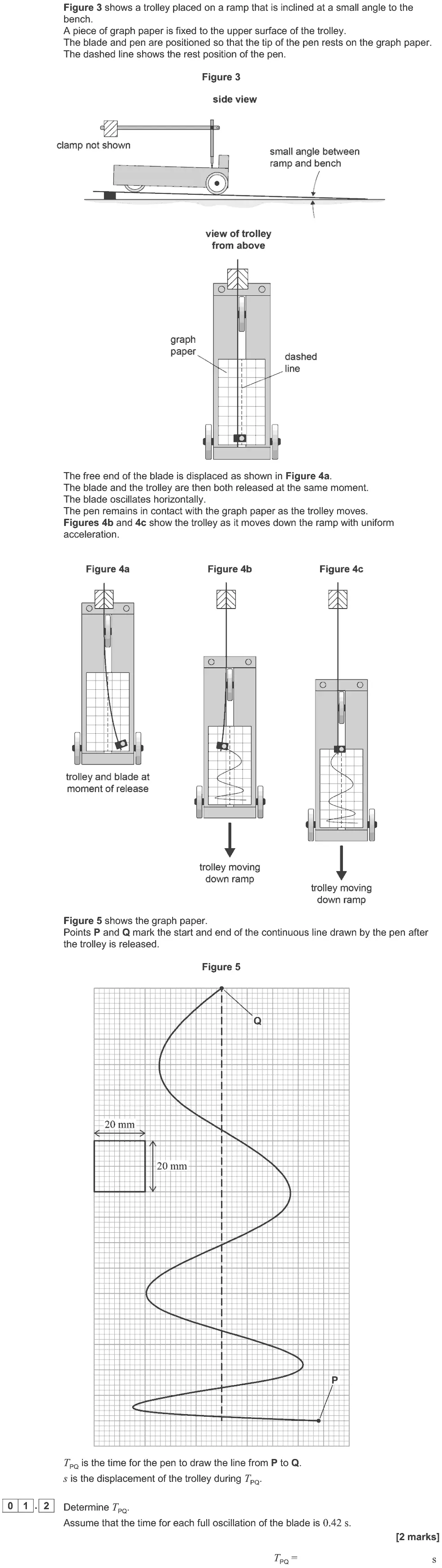
Figure 3 shows a trolley placed on a ramp that is inclined at a small angle to the
bench.
A piece of graph paper is fixed to the upper surface of the trolley.
The blade and pen are positioned so that the tip of the pen rests on the graph paper.
The dashed line shows the rest position of the pen.
Figure 3
The free end of the blade is displaced as shown in Figure 4a.
The blade and the trolley are then both released at the same moment.
The blade oscillates horizontally.
The pen remains in contact with the graph paper as the trolley moves.
Figures 4b and 4c show the trolley as it moves down the ramp with uniform
acceleration.
Figure 5 shows the graph paper.
Points P and Q mark the start and end of the continuous line drawn by the pen after
the trolley is released.
Figure 5
TPQ is the time for the pen to draw the line from P to Q.
s is the displacement of the trolley during TPQ.
Determine TPQ.
Assume that the time for each full oscillation of the blade is 0.42 s.
[2 marks]
TPQ =
s
June 2024 · AS Paper 2 · Q1.3 1 mark AO2=1 Short answer measurements and uncertainties
Earlier part of question 1 that this part usesEarlier part of June 2024 Paper 2 question 1
Determine s.
The scale of the graph paper is shown on Figure 5.
[1 mark]
s =
m
June 2024 · AS Paper 2 · Q1.4 2 marks AO2=2 Calculation motion and projectiles
Earlier part of question 1 that this part usesEarlier part of June 2024 Paper 2 question 1
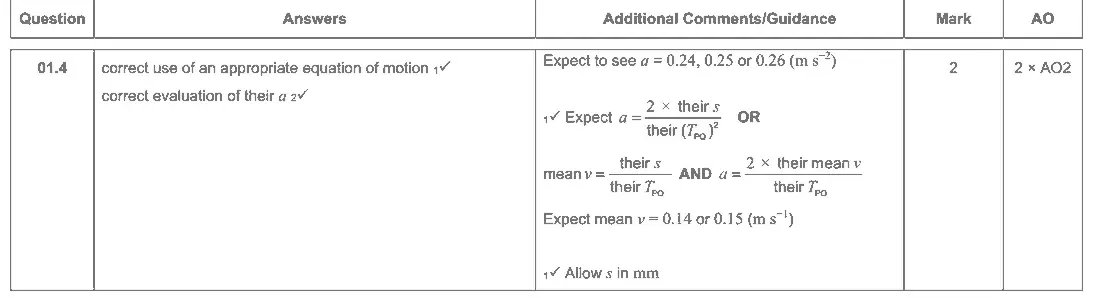
Determine the acceleration a of the trolley.
[2 marks]
a =
m s−2
June 2024 · AS Paper 2 · Q1.5 2 marks AO1=2 Practical and data analysis measurements and uncertainties
Earlier part of question 1 that this part usesEarlier part of June 2024 Paper 2 question 1
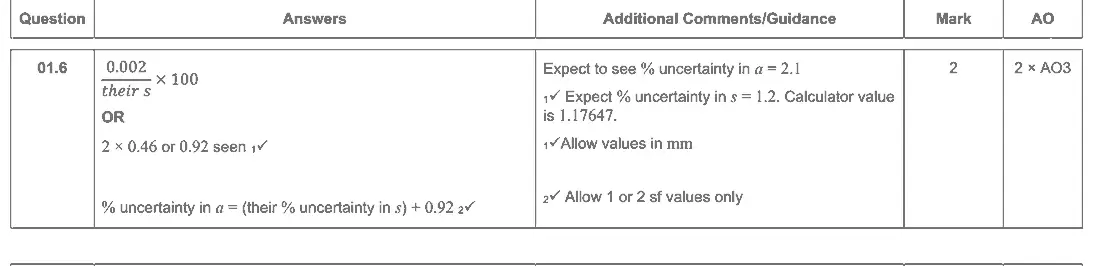
A teacher suggests that the absolute uncertainty in s is ±2 mm.
Explain why this is a valid suggestion.
[2 marks]
June 2024 · AS Paper 2 · Q1.6 2 marks AO3=2 Calculation Hard measurements and uncertainties
Earlier part of question 1 that this part usesEarlier part of June 2024 Paper 2 question 1
The percentage uncertainty in TPQ is 0.46%.
Determine the percentage uncertainty in your result for a.
[2 marks]
percentage uncertainty =
%
June 2024 · AS Paper 2 · Q1.7 2 marks AO3=2 Explanation newtons laws and momentumvectors and moments
Earlier part of question 1 that this part usesEarlier part of June 2024 Paper 2 question 1
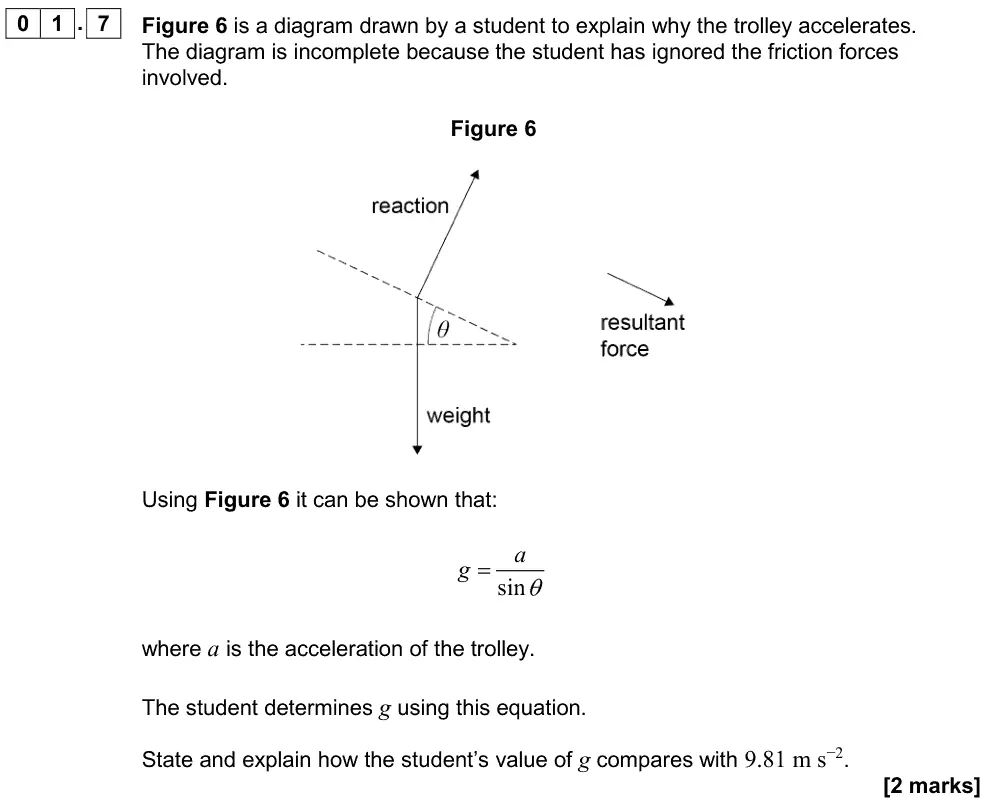
Figure 6 is a diagram drawn by a student to explain why the trolley accelerates.
The diagram is incomplete because the student has ignored the friction forces
involved.
Figure 6
Using Figure 6 it can be shown that:
sin
a
g =
where a is the acceleration of the trolley.
The student determines g using this equation.
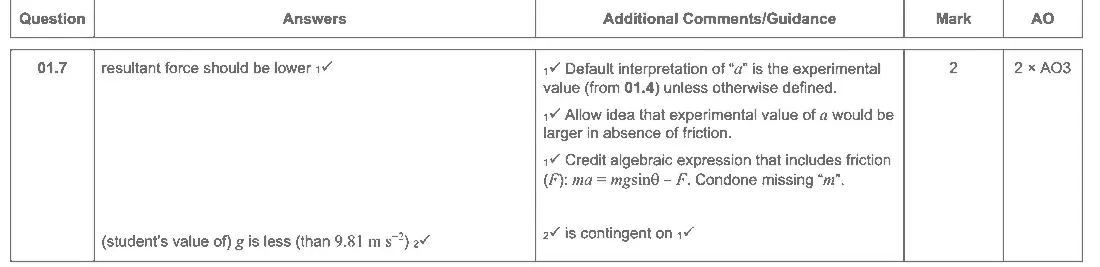
State and explain how the student’s value of g compares with 9.81 m s−2.
[2 marks]
June 2024 · AS Paper 2 · Q2.1 1 mark AO2=1 Calculation measurements and uncertainties
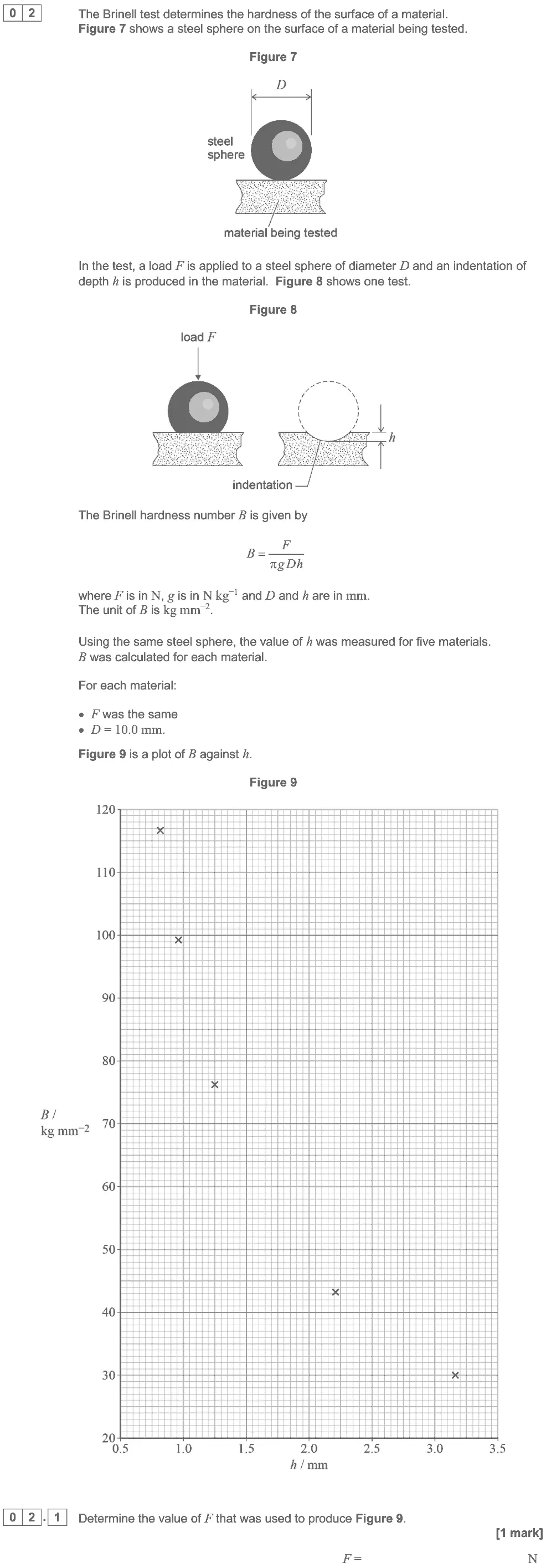
The Brinell test determines the hardness of the surface of a material.
Figure 7 shows a steel sphere on the surface of a material being tested.
Figure 7
In the test, a load F is applied to a steel sphere of diameter D and an indentation of
depth h is produced in the material.  Figure 8 shows one test.
Figure 8
The Brinell hardness number B is given by
F
B
gDh
= π
where F is in N, g is in N kg−1 and D and h are in mm.
The unit of B is kg mm−2.
Using the same steel sphere, the value of h was measured for five materials.
B was calculated for each material.
For each material:
• F was the same
• D = 10.0 mm.
Figure 9 is a plot of B against h.
Figure 9
Determine the value of F that was used to produce Figure 9.
[1 mark]
F =
N
June 2024 · AS Paper 2 · Q2.2 2 marks AO1=1, AO2=1 Calculation measurements and uncertainties
Earlier part of question 2 that this part usesEarlier part of June 2024 Paper 2 question 2
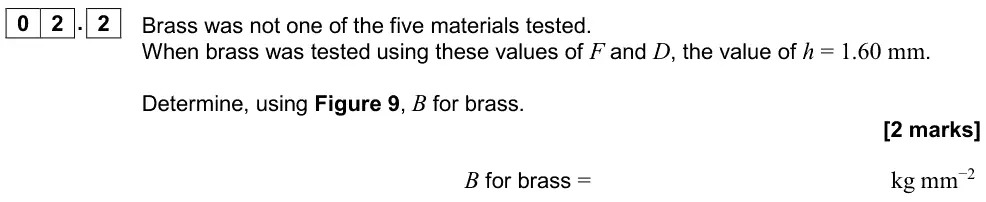
Brass was not one of the five materials tested.
When brass was tested using these values of F and D, the value of h = 1.60 mm.
Determine, using Figure 9, B for brass.
[2 marks]
B for brass =
kg mm−2
June 2024 · AS Paper 2 · Q2.3 2 marks AO3=2 Explanation measurements and uncertainties
Earlier part of question 2 that this part usesEarlier part of June 2024 Paper 2 question 2
B for lead is about 5 kg mm−2.
Show that this result cannot be obtained with the steel sphere and the value of F used
to produce Figure 9.
Go on to suggest how the test can be modified to determine B for lead.
[2 marks]
June 2024 · AS Paper 2 · Q2.4 1 mark AO1=1 Short answer measurements and uncertainties
Earlier part of question 2 that this part usesEarlier part of June 2024 Paper 2 question 2
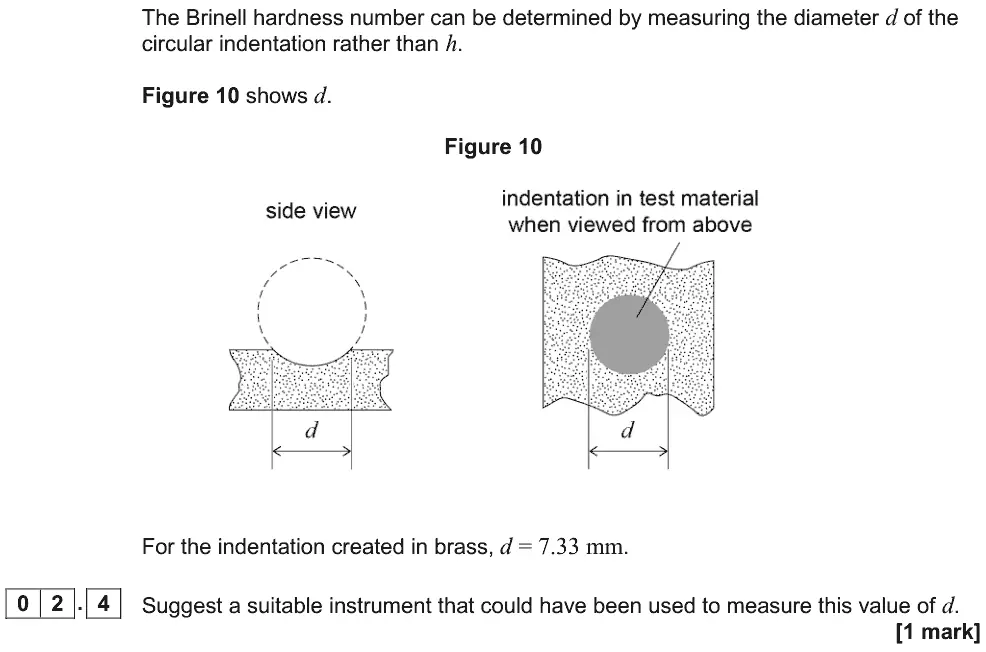
The Brinell hardness number can be determined by measuring the diameter d of the
circular indentation rather than h.
Figure 10 shows d.
Figure 10
For the indentation created in brass, d = 7.33 mm.
Suggest a suitable instrument that could have been used to measure this value of d.
[1 mark]
June 2024 · AS Paper 2 · Q2.5 2 marks AO3=2 Practical and data analysis measurements and uncertainties
Earlier part of question 2 that this part usesEarlier part of June 2024 Paper 2 question 2
For the indentation created in brass, h = 1.60 mm.
Explain one advantage of finding B by measuring d rather than h.
[2 marks]
June 2024 · AS Paper 2 · Q3.1 2 marks AO2=2 Calculation materials and young modulus
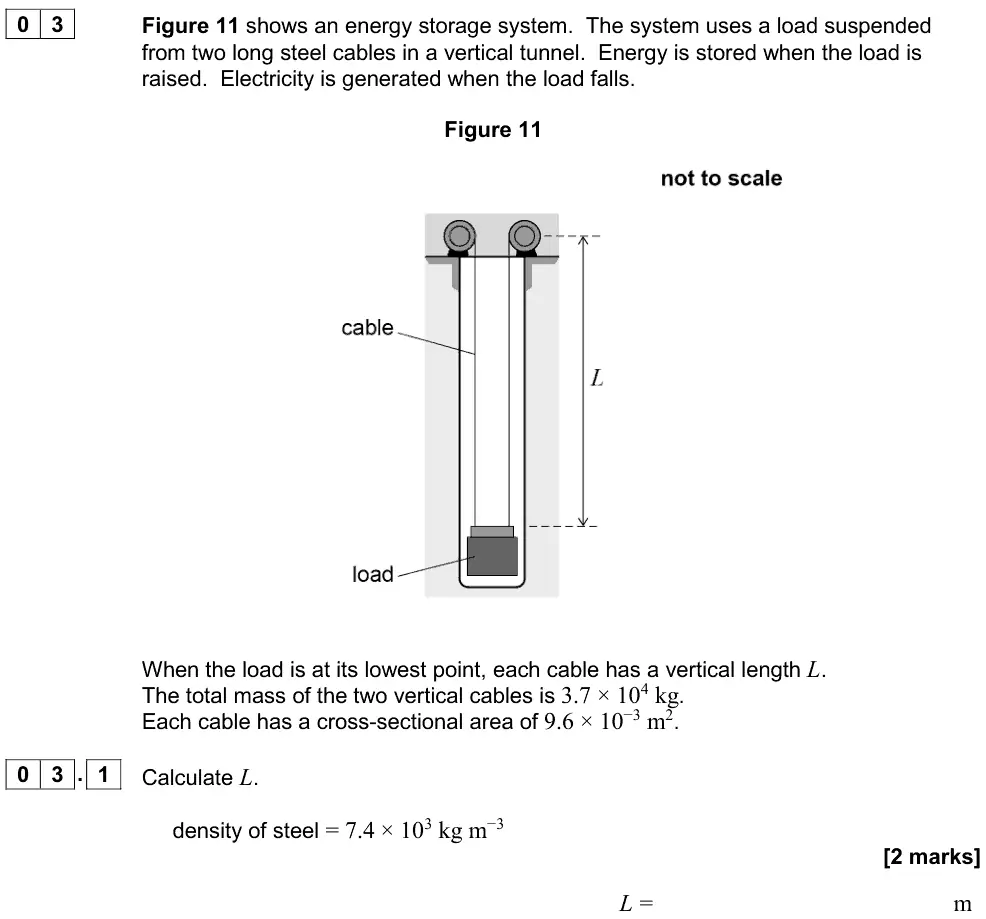
Figure 11 shows an energy storage system.  The system uses a load suspended
from two long steel cables in a vertical tunnel.  Energy is stored when the load is
raised.  Electricity is generated when the load falls.
Figure 11
When the load is at its lowest point, each cable has a vertical length L.
The total mass of the two vertical cables is 3.7 × 10⁴ kg.
Each cable has a cross-sectional area of 9.6 × 10⁻³ m2.
Calculate L.
density of steel = 7.4 × 10³ kg m−3
[2 marks]
L =
m
June 2024 · AS Paper 2 · Q3.2 4 marks AO2=4 Calculation newtons laws and momentum
Earlier part of question 3 that this part usesEarlier part of June 2024 Paper 2 question 3
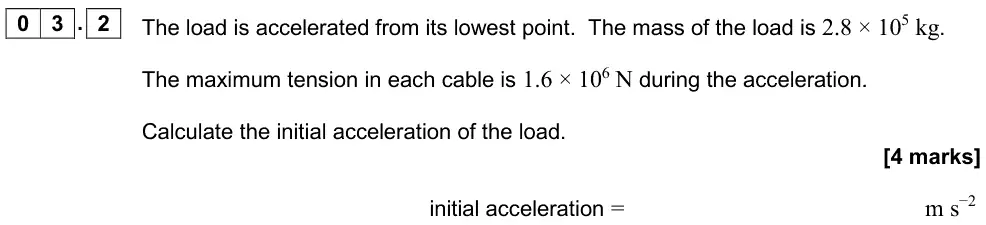
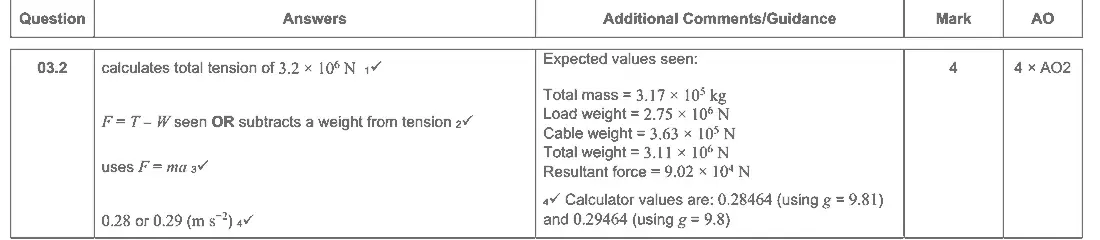
The load is accelerated from its lowest point.  The mass of the load is 2.8 × 10⁵ kg.
The maximum tension in each cable is 1.6 × 10⁶ N during the acceleration.
Calculate the initial acceleration of the load.
[4 marks]
initial acceleration =
m s−2
June 2024 · AS Paper 2 · Q3.3 2 marks AO3=2 Explanation materials and young modulus
Earlier part of question 3 that this part usesEarlier part of June 2024 Paper 2 question 3
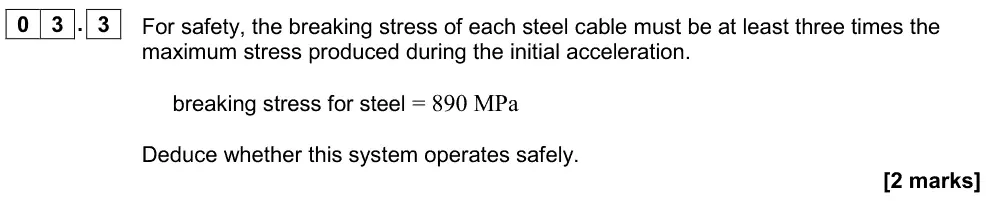
For safety, the breaking stress of each steel cable must be at least three times the
maximum stress produced during the initial acceleration.
breaking stress for steel = 890 MPa
Deduce whether this system operates safely.
[2 marks]
June 2024 · AS Paper 2 · Q3.4 4 marks AO1=1, AO2=1, AO3=2 Calculation work energy and power
Earlier part of question 3 that this part usesEarlier part of June 2024 Paper 2 question 3
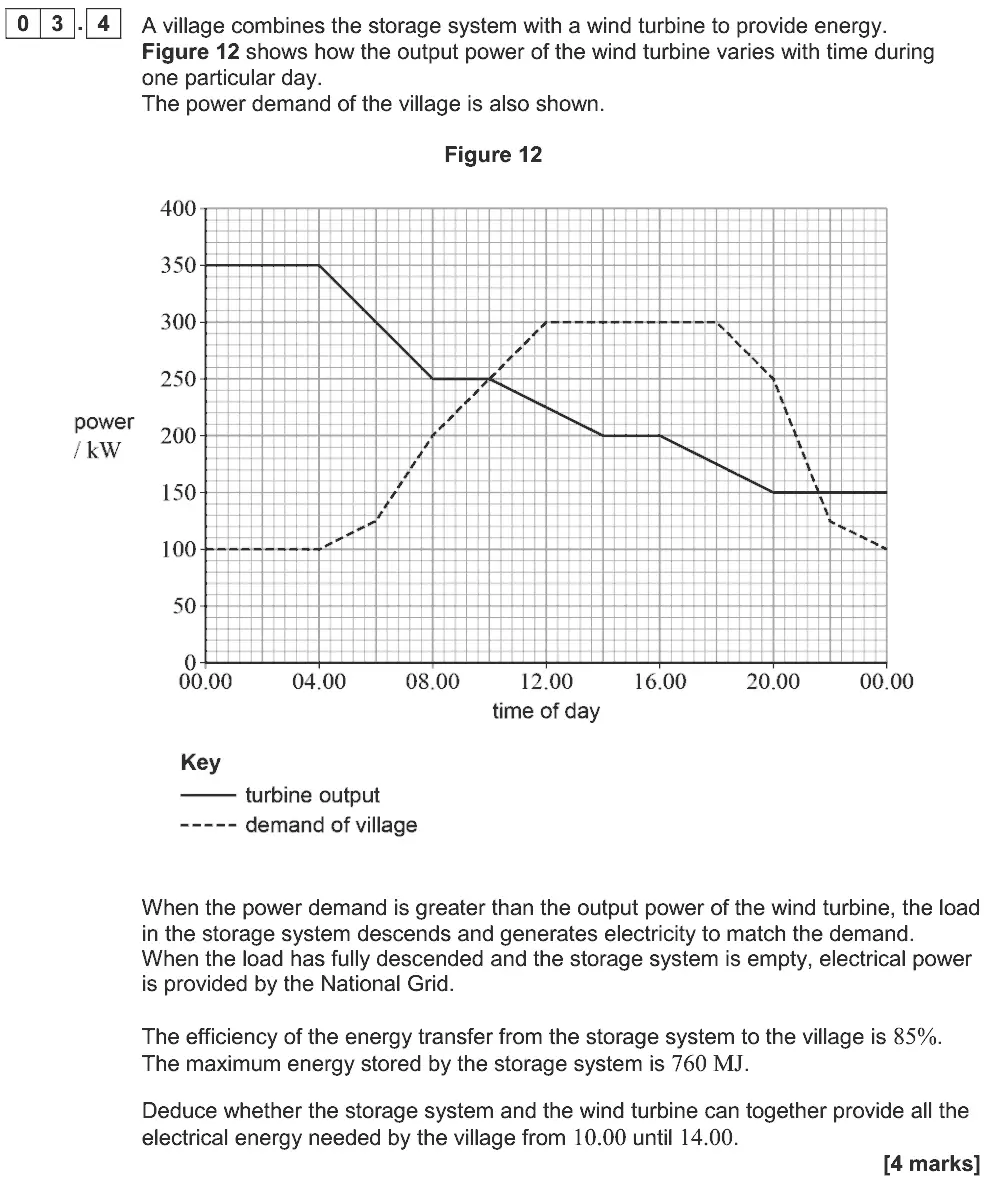
A village combines the storage system with a wind turbine to provide energy.
Figure 12 shows how the output power of the wind turbine varies with time during
one particular day.
The power demand of the village is also shown.
Figure 12
When the power demand is greater than the output power of the wind turbine, the load
in the storage system descends and generates electricity to match the demand.
When the load has fully descended and the storage system is empty, electrical power
is provided by the National Grid.
The efficiency of the energy transfer from the storage system to the village is 85%.
The maximum energy stored by the storage system is 760 MJ.
Deduce whether the storage system and the wind turbine can together provide all the
electrical energy needed by the village from 10.00 until 14.00.
[4 marks]
June 2024 · AS Paper 2 · Q4.1 3 marks AO2=2, AO3=1 Explanation interference and diffractionprogressive waves and polarisation
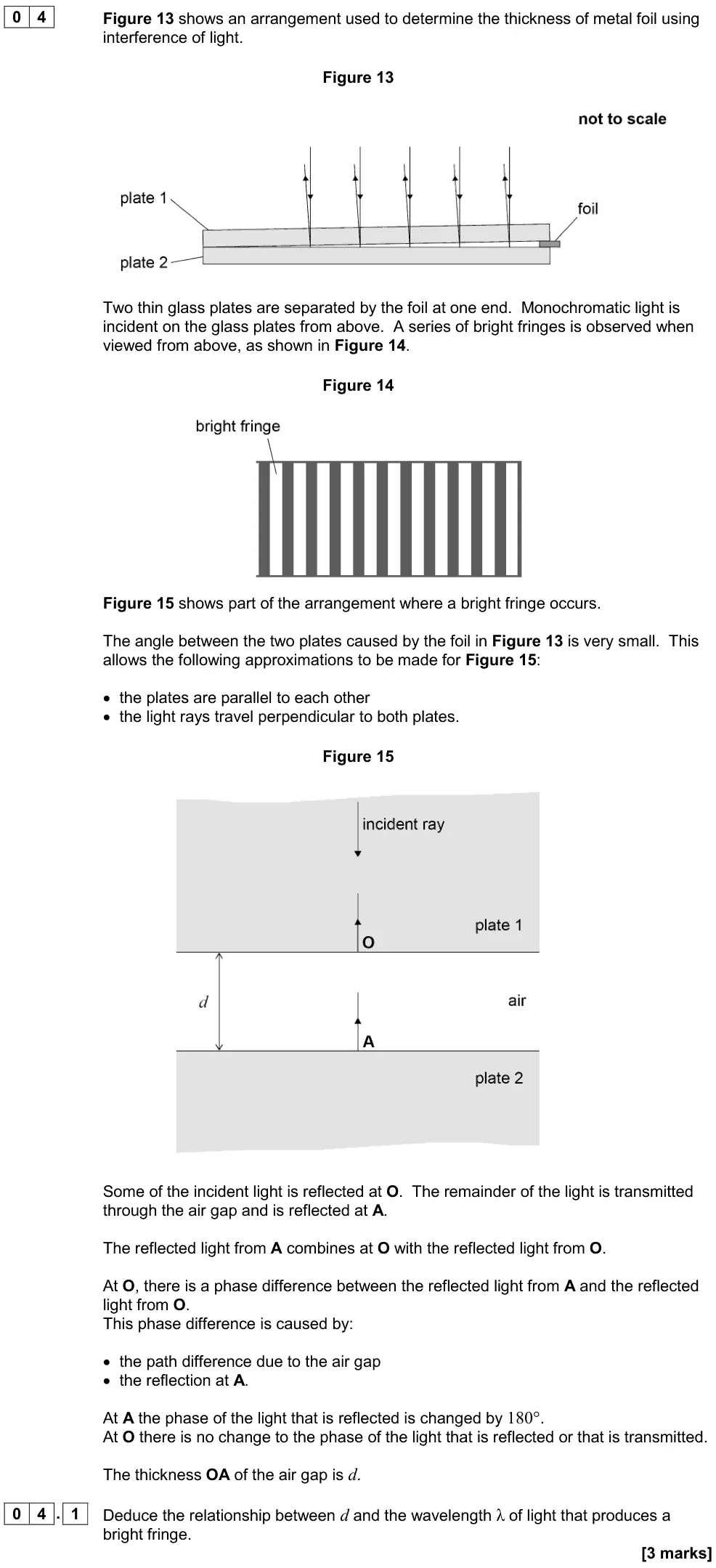
Figure 13 shows an arrangement used to determine the thickness of metal foil using
interference of light.
Figure 13
Two thin glass plates are separated by the foil at one end.  Monochromatic light is
incident on the glass plates from above.  A series of bright fringes is observed when
viewed from above, as shown in Figure 14.
Figure 14
Figure 15 shows part of the arrangement where a bright fringe occurs.
The angle between the two plates caused by the foil in Figure 13 is very small.  This
allows the following approximations to be made for Figure 15:
• the plates are parallel to each other
• the light rays travel perpendicular to both plates.
Figure 15
Some of the incident light is reflected at O.  The remainder of the light is transmitted
through the air gap and is reflected at A.
The reflected light from A combines at O with the reflected light from O.
At O, there is a phase difference between the reflected light from A and the reflected
light from O.
This phase difference is caused by:
• the path difference due to the air gap
• the reflection at A.
At A the phase of the light that is reflected is changed by 180°.
At O there is no change to the phase of the light that is reflected or that is transmitted.
The thickness OA of the air gap is d.
Deduce the relationship between d and the wavelength λ of light that produces a
bright fringe.
[3 marks]
June 2024 · AS Paper 2 · Q4.2 2 marks AO2=1, AO3=1 Calculation Hard interference and diffraction
Earlier part of question 4 that this part usesEarlier part of June 2024 Paper 2 question 4
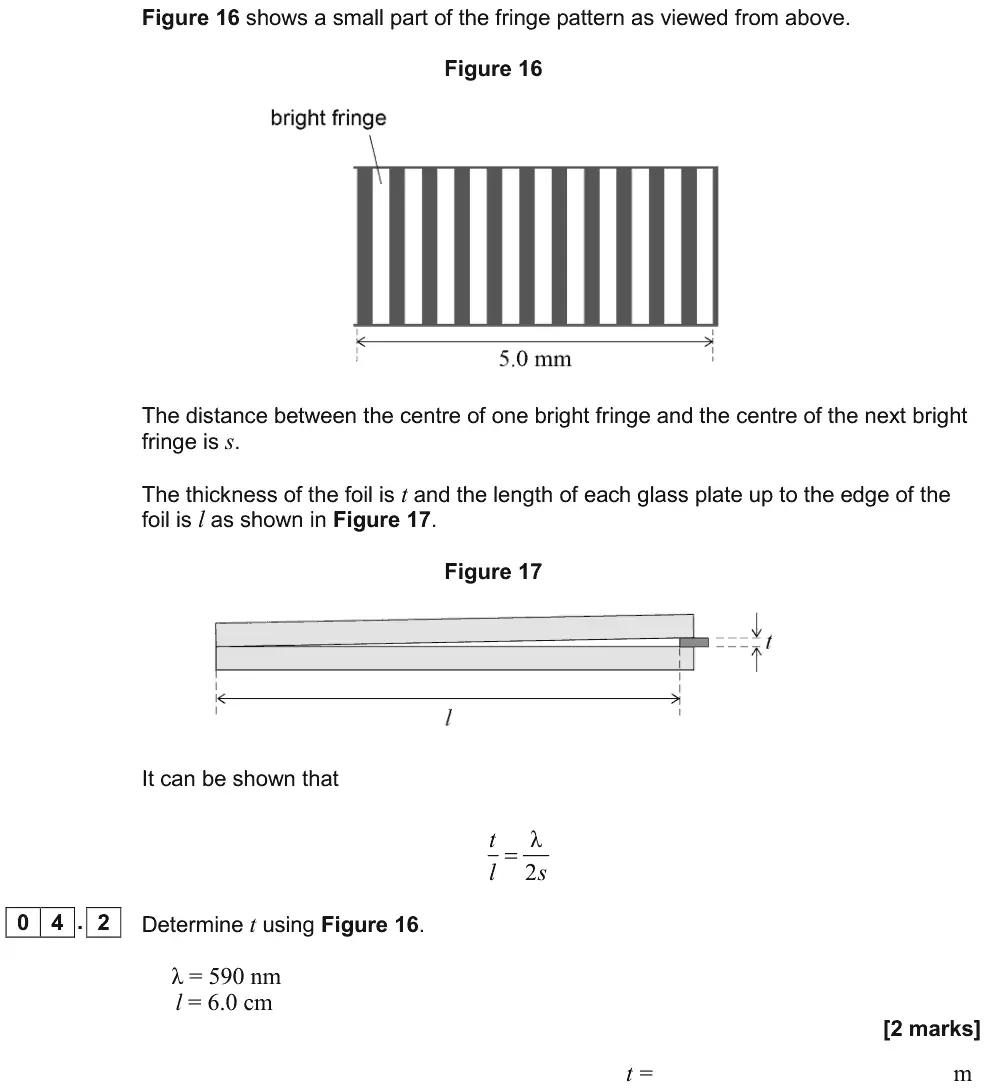
Figure 16 shows a small part of the fringe pattern as viewed from above.
Figure 16
The distance between the centre of one bright fringe and the centre of the next bright
fringe is s.
The thickness of the foil is t and the length of each glass plate up to the edge of the
foil is l as shown in Figure 17.
Figure 17
It can be shown that
λ
2
t
l
s
=
Determine t using Figure 16.
λ = 590 nm
l = 6.0 cm
[2 marks]
t =
m
June 2024 · AS Paper 2 · Q4.3 3 marks AO1=1, AO2=1, AO3=1 Explanation refraction and optical fibresprogressive waves and polarisation
Earlier part of question 4 that this part usesEarlier part of June 2024 Paper 2 question 4
The space between the plates is now filled with water.  The same light source is used,
and t and l remain the same as before.
Deduce how the distance s will change when water fills the space between the plates.
refractive index of water = 1.3
[3 marks]
June 2024 · AS Paper 2 · Q5 1 mark Multiple choice atomic structure and stable nuclei
A sequence of radioactive decays starts with nuclide P and ends with an isotope of P.
Which is a possible sequence for these decays?
[1 mark]
A one alpha decay followed by four β− decays
B one alpha decay followed by two β− decays
C two alpha decays followed by two β− decays
D two alpha decays followed by one β− decay
June 2024 · AS Paper 2 · Q6 1 mark Multiple choice current voltage and resistivity
The current in a circuit is 0.33 A.
How many electrons pass a point in the circuit in 7.0 minutes?
[1 mark]
A 1.4 × 10¹⁹
B 1.2 × 10²⁰
C 8.7 × 10²⁰
D 8.0 × 10²¹
June 2024 · AS Paper 2 · Q7 1 mark Multiple choice interference and diffraction
Monochromatic light of wavelength 520 nm is incident normally on a diffraction grating.
The third-order maximum occurs at a diffraction angle θ.
Light of wavelength λ is incident normally on the same grating.
The fourth-order maximum also occurs at angle θ.
What is λ?
[1 mark]
A 260 nm
B 390 nm
C 690 nm
D 780 nm
June 2024 · AS Paper 2 · Q8 1 mark Multiple choice atomic structure and stable nuclei
The alpha particle, positron and proton have different charge-to-mass ratios.
Which row shows the particles that have the greatest and the smallest value of this ratio?
[1 mark]
Greatest charge-to-mass ratio
Smallest charge-to-mass ratio
A
positron
alpha particle
B
positron
proton
C
alpha particle
proton
D
alpha particle
positron
June 2024 · AS Paper 2 · Q9 1 mark Multiple choice circuits and potential dividers
A circuit contains a battery with an emf of 12 V and negligible internal resistance.
At a certain light intensity, the LDR has a resistance of 480 Ω and the voltmeter reading
is 2.0 V.
At a different light intensity, the resistance of the LDR is R and the voltmeter reading is
now 8.0 V.
What is R?
[1 mark]
A 48 Ω
B 96 Ω
C 120 Ω
D 160 Ω
June 2024 · AS Paper 2 · Q10 1 mark Multiple choice materials and young modulus
A wire obeys Hooke’s law.
When the wire is extended by ΔL, the elastic strain energy is Es and the tension in the wire
is T.
Which pair of graphs shows the variation of Es with ΔL and the variation of Es with T?
[1 mark]
A
B
C
D
June 2024 · AS Paper 2 · Q11 1 mark Multiple choice motion and projectiles
The graph shows the variation with time of a quantity y for an object as it falls through
the air.
Which row gives y and the amount of air resistance?
[1 mark]
y
Air resistance
A
distance
negligible
B
distance
not negligible
C
speed
negligible
D
speed
not negligible
June 2024 · AS Paper 2 · Q12 1 mark Multiple choice work energy and power
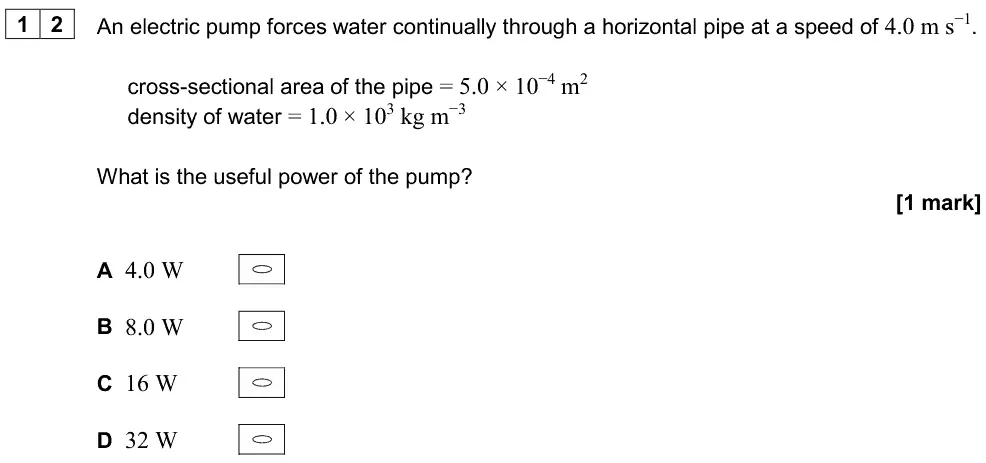
An electric pump forces water continually through a horizontal pipe at a speed of 4.0 m s−1.
cross-sectional area of the pipe = 5.0 × 10⁻⁴ m2
density of water = 1.0 × 10³ kg m−3
What is the useful power of the pump?
[1 mark]
A 4.0 W
B 8.0 W
C 16 W
D 32 W
June 2024 · AS Paper 2 · Q13 1 mark Multiple choice circuits and potential dividers
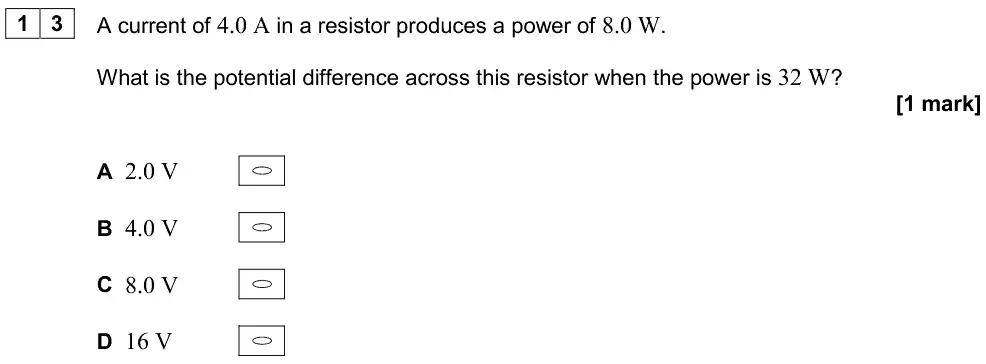
A current of 4.0 A in a resistor produces a power of 8.0 W.
What is the potential difference across this resistor when the power is 32 W?
[1 mark]
A 2.0 V
B 4.0 V
C 8.0 V
D 16 V
June 2024 · AS Paper 2 · Q14 1 mark Multiple choice photoelectric effect
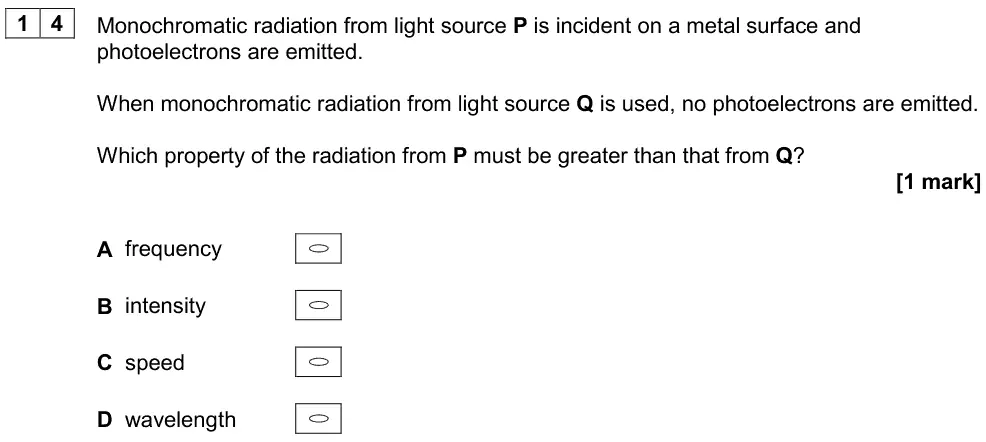
Monochromatic radiation from light source P is incident on a metal surface and
photoelectrons are emitted.
When monochromatic radiation from light source Q is used, no photoelectrons are emitted.
Which property of the radiation from P must be greater than that from Q?
[1 mark]
A frequency
B intensity
C speed
D wavelength
June 2024 · AS Paper 2 · Q15 1 mark Multiple choice interference and diffraction
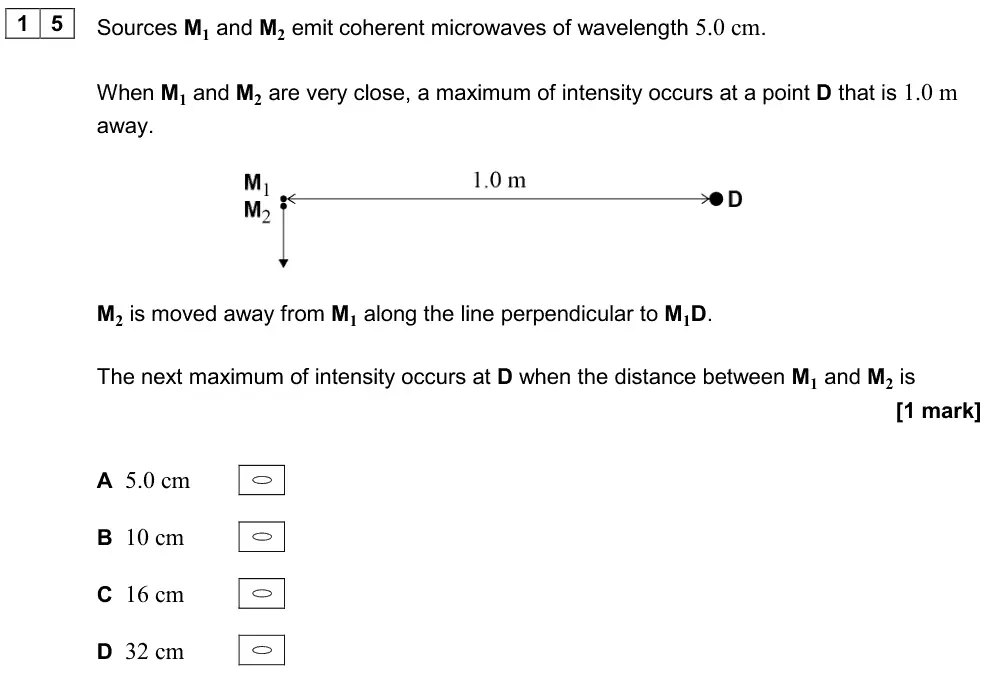
Sources M1 and M2 emit coherent microwaves of wavelength 5.0 cm.
When M1 and M2 are very close, a maximum of intensity occurs at a point D that is 1.0 m
away.
M2 is moved away from M1 along the line perpendicular to M1D.
The next maximum of intensity occurs at D when the distance between M1 and M2 is
[1 mark]
A 5.0 cm
B 10 cm
C 16 cm
D 32 cm
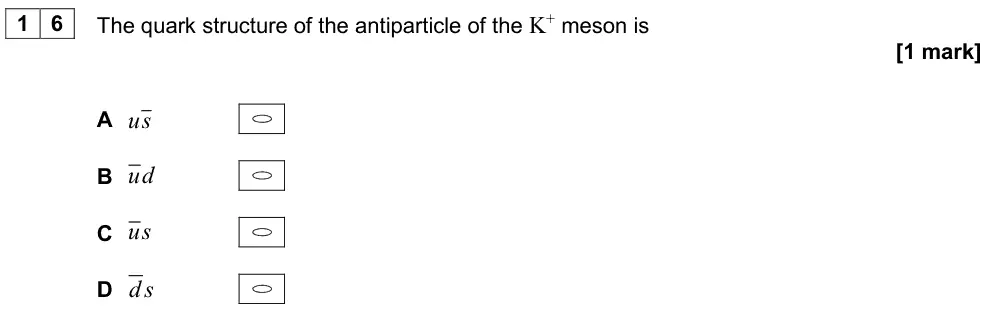
June 2024 · AS Paper 2 · Q16 1 mark Multiple choice classification of particles and quarksparticles antiparticles and interactions
The quark structure of the antiparticle of the K+ meson is
[1 mark]
A us
B ud
C us
D ds
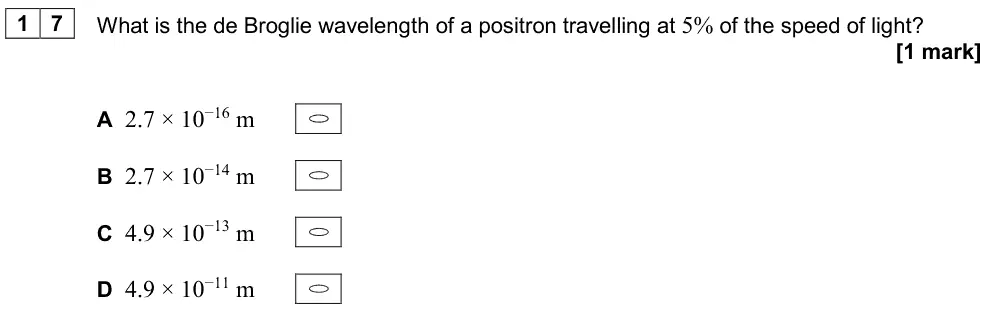
June 2024 · AS Paper 2 · Q17 1 mark Multiple choice energy levels and wave particle duality
What is the de Broglie wavelength of a positron travelling at 5% of the speed of light?
[1 mark]
A 2.7 × 10⁻¹⁶ m
B 2.7 × 10⁻¹⁴ m
C 4.9 × 10⁻¹³ m
D 4.9 × 10⁻¹¹ m
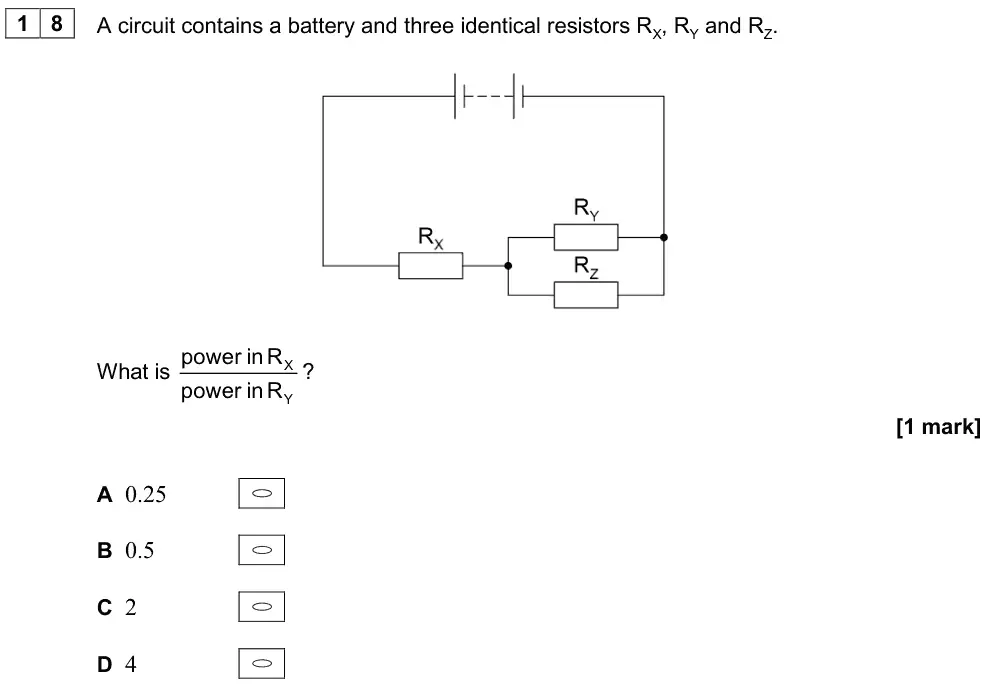
June 2024 · AS Paper 2 · Q18 1 mark Multiple choice circuits and potential dividers
A circuit contains a battery and three identical resistors RX, RY and RZ.
What is
X
Y
power in R
power in R
?
[1 mark]
A 0.25
B 0.5
C 2
D 4
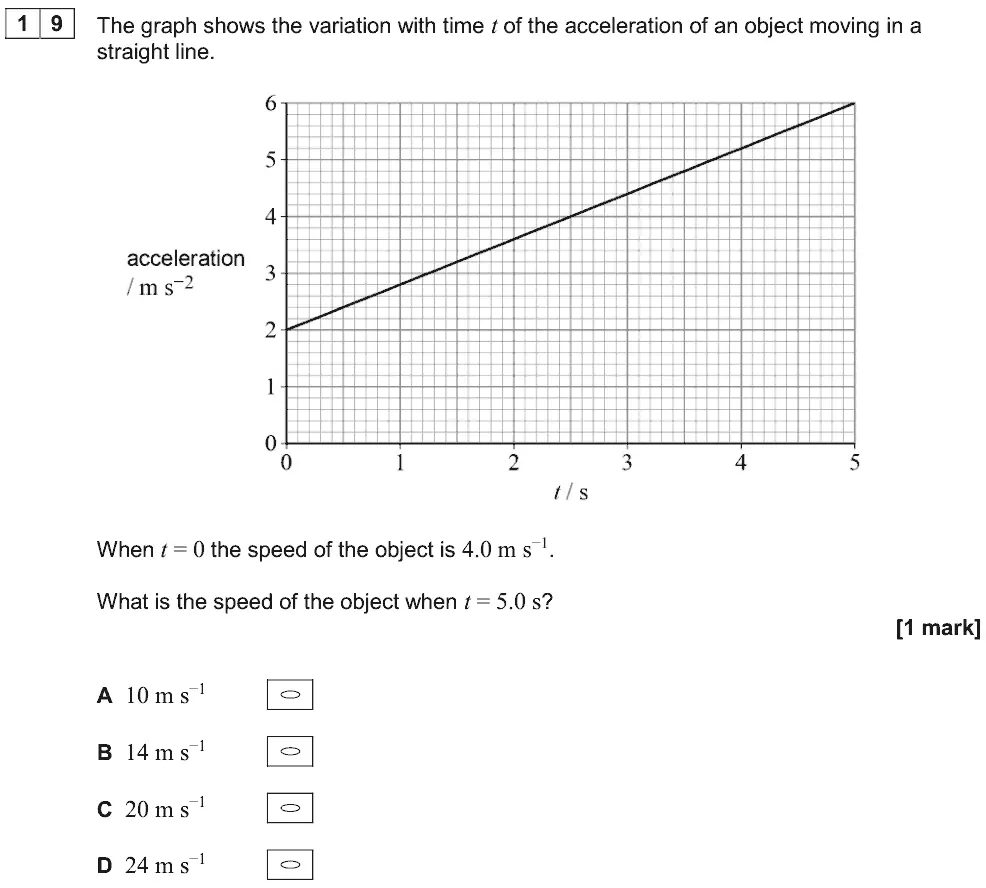
June 2024 · AS Paper 2 · Q19 1 mark Multiple choice motion and projectiles
The graph shows the variation with time t of the acceleration of an object moving in a
straight line.
When t = 0 the speed of the object is 4.0 m s−1.
What is the speed of the object when t = 5.0 s?
[1 mark]
A 10 m s−1
B 14 m s−1
C 20 m s−1
D 24 m s−1
June 2024 · AS Paper 2 · Q20 1 mark Multiple choice newtons laws and momentummotion and projectiles
An object is released and falls from rest.
Air resistance is negligible.
After falling for time t, the momentum of the object is
[1 mark]
A constant.
B proportional to t .
C proportional to t.
D proportional to t2.
June 2024 · AS Paper 2 · Q21 1 mark Multiple choice refraction and optical fibres
The cladding of a step-index optical fibre
[1 mark]
A must not be transparent.
B must have a higher refractive index than the core.
C reduces signal loss.
D reduces material dispersion.
June 2024 · AS Paper 2 · Q22 1 mark Multiple choice newtons laws and momentum
A cricket ball of mass 0.16 kg travels at a speed of 35 m s−1 towards a bat.
When the ball is hit, it is in contact with the bat for 52 ms.
As a result, the ball travels in the opposite direction with a speed of 30 m s−1.
What is the average force on the ball from the bat?
[1 mark]
A 0.015 N
B 0.20 N
C 15 N
D 200 N
June 2024 · AS Paper 2 · Q23 1 mark Multiple choice motion and projectiles
A horse starts walking from point X on a circular track of circumference 60 m.
The speed of the horse is a constant 2.0 m s−1.
What is the horse’s displacement from X after 45 s?
[1 mark]
A 19 m
B 30 m
C 38 m
D 90 m
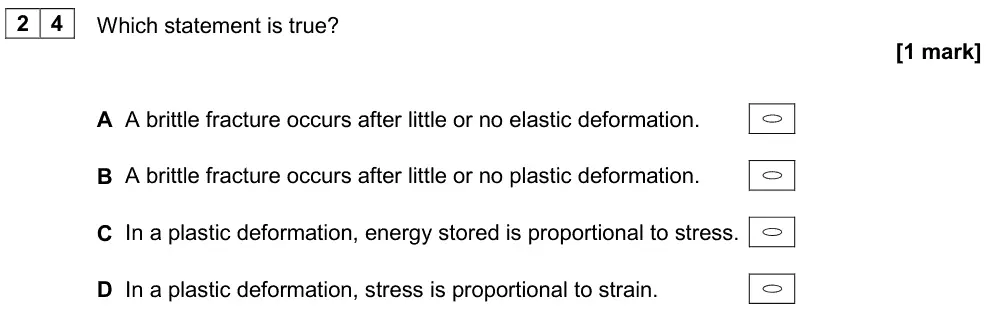
June 2024 · AS Paper 2 · Q24 1 mark Multiple choice materials and young modulus
Which statement is true?
[1 mark]
A A brittle fracture occurs after little or no elastic deformation.
B A brittle fracture occurs after little or no plastic deformation.
C In a plastic deformation, energy stored is proportional to stress.
D In a plastic deformation, stress is proportional to strain.
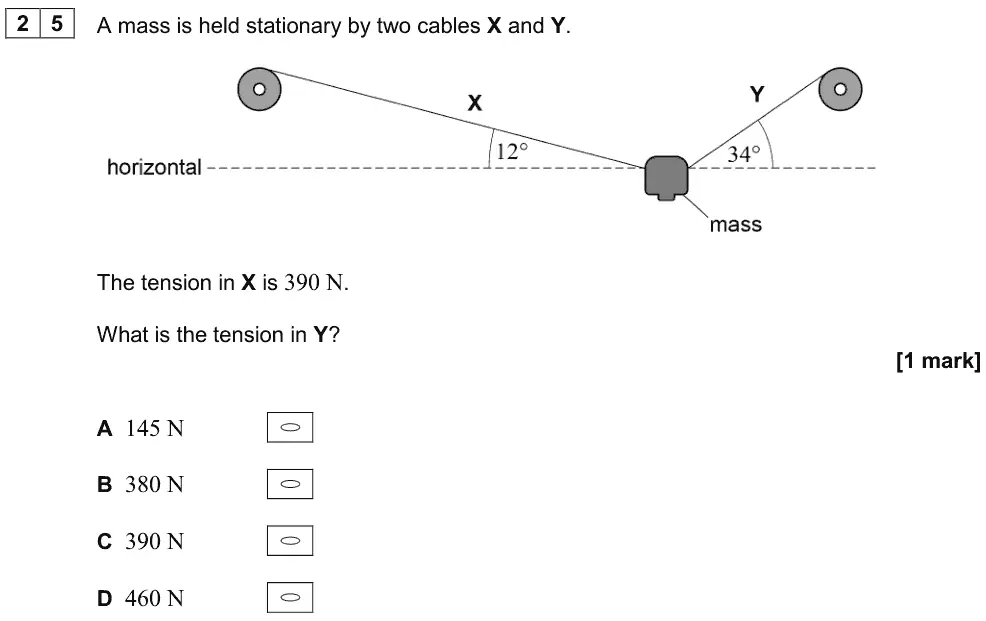
June 2024 · AS Paper 2 · Q25 1 mark Multiple choice vectors and moments
A mass is held stationary by two cables X and Y.
The tension in X is 390 N.
What is the tension in Y?
[1 mark]
A 145 N
B 380 N
C 390 N
D 460 N
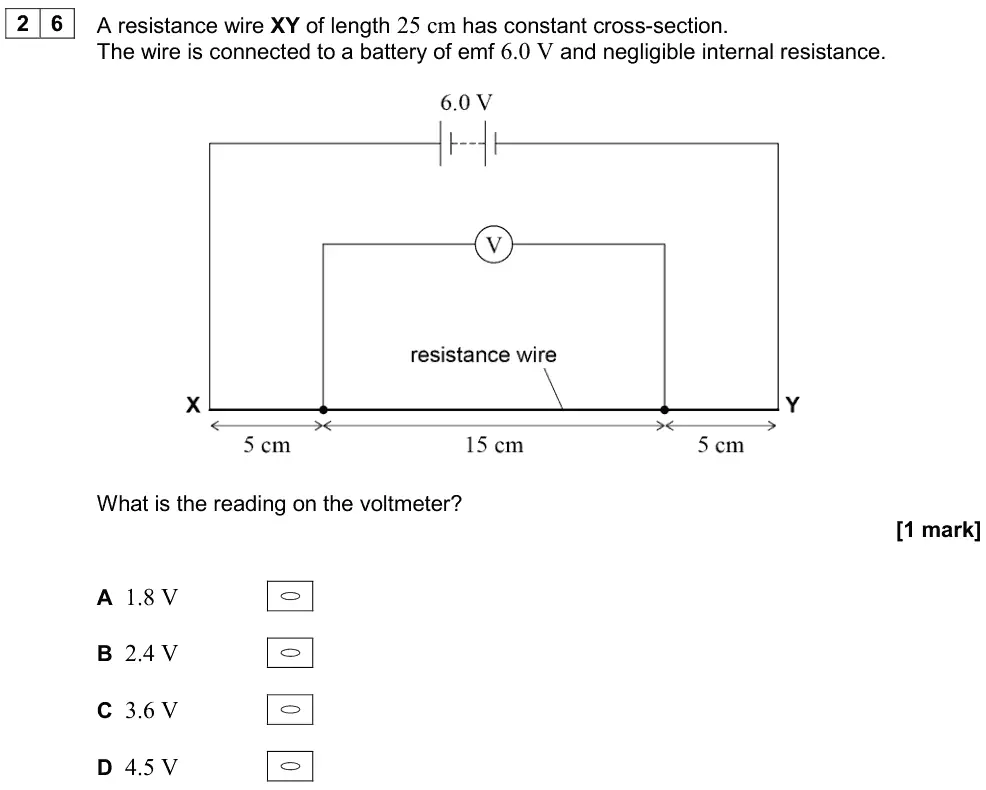
June 2024 · AS Paper 2 · Q26 1 mark Multiple choice circuits and potential dividerscurrent voltage and resistivity
A resistance wire XY of length 25 cm has constant cross-section.
The wire is connected to a battery of emf 6.0 V and negligible internal resistance.
What is the reading on the voltmeter?
[1 mark]
A 1.8 V
B 2.4 V
C 3.6 V
D 4.5 V
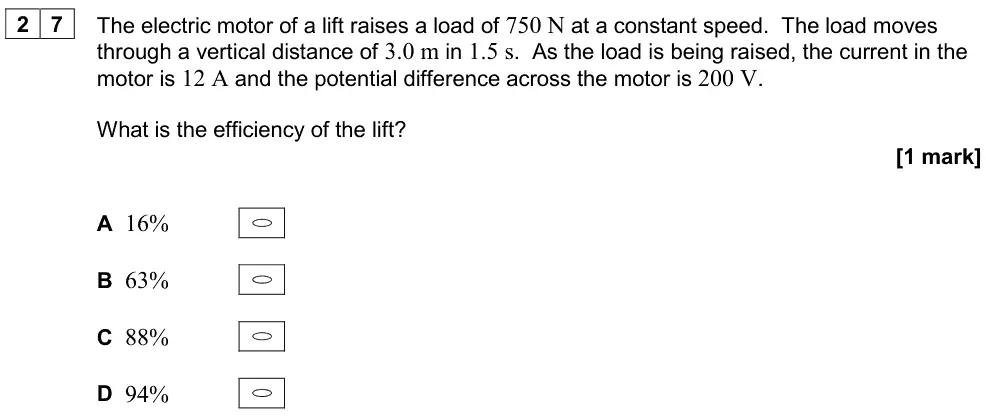
June 2024 · AS Paper 2 · Q27 1 mark Multiple choice work energy and power
The electric motor of a lift raises a load of 750 N at a constant speed.  The load moves
through a vertical distance of 3.0 m in 1.5 s.  As the load is being raised, the current in the
motor is 12 A and the potential difference across the motor is 200 V.
What is the efficiency of the lift?
[1 mark]
A 16%
B 63%
C 88%
D 94%
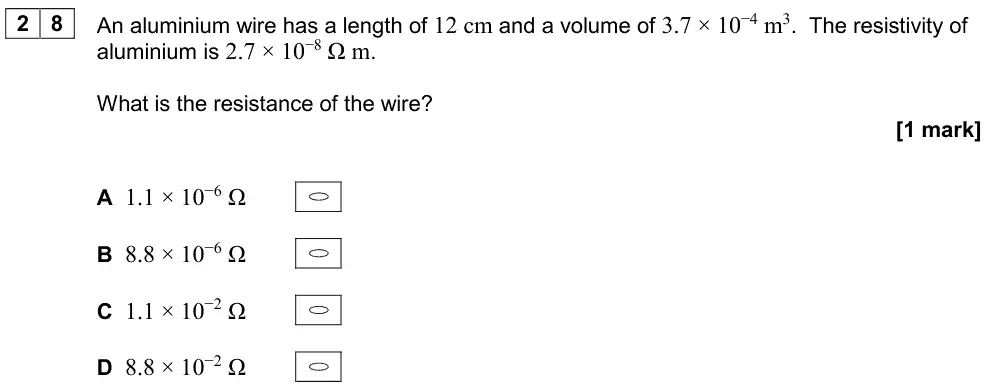
June 2024 · AS Paper 2 · Q28 1 mark Multiple choice current voltage and resistivity
An aluminium wire has a length of 12 cm and a volume of 3.7 × 10⁻⁴ m3.  The resistivity of
aluminium is 2.7 × 10⁻⁸ Ω m.
What is the resistance of the wire?
[1 mark]
A 1.1 × 10⁻⁶ Ω
B 8.8 × 10⁻⁶ Ω
C 1.1 × 10⁻² Ω
D 8.8 × 10⁻² Ω
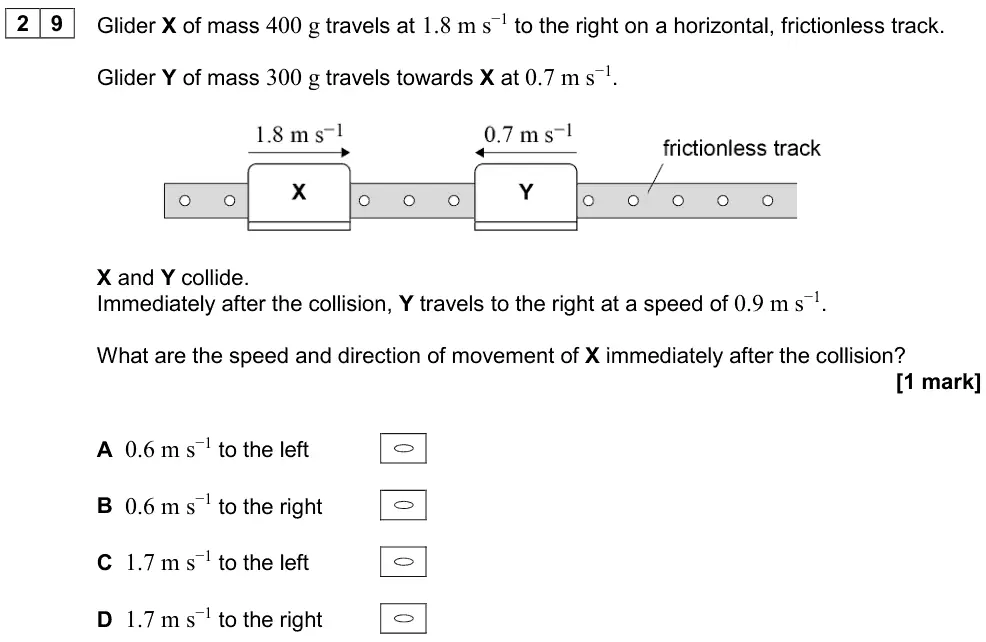
June 2024 · AS Paper 2 · Q29 1 mark Multiple choice newtons laws and momentum
Glider X of mass 400 g travels at 1.8 m s−1 to the right on a horizontal, frictionless track.
Glider Y of mass 300 g travels towards X at 0.7 m s−1.
X and Y collide.
Immediately after the collision, Y travels to the right at a speed of 0.9 m s−1.
What are the speed and direction of movement of X immediately after the collision?
[1 mark]
A 0.6 m s−1 to the left
B 0.6 m s−1 to the right
C 1.7 m s−1 to the left
D 1.7 m s−1 to the right
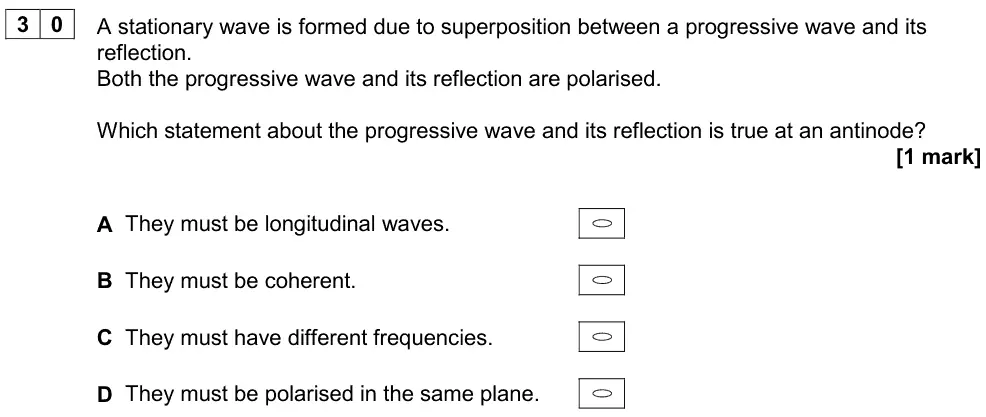
June 2024 · AS Paper 2 · Q30 1 mark Multiple choice stationary wavesprogressive waves and polarisation
A stationary wave is formed due to superposition between a progressive wave and its
reflection.
Both the progressive wave and its reflection are polarised.
Which statement about the progressive wave and its reflection is true at an antinode?
[1 mark]
A They must be longitudinal waves.
B They must be coherent.
C They must have different frequencies.
D They must be polarised in the same plane.
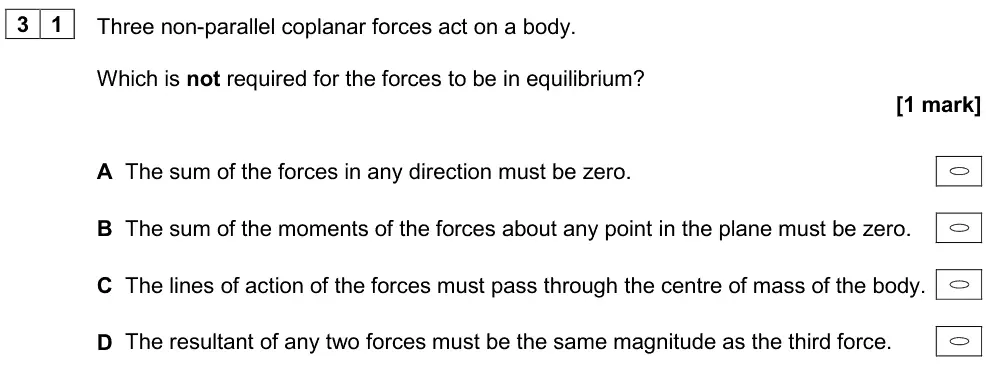
June 2024 · AS Paper 2 · Q31 1 mark Multiple choice vectors and moments
Three non-parallel coplanar forces act on a body.
Which is not required for the forces to be in equilibrium?
[1 mark]
A The sum of the forces in any direction must be zero.
B The sum of the moments of the forces about any point in the plane must be zero.
C The lines of action of the forces must pass through the centre of mass of the body.
D The resultant of any two forces must be the same magnitude as the third force.
June 2024 · AS Paper 2 · Q32 1 mark Multiple choice stationary wavesprogressive waves and polarisation
Which row is correct for both a progressive wave and a stationary wave?
[1 mark]
Progressive wave
Stationary wave
A
Some of the particles do not
vibrate.
All the particles vibrate in phase
with each other.
B
None of the particles vibrate with
the same amplitude.
All the particles vibrate with the
same amplitude.
C
All the particles vibrate.
Some of the particles do not
vibrate.
D
All the particles vibrate in phase
with each other.
None of the particles vibrate in
phase with each other.
June 2024 · AS Paper 2 · Q33 1 mark Multiple choice emf and internal resistance
A student investigates the characteristics of a power supply.
The experimental data are plotted on a graph with:
• pd (potential difference) across the power supply plotted on the y-axis
• current in the power supply plotted on the x-axis.
The axes intersect at (0,0).
What feature of the graph represents the emf of the power supply?
[1 mark]
A the area enclosed by the line and the x-axis
B the magnitude of the gradient of the line
C the intercept on the x-axis
D the intercept on the y-axis
June 2024 · AS Paper 2 · Q34 1 mark Multiple choice measurements and uncertainties
Which row shows SI prefixes in order of increasing magnitude?
[1 mark]
Smallest
Largest
A
f
p
μ
c
B
f
p
c
μ
C
p
f
μ
c
D
p
f
c
μ

Work with an AQA physics tutor

Want a paper marked and gone through with you? Message us.

Prefer email? Send an enquiry

If you are under 18, please include a parent's contact details. Enquiries go to enquiries@physicsaleveltutor.com and are deleted once handled. All tutoring is online.