November 2020: Paper 2

85 marks · 57 question parts · Paper, mark scheme and report on AQA's site · An autumn series using the paper written for the cancelled summer exams · Have the data and formulae booklet beside you

Question by question

QTopicMarksAOType
1.1 Thermal energy transfer and ideal gases 1Short answer
1.2 Thermal energy transfer and ideal gases 1Short answer
1.3 Thermal energy transfer and ideal gases 2Short answer
1.4 Thermal energy transfer and ideal gases, Molecular kinetic theory 1Short answer
1.5 Thermal energy transfer and ideal gases, Work, energy, power and conservation of energy 3Calculation
1.6 Thermal energy transfer and ideal gases, Work, energy, power and conservation of energy 2Calculation
2.1 Gravitational fields and orbits, Circular motion 3AO1=3Show that
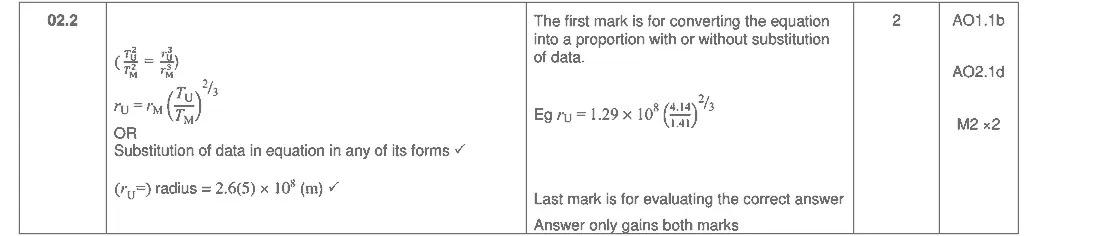
2.2 Gravitational fields and orbits 2Calculation
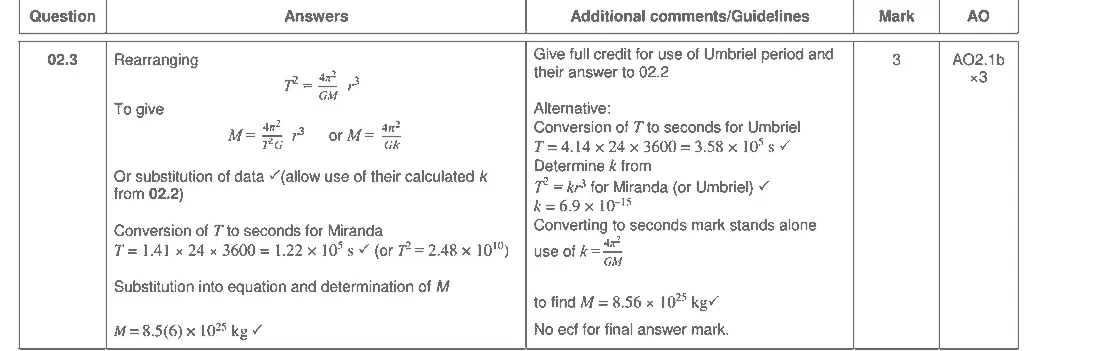
2.3 Gravitational fields and orbits 3AO2=3Calculation
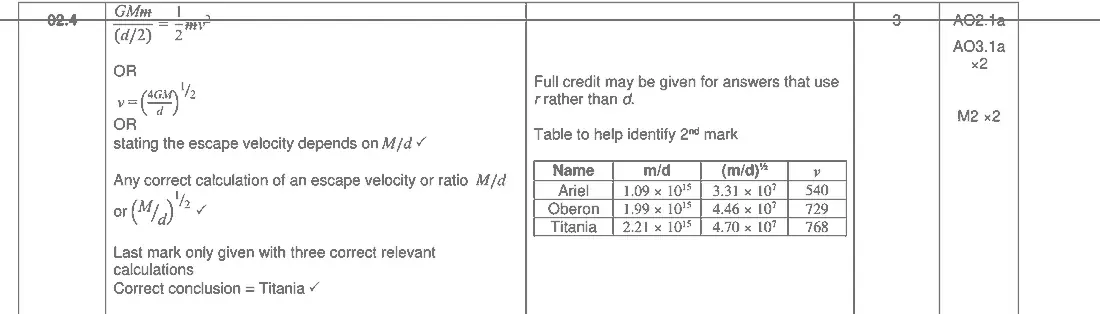
2.4 Gravitational fields and orbits 3Calculation
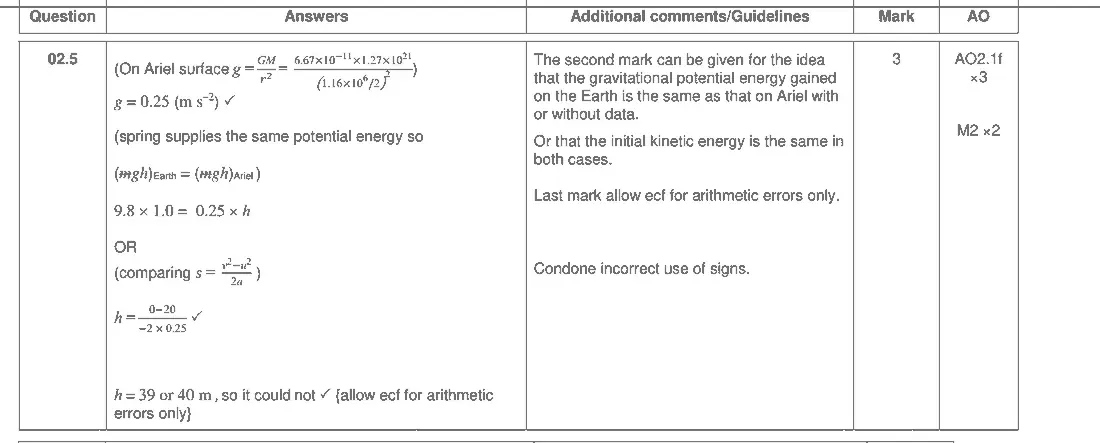
2.5 Gravitational fields and orbits, Work, energy, power and conservation of energy 3AO2=3Calculation
3.1 Magnetic flux density and moving charges in a magnetic field, Electric fields and electric potential 1AO1=1Diagram or graph
3.2 Magnetic flux density and moving charges in a magnetic field, Electric fields and electric potential 2Calculation
3.3 Magnetic flux density and moving charges in a magnetic field, Circular motion 1AO2=1Show that
3.4 Magnetic flux density and moving charges in a magnetic field 2AO1=2Calculation
3.5 Electric fields and electric potential, Work, energy, power and conservation of energy 3Calculation
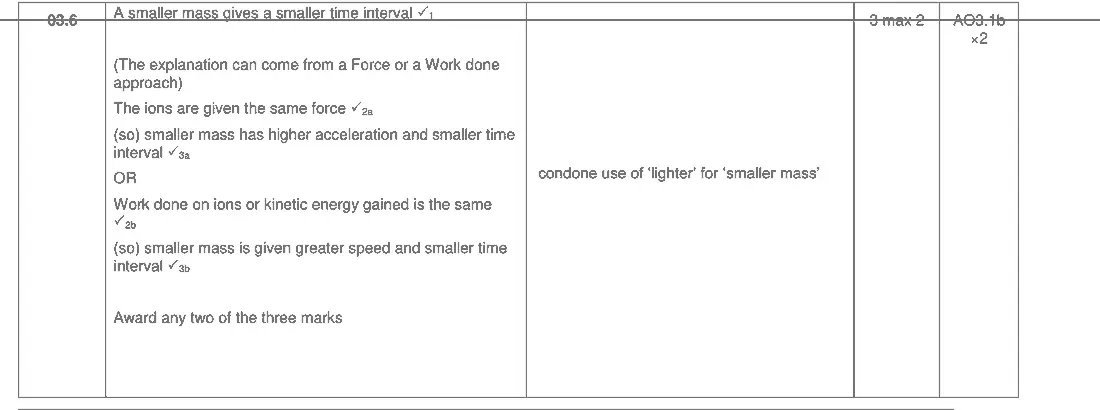
3.6 Electric fields and electric potential, Newton's laws of motion and momentum 2Explanation
4.1 Electromagnetic induction, alternating currents and transformers 1AO1=1Calculation
4.2 Electromagnetic induction, alternating currents and transformers 1AO2=1Short answer
4.3 Electromagnetic induction, alternating currents and transformers 1AO2=1Diagram or graph
4.4 Electromagnetic induction, alternating currents and transformers 1AO2=1Calculation
4.5 Capacitance and capacitor charge and discharge 3Practical and data analysis
4.6 Electromagnetic induction, alternating currents and transformers, Measurements, units and uncertainties 2AO3=2Explanation
5.1 Particles, antiparticles and particle interactions, Rutherford scattering, alpha, beta and gamma radiation 1AO1=1Short answer
5.2 Newton's laws of motion and momentum, Electric fields and electric potential 1AO1=1Diagram or graph
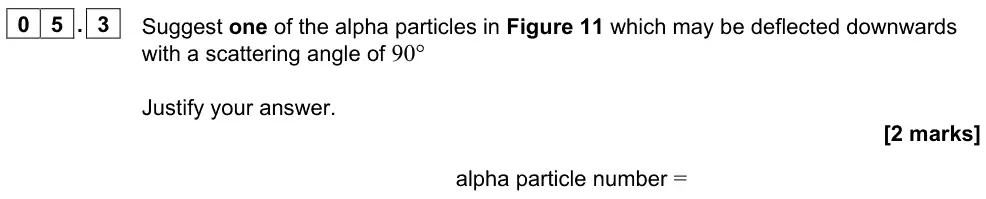
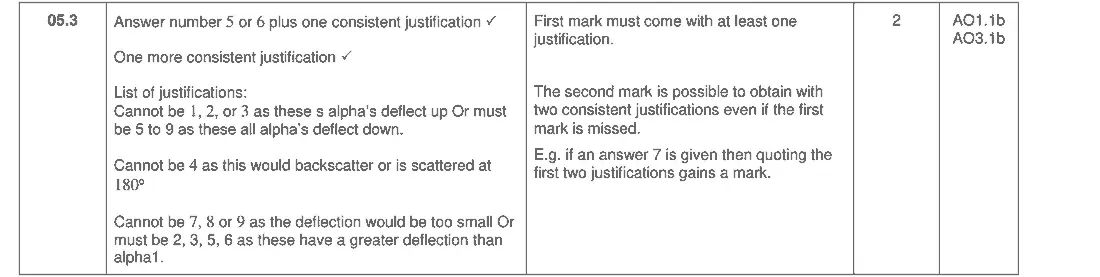
5.3 Rutherford scattering, alpha, beta and gamma radiation 2Explanation
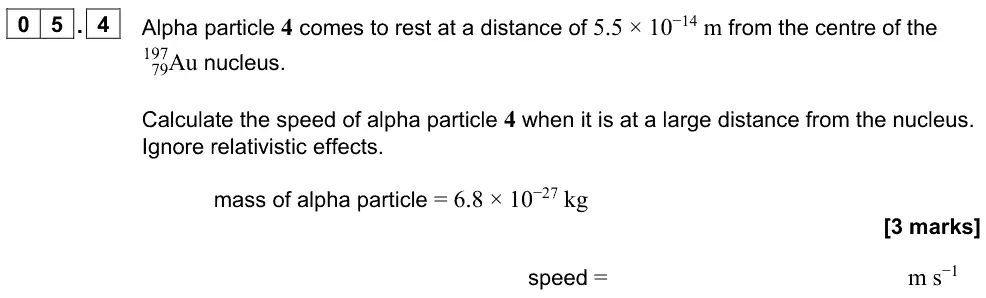
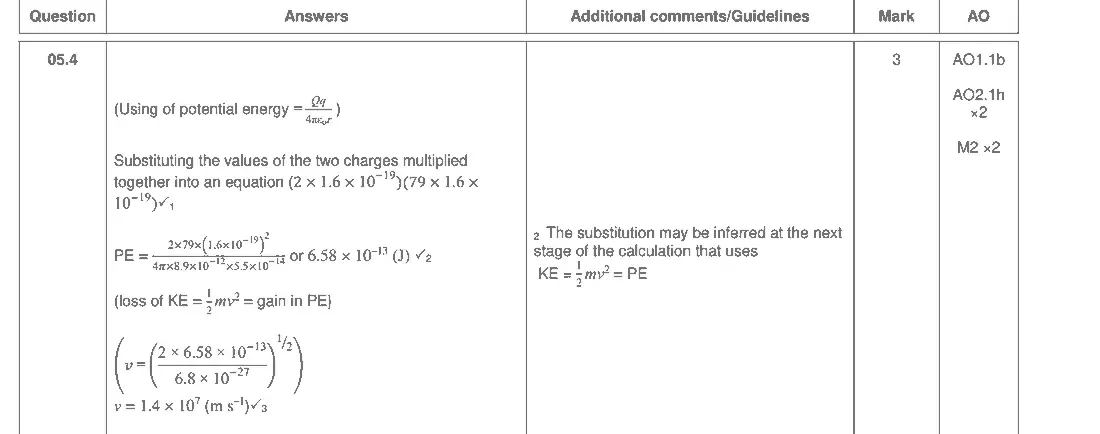
5.4 Electric fields and electric potential, Nuclear radius 3Calculation
5.5 Nuclear radius 2Calculation
5.6 Nuclear radius 1Short answer
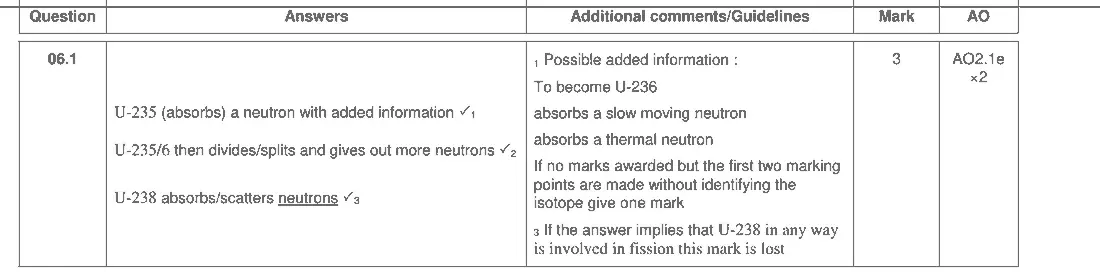
6.1 Mass and energy, binding energy, fission and safety 3AO2=3Explanation
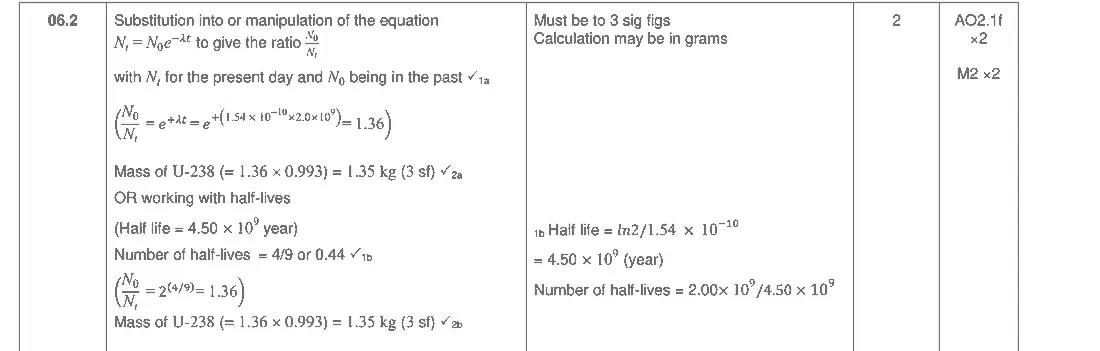
6.2 Radioactive decay, half-life and nuclear instability 2AO2=2Show that
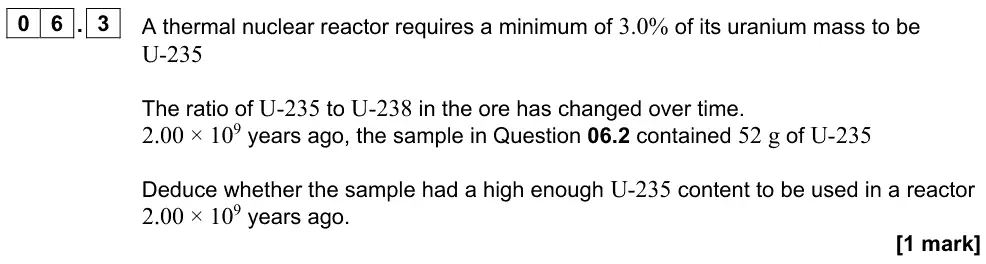
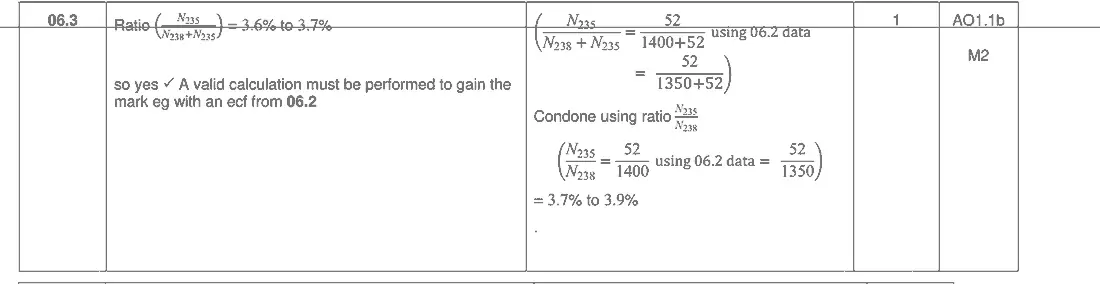
6.3 Radioactive decay, half-life and nuclear instability, Mass and energy, binding energy, fission and safety 1Calculation
7 Thermal energy transfer and ideal gases 1Multiple choice
8 Thermal energy transfer and ideal gases 1Multiple choice
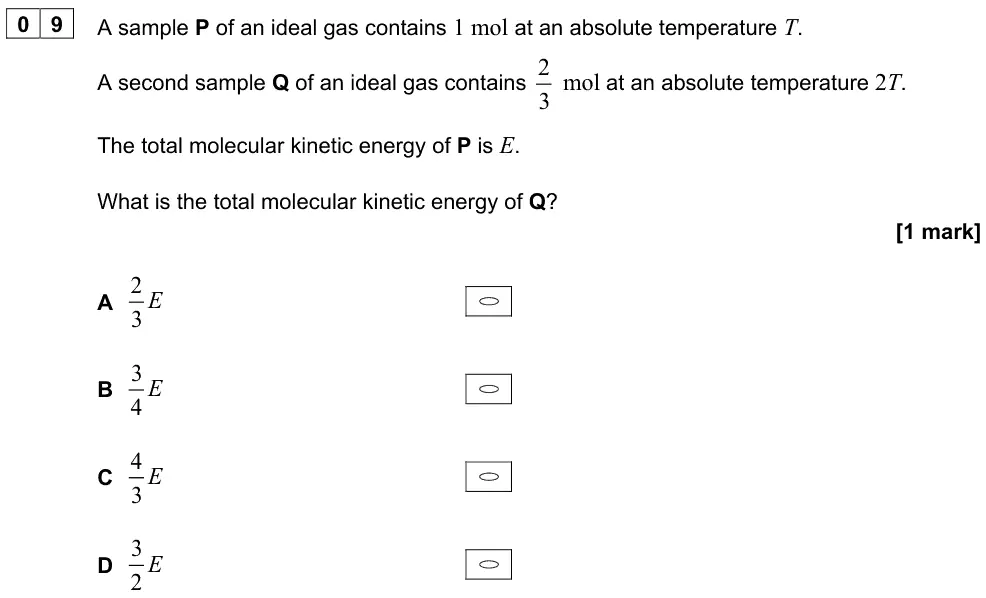
9 Molecular kinetic theory 1Multiple choice
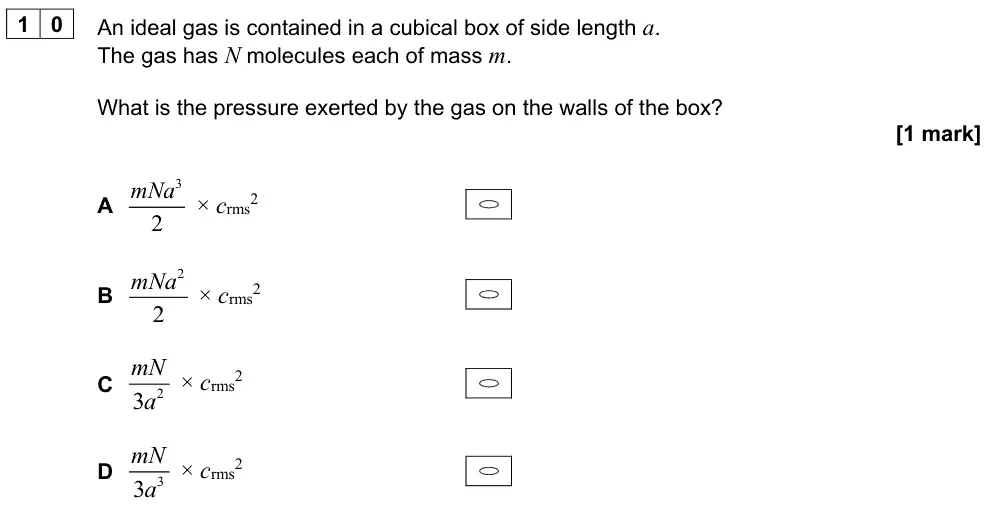
10 Molecular kinetic theory 1Multiple choice
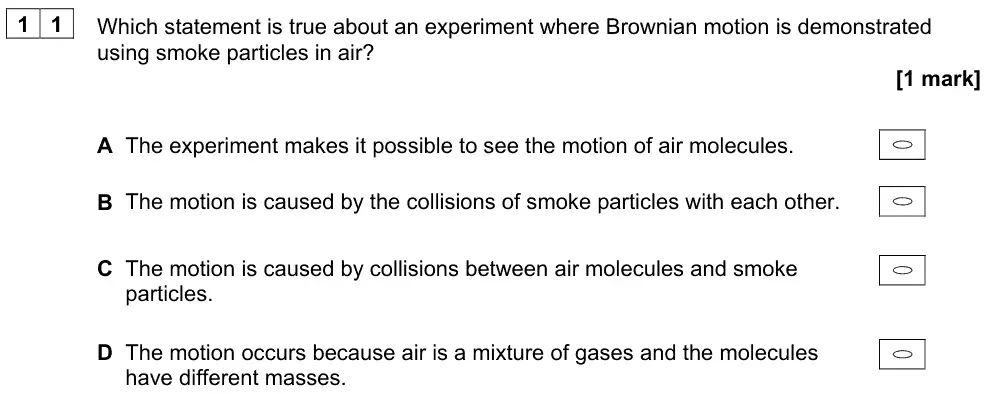
11 Molecular kinetic theory 1Multiple choice
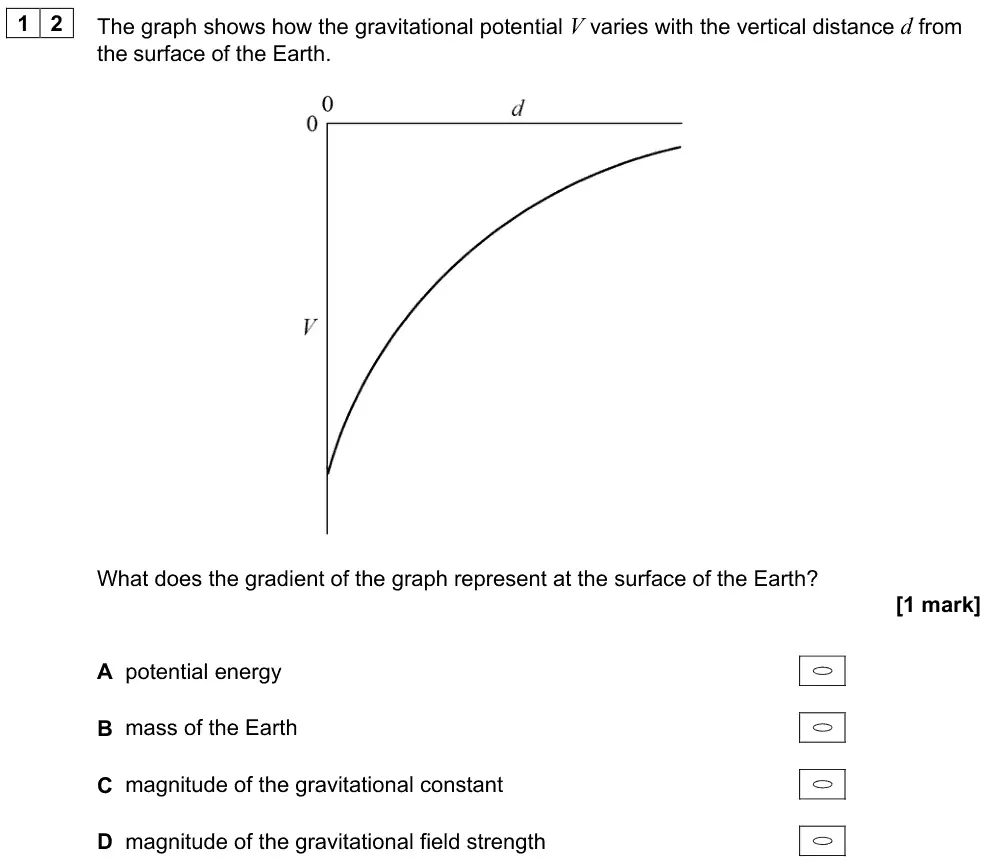
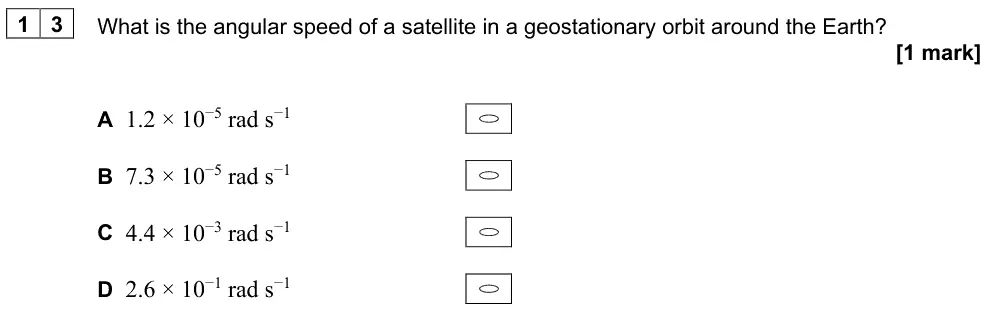
12 Gravitational fields and orbits 1Multiple choice
13 Gravitational fields and orbits, Circular motion 1Multiple choice
14 Electric fields and electric potential 1Multiple choice
15 Electric fields and electric potential 1Multiple choice
16 Electric fields and electric potential 1Multiple choice
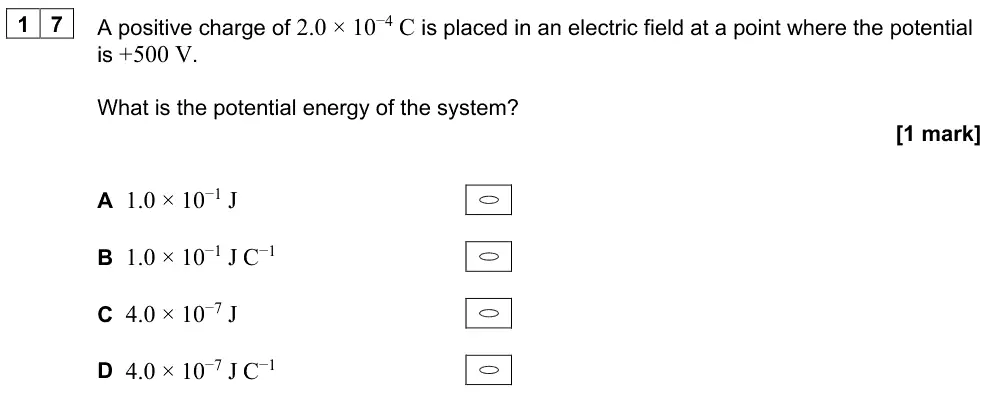
17 Electric fields and electric potential 1Multiple choice
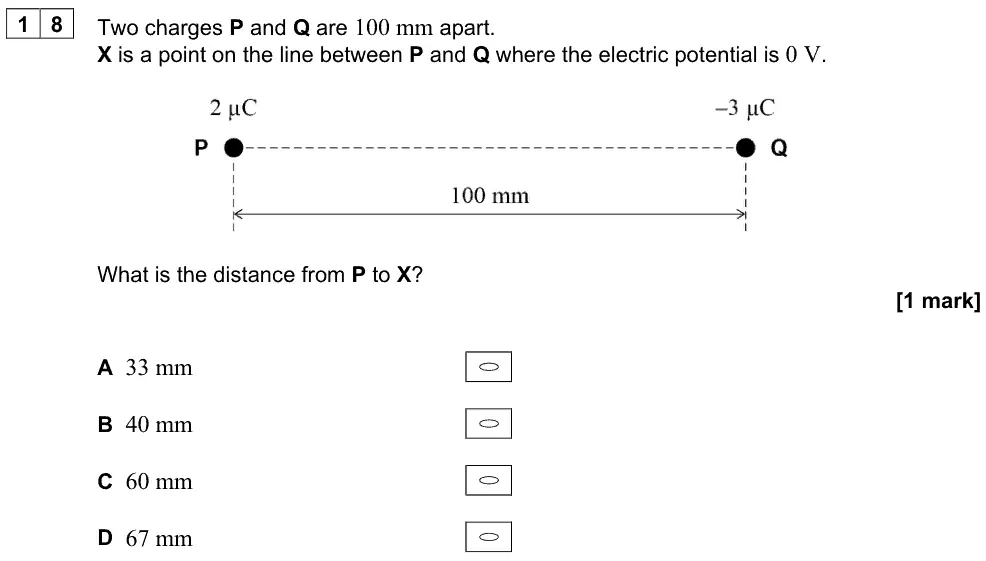
18 Electric fields and electric potential 1Multiple choice
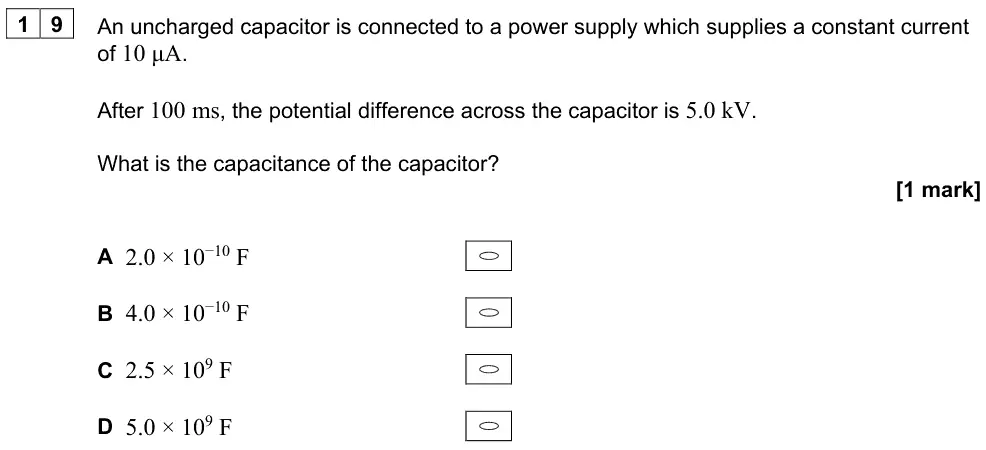
19 Capacitance and capacitor charge and discharge, Current, potential difference, I-V characteristics and resistivity 1Multiple choice
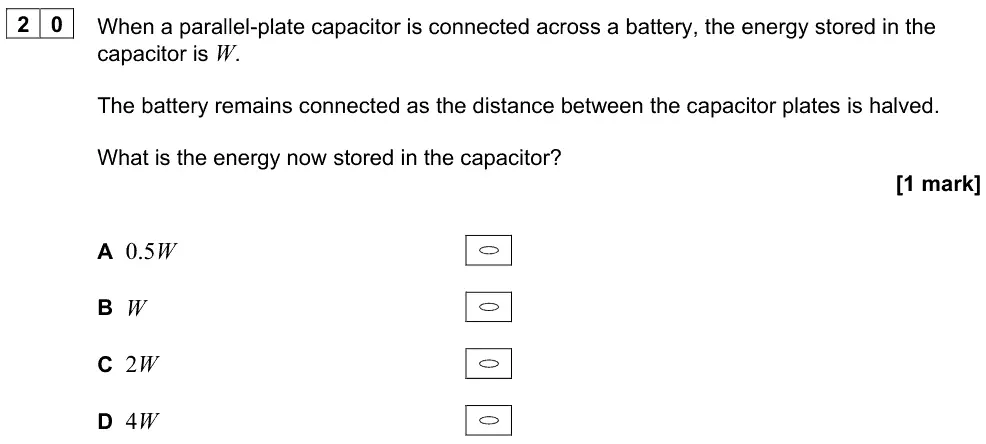
20 Capacitance and capacitor charge and discharge 1Multiple choice
21 Capacitance and capacitor charge and discharge 1Multiple choice
22 Capacitance and capacitor charge and discharge 1Multiple choice
23 Magnetic flux density and moving charges in a magnetic field 1Multiple choice
24 Electromagnetic induction, alternating currents and transformers 1Multiple choice
25 Electromagnetic induction, alternating currents and transformers 1Multiple choice
26 Electromagnetic induction, alternating currents and transformers 1Multiple choice
27 Electromagnetic induction, alternating currents and transformers 1Multiple choice
28 Rutherford scattering, alpha, beta and gamma radiation 1Multiple choice
29 Radioactive decay, half-life and nuclear instability 1Multiple choice
30 Mass and energy, binding energy, fission and safety 1Multiple choice
31 Mass and energy, binding energy, fission and safety 1Multiple choice

The questions

1.11.21.31.41.51.62.12.22.32.42.53.13.23.33.43.53.64.14.24.34.44.54.65.15.25.35.45.55.66.16.26.378910111213141516171819202122232425262728293031
November 2020 · Paper 2 · Q1.1 1 mark Short answer thermal energy and ideal gases
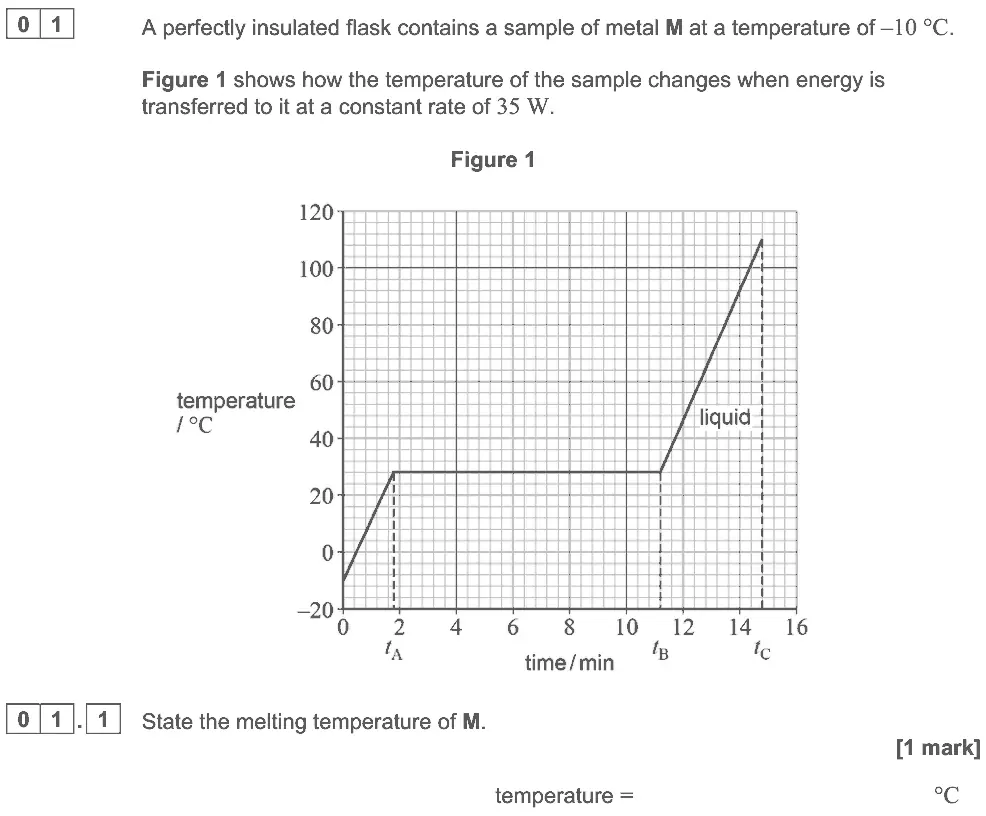
A perfectly insulated flask contains a sample of metal M at a temperature of –10 °C.
Figure 1 shows how the temperature of the sample changes when energy is
transferred to it at a constant rate of 35 W.
Figure 1
State the melting temperature of M.
[1 mark]
temperature =
°C
November 2020 · Paper 2 · Q1.2 1 mark Short answer thermal energy and ideal gases
Earlier part of question 1 that this part usesEarlier part of November 2020 Paper 2 question 1
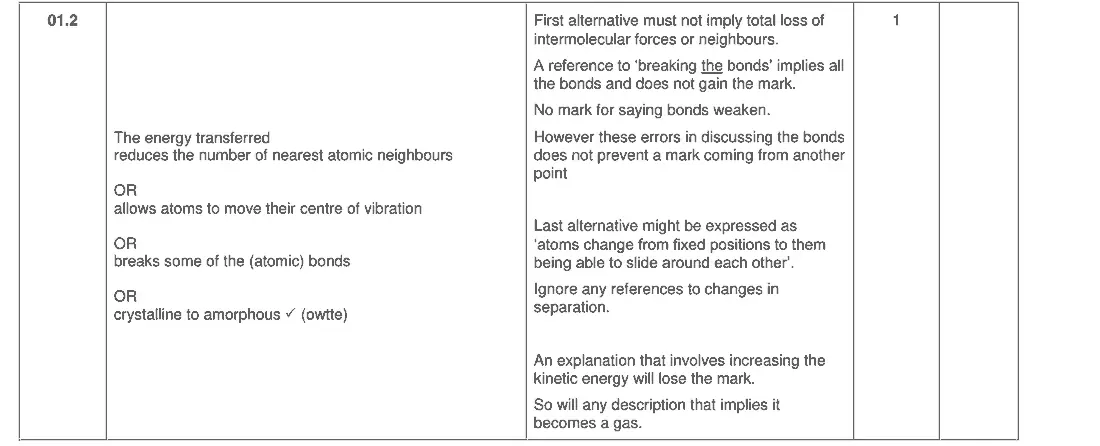
Explain how the energy transferred to the sample changes the arrangement of the
atoms during the time interval tA to tB.
[1 mark]
November 2020 · Paper 2 · Q1.3 2 marks Short answer thermal energy and ideal gases
Earlier part of question 1 that this part usesEarlier part of November 2020 Paper 2 question 1
State what happens to the potential energy of the atoms and to the kinetic energy of
the atoms during the time interval tA to tB.
[2 marks]
November 2020 · Paper 2 · Q1.4 1 mark Short answer thermal energy and ideal gaseskinetic theory
Earlier part of question 1 that this part usesEarlier part of November 2020 Paper 2 question 1
Describe how the motion of the atoms changes during the time interval tB to tC.
[1 mark]
November 2020 · Paper 2 · Q1.5 3 marks Calculation thermal energy and ideal gaseswork energy and power
Earlier part of question 1 that this part usesEarlier part of November 2020 Paper 2 question 1
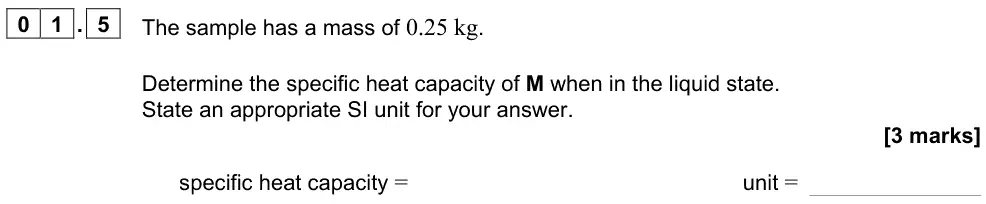
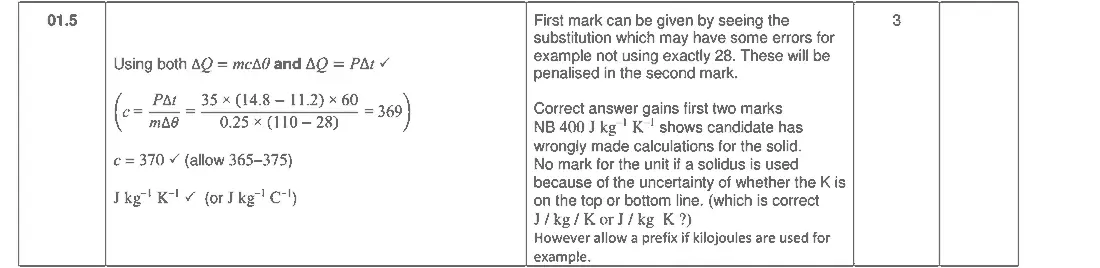
The sample has a mass of 0.25 kg.
Determine the specific heat capacity of M when in the liquid state.
State an appropriate SI unit for your answer.
[3 marks]
specific heat capacity =
unit =
November 2020 · Paper 2 · Q1.6 2 marks Calculation thermal energy and ideal gaseswork energy and power
Earlier part of question 1 that this part usesEarlier part of November 2020 Paper 2 question 1
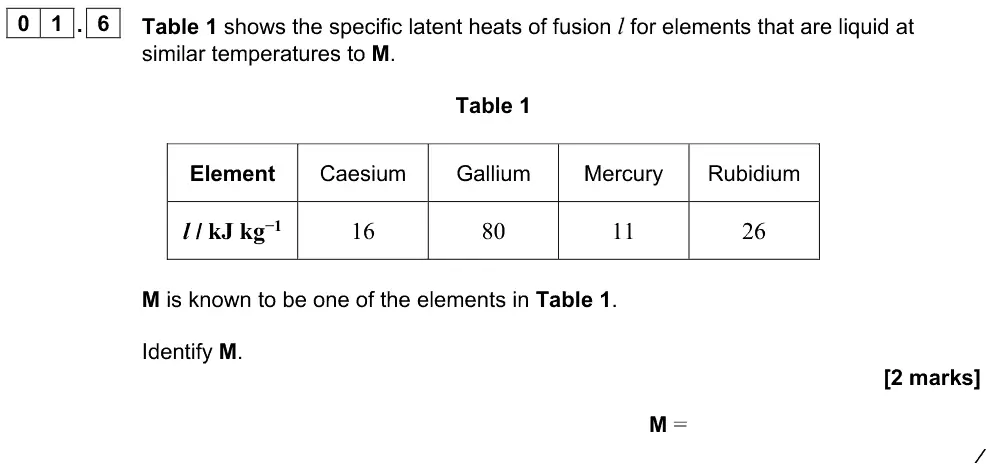
Table 1 shows the specific latent heats of fusion l for elements that are liquid at
similar temperatures to M.
Table 1
Element
Caesium
Gallium
Mercury
Rubidium
l / kJ kg−1
16
80
11
26
M is known to be one of the elements in Table 1.
Identify M.
[2 marks]
M =
November 2020 · Paper 2 · Q2.1 3 marks AO1=3 Show that gravitational fieldscircular motion
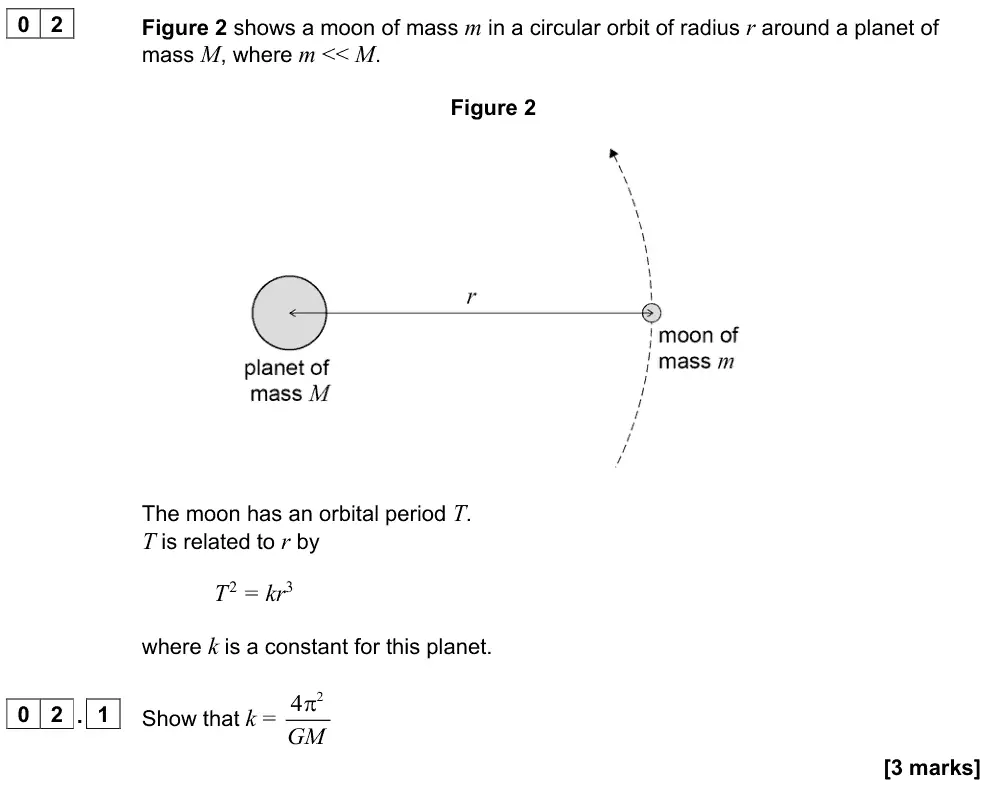
Figure 2 shows a moon of mass m in a circular orbit of radius r around a planet of
mass M, where m << M.
Figure 2
The moon has an orbital period T.
T is related to r by
T 2 = kr3
where k is a constant for this planet.
Show that k =
2
4
GM
π
[3 marks]
November 2020 · Paper 2 · Q2.2 2 marks Calculation gravitational fields
Earlier part of question 2 that this part usesEarlier part of November 2020 Paper 2 question 2
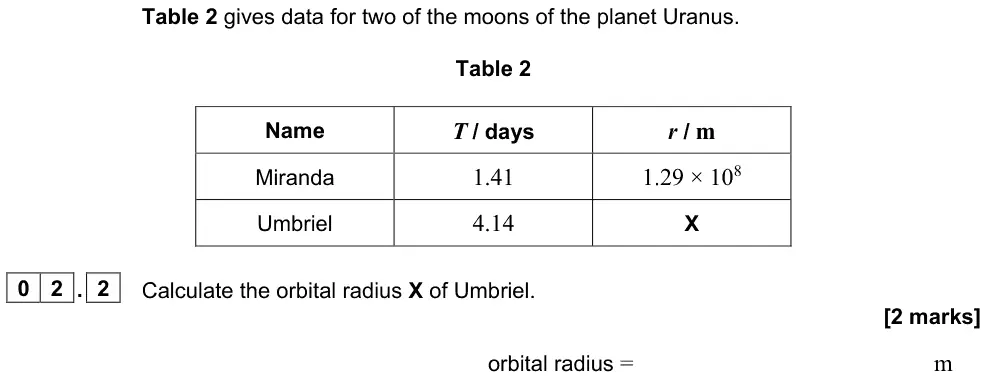
Table 2 gives data for two of the moons of the planet Uranus.
Table 2
Name
T / days
r / m
Miranda
1.41
1.29 × 10⁸
Umbriel
4.14
X
Calculate the orbital radius X of Umbriel.
[2 marks]
orbital radius =
m
November 2020 · Paper 2 · Q2.3 3 marks AO2=3 Calculation gravitational fields
Earlier part of question 2 that this part usesEarlier part of November 2020 Paper 2 question 2
Calculate the mass of Uranus.
[3 marks]
mass =
kg
November 2020 · Paper 2 · Q2.4 3 marks Calculation gravitational fields
Earlier part of question 2 that this part usesEarlier part of November 2020 Paper 2 question 2
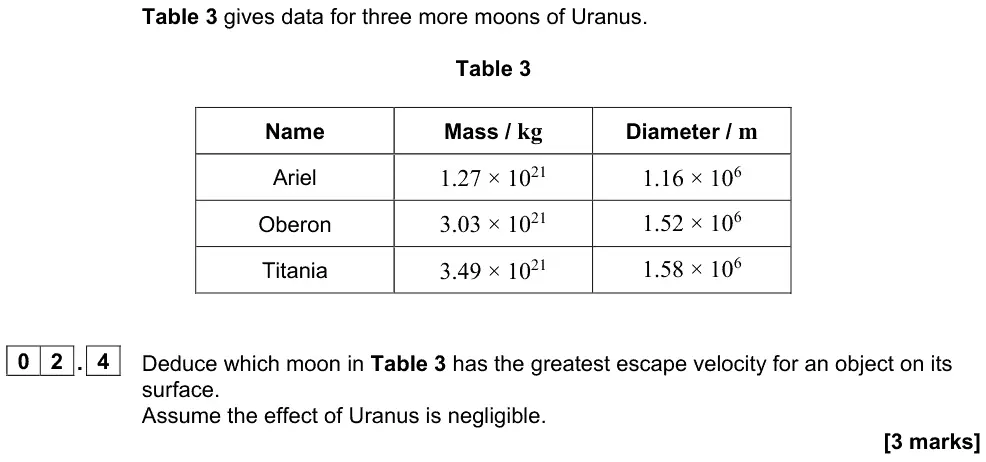
Table 3 gives data for three more moons of Uranus.
Table 3
Name
Mass / kg
Diameter / m
Ariel
1.27 × 10²¹
1.16 × 10⁶
Oberon
3.03 × 10²¹
1.52 × 10⁶
Titania
3.49 × 10²¹
1.58 × 10⁶
Deduce which moon in Table 3 has the greatest escape velocity for an object on its
surface.
Assume the effect of Uranus is negligible.
[3 marks]
November 2020 · Paper 2 · Q2.5 3 marks AO2=3 Calculation gravitational fieldswork energy and power
Earlier part of question 2 that this part usesEarlier part of November 2020 Paper 2 question 2
A spring mechanism can project an object vertically to a maximum height of 1.0 m
from the surface of the Earth.
Determine whether the same mechanism could project the same object vertically to a
maximum height greater than 100 m when placed on the surface of Ariel.
[3 marks]
November 2020 · Paper 2 · Q3.1 1 mark AO1=1 Diagram or graph magnetic fieldselectric fields
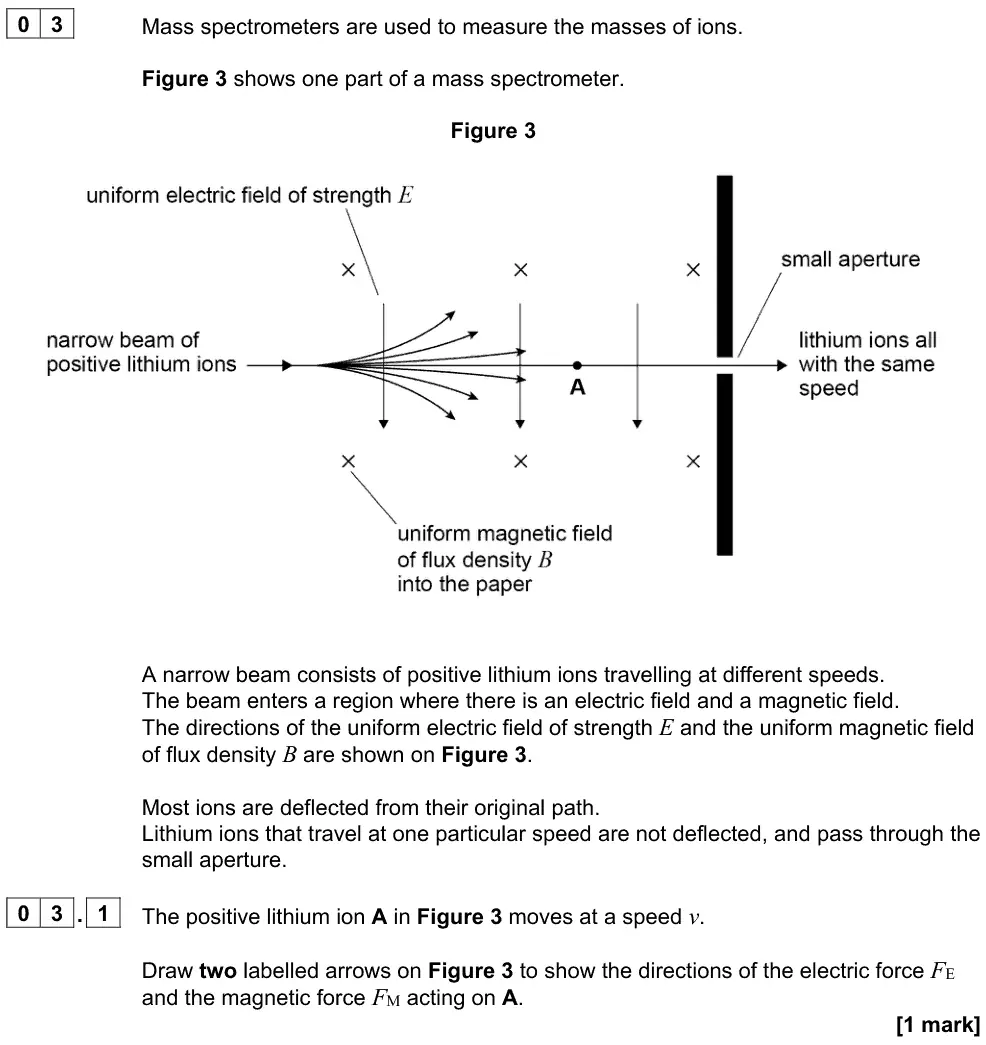
Mass spectrometers are used to measure the masses of ions.
Figure 3 shows one part of a mass spectrometer.
Figure 3
A narrow beam consists of positive lithium ions travelling at different speeds.
The beam enters a region where there is an electric field and a magnetic field.
The directions of the uniform electric field of strength E and the uniform magnetic field
of flux density B are shown on Figure 3.
Most ions are deflected from their original path.
Lithium ions that travel at one particular speed are not deflected, and pass through the
small aperture.
The positive lithium ion A in Figure 3 moves at a speed v.
Draw two labelled arrows on Figure 3 to show the directions of the electric force FE
and the magnetic force FM acting on A.
[1 mark]
November 2020 · Paper 2 · Q3.2 2 marks Calculation magnetic fieldselectric fields
Earlier part of question 3 that this part usesEarlier part of November 2020 Paper 2 question 3
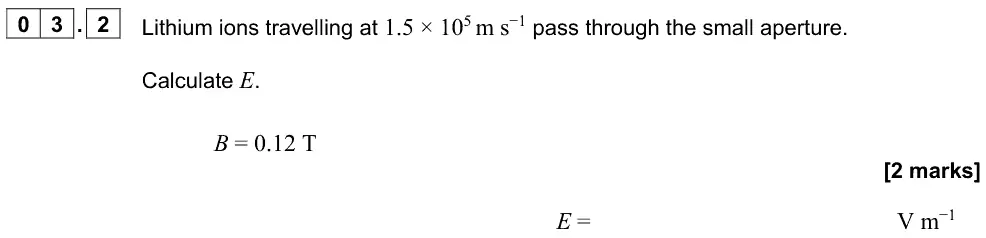
Lithium ions travelling at 1.5 × 10⁵ m s−1 pass through the small aperture.
Calculate E.
B = 0.12 T
[2 marks]
E =
V m−1
November 2020 · Paper 2 · Q3.3 1 mark AO2=1 Show that magnetic fieldscircular motion
Earlier part of question 3 that this part usesEarlier part of November 2020 Paper 2 question 3
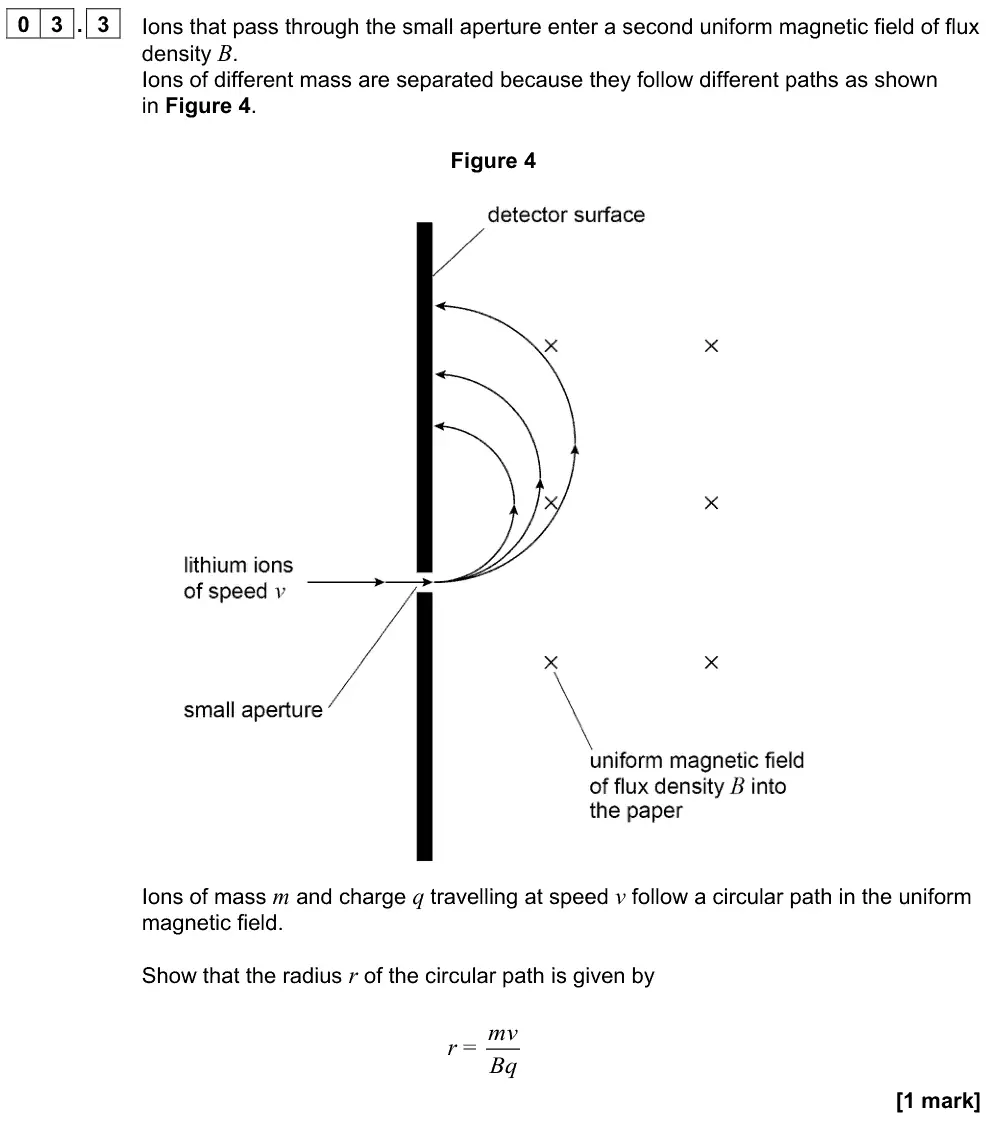
Ions that pass through the small aperture enter a second uniform magnetic field of flux
density B.
Ions of different mass are separated because they follow different paths as shown
in Figure 4.
Figure 4
Ions of mass m and charge q travelling at speed v follow a circular path in the uniform
magnetic field.
Show that the radius r of the circular path is given by
r = mv
Bq
[1 mark]
November 2020 · Paper 2 · Q3.4 2 marks AO1=2 Calculation magnetic fields
Earlier part of question 3 that this part usesEarlier part of November 2020 Paper 2 question 3
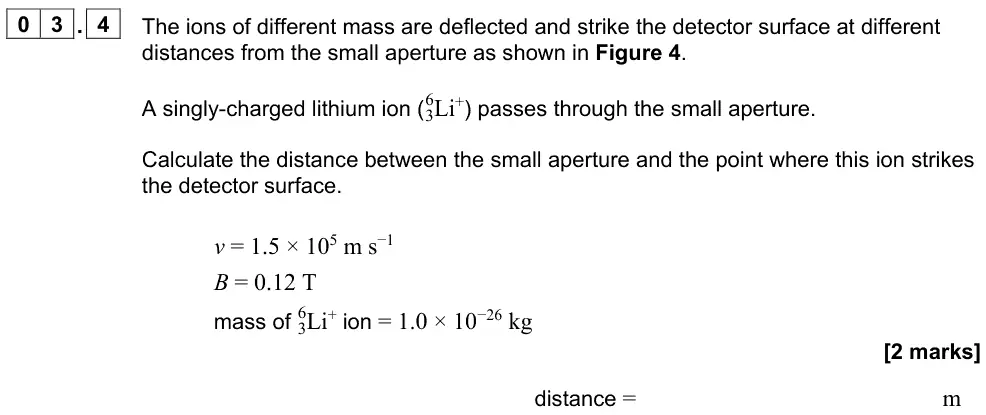
The ions of different mass are deflected and strike the detector surface at different
distances from the small aperture as shown in Figure 4.
A singly-charged lithium ion ( Li
3
6
+) passes through the small aperture.
Calculate the distance between the small aperture and the point where this ion strikes
the detector surface.
v = 1.5 × 10⁵ m s−1
B = 0.12 T
mass of Li
3
6
+ ion = 1.0 × 10⁻²⁶ kg
[2 marks]
distance =
m
November 2020 · Paper 2 · Q3.5 3 marks Calculation Hard electric fieldswork energy and power
Earlier part of question 3 that this part usesEarlier part of November 2020 Paper 2 question 3
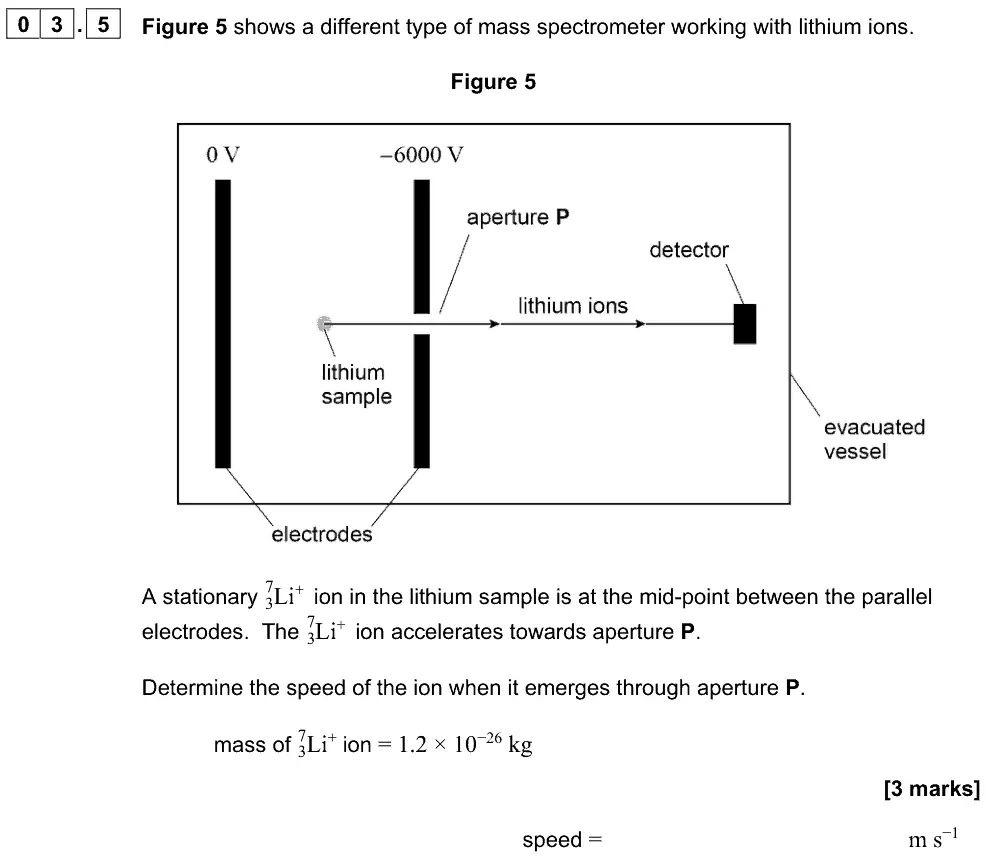
Figure 5 shows a different type of mass spectrometer working with lithium ions.
Figure 5
A stationary Li+
3
7
ion in the lithium sample is at the mid-point between the parallel
electrodes.  The Li+
3
7
ion accelerates towards aperture P.
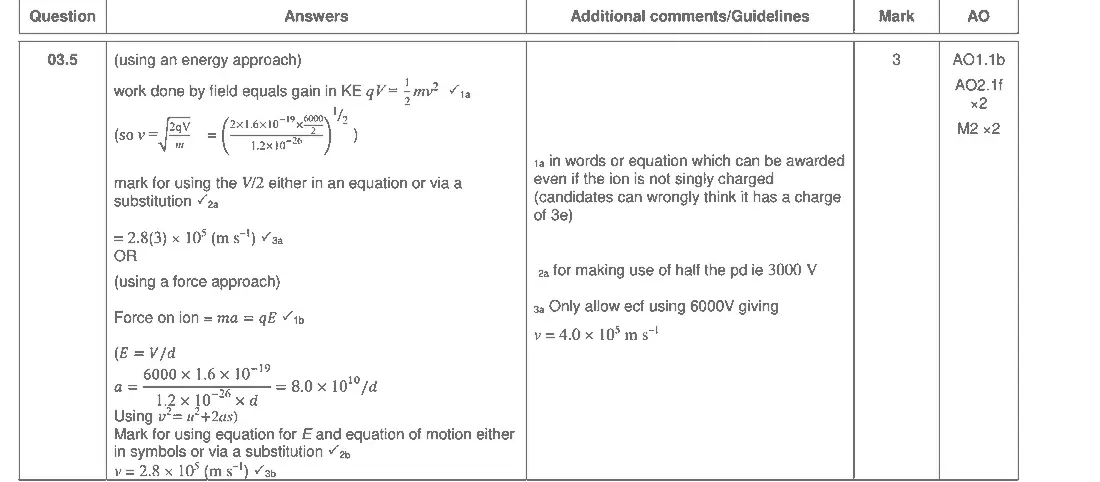
Determine the speed of the ion when it emerges through aperture P.
mass of Li
3
7
+ ion = 1.2 × 10⁻²⁶ kg
[3 marks]
speed =
m s−1
November 2020 · Paper 2 · Q3.6 2 marks Explanation electric fieldsnewtons laws and momentum
Earlier part of question 3 that this part usesEarlier part of November 2020 Paper 2 question 3
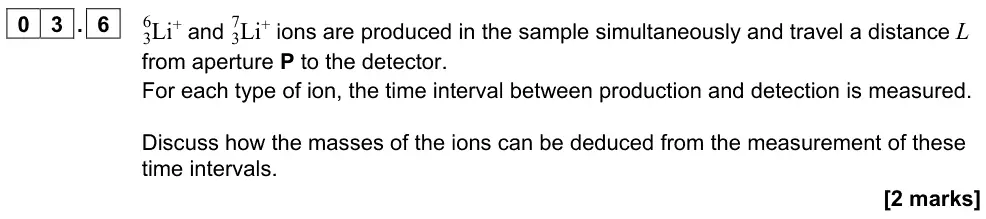
Li
3
6
+ and Li
3
7
+ ions are produced in the sample simultaneously and travel a distance L
from aperture P to the detector.
For each type of ion, the time interval between production and detection is measured.
Discuss how the masses of the ions can be deduced from the measurement of these
time intervals.
[2 marks]
November 2020 · Paper 2 · Q4.1 1 mark AO1=1 Calculation electromagnetic induction
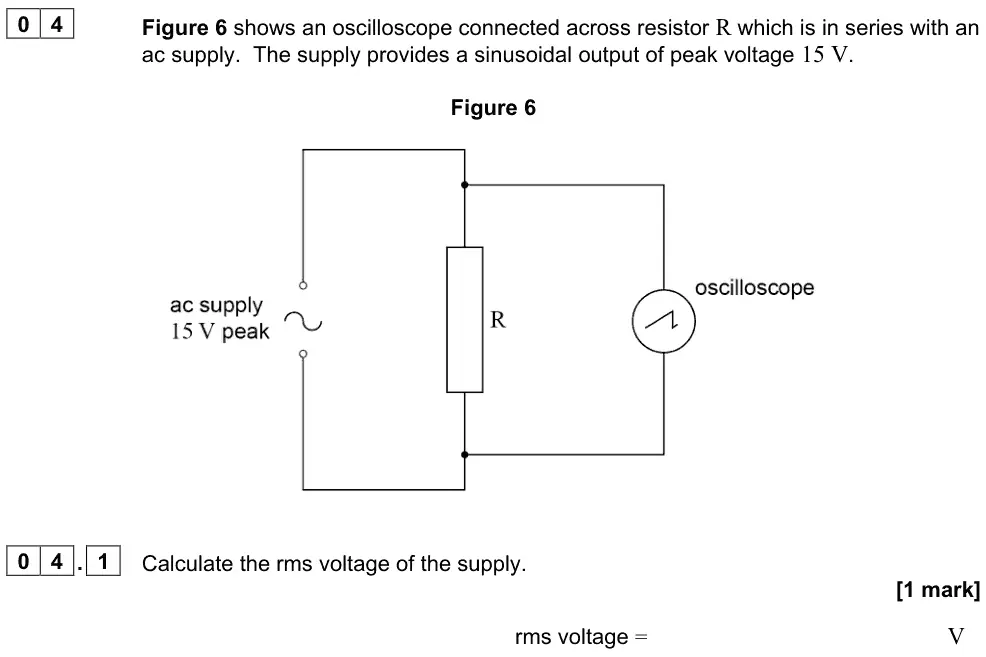
Figure 6 shows an oscilloscope connected across resistor R which is in series with an
ac supply.  The supply provides a sinusoidal output of peak voltage 15 V.
Figure 6
Calculate the rms voltage of the supply.
[1 mark]
rms voltage =
V
November 2020 · Paper 2 · Q4.2 1 mark AO2=1 Short answer electromagnetic induction
Earlier part of question 4 that this part usesEarlier part of November 2020 Paper 2 question 4
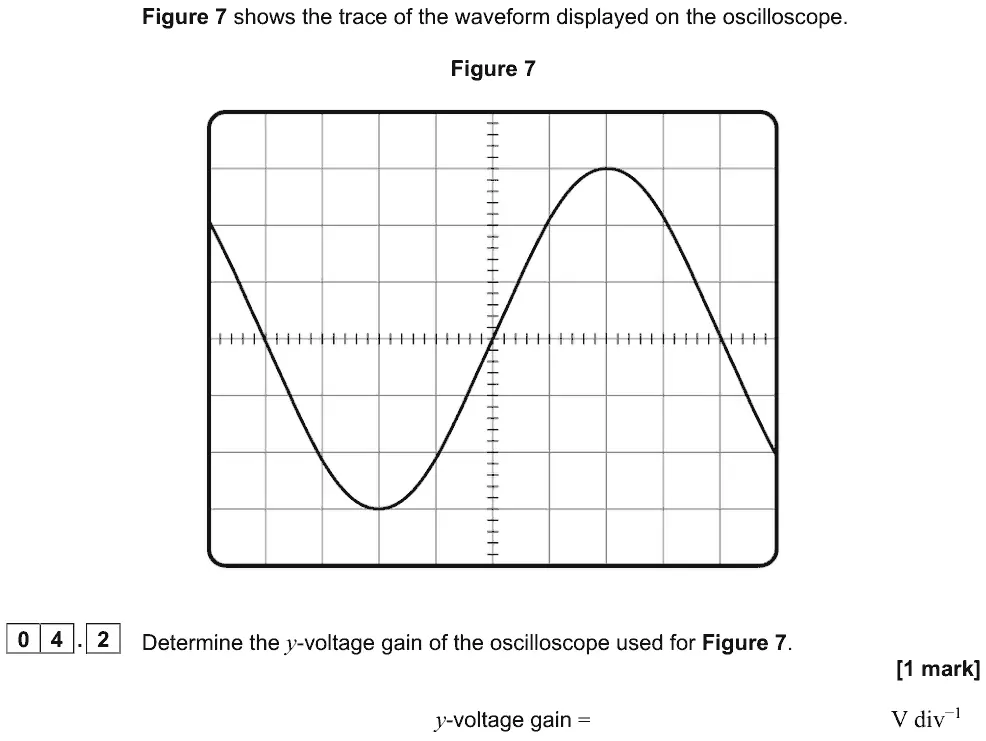
Figure 7 shows the trace of the waveform displayed on the oscilloscope.
Figure 7
Determine the y-voltage gain of the oscilloscope used for Figure 7.
[1 mark]
y-voltage gain =
V div−1
November 2020 · Paper 2 · Q4.3 1 mark AO2=1 Diagram or graph electromagnetic induction
Earlier part of question 4 that this part usesEarlier part of November 2020 Paper 2 question 4
A dc supply gives the same rate of energy dissipation in R as the ac supply in
Figure 6.
Draw the trace of the output of the dc supply on Figure 7.
The oscilloscope settings remain the same.
[1 mark]
November 2020 · Paper 2 · Q4.4 1 mark AO2=1 Calculation electromagnetic induction
Earlier part of question 4 that this part usesEarlier part of November 2020 Paper 2 question 4
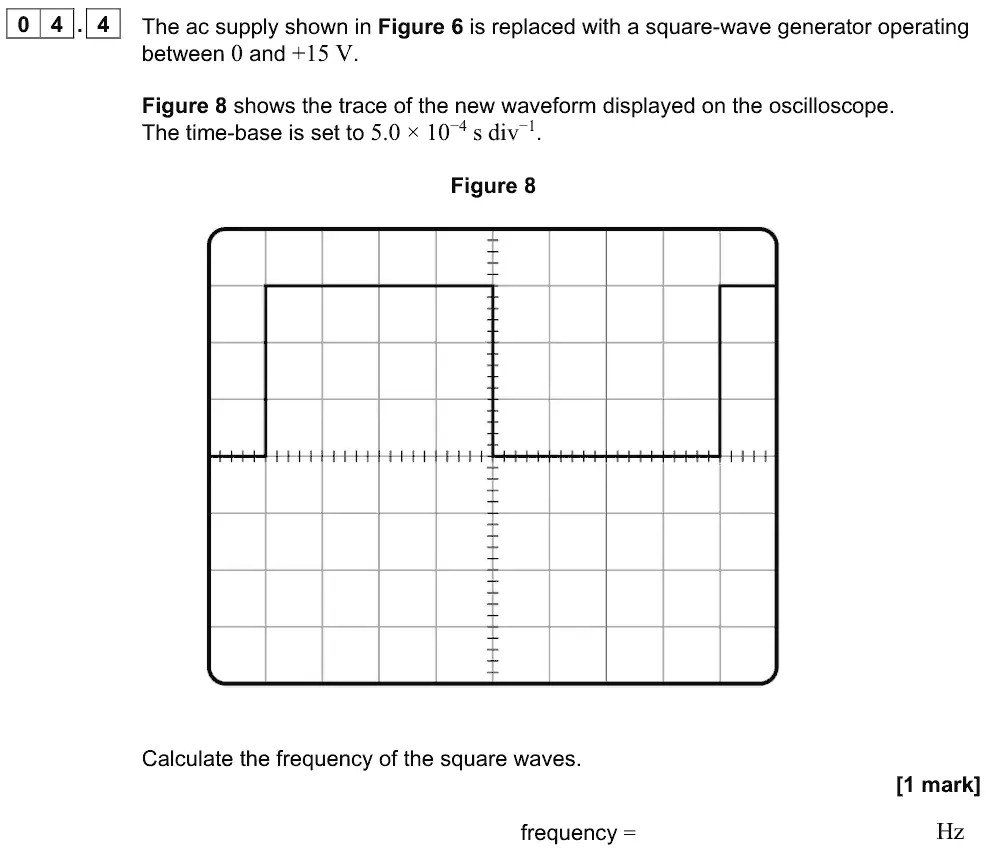
The ac supply shown in Figure 6 is replaced with a square-wave generator operating
between 0 and +15 V.
Figure 8 shows the trace of the new waveform displayed on the oscilloscope.
The time-base is set to 5.0 × 10⁻⁴ s div−1.
Figure 8
Calculate the frequency of the square waves.
[1 mark]
frequency =
Hz
November 2020 · Paper 2 · Q4.5 3 marks Practical and data analysis capacitors
Earlier part of question 4 that this part usesEarlier part of November 2020 Paper 2 question 4
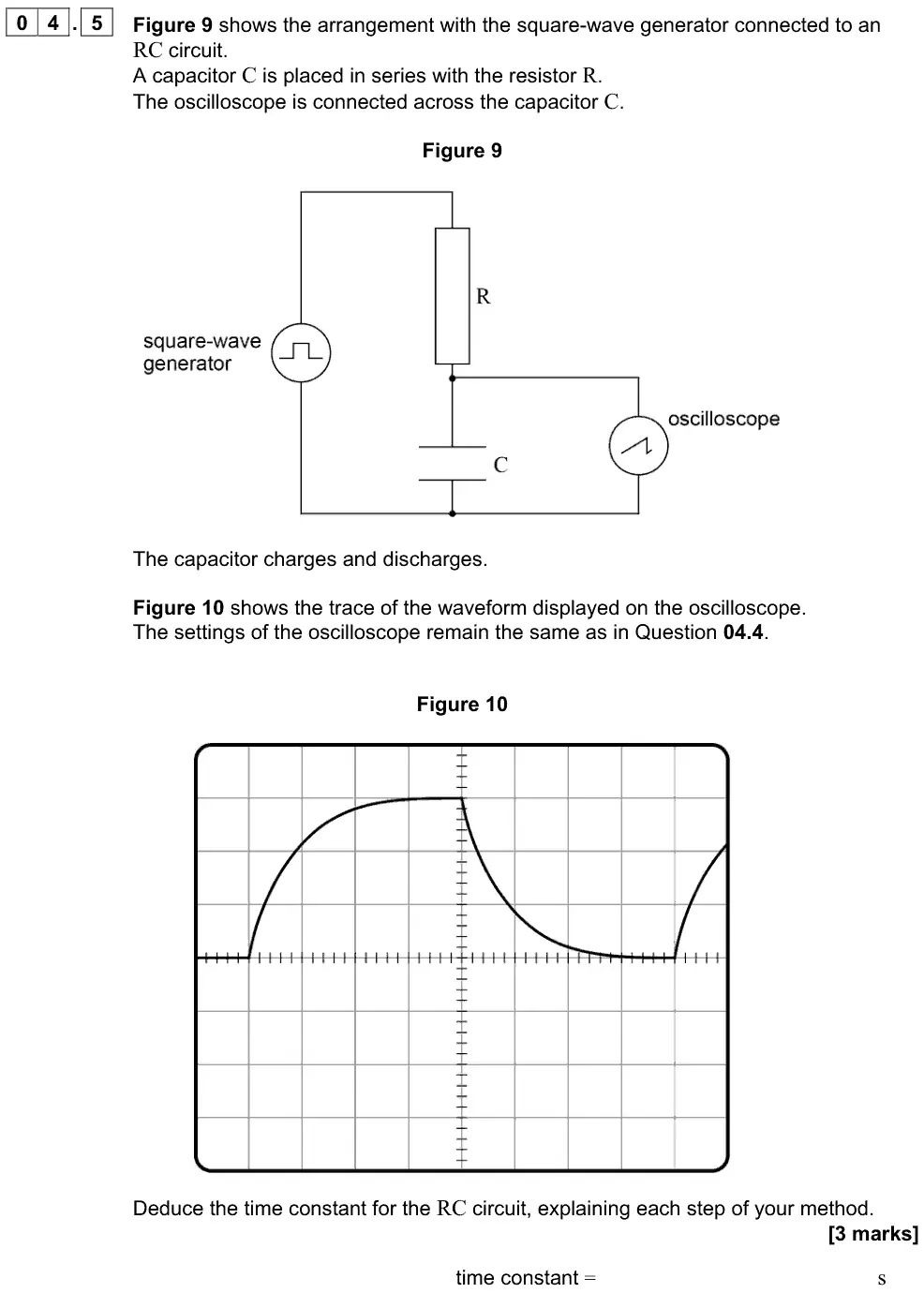
Figure 9 shows the arrangement with the square-wave generator connected to an
RC circuit.
A capacitor C is placed in series with the resistor R.
The oscilloscope is connected across the capacitor C.
Figure 9
The capacitor charges and discharges.
Figure 10 shows the trace of the waveform displayed on the oscilloscope.
The settings of the oscilloscope remain the same as in Question 04.4.
Figure 10
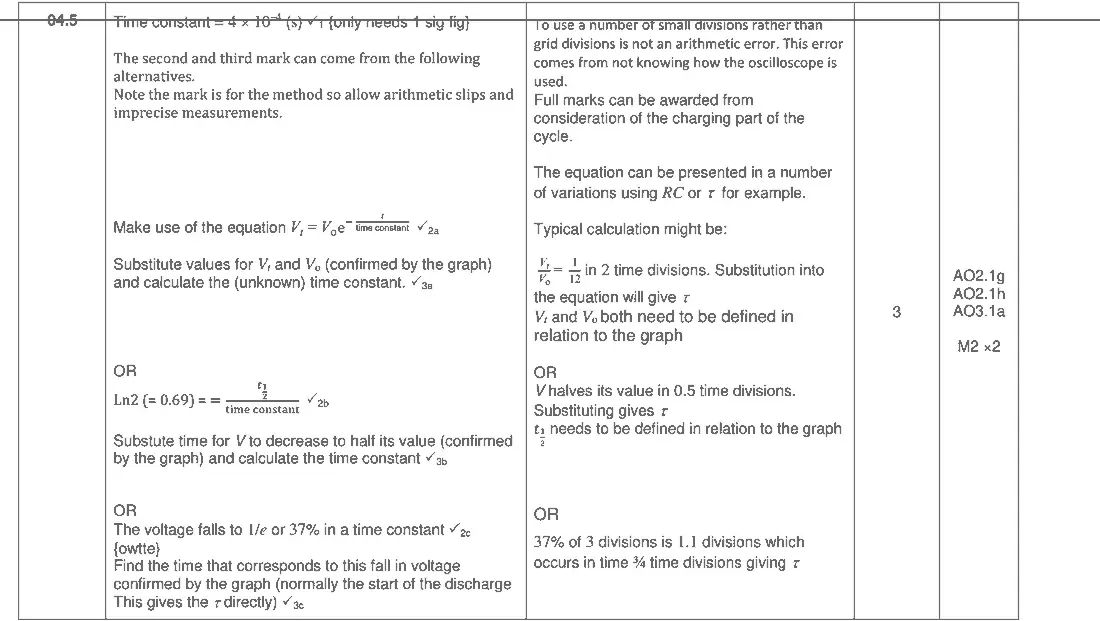
Deduce the time constant for the RC circuit, explaining each step of your method.
[3 marks]
time constant =
s
November 2020 · Paper 2 · Q4.6 2 marks AO3=2 Explanation electromagnetic inductionmeasurements and uncertainties
Earlier part of question 4 that this part usesEarlier part of November 2020 Paper 2 question 4
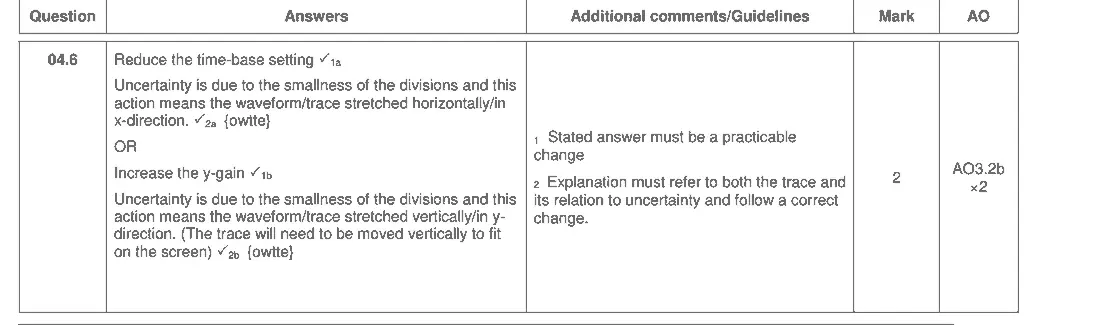
State and explain a change to one control setting on the oscilloscope that would
reduce the uncertainty in the value of the time constant.
[2 marks]
November 2020 · Paper 2 · Q5.1 1 mark AO1=1 Short answer Hard particles antiparticles and interactionsrutherford scattering and radiation
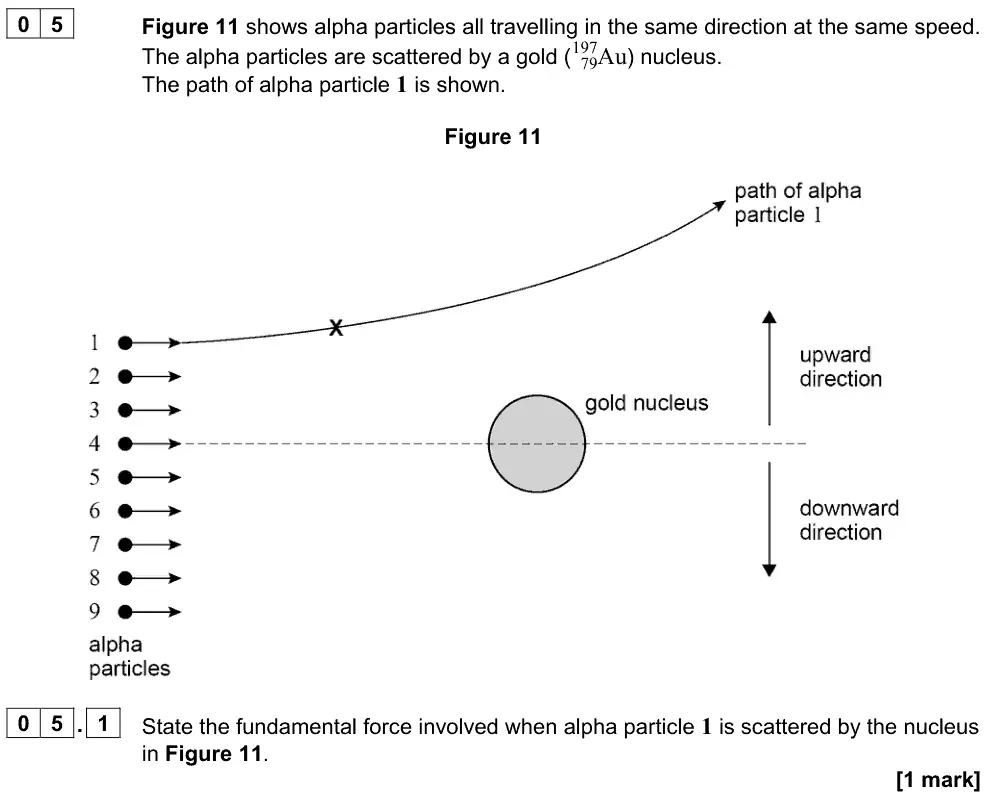
Figure 11 shows alpha particles all travelling in the same direction at the same speed.
The alpha particles are scattered by a gold (
Au
79
197
) nucleus.
The path of alpha particle 1 is shown.
Figure 11
State the fundamental force involved when alpha particle 1 is scattered by the nucleus
in Figure 11.
[1 mark]
November 2020 · Paper 2 · Q5.2 1 mark AO1=1 Diagram or graph newtons laws and momentumelectric fields
Earlier part of question 5 that this part usesEarlier part of November 2020 Paper 2 question 5
Draw an arrow at position X on Figure 11 to show the direction of the rate of change
in momentum of alpha particle 1
[1 mark]
November 2020 · Paper 2 · Q5.3 2 marks Explanation rutherford scattering and radiation
Earlier part of question 5 that this part usesEarlier part of November 2020 Paper 2 question 5
Suggest one of the alpha particles in Figure 11 which may be deflected downwards
with a scattering angle of 90°
Justify your answer.
[2 marks]
alpha particle number =
November 2020 · Paper 2 · Q5.4 3 marks Calculation electric fieldsnuclear radius
Earlier part of question 5 that this part usesEarlier part of November 2020 Paper 2 question 5
Alpha particle 4 comes to rest at a distance of 5.5 × 10⁻¹⁴ m from the centre of the
Au
79
197
nucleus.
Calculate the speed of alpha particle 4 when it is at a large distance from the nucleus.
Ignore relativistic effects.
mass of alpha particle = 6.8 × 10⁻²⁷ kg
[3 marks]
speed =
m s−1
November 2020 · Paper 2 · Q5.5 2 marks Calculation nuclear radius
Earlier part of question 5 that this part usesEarlier part of November 2020 Paper 2 question 5
The nuclear radius of
Au
79
197
is 6.98 × 10⁻¹⁵ m.
Calculate the nuclear radius of
Ag
47
107
.
[2 marks]
radius =
m
November 2020 · Paper 2 · Q5.6 1 mark Short answer nuclear radius
Earlier part of question 5 that this part usesEarlier part of November 2020 Paper 2 question 5
All nuclei have approximately the same density.
State one conclusion about the nucleons in a nucleus that can be deduced from this
fact.
[1 mark]
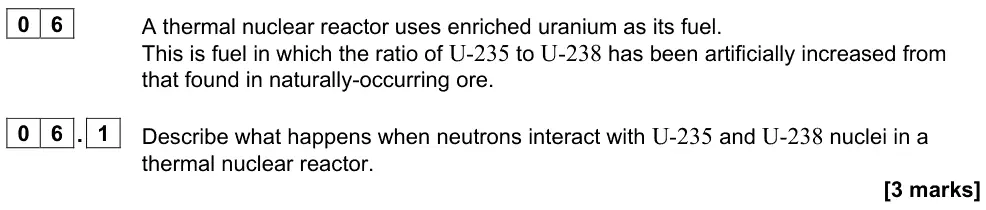
November 2020 · Paper 2 · Q6.1 3 marks AO2=3 Explanation mass energy and fission
A thermal nuclear reactor uses enriched uranium as its fuel.
This is fuel in which the ratio of U-235 to U-238 has been artificially increased from
that found in naturally-occurring ore.
Describe what happens when neutrons interact with U-235 and U-238 nuclei in a
thermal nuclear reactor.
[3 marks]
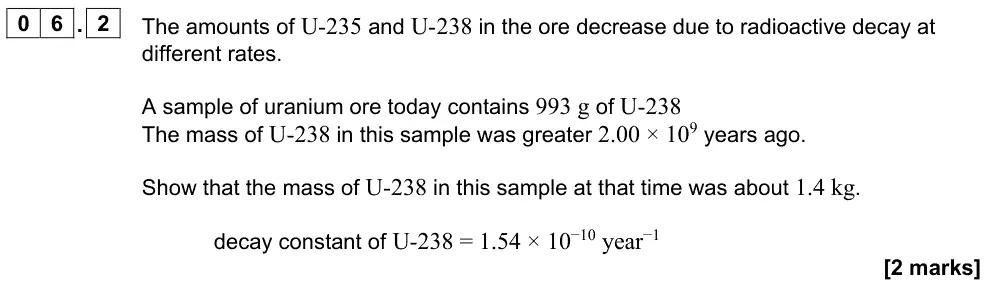
November 2020 · Paper 2 · Q6.2 2 marks AO2=2 Show that radioactive decay
Earlier part of question 6 that this part usesEarlier part of November 2020 Paper 2 question 6
The amounts of U-235 and U-238 in the ore decrease due to radioactive decay at
different rates.
A sample of uranium ore today contains 993 g of U-238
The mass of U-238 in this sample was greater 2.00 × 10⁹ years ago.
Show that the mass of U-238 in this sample at that time was about 1.4 kg.
decay constant of U-238 = 1.54 × 10⁻¹⁰ year−1
[2 marks]
November 2020 · Paper 2 · Q6.3 1 mark Calculation radioactive decaymass energy and fission
Earlier part of question 6 that this part usesEarlier part of November 2020 Paper 2 question 6
A thermal nuclear reactor requires a minimum of 3.0% of its uranium mass to be
U-235
The ratio of U-235 to U-238 in the ore has changed over time.
2.00 × 10⁹ years ago, the sample in Question 06.2 contained 52 g of U-235
Deduce whether the sample had a high enough U-235 content to be used in a reactor
2.00 × 10⁹ years ago.
[1 mark]
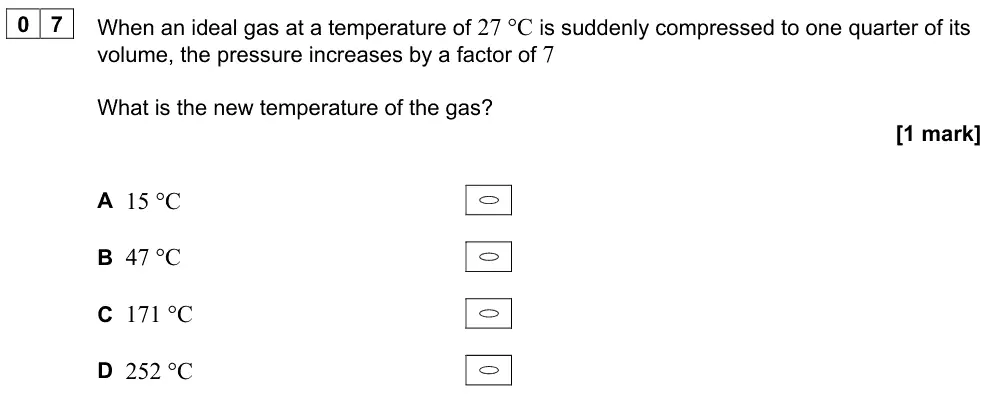
November 2020 · Paper 2 · Q7 1 mark Multiple choice Hard thermal energy and ideal gases
When an ideal gas at a temperature of 27 °C is suddenly compressed to one quarter of its
volume, the pressure increases by a factor of 7
What is the new temperature of the gas?
[1 mark]
A 15 °C
B 47 °C
C 171 °C
D 252 °C
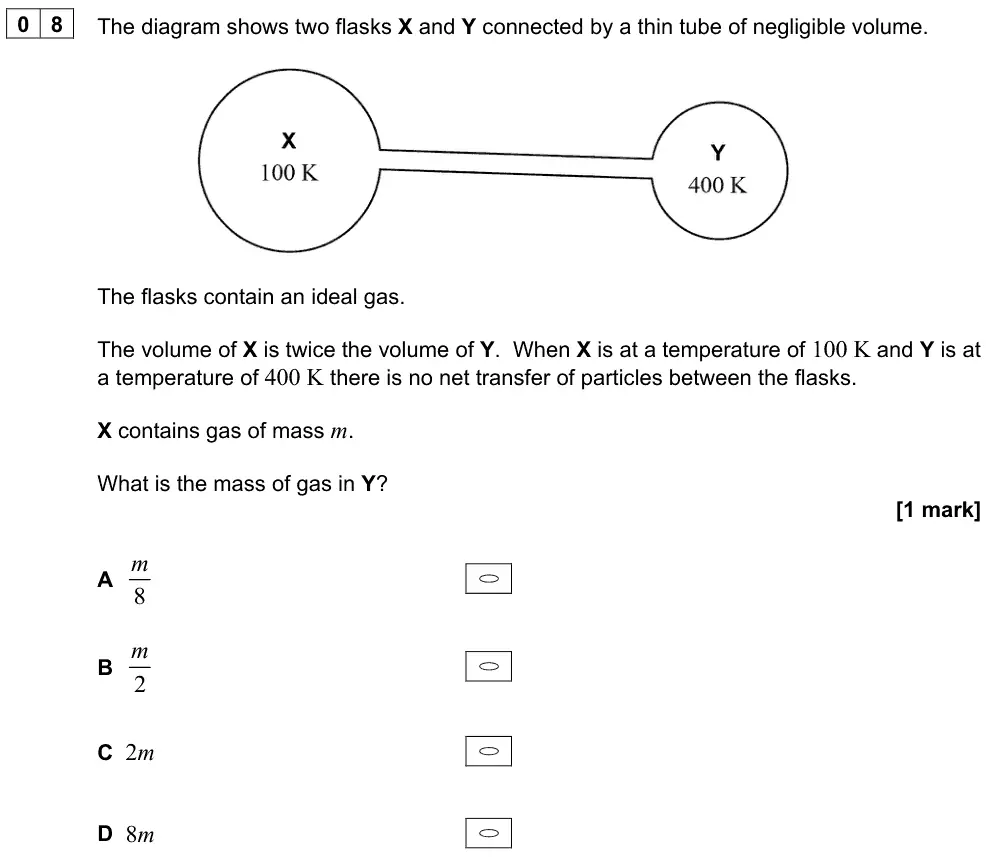
November 2020 · Paper 2 · Q8 1 mark Multiple choice thermal energy and ideal gases
The diagram shows two flasks X and Y connected by a thin tube of negligible volume.
The flasks contain an ideal gas.
The volume of X is twice the volume of Y.  When X is at a temperature of 100 K and Y is at
a temperature of 400 K there is no net transfer of particles between the flasks.
X contains gas of mass m.
What is the mass of gas in Y?
[1 mark]
A 8
m
B 2
m
C 2m
D 8m
November 2020 · Paper 2 · Q9 1 mark Multiple choice kinetic theory
A sample P of an ideal gas contains 1 mol at an absolute temperature T.
A second sample Q of an ideal gas contains 2
3
mol at an absolute temperature 2T.
The total molecular kinetic energy of P is E.
What is the total molecular kinetic energy of Q?
[1 mark]
A 2
3 E
B 3
4 E
C 4
3 E
D 3
2 E
November 2020 · Paper 2 · Q10 1 mark Multiple choice kinetic theory
An ideal gas is contained in a cubical box of side length a.
The gas has N molecules each of mass m.
What is the pressure exerted by the gas on the walls of the box?
[1 mark]
A
3
2
mNa × crms2
B
2
2
mNa × crms2
C
2
3
mN
a
× crms2
D
3
3
mN
a
× crms2
November 2020 · Paper 2 · Q11 1 mark Multiple choice kinetic theory
Which statement is true about an experiment where Brownian motion is demonstrated
using smoke particles in air?
[1 mark]
A The experiment makes it possible to see the motion of air molecules.
B The motion is caused by the collisions of smoke particles with each other.
C The motion is caused by collisions between air molecules and smoke
particles.
D The motion occurs because air is a mixture of gases and the molecules
have different masses.
November 2020 · Paper 2 · Q12 1 mark Multiple choice gravitational fields
The graph shows how the gravitational potential V varies with the vertical distance d from
the surface of the Earth.
What does the gradient of the graph represent at the surface of the Earth?
[1 mark]
A potential energy
B mass of the Earth
C magnitude of the gravitational constant
D magnitude of the gravitational field strength
November 2020 · Paper 2 · Q13 1 mark Multiple choice gravitational fieldscircular motion
What is the angular speed of a satellite in a geostationary orbit around the Earth?
[1 mark]
A 1.2 × 10⁻⁵ rad s−1
B 7.3 × 10⁻⁵ rad s−1
C 4.4 × 10⁻³ rad s−1
D 2.6 × 10⁻¹ rad s−1
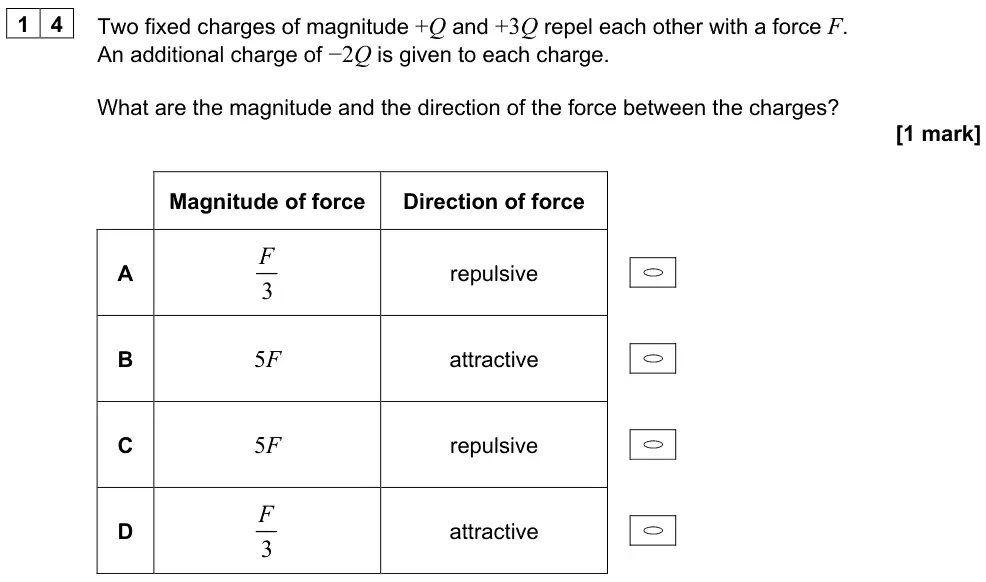
November 2020 · Paper 2 · Q14 1 mark Multiple choice Easy electric fields
Two fixed charges of magnitude +Q and +3Q repel each other with a force F.
An additional charge of −2Q is given to each charge.
What are the magnitude and the direction of the force between the charges?
[1 mark]
Magnitude of force
Direction of force
A
3
F
repulsive
B
5F
attractive
C
5F
repulsive
D
3
F
attractive
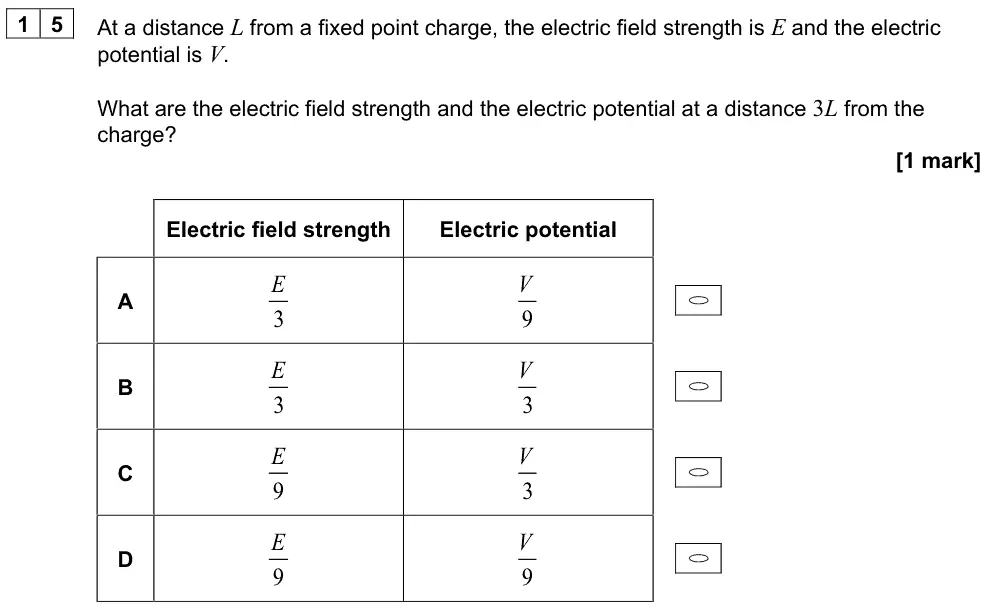
November 2020 · Paper 2 · Q15 1 mark Multiple choice electric fields
At a distance L from a fixed point charge, the electric field strength is E and the electric
potential is V.
What are the electric field strength and the electric potential at a distance 3L from the
charge?
[1 mark]
Electric field strength
Electric potential
A
3
E
9
V
B
3
E
3
V
C
9
E
3
V
D
9
E
9
V
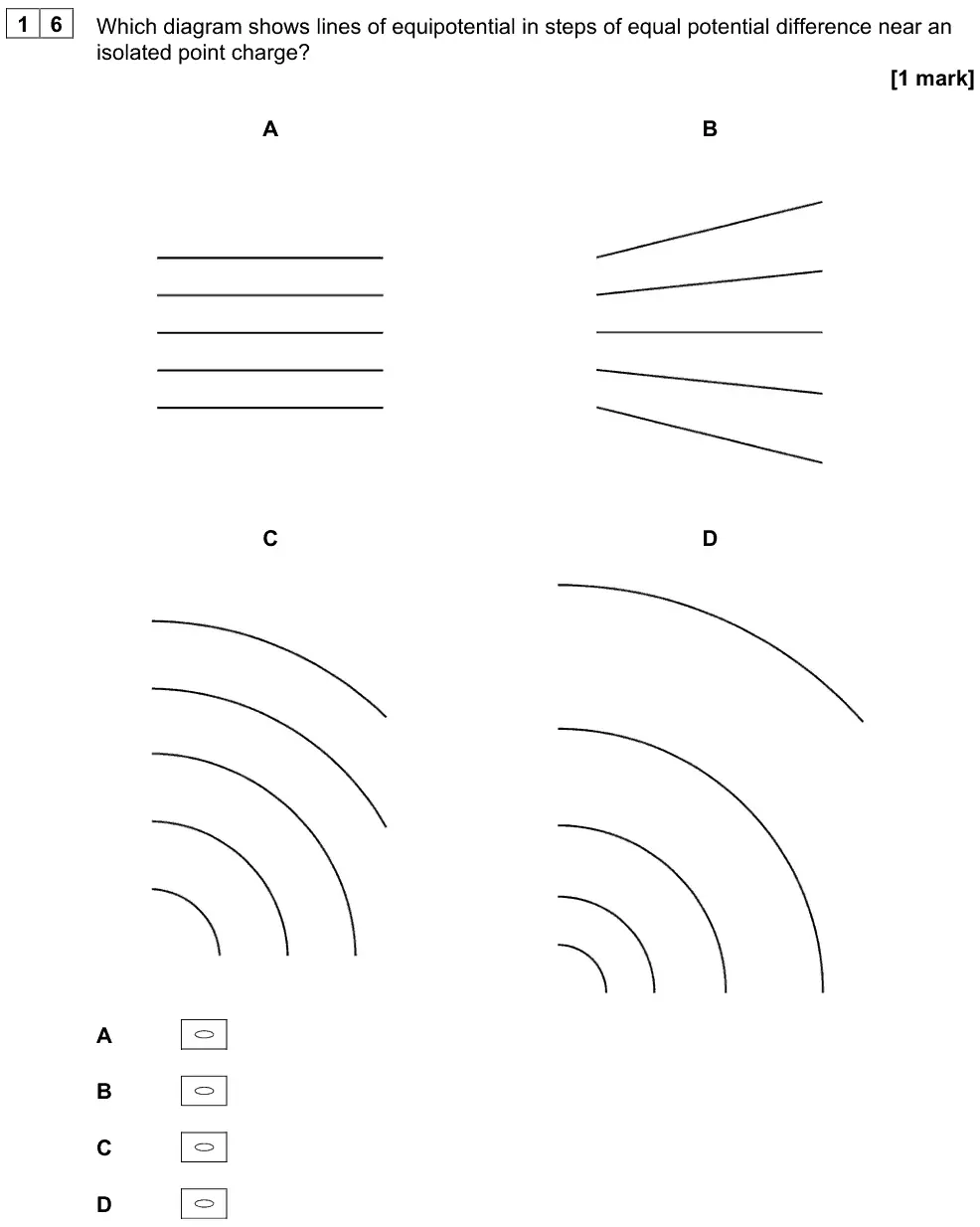
November 2020 · Paper 2 · Q16 1 mark Multiple choice electric fields
Which diagram shows lines of equipotential in steps of equal potential difference near an
isolated point charge?
[1 mark]
A
B
C
D
A
B
C
D
November 2020 · Paper 2 · Q17 1 mark Multiple choice electric fields
A positive charge of 2.0 × 10⁻⁴ C is placed in an electric field at a point where the potential
is +500 V.
What is the potential energy of the system?
[1 mark]
A 1.0 × 10⁻¹ J
B 1.0 × 10⁻¹ J C−1
C 4.0 × 10⁻⁷ J
D 4.0 × 10⁻⁷ J C−1
November 2020 · Paper 2 · Q18 1 mark Multiple choice electric fields
Two charges P and Q are 100 mm apart.
X is a point on the line between P and Q where the electric potential is 0 V.
What is the distance from P to X?
[1 mark]
A 33 mm
B 40 mm
C 60 mm
D 67 mm
November 2020 · Paper 2 · Q19 1 mark Multiple choice capacitorscurrent voltage and resistivity
An uncharged capacitor is connected to a power supply which supplies a constant current
of 10 μA.
After 100 ms, the potential difference across the capacitor is 5.0 kV.
What is the capacitance of the capacitor?
[1 mark]
A 2.0 × 10⁻¹⁰ F
B 4.0 × 10⁻¹⁰ F
C 2.5 × 10⁹ F
D 5.0 × 10⁹ F
November 2020 · Paper 2 · Q20 1 mark Multiple choice capacitors
When a parallel-plate capacitor is connected across a battery, the energy stored in the
capacitor is W.
The battery remains connected as the distance between the capacitor plates is halved.
What is the energy now stored in the capacitor?
[1 mark]
A 0.5W
B W
C 2W
D 4W
November 2020 · Paper 2 · Q21 1 mark Multiple choice capacitors
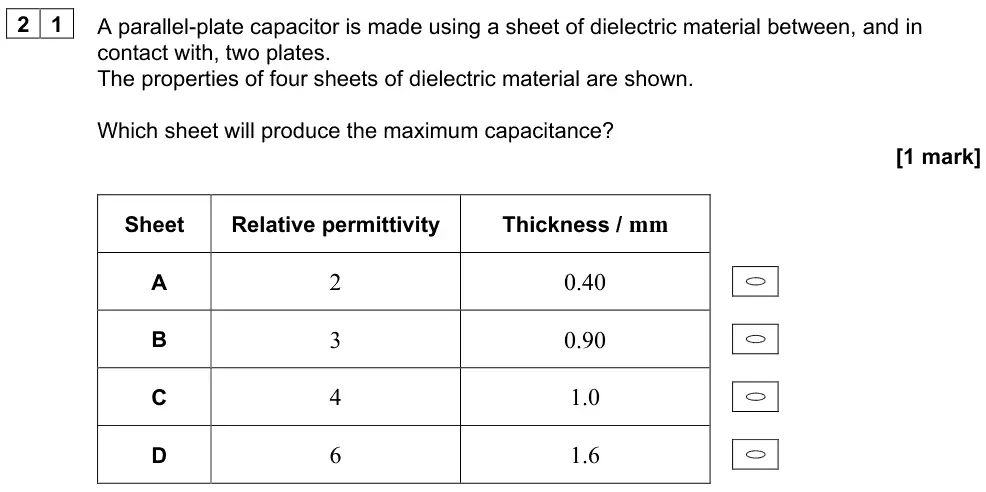
A parallel-plate capacitor is made using a sheet of dielectric material between, and in
contact with, two plates.
The properties of four sheets of dielectric material are shown.
Which sheet will produce the maximum capacitance?
[1 mark]
Sheet
Relative permittivity
Thickness / mm
A
2
0.40
B
3
0.90
C
4
1.0
D
6
1.6
November 2020 · Paper 2 · Q22 1 mark Multiple choice capacitors
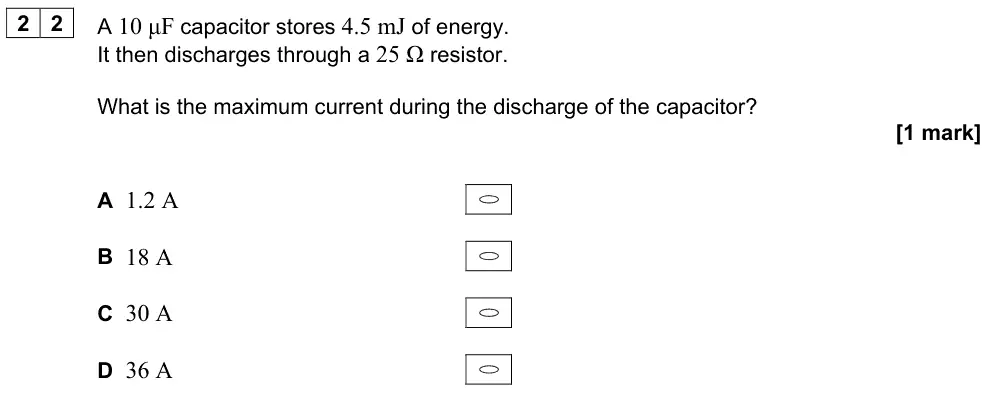
A 10 μF capacitor stores 4.5 mJ of energy.
It then discharges through a 25 Ω resistor.
What is the maximum current during the discharge of the capacitor?
[1 mark]
A 1.2 A
B 18 A
C 30 A
D 36 A
November 2020 · Paper 2 · Q23 1 mark Multiple choice magnetic fields
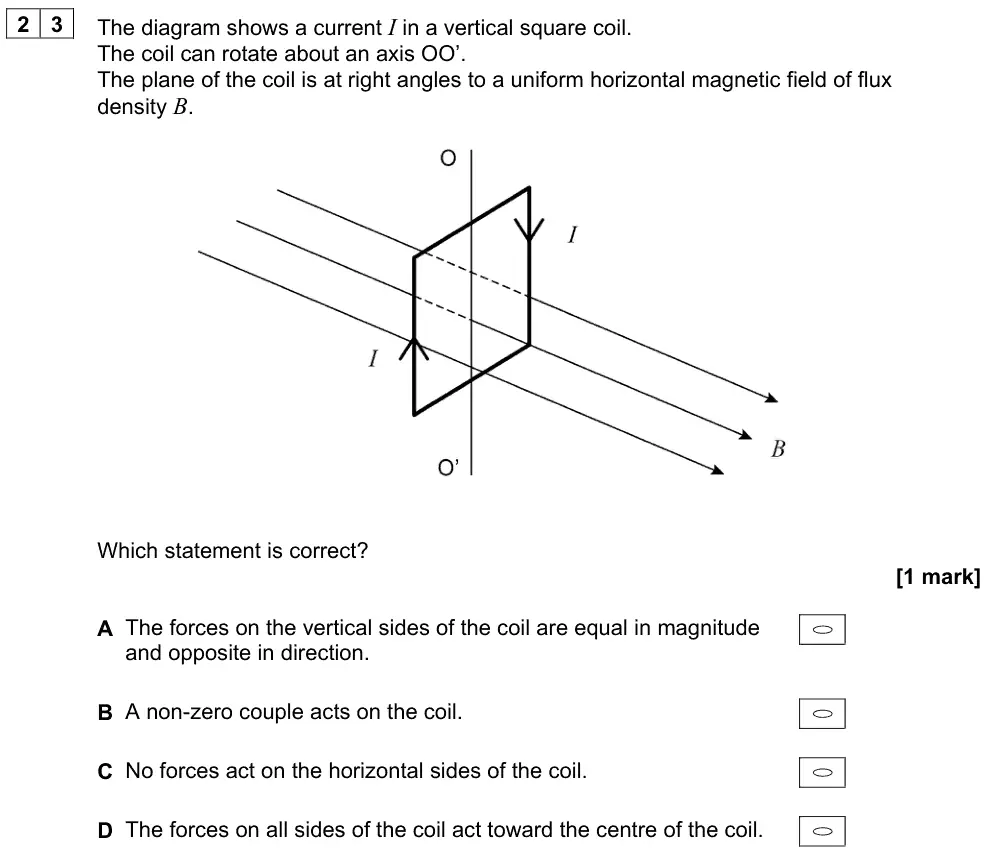
The diagram shows a current I in a vertical square coil.
The coil can rotate about an axis OO’.
The plane of the coil is at right angles to a uniform horizontal magnetic field of flux
density B.
Which statement is correct?
[1 mark]
A The forces on the vertical sides of the coil are equal in magnitude
and opposite in direction.
B A non-zero couple acts on the coil.
C No forces act on the horizontal sides of the coil.
D The forces on all sides of the coil act toward the centre of the coil.
November 2020 · Paper 2 · Q24 1 mark Multiple choice Hard electromagnetic induction
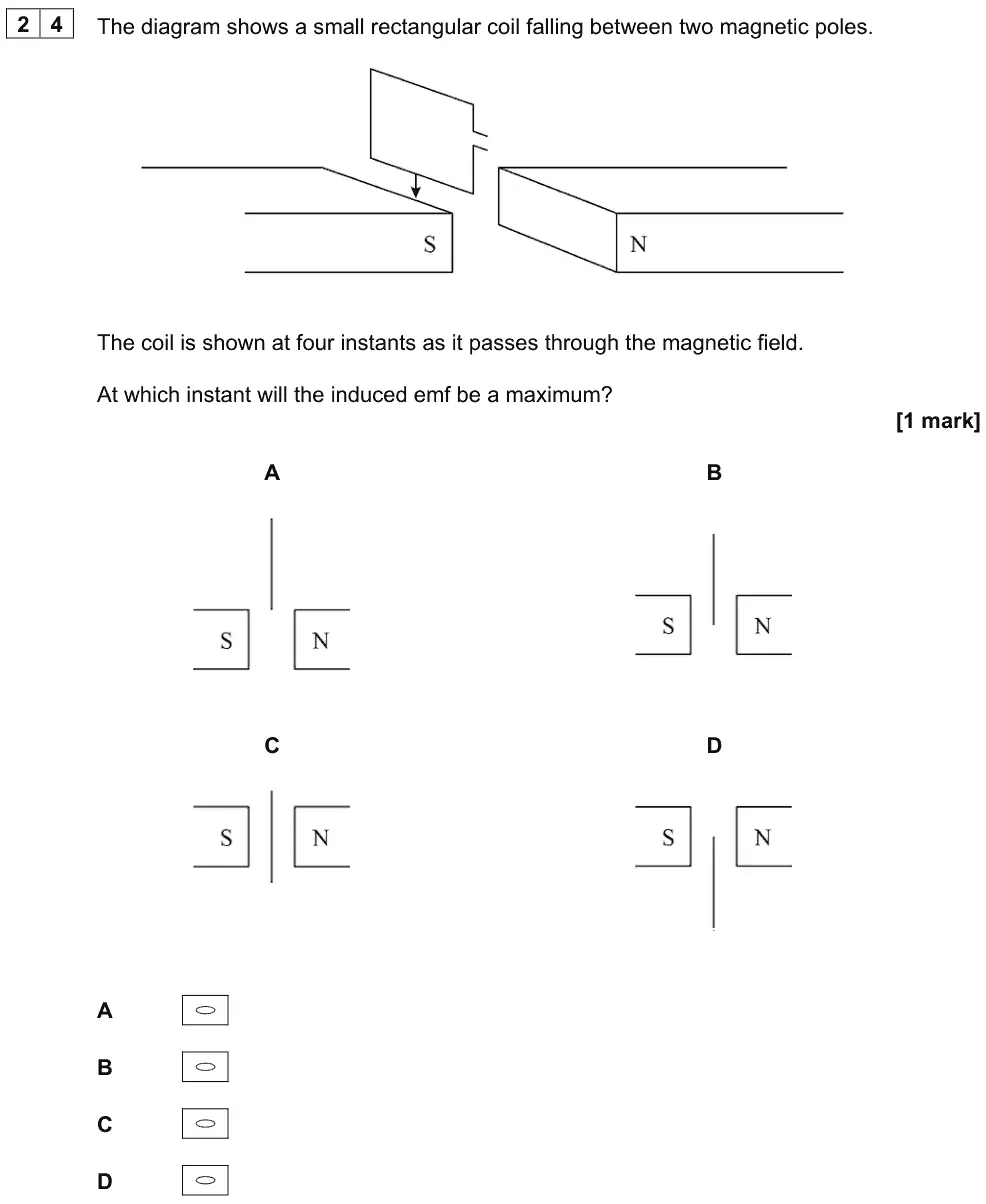
The diagram shows a small rectangular coil falling between two magnetic poles.
The coil is shown at four instants as it passes through the magnetic field.
At which instant will the induced emf be a maximum?
[1 mark]
A
B
C
D
A
B
C
D
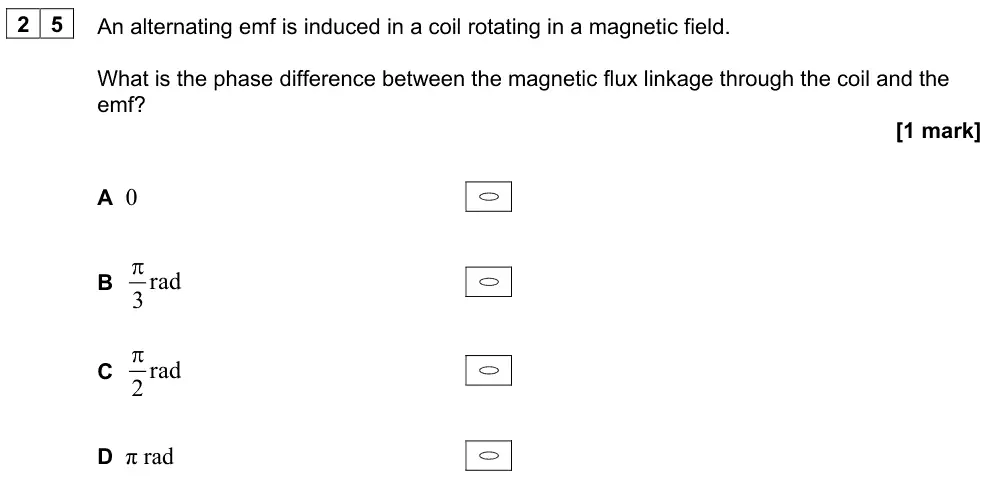
November 2020 · Paper 2 · Q25 1 mark Multiple choice electromagnetic induction
An alternating emf is induced in a coil rotating in a magnetic field.
What is the phase difference between the magnetic flux linkage through the coil and the
emf?
[1 mark]
A 0
B
rad
3
π
C
rad
2
π
D π rad
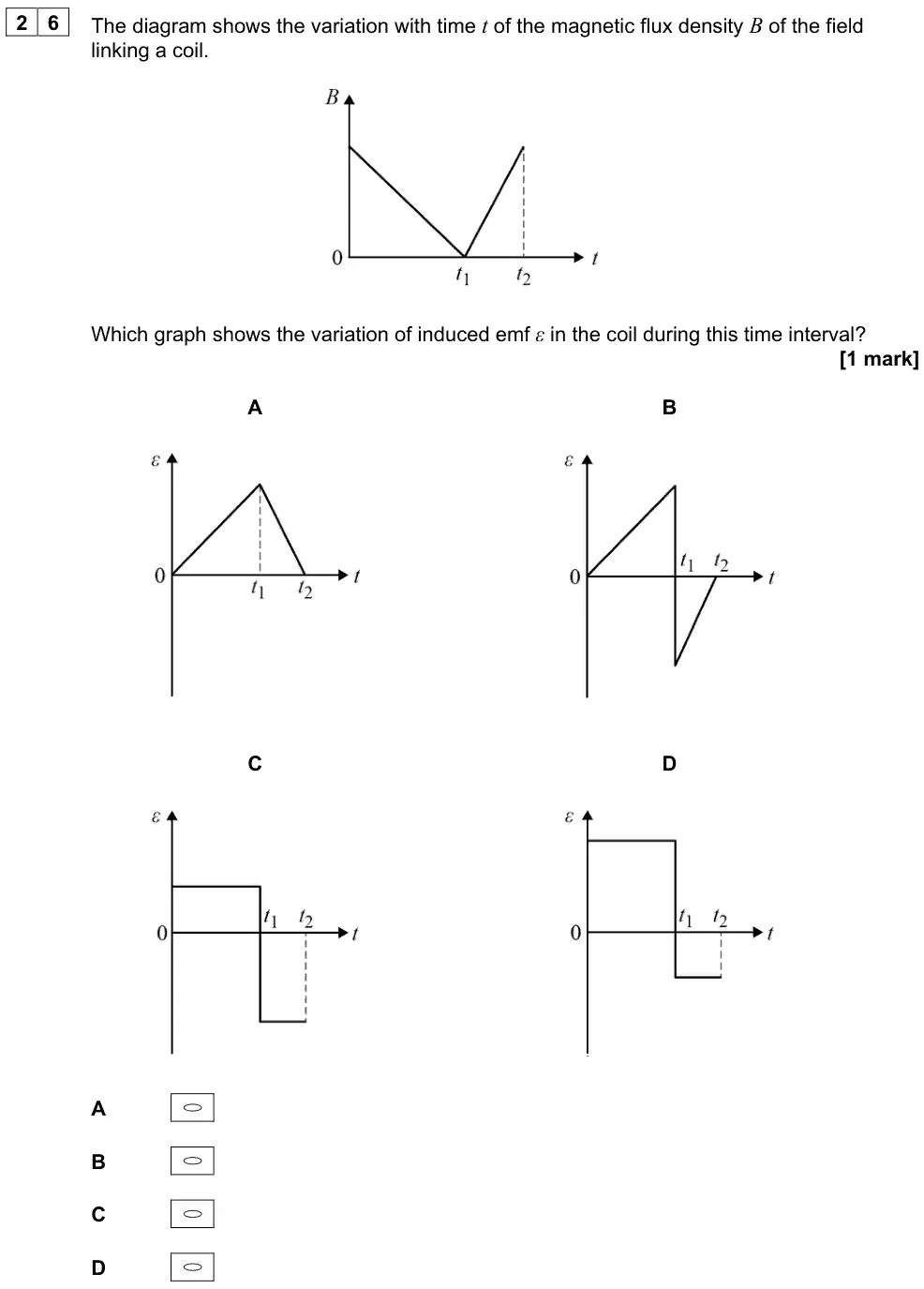
November 2020 · Paper 2 · Q26 1 mark Multiple choice electromagnetic induction
The diagram shows the variation with time t of the magnetic flux density B of the field
linking a coil.
Which graph shows the variation of induced emf ε in the coil during this time interval?
[1 mark]
A
B
C
D
A
B
C
D
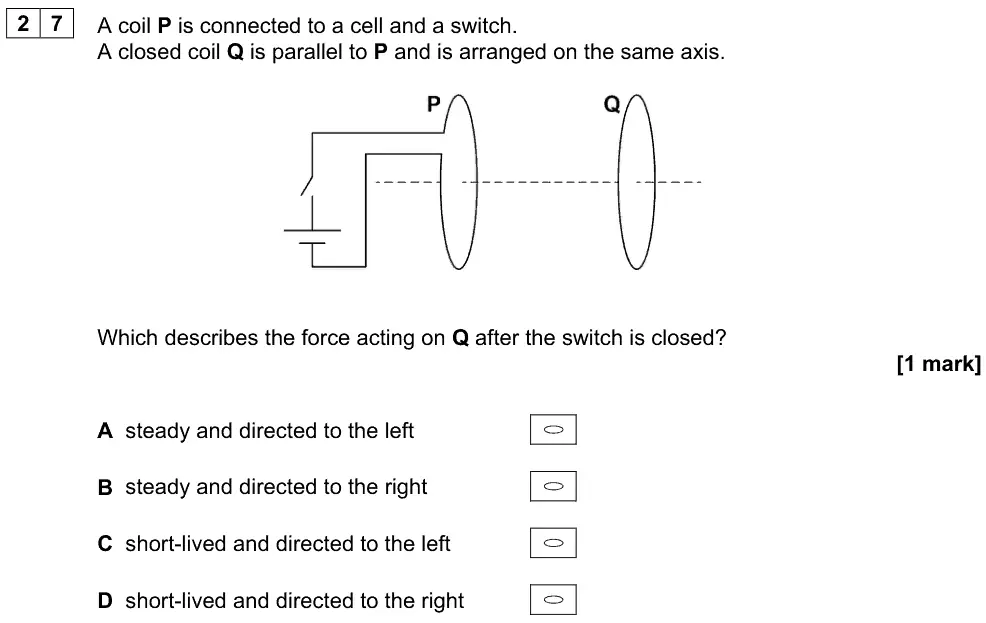
November 2020 · Paper 2 · Q27 1 mark Multiple choice electromagnetic induction
A coil P is connected to a cell and a switch.
A closed coil Q is parallel to P and is arranged on the same axis.
Which describes the force acting on Q after the switch is closed?
[1 mark]
A steady and directed to the left
B steady and directed to the right
C short-lived and directed to the left
D short-lived and directed to the right
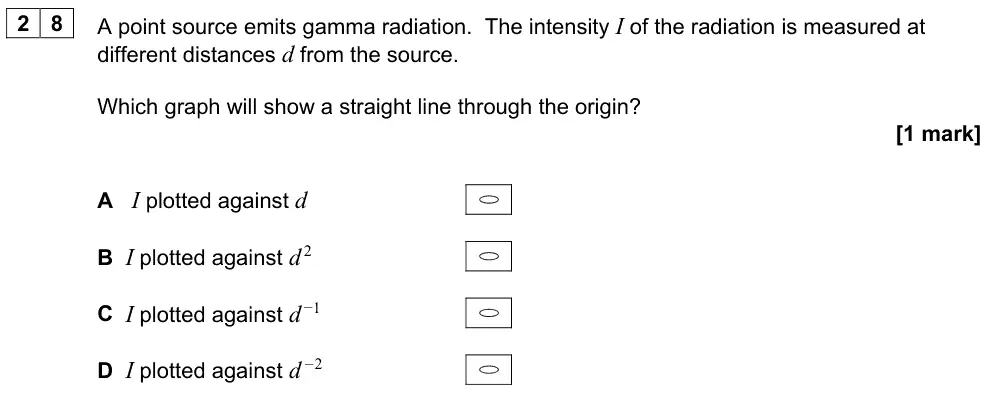
November 2020 · Paper 2 · Q28 1 mark Multiple choice rutherford scattering and radiation
A point source emits gamma radiation.  The intensity I of the radiation is measured at
different distances d from the source.
Which graph will show a straight line through the origin?
[1 mark]
A I plotted against d
B I plotted against d 2
C I plotted against d −1
D I plotted against d −2
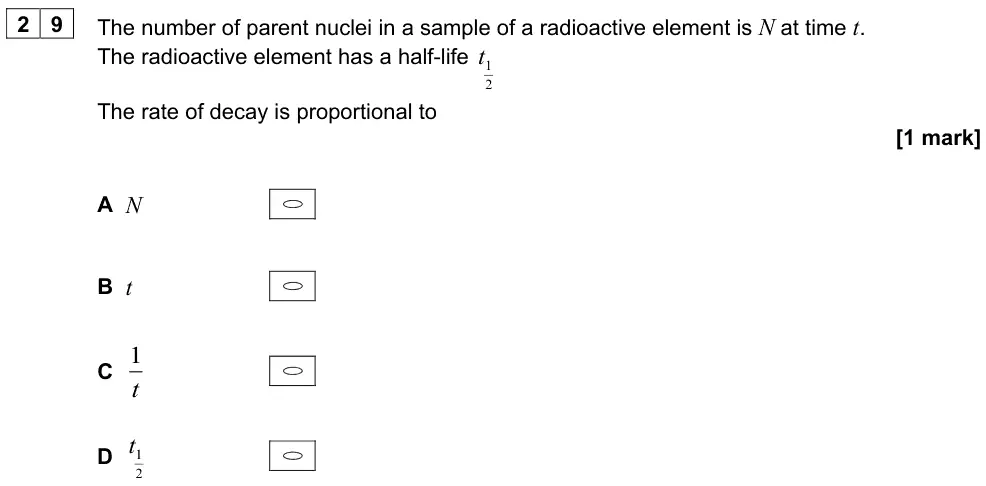
November 2020 · Paper 2 · Q29 1 mark Multiple choice radioactive decay
The number of parent nuclei in a sample of a radioactive element is N at time t.
The radioactive element has a half-life 1
2
t
The rate of decay is proportional to
[1 mark]
A N
B t
C 1
t
D
1
2
t
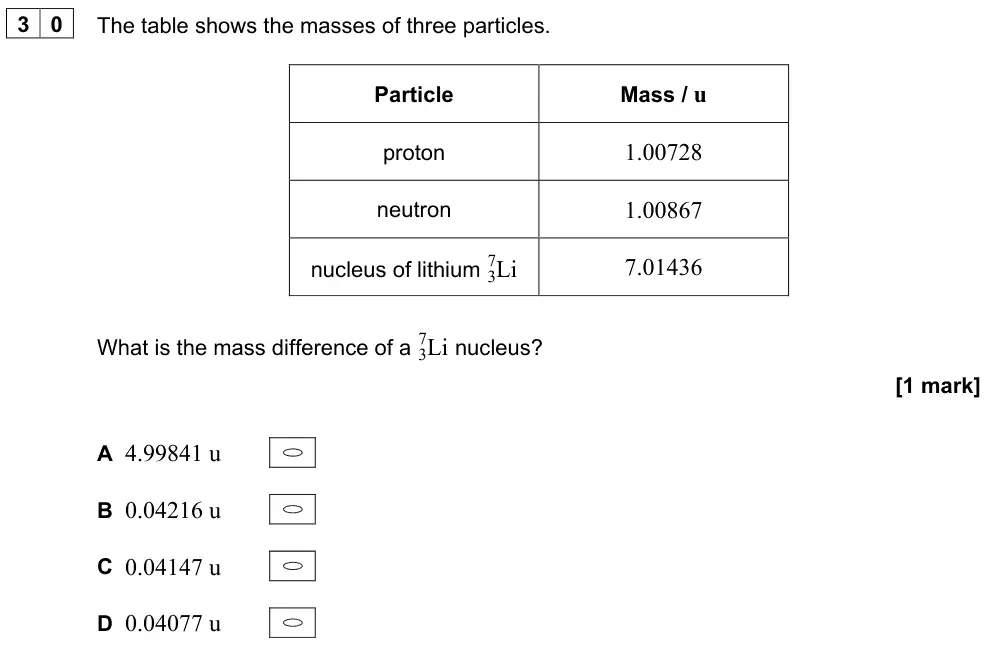
November 2020 · Paper 2 · Q30 1 mark Multiple choice Easy mass energy and fission
The table shows the masses of three particles.
Particle
Mass / u
proton
1.00728
neutron
1.00867
nucleus of lithium Li
3
7
7.01436
What is the mass difference of a Li
3
7
nucleus?
[1 mark]
A 4.99841 u
B 0.04216 u
C 0.04147 u
D 0.04077 u
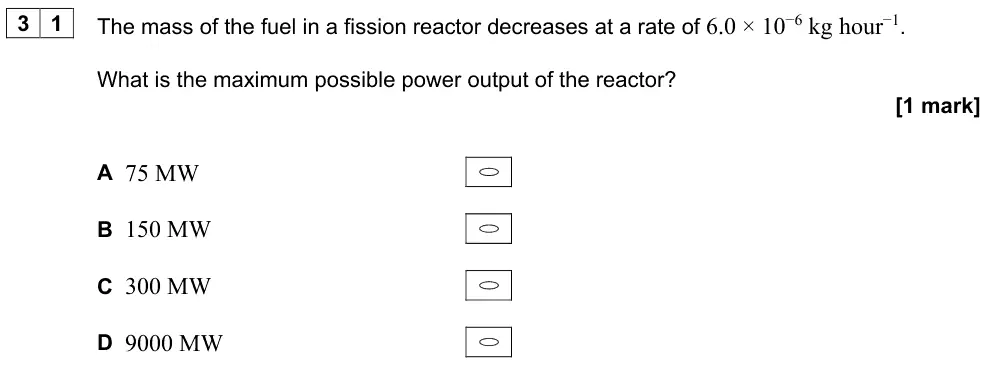
November 2020 · Paper 2 · Q31 1 mark Multiple choice mass energy and fission
The mass of the fuel in a fission reactor decreases at a rate of 6.0 × 10⁻⁶ kg hour−1.
What is the maximum possible power output of the reactor?
[1 mark]
A 75 MW
B 150 MW
C 300 MW
D 9000 MW

Work with an AQA physics tutor

Want a paper marked and gone through with you? Message us.

Prefer email? Send an enquiry

If you are under 18, please include a parent's contact details. Enquiries go to enquiries@physicsaleveltutor.com and are deleted once handled. All tutoring is online.