
November 2021: AS Paper 2

70 marks · 48 question parts · Paper, mark scheme and report on AQA's site · An autumn series using the paper written for the cancelled summer exams · Have the data and formulae booklet beside you

Question by question

QTopicMarksAOType
1.1 Superposition and stationary waves 2AO3=2Diagram or graph
1.2 Superposition and stationary waves 1AO3=1Practical and data analysis
1.3 Measurements, units and uncertainties 2AO3=2Calculation
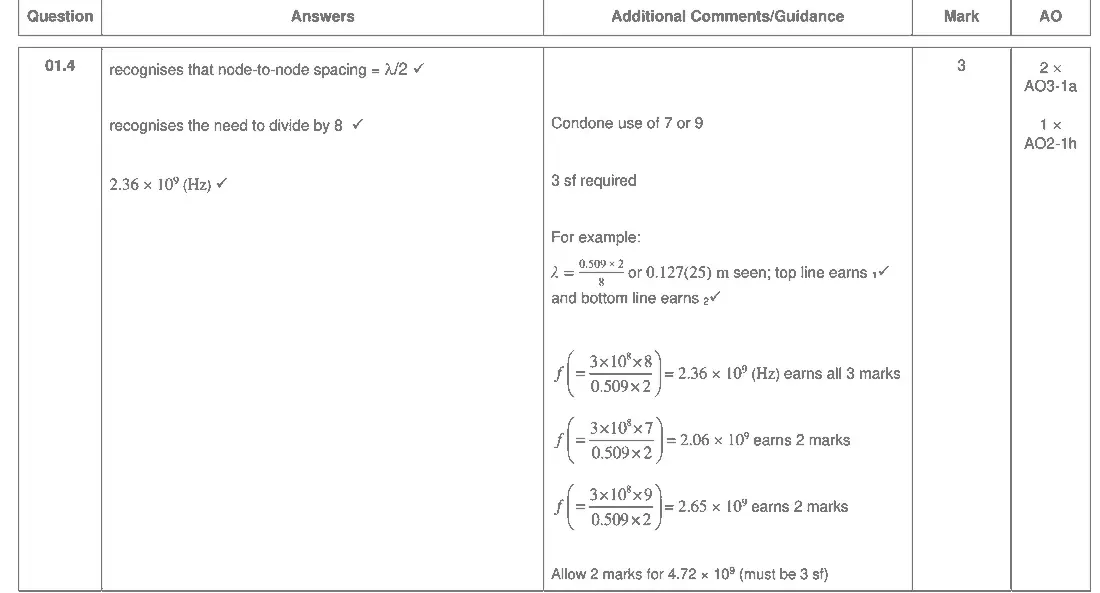
1.4 Superposition and stationary waves, Progressive waves, longitudinal and transverse waves 3Calculation
1.5 Progressive waves, longitudinal and transverse waves 1AO1=1Short answer
2.1 Materials, stress, strain and the Young modulus 1AO2=1Show that
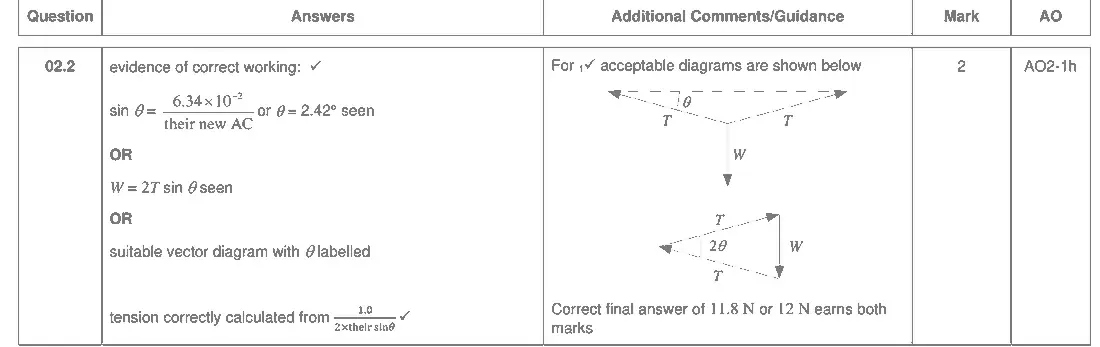
2.2 Scalars, vectors and moments 2AO2=2Calculation
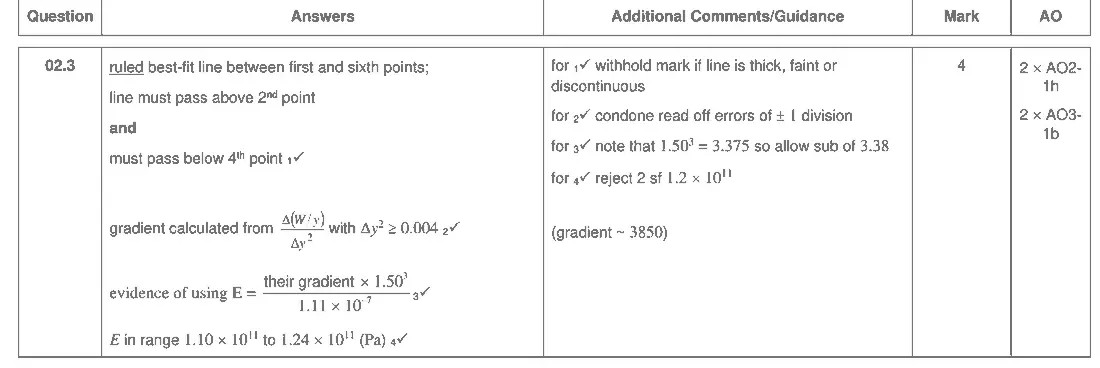
2.3 Materials, stress, strain and the Young modulus 4Practical and data analysis
2.4 Measurements, units and uncertainties 1AO1=1Short answer
3.1 Measurements, units and uncertainties 1AO1=1Practical and data analysis
3.2 Measurements, units and uncertainties 2AO1=2Practical and data analysis
4.1 Motion along a straight line and projectile motion, Scalars, vectors and moments 1AO1=1Diagram or graph
4.2 Scalars, vectors and moments 1AO2=1Show that
4.3 Newton's laws of motion and momentum 3AO2=3Calculation
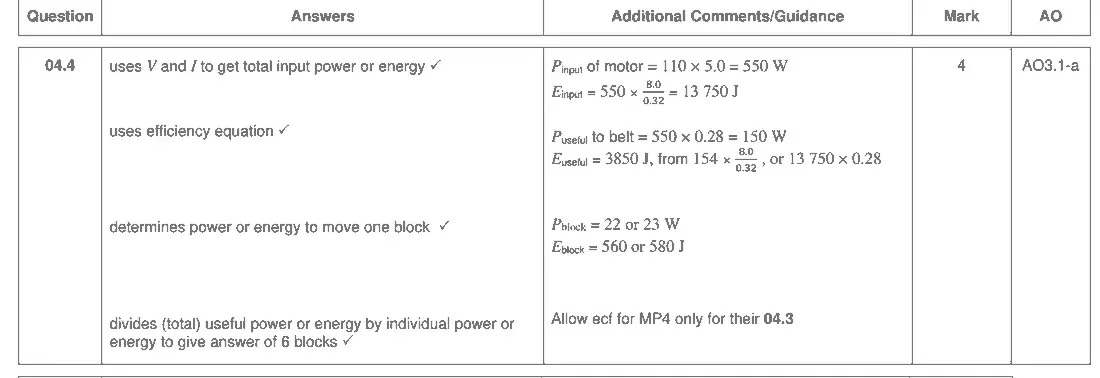
4.4 Work, energy, power and conservation of energy 4AO3=4Calculation
5.1 Particles, antiparticles and particle interactions 2AO2=2Show that
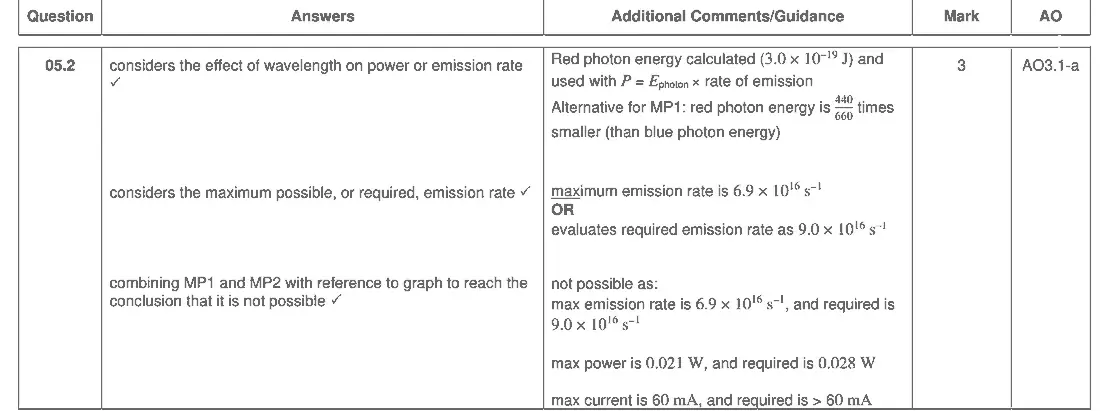
5.2 Particles, antiparticles and particle interactions 3AO3=3Explanation
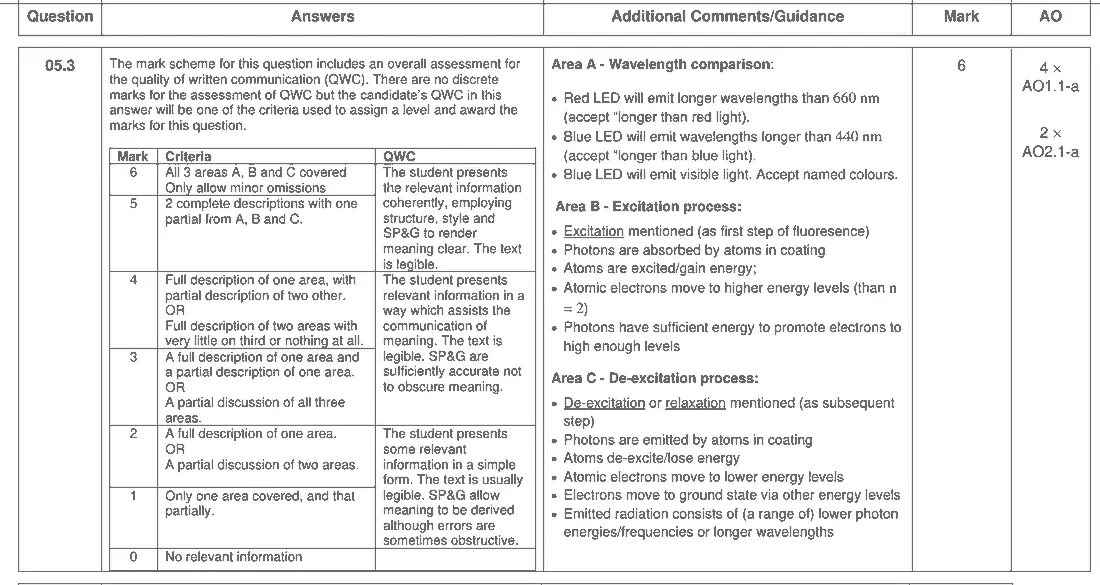
5.3 Excitation, energy levels and wave-particle duality 6Extended response
6 Atomic structure and stable nuclei 1Multiple choice
7 Particles, antiparticles and particle interactions 1Multiple choice
8 Classification of particles, quarks and conservation laws 1Multiple choice
9 Particles, antiparticles and particle interactions 1Multiple choice
10 Work, energy, power and conservation of energy 1Multiple choice
11 Work, energy, power and conservation of energy 1Multiple choice
12 Atomic structure and stable nuclei 1Multiple choice
13 Excitation, energy levels and wave-particle duality 1Multiple choice
14 Classification of particles, quarks and conservation laws, Atomic structure and stable nuclei 1Multiple choice
15 Progressive waves, longitudinal and transverse waves 1Multiple choice
16 Newton's laws of motion and momentum 1Multiple choice
17 Superposition and stationary waves 1Multiple choice
18 Refraction, total internal reflection and optical fibres 1Multiple choice
19 Interference, diffraction and the diffraction grating 1Multiple choice
20 Electromotive force and internal resistance 1Multiple choice
21 The photoelectric effect 1Multiple choice
22 Scalars, vectors and moments 1Multiple choice
23 Motion along a straight line and projectile motion 1Multiple choice
24 Newton's laws of motion and momentum 1Multiple choice
25 Newton's laws of motion and momentum 1Multiple choice
26 Materials, stress, strain and the Young modulus 1Multiple choice
27 Motion along a straight line and projectile motion, Newton's laws of motion and momentum 1Multiple choice
28 Motion along a straight line and projectile motion 1Multiple choice
29 Circuits and potential dividers 1Multiple choice
30 Circuits and potential dividers 1Multiple choice
31 Circuits and potential dividers, Current, potential difference, I-V characteristics and resistivity 1Multiple choice
32 Materials, stress, strain and the Young modulus 1Multiple choice
33 Measurements, units and uncertainties 1Multiple choice
34 Current, potential difference, I-V characteristics and resistivity 1Multiple choice
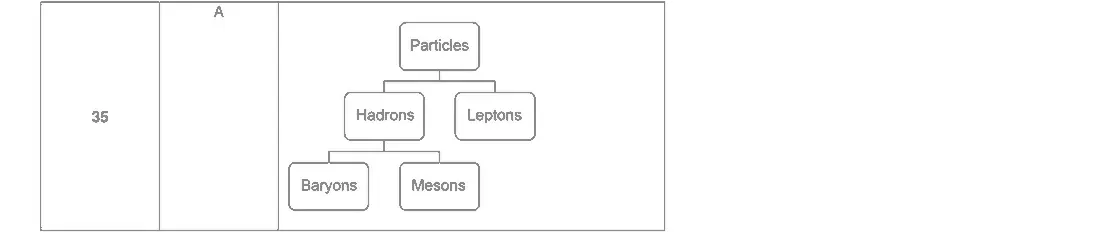
35 Classification of particles, quarks and conservation laws 1Multiple choice

The questions

1.11.21.31.41.52.12.22.32.43.13.24.14.24.34.45.15.25.367891011121314151617181920212223242526272829303132333435
November 2021 · AS Paper 2 · Q1.1 2 marks AO3=2 Diagram or graph stationary waves
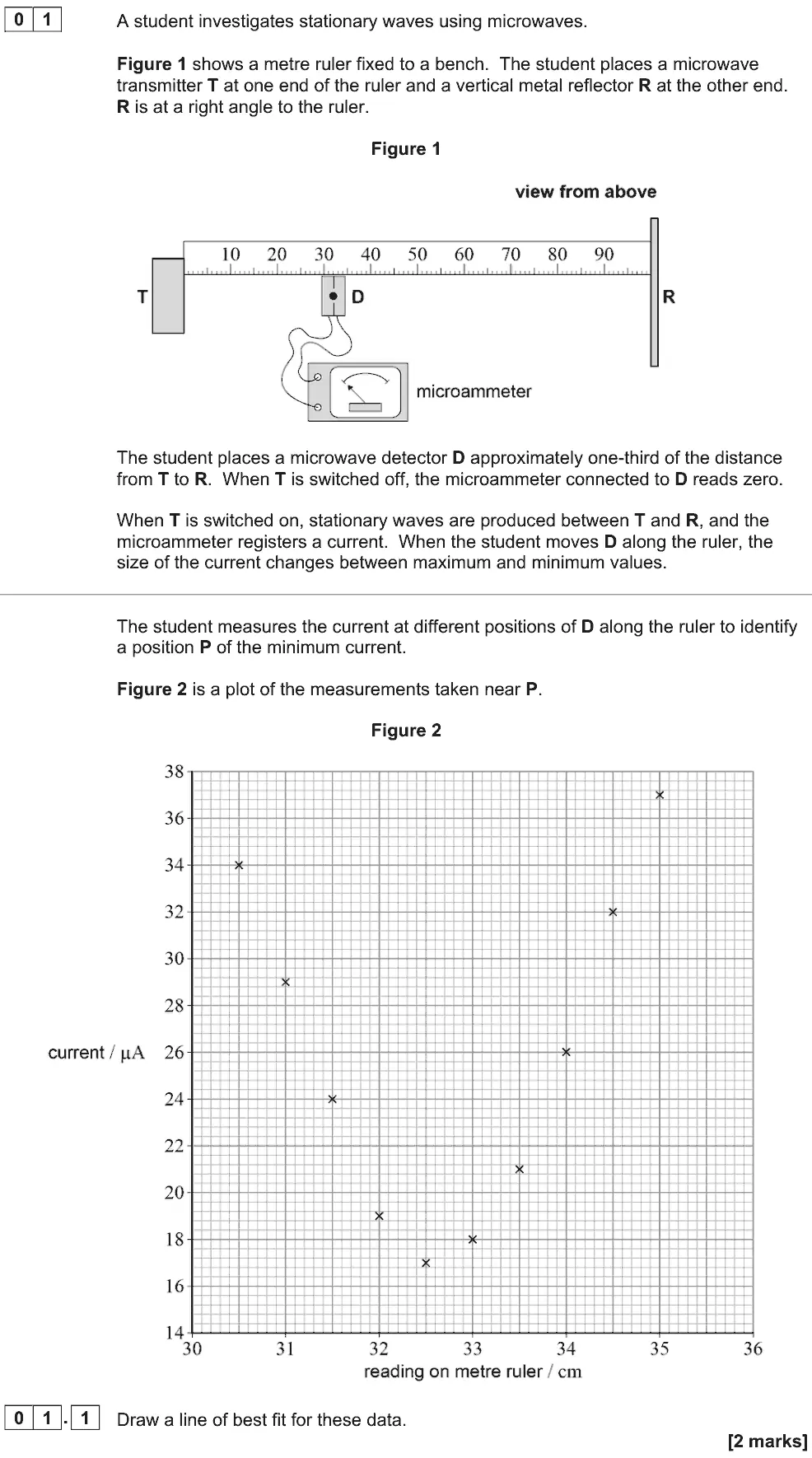
A student investigates stationary waves using microwaves.
Figure 1 shows a metre ruler fixed to a bench.  The student places a microwave
transmitter T at one end of the ruler and a vertical metal reflector R at the other end.
R is at a right angle to the ruler.
Figure 1
The student places a microwave detector D approximately one-third of the distance
from T to R.  When T is switched off, the microammeter connected to D reads zero.
When T is switched on, stationary waves are produced between T and R, and the
microammeter registers a current.  When the student moves D along the ruler, the
size of the current changes between maximum and minimum values.
The student measures the current at different positions of D along the ruler to identify
a position P of the minimum current.
Figure 2 is a plot of the measurements taken near P.
Figure 2
Draw a line of best fit for these data.
[2 marks]
November 2021 · AS Paper 2 · Q1.2 1 mark AO3=1 Practical and data analysis stationary waves
Earlier part of question 1 that this part usesEarlier part of November 2021 Paper 2 question 1
State a value for the position of P.
[1 mark]
position of P =
cm
November 2021 · AS Paper 2 · Q1.3 2 marks AO3=2 Calculation measurements and uncertainties
Earlier part of question 1 that this part usesEarlier part of November 2021 Paper 2 question 1
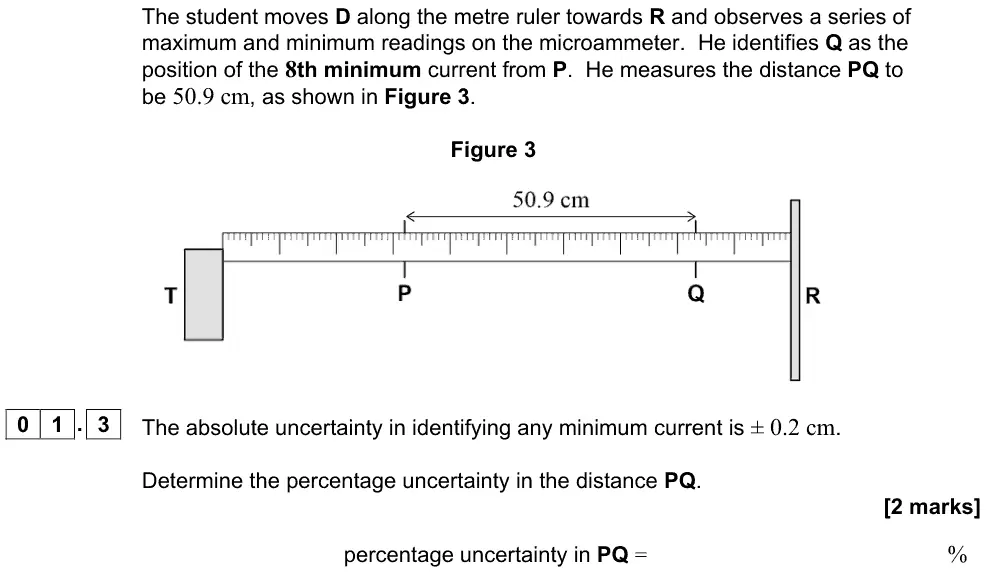
The student moves D along the metre ruler towards R and observes a series of
maximum and minimum readings on the microammeter.  He identifies Q as the
position of the 8th minimum current from P.  He measures the distance PQ to
be 50.9 cm, as shown in Figure 3.
Figure 3
The absolute uncertainty in identifying any minimum current is ± 0.2 cm.
Determine the percentage uncertainty in the distance PQ.
[2 marks]
percentage uncertainty in PQ =
%
November 2021 · AS Paper 2 · Q1.4 3 marks Calculation stationary wavesprogressive waves and polarisation
Earlier part of question 1 that this part usesEarlier part of November 2021 Paper 2 question 1
Deduce the frequency of the microwaves produced by T.
[3 marks]
frequency =
Hz
November 2021 · AS Paper 2 · Q1.5 1 mark AO1=1 Short answer progressive waves and polarisation
Earlier part of question 1 that this part usesEarlier part of November 2021 Paper 2 question 1
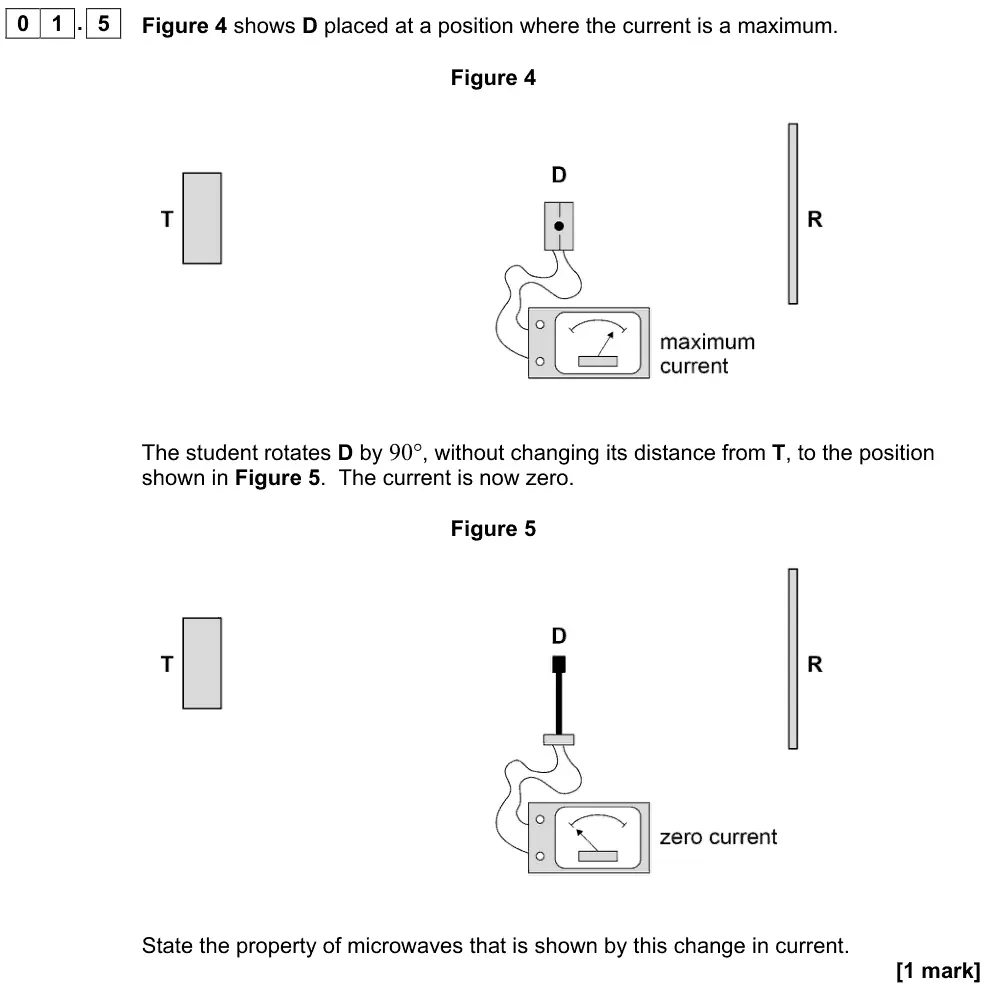
Figure 4 shows D placed at a position where the current is a maximum.
Figure 4
The student rotates D by 90°, without changing its distance from T, to the position
shown in Figure 5.  The current is now zero.
Figure 5
State the property of microwaves that is shown by this change in current.
[1 mark]
November 2021 · AS Paper 2 · Q2.1 1 mark AO2=1 Show that materials and young modulus
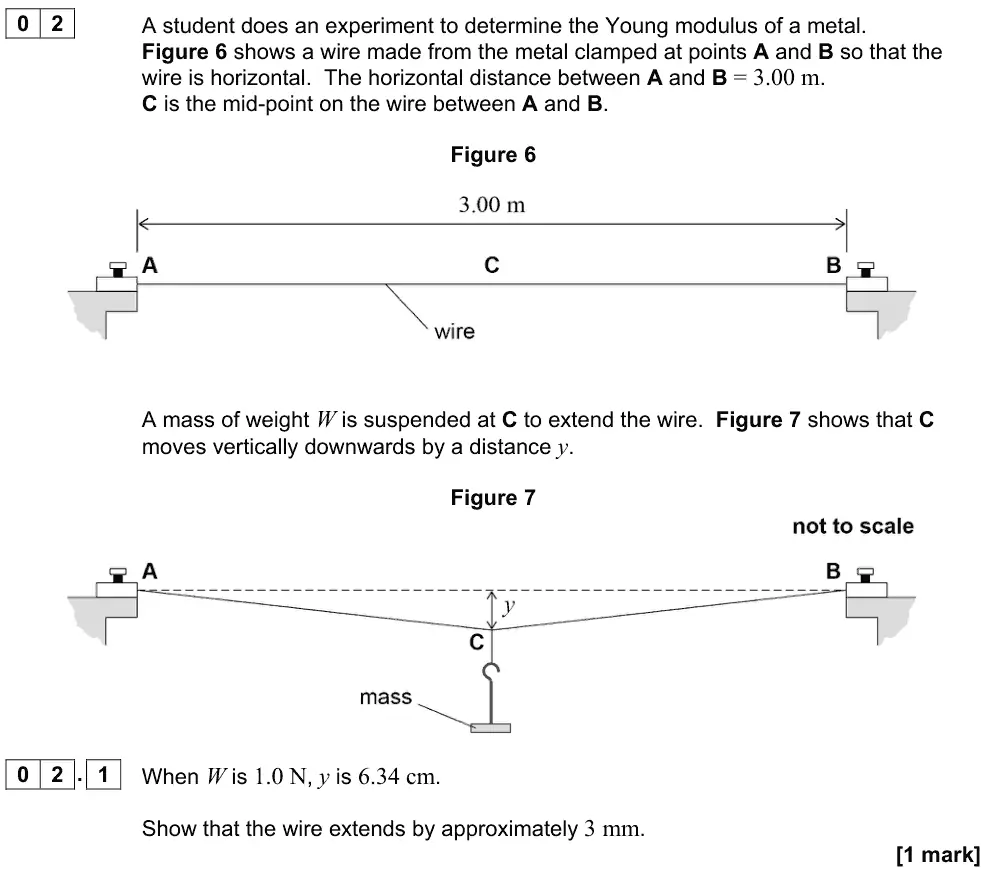
A student does an experiment to determine the Young modulus of a metal.
Figure 6 shows a wire made from the metal clamped at points A and B so that the
wire is horizontal.  The horizontal distance between A and B = 3.00 m.
C is the mid-point on the wire between A and B.
Figure 6
A mass of weight W is suspended at C to extend the wire.  Figure 7 shows that C
moves vertically downwards by a distance y.
Figure 7
When W is 1.0 N, y is 6.34 cm.
Show that the wire extends by approximately 3 mm.
[1 mark]
November 2021 · AS Paper 2 · Q2.2 2 marks AO2=2 Calculation vectors and moments
Earlier part of question 2 that this part usesEarlier part of November 2021 Paper 2 question 2
Calculate the tension in the wire when W is 1.0 N.
[2 marks]
tension =
N
November 2021 · AS Paper 2 · Q2.3 4 marks Practical and data analysis materials and young modulus
Earlier part of question 2 that this part usesEarlier part of November 2021 Paper 2 question 2
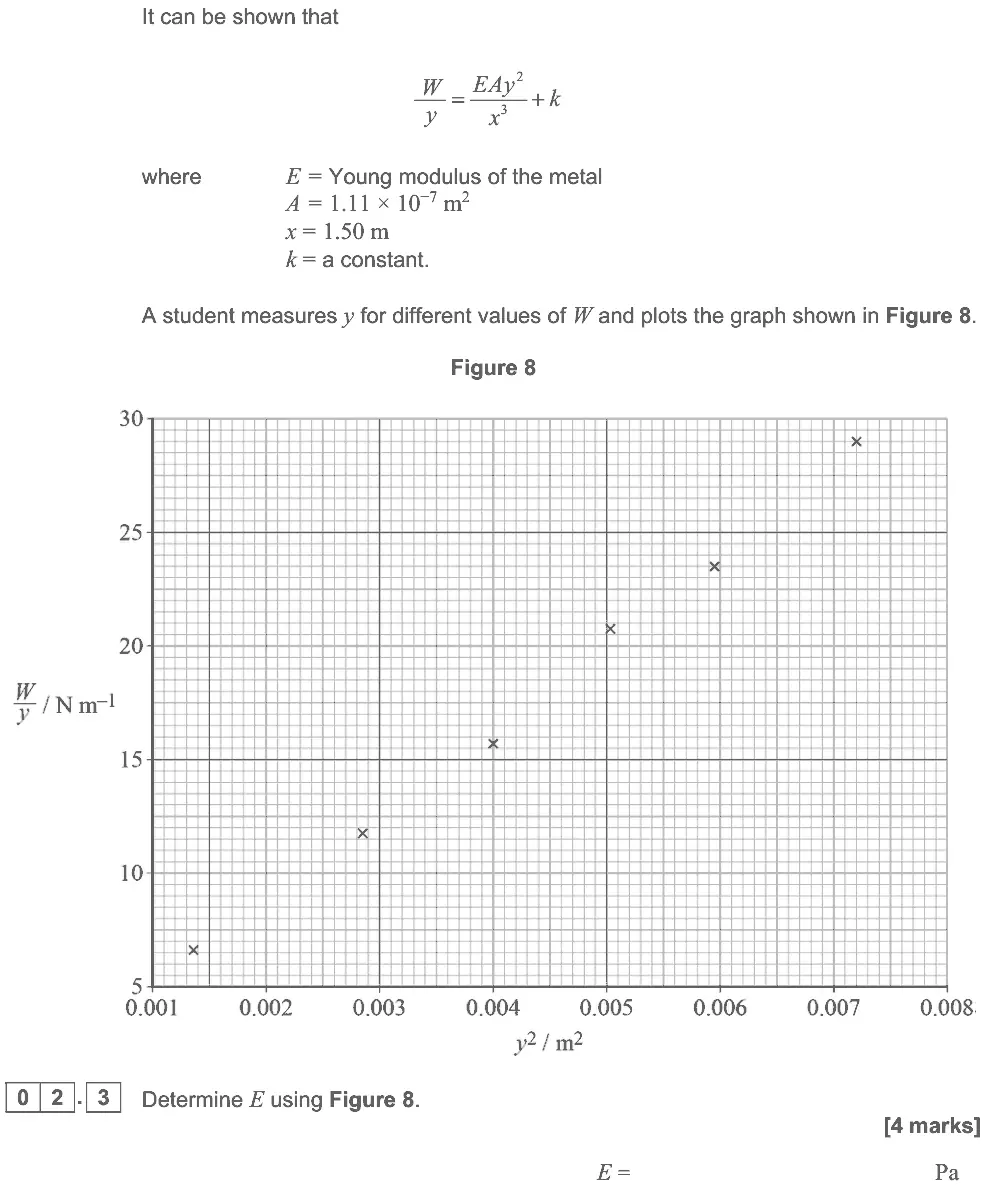
It can be shown that
2
3
EAy
W
k
y
x
=
+
where
E = Young modulus of the metal
A = 1.11 × 10⁻⁷ m2
x = 1.50 m
k = a constant.
A student measures y for different values of W and plots the graph shown in Figure 8.
Figure 8
Determine E using Figure 8.
[4 marks]
E =
Pa
November 2021 · AS Paper 2 · Q2.4 1 mark AO1=1 Short answer measurements and uncertainties
Earlier part of question 2 that this part usesEarlier part of November 2021 Paper 2 question 2
Deduce the fundamental base units for k.
[1 mark]
fundamental base units for k =
November 2021 · AS Paper 2 · Q3.1 1 mark AO1=1 Practical and data analysis measurements and uncertainties
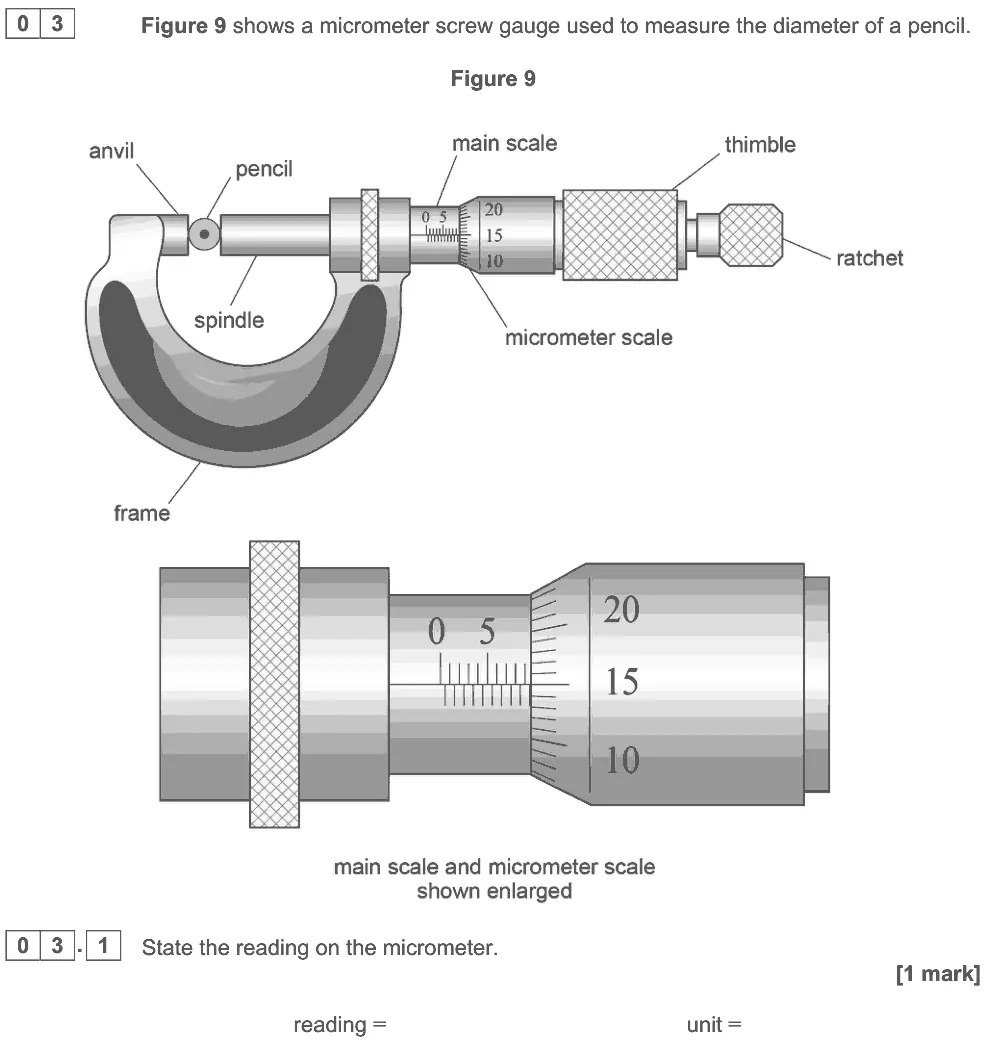
Figure 9 shows a micrometer screw gauge used to measure the diameter of a pencil.
Figure 9
State the reading on the micrometer.
[1 mark]
reading =
unit =
November 2021 · AS Paper 2 · Q3.2 2 marks AO1=2 Practical and data analysis measurements and uncertainties
Earlier part of question 3 that this part usesEarlier part of November 2021 Paper 2 question 3
The micrometer has a zero error.
Describe how to determine an accurate measurement for the diameter of the
pencil using this micrometer.
[2 marks]
November 2021 · AS Paper 2 · Q4.1 1 mark AO1=1 Diagram or graph motion and projectilesvectors and moments
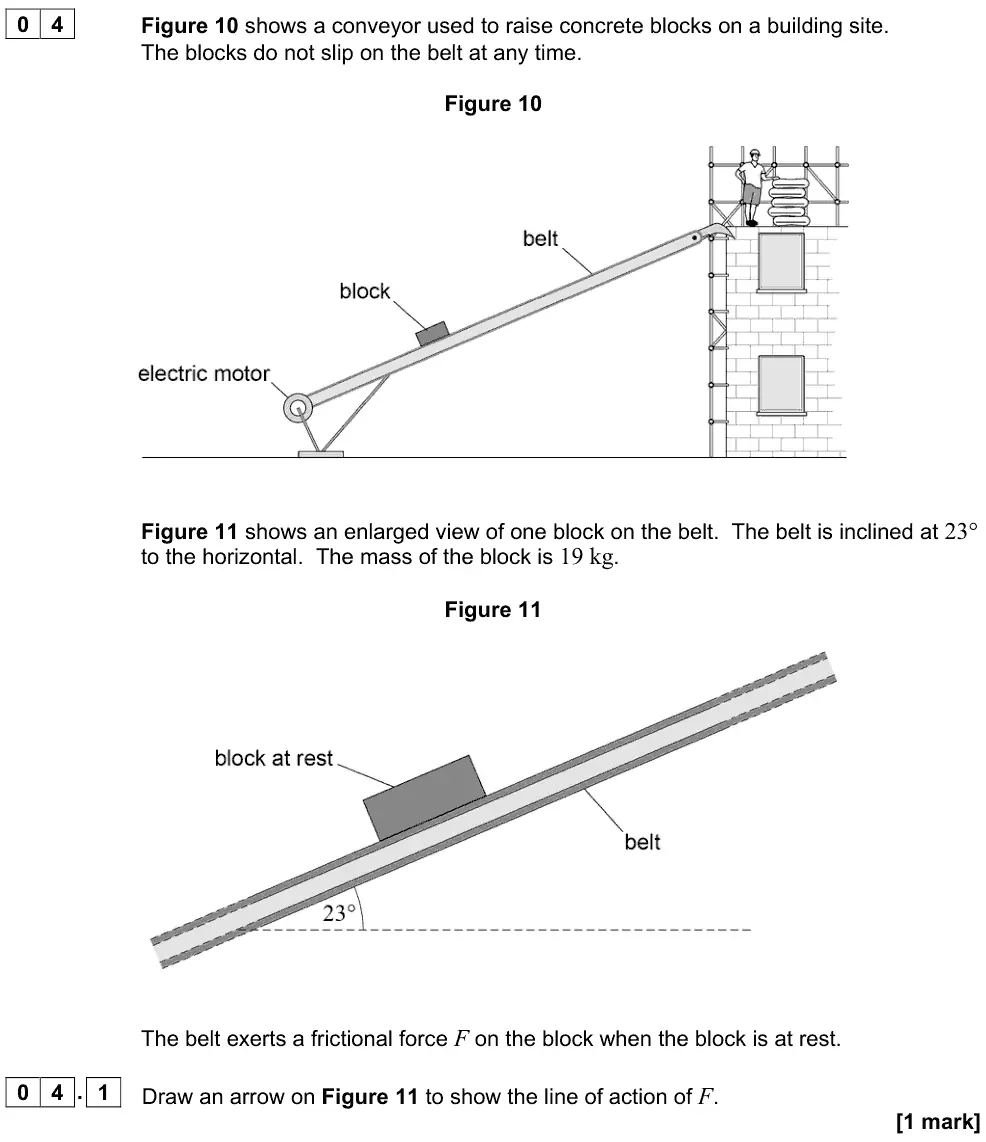
Figure 10 shows a conveyor used to raise concrete blocks on a building site.
The blocks do not slip on the belt at any time.
Figure 10
Figure 11 shows an enlarged view of one block on the belt.  The belt is inclined at 23°
to the horizontal.  The mass of the block is 19 kg.
Figure 11
The belt exerts a frictional force F on the block when the block is at rest.
Draw an arrow on Figure 11 to show the line of action of F.
[1 mark]
November 2021 · AS Paper 2 · Q4.2 1 mark AO2=1 Show that vectors and moments
Earlier part of question 4 that this part usesEarlier part of November 2021 Paper 2 question 4
Show that the magnitude of F is approximately 70 N.
[1 mark]
November 2021 · AS Paper 2 · Q4.3 3 marks AO2=3 Calculation newtons laws and momentum
Earlier part of question 4 that this part usesEarlier part of November 2021 Paper 2 question 4
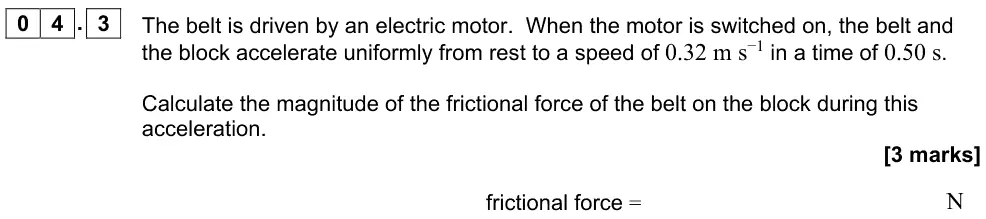
The belt is driven by an electric motor.  When the motor is switched on, the belt and
the block accelerate uniformly from rest to a speed of 0.32 m s−1 in a time of 0.50 s.
Calculate the magnitude of the frictional force of the belt on the block during this
acceleration.
[3 marks]
frictional force =
N
November 2021 · AS Paper 2 · Q4.4 4 marks AO3=4 Calculation work energy and power
Earlier part of question 4 that this part usesEarlier part of November 2021 Paper 2 question 4
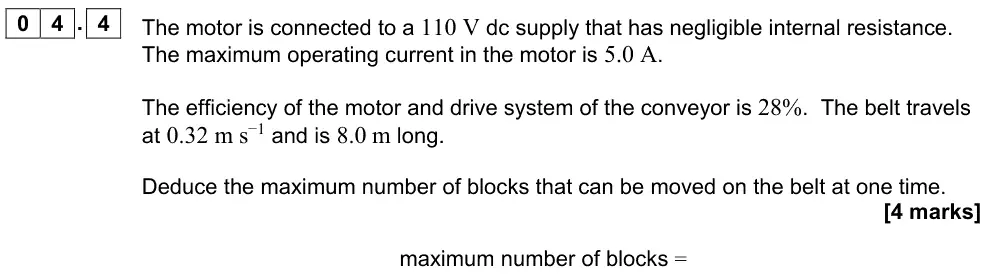
The motor is connected to a 110 V dc supply that has negligible internal resistance.
The maximum operating current in the motor is 5.0 A.
The efficiency of the motor and drive system of the conveyor is 28%.  The belt travels
at 0.32 m s−1 and is 8.0 m long.
Deduce the maximum number of blocks that can be moved on the belt at one time.
[4 marks]
maximum number of blocks =
November 2021 · AS Paper 2 · Q5.1 2 marks AO2=2 Show that particles antiparticles and interactions
A light emitting diode (LED) emits blue light with a wavelength of 440 nm.
The rate of photon emission is 3.0 × 10¹⁶ s−1.
Show that the power output of the LED is approximately 0.014 W.
[2 marks]
November 2021 · AS Paper 2 · Q5.2 3 marks AO3=3 Explanation particles antiparticles and interactions
Earlier part of question 5 that this part usesEarlier part of November 2021 Paper 2 question 5
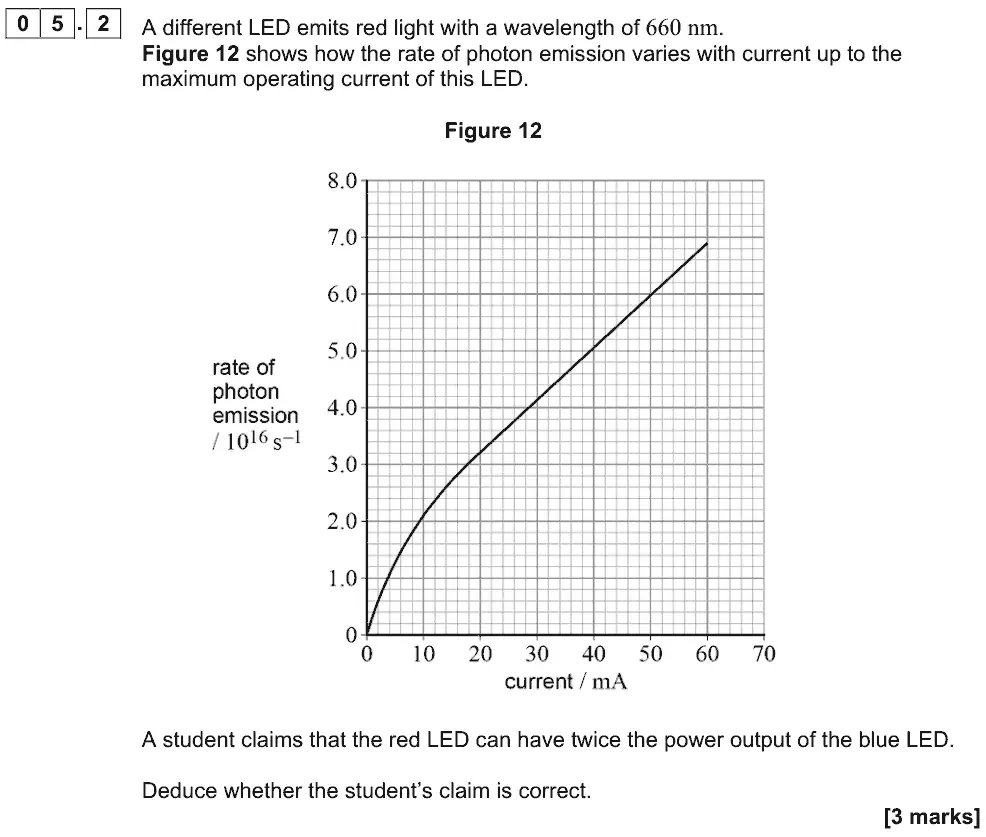
A different LED emits red light with a wavelength of 660 nm.
Figure 12 shows how the rate of photon emission varies with current up to the
maximum operating current of this LED.
Figure 12
A student claims that the red LED can have twice the power output of the blue LED.
Deduce whether the student’s claim is correct.
[3 marks]
November 2021 · AS Paper 2 · Q5.3 6 marks 6-mark extended response energy levels and wave particle duality
Earlier part of question 5 that this part usesEarlier part of November 2021 Paper 2 question 5
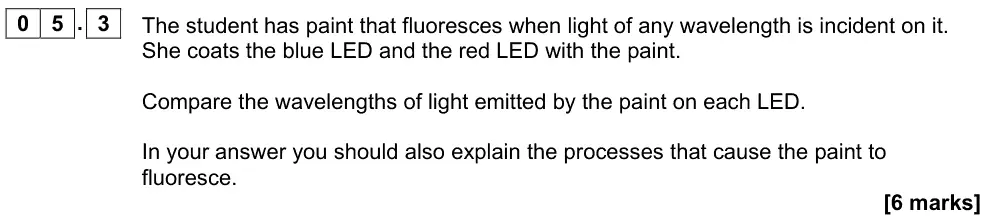
The student has paint that fluoresces when light of any wavelength is incident on it.
She coats the blue LED and the red LED with the paint.
Compare the wavelengths of light emitted by the paint on each LED.
In your answer you should also explain the processes that cause the paint to
fluoresce.
[6 marks]
November 2021 · AS Paper 2 · Q6 1 mark Multiple choice atomic structure and stable nuclei
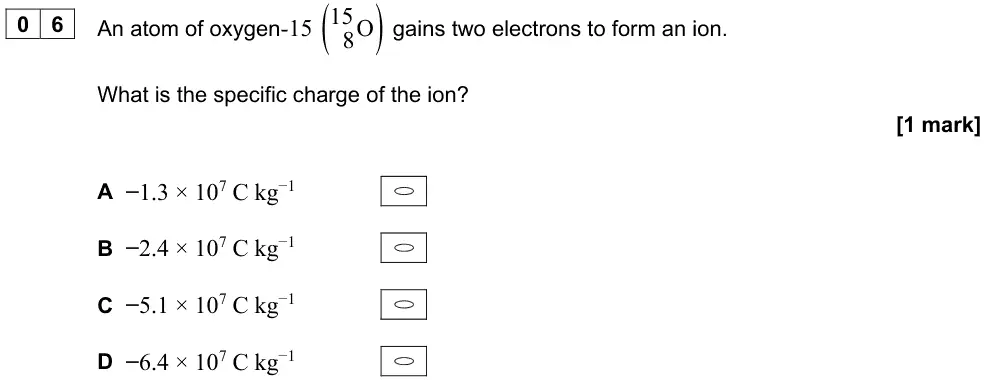
15O
8
gains two electrons to form an ion.
What is the specific charge of the ion?
[1 mark]
A −1.3 × 10⁷ C kg−1
B −2.4 × 10⁷ C kg−1
C −5.1 × 10⁷ C kg−1
D −6.4 × 10⁷ C kg−1
November 2021 · AS Paper 2 · Q7 1 mark Multiple choice particles antiparticles and interactions
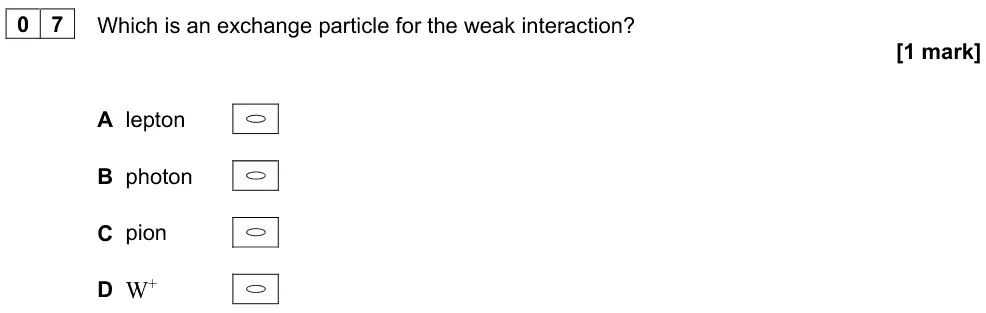
Which is an exchange particle for the weak interaction?
[1 mark]
A lepton
B photon
C pion
D W+
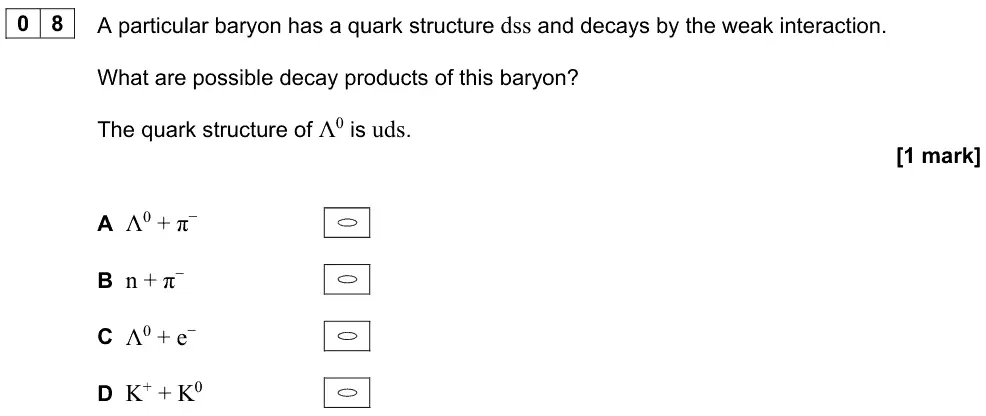
November 2021 · AS Paper 2 · Q8 1 mark Multiple choice classification of particles and quarks
A particular baryon has a quark structure dss and decays by the weak interaction.
What are possible decay products of this baryon?
The quark structure of Λ0 is uds.
[1 mark]
A Λ0 + π−
B n + π−
C Λ0 + e−
D K+ + K0
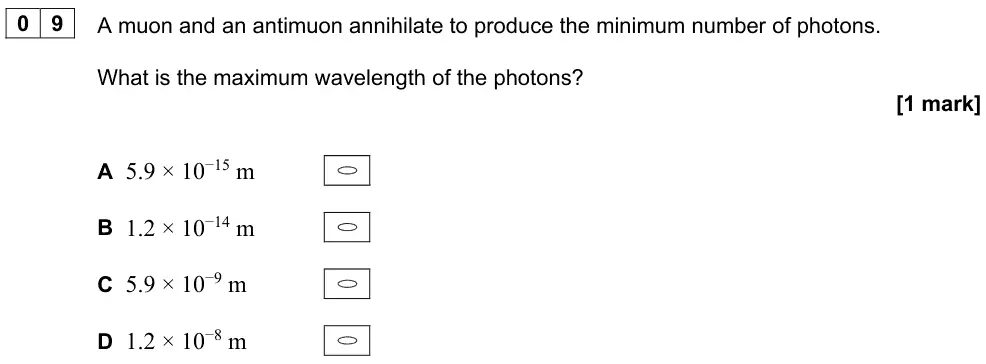
November 2021 · AS Paper 2 · Q9 1 mark Multiple choice particles antiparticles and interactions
A muon and an antimuon annihilate to produce the minimum number of photons.
What is the maximum wavelength of the photons?
[1 mark]
A 5.9 × 10⁻¹⁵ m
B 1.2 × 10⁻¹⁴ m
C 5.9 × 10⁻⁹ m
D 1.2 × 10⁻⁸ m
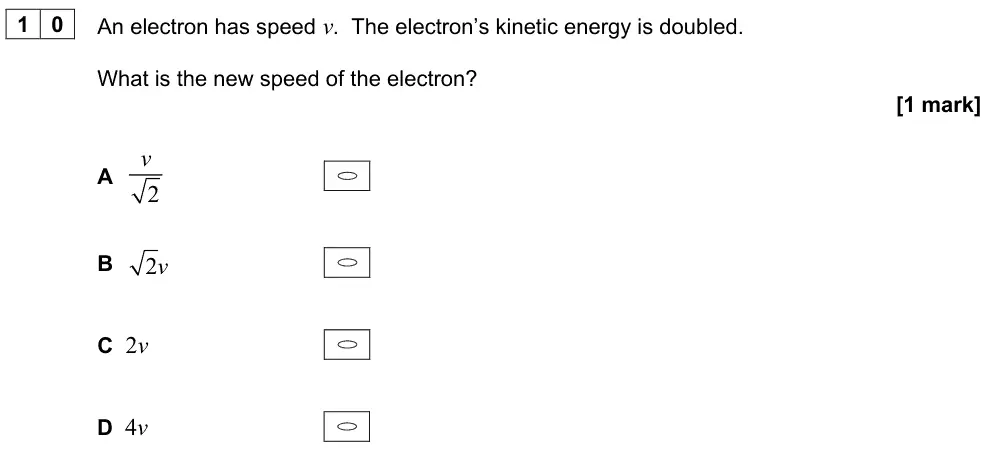
November 2021 · AS Paper 2 · Q10 1 mark Multiple choice work energy and power
An electron has speed v.  The electron’s kinetic energy is doubled.
What is the new speed of the electron?
[1 mark]
A
2
v
B
2v
C 2v
D 4v
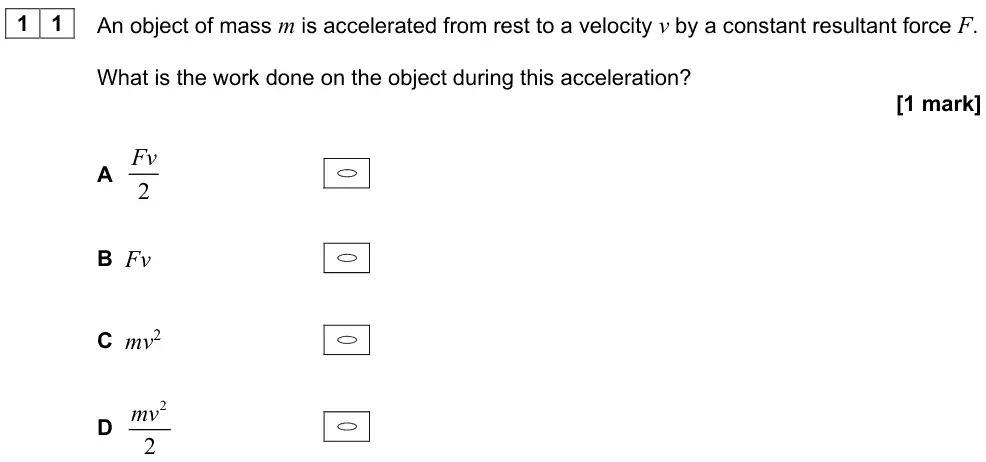
November 2021 · AS Paper 2 · Q11 1 mark Multiple choice work energy and power
An object of mass m is accelerated from rest to a velocity v by a constant resultant force F.
What is the work done on the object during this acceleration?
[1 mark]
A
2
Fv
B Fv
C mv2
D
2
2
mv
November 2021 · AS Paper 2 · Q12 1 mark Multiple choice atomic structure and stable nuclei
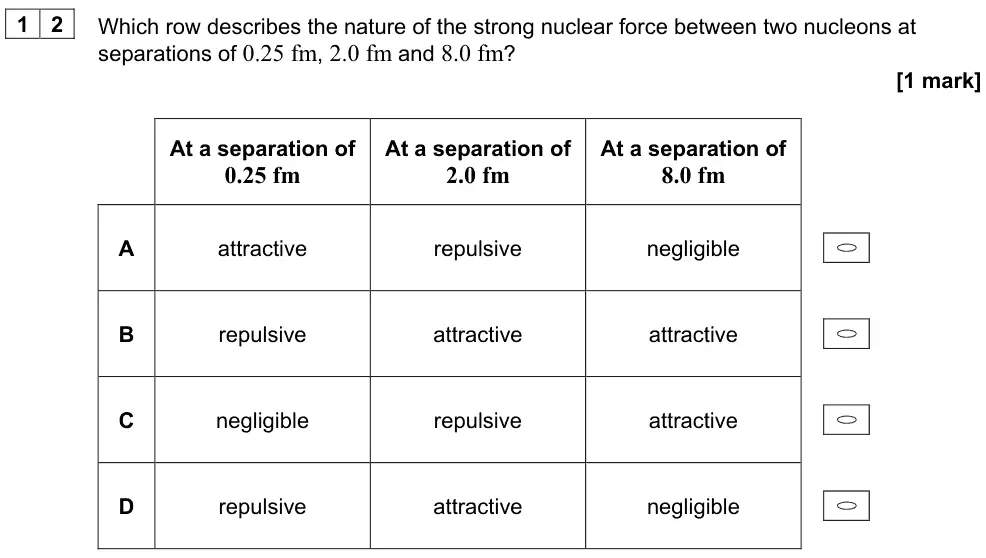
Which row describes the nature of the strong nuclear force between two nucleons at
separations of 0.25 fm, 2.0 fm and 8.0 fm?
[1 mark]
At a separation of
0.25 fm
At a separation of
2.0 fm
At a separation of
8.0 fm
A
attractive
repulsive
negligible
B
repulsive
attractive
attractive
C
negligible
repulsive
attractive
D
repulsive
attractive
negligible
November 2021 · AS Paper 2 · Q13 1 mark Multiple choice energy levels and wave particle duality
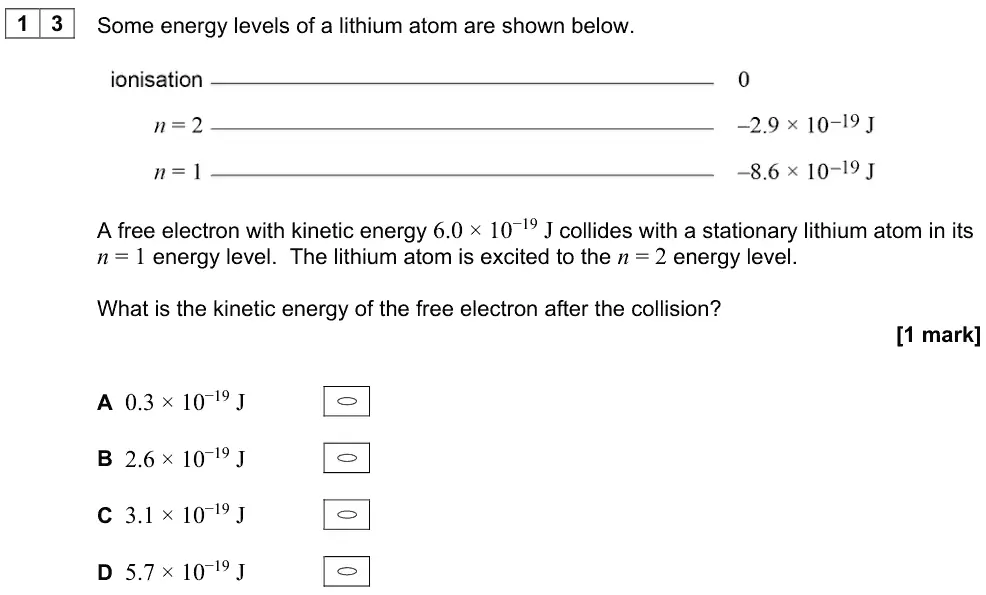
Some energy levels of a lithium atom are shown below.
A free electron with kinetic energy 6.0 × 10⁻¹⁹ J collides with a stationary lithium atom in its
n = 1 energy level.  The lithium atom is excited to the n = 2 energy level.
What is the kinetic energy of the free electron after the collision?
[1 mark]
A 0.3 × 10⁻¹⁹ J
B 2.6 × 10⁻¹⁹ J
C 3.1 × 10⁻¹⁹ J
D 5.7 × 10⁻¹⁹ J
November 2021 · AS Paper 2 · Q14 1 mark Multiple choice classification of particles and quarksatomic structure and stable nuclei
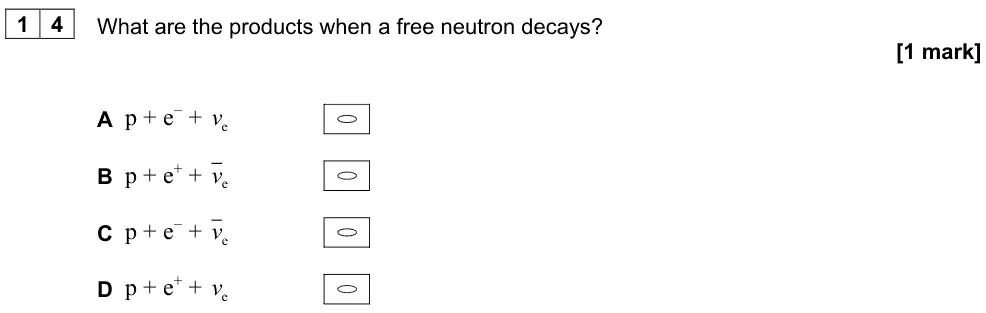
What are the products when a free neutron decays?
[1 mark]
A p + e− +
ev
B p + e+ +
ev
C p + e− +
ev
D p + e+ +
ev
November 2021 · AS Paper 2 · Q15 1 mark Multiple choice progressive waves and polarisation
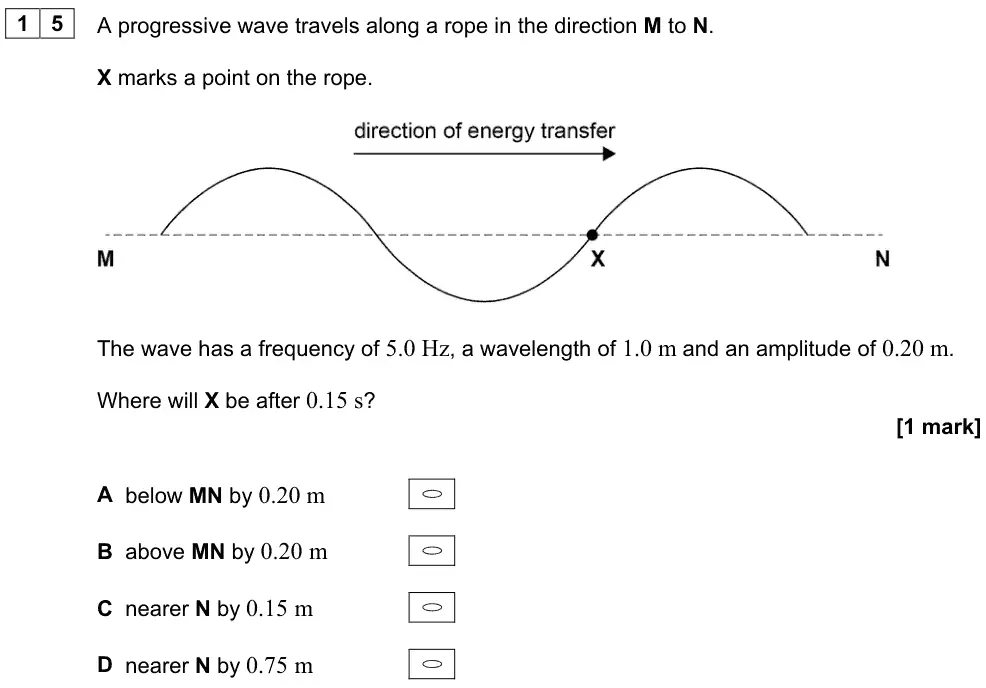
A progressive wave travels along a rope in the direction M to N.
X marks a point on the rope.
The wave has a frequency of 5.0 Hz, a wavelength of 1.0 m and an amplitude of 0.20 m.
Where will X be after 0.15 s?
[1 mark]
A below MN by 0.20 m
B above MN by 0.20 m
C nearer N by 0.15 m
D nearer N by 0.75 m
November 2021 · AS Paper 2 · Q16 1 mark Multiple choice newtons laws and momentum
What is true for an inelastic collision between two isolated objects?
[1 mark]
A Both total momentum and total kinetic energy are conserved.
B Neither total momentum nor total kinetic energy is conserved.
C Only total kinetic energy is conserved.
D Only total momentum is conserved.
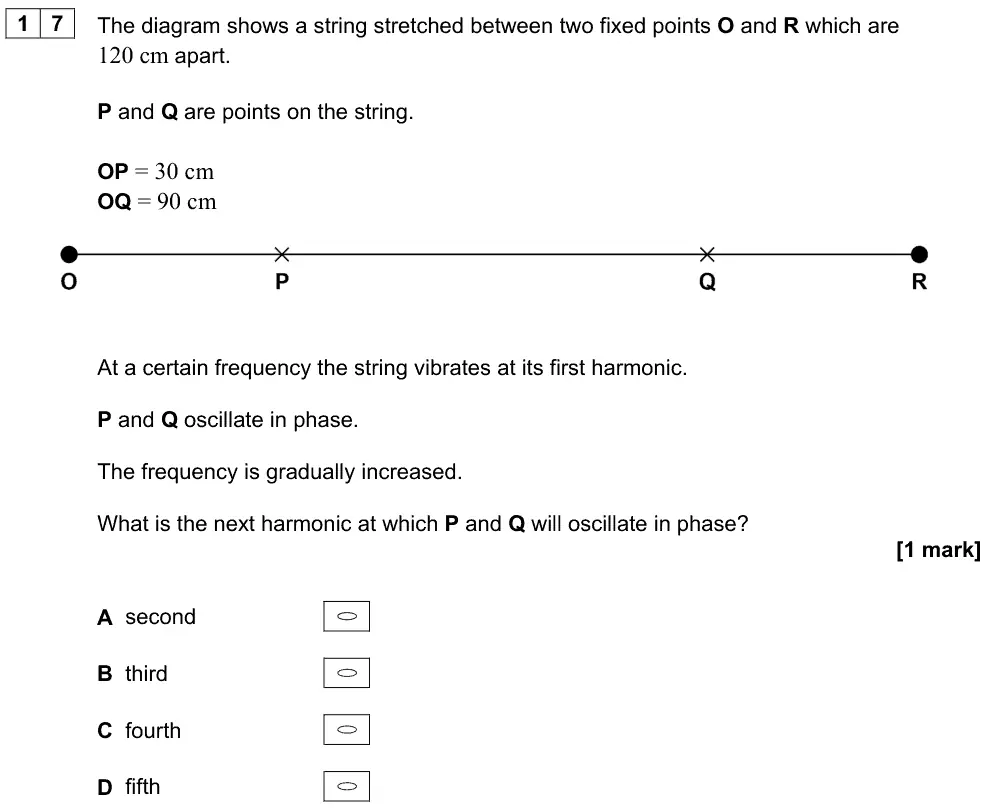
November 2021 · AS Paper 2 · Q17 1 mark Multiple choice stationary waves
The diagram shows a string stretched between two fixed points O and R which are
120 cm apart.
P and Q are points on the string.
OP = 30 cm
OQ = 90 cm
At a certain frequency the string vibrates at its first harmonic.
P and Q oscillate in phase.
The frequency is gradually increased.
What is the next harmonic at which P and Q will oscillate in phase?
[1 mark]
A second
B third
C fourth
D fifth
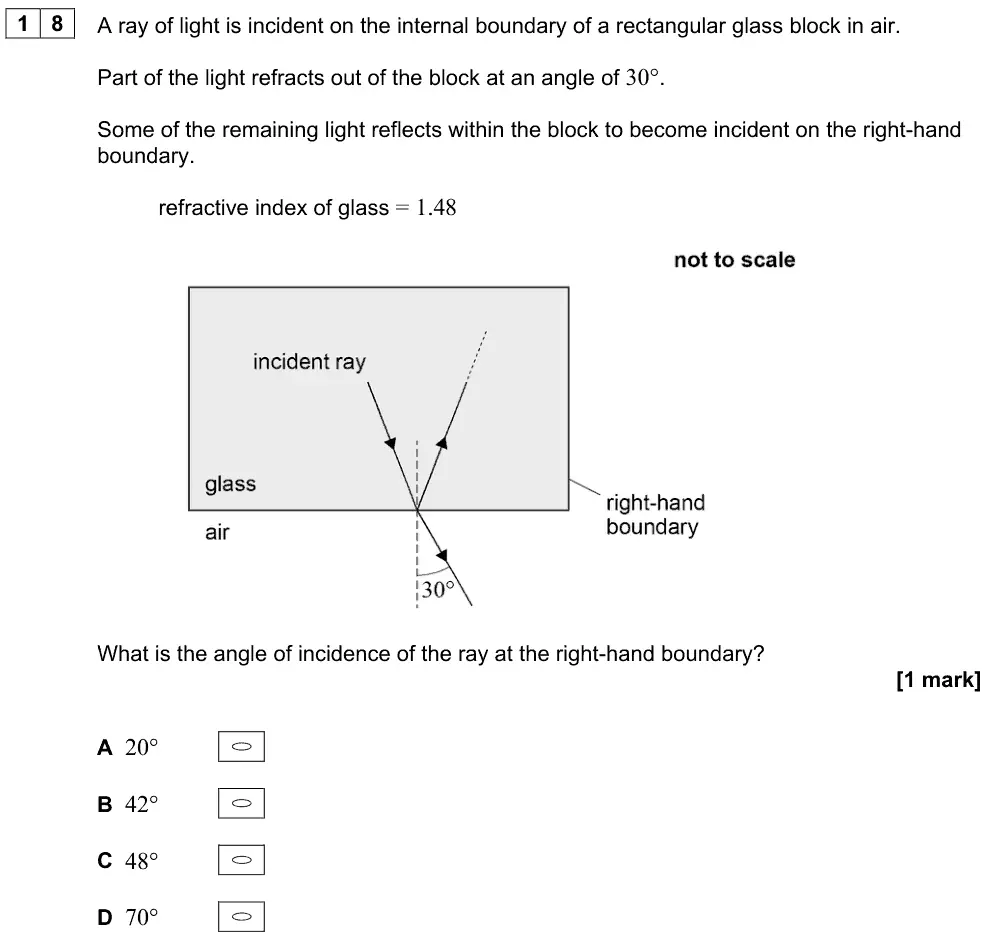
November 2021 · AS Paper 2 · Q18 1 mark Multiple choice refraction and optical fibres
A ray of light is incident on the internal boundary of a rectangular glass block in air.
Part of the light refracts out of the block at an angle of 30°.
Some of the remaining light reflects within the block to become incident on the right-hand
boundary.
refractive index of glass = 1.48
What is the angle of incidence of the ray at the right-hand boundary?
[1 mark]
A 20°
B 42°
C 48°
D 70°
November 2021 · AS Paper 2 · Q19 1 mark Multiple choice interference and diffraction
In a Young’s double-slit experiment, monochromatic light is incident on two narrow slits
and the resulting interference pattern is observed on a screen.
Which change decreases the fringe separation?
[1 mark]
A decreasing the separation between the two slits
B increasing the distance between the slits and the screen
C using monochromatic light of higher frequency
D using monochromatic light of longer wavelength
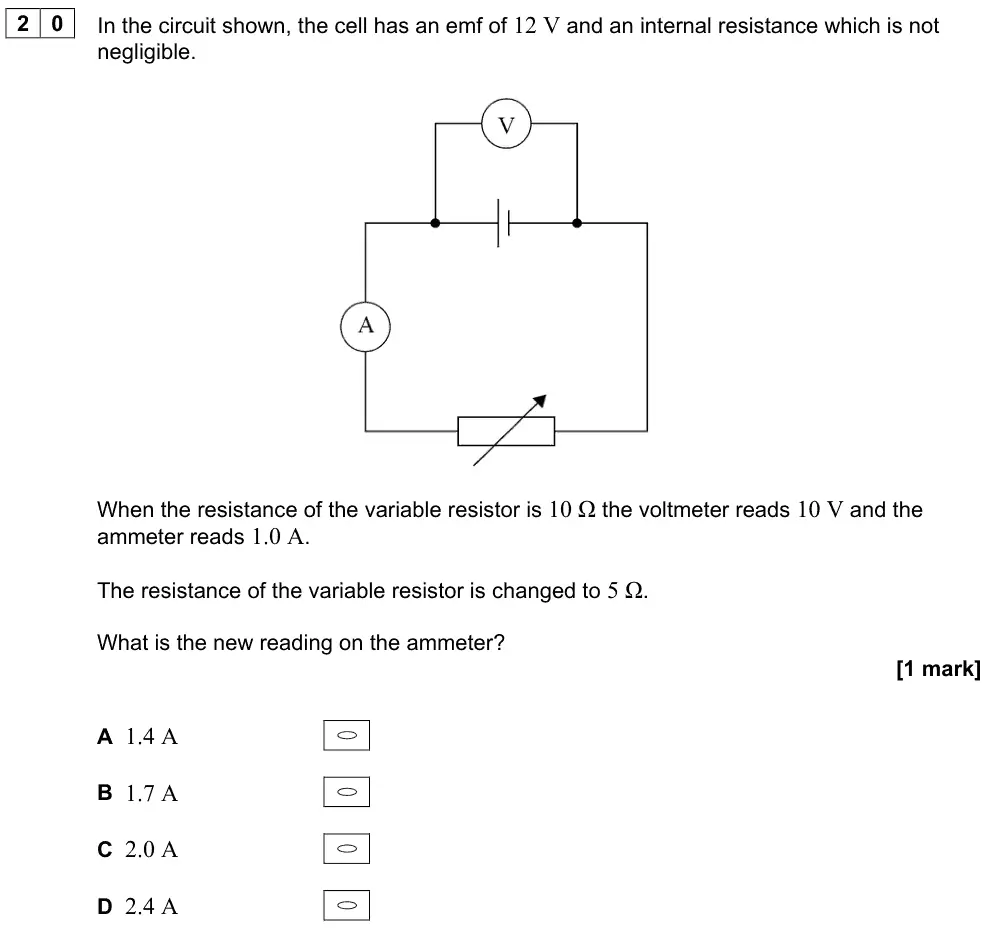
November 2021 · AS Paper 2 · Q20 1 mark Multiple choice emf and internal resistance
In the circuit shown, the cell has an emf of 12 V and an internal resistance which is not
negligible.
When the resistance of the variable resistor is 10 Ω the voltmeter reads 10 V and the
ammeter reads 1.0 A.
The resistance of the variable resistor is changed to 5 Ω.
What is the new reading on the ammeter?
[1 mark]
A 1.4 A
B 1.7 A
C 2.0 A
D 2.4 A
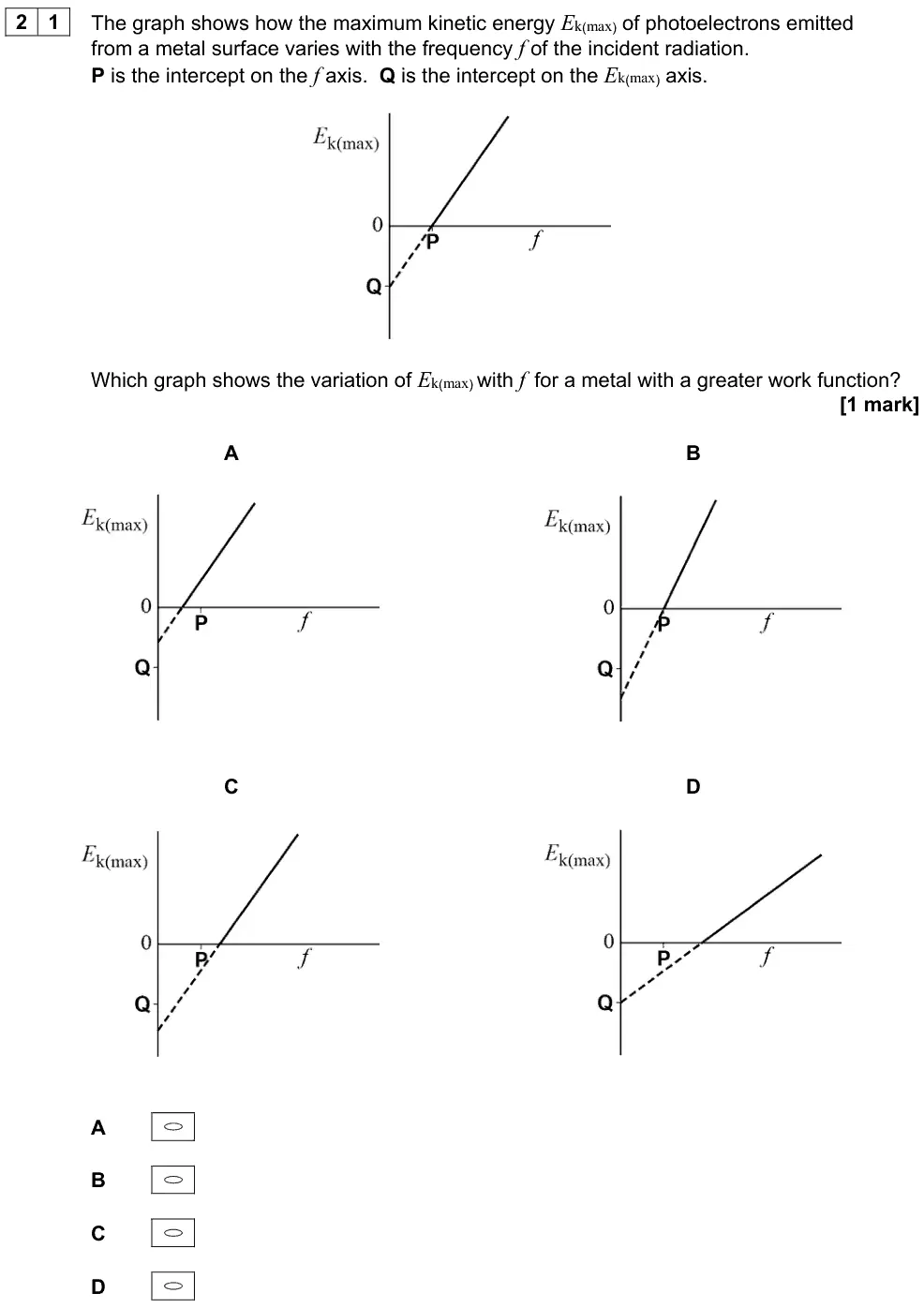
November 2021 · AS Paper 2 · Q21 1 mark Multiple choice photoelectric effect
The graph shows how the maximum kinetic energy Ek(max) of photoelectrons emitted
from a metal surface varies with the frequency f of the incident radiation.
P is the intercept on the f axis.  Q is the intercept on the Ek(max) axis.
Which graph shows the variation of Ek(max) with f  for a metal with a greater work function?
[1 mark]
A
B
C
D
A
B
C
D
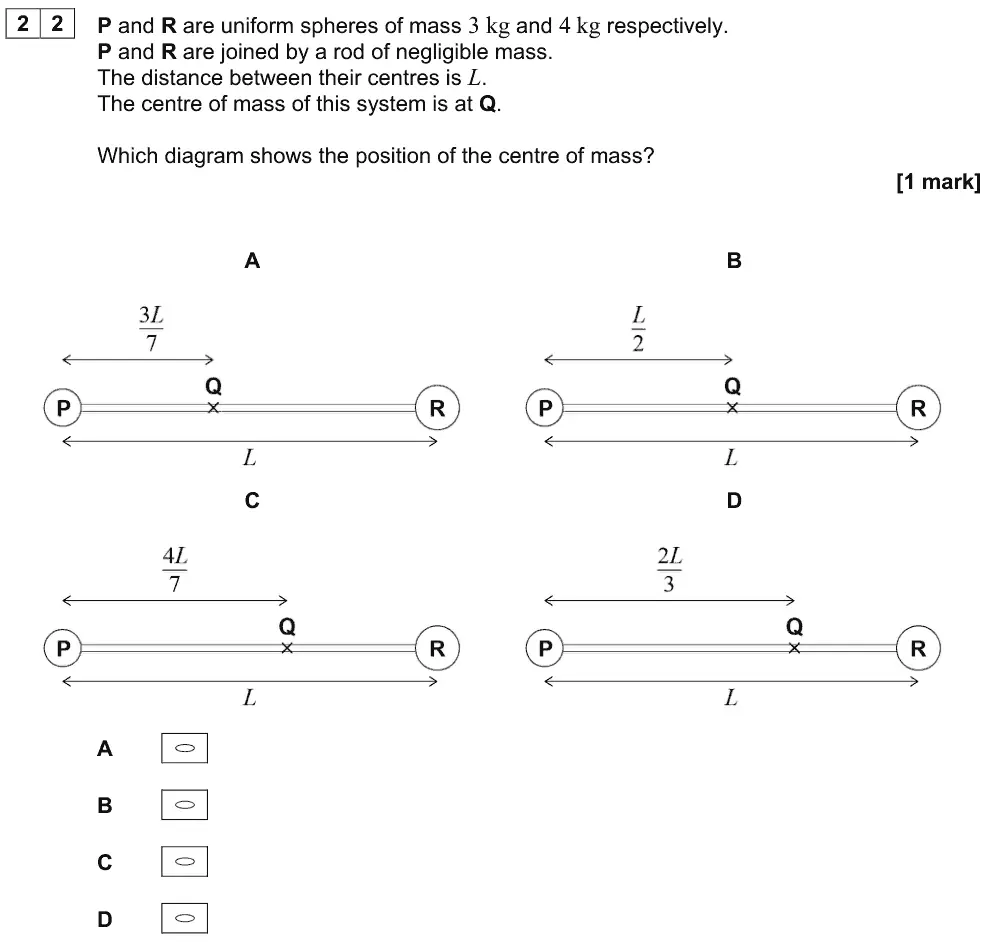
November 2021 · AS Paper 2 · Q22 1 mark Multiple choice vectors and moments
P and R are uniform spheres of mass 3 kg and 4 kg respectively.
P and R are joined by a rod of negligible mass.
The distance between their centres is L.
The centre of mass of this system is at Q.
Which diagram shows the position of the centre of mass?
[1 mark]
A
B
C
D
A
B
C
D
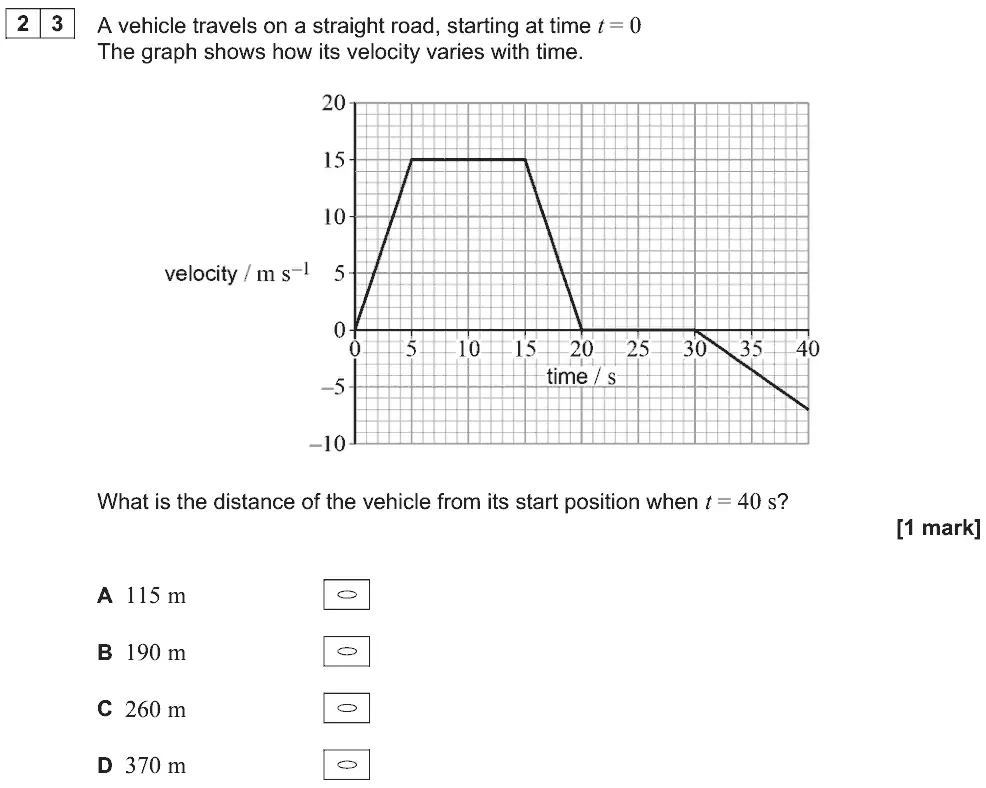
November 2021 · AS Paper 2 · Q23 1 mark Multiple choice motion and projectiles
A vehicle travels on a straight road, starting at time t = 0
The graph shows how its velocity varies with time.
What is the distance of the vehicle from its start position when t = 40 s?
[1 mark]
A 115 m
B 190 m
C 260 m
D 370 m
November 2021 · AS Paper 2 · Q24 1 mark Multiple choice newtons laws and momentum
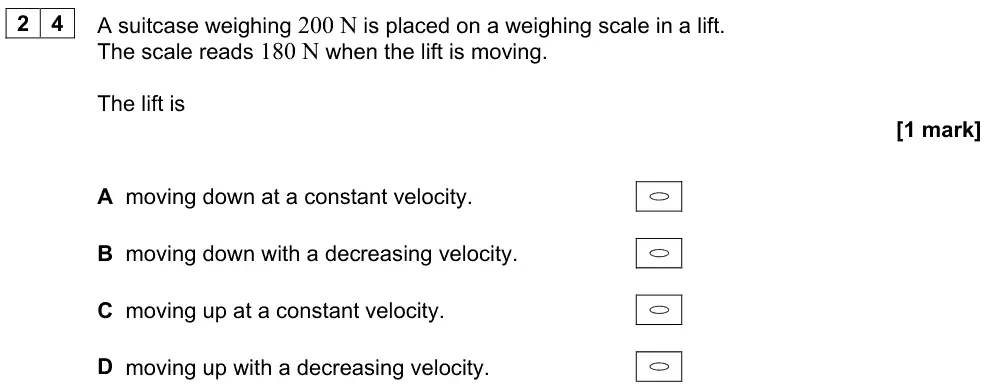
A suitcase weighing 200 N is placed on a weighing scale in a lift.
The scale reads 180 N when the lift is moving.
The lift is
[1 mark]
A moving down at a constant velocity.
B moving down with a decreasing velocity.
C moving up at a constant velocity.
D moving up with a decreasing velocity.
November 2021 · AS Paper 2 · Q25 1 mark Multiple choice newtons laws and momentum
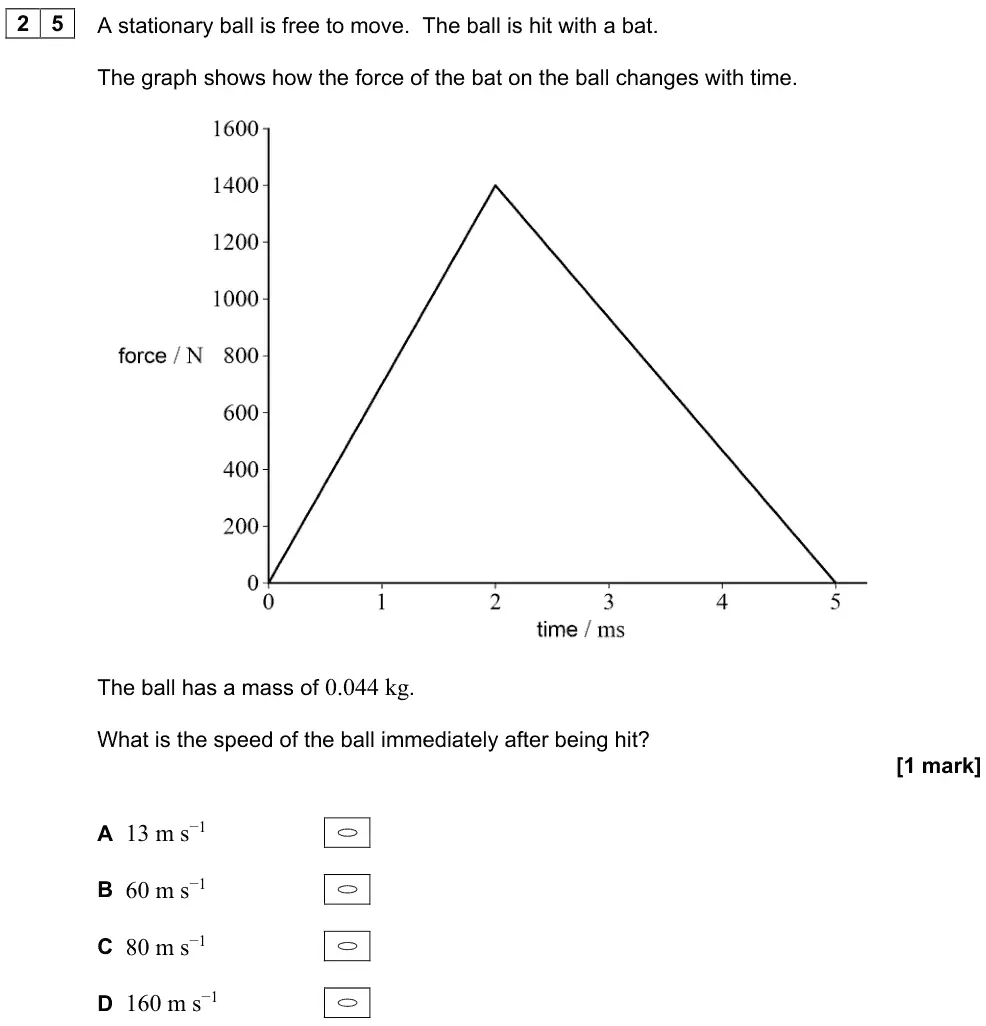
A stationary ball is free to move.  The ball is hit with a bat.
The graph shows how the force of the bat on the ball changes with time.
The ball has a mass of 0.044 kg.
What is the speed of the ball immediately after being hit?
[1 mark]
A 13 m s−1
B 60 m s−1
C 80 m s−1
D 160 m s−1
November 2021 · AS Paper 2 · Q26 1 mark Multiple choice materials and young modulus
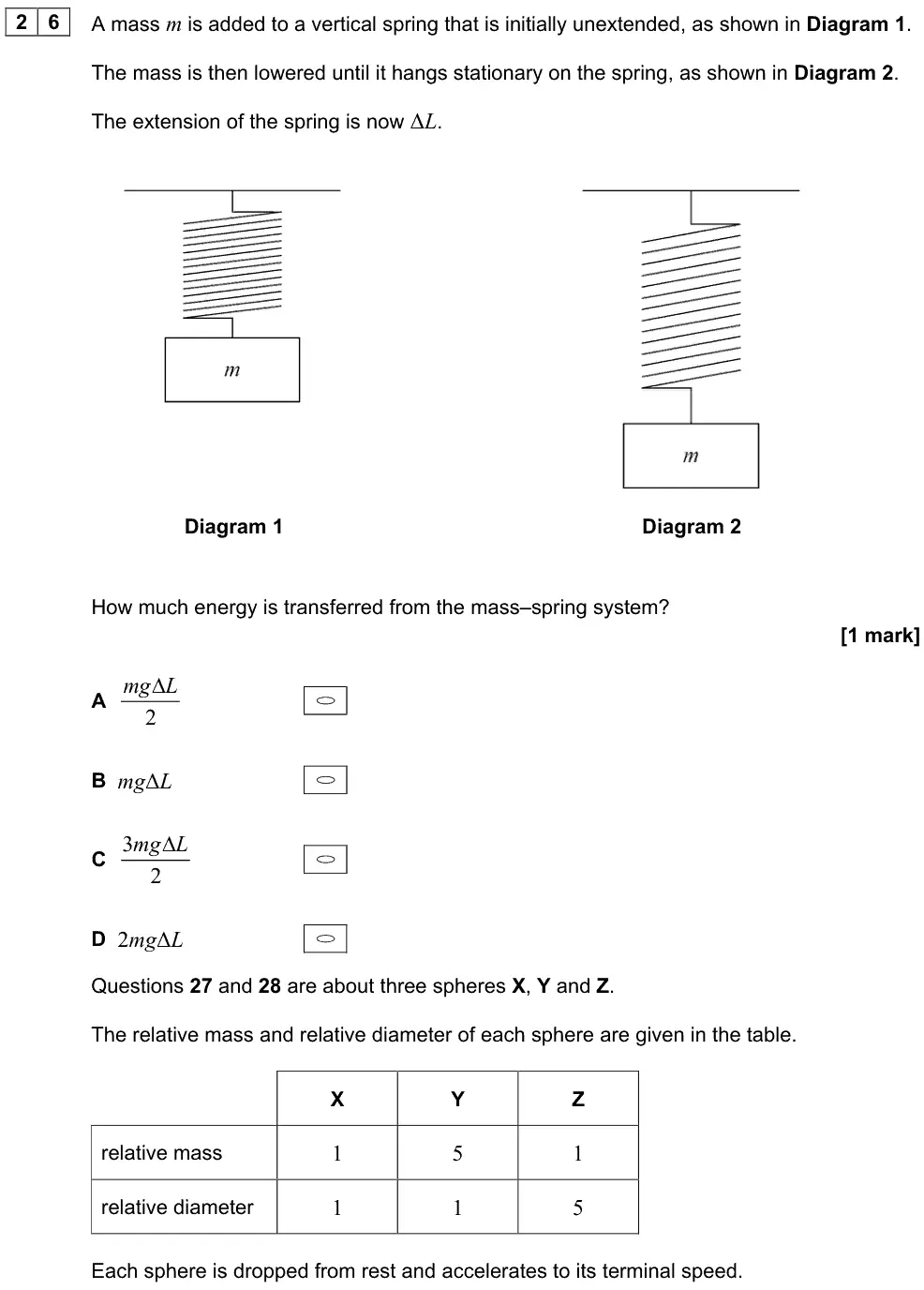
A mass m is added to a vertical spring that is initially unextended, as shown in Diagram 1.
The mass is then lowered until it hangs stationary on the spring, as shown in Diagram 2.
The extension of the spring is now ΔL.
Diagram 1
Diagram 2
How much energy is transferred from the mass–spring system?
[1 mark]
A
2
mg L
∆
B mgΔL
C 3
2
mg L
∆
D 2mgΔL
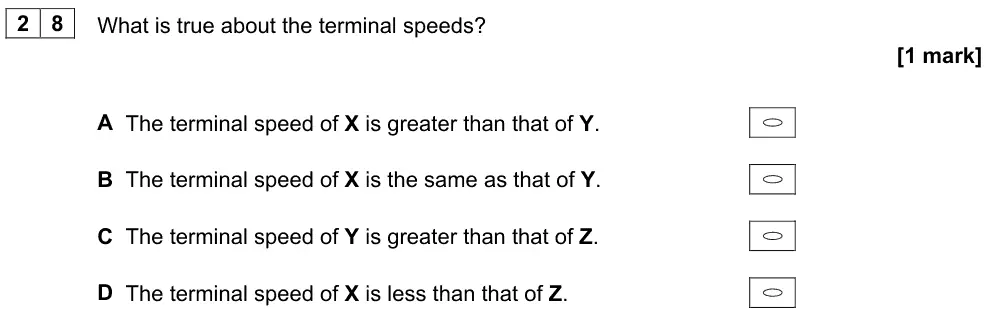
Questions 27 and 28 are about three spheres X, Y and Z.
The relative mass and relative diameter of each sphere are given in the table.
X
Y
Z
relative mass
1
5
1
relative diameter
1
1
5
Each sphere is dropped from rest and accelerates to its terminal speed.
November 2021 · AS Paper 2 · Q27 1 mark Multiple choice motion and projectilesnewtons laws and momentum
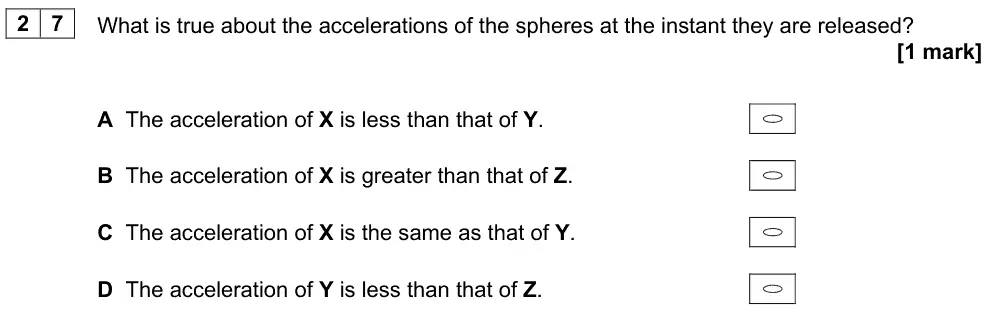
What is true about the accelerations of the spheres at the instant they are released?
[1 mark]
A The acceleration of X is less than that of Y.
B The acceleration of X is greater than that of Z.
C The acceleration of X is the same as that of Y.
D The acceleration of Y is less than that of Z.
November 2021 · AS Paper 2 · Q28 1 mark Multiple choice motion and projectiles
What is true about the terminal speeds?
[1 mark]
A The terminal speed of X is greater than that of Y.
B The terminal speed of X is the same as that of Y.
C The terminal speed of Y is greater than that of Z.
D The terminal speed of X is less than that of Z.
November 2021 · AS Paper 2 · Q29 1 mark Multiple choice circuits and potential dividers
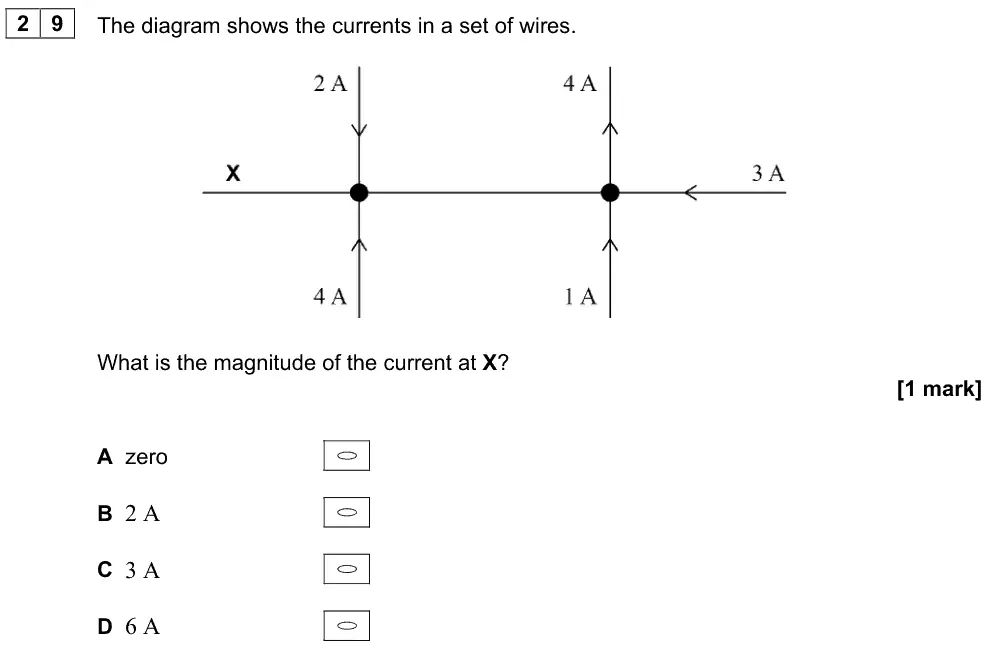
The diagram shows the currents in a set of wires.
What is the magnitude of the current at X?
[1 mark]
A zero
B 2 A
C 3 A
D 6 A
November 2021 · AS Paper 2 · Q30 1 mark Multiple choice circuits and potential dividers
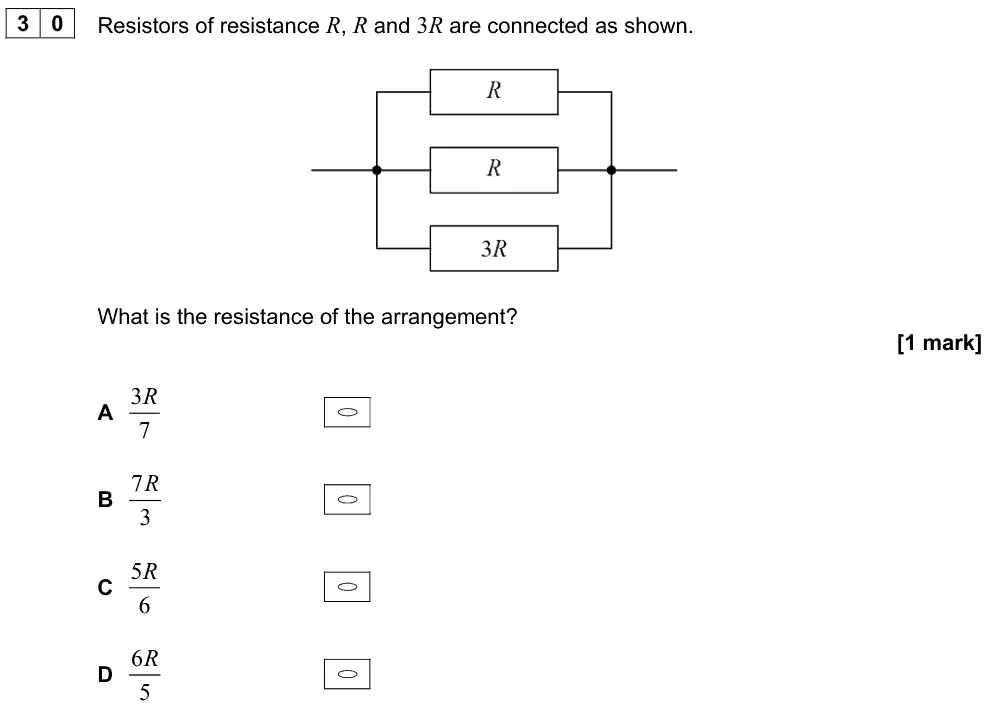
Resistors of resistance R, R and 3R are connected as shown.
What is the resistance of the arrangement?
[1 mark]
A 3
7
R
B 7
3
R
C 5
6
R
D 6
5
R
November 2021 · AS Paper 2 · Q31 1 mark Multiple choice circuits and potential dividerscurrent voltage and resistivity
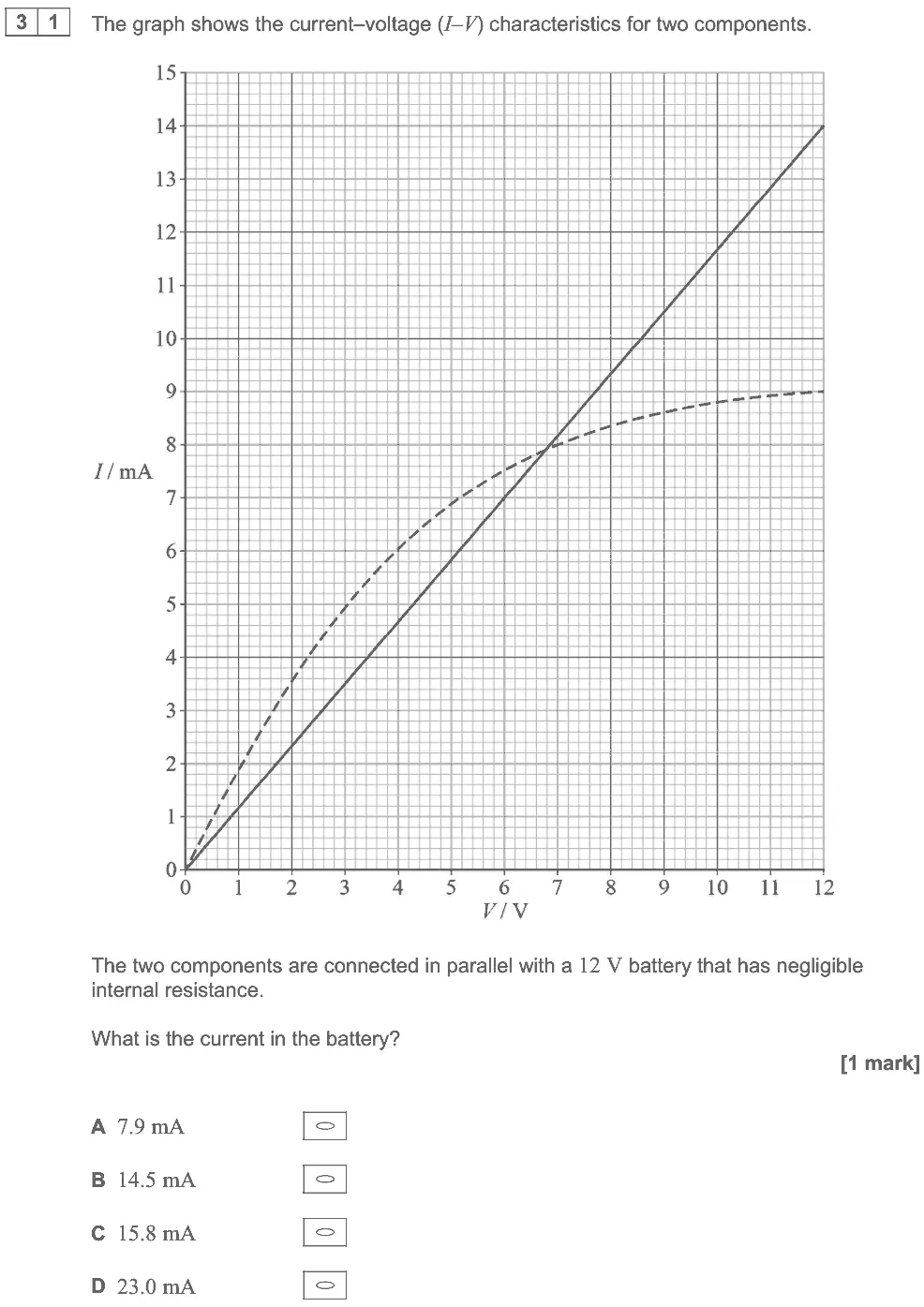
The graph shows the current–voltage (I–V) characteristics for two components.
The two components are connected in parallel with a 12 V battery that has negligible
internal resistance.
What is the current in the battery?
[1 mark]
A 7.9 mA
B 14.5 mA
C 15.8 mA
D 23.0 mA
November 2021 · AS Paper 2 · Q32 1 mark Multiple choice materials and young modulus
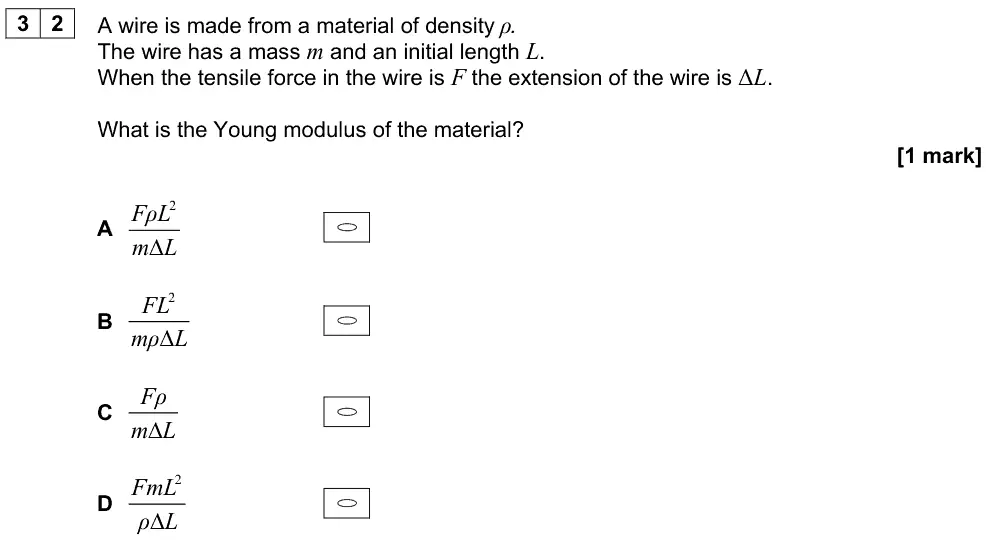
A wire is made from a material of density ρ.
The wire has a mass m and an initial length L.
When the tensile force in the wire is F the extension of the wire is ΔL.
What is the Young modulus of the material?
[1 mark]
A
2
FρL
m L
∆
B
2
FL
mρ L
∆
C
Fρ
m L
∆
D
2
FmL
ρ L
∆
November 2021 · AS Paper 2 · Q33 1 mark Multiple choice measurements and uncertainties
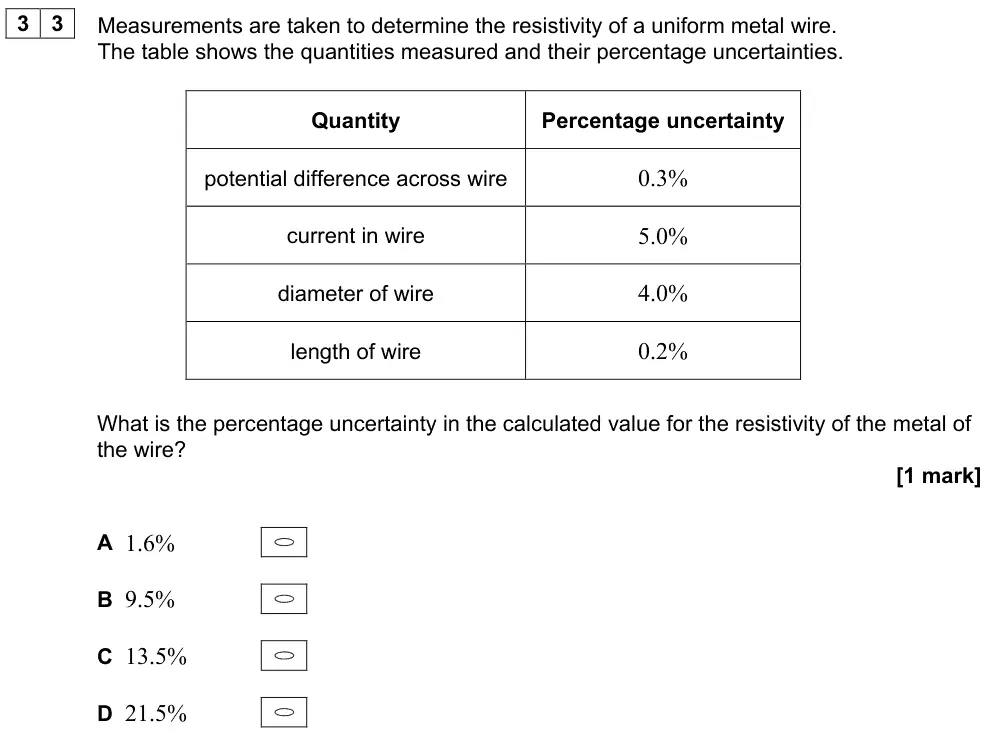
Measurements are taken to determine the resistivity of a uniform metal wire.
The table shows the quantities measured and their percentage uncertainties.
Quantity
Percentage uncertainty
potential difference across wire
0.3%
current in wire
5.0%
diameter of wire
4.0%
length of wire
0.2%
What is the percentage uncertainty in the calculated value for the resistivity of the metal of
the wire?
[1 mark]
A 1.6%
B 9.5%
C 13.5%
D 21.5%
November 2021 · AS Paper 2 · Q34 1 mark Multiple choice current voltage and resistivity
Superconductors are used to
[1 mark]
A increase the strength of electricity cables.
B make light dependent resistors.
C produce strong magnetic fields.
D increase the rate of heat energy transfer.
November 2021 · AS Paper 2 · Q35 1 mark Multiple choice classification of particles and quarks
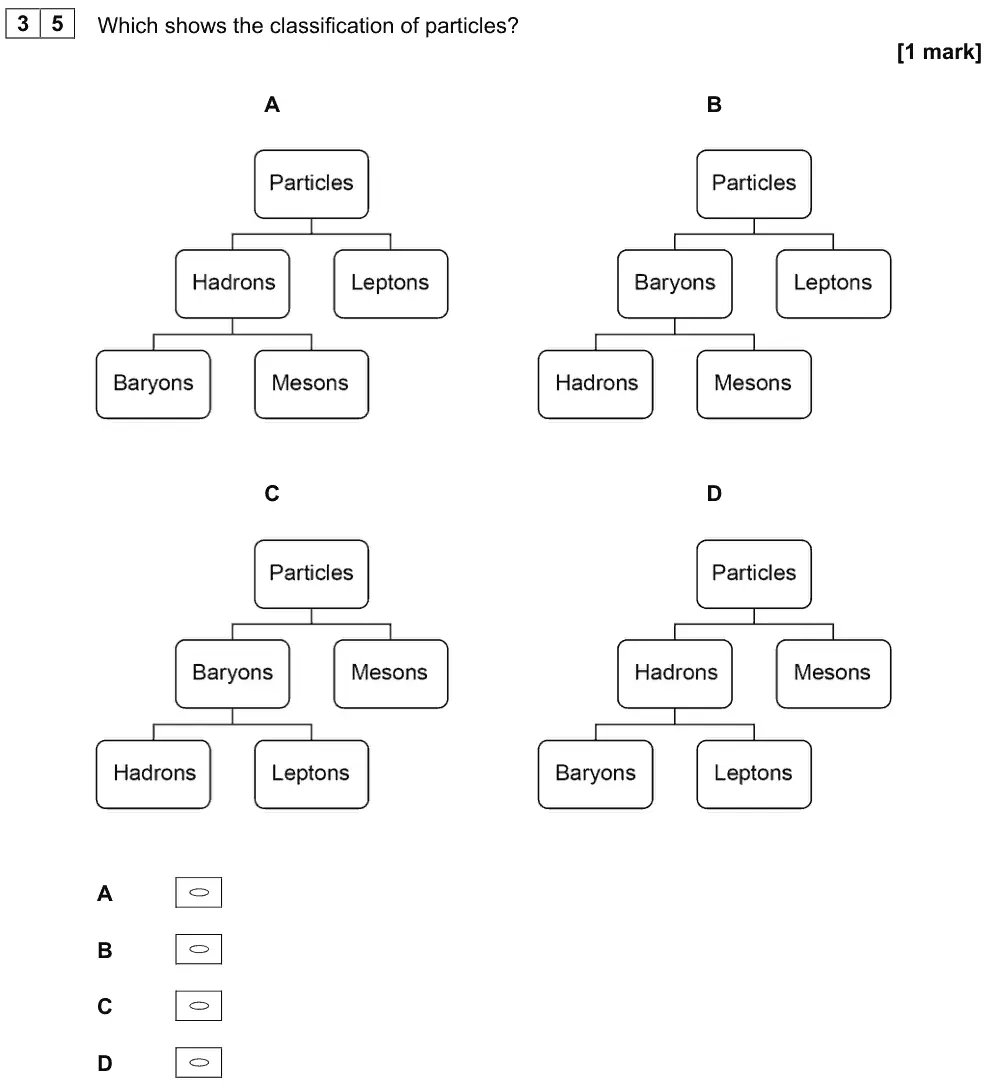
Which shows the classification of particles?
[1 mark]
A
B
C
D
A
B
C
D

Work with an AQA physics tutor

Want a paper marked and gone through with you? Message us.

Prefer email? Send an enquiry

If you are under 18, please include a parent's contact details. Enquiries go to enquiries@physicsaleveltutor.com and are deleted once handled. All tutoring is online.