November 2021: Paper 2

85 marks · 52 question parts · Paper, mark scheme and report on AQA's site · An autumn series using the paper written for the cancelled summer exams · Have the data and formulae booklet beside you

Question by question

QTopicMarksAOType
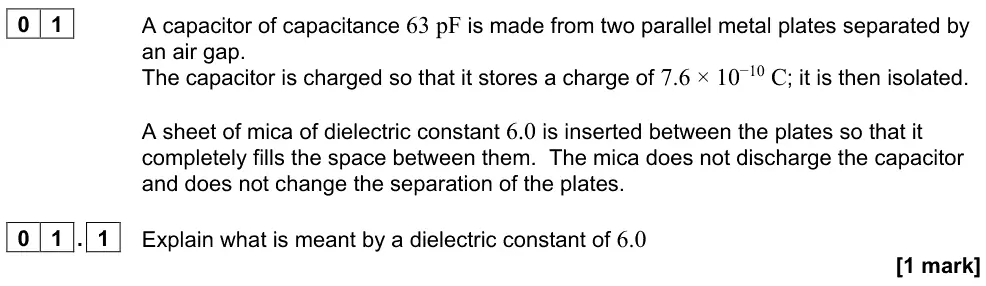
1.1 Capacitance and capacitor charge and discharge 1AO1=1Short answer
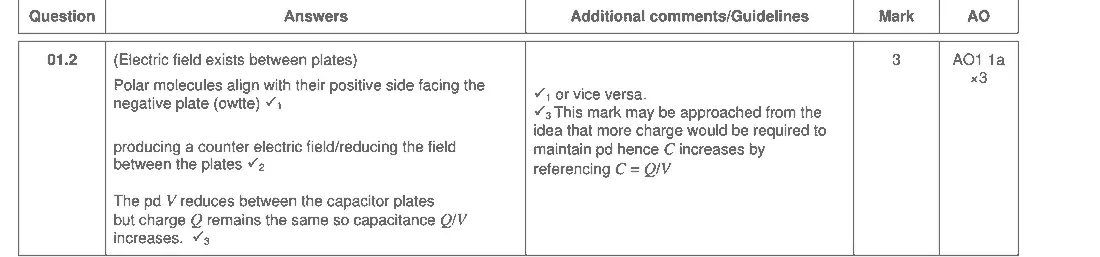
1.2 Capacitance and capacitor charge and discharge 3AO1=3Explanation
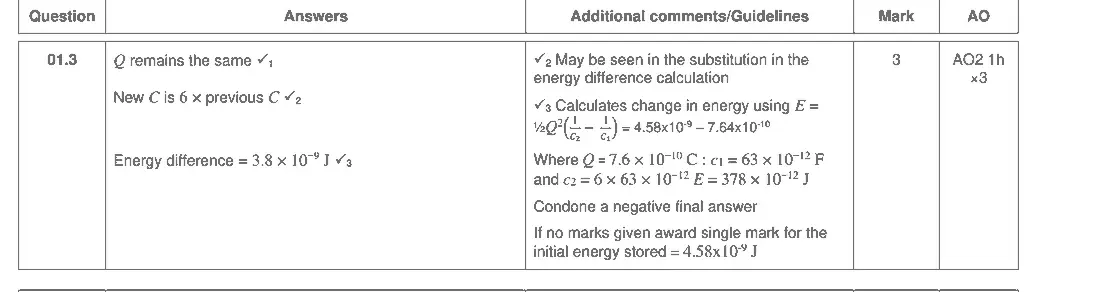
1.3 Capacitance and capacitor charge and discharge 3AO2=3Calculation
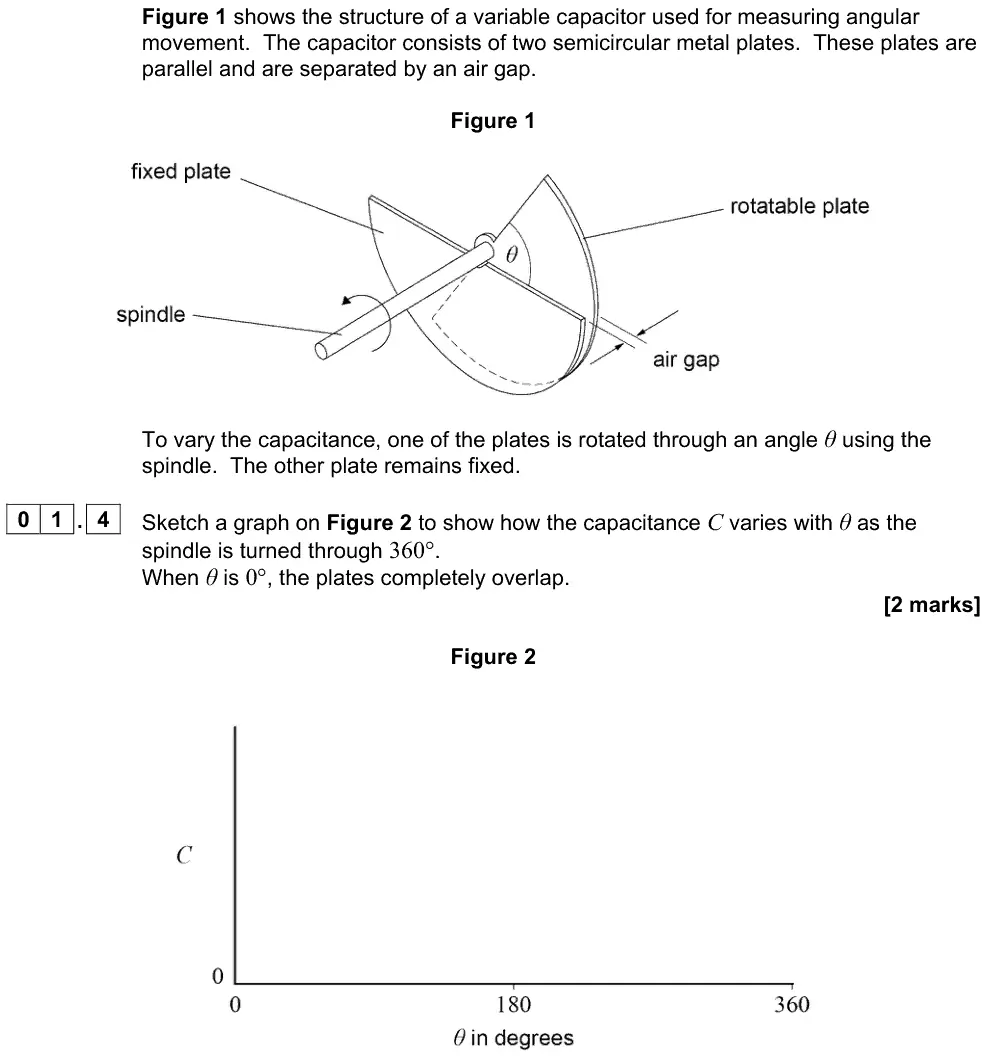
1.4 Capacitance and capacitor charge and discharge 2Diagram or graph
1.5 Capacitance and capacitor charge and discharge 3AO3=3Explanation
2.1 Gravitational fields and orbits, Circular motion 2AO2=2Show that
2.2 Gravitational fields and orbits, Circular motion 2AO2=2Calculation
2.3 Gravitational fields and orbits, Circular motion 2Explanation
2.4 Gravitational fields and orbits 2AO1=2Calculation
2.5 Gravitational fields and orbits 2AO2=2Explanation
3.1 Molecular kinetic theory 1AO1=1Short answer
3.2 Circular motion, Motion along a straight line and projectile motion 2AO2=2Show that
3.3 Molecular kinetic theory, Thermal energy transfer and ideal gases 3Calculation
3.4 Molecular kinetic theory 2Explanation
3.5 Thermal energy transfer and ideal gases 1AO2=1Calculation
3.6 Molecular kinetic theory 2AO3=2Explanation
4.1 Electromagnetic induction, alternating currents and transformers 2AO2=2Show that
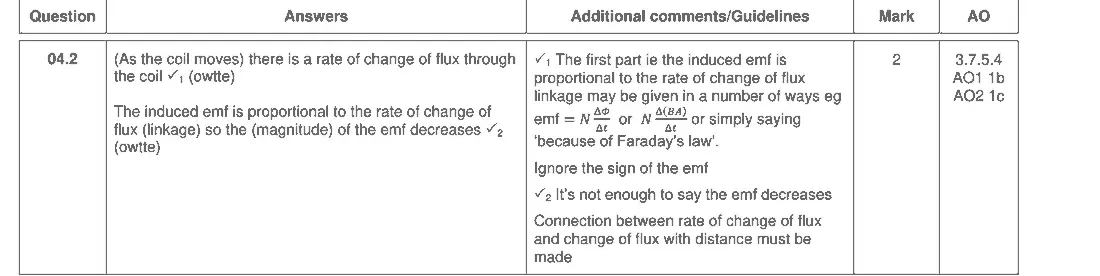
4.2 Electromagnetic induction, alternating currents and transformers 2Explanation
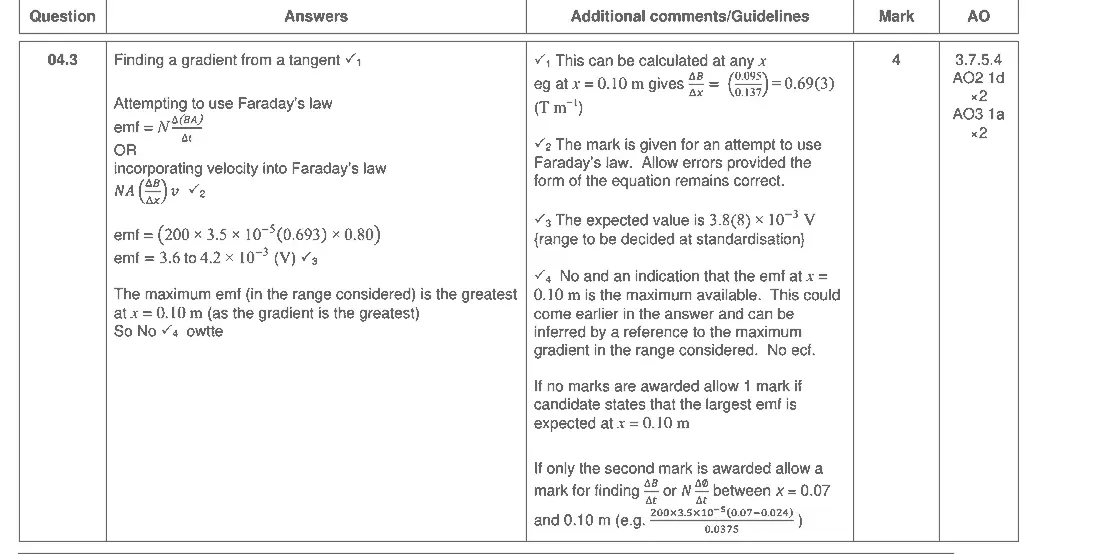
4.3 Electromagnetic induction, alternating currents and transformers 4Calculation
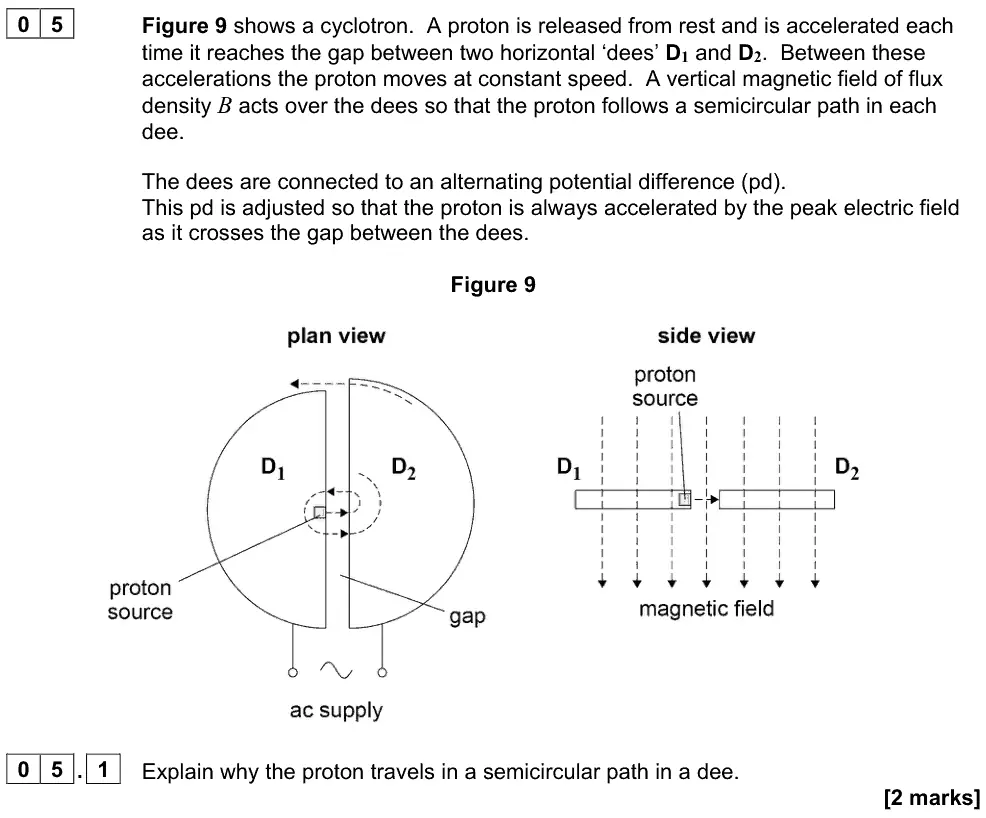
5.1 Magnetic flux density and moving charges in a magnetic field 2AO1=2Explanation
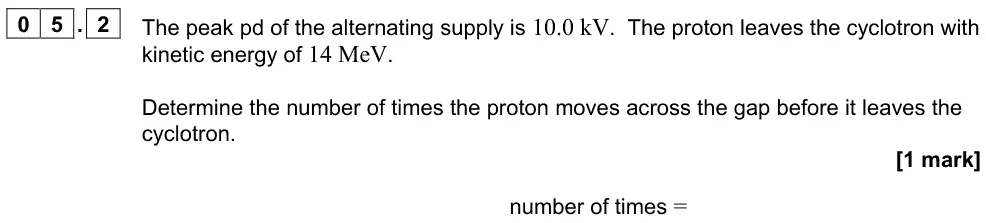
5.2 Electric fields and electric potential, Excitation, energy levels and wave-particle duality 1AO2=1Short answer
5.3 Magnetic flux density and moving charges in a magnetic field 3AO2=3Show that
5.4 Magnetic flux density and moving charges in a magnetic field, Excitation, energy levels and wave-particle duality 4Calculation
6.1 Mass and energy, binding energy, fission and safety 2AO1=2Explanation
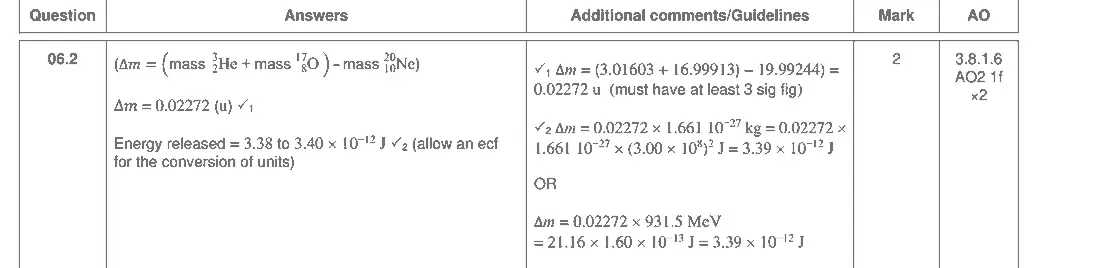
6.2 Mass and energy, binding energy, fission and safety 2AO2=2Calculation
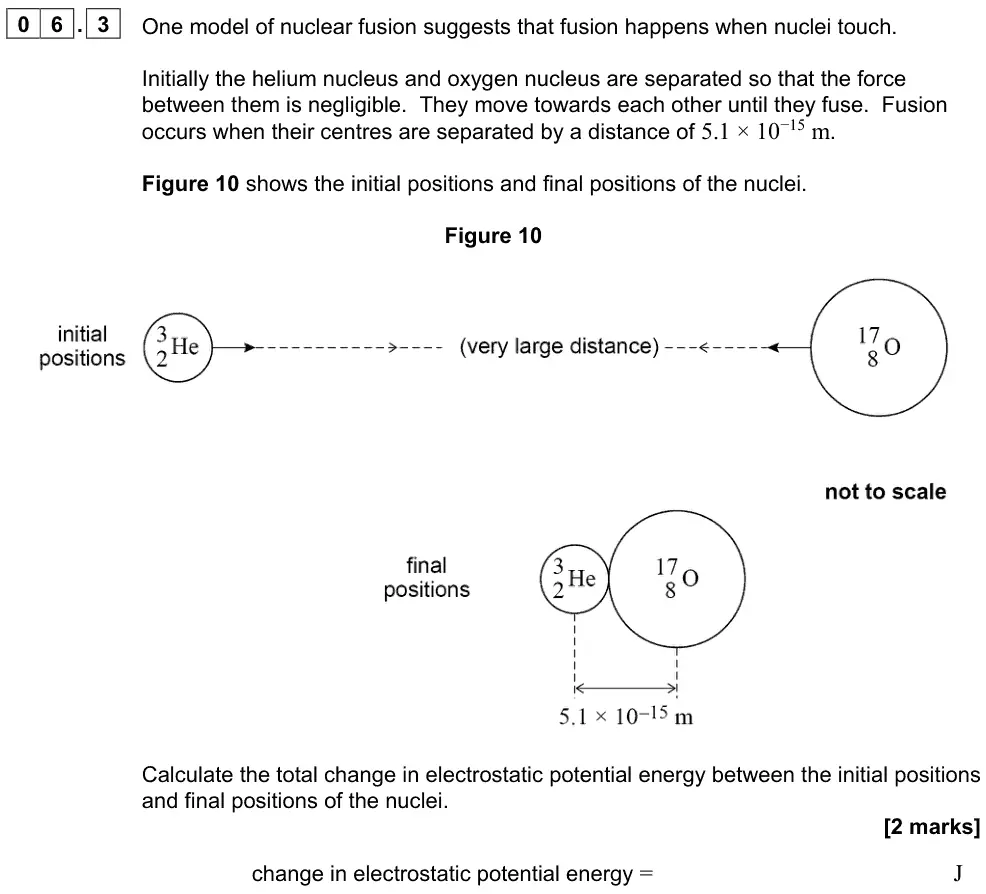
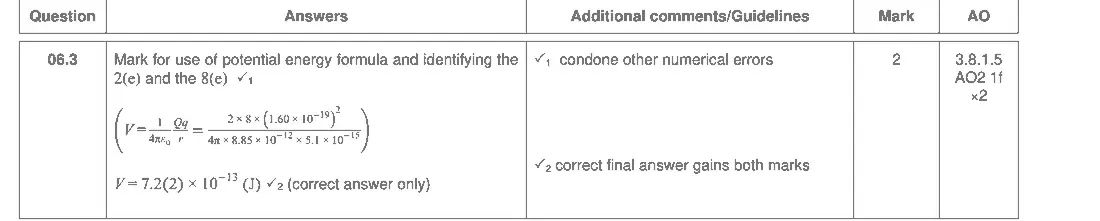
6.3 Electric fields and electric potential, Nuclear radius 2AO2=2Calculation
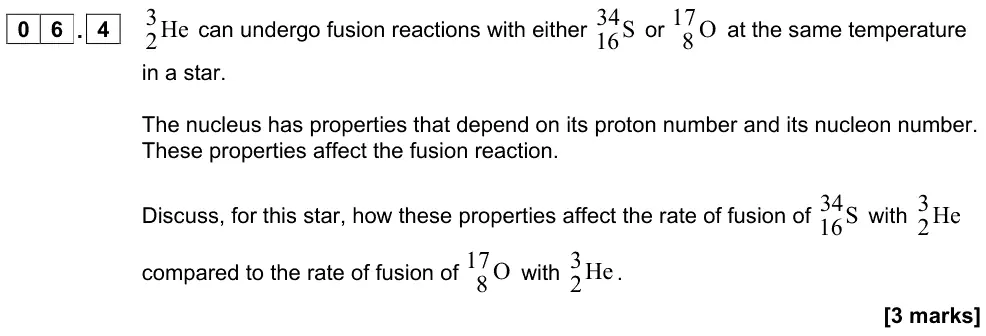
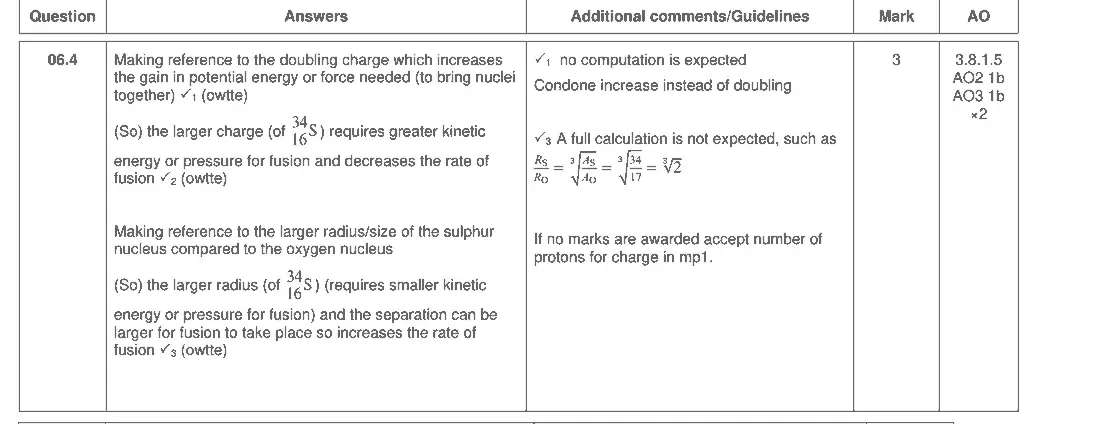
6.4 Electric fields and electric potential, Nuclear radius 3Explanation
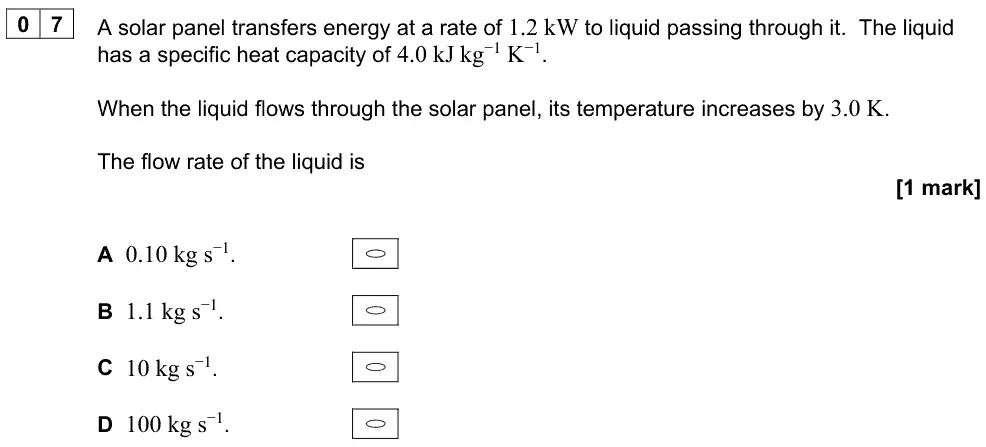
7 Thermal energy transfer and ideal gases 1Multiple choice
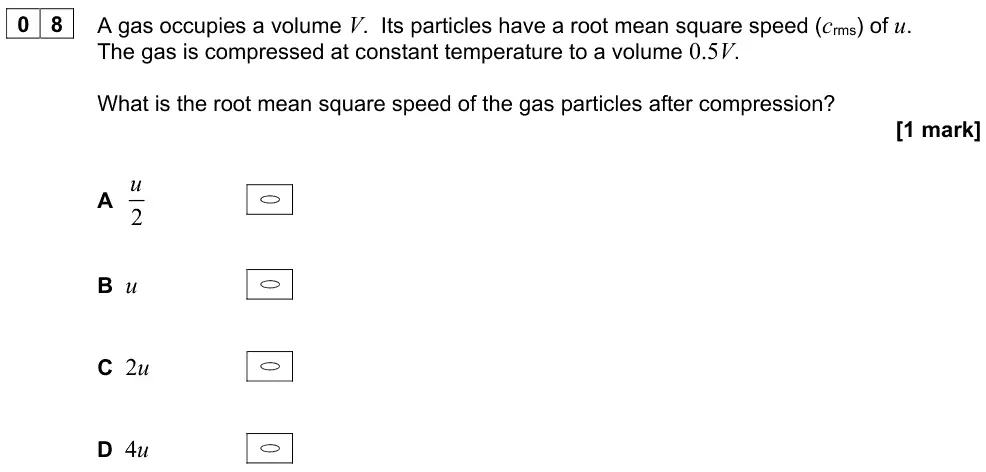
8 Molecular kinetic theory 1Multiple choice
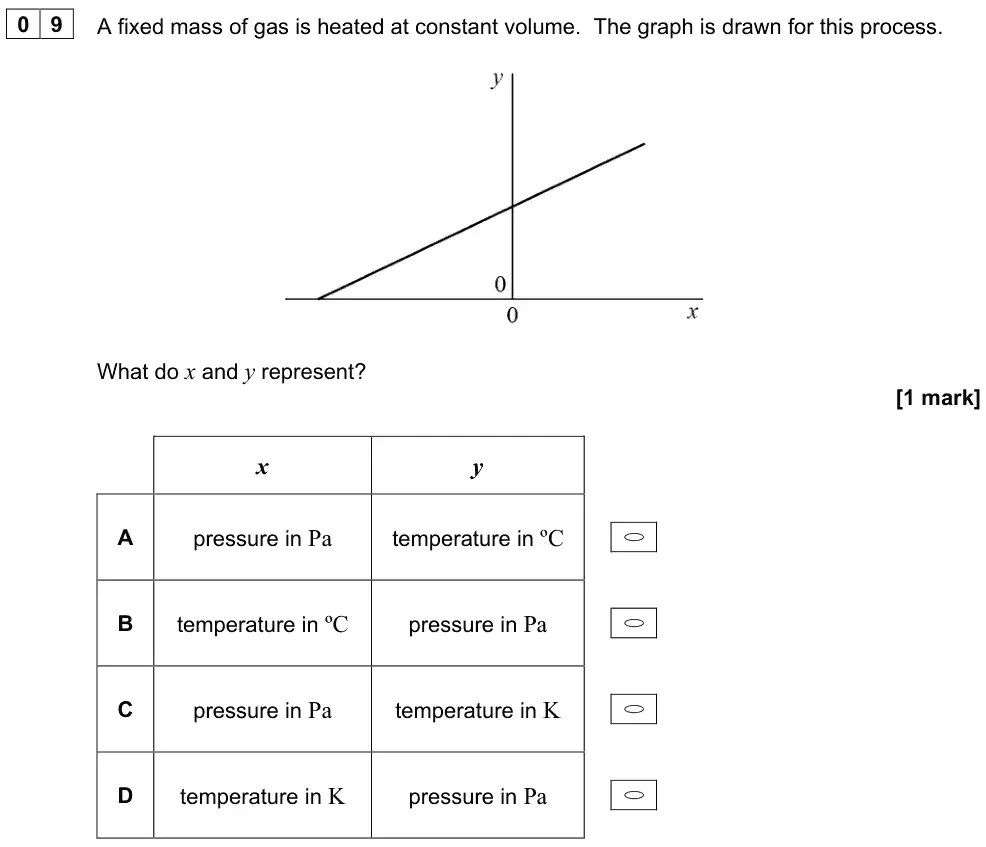
9 Thermal energy transfer and ideal gases 1Multiple choice
10 Molecular kinetic theory 1Multiple choice
11 Gravitational fields and orbits 1Multiple choice
12 Gravitational fields and orbits, Materials, stress, strain and the Young modulus 1Multiple choice
13 Gravitational fields and orbits 1Multiple choice
14 Electric fields and electric potential 1Multiple choice
15 Electric fields and electric potential, Gravitational fields and orbits 1Multiple choice
16 Electric fields and electric potential 1Multiple choice
17 Electric fields and electric potential 1Multiple choice
18 Electric fields and electric potential 1Multiple choice
19 Electric fields and electric potential 1Multiple choice
20 Capacitance and capacitor charge and discharge 1Multiple choice
21 Magnetic flux density and moving charges in a magnetic field 1Multiple choice
22 Electromagnetic induction, alternating currents and transformers 1Multiple choice
23 Electromagnetic induction, alternating currents and transformers 1Multiple choice
24 Electromagnetic induction, alternating currents and transformers, Circuits and potential dividers 1Multiple choice
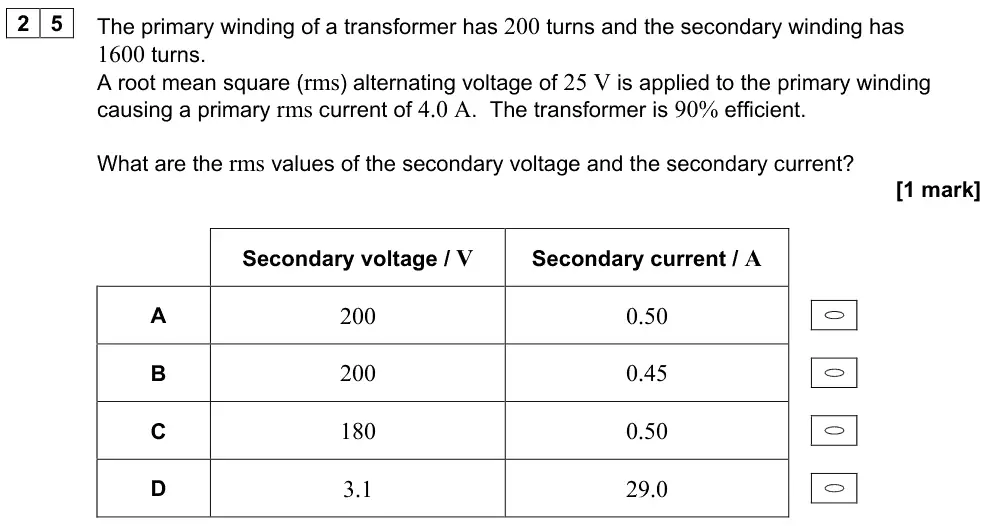
25 Electromagnetic induction, alternating currents and transformers 1Multiple choice
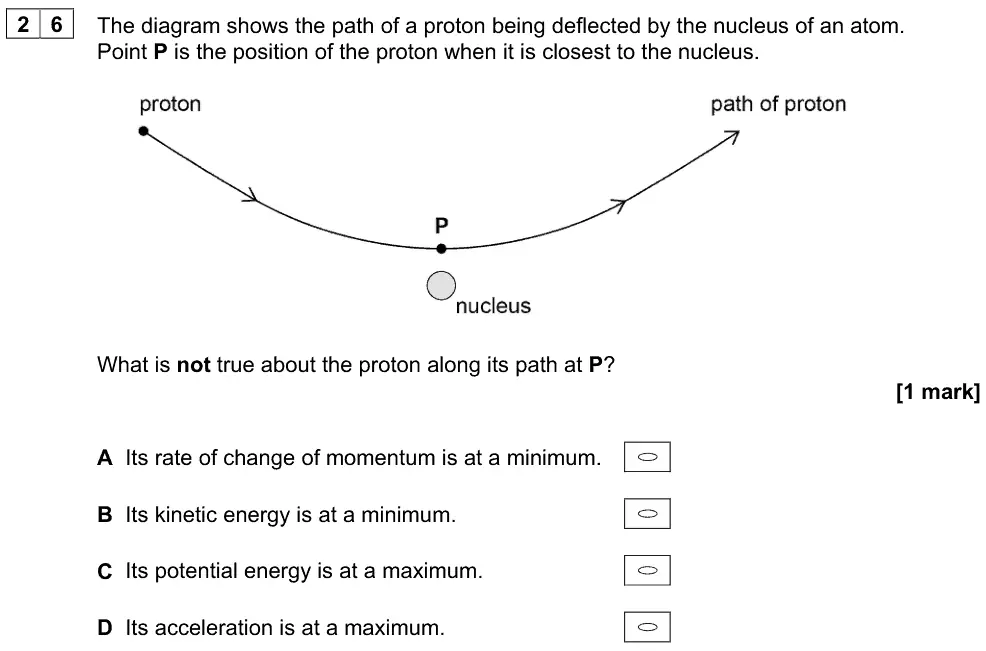
26 Rutherford scattering, alpha, beta and gamma radiation, Newton's laws of motion and momentum 1Multiple choice
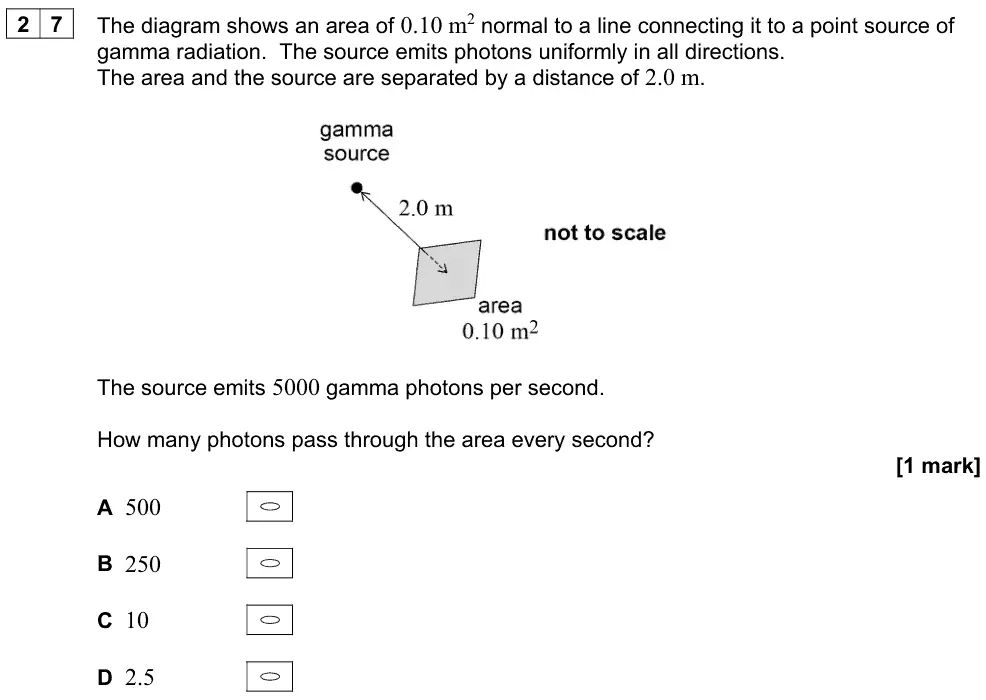
27 Rutherford scattering, alpha, beta and gamma radiation 1Multiple choice
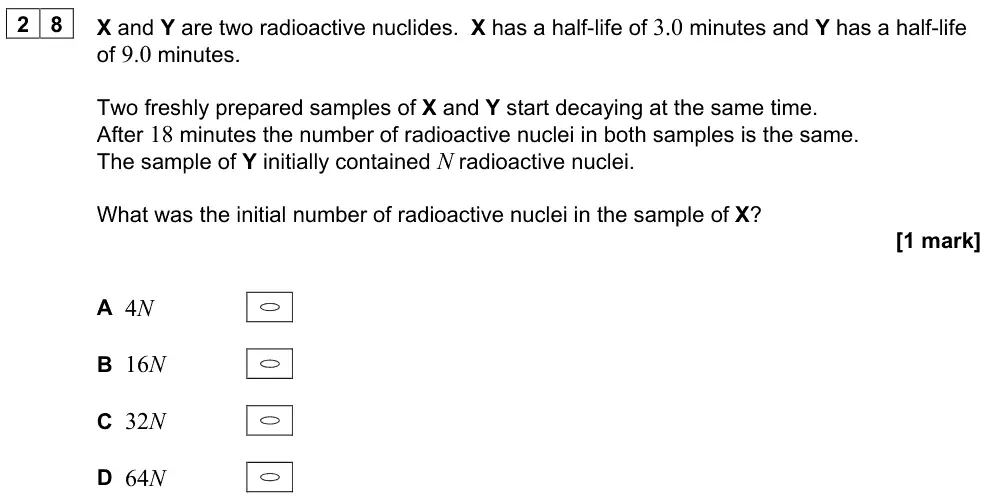
28 Radioactive decay, half-life and nuclear instability 1Multiple choice
29 Mass and energy, binding energy, fission and safety 1Multiple choice
30 Mass and energy, binding energy, fission and safety 1Multiple choice
31 Radioactive decay, half-life and nuclear instability 1Multiple choice

The questions

1.11.21.31.41.52.12.22.32.42.53.13.23.33.43.53.64.14.24.35.15.25.35.46.16.26.36.478910111213141516171819202122232425262728293031
November 2021 · Paper 2 · Q1.1 1 mark AO1=1 Short answer Hard capacitors
A capacitor of capacitance 63 pF is made from two parallel metal plates separated by
an air gap.
The capacitor is charged so that it stores a charge of 7.6 × 10⁻¹⁰ C; it is then isolated.
A sheet of mica of dielectric constant 6.0 is inserted between the plates so that it
completely fills the space between them.  The mica does not discharge the capacitor
and does not change the separation of the plates.
Explain what is meant by a dielectric constant of 6.0
[1 mark]
November 2021 · Paper 2 · Q1.2 3 marks AO1=3 Explanation capacitors
Earlier part of question 1 that this part usesEarlier part of November 2021 Paper 2 question 1
Mica is made up of polar molecules.  As the mica is inserted, the capacitance of the
capacitor changes.
Explain how the polar molecules cause this change in capacitance.
[3 marks]
November 2021 · Paper 2 · Q1.3 3 marks AO2=3 Calculation capacitors
Earlier part of question 1 that this part usesEarlier part of November 2021 Paper 2 question 1
Calculate the difference between the initial energy stored by the capacitor and the
energy stored when the mica has been fully inserted.
[3 marks]
energy difference =
J
November 2021 · Paper 2 · Q1.4 2 marks Diagram or graph capacitors
Earlier part of question 1 that this part usesEarlier part of November 2021 Paper 2 question 1
Figure 1 shows the structure of a variable capacitor used for measuring angular
movement.  The capacitor consists of two semicircular metal plates.  These plates are
parallel and are separated by an air gap.
Figure 1
To vary the capacitance, one of the plates is rotated through an angle θ using the
spindle.  The other plate remains fixed.
Sketch a graph on Figure 2 to show how the capacitance C varies with θ as the
spindle is turned through 360°.
When θ is 0°, the plates completely overlap.
[2 marks]
Figure 2
November 2021 · Paper 2 · Q1.5 3 marks AO3=3 Explanation capacitors
Earlier part of question 1 that this part usesEarlier part of November 2021 Paper 2 question 1
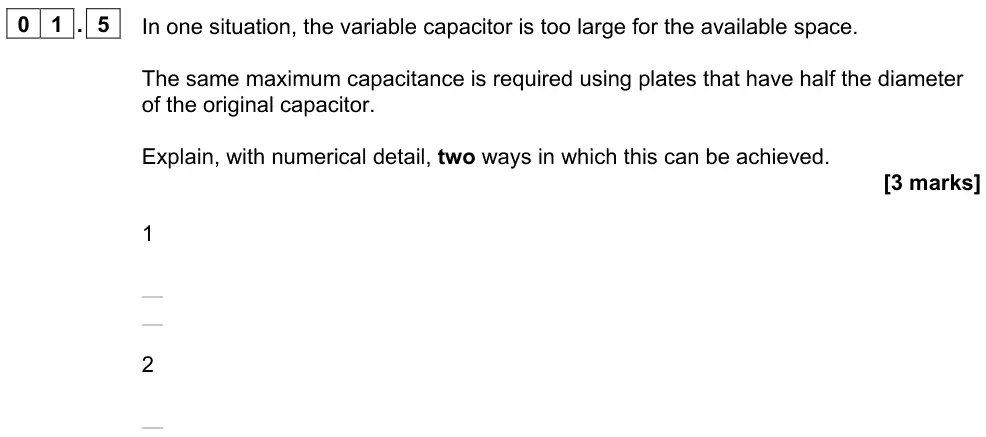
In one situation, the variable capacitor is too large for the available space.
The same maximum capacitance is required using plates that have half the diameter
of the original capacitor.
Explain, with numerical detail, two ways in which this can be achieved.
[3 marks]
1
2
November 2021 · Paper 2 · Q2.1 2 marks AO2=2 Show that gravitational fieldscircular motion
The Global Positioning System (GPS) uses satellites to support navigation on Earth.
One GPS satellite is in a circular orbit at a height h above the surface of the Earth.
The Earth has mass M and radius R.
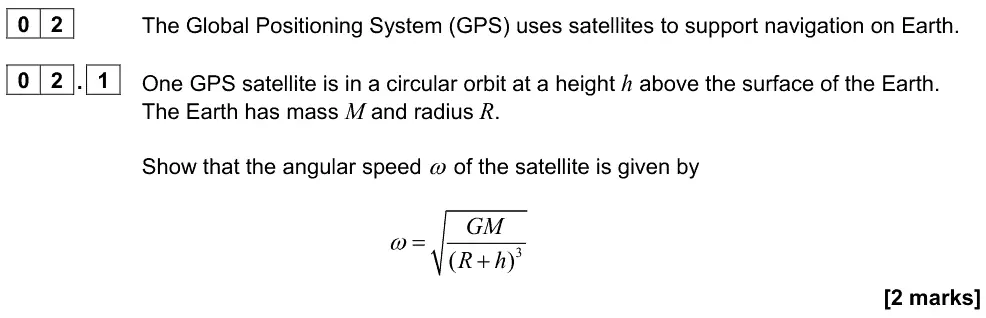
Show that the angular speed   of the satellite is given by
3
(
)
GM
R
h
=
+
[2 marks]
November 2021 · Paper 2 · Q2.2 2 marks AO2=2 Calculation gravitational fieldscircular motion
Earlier part of question 2 that this part usesEarlier part of November 2021 Paper 2 question 2
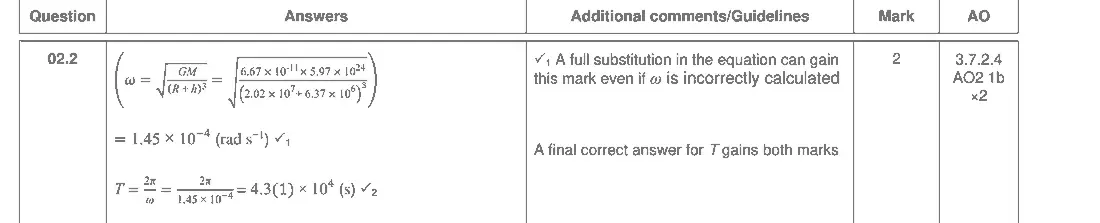
Calculate the orbital period of the satellite when h equals 2.02 × 10⁷ m.
[2 marks]
orbital period =
s
November 2021 · Paper 2 · Q2.3 2 marks Explanation gravitational fieldscircular motion
Earlier part of question 2 that this part usesEarlier part of November 2021 Paper 2 question 2
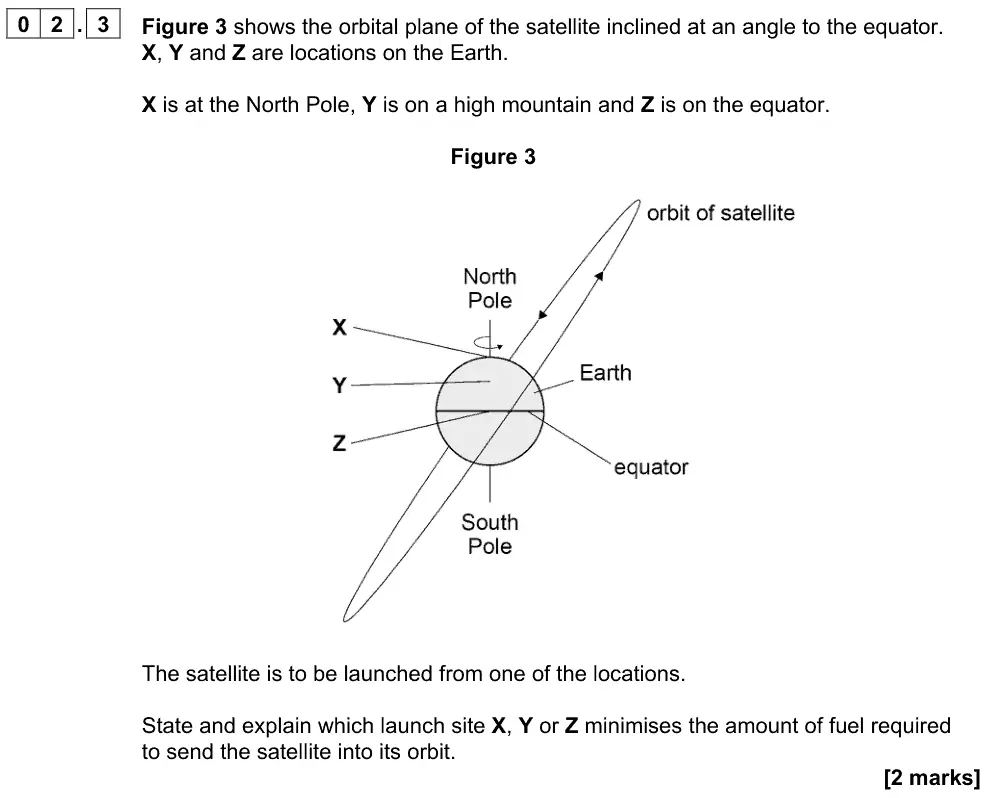
Figure 3 shows the orbital plane of the satellite inclined at an angle to the equator.
X, Y and Z are locations on the Earth.
X is at the North Pole, Y is on a high mountain and Z is on the equator.
Figure 3
The satellite is to be launched from one of the locations.
State and explain which launch site X, Y or Z minimises the amount of fuel required
to send the satellite into its orbit.
[2 marks]
November 2021 · Paper 2 · Q2.4 2 marks AO1=2 Calculation gravitational fields
Earlier part of question 2 that this part usesEarlier part of November 2021 Paper 2 question 2
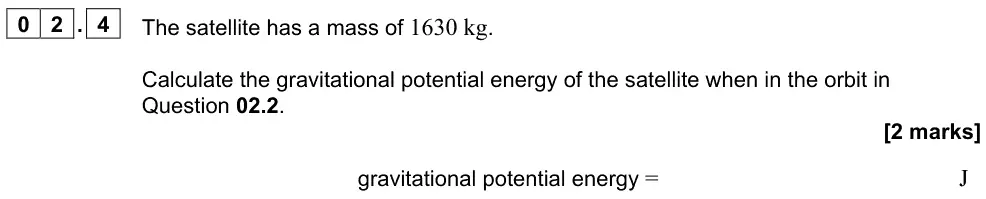
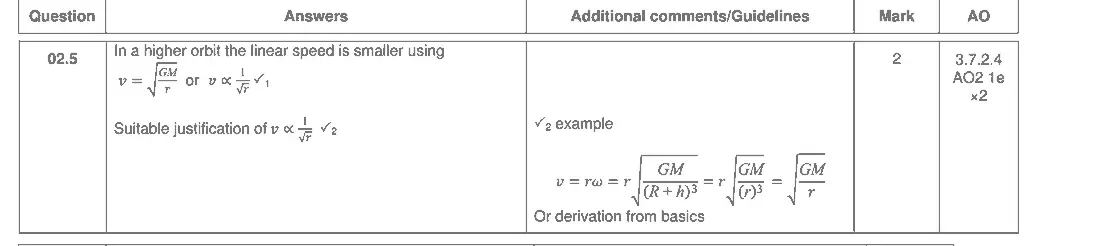
The satellite has a mass of 1630 kg.
Calculate the gravitational potential energy of the satellite when in the orbit in
Question 02.2.
[2 marks]
gravitational potential energy =
J
November 2021 · Paper 2 · Q2.5 2 marks AO2=2 Explanation gravitational fields
Earlier part of question 2 that this part usesEarlier part of November 2021 Paper 2 question 2
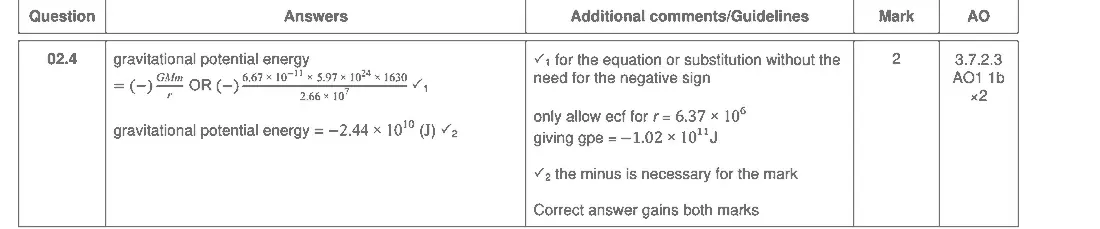
A different satellite is in a higher circular orbit.
Explain how the linear speed of this satellite compares with the linear speed of the
satellite in Question 02.1.
[2 marks]
November 2021 · Paper 2 · Q3.1 1 mark AO1=1 Short answer Hard kinetic theory
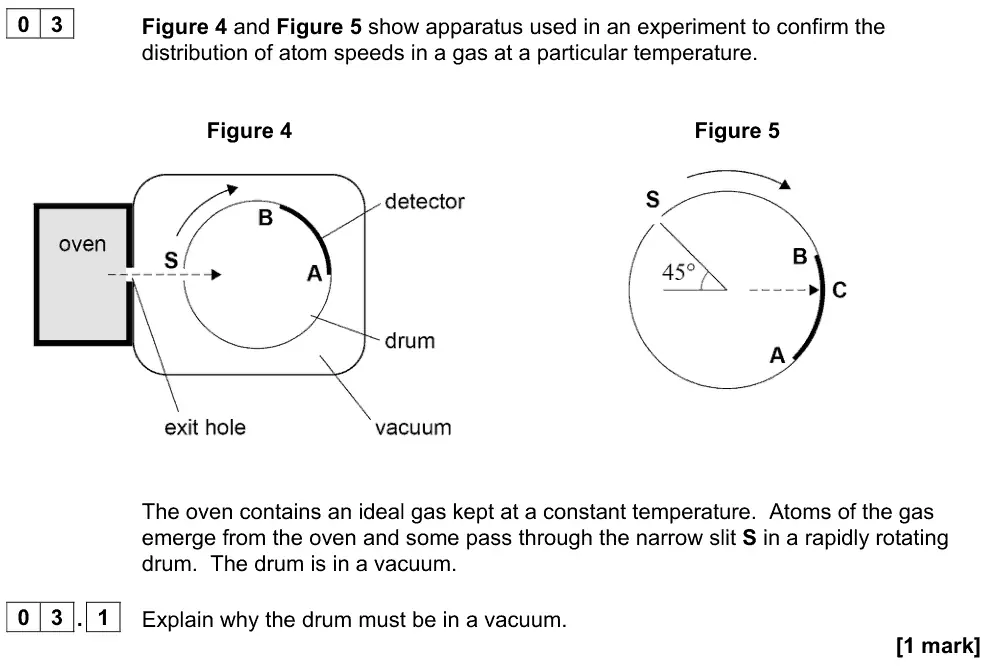
Figure 4 and Figure 5 show apparatus used in an experiment to confirm the
distribution of atom speeds in a gas at a particular temperature.
Figure 4
Figure 5
The oven contains an ideal gas kept at a constant temperature.  Atoms of the gas
emerge from the oven and some pass through the narrow slit S in a rapidly rotating
drum.  The drum is in a vacuum.
Explain why the drum must be in a vacuum.
[1 mark]
November 2021 · Paper 2 · Q3.2 2 marks AO2=2 Show that circular motionmotion and projectiles
Earlier part of question 3 that this part usesEarlier part of November 2021 Paper 2 question 3
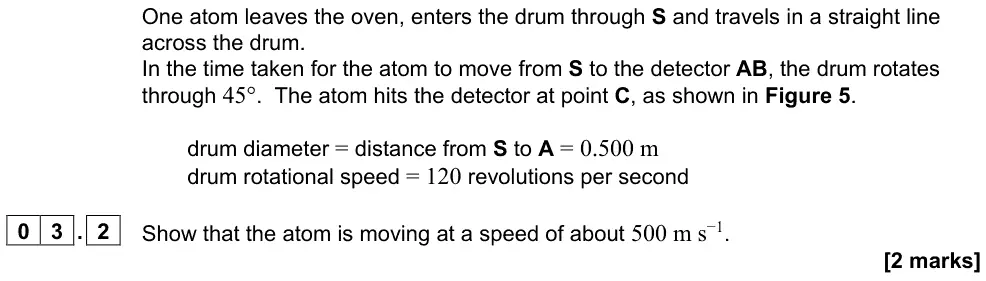
One atom leaves the oven, enters the drum through S and travels in a straight line
across the drum.
In the time taken for the atom to move from S to the detector AB, the drum rotates
through 45°.  The atom hits the detector at point C, as shown in Figure 5.
drum diameter = distance from S to A = 0.500 m
drum rotational speed = 120 revolutions per second
Show that the atom is moving at a speed of about 500 m s−1.
[2 marks]
November 2021 · Paper 2 · Q3.3 3 marks Calculation kinetic theorythermal energy and ideal gases
Earlier part of question 3 that this part usesEarlier part of November 2021 Paper 2 question 3
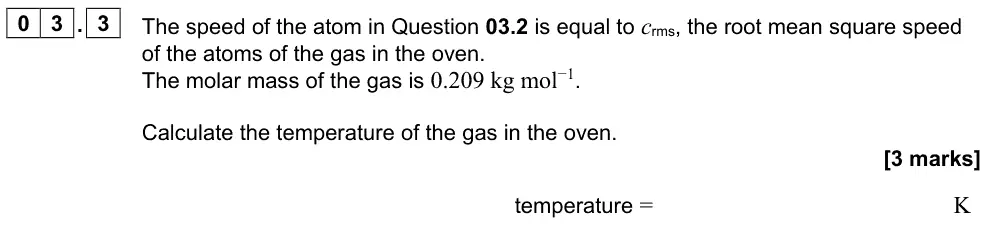
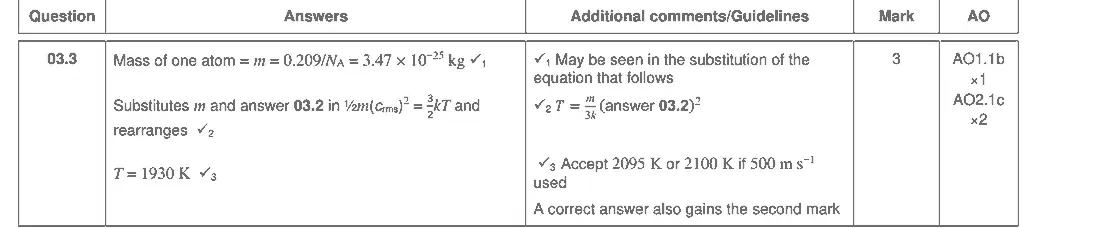
The speed of the atom in Question 03.2 is equal to crms, the root mean square speed
of the atoms of the gas in the oven.
The molar mass of the gas is 0.209 kg mol−1.
Calculate the temperature of the gas in the oven.
[3 marks]
temperature =
K
November 2021 · Paper 2 · Q3.4 2 marks Explanation kinetic theory
Earlier part of question 3 that this part usesEarlier part of November 2021 Paper 2 question 3
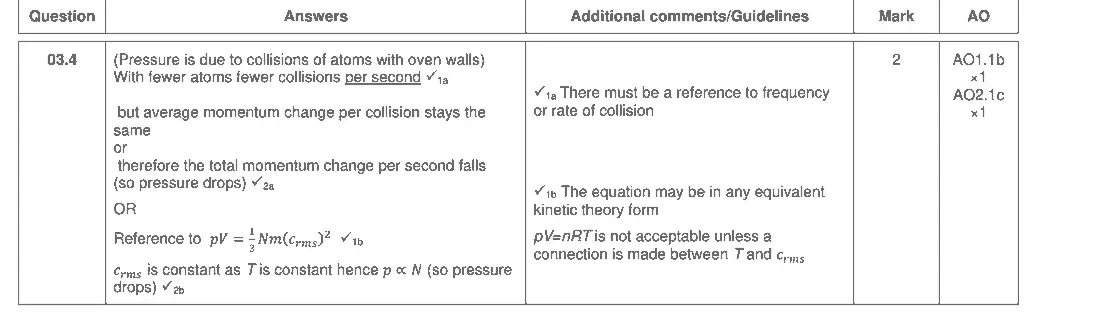
The oven temperature is kept constant during the experiment but the pressure in the
oven decreases as atoms leave through the exit hole.
Explain, using the kinetic theory, why the pressure decreases.
[2 marks]
November 2021 · Paper 2 · Q3.5 1 mark AO2=1 Calculation thermal energy and ideal gases
Earlier part of question 3 that this part usesEarlier part of November 2021 Paper 2 question 3
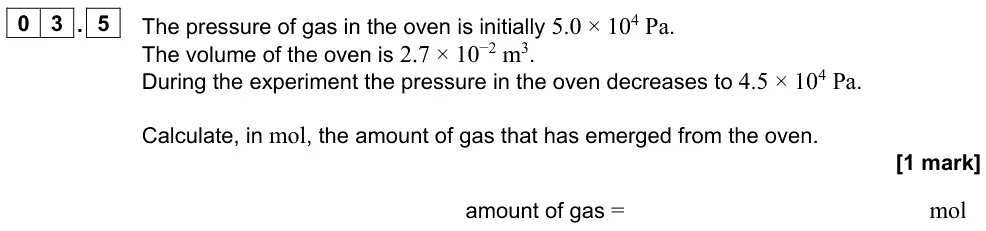
The pressure of gas in the oven is initially 5.0 × 10⁴ Pa.
The volume of the oven is 2.7 × 10⁻² m3.
During the experiment the pressure in the oven decreases to 4.5 × 10⁴ Pa.
Calculate, in mol, the amount of gas that has emerged from the oven.
[1 mark]
amount of gas =
mol
November 2021 · Paper 2 · Q3.6 2 marks AO3=2 Explanation kinetic theory
Earlier part of question 3 that this part usesEarlier part of November 2021 Paper 2 question 3
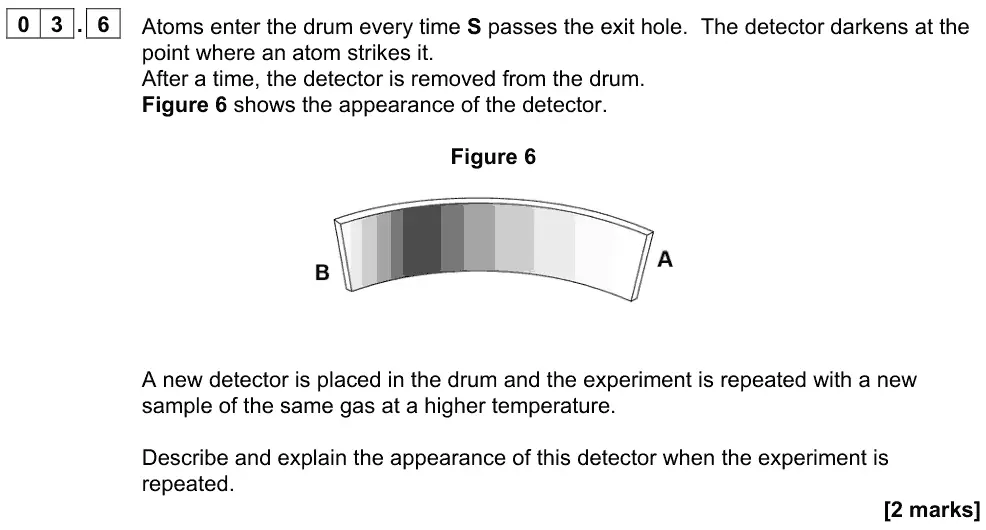
Atoms enter the drum every time S passes the exit hole.  The detector darkens at the
point where an atom strikes it.
After a time, the detector is removed from the drum.
Figure 6 shows the appearance of the detector.
Figure 6
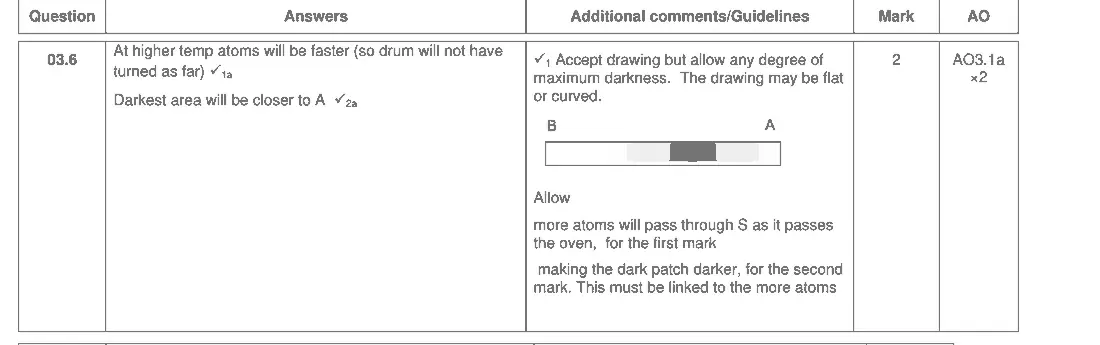
A new detector is placed in the drum and the experiment is repeated with a new
sample of the same gas at a higher temperature.
Describe and explain the appearance of this detector when the experiment is
repeated.
[2 marks]
November 2021 · Paper 2 · Q4.1 2 marks AO2=2 Show that electromagnetic induction
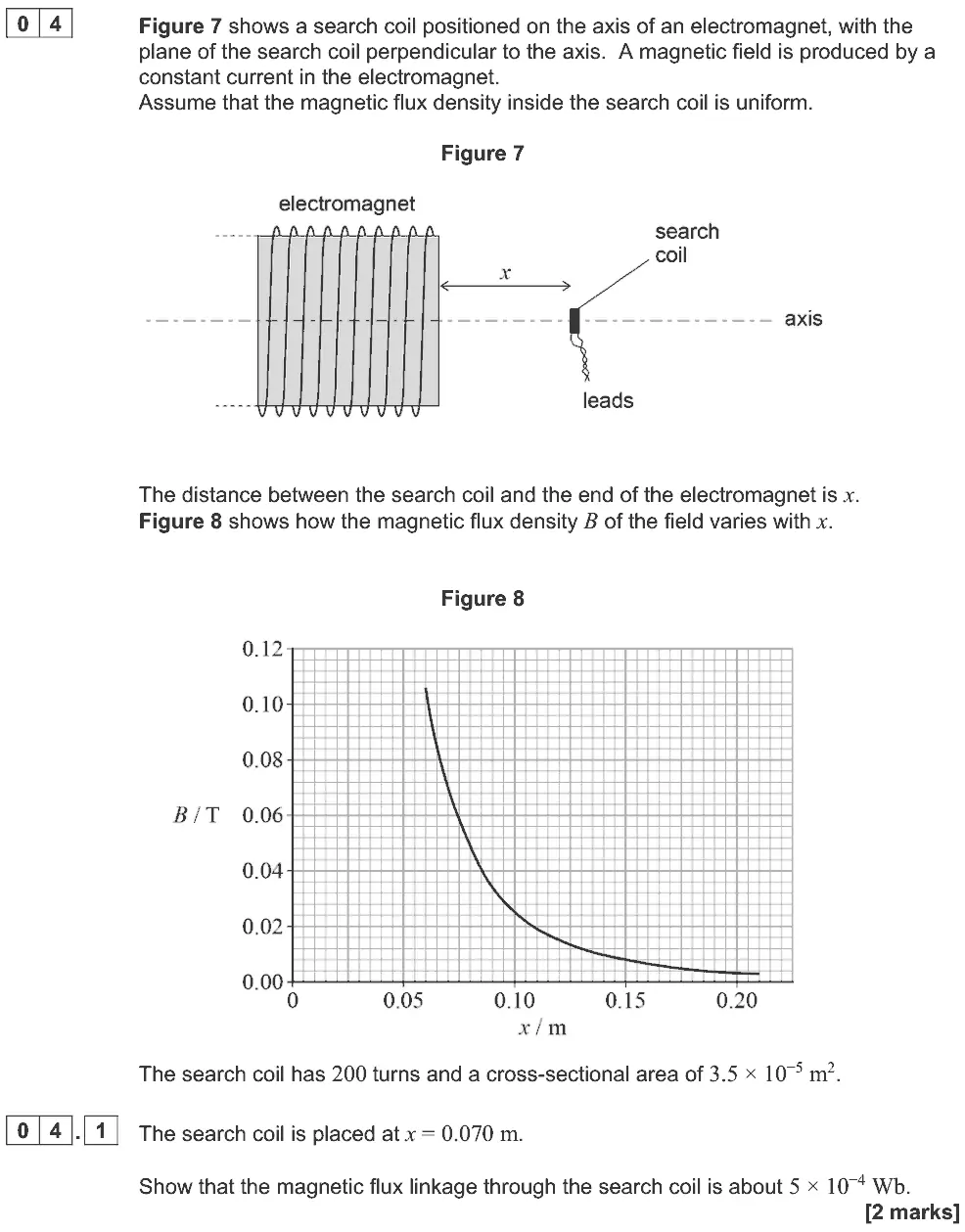
Figure 7 shows a search coil positioned on the axis of an electromagnet, with the
plane of the search coil perpendicular to the axis.  A magnetic field is produced by a
constant current in the electromagnet.
Assume that the magnetic flux density inside the search coil is uniform.
Figure 7
The distance between the search coil and the end of the electromagnet is x.
Figure 8 shows how the magnetic flux density B of the field varies with x.
Figure 8
The search coil has 200 turns and a cross-sectional area of 3.5 × 10⁻⁵ m2.
The search coil is placed at x = 0.070 m.
Show that the magnetic flux linkage through the search coil is about 5 × 10⁻⁴ Wb.
[2 marks]
November 2021 · Paper 2 · Q4.2 2 marks Explanation electromagnetic induction
Earlier part of question 4 that this part usesEarlier part of November 2021 Paper 2 question 4
The search coil is now moved at a constant speed of 0.80 m s−1 along the axis so that
x is increasing.  An emf is induced across the terminals of the search coil.
Explain what happens to the value of the emf as the search coil moves.
[2 marks]
November 2021 · Paper 2 · Q4.3 4 marks Calculation electromagnetic induction
Earlier part of question 4 that this part usesEarlier part of November 2021 Paper 2 question 4
The search coil passes through the position where x = 0.10 m.
Deduce whether the emf can exceed 5 mV for values of x greater than 0.10 m.
[4 marks]
November 2021 · Paper 2 · Q5.1 2 marks AO1=2 Explanation magnetic fields
Figure 9 shows a cyclotron.  A proton is released from rest and is accelerated each
time it reaches the gap between two horizontal ‘dees’ D1 and D2.  Between these
accelerations the proton moves at constant speed.  A vertical magnetic field of flux
density B acts over the dees so that the proton follows a semicircular path in each
dee.
The dees are connected to an alternating potential difference (pd).
This pd is adjusted so that the proton is always accelerated by the peak electric field
as it crosses the gap between the dees.
Figure 9
Explain why the proton travels in a semicircular path in a dee.
[2 marks]
November 2021 · Paper 2 · Q5.2 1 mark AO2=1 Short answer Hard electric fieldsenergy levels and wave particle duality
Earlier part of question 5 that this part usesEarlier part of November 2021 Paper 2 question 5
The peak pd of the alternating supply is 10.0 kV.  The proton leaves the cyclotron with
kinetic energy of 14 MeV.
Determine the number of times the proton moves across the gap before it leaves the
cyclotron.
[1 mark]
number of times =
November 2021 · Paper 2 · Q5.3 3 marks AO2=3 Show that Hard magnetic fields
Earlier part of question 5 that this part usesEarlier part of November 2021 Paper 2 question 5
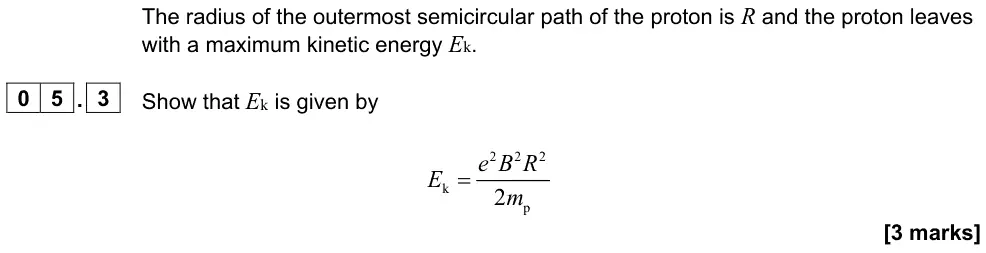
The radius of the outermost semicircular path of the proton is R and the proton leaves
with a maximum kinetic energy Ek.
Show that Ek is given by
2
2
2
k
p
2
e B R
E
m
=
[3 marks]
November 2021 · Paper 2 · Q5.4 4 marks Calculation magnetic fieldsenergy levels and wave particle duality
Earlier part of question 5 that this part usesEarlier part of November 2021 Paper 2 question 5
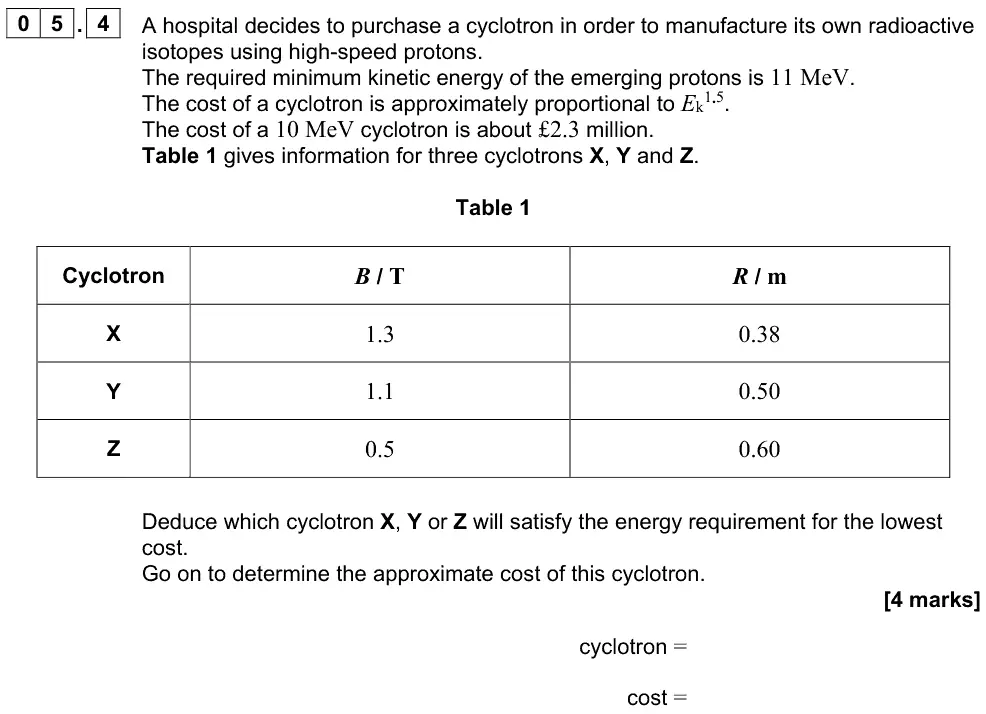
A hospital decides to purchase a cyclotron in order to manufacture its own radioactive
isotopes using high-speed protons.
The required minimum kinetic energy of the emerging protons is 11 MeV.
The cost of a cyclotron is approximately proportional to Ek1.5.
The cost of a 10 MeV cyclotron is about £2.3 million.
Table 1 gives information for three cyclotrons X, Y and Z.
Table 1
Cyclotron
B / T
R / m
X
1.3
0.38
Y
1.1
0.50
Z
0.5
0.60
Deduce which cyclotron X, Y or Z will satisfy the energy requirement for the lowest
cost.
Go on to determine the approximate cost of this cyclotron.
[4 marks]
cyclotron =
cost =
November 2021 · Paper 2 · Q6.1 2 marks AO1=2 Explanation mass energy and fission
Explain, in terms of binding energy, why energy can be released when two nuclei
undergo nuclear fusion.
[2 marks]
November 2021 · Paper 2 · Q6.2 2 marks AO2=2 Calculation mass energy and fission
Earlier part of question 6 that this part usesEarlier part of November 2021 Paper 2 question 6
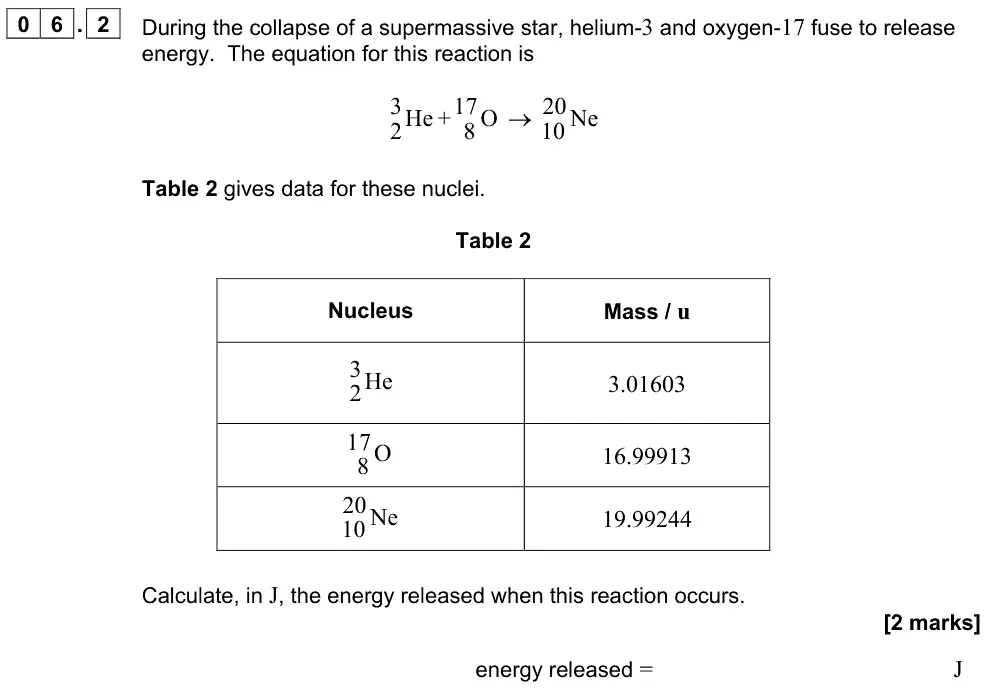
During the collapse of a supermassive star, helium-3 and oxygen-17 fuse to release
energy.  The equation for this reaction is
3
17
20
He +
O
Ne
2
8
10
→
Table 2 gives data for these nuclei.
Table 2
Nucleus
Mass / u
3He
2
3.01603
17O
8
16.99913
20 Ne
10
19.99244
Calculate, in J, the energy released when this reaction occurs.
[2 marks]
energy released =
J
November 2021 · Paper 2 · Q6.3 2 marks AO2=2 Calculation electric fieldsnuclear radius
Earlier part of question 6 that this part usesEarlier part of November 2021 Paper 2 question 6
One model of nuclear fusion suggests that fusion happens when nuclei touch.
Initially the helium nucleus and oxygen nucleus are separated so that the force
between them is negligible.  They move towards each other until they fuse.  Fusion
occurs when their centres are separated by a distance of 5.1 × 10⁻¹⁵ m.
Figure 10 shows the initial positions and final positions of the nuclei.
Figure 10
Calculate the total change in electrostatic potential energy between the initial positions
and final positions of the nuclei.
[2 marks]
change in electrostatic potential energy =
J
November 2021 · Paper 2 · Q6.4 3 marks Explanation electric fieldsnuclear radius
Earlier part of question 6 that this part usesEarlier part of November 2021 Paper 2 question 6
3He
2
can undergo fusion reactions with either 34S
16
or 17O
8
at the same temperature
in a star.
The nucleus has properties that depend on its proton number and its nucleon number.
These properties affect the fusion reaction.
Discuss, for this star, how these properties affect the rate of fusion of 34S
16
with 3He
2
compared to the rate of fusion of 17O
8
with 3He
2
.
[3 marks]
November 2021 · Paper 2 · Q7 1 mark Multiple choice thermal energy and ideal gases
A solar panel transfers energy at a rate of 1.2 kW to liquid passing through it.  The liquid
has a specific heat capacity of 4.0 kJ kg−1 K−1.
When the liquid flows through the solar panel, its temperature increases by 3.0 K.
The flow rate of the liquid is
[1 mark]
A 0.10 kg s−1.
B 1.1 kg s−1.
C 10 kg s−1.
D 100 kg s−1.
November 2021 · Paper 2 · Q8 1 mark Multiple choice kinetic theory
A gas occupies a volume V.  Its particles have a root mean square speed (crms) of u.
The gas is compressed at constant temperature to a volume 0.5V.
What is the root mean square speed of the gas particles after compression?
[1 mark]
A 2
u
B u
C 2u
D 4u
November 2021 · Paper 2 · Q9 1 mark Multiple choice thermal energy and ideal gases
A fixed mass of gas is heated at constant volume.  The graph is drawn for this process.
What do x and y represent?
[1 mark]
x
y
A
pressure in Pa
temperature in ºC
B
temperature in ºC
pressure in Pa
C
pressure in Pa
temperature in K
D
temperature in K
pressure in Pa
November 2021 · Paper 2 · Q10 1 mark Multiple choice kinetic theory
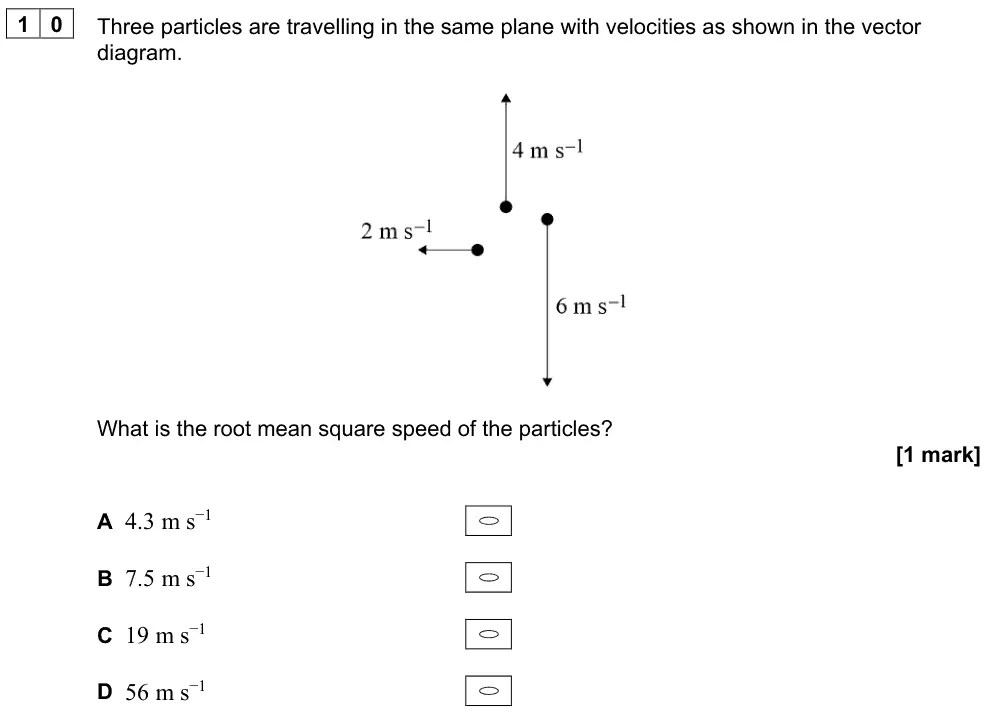
Three particles are travelling in the same plane with velocities as shown in the vector
diagram.
What is the root mean square speed of the particles?
[1 mark]
A 4.3 m s−1
B 7.5 m s−1
C 19 m s−1
D 56 m s−1
November 2021 · Paper 2 · Q11 1 mark Multiple choice gravitational fields
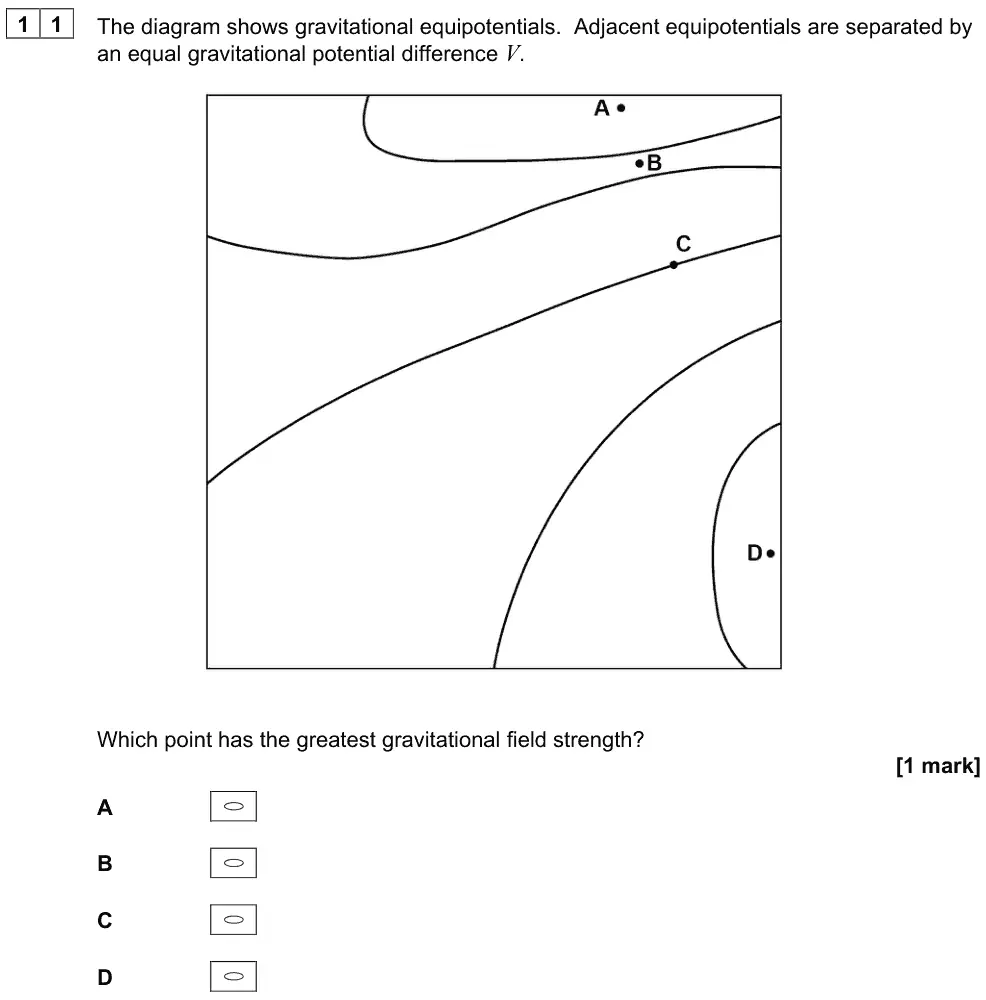
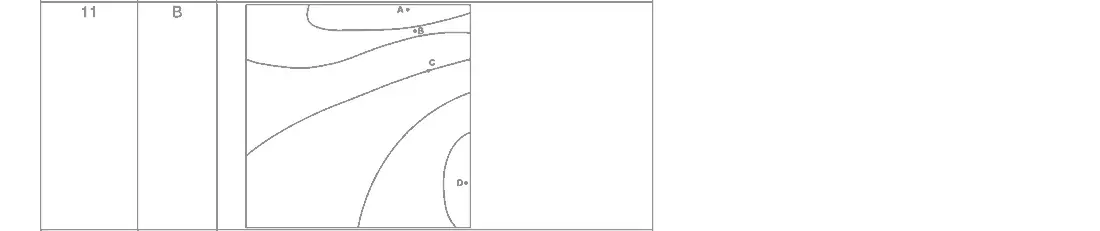
The diagram shows gravitational equipotentials.  Adjacent equipotentials are separated by
an equal gravitational potential difference V.
Which point has the greatest gravitational field strength?
[1 mark]
A
B
C
D
November 2021 · Paper 2 · Q12 1 mark Multiple choice gravitational fieldsmaterials and young modulus
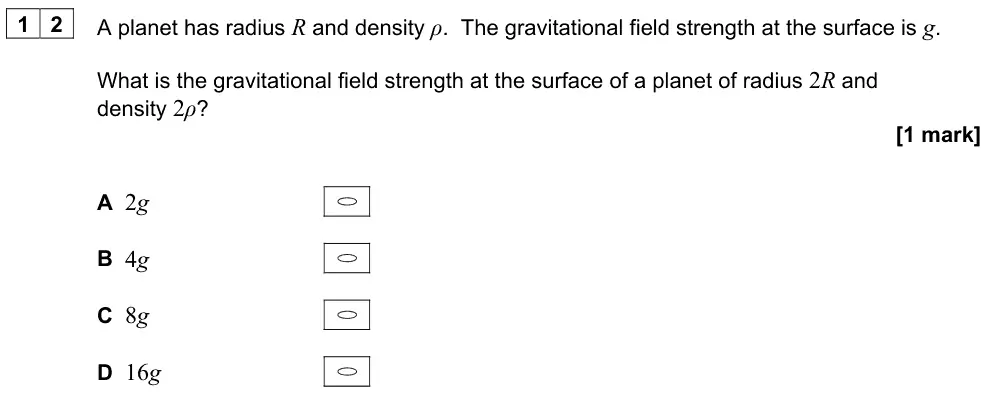
A planet has radius R and density ρ.  The gravitational field strength at the surface is g.
What is the gravitational field strength at the surface of a planet of radius 2R and
density 2ρ?
[1 mark]
A 2g
B 4g
C 8g
D 16g
November 2021 · Paper 2 · Q13 1 mark Multiple choice gravitational fields
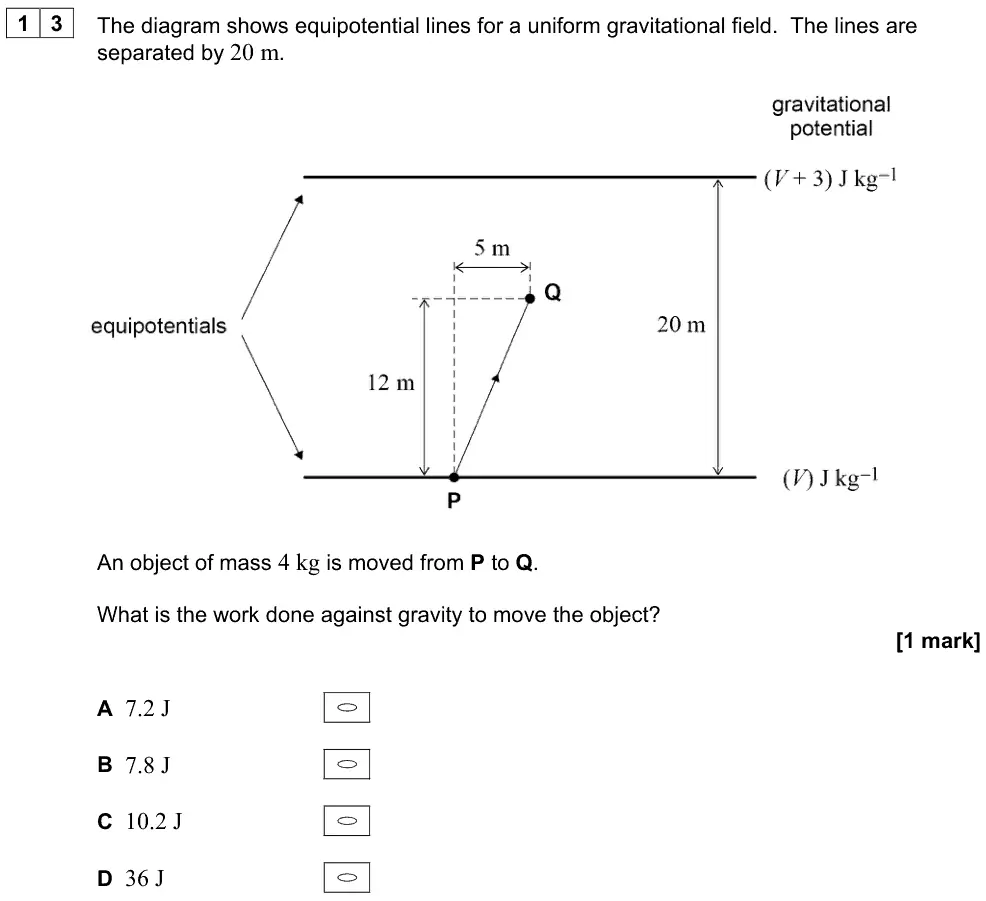
The diagram shows equipotential lines for a uniform gravitational field.  The lines are
separated by 20 m.
An object of mass 4 kg is moved from P to Q.
What is the work done against gravity to move the object?
[1 mark]
A 7.2 J
B 7.8 J
C 10.2 J
D 36 J
November 2021 · Paper 2 · Q14 1 mark Multiple choice electric fields
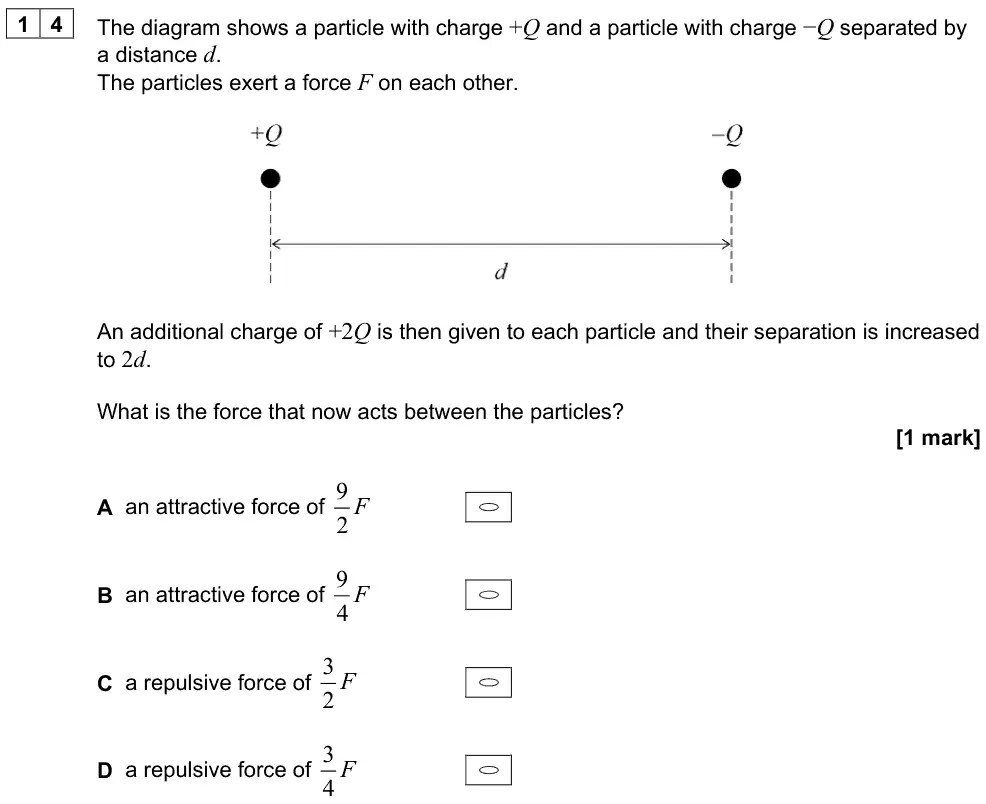
The diagram shows a particle with charge +Q and a particle with charge −Q separated by
a distance d.
The particles exert a force F on each other.
An additional charge of +2Q is then given to each particle and their separation is increased
to 2d.
What is the force that now acts between the particles?
[1 mark]
A an attractive force of 9
2 F
B an attractive force of 9
4 F
C a repulsive force of 3
2 F
D a repulsive force of 3
4 F
November 2021 · Paper 2 · Q15 1 mark Multiple choice electric fieldsgravitational fields
Two protons are separated by distance r.
The electrostatic force between the two protons is X times the gravitational force between
them.
What is the best estimate for X?
[1 mark]
A 1020
B 1028
C 1036
D 1042
November 2021 · Paper 2 · Q16 1 mark Multiple choice electric fields
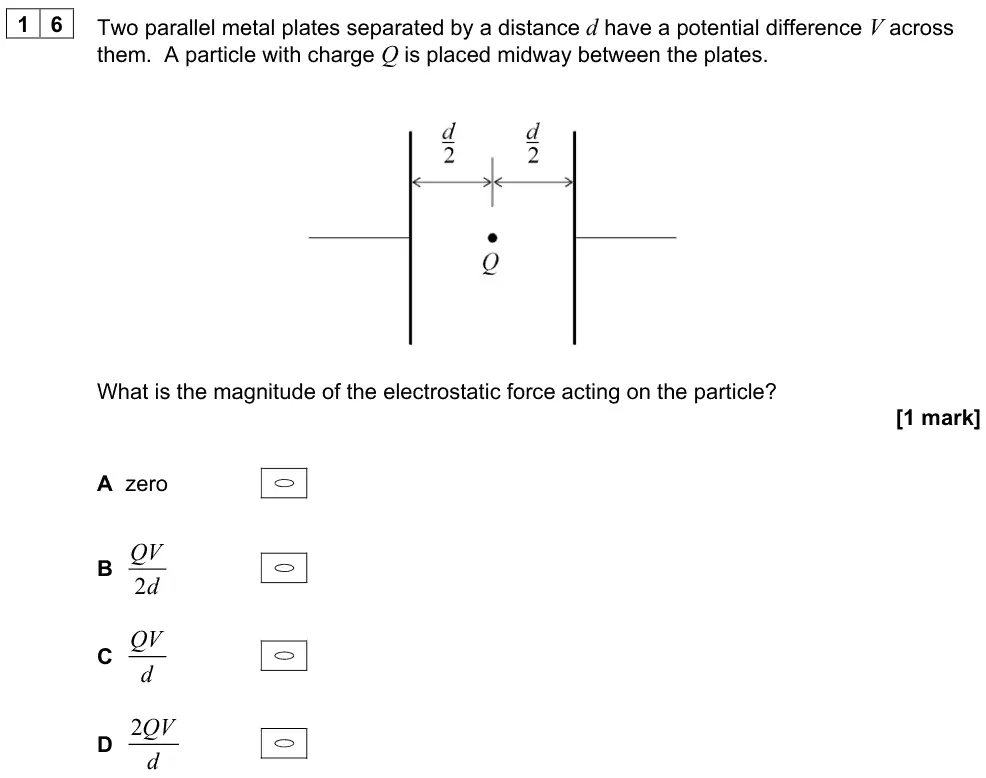
Two parallel metal plates separated by a distance d have a potential difference V across
them.  A particle with charge Q is placed midway between the plates.
What is the magnitude of the electrostatic force acting on the particle?
[1 mark]
A zero
B 2
QV
d
C QV
d
D 2QV
d
November 2021 · Paper 2 · Q17 1 mark Multiple choice electric fields
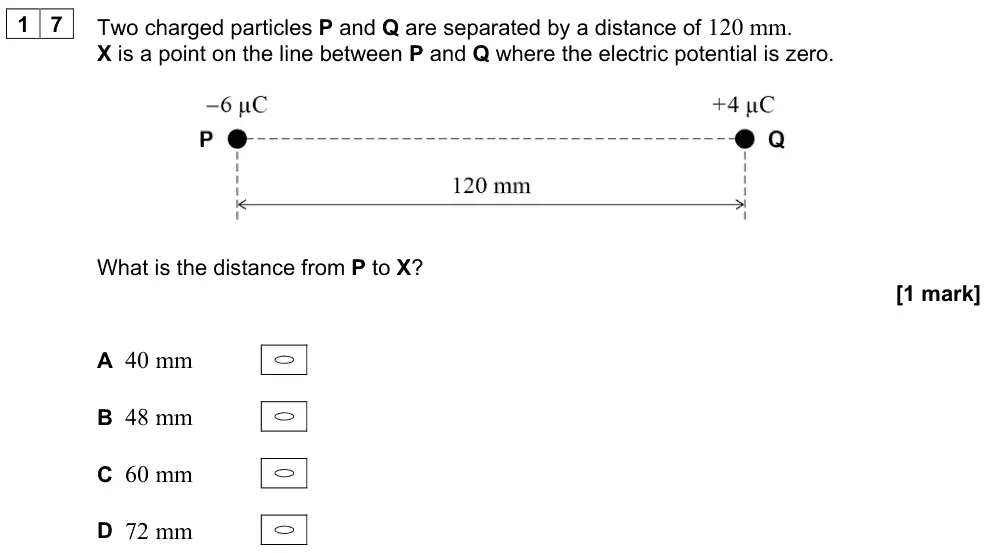
Two charged particles P and Q are separated by a distance of 120 mm.
X is a point on the line between P and Q where the electric potential is zero.
What is the distance from P to X?
[1 mark]
A 40 mm
B 48 mm
C 60 mm
D 72 mm
November 2021 · Paper 2 · Q18 1 mark Multiple choice electric fields
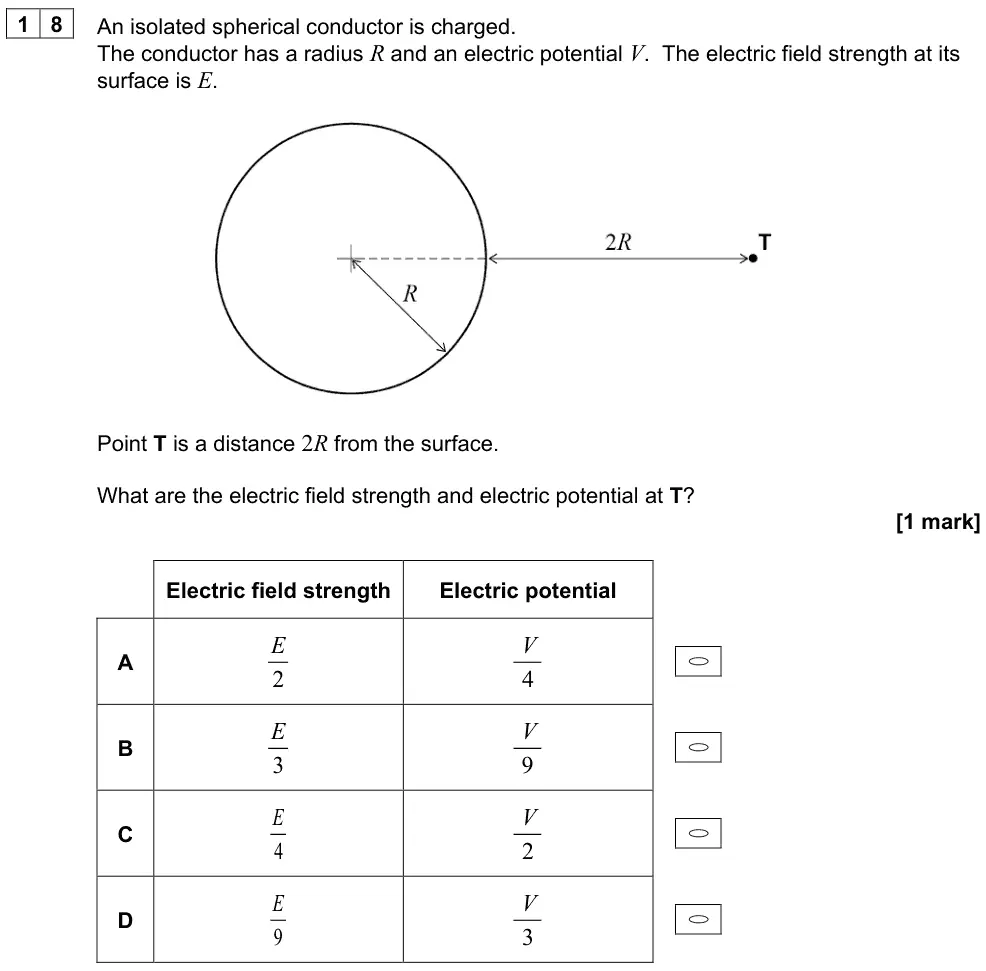
An isolated spherical conductor is charged.
The conductor has a radius R and an electric potential V.  The electric field strength at its
surface is E.
Point T is a distance 2R from the surface.
What are the electric field strength and electric potential at T?
[1 mark]
Electric field strength
Electric potential
A
2
E
4
V
B
3
E
9
V
C
4
E
2
V
D
9
E
3
V
November 2021 · Paper 2 · Q19 1 mark Multiple choice electric fields
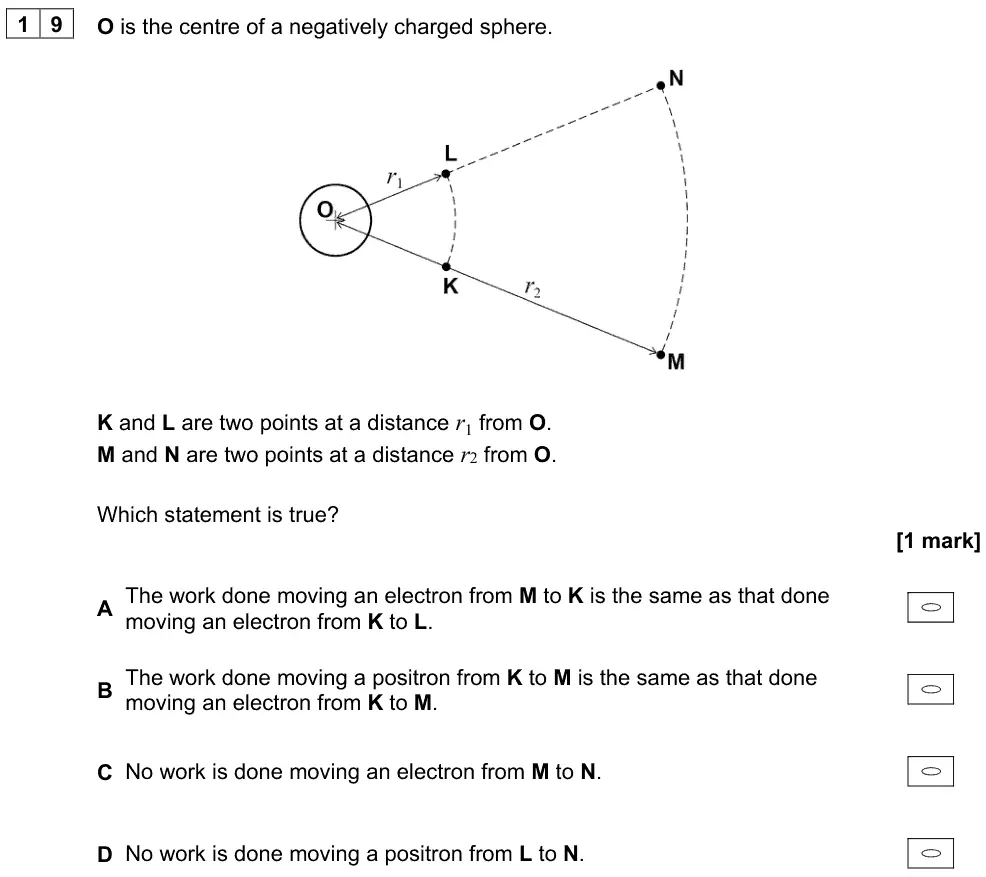
O is the centre of a negatively charged sphere.
K and L are two points at a distance r1 from O.
M and N are two points at a distance r2 from O.
Which statement is true?
[1 mark]
A The work done moving an electron from M to K is the same as that done
moving an electron from K to L.
B The work done moving a positron from K to M is the same as that done
moving an electron from K to M.
C No work is done moving an electron from M to N.
D No work is done moving a positron from L to N.
November 2021 · Paper 2 · Q20 1 mark Multiple choice capacitors
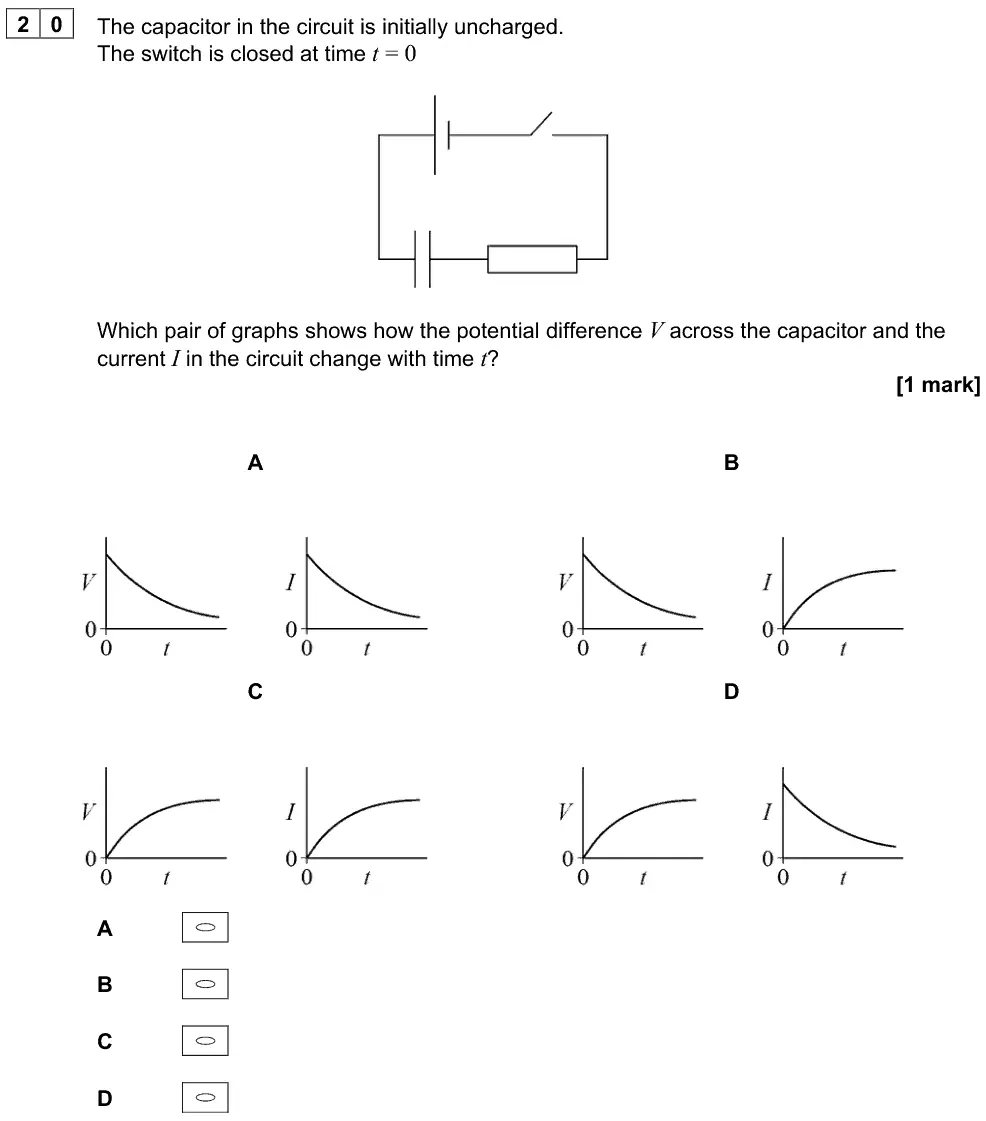
The capacitor in the circuit is initially uncharged.
The switch is closed at time t = 0
Which pair of graphs shows how the potential difference V across the capacitor and the
current I in the circuit change with time t?
[1 mark]
A
B
C
D
A
B
C
D
November 2021 · Paper 2 · Q21 1 mark Multiple choice magnetic fields
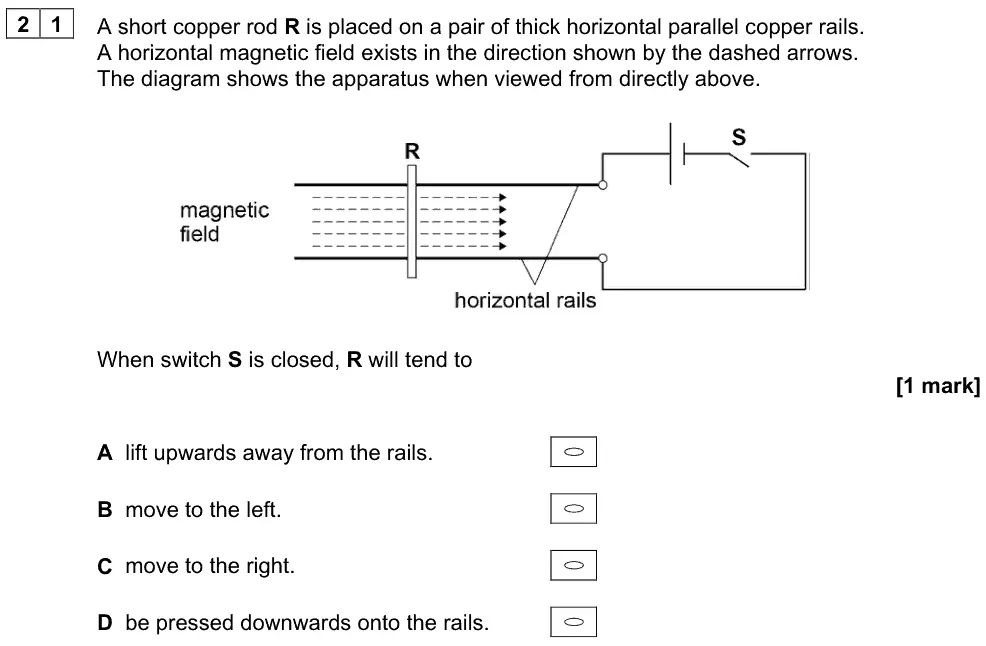
A short copper rod R is placed on a pair of thick horizontal parallel copper rails.
A horizontal magnetic field exists in the direction shown by the dashed arrows.
The diagram shows the apparatus when viewed from directly above.
When switch S is closed, R will tend to
[1 mark]
A lift upwards away from the rails.
B move to the left.
C move to the right.
D be pressed downwards onto the rails.
November 2021 · Paper 2 · Q22 1 mark Multiple choice electromagnetic induction
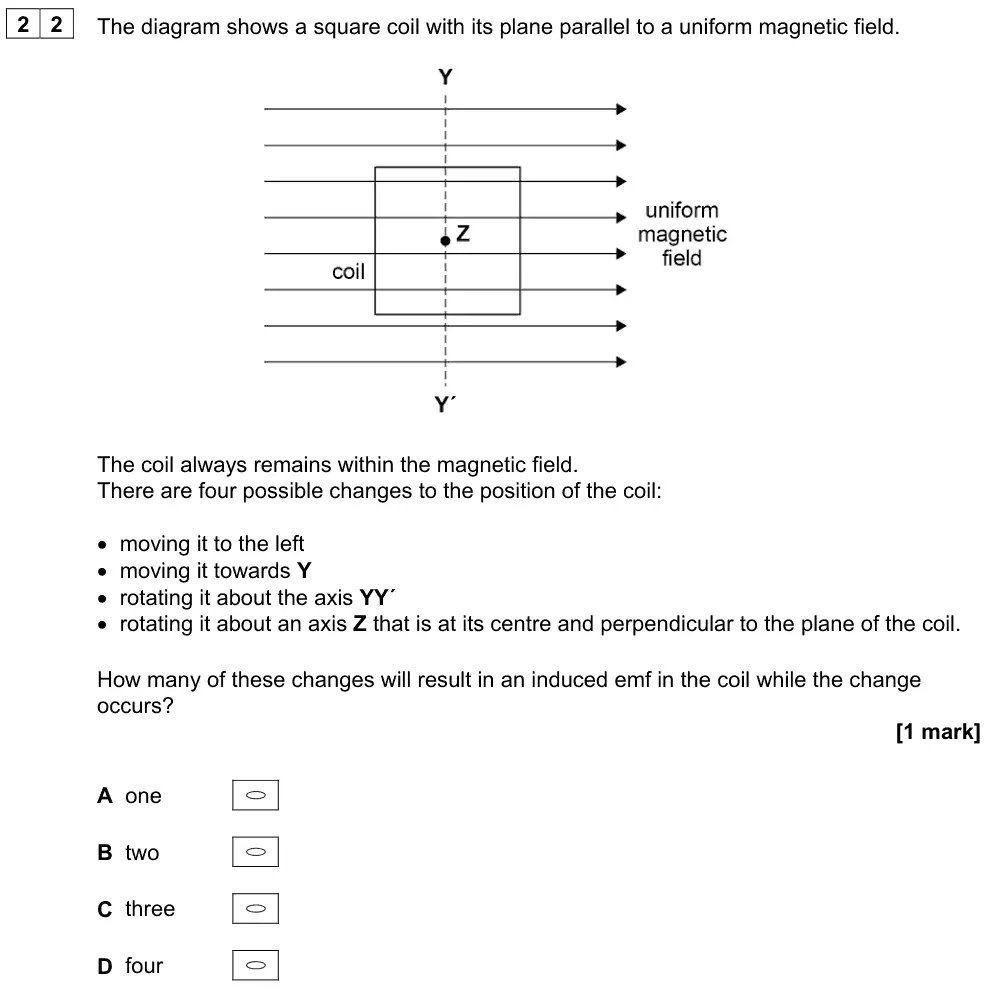
The diagram shows a square coil with its plane parallel to a uniform magnetic field.
The coil always remains within the magnetic field.
There are four possible changes to the position of the coil:
• moving it to the left
• moving it towards Y
• rotating it about the axis YYˊ
• rotating it about an axis Z that is at its centre and perpendicular to the plane of the coil.
How many of these changes will result in an induced emf in the coil while the change
occurs?
[1 mark]
A one
B two
C three
D four
November 2021 · Paper 2 · Q23 1 mark Multiple choice electromagnetic induction
Mains electricity is rated 230 V in the UK.
Which is correct?
[1 mark]
A The mean voltage is 163 V.
B The peak voltage is 230 V.
C The root mean square voltage is 325 V.
D The peak-to-peak voltage is 650 V.
November 2021 · Paper 2 · Q24 1 mark Multiple choice electromagnetic inductioncircuits and potential dividers
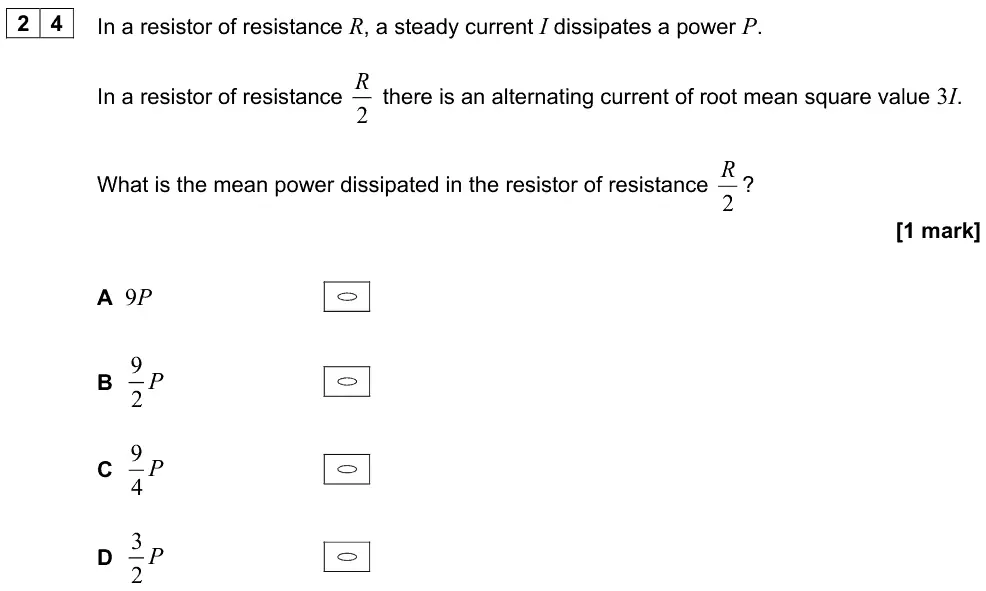
In a resistor of resistance R, a steady current I dissipates a power P.
In a resistor of resistance 2
R there is an alternating current of root mean square value 3I.
What is the mean power dissipated in the resistor of resistance 2
R ?
[1 mark]
A 9P
B 9
2 P
C 9
4 P
D 3
2 P
November 2021 · Paper 2 · Q25 1 mark Multiple choice electromagnetic induction
The primary winding of a transformer has 200 turns and the secondary winding has
1600 turns.
A root mean square (rms) alternating voltage of 25 V is applied to the primary winding
causing a primary rms current of 4.0 A.  The transformer is 90% efficient.
What are the rms values of the secondary voltage and the secondary current?
[1 mark]
Secondary voltage / V
Secondary current / A
A
200
0.50
B
200
0.45
C
180
0.50
D
3.1
29.0
November 2021 · Paper 2 · Q26 1 mark Multiple choice rutherford scattering and radiationnewtons laws and momentum
The diagram shows the path of a proton being deflected by the nucleus of an atom.
Point P is the position of the proton when it is closest to the nucleus.
What is not true about the proton along its path at P?
[1 mark]
A Its rate of change of momentum is at a minimum.
B Its kinetic energy is at a minimum.
C Its potential energy is at a maximum.
D Its acceleration is at a maximum.
November 2021 · Paper 2 · Q27 1 mark Multiple choice rutherford scattering and radiation
The diagram shows an area of 0.10 m2 normal to a line connecting it to a point source of
gamma radiation.  The source emits photons uniformly in all directions.
The area and the source are separated by a distance of 2.0 m.
The source emits 5000 gamma photons per second.
How many photons pass through the area every second?
[1 mark]
A 500
B 250
C 10
D 2.5
November 2021 · Paper 2 · Q28 1 mark Multiple choice radioactive decay
X and Y are two radioactive nuclides.  X has a half-life of 3.0 minutes and Y has a half-life
of 9.0 minutes.
Two freshly prepared samples of X and Y start decaying at the same time.
After 18 minutes the number of radioactive nuclei in both samples is the same.
The sample of Y initially contained N radioactive nuclei.
What was the initial number of radioactive nuclei in the sample of X?
[1 mark]
A 4N
B 16N
C 32N
D 64N
November 2021 · Paper 2 · Q29 1 mark Multiple choice mass energy and fission
What is the main purpose of a moderator in a thermal nuclear reactor?
[1 mark]
A to shield the surroundings from ionising radiations
B to decrease the number of fission chain reactions
C to decrease neutron speeds
D to prevent the core from overheating
November 2021 · Paper 2 · Q30 1 mark Multiple choice mass energy and fission
In the core of a nuclear reactor, the mass of fuel decreases at a rate of
9.0 × 10⁻⁶ kg hour−1 due to nuclear reactions.
What is the maximum power output of the reactor?
[1 mark]
A 2.3 × 10⁸ W
B 1.4 × 10¹¹ W
C 8.1 × 10¹¹ W
D 2.9 × 10¹⁵ W
27Mg
can decay by beta minus emission to one of two possible excited states of 27Al.
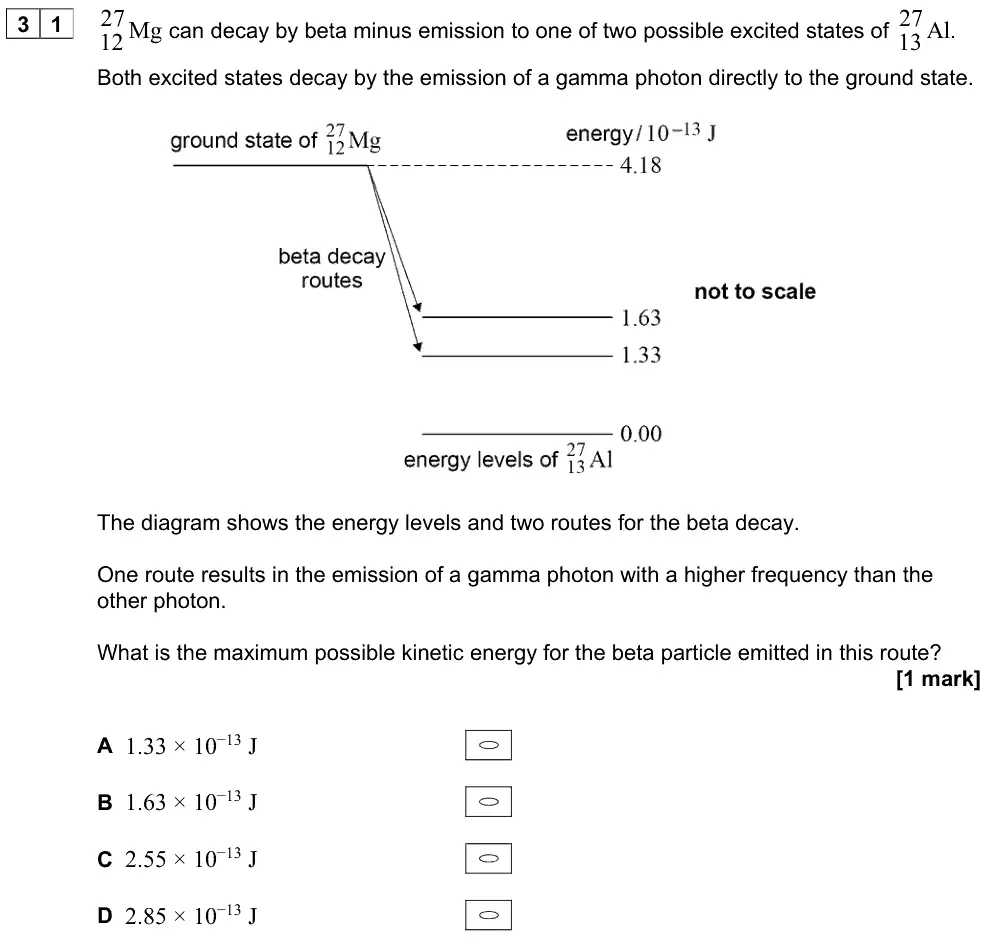
November 2021 · Paper 2 · Q31 1 mark Multiple choice radioactive decay
27Mg
12
can decay by beta minus emission to one of two possible excited states of 27Al.
13
Both excited states decay by the emission of a gamma photon directly to the ground state.
The diagram shows the energy levels and two routes for the beta decay.
One route results in the emission of a gamma photon with a higher frequency than the
other photon.
What is the maximum possible kinetic energy for the beta particle emitted in this route?
[1 mark]
A 1.33 × 10⁻¹³ J
B 1.63 × 10⁻¹³ J
C 2.55 × 10⁻¹³ J
D 2.85 × 10⁻¹³ J

Work with an AQA physics tutor

Want a paper marked and gone through with you? Message us.

Prefer email? Send an enquiry

If you are under 18, please include a parent's contact details. Enquiries go to enquiries@physicsaleveltutor.com and are deleted once handled. All tutoring is online.