
Specimen set 1: Paper 1

85 marks · 54 question parts · Paper, mark scheme and report on AQA's site · Have the data and formulae booklet beside you
Question by question

QTopicMarksAOType
1.1 Atomic structure and stable nuclei 2Short answer
1.2 Atomic structure and stable nuclei 2Explanation
1.3 Atomic structure and stable nuclei 3Short answer
1.4 Excitation, energy levels and wave-particle duality 1Short answer
1.5 Atomic structure and stable nuclei 2Explanation
2.1 Materials, stress, strain and the Young modulus 1Diagram or graph
2.2 Materials, stress, strain and the Young modulus 3Explanation
2.3 Materials, stress, strain and the Young modulus 1Diagram or graph
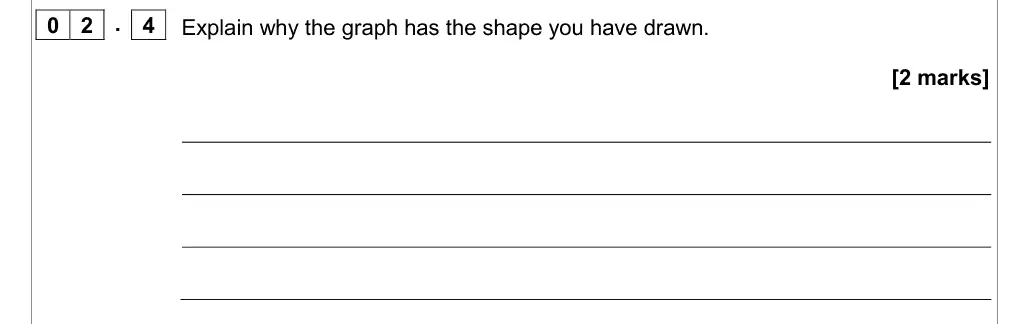
2.4 Materials, stress, strain and the Young modulus 2Explanation
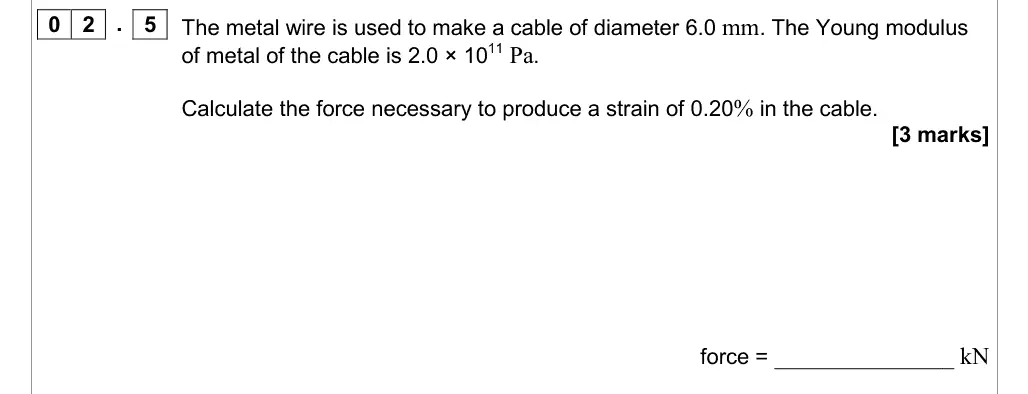
2.5 Materials, stress, strain and the Young modulus 3Calculation
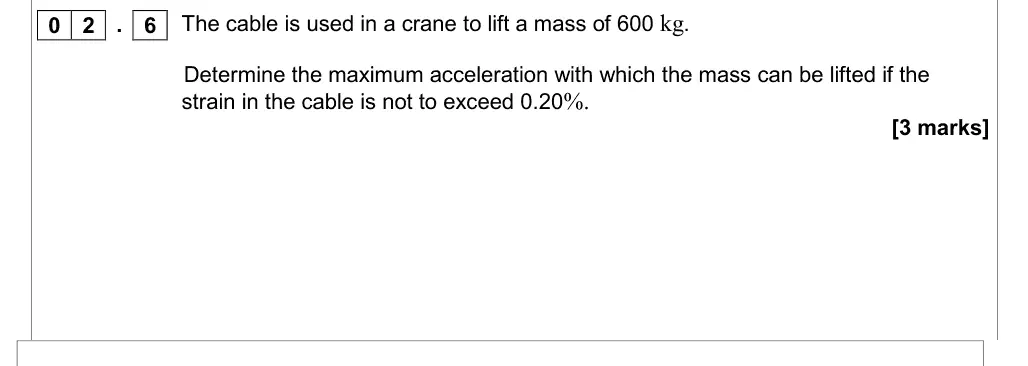
2.6 Newton's laws of motion and momentum 3Calculation
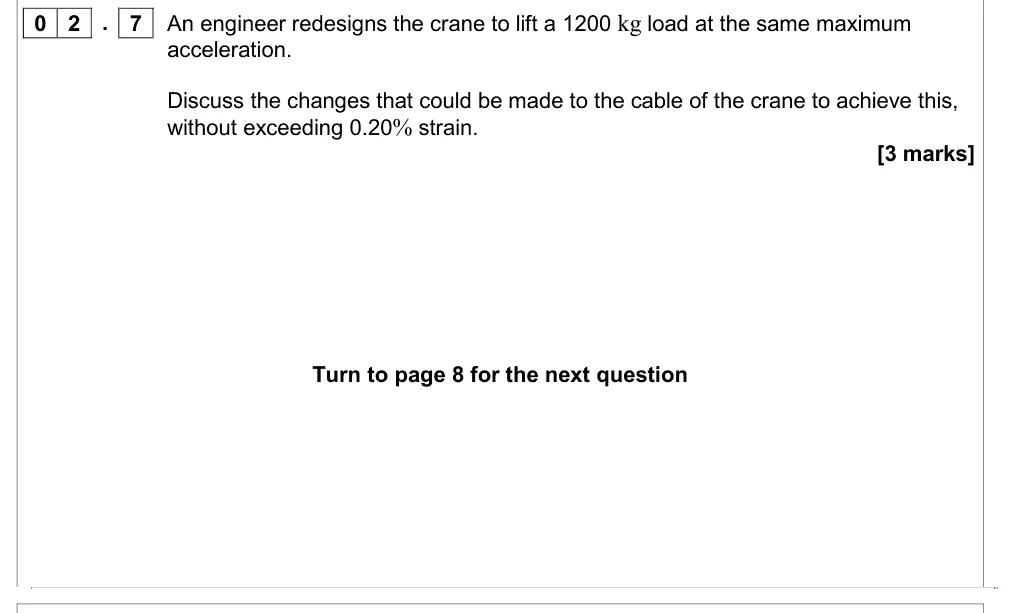
2.7 Materials, stress, strain and the Young modulus, Newton's laws of motion and momentum 3Explanation
3.1 Circuits and potential dividers 1Short answer
3.2 Circuits and potential dividers 1Short answer
3.3 Circuits and potential dividers, Current, potential difference, I-V characteristics and resistivity 2Calculation
3.4 Circuits and potential dividers 3Explanation
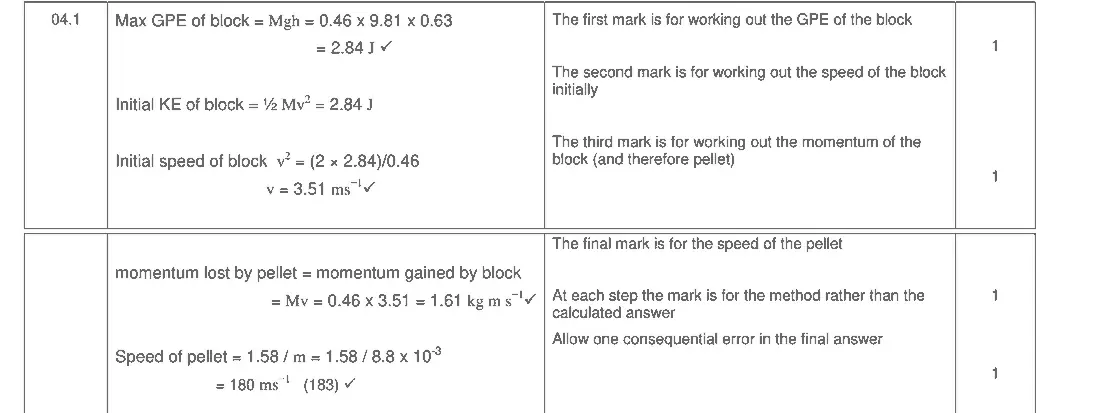
4.1 Newton's laws of motion and momentum, Work, energy, power and conservation of energy 4Calculation
4.2 Newton's laws of motion and momentum 4Explanation
4.3 Newton's laws of motion and momentum 2Explanation
5.1 Refraction, total internal reflection and optical fibres 3Explanation
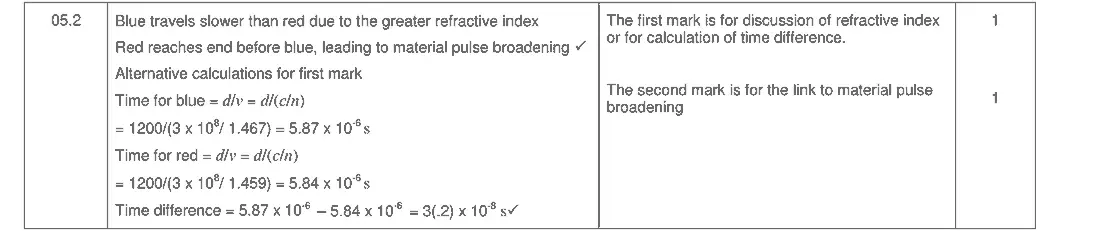
5.2 Refraction, total internal reflection and optical fibres 2Explanation
5.3 Refraction, total internal reflection and optical fibres 2Explanation
6.1 Interference, diffraction and the diffraction grating 1Short answer
6.2 Motion along a straight line and projectile motion 1Calculation
6.3 Motion along a straight line and projectile motion 1Explanation
6.4 Progressive waves, longitudinal and transverse waves 2Explanation
6.5 Measurements, units and uncertainties 1Short answer
6.6 Measurements, units and uncertainties 2Calculation
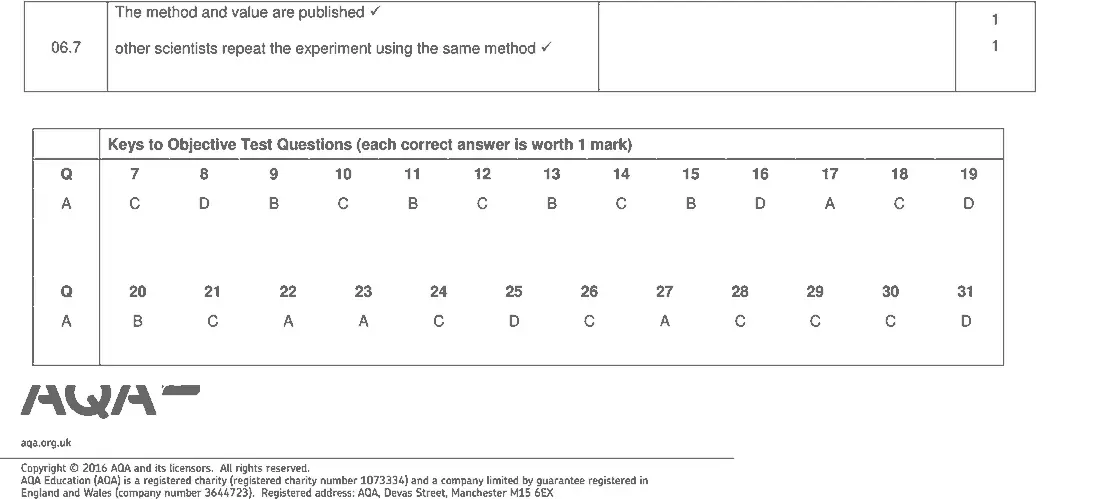
6.7 Excitation, energy levels and wave-particle duality 2Short answer
7 Atomic structure and stable nuclei 1Multiple choice
8 The photoelectric effect 1Multiple choice
9 The photoelectric effect 1Multiple choice
10 Materials, stress, strain and the Young modulus 1Multiple choice
11 Excitation, energy levels and wave-particle duality 1Multiple choice
12 Superposition and stationary waves 1Multiple choice
13 Refraction, total internal reflection and optical fibres 1Multiple choice
14 The photoelectric effect 1Multiple choice
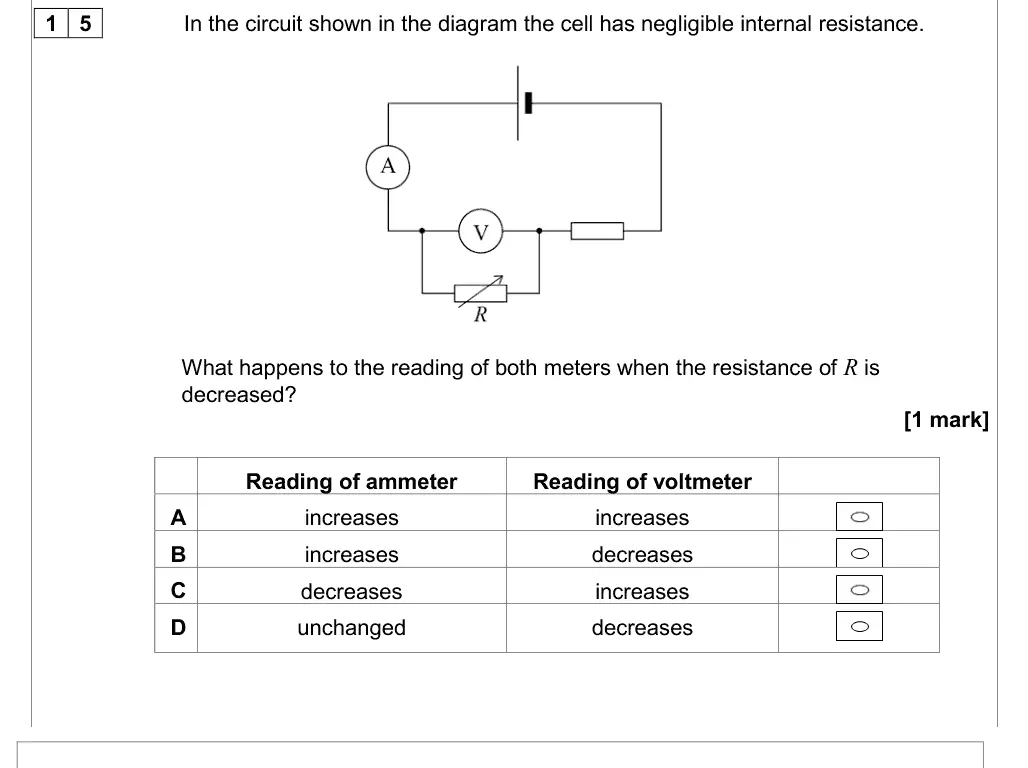
15 Circuits and potential dividers 1Multiple choice
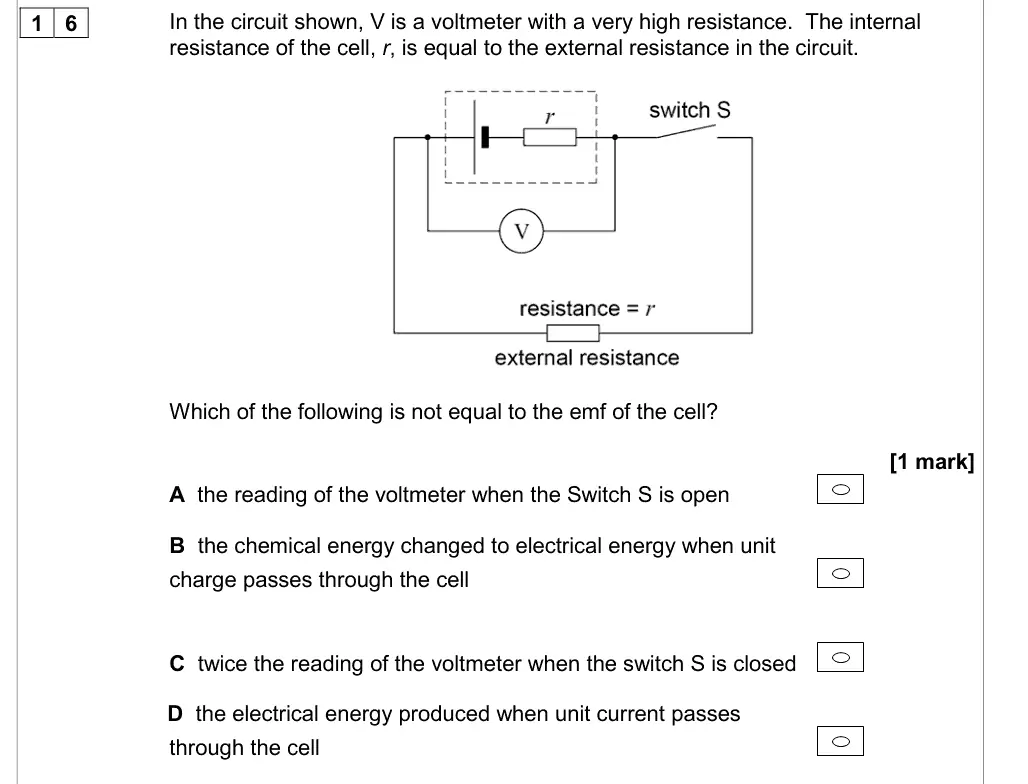
16 Electromotive force and internal resistance 1Multiple choice
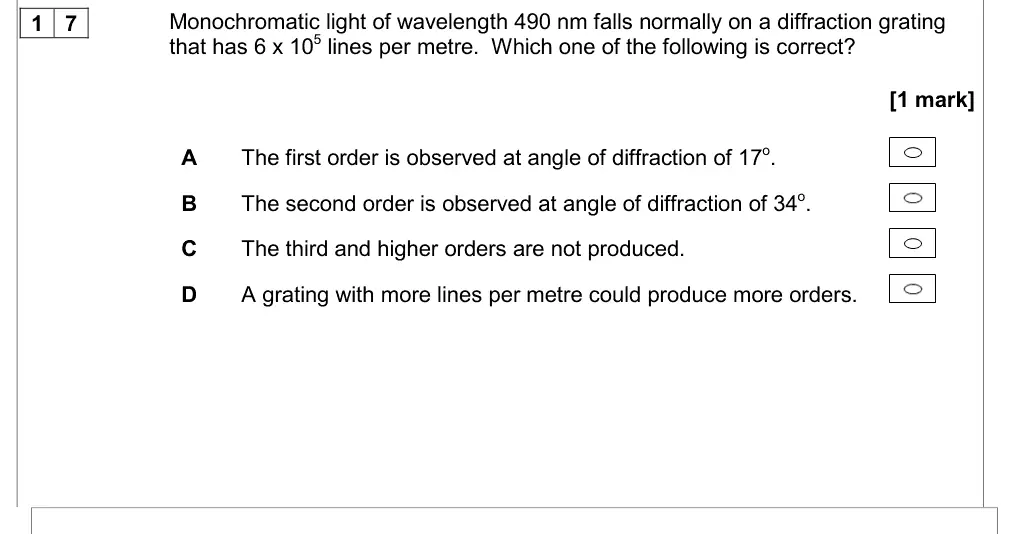
17 Interference, diffraction and the diffraction grating 1Multiple choice
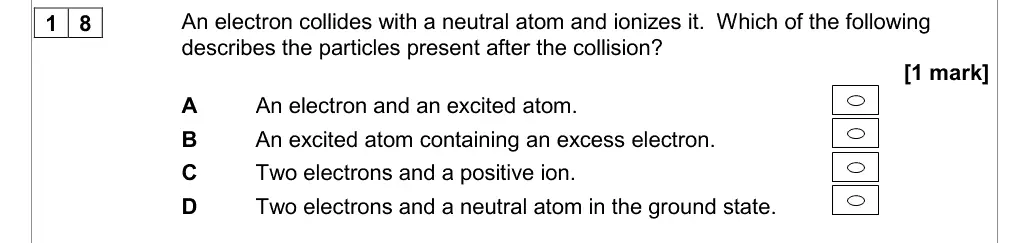
18 Excitation, energy levels and wave-particle duality 1Multiple choice
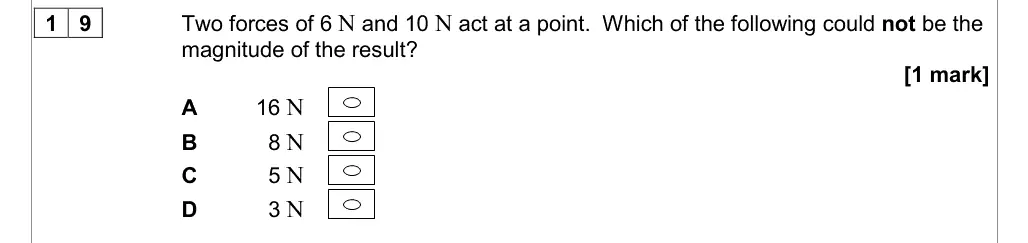
19 Scalars, vectors and moments 1Multiple choice
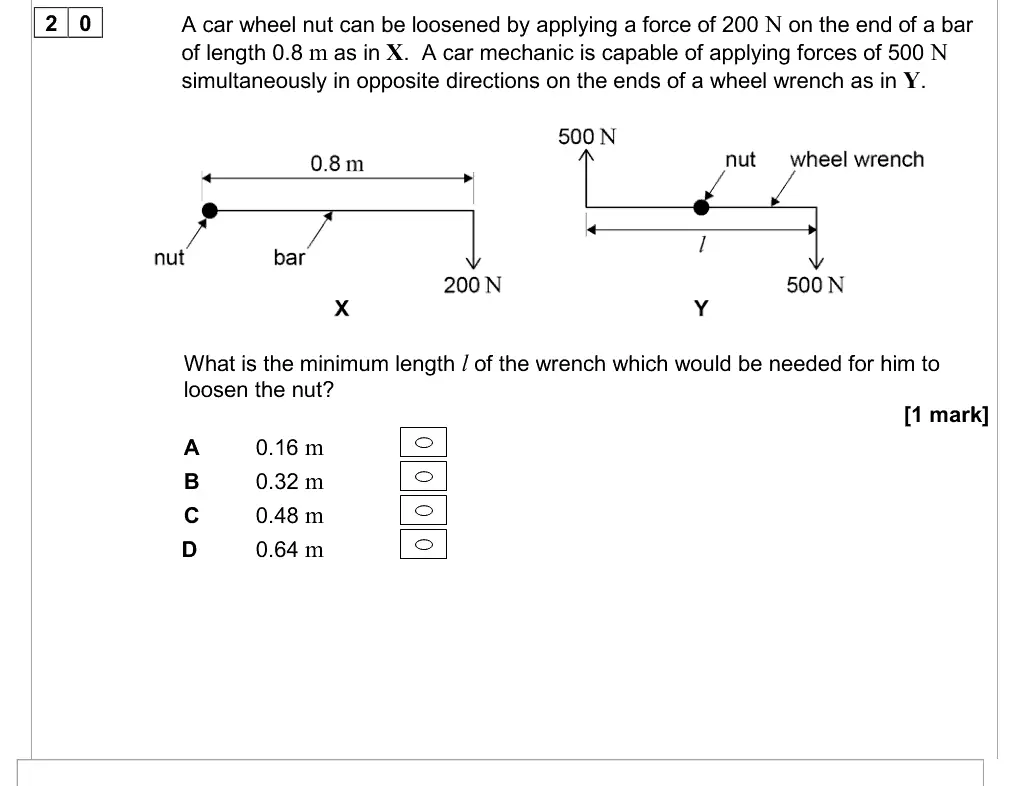
20 Scalars, vectors and moments 1Multiple choice
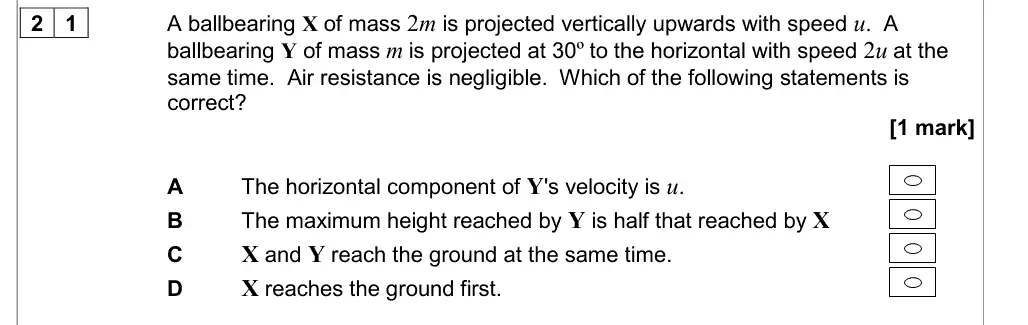
21 Motion along a straight line and projectile motion 1Multiple choice
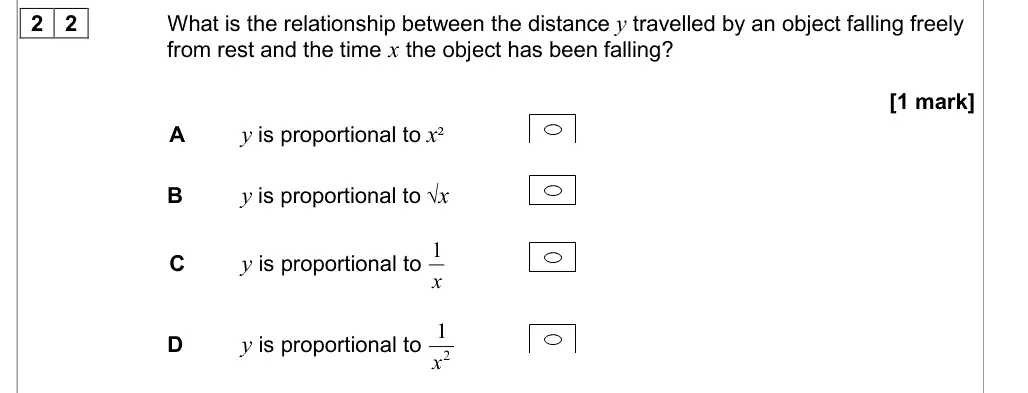
22 Motion along a straight line and projectile motion 1Multiple choice
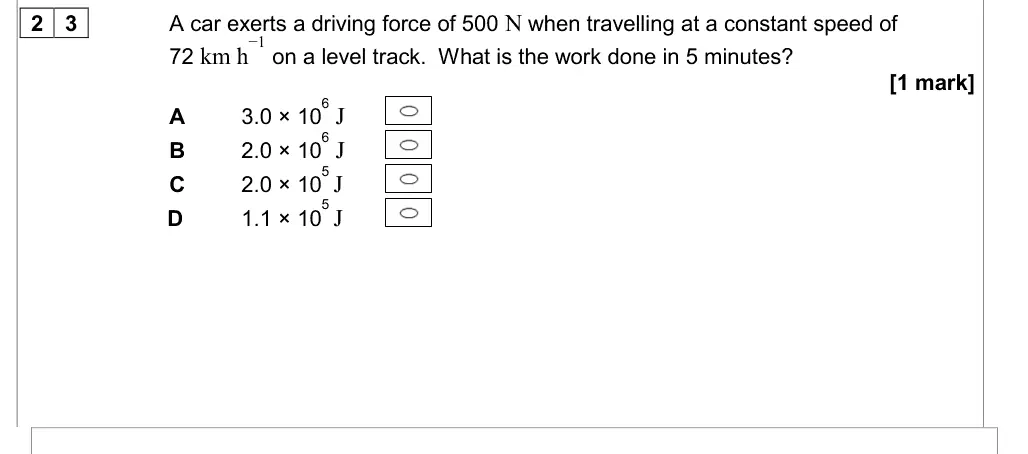
23 Work, energy, power and conservation of energy 1Multiple choice
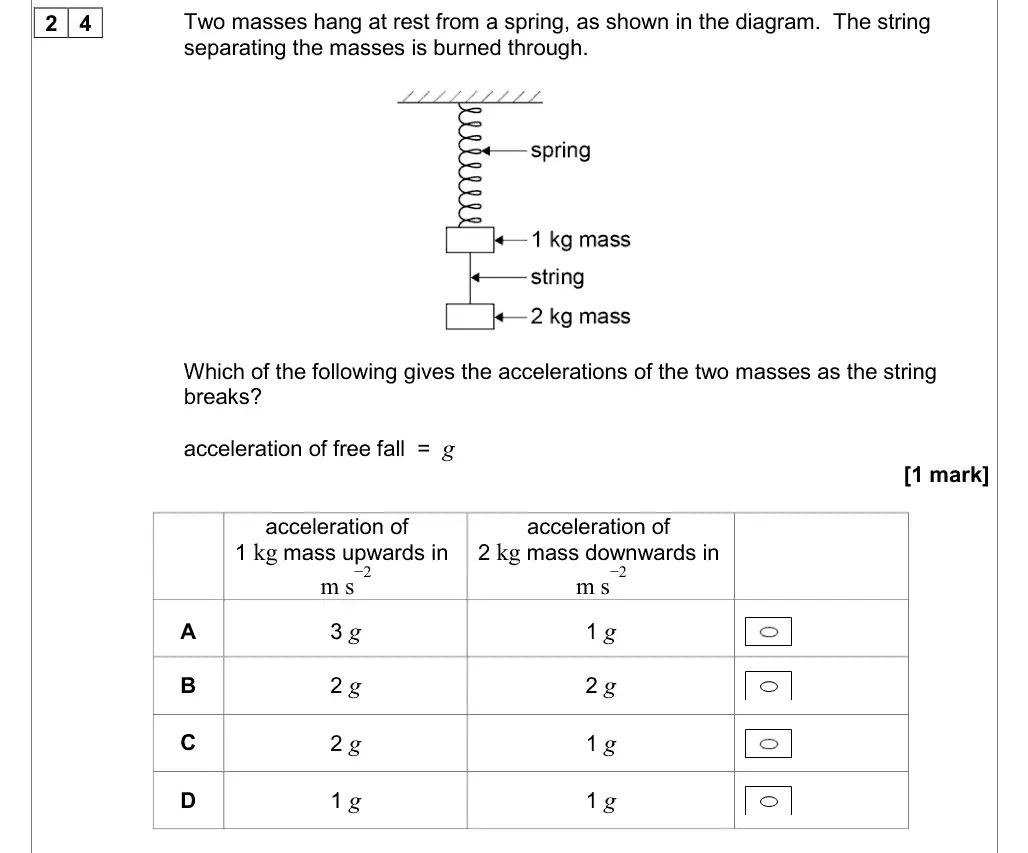
24 Newton's laws of motion and momentum 1Multiple choice
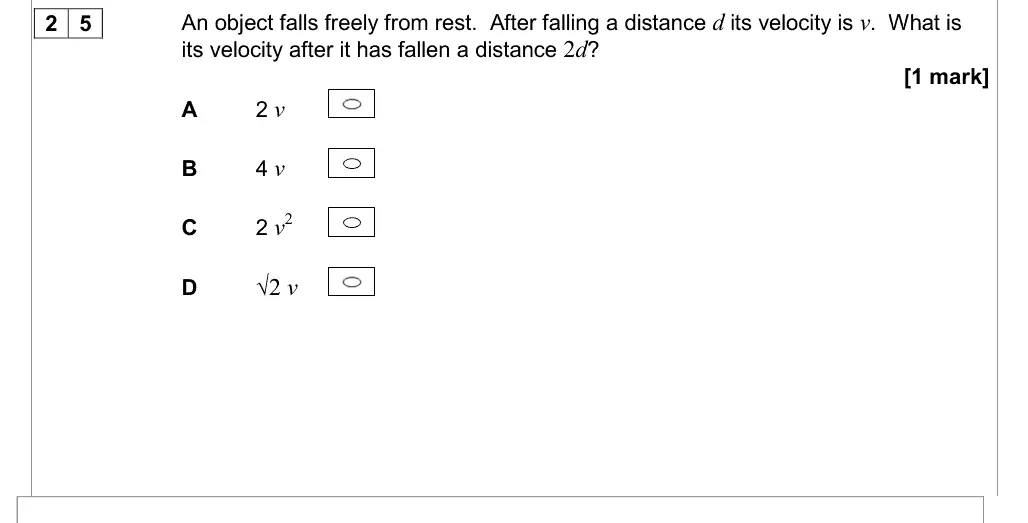
25 Motion along a straight line and projectile motion 1Multiple choice
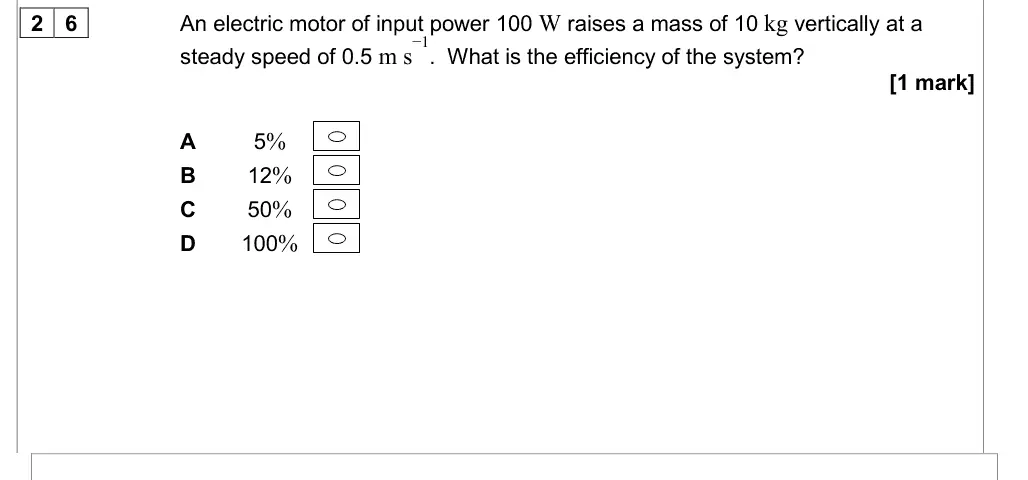
26 Work, energy, power and conservation of energy 1Multiple choice
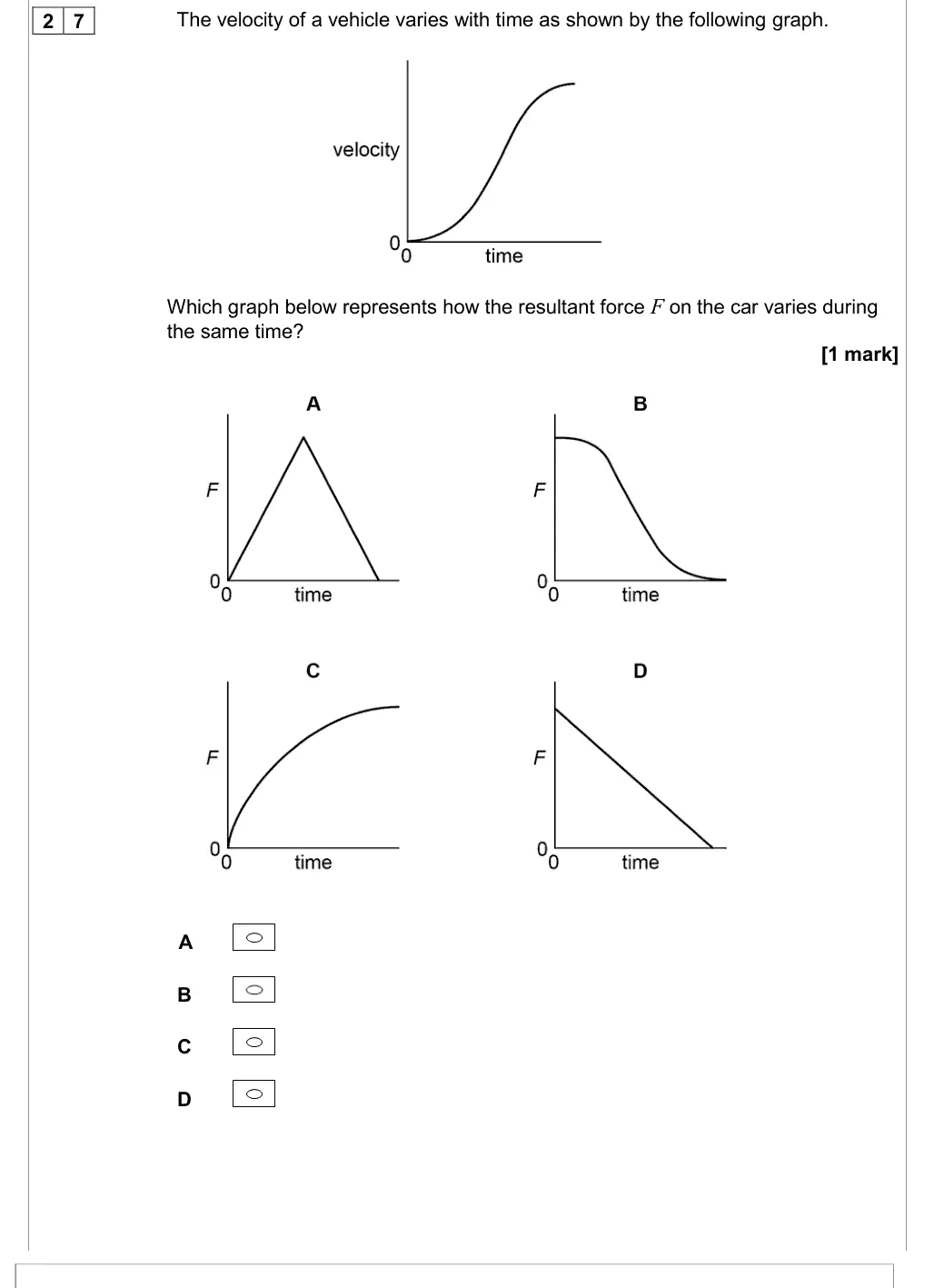
27 Motion along a straight line and projectile motion, Newton's laws of motion and momentum 1Multiple choice
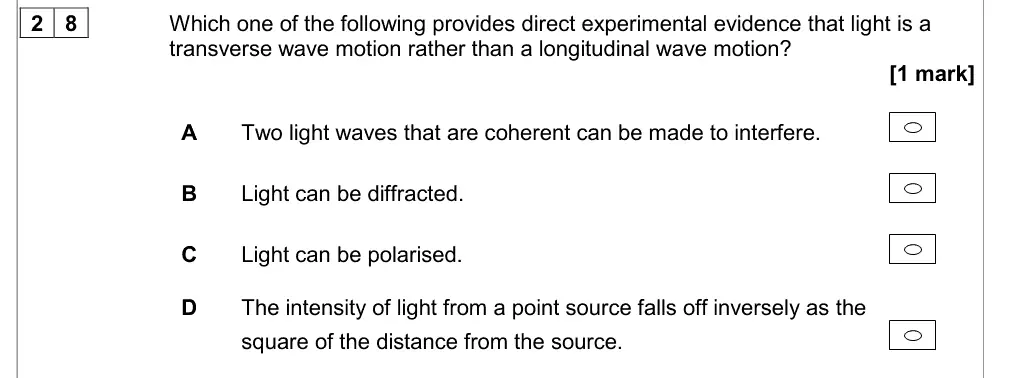
28 Progressive waves, longitudinal and transverse waves 1Multiple choice
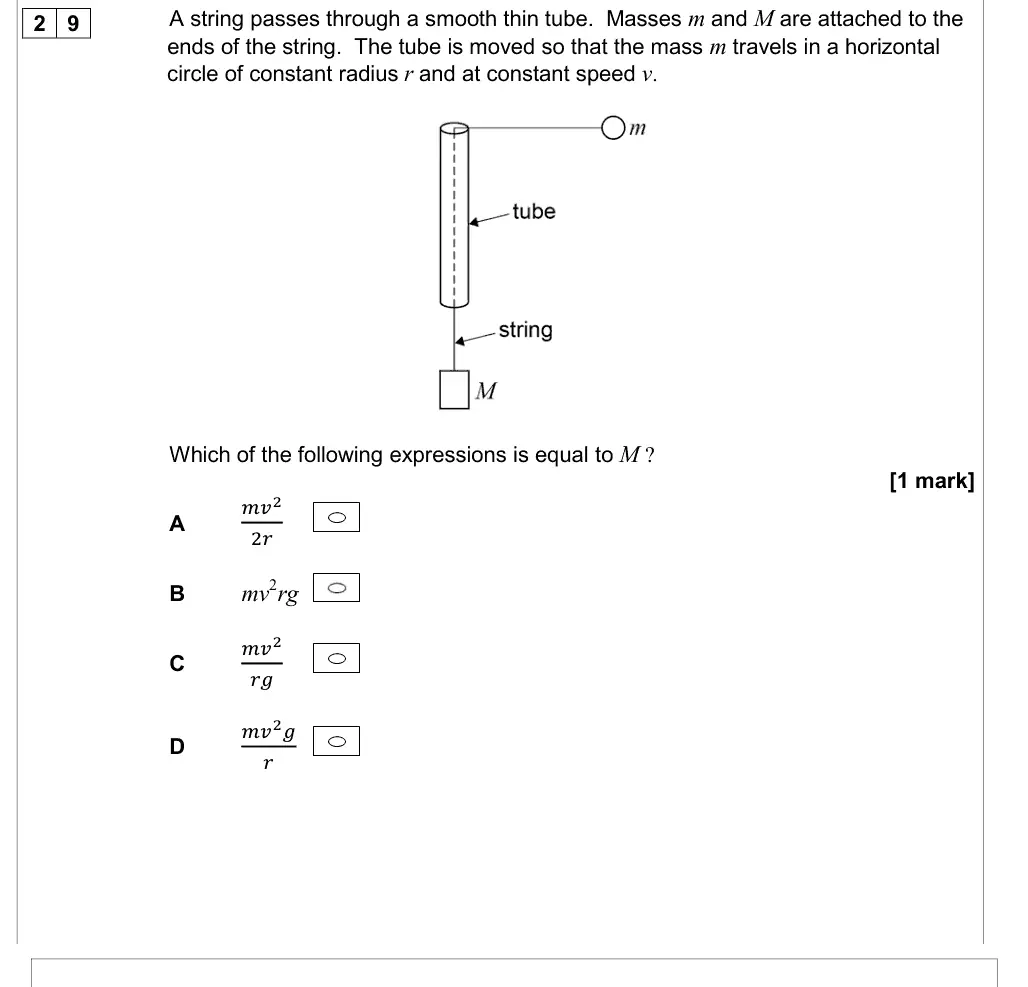
29 Circular motion 1Multiple choice
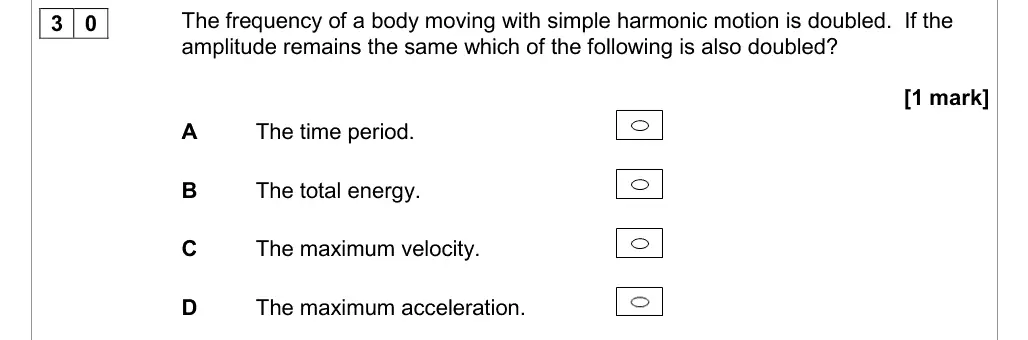
30 Simple harmonic motion, forced vibrations and resonance 1Multiple choice
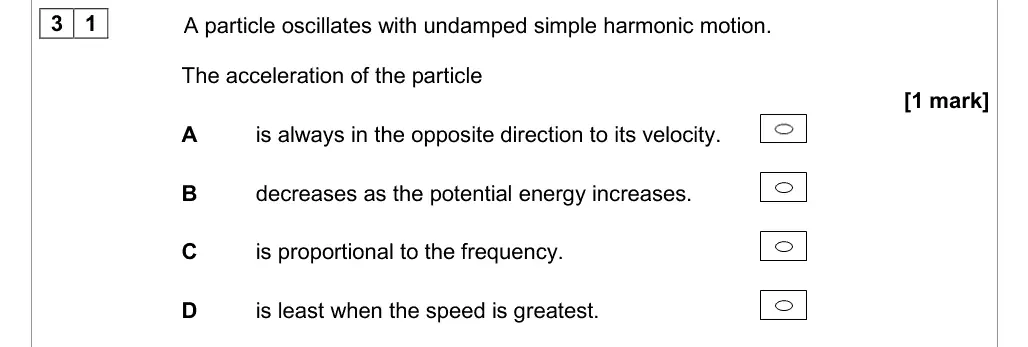
31 Simple harmonic motion, forced vibrations and resonance 1Multiple choice

The questions

1.11.21.31.41.52.12.22.32.42.52.62.73.13.23.33.44.14.24.35.15.25.36.16.26.36.46.56.66.778910111213141516171819202122232425262728293031
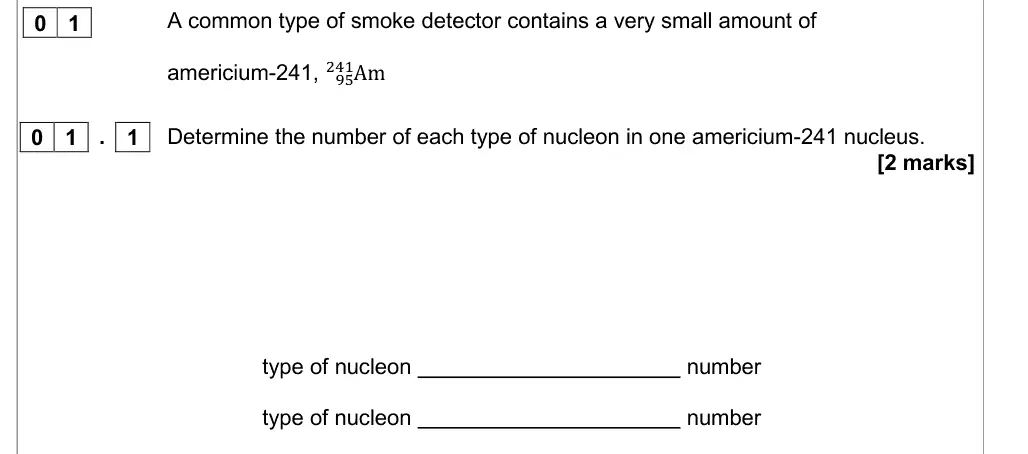
Specimen set 1 · Paper 1 · Q1.1 2 marks Short answer atomic structure and stable nuclei
A common type of smoke detector contains a very small amount of
americium-241,
Am
95
241
Determine the number of each type of nucleon in one americium-241 nucleus.
[2 marks]
type of nucleon                                             number                                  .
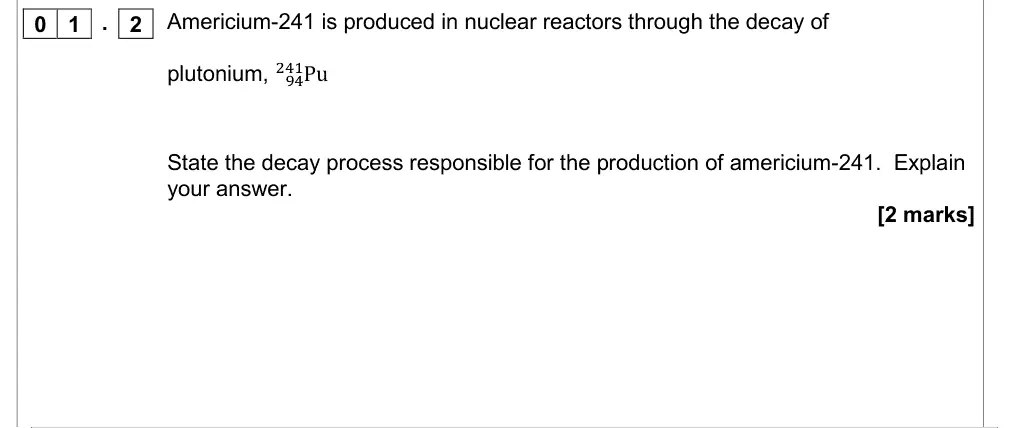
Specimen set 1 · Paper 1 · Q1.2 2 marks Explanation atomic structure and stable nuclei
Earlier part of question 1 that this part usesEarlier part of Specimen set 1 Paper 1 question 1
Americium-241 is produced in nuclear reactors through the decay of
plutonium,
Pu
94
241
State the decay process responsible for the production of americium-241.  Explain
your answer.
[2 marks]
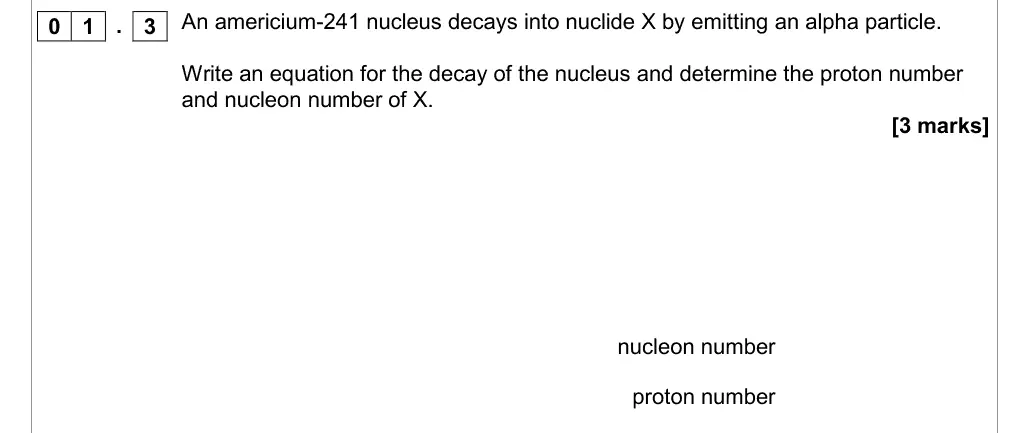
Specimen set 1 · Paper 1 · Q1.3 3 marks Short answer atomic structure and stable nuclei
Earlier part of question 1 that this part usesEarlier part of Specimen set 1 Paper 1 question 1
An americium-241 nucleus decays into nuclide X by emitting an alpha particle.
Write an equation for the decay of the nucleus and determine the proton number
and nucleon number of X.
[3 marks]
nucleon number                                  .
proton number                                  .
Specimen set 1 · Paper 1 · Q1.4 1 mark Short answer energy levels and wave particle duality
Earlier part of question 1 that this part usesEarlier part of Specimen set 1 Paper 1 question 1
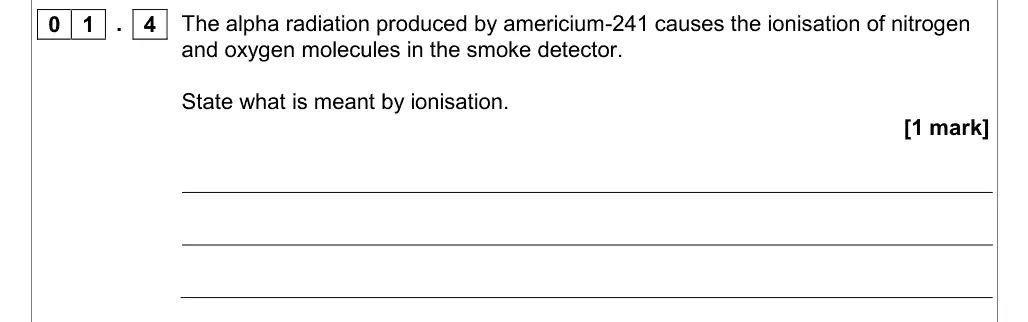
The alpha radiation produced by americium-241 causes the ionisation of nitrogen
and oxygen molecules in the smoke detector.
State what is meant by ionisation.
[1 mark]
Specimen set 1 · Paper 1 · Q1.5 2 marks Explanation atomic structure and stable nuclei
Earlier part of question 1 that this part usesEarlier part of Specimen set 1 Paper 1 question 1
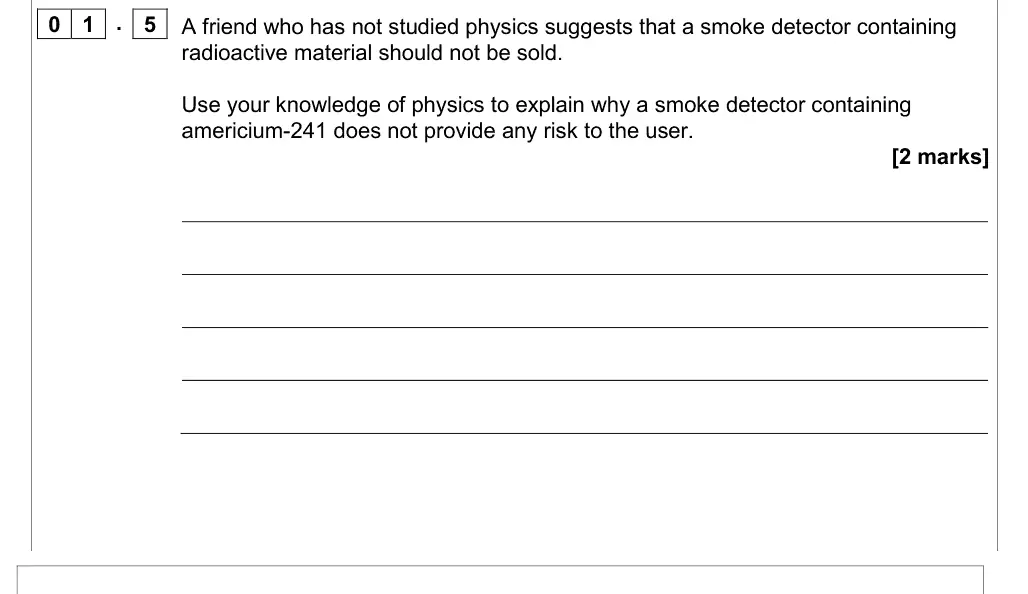
A friend who has not studied physics suggests that a smoke detector containing
radioactive material should not be sold.
Use your knowledge of physics to explain why a smoke detector containing
americium-241 does not provide any risk to the user.
[2 marks]
Specimen set 1 · Paper 1 · Q2.1 1 mark Diagram or graph materials and young modulus
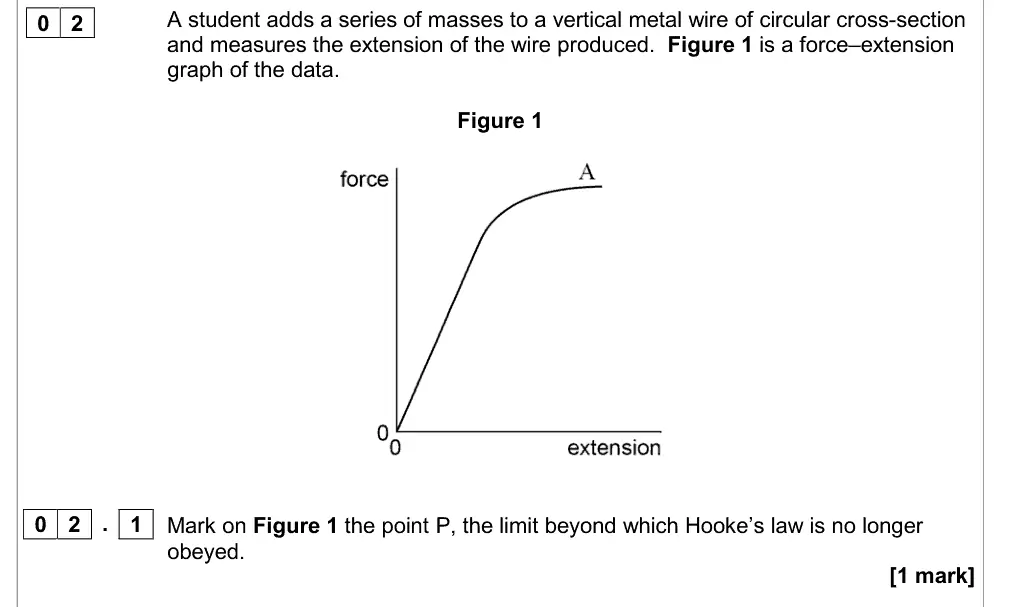
A student adds a series of masses to a vertical metal wire of circular cross-section
and measures the extension of the wire produced.  Figure 1 is a force–extension
graph of the data.
Figure 1
Mark on Figure 1 the point P, the limit beyond which Hooke’s law is no longer
obeyed.
[1 mark]
Specimen set 1 · Paper 1 · Q2.2 3 marks Explanation materials and young modulus
Earlier part of question 2 that this part usesEarlier part of Specimen set 1 Paper 1 question 2
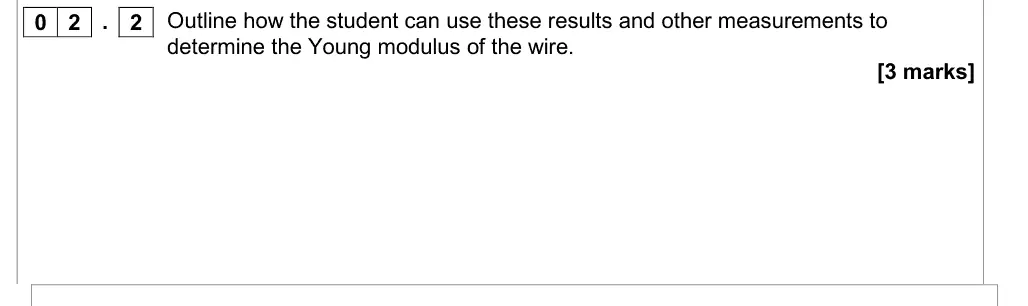
Outline how the student can use these results and other measurements to
determine the Young modulus of the wire.
[3 marks]
Specimen set 1 · Paper 1 · Q2.3 1 mark Diagram or graph materials and young modulus
Earlier part of question 2 that this part usesEarlier part of Specimen set 1 Paper 1 question 2
When the wire has been extended to A, the masses are removed one by one and
the extension re-measured.
Draw on Figure 1 the shape of the graph that the student will obtain.
[1 mark]
Specimen set 1 · Paper 1 · Q2.4 2 marks Explanation materials and young modulus
Earlier part of question 2 that this part usesEarlier part of Specimen set 1 Paper 1 question 2
Explain why the graph has the shape you have drawn.
[2 marks]
Specimen set 1 · Paper 1 · Q2.5 3 marks Calculation materials and young modulus
Earlier part of question 2 that this part usesEarlier part of Specimen set 1 Paper 1 question 2
The metal wire is used to make a cable of diameter 6.0 mm. The Young modulus
of metal of the cable is 2.0 × 10¹¹ Pa.
Calculate the force necessary to produce a strain of 0.20% in the cable.
[3 marks]
force =  kN
Specimen set 1 · Paper 1 · Q2.6 3 marks Calculation newtons laws and momentum
Earlier part of question 2 that this part usesEarlier part of Specimen set 1 Paper 1 question 2
The cable is used in a crane to lift a mass of 600 kg.
Determine the maximum acceleration with which the mass can be lifted if the
strain in the cable is not to exceed 0.20%.
[3 marks]
Specimen set 1 · Paper 1 · Q2.7 3 marks Explanation materials and young modulusnewtons laws and momentum
Earlier part of question 2 that this part usesEarlier part of Specimen set 1 Paper 1 question 2
An engineer redesigns the crane to lift a 1200 kg load at the same maximum
acceleration.
Discuss the changes that could be made to the cable of the crane to achieve this,
without exceeding 0.20% strain.
[3 marks]
Turn to page 8 for the next question
Specimen set 1 · Paper 1 · Q3.1 1 mark Short answer circuits and potential dividers
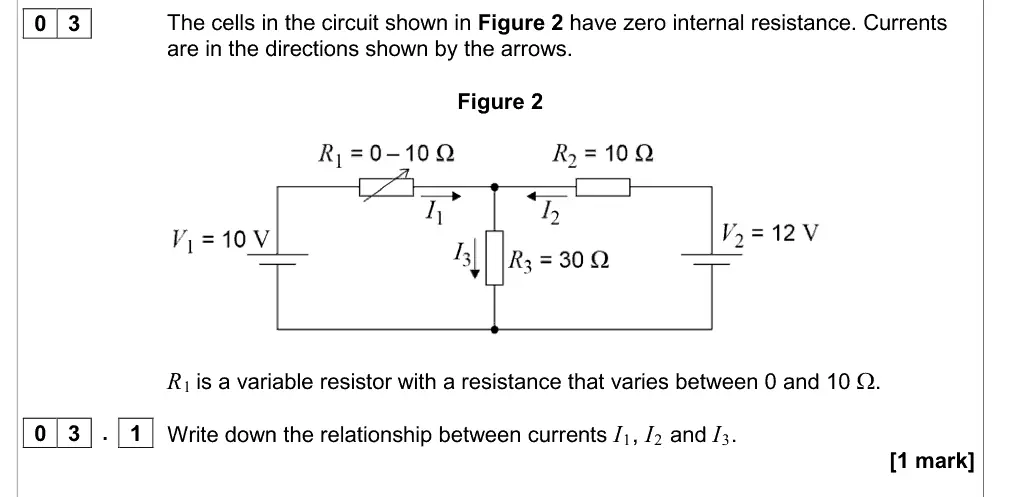
The cells in the circuit shown in Figure 2 have zero internal resistance. Currents
are in the directions shown by the arrows.
Figure 2
R1 is a variable resistor with a resistance that varies between 0 and 10 Ω.
Write down the relationship between currents I1, I2 and I3.
[1 mark]
Specimen set 1 · Paper 1 · Q3.2 1 mark Short answer circuits and potential dividers
Earlier part of question 3 that this part usesEarlier part of Specimen set 1 Paper 1 question 3
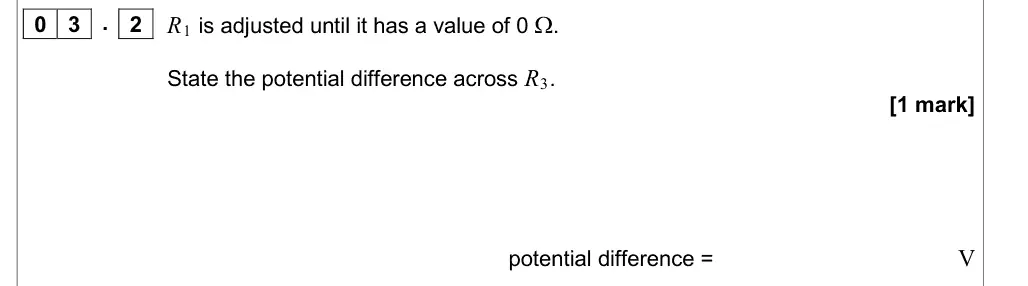
R1 is adjusted until it has a value of 0 Ω.
State the potential difference across R3.
[1 mark]
potential difference =                                        V
Specimen set 1 · Paper 1 · Q3.3 2 marks Calculation circuits and potential dividerscurrent voltage and resistivity
Earlier part of question 3 that this part usesEarlier part of Specimen set 1 Paper 1 question 3
Determine the current I2.
[2 marks]
current =                                         A
Specimen set 1 · Paper 1 · Q3.4 3 marks Explanation circuits and potential dividers
Earlier part of question 3 that this part usesEarlier part of Specimen set 1 Paper 1 question 3
State and explain what happens to the potential difference across R2 as the
resistance of R1 is gradually increased from zero.
[3 marks]
Specimen set 1 · Paper 1 · Q4.1 4 marks Calculation newtons laws and momentumwork energy and power
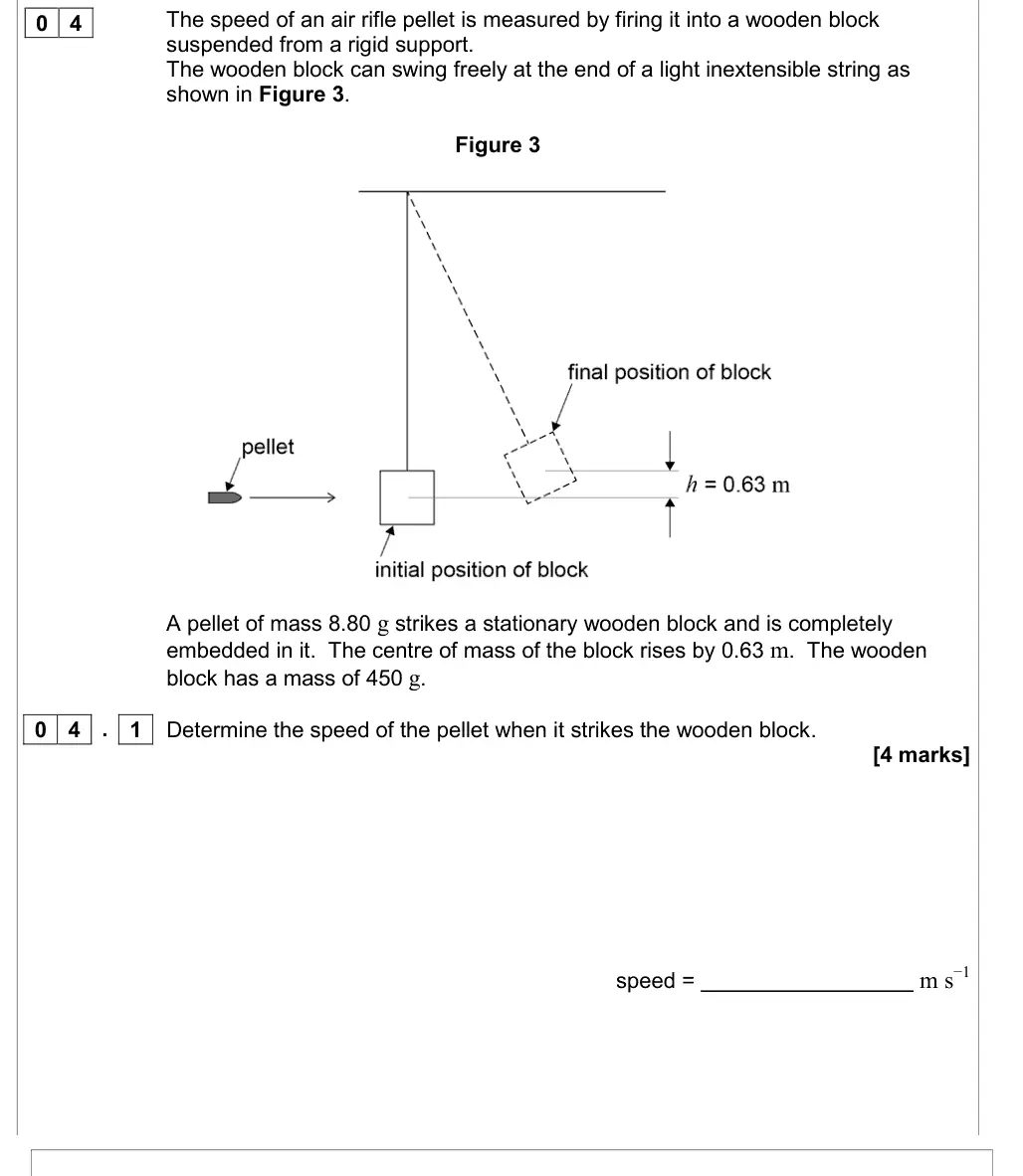
The speed of an air rifle pellet is measured by firing it into a wooden block
suspended from a rigid support.
The wooden block can swing freely at the end of a light inextensible string as
shown in Figure 3.
Figure 3
A pellet of mass 8.80 g strikes a stationary wooden block and is completely
embedded in it.  The centre of mass of the block rises by 0.63 m.  The wooden
block has a mass of 450 g.
Determine the speed of the pellet when it strikes the wooden block.
[4 marks]
speed =                                     m s−1
Specimen set 1 · Paper 1 · Q4.2 4 marks Explanation newtons laws and momentum
Earlier part of question 4 that this part usesEarlier part of Specimen set 1 Paper 1 question 4
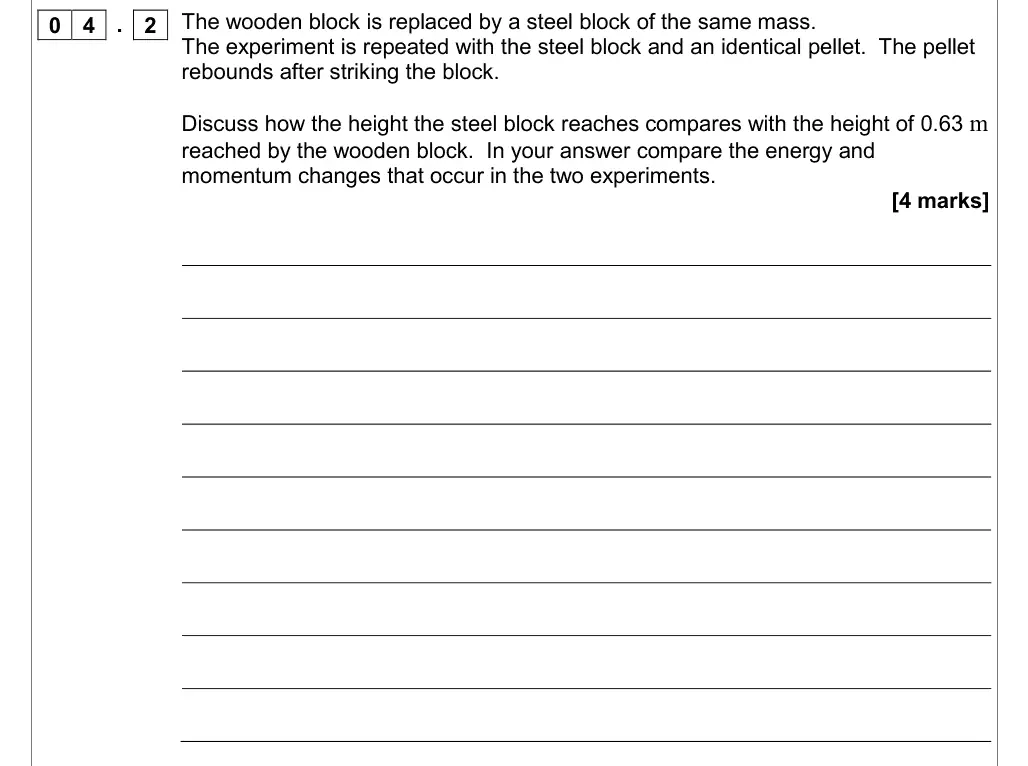
The wooden block is replaced by a steel block of the same mass.
The experiment is repeated with the steel block and an identical pellet.  The pellet
rebounds after striking the block.
Discuss how the height the steel block reaches compares with the height of 0.63 m
reached by the wooden block.  In your answer compare the energy and
momentum changes that occur in the two experiments.
[4 marks]
Specimen set 1 · Paper 1 · Q4.3 2 marks Explanation newtons laws and momentum
Earlier part of question 4 that this part usesEarlier part of Specimen set 1 Paper 1 question 4
Discuss which experiment is likely to give the more accurate value for the velocity
of the pellet.
[2 marks]
Specimen set 1 · Paper 1 · Q5.1 3 marks Explanation refraction and optical fibres
Describe the structure of a step-index optical fibre outlining the purpose of the core
and the cladding.
[3 marks]
Specimen set 1 · Paper 1 · Q5.2 2 marks Explanation refraction and optical fibres
Earlier part of question 5 that this part usesEarlier part of Specimen set 1 Paper 1 question 5
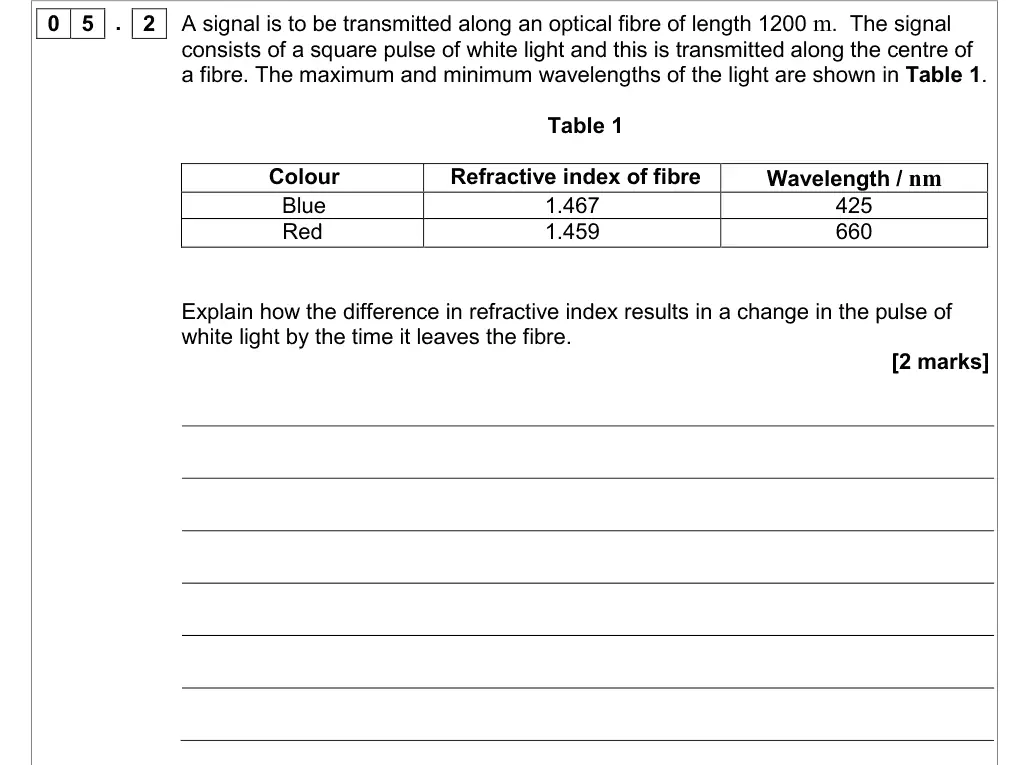
A signal is to be transmitted along an optical fibre of length 1200 m.  The signal
consists of a square pulse of white light and this is transmitted along the centre of
a fibre. The maximum and minimum wavelengths of the light are shown in Table 1.
Table 1
Colour
Refractive index of fibre
Wavelength / nm
Blue
1.467
425
Red
1.459
660
Explain how the difference in refractive index results in a change in the pulse of
white light by the time it leaves the fibre.
[2 marks]
Specimen set 1 · Paper 1 · Q5.3 2 marks Explanation refraction and optical fibres
Earlier part of question 5 that this part usesEarlier part of Specimen set 1 Paper 1 question 5
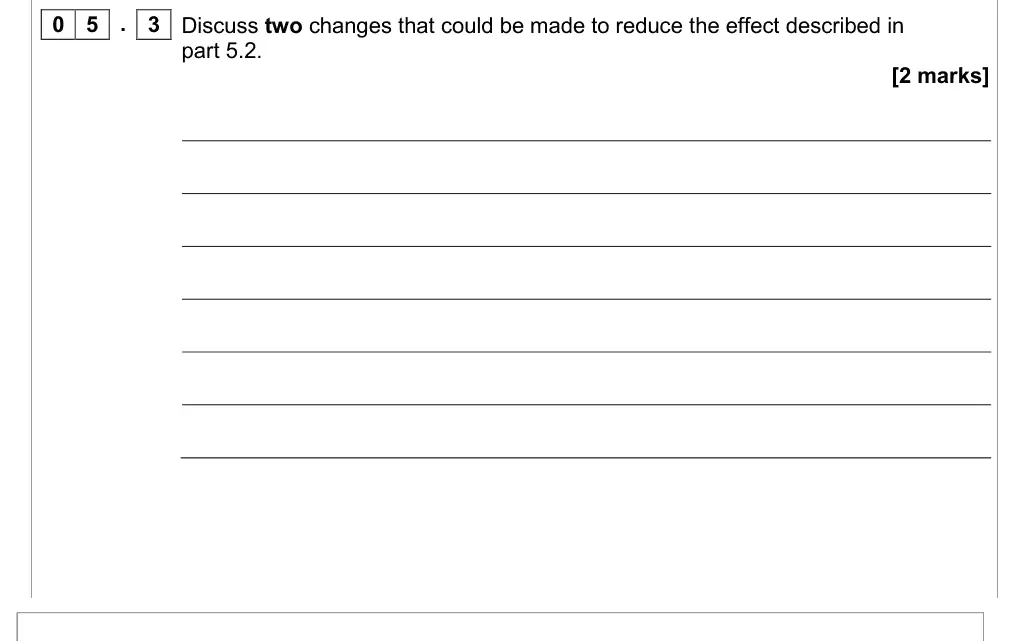
Discuss two changes that could be made to reduce the effect described in
part 5.2.
[2 marks]
Specimen set 1 · Paper 1 · Q6.1 1 mark Short answer interference and diffraction
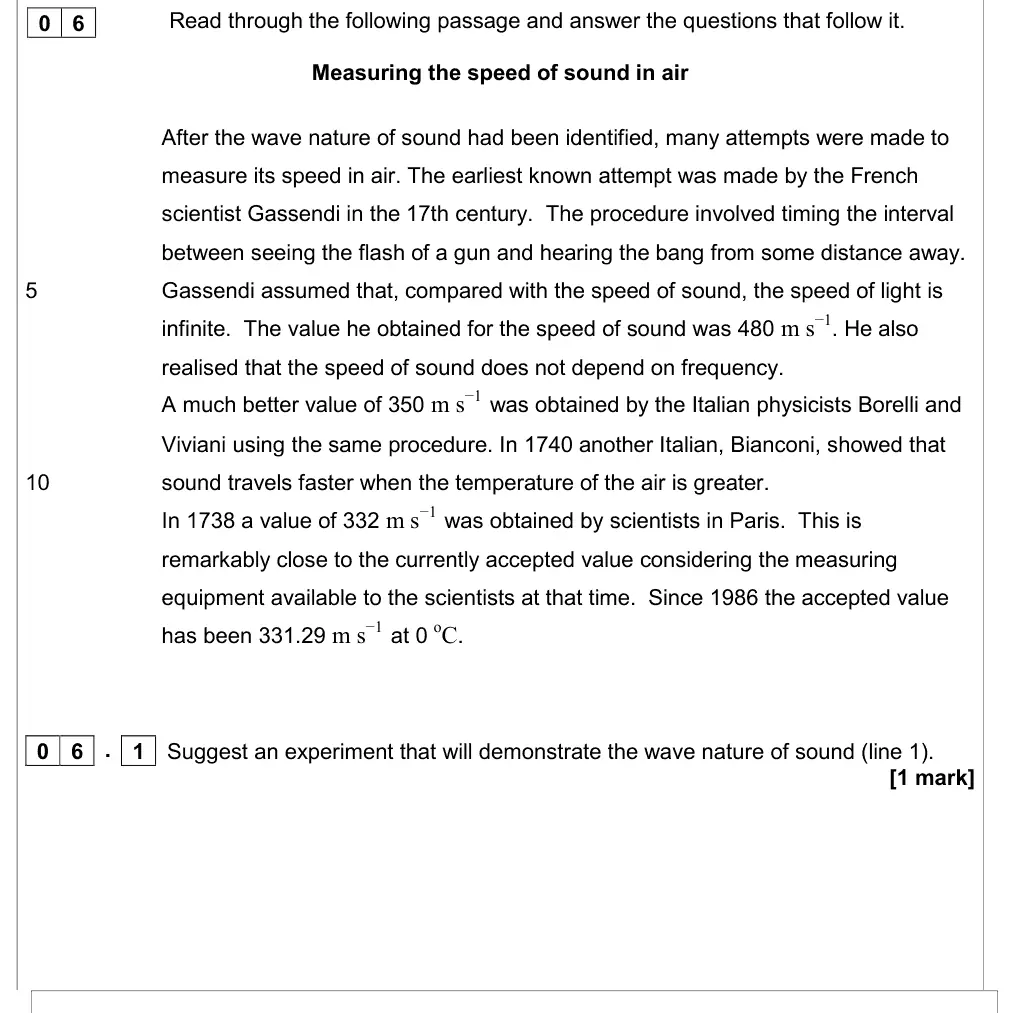
Read through the following passage and answer the questions that follow it.
Measuring the speed of sound in air
5
10
After the wave nature of sound had been identified, many attempts were made to
measure its speed in air. The earliest known attempt was made by the French
scientist Gassendi in the 17th century.  The procedure involved timing the interval
between seeing the flash of a gun and hearing the bang from some distance away.
Gassendi assumed that, compared with the speed of sound, the speed of light is
infinite.  The value he obtained for the speed of sound was 480 m s−1. He also
realised that the speed of sound does not depend on frequency.
A much better value of 350 m s−1  was obtained by the Italian physicists Borelli and
Viviani using the same procedure. In 1740 another Italian, Bianconi, showed that
sound travels faster when the temperature of the air is greater.
In 1738 a value of 332 m s−1  was obtained by scientists in Paris.  This is
remarkably close to the currently accepted value considering the measuring
equipment available to the scientists at that time.  Since 1986 the accepted value
has been 331.29 m s−1  at 0 oC.
Suggest an experiment that will demonstrate the wave nature of sound (line 1).
[1 mark]
Specimen set 1 · Paper 1 · Q6.2 1 mark Calculation motion and projectiles
Earlier part of question 6 that this part usesEarlier part of Specimen set 1 Paper 1 question 6
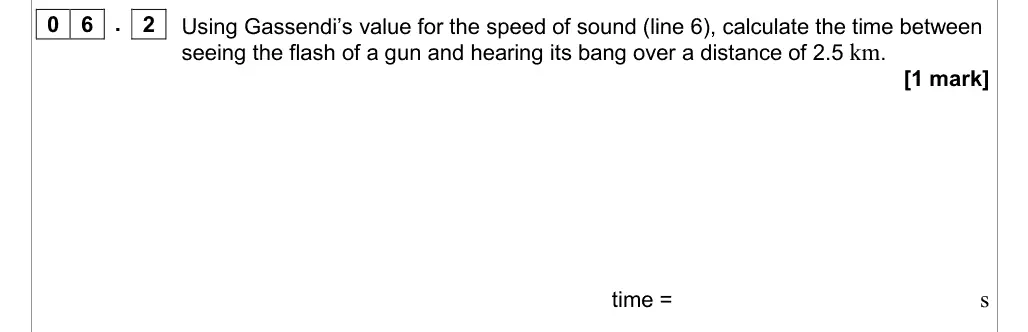
Using Gassendi’s value for the speed of sound (line 6), calculate the time between
seeing the flash of a gun and hearing its bang over a distance of 2.5 km.
[1 mark]
time =
s
Specimen set 1 · Paper 1 · Q6.3 1 mark Explanation motion and projectiles
Earlier part of question 6 that this part usesEarlier part of Specimen set 1 Paper 1 question 6
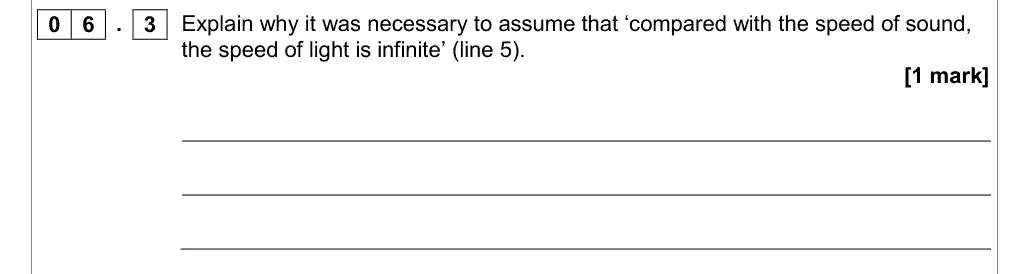
Explain why it was necessary to assume that ‘compared with the speed of sound,
the speed of light is infinite’ (line 5).
[1 mark]
Specimen set 1 · Paper 1 · Q6.4 2 marks Explanation progressive waves and polarisation
Earlier part of question 6 that this part usesEarlier part of Specimen set 1 Paper 1 question 6
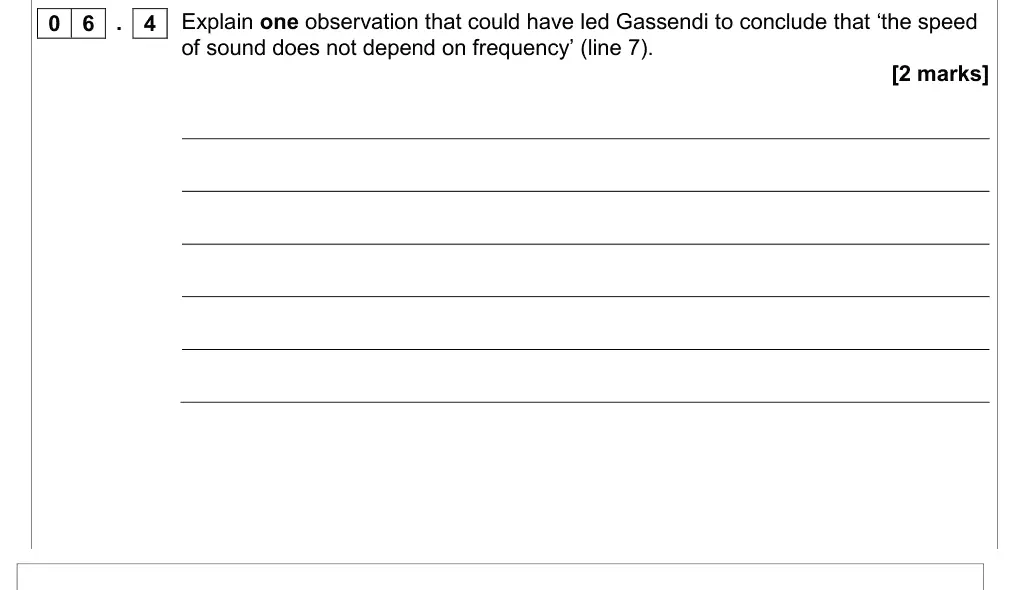
Explain one observation that could have led Gassendi to conclude that ‘the speed
of sound does not depend on frequency’ (line 7).
[2 marks]
Specimen set 1 · Paper 1 · Q6.5 1 mark Short answer measurements and uncertainties
Earlier part of question 6 that this part usesEarlier part of Specimen set 1 Paper 1 question 6
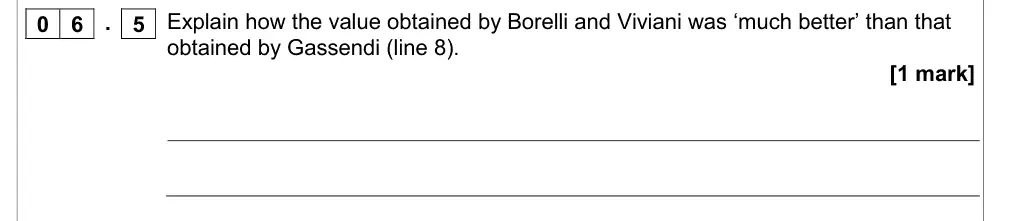
Explain how the value obtained by Borelli and Viviani was ‘much better’ than that
obtained by Gassendi (line 8).
[1 mark]
Specimen set 1 · Paper 1 · Q6.6 2 marks Calculation measurements and uncertainties
Earlier part of question 6 that this part usesEarlier part of Specimen set 1 Paper 1 question 6
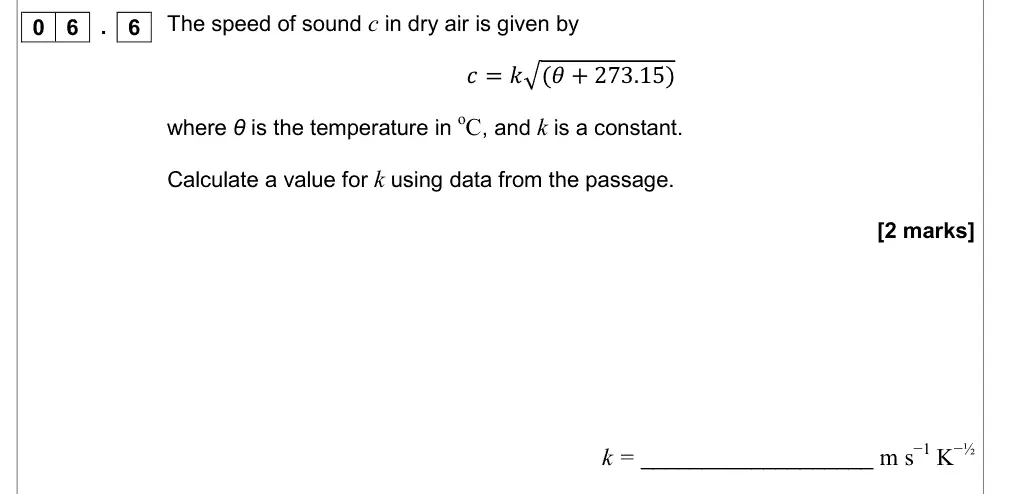
The speed of sound c in dry air is given by
𝑐= 𝑘ඥ(𝜃+ 273.15)
where θ is the temperature in oC, and k is a constant.
Calculate a value for k using data from the passage.
[2 marks]
k =  m s−1 K−½
Specimen set 1 · Paper 1 · Q6.7 2 marks Short answer energy levels and wave particle duality
Earlier part of question 6 that this part usesEarlier part of Specimen set 1 Paper 1 question 6
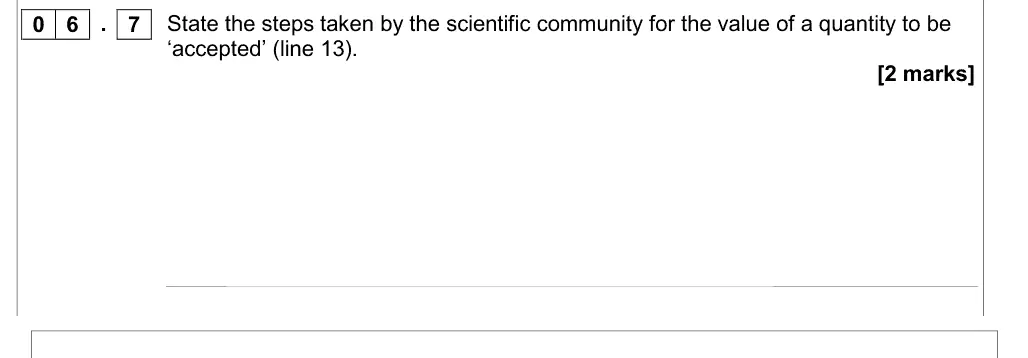
State the steps taken by the scientific community for the value of a quantity to be
‘accepted’ (line 13).
[2 marks]
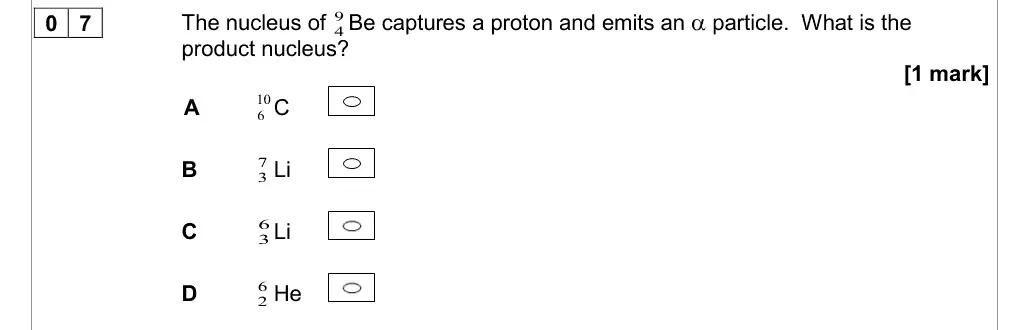
Specimen set 1 · Paper 1 · Q7 1 mark Multiple choice atomic structure and stable nuclei
The nucleus of 4
9 Be captures a proton and emits an α particle.  What is the
product nucleus?
[1 mark]
A
C
B
Li
C
Li
D
He
6
10
3
7
3
6
2
6
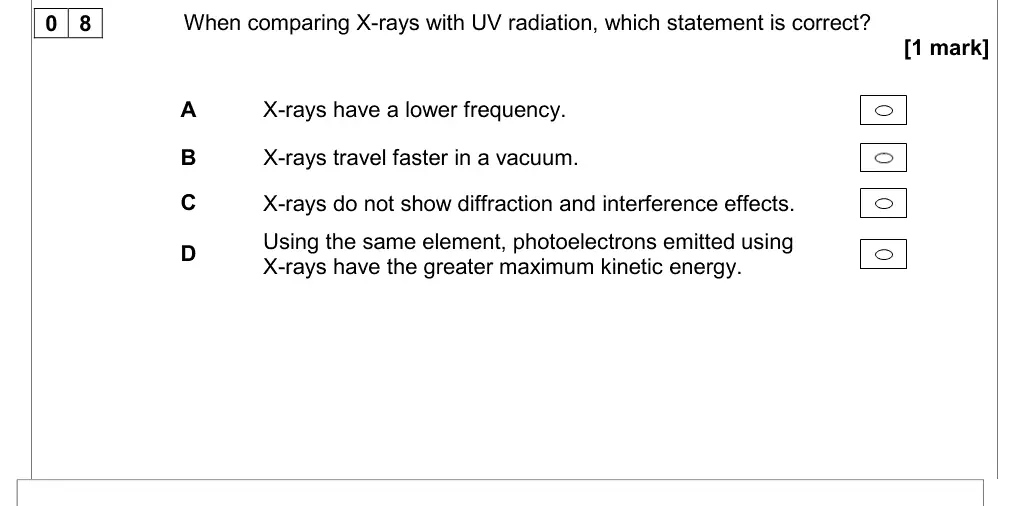
Specimen set 1 · Paper 1 · Q8 1 mark Multiple choice photoelectric effect
When comparing X-rays with UV radiation, which statement is correct?
[1 mark]
A
X-rays have a lower frequency.
B
X-rays travel faster in a vacuum.
C
X-rays do not show diffraction and interference effects.
D
Using the same element, photoelectrons emitted using
X-rays have the greater maximum kinetic energy.
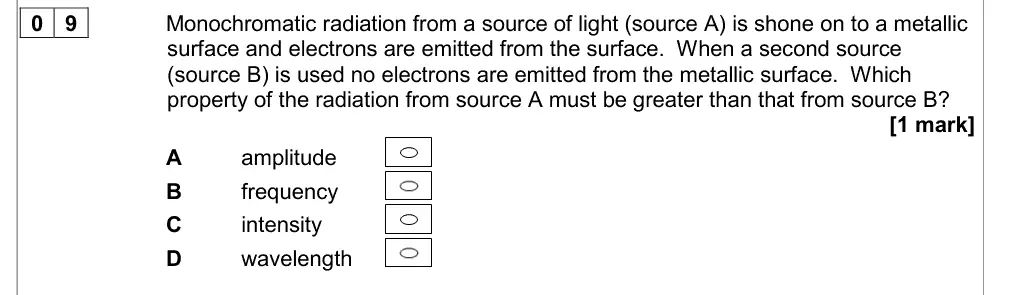
Specimen set 1 · Paper 1 · Q9 1 mark Multiple choice photoelectric effect
Monochromatic radiation from a source of light (source A) is shone on to a metallic
surface and electrons are emitted from the surface.  When a second source
(source B) is used no electrons are emitted from the metallic surface.  Which
property of the radiation from source A must be greater than that from source B?
[1 mark]
A
amplitude
B
frequency
C
intensity
D
wavelength
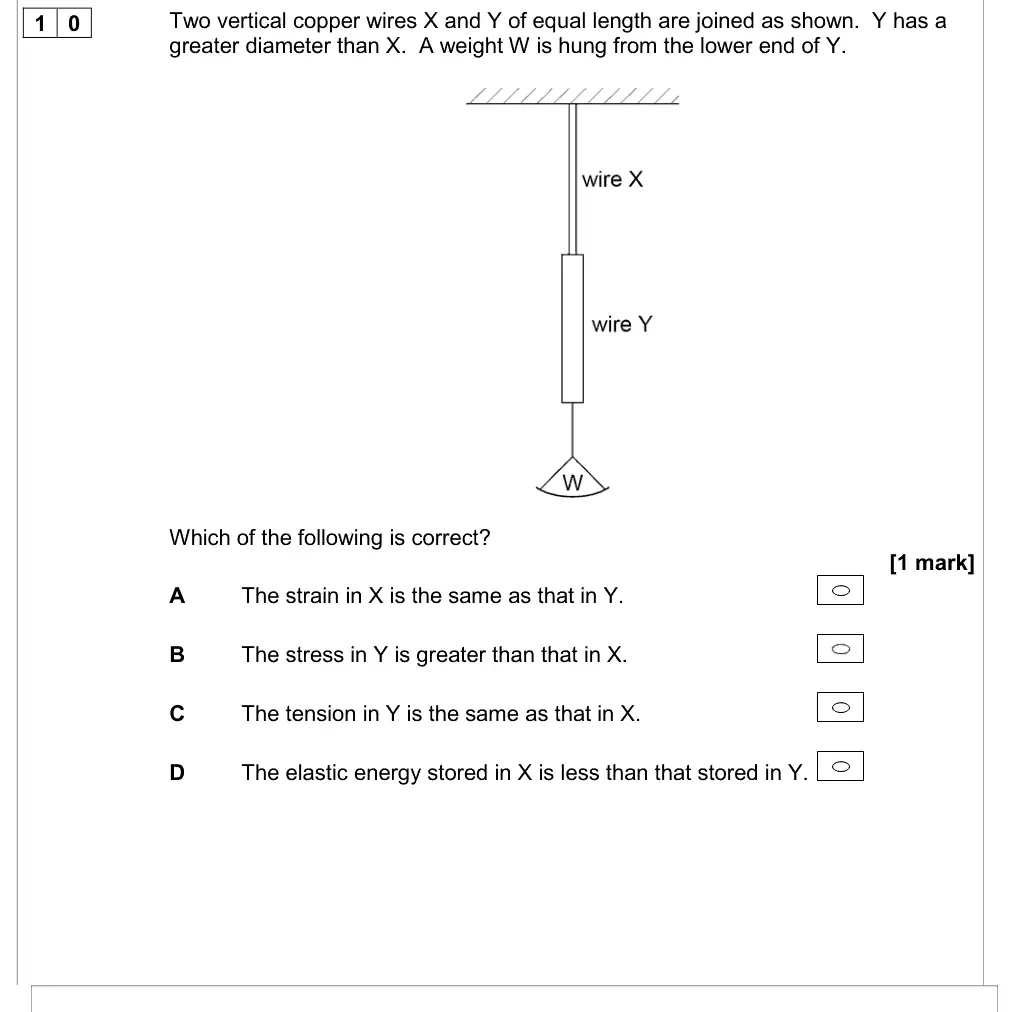
Specimen set 1 · Paper 1 · Q10 1 mark Multiple choice materials and young modulus
Two vertical copper wires X and Y of equal length are joined as shown.  Y has a
greater diameter than X.  A weight W is hung from the lower end of Y.
Which of the following is correct?
[1 mark]
A
The strain in X is the same as that in Y.
B
The stress in Y is greater than that in X.
C
The tension in Y is the same as that in X.
D
The elastic energy stored in X is less than that stored in Y.
Specimen set 1 · Paper 1 · Q11 1 mark Multiple choice energy levels and wave particle duality
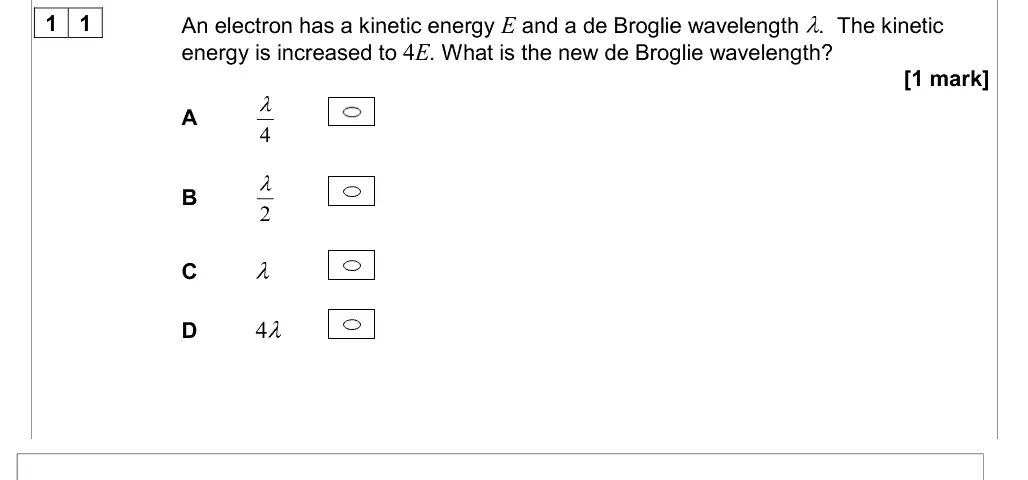
An electron has a kinetic energy E and a de Broglie wavelength λ.  The kinetic
energy is increased to 4E. What is the new de Broglie wavelength?
[1 mark]
A
B
C
λ
D
4λ
λ
4
λ
2
Specimen set 1 · Paper 1 · Q12 1 mark Multiple choice stationary waves
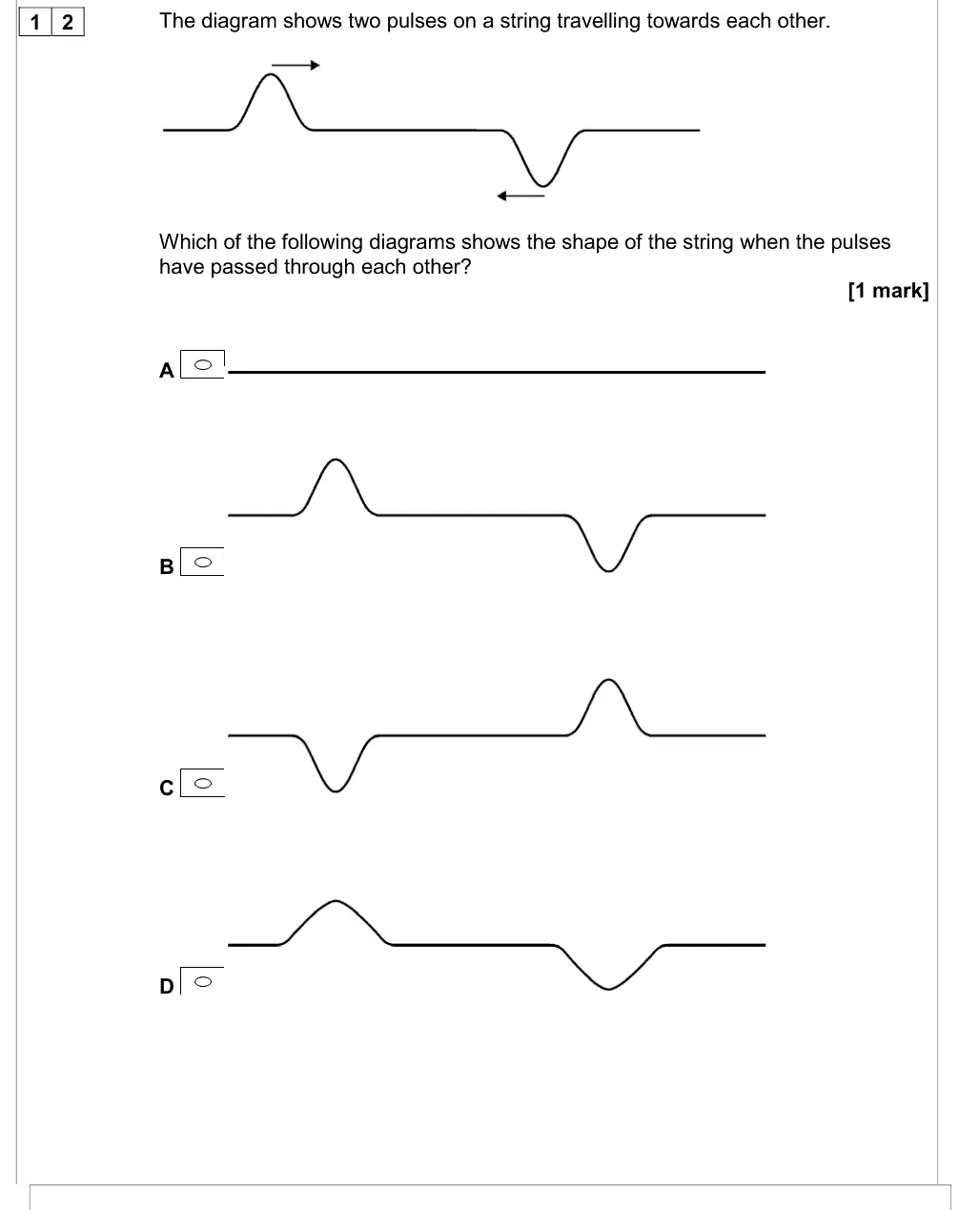
The diagram shows two pulses on a string travelling towards each other.
Which of the following diagrams shows the shape of the string when the pulses
have passed through each other?
[1 mark]
A
B
C
D
Specimen set 1 · Paper 1 · Q13 1 mark Multiple choice refraction and optical fibres
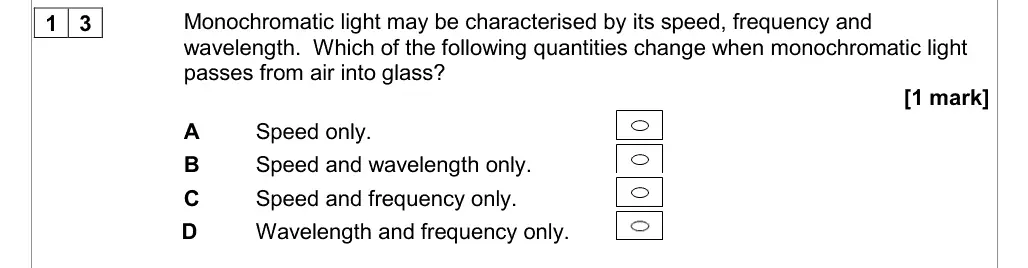
Monochromatic light may be characterised by its speed, frequency and
wavelength.  Which of the following quantities change when monochromatic light
passes from air into glass?
[1 mark]
A
Speed only.
B
Speed and wavelength only.
C
Speed and frequency only.
D
Wavelength and frequency only.
Specimen set 1 · Paper 1 · Q14 1 mark Multiple choice photoelectric effect
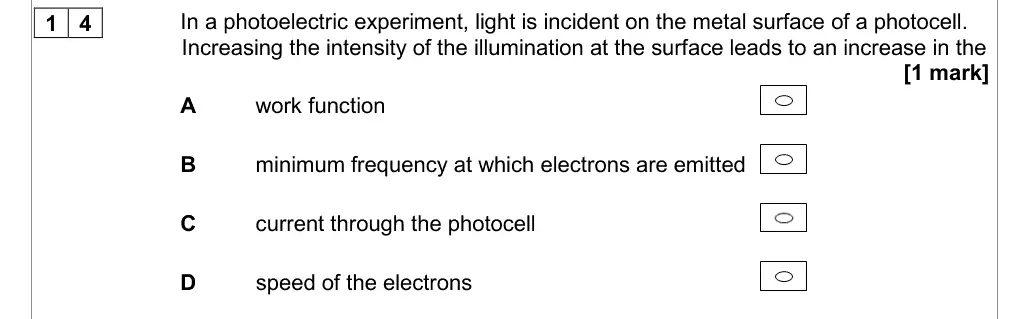
In a photoelectric experiment, light is incident on the metal surface of a photocell.
Increasing the intensity of the illumination at the surface leads to an increase in the
[1 mark]
A
work function
B
minimum frequency at which electrons are emitted
C
current through the photocell
D
speed of the electrons
Specimen set 1 · Paper 1 · Q15 1 mark Multiple choice circuits and potential dividers
In the circuit shown in the diagram the cell has negligible internal resistance.
What happens to the reading of both meters when the resistance of R is
decreased?
[1 mark]
Reading of ammeter
Reading of voltmeter
A
increases
increases
B
increases
decreases
C
decreases
increases
D
unchanged
decreases
Specimen set 1 · Paper 1 · Q16 1 mark Multiple choice emf and internal resistance
In the circuit shown, V is a voltmeter with a very high resistance.  The internal
resistance of the cell, r, is equal to the external resistance in the circuit.
Which of the following is not equal to the emf of the cell?
[1 mark]
A  the reading of the voltmeter when the Switch S is open
B  the chemical energy changed to electrical energy when unit
charge passes through the cell
C  twice the reading of the voltmeter when the switch S is closed
D  the electrical energy produced when unit current passes
through the cell
Specimen set 1 · Paper 1 · Q17 1 mark Multiple choice interference and diffraction
Monochromatic light of wavelength 490 nm falls normally on a diffraction grating
that has 6 x 10⁵ lines per metre.  Which one of the following is correct?
[1 mark]
A
The first order is observed at angle of diffraction of 17o.
B
The second order is observed at angle of diffraction of 34o.
C
The third and higher orders are not produced.
D
A grating with more lines per metre could produce more orders.
Specimen set 1 · Paper 1 · Q18 1 mark Multiple choice energy levels and wave particle duality
An electron collides with a neutral atom and ionizes it.  Which of the following
describes the particles present after the collision?
[1 mark]
A
An electron and an excited atom.
B
An excited atom containing an excess electron.
C
Two electrons and a positive ion.
D
Two electrons and a neutral atom in the ground state.
Specimen set 1 · Paper 1 · Q19 1 mark Multiple choice vectors and moments
Two forces of 6 N and 10 N act at a point.  Which of the following could not be the
magnitude of the result?
[1 mark]
A
16 N
B
8 N
C
5 N
D
3 N
Specimen set 1 · Paper 1 · Q20 1 mark Multiple choice vectors and moments
A car wheel nut can be loosened by applying a force of 200 N on the end of a bar
of length 0.8 m as in X.  A car mechanic is capable of applying forces of 500 N
simultaneously in opposite directions on the ends of a wheel wrench as in Y.
What is the minimum length l of the wrench which would be needed for him to
loosen the nut?
[1 mark]
A
0.16 m
B
0.32 m
C
0.48 m
D
0.64 m
Specimen set 1 · Paper 1 · Q21 1 mark Multiple choice motion and projectiles
A ballbearing X of mass 2m is projected vertically upwards with speed u.  A
ballbearing Y of mass m is projected at 30º to the horizontal with speed 2u at the
same time.  Air resistance is negligible.  Which of the following statements is
correct?
[1 mark]
A
The horizontal component of Y's velocity is u.
B
The maximum height reached by Y is half that reached by X
C
X and Y reach the ground at the same time.
D
X reaches the ground first.
Specimen set 1 · Paper 1 · Q22 1 mark Multiple choice motion and projectiles
What is the relationship between the distance y travelled by an object falling freely
from rest and the time x the object has been falling?
[1 mark]
A
y is proportional to x²
B
y is proportional to √x
C
y is proportional to
D
y is proportional to
1
x
1
2
x
Specimen set 1 · Paper 1 · Q23 1 mark Multiple choice work energy and power
A car exerts a driving force of 500 N when travelling at a constant speed of
72 km h
−1 on a level track.  What is the work done in 5 minutes?
[1 mark]
A
3.0 × 10
6 J
B
2.0 × 10
6 J
C
2.0 × 10
5 J
D
1.1 × 10
5 J
Specimen set 1 · Paper 1 · Q24 1 mark Multiple choice newtons laws and momentum
Two masses hang at rest from a spring, as shown in the diagram.  The string
separating the masses is burned through.
Which of the following gives the accelerations of the two masses as the string
breaks?
acceleration of free fall  =  g
[1 mark]
acceleration of
1 kg mass upwards in
m s
−2
acceleration of
2 kg mass downwards in
m s
−2
A
3 g
1 g
B
2 g
2 g
C
2 g
1 g
D
1 g
1 g
Specimen set 1 · Paper 1 · Q25 1 mark Multiple choice motion and projectiles
An object falls freely from rest.  After falling a distance d its velocity is v.  What is
its velocity after it has fallen a distance 2d?
[1 mark]
A
2 v
B
4 v
C
2 v2
D
√2 v
Specimen set 1 · Paper 1 · Q26 1 mark Multiple choice work energy and power
An electric motor of input power 100 W raises a mass of 10 kg vertically at a
steady speed of 0.5 m s
−1.  What is the efficiency of the system?
[1 mark]
A
5%
B
12%
C
50%
D
100%
Specimen set 1 · Paper 1 · Q27 1 mark Multiple choice motion and projectilesnewtons laws and momentum
The velocity of a vehicle varies with time as shown by the following graph.
Which graph below represents how the resultant force F on the car varies during
the same time?
[1 mark]
A
B
C
D
Specimen set 1 · Paper 1 · Q28 1 mark Multiple choice progressive waves and polarisation
Which one of the following provides direct experimental evidence that light is a
transverse wave motion rather than a longitudinal wave motion?
[1 mark]
A
Two light waves that are coherent can be made to interfere.
B
Light can be diffracted.
C
Light can be polarised.
D
The intensity of light from a point source falls off inversely as the
square of the distance from the source.
Specimen set 1 · Paper 1 · Q29 1 mark Multiple choice circular motion
A string passes through a smooth thin tube.  Masses m and M are attached to the
ends of the string.  The tube is moved so that the mass m travels in a horizontal
circle of constant radius r and at constant speed v.
Which of the following expressions is equal to M ?
[1 mark]
A
𝑚𝑣2
2𝑟
B
mv2rg
C
𝑚𝑣2
𝑟𝑔
D
𝑚𝑣2𝑔
𝑟
Specimen set 1 · Paper 1 · Q30 1 mark Multiple choice simple harmonic motion
The frequency of a body moving with simple harmonic motion is doubled.  If the
amplitude remains the same which of the following is also doubled?
[1 mark]
A
The time period.
B
The total energy.
C
The maximum velocity.
D
The maximum acceleration.
Specimen set 1 · Paper 1 · Q31 1 mark Multiple choice simple harmonic motion
A particle oscillates with undamped simple harmonic motion.
The acceleration of the particle
[1 mark]
A
is always in the opposite direction to its velocity.
B
decreases as the potential energy increases.
C
is proportional to the frequency.
D
is least when the speed is greatest.

Work with an AQA physics tutor

Want a paper marked and gone through with you? Message us.

Prefer email? Send an enquiry

If you are under 18, please include a parent's contact details. Enquiries go to enquiries@physicsaleveltutor.com and are deleted once handled. All tutoring is online.