June 2017: Paper 1, Modelling physics

100 marks · 51 question parts · Paper, mark scheme and report on OCR's site · Have the Data, Formulae and Relationships Booklet beside you

Question by question

QTopicMarksAOType
1 Gravitational fields, Newton's law of gravitation and gravitational potential, Physical quantities and S.I. units 1Multiple choice
2 Mechanical properties of matter: stress, strain and the Young modulus 1Multiple choice
3 Linear motion: the suvat equations and free fall, Work, energy and power 1Multiple choice
4 Linear motion: the suvat equations and free fall 1Multiple choice
5 Measurements and uncertainties, Practical skills: planning, analysis and evaluation 1Multiple choice
6 Mechanical properties of matter: stress, strain and the Young modulus, Density, pressure and upthrust 1Multiple choice
7 Stars: stellar evolution, energy levels, spectra, Wien's law and Stefan's law, Thermal physics: temperature, internal energy and specific heat capacity 1Multiple choice
8 Dynamics, drag and terminal velocity, Scalars and vectors 1Multiple choice
9 Gravitational fields, Newton's law of gravitation and gravitational potential 1Multiple choice
10 Cosmology: parallax, the Doppler effect, Hubble's law and the Big Bang, Stars: stellar evolution, energy levels, spectra, Wien's law and Stefan's law 1Multiple choice
11 Mechanical properties of matter: stress, strain and the Young modulus 1Multiple choice
12 Linear motion: the suvat equations and free fall 1Multiple choice
13 Newton's laws of motion and momentum 1Multiple choice
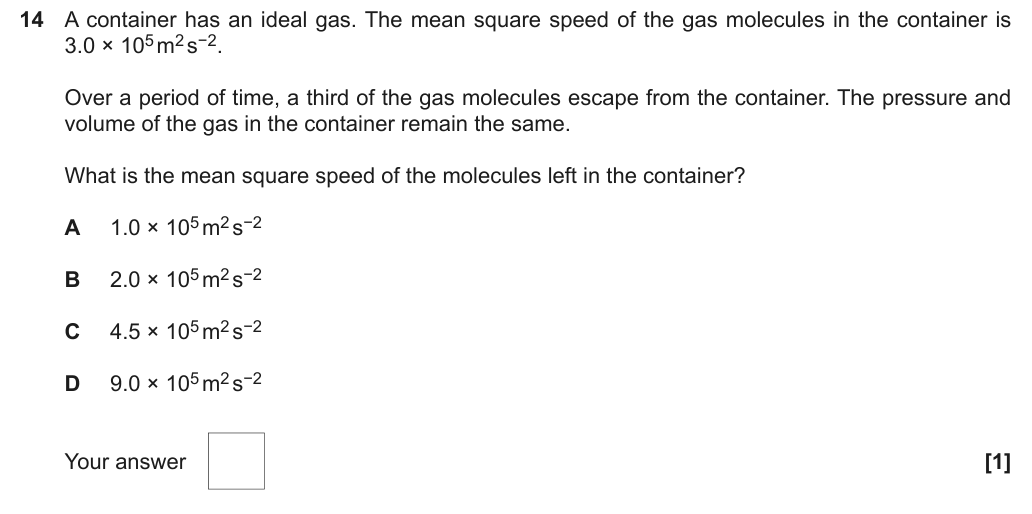
14 Ideal gases and the kinetic theory 1Multiple choice
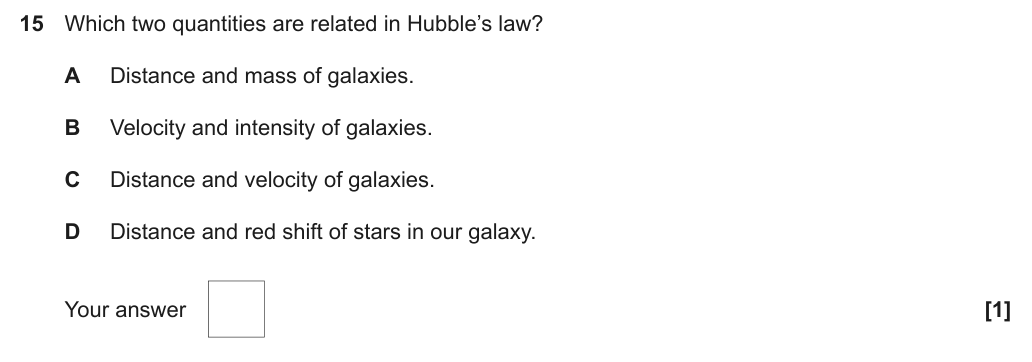
15 Cosmology: parallax, the Doppler effect, Hubble's law and the Big Bang 1Multiple choice
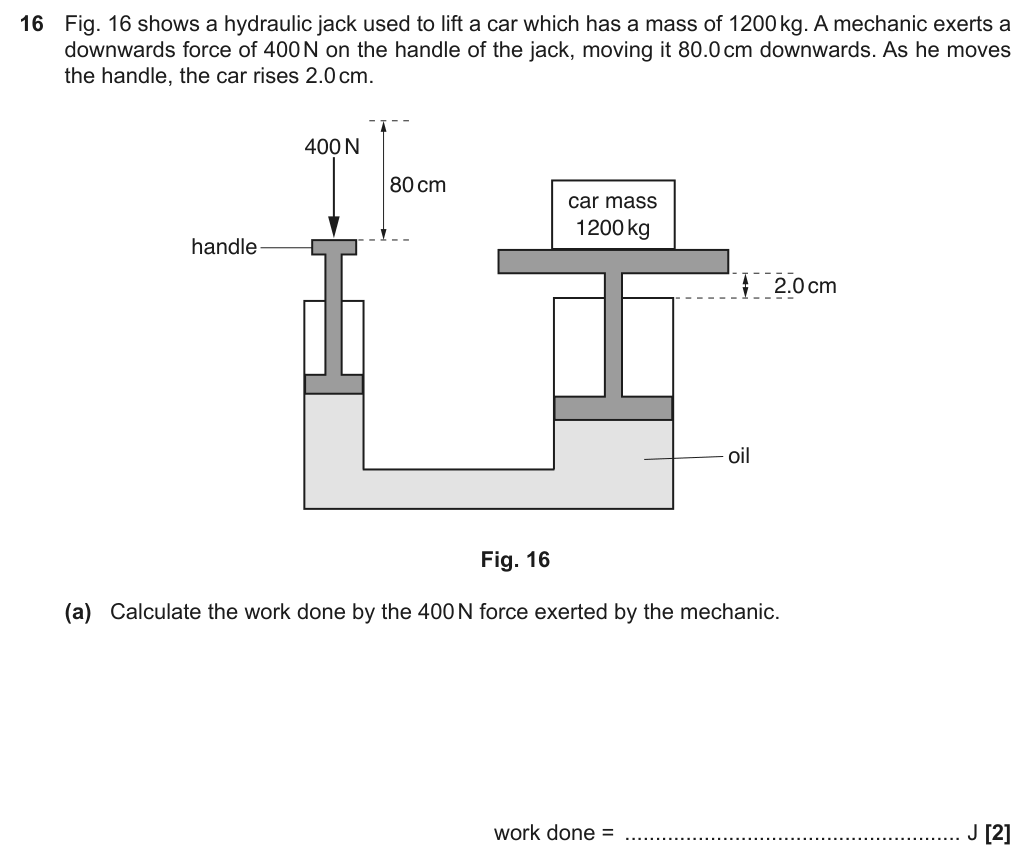
16(a) Work, energy and power 2Calculation
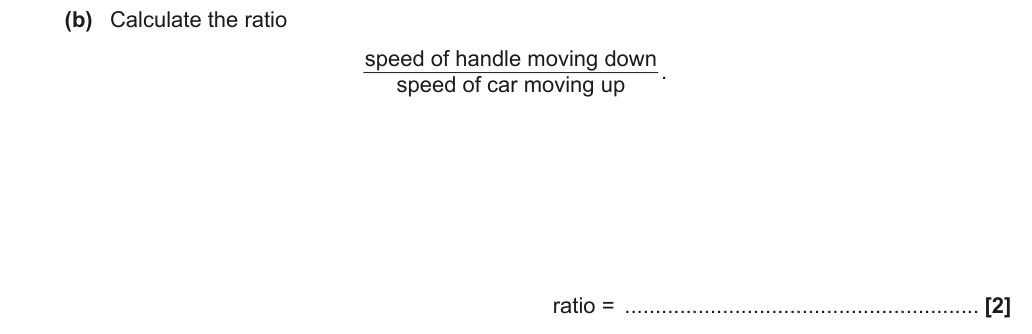
16(b) Kinematics: displacement, velocity and motion graphs 2Calculation
16(c) Work, energy and power 2Calculation
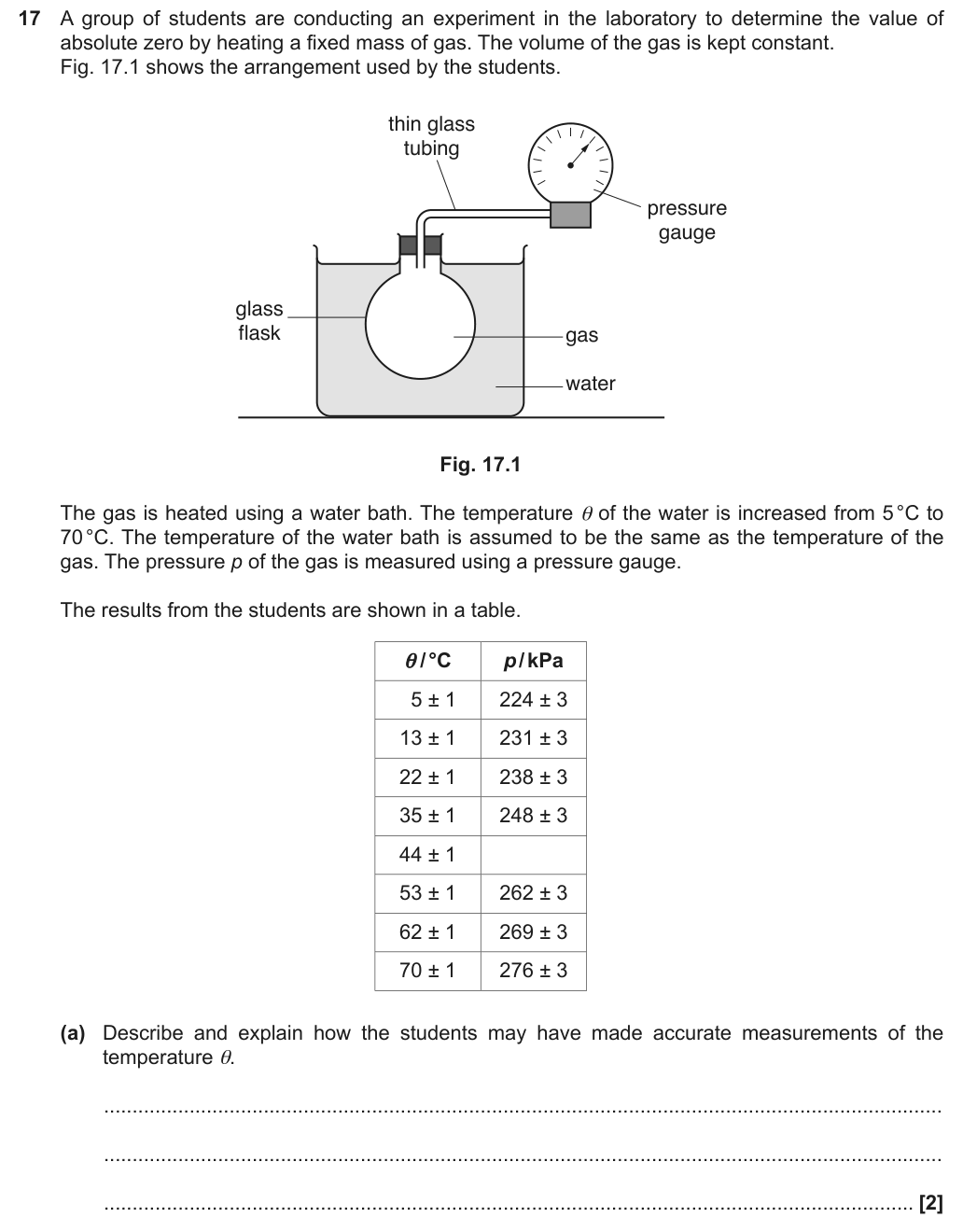
17(a) Practical skills: planning, analysis and evaluation 2Explanation
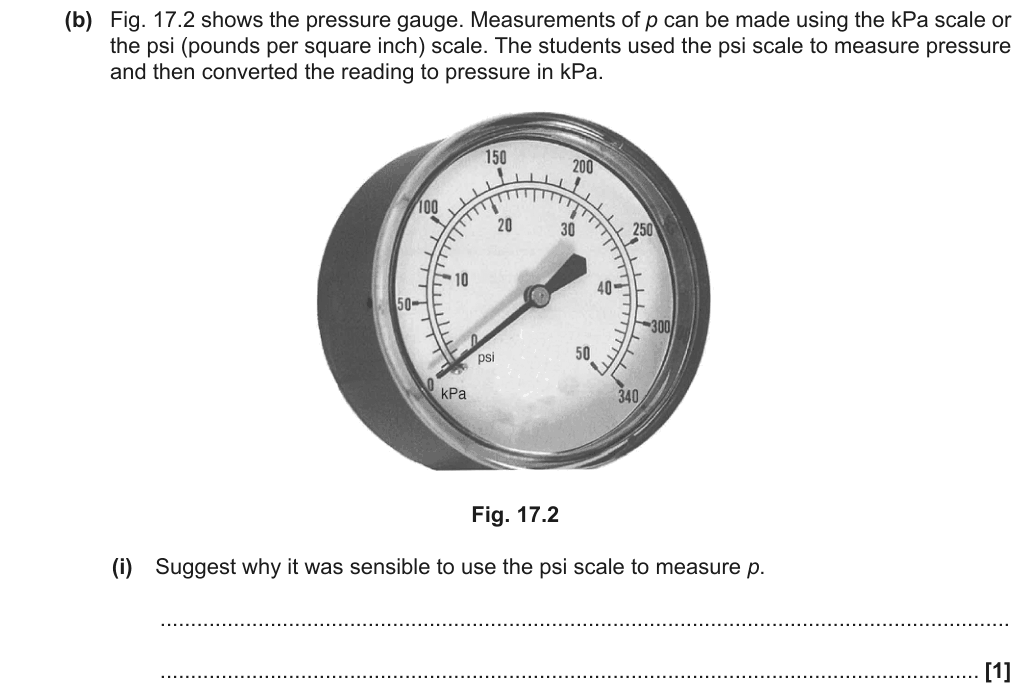
17(b)(i) Practical skills: planning, analysis and evaluation 1Explanation
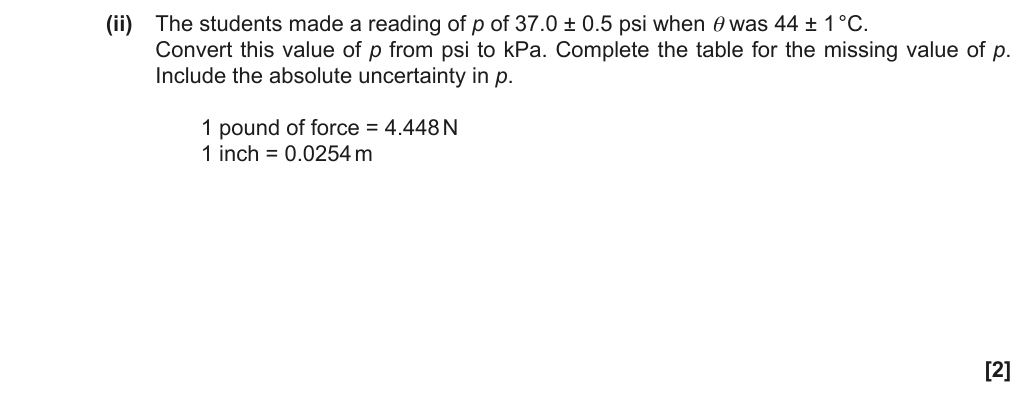
17(b)(ii) Density, pressure and upthrust, Practical skills: planning, analysis and evaluation, Measurements and uncertainties 2Short answer
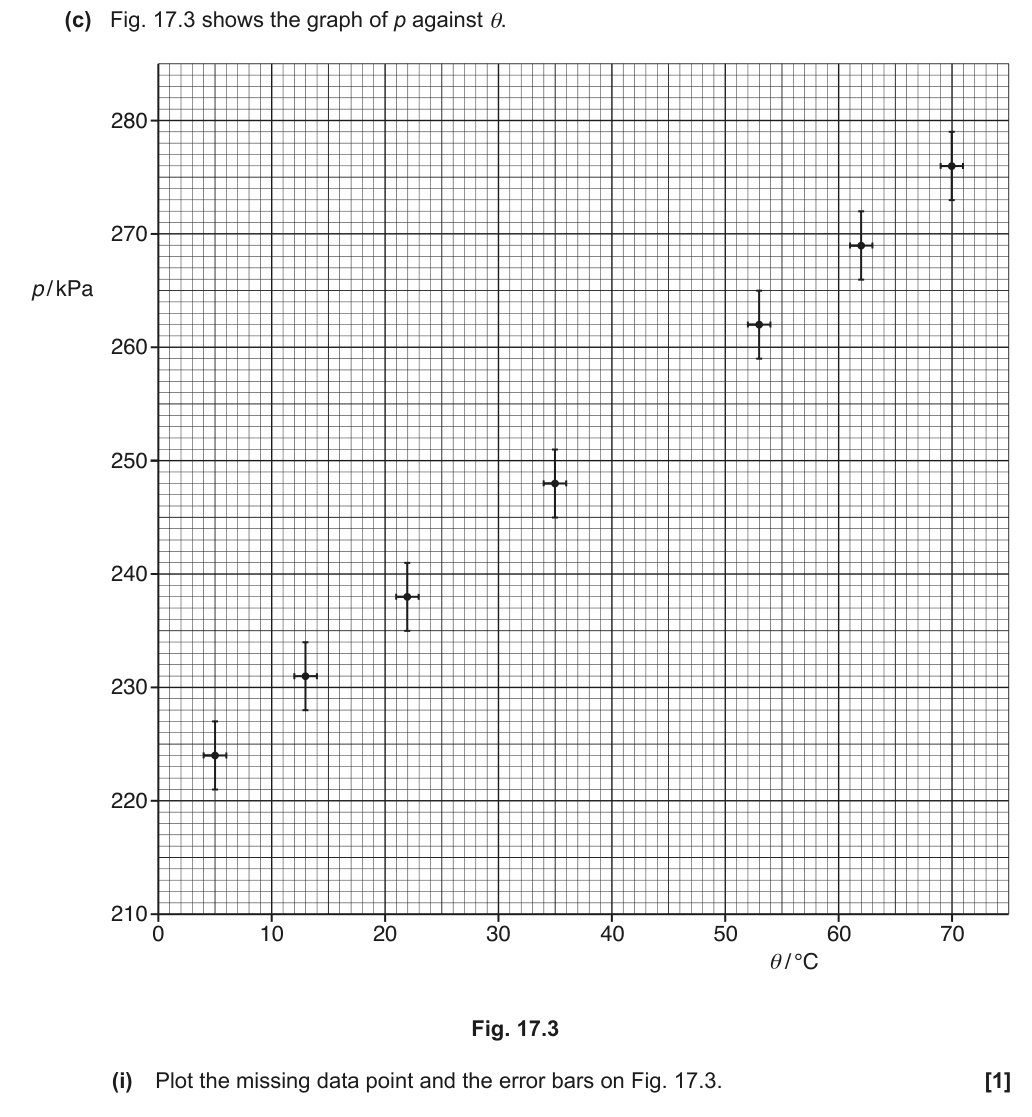
17(c)(i) Practical skills: planning, analysis and evaluation, Measurements and uncertainties 1Diagram or graph
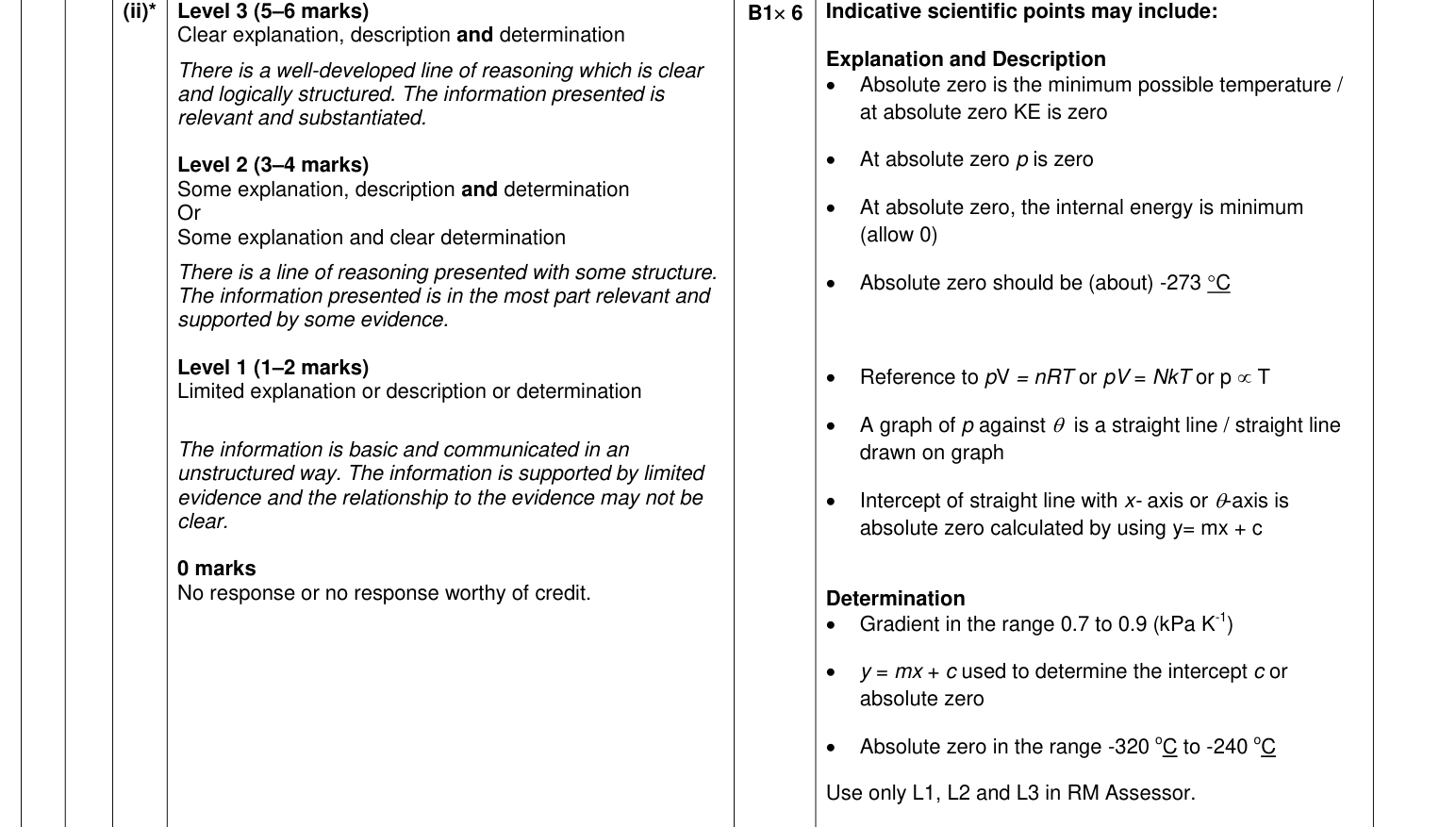
17(c)(ii) Ideal gases and the kinetic theory, Practical skills: planning, analysis and evaluation, Thermal physics: temperature, internal energy and specific heat capacity 6Extended response
17(d) Measurements and uncertainties 2Explanation
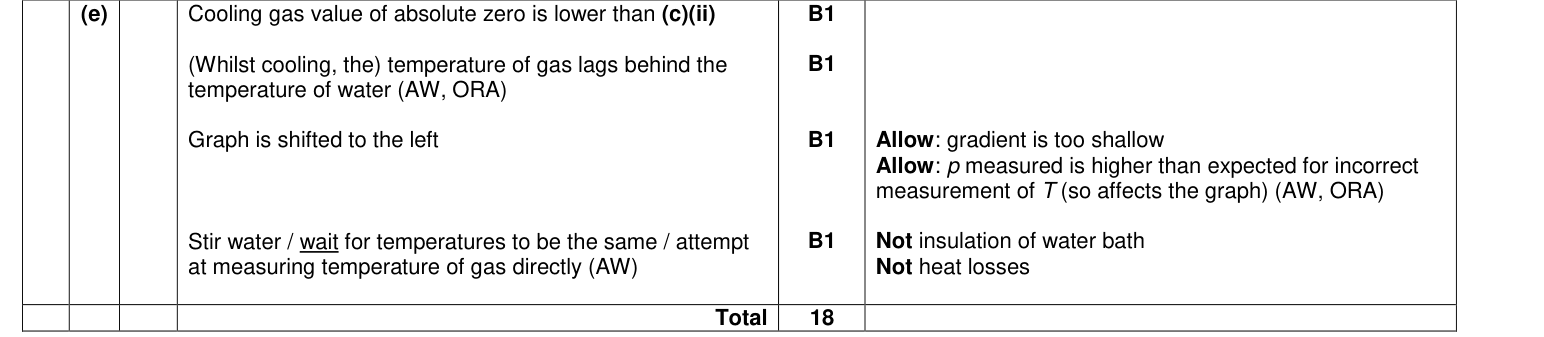
17(e) Measurements and uncertainties, Practical skills: planning, analysis and evaluation, Thermal physics: temperature, internal energy and specific heat capacity, Ideal gases and the kinetic theory 4Explanation
18(a)(i) Density, pressure and upthrust 2Calculation
18(a)(ii) Density, pressure and upthrust, Practical skills: planning, analysis and evaluation 2Explanation
18(b) Linear motion: the suvat equations and free fall 2Calculation
18(c)(i) Dynamics, drag and terminal velocity, Density, pressure and upthrust 3Diagram or graph
18(c)(ii) Dynamics, drag and terminal velocity, Density, pressure and upthrust 3Explanation
18(d) Practical skills: planning, analysis and evaluation 2Practical and data analysis
19(a)(i) Simple harmonic motion, damping and resonance 3Show that
19(a)(ii) Simple harmonic motion, damping and resonance 2Explanation
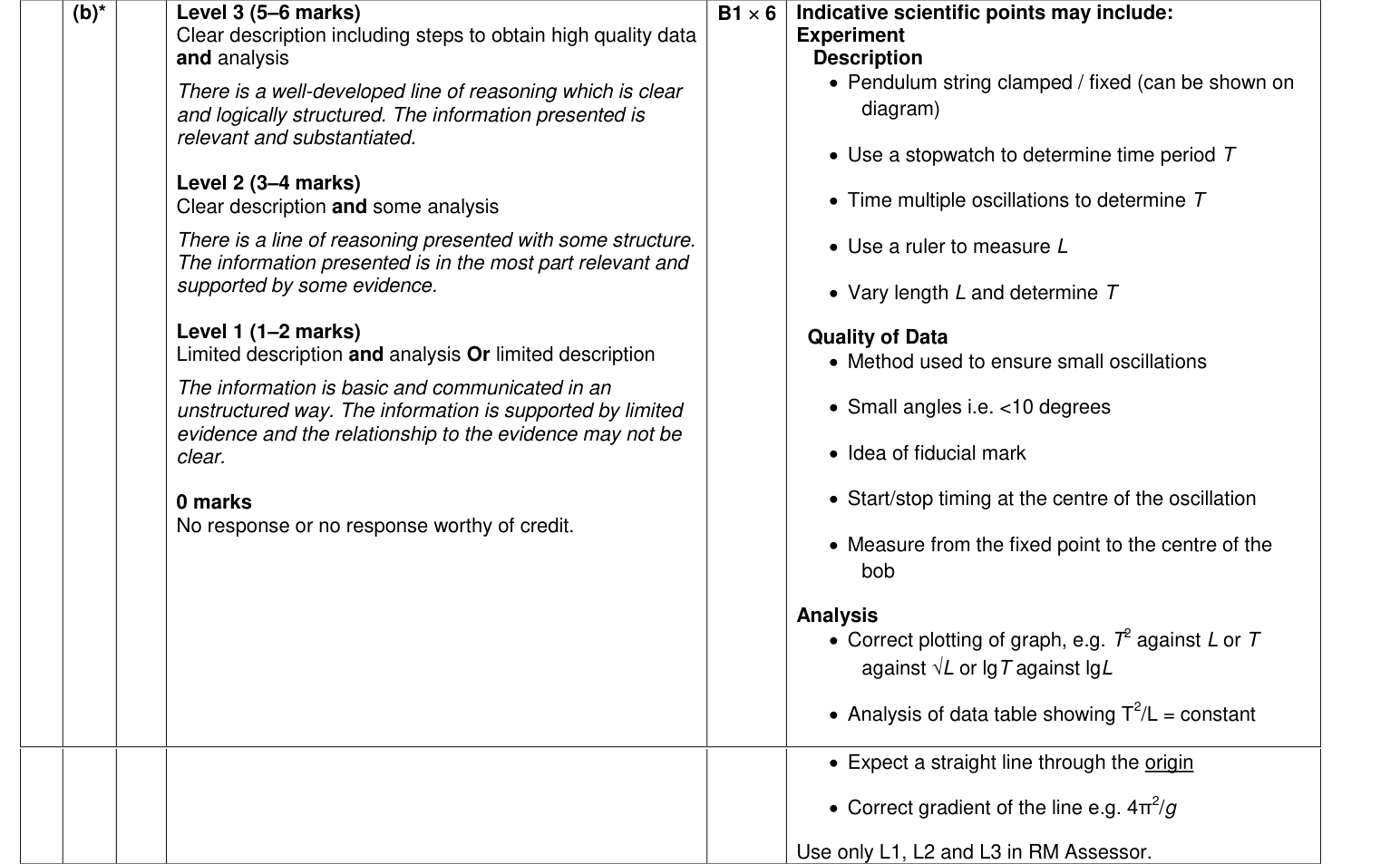
19(b) Simple harmonic motion, damping and resonance, Practical skills: planning, analysis and evaluation 6Extended response
19(c)(i) Simple harmonic motion, damping and resonance 2Show that
19(c)(ii) Simple harmonic motion, damping and resonance 2Explanation
20(a) Work, energy and power 2Calculation
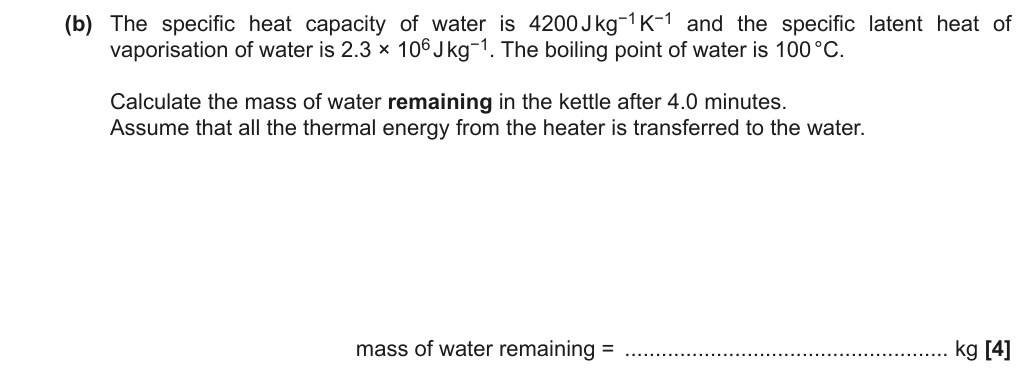
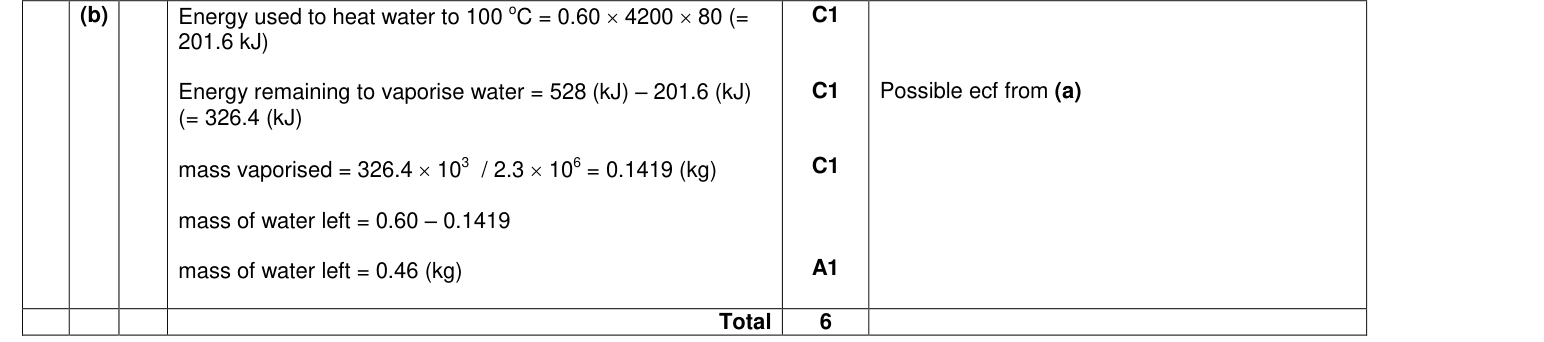
20(b) Thermal physics: temperature, internal energy and specific heat capacity 4Calculation
21(a)(i) Stars: stellar evolution, energy levels, spectra, Wien's law and Stefan's law 1Explanation
21(a)(ii) Stars: stellar evolution, energy levels, spectra, Wien's law and Stefan's law 4Calculation
21(b)(i) Stars: stellar evolution, energy levels, spectra, Wien's law and Stefan's law 1Short answer
21(b)(ii) Stars: stellar evolution, energy levels, spectra, Wien's law and Stefan's law 1Short answer
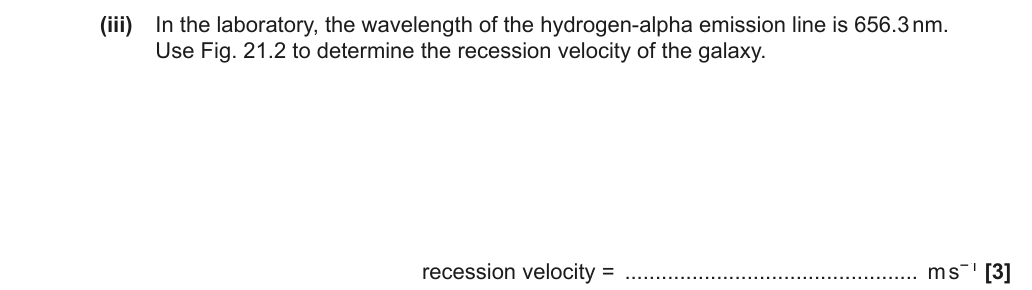
21(b)(iii) Cosmology: parallax, the Doppler effect, Hubble's law and the Big Bang 3Calculation
21(b)(iv) Stars: stellar evolution, energy levels, spectra, Wien's law and Stefan's law 1Explanation
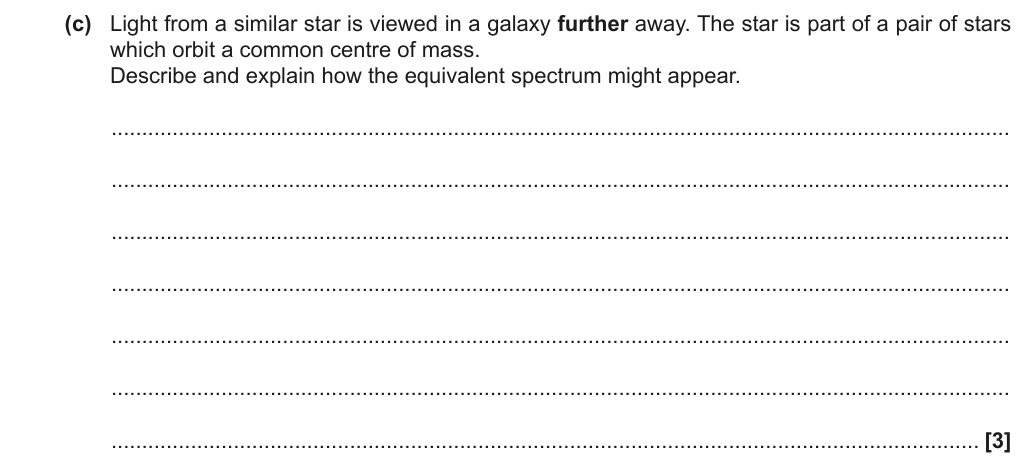
21(c) Cosmology: parallax, the Doppler effect, Hubble's law and the Big Bang 3Explanation
22(a) Thermal physics: temperature, internal energy and specific heat capacity 1Short answer
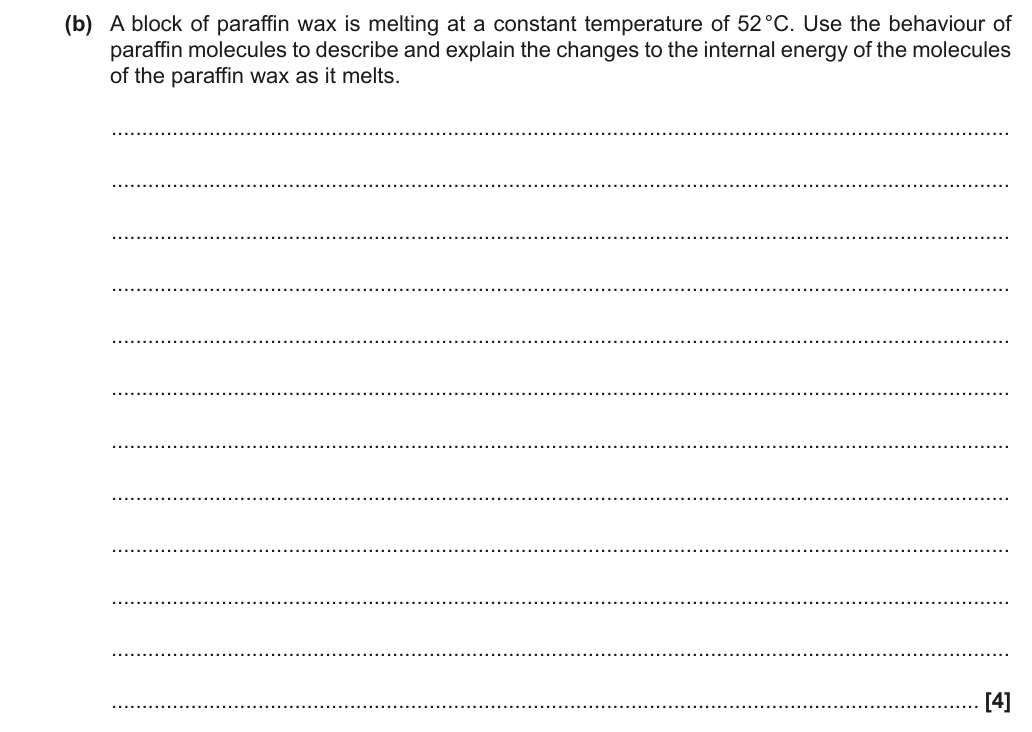
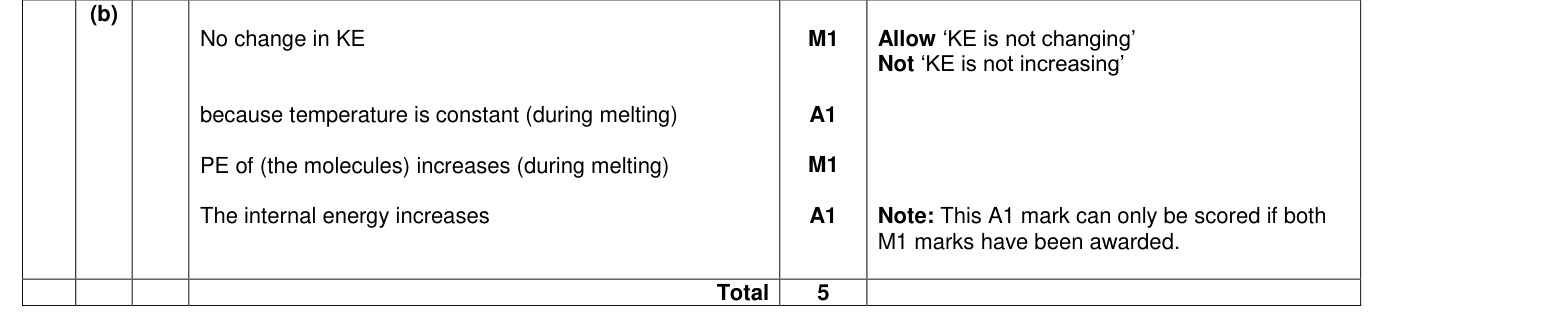
22(b) Thermal physics: temperature, internal energy and specific heat capacity 4Explanation
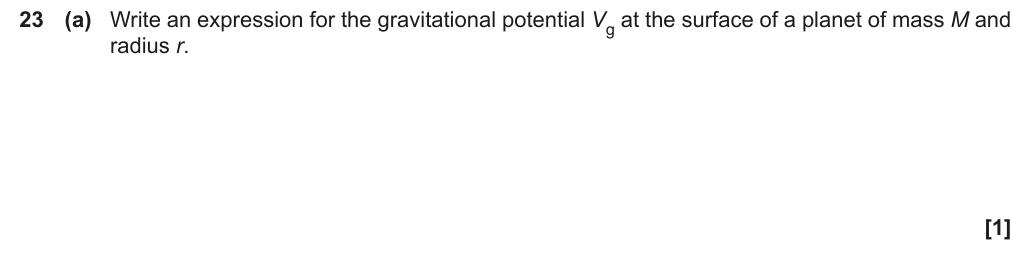
23(a) Gravitational fields, Newton's law of gravitation and gravitational potential 1Short answer
23(b)(i) Gravitational fields, Newton's law of gravitation and gravitational potential 2Show that
23(b)(ii) Gravitational fields, Newton's law of gravitation and gravitational potential 1Calculation
23(b)(iii) Gravitational fields, Newton's law of gravitation and gravitational potential, Ideal gases and the kinetic theory 3Practical and data analysis

The questions

12345678910111213141516(a)16(b)16(c)17(a)17(b)(i)17(b)(ii)17(c)(i)17(c)(ii)17(d)17(e)18(a)(i)18(a)(ii)18(b)18(c)(i)18(c)(ii)18(d)19(a)(i)19(a)(ii)19(b)19(c)(i)19(c)(ii)20(a)20(b)21(a)(i)21(a)(ii)21(b)(i)21(b)(ii)21(b)(iii)21(b)(iv)21(c)22(a)22(b)23(a)23(b)(i)23(b)(ii)23(b)(iii)
June 2017 · Paper 1 · Q1 1 mark Multiple choice gravitational fieldsquantities and units
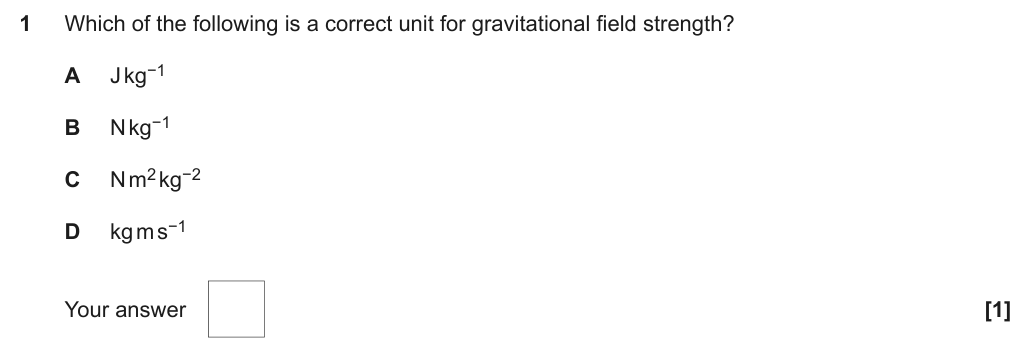
1 Which of the following is a correct unit for gravitational field strength?
A J kg−1
B N kg−1
C N m2 kg−2
D kg m s−1
Your answer [1]
June 2017 · Paper 1 · Q2 1 mark Multiple choice materials and young modulus
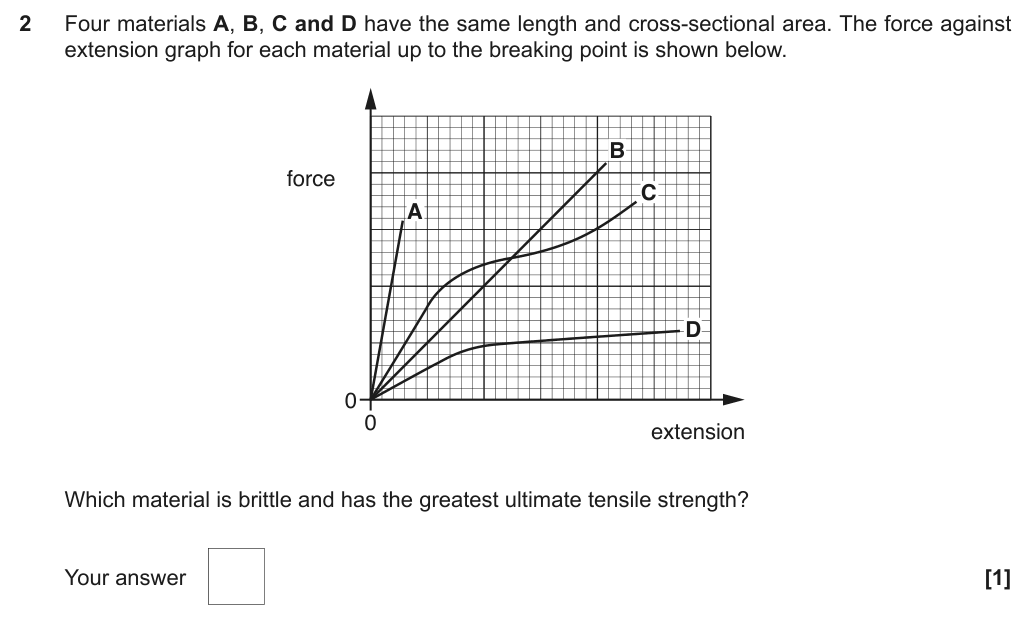
2 Four materials A, B, C and D have the same length and cross-sectional area. The force against
extension graph for each material up to the breaking point is shown below.
B
force
C
A
D
0
0
extension
Which material is brittle and has the greatest ultimate tensile strength?
Your answer [1]
June 2017 · Paper 1 · Q3 1 mark Multiple choice linear motionwork energy and power
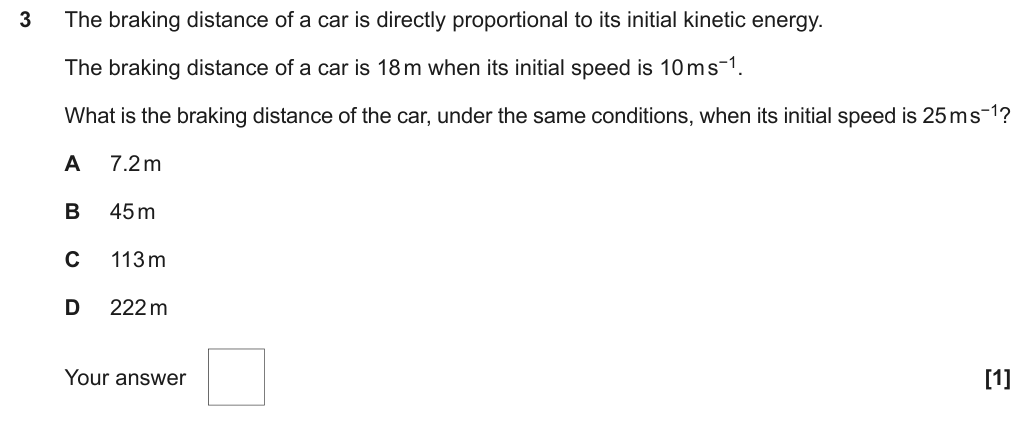
3 The braking distance of a car is directly proportional to its initial kinetic energy.
The braking distance of a car is 18 m when its initial speed is 10 m s−1.
What is the braking distance of the car, under the same conditions, when its initial speed is 25 m s−1?
A 7.2 m
B 45 m
C 113 m
D 222 m
Your answer [1]
June 2017 · Paper 1 · Q4 1 mark Multiple choice linear motion
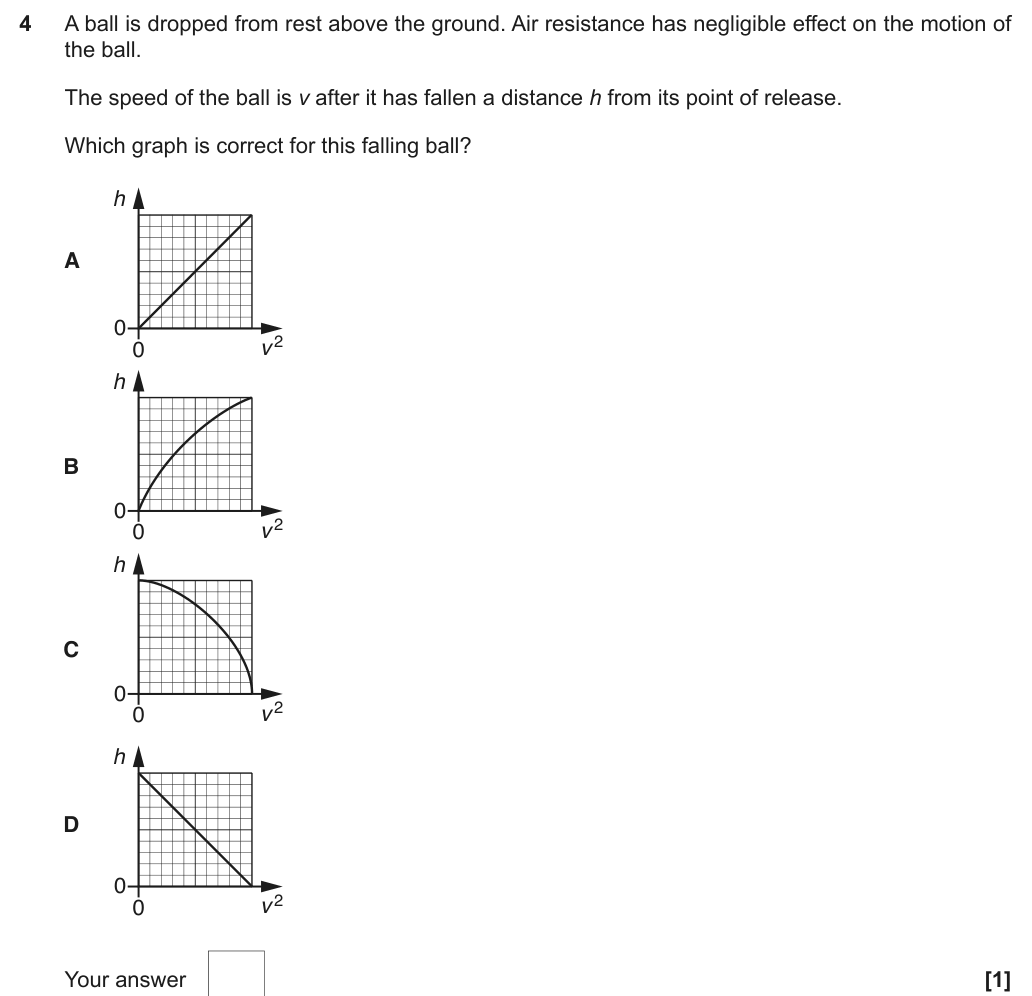
4 A ball is dropped from rest above the ground. Air resistance has negligible effect on the motion of
the ball.
The speed of the ball is v after it has fallen a distance h from its point of release.
Which graph is correct for this falling ball?
h
A
0
0 v 2
h
B
0
0 v 2
h
C
0
0 v 2
h
D
0
0 v 2
Your answer [1]
June 2017 · Paper 1 · Q5 1 mark Multiple choice measurements and uncertaintiespractical skills
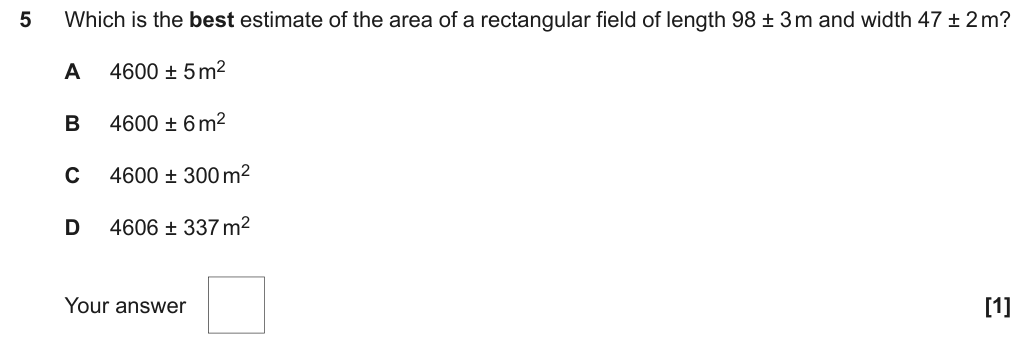
5 Which is the best estimate of the area of a rectangular field of length 98 ± 3 m and width 47 ± 2 m?
A 4600 ± 5 m2
B 4600 ± 6 m2
C 4600 ± 300 m2
D 4606 ± 337 m2
Your answer [1]
June 2017 · Paper 1 · Q6 1 mark Multiple choice materials and young modulusdensity and pressure
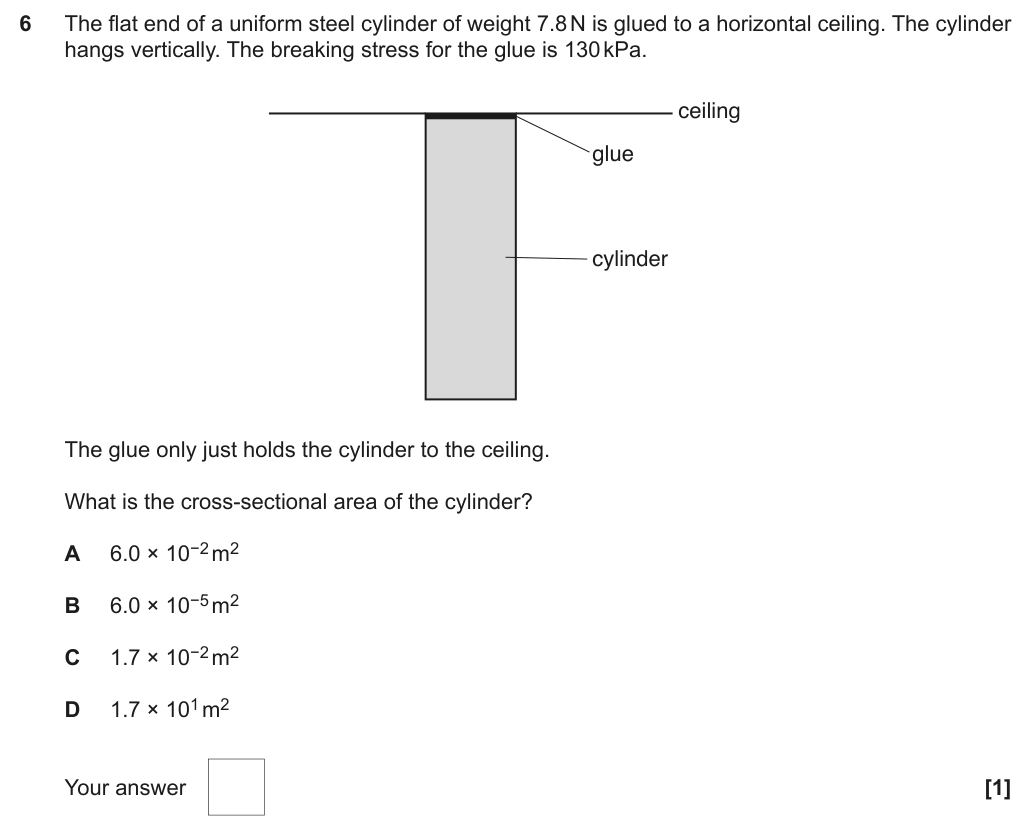
6 The flat end of a uniform steel cylinder of weight 7.8 N is glued to a horizontal ceiling. The cylinder
hangs vertically. The breaking stress for the glue is 130 kPa.
ceiling
glue
cylinder
The glue only just holds the cylinder to the ceiling.
What is the cross-sectional area of the cylinder?
A 6.0 × 10⁻² m2
B 6.0 × 10⁻⁵ m2
C 1.7 × 10⁻² m2
D 1.7 × 101 m2
Your answer [1]
June 2017 · Paper 1 · Q7 1 mark Multiple choice starsthermal physics
7 The intensity against wavelength graph of an object at 750 °C peaks at a wavelength of λ. The
temperature of the object is raised to 960 °C.
What is the wavelength now at the new peak intensity in terms of λ?
A 0.78 λ
B 0.83 λ
C 1.2 λ
D 1.3 λ
Your answer [1]
June 2017 · Paper 1 · Q8 1 mark Multiple choice dynamics and terminal velocityscalars and vectors
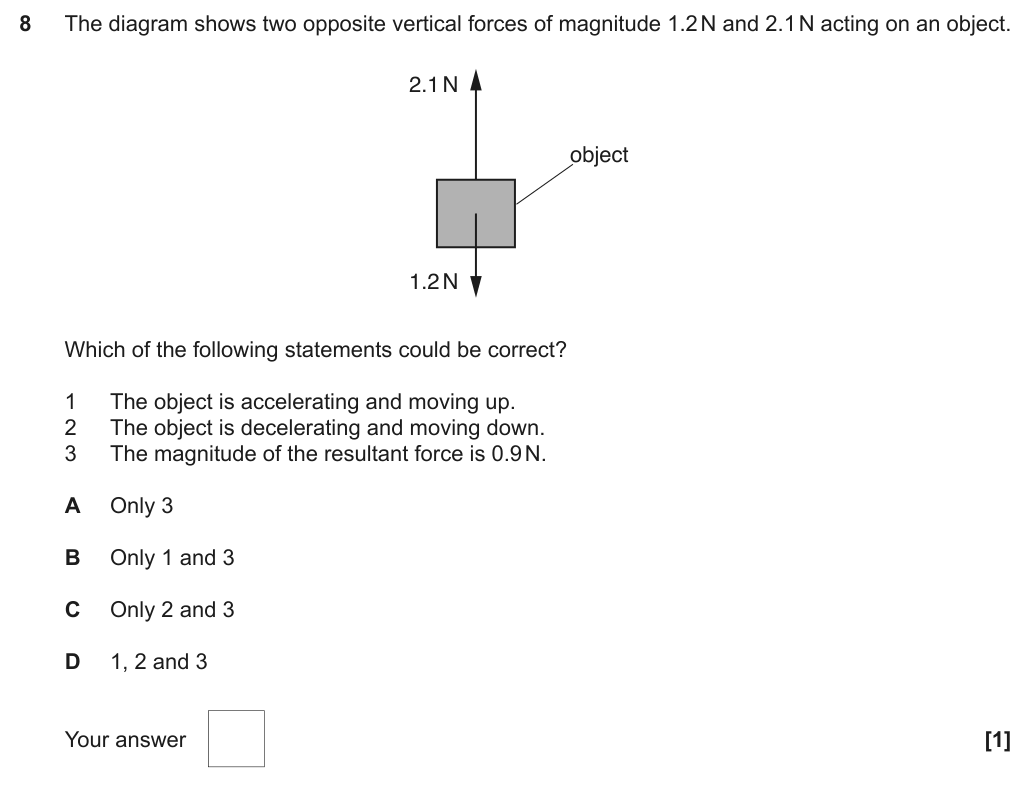
8 The diagram shows two opposite vertical forces of magnitude 1.2 N and 2.1 N acting on an object.
2.1 N
object
1.2 N
Which of the following statements could be correct?
1 The object is accelerating and moving up.
2 The object is decelerating and moving down.
3 The magnitude of the resultant force is 0.9 N.
A Only 3
B Only 1 and 3
C Only 2 and 3
D 1, 2 and 3
Your answer [1]
June 2017 · Paper 1 · Q9 1 mark Multiple choice gravitational fields
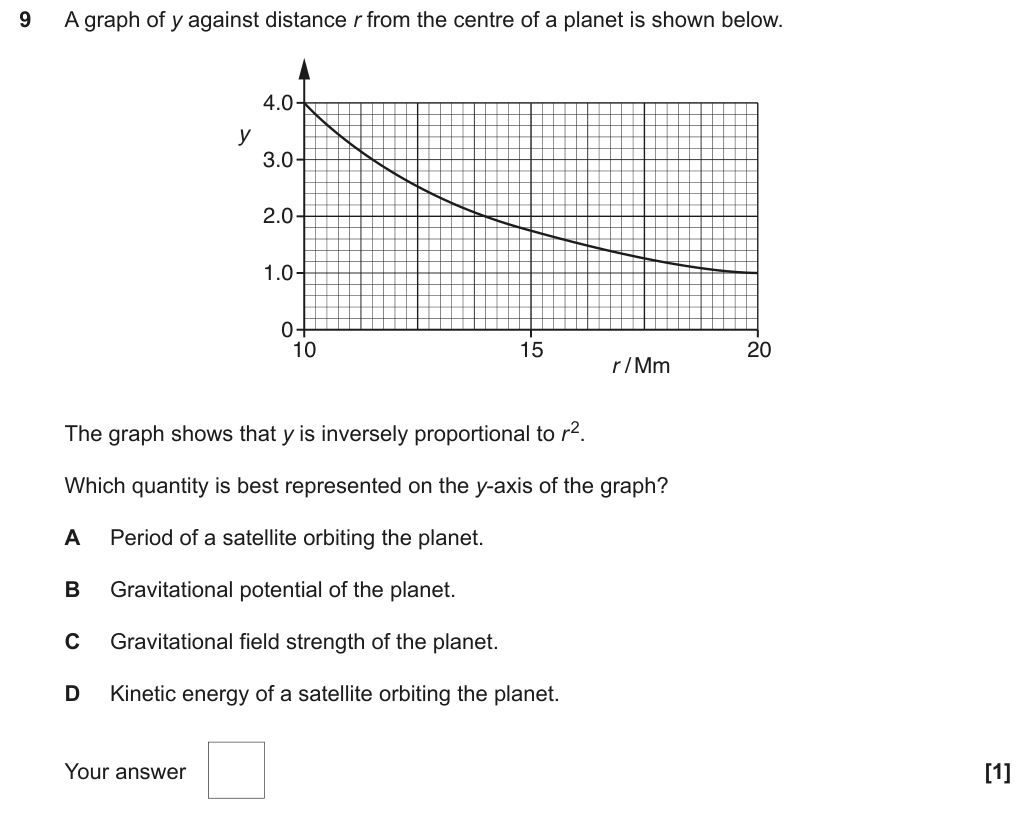
9 A graph of y against distance r from the centre of a planet is shown below.
4.0
y
3.0
2.0
1.0
0
10 15 20
r / Mm
The graph shows that y is inversely proportional to r 2.
Which quantity is best represented on the y-axis of the graph?
A Period of a satellite orbiting the planet.
B Gravitational potential of the planet.
C Gravitational field strength of the planet.
D Kinetic energy of a satellite orbiting the planet.
Your answer [1]
June 2017 · Paper 1 · Q10 1 mark Multiple choice cosmologystars
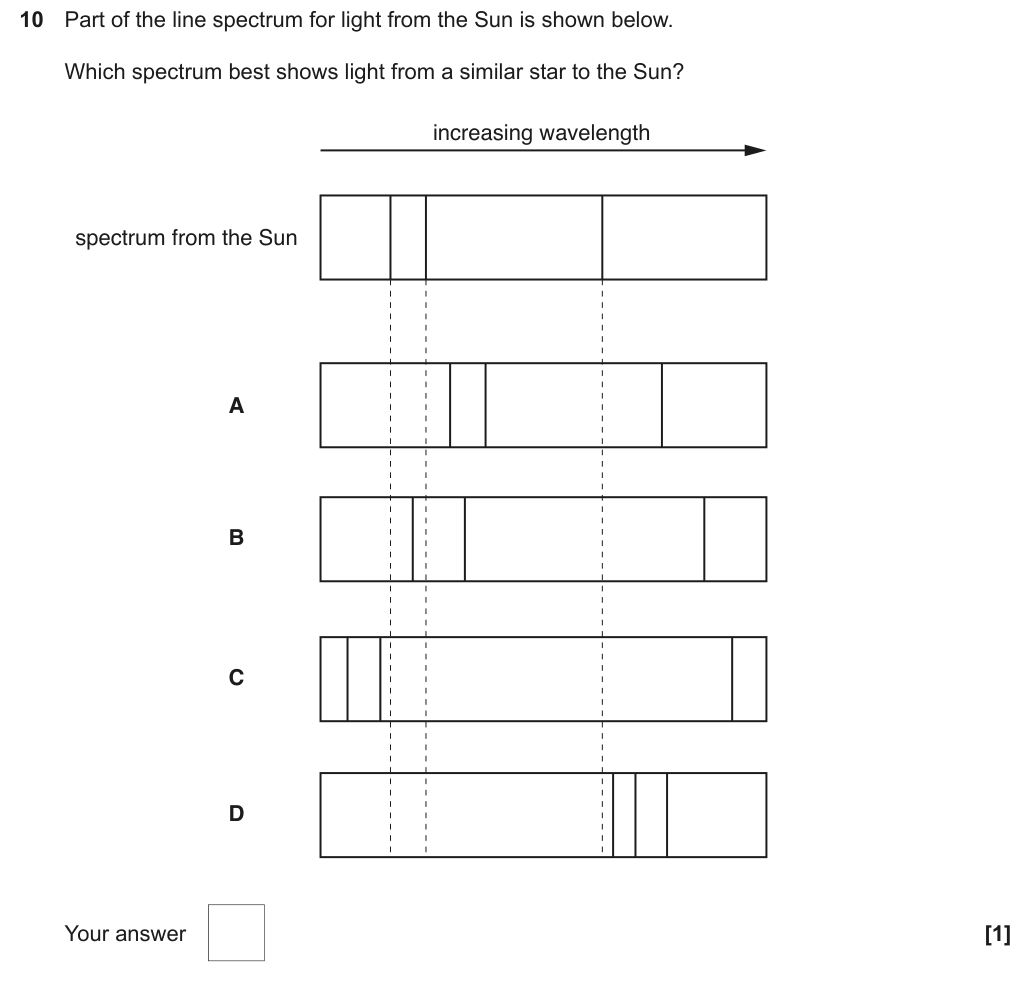
10 Part of the line spectrum for light from the Sun is shown below.
Which spectrum best shows light from a similar star to the Sun?
increasing wavelength
spectrum from the Sun
A
B
C
D
Your answer [1]
June 2017 · Paper 1 · Q11 1 mark Multiple choice materials and young modulus
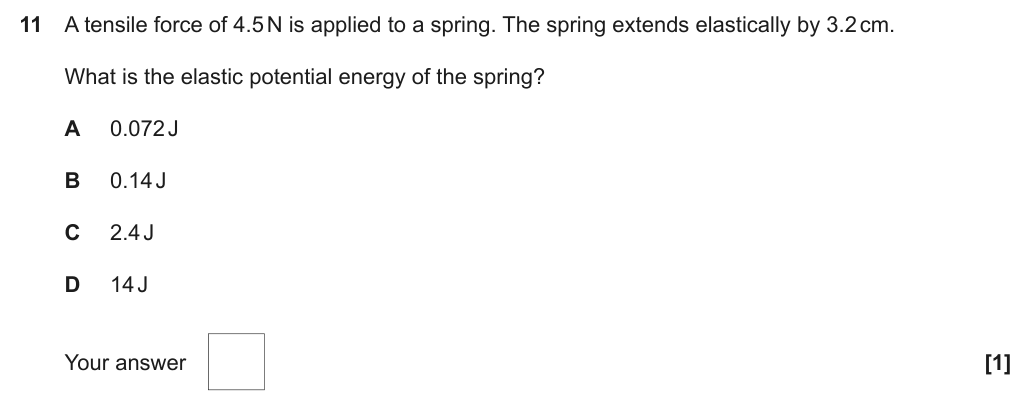
11 A tensile force of 4.5 N is applied to a spring. The spring extends elastically by 3.2 cm.
What is the elastic potential energy of the spring?
A 0.072 J
B 0.14 J
C 2.4 J
D 14 J
Your answer [1]
June 2017 · Paper 1 · Q12 1 mark Multiple choice linear motion
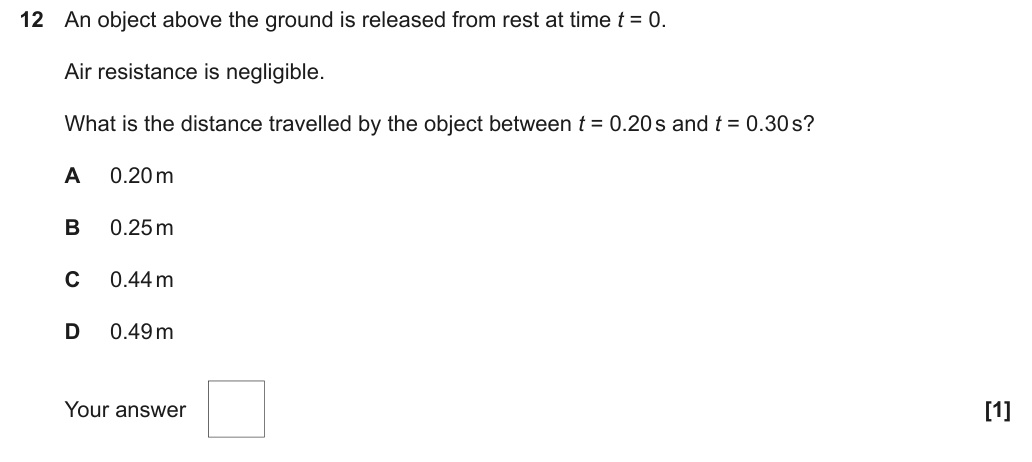
12 An object above the ground is released from rest at time t = 0.
Air resistance is negligible.
What is the distance travelled by the object between t = 0.20 s and t = 0.30 s?
A 0.20 m
B 0.25 m
C 0.44 m
D 0.49 m
Your answer [1]
June 2017 · Paper 1 · Q13 1 mark Multiple choice newtons laws and momentum
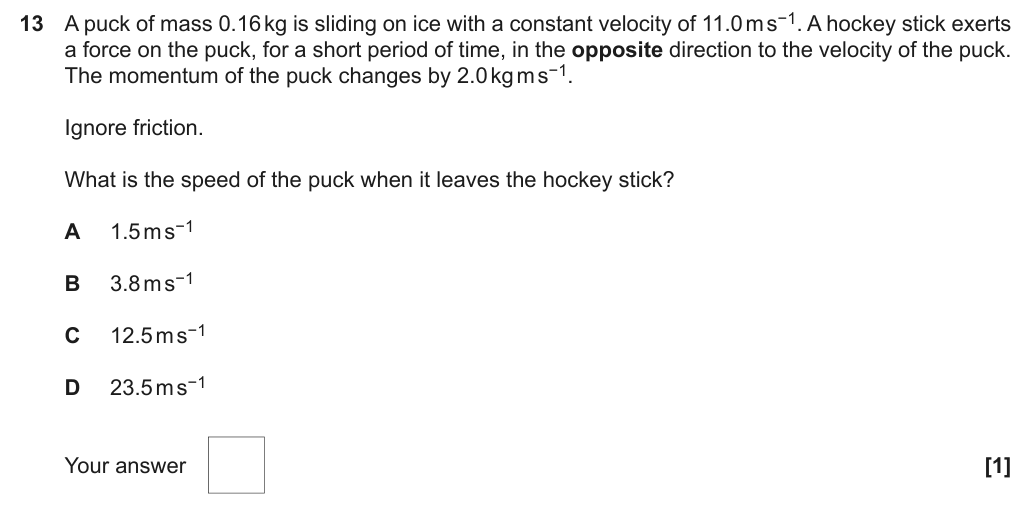
13 A puck of mass 0.16 kg is sliding on ice with a constant velocity of 11.0 m s−1. A hockey stick exerts
a force on the puck, for a short period of time, in the opposite direction to the velocity of the puck.
The momentum of the puck changes by 2.0 kg m s−1.
Ignore friction.
What is the speed of the puck when it leaves the hockey stick?
A 1.5 m s−1
B 3.8 m s−1
C 12.5 m s−1
D 23.5 m s−1
Your answer [1]
June 2017 · Paper 1 · Q14 1 mark Multiple choice ideal gases
14 A container has an ideal gas. The mean square speed of the gas molecules in the container is
3.0 × 10⁵ m2 s−2.
Over a period of time, a third of the gas molecules escape from the container. The pressure and
volume of the gas in the container remain the same.
What is the mean square speed of the molecules left in the container?
A 1.0 × 10⁵ m2 s−2
B 2.0 × 10⁵ m2 s−2
C 4.5 × 10⁵ m2 s−2
D 9.0 × 10⁵ m2 s−2
Your answer [1]
June 2017 · Paper 1 · Q15 1 mark Multiple choice cosmology
15 Which two quantities are related in Hubble’s law?
A Distance and mass of galaxies.
B Velocity and intensity of galaxies.
C Distance and velocity of galaxies.
D Distance and red shift of stars in our galaxy.
Your answer [1]
June 2017 · Paper 1 · Q16(a) 2 marks Calculation work energy and power
16 Fig. 16 shows a hydraulic jack used to lift a car which has a mass of 1200 kg. A mechanic exerts a
downwards force of 400 N on the handle of the jack, moving it 80.0 cm downwards. As he moves
the handle, the car rises 2.0 cm.
400 N
80 cm
car mass
1200 kg
handle
2.0 cm
oil
Fig. 16
(a) Calculate the work done by the 400 N force exerted by the mechanic.
work done =  ....................................................... J [2]
June 2017 · Paper 1 · Q16(b) 2 marks Calculation kinematics
Earlier part of question 16 that this part usesEarlier part of June 2017 Paper 1 question 16
(b) Calculate the ratio
speed of handle moving down
.
speed of car moving up
ratio =  .......................................................... [2]
June 2017 · Paper 1 · Q16(c) 2 marks Calculation work energy and power
Earlier part of question 16 that this part usesEarlier part of June 2017 Paper 1 question 16
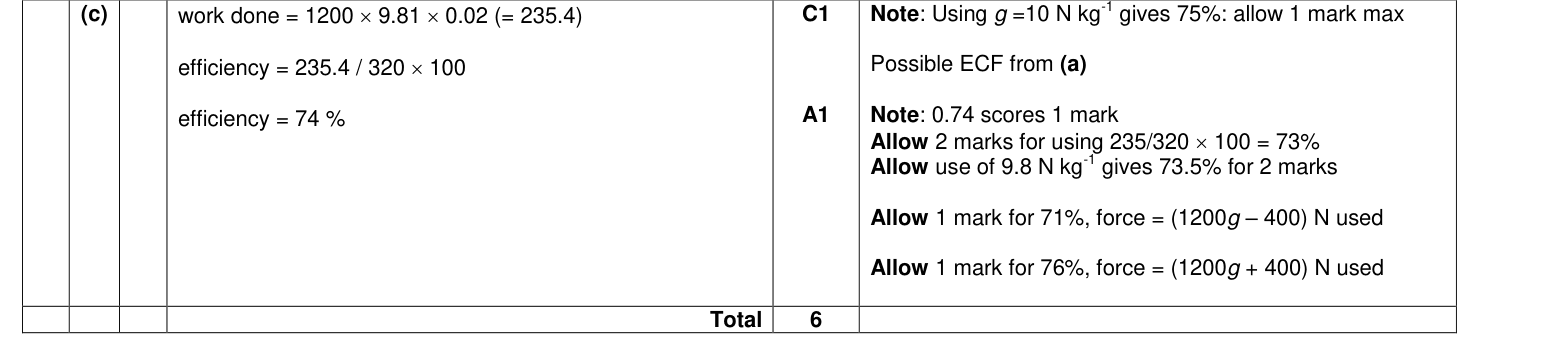
(c) Calculate the useful work done on the car and hence the percentage efficiency of the jack.
efficiency =  ...................................................... % [2]
June 2017 · Paper 1 · Q17(a) 2 marks Explanation practical skills
17 A group of students are conducting an experiment in the laboratory to determine the value of
absolute zero by heating a fixed mass of gas. The volume of the gas is kept constant.
Fig. 17.1 shows the arrangement used by the students.
thin glass
tubing
pressure
gauge
glass
flask gas
water
Fig. 17.1
The gas is heated using a water bath. The temperature θ of the water is increased from 5 °C to
70 °C. The temperature of the water bath is assumed to be the same as the temperature of the
gas. The pressure p of the gas is measured using a pressure gauge.
The results from the students are shown in a table.
θ  / °C p / kPa
5 ± 1 224 ± 3
13 ± 1 231 ± 3
22 ± 1 238 ± 3
35 ± 1 248 ± 3
44 ± 1
53 ± 1 262 ± 3
62 ± 1 269 ± 3
70 ± 1 276 ± 3
(a) Describe and explain how the students may have made accurate measurements of the
temperature θ.
...................................................................................................................................................
...................................................................................................................................................
.............................................................................................................................................. [2]
June 2017 · Paper 1 · Q17(b)(i) 1 mark Explanation practical skills
(b) Fig. 17.2 shows the pressure gauge. Measurements of p can be made using the kPa scale or
the psi (pounds per square inch) scale. The students used the psi scale to measure pressure
and then converted the reading to pressure in kPa.
Fig. 17.2
(i) Suggest why it was sensible to use the psi scale to measure p.
...........................................................................................................................................
...................................................................................................................................... [1]
June 2017 · Paper 1 · Q17(b)(ii) 2 marks Short answer density and pressurepractical skillsmeasurements and uncertainties
Earlier parts of question 17 that this part usesEarlier part of June 2017 Paper 1 question 17Earlier part of June 2017 Paper 1 question 17
(ii) The students made a reading of p of 37.0 ± 0.5 psi when θ was 44 ± 1 °C.
Convert this value of p from psi to kPa. Complete the table for the missing value of p.
Include the absolute uncertainty in p.
1 pound of force = 4.448 N
1 inch = 0.0254 m
[2]
June 2017 · Paper 1 · Q17(c)(i) 1 mark Diagram or graph practical skillsmeasurements and uncertainties
Earlier parts of question 17 that this part usesEarlier part of June 2017 Paper 1 question 17Earlier part of June 2017 Paper 1 question 17
(c) Fig. 17.3 shows the graph of p against θ.
280
270
p / kPa
260
250
240
230
220
210
0 10 20 30 40 50 60 70
θ / °C
Fig. 17.3
(i) Plot the missing data point and the error bars on Fig. 17.3. [1]
June 2017 · Paper 1 · Q17(c)(ii) 6 marks 6-mark extended response ideal gasespractical skillsthermal physics
Earlier part of question 17 that this part usesEarlier part of June 2017 Paper 1 question 17
(ii)* Explain what is meant by absolute zero. Describe how Fig. 17.3 can be used to determine
the value of absolute zero.
Determine the value of absolute zero. You may assume that the gas behaves as an ideal
gas.
...........................................................................................................................................
...........................................................................................................................................
...........................................................................................................................................
...........................................................................................................................................
...........................................................................................................................................
...........................................................................................................................................
...........................................................................................................................................
...........................................................................................................................................
...........................................................................................................................................
...........................................................................................................................................
...........................................................................................................................................
...........................................................................................................................................
...........................................................................................................................................
...........................................................................................................................................
...........................................................................................................................................
...........................................................................................................................................
...........................................................................................................................................
...........................................................................................................................................
...........................................................................................................................................
...........................................................................................................................................
...........................................................................................................................................
...........................................................................................................................................
...........................................................................................................................................
...........................................................................................................................................
...................................................................................................................................... [6]
June 2017 · Paper 1 · Q17(d) 2 marks Explanation measurements and uncertainties
Earlier parts of question 17 that this part usesEarlier part of June 2017 Paper 1 question 17Earlier part of June 2017 Paper 1 question 17
(d) Describe, without doing any calculations, how you could use Fig. 17.3 to determine the actual
uncertainty in the value of absolute zero in (c)(ii).
...................................................................................................................................................
...................................................................................................................................................
...................................................................................................................................................
.............................................................................................................................................. [2]
June 2017 · Paper 1 · Q17(e) 4 marks Explanation measurements and uncertaintiespractical skillsthermal physicsideal gases
Earlier parts of question 17 that this part usesEarlier part of June 2017 Paper 1 question 17Earlier part of June 2017 Paper 1 question 17
(e) The experiment is repeated as the water bath quickly cools from 70 °C to 5 °C. Absolute zero
was found to be −390 °C.
Compare this value with your value from (c)(ii) and explain why the values may differ. Describe
an experimental approach that could be taken to avoid systematic error in the determination
of absolute zero.
...................................................................................................................................................
...................................................................................................................................................
...................................................................................................................................................
...................................................................................................................................................
...................................................................................................................................................
...................................................................................................................................................
...................................................................................................................................................
...................................................................................................................................................
...................................................................................................................................................
...................................................................................................................................................
.............................................................................................................................................. [4]
June 2017 · Paper 1 · Q18(a)(i) 2 marks Calculation density and pressure
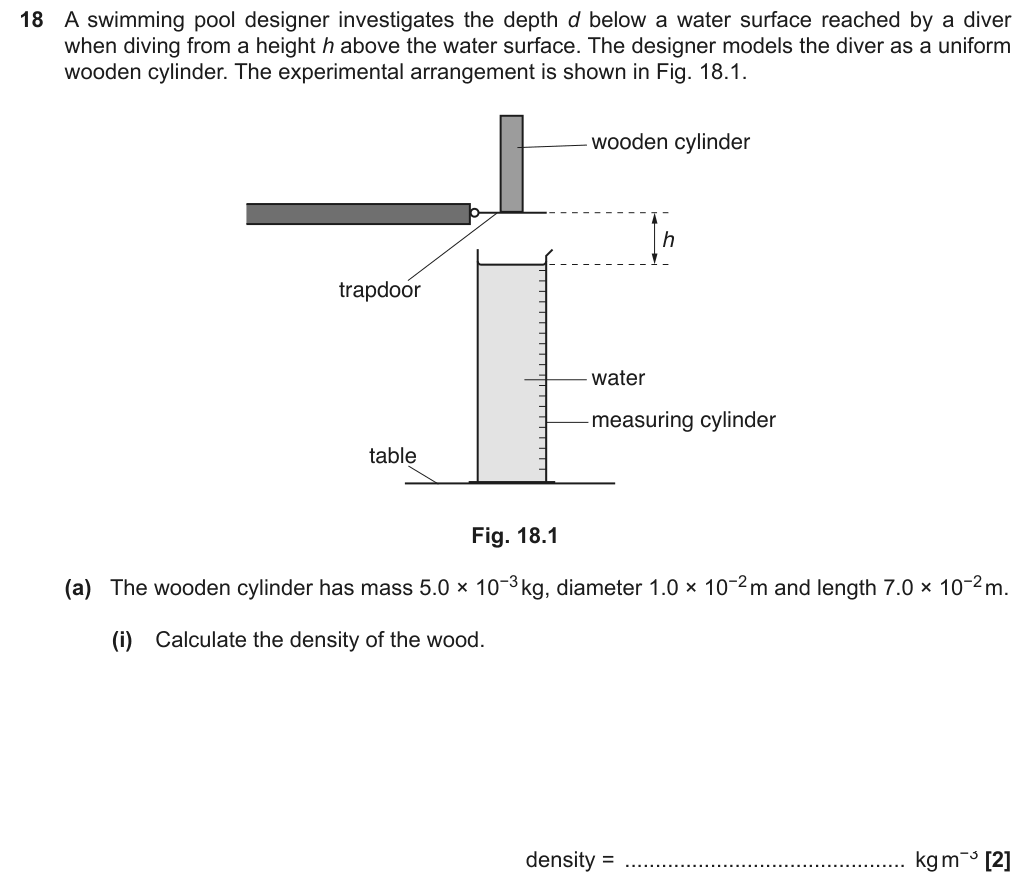
18 A swimming pool designer investigates the depth d below a water surface reached by a diver
when diving from a height h above the water surface. The designer models the diver as a uniform
wooden cylinder. The experimental arrangement is shown in Fig. 18.1.
wooden cylinder
h
trapdoor
water
measuring cylinder
table
Fig. 18.1
(a) The wooden cylinder has mass 5.0 × 10⁻³ kg, diameter 1.0 × 10⁻² m and length 7.0 × 10⁻² m.
(i) Calculate the density of the wood.
density =  .............................................. kg m−3 [2]
June 2017 · Paper 1 · Q18(a)(ii) 2 marks Explanation density and pressurepractical skills
Earlier part of question 18 that this part usesEarlier part of June 2017 Paper 1 question 18
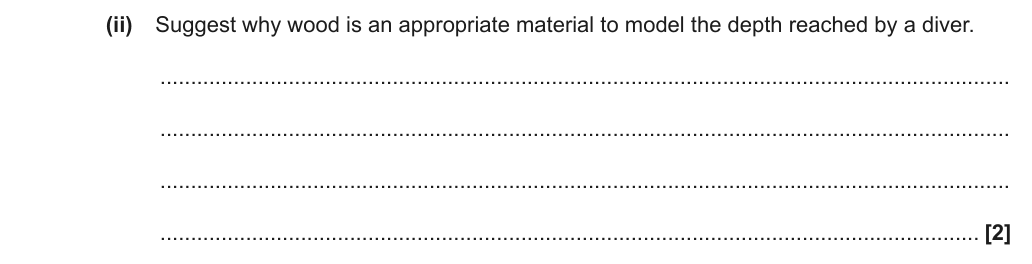
(ii) Suggest why wood is an appropriate material to model the depth reached by a diver.
...........................................................................................................................................
...........................................................................................................................................
...........................................................................................................................................
...................................................................................................................................... [2]
June 2017 · Paper 1 · Q18(b) 2 marks Calculation linear motion
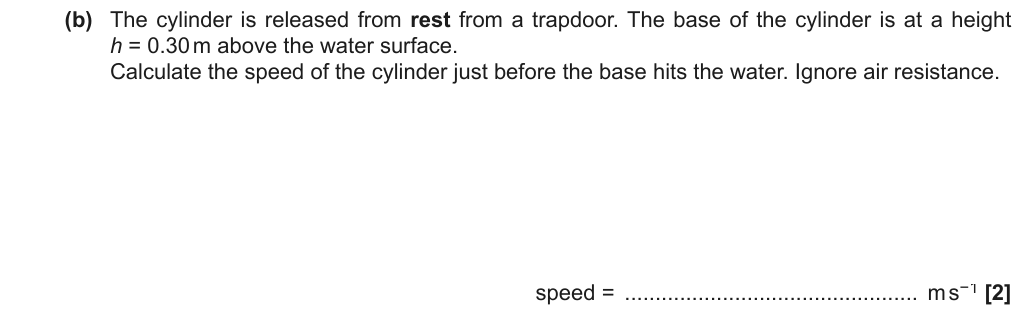
(b) The cylinder is released from rest from a trapdoor. The base of the cylinder is at a height
h = 0.30 m above the water surface.
Calculate the speed of the cylinder just before the base hits the water. Ignore air resistance.
speed =  ................................................ m s−1 [2]
June 2017 · Paper 1 · Q18(c)(i) 3 marks Diagram or graph dynamics and terminal velocitydensity and pressure
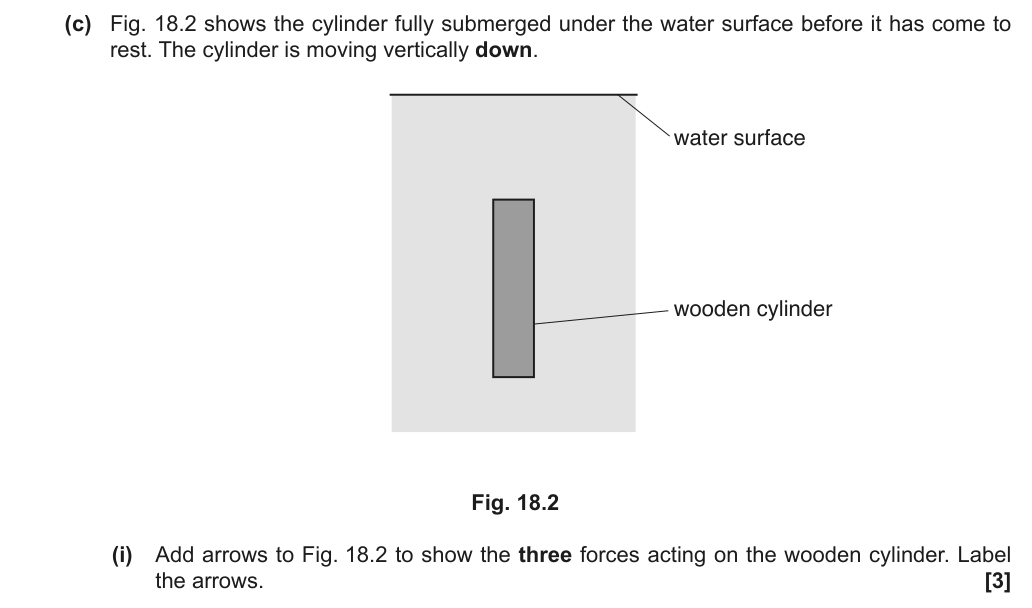
(c) Fig. 18.2 shows the cylinder fully submerged under the water surface before it has come to
rest. The cylinder is moving vertically down.
water surface
wooden cylinder
Fig. 18.2
(i) Add arrows to Fig. 18.2 to show the three forces acting on the wooden cylinder. Label
the arrows. [3]
June 2017 · Paper 1 · Q18(c)(ii) 3 marks Explanation dynamics and terminal velocitydensity and pressure
Earlier part of question 18 that this part usesEarlier part of June 2017 Paper 1 question 18
(ii) Describe and explain how the resultant force on the wooden cylinder varies from the
moment the cylinder is fully submerged until it reaches its deepest point.
...........................................................................................................................................
...........................................................................................................................................
...........................................................................................................................................
...........................................................................................................................................
...........................................................................................................................................
...................................................................................................................................... [3]
June 2017 · Paper 1 · Q18(d) 2 marks Practical and data analysis practical skills
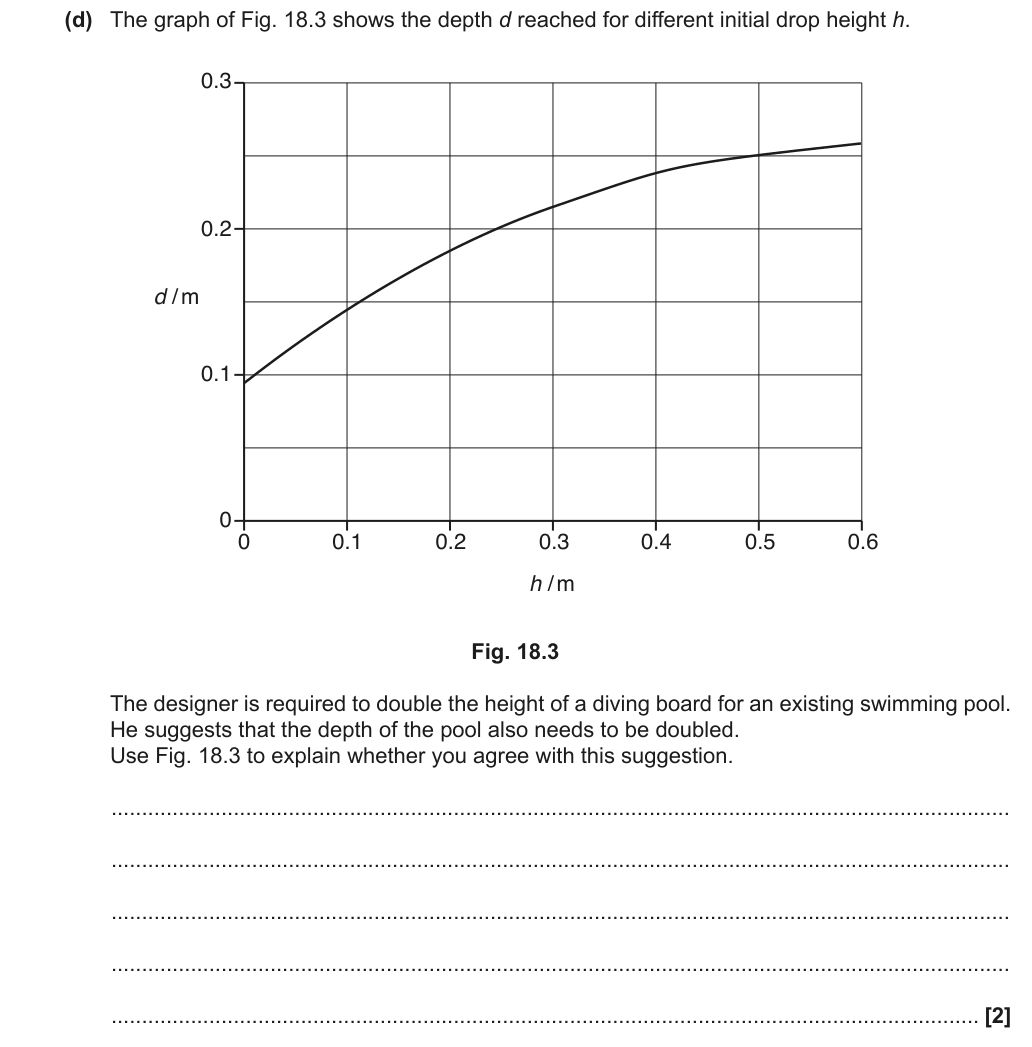
(d) The graph of Fig. 18.3 shows the depth d reached for different initial drop height h.
0.3
0.2
d / m
0.1
0
0 0.1 0.2 0.3 0.4 0.5 0.6
h / m
Fig. 18.3
The designer is required to double the height of a diving board for an existing swimming pool.
He suggests that the depth of the pool also needs to be doubled.
Use Fig. 18.3 to explain whether you agree with this suggestion.
...................................................................................................................................................
...................................................................................................................................................
...................................................................................................................................................
...................................................................................................................................................
.............................................................................................................................................. [2]
June 2017 · Paper 1 · Q19(a)(i) 3 marks Show that simple harmonic motion
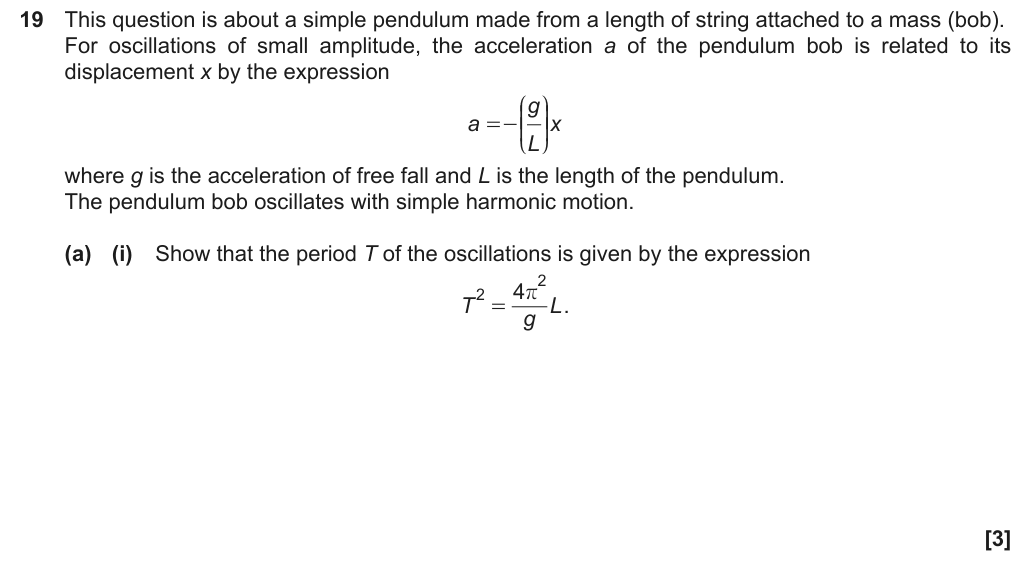
19 This question is about a simple pendulum made from a length of string attached to a mass (bob).
For oscillations of small amplitude, the acceleration a of the pendulum bob is related to its
displacement x by the expression
J g N
a KK OO x
=-
L
L P
where g is the acceleration of free fall and L is the length of the pendulum.
The pendulum bob oscillates with simple harmonic motion.
(a) (i) Show that the period T of the oscillations is given by the expression
4 2
2 r
T = g L .
[3]
June 2017 · Paper 1 · Q19(a)(ii) 2 marks Explanation simple harmonic motion
Earlier part of question 19 that this part usesEarlier part of June 2017 Paper 1 question 19
(ii) A student notices that the amplitude of each oscillation decreases over time.
Explain this observation and state what effect this may have on T.
...........................................................................................................................................
...........................................................................................................................................
...........................................................................................................................................
...................................................................................................................................... [2]
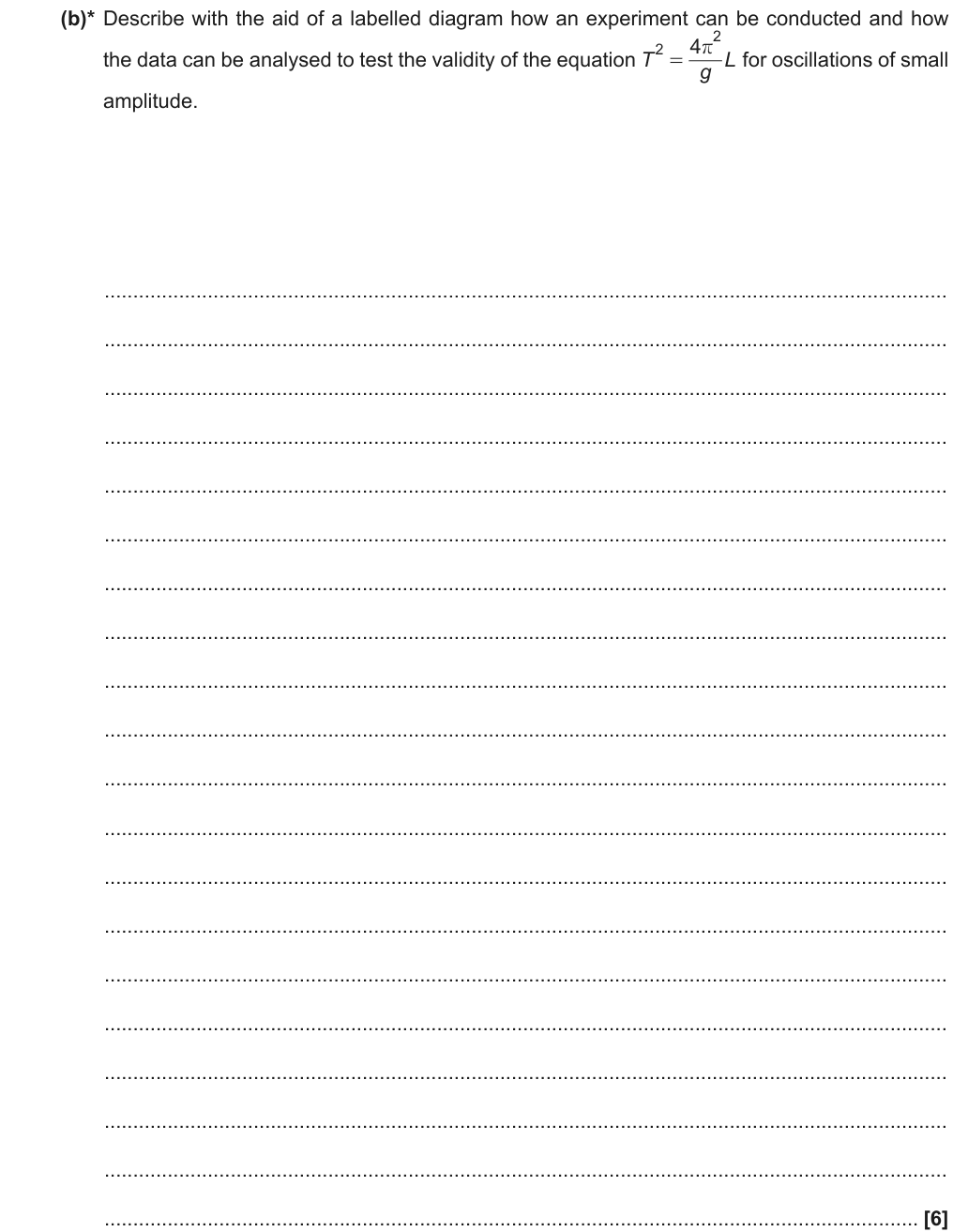
June 2017 · Paper 1 · Q19(b) 6 marks 6-mark extended response simple harmonic motionpractical skills
(b)* Describe with the aid of a labelled diagram how an experiment can be conducted and how
4 2
2 r
the data can be analysed to test the validity of the equation T = g L for oscillations of small
amplitude.
...................................................................................................................................................
...................................................................................................................................................
...................................................................................................................................................
...................................................................................................................................................
...................................................................................................................................................
...................................................................................................................................................
...................................................................................................................................................
...................................................................................................................................................
...................................................................................................................................................
...................................................................................................................................................
...................................................................................................................................................
...................................................................................................................................................
...................................................................................................................................................
...................................................................................................................................................
...................................................................................................................................................
...................................................................................................................................................
...................................................................................................................................................
...................................................................................................................................................
...................................................................................................................................................
.............................................................................................................................................. [6]
June 2017 · Paper 1 · Q19(c)(i) 2 marks Show that simple harmonic motion
Earlier part of question 19 that this part usesEarlier part of June 2017 Paper 1 question 19
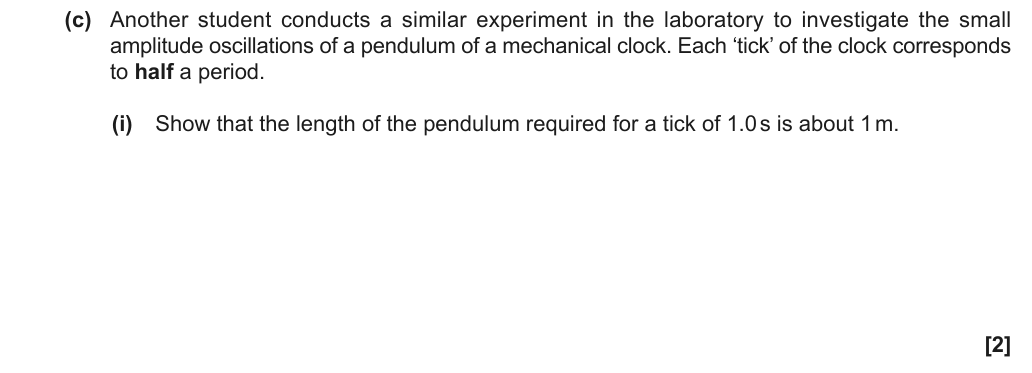
(c) Another student conducts a similar experiment in the laboratory to investigate the small
amplitude oscillations of a pendulum of a mechanical clock. Each ‘tick’ of the clock corresponds
to half a period.
(i) Show that the length of the pendulum required for a tick of 1.0 s is about 1 m.
[2]
June 2017 · Paper 1 · Q19(c)(ii) 2 marks Explanation simple harmonic motion
Earlier parts of question 19 that this part usesEarlier part of June 2017 Paper 1 question 19Earlier part of June 2017 Paper 1 question 19
(ii) If the pendulum clock were to be used on the Moon, explain whether this clock would run
on time compared with an identical clock on the Earth.
...........................................................................................................................................
...........................................................................................................................................
...........................................................................................................................................
...................................................................................................................................... [2]
June 2017 · Paper 1 · Q20(a) 2 marks Calculation work energy and power
20 A plastic kettle is filled with 0.60 kg of water at a temperature of 20 °C.
A 2.2 kW electric heater is used to heat the water for a time of 4.0 minutes.
(a) Calculate the total energy supplied by the heater during the time of 4.0 minutes.
energy =  ....................................................... J [2]
June 2017 · Paper 1 · Q20(b) 4 marks Calculation thermal physics
Earlier part of question 20 that this part usesEarlier part of June 2017 Paper 1 question 20
(b) The specific heat capacity of water is 4200 J kg−1 K−1 and the specific latent heat of
vaporisation of water is 2.3 × 10⁶ J kg−1. The boiling point of water is 100 °C.
Calculate the mass of water remaining in the kettle after 4.0 minutes.
Assume that all the thermal energy from the heater is transferred to the water.
mass of water remaining =  ..................................................... kg [4]
June 2017 · Paper 1 · Q21(a)(i) 1 mark Explanation stars
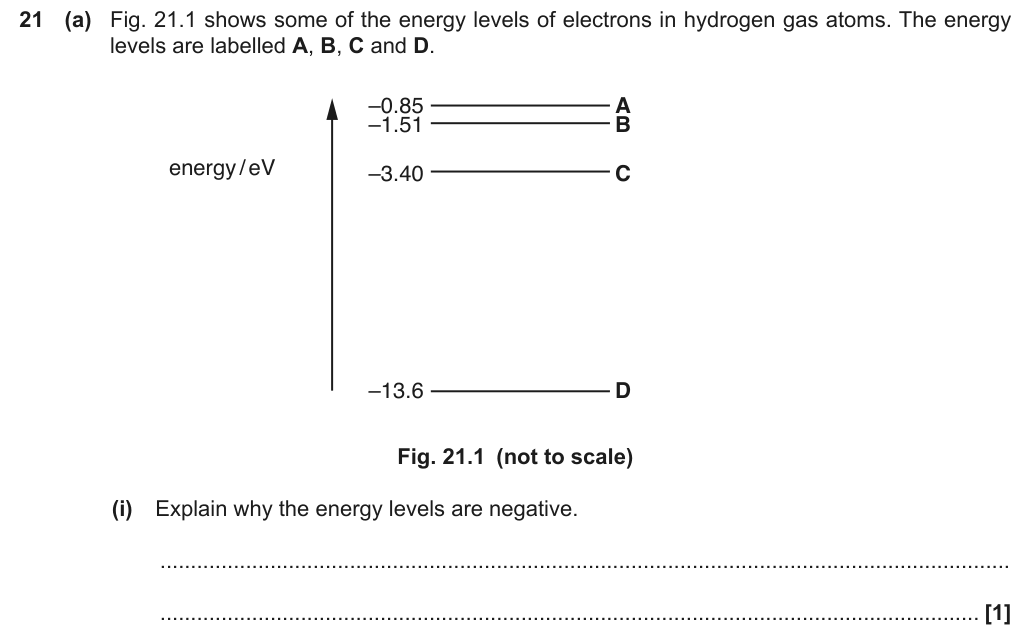
21 (a) Fig. 21.1 shows some of the energy levels of electrons in hydrogen gas atoms. The energy
levels are labelled A, B, C and D.
–0.85 A
–1.51 B
energy / eV –3.40 C
–13.6 D
Fig. 21.1 (not to scale)
(i) Explain why the energy levels are negative.
...........................................................................................................................................
...................................................................................................................................... [1]
June 2017 · Paper 1 · Q21(a)(ii) 4 marks Calculation stars
Earlier part of question 21 that this part usesEarlier part of June 2017 Paper 1 question 21
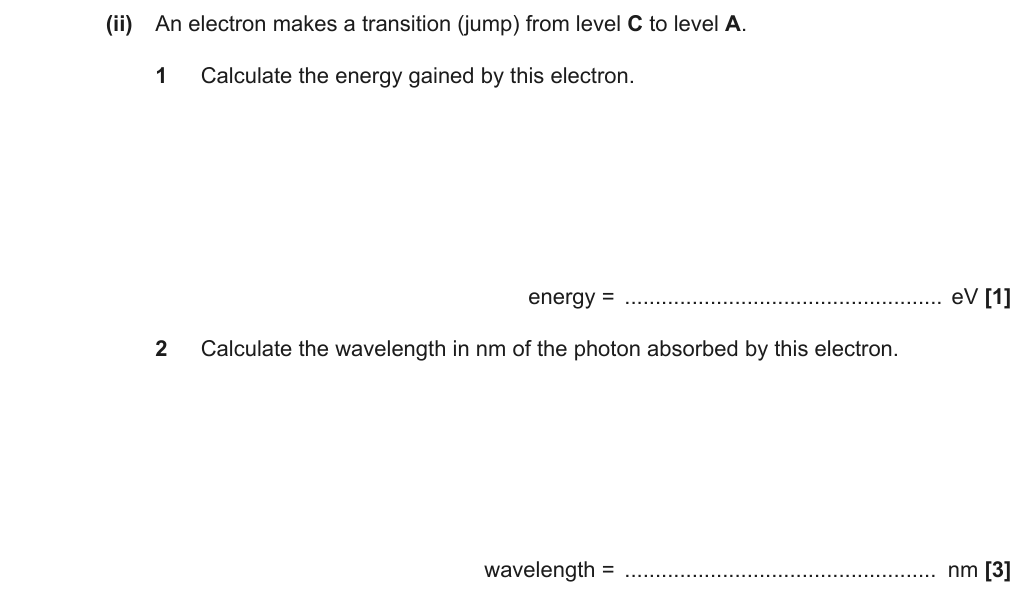
(ii) An electron makes a transition (jump) from level C to level A.
1 Calculate the energy gained by this electron.
energy =  .................................................... eV [1]
2 Calculate the wavelength in nm of the photon absorbed by this electron.
wavelength =  ................................................... nm [3]
June 2017 · Paper 1 · Q21(b)(i) 1 mark Short answer stars
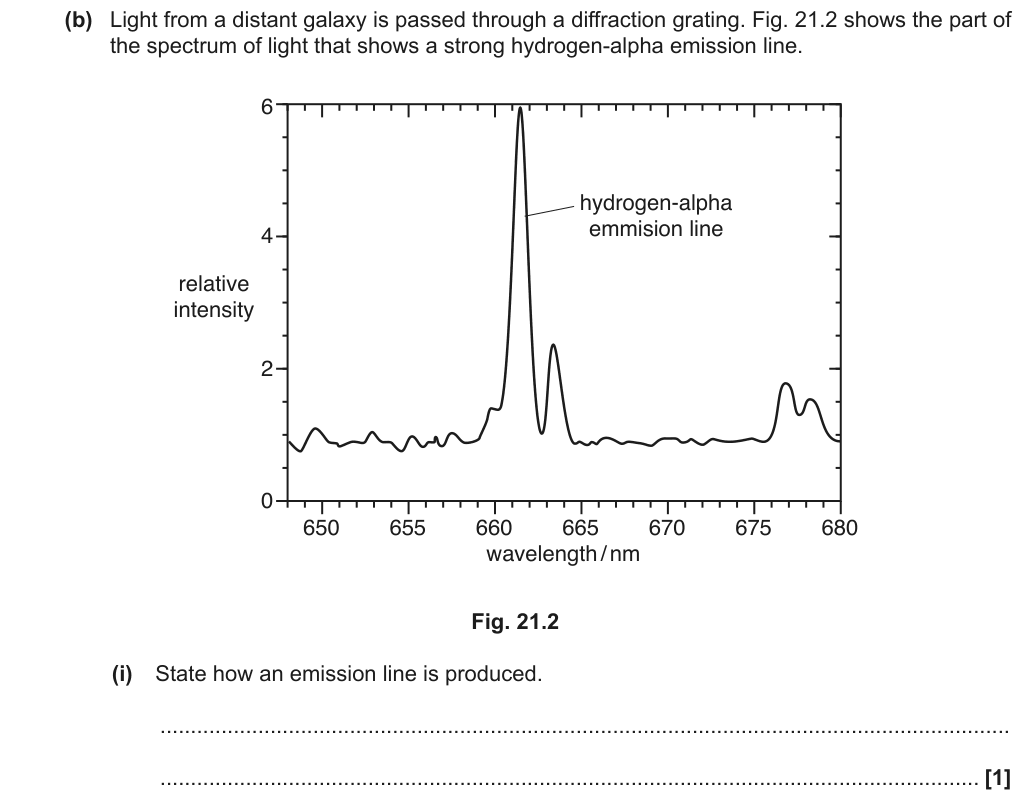
(b) Light from a distant galaxy is passed through a diffraction grating. Fig. 21.2 shows the part of
the spectrum of light that shows a strong hydrogen-alpha emission line.
6
hydrogen-alpha
4 emmision line
relative
intensity
2
0
650 655 660 665 670 675 680
wavelength / nm
Fig. 21.2
(i) State how an emission line is produced.
...........................................................................................................................................
...................................................................................................................................... [1]
June 2017 · Paper 1 · Q21(b)(ii) 1 mark Short answer stars
Earlier part of question 21 that this part usesEarlier part of June 2017 Paper 1 question 21
(ii) State an adjustment that could be made to the experimental arrangement that would
space the emission lines more widely.
...........................................................................................................................................
...................................................................................................................................... [1]
June 2017 · Paper 1 · Q21(b)(iii) 3 marks Calculation cosmology
Earlier part of question 21 that this part usesEarlier part of June 2017 Paper 1 question 21
(iii) In the laboratory, the wavelength of the hydrogen-alpha emission line is 656.3 nm.
Use Fig. 21.2 to determine the recession velocity of the galaxy.
recession velocity =  ................................................ m s−1 [3]
June 2017 · Paper 1 · Q21(b)(iv) 1 mark Explanation stars
(iv) Suggest why hydrogen spectral lines play an important role in determining red shift of
galaxies.
...........................................................................................................................................
...................................................................................................................................... [1]
June 2017 · Paper 1 · Q21(c) 3 marks Explanation cosmology
Earlier part of question 21 that this part usesEarlier part of June 2017 Paper 1 question 21
(c) Light from a similar star is viewed in a galaxy further away. The star is part of a pair of stars
which orbit a common centre of mass.
Describe and explain how the equivalent spectrum might appear.
...................................................................................................................................................
...................................................................................................................................................
...................................................................................................................................................
...................................................................................................................................................
...................................................................................................................................................
...................................................................................................................................................
.............................................................................................................................................. [3]
June 2017 · Paper 1 · Q22(a) 1 mark Short answer thermal physics
22 (a) Define the internal energy of a substance.
...................................................................................................................................................
...................................................................................................................................................
.............................................................................................................................................. [1]
June 2017 · Paper 1 · Q22(b) 4 marks Explanation thermal physics
(b) A block of paraffin wax is melting at a constant temperature of 52 °C. Use the behaviour of
paraffin molecules to describe and explain the changes to the internal energy of the molecules
of the paraffin wax as it melts.
...................................................................................................................................................
...................................................................................................................................................
...................................................................................................................................................
...................................................................................................................................................
...................................................................................................................................................
...................................................................................................................................................
...................................................................................................................................................
...................................................................................................................................................
...................................................................................................................................................
...................................................................................................................................................
...................................................................................................................................................
.............................................................................................................................................. [4]
June 2017 · Paper 1 · Q23(a) 1 mark Short answer gravitational fields
23 (a) Write an expression for the gravitational potential Vg at the surface of a planet of mass M and
radius r.
[1]
June 2017 · Paper 1 · Q23(b)(i) 2 marks Show that gravitational fields
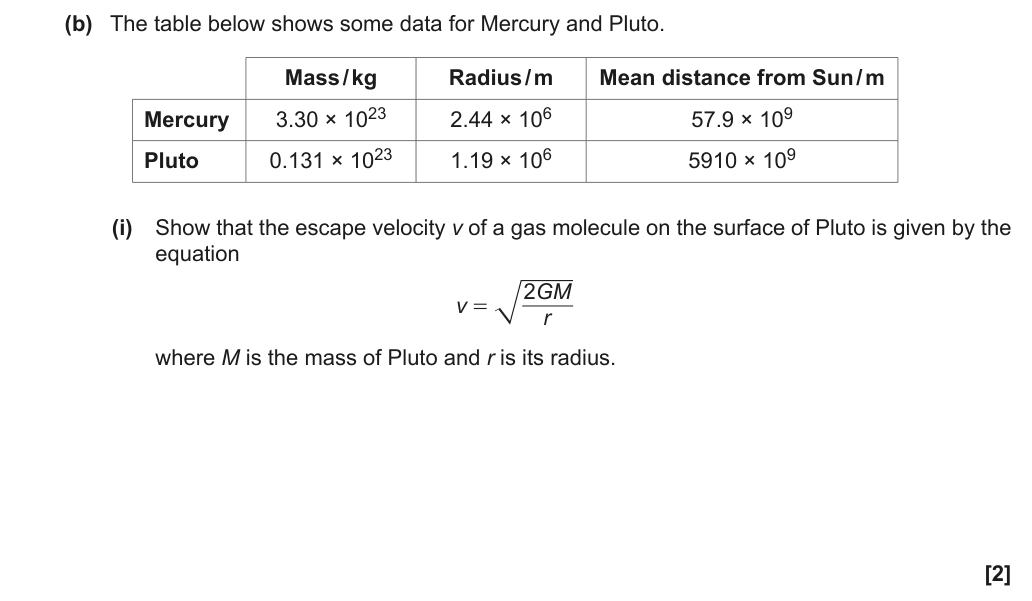
(b) The table below shows some data for Mercury and Pluto.
Mass / kg Radius / m Mean distance from Sun / m
Mercury 3.30 × 10²³ 2.44 × 10⁶ 57.9 × 10⁹
Pluto 0.131 × 10²³ 1.19 × 10⁶ 5910 × 109
(i) Show that the escape velocity v of a gas molecule on the surface of Pluto is given by the
equation
2 GM
v =
r
where M is the mass of Pluto and r is its radius.
[2]
June 2017 · Paper 1 · Q23(b)(ii) 1 mark Calculation gravitational fields
Earlier part of question 23 that this part usesEarlier part of June 2017 Paper 1 question 23
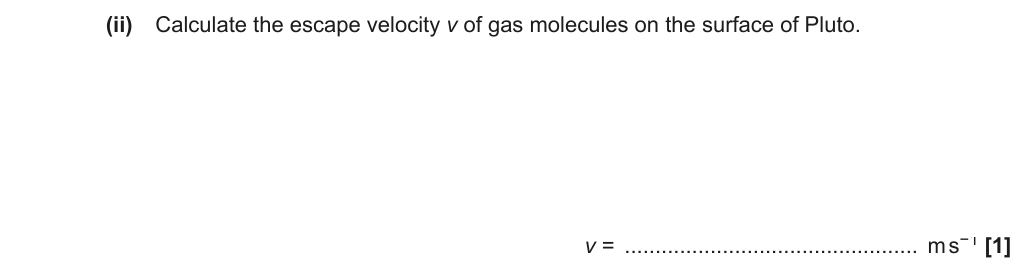
(ii) Calculate the escape velocity v of gas molecules on the surface of Pluto.
v =  ................................................ m s−1 [1]
June 2017 · Paper 1 · Q23(b)(iii) 3 marks Practical and data analysis gravitational fieldsideal gases
Earlier parts of question 23 that this part usesEarlier part of June 2017 Paper 1 question 23Earlier part of June 2017 Paper 1 question 23
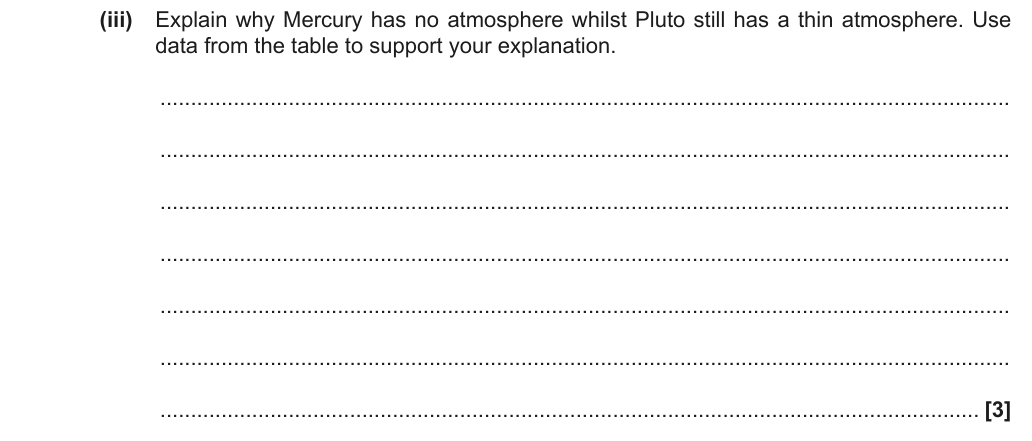
(iii) Explain why Mercury has no atmosphere whilst Pluto still has a thin atmosphere. Use
data from the table to support your explanation.
...........................................................................................................................................
...........................................................................................................................................
...........................................................................................................................................
...........................................................................................................................................
...........................................................................................................................................
...........................................................................................................................................
...................................................................................................................................... [3]

Work with an OCR physics tutor

Want a paper marked and gone through with you? Message us.

Prefer email? Send an enquiry

If you are under 18, please include a parent's contact details. Enquiries go to enquiries@physicsaleveltutor.com and are deleted once handled. All tutoring is online.