June 2019: Paper 3, Unified physics

70 marks · 25 question parts · Paper, mark scheme and report on OCR's site · Have the Data, Formulae and Relationships Booklet beside you

Question by question

QTopicMarksAOType
1(a) Ideal gases and the kinetic theory, Thermal physics: temperature, internal energy and specific heat capacity 2Calculation
1(b) Ideal gases and the kinetic theory 3Calculation
1(c)(i) Density, pressure and upthrust 2Show that
1(c)(ii) Dynamics, drag and terminal velocity, Density, pressure and upthrust 3Calculation
1(d) Dynamics, drag and terminal velocity, Newton's laws of motion and momentum 3Explanation
2(a) Radioactivity: decay, half-life and activity, The nuclear atom and fundamental particles, Mass–energy, binding energy, fission and fusion 3Short answer
2(b)(i) Radioactivity: decay, half-life and activity 1Explanation
2(b)(ii) Radioactivity: decay, half-life and activity, Practical skills: planning, analysis and evaluation, Measurements and uncertainties, Medical imaging: X-rays, CAT scans, PET, the gamma camera and ultrasound 11Show that
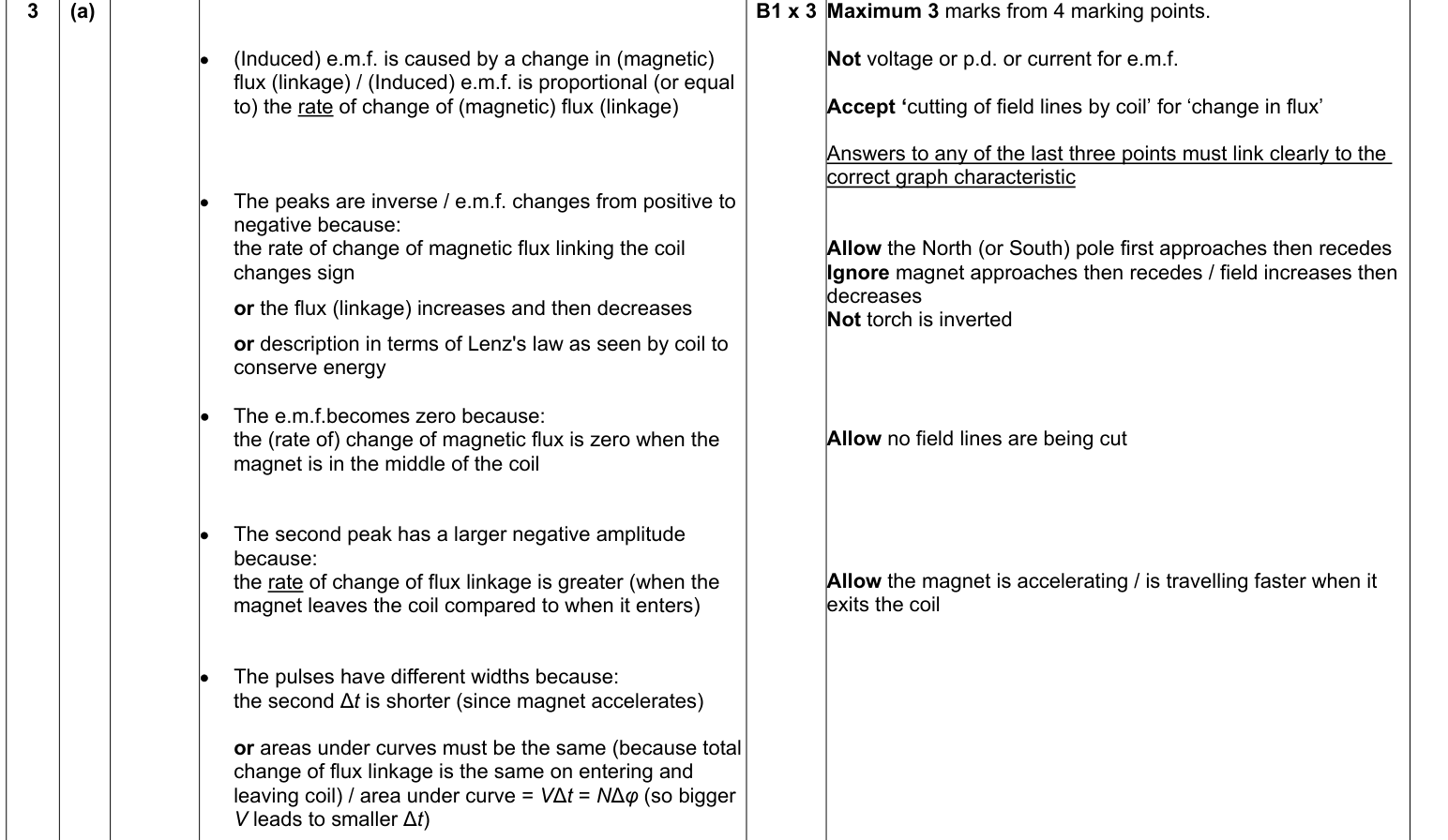
3(a) Electromagnetism: Faraday's law, Lenz's law and transformers 3Explanation
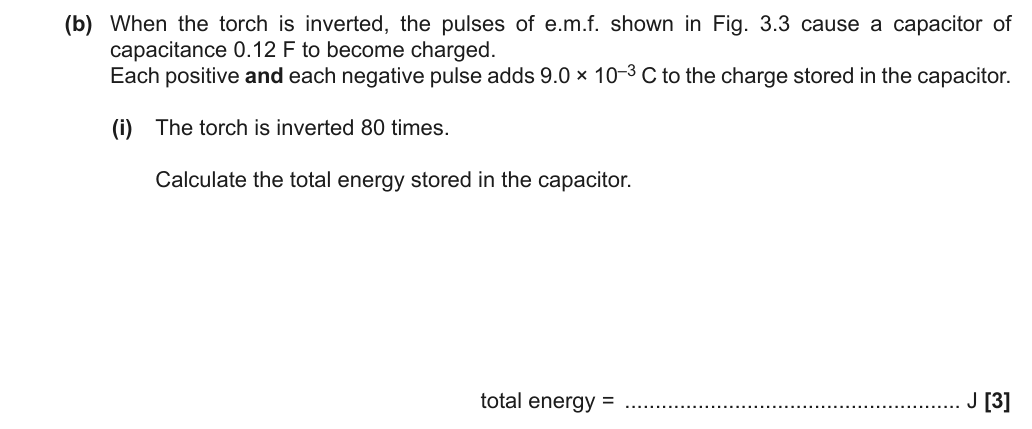
3(b)(i) Capacitors: energy, charging and discharging 3Calculation
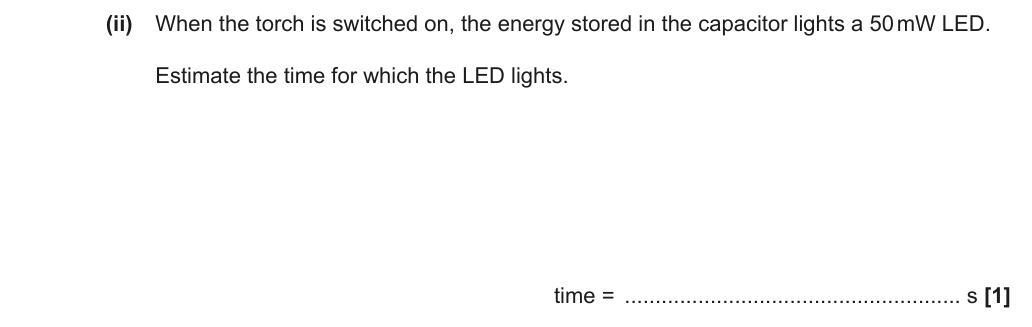
3(b)(ii) Work, energy and power 1Calculation
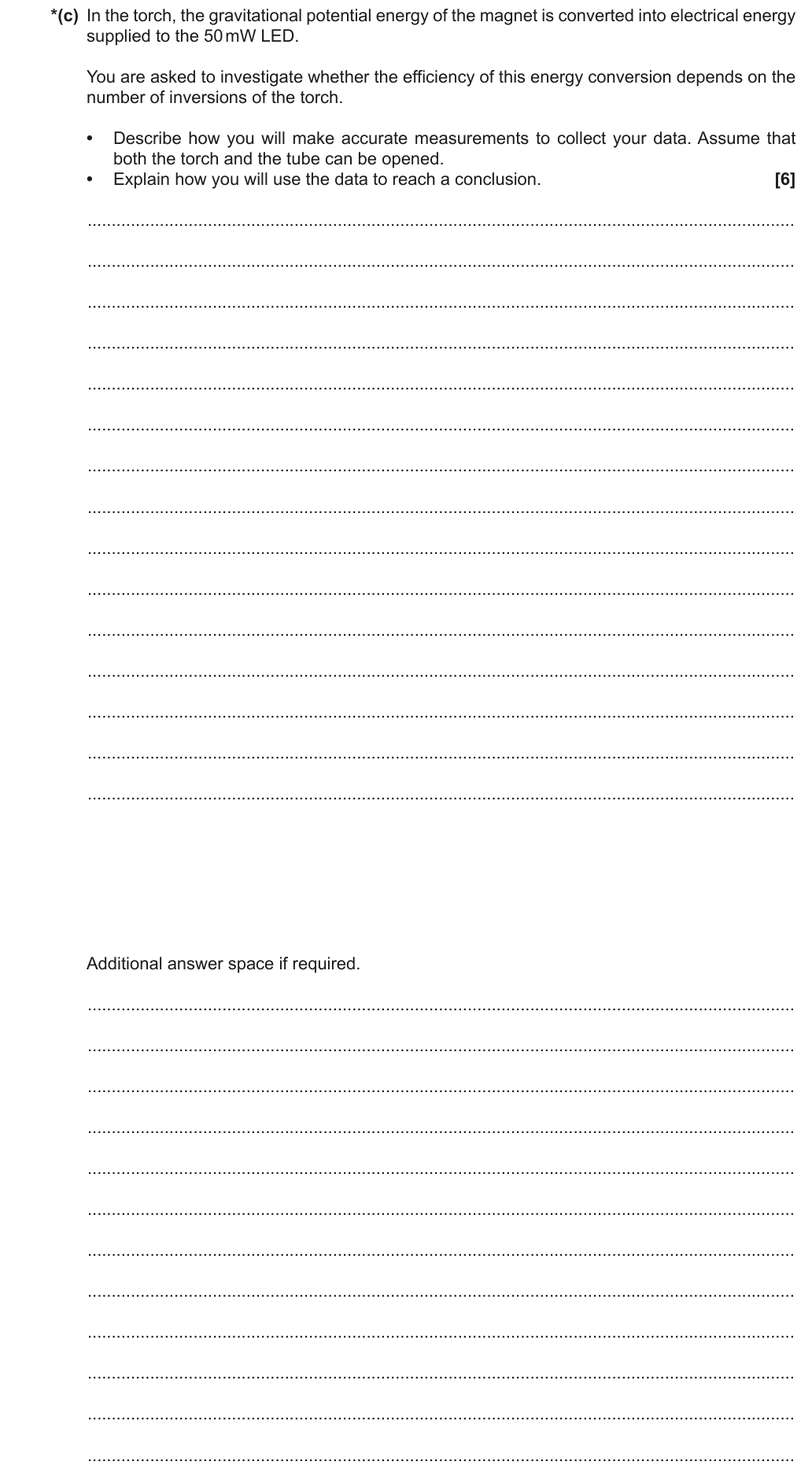
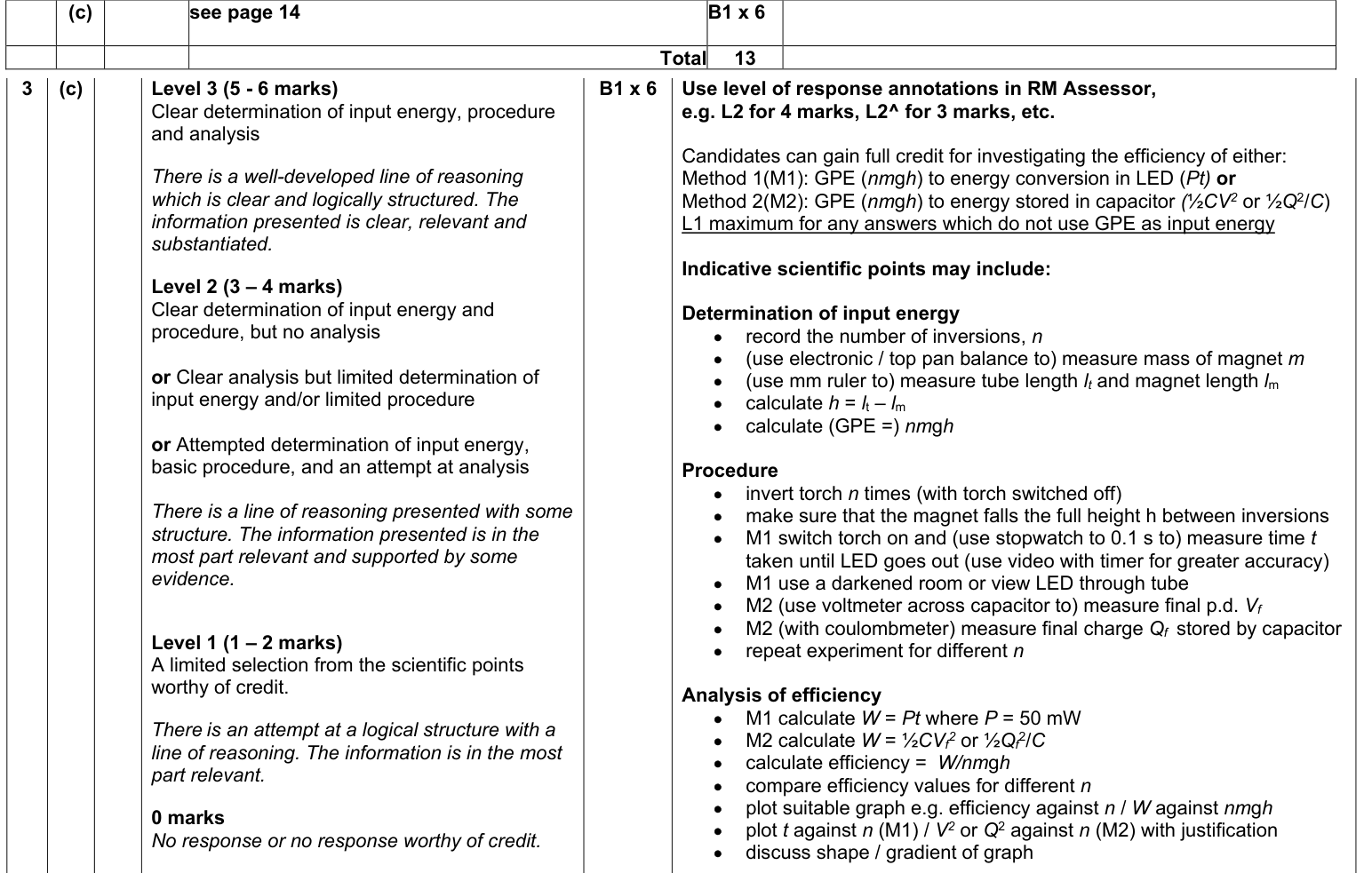
3(c) Work, energy and power, Practical skills: planning, analysis and evaluation, Capacitors: energy, charging and discharging 6Extended response
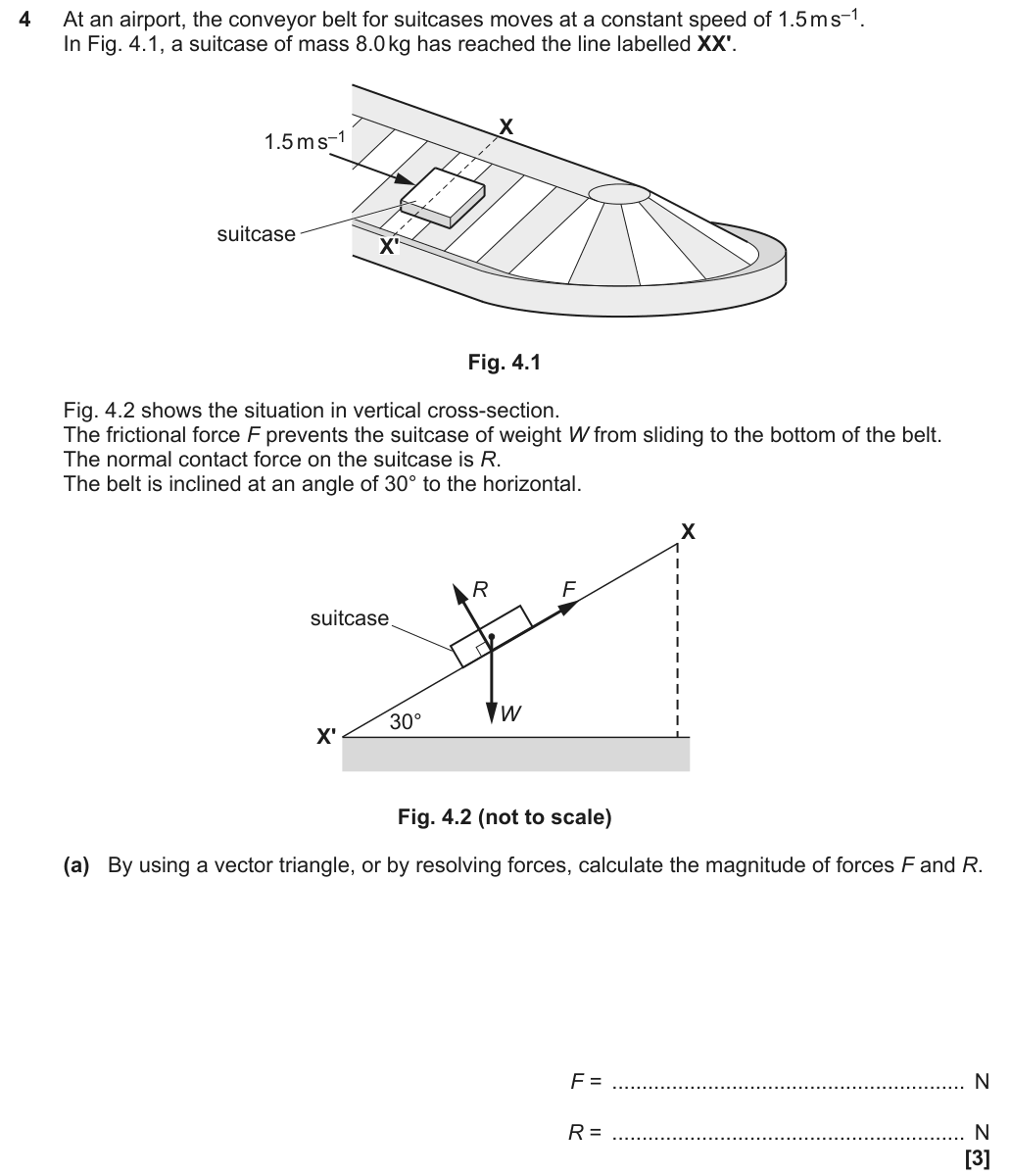
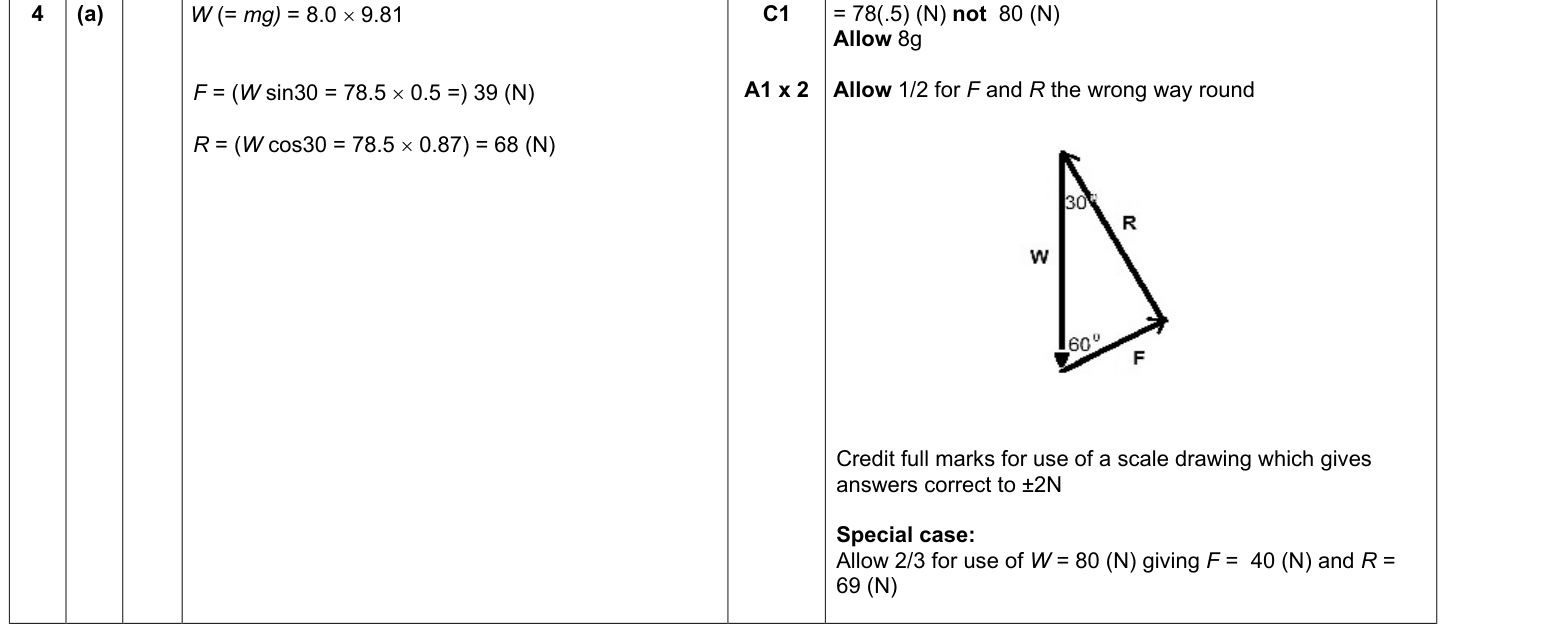
4(a) Scalars and vectors, Dynamics, drag and terminal velocity, Equilibrium: moments, couples and centre of mass 3Calculation
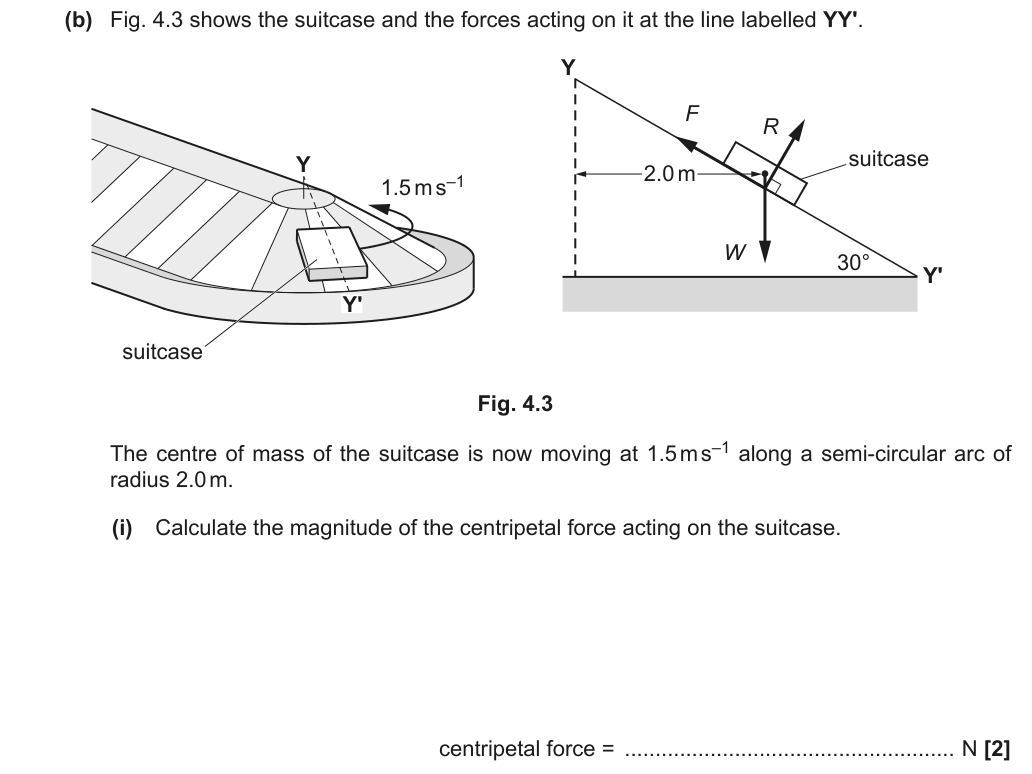
4(b)(i) Circular motion and centripetal force 2Calculation
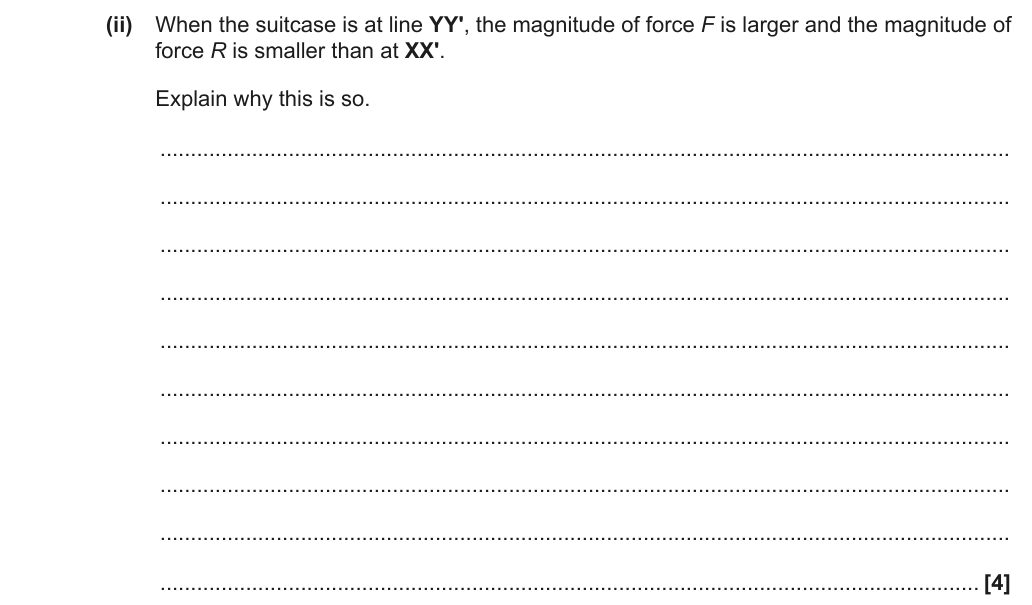
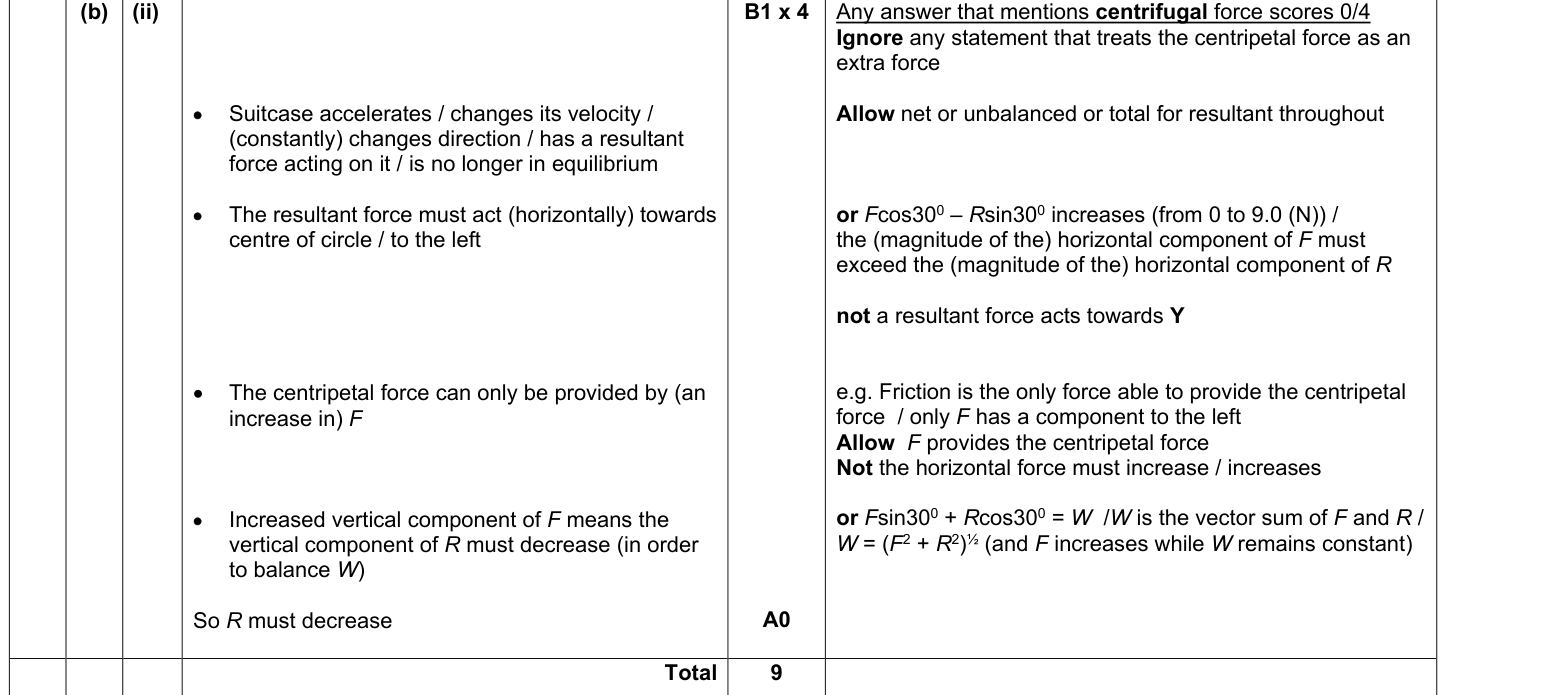
4(b)(ii) Circular motion and centripetal force, Scalars and vectors, Dynamics, drag and terminal velocity 4Explanation
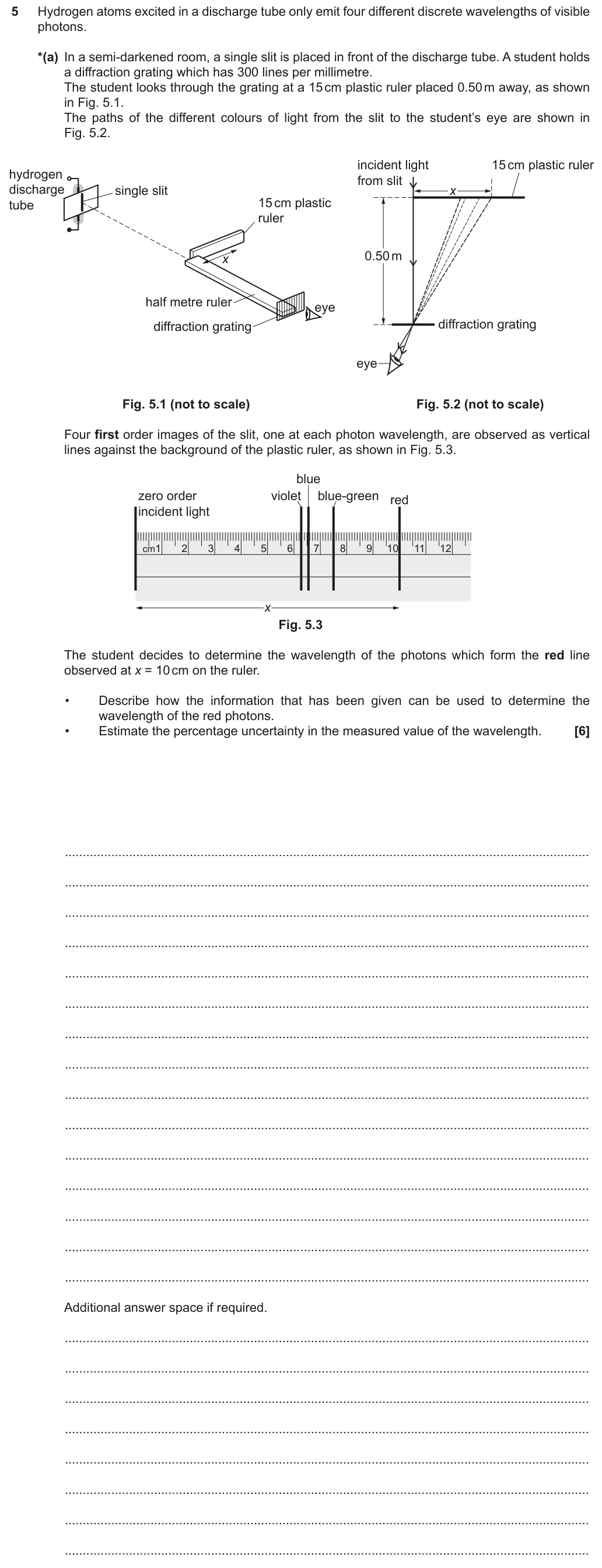
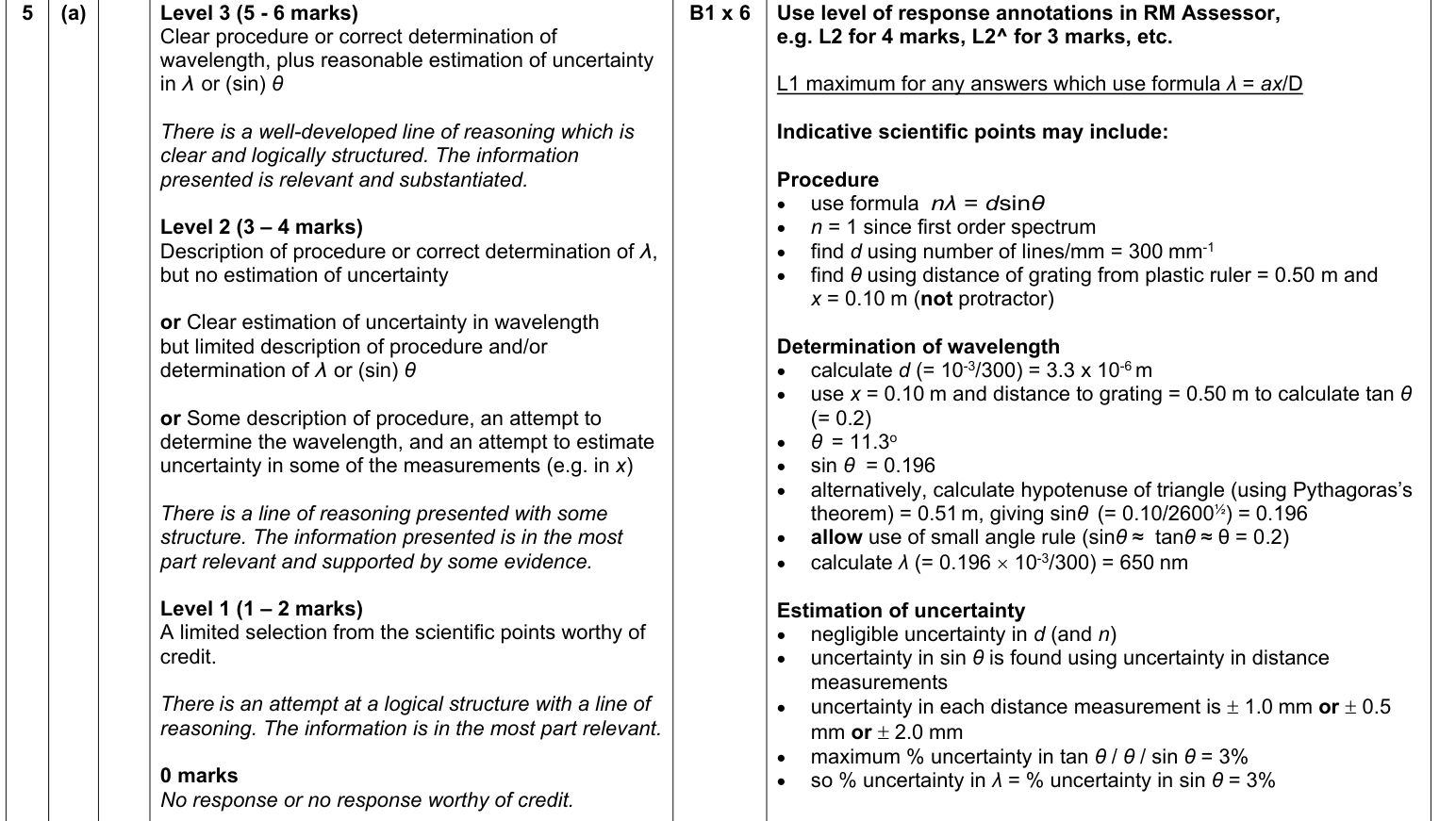
5(a) Stars: stellar evolution, energy levels, spectra, Wien's law and Stefan's law, Practical skills: planning, analysis and evaluation, Measurements and uncertainties 6Extended response
5(b)(i) Photons and the Planck constant 1Show that
5(b)(ii) Stars: stellar evolution, energy levels, spectra, Wien's law and Stefan's law 2Diagram or graph
6(a) Cosmology: parallax, the Doppler effect, Hubble's law and the Big Bang 1Explanation
6(b) Medical imaging: X-rays, CAT scans, PET, the gamma camera and ultrasound 2Explanation
6(c)(i) Circular motion and centripetal force 2Show that
6(c)(ii) Cosmology: parallax, the Doppler effect, Hubble's law and the Big Bang 2Calculation
6(c)(iii) Cosmology: parallax, the Doppler effect, Hubble's law and the Big Bang, Practical skills: planning, analysis and evaluation 1Short answer
6(c)(iv) Cosmology: parallax, the Doppler effect, Hubble's law and the Big Bang 1Short answer
6(d) Measurements and uncertainties, Practical skills: planning, analysis and evaluation 2Short answer

The questions

1(a)1(b)1(c)(i)1(c)(ii)1(d)2(a)2(b)(i)2(b)(ii)3(a)3(b)(i)3(b)(ii)3(c)4(a)4(b)(i)4(b)(ii)5(a)5(b)(i)5(b)(ii)6(a)6(b)6(c)(i)6(c)(ii)6(c)(iii)6(c)(iv)6(d)
June 2019 · Paper 3 · Q1(a) 2 marks Calculation Medium ideal gasesthermal physics
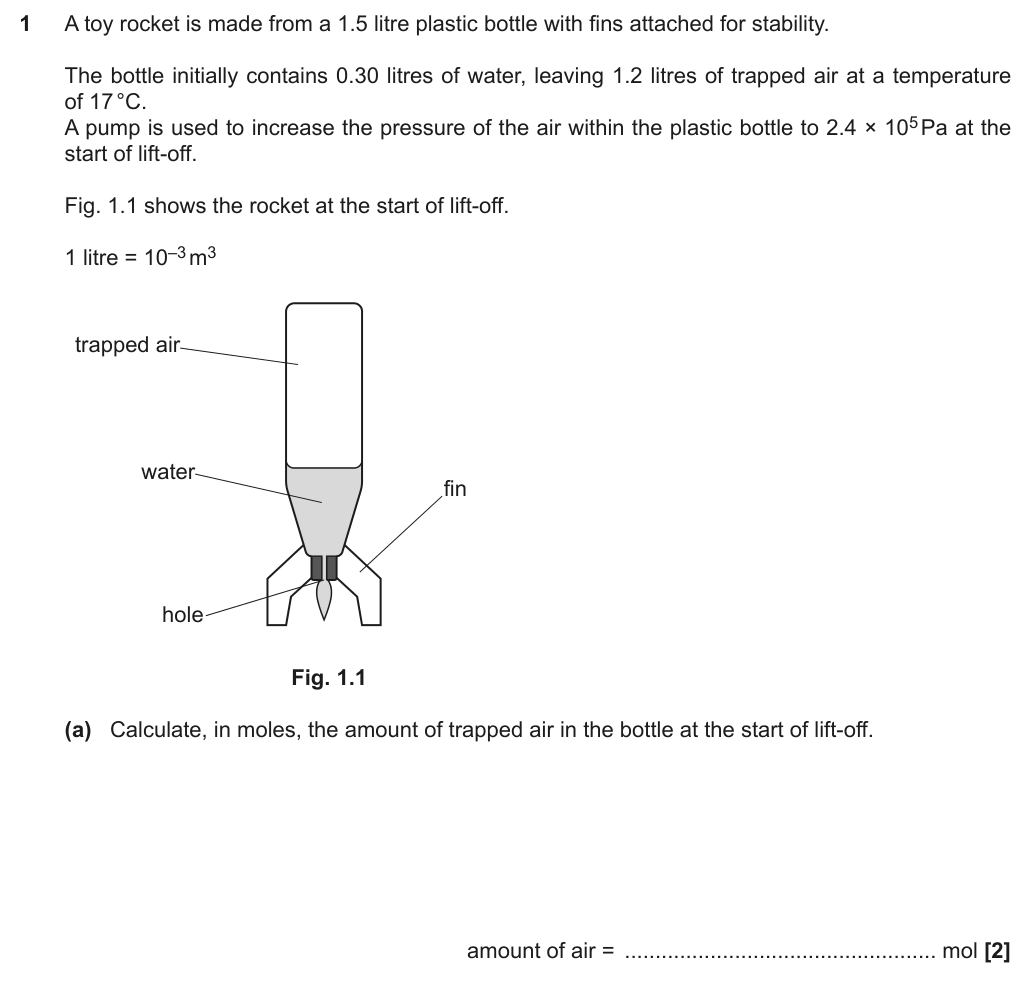
1 A toy rocket is made from a 1.5 litre plastic bottle with fins attached for stability.
The bottle initially contains 0.30 litres of water, leaving 1.2 litres of trapped air at a temperature
of 17 °C.
A pump is used to increase the pressure of the air within the plastic bottle to 2.4 × 10⁵ Pa at the
start of lift-off.
Fig. 1.1 shows the rocket at the start of lift-off.
1 litre = 10–3 m3
trapped air
water
fin
hole
Fig. 1.1
(a) Calculate, in moles, the amount of trapped air in the bottle at the start of lift-off.
amount of air =  ................................................... mol [2]
June 2019 · Paper 3 · Q1(b) 3 marks Calculation Medium ideal gases
Earlier part of question 1 that this part usesEarlier part of June 2019 Paper 3 question 1
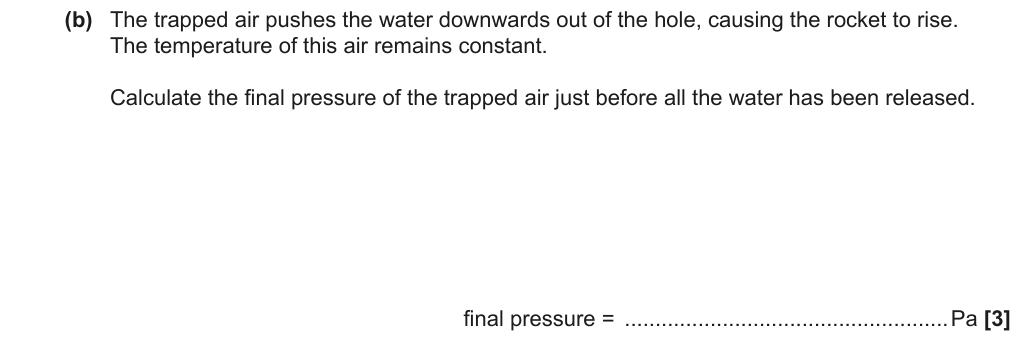
(b) The trapped air pushes the water downwards out of the hole, causing the rocket to rise.
The temperature of this air remains constant.
Calculate the final pressure of the trapped air just before all the water has been released.
final pressure =  .....................................................Pa [3]
June 2019 · Paper 3 · Q1(c)(i) 2 marks Show that Medium density and pressure
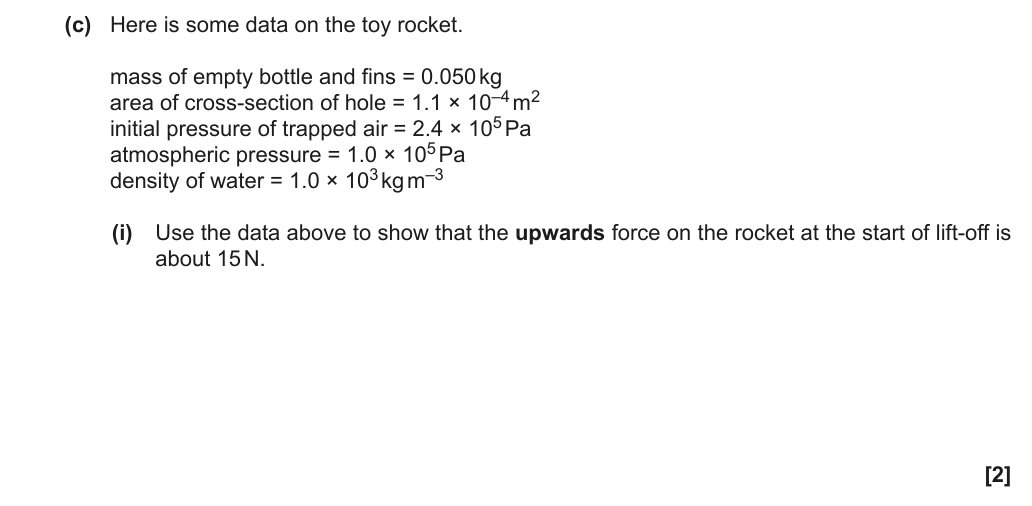
(c) Here is some data on the toy rocket.
mass of empty bottle and fins = 0.050 kg
area of cross-section of hole = 1.1 × 10⁻⁴ m2
initial pressure of trapped air = 2.4 × 10⁵ Pa
atmospheric pressure = 1.0 × 10⁵ Pa
density of water = 1.0 × 10³ kg m–3
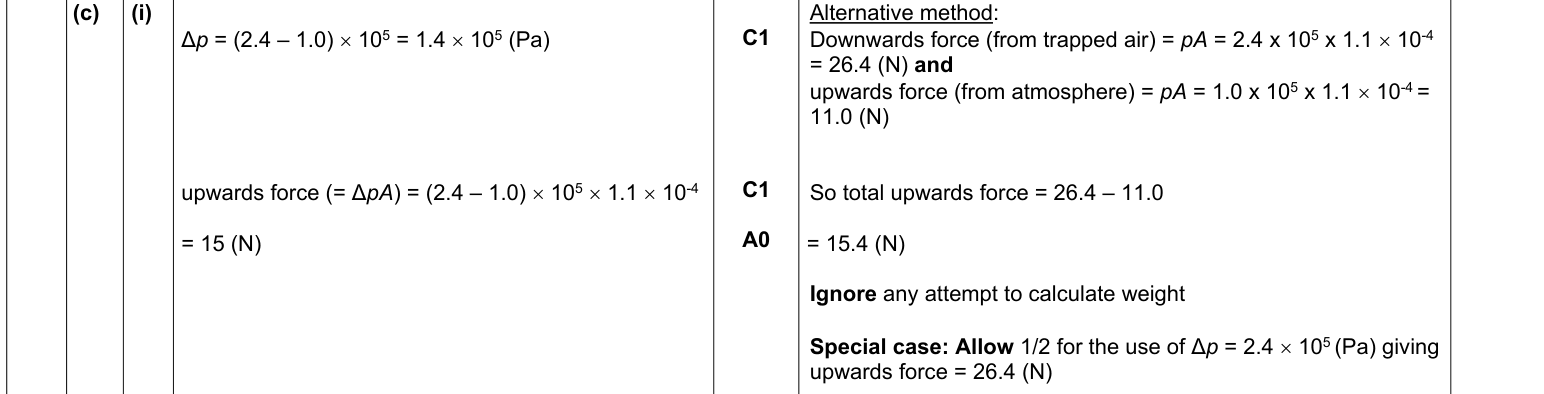
(i) Use the data above to show that the upwards force on the rocket at the start of lift-off is
about 15 N.
[2]
June 2019 · Paper 3 · Q1(c)(ii) 3 marks Calculation Hard dynamics and terminal velocitydensity and pressure
Earlier parts of question 1 that this part usesEarlier part of June 2019 Paper 3 question 1Earlier part of June 2019 Paper 3 question 1
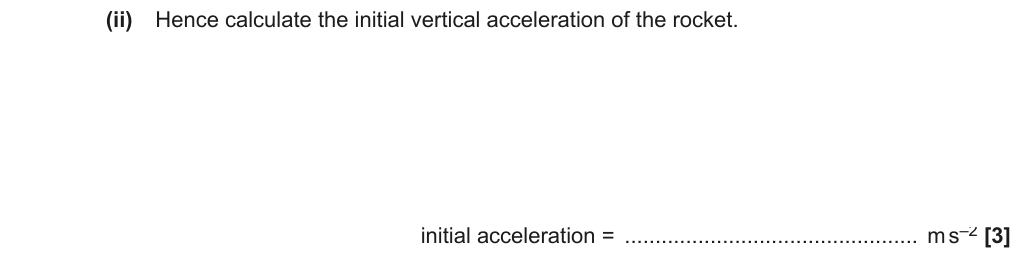
(ii) Hence calculate the initial vertical acceleration of the rocket.
initial acceleration =  ................................................ m s–2 [3]
June 2019 · Paper 3 · Q1(d) 3 marks Explanation Medium dynamics and terminal velocitynewtons laws and momentum
Earlier parts of question 1 that this part usesEarlier part of June 2019 Paper 3 question 1Earlier part of June 2019 Paper 3 question 1
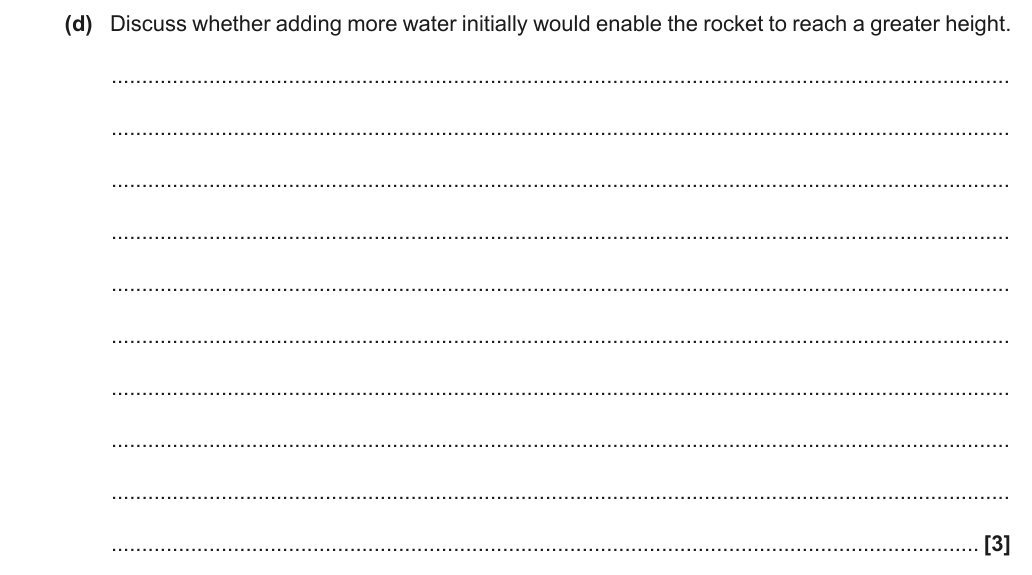
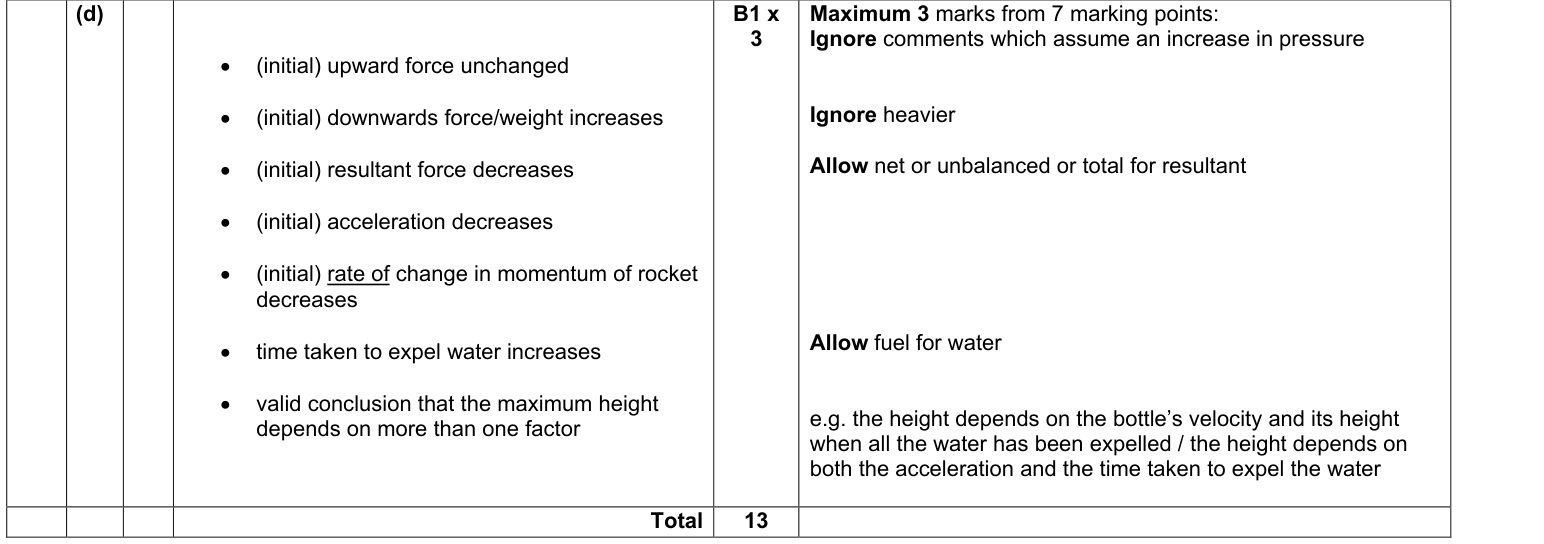
(d) Discuss whether adding more water initially would enable the rocket to reach a greater height.
...................................................................................................................................................
...................................................................................................................................................
...................................................................................................................................................
...................................................................................................................................................
...................................................................................................................................................
...................................................................................................................................................
...................................................................................................................................................
...................................................................................................................................................
...................................................................................................................................................
.............................................................................................................................................. [3]
June 2019 · Paper 3 · Q2(a) 3 marks Short answer Medium radioactivitynuclear atom and particlesnuclear fission and fusion
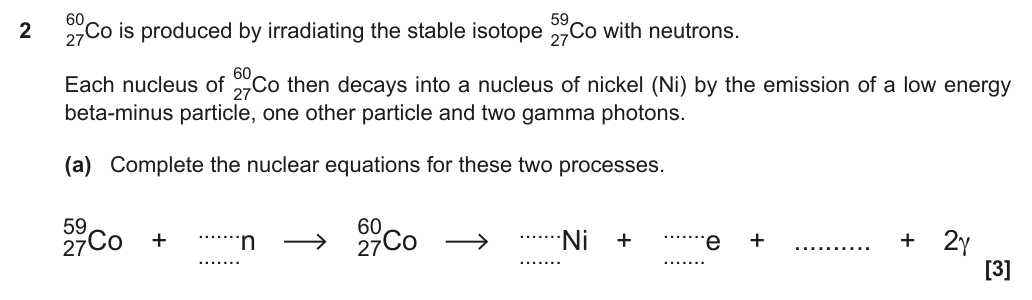
2 60 27Co is produced by irradiating the stable isotope 59 27Co with neutrons.
Each nucleus of 60 27Co then decays into a nucleus of nickel (Ni) by the emission of a low energy
beta-minus particle, one other particle and two gamma photons.
(a) Complete the nuclear equations for these two processes.
59 ....... 60 ....... .......
27Co + .......n 27Co .......Ni + .......e + .......... + 2γ
[3]
June 2019 · Paper 3 · Q2(b)(i) 1 mark Explanation Medium radioactivity
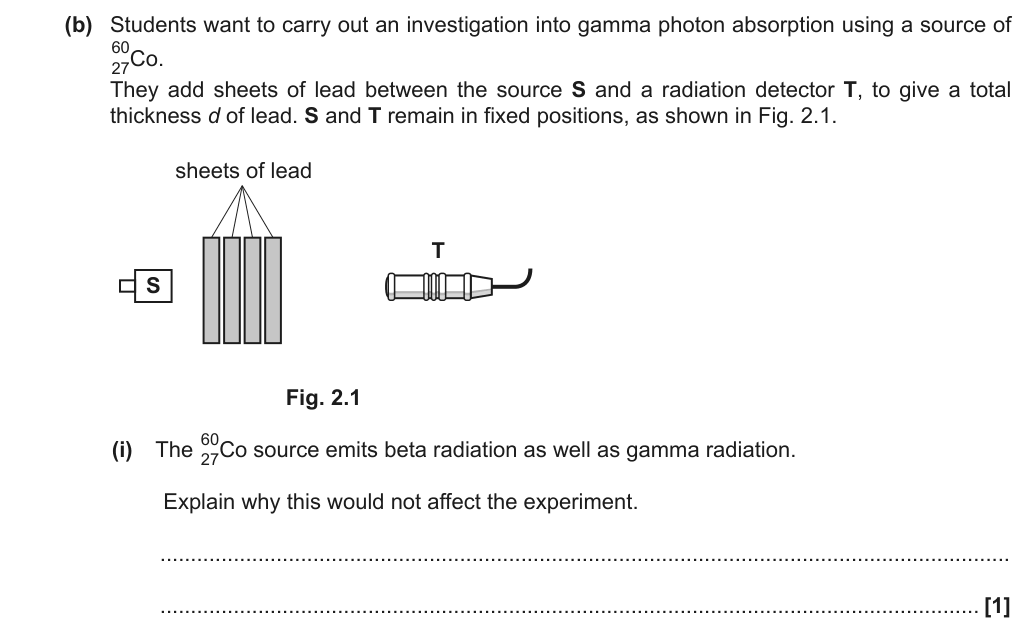
(b) Students want to carry out an investigation into gamma photon absorption using a source of
60 27Co.
They add sheets of lead between the source S and a radiation detector T, to give a total
thickness d of lead. S and T remain in fixed positions, as shown in Fig. 2.1.
sheets of lead
T
S
Fig. 2.1
(i) The 60 27Co source emits beta radiation as well as gamma radiation.
Explain why this would not affect the experiment.
...........................................................................................................................................
...................................................................................................................................... [1]
June 2019 · Paper 3 · Q2(b)(ii) 11 marks Show that Medium radioactivitypractical skillsmeasurements and uncertaintiesmedical imaging
Earlier part of question 2 that this part usesEarlier part of June 2019 Paper 3 question 2
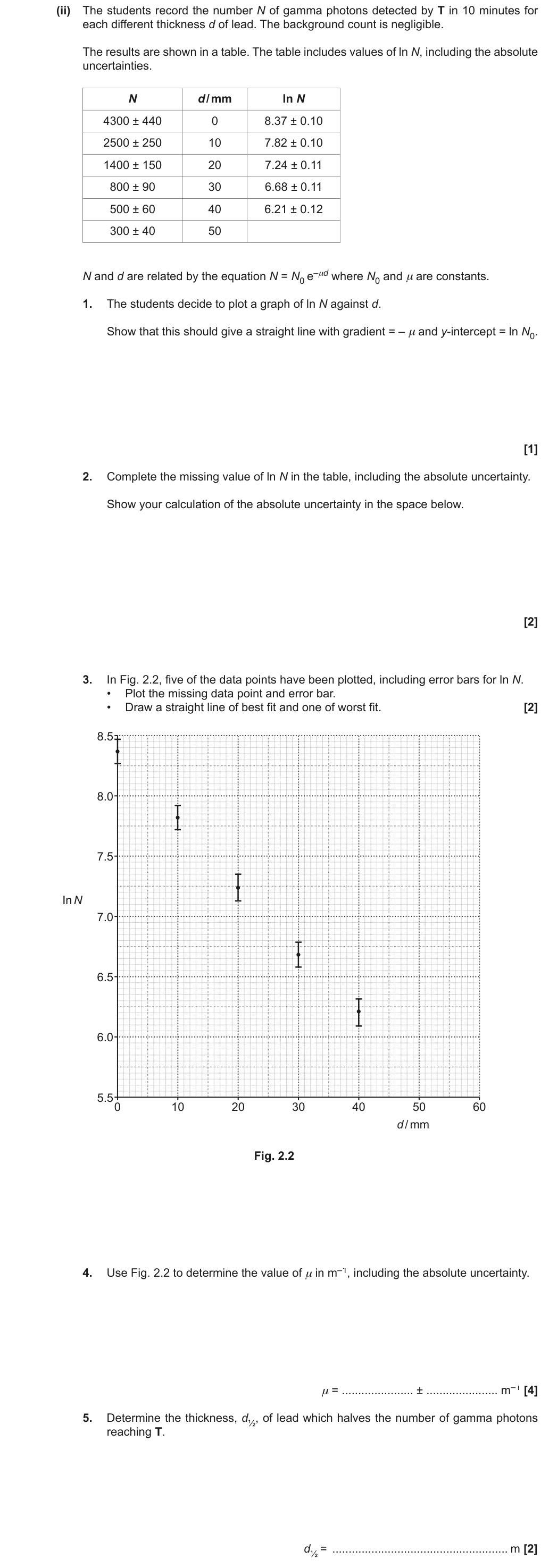
(ii) The students record the number N of gamma photons detected by T in 10 minutes for
each different thickness d of lead. The background count is negligible.
The results are shown in a table. The table includes values of ln N, including the absolute

uncertainties.
N d / mm ln N
4300 ± 440 0 8.37 ± 0.10
2500 ± 250 10 7.82 ± 0.10
1400 ± 150 20 7.24 ± 0.11
800 ± 90 30 6.68 ± 0.11
500 ± 60 40 6.21 ± 0.12
300 ± 40 50
N and d are related by the equation N = N0 e–μd where N0 and μ are constants.
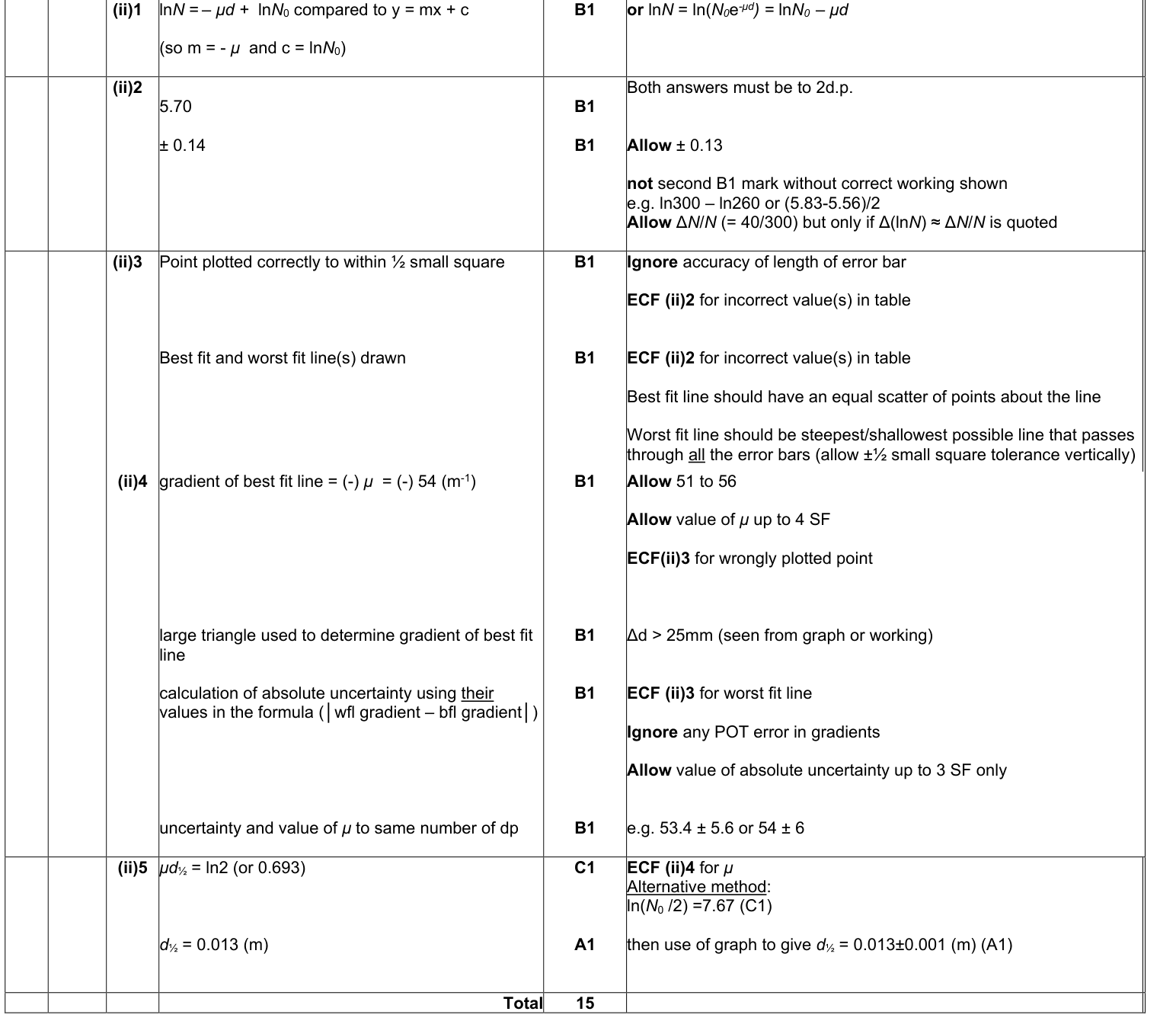
1. The students decide to plot a graph of ln N against d.
Show that this should give a straight line with gradient = – μ and y-intercept = ln N0.
[1]
2. Complete the missing value of ln N in the table, including the absolute uncertainty.
Show your calculation of the absolute uncertainty in the space below.
[2]
3. In Fig. 2.2, five of the data points have been plotted, including error bars for ln N.
• Plot the missing data point and error bar.
• Draw a straight line of best fit and one of worst fit. [2]
8.5
8.0
7.5
In N
7.0
6.5
6.0
5.50
10 20 30 40 50 60
d / mm
Fig. 2.2
4. Use Fig. 2.2 to determine the value of μ in m–1, including the absolute uncertainty.
μ = ...................... ± ...................... m–1 [4]
5. Determine the thickness, d½, of lead which halves the number of gamma photons
reaching T.
d½ =  ...................................................... m [2]
June 2019 · Paper 3 · Q3(a) 3 marks Explanation Medium electromagnetic induction
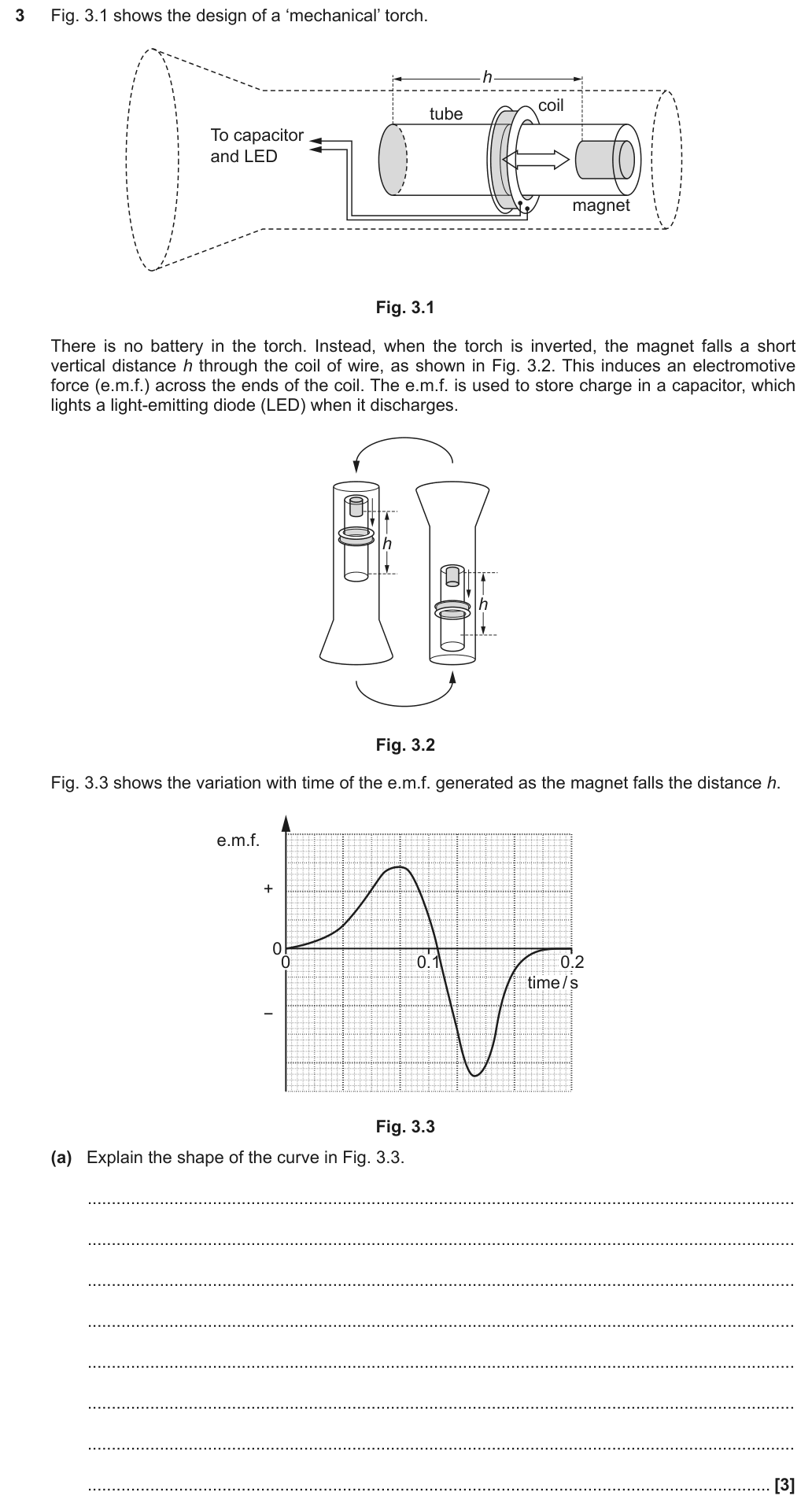
3 Fig. 3.1 shows the design of a ‘mechanical’ torch.
h
coil
tube
To capacitor
and LED
magnet
Fig. 3.1
There is no battery in the torch. Instead, when the torch is inverted, the magnet falls a short
vertical distance h through the coil of wire, as shown in Fig. 3.2. This induces an electromotive
force (e.m.f.) across the ends of the coil. The e.m.f. is used to store charge in a capacitor, which
lights a light-emitting diode (LED) when it discharges.
h
h
Fig. 3.2
Fig. 3.3 shows the variation with time of the e.m.f. generated as the magnet falls the distance h.
e.m.f.
+
00
0.1 0.2
time / s
−
Fig. 3.3
(a) Explain the shape of the curve in Fig. 3.3.
...................................................................................................................................................
...................................................................................................................................................
...................................................................................................................................................
...................................................................................................................................................
...................................................................................................................................................
...................................................................................................................................................
...................................................................................................................................................
.............................................................................................................................................. [3]
June 2019 · Paper 3 · Q3(b)(i) 3 marks Calculation Medium capacitors
Earlier part of question 3 that this part usesEarlier part of June 2019 Paper 3 question 3
(b)  When the torch is inverted, the pulses of e.m.f. shown in Fig. 3.3 cause a capacitor of
capacitance 0.12 F to become charged.
Each positive and each negative pulse adds 9.0 × 10⁻³ C to the charge stored in the capacitor.
(i) The torch is inverted 80 times.
Calculate the total energy stored in the capacitor.
total energy =  ....................................................... J [3]
June 2019 · Paper 3 · Q3(b)(ii) 1 mark Calculation Easy work energy and power
Earlier part of question 3 that this part usesEarlier part of June 2019 Paper 3 question 3
(ii) When the torch is switched on, the energy stored in the capacitor lights a 50 mW LED.
Estimate the time for which the LED lights.
time =  ....................................................... s [1]
June 2019 · Paper 3 · Q3(c) 6 marks 6-mark extended response Hard work energy and powerpractical skillscapacitors
Earlier parts of question 3 that this part usesEarlier part of June 2019 Paper 3 question 3Earlier part of June 2019 Paper 3 question 3
*(c) In the torch, the gravitational potential energy of the magnet is converted into electrical energy
supplied to the 50 mW LED.
You are asked to investigate whether the efficiency of this energy conversion depends on the
number of inversions of the torch.
• Describe how you will make accurate measurements to collect your data. Assume that
both the torch and the tube can be opened.
• Explain how you will use the data to reach a conclusion. [6]
...................................................................................................................................................
...................................................................................................................................................
...................................................................................................................................................
...................................................................................................................................................
...................................................................................................................................................
...................................................................................................................................................
...................................................................................................................................................
...................................................................................................................................................
...................................................................................................................................................
...................................................................................................................................................
...................................................................................................................................................
...................................................................................................................................................
...................................................................................................................................................
...................................................................................................................................................
...................................................................................................................................................
Additional answer space if required.
...................................................................................................................................................
...................................................................................................................................................
...................................................................................................................................................
...................................................................................................................................................
...................................................................................................................................................
...................................................................................................................................................
...................................................................................................................................................
...................................................................................................................................................
...................................................................................................................................................
...................................................................................................................................................
...................................................................................................................................................
...................................................................................................................................................
June 2019 · Paper 3 · Q4(a) 3 marks Calculation Easy scalars and vectorsdynamics and terminal velocityequilibrium and moments
4 At an airport, the conveyor belt for suitcases moves at a constant speed of 1.5 m s–1.
In Fig. 4.1, a suitcase of mass 8.0 kg has reached the line labelled XX'.
X
1.5 m s–1
suitcase
X'
Fig. 4.1
Fig. 4.2 shows the situation in vertical cross-section.
The frictional force F prevents the suitcase of weight W from sliding to the bottom of the belt.
The normal contact force on the suitcase is R.
The belt is inclined at an angle of 30° to the horizontal.
X
R F
suitcase
W
30°
X'
Fig. 4.2 (not to scale)
(a) By using a vector triangle, or by resolving forces, calculate the magnitude of forces F and R.
F =  ........................................................... N
R =  ........................................................... N
[3]
June 2019 · Paper 3 · Q4(b)(i) 2 marks Calculation Hard circular motion
Earlier part of question 4 that this part usesEarlier part of June 2019 Paper 3 question 4
(b)  Fig. 4.3 shows the suitcase and the forces acting on it at the line labelled YY'.
Y
F
R
Y suitcase
2.0 m
1.5 m s–1
W
30°
Y'
Y'
suitcase
Fig. 4.3
The centre of mass of the suitcase is now moving at 1.5 m s–1 along a semi-circular arc of
radius 2.0 m.
(i) Calculate the magnitude of the centripetal force acting on the suitcase.
centripetal force =  ...................................................... N [2]
June 2019 · Paper 3 · Q4(b)(ii) 4 marks Explanation Medium circular motionscalars and vectorsdynamics and terminal velocity
Earlier parts of question 4 that this part usesEarlier part of June 2019 Paper 3 question 4Earlier part of June 2019 Paper 3 question 4
(ii) When the suitcase is at line YY', the magnitude of force F is larger and the magnitude of
force R is smaller than at XX'.
Explain why this is so.
...........................................................................................................................................
...........................................................................................................................................
...........................................................................................................................................
...........................................................................................................................................
...........................................................................................................................................
...........................................................................................................................................
...........................................................................................................................................
...........................................................................................................................................
...........................................................................................................................................
...................................................................................................................................... [4]
June 2019 · Paper 3 · Q5(a) 6 marks 6-mark extended response Medium starspractical skillsmeasurements and uncertainties
5 Hydrogen atoms excited in a discharge tube only emit four different discrete wavelengths of visible
photons.
*(a) In a semi-darkened room, a single slit is placed in front of the discharge tube. A student holds
a diffraction grating which has 300 lines per millimetre.
The student looks through the grating at a 15 cm plastic ruler placed 0.50 m away, as shown
in Fig. 5.1.
The paths of the different colours of light from the slit to the student’s eye are shown in
Fig. 5.2.
incident light 15 cm plastic ruler
hydrogen
from slit
discharge single slit x
tube 15 cm plastic
ruler
x 0.50 m
half metre ruler
eye
diffraction grating diffraction grating
eye
Fig. 5.1 (not to scale) Fig. 5.2 (not to scale)
Four first order images of the slit, one at each photon wavelength, are observed as vertical
lines against the background of the plastic ruler, as shown in Fig. 5.3.
blue
zero order violet blue-green red
incident light
cm 1 2 3 4 5 6 7 8 9 10 11 12
x
Fig. 5.3
The student decides to determine the wavelength of the photons which form the red line
observed at x = 10 cm on the ruler.
• Describe how the information that has been given can be used to determine the
wavelength of the red photons.
• Estimate the percentage uncertainty in the measured value of the wavelength. [6]
...................................................................................................................................................
...................................................................................................................................................
...................................................................................................................................................
...................................................................................................................................................
...................................................................................................................................................
...................................................................................................................................................
...................................................................................................................................................
...................................................................................................................................................
...................................................................................................................................................
...................................................................................................................................................
...................................................................................................................................................
...................................................................................................................................................
...................................................................................................................................................
...................................................................................................................................................
...................................................................................................................................................
Additional answer space if required.
...................................................................................................................................................
...................................................................................................................................................
...................................................................................................................................................
...................................................................................................................................................
...................................................................................................................................................
...................................................................................................................................................
...................................................................................................................................................
...................................................................................................................................................
June 2019 · Paper 3 · Q5(b)(i) 1 mark Show that Medium photons
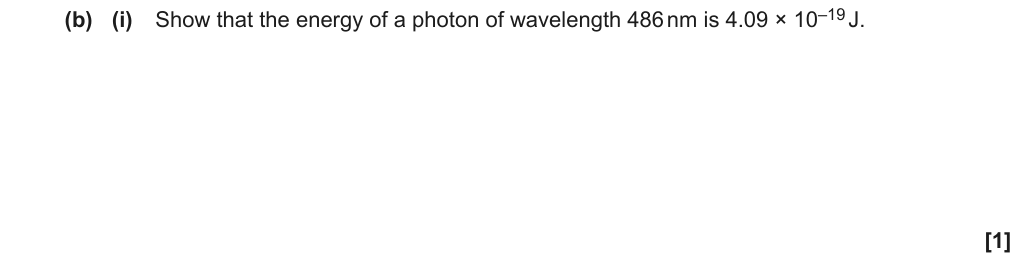
(b) (i) Show that the energy of a photon of wavelength 486 nm is 4.09 × 10⁻¹⁹ J.
[1]
June 2019 · Paper 3 · Q5(b)(ii) 2 marks Diagram or graph Easy stars
Earlier part of question 5 that this part usesEarlier part of June 2019 Paper 3 question 5
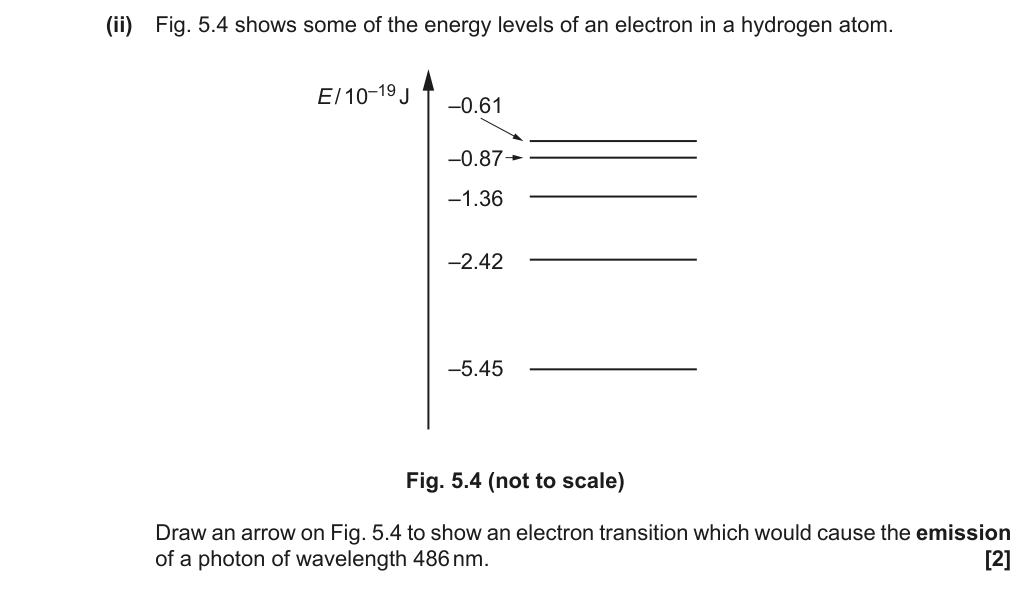
(ii) Fig. 5.4 shows some of the energy levels of an electron in a hydrogen atom.
E / 10–19 J
–0.61
–0.87
–1.36
–2.42
–5.45
Fig. 5.4 (not to scale)
Draw an arrow on Fig. 5.4 to show an electron transition which would cause the emission
of a photon of wavelength 486 nm. [2]
June 2019 · Paper 3 · Q6(a) 1 mark Explanation Hard cosmology
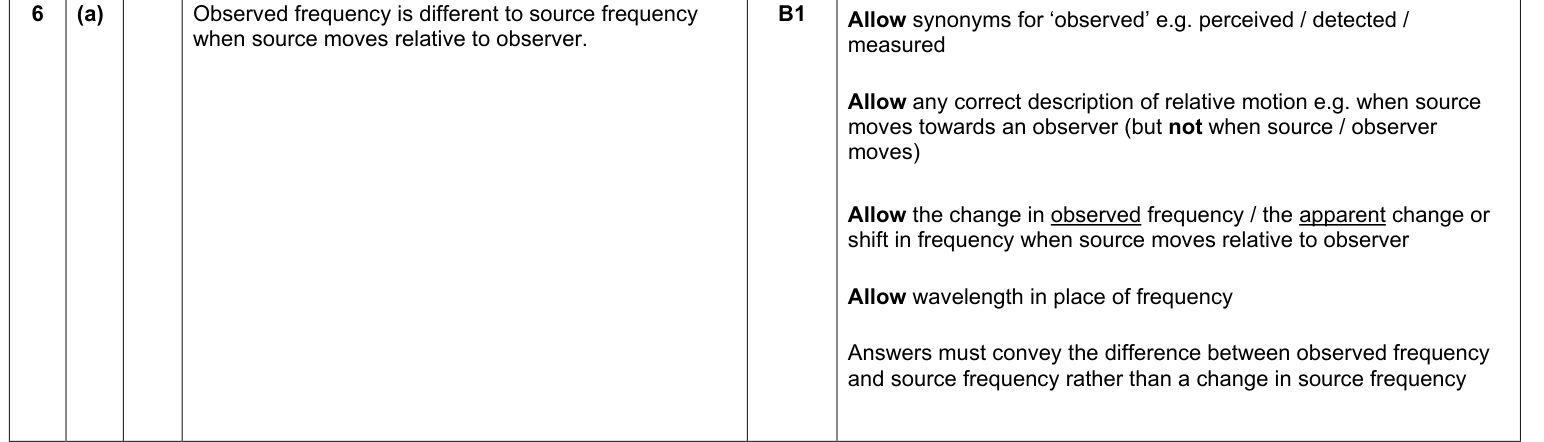
6 (a) Describe the Doppler effect.
...................................................................................................................................................
.............................................................................................................................................. [1]
June 2019 · Paper 3 · Q6(b) 2 marks Explanation Easy medical imaging
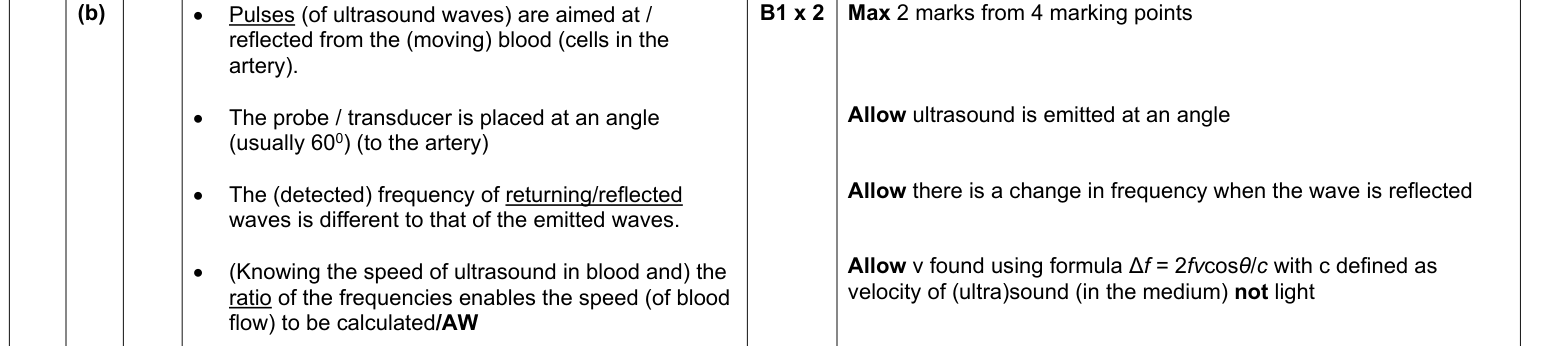
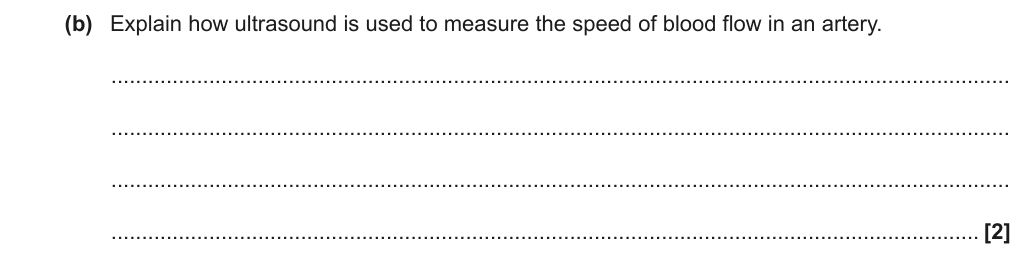
(b) Explain how ultrasound is used to measure the speed of blood flow in an artery.
...................................................................................................................................................
...................................................................................................................................................
...................................................................................................................................................
.............................................................................................................................................. [2]
June 2019 · Paper 3 · Q6(c)(i) 2 marks Show that Easy circular motion
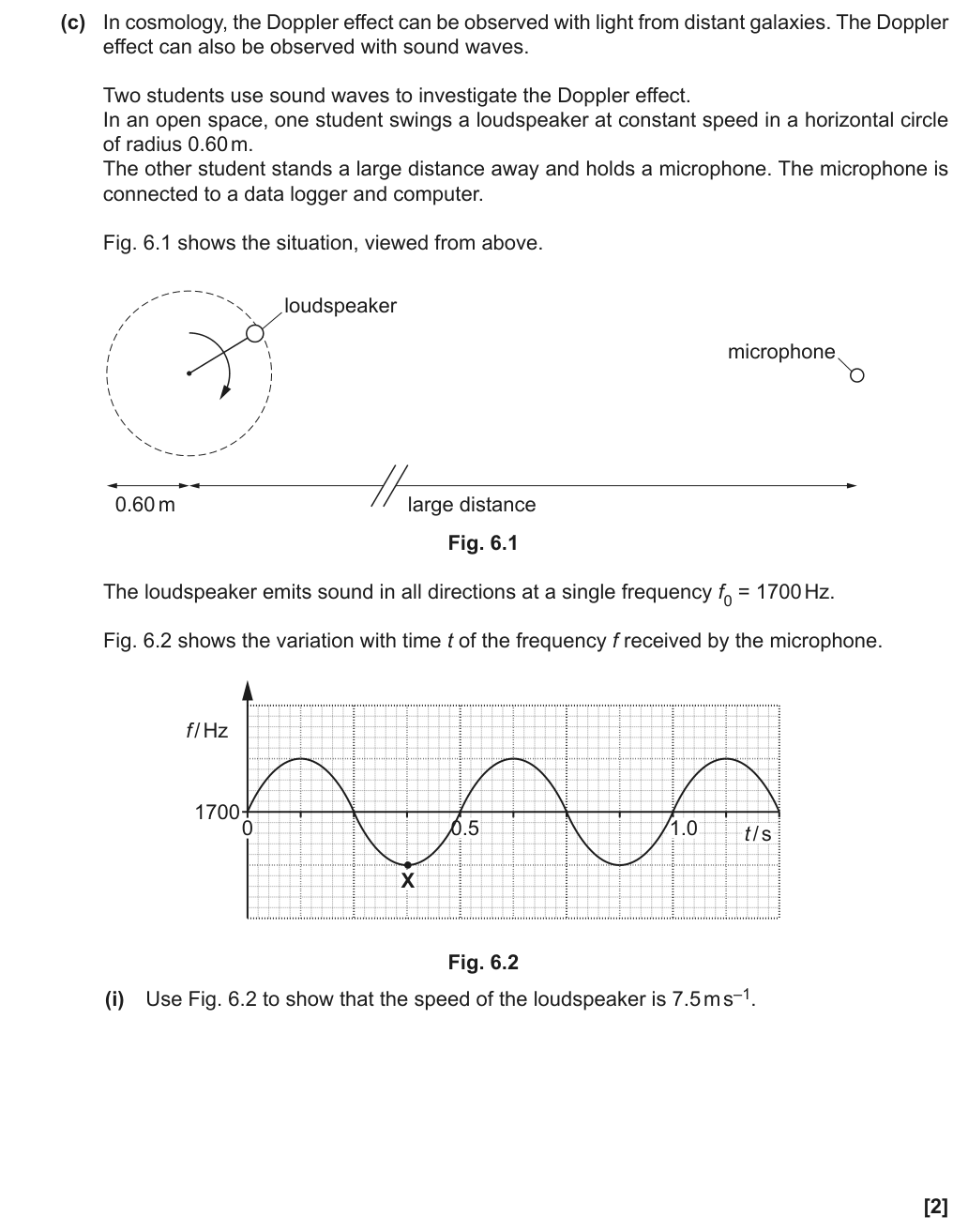
(c) In cosmology, the Doppler effect can be observed with light from distant galaxies. The Doppler
effect can also be observed with sound waves.
Two students use sound waves to investigate the Doppler effect.
In an open space, one student swings a loudspeaker at constant speed in a horizontal circle
of radius 0.60 m.
The other student stands a large distance away and holds a microphone. The microphone is
connected to a data logger and computer.
Fig. 6.1 shows the situation, viewed from above.
loudspeaker
microphone
0.60 m large distance
Fig. 6.1
The loudspeaker emits sound in all directions at a single frequency f0 = 1700 Hz.
Fig. 6.2 shows the variation with time t of the frequency f received by the microphone.
f / Hz
17000
0.5 1.0 t / s
X
Fig. 6.2
(i) Use Fig. 6.2 to show that the speed of the loudspeaker is 7.5 m s–1.
[2]
June 2019 · Paper 3 · Q6(c)(ii) 2 marks Calculation Medium cosmology
Earlier part of question 6 that this part usesEarlier part of June 2019 Paper 3 question 6
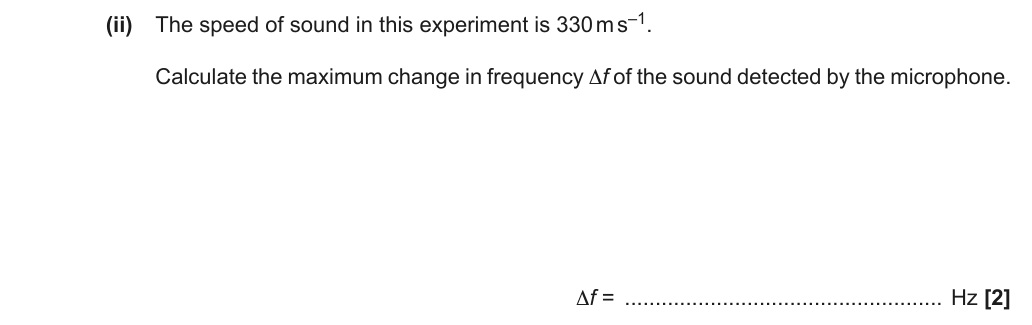
(ii) The speed of sound in this experiment is 330 m s–1.
Calculate the maximum change in frequency Δf of the sound detected by the microphone.
Δf =  .................................................... Hz [2]
June 2019 · Paper 3 · Q6(c)(iii) 1 mark Short answer Medium cosmologypractical skills
Earlier parts of question 6 that this part usesEarlier part of June 2019 Paper 3 question 6Earlier part of June 2019 Paper 3 question 6
(iii) Hence complete the scale on the y-axis of Fig. 6.2. [1]
June 2019 · Paper 3 · Q6(c)(iv) 1 mark Short answer Medium cosmology
Earlier part of question 6 that this part usesEarlier part of June 2019 Paper 3 question 6
(iv) Mark with an X on Fig. 6.1 the position of the loudspeaker which corresponds to the
point X on Fig. 6.2. [1]
June 2019 · Paper 3 · Q6(d) 2 marks Short answer Medium measurements and uncertaintiespractical skills
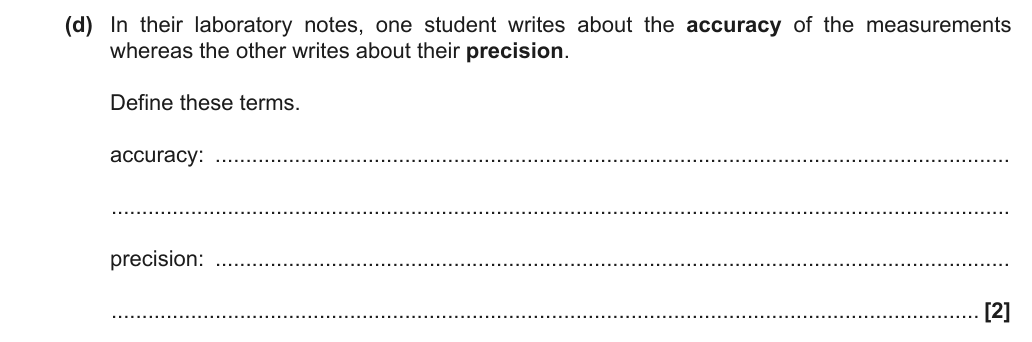
(d)  In their laboratory notes, one student writes about the accuracy of the measurements
whereas the other writes about their precision.
Define these terms.
accuracy:  ..................................................................................................................................
...................................................................................................................................................
precision:  ..................................................................................................................................
.............................................................................................................................................. [2]

Work with an OCR physics tutor

Want a paper marked and gone through with you? Message us.

Prefer email? Send an enquiry

If you are under 18, please include a parent's contact details. Enquiries go to enquiries@physicsaleveltutor.com and are deleted once handled. All tutoring is online.