Answer
C
Mark scheme

Examiner's comment
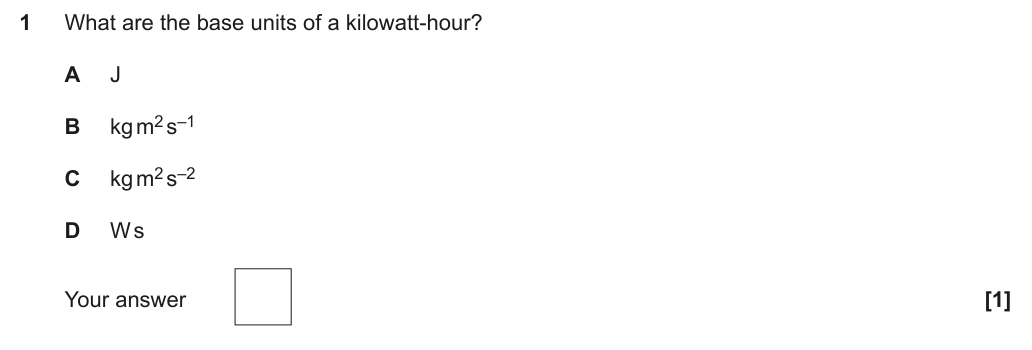
A little over half of candidates were able to identify the correct response. Many candidates showed working to obtain their answer. D was a common incorrect response.
100 marks · 56 question parts · Paper, mark scheme and report on OCR's site · Have the Data, Formulae and Relationships Booklet beside you
C
A little over half of candidates were able to identify the correct response. Many candidates showed working to obtain their answer. D was a common incorrect response.
D
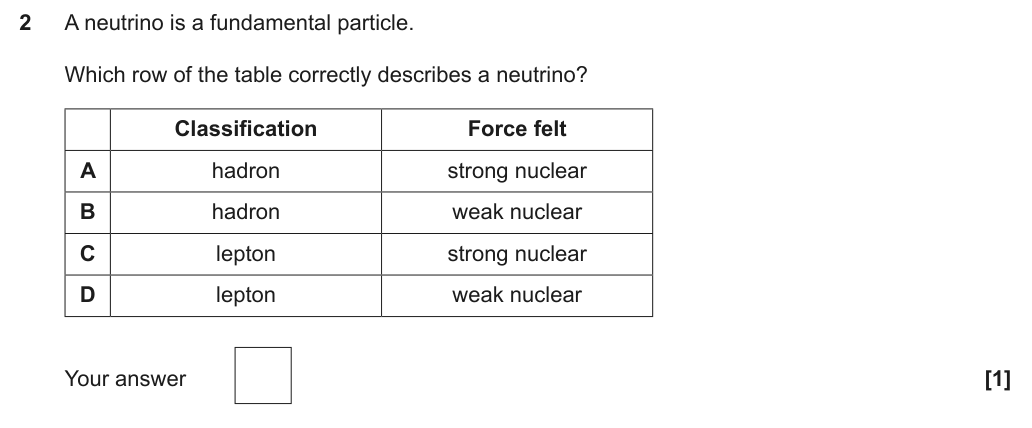
Most candidates were able to correctly identify the classification and force. To reduce their options, many candidates circled the correct force.
C
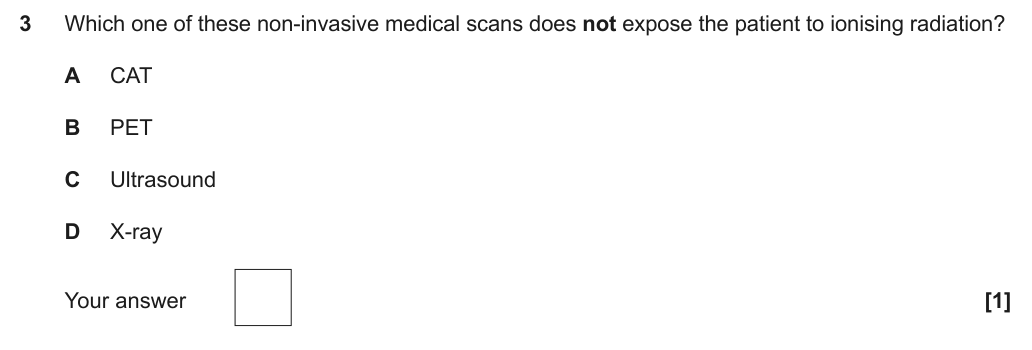
This question was correctly answered by most of the candidates and demonstrated a good knowledge of ionising radiations in medical applications.
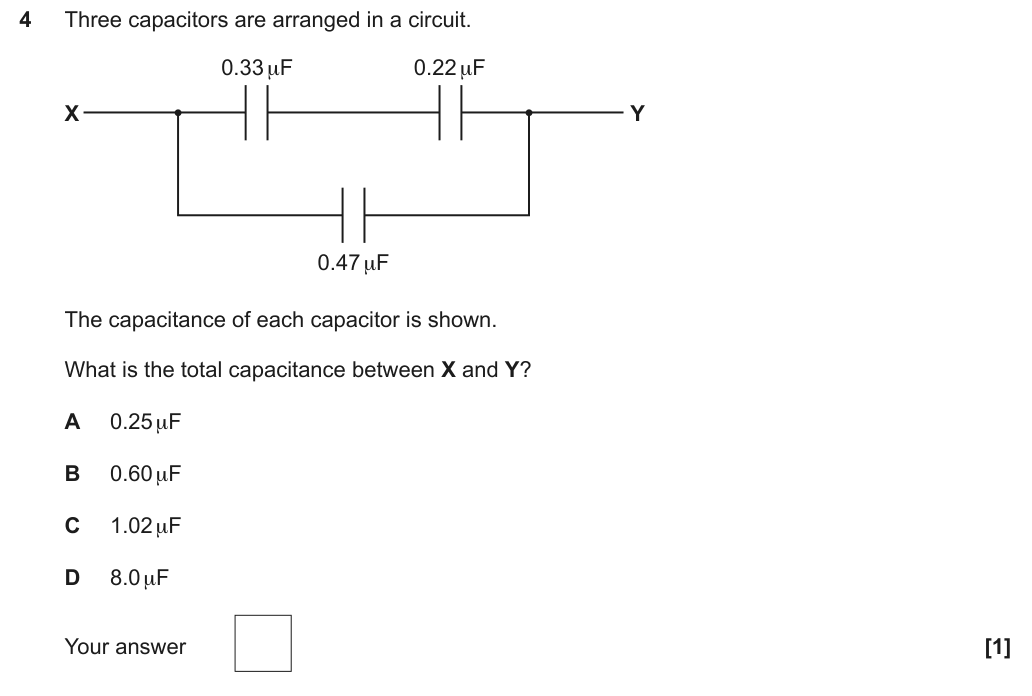
B
Most candidates were able to correctly calculate the total capacitance, and many showed working to support a correct method. A was the most common distractor, being calculated as if the capacitors were resistors.
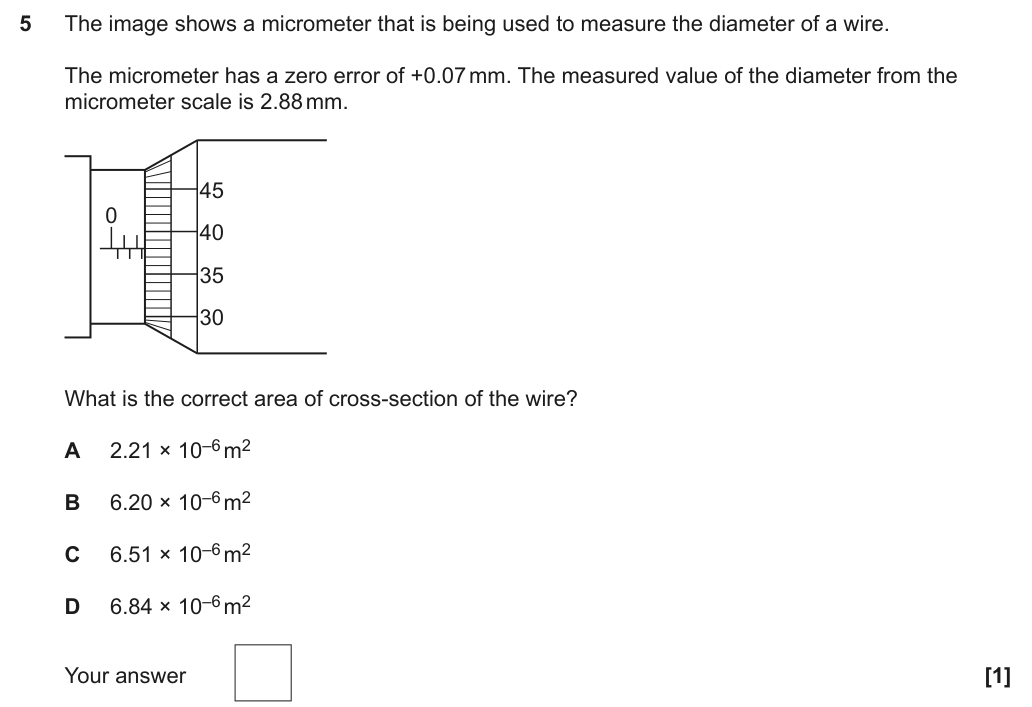
B
Around two thirds of candidates were able to correctly apply the zero error in their calculation. D was a common distractor where the zero error was added onto the micrometre reading.
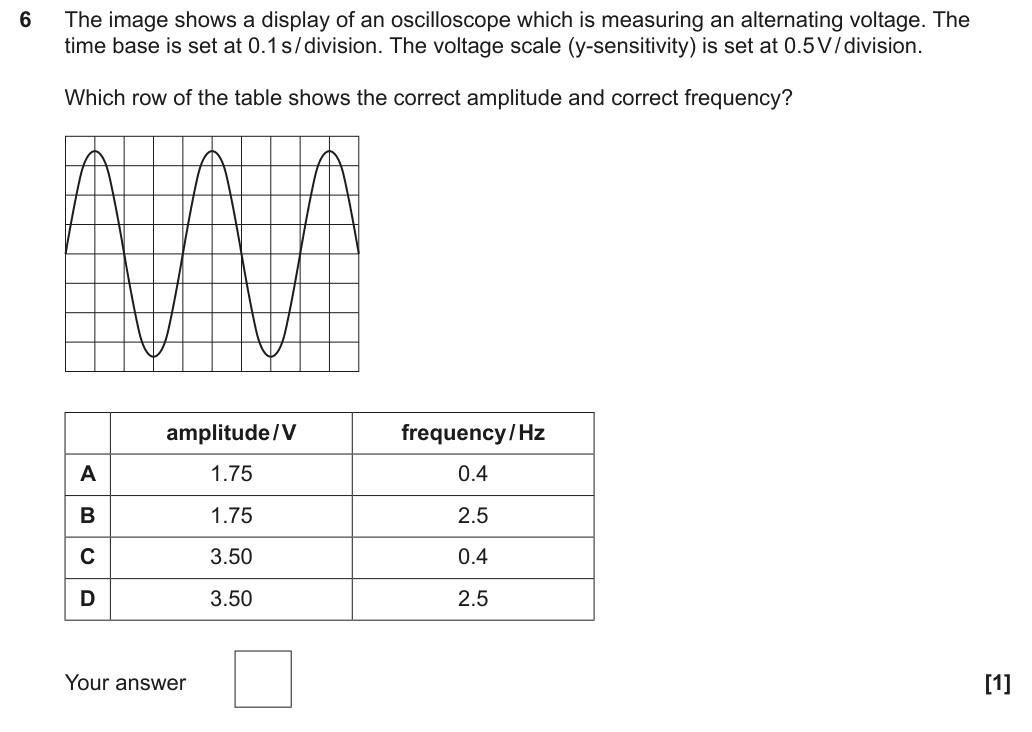
B
Most candidates were able to correctly calculate the amplitude and frequency. A was the most common distractor where candidates simply identified the time period rather than then calculate the frequency.
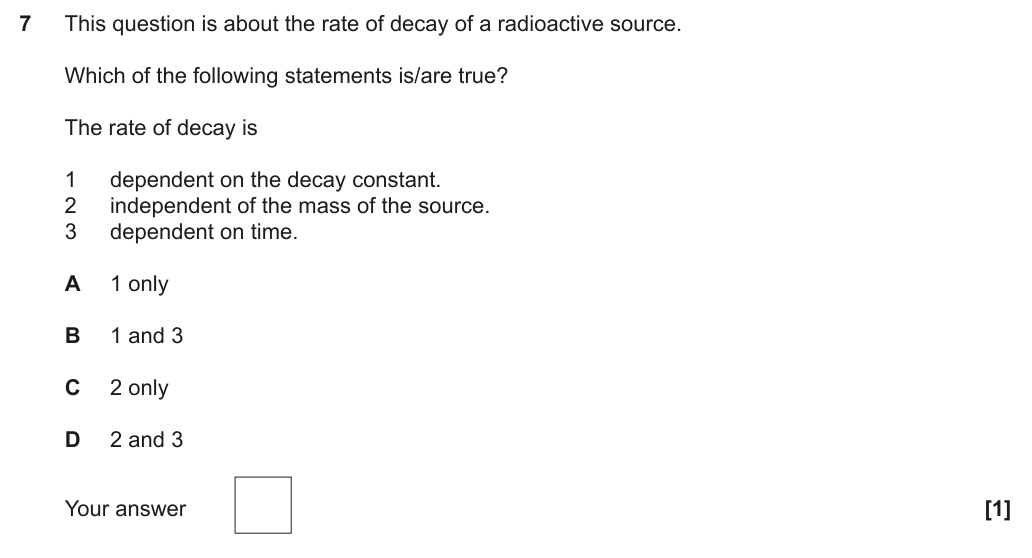
B
A little under half of the candidates were able to correctly identify the correct statements. A helpful approach to this type of question is to ‘tick’ the statements which the candidate is certain of, which then reduces the options available.
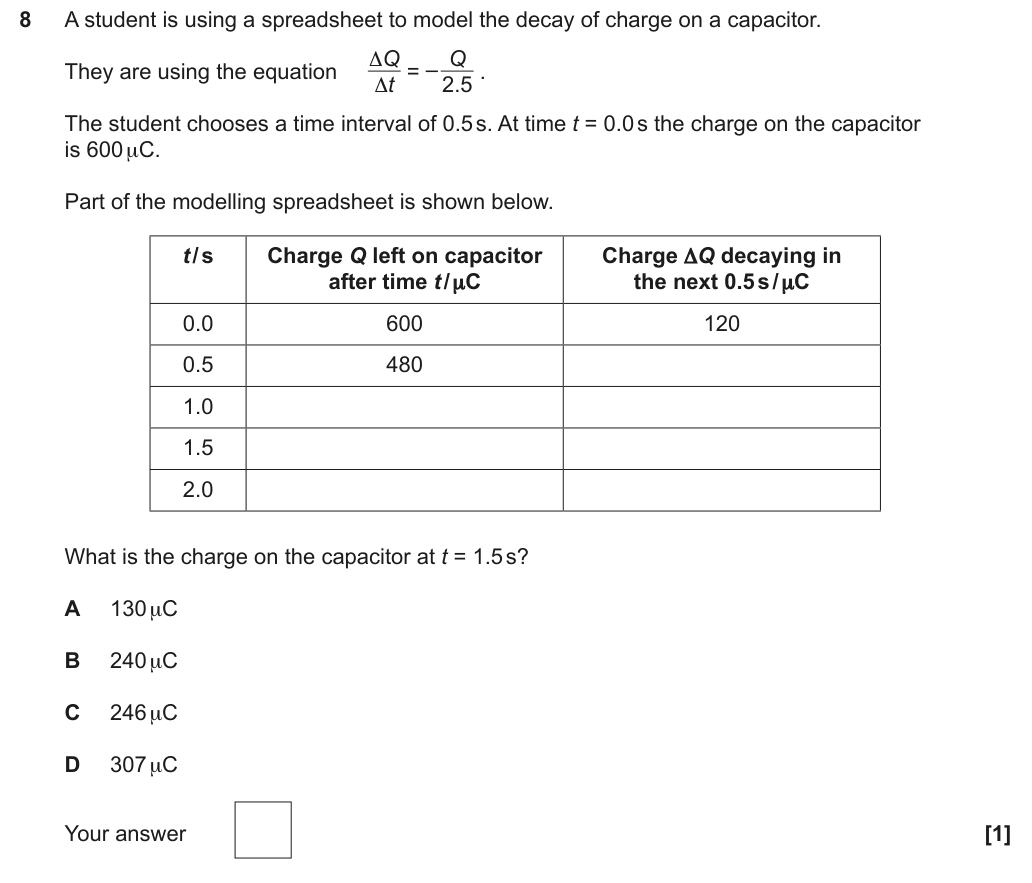
D
Most candidates were able to correctly calculate the charge. Although not a difficult calculation, there are plenty of stages and potential for error at each. Most of the candidates filled in the table at each point which would be a helpful way of keeping on track of the charge.
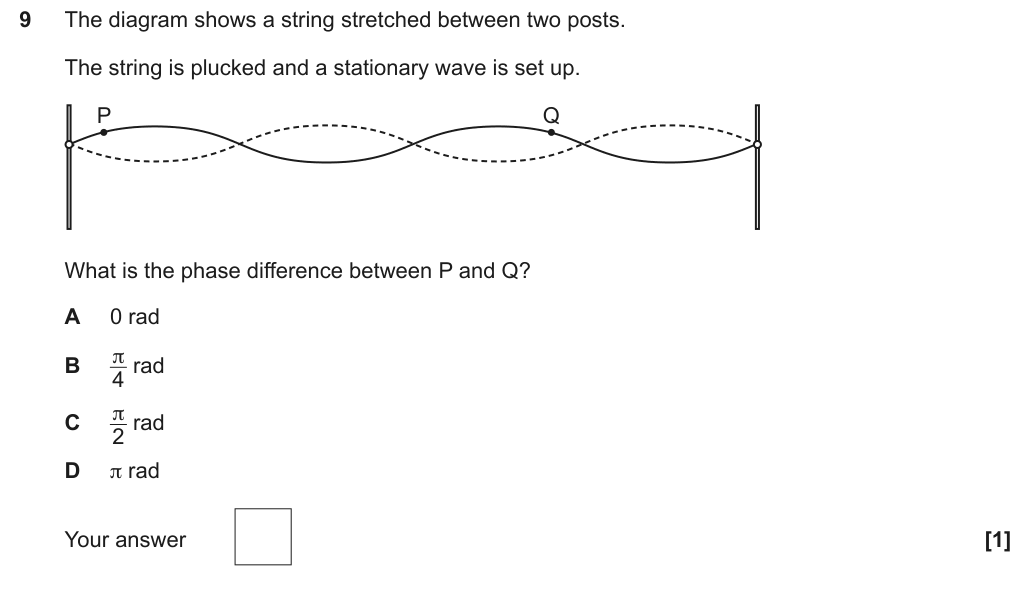
A
Relatively few candidates got this phase difference correct; it was clear from many that they thought that it was a progressive wave as they attempted to add on fractions of cycles. It may also be the case that candidates are unfamiliar with phase differences in stationary waves.
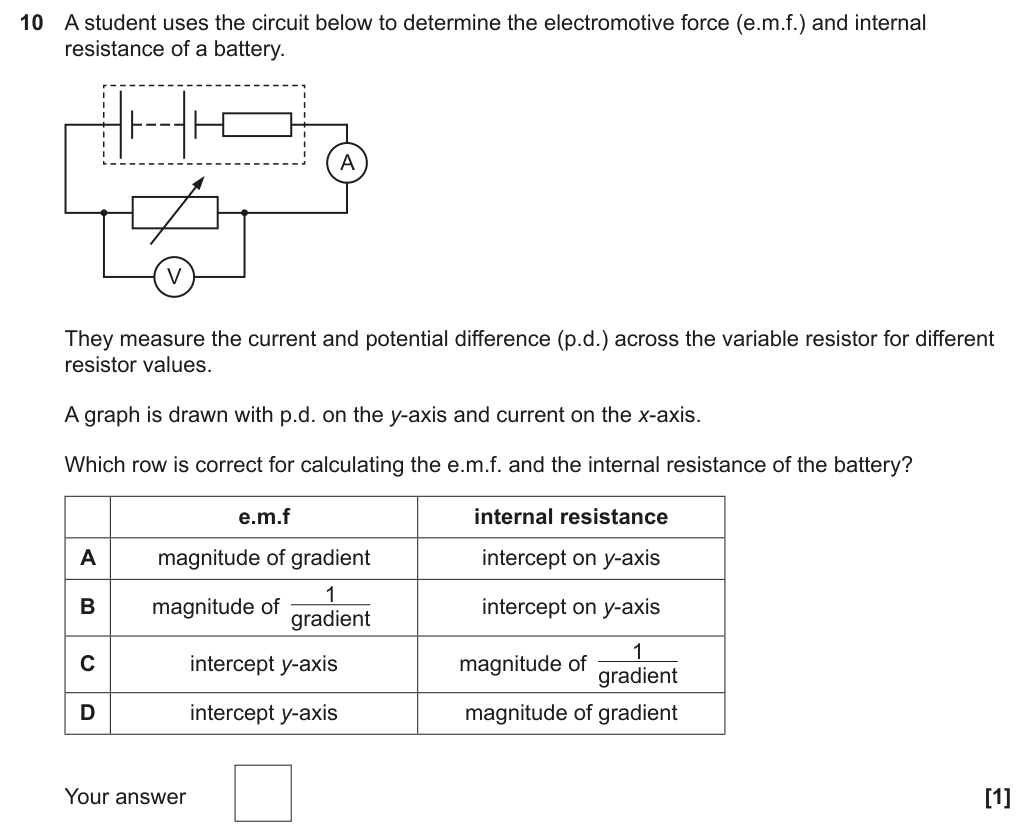
D
This was correctly answered by most candidates. They were able to identify how to obtain the emf correctly but less certain on the internal resistance, which led to C being my far the most common incorrect response.
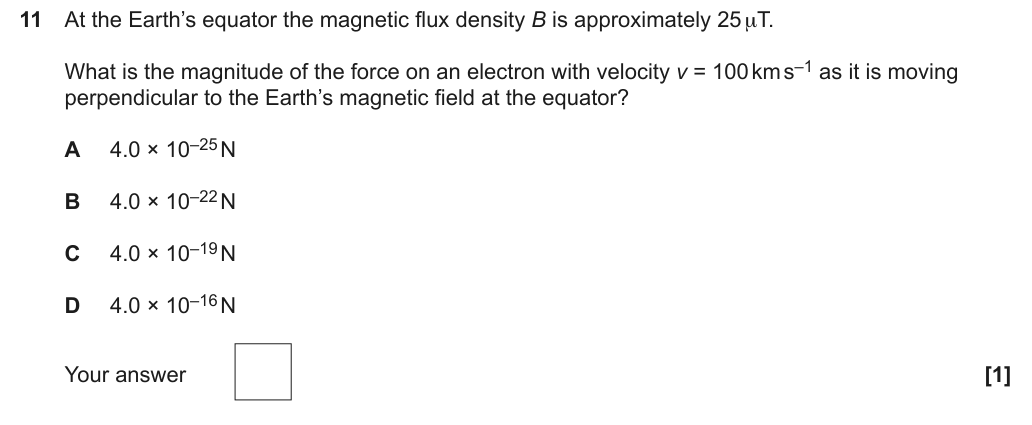
C
Most candidates were able to calculate the force, using F = BQv. The powers of ten in the various quantites appeared to have caused few problems. SThis was the multiple choice question that had the most ‘no responses’.
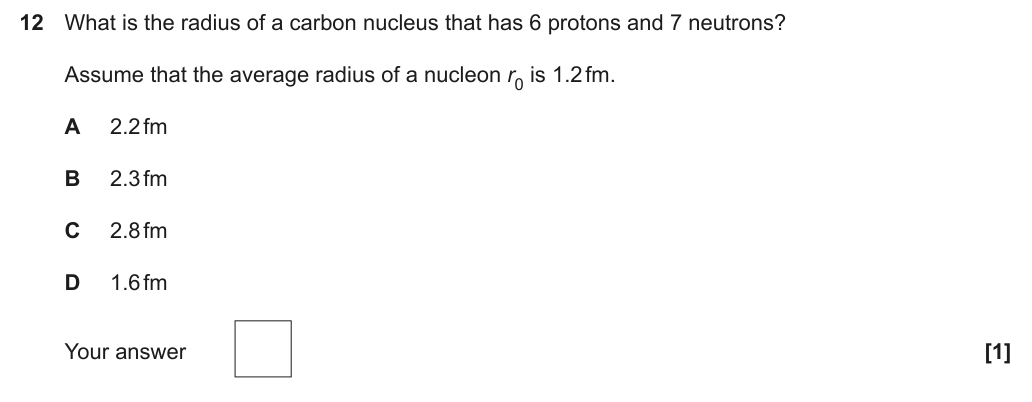
C
Most candidates were able to correctly calculate the radius and it was clear that most knew how to correctly apply the formula.
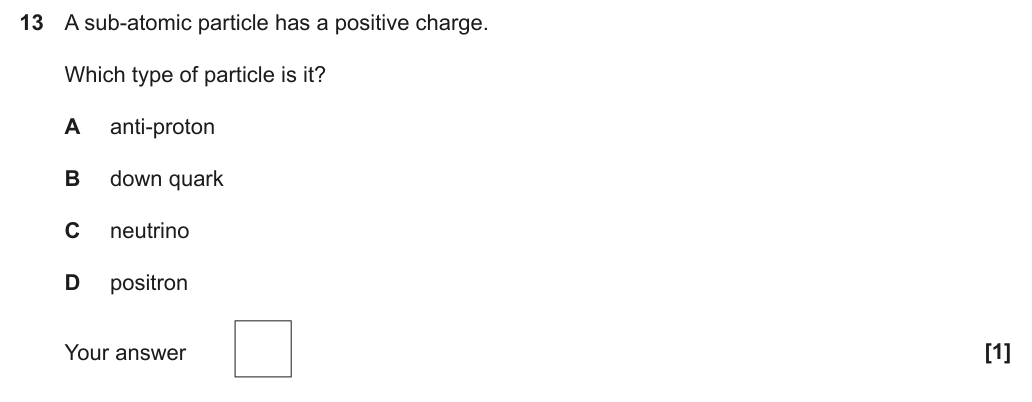
D
This relatively simple question was correctly answered by of the vast majority of candidates. The most common distractor was B which was presumably due to a lack of certainty of quark charges.
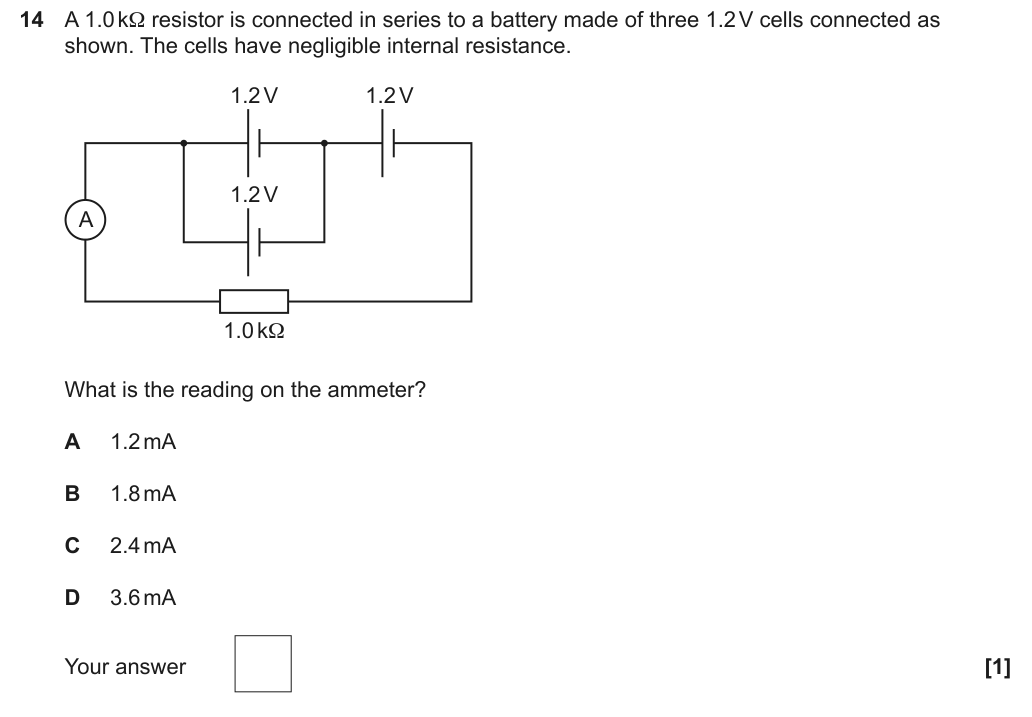
C
This question was relatively poorly answered with fewer than half of the candidates getting the correct response. B and D were the two common distractors with B treating the cells as if they were resistors, and D simply adding up the three voltages.
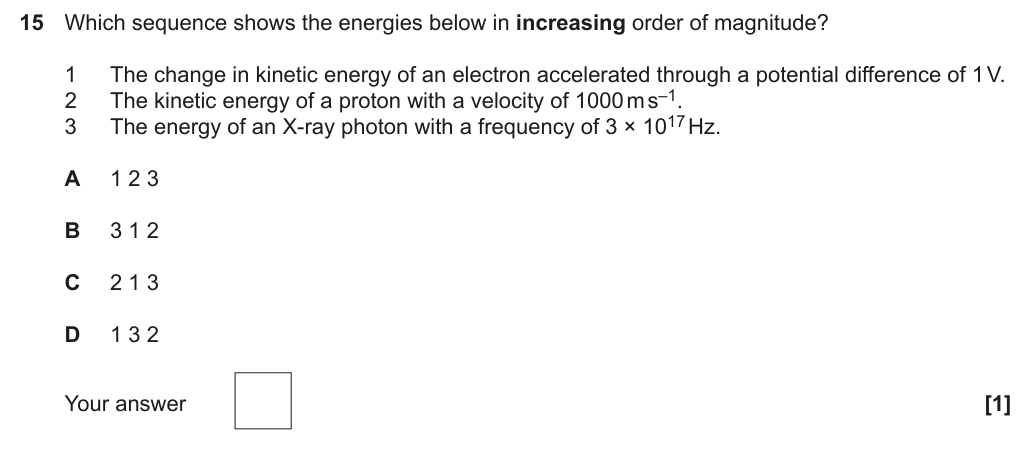
C
Approximately half of the candidates were able to correctly identify the order. Many set out the calculations to the side before putting them in rank order and this generally proved successful. Most of the incorrect responses showed little or no working, leading to the assumption that there may have been some guesswork involved.
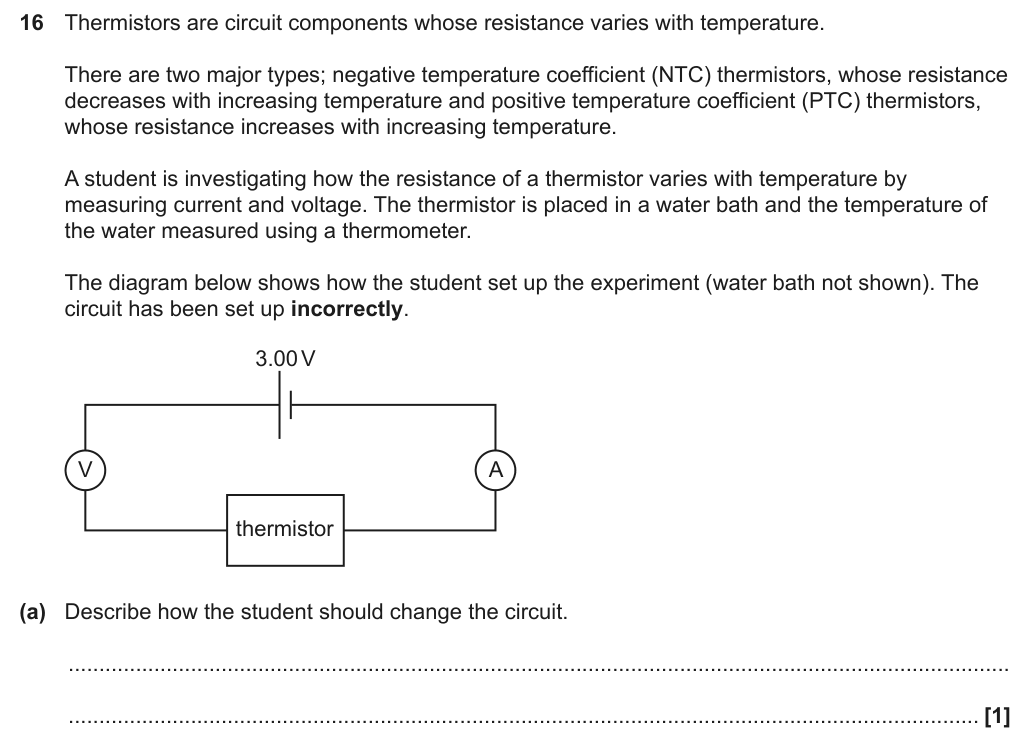
This relatively simple first question was correctly answered by the significant majority of candidates. In general, it was lack of detail, such as ‘place it in parallel’ which meant that the mark would not be scored. A small number of candidates mentioned placing the ammeter in parallel.
Skills: PAG3 Investigating electrical properties
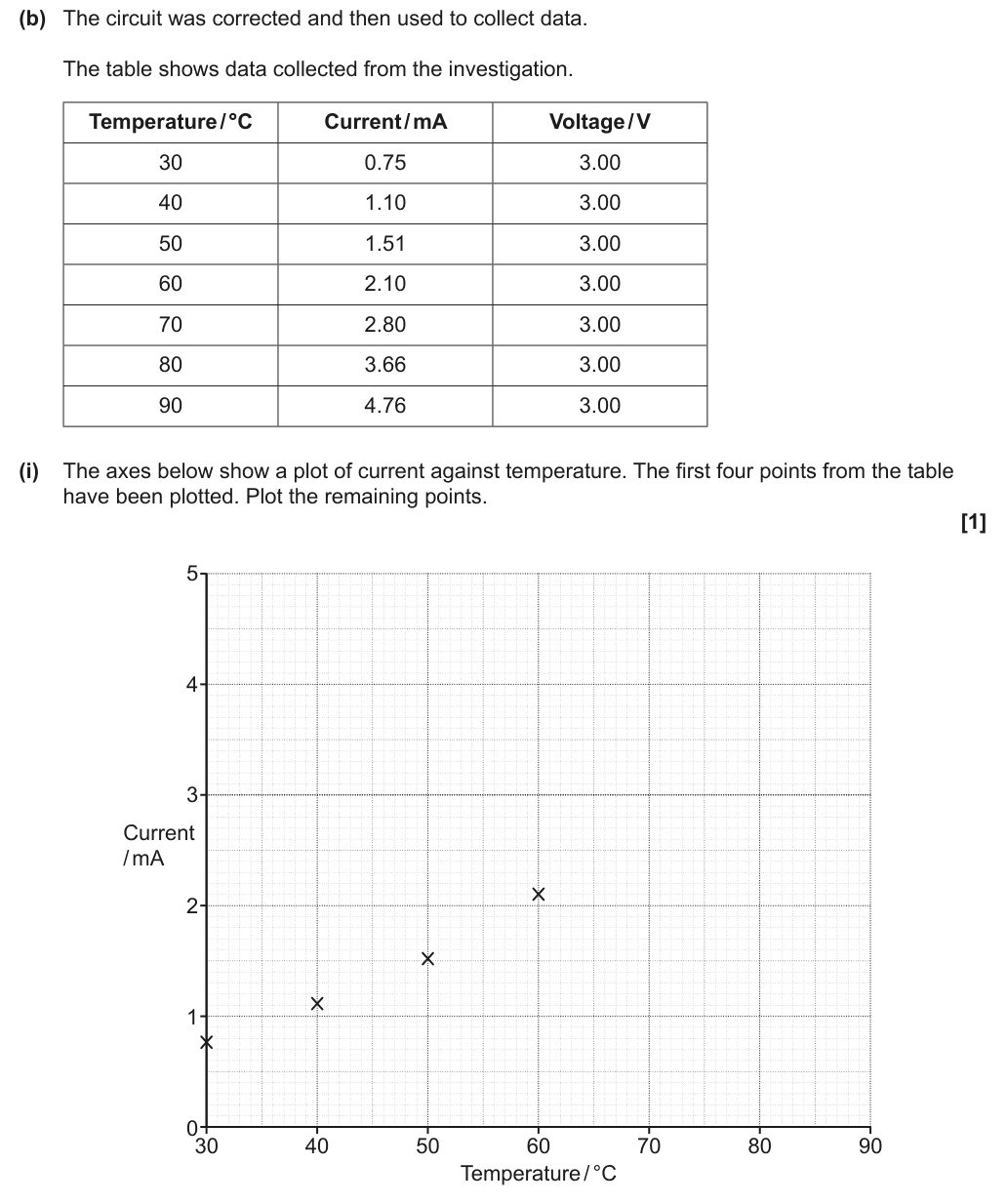
Point plotting is always likely to form part of a question in this paper. The general rule is that each point should be plotted within ½ a small square of the correct position. Candidates are encouraged to plot points as ‘crosses’ and use a sharp pencil. The vast majority of candidates plotted these three points correctly with the second point most commonly being plotted incorrectly.
Skills: M3.2 Plot two variables from experimental or other data; PAG3 Investigating electrical properties
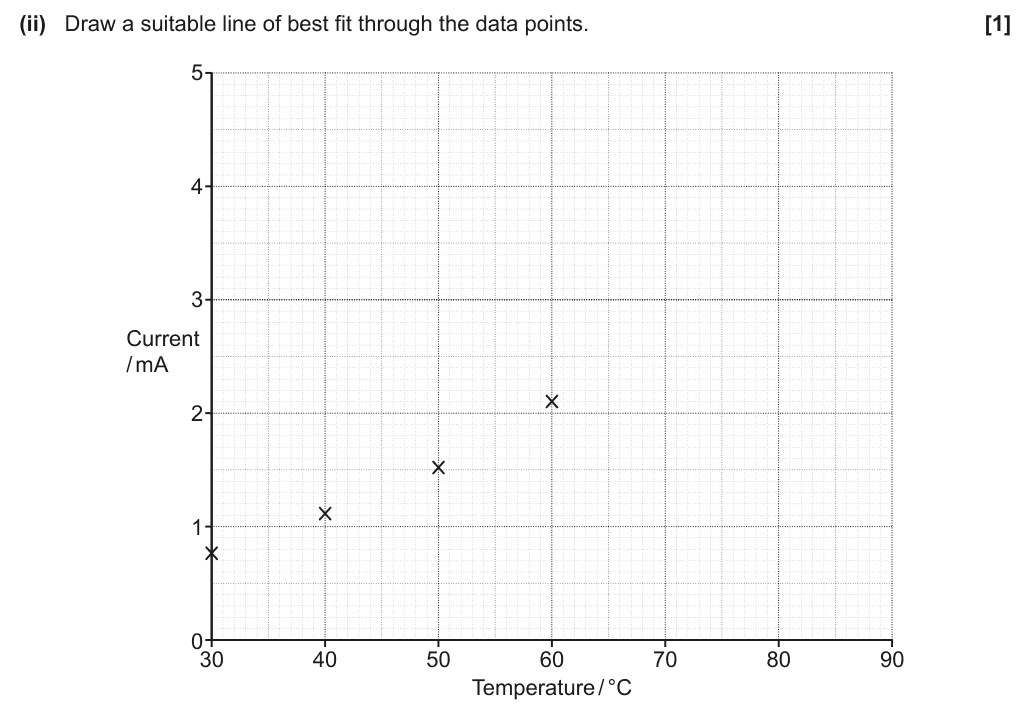
The suitable line is a curve of increasing gradient and well over half of the candidates were able to draw this carefully. There were very few lines which simply joined the points as ‘dot-to-dot’ straight lines although a considerable number drew a single straight line often through the (false) origin which should have looked clearly unsuitable. When drawing the curve it needs to pass within a single small square of each data point; several candidates drew careless lines missing data points by some distance. Candidates are also encouraged to use a sharp pencil for this line. There were a reasonable number who attempted to correct a line drawn in pencil, often making it difficult to award a mark.
Skills: M3.2 Plot two variables from experimental or other data; PAG3 Investigating electrical properties
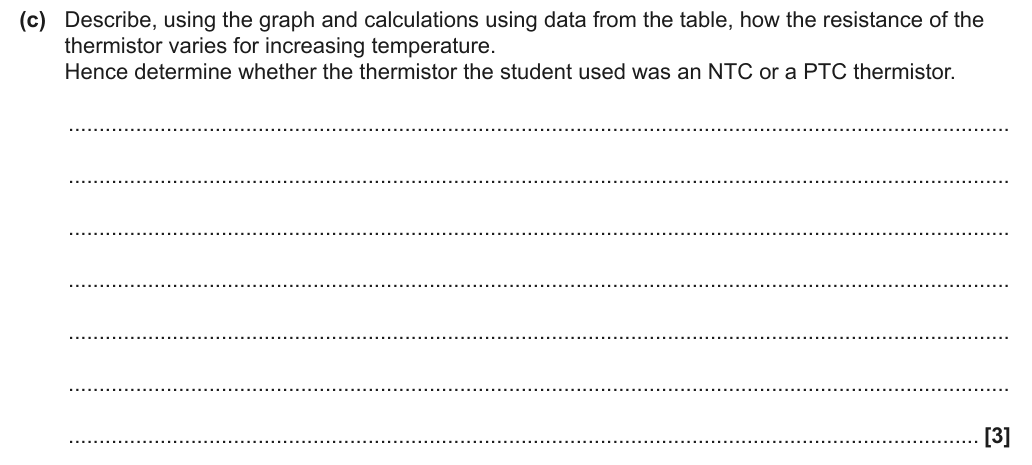
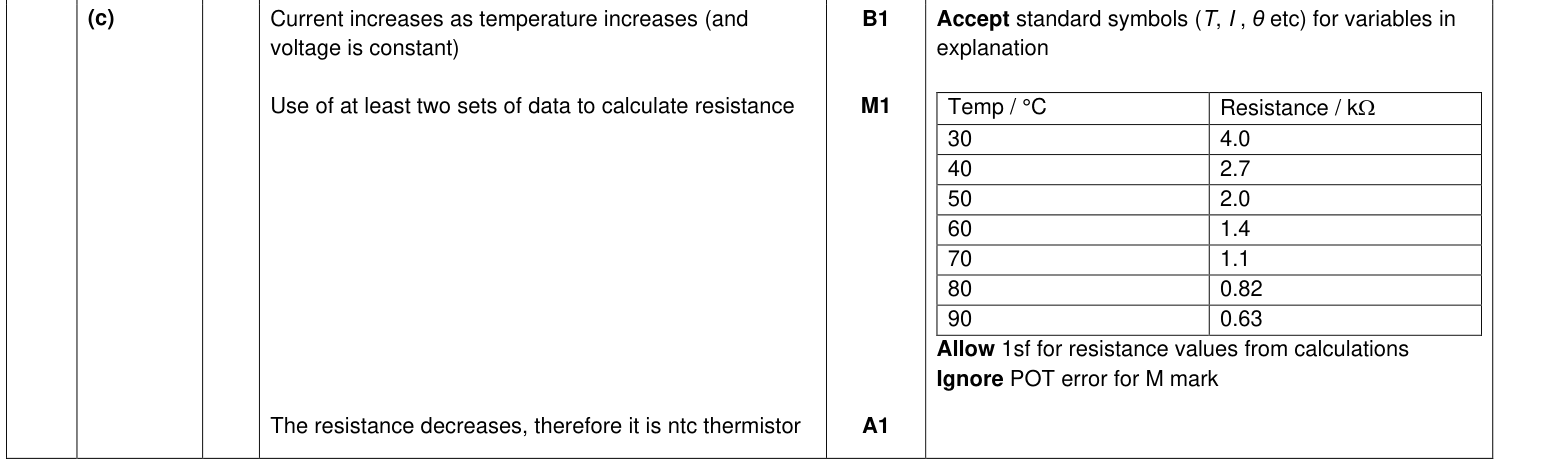
Candidates were asked to use both the graph and table to draw their conclusion and for full credit both of these needed to be done. A simple description of the variance of current with temperature was all that was needed for the graph mark but calculations of resistance needed to be carried out from the table. Most candidates were able to score at least 1 mark on this question although some incorrectly identified the type of thermistor (as PTC) despite having the rest of the response correct.
Skills: M2.3 Substitute numerical values into algebraic equations using appropriate units for physical quantities; M3.1 Translate information between graphical, numerical and algebraic forms; PAG3 Investigating electrical properties
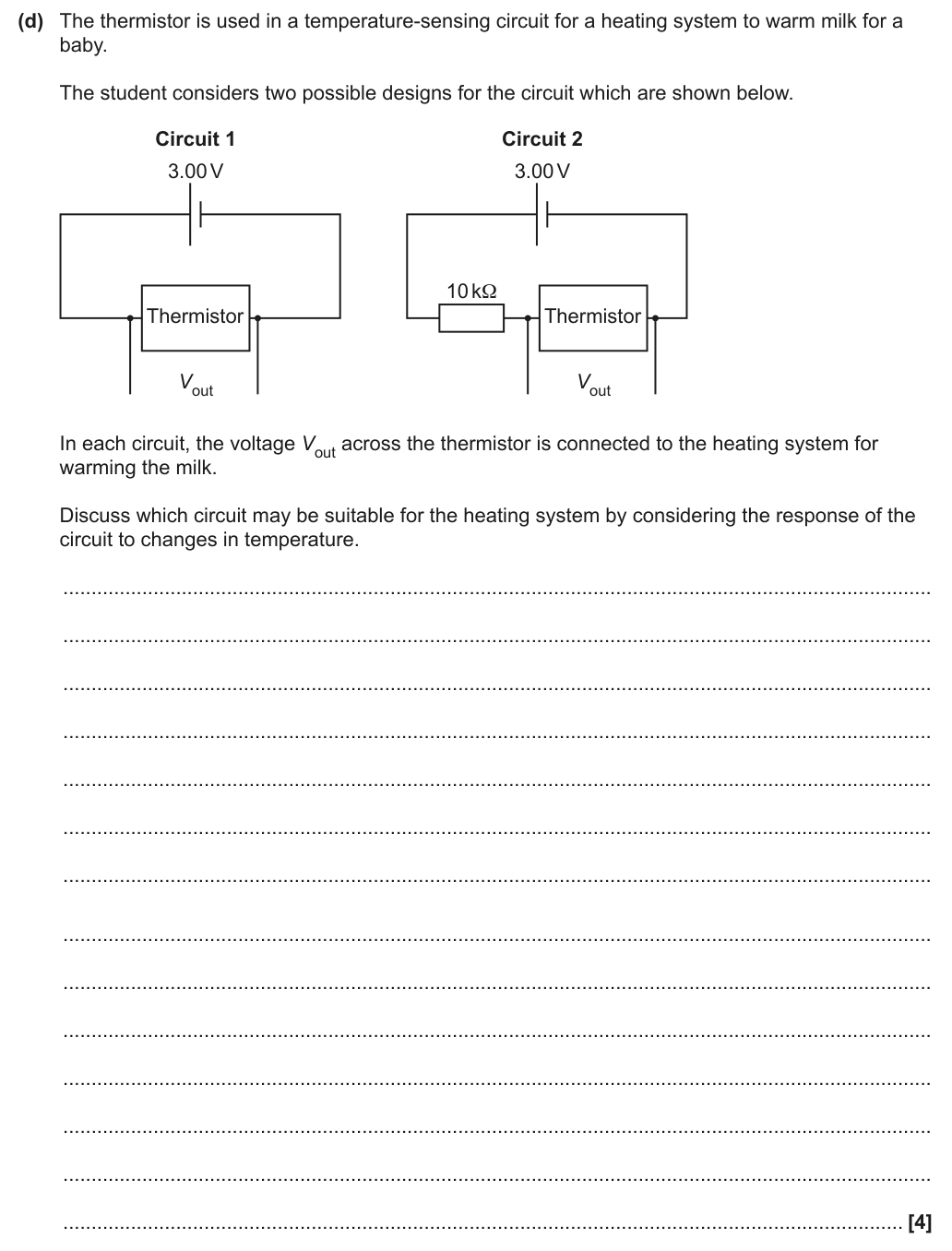
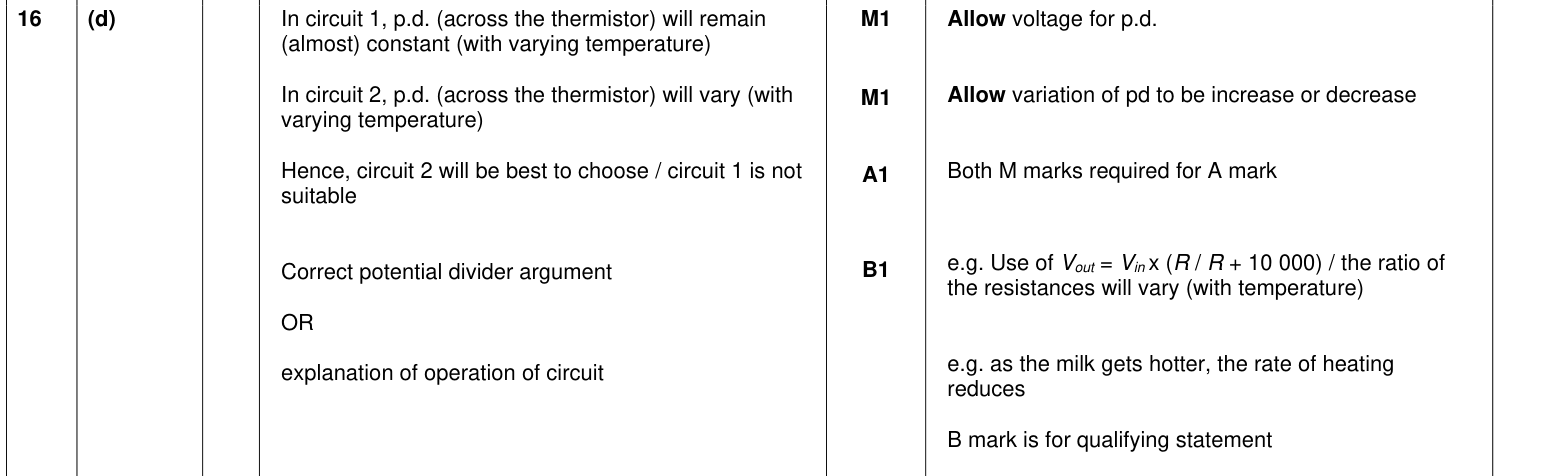
A significant number of candidates did not score on this question despite giving a response, indicating a lack of understanding of voltage in circuits. In particular, those who did not appreciate that the full voltage was across the thermistor in circuit 1 generally struggled to obtain any marks. However, there were many good descriptions of a potential divider in circuit 2 and these often went into detail about the operation of the circuit and its suitability.
Skills: PAG4 Investigating electrical circuits
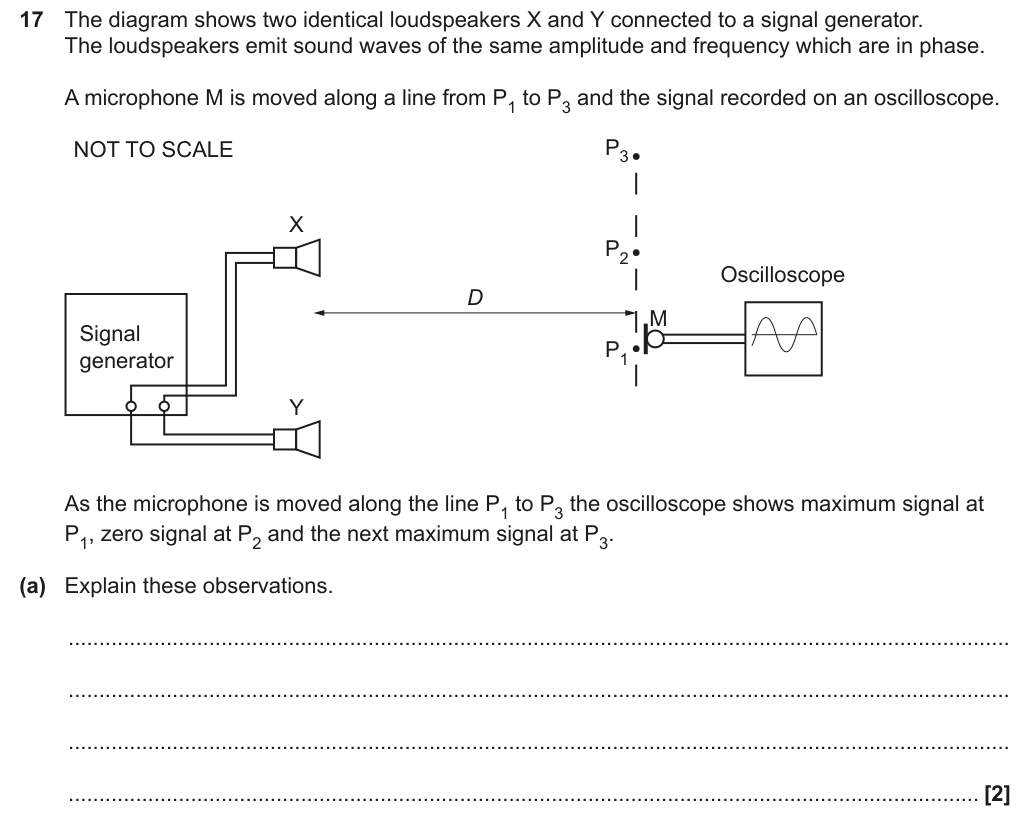
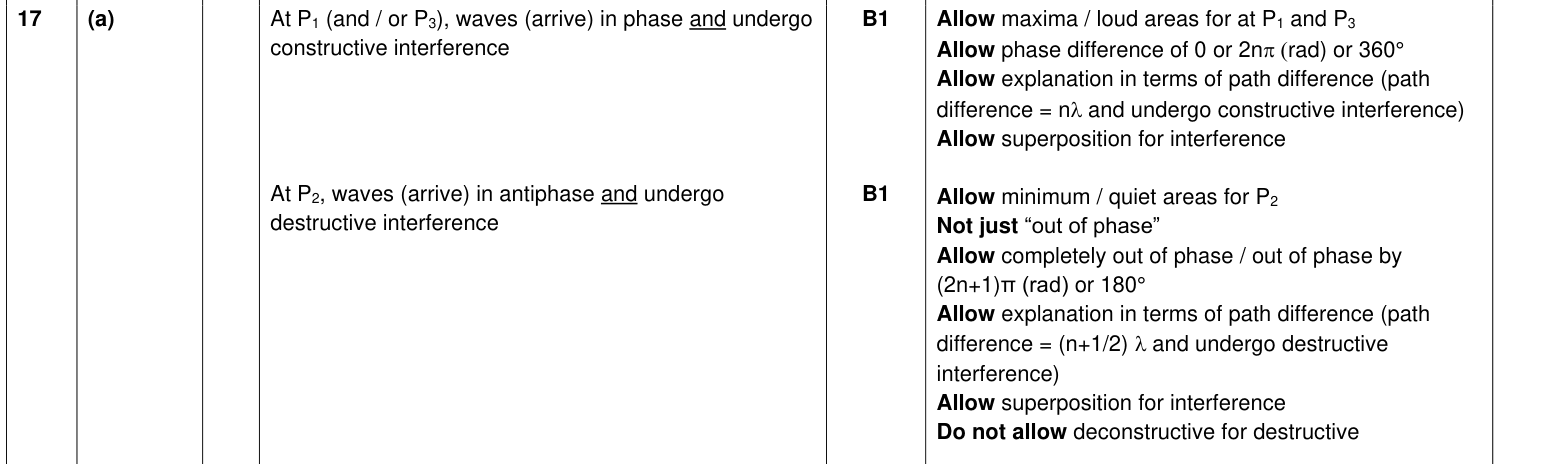
Candidates needed to appreciate that the maximum and minimum were due to interference and then give an explanation of constructive and destructive interference in terms of phase or path differences. It was a common misunderstanding that a stationary wave was formed, and a significant number of candidates described the observations in terms of nodes and antinodes. It was also common to see confusion between path and phase difference, with candidates giving phase differences in terms of wavelengths. In Exemplar 1, the candidate has given an excellent response to the maximum – stating constructive interference and then giving two reasons why this occurs (assuming n is an integer). However, the minima stops and isn’t developed, even though there is still some space, and the additional space at the back can also be used. It is likely that the candidate knew the reason for the destructive interference, and this demonstrates how important it is to complete descriptions and explanations.
Skills: PAG5 Investigating waves
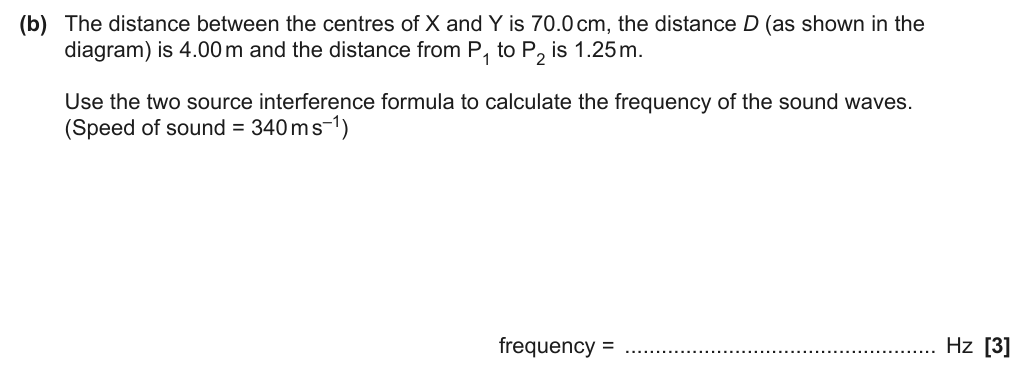
The majority of candidates were able to use the two source formula, however used 1.25m for their value of x, rather than double this. A small number of candidates attempted a geometrical solution, attempting to calculate angles, but this was unlikely on its own to score any marks.
Skills: M0.1 Recognise and make use of appropriate units in calculations; M2.2 Change the subject of an equation, including non-linear equations; M2.3 Substitute numerical values into algebraic equations using appropriate units for physical quantities; PAG5 Investigating waves
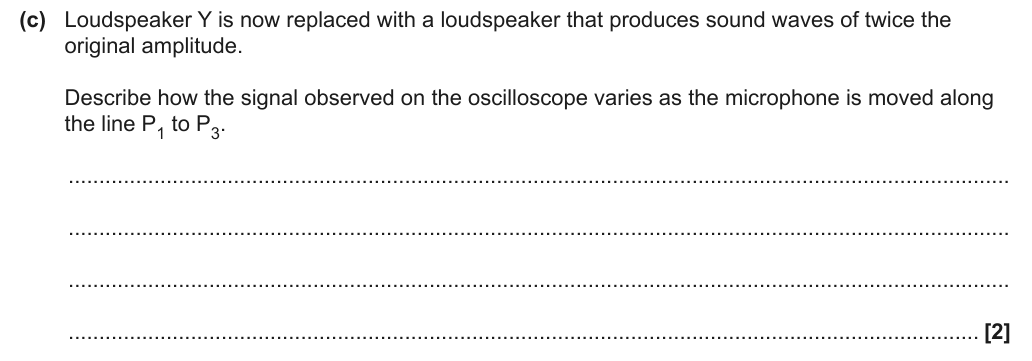
This question specifically asked about the observed signal and so responses based on loudness or sound volume are not appropriate. Candidates needed to be very clear that they were describing particular positions and how the signal varied from the previous situation. There was no penalty for an incorrect value of the increase in signal, although many candidates were able to state this correctly.

Candidates need to give a clear and specific answer to this question, which is best expressed in words. The Data and Formulae booklet contains the equation for intensity in symbols, however it is important to state the ‘per unit area’ in the explanation rather than a vaguer statement such as ‘power over area’. Many candidates gave very simplistic responses such as ‘the amount of energy a wave has’ indicating a lack of appreciation for the detail required.
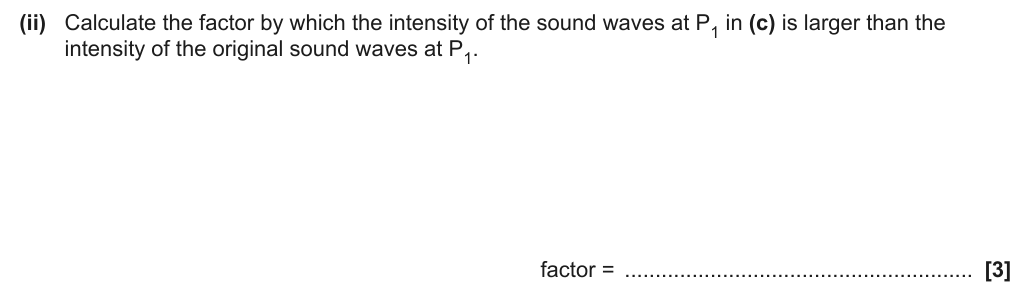
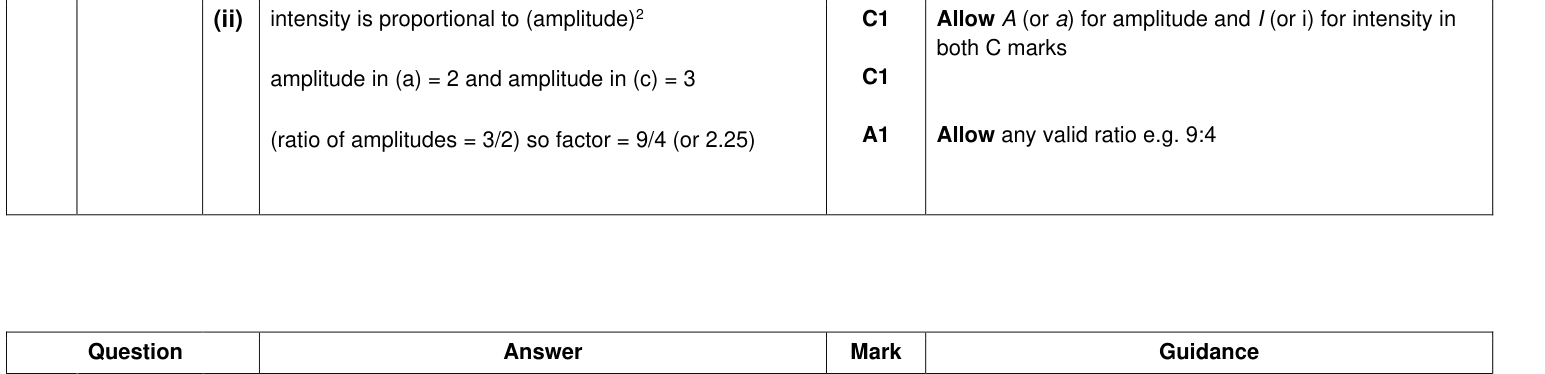
Some candidates were able to correctly calculate the factor, which could be expressed in a number of ways. Many candidates were able to correctly state the relationship between intensity and amplitude but not able to identify how the amplitudes were different and so could not carry on with the calculation, so only scoring a single mark.
Skills: M0.3 Use ratios, fractions and percentages
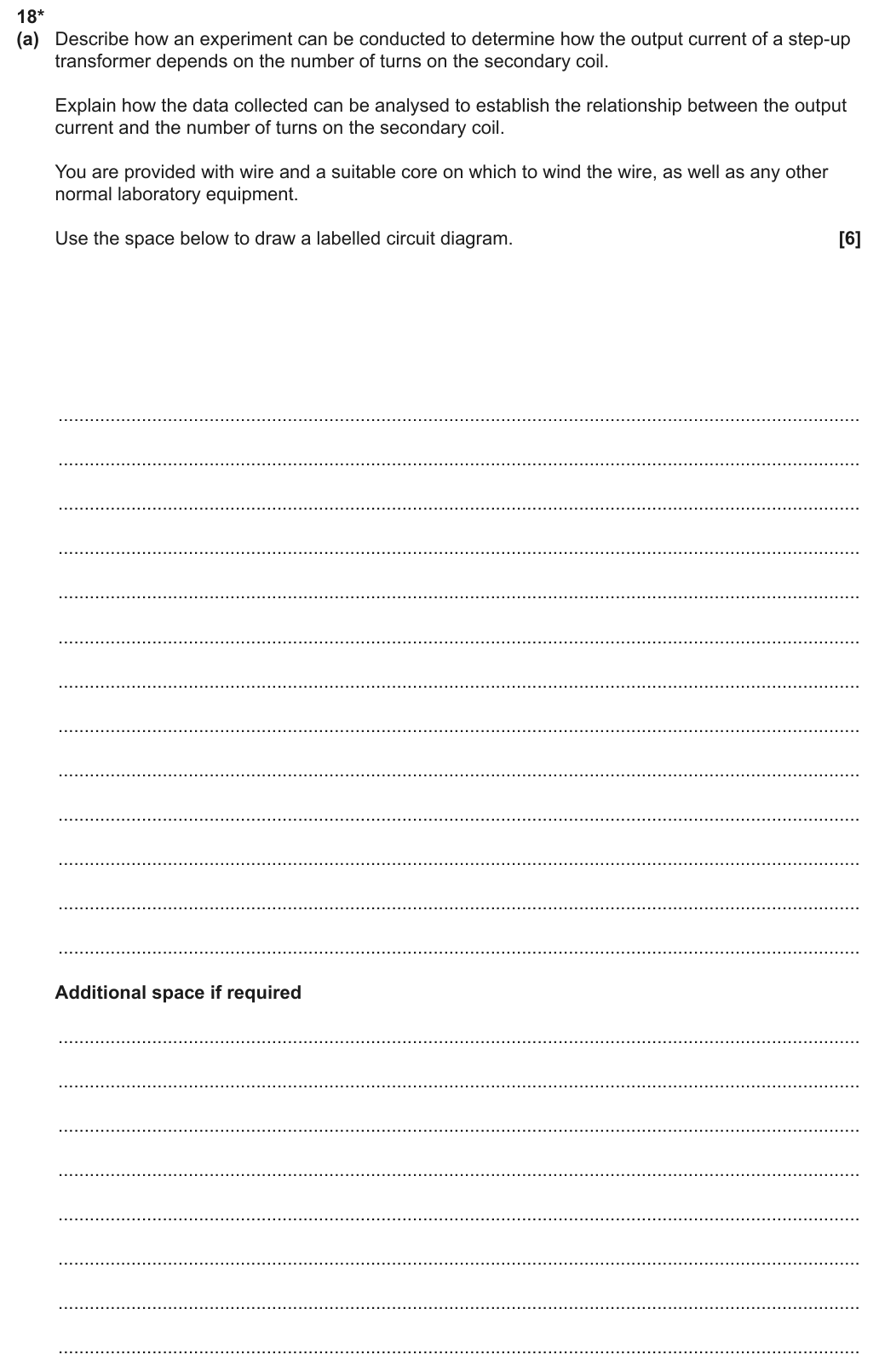
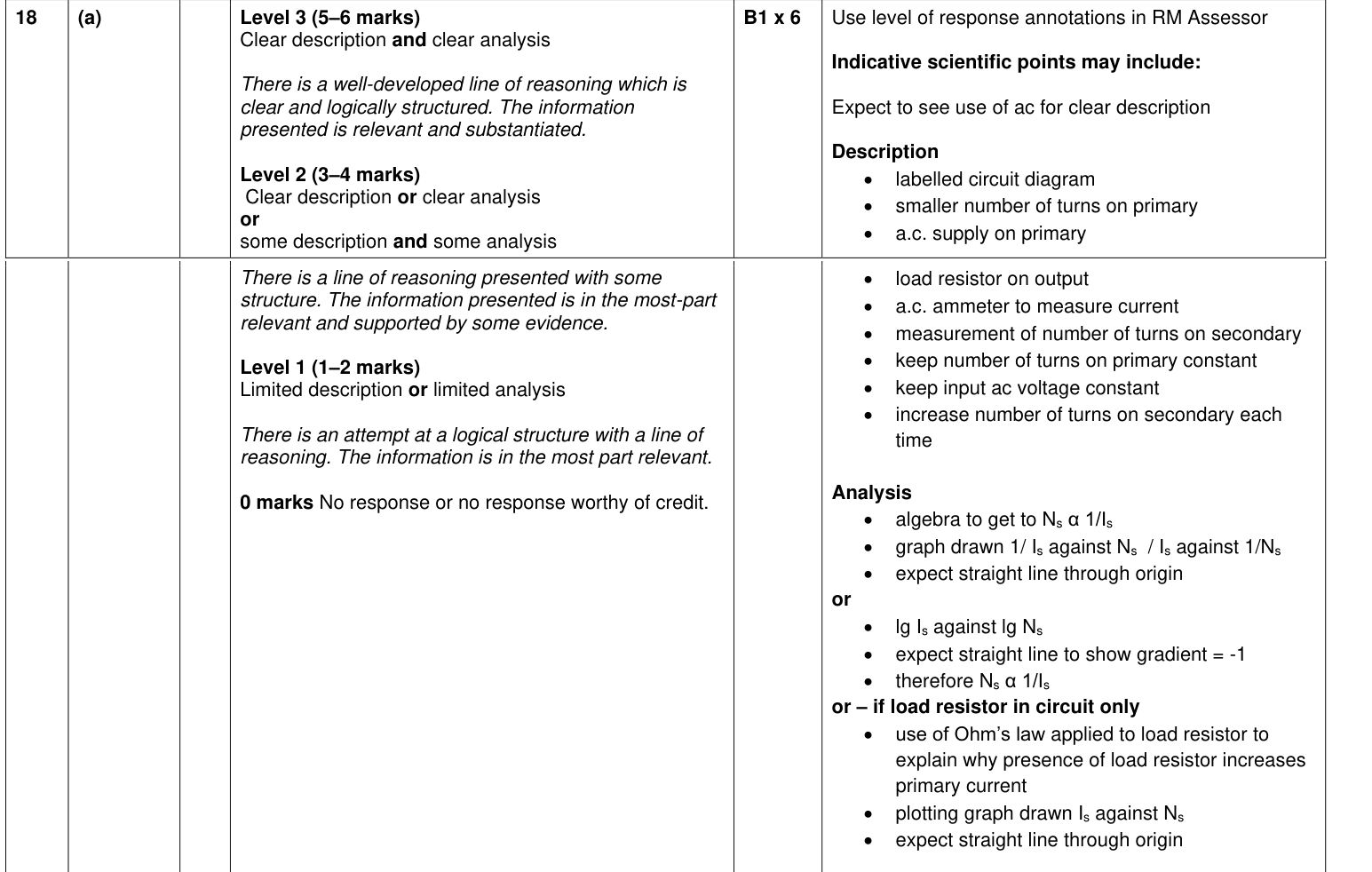
This Level of Response (LoR) question was designed to assess practical skills of planning, implementation, analysis and evaluation from Module 6 of the specification, specifically 6.3.3(f), along with HSW3 and HSW4. A holistic approach to marking is used, with marks given according to answers matching the descriptors for the various levels. No one answer is perfect for this question, and examiners were expecting a varied approach, with common themes, which would lead to a correct conclusion. The nature of the question is such that it can be conveniently separated into a description of the experiment and an analysis of it. The key points in the description that examiners were looking for were: - a suitable circuit diagram with a transformer and coils along with a supply and metres – use of an ac supply - a description of the method used, specifically controlling variables, and measuring an output – a statement or description of how the output current is to be determined – a statement of how the secondary turns is to be varied. The key points in the analysis that examiners were looking for were: - a statement of the transformer equation in terms of current and turns – a suitable arrangement of this formula to give either the dependent or independent variable as the subject – a suitable graph which would give a linear relation – an explanation of how this graph would appear. It was clear that many candidates had carried out this experiment by investigating voltage however the use of current here caused some difficulties to less successful candidates. The very best responses were detailed, with a clear diagram and well-structured making every attempt to fully answer each section. In many cases the diagram did little to add to the description, however the very best were suitable on their own. Many candidates had a single supply for both the primary and secondary turns and a significant number used a dc supply. Good responses often included the additional detail that the transformer was a step up so that there would be a larger number of turns on the secondary, often giving suitable numbers. Many candidates stated that they would plot secondary current against secondary turns and then stated that it would show inverse proportionality. It is to be explained that any relation should be shown through a straight line graph wherever possible. would be given Level 3 and 6 marks. Firstly, the diagram doesn’t have any method for measuring input current or have a load resistor, but it is clear what it represents and it also looks like it is a step-up transformer. The diagram has a dc cell symbol, but this is overridden by a statement that it is an ac supply in the text. This does not have to be treated as a contradiction, as the symbol for ac is not likely to be known. The method explains how this is to be carried out quite well and is structured in an ordered way. The analysis is brief but complete. It shows the equation that has been used, arranged in the form of y = mx + c and then stating what should be plotted and what it will show. This is an example of a perfectly good response that will achieve maximum marks without having to get every indicative point.
Skills: M3.11 Use logarithmic plots to test exponential and power law variations; M3.3 Understand that y = mx + c represents a linear relationship
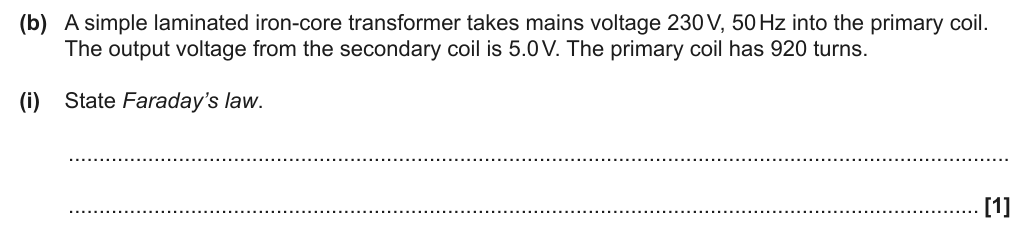
It was encouraging to see that over half of the candidates were able to correctly recall Faraday’s law, which is specifically stated in the specification. The vast majority of incorrect responses were a statement, generally in words, of the transformer equation presumably as it was used in the following question.
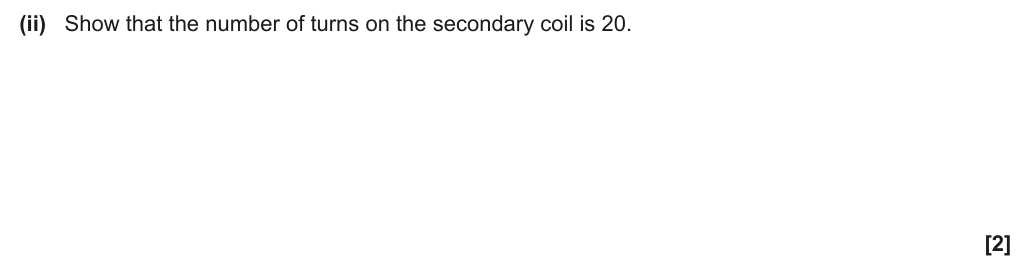
The vast majority of candidates were able to correctly show the number of turns on the secondary coil was 20. As always with a ‘show that’ question it is important that each step is clearly shown and that there is no doubt that the candidate has evaluated the answer. Candidates who did not score on this generally were not explicit enough in their working.
Skills: M0.3 Use ratios, fractions and percentages; M2.2 Change the subject of an equation, including non-linear equations
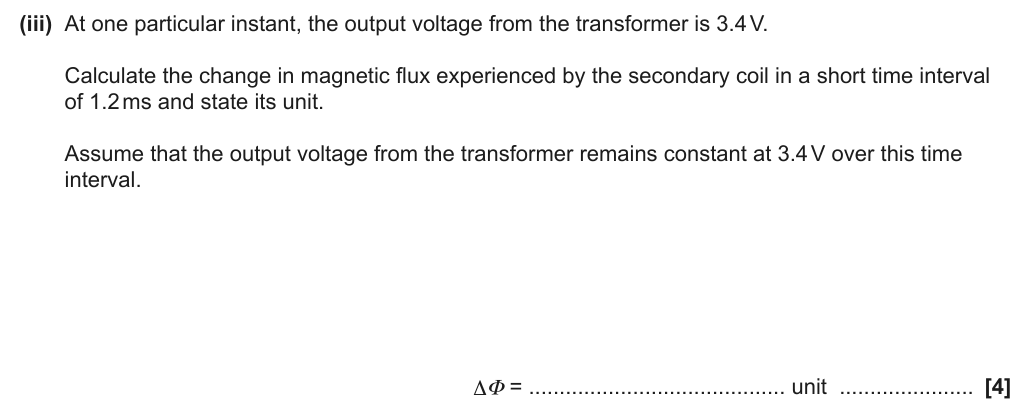
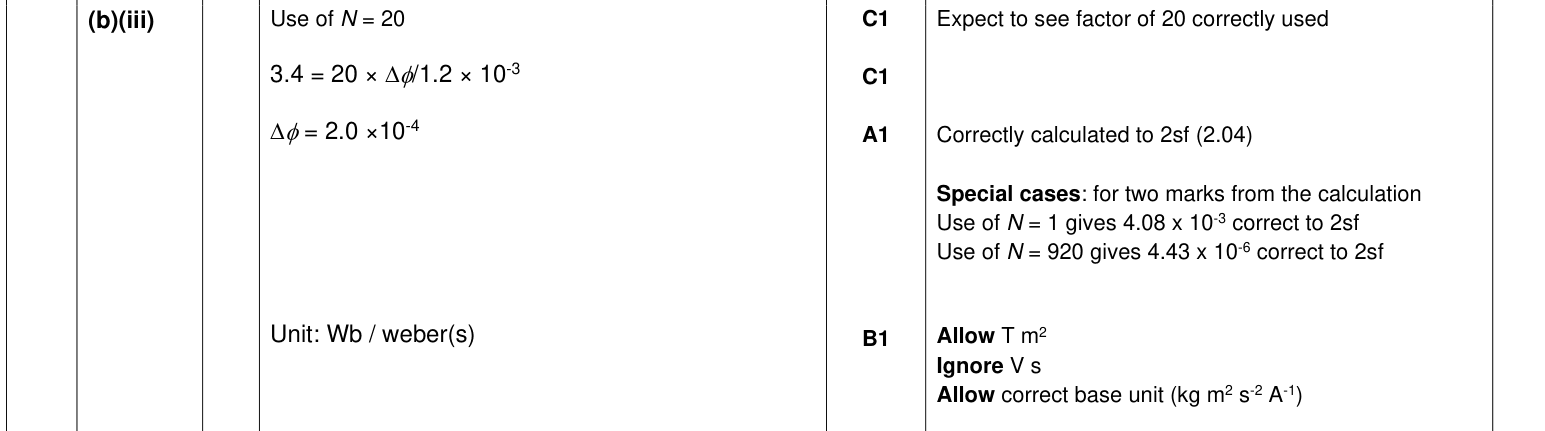
This question was generally well answered with over a third gaining all 4 marks. Most candidates chose the correct equation, although its rearrangement caused some problems, along with the number of turns to use. The correct numerical answer was 2.0 x 10⁻⁴ which several candidates incorrectly (in terms of significant figures) gave as 2 x 10⁻⁴ thus losing a mark. Candidates should be reminded that, in general, answers should be given to the lowest number of significant figures in the question, in this case 2sf. Many candidates who struggled with the calculation were able to get the standalone mark for the unit although there was a reasonable number of W rather than Wb.
Skills: M0.1 Recognise and make use of appropriate units in calculations; M2.2 Change the subject of an equation, including non-linear equations; M2.3 Substitute numerical values into algebraic equations using appropriate units for physical quantities
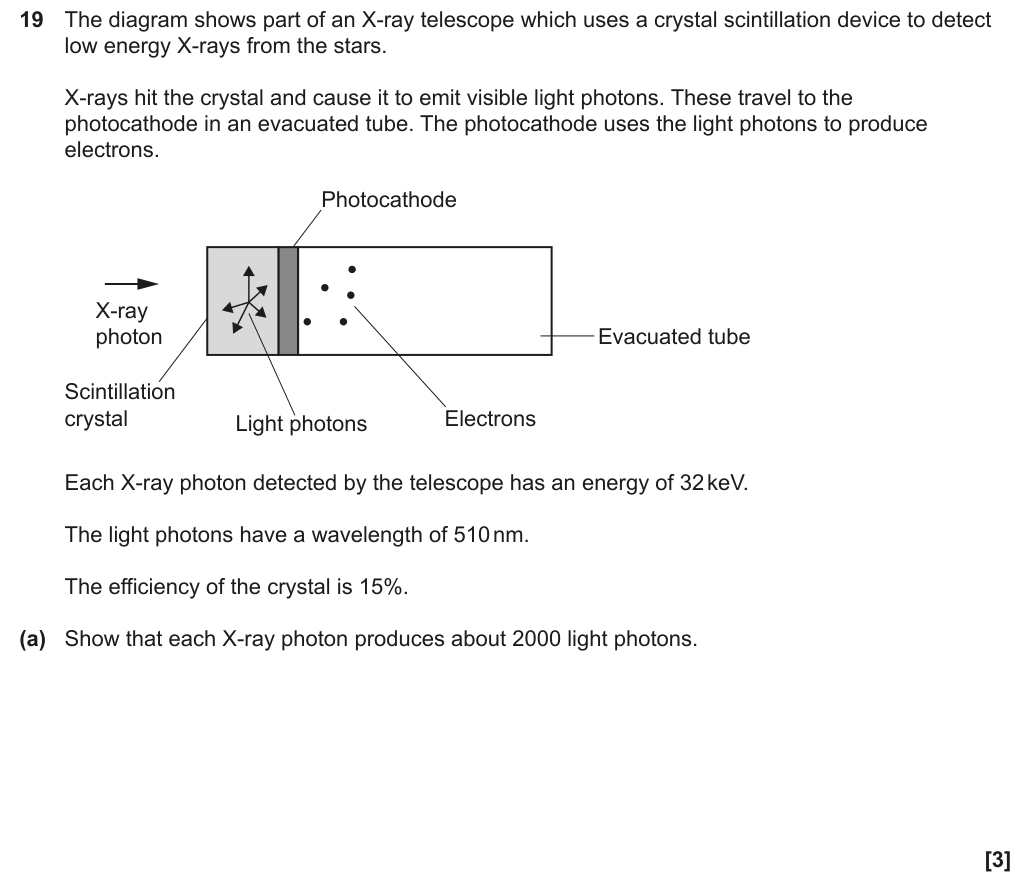
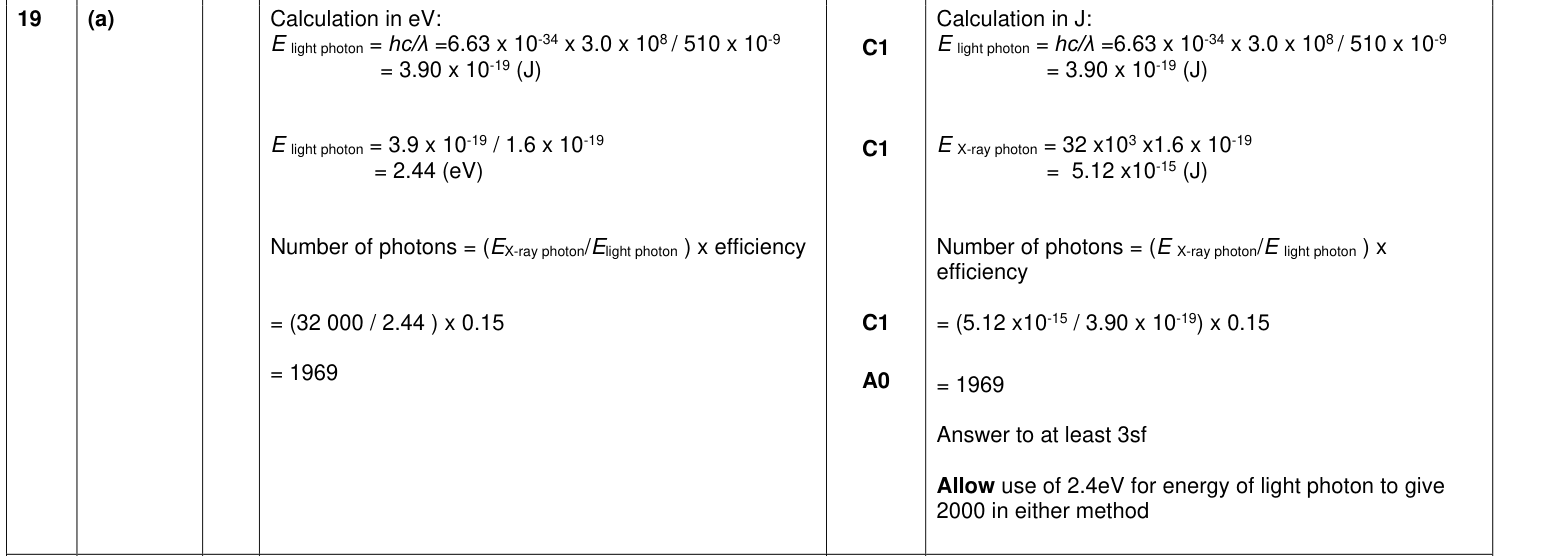
Most candidates were able to correctly show that the number of light photons was close to 1970. There were a number of methods and units that could be used and the inclusion of the 15% factor could be done at several points. Examiners were aware of these various routes and gave credit to working at each point where appropriate. The conversion of the keV to joules and the conversion of nm seemed to cause no difficulties.
Skills: M0.2 Recognise and use expressions in decimal and standard form; M0.3 Use ratios, fractions and percentages; M2.3 Substitute numerical values into algebraic equations using appropriate units for physical quantities
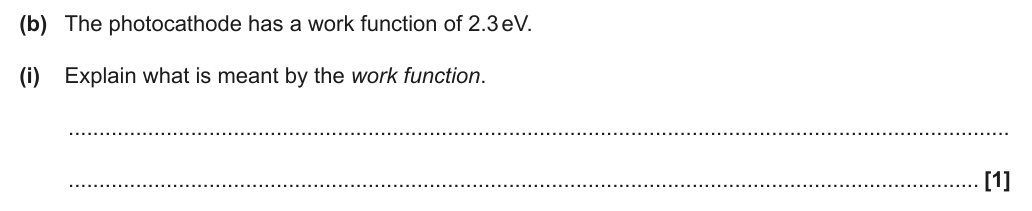
This explanation requires some specific detail; that it is a minimum energy and that it is not being applied to an atom. Nearly two thirds of candidates gave an explanation clear enough for credit and most of those who missed out on the mark simply weren’t detailed enough rather than being wholly wrong. Responses such as ‘the minimum energy for the photoelectric effect to occur’ are not quite detailed enough.
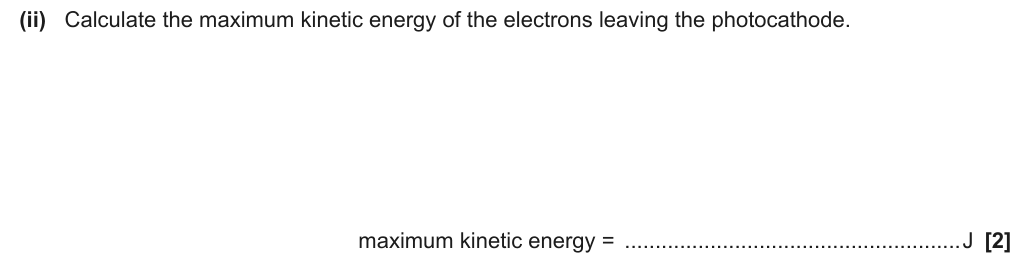
Most candidates were able to obtain at least 1 mark by correctly converting the work function into joules. As always, correct working is very helpful in obtaining the intermediate marks. Several arranged the equation incorrectly, by adding on the work function, but well over half of the candidates correctly evaluated the maximum kinetic energy.
Skills: M0.2 Recognise and use expressions in decimal and standard form; M2.2 Change the subject of an equation, including non-linear equations; M2.3 Substitute numerical values into algebraic equations using appropriate units for physical quantities
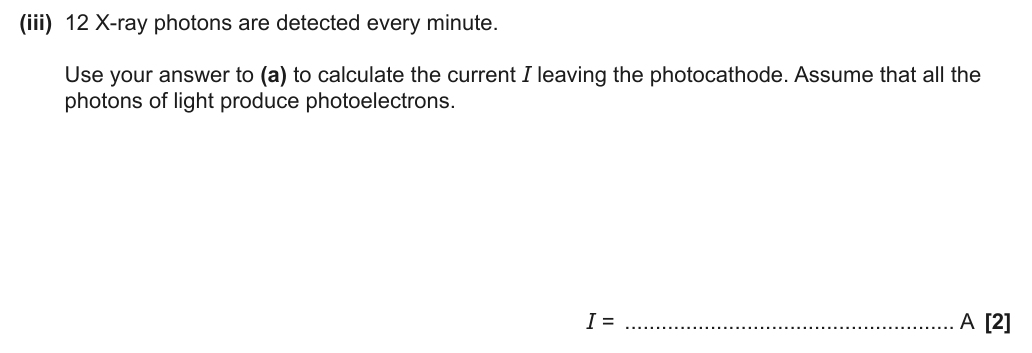
A little under half of the candidates were able to correctly calculate the current. Incorrect methods included missing out the factor of 12, or by dividing by 3600 instead of 60.
Skills: M0.1 Recognise and make use of appropriate units in calculations; M0.2 Recognise and use expressions in decimal and standard form; M2.3 Substitute numerical values into algebraic equations using appropriate units for physical quantities

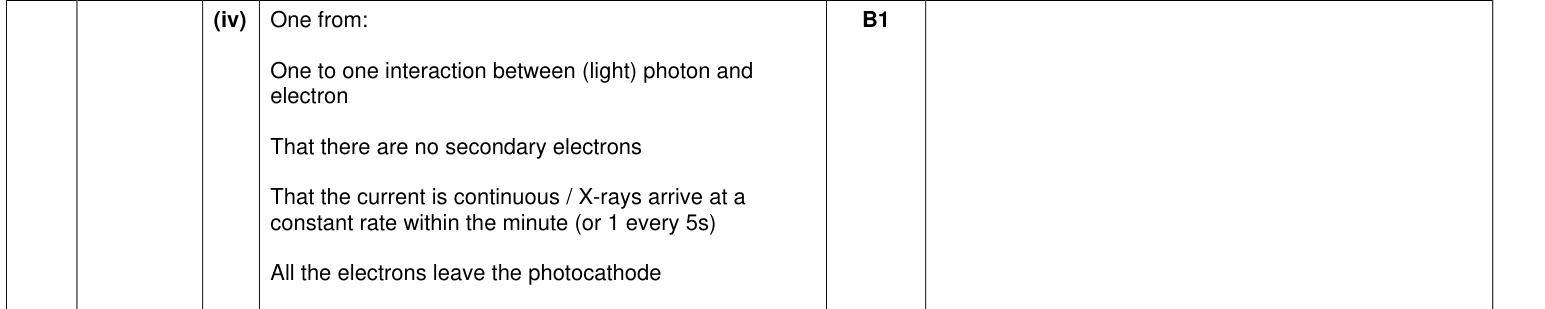
The main expectation for this question was to appreciate the one-to-one relation between the photon and the electron, although other valid answers were given. Ideas about efficiency are a little too limited for credit, along with statements like ‘there are exactly 2000 photons’. Information in the question has to be treated as correct in any case, so is not an assumption.
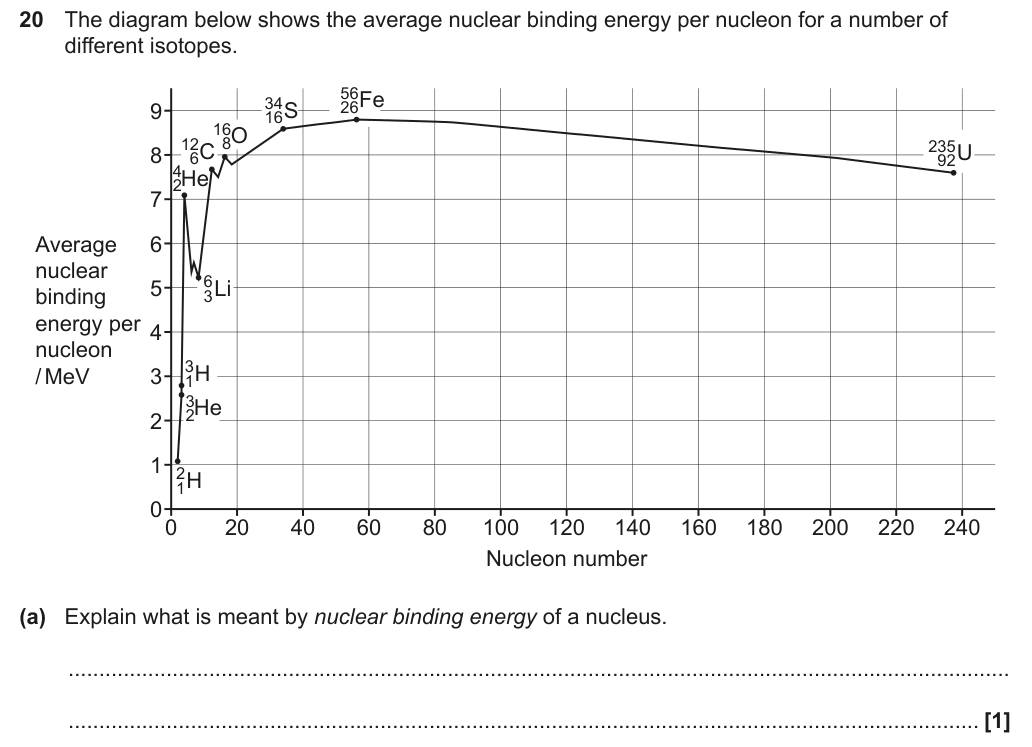
A little less than half gave a suitable explanation for the binding energy; many incorrect responses were based on the idea that it was the energy holding the nucleus together. Several responses correctly stated the relationship between binding energy and mass defect although this did not answer the question.

Around half of candidates gave a clear suggestion why hydrogen was not included. Many appreciated that the single nucleon had no binding energy although not all made a link. Several candidates described a hydrogen atom instead of the nucleus causing confusion over electron binding energy.
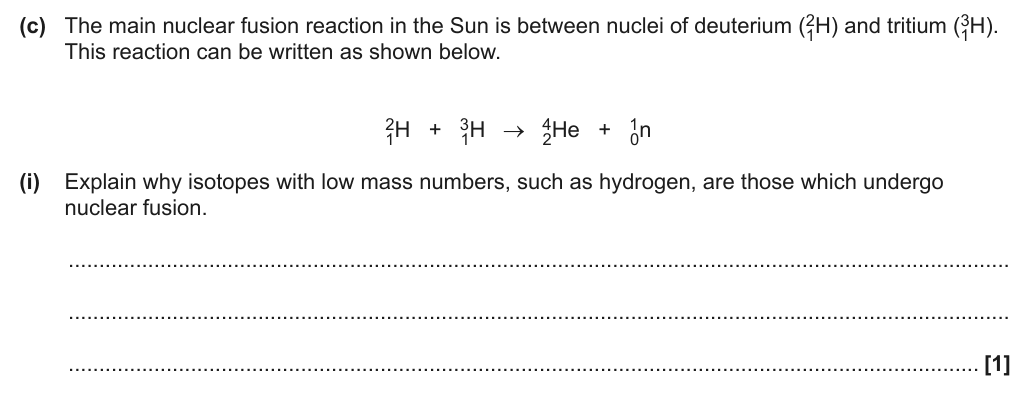
This question was quite poorly answered with few candidates appreciating the idea that an increase in binding energy per nucleon would result in energy given out. Many candidates simply restated the question, by saying low mass would join to give higher mass or stated that iron was the most stable isotope.
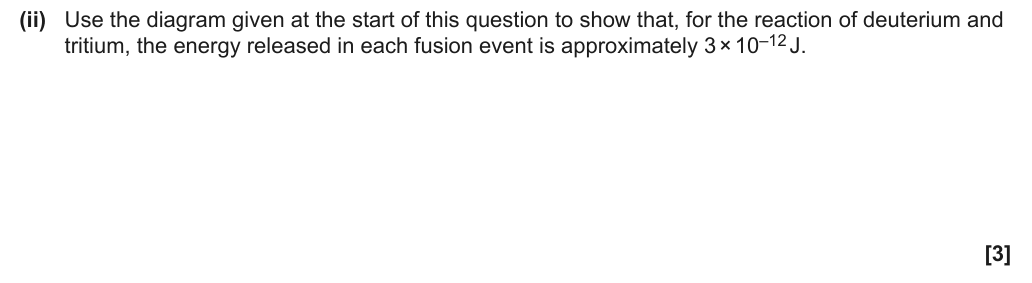
As always with a ‘show that’ question, it is vital to include as many steps as possible, the key to this question involved reading from the graph and then including the number of nucleons in the calculation. A fair number of candidates correctly read the point but did not multiply this with the nucleon number. There were relatively few misreads from the graph and the tolerance allowed some variation. Many simple (and incorrect) methods would give a value fairly close to 3 x 10-12 and so candidates would feel that they had correctly answered the question. Very few candidates struggled with the conversion from MeV to joules, although this may have been supported by having the power of ten given to them. It is also important to make sure that any value is given to a greater number of significant figures than that asked for, if appropriate. Around a third of candidates were able to obtain all 3 marks on what a potentially challenging calculation is.
Skills: M0.2 Recognise and use expressions in decimal and standard form; M2.3 Substitute numerical values into algebraic equations using appropriate units for physical quantities; M3.1 Translate information between graphical, numerical and algebraic forms
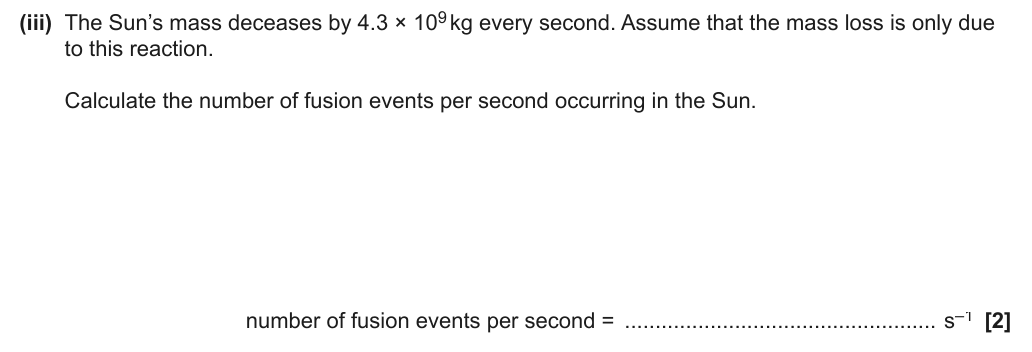
There are several routes to obtain the correct answer and credit is always given to any correct method. Neatly two thirds of candidates scored both marks on this question, even if they had not completed the previous part by using the ‘show that’ value. Candidates should always be aware that a ‘show that’ value is likely to be used in subsequent calculations.
Skills: M0.2 Recognise and use expressions in decimal and standard form; M2.3 Substitute numerical values into algebraic equations using appropriate units for physical quantities
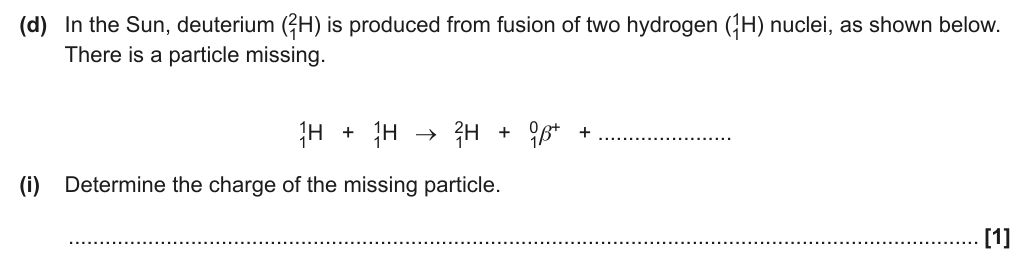
Most candidates were able to identify the charge. Most who gave incorrect responses answered a charge of -1, presumably due to the +.

Most candidates appreciated that this was a neutrino, with some giving the symbol in the equation too. There were relatively few antineutrino responses with electron being the most common incorrect answer. There seemed to be little connection between this and the previous question for several candidates who correctly gave the charge in (d)(i) but then named a charged particle here, or vice versa.

Most candidates were able to determine the correct number of quarks; the most common incorrect response was six, being the total number of quarks.
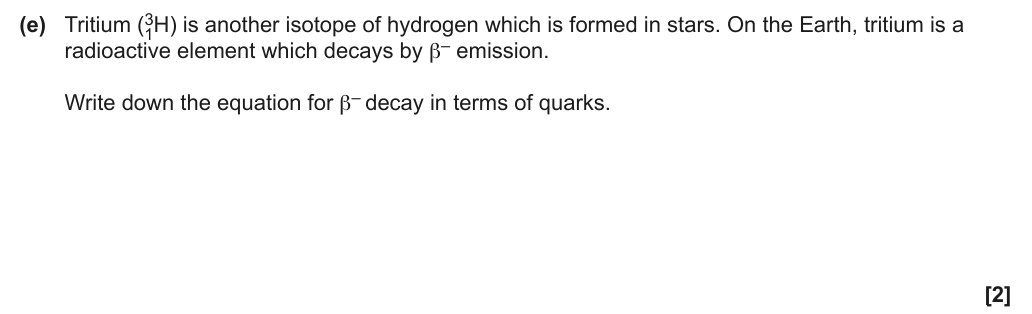
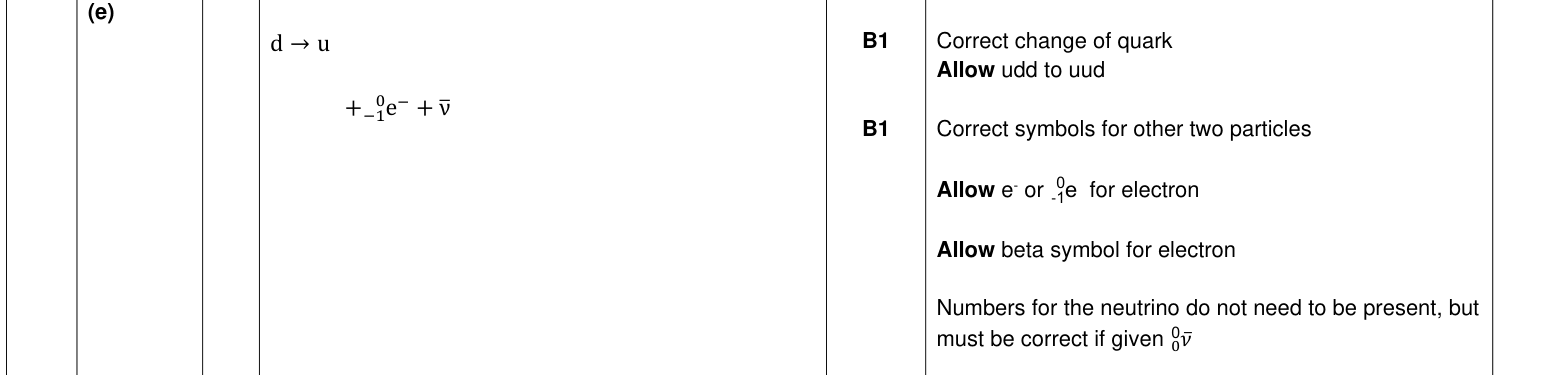
Candidates needed to show the quark change for a single mark, being a down quark to an up quark. This could be done in a number of ways, as long as there was one fewer d and one more u on the right hand side of the equation. This was done fairly well but the other particles were less clear. A neutrino was often given instead of an antineutrino and even though a beta-minus was given in the question, this was often written as a beta plus. A significant number of candidates gave no response to this question. This did not seem to be an issue of time.
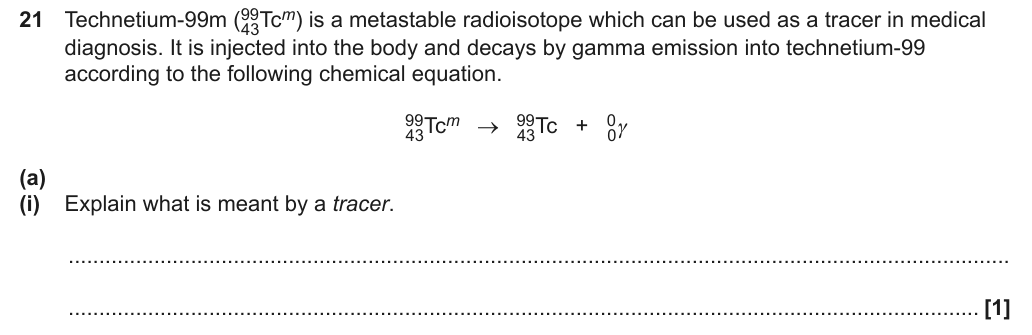
There are many possible answers to this question, but it was felt that the key point being looked for was the idea that a location in the body could be identified. General uses of tracers was not specific enough and several candidates simply stated that the tracer could be traced. Only around a quarter of candidates gave a suitable response to this question.
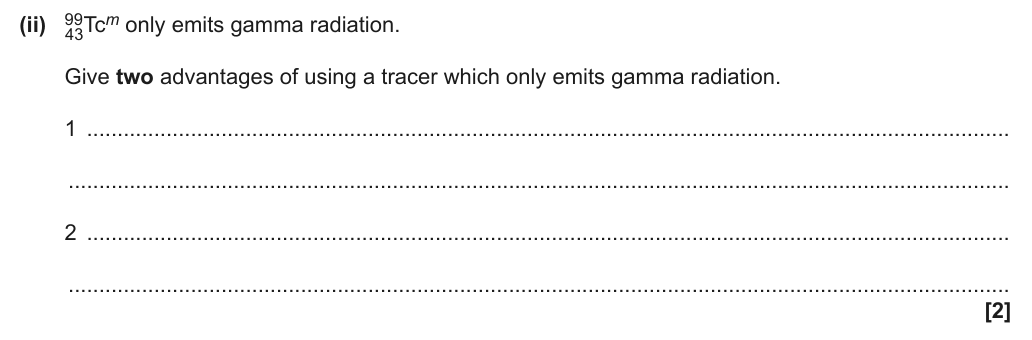
This relatively simple question was correctly answered by the majority of candidates. There was no additional detail required apart from the two simple facts although it was good to see many candidates putting these into context. Candidates should be reminded that in a question like this, only two responses should be given. Including a third runs the risk of a contradiction. Common misconceptions included the idea that the half-life of a source of gamma radiation was shorter (or longer) than alpha and beta, and that gamma radiation was ‘safer’.
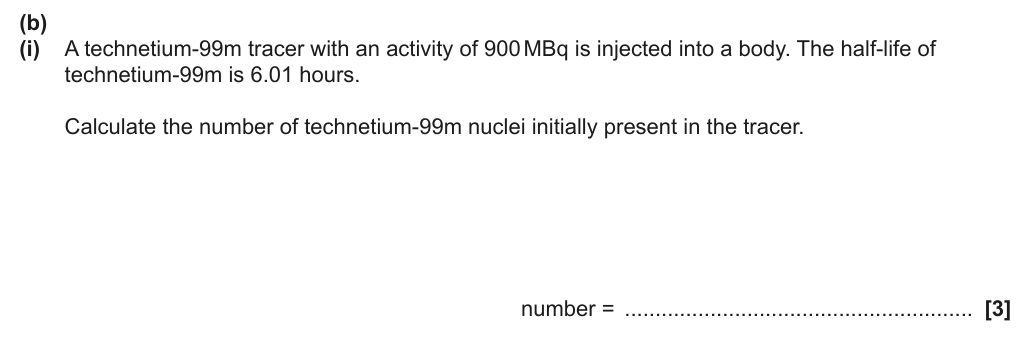
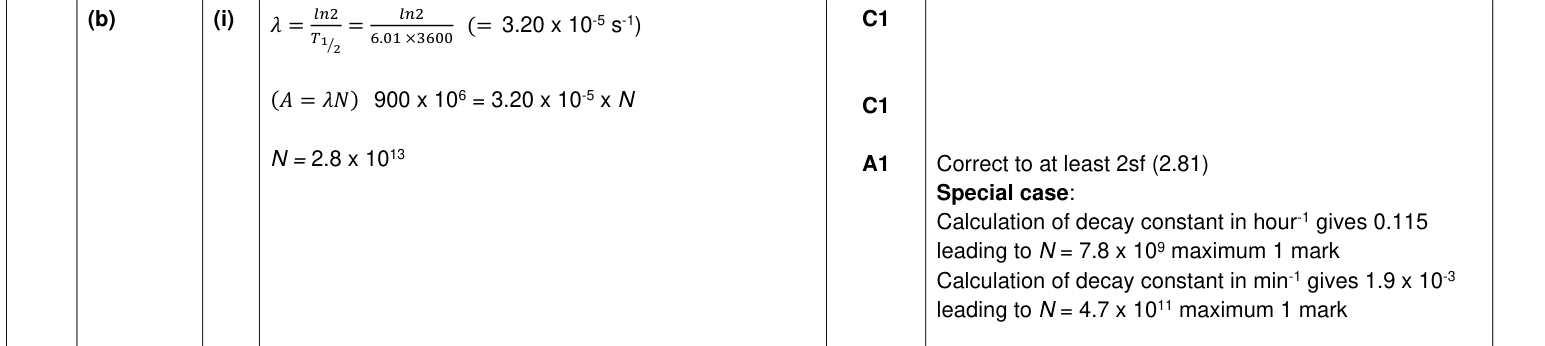
It was very encouraging to see that nearly two thirds of candidates were able to score all 3 marks on this question. Logarithms can challenge candidates but it was clear that many understood how to carry this out and were able to effectively. There were relatively few who were confused by the time units, but credit could be given even when the unit was used incorrectly.
Skills: M0.1 Recognise and make use of appropriate units in calculations; M0.2 Recognise and use expressions in decimal and standard form; M2.2 Change the subject of an equation, including non-linear equations; M2.3 Substitute numerical values into algebraic equations using appropriate units for physical quantities
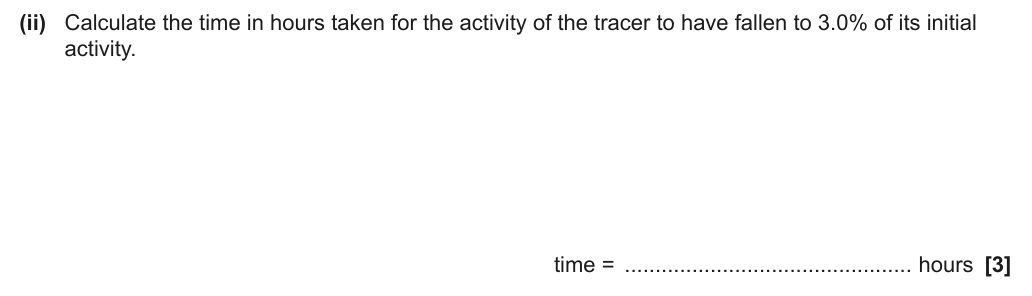
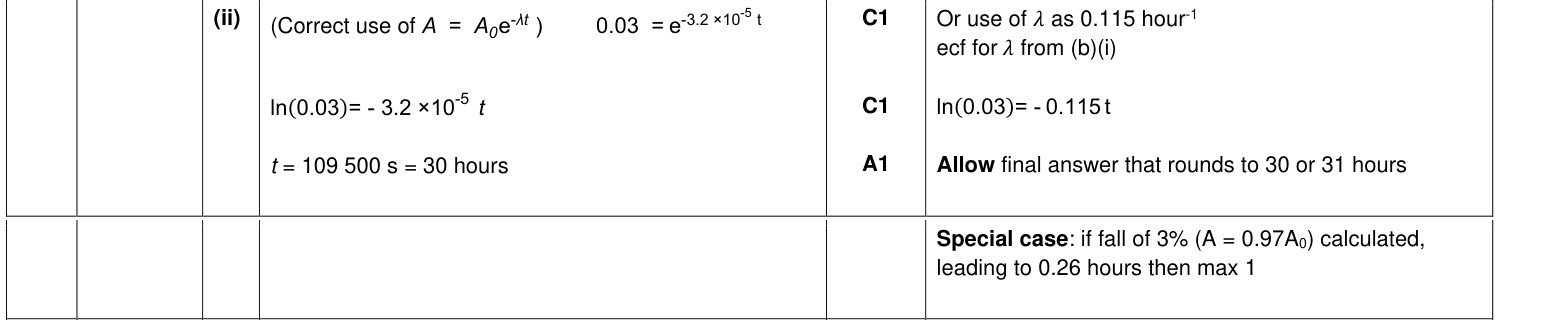
This calculation was also carried out very well, with many gaining full marks. There are several different ways to obtain the correct answer and part credit can be given for any method which will use the decay equation correctly. Most candidates calculated what 35 of the initial activity would be, putting both A and A0 into the calculation, rather than just using 0.03 as the ratio.
Skills: M0.5 Use calculators to find and use power, exponential and logarithmic functions; M2.2 Change the subject of an equation, including non-linear equations; M2.5 Use logarithms in relation to quantities that range over several orders of magnitude
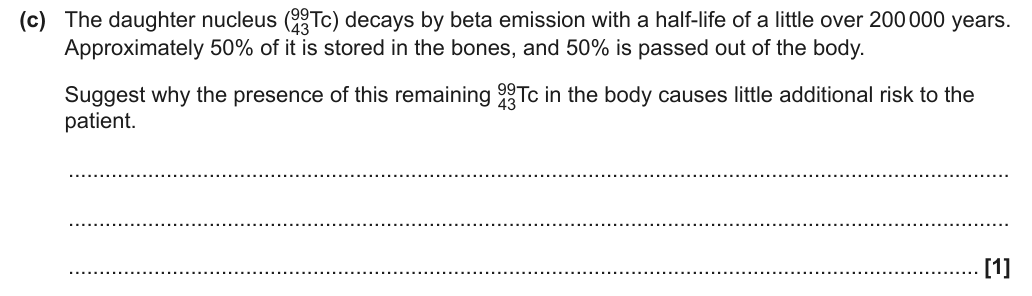
The required response here was to do with the activity of the remaining Tc. It needed to be clear that the activity was very low, or that it was low compared to any background count. Using the half-life alone as the response would not be worth any credit. A noticeable number of candidates misinterpreted the question and answered why the presence of the Tc does continue to cause a risk. Many also gave responses relating to the beta emission, stating that it was safe or wouldn’t affect bones.
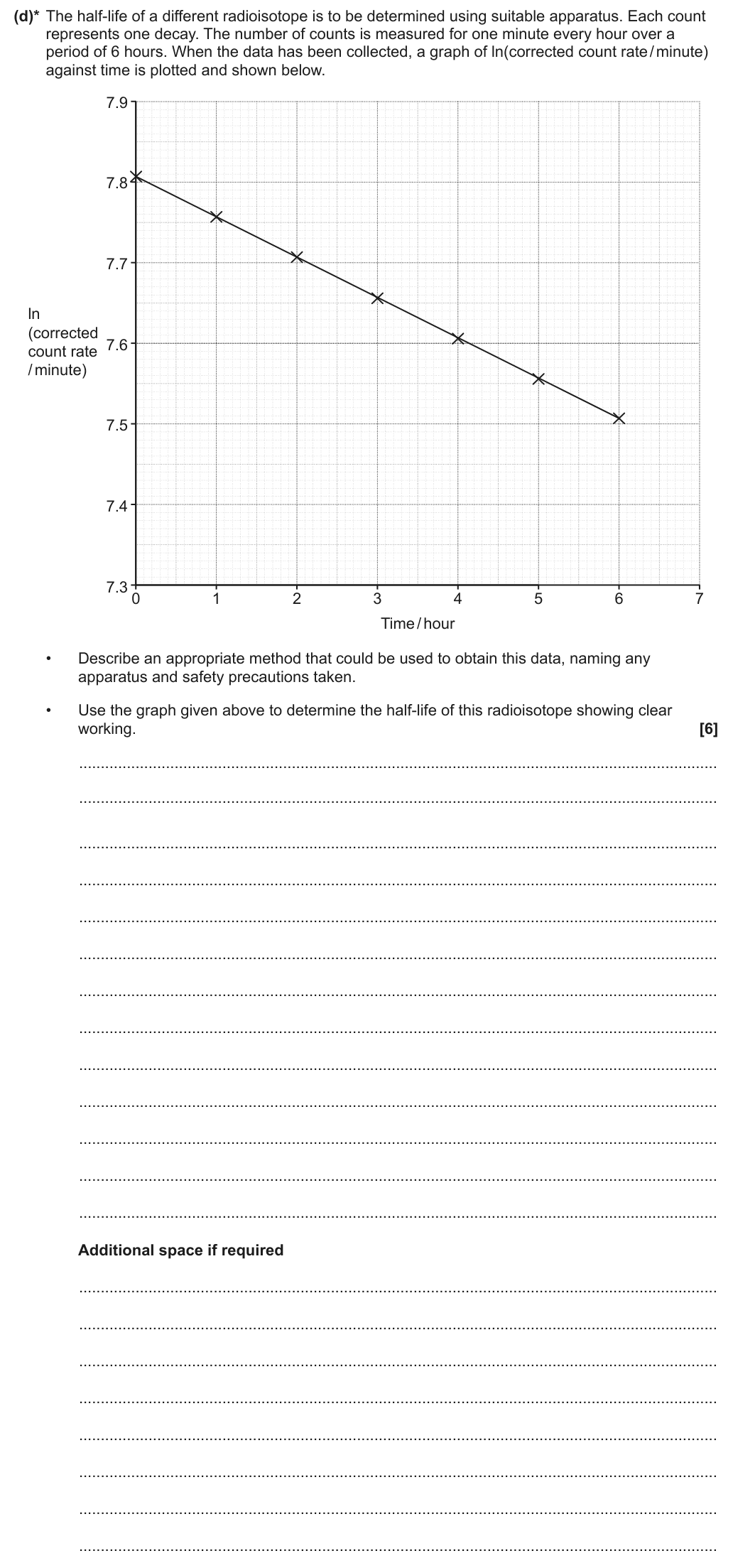
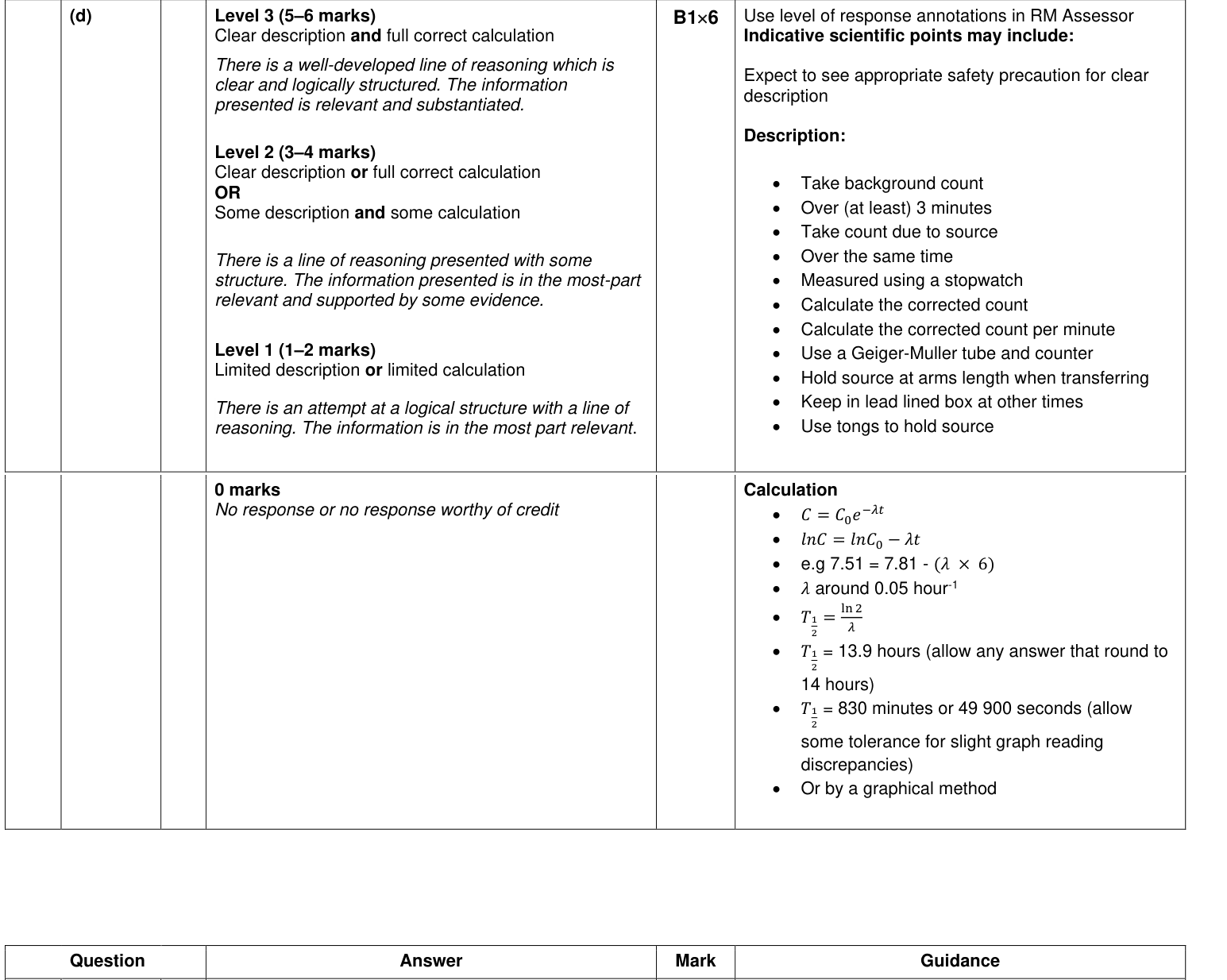
This is the second Level of Response (LoR) question in this paper, and was designed to assess nuclear and particle physics, specifically sections 6.4.3e of the specification. In particular, there are two parts (description and calculation) relating to a method and graphical data. As previous, there are no specific marking points and examiners use a ‘best-fit’ approach to the marking. Indicative scientific points are given in the mark scheme as a guidance what to expect, but not all need to be satisfied to be given full marks. Incorrect physics can be expected to be penalised, however. Candidates should always be encouraged to structure their answers carefully and in calculations aim to give explanation of each stage rather than just producing a number. The two separate sections can be separated into a description of the method for obtaining the data, and a calculation using the graph to determine the half-life. The key points in the description that examiners were looking for were: - named apparatus - measurement of background radiation – calculation of corrected count rate – safety requirements. The key points in the calculation that examiners were looking for were: - arrangement of decay equation having taken logs – demonstration that the gradient is the decay constant - calculation of the gradient – use of the gradient to determine the half-life. The descriptions of the method varied significantly. Some were extensive and detailed and others a very limited response despite being a procedure that candidates are likely to have come across. Most candidates gave a simple safety precaution, such as holding at arm’s length, but there were plenty of vague responses such as wearing coats. Not all candidates could explain how, or why, the background was taken and a fair number missed this out completely. Quite a few candidates gave extensive detail about storing the source, which although is relevant, is not the key point to the question. The analysis was done better and in general well-structured and clear. The working was set out well for the most part and it was simple to follow the candidates working. Not all gave a clear reason for how they were obtaining the half-life, but this was not fully necessary as long as the answer was correct. One common error was to take logs of the data on the y-axis rather than appreciating that they are already log values. There were not many misreads, but the nature of the data meant that any could have a significant impact on their answer and would likely be penalised. Some candidates got into difficulties with time units and attempted to convert the decay constant to s-1 without success.
Skills: M2.5 Use logarithms in relation to quantities that range over several orders of magnitude; M3.10 Interpret logarithmic plots; M3.4 Determine the slope and intercept of a linear graph; PAG7 Investigating ionising radiation
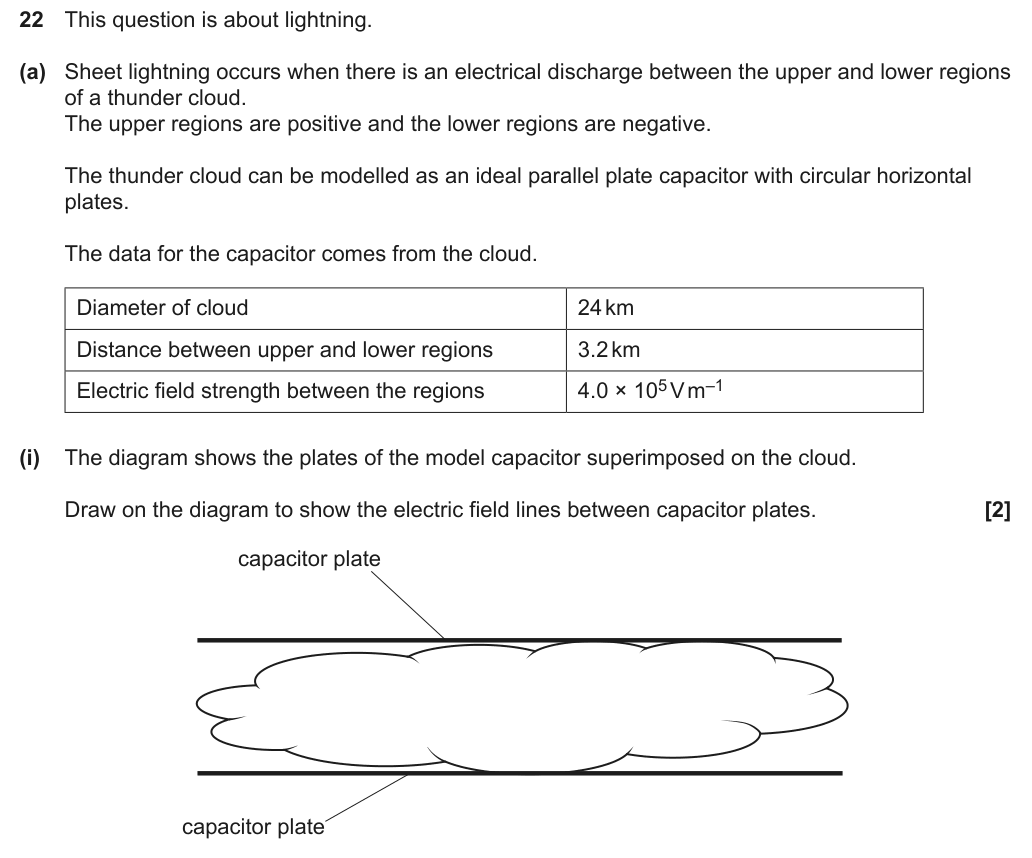
Most candidates were able to score at least 1 mark on this question. The most common loss of marks was an uneven spacing between the lines. Some candidates (helpfully) wrote on the diagram that the spacing was equal. As it is apparent that most candidates know the spacing should be regular, it would be best to do this with a ruler rather than leave it judgement. Similarly, the lines should be vertical and straight, again best done with a ruler. spacing is regular and this is possible what the candidate meant to do, but those at the right hand side (ignoring those outside of the plates) are definitely not equally spaced by eye. It would have been far better for the candidate to use a ruler to make the spacing equal.
Skills: M4.2 Visualise and represent 2D and 3D forms, including two-dimensional representations of 3D objects

Although there were many ways to obtain this mark, only around half of candidates gave a suitable response. Many answers were vague such as ‘the cloud is not even’ or ‘the cloud contains water vapour’ which really needs more clarity. The best response is based on the distribution of charges, but alternatives relating to uniformity of a variety of factors are perfectly correct.
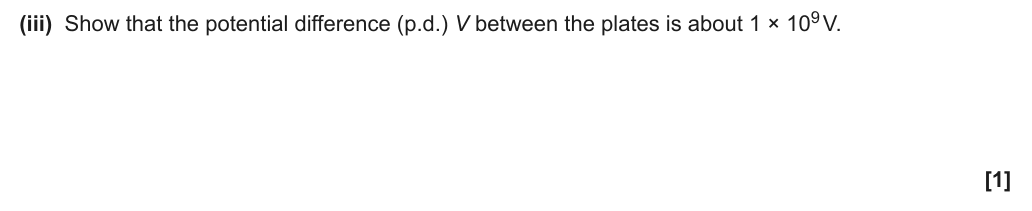
Again, a ‘show that’ question needs the calculation to be clear. Here it will involve the multiplication of two quantities using the correct powers. For example, 32k is not a suitable alternative to 32 x 103. The value calculated is not the same as the ‘show that’ value so needs to be given to more significant figures (at least 2) to prove the calculation was carried out. The significant majority of candidates were able to correctly score this mark.
Skills: M0.1 Recognise and make use of appropriate units in calculations; M0.2 Recognise and use expressions in decimal and standard form
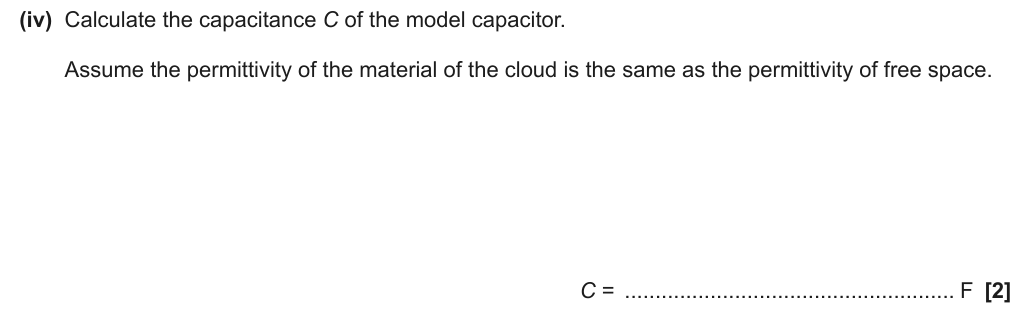
Most candidates were able to select the correct formula and make an attempt at a substitution. The main error came from an incorrect calculation of the area, either by using an incorrect method for the circle or incorrectly calculating it using 24km x 3.2km. Candidates are to be reminded that if the working is correct and the calculation wrong, then marks may still be given. Without this working, there is likely to be no credit. Several candidates used the formula for charge on a sphere which gave the same answer (to 2sf) but is a physics error so scores no marks.
Skills: M0.1 Recognise and make use of appropriate units in calculations; M2.3 Substitute numerical values into algebraic equations using appropriate units for physical quantities; M4.3 Calculate areas of triangles, circumferences and areas of circles, surface areas and volumes of rectangular blocks, cylinders and spheres
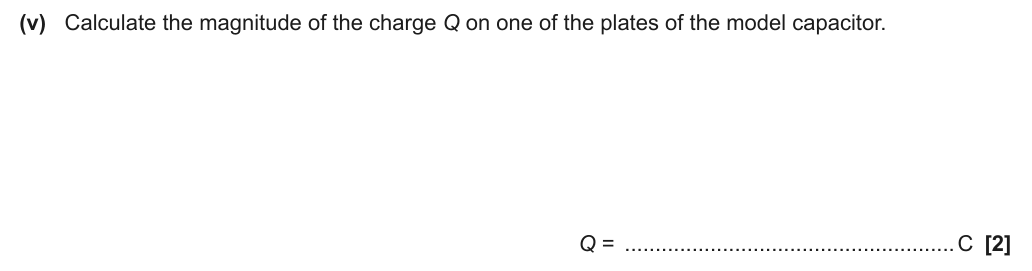
This response could produce a wide variety of correct answers depending on the rounding of the numbers used, although most candidates used at least 2sf for their values, which is recommended. A noticeable number of candidates correctly evaluated the change then divided it by 2, presumably due to it asking for the charge on one of the plates.
Skills: M2.3 Substitute numerical values into algebraic equations using appropriate units for physical quantities
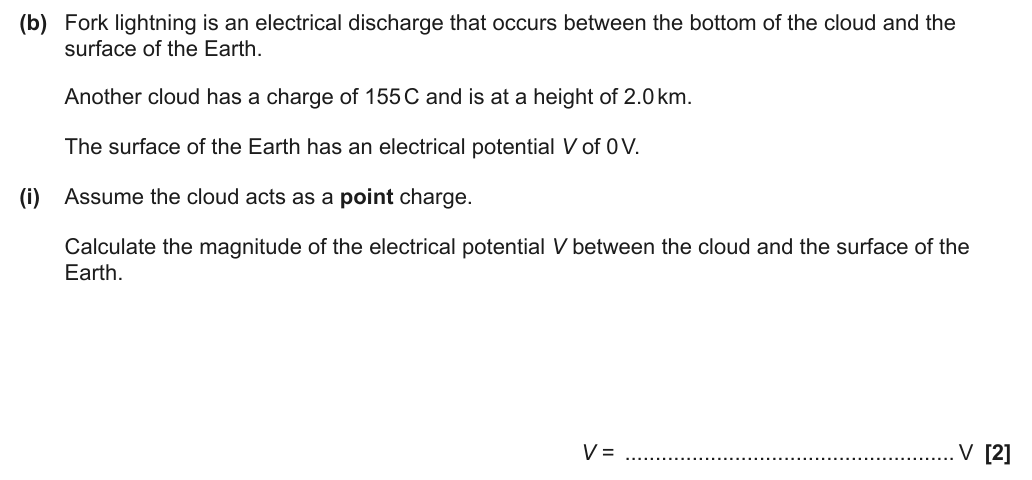
Most candidates were able to correctly select the equation and evaluate the correct answer. Some chose the field strength equation or wrote the potential equation with a r2. Some selected the wrong value of r, giving it as the radius of the cloud. As with Question 18(b)(iii) candidates are reminded that, in general, answers should be given to the lowest number of significant figures in the question, and that an answer of 7 x 10⁸ will incur the significant figure penalty (applied only once per paper).
Skills: M0.2 Recognise and use expressions in decimal and standard form; M2.3 Substitute numerical values into algebraic equations using appropriate units for physical quantities
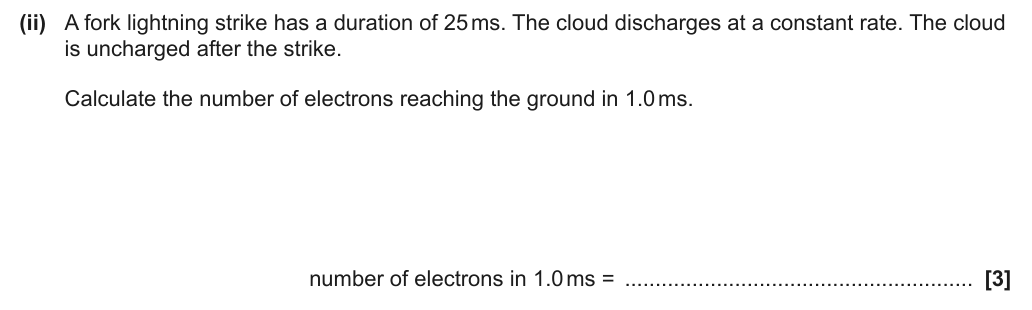
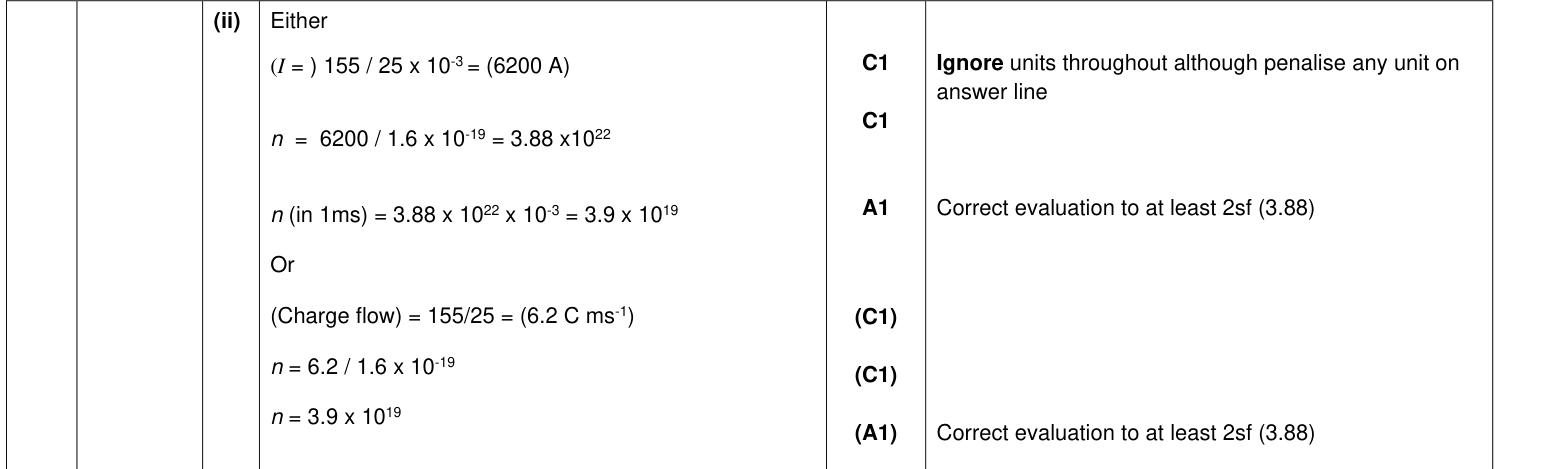
This question could be answered in several ways. Most candidates chose to calculate the current in amps and then converting back to ms at the end. Very few were confused by the need to give the answer in ms. This question polarised the candidates with the vast majority scoring 0 or 3; those who got part way to solving it generally ended up with the correct answer.
Skills: M0.2 Recognise and use expressions in decimal and standard form; M0.3 Use ratios, fractions and percentages; M2.3 Substitute numerical values into algebraic equations using appropriate units for physical quantities
Want a paper marked and gone through with you? Message us.