June 2017: Paper 2

85 marks · 55 question parts · Paper, mark scheme and report on AQA's site · Have the data and formulae booklet beside you

Question by question

QTopicMarksAOType
1.1 Molecular kinetic theory 1Short answer
1.2 Thermal energy transfer and ideal gases 2Calculation
1.3 Thermal energy transfer and ideal gases 2Calculation
1.4 Thermal energy transfer and ideal gases 2Calculation
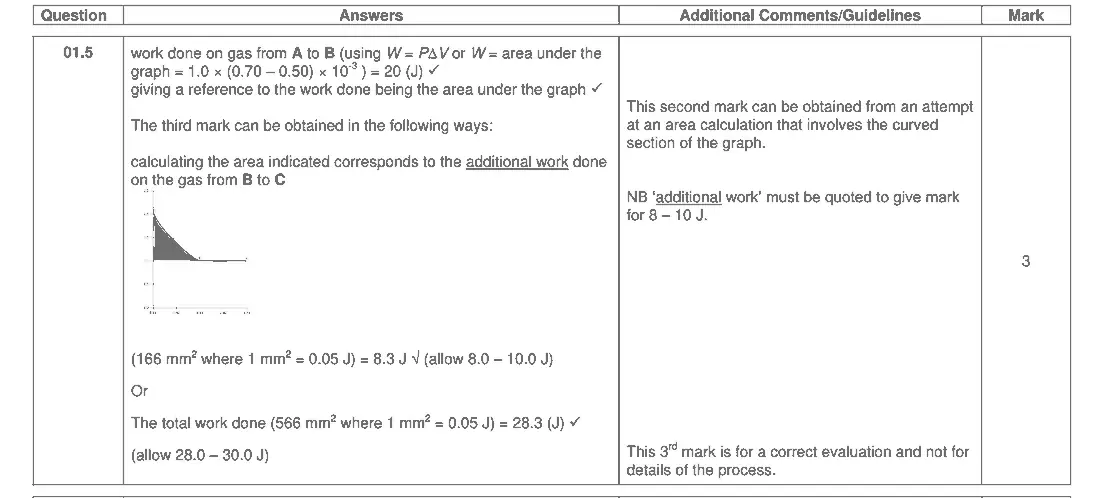
1.5 Thermal energy transfer and ideal gases 3Calculation
2.1 Magnetic flux density and moving charges in a magnetic field, Newton's laws of motion and momentum 1Short answer
2.2 Magnetic flux density and moving charges in a magnetic field 1Diagram or graph
2.3 Magnetic flux density and moving charges in a magnetic field 1Short answer
2.4 Magnetic flux density and moving charges in a magnetic field 2Calculation
3.1 Magnetic flux density and moving charges in a magnetic field 1Explanation
3.2 Magnetic flux density and moving charges in a magnetic field, Circular motion 3Show that
3.3 Magnetic flux density and moving charges in a magnetic field 2Calculation
4.1 Mass and energy, binding energy, fission and safety 1Short answer
4.2 Mass and energy, binding energy, fission and safety 1Short answer
4.3 Mass and energy, binding energy, fission and safety 3Explanation
4.4 Mass and energy, binding energy, fission and safety 6Extended response
5.1 Mass and energy, binding energy, fission and safety 3Calculation
5.2 Radioactive decay, half-life and nuclear instability, Excitation, energy levels and wave-particle duality 2Calculation
5.3 Radioactive decay, half-life and nuclear instability 1Short answer
5.4 Radioactive decay, half-life and nuclear instability, Particles, antiparticles and particle interactions 3Calculation
6.1 Gravitational fields and orbits 1Short answer
6.2 Gravitational fields and orbits 2Explanation
6.3 Gravitational fields and orbits 2Explanation
6.4 Gravitational fields and orbits, Electric fields and electric potential 1Short answer
6.5 Electric fields and electric potential 1Short answer
6.6 Electric fields and electric potential 2Diagram or graph
7.1 Gravitational fields and orbits, Circular motion 2Show that
7.2 Gravitational fields and orbits 2Calculation
7.3 Gravitational fields and orbits 3Calculation
7.4 Gravitational fields and orbits 3Calculation
8 Thermal energy transfer and ideal gases, Work, energy, power and conservation of energy 1Multiple choice
9 Thermal energy transfer and ideal gases, Work, energy, power and conservation of energy 1Multiple choice
10 Thermal energy transfer and ideal gases 1Multiple choice
11 Molecular kinetic theory 1Multiple choice
12 Gravitational fields and orbits 1Multiple choice
13 Gravitational fields and orbits 1Multiple choice
14 Gravitational fields and orbits, Circular motion 1Multiple choice
15 Electric fields and electric potential 1Multiple choice
16 Electric fields and electric potential, Newton's laws of motion and momentum 1Multiple choice
17 Electric fields and electric potential 1Multiple choice
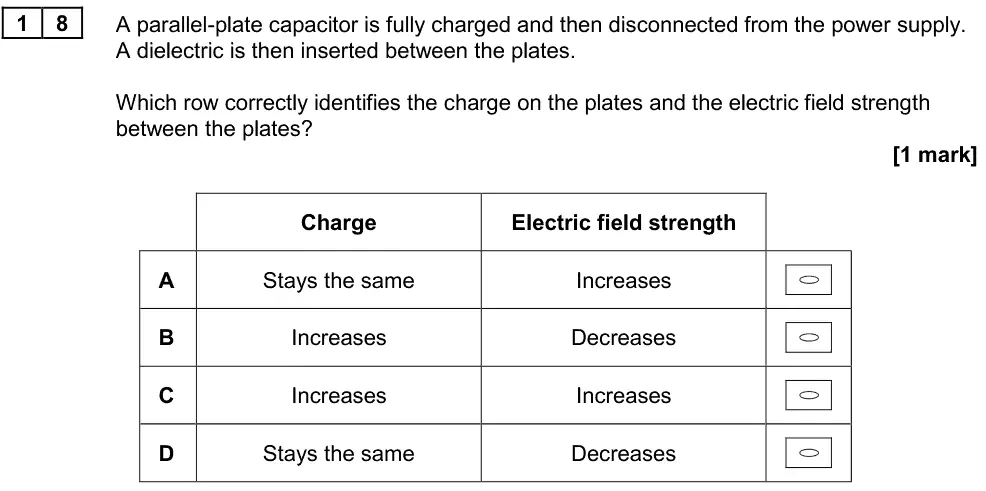
18 Capacitance and capacitor charge and discharge 1Multiple choice
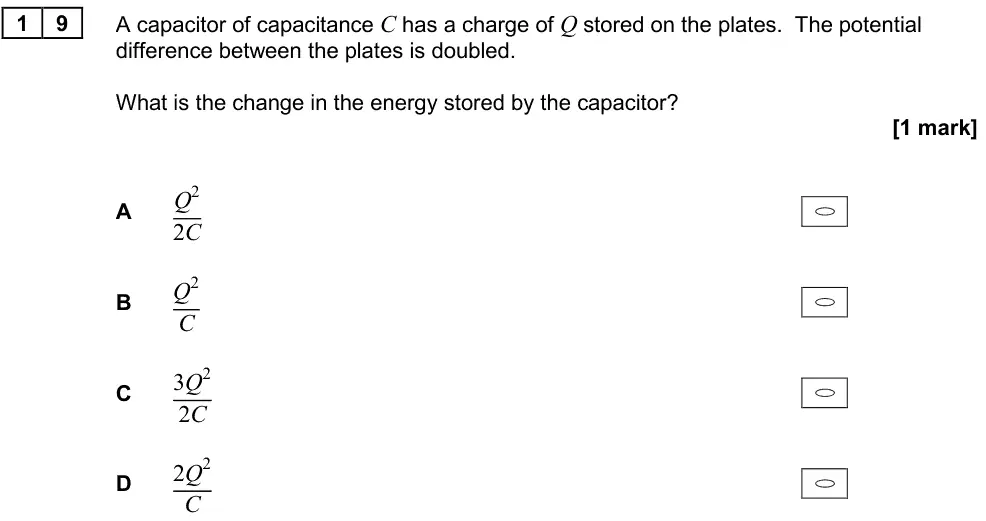
19 Capacitance and capacitor charge and discharge 1Multiple choice
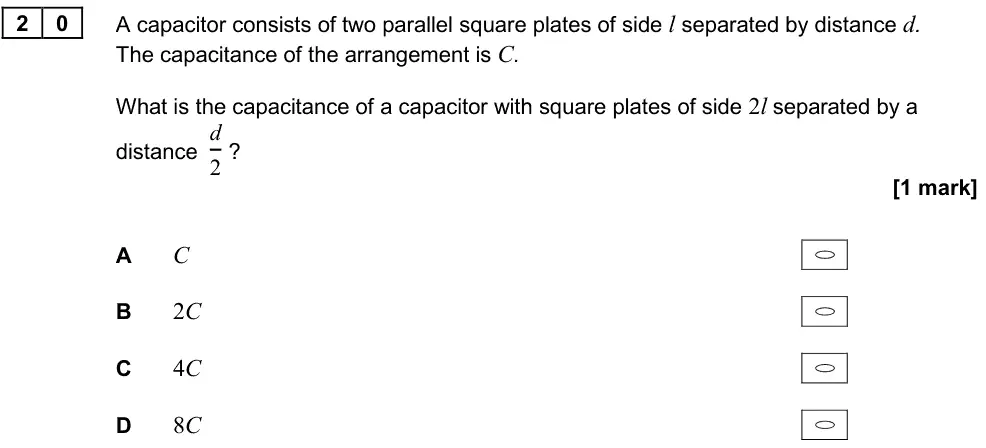
20 Capacitance and capacitor charge and discharge 1Multiple choice
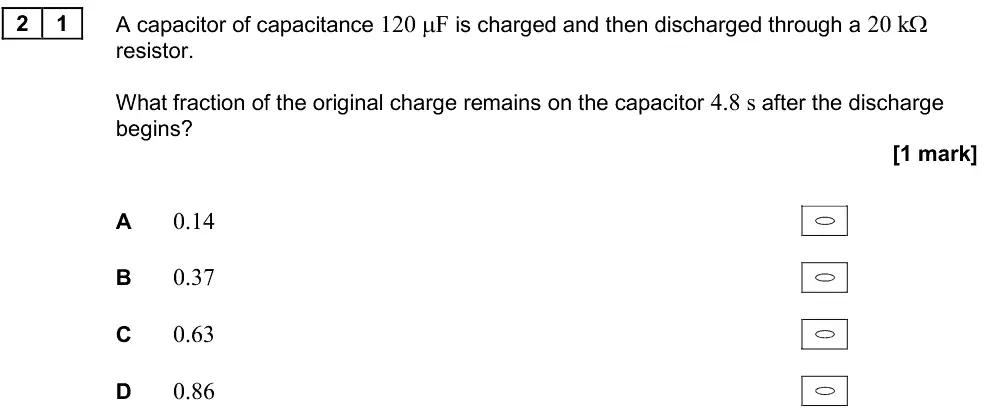
21 Capacitance and capacitor charge and discharge 1Multiple choice
22 Electromagnetic induction, alternating currents and transformers 1Multiple choice
23 Electromagnetic induction, alternating currents and transformers 1Multiple choice
24 Electromagnetic induction, alternating currents and transformers 1Multiple choice
25 Electromagnetic induction, alternating currents and transformers 1Multiple choice
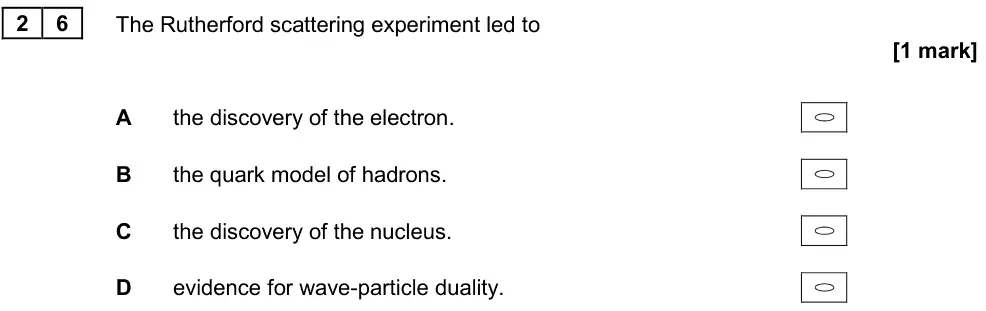
26 Rutherford scattering, alpha, beta and gamma radiation 1Multiple choice
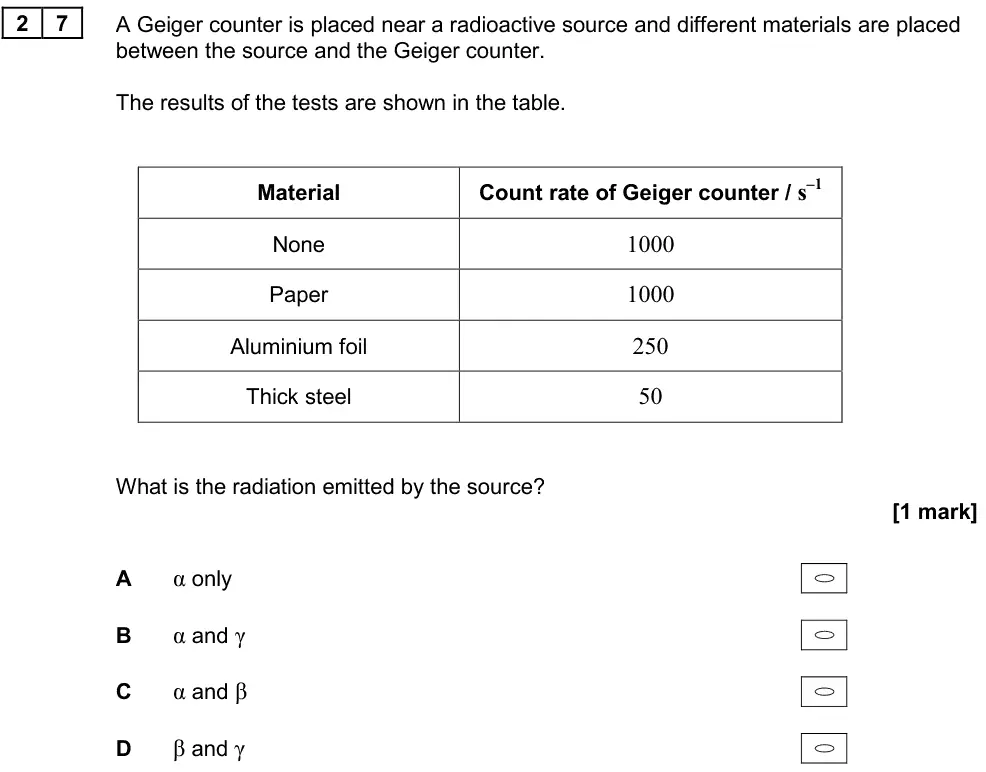
27 Rutherford scattering, alpha, beta and gamma radiation 1Multiple choice
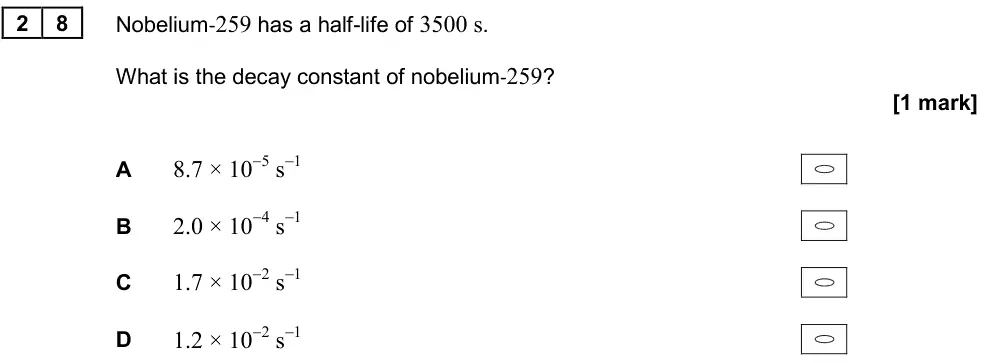
28 Radioactive decay, half-life and nuclear instability 1Multiple choice
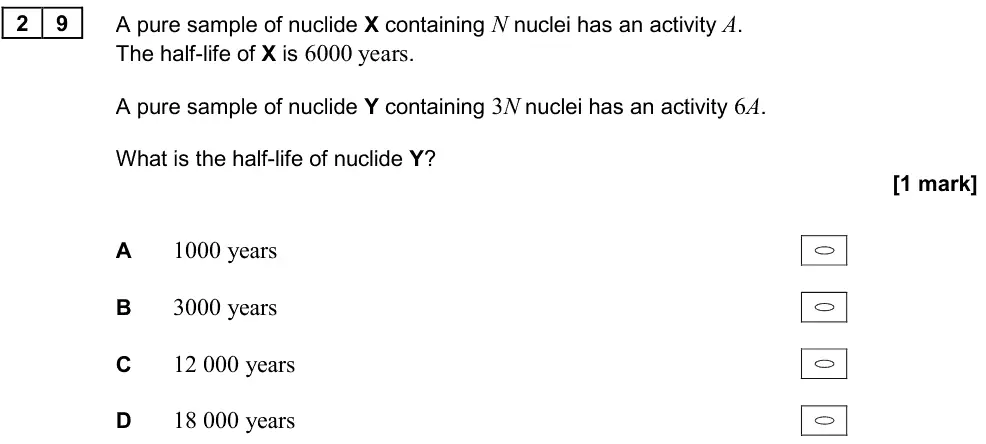
29 Radioactive decay, half-life and nuclear instability 1Multiple choice
30 Radioactive decay, half-life and nuclear instability 1Multiple choice
31 Nuclear radius 1Multiple choice
32 Mass and energy, binding energy, fission and safety 1Multiple choice

The questions

1.11.21.31.41.52.12.22.32.43.13.23.34.14.24.34.45.15.25.35.46.16.26.36.46.56.67.17.27.37.4891011121314151617181920212223242526272829303132
June 2017 · Paper 2 · Q1.1 1 mark Short answer kinetic theory
A number of assumptions are made when explaining the behaviour of a gas using
the molecular kinetic theory model.
State one assumption about the size of molecules.
[1 mark]
June 2017 · Paper 2 · Q1.2 2 marks Calculation thermal energy and ideal gases
Earlier part of question 1 that this part usesEarlier part of June 2017 Paper 2 question 1
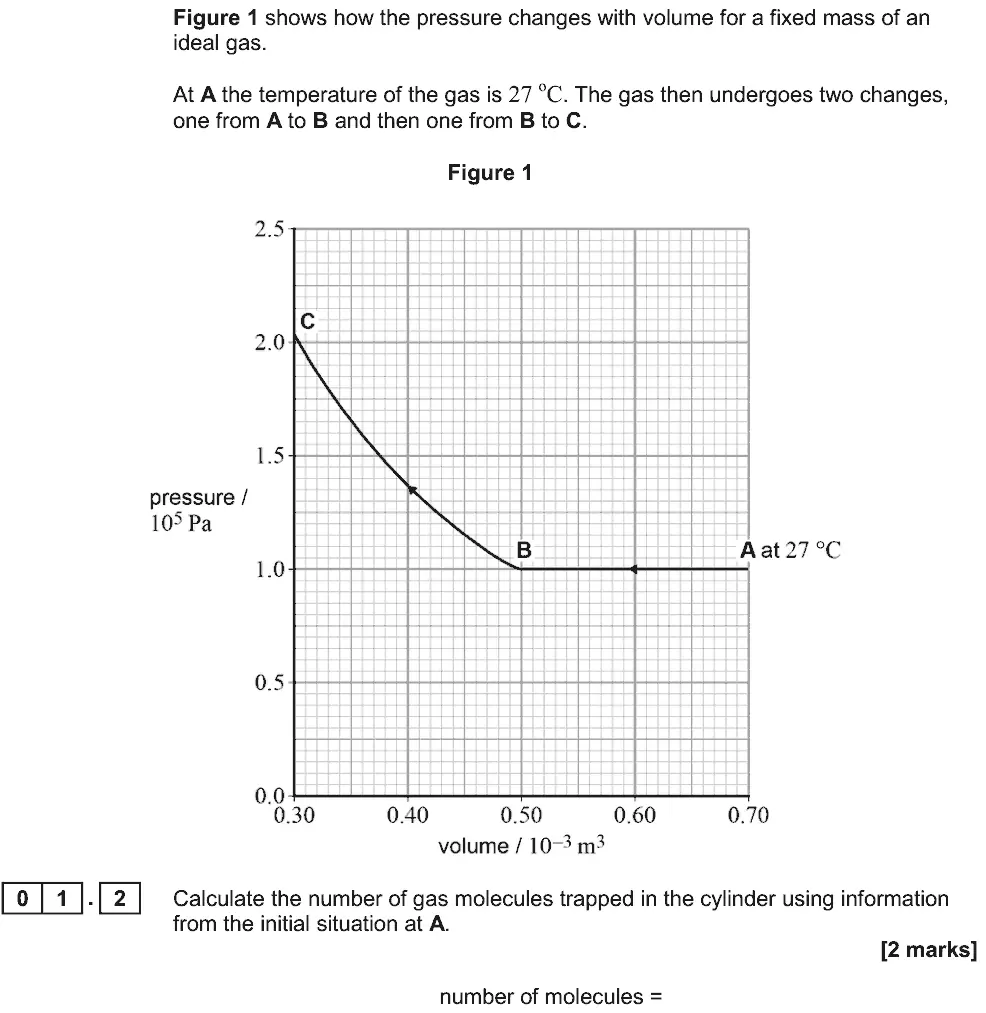
Figure 1 shows how the pressure changes with volume for a fixed mass of an
ideal gas.
At A the temperature of the gas is 27 oC. The gas then undergoes two changes,
one from A to B and then one from B to C.
Figure 1
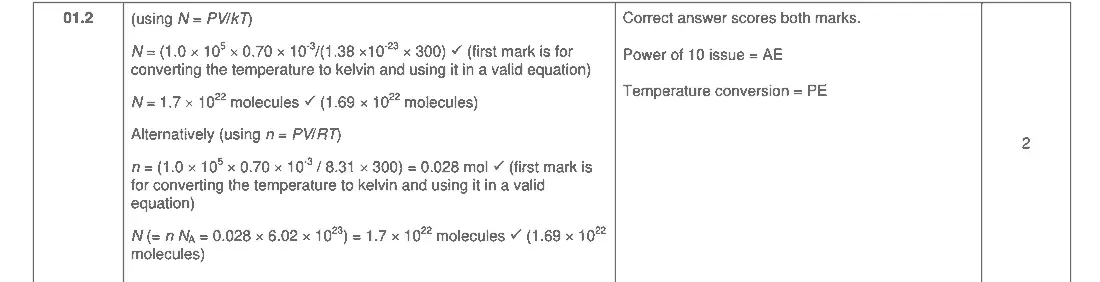
Calculate the number of gas molecules trapped in the cylinder using information
from the initial situation at A.
[2 marks]
number of molecules =
June 2017 · Paper 2 · Q1.3 2 marks Calculation thermal energy and ideal gases
Earlier part of question 1 that this part usesEarlier part of June 2017 Paper 2 question 1
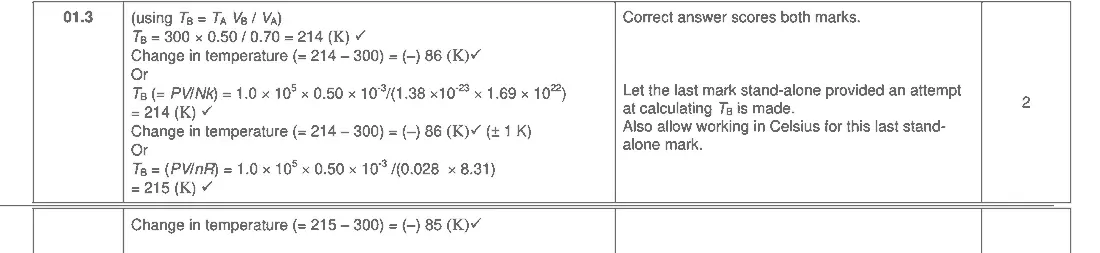
Calculate, in K, the change in temperature of the gas during the compression that
occurs between A and B.
[2 marks]
change in temperature =
K
June 2017 · Paper 2 · Q1.4 2 marks Calculation thermal energy and ideal gases
Earlier part of question 1 that this part usesEarlier part of June 2017 Paper 2 question 1
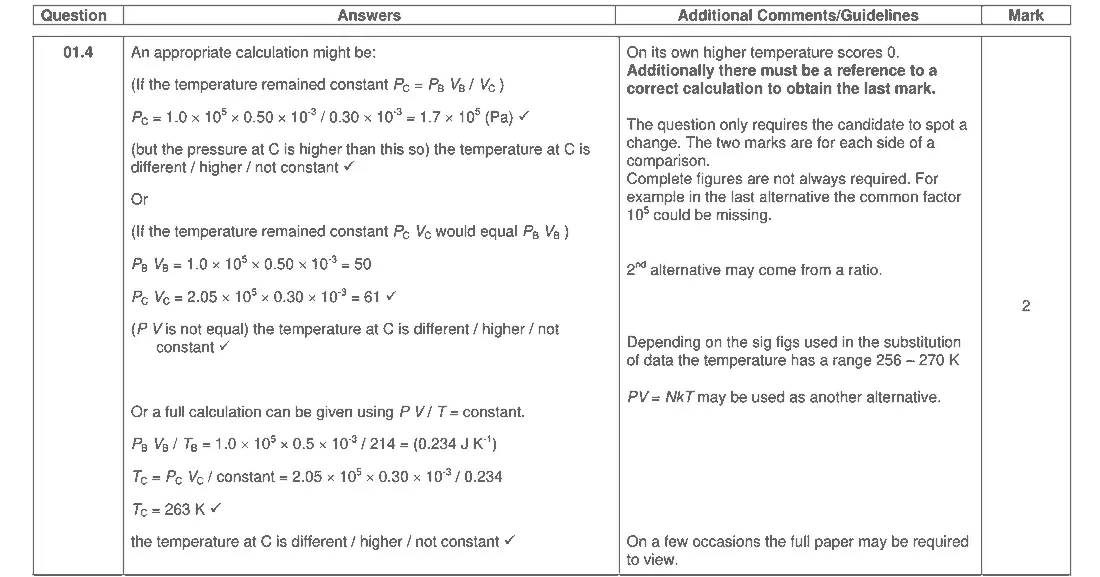
Deduce whether the temperature of the gas changes during the compression from
B to C.
[2 marks]
June 2017 · Paper 2 · Q1.5 3 marks Calculation Hard thermal energy and ideal gases
Earlier part of question 1 that this part usesEarlier part of June 2017 Paper 2 question 1
Compare the work done on the gas during the change from A to B with that
from B to C on Figure 1.
[3 marks]
June 2017 · Paper 2 · Q2.1 1 mark Short answer magnetic fieldsnewtons laws and momentum
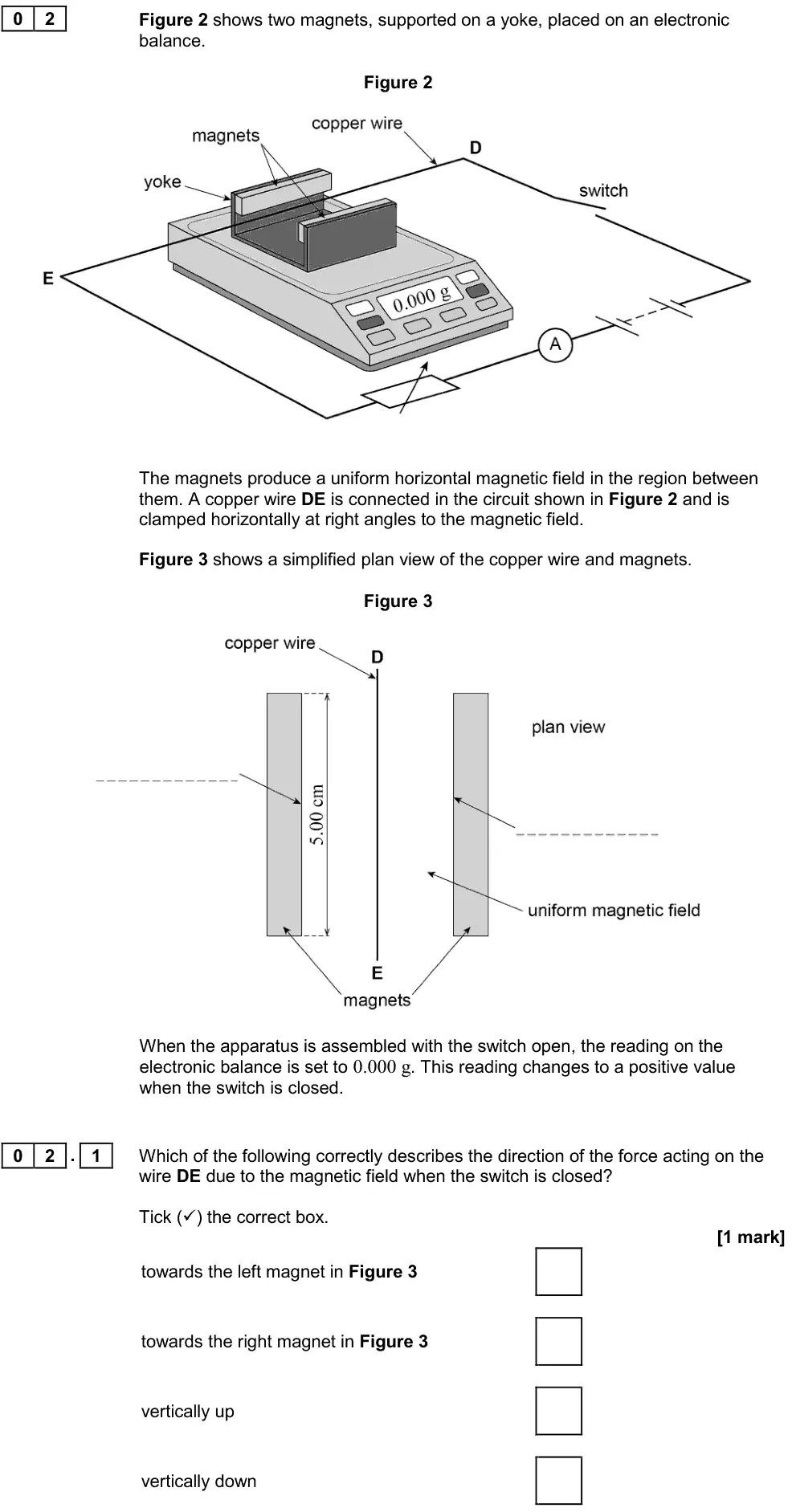
Figure 2 shows two magnets, supported on a yoke, placed on an electronic
balance.
Figure 2
The magnets produce a uniform horizontal magnetic field in the region between
them. A copper wire DE is connected in the circuit shown in Figure 2 and is
clamped horizontally at right angles to the magnetic field.
Figure 3 shows a simplified plan view of the copper wire and magnets.
Figure 3
When the apparatus is assembled with the switch open, the reading on the
electronic balance is set to 0.000 g. This reading changes to a positive value
when the switch is closed.
Which of the following correctly describes the direction of the force acting on the
wire DE due to the magnetic field when the switch is closed?
Tick () the correct box.
[1 mark]
towards the left magnet in Figure 3
towards the right magnet in Figure 3
vertically up
vertically down
June 2017 · Paper 2 · Q2.2 1 mark Diagram or graph magnetic fields
Earlier part of question 2 that this part usesEarlier part of June 2017 Paper 2 question 2
Label the poles of the magnets by putting N or S on each of the two dashed lines
in Figure 3.
[1 mark]
June 2017 · Paper 2 · Q2.3 1 mark Short answer magnetic fields
Earlier part of question 2 that this part usesEarlier part of June 2017 Paper 2 question 2
Define the tesla.
[1 mark]
June 2017 · Paper 2 · Q2.4 2 marks Calculation magnetic fields
Earlier part of question 2 that this part usesEarlier part of June 2017 Paper 2 question 2
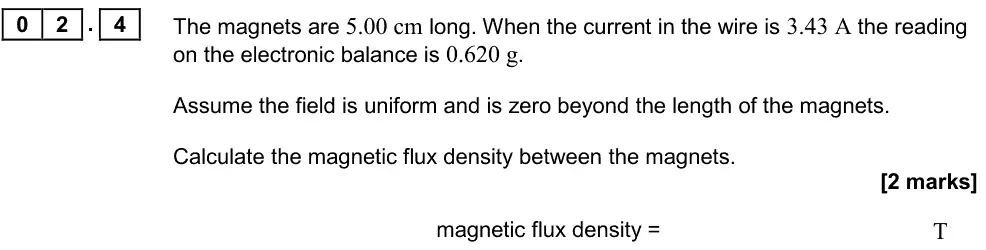
The magnets are 5.00 cm long. When the current in the wire is 3.43 A the reading
on the electronic balance is 0.620 g.
Assume the field is uniform and is zero beyond the length of the magnets.
Calculate the magnetic flux density between the magnets.
[2 marks]
magnetic flux density =
T
June 2017 · Paper 2 · Q3.1 1 mark Explanation magnetic fields
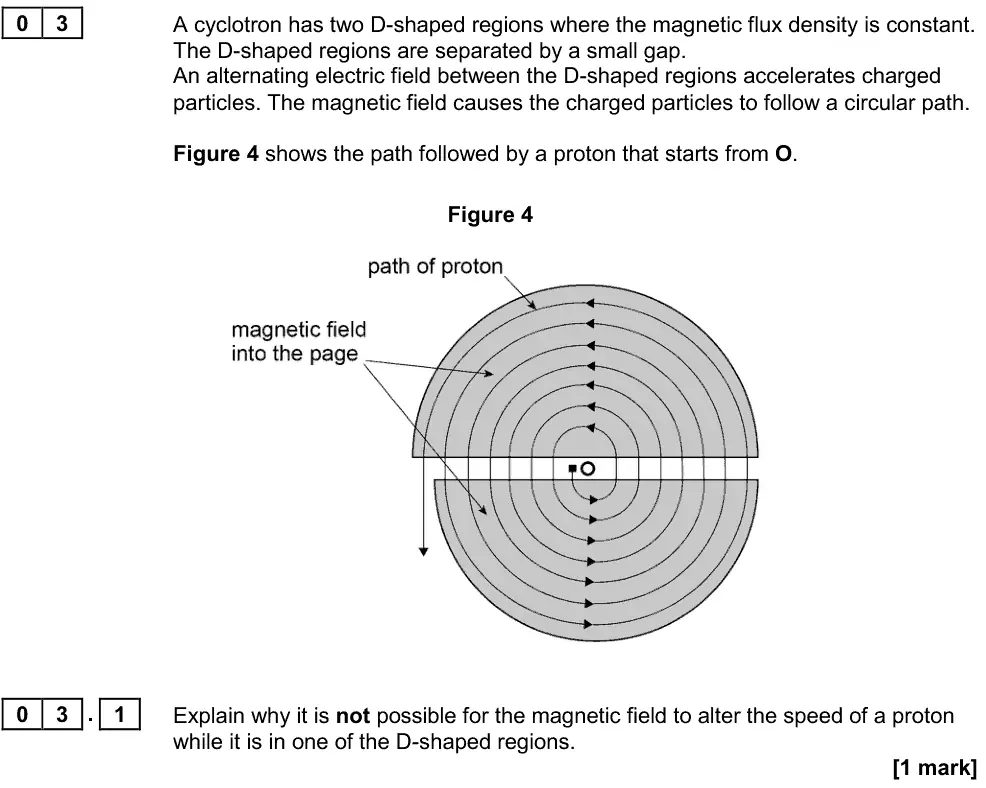
A cyclotron has two D-shaped regions where the magnetic flux density is constant.
The D-shaped regions are separated by a small gap.
An alternating electric field between the D-shaped regions accelerates charged
particles. The magnetic field causes the charged particles to follow a circular path.
Figure 4 shows the path followed by a proton that starts from O.
Figure 4
Explain why it is not possible for the magnetic field to alter the speed of a proton
while it is in one of the D-shaped regions.
[1 mark]
June 2017 · Paper 2 · Q3.2 3 marks Show that magnetic fieldscircular motion
Earlier part of question 3 that this part usesEarlier part of June 2017 Paper 2 question 3
Derive an expression to show that the time taken by a proton to travel round one
semi-circular path is independent of the radius of the path.
[3 marks]
June 2017 · Paper 2 · Q3.3 2 marks Calculation magnetic fields
Earlier part of question 3 that this part usesEarlier part of June 2017 Paper 2 question 3
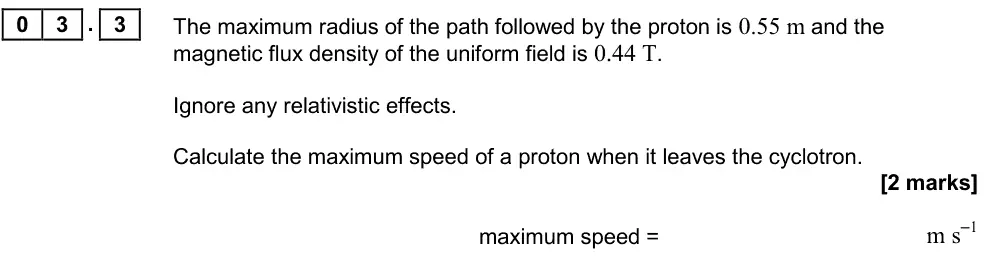
The maximum radius of the path followed by the proton is 0.55 m and the
magnetic flux density of the uniform field is 0.44 T.
Ignore any relativistic effects.
Calculate the maximum speed of a proton when it leaves the cyclotron.
[2 marks]
maximum speed =
m s–1
June 2017 · Paper 2 · Q4.1 1 mark Short answer mass energy and fission
The core of a thermal nuclear reactor contains a number of components that are
exposed to moving neutrons.
State what happens to a neutron that is incident on the moderator.
[1 mark]
June 2017 · Paper 2 · Q4.2 1 mark Short answer mass energy and fission
Earlier part of question 4 that this part usesEarlier part of June 2017 Paper 2 question 4
State what happens to a neutron that is incident on a control rod.
[1 mark]
June 2017 · Paper 2 · Q4.3 3 marks Explanation mass energy and fission
Earlier part of question 4 that this part usesEarlier part of June 2017 Paper 2 question 4
A slow-moving neutron is in collision with a nucleus of an atom of the fuel which
causes fission.
Describe what happens in the process.
[3 marks]
June 2017 · Paper 2 · Q4.4 6 marks 6-mark extended response mass energy and fission
Earlier part of question 4 that this part usesEarlier part of June 2017 Paper 2 question 4
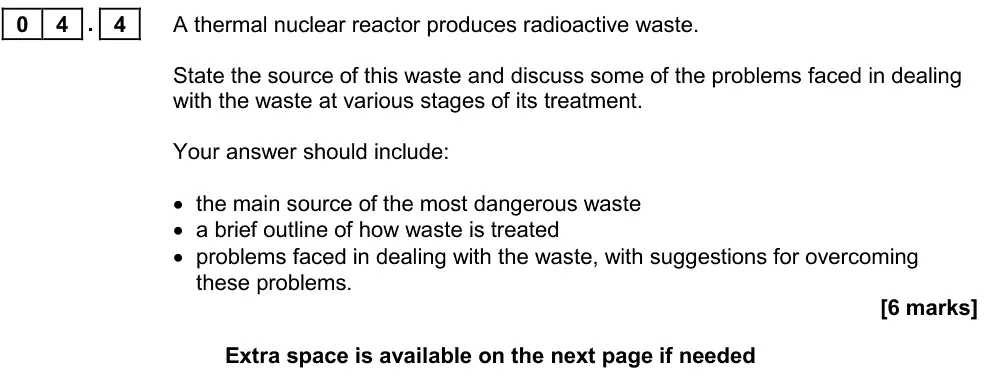
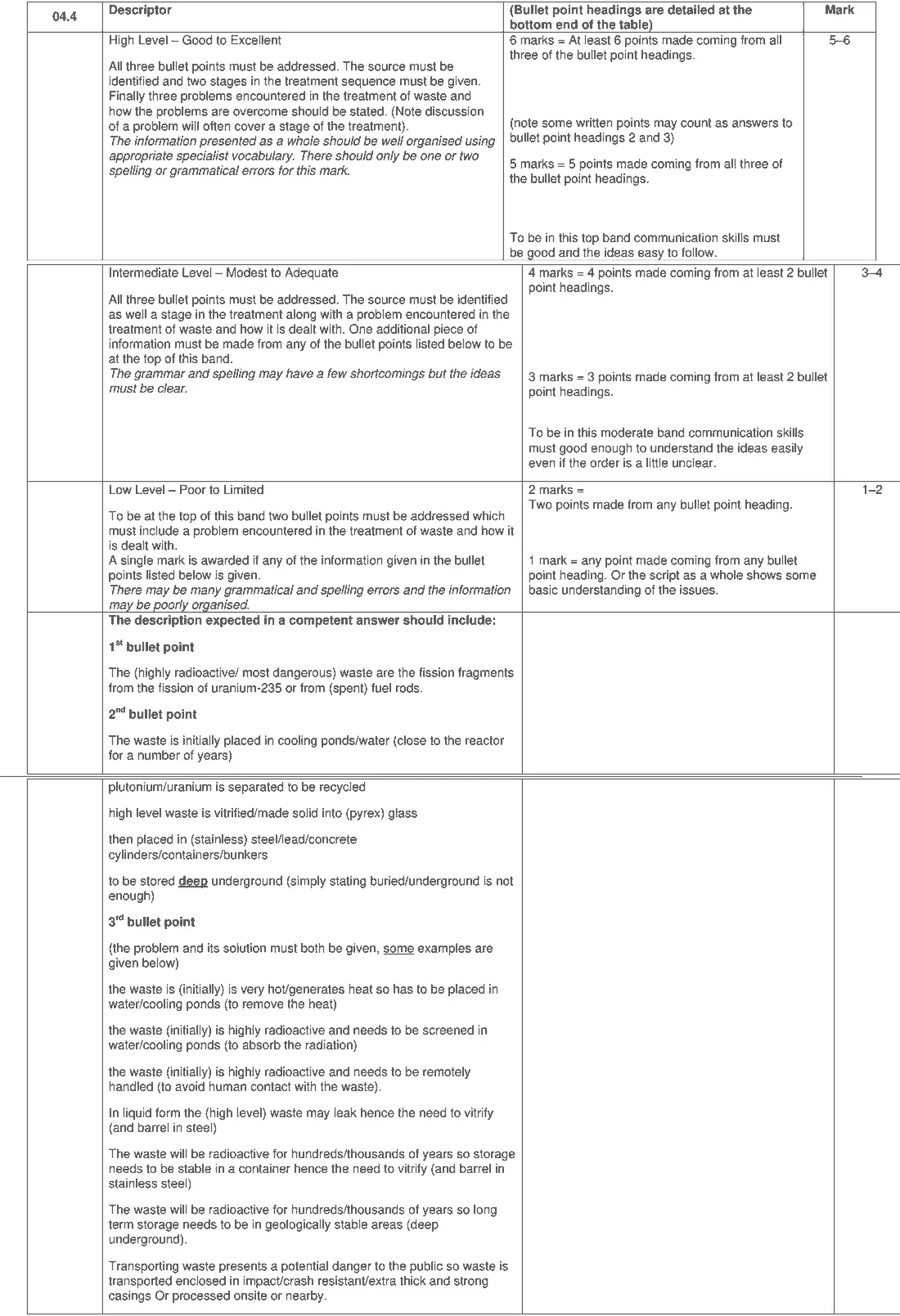
A thermal nuclear reactor produces radioactive waste.
State the source of this waste and discuss some of the problems faced in dealing
with the waste at various stages of its treatment.
Your answer should include:
• the main source of the most dangerous waste
• a brief outline of how waste is treated
• problems faced in dealing with the waste, with suggestions for overcoming
these problems.
[6 marks]
Extra space is available on the next page if needed
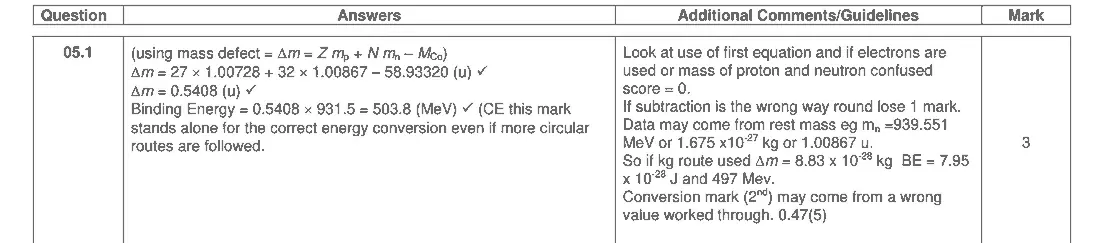
June 2017 · Paper 2 · Q5.1 3 marks Calculation mass energy and fission
27
59
.
nuclear mass of  Co
27
59
= 58.93320 u
[3 marks]
binding energy  =
MeV
June 2017 · Paper 2 · Q5.2 2 marks Calculation radioactive decayenergy levels and wave particle duality
Earlier part of question 5 that this part usesEarlier part of June 2017 Paper 2 question 5
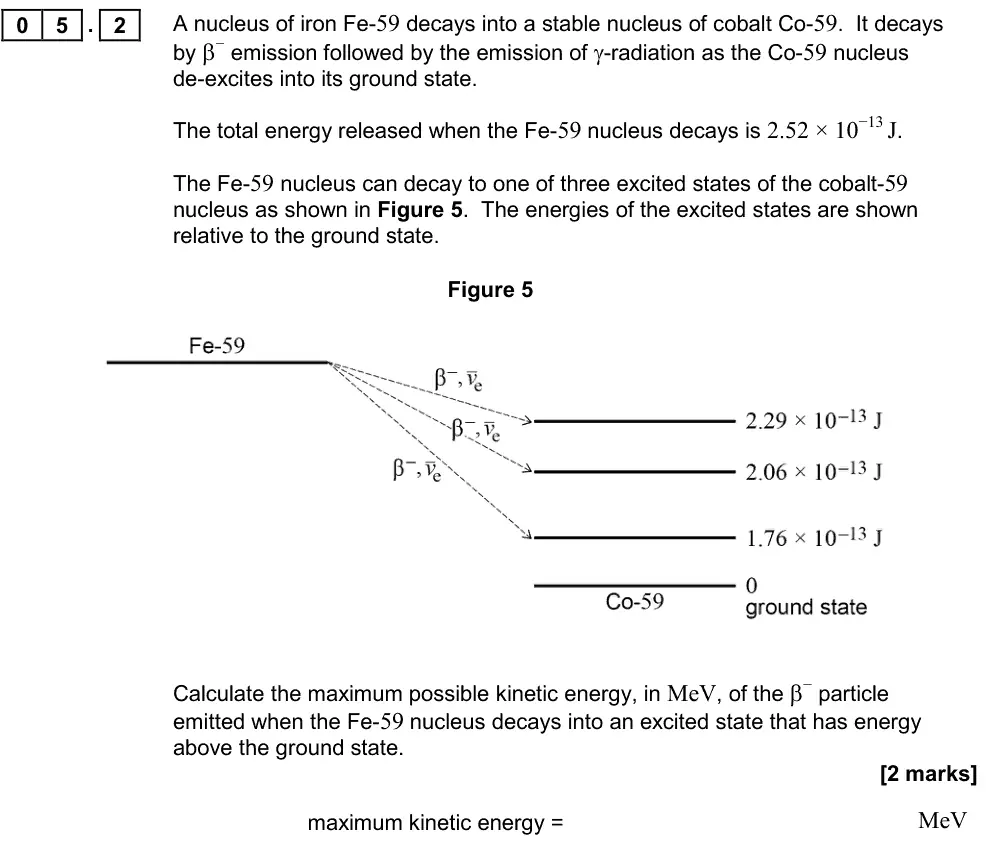
A nucleus of iron Fe-59 decays into a stable nucleus of cobalt Co-59.  It decays
by β− emission followed by the emission of γ-radiation as the Co-59 nucleus
de-excites into its ground state.
The total energy released when the Fe-59 nucleus decays is 2.52 × 10⁻¹³ J.
The Fe-59 nucleus can decay to one of three excited states of the cobalt-59
nucleus as shown in Figure 5.  The energies of the excited states are shown
relative to the ground state.
Figure 5
Calculate the maximum possible kinetic energy, in MeV, of the β− particle
emitted when the Fe-59 nucleus decays into an excited state that has energy
above the ground state.
[2 marks]
maximum kinetic energy =
MeV
June 2017 · Paper 2 · Q5.3 1 mark Short answer radioactive decay
Earlier part of question 5 that this part usesEarlier part of June 2017 Paper 2 question 5
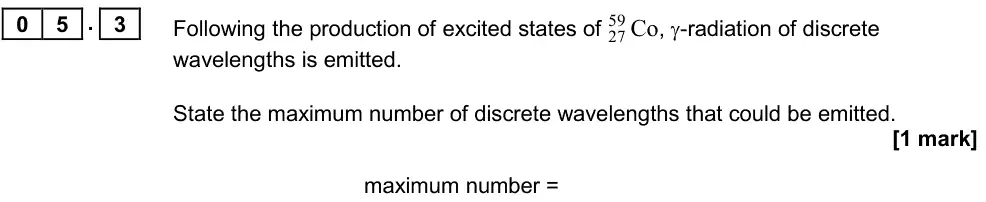
27
59
, γ-radiation of discrete
wavelengths is emitted.
State the maximum number of discrete wavelengths that could be emitted.
[1 mark]
maximum number =
June 2017 · Paper 2 · Q5.4 3 marks Calculation radioactive decayparticles antiparticles and interactions
Earlier part of question 5 that this part usesEarlier part of June 2017 Paper 2 question 5
Calculate the longest wavelength of the emitted γ-radiation.
[3 marks]
longest wavelength =
m
June 2017 · Paper 2 · Q6.1 1 mark Short answer gravitational fields
State what is represented by gravitational field lines.
[1 mark]
June 2017 · Paper 2 · Q6.2 2 marks Explanation gravitational fields
Earlier part of question 6 that this part usesEarlier part of June 2017 Paper 2 question 6
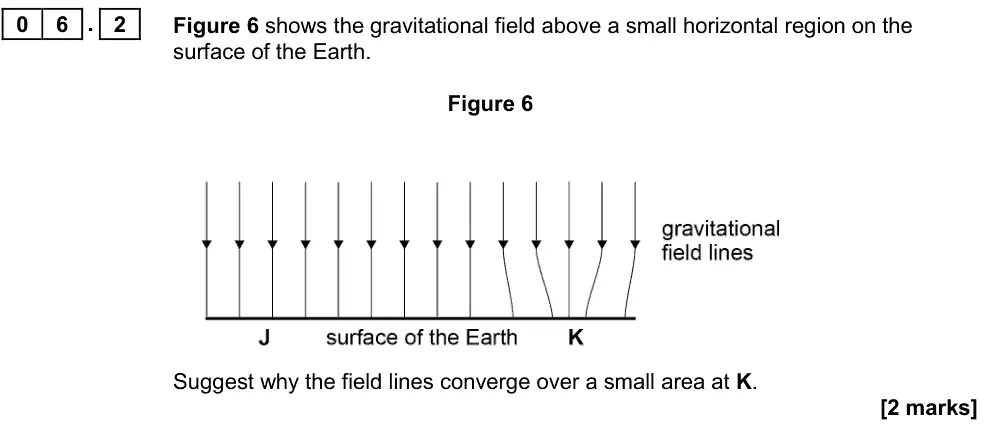
Figure 6 shows the gravitational field above a small horizontal region on the
surface of the Earth.
Figure 6
Suggest why the field lines converge over a small area at K.
[2 marks]
June 2017 · Paper 2 · Q6.3 2 marks Explanation gravitational fields
Earlier part of question 6 that this part usesEarlier part of June 2017 Paper 2 question 6
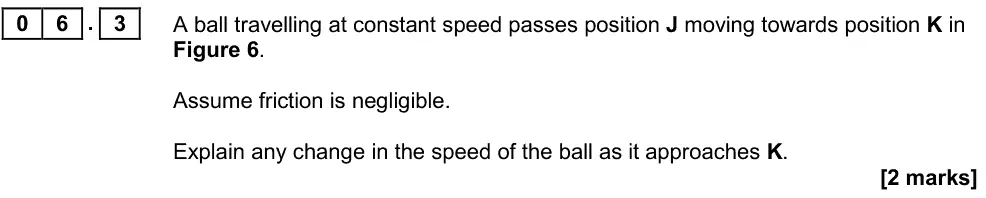
A ball travelling at constant speed passes position J moving towards position K in
Figure 6.
Assume friction is negligible.
Explain any change in the speed of the ball as it approaches K.
[2 marks]
June 2017 · Paper 2 · Q6.4 1 mark Short answer gravitational fieldselectric fields
Earlier part of question 6 that this part usesEarlier part of June 2017 Paper 2 question 6
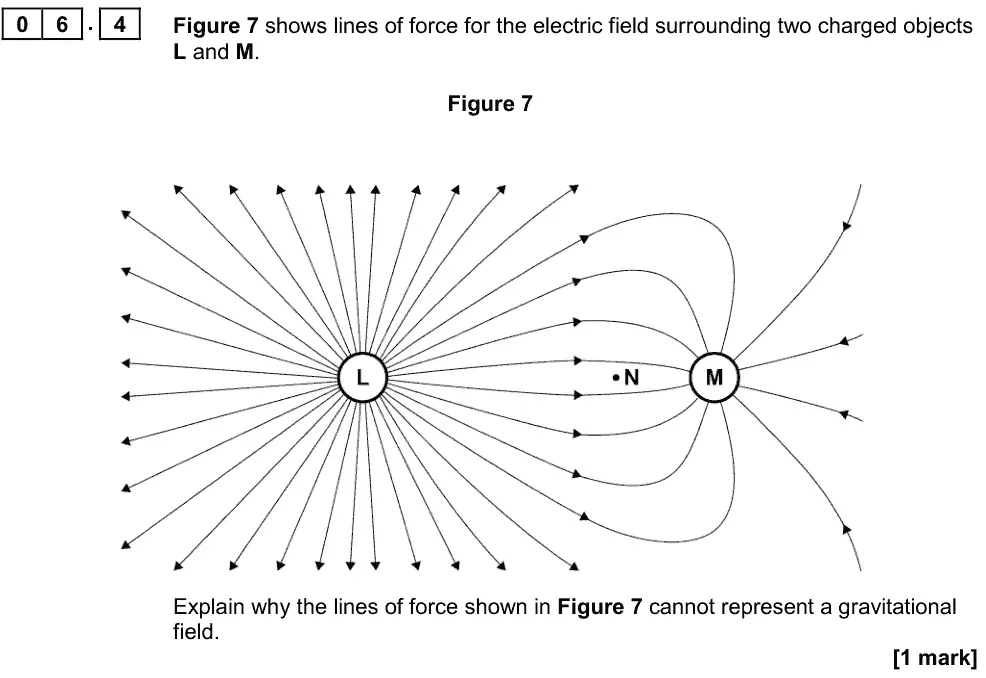
Figure 7 shows lines of force for the electric field surrounding two charged objects
L and M.
Figure 7
Explain why the lines of force shown in Figure 7 cannot represent a gravitational
field.
[1 mark]
June 2017 · Paper 2 · Q6.5 1 mark Short answer Easy electric fields
Earlier part of question 6 that this part usesEarlier part of June 2017 Paper 2 question 6
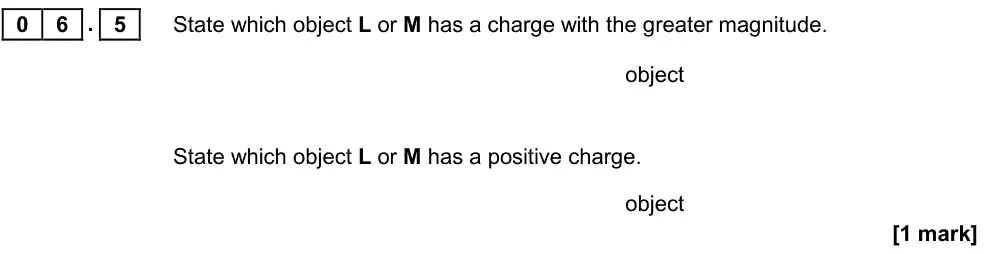
State which object L or M has a charge with the greater magnitude.
object
State which object L or M has a positive charge.
object
[1 mark]
June 2017 · Paper 2 · Q6.6 2 marks Diagram or graph electric fields
Earlier part of question 6 that this part usesEarlier part of June 2017 Paper 2 question 6
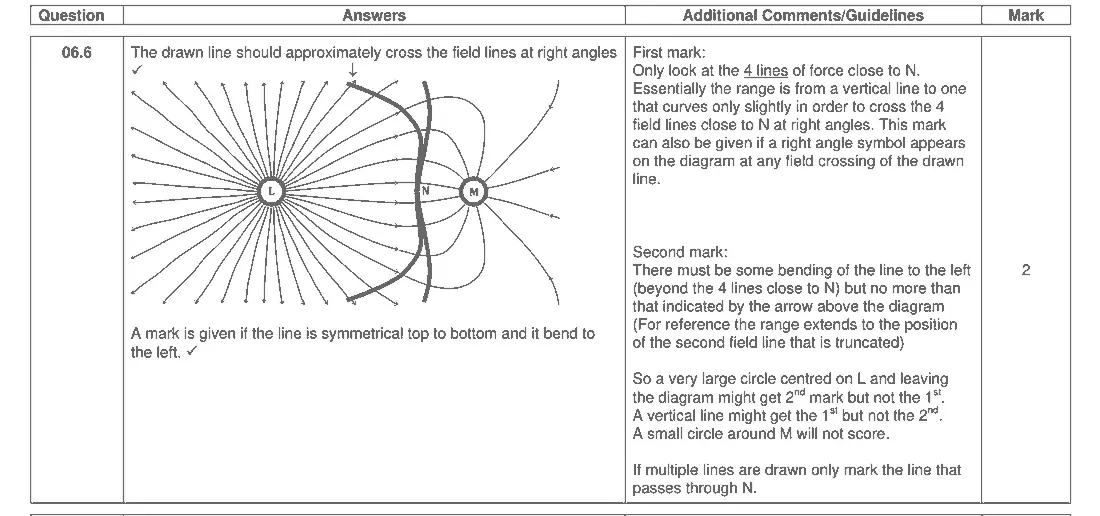
Draw, on Figure 7, an equipotential line that passes through point N.
Do not extend your line beyond the given field lines.
[2 marks]
June 2017 · Paper 2 · Q7.1 2 marks Show that gravitational fieldscircular motion
Derive an expression to show that for satellites in a circular orbit
T2 ∝ r3
where T is the period of orbit and r is the radius of the orbit.
[2 marks]
June 2017 · Paper 2 · Q7.2 2 marks Calculation gravitational fields
Earlier part of question 7 that this part usesEarlier part of June 2017 Paper 2 question 7
Pluto is a dwarf planet. The mean orbital radius of Pluto around the Sun is
5.91 × 10⁹ km compared to a mean orbital radius of 1.50 × 10⁸ km for the Earth.
Calculate in years the orbital period of Pluto.
[2 marks]
orbital period of Pluto =
yr
June 2017 · Paper 2 · Q7.3 3 marks Calculation gravitational fields
Earlier part of question 7 that this part usesEarlier part of June 2017 Paper 2 question 7
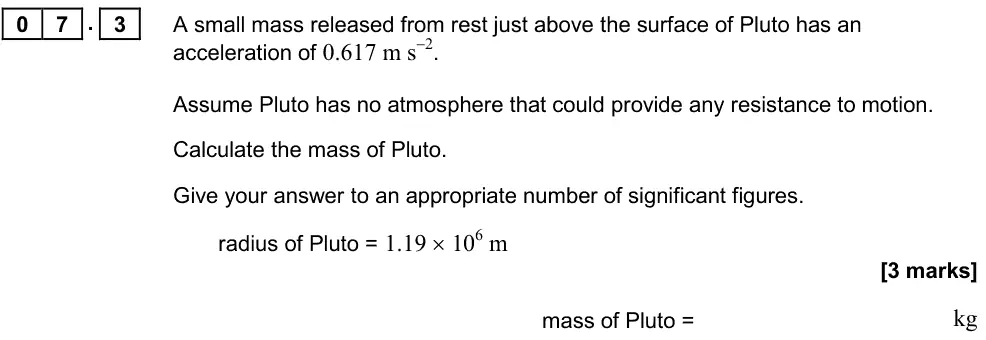
A small mass released from rest just above the surface of Pluto has an
acceleration of 0.617 m s−2.
Assume Pluto has no atmosphere that could provide any resistance to motion.
Calculate the mass of Pluto.
Give your answer to an appropriate number of significant figures.
radius of Pluto = 1.19 × 10⁶ m
[3 marks]
mass of Pluto =
kg
June 2017 · Paper 2 · Q7.4 3 marks Calculation gravitational fields
Earlier part of question 7 that this part usesEarlier part of June 2017 Paper 2 question 7
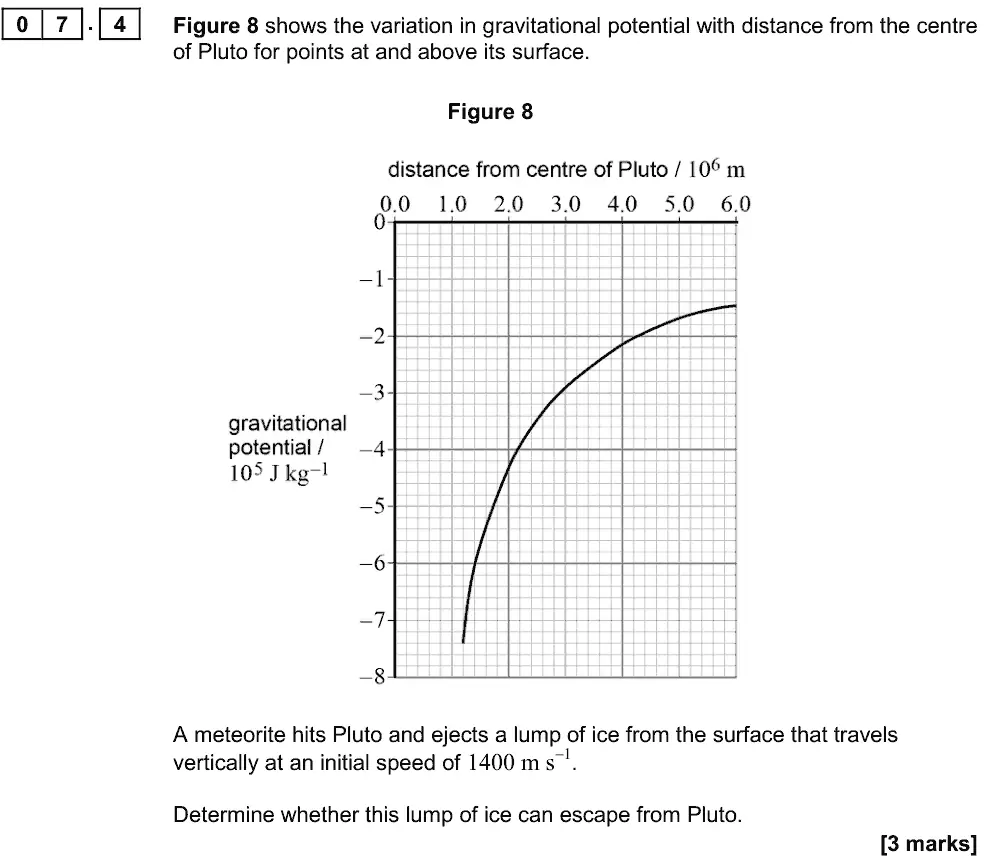
Figure 8 shows the variation in gravitational potential with distance from the centre
of Pluto for points at and above its surface.
Figure 8
A meteorite hits Pluto and ejects a lump of ice from the surface that travels
vertically at an initial speed of 1400 m s−1.
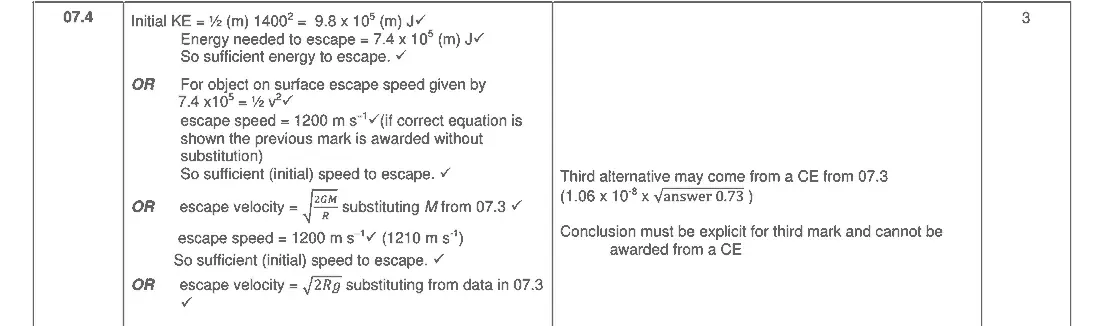
Determine whether this lump of ice can escape from Pluto.
[3 marks]
June 2017 · Paper 2 · Q8 1 mark Multiple choice thermal energy and ideal gaseswork energy and power
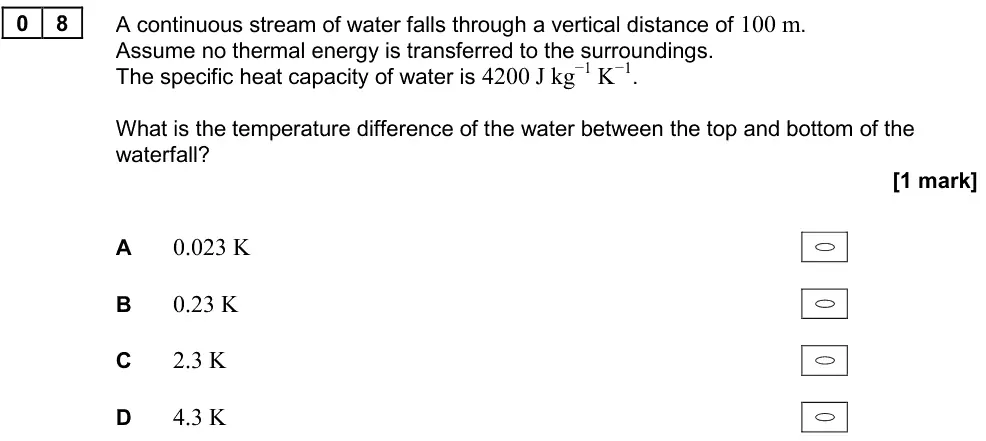
A continuous stream of water falls through a vertical distance of 100 m.
Assume no thermal energy is transferred to the surroundings.
The specific heat capacity of water is 4200 J kg−1 K−1.
What is the temperature difference of the water between the top and bottom of the
waterfall?
[1 mark]
A
0.023 K
B
0.23 K
C
2.3 K
D
4.3 K
June 2017 · Paper 2 · Q9 1 mark Multiple choice thermal energy and ideal gaseswork energy and power
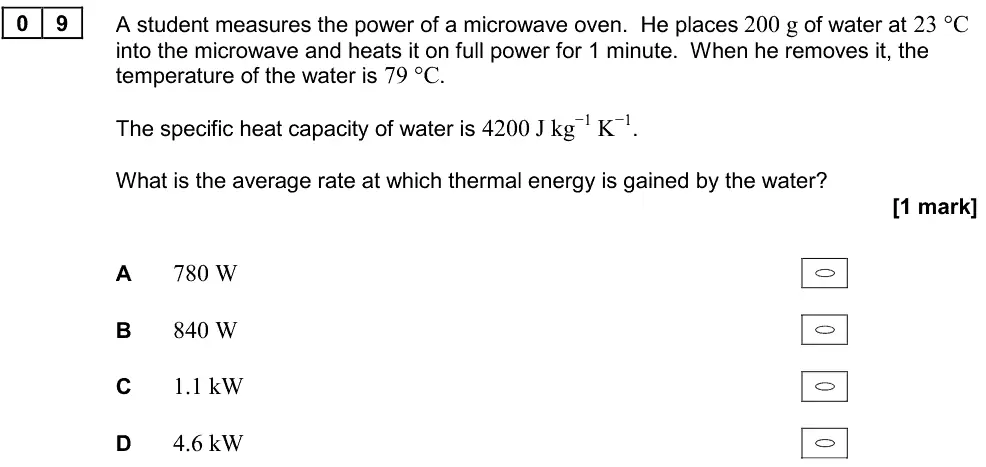
A student measures the power of a microwave oven.  He places 200 g of water at 23 °C
into the microwave and heats it on full power for 1 minute.  When he removes it, the
temperature of the water is 79 °C.
The specific heat capacity of water is 4200 J kg−1 K−1.
What is the average rate at which thermal energy is gained by the water?
[1 mark]
A
780 W
B
840 W
C
1.1 kW
D
4.6 kW
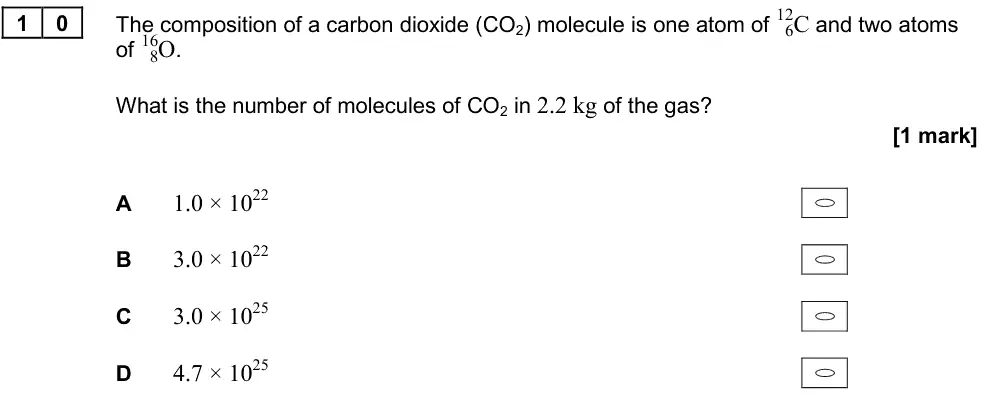
June 2017 · Paper 2 · Q10 1 mark Multiple choice thermal energy and ideal gases
The composition of a carbon dioxide (CO2) molecule is one atom of C
6
12 and two atoms
of O
8
16 .
What is the number of molecules of CO2 in 2.2 kg of the gas?
[1 mark]
A
1.0 × 10²²
B
3.0 × 10²²
C
3.0 × 1025
D
4.7 × 1025
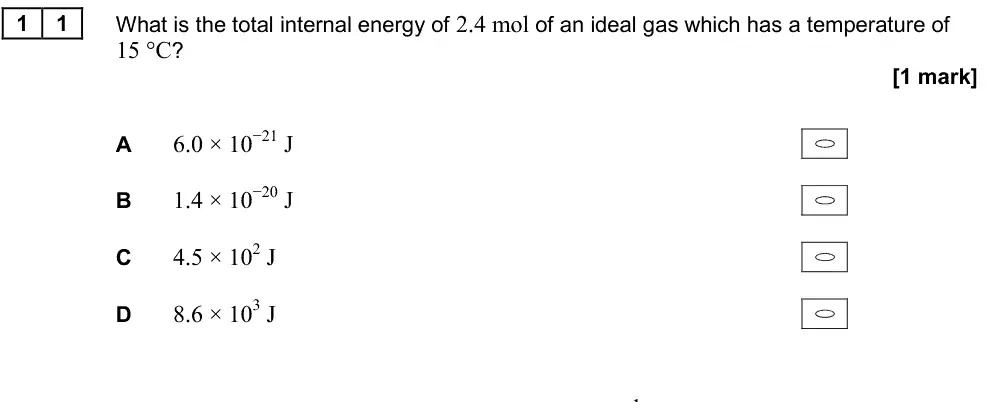
June 2017 · Paper 2 · Q11 1 mark Multiple choice kinetic theory
What is the total internal energy of 2.4 mol of an ideal gas which has a temperature of
15 °C?
[1 mark]
A
6.0 × 10⁻²¹ J
B
1.4 × 10⁻²⁰ J
C
4.5 × 10² J
D
8.6 × 10³ J
1
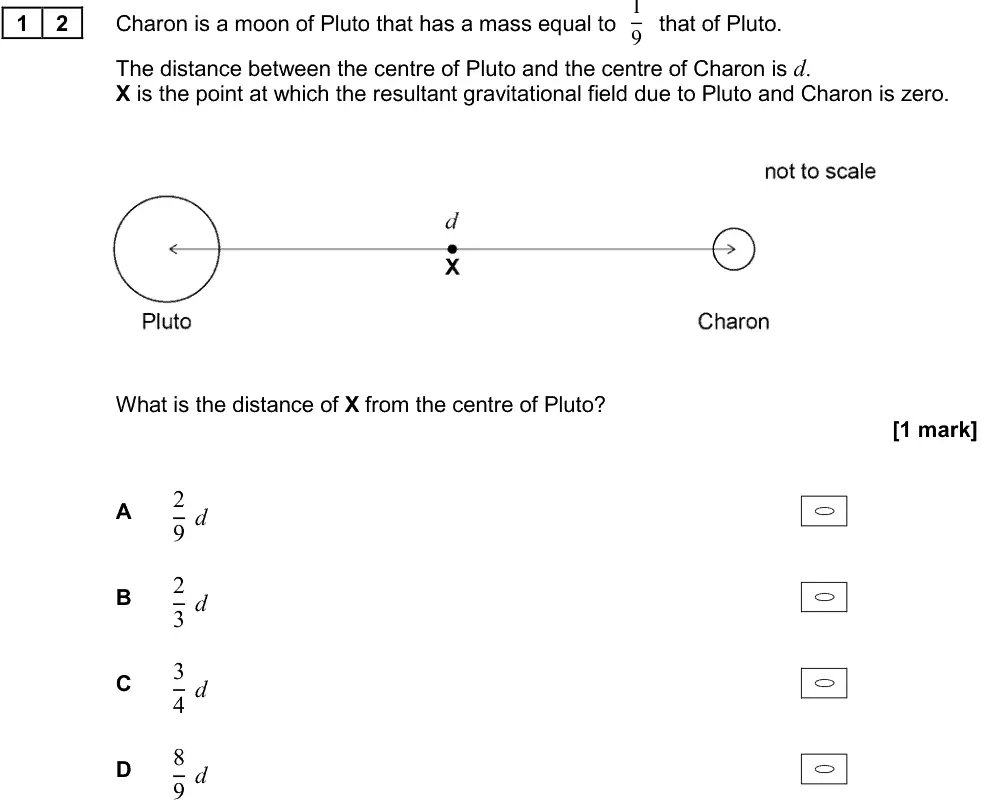
June 2017 · Paper 2 · Q12 1 mark Multiple choice gravitational fields
Charon is a moon of Pluto that has a mass equal to       that of Pluto.
The distance between the centre of Pluto and the centre of Charon is d.
X is the point at which the resultant gravitational field due to Pluto and Charon is zero.
What is the distance of X from the centre of Pluto?
[1 mark]
A
2
9 d
B
2
3 d
C
3
4 d
D
8
9 d
9
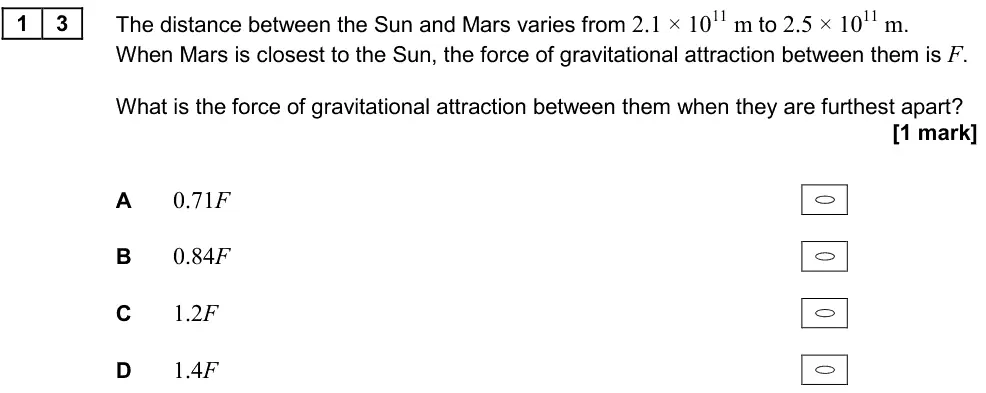
June 2017 · Paper 2 · Q13 1 mark Multiple choice gravitational fields
The distance between the Sun and Mars varies from 2.1 × 10¹¹ m to 2.5 × 10¹¹ m.
When Mars is closest to the Sun, the force of gravitational attraction between them is F.
What is the force of gravitational attraction between them when they are furthest apart?
[1 mark]
A
0.71F
B
0.84F
C
1.2F
D
1.4F
June 2017 · Paper 2 · Q14 1 mark Multiple choice gravitational fieldscircular motion
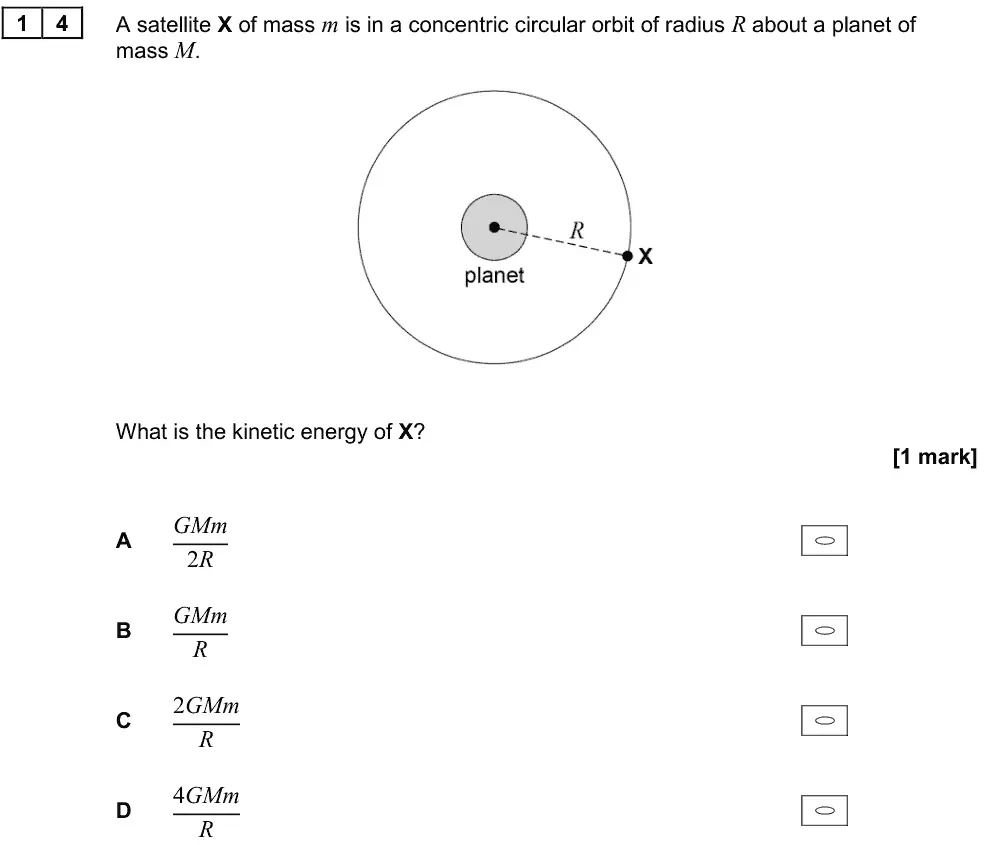
A satellite X of mass m is in a concentric circular orbit of radius R about a planet of
mass M.
What is the kinetic energy of X?
[1 mark]
A
GMm
2R
B
GMm
R
C
2GMm
R
D
4GMm
R
June 2017 · Paper 2 · Q15 1 mark Multiple choice electric fields
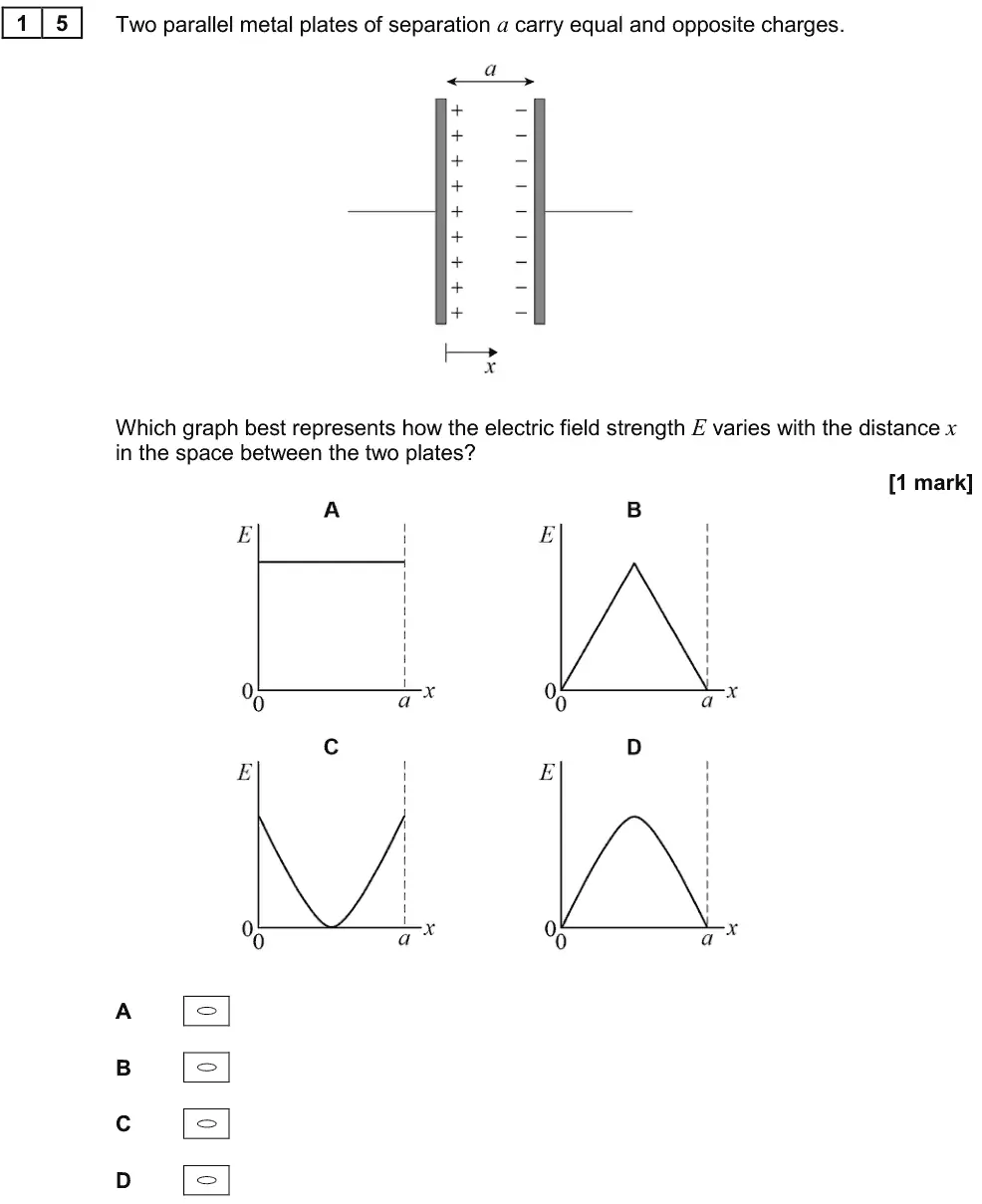
Two parallel metal plates of separation a carry equal and opposite charges.
Which graph best represents how the electric field strength E varies with the distance x
in the space between the two plates?
[1 mark]
A
B
C
D
June 2017 · Paper 2 · Q16 1 mark Multiple choice electric fieldsnewtons laws and momentum
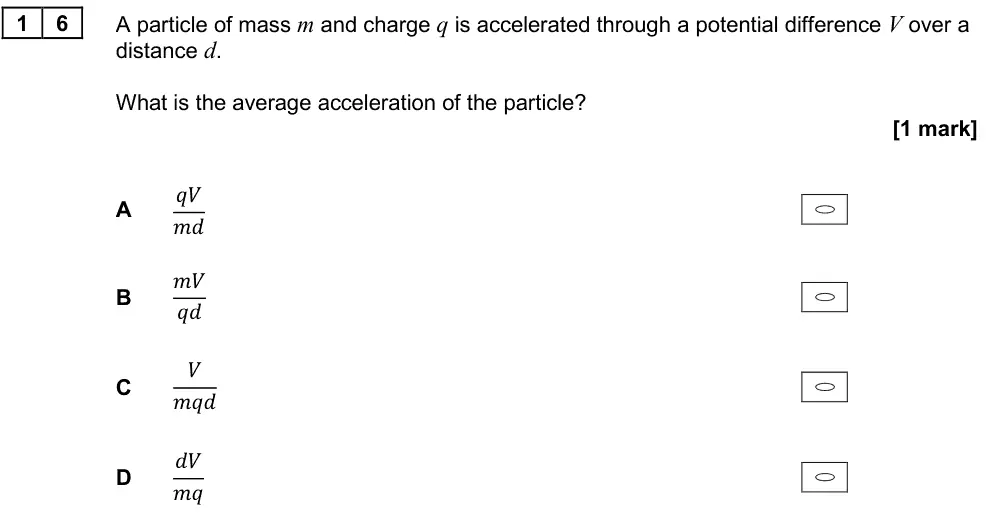
A particle of mass m and charge q is accelerated through a potential difference V over a
distance d.
What is the average acceleration of the particle?
[1 mark]
A
𝑞𝑞
𝑚𝑚
B
𝑚𝑚
𝑞𝑞
C
𝑉
𝑚𝑚𝑚
D
𝑑𝑑
𝑚𝑚
June 2017 · Paper 2 · Q17 1 mark Multiple choice electric fields
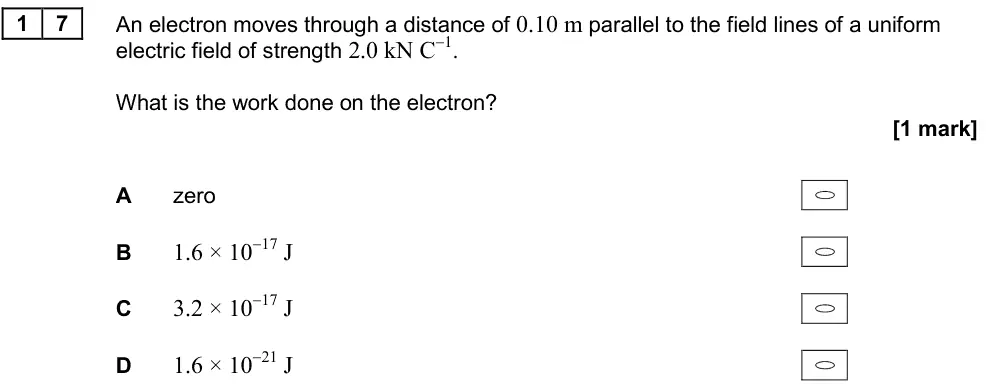
An electron moves through a distance of 0.10 m parallel to the field lines of a uniform
electric field of strength 2.0 kN C−1.
What is the work done on the electron?
[1 mark]
A
zero
B
1.6 × 10⁻¹⁷ J
C
3.2 × 10⁻¹⁷ J
D
1.6 × 10⁻²¹ J
June 2017 · Paper 2 · Q18 1 mark Multiple choice capacitors
A parallel-plate capacitor is fully charged and then disconnected from the power supply.
A dielectric is then inserted between the plates.
Which row correctly identifies the charge on the plates and the electric field strength
between the plates?
[1 mark]
Charge
Electric field strength
A
Stays the same
Increases
B
Increases
Decreases
C
Increases
Increases
D
Stays the same
Decreases
June 2017 · Paper 2 · Q19 1 mark Multiple choice capacitors
A capacitor of capacitance C has a charge of Q stored on the plates.  The potential
difference between the plates is doubled.
What is the change in the energy stored by the capacitor?
[1 mark]
A
Q2
2C
B
Q2
C
C
3Q2
2C
D
2Q2
C
June 2017 · Paper 2 · Q20 1 mark Multiple choice capacitors
A capacitor consists of two parallel square plates of side l separated by distance d.
The capacitance of the arrangement is C.
What is the capacitance of a capacitor with square plates of side 2l separated by a
distance
d
2 ?
[1 mark]
A
C
B
2C
C
4C
D
8C
June 2017 · Paper 2 · Q21 1 mark Multiple choice capacitors
A capacitor of capacitance 120 µF is charged and then discharged through a 20 kΩ
resistor.
What fraction of the original charge remains on the capacitor 4.8 s after the discharge
begins?
[1 mark]
A
0.14
B
0.37
C
0.63
D
0.86
June 2017 · Paper 2 · Q22 1 mark Multiple choice electromagnetic induction
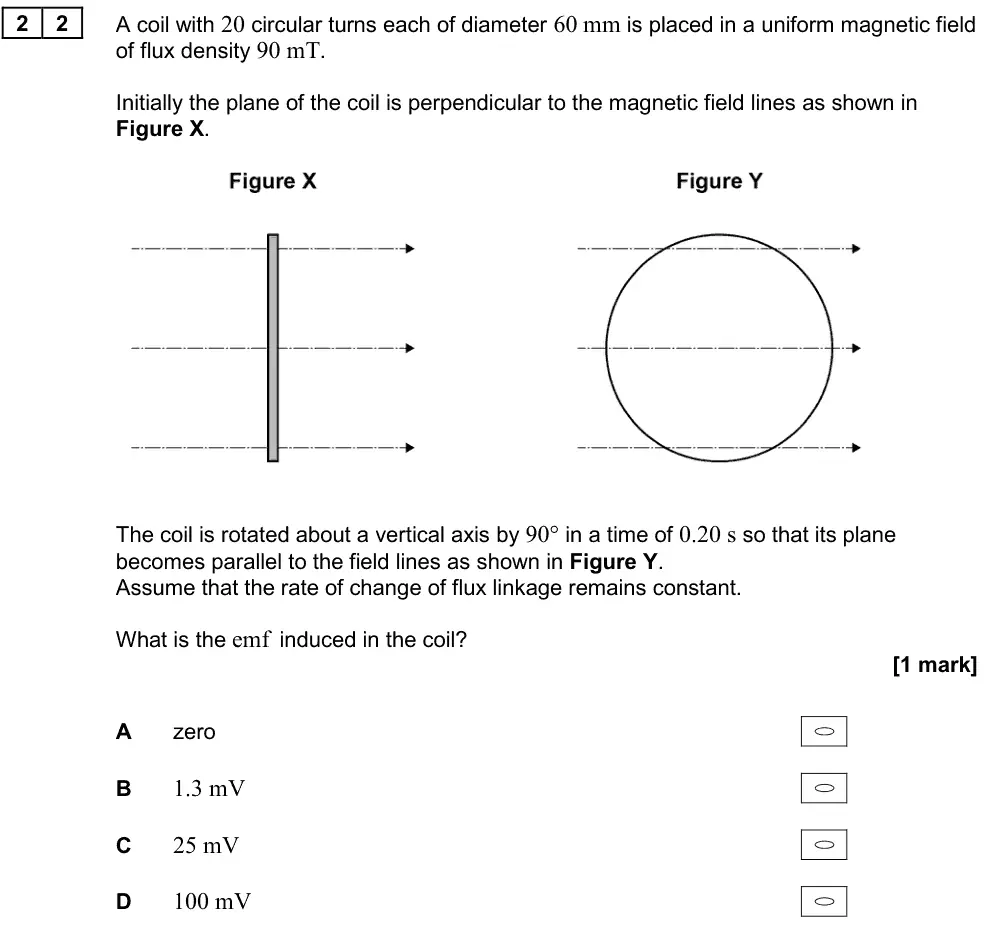
A coil with 20 circular turns each of diameter 60 mm is placed in a uniform magnetic field
of flux density 90 mT.
Initially the plane of the coil is perpendicular to the magnetic field lines as shown in
Figure X.
The coil is rotated about a vertical axis by 90° in a time of 0.20 s so that its plane
becomes parallel to the field lines as shown in Figure Y.
Assume that the rate of change of flux linkage remains constant.
What is the emf induced in the coil?
[1 mark]
A
zero
B
1.3 mV
C
25 mV
D
100 mV
June 2017 · Paper 2 · Q23 1 mark Multiple choice electromagnetic induction
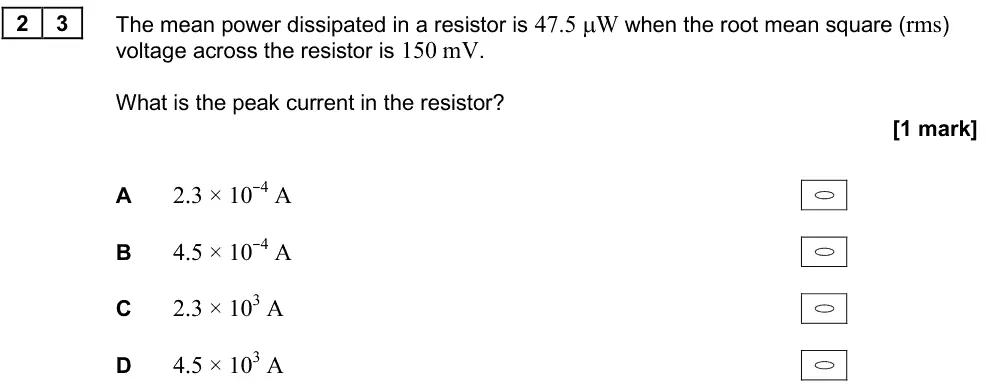
The mean power dissipated in a resistor is 47.5 µW when the root mean square (rms)
voltage across the resistor is 150 mV.
What is the peak current in the resistor?
[1 mark]
A
2.3 × 10⁻⁴ A
B
4.5 × 10⁻⁴ A
C
2.3 × 10³ A
D
4.5 × 10³ A
June 2017 · Paper 2 · Q24 1 mark Multiple choice electromagnetic induction
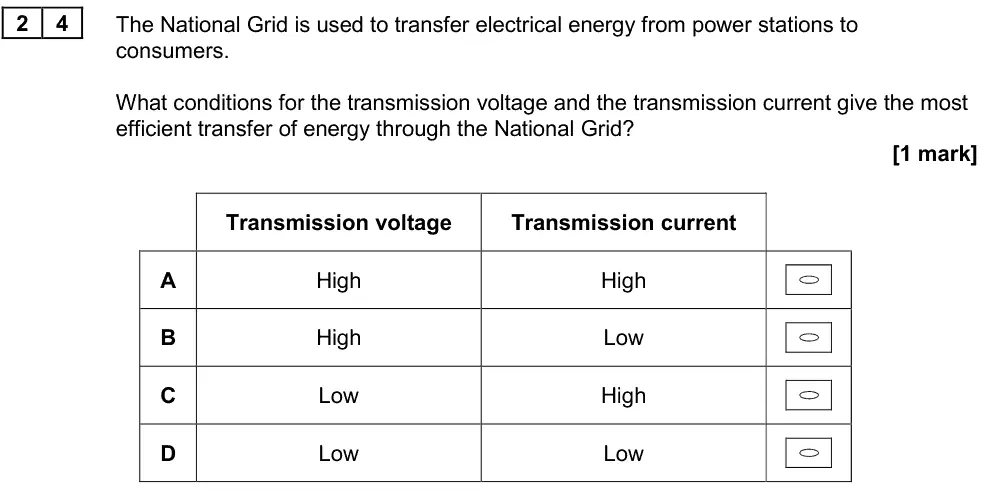
The National Grid is used to transfer electrical energy from power stations to
consumers.
What conditions for the transmission voltage and the transmission current give the most
efficient transfer of energy through the National Grid?
[1 mark]
Transmission voltage
Transmission current
A
High
High
B
High
Low
C
Low
High
D
Low
Low
June 2017 · Paper 2 · Q25 1 mark Multiple choice electromagnetic induction
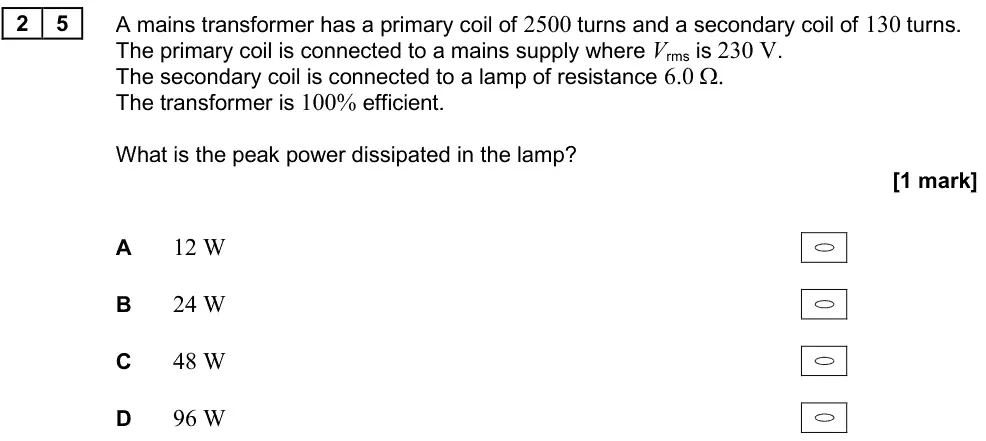
A mains transformer has a primary coil of 2500 turns and a secondary coil of 130 turns.
The primary coil is connected to a mains supply where Vrms is 230 V.
The secondary coil is connected to a lamp of resistance 6.0 Ω.
The transformer is 100% efficient.
What is the peak power dissipated in the lamp?
[1 mark]
A
12 W
B
24 W
C
48 W
D
96 W
June 2017 · Paper 2 · Q26 1 mark Multiple choice rutherford scattering and radiation
The Rutherford scattering experiment led to
[1 mark]
A
the discovery of the electron.
B
the quark model of hadrons.
C
the discovery of the nucleus.
D
evidence for wave-particle duality.
June 2017 · Paper 2 · Q27 1 mark Multiple choice rutherford scattering and radiation
A Geiger counter is placed near a radioactive source and different materials are placed
between the source and the Geiger counter.
The results of the tests are shown in the table.
Material
Count rate of Geiger counter / s–1
None
1000
Paper
1000
Aluminium foil
250
Thick steel
50
What is the radiation emitted by the source?
[1 mark]
A
α only
B
α and γ
C
α and β
D
β and γ
June 2017 · Paper 2 · Q28 1 mark Multiple choice radioactive decay
Nobelium-259 has a half-life of 3500 s.
What is the decay constant of nobelium-259?
[1 mark]
A
8.7 × 10⁻⁵ s−1
B
2.0 × 10⁻⁴ s−1
C
1.7 × 10⁻² s−1
D
1.2 × 10⁻² s−1
June 2017 · Paper 2 · Q29 1 mark Multiple choice radioactive decay
A pure sample of nuclide X containing N nuclei has an activity A.
The half-life of X is 6000 years.
A pure sample of nuclide Y containing 3N nuclei has an activity 6A.
What is the half-life of nuclide Y?
[1 mark]
A
1000 years
B
3000 years
C
12 000 years
D
18 000 years
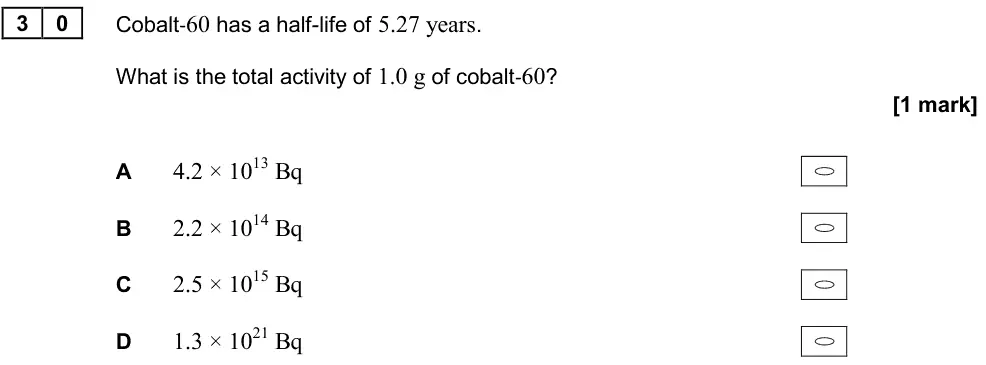
June 2017 · Paper 2 · Q30 1 mark Multiple choice radioactive decay
Cobalt-60 has a half-life of 5.27 years.
What is the total activity of 1.0 g of cobalt-60?
[1 mark]
A
4.2 × 10¹³ Bq
B
2.2 × 10¹⁴ Bq
C
2.5 × 10¹⁵ Bq
D
1.3 × 10²¹ Bq
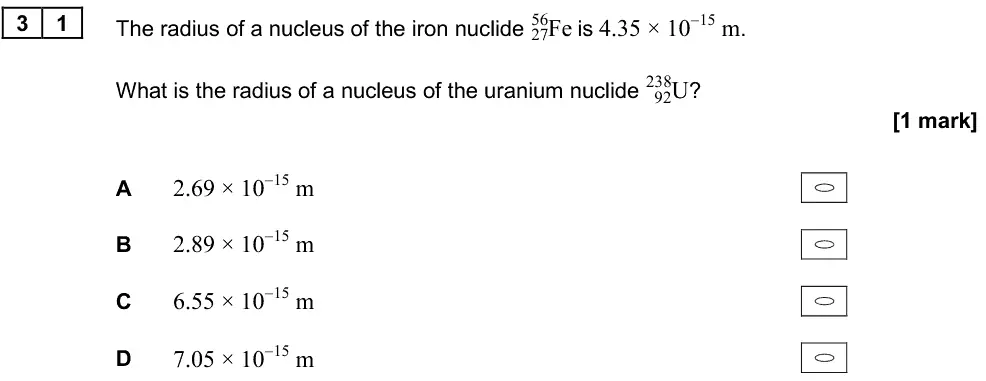
June 2017 · Paper 2 · Q31 1 mark Multiple choice nuclear radius
The radius of a nucleus of the iron nuclide Fe
27
56
What is the radius of a nucleus of the uranium nuclide
U
92
238 ?
[1 mark]
A
2.69 × 10⁻¹⁵ m
B
2.89 × 10⁻¹⁵ m
C
6.55 × 10⁻¹⁵ m
D
7.05 × 10⁻¹⁵ m
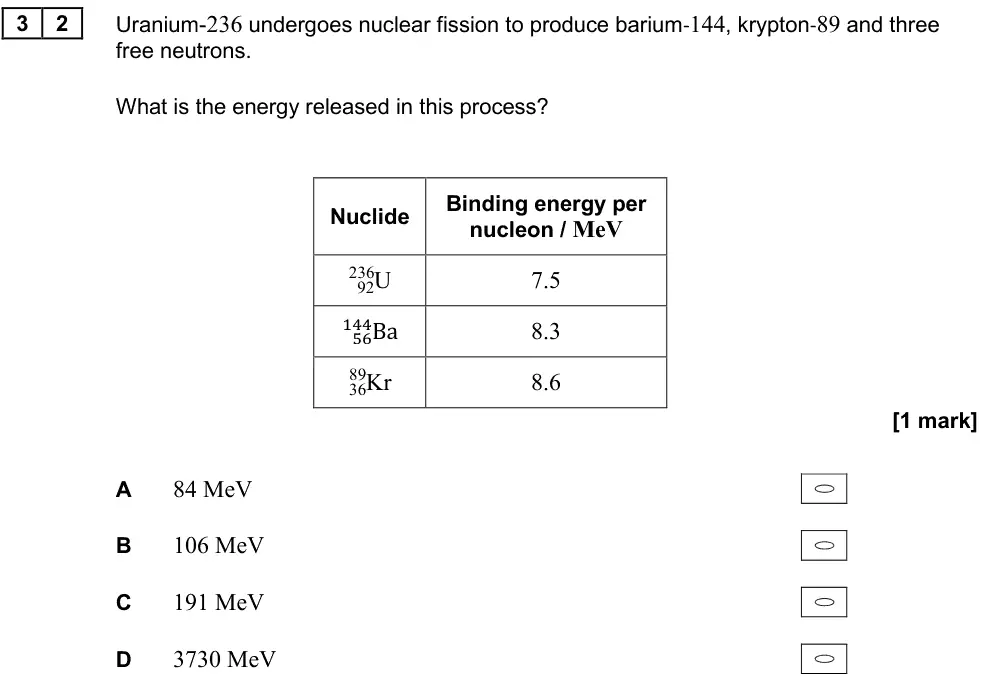
June 2017 · Paper 2 · Q32 1 mark Multiple choice mass energy and fission
Uranium-236 undergoes nuclear fission to produce barium-144, krypton-89 and three
free neutrons.
What is the energy released in this process?
Nuclide
Binding energy per
nucleon / MeV
U
92
236
7.5
Ba
56
144
8.3
Kr
36
89
8.6
[1 mark]
A
84 MeV
B
106 MeV
C
191 MeV
D
3730 MeV

Work with an AQA physics tutor

Want a paper marked and gone through with you? Message us.

Prefer email? Send an enquiry

If you are under 18, please include a parent's contact details. Enquiries go to enquiries@physicsaleveltutor.com and are deleted once handled. All tutoring is online.