
June 2024: AS Paper 2, Depth in physics

70 marks · 35 question parts · Paper, mark scheme and report on OCR's site · Have the Data, Formulae and Relationships Booklet beside you

Question by question

QTopicMarksAOType
1(a) Kinematics: displacement, velocity and motion graphs 2Calculation
1(b) Scalars and vectors, Kinematics: displacement, velocity and motion graphs 2Explanation
1(c)(i) Practical skills: planning, analysis and evaluation 1Show that
1(c)(ii) Practical skills: planning, analysis and evaluation 3Calculation
2(a) Newton's laws of motion and momentum 1Short answer
2(b)(i) Newton's laws of motion and momentum, Physical quantities and S.I. units 2Calculation
2(b)(ii) Newton's laws of motion and momentum 1Calculation
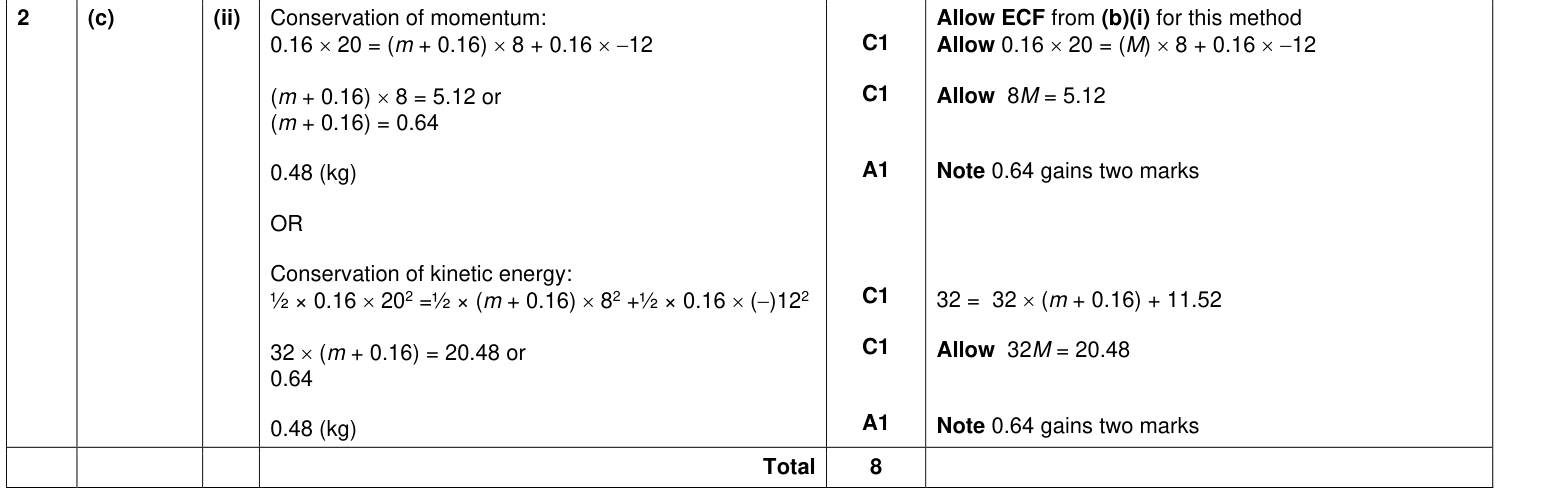
2(c)(i) Collisions: conservation of momentum 1Explanation
2(c)(ii) Collisions: conservation of momentum, Newton's laws of motion and momentum 3Calculation
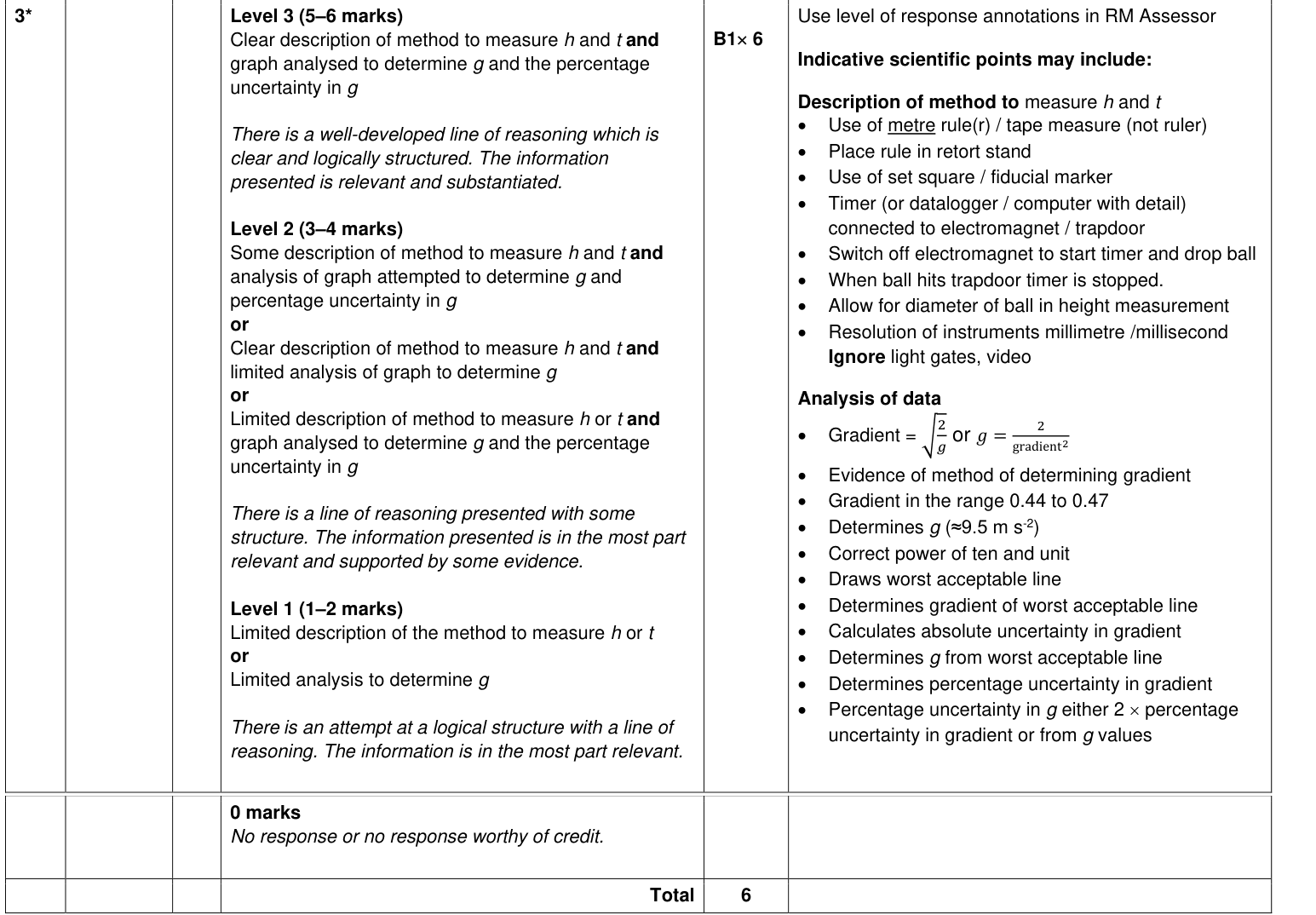
3 Linear motion: the suvat equations and free fall, Practical skills: planning, analysis and evaluation, Measurements and uncertainties 6Extended response
4(a)(i) Practical skills: planning, analysis and evaluation, Measurements and uncertainties 2Explanation
4(a)(ii) Density, pressure and upthrust 2Calculation
4(b)(i) Equilibrium: moments, couples and centre of mass 1Explanation
4(b)(ii) Equilibrium: moments, couples and centre of mass 3Show that
4(c)(i) Equilibrium: moments, couples and centre of mass 3Short answer
4(c)(ii) Equilibrium: moments, couples and centre of mass, Dynamics, drag and terminal velocity 3Calculation
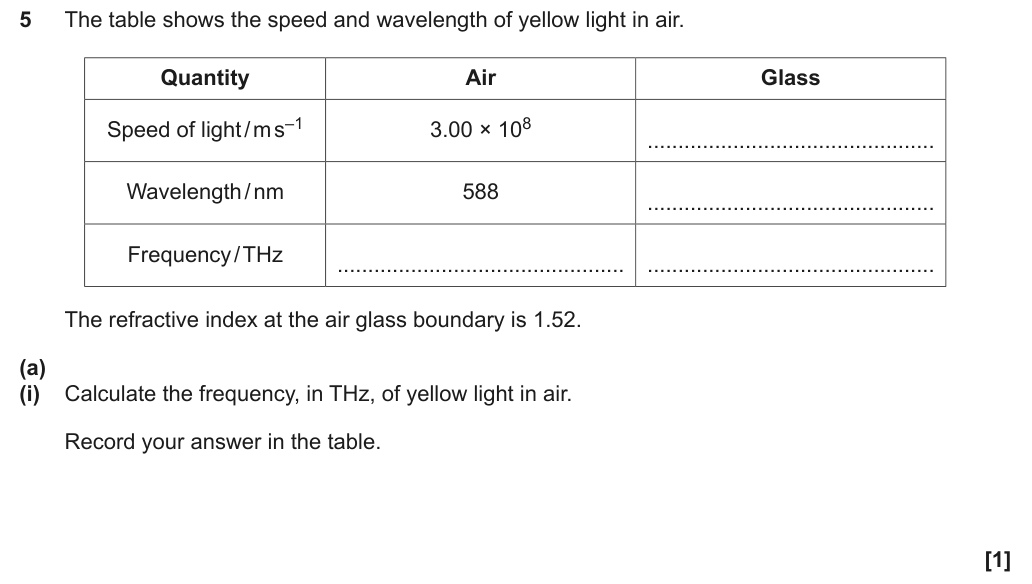
5(a)(i) Wave motion: progressive waves, the wave equation and intensity 1Calculation
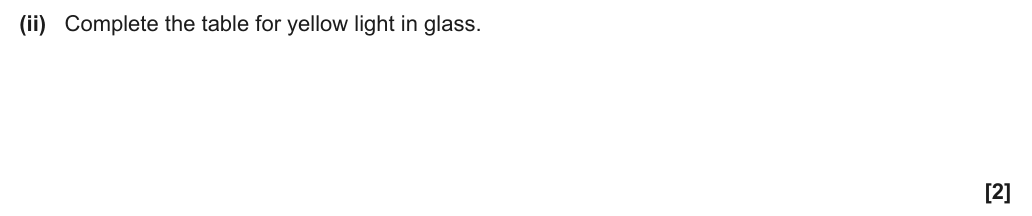
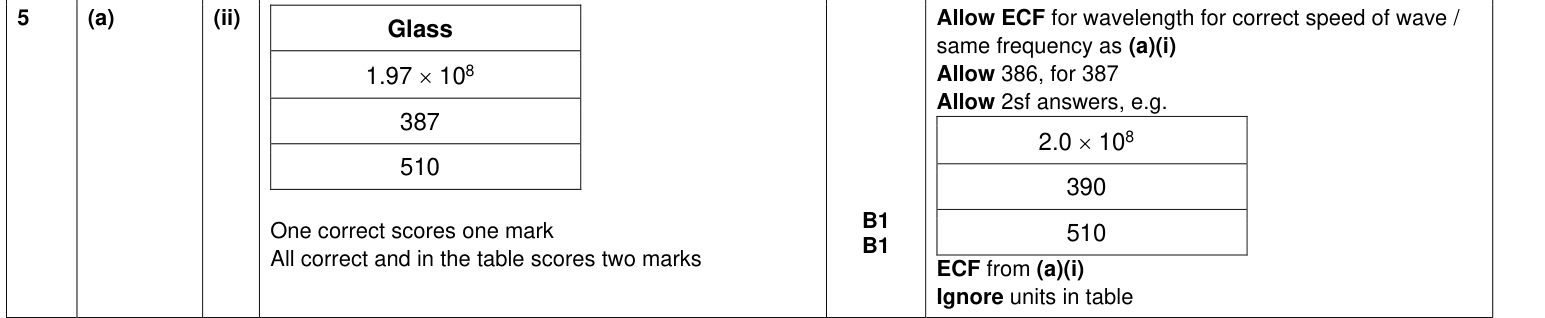
5(a)(ii) Electromagnetic waves, polarisation and refraction, Wave motion: progressive waves, the wave equation and intensity 2Short answer
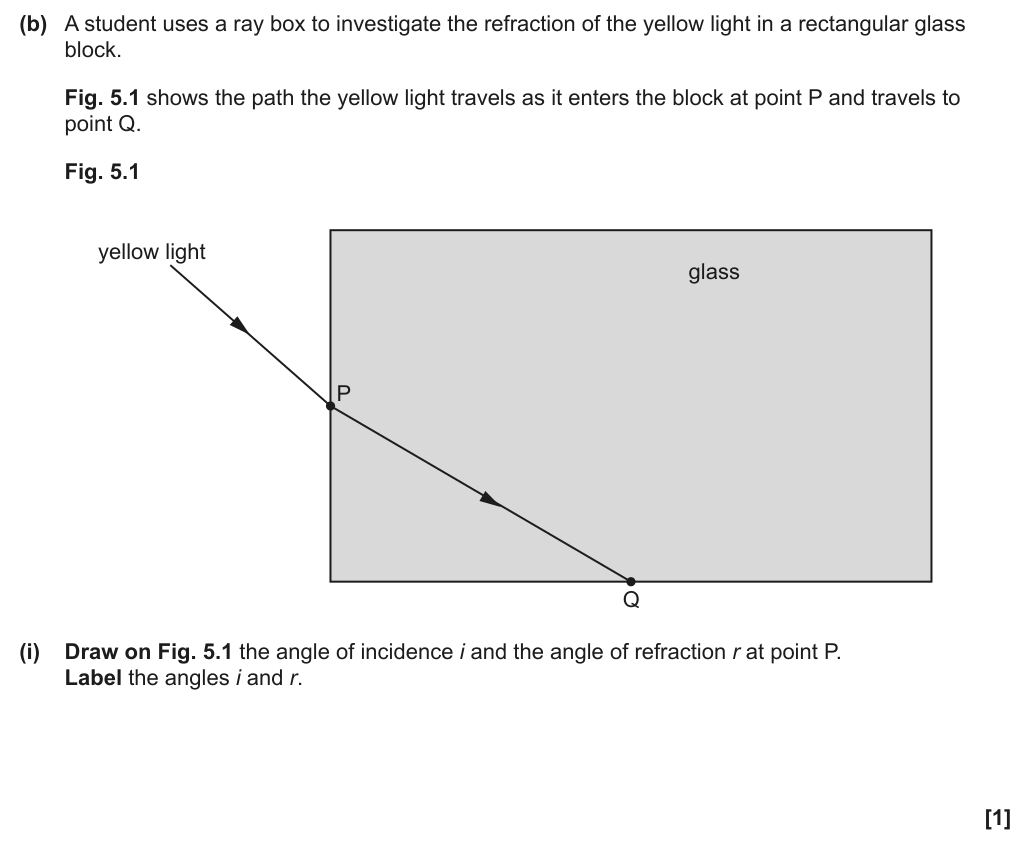
5(b)(i) Electromagnetic waves, polarisation and refraction 1Diagram or graph
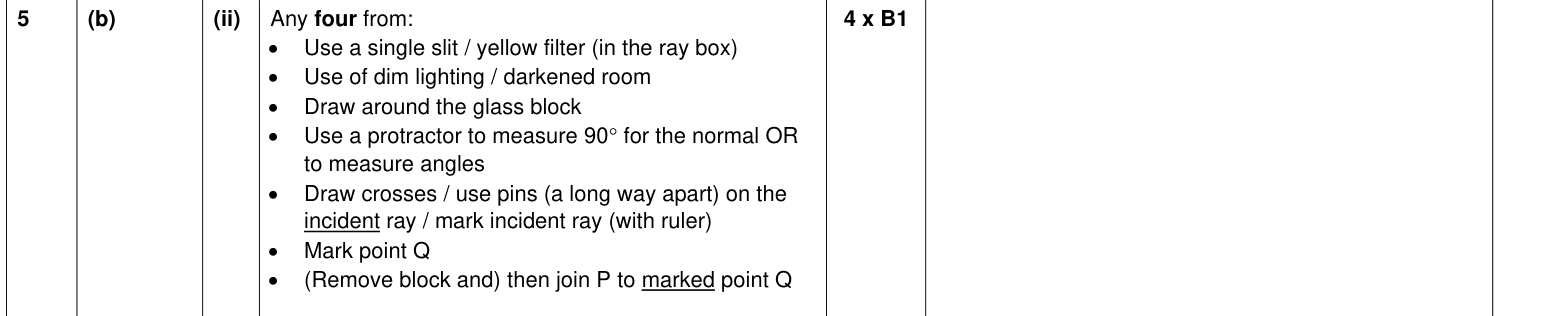
5(b)(ii) Electromagnetic waves, polarisation and refraction, Practical skills: planning, analysis and evaluation 4Explanation
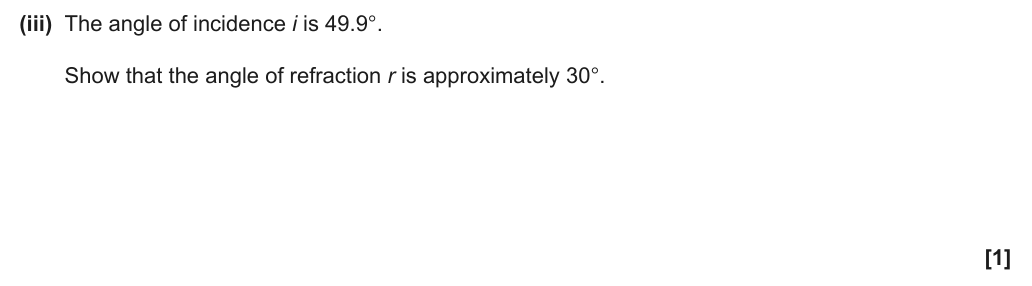
5(b)(iii) Electromagnetic waves, polarisation and refraction 1Show that
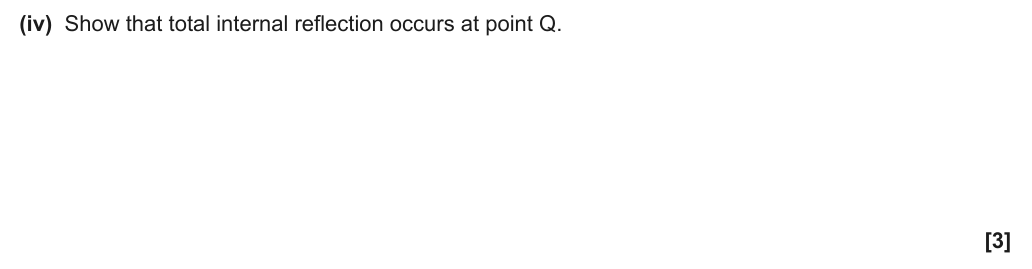
5(b)(iv) Electromagnetic waves, polarisation and refraction 3Show that
5(b)(v) Electromagnetic waves, polarisation and refraction, Wave motion: progressive waves, the wave equation and intensity 1Diagram or graph
6(a) Wave motion: progressive waves, the wave equation and intensity 2Calculation
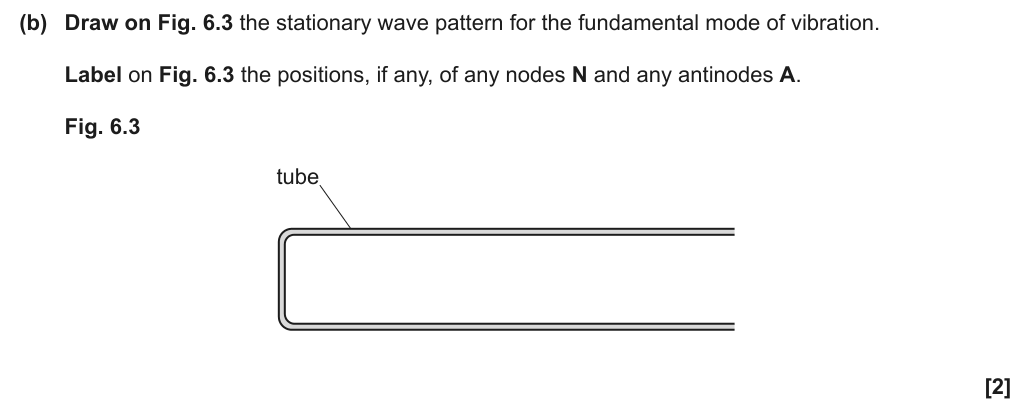
6(b) Stationary waves 2Diagram or graph
6(c) Stationary waves 1Calculation
7(a)(i) Internal resistance and e.m.f., E.m.f., p.d., resistance and I–V characteristics 1Explanation
7(a)(ii) Internal resistance and e.m.f. 1Show that
7(a)(iii) Series and parallel circuits: Kirchhoff's laws 1Show that
7(b)(i) Electrical power and energy 1Calculation
7(b)(ii) Charge, current and mean drift velocity 2Calculation
7(b)(iii) Charge, current and mean drift velocity, Series and parallel circuits: Kirchhoff's laws 2Calculation
7(c)(i) Series and parallel circuits: Kirchhoff's laws 1Short answer
7(c)(ii) Internal resistance and e.m.f. 1Short answer
8 Wave–particle duality and the de Broglie equation, Practical skills: planning, analysis and evaluation, Physical quantities and S.I. units, Newton's laws of motion and momentum 6Extended response

The questions

1(a)1(b)1(c)(i)1(c)(ii)2(a)2(b)(i)2(b)(ii)2(c)(i)2(c)(ii)34(a)(i)4(a)(ii)4(b)(i)4(b)(ii)4(c)(i)4(c)(ii)5(a)(i)5(a)(ii)5(b)(i)5(b)(ii)5(b)(iii)5(b)(iv)5(b)(v)6(a)6(b)6(c)7(a)(i)7(a)(ii)7(a)(iii)7(b)(i)7(b)(ii)7(b)(iii)7(c)(i)7(c)(ii)8
June 2024 · AS Paper 2 · Q1(a) 2 marks Calculation Easy kinematics
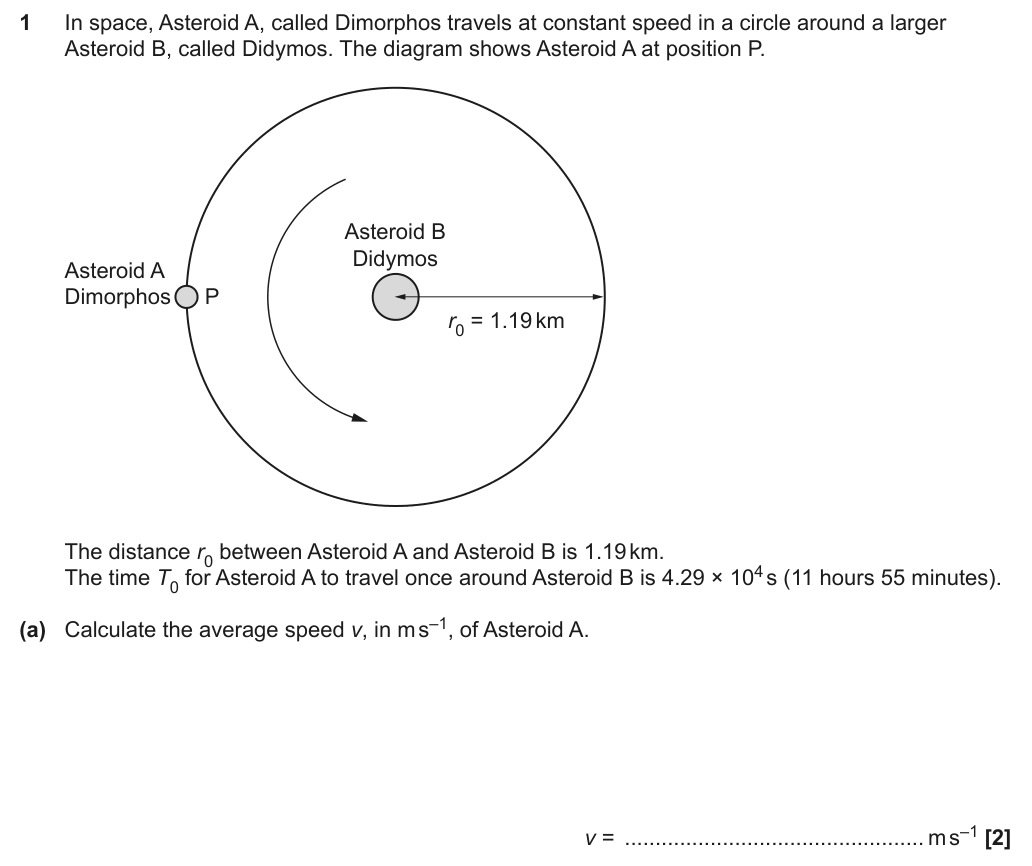
1 In space, Asteroid A, called Dimorphos travels at constant speed in a circle around a larger
Asteroid B, called Didymos. The diagram shows Asteroid A at position P.
Asteroid B
Didymos
Asteroid A
Dimorphos P
r0 = 1.19 km
The distance r0 between Asteroid A and Asteroid B is 1.19 km.
The time T0 for Asteroid A to travel once around Asteroid B is 4.29 × 10⁴ s (11 hours 55 minutes).
(a) Calculate the average speed v, in m s–1, of Asteroid A.
v =  ................................................. m s–1 [2]
June 2024 · AS Paper 2 · Q1(b) 2 marks Explanation Medium scalars and vectorskinematics
Earlier part of question 1 that this part usesEarlier part of June 2024 Paper 2 question 1
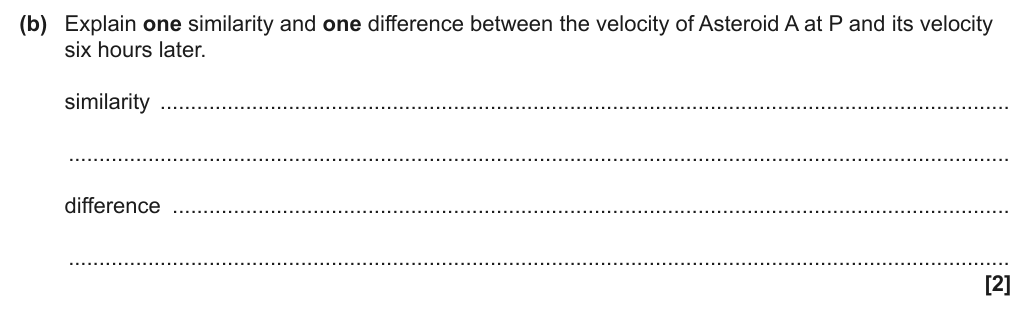
(b) Explain one similarity and one difference between the velocity of Asteroid A at P and its velocity
six hours later.
similarity  ...........................................................................................................................................
..........................................................................................................................................................
difference  .........................................................................................................................................
..........................................................................................................................................................
[2]
June 2024 · AS Paper 2 · Q1(c)(i) 1 mark Show that Medium practical skills
Earlier part of question 1 that this part usesEarlier part of June 2024 Paper 2 question 1
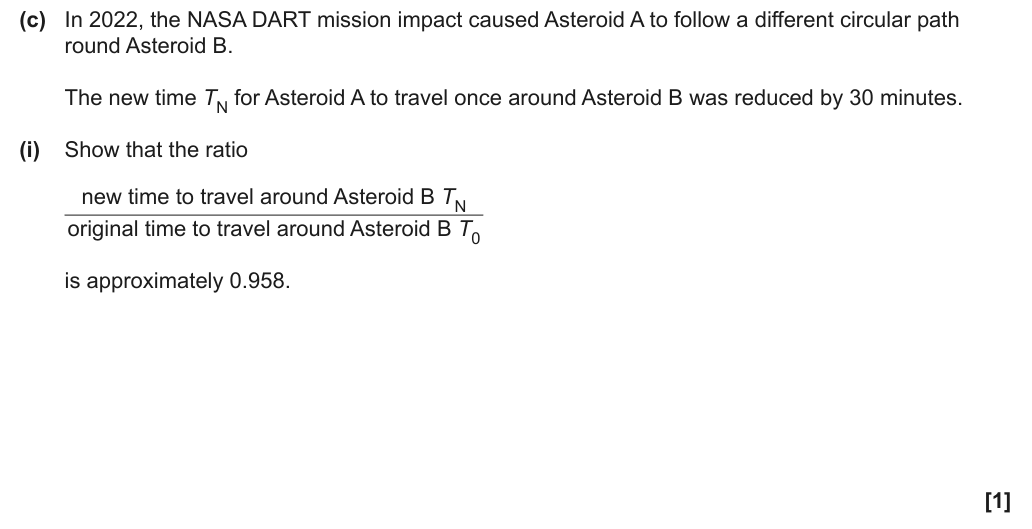
(c) In 2022, the NASA DART mission impact caused Asteroid A to follow a different circular path
round Asteroid B.
The new time TN for Asteroid A to travel once around Asteroid B was reduced by 30 minutes.
(i) Show that the ratio
new time to travel around Asteroid B TN
original time to travel around Asteroid B T0
is approximately 0.958.
[1]
June 2024 · AS Paper 2 · Q1(c)(ii) 3 marks Calculation Hard practical skills
Earlier parts of question 1 that this part usesEarlier part of June 2024 Paper 2 question 1Earlier part of June 2024 Paper 2 question 1
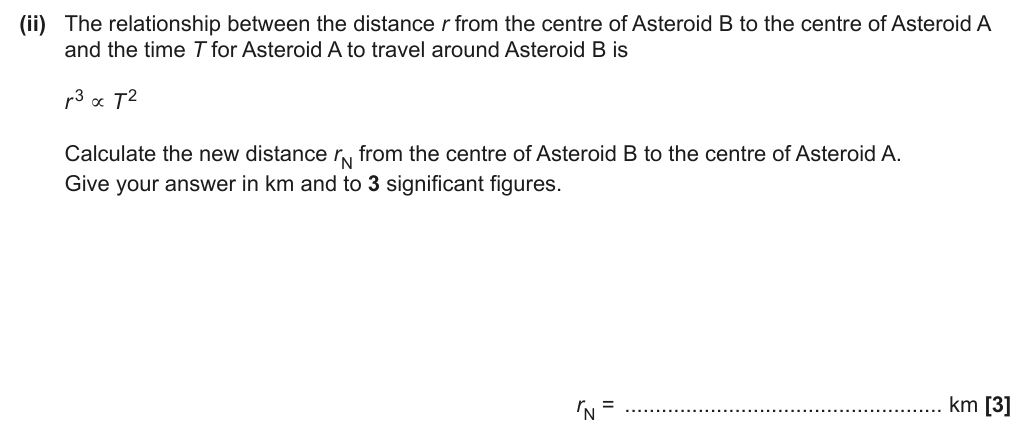
(ii) The relationship between the distance r from the centre of Asteroid B to the centre of Asteroid A
and the time T for Asteroid A to travel around Asteroid B is
r 3 ∝T 2
Calculate the new distance rN from the centre of Asteroid B to the centre of Asteroid A.
Give your answer in km and to 3 significant figures.
rN =  .................................................... km [3]
June 2024 · AS Paper 2 · Q2(a) 1 mark Short answer Medium newtons laws and momentum
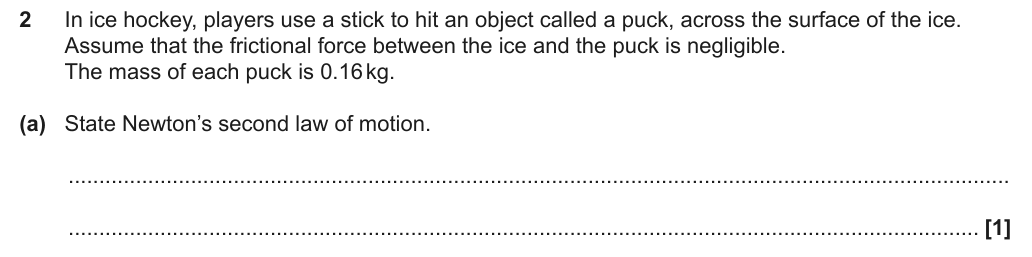
2 In ice hockey, players use a stick to hit an object called a puck, across the surface of the ice.
Assume that the frictional force between the ice and the puck is negligible.
The mass of each puck is 0.16 kg.
(a) State Newton’s second law of motion.
..........................................................................................................................................................
..................................................................................................................................................... [1]
June 2024 · AS Paper 2 · Q2(b)(i) 2 marks Calculation Medium newtons laws and momentumquantities and units
Earlier part of question 2 that this part usesEarlier part of June 2024 Paper 2 question 2
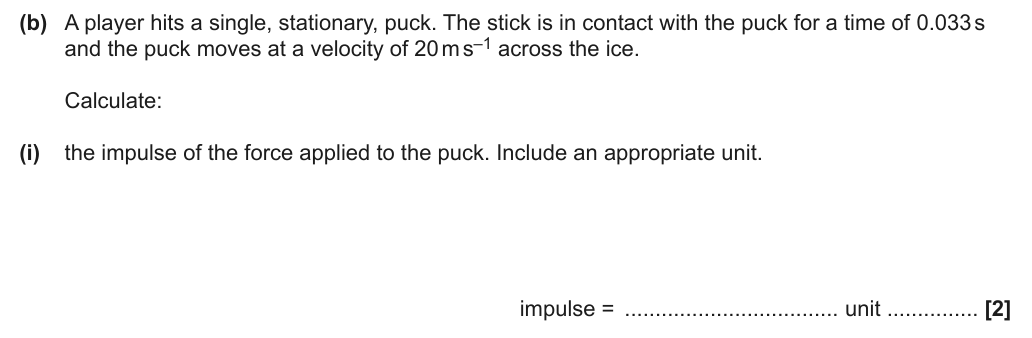
(b) A player hits a single, stationary, puck. The stick is in contact with the puck for a time of 0.033 s
and the puck moves at a velocity of 20 m s–1 across the ice.
Calculate:
(i) the impulse of the force applied to the puck. Include an appropriate unit.
impulse =  ................................... unit ............... [2]
June 2024 · AS Paper 2 · Q2(b)(ii) 1 mark Calculation Medium newtons laws and momentum
Earlier part of question 2 that this part usesEarlier part of June 2024 Paper 2 question 2
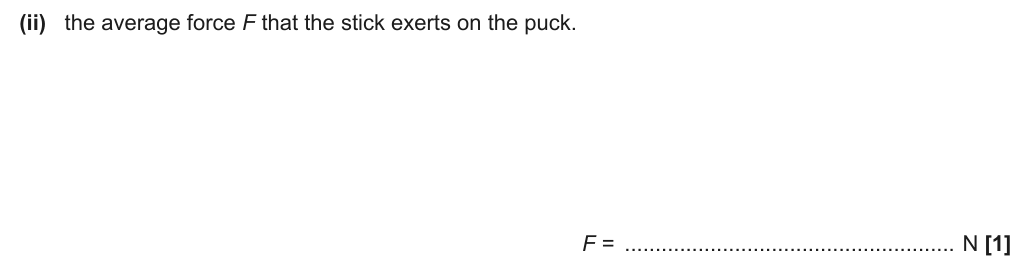
(ii) the average force F that the stick exerts on the puck.
F =  ...................................................... N [1]
June 2024 · AS Paper 2 · Q2(c)(i) 1 mark Explanation Medium collisions
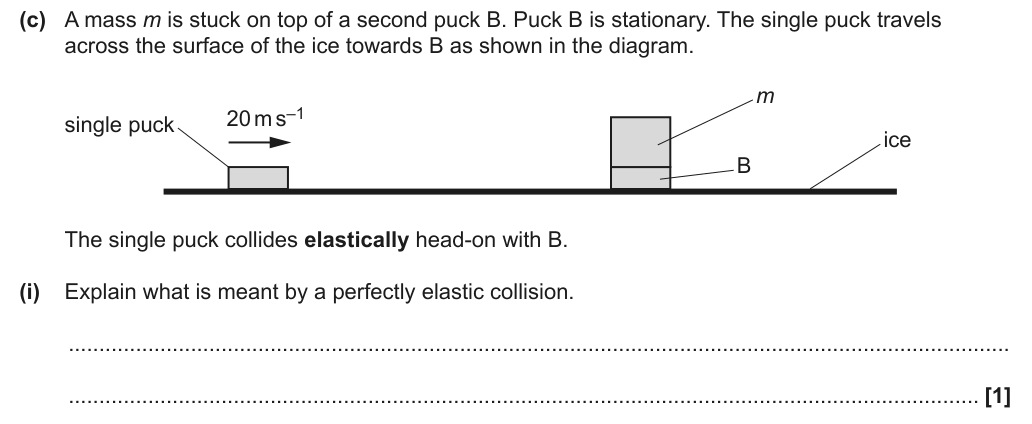
(c) A mass m is stuck on top of a second puck B. Puck B is stationary. The single puck travels
across the surface of the ice towards B as shown in the diagram.
m
20 m s–1
single puck
ice
B
The single puck collides elastically head-on with B.
(i) Explain what is meant by a perfectly elastic collision.
..........................................................................................................................................................
..................................................................................................................................................... [1]
June 2024 · AS Paper 2 · Q2(c)(ii) 3 marks Calculation Hard collisionsnewtons laws and momentum
Earlier parts of question 2 that this part usesEarlier part of June 2024 Paper 2 question 2Earlier part of June 2024 Paper 2 question 2
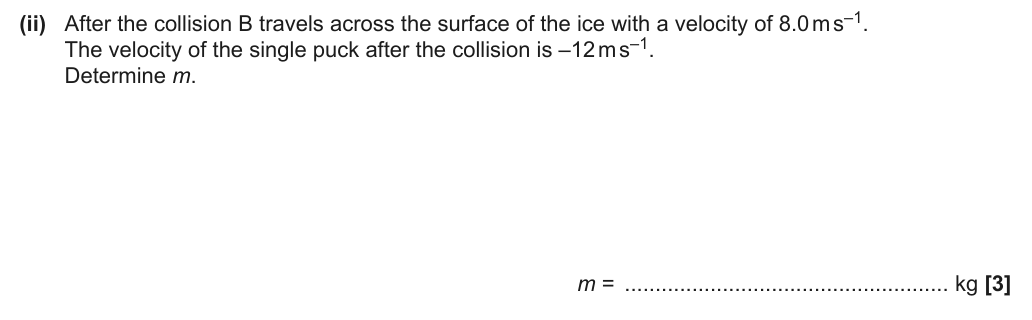
(ii) After the collision B travels across the surface of the ice with a velocity of 8.0 m s–1.
The velocity of the single puck after the collision is –12 m s–1.
Determine m.
m =  ..................................................... kg [3]
June 2024 · AS Paper 2 · Q3 6 marks 6-mark extended response Medium linear motionpractical skillsmeasurements and uncertainties
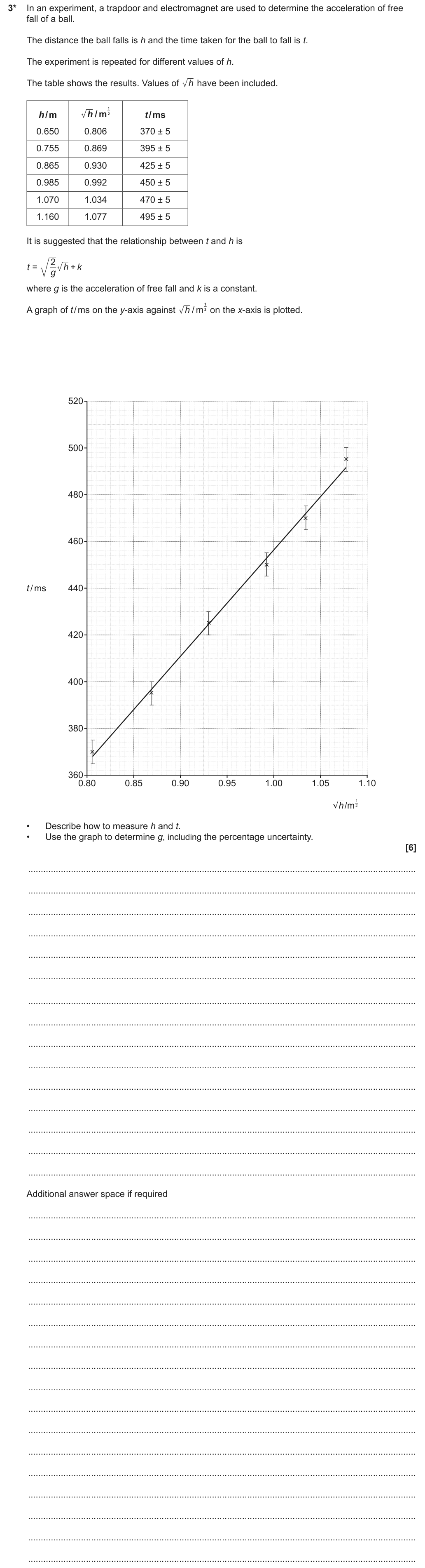
3* In an experiment, a trapdoor and electromagnet are used to determine the acceleration of free
fall of a ball.
The distance the ball falls is h and the time taken for the ball to fall is t.
The experiment is repeated for different values of h.
The table shows the results. Values of h have been included.
h / m h / m 1 t / ms
2
0.650 0.806 370 ± 5
0.755 0.869 395 ± 5
0.865 0.930 425 ± 5
0.985 0.992 450 ± 5
1.070 1.034 470 ± 5
1.160 1.077 495 ± 5
It is suggested that the relationship between t and h is
2
t = h + k
g
where g is the acceleration of free fall and k is a constant.
A graph of t / ms on the y-axis against h / m 1 on the x-axis is plotted.
2
QUESTION 3 CONTINUES ON PAGE 8
520
500
480
460
t / ms 440
420
400
380
360
0.80 0.85 0.90 0.95 1.00 1.05 1.10
h m 2 / 1
• Describe how to measure h and t.
• Use the graph to determine g, including the percentage uncertainty.
[6]
..........................................................................................................................................................
..........................................................................................................................................................
..........................................................................................................................................................
..........................................................................................................................................................
..........................................................................................................................................................
..........................................................................................................................................................
..........................................................................................................................................................
..........................................................................................................................................................
..........................................................................................................................................................
..........................................................................................................................................................
..........................................................................................................................................................
..........................................................................................................................................................
..........................................................................................................................................................
..........................................................................................................................................................
..........................................................................................................................................................
Additional answer space if required
..........................................................................................................................................................
..........................................................................................................................................................
..........................................................................................................................................................
..........................................................................................................................................................
..........................................................................................................................................................
..........................................................................................................................................................
..........................................................................................................................................................
..........................................................................................................................................................
..........................................................................................................................................................
..........................................................................................................................................................
..........................................................................................................................................................
..........................................................................................................................................................
..........................................................................................................................................................
..........................................................................................................................................................
..........................................................................................................................................................
..........................................................................................................................................................
..........................................................................................................................................................
June 2024 · AS Paper 2 · Q4(a)(i) 2 marks Explanation Medium practical skillsmeasurements and uncertainties
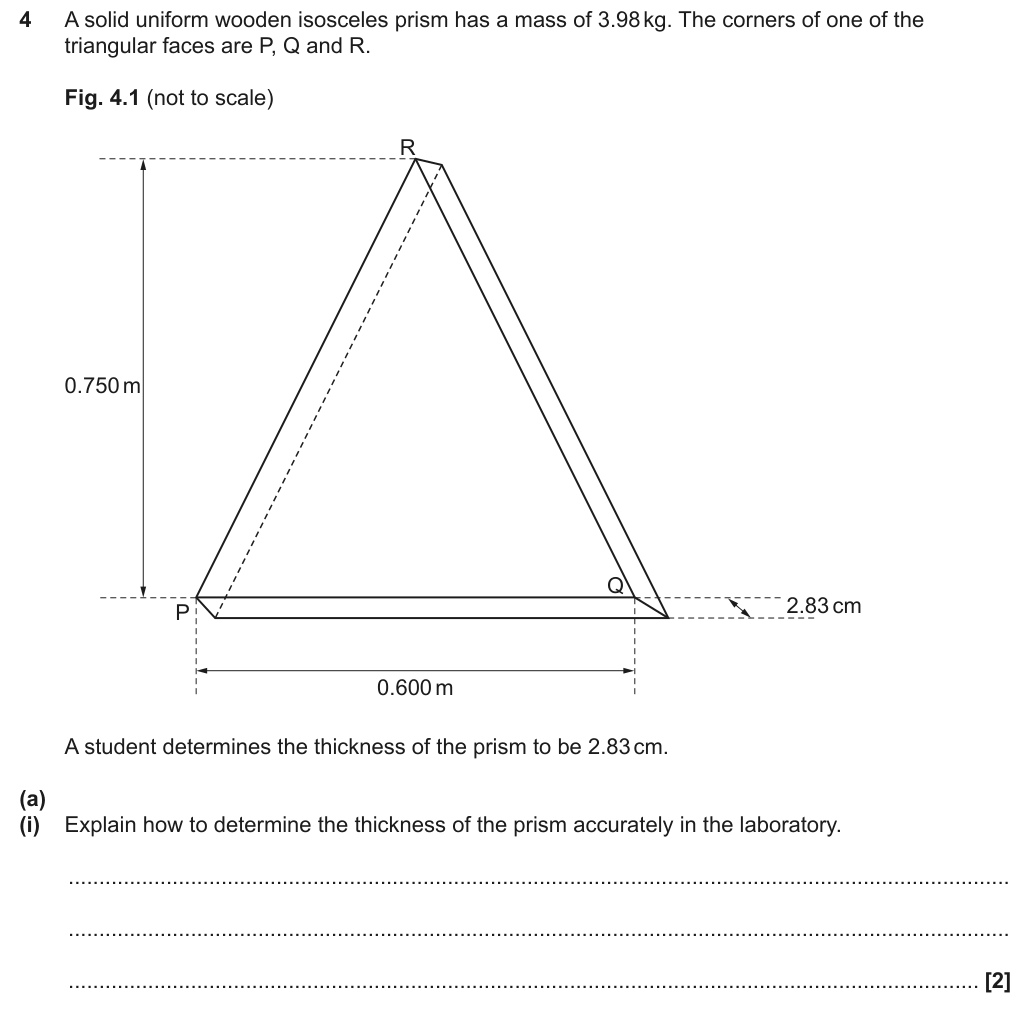
4 A solid uniform wooden isosceles prism has a mass of 3.98 kg. The corners of one of the
triangular faces are P, Q and R.
Fig. 4.1 (not to scale)
R
0.750 m
Q
2.83 cm
P
0.600 m
A student determines the thickness of the prism to be 2.83 cm.
(a)
(i) Explain how to determine the thickness of the prism accurately in the laboratory.
..........................................................................................................................................................
..........................................................................................................................................................
..................................................................................................................................................... [2]
June 2024 · AS Paper 2 · Q4(a)(ii) 2 marks Calculation Hard density and pressure
Earlier part of question 4 that this part usesEarlier part of June 2024 Paper 2 question 4
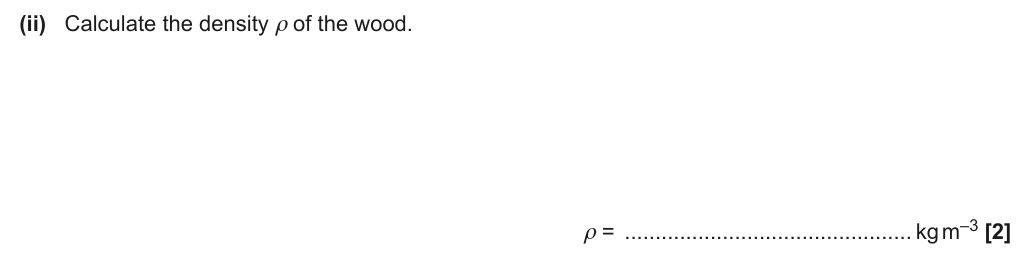
(ii) Calculate the density ρ of the wood.
ρ =  ............................................... kg m–3 [2]
June 2024 · AS Paper 2 · Q4(b)(i) 1 mark Explanation Medium equilibrium and moments
(b)
(i) Explain what is meant by centre of gravity.
..........................................................................................................................................................
..................................................................................................................................................... [1]
June 2024 · AS Paper 2 · Q4(b)(ii) 3 marks Show that Hard equilibrium and moments
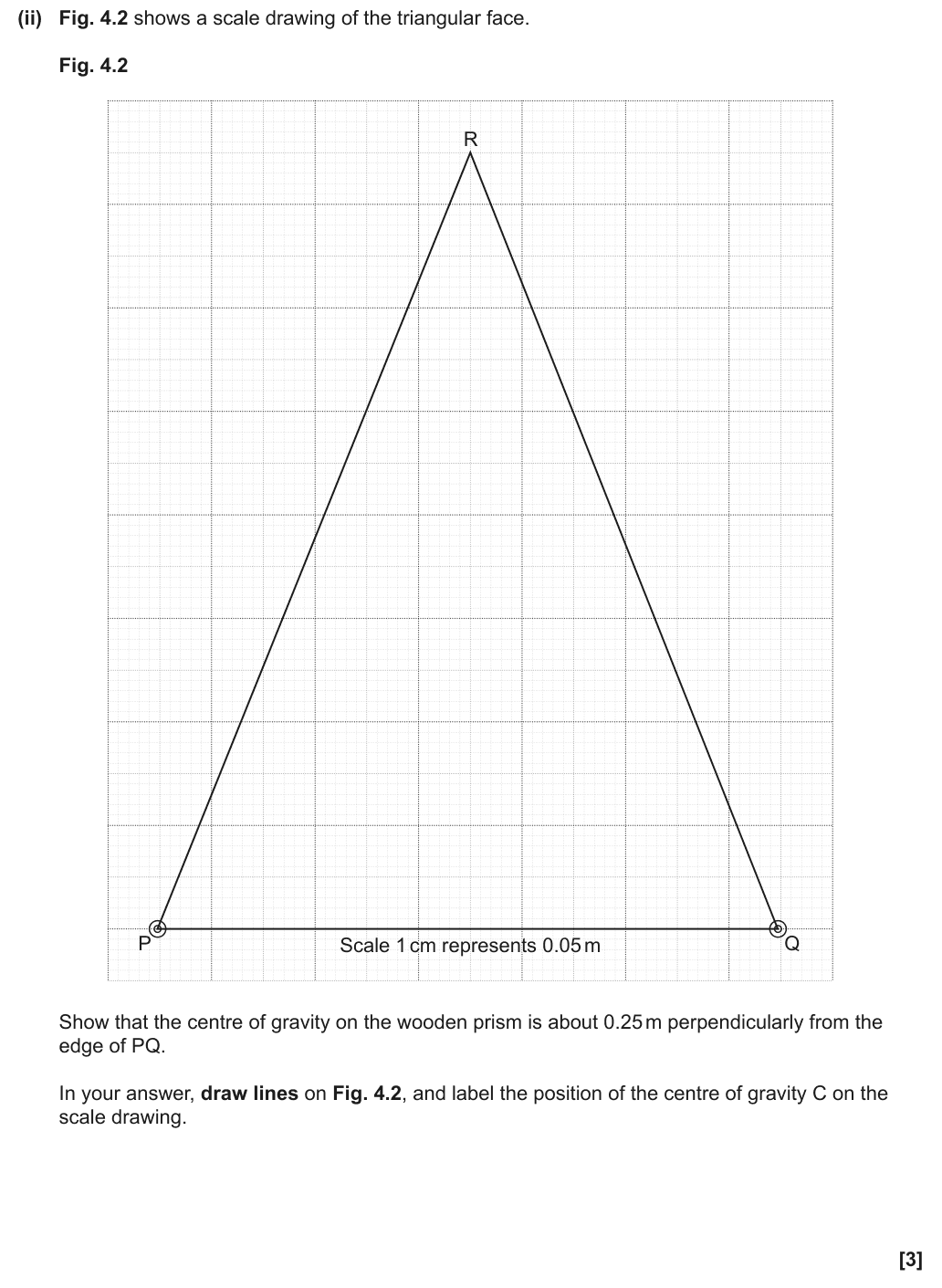
(ii) Fig. 4.2 shows a scale drawing of the triangular face.
Fig. 4.2
R
P Scale 1 cm represents 0.05 m Scale 1 cm represents 0.05 m Q
Show that the centre of gravity on the wooden prism is about 0.25 m perpendicularly from the
edge of PQ.
In your answer, draw lines on Fig. 4.2, and label the position of the centre of gravity C on the
scale drawing.
[3]
June 2024 · AS Paper 2 · Q4(c)(i) 3 marks Short answer Hard equilibrium and moments
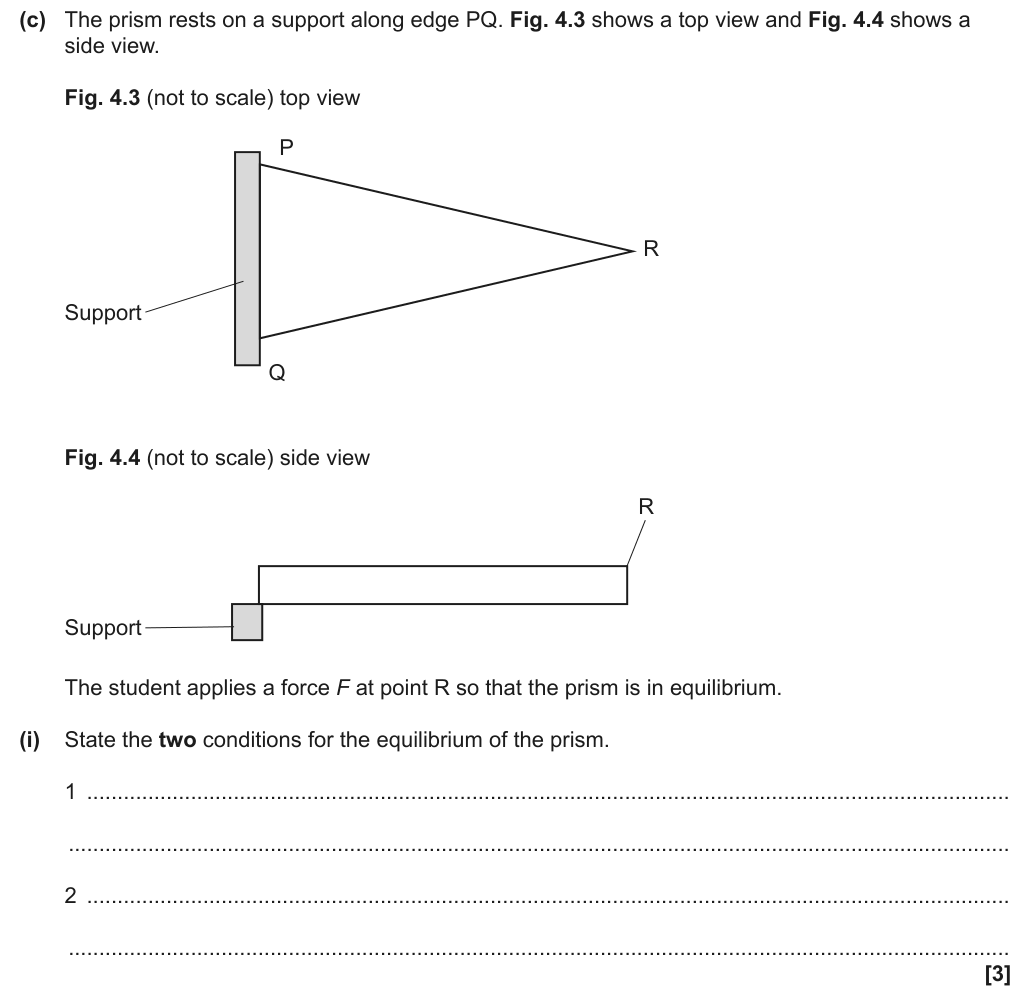
(c) The prism rests on a support along edge PQ. Fig. 4.3 shows a top view and Fig. 4.4 shows a
side view.
Fig. 4.3 (not to scale) top view
P
R
Support
Q
Fig. 4.4 (not to scale) side view
R
Support
The student applies a force F at point R so that the prism is in equilibrium.
(i) State the two conditions for the equilibrium of the prism.
1  .......................................................................................................................................................
..........................................................................................................................................................
2  .......................................................................................................................................................
..........................................................................................................................................................
[3]
June 2024 · AS Paper 2 · Q4(c)(ii) 3 marks Calculation Easy equilibrium and momentsdynamics and terminal velocity
Earlier parts of question 4 that this part usesEarlier part of June 2024 Paper 2 question 4Earlier part of June 2024 Paper 2 question 4Earlier part of June 2024 Paper 2 question 4
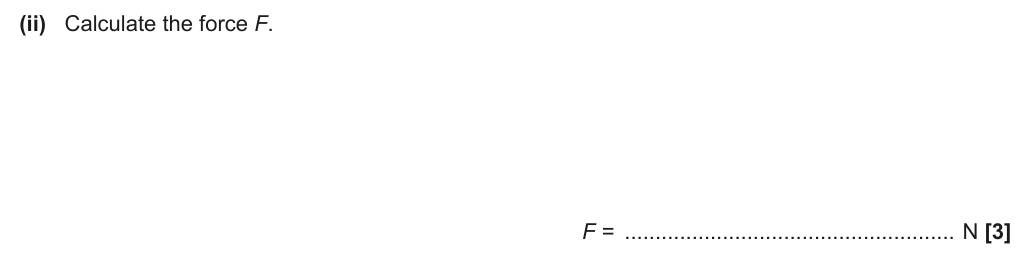
(ii) Calculate the force F.
F =  ...................................................... N [3]
June 2024 · AS Paper 2 · Q5(a)(i) 1 mark Calculation Easy wave motion
5 The table shows the speed and wavelength of yellow light in air.
Quantity Air Glass
Speed of light / m s–1 3.00 × 10⁸
...............................................
Wavelength / nm 588
...............................................
Frequency / THz
............................................... ...............................................
The refractive index at the air glass boundary is 1.52.
(a)
(i) Calculate the frequency, in THz, of yellow light in air.
Record your answer in the table.
[1]
June 2024 · AS Paper 2 · Q5(a)(ii) 2 marks Short answer Easy electromagnetic waves and refractionwave motion
Earlier part of question 5 that this part usesEarlier part of June 2024 Paper 2 question 5
(ii) Complete the table for yellow light in glass.
[2]
June 2024 · AS Paper 2 · Q5(b)(i) 1 mark Diagram or graph Easy electromagnetic waves and refraction
(b) A student uses a ray box to investigate the refraction of the yellow light in a rectangular glass
block.
Fig. 5.1 shows the path the yellow light travels as it enters the block at point P and travels to
point Q.
Fig. 5.1
yellow light
glass
P
Q
(i) Draw on Fig. 5.1 the angle of incidence i and the angle of refraction r at point P.
Label the angles i and r.
[1]
June 2024 · AS Paper 2 · Q5(b)(ii) 4 marks Explanation Hard electromagnetic waves and refractionpractical skills
Earlier part of question 5 that this part usesEarlier part of June 2024 Paper 2 question 5
(ii) Describe how the student produces Fig. 5.1 experimentally using a ray box.
..........................................................................................................................................................
..........................................................................................................................................................
..........................................................................................................................................................
..........................................................................................................................................................
..........................................................................................................................................................
..........................................................................................................................................................
..........................................................................................................................................................
..................................................................................................................................................... [4]
June 2024 · AS Paper 2 · Q5(b)(iii) 1 mark Show that Medium electromagnetic waves and refraction
Earlier part of question 5 that this part usesEarlier part of June 2024 Paper 2 question 5
(iii) The angle of incidence i is 49.9°.
Show that the angle of refraction r is approximately 30°.
[1]
June 2024 · AS Paper 2 · Q5(b)(iv) 3 marks Show that Medium electromagnetic waves and refraction
Earlier parts of question 5 that this part usesEarlier part of June 2024 Paper 2 question 5Earlier part of June 2024 Paper 2 question 5Earlier part of June 2024 Paper 2 question 5
(iv) Show that total internal reflection occurs at point Q.
[3]
June 2024 · AS Paper 2 · Q5(b)(v) 1 mark Diagram or graph Medium electromagnetic waves and refractionwave motion
Earlier parts of question 5 that this part usesEarlier part of June 2024 Paper 2 question 5Earlier part of June 2024 Paper 2 question 5
(v) Draw on Fig. 5.1 the path of the light as it travels from point Q back into the air.
[1]
June 2024 · AS Paper 2 · Q6(a) 2 marks Calculation Medium wave motion
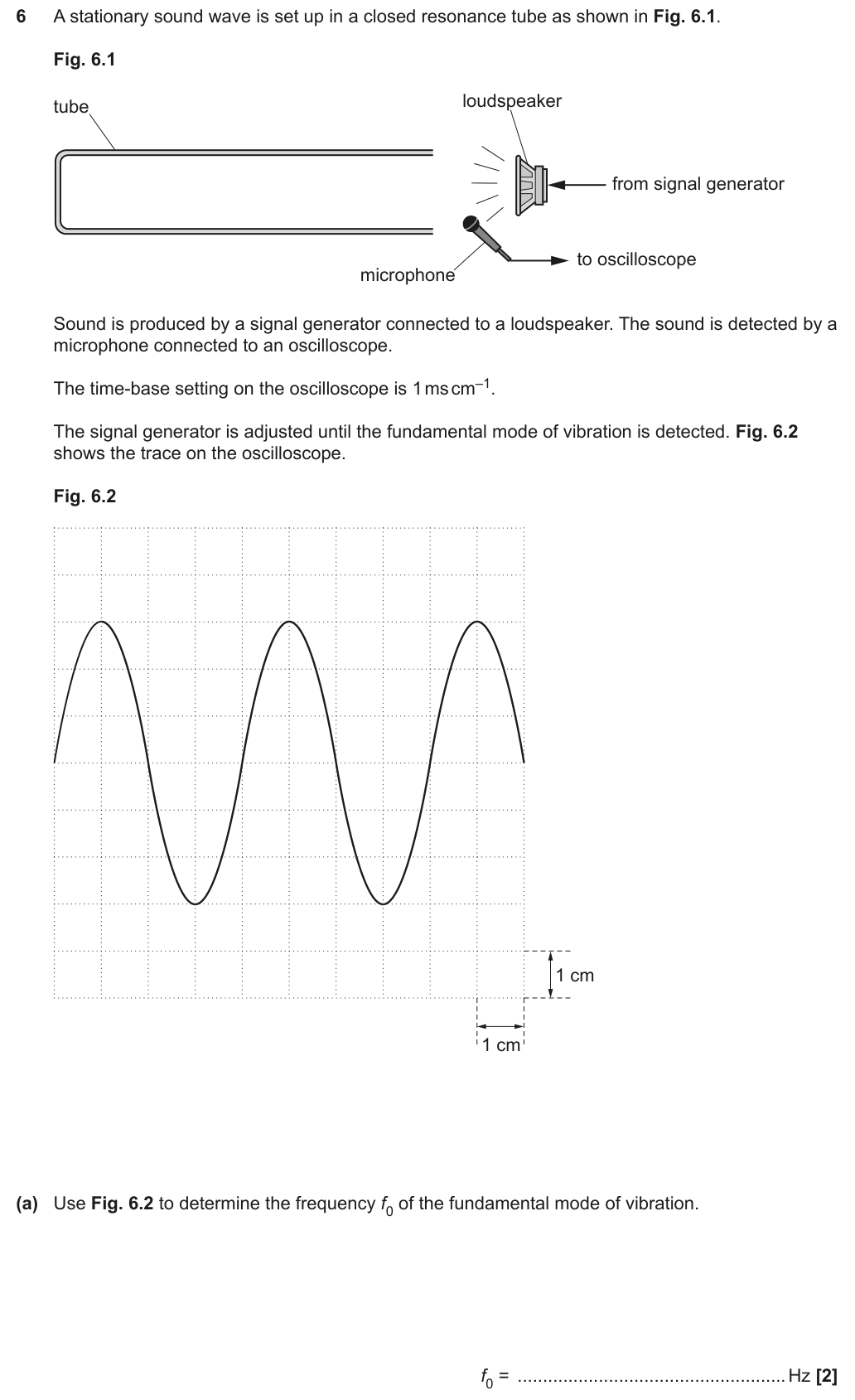
6 A stationary sound wave is set up in a closed resonance tube as shown in Fig. 6.1.
Fig. 6.1
loudspeaker
tube
from signal generator
to oscilloscope
microphone
Sound is produced by a signal generator connected to a loudspeaker. The sound is detected by a
microphone connected to an oscilloscope.
The time-base setting on the oscilloscope is 1 ms cm–1.
The signal generator is adjusted until the fundamental mode of vibration is detected. Fig. 6.2
shows the trace on the oscilloscope.
Fig. 6.2
1 cm
1 cm
(a) Use Fig. 6.2 to determine the frequency f0 of the fundamental mode of vibration.
f0 =  ..................................................... Hz [2]
June 2024 · AS Paper 2 · Q6(b) 2 marks Diagram or graph Medium stationary waves
Earlier part of question 6 that this part usesEarlier part of June 2024 Paper 2 question 6
(b) Draw on Fig. 6.3 the stationary wave pattern for the fundamental mode of vibration.
Label on Fig. 6.3 the positions, if any, of any nodes N and any antinodes A.
Fig. 6.3
tube
[2]
June 2024 · AS Paper 2 · Q6(c) 1 mark Calculation Hard stationary waves
Earlier part of question 6 that this part usesEarlier part of June 2024 Paper 2 question 6
(c) The frequency of the signal generator is increased until the next harmonic is displayed on the
oscilloscope.
Calculate the frequency fn of the next harmonic.
fn =  ..................................................... Hz [1]
June 2024 · AS Paper 2 · Q7(a)(i) 1 mark Explanation Medium internal resistanceemf pd and resistance
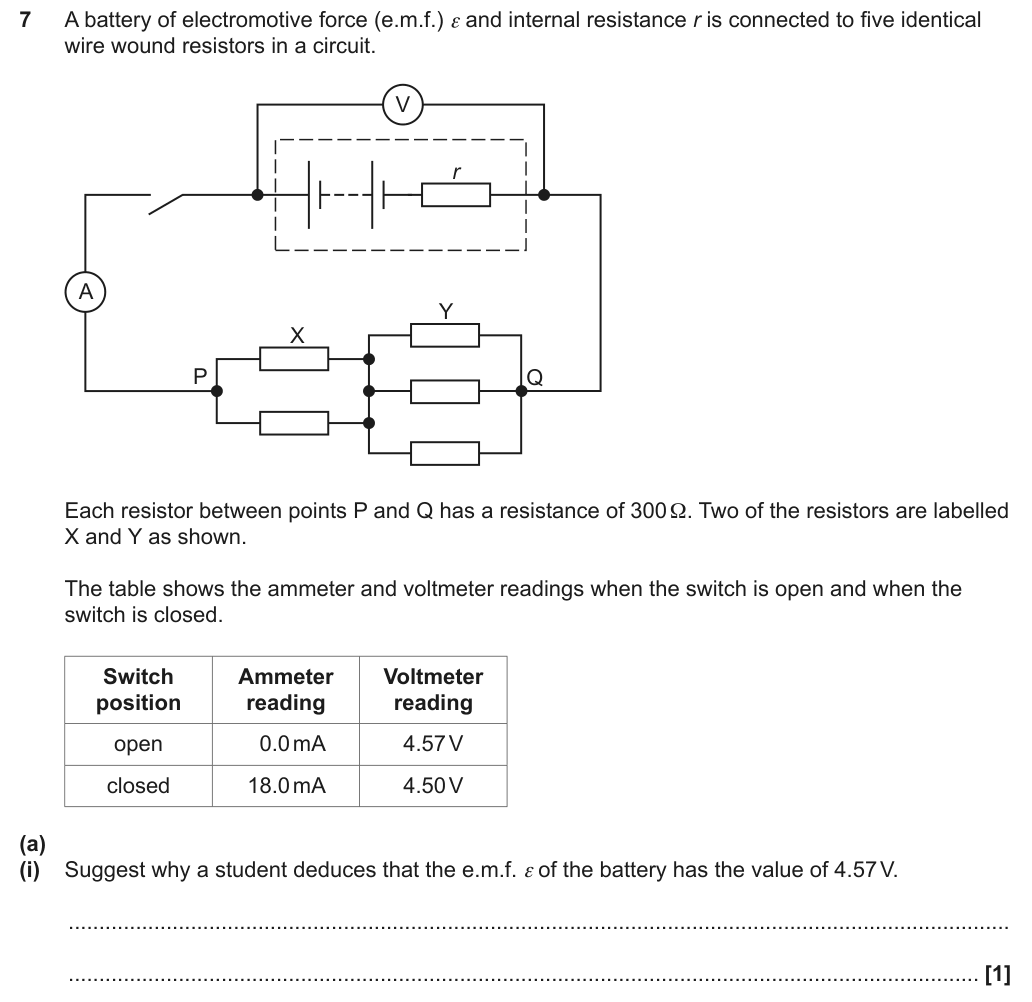
7 A battery of electromotive force (e.m.f.) ε and internal resistance r is connected to five identical
wire wound resistors in a circuit.
V
r
A
Y
X
P Q
Each resistor between points P and Q has a resistance of 300 Ω. Two of the resistors are labelled
X and Y as shown.
The table shows the ammeter and voltmeter readings when the switch is open and when the
switch is closed.
Switch Ammeter Voltmeter
position reading reading
open 0.0 mA 4.57 V
closed 18.0 mA 4.50 V
(a)
(i) Suggest why a student deduces that the e.m.f. ε of the battery has the value of 4.57 V.
..........................................................................................................................................................
..................................................................................................................................................... [1]
June 2024 · AS Paper 2 · Q7(a)(ii) 1 mark Show that Medium internal resistance
Earlier part of question 7 that this part usesEarlier part of June 2024 Paper 2 question 7
(ii) Show that the resistance r is approximately 3.9 Ω.
[1]
June 2024 · AS Paper 2 · Q7(a)(iii) 1 mark Show that Easy series and parallel circuits
Earlier part of question 7 that this part usesEarlier part of June 2024 Paper 2 question 7
(iii) Show that the total resistance of the resistors between P and Q is 250 Ω.
[1]
June 2024 · AS Paper 2 · Q7(b)(i) 1 mark Calculation Medium electrical power
Earlier parts of question 7 that this part usesEarlier part of June 2024 Paper 2 question 7Earlier part of June 2024 Paper 2 question 7
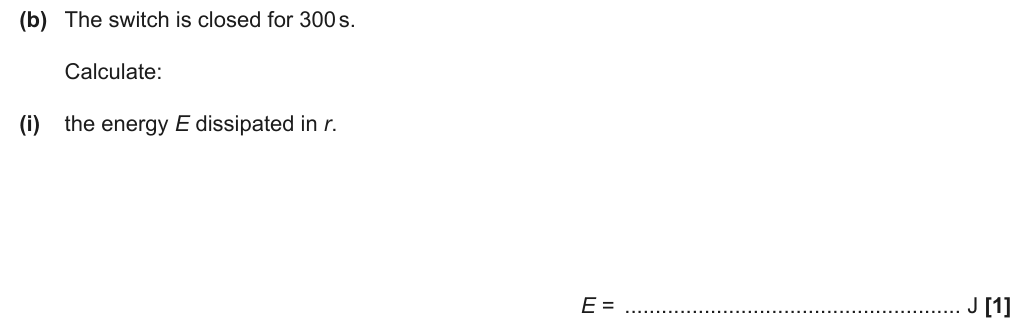
(b) The switch is closed for 300 s.
Calculate:
(i) the energy E dissipated in r.
E =  ....................................................... J [1]
June 2024 · AS Paper 2 · Q7(b)(ii) 2 marks Calculation Medium charge and current
Earlier parts of question 7 that this part usesEarlier part of June 2024 Paper 2 question 7Earlier part of June 2024 Paper 2 question 7
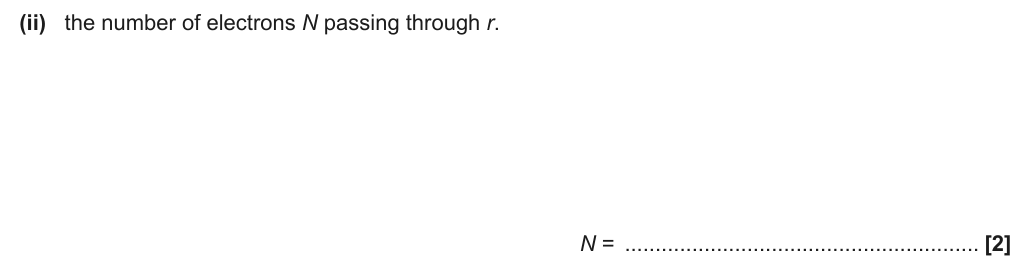
(ii) the number of electrons N passing through r.
N =  .......................................................... [2]
June 2024 · AS Paper 2 · Q7(b)(iii) 2 marks Calculation Medium charge and currentseries and parallel circuits
Earlier part of question 7 that this part usesEarlier part of June 2024 Paper 2 question 7
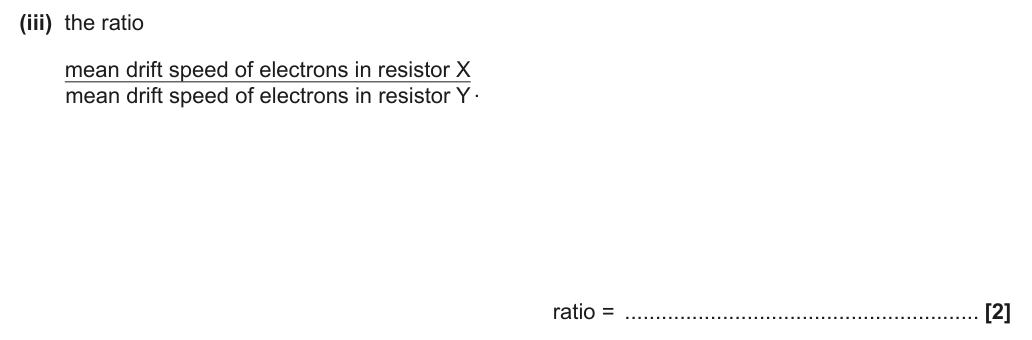
(iii) the ratio
mean drift speed of electrons in resistor X
mean drift speed of electrons in resistor Y .
ratio =  .......................................................... [2]
June 2024 · AS Paper 2 · Q7(c)(i) 1 mark Short answer Hard series and parallel circuits
Earlier part of question 7 that this part usesEarlier part of June 2024 Paper 2 question 7
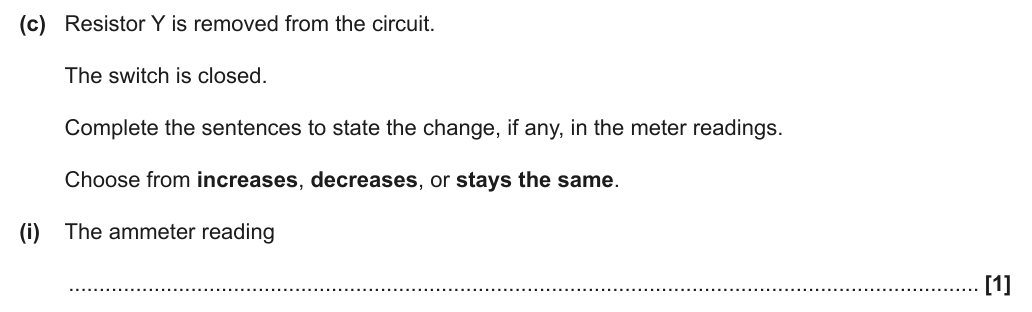
(c) Resistor Y is removed from the circuit.
The switch is closed.
Complete the sentences to state the change, if any, in the meter readings.
Choose from increases, decreases, or stays the same.
(i) The ammeter reading
..................................................................................................................................................... [1]
June 2024 · AS Paper 2 · Q7(c)(ii) 1 mark Short answer Hard internal resistance
Earlier parts of question 7 that this part usesEarlier part of June 2024 Paper 2 question 7Earlier part of June 2024 Paper 2 question 7
(ii) The voltmeter reading
..................................................................................................................................................... [1]
June 2024 · AS Paper 2 · Q8 6 marks 6-mark extended response Medium wave particle dualitypractical skillsquantities and unitsnewtons laws and momentum
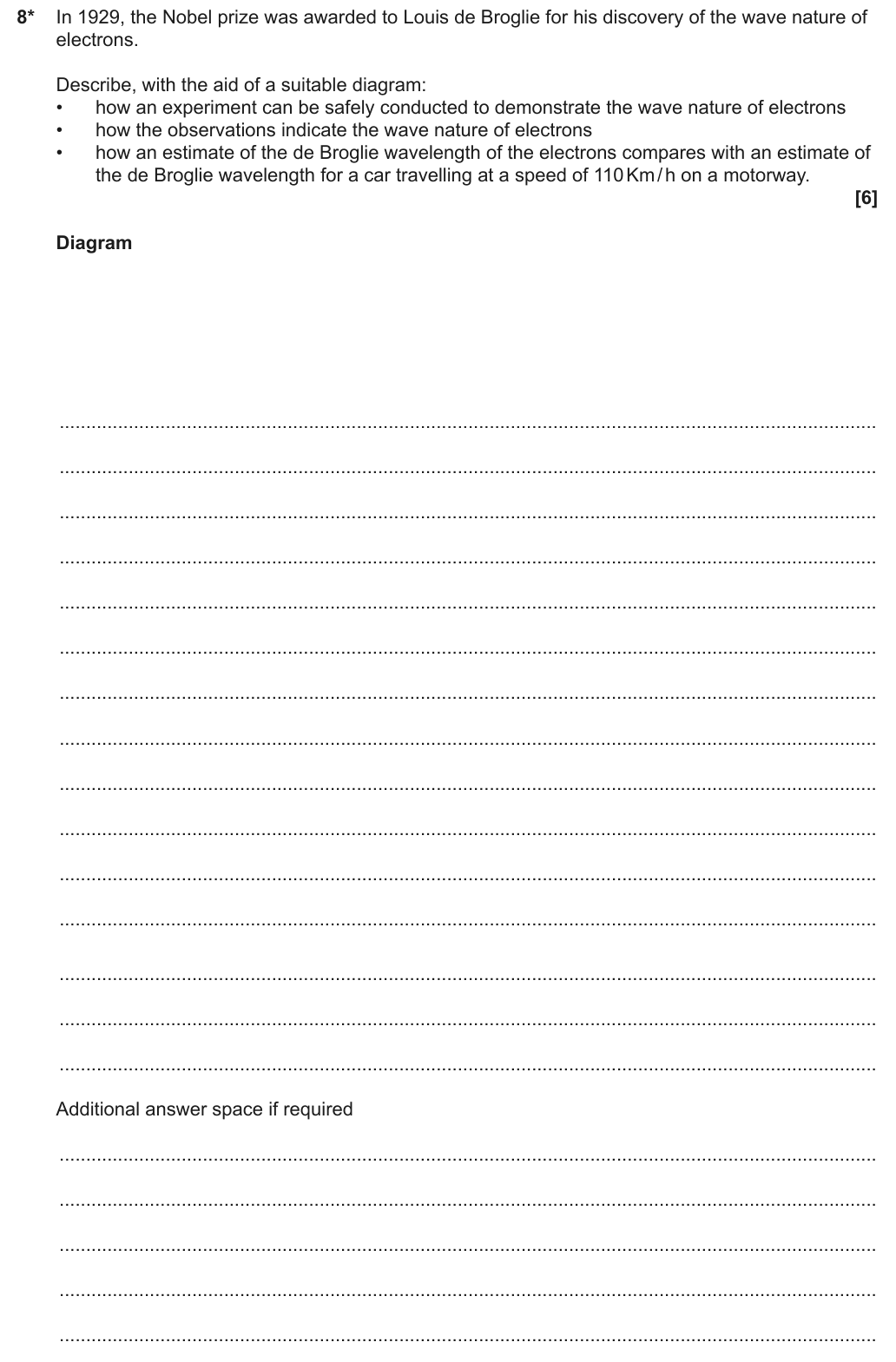
8* In 1929, the Nobel prize was awarded to Louis de Broglie for his discovery of the wave nature of
electrons.
Describe, with the aid of a suitable diagram:
• how an experiment can be safely conducted to demonstrate the wave nature of electrons
• how the observations indicate the wave nature of electrons
• how an estimate of the de Broglie wavelength of the electrons compares with an estimate of
the de Broglie wavelength for a car travelling at a speed of 110 Km / h on a motorway.
[6]
Diagram
..........................................................................................................................................................
..........................................................................................................................................................
..........................................................................................................................................................
..........................................................................................................................................................
..........................................................................................................................................................
..........................................................................................................................................................
..........................................................................................................................................................
..........................................................................................................................................................
..........................................................................................................................................................
..........................................................................................................................................................
..........................................................................................................................................................
..........................................................................................................................................................
..........................................................................................................................................................
..........................................................................................................................................................
..........................................................................................................................................................
Additional answer space if required
..........................................................................................................................................................
..........................................................................................................................................................
..........................................................................................................................................................
..........................................................................................................................................................
..........................................................................................................................................................

Work with an OCR physics tutor

Want a paper marked and gone through with you? Message us.

Prefer email? Send an enquiry

If you are under 18, please include a parent's contact details. Enquiries go to enquiries@physicsaleveltutor.com and are deleted once handled. All tutoring is online.