November 2020: Paper 2, Exploring physics

100 marks · 47 question parts · Paper, mark scheme and report on OCR's site · An autumn series using the paper written for the cancelled summer exams · Have the Data, Formulae and Relationships Booklet beside you

Question by question

QTopicMarksAOType
1 Medical imaging: X-rays, CAT scans, PET, the gamma camera and ultrasound 1Multiple choice
2 Charge, current and mean drift velocity 1Multiple choice
3 The photoelectric effect 1Multiple choice
4 Magnetic fields and the motion of charged particles, Physical quantities and S.I. units 1Multiple choice
5 Wave motion: progressive waves, the wave equation and intensity 1Multiple choice
6 Stationary waves 1Multiple choice
7 Capacitors: energy, charging and discharging 1Multiple choice
8 Capacitors: energy, charging and discharging 1Multiple choice
9 Radioactivity: decay, half-life and activity 1Multiple choice
10 Mass–energy, binding energy, fission and fusion 1Multiple choice
11 Stationary waves, Wave motion: progressive waves, the wave equation and intensity 1Multiple choice
12 The nuclear atom and fundamental particles 1Multiple choice
13 Electric fields, Coulomb's law and electric potential 1Multiple choice
14 Electrical power and energy 1Multiple choice
15 Wave–particle duality and the de Broglie equation 1Multiple choice
16(a) Medical imaging: X-rays, CAT scans, PET, the gamma camera and ultrasound 2Explanation
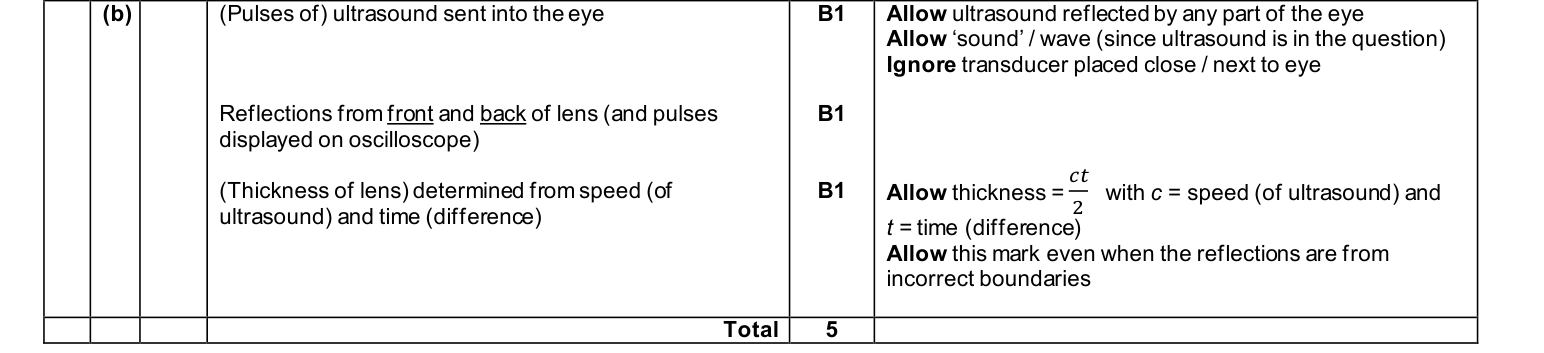
16(b) Medical imaging: X-rays, CAT scans, PET, the gamma camera and ultrasound 3Explanation
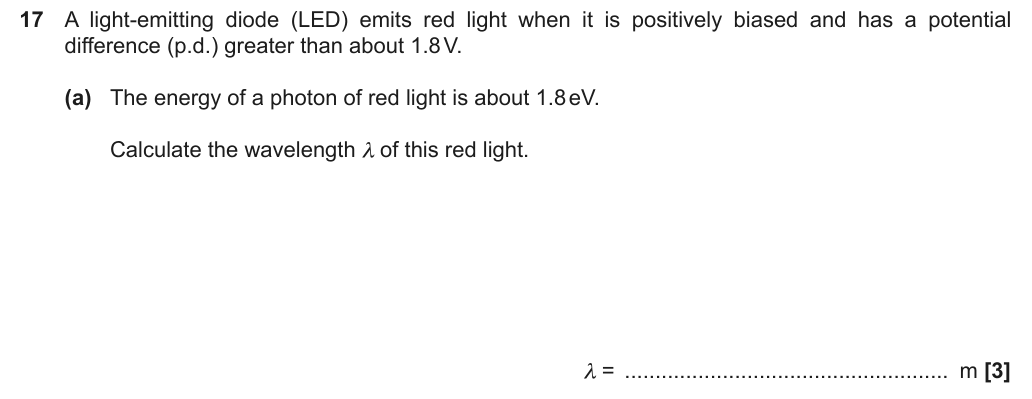
17(a) Photons and the Planck constant 3Calculation
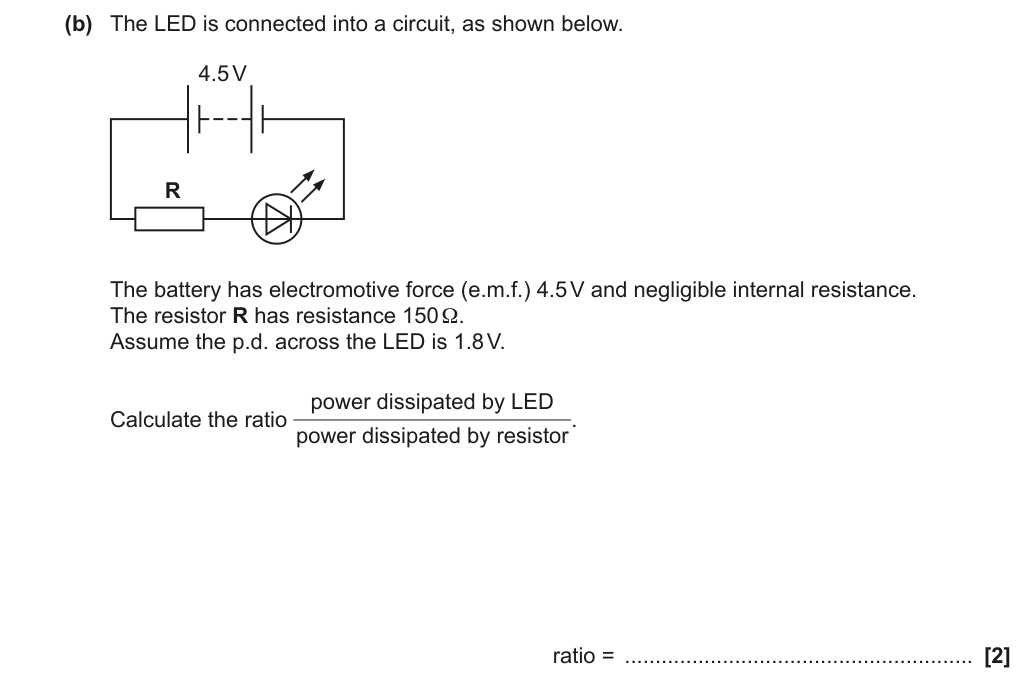
17(b) Electrical power and energy, E.m.f., p.d., resistance and I–V characteristics, Series and parallel circuits: Kirchhoff's laws 2Calculation
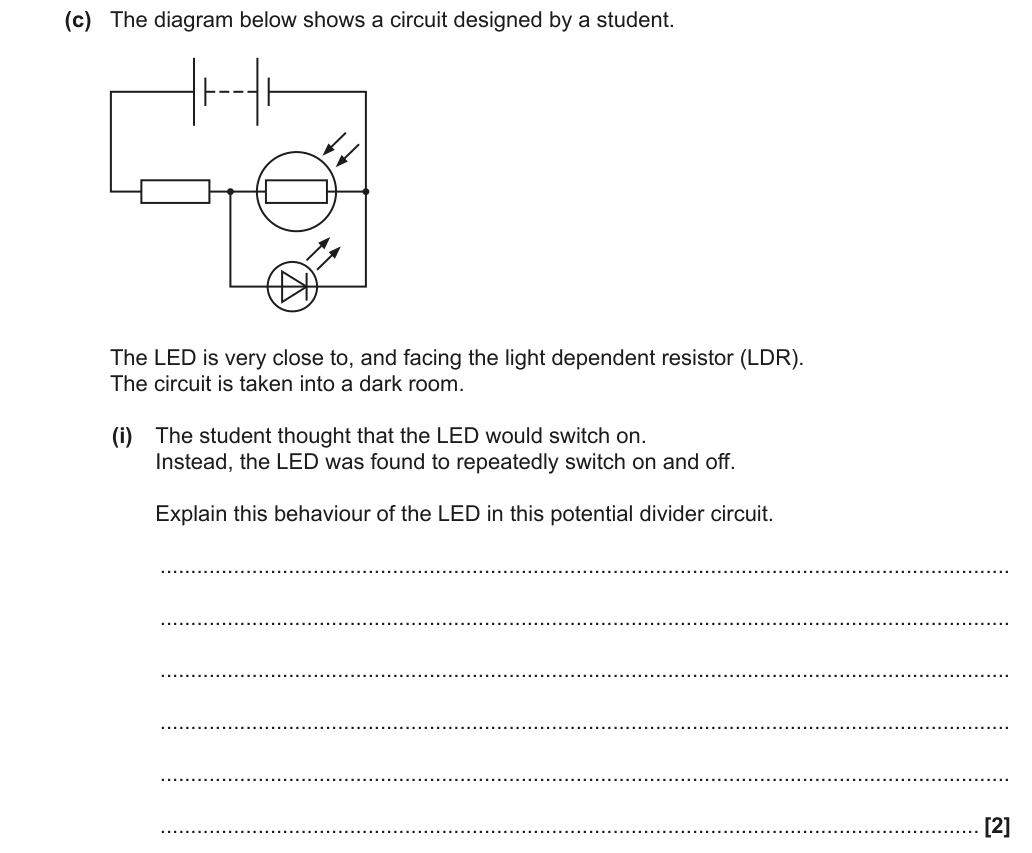
17(c)(i) Potential dividers, E.m.f., p.d., resistance and I–V characteristics 2Explanation
17(c)(ii) Practical skills: planning, analysis and evaluation, Potential dividers 1Explanation
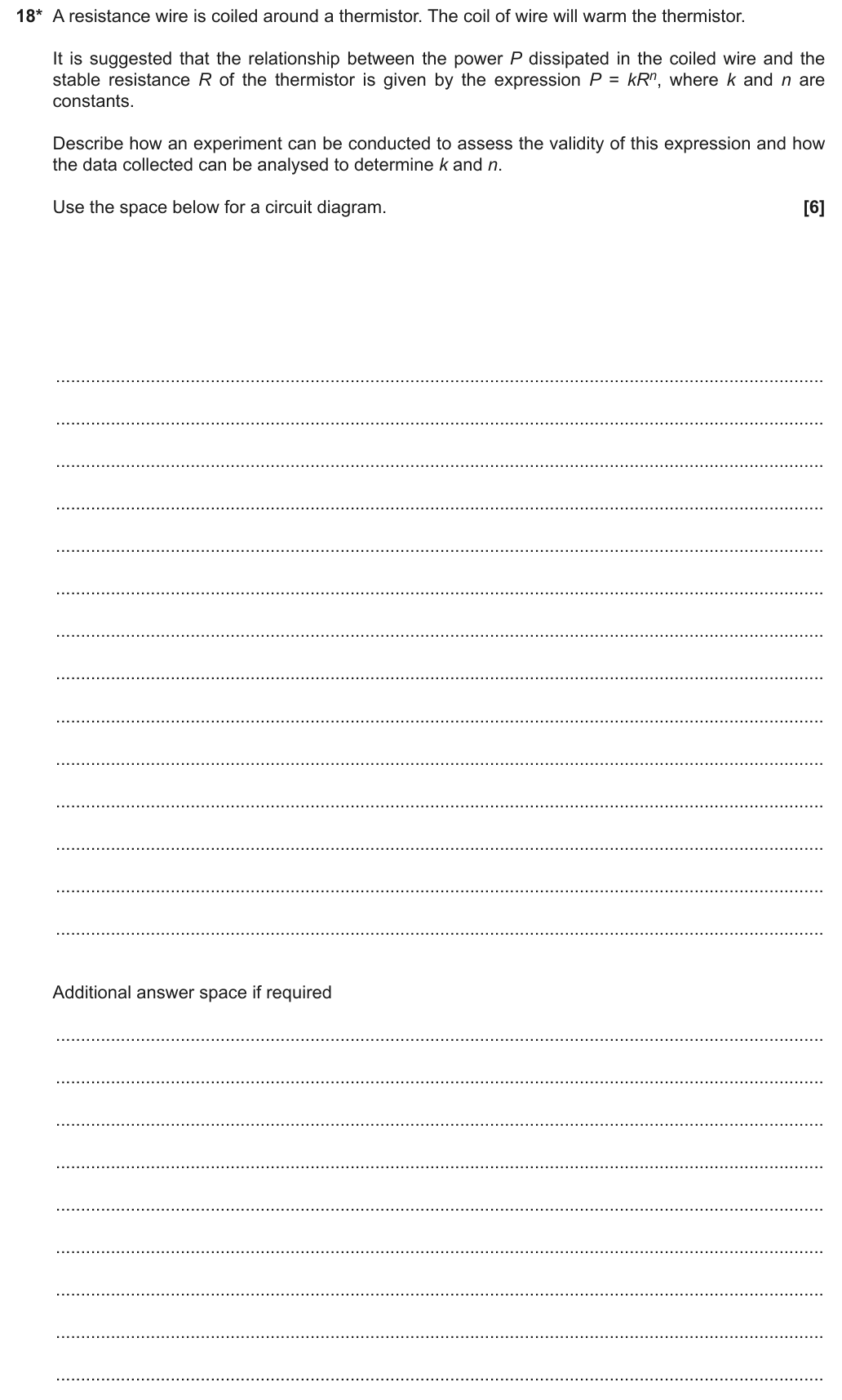
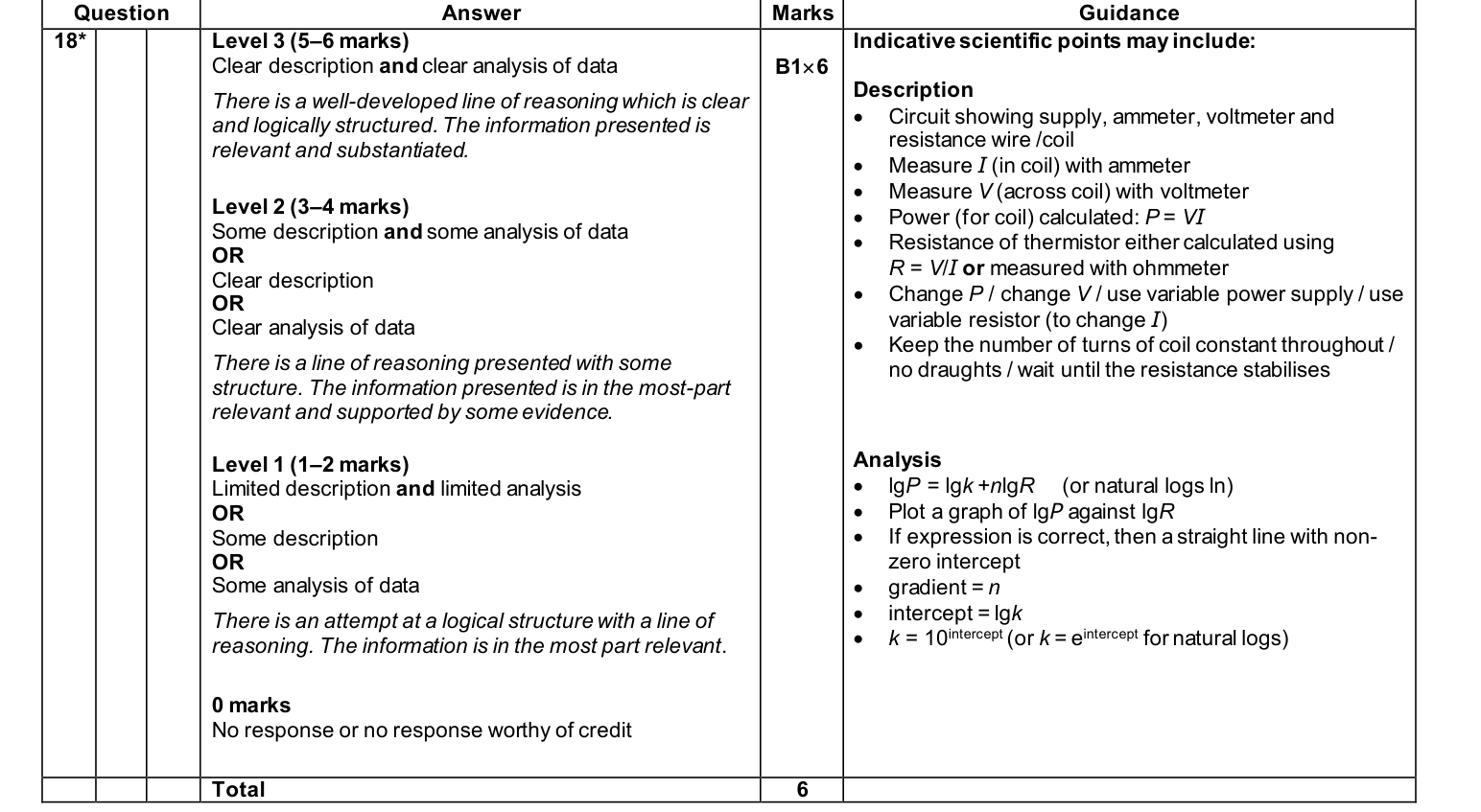
18 Practical skills: planning, analysis and evaluation, E.m.f., p.d., resistance and I–V characteristics, Resistivity, Electrical power and energy 6Extended response
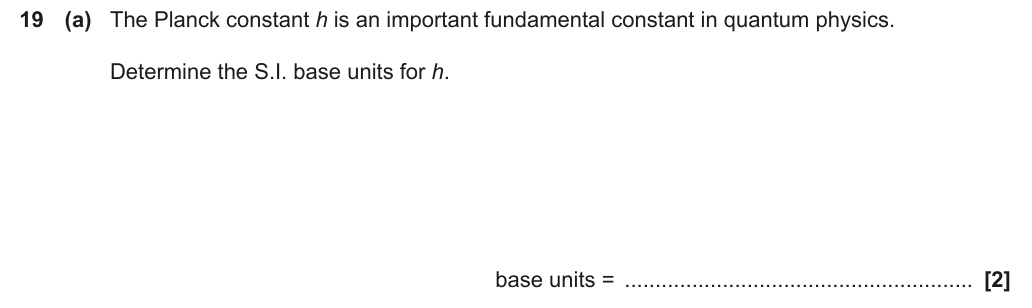
19(a) Physical quantities and S.I. units 2Calculation
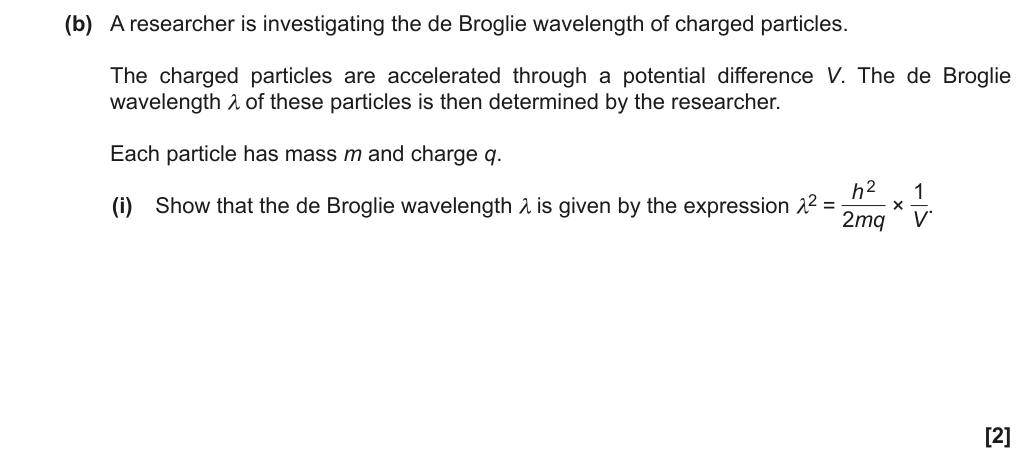
19(b)(i) Wave–particle duality and the de Broglie equation, E.m.f., p.d., resistance and I–V characteristics 2Show that
19(b)(ii) Measurements and uncertainties, Practical skills: planning, analysis and evaluation, E.m.f., p.d., resistance and I–V characteristics, Wave–particle duality and the de Broglie equation 7Show that
20(a)(i) Wave motion: progressive waves, the wave equation and intensity, Physical quantities and S.I. units 2Calculation
20(a)(ii) Wave motion: progressive waves, the wave equation and intensity 2Calculation
20(b) Superposition, interference and the double slit 1Short answer
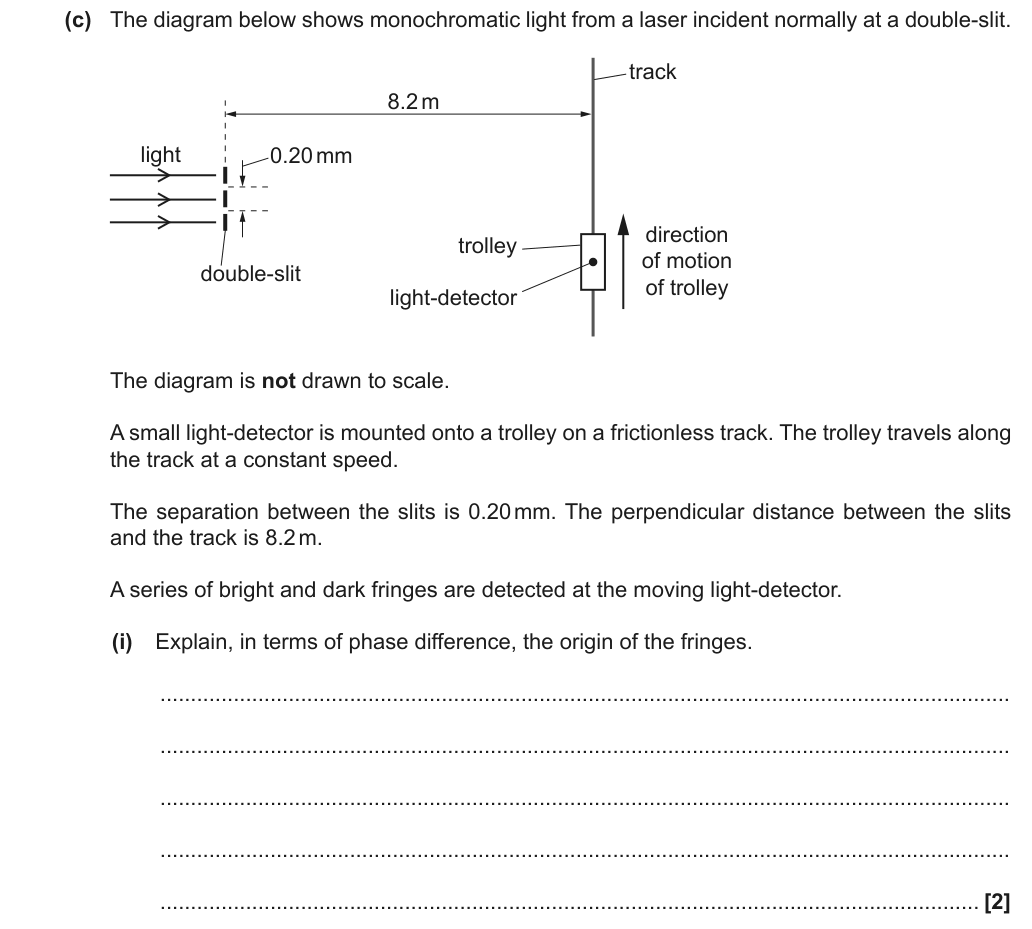
20(c)(i) Superposition, interference and the double slit 2Explanation
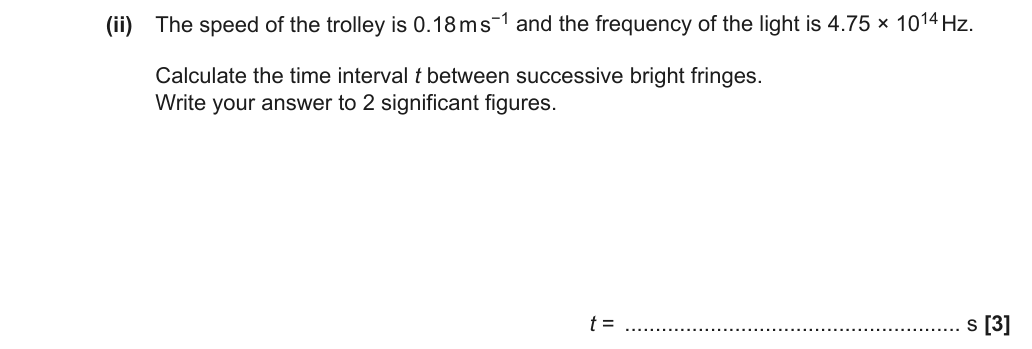
20(c)(ii) Superposition, interference and the double slit, Practical skills: planning, analysis and evaluation, Wave motion: progressive waves, the wave equation and intensity 3Calculation
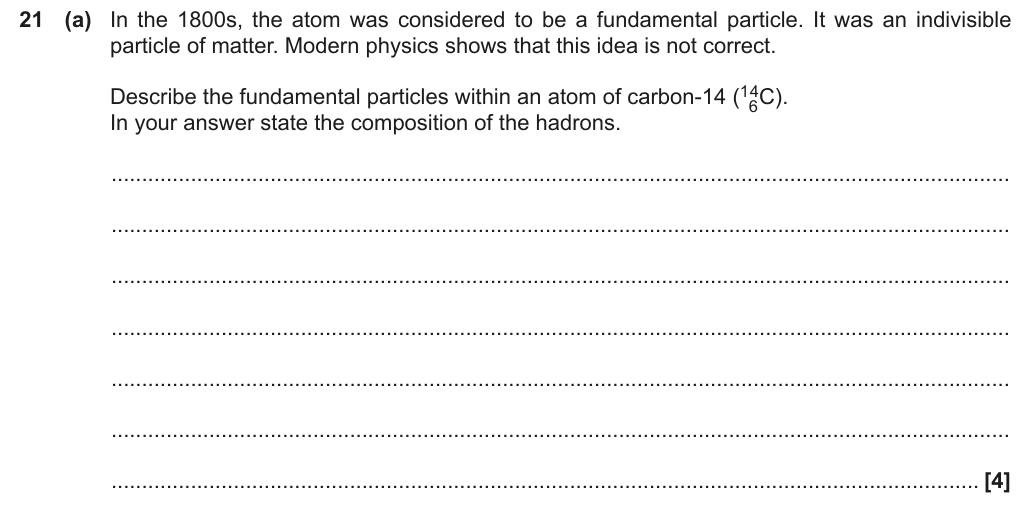
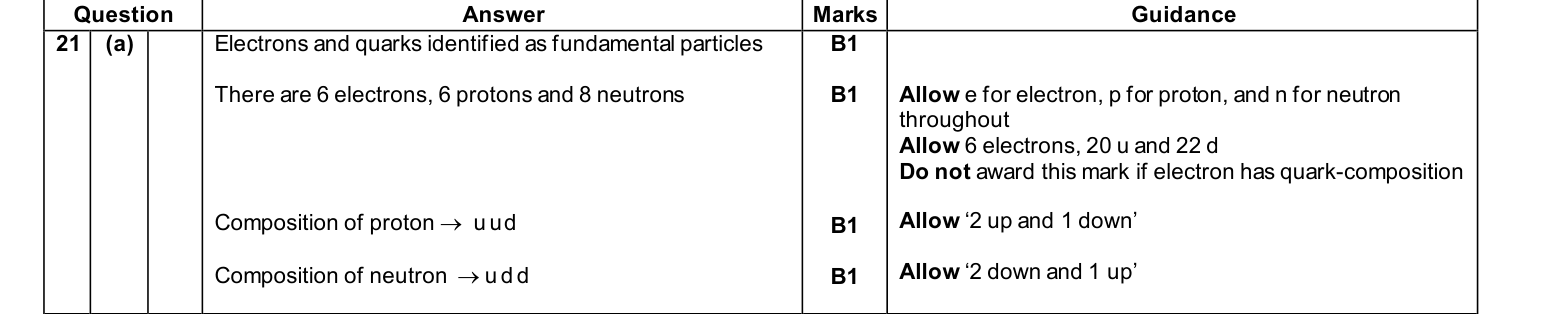
21(a) The nuclear atom and fundamental particles 4Explanation
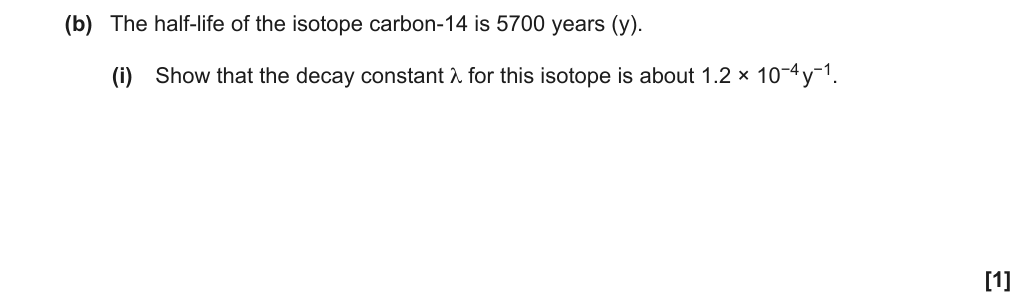
21(b)(i) Radioactivity: decay, half-life and activity 1Show that
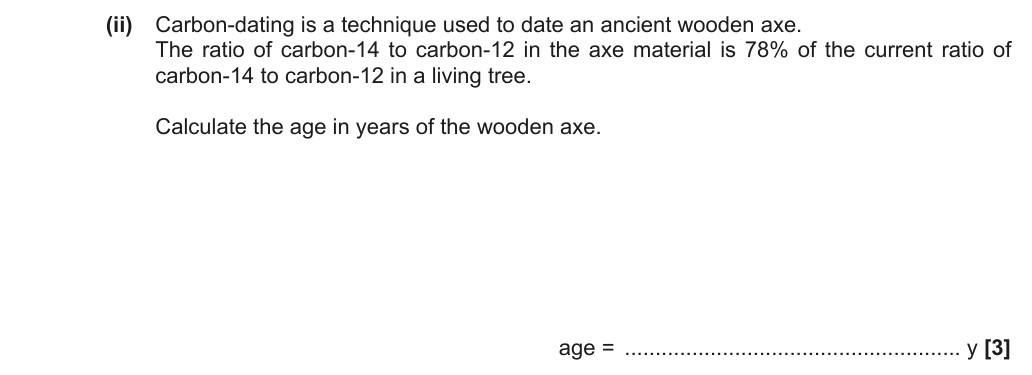
21(b)(ii) Radioactivity: decay, half-life and activity 3Calculation
21(b)(iii) Radioactivity: decay, half-life and activity 1Short answer
21(c) The nuclear atom and fundamental particles, Practical skills: planning, analysis and evaluation 6Extended response
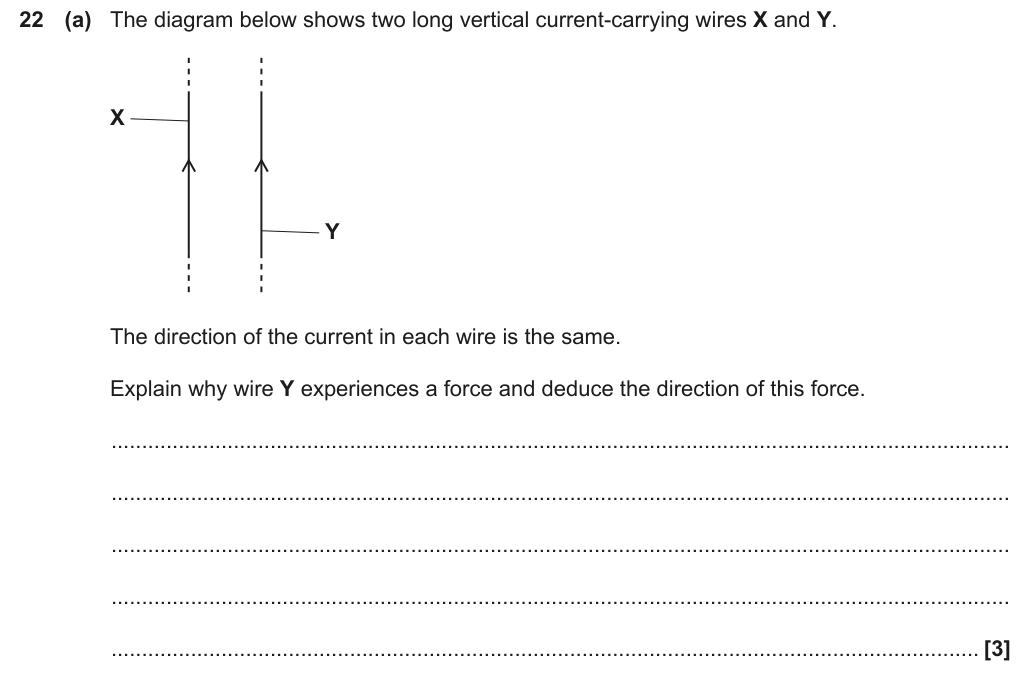
22(a) Magnetic fields and the motion of charged particles 3Explanation
22(b)(i) Electromagnetism: Faraday's law, Lenz's law and transformers 1Short answer
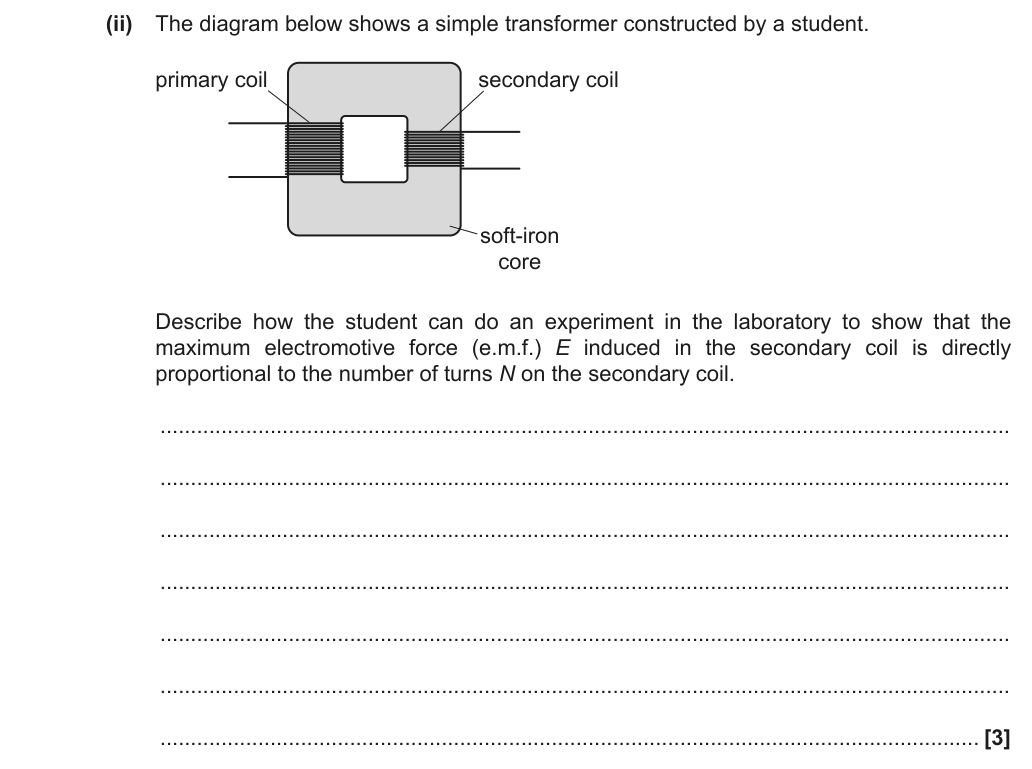
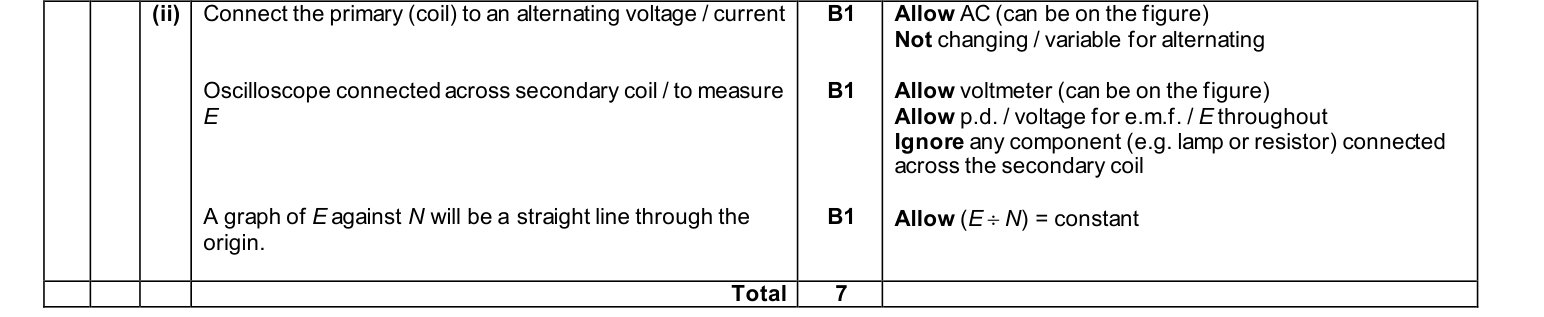
22(b)(ii) Electromagnetism: Faraday's law, Lenz's law and transformers, Practical skills: planning, analysis and evaluation 3Explanation
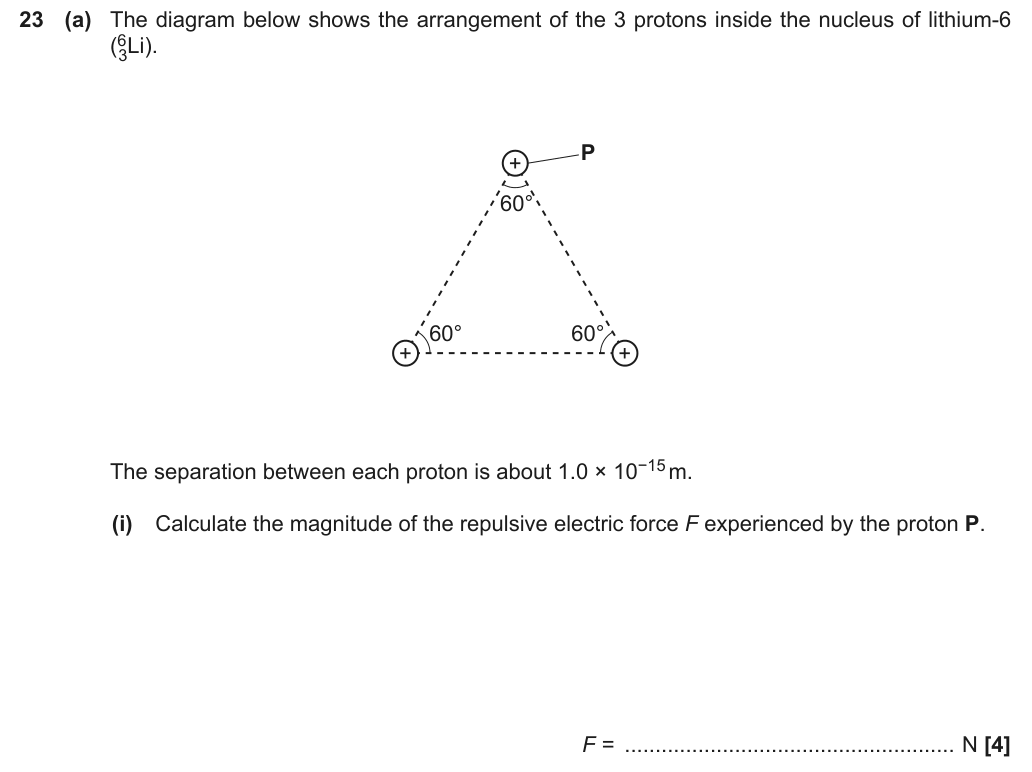
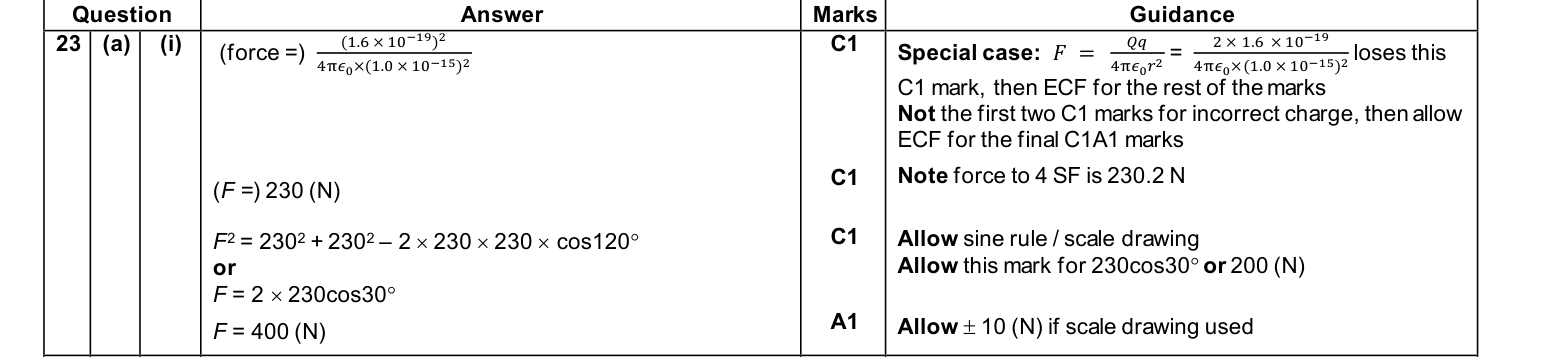
23(a)(i) Electric fields, Coulomb's law and electric potential, Scalars and vectors, Charge, current and mean drift velocity 4Calculation
23(a)(ii) Electric fields, Coulomb's law and electric potential, Scalars and vectors 1Diagram or graph
23(a)(iii) The nuclear atom and fundamental particles 2Explanation
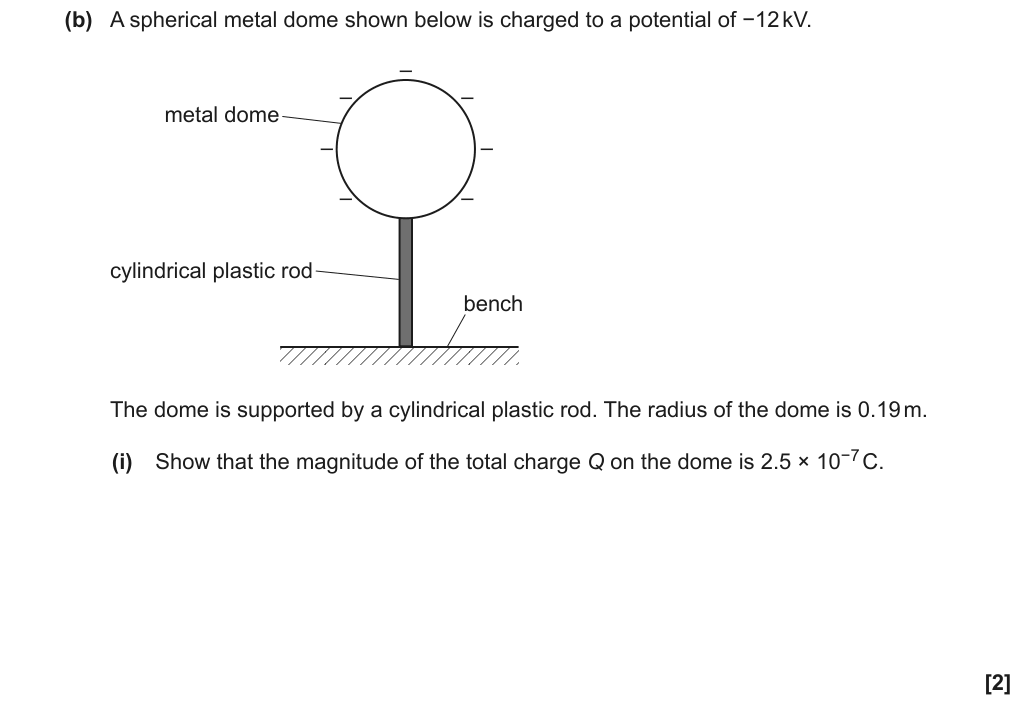
23(b)(i) Electric fields, Coulomb's law and electric potential 2Show that
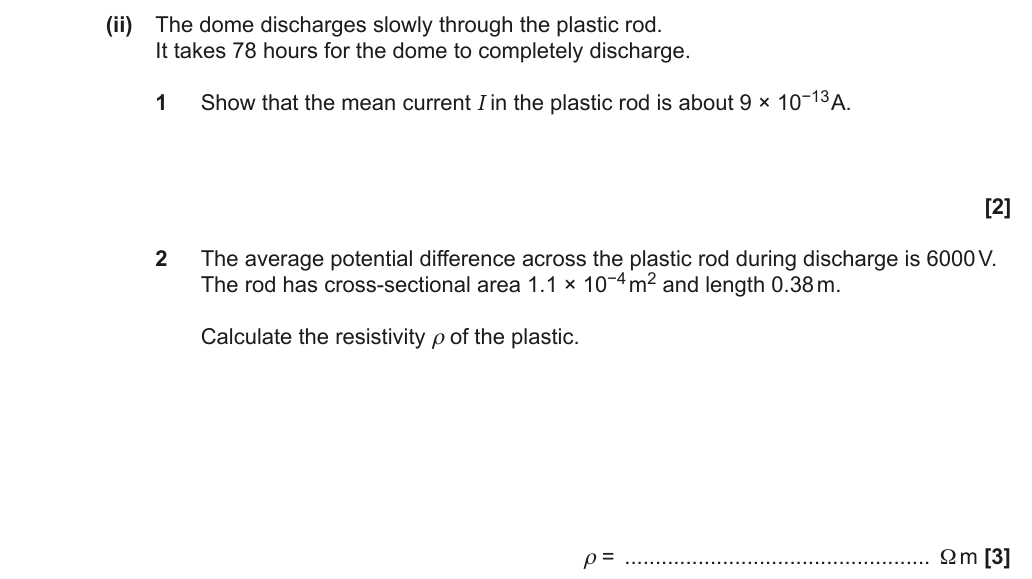
23(b)(ii) Charge, current and mean drift velocity, E.m.f., p.d., resistance and I–V characteristics, Resistivity 5Show that
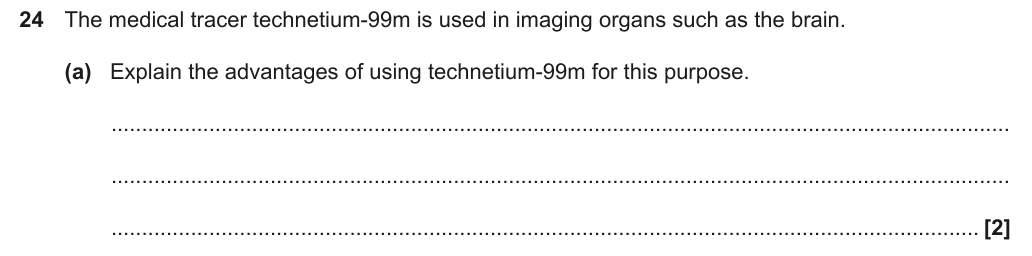
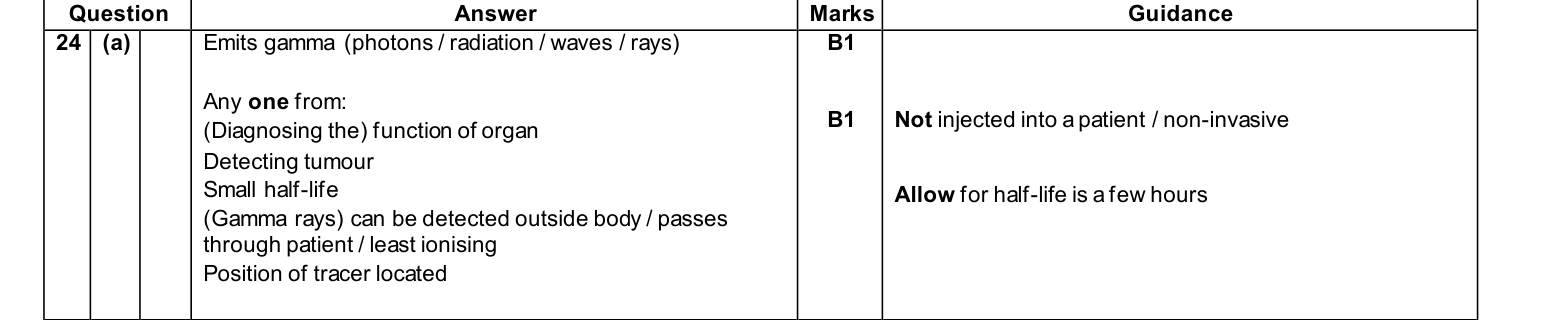
24(a) Medical imaging: X-rays, CAT scans, PET, the gamma camera and ultrasound 2Explanation
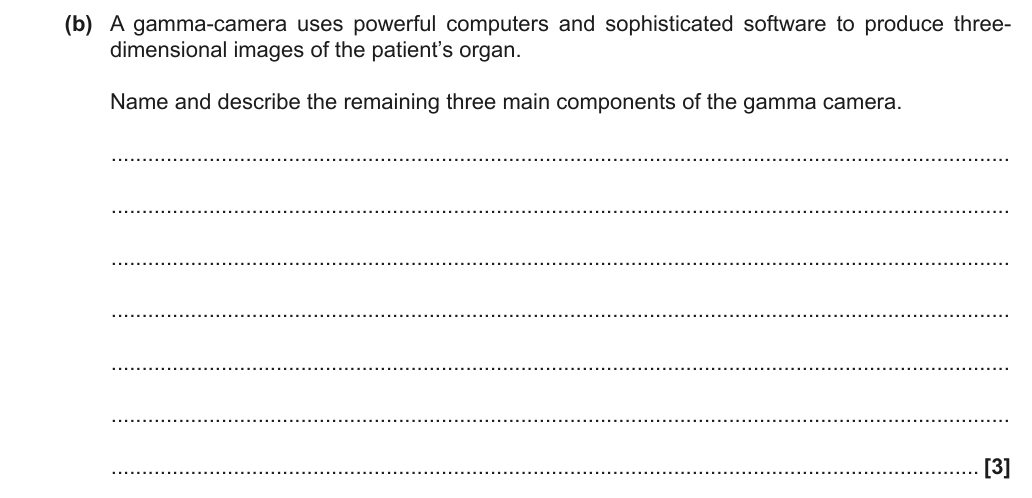
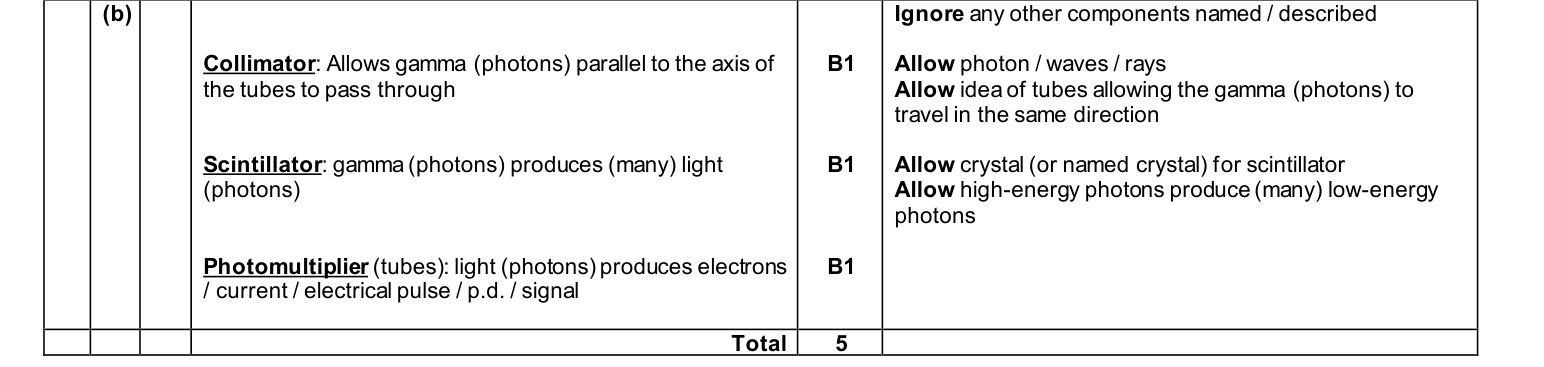
24(b) Medical imaging: X-rays, CAT scans, PET, the gamma camera and ultrasound 3Explanation
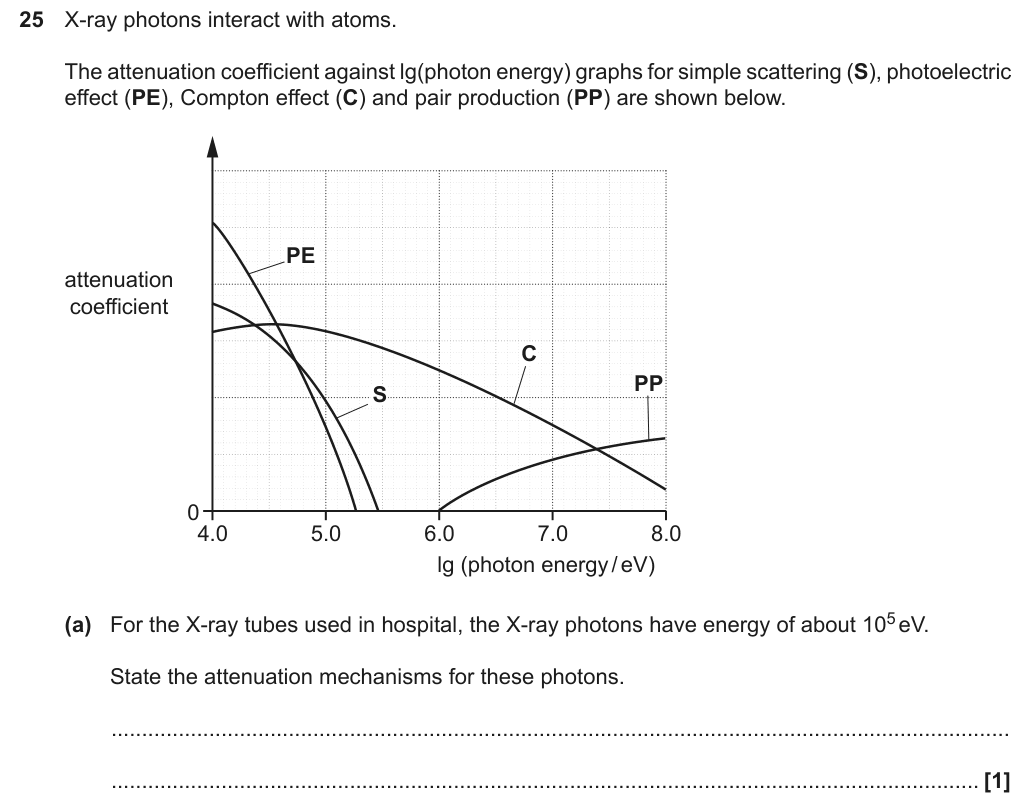
25(a) Medical imaging: X-rays, CAT scans, PET, the gamma camera and ultrasound 1Short answer
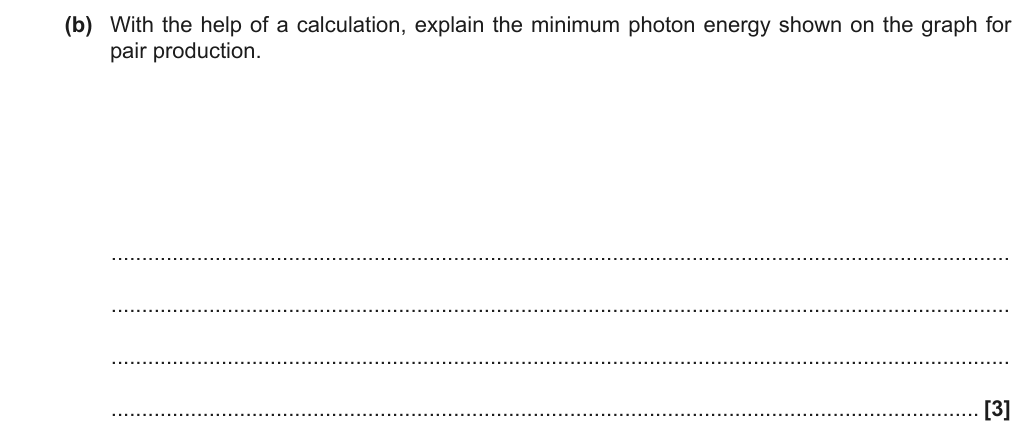
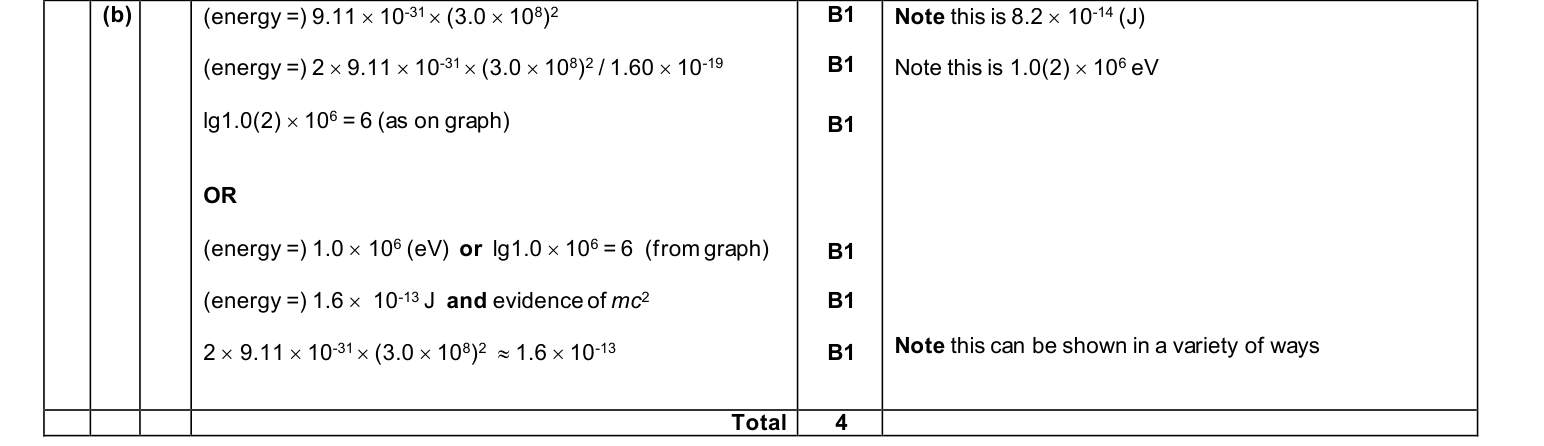
25(b) Mass–energy, binding energy, fission and fusion, Medical imaging: X-rays, CAT scans, PET, the gamma camera and ultrasound 3Explanation

The questions

12345678910111213141516(a)16(b)17(a)17(b)17(c)(i)17(c)(ii)1819(a)19(b)(i)19(b)(ii)20(a)(i)20(a)(ii)20(b)20(c)(i)20(c)(ii)21(a)21(b)(i)21(b)(ii)21(b)(iii)21(c)22(a)22(b)(i)22(b)(ii)23(a)(i)23(a)(ii)23(a)(iii)23(b)(i)23(b)(ii)24(a)24(b)25(a)25(b)
November 2020 · Paper 2 · Q1 1 mark Multiple choice Medium medical imaging
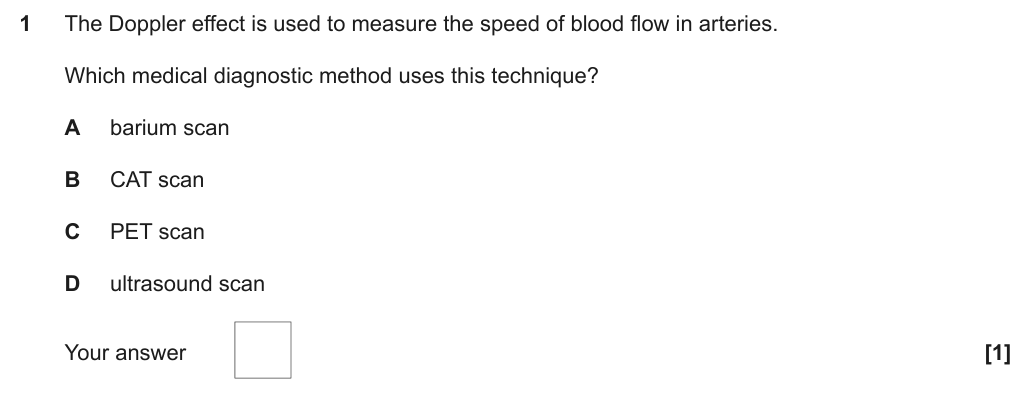
1 The Doppler effect is used to measure the speed of blood flow in arteries.
Which medical diagnostic method uses this technique?
A barium scan
B CAT scan
C PET scan
D ultrasound scan
Your answer [1]
November 2020 · Paper 2 · Q2 1 mark Multiple choice Easy charge and current
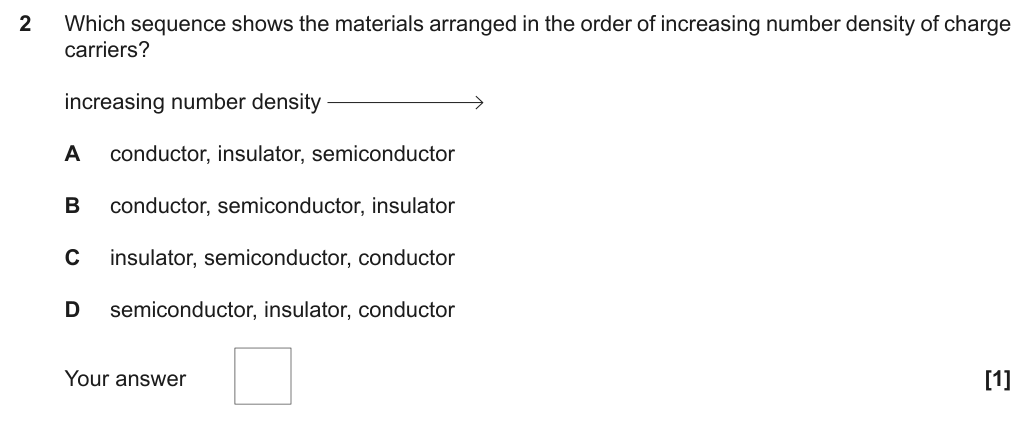
2 Which sequence shows the materials arranged in the order of increasing number density of charge
carriers?
increasing number density
A conductor, insulator, semiconductor
B conductor, semiconductor, insulator
C insulator, semiconductor, conductor
D semiconductor, insulator, conductor
Your answer [1]
November 2020 · Paper 2 · Q3 1 mark Multiple choice photoelectric effect
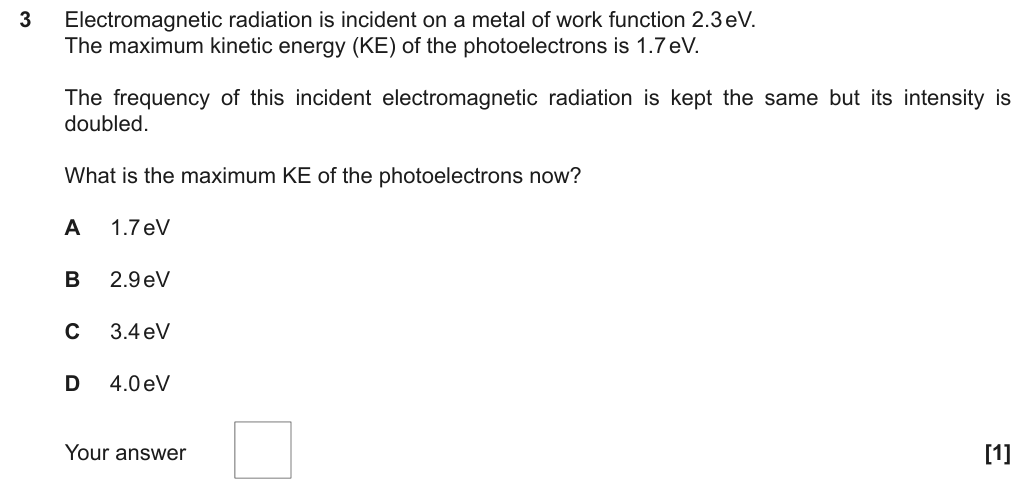
3 Electromagnetic radiation is incident on a metal of work function 2.3 eV.
The maximum kinetic energy (KE) of the photoelectrons is 1.7 eV.
The frequency of this incident electromagnetic radiation is kept the same but its intensity is
doubled.
What is the maximum KE of the photoelectrons now?
A 1.7 eV
B 2.9 eV
C 3.4 eV
D 4.0 eV
Your answer [1]
November 2020 · Paper 2 · Q4 1 mark Multiple choice Medium magnetic fieldsquantities and units
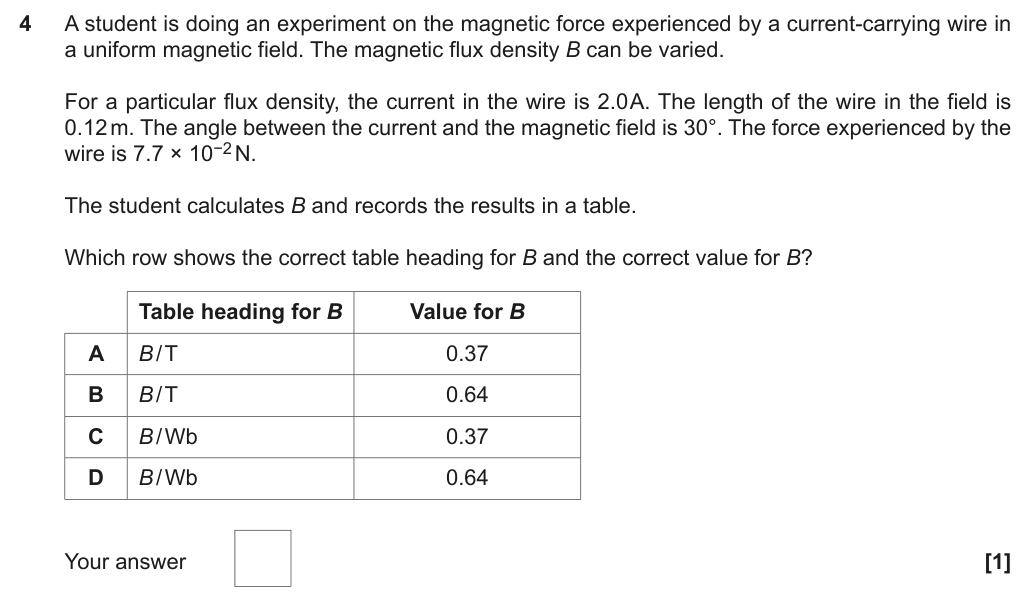
4 A student is doing an experiment on the magnetic force experienced by a current-carrying wire in
a uniform magnetic field. The magnetic flux density B can be varied.
For a particular flux density, the current in the wire is 2.0 A. The length of the wire in the field is
0.12 m. The angle between the current and the magnetic field is 30°. The force experienced by the
wire is 7.7 × 10⁻² N.
The student calculates B and records the results in a table.
Which row shows the correct table heading for B and the correct value for B?
Table heading for B Value for B
A B / T 0.37
B B / T 0.64
C B / Wb 0.37
D B / Wb 0.64
Your answer [1]
November 2020 · Paper 2 · Q5 1 mark Multiple choice wave motion
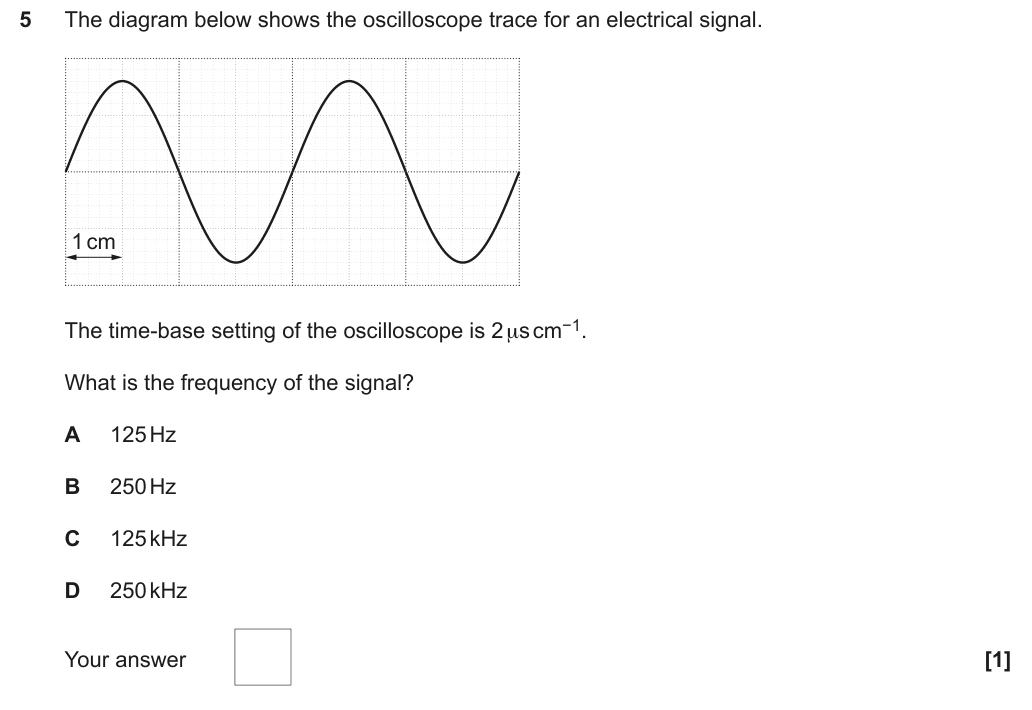
5 The diagram below shows the oscilloscope trace for an electrical signal.
1 cm
The time-base setting of the oscilloscope is 2 μs cm−1.
What is the frequency of the signal?
A 125 Hz
B 250 Hz
C 125 kHz
D 250 kHz
Your answer [1]
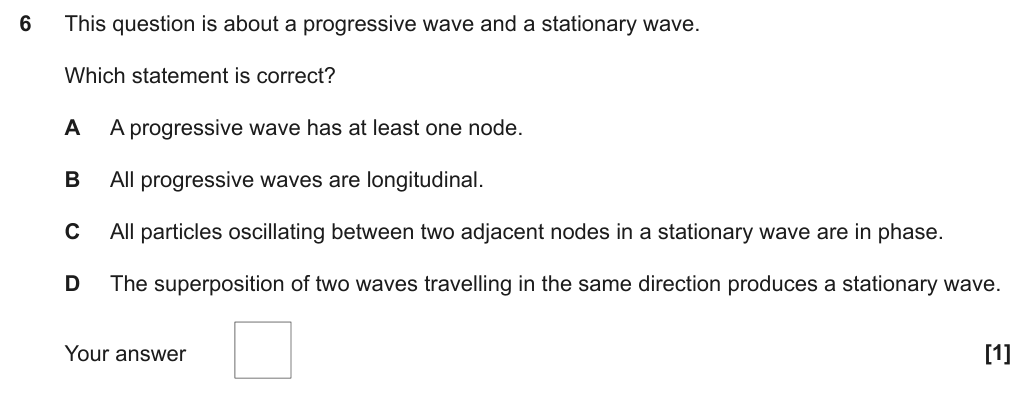
November 2020 · Paper 2 · Q6 1 mark Multiple choice stationary waves
6 This question is about a progressive wave and a stationary wave.
Which statement is correct?
A A progressive wave has at least one node.
B All progressive waves are longitudinal.
C All particles oscillating between two adjacent nodes in a stationary wave are in phase.
D The superposition of two waves travelling in the same direction produces a stationary wave.
Your answer [1]
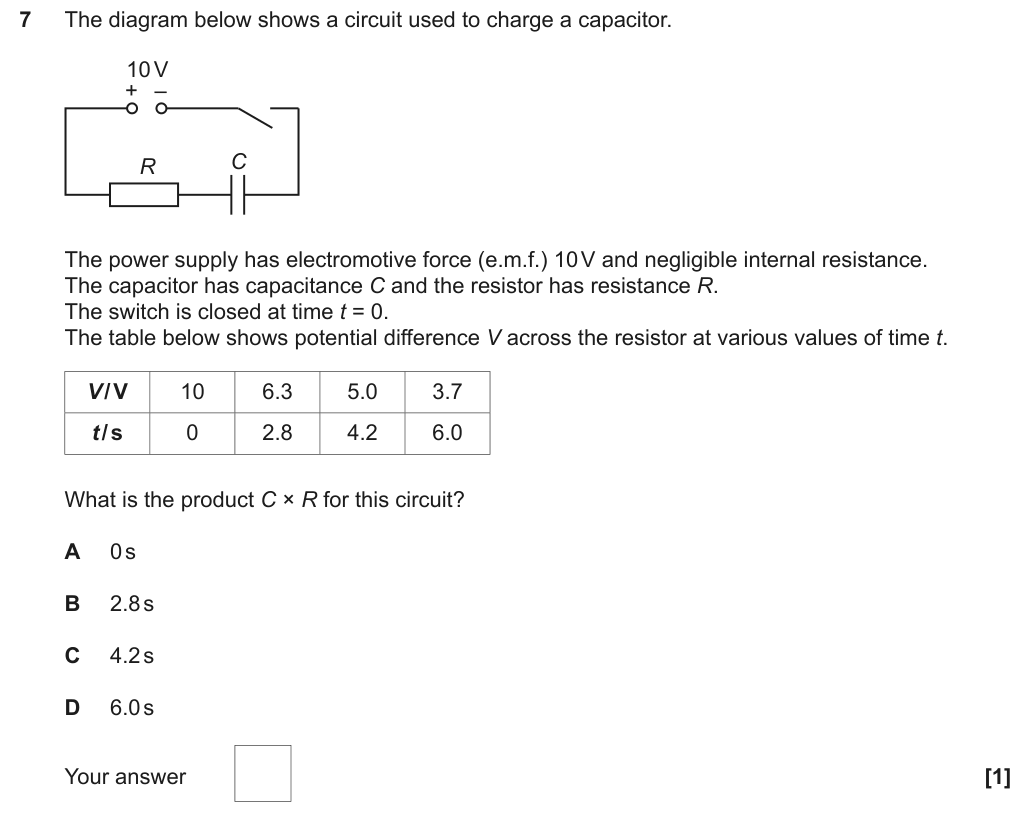
November 2020 · Paper 2 · Q7 1 mark Multiple choice Medium capacitors
7 The diagram below shows a circuit used to charge a capacitor.
10 V
+ –
R C
The power supply has electromotive force (e.m.f.) 10 V and negligible internal resistance.
The capacitor has capacitance C and the resistor has resistance R.
The switch is closed at time t = 0.
The table below shows potential difference V across the resistor at various values of time t.
V / V 10 6.3 5.0 3.7
t / s 0 2.8 4.2 6.0
What is the product C × R for this circuit?
A 0 s
B 2.8 s
C  4.2 s
D  6.0 s
Your answer [1]
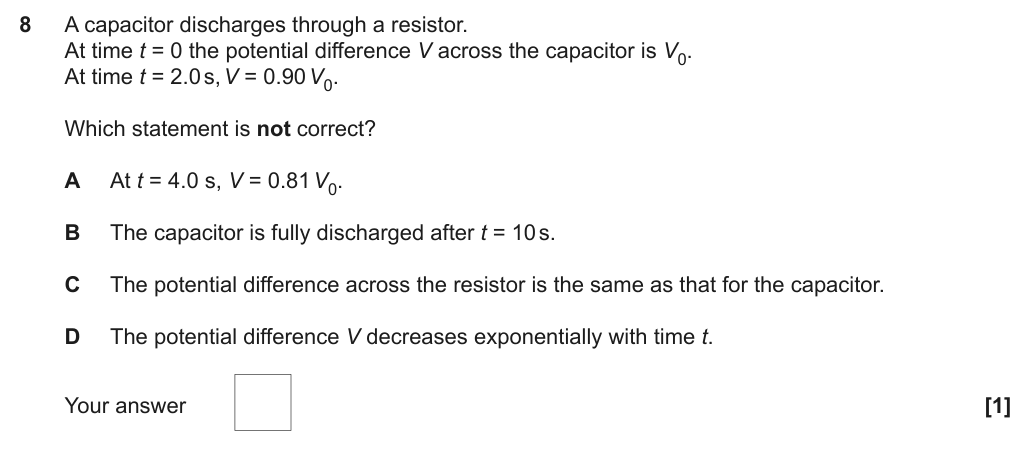
November 2020 · Paper 2 · Q8 1 mark Multiple choice capacitors
8 A capacitor discharges through a resistor.
At time t = 0 the potential difference V across the capacitor is V0.
At time t = 2.0 s, V = 0.90 V0.
Which statement is not correct?
A At t = 4.0 s, V = 0.81 V0.
B The capacitor is fully discharged after t = 10 s.
C The potential difference across the resistor is the same as that for the capacitor.
D The potential difference V decreases exponentially with time t.
Your answer [1]
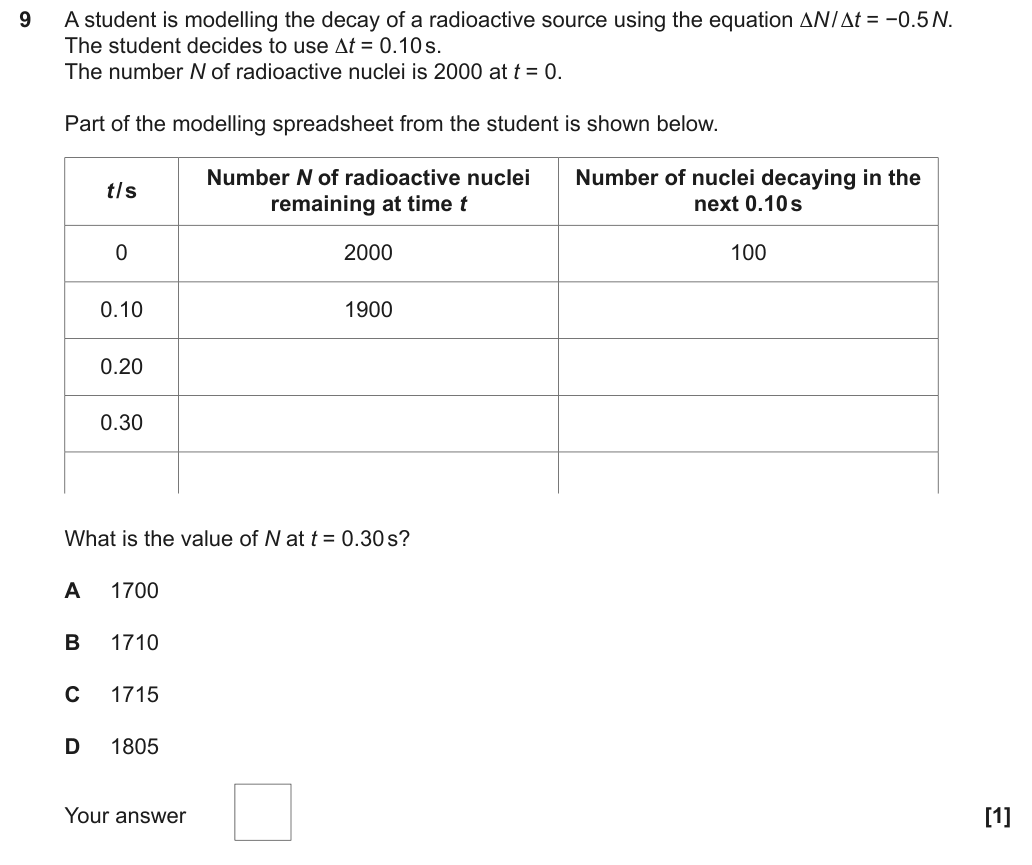
November 2020 · Paper 2 · Q9 1 mark Multiple choice Medium radioactivity
9 A student is modelling the decay of a radioactive source using the equation ΔN / Δt = −0.5 N.
The student decides to use Δt = 0.10 s.
The number N of radioactive nuclei is 2000 at t = 0.
Part of the modelling spreadsheet from the student is shown below.
Number N of radioactive nuclei Number of nuclei decaying in the
t / s
remaining at time t next 0.10 s
0 2000 100
0.10 1900
0.20
0.30
What is the value of N at t = 0.30 s?
A 1700
B 1710
C 1715
D 1805
Your answer [1]
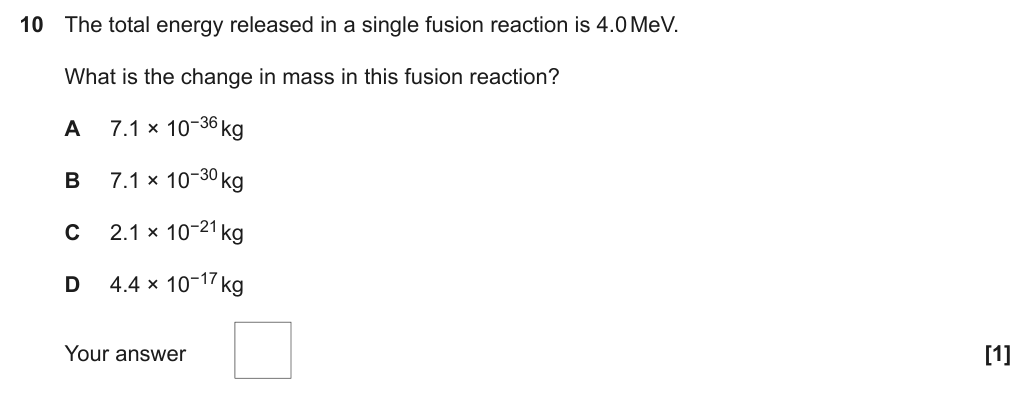
November 2020 · Paper 2 · Q10 1 mark Multiple choice nuclear fission and fusion
10 The total energy released in a single fusion reaction is 4.0 MeV.
What is the change in mass in this fusion reaction?
A 7.1 × 10−36 kg
B 7.1 × 10⁻³⁰ kg
C 2.1 × 10⁻²¹ kg
D 4.4 × 10⁻¹⁷ kg
Your answer [1]
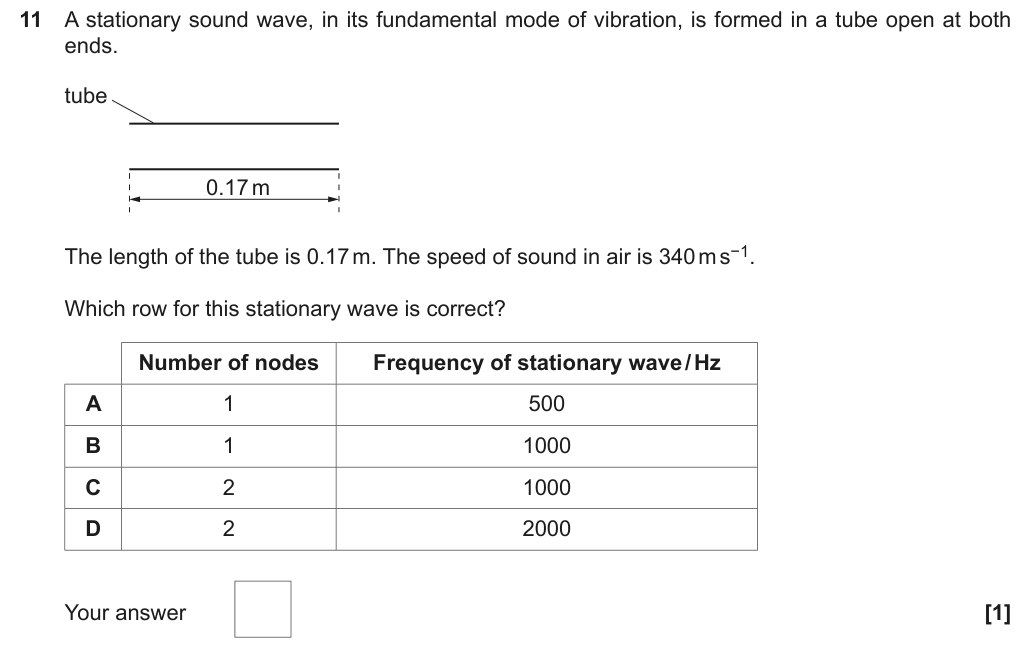
November 2020 · Paper 2 · Q11 1 mark Multiple choice stationary waveswave motion
11 A stationary sound wave, in its fundamental mode of vibration, is formed in a tube open at both
ends.
tube
0.17 m
The length of the tube is 0.17 m. The speed of sound in air is 340 m s−1.
Which row for this stationary wave is correct?
Number of nodes Frequency of stationary wave / Hz
A 1 500
B 1 1000
C 2 1000
D 2 2000
Your answer [1]
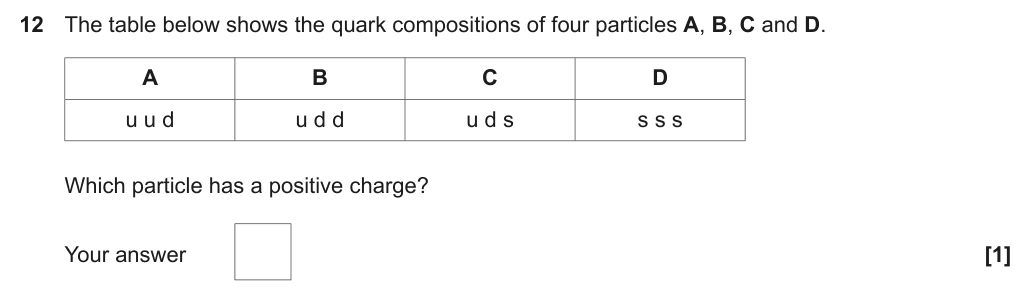
November 2020 · Paper 2 · Q12 1 mark Multiple choice nuclear atom and particles
12 The table below shows the quark compositions of four particles A, B, C and D.
A B C D
u u d u d d u d s s s s
Which particle has a positive charge?
Your answer [1]
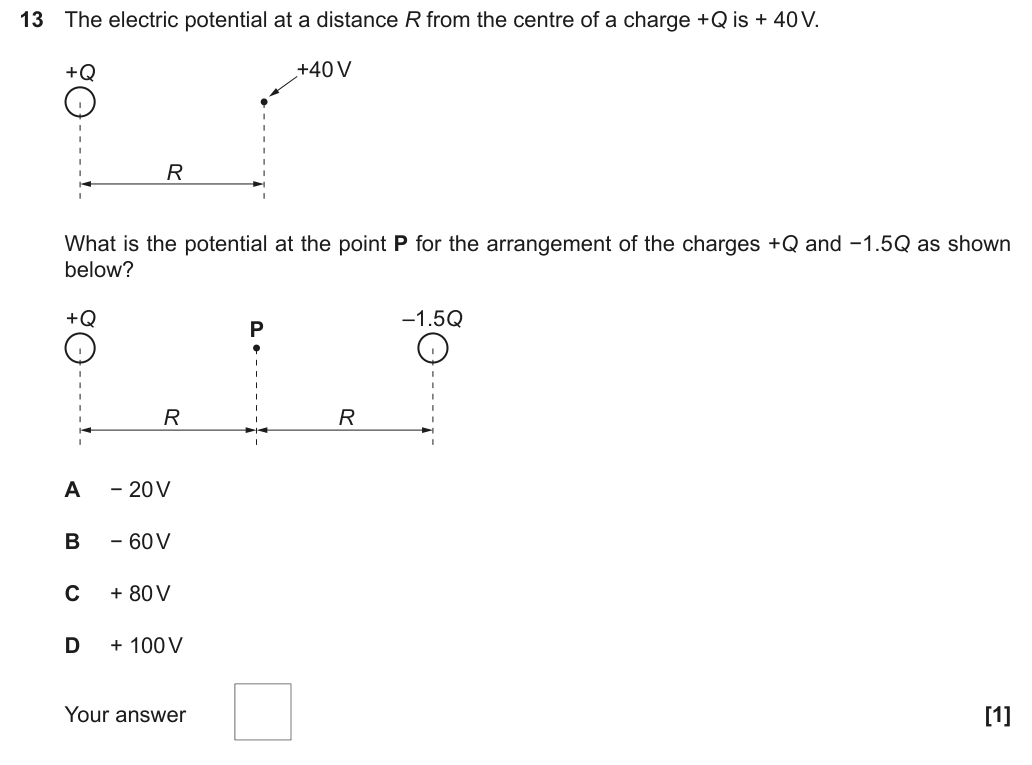
November 2020 · Paper 2 · Q13 1 mark Multiple choice Medium electric fields
13 The electric potential at a distance R from the centre of a charge +Q is + 40 V.
+Q +40 V
R
What is the potential at the point P for the arrangement of the charges +Q and −1.5Q as shown
below?
+Q –1.5Q
P
R R
A − 20 V
B − 60 V
C + 80 V
D + 100 V
Your answer [1]
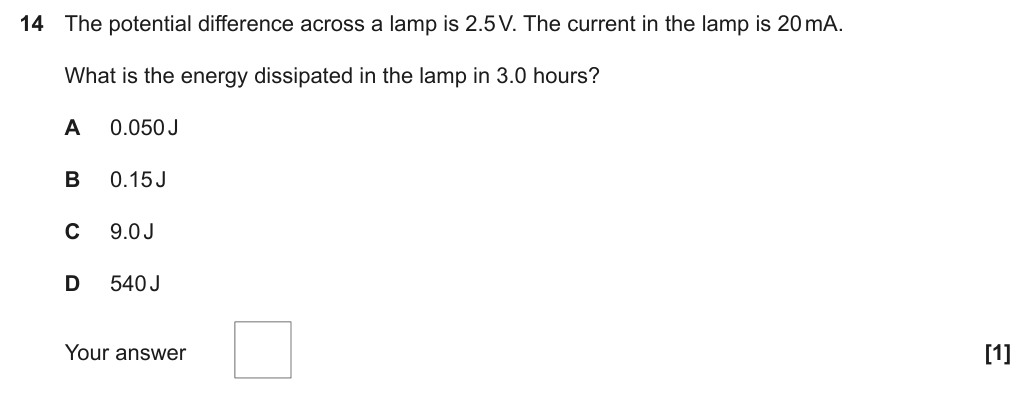
November 2020 · Paper 2 · Q14 1 mark Multiple choice electrical power
14 The potential difference across a lamp is 2.5 V. The current in the lamp is 20 mA.
What is the energy dissipated in the lamp in 3.0 hours?
A 0.050 J
B 0.15 J
C 9.0 J
D 540 J
Your answer [1]
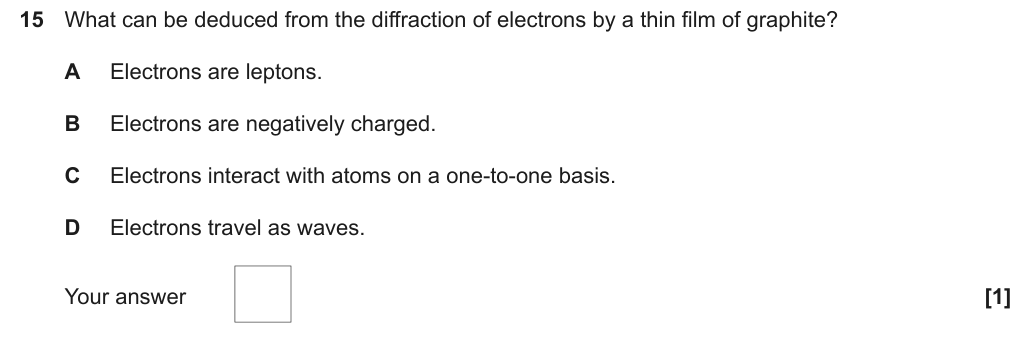
November 2020 · Paper 2 · Q15 1 mark Multiple choice Medium wave particle duality
15 What can be deduced from the diffraction of electrons by a thin film of graphite?
A Electrons are leptons.
B  Electrons are negatively charged.
C Electrons interact with atoms on a one-to-one basis.
D Electrons travel as waves.
Your answer [1]
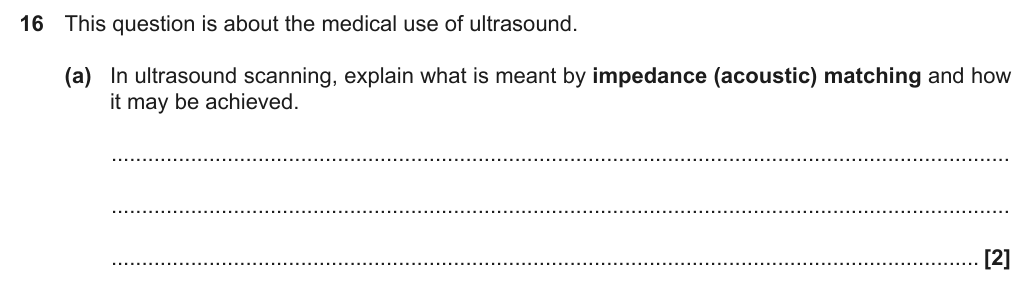
November 2020 · Paper 2 · Q16(a) 2 marks Explanation Medium medical imaging
16 This question is about the medical use of ultrasound.
(a) In ultrasound scanning, explain what is meant by impedance (acoustic) matching and how
it may be achieved.
...................................................................................................................................................
...................................................................................................................................................
.............................................................................................................................................. [2]
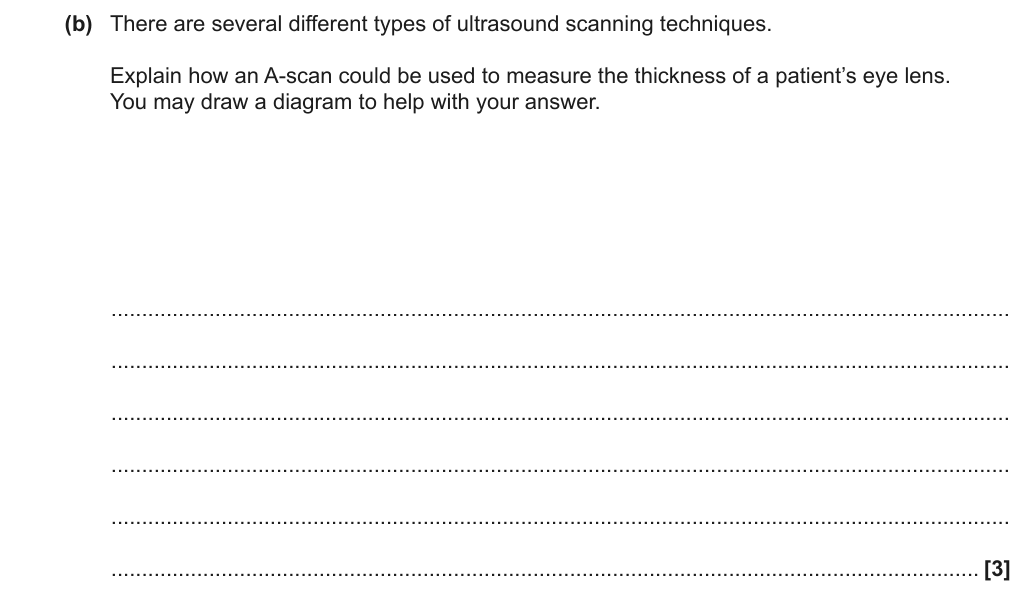
November 2020 · Paper 2 · Q16(b) 3 marks Explanation Medium medical imaging
(b) There are several different types of ultrasound scanning techniques.
Explain how an A-scan could be used to measure the thickness of a patient’s eye lens.
You may draw a diagram to help with your answer.
...................................................................................................................................................
...................................................................................................................................................
...................................................................................................................................................
...................................................................................................................................................
...................................................................................................................................................
.............................................................................................................................................. [3]
November 2020 · Paper 2 · Q17(a) 3 marks Calculation photons
17 A light-emitting diode (LED) emits red light when it is positively biased and has a potential
difference (p.d.) greater than about 1.8 V.
(a) The energy of a photon of red light is about 1.8 eV.
Calculate the wavelength λ of this red light.
λ =  ..................................................... m [3]
November 2020 · Paper 2 · Q17(b) 2 marks Calculation electrical poweremf pd and resistanceseries and parallel circuits
(b)  The LED is connected into a circuit, as shown below.
4.5 V
R
The battery has electromotive force (e.m.f.) 4.5 V and negligible internal resistance.
The resistor R has resistance 150 Ω.
Assume the p.d. across the LED is 1.8 V.
power dissipated by LED
Calculate the ratio power dissipated by resistor.
ratio =  ......................................................... [2]
November 2020 · Paper 2 · Q17(c)(i) 2 marks Explanation potential dividersemf pd and resistance
(c) The diagram below shows a circuit designed by a student.
The LED is very close to, and facing the light dependent resistor (LDR).
The circuit is taken into a dark room.
(i)  The student thought that the LED would switch on.
Instead, the LED was found to repeatedly switch on and off.
Explain this behaviour of the LED in this potential divider circuit.
...........................................................................................................................................
...........................................................................................................................................
...........................................................................................................................................
...........................................................................................................................................
...........................................................................................................................................
...................................................................................................................................... [2]
November 2020 · Paper 2 · Q17(c)(ii) 1 mark Explanation practical skillspotential dividers
Earlier part of question 17 that this part usesEarlier part of November 2020 Paper 2 question 17
(ii) Suggest a possible refinement so that the LED switches on permanently when taken into
the dark room.
...........................................................................................................................................
...................................................................................................................................... [1]
November 2020 · Paper 2 · Q18 6 marks 6-mark extended response Medium practical skillsemf pd and resistanceresistivityelectrical power
18* A resistance wire is coiled around a thermistor. The coil of wire will warm the thermistor.
It is suggested that the relationship between the power P dissipated in the coiled wire and the
stable resistance R of the thermistor is given by the expression P = kRn, where k and n are
constants.
Describe how an experiment can be conducted to assess the validity of this expression and how
the data collected can be analysed to determine k and n.
Use the space below for a circuit diagram. [6]
..........................................................................................................................................................
..........................................................................................................................................................
..........................................................................................................................................................
..........................................................................................................................................................
..........................................................................................................................................................
..........................................................................................................................................................
..........................................................................................................................................................
..........................................................................................................................................................
..........................................................................................................................................................
..........................................................................................................................................................
..........................................................................................................................................................
..........................................................................................................................................................
..........................................................................................................................................................
..........................................................................................................................................................
Additional answer space if required
..........................................................................................................................................................
..........................................................................................................................................................
..........................................................................................................................................................
..........................................................................................................................................................
..........................................................................................................................................................
..........................................................................................................................................................
..........................................................................................................................................................
..........................................................................................................................................................
..........................................................................................................................................................
November 2020 · Paper 2 · Q19(a) 2 marks Calculation Medium quantities and units
19 (a) The Planck constant h is an important fundamental constant in quantum physics.
Determine the S.I. base units for h.
base units =  ......................................................... [2]
November 2020 · Paper 2 · Q19(b)(i) 2 marks Show that Medium wave particle dualityemf pd and resistance
(b) A researcher is investigating the de Broglie wavelength of charged particles.
The charged particles are accelerated through a potential difference V. The de Broglie
wavelength λ of these particles is then determined by the researcher.
Each particle has mass m and charge q.
(i) Show that the de Broglie wavelength λ is given by the expression λ2 = h 2 2mq × 1
V.
[2]
November 2020 · Paper 2 · Q19(b)(ii) 7 marks Show that Medium measurements and uncertaintiespractical skillsemf pd and resistancewave particle duality
Earlier part of question 19 that this part usesEarlier part of November 2020 Paper 2 question 19
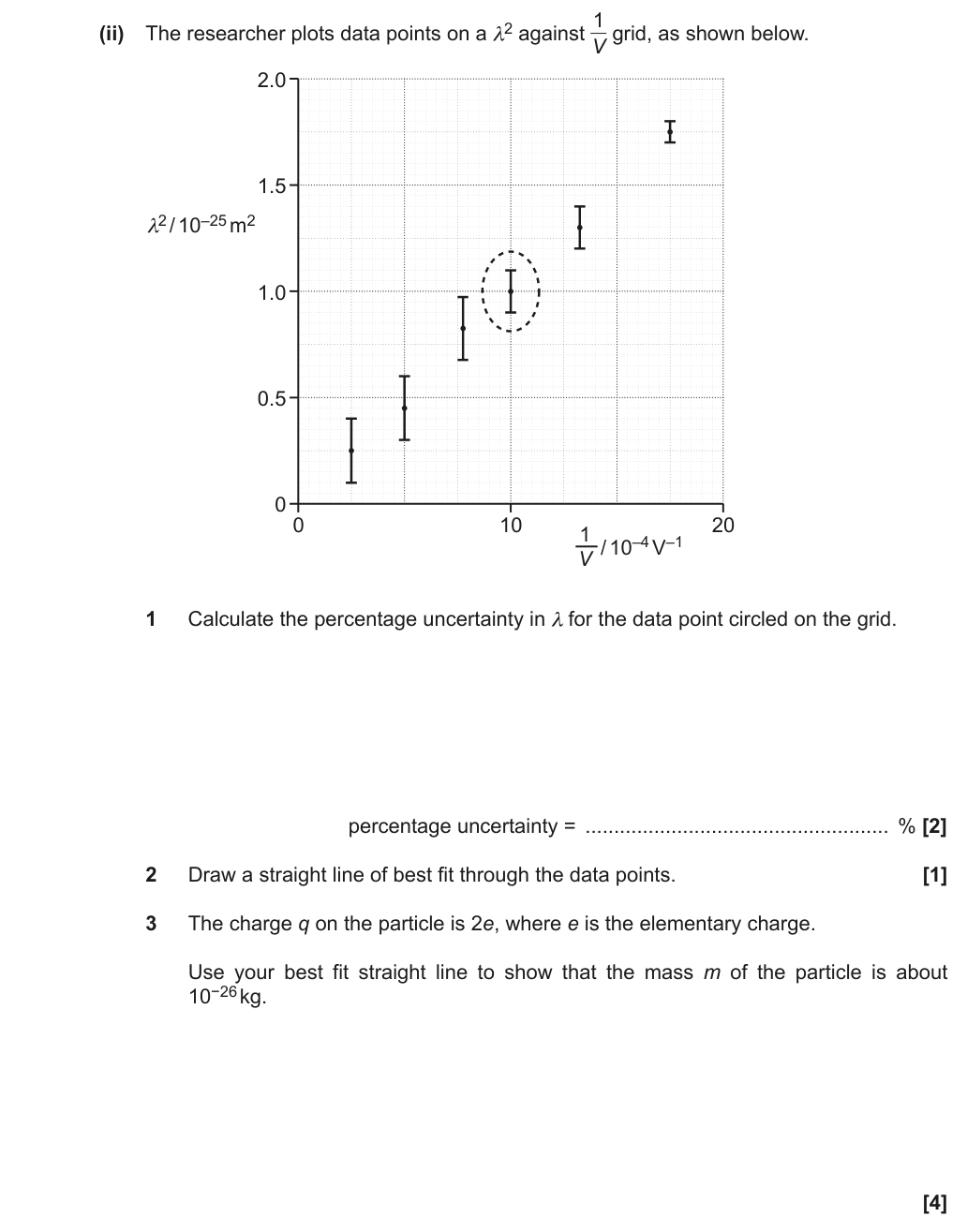
(ii) The researcher plots data points on a λ2 against 1
V grid, as shown below.
2.0
1.5
λ2 / 10–25 m2
1.0
0.5
0
0 10 20
1
/ 10–4 V–1
V
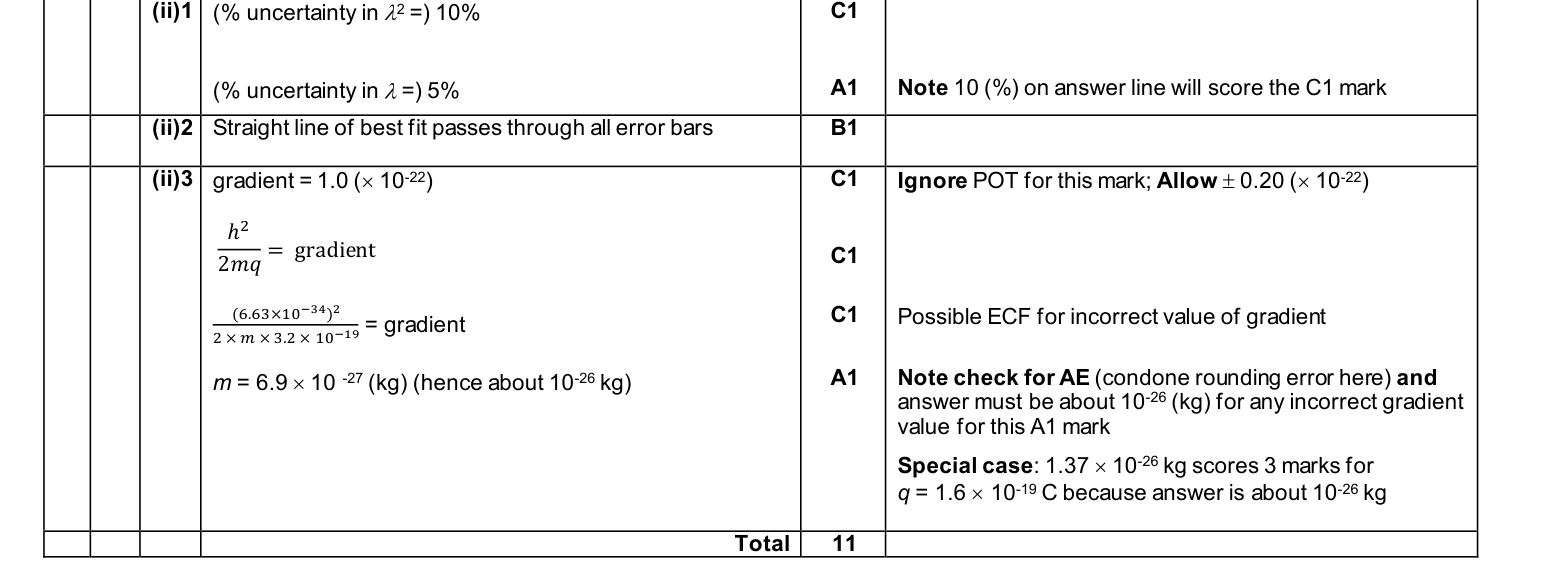
1 Calculate the percentage uncertainty in λ for the data point circled on the grid.
percentage uncertainty =  ..................................................... % [2]
2 Draw a straight line of best fit through the data points. [1]
3 The charge q on the particle is 2e, where e is the elementary charge.
Use your best fit straight line to show that the mass m of the particle is about
10−26 kg.

[4]
November 2020 · Paper 2 · Q20(a)(i) 2 marks Calculation Medium wave motionquantities and units
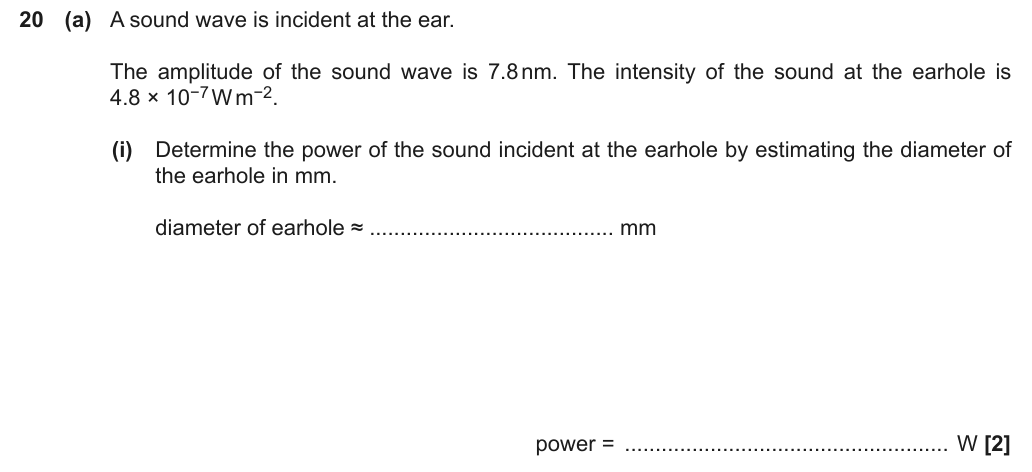
20  (a) A sound wave is incident at the ear.

The amplitude of the sound wave is 7.8 nm. The intensity of the sound at the earhole is
4.8 × 10⁻⁷ W m−2.
(i) Determine the power of the sound incident at the earhole by estimating the diameter of
the earhole in mm.
diameter of earhole ≈ ........................................ mm
power =  ..................................................... W [2]
November 2020 · Paper 2 · Q20(a)(ii) 2 marks Calculation Medium wave motion
Earlier part of question 20 that this part usesEarlier part of November 2020 Paper 2 question 20
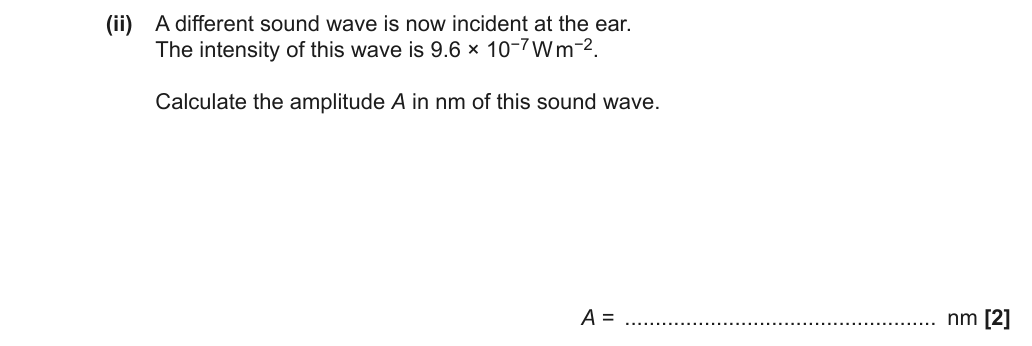
(ii) A different sound wave is now incident at the ear.
The intensity of this wave is 9.6 × 10⁻⁷ W m−2.
Calculate the amplitude A in nm of this sound wave.
A =  ................................................... nm [2]
November 2020 · Paper 2 · Q20(b) 1 mark Short answer Medium superposition and interference
(b) State the principle of superposition.
...................................................................................................................................................
.............................................................................................................................................. [1]
November 2020 · Paper 2 · Q20(c)(i) 2 marks Explanation Medium superposition and interference
(c) The diagram below shows monochromatic light from a laser incident normally at a double-slit.
track
8.2 m
light 0.20 mm
direction
trolley
of motion
double-slit
of trolley
light-detector
The diagram is not drawn to scale.
A small light-detector is mounted onto a trolley on a frictionless track. The trolley travels along
the track at a constant speed.
The separation between the slits is 0.20 mm. The perpendicular distance between the slits
and the track is 8.2 m.
A series of bright and dark fringes are detected at the moving light-detector.
(i) Explain, in terms of phase difference, the origin of the fringes.
...........................................................................................................................................
...........................................................................................................................................
...........................................................................................................................................
...........................................................................................................................................
...................................................................................................................................... [2]
November 2020 · Paper 2 · Q20(c)(ii) 3 marks Calculation Medium superposition and interferencepractical skillswave motion
Earlier part of question 20 that this part usesEarlier part of November 2020 Paper 2 question 20
(ii) The speed of the trolley is 0.18 m s−1 and the frequency of the light is 4.75 × 10¹⁴ Hz.
Calculate the time interval t between successive bright fringes.
Write your answer to 2 significant figures.
t =  ....................................................... s [3]
November 2020 · Paper 2 · Q21(a) 4 marks Explanation Medium nuclear atom and particles
21  (a) In the 1800s, the atom was considered to be a fundamental particle. It was an indivisible
particle of matter. Modern physics shows that this idea is not correct.
Describe the fundamental particles within an atom of carbon-14 (1 4C).
6
In your answer state the composition of the hadrons.
...................................................................................................................................................
...................................................................................................................................................
...................................................................................................................................................
...................................................................................................................................................
...................................................................................................................................................
...................................................................................................................................................
.............................................................................................................................................. [4]
November 2020 · Paper 2 · Q21(b)(i) 1 mark Show that Medium radioactivity
(b)  The half-life of the isotope carbon-14 is 5700 years (y).
(i) Show that the decay constant λ for this isotope is about 1.2 × 10⁻⁴ y−1.
[1]
November 2020 · Paper 2 · Q21(b)(ii) 3 marks Calculation Medium radioactivity
Earlier part of question 21 that this part usesEarlier part of November 2020 Paper 2 question 21
(ii) Carbon-dating is a technique used to date an ancient wooden axe.
The ratio of carbon-14 to carbon-12 in the axe material is 78% of the current ratio of
carbon-14 to carbon-12 in a living tree.
Calculate the age in years of the wooden axe.
age =  ....................................................... y [3]
November 2020 · Paper 2 · Q21(b)(iii) 1 mark Short answer Medium radioactivity
Earlier part of question 21 that this part usesEarlier part of November 2020 Paper 2 question 21
(iii) State one assumption made in the calculation in (ii).
...........................................................................................................................................
...................................................................................................................................... [1]
November 2020 · Paper 2 · Q21(c) 6 marks 6-mark extended response Medium nuclear atom and particlespractical skills
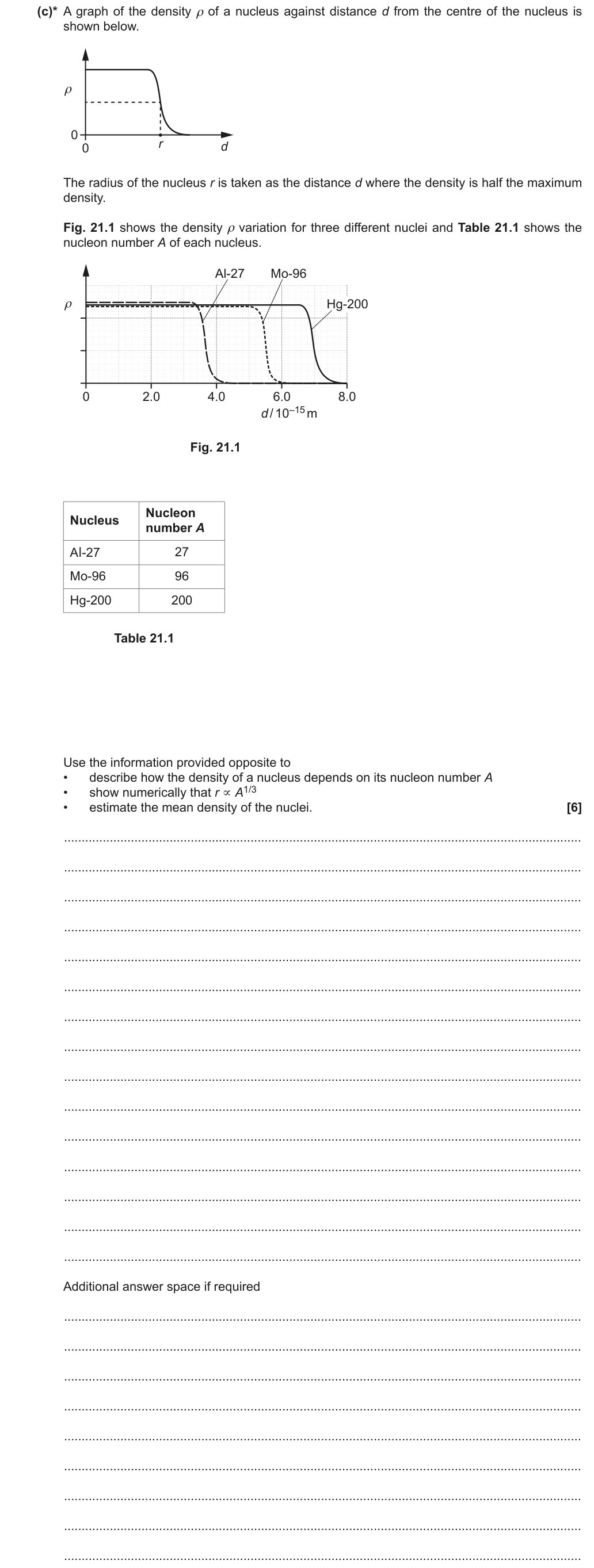
(c)* A graph of the density ρ of a nucleus against distance d from the centre of the nucleus is
shown below.
ρ
0
r d
0
The radius of the nucleus r is taken as the distance d where the density is half the maximum
density.
Fig. 21.1 shows the density ρ variation for three different nuclei and Table 21.1 shows the
nucleon number A of each nucleus.
Al-27 Mo-96
ρ Hg-200
0 2.0 4.0 6.0 8.0
d / 10–15 m
Fig. 21.1
Nucleon
Nucleus
number A
Al-27 27
Mo-96 96
Hg-200 200
Table 21.1
Use the information provided opposite to
• describe how the density of a nucleus depends on its nucleon number A
• show numerically that r ∝ A1/3
• estimate the mean density of the nuclei. [6]
...................................................................................................................................................
...................................................................................................................................................
...................................................................................................................................................
...................................................................................................................................................
...................................................................................................................................................
...................................................................................................................................................
...................................................................................................................................................
...................................................................................................................................................
...................................................................................................................................................
...................................................................................................................................................
...................................................................................................................................................
...................................................................................................................................................
...................................................................................................................................................
...................................................................................................................................................
...................................................................................................................................................
Additional answer space if required
...................................................................................................................................................
...................................................................................................................................................
...................................................................................................................................................
...................................................................................................................................................
...................................................................................................................................................
...................................................................................................................................................
...................................................................................................................................................
...................................................................................................................................................
...................................................................................................................................................
November 2020 · Paper 2 · Q22(a) 3 marks Explanation Medium magnetic fields
22 (a) The diagram below shows two long vertical current-carrying wires X and Y.
X
Y
The direction of the current in each wire is the same.
Explain why wire Y experiences a force and deduce the direction of this force.
...................................................................................................................................................
...................................................................................................................................................
...................................................................................................................................................
...................................................................................................................................................
.............................................................................................................................................. [3]
November 2020 · Paper 2 · Q22(b)(i) 1 mark Short answer Medium electromagnetic induction
(b) (i) State Faraday’s law of electromagnetic induction.
...........................................................................................................................................
...................................................................................................................................... [1]
November 2020 · Paper 2 · Q22(b)(ii) 3 marks Explanation Medium electromagnetic inductionpractical skills
(ii) The diagram below shows a simple transformer constructed by a student.
primary coil secondary coil
soft-iron
core
Describe how the student can do an experiment in the laboratory to show that the
maximum electromotive force (e.m.f.) E induced in the secondary coil is directly
proportional to the number of turns N on the secondary coil.
...........................................................................................................................................
...........................................................................................................................................
...........................................................................................................................................
...........................................................................................................................................
...........................................................................................................................................
...........................................................................................................................................
...................................................................................................................................... [3]
November 2020 · Paper 2 · Q23(a)(i) 4 marks Calculation electric fieldsscalars and vectorscharge and current
23 (a) The diagram below shows the arrangement of the 3 protons inside the nucleus of lithium-6
(6 3Li).
P
+
60°
60° 60°
+ +
The separation between each proton is about 1.0 × 10⁻¹⁵ m.
(i) Calculate the magnitude of the repulsive electric force F experienced by the proton P.
F =  ...................................................... N [4]
November 2020 · Paper 2 · Q23(a)(ii) 1 mark Diagram or graph electric fieldsscalars and vectors
Earlier part of question 23 that this part usesEarlier part of November 2020 Paper 2 question 23
(ii) On the diagram above, draw an arrow to show the direction of the electric force F
experienced by P. [1]
November 2020 · Paper 2 · Q23(a)(iii) 2 marks Explanation nuclear atom and particles
(iii) Explain how protons stay within the nucleus of lithium-6.
...........................................................................................................................................
...........................................................................................................................................
...........................................................................................................................................
...................................................................................................................................... [2]
November 2020 · Paper 2 · Q23(b)(i) 2 marks Show that electric fields
(b) A spherical metal dome shown below is charged to a potential of −12 kV.
–
– –
metal dome
– –
– –
cylindrical plastic rod
bench
The dome is supported by a cylindrical plastic rod. The radius of the dome is 0.19 m.
(i) Show that the magnitude of the total charge Q on the dome is 2.5 × 10⁻⁷ C.
[2]
November 2020 · Paper 2 · Q23(b)(ii) 5 marks Show that charge and currentemf pd and resistanceresistivity
Earlier part of question 23 that this part usesEarlier part of November 2020 Paper 2 question 23
(ii) The dome discharges slowly through the plastic rod.
It takes 78 hours for the dome to completely discharge.
1 Show that the mean current I in the plastic rod is about 9 × 10⁻¹³ A.
[2]
2 The average potential difference across the plastic rod during discharge is 6000 V.
The rod has cross-sectional area 1.1 × 10⁻⁴ m2 and length 0.38 m.
Calculate the resistivity ρ of the plastic.
ρ =  .................................................. Ω m [3]
November 2020 · Paper 2 · Q24(a) 2 marks Explanation Medium medical imaging
24 The medical tracer technetium-99m is used in imaging organs such as the brain.
(a) Explain the advantages of using technetium-99m for this purpose.
...................................................................................................................................................
...................................................................................................................................................
.............................................................................................................................................. [2]
November 2020 · Paper 2 · Q24(b) 3 marks Explanation Medium medical imaging
(b) A gamma-camera uses powerful computers and sophisticated software to produce three-
dimensional images of the patient’s organ.
Name and describe the remaining three main components of the gamma camera.
...................................................................................................................................................
...................................................................................................................................................
...................................................................................................................................................
...................................................................................................................................................
...................................................................................................................................................
...................................................................................................................................................
.............................................................................................................................................. [3]
November 2020 · Paper 2 · Q25(a) 1 mark Short answer Medium medical imaging
25 X-ray photons interact with atoms.
The attenuation coefficient against lg(photon energy) graphs for simple scattering (S), photoelectric
effect (PE), Compton effect (C) and pair production (PP) are shown below.
PE
attenuation
coefficient
C
PP
S
0
4.0 5.0 6.0 7.0 8.0
lg (photon energy / eV)
(a) For the X-ray tubes used in hospital, the X-ray photons have energy of about 105 eV.
State the attenuation mechanisms for these photons.
...................................................................................................................................................
.............................................................................................................................................. [1]
November 2020 · Paper 2 · Q25(b) 3 marks Explanation Medium nuclear fission and fusionmedical imaging
Earlier part of question 25 that this part usesEarlier part of November 2020 Paper 2 question 25
(b) With the help of a calculation, explain the minimum photon energy shown on the graph for
pair production.
...................................................................................................................................................
...................................................................................................................................................
...................................................................................................................................................
.............................................................................................................................................. [3]

Work with an OCR physics tutor

Want a paper marked and gone through with you? Message us.

Prefer email? Send an enquiry

If you are under 18, please include a parent's contact details. Enquiries go to enquiries@physicsaleveltutor.com and are deleted once handled. All tutoring is online.