November 2021: Paper 2, Exploring physics

100 marks · 46 question parts · Paper, mark scheme and report on OCR's site · An autumn series using the paper written for the cancelled summer exams · Have the Data, Formulae and Relationships Booklet beside you

Question by question

QTopicMarksAOType
1 Electromagnetism: Faraday's law, Lenz's law and transformers 1Multiple choice
2 Wave motion: progressive waves, the wave equation and intensity, Superposition, interference and the double slit 1Multiple choice
3 Electrical power and energy 1Multiple choice
4 Electric fields, Coulomb's law and electric potential 1Multiple choice
5 E.m.f., p.d., resistance and I–V characteristics, Charge, current and mean drift velocity 1Multiple choice
6 Capacitors: energy, charging and discharging 1Multiple choice
7 Potential dividers 1Multiple choice
8 Superposition, interference and the double slit 1Multiple choice
9 Stationary waves, Wave motion: progressive waves, the wave equation and intensity 1Multiple choice
10 Electrical power and energy, Charge, current and mean drift velocity, Series and parallel circuits: Kirchhoff's laws 1Multiple choice
11 Superposition, interference and the double slit, Wave motion: progressive waves, the wave equation and intensity 1Multiple choice
12 Electromagnetism: Faraday's law, Lenz's law and transformers 1Multiple choice
13 Radioactivity: decay, half-life and activity, The nuclear atom and fundamental particles 1Multiple choice
14 Medical imaging: X-rays, CAT scans, PET, the gamma camera and ultrasound 1Multiple choice
15 Radioactivity: decay, half-life and activity 1Multiple choice
16(a)(i) Wave motion: progressive waves, the wave equation and intensity 2Calculation
16(a)(ii) Wave motion: progressive waves, the wave equation and intensity, Practical skills: planning, analysis and evaluation 3Explanation
16(b) Stationary waves 2Short answer
16(c) Electromagnetic waves, polarisation and refraction 3Diagram or graph
17(a) The photoelectric effect 1Short answer
17(b)(i) The photoelectric effect, Photons and the Planck constant 4Explanation
17(b)(ii) The photoelectric effect, Photons and the Planck constant, Wave–particle duality and the de Broglie equation 4Calculation
18(a)(i) Charge, current and mean drift velocity, Series and parallel circuits: Kirchhoff's laws 1Diagram or graph
18(a)(ii) Series and parallel circuits: Kirchhoff's laws, Internal resistance and e.m.f. 3Calculation
18(a)(iii) Charge, current and mean drift velocity 2Calculation
18(a)(iv) Resistivity, Practical skills: planning, analysis and evaluation 2Explanation
18(b) Internal resistance and e.m.f., Practical skills: planning, analysis and evaluation, E.m.f., p.d., resistance and I–V characteristics, Electrical power and energy 6Extended response
19(a) Magnetic fields and the motion of charged particles 2Diagram or graph
19(b) Magnetic fields and the motion of charged particles, Practical skills: planning, analysis and evaluation, Measurements and uncertainties 4Calculation
20(a) Capacitors: energy, charging and discharging 4Calculation
20(b) Practical skills: planning, analysis and evaluation, Measurements and uncertainties, Capacitors: energy, charging and discharging 4Diagram or graph
21(a) Medical imaging: X-rays, CAT scans, PET, the gamma camera and ultrasound 2Explanation
21(b) Medical imaging: X-rays, CAT scans, PET, the gamma camera and ultrasound, Wave motion: progressive waves, the wave equation and intensity 4Calculation
21(c) Medical imaging: X-rays, CAT scans, PET, the gamma camera and ultrasound 2Explanation
22 Medical imaging: X-rays, CAT scans, PET, the gamma camera and ultrasound, Mass–energy, binding energy, fission and fusion 4Explanation
23(a) Mass–energy, binding energy, fission and fusion 2Explanation
23(b) Mass–energy, binding energy, fission and fusion, Photons and the Planck constant 6Extended response
24(a)(i) Electric fields, Coulomb's law and electric potential 3Show that
24(a)(ii) Electric fields, Coulomb's law and electric potential 1Show that
24(a)(iii) Electric fields, Coulomb's law and electric potential 2Calculation
24(b) Electric fields, Coulomb's law and electric potential, The nuclear atom and fundamental particles 2Diagram or graph
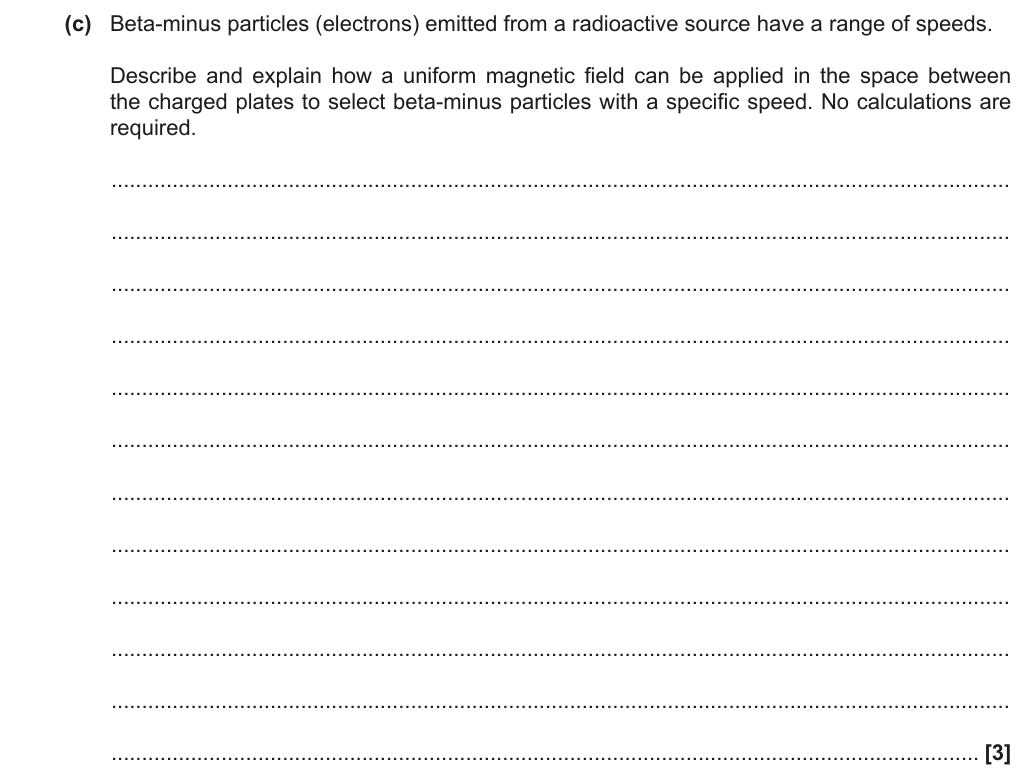
24(c) Magnetic fields and the motion of charged particles, Electric fields, Coulomb's law and electric potential 3Explanation
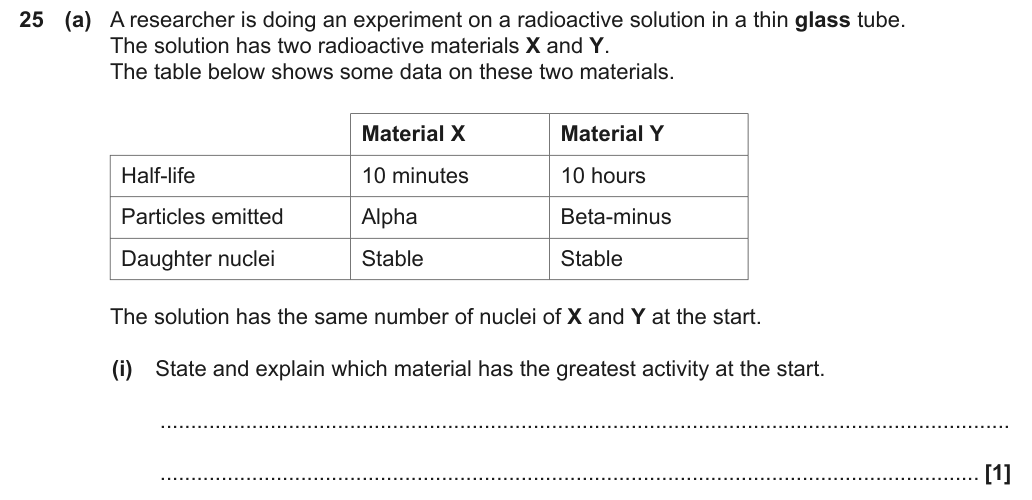
25(a)(i) Radioactivity: decay, half-life and activity 1Explanation
25(a)(ii) Radioactivity: decay, half-life and activity 1Short answer
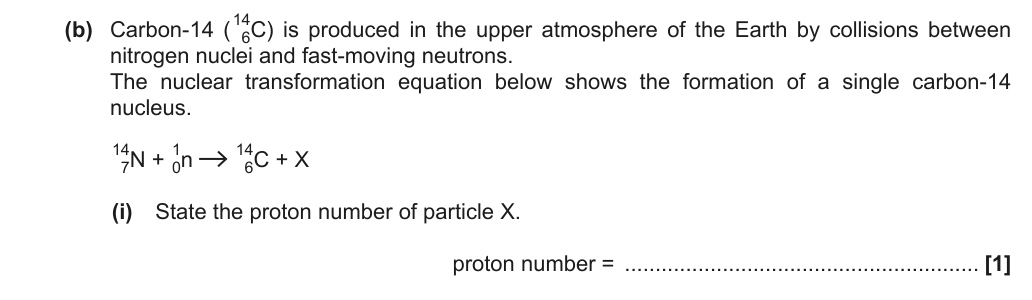
25(b)(i) Mass–energy, binding energy, fission and fusion 1Calculation
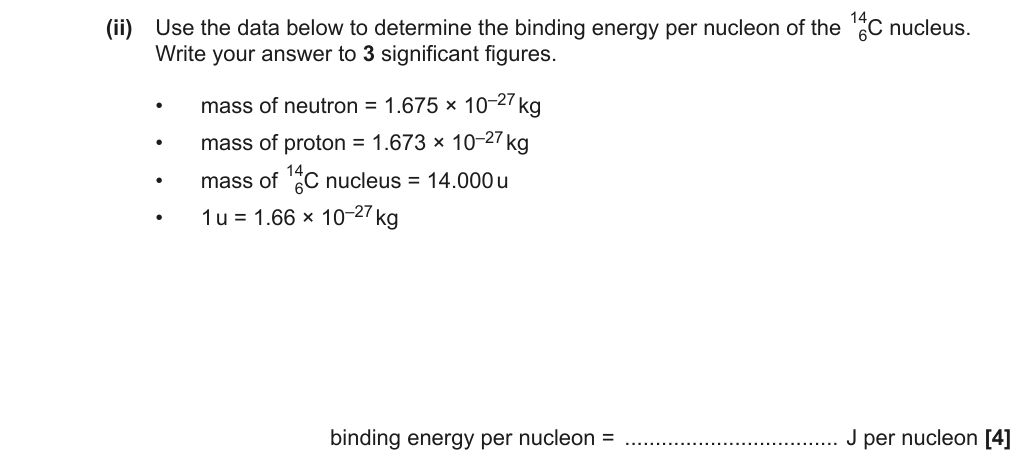
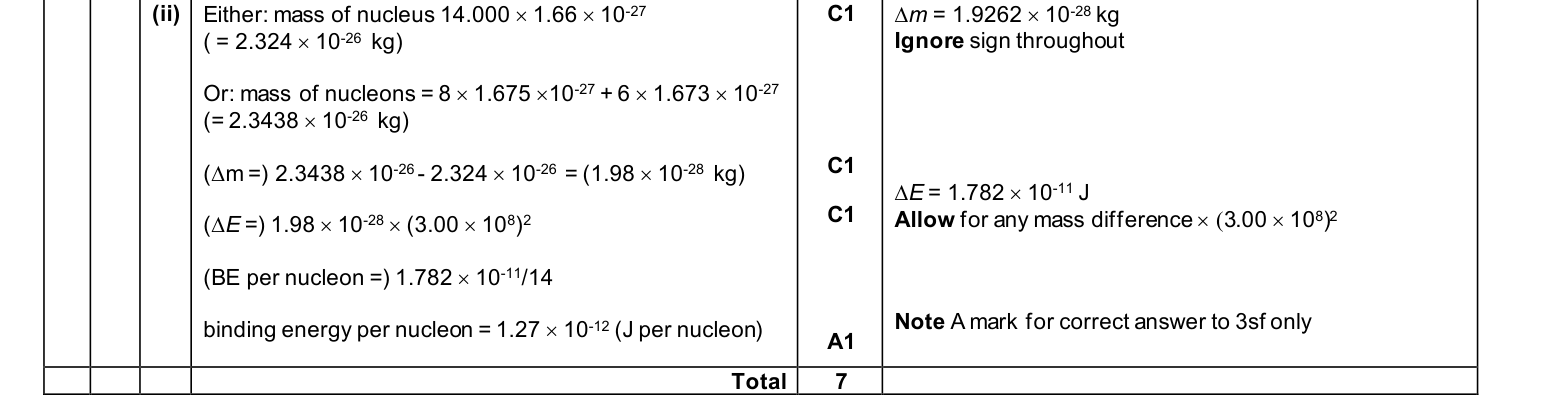
25(b)(ii) Mass–energy, binding energy, fission and fusion, Practical skills: planning, analysis and evaluation 4Calculation

The questions

12345678910111213141516(a)(i)16(a)(ii)16(b)16(c)17(a)17(b)(i)17(b)(ii)18(a)(i)18(a)(ii)18(a)(iii)18(a)(iv)18(b)19(a)19(b)20(a)20(b)21(a)21(b)21(c)2223(a)23(b)24(a)(i)24(a)(ii)24(a)(iii)24(b)24(c)25(a)(i)25(a)(ii)25(b)(i)25(b)(ii)
November 2021 · Paper 2 · Q1 1 mark Multiple choice Easy electromagnetic induction
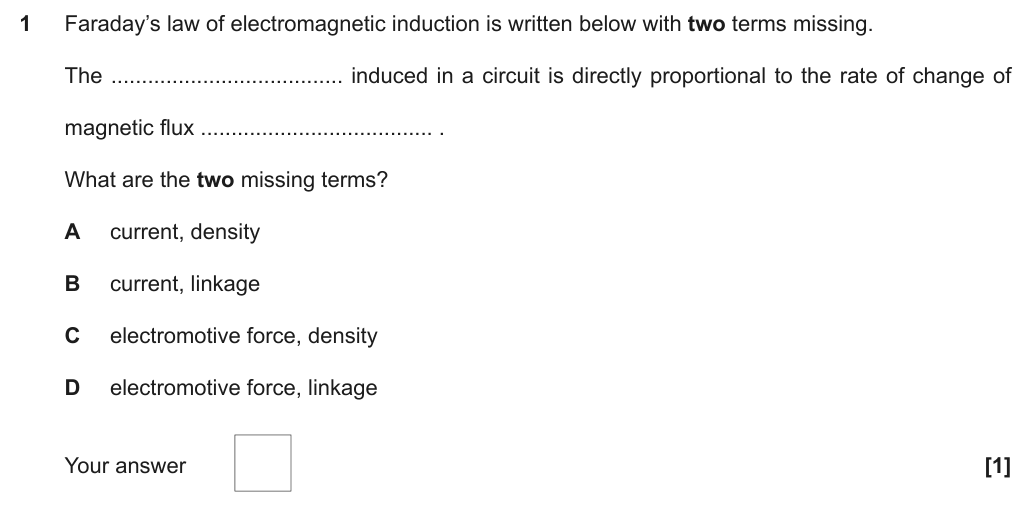
1 Faraday’s law of electromagnetic induction is written below with two terms missing.
The ...................................... induced in a circuit is directly proportional to the rate of change of
magnetic flux ...................................... .
What are the two missing terms?
A current, density
B current, linkage
C electromotive force, density
D electromotive force, linkage
Your answer [1]
November 2021 · Paper 2 · Q2 1 mark Multiple choice Easy wave motionsuperposition and interference
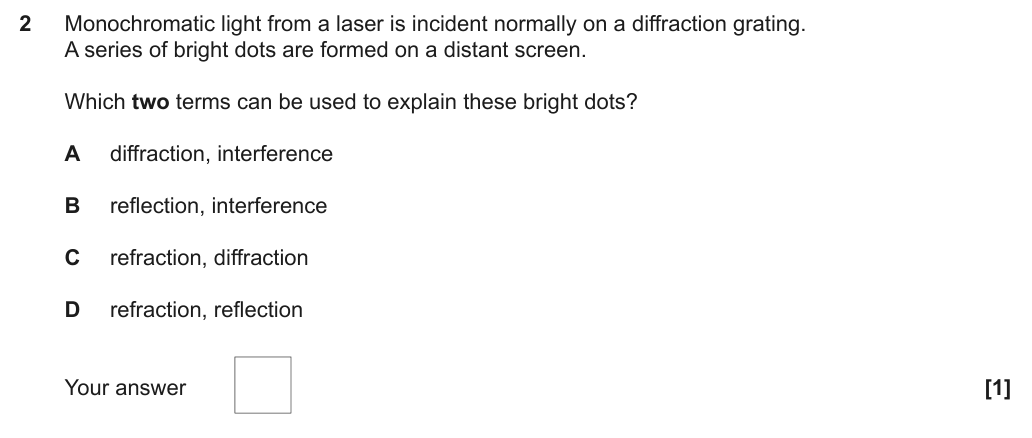
2 Monochromatic light from a laser is incident normally on a diffraction grating.
A series of bright dots are formed on a distant screen.
Which two terms can be used to explain these bright dots?
A diffraction, interference
B reflection, interference
C refraction, diffraction
D refraction, reflection
Your answer [1]
November 2021 · Paper 2 · Q3 1 mark Multiple choice Easy electrical power
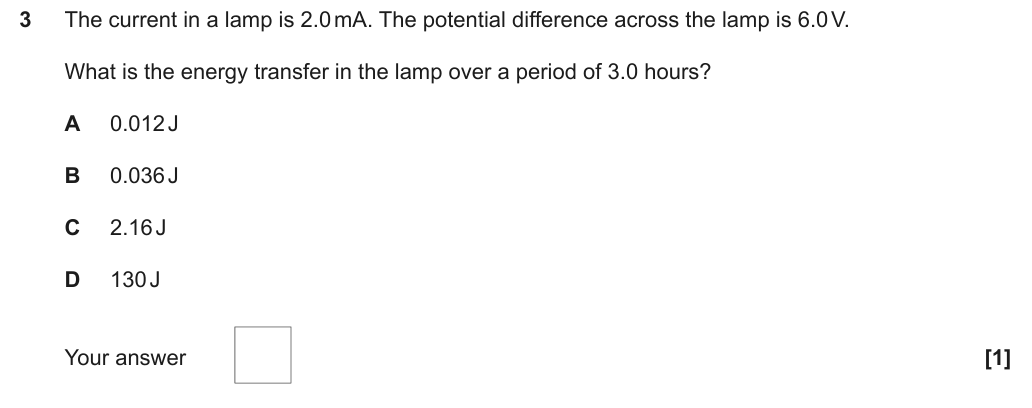
3 The current in a lamp is 2.0 mA. The potential difference across the lamp is 6.0 V.
What is the energy transfer in the lamp over a period of 3.0 hours?
A 0.012 J
B 0.036 J
C 2.16 J
D 130 J
Your answer [1]
November 2021 · Paper 2 · Q4 1 mark Multiple choice Hard electric fields
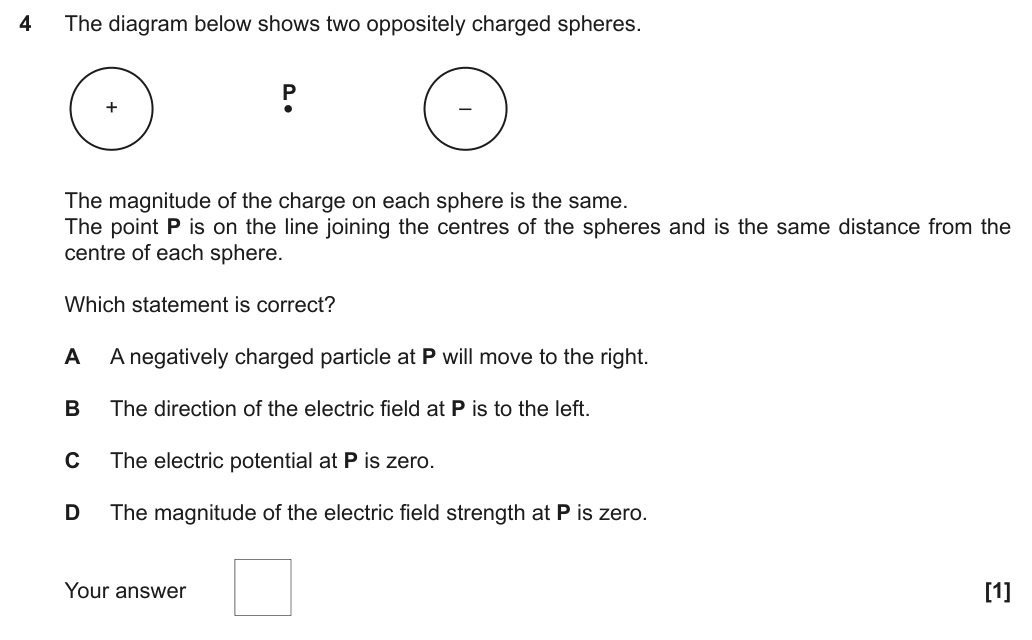
4 The diagram below shows two oppositely charged spheres.
P
+ –
The magnitude of the charge on each sphere is the same.
The point P is on the line joining the centres of the spheres and is the same distance from the
centre of each sphere.
Which statement is correct?
A A negatively charged particle at P will move to the right.
B The direction of the electric field at P is to the left.
C The electric potential at P is zero.
D The magnitude of the electric field strength at P is zero.
Your answer [1]
November 2021 · Paper 2 · Q5 1 mark Multiple choice Hard emf pd and resistancecharge and current
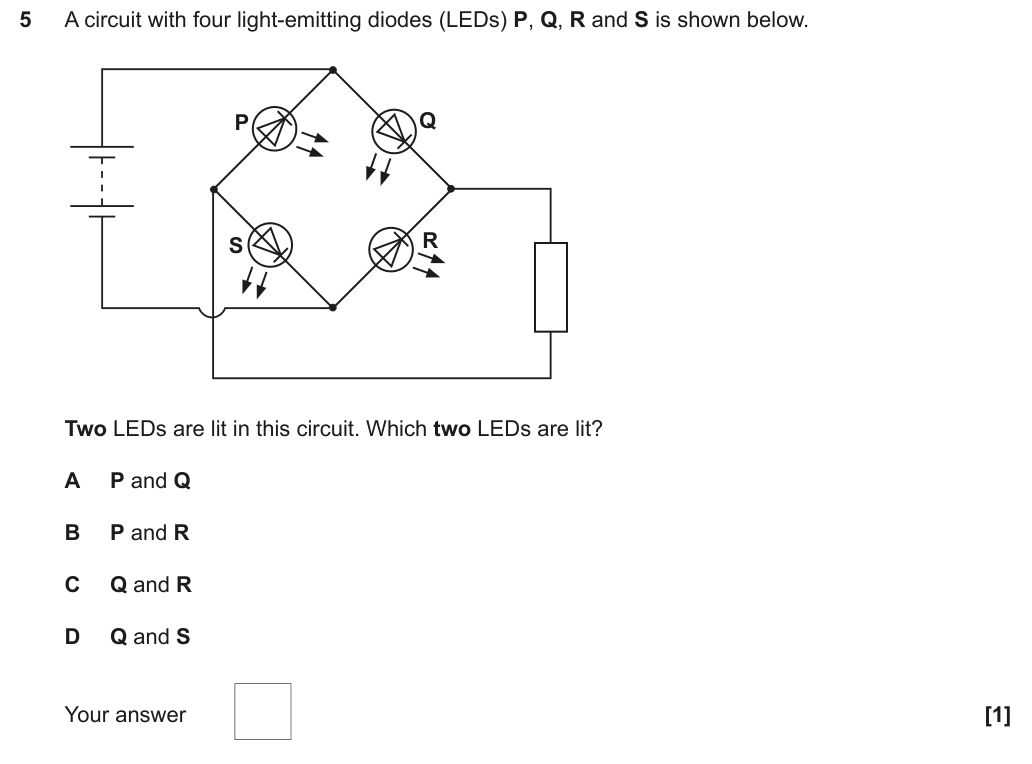
5 A circuit with four light-emitting diodes (LEDs) P, Q, R and S is shown below.
P Q
S R
Two LEDs are lit in this circuit. Which two LEDs are lit?
A P and Q
B P and R
C Q and R
D Q and S
Your answer [1]
November 2021 · Paper 2 · Q6 1 mark Multiple choice Easy capacitors
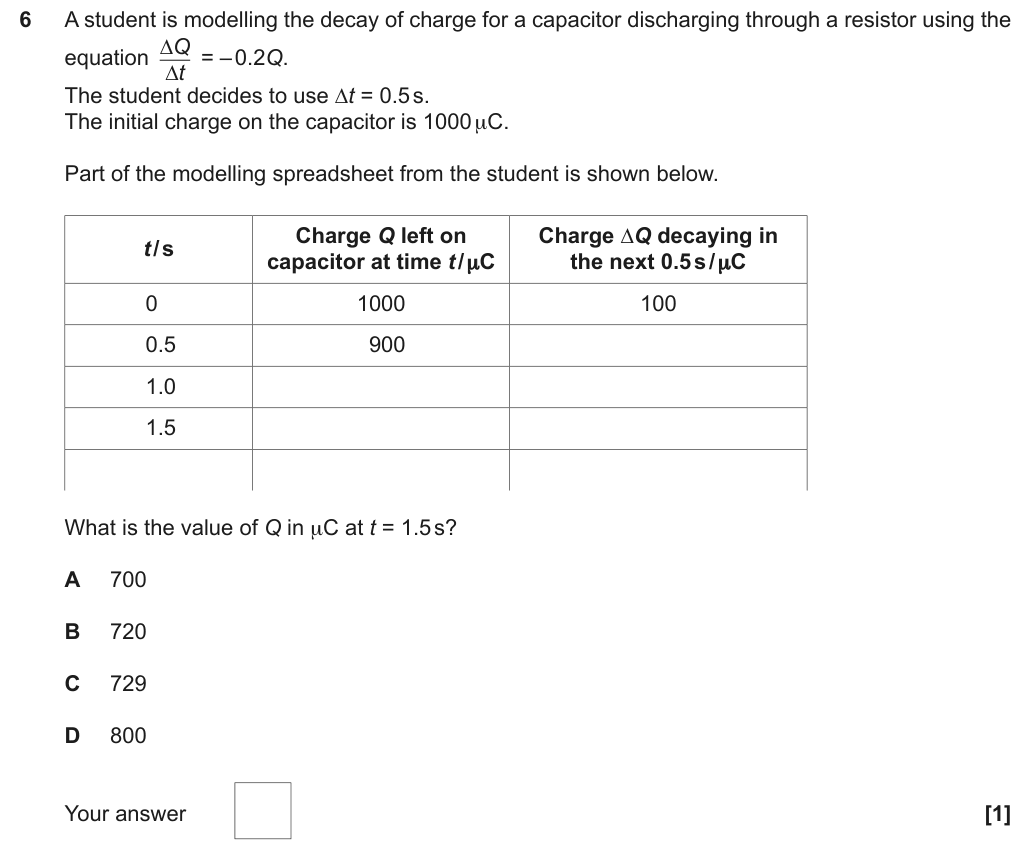
6 A student is modelling the decay of charge for a capacitor discharging through a resistor using the
equation ∆Q
∆t = – 0.2Q.
The student decides to use ∆t = 0.5 s.
The initial charge on the capacitor is 1000 µC.
Part of the modelling spreadsheet from the student is shown below.
Charge Q left on Charge ∆Q decaying in
t / s
capacitor at time t / µC the next 0.5 s / µC
0 1000 100
0.5 900
1.0
1.5
What is the value of Q in µC at t = 1.5 s?
A 700
B 720
C 729
D 800
Your answer [1]
November 2021 · Paper 2 · Q7 1 mark Multiple choice Hard potential dividers
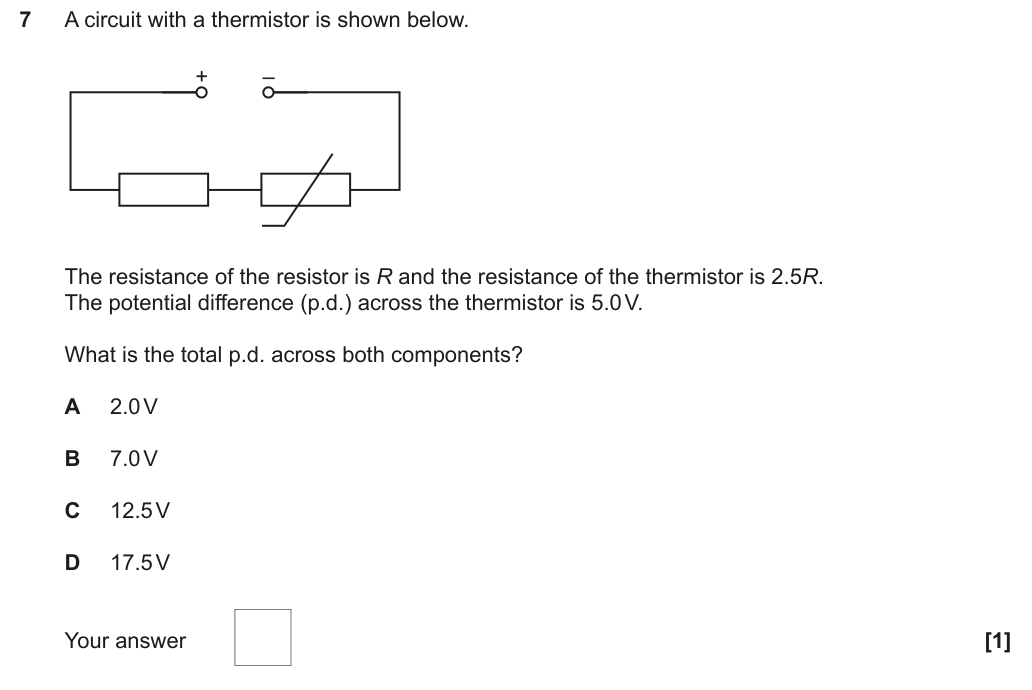
7 A circuit with a thermistor is shown below.
+ –
The resistance of the resistor is R and the resistance of the thermistor is 2.5R.
The potential difference (p.d.) across the thermistor is 5.0 V.
What is the total p.d. across both components?
A 2.0 V
B 7.0 V
C 12.5 V
D 17.5 V
Your answer [1]
November 2021 · Paper 2 · Q8 1 mark Multiple choice Medium superposition and interference
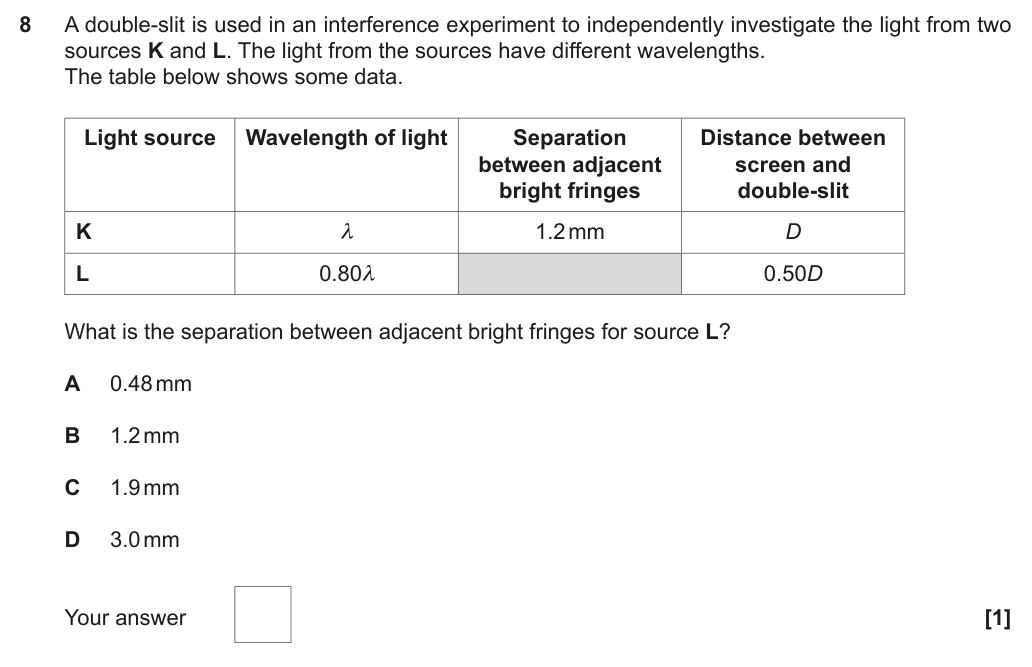
8 A double-slit is used in an interference experiment to independently investigate the light from two
sources K and L. The light from the sources have different wavelengths.
The table below shows some data.
Light source Wavelength of light Separation Distance between
between adjacent screen and
bright fringes double‑slit
K λ 1.2 mm D
L 0.80λ 0.50D
What is the separation between adjacent bright fringes for source L?
A 0.48 mm
B 1.2 mm
C 1.9 mm
D 3.0 mm
Your answer [1]
November 2021 · Paper 2 · Q9 1 mark Multiple choice Easy stationary waveswave motion
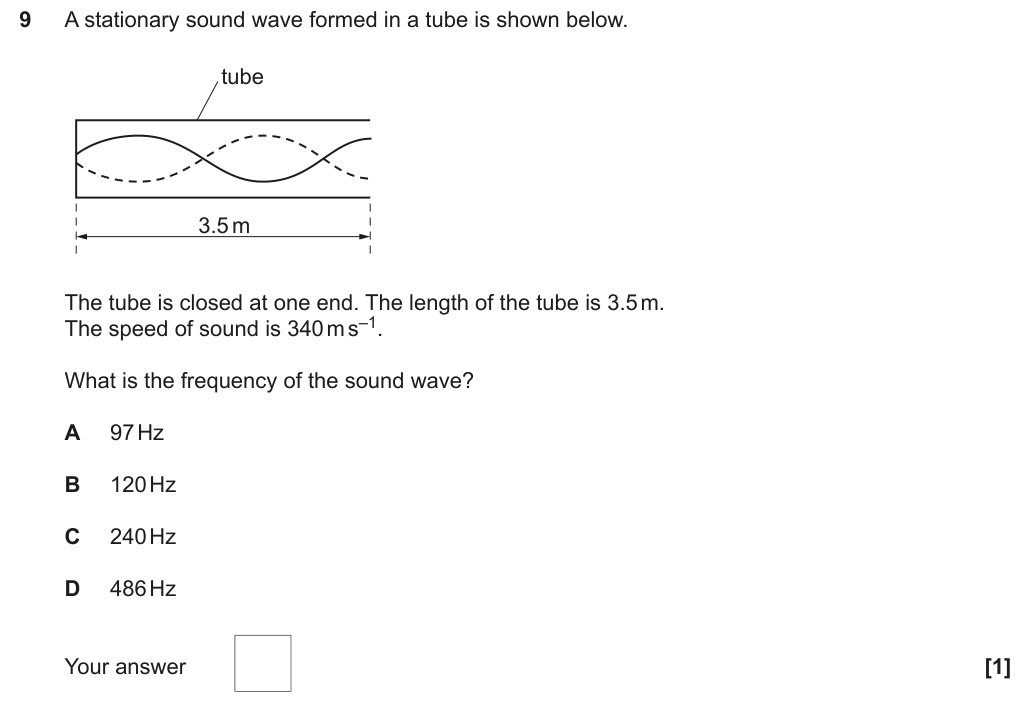
9 A stationary sound wave formed in a tube is shown below.
tube
3.5 m
The tube is closed at one end. The length of the tube is 3.5 m.
The speed of sound is 340 m s–1.
What is the frequency of the sound wave?
A 97 Hz
B 120 Hz
C 240 Hz
D 486 Hz
Your answer [1]
November 2021 · Paper 2 · Q10 1 mark Multiple choice Medium electrical powercharge and currentseries and parallel circuits
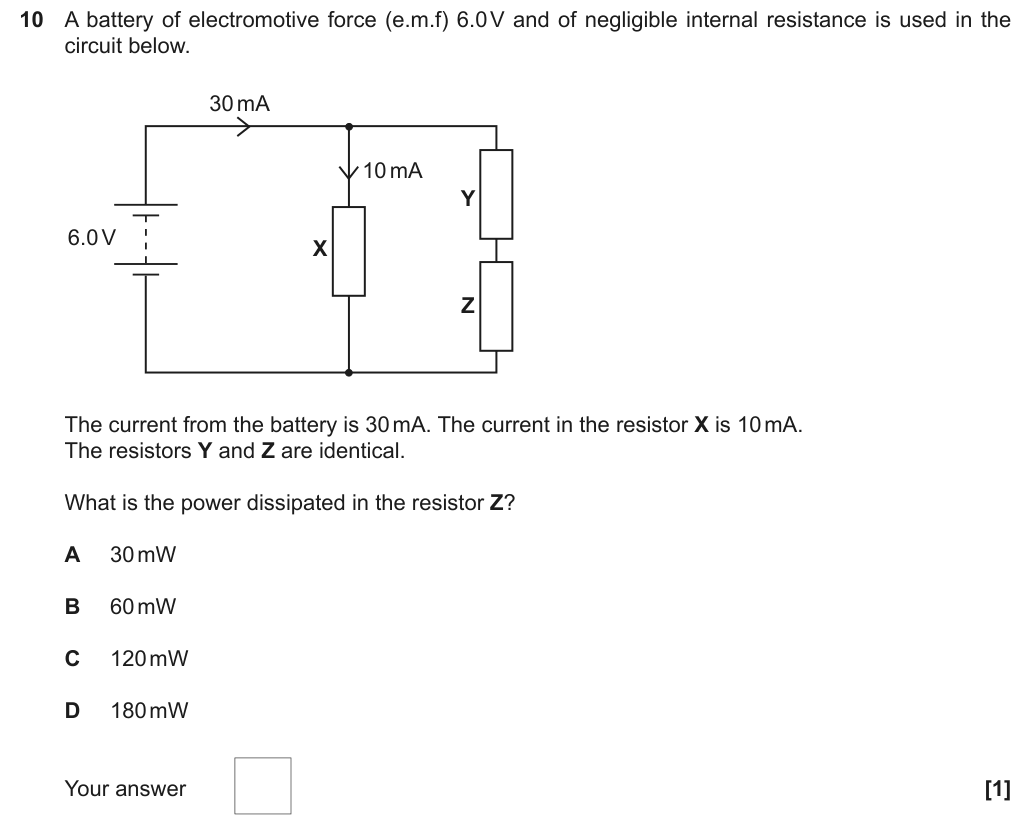
10 A battery of electromotive force (e.m.f) 6.0 V and of negligible internal resistance is used in the
circuit below.
30 mA
10 mA
Y
6.0 V
X
Z
The current from the battery is 30 mA. The current in the resistor X is 10 mA.
The resistors Y and Z are identical.
What is the power dissipated in the resistor Z?
A 30 mW
B 60 mW
C 120 mW
D 180 mW
Your answer [1]
November 2021 · Paper 2 · Q11 1 mark Multiple choice Hard superposition and interferencewave motion
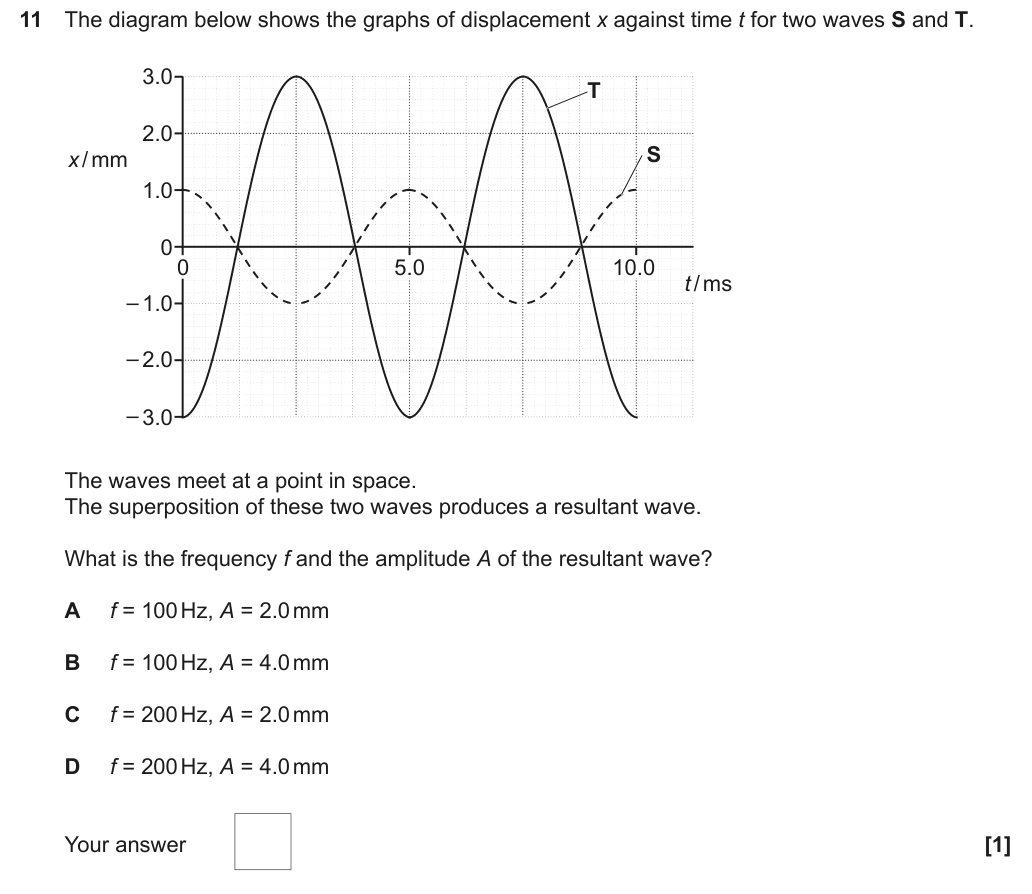
11 The diagram below shows the graphs of displacement x against time t for two waves S and T.
3.0
T T
2.0
x / mm S S
1.0
0
0 5.0 10.0
t / ms
– 1.0
– 2.0
– 3.0
The waves meet at a point in space.
The superposition of these two waves produces a resultant wave.
What is the frequency f and the amplitude A of the resultant wave?
A f = 100 Hz, A = 2.0 mm
B f = 100 Hz, A = 4.0 mm
C f = 200 Hz, A = 2.0 mm
D f = 200 Hz, A = 4.0 mm
Your answer [1]
November 2021 · Paper 2 · Q12 1 mark Multiple choice Hard electromagnetic induction
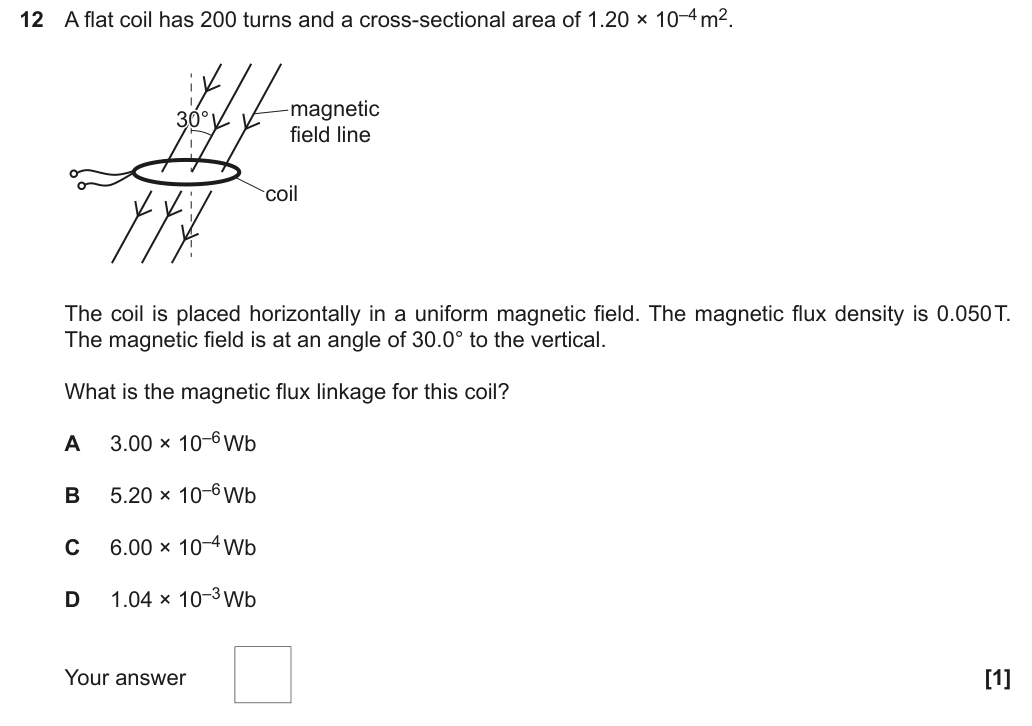
12 A flat coil has 200 turns and a cross-sectional area of 1.20 × 10⁻⁴ m2.
magnetic
30° 30°
field line
coil
The coil is placed horizontally in a uniform magnetic field. The magnetic flux density is 0.050 T.

The magnetic field is at an angle of 30.0° to the vertical.
What is the magnetic flux linkage for this coil?
A 3.00 × 10⁻⁶ Wb
B 5.20 × 10⁻⁶ Wb
C 6.00 × 10⁻⁴ Wb
D 1.04 × 10⁻³ Wb
Your answer [1]
November 2021 · Paper 2 · Q13 1 mark Multiple choice Hard radioactivitynuclear atom and particles
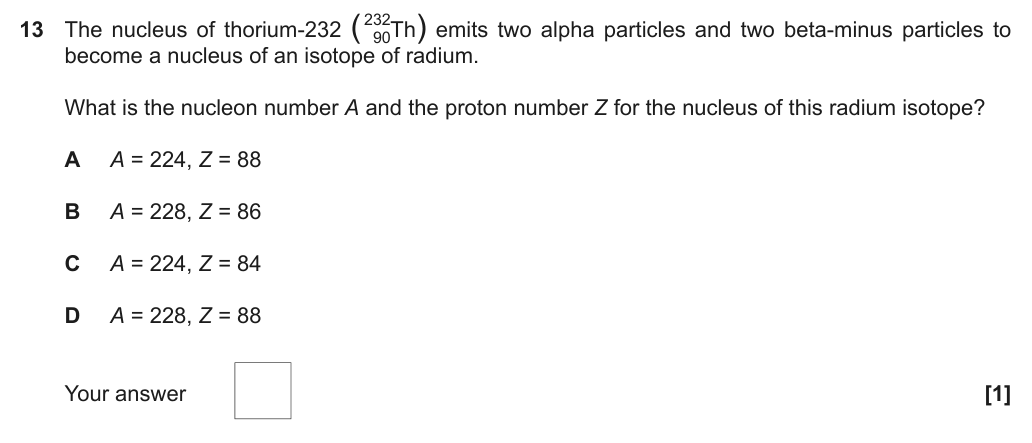
13 The nucleus of thorium-232 ( 232 90Th) emits two alpha particles and two beta-minus particles to
become a nucleus of an isotope of radium.
What is the nucleon number A and the proton number Z for the nucleus of this radium isotope?
A A = 224, Z = 88
B A = 228, Z = 86
C A = 224, Z = 84
D A = 228, Z = 88
Your answer [1]
November 2021 · Paper 2 · Q14 1 mark Multiple choice Easy medical imaging
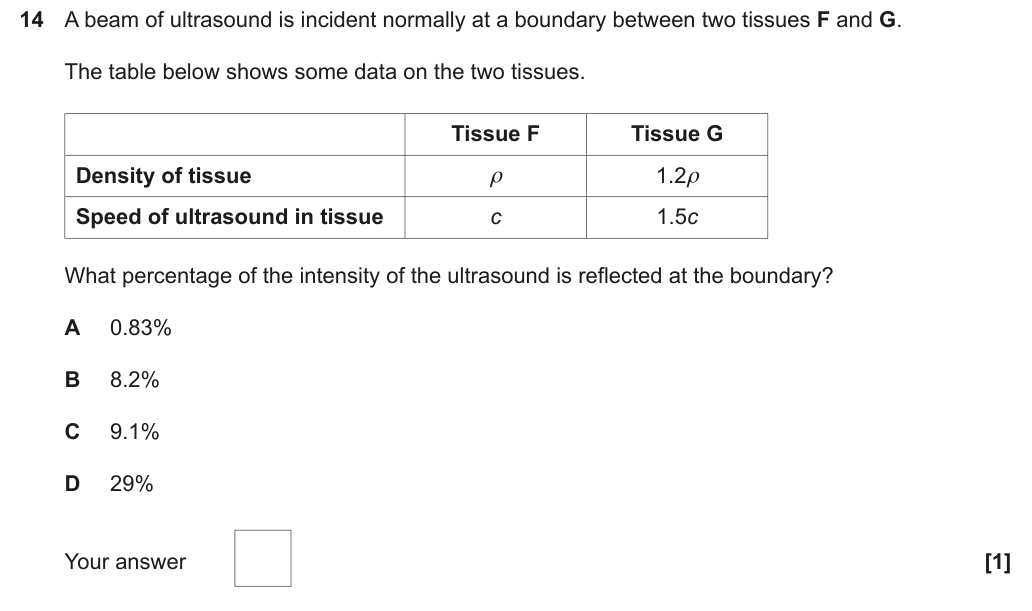
14 A beam of ultrasound is incident normally at a boundary between two tissues F and G.
The table below shows some data on the two tissues.
Tissue F Tissue G
Density of tissue ρ 1.2ρ
Speed of ultrasound in tissue c 1.5c
What percentage of the intensity of the ultrasound is reflected at the boundary?
A 0.83%
B 8.2%
C 9.1%
D 29%
Your answer [1]
November 2021 · Paper 2 · Q15 1 mark Multiple choice Hard radioactivity
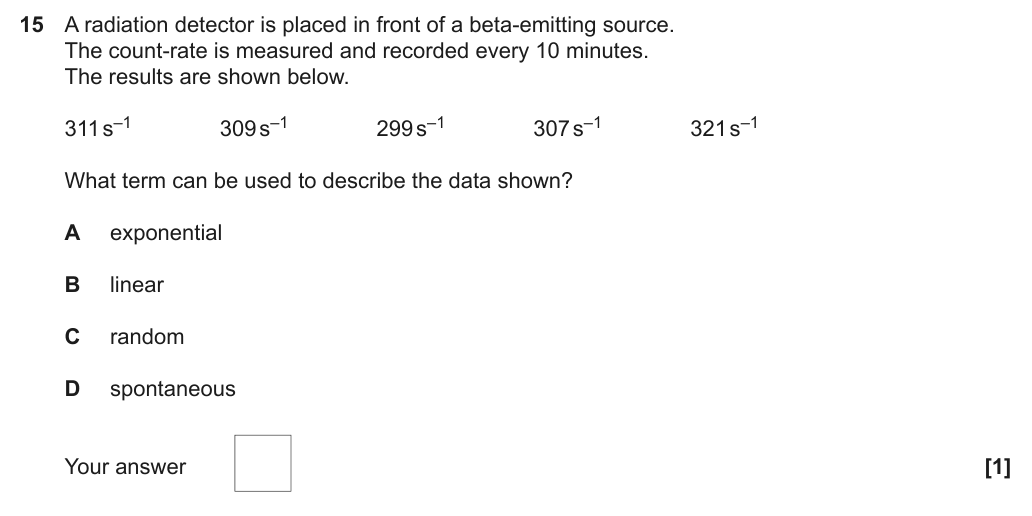
15 A radiation detector is placed in front of a beta-emitting source.
The count-rate is measured and recorded every 10 minutes.
The results are shown below.
311 s–1    309 s–1    299 s–1    307 s–1    321 s–1
What term can be used to describe the data shown?
A exponential
B linear
C random
D spontaneous
Your answer [1]
November 2021 · Paper 2 · Q16(a)(i) 2 marks Calculation Easy wave motion
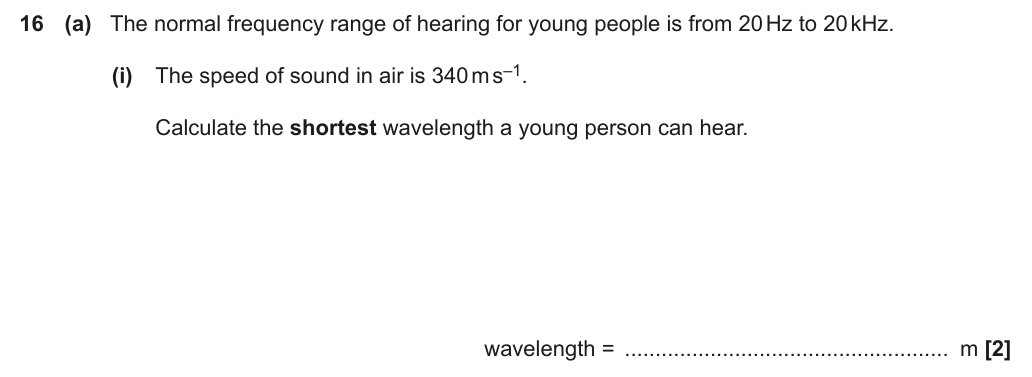
16 (a) The normal frequency range of hearing for young people is from 20 Hz to 20 kHz.
(i) The speed of sound in air is 340 m s–1.
Calculate the shortest wavelength a young person can hear.
wavelength =  ..................................................... m [2]
November 2021 · Paper 2 · Q16(a)(ii) 3 marks Explanation Hard wave motionpractical skills
(ii) Describe how you can use an oscilloscope, and other additional laboratory equipment,
to determine the actual upper limit of the frequency range for a young person.
...........................................................................................................................................
...........................................................................................................................................
...........................................................................................................................................
...........................................................................................................................................
...........................................................................................................................................
...........................................................................................................................................
...................................................................................................................................... [3]
November 2021 · Paper 2 · Q16(b) 2 marks Short answer Hard stationary waves
(b) State one difference and one similarity between the oscillations of a stationary sound wave
and a progressive sound wave.
Difference:  ................................................................................................................................
...................................................................................................................................................
Similarity:  ..................................................................................................................................
...................................................................................................................................................
[2]
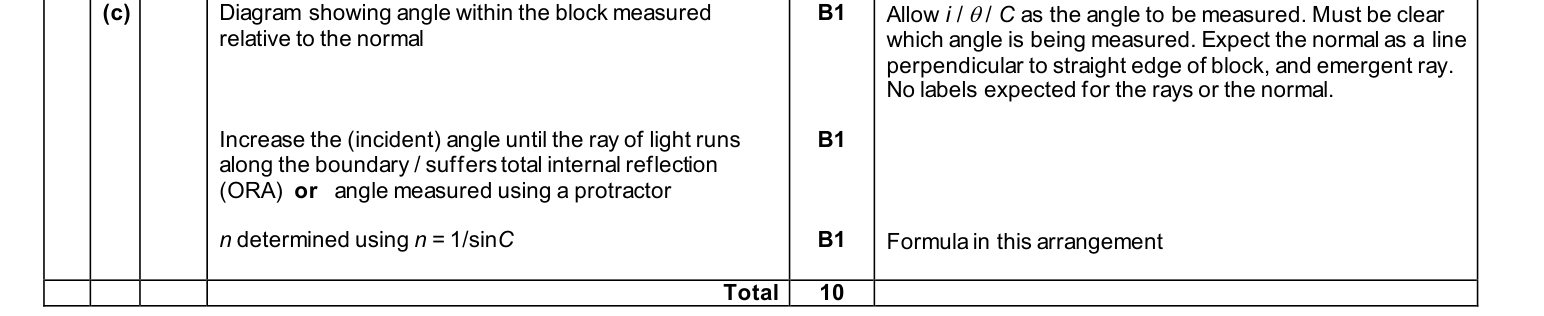
November 2021 · Paper 2 · Q16(c) 3 marks Diagram or graph Medium electromagnetic waves and refraction
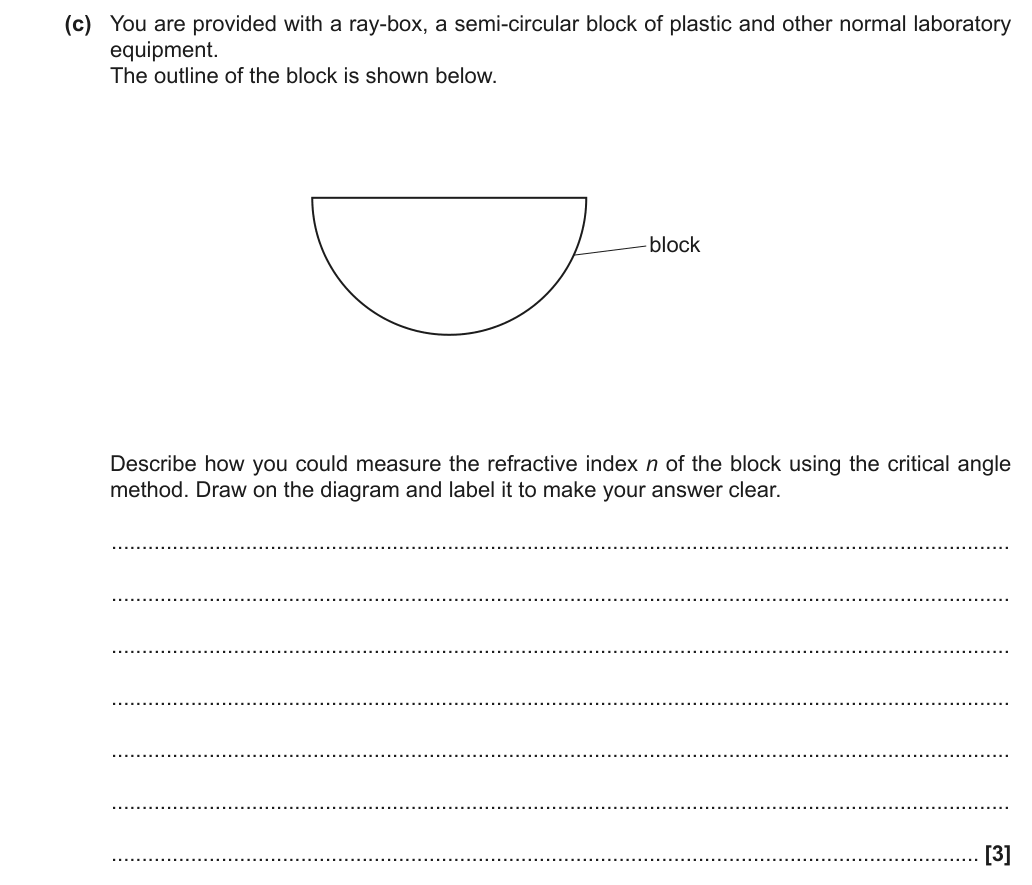
(c) You are provided with a ray-box, a semi-circular block of plastic and other normal laboratory
equipment.
The outline of the block is shown below.
block
Describe how you could measure the refractive index n of the block using the critical angle
method. Draw on the diagram and label it to make your answer clear.
...................................................................................................................................................
...................................................................................................................................................
...................................................................................................................................................
...................................................................................................................................................
...................................................................................................................................................
...................................................................................................................................................
.............................................................................................................................................. [3]
November 2021 · Paper 2 · Q17(a) 1 mark Short answer Hard photoelectric effect
17 (a) Define the work function of a metal.
...................................................................................................................................................
.............................................................................................................................................. [1]
November 2021 · Paper 2 · Q17(b)(i) 4 marks Explanation Medium photoelectric effectphotons
(b) The work function of potassium is 2.3 eV.
(i) Potassium emits electrons from its surface when blue light is incident on it. Extremely
intense red light produces no electrons.
Explain these observations in terms of photons and their energy.
...........................................................................................................................................
...........................................................................................................................................
...........................................................................................................................................
...........................................................................................................................................
...........................................................................................................................................
...........................................................................................................................................
...........................................................................................................................................
...................................................................................................................................... [4]
November 2021 · Paper 2 · Q17(b)(ii) 4 marks Calculation Medium photoelectric effectphotonswave particle duality
Earlier part of question 17 that this part usesEarlier part of November 2021 Paper 2 question 17
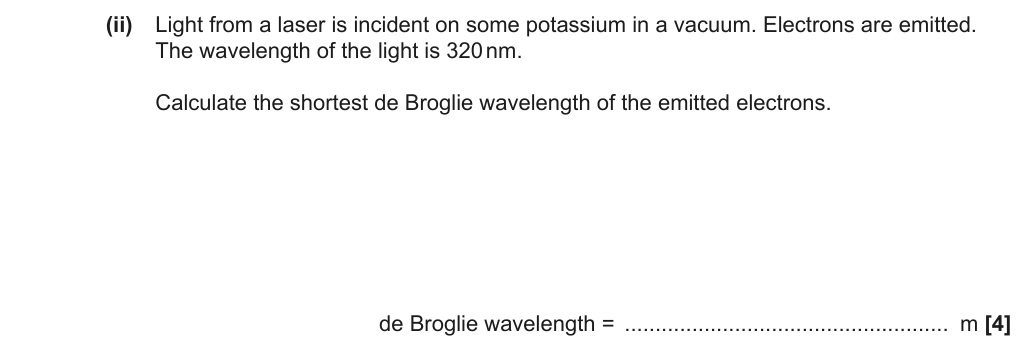
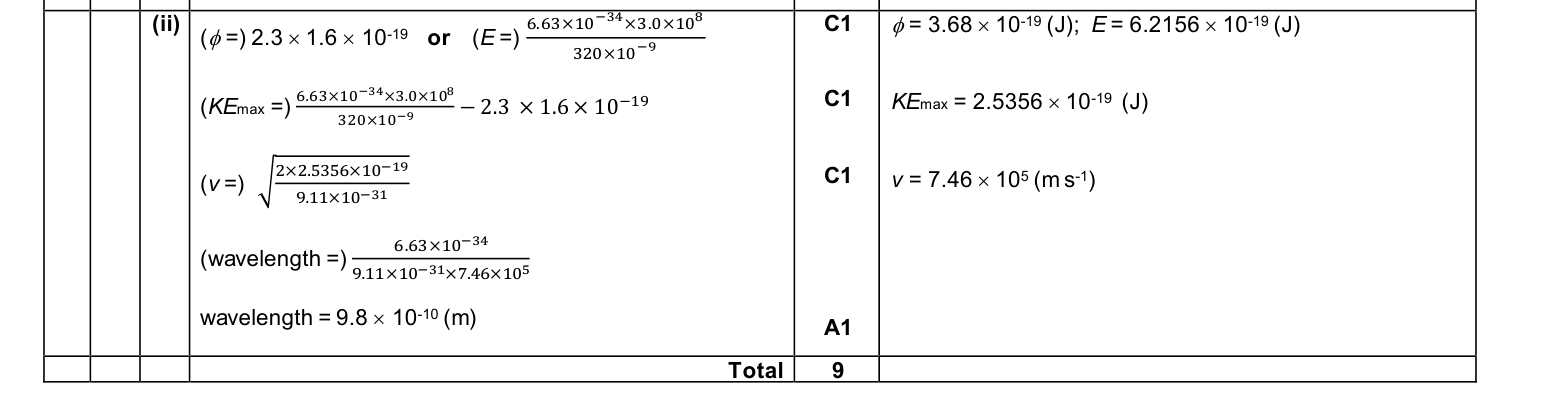
(ii) Light from a laser is incident on some potassium in a vacuum. Electrons are emitted.
The wavelength of the light is 320 nm.
Calculate the shortest de Broglie wavelength of the emitted electrons.
de Broglie wavelength =  ..................................................... m [4]
November 2021 · Paper 2 · Q18(a)(i) 1 mark Diagram or graph Easy charge and currentseries and parallel circuits
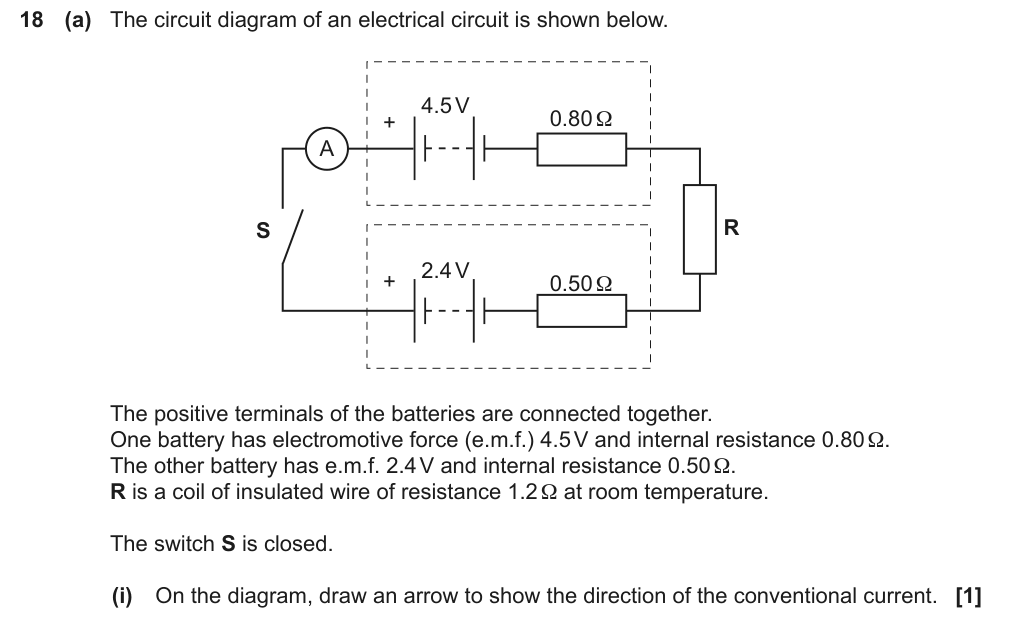
18 (a) The circuit diagram of an electrical circuit is shown below.
4.5 V
+ 0.80 Ω
A
S R
2.4 V
+ 0.50 Ω
The positive terminals of the batteries are connected together.
One battery has electromotive force (e.m.f.) 4.5 V and internal resistance 0.80 Ω.
The other battery has e.m.f. 2.4 V and internal resistance 0.50 Ω.
R is a coil of insulated wire of resistance 1.2 Ω at room temperature.
The switch S is closed.
(i) On the diagram, draw an arrow to show the direction of the conventional current.  [1]
November 2021 · Paper 2 · Q18(a)(ii) 3 marks Calculation Medium series and parallel circuitsinternal resistance
Earlier part of question 18 that this part usesEarlier part of November 2021 Paper 2 question 18
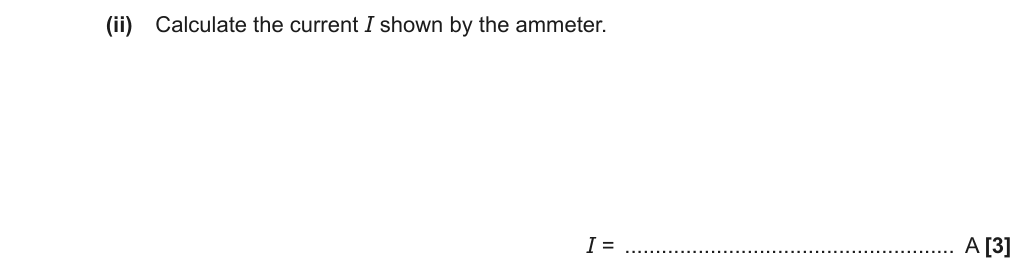
(ii) Calculate the current I shown by the ammeter.
I =  ...................................................... A [3]
November 2021 · Paper 2 · Q18(a)(iii) 2 marks Calculation Hard charge and current
Earlier part of question 18 that this part usesEarlier part of November 2021 Paper 2 question 18
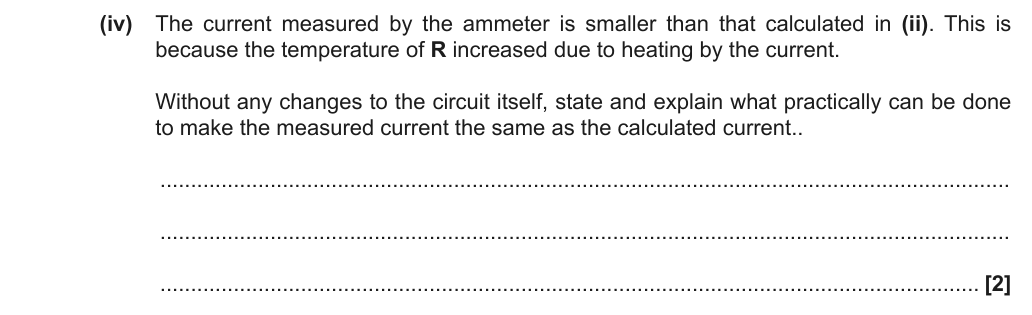
(iii) The insulated wire has diameter 4.6 × 10⁻⁴ m.
The number density of charge carriers in R is 4.2 × 1028 m–3.
Calculate the mean drift velocity v of the charge carriers in R.
v =  ................................................ m s–1 [2]
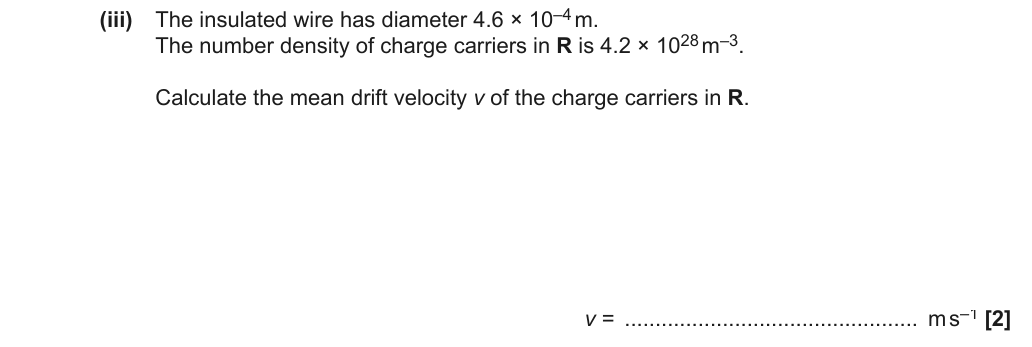
November 2021 · Paper 2 · Q18(a)(iv) 2 marks Explanation Medium resistivitypractical skills
Earlier parts of question 18 that this part usesEarlier part of November 2021 Paper 2 question 18Earlier part of November 2021 Paper 2 question 18
(iv) The current measured by the ammeter is smaller than that calculated in (ii). This is
because the temperature of R increased due to heating by the current.
Without any changes to the circuit itself, state and explain what practically can be done
to make the measured current the same as the calculated current..
...........................................................................................................................................
...........................................................................................................................................
...................................................................................................................................... [2]
November 2021 · Paper 2 · Q18(b) 6 marks 6-mark extended response Medium internal resistancepractical skillsemf pd and resistanceelectrical power
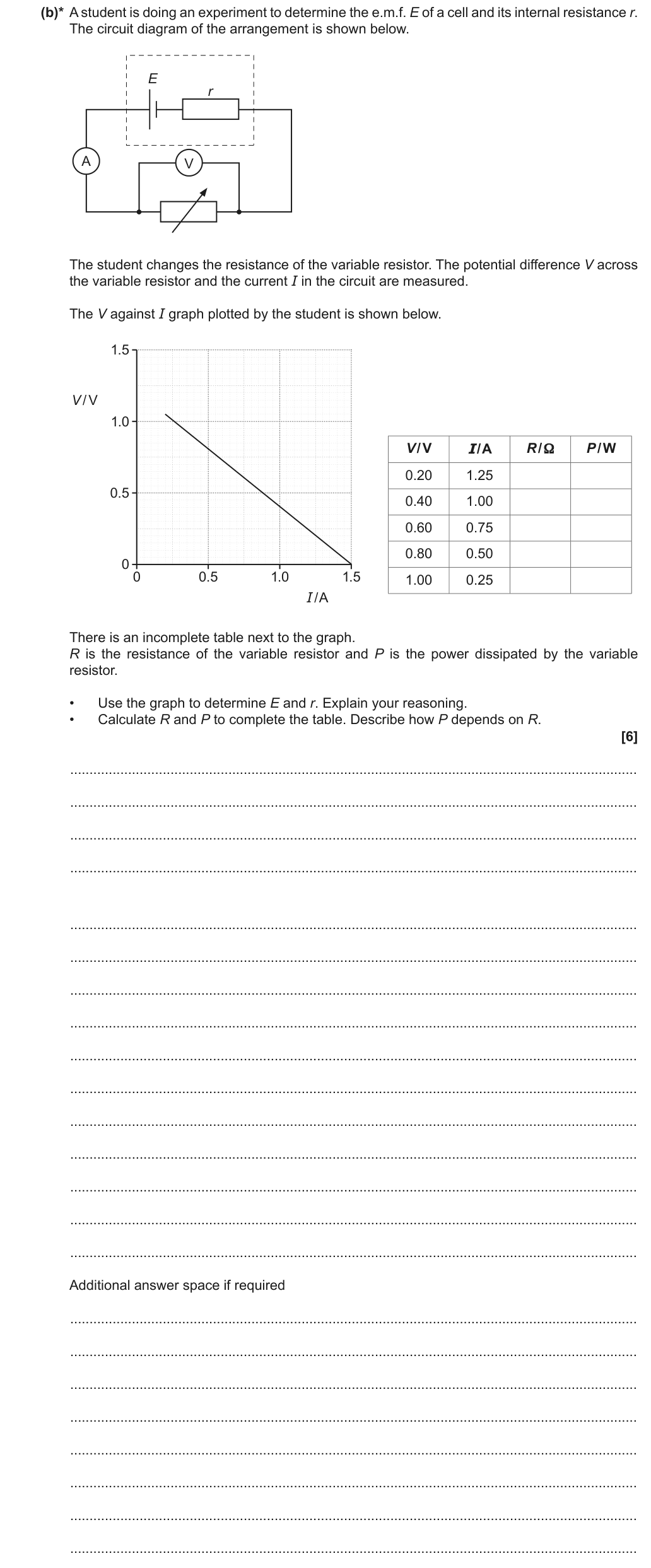
(b)* A student is doing an experiment to determine the e.m.f. E of a cell and its internal resistance r.
The circuit diagram of the arrangement is shown below.
E
r
A V
The student changes the resistance of the variable resistor. The potential difference V across
the variable resistor and the current I in the circuit are measured.
The V against I graph plotted by the student is shown below.
1.5
V / V
1.0
V / V I / A R / Ω P / W
0.20 1.25
0.5
0.40 1.00
0.60 0.75
0.80 0.50
0
0 0.5 1.0 1.5 1.00 0.25
I / A
There is an incomplete table next to the graph.
R is the resistance of the variable resistor and P is the power dissipated by the variable
resistor.
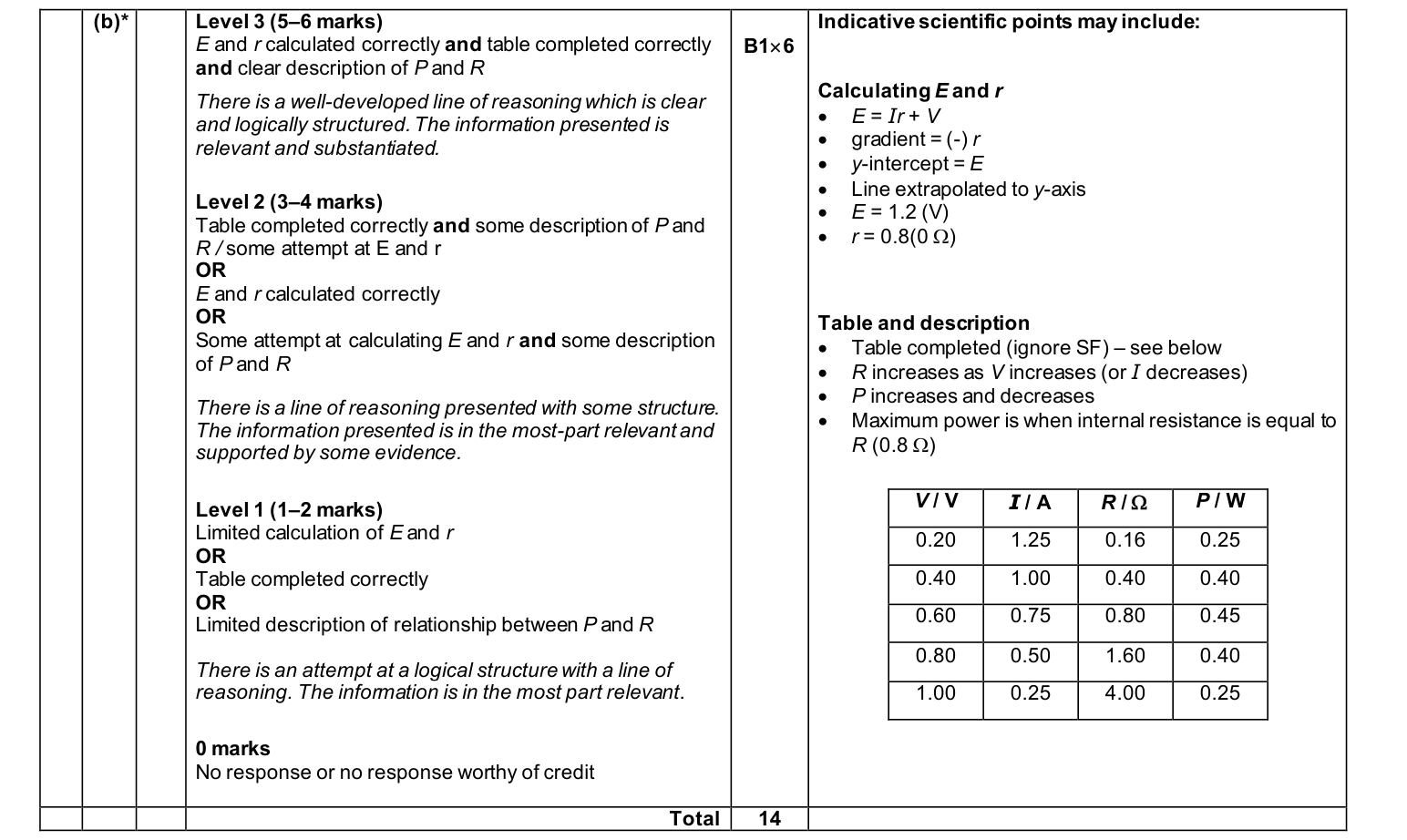
• Use the graph to determine E and r. Explain your reasoning.
• Calculate R and P to complete the table. Describe how P depends on R.
[6]
...................................................................................................................................................
...................................................................................................................................................
...................................................................................................................................................
...................................................................................................................................................
...................................................................................................................................................
...................................................................................................................................................
...................................................................................................................................................
...................................................................................................................................................
...................................................................................................................................................
...................................................................................................................................................
...................................................................................................................................................
...................................................................................................................................................
...................................................................................................................................................
...................................................................................................................................................
...................................................................................................................................................
Additional answer space if required
...................................................................................................................................................
...................................................................................................................................................
...................................................................................................................................................
...................................................................................................................................................
...................................................................................................................................................
...................................................................................................................................................
...................................................................................................................................................
...................................................................................................................................................
November 2021 · Paper 2 · Q19(a) 2 marks Diagram or graph Hard magnetic fields
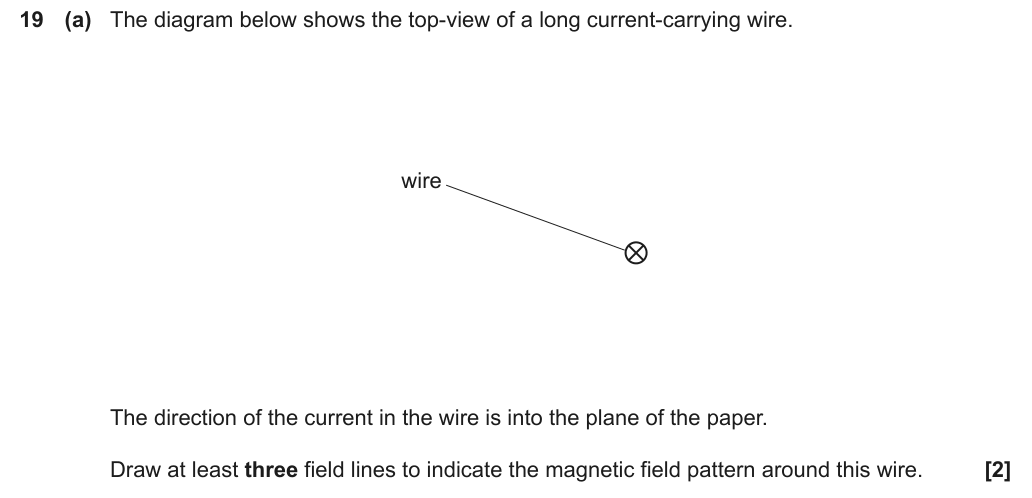
19 (a) The diagram below shows the top-view of a long current-carrying wire.
wire
The direction of the current in the wire is into the plane of the paper.
Draw at least three field lines to indicate the magnetic field pattern around this wire. [2]
November 2021 · Paper 2 · Q19(b) 4 marks Calculation Easy magnetic fieldspractical skillsmeasurements and uncertainties
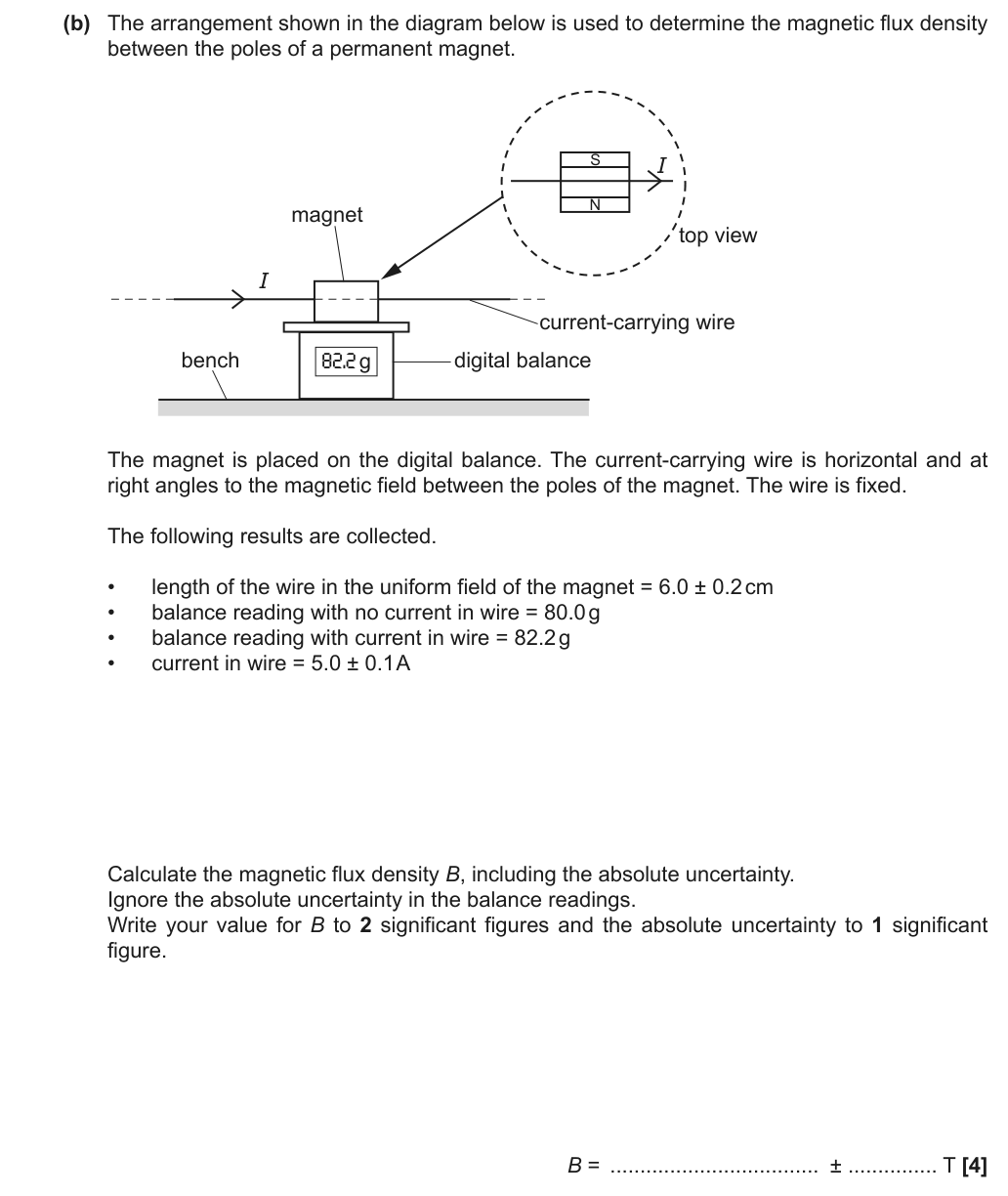
(b) The arrangement shown in the diagram below is used to determine the magnetic flux density
between the poles of a permanent magnet.
S I
magnet N
top view
I
current-carrying wire
bench 82.2 g digital balance
The magnet is placed on the digital balance. The current-carrying wire is horizontal and at
right angles to the magnetic field between the poles of the magnet. The wire is fixed.
The following results are collected.
• length of the wire in the uniform field of the magnet = 6.0 ± 0.2 cm
• balance reading with no current in wire = 80.0 g
• balance reading with current in wire = 82.2 g
• current in wire = 5.0 ± 0.1 A
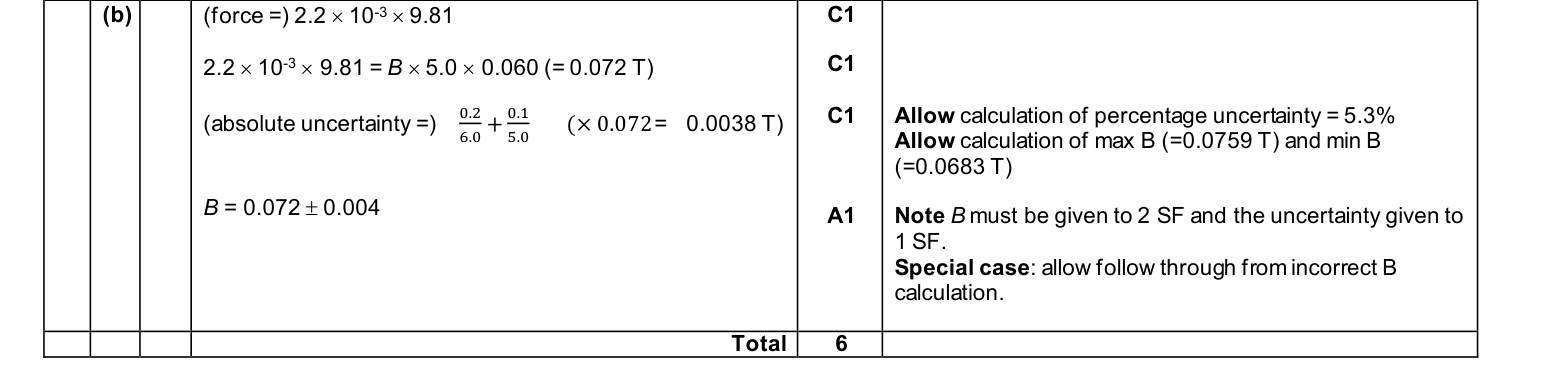
Calculate the magnetic flux density B, including the absolute uncertainty.
Ignore the absolute uncertainty in the balance readings.
Write your value for B to 2 significant figures and the absolute uncertainty to 1 significant
figure.
B =  ................................... ± ............... T [4]
November 2021 · Paper 2 · Q20(a) 4 marks Calculation Medium capacitors
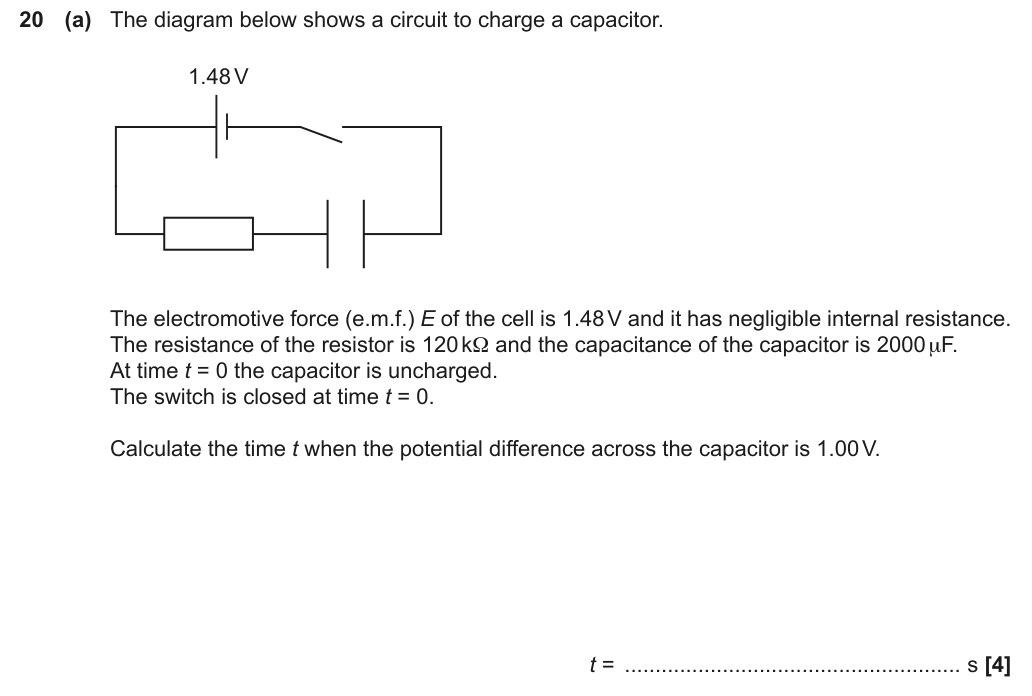
20 (a) The diagram below shows a circuit to charge a capacitor.
1.48 V
The electromotive force (e.m.f.) E of the cell is 1.48 V and it has negligible internal resistance.
The resistance of the resistor is 120 kΩ and the capacitance of the capacitor is 2000 µF.
At time t = 0 the capacitor is uncharged.
The switch is closed at time t = 0.
Calculate the time t when the potential difference across the capacitor is 1.00 V.
t =  ....................................................... s [4]
November 2021 · Paper 2 · Q20(b) 4 marks Diagram or graph Easy practical skillsmeasurements and uncertaintiescapacitors
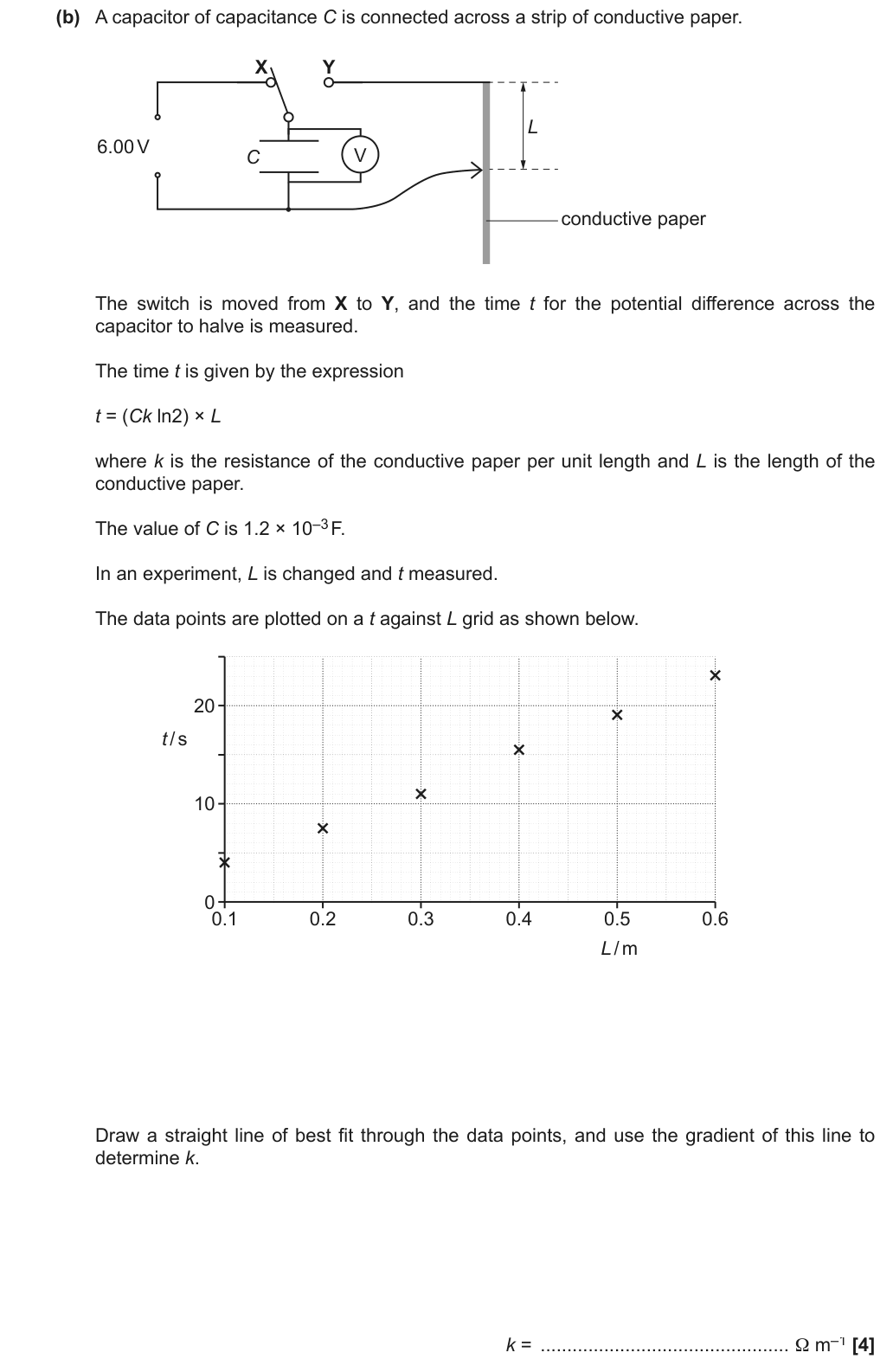
(b) A capacitor of capacitance C is connected across a strip of conductive paper.
X Y
L
6.00 V
C V
conductive paper
The switch is moved from X to Y, and the time t for the potential difference across the
capacitor to halve is measured.
The time t is given by the expression
t = (Ck ln2) × L
where k is the resistance of the conductive paper per unit length and L is the length of the
conductive paper.
The value of C is 1.2 × 10⁻³ F.
In an experiment, L is changed and t measured.
The data points are plotted on a t against L grid as shown below.
20
t / s
10
0
0.1 0.2 0.3 0.4 0.5 0.6
L / m
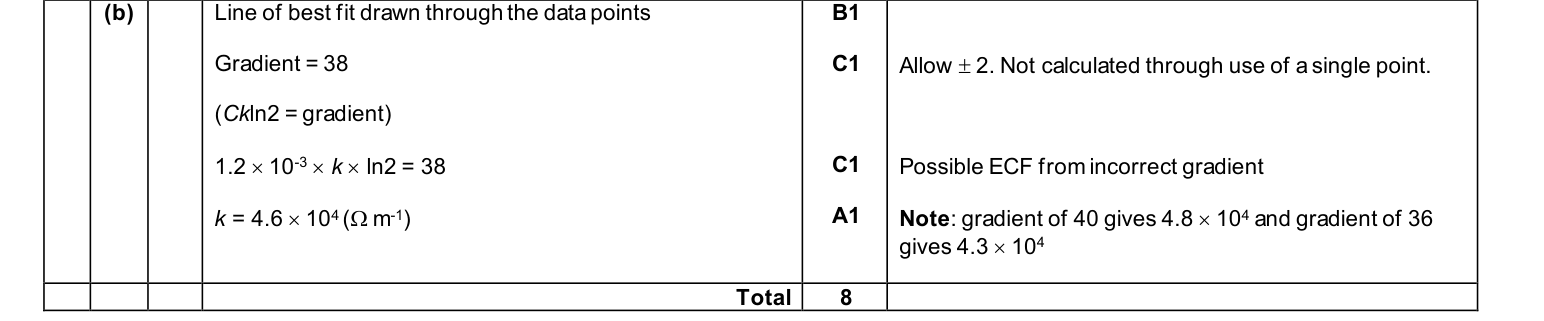
Draw a straight line of best fit through the data points, and use the gradient of this line to
determine k.
k =  ............................................... Ω m–1 [4]
November 2021 · Paper 2 · Q21(a) 2 marks Explanation Medium medical imaging
21 (a) A high-energy X-ray photon interacts with an electron of an atom through the Compton
effect.
Describe this effect.
...................................................................................................................................................
...................................................................................................................................................
...................................................................................................................................................
.............................................................................................................................................. [2]
November 2021 · Paper 2 · Q21(b) 4 marks Calculation Medium medical imagingwave motion
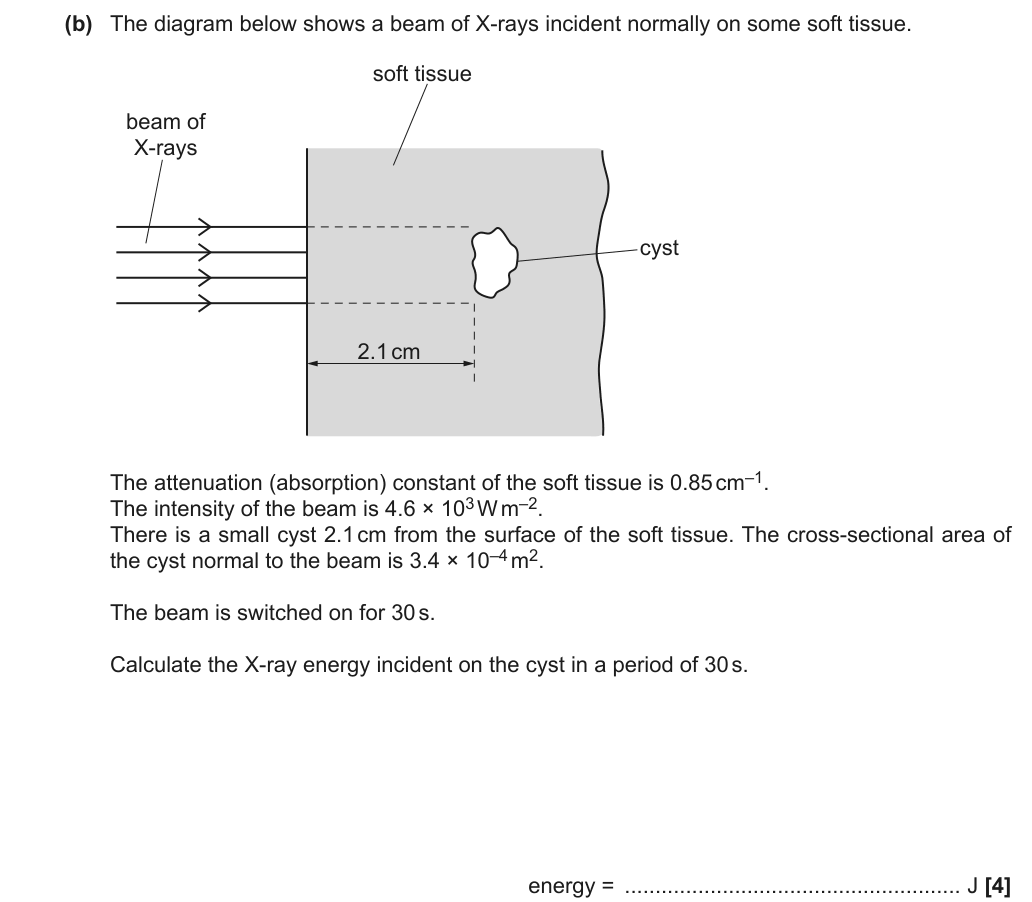
(b) The diagram below shows a beam of X-rays incident normally on some soft tissue.
soft tissue
beam of
X-rays
cyst
2.1 cm
The attenuation (absorption) constant of the soft tissue is 0.85 cm–1.
The intensity of the beam is 4.6 × 10³ W m–2.
There is a small cyst 2.1 cm from the surface of the soft tissue. The cross-sectional area of
the cyst normal to the beam is 3.4 × 10⁻⁴ m2.
The beam is switched on for 30 s.
Calculate the X-ray energy incident on the cyst in a period of 30 s.
energy =  ....................................................... J [4]
November 2021 · Paper 2 · Q21(c) 2 marks Explanation Medium medical imaging
Earlier part of question 21 that this part usesEarlier part of November 2021 Paper 2 question 21
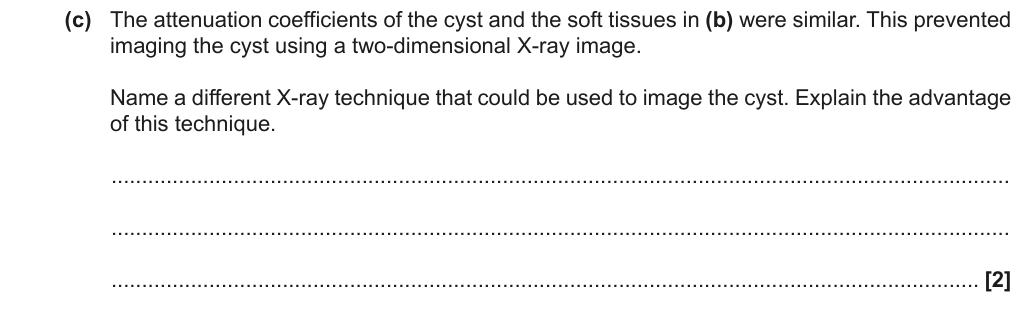
(c) The attenuation coefficients of the cyst and the soft tissues in (b) were similar. This prevented
imaging the cyst using a two-dimensional X-ray image.
Name a different X-ray technique that could be used to image the cyst. Explain the advantage
of this technique.
...................................................................................................................................................
...................................................................................................................................................
.............................................................................................................................................. [2]
November 2021 · Paper 2 · Q22 4 marks Explanation Hard medical imagingnuclear fission and fusion
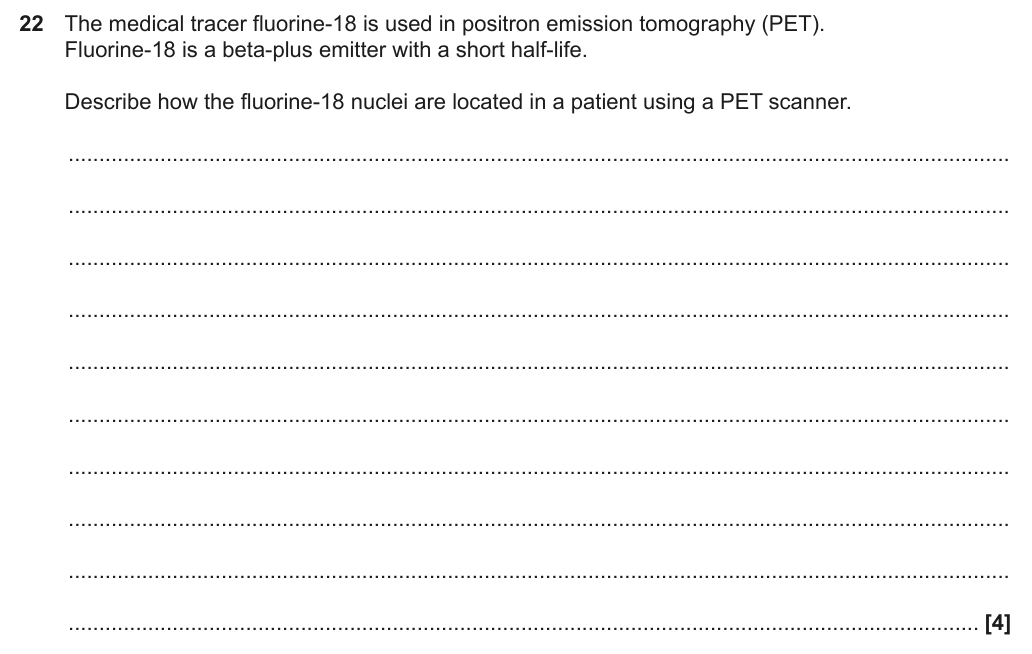
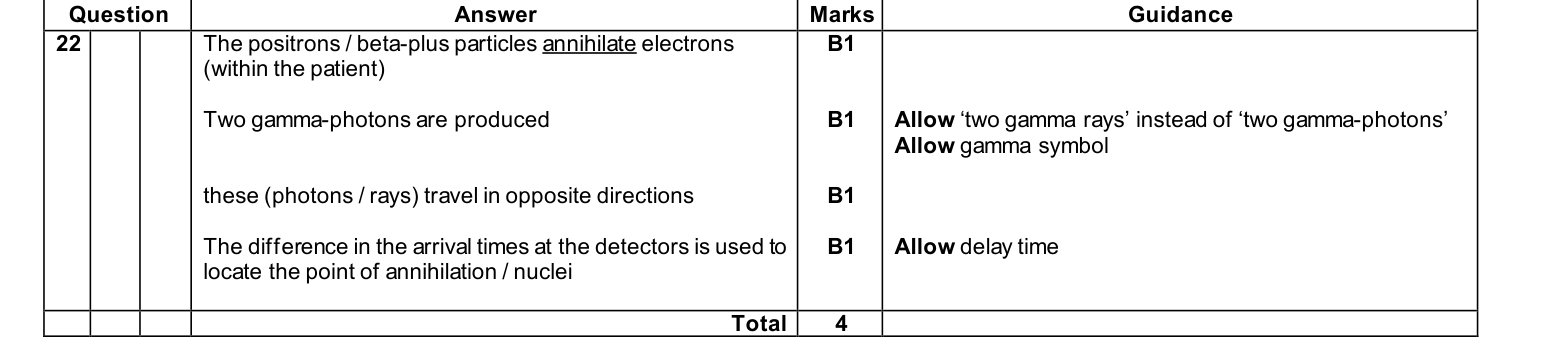
22 The medical tracer fluorine-18 is used in positron emission tomography (PET).
Fluorine-18 is a beta-plus emitter with a short half-life.
Describe how the fluorine-18 nuclei are located in a patient using a PET scanner.
..........................................................................................................................................................
..........................................................................................................................................................
..........................................................................................................................................................
..........................................................................................................................................................
..........................................................................................................................................................
..........................................................................................................................................................
..........................................................................................................................................................
..........................................................................................................................................................
..........................................................................................................................................................
..................................................................................................................................................... [4]
November 2021 · Paper 2 · Q23(a) 2 marks Explanation Medium nuclear fission and fusion
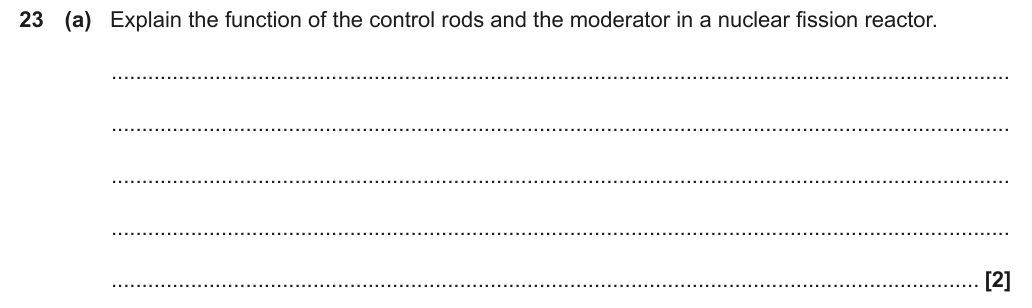
23 (a) Explain the function of the control rods and the moderator in a nuclear fission reactor.
...................................................................................................................................................
...................................................................................................................................................
...................................................................................................................................................
...................................................................................................................................................
.............................................................................................................................................. [2]
November 2021 · Paper 2 · Q23(b) 6 marks 6-mark extended response Medium nuclear fission and fusionphotons
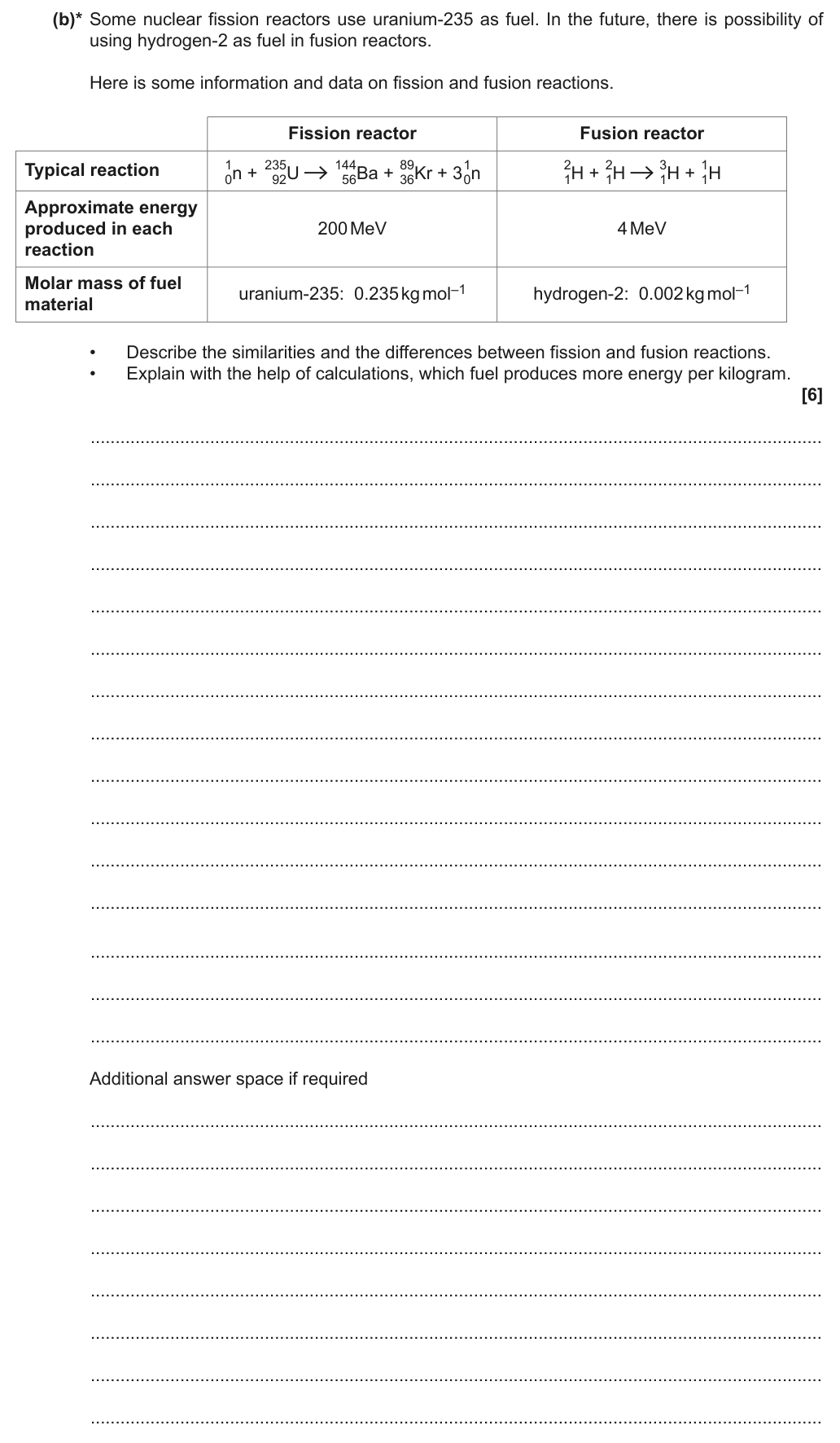
(b)* Some nuclear fission reactors use uranium-235 as fuel. In the future, there is possibility of
using hydrogen-2 as fuel in fusion reactors.
Here is some information and data on fission and fusion reactions.
Fission reactor Fusion reactor
Typical reaction 1 0n + 235 92U 144 56Ba + 89 36Kr + 31 0n 2 1H + 2 1H 3 1H + 1 1H
Approximate energy
produced in each 200 MeV 4 MeV
reaction
Molar mass of fuel
uranium-235:  0.235 kg mol–1 hydrogen-2:  0.002 kg mol–1
material
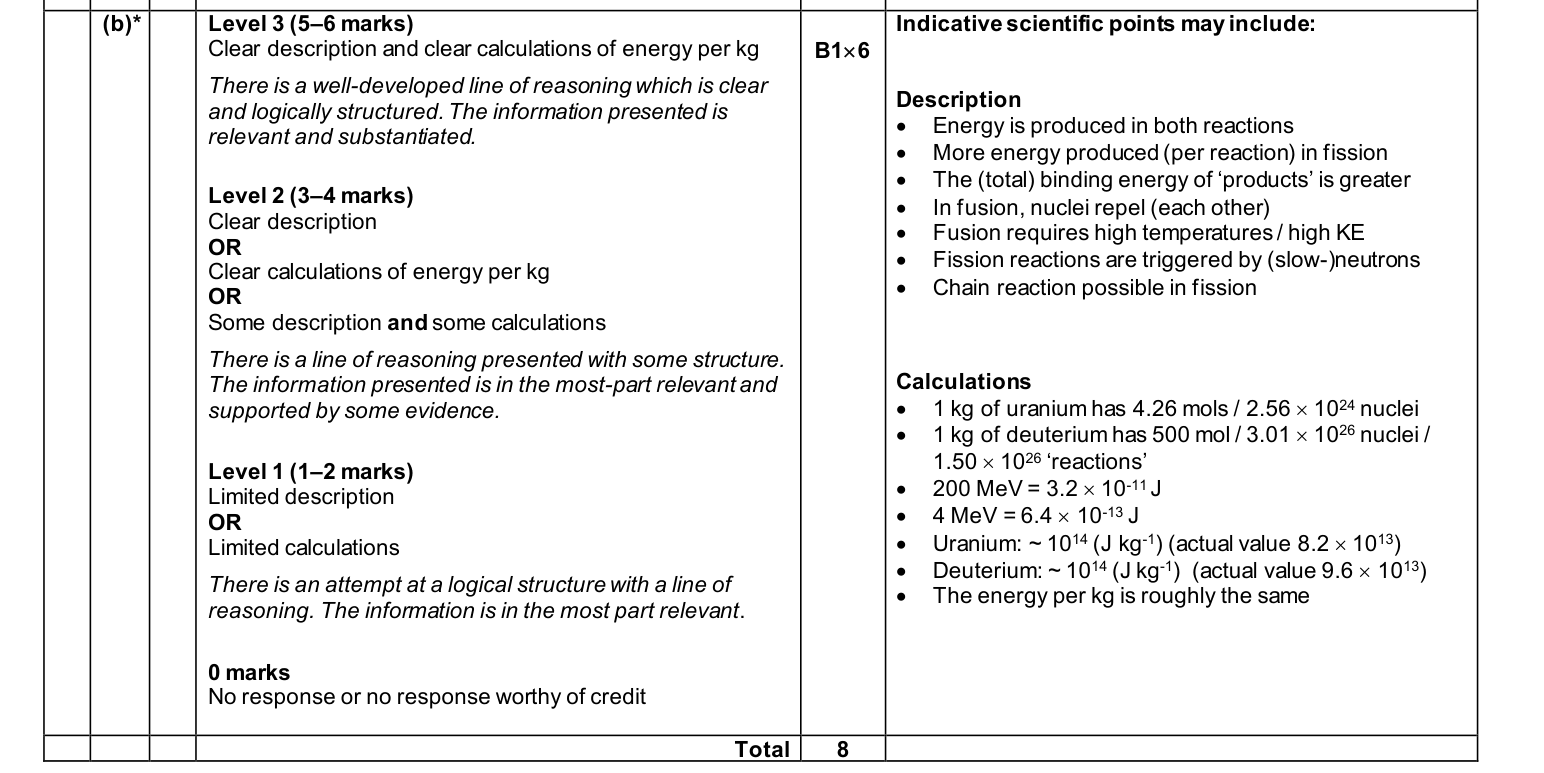
• Describe the similarities and the differences between fission and fusion reactions.
• Explain with the help of calculations, which fuel produces more energy per kilogram.
[6]
...................................................................................................................................................
...................................................................................................................................................
...................................................................................................................................................
...................................................................................................................................................
...................................................................................................................................................
...................................................................................................................................................
...................................................................................................................................................
...................................................................................................................................................
...................................................................................................................................................
...................................................................................................................................................
...................................................................................................................................................
...................................................................................................................................................
...................................................................................................................................................
...................................................................................................................................................
...................................................................................................................................................
Additional answer space if required
...................................................................................................................................................
...................................................................................................................................................
...................................................................................................................................................
...................................................................................................................................................
...................................................................................................................................................
...................................................................................................................................................
...................................................................................................................................................
...................................................................................................................................................
November 2021 · Paper 2 · Q24(a)(i) 3 marks Show that Medium electric fields
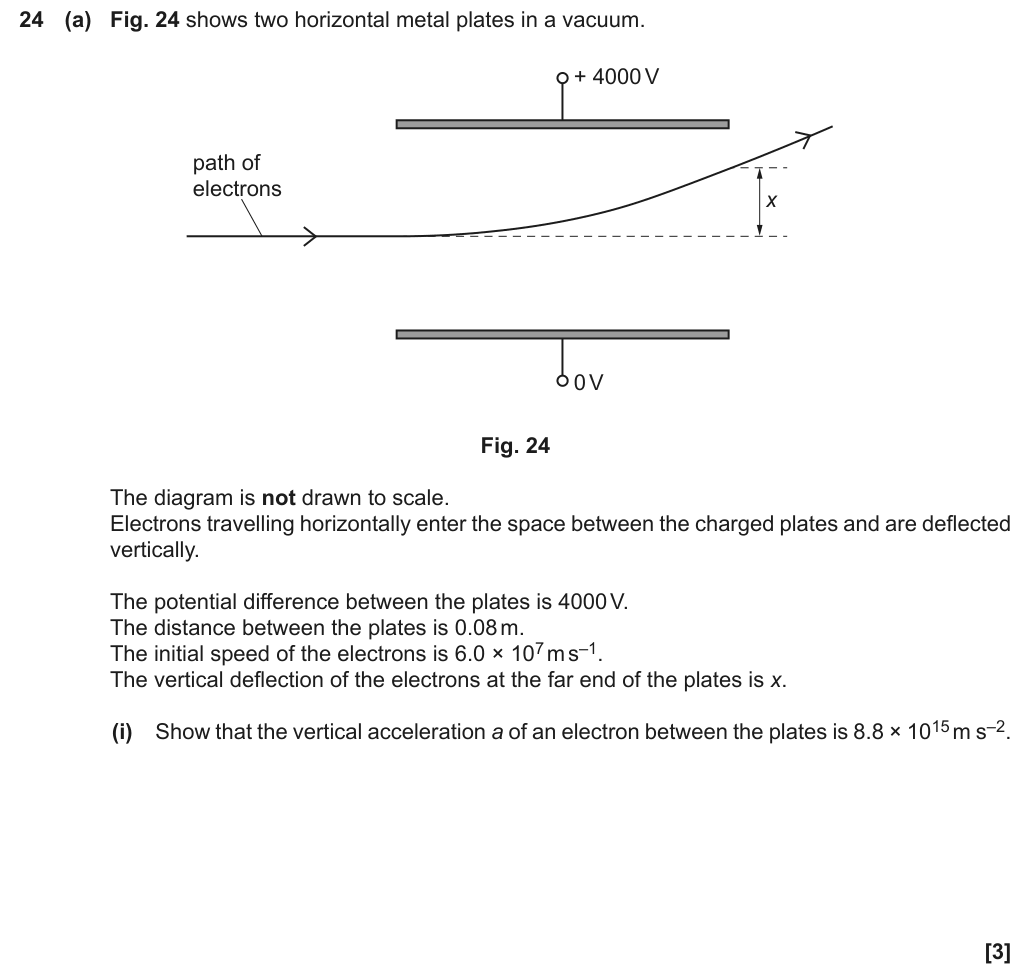
24 (a) Fig. 24 shows two horizontal metal plates in a vacuum.
+ 4000 V
path of
electrons
x
0 V
Fig. 24
The diagram is not drawn to scale.
Electrons travelling horizontally enter the space between the charged plates and are deflected
vertically.
The potential difference between the plates is 4000 V.
The distance between the plates is 0.08 m.
The initial speed of the electrons is 6.0 × 10⁷ m s–1.
The vertical deflection of the electrons at the far end of the plates is x.
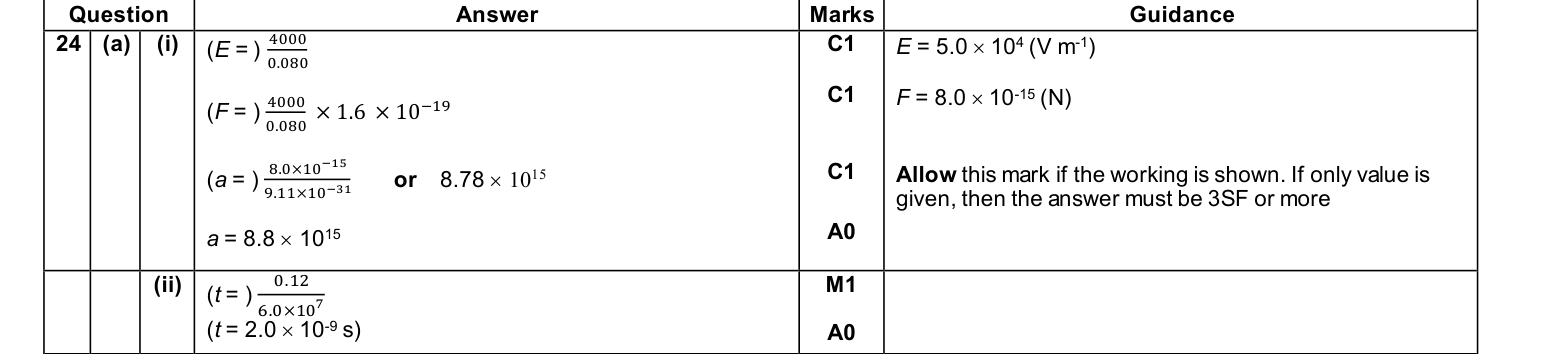
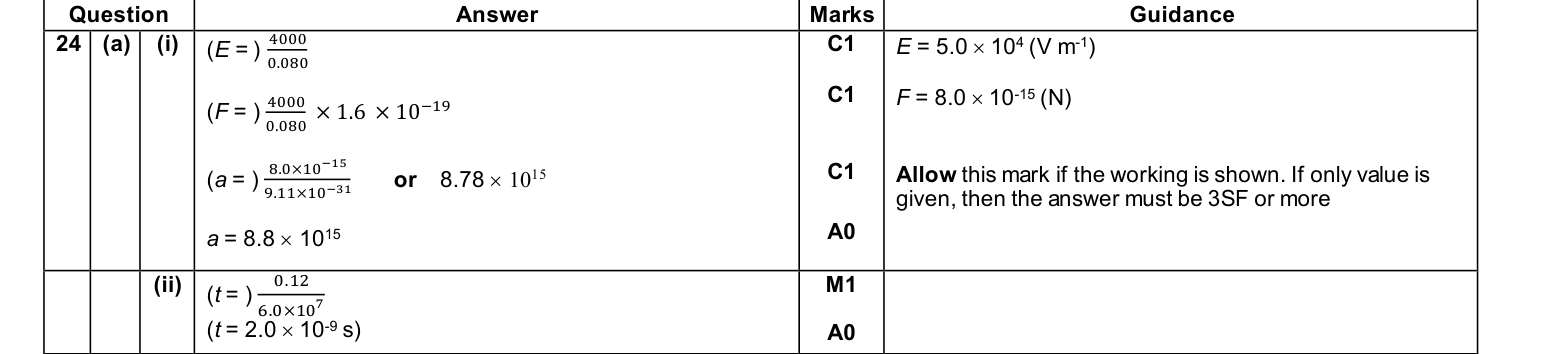
(i) Show that the vertical acceleration a of an electron between the plates is 8.8 × 10¹⁵ m s–2.
[3]
November 2021 · Paper 2 · Q24(a)(ii) 1 mark Show that Medium electric fields
Earlier part of question 24 that this part usesEarlier part of November 2021 Paper 2 question 24
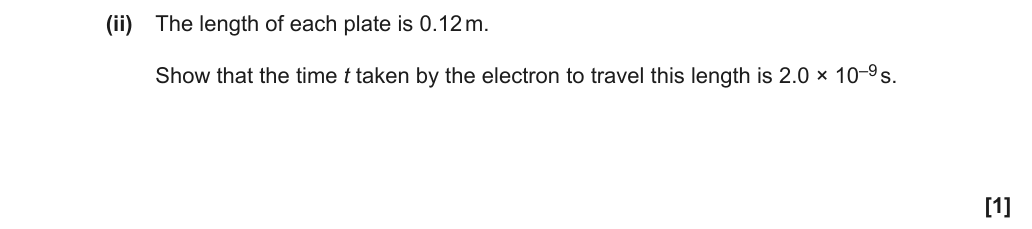
(ii) The length of each plate is 0.12 m.
Show that the time t taken by the electron to travel this length is 2.0 × 10⁻⁹ s.
[1]
November 2021 · Paper 2 · Q24(a)(iii) 2 marks Calculation Medium electric fields
Earlier parts of question 24 that this part usesEarlier part of November 2021 Paper 2 question 24Earlier part of November 2021 Paper 2 question 24
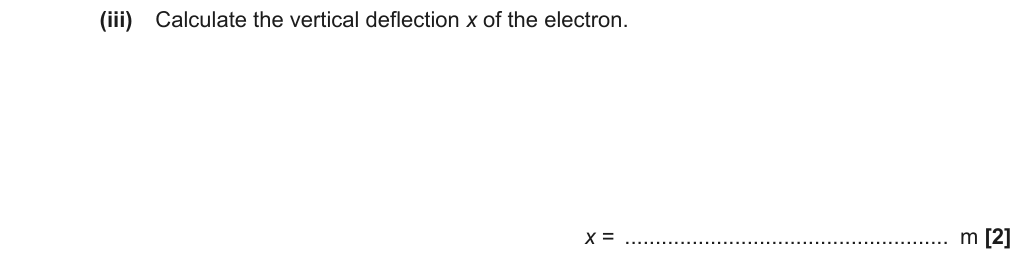
(iii) Calculate the vertical deflection x of the electron.
x =  ..................................................... m [2]
November 2021 · Paper 2 · Q24(b) 2 marks Diagram or graph Easy electric fieldsnuclear atom and particles
Earlier part of question 24 that this part usesEarlier part of November 2021 Paper 2 question 24
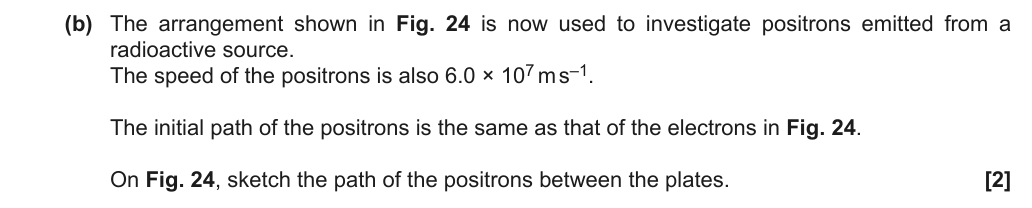
(b) The arrangement shown in Fig. 24 is now used to investigate positrons emitted from a
radioactive source.
The speed of the positrons is also 6.0 × 10⁷ m s–1.
The initial path of the positrons is the same as that of the electrons in Fig. 24.
On Fig. 24, sketch the path of the positrons between the plates. [2]
November 2021 · Paper 2 · Q24(c) 3 marks Explanation Hard magnetic fieldselectric fields
Earlier part of question 24 that this part usesEarlier part of November 2021 Paper 2 question 24
(c) Beta-minus particles (electrons) emitted from a radioactive source have a range of speeds.
Describe and explain how a uniform magnetic field can be applied in the space between
the charged plates to select beta-minus particles with a specific speed. No calculations are
required.
...................................................................................................................................................
...................................................................................................................................................
...................................................................................................................................................
...................................................................................................................................................
...................................................................................................................................................
...................................................................................................................................................
...................................................................................................................................................
...................................................................................................................................................
...................................................................................................................................................
...................................................................................................................................................
...................................................................................................................................................
.............................................................................................................................................. [3]
November 2021 · Paper 2 · Q25(a)(i) 1 mark Explanation Medium radioactivity
25 (a) A researcher is doing an experiment on a radioactive solution in a thin glass tube.
The solution has two radioactive materials X and Y.
The table below shows some data on these two materials.
Material X Material Y
Half-life 10 minutes 10 hours
Particles emitted Alpha Beta-minus
Daughter nuclei Stable Stable
The solution has the same number of nuclei of X and Y at the start.
(i) State and explain which material has the greatest activity at the start.
...........................................................................................................................................
...................................................................................................................................... [1]
November 2021 · Paper 2 · Q25(a)(ii) 1 mark Short answer Medium radioactivity
Earlier part of question 25 that this part usesEarlier part of November 2021 Paper 2 question 25
(ii) State why it is dangerous for the researcher to handle the test tube with bare hands.
...........................................................................................................................................
...................................................................................................................................... [1]
November 2021 · Paper 2 · Q25(b)(i) 1 mark Calculation Easy nuclear fission and fusion
(b) Carbon-14 (14 6C) is produced in the upper atmosphere of the Earth by collisions between
nitrogen nuclei and fast-moving neutrons.
The nuclear transformation equation below shows the formation of a single carbon-14
nucleus.
14 7N + 1 0n 14 6C + X
(i) State the proton number of particle X.
proton number =  .......................................................... [1]
November 2021 · Paper 2 · Q25(b)(ii) 4 marks Calculation Medium nuclear fission and fusionpractical skills
(ii) Use the data below to determine the binding energy per nucleon of the 14 6C nucleus.
Write your answer to 3 significant figures.
• mass of neutron = 1.675 × 10⁻²⁷ kg
• mass of proton = 1.673 × 10⁻²⁷ kg
• mass of 14 6C nucleus = 14.000 u
• 1 u = 1.66 × 10⁻²⁷ kg
binding energy per nucleon =  ................................... J per nucleon [4]

Work with an OCR physics tutor

Want a paper marked and gone through with you? Message us.

Prefer email? Send an enquiry

If you are under 18, please include a parent's contact details. Enquiries go to enquiries@physicsaleveltutor.com and are deleted once handled. All tutoring is online.