June 2018: Paper 1

85 marks · 49 question parts · Paper, mark scheme and report on AQA's site · Have the data and formulae booklet beside you

Question by question

QTopicMarksAOType
1.1 Motion along a straight line and projectile motion, Newton's laws of motion and momentum 3Calculation
1.2 Motion along a straight line and projectile motion 3Calculation
1.3 Work, energy, power and conservation of energy 2Explanation
1.4 Work, energy, power and conservation of energy 3Calculation
1.5 Motion along a straight line and projectile motion 1Explanation
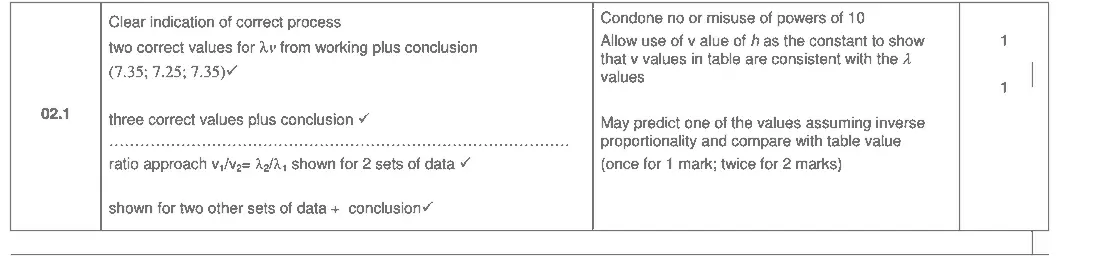
2.1 Excitation, energy levels and wave-particle duality 2Show that
2.2 Excitation, energy levels and wave-particle duality 2Calculation
2.3 Excitation, energy levels and wave-particle duality 3Explanation
2.4 Excitation, energy levels and wave-particle duality 3Explanation
3.1 Superposition and stationary waves 3Explanation
3.2 Superposition and stationary waves 2Show that
3.3 Progressive waves, longitudinal and transverse waves, Superposition and stationary waves 1Calculation
3.4 Superposition and stationary waves, Materials, stress, strain and the Young modulus 4Calculation
4.1 Current, potential difference, I-V characteristics and resistivity 3Calculation
4.2 Circuits and potential dividers 2Calculation
4.3 Circuits and potential dividers 5Calculation
4.4 Current, potential difference, I-V characteristics and resistivity, Circuits and potential dividers 2Explanation
5.1 Circular motion 2Show that
5.2 Circular motion, Scalars, vectors and moments 3Calculation
5.3 Circular motion, Scalars, vectors and moments 3Explanation
6.1 Newton's laws of motion and momentum 1Short answer
6.2 Newton's laws of motion and momentum 3Show that
6.3 Newton's laws of motion and momentum 2Calculation
6.4 Newton's laws of motion and momentum 2Explanation
7 Newton's laws of motion and momentum 1Multiple choice
8 Measurements, units and uncertainties, Current, potential difference, I-V characteristics and resistivity 1Multiple choice
9 Atomic structure and stable nuclei 1Multiple choice
10 Particles, antiparticles and particle interactions 1Multiple choice
11 Classification of particles, quarks and conservation laws 1Multiple choice
12 Atomic structure and stable nuclei, Classification of particles, quarks and conservation laws 1Multiple choice
13 Excitation, energy levels and wave-particle duality 1Multiple choice
14 The photoelectric effect, Excitation, energy levels and wave-particle duality 1Multiple choice
15 Interference, diffraction and the diffraction grating, Progressive waves, longitudinal and transverse waves 1Multiple choice
16 Interference, diffraction and the diffraction grating 1Multiple choice
17 Interference, diffraction and the diffraction grating 1Multiple choice
18 Refraction, total internal reflection and optical fibres 1Multiple choice
19 Refraction, total internal reflection and optical fibres 1Multiple choice
20 Scalars, vectors and moments 1Multiple choice
21 Scalars, vectors and moments, Materials, stress, strain and the Young modulus 1Multiple choice
22 Newton's laws of motion and momentum 1Multiple choice
23 Motion along a straight line and projectile motion 1Multiple choice
24 Materials, stress, strain and the Young modulus 1Multiple choice
25 Current, potential difference, I-V characteristics and resistivity 1Multiple choice
26 Current, potential difference, I-V characteristics and resistivity, Circuits and potential dividers 1Multiple choice
27 Current, potential difference, I-V characteristics and resistivity, Circuits and potential dividers 1Multiple choice
28 Current, potential difference, I-V characteristics and resistivity 1Multiple choice
29 Simple harmonic motion, forced vibrations and resonance 1Multiple choice
30 Simple harmonic motion, forced vibrations and resonance 1Multiple choice
31 Simple harmonic motion, forced vibrations and resonance 1Multiple choice

The questions

1.11.21.31.41.52.12.22.32.43.13.23.33.44.14.24.34.45.15.25.36.16.26.36.478910111213141516171819202122232425262728293031
June 2018 · Paper 1 · Q1.1 3 marks Calculation Hard motion and projectilesnewtons laws and momentum
Horizontal escape lanes made of loose gravel have been constructed at the side of
some roads on steep hills so that vehicles can stop safely when their brakes fail.
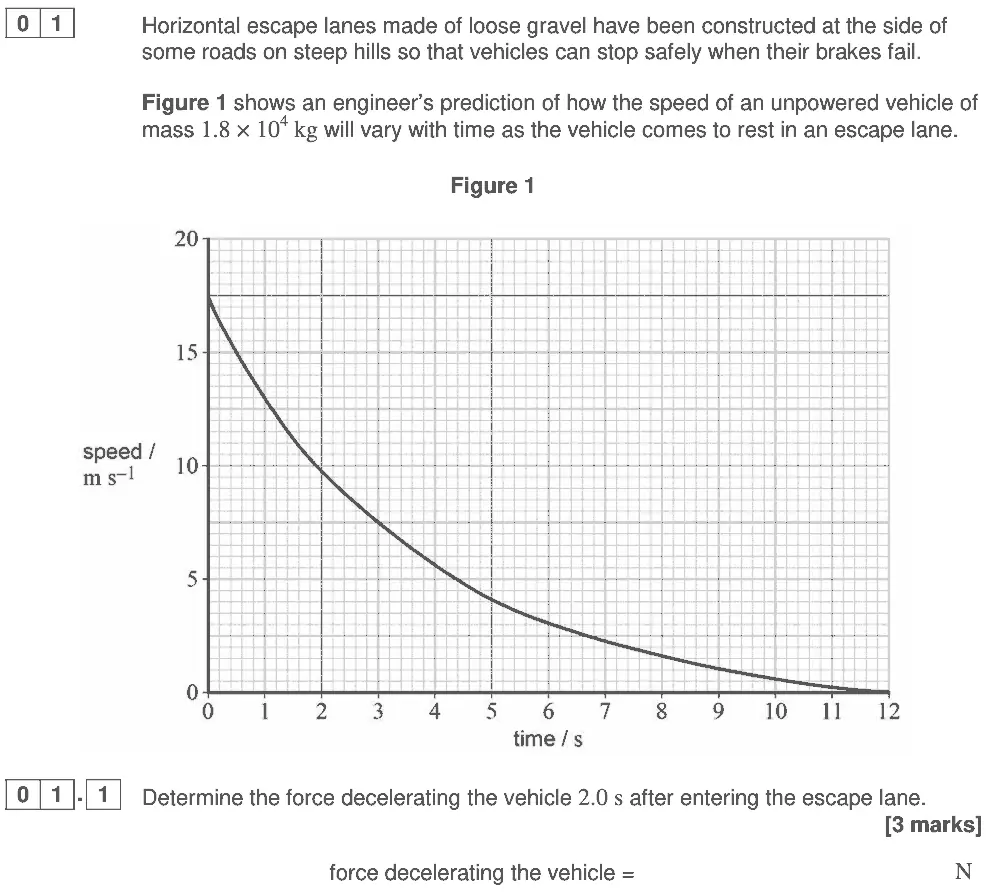
Figure 1 shows an engineer’s prediction of how the speed of an unpowered vehicle of
mass 1.8 × 10⁴ kg will vary with time as the vehicle comes to rest in an escape lane.
Figure 1
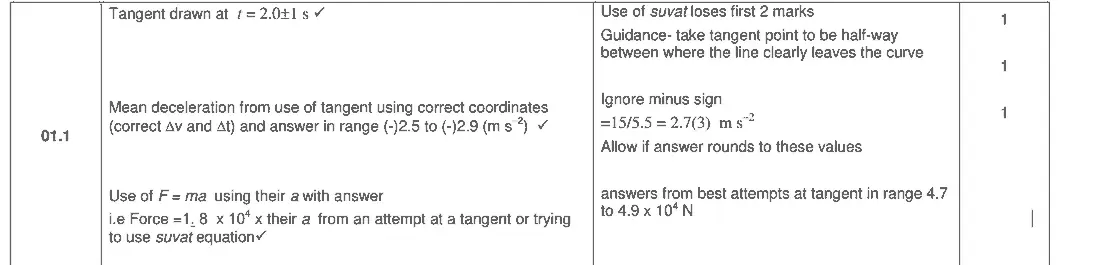
Determine the force decelerating the vehicle 2.0 s after entering the escape lane.
[3 marks]
force decelerating the vehicle =
N
June 2018 · Paper 1 · Q1.2 3 marks Calculation Hard motion and projectiles
Earlier part of question 1 that this part usesEarlier part of June 2018 Paper 1 question 1
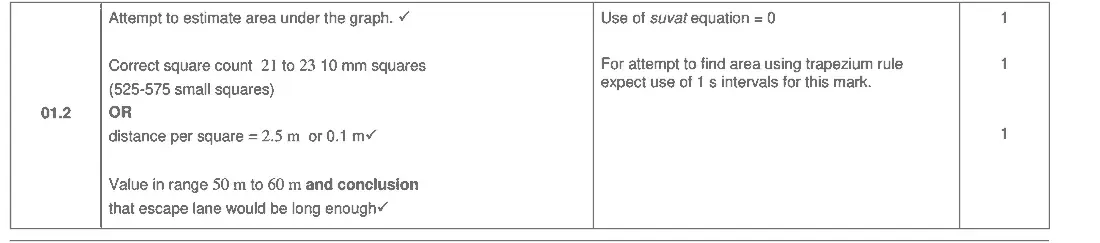
Deduce whether a lane of length 85 m is long enough to stop the vehicle, assuming
that the engineer’s graph is correct.
[3 marks]
June 2018 · Paper 1 · Q1.3 2 marks Explanation Hard work energy and power
Earlier part of question 1 that this part usesEarlier part of June 2018 Paper 1 question 1
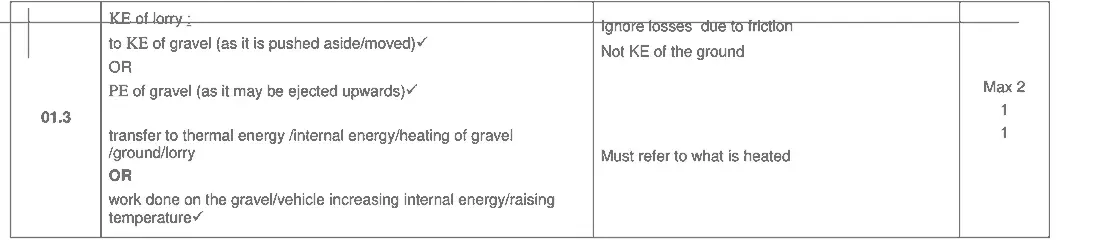
Discuss the energy transfers that take place when a vehicle is decelerated in an
escape lane.
[2 marks]
June 2018 · Paper 1 · Q1.4 3 marks Calculation Hard work energy and power
Earlier part of question 1 that this part usesEarlier part of June 2018 Paper 1 question 1
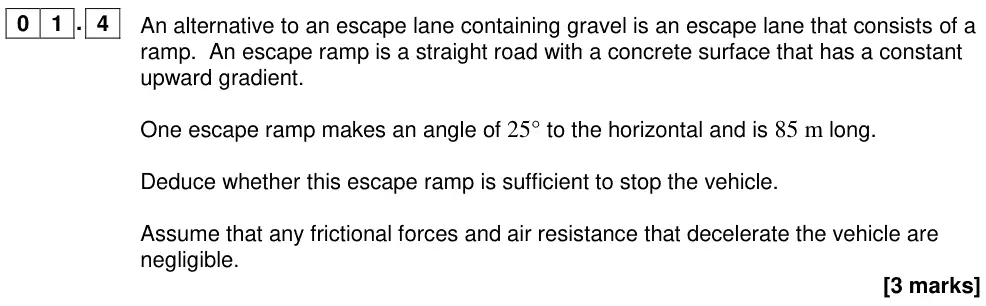
An alternative to an escape lane containing gravel is an escape lane that consists of a
ramp.  An escape ramp is a straight road with a concrete surface that has a constant
upward gradient.
One escape ramp makes an angle of 25° to the horizontal and is 85 m long.
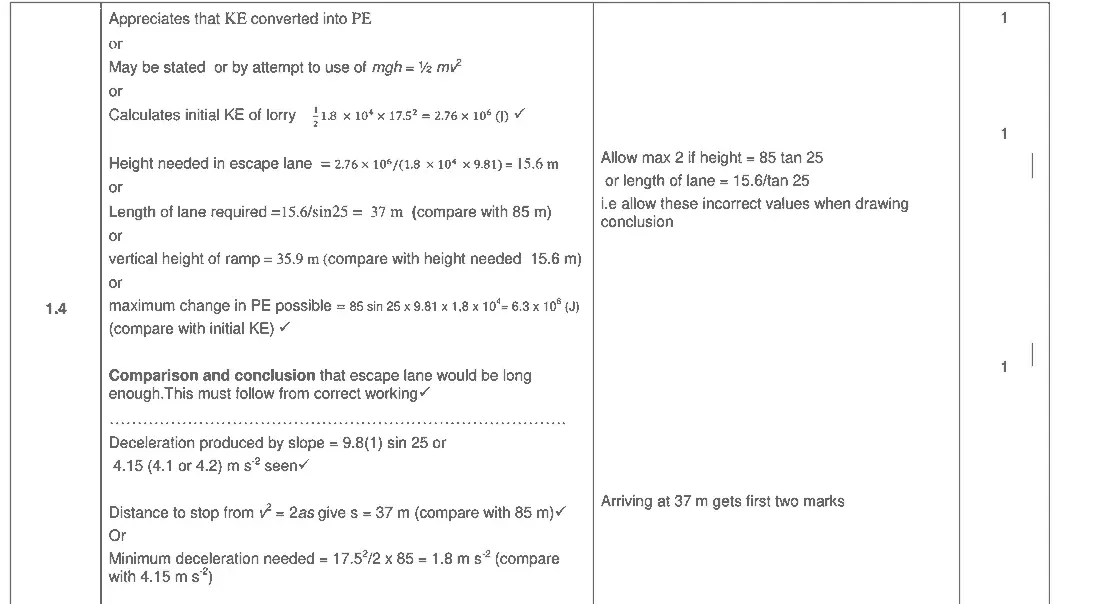
Deduce whether this escape ramp is sufficient to stop the vehicle.
Assume that any frictional forces and air resistance that decelerate the vehicle are
negligible.
[3 marks]
June 2018 · Paper 1 · Q1.5 1 mark Explanation motion and projectiles
Earlier part of question 1 that this part usesEarlier part of June 2018 Paper 1 question 1
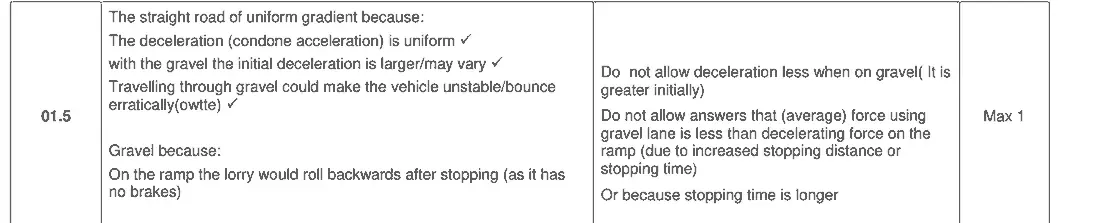
Discuss whether an escape lane containing gravel or an escape ramp would provide
the safer experience for the driver of the vehicle as it comes to rest.
[1 mark]
wavelength  of an electron varies with its velocity v.
June 2018 · Paper 1 · Q2.1 2 marks Show that Easy energy levels and wave particle duality
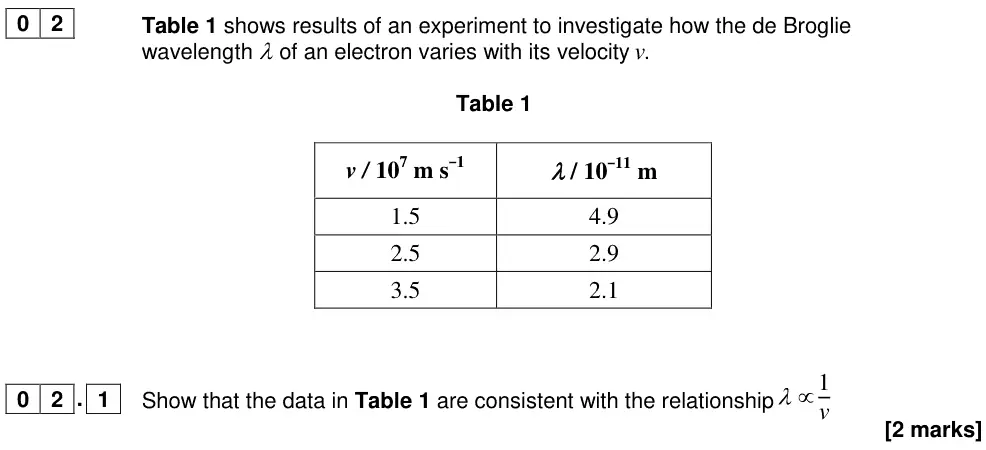
Table 1 shows results of an experiment to investigate how the de Broglie
Table 1
v / 107 m s−1
/ 10−11 m
1.5
4.9
2.5
2.9
3.5
2.1
Show that the data in Table 1 are consistent with the relationship
[2 marks]
∝1
v
June 2018 · Paper 1 · Q2.2 2 marks Calculation Easy energy levels and wave particle duality
Earlier part of question 2 that this part usesEarlier part of June 2018 Paper 1 question 2
Calculate a value for the Planck constant suggested by the data in Table 1.
[2 marks]
Planck constant =
J s
June 2018 · Paper 1 · Q2.3 3 marks Explanation energy levels and wave particle duality
Earlier part of question 2 that this part usesEarlier part of June 2018 Paper 1 question 2
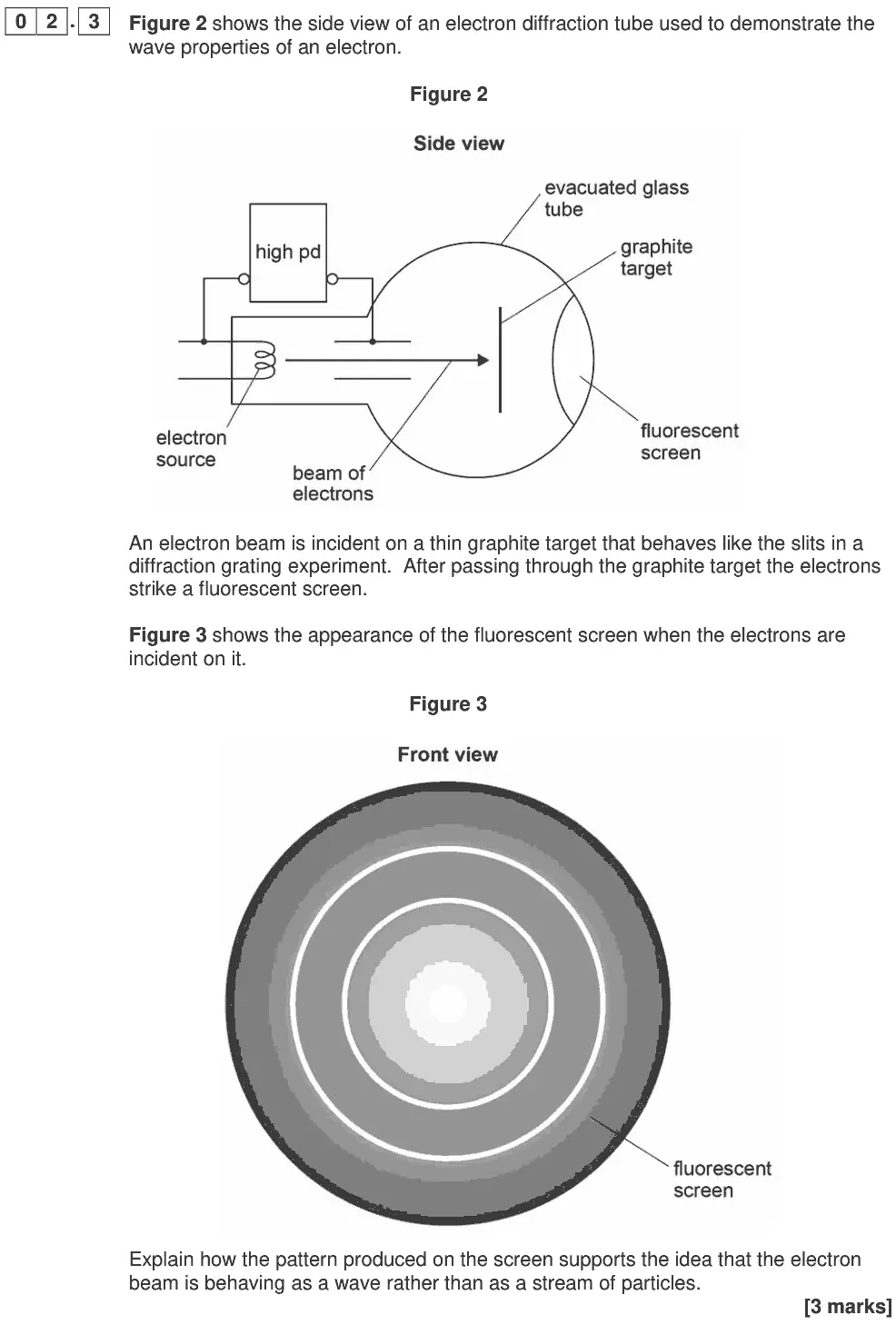
Figure 2 shows the side view of an electron diffraction tube used to demonstrate the
wave properties of an electron.
Figure 2
An electron beam is incident on a thin graphite target that behaves like the slits in a
diffraction grating experiment.  After passing through the graphite target the electrons
strike a fluorescent screen.
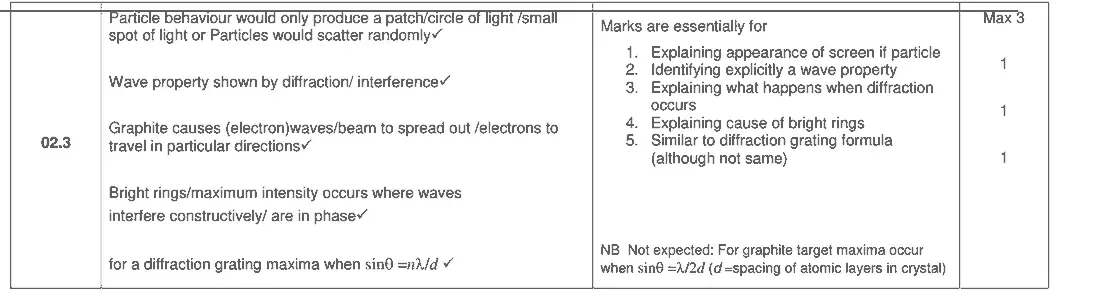
Figure 3 shows the appearance of the fluorescent screen when the electrons are
incident on it.
Figure 3
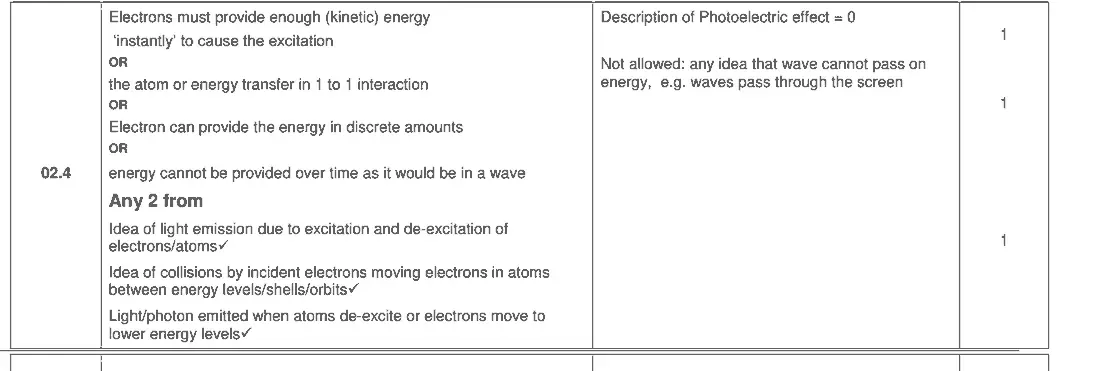
Explain how the pattern produced on the screen supports the idea that the electron
beam is behaving as a wave rather than as a stream of particles.
[3 marks]
June 2018 · Paper 1 · Q2.4 3 marks Explanation energy levels and wave particle duality
Earlier part of question 2 that this part usesEarlier part of June 2018 Paper 1 question 2
Explain how the emission of light from the fluorescent screen shows that the electrons
incident on it are behaving as particles.
[3 marks]
June 2018 · Paper 1 · Q3.1 3 marks Explanation stationary waves
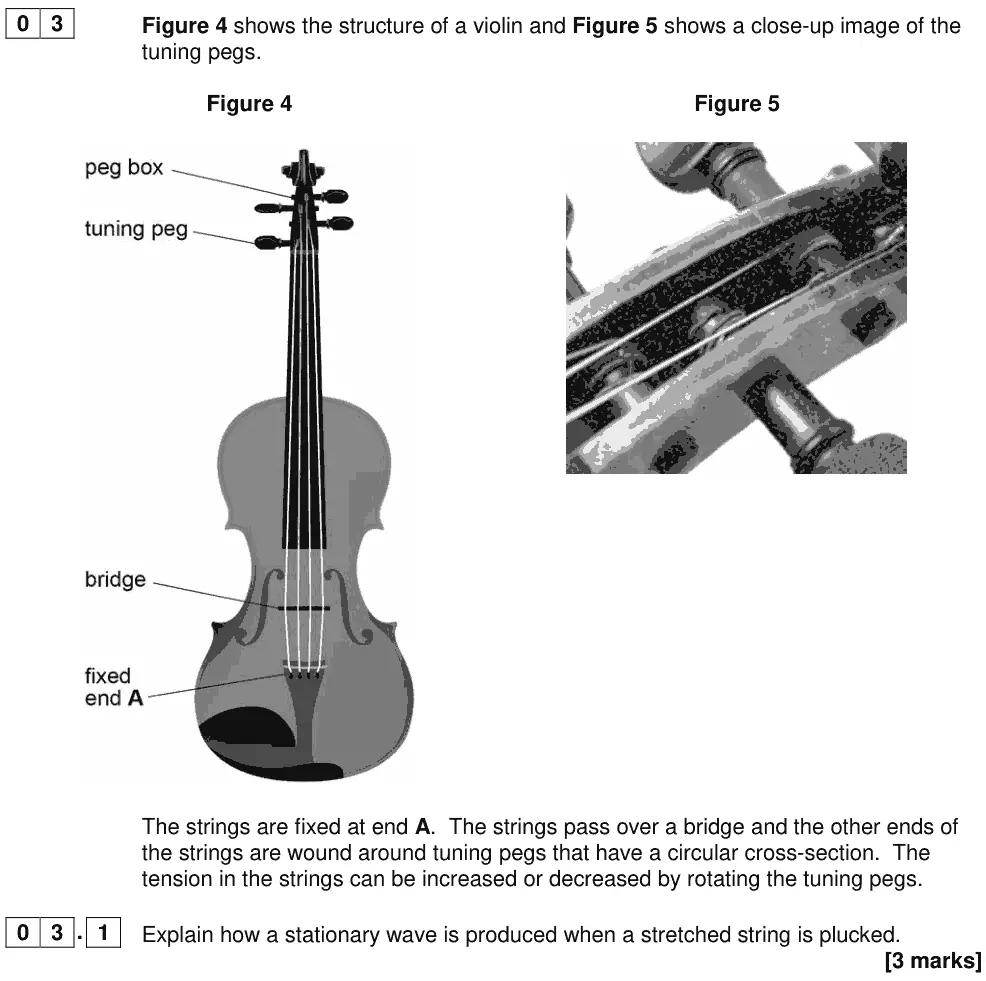
Figure 4 shows the structure of a violin and Figure 5 shows a close-up image of the
tuning pegs.
Figure 4
Figure 5
The strings are fixed at end A.  The strings pass over a bridge and the other ends of
the strings are wound around tuning pegs that have a circular cross-section.  The
tension in the strings can be increased or decreased by rotating the tuning pegs.
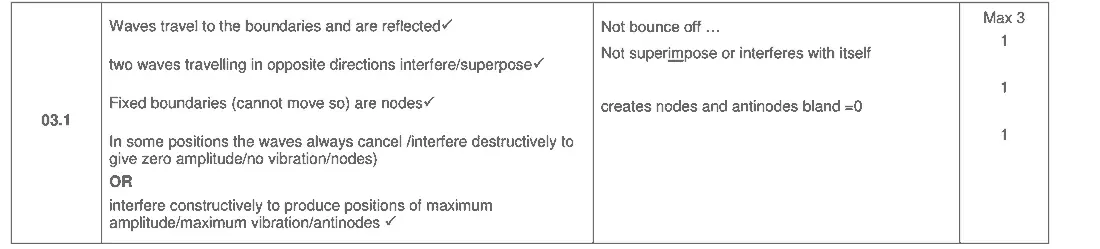
Explain how a stationary wave is produced when a stretched string is plucked.
[3 marks]
June 2018 · Paper 1 · Q3.2 2 marks Show that Easy stationary waves
Earlier part of question 3 that this part usesEarlier part of June 2018 Paper 1 question 3
The vibrating length of one of the strings of a violin is 0.33 m
When the tension in the string is 25 N, the string vibrates with a first-harmonic
frequency of 370 Hz
Show that the mass of a 1.0 m length of the string is about 4 × 10⁻⁴ kg
[2 marks]
June 2018 · Paper 1 · Q3.3 1 mark Calculation progressive waves and polarisationstationary waves
Earlier part of question 3 that this part usesEarlier part of June 2018 Paper 1 question 3
Determine the speed at which waves travel along the string in question 03.2 when it
vibrates with a first-harmonic frequency of 370 Hz
[1 mark]
speed of waves =
m s–1
June 2018 · Paper 1 · Q3.4 4 marks Calculation stationary wavesmaterials and young modulus
Earlier part of question 3 that this part usesEarlier part of June 2018 Paper 1 question 3
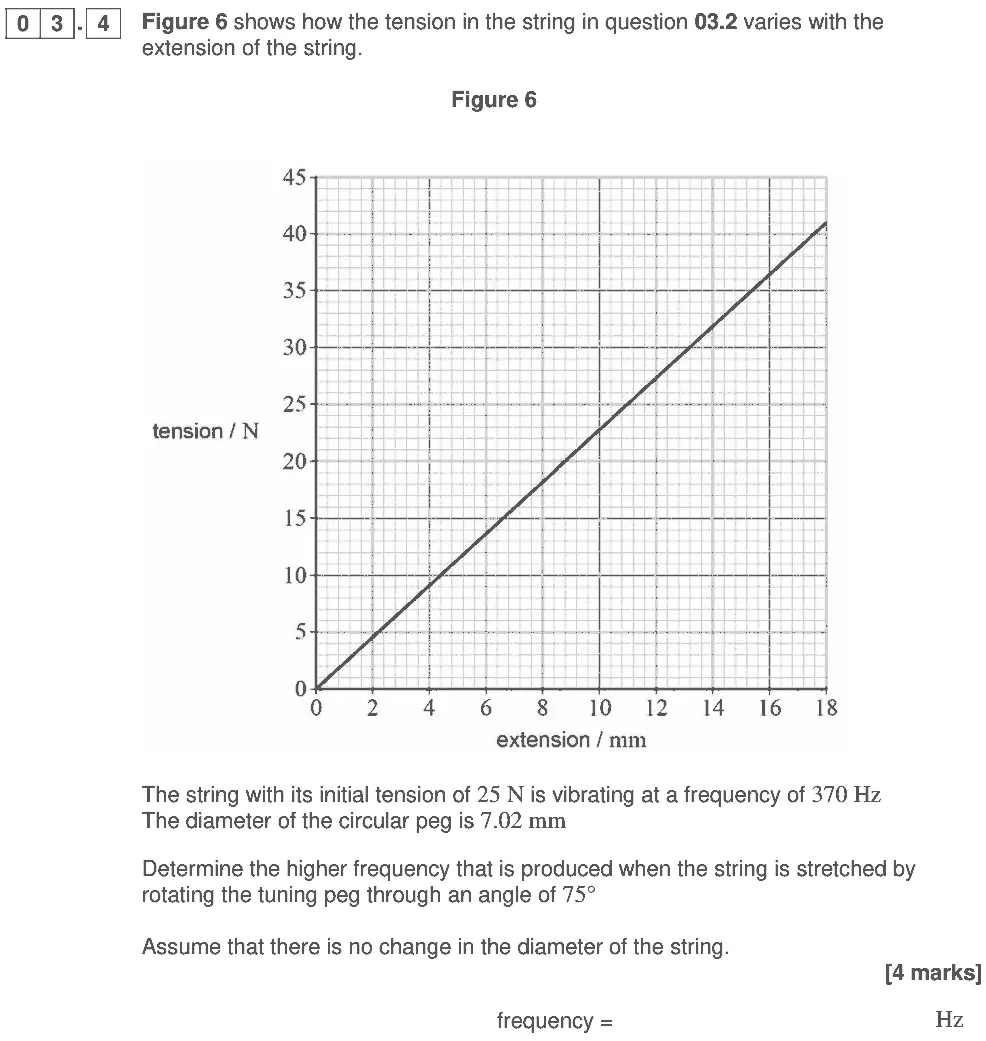
Figure 6 shows how the tension in the string in question 03.2 varies with the
extension of the string.
Figure 6
The string with its initial tension of 25 N is vibrating at a frequency of 370 Hz
The diameter of the circular peg is 7.02 mm
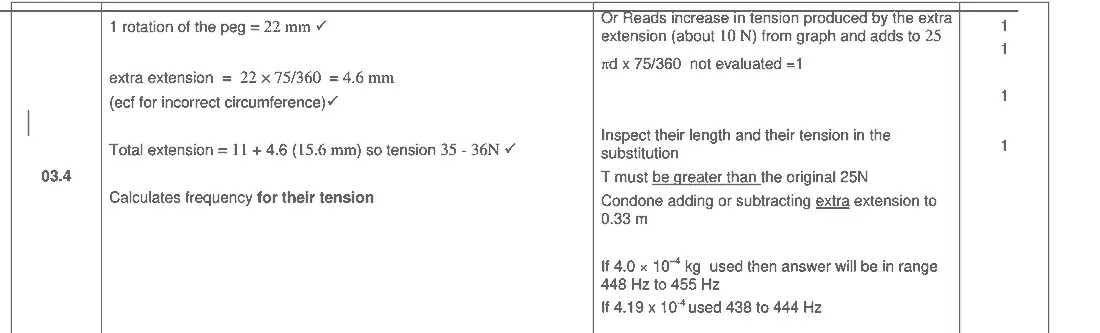
Determine the higher frequency that is produced when the string is stretched by
rotating the tuning peg through an angle of 75°
Assume that there is no change in the diameter of the string.
[4 marks]
frequency =
Hz
June 2018 · Paper 1 · Q4.1 3 marks Calculation current voltage and resistivity
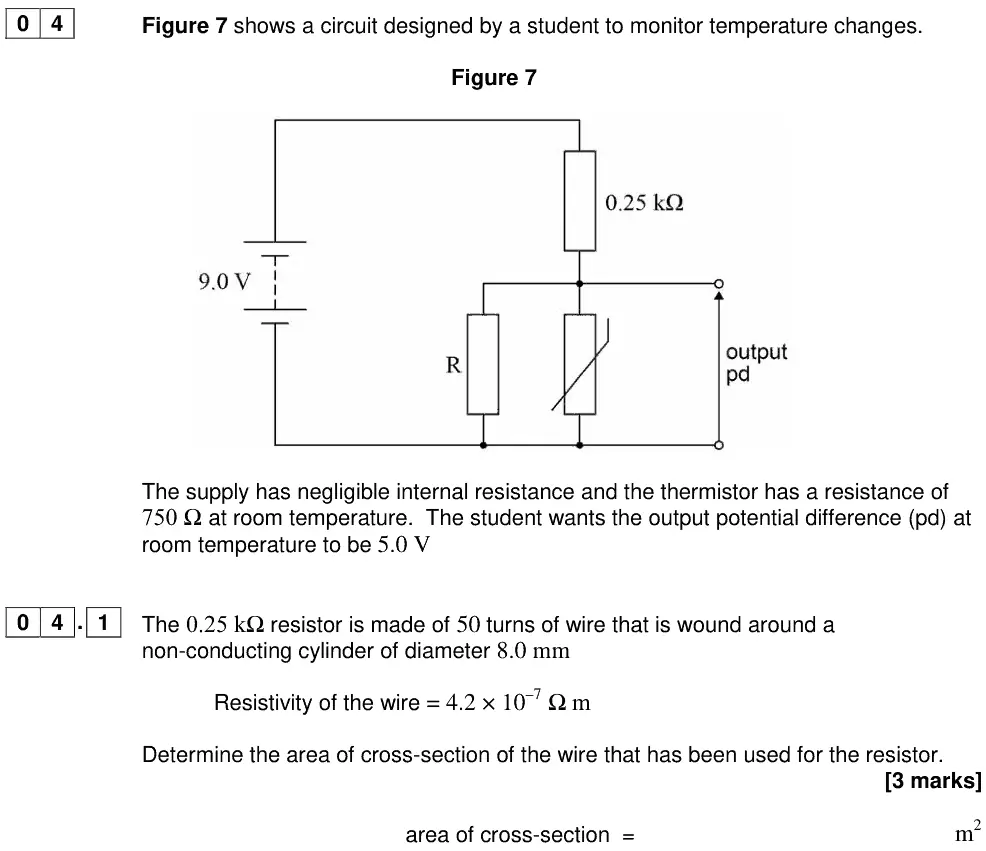
Figure 7 shows a circuit designed by a student to monitor temperature changes.
Figure 7
The supply has negligible internal resistance and the thermistor has a resistance of
750 Ω at room temperature.  The student wants the output potential difference (pd) at
room temperature to be 5.0 V
The 0.25 kΩ resistor is made of 50 turns of wire that is wound around a
non-conducting cylinder of diameter 8.0 mm
Resistivity of the wire = 4.2 × 10⁻⁷ Ω m
Determine the area of cross-section of the wire that has been used for the resistor.
[3 marks]
area of cross-section  =
m2
June 2018 · Paper 1 · Q4.2 2 marks Calculation Hard circuits and potential dividers
Earlier part of question 4 that this part usesEarlier part of June 2018 Paper 1 question 4
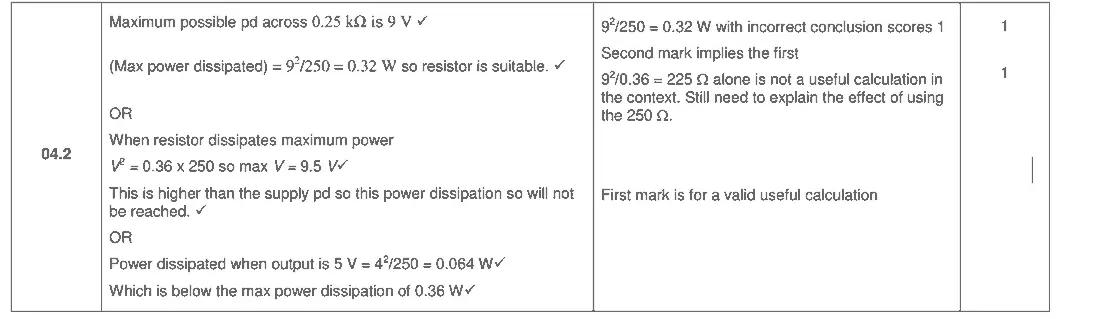
The student selects a resistor rated at 0.36 W for the 0.25 kΩ resistor in Figure 7.
Determine whether this resistor is suitable.
[2 marks]
June 2018 · Paper 1 · Q4.3 5 marks Calculation Hard circuits and potential dividers
Earlier part of question 4 that this part usesEarlier part of June 2018 Paper 1 question 4
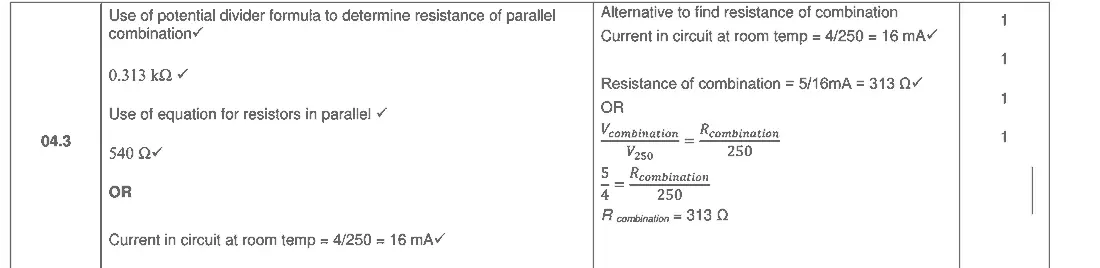
Determine the value of R that the student should select.
Give your answer to an appropriate number of significant figures.
[5 marks]
value of R  =
Ω
June 2018 · Paper 1 · Q4.4 2 marks Explanation current voltage and resistivitycircuits and potential dividers
Earlier part of question 4 that this part usesEarlier part of June 2018 Paper 1 question 4
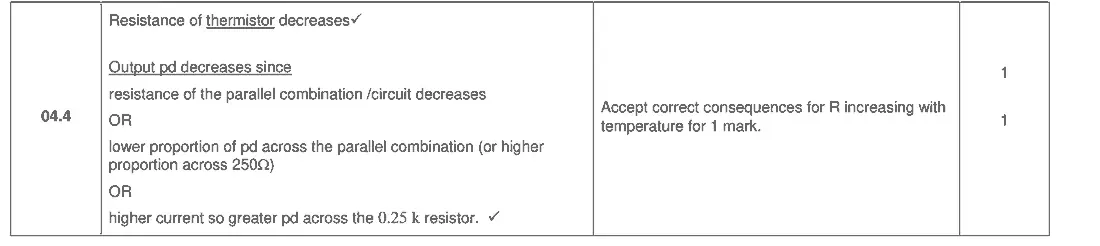
State and explain the effect on the output pd of increasing the temperature of the
thermistor.
[2 marks]
June 2018 · Paper 1 · Q5.1 2 marks Show that circular motion
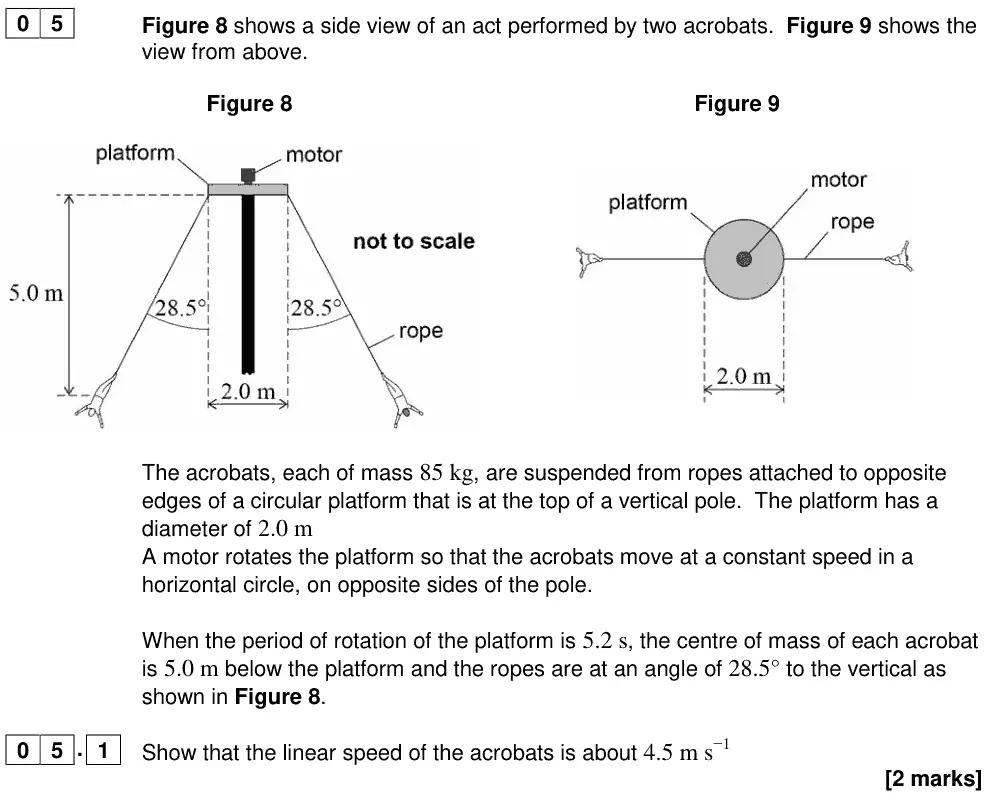
Figure 8 shows a side view of an act performed by two acrobats.  Figure 9 shows the
view from above.
Figure 8
Figure 9
The acrobats, each of mass 85 kg, are suspended from ropes attached to opposite
edges of a circular platform that is at the top of a vertical pole.  The platform has a
diameter of 2.0 m
A motor rotates the platform so that the acrobats move at a constant speed in a
horizontal circle, on opposite sides of the pole.
When the period of rotation of the platform is 5.2 s, the centre of mass of each acrobat
is 5.0 m below the platform and the ropes are at an angle of 28.5° to the vertical as
shown in Figure 8.
Show that the linear speed of the acrobats is about 4.5 m s−1
[2 marks]
June 2018 · Paper 1 · Q5.2 3 marks Calculation circular motionvectors and moments
Earlier part of question 5 that this part usesEarlier part of June 2018 Paper 1 question 5
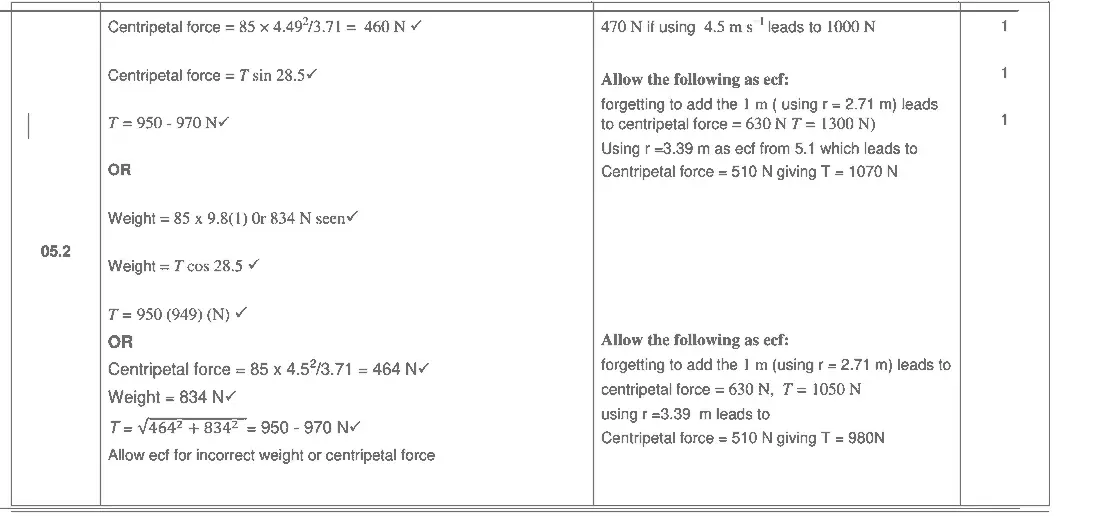
Determine the tension in each rope that supports the acrobats.
[3 marks]
tension =
N
June 2018 · Paper 1 · Q5.3 3 marks Explanation circular motionvectors and moments
Earlier part of question 5 that this part usesEarlier part of June 2018 Paper 1 question 5
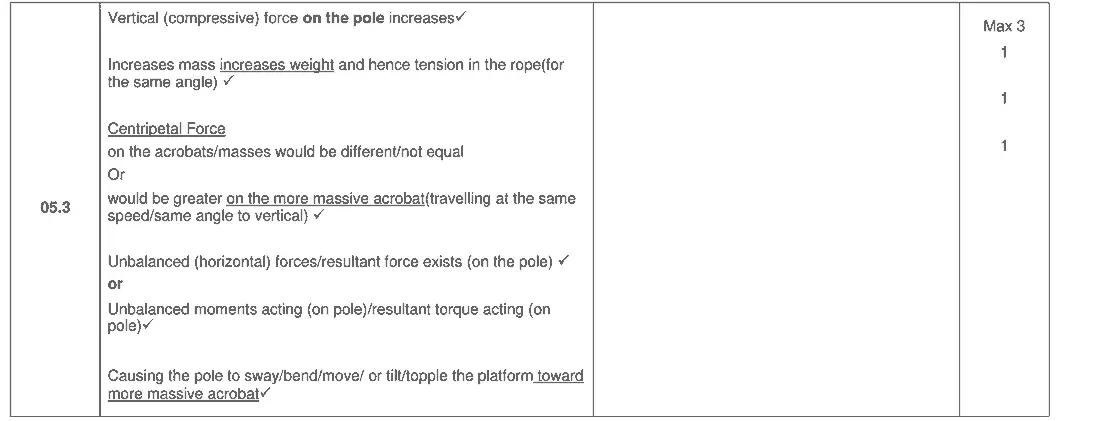
Discuss the consequences for the forces acting on the pole when one acrobat has a
much greater mass than the other.
[3 marks]
June 2018 · Paper 1 · Q6.1 1 mark Short answer Easy newtons laws and momentum
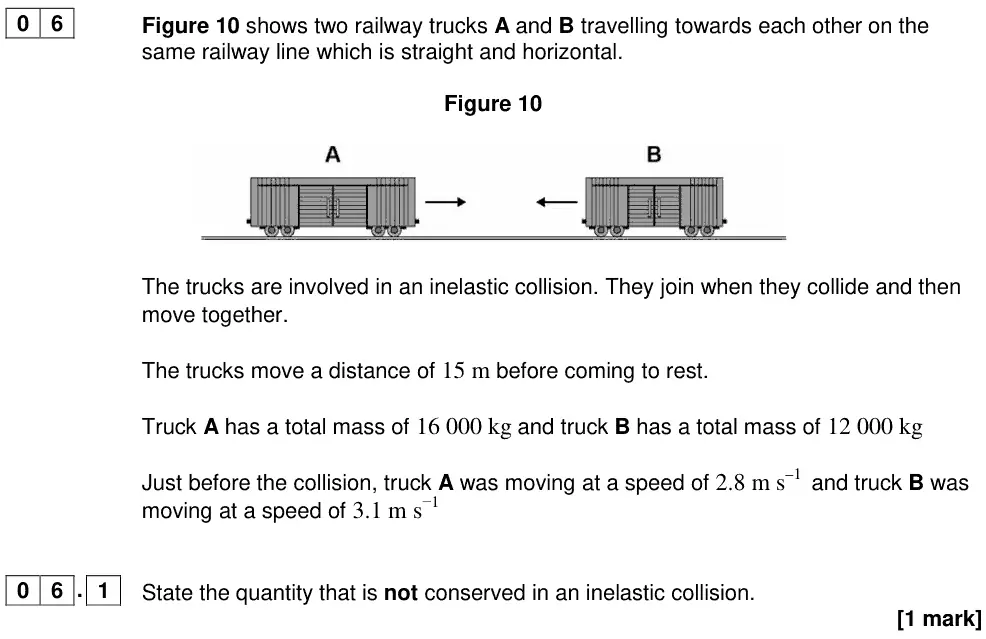
Figure 10 shows two railway trucks A and B travelling towards each other on the
same railway line which is straight and horizontal.
Figure 10
The trucks are involved in an inelastic collision. They join when they collide and then
move together.
The trucks move a distance of 15 m before coming to rest.
Truck A has a total mass of 16 000 kg and truck B has a total mass of 12 000 kg
Just before the collision, truck A was moving at a speed of 2.8 m s–1  and truck B was
moving at a speed of 3.1 m s−1
State the quantity that is not conserved in an inelastic collision.
[1 mark]
June 2018 · Paper 1 · Q6.2 3 marks Show that Easy newtons laws and momentum
Earlier part of question 6 that this part usesEarlier part of June 2018 Paper 1 question 6
Show that the speed of the joined trucks immediately after the collision is about
0.3 m s–1
[3 marks]
June 2018 · Paper 1 · Q6.3 2 marks Calculation newtons laws and momentum
Earlier part of question 6 that this part usesEarlier part of June 2018 Paper 1 question 6
Calculate the impulse that acts on each truck during the collision.
Give an appropriate unit for your answer.
[2 marks]
impulse =
unit
June 2018 · Paper 1 · Q6.4 2 marks Explanation newtons laws and momentum
Earlier part of question 6 that this part usesEarlier part of June 2018 Paper 1 question 6
Explain, without doing a calculation, how the motion of the trucks immediately after the
collision would be different for a collision that is perfectly elastic.
[2 marks]
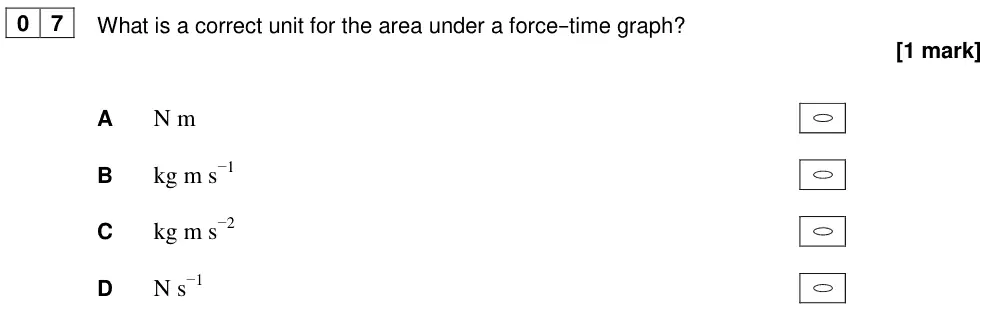
June 2018 · Paper 1 · Q7 1 mark Multiple choice newtons laws and momentum
What is a correct unit for the area under a force−time graph?
[1 mark]
A
N m
B
kg m s−1
C
kg m s−2
D
N s−1
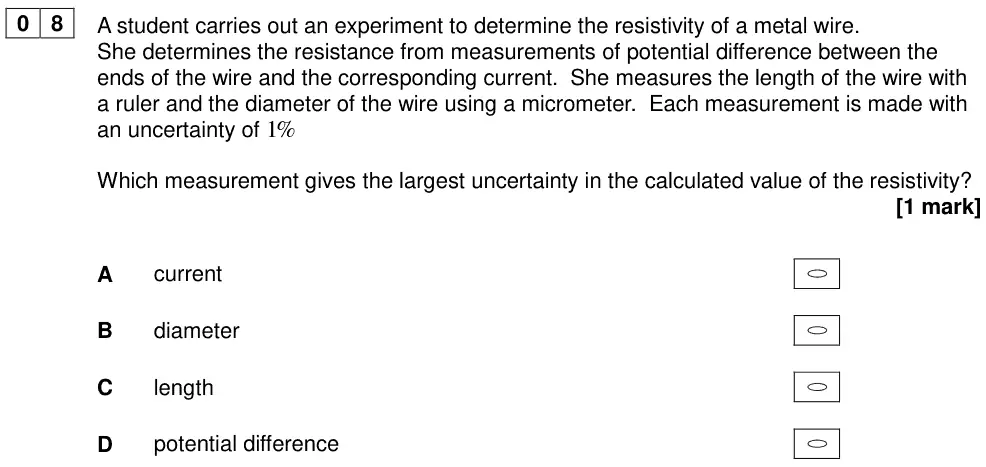
June 2018 · Paper 1 · Q8 1 mark Multiple choice measurements and uncertaintiescurrent voltage and resistivity
A student carries out an experiment to determine the resistivity of a metal wire.
She determines the resistance from measurements of potential difference between the
ends of the wire and the corresponding current.  She measures the length of the wire with
a ruler and the diameter of the wire using a micrometer.  Each measurement is made with
an uncertainty of 1%
Which measurement gives the largest uncertainty in the calculated value of the resistivity?
[1 mark]
A
current
B
diameter
C
length
D
potential difference
19 .
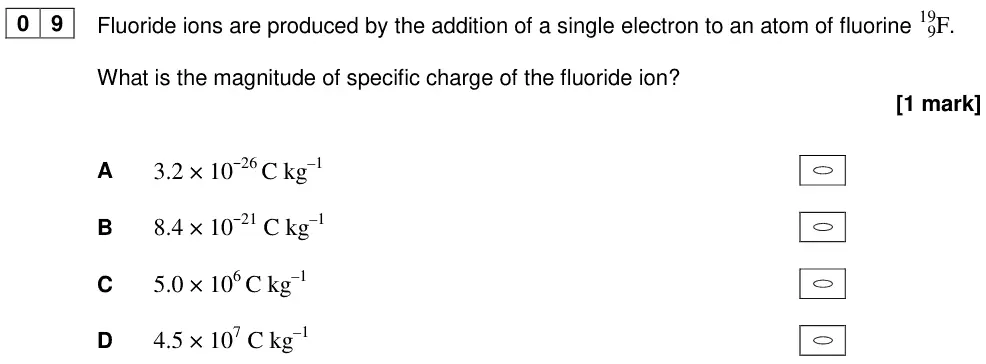
June 2018 · Paper 1 · Q9 1 mark Multiple choice atomic structure and stable nuclei
Fluoride ions are produced by the addition of a single electron to an atom of fluorine F
9
19 .
What is the magnitude of specific charge of the fluoride ion?
[1 mark]
A
3.2 × 10⁻²⁶ C kg–1
B
8.4 × 10⁻²¹ C kg–1
C
5.0 × 10⁶ C kg–1
D
4.5 × 10⁷ C kg–1
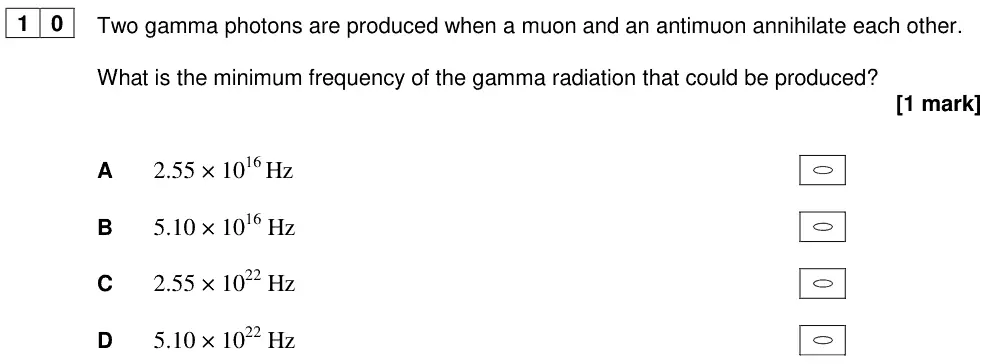
June 2018 · Paper 1 · Q10 1 mark Multiple choice particles antiparticles and interactions
Two gamma photons are produced when a muon and an antimuon annihilate each other.
What is the minimum frequency of the gamma radiation that could be produced?
[1 mark]
A
2.55 × 10¹⁶ Hz
B
5.10 × 10¹⁶ Hz
C
2.55 × 10²² Hz
D
5.10 × 10²² Hz
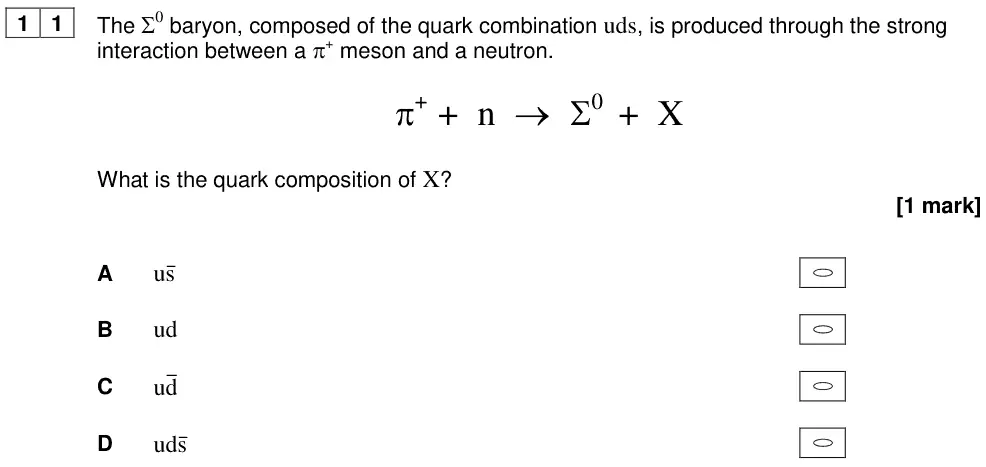
June 2018 · Paper 1 · Q11 1 mark Multiple choice classification of particles and quarks
The Σ0 baryon, composed of the quark combination uds, is produced through the strong
interaction between a π+ meson and a neutron.
π+
+  n  →  Σ0  +  X
What is the quark composition of X?
[1 mark]
A
us̅
B
ud
C
udത
D
uds̅
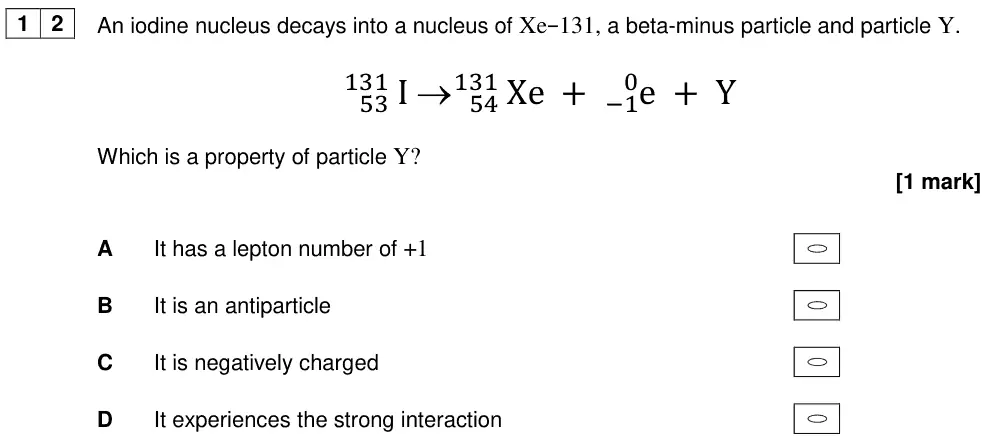
I →
Xe +
e
+ Y
June 2018 · Paper 1 · Q12 1 mark Multiple choice Easy atomic structure and stable nucleiclassification of particles and quarks
An iodine nucleus decays into a nucleus of Xe−131, a beta-minus particle and particle Y.
−1
0
54
131
53
131
Which is a property of particle Y?
[1 mark]
A
It has a lepton number of +1
B
It is an antiparticle
C
It is negatively charged
D
It experiences the strong interaction
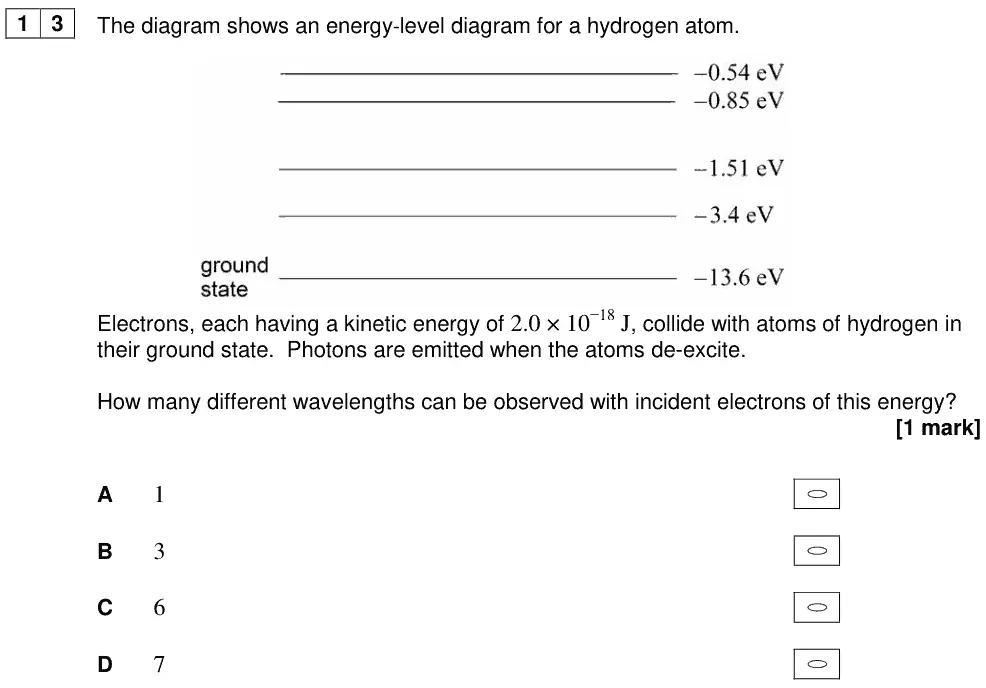
June 2018 · Paper 1 · Q13 1 mark Multiple choice energy levels and wave particle duality
The diagram shows an energy-level diagram for a hydrogen atom.
Electrons, each having a kinetic energy of 2.0 × 10⁻¹⁸ J, collide with atoms of hydrogen in
their ground state.  Photons are emitted when the atoms de-excite.
How many different wavelengths can be observed with incident electrons of this energy?
[1 mark]
A
1
B
3
C
6
D
7
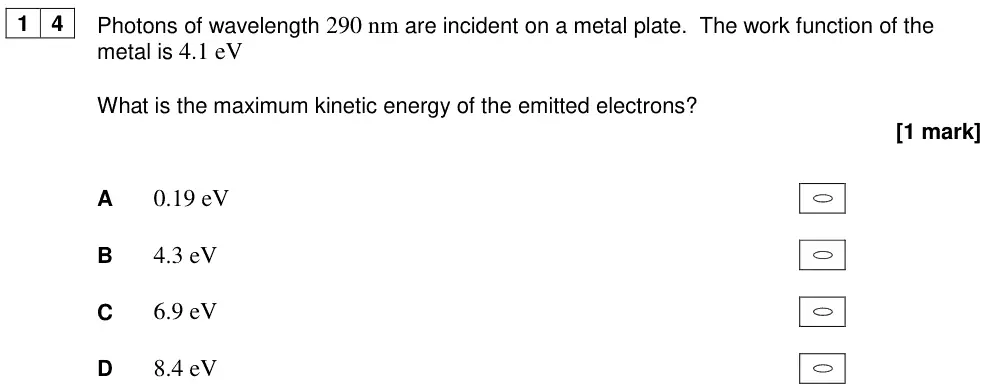
June 2018 · Paper 1 · Q14 1 mark Multiple choice photoelectric effectenergy levels and wave particle duality
Photons of wavelength 290 nm are incident on a metal plate.  The work function of the
metal is 4.1 eV
What is the maximum kinetic energy of the emitted electrons?
[1 mark]
A
0.19 eV
B
4.3 eV
C
6.9 eV
D
8.4 eV
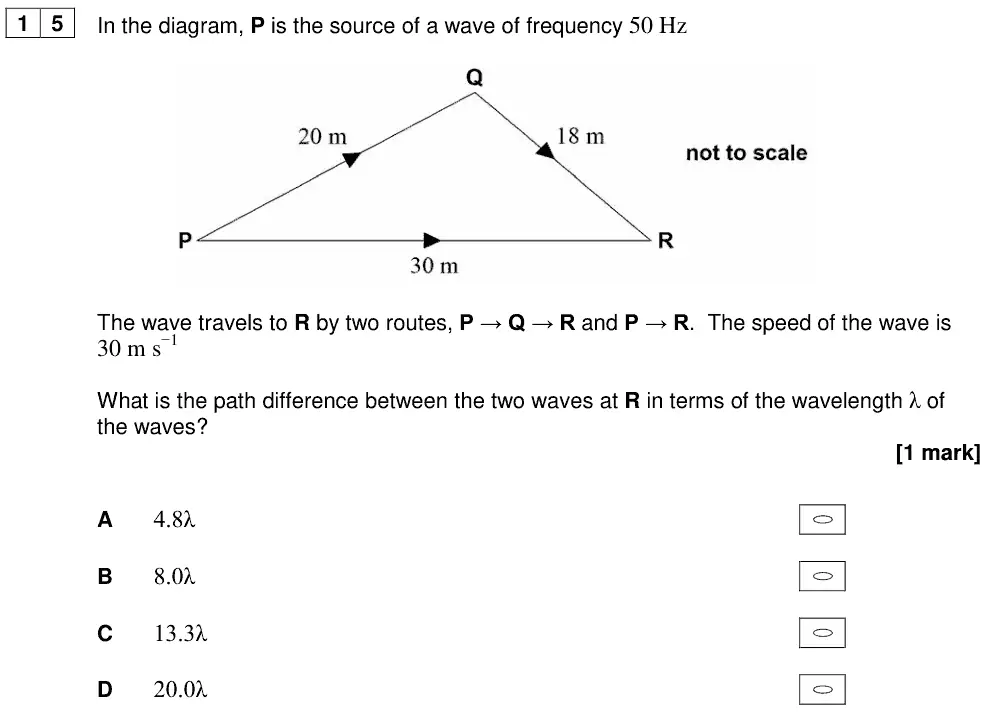
June 2018 · Paper 1 · Q15 1 mark Multiple choice interference and diffractionprogressive waves and polarisation
In the diagram, P is the source of a wave of frequency 50 Hz
The wave travels to R by two routes, P → Q → R and P → R.  The speed of the wave is
30 m s−1
What is the path difference between the two waves at R in terms of the wavelength λ of
the waves?
[1 mark]
A
4.8λ
B
8.0λ
C
13.3λ
D
20.0λ
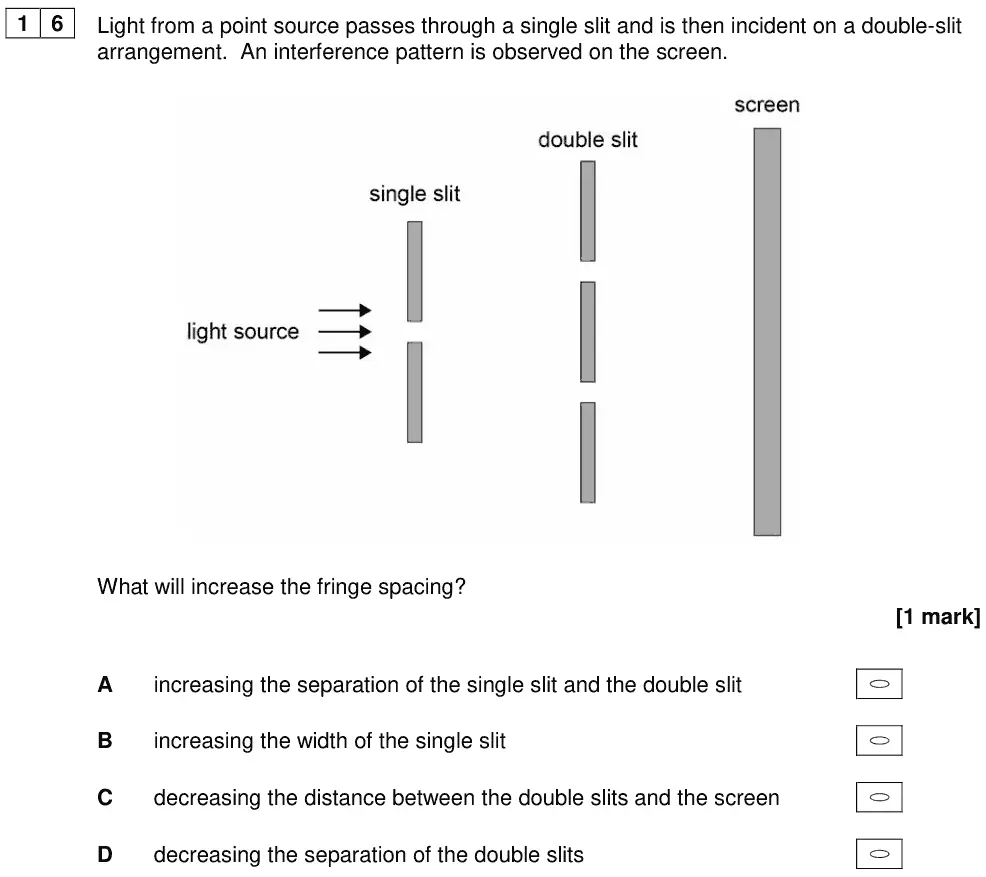
June 2018 · Paper 1 · Q16 1 mark Multiple choice interference and diffraction
Light from a point source passes through a single slit and is then incident on a double-slit
arrangement.  An interference pattern is observed on the screen.
What will increase the fringe spacing?
[1 mark]
A
increasing the separation of the single slit and the double slit
B
increasing the width of the single slit
C
decreasing the distance between the double slits and the screen
D
decreasing the separation of the double slits
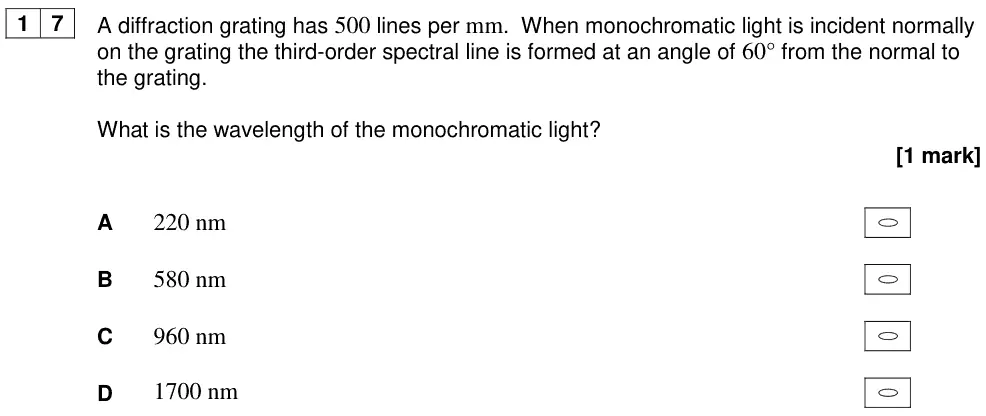
June 2018 · Paper 1 · Q17 1 mark Multiple choice interference and diffraction
A diffraction grating has 500 lines per mm.  When monochromatic light is incident normally
on the grating the third-order spectral line is formed at an angle of 60° from the normal to
the grating.
What is the wavelength of the monochromatic light?
[1 mark]
A
220 nm
B
580 nm
C
960 nm
D
1700 nm
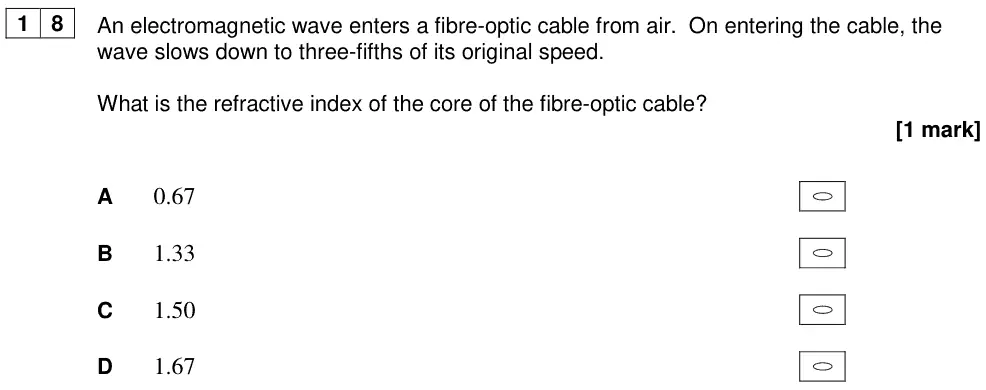
June 2018 · Paper 1 · Q18 1 mark Multiple choice Easy refraction and optical fibres
An electromagnetic wave enters a fibre-optic cable from air.  On entering the cable, the
wave slows down to three-fifths of its original speed.
What is the refractive index of the core of the fibre-optic cable?
[1 mark]
A
0.67
B
1.33
C
1.50
D
1.67
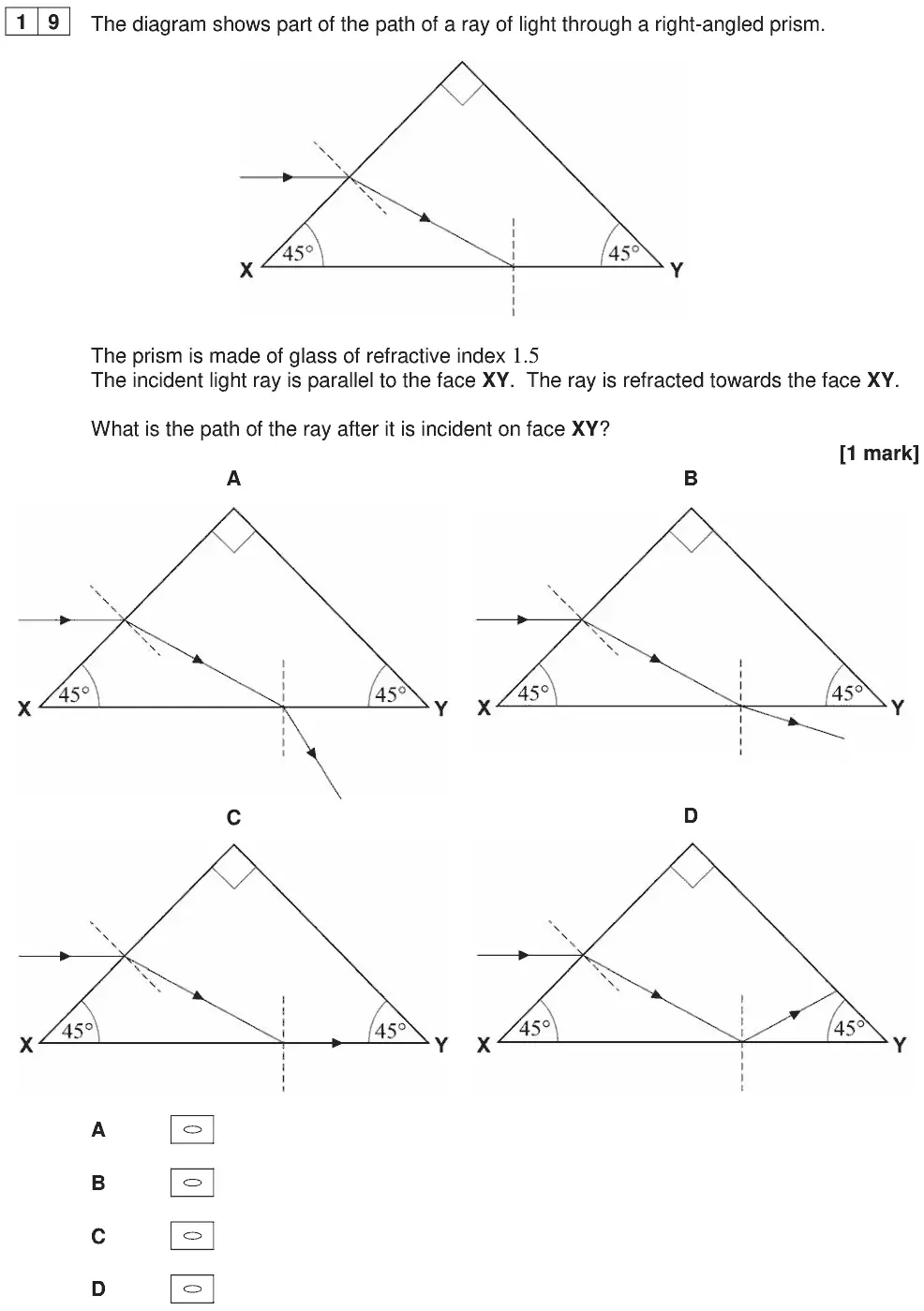
June 2018 · Paper 1 · Q19 1 mark Multiple choice refraction and optical fibres
The diagram shows part of the path of a ray of light through a right-angled prism.
The prism is made of glass of refractive index 1.5
The incident light ray is parallel to the face XY.  The ray is refracted towards the face XY.
What is the path of the ray after it is incident on face XY?
[1 mark]
A
B
C
D
A
B
C
D
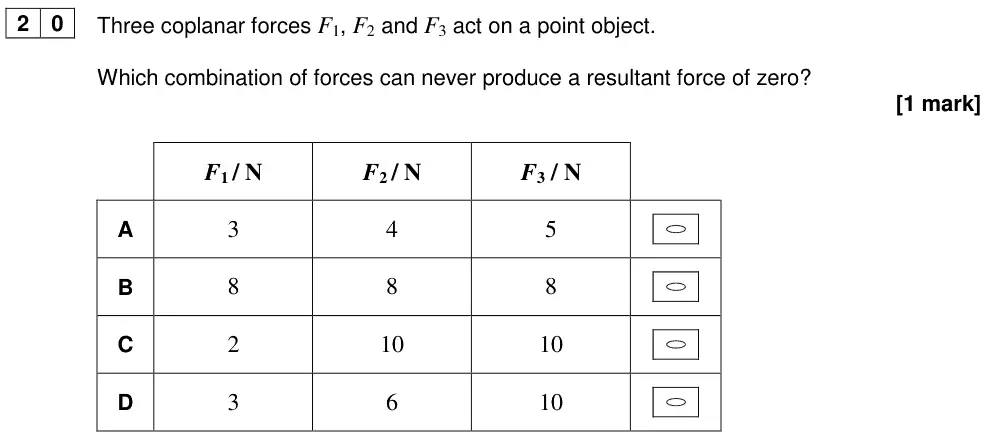
June 2018 · Paper 1 · Q20 1 mark Multiple choice vectors and moments
Three coplanar forces F1, F2 and F3 act on a point object.
Which combination of forces can never produce a resultant force of zero?
[1 mark]
F1 / N
F2 / N
F3 / N
A
3
4
5
B
8
8
8
C
2
10
10
D
3
6
10
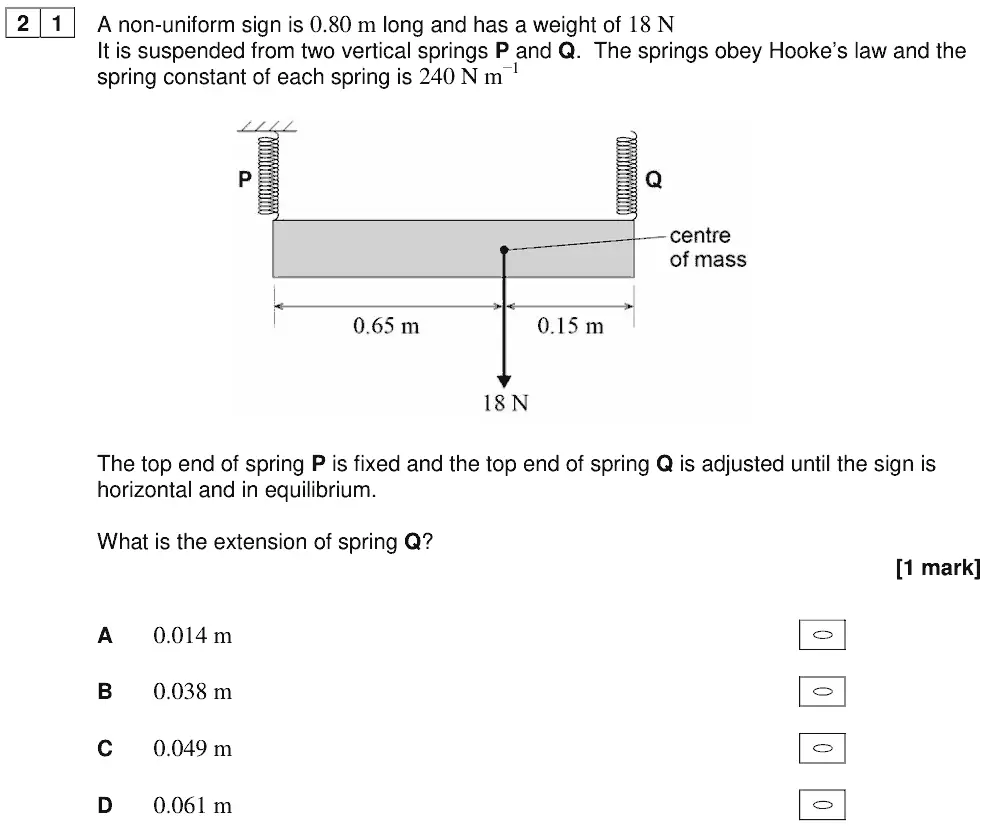
June 2018 · Paper 1 · Q21 1 mark Multiple choice vectors and momentsmaterials and young modulus
A non-uniform sign is 0.80 m long and has a weight of 18 N
It is suspended from two vertical springs P and Q.  The springs obey Hooke’s law and the
spring constant of each spring is 240 N m−1
The top end of spring P is fixed and the top end of spring Q is adjusted until the sign is
horizontal and in equilibrium.
What is the extension of spring Q?
[1 mark]
A
0.014 m
B
0.038 m
C
0.049 m
D
0.061 m
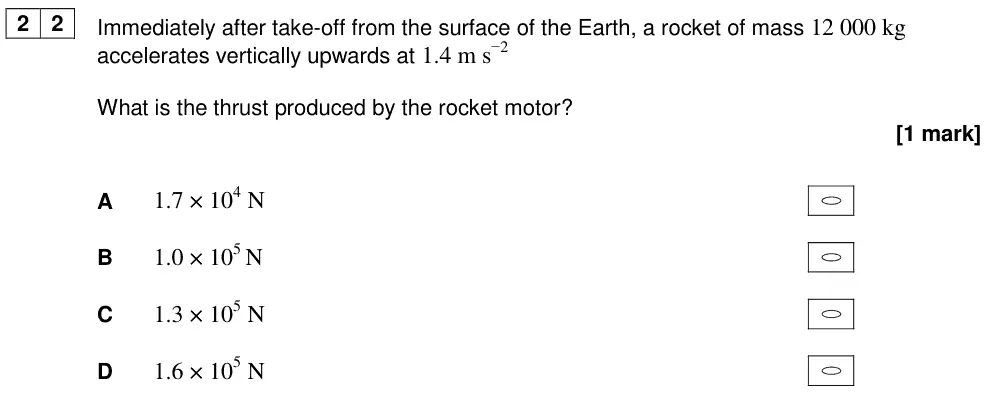
June 2018 · Paper 1 · Q22 1 mark Multiple choice newtons laws and momentum
Immediately after take-off from the surface of the Earth, a rocket of mass 12 000 kg
accelerates vertically upwards at 1.4 m s−2
What is the thrust produced by the rocket motor?
[1 mark]
A
1.7 × 10⁴ N
B
1.0 × 10⁵ N
C
1.3 × 10⁵ N
D
1.6 × 10⁵ N
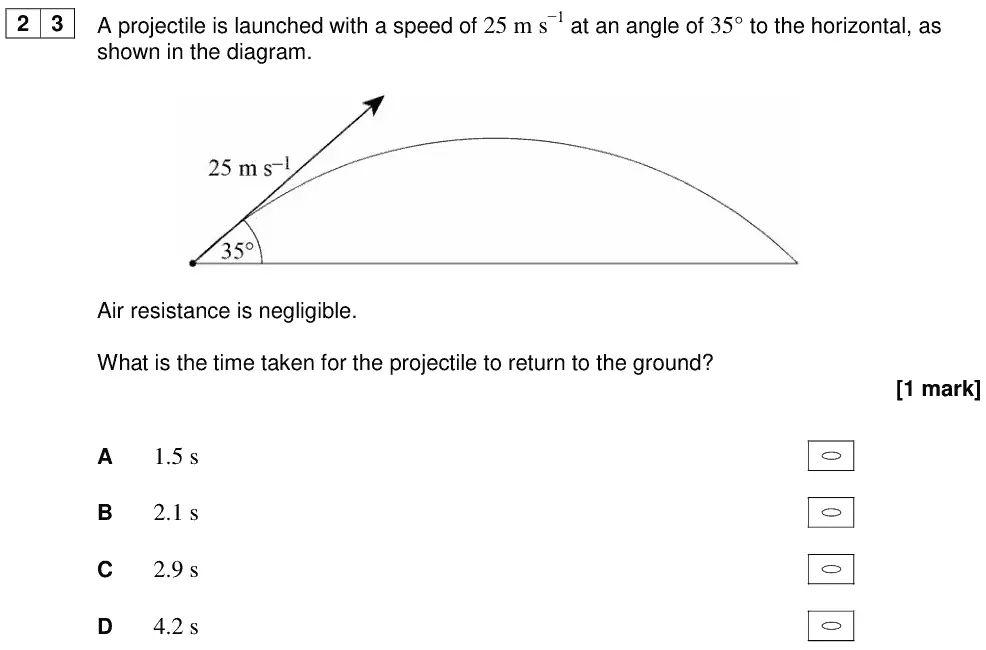
June 2018 · Paper 1 · Q23 1 mark Multiple choice motion and projectiles
A projectile is launched with a speed of 25 m s−1 at an angle of 35° to the horizontal, as
shown in the diagram.
Air resistance is negligible.
What is the time taken for the projectile to return to the ground?
[1 mark]
A
1.5 s
B
2.1 s
C
2.9 s
D
4.2 s
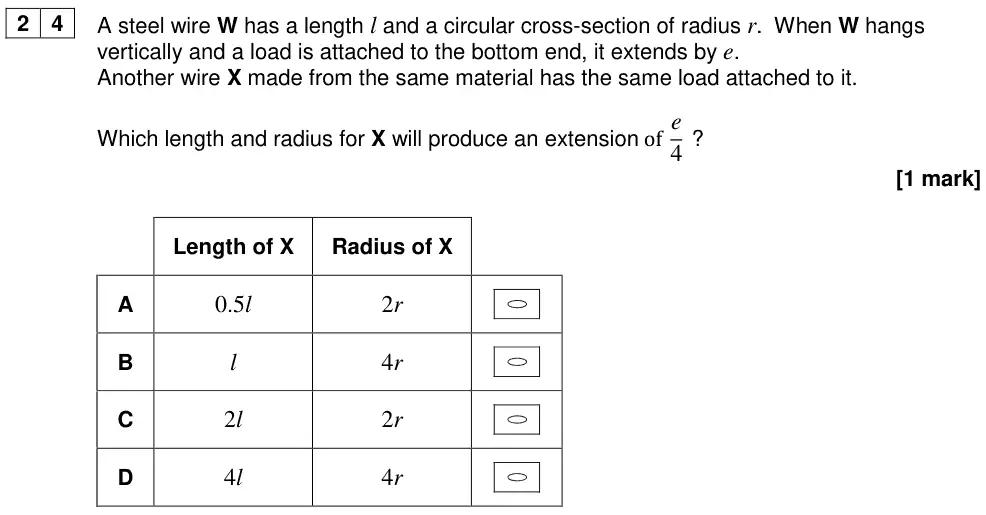
June 2018 · Paper 1 · Q24 1 mark Multiple choice materials and young modulus
A steel wire W has a length l and a circular cross-section of radius r.  When W hangs
vertically and a load is attached to the bottom end, it extends by e.
Another wire X made from the same material has the same load attached to it.
Which length and radius for X will produce an extension of e
4 ?
[1 mark]
Length of X
Radius of X
A
0.5l
2r
B
l
4r
C
2l
2r
D
4l
4r
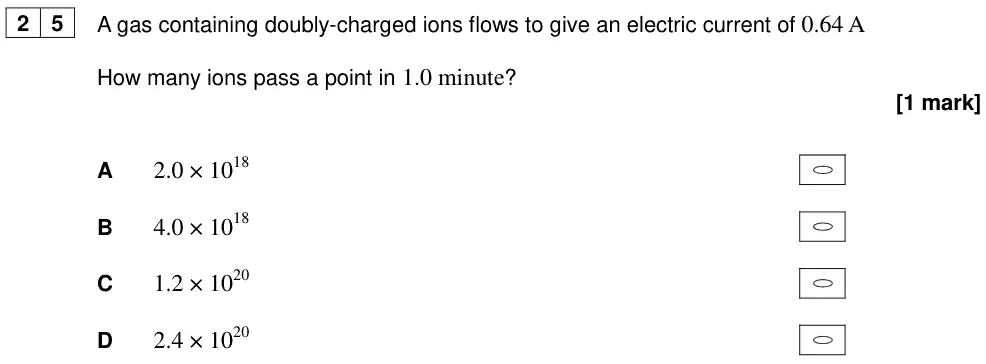
June 2018 · Paper 1 · Q25 1 mark Multiple choice current voltage and resistivity
A gas containing doubly-charged ions flows to give an electric current of 0.64 A
How many ions pass a point in 1.0 minute?
[1 mark]
A
2.0 × 10¹⁸
B
4.0 × 10¹⁸
C
1.2 × 10²⁰
D
2.4 × 10²⁰
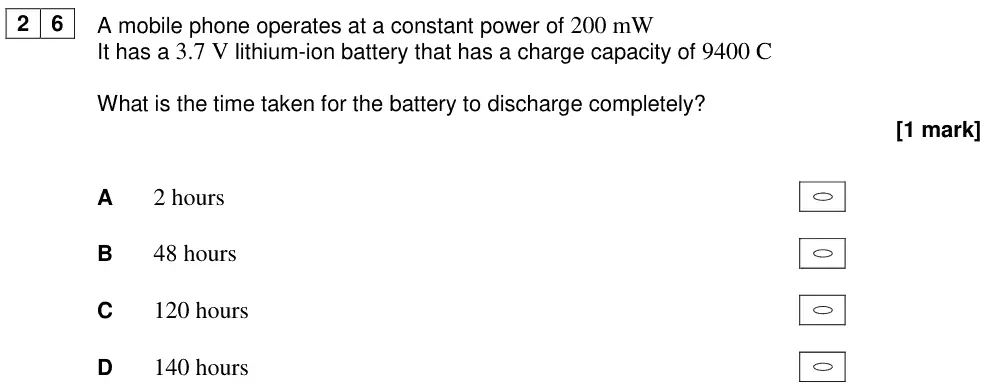
June 2018 · Paper 1 · Q26 1 mark Multiple choice current voltage and resistivitycircuits and potential dividers
A mobile phone operates at a constant power of 200 mW
It has a 3.7 V lithium-ion battery that has a charge capacity of 9400 C
What is the time taken for the battery to discharge completely?
[1 mark]
A
2 hours
B
48 hours
C
120 hours
D
140 hours
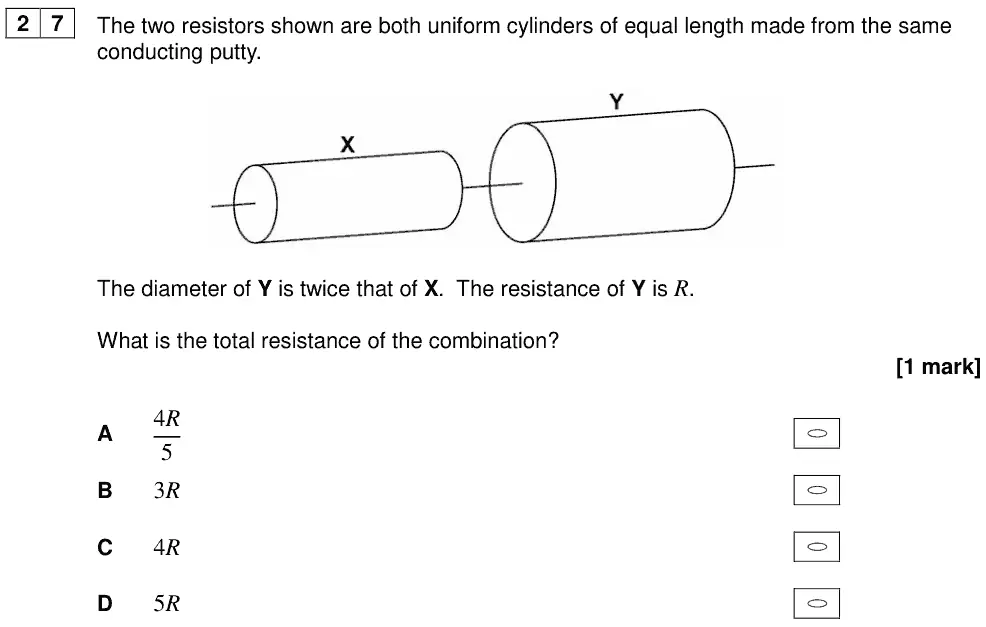
June 2018 · Paper 1 · Q27 1 mark Multiple choice current voltage and resistivitycircuits and potential dividers
The two resistors shown are both uniform cylinders of equal length made from the same
conducting putty.
The diameter of Y is twice that of X.  The resistance of Y is R.
What is the total resistance of the combination?
[1 mark]
A
4R
5
B
3R
C
4R
D
5R
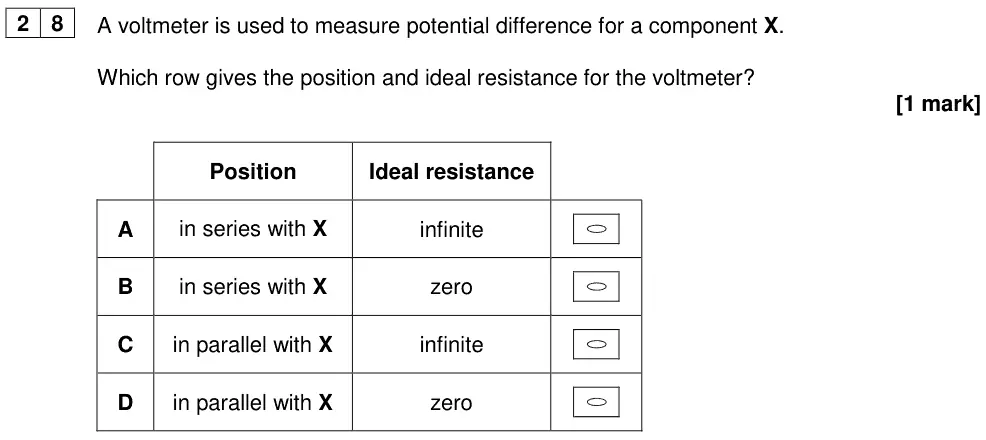
June 2018 · Paper 1 · Q28 1 mark Multiple choice current voltage and resistivity
A voltmeter is used to measure potential difference for a component X.
Which row gives the position and ideal resistance for the voltmeter?
[1 mark]
Position
Ideal resistance
A
in series with X
infinite
B
in series with X
zero
C
in parallel with X
infinite
D
in parallel with X
zero
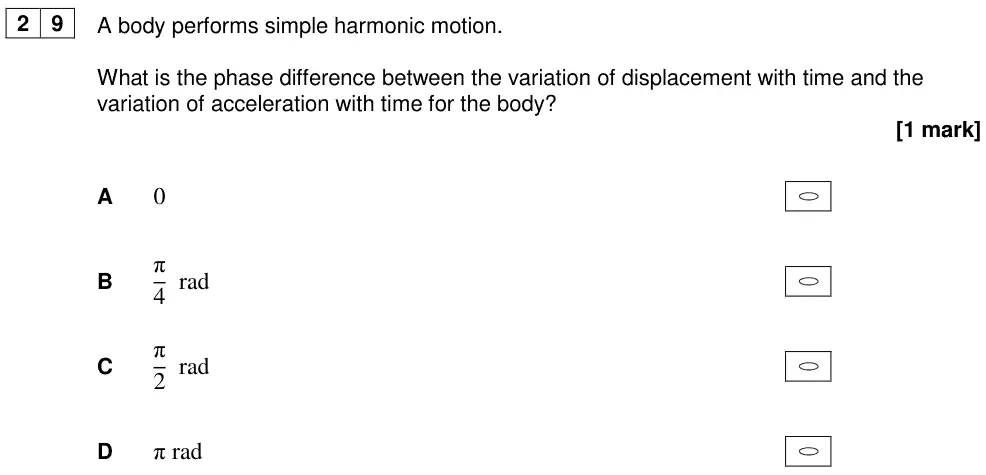
June 2018 · Paper 1 · Q29 1 mark Multiple choice simple harmonic motion
A body performs simple harmonic motion.
What is the phase difference between the variation of displacement with time and the
variation of acceleration with time for the body?
[1 mark]
A
0
B
π
4  rad
C
π
2  rad
D
π rad
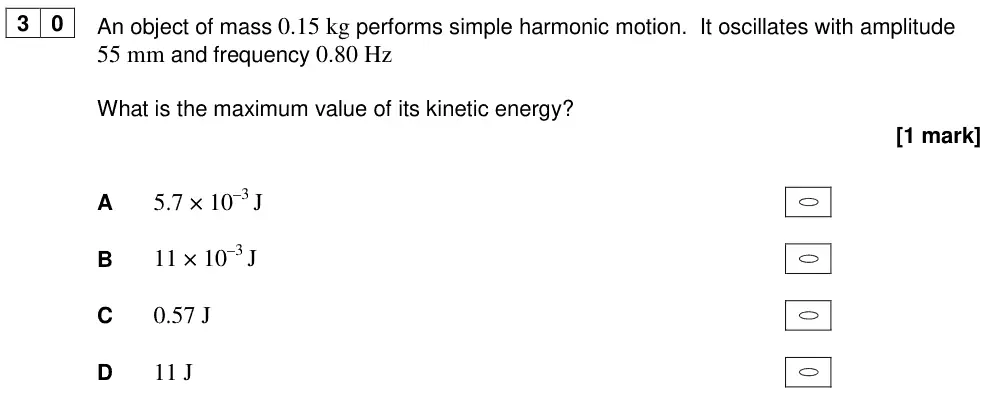
June 2018 · Paper 1 · Q30 1 mark Multiple choice simple harmonic motion
An object of mass 0.15 kg performs simple harmonic motion.  It oscillates with amplitude
55 mm and frequency 0.80 Hz
What is the maximum value of its kinetic energy?
[1 mark]
A
5.7 × 10⁻³ J
B
11 × 10–3 J
C
0.57 J
D
11 J
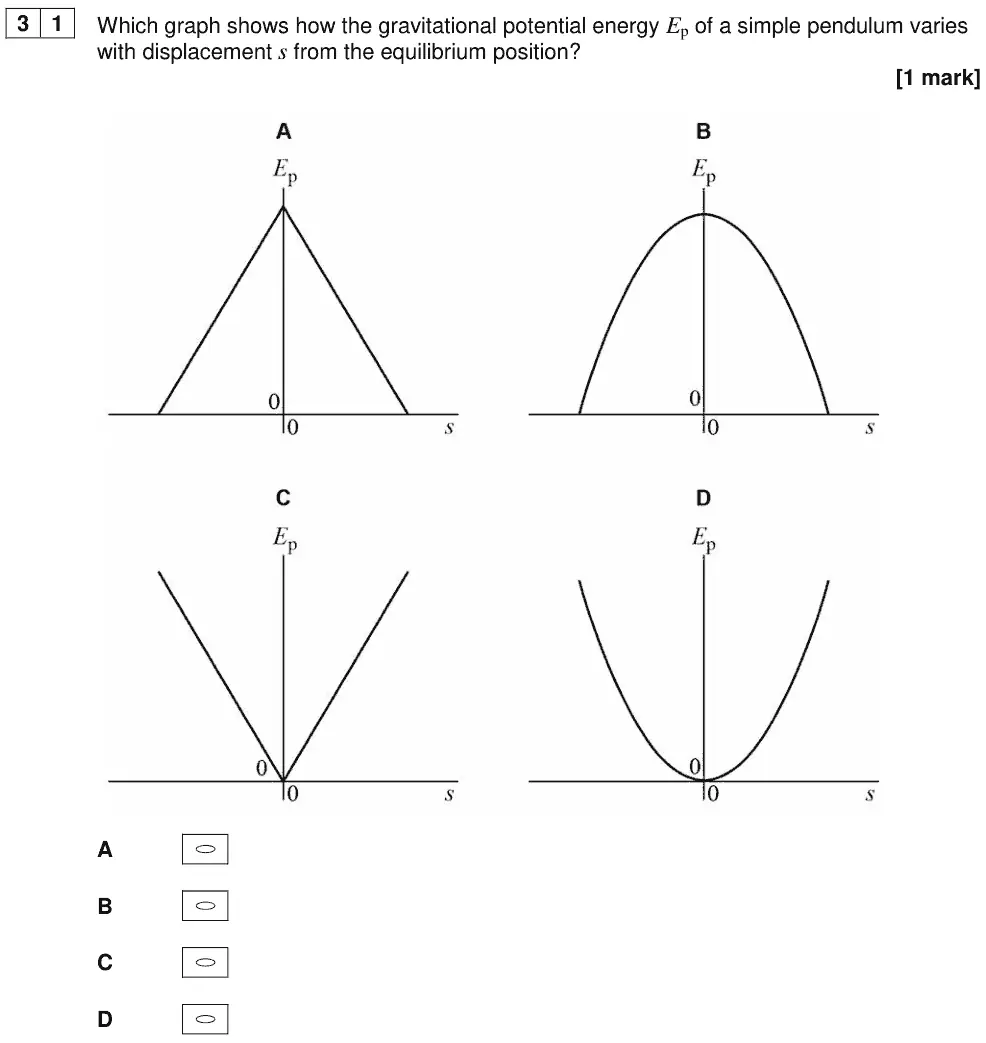
June 2018 · Paper 1 · Q31 1 mark Multiple choice simple harmonic motion
Which graph shows how the gravitational potential energy Ep of a simple pendulum varies
with displacement s from the equilibrium position?
[1 mark]
A
B
C
D

Work with an AQA physics tutor

Want a paper marked and gone through with you? Message us.

Prefer email? Send an enquiry

If you are under 18, please include a parent's contact details. Enquiries go to enquiries@physicsaleveltutor.com and are deleted once handled. All tutoring is online.