June 2022: Paper 1

85 marks · 53 question parts · Paper, mark scheme and report on AQA's site · Have the data and formulae booklet beside you

Question by question

QTopicMarksAOType
1.1 Atomic structure and stable nuclei 2AO1=2Short answer
1.2 Particles, antiparticles and particle interactions, Classification of particles, quarks and conservation laws 2AO2=1,AO3=1Explanation
1.3 Excitation, energy levels and wave-particle duality 2AO3=2Explanation
1.4 Excitation, energy levels and wave-particle duality 3AO2=2,AO3=1Calculation
1.5 Excitation, energy levels and wave-particle duality 3AO1=3Explanation
2.1 Classification of particles, quarks and conservation laws 1AO1=1Short answer
2.2 Atomic structure and stable nuclei 2AO1=2Explanation
2.3 Classification of particles, quarks and conservation laws 1AO1=1Short answer
2.4 Particles, antiparticles and particle interactions 3AO3=3Calculation
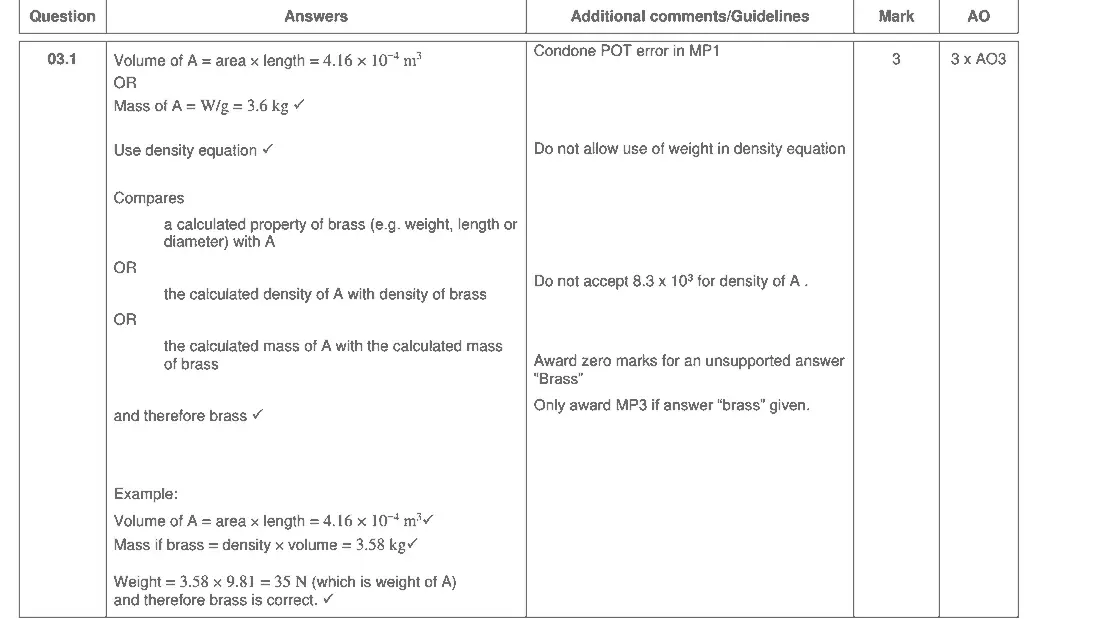
3.1 Materials, stress, strain and the Young modulus 3AO3=3Calculation
3.2 Scalars, vectors and moments 2AO2=2Calculation
3.3 Scalars, vectors and moments 2AO2=2Explanation
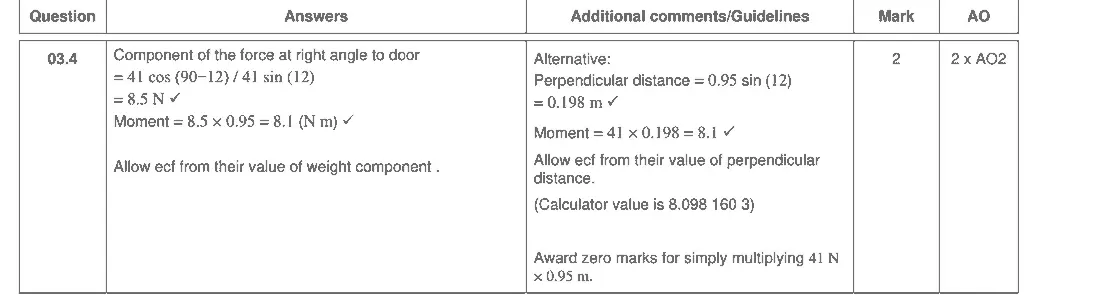
3.4 Scalars, vectors and moments 2AO2=2Calculation
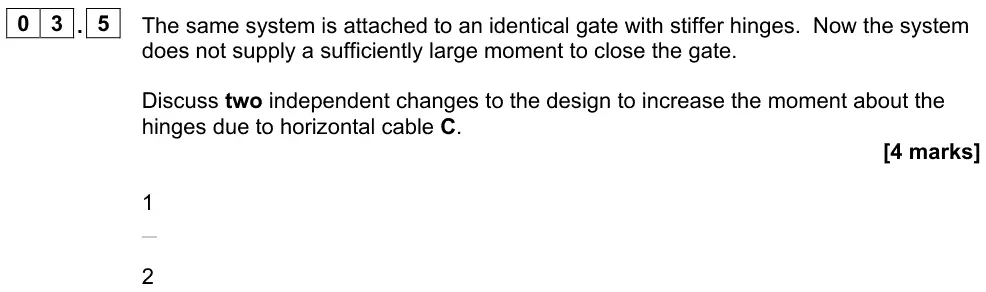
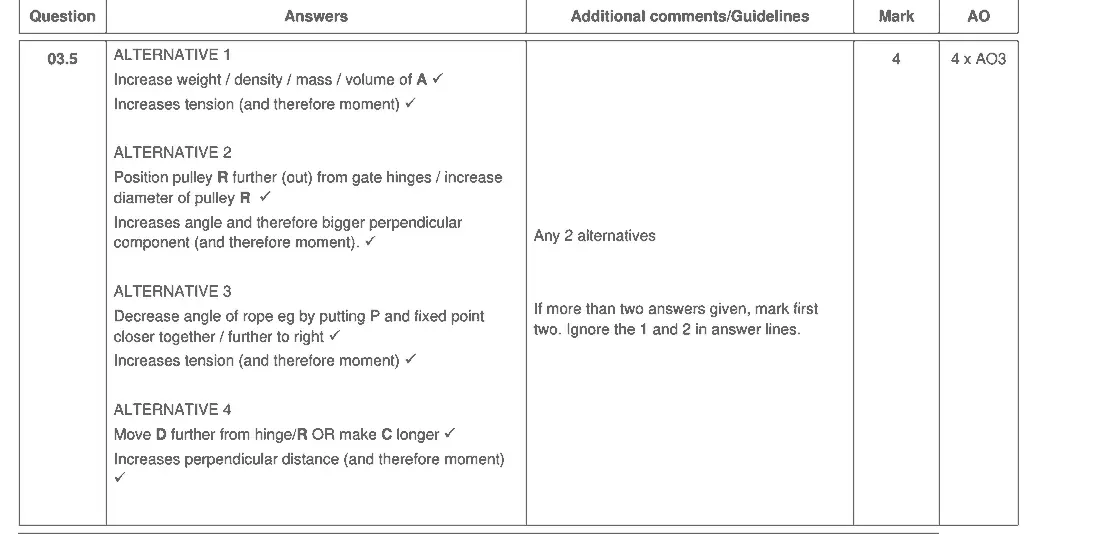
3.5 Scalars, vectors and moments 4AO3=4Explanation
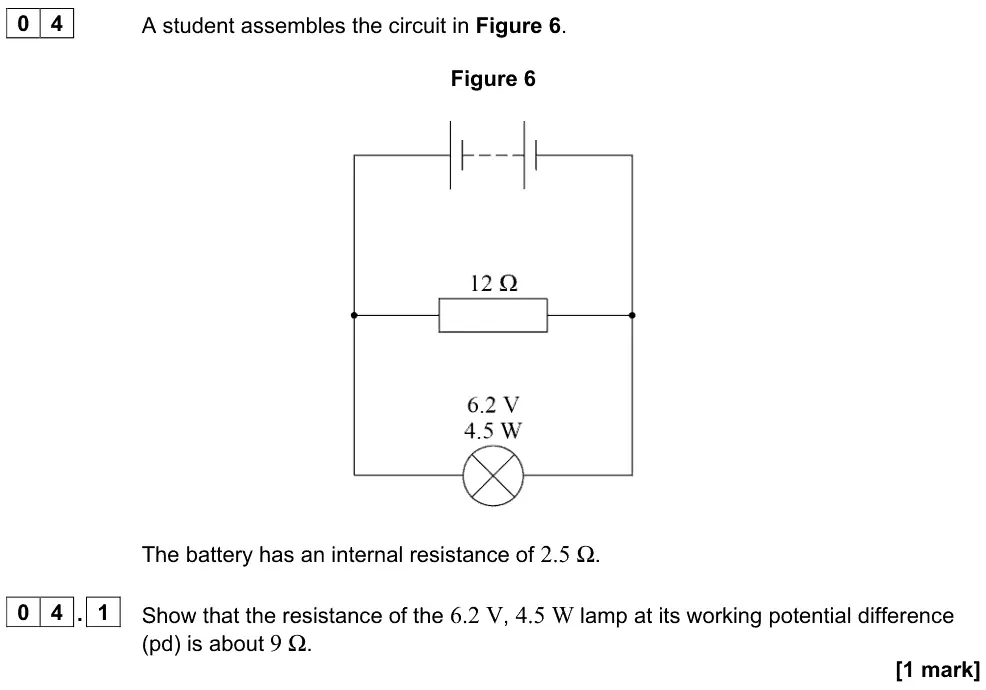
4.1 Circuits and potential dividers 1AO1=1Show that
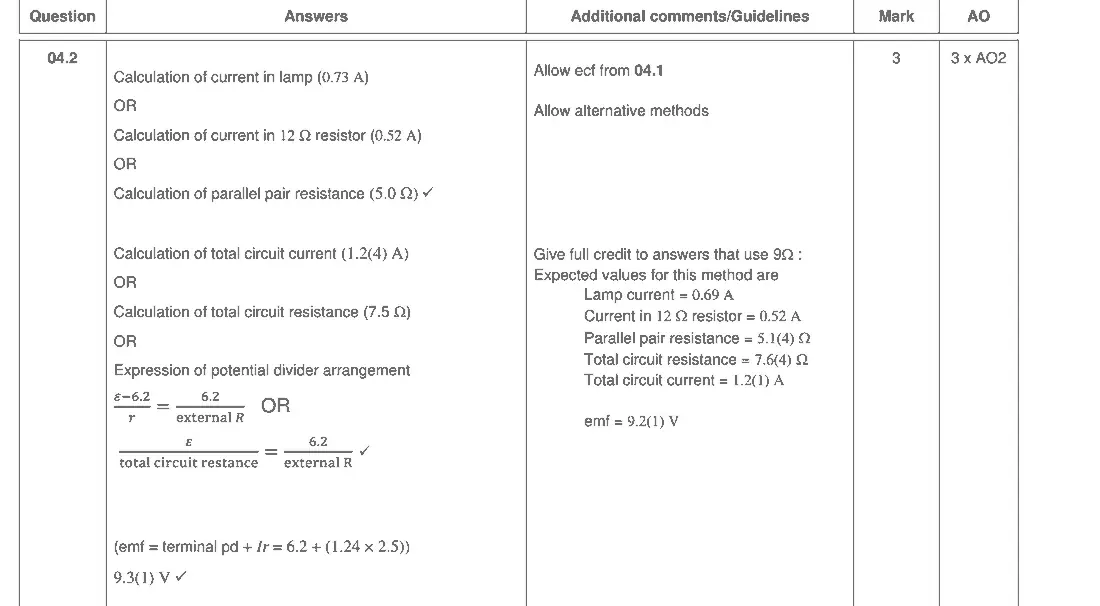
4.2 Electromotive force and internal resistance 3AO2=3Calculation
4.3 Current, potential difference, I-V characteristics and resistivity 3AO2=3Calculation
4.4 Circuits and potential dividers, Current, potential difference, I-V characteristics and resistivity 2AO3=2Explanation
4.5 Electromotive force and internal resistance 2AO3=2Explanation
5.1 Circular motion 2AO1=2Calculation
5.2 Circular motion 1AO1=1Diagram or graph
5.3 Circular motion 2AO2=2Calculation
5.4 Newton's laws of motion and momentum, Circular motion 2AO1=2Explanation
5.5 Simple harmonic motion, forced vibrations and resonance 2AO1=2Calculation
5.6 Simple harmonic motion, forced vibrations and resonance 2AO3=2Explanation
6.1 Refraction, total internal reflection and optical fibres 1AO1=1Short answer
6.2 Refraction, total internal reflection and optical fibres 2AO2=2Show that
6.3 Refraction, total internal reflection and optical fibres 3AO3=3Diagram or graph
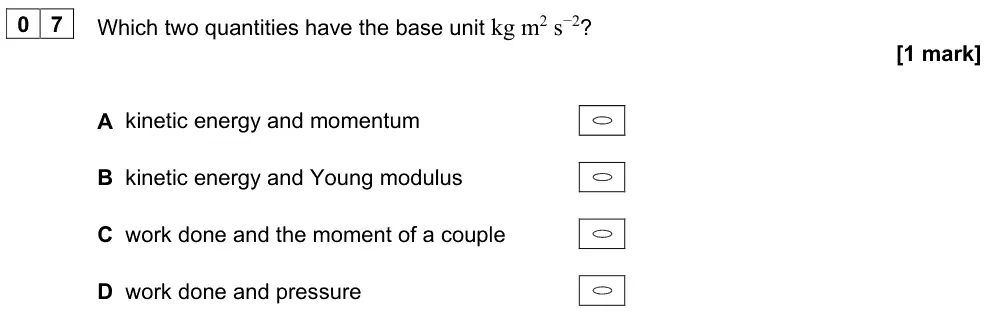
7 Measurements, units and uncertainties, Scalars, vectors and moments 1AO1=1Multiple choice
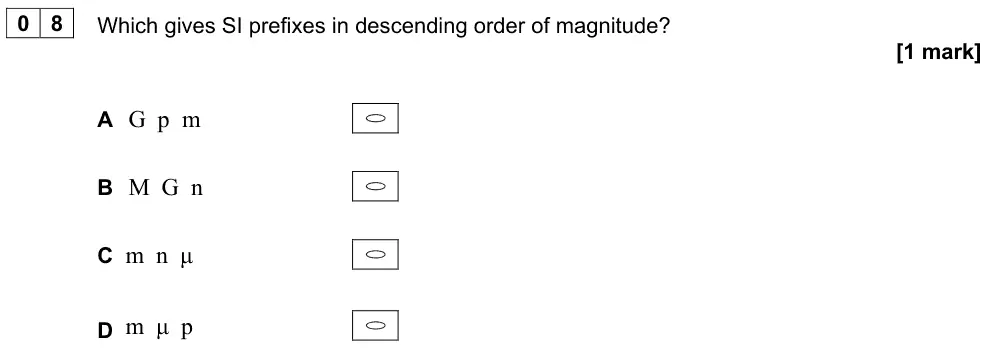
8 Measurements, units and uncertainties 1AO3=1Multiple choice
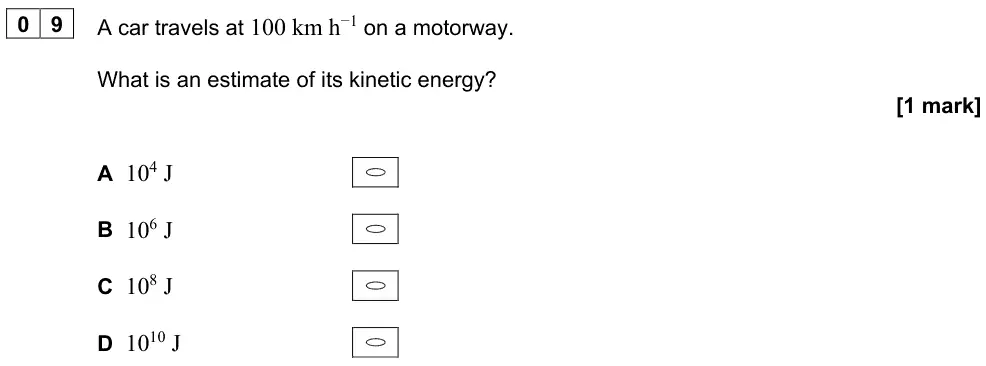
9 Measurements, units and uncertainties, Work, energy, power and conservation of energy 1AO1=1Multiple choice
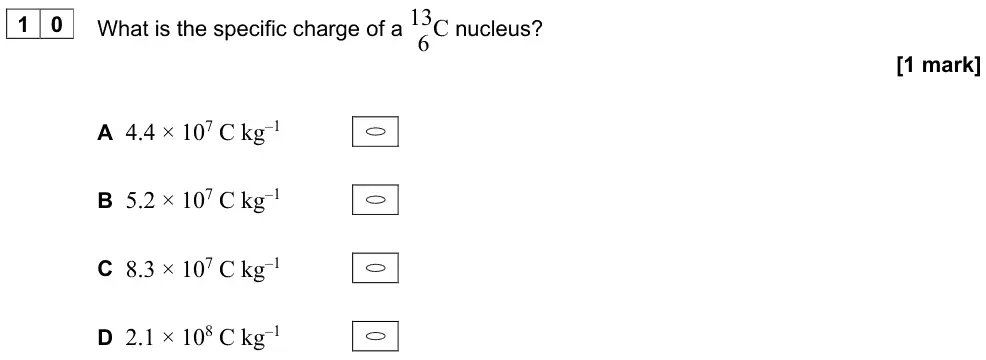
10 Atomic structure and stable nuclei 1AO2=1Multiple choice
11 Atomic structure and stable nuclei 1AO1=1Multiple choice
12 Classification of particles, quarks and conservation laws 1AO1=1Multiple choice
13 Classification of particles, quarks and conservation laws 1AO2=1Multiple choice
14 The photoelectric effect 1AO2=1Multiple choice
15 Excitation, energy levels and wave-particle duality 1AO1=1Multiple choice
16 Excitation, energy levels and wave-particle duality 1AO1=1Multiple choice
17 Excitation, energy levels and wave-particle duality 1AO2=1Multiple choice
18 Progressive waves, longitudinal and transverse waves 1AO2=1Multiple choice
19 Superposition and stationary waves 1AO1=1Multiple choice
20 Interference, diffraction and the diffraction grating 1AO2=1Multiple choice
21 Interference, diffraction and the diffraction grating 1AO2=1Multiple choice
22 Scalars, vectors and moments 1AO1=1Multiple choice
23 Motion along a straight line and projectile motion 1AO2=1Multiple choice
24 Newton's laws of motion and momentum 1AO2=1Multiple choice
25 Newton's laws of motion and momentum 1AO1=1Multiple choice
26 Newton's laws of motion and momentum, Work, energy, power and conservation of energy 1AO2=1Multiple choice
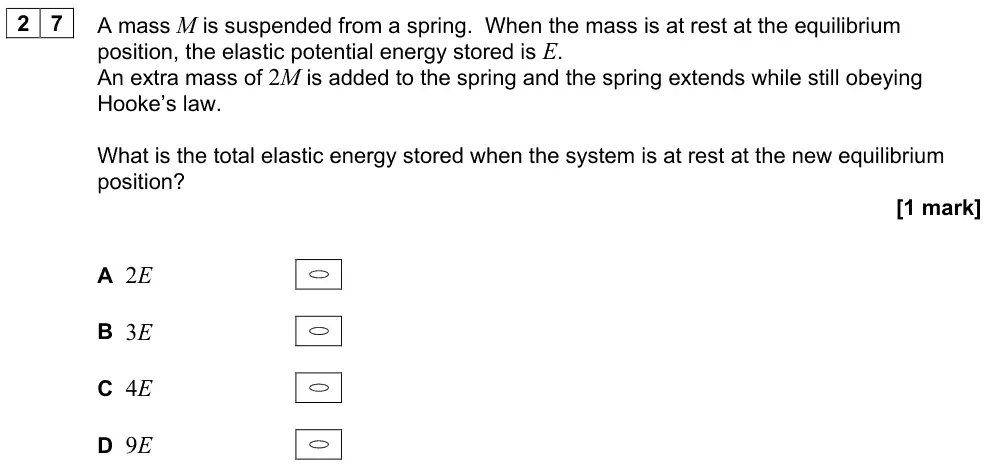
27 Materials, stress, strain and the Young modulus 1AO1=1Multiple choice
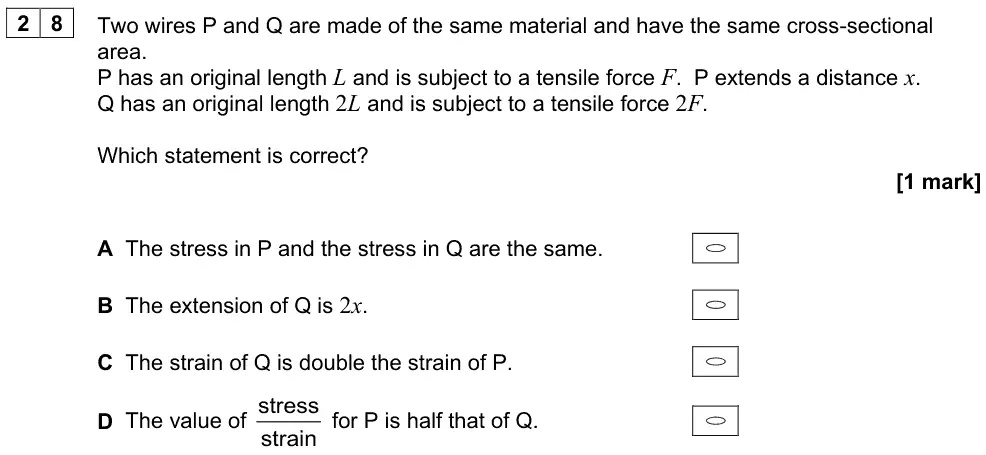
28 Materials, stress, strain and the Young modulus 1AO3=1Multiple choice
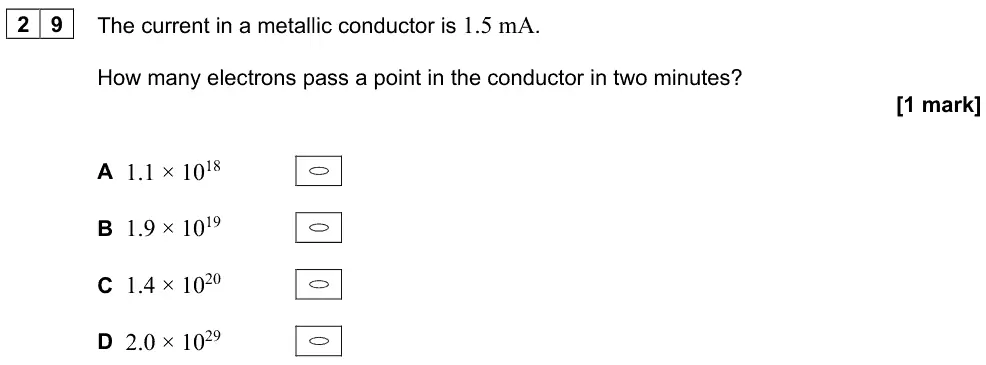
29 Current, potential difference, I-V characteristics and resistivity 1AO2=1Multiple choice
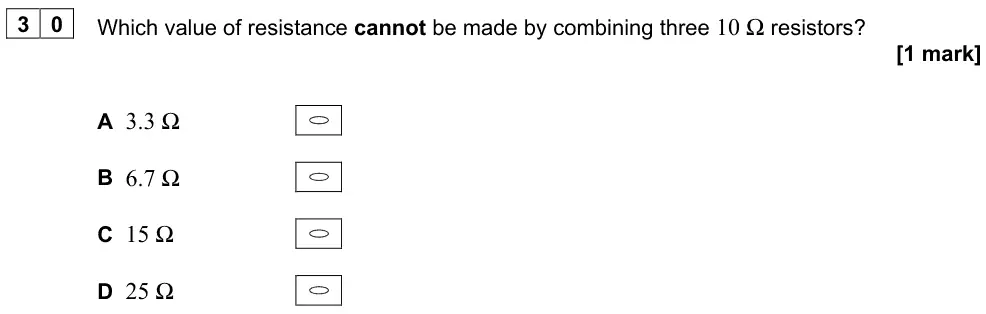
30 Circuits and potential dividers 1AO2=1Multiple choice
31 Simple harmonic motion, forced vibrations and resonance 1AO2=1Multiple choice

The questions

1.11.21.31.41.52.12.22.32.43.13.23.33.43.54.14.24.34.44.55.15.25.35.45.55.66.16.26.378910111213141516171819202122232425262728293031
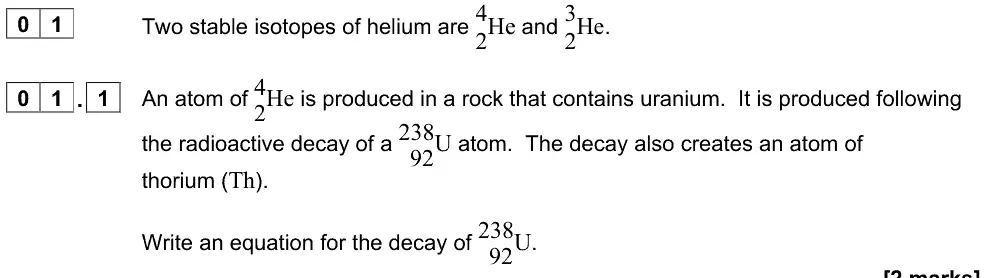
June 2022 · Paper 1 · Q1.1 2 marks AO1=2 Short answer atomic structure and stable nuclei
2He.
An atom of 4
2He is produced in a rock that contains uranium.  It is produced following
the radioactive decay of a 238
92U atom.  The decay also creates an atom of
thorium (Th).
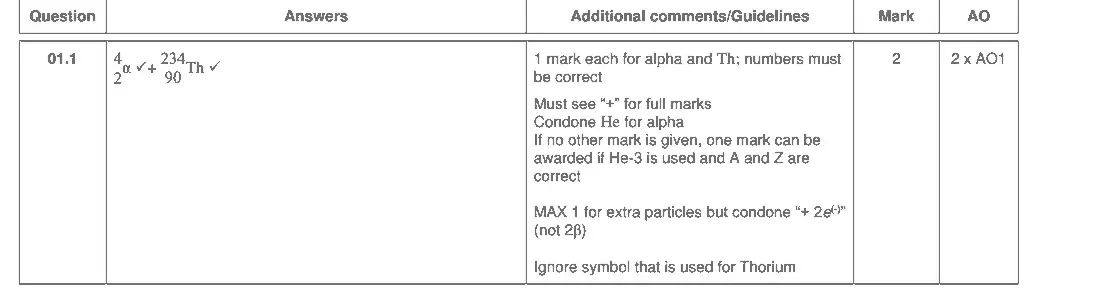
Write an equation for the decay of 238
92U.
[2 marks]
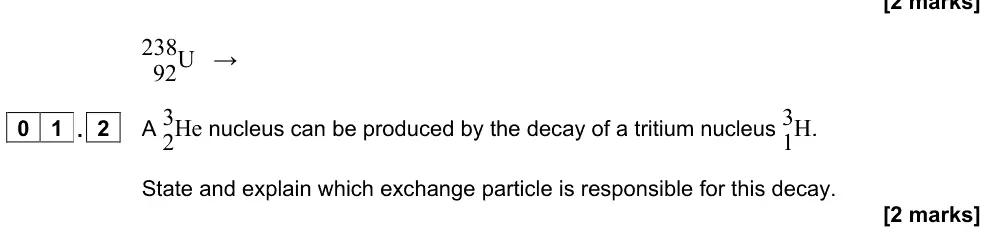
June 2022 · Paper 1 · Q1.2 2 marks AO2=1, AO3=1 Explanation particles antiparticles and interactionsclassification of particles and quarks
Earlier part of question 1 that this part usesEarlier part of June 2022 Paper 1 question 1
238
92U →
A 3
2He nucleus can be produced by the decay of a tritium nucleus 3
1H.
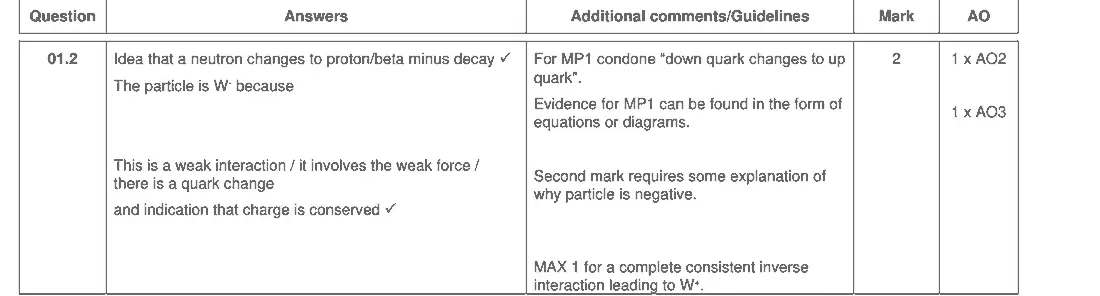
State and explain which exchange particle is responsible for this decay.
[2 marks]
June 2022 · Paper 1 · Q1.3 2 marks AO3=2 Explanation energy levels and wave particle duality
Earlier part of question 1 that this part usesEarlier part of June 2022 Paper 1 question 1
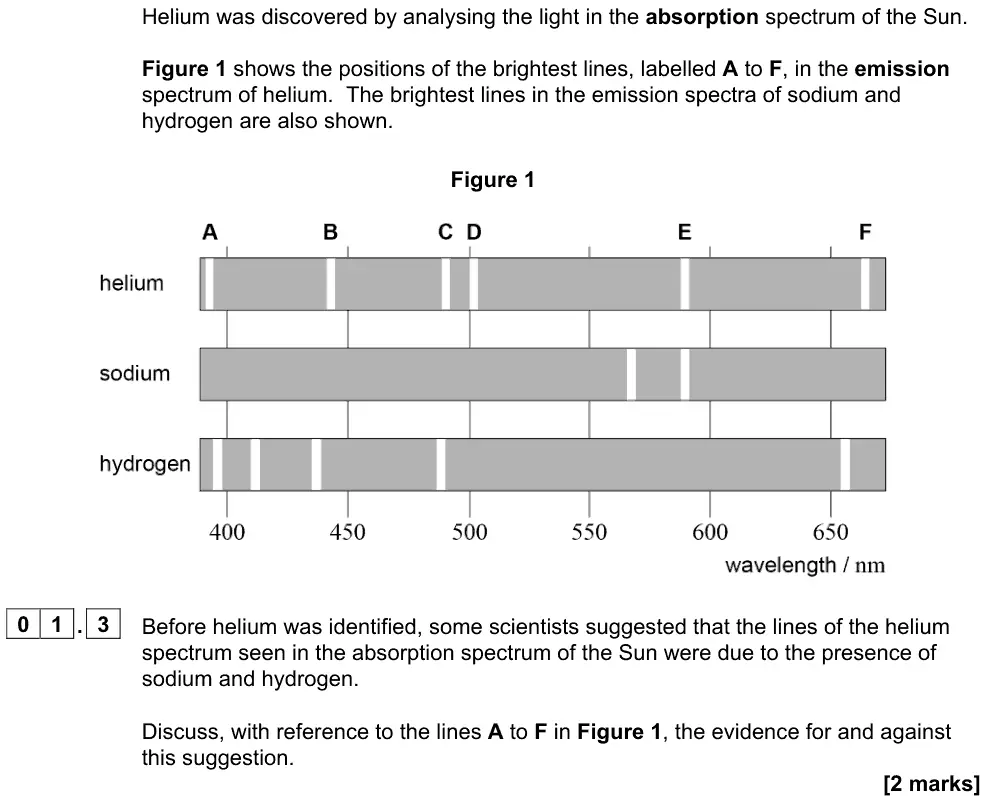
Helium was discovered by analysing the light in the absorption spectrum of the Sun.
Figure 1 shows the positions of the brightest lines, labelled A to F, in the emission
spectrum of helium.  The brightest lines in the emission spectra of sodium and
hydrogen are also shown.
Figure 1
Before helium was identified, some scientists suggested that the lines of the helium
spectrum seen in the absorption spectrum of the Sun were due to the presence of
sodium and hydrogen.
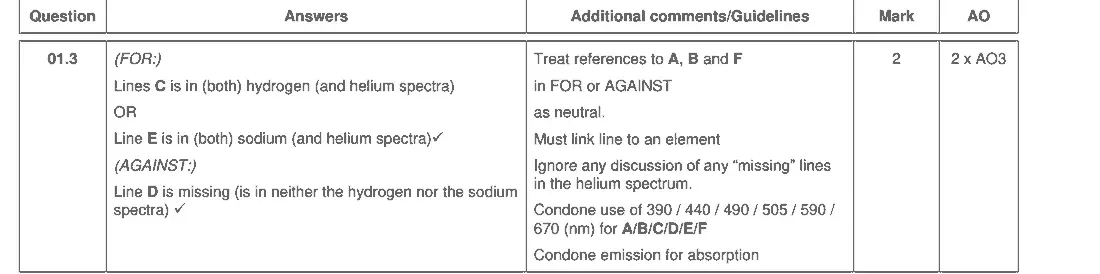
Discuss, with reference to the lines A to F in Figure 1, the evidence for and against
this suggestion.
[2 marks]
June 2022 · Paper 1 · Q1.4 3 marks AO2=2, AO3=1 Calculation energy levels and wave particle duality
Earlier part of question 1 that this part usesEarlier part of June 2022 Paper 1 question 1
Calculate, in eV, the change in energy level responsible for the spectral line labelled E
in Figure 1.
[3 marks]
change in energy level =
eV
June 2022 · Paper 1 · Q1.5 3 marks AO1=3 Explanation energy levels and wave particle duality
Earlier part of question 1 that this part usesEarlier part of June 2022 Paper 1 question 1
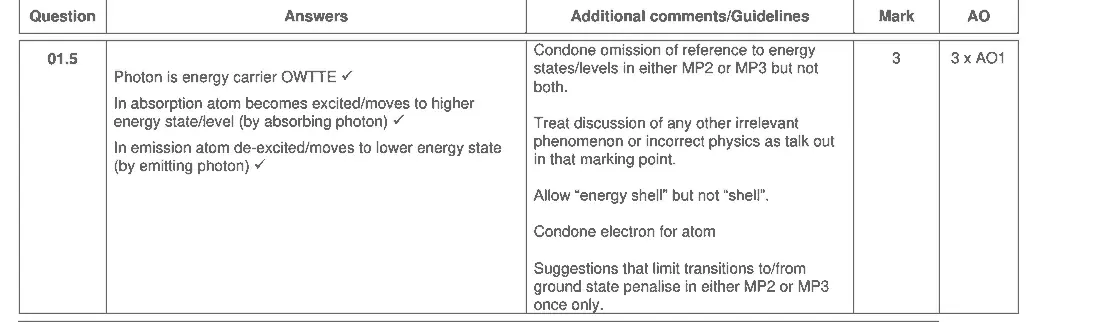
Explain, with reference to the processes within an atom, the difference between an
emission spectrum and an absorption spectrum.
[3 marks]
June 2022 · Paper 1 · Q2.1 1 mark AO1=1 Short answer classification of particles and quarks
Carbon-14 decays into nitrogen-14 with the release of a beta (β−) particle and an
antineutrino (
ev ).
State the change of quark character in β− decay.
[1 mark]
June 2022 · Paper 1 · Q2.2 2 marks AO1=2 Explanation atomic structure and stable nuclei
Earlier part of question 2 that this part usesEarlier part of June 2022 Paper 1 question 2
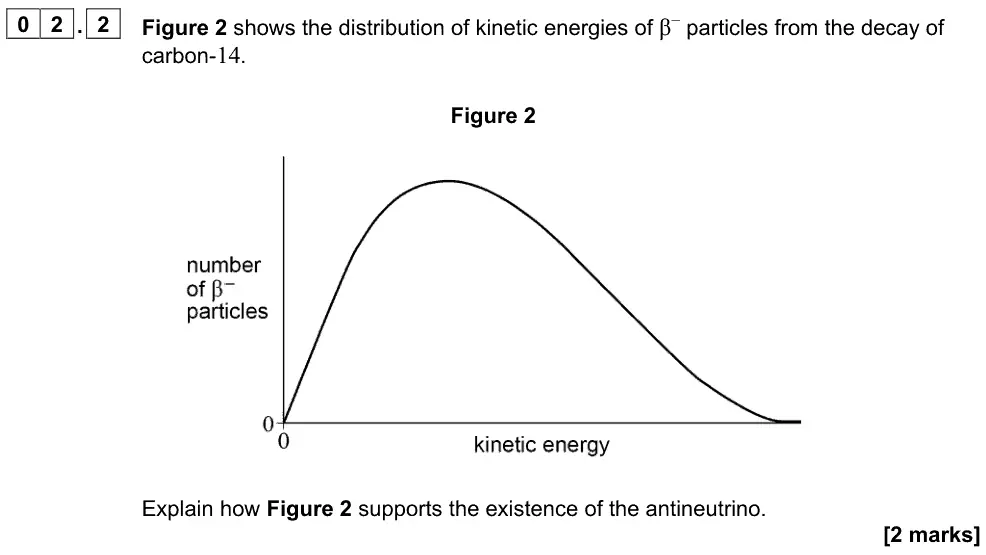
Figure 2 shows the distribution of kinetic energies of β− particles from the decay of
carbon-14.
Figure 2
Explain how Figure 2 supports the existence of the antineutrino.
[2 marks]
June 2022 · Paper 1 · Q2.3 1 mark AO1=1 Short answer classification of particles and quarks
Earlier part of question 2 that this part usesEarlier part of June 2022 Paper 1 question 2
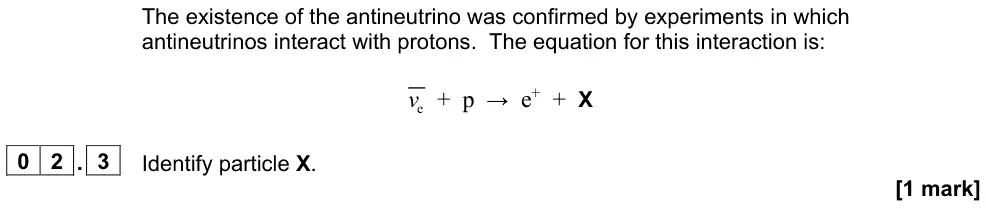
The existence of the antineutrino was confirmed by experiments in which
antineutrinos interact with protons.  The equation for this interaction is:
ev +  p  →  e+  +  X
Identify particle X.
[1 mark]
June 2022 · Paper 1 · Q2.4 3 marks AO3=3 Calculation particles antiparticles and interactions
Earlier part of question 2 that this part usesEarlier part of June 2022 Paper 1 question 2
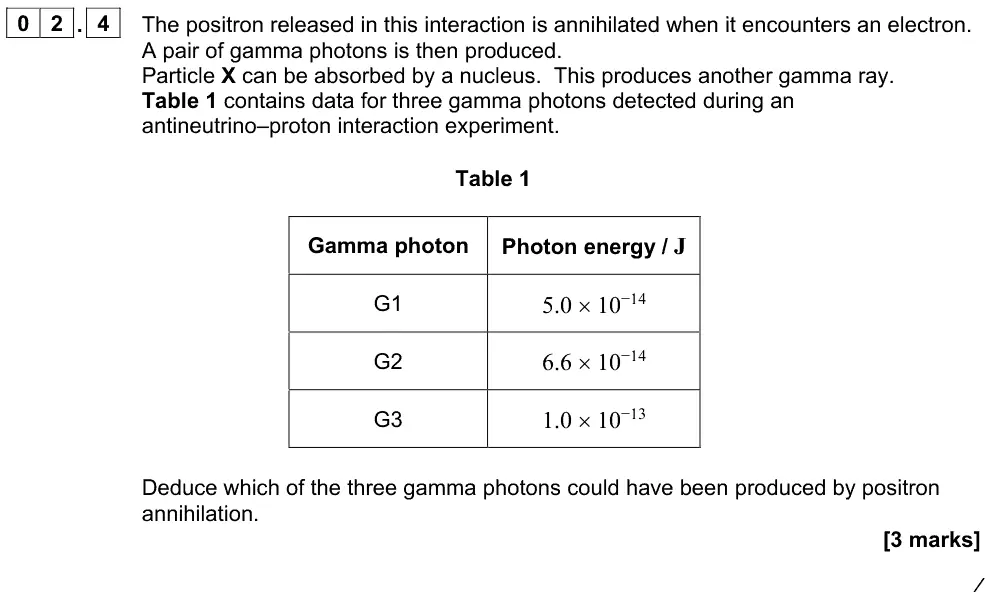
The positron released in this interaction is annihilated when it encounters an electron.
A pair of gamma photons is then produced.
Particle X can be absorbed by a nucleus.  This produces another gamma ray.
Table 1 contains data for three gamma photons detected during an
antineutrino–proton interaction experiment.
Table 1
Gamma photon
Photon energy / J
G1
5.0 × 10⁻¹⁴
G2
6.6 × 10⁻¹⁴
G3
1.0 × 10⁻¹³
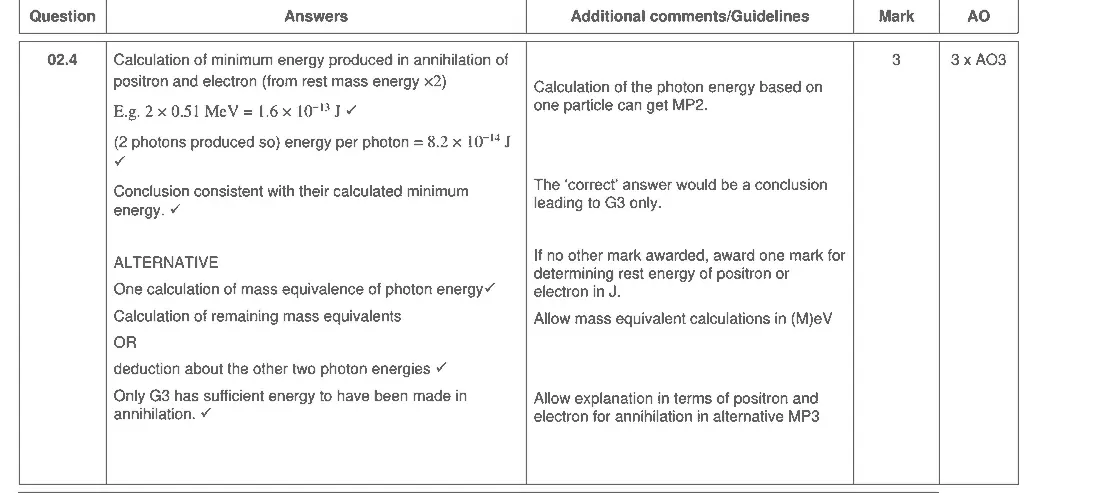
Deduce which of the three gamma photons could have been produced by positron
annihilation.
[3 marks]
June 2022 · Paper 1 · Q3.1 3 marks AO3=3 Calculation materials and young modulus
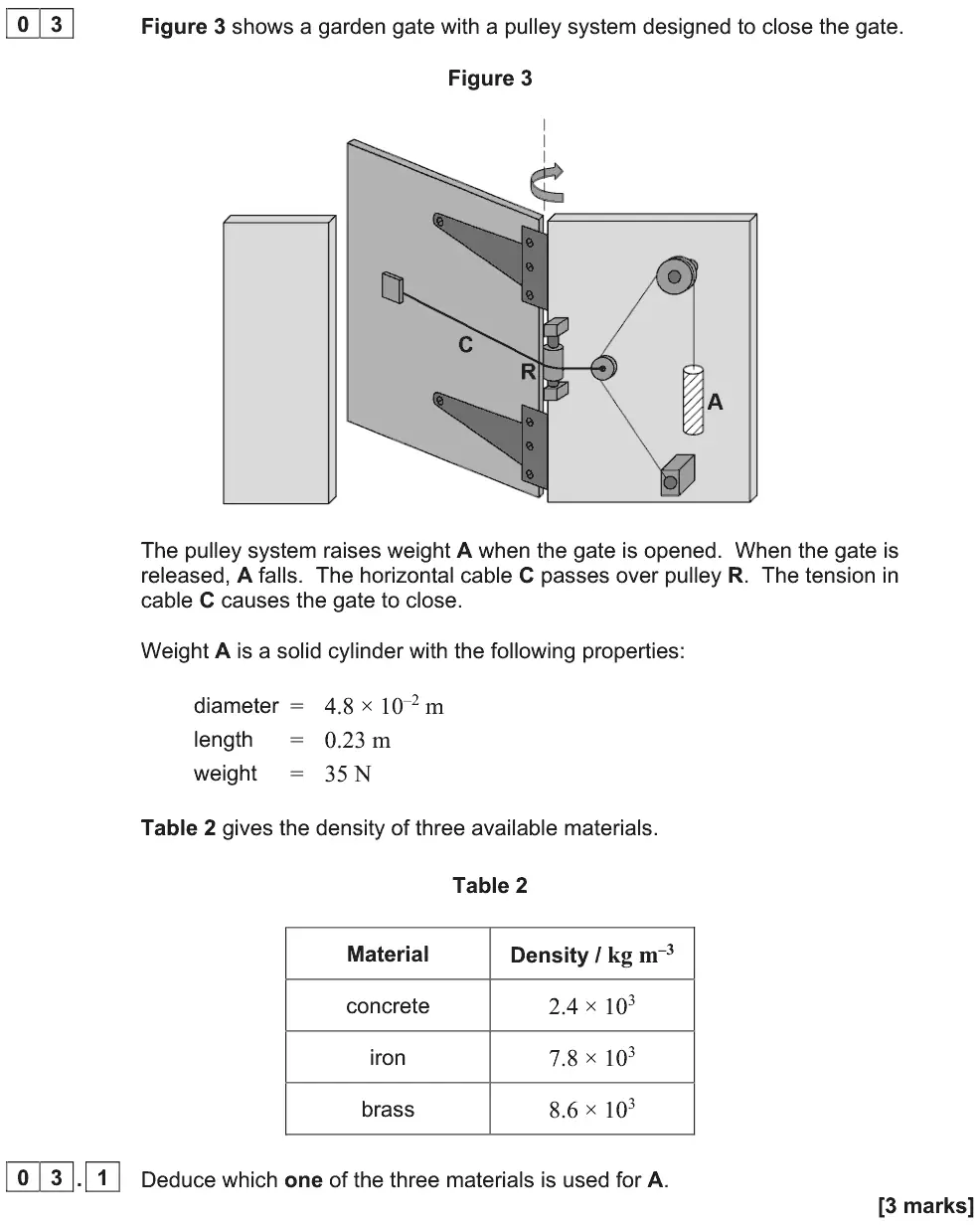
Figure 3 shows a garden gate with a pulley system designed to close the gate.
Figure 3
The pulley system raises weight A when the gate is opened.  When the gate is
released, A falls.  The horizontal cable C passes over pulley R.  The tension in
cable C causes the gate to close.
Weight A is a solid cylinder with the following properties:
diameter = 4.8 × 10⁻² m
length
= 0.23 m
weight
= 35 N
Table 2 gives the density of three available materials.
Table 2
Material
Density / kg m–3
concrete
2.4 × 10³
iron
7.8 × 10³
brass
8.6 × 10³
Deduce which one of the three materials is used for A.
[3 marks]
June 2022 · Paper 1 · Q3.2 2 marks AO2=2 Calculation vectors and moments
Earlier part of question 3 that this part usesEarlier part of June 2022 Paper 1 question 3
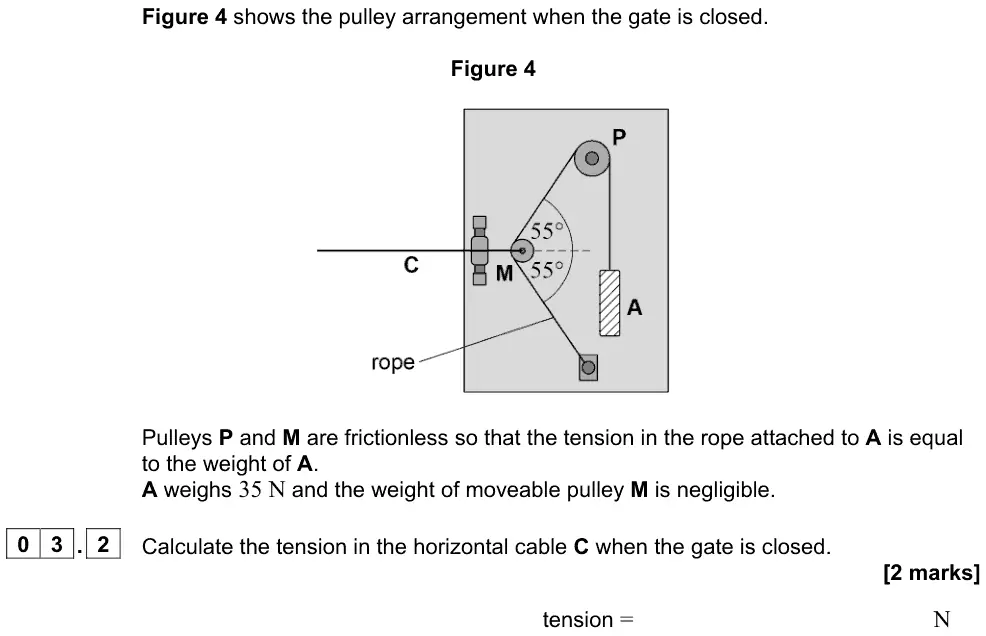
Figure 4 shows the pulley arrangement when the gate is closed.
Figure 4
Pulleys P and M are frictionless so that the tension in the rope attached to A is equal
to the weight of A.
A weighs 35 N and the weight of moveable pulley M is negligible.
Calculate the tension in the horizontal cable C when the gate is closed.
[2 marks]
tension =
N
June 2022 · Paper 1 · Q3.3 2 marks AO2=2 Explanation vectors and moments
Earlier part of question 3 that this part usesEarlier part of June 2022 Paper 1 question 3
Pulley M is pulled to the left as the gate is opened.
Explain why this increases the tension in the horizontal cable C.
[2 marks]
June 2022 · Paper 1 · Q3.4 2 marks AO2=2 Calculation vectors and moments
Earlier part of question 3 that this part usesEarlier part of June 2022 Paper 1 question 3
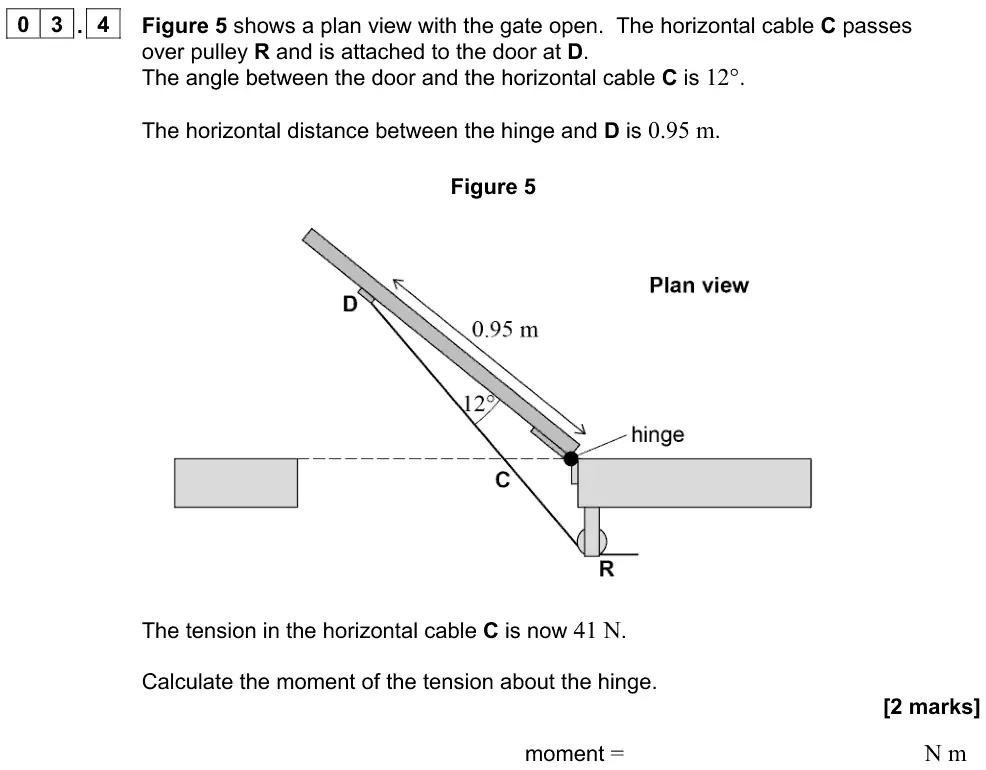
Figure 5 shows a plan view with the gate open.  The horizontal cable C passes
over pulley R and is attached to the door at D.
The angle between the door and the horizontal cable C is 12°.
The horizontal distance between the hinge and D is 0.95 m.
Figure 5
The tension in the horizontal cable C is now 41 N.
Calculate the moment of the tension about the hinge.
[2 marks]
moment =
N m
June 2022 · Paper 1 · Q3.5 4 marks AO3=4 Explanation vectors and moments
Earlier part of question 3 that this part usesEarlier part of June 2022 Paper 1 question 3
The same system is attached to an identical gate with stiffer hinges.  Now the system
does not supply a sufficiently large moment to close the gate.
Discuss two independent changes to the design to increase the moment about the
hinges due to horizontal cable C.
[4 marks]
1
2
June 2022 · Paper 1 · Q4.1 1 mark AO1=1 Show that circuits and potential dividers
A student assembles the circuit in Figure 6.
Figure 6
The battery has an internal resistance of 2.5 Ω.
Show that the resistance of the 6.2 V, 4.5 W lamp at its working potential difference
(pd) is about 9 Ω.
[1 mark]
June 2022 · Paper 1 · Q4.2 3 marks AO2=3 Calculation emf and internal resistance
Earlier part of question 4 that this part usesEarlier part of June 2022 Paper 1 question 4
The terminal pd across the battery is 6.2 V.
Calculate the emf of the battery.
[3 marks]
emf =
V
June 2022 · Paper 1 · Q4.3 3 marks AO2=3 Calculation current voltage and resistivity
Earlier part of question 4 that this part usesEarlier part of June 2022 Paper 1 question 4
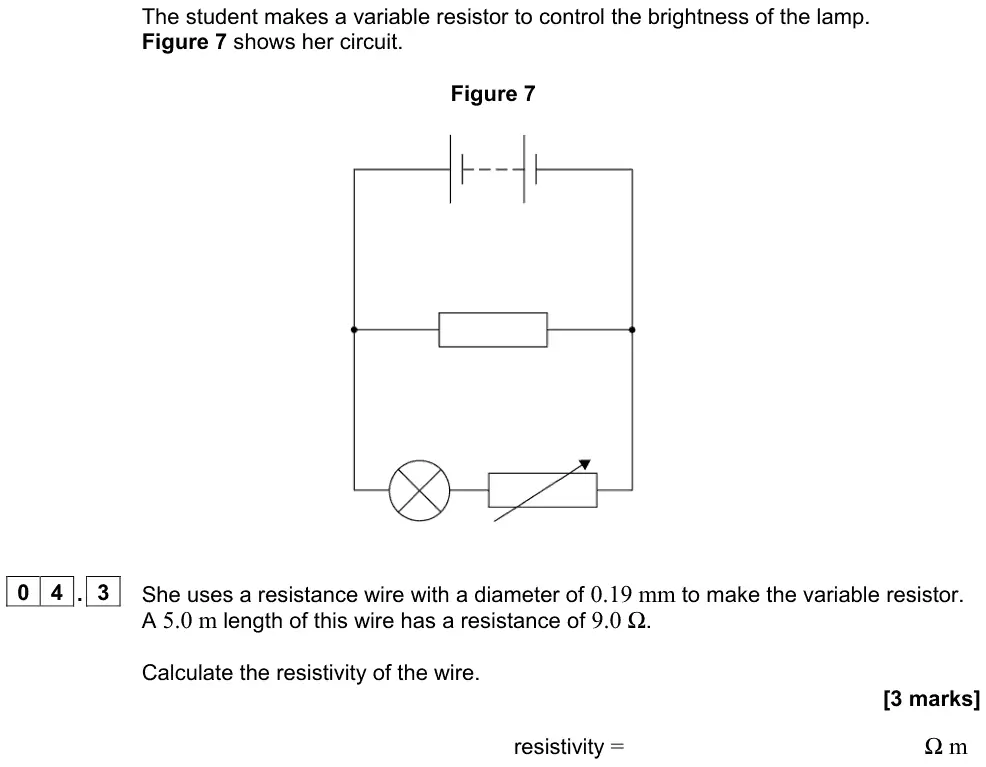
The student makes a variable resistor to control the brightness of the lamp.
Figure 7 shows her circuit.
Figure 7
She uses a resistance wire with a diameter of 0.19 mm to make the variable resistor.
A 5.0 m length of this wire has a resistance of 9.0 Ω.
Calculate the resistivity of the wire.
[3 marks]
resistivity =
Ω m
June 2022 · Paper 1 · Q4.4 2 marks AO3=2 Explanation circuits and potential dividerscurrent voltage and resistivity
Earlier part of question 4 that this part usesEarlier part of June 2022 Paper 1 question 4
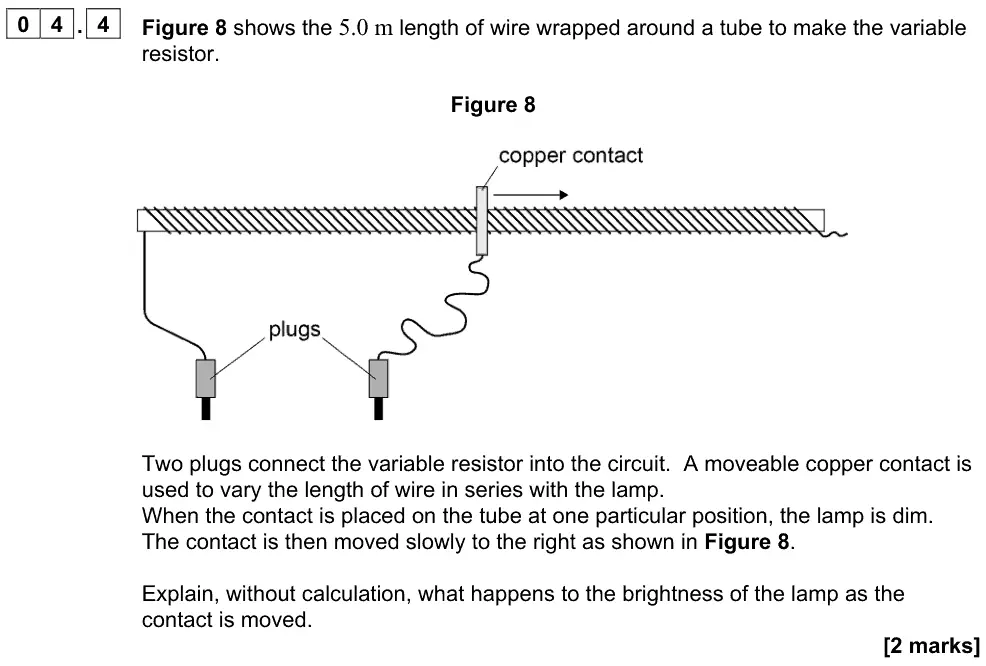
Figure 8 shows the 5.0 m length of wire wrapped around a tube to make the variable
resistor.
Figure 8
Two plugs connect the variable resistor into the circuit.  A moveable copper contact is
used to vary the length of wire in series with the lamp.
When the contact is placed on the tube at one particular position, the lamp is dim.
The contact is then moved slowly to the right as shown in Figure 8.
Explain, without calculation, what happens to the brightness of the lamp as the
contact is moved.
[2 marks]
June 2022 · Paper 1 · Q4.5 2 marks AO3=2 Explanation emf and internal resistance
Earlier part of question 4 that this part usesEarlier part of June 2022 Paper 1 question 4
The student now makes a different circuit by connecting the variable resistor
in parallel with the lamp.
The contact is returned to its original position on the tube as shown in Figure 8 and
the lamp is dim.  The contact is again slowly moved to the right.
Explain, without calculation, what happens to the brightness of the lamp as the
contact is moved.
[2 marks]
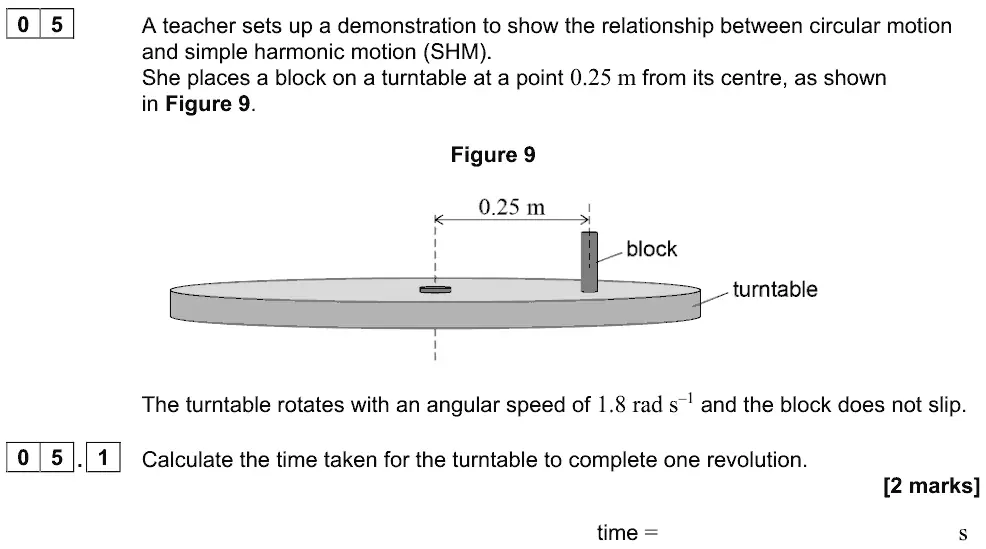
June 2022 · Paper 1 · Q5.1 2 marks AO1=2 Calculation circular motion
A teacher sets up a demonstration to show the relationship between circular motion
and simple harmonic motion (SHM).
She places a block on a turntable at a point 0.25 m from its centre, as shown
in Figure 9.
Figure 9
The turntable rotates with an angular speed of 1.8 rad s–1 and the block does not slip.
Calculate the time taken for the turntable to complete one revolution.
[2 marks]
time =
s
June 2022 · Paper 1 · Q5.2 1 mark AO1=1 Diagram or graph circular motion
Earlier part of question 5 that this part usesEarlier part of June 2022 Paper 1 question 5
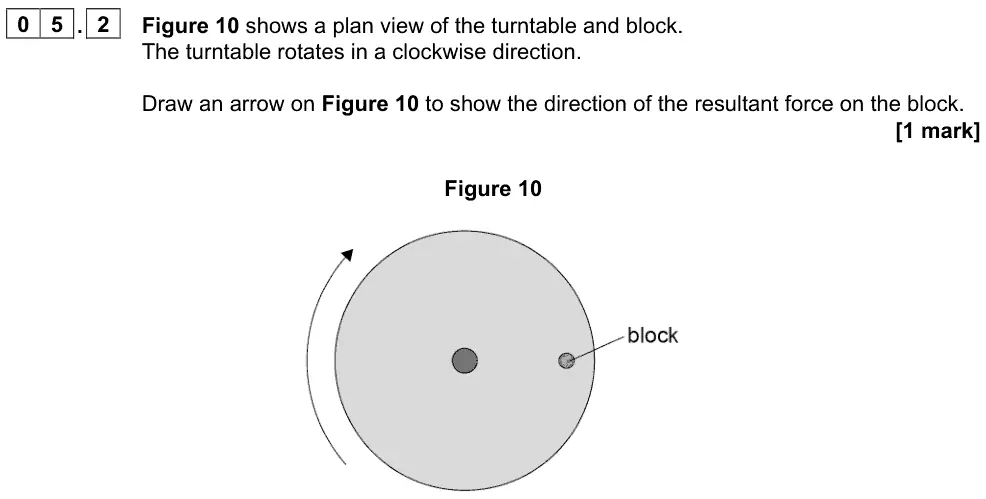
Figure 10 shows a plan view of the turntable and block.
The turntable rotates in a clockwise direction.
Draw an arrow on Figure 10 to show the direction of the resultant force on the block.
[1 mark]
Figure 10
June 2022 · Paper 1 · Q5.3 2 marks AO2=2 Calculation circular motion
Earlier part of question 5 that this part usesEarlier part of June 2022 Paper 1 question 5
The mass of the block is 0.12 kg.
Calculate the magnitude of the resultant force on the block.
[2 marks]
magnitude of force =
N
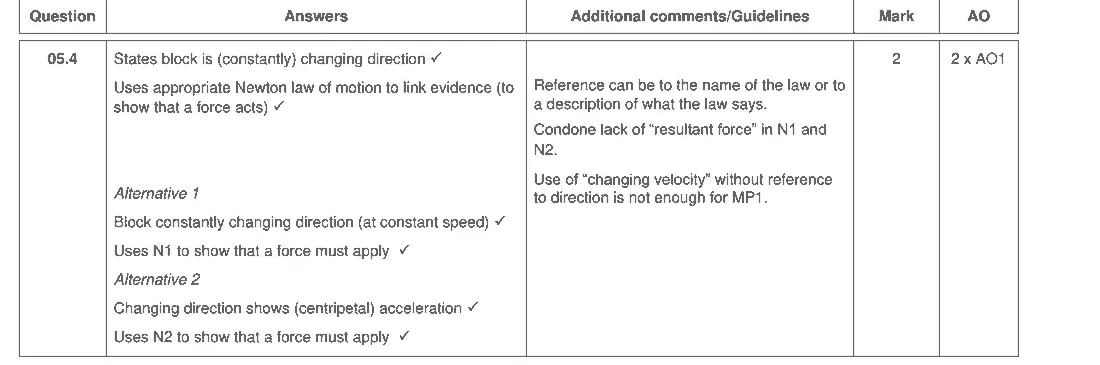
June 2022 · Paper 1 · Q5.4 2 marks AO1=2 Explanation newtons laws and momentumcircular motion
Earlier part of question 5 that this part usesEarlier part of June 2022 Paper 1 question 5
Describe, with reference to one of Newton’s laws of motion, the evidence that a
resultant force is acting on the block.
[2 marks]
June 2022 · Paper 1 · Q5.5 2 marks AO1=2 Calculation simple harmonic motion
Earlier part of question 5 that this part usesEarlier part of June 2022 Paper 1 question 5
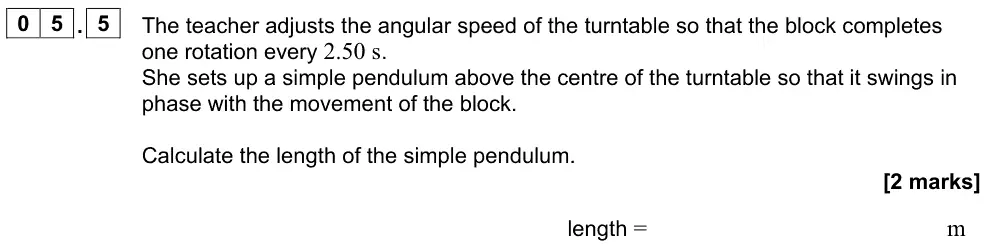
The teacher adjusts the angular speed of the turntable so that the block completes
one rotation every 2.50 s.
She sets up a simple pendulum above the centre of the turntable so that it swings in
phase with the movement of the block.
Calculate the length of the simple pendulum.
[2 marks]
length =
m
June 2022 · Paper 1 · Q5.6 2 marks AO3=2 Explanation simple harmonic motion
Earlier part of question 5 that this part usesEarlier part of June 2022 Paper 1 question 5
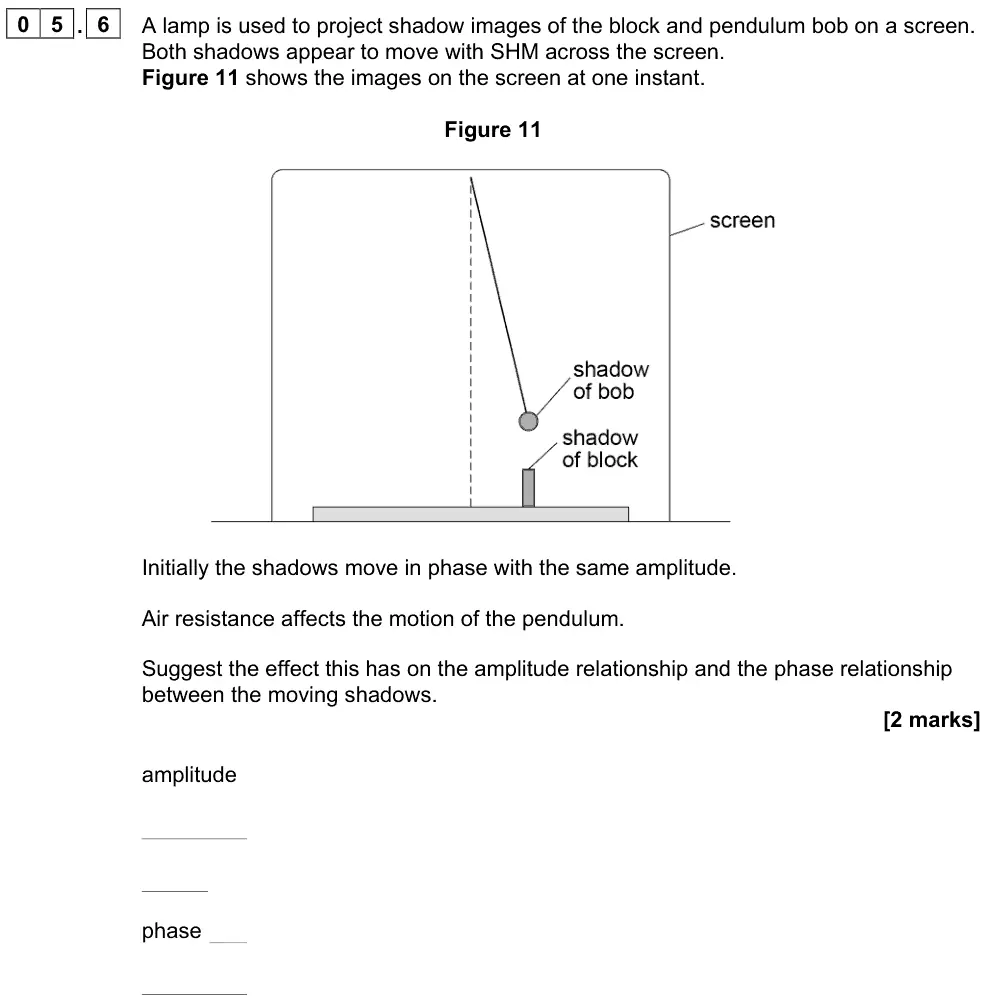
A lamp is used to project shadow images of the block and pendulum bob on a screen.
Both shadows appear to move with SHM across the screen.
Figure 11 shows the images on the screen at one instant.
Figure 11
Initially the shadows move in phase with the same amplitude.
Air resistance affects the motion of the pendulum.
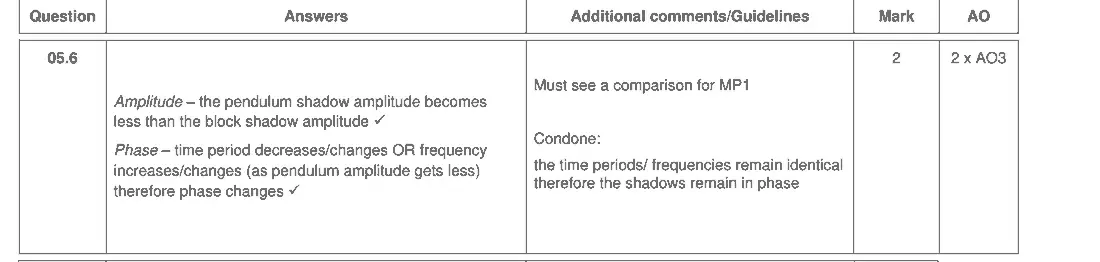
Suggest the effect this has on the amplitude relationship and the phase relationship
between the moving shadows.
[2 marks]
amplitude
phase
June 2022 · Paper 1 · Q6.1 1 mark AO1=1 Short answer refraction and optical fibres
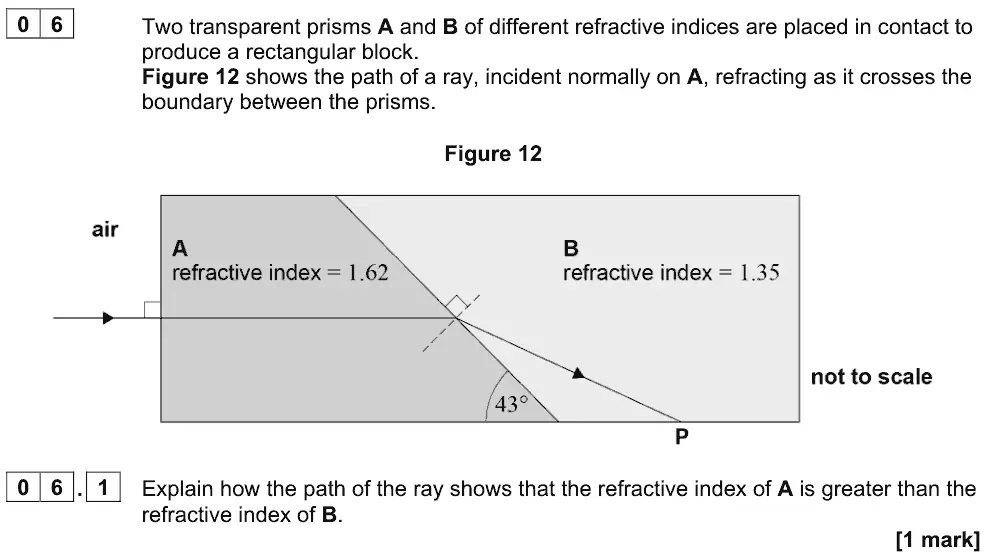
Two transparent prisms A and B of different refractive indices are placed in contact to
produce a rectangular block.
Figure 12 shows the path of a ray, incident normally on A, refracting as it crosses the
boundary between the prisms.
Figure 12
Explain how the path of the ray shows that the refractive index of A is greater than the
refractive index of B.
[1 mark]
June 2022 · Paper 1 · Q6.2 2 marks AO2=2 Show that refraction and optical fibres
Earlier part of question 6 that this part usesEarlier part of June 2022 Paper 1 question 6
Show that the angle of refraction of the ray in B is about 60°.
[2 marks]
June 2022 · Paper 1 · Q6.3 3 marks AO3=3 Diagram or graph refraction and optical fibres
Earlier part of question 6 that this part usesEarlier part of June 2022 Paper 1 question 6
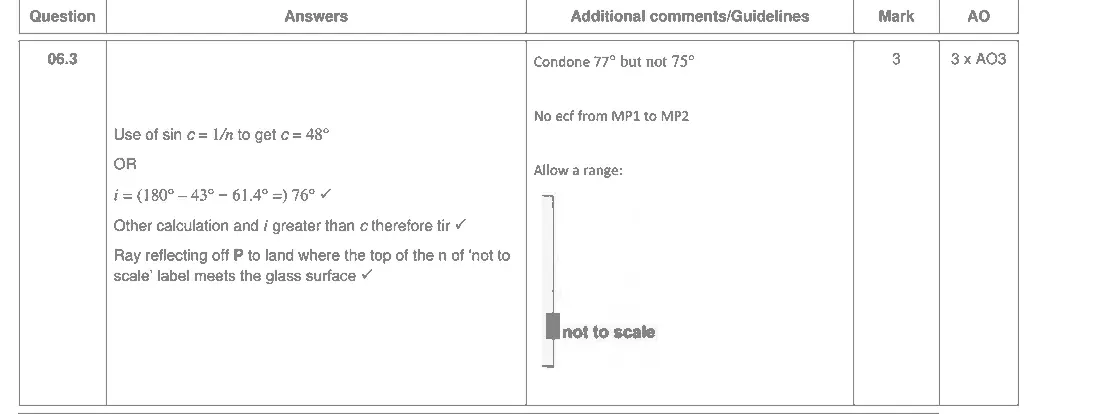
Draw, on Figure 12, the path of the ray immediately after it reaches P.
Justify your answer with calculations.
[3 marks]
June 2022 · Paper 1 · Q7 1 mark AO1=1 Multiple choice measurements and uncertaintiesvectors and moments
Which two quantities have the base unit kg m2 s−2?
[1 mark]
A kinetic energy and momentum
B kinetic energy and Young modulus
C work done and the moment of a couple
D work done and pressure
June 2022 · Paper 1 · Q8 1 mark AO3=1 Multiple choice measurements and uncertainties
Which gives SI prefixes in descending order of magnitude?
[1 mark]
A G  p  m
B M  G  n
C m  n  μ
D m  μ  p
June 2022 · Paper 1 · Q9 1 mark AO1=1 Multiple choice measurements and uncertaintieswork energy and power
A car travels at 100 km h−1 on a motorway.
What is an estimate of its kinetic energy?
[1 mark]
A 104 J
B 106 J
C 108 J
D 1010 J
What is the specific charge of a 13
6C nucleus?
June 2022 · Paper 1 · Q10 1 mark AO2=1 Multiple choice atomic structure and stable nuclei
What is the specific charge of a 13
[1 mark]
A 4.4 × 10⁷ C kg–1
B 5.2 × 10⁷ C kg–1
C 8.3 × 10⁷ C kg–1
D 2.1 × 10⁸ C kg–1
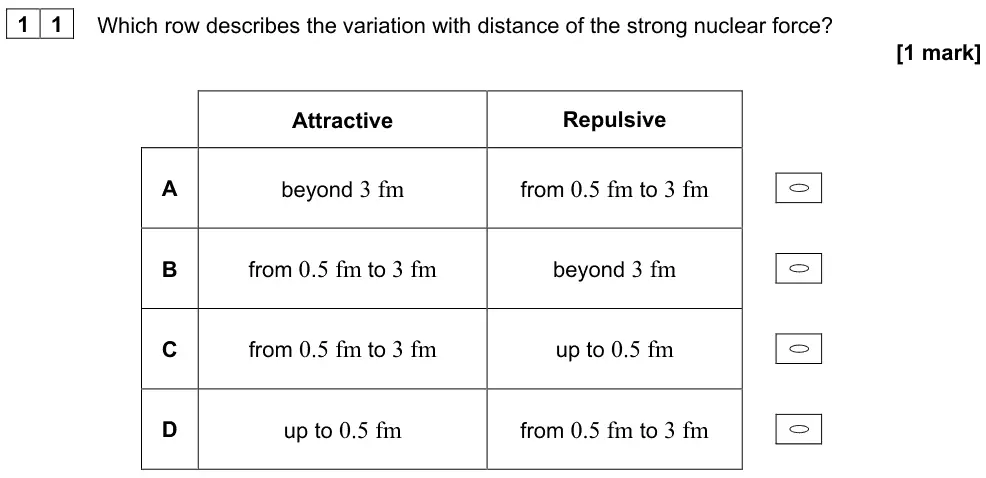
June 2022 · Paper 1 · Q11 1 mark AO1=1 Multiple choice atomic structure and stable nuclei
Which row describes the variation with distance of the strong nuclear force?
[1 mark]
Attractive
Repulsive
A
beyond 3 fm
from 0.5 fm to 3 fm
B
from 0.5 fm to 3 fm
beyond 3 fm
C
from 0.5 fm to 3 fm
up to 0.5 fm
D
up to 0.5 fm
from 0.5 fm to 3 fm
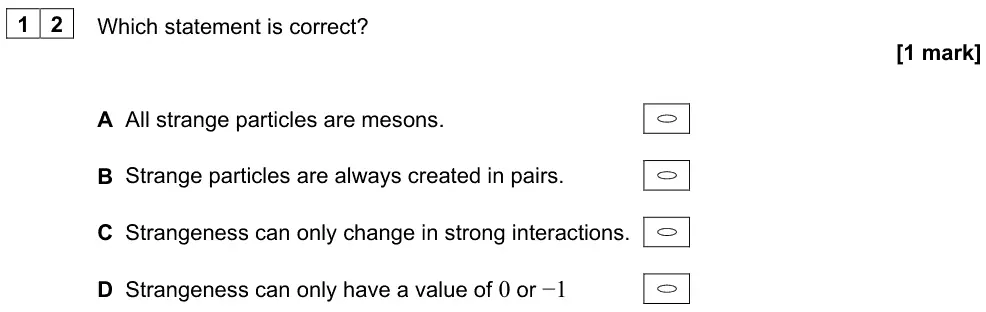
June 2022 · Paper 1 · Q12 1 mark AO1=1 Multiple choice classification of particles and quarks
Which statement is correct?
[1 mark]
A All strange particles are mesons.
B Strange particles are always created in pairs.
C Strangeness can only change in strong interactions.
D Strangeness can only have a value of 0 or −1
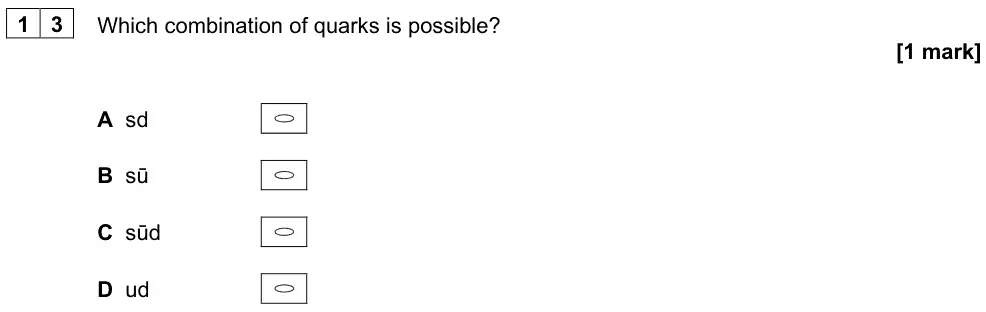
June 2022 · Paper 1 · Q13 1 mark AO2=1 Multiple choice classification of particles and quarks
Which combination of quarks is possible?
[1 mark]
A sd
B sū
C sūd
D ud
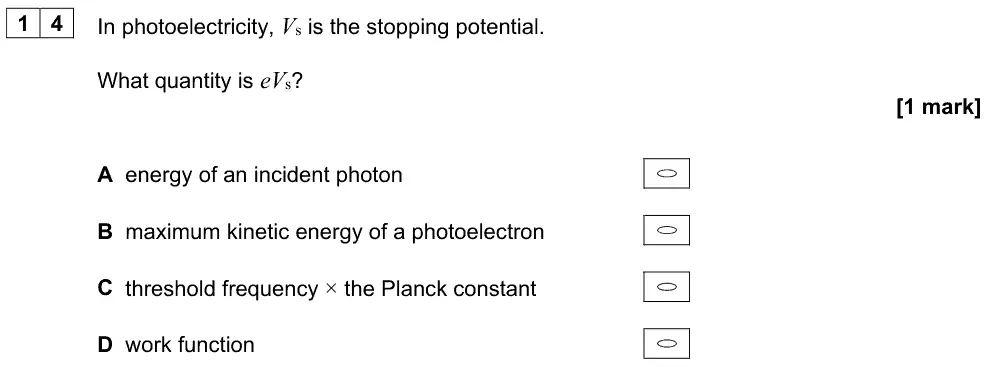
June 2022 · Paper 1 · Q14 1 mark AO2=1 Multiple choice photoelectric effect
In photoelectricity, Vs is the stopping potential.
What quantity is eVs?
[1 mark]
A energy of an incident photon
B maximum kinetic energy of a photoelectron
C threshold frequency × the Planck constant
D work function
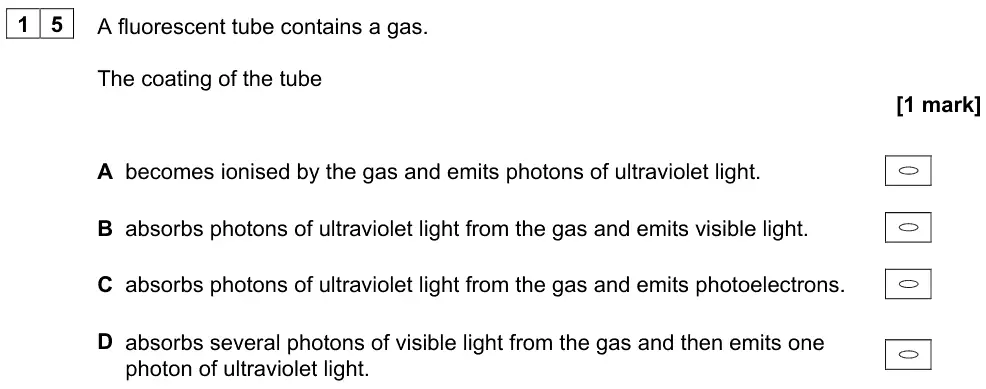
June 2022 · Paper 1 · Q15 1 mark AO1=1 Multiple choice energy levels and wave particle duality
A fluorescent tube contains a gas.
The coating of the tube
[1 mark]
A becomes ionised by the gas and emits photons of ultraviolet light.
B absorbs photons of ultraviolet light from the gas and emits visible light.
C absorbs photons of ultraviolet light from the gas and emits photoelectrons.
D absorbs several photons of visible light from the gas and then emits one
photon of ultraviolet light.
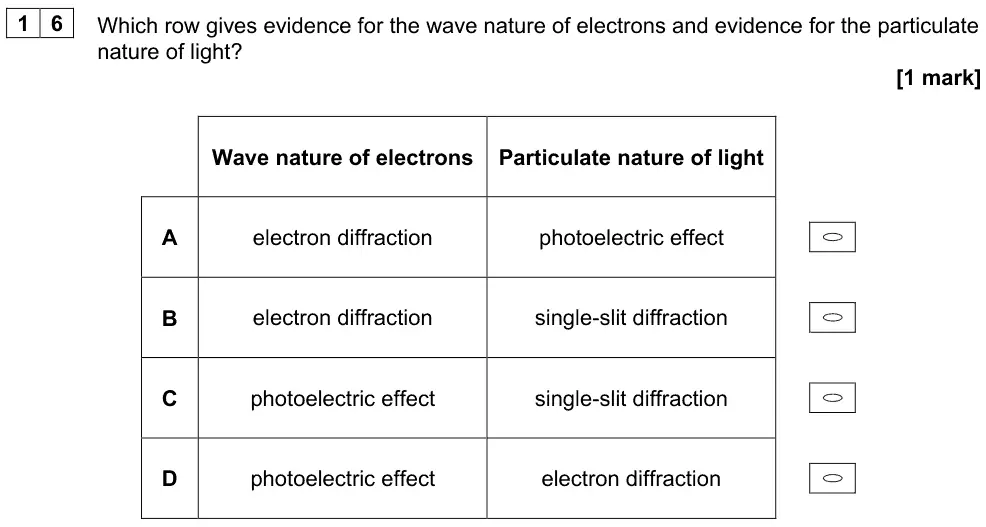
June 2022 · Paper 1 · Q16 1 mark AO1=1 Multiple choice energy levels and wave particle duality
Which row gives evidence for the wave nature of electrons and evidence for the particulate
nature of light?
[1 mark]
Wave nature of electrons
Particulate nature of light
A
electron diffraction
photoelectric effect
B
electron diffraction
single-slit diffraction
C
photoelectric effect
single-slit diffraction
D
photoelectric effect
electron diffraction
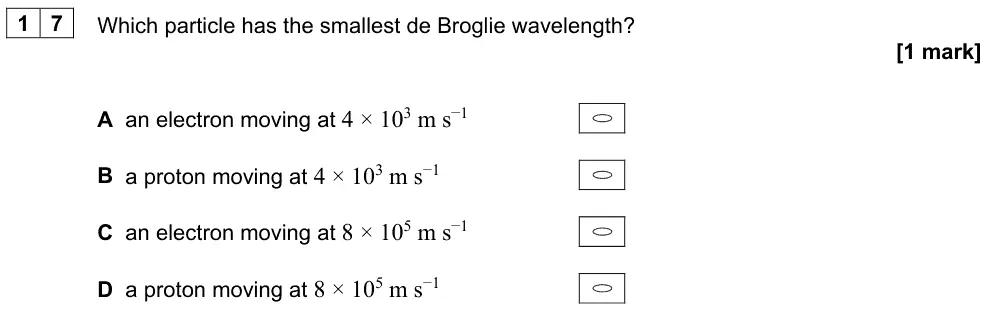
June 2022 · Paper 1 · Q17 1 mark AO2=1 Multiple choice energy levels and wave particle duality
Which particle has the smallest de Broglie wavelength?
[1 mark]
A an electron moving at 4 × 10³ m s−1
B a proton moving at 4 × 10³ m s−1
C an electron moving at 8 × 10⁵ m s−1
D a proton moving at 8 × 10⁵ m s−1
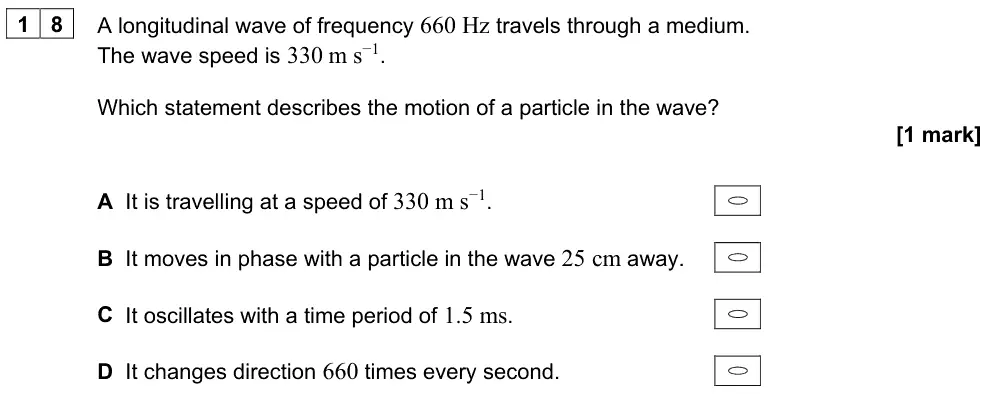
June 2022 · Paper 1 · Q18 1 mark AO2=1 Multiple choice progressive waves and polarisation
A longitudinal wave of frequency 660 Hz travels through a medium.
The wave speed is 330 m s−1.
Which statement describes the motion of a particle in the wave?
[1 mark]
A It is travelling at a speed of 330 m s−1.
B It moves in phase with a particle in the wave 25 cm away.
C It oscillates with a time period of 1.5 ms.
D It changes direction 660 times every second.
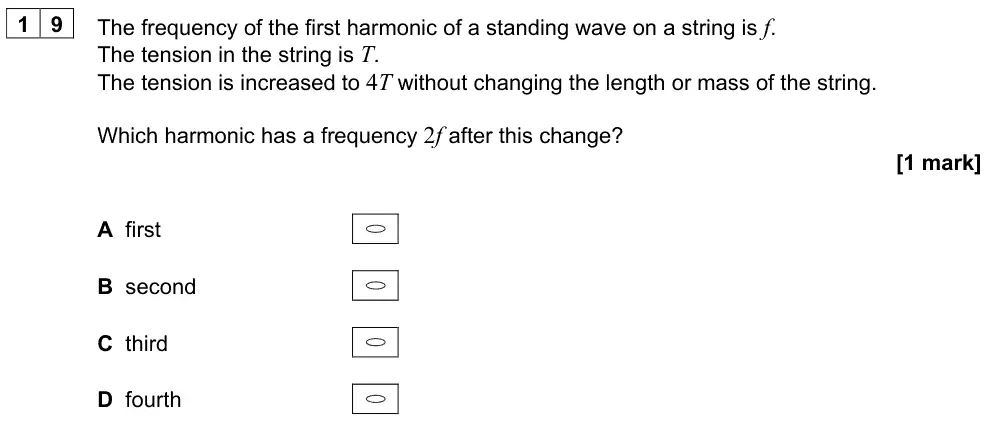
June 2022 · Paper 1 · Q19 1 mark AO1=1 Multiple choice stationary waves
The frequency of the first harmonic of a standing wave on a string is f.
The tension in the string is T.
The tension is increased to 4T without changing the length or mass of the string.
Which harmonic has a frequency 2f after this change?
[1 mark]
A first
B second
C third
D fourth
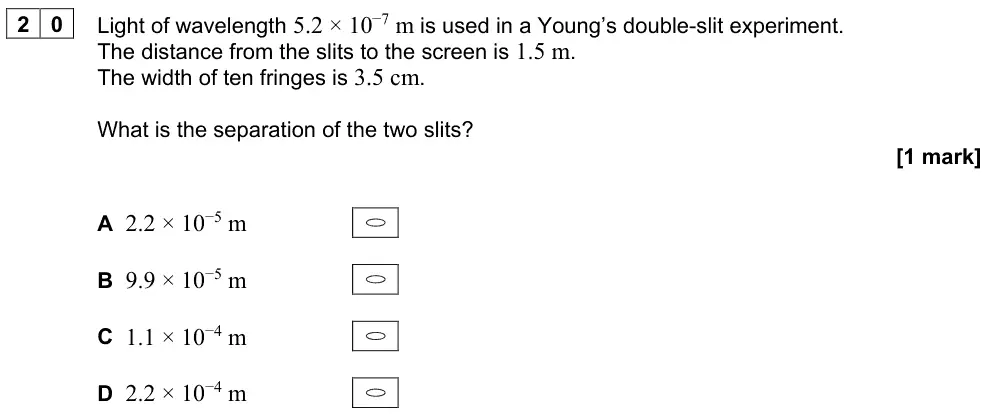
June 2022 · Paper 1 · Q20 1 mark AO2=1 Multiple choice interference and diffraction
Light of wavelength 5.2 × 10⁻⁷ m is used in a Young’s double-slit experiment.
The distance from the slits to the screen is 1.5 m.
The width of ten fringes is 3.5 cm.
What is the separation of the two slits?
[1 mark]
A 2.2 × 10⁻⁵ m
B 9.9 × 10⁻⁵ m
C 1.1 × 10⁻⁴ m
D 2.2 × 10⁻⁴ m
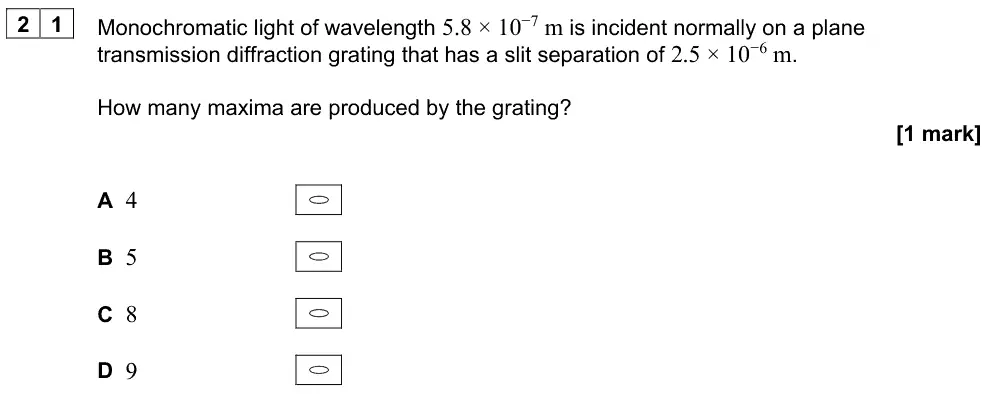
June 2022 · Paper 1 · Q21 1 mark AO2=1 Multiple choice interference and diffraction
Monochromatic light of wavelength 5.8 × 10⁻⁷ m is incident normally on a plane
transmission diffraction grating that has a slit separation of 2.5 × 10⁻⁶ m.
How many maxima are produced by the grating?
[1 mark]
A 4
B 5
C 8
D 9
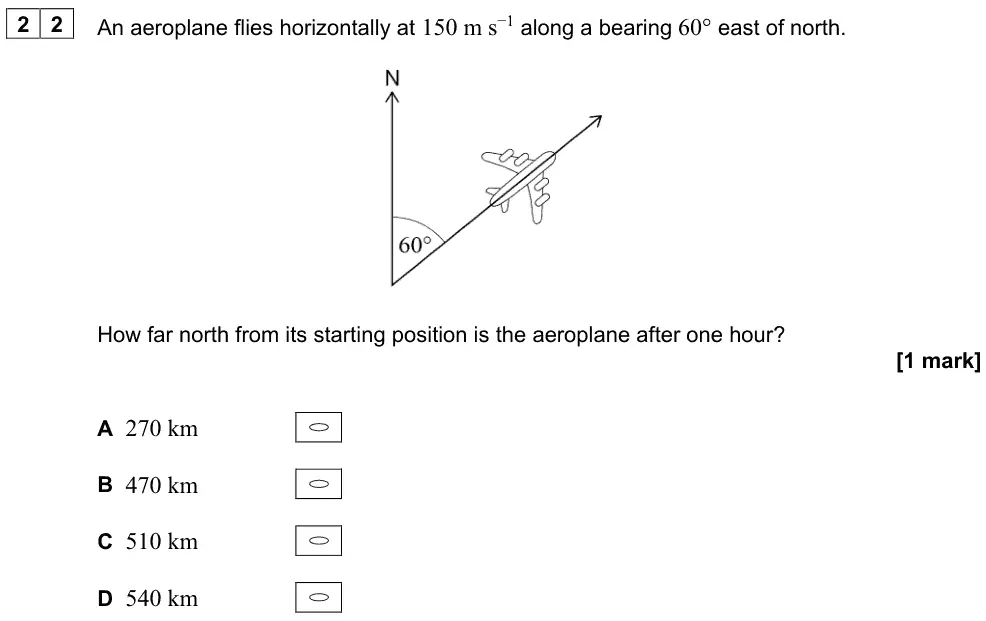
June 2022 · Paper 1 · Q22 1 mark AO1=1 Multiple choice vectors and moments
An aeroplane flies horizontally at 150 m s−1 along a bearing 60° east of north.
How far north from its starting position is the aeroplane after one hour?
[1 mark]
A 270 km
B 470 km
C 510 km
D 540 km
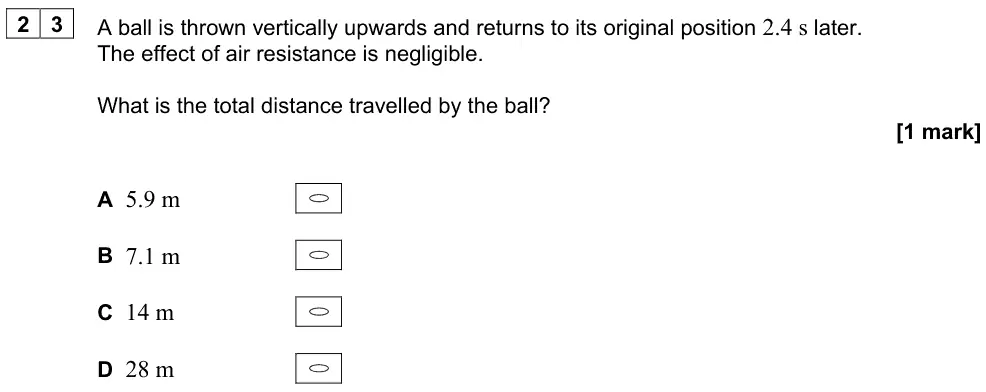
June 2022 · Paper 1 · Q23 1 mark AO2=1 Multiple choice motion and projectiles
A ball is thrown vertically upwards and returns to its original position 2.4 s later.
The effect of air resistance is negligible.
What is the total distance travelled by the ball?
[1 mark]
A 5.9 m
B 7.1 m
C 14 m
D 28 m
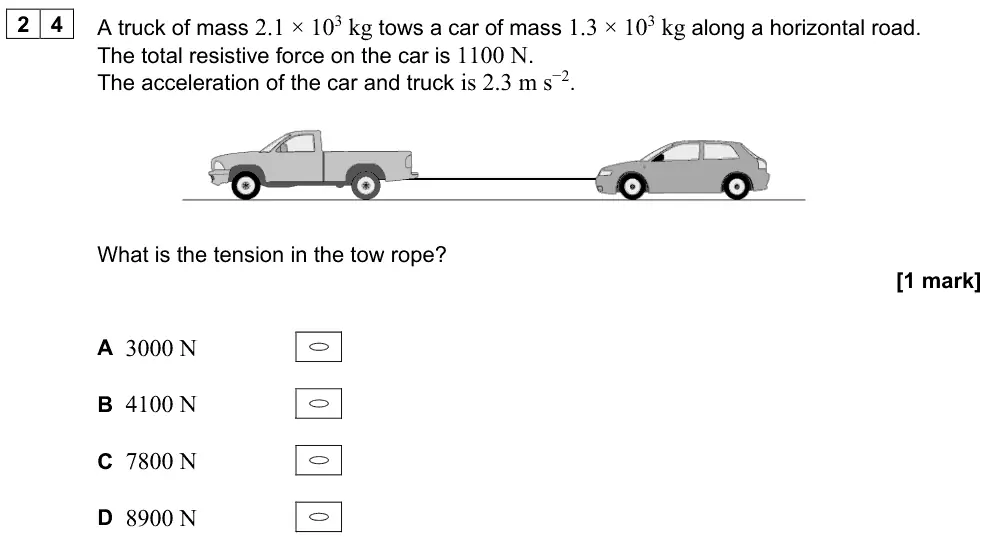
June 2022 · Paper 1 · Q24 1 mark AO2=1 Multiple choice newtons laws and momentum
A truck of mass 2.1 × 10³ kg tows a car of mass 1.3 × 10³ kg along a horizontal road.
The total resistive force on the car is 1100 N.
The acceleration of the car and truck is 2.3 m s−2.
What is the tension in the tow rope?
[1 mark]
A 3000 N
B 4100 N
C 7800 N
D 8900 N
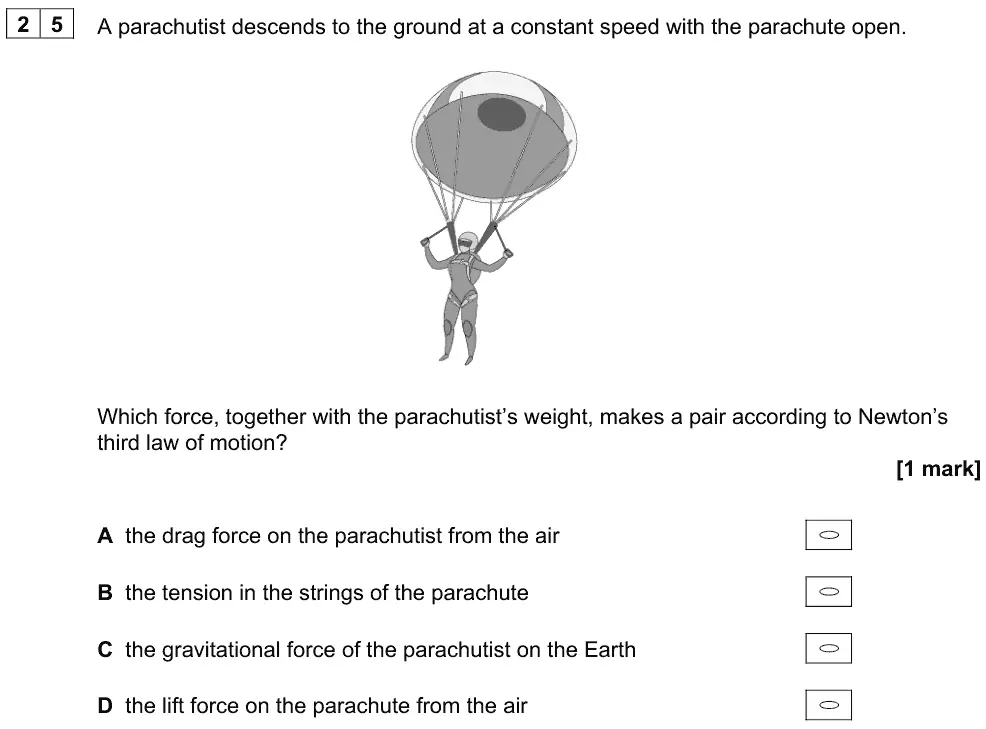
June 2022 · Paper 1 · Q25 1 mark AO1=1 Multiple choice newtons laws and momentum
A parachutist descends to the ground at a constant speed with the parachute open.
Which force, together with the parachutist’s weight, makes a pair according to Newton’s
third law of motion?
[1 mark]
A the drag force on the parachutist from the air
B the tension in the strings of the parachute
C the gravitational force of the parachutist on the Earth
D the lift force on the parachute from the air
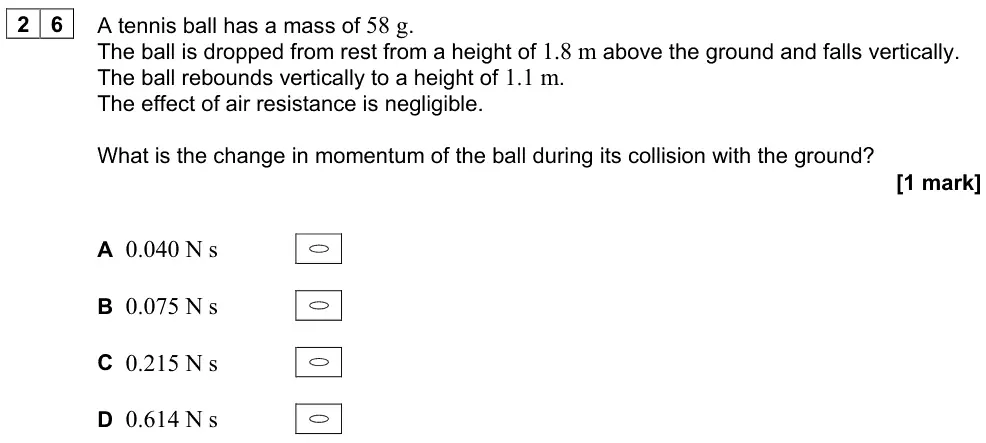
June 2022 · Paper 1 · Q26 1 mark AO2=1 Multiple choice newtons laws and momentumwork energy and power
A tennis ball has a mass of 58 g.
The ball is dropped from rest from a height of 1.8 m above the ground and falls vertically.
The ball rebounds vertically to a height of 1.1 m.
The effect of air resistance is negligible.
What is the change in momentum of the ball during its collision with the ground?
[1 mark]
A 0.040 N s
B 0.075 N s
C 0.215 N s
D 0.614 N s
June 2022 · Paper 1 · Q27 1 mark AO1=1 Multiple choice materials and young modulus
A mass M is suspended from a spring.  When the mass is at rest at the equilibrium
position, the elastic potential energy stored is E.
An extra mass of 2M is added to the spring and the spring extends while still obeying
Hooke’s law.
What is the total elastic energy stored when the system is at rest at the new equilibrium
position?
[1 mark]
A 2E
B 3E
C 4E
D 9E
June 2022 · Paper 1 · Q28 1 mark AO3=1 Multiple choice materials and young modulus
Two wires P and Q are made of the same material and have the same cross-sectional
area.
P has an original length L and is subject to a tensile force F.  P extends a distance x.
Q has an original length 2L and is subject to a tensile force 2F.
Which statement is correct?
[1 mark]
A The stress in P and the stress in Q are the same.
B The extension of Q is 2x.
C The strain of Q is double the strain of P.
D The value of stress
strain
for P is half that of Q.
June 2022 · Paper 1 · Q29 1 mark AO2=1 Multiple choice current voltage and resistivity
The current in a metallic conductor is 1.5 mA.
How many electrons pass a point in the conductor in two minutes?
[1 mark]
A 1.1 × 10¹⁸
B 1.9 × 10¹⁹
C 1.4 × 10²⁰
D 2.0 × 1029
June 2022 · Paper 1 · Q30 1 mark AO2=1 Multiple choice circuits and potential dividers
Which value of resistance cannot be made by combining three 10 Ω resistors?
[1 mark]
A 3.3 Ω
B 6.7 Ω
C 15 Ω
D 25 Ω
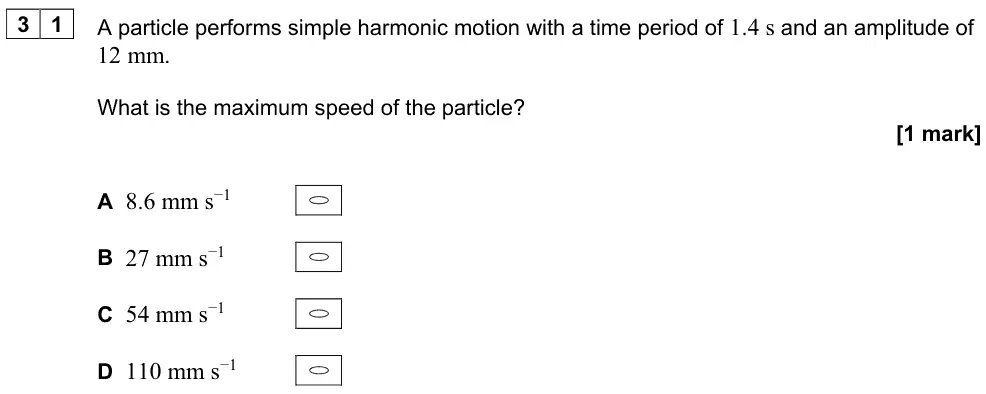
June 2022 · Paper 1 · Q31 1 mark AO2=1 Multiple choice simple harmonic motion
A particle performs simple harmonic motion with a time period of 1.4 s and an amplitude of
12 mm.
What is the maximum speed of the particle?
[1 mark]
A 8.6 mm s−1
B 27 mm s−1
C 54 mm s−1
D 110 mm s−1

Work with an AQA physics tutor

Want a paper marked and gone through with you? Message us.

Prefer email? Send an enquiry

If you are under 18, please include a parent's contact details. Enquiries go to enquiries@physicsaleveltutor.com and are deleted once handled. All tutoring is online.