June 2023: Paper 1

85 marks · 51 question parts · Paper, mark scheme and report on AQA's site · Have the data and formulae booklet beside you

Question by question

QTopicMarksAOType
1.1 Classification of particles, quarks and conservation laws 1AO3=1Short answer
1.2 Classification of particles, quarks and conservation laws 2AO1=2Explanation
1.3 Particles, antiparticles and particle interactions, Classification of particles, quarks and conservation laws 1AO1=1Short answer
1.4 Particles, antiparticles and particle interactions, Excitation, energy levels and wave-particle duality 1AO1=1Calculation
1.5 Classification of particles, quarks and conservation laws 1AO1=1Short answer
2.1 Motion along a straight line and projectile motion, Measurements, units and uncertainties 2Calculation
2.2 Work, energy, power and conservation of energy 2Calculation
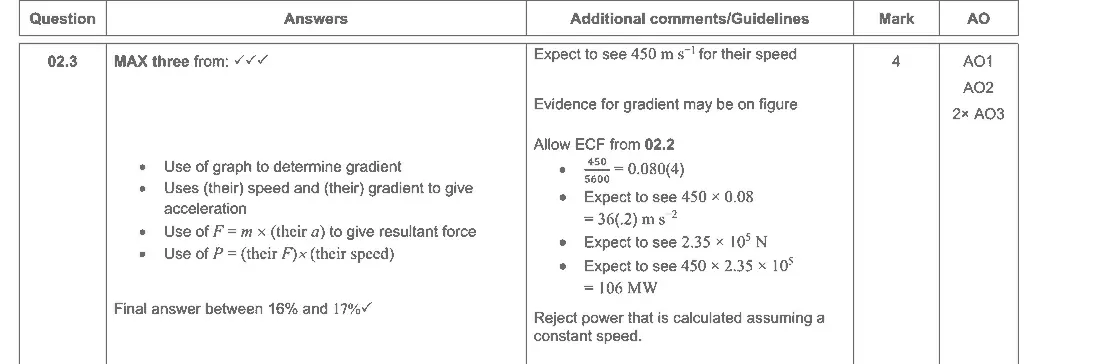
2.3 Work, energy, power and conservation of energy 4Calculation
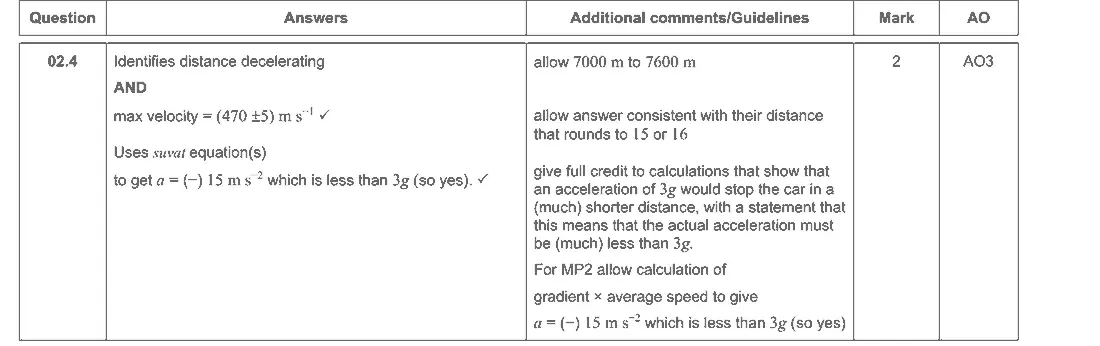
2.4 Motion along a straight line and projectile motion 2AO3=2Calculation
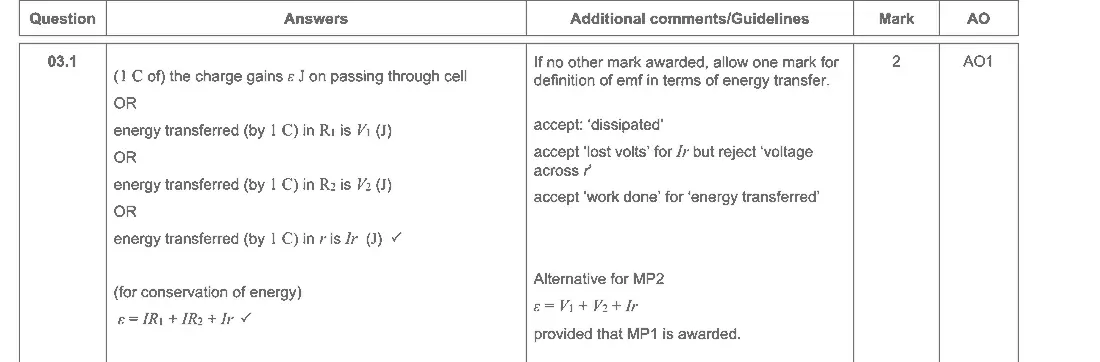
3.1 Circuits and potential dividers, Electromotive force and internal resistance 2AO1=2Explanation
3.2 Electromotive force and internal resistance 3AO2=3Show that
3.3 Circuits and potential dividers, Electromotive force and internal resistance 2AO2=2Calculation
3.4 Circuits and potential dividers, Current, potential difference, I-V characteristics and resistivity 4AO3=4Diagram or graph
4.1 Refraction, total internal reflection and optical fibres 1AO1=1Show that
4.2 Refraction, total internal reflection and optical fibres 2Explanation
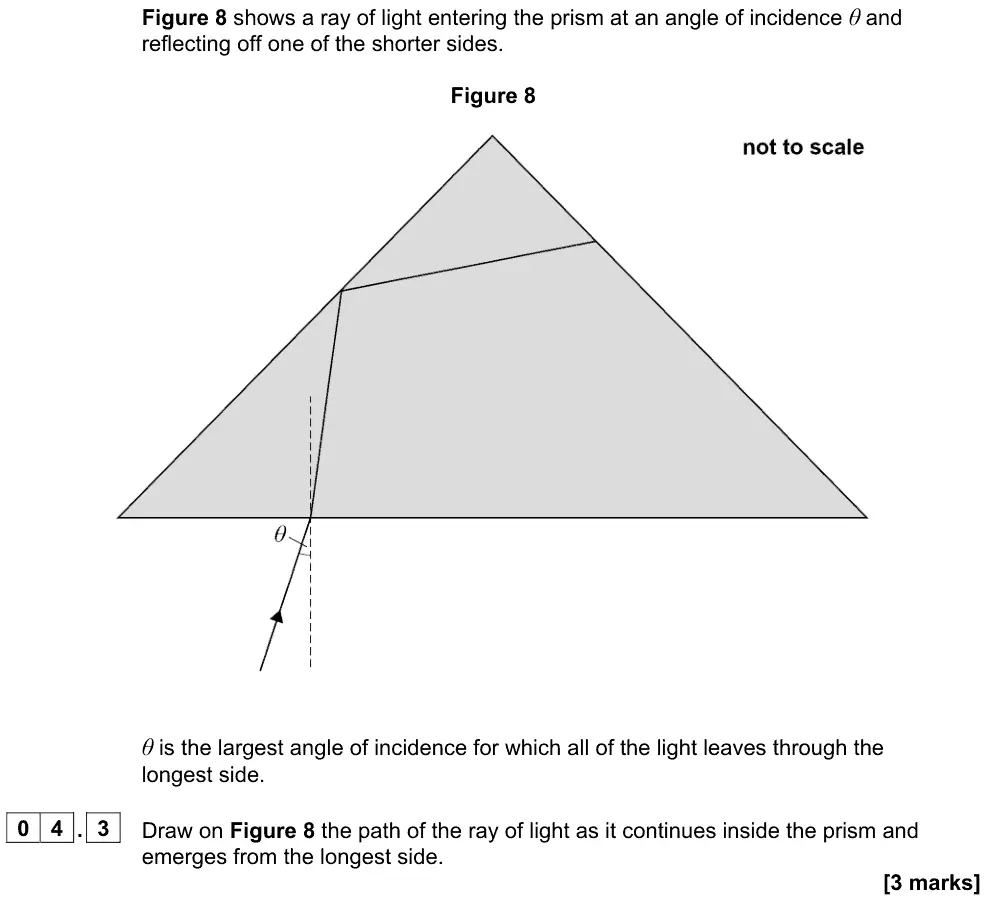
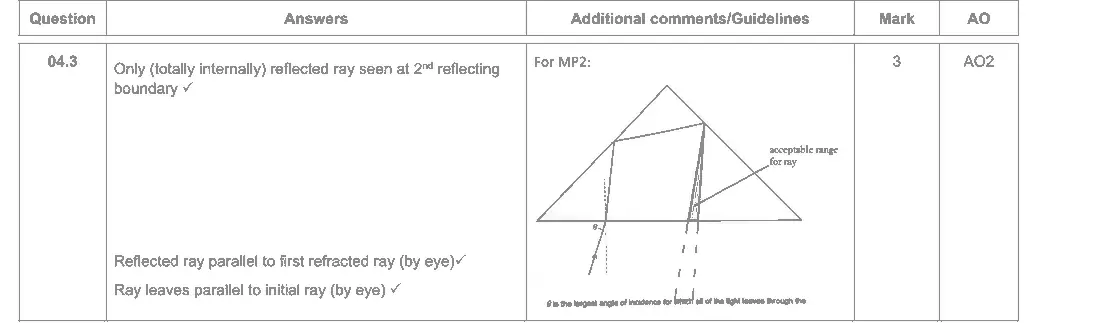
4.3 Refraction, total internal reflection and optical fibres 3AO2=3Diagram or graph
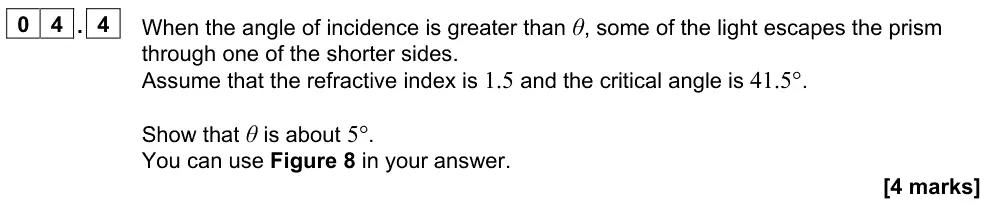
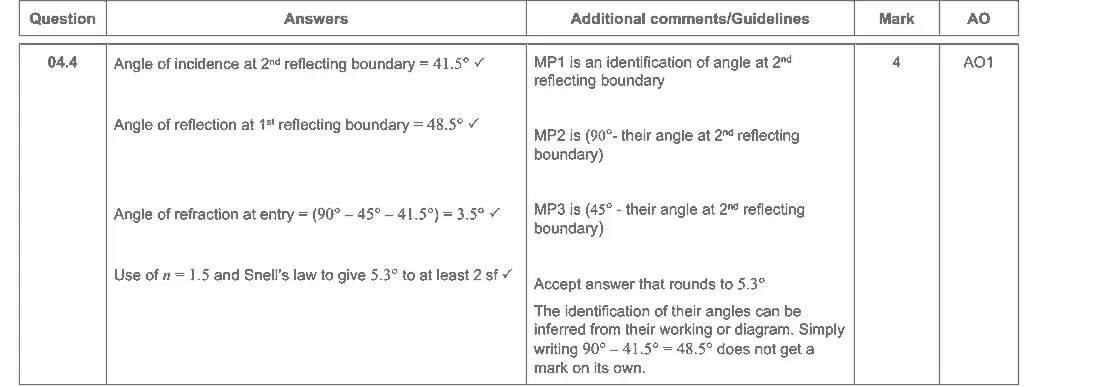
4.4 Refraction, total internal reflection and optical fibres 4AO1=4Show that
4.5 Refraction, total internal reflection and optical fibres 4AO3=4Explanation
5.1 Materials, stress, strain and the Young modulus 1AO1=1Calculation
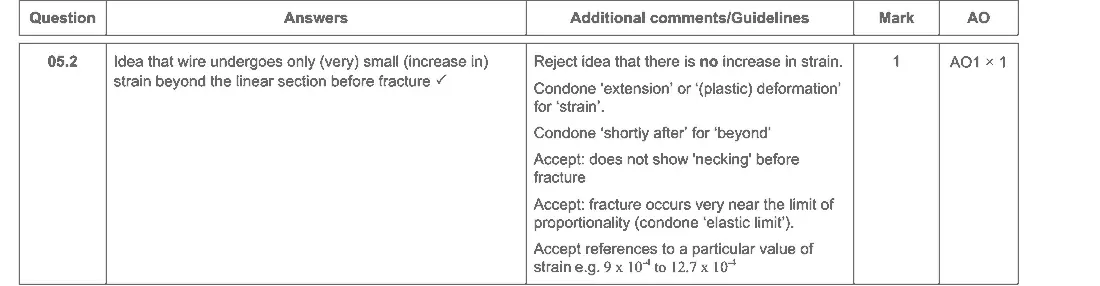
5.2 Materials, stress, strain and the Young modulus 1AO1=1Short answer
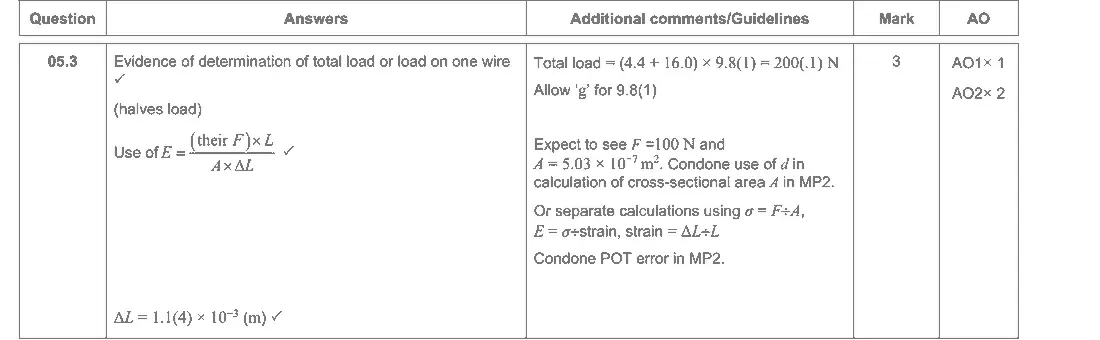
5.3 Materials, stress, strain and the Young modulus 3Calculation
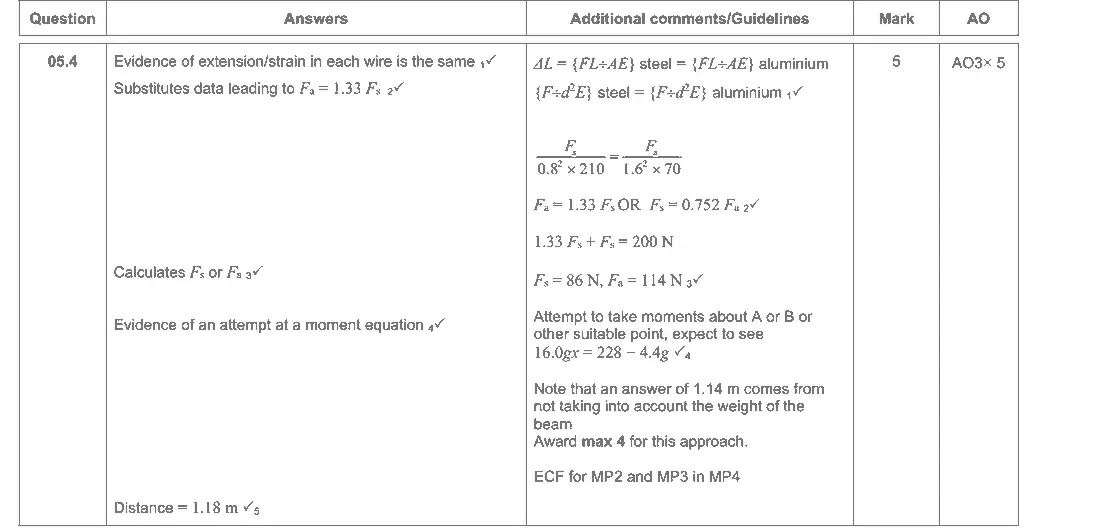
5.4 Materials, stress, strain and the Young modulus, Scalars, vectors and moments 5AO3=5Calculation
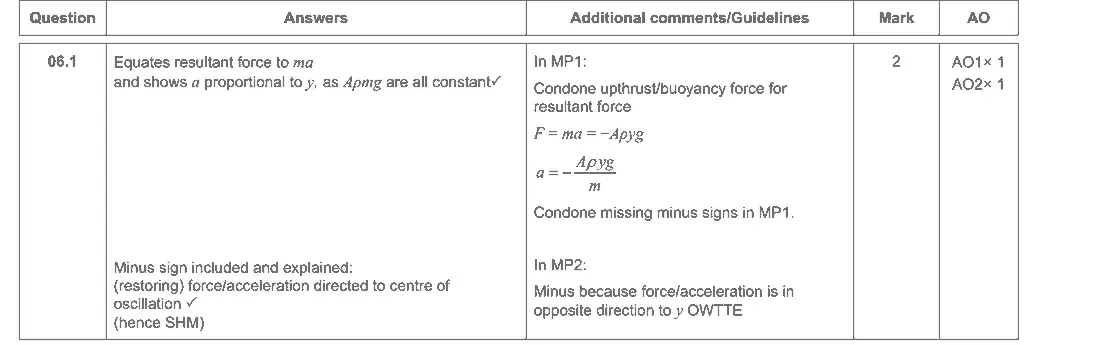
6.1 Simple harmonic motion, forced vibrations and resonance 2Show that
6.2 Simple harmonic motion, forced vibrations and resonance 2Calculation
6.3 Simple harmonic motion, forced vibrations and resonance 2AO1=2Short answer
6.4 Simple harmonic motion, forced vibrations and resonance, Progressive waves, longitudinal and transverse waves 3AO3=3Calculation
7 Measurements, units and uncertainties, Motion along a straight line and projectile motion 1Multiple choice
8 Measurements, units and uncertainties, Motion along a straight line and projectile motion 1Multiple choice
9 Atomic structure and stable nuclei 1Multiple choice
10 Classification of particles, quarks and conservation laws 1Multiple choice
11 Particles, antiparticles and particle interactions, Classification of particles, quarks and conservation laws 1Multiple choice
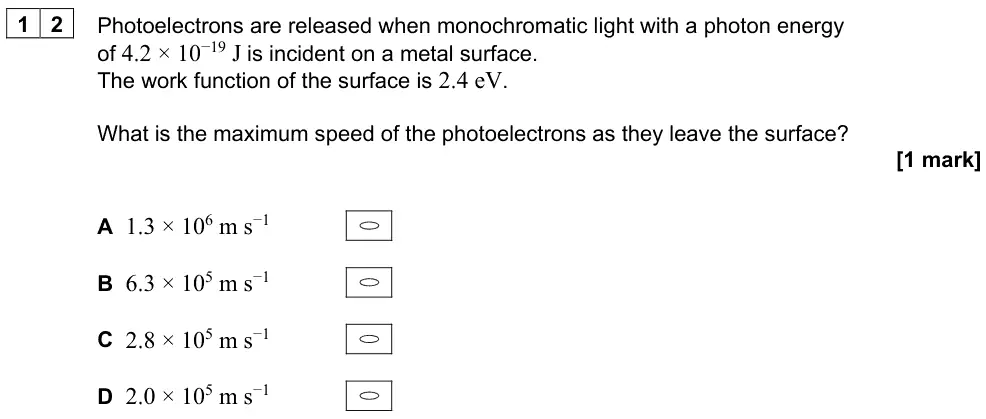
12 The photoelectric effect, Excitation, energy levels and wave-particle duality 1Multiple choice
13 Excitation, energy levels and wave-particle duality 1Multiple choice
14 Superposition and stationary waves, Progressive waves, longitudinal and transverse waves 1Multiple choice
15 Superposition and stationary waves, Interference, diffraction and the diffraction grating 1Multiple choice
16 Interference, diffraction and the diffraction grating 1Multiple choice
17 Interference, diffraction and the diffraction grating 1Multiple choice
18 Motion along a straight line and projectile motion 1Multiple choice
19 Newton's laws of motion and momentum, Motion along a straight line and projectile motion 1Multiple choice
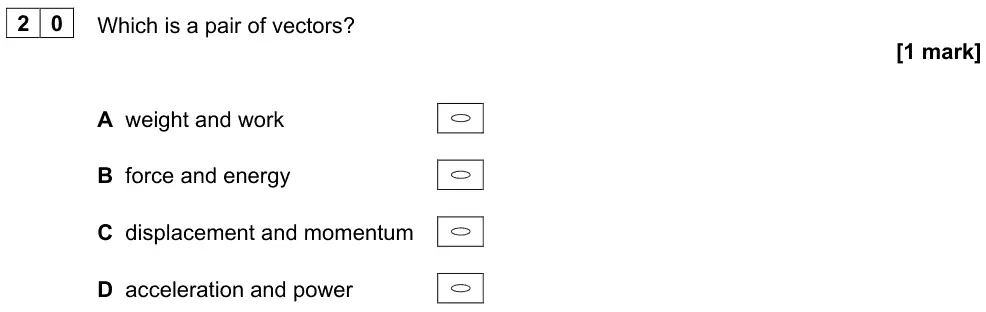
20 Scalars, vectors and moments 1Multiple choice
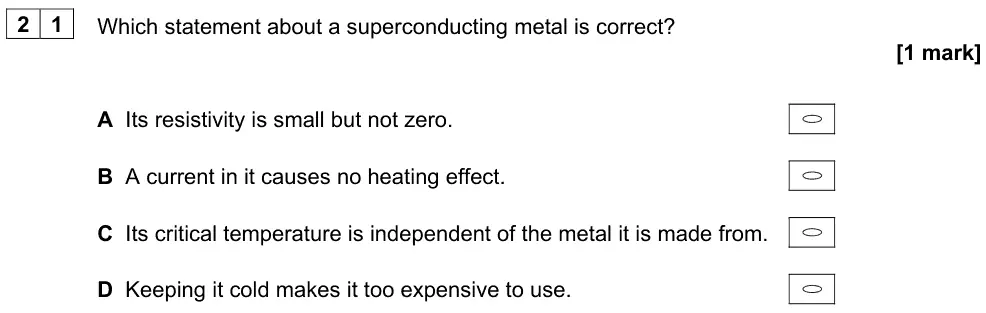
21 Current, potential difference, I-V characteristics and resistivity 1Multiple choice
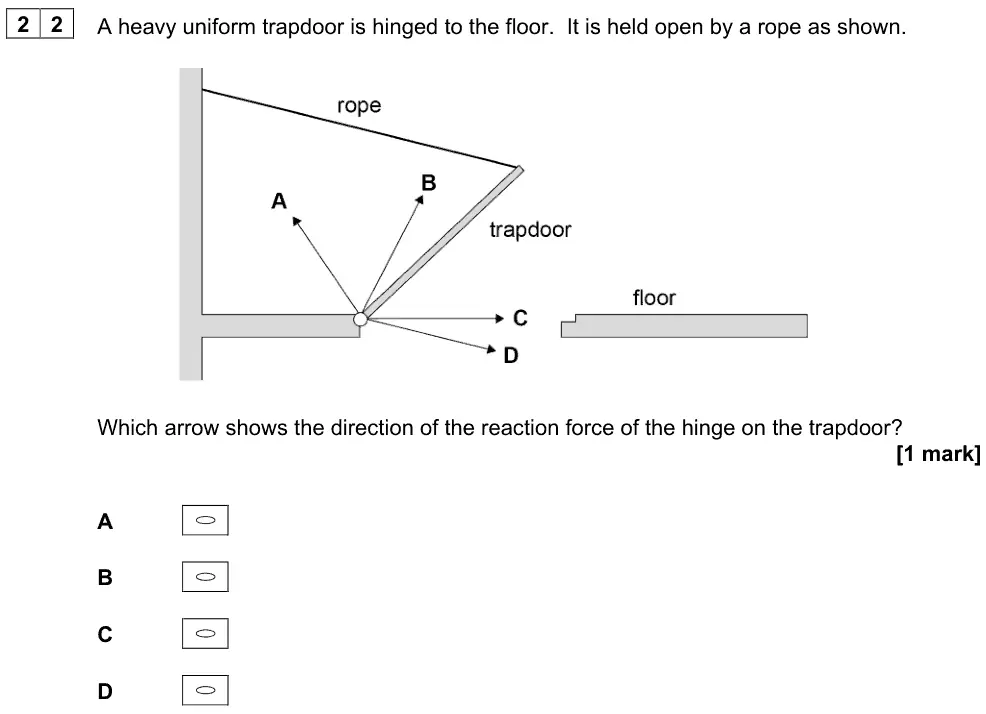
22 Scalars, vectors and moments 1Multiple choice
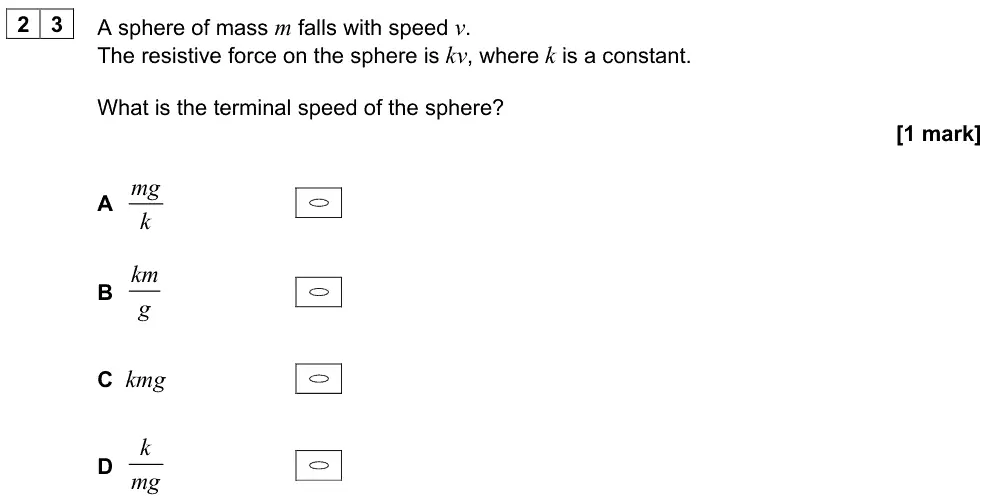
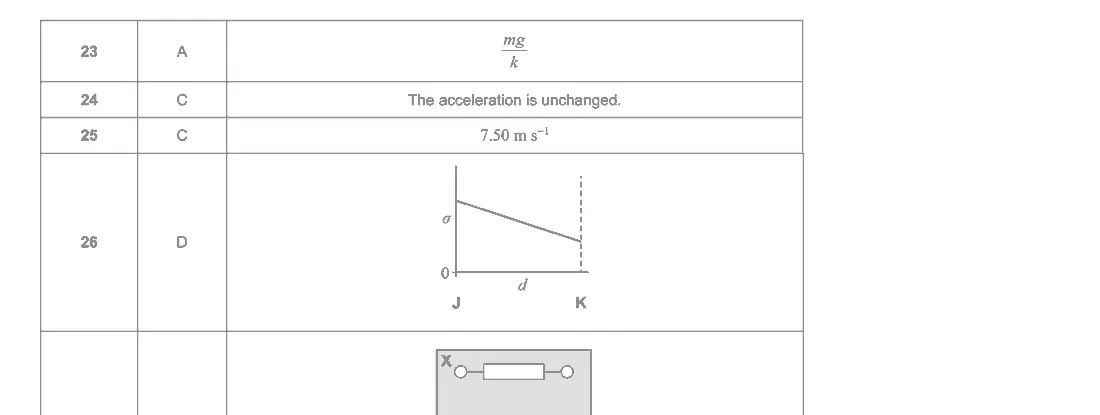
23 Motion along a straight line and projectile motion, Newton's laws of motion and momentum 1Multiple choice
24 Newton's laws of motion and momentum, Scalars, vectors and moments 1Multiple choice
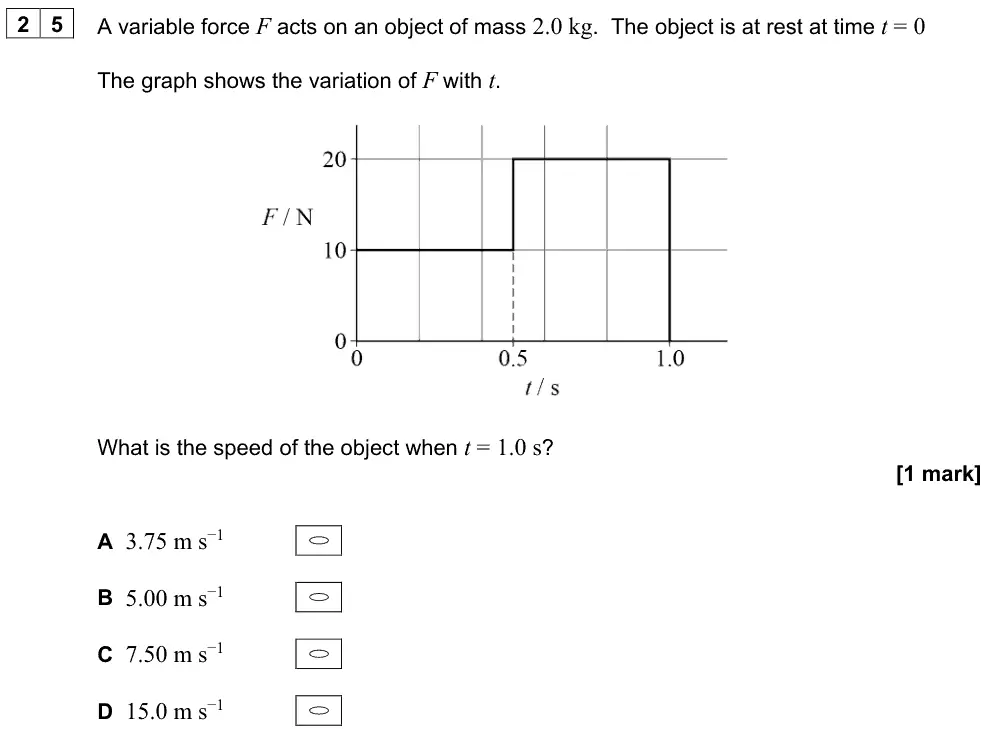
25 Newton's laws of motion and momentum 1Multiple choice
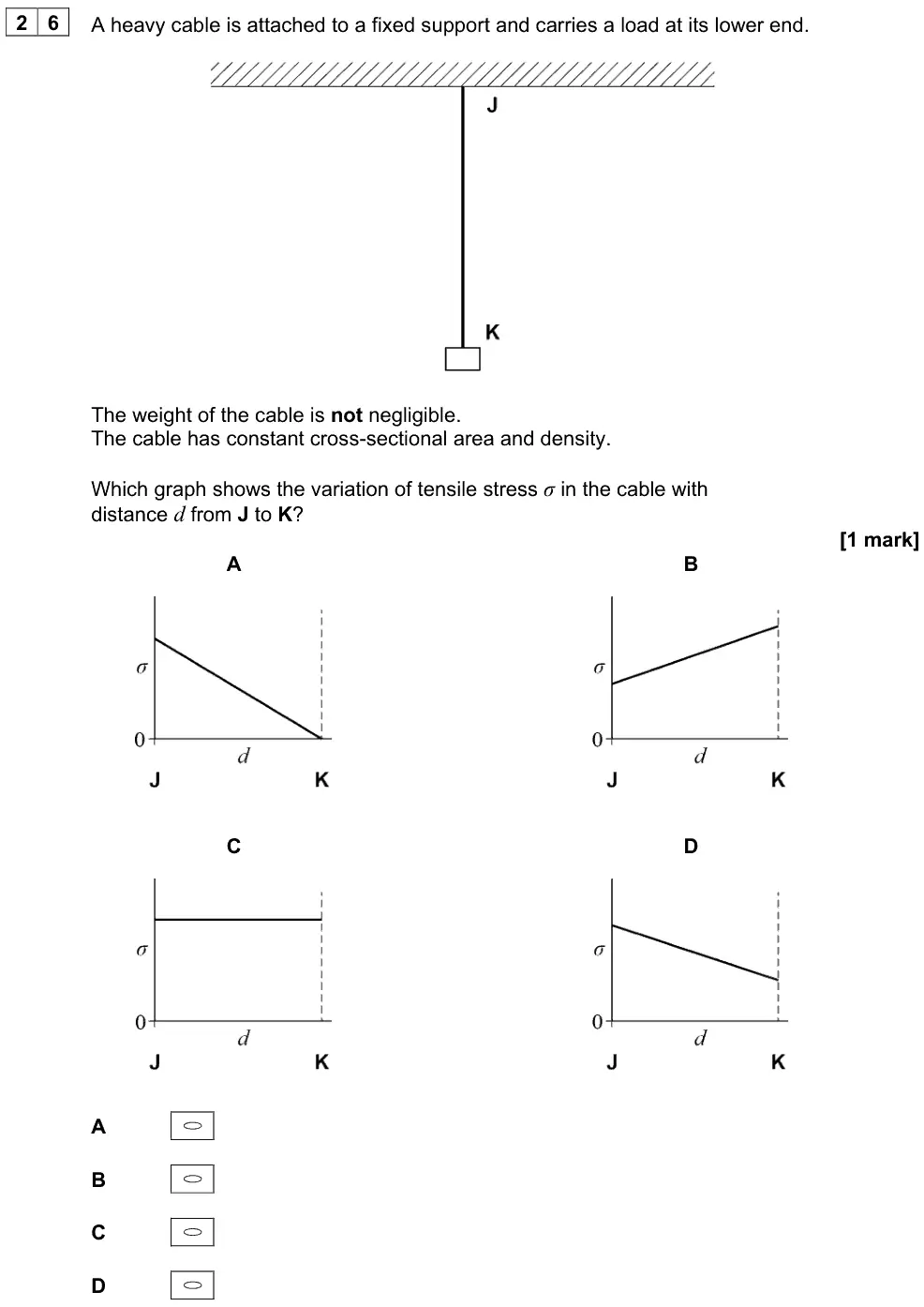
26 Materials, stress, strain and the Young modulus 1Multiple choice
27 Circuits and potential dividers 1Multiple choice
28 Circular motion 1Multiple choice
29 Circuits and potential dividers 1Multiple choice
30 Circular motion, Scalars, vectors and moments 1Multiple choice
31 Simple harmonic motion, forced vibrations and resonance 1Multiple choice

The questions

1.11.21.31.41.52.12.22.32.43.13.23.33.44.14.24.34.44.55.15.25.35.46.16.26.36.478910111213141516171819202122232425262728293031
June 2023 · Paper 1 · Q1.1 1 mark AO3=1 Short answer classification of particles and quarks
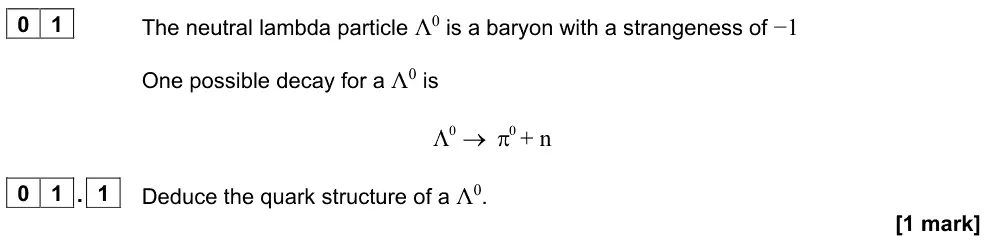
The neutral lambda particle Λ0 is a baryon with a strangeness of −1
One possible decay for a Λ0 is
0
0
+ n
Λ →π
Deduce the quark structure of a Λ0.
[1 mark]
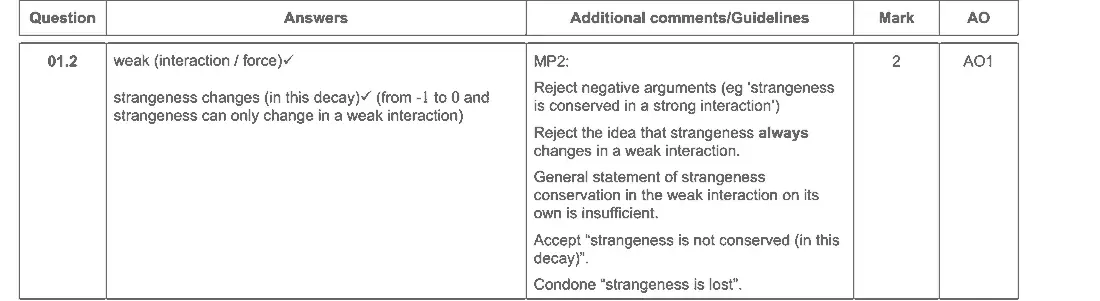
June 2023 · Paper 1 · Q1.2 2 marks AO1=2 Explanation classification of particles and quarks
Earlier part of question 1 that this part usesEarlier part of June 2023 Paper 1 question 1
State and explain which interaction is involved in this decay.
[2 marks]
June 2023 · Paper 1 · Q1.3 1 mark AO1=1 Short answer particles antiparticles and interactionsclassification of particles and quarks
Earlier part of question 1 that this part usesEarlier part of June 2023 Paper 1 question 1
An antiparticle of the neutral lambda particle decays into a neutral pion and particle X.
Identify X.
[1 mark]
June 2023 · Paper 1 · Q1.4 1 mark AO1=1 Calculation particles antiparticles and interactionsenergy levels and wave particle duality
Earlier part of question 1 that this part usesEarlier part of June 2023 Paper 1 question 1
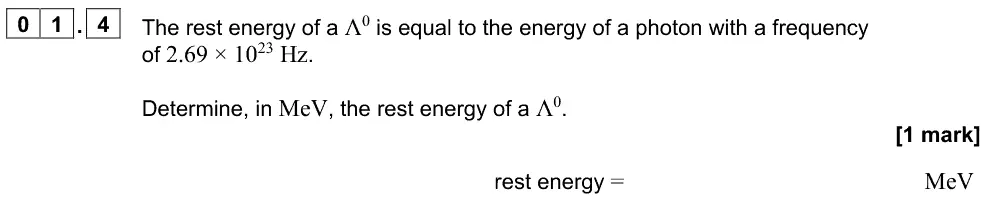
The rest energy of a Λ0 is equal to the energy of a photon with a frequency
of 2.69 × 10²³ Hz.
Determine, in MeV, the rest energy of a Λ0.
[1 mark]
rest energy =
MeV
June 2023 · Paper 1 · Q1.5 1 mark AO1=1 Short answer classification of particles and quarks
Earlier part of question 1 that this part usesEarlier part of June 2023 Paper 1 question 1
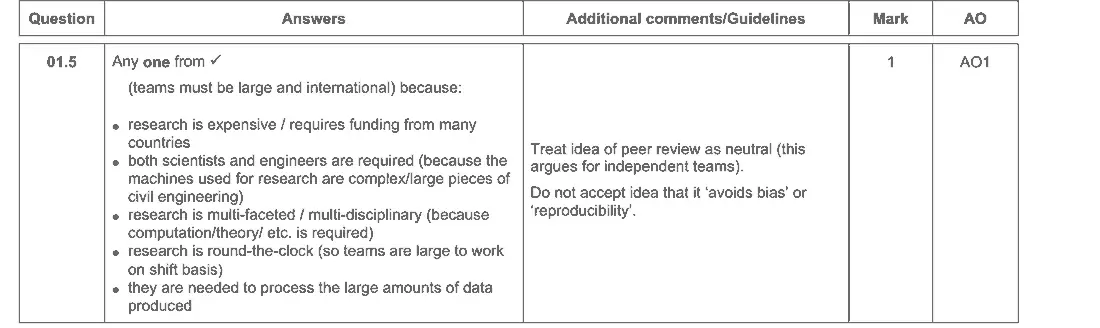
The discovery of particles such as the Λ0 is made by large international research
teams.
Suggest one reason for this.
[1 mark]
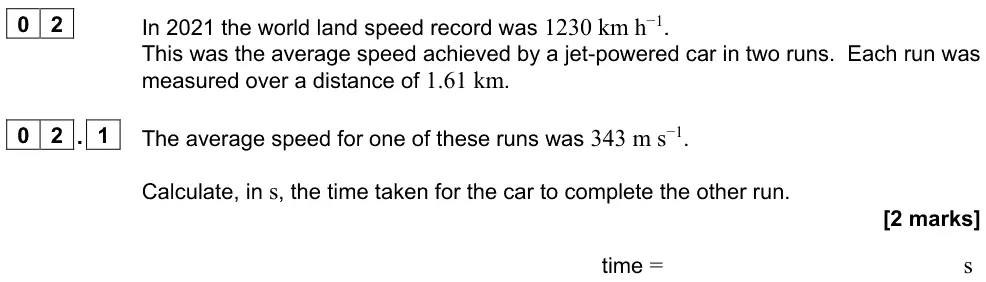
June 2023 · Paper 1 · Q2.1 2 marks Calculation motion and projectilesmeasurements and uncertainties
In 2021 the world land speed record was 1230 km h−1.
This was the average speed achieved by a jet-powered car in two runs.  Each run was
measured over a distance of 1.61 km.
The average speed for one of these runs was 343 m s−1.
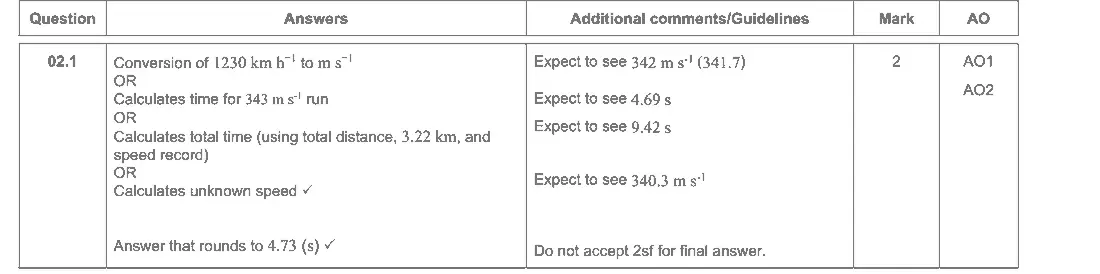
Calculate, in s, the time taken for the car to complete the other run.
[2 marks]
time =
s
June 2023 · Paper 1 · Q2.2 2 marks Calculation work energy and power
Earlier part of question 2 that this part usesEarlier part of June 2023 Paper 1 question 2
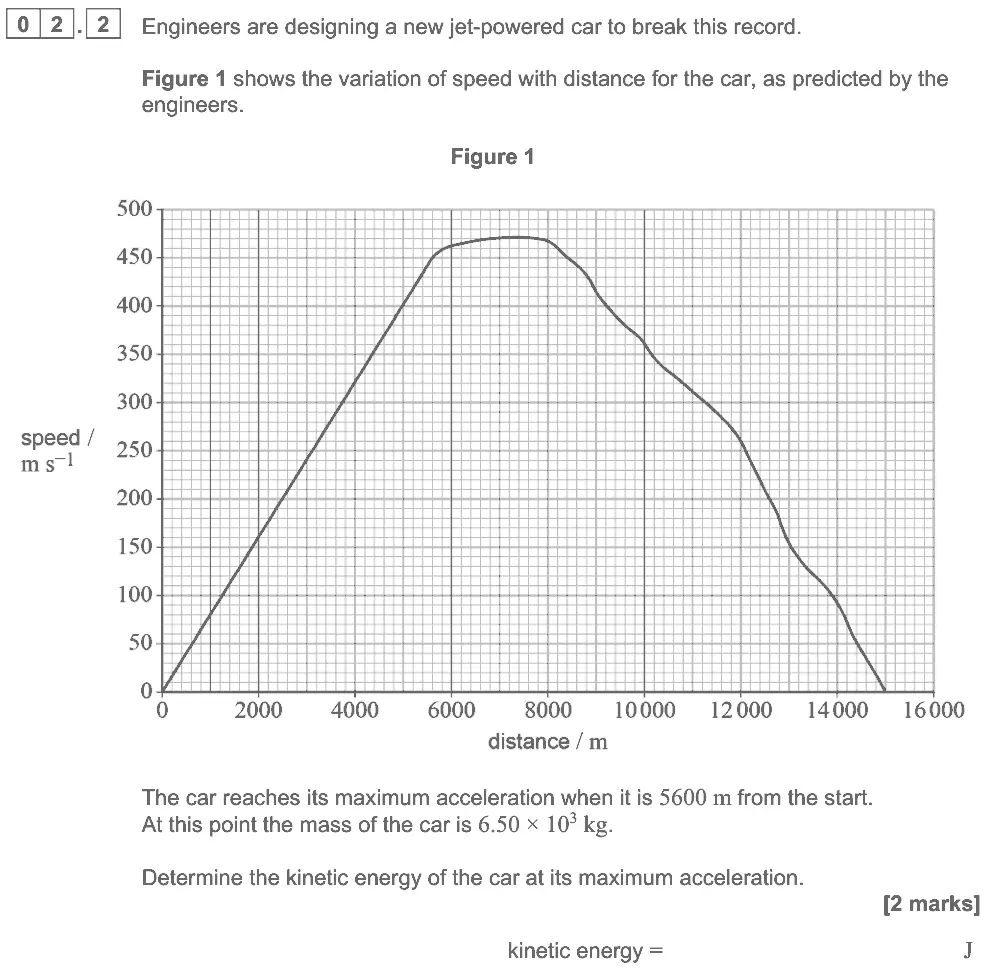
Engineers are designing a new jet-powered car to break this record.
Figure 1 shows the variation of speed with distance for the car, as predicted by the
engineers.
Figure 1
The car reaches its maximum acceleration when it is 5600 m from the start.
At this point the mass of the car is 6.50 × 10³ kg.
Determine the kinetic energy of the car at its maximum acceleration.
[2 marks]
kinetic energy =
J
June 2023 · Paper 1 · Q2.3 4 marks Calculation work energy and power
Earlier part of question 2 that this part usesEarlier part of June 2023 Paper 1 question 2
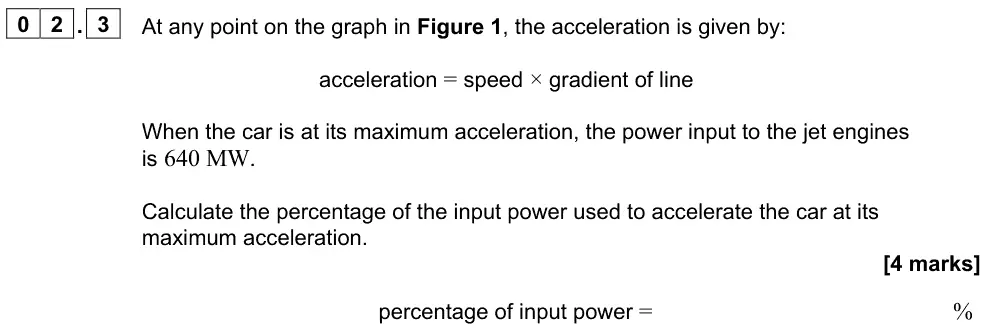
At any point on the graph in Figure 1, the acceleration is given by:
acceleration = speed × gradient of line
When the car is at its maximum acceleration, the power input to the jet engines
is 640 MW.
Calculate the percentage of the input power used to accelerate the car at its
maximum acceleration.
[4 marks]
percentage of input power =
%
June 2023 · Paper 1 · Q2.4 2 marks AO3=2 Calculation Hard motion and projectiles
Earlier part of question 2 that this part usesEarlier part of June 2023 Paper 1 question 2
Scientists recommend that the average deceleration of the driver of the car should be
less than 3g.
Deduce whether the average deceleration is less than 3g.
[2 marks]
June 2023 · Paper 1 · Q3.1 2 marks AO1=2 Explanation circuits and potential dividersemf and internal resistance
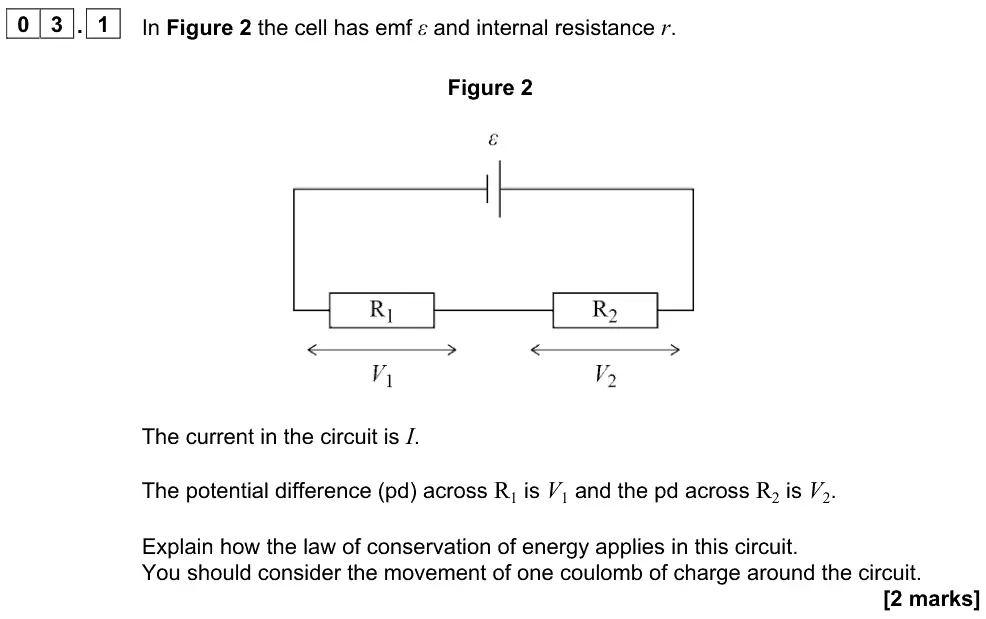
In Figure 2 the cell has emf ε and internal resistance r.
Figure 2
The current in the circuit is I.
The potential difference (pd) across R1 is V1 and the pd across R2 is V2.
Explain how the law of conservation of energy applies in this circuit.
You should consider the movement of one coulomb of charge around the circuit.
[2 marks]
June 2023 · Paper 1 · Q3.2 3 marks AO2=3 Show that Easy emf and internal resistance
Earlier part of question 3 that this part usesEarlier part of June 2023 Paper 1 question 3
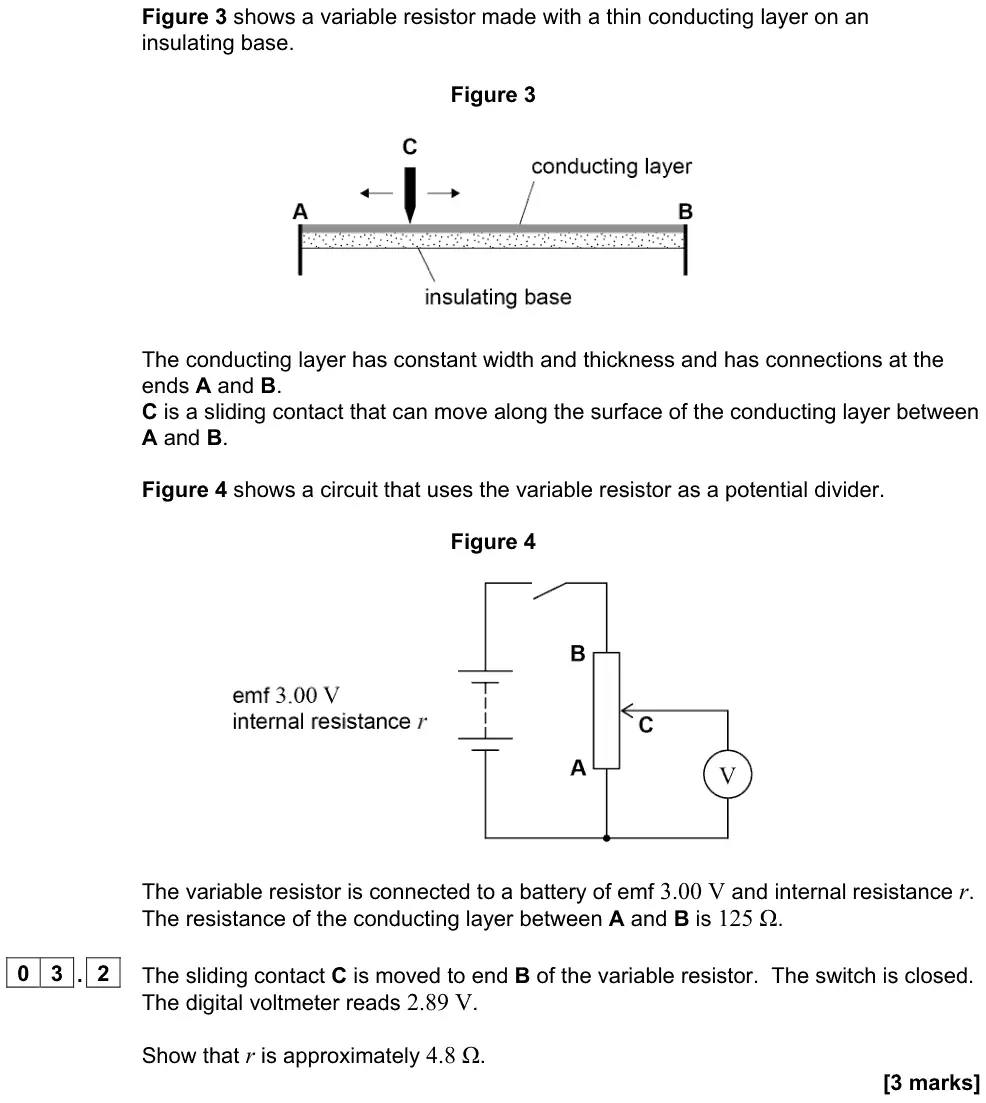
Figure 3 shows a variable resistor made with a thin conducting layer on an
insulating base.
Figure 3
The conducting layer has constant width and thickness and has connections at the
ends A and B.
C is a sliding contact that can move along the surface of the conducting layer between
A and B.
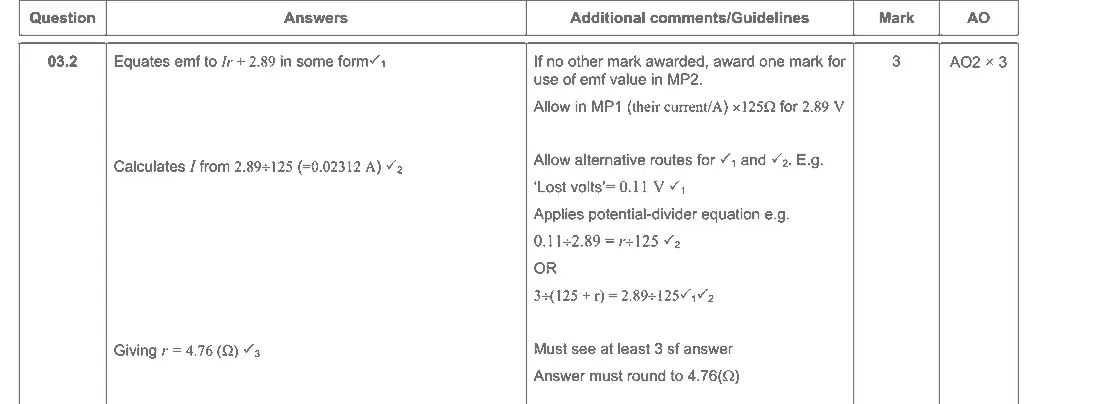
Figure 4 shows a circuit that uses the variable resistor as a potential divider.
Figure 4
The variable resistor is connected to a battery of emf 3.00 V and internal resistance r.
The resistance of the conducting layer between A and B is 125 Ω.
The sliding contact C is moved to end B of the variable resistor.  The switch is closed.
The digital voltmeter reads 2.89 V.
Show that r is approximately 4.8 Ω.
[3 marks]
June 2023 · Paper 1 · Q3.3 2 marks AO2=2 Calculation circuits and potential dividersemf and internal resistance
Earlier part of question 3 that this part usesEarlier part of June 2023 Paper 1 question 3
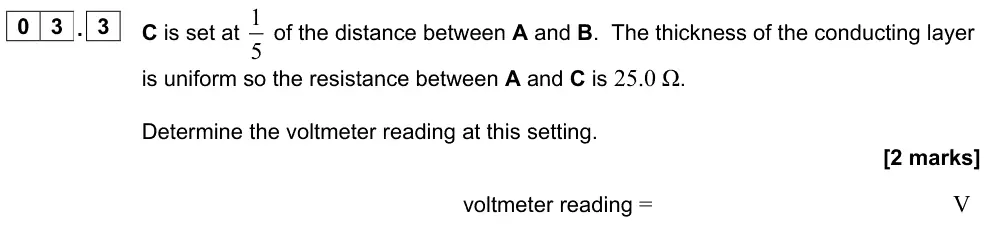
C is set at 1
5
of the distance between A and B.  The thickness of the conducting layer
is uniform so the resistance between A and C is 25.0 Ω.
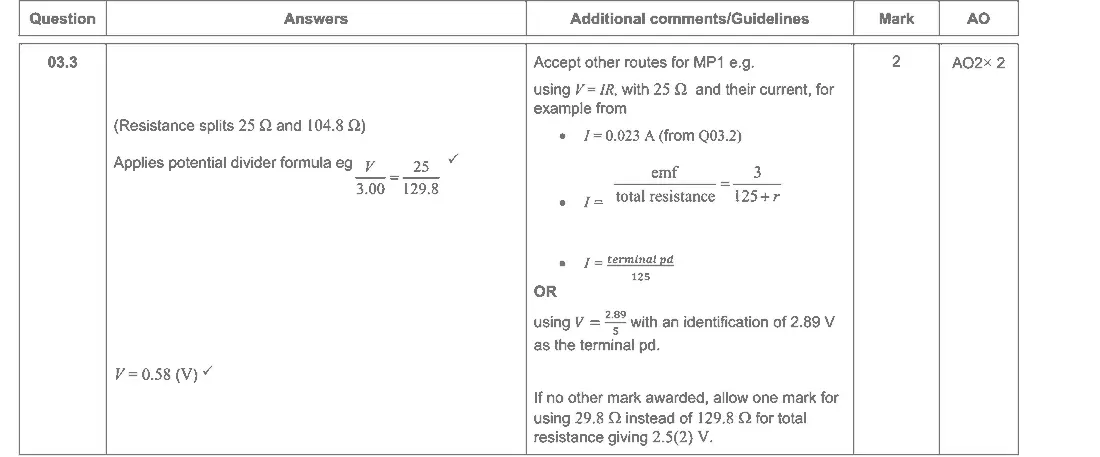
Determine the voltmeter reading at this setting.
[2 marks]
voltmeter reading =
V
June 2023 · Paper 1 · Q3.4 4 marks AO3=4 Diagram or graph circuits and potential dividerscurrent voltage and resistivity
Earlier part of question 3 that this part usesEarlier part of June 2023 Paper 1 question 3
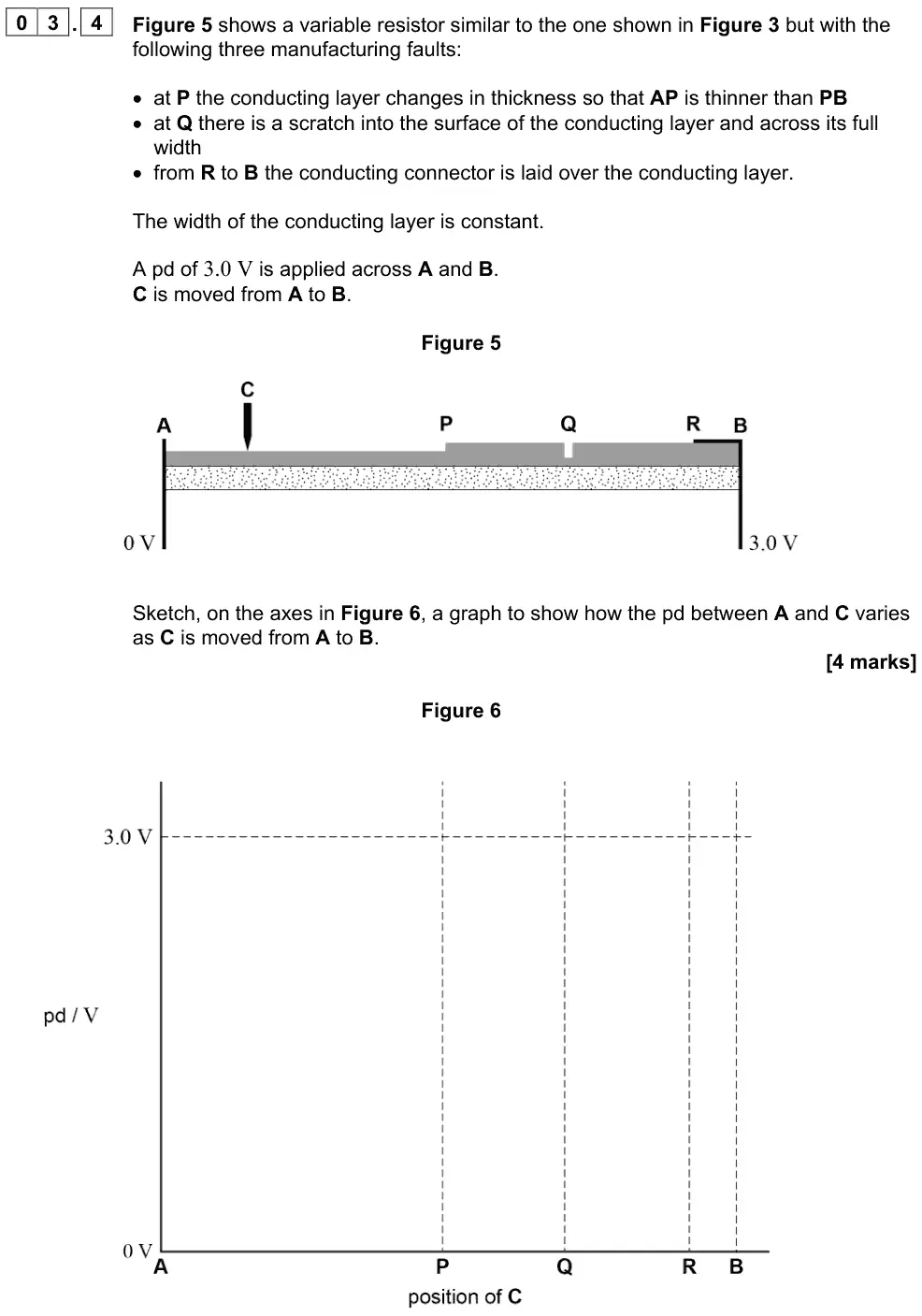
Figure 5 shows a variable resistor similar to the one shown in Figure 3 but with the
following three manufacturing faults:
• at P the conducting layer changes in thickness so that AP is thinner than PB
• at Q there is a scratch into the surface of the conducting layer and across its full
width
• from R to B the conducting connector is laid over the conducting layer.
The width of the conducting layer is constant.
A pd of 3.0 V is applied across A and B.
C is moved from A to B.
Figure 5
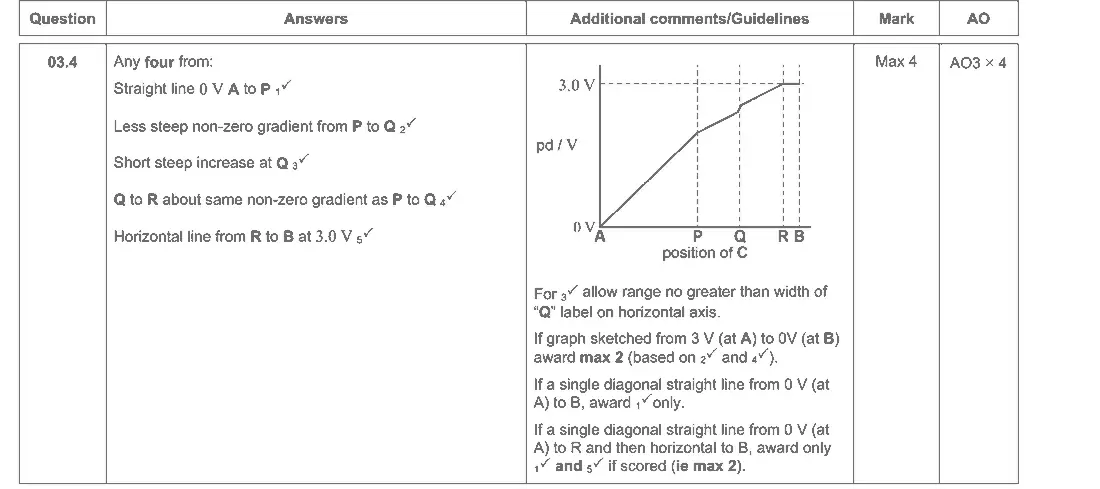
Sketch, on the axes in Figure 6, a graph to show how the pd between A and C varies
as C is moved from A to B.
[4 marks]
Figure 6
June 2023 · Paper 1 · Q4.1 1 mark AO1=1 Show that Easy refraction and optical fibres
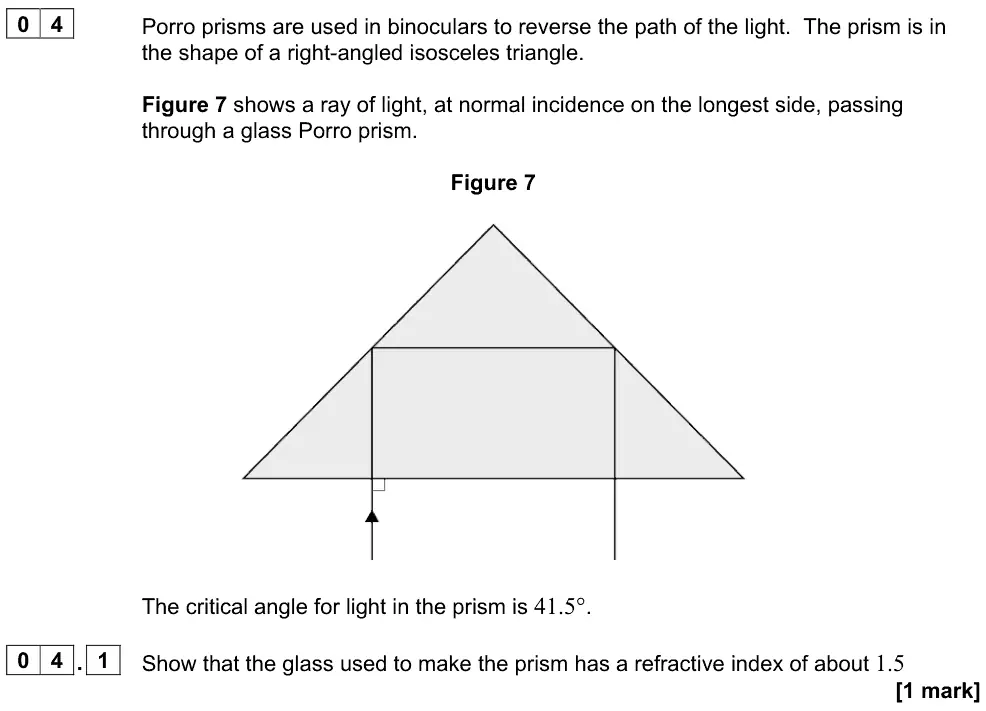
Porro prisms are used in binoculars to reverse the path of the light.  The prism is in
the shape of a right-angled isosceles triangle.
Figure 7 shows a ray of light, at normal incidence on the longest side, passing
through a glass Porro prism.
Figure 7
The critical angle for light in the prism is 41.5°.
Show that the glass used to make the prism has a refractive index of about 1.5
[1 mark]
June 2023 · Paper 1 · Q4.2 2 marks Explanation refraction and optical fibres
Earlier part of question 4 that this part usesEarlier part of June 2023 Paper 1 question 4
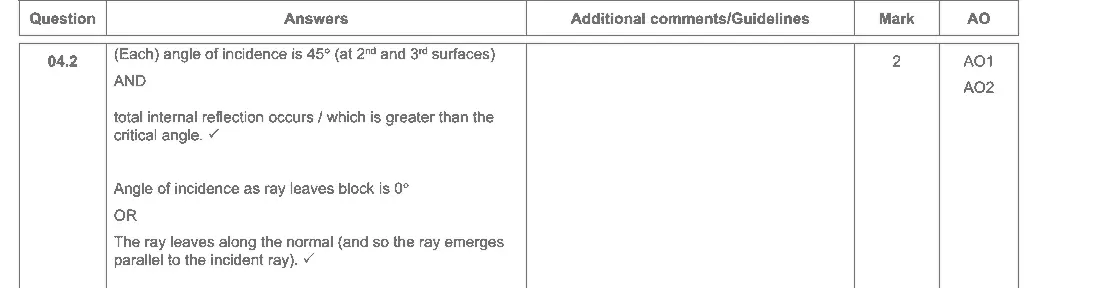
Explain why the ray emerges parallel to the incident ray.
[2 marks]
June 2023 · Paper 1 · Q4.3 3 marks AO2=3 Diagram or graph refraction and optical fibres
Earlier part of question 4 that this part usesEarlier part of June 2023 Paper 1 question 4
Figure 8 shows a ray of light entering the prism at an angle of incidence θ and
reflecting off one of the shorter sides.
Figure 8
θ is the largest angle of incidence for which all of the light leaves through the
longest side.
Draw on Figure 8 the path of the ray of light as it continues inside the prism and
emerges from the longest side.
[3 marks]
June 2023 · Paper 1 · Q4.4 4 marks AO1=4 Show that refraction and optical fibres
Earlier part of question 4 that this part usesEarlier part of June 2023 Paper 1 question 4
When the angle of incidence is greater than θ, some of the light escapes the prism
through one of the shorter sides.
Assume that the refractive index is 1.5 and the critical angle is 41.5°.
Show that θ is about 5°.
You can use Figure 8 in your answer.
[4 marks]
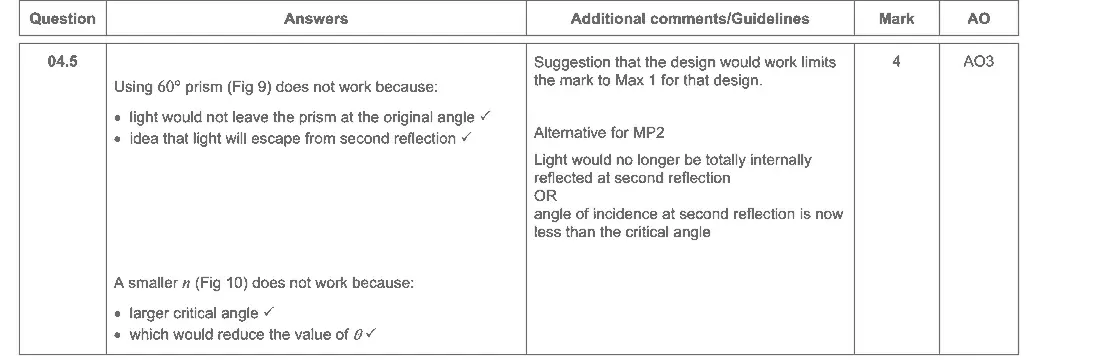
June 2023 · Paper 1 · Q4.5 4 marks AO3=4 Explanation refraction and optical fibres
Earlier part of question 4 that this part usesEarlier part of June 2023 Paper 1 question 4
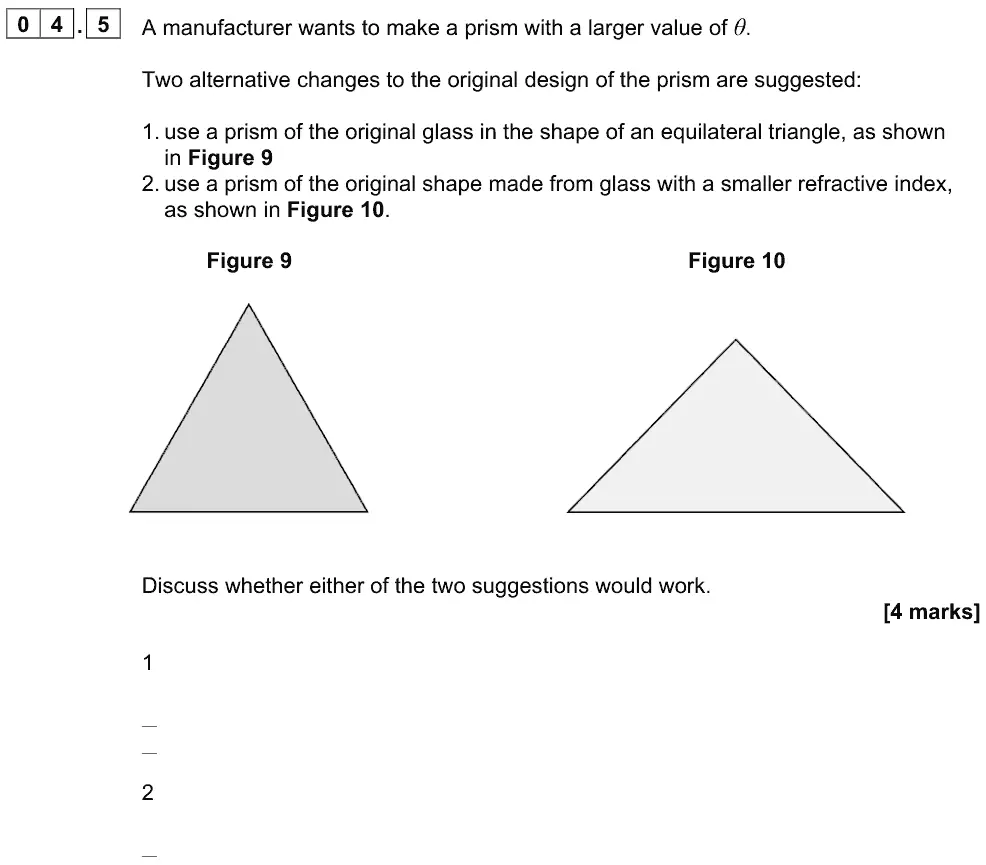
A manufacturer wants to make a prism with a larger value of θ.
Two alternative changes to the original design of the prism are suggested:
1. use a prism of the original glass in the shape of an equilateral triangle, as shown
in Figure 9
2. use a prism of the original shape made from glass with a smaller refractive index,
as shown in Figure 10.
Figure 9
Figure 10
Discuss whether either of the two suggestions would work.
[4 marks]
1
2
June 2023 · Paper 1 · Q5.1 1 mark AO1=1 Calculation materials and young modulus
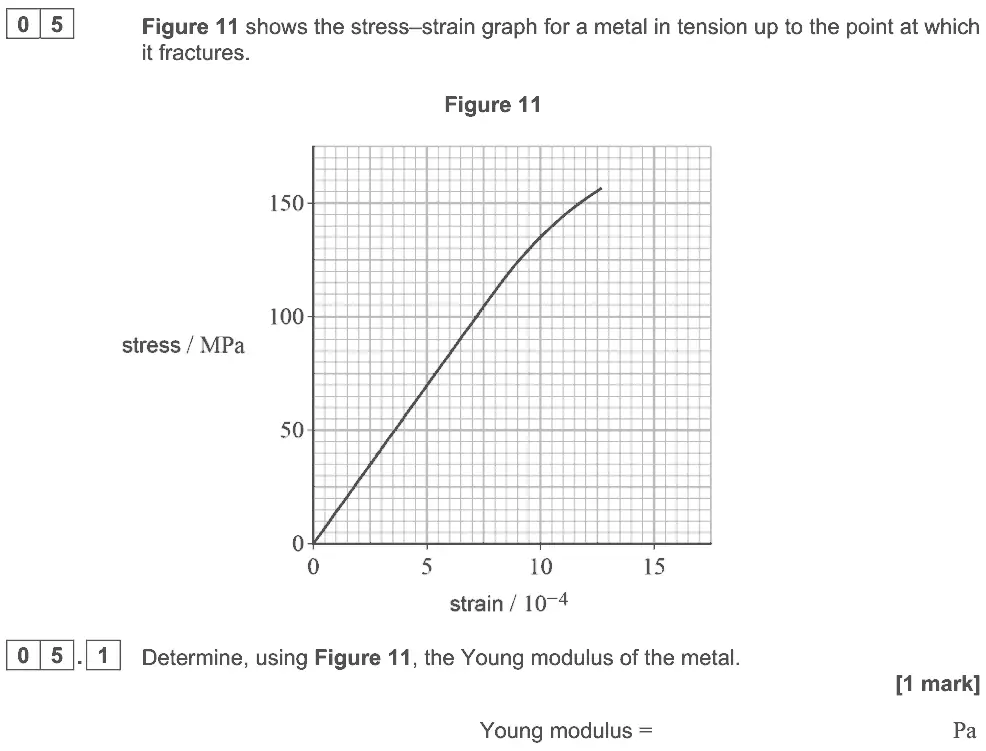
Figure 11 shows the stress–strain graph for a metal in tension up to the point at which
it fractures.
Figure 11
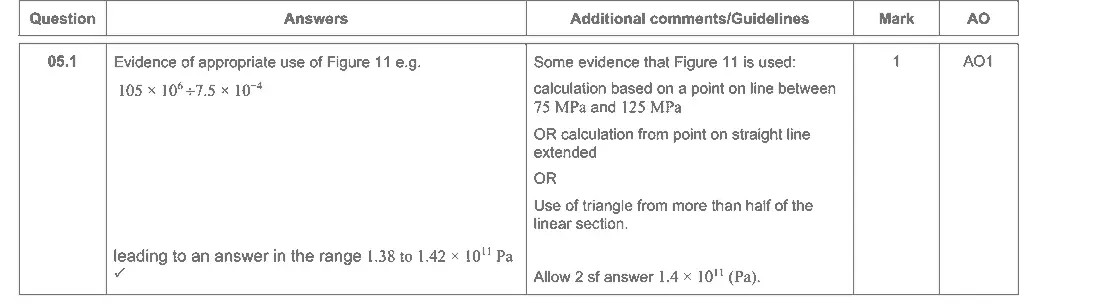
Determine, using Figure 11, the Young modulus of the metal.
[1 mark]
Young modulus =
Pa
June 2023 · Paper 1 · Q5.2 1 mark AO1=1 Short answer materials and young modulus
Earlier part of question 5 that this part usesEarlier part of June 2023 Paper 1 question 5
Explain how the graph shows that this metal is brittle.
[1 mark]
June 2023 · Paper 1 · Q5.3 3 marks Calculation materials and young modulus
Earlier part of question 5 that this part usesEarlier part of June 2023 Paper 1 question 5
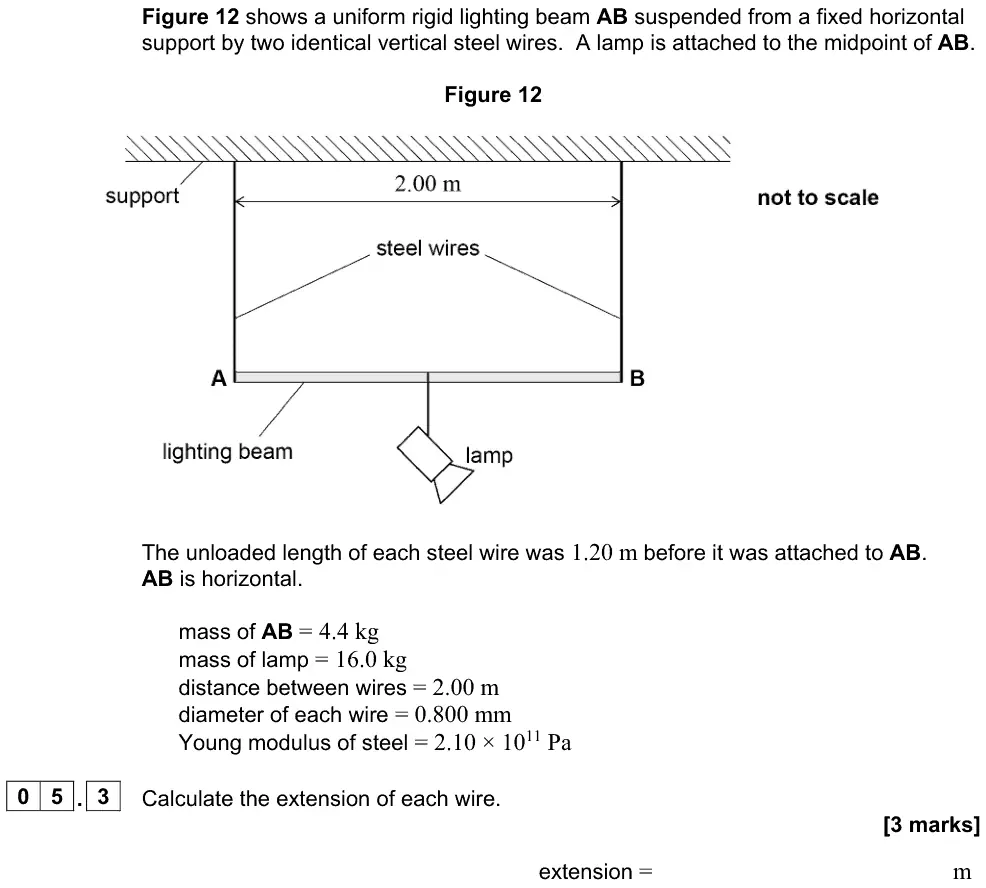
Figure 12 shows a uniform rigid lighting beam AB suspended from a fixed horizontal
support by two identical vertical steel wires.  A lamp is attached to the midpoint of AB.
Figure 12
The unloaded length of each steel wire was 1.20 m before it was attached to AB.
AB is horizontal.
mass of AB = 4.4 kg
mass of lamp = 16.0 kg
distance between wires = 2.00 m
diameter of each wire = 0.800 mm
Young modulus of steel = 2.10 × 10¹¹ Pa
Calculate the extension of each wire.
[3 marks]
extension =
m
June 2023 · Paper 1 · Q5.4 5 marks AO3=5 Calculation materials and young modulusvectors and moments
Earlier part of question 5 that this part usesEarlier part of June 2023 Paper 1 question 5
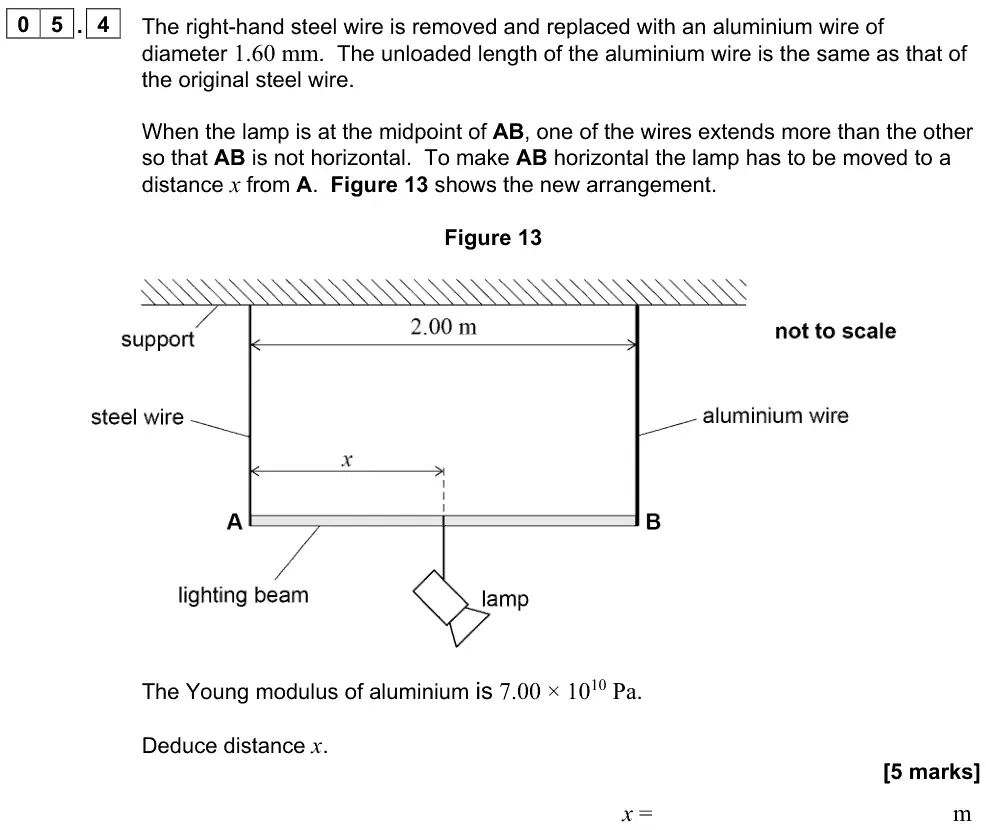
The right-hand steel wire is removed and replaced with an aluminium wire of
diameter 1.60 mm.  The unloaded length of the aluminium wire is the same as that of
the original steel wire.
When the lamp is at the midpoint of AB, one of the wires extends more than the other
so that AB is not horizontal.  To make AB horizontal the lamp has to be moved to a
distance x from A.  Figure 13 shows the new arrangement.
Figure 13
The Young modulus of aluminium is 7.00 × 10¹⁰ Pa.
Deduce distance x.
[5 marks]
x =
m
June 2023 · Paper 1 · Q6.1 2 marks Show that simple harmonic motion
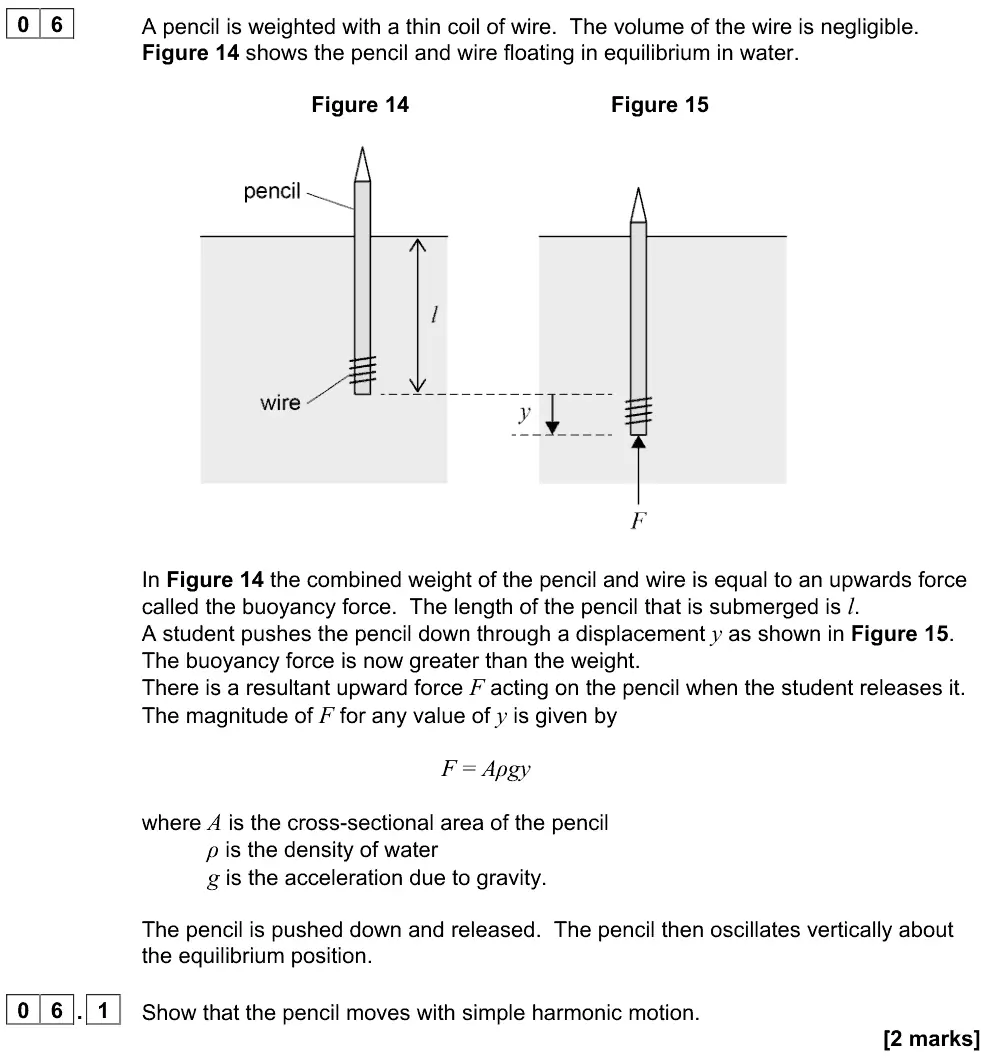
A pencil is weighted with a thin coil of wire.  The volume of the wire is negligible.
Figure 14 shows the pencil and wire floating in equilibrium in water.
Figure 14                                 Figure 15
In Figure 14 the combined weight of the pencil and wire is equal to an upwards force
called the buoyancy force.  The length of the pencil that is submerged is l.
A student pushes the pencil down through a displacement y as shown in Figure 15.
The buoyancy force is now greater than the weight.
There is a resultant upward force F acting on the pencil when the student releases it.
The magnitude of F for any value of y is given by
F = Aρgy
where A is the cross-sectional area of the pencil
ρ is the density of water
g is the acceleration due to gravity.
The pencil is pushed down and released.  The pencil then oscillates vertically about
the equilibrium position.
Show that the pencil moves with simple harmonic motion.
[2 marks]
June 2023 · Paper 1 · Q6.2 2 marks Calculation simple harmonic motion
Earlier part of question 6 that this part usesEarlier part of June 2023 Paper 1 question 6
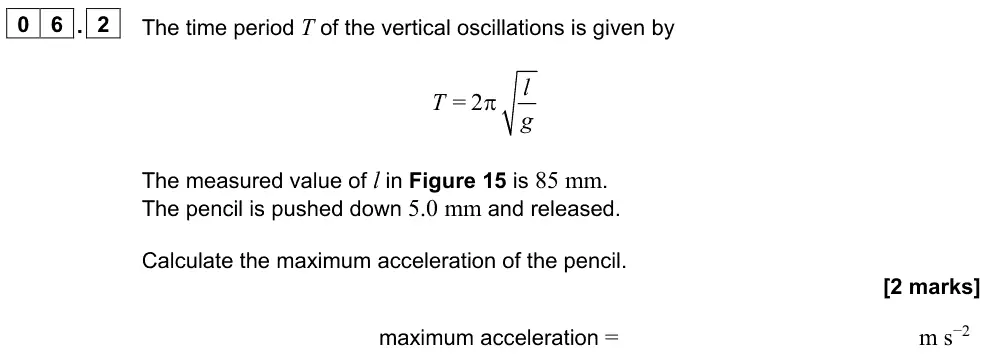
The time period T of the vertical oscillations is given by
= 2
l
T
g
π
The measured value of l in Figure 15 is 85 mm.
The pencil is pushed down 5.0 mm and released.
Calculate the maximum acceleration of the pencil.
[2 marks]
maximum acceleration =
m s−2
June 2023 · Paper 1 · Q6.3 2 marks AO1=2 Short answer simple harmonic motion
Earlier part of question 6 that this part usesEarlier part of June 2023 Paper 1 question 6
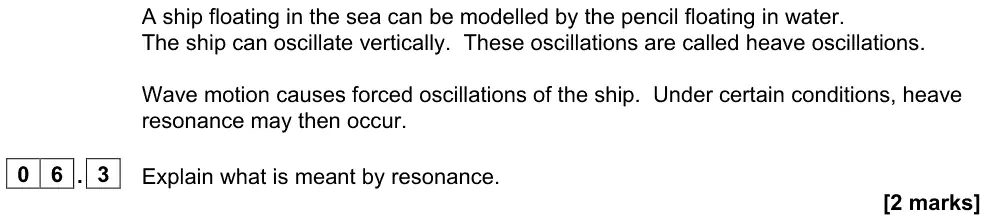
A ship floating in the sea can be modelled by the pencil floating in water.
The ship can oscillate vertically.  These oscillations are called heave oscillations.
Wave motion causes forced oscillations of the ship.  Under certain conditions, heave
resonance may then occur.
Explain what is meant by resonance.
[2 marks]
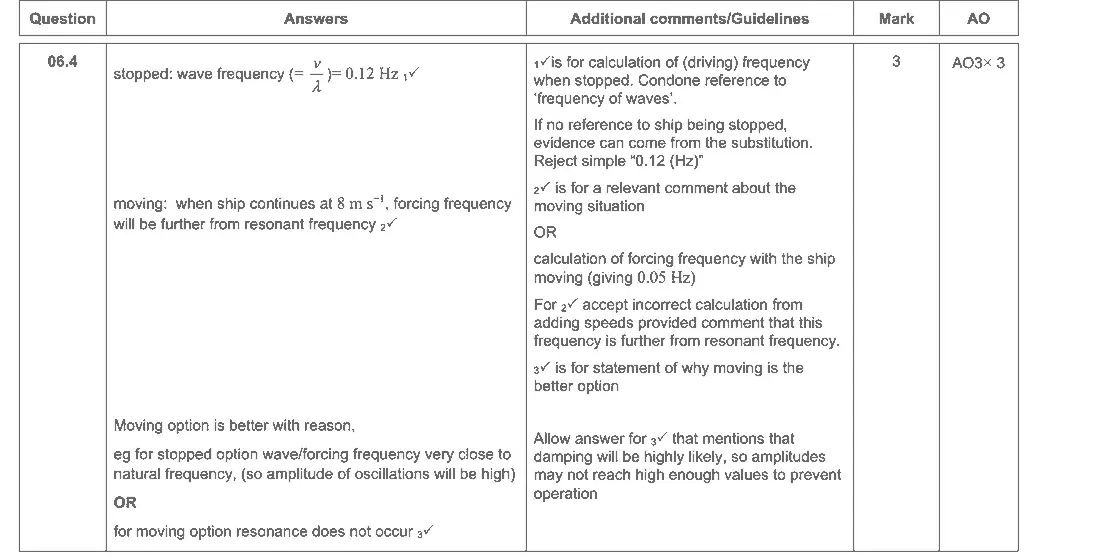
June 2023 · Paper 1 · Q6.4 3 marks AO3=3 Calculation simple harmonic motionprogressive waves and polarisation
Earlier part of question 6 that this part usesEarlier part of June 2023 Paper 1 question 6
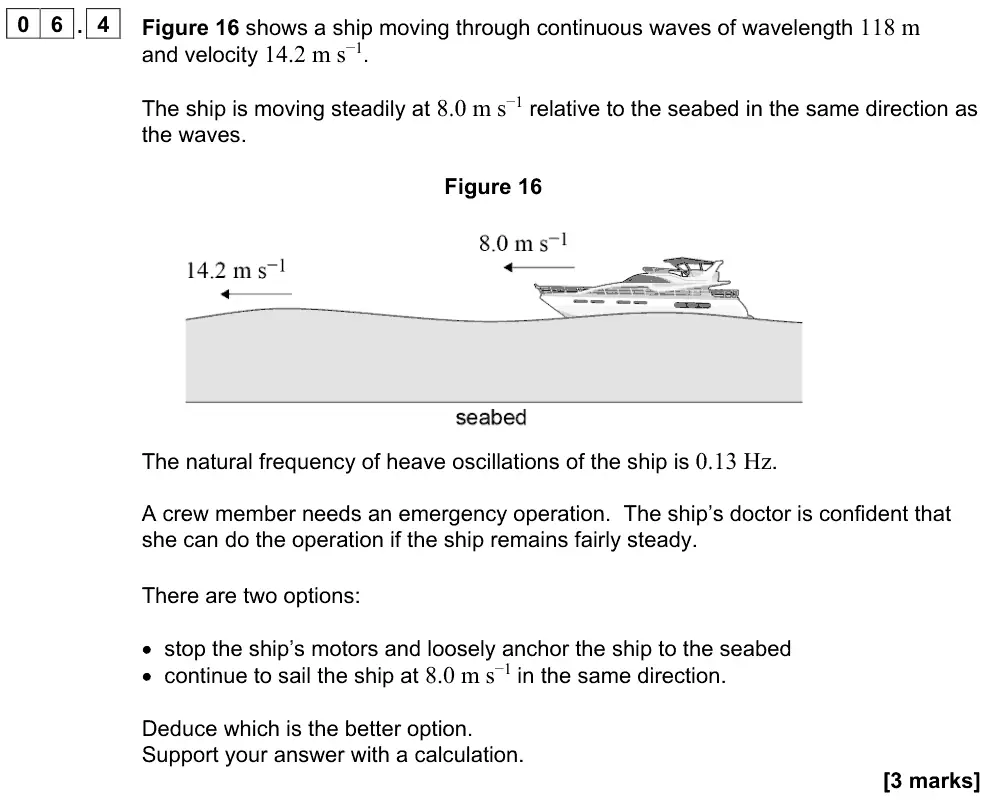
Figure 16 shows a ship moving through continuous waves of wavelength 118 m
and velocity 14.2 m s−1.
The ship is moving steadily at 8.0 m s−1 relative to the seabed in the same direction as
the waves.
Figure 16
The natural frequency of heave oscillations of the ship is 0.13 Hz.
A crew member needs an emergency operation.  The ship’s doctor is confident that
she can do the operation if the ship remains fairly steady.
There are two options:
• stop the ship’s motors and loosely anchor the ship to the seabed
• continue to sail the ship at 8.0 m s−1 in the same direction.
Deduce which is the better option.
Support your answer with a calculation.
[3 marks]
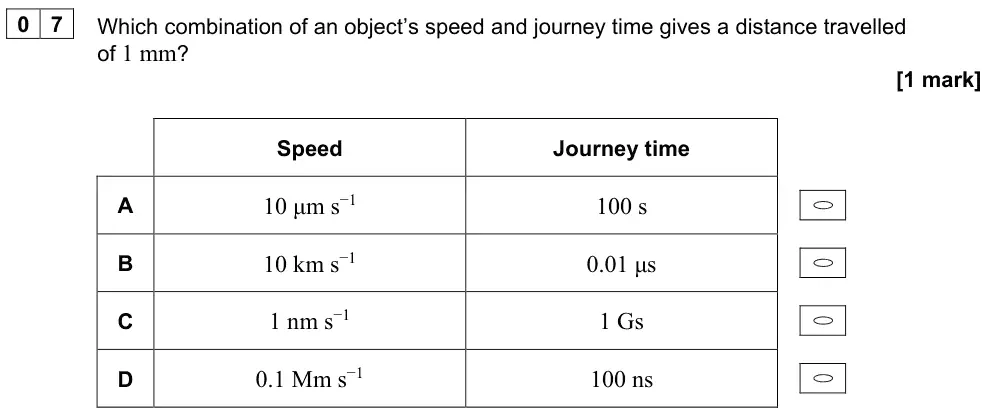
June 2023 · Paper 1 · Q7 1 mark Multiple choice Easy measurements and uncertaintiesmotion and projectiles
Which combination of an object’s speed and journey time gives a distance travelled
of 1 mm?
[1 mark]
Speed
Journey time
A
10 μm s−1
100 s
B
10 km s−1
0.01 μs
C
1 nm s−1
1 Gs
D
0.1 Mm s−1
100 ns
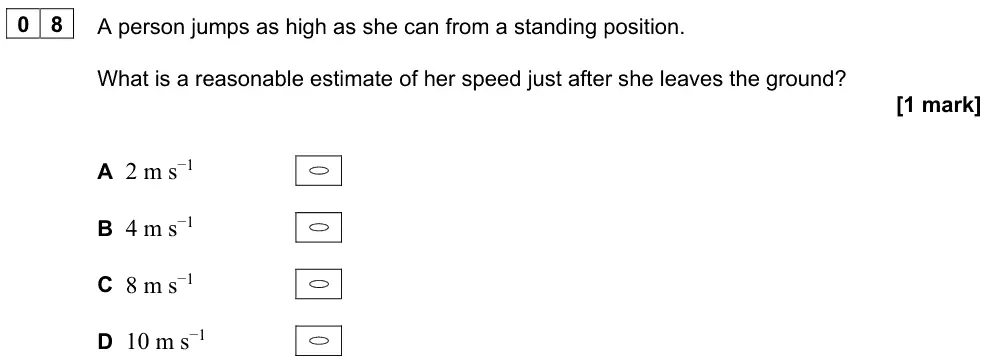
June 2023 · Paper 1 · Q8 1 mark Multiple choice measurements and uncertaintiesmotion and projectiles
A person jumps as high as she can from a standing position.
What is a reasonable estimate of her speed just after she leaves the ground?
[1 mark]
A 2 m s−1
B 4 m s−1
C 8 m s−1
D 10 m s−1
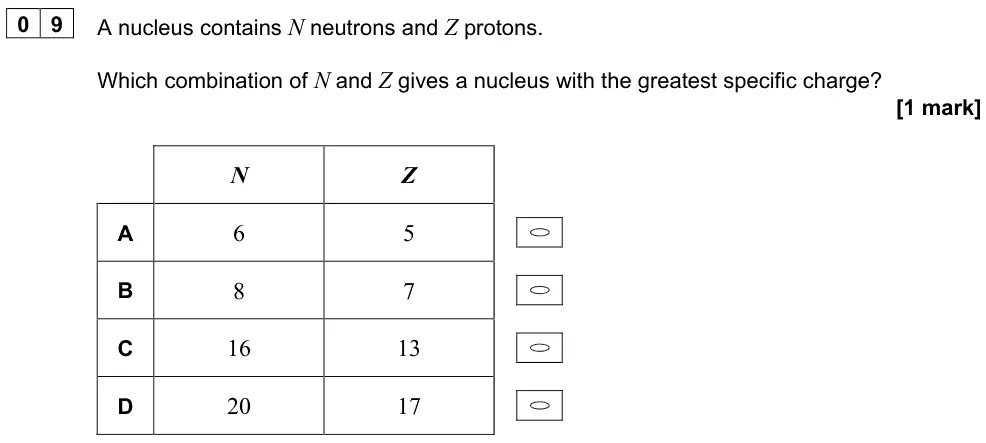
June 2023 · Paper 1 · Q9 1 mark Multiple choice atomic structure and stable nuclei
A nucleus contains N neutrons and Z protons.
Which combination of N and Z gives a nucleus with the greatest specific charge?
[1 mark]
N
Z
A
6
5
B
8
7
C
16
13
D
20
17
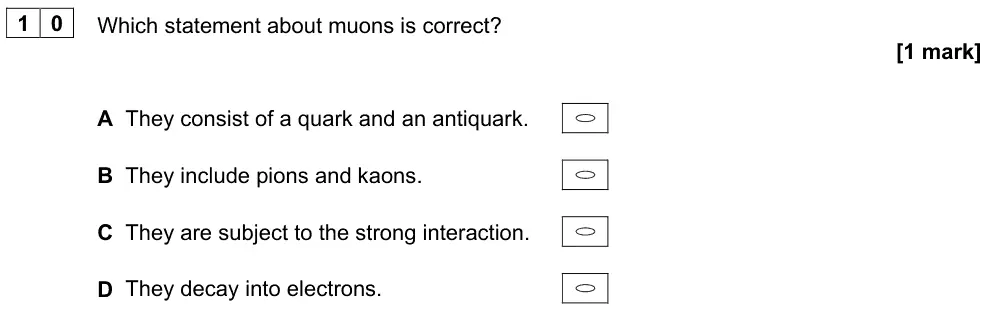
June 2023 · Paper 1 · Q10 1 mark Multiple choice Easy classification of particles and quarks
Which statement about muons is correct?
[1 mark]
A They consist of a quark and an antiquark.
B They include pions and kaons.
C They are subject to the strong interaction.
D They decay into electrons.
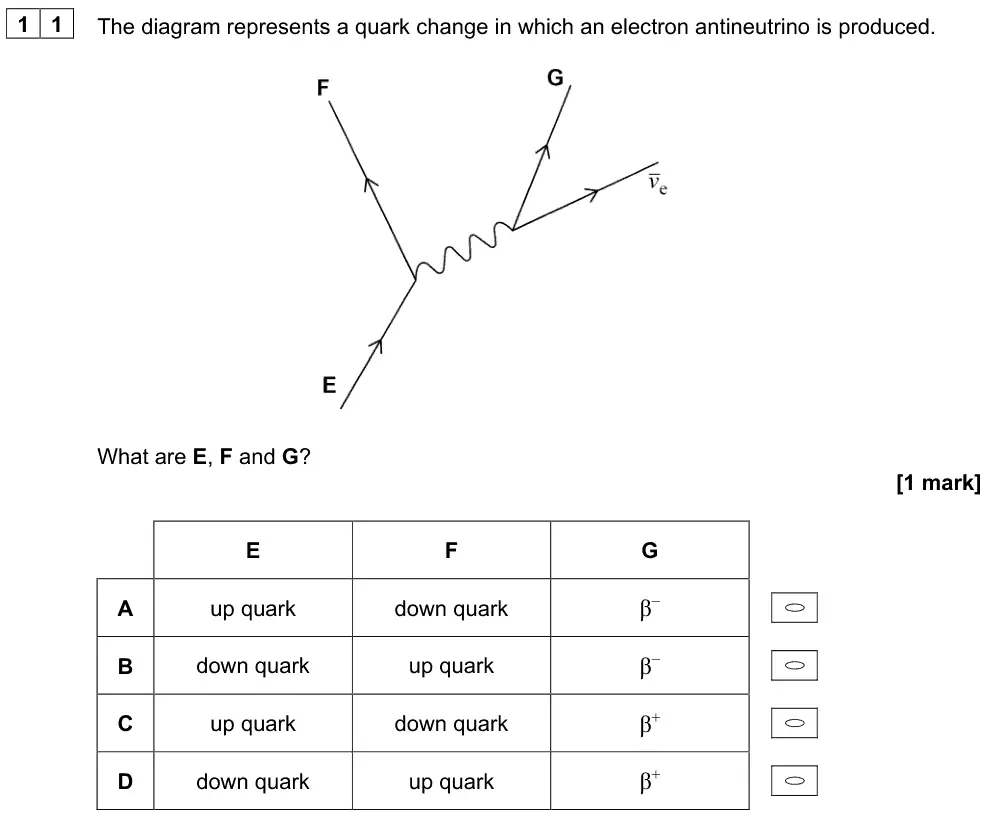
June 2023 · Paper 1 · Q11 1 mark Multiple choice Easy particles antiparticles and interactionsclassification of particles and quarks
The diagram represents a quark change in which an electron antineutrino is produced.
What are E, F and G?
[1 mark]
E
F
G
A
up quark
down quark
β−
B
down quark
up quark
β−
C
up quark
down quark
β+
D
down quark
up quark
β+
June 2023 · Paper 1 · Q12 1 mark Multiple choice Easy photoelectric effectenergy levels and wave particle duality
Photoelectrons are released when monochromatic light with a photon energy
of 4.2 × 10⁻¹⁹ J is incident on a metal surface.
The work function of the surface is 2.4 eV.
What is the maximum speed of the photoelectrons as they leave the surface?
[1 mark]
A 1.3 × 10⁶ m s−1
B 6.3 × 10⁵ m s−1
C 2.8 × 10⁵ m s−1
D 2.0 × 10⁵ m s−1
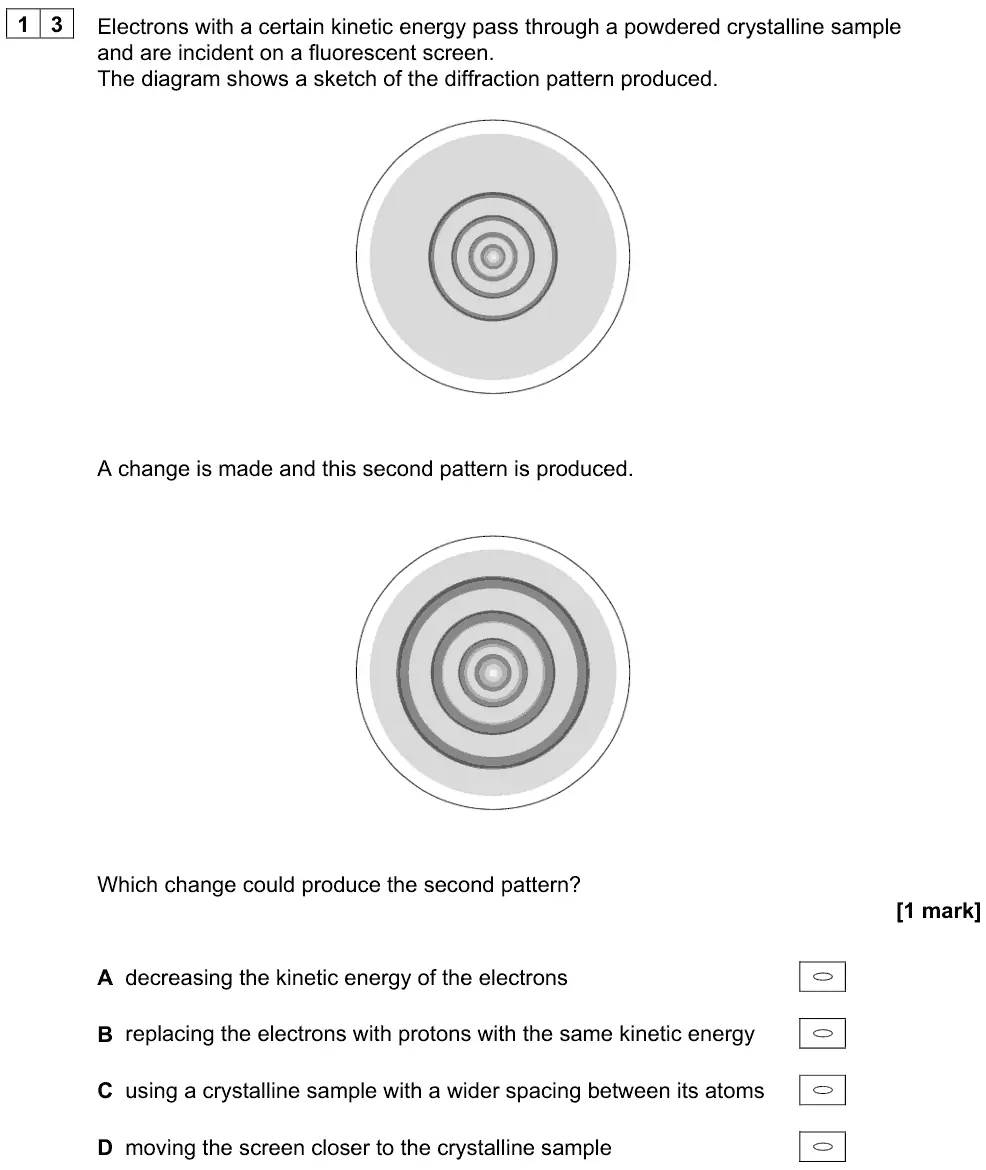
June 2023 · Paper 1 · Q13 1 mark Multiple choice Hard energy levels and wave particle duality
Electrons with a certain kinetic energy pass through a powdered crystalline sample
and are incident on a fluorescent screen.
The diagram shows a sketch of the diffraction pattern produced.
A change is made and this second pattern is produced.
Which change could produce the second pattern?
[1 mark]
A decreasing the kinetic energy of the electrons
B replacing the electrons with protons with the same kinetic energy
C using a crystalline sample with a wider spacing between its atoms
D moving the screen closer to the crystalline sample
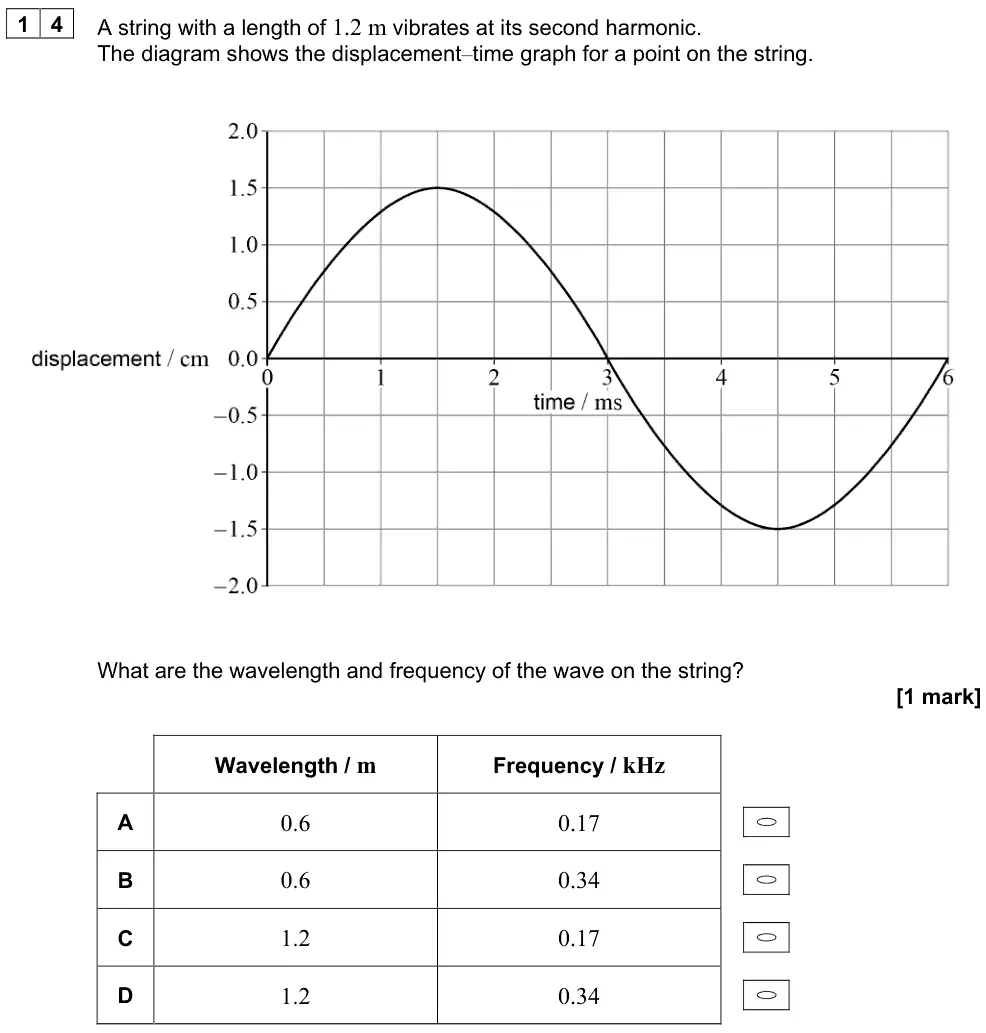
June 2023 · Paper 1 · Q14 1 mark Multiple choice stationary wavesprogressive waves and polarisation
A string with a length of 1.2 m vibrates at its second harmonic.
The diagram shows the displacement–time graph for a point on the string.
What are the wavelength and frequency of the wave on the string?
[1 mark]
Wavelength / m
Frequency / kHz
A
0.6
0.17
B
0.6
0.34
C
1.2
0.17
D
1.2
0.34
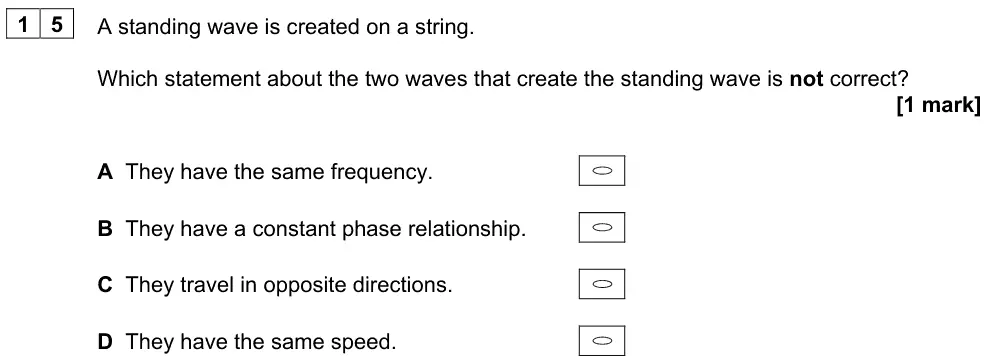
June 2023 · Paper 1 · Q15 1 mark Multiple choice stationary wavesinterference and diffraction
A standing wave is created on a string.
Which statement about the two waves that create the standing wave is not correct?
[1 mark]
A They have the same frequency.
B They have a constant phase relationship.
C They travel in opposite directions.
D They have the same speed.
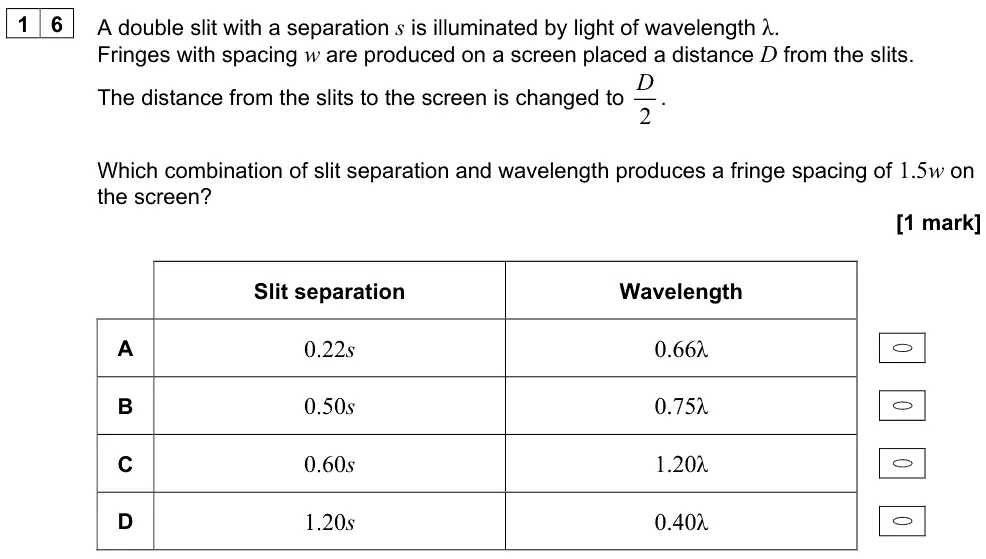
June 2023 · Paper 1 · Q16 1 mark Multiple choice interference and diffraction
A double slit with a separation s is illuminated by light of wavelength λ.
Fringes with spacing w are produced on a screen placed a distance D from the slits.
The distance from the slits to the screen is changed to 2
D .
Which combination of slit separation and wavelength produces a fringe spacing of 1.5w on
the screen?
[1 mark]
Slit separation
Wavelength
A
0.22s
0.66λ
B
0.50s
0.75λ
C
0.60s
1.20λ
D
1.20s
0.40λ
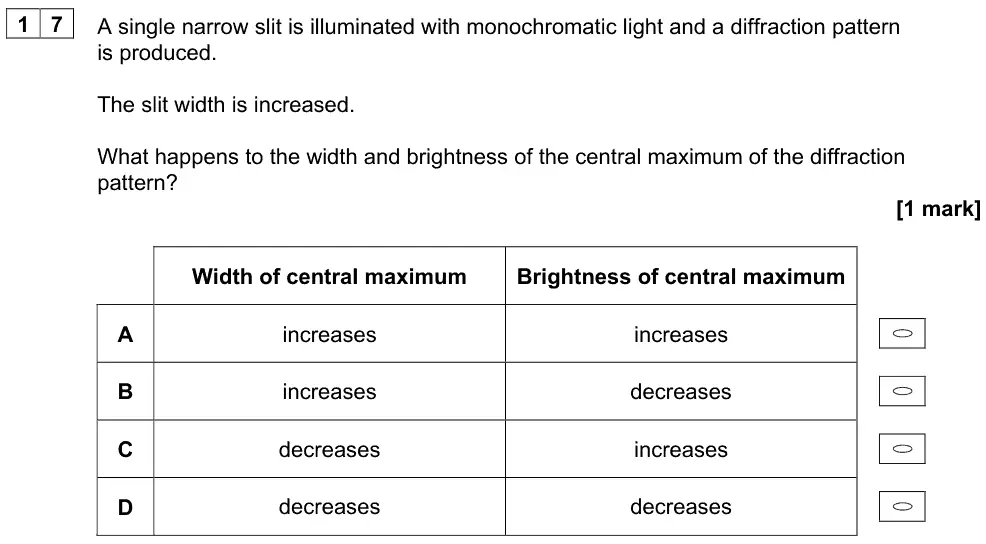
June 2023 · Paper 1 · Q17 1 mark Multiple choice interference and diffraction
A single narrow slit is illuminated with monochromatic light and a diffraction pattern
is produced.
The slit width is increased.
What happens to the width and brightness of the central maximum of the diffraction
pattern?
[1 mark]
Width of central maximum
Brightness of central maximum
A
increases
increases
B
increases
decreases
C
decreases
increases
D
decreases
decreases
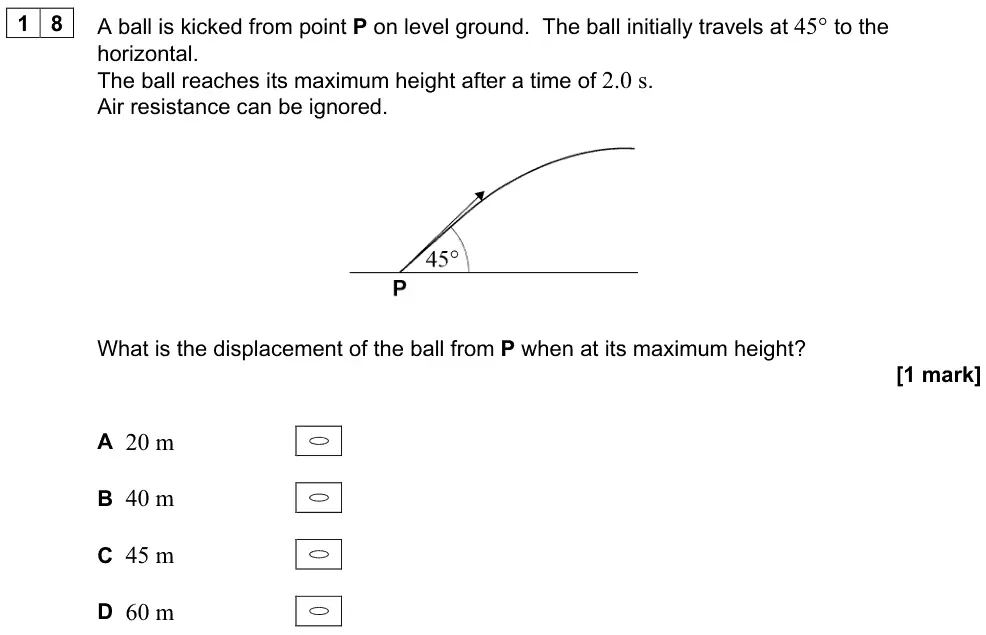
June 2023 · Paper 1 · Q18 1 mark Multiple choice Hard motion and projectiles
A ball is kicked from point P on level ground.  The ball initially travels at 45° to the
horizontal.
The ball reaches its maximum height after a time of 2.0 s.
Air resistance can be ignored.
What is the displacement of the ball from P when at its maximum height?
[1 mark]
A 20 m
B 40 m
C 45 m
D 60 m
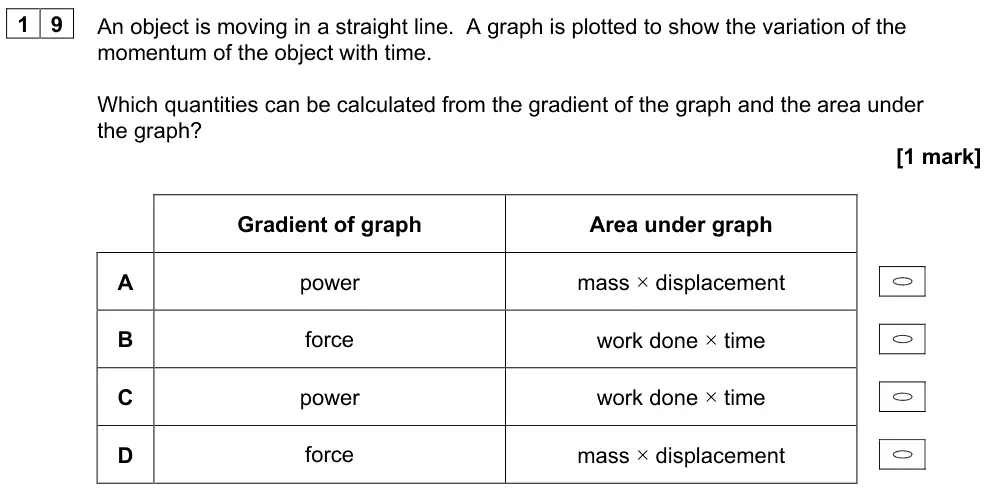
June 2023 · Paper 1 · Q19 1 mark Multiple choice newtons laws and momentummotion and projectiles
An object is moving in a straight line.  A graph is plotted to show the variation of the
momentum of the object with time.
Which quantities can be calculated from the gradient of the graph and the area under
the graph?
[1 mark]
Gradient of graph
Area under graph
A
power
mass × displacement
B
force
work done × time
C
power
work done × time
D
force
mass × displacement
June 2023 · Paper 1 · Q20 1 mark Multiple choice Easy vectors and moments
Which is a pair of vectors?
[1 mark]
A weight and work
B force and energy
C displacement and momentum
D acceleration and power
June 2023 · Paper 1 · Q21 1 mark Multiple choice Hard current voltage and resistivity
Which statement about a superconducting metal is correct?
[1 mark]
A Its resistivity is small but not zero.
B A current in it causes no heating effect.
C Its critical temperature is independent of the metal it is made from.
D Keeping it cold makes it too expensive to use.
June 2023 · Paper 1 · Q22 1 mark Multiple choice Hard vectors and moments
A heavy uniform trapdoor is hinged to the floor.  It is held open by a rope as shown.
Which arrow shows the direction of the reaction force of the hinge on the trapdoor?
[1 mark]
A
B
C
D
June 2023 · Paper 1 · Q23 1 mark Multiple choice motion and projectilesnewtons laws and momentum
A sphere of mass m falls with speed v.
The resistive force on the sphere is kv, where k is a constant.
What is the terminal speed of the sphere?
[1 mark]
A mg
k
B km
g
C kmg
D
k
mg
June 2023 · Paper 1 · Q24 1 mark Multiple choice newtons laws and momentumvectors and moments
A trolley moves down a slope with constant acceleration.
The mass of the trolley is doubled and the trolley moves down the same slope again.
Air resistance and friction are negligible.
Which is correct?
[1 mark]
A The accelerating force is unchanged.
B The accelerating force is halved.
C The acceleration is unchanged.
D The acceleration is halved.
June 2023 · Paper 1 · Q25 1 mark Multiple choice newtons laws and momentum
A variable force F acts on an object of mass 2.0 kg.  The object is at rest at time t = 0
The graph shows the variation of F with t.
What is the speed of the object when t = 1.0 s?
[1 mark]
A 3.75 m s−1
B 5.00 m s−1
C 7.50 m s−1
D 15.0 m s−1
June 2023 · Paper 1 · Q26 1 mark Multiple choice Hard materials and young modulus
A heavy cable is attached to a fixed support and carries a load at its lower end.
The weight of the cable is not negligible.
The cable has constant cross-sectional area and density.
Which graph shows the variation of tensile stress σ in the cable with
distance d from J to K?
[1 mark]
A
B
C
D
A
B
C
D
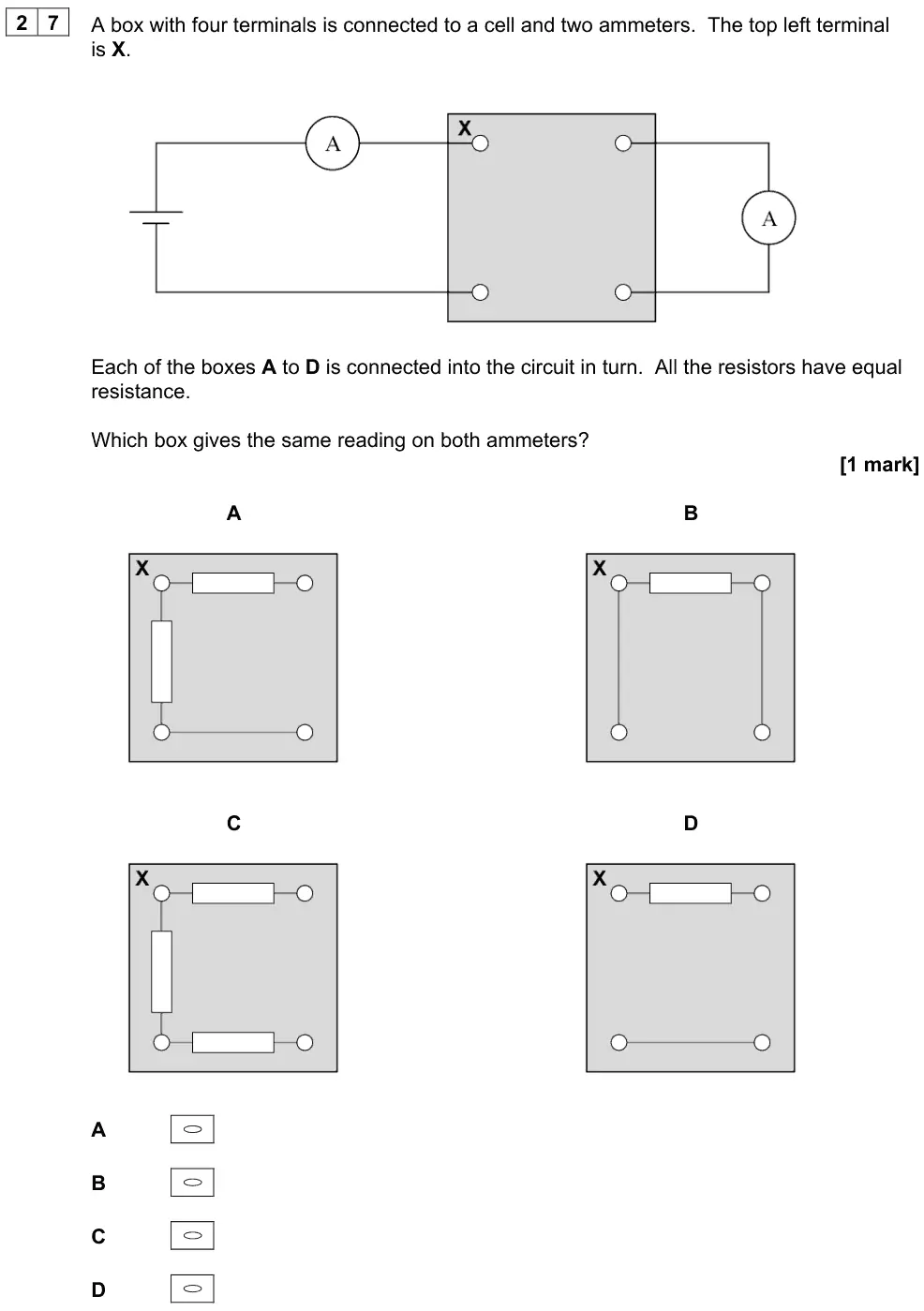
June 2023 · Paper 1 · Q27 1 mark Multiple choice circuits and potential dividers
A box with four terminals is connected to a cell and two ammeters.  The top left terminal
is X.
Each of the boxes A to D is connected into the circuit in turn.  All the resistors have equal
resistance.
Which box gives the same reading on both ammeters?
[1 mark]
A
B
C
D
A
B
C
D
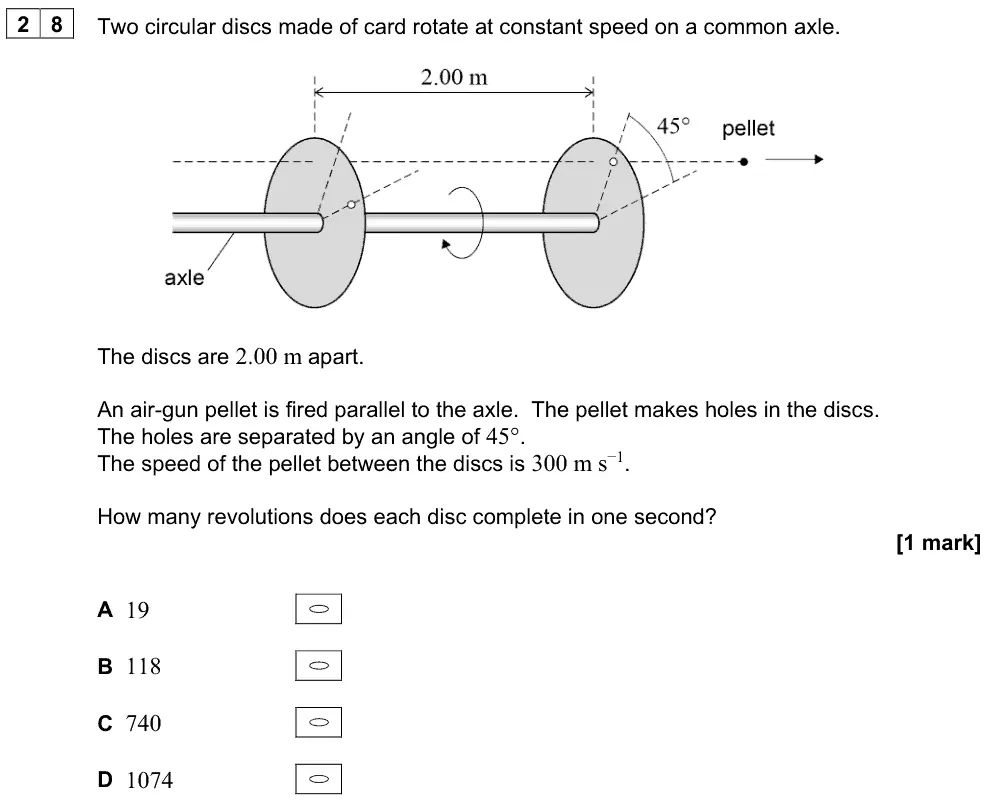
June 2023 · Paper 1 · Q28 1 mark Multiple choice circular motion
Two circular discs made of card rotate at constant speed on a common axle.
The discs are 2.00 m apart.
An air-gun pellet is fired parallel to the axle.  The pellet makes holes in the discs.
The holes are separated by an angle of 45°.
The speed of the pellet between the discs is 300 m s−1.
How many revolutions does each disc complete in one second?
[1 mark]
A 19
B 118
C 740
D 1074
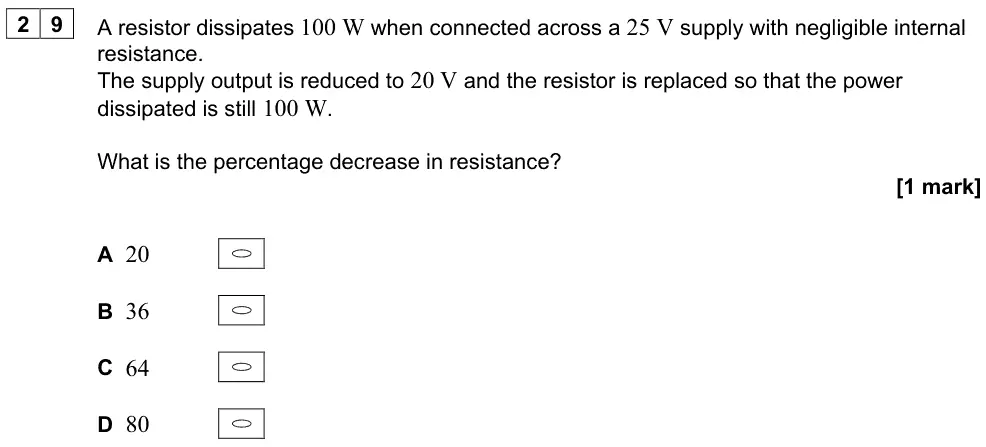
June 2023 · Paper 1 · Q29 1 mark Multiple choice circuits and potential dividers
A resistor dissipates 100 W when connected across a 25 V supply with negligible internal
resistance.
The supply output is reduced to 20 V and the resistor is replaced so that the power
dissipated is still 100 W.
What is the percentage decrease in resistance?
[1 mark]
A 20
B 36
C 64
D 80
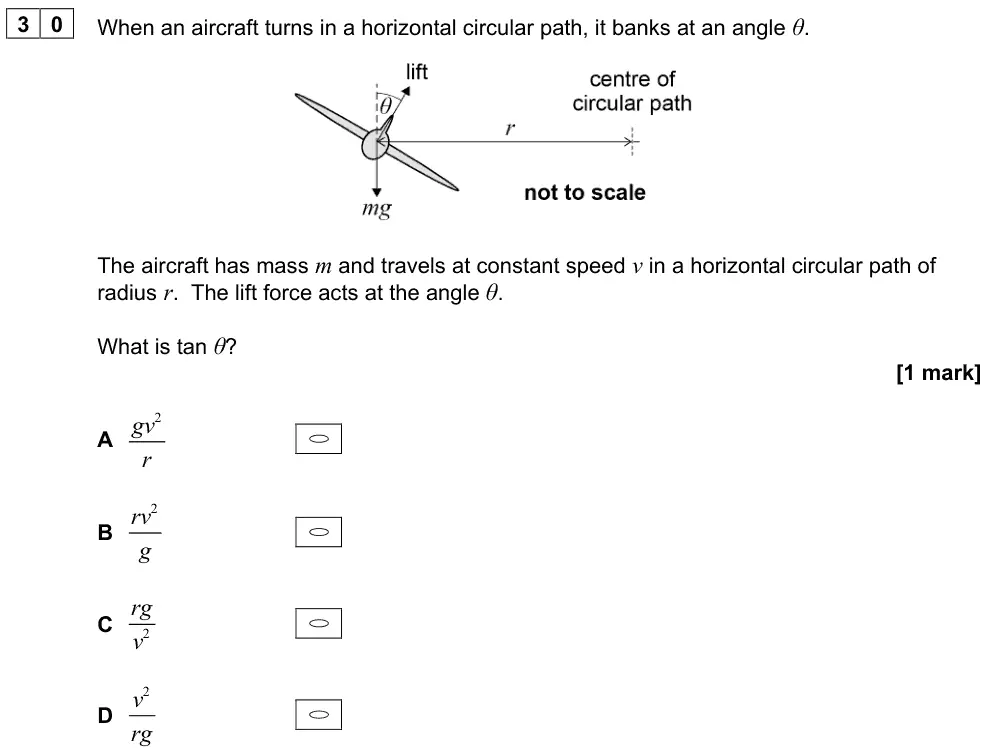
June 2023 · Paper 1 · Q30 1 mark Multiple choice circular motionvectors and moments
When an aircraft turns in a horizontal circular path, it banks at an angle θ.
The aircraft has mass m and travels at constant speed v in a horizontal circular path of
radius r.  The lift force acts at the angle θ.
What is tan θ?
[1 mark]
A
2
gv
r
B
2
rv
g
C
2
rg
v
D
2v
rg
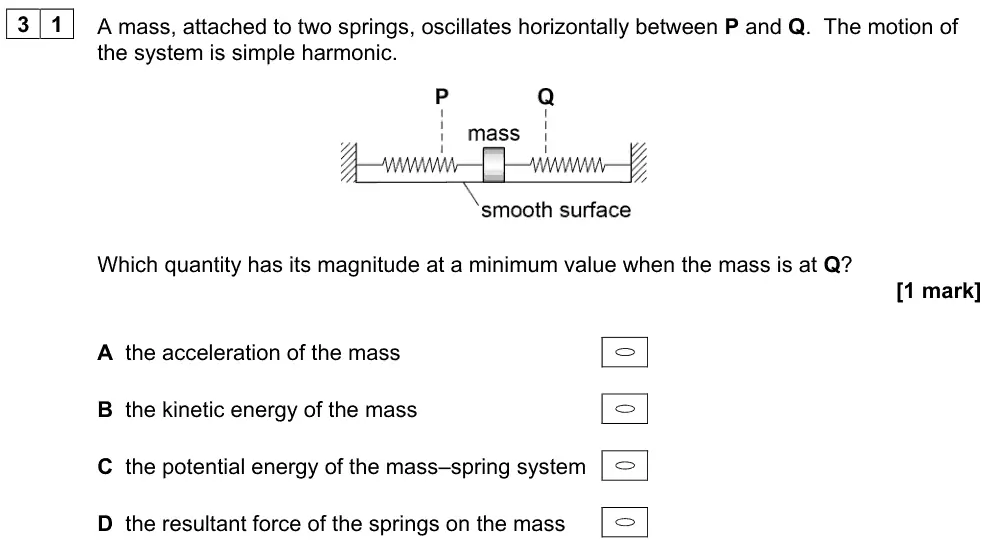
June 2023 · Paper 1 · Q31 1 mark Multiple choice simple harmonic motion
A mass, attached to two springs, oscillates horizontally between P and Q.  The motion of
the system is simple harmonic.
Which quantity has its magnitude at a minimum value when the mass is at Q?
[1 mark]
A the acceleration of the mass
B the kinetic energy of the mass
C the potential energy of the mass–spring system
D the resultant force of the springs on the mass

Work with an AQA physics tutor

Want a paper marked and gone through with you? Message us.

Prefer email? Send an enquiry

If you are under 18, please include a parent's contact details. Enquiries go to enquiries@physicsaleveltutor.com and are deleted once handled. All tutoring is online.