June 2024: Paper 1

85 marks · 52 question parts · Paper, mark scheme and report on AQA's site · Have the data and formulae booklet beside you

Question by question

QTopicMarksAOType
1.1 Particles, antiparticles and particle interactions 1AO1=1Short answer
1.2 Classification of particles, quarks and conservation laws, Atomic structure and stable nuclei 1AO1=1Short answer
1.3 Particles, antiparticles and particle interactions 2AO1=2Explanation
1.4 Particles, antiparticles and particle interactions 3AO1=3Explanation
2.1 Classification of particles, quarks and conservation laws 2AO1=1,AO2=1Short answer
2.2 Classification of particles, quarks and conservation laws 3AO3=3Explanation
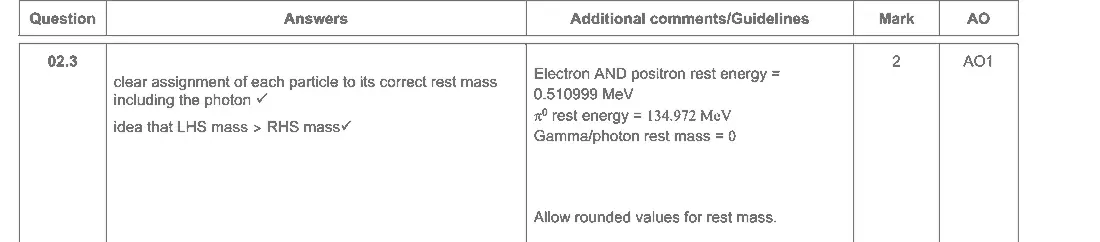
2.3 Particles, antiparticles and particle interactions 2AO1=2Short answer
2.4 Particles, antiparticles and particle interactions 1AO1=1Short answer
2.5 Classification of particles, quarks and conservation laws 1AO1=1Short answer
3.1 Refraction, total internal reflection and optical fibres 1AO2=1Diagram or graph
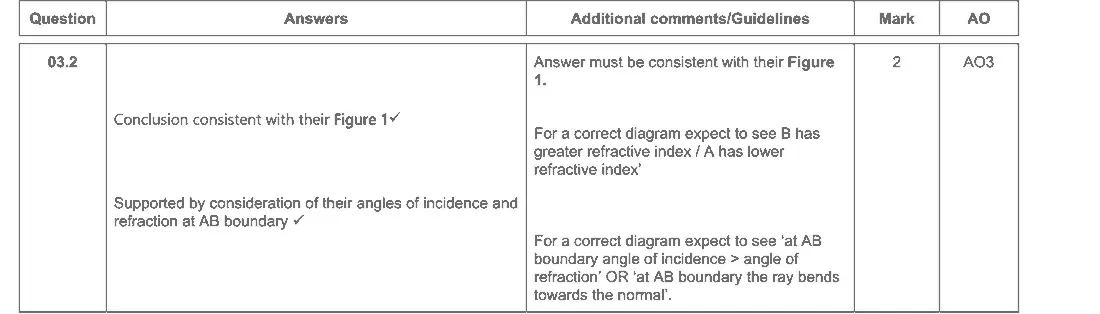
3.2 Refraction, total internal reflection and optical fibres 2AO3=2Explanation
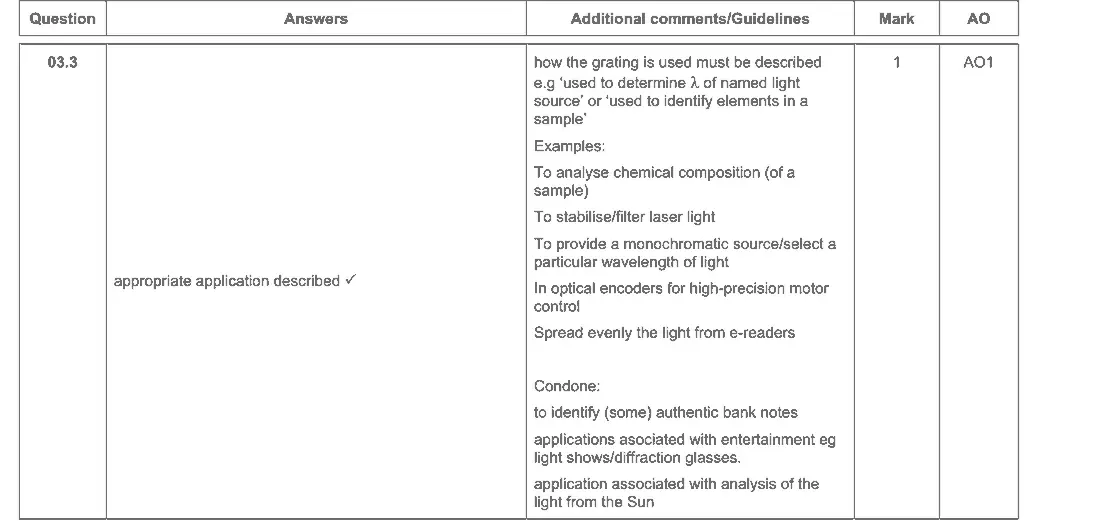
3.3 Interference, diffraction and the diffraction grating 1AO1=1Short answer
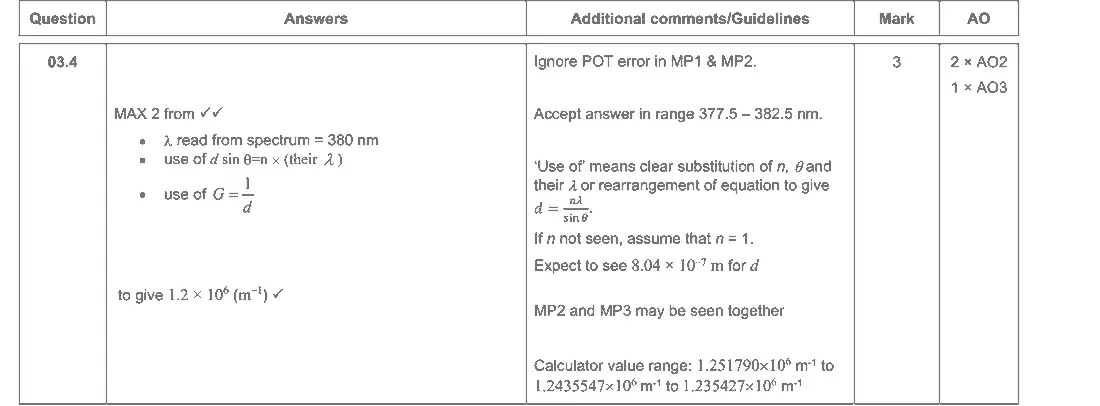
3.4 Interference, diffraction and the diffraction grating 3AO2=2,AO3=1Calculation
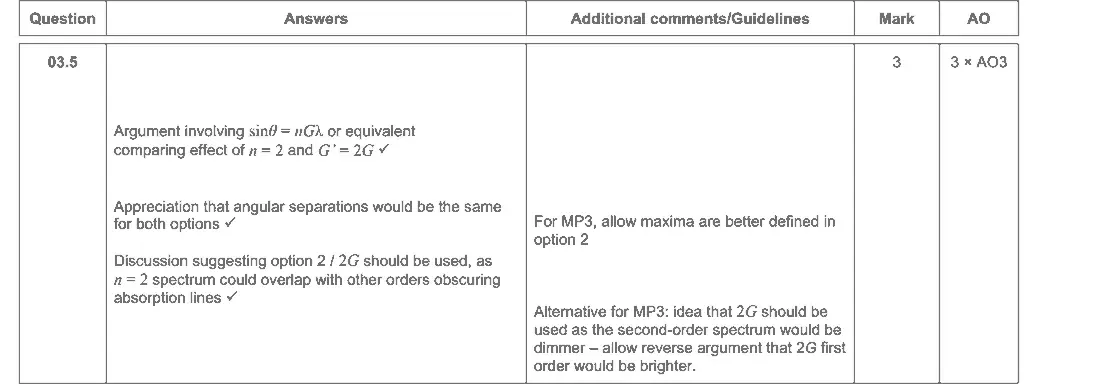
3.5 Interference, diffraction and the diffraction grating 3AO3=3Explanation
4.1 Newton's laws of motion and momentum, Work, energy, power and conservation of energy 2AO3=2Show that
4.2 Work, energy, power and conservation of energy 2AO2=2Calculation
5.1 Scalars, vectors and moments 4AO3=4Diagram or graph
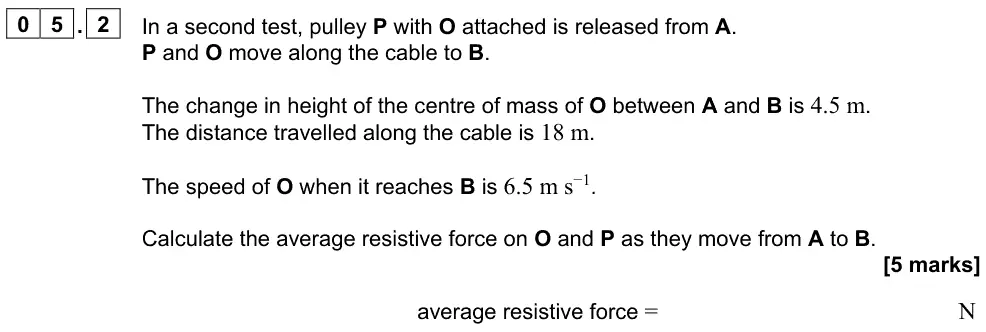
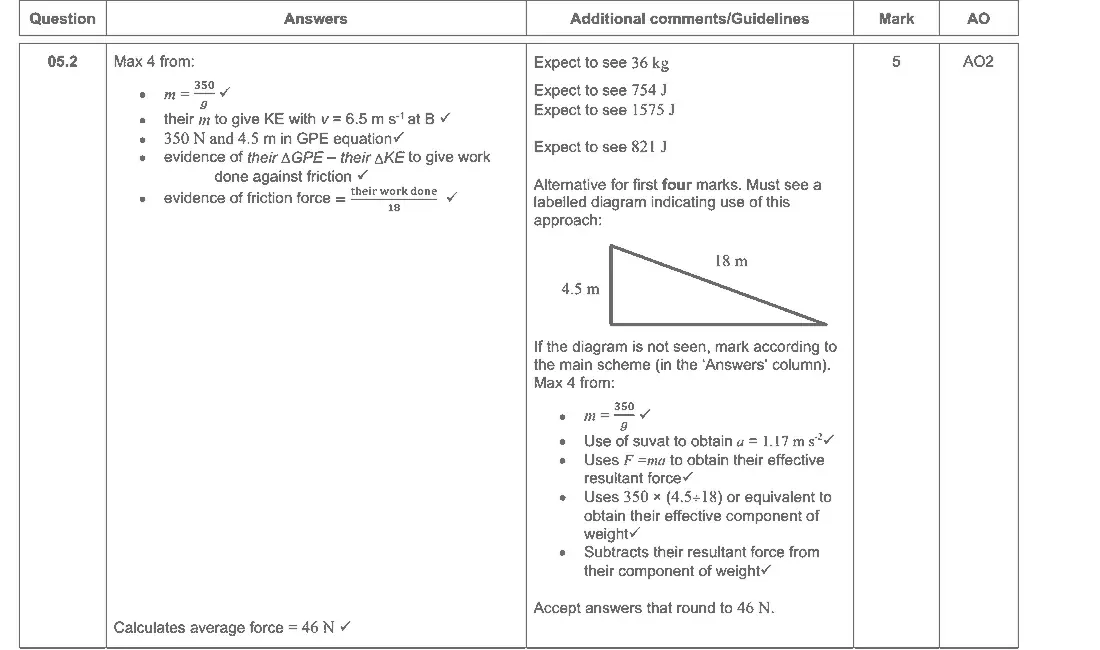
5.2 Work, energy, power and conservation of energy 5AO2=5Calculation
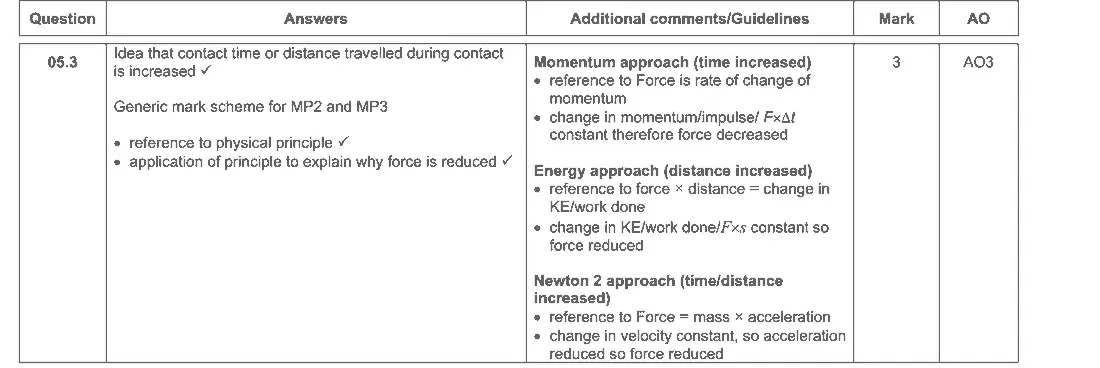
5.3 Newton's laws of motion and momentum 3AO3=3Explanation
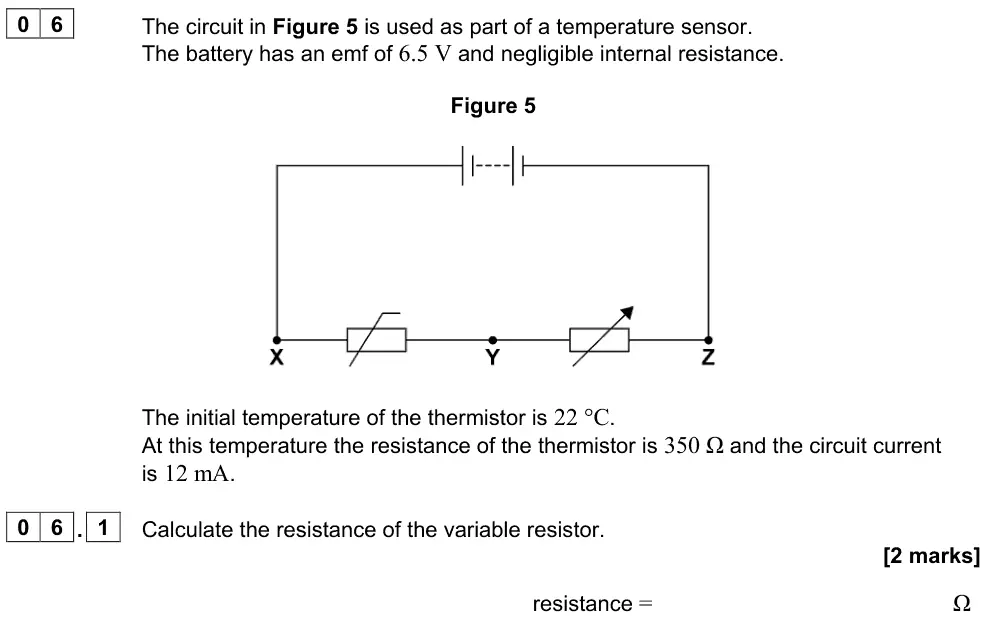
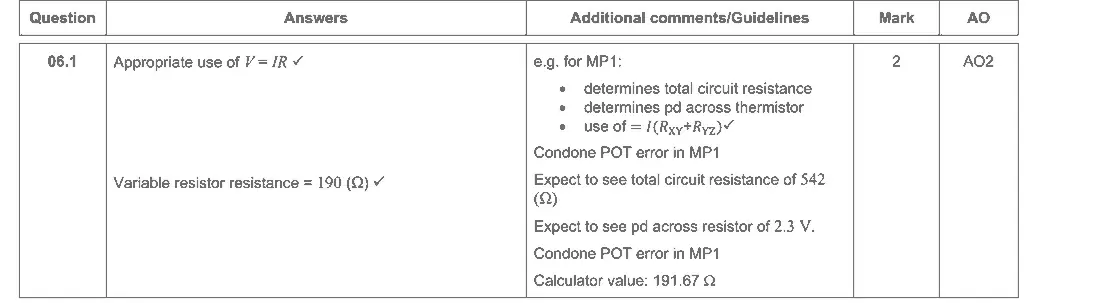
6.1 Circuits and potential dividers, Current, potential difference, I-V characteristics and resistivity 2AO2=2Calculation
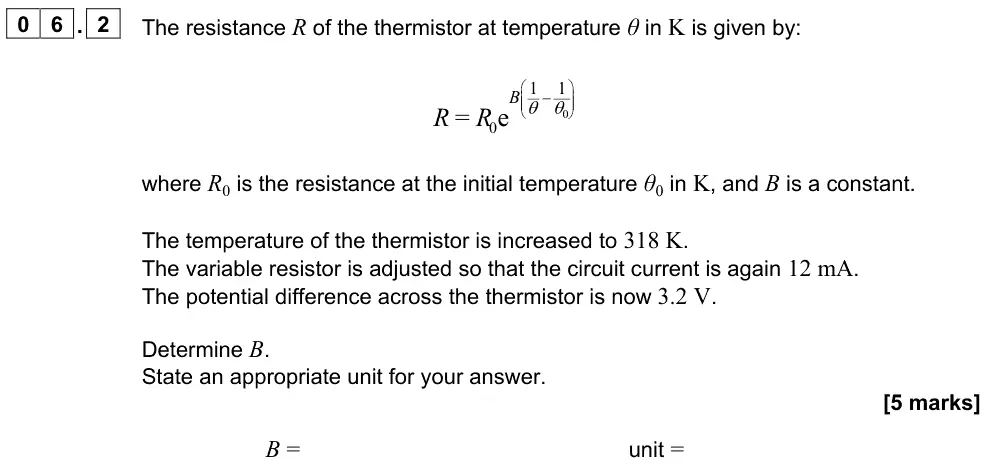
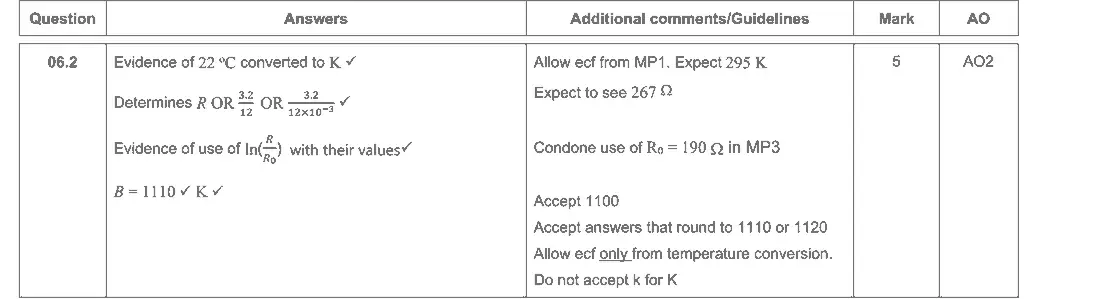
6.2 Current, potential difference, I-V characteristics and resistivity 5AO2=5Calculation
6.3 Current, potential difference, I-V characteristics and resistivity 2AO3=2Explanation
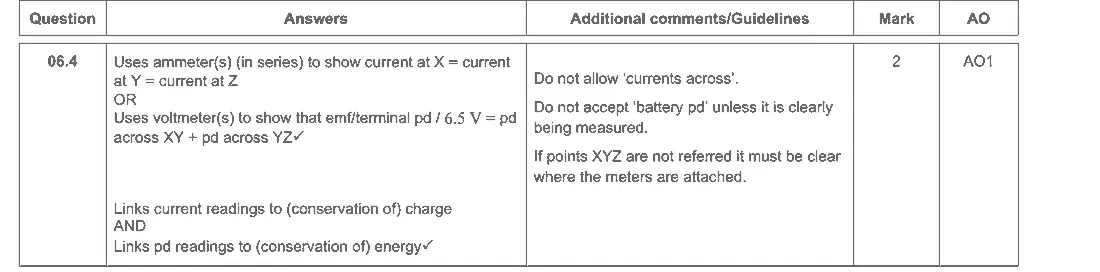
6.4 Circuits and potential dividers 2AO1=2Explanation
7.1 Superposition and stationary waves 1AO3=1Short answer
7.2 Progressive waves, longitudinal and transverse waves, Superposition and stationary waves 2AO3=2Calculation
7.3 Progressive waves, longitudinal and transverse waves, Superposition and stationary waves 1AO1=1Short answer
7.4 Superposition and stationary waves, Progressive waves, longitudinal and transverse waves 3AO3=3Diagram or graph
8 Atomic structure and stable nuclei 1AO2=1Multiple choice
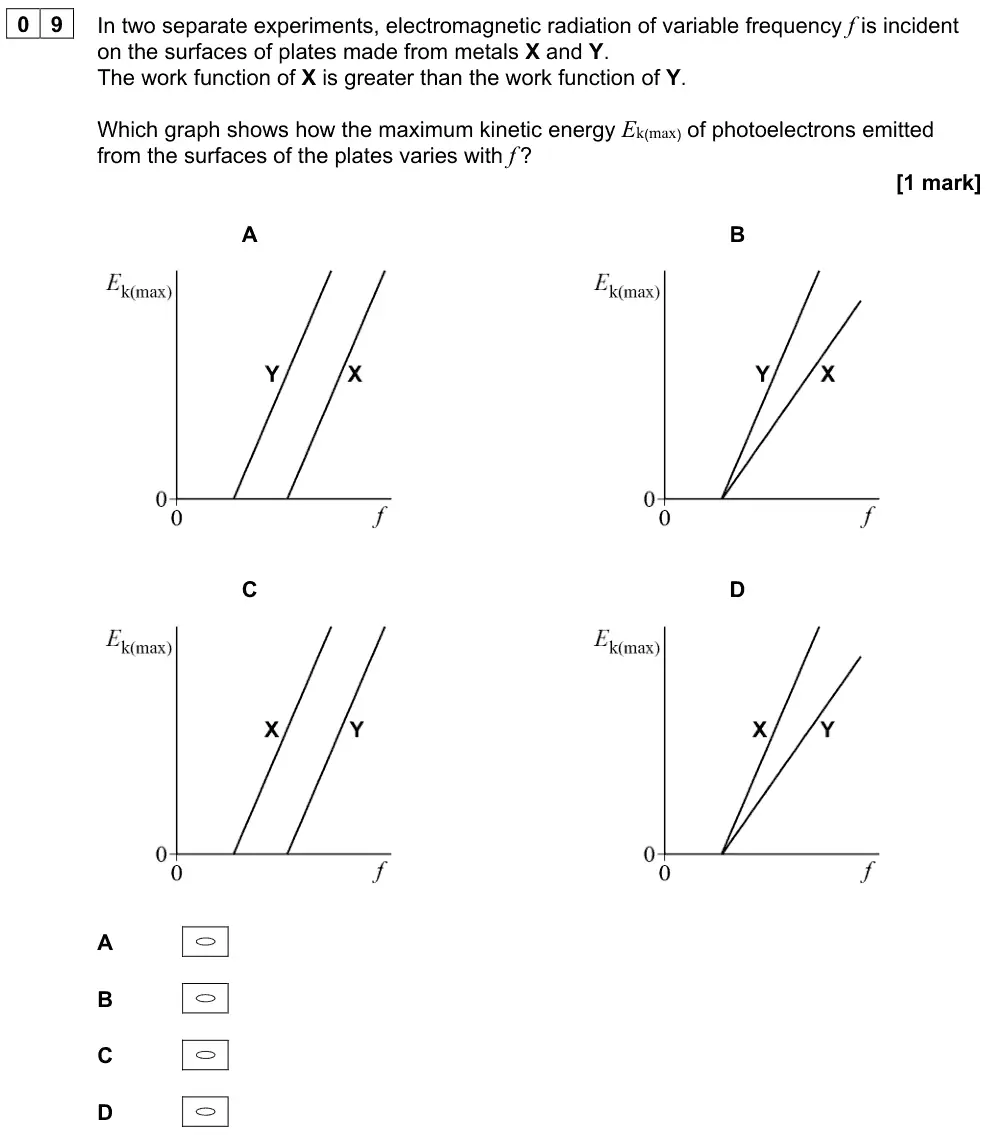
9 The photoelectric effect 1AO1=1Multiple choice
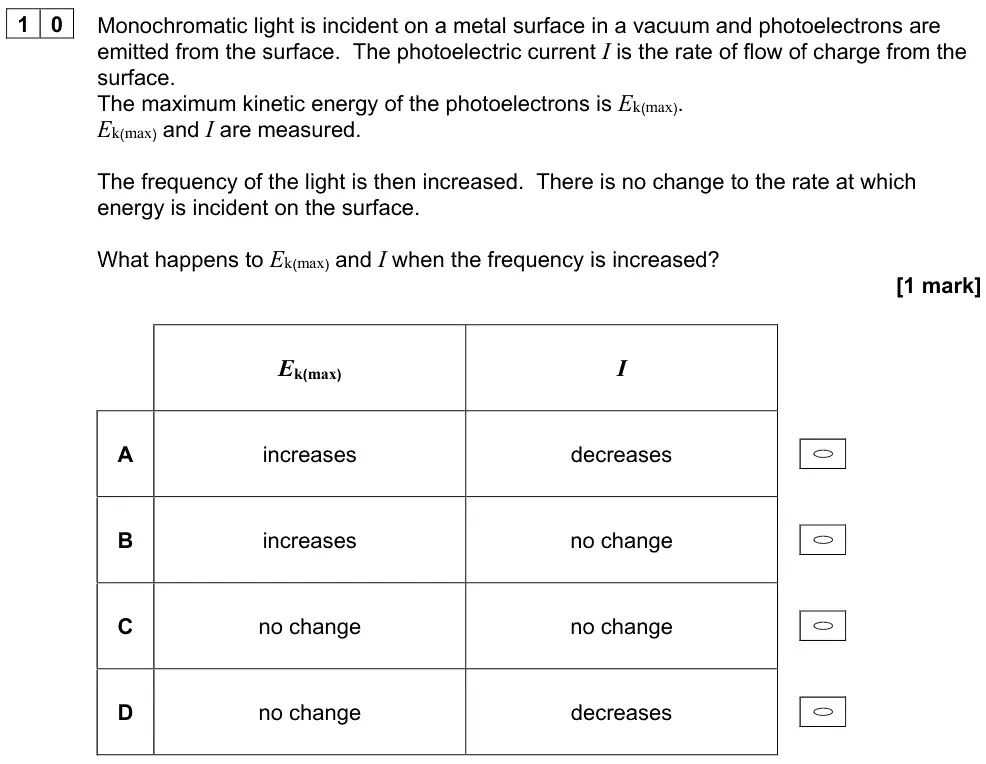
10 The photoelectric effect 1AO2=1Multiple choice
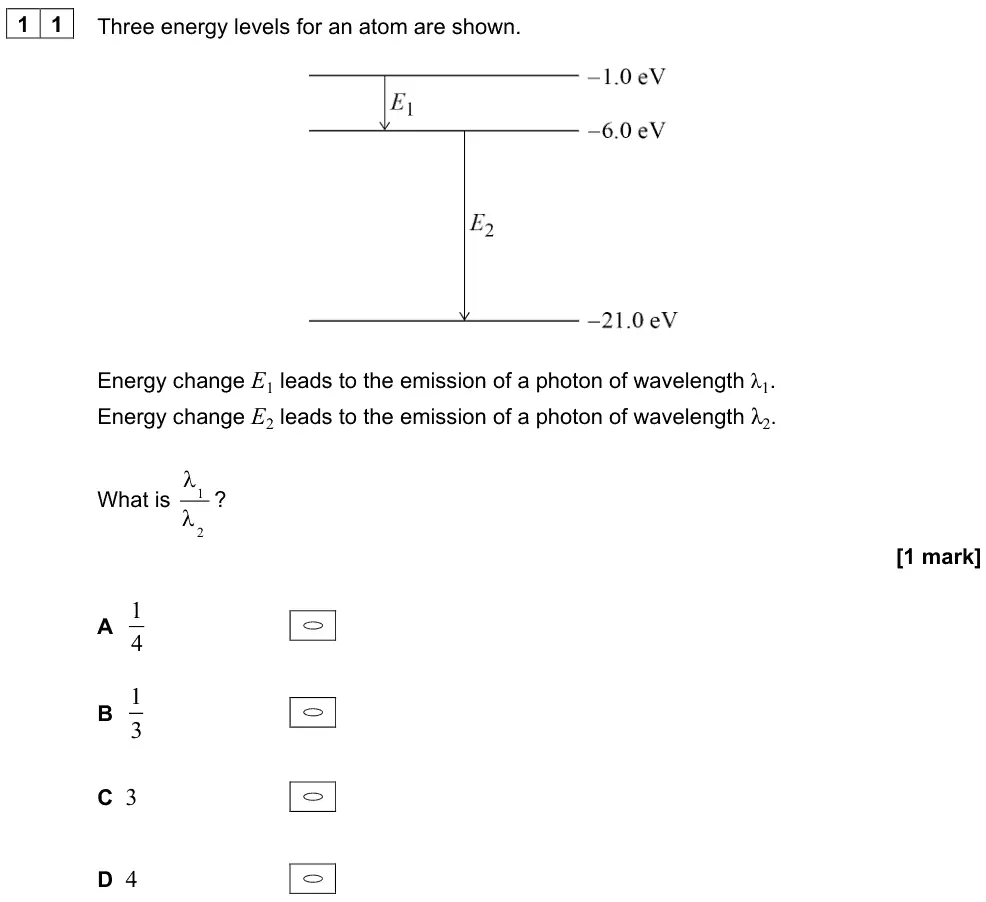
11 Excitation, energy levels and wave-particle duality 1AO1=1Multiple choice
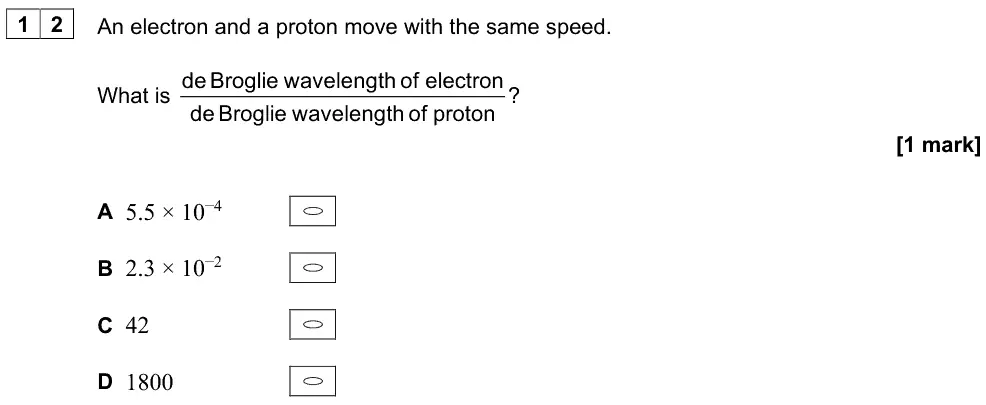
12 Excitation, energy levels and wave-particle duality 1AO2=1Multiple choice
13 Progressive waves, longitudinal and transverse waves 1AO2=1Multiple choice
14 Progressive waves, longitudinal and transverse waves 1AO1=1Multiple choice
15 Superposition and stationary waves 1AO1=1Multiple choice
16 Interference, diffraction and the diffraction grating 1AO1=1Multiple choice
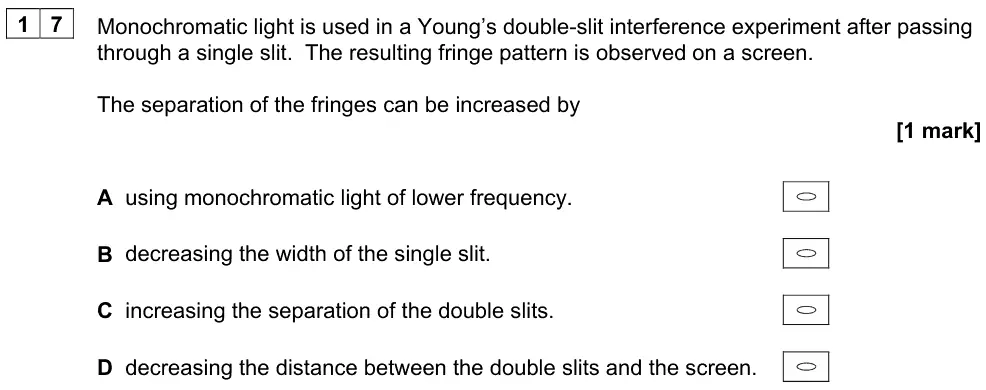
17 Interference, diffraction and the diffraction grating 1AO1=1Multiple choice
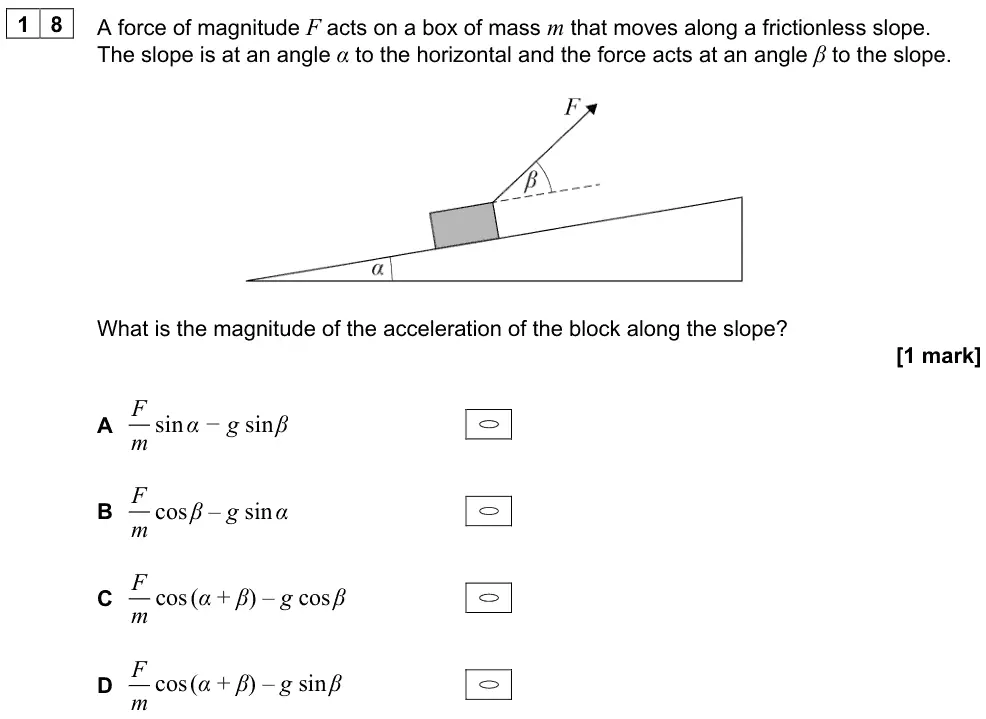
18 Newton's laws of motion and momentum, Scalars, vectors and moments 1AO1=1Multiple choice
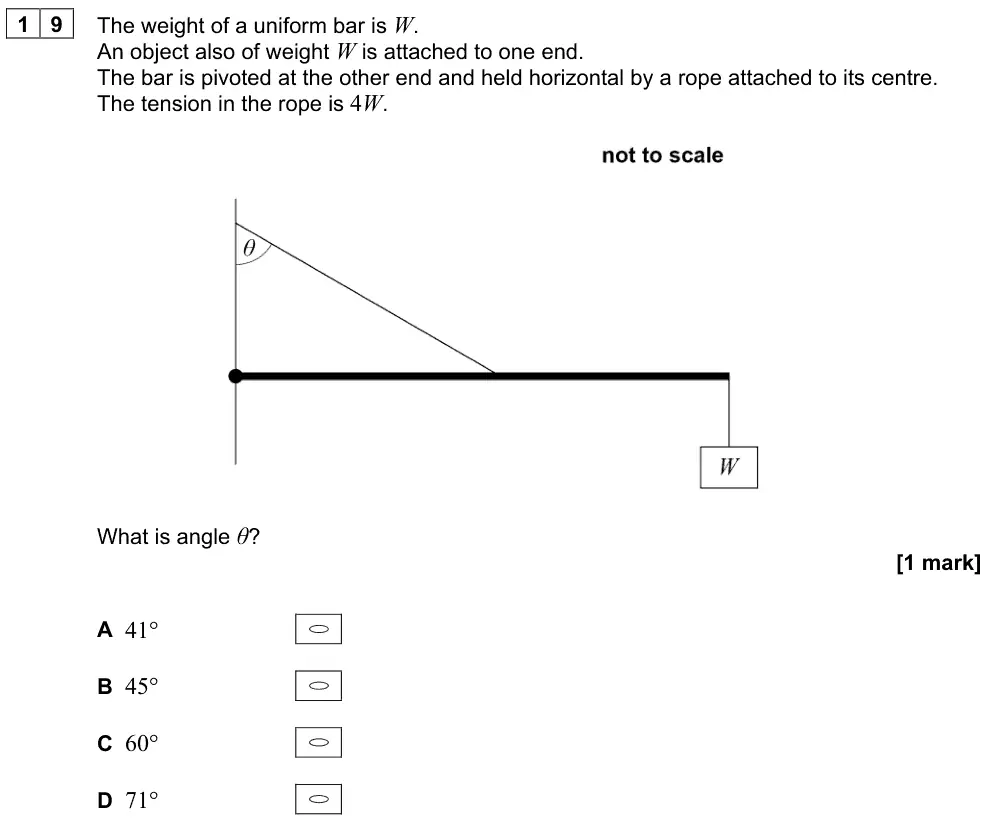
19 Scalars, vectors and moments 1AO2=1Multiple choice
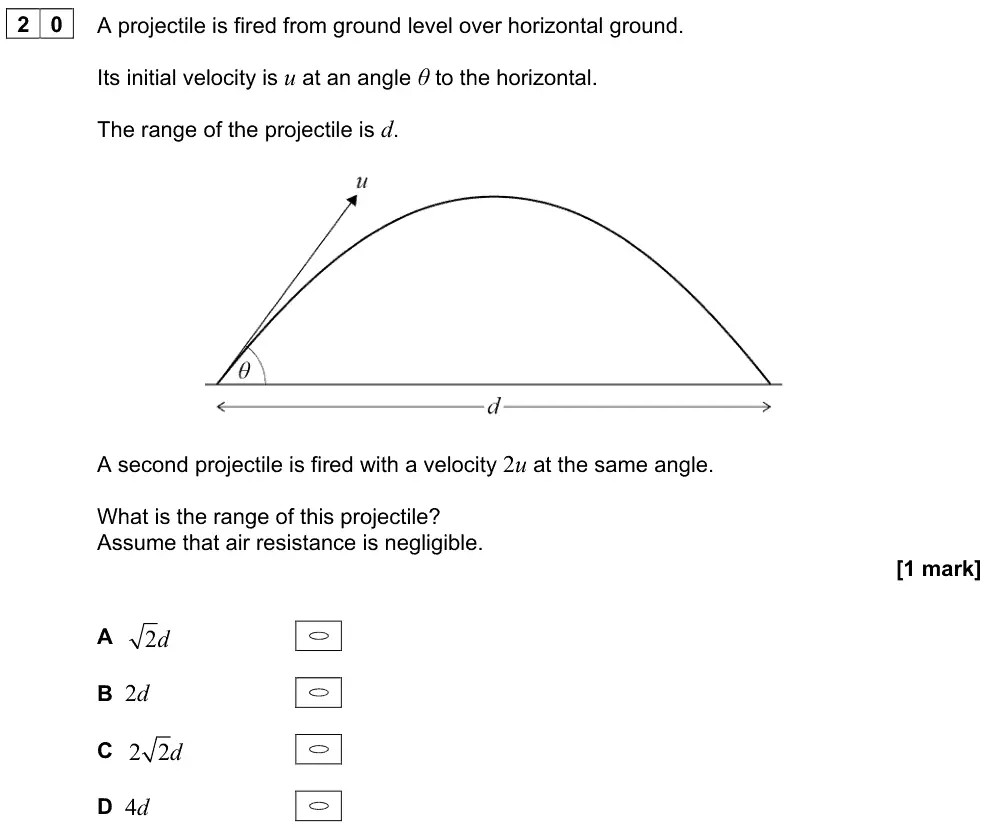
20 Motion along a straight line and projectile motion 1AO2=1Multiple choice
21 Motion along a straight line and projectile motion 1AO2=1Multiple choice
22 Motion along a straight line and projectile motion 1AO2=1Multiple choice
23 Newton's laws of motion and momentum 1AO2=1Multiple choice
24 Newton's laws of motion and momentum 1AO2=1Multiple choice
25 Materials, stress, strain and the Young modulus 1AO2=1Multiple choice
26 Materials, stress, strain and the Young modulus, Work, energy, power and conservation of energy 1AO2=1Multiple choice
27 Electromotive force and internal resistance 1AO2=1Multiple choice
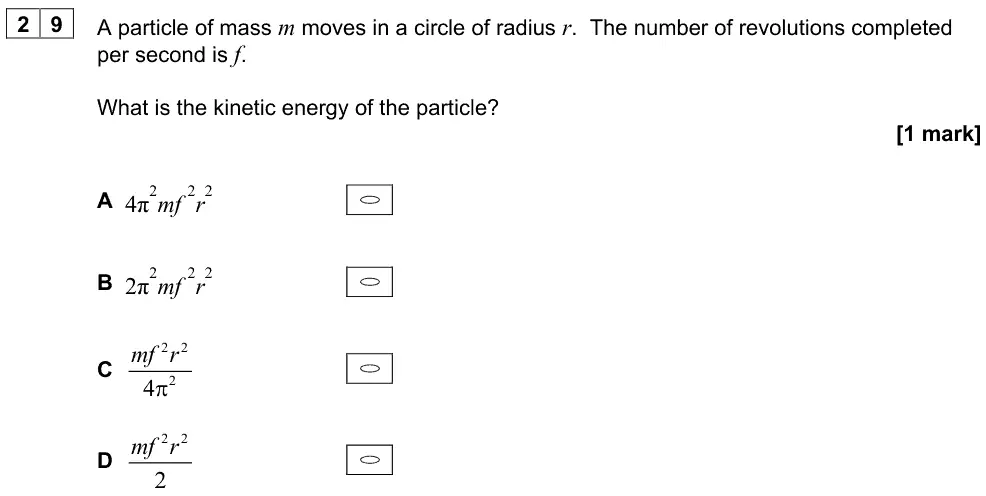
28 Circular motion 1AO1=1Multiple choice
29 Circular motion, Work, energy, power and conservation of energy 1AO1=1Multiple choice
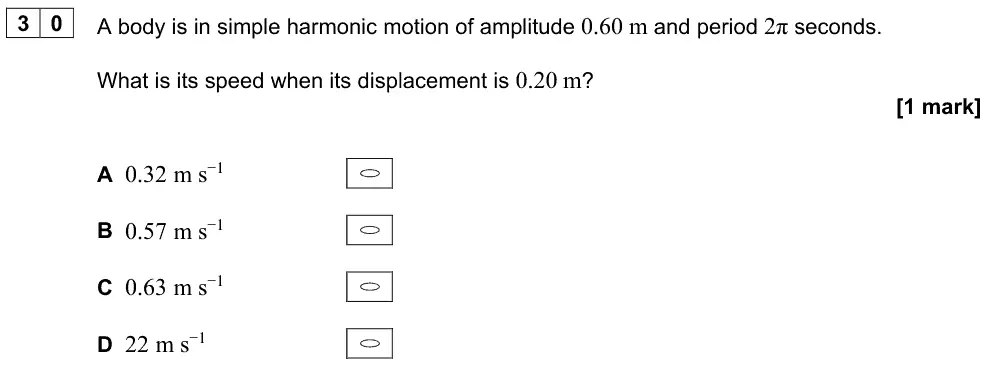
30 Simple harmonic motion, forced vibrations and resonance 1AO1=1Multiple choice
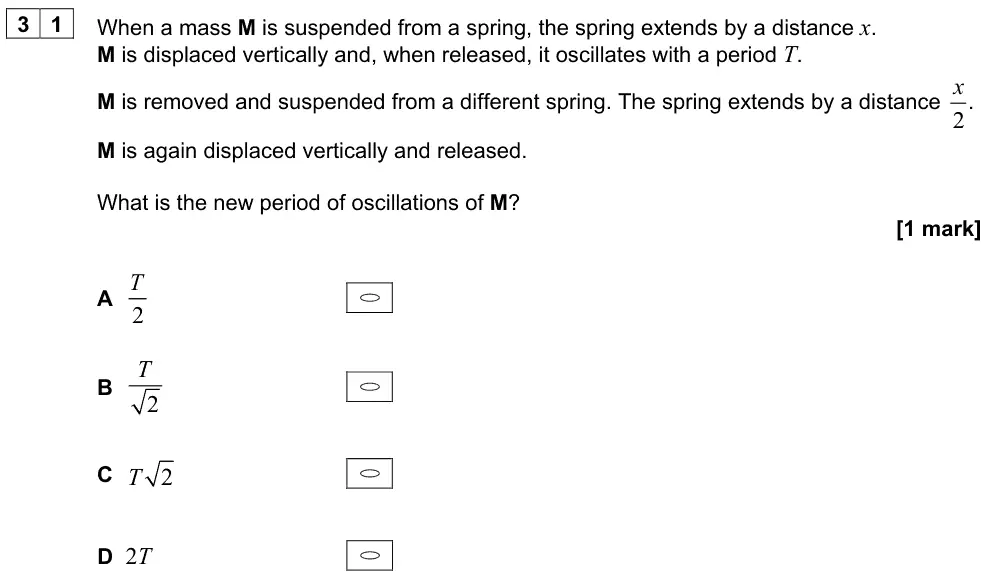
31 Simple harmonic motion, forced vibrations and resonance 1AO2=1Multiple choice
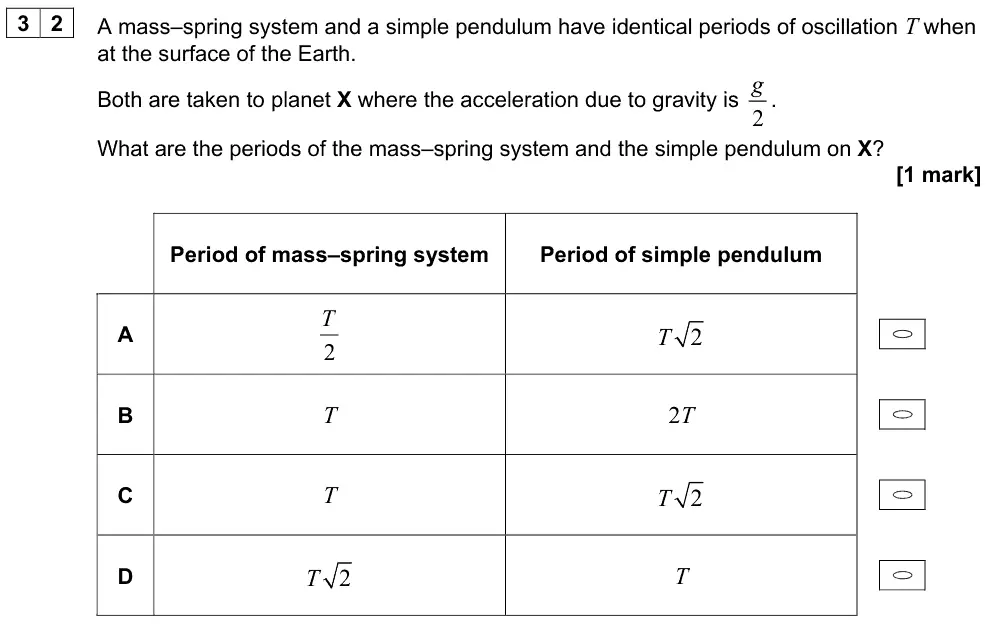
32 Simple harmonic motion, forced vibrations and resonance 1AO2=1Multiple choice

The questions

1.11.21.31.42.12.22.32.42.53.13.23.33.43.54.14.25.15.25.36.16.26.36.47.17.27.37.4891011121314151617181920212223242526272829303132
June 2024 · Paper 1 · Q1.1 1 mark AO1=1 Short answer Easy particles antiparticles and interactions
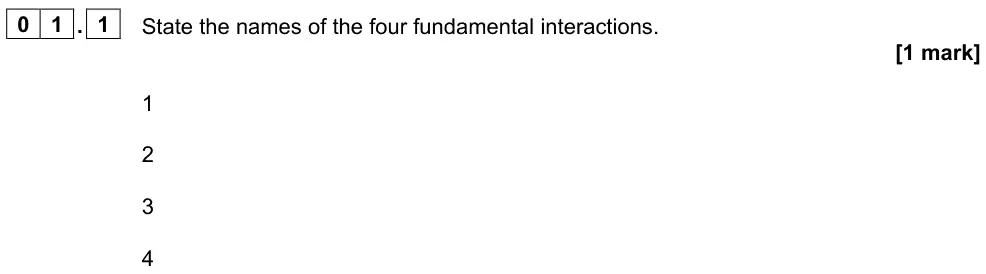
State the names of the four fundamental interactions.
[1 mark]
1
2
3
4
June 2024 · Paper 1 · Q1.2 1 mark AO1=1 Short answer classification of particles and quarksatomic structure and stable nuclei
Earlier part of question 1 that this part usesEarlier part of June 2024 Paper 1 question 1
State the products of the decay of a free neutron.
[1 mark]
June 2024 · Paper 1 · Q1.3 2 marks AO1=2 Explanation particles antiparticles and interactions
Earlier part of question 1 that this part usesEarlier part of June 2024 Paper 1 question 1
Explain which of the fundamental interactions is responsible for the decay of the
neutron.
[2 marks]
June 2024 · Paper 1 · Q1.4 3 marks AO1=3 Explanation particles antiparticles and interactions
Earlier part of question 1 that this part usesEarlier part of June 2024 Paper 1 question 1
The forces between two moving electrons cause their paths to change.
Explain, using the concept of exchange particles, why the electron paths change.
[3 marks]
June 2024 · Paper 1 · Q2.1 2 marks AO1=1, AO2=1 Short answer classification of particles and quarks
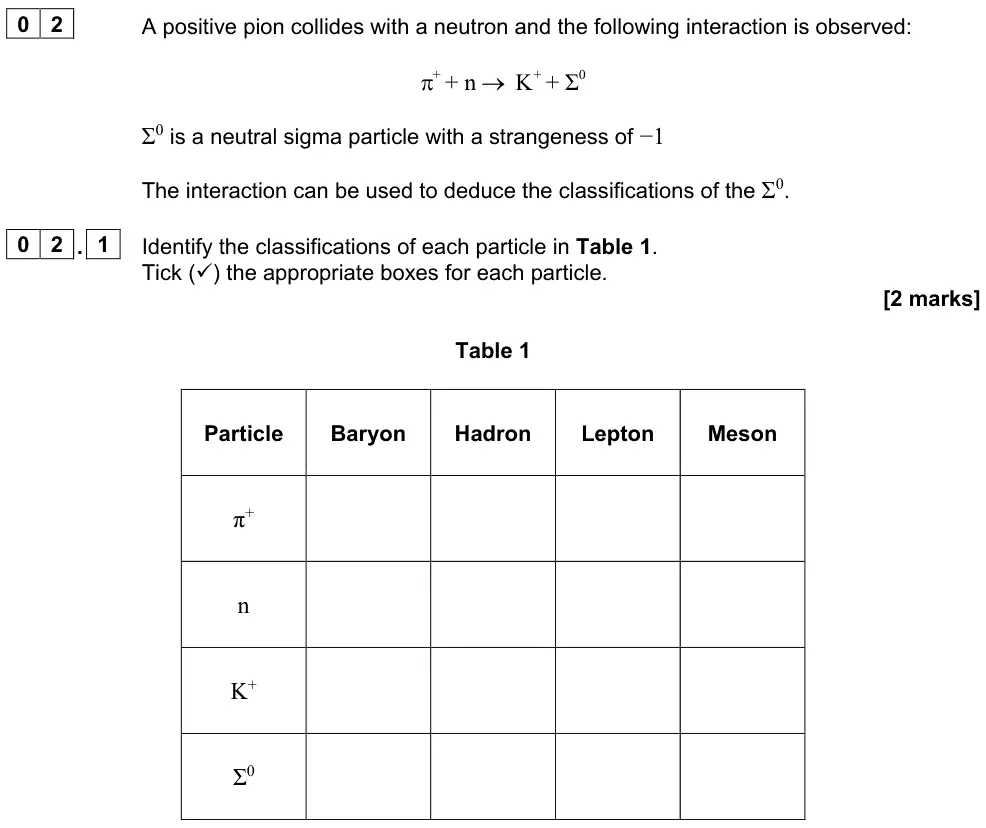
A positive pion collides with a neutron and the following interaction is observed:
0
+
+
+ n
Σ
+
π
→Κ
Σ0 is a neutral sigma particle with a strangeness of −1
The interaction can be used to deduce the classifications of the Σ0.
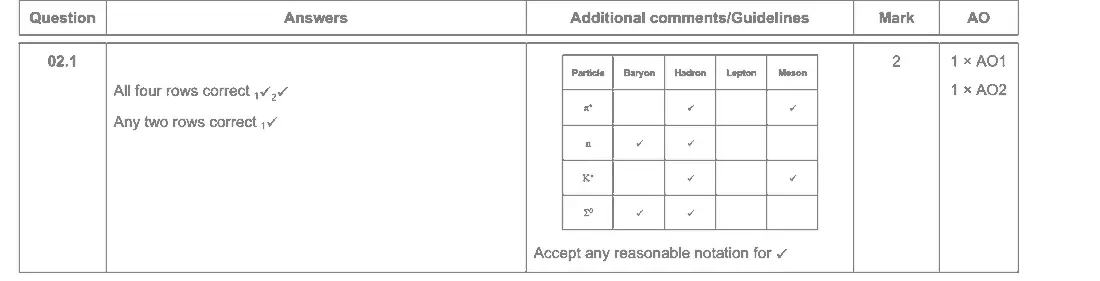
Identify the classifications of each particle in Table 1.
Tick () the appropriate boxes for each particle.
[2 marks]
Table 1
Particle
Baryon
Hadron
Lepton
Meson
π+
n
K+
Σ0
June 2024 · Paper 1 · Q2.2 3 marks AO3=3 Explanation classification of particles and quarks
Earlier part of question 2 that this part usesEarlier part of June 2024 Paper 1 question 2
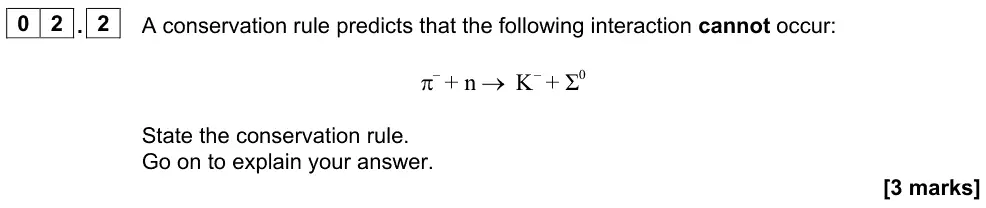
A conservation rule predicts that the following interaction cannot occur:
0
+ n
Σ
+
−
−
π
→Κ
State the conservation rule.
Go on to explain your answer.
[3 marks]
June 2024 · Paper 1 · Q2.3 2 marks AO1=2 Short answer particles antiparticles and interactions
Earlier part of question 2 that this part usesEarlier part of June 2024 Paper 1 question 2
One way in which neutral pions decay is
+
0
e + e +
−
γ
π →
Compare the rest energies of the particles involved in this decay.
[2 marks]
June 2024 · Paper 1 · Q2.4 1 mark AO1=1 Short answer Hard particles antiparticles and interactions
Earlier part of question 2 that this part usesEarlier part of June 2024 Paper 1 question 2
The decay of the neutral pion leads to the production of further gamma photons.
Explain why.
[1 mark]
June 2024 · Paper 1 · Q2.5 1 mark AO1=1 Short answer classification of particles and quarks
Earlier part of question 2 that this part usesEarlier part of June 2024 Paper 1 question 2
The Standard Model is a theory that classifies elementary particles.
Evidence for the theory has been collected since about 1950.  However, the term
Standard Model has only been used since 1973.
Suggest why progress in particle physics is slow.
[1 mark]
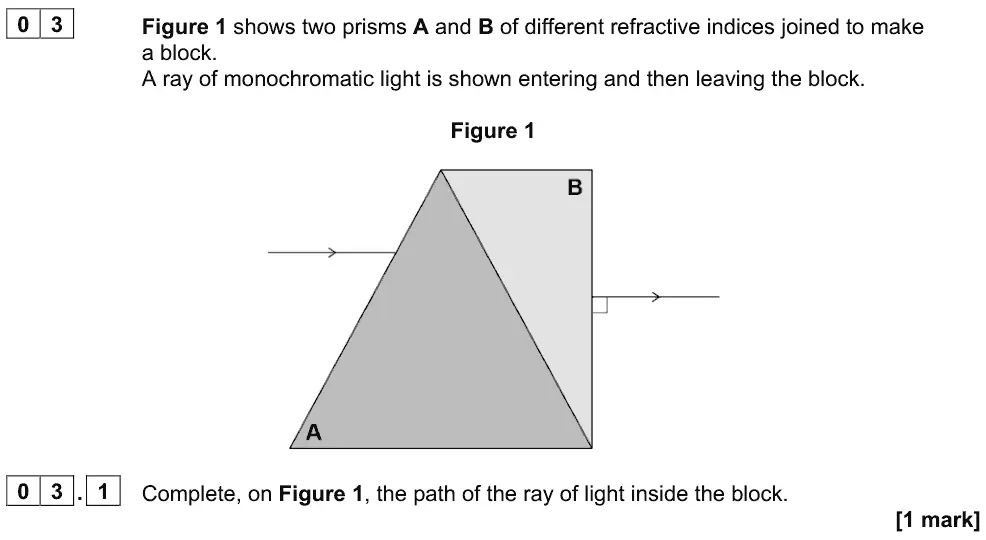
June 2024 · Paper 1 · Q3.1 1 mark AO2=1 Diagram or graph refraction and optical fibres
Figure 1 shows two prisms A and B of different refractive indices joined to make
a block.
A ray of monochromatic light is shown entering and then leaving the block.
Figure 1
Complete, on Figure 1, the path of the ray of light inside the block.
[1 mark]
June 2024 · Paper 1 · Q3.2 2 marks AO3=2 Explanation refraction and optical fibres
Earlier part of question 3 that this part usesEarlier part of June 2024 Paper 1 question 3
Deduce which prism, A or B, has the greater refractive index.
[2 marks]
June 2024 · Paper 1 · Q3.3 1 mark AO1=1 Short answer interference and diffraction
Earlier part of question 3 that this part usesEarlier part of June 2024 Paper 1 question 3
The block is used with a telescope to investigate stars.
The block can be replaced with a diffraction grating.
Describe one non-astronomical application of a diffraction grating.
[1 mark]
June 2024 · Paper 1 · Q3.4 3 marks AO2=2, AO3=1 Calculation interference and diffraction
Earlier part of question 3 that this part usesEarlier part of June 2024 Paper 1 question 3
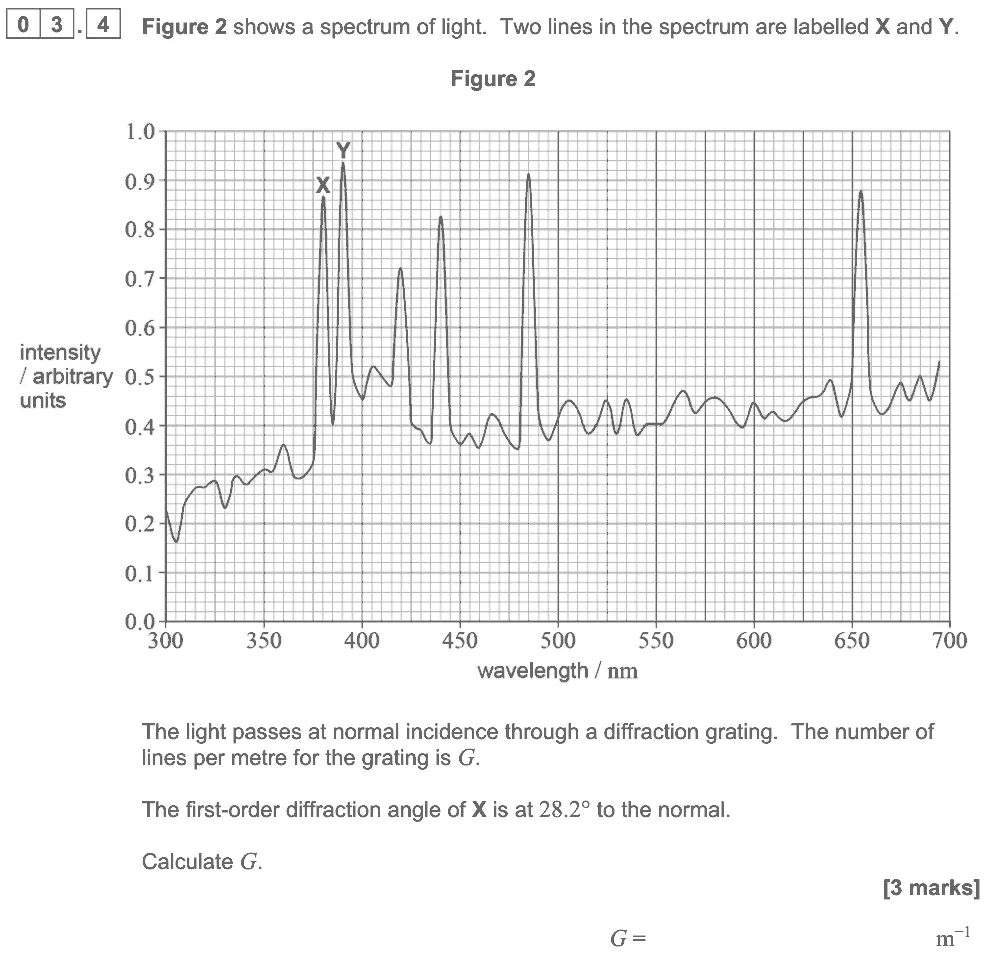
Figure 2 shows a spectrum of light.  Two lines in the spectrum are labelled X and Y.
Figure 2
The light passes at normal incidence through a diffraction grating.  The number of
lines per metre for the grating is G.
The first-order diffraction angle of X is at 28.2° to the normal.
Calculate G.
[3 marks]
G =
m−1
June 2024 · Paper 1 · Q3.5 3 marks AO3=3 Explanation interference and diffraction
Earlier part of question 3 that this part usesEarlier part of June 2024 Paper 1 question 3
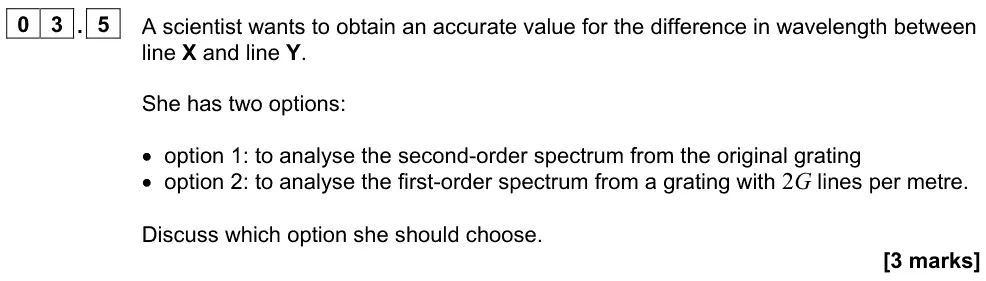
A scientist wants to obtain an accurate value for the difference in wavelength between
line X and line Y.
She has two options:
• option 1: to analyse the second-order spectrum from the original grating
• option 2: to analyse the first-order spectrum from a grating with 2G lines per metre.
Discuss which option she should choose.
[3 marks]
June 2024 · Paper 1 · Q4.1 2 marks AO3=2 Show that newtons laws and momentumwork energy and power
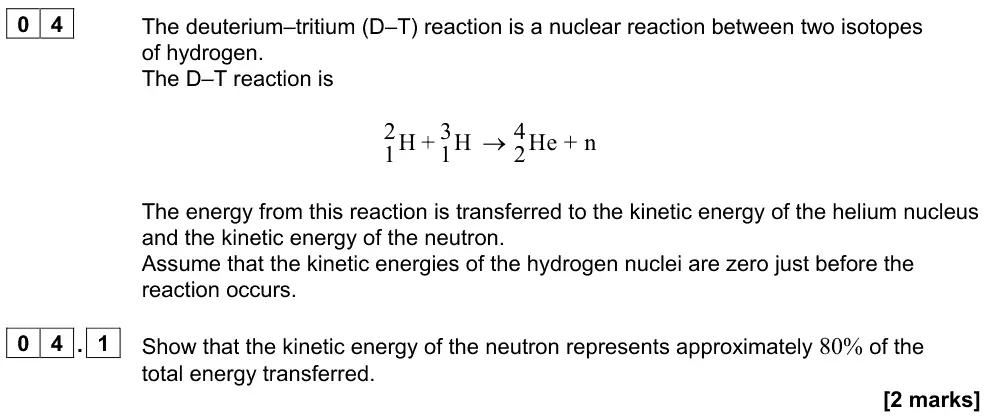
The deuterium–tritium (D–T) reaction is a nuclear reaction between two isotopes
of hydrogen.
The D–T reaction is
n
2
3
4
+
e +
1
1
2
Η
Η  →
Η
The energy from this reaction is transferred to the kinetic energy of the helium nucleus
and the kinetic energy of the neutron.
Assume that the kinetic energies of the hydrogen nuclei are zero just before the
reaction occurs.
Show that the kinetic energy of the neutron represents approximately 80% of the
total energy transferred.
[2 marks]
June 2024 · Paper 1 · Q4.2 2 marks AO2=2 Calculation work energy and power
Earlier part of question 4 that this part usesEarlier part of June 2024 Paper 1 question 4
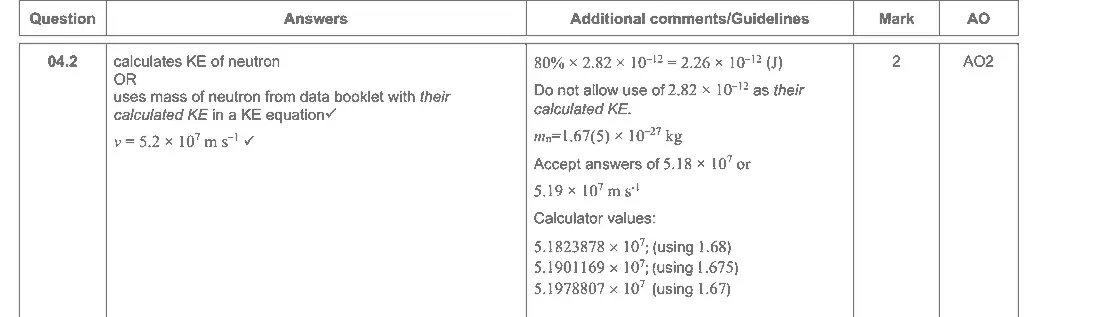
The combined kinetic energy of the helium nucleus and the neutron is 2.82 × 10⁻¹² J.
Calculate the initial speed of the neutron.
[2 marks]
initial speed =
m s−1
June 2024 · Paper 1 · Q5.1 4 marks AO3=4 Diagram or graph vectors and moments
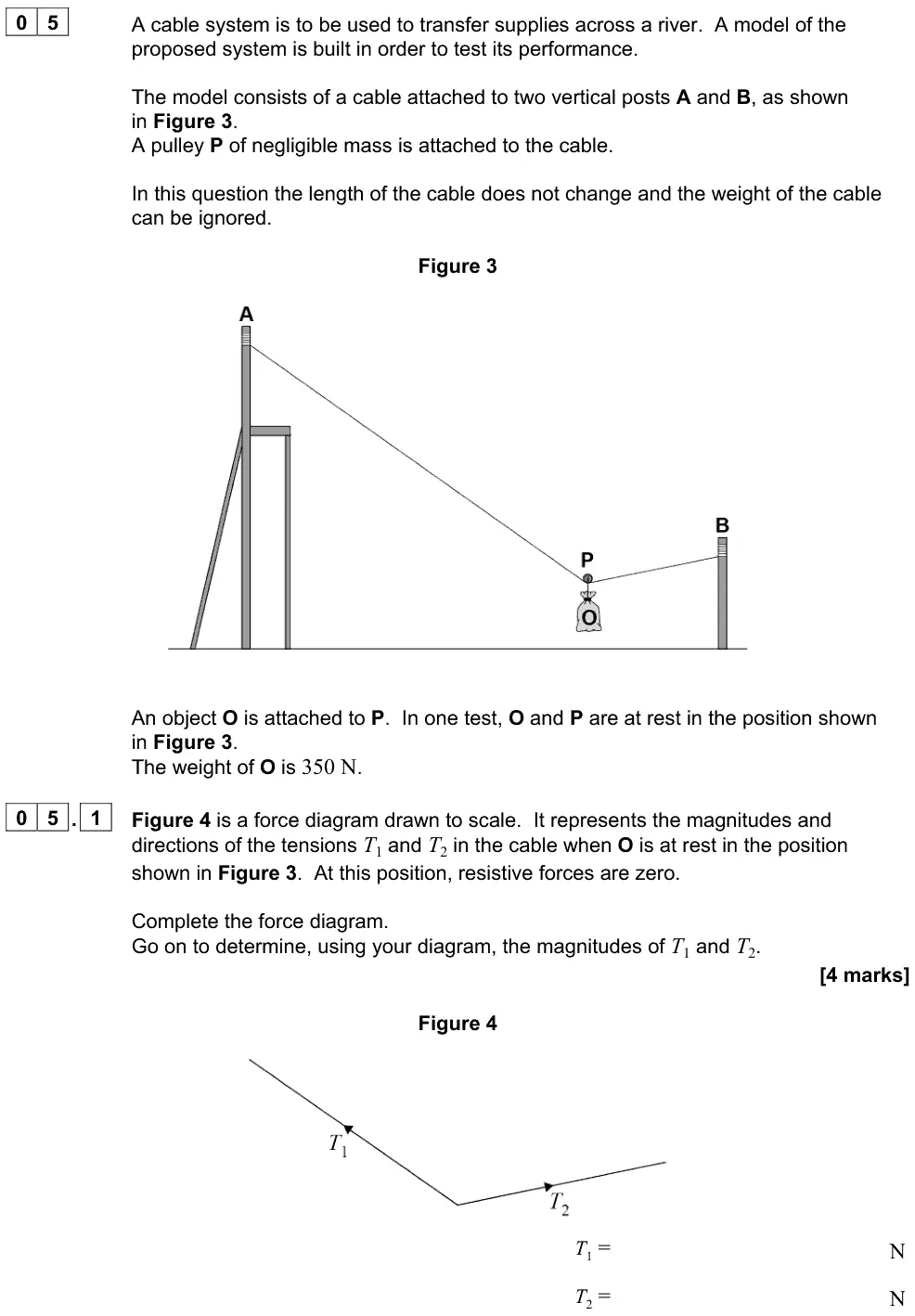
A cable system is to be used to transfer supplies across a river.  A model of the
proposed system is built in order to test its performance.
The model consists of a cable attached to two vertical posts A and B, as shown
in Figure 3.
A pulley P of negligible mass is attached to the cable.
In this question the length of the cable does not change and the weight of the cable
can be ignored.
Figure 3
An object O is attached to P.  In one test, O and P are at rest in the position shown
in Figure 3.
The weight of O is 350 N.
Figure 4 is a force diagram drawn to scale.  It represents the magnitudes and
directions of the tensions T1 and T2 in the cable when O is at rest in the position
shown in Figure 3.  At this position, resistive forces are zero.
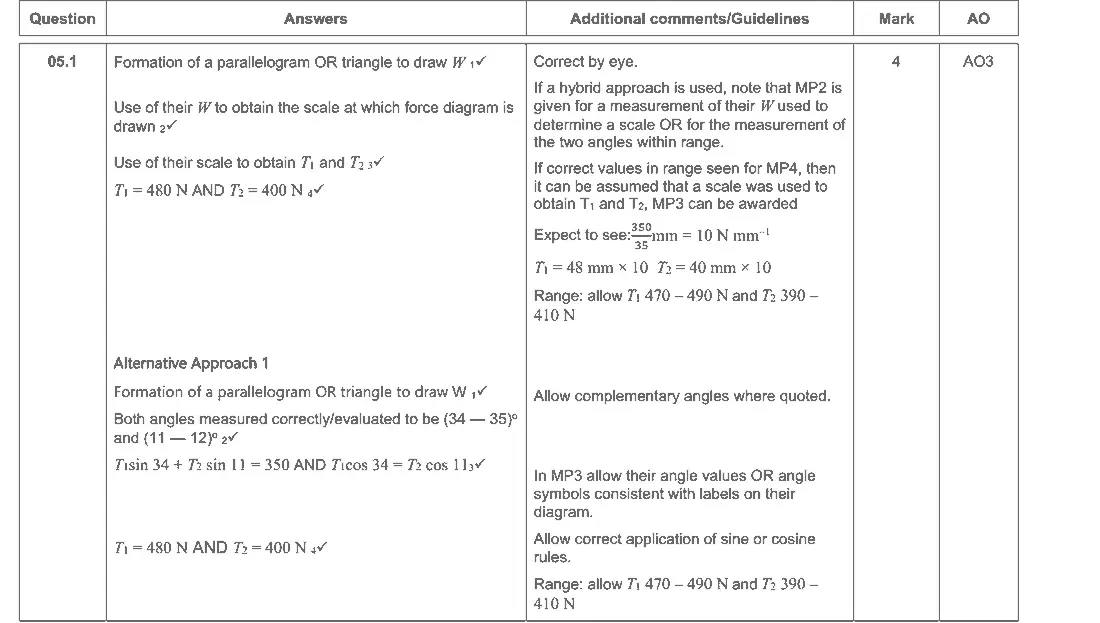
Complete the force diagram.
Go on to determine, using your diagram, the magnitudes of T1 and T2.
[4 marks]
Figure 4
T1 =
N
T2 =
N
June 2024 · Paper 1 · Q5.2 5 marks AO2=5 Calculation work energy and power
Earlier part of question 5 that this part usesEarlier part of June 2024 Paper 1 question 5
In a second test, pulley P with O attached is released from A.
P and O move along the cable to B.
The change in height of the centre of mass of O between A and B is 4.5 m.
The distance travelled along the cable is 18 m.
The speed of O when it reaches B is 6.5 m s−1.
Calculate the average resistive force on O and P as they move from A to B.
[5 marks]
average resistive force =
N
June 2024 · Paper 1 · Q5.3 3 marks AO3=3 Explanation newtons laws and momentum
Earlier part of question 5 that this part usesEarlier part of June 2024 Paper 1 question 5
O contains a fragile item packed in suitable material.
Explain how the material can prevent damage to the fragile item when O stops
suddenly at B.
[3 marks]
June 2024 · Paper 1 · Q6.1 2 marks AO2=2 Calculation Easy circuits and potential dividerscurrent voltage and resistivity
The circuit in Figure 5 is used as part of a temperature sensor.
The battery has an emf of 6.5 V and negligible internal resistance.
Figure 5
The initial temperature of the thermistor is 22 °C.
At this temperature the resistance of the thermistor is 350 Ω and the circuit current
is 12 mA.
Calculate the resistance of the variable resistor.
[2 marks]
resistance =
Ω
June 2024 · Paper 1 · Q6.2 5 marks AO2=5 Calculation current voltage and resistivity
Earlier part of question 6 that this part usesEarlier part of June 2024 Paper 1 question 6
The resistance R of the thermistor at temperature θ in K is given by:
0
0
1
1
=
e
B
R
R








−
where R0 is the resistance at the initial temperature θ0 in K, and B is a constant.
The temperature of the thermistor is increased to 318 K.
The variable resistor is adjusted so that the circuit current is again 12 mA.
The potential difference across the thermistor is now 3.2 V.
Determine B.
State an appropriate unit for your answer.
[5 marks]
B =
unit =
June 2024 · Paper 1 · Q6.3 2 marks AO3=2 Explanation current voltage and resistivity
Earlier part of question 6 that this part usesEarlier part of June 2024 Paper 1 question 6
Explain why the current in the thermistor needs to be controlled.
[2 marks]
June 2024 · Paper 1 · Q6.4 2 marks AO1=2 Explanation circuits and potential dividers
Earlier part of question 6 that this part usesEarlier part of June 2024 Paper 1 question 6
Explain how ammeters and voltmeters can be used in the circuit in Figure 5 to
demonstrate the conservation of charge and the conservation of energy.
Refer to points X, Y and Z in your answer.
[2 marks]
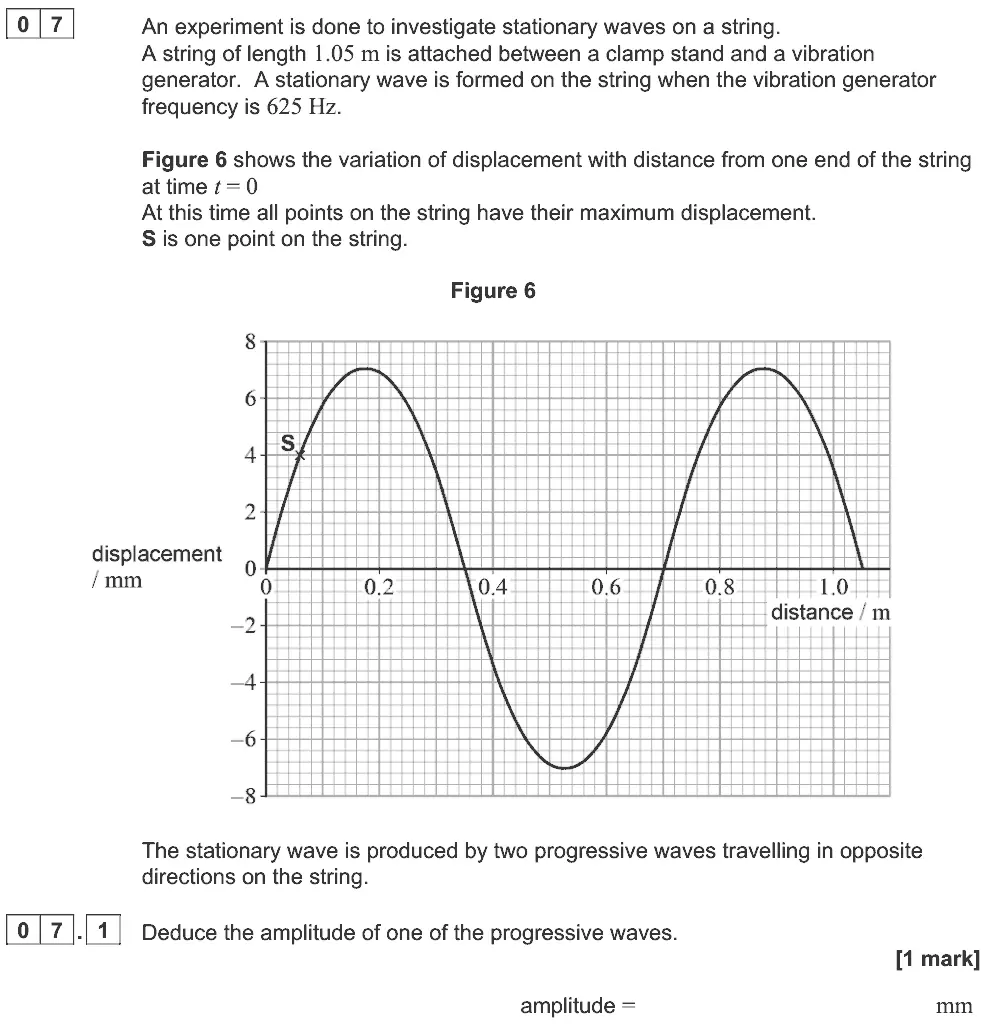
June 2024 · Paper 1 · Q7.1 1 mark AO3=1 Short answer stationary waves
An experiment is done to investigate stationary waves on a string.
A string of length 1.05 m is attached between a clamp stand and a vibration
generator.  A stationary wave is formed on the string when the vibration generator
frequency is 625 Hz.
Figure 6 shows the variation of displacement with distance from one end of the string
at time t = 0
At this time all points on the string have their maximum displacement.
S is one point on the string.
Figure 6
The stationary wave is produced by two progressive waves travelling in opposite
directions on the string.
Deduce the amplitude of one of the progressive waves.
[1 mark]
amplitude =
mm
June 2024 · Paper 1 · Q7.2 2 marks AO3=2 Calculation Easy progressive waves and polarisationstationary waves
Earlier part of question 7 that this part usesEarlier part of June 2024 Paper 1 question 7
Determine, in m s−1, the speed of one of the progressive waves.
[2 marks]
speed =
m s−1
June 2024 · Paper 1 · Q7.3 1 mark AO1=1 Short answer progressive waves and polarisationstationary waves
Earlier part of question 7 that this part usesEarlier part of June 2024 Paper 1 question 7
State the phase relationship between the two waves when t = 0
[1 mark]
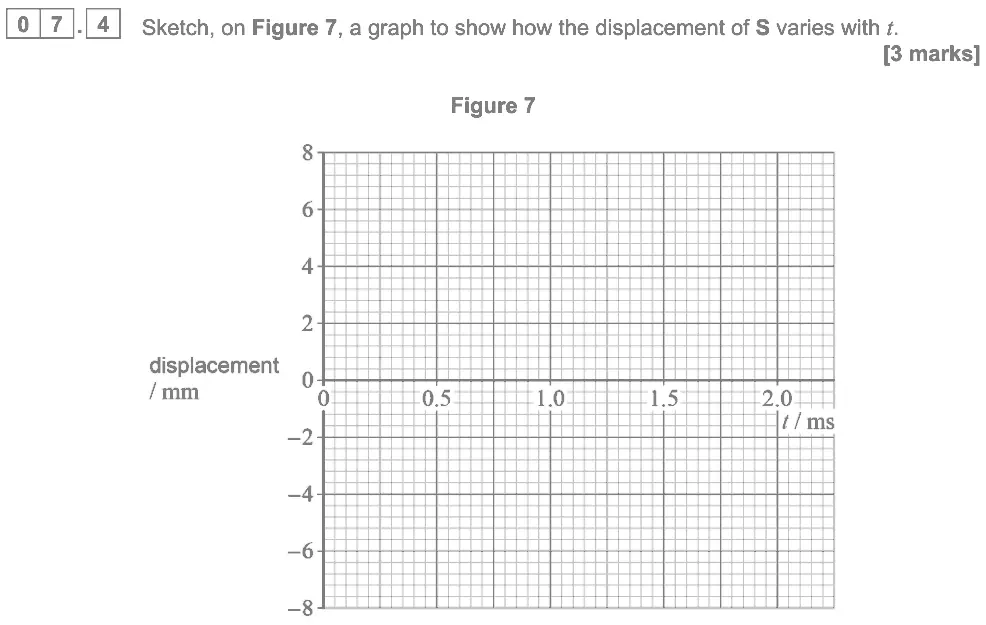
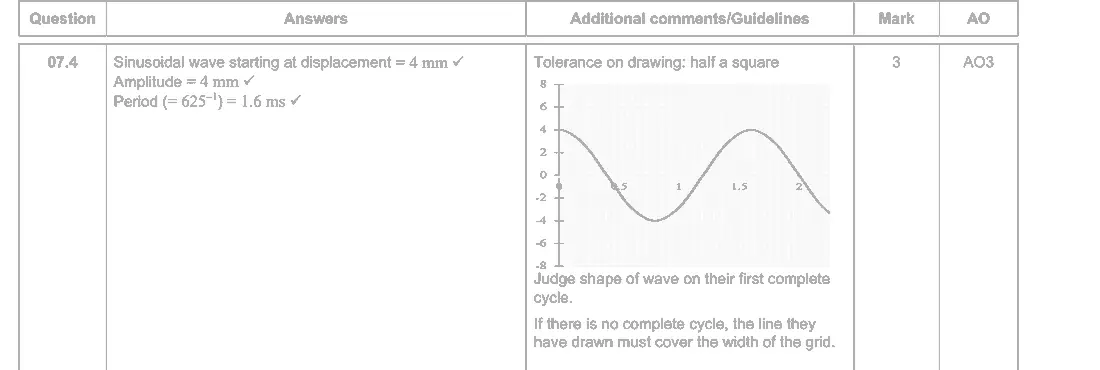
June 2024 · Paper 1 · Q7.4 3 marks AO3=3 Diagram or graph stationary wavesprogressive waves and polarisation
Earlier part of question 7 that this part usesEarlier part of June 2024 Paper 1 question 7
Sketch, on Figure 7, a graph to show how the displacement of S varies with t.
[3 marks]
Figure 7
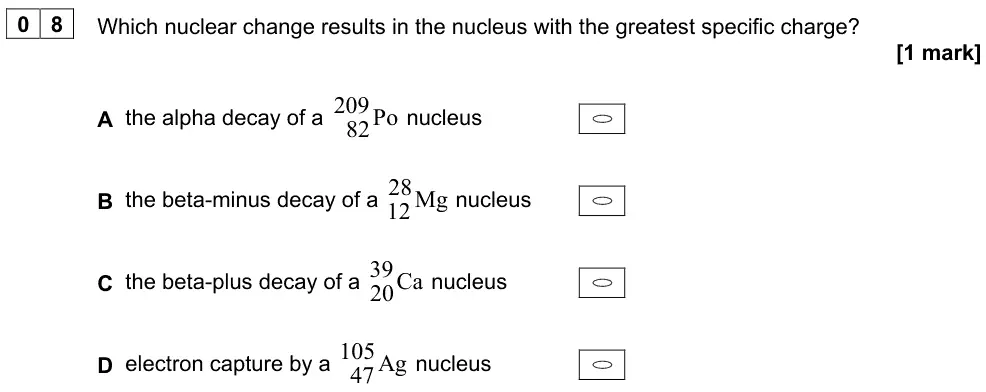
June 2024 · Paper 1 · Q8 1 mark AO2=1 Multiple choice atomic structure and stable nuclei
Which nuclear change results in the nucleus with the greatest specific charge?
[1 mark]
A the alpha decay of a 209Po
82
nucleus
B the beta-minus decay of a 28Mg
12
nucleus
C the beta-plus decay of a 39Ca
20
nucleus
D electron capture by a 105Ag
47
nucleus
June 2024 · Paper 1 · Q9 1 mark AO1=1 Multiple choice photoelectric effect
In two separate experiments, electromagnetic radiation of variable frequency f is incident
on the surfaces of plates made from metals X and Y.
The work function of X is greater than the work function of Y.
Which graph shows how the maximum kinetic energy Ek(max) of photoelectrons emitted
from the surfaces of the plates varies with f ?
[1 mark]
A
B
C
D
A
B
C
D
June 2024 · Paper 1 · Q10 1 mark AO2=1 Multiple choice Hard photoelectric effect
Monochromatic light is incident on a metal surface in a vacuum and photoelectrons are
emitted from the surface.  The photoelectric current I is the rate of flow of charge from the
surface.
The maximum kinetic energy of the photoelectrons is Ek(max).
Ek(max) and I are measured.
The frequency of the light is then increased.  There is no change to the rate at which
energy is incident on the surface.
What happens to Ek(max) and I when the frequency is increased?
[1 mark]
Ek(max)
I
A
increases
decreases
B
increases
no change
C
no change
no change
D
no change
decreases
June 2024 · Paper 1 · Q11 1 mark AO1=1 Multiple choice energy levels and wave particle duality
Three energy levels for an atom are shown.
Energy change E1 leads to the emission of a photon of wavelength λ1.
Energy change E2 leads to the emission of a photon of wavelength λ2.
What is
1
2
λ
λ
?
[1 mark]
A 1
4
B 1
3
C 3
D 4
June 2024 · Paper 1 · Q12 1 mark AO2=1 Multiple choice Easy energy levels and wave particle duality
An electron and a proton move with the same speed.
What is de Broglie wavelength of electron ?
de Broglie wavelength of proton
[1 mark]
A 5.5 × 10⁻⁴
B 2.3 × 10⁻²
C 42
D 1800
June 2024 · Paper 1 · Q13 1 mark AO2=1 Multiple choice progressive waves and polarisation
A laser emits light of wavelength 600 nm for 10 ns.
What is the number of complete waves emitted by the laser?
[1 mark]
A 5 × 10¹⁷
B 5 × 10¹²
C 5 × 10⁸
D 5 × 10⁶
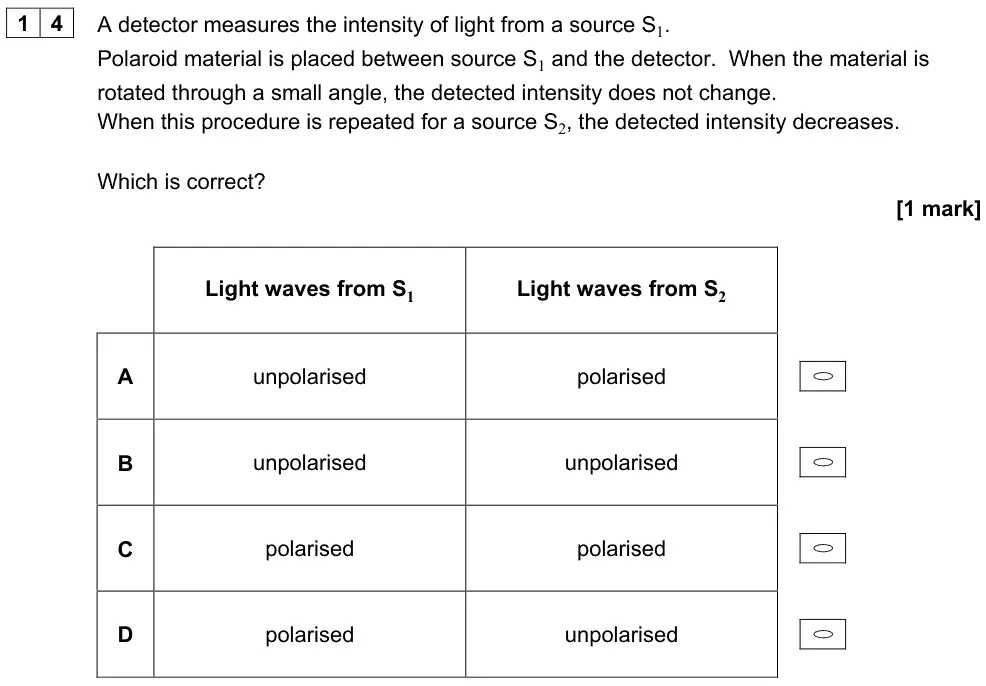
June 2024 · Paper 1 · Q14 1 mark AO1=1 Multiple choice Easy progressive waves and polarisation
A detector measures the intensity of light from a source S1.
Polaroid material is placed between source S1 and the detector.  When the material is
rotated through a small angle, the detected intensity does not change.
When this procedure is repeated for a source S2, the detected intensity decreases.
Which is correct?
[1 mark]
Light waves from S1
Light waves from S2
A
unpolarised
polarised
B
unpolarised
unpolarised
C
polarised
polarised
D
polarised
unpolarised
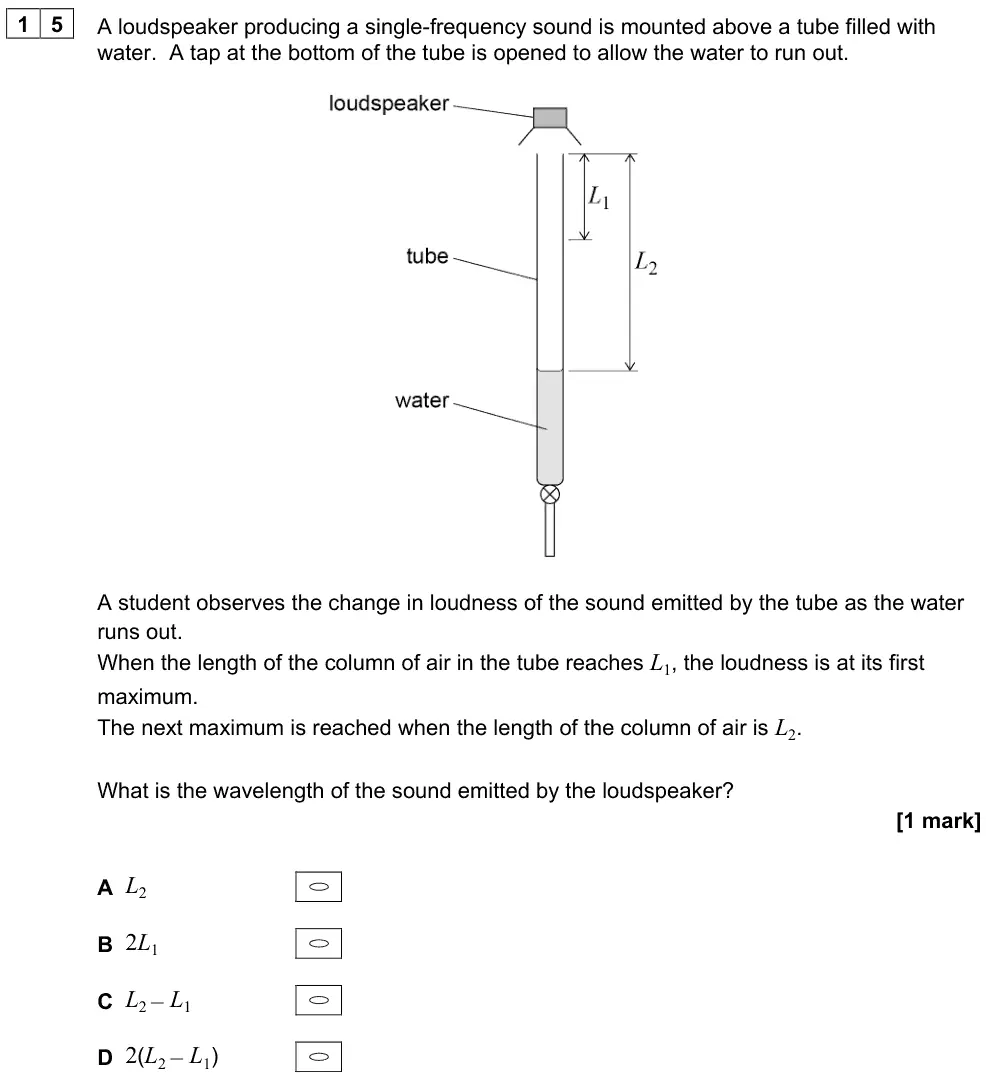
June 2024 · Paper 1 · Q15 1 mark AO1=1 Multiple choice stationary waves
A loudspeaker producing a single-frequency sound is mounted above a tube filled with
water.  A tap at the bottom of the tube is opened to allow the water to run out.
A student observes the change in loudness of the sound emitted by the tube as the water
runs out.
When the length of the column of air in the tube reaches L1, the loudness is at its first
maximum.
The next maximum is reached when the length of the column of air is L2.
What is the wavelength of the sound emitted by the loudspeaker?
[1 mark]
A L2
B 2L1
C L2 − L1
D 2(L2 − L1)
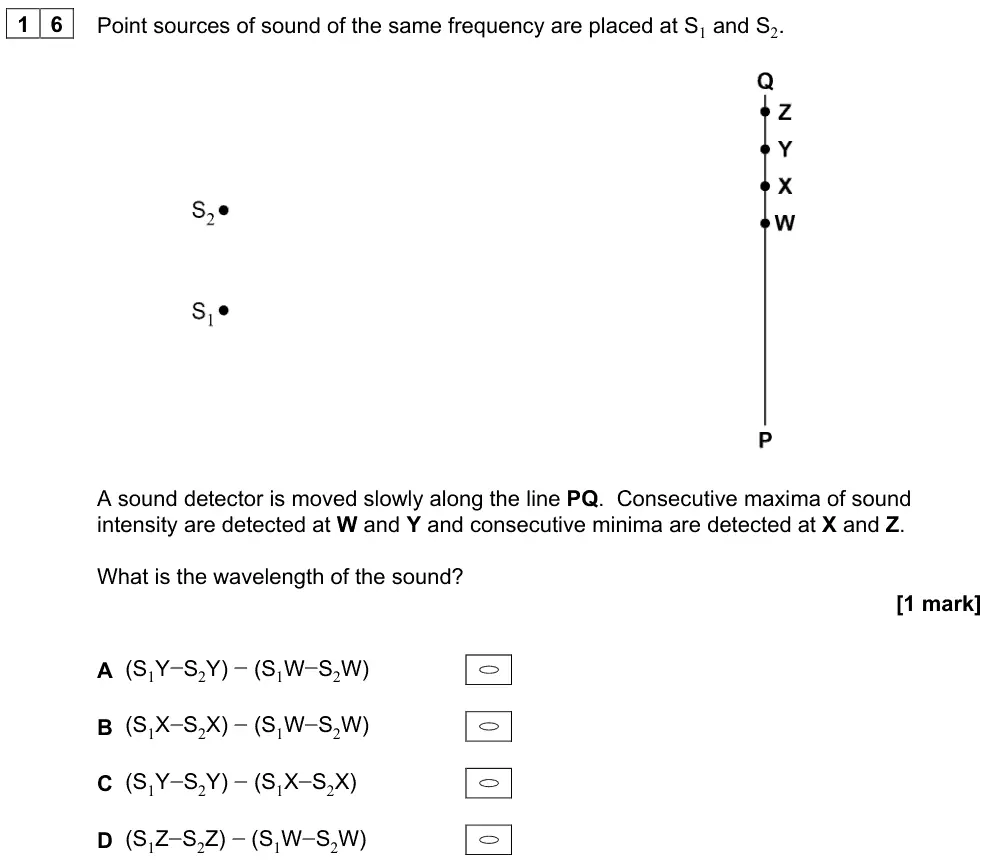
June 2024 · Paper 1 · Q16 1 mark AO1=1 Multiple choice interference and diffraction
Point sources of sound of the same frequency are placed at S1 and S2.
A sound detector is moved slowly along the line PQ.  Consecutive maxima of sound
intensity are detected at W and Y and consecutive minima are detected at X and Z.
What is the wavelength of the sound?
[1 mark]
A (S1Y−S2Y) − (S1W−S2W)
B (S1X−S2X) − (S1W−S2W)
C (S1Y−S2Y) − (S1X−S2X)
D (S1Z−S2Z) − (S1W−S2W)
June 2024 · Paper 1 · Q17 1 mark AO1=1 Multiple choice interference and diffraction
Monochromatic light is used in a Young’s double-slit interference experiment after passing
through a single slit.  The resulting fringe pattern is observed on a screen.
The separation of the fringes can be increased by
[1 mark]
A using monochromatic light of lower frequency.
B decreasing the width of the single slit.
C increasing the separation of the double slits.
D decreasing the distance between the double slits and the screen.
June 2024 · Paper 1 · Q18 1 mark AO1=1 Multiple choice Easy newtons laws and momentumvectors and moments
A force of magnitude F acts on a box of mass m that moves along a frictionless slope.
The slope is at an angle α to the horizontal and the force acts at an angle β to the slope.
What is the magnitude of the acceleration of the block along the slope?
[1 mark]
A F
m sin α − g sin β
B F
m cos β – g sin α
C F
m cos (α + β) – g cos β
D F
m cos (α + β) – g sin β
June 2024 · Paper 1 · Q19 1 mark AO2=1 Multiple choice vectors and moments
The weight of a uniform bar is W.
An object also of weight W is attached to one end.
The bar is pivoted at the other end and held horizontal by a rope attached to its centre.
The tension in the rope is 4W.
What is angle θ?
[1 mark]
A 41°
B 45°
C 60°
D 71°
June 2024 · Paper 1 · Q20 1 mark AO2=1 Multiple choice motion and projectiles
A projectile is fired from ground level over horizontal ground.
Its initial velocity is u at an angle θ to the horizontal.
The range of the projectile is d.
A second projectile is fired with a velocity 2u at the same angle.
What is the range of this projectile?
Assume that air resistance is negligible.
[1 mark]
A
2d
B 2d
C 2 2d
D 4d
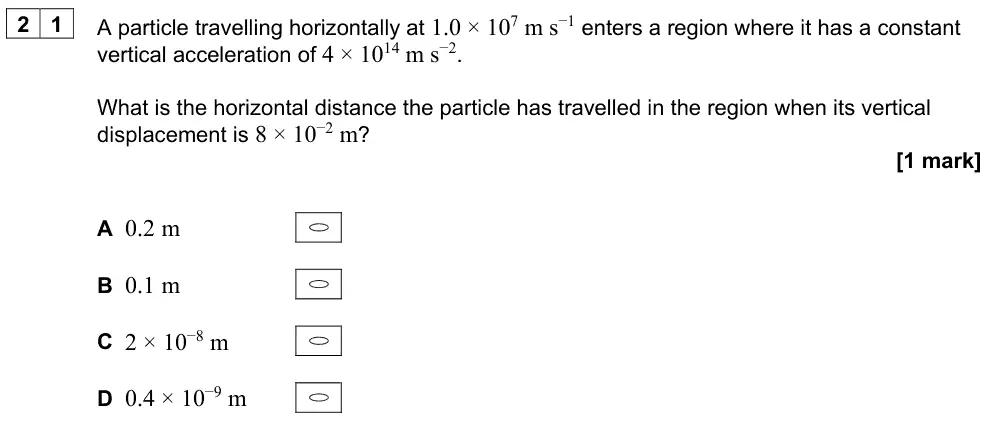
June 2024 · Paper 1 · Q21 1 mark AO2=1 Multiple choice motion and projectiles
A particle travelling horizontally at 1.0 × 10⁷ m s−1 enters a region where it has a constant
vertical acceleration of 4 × 10¹⁴ m s−2.
What is the horizontal distance the particle has travelled in the region when its vertical
displacement is 8 × 10⁻² m?
[1 mark]
A 0.2 m
B 0.1 m
C 2 × 10⁻⁸ m
D 0.4 × 10⁻⁹ m
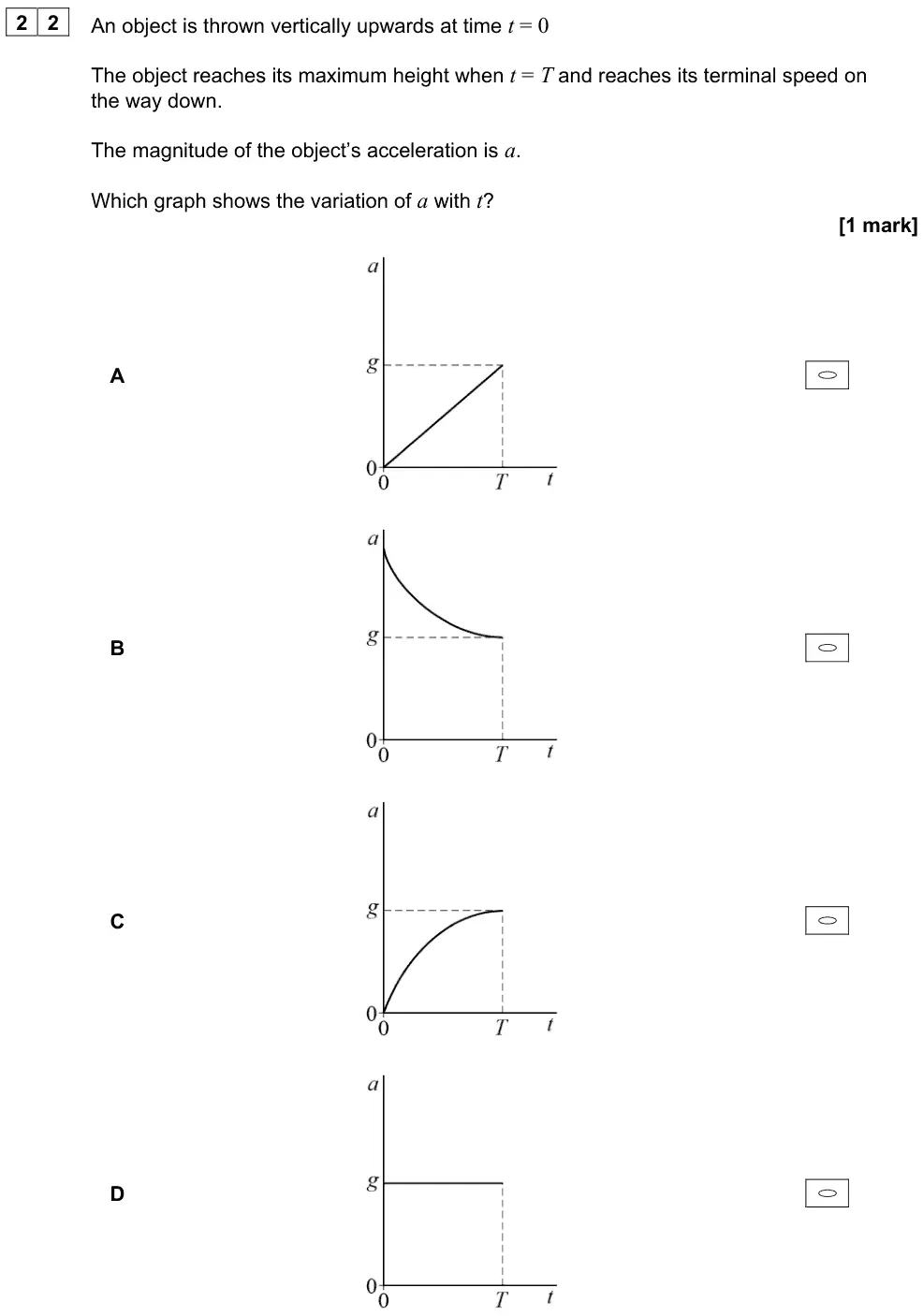
June 2024 · Paper 1 · Q22 1 mark AO2=1 Multiple choice motion and projectiles
An object is thrown vertically upwards at time t = 0
The object reaches its maximum height when t = T and reaches its terminal speed on
the way down.
The magnitude of the object’s acceleration is a.
Which graph shows the variation of a with t?
[1 mark]
A
B
C
D
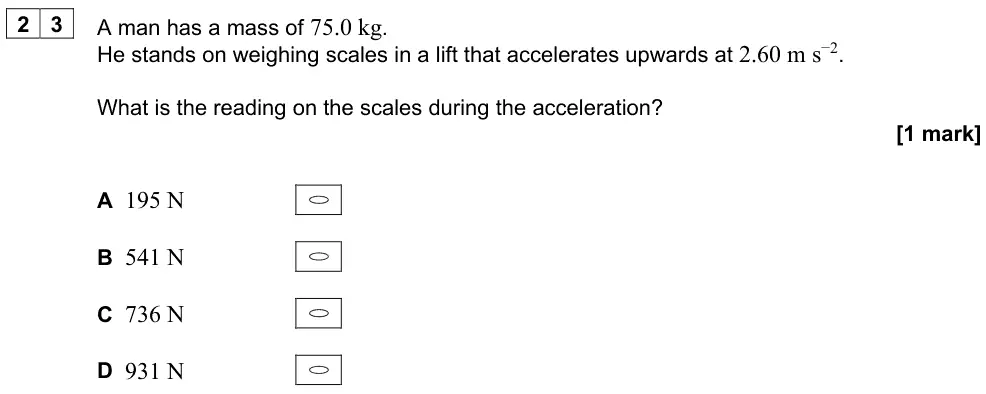
June 2024 · Paper 1 · Q23 1 mark AO2=1 Multiple choice newtons laws and momentum
A man has a mass of 75.0 kg.
He stands on weighing scales in a lift that accelerates upwards at 2.60 m s−2.
What is the reading on the scales during the acceleration?
[1 mark]
A 195 N
B 541 N
C 736 N
D 931 N
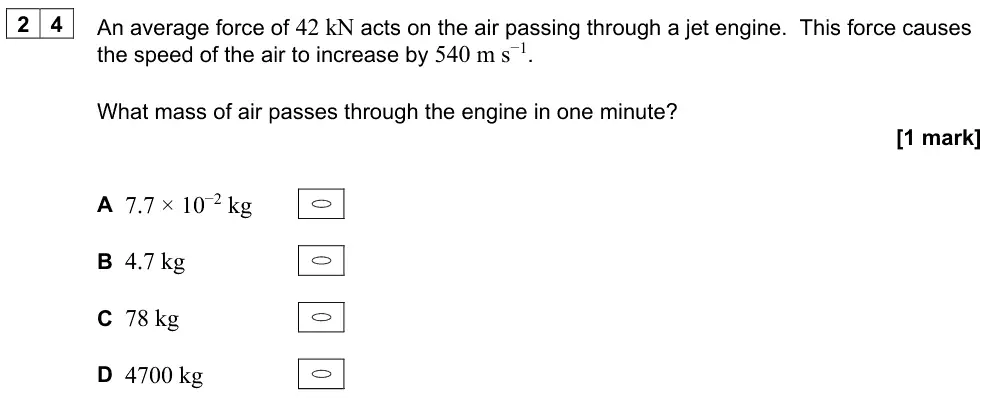
June 2024 · Paper 1 · Q24 1 mark AO2=1 Multiple choice newtons laws and momentum
An average force of 42 kN acts on the air passing through a jet engine.  This force causes
the speed of the air to increase by 540 m s−1.
What mass of air passes through the engine in one minute?
[1 mark]
A 7.7 × 10⁻² kg
B 4.7 kg
C 78 kg
D 4700 kg
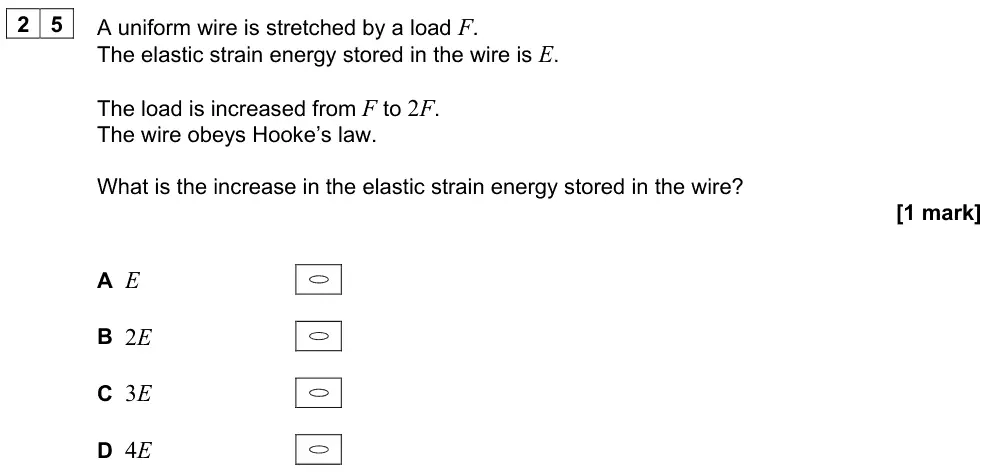
June 2024 · Paper 1 · Q25 1 mark AO2=1 Multiple choice Hard materials and young modulus
A uniform wire is stretched by a load F.
The elastic strain energy stored in the wire is E.
The load is increased from F to 2F.
The wire obeys Hooke’s law.
What is the increase in the elastic strain energy stored in the wire?
[1 mark]
A E
B 2E
C 3E
D 4E
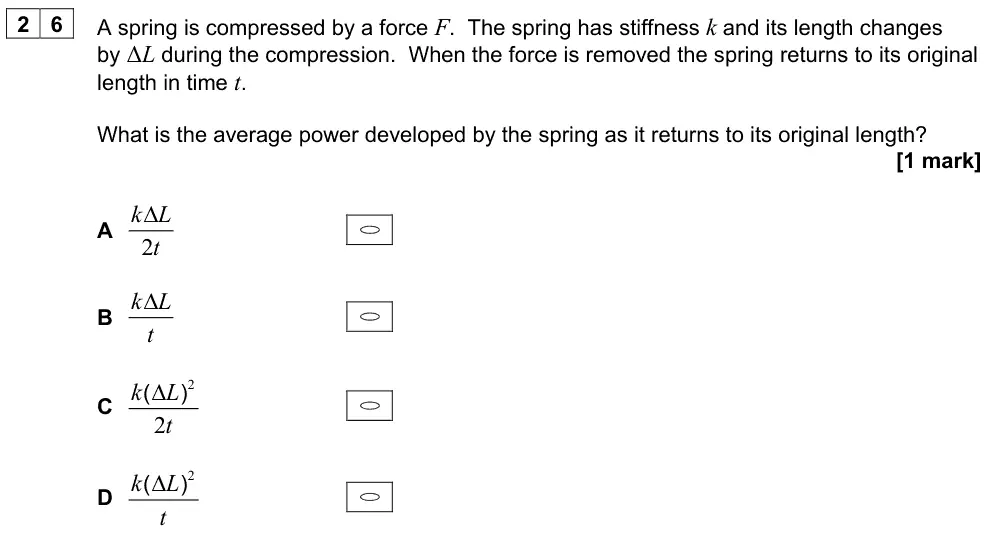
June 2024 · Paper 1 · Q26 1 mark AO2=1 Multiple choice materials and young moduluswork energy and power
A spring is compressed by a force F.  The spring has stiffness k and its length changes
by ΔL during the compression.  When the force is removed the spring returns to its original
length in time t.
What is the average power developed by the spring as it returns to its original length?
[1 mark]
A
2
k L
t
∆
B k L
t
∆
C
2
2
k
L
t
∆
(
)
D
2
k
L
t
∆
(
)
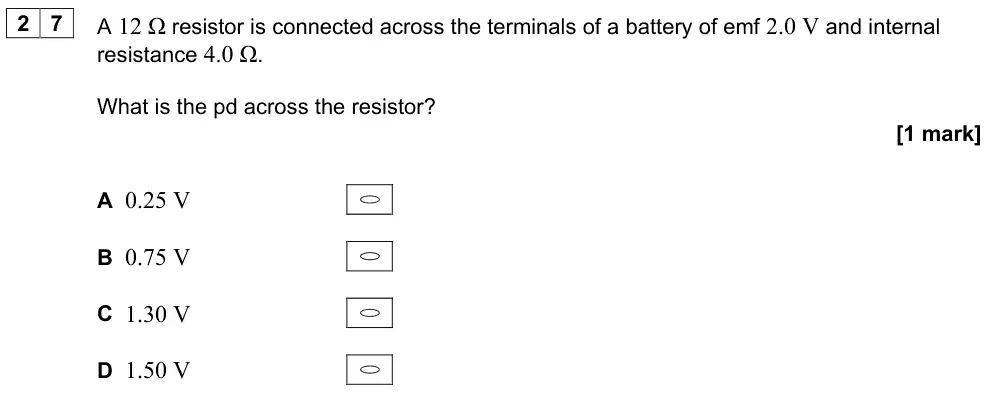
June 2024 · Paper 1 · Q27 1 mark AO2=1 Multiple choice Easy emf and internal resistance
A 12 Ω resistor is connected across the terminals of a battery of emf 2.0 V and internal
resistance 4.0 Ω.
What is the pd across the resistor?
[1 mark]
A 0.25 V
B 0.75 V
C 1.30 V
D 1.50 V
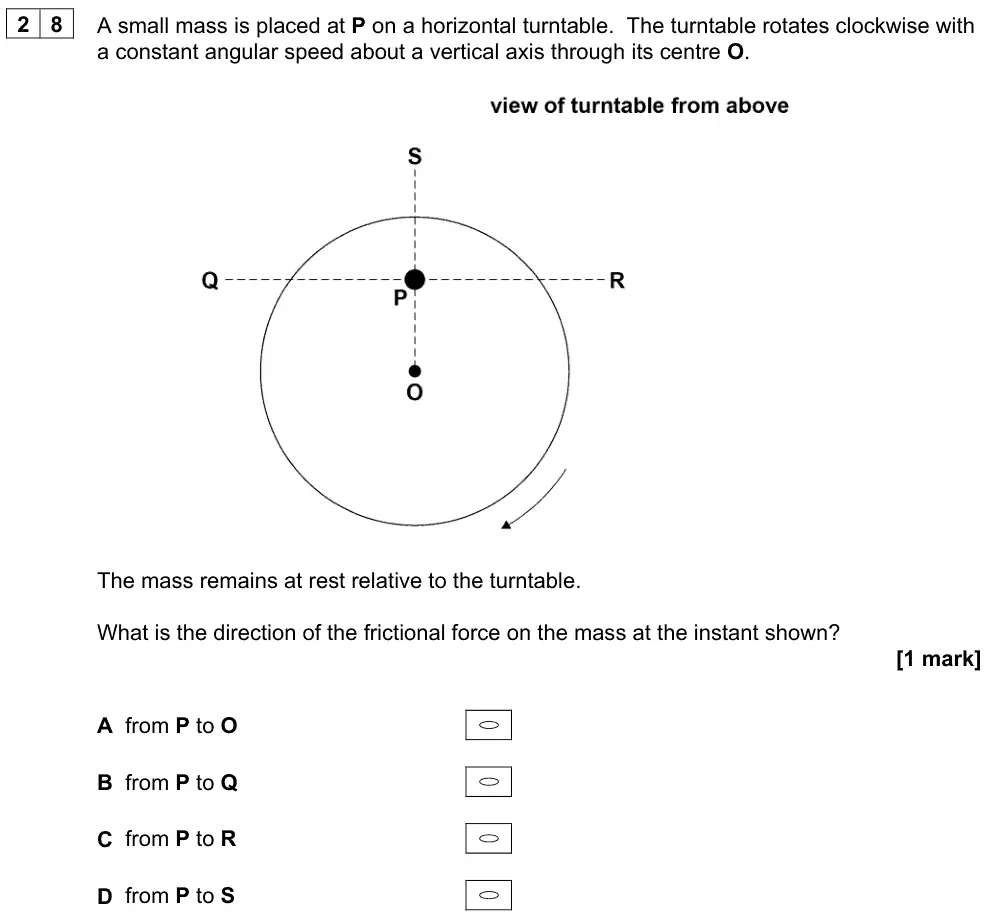
June 2024 · Paper 1 · Q28 1 mark AO1=1 Multiple choice circular motion
A small mass is placed at P on a horizontal turntable.  The turntable rotates clockwise with
a constant angular speed about a vertical axis through its centre O.
The mass remains at rest relative to the turntable.
What is the direction of the frictional force on the mass at the instant shown?
[1 mark]
A from P to O
B from P to Q
C from P to R
D from P to S
June 2024 · Paper 1 · Q29 1 mark AO1=1 Multiple choice Easy circular motionwork energy and power
A particle of mass m moves in a circle of radius r.  The number of revolutions completed
per second is f.
What is the kinetic energy of the particle?
[1 mark]
A 4π
2mf
2r
2
B 2π
2mf
2r
2
C
2
2
2
4
mf r
π
D
2
2
2
mf r
June 2024 · Paper 1 · Q30 1 mark AO1=1 Multiple choice simple harmonic motion
A body is in simple harmonic motion of amplitude 0.60 m and period 2π seconds.
What is its speed when its displacement is 0.20 m?
[1 mark]
A 0.32 m s−1
B 0.57 m s−1
C 0.63 m s−1
D 22 m s−1
June 2024 · Paper 1 · Q31 1 mark AO2=1 Multiple choice simple harmonic motion
When a mass M is suspended from a spring, the spring extends by a distance x.
M is displaced vertically and, when released, it oscillates with a period T.
M is removed and suspended from a different spring. The spring extends by a distance 2
x .
M is again displaced vertically and released.
What is the new period of oscillations of M?
[1 mark]
A 2
T
B
2
T
C
2
T
D 2T
June 2024 · Paper 1 · Q32 1 mark AO2=1 Multiple choice simple harmonic motion
A mass–spring system and a simple pendulum have identical periods of oscillation T when
at the surface of the Earth.
Both are taken to planet X where the acceleration due to gravity is 2
g .
What are the periods of the mass–spring system and the simple pendulum on X?
[1 mark]
Period of mass–spring system
Period of simple pendulum
A
2
T
2
T
B
T
2T
C
T
2
T
D
2
T
T

Work with an AQA physics tutor

Want a paper marked and gone through with you? Message us.

Prefer email? Send an enquiry

If you are under 18, please include a parent's contact details. Enquiries go to enquiries@physicsaleveltutor.com and are deleted once handled. All tutoring is online.