June 2025: Paper 1

85 marks · 53 question parts · Paper, mark scheme and report on AQA's site · Have the data and formulae booklet beside you

Question by question

QTopicMarksAOType
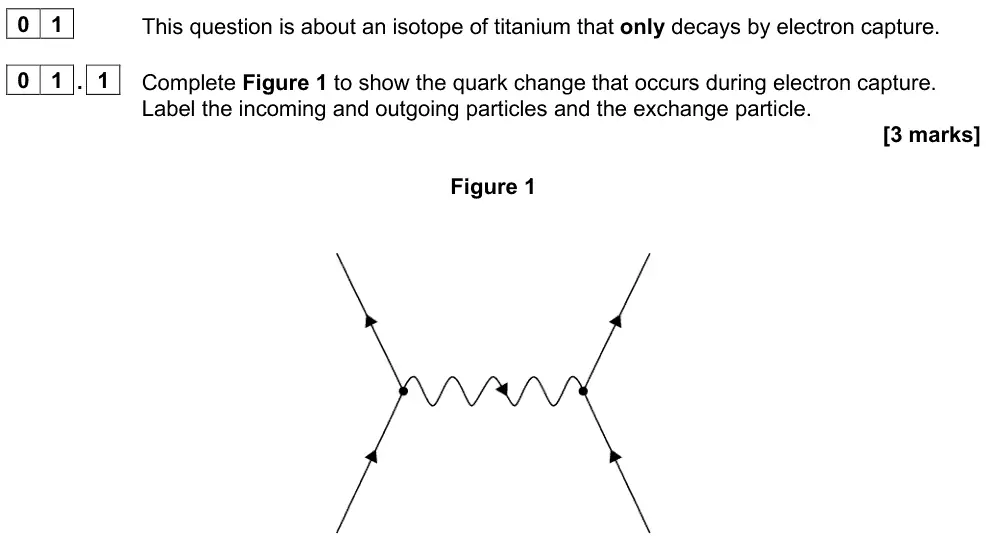
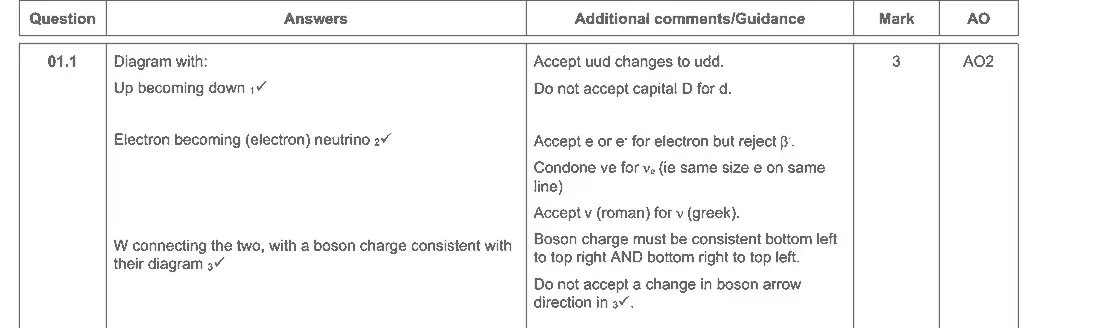
1.1 Particles, antiparticles and particle interactions 3AO2=3Diagram or graph
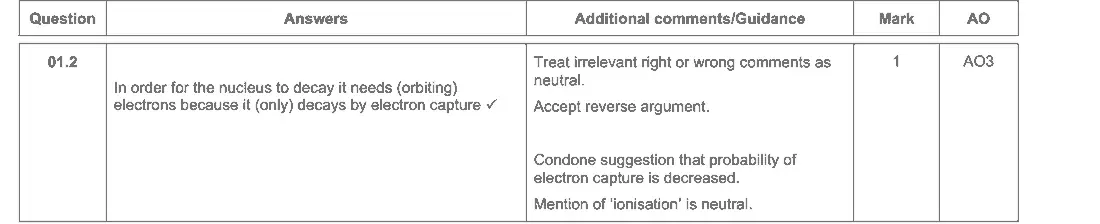
1.2 Particles, antiparticles and particle interactions 1AO3=1Explanation
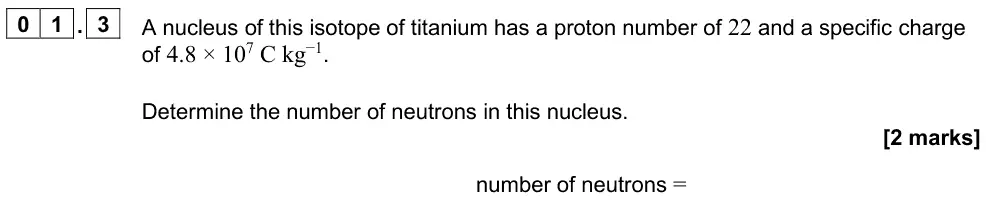
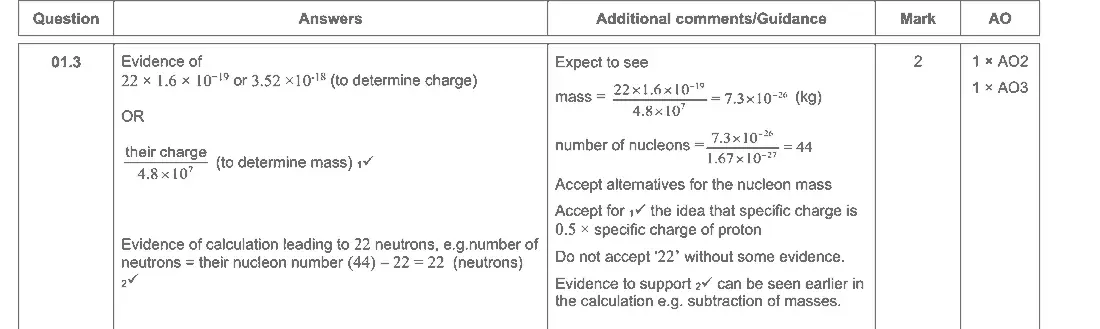
1.3 Atomic structure and stable nuclei 2AO2=1,AO3=1Calculation
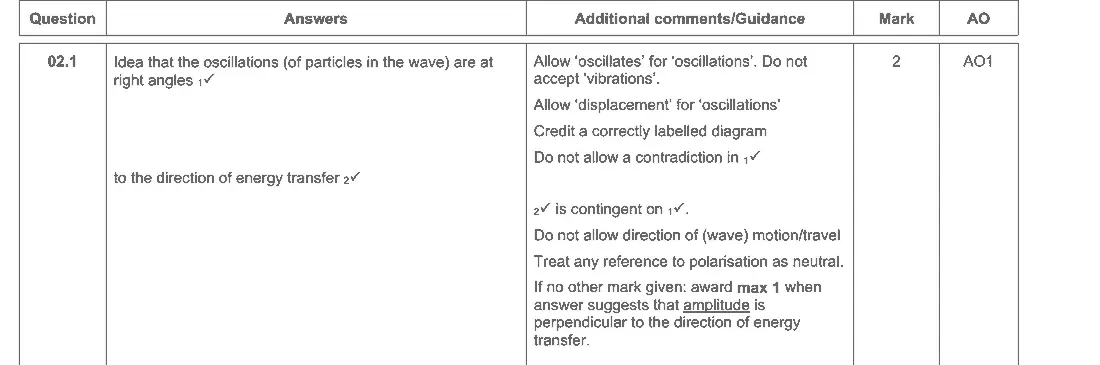
2.1 Progressive waves, longitudinal and transverse waves 2AO1=2Short answer
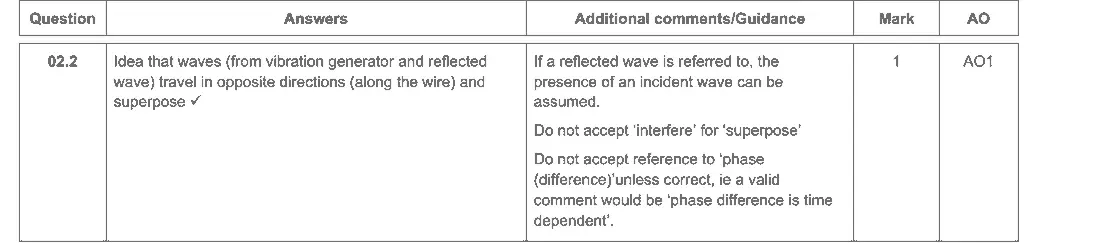
2.2 Superposition and stationary waves 1AO1=1Explanation
2.3 Superposition and stationary waves, Progressive waves, longitudinal and transverse waves 2AO2=2Explanation
2.4 Superposition and stationary waves 5AO1=1,AO3=4Calculation
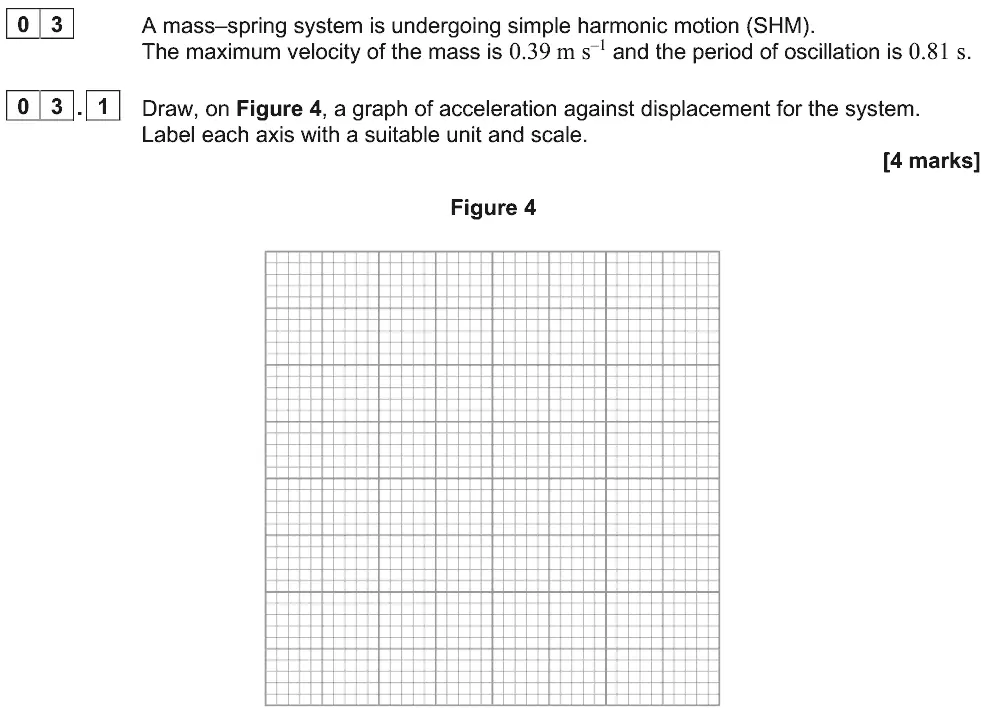
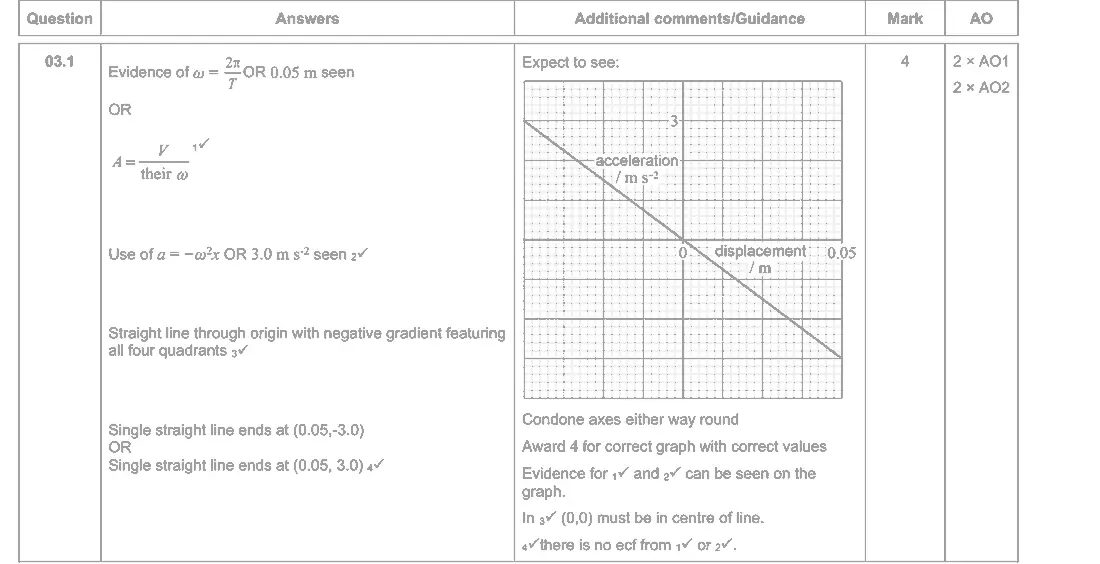
3.1 Simple harmonic motion, forced vibrations and resonance 4AO1=2,AO2=2Diagram or graph
3.2 Simple harmonic motion, forced vibrations and resonance 1AO1=1Diagram or graph
4.1 Materials, stress, strain and the Young modulus 1AO1=1Short answer
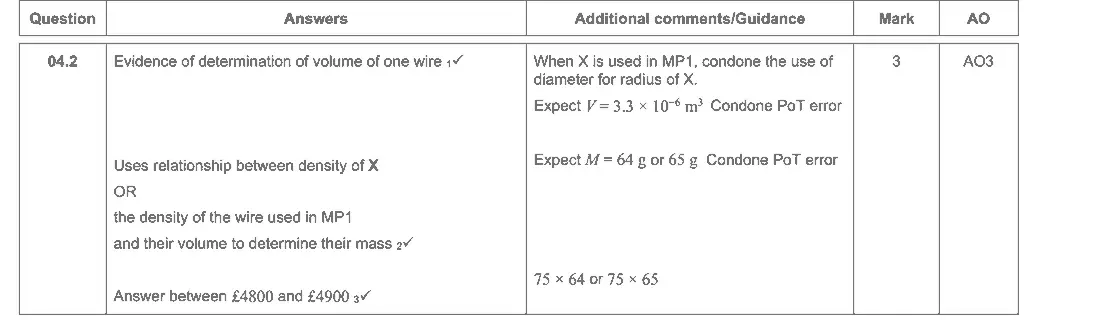
4.2 Materials, stress, strain and the Young modulus 3AO3=3Calculation
4.3 Materials, stress, strain and the Young modulus 1AO1=1Short answer
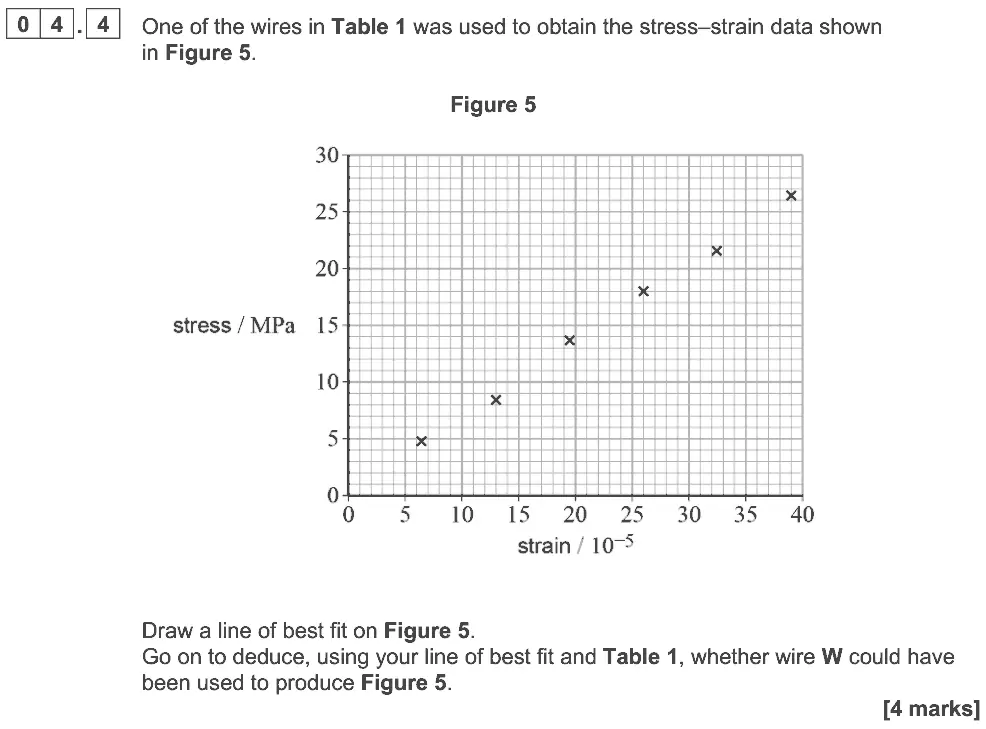
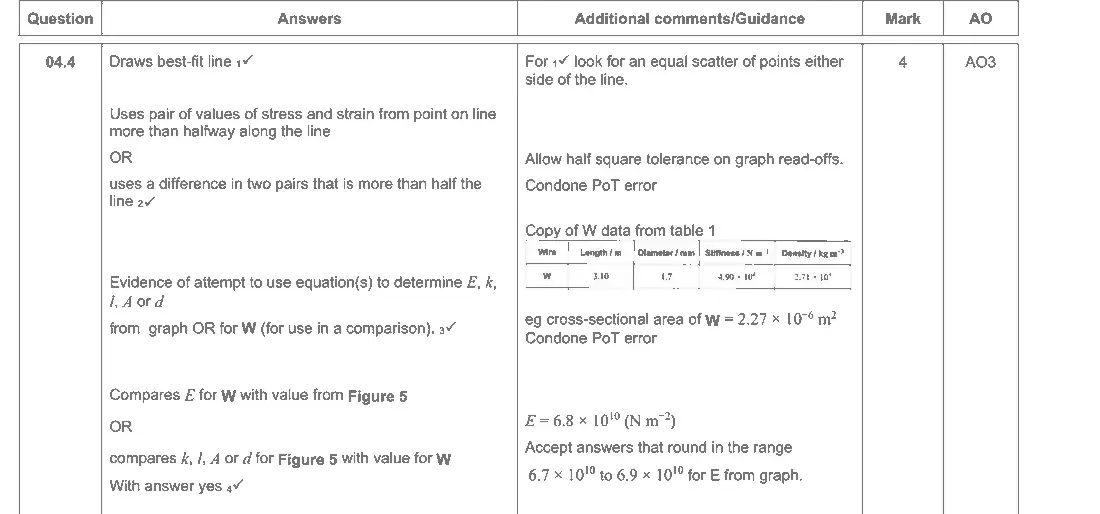
4.4 Materials, stress, strain and the Young modulus 4AO3=4Practical and data analysis
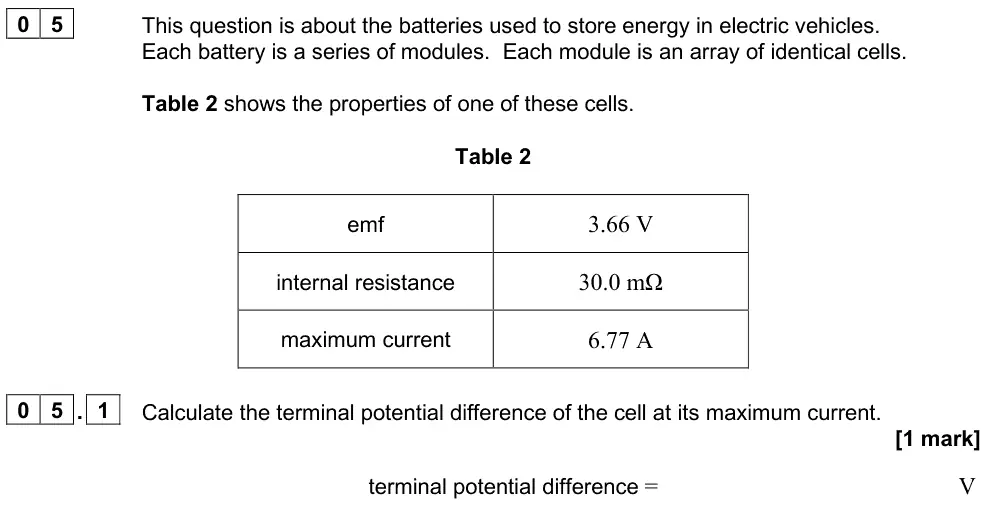
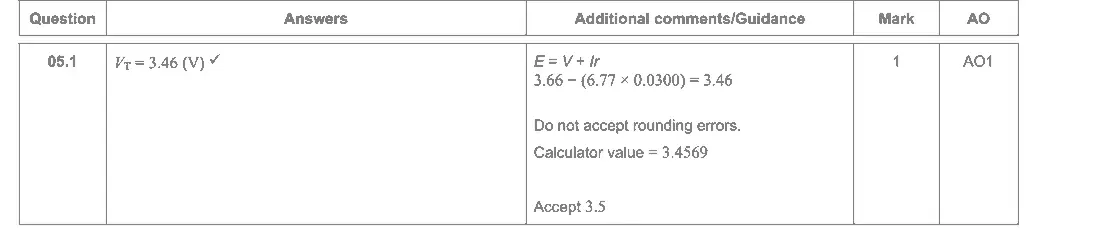
5.1 Electromotive force and internal resistance 1AO1=1Calculation
5.2 Circuits and potential dividers, Electromotive force and internal resistance 2AO1=1,AO2=1Calculation
5.3 Circuits and potential dividers, Electromotive force and internal resistance 3AO3=3Calculation
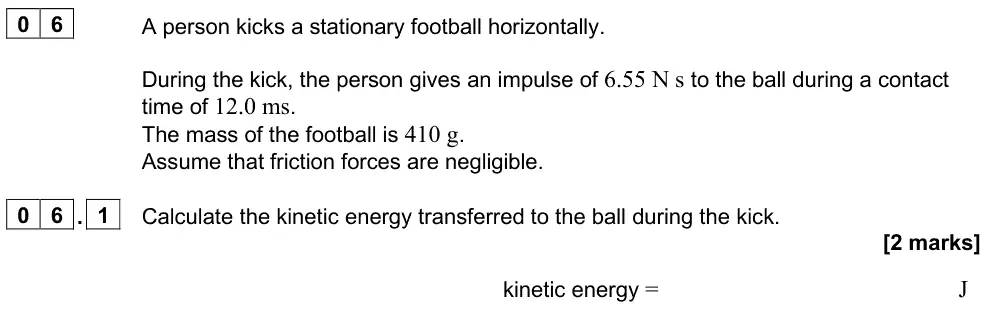
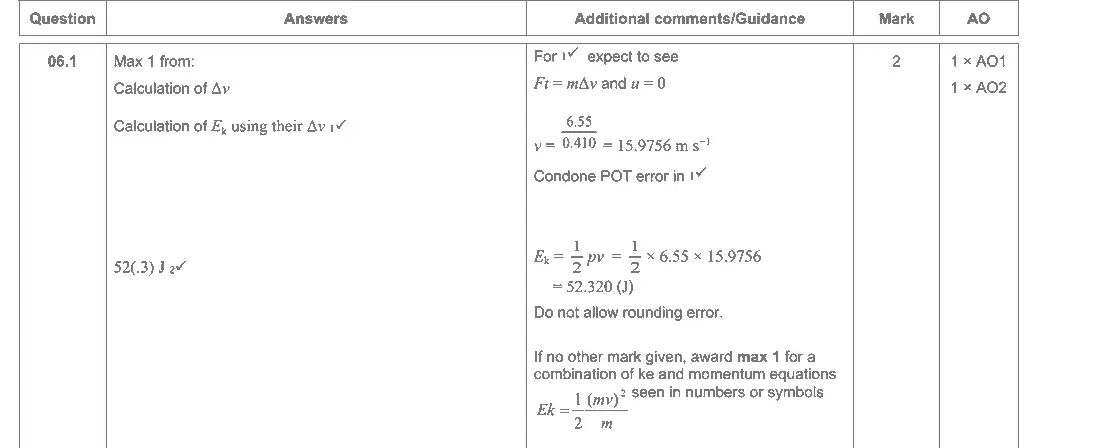
6.1 Newton's laws of motion and momentum, Work, energy, power and conservation of energy 2AO1=1,AO2=1Calculation
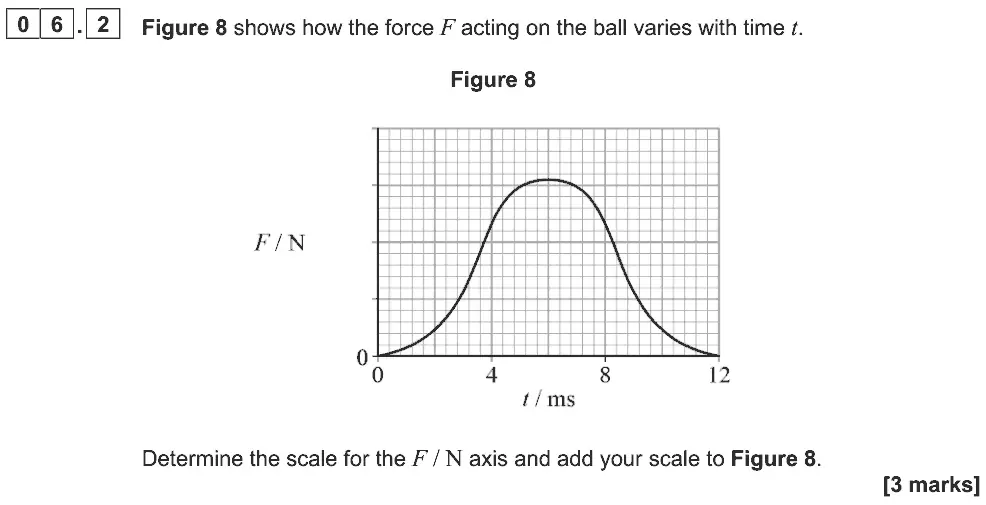
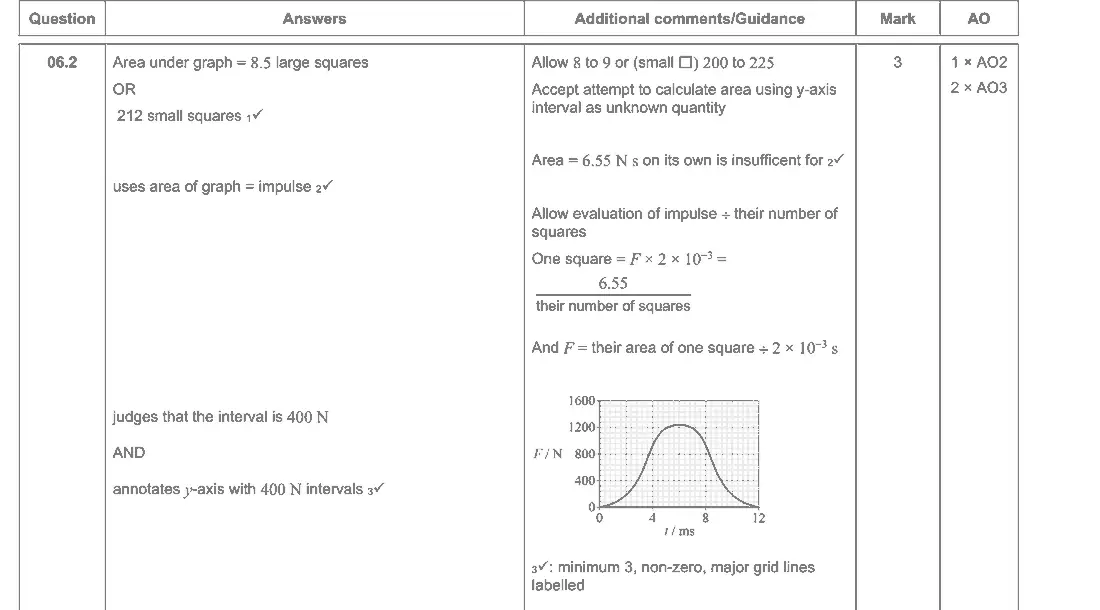
6.2 Newton's laws of motion and momentum 3AO2=1,AO3=2Diagram or graph
6.3 Motion along a straight line and projectile motion 3AO1=1,AO2=2Calculation
7.1 Circular motion, Work, energy, power and conservation of energy 2AO2=2Show that
7.2 Circular motion 1AO2=1Calculation
7.3 Circular motion 1AO3=1Short answer
7.4 Newton's laws of motion and momentum, Circular motion 2AO1=1,AO2=1Diagram or graph
7.5 Circular motion, Scalars, vectors and moments 2AO3=2Explanation
8.1 Work, energy, power and conservation of energy, Current, potential difference, I-V characteristics and resistivity 2AO2=2Calculation
8.2 Excitation, energy levels and wave-particle duality 1AO1=1Short answer
8.3 Excitation, energy levels and wave-particle duality 2AO1=1,AO3=1Explanation
8.4 Excitation, energy levels and wave-particle duality, Particles, antiparticles and particle interactions 3AO1=1,AO2=2Calculation
9 Classification of particles, quarks and conservation laws 1AO1=1Multiple choice
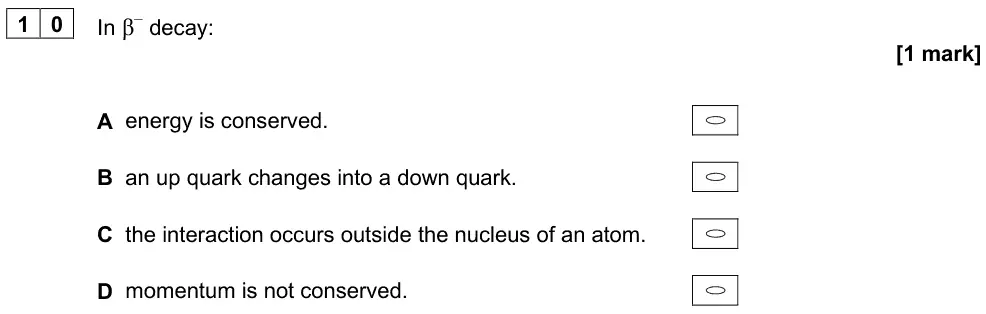
10 Classification of particles, quarks and conservation laws 1AO1=1Multiple choice
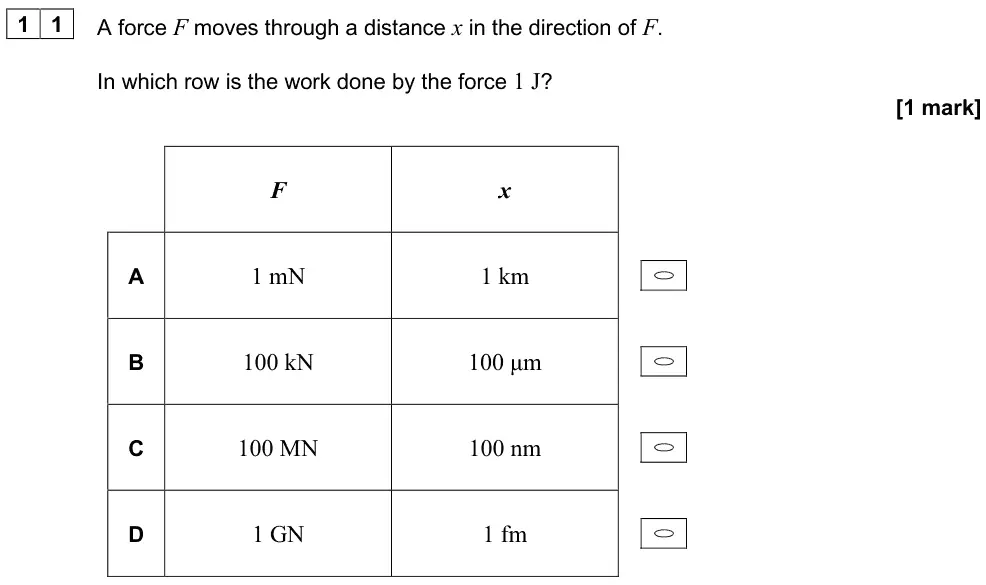
11 Work, energy, power and conservation of energy, Measurements, units and uncertainties 1AO1=1Multiple choice
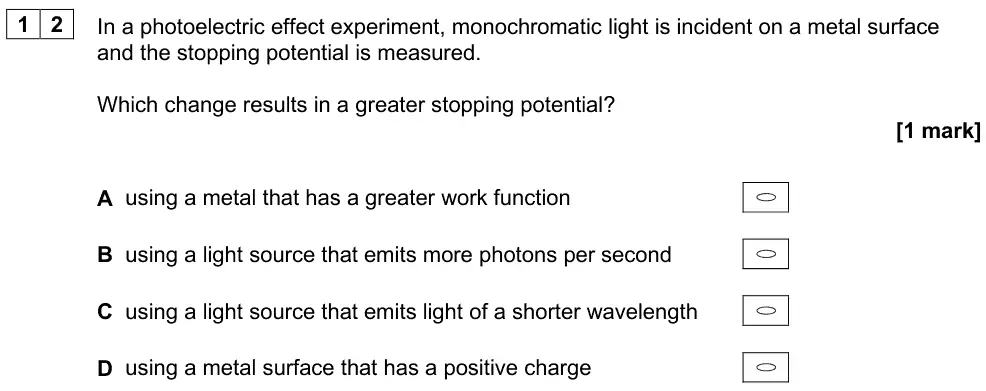
12 The photoelectric effect 1AO1=1Multiple choice
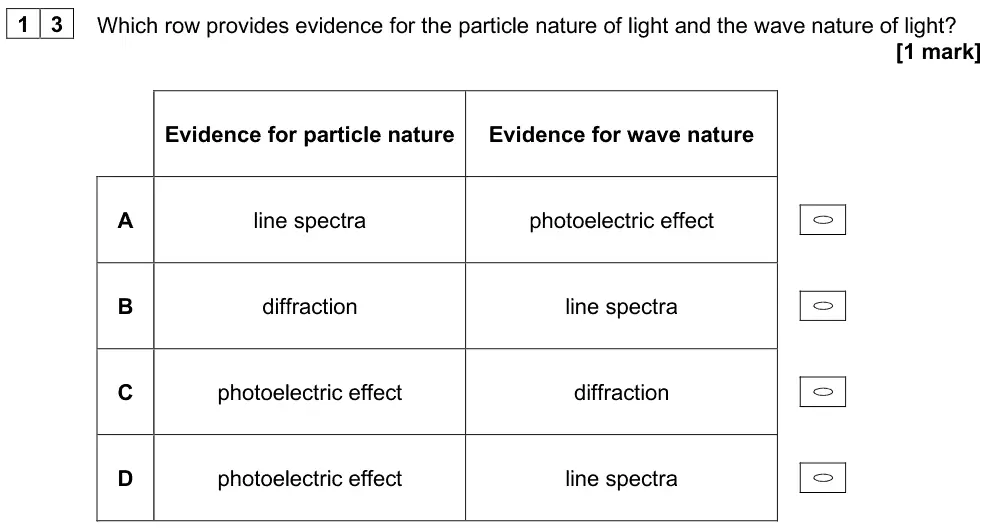
13 Excitation, energy levels and wave-particle duality 1AO1=1Multiple choice
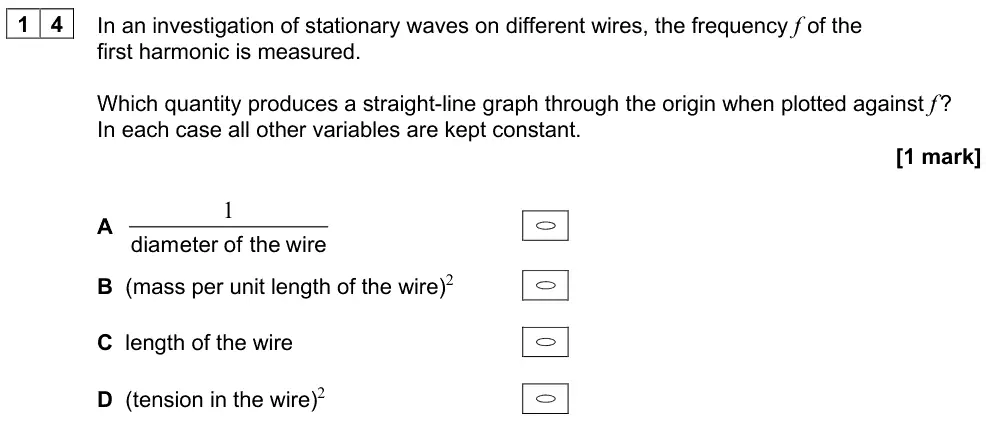
14 Superposition and stationary waves 1AO1=1Multiple choice
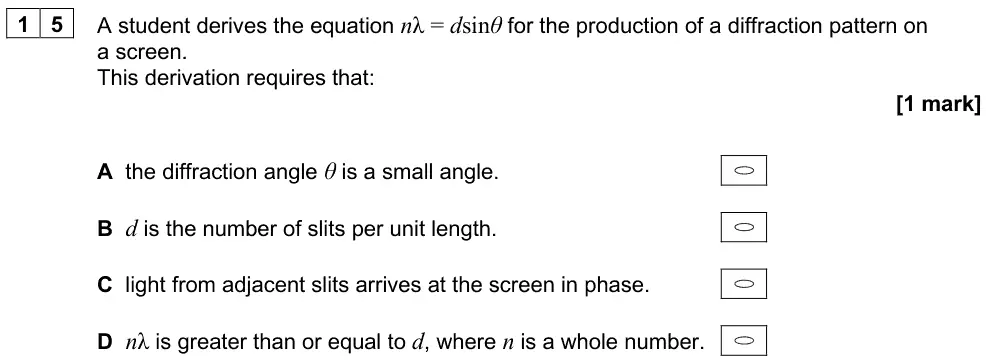
15 Interference, diffraction and the diffraction grating 1AO1=1Multiple choice
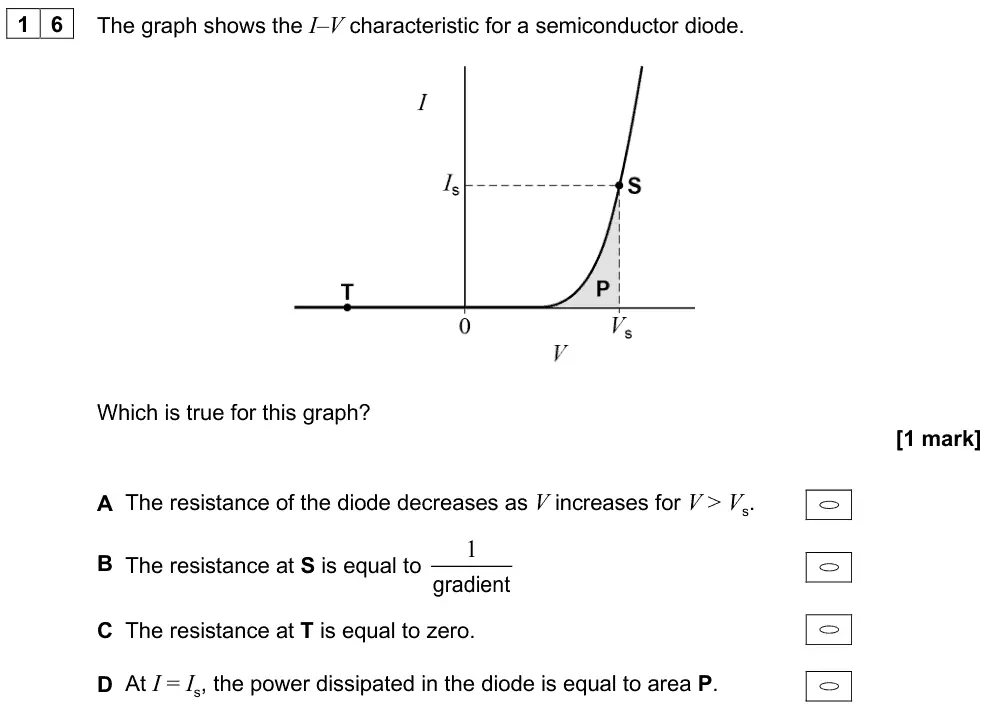
16 Current, potential difference, I-V characteristics and resistivity 1AO1=1Multiple choice
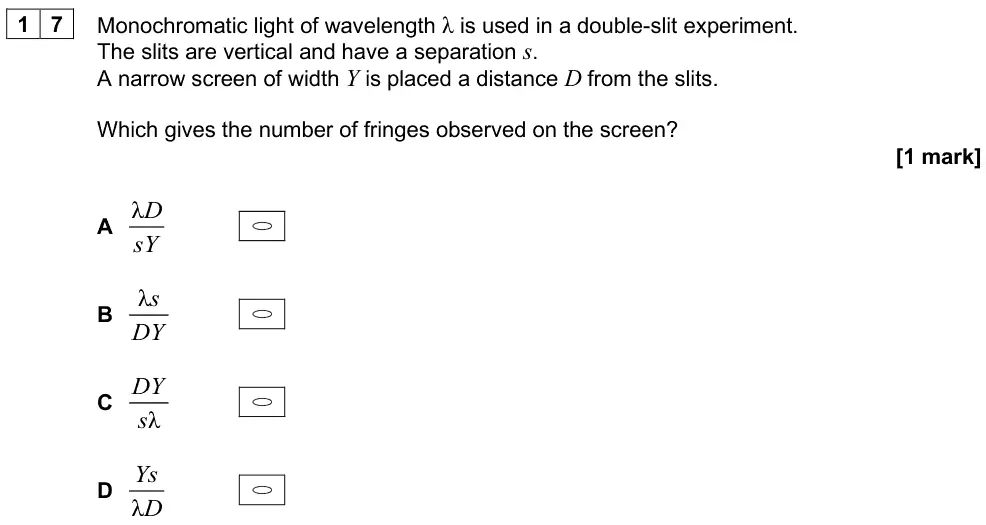
17 Interference, diffraction and the diffraction grating 1AO1=1Multiple choice
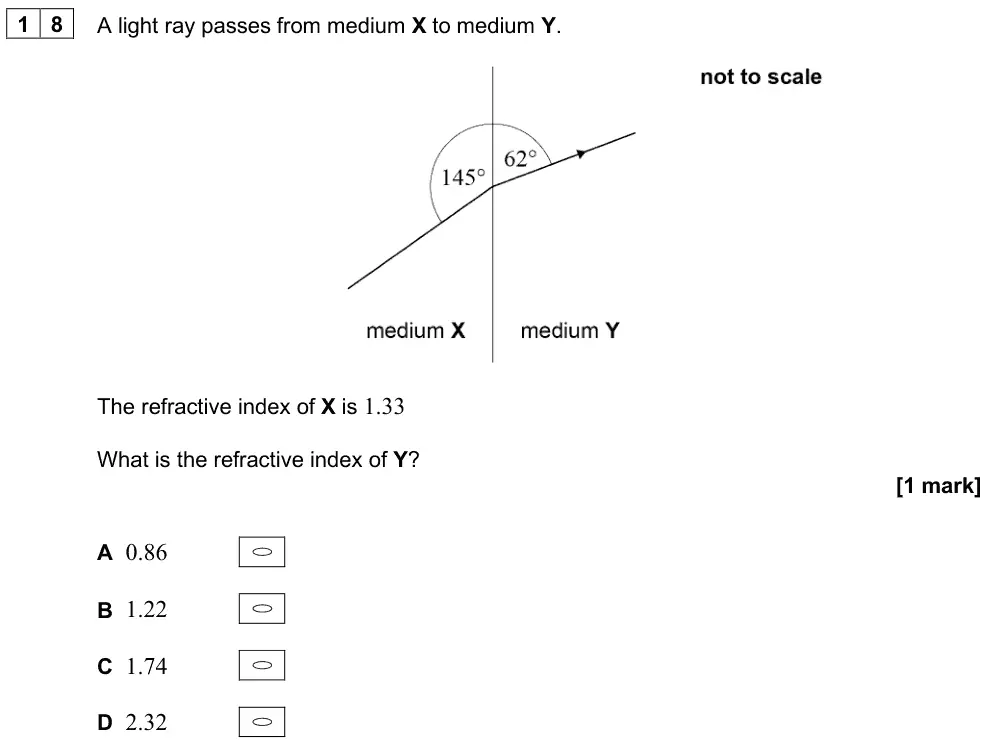
18 Refraction, total internal reflection and optical fibres 1AO2=1Multiple choice
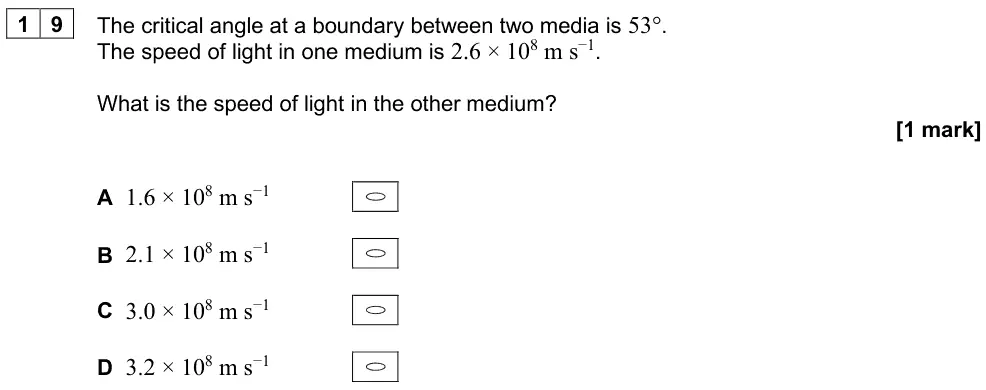
19 Refraction, total internal reflection and optical fibres 1AO2=1Multiple choice
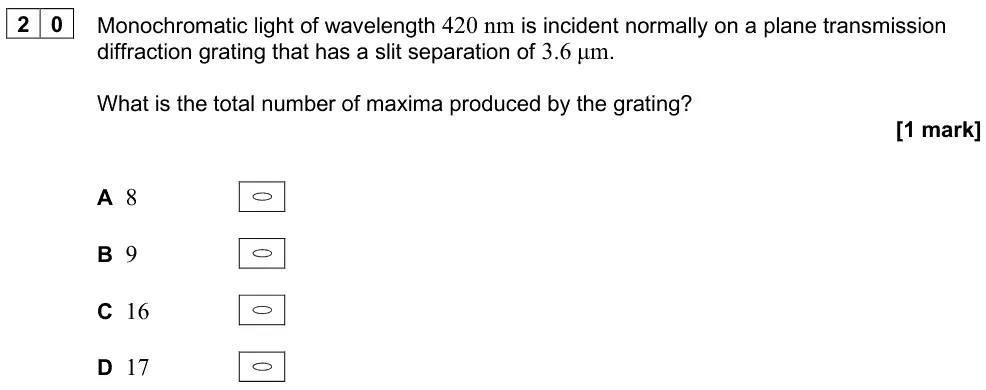
20 Interference, diffraction and the diffraction grating 1AO2=1Multiple choice
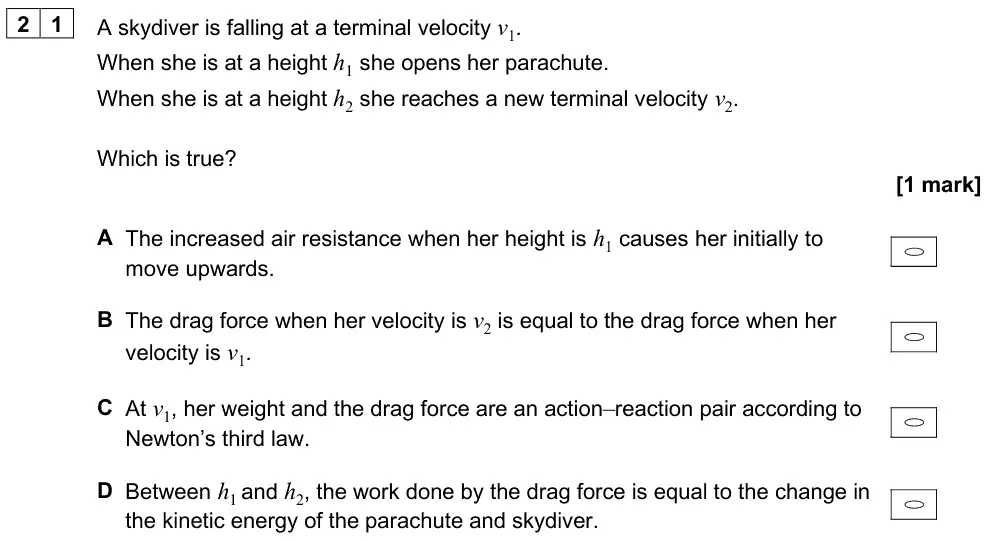
21 Motion along a straight line and projectile motion, Newton's laws of motion and momentum 1AO2=1Multiple choice
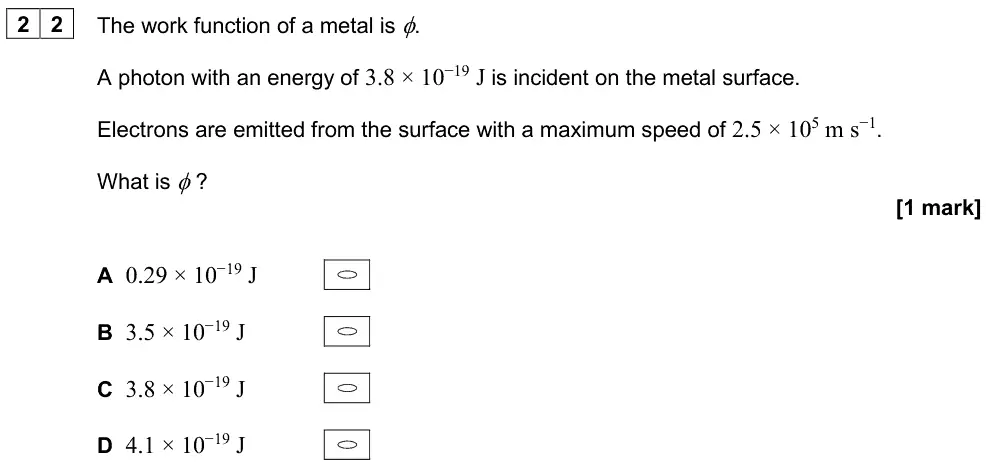
22 The photoelectric effect 1AO2=1Multiple choice
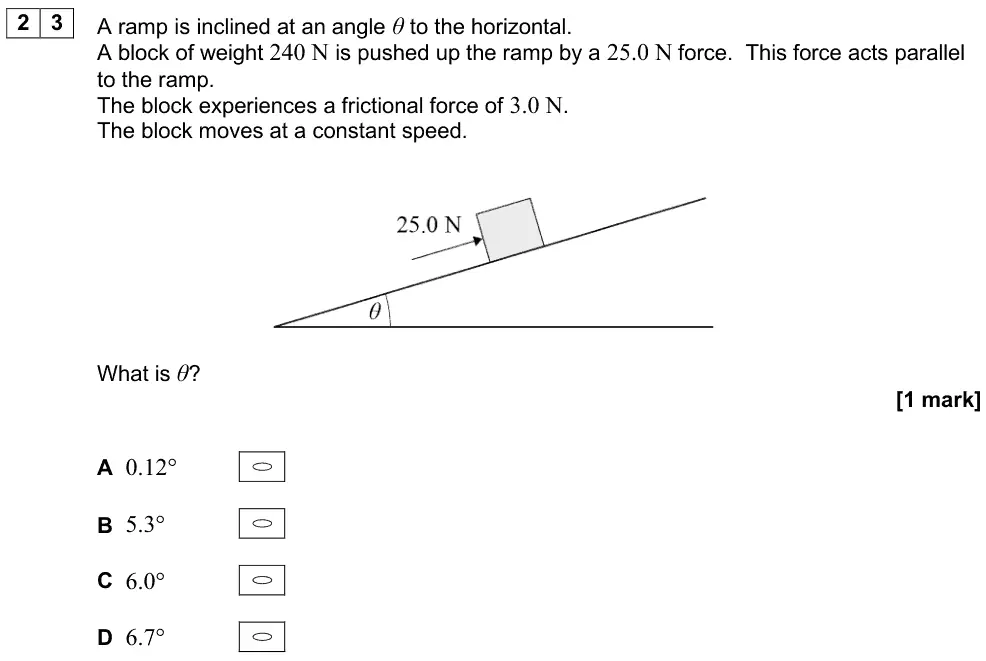
23 Scalars, vectors and moments 1AO2=1Multiple choice
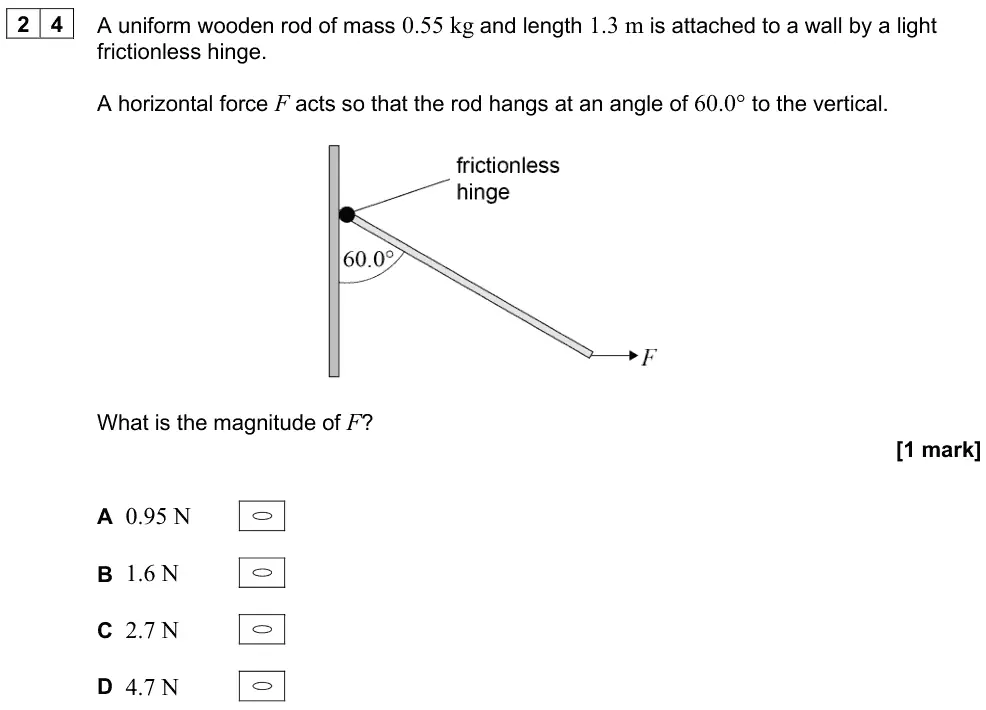
24 Scalars, vectors and moments 1AO2=1Multiple choice
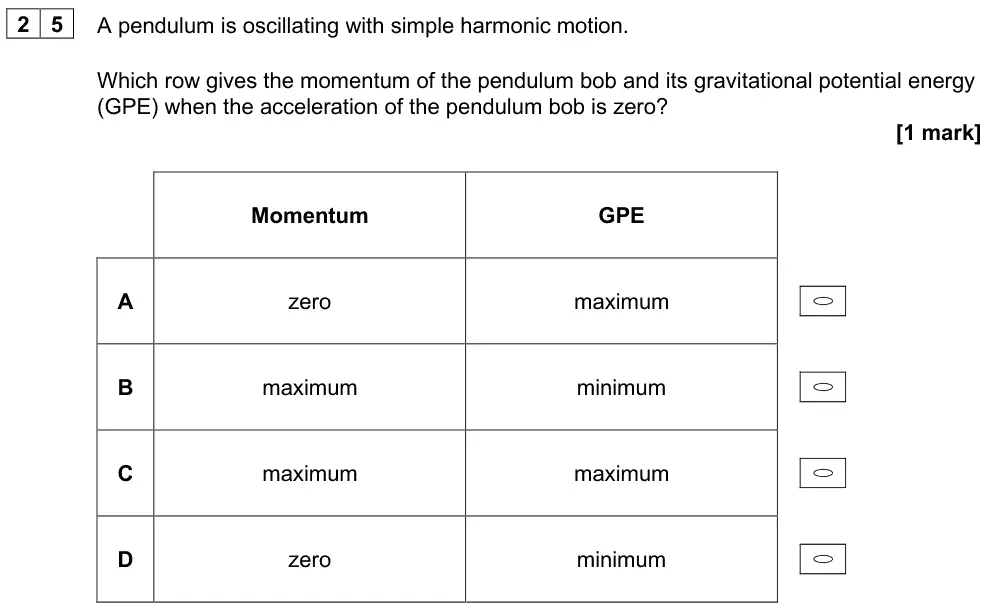
25 Simple harmonic motion, forced vibrations and resonance 1AO1=1Multiple choice
26 Current, potential difference, I-V characteristics and resistivity, Circuits and potential dividers 1AO2=1Multiple choice
27 Excitation, energy levels and wave-particle duality 1AO1=1Multiple choice
28 Circuits and potential dividers 1AO2=1Multiple choice
29 Current, potential difference, I-V characteristics and resistivity, Circuits and potential dividers 1AO1=1Multiple choice
30 The photoelectric effect 1AO1=1Multiple choice
31 Simple harmonic motion, forced vibrations and resonance 1AO2=1Multiple choice
32 Simple harmonic motion, forced vibrations and resonance 1AO2=1Multiple choice
33 Excitation, energy levels and wave-particle duality 1AO1=1Multiple choice

The questions

1.11.21.32.12.22.32.43.13.24.14.24.34.45.15.25.36.16.26.37.17.27.37.47.58.18.28.38.49101112131415161718192021222324252627282930313233
June 2025 · Paper 1 · Q1.1 3 marks AO2=3 Diagram or graph Hard particles antiparticles and interactions
This question is about an isotope of titanium that only decays by electron capture.
Complete Figure 1 to show the quark change that occurs during electron capture.
Label the incoming and outgoing particles and the exchange particle.
[3 marks]
Figure 1
June 2025 · Paper 1 · Q1.2 1 mark AO3=1 Explanation particles antiparticles and interactions
Earlier part of question 1 that this part usesEarlier part of June 2025 Paper 1 question 1
In some circumstances, a nucleus of this isotope can exist with no orbiting electrons.
Explain why a neutral atom of this isotope is less stable than a nucleus that has no
orbiting electrons.
[1 mark]
June 2025 · Paper 1 · Q1.3 2 marks AO2=1, AO3=1 Calculation Easy atomic structure and stable nuclei
Earlier part of question 1 that this part usesEarlier part of June 2025 Paper 1 question 1
A nucleus of this isotope of titanium has a proton number of 22 and a specific charge
of 4.8 × 10⁷ C kg−1.
Determine the number of neutrons in this nucleus.
[2 marks]
number of neutrons =
June 2025 · Paper 1 · Q2.1 2 marks AO1=2 Short answer progressive waves and polarisation
State what is meant by a transverse wave.
[2 marks]
June 2025 · Paper 1 · Q2.2 1 mark AO1=1 Explanation stationary waves
Earlier part of question 2 that this part usesEarlier part of June 2025 Paper 1 question 2
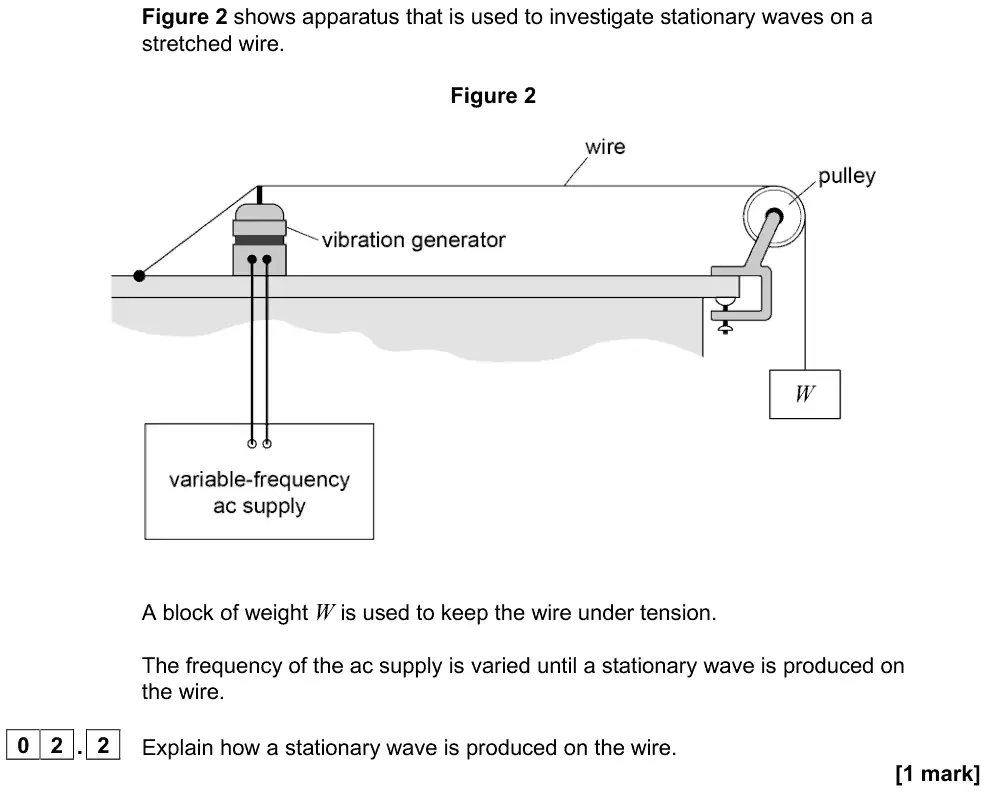
Figure 2 shows apparatus that is used to investigate stationary waves on a
stretched wire.
Figure 2
A block of weight W is used to keep the wire under tension.
The frequency of the ac supply is varied until a stationary wave is produced on
the wire.
Explain how a stationary wave is produced on the wire.
[1 mark]
June 2025 · Paper 1 · Q2.3 2 marks AO2=2 Explanation stationary wavesprogressive waves and polarisation
Earlier part of question 2 that this part usesEarlier part of June 2025 Paper 1 question 2
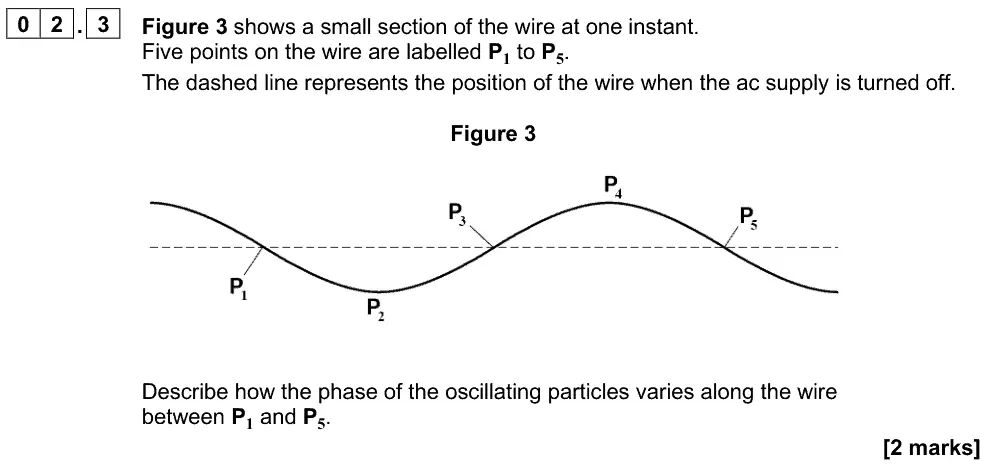
Figure 3 shows a small section of the wire at one instant.
Five points on the wire are labelled P1 to P5.
The dashed line represents the position of the wire when the ac supply is turned off.
Figure 3
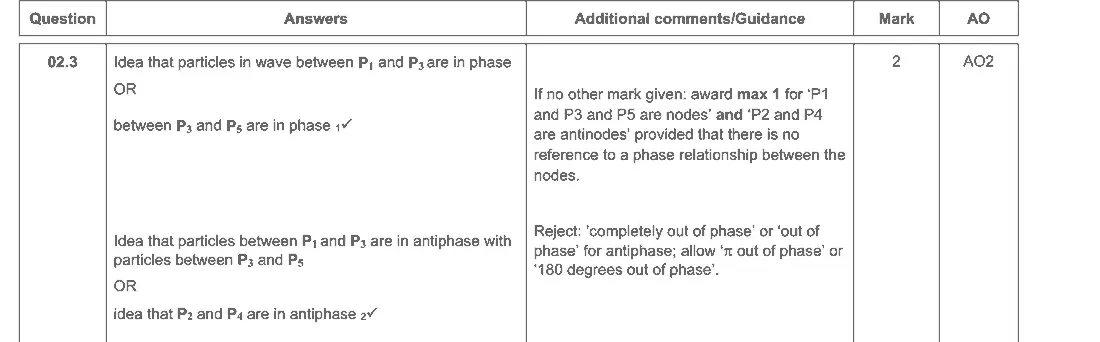
Describe how the phase of the oscillating particles varies along the wire
between P1 and P5.
[2 marks]
June 2025 · Paper 1 · Q2.4 5 marks AO1=1, AO3=4 Calculation stationary waves
Earlier part of question 2 that this part usesEarlier part of June 2025 Paper 1 question 2
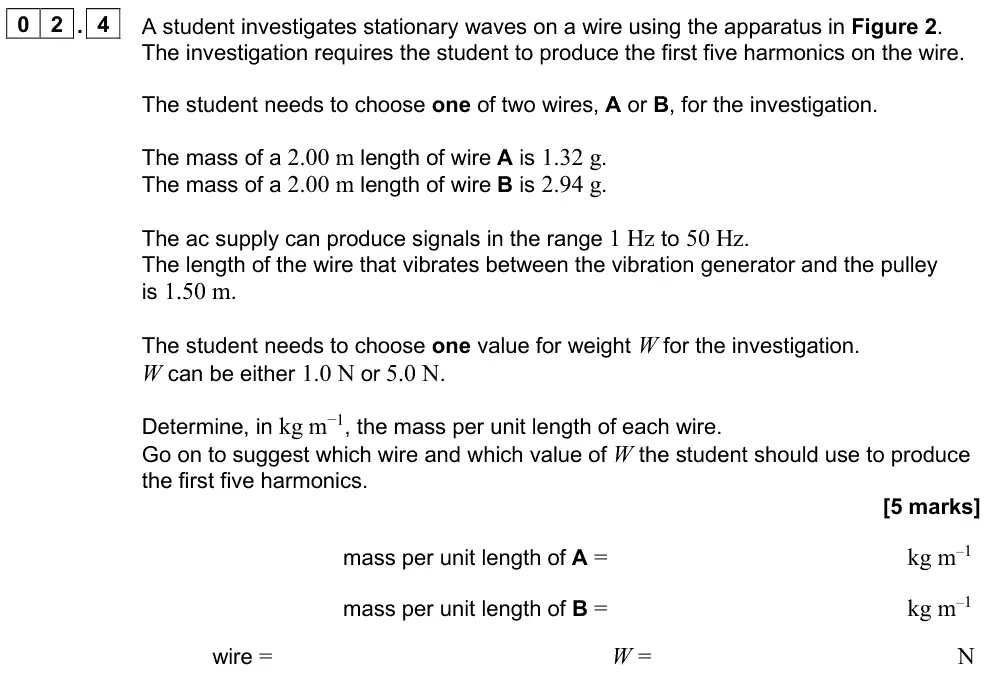
A student investigates stationary waves on a wire using the apparatus in Figure 2.
The investigation requires the student to produce the first five harmonics on the wire.
The student needs to choose one of two wires, A or B, for the investigation.
The mass of a 2.00 m length of wire A is 1.32 g.
The mass of a 2.00 m length of wire B is 2.94 g.
The ac supply can produce signals in the range 1 Hz to 50 Hz.
The length of the wire that vibrates between the vibration generator and the pulley
is 1.50 m.
The student needs to choose one value for weight W for the investigation.
W can be either 1.0 N or 5.0 N.
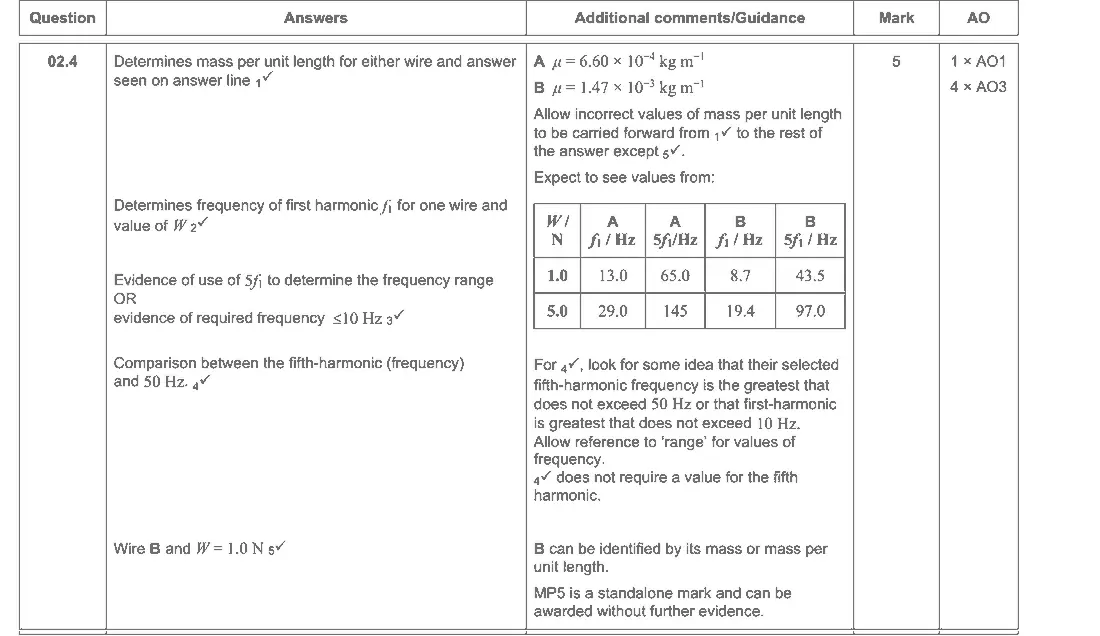
Determine, in kg m−1, the mass per unit length of each wire.
Go on to suggest which wire and which value of W the student should use to produce
the first five harmonics.
[5 marks]
mass per unit length of A =
kg m–1
mass per unit length of B =
kg m–1
wire =
W =
N
June 2025 · Paper 1 · Q3.1 4 marks AO1=2, AO2=2 Diagram or graph simple harmonic motion
A mass–spring system is undergoing simple harmonic motion (SHM).
The maximum velocity of the mass is 0.39 m s–1 and the period of oscillation is 0.81 s.
Draw, on Figure 4, a graph of acceleration against displacement for the system.
Label each axis with a suitable unit and scale.
[4 marks]
Figure 4
June 2025 · Paper 1 · Q3.2 1 mark AO1=1 Diagram or graph simple harmonic motion
Earlier part of question 3 that this part usesEarlier part of June 2025 Paper 1 question 3
Label, with a P, a point on your graph where the mass has 50% of its maximum
kinetic energy.
[1 mark]
June 2025 · Paper 1 · Q4.1 1 mark AO1=1 Short answer Easy materials and young modulus
Explain why the Young modulus and the breaking stress of a wire have the same
SI unit.
[1 mark]
June 2025 · Paper 1 · Q4.2 3 marks AO3=3 Calculation Easy materials and young modulus
Earlier part of question 4 that this part usesEarlier part of June 2025 Paper 1 question 4
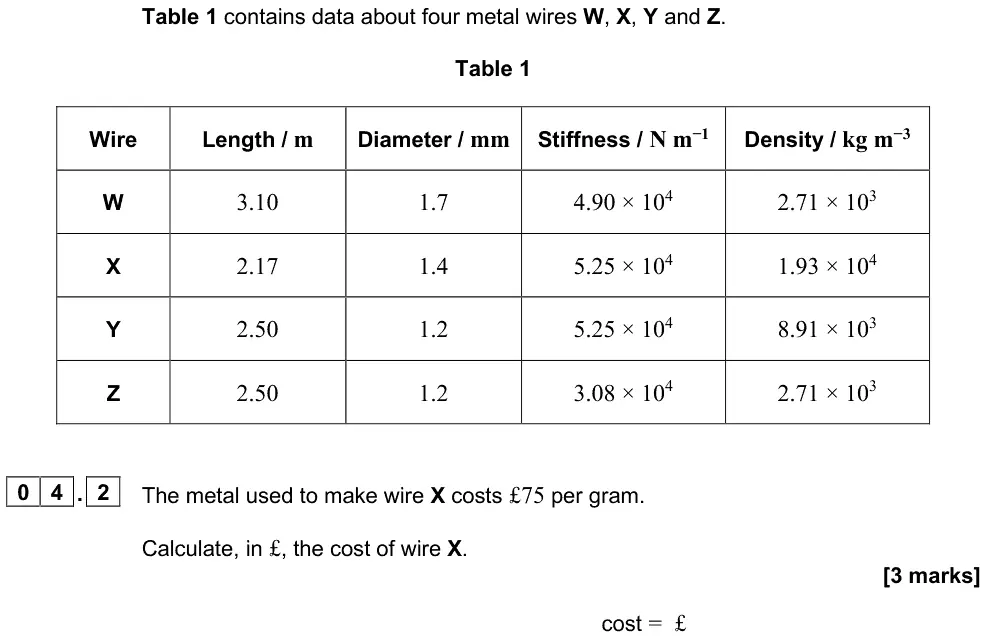
Table 1 contains data about four metal wires W, X, Y and Z.
Table 1
Wire
Length / m
Diameter / mm
Stiffness / N m−1
Density / kg m−3
W
3.10
1.7
4.90 × 10⁴
2.71 × 103
X
2.17
1.4
5.25 × 10⁴
1.93 × 10⁴
Y
2.50
1.2
5.25 × 10⁴
8.91 × 10³
Z
2.50
1.2
3.08 × 10⁴
2.71 × 10³
The metal used to make wire X costs £75 per gram.
Calculate, in £, the cost of wire X.
[3 marks]
cost = £
June 2025 · Paper 1 · Q4.3 1 mark AO1=1 Short answer materials and young modulus
Earlier part of question 4 that this part usesEarlier part of June 2025 Paper 1 question 4
State and explain which of the wires in Table 1 are made from the same material.
[1 mark]
June 2025 · Paper 1 · Q4.4 4 marks AO3=4 Practical and data analysis materials and young modulus
Earlier part of question 4 that this part usesEarlier part of June 2025 Paper 1 question 4
One of the wires in Table 1 was used to obtain the stress–strain data shown
in Figure 5.
Figure 5
Draw a line of best fit on Figure 5.
Go on to deduce, using your line of best fit and Table 1, whether wire W could have
been used to produce Figure 5.
[4 marks]
June 2025 · Paper 1 · Q5.1 1 mark AO1=1 Calculation Easy emf and internal resistance
This question is about the batteries used to store energy in electric vehicles.
Each battery is a series of modules.  Each module is an array of identical cells.
Table 2 shows the properties of one of these cells.
Table 2
emf
3.66 V
internal resistance
30.0 mΩ
maximum current
6.77 A
Calculate the terminal potential difference of the cell at its maximum current.
[1 mark]
terminal potential difference =
V
June 2025 · Paper 1 · Q5.2 2 marks AO1=1, AO2=1 Calculation circuits and potential dividersemf and internal resistance
Earlier part of question 5 that this part usesEarlier part of June 2025 Paper 1 question 5
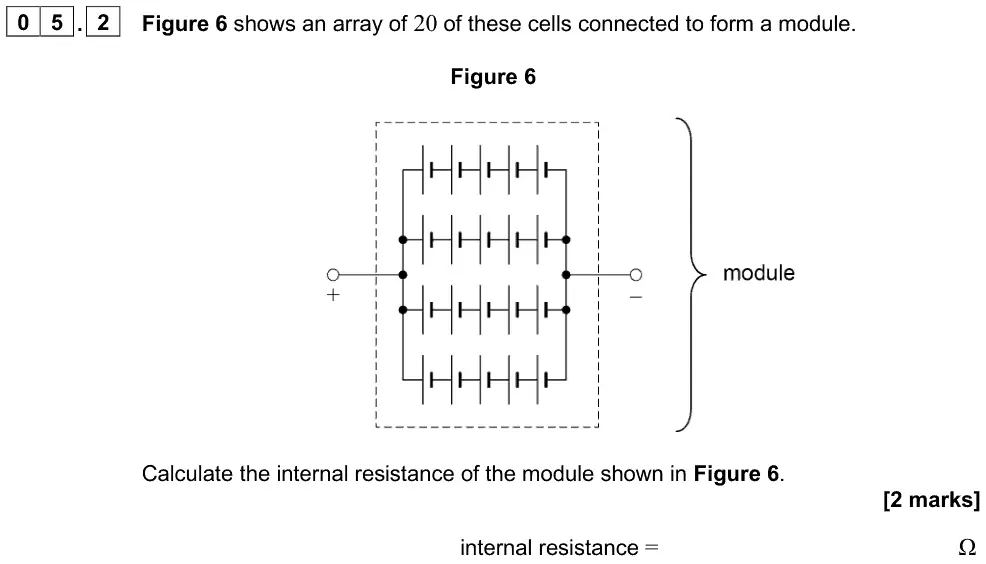
Figure 6 shows an array of 20 of these cells connected to form a module.
Figure 6
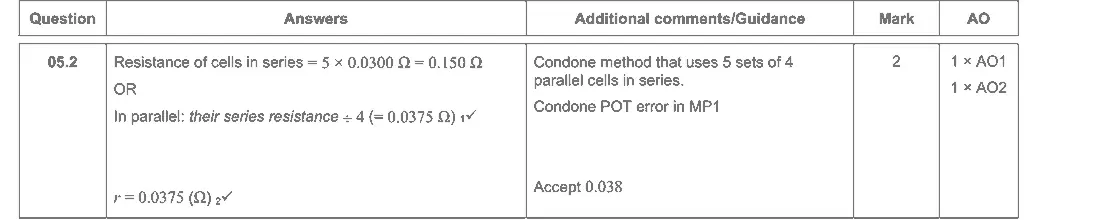
Calculate the internal resistance of the module shown in Figure 6.
[2 marks]
internal resistance =
Ω
June 2025 · Paper 1 · Q5.3 3 marks AO3=3 Calculation circuits and potential dividersemf and internal resistance
Earlier part of question 5 that this part usesEarlier part of June 2025 Paper 1 question 5
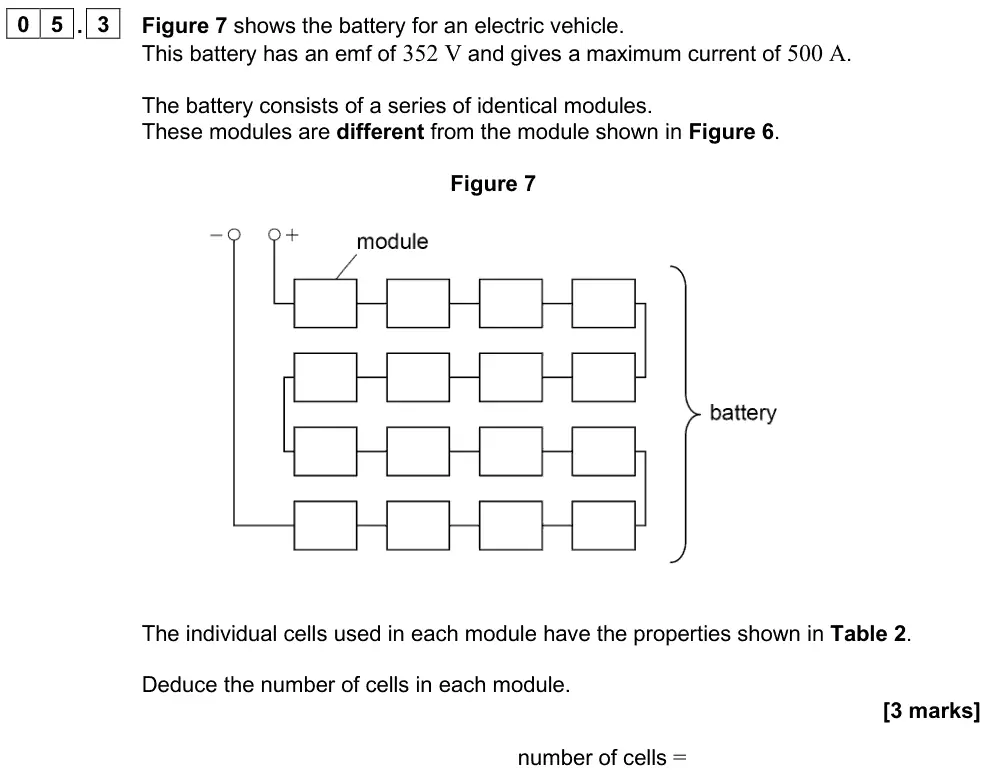
Figure 7 shows the battery for an electric vehicle.
This battery has an emf of 352 V and gives a maximum current of 500 A.
The battery consists of a series of identical modules.
These modules are different from the module shown in Figure 6.
Figure 7
The individual cells used in each module have the properties shown in Table 2.
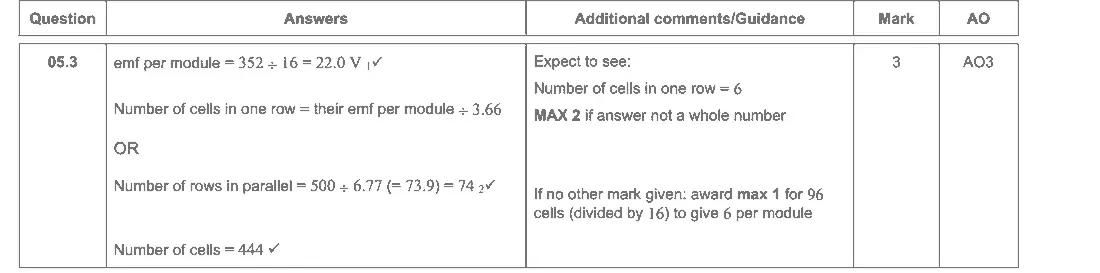
Deduce the number of cells in each module.
[3 marks]
number of cells =
June 2025 · Paper 1 · Q6.1 2 marks AO1=1, AO2=1 Calculation Easy newtons laws and momentumwork energy and power
A person kicks a stationary football horizontally.
During the kick, the person gives an impulse of 6.55 N s to the ball during a contact
time of 12.0 ms.
The mass of the football is 410 g.
Assume that friction forces are negligible.
Calculate the kinetic energy transferred to the ball during the kick.
[2 marks]
kinetic energy =
J
June 2025 · Paper 1 · Q6.2 3 marks AO2=1, AO3=2 Diagram or graph Hard newtons laws and momentum
Earlier part of question 6 that this part usesEarlier part of June 2025 Paper 1 question 6
Figure 8 shows how the force F acting on the ball varies with time t.
Figure 8
Determine the scale for the F / N axis and add your scale to Figure 8.
[3 marks]
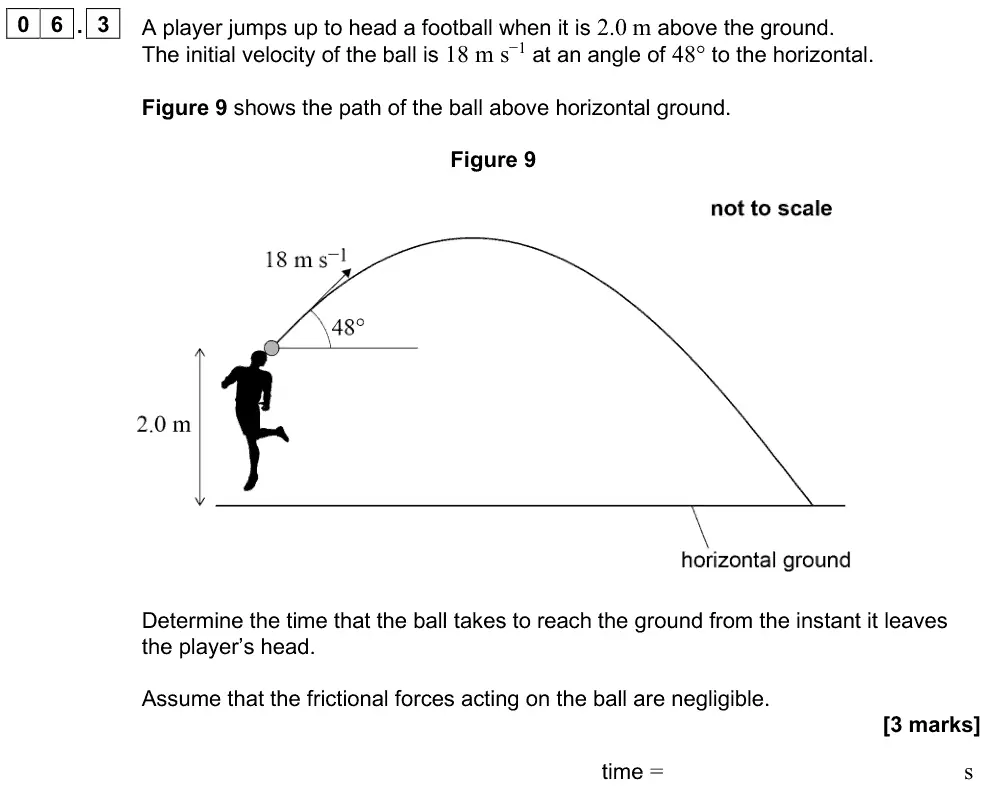
June 2025 · Paper 1 · Q6.3 3 marks AO1=1, AO2=2 Calculation motion and projectiles
Earlier part of question 6 that this part usesEarlier part of June 2025 Paper 1 question 6
A player jumps up to head a football when it is 2.0 m above the ground.
The initial velocity of the ball is 18 m s−1 at an angle of 48° to the horizontal.
Figure 9 shows the path of the ball above horizontal ground.
Figure 9
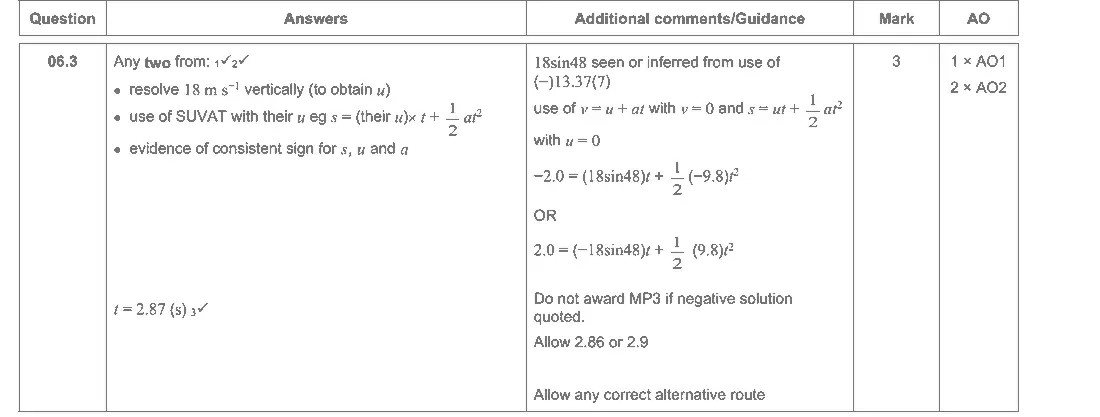
Determine the time that the ball takes to reach the ground from the instant it leaves
the player’s head.
Assume that the frictional forces acting on the ball are negligible.
[3 marks]
time =
s
June 2025 · Paper 1 · Q7.1 2 marks AO2=2 Show that circular motionwork energy and power
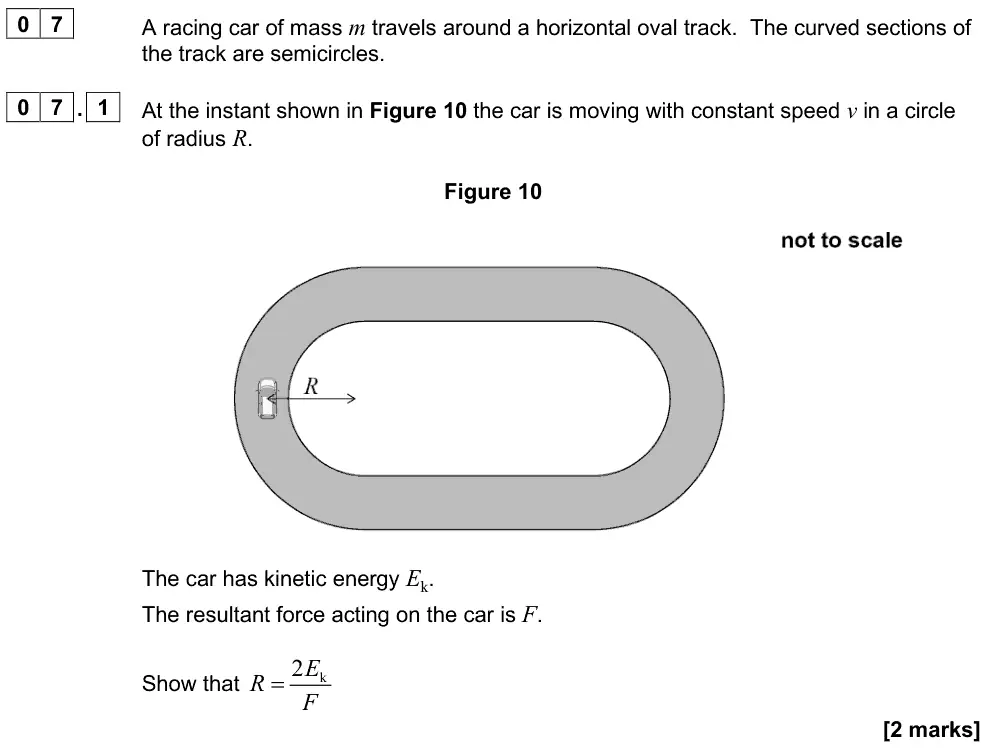
A racing car of mass m travels around a horizontal oval track.  The curved sections of
the track are semicircles.
At the instant shown in Figure 10 the car is moving with constant speed v in a circle
of radius R.
Figure 10
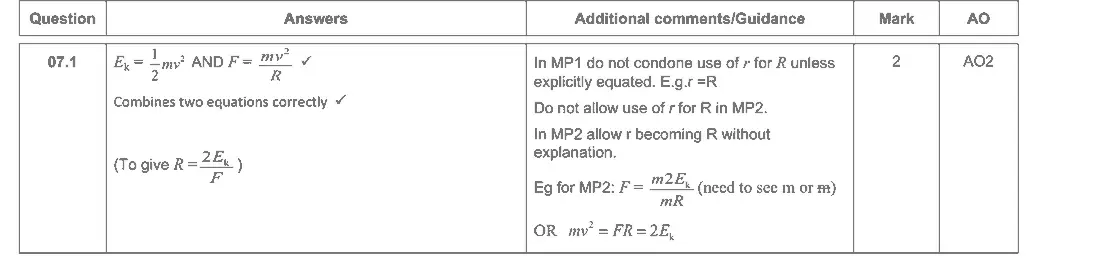
The car has kinetic energy Ek.
The resultant force acting on the car is F.
Show that
k
2E
R
F
=
[2 marks]
June 2025 · Paper 1 · Q7.2 1 mark AO2=1 Calculation Easy circular motion
Earlier part of question 7 that this part usesEarlier part of June 2025 Paper 1 question 7
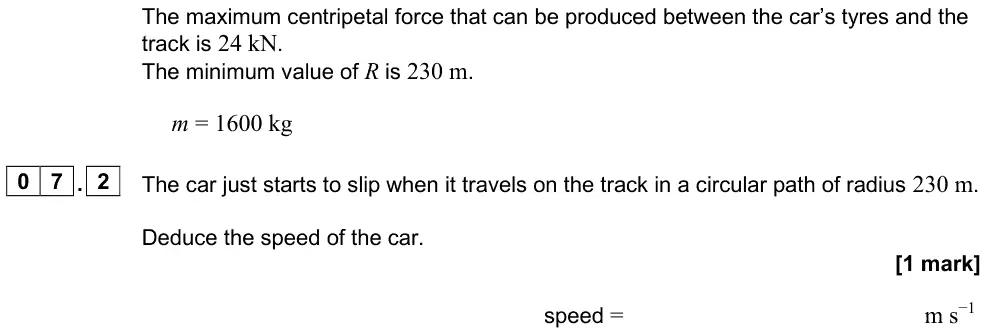
The maximum centripetal force that can be produced between the car’s tyres and the
track is 24 kN.
The minimum value of R is 230 m.
m = 1600 kg
The car just starts to slip when it travels on the track in a circular path of radius 230 m.
Deduce the speed of the car.
[1 mark]
speed =
m s−1
June 2025 · Paper 1 · Q7.3 1 mark AO3=1 Short answer circular motion
Earlier part of question 7 that this part usesEarlier part of June 2025 Paper 1 question 7
The driver wishes to drive this car around the curved section of the track, without
slipping, at a speed greater than your answer to Question 07.2.
Suggest one way in which the driver can achieve this.
[1 mark]
June 2025 · Paper 1 · Q7.4 2 marks AO1=1, AO2=1 Diagram or graph newtons laws and momentumcircular motion
Earlier part of question 7 that this part usesEarlier part of June 2025 Paper 1 question 7
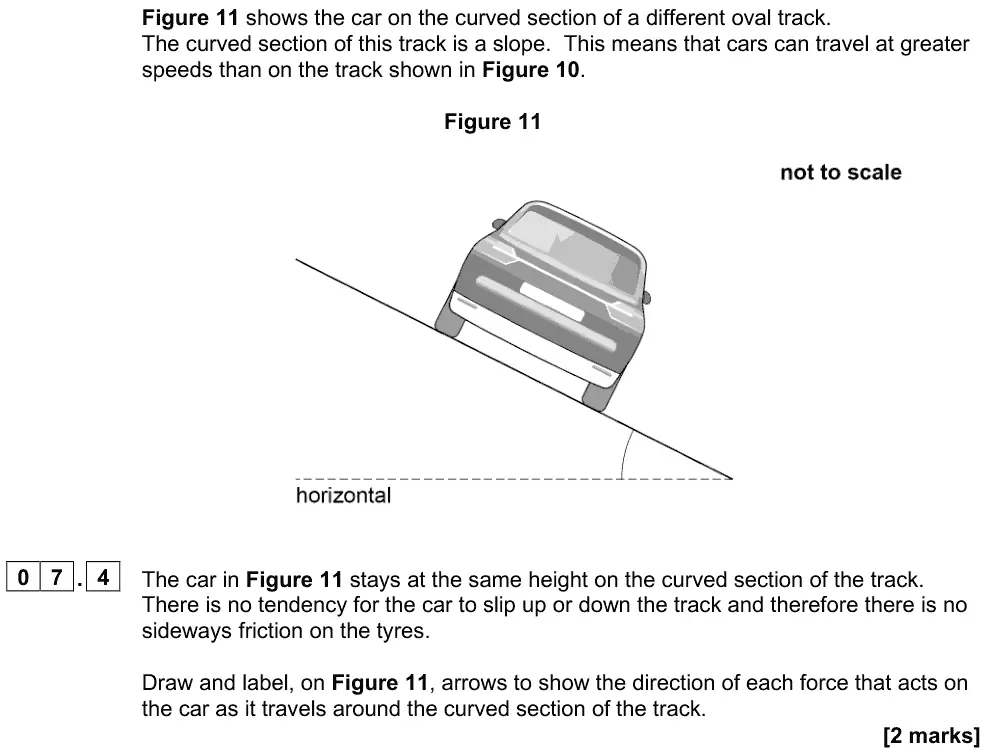
Figure 11 shows the car on the curved section of a different oval track.
The curved section of this track is a slope.  This means that cars can travel at greater
speeds than on the track shown in Figure 10.
Figure 11
The car in Figure 11 stays at the same height on the curved section of the track.
There is no tendency for the car to slip up or down the track and therefore there is no
sideways friction on the tyres.
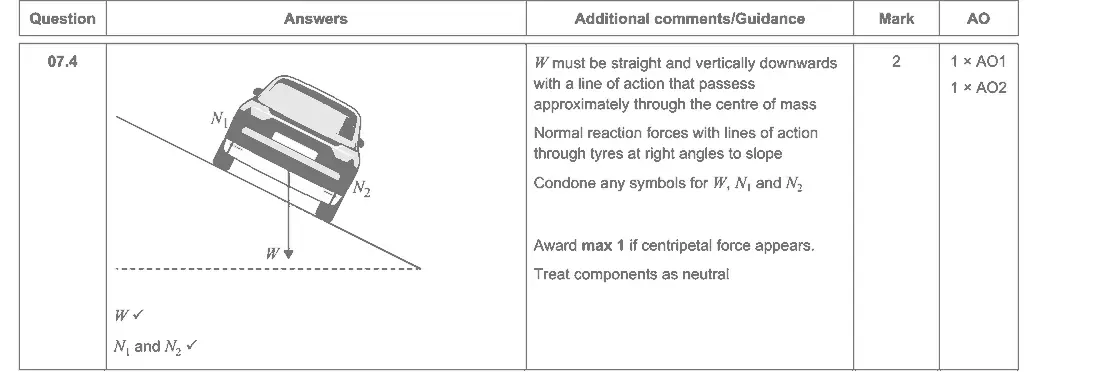
Draw and label, on Figure 11, arrows to show the direction of each force that acts on
the car as it travels around the curved section of the track.
[2 marks]
June 2025 · Paper 1 · Q7.5 2 marks AO3=2 Explanation circular motionvectors and moments
Earlier part of question 7 that this part usesEarlier part of June 2025 Paper 1 question 7
A car has a greater maximum speed on a sloped track than on a horizontal track of
the same radius.
Explain why.
[2 marks]
June 2025 · Paper 1 · Q8.1 2 marks AO2=2 Calculation Easy work energy and powercurrent voltage and resistivity
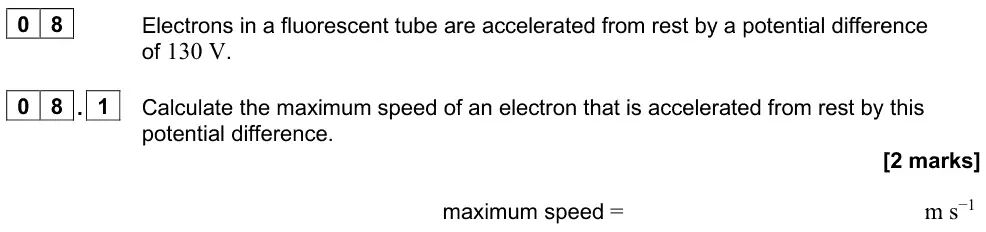
Electrons in a fluorescent tube are accelerated from rest by a potential difference
of 130 V.
Calculate the maximum speed of an electron that is accelerated from rest by this
potential difference.
[2 marks]
maximum speed =
m s−1
June 2025 · Paper 1 · Q8.2 1 mark AO1=1 Short answer energy levels and wave particle duality
Earlier part of question 8 that this part usesEarlier part of June 2025 Paper 1 question 8
Explain why the average speed of the electrons in the tube is much less than the
maximum speed you calculated in Question 08.1.
[1 mark]
June 2025 · Paper 1 · Q8.3 2 marks AO1=1, AO3=1 Explanation energy levels and wave particle duality
Earlier part of question 8 that this part usesEarlier part of June 2025 Paper 1 question 8
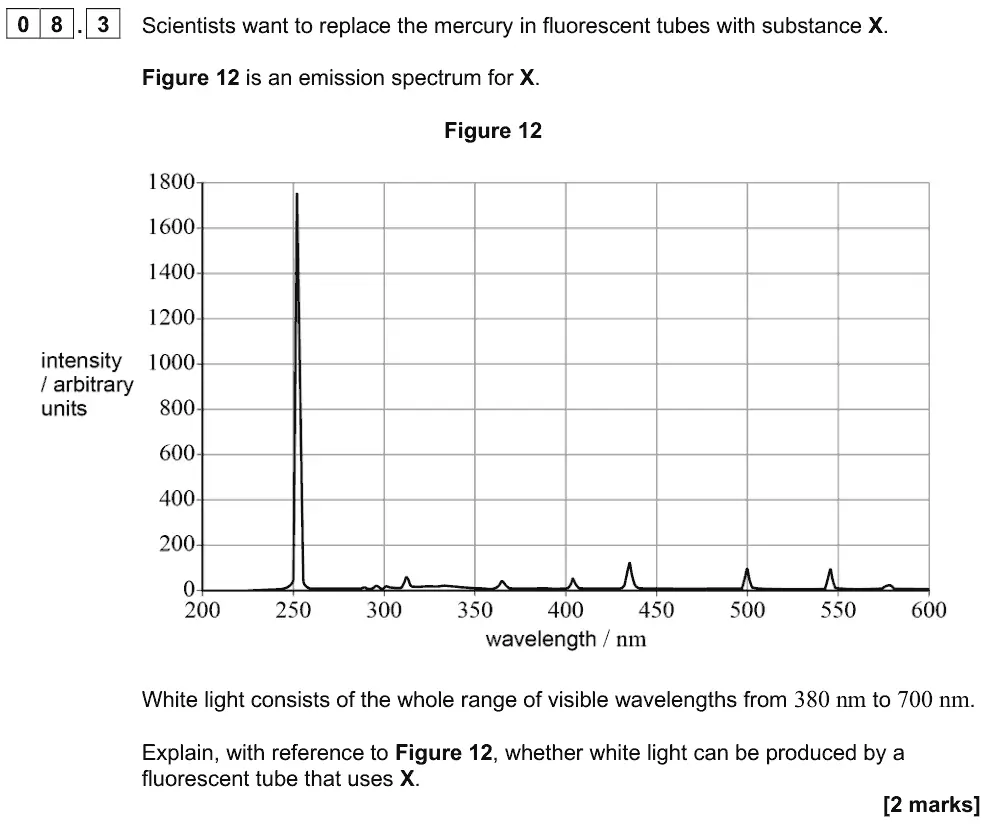
Scientists want to replace the mercury in fluorescent tubes with substance X.
Figure 12 is an emission spectrum for X.
Figure 12
White light consists of the whole range of visible wavelengths from 380 nm to 700 nm.
Explain, with reference to Figure 12, whether white light can be produced by a
fluorescent tube that uses X.
[2 marks]
June 2025 · Paper 1 · Q8.4 3 marks AO1=1, AO2=2 Calculation Easy energy levels and wave particle dualityparticles antiparticles and interactions
Earlier part of question 8 that this part usesEarlier part of June 2025 Paper 1 question 8
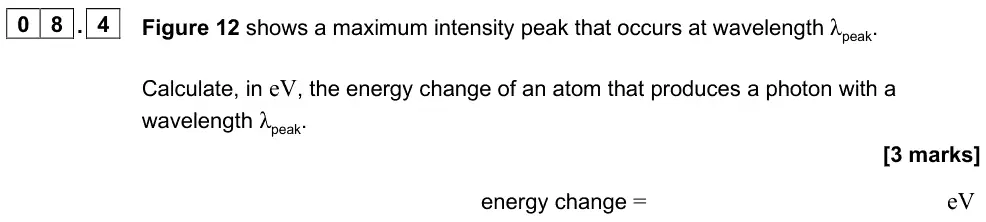
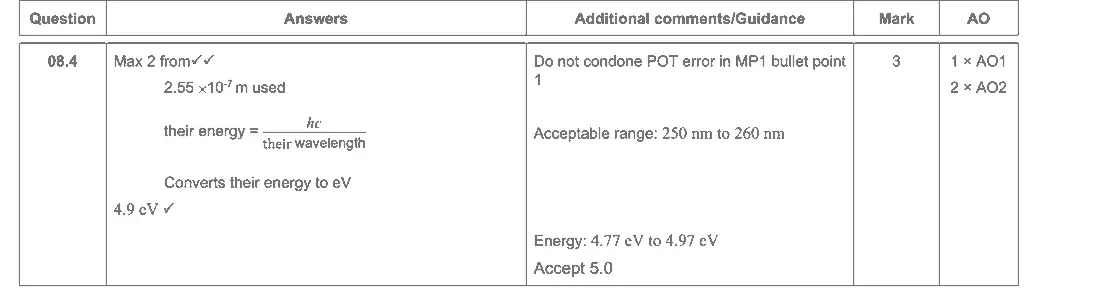
Figure 12 shows a maximum intensity peak that occurs at wavelength λpeak.
Calculate, in eV, the energy change of an atom that produces a photon with a
wavelength λpeak.
[3 marks]
energy change =
eV
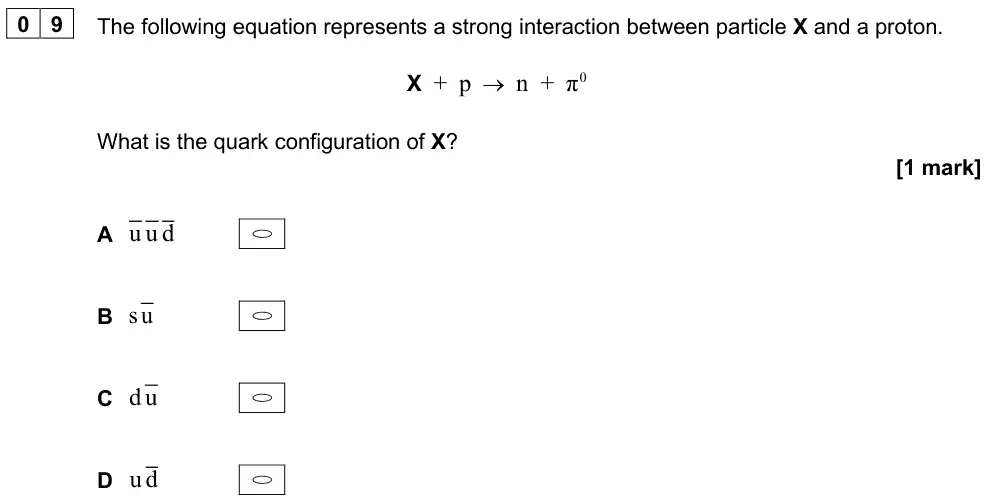
June 2025 · Paper 1 · Q9 1 mark AO1=1 Multiple choice classification of particles and quarks
The following equation represents a strong interaction between particle X and a proton.
0
+ p
n + π
→
X
What is the quark configuration of X?
[1 mark]
A u u d
B su
C d u
D u d
June 2025 · Paper 1 · Q10 1 mark AO1=1 Multiple choice classification of particles and quarks
In β− decay:
[1 mark]
A energy is conserved.
B an up quark changes into a down quark.
C the interaction occurs outside the nucleus of an atom.
D momentum is not conserved.
June 2025 · Paper 1 · Q11 1 mark AO1=1 Multiple choice work energy and powermeasurements and uncertainties
A force F moves through a distance x in the direction of F.
In which row is the work done by the force 1 J?
[1 mark]
F
x
A
1 mN
1 km
B
100 kN
100 μm
C
100 MN
100 nm
D
1 GN
1 fm
June 2025 · Paper 1 · Q12 1 mark AO1=1 Multiple choice photoelectric effect
In a photoelectric effect experiment, monochromatic light is incident on a metal surface
and the stopping potential is measured.
Which change results in a greater stopping potential?
[1 mark]
A using a metal that has a greater work function
B using a light source that emits more photons per second
C using a light source that emits light of a shorter wavelength
D using a metal surface that has a positive charge
June 2025 · Paper 1 · Q13 1 mark AO1=1 Multiple choice energy levels and wave particle duality
Which row provides evidence for the particle nature of light and the wave nature of light?
[1 mark]
Evidence for particle nature
Evidence for wave nature
A
line spectra
photoelectric effect
B
diffraction
line spectra
C
photoelectric effect
diffraction
D
photoelectric effect
line spectra
June 2025 · Paper 1 · Q14 1 mark AO1=1 Multiple choice stationary waves
In an investigation of stationary waves on different wires, the frequency f of the
first harmonic is measured.
Which quantity produces a straight-line graph through the origin when plotted against f ?
In each case all other variables are kept constant.
[1 mark]
A
1
diameter of the wire
B (mass per unit length of the wire)2
C length of the wire
D (tension in the wire)2
June 2025 · Paper 1 · Q15 1 mark AO1=1 Multiple choice interference and diffraction
A student derives the equation nλ = dsinθ for the production of a diffraction pattern on
a screen.
This derivation requires that:
[1 mark]
A the diffraction angle θ is a small angle.
B d is the number of slits per unit length.
C light from adjacent slits arrives at the screen in phase.
D nλ is greater than or equal to d, where n is a whole number.
June 2025 · Paper 1 · Q16 1 mark AO1=1 Multiple choice current voltage and resistivity
The graph shows the I–V characteristic for a semiconductor diode.
Which is true for this graph?
[1 mark]
A The resistance of the diode decreases as V increases for V > Vs.
B The resistance at S is equal to
1
gradient
C The resistance at T is equal to zero.
D At I = Is, the power dissipated in the diode is equal to area P.
June 2025 · Paper 1 · Q17 1 mark AO1=1 Multiple choice interference and diffraction
Monochromatic light of wavelength λ is used in a double-slit experiment.
The slits are vertical and have a separation s.
A narrow screen of width Y is placed a distance D from the slits.
Which gives the number of fringes observed on the screen?
[1 mark]
A λD
sY
B λs
DY
C
λ
DY
s
D λ
Ys
D
June 2025 · Paper 1 · Q18 1 mark AO2=1 Multiple choice refraction and optical fibres
A light ray passes from medium X to medium Y.
The refractive index of X is 1.33
What is the refractive index of Y?
[1 mark]
A 0.86
B 1.22
C 1.74
D 2.32
June 2025 · Paper 1 · Q19 1 mark AO2=1 Multiple choice refraction and optical fibres
The critical angle at a boundary between two media is 53°.
The speed of light in one medium is 2.6 × 10⁸ m s−1.
What is the speed of light in the other medium?
[1 mark]
A 1.6 × 10⁸ m s−1
B 2.1 × 10⁸ m s−1
C 3.0 × 10⁸ m s−1
D 3.2 × 10⁸ m s−1
June 2025 · Paper 1 · Q20 1 mark AO2=1 Multiple choice interference and diffraction
Monochromatic light of wavelength 420 nm is incident normally on a plane transmission
diffraction grating that has a slit separation of 3.6 μm.
What is the total number of maxima produced by the grating?
[1 mark]
A 8
B 9
C 16
D 17
June 2025 · Paper 1 · Q21 1 mark AO2=1 Multiple choice motion and projectilesnewtons laws and momentum
A skydiver is falling at a terminal velocity v1.
When she is at a height h1 she opens her parachute.
When she is at a height h2 she reaches a new terminal velocity v2.
Which is true?
[1 mark]
A The increased air resistance when her height is h1 causes her initially to
move upwards.
B The drag force when her velocity is v2 is equal to the drag force when her
velocity is v1.
C At v1, her weight and the drag force are an action–reaction pair according to
Newton’s third law.
D Between h1 and h2, the work done by the drag force is equal to the change in
the kinetic energy of the parachute and skydiver.
June 2025 · Paper 1 · Q22 1 mark AO2=1 Multiple choice photoelectric effect
The work function of a metal is .
A photon with an energy of 3.8 × 10⁻¹⁹ J is incident on the metal surface.
Electrons are emitted from the surface with a maximum speed of 2.5 × 10⁵ m s−1.
What is  ?
[1 mark]
A 0.29 × 10⁻¹⁹ J
B 3.5 × 10⁻¹⁹ J
C 3.8 × 10⁻¹⁹ J
D 4.1 × 10⁻¹⁹ J
June 2025 · Paper 1 · Q23 1 mark AO2=1 Multiple choice vectors and moments
A ramp is inclined at an angle θ to the horizontal.
A block of weight 240 N is pushed up the ramp by a 25.0 N force.  This force acts parallel
to the ramp.
The block experiences a frictional force of 3.0 N.
The block moves at a constant speed.
What is θ?
[1 mark]
A 0.12°
B 5.3°
C 6.0°
D 6.7°
June 2025 · Paper 1 · Q24 1 mark AO2=1 Multiple choice vectors and moments
A uniform wooden rod of mass 0.55 kg and length 1.3 m is attached to a wall by a light
frictionless hinge.
A horizontal force F acts so that the rod hangs at an angle of 60.0° to the vertical.
What is the magnitude of F?
[1 mark]
A 0.95 N
B 1.6 N
C 2.7 N
D 4.7 N
June 2025 · Paper 1 · Q25 1 mark AO1=1 Multiple choice simple harmonic motion
A pendulum is oscillating with simple harmonic motion.
Which row gives the momentum of the pendulum bob and its gravitational potential energy
(GPE) when the acceleration of the pendulum bob is zero?
[1 mark]
Momentum
GPE
A
zero
maximum
B
maximum
minimum
C
maximum
maximum
D
zero
minimum
June 2025 · Paper 1 · Q26 1 mark AO2=1 Multiple choice current voltage and resistivitycircuits and potential dividers
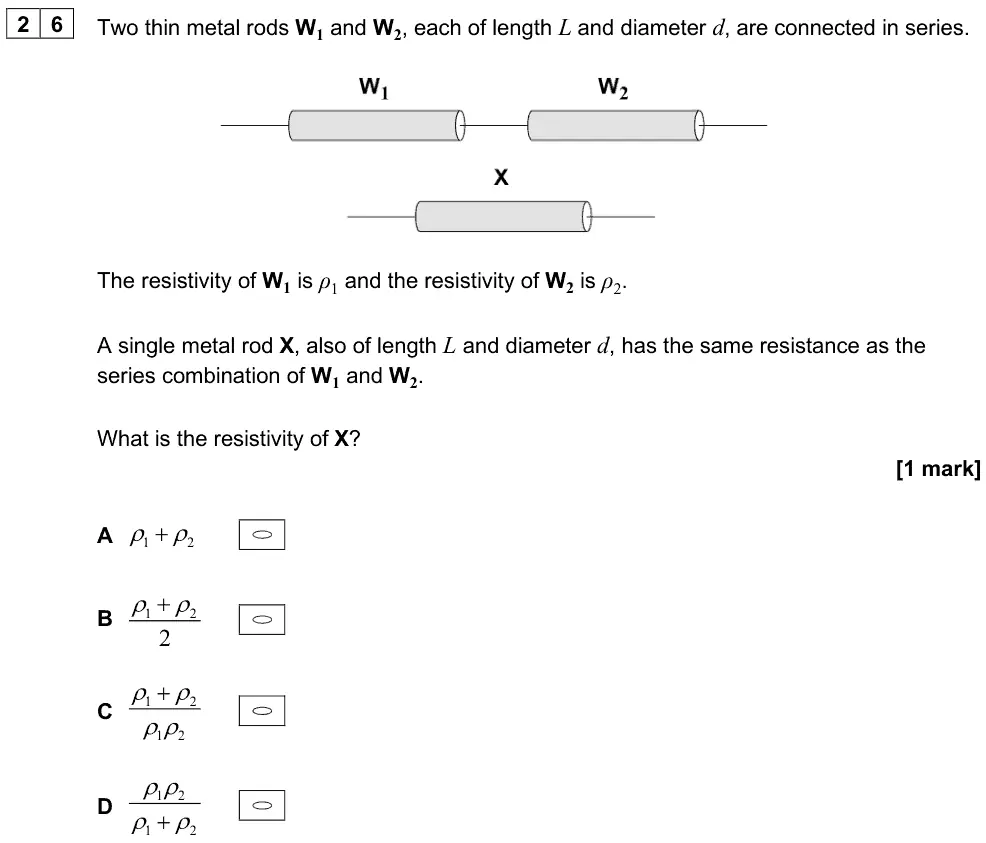
Two thin metal rods W1 and W2, each of length L and diameter d, are connected in series.
The resistivity of W1 is ρ1 and the resistivity of W2 is ρ2.
A single metal rod X, also of length L and diameter d, has the same resistance as the
series combination of W1 and W2.
What is the resistivity of X?
[1 mark]
A
1
2
+
B
1
2
2
+
C
1
2
1
2
+
D
1
2
1
2
+
June 2025 · Paper 1 · Q27 1 mark AO1=1 Multiple choice energy levels and wave particle duality
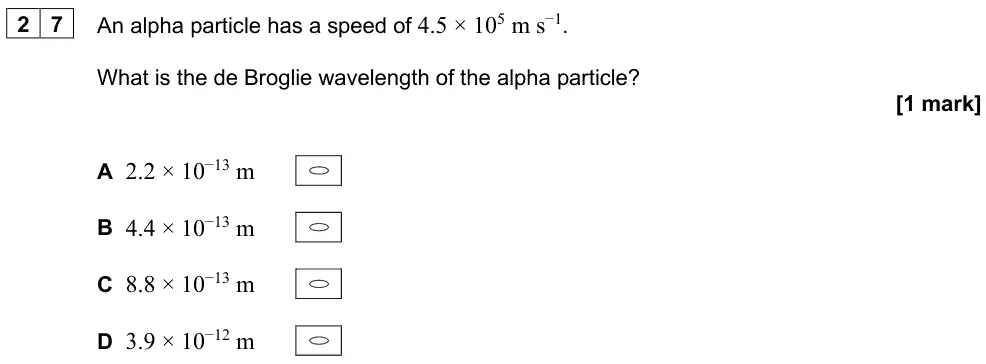
An alpha particle has a speed of 4.5 × 10⁵ m s−1.
What is the de Broglie wavelength of the alpha particle?
[1 mark]
A 2.2 × 10⁻¹³ m
B 4.4 × 10⁻¹³ m
C 8.8 × 10⁻¹³ m
D 3.9 × 10⁻¹² m
June 2025 · Paper 1 · Q28 1 mark AO2=1 Multiple choice circuits and potential dividers
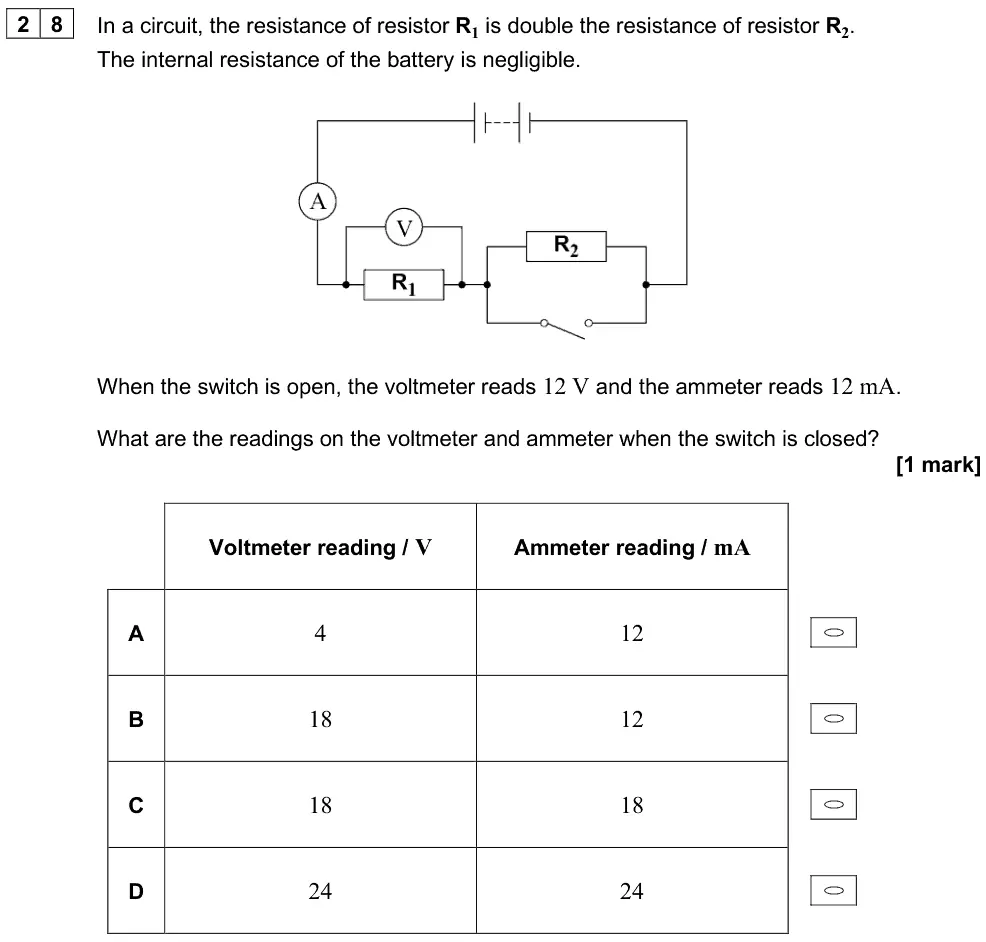
In a circuit, the resistance of resistor R1 is double the resistance of resistor R2.
The internal resistance of the battery is negligible.
When the switch is open, the voltmeter reads 12 V and the ammeter reads 12 mA.
What are the readings on the voltmeter and ammeter when the switch is closed?
[1 mark]
Voltmeter reading / V
Ammeter reading / mA
A
4
12
B
18
12
C
18
18
D
24
24
June 2025 · Paper 1 · Q29 1 mark AO1=1 Multiple choice current voltage and resistivitycircuits and potential dividers
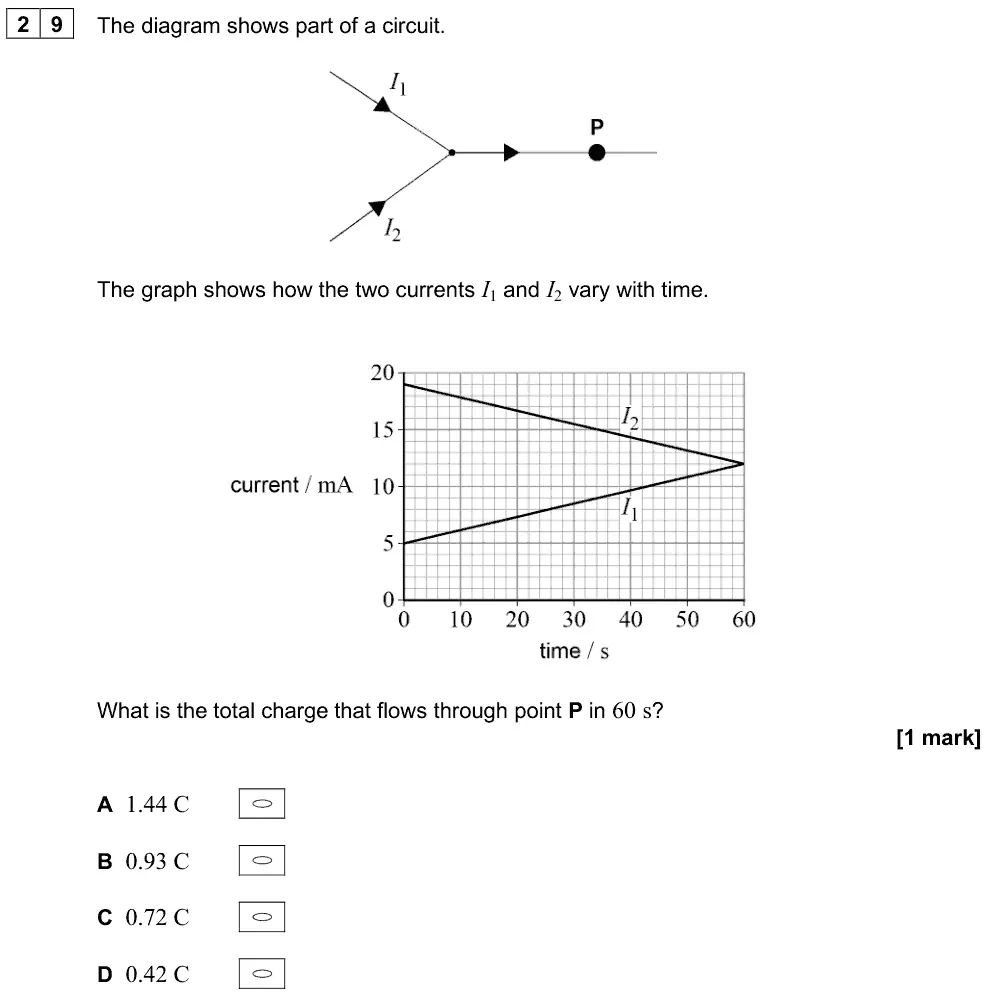
The diagram shows part of a circuit.
The graph shows how the two currents I1 and I2 vary with time.
What is the total charge that flows through point P in 60 s?
[1 mark]
A 1.44 C
B 0.93 C
C 0.72 C
D 0.42 C
June 2025 · Paper 1 · Q30 1 mark AO1=1 Multiple choice photoelectric effect
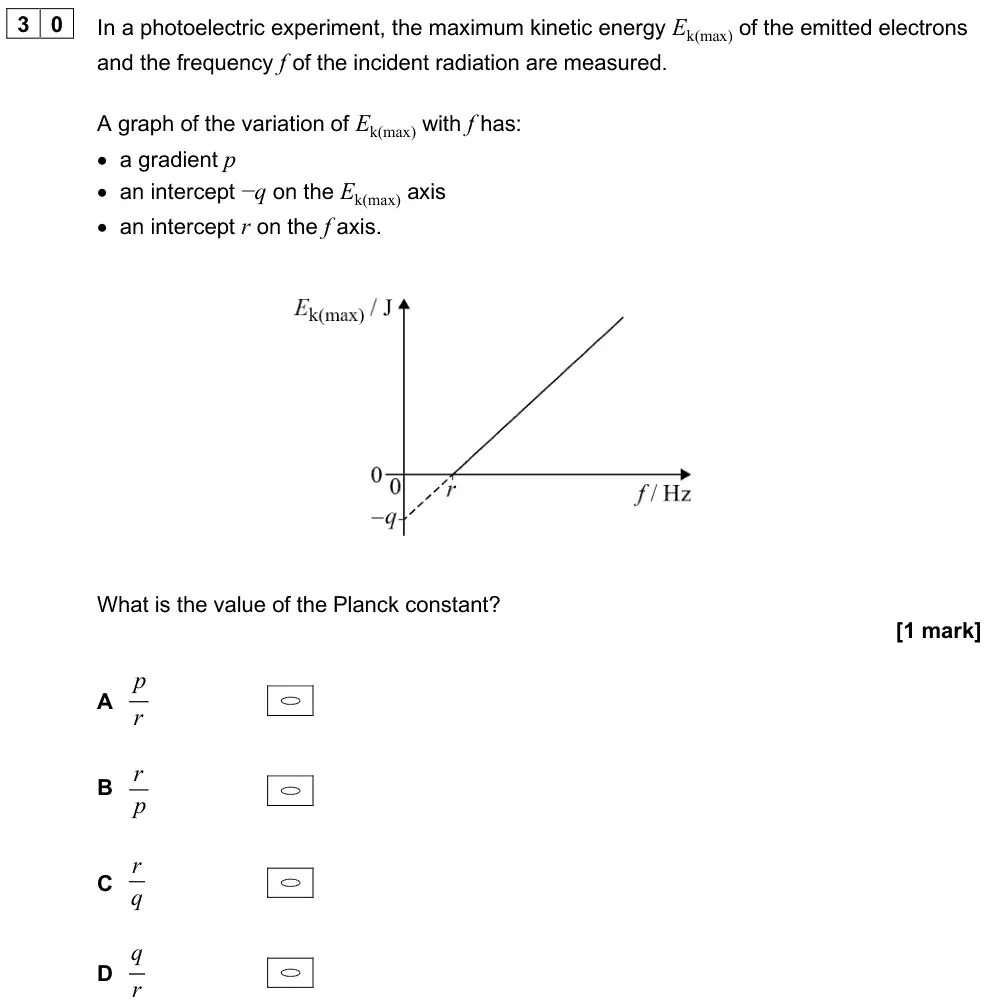
In a photoelectric experiment, the maximum kinetic energy Ek(max) of the emitted electrons
and the frequency f of the incident radiation are measured.
A graph of the variation of Ek(max) with f has:
• a gradient p
• an intercept −q on the Ek(max) axis
• an intercept r on the f axis.
What is the value of the Planck constant?
[1 mark]
A
p
r
B r
p
C r
q
D
q
r
June 2025 · Paper 1 · Q31 1 mark AO2=1 Multiple choice simple harmonic motion
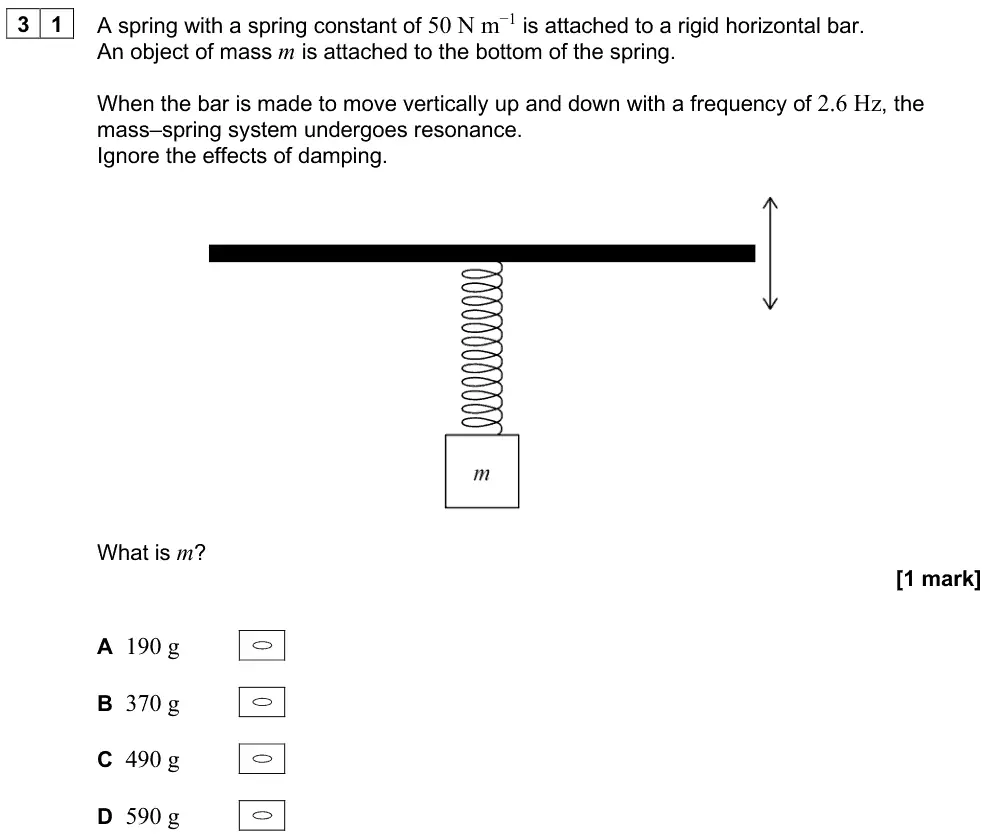
A spring with a spring constant of 50 N m−1 is attached to a rigid horizontal bar.
An object of mass m is attached to the bottom of the spring.
When the bar is made to move vertically up and down with a frequency of 2.6 Hz, the
mass–spring system undergoes resonance.
Ignore the effects of damping.
What is m?
[1 mark]
A 190 g
B 370 g
C 490 g
D 590 g
June 2025 · Paper 1 · Q32 1 mark AO2=1 Multiple choice simple harmonic motion
A simple pendulum of length 8.0 cm oscillates on Earth with a frequency f1.
An identical pendulum on the Moon oscillates with a frequency f2.
The acceleration due to gravity is 1.6 m s−2 on the surface of the Moon.
What is f1 – f2?
[1 mark]
A 1.8 Hz
B 1.1 Hz
C 0.85 Hz
D 0.35 Hz
June 2025 · Paper 1 · Q33 1 mark AO1=1 Multiple choice energy levels and wave particle duality
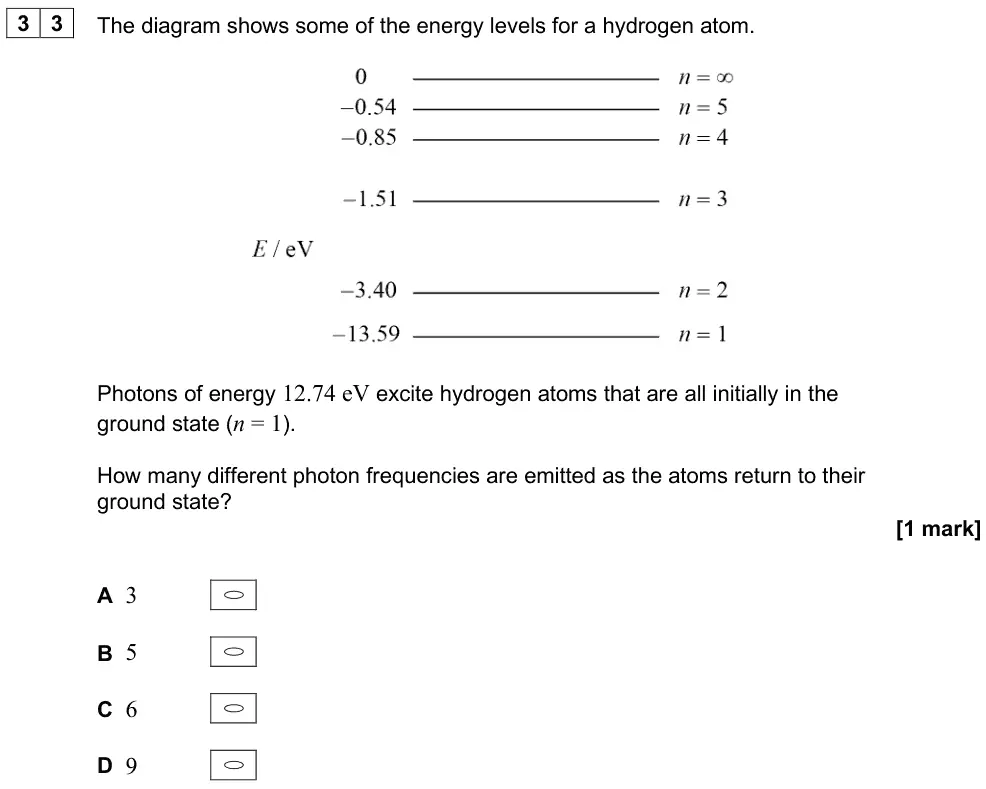
The diagram shows some of the energy levels for a hydrogen atom.
Photons of energy 12.74 eV excite hydrogen atoms that are all initially in the
ground state (n = 1).
How many different photon frequencies are emitted as the atoms return to their
ground state?
[1 mark]
A 3
B 5
C 6
D 9

Work with an AQA physics tutor

Want a paper marked and gone through with you? Message us.

Prefer email? Send an enquiry

If you are under 18, please include a parent's contact details. Enquiries go to enquiries@physicsaleveltutor.com and are deleted once handled. All tutoring is online.