November 2021: Paper 1

85 marks · 48 question parts · Paper, mark scheme and report on AQA's site · An autumn series using the paper written for the cancelled summer exams · Have the data and formulae booklet beside you

Question by question

QTopicMarksAOType
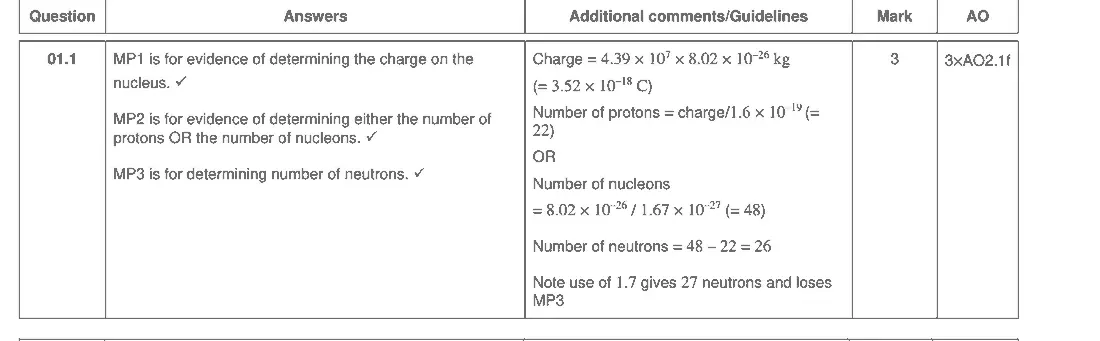
1.1 Atomic structure and stable nuclei 3AO2=3Calculation
1.2 Work, energy, power and conservation of energy, Excitation, energy levels and wave-particle duality 3AO1=1,AO2=2Calculation
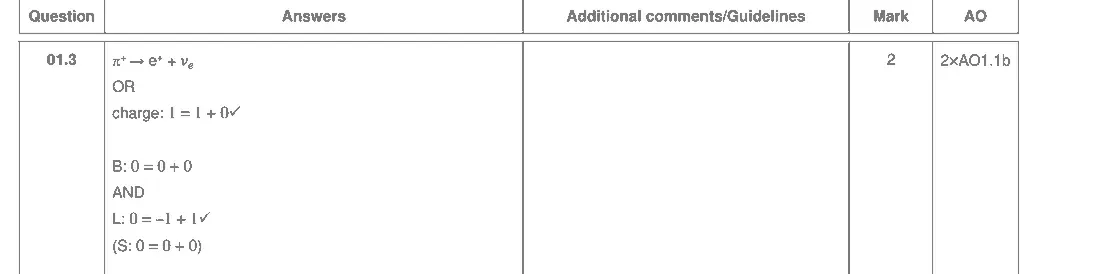
1.3 Classification of particles, quarks and conservation laws 2AO1=2Explanation
1.4 Classification of particles, quarks and conservation laws 2AO1=2Explanation
1.5 Classification of particles, quarks and conservation laws 2AO1=2Short answer
2.1 Progressive waves, longitudinal and transverse waves 3AO1=3Explanation
2.2 Interference, diffraction and the diffraction grating 4AO3=4Explanation
2.3 Interference, diffraction and the diffraction grating 1AO3=1Short answer
2.4 Interference, diffraction and the diffraction grating 3AO3=3Calculation
3.1 Refraction, total internal reflection and optical fibres 1AO1=1Calculation
3.2 Refraction, total internal reflection and optical fibres 3AO2=3Calculation
3.3 Refraction, total internal reflection and optical fibres 3AO3=3Diagram or graph
4.1 Circular motion 2AO2=2Explanation
4.2 Circular motion 2AO2=2Show that
4.3 Circular motion 2AO3=2Explanation
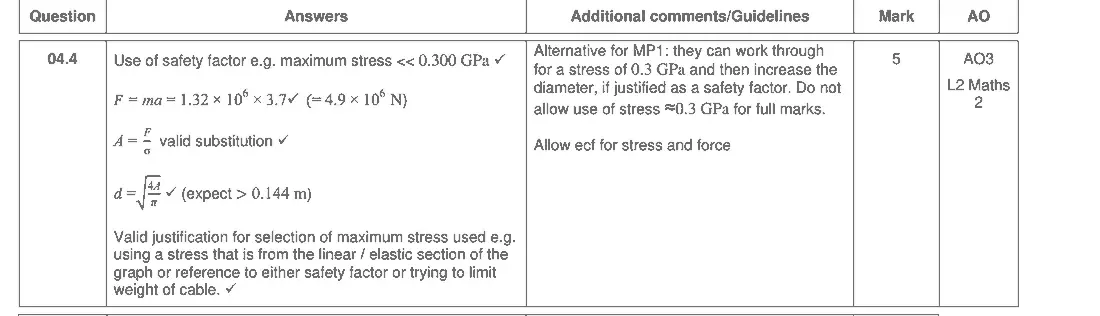
4.4 Materials, stress, strain and the Young modulus 5AO3=5Calculation
5.1 Motion along a straight line and projectile motion, Scalars, vectors and moments 2AO2=2Show that
5.2 Motion along a straight line and projectile motion 2Show that
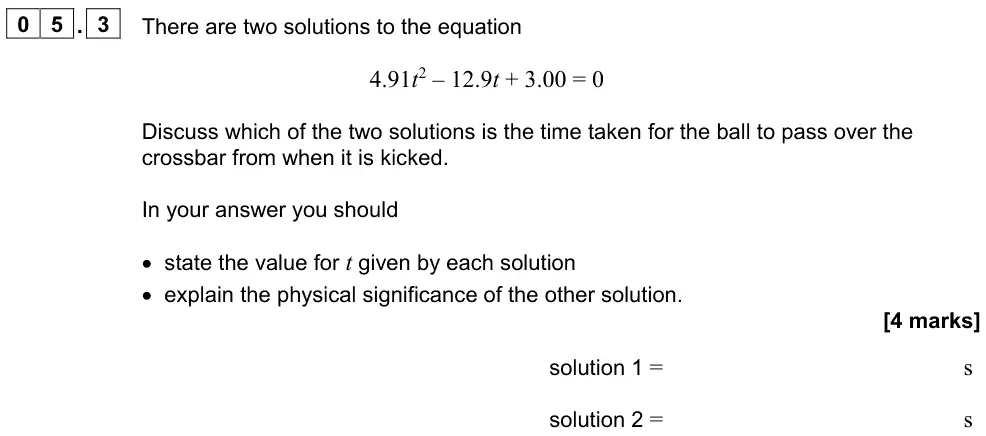
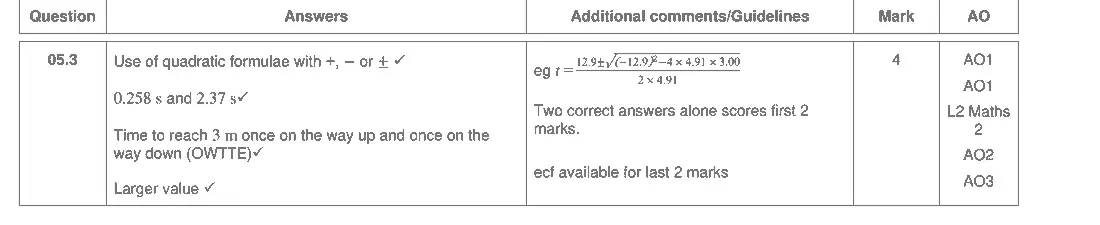
5.3 Motion along a straight line and projectile motion 4Calculation
5.4 Motion along a straight line and projectile motion 1AO3=1Calculation
5.5 Motion along a straight line and projectile motion 5Explanation
6.1 Circuits and potential dividers 2Show that
6.2 Circuits and potential dividers 3Calculation
7 Measurements, units and uncertainties 1Multiple choice
8 Measurements, units and uncertainties 1Multiple choice
9 Particles, antiparticles and particle interactions, Classification of particles, quarks and conservation laws 1Multiple choice
10 Atomic structure and stable nuclei 1Multiple choice
11 Particles, antiparticles and particle interactions, Classification of particles, quarks and conservation laws 1Multiple choice
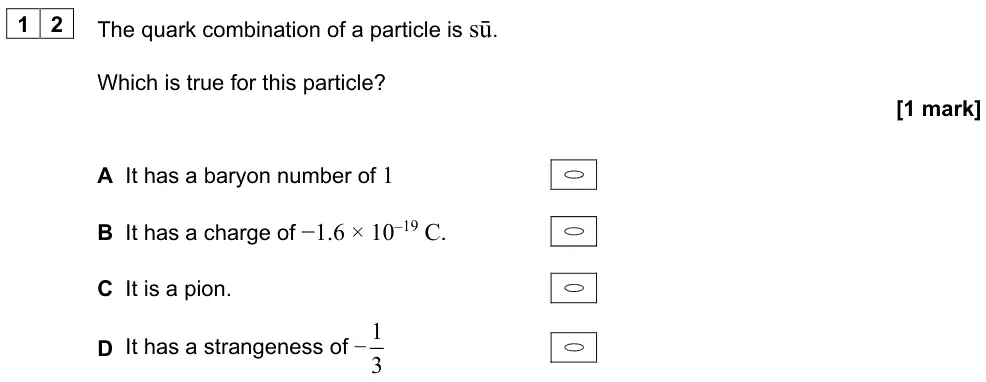
12 Classification of particles, quarks and conservation laws 1Multiple choice
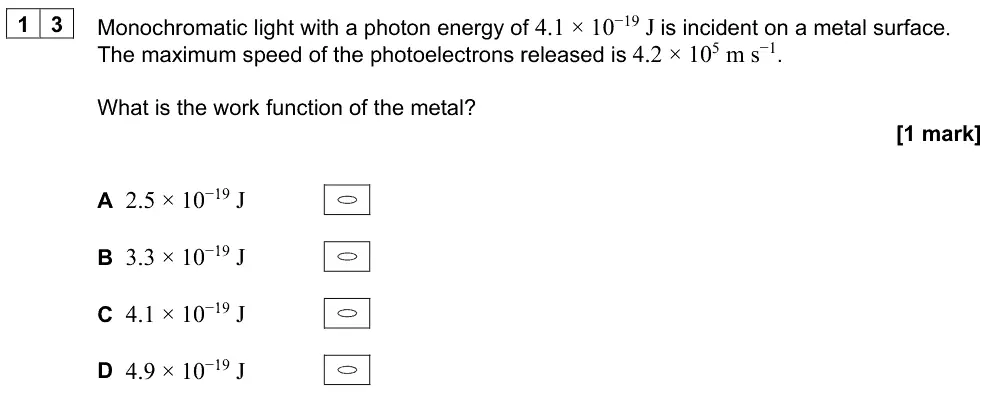
13 The photoelectric effect 1Multiple choice
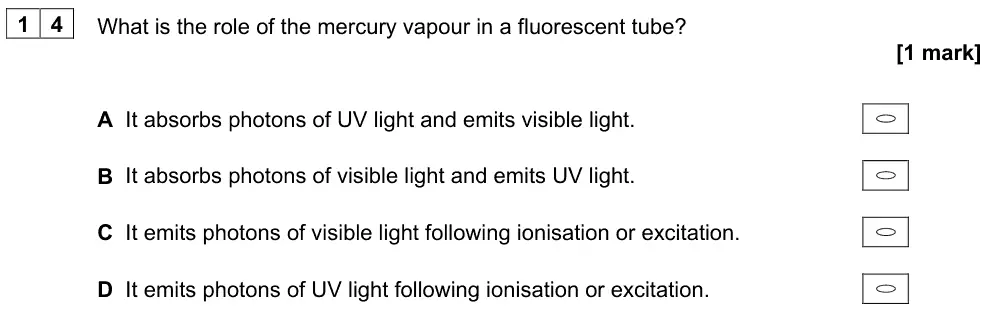
14 Excitation, energy levels and wave-particle duality 1Multiple choice
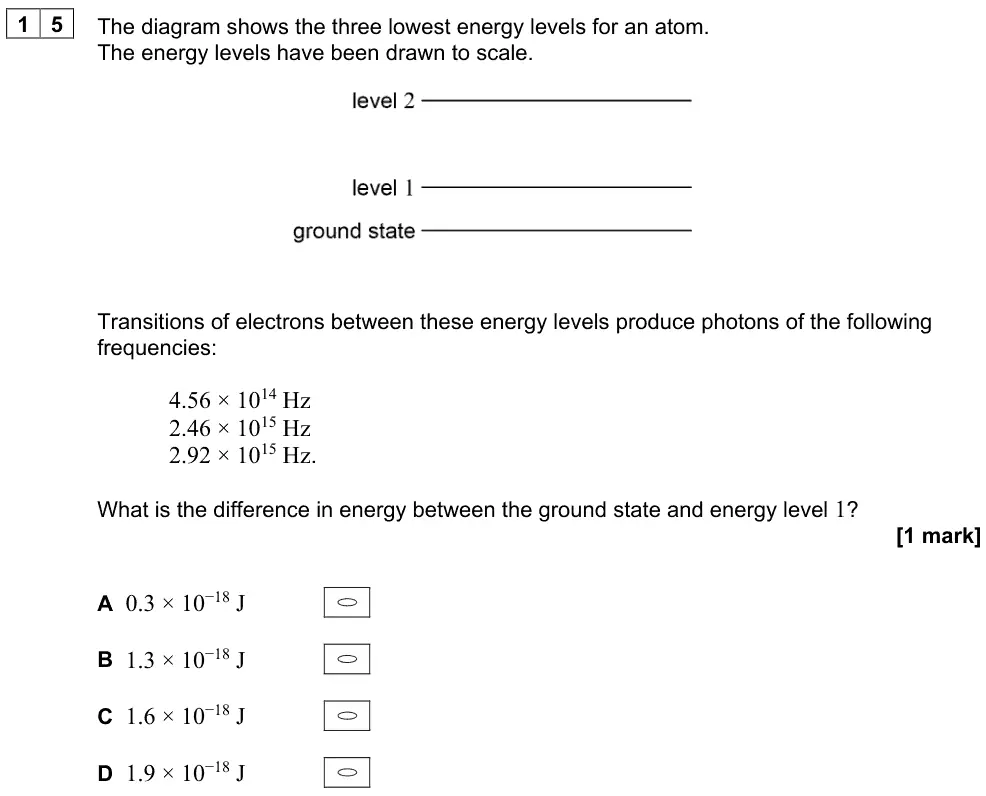
15 Excitation, energy levels and wave-particle duality 1Multiple choice
16 Excitation, energy levels and wave-particle duality, Work, energy, power and conservation of energy 1Multiple choice
17 Progressive waves, longitudinal and transverse waves 1Multiple choice
18 Superposition and stationary waves 1Multiple choice
19 Interference, diffraction and the diffraction grating 1Multiple choice
20 Scalars, vectors and moments 1Multiple choice
21 Scalars, vectors and moments 1Multiple choice
22 Scalars, vectors and moments 1Multiple choice
23 Motion along a straight line and projectile motion, Newton's laws of motion and momentum 1Multiple choice
24 Newton's laws of motion and momentum 1Multiple choice
25 Newton's laws of motion and momentum, Work, energy, power and conservation of energy 1Multiple choice
26 Materials, stress, strain and the Young modulus 1Multiple choice
27 Circuits and potential dividers 1Multiple choice
28 Electromotive force and internal resistance, Circuits and potential dividers 1Multiple choice
29 Current, potential difference, I-V characteristics and resistivity, Circuits and potential dividers 1Multiple choice
30 Simple harmonic motion, forced vibrations and resonance 1Multiple choice
31 Simple harmonic motion, forced vibrations and resonance, Work, energy, power and conservation of energy 1Multiple choice

The questions

1.11.21.31.41.52.12.22.32.43.13.23.34.14.24.34.45.15.25.35.45.56.16.278910111213141516171819202122232425262728293031
November 2021 · Paper 1 · Q1.1 3 marks AO2=3 Calculation atomic structure and stable nuclei
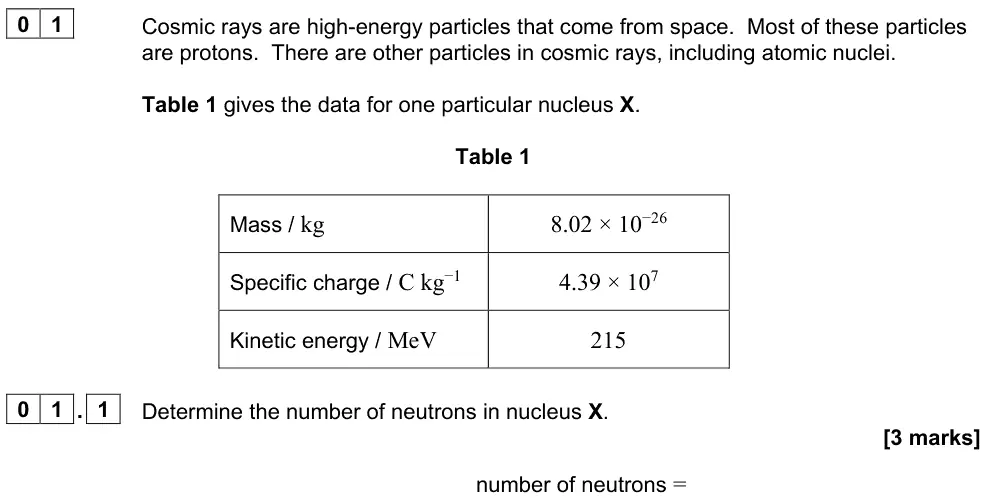
Cosmic rays are high-energy particles that come from space.  Most of these particles
are protons.  There are other particles in cosmic rays, including atomic nuclei.
Table 1 gives the data for one particular nucleus X.
Table 1
Mass / kg
8.02 × 10⁻²⁶
Specific charge / C kg−1
4.39 × 10⁷
Kinetic energy / MeV
215
Determine the number of neutrons in nucleus X.
[3 marks]
number of neutrons =
November 2021 · Paper 1 · Q1.2 3 marks AO1=1, AO2=2 Calculation work energy and powerenergy levels and wave particle duality
Earlier part of question 1 that this part usesEarlier part of November 2021 Paper 1 question 1
Calculate the speed of X.
Ignore relativistic effects.
[3 marks]
speed =
m s−1
November 2021 · Paper 1 · Q1.3 2 marks AO1=2 Explanation classification of particles and quarks
Earlier part of question 1 that this part usesEarlier part of November 2021 Paper 1 question 1
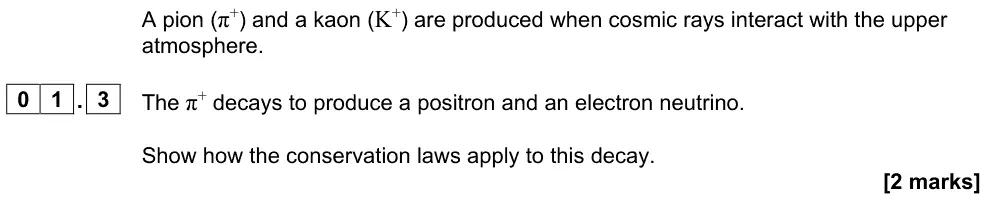
A pion (π+) and a kaon (K+) are produced when cosmic rays interact with the upper
atmosphere.
The π+ decays to produce a positron and an electron neutrino.
Show how the conservation laws apply to this decay.
[2 marks]
November 2021 · Paper 1 · Q1.4 2 marks AO1=2 Explanation classification of particles and quarks
Earlier part of question 1 that this part usesEarlier part of November 2021 Paper 1 question 1
The K+ decays to produce an anti-muon and a muon neutrino.
Explain how strangeness applies in this decay.
[2 marks]
November 2021 · Paper 1 · Q1.5 2 marks AO1=2 Short answer classification of particles and quarks
Earlier part of question 1 that this part usesEarlier part of November 2021 Paper 1 question 1
Write an equation for a K+ decay that involves only hadrons.
[2 marks]
November 2021 · Paper 1 · Q2.1 3 marks AO1=3 Explanation progressive waves and polarisation
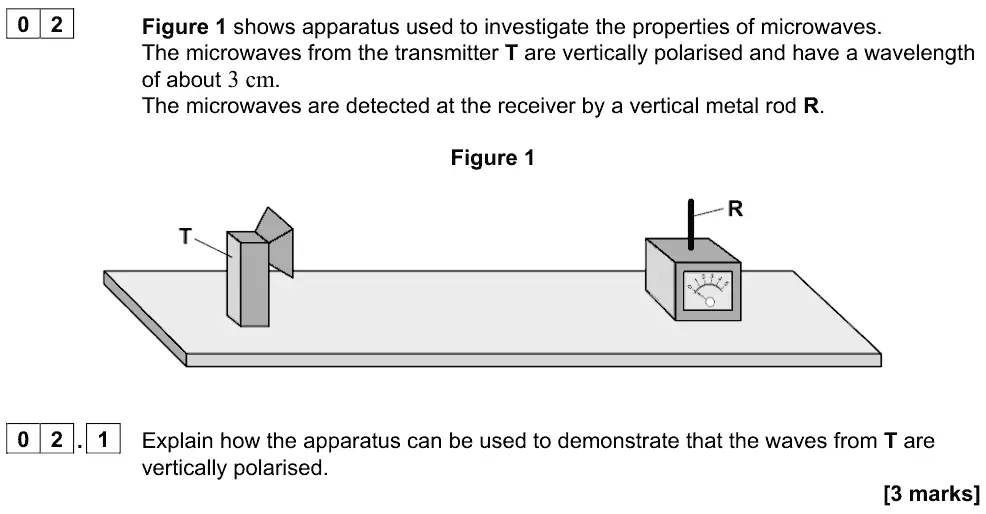
Figure 1 shows apparatus used to investigate the properties of microwaves.
The microwaves from the transmitter T are vertically polarised and have a wavelength
of about 3 cm.
The microwaves are detected at the receiver by a vertical metal rod R.
Figure 1
Explain how the apparatus can be used to demonstrate that the waves from T are
vertically polarised.
[3 marks]
November 2021 · Paper 1 · Q2.2 4 marks AO3=4 Explanation interference and diffraction
Earlier part of question 2 that this part usesEarlier part of November 2021 Paper 1 question 2
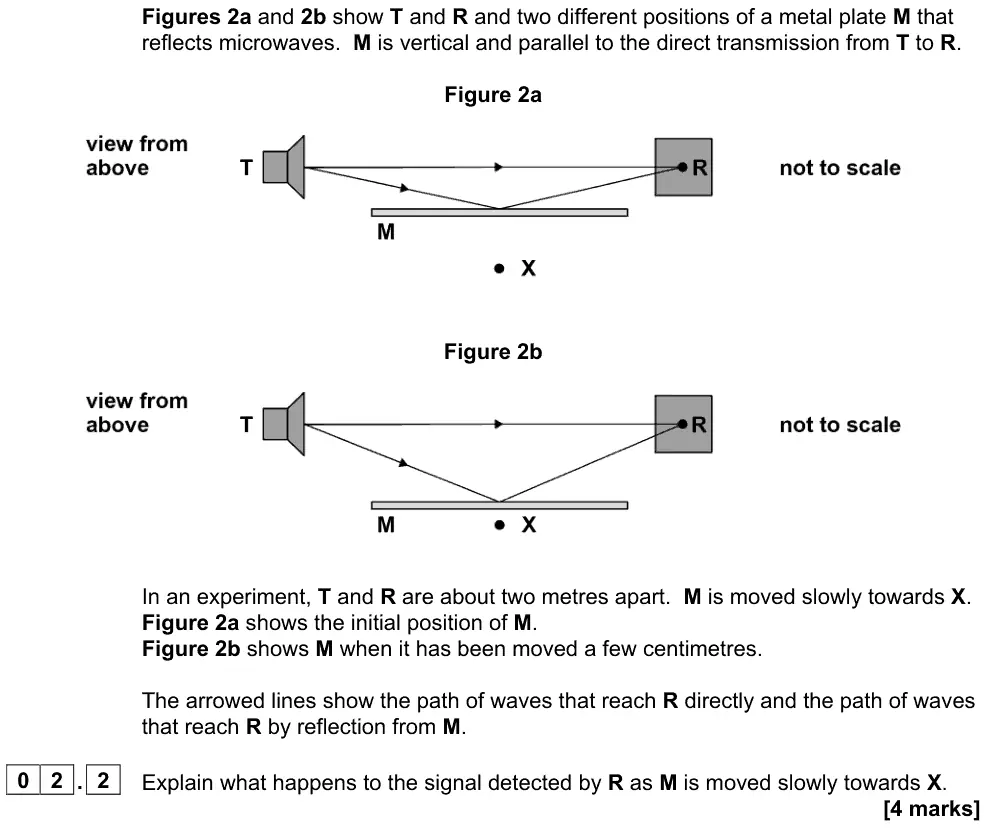
Figures 2a and 2b show T and R and two different positions of a metal plate M that
reflects microwaves.  M is vertical and parallel to the direct transmission from T to R.
Figure 2a
Figure 2b
In an experiment, T and R are about two metres apart.  M is moved slowly towards X.
Figure 2a shows the initial position of M.
Figure 2b shows M when it has been moved a few centimetres.
The arrowed lines show the path of waves that reach R directly and the path of waves
that reach R by reflection from M.
Explain what happens to the signal detected by R as M is moved slowly towards X.
[4 marks]
November 2021 · Paper 1 · Q2.3 1 mark AO3=1 Short answer interference and diffraction
Earlier part of question 2 that this part usesEarlier part of November 2021 Paper 1 question 2
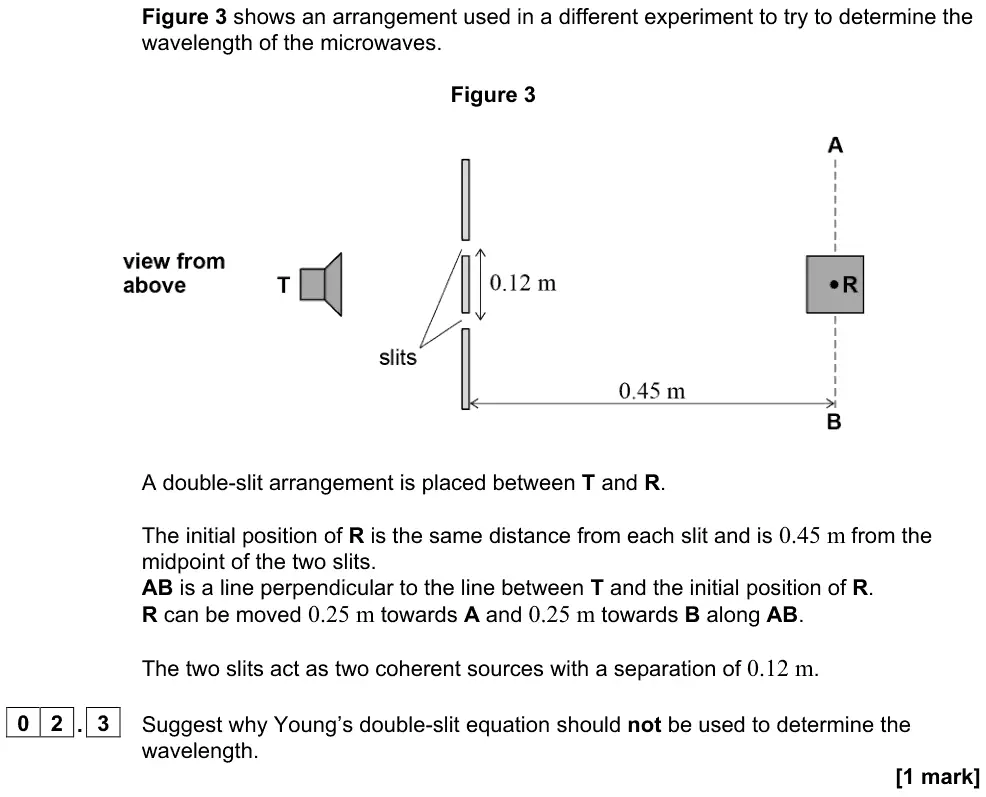
Figure 3 shows an arrangement used in a different experiment to try to determine the
wavelength of the microwaves.
Figure 3
A double-slit arrangement is placed between T and R.
The initial position of R is the same distance from each slit and is 0.45 m from the
midpoint of the two slits.
AB is a line perpendicular to the line between T and the initial position of R.
R can be moved 0.25 m towards A and 0.25 m towards B along AB.
The two slits act as two coherent sources with a separation of 0.12 m.
Suggest why Young’s double-slit equation should not be used to determine the
wavelength.
[1 mark]
November 2021 · Paper 1 · Q2.4 3 marks AO3=3 Calculation interference and diffraction
Earlier part of question 2 that this part usesEarlier part of November 2021 Paper 1 question 2
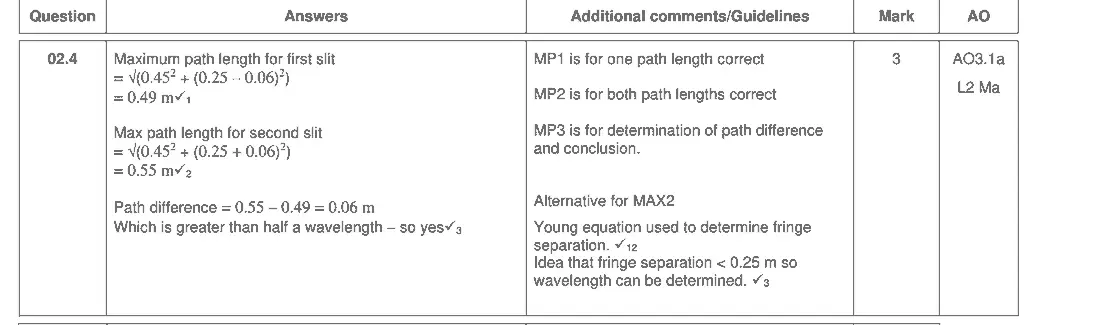
The wavelength is known to be about 3 cm.
Deduce whether this practical arrangement is suitable for a determination of a value
for the wavelength.
[3 marks]
November 2021 · Paper 1 · Q3.1 1 mark AO1=1 Calculation refraction and optical fibres
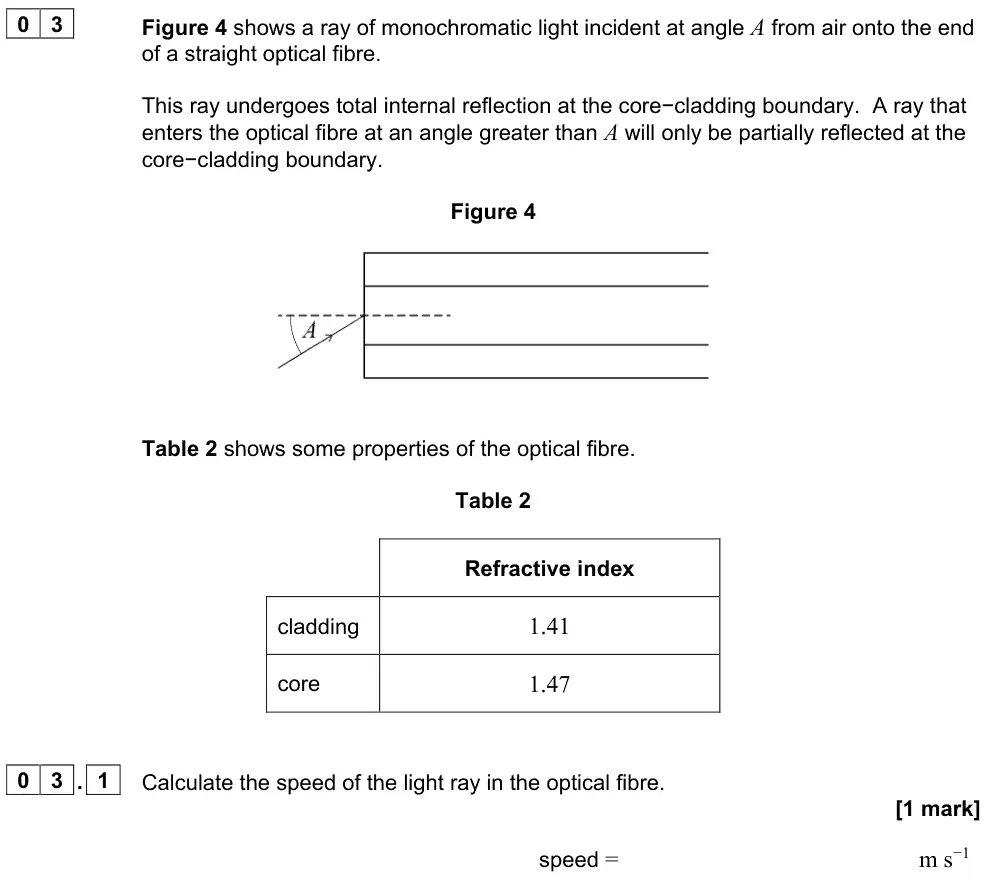
Figure 4 shows a ray of monochromatic light incident at angle A from air onto the end
of a straight optical fibre.
This ray undergoes total internal reflection at the core−cladding boundary.  A ray that
enters the optical fibre at an angle greater than A will only be partially reflected at the
core−cladding boundary.
Figure 4
Table 2 shows some properties of the optical fibre.
Table 2
Refractive index
cladding
1.41
core
1.47
Calculate the speed of the light ray in the optical fibre.
[1 mark]
speed =
m s−1
November 2021 · Paper 1 · Q3.2 3 marks AO2=3 Calculation refraction and optical fibres
Earlier part of question 3 that this part usesEarlier part of November 2021 Paper 1 question 3
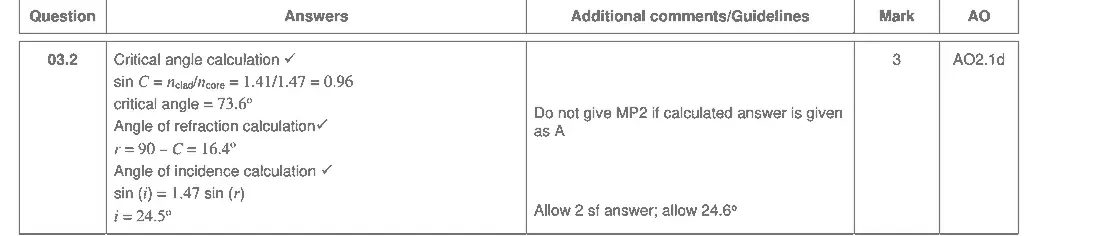
Calculate A, in degrees, for the optical fibre shown in Figure 4.
[3 marks]
A =
degrees
November 2021 · Paper 1 · Q3.3 3 marks AO3=3 Diagram or graph refraction and optical fibres
Earlier part of question 3 that this part usesEarlier part of November 2021 Paper 1 question 3
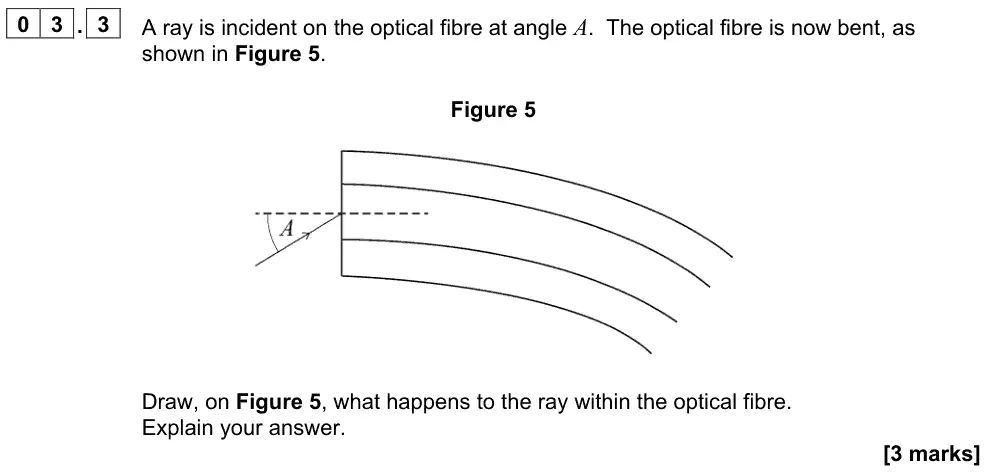
A ray is incident on the optical fibre at angle A.  The optical fibre is now bent, as
shown in Figure 5.
Figure 5
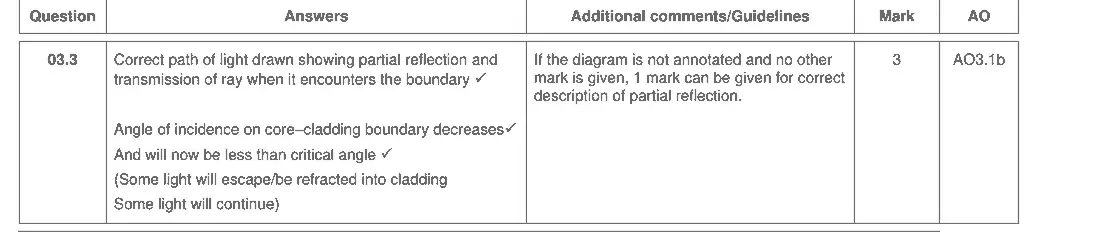
Draw, on Figure 5, what happens to the ray within the optical fibre.
Explain your answer.
[3 marks]
November 2021 · Paper 1 · Q4.1 2 marks AO2=2 Explanation circular motion
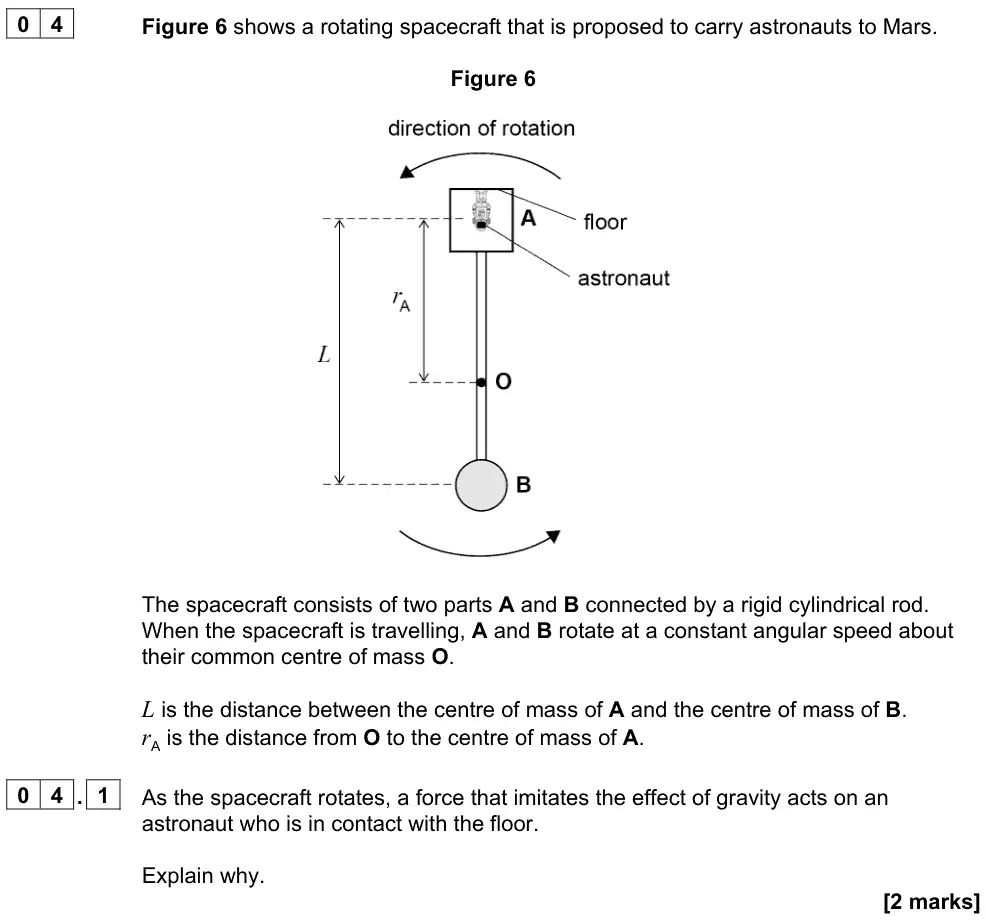
Figure 6 shows a rotating spacecraft that is proposed to carry astronauts to Mars.
Figure 6
The spacecraft consists of two parts A and B connected by a rigid cylindrical rod.
When the spacecraft is travelling, A and B rotate at a constant angular speed about
their common centre of mass O.
L is the distance between the centre of mass of A and the centre of mass of B.
rA is the distance from O to the centre of mass of A.
As the spacecraft rotates, a force that imitates the effect of gravity acts on an
astronaut who is in contact with the floor.
Explain why.
[2 marks]
November 2021 · Paper 1 · Q4.2 2 marks AO2=2 Show that circular motion
Earlier part of question 4 that this part usesEarlier part of November 2021 Paper 1 question 4
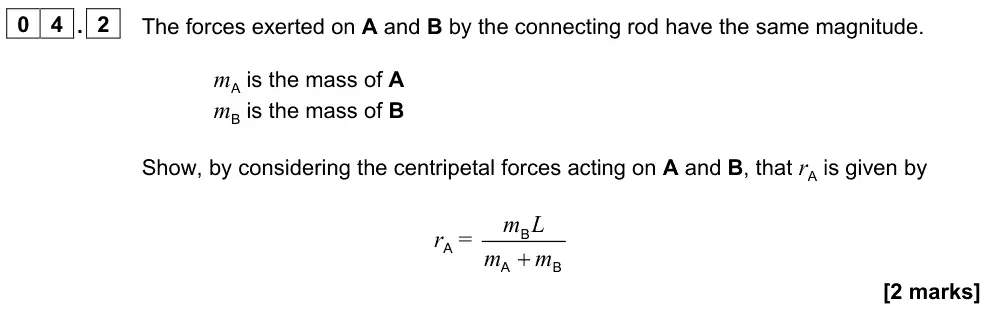
The forces exerted on A and B by the connecting rod have the same magnitude.
mA is the mass of A
mB is the mass of B
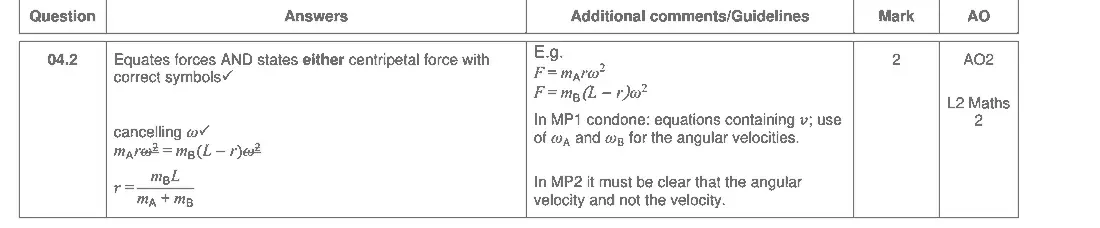
Show, by considering the centripetal forces acting on A and B, that rA is given by
rA =
m L
m
m
+
B
A
B
[2 marks]
November 2021 · Paper 1 · Q4.3 2 marks AO3=2 Explanation circular motion
Earlier part of question 4 that this part usesEarlier part of November 2021 Paper 1 question 4
In this spacecraft mA < mB.
Deduce whether the centre of mass of A or the centre of mass of B rotates with a
greater linear speed.
[2 marks]
November 2021 · Paper 1 · Q4.4 5 marks AO3=5 Calculation materials and young modulus
Earlier part of question 4 that this part usesEarlier part of November 2021 Paper 1 question 4
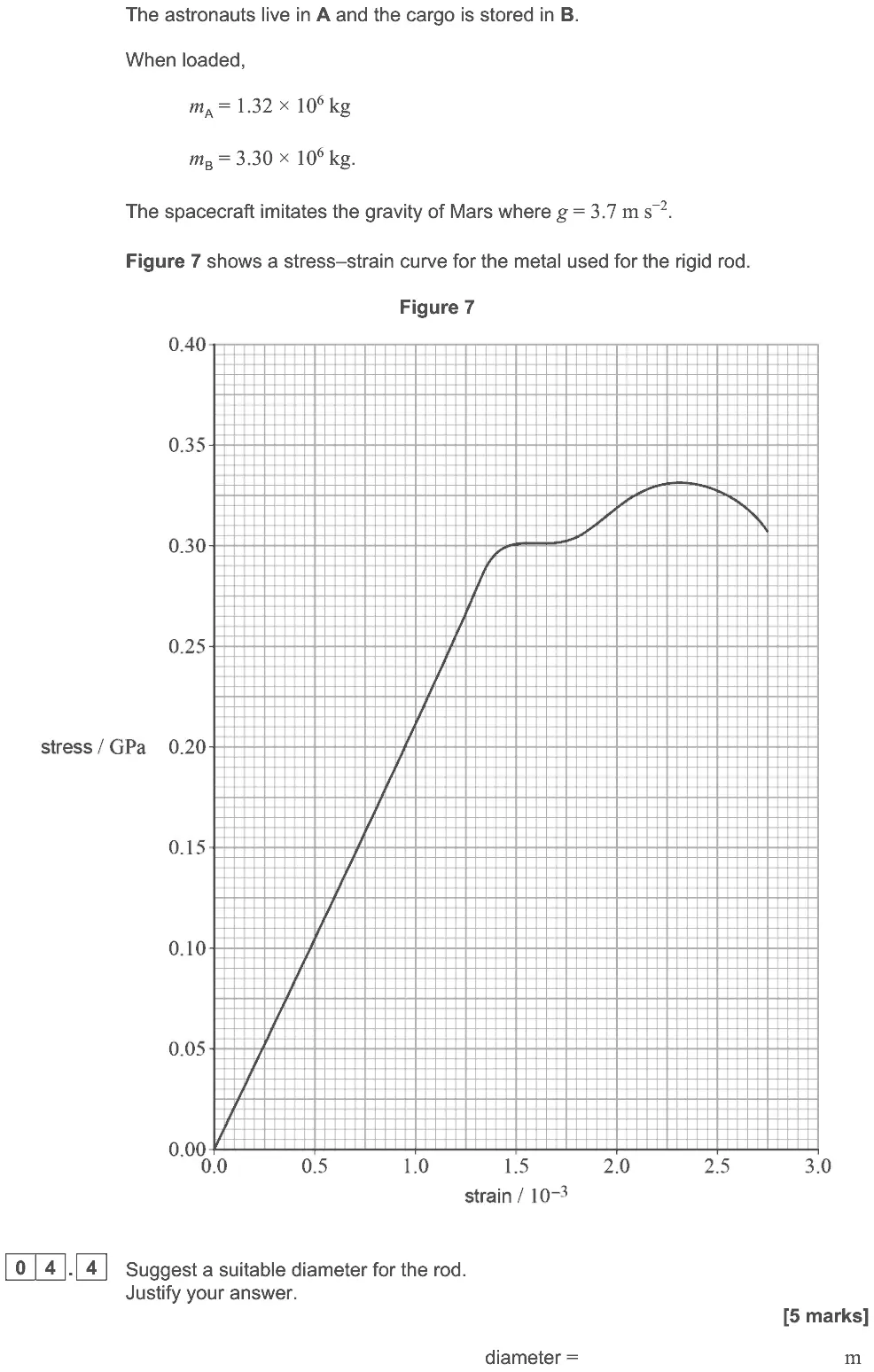
The astronauts live in A and the cargo is stored in B.
When loaded,
mA = 1.32 × 10⁶ kg
mB = 3.30 × 10⁶ kg.
The spacecraft imitates the gravity of Mars where g = 3.7 m s−2.
Figure 7 shows a stress–strain curve for the metal used for the rigid rod.
Figure 7
Suggest a suitable diameter for the rod.
Justify your answer.
[5 marks]
diameter =
m
November 2021 · Paper 1 · Q5.1 2 marks AO2=2 Show that motion and projectilesvectors and moments
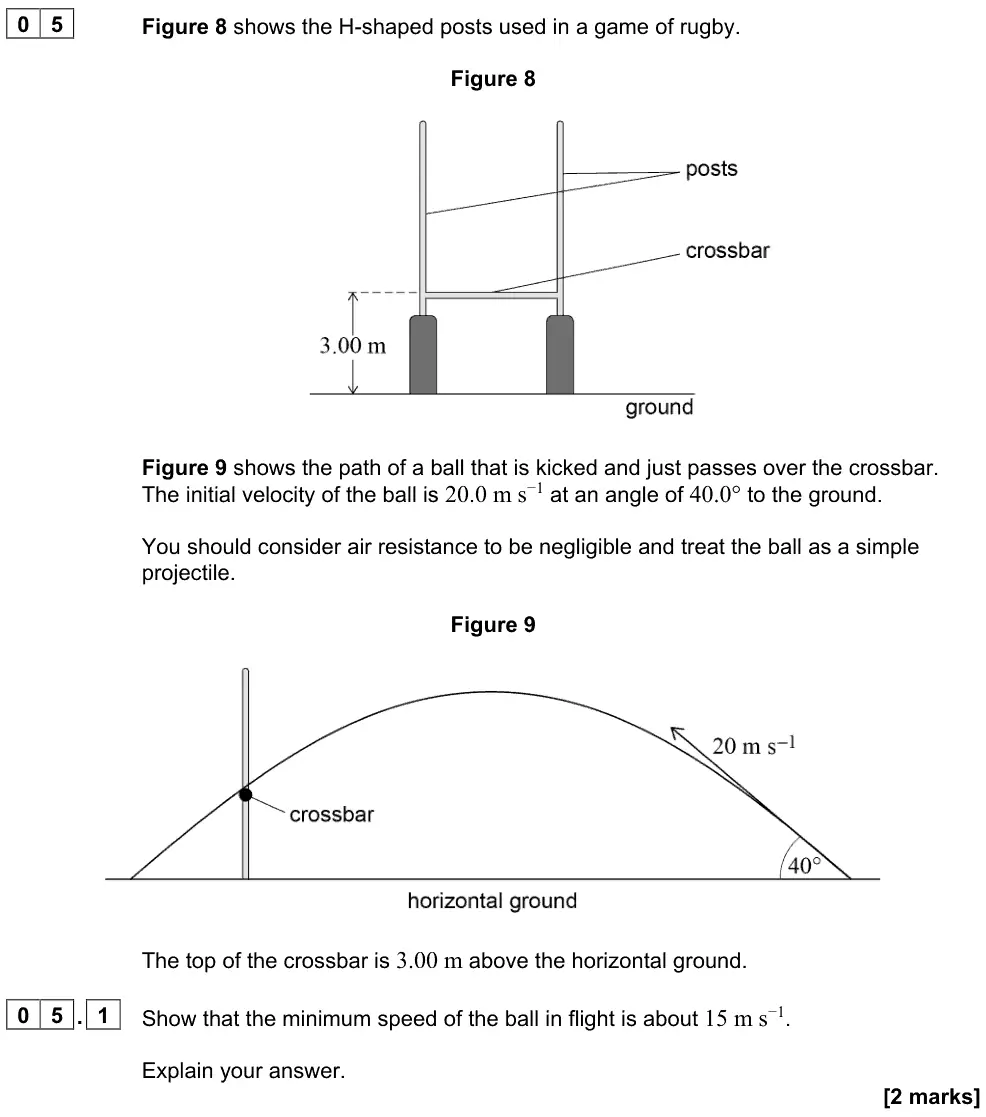
Figure 8 shows the H-shaped posts used in a game of rugby.
Figure 8
Figure 9 shows the path of a ball that is kicked and just passes over the crossbar.
The initial velocity of the ball is 20.0 m s−1 at an angle of 40.0° to the ground.
You should consider air resistance to be negligible and treat the ball as a simple
projectile.
Figure 9
The top of the crossbar is 3.00 m above the horizontal ground.
Show that the minimum speed of the ball in flight is about 15 m s−1.
Explain your answer.
[2 marks]
November 2021 · Paper 1 · Q5.2 2 marks Show that motion and projectiles
Earlier part of question 5 that this part usesEarlier part of November 2021 Paper 1 question 5
The ball just passes over the crossbar at a time t after it is kicked.
Show that t must satisfy the following equation:
4.91t2 – 12.9t + 3.00 = 0
[2 marks]
November 2021 · Paper 1 · Q5.3 4 marks Calculation motion and projectiles
Earlier part of question 5 that this part usesEarlier part of November 2021 Paper 1 question 5
There are two solutions to the equation
4.91t2 – 12.9t + 3.00 = 0
Discuss which of the two solutions is the time taken for the ball to pass over the
crossbar from when it is kicked.
In your answer you should
• state the value for t given by each solution
• explain the physical significance of the other solution.
[4 marks]
solution 1 =
s
solution 2 =
s
November 2021 · Paper 1 · Q5.4 1 mark AO3=1 Calculation motion and projectiles
Earlier part of question 5 that this part usesEarlier part of November 2021 Paper 1 question 5
Another attempt is made to kick the ball over the crossbar.  The initial velocity of the
ball is the same as in the first attempt.
This kick is made from a horizontal distance of 38 m from the posts.
Deduce whether the ball can pass over the crossbar.
[1 mark]
November 2021 · Paper 1 · Q5.5 5 marks Explanation motion and projectiles
Earlier part of question 5 that this part usesEarlier part of November 2021 Paper 1 question 5
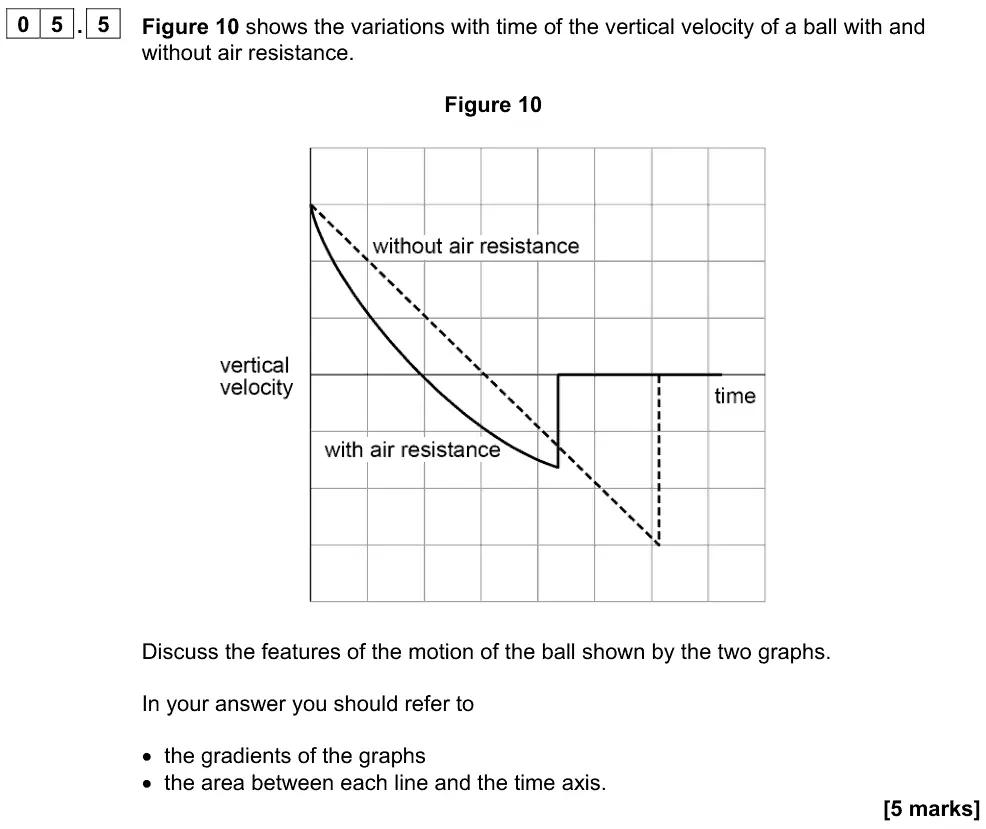
Figure 10 shows the variations with time of the vertical velocity of a ball with and
without air resistance.
Figure 10
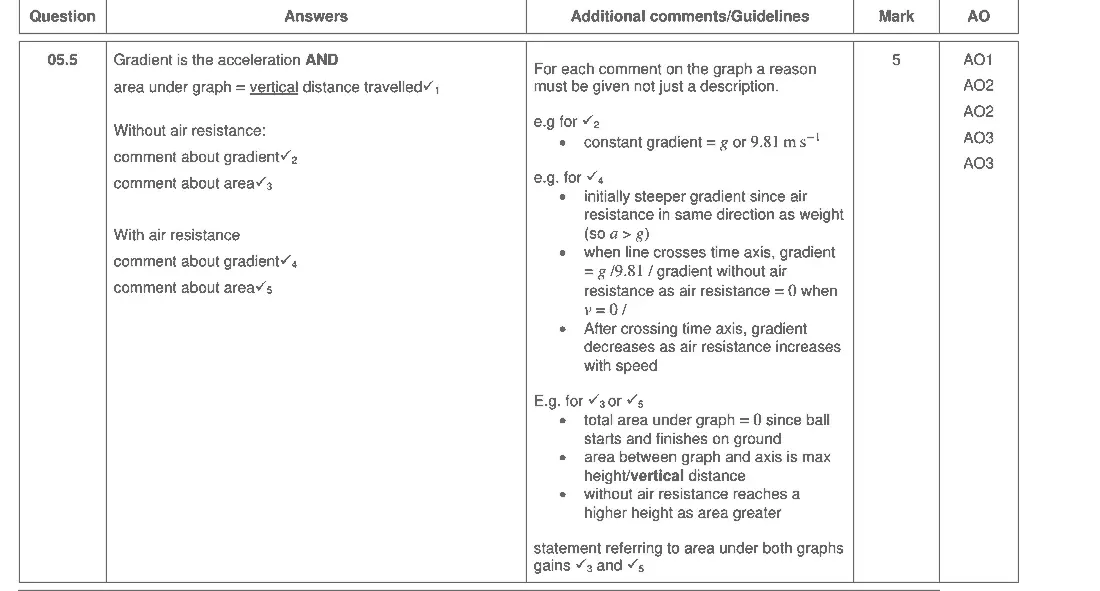
Discuss the features of the motion of the ball shown by the two graphs.
In your answer you should refer to
• the gradients of the graphs
• the area between each line and the time axis.
[5 marks]
November 2021 · Paper 1 · Q6.1 2 marks Show that circuits and potential dividers
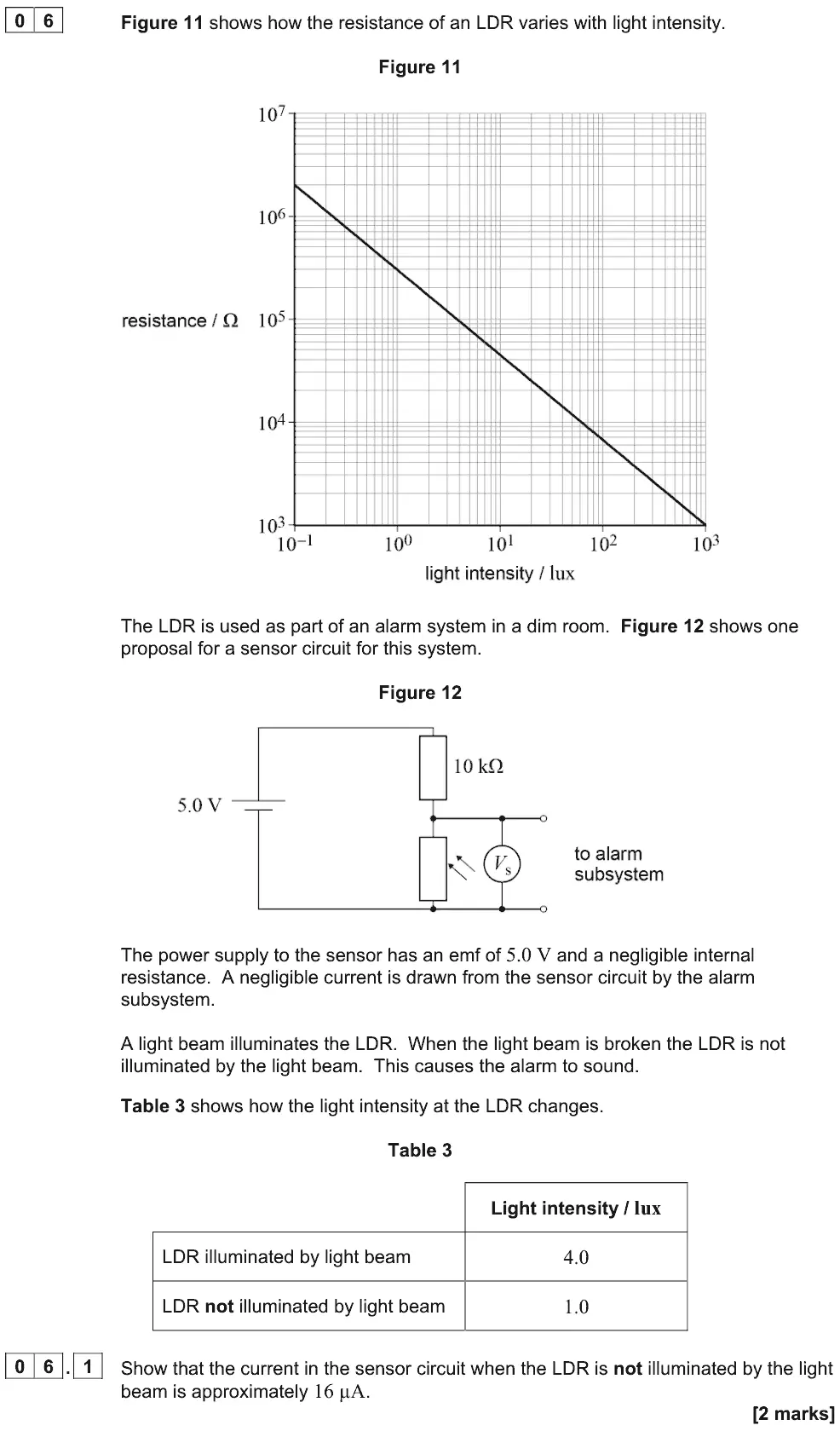
Figure 11 shows how the resistance of an LDR varies with light intensity.
Figure 11
The LDR is used as part of an alarm system in a dim room.  Figure 12 shows one
proposal for a sensor circuit for this system.
Figure 12
The power supply to the sensor has an emf of 5.0 V and a negligible internal
resistance.  A negligible current is drawn from the sensor circuit by the alarm
subsystem.
A light beam illuminates the LDR.  When the light beam is broken the LDR is not
illuminated by the light beam.  This causes the alarm to sound.
Table 3 shows how the light intensity at the LDR changes.
Table 3
Light intensity / lux
LDR illuminated by light beam
4.0
LDR not illuminated by light beam
1.0
Show that the current in the sensor circuit when the LDR is not illuminated by the light
beam is approximately 16 µA.
[2 marks]
November 2021 · Paper 1 · Q6.2 3 marks Calculation circuits and potential dividers
Earlier part of question 6 that this part usesEarlier part of November 2021 Paper 1 question 6
The alarm sounds when the potential difference Vs across the LDR changes by more
than 25% of the power supply emf.
Discuss whether the circuit shown in Figure 12 is suitable.
Support your answer with a calculation.
[3 marks]
November 2021 · Paper 1 · Q7 1 mark Multiple choice measurements and uncertainties
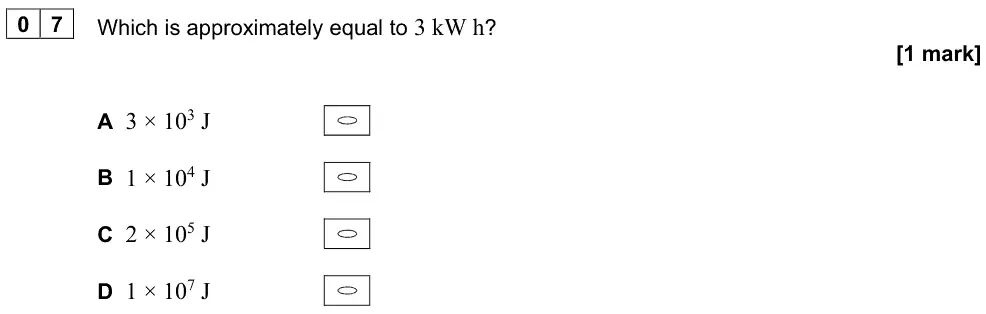
Which is approximately equal to 3 kW h?
[1 mark]
A 3 × 10³ J
B 1 × 10⁴ J
C 2 × 10⁵ J
D 1 × 10⁷ J
November 2021 · Paper 1 · Q8 1 mark Multiple choice measurements and uncertainties
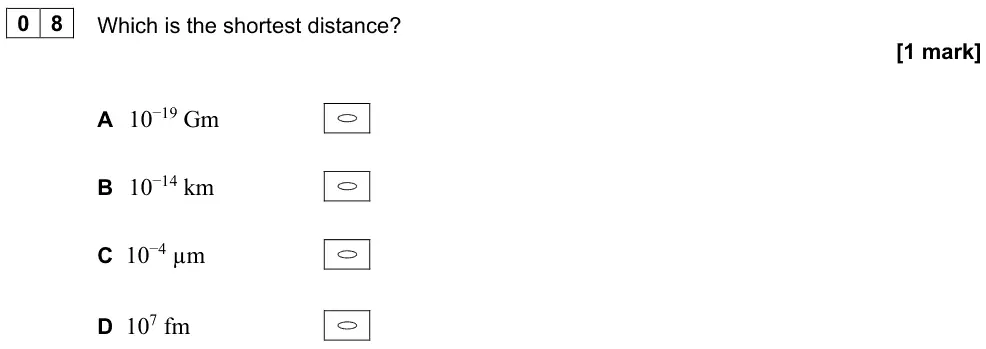
Which is the shortest distance?
[1 mark]
A 10−19 Gm
B 10−14 km
C 10−4 µm
D 107 fm
November 2021 · Paper 1 · Q9 1 mark Multiple choice particles antiparticles and interactionsclassification of particles and quarks
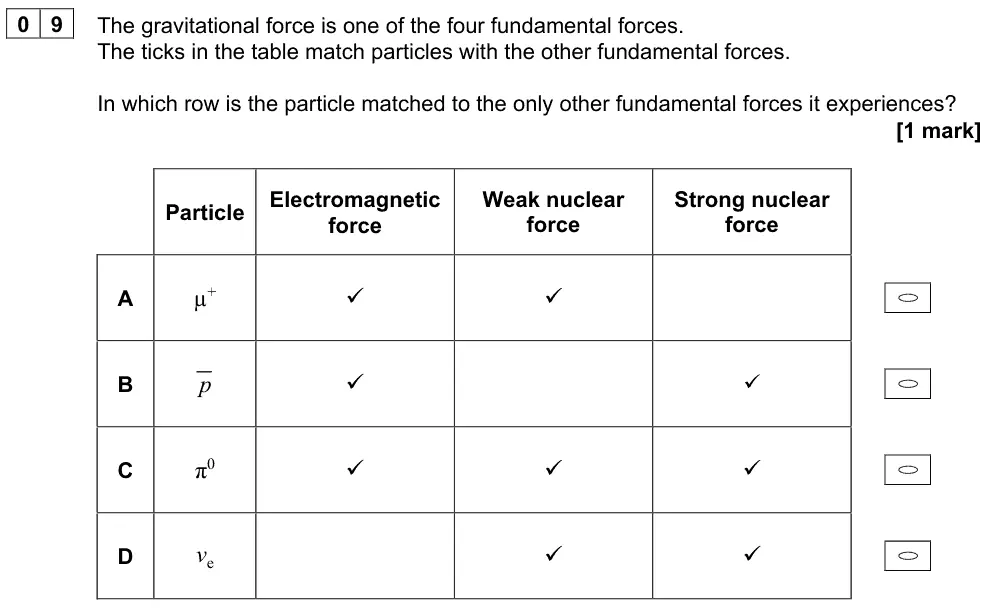
The gravitational force is one of the four fundamental forces.
The ticks in the table match particles with the other fundamental forces.
In which row is the particle matched to the only other fundamental forces it experiences?
[1 mark]
Particle
Electromagnetic
force
Weak nuclear
force
Strong nuclear
force
A
µ+


B
p


C
π0



D
ve


November 2021 · Paper 1 · Q10 1 mark Multiple choice Easy atomic structure and stable nuclei
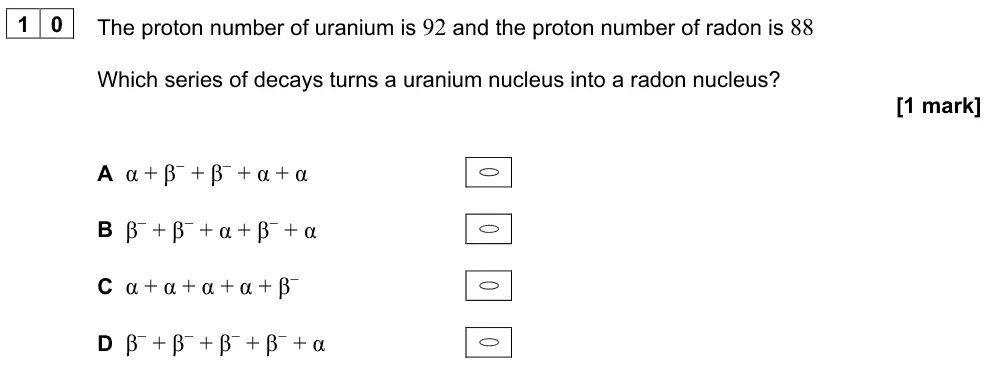
The proton number of uranium is 92 and the proton number of radon is 88
Which series of decays turns a uranium nucleus into a radon nucleus?
[1 mark]
A α + β− + β− + α + α
B β− + β− + α + β− + α
C α + α + α + α + β−
D β− + β− + β− + β− + α
November 2021 · Paper 1 · Q11 1 mark Multiple choice particles antiparticles and interactionsclassification of particles and quarks
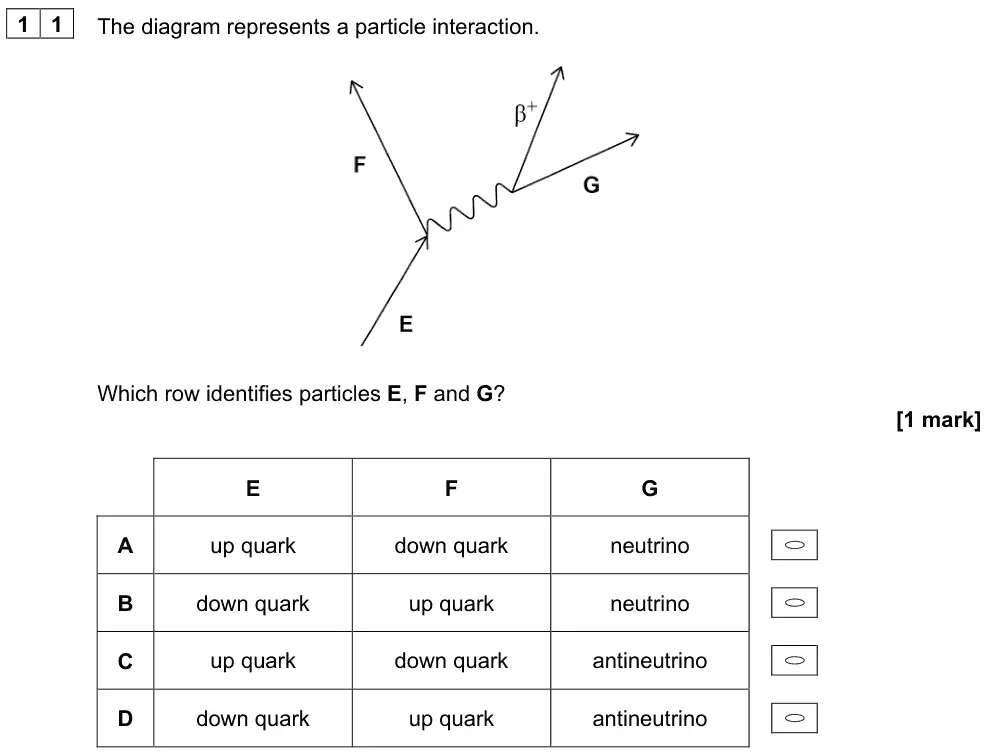
The diagram represents a particle interaction.
Which row identifies particles E, F and G?
[1 mark]
E
F
G
A
up quark
down quark
neutrino
B
down quark
up quark
neutrino
C
up quark
down quark
antineutrino
D
down quark
up quark
antineutrino
November 2021 · Paper 1 · Q12 1 mark Multiple choice classification of particles and quarks
The quark combination of a particle is sū.
Which is true for this particle?
[1 mark]
A It has a baryon number of 1
B It has a charge of −1.6 × 10⁻¹⁹ C.
C It is a pion.
D It has a strangeness of −1
3
November 2021 · Paper 1 · Q13 1 mark Multiple choice photoelectric effect
Monochromatic light with a photon energy of 4.1 × 10⁻¹⁹ J is incident on a metal surface.
The maximum speed of the photoelectrons released is 4.2 × 10⁵ m s−1.
What is the work function of the metal?
[1 mark]
A 2.5 × 10⁻¹⁹ J
B 3.3 × 10⁻¹⁹ J
C 4.1 × 10⁻¹⁹ J
D 4.9 × 10⁻¹⁹ J
November 2021 · Paper 1 · Q14 1 mark Multiple choice energy levels and wave particle duality
What is the role of the mercury vapour in a fluorescent tube?
[1 mark]
A It absorbs photons of UV light and emits visible light.
B It absorbs photons of visible light and emits UV light.
C It emits photons of visible light following ionisation or excitation.
D It emits photons of UV light following ionisation or excitation.
November 2021 · Paper 1 · Q15 1 mark Multiple choice energy levels and wave particle duality
The diagram shows the three lowest energy levels for an atom.
The energy levels have been drawn to scale.
Transitions of electrons between these energy levels produce photons of the following
frequencies:
4.56 × 10¹⁴ Hz
2.46 × 10¹⁵ Hz
2.92 × 10¹⁵ Hz.
What is the difference in energy between the ground state and energy level 1?
[1 mark]
A 0.3 × 10⁻¹⁸ J
B 1.3 × 10⁻¹⁸ J
C 1.6 × 10⁻¹⁸ J
D 1.9 × 10⁻¹⁸ J
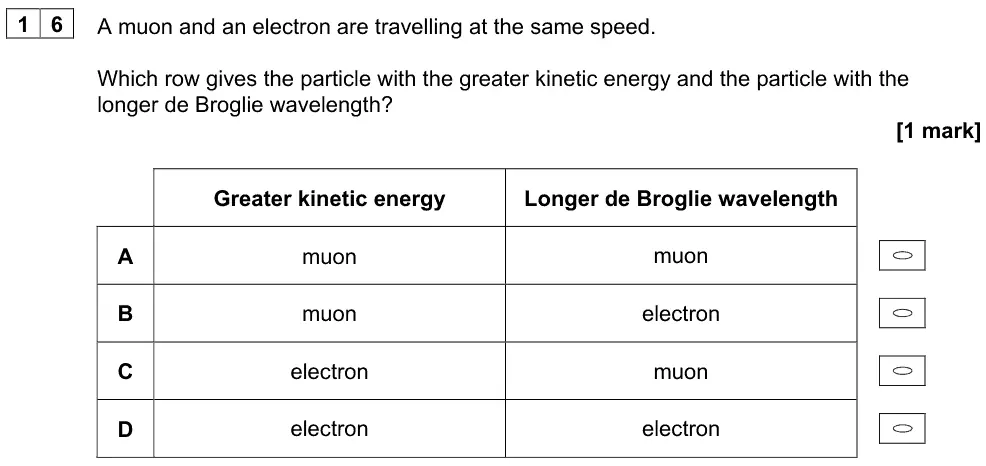
November 2021 · Paper 1 · Q16 1 mark Multiple choice Easy energy levels and wave particle dualitywork energy and power
A muon and an electron are travelling at the same speed.
Which row gives the particle with the greater kinetic energy and the particle with the
longer de Broglie wavelength?
[1 mark]
Greater kinetic energy
Longer de Broglie wavelength
A
muon
muon
B
muon
electron
C
electron
muon
D
electron
electron
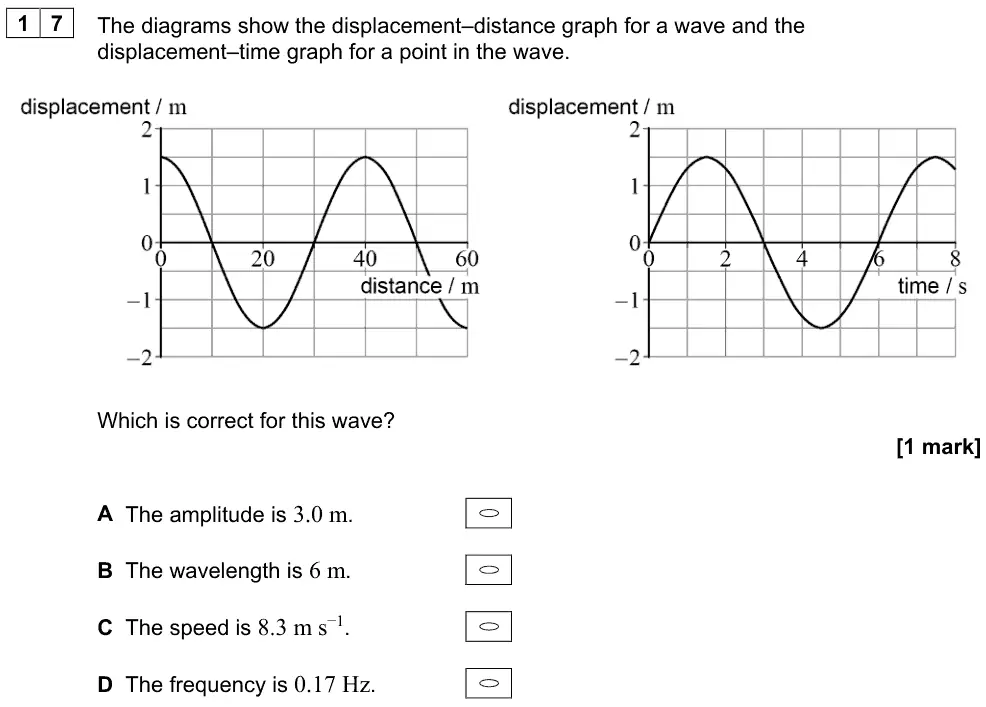
November 2021 · Paper 1 · Q17 1 mark Multiple choice progressive waves and polarisation
The diagrams show the displacement–distance graph for a wave and the
displacement–time graph for a point in the wave.
Which is correct for this wave?
[1 mark]
A The amplitude is 3.0 m.
B The wavelength is 6 m.
C The speed is 8.3 m s−1.
D The frequency is 0.17 Hz.
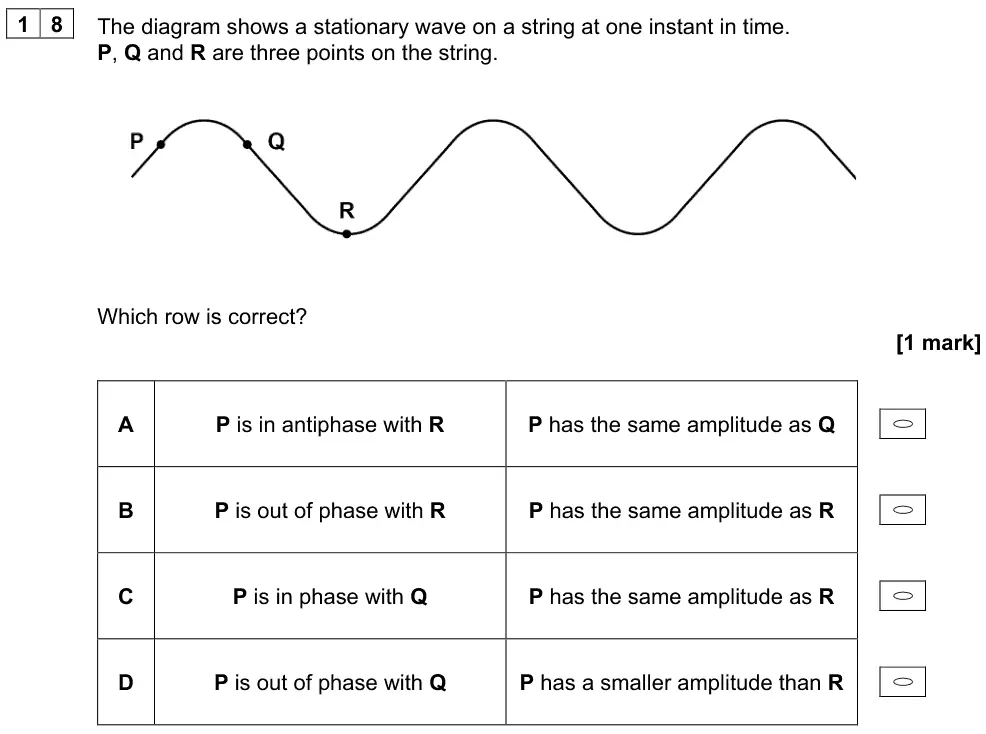
November 2021 · Paper 1 · Q18 1 mark Multiple choice stationary waves
The diagram shows a stationary wave on a string at one instant in time.
P, Q and R are three points on the string.
Which row is correct?
[1 mark]
A
P is in antiphase with R
P has the same amplitude as Q
B
P is out of phase with R
P has the same amplitude as R
C
P is in phase with Q
P has the same amplitude as R
D
P is out of phase with Q
P has a smaller amplitude than R
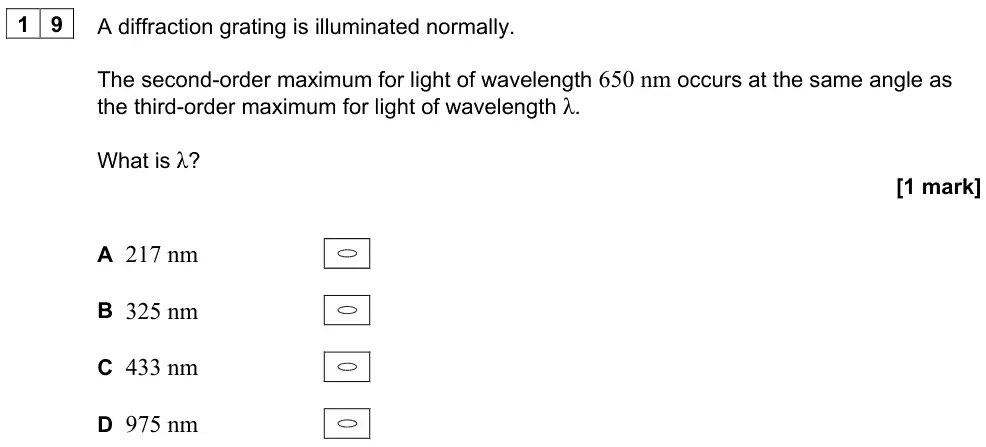
November 2021 · Paper 1 · Q19 1 mark Multiple choice interference and diffraction
A diffraction grating is illuminated normally.
The second-order maximum for light of wavelength 650 nm occurs at the same angle as
the third-order maximum for light of wavelength λ.
What is λ?
[1 mark]
A 217 nm
B 325 nm
C 433 nm
D 975 nm
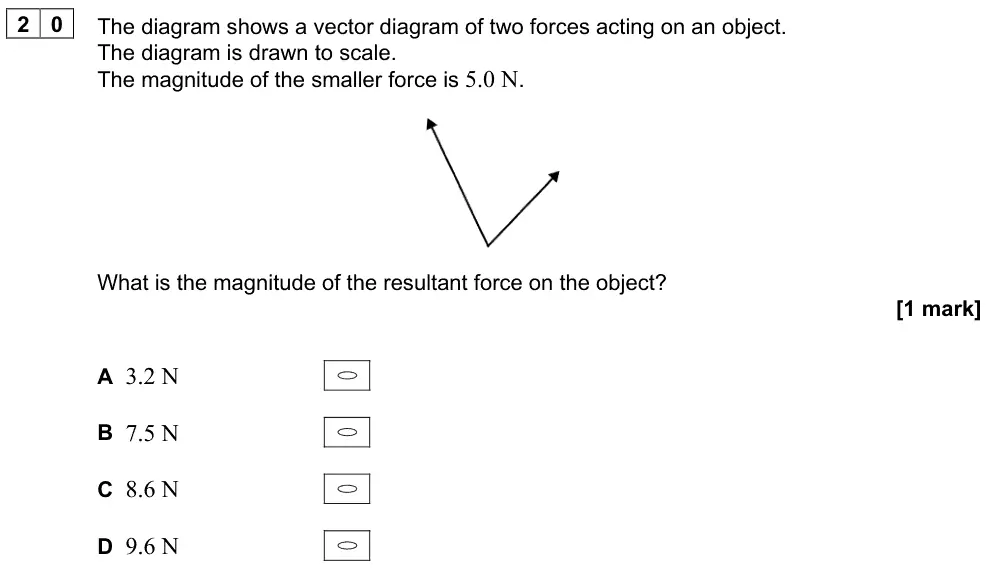
November 2021 · Paper 1 · Q20 1 mark Multiple choice Hard vectors and moments
The diagram shows a vector diagram of two forces acting on an object.
The diagram is drawn to scale.
The magnitude of the smaller force is 5.0 N.
What is the magnitude of the resultant force on the object?
[1 mark]
A 3.2 N
B 7.5 N
C 8.6 N
D 9.6 N
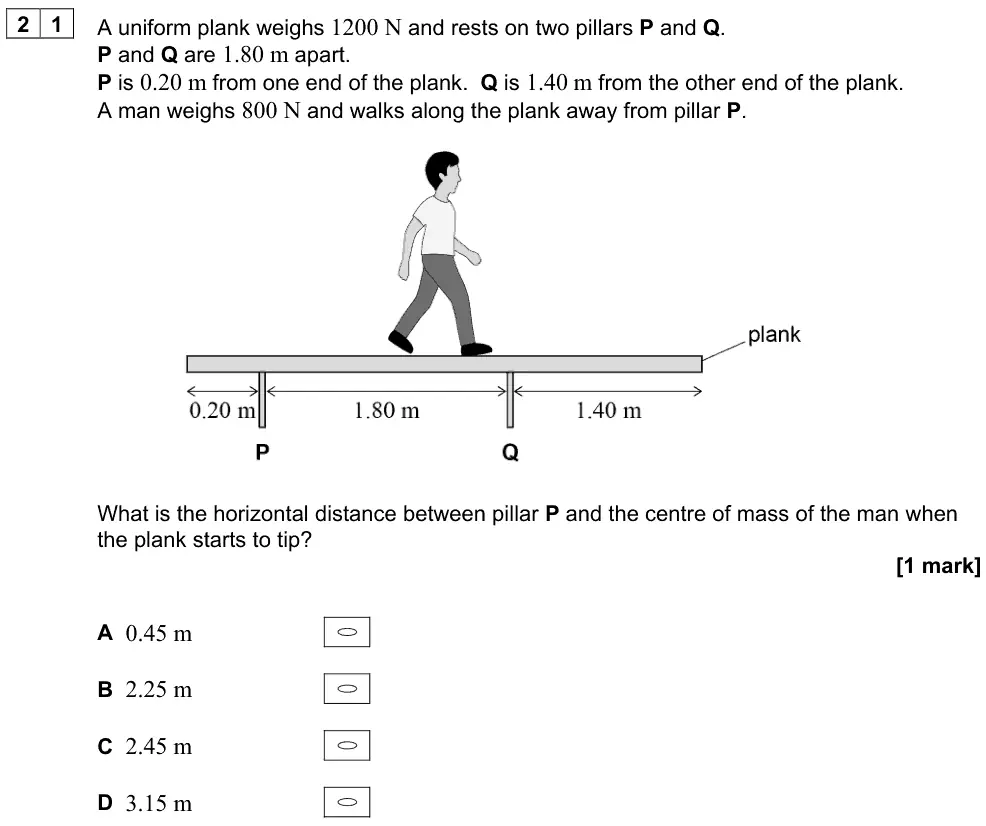
November 2021 · Paper 1 · Q21 1 mark Multiple choice vectors and moments
A uniform plank weighs 1200 N and rests on two pillars P and Q.
P and Q are 1.80 m apart.
P is 0.20 m from one end of the plank.  Q is 1.40 m from the other end of the plank.
A man weighs 800 N and walks along the plank away from pillar P.
What is the horizontal distance between pillar P and the centre of mass of the man when
the plank starts to tip?
[1 mark]
A 0.45 m
B 2.25 m
C 2.45 m
D 3.15 m
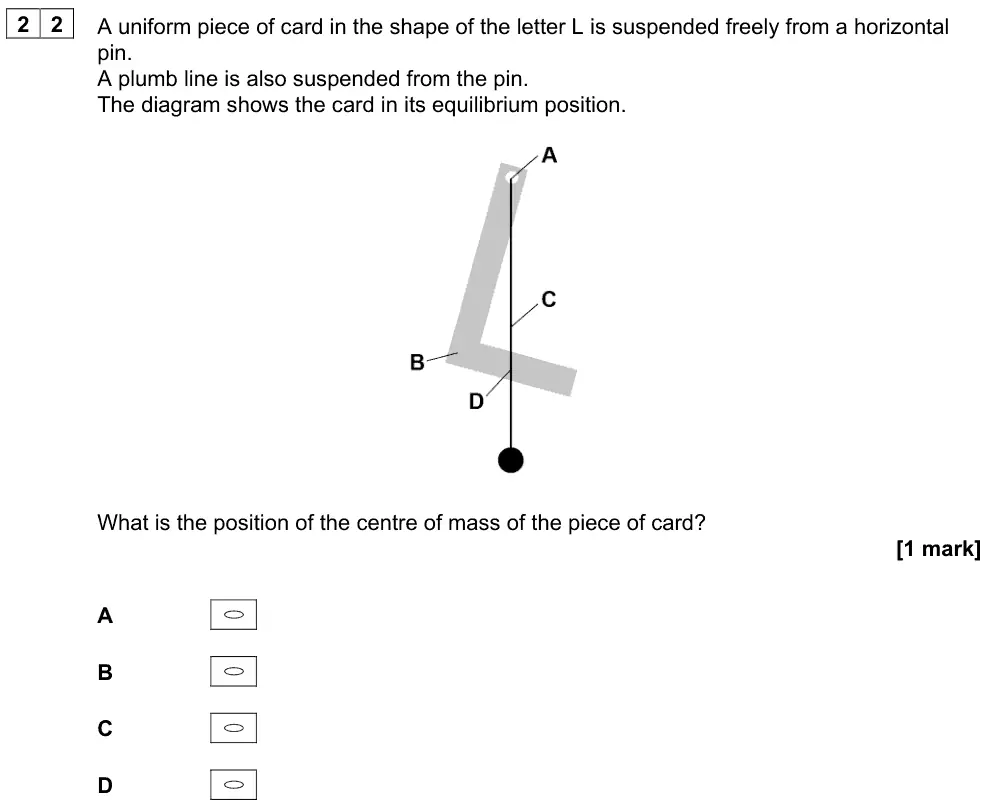
November 2021 · Paper 1 · Q22 1 mark Multiple choice vectors and moments
A uniform piece of card in the shape of the letter L is suspended freely from a horizontal
pin.
A plumb line is also suspended from the pin.
The diagram shows the card in its equilibrium position.
What is the position of the centre of mass of the piece of card?
[1 mark]
A
B
C
D
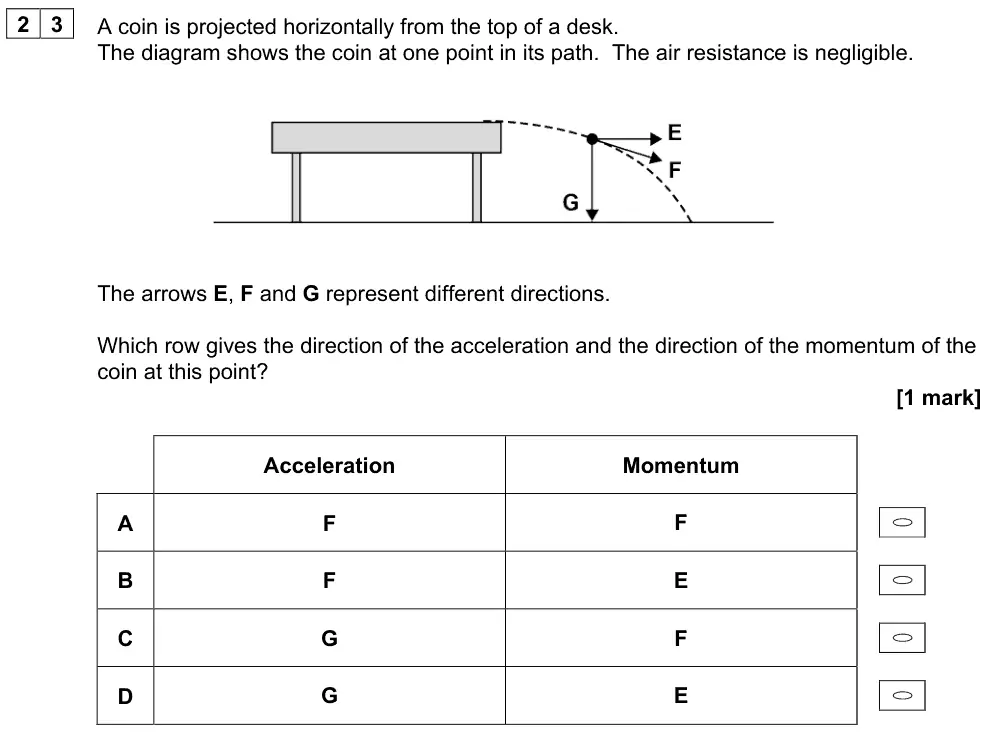
November 2021 · Paper 1 · Q23 1 mark Multiple choice motion and projectilesnewtons laws and momentum
A coin is projected horizontally from the top of a desk.
The diagram shows the coin at one point in its path.  The air resistance is negligible.
The arrows E, F and G represent different directions.
Which row gives the direction of the acceleration and the direction of the momentum of the
coin at this point?
[1 mark]
Acceleration
Momentum
A
F
F
B
F
E
C
G
F
D
G
E
November 2021 · Paper 1 · Q24 1 mark Multiple choice newtons laws and momentum
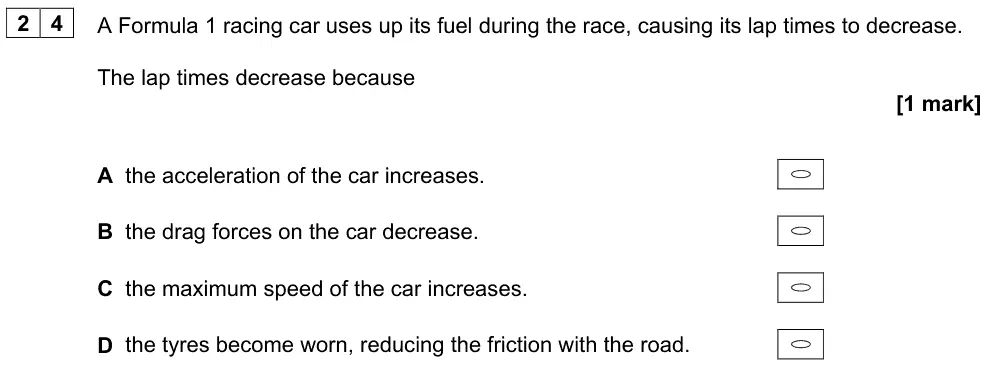
A Formula 1 racing car uses up its fuel during the race, causing its lap times to decrease.
The lap times decrease because
[1 mark]
A the acceleration of the car increases.
B the drag forces on the car decrease.
C the maximum speed of the car increases.
D the tyres become worn, reducing the friction with the road.
November 2021 · Paper 1 · Q25 1 mark Multiple choice newtons laws and momentumwork energy and power
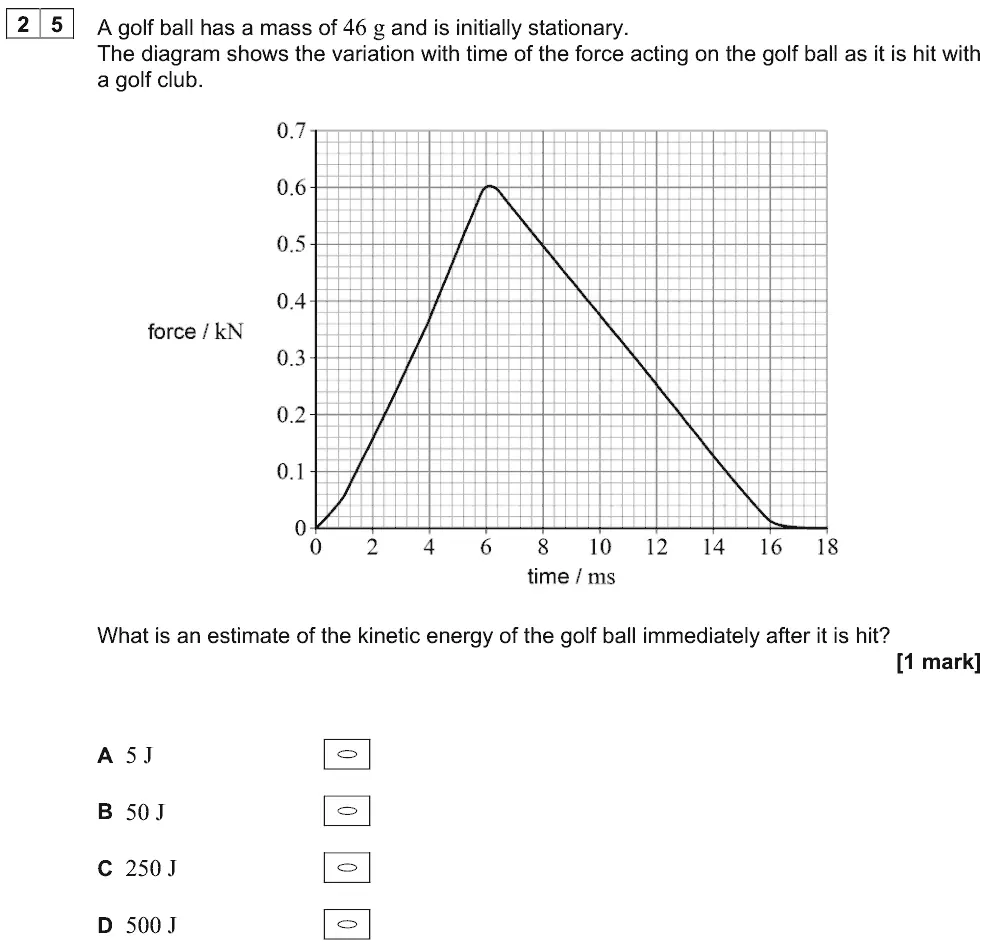
A golf ball has a mass of 46 g and is initially stationary.
The diagram shows the variation with time of the force acting on the golf ball as it is hit with
a golf club.
What is an estimate of the kinetic energy of the golf ball immediately after it is hit?
[1 mark]
A 5 J
B 50 J
C 250 J
D 500 J
November 2021 · Paper 1 · Q26 1 mark Multiple choice materials and young modulus
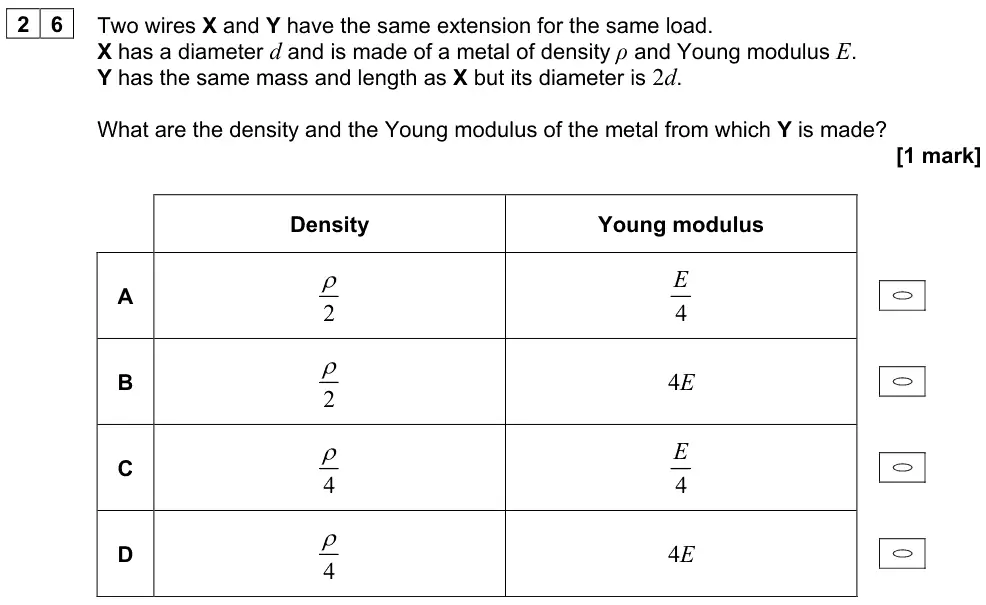
Two wires X and Y have the same extension for the same load.
X has a diameter d and is made of a metal of density ρ and Young modulus E.
Y has the same mass and length as X but its diameter is 2d.
What are the density and the Young modulus of the metal from which Y is made?
[1 mark]
Density
Young modulus
A
2
4
E
B
2
4E
C
4
4
E
D
4
4E
November 2021 · Paper 1 · Q27 1 mark Multiple choice Hard circuits and potential dividers
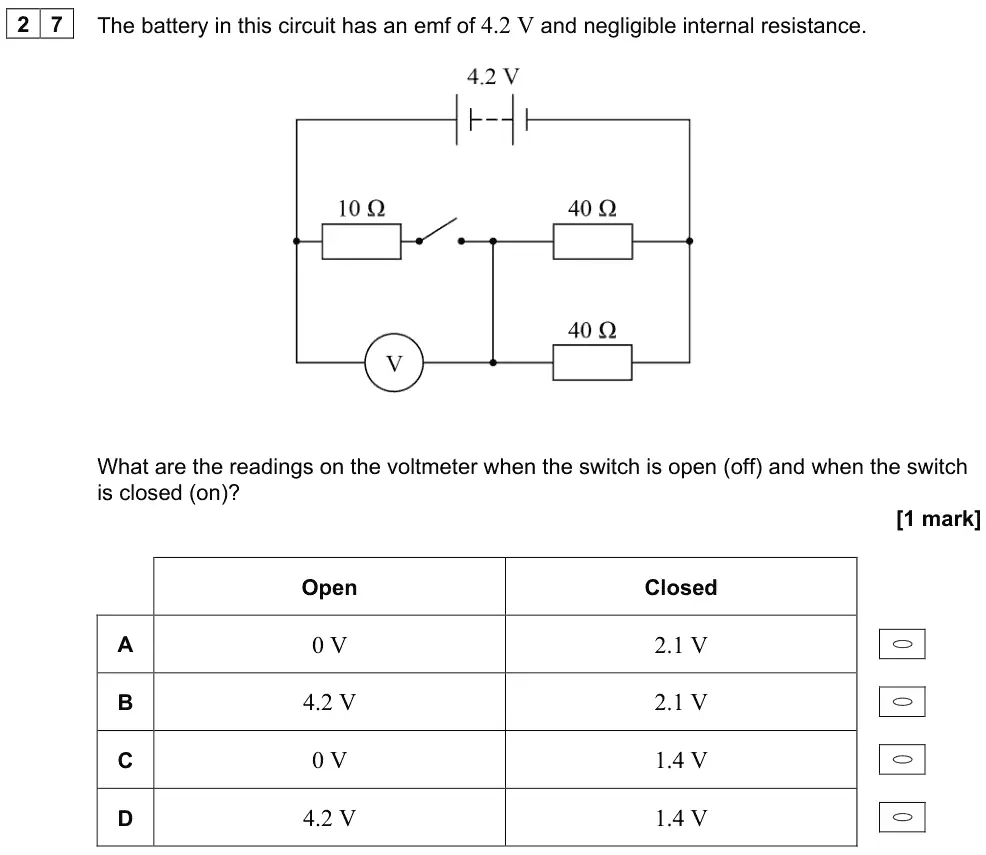
The battery in this circuit has an emf of 4.2 V and negligible internal resistance.
What are the readings on the voltmeter when the switch is open (off) and when the switch
is closed (on)?
[1 mark]
Open
Closed
A
0 V
2.1 V
B
4.2 V
2.1 V
C
0 V
1.4 V
D
4.2 V
1.4 V
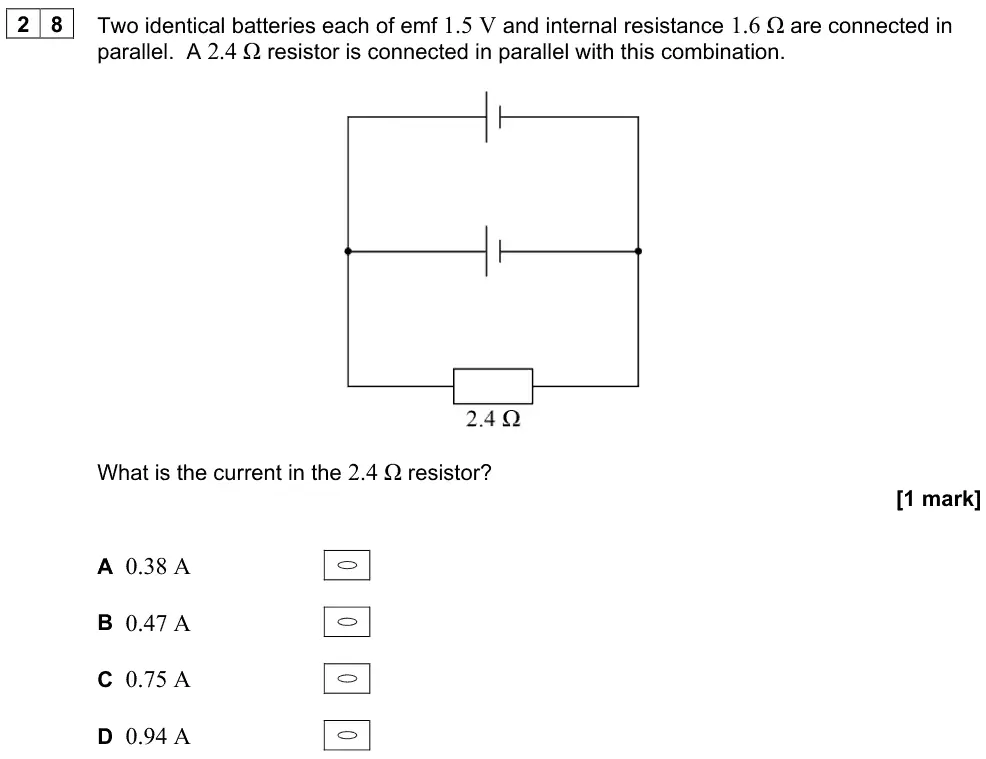
November 2021 · Paper 1 · Q28 1 mark Multiple choice emf and internal resistancecircuits and potential dividers
Two identical batteries each of emf 1.5 V and internal resistance 1.6 Ω are connected in
parallel.  A 2.4 Ω resistor is connected in parallel with this combination.
What is the current in the 2.4 Ω resistor?
[1 mark]
A 0.38 A
B 0.47 A
C 0.75 A
D 0.94 A
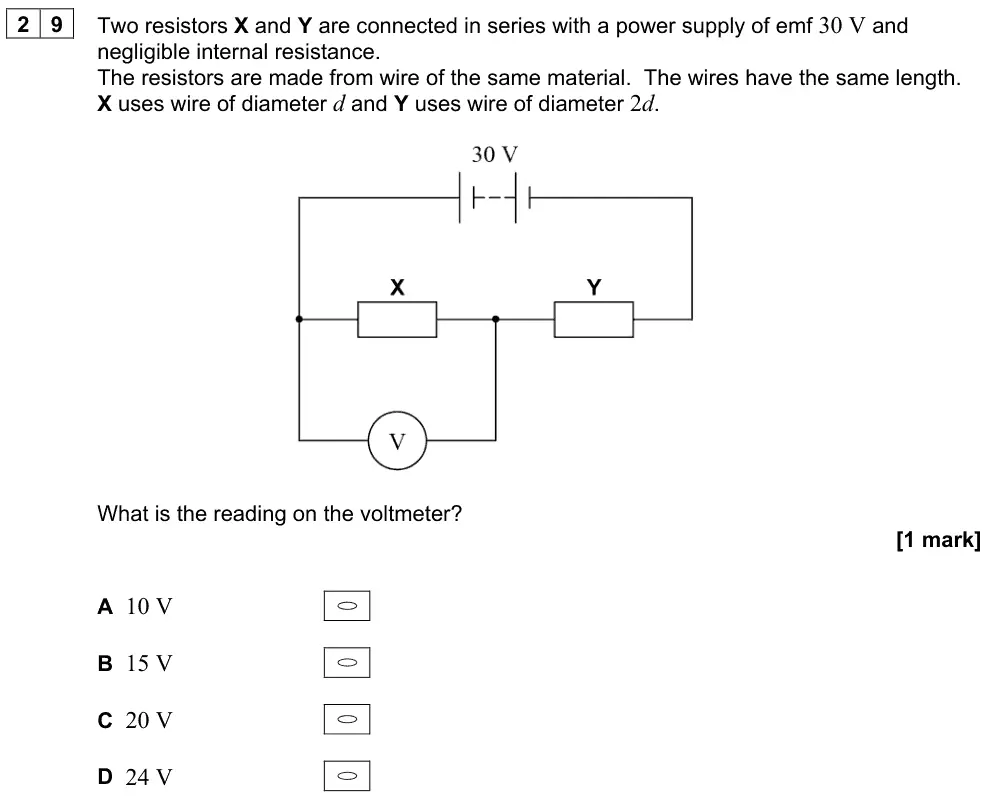
November 2021 · Paper 1 · Q29 1 mark Multiple choice Hard current voltage and resistivitycircuits and potential dividers
Two resistors X and Y are connected in series with a power supply of emf 30 V and
negligible internal resistance.
The resistors are made from wire of the same material.  The wires have the same length.
X uses wire of diameter d and Y uses wire of diameter 2d.
What is the reading on the voltmeter?
[1 mark]
A 10 V
B 15 V
C 20 V
D 24 V
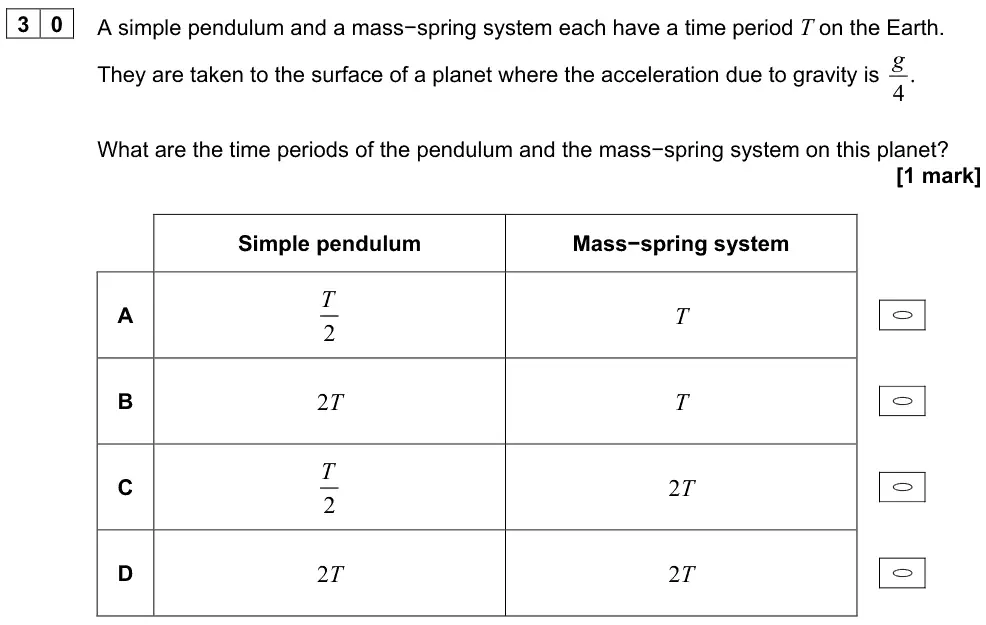
November 2021 · Paper 1 · Q30 1 mark Multiple choice simple harmonic motion
A simple pendulum and a mass−spring system each have a time period T on the Earth.
They are taken to the surface of a planet where the acceleration due to gravity is
.
4
g
What are the time periods of the pendulum and the mass−spring system on this planet?
[1 mark]
Simple pendulum
Mass−spring system
A
2
T
T
B
2T
T
C
2
T
2T
D
2T
2T
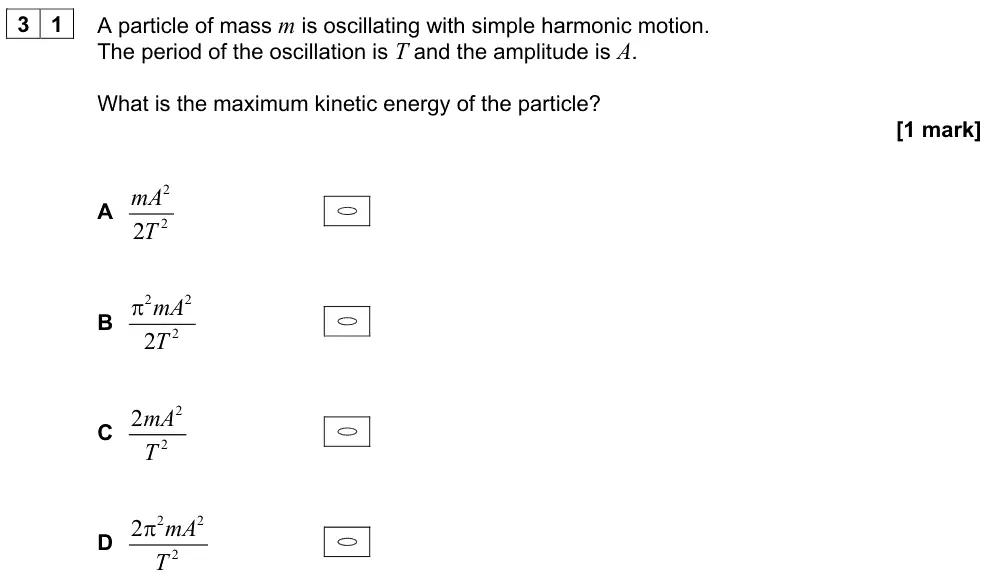
November 2021 · Paper 1 · Q31 1 mark Multiple choice simple harmonic motionwork energy and power
A particle of mass m is oscillating with simple harmonic motion.
The period of the oscillation is T and the amplitude is A.
What is the maximum kinetic energy of the particle?
[1 mark]
A
2
2
2
mA
T
B
2
2
2
2
mA
T
π
C
2
2
2mA
T
D
2
2
2
2
mA
T
π

Work with an AQA physics tutor

Want a paper marked and gone through with you? Message us.

Prefer email? Send an enquiry

If you are under 18, please include a parent's contact details. Enquiries go to enquiries@physicsaleveltutor.com and are deleted once handled. All tutoring is online.