Specimen set 1: Paper 2

85 marks · 48 question parts · Paper, mark scheme and report on AQA's site · Have the data and formulae booklet beside you

Question by question

QTopicMarksAOType
1.1 Motion along a straight line and projectile motion 2Calculation
1.2 Electric fields and electric potential 3Show that
1.3 Motion along a straight line and projectile motion 1Calculation
1.4 Newton's laws of motion and momentum, Motion along a straight line and projectile motion 2Explanation
1.5 Electric fields and electric potential, Atomic structure and stable nuclei 4Explanation
2.1 Capacitance and capacitor charge and discharge 2Calculation
2.2 Capacitance and capacitor charge and discharge 2Show that
2.3 Capacitance and capacitor charge and discharge 2Calculation
2.4 Capacitance and capacitor charge and discharge 2Explanation
3.1 Molecular kinetic theory 2Short answer
3.2 Molecular kinetic theory 3Explanation
3.3 Thermal energy transfer and ideal gases 6Calculation
4.1 Radioactive decay, half-life and nuclear instability 1Show that
4.2 Radioactive decay, half-life and nuclear instability 3Show that
4.3 Radioactive decay, half-life and nuclear instability 3Calculation
4.4 Materials, stress, strain and the Young modulus 2Short answer
5.1 Electromagnetic induction, alternating currents and transformers 4Explanation
5.2 Electromagnetic induction, alternating currents and transformers 3Calculation
6.1 Gravitational fields and orbits 2Short answer
6.2 Circular motion 1Calculation
6.3 Progressive waves, longitudinal and transverse waves, Circular motion 3Show that
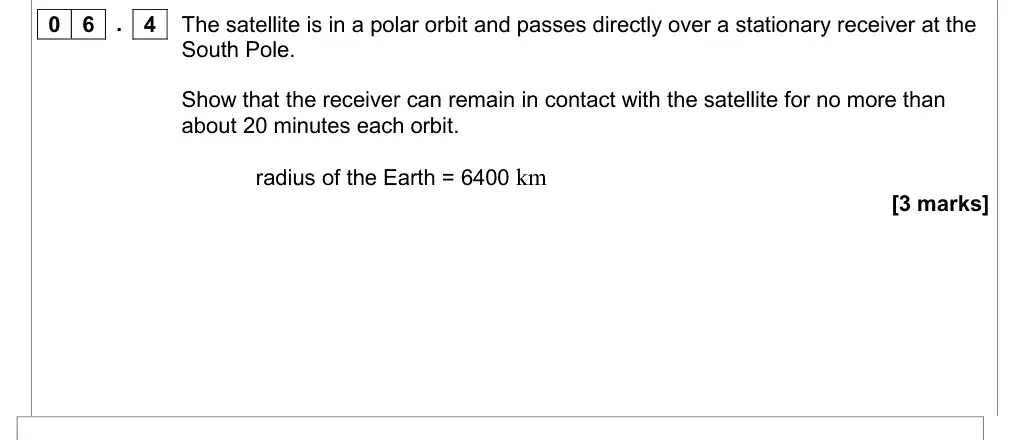
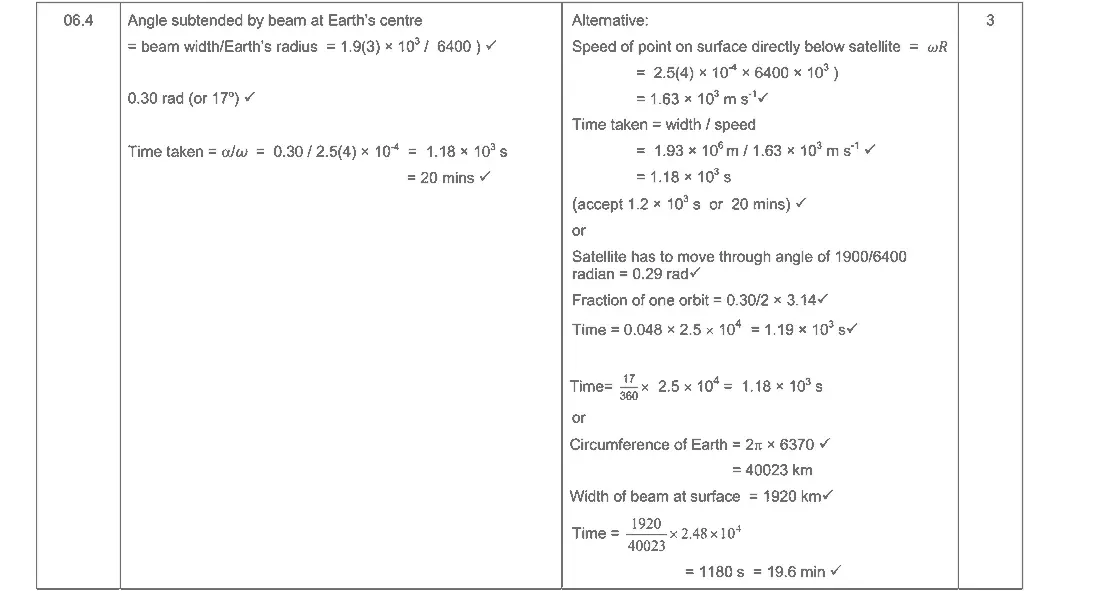
6.4 Circular motion 3Show that
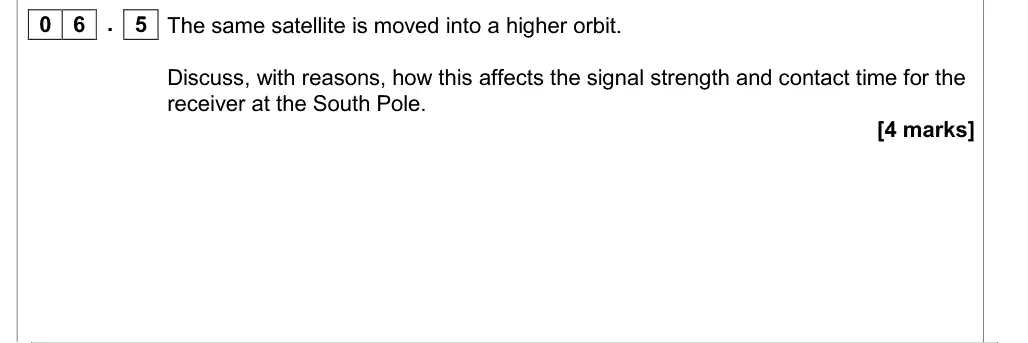
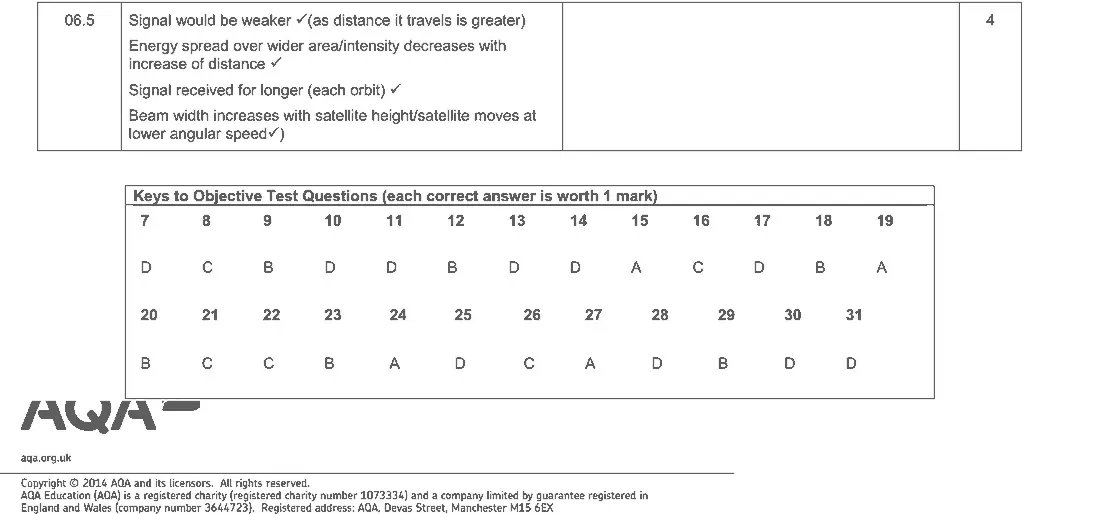
6.5 Gravitational fields and orbits, Rutherford scattering, alpha, beta and gamma radiation 4Explanation
7 Gravitational fields and orbits 1Multiple choice
8 Gravitational fields and orbits 1Multiple choice
9 Gravitational fields and orbits 1Multiple choice
10 Gravitational fields and orbits 1Multiple choice
11 Electric fields and electric potential 1Multiple choice
12 Electric fields and electric potential 1Multiple choice
13 Rutherford scattering, alpha, beta and gamma radiation, Electric fields and electric potential 1Multiple choice
14 Electric fields and electric potential 1Multiple choice
15 Electric fields and electric potential 1Multiple choice
16 Capacitance and capacitor charge and discharge 1Multiple choice
17 Capacitance and capacitor charge and discharge 1Multiple choice
18 Magnetic flux density and moving charges in a magnetic field 1Multiple choice
19 Magnetic flux density and moving charges in a magnetic field 1Multiple choice
20 Electromagnetic induction, alternating currents and transformers 1Multiple choice
21 Simple harmonic motion, forced vibrations and resonance 1Multiple choice
22 Electromagnetic induction, alternating currents and transformers 1Multiple choice
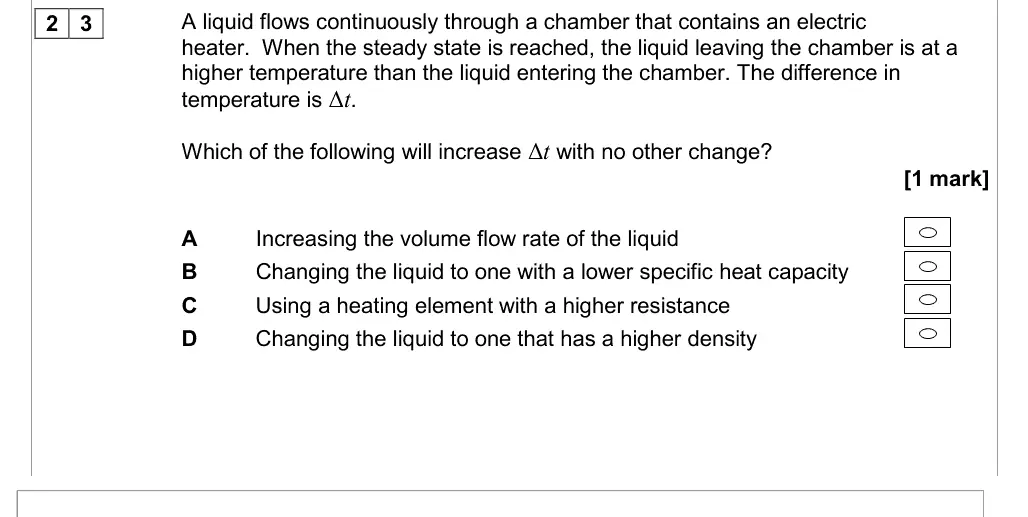
23 Thermal energy transfer and ideal gases 1Multiple choice
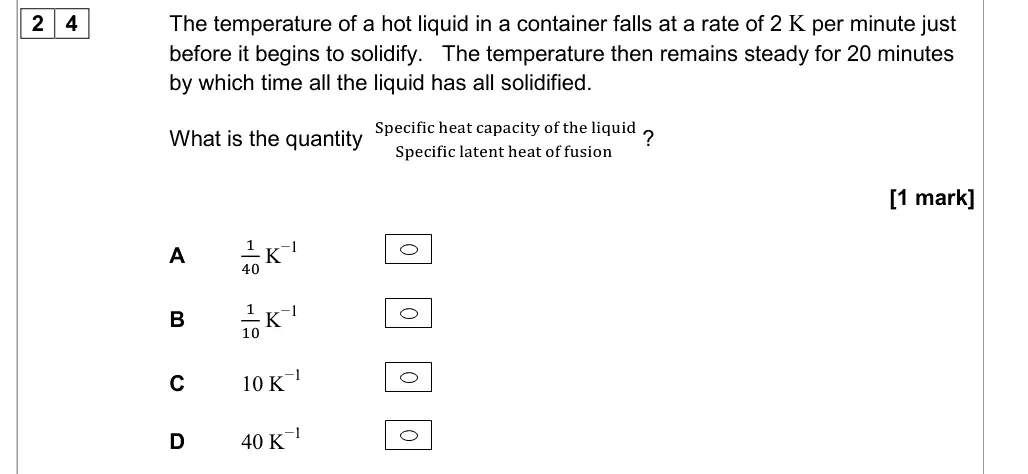
24 Thermal energy transfer and ideal gases 1Multiple choice
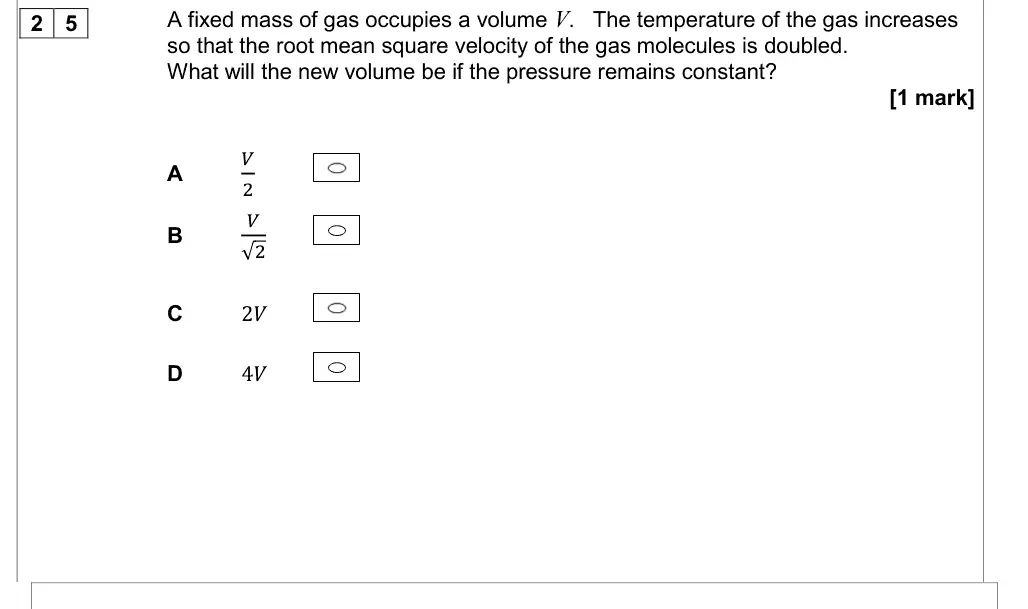
25 Molecular kinetic theory, Thermal energy transfer and ideal gases 1Multiple choice
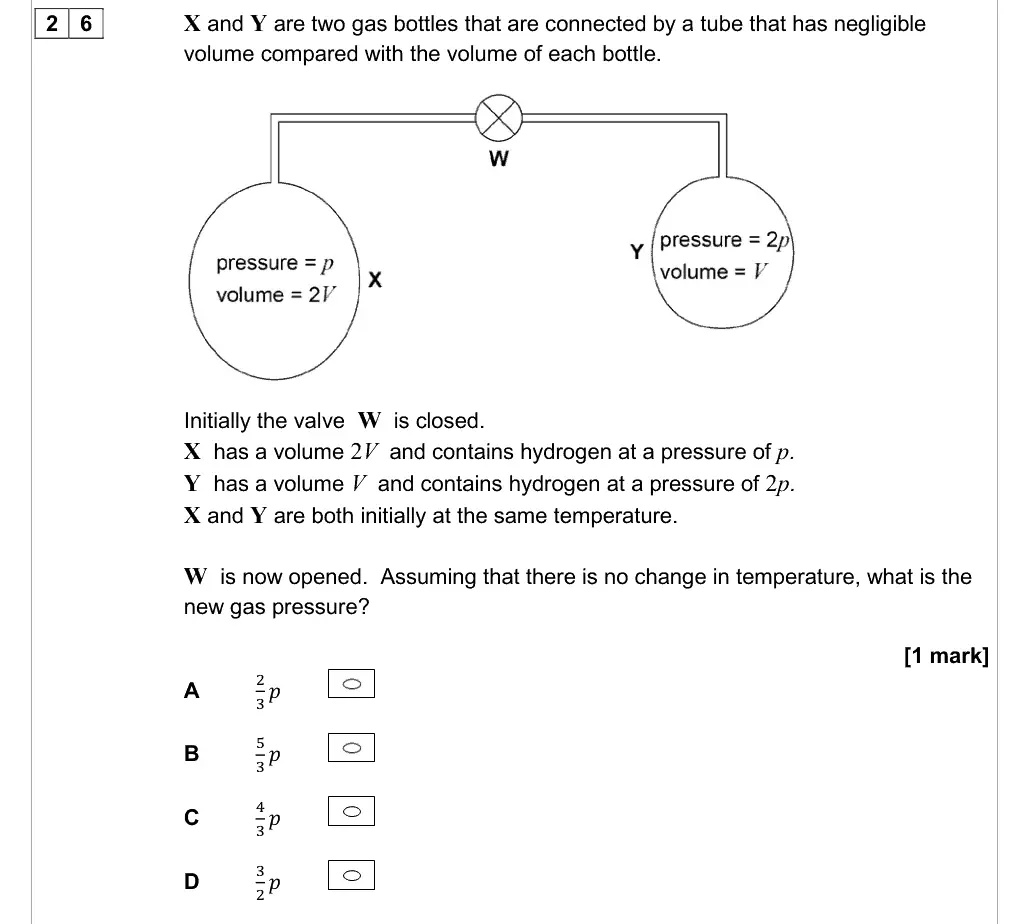
26 Thermal energy transfer and ideal gases 1Multiple choice
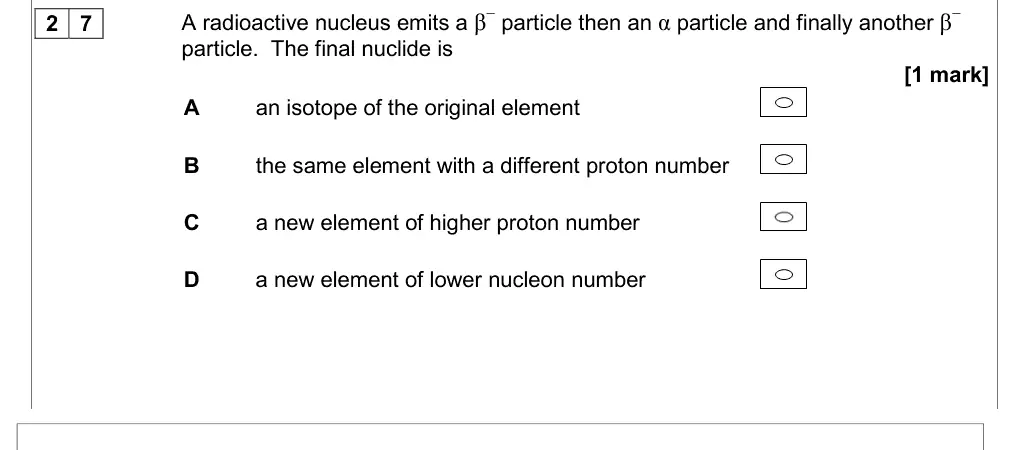
27 Radioactive decay, half-life and nuclear instability, Atomic structure and stable nuclei 1Multiple choice
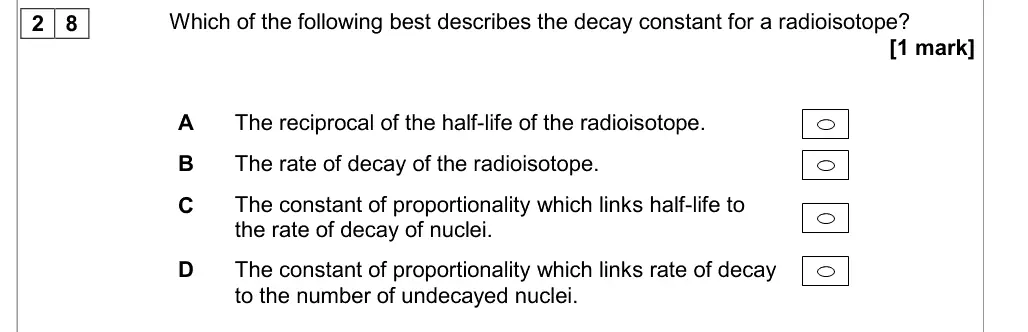
28 Radioactive decay, half-life and nuclear instability 1Multiple choice
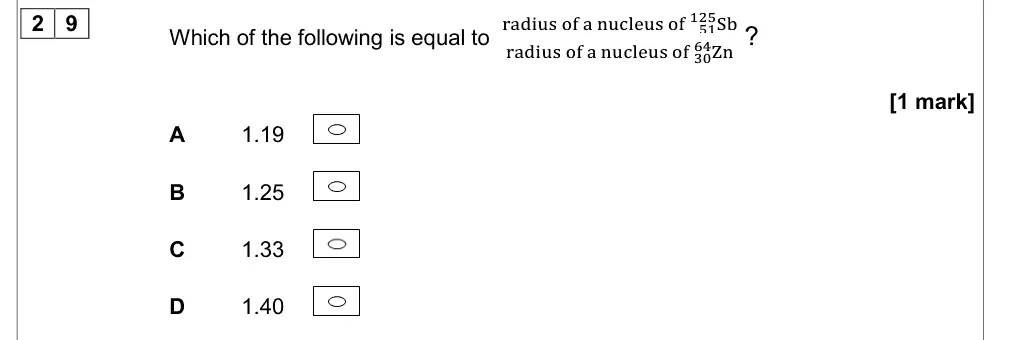
29 Nuclear radius 1Multiple choice
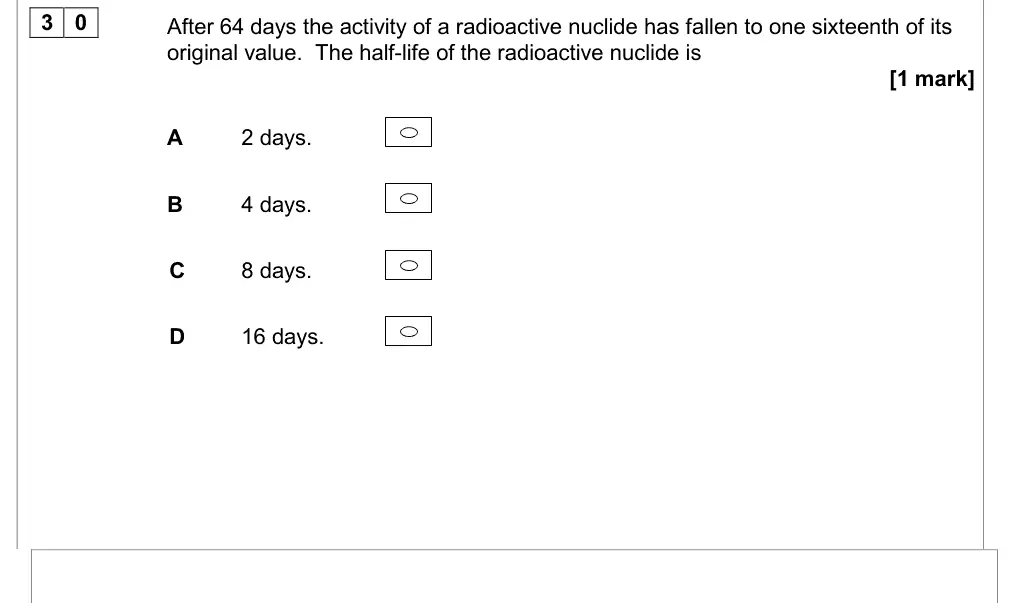
30 Radioactive decay, half-life and nuclear instability 1Multiple choice
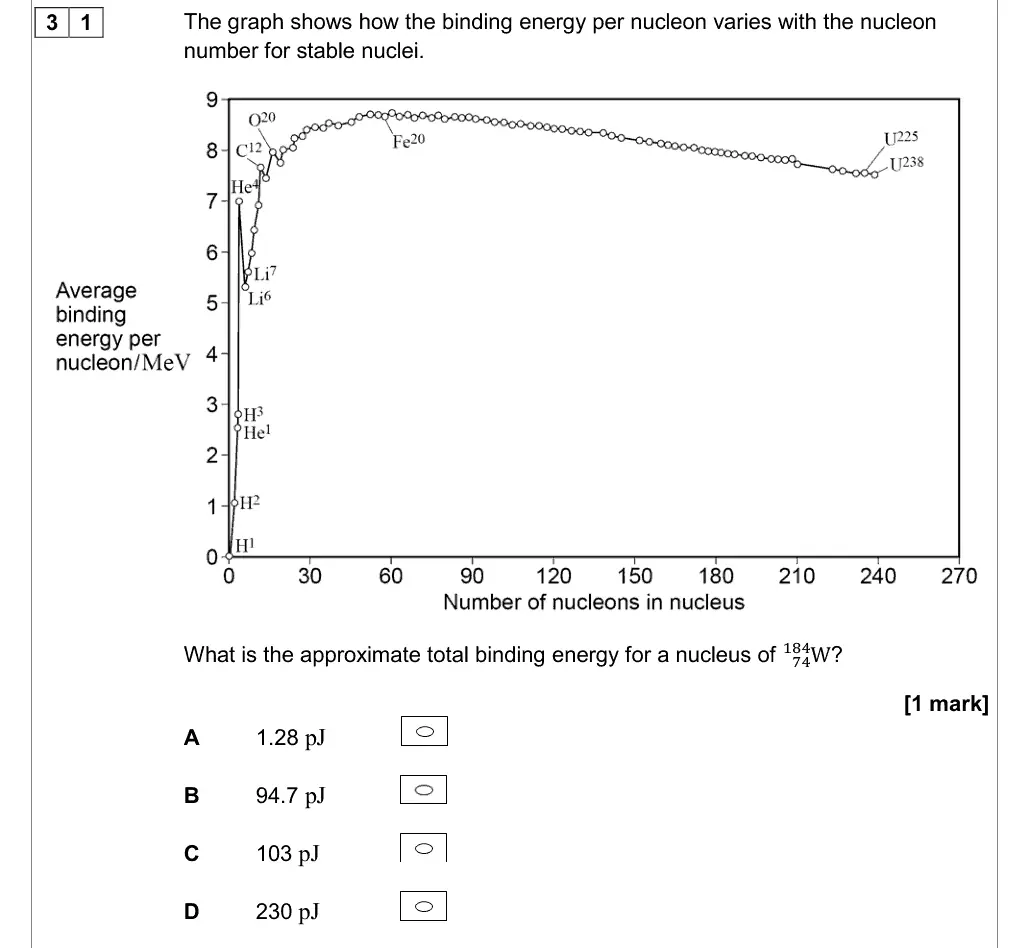
31 Mass and energy, binding energy, fission and safety 1Multiple choice

The questions

1.11.21.31.41.52.12.22.32.43.13.23.34.14.24.34.45.15.26.16.26.36.46.578910111213141516171819202122232425262728293031
Specimen set 1 · Paper 2 · Q1.1 2 marks Calculation motion and projectiles
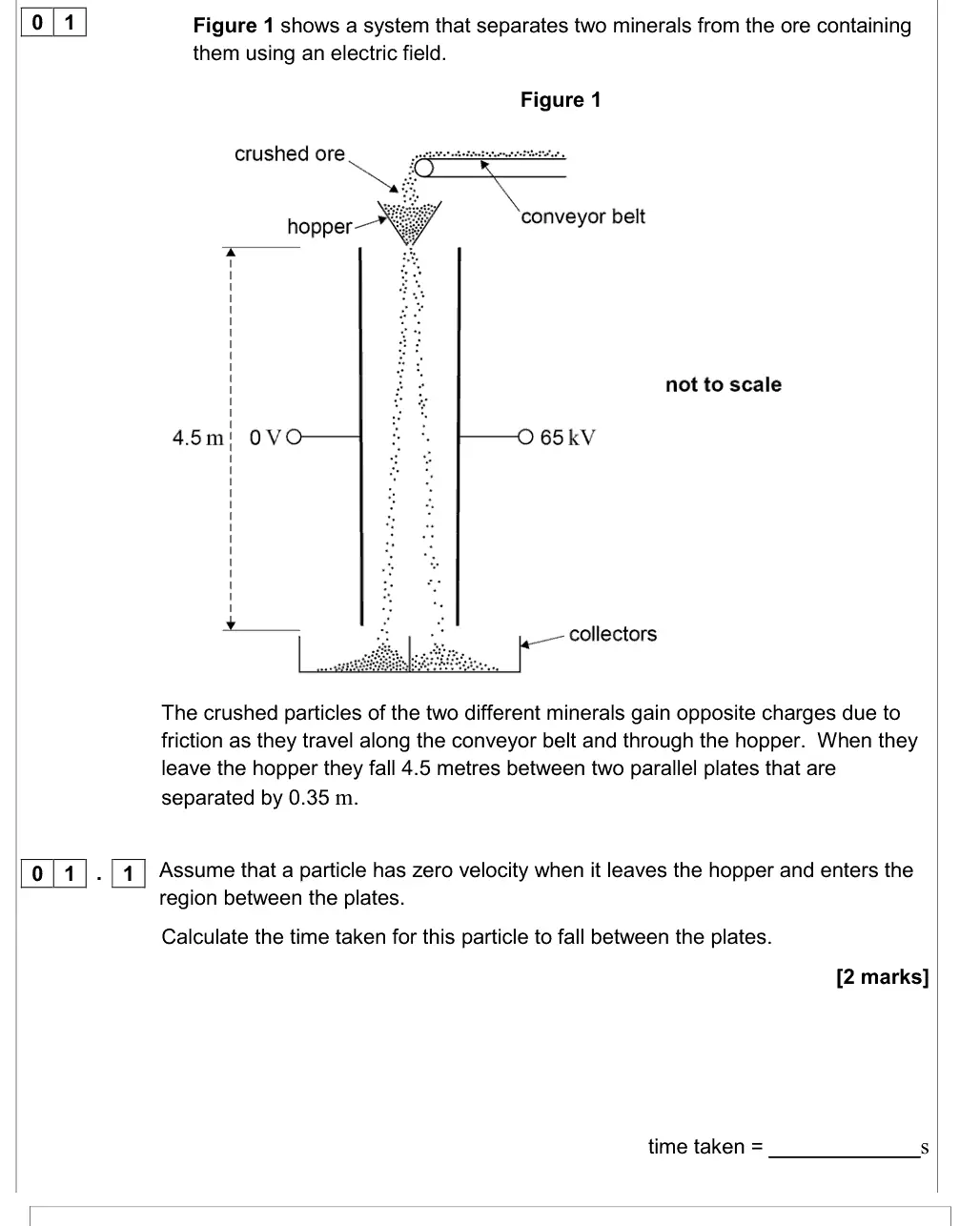
Figure 1 shows a system that separates two minerals from the ore containing
them using an electric field.
Figure 1
The crushed particles of the two different minerals gain opposite charges due to
friction as they travel along the conveyor belt and through the hopper.  When they
leave the hopper they fall 4.5 metres between two parallel plates that are
separated by 0.35 m.
Assume that a particle has zero velocity when it leaves the hopper and enters the
region between the plates.
Calculate the time taken for this particle to fall between the plates.
[2 marks]
time taken = s
Specimen set 1 · Paper 2 · Q1.2 3 marks Show that electric fields
Earlier part of question 1 that this part usesEarlier part of Specimen set 1 Paper 2 question 1
A potential difference (pd) of 65 kV is applied between the plates.
Show that when a particle of specific charge 1.2 × 10⁻⁶ C kg−1  is between the
plates its horizontal acceleration is about 0.2 m s−2.
[3 marks]
Specimen set 1 · Paper 2 · Q1.3 1 mark Calculation motion and projectiles
Earlier part of question 1 that this part usesEarlier part of Specimen set 1 Paper 2 question 1
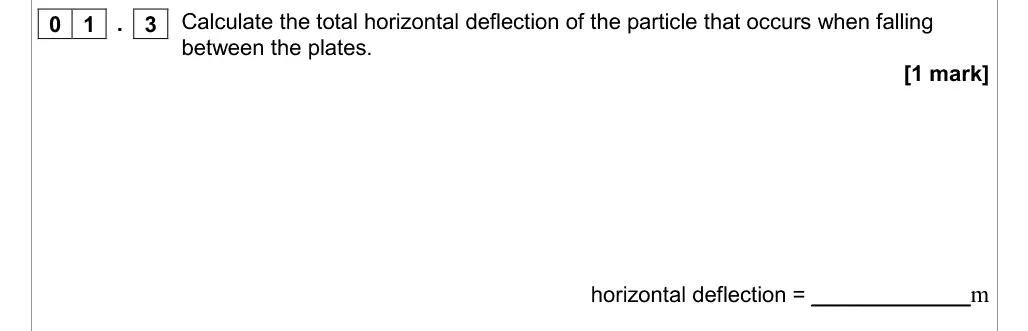
Calculate the total horizontal deflection of the particle that occurs when falling
between the plates.
[1 mark]
horizontal deflection = m
Specimen set 1 · Paper 2 · Q1.4 2 marks Explanation newtons laws and momentummotion and projectiles
Earlier part of question 1 that this part usesEarlier part of Specimen set 1 Paper 2 question 1
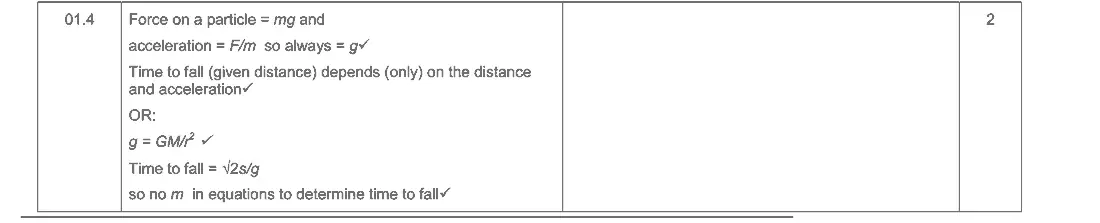
Explain why the time to fall vertically between the plates is independent of the
mass of a particle.
[2 marks]
Specimen set 1 · Paper 2 · Q1.5 4 marks Explanation electric fieldsatomic structure and stable nuclei
Earlier part of question 1 that this part usesEarlier part of Specimen set 1 Paper 2 question 1
State and explain two reasons, why the horizontal acceleration of a particle is
different for each particle.
[4 marks]
Turn to page 6 for the next question
Specimen set 1 · Paper 2 · Q2.1 2 marks Calculation capacitors
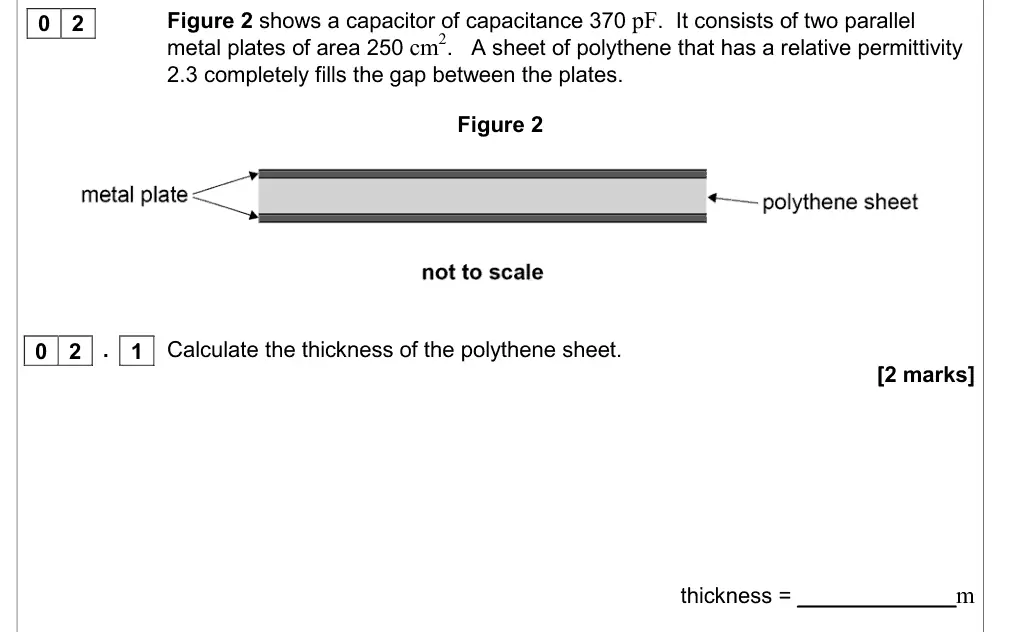
Figure 2 shows a capacitor of capacitance 370 pF.  It consists of two parallel
metal plates of area 250 cm2.   A sheet of polythene that has a relative permittivity
2.3 completely fills the gap between the plates.
Figure 2
Calculate the thickness of the polythene sheet.
[2 marks]
thickness = m
Specimen set 1 · Paper 2 · Q2.2 2 marks Show that capacitors
Earlier part of question 2 that this part usesEarlier part of Specimen set 1 Paper 2 question 2
The capacitor is charged so that there is a potential difference of 35 V between
the plates.  The charge on the capacitor is then 13 nC and the energy stored is
0.23 µJ.
The supply is now disconnected and the polythene sheet is pulled out from
between the plates without discharging or altering the separation of the plates.
Show that the potential difference between the plates increases to about 80 V.
[2 marks]
Specimen set 1 · Paper 2 · Q2.3 2 marks Calculation capacitors
Earlier part of question 2 that this part usesEarlier part of Specimen set 1 Paper 2 question 2
Calculate the energy that is now stored by the capacitor.
[2 marks]
energy stored = µJ
Specimen set 1 · Paper 2 · Q2.4 2 marks Explanation capacitors
Earlier part of question 2 that this part usesEarlier part of Specimen set 1 Paper 2 question 2
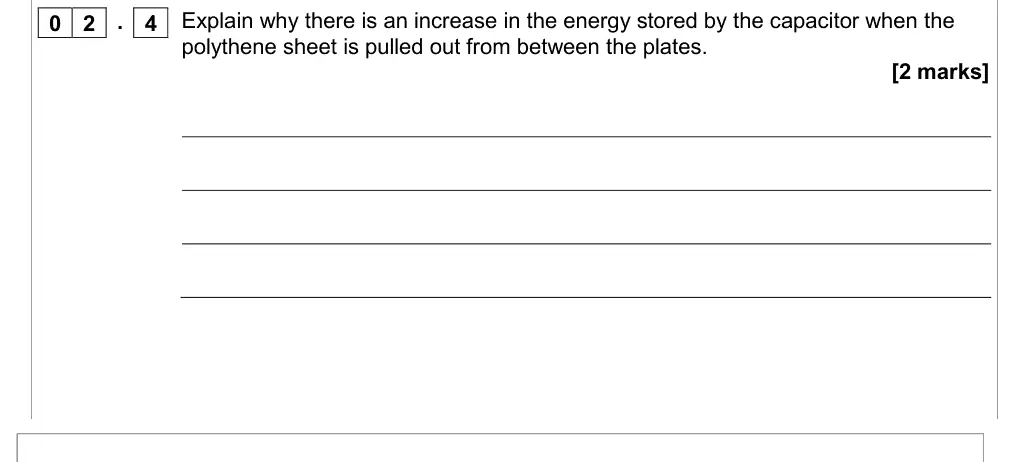
Explain why there is an increase in the energy stored by the capacitor when the
polythene sheet is pulled out from between the plates.
[2 marks]
Specimen set 1 · Paper 2 · Q3.1 2 marks Short answer kinetic theory
State two assumptions made about the motion of the molecules in a gas in the
derivation of the kinetic theory of gases equation.
[2 marks]
Specimen set 1 · Paper 2 · Q3.2 3 marks Explanation kinetic theory
Earlier part of question 3 that this part usesEarlier part of Specimen set 1 Paper 2 question 3
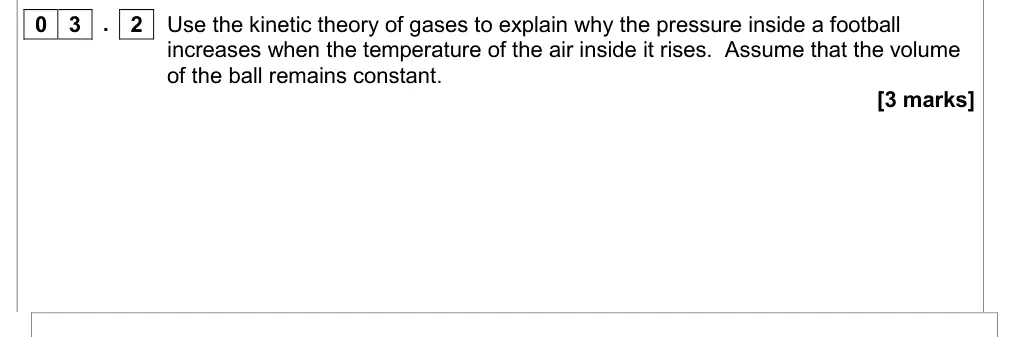
Use the kinetic theory of gases to explain why the pressure inside a football
increases when the temperature of the air inside it rises.  Assume that the volume
of the ball remains constant.
[3 marks]
Specimen set 1 · Paper 2 · Q3.3 6 marks Calculation thermal energy and ideal gases
Earlier part of question 3 that this part usesEarlier part of Specimen set 1 Paper 2 question 3
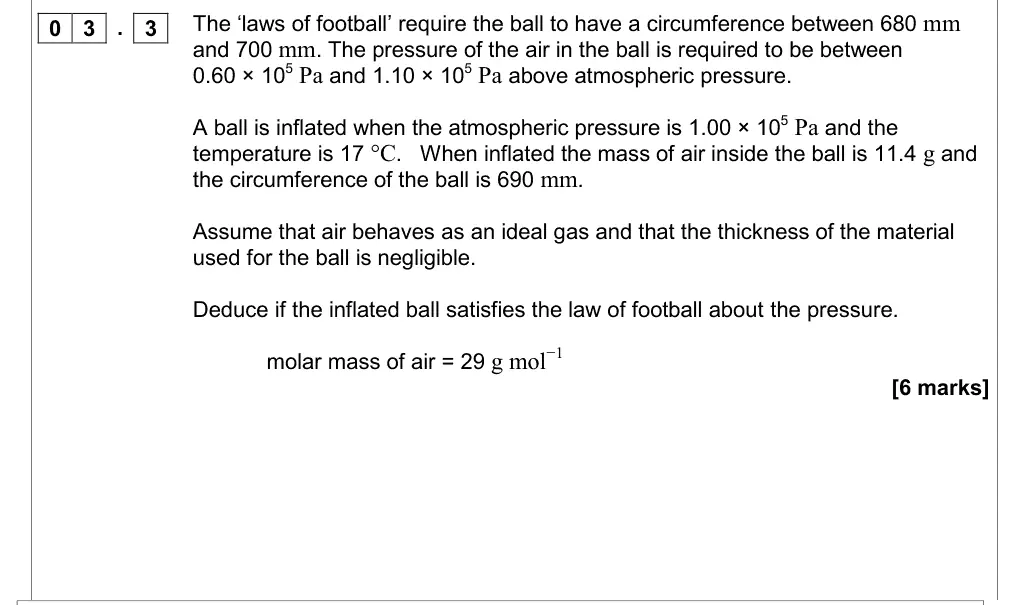
The ‘laws of football’ require the ball to have a circumference between 680 mm
and 700 mm. The pressure of the air in the ball is required to be between
0.60 × 10⁵ Pa and 1.10 × 10⁵ Pa above atmospheric pressure.
A ball is inflated when the atmospheric pressure is 1.00 × 10⁵ Pa and the
temperature is 17 °C.   When inflated the mass of air inside the ball is 11.4 g and
the circumference of the ball is 690 mm.
Assume that air behaves as an ideal gas and that the thickness of the material
used for the ball is negligible.
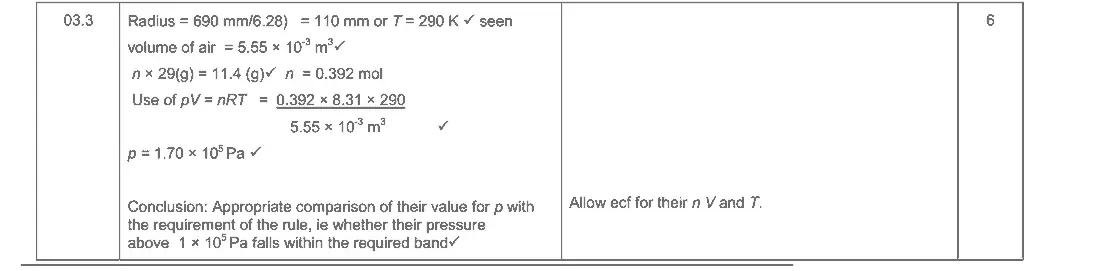
Deduce if the inflated ball satisfies the law of football about the pressure.
molar mass of air = 29 g mol−1
[6 marks]
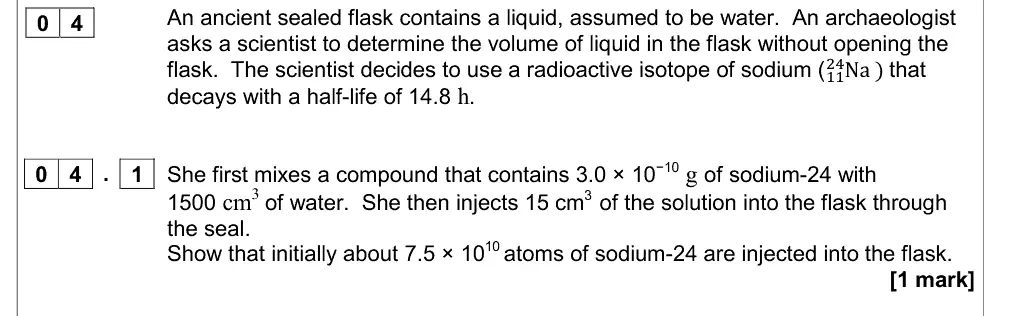
Specimen set 1 · Paper 2 · Q4.1 1 mark Show that radioactive decay
An ancient sealed flask contains a liquid, assumed to be water.  An archaeologist
asks a scientist to determine the volume of liquid in the flask without opening the
flask.  The scientist decides to use a radioactive isotope of sodium (
Na
11
24
) that
decays with a half-life of 14.8 h.
She first mixes a compound that contains 3.0 × 10⁻¹⁰ g of sodium-24 with
1500 cm3 of water.  She then injects 15 cm3  of the solution into the flask through
the seal.
Show that initially about 7.5 × 10¹⁰ atoms of sodium-24 are injected into the flask.
[1 mark]
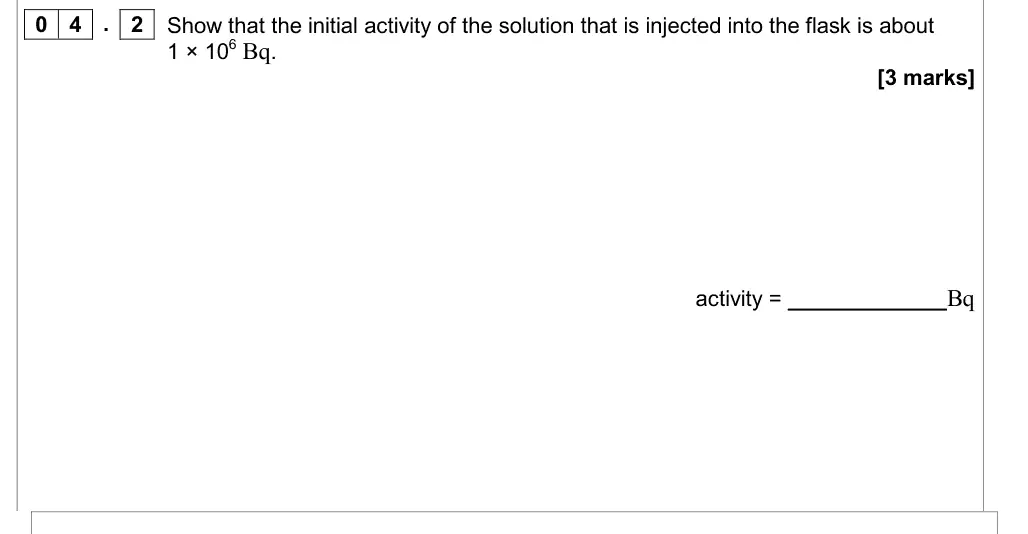
Specimen set 1 · Paper 2 · Q4.2 3 marks Show that radioactive decay
Earlier part of question 4 that this part usesEarlier part of Specimen set 1 Paper 2 question 4
Show that the initial activity of the solution that is injected into the flask is about
1 × 10⁶ Bq.
[3 marks]
activity = Bq
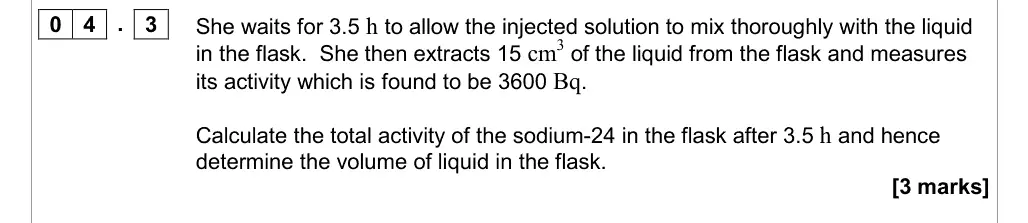
Specimen set 1 · Paper 2 · Q4.3 3 marks Calculation radioactive decay
Earlier part of question 4 that this part usesEarlier part of Specimen set 1 Paper 2 question 4
She waits for 3.5 h to allow the injected solution to mix thoroughly with the liquid
in the flask.  She then extracts 15 cm3 of the liquid from the flask and measures
its activity which is found to be 3600 Bq.
Calculate the total activity of the sodium-24 in the flask after 3.5 h and hence
determine the volume of liquid in the flask.
[3 marks]
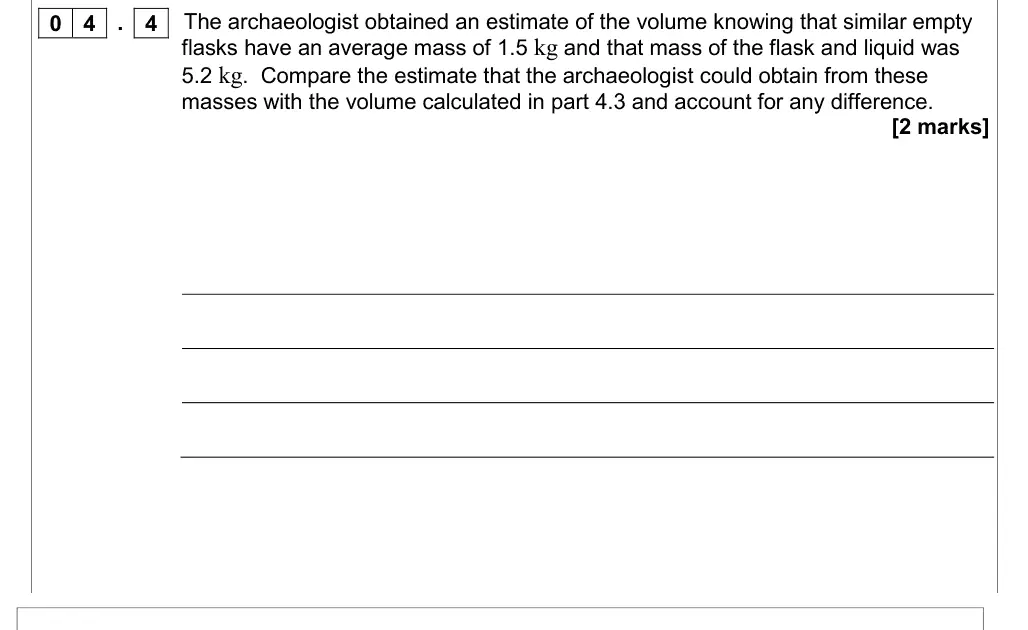
Specimen set 1 · Paper 2 · Q4.4 2 marks Short answer materials and young modulus
Earlier part of question 4 that this part usesEarlier part of Specimen set 1 Paper 2 question 4
The archaeologist obtained an estimate of the volume knowing that similar empty
flasks have an average mass of 1.5 kg and that mass of the flask and liquid was
5.2 kg.  Compare the estimate that the archaeologist could obtain from these
masses with the volume calculated in part 4.3 and account for any difference.
[2 marks]
Specimen set 1 · Paper 2 · Q5.1 4 marks Explanation electromagnetic induction
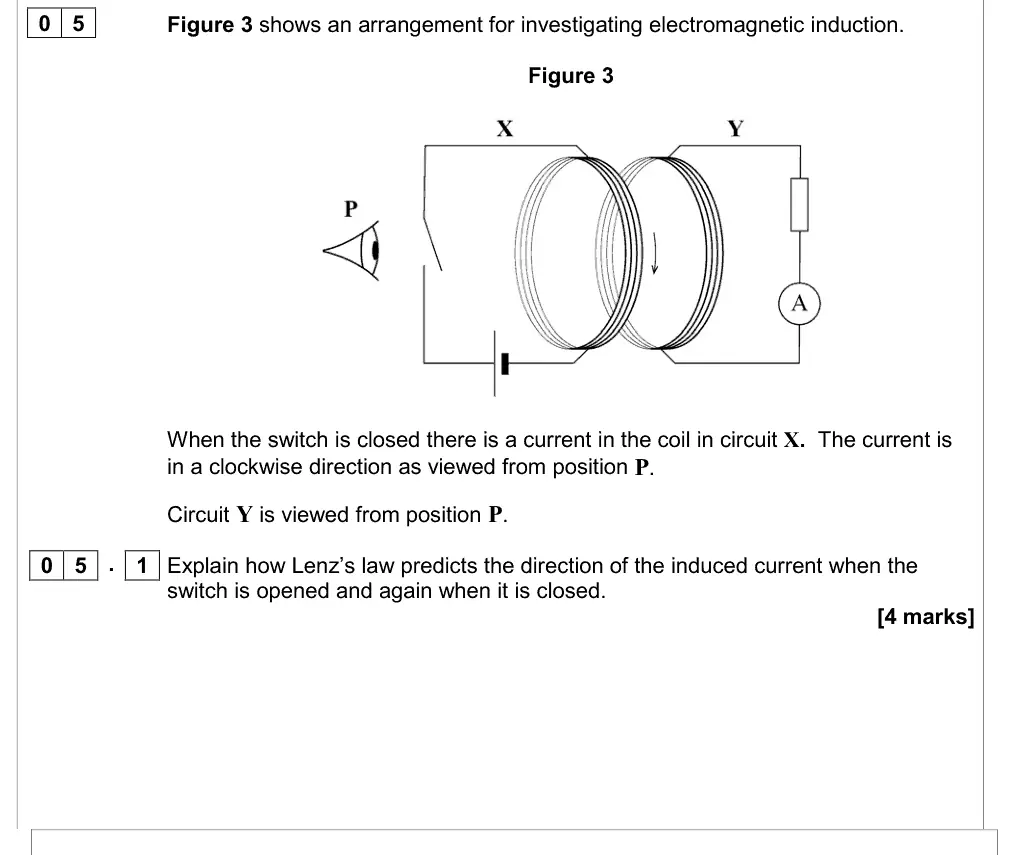
Figure 3 shows an arrangement for investigating electromagnetic induction.
Figure 3
When the switch is closed there is a current in the coil in circuit X.  The current is
in a clockwise direction as viewed from position P.
Circuit Y is viewed from position P.
Explain how Lenz’s law predicts the direction of the induced current when the
switch is opened and again when it is closed.
[4 marks]
Specimen set 1 · Paper 2 · Q5.2 3 marks Calculation electromagnetic induction
Earlier part of question 5 that this part usesEarlier part of Specimen set 1 Paper 2 question 5
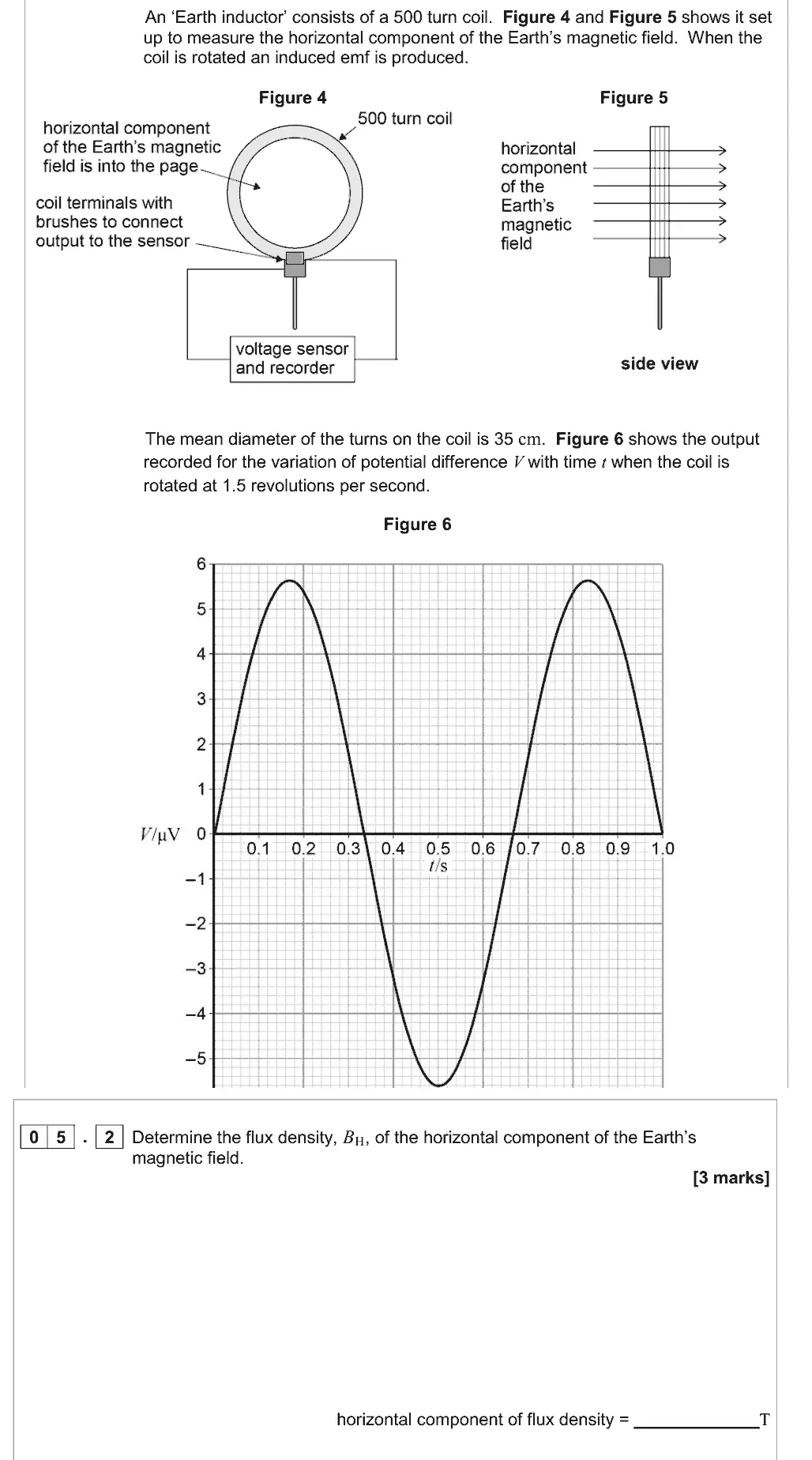
An ‘Earth inductor’ consists of a 500 turn coil.  Figure 4 and Figure 5 shows it set
up to measure the horizontal component of the Earth’s magnetic field.  When the
coil is rotated an induced emf is produced.
Figure 4
Figure 5
The mean diameter of the turns on the coil is 35 cm.  Figure 6 shows the output
recorded for the variation of potential difference V with time t when the coil is
rotated at 1.5 revolutions per second.
Figure 6
Determine the flux density, BH, of the horizontal component of the Earth’s
magnetic field.
[3 marks]
horizontal component of flux density = T
Specimen set 1 · Paper 2 · Q6.1 2 marks Short answer gravitational fields
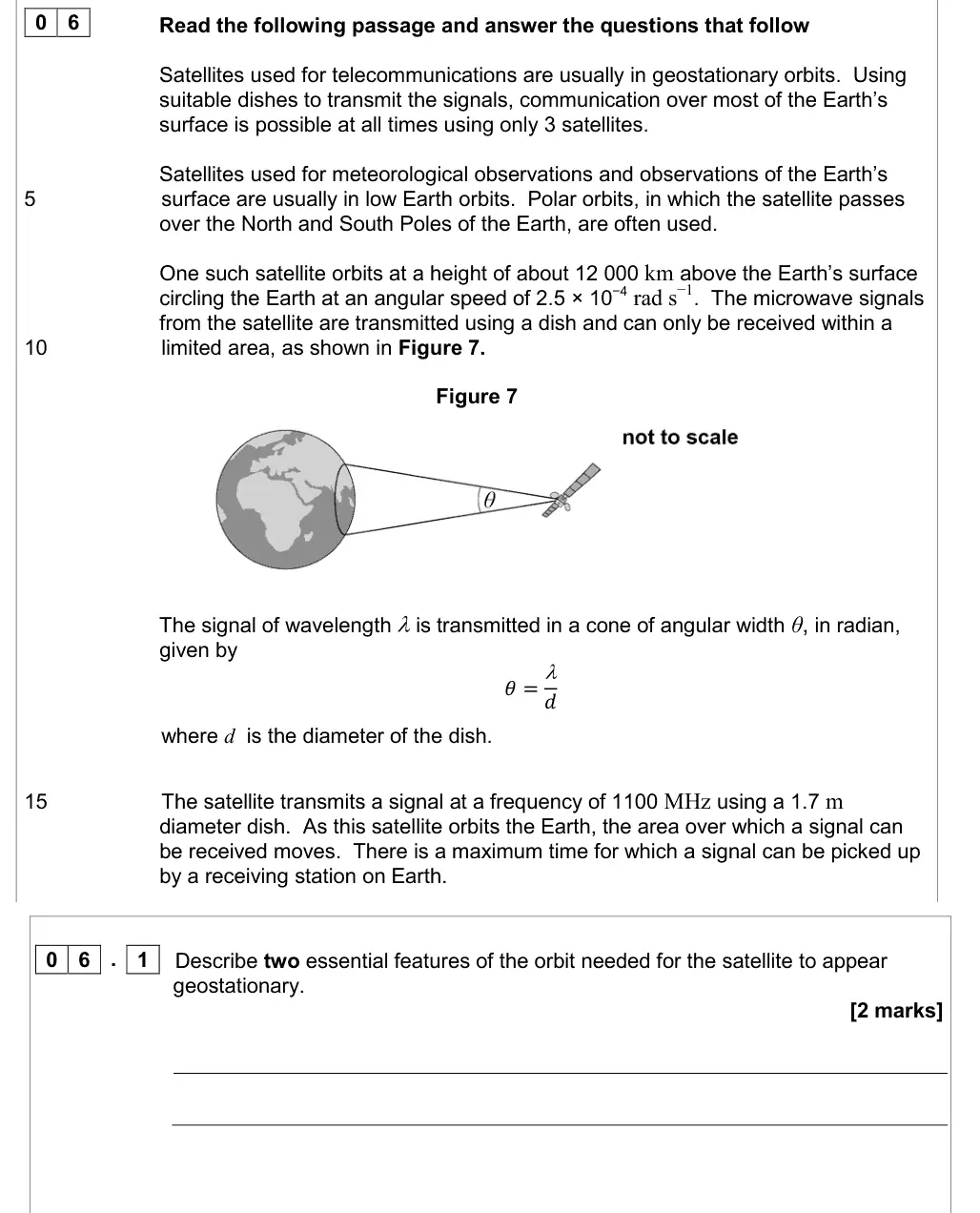
Read the following passage and answer the questions that follow
Satellites used for telecommunications are usually in geostationary orbits.  Using
suitable dishes to transmit the signals, communication over most of the Earth’s
surface is possible at all times using only 3 satellites.
Satellites used for meteorological observations and observations of the Earth’s
5
surface are usually in low Earth orbits.  Polar orbits, in which the satellite passes
over the North and South Poles of the Earth, are often used.
One such satellite orbits at a height of about 12 000 km above the Earth’s surface
circling the Earth at an angular speed of 2.5 × 10⁻⁴ rad s−1.  The microwave signals
from the satellite are transmitted using a dish and can only be received within a
10
limited area, as shown in Figure 7.
Figure 7
The signal of wavelength λ is transmitted in a cone of angular width θ, in radian,
given by
𝜃= λ
𝑑
where d  is the diameter of the dish.
15
The satellite transmits a signal at a frequency of 1100 MHz using a 1.7 m
diameter dish.  As this satellite orbits the Earth, the area over which a signal can
be received moves.  There is a maximum time for which a signal can be picked up
by a receiving station on Earth.
Describe two essential features of the orbit needed for the satellite to appear
geostationary.
[2 marks]
Specimen set 1 · Paper 2 · Q6.2 1 mark Calculation circular motion
Earlier part of question 6 that this part usesEarlier part of Specimen set 1 Paper 2 question 6
Calculate the time taken, in s, for the satellite mentioned in line 7 in the passage to
complete one orbit around the Earth.
[1 mark]
time taken = s
Specimen set 1 · Paper 2 · Q6.3 3 marks Show that progressive waves and polarisationcircular motion
Earlier part of question 6 that this part usesEarlier part of Specimen set 1 Paper 2 question 6
Show that at a distance of 12 000 km from the satellite the beam has a width of
1900 km.
[3 marks]
Specimen set 1 · Paper 2 · Q6.4 3 marks Show that circular motion
Earlier part of question 6 that this part usesEarlier part of Specimen set 1 Paper 2 question 6
The satellite is in a polar orbit and passes directly over a stationary receiver at the
South Pole.
Show that the receiver can remain in contact with the satellite for no more than
about 20 minutes each orbit.
radius of the Earth = 6400 km
[3 marks]
Specimen set 1 · Paper 2 · Q6.5 4 marks Explanation gravitational fieldsrutherford scattering and radiation
Earlier part of question 6 that this part usesEarlier part of Specimen set 1 Paper 2 question 6
The same satellite is moved into a higher orbit.
Discuss, with reasons, how this affects the signal strength and contact time for the
receiver at the South Pole.
[4 marks]
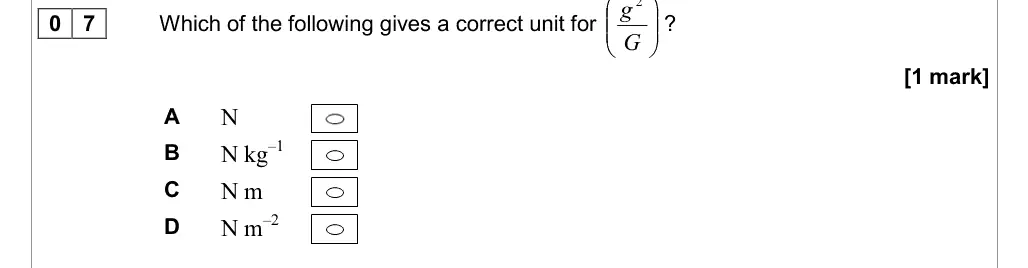
Specimen set 1 · Paper 2 · Q7 1 mark Multiple choice gravitational fields
Which of the following gives a correct unit for




G
?
[1 mark]
A
N
B
N kg–1
C
N m
D
N m–2
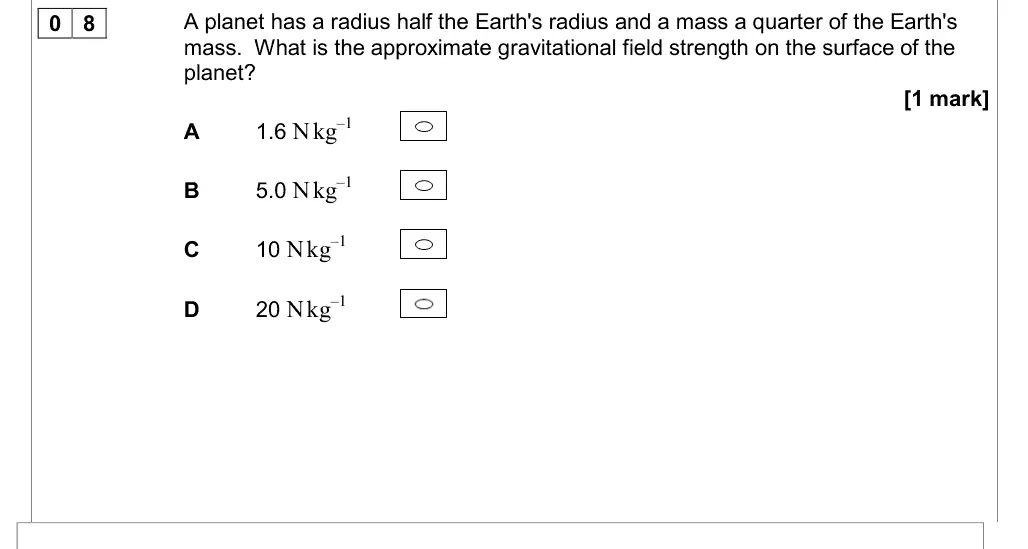
Specimen set 1 · Paper 2 · Q8 1 mark Multiple choice gravitational fields
A planet has a radius half the Earth's radius and a mass a quarter of the Earth's
mass.  What is the approximate gravitational field strength on the surface of the
planet?
[1 mark]
A
1.6  N kg–1
B
5.0  N kg–1
C
10  N kg–1
D
20  N kg–1
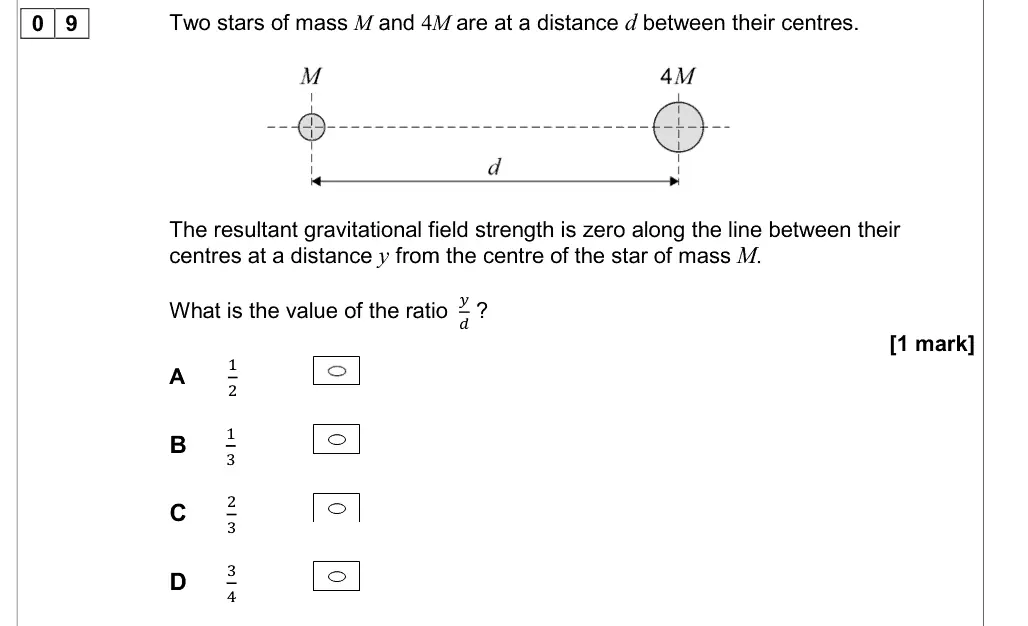
Specimen set 1 · Paper 2 · Q9 1 mark Multiple choice gravitational fields
Two stars of mass M and 4M are at a distance d between their centres.
The resultant gravitational field strength is zero along the line between their
centres at a distance y from the centre of the star of mass M.
What is the value of the ratio
𝑦
𝑑 ?
[1 mark]
A
1
2
B
1
3
C
2
3
D
3
4
Specimen set 1 · Paper 2 · Q10 1 mark Multiple choice gravitational fields
Which of the following statements about Newton’s law of gravitation is correct?
Newton’s gravitational law explains
[1 mark]
A  the origin of gravitational forces.
B  why a falling satellite burns up when it enters the Earth’s atmosphere.
C  why projectiles maintain a uniform horizontal speed.
D  how various factors affect the gravitational force between two particles.
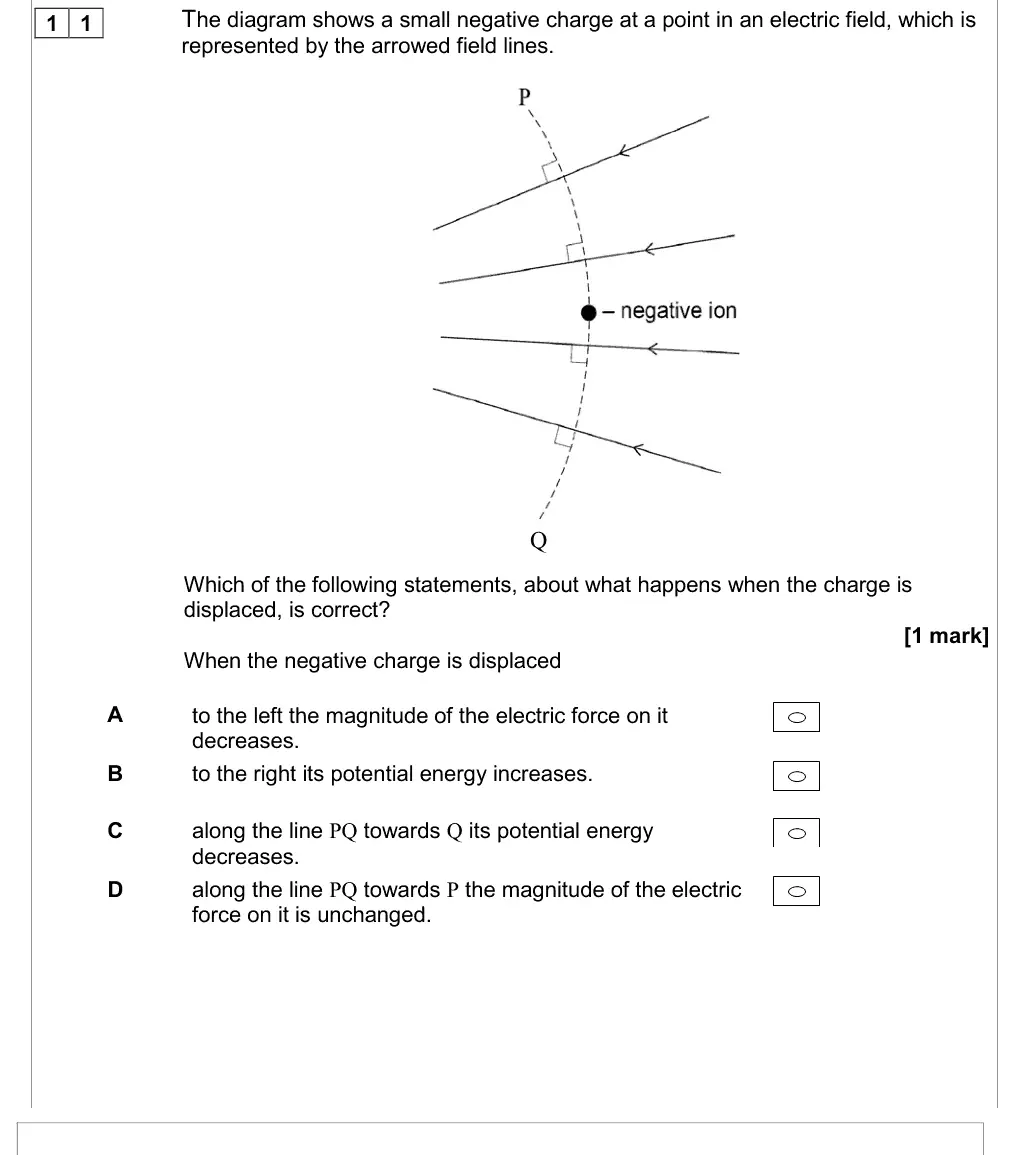
Specimen set 1 · Paper 2 · Q11 1 mark Multiple choice electric fields
The diagram shows a small negative charge at a point in an electric field, which is
represented by the arrowed field lines.
Which of the following statements, about what happens when the charge is
displaced, is correct?
[1 mark]
When the negative charge is displaced
A
to the left the magnitude of the electric force on it
decreases.
B
to the right its potential energy increases.
C
along the line PQ towards Q its potential energy
decreases.
D
along the line PQ towards P the magnitude of the electric
force on it is unchanged.
Q
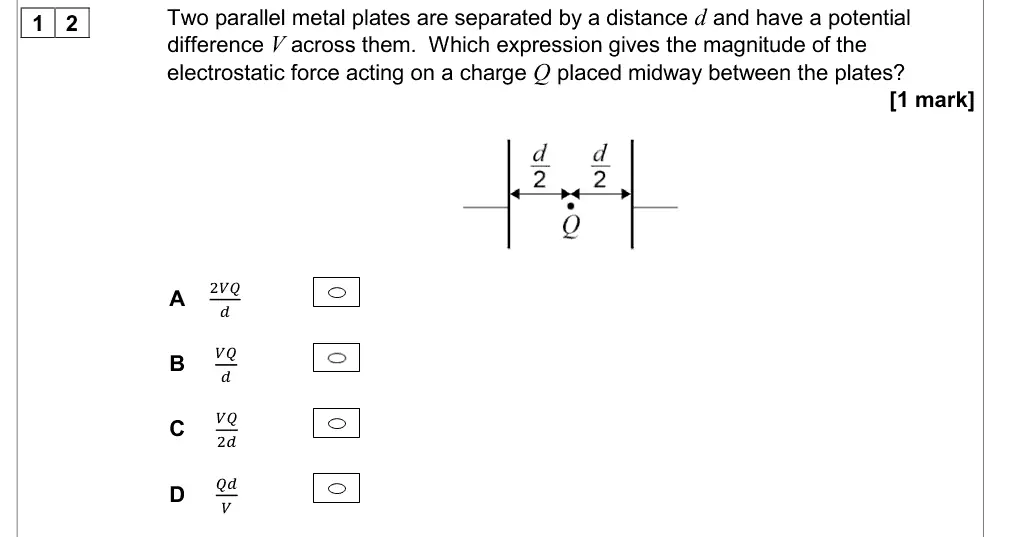
Two parallel metal plates are separated by a distance d and have a potential
Specimen set 1 · Paper 2 · Q12 1 mark Multiple choice electric fields
Two parallel metal plates are separated by a distance d and have a potential
difference V across them.  Which expression gives the magnitude of the
electrostatic force acting on a charge Q placed midway between the plates?
[1 mark]
A
2𝑉𝑄
𝑑
B
𝑉𝑄
𝑑
C
𝑉𝑄
2𝑑
D
𝑄𝑑
𝑉
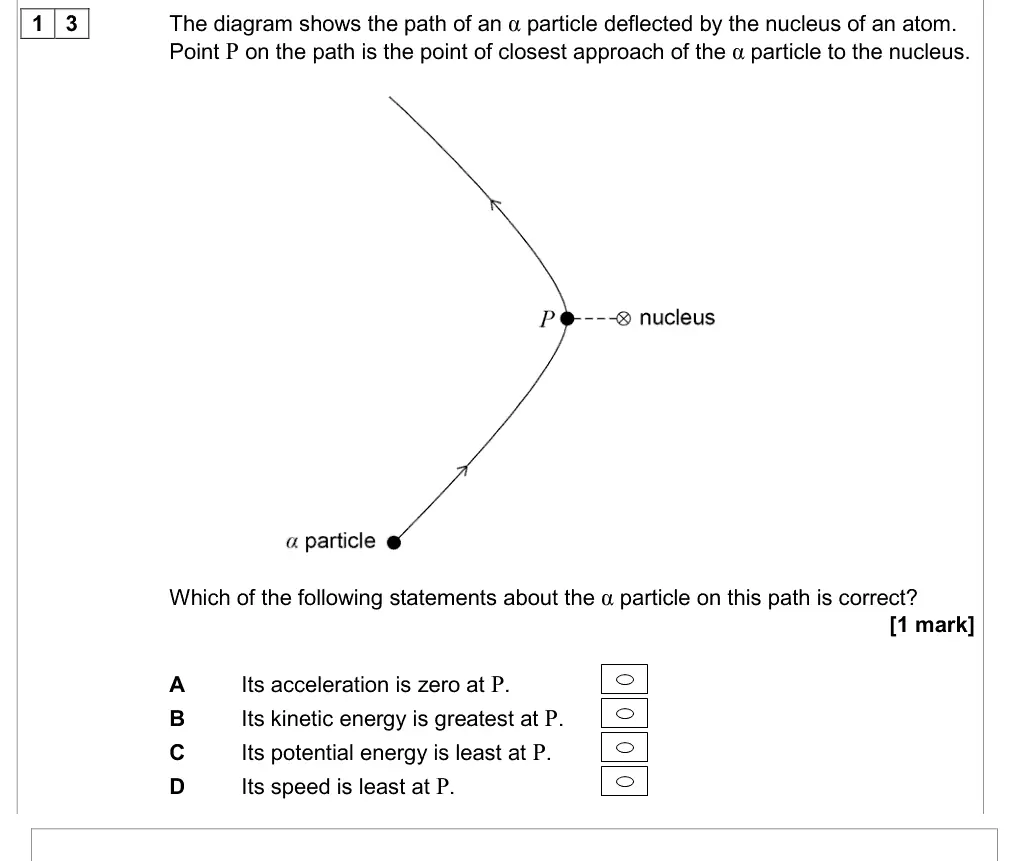
Specimen set 1 · Paper 2 · Q13 1 mark Multiple choice rutherford scattering and radiationelectric fields
The diagram shows the path of an α particle deflected by the nucleus of an atom.
Point P on the path is the point of closest approach of the α particle to the nucleus.
Which of the following statements about the α particle on this path is correct?
[1 mark]
A
Its acceleration is zero at P.
B
Its kinetic energy is greatest at P.
C
Its potential energy is least at P.
D
Its speed is least at P.
The electric potential at a distance r from a positive point charge is 45 V.  The
Specimen set 1 · Paper 2 · Q14 1 mark Multiple choice electric fields
The electric potential at a distance r from a positive point charge is 45 V.  The
potential increases to 50 V when the distance from the point charge decreases by
1.5 m.  What is the value of r?
[1 mark]
A
1.3 m
B
1.5 m
C
7.9 m
D
15 m
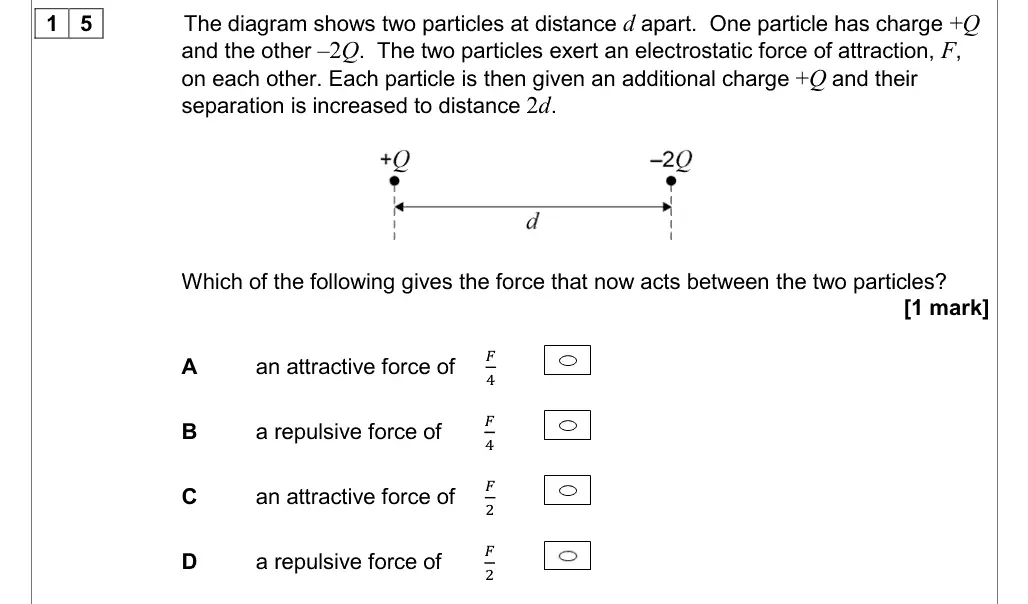
Specimen set 1 · Paper 2 · Q15 1 mark Multiple choice electric fields
The diagram shows two particles at distance d apart.  One particle has charge +Q
and the other –2Q.  The two particles exert an electrostatic force of attraction, F,
on each other. Each particle is then given an additional charge +Q and their
separation is increased to distance 2d.
Which of the following gives the force that now acts between the two particles?
[1 mark]
A
an attractive force of
𝐹
4
B
a repulsive force of
𝐹
4
C
an attractive force of
𝐹
2
D
a repulsive force of
𝐹
2
Specimen set 1 · Paper 2 · Q16 1 mark Multiple choice capacitors
Which of the following statements about a parallel plate capacitor is incorrect?
[1 mark]
A
The capacitance of the capacitor is the amount of charge
stored by the capacitor when the pd across the plates is 1 V.
B
A uniform electric field exists between the plates of the
capacitor.
C
The charge stored on the capacitor is inversely proportional
to the pd across the plates.
D
The energy stored when the capacitor is fully charged is
proportional to the square of the pd across the plates.
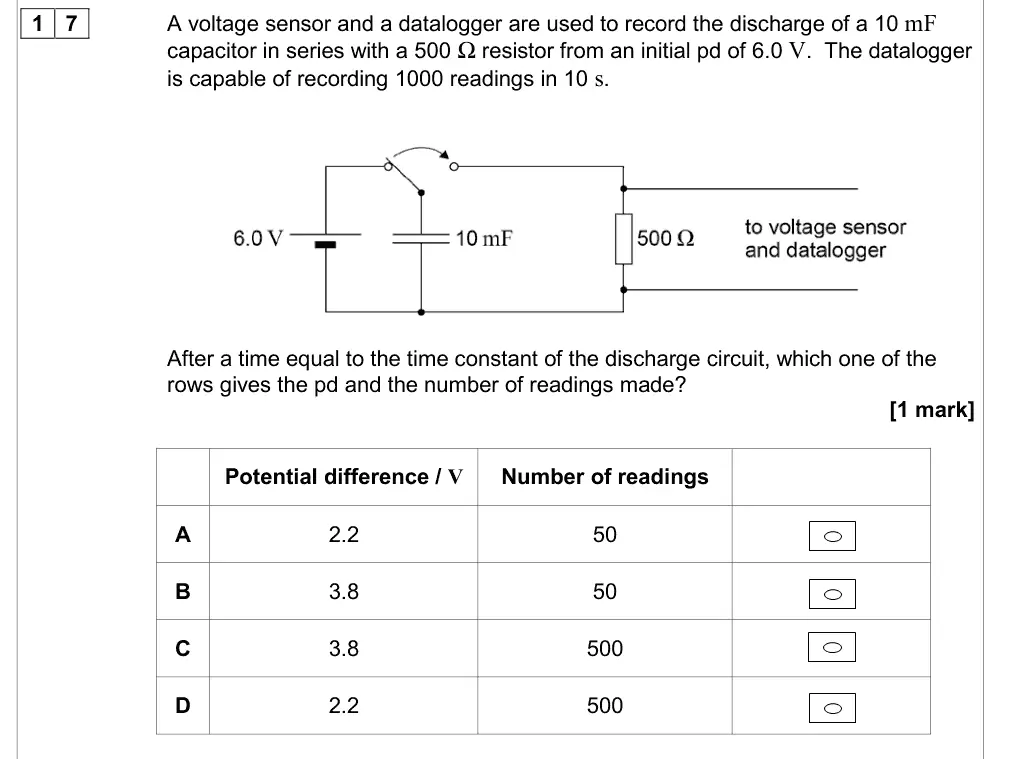
Specimen set 1 · Paper 2 · Q17 1 mark Multiple choice capacitors
A voltage sensor and a datalogger are used to record the discharge of a 10 mF
capacitor in series with a 500 Ω resistor from an initial pd of 6.0 V.  The datalogger
is capable of recording 1000 readings in 10 s.
After a time equal to the time constant of the discharge circuit, which one of the
rows gives the pd and the number of readings made?
[1 mark]
Potential difference / V
Number of readings
A
2.2
50
B
3.8
50
C
3.8
500
D
2.2
500
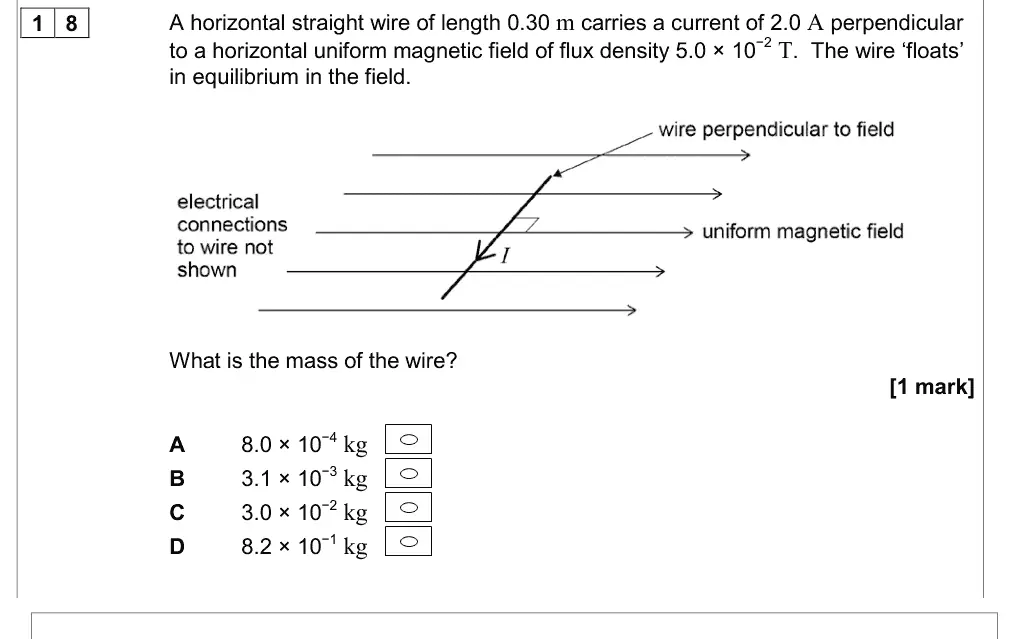
Specimen set 1 · Paper 2 · Q18 1 mark Multiple choice magnetic fields
A horizontal straight wire of length 0.30 m carries a current of 2.0 A perpendicular
to a horizontal uniform magnetic field of flux density 5.0 × 10⁻² T.  The wire ‘floats’
in equilibrium in the field.
What is the mass of the wire?
[1 mark]
A
8.0 × 10⁻⁴ kg
B
3.1 × 10⁻³ kg
C
3.0 × 10⁻² kg
D
8.2 × 10⁻¹ kg
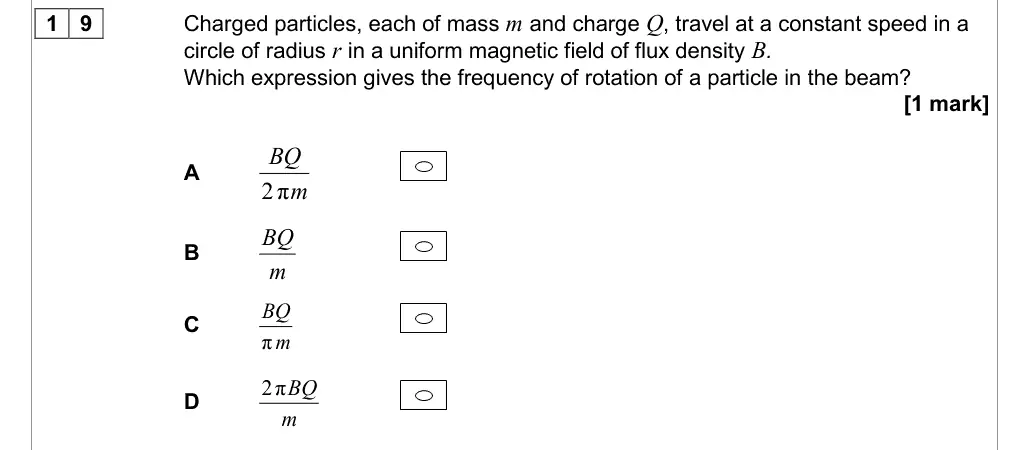
Specimen set 1 · Paper 2 · Q19 1 mark Multiple choice magnetic fields
Charged particles, each of mass m and charge Q, travel at a constant speed in a
circle of radius r in a uniform magnetic field of flux density B.
Which expression gives the frequency of rotation of a particle in the beam?
[1 mark]
A
m
BQ
π
2
B
m
BQ
C
m
BQ
π
D
m
BQ
π
2
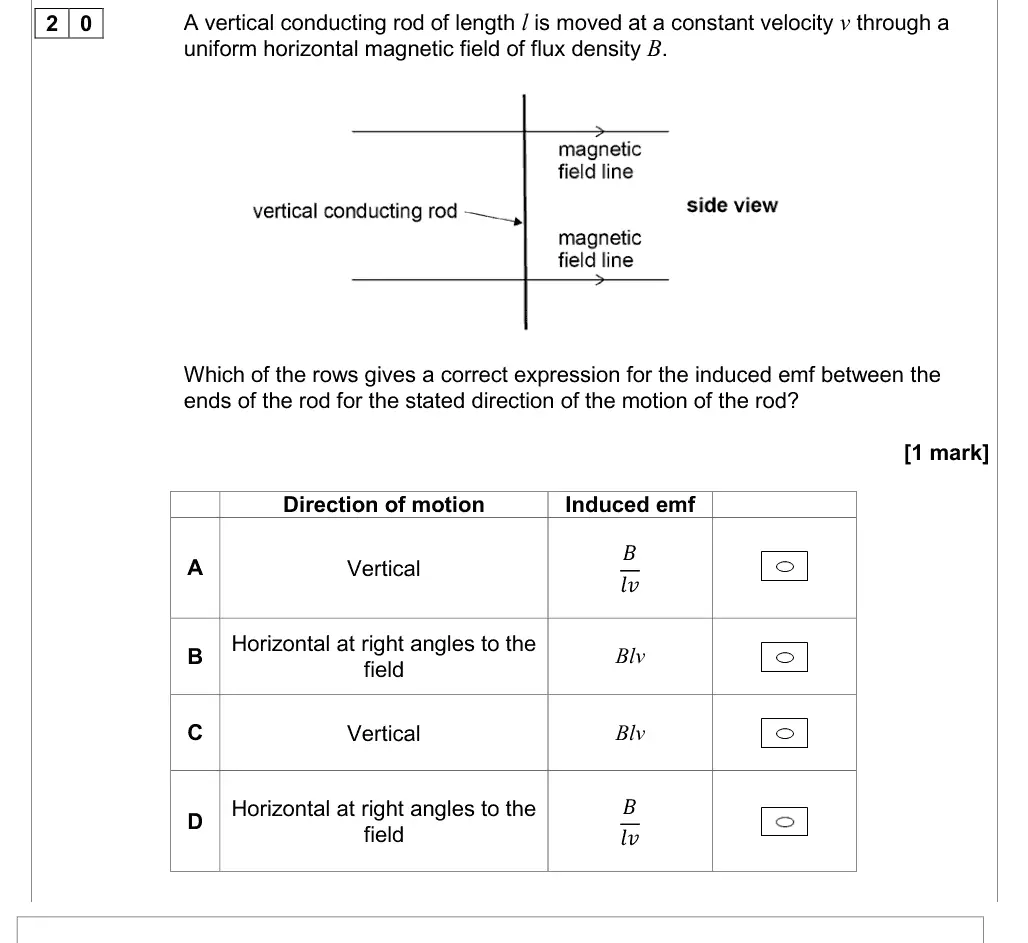
Specimen set 1 · Paper 2 · Q20 1 mark Multiple choice electromagnetic induction
A vertical conducting rod of length l is moved at a constant velocity v through a
uniform horizontal magnetic field of flux density B.
Which of the rows gives a correct expression for the induced emf between the
ends of the rod for the stated direction of the motion of the rod?
[1 mark]
Direction of motion
Induced emf
A
Vertical
𝐵
𝑙𝑣
B
Horizontal at right angles to the
field
Blv
C
Vertical
Blv
D
Horizontal at right angles to the
field
𝐵
𝑙𝑣
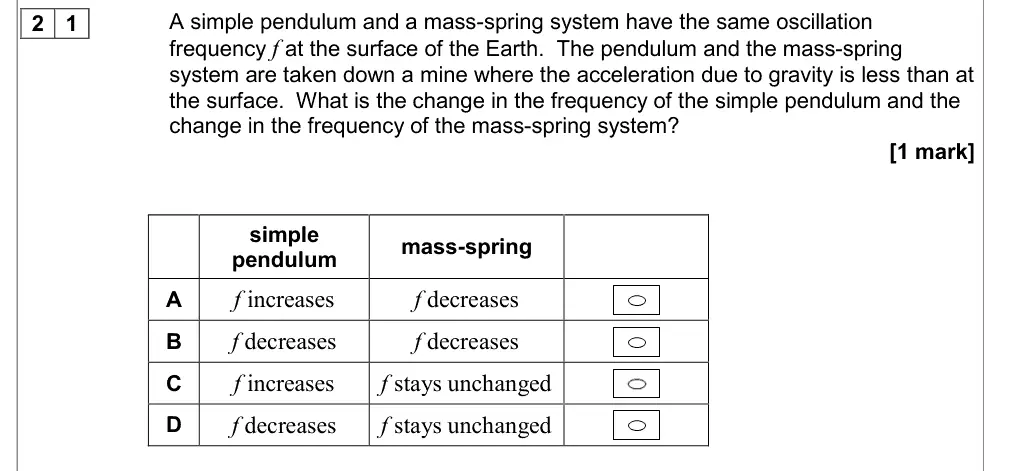
Specimen set 1 · Paper 2 · Q21 1 mark Multiple choice simple harmonic motion
A simple pendulum and a mass-spring system have the same oscillation
frequency f at the surface of the Earth.  The pendulum and the mass-spring
system are taken down a mine where the acceleration due to gravity is less than at
the surface.  What is the change in the frequency of the simple pendulum and the
change in the frequency of the mass-spring system?
[1 mark]
simple
pendulum
mass-spring
A
f increases
f decreases
B
f decreases
f decreases
C
f increases
f stays unchanged
D
f decreases
f stays unchanged
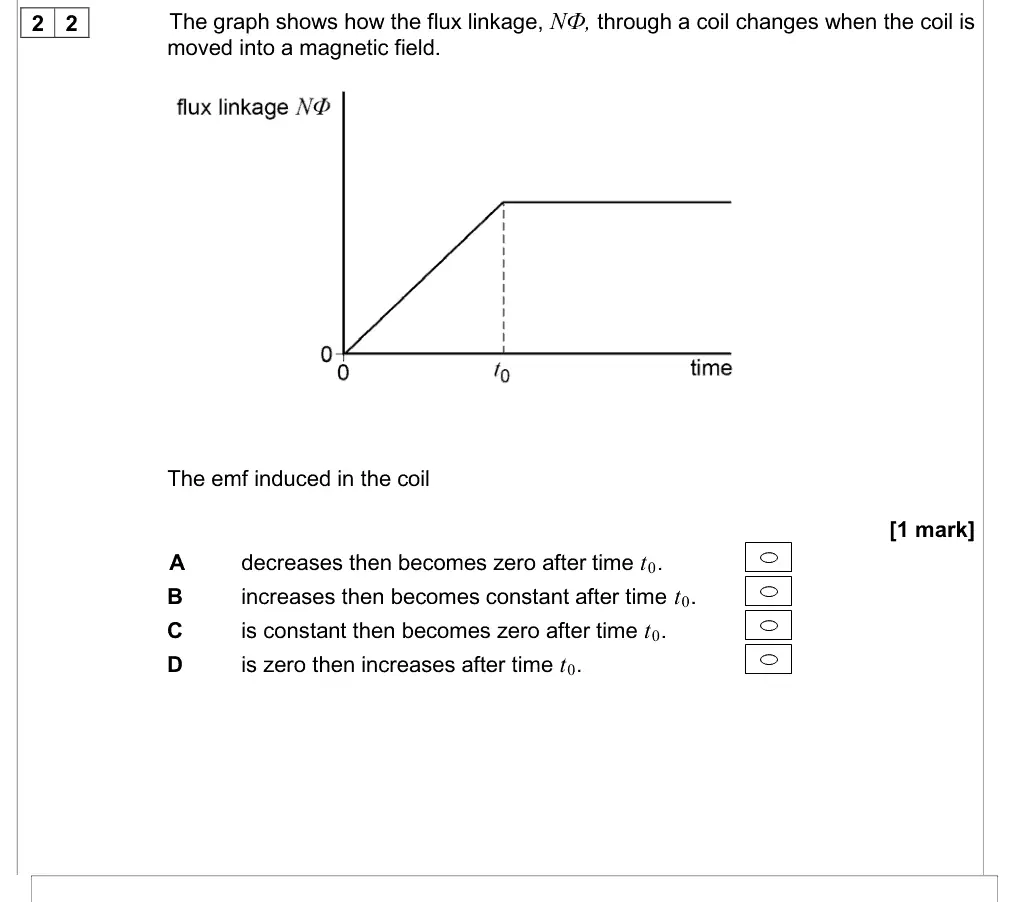
Specimen set 1 · Paper 2 · Q22 1 mark Multiple choice electromagnetic induction
The graph shows how the flux linkage, NФ, through a coil changes when the coil is
moved into a magnetic field.
The emf induced in the coil
[1 mark]
A
decreases then becomes zero after time t0.
B
increases then becomes constant after time t0.
C
is constant then becomes zero after time t0.
D
is zero then increases after time t0.
Specimen set 1 · Paper 2 · Q23 1 mark Multiple choice thermal energy and ideal gases
A liquid flows continuously through a chamber that contains an electric
heater.  When the steady state is reached, the liquid leaving the chamber is at a
higher temperature than the liquid entering the chamber. The difference in
temperature is Δt.
Which of the following will increase Δt with no other change?
[1 mark]
A
Increasing the volume flow rate of the liquid
B
Changing the liquid to one with a lower specific heat capacity
C
Using a heating element with a higher resistance
D
Changing the liquid to one that has a higher density
Specimen set 1 · Paper 2 · Q24 1 mark Multiple choice thermal energy and ideal gases
The temperature of a hot liquid in a container falls at a rate of 2 K per minute just
before it begins to solidify.   The temperature then remains steady for 20 minutes
by which time all the liquid has all solidified.
What is the quantity
Specific heat capacity of the liquid
Specific latent heat of fusion
?
[1 mark]
A
1
40 K−1
B
1
10 K−1
C
10 K−1
D
40 K−1
Specimen set 1 · Paper 2 · Q25 1 mark Multiple choice kinetic theorythermal energy and ideal gases
A fixed mass of gas occupies a volume V.   The temperature of the gas increases
so that the root mean square velocity of the gas molecules is doubled.
What will the new volume be if the pressure remains constant?
[1 mark]
A
𝑉
2
B
𝑉
√2
C
2𝑉
D
4𝑉
Specimen set 1 · Paper 2 · Q26 1 mark Multiple choice thermal energy and ideal gases
X and Y are two gas bottles that are connected by a tube that has negligible
volume compared with the volume of each bottle.
Initially the valve  W  is closed.
X  has a volume 2V  and contains hydrogen at a pressure of p.
Y  has a volume V  and contains hydrogen at a pressure of 2p.
X and Y are both initially at the same temperature.
W  is now opened.  Assuming that there is no change in temperature, what is the
new gas pressure?
[1 mark]
A
2
3 𝑝
B
5
3 𝑝
C
4
3 𝑝
D
3
2 𝑝
Specimen set 1 · Paper 2 · Q27 1 mark Multiple choice radioactive decayatomic structure and stable nuclei
A radioactive nucleus emits a β− particle then an α particle and finally another β−
particle.  The final nuclide is
[1 mark]
A
an isotope of the original element
B
the same element with a different proton number
C
a new element of higher proton number
D
a new element of lower nucleon number
Specimen set 1 · Paper 2 · Q28 1 mark Multiple choice radioactive decay
Which of the following best describes the decay constant for a radioisotope?
[1 mark]
A
The reciprocal of the half-life of the radioisotope.
B
The rate of decay of the radioisotope.
C
The constant of proportionality which links half-life to
the rate of decay of nuclei.
D
The constant of proportionality which links rate of decay
to the number of undecayed nuclei.
radius of a nucleus of
Sb
51
125
Specimen set 1 · Paper 2 · Q29 1 mark Multiple choice nuclear radius
Which of the following is equal to
radius of a nucleus of
Zn
30
64
?
[1 mark]
A
1.19
B
1.25
C
1.33
D
1.40
Specimen set 1 · Paper 2 · Q30 1 mark Multiple choice radioactive decay
After 64 days the activity of a radioactive nuclide has fallen to one sixteenth of its
original value.  The half-life of the radioactive nuclide is
[1 mark]
A
2 days.
B
4 days.
C
8 days.
D
16 days.
Specimen set 1 · Paper 2 · Q31 1 mark Multiple choice mass energy and fission
The graph shows how the binding energy per nucleon varies with the nucleon
number for stable nuclei.
What is the approximate total binding energy for a nucleus of
W
74
184
?
[1 mark]
A
1.28 pJ
B
94.7 pJ
C
103 pJ
D
230 pJ

Work with an AQA physics tutor

Want a paper marked and gone through with you? Message us.

Prefer email? Send an enquiry

If you are under 18, please include a parent's contact details. Enquiries go to enquiries@physicsaleveltutor.com and are deleted once handled. All tutoring is online.