June 2017: Paper 2, Exploring physics

100 marks · 47 question parts · Paper, mark scheme and report on OCR's site · Have the Data, Formulae and Relationships Booklet beside you

Question by question

QTopicMarksAOType
1 Charge, current and mean drift velocity 1Multiple choice
2 E.m.f., p.d., resistance and I–V characteristics, Charge, current and mean drift velocity 1Multiple choice
3 Physical quantities and S.I. units 1Multiple choice
4 Resistivity, Series and parallel circuits: Kirchhoff's laws, Potential dividers 1Multiple choice
5 Wave motion: progressive waves, the wave equation and intensity, Superposition, interference and the double slit 1Multiple choice
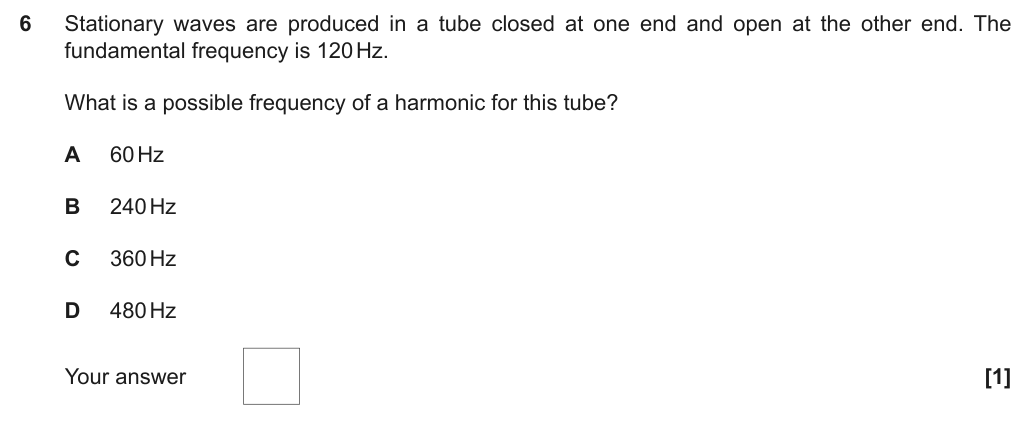
6 Stationary waves 1Multiple choice
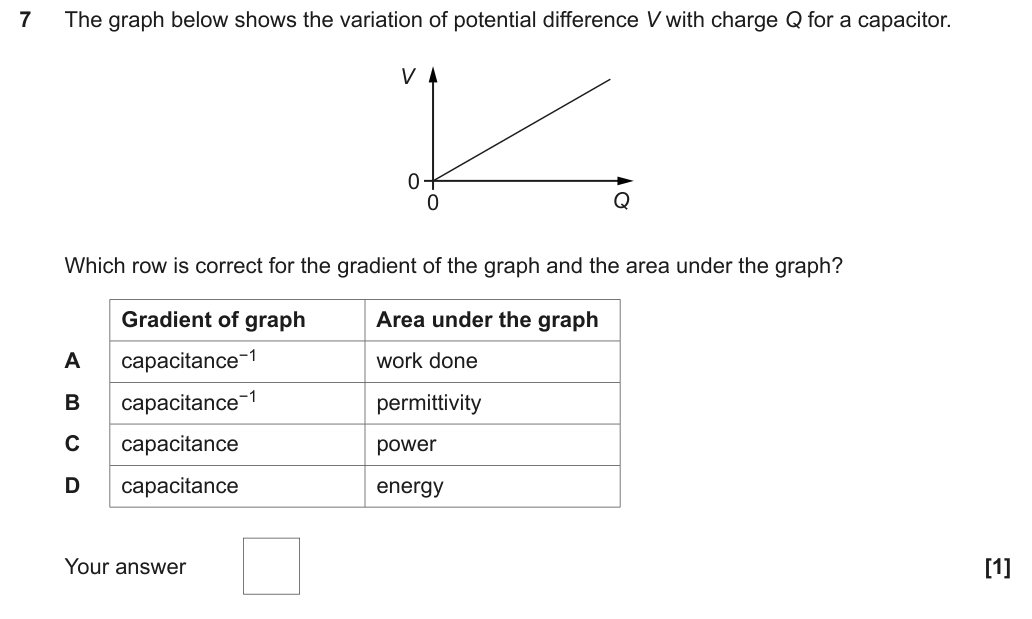
7 Capacitors: energy, charging and discharging 1Multiple choice
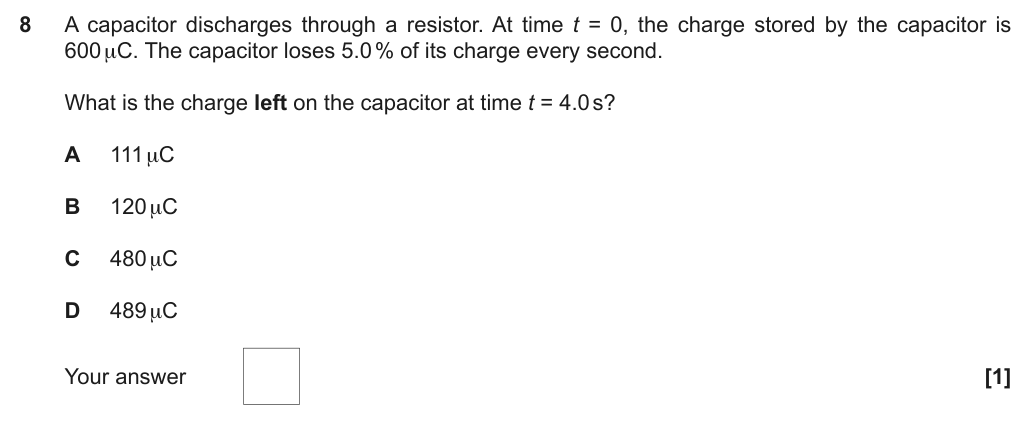
8 Capacitors: energy, charging and discharging 1Multiple choice
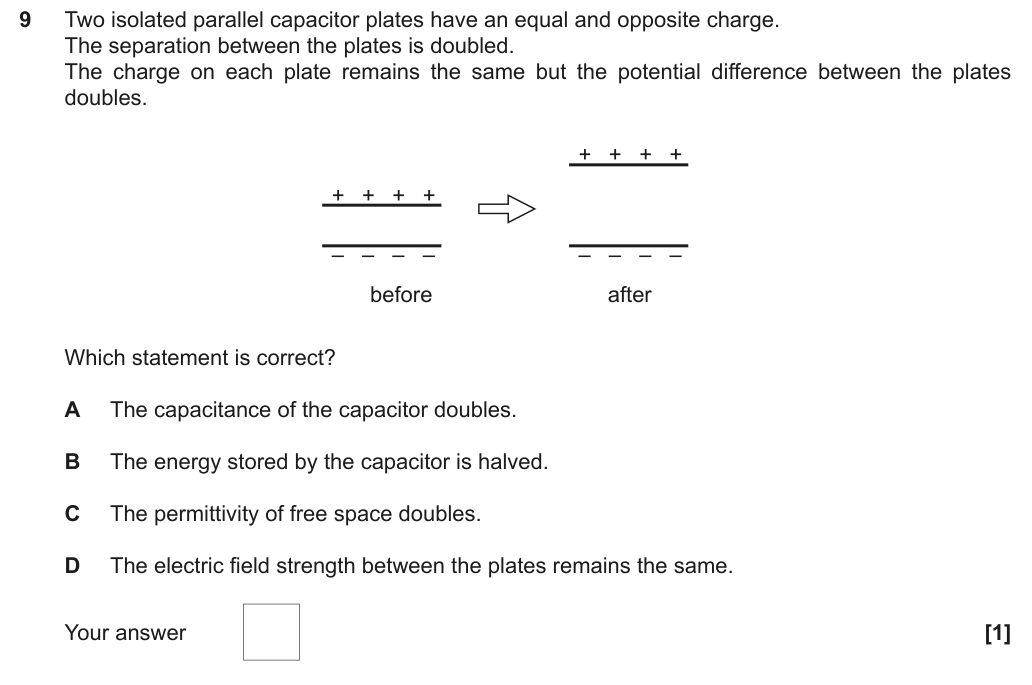
9 Electric fields, Coulomb's law and electric potential 1Multiple choice
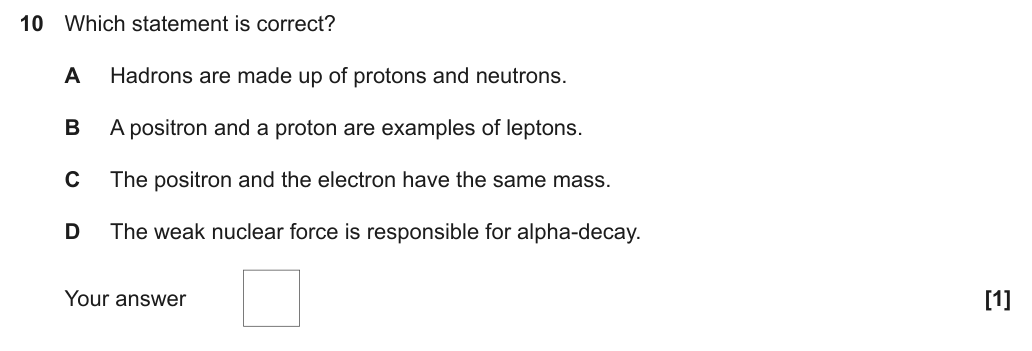
10 The nuclear atom and fundamental particles 1Multiple choice
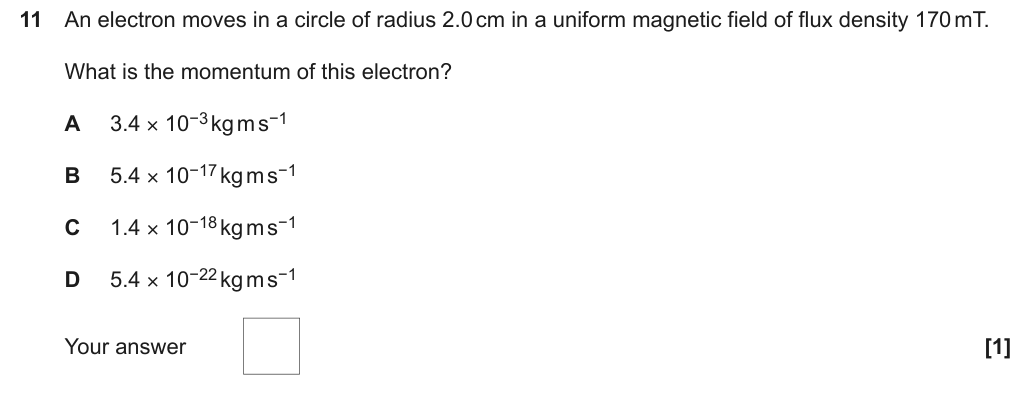
11 Magnetic fields and the motion of charged particles 1Multiple choice
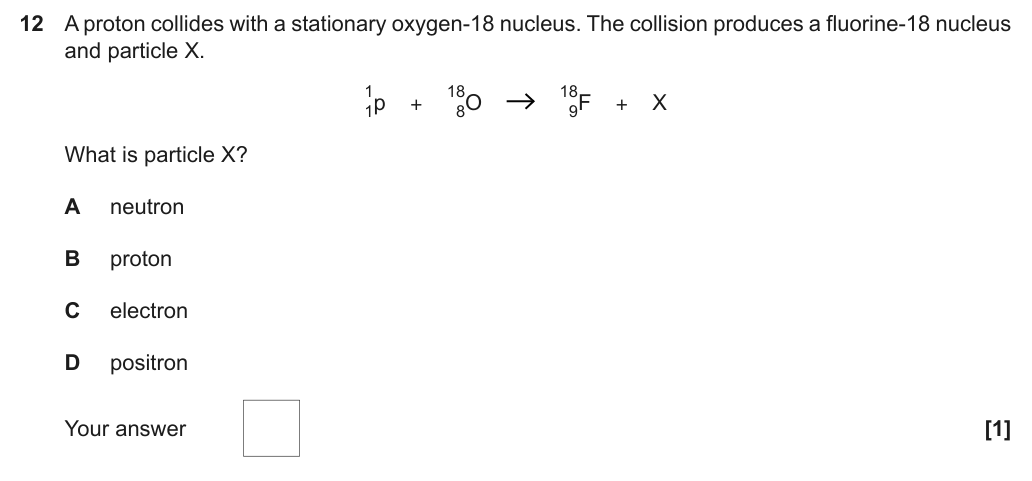
12 Mass–energy, binding energy, fission and fusion, The nuclear atom and fundamental particles 1Multiple choice
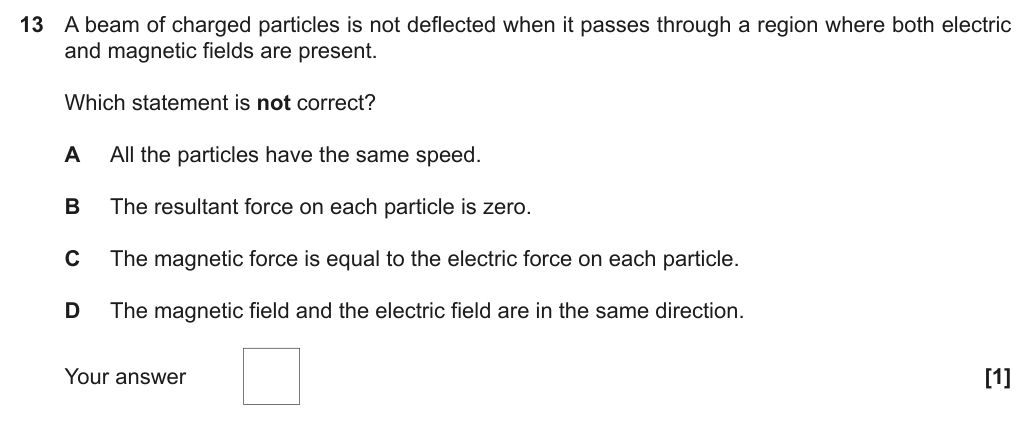
13 Magnetic fields and the motion of charged particles 1Multiple choice
14 Medical imaging: X-rays, CAT scans, PET, the gamma camera and ultrasound 1Multiple choice
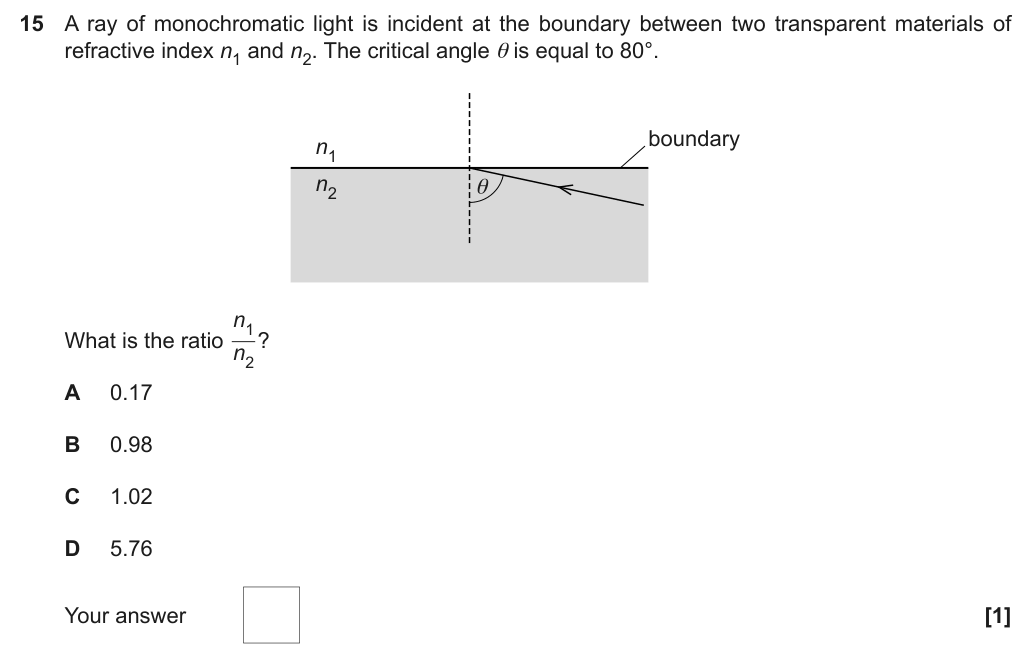
15 Electromagnetic waves, polarisation and refraction 1Multiple choice
16(a) Superposition, interference and the double slit 1Short answer
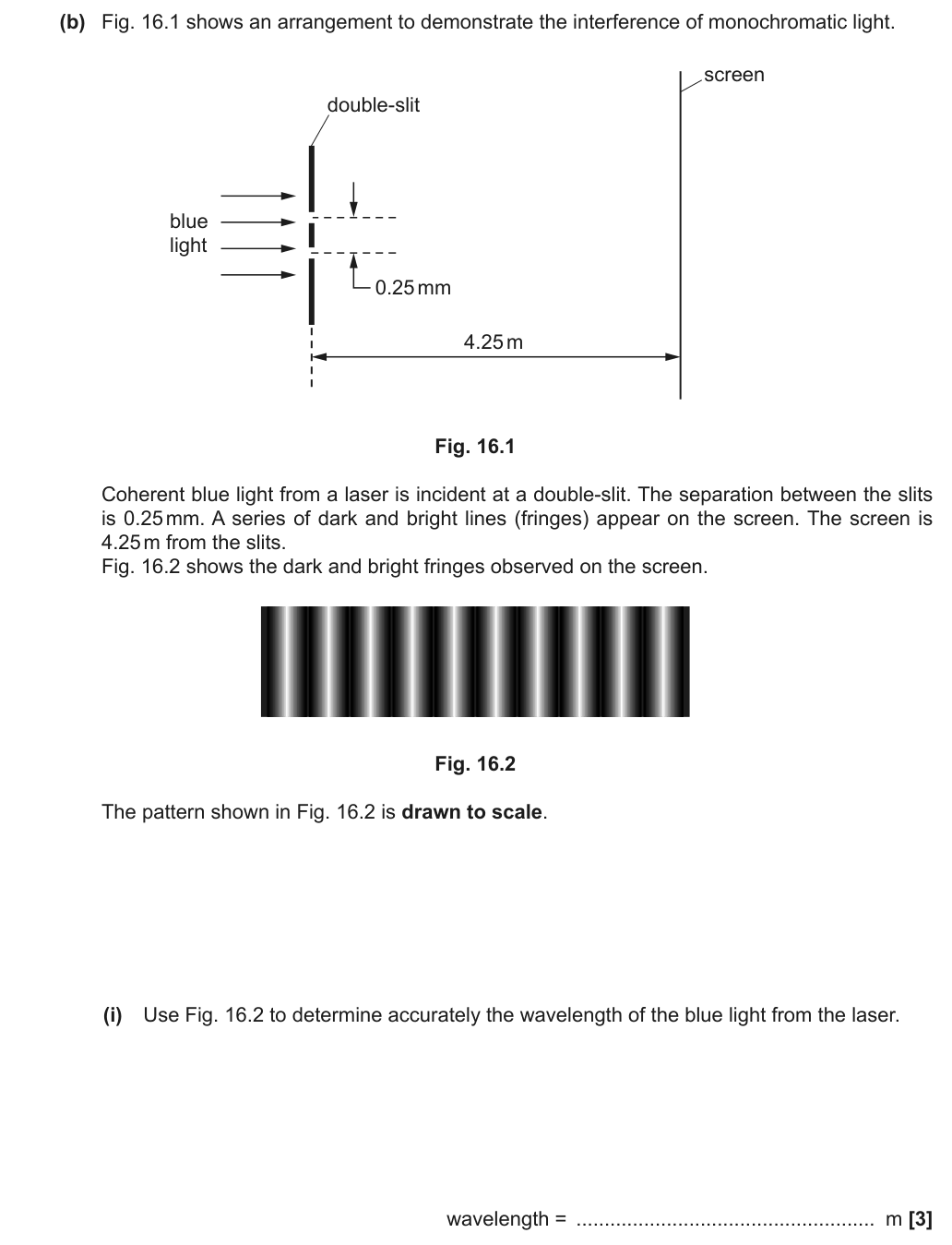
16(b)(i) Superposition, interference and the double slit 3Calculation
16(b)(ii) Superposition, interference and the double slit 2Explanation
17(a) Physical quantities and S.I. units 1Short answer
17(b)(i) Resistivity, Series and parallel circuits: Kirchhoff's laws 2Show that
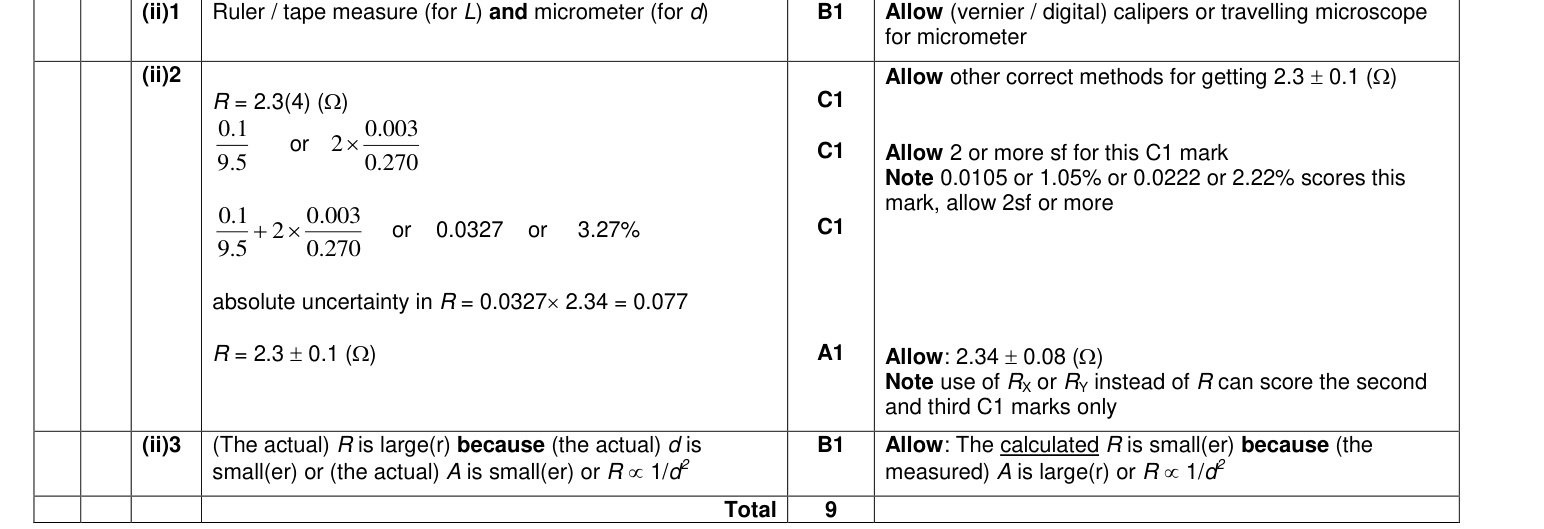
17(b)(ii) Measurements and uncertainties, Practical skills: planning, analysis and evaluation, Resistivity 6Calculation
18(a)(i) Series and parallel circuits: Kirchhoff's laws 3Calculation
18(a)(ii) Series and parallel circuits: Kirchhoff's laws 2Explanation
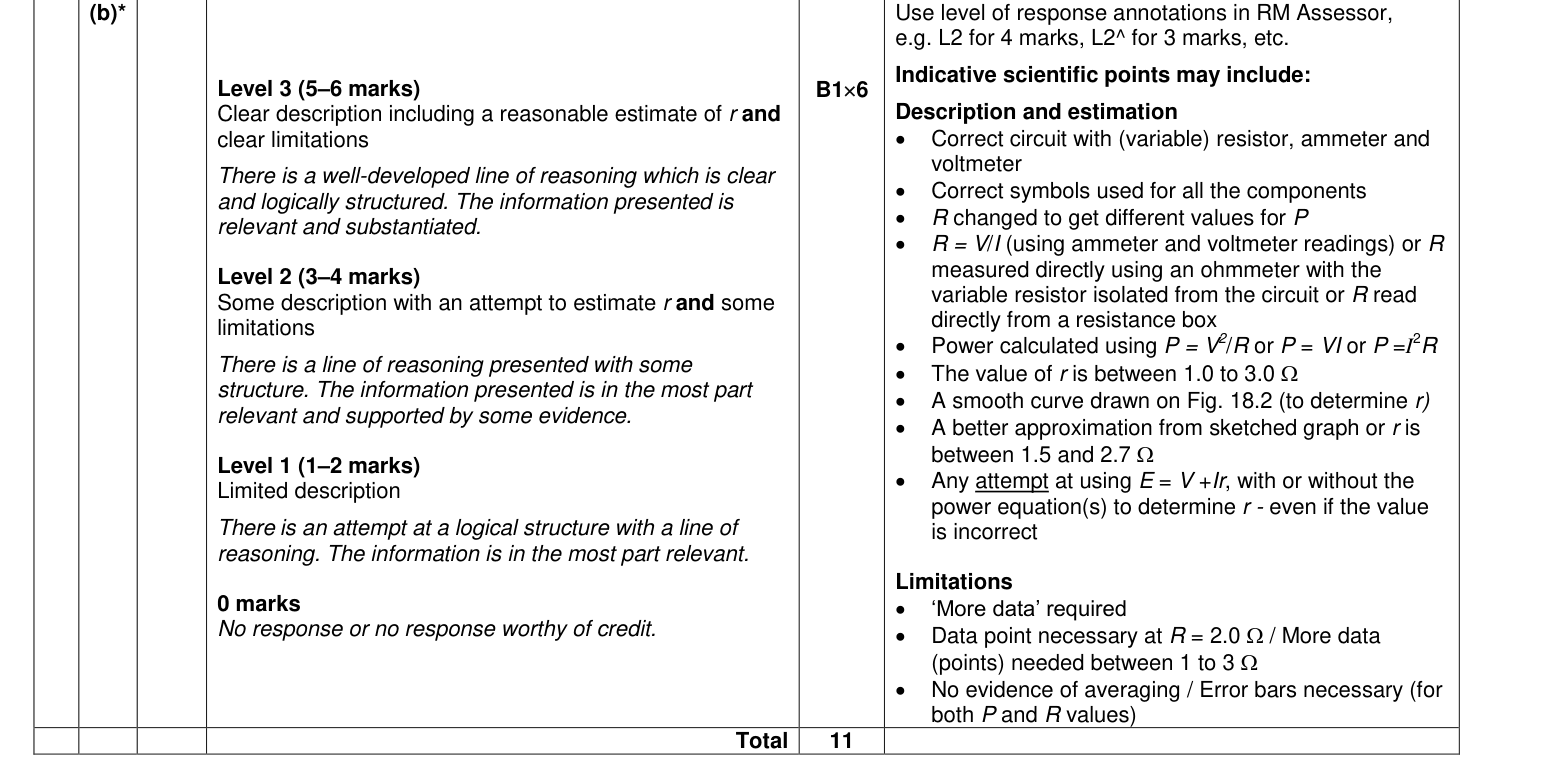
18(b) Internal resistance and e.m.f., Practical skills: planning, analysis and evaluation, E.m.f., p.d., resistance and I–V characteristics, Electrical power and energy 6Extended response
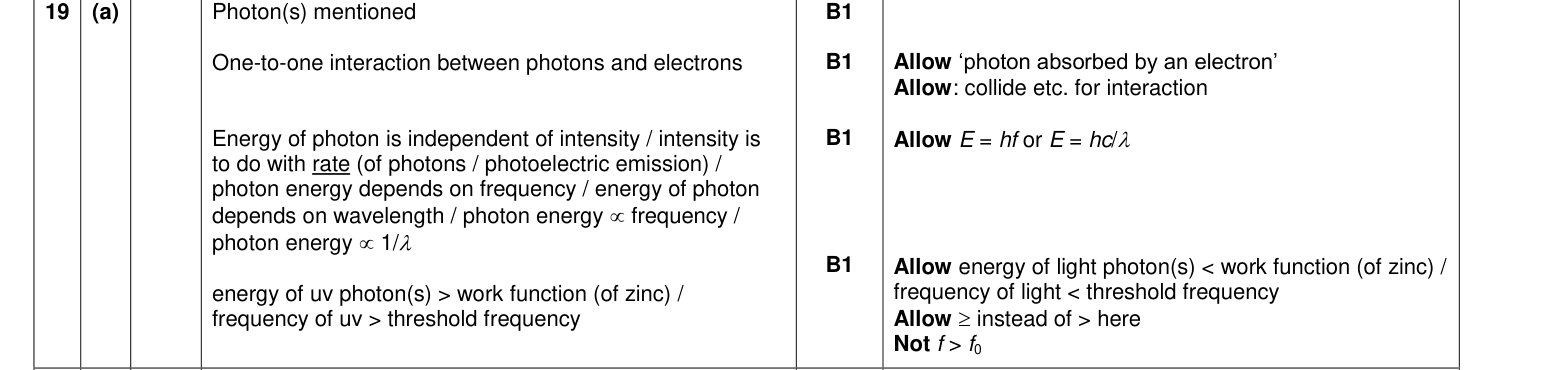
19(a) The photoelectric effect, Photons and the Planck constant 4Explanation
19(b) The photoelectric effect, Photons and the Planck constant 3Calculation
19(c) E.m.f., p.d., resistance and I–V characteristics, Photons and the Planck constant, The photoelectric effect 3Explanation
20(a) Electric fields, Coulomb's law and electric potential 2Diagram or graph
20(b) Electric fields, Coulomb's law and electric potential 1Short answer
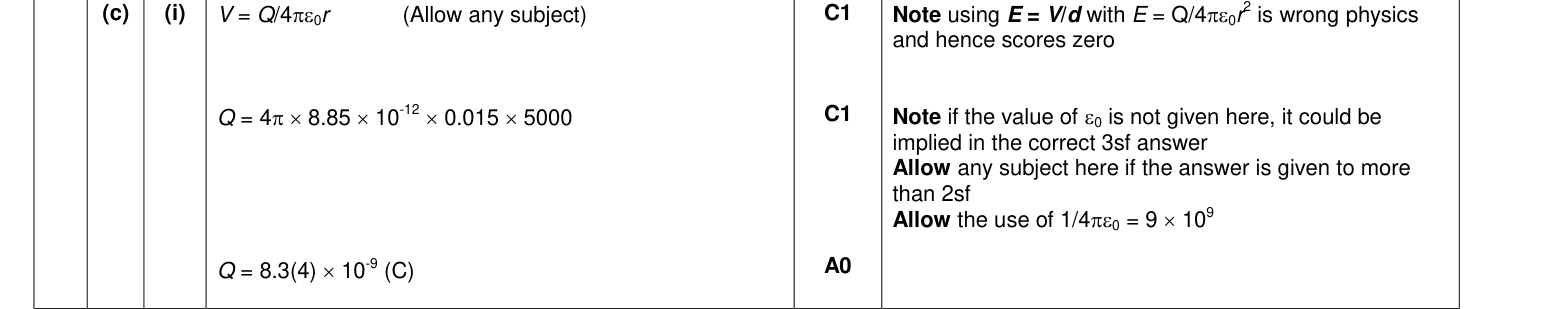
20(c)(i) Electric fields, Coulomb's law and electric potential 2Show that
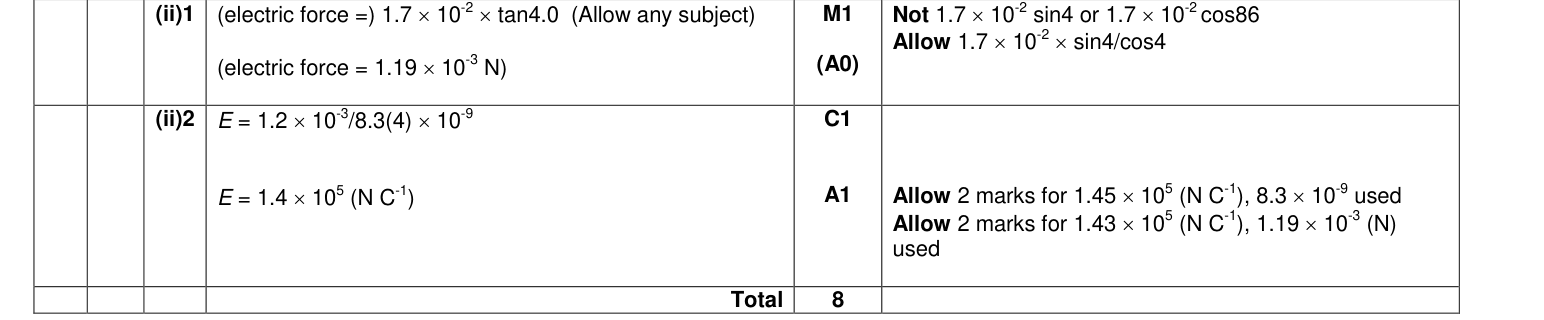
20(c)(ii) Electric fields, Coulomb's law and electric potential, Scalars and vectors 3Show that
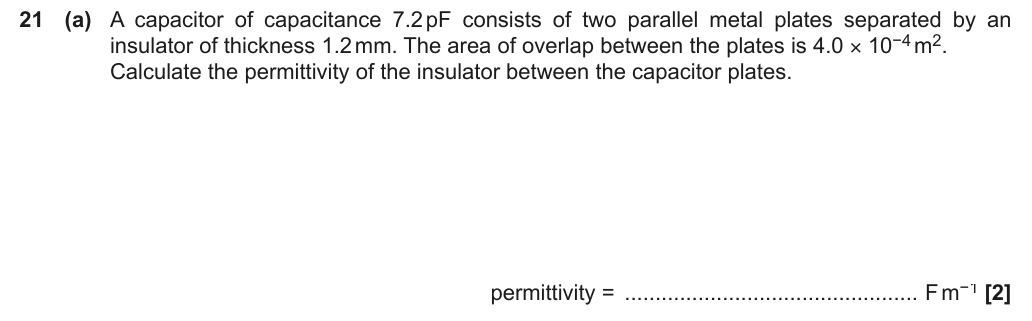
21(a) Electric fields, Coulomb's law and electric potential 2Calculation
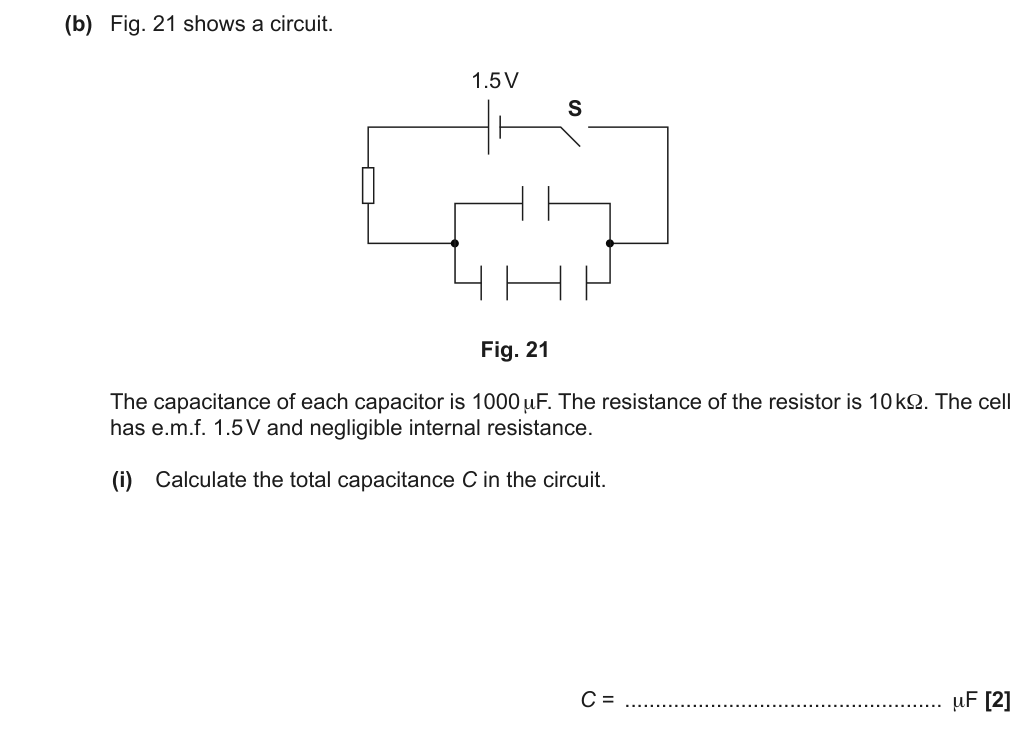
21(b)(i) Capacitors: energy, charging and discharging 2Calculation
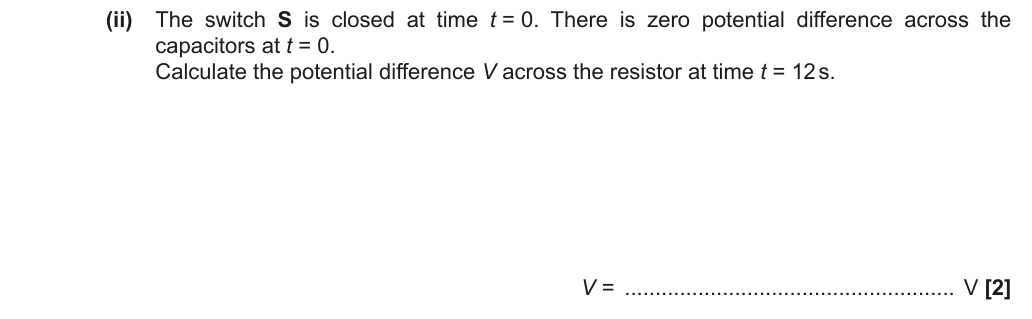
21(b)(ii) Capacitors: energy, charging and discharging 2Calculation
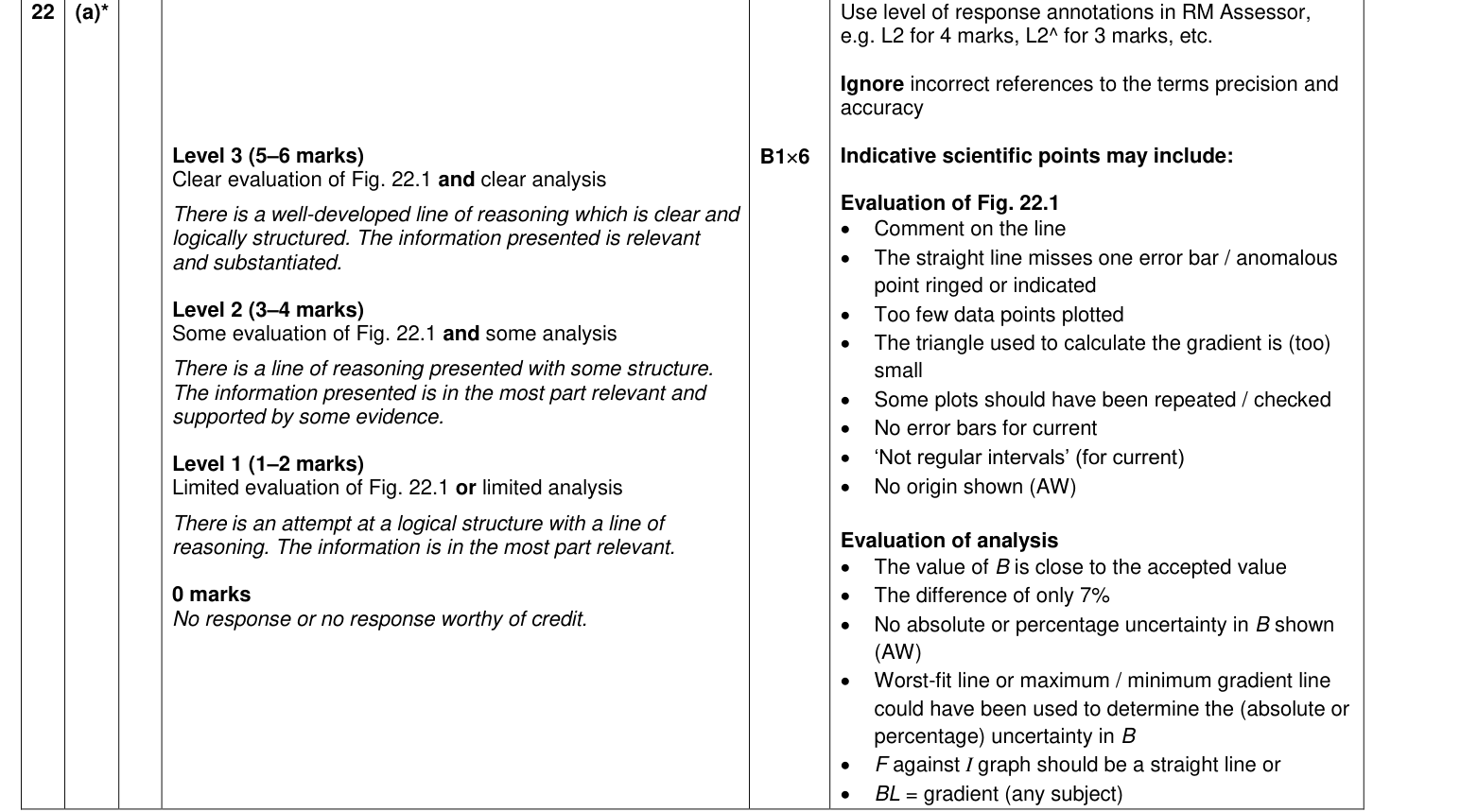
22(a) Magnetic fields and the motion of charged particles, Practical skills: planning, analysis and evaluation, Measurements and uncertainties 6Extended response
22(b)(i) Electromagnetism: Faraday's law, Lenz's law and transformers 3Practical and data analysis
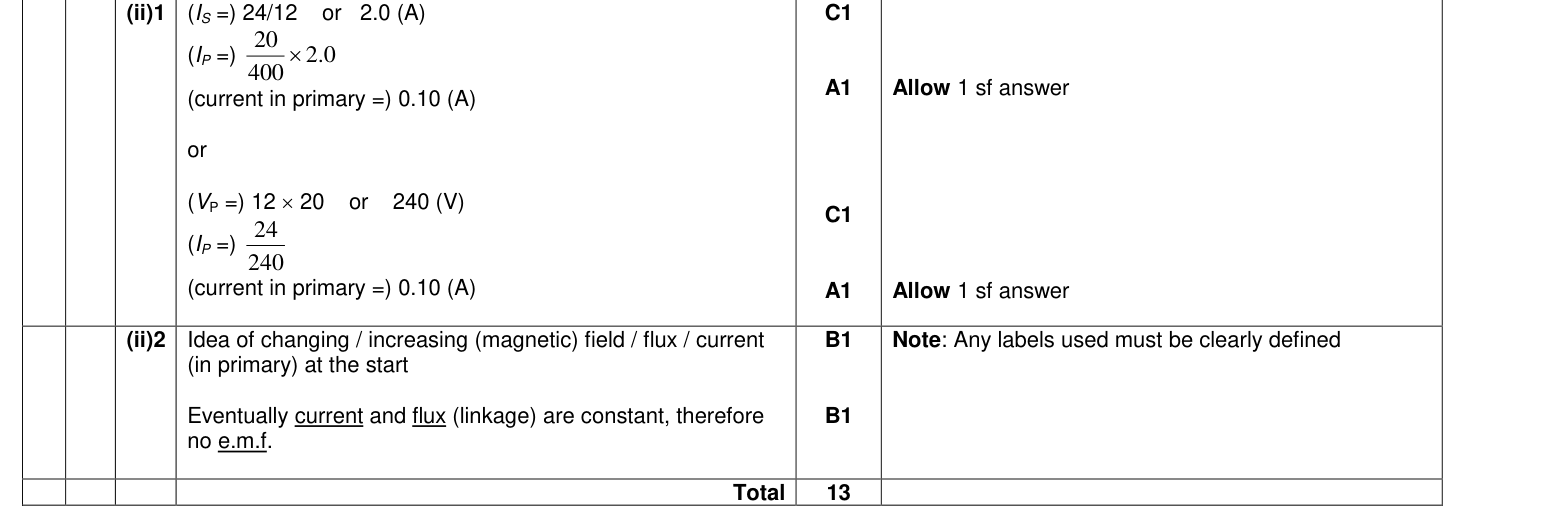
22(b)(ii) Electromagnetism: Faraday's law, Lenz's law and transformers, Electrical power and energy 4Calculation
23(a) The nuclear atom and fundamental particles 2Explanation
23(b)(i) The nuclear atom and fundamental particles 1Short answer
23(b)(ii) The nuclear atom and fundamental particles 2Short answer
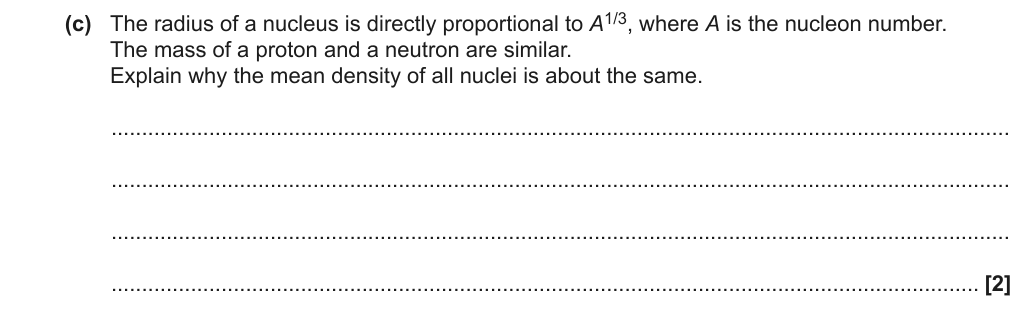
23(c) The nuclear atom and fundamental particles 2Explanation
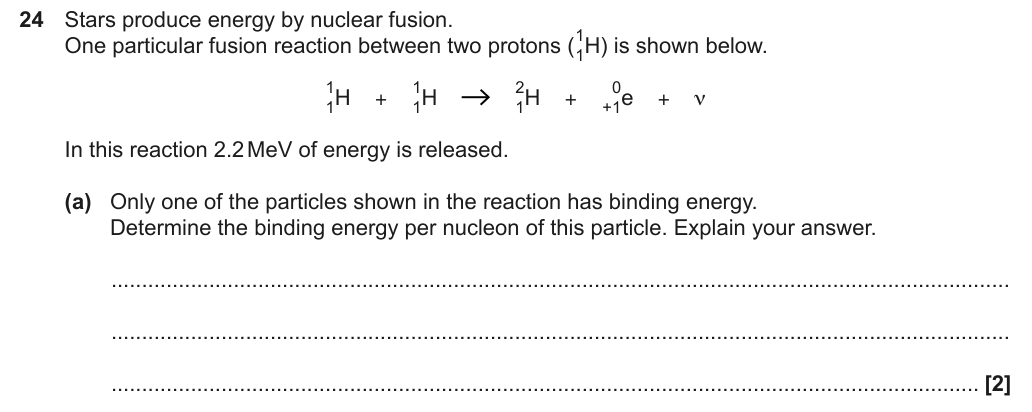
24(a) Mass–energy, binding energy, fission and fusion 2Calculation
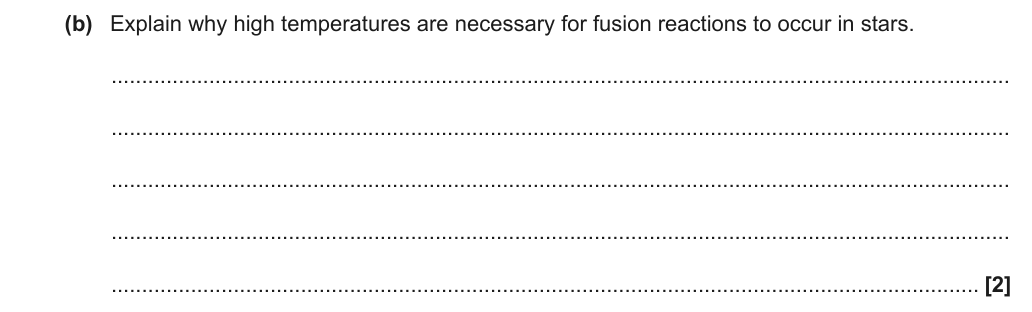
24(b) Mass–energy, binding energy, fission and fusion 2Explanation
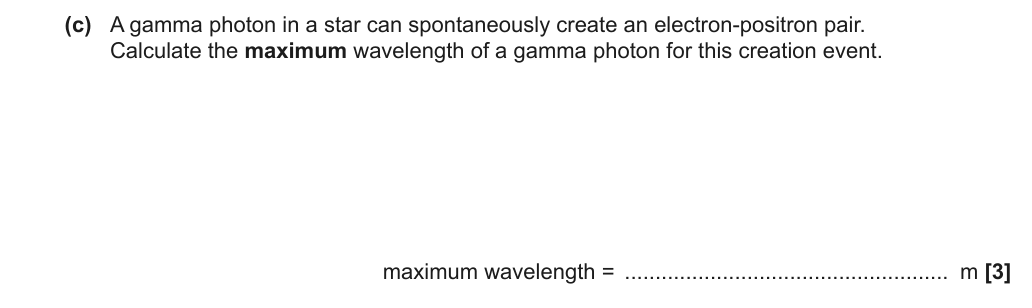
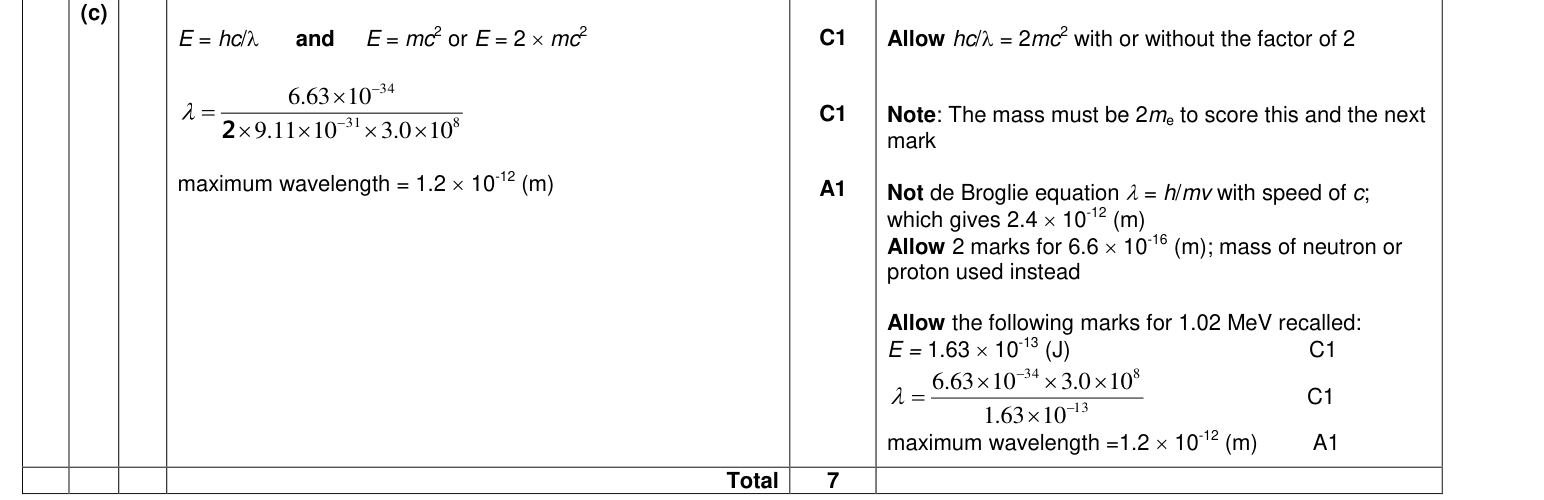
24(c) Mass–energy, binding energy, fission and fusion, Photons and the Planck constant 3Calculation
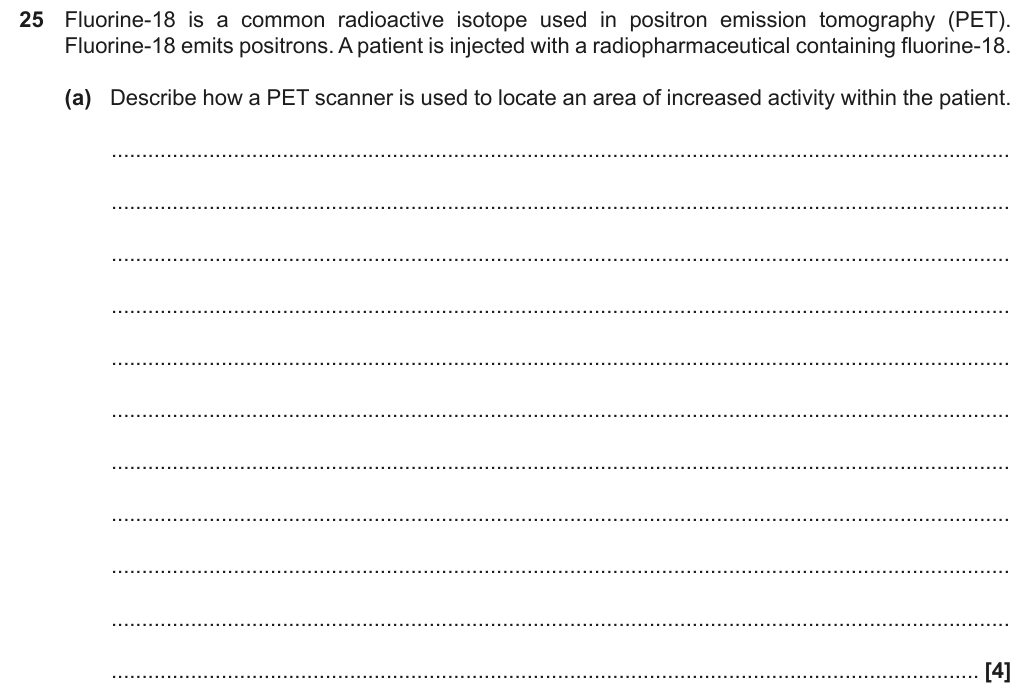
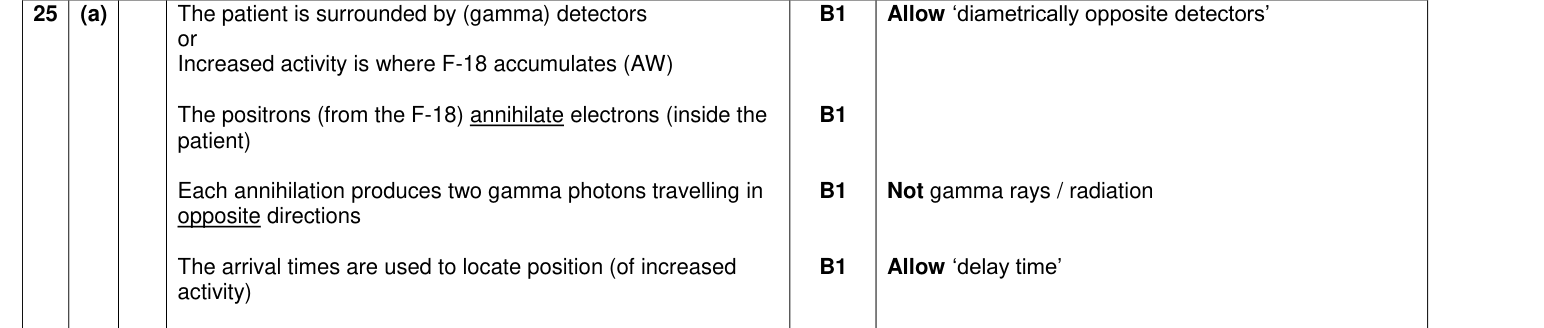
25(a) Medical imaging: X-rays, CAT scans, PET, the gamma camera and ultrasound 4Explanation
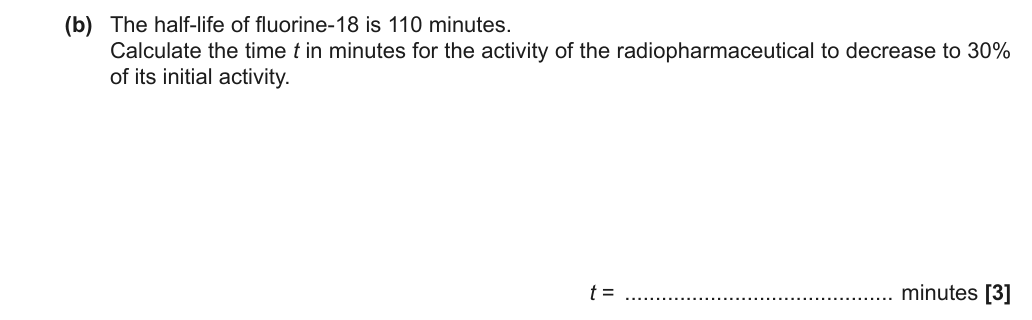
25(b) Radioactivity: decay, half-life and activity 3Calculation
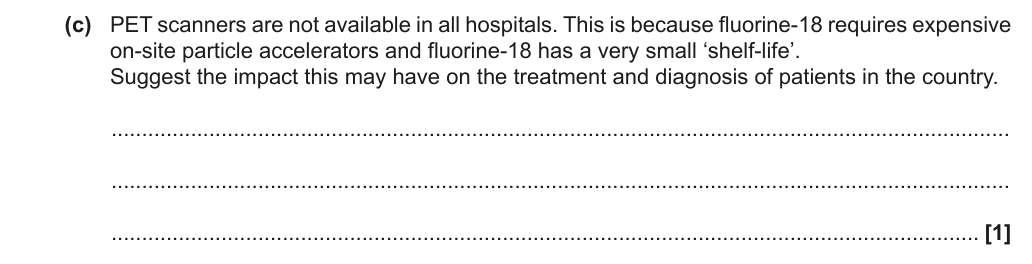
25(c) Medical imaging: X-rays, CAT scans, PET, the gamma camera and ultrasound 1Explanation

The questions

12345678910111213141516(a)16(b)(i)16(b)(ii)17(a)17(b)(i)17(b)(ii)18(a)(i)18(a)(ii)18(b)19(a)19(b)19(c)20(a)20(b)20(c)(i)20(c)(ii)21(a)21(b)(i)21(b)(ii)22(a)22(b)(i)22(b)(ii)23(a)23(b)(i)23(b)(ii)23(c)24(a)24(b)24(c)25(a)25(b)25(c)
June 2017 · Paper 2 · Q1 1 mark Multiple choice charge and current
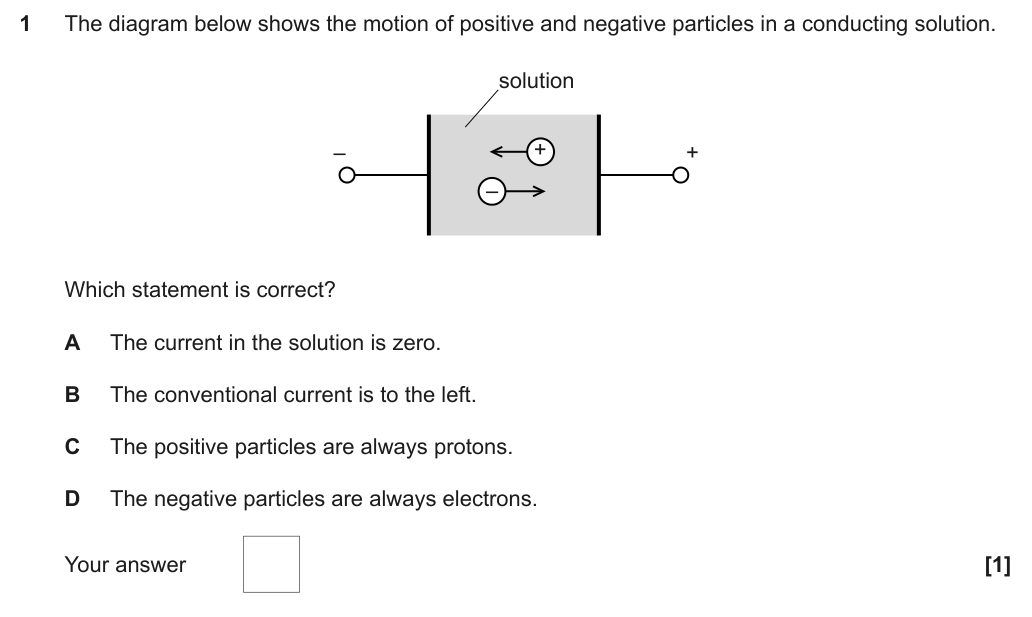
1 The diagram below shows the motion of positive and negative particles in a conducting solution.
solution
– + +
–
Which statement is correct?
A The current in the solution is zero.
B The conventional current is to the left.
C The positive particles are always protons.
D The negative particles are always electrons.
Your answer [1]
June 2017 · Paper 2 · Q2 1 mark Multiple choice emf pd and resistancecharge and current
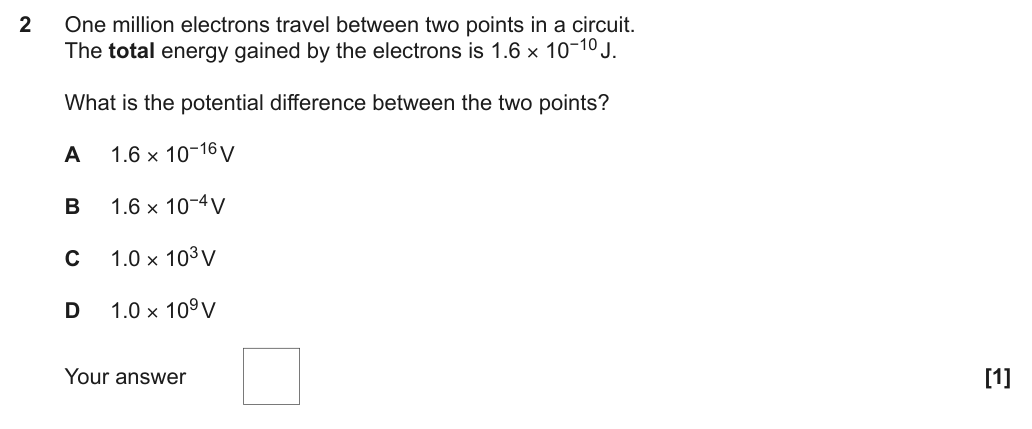
2 One million electrons travel between two points in a circuit.
The total energy gained by the electrons is 1.6 × 10⁻¹⁰ J.
What is the potential difference between the two points?
A 1.6 × 10⁻¹⁶ V
B 1.6 × 10⁻⁴ V
C 1.0 × 10³ V
D 1.0 × 10⁹ V
Your answer [1]
June 2017 · Paper 2 · Q3 1 mark Multiple choice quantities and units
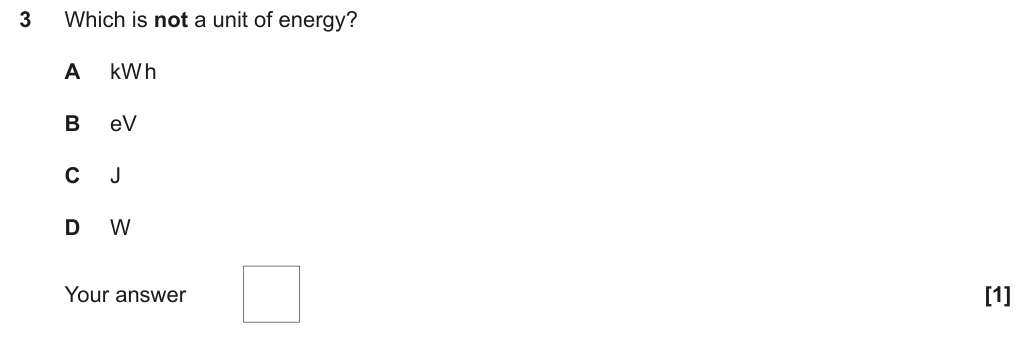
3 Which is not a unit of energy?
A kW h
B eV
C J
D W
Your answer [1]
June 2017 · Paper 2 · Q4 1 mark Multiple choice resistivityseries and parallel circuitspotential dividers
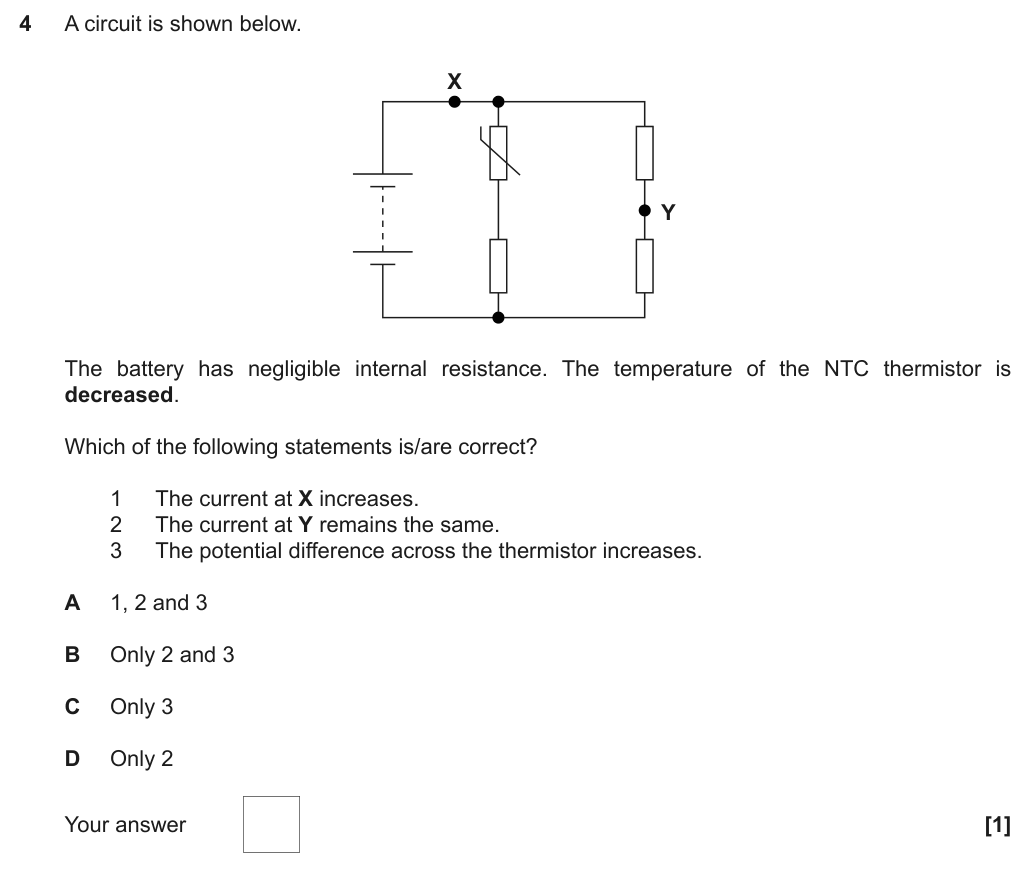
4 A circuit is shown below.
X
Y
The battery has negligible internal resistance. The temperature of the NTC thermistor is
decreased.
Which of the following statements is/are correct?
1 The current at X increases.
2 The current at Y remains the same.
3 The potential difference across the thermistor increases.
A 1, 2 and 3
B Only 2 and 3
C Only 3
D Only 2
Your answer [1]
June 2017 · Paper 2 · Q5 1 mark Multiple choice wave motionsuperposition and interference
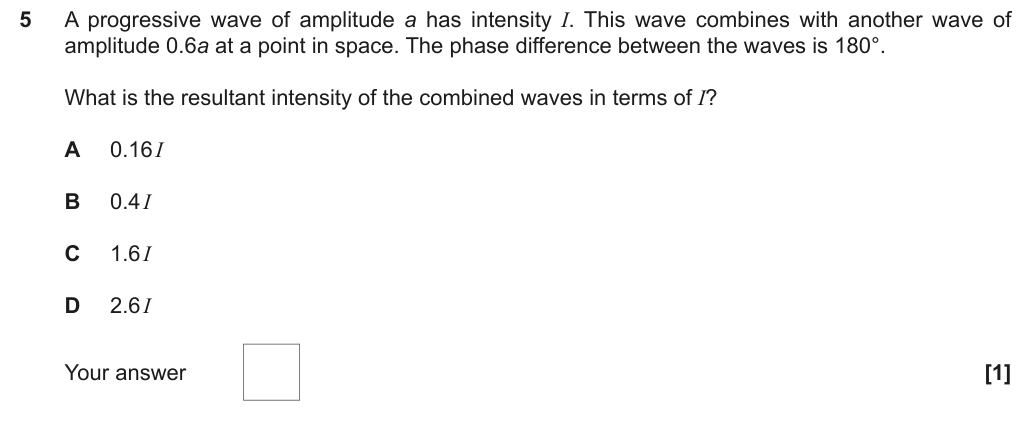
5 A progressive wave of amplitude a has intensity I. This wave combines with another wave of
amplitude 0.6a at a point in space. The phase difference between the waves is 180°.
What is the resultant intensity of the combined waves in terms of I?
A 0.16 I
B 0.4 I
C 1.6 I
D 2.6 I
Your answer [1]
June 2017 · Paper 2 · Q6 1 mark Multiple choice stationary waves
6 Stationary waves are produced in a tube closed at one end and open at the other end. The
fundamental frequency is 120 Hz.
What is a possible frequency of a harmonic for this tube?
A 60 Hz
B 240 Hz
C 360 Hz
D 480 Hz
Your answer [1]
June 2017 · Paper 2 · Q7 1 mark Multiple choice capacitors
7 The graph below shows the variation of potential difference V with charge Q for a capacitor.
V
0
0 Q
Which row is correct for the gradient of the graph and the area under the graph?
Gradient of graph Area under the graph
A capacitance−1 work done
B capacitance−1 permittivity
C capacitance power
D capacitance energy
Your answer [1]
June 2017 · Paper 2 · Q8 1 mark Multiple choice capacitors
8 A capacitor discharges through a resistor. At time t = 0, the charge stored by the capacitor is
600 μC. The capacitor loses 5.0 % of its charge every second.
What is the charge left on the capacitor at time t = 4.0 s?
A 111 μC
B 120 μC
C 480 μC
D 489 μC
Your answer [1]
June 2017 · Paper 2 · Q9 1 mark Multiple choice electric fields
9 Two isolated parallel capacitor plates have an equal and opposite charge.
The separation between the plates is doubled.
The charge on each plate remains the same but the potential difference between the plates
doubles.
+ + + +
+ + + +
– – – – – – – –
before after
Which statement is correct?
A The capacitance of the capacitor doubles.
B The energy stored by the capacitor is halved.
C The permittivity of free space doubles.
D The electric field strength between the plates remains the same.
Your answer [1]
June 2017 · Paper 2 · Q10 1 mark Multiple choice nuclear atom and particles
10 Which statement is correct?
A Hadrons are made up of protons and neutrons.
B A positron and a proton are examples of leptons.
C The positron and the electron have the same mass.
D The weak nuclear force is responsible for alpha-decay.
Your answer [1]
June 2017 · Paper 2 · Q11 1 mark Multiple choice magnetic fields
11 An electron moves in a circle of radius 2.0 cm in a uniform magnetic field of flux density 170 mT.
What is the momentum of this electron?
A 3.4 × 10⁻³ kg m s−1
B 5.4 × 10⁻¹⁷ kg m s−1
C 1.4 × 10⁻¹⁸ kg m s−1
D 5.4 × 10⁻²² kg m s−1
Your answer [1]
June 2017 · Paper 2 · Q12 1 mark Multiple choice nuclear fission and fusionnuclear atom and particles
12 A proton collides with a stationary oxygen-18 nucleus. The collision produces a fluorine-18 nucleus
and particle X.
1 1p    +    18 8O 18 9F    +    X
What is particle X?
A neutron
B proton
C electron
D positron
Your answer [1]
June 2017 · Paper 2 · Q13 1 mark Multiple choice magnetic fields
13 A beam of charged particles is not deflected when it passes through a region where both electric
and magnetic fields are present.
Which statement is not correct?
A All the particles have the same speed.
B The resultant force on each particle is zero.
C The magnetic force is equal to the electric force on each particle.
D The magnetic field and the electric field are in the same direction.
Your answer [1]
June 2017 · Paper 2 · Q14 1 mark Multiple choice medical imaging
14 There are four important attenuation mechanisms by which X-ray photons may interact when they
pass through matter.
In which mechanism is the X-ray photon scattered with a longer wavelength?
A simple scattering
B Compton effect
C pair production
D photoelectric effect
Your answer [1]
June 2017 · Paper 2 · Q15 1 mark Multiple choice electromagnetic waves and refraction
15 A ray of monochromatic light is incident at the boundary between two transparent materials of
refractive index n1 and n2. The critical angle θ is equal to 80°.
boundary
n1
n2 θ
n
1?
What is the ratio n
2
A 0.17
B 0.98
C 1.02
D 5.76
Your answer [1]
June 2017 · Paper 2 · Q16(a) 1 mark Short answer superposition and interference
16 (a) State the principle of superposition of waves.
...................................................................................................................................................
...................................................................................................................................................
.............................................................................................................................................. [1]
June 2017 · Paper 2 · Q16(b)(i) 3 marks Calculation superposition and interference
(b) Fig. 16.1 shows an arrangement to demonstrate the interference of monochromatic light.
screen
double-slit
blue
light
0.25 mm
4.25 m
Fig. 16.1
Coherent blue light from a laser is incident at a double-slit. The separation between the slits
is 0.25 mm. A series of dark and bright lines (fringes) appear on the screen. The screen is
4.25 m from the slits.
Fig. 16.2 shows the dark and bright fringes observed on the screen.
Fig. 16.2
The pattern shown in Fig. 16.2 is drawn to scale.
(i) Use Fig. 16.2 to determine accurately the wavelength of the blue light from the laser.
wavelength =  ..................................................... m [3]
June 2017 · Paper 2 · Q16(b)(ii) 2 marks Explanation superposition and interference
Earlier part of question 16 that this part usesEarlier part of June 2017 Paper 2 question 16
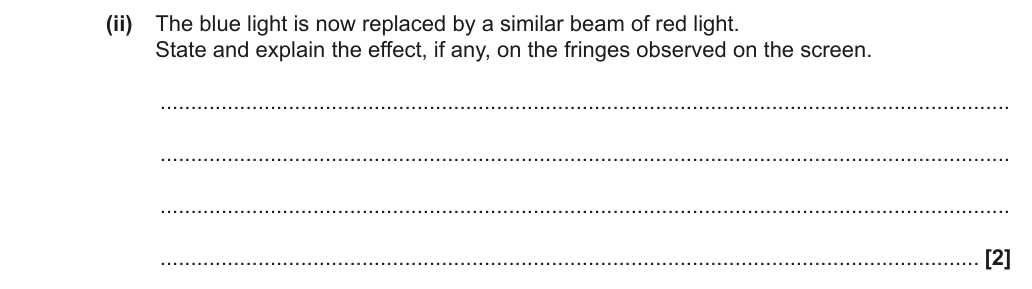
(ii) The blue light is now replaced by a similar beam of red light.
State and explain the effect, if any, on the fringes observed on the screen.
...........................................................................................................................................
...........................................................................................................................................
...........................................................................................................................................
...................................................................................................................................... [2]
June 2017 · Paper 2 · Q17(a) 1 mark Short answer quantities and units
17 (a) State one S.I. base quantity other than length, mass and time.
.............................................................................................................................................. [1]
June 2017 · Paper 2 · Q17(b)(i) 2 marks Show that resistivityseries and parallel circuits
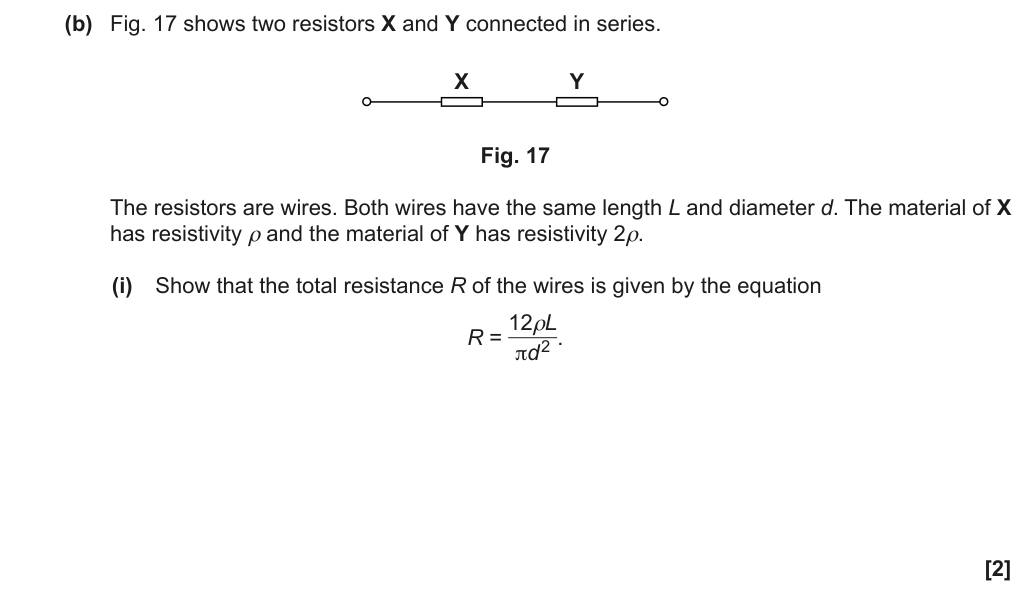
(b) Fig. 17 shows two resistors X and Y connected in series.
X Y
Fig. 17
The resistors are wires. Both wires have the same length L and diameter d. The material of X
has resistivity ρ and the material of Y has resistivity 2ρ.
(i) Show that the total resistance R of the wires is given by the equation
R = 12ρL
πd 2 .
[2]
June 2017 · Paper 2 · Q17(b)(ii) 6 marks Calculation measurements and uncertaintiespractical skillsresistivity
Earlier part of question 17 that this part usesEarlier part of June 2017 Paper 2 question 17
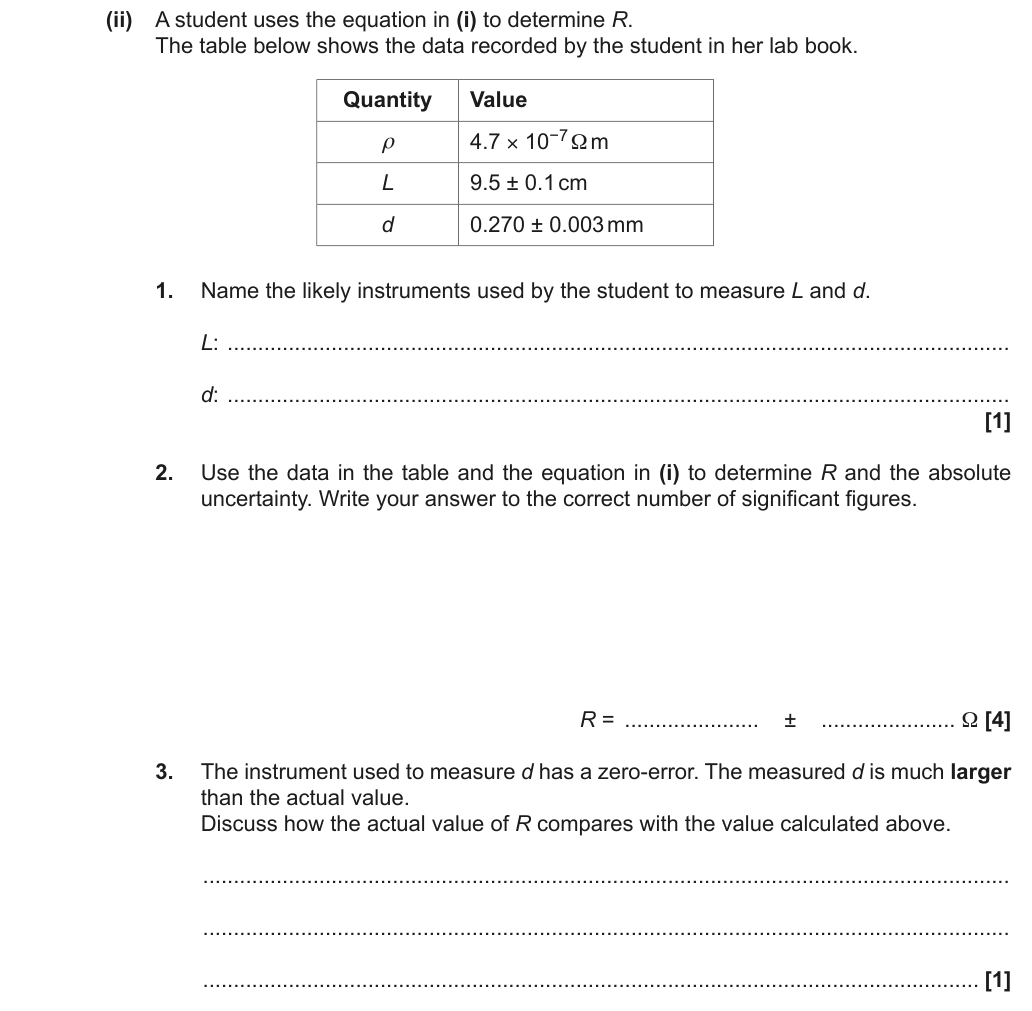
(ii) A student uses the equation in (i) to determine R.
The table below shows the data recorded by the student in her lab book.
Quantity Value
ρ 4.7 × 10⁻⁷ Ω m
L 9.5 ± 0.1 cm
d 0.270 ± 0.003 mm
1. Name the likely instruments used by the student to measure L and d.
L:  ................................................................................................................................
d:  ................................................................................................................................
[1]
2. Use the data in the table and the equation in (i) to determine R and the absolute
uncertainty. Write your answer to the correct number of significant figures.
R =  ......................    ±    ...................... Ω [4]
3. The instrument used to measure d has a zero-error. The measured d is much larger
than the actual value.
Discuss how the actual value of R compares with the value calculated above.
....................................................................................................................................
....................................................................................................................................
............................................................................................................................... [1]
June 2017 · Paper 2 · Q18(a)(i) 3 marks Calculation series and parallel circuits
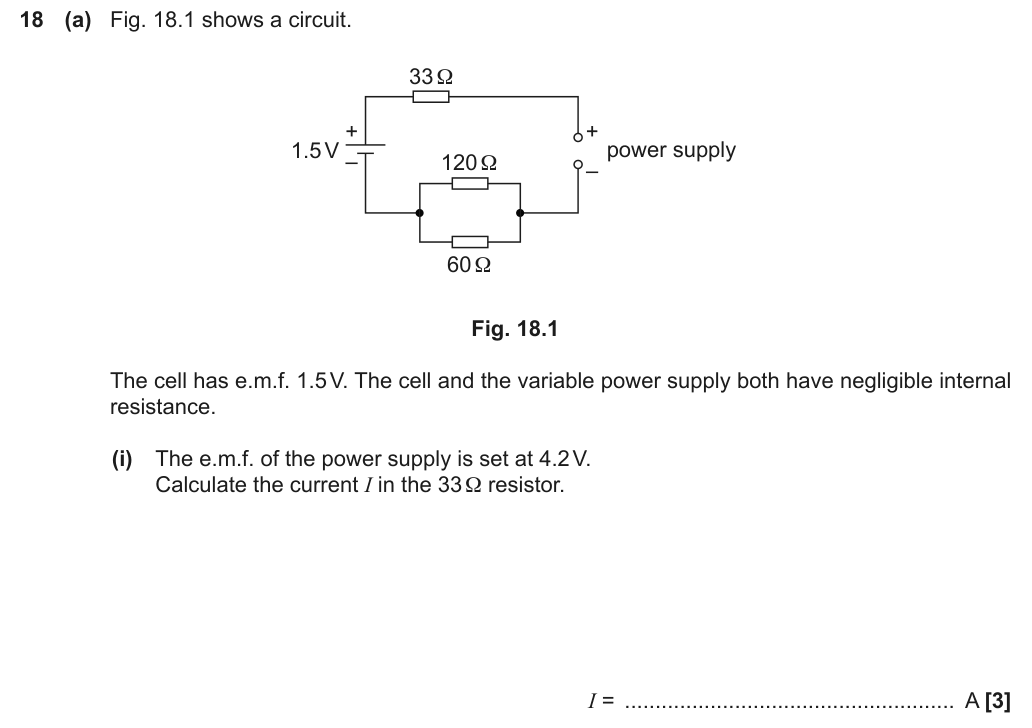
18 (a) Fig. 18.1 shows a circuit.
33 Ω
+ +
1.5 V power supply
– 120 Ω
–
60 Ω
Fig. 18.1
The cell has e.m.f. 1.5 V. The cell and the variable power supply both have negligible internal
resistance.
(i) The e.m.f. of the power supply is set at 4.2 V.
Calculate the current I in the 33 Ω resistor.
I =  ...................................................... A [3]
June 2017 · Paper 2 · Q18(a)(ii) 2 marks Explanation series and parallel circuits
Earlier part of question 18 that this part usesEarlier part of June 2017 Paper 2 question 18
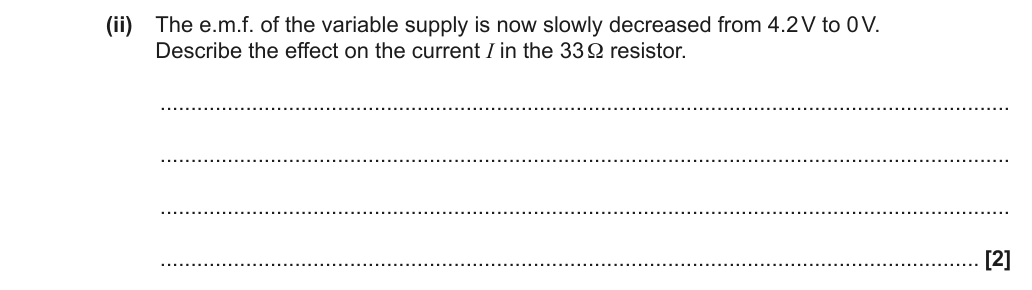
(ii) The e.m.f. of the variable supply is now slowly decreased from 4.2 V to 0 V.
Describe the effect on the current I in the 33 Ω resistor.
...........................................................................................................................................
...........................................................................................................................................
...........................................................................................................................................
...................................................................................................................................... [2]
June 2017 · Paper 2 · Q18(b) 6 marks 6-mark extended response internal resistancepractical skillsemf pd and resistanceelectrical power
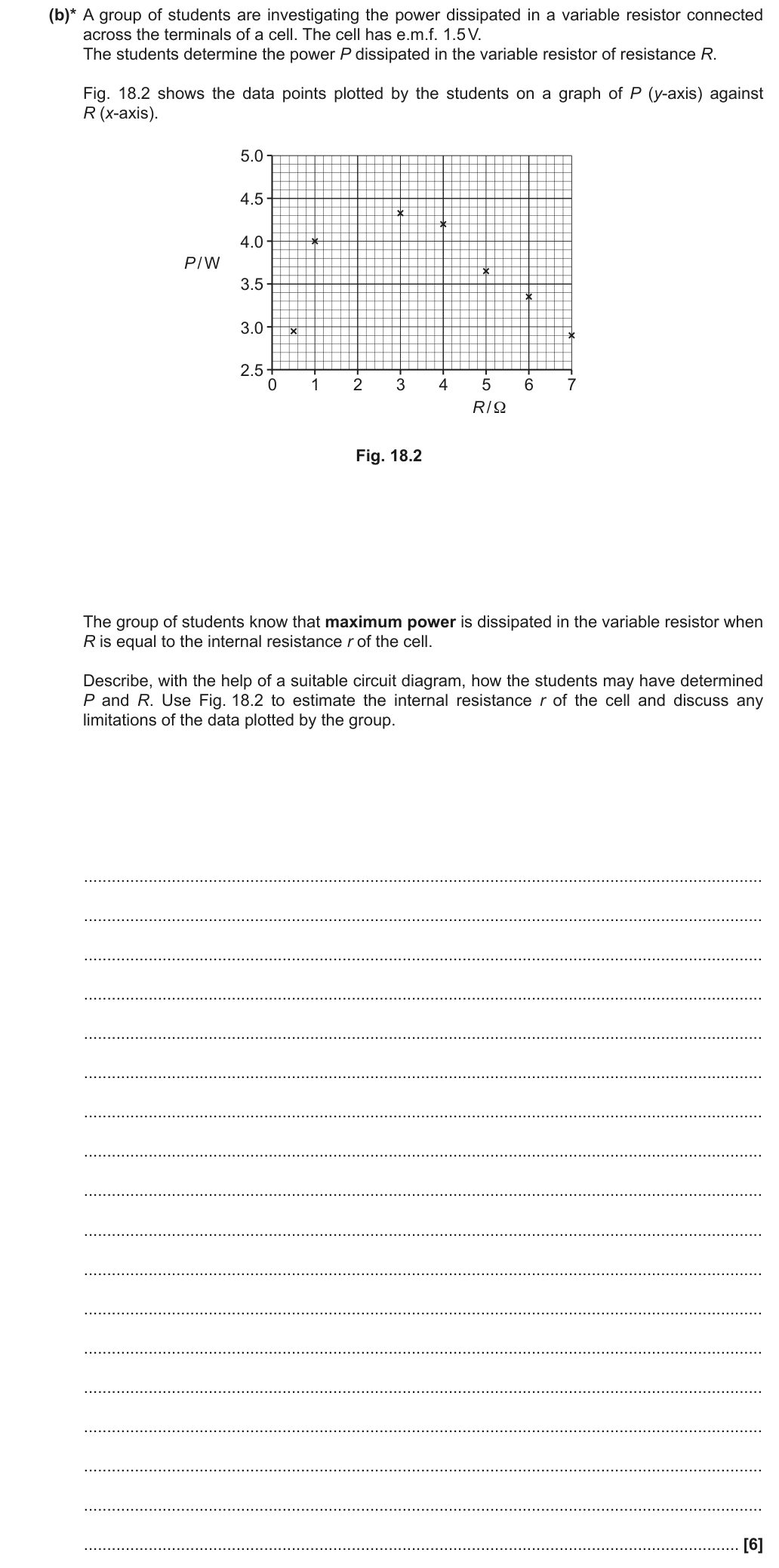
(b)* A group of students are investigating the power dissipated in a variable resistor connected
across the terminals of a cell. The cell has e.m.f. 1.5 V.
The students determine the power P dissipated in the variable resistor of resistance R.
Fig. 18.2 shows the data points plotted by the students on a graph of P (y-axis) against
R (x-axis).
5.0
4.5
4.0
P / W
3.5
3.0
2.5
0 1 2 3 4 5 6 7
R / Ω
Fig. 18.2
The group of students know that maximum power is dissipated in the variable resistor when
R is equal to the internal resistance r of the cell.
Describe, with the help of a suitable circuit diagram, how the students may have determined
P and R. Use Fig. 18.2 to estimate the internal resistance r of the cell and discuss any
limitations of the data plotted by the group.
...................................................................................................................................................
...................................................................................................................................................
...................................................................................................................................................
...................................................................................................................................................
...................................................................................................................................................
...................................................................................................................................................
...................................................................................................................................................
...................................................................................................................................................
...................................................................................................................................................
...................................................................................................................................................
...................................................................................................................................................
...................................................................................................................................................
...................................................................................................................................................
...................................................................................................................................................
...................................................................................................................................................
...................................................................................................................................................
...................................................................................................................................................
.............................................................................................................................................. [6]
June 2017 · Paper 2 · Q19(a) 4 marks Explanation photoelectric effectphotons
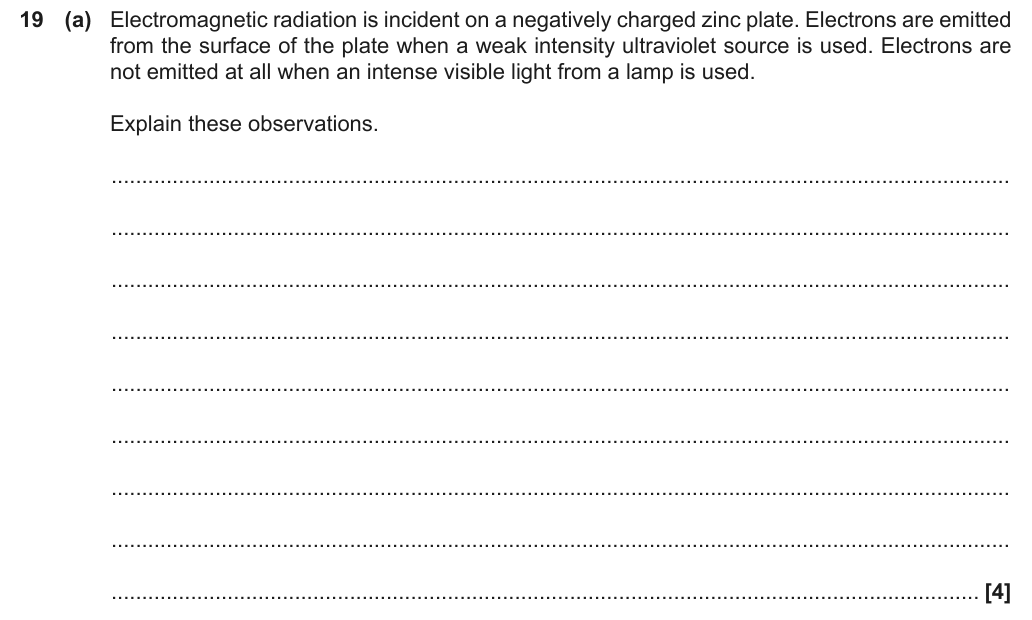
19 (a) Electromagnetic radiation is incident on a negatively charged zinc plate. Electrons are emitted
from the surface of the plate when a weak intensity ultraviolet source is used. Electrons are
not emitted at all when an intense visible light from a lamp is used.
Explain these observations.
...................................................................................................................................................
...................................................................................................................................................
...................................................................................................................................................
...................................................................................................................................................
...................................................................................................................................................
...................................................................................................................................................
...................................................................................................................................................
...................................................................................................................................................
.............................................................................................................................................. [4]
June 2017 · Paper 2 · Q19(b) 3 marks Calculation photoelectric effectphotons
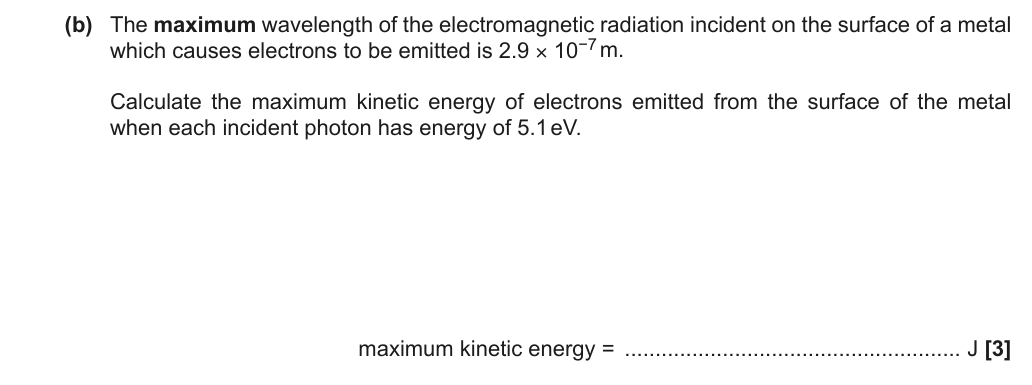
(b) The maximum wavelength of the electromagnetic radiation incident on the surface of a metal
which causes electrons to be emitted is 2.9 × 10⁻⁷ m.
Calculate the maximum kinetic energy of electrons emitted from the surface of the metal
when each incident photon has energy of 5.1 eV.
maximum kinetic energy =  ....................................................... J [3]
June 2017 · Paper 2 · Q19(c) 3 marks Explanation emf pd and resistancephotonsphotoelectric effect
(c) Electromagnetic radiation of constant wavelength is incident on a metal plate. Photoelectrons
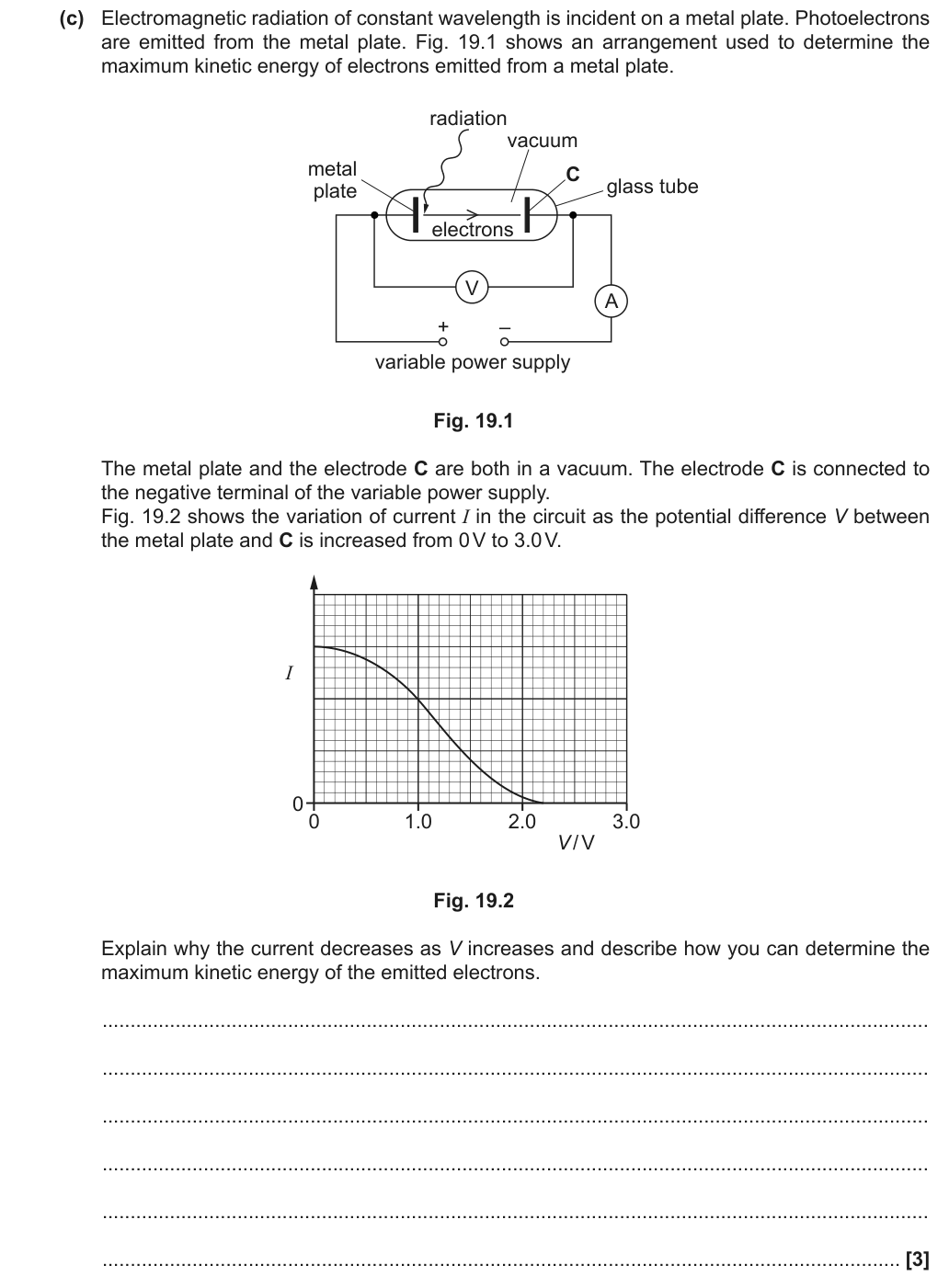
are emitted from the metal plate. Fig. 19.1 shows an arrangement used to determine the
maximum kinetic energy of electrons emitted from a metal plate.
radiation
vacuum
metal C
plate glass tube
electrons
V
A
+ –
variable power supply
Fig. 19.1
The metal plate and the electrode C are both in a vacuum. The electrode C is connected to
the negative terminal of the variable power supply.
Fig. 19.2 shows the variation of current I in the circuit as the potential difference V between
the metal plate and C is increased from 0 V to 3.0 V.
I
0
0 1.0 2.0 3.0
V / V
Fig. 19.2
Explain why the current decreases as V increases and describe how you can determine the
maximum kinetic energy of the emitted electrons.
...................................................................................................................................................
...................................................................................................................................................
...................................................................................................................................................
...................................................................................................................................................
...................................................................................................................................................
.............................................................................................................................................. [3]
June 2017 · Paper 2 · Q20(a) 2 marks Diagram or graph electric fields
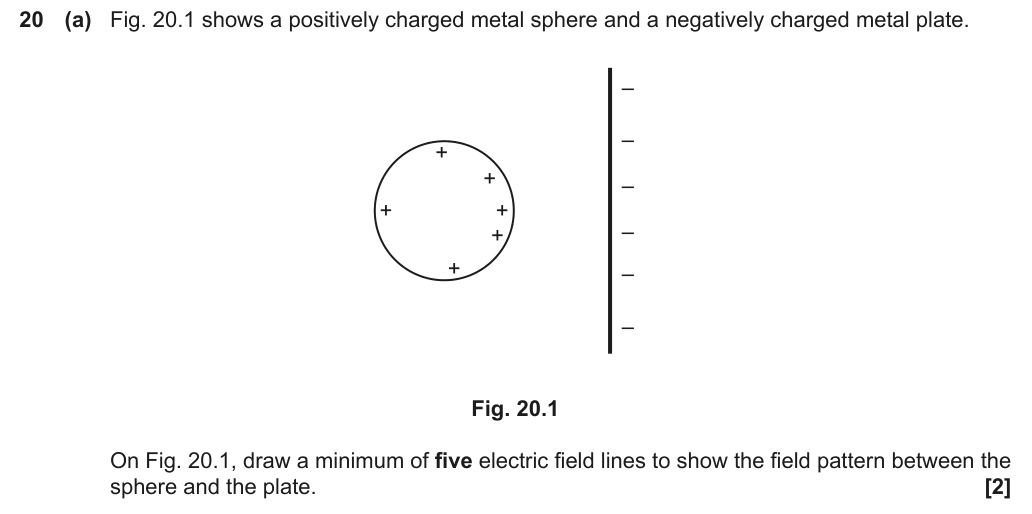
20 (a) Fig. 20.1 shows a positively charged metal sphere and a negatively charged metal plate.
–
–
+
+
–
+ +
+ –
+ –
–
Fig. 20.1
On Fig. 20.1, draw a minimum of five electric field lines to show the field pattern between the
sphere and the plate. [2]
June 2017 · Paper 2 · Q20(b) 1 mark Short answer electric fields
(b) Define electric potential at a point in space.
...................................................................................................................................................
.............................................................................................................................................. [1]
June 2017 · Paper 2 · Q20(c)(i) 2 marks Show that electric fields
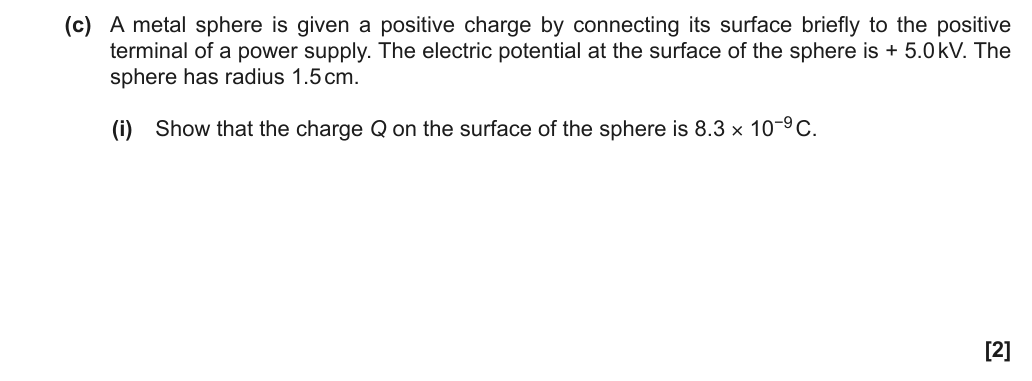
(c) A metal sphere is given a positive charge by connecting its surface briefly to the positive
terminal of a power supply. The electric potential at the surface of the sphere is + 5.0 kV. The
sphere has radius 1.5 cm.
(i) Show that the charge Q on the surface of the sphere is 8.3 × 10⁻⁹ C.
[2]
June 2017 · Paper 2 · Q20(c)(ii) 3 marks Show that electric fieldsscalars and vectors
Earlier part of question 20 that this part usesEarlier part of June 2017 Paper 2 question 20
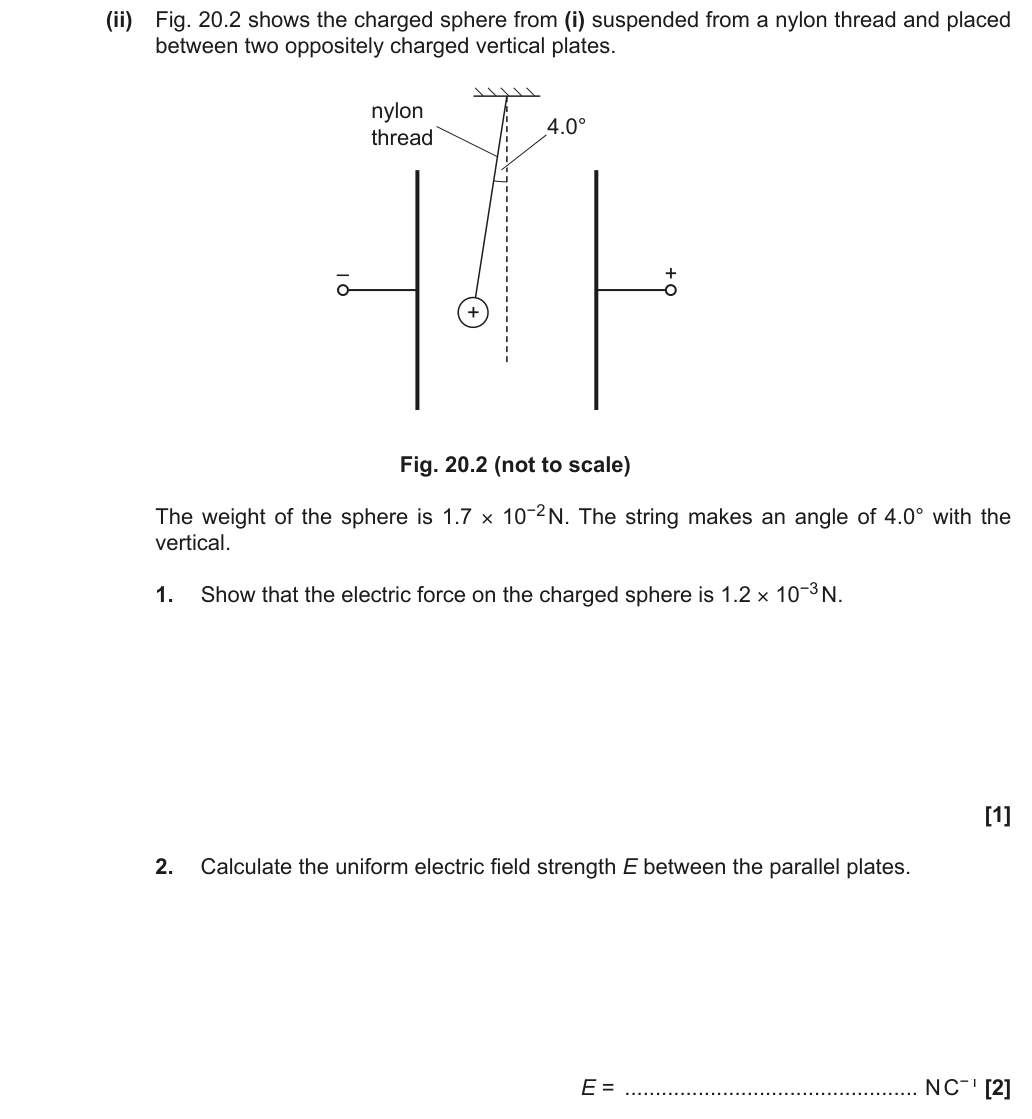
(ii) Fig. 20.2 shows the charged sphere from (i) suspended from a nylon thread and placed
between two oppositely charged vertical plates.
nylon
4.0°
thread
– +
+
Fig. 20.2 (not to scale)
The weight of the sphere is 1.7 × 10⁻² N. The string makes an angle of 4.0° with the
vertical.
1. Show that the electric force on the charged sphere is 1.2 × 10⁻³ N.
[1]
2. Calculate the uniform electric field strength E between the parallel plates.
E =  ................................................ N C−1 [2]
June 2017 · Paper 2 · Q21(a) 2 marks Calculation electric fields
21 (a) A capacitor of capacitance 7.2 pF consists of two parallel metal plates separated by an
insulator of thickness 1.2 mm. The area of overlap between the plates is 4.0 × 10⁻⁴ m2.
Calculate the permittivity of the insulator between the capacitor plates.
permittivity =  ................................................ F m−1 [2]
June 2017 · Paper 2 · Q21(b)(i) 2 marks Calculation capacitors
(b) Fig. 21 shows a circuit.
1.5 V
S
Fig. 21
The capacitance of each capacitor is 1000 μF. The resistance of the resistor is 10 kΩ. The cell
has e.m.f. 1.5 V and negligible internal resistance.
(i) Calculate the total capacitance C in the circuit.
C =  .................................................... μF [2]
June 2017 · Paper 2 · Q21(b)(ii) 2 marks Calculation capacitors
Earlier part of question 21 that this part usesEarlier part of June 2017 Paper 2 question 21
(ii) The switch S is closed at time t = 0. There is zero potential difference across the
capacitors at t = 0.
Calculate the potential difference V across the resistor at time t = 12 s.
V =  ...................................................... V [2]
June 2017 · Paper 2 · Q22(a) 6 marks 6-mark extended response magnetic fieldspractical skillsmeasurements and uncertainties
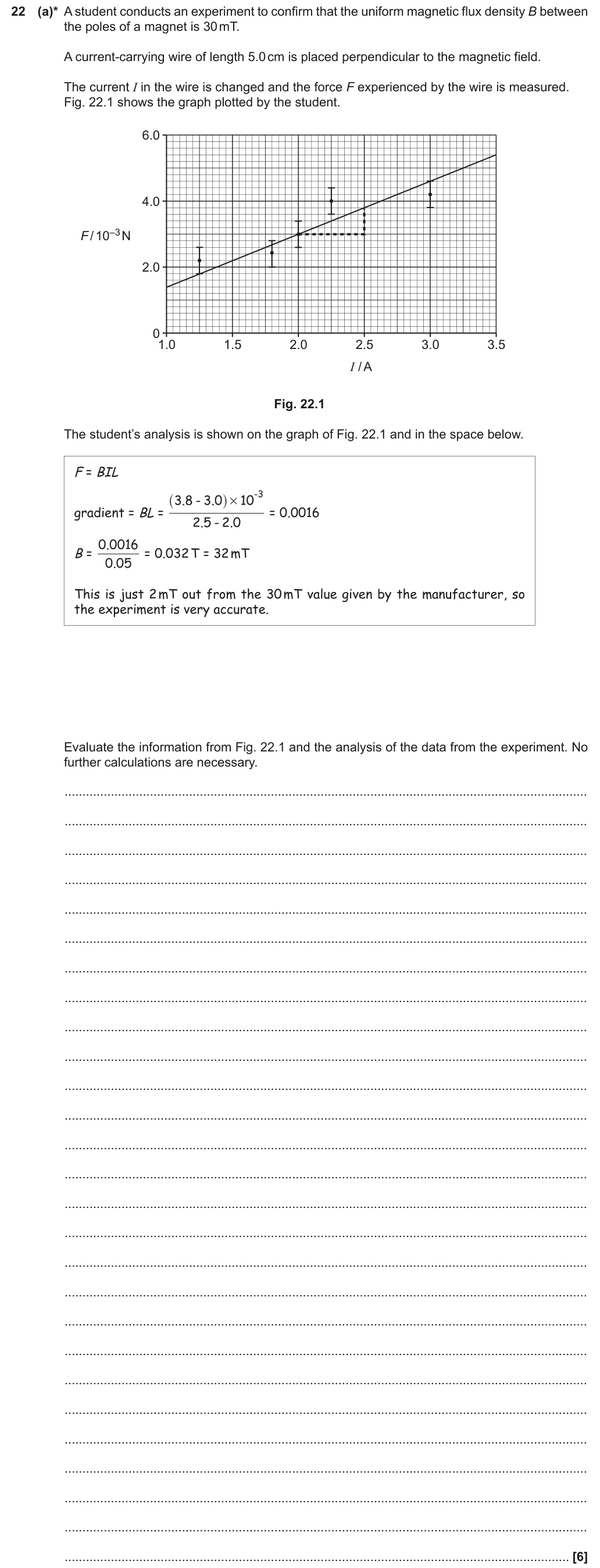
22 (a)* A student conducts an experiment to confirm that the uniform magnetic flux density B between
the poles of a magnet is 30 mT.
A current-carrying wire of length 5.0 cm is placed perpendicular to the magnetic field.
The current I in the wire is changed and the force F experienced by the wire is measured.
Fig. 22.1 shows the graph plotted by the student.
6.0
4.0
F / 10–3 N
2.0
0
1.0 1.5 2.0 2.5 3.0 3.5
I  / A
Fig. 22.1
The student’s analysis is shown on the graph of Fig. 22.1 and in the space below.
F = BIL
_ i - 3
3.8 - 3.0 # 10
gradient = BL = = 0.0016
2.5 - 2.0
0.0016 = 0.032 T = 32 mT
B = 0.05
This is just 2 mT out from the 30 mT value given by the manufacturer, so
the experiment is very accurate.
Evaluate the information from Fig. 22.1 and the analysis of the data from the experiment. No
further calculations are necessary.
...................................................................................................................................................
...................................................................................................................................................
...................................................................................................................................................
...................................................................................................................................................
...................................................................................................................................................
...................................................................................................................................................
...................................................................................................................................................
...................................................................................................................................................
...................................................................................................................................................
...................................................................................................................................................
...................................................................................................................................................
...................................................................................................................................................
...................................................................................................................................................
...................................................................................................................................................
...................................................................................................................................................
...................................................................................................................................................
...................................................................................................................................................
...................................................................................................................................................
...................................................................................................................................................
...................................................................................................................................................
...................................................................................................................................................
...................................................................................................................................................
...................................................................................................................................................
...................................................................................................................................................
...................................................................................................................................................
...................................................................................................................................................
.............................................................................................................................................. [6]
June 2017 · Paper 2 · Q22(b)(i) 3 marks Practical and data analysis electromagnetic induction
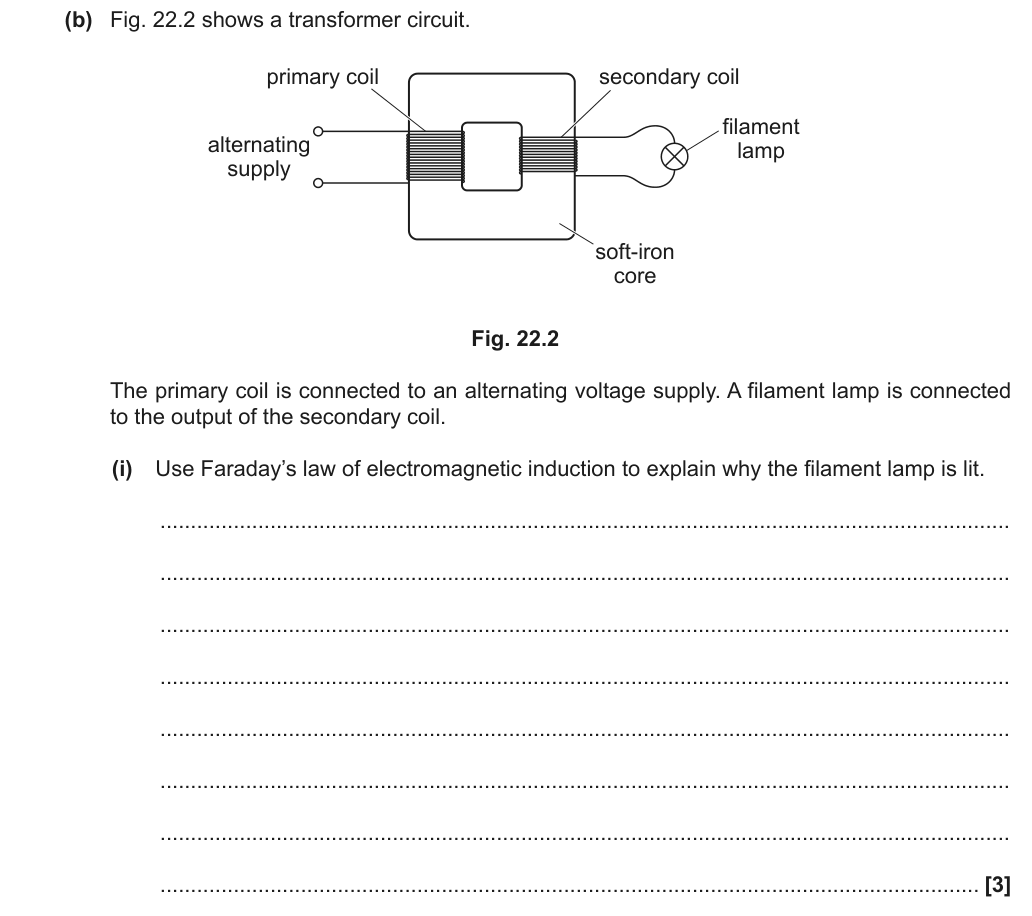
(b) Fig. 22.2 shows a transformer circuit.
primary coil secondary coil
filament
alternating lamp
supply
soft-iron
core
Fig. 22.2
The primary coil is connected to an alternating voltage supply. A filament lamp is connected
to the output of the secondary coil.
(i) Use Faraday’s law of electromagnetic induction to explain why the filament lamp is lit.
...........................................................................................................................................
...........................................................................................................................................
...........................................................................................................................................
...........................................................................................................................................
...........................................................................................................................................
...........................................................................................................................................
...........................................................................................................................................
...................................................................................................................................... [3]
June 2017 · Paper 2 · Q22(b)(ii) 4 marks Calculation electromagnetic inductionelectrical power
Earlier part of question 22 that this part usesEarlier part of June 2017 Paper 2 question 22
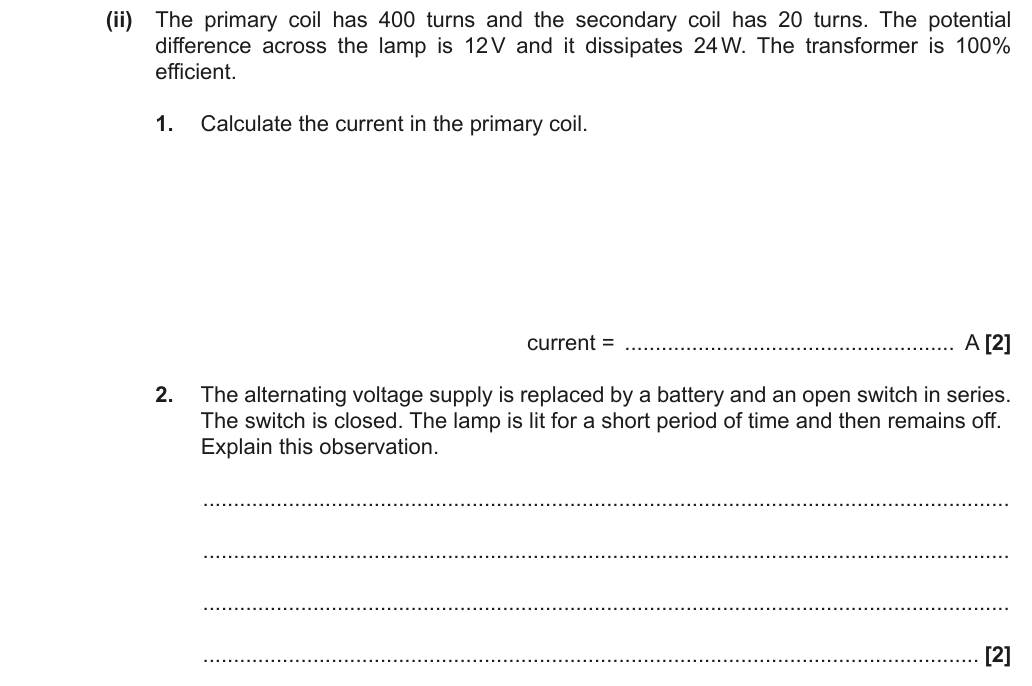
(ii) The primary coil has 400 turns and the secondary coil has 20 turns. The potential
difference across the lamp is 12 V and it dissipates 24 W. The transformer is 100%
efficient.
1. Calculate the current in the primary coil.
current =  ...................................................... A [2]
2. The alternating voltage supply is replaced by a battery and an open switch in series.
The switch is closed. The lamp is lit for a short period of time and then remains off.
Explain this observation.
....................................................................................................................................
....................................................................................................................................
....................................................................................................................................
............................................................................................................................... [2]
June 2017 · Paper 2 · Q23(a) 2 marks Explanation nuclear atom and particles
23 (a) Describe the nature of the strong nuclear force.
...................................................................................................................................................
...................................................................................................................................................
...................................................................................................................................................
.............................................................................................................................................. [2]
June 2017 · Paper 2 · Q23(b)(i) 1 mark Short answer nuclear atom and particles
(b) (i) Name a hadron found in the nucleus of an atom and state its quark combination.
name of hadron: ..........................  quark combination: .......................... [1]
June 2017 · Paper 2 · Q23(b)(ii) 2 marks Short answer nuclear atom and particles
(ii) Write a decay equation in terms of a quark model for beta-minus decay.
[2]
June 2017 · Paper 2 · Q23(c) 2 marks Explanation nuclear atom and particles
(c) The radius of a nucleus is directly proportional to A1/3, where A is the nucleon number.
The mass of a proton and a neutron are similar.
Explain why the mean density of all nuclei is about the same.
...................................................................................................................................................
...................................................................................................................................................
...................................................................................................................................................
.............................................................................................................................................. [2]
June 2017 · Paper 2 · Q24(a) 2 marks Calculation nuclear fission and fusion
24 Stars produce energy by nuclear fusion.
One particular fusion reaction between two protons (1 1H) is shown below.
1 1H    +    1 1H 2 1H    +    0
+1e    +    ν
In this reaction 2.2 MeV of energy is released.
(a) Only one of the particles shown in the reaction has binding energy.
Determine the binding energy per nucleon of this particle. Explain your answer.
...................................................................................................................................................
...................................................................................................................................................
.............................................................................................................................................. [2]
June 2017 · Paper 2 · Q24(b) 2 marks Explanation nuclear fission and fusion
(b) Explain why high temperatures are necessary for fusion reactions to occur in stars.
...................................................................................................................................................
...................................................................................................................................................
...................................................................................................................................................
...................................................................................................................................................
.............................................................................................................................................. [2]
June 2017 · Paper 2 · Q24(c) 3 marks Calculation nuclear fission and fusionphotons
(c) A gamma photon in a star can spontaneously create an electron-positron pair.
Calculate the maximum wavelength of a gamma photon for this creation event.
maximum wavelength =  ..................................................... m [3]
June 2017 · Paper 2 · Q25(a) 4 marks Explanation medical imaging
25 Fluorine-18 is a common radioactive isotope used in positron emission tomography (PET).
Fluorine-18 emits positrons. A patient is injected with a radiopharmaceutical containing fluorine-18.
(a) Describe how a PET scanner is used to locate an area of increased activity within the patient.
...................................................................................................................................................
...................................................................................................................................................
...................................................................................................................................................
...................................................................................................................................................
...................................................................................................................................................
...................................................................................................................................................
...................................................................................................................................................
...................................................................................................................................................
...................................................................................................................................................
...................................................................................................................................................
.............................................................................................................................................. [4]
June 2017 · Paper 2 · Q25(b) 3 marks Calculation radioactivity
(b) The half-life of fluorine-18 is 110 minutes.
Calculate the time t in minutes for the activity of the radiopharmaceutical to decrease to 30%
of its initial activity.
t =  ............................................ minutes [3]
June 2017 · Paper 2 · Q25(c) 1 mark Explanation medical imaging
(c) PET scanners are not available in all hospitals. This is because fluorine-18 requires expensive
on-site particle accelerators and fluorine-18 has a very small ‘shelf-life’.
Suggest the impact this may have on the treatment and diagnosis of patients in the country.
...................................................................................................................................................
...................................................................................................................................................
.............................................................................................................................................. [1]

Work with an OCR physics tutor

Want a paper marked and gone through with you? Message us.

Prefer email? Send an enquiry

If you are under 18, please include a parent's contact details. Enquiries go to enquiries@physicsaleveltutor.com and are deleted once handled. All tutoring is online.