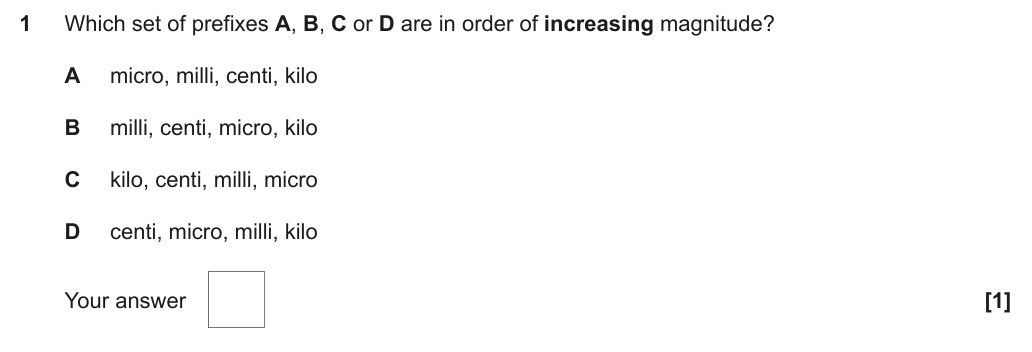
Answer
A
Mark scheme

100 marks · 52 question parts · Paper, mark scheme and report on OCR's site · Have the Data, Formulae and Relationships Booklet beside you
A
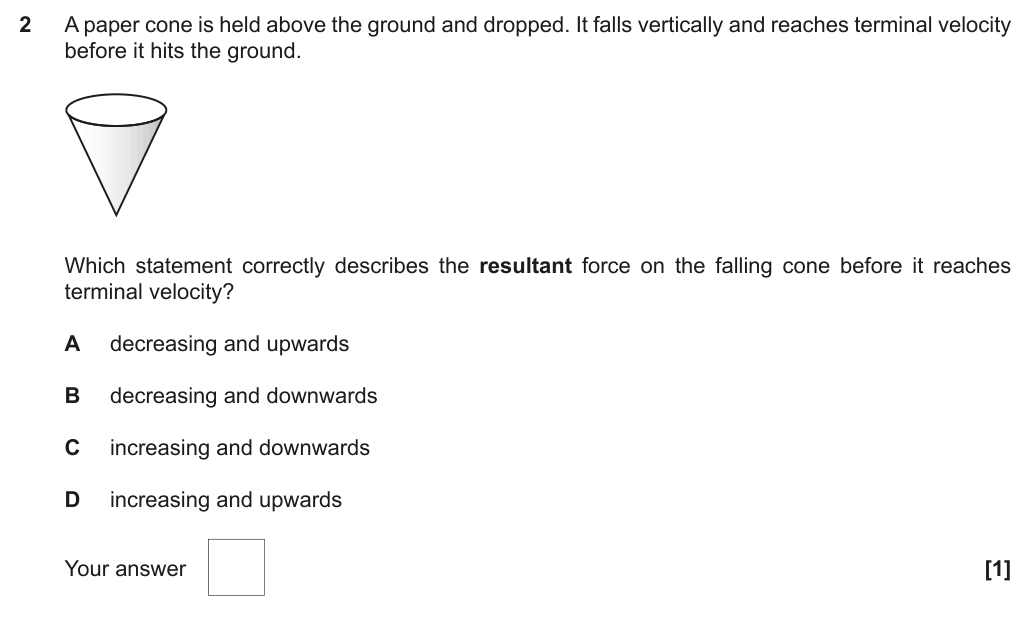
B
Before the cone reaches terminal velocity, it is still accelerating downwards so there is still a resultant force downwards. Once the cone is at terminal velocity, the resultant force must be zero. This means that the resultant force has decreased, giving the correct answer B.
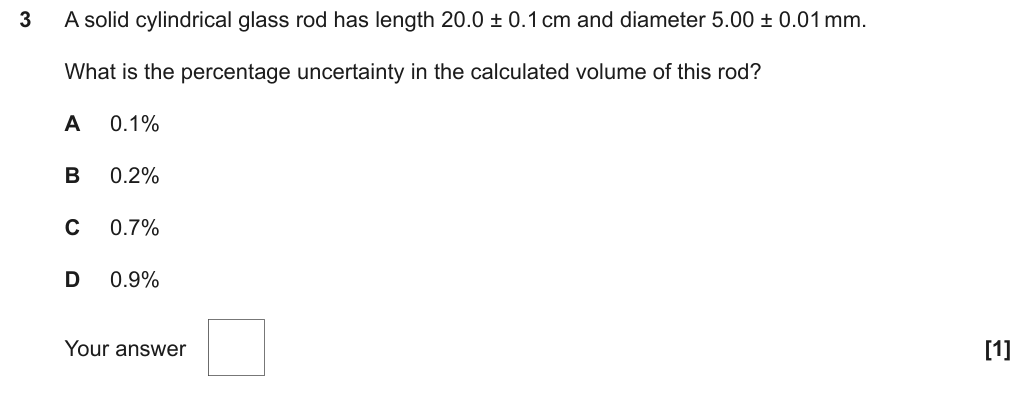
D
Most candidates understood that the percentage uncertainties, rather than the absolute uncertainties should be combined here. The percentage uncertainty in the length is 0.5% and the percentage uncertainty in the diameter is 0.2%. The most common incorrect response here was C, because this is what you get when you add the 2 percentage uncertainties. The percentage uncertainty in the diameter must be doubled, because the formula for the volume of the cylinder include diameter2. This gives the correct answer D.
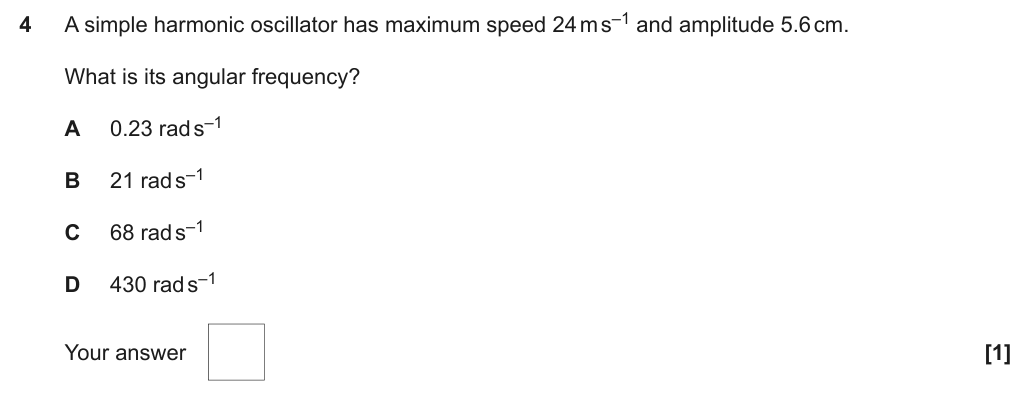
D
The correct formula here is vmax = Aω. This means that to find the angular frequency, ω, you must divide the maximum speed by the amplitude. The amplitude is given in centimetres so that needs to be converted to metres. This gives 24/0.056 = 429 rad s-1, giving the answer D.
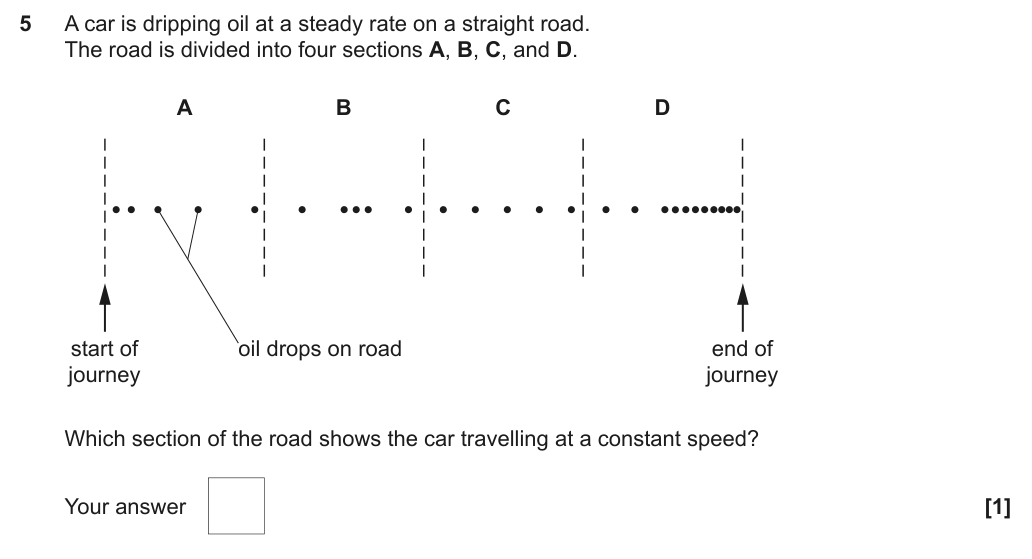
C
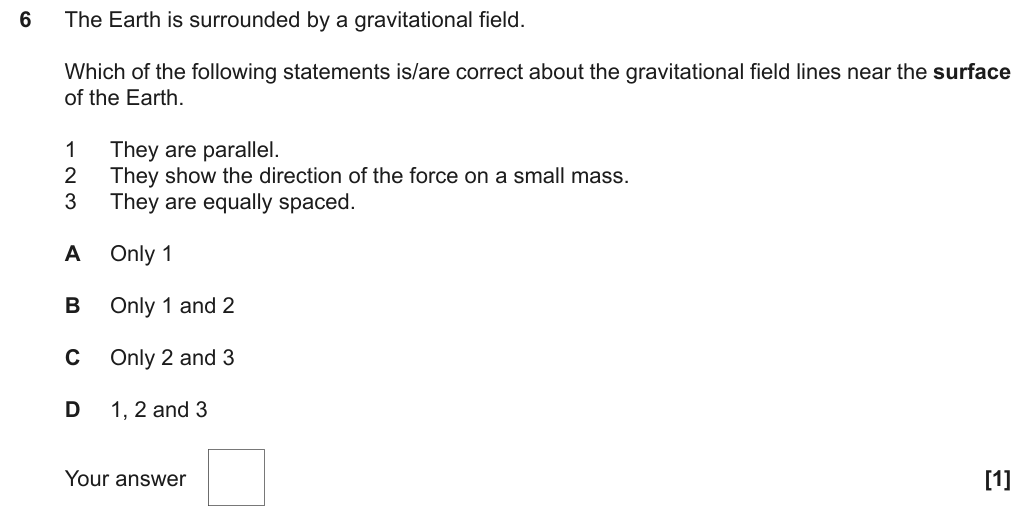
D
Near to the surface of the Earth, the gravitational field is approximately uniform. This means that they are parallel and equally spaced. Gravitational field lines in general show the direction of the force on a small mass. This makes all 3 statements are correct, giving the answer D.
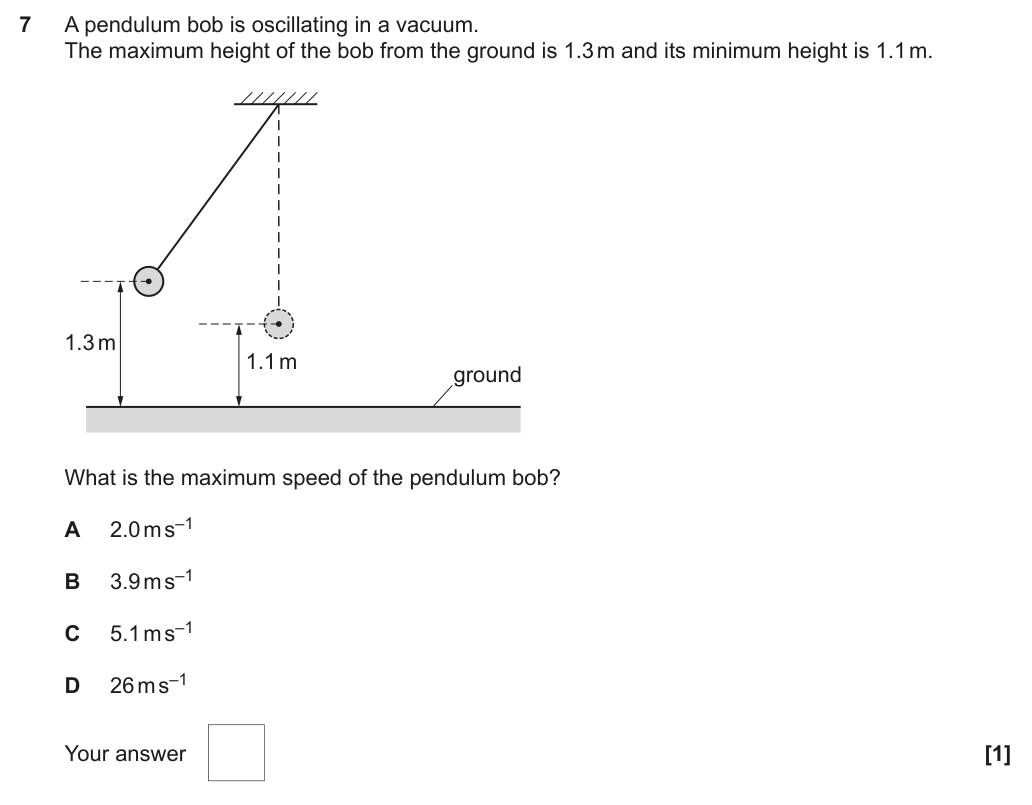
A
The key to this question is to consider the GPE lost and equate it to the KE gained. The GPE lost here = mass × 9.81 × 0.20 = ½ × mass × v2. The masses cancel (which is why the mass wasn’t given). This makes v2 = 3.924. The most common wrong answer was B, as candidates had forgotten to take the square root. The correct speed is 1.98 m s-1 giving the correct answer, A.
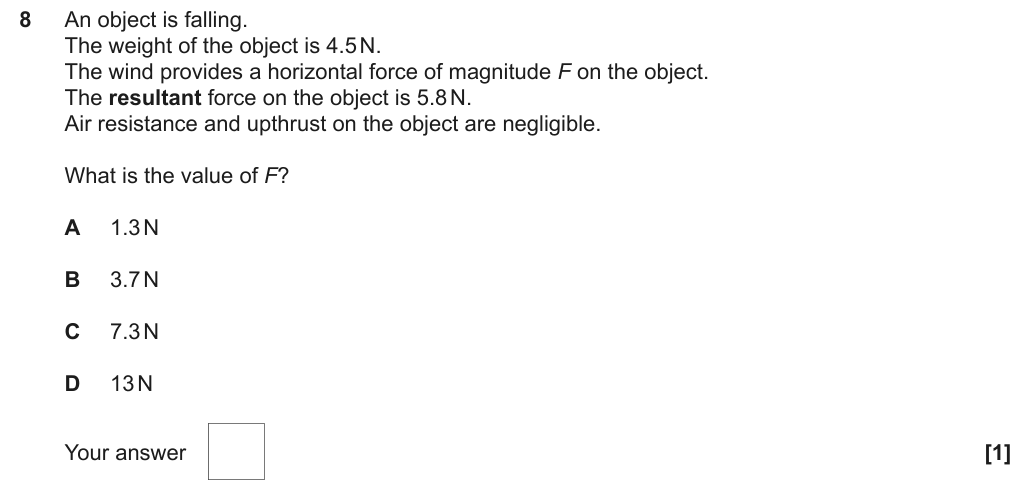
B
C
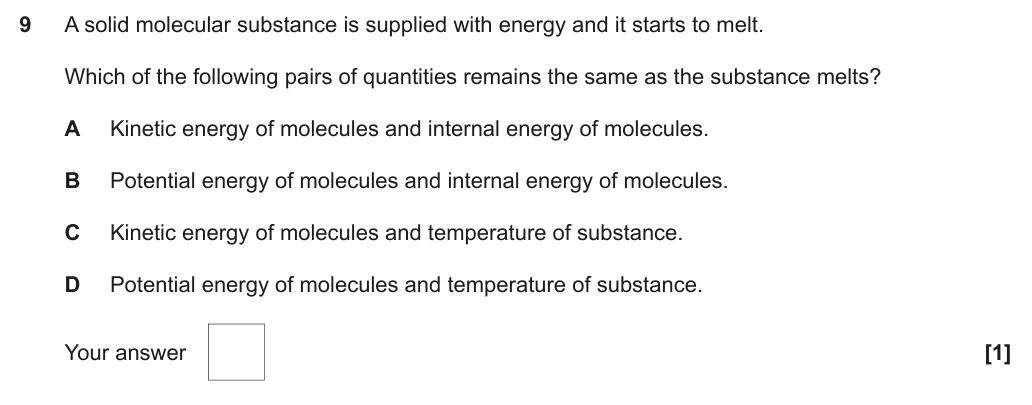
As a substance melts, the PE of the molecules increases, ruling out answers B and D. The temperature of a melting substance does not change and so the KE of the molecules cannot change, as the temperature and mean KE of molecules are directly proportional. This means that C must be correct. A cannot be correct since the internal energy is the sum of the KE and PE of the molecules. The KE is constant and the PE increases, meaning the internal energy must also increase.
C
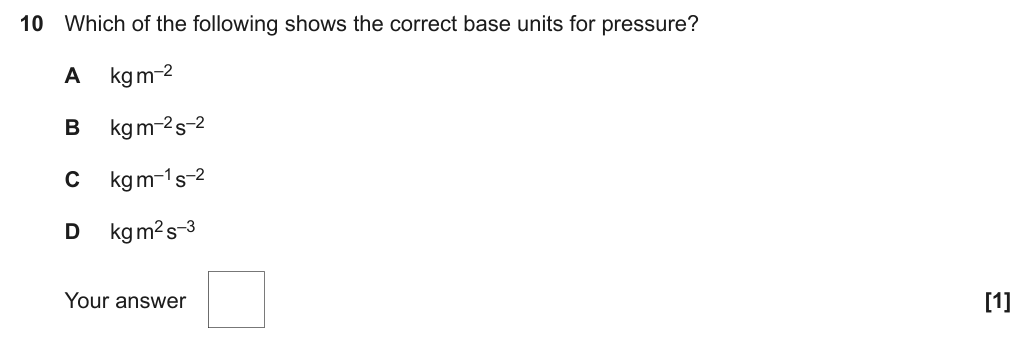
Since P = F/A, we need the units of force and area in base units. F = ma, so force has the base units of kg m s-2 . Area’s unit in base units is m2. Hence pressure has the base units kg m s-1/m2 = kg m-1 s-2, which is answer C.
B
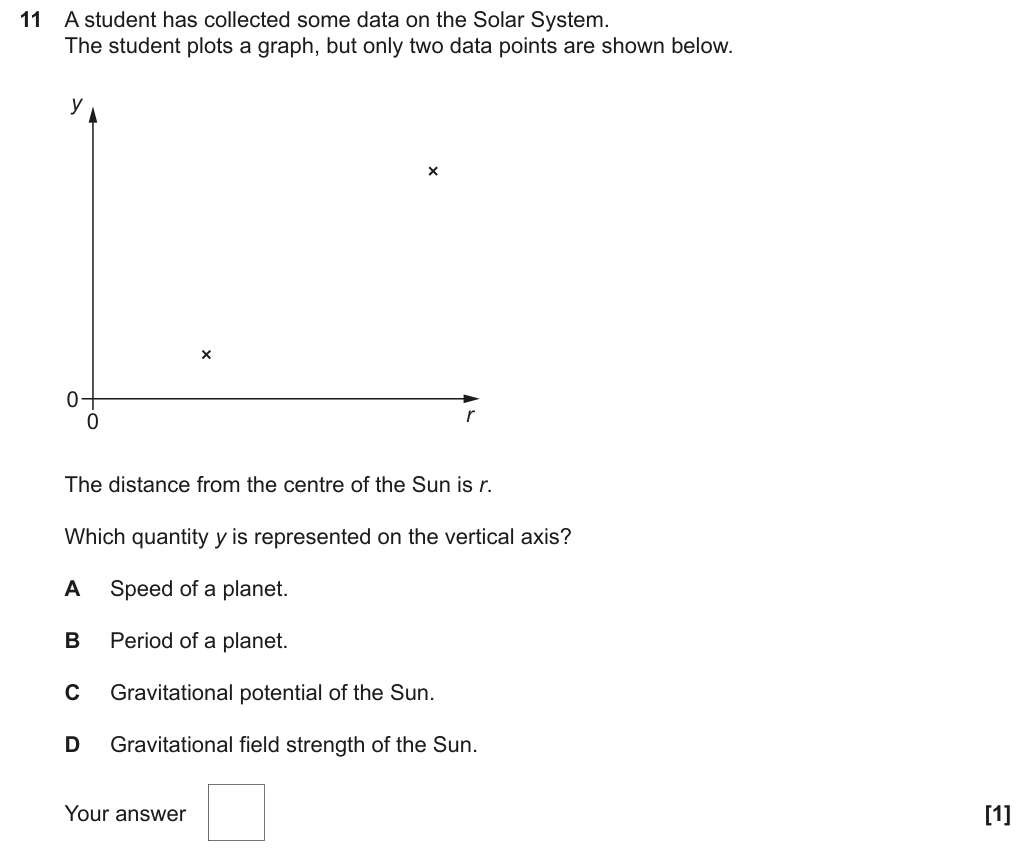
Answering this question needs knowledge of Kepler’s Third Law and the formulae for gravitational potential and gravitational field strength, all of which are given in the data, formulae and relationships booklet. This relationship cannot be gravitational potential or gravitational field strength, as quantity y increases with distance from the Sun. By equating the gravitational force on a planet with the centripetal force, it can be shown also that (orbital speed)2 and orbital radius are inversely proportional. This graph does not show an inversely proportional relationship. The formula sheet says that the square of a planet’s period is directly proportional to the cube of the planet’s orbital radius. In other words, the relationship shows that as orbital radius increases, so does the period, but not directly proportionally. This is the relationship shown on the graph, giving answer B.
D
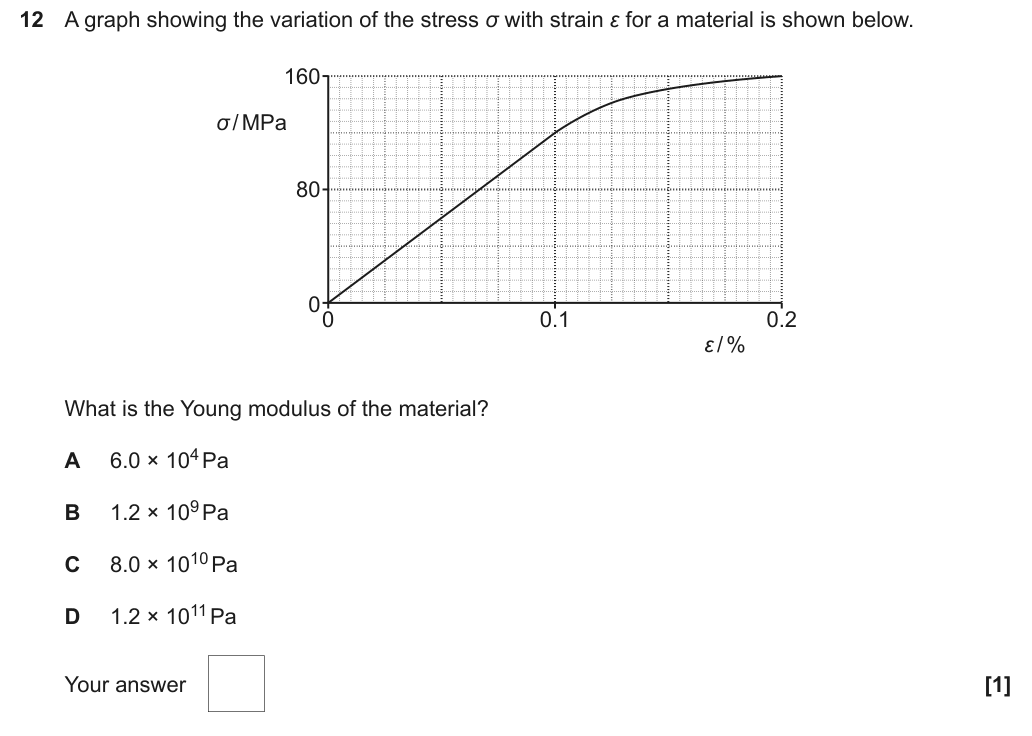
The Young modulus is found by calculating the initial gradient of the material’s stress-strain graph. The initial portion appears to be a straight line from the origin to the point (0.1, 120). The units on this graph are megapascals and %. This means the co-ordinates of the chosen point are in fact (0.1 × 10⁻², 120 × 106). Many candidates forgot to convert the strain into a decimal and left it as a percentage. Their answer was a factor of a 100 out, ie answer B. The correct answer is 120 × 106 / 0.1 × 102 = 1.2 × 10¹¹ Pa. This is answer D.
Skills: M0.1 Recognise and make use of appropriate units in calculations; M0.3 Use ratios, fractions and percentages; M3.4 Determine the slope and intercept of a linear graph
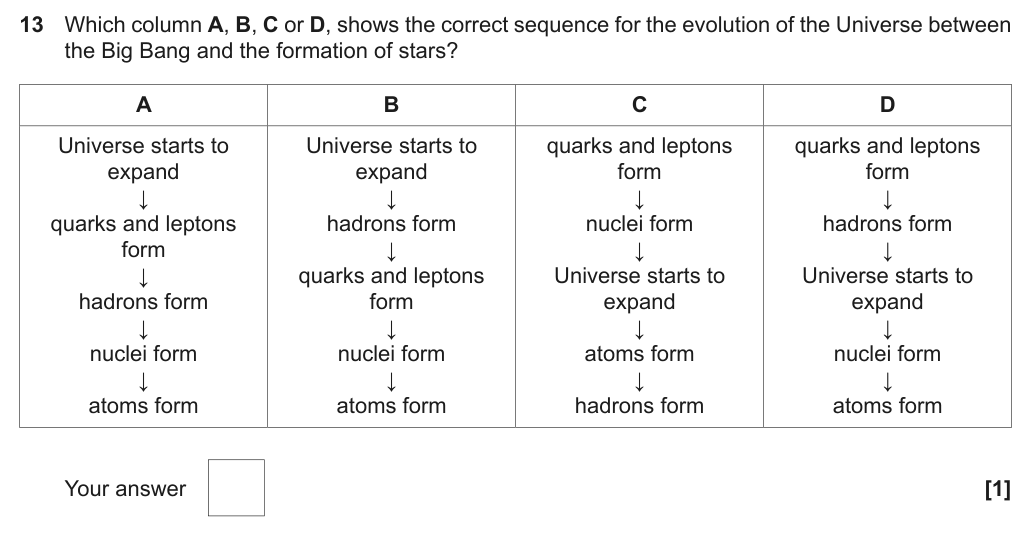
A
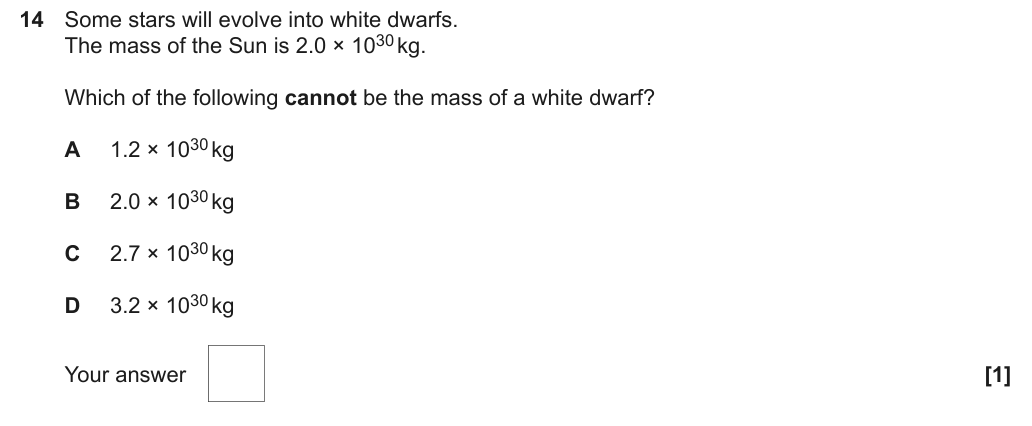
D
The Chandrasekhar limit for the mass of a white dwarf is 1.4 solar masses. The mass of the Sun is 2.0 × 1030 kg, so the mass limit for a white dwarf is 2.8 ×1030 kg. Only star D exceeds this limit, so it cannot be a white dwarf.
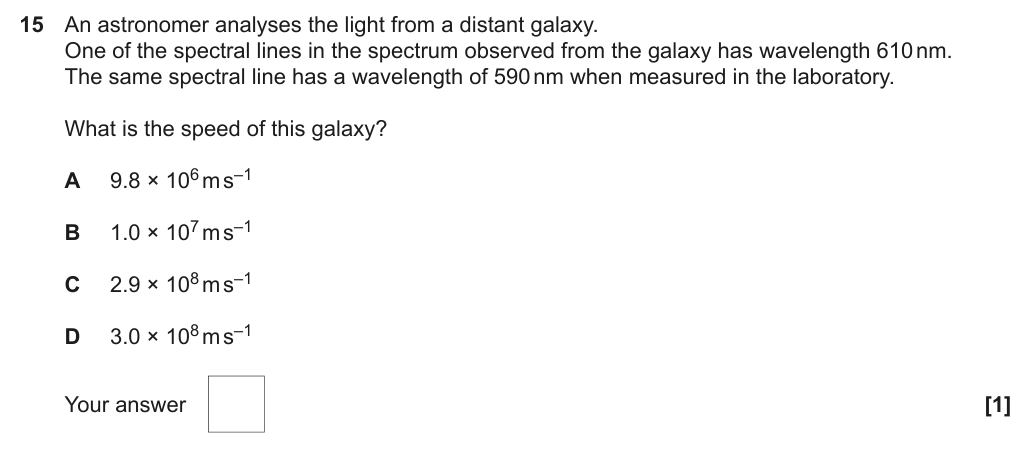
B
Option D is the speed of light, so the galaxy cannot be travelling this fast. The change in wavelength for the galaxy is 20 nm. The laboratory wavelength for this light is 590 nm. The relationship we need is that the fractional change in wavelength for light from a galaxy approximately equals the fraction of the speed of light for that galaxy. The fractional change in wavelength is 20/590 = 3.39 % 3.39% of the speed of light = 1.02 × 10⁷ m s-1, i.e. option B. Option A was the most common incorrect response, which is the speed when the change is wavelength is divided by the wavelength of light from the galaxy.

Ultimate tensile strength is the maximum stress a material can withstand without breaking or failing. The most common incorrect answer included descriptions of force rather than stress.
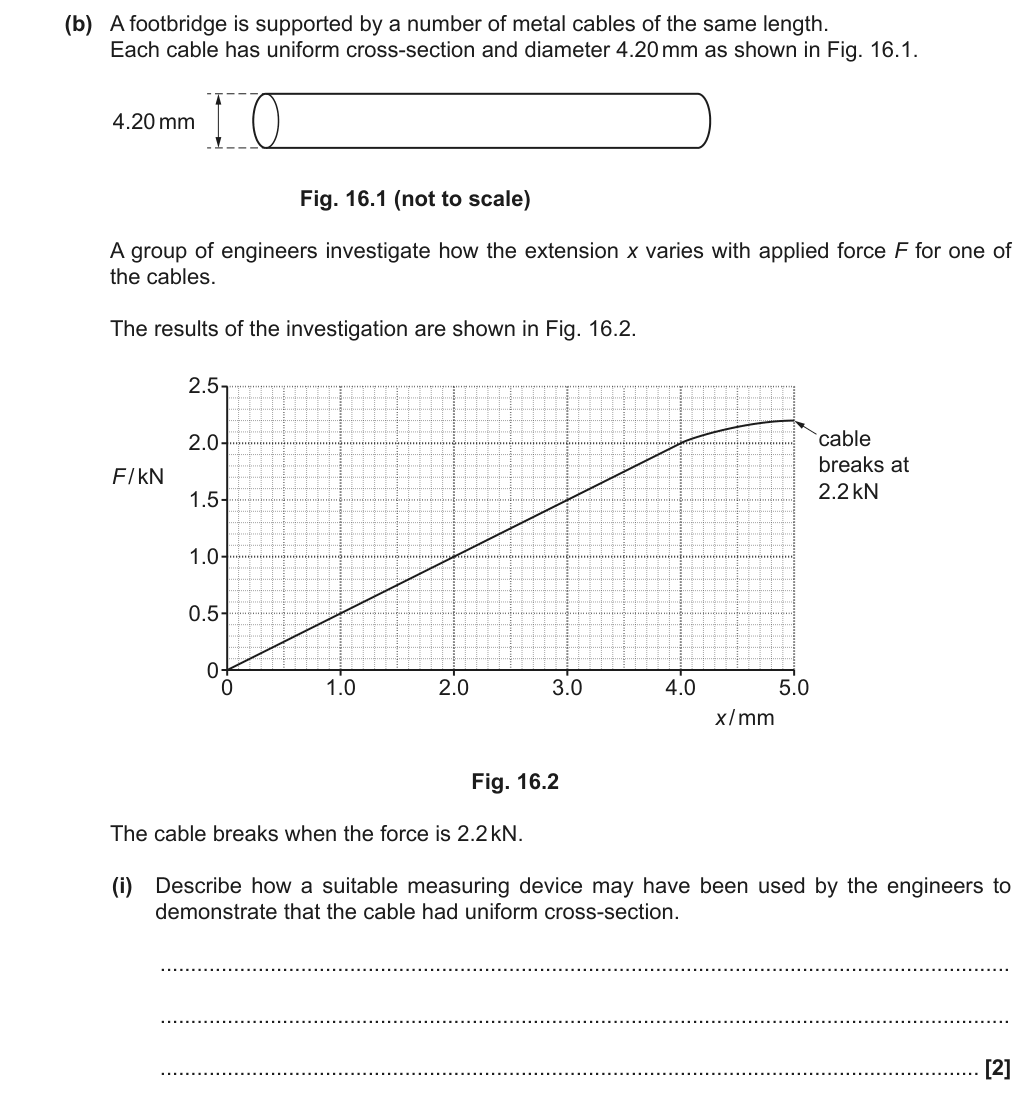
Skills: PAG2 Investigating properties of materials
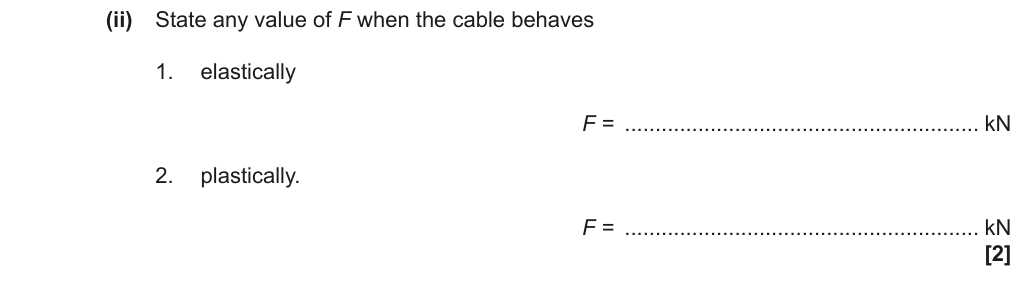
Skills: M3.1 Translate information between graphical, numerical and algebraic forms
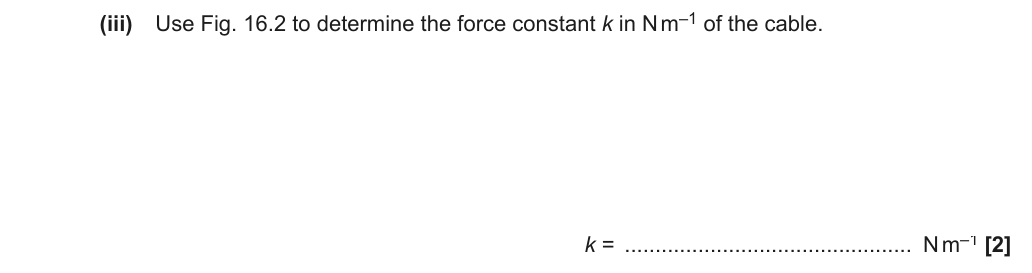
Skills: M0.1 Recognise and make use of appropriate units in calculations; M3.4 Determine the slope and intercept of a linear graph
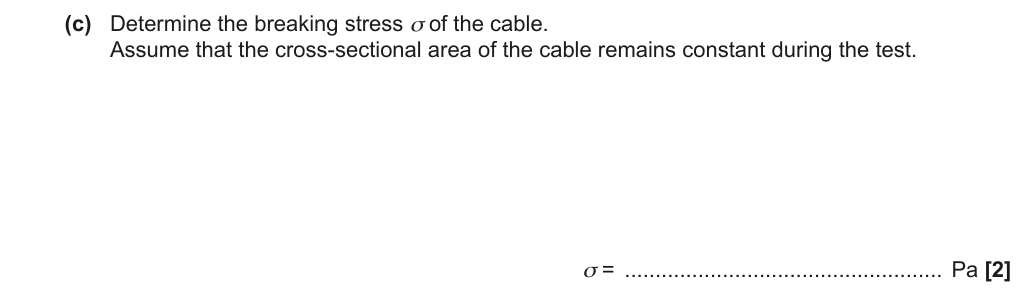
Skills: M0.1 Recognise and make use of appropriate units in calculations; M2.3 Substitute numerical values into algebraic equations using appropriate units for physical quantities; M4.3 Calculate areas of triangles, circumferences and areas of circles, surface areas and volumes of rectangular blocks, cylinders and spheres
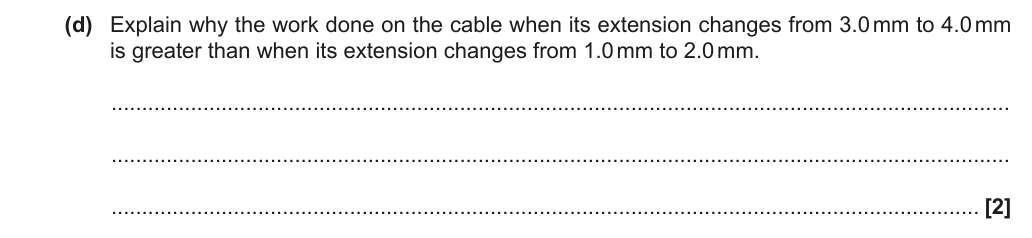
This question is best answered by referring to the graph in the question. Exemplars 1 and 2 indicate the difference between a low level and a high level response. This exemplar shows a response that contains broadly true statements yet is only loosely linked to the context and so scored zero marks. This response is clearly and specifically about this context and uses the graph as supporting evidence. The link to the graph is that the area gives the work done and that a larger area for one region means a larger amount of work done for that region.
Skills: M3.8 Understand the possible physical significance of the area between a curve and the x axis and be able to calculate it or estimate it by graphical methods as appropriate
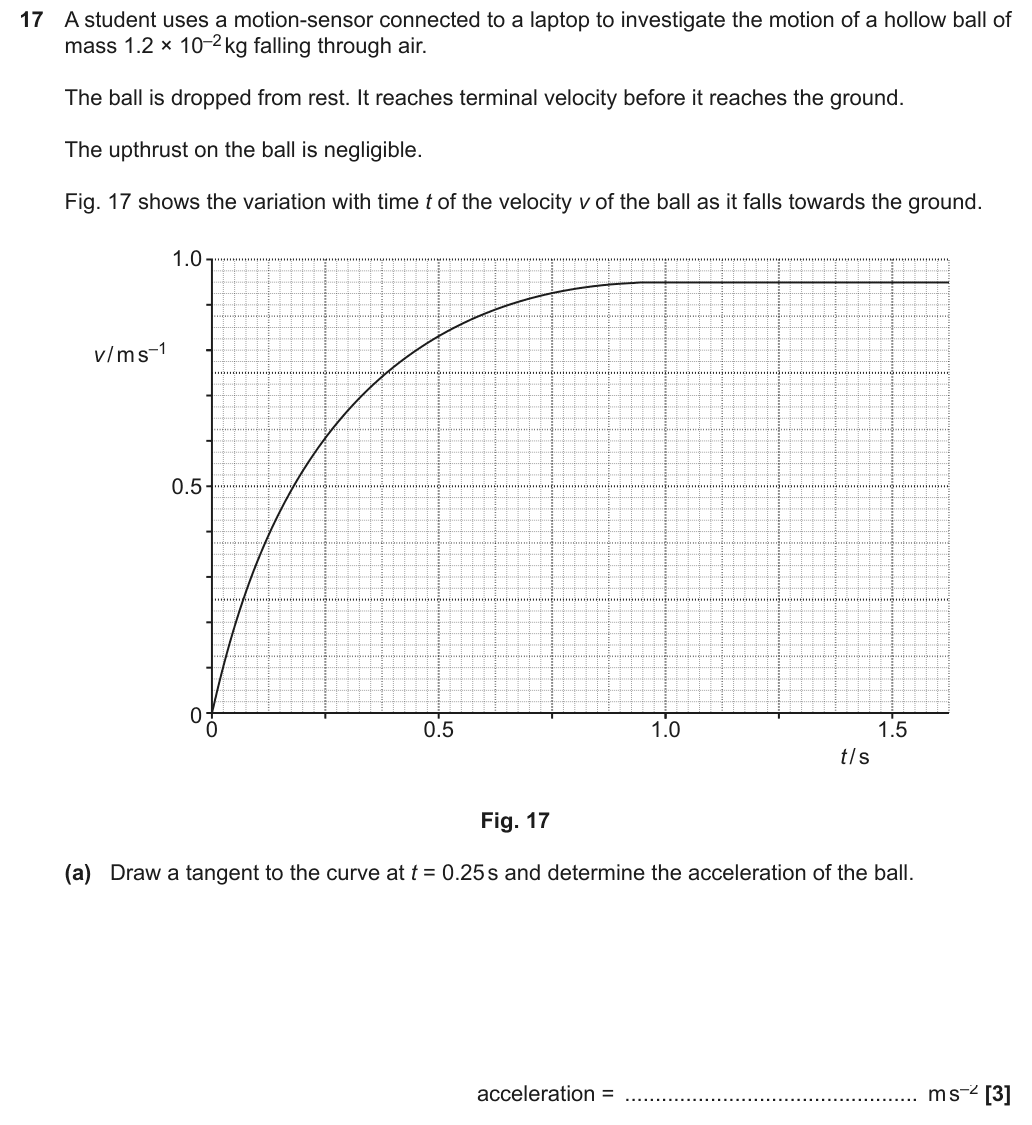
Skills: M3.6 Draw and use the slope of a tangent to a curve as a measure of rate of change; PAG1 Investigating motion
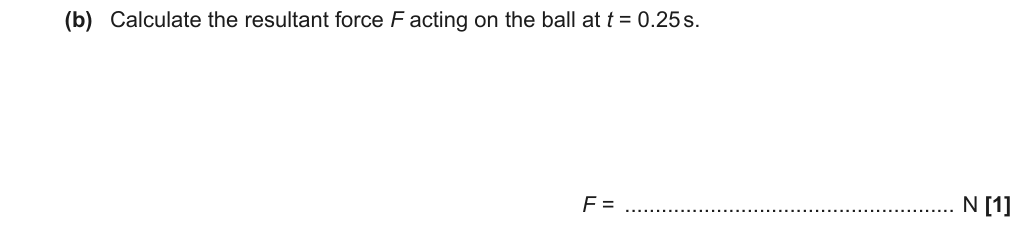
Skills: M2.3 Substitute numerical values into algebraic equations using appropriate units for physical quantities
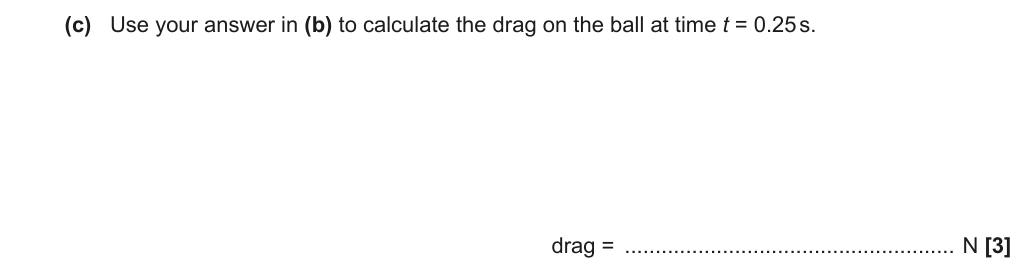
Most candidates correctly calculated the ball’s weight. They had calculated the resultant force on the ball, using F = ma. The resultant force from the previous question was checked, as error carried forward rules applied. Exemplar 3 shows an excellent way of planning out how to answer this sort of question. This candidate has drawn a free-body force diagram to make their intention clear. From it, they know that the resultant force must equal the weight minus the drag. From there they have found the drag force.
Skills: M2.2 Change the subject of an equation, including non-linear equations; M2.3 Substitute numerical values into algebraic equations using appropriate units for physical quantities
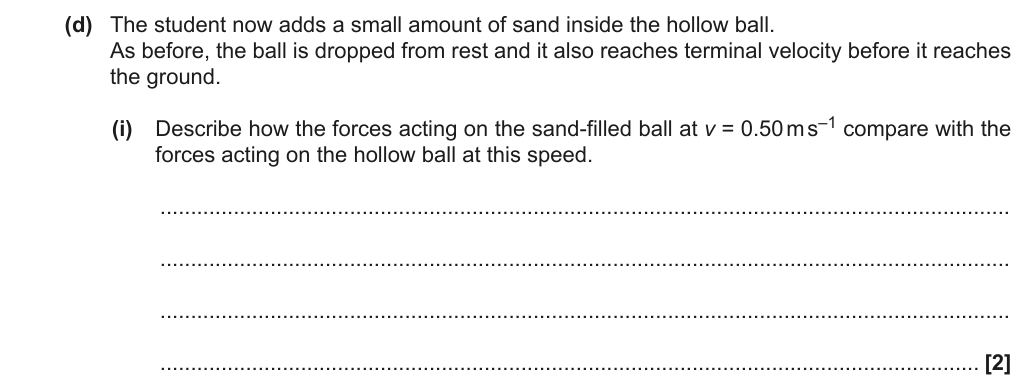
Lots of candidates described the familiar ideas involving drag increasing with speed until the drag equals the weight’s magnitude. The question was constructed to be simpler than this and asks to compare the forces on the 2 balls at a given speed. The weight of the sand-filled ball is larger. The 2 balls are identical in shape so at the same speed will have the same drag force. Know what is coming! Reading through to the end of the whole question is sensible. The answer candidates gave for Question 17(d)(i) would have formed part of the answer for Question 17(d)(ii), so valuable time can be saved by planning your answers for each part.
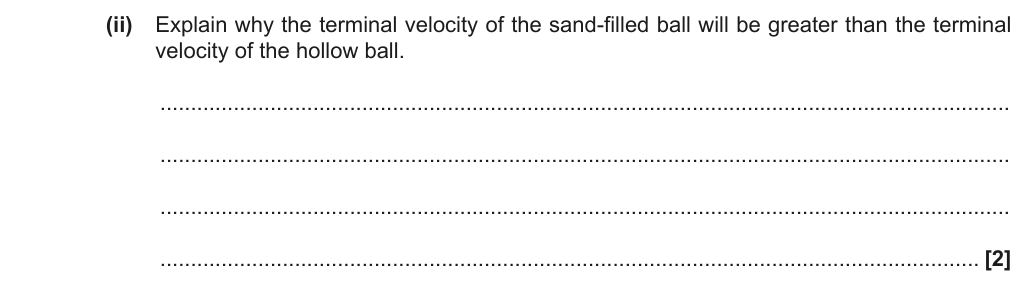
The first mark here was for the knowing that the condition for terminal velocity was required, linked to the idea of the sand-filled ball having a larger weight. The second mark was more difficult to achieve, since a clear link between increased speed and increase drag was required.
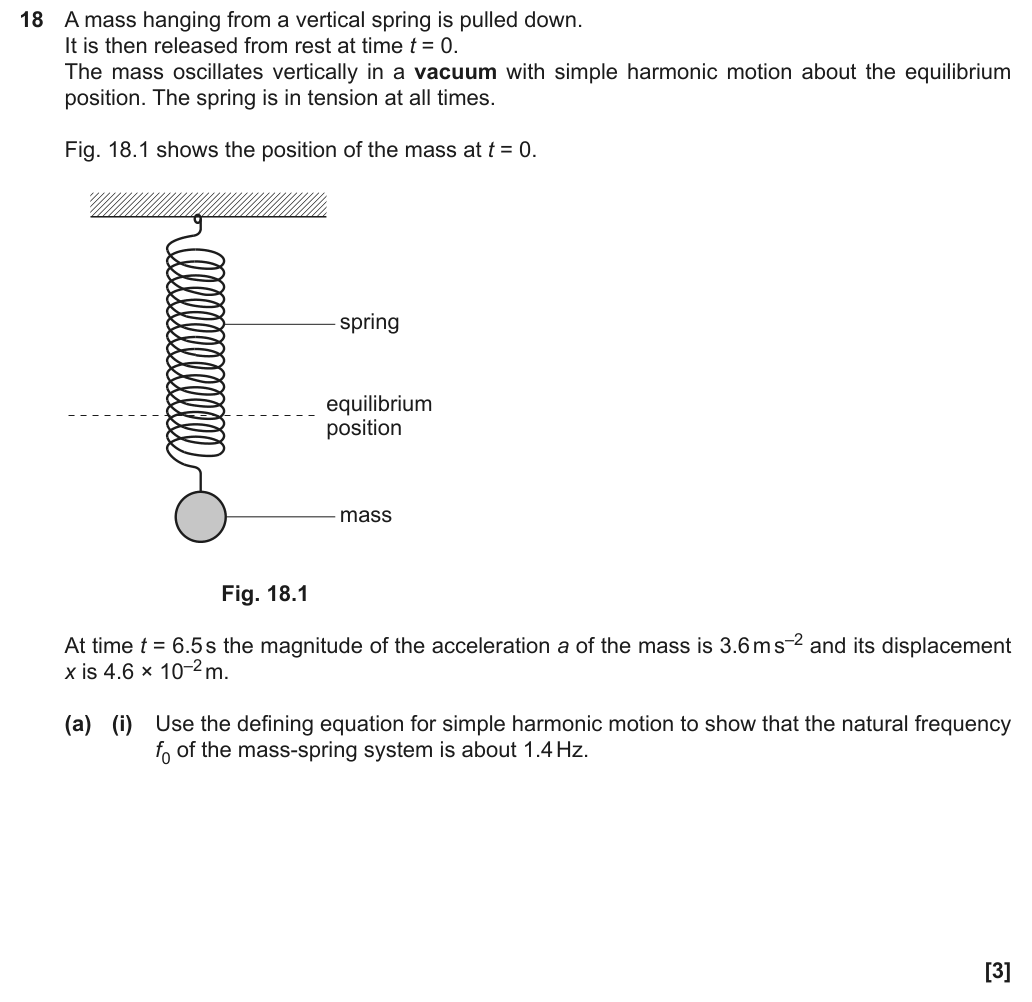
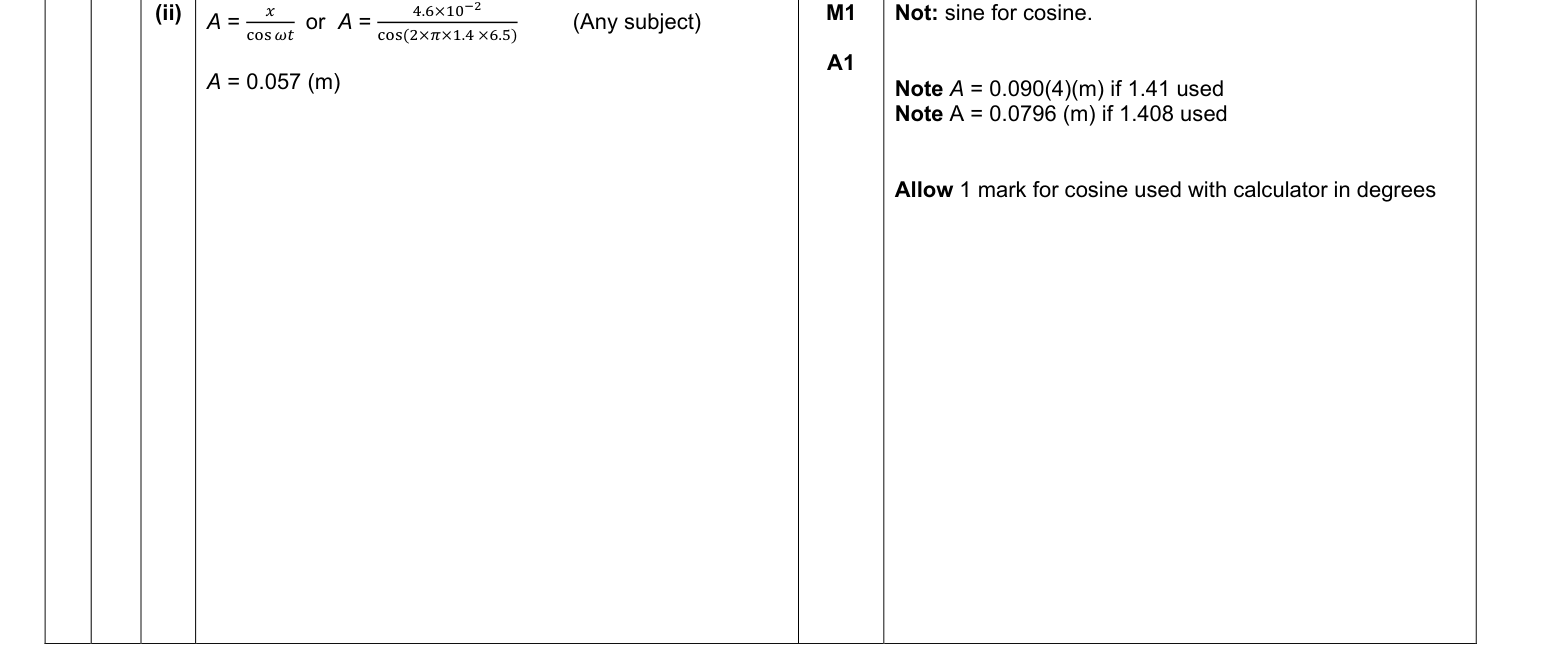
Question 18 (a) (ii) As the mass is pulled down before release, the mass is away from the equilibrium position. The natural frequency of this system is 1.4 Hz, as stated in Question 18(a).
Skills: M2.2 Change the subject of an equation, including non-linear equations; M2.3 Substitute numerical values into algebraic equations using appropriate units for physical quantities
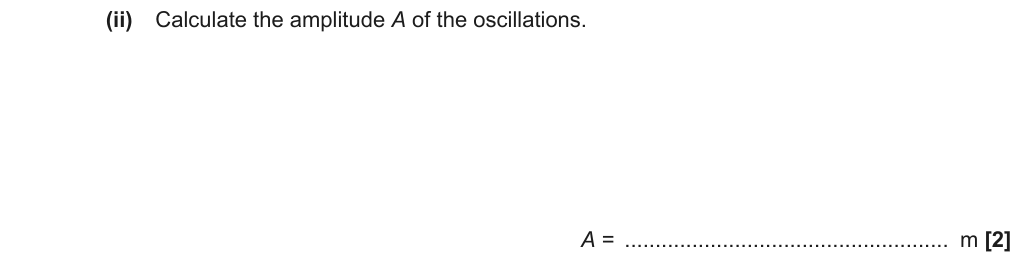
As the mass is pulled down before release, the mass is away from the equilibrium position. This means that the sine relationship between displacement and time cannot be correct. Many candidates got this idea correct. The relationship x = A cos(ωt) requires that the value of ωt is expressed in radians. This meant that to calculate the amplitude correctly, the calculator has to be in radians mode, rather than degrees mode.
Skills: M2.2 Change the subject of an equation, including non-linear equations; M2.3 Substitute numerical values into algebraic equations using appropriate units for physical quantities; M4.7 Understand the relationship between degrees and radians and translate from one to the other
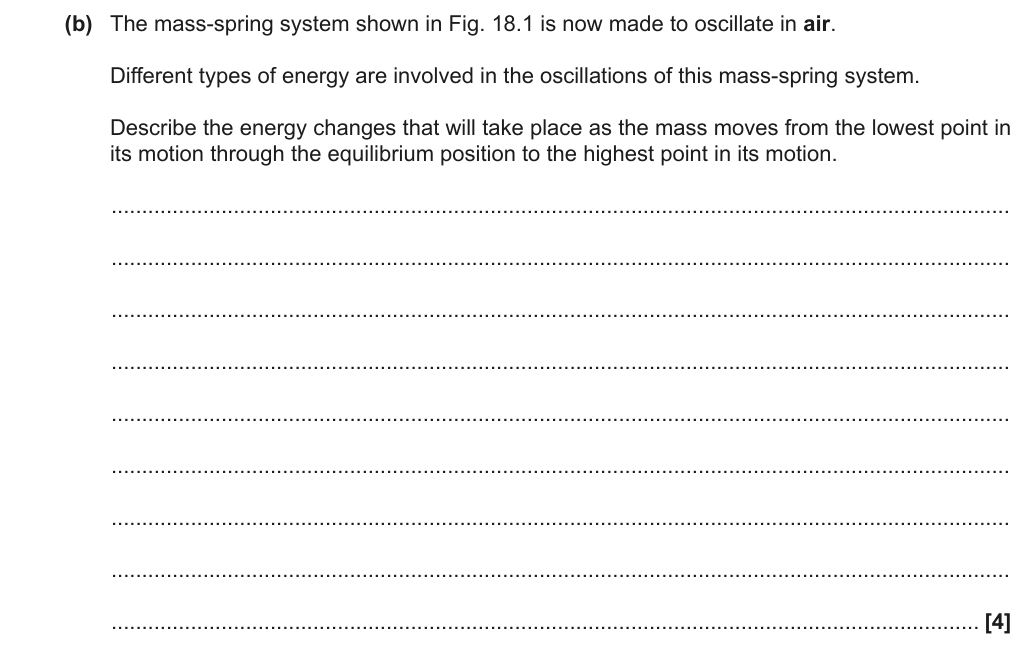
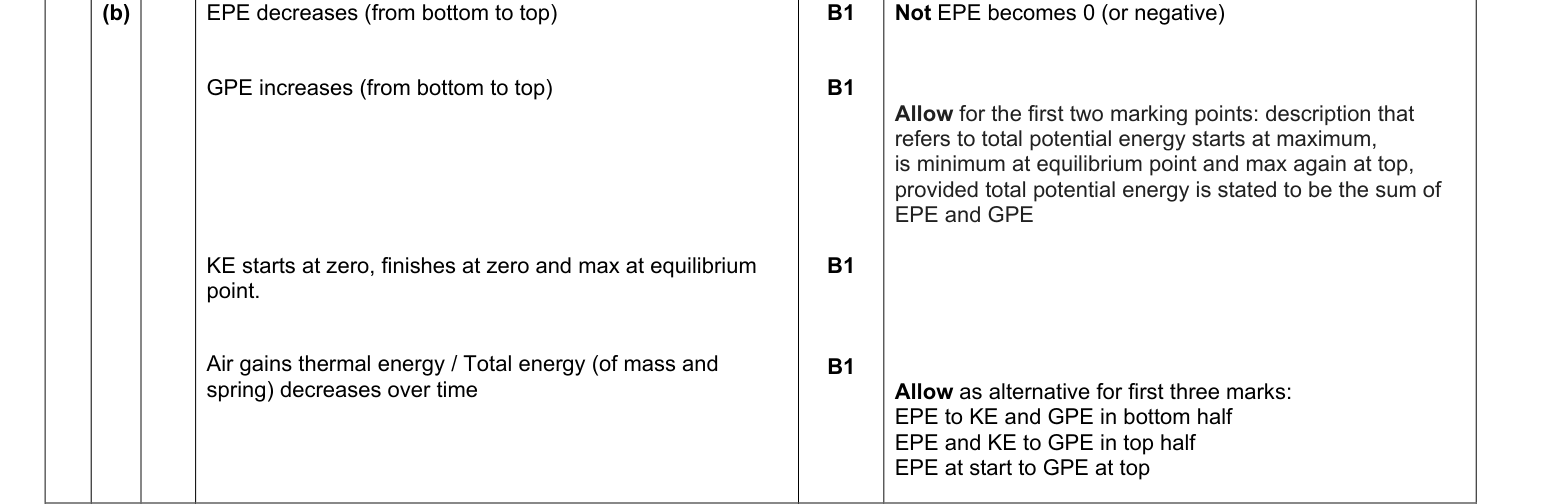
The best way to answer this question is to plan out what happens to each of the relevant energy types. In this case the relevant energy types are elastic potential, gravitational potential and kinetic energy. Candidates often carefully recalled the details of energy changes for a horizontal mass-spring system, which was incorrect. Earlier in the question, the candidates were told that the spring is always under tension. This means that the elastic potential energy cannot be zero or indeed negative. At the bottom and the top of the motion, the kinetic energy of the system is zero, as the objects have zero velocity. At the equilibrium position, the kinetic energy of the system is maximum. Responses that included merely ‘potential energy’ were too vague, unless it was clear that the potential energy of this system is the sum of both the gravitational and elastic potential energies. The first 2 statements in this response are true yet not enough. The third statement is untrue, as it implies that GPE is decreasing (and so contradicts the second statement) and also states that the elastic potential energy is increasing. Zero marks. This response is separated out into the 3 main energy types. The changes for each of the types is correct. The only thing they haven’t mentioned is that the total energy of the system will decrease because of the damping effect of the air. 3 marks. Question 18 (c) (i) and (c) (ii) The correct shape for Question 18(c)(i) is a standard resonance curve. The natural frequency of this system is 1.4 Hz, as stated in Question 18(a). This means that the peak of the curve should come at 1.4 Hz. The curve for Question 18(c) needed to be of lower amplitude throughout the frequency range (not including at 0 Hz). Some candidates put the peak of curve D at the same frequency as curve K and others put the peak of curve D slightly to the left. Both were given the mark.
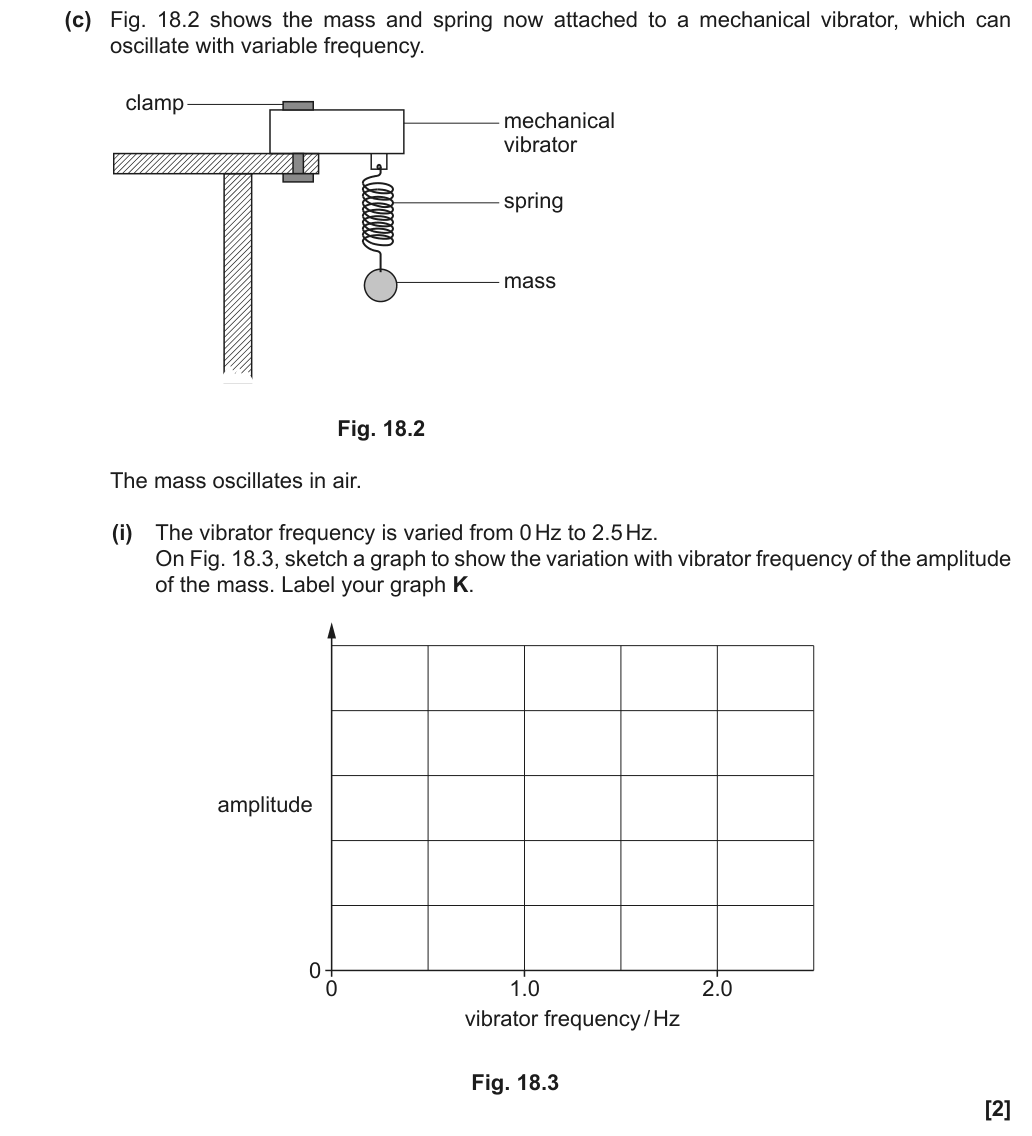
Question 18 (c) (i) and (c) (ii) The correct shape for Question 18(c)(i) is a standard resonance curve.
Skills: M3.12 Sketch relationships which are modelled by y = k/x, y = kx², y = k/x², y = kx, y = sin x, y = cos x, y = e^(±x) and y = sin²x, y = cos²x as applied to physical relationships

Question 18 (c) (i) and (c) (ii) The correct shape for Question 18(c)(i) is a standard resonance curve. Question 18 (c) (iii) Many candidates linked the possibility of a driving force, such as footsteps or the wind, giving a driver frequency at or near the natural frequency of a bridge and that this phenomenon is known as resonance.
Skills: M3.12 Sketch relationships which are modelled by y = k/x, y = kx², y = k/x², y = kx, y = sin x, y = cos x, y = e^(±x) and y = sin²x, y = cos²x as applied to physical relationships
Many candidates linked the possibility of a driving force, such as footsteps or the wind, giving a driver frequency at or near the natural frequency of a bridge and that this phenomenon is known as resonance. The second mark was for a link of the resonance idea of maximum amplitude to a consequence, such as a bridge shaking itself apart or being too unstable for use.
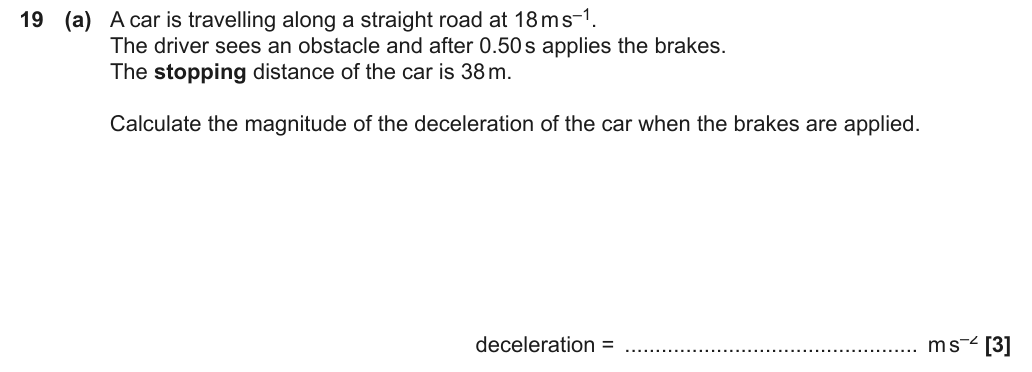
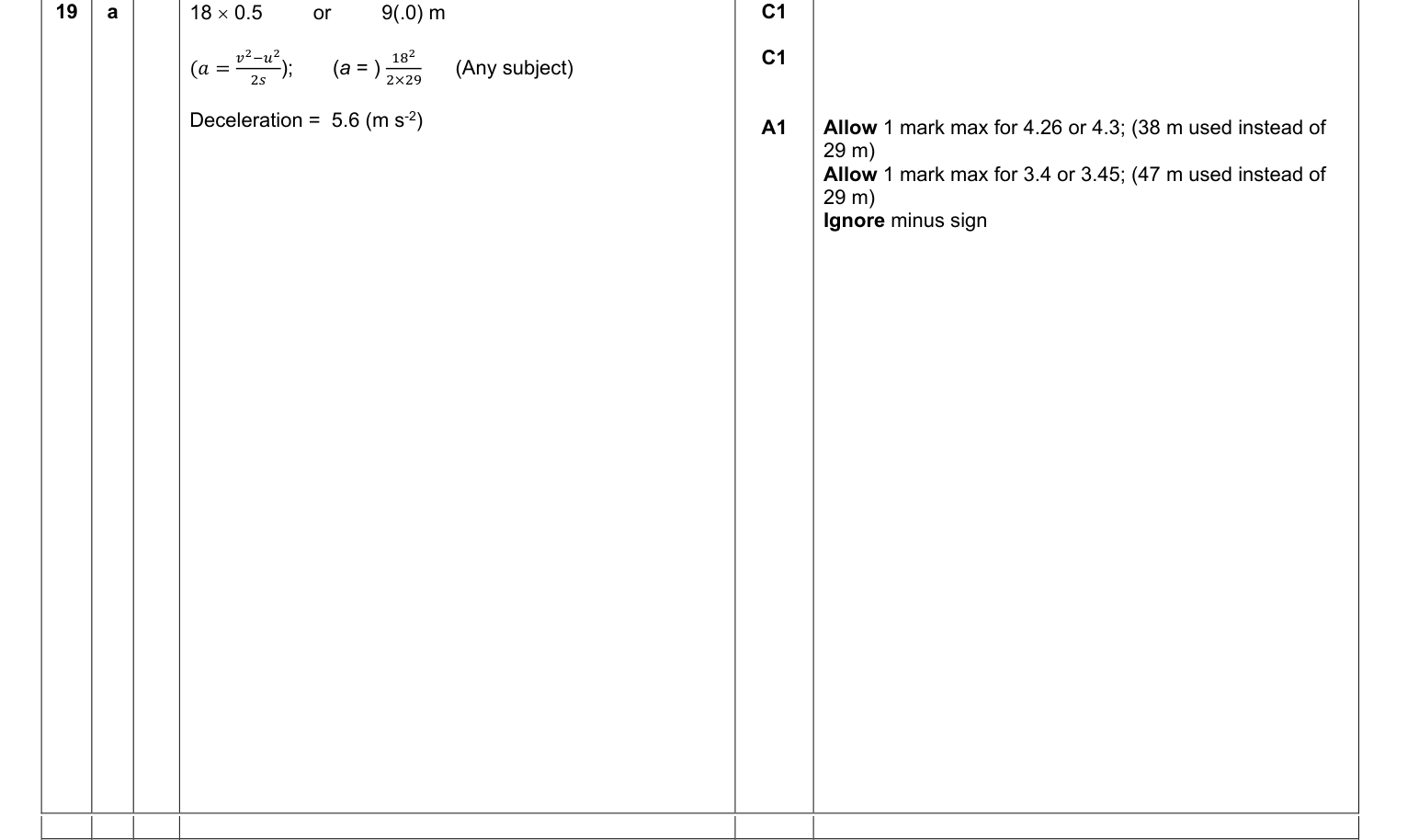
Many candidates use the stopping distance for the braking distance of the car, giving a deceleration that was too low and scoring 1 mark only. More successful candidates remembered to calculate the thinking distance involved (9 m) and subtract this from the stopping distance to give a braking distance of 29 m. Algebraic rearrangement, substitution and evaluation from then on was excellent.
Skills: M2.2 Change the subject of an equation, including non-linear equations; M2.3 Substitute numerical values into algebraic equations using appropriate units for physical quantities
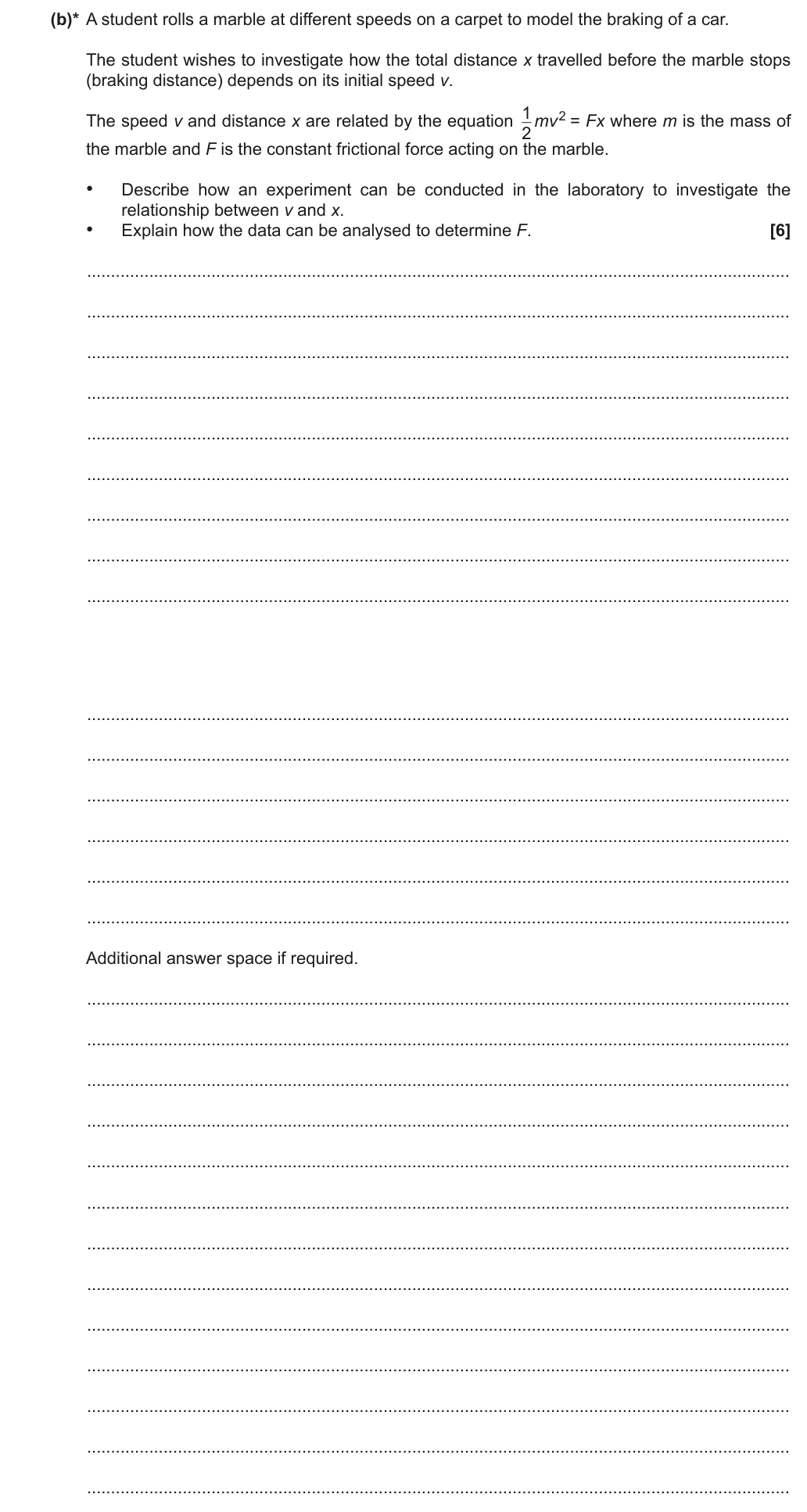
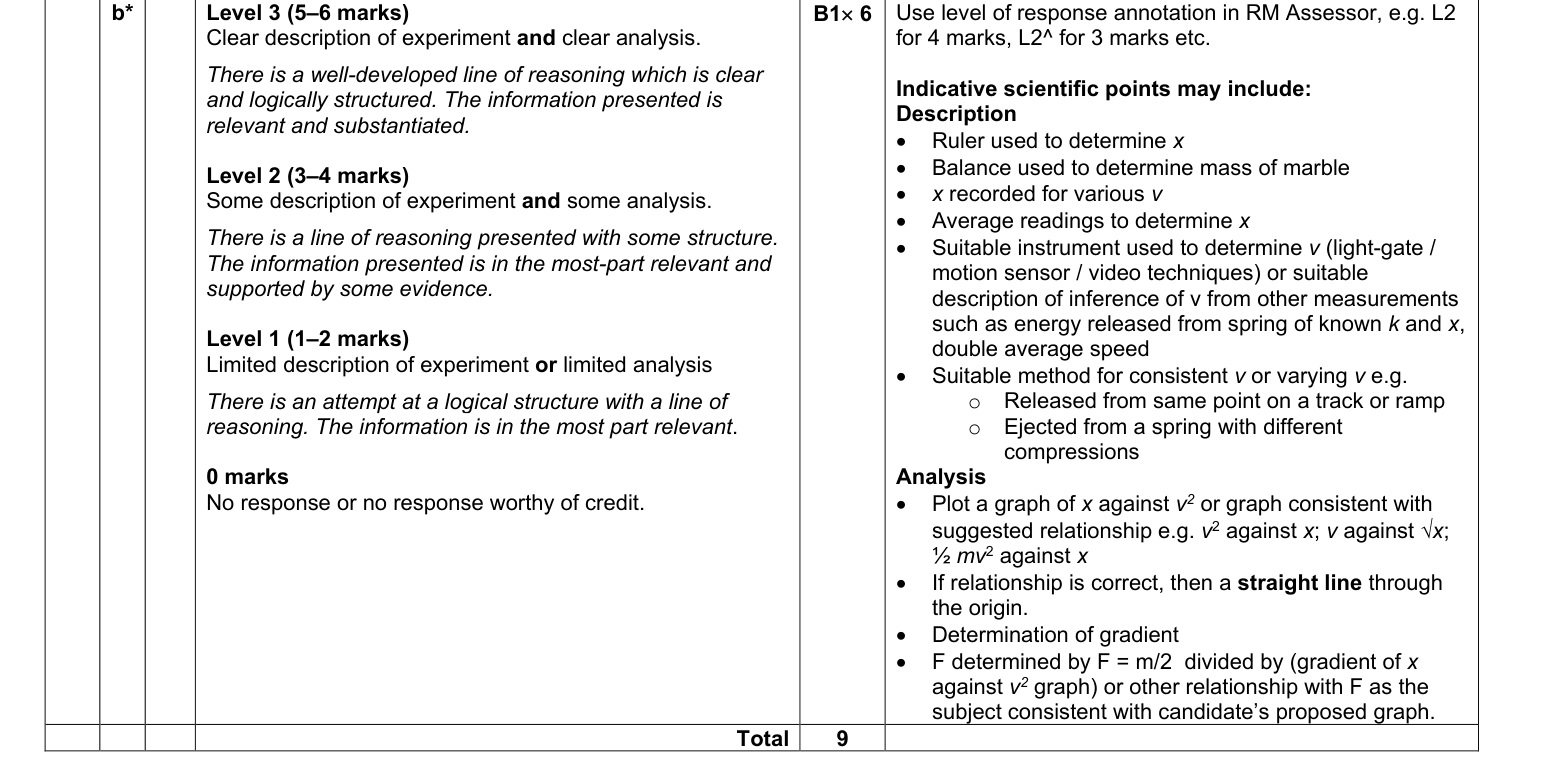
Most candidates made excellent attempts at describing this investigation. The analysis section was particularly well completed compared with previous sessions. Many of these investigations would have been successful had they been given as instructions to year 12 students as shown by Exemplar 6. The higher ability candidates distinguished themselves by being clear about how they were going to measure or calculate the speed of the marble and do that in a predictable way. This is shown best by exemplar 7. This response is a very good attempt. They have employed a light gate to measure the speed, without much explanation of how that device would calculate the speed itself. The analysis is sound, with a clear indication of what they would do with the data and how the relationship in the question matched up to a straight line of best fit. The candidate has made sure that they have explained how to calculate F from the gradient, rather than leaving it to the reader to work it out for themselves. This response scored Level 2. This response is similar in many ways to the previous exemplar. The difference is that the candidate has explained carefully how they will achieve different speeds and equally, how 2 light gates connected to a datalogger will measure the time of transit between the gates. The calculation of the speed v is easy to spot as the distance between the light gates divided by the time between them. Furthermore, there is reference to repeat readings for given v and an average distance for x. The analysis to find F is not quite as explicit as that in the previous exemplar, yet it is easily sufficient for a Level 3 response.
Skills: M3.3 Understand that y = mx + c represents a linear relationship; M3.4 Determine the slope and intercept of a linear graph; PAG1 Investigating motion
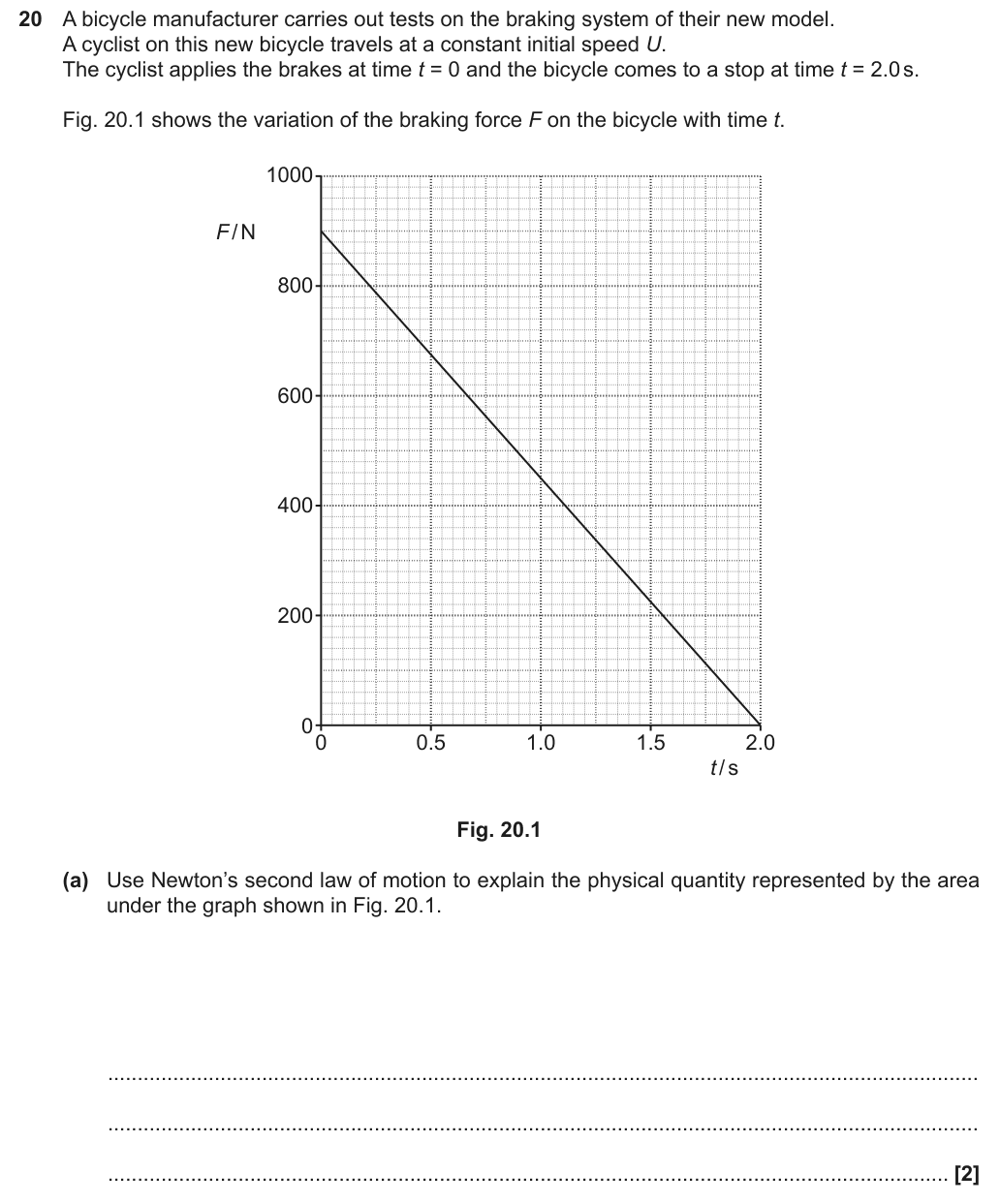
It was good to see that most candidates understood that Newton’s second law of motion is more than the statement that F=ma. Many had successful attempts with some candidates missing that it is the rate of change of momentum, rather than the change of momentum that is required. About two-thirds of candidates also correctly indicated that the area under the graph represents the impulse or the change in momentum. In Question 20(b), some candidates assumed, incorrectly, that the maximum force multiplied by the time taken would give the change in momentum and so scored zero marks. Rather more simply divided the maximum force by the mass, which gave the right answer yet with incorrect physics. This approach also scored zero. In fact, more successful responses made it clear that the area of the triangle on the graph was the impulse and that that area gave a change in momentum of 900 Ns.
Skills: M3.8 Understand the possible physical significance of the area between a curve and the x axis and be able to calculate it or estimate it by graphical methods as appropriate
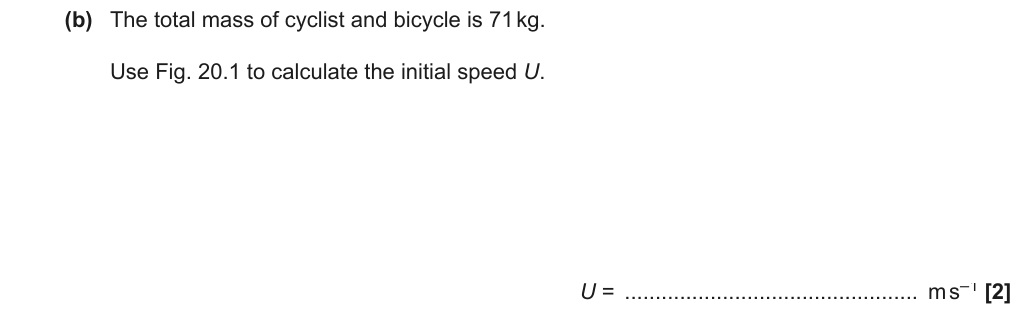
It was good to see that most candidates understood that Newton’s second law of motion is more than the statement that F=ma. Many had successful attempts with some candidates missing that it is the rate of change of momentum, rather than the change of momentum that is required. About two-thirds of candidates also correctly indicated that the area under the graph represents the impulse or the change in momentum. In Question 20(b), some candidates assumed, incorrectly, that the maximum force multiplied by the time taken would give the change in momentum and so scored zero marks. Rather more simply divided the maximum force by the mass, which gave the right answer yet with incorrect physics. This approach also scored zero. In fact, more successful responses made it clear that the area of the triangle on the graph was the impulse and that that area gave a change in momentum of 900 Ns.
Skills: M2.3 Substitute numerical values into algebraic equations using appropriate units for physical quantities; M3.8 Understand the possible physical significance of the area between a curve and the x axis and be able to calculate it or estimate it by graphical methods as appropriate; M4.3 Calculate areas of triangles, circumferences and areas of circles, surface areas and volumes of rectangular blocks, cylinders and spheres
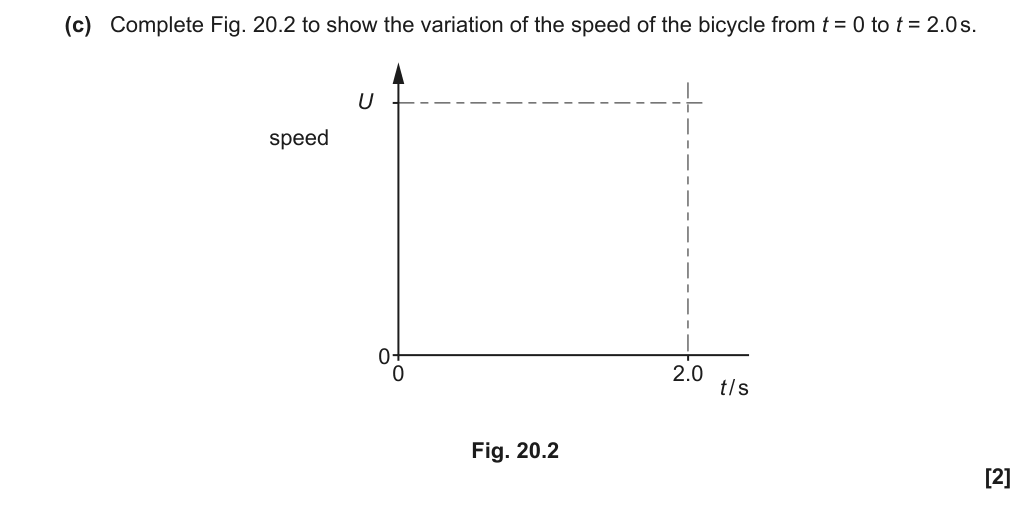
Successful candidates spotted that the resultant force, the acceleration and hence the gradient of this speed- time graph decreased in magnitude with time. A constant gradient, ie a straight line between (0,U) and (2.0,0), can only be achieved by a constant decelerating resultant force. This gives a curve that starts off (0,U) with a steep negative gradient and finishes with a small negative gradient at (2.0,0).
Skills: M3.1 Translate information between graphical, numerical and algebraic forms; M3.12 Sketch relationships which are modelled by y = k/x, y = kx², y = k/x², y = kx, y = sin x, y = cos x, y = e^(±x) and y = sin²x, y = cos²x as applied to physical relationships
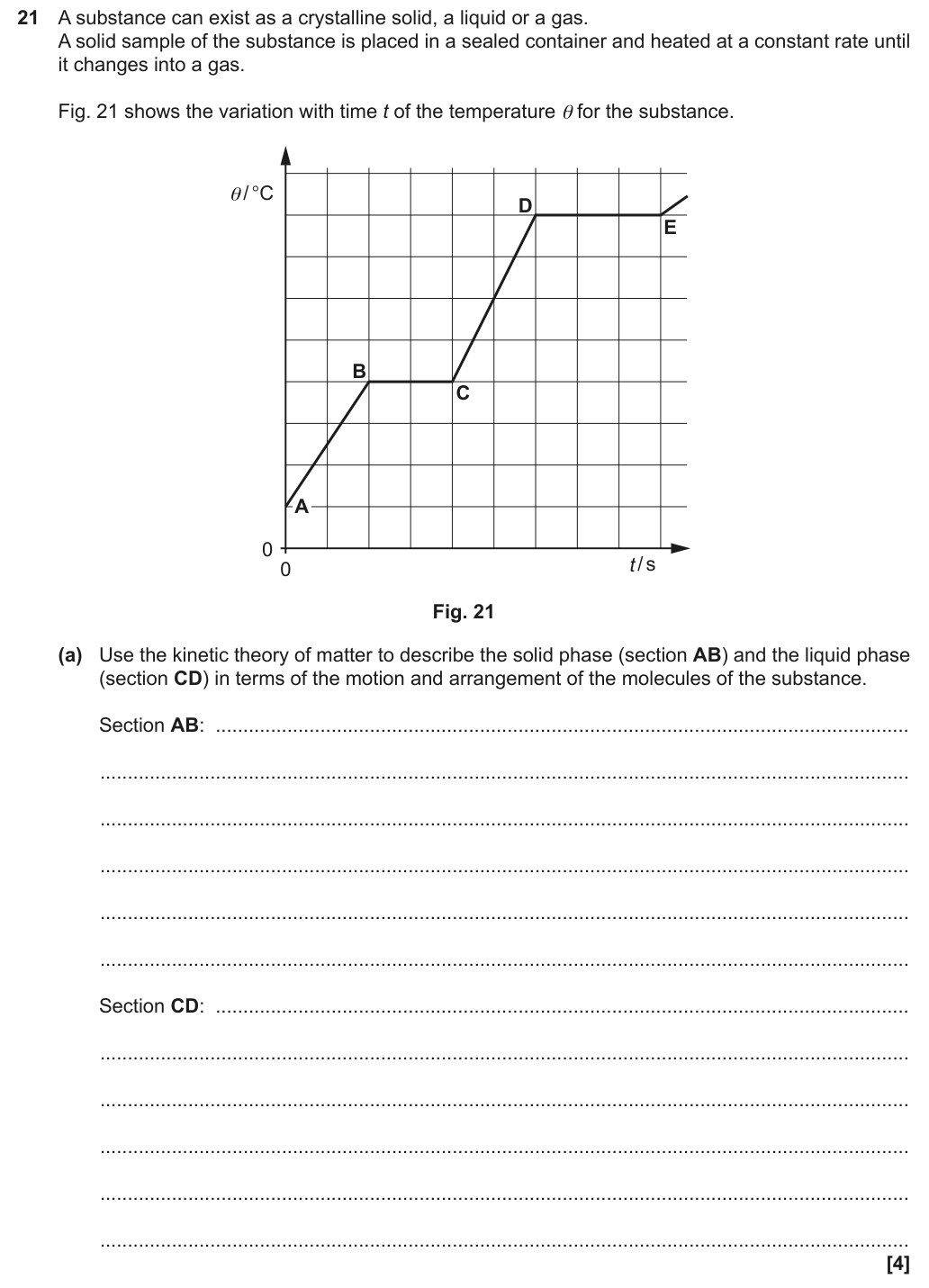
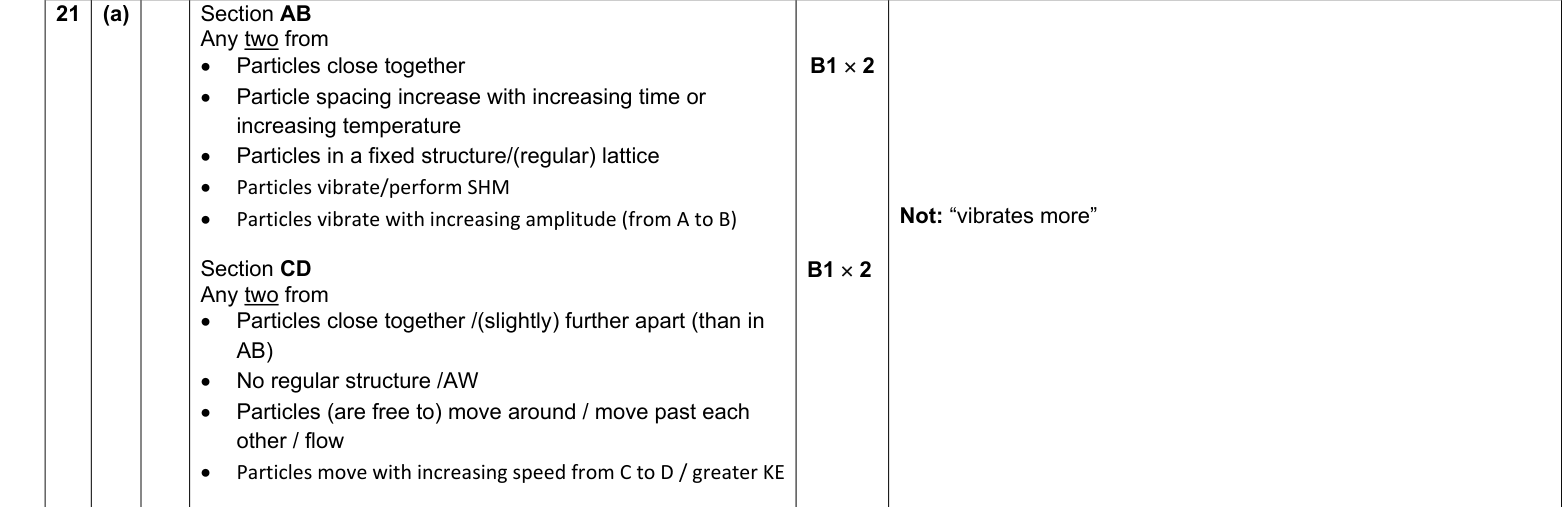
Many candidates realised that the gradients of the lines AB and CD were related to the specific heat capacities of the solid and liquid states. Higher level responses included the formula relating energy change, mass, specific heat capacity and the temperature change, and how that formula related to the gradient of the line on a temperature-time graph. Once that link was established, the lower gradient indicates a larger specific heat capacity.
Skills: M3.1 Translate information between graphical, numerical and algebraic forms; M3.4 Determine the slope and intercept of a linear graph
This is a simple definition that many candidates recalled well. Lower level responses missed out that this is to do with the kinetic energy and potential energy of particles.
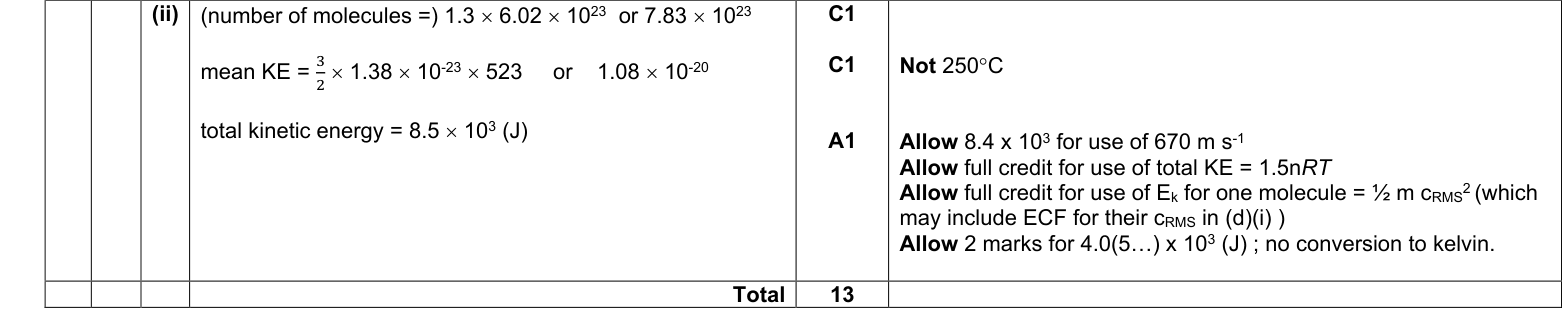
The key to this question is equating 2 formulae. The first is the familiar ½ m v2 for kinetic energy. In this case, the squared speed will be the mean squared speed of the particles. The second is the connection between average kinetic energy of a particle at absolute temperature, T, Ek = 3/2 k T. If candidates did that, then they not only scored the first mark but also could go on to complete the question. A common error was to forget to find the square root, as the question asks for the root mean square speed.
Skills: M0.5 Use calculators to find and use power, exponential and logarithmic functions; M2.2 Change the subject of an equation, including non-linear equations; M2.3 Substitute numerical values into algebraic equations using appropriate units for physical quantities
There were 2 ways to answer this question. The first was to find the kinetic of one particle using the mean square speed and the second was to find the kinetic energy of one particle using the absolute temperature. Lower level responses stopped at that point, or there was misunderstanding how to scale that value up to the whole gas. For either route, the value for one particle needed to be multiplied by the number of particles in the gas. This can be found by multiplying the number of moles by the Avagadro constant given in the data, formulae and relationship booklet.
Skills: M0.2 Recognise and use expressions in decimal and standard form; M2.3 Substitute numerical values into algebraic equations using appropriate units for physical quantities
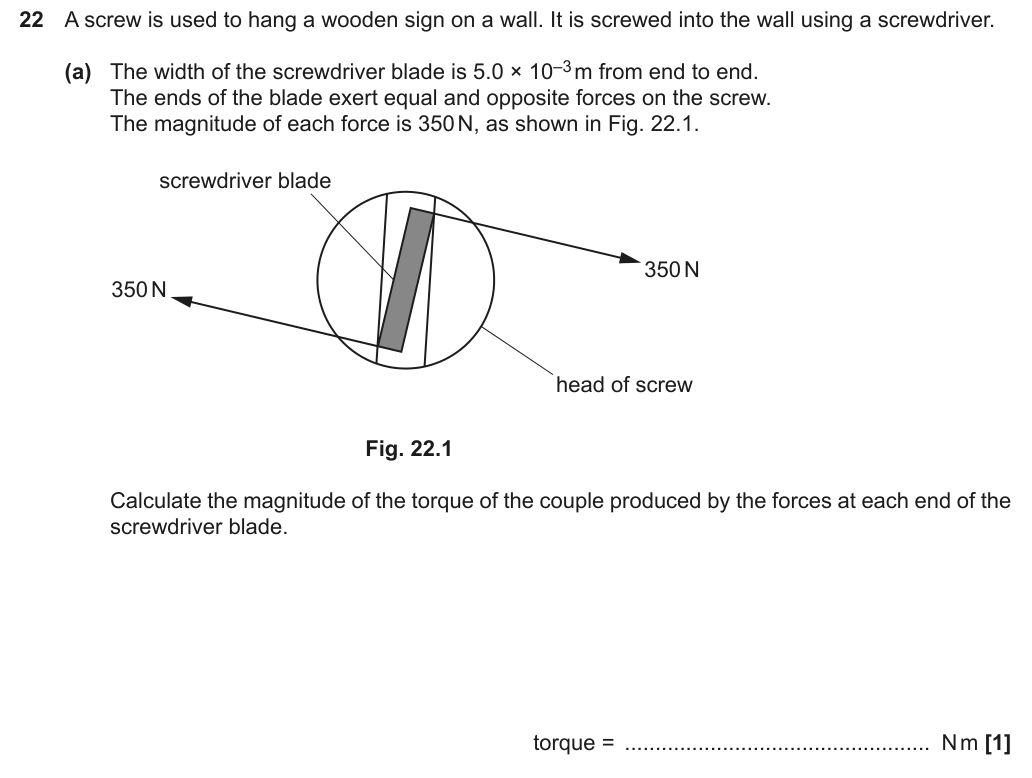
Skills: M2.3 Substitute numerical values into algebraic equations using appropriate units for physical quantities
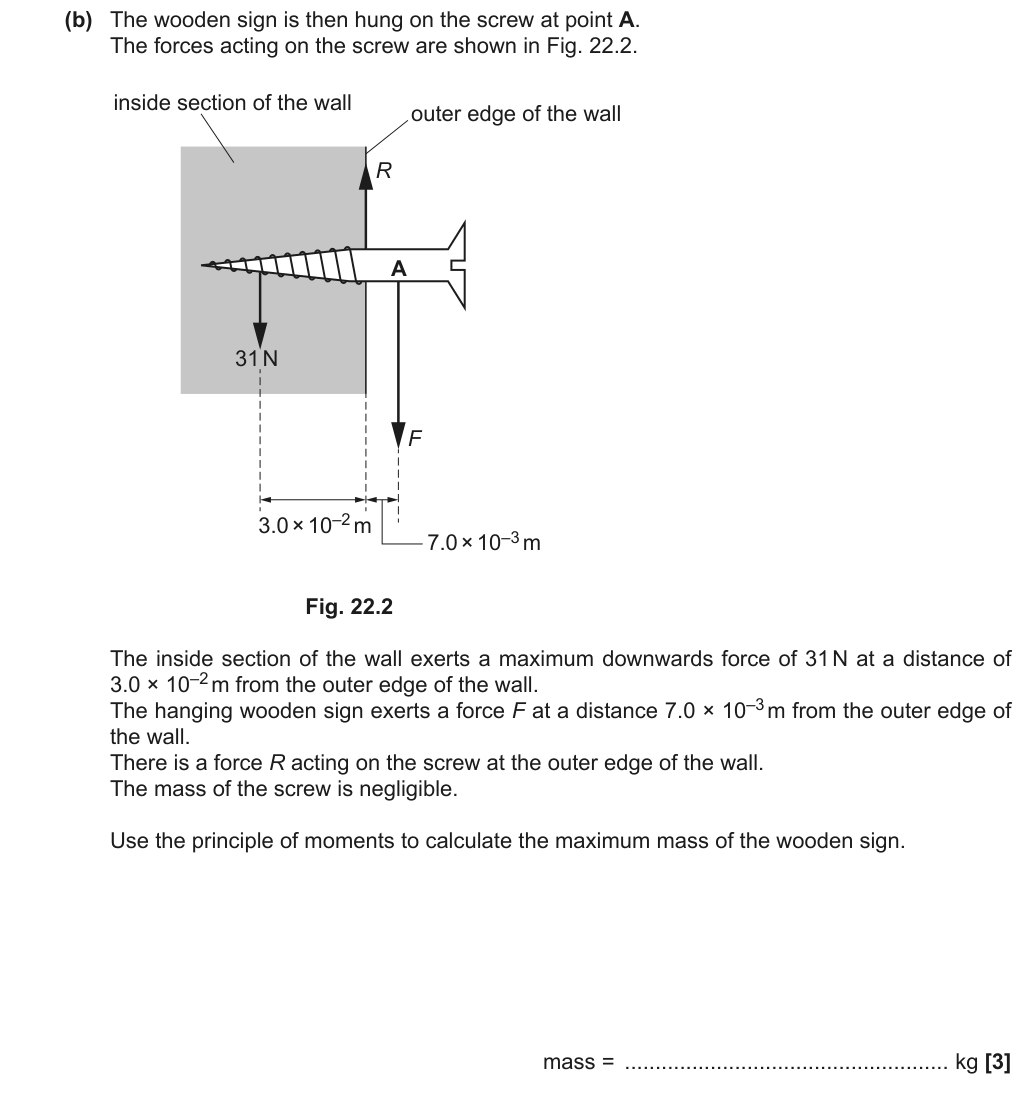
Skills: M2.3 Substitute numerical values into algebraic equations using appropriate units for physical quantities; M2.4 Solve algebraic equations, including quadratic equations
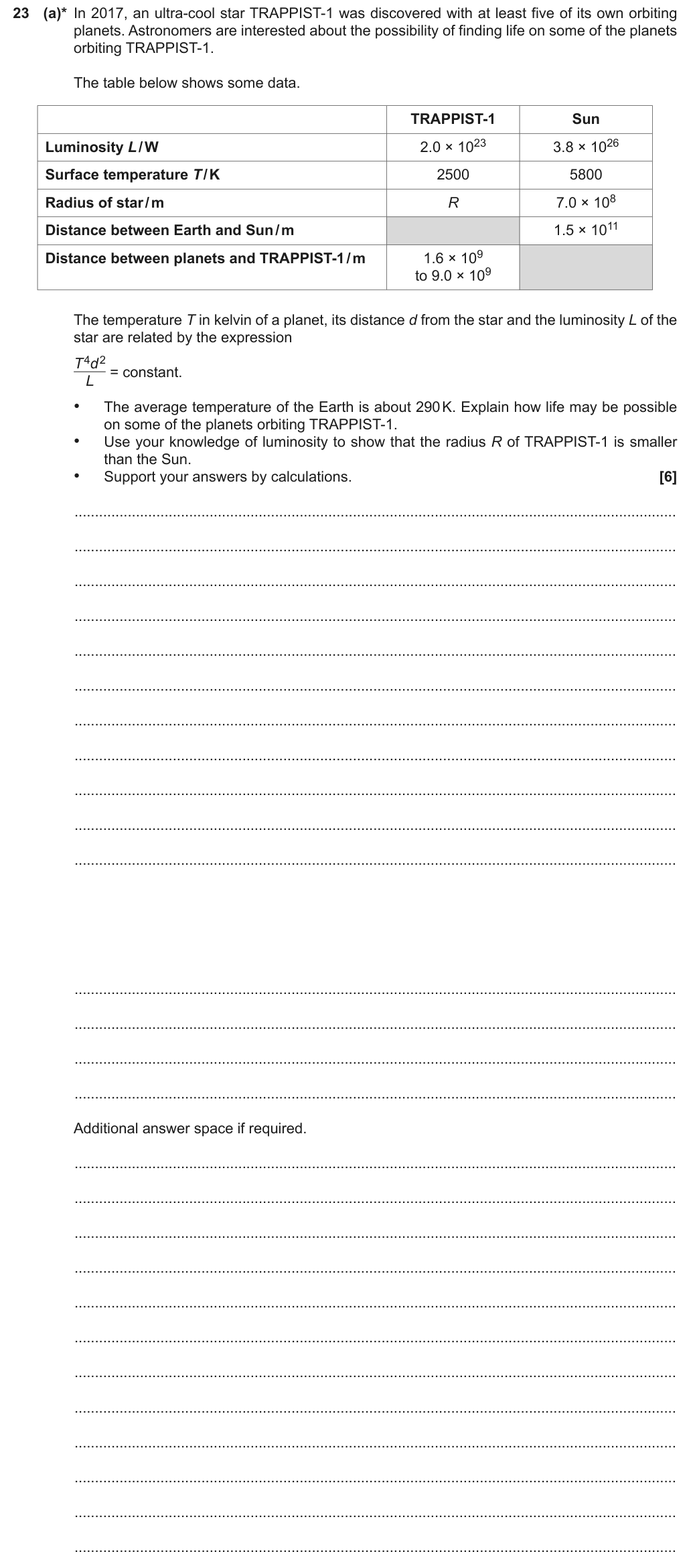
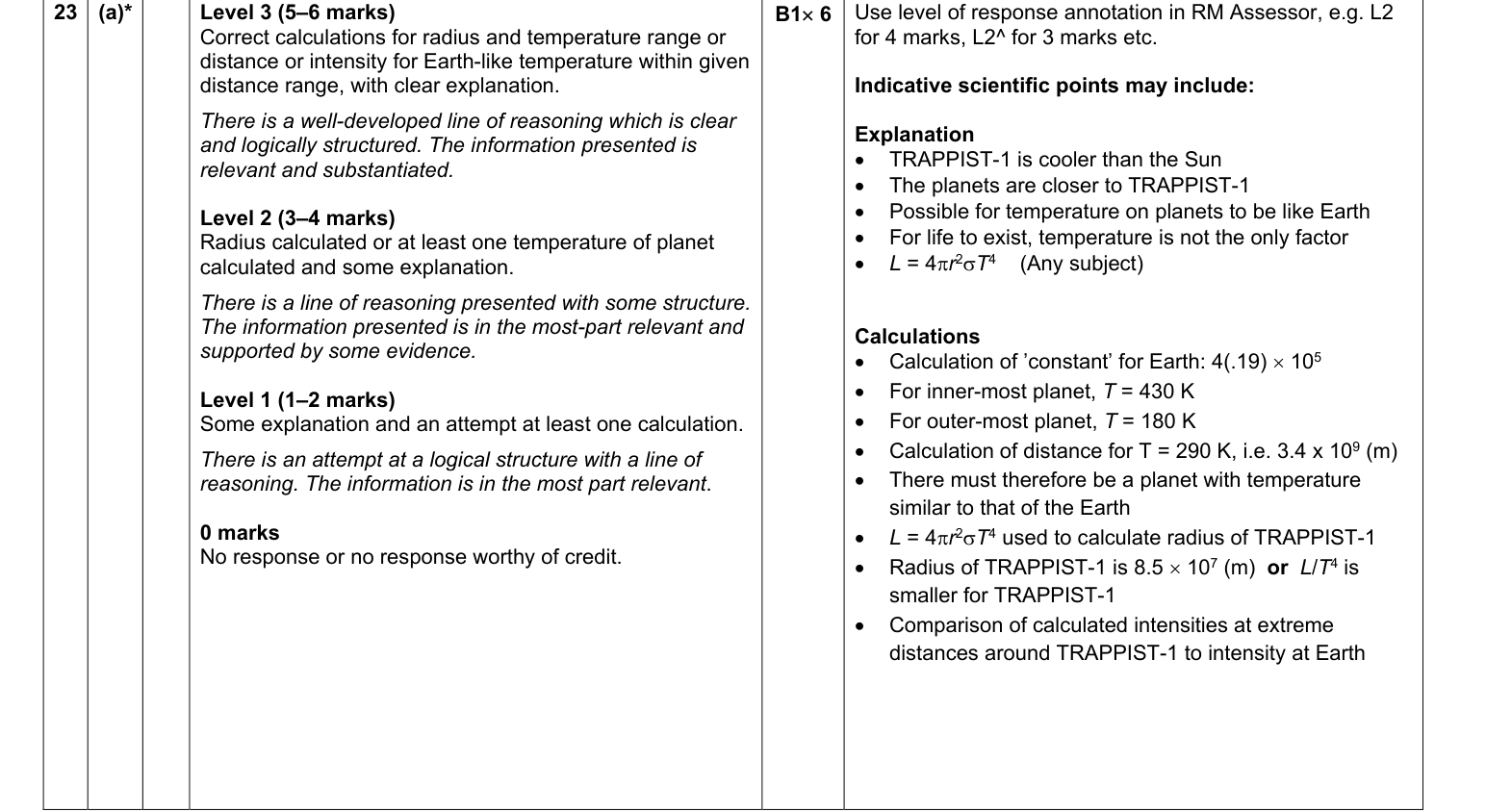
This level of response question was very well answered, largely due to the highly mathematical content. Higher level responses showed clarity of method as well as one of a range of ways of supporting the idea that life may be possible on the planets of TRAPPIST-1. Many candidates opted to show that that the temperature of the nearest planet was approximately 430 K while that at the furthest planet was approximately 180 K. The argument went that there must be a distance at which the temperature was approximately 290 K. Other methods found the distance from TRAPPIST-1 that would give a surface temperature of 290 K and showed that lay within the range of distances given in the table.
Skills: M0.2 Recognise and use expressions in decimal and standard form; M0.3 Use ratios, fractions and percentages; M0.5 Use calculators to find and use power, exponential and logarithmic functions; M2.2 Change the subject of an equation, including non-linear equations
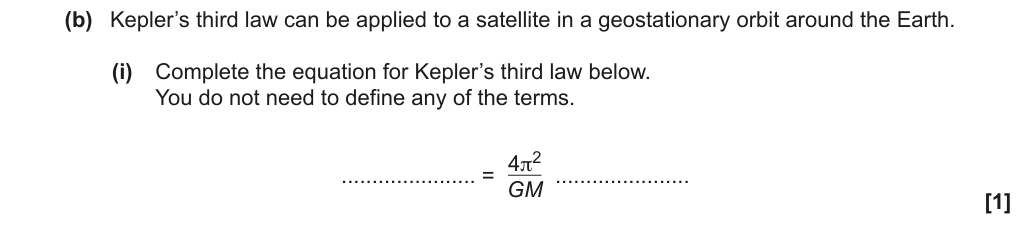
Question 23 (b) (ii) The radius of the orbit of a geostationary satellite was found with ease by the majority of candidates by using the formula in the data book or by looking at their response for part 23(b)(i).
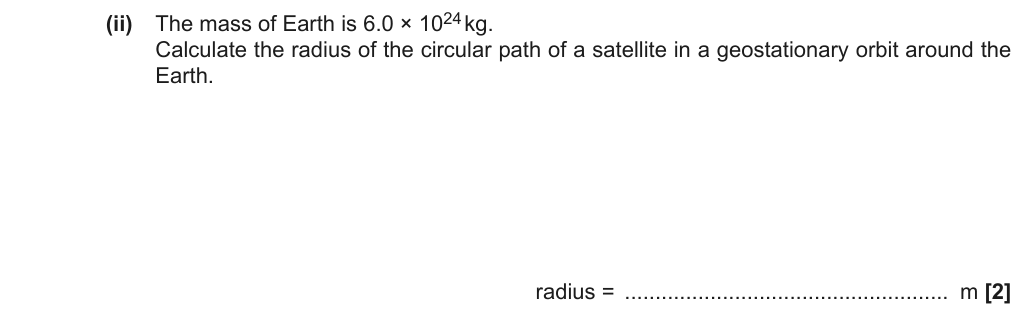
The radius of the orbit of a geostationary satellite was found with ease by the majority of candidates by using the formula in the data book or by looking at their response for part 23(b)(i). There were a few ways of generating an arithmetical error, such as using the square root instead of the cube root for the final step, getting the wrong power for the time or by using a time equal to one year instead of one day.
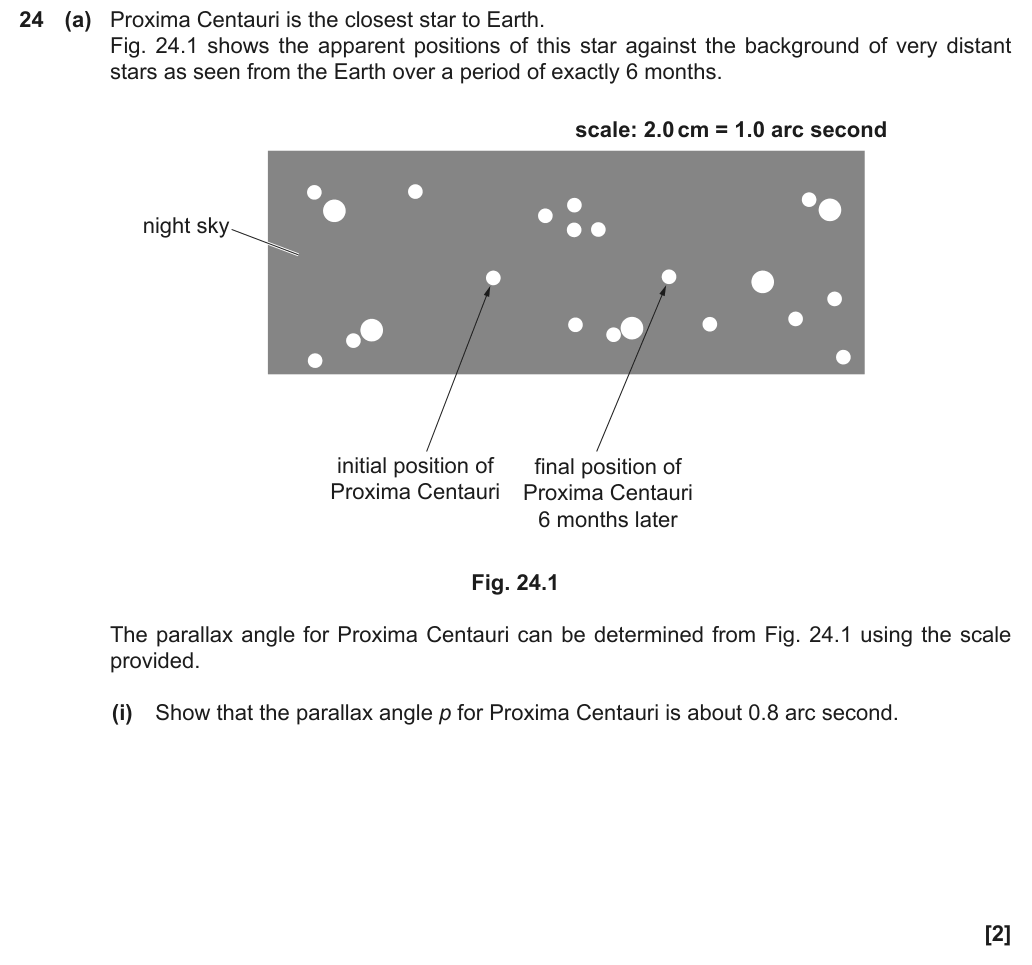
Almost all candidates scored a mark for measuring the distance between promixa centauri’s positions 6 months apart. The scale was well understood, giving an angle of approximately 1.5 arc seconds. The parallax angle is defined to be half of this value, giving a parallax angle in this case of 0.75 arc seconds. This final step was what prevented candidates receiving the second mark.
Skills: M0.3 Use ratios, fractions and percentages; M3.1 Translate information between graphical, numerical and algebraic forms
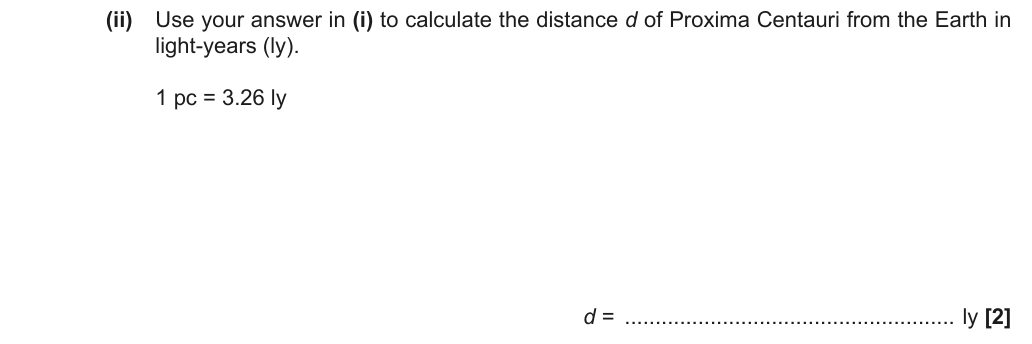
Most candidates used the data in the previous part of the question ie that the parallax angle was 0.8 arc seconds or trusted their own value which was close to 0.8 arc seconds. Nearly everyone that presented a distance in parsecs could then calculate the distance in light years.
Skills: M0.1 Recognise and make use of appropriate units in calculations; M2.3 Substitute numerical values into algebraic equations using appropriate units for physical quantities
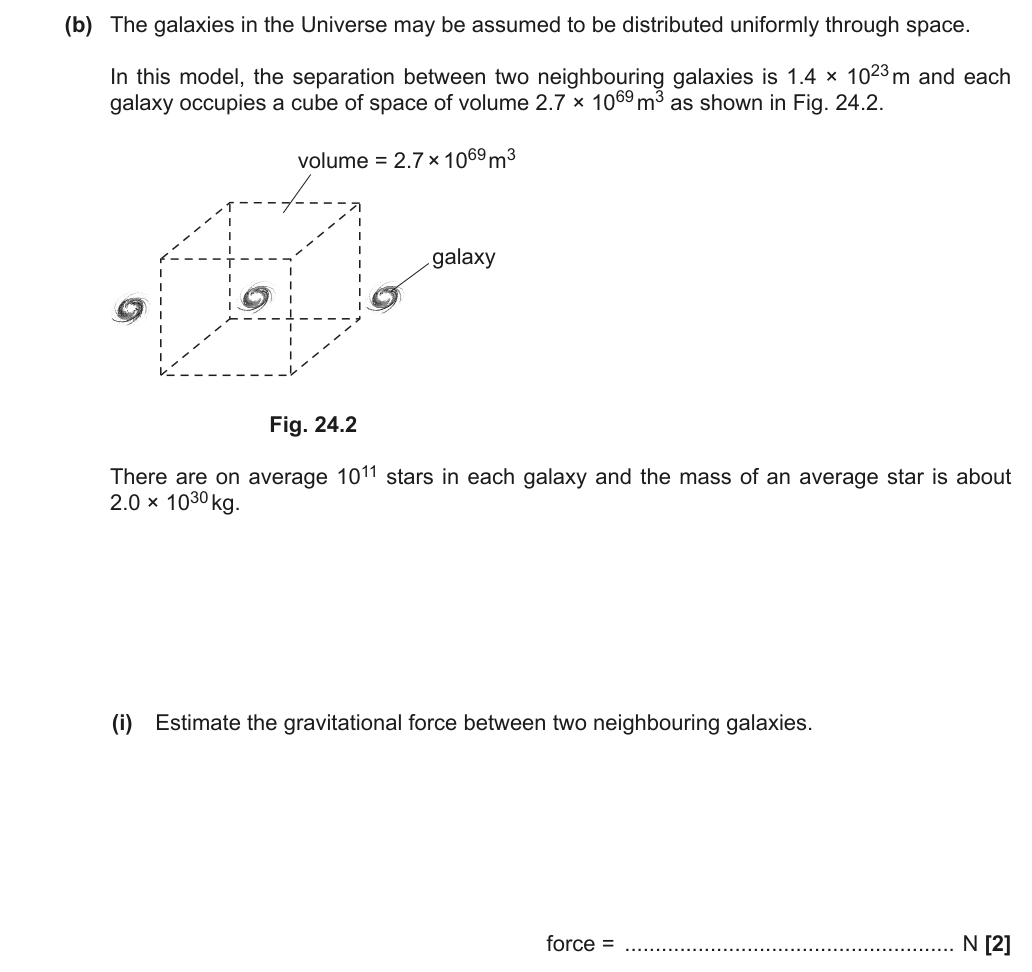
While some lower level responses included an attempt to find the gravitational field strength rather than the force most selected the correct formula. After selecting the correct relationship, most candidates could then correctly find the force, provided that they remembered to multiply the masses and square the distance of separation.
Skills: M0.2 Recognise and use expressions in decimal and standard form; M1.4 Make order of magnitude calculations; M2.3 Substitute numerical values into algebraic equations using appropriate units for physical quantities
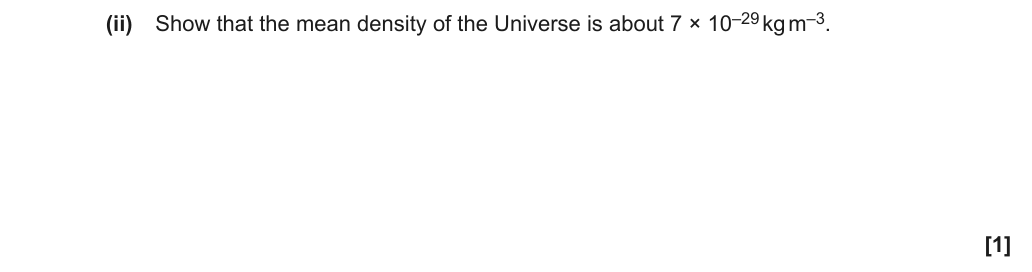
Question 24 (b) (i) While some lower level responses included an attempt to find the gravitational field strength rather than the force most selected the correct formula. Question 24 (b) (iii) This was a question about challenging the model of the universe.

This was a question about challenging the model of the universe. The model takes into account an average mass and average distance of separation, so answers that referred to a variation in masses or distances between galaxies did not score. Higher level responses included that the universe was expanding, so that the distances involved were always changing, or that dark matter was not included in the calculations. There was no indication that candidates were constrained by time in this paper.
Want a paper marked and gone through with you? Message us.