Examiner's comment
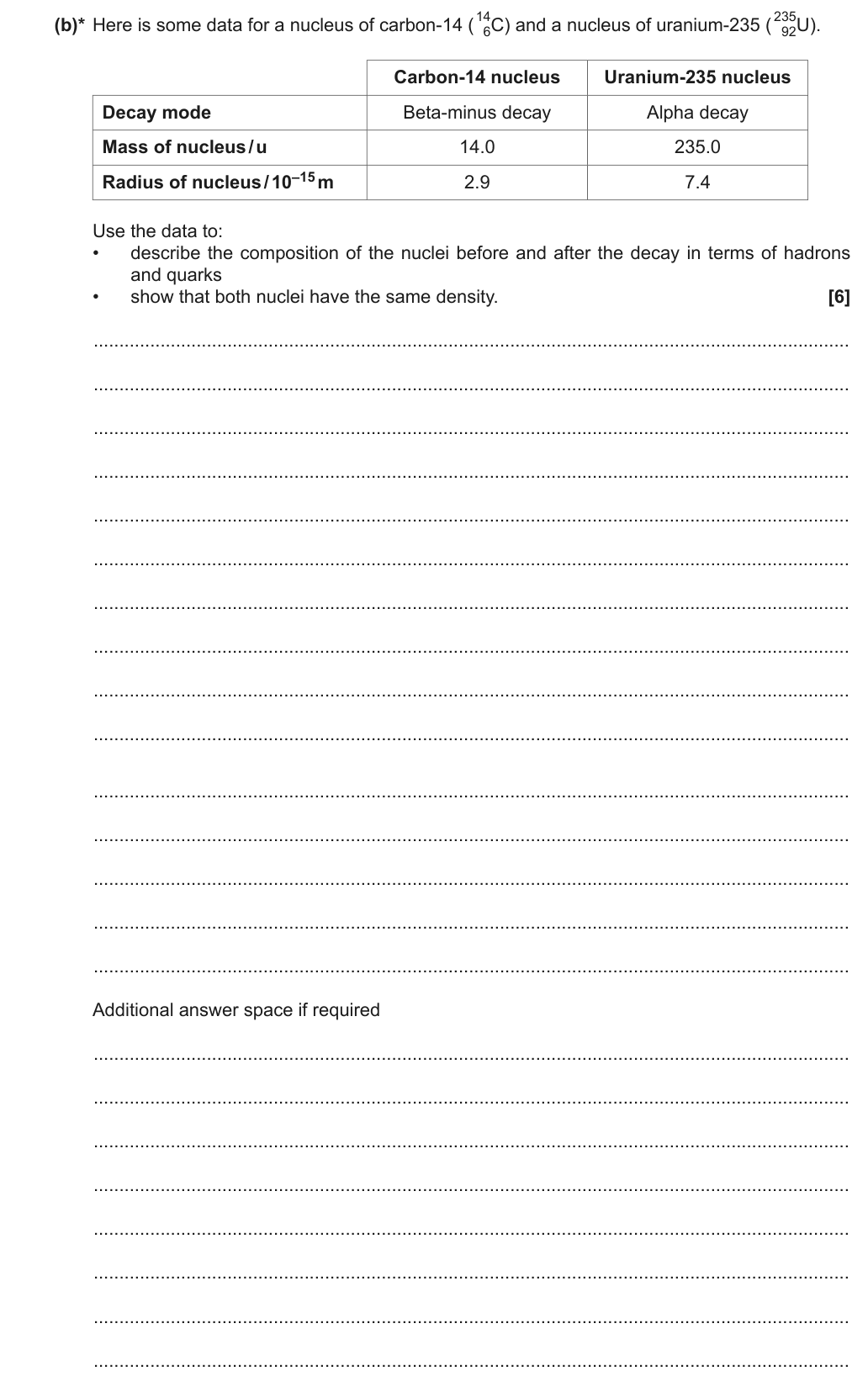
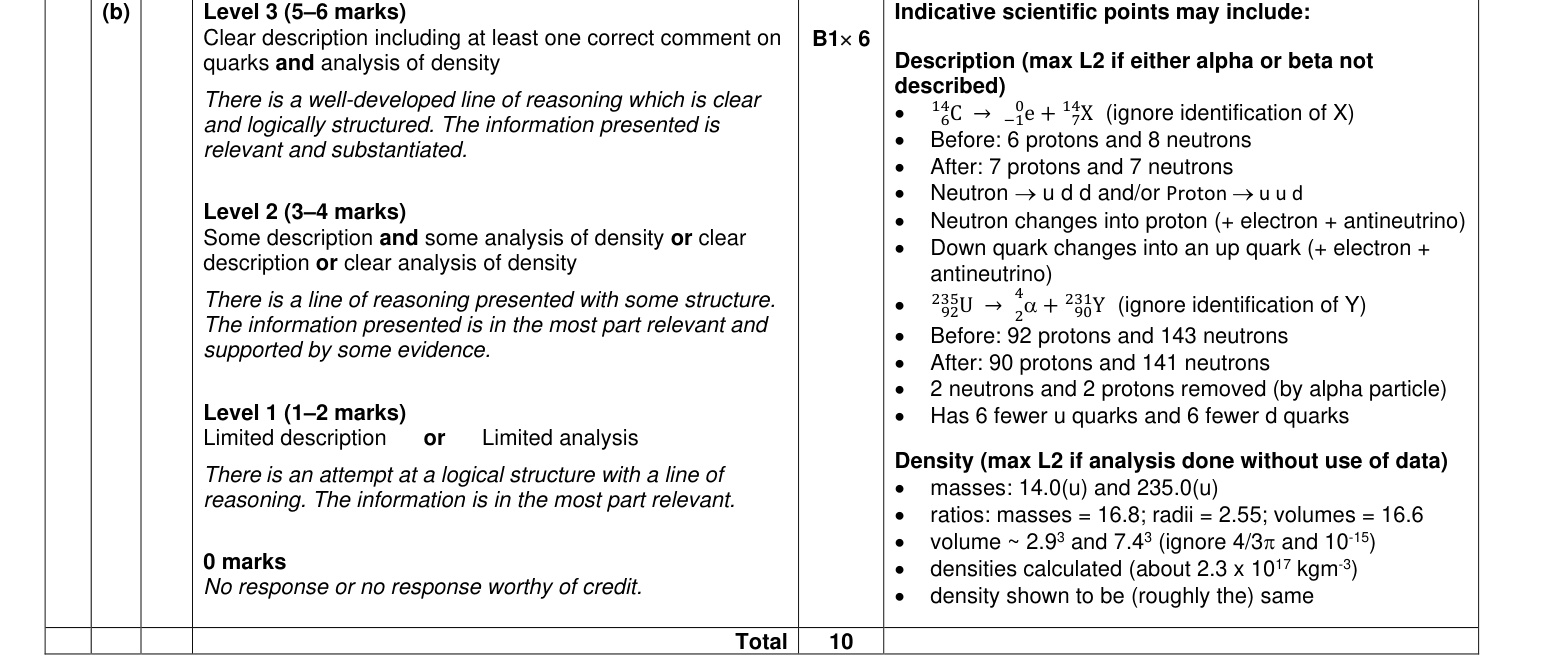
This is the second level of response (LoR) question in this paper, and was designed to assess nuclear and particle physics, specifically sections 6.4.1 and 6.4.2 of the specification. In particular, there are two parts (description and analysis) relating to two radioisotopes, and some given data. As previous, there are no specific marking points and examiners use a “best-fit” approach to the marking. Indicative scientific points are given in the mark scheme as a guidance what to expect, but not all need to be satisfied to be given full marks. Incorrect physics can be expected to be penalised however. Candidates should always be encouraged to structure their answers carefully and in calculations aim to give explanation of each stage rather than just producing a number. The two separate sections can be separated into a description of the decays, and an analysis of the data to show the two nuclear densities are the same. The key points in the description that examiners were looking for were: - numbers of protons before and after each decay – a description of the change in quark structure during beta decay – correctly balanced equations for alpha and beta-minus decay – the nature of the emissions in each decay. The key points in the analysis that examiners were looking for were: - calculation of volumes of nuclei, using (4/3) r3 – correct use of the density formula – numerical evaluation of the densities of the nuclei and a comparison. The descriptions of the decays varied hugely both in quality and quantity. Most candidates were aware that a beta particle is an electron, but several seemed to think it was an orbiting one which had no structural changes on the nucleus. Those who did know it was from a neutron to proton change often mixed up the nucleon numbers afterwards. Alpha decay was generally done better with most candidates knowing the nature of an alpha particle and correctly stating the structure of the remaining nucleus. Attempts were generally made to changes in quark structures (mostly for beta decay) and the structure of a neutron and proton were known, although strangely several candidates stated the change was from an up quark to a down quark. Candidates who did not give any descriptions of the quark structures were limited to Level 2. For the most part, the analysis was done better than the description and candidates were generally able to correctly evaluate the two densities and make a suitable comparison. Units of density were not penalised here, with many candidates using the mass (in u) in the calculation but giving the units of density as kg m-3, although many stating u m-3. However, many did correctly calculate the mass of the nucleus using the correct factor coming out with densities of approximately 2.3 1017 kg m-3. Those who took an approach to algebraically show that the density of every nucleus is independent of the nucleon number (using a standard method to get to some variation of 3u/4r3) alone were unable to reach Level 3 as they had not used the data. The use of r0 as 1.2 10-15 m was commonly seen. A candidate who provides some description and analysis which places it in Level 2, but the confusion over alpha decay and general lack of clarity means it would be at the lower point (3 marks).
Notes from the mark scheme and report
- max L2 if either alpha or beta decay not described
- max L2 if density analysis does not use the data
Skills: M0.3 Use ratios, fractions and percentages; M2.3 Substitute numerical values into algebraic equations using appropriate units for physical quantities; M4.3 Calculate areas of triangles, circumferences and areas of circles, surface areas and volumes of rectangular blocks, cylinders and spheres