Answer
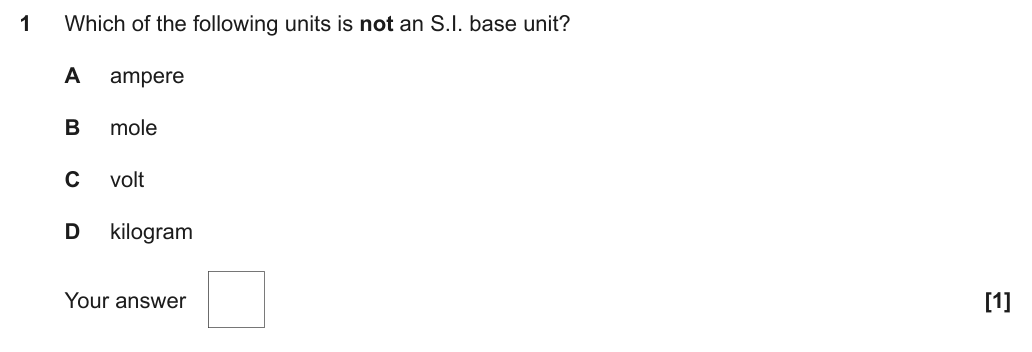
C
Mark scheme

Examiner's comment
About three quarters of all candidates recognised that the volt is not an S.I. base unit.
100 marks · 52 question parts · Paper, mark scheme and report on OCR's site · Have the Data, Formulae and Relationships Booklet beside you
C
About three quarters of all candidates recognised that the volt is not an S.I. base unit.
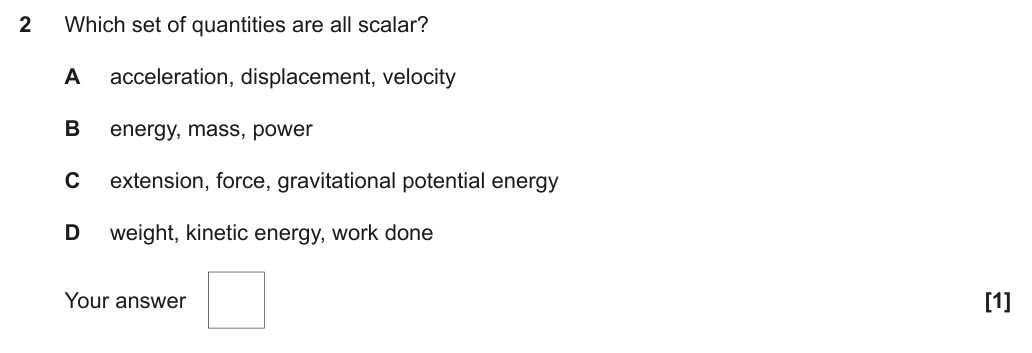
B
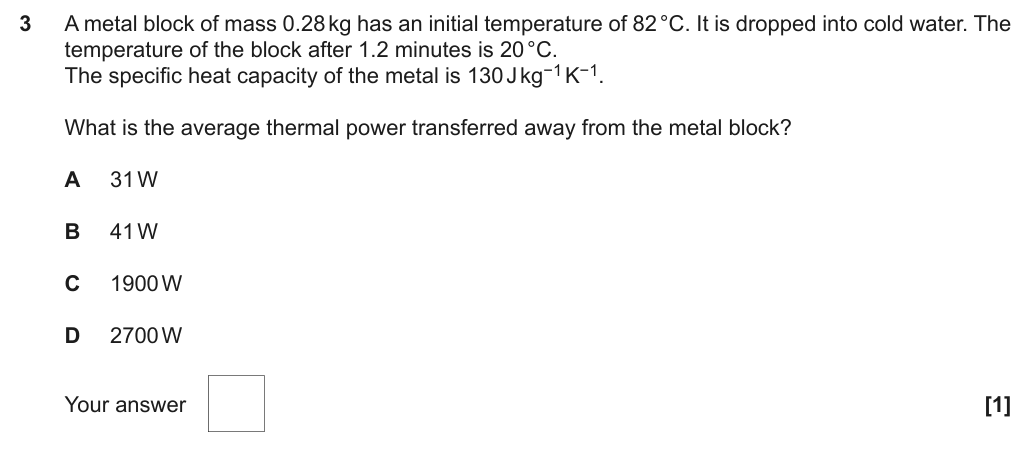
A
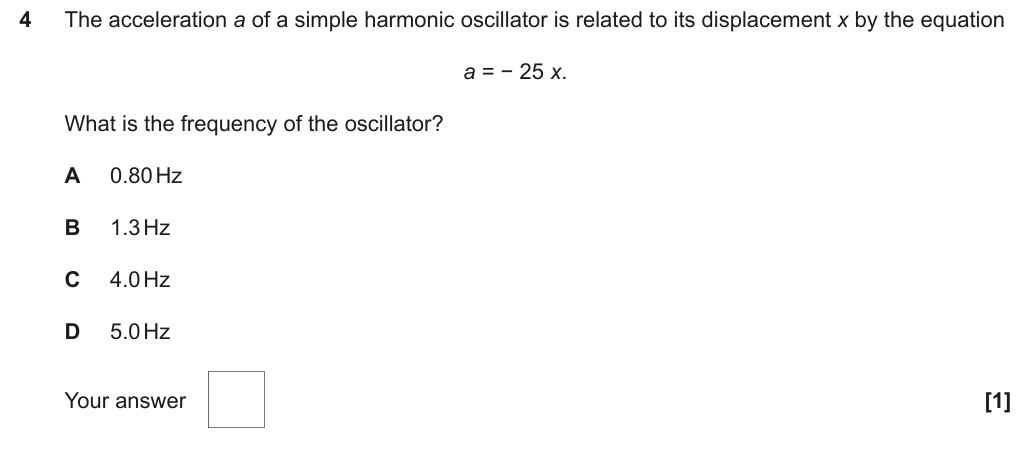
A
About three quarters of all candidates recognised that since = −𝜔𝜔2𝑥𝑥 , the angular frequency of this motion was 5. Also, since 𝜔𝜔= 2𝜋𝜋𝜋𝜋, the frequency must be equal to 5/(2𝜋𝜋) .
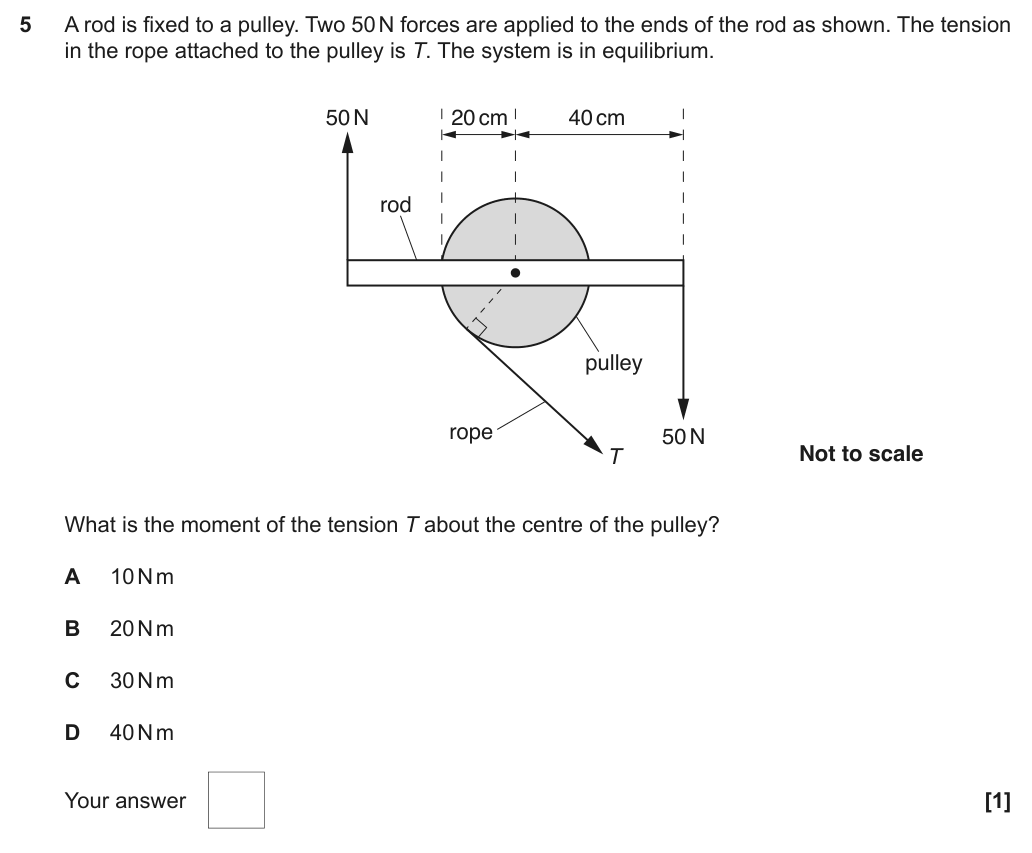
D
Examiners’ report Question 5 Please note an erratum notice was issued for this question.
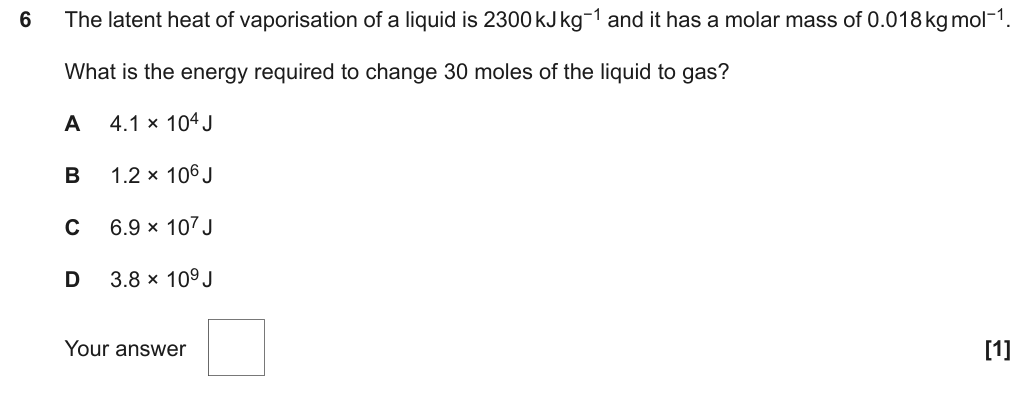
B
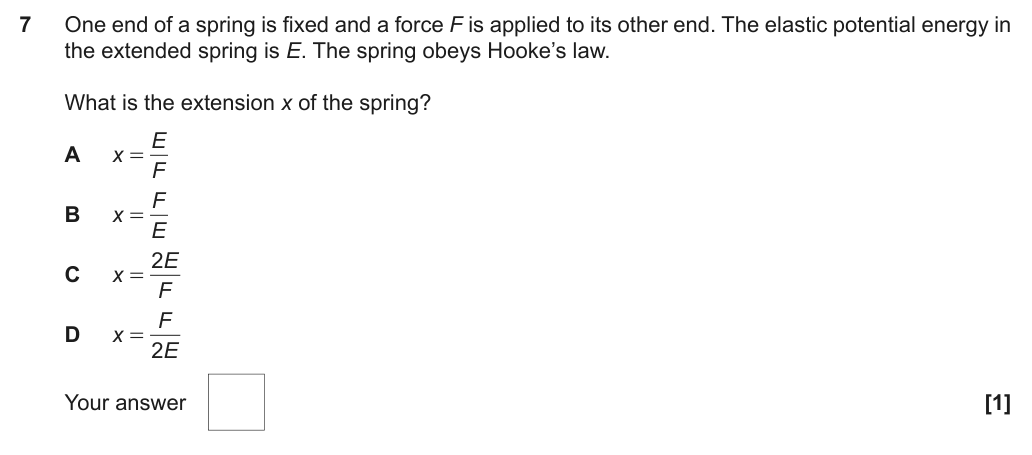
C
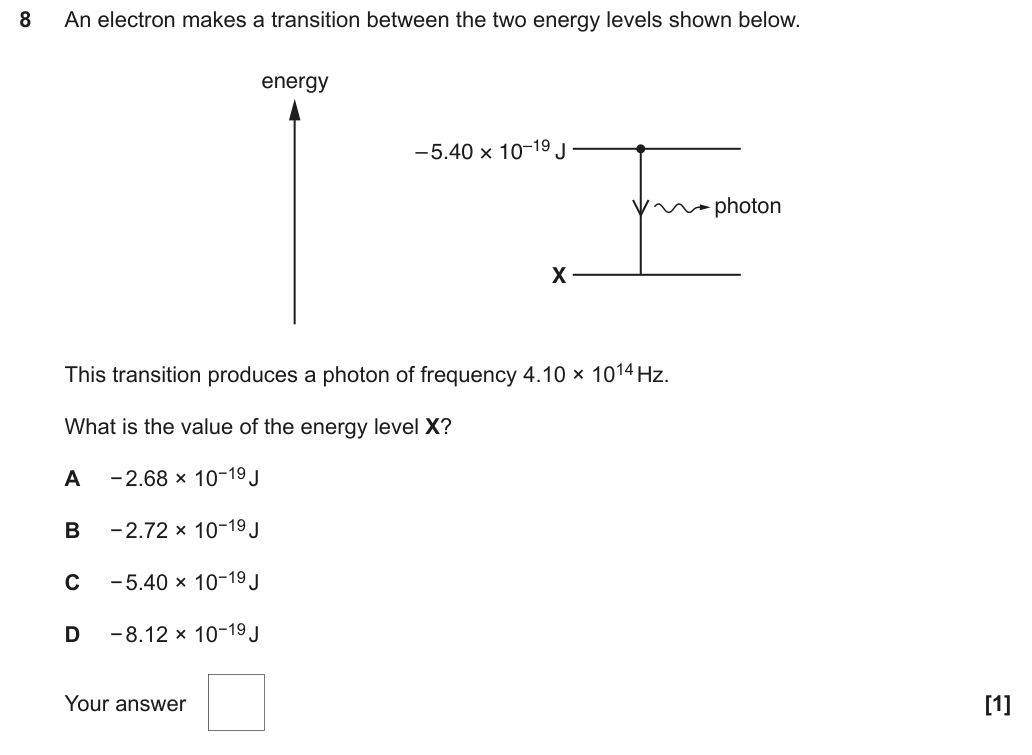
D
The key to this question is to find the energy of the photon (from E = hf) which gives 2.72 x 10⁻¹⁹ J. The energy level X is this amount of energy below -5.40 x 10⁻¹⁹ J, which can only be answer D.
B
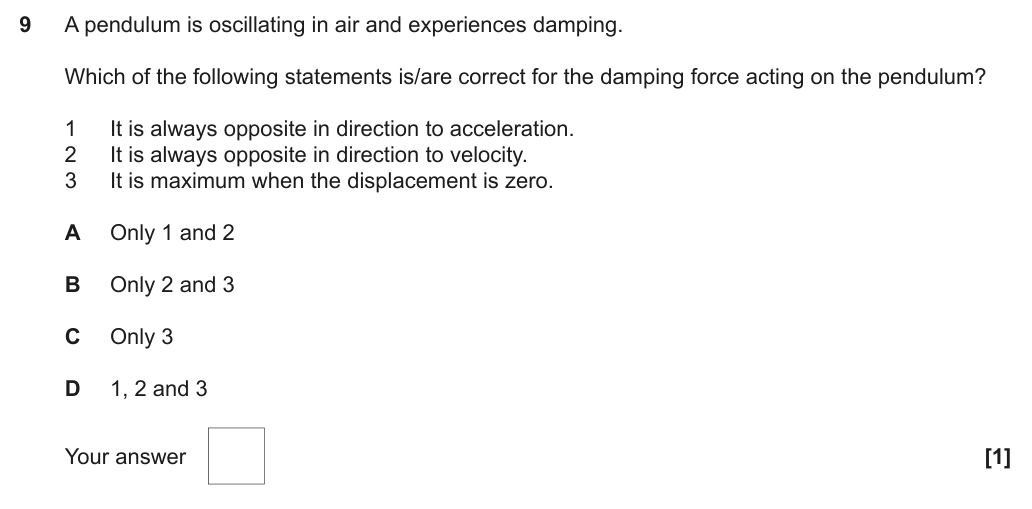
The damping force is always opposite in direction to velocity. If the displacement is zero, then the speed is greatest and hence the damping force is also greatest in magnitude. The damping force is not always opposite in direction to acceleration, although the displacement must be, according to the definition of SHM.
D
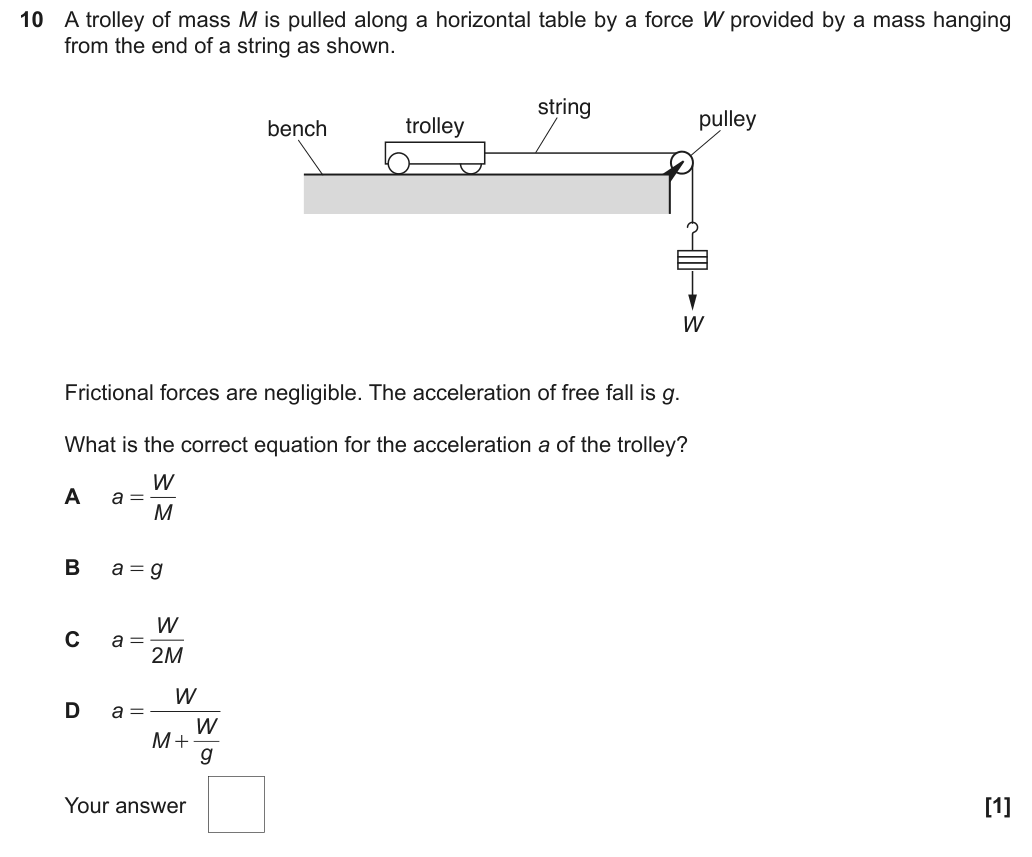
Most candidates did not realise that both the suspended mass and the trolley are moving with acceleration a. The resultant force along for this composite object is W and the total mass is (M + W/g), giving D as the acceleration.
D
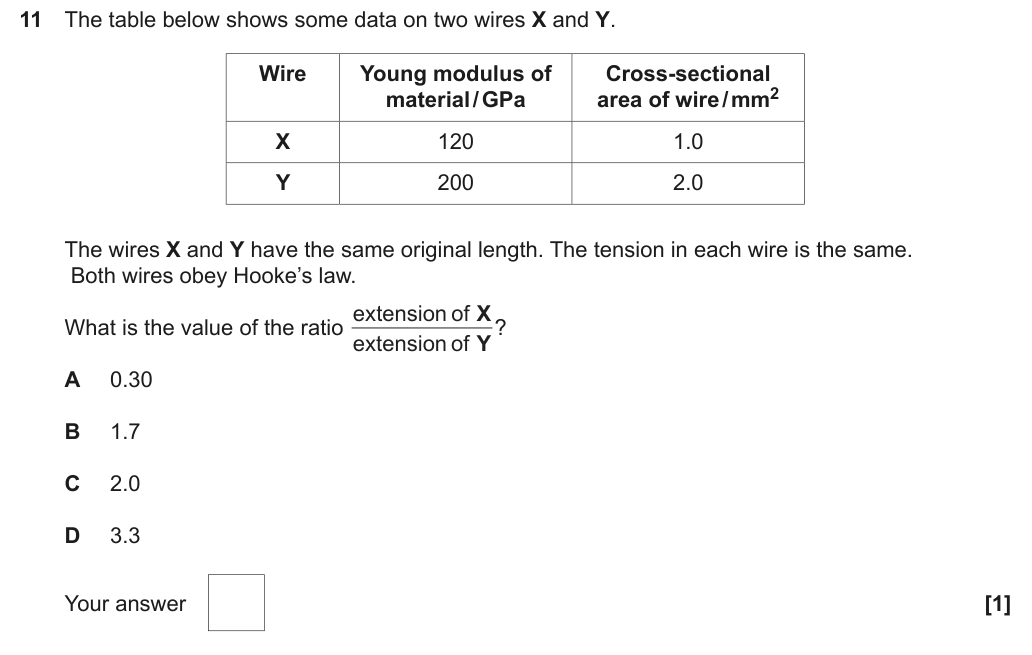
The tension for both wires is the same, yet wire X has half of the cross-sectional area. This means the stress for X will be twice that of Y. Strain = stress/Young modulus, so with half of the stress and (120/200) of the Young modulus, the strain for X will be 2 x (200/120) or times that of the strain for Y. The original lengths for X and Y are the same, so the extension of X will be 3.3 times that of Y.
C
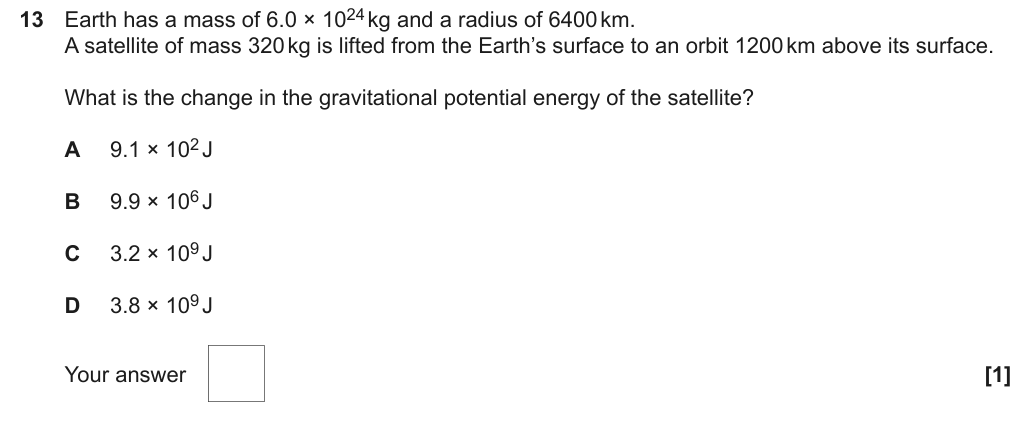
C
This question requires the candidate to calculate the gravitational potential energy when r = 6.4 x 10³ m and again when r = 7.6 x 10³ m. The difference of those two energies gives answer C. About two thirds of all candidates got this correct.
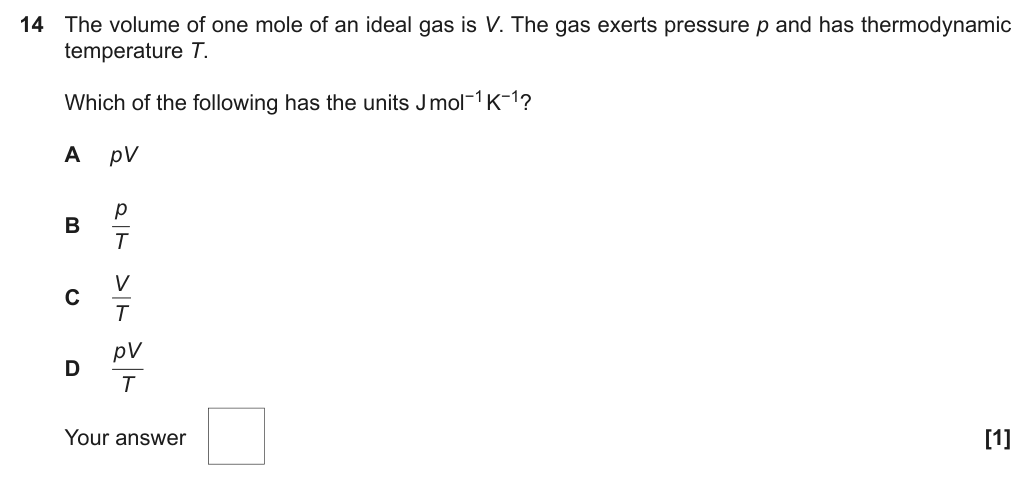
D
The unit J mol-1 K-1 is the same unit as the molar gas constant, such that pV = nRT. It follows that the unit of R must be the same as the unit of pV/T as ‘n’ has no units.
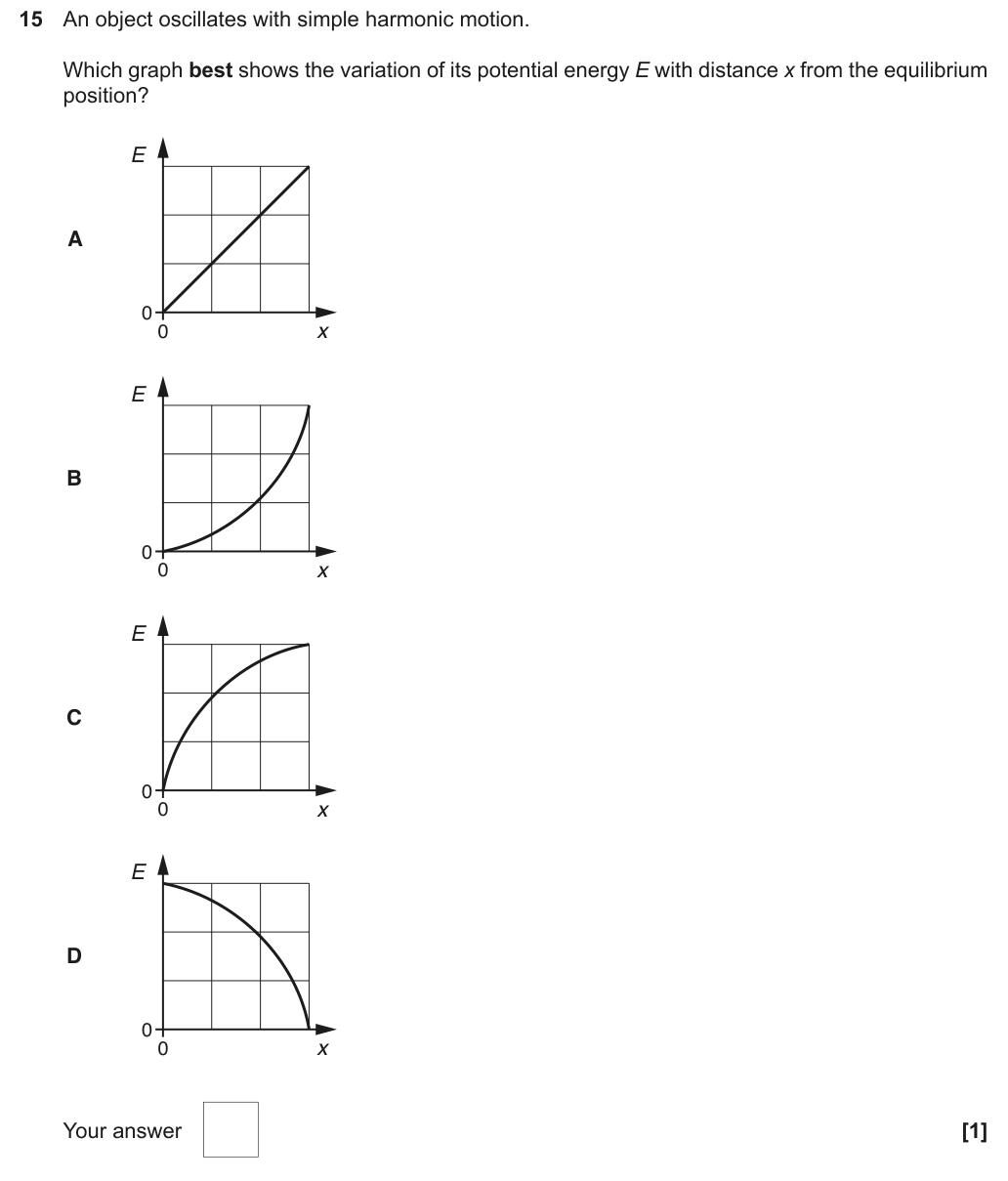
B
In SHM, when x = 0, the object is moving at its fastest and so has maximum KE. This in turn means that the PE must be minimum, eliminating option D. The speed of the object slightly away from the point where x=0 does not increase rapidly nor linearly. This only leaves option B.
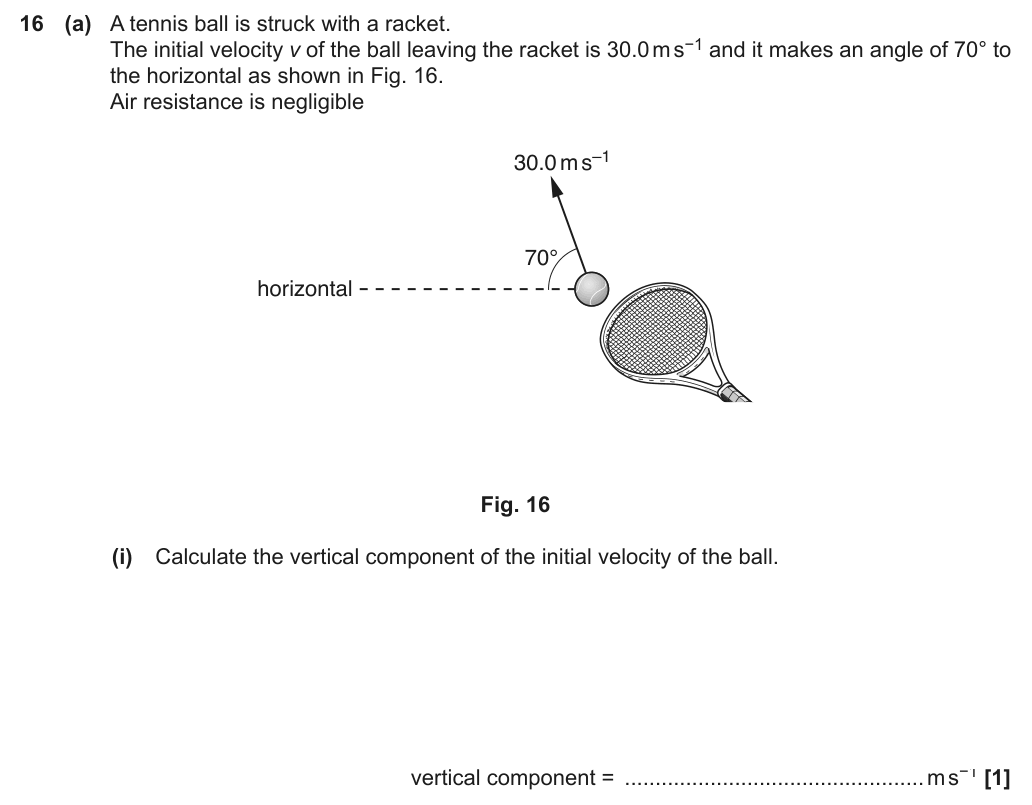
Question 16 (a) (i) Examiners’ report Question 16 (a) (ii) Question 16 (a) (iii) Question 16 (a) (iv) Part (i) was particularly well answered by 95% of all candidates.
Skills: M0.6 Use calculators to handle sin x, cos x and tan x when x is expressed in degrees or radians; M4.5 Use sin, cos and tan in physical problems
Question 16 (a) (i) Examiners’ report Question 16 (a) (ii) Question 16 (a) (iii) Question 16 (a) (iv) Part (i) was particularly well answered by 95% of all candidates.
Skills: M2.2 Change the subject of an equation, including non-linear equations; M2.3 Substitute numerical values into algebraic equations using appropriate units for physical quantities

Question 16 (a) (i) Examiners’ report Question 16 (a) (ii) Question 16 (a) (iii) Question 16 (a) (iv) Part (i) was particularly well answered by 95% of all candidates.
Part (i) was particularly well answered by 95% of all candidates. Nine out of ten candidates scored full marks in part (a)(ii), as they remembered that the question asks to show that the maximum height is around 40m. Working for this type of question is essential. In part (a)(iii), three quarters of all candidates correctly talked about the ball still having a horizontal velocity (which wasn’t zero) and therefore still possessing some KE. The key to this part (a)(iv), remembered by most candidates, was to use the horizontal component of velocity to find the KE at the maximum height. Some used the initial speed and others used the initial vertical velocity component found in part (a)(i).
Skills: M0.1 Recognise and make use of appropriate units in calculations; M0.6 Use calculators to handle sin x, cos x and tan x when x is expressed in degrees or radians; M2.3 Substitute numerical values into algebraic equations using appropriate units for physical quantities
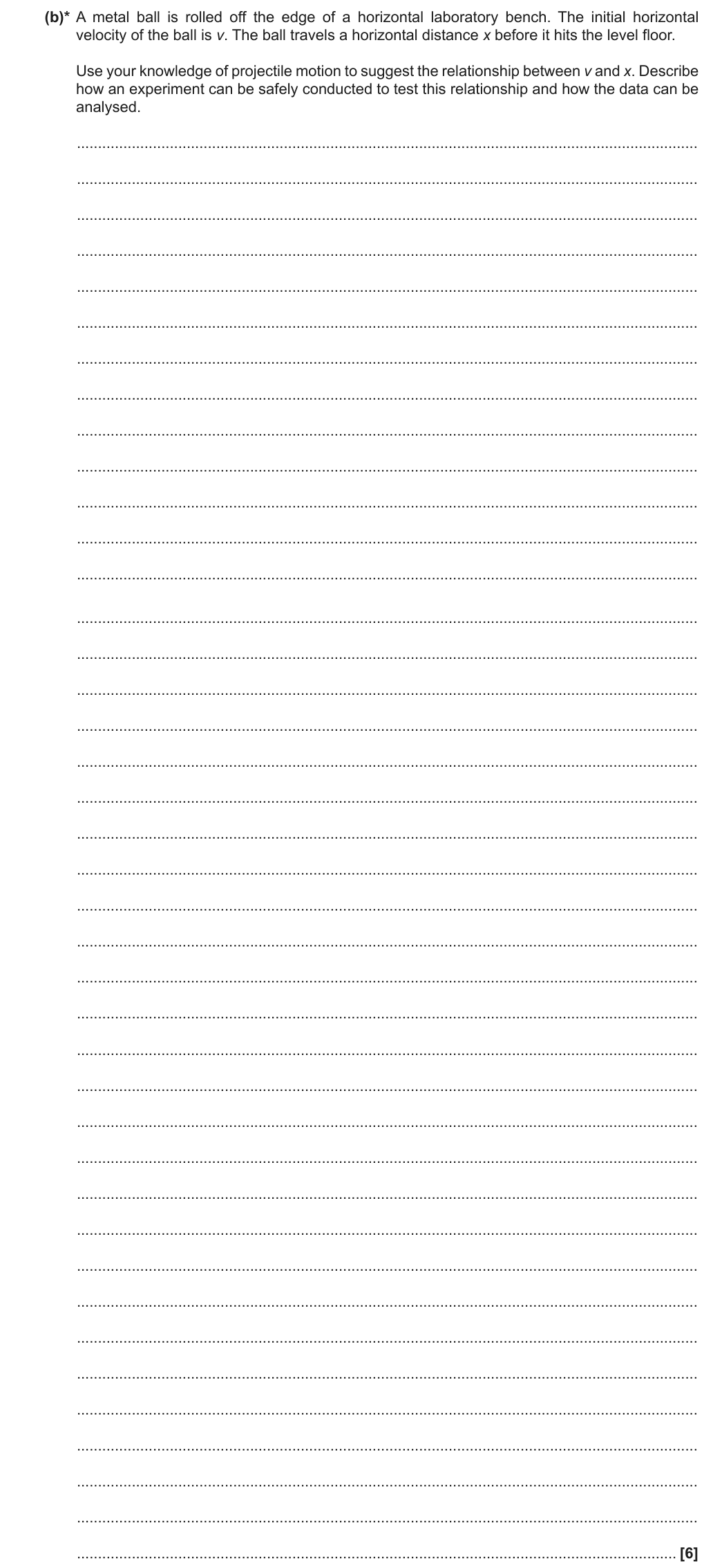
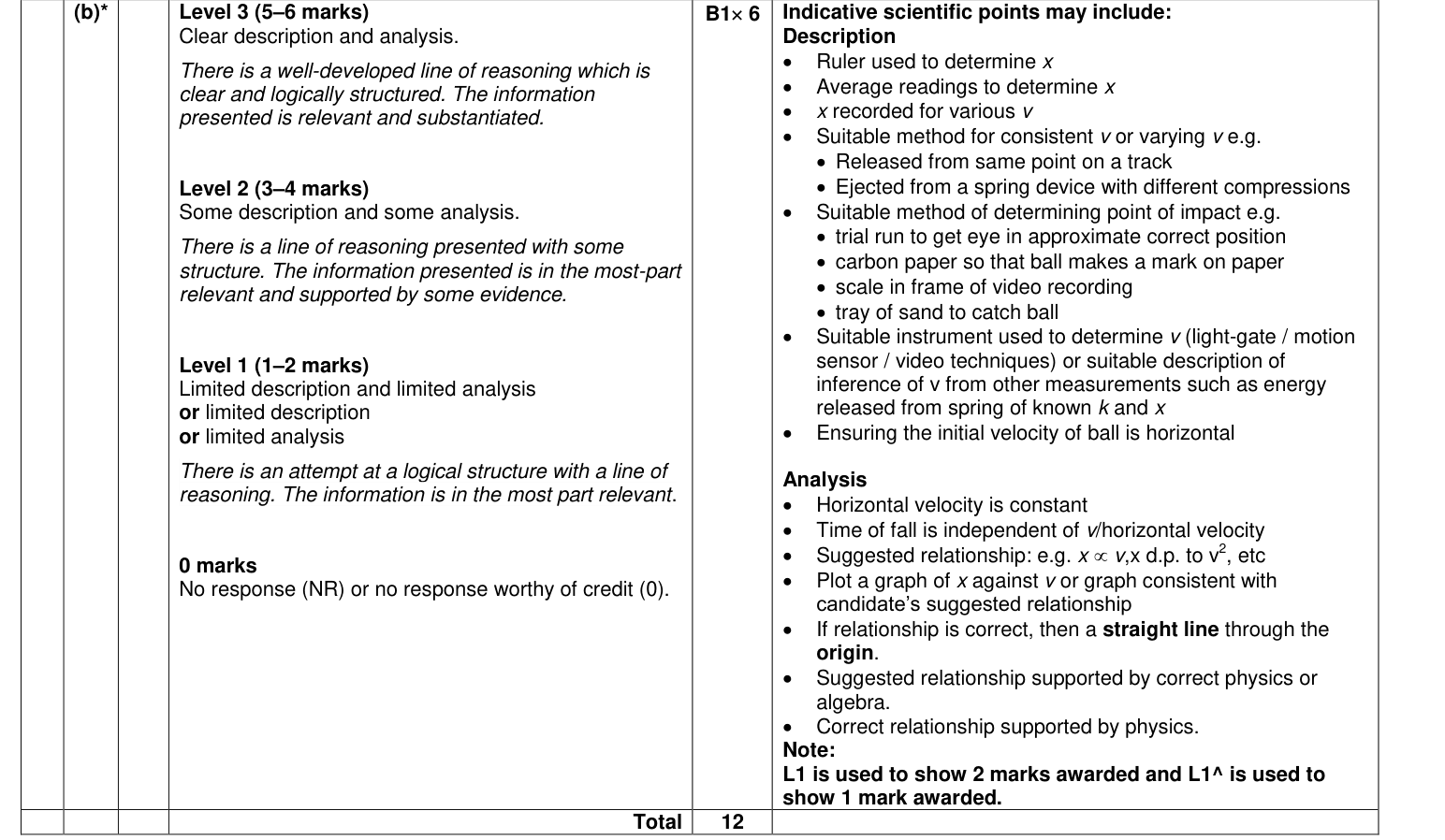
Many candidates had plenty to say that was sensible. There was plenty of evidence that candidates had seen this experiment or had performed a similar one themselves. A few confused the question, instead describing how to find the time of flight or that the ball was falling vertically. Others described what they thought would happen to the vertical component of velocity when they changed the vertical distance that the ball dropped. In the first paragraph, the candidate has made clear that the time of flight is constant and goes on to explain why towards the end of the response. This supports the prediction that 𝑣𝑣∝𝑥𝑥. In addition, the candidate takes time to explain how to obtain data for both the horizontal velocity and horizontal distance. It was pleasing to see light gates and motion sensors being employed, with the best answers explaining how to use the data provided by the sensors to calculate the velocity of projection. The exemplar response also includes the correct analysis. There is a graph of v against x and the resulting best fit straight line through the origin supports the idea that these two variables are directly proportional. Too many candidates did not mention the crucial statement about the line going through the origin, limiting their response to a high L1 or low L2.
Skills: M3.2 Plot two variables from experimental or other data; M3.3 Understand that y = mx + c represents a linear relationship; PAG1 Investigating motion
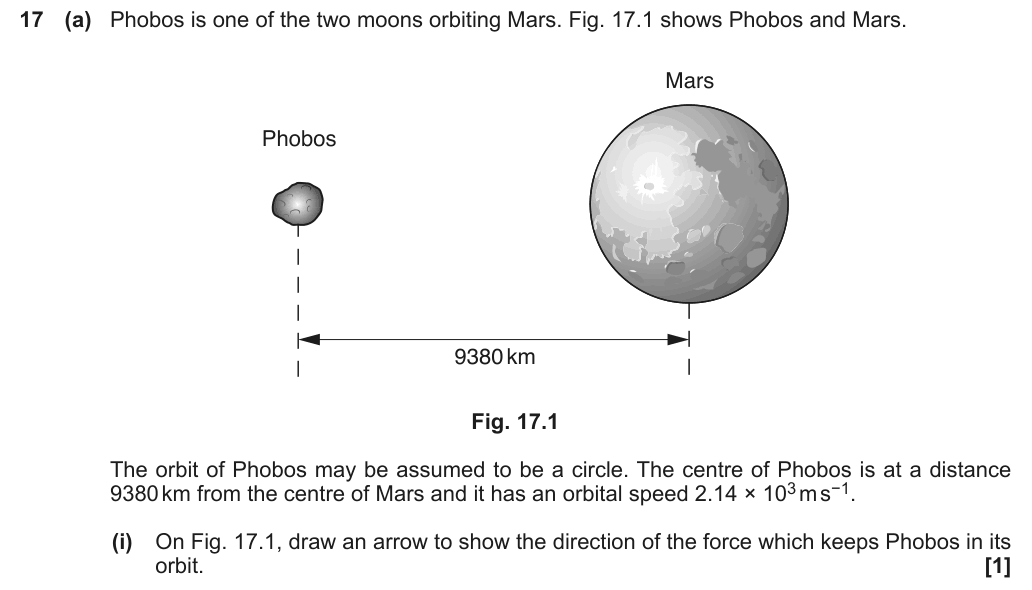
The examiners were quite lenient in this series in terms of the precise direction of the arrow, which should point towards the centre of Mars.
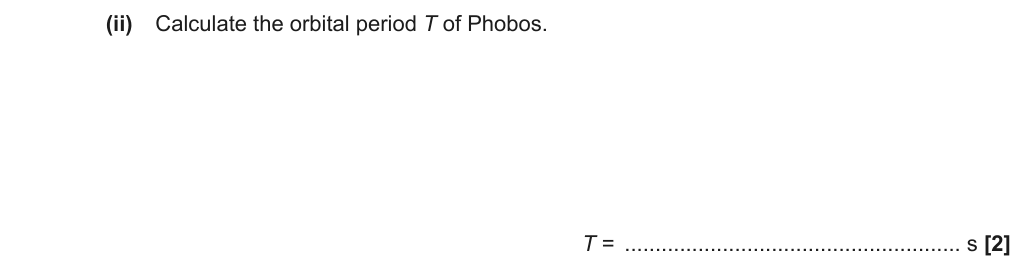
Around four fifths of candidates got this right. Those that did not either poorly converted the radius from km or used the area rather than the circumference of the orbit.
Skills: M0.1 Recognise and make use of appropriate units in calculations; M2.2 Change the subject of an equation, including non-linear equations
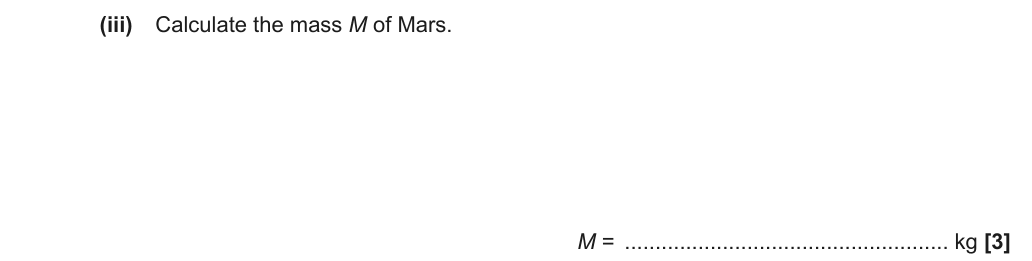
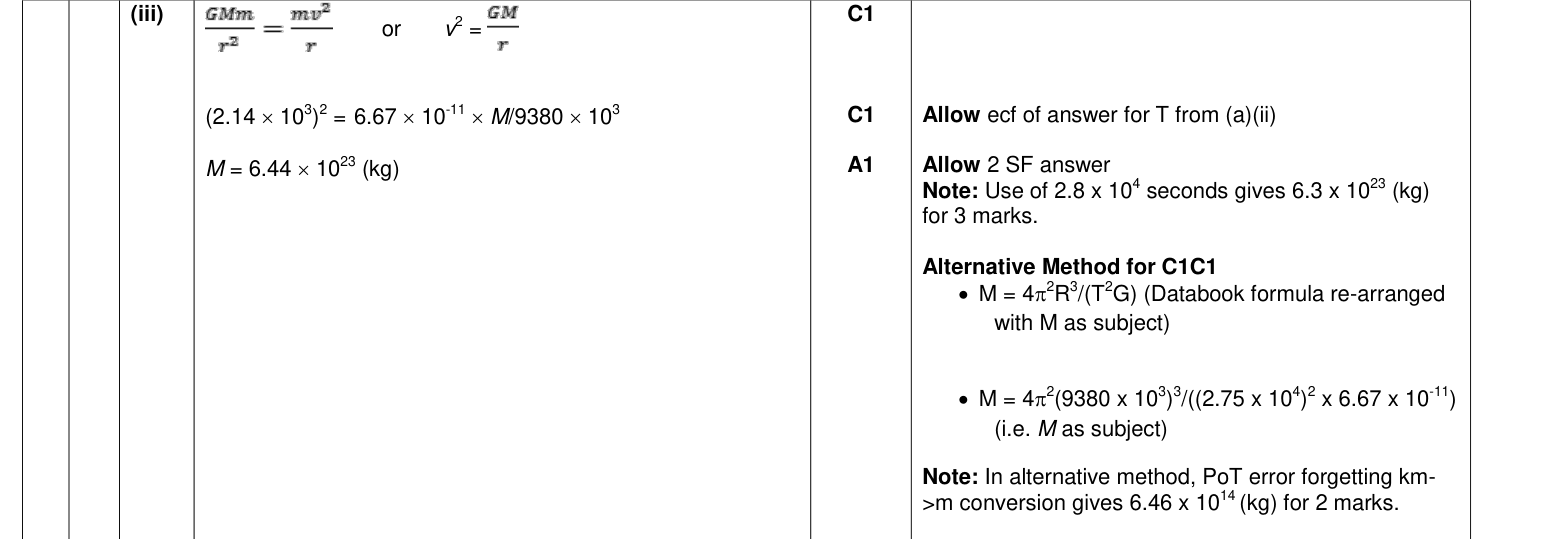
Many candidates successfully used the equation for Kepler’s Third Law, which is encouraging. A quicker route was to find the Phobos’s acceleration (from v2/r) and equating that to the gravitational field strength at Phobos from Mars (GMmars/r2) and then rearranging to find the mass of Mars.
Skills: M0.2 Recognise and use expressions in decimal and standard form; M2.2 Change the subject of an equation, including non-linear equations; M2.3 Substitute numerical values into algebraic equations using appropriate units for physical quantities
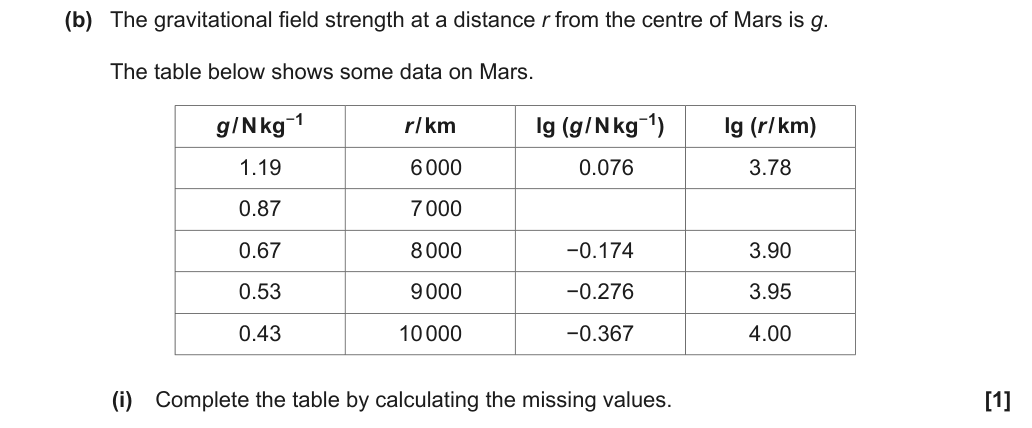
Although some candidates were confused by the appearance of ‘lg’, most candidates were not. This notation is on the specification and was used in the previous specification.
Skills: M0.5 Use calculators to find and use power, exponential and logarithmic functions; M1.1 Use an appropriate number of significant figures; M2.5 Use logarithms in relation to quantities that range over several orders of magnitude
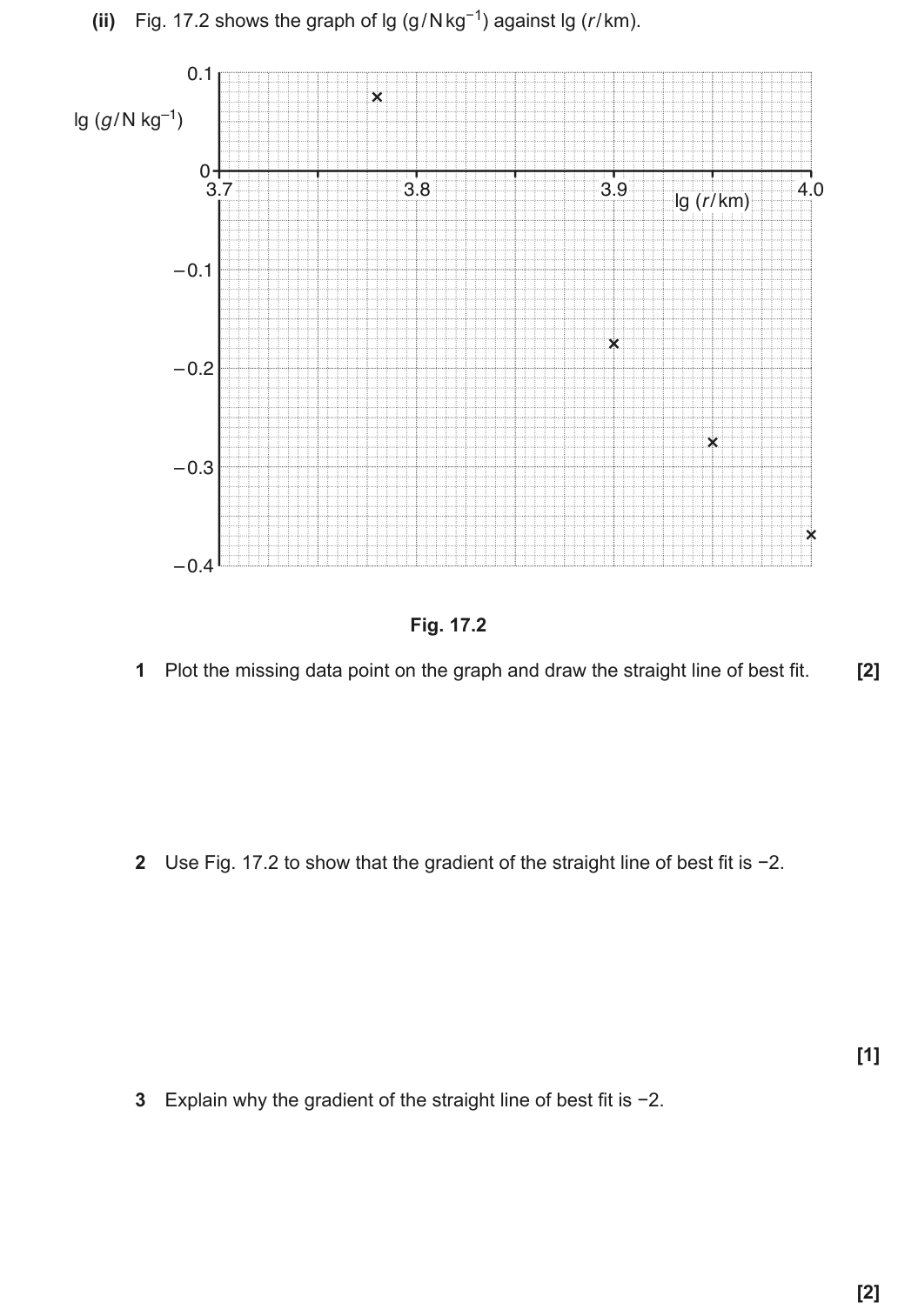
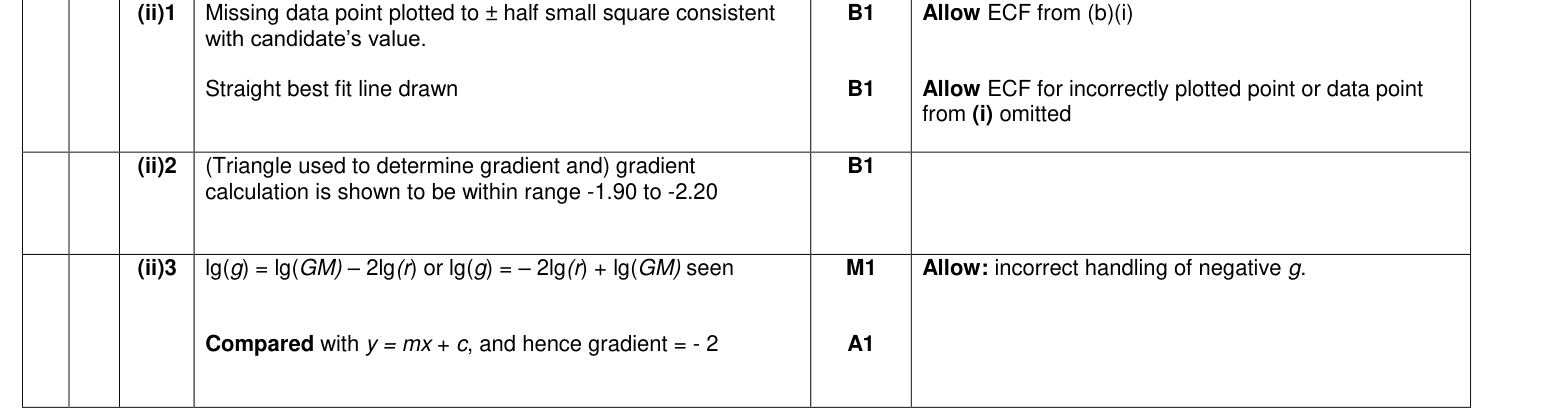
Providing the candidate had entered values in the tables, the data point was almost always plotted correctly. The best fit line caused slightly more problems. Candidates should take a ruler into the examination and be careful about the positioning of the ruler for the fairest best fit straight line. The Practical Skills Handbook is helpful on this topic. In this example, the candidate’s line has missed the final data point. The line of best fit for this item should just graze each of the given points. Most candidates correctly found the gradient of their best fit straight line. The exemplar shows both an unsuccessful and a successful approach. The crossed-out working was typical across many candidates, with incorrect maths and no handling of the ‘GM’ term. The successful approach was very clear mathematically, as well as making a clear comparison with the general equation for a straight line. Some candidates decided to find the gradient of their best fit line again, showing that they did not see the distinction between these two questions, despite the change in command verb.
Skills: M2.5 Use logarithms in relation to quantities that range over several orders of magnitude; M3.11 Use logarithmic plots to test exponential and power law variations; M3.2 Plot two variables from experimental or other data; M3.4 Determine the slope and intercept of a linear graph
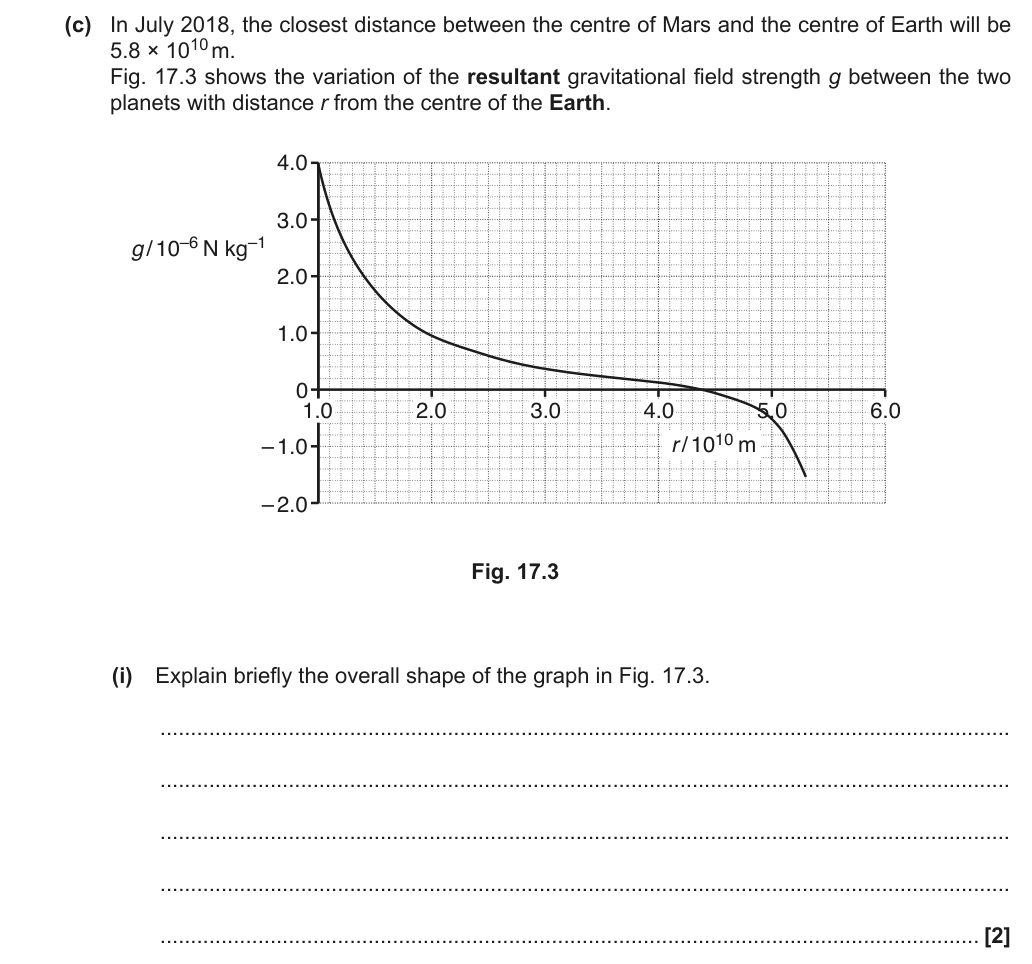
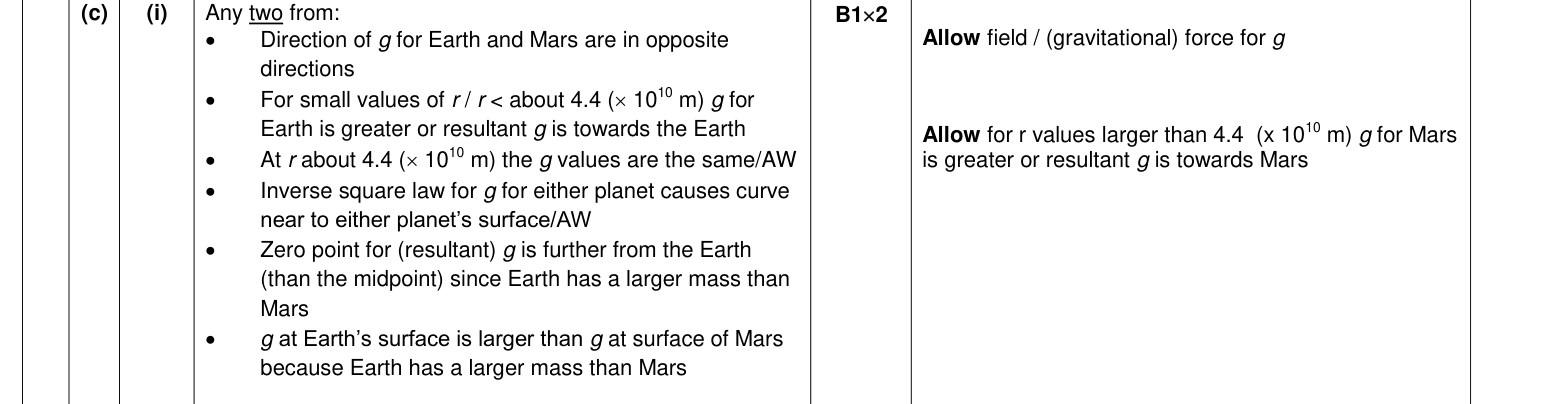
Most candidates mis-read the question and tried to describe the shape of the curve, rather than explain why the curve has that shape. Many candidates also mis-used the term ‘exponential’ to describe a curve that is related to 1/r2. Others thought that the graph showed the effect of Mars and the Earth on each other, rather than on a small mass between them. They went on to describe what happened when Mars and Earth were separated by an increasingly large distance. It is good practice to be specific about which section of the graph you are talking about. ‘When r is below 2.0 x 10¹⁰ m’ is much clearer than ‘At the start’. Potential, potential difference, potential energy, field strength and force These terms are all very similar yet subtly different and with differing formula. Be careful you know which is which.
Skills: M3.1 Translate information between graphical, numerical and algebraic forms
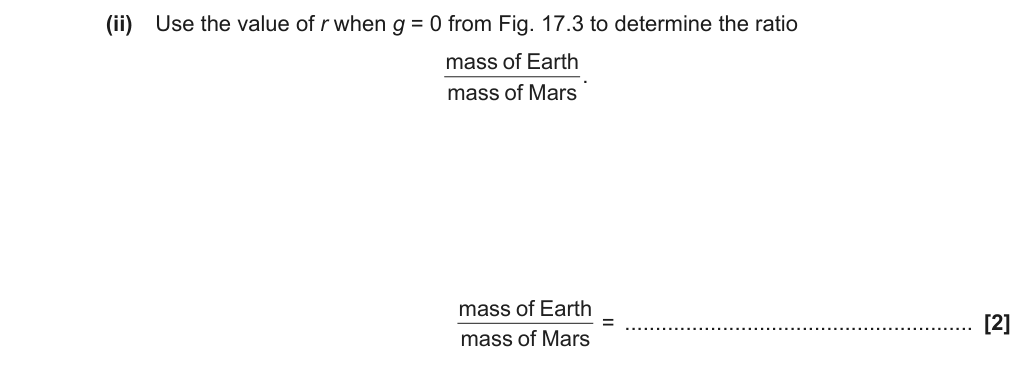
To correctly answer this question, the candidate should equate the gravitational field strength from Earth (GMEarth/x2 where x is the distance to the point where g=0 from the centre of Earth) and the gravitational field strength from Mars (GMMars/y2 where y is the distance to the point where g=0 from the centre of Mars). Many candidates did not get this far, yet some that did substituted and re-arranged correctly get a value in the correct range. Errors occurred when candidates were unsure of which distances to use in the equation. The commonest error was to use 0.9 x 10¹⁰ m for the distance of the zero-point since the graph stops at 5.3 x 10¹⁰ m, rather than using the data provided that the distance between the centres of the two planets was 5.8 x 10¹⁰ m and so the correct value for r was 1.4 x 10¹⁰ m.
Skills: M0.3 Use ratios, fractions and percentages; M2.2 Change the subject of an equation, including non-linear equations; M3.1 Translate information between graphical, numerical and algebraic forms
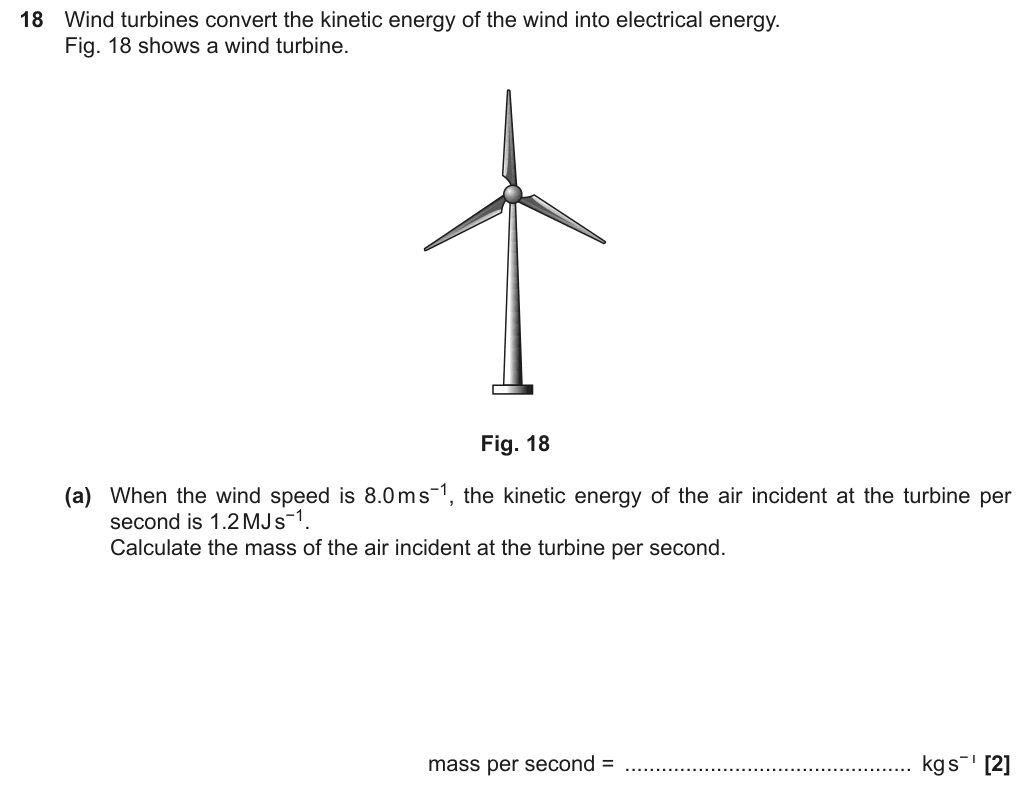
A large majority of candidates got this right. Those that did not usually forgot to square the velocity.
Skills: M0.2 Recognise and use expressions in decimal and standard form; M2.2 Change the subject of an equation, including non-linear equations
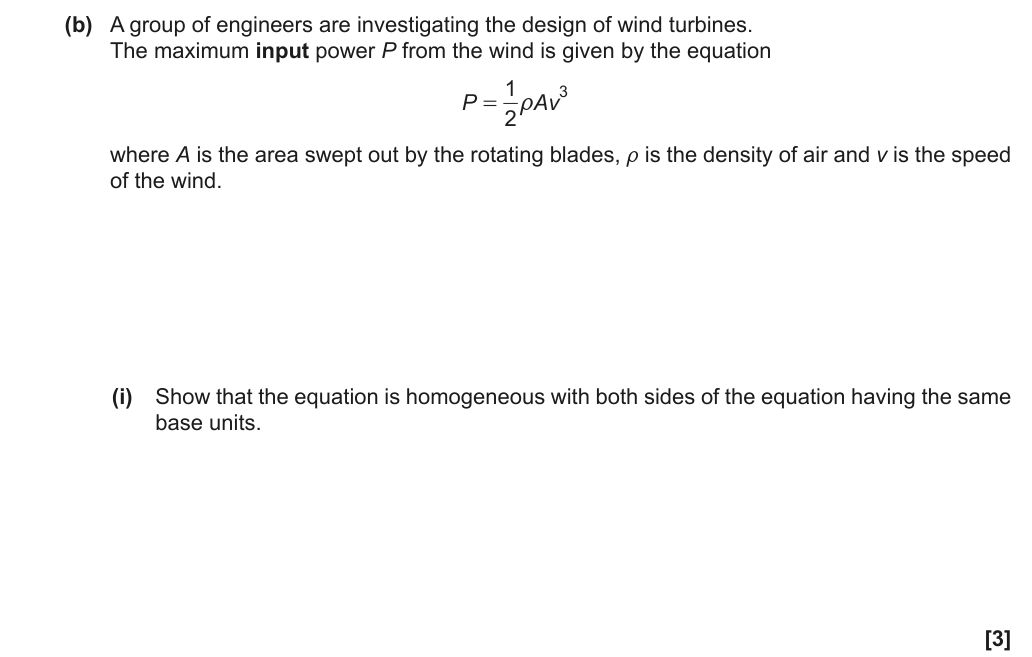
Candidates generally made an excellent attempt at this question, although for many the working was difficult to follow. In the exemplar, the candidate has made it very clear that they are considering the two sides of the equation separately and have reduced each unit to its S.I. base units as required by the question. The use of square brackets to distinguish between a quantity rather than a base unit was helpful.
Skills: M0.1 Recognise and make use of appropriate units in calculations
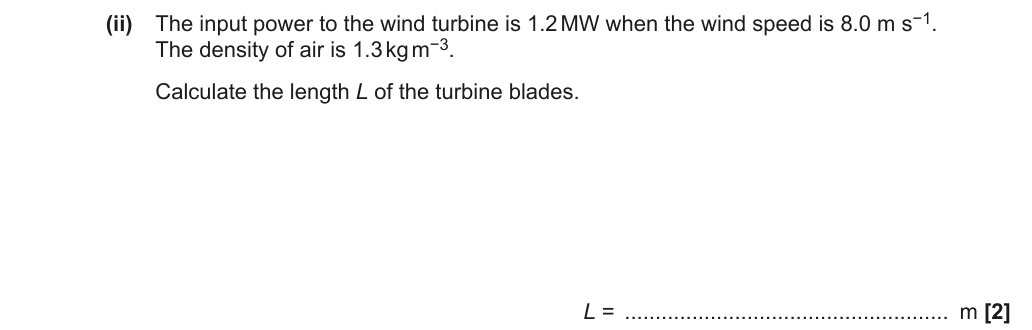
About two thirds of candidates got full marks on this item. By substituting the values into the formula, the area required is approximately 3600 m2. Some candidates did not read the question and instead of thinking about area swept out being a circle, they took it to be square, giving the length of the blade to be √3600 = 60 m.
Skills: M0.5 Use calculators to find and use power, exponential and logarithmic functions; M2.2 Change the subject of an equation, including non-linear equations; M4.3 Calculate areas of triangles, circumferences and areas of circles, surface areas and volumes of rectangular blocks, cylinders and spheres
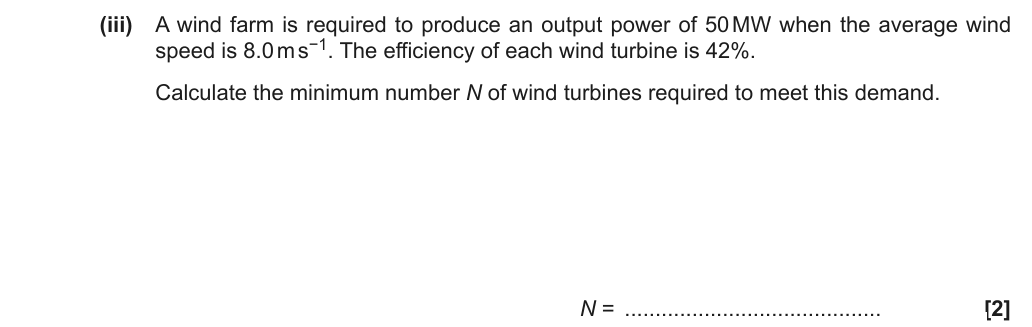
Rather more candidates got this item right. Some candidates mis-converted the unit and got values that could not be right i.e. 1 or 106 yet the majority arrived at 99.2 and correctly stated that the minimum number of required turbines must be 100 and not 99.
Skills: M0.3 Use ratios, fractions and percentages
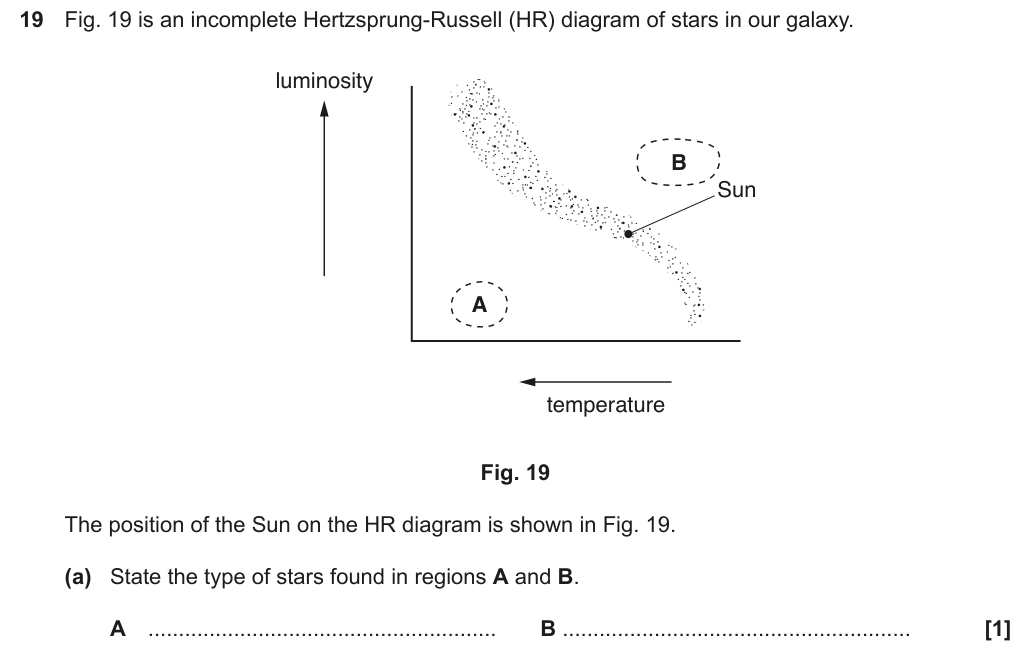
Examiners’ report Question 19 (a) Question 19 (b) (i) Examiners’ report Question 19 (b) (ii) This whole question was well answered in general.
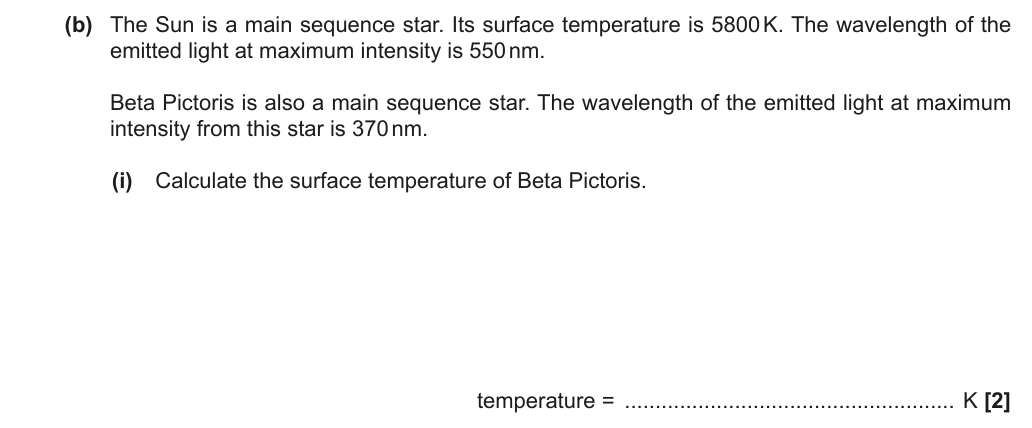
Examiners’ report Question 19 (a) Question 19 (b) (i) Examiners’ report Question 19 (b) (ii) This whole question was well answered in general.

This whole question was well answered in general. Very few could not identify white dwarf and red giant stars. The calculation of the surface temperature was straightforward with a minority suggesting that λmax ∝T . In either case, most candidates plotted the position of Beta Pictoris on the HR plot successfully.
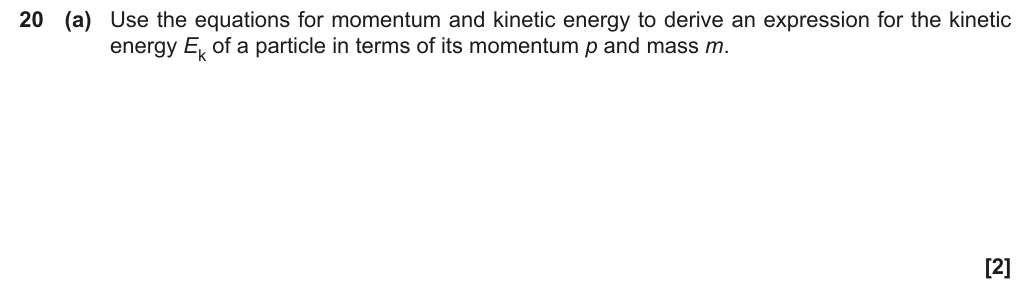
Question 20 (a) Examiners’ report Question 20 (b) (i) Examiners’ report Question 20 (b) (ii) Nearly four fifths of candidates completed 20a well, especially if they clearly stated the equations for momentum and kinetic energy.
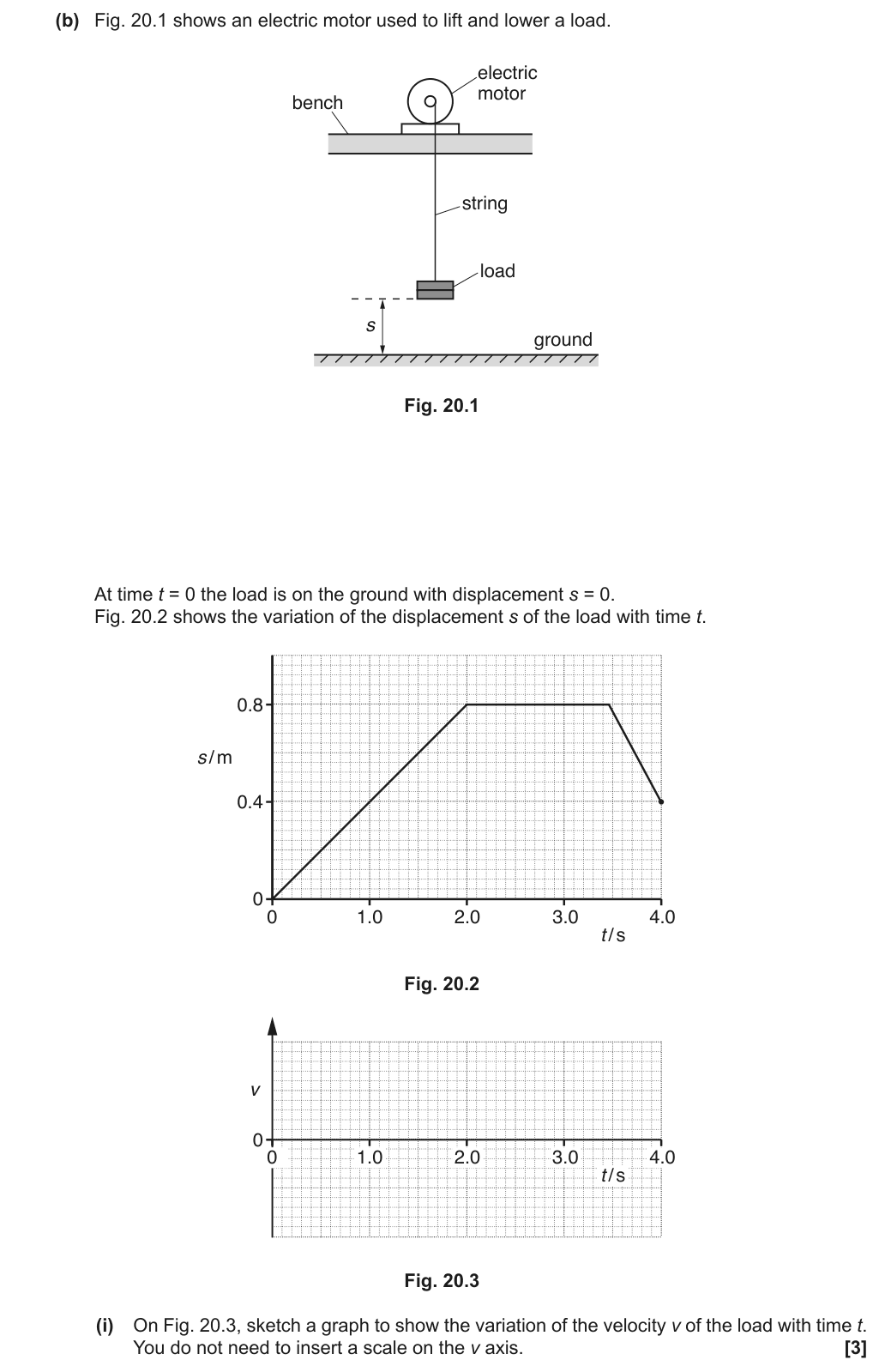
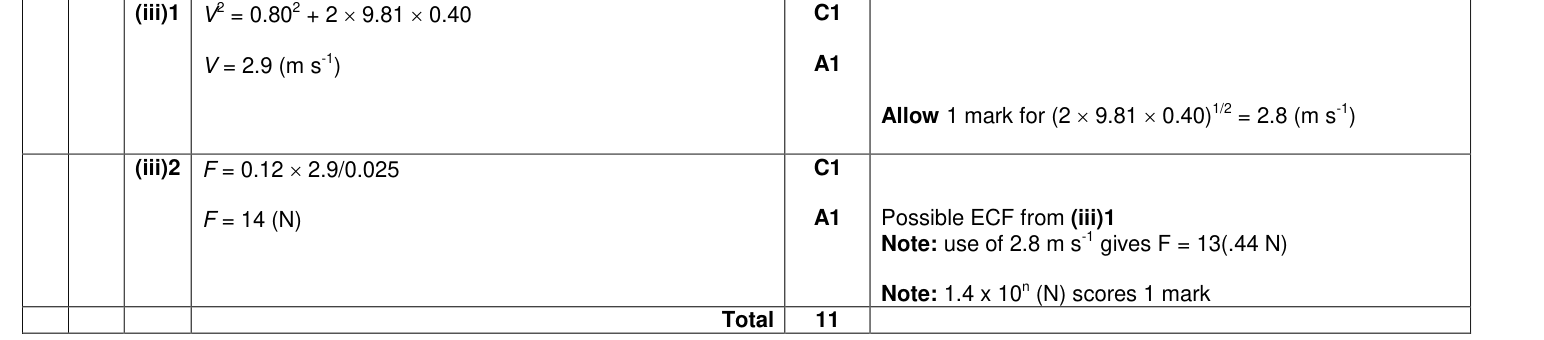
Question 20 (a) Examiners’ report Question 20 (b) (i) Examiners’ report Question 20 (b) (ii) Nearly four fifths of candidates completed 20a well, especially if they clearly stated the equations for momentum and kinetic energy. Question 20 (b) (iii) (1) Many candidates selected the correct equation, although did not realise that the load was not at rest when it was released. Examiners’ report Question 20 (b) (iii) (2) Nearly three quarters of the candidates used the correct method for finding the average force acting on the load by considering the rate of change of momentum.
Skills: M3.1 Translate information between graphical, numerical and algebraic forms; M3.5 Calculate rate of change from a graph showing a linear relationship
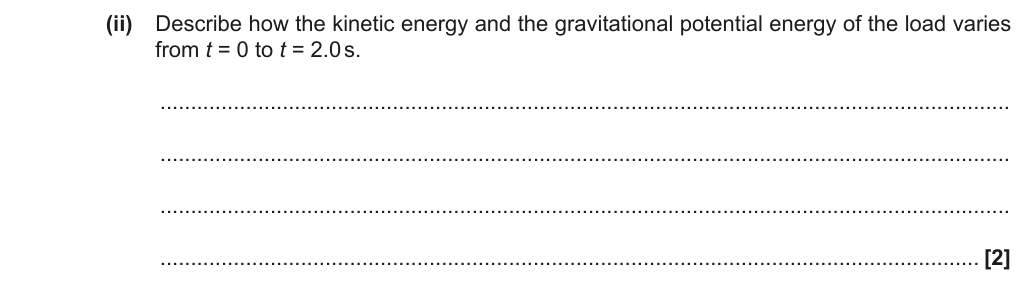
Nearly four fifths of candidates completed 20a well, especially if they clearly stated the equations for momentum and kinetic energy. Those that did not generally forgot that the question required an expression with ‘p’ and ‘m’ in it. ½ pv was a common wrong answer. 20bi was answered well, with some candidates either slightly misreading the graph when the velocity became negative or not spotting that the line was steeper for the last section of the movement than it was in the first. Most candidates spotted that the KE was constant because the velocity was constant. Rather fewer candidates explained that the GPE increased at a constant rate.
Skills: M3.1 Translate information between graphical, numerical and algebraic forms
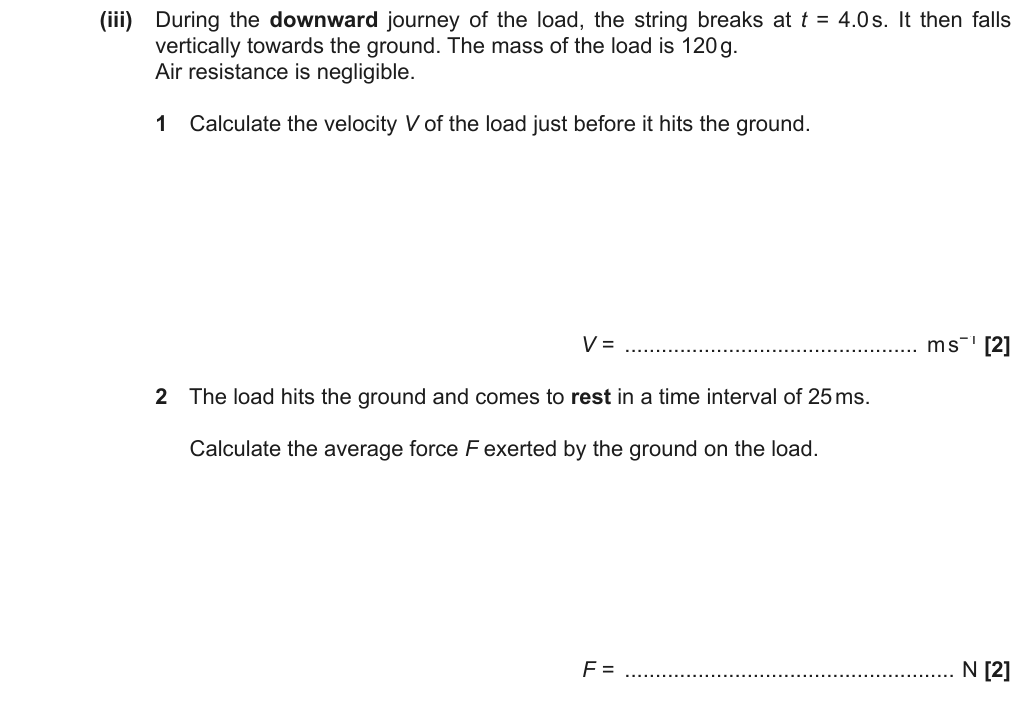
Many candidates selected the correct equation, although did not realise that the load was not at rest when it was released. The initial velocity was found from the graph on page 22 of the paper and was 0.80 ms-1. Nearly three quarters of the candidates used the correct method for finding the average force acting on the load by considering the rate of change of momentum.
Skills: M0.1 Recognise and make use of appropriate units in calculations; M2.3 Substitute numerical values into algebraic equations using appropriate units for physical quantities; M3.4 Determine the slope and intercept of a linear graph
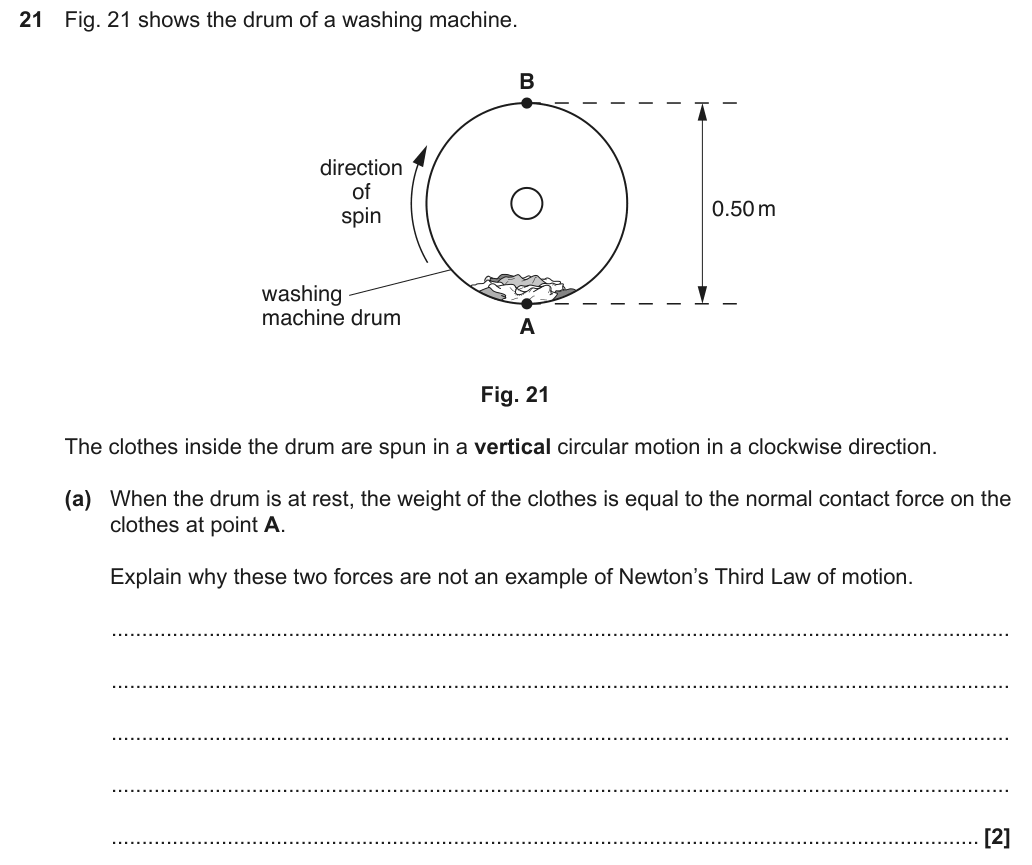
Many candidates incorrectly quoted Newtons’ Third Law (N3L) or did not realise that a pair of N3L forces must be of the same type. The two forces in the question are acting on the same object, whereas N3L forces must act on different objects. Some candidates thought that the clothes were in motion, while the question states that the clothes are at rest. Normal Contact Force Normal contact force is essentially an electrostatic force between the two objects in contact.
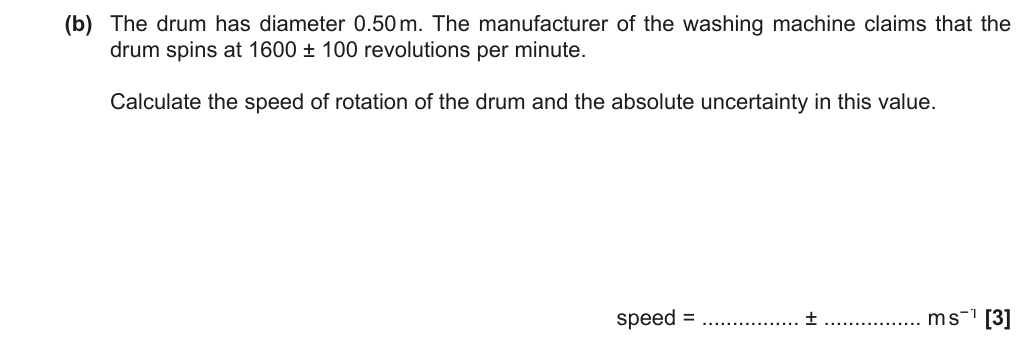
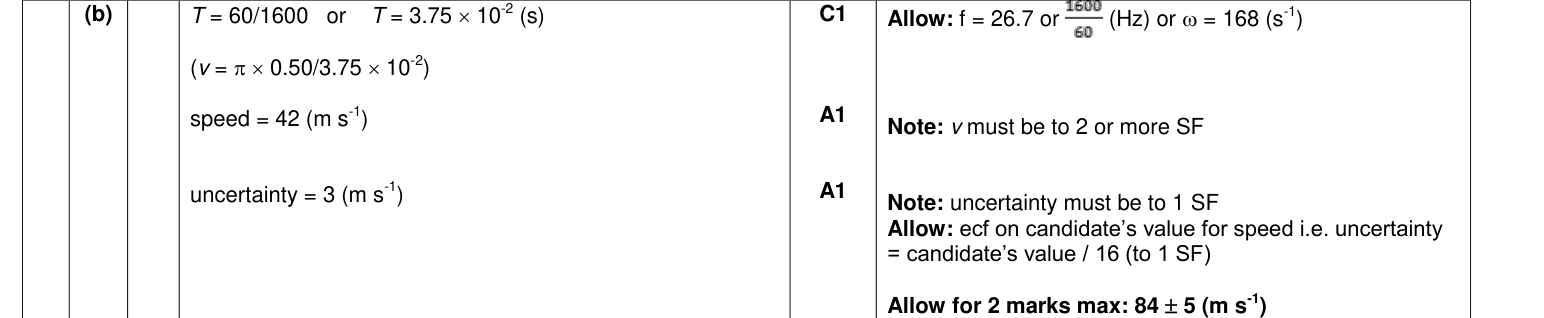
About half of the candidates got this item right or provided clear working to show where they were going. There was much confusion about which quantity was which. 1600 revolutions per minute refers to the frequency of the rotation, not the angular speed, angular frequency or the speed itself. The percentage error of the frequency was 6.25%, prior to rounding. Some candidates multiplied this by their value for the speed to get the correct absolute uncertainty, although good practice is to round uncertainties to 1 SF.
Skills: M0.3 Use ratios, fractions and percentages; M1.5 Identify uncertainties in measurements and use simple techniques to determine uncertainty when data are combined; M2.3 Substitute numerical values into algebraic equations using appropriate units for physical quantities
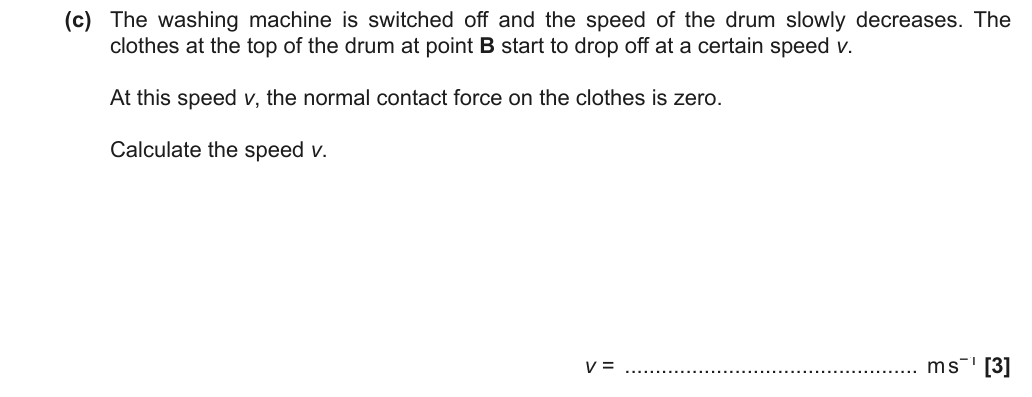
This question was answered well by those above the mean result. When the machine is switched off, the clothes are still in circular motion and at point B, the resultant force is still the weight of the clothes plus the normal contact force. This means at the critical speed when the clothes fall off at point B, the centripetal force will equal the weight of the clothes, since the question states that the normal contact force is zero.
Skills: M2.2 Change the subject of an equation, including non-linear equations
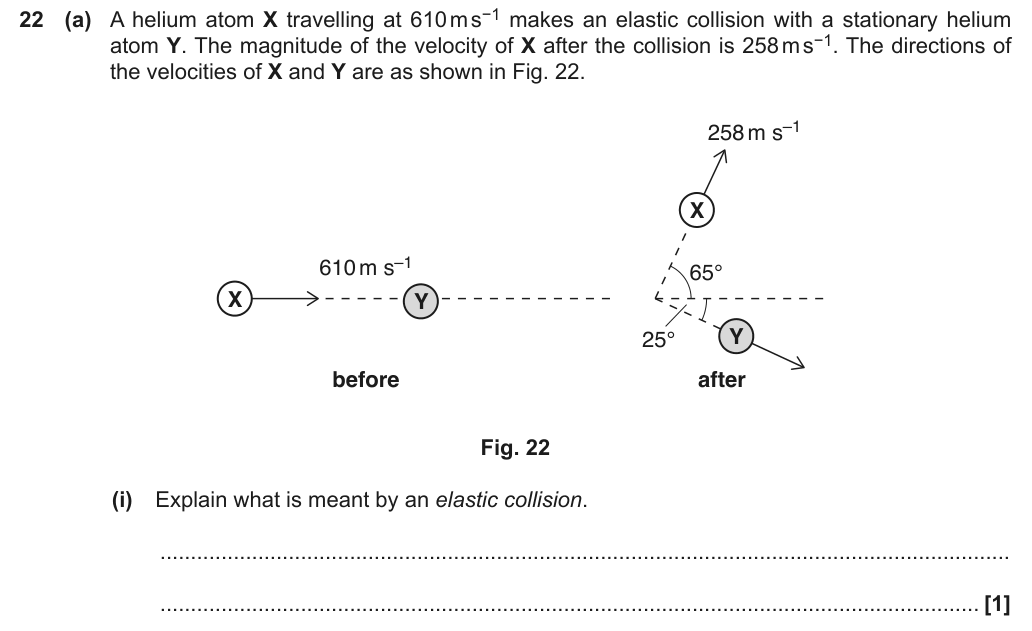
Question 22 (a) (i) Examiners’ report Question 22 (a) (ii) Most candidates correctly remembered that an elastic collision is one in which KE is conserved.
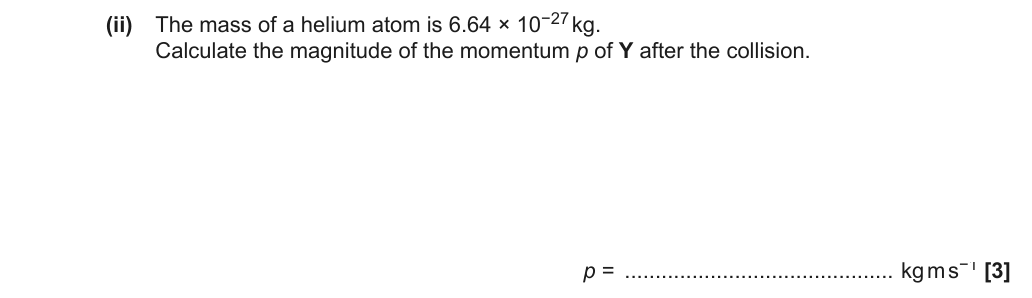
Most candidates correctly remembered that an elastic collision is one in which KE is conserved. In this series, it was acceptable to refer to ‘no loss of KE’. Using the idea that the KE was conserved would have made calculating the velocity of particle Y straightforward. Most candidates preferred a conservation of momentum approach, which of course still works. Many candidates remembered that momentum is conserved in both the x- and y-directions independently and consideration of either was enough. Some candidates forgot that trigonometry was necessary to complete this step, or made errors with which of sine or cosine was required.
Skills: M0.6 Use calculators to handle sin x, cos x and tan x when x is expressed in degrees or radians; M2.3 Substitute numerical values into algebraic equations using appropriate units for physical quantities; M4.5 Use sin, cos and tan in physical problems
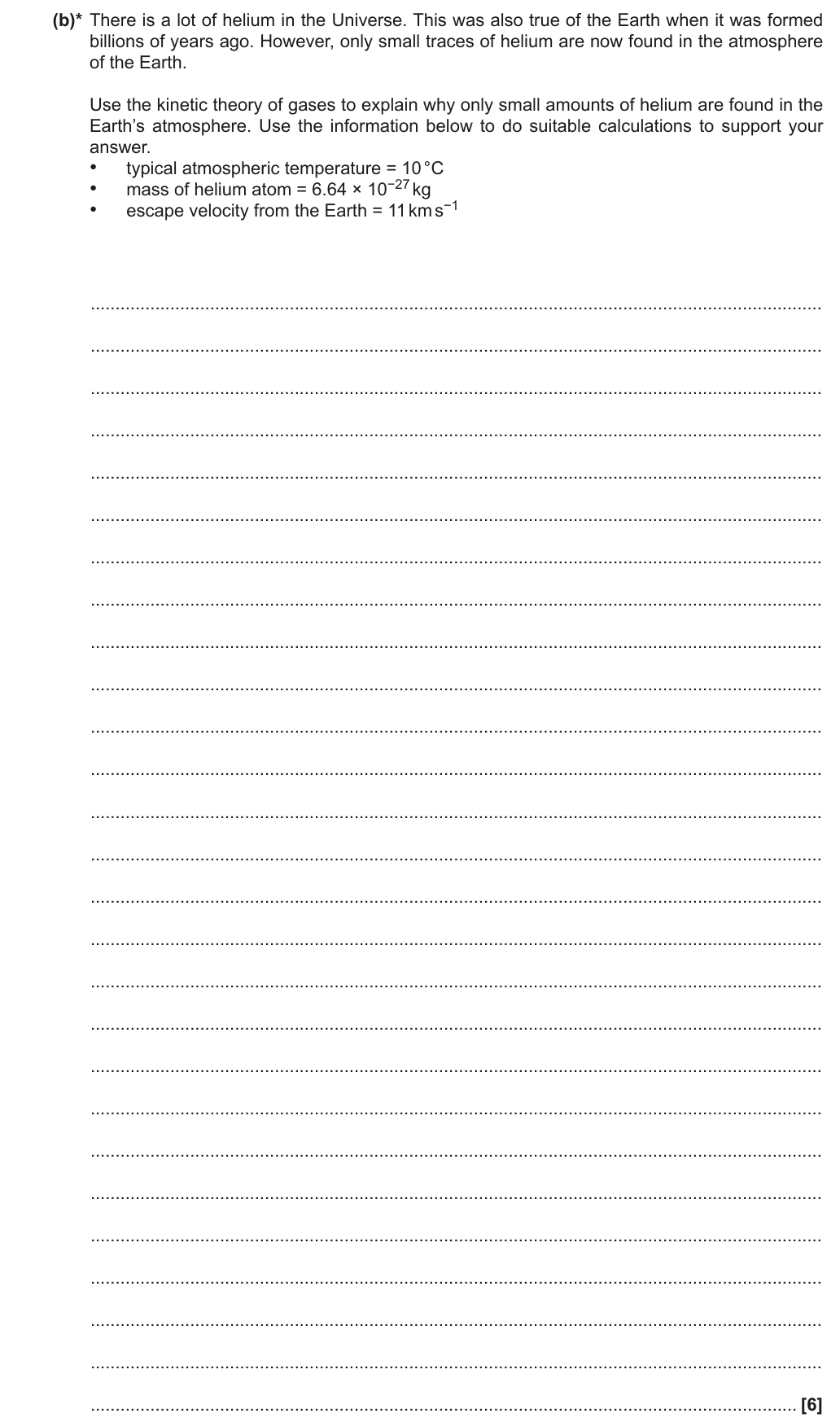
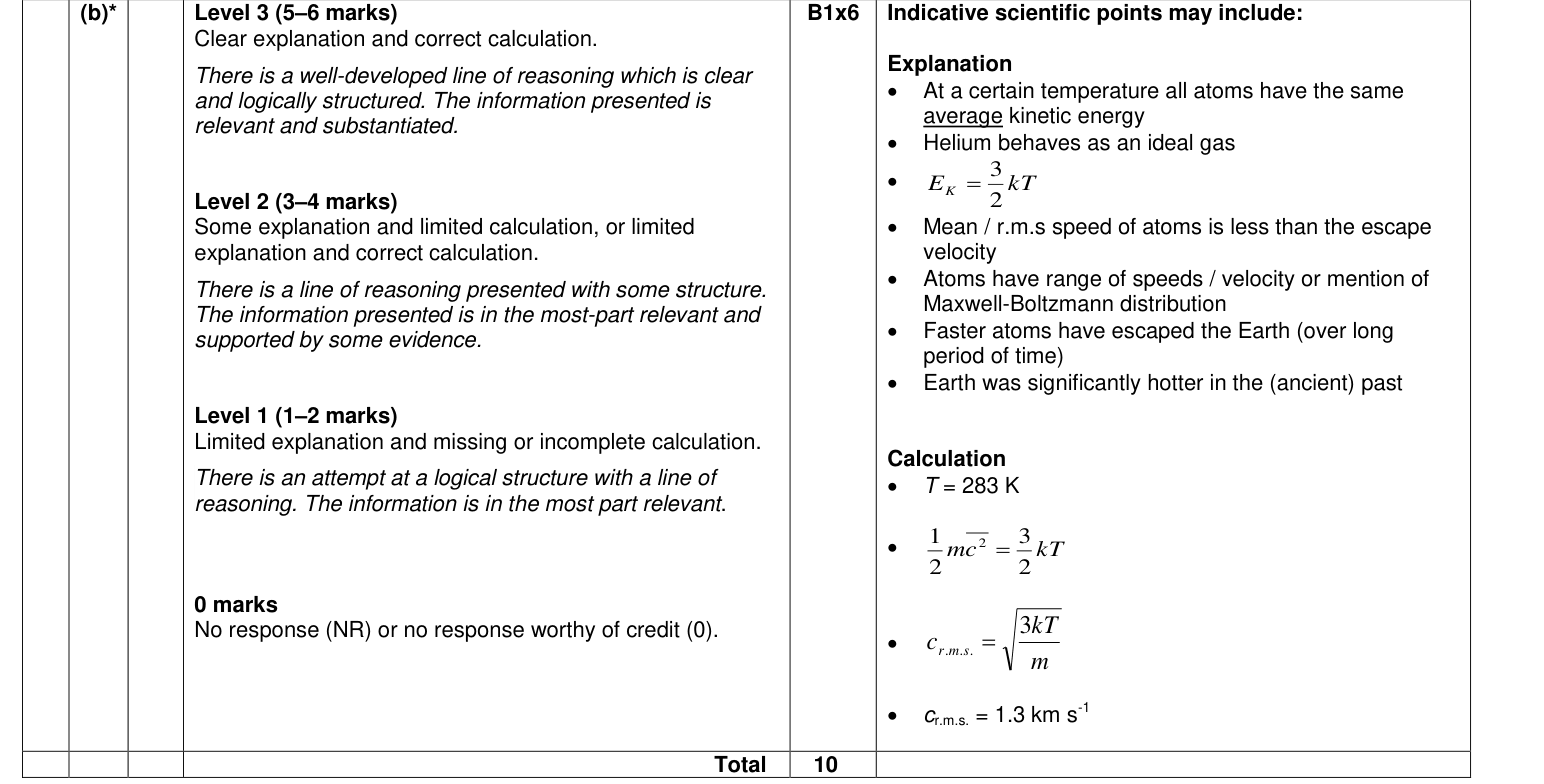
In correctly calculating the root means square speed and by being clear about how that has been calculated, this candidate has gained L2 already. There is a correct comparison of this speed with the escape velocity. There is also reference to the Boltzmann distribution of speeds, suggesting that even though a small fraction will have a sufficient velocity, over time those particles will escape. Most candidates made good progress with the calculation or provided an alternative by calculating the mean KE of a particle and comparing that with the KE a particle with escape velocity would have. A significant fraction made a poor comparison of their value with escape velocity (e.g. that 1300 ms-1 was greater than 11 km s-1) or compared the mean squared speed with the escape velocity.
Skills: M0.5 Use calculators to find and use power, exponential and logarithmic functions; M2.2 Change the subject of an equation, including non-linear equations; M2.3 Substitute numerical values into algebraic equations using appropriate units for physical quantities
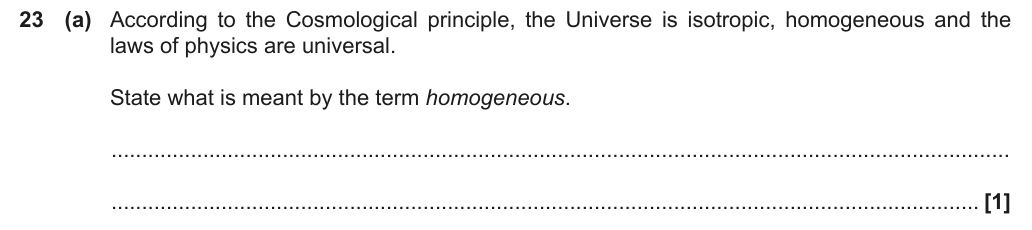
Just under half of the candidates got this term correct. The majority that did not confused this term with isotropic or used insufficiently clear language, such as ‘the universe is the same everywhere’.
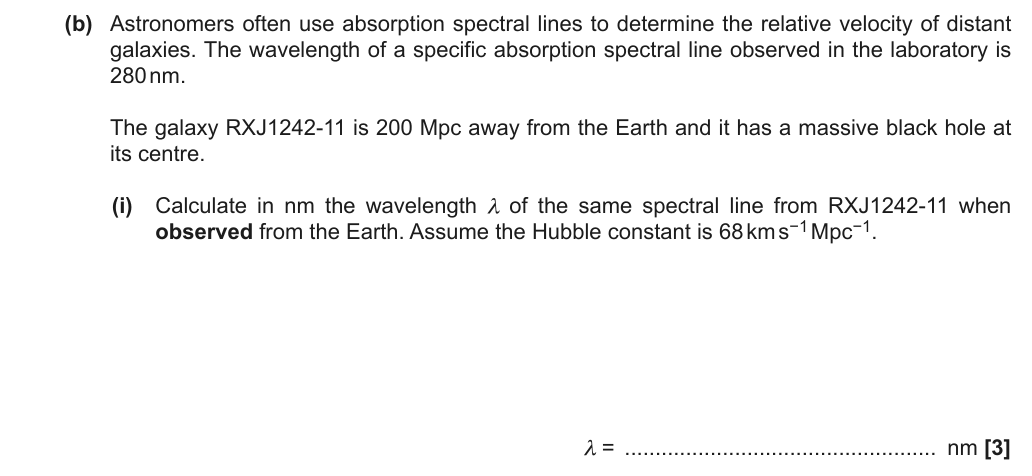
This is a more challenging question with several steps. In multiplying the distance in Mpc by the H0 as quoted, the velocity of the galaxy was 13600 km s-1. Some candidates handled the units well in this question, reaching a change in wavelength of 13 nm. If the candidate got as far as that, then approximately half then went on to add the change in wavelength correctly. The change is added as the galaxy is going away from us. This candidate has laid out the calculation very carefully. It is obvious that they have handled the idea that the speed of light is given in m s-1 and that the galaxy’s velocity is in km s-1. This gives the correct change in wavelength and eventually the correct wavelength.
Skills: M0.1 Recognise and make use of appropriate units in calculations; M2.2 Change the subject of an equation, including non-linear equations; M2.3 Substitute numerical values into algebraic equations using appropriate units for physical quantities

Lots of candidates had some good ideas here, and had clearly read widely about black holes. The better answers were those that were specific to black holes rather than merely ‘high mass’, for example. Good ideas included: ‘has an escape velocity greater (or equal to) the speed of light’ ‘infinitely dense’ ‘emits Hawking radiation’ ‘event horizon greater than physical radius’
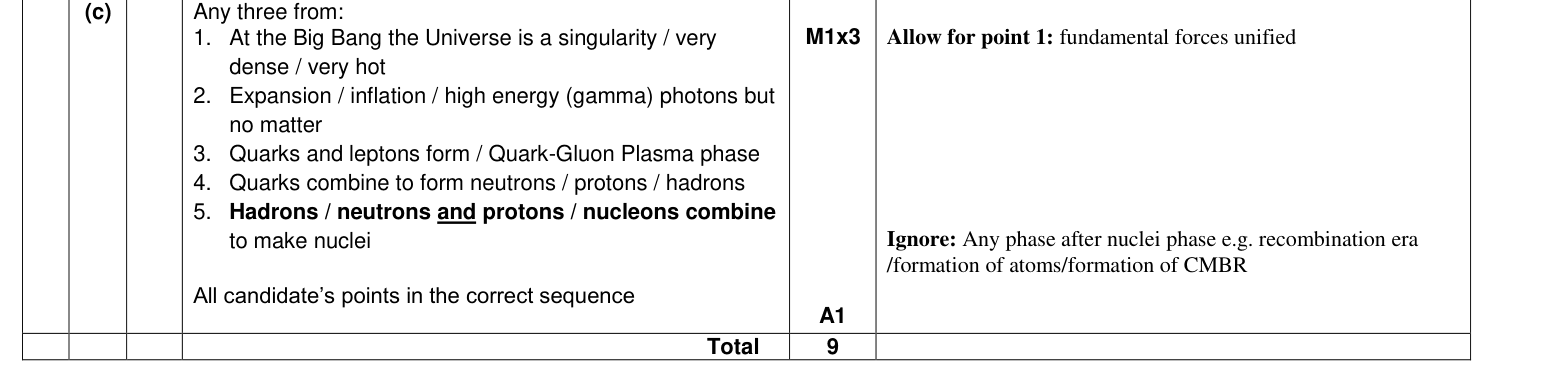
Many candidates did well on this question as they had learnt the stages and the order of those stages well. The most common reason for loss of marks was not including details about leptons or getting the stages in the wrong order.
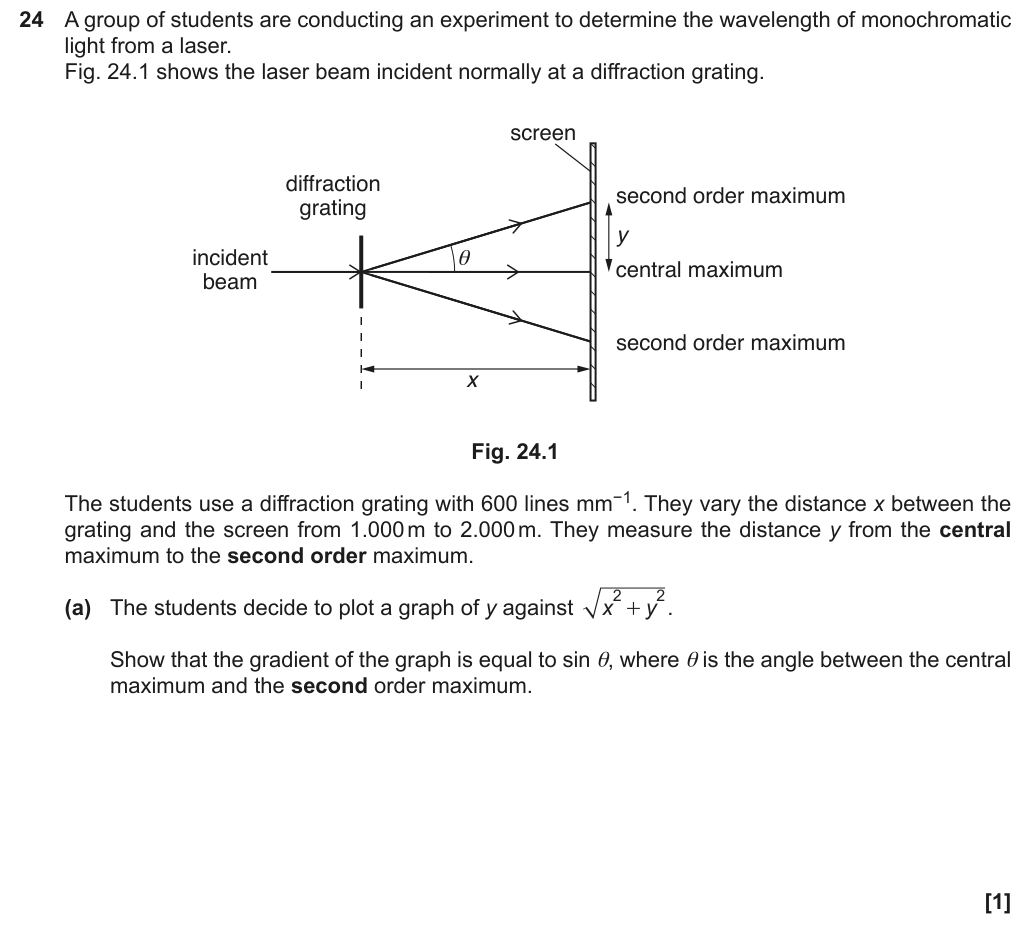
Candidates found this item tricky even if they realised that sin(θ) = y/ඥx2 + y2 and then re-arranged the equation into a form comparable with the general equation of a straight line, “y=mx +c”. Unless that comparison was clear, then the mark could not be credited. The exemplar shows a clear way of demonstrating how to show that the gradient of the line of the graph should be sin(θ).
Skills: M3.3 Understand that y = mx + c represents a linear relationship; M4.4 Use Pythagoras’ theorem, and the angle sum of a triangle; M4.5 Use sin, cos and tan in physical problems; PAG5 Investigating waves
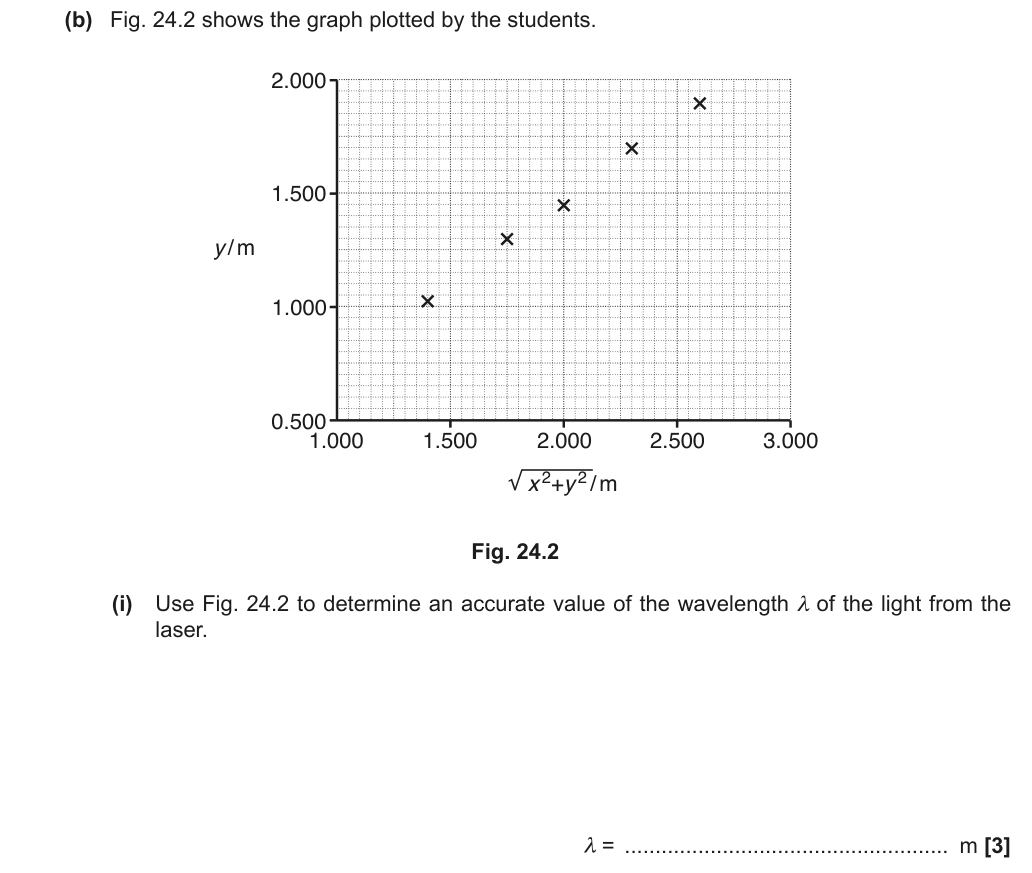
Many candidates could plot the best fit straight line and attempted to calculate the gradient. Not many candidates after that point realised that the gradient had given them sin(θ) and could make no further meaningful progress. Common errors included not calculating d correctly from the quoted number of lines mm-1 or, less frequently, was using a value different from 2 for n.
Skills: M2.3 Substitute numerical values into algebraic equations using appropriate units for physical quantities; M3.2 Plot two variables from experimental or other data; M3.4 Determine the slope and intercept of a linear graph; PAG5 Investigating waves

20 per cent of candidates did not attempt this item. Some candidates were on the right lines but very few mentioned about absolute uncertainty and that for these instruments and this graph, the absolute uncertainty was too small to view on this scale.
Skills: M1.5 Identify uncertainties in measurements and use simple techniques to determine uncertainty when data are combined; PAG5 Investigating waves

About two fifths of candidates appreciated that the precision would not be as good with a protractor, as repeated measurements would be less likely to cluster in close proximity. Precision The term ‘precision’ is defined of page 40 the Practical Skills Handbook, along with other useful terms that attempt to describe the quality of data Erratum notice
Want a paper marked and gone through with you? Message us.