Answer
D
Mark scheme

Examiner's comment
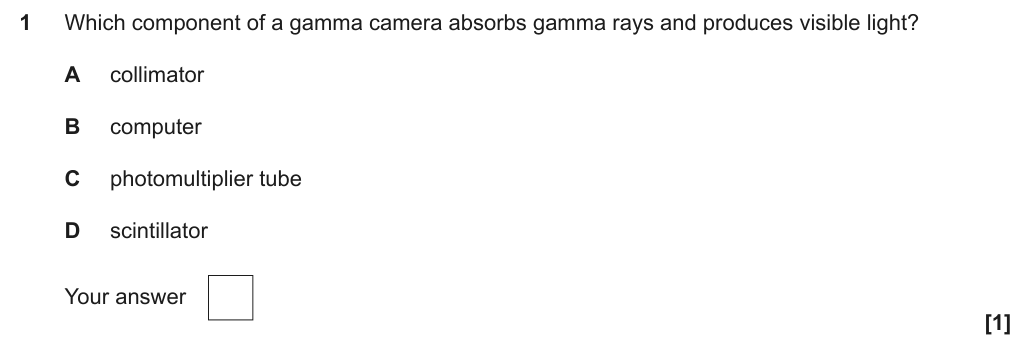
The majority of candidates were able to correctly recall the correct component. A proved a common distractor.
100 marks · 51 question parts · Paper, mark scheme and report on OCR's site · Have the Data, Formulae and Relationships Booklet beside you
D
The majority of candidates were able to correctly recall the correct component. A proved a common distractor.
C
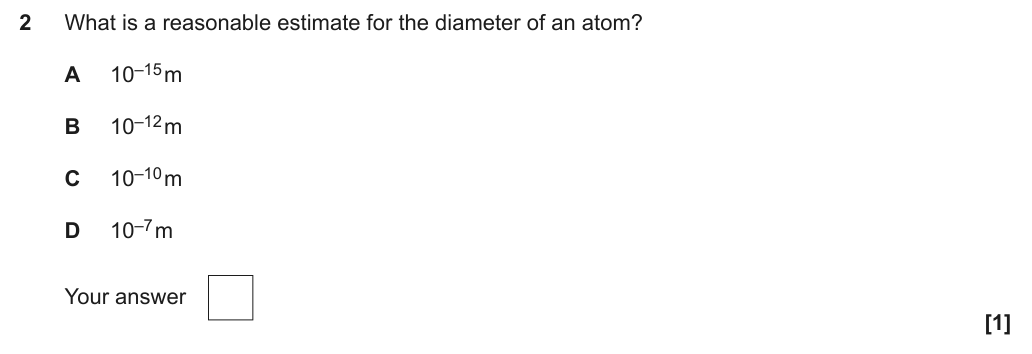
Only a few candidates were able to correctly identify the estimate for the diameter. Section 2.1.1 (b) of the specification requires candidates to be able to make estimates of physical quantities. B was the most common incorrect answer.
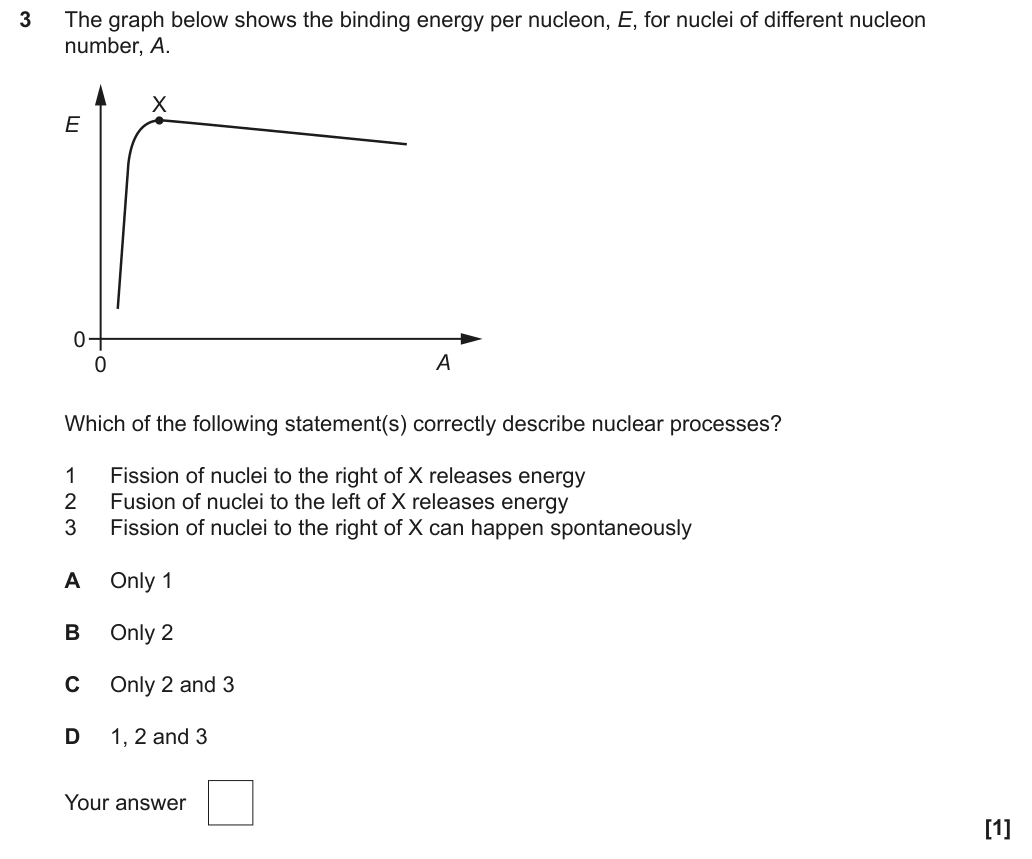
D
Most candidates were able to select the correct combination. Working by candidates often indicated that they knew that 1 and 2 were correct and so the only correct combination would be response D.
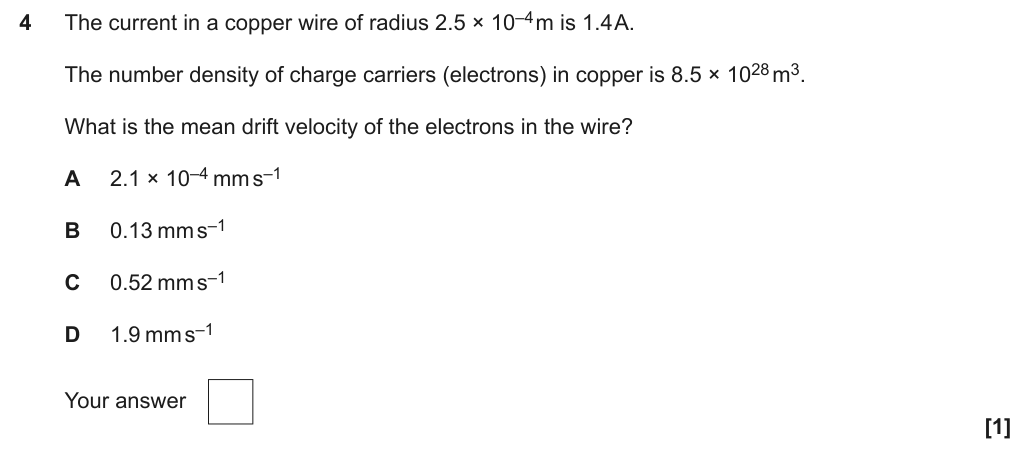
C
This relatively straightforward calculation, with no difficult unit conversions, was correctly answered by many candidates. The calculation does involve calculating the cross-sectional area, and many candidates showed this in working at the side, to support their calculation.
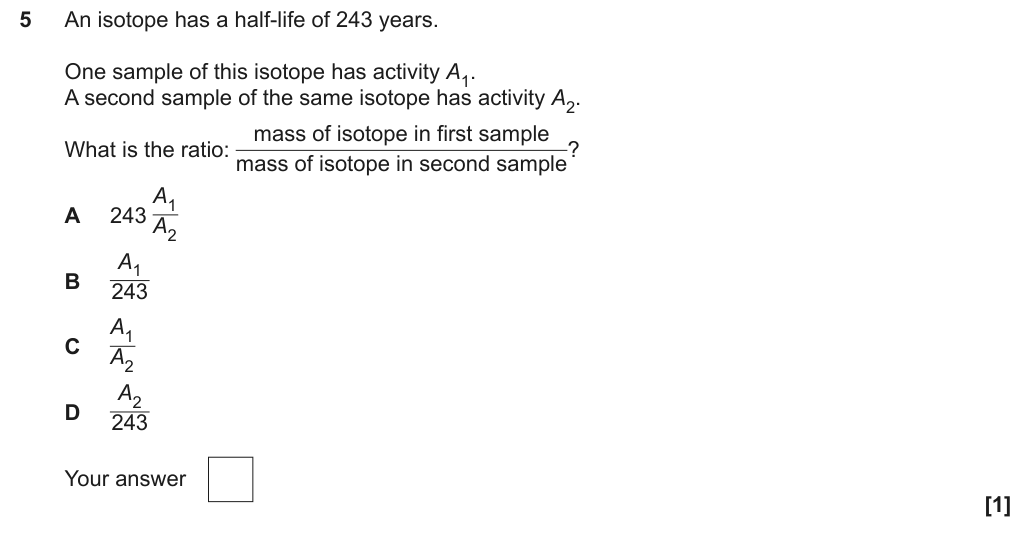
C
Most candidates were able to correctly identify the ratio. Many candidates worked the answer from first principles, clearly showing that the factor 243 would cancel in their calculation.
Skills: M0.3 Use ratios, fractions and percentages
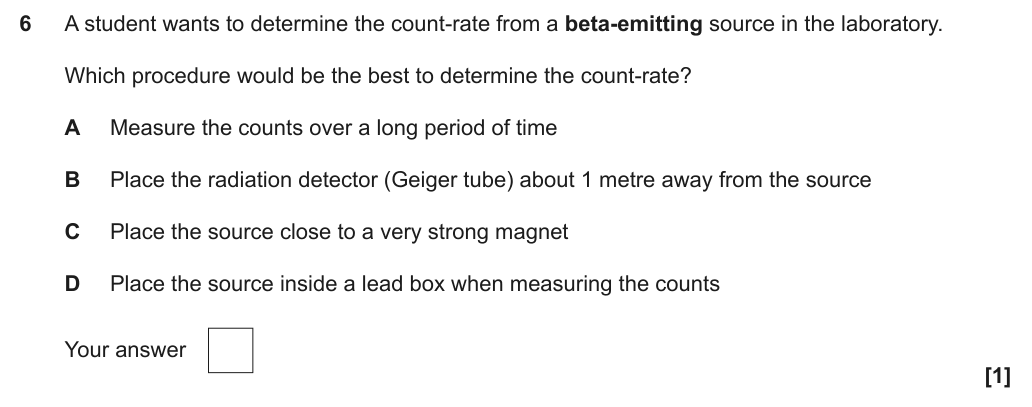
A
Correctly identifying the best procedure proved challenging for candidates. Many incorrect responses were given as B.
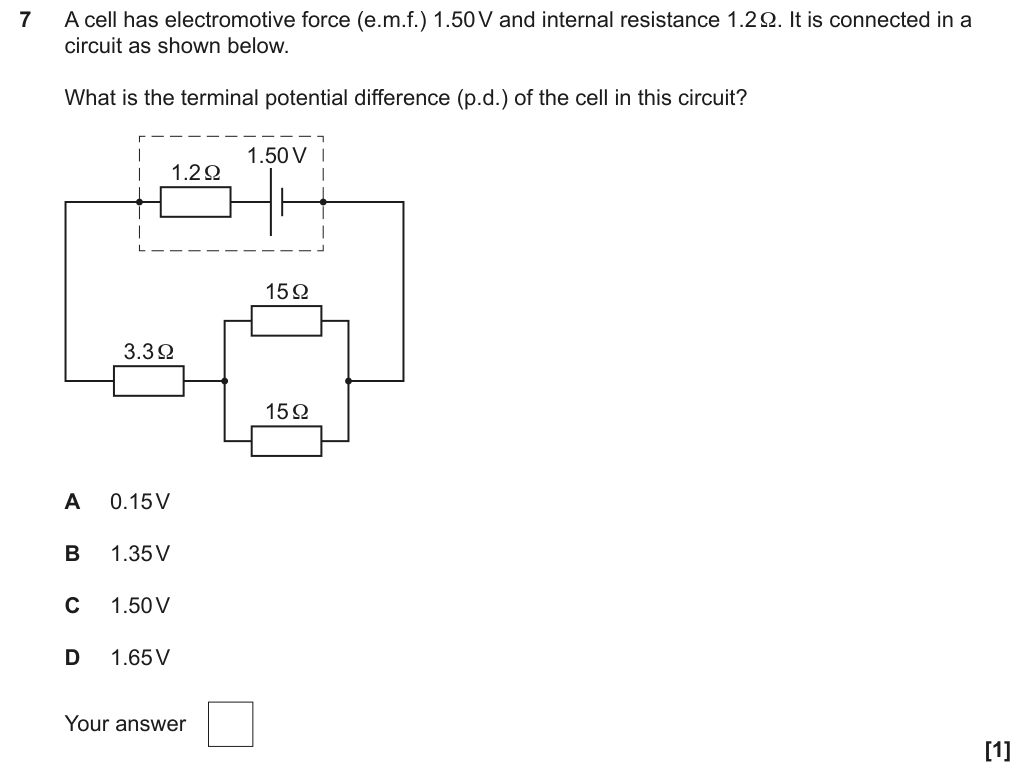
B
Most candidates were able to correctly identify the terminal p.d. Notably, many answers which did not show the correct response showed no, or little relevant, working.. Some candidates chose D, possibly showing an issue understanding of the relationship between e.m.f. and terminal p.d..
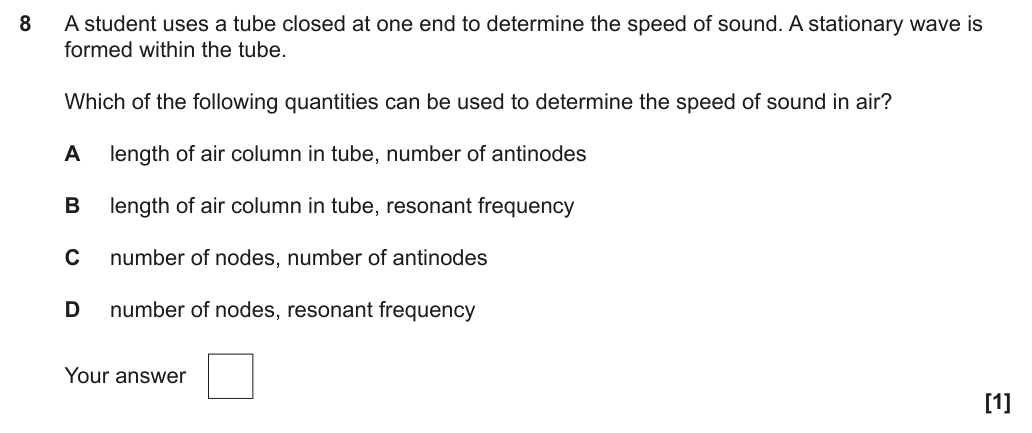
B
Most candidates gave the correct response. Many candidates drew helpful diagrams of a standing wave in a tube to help them identify relevant quantities.
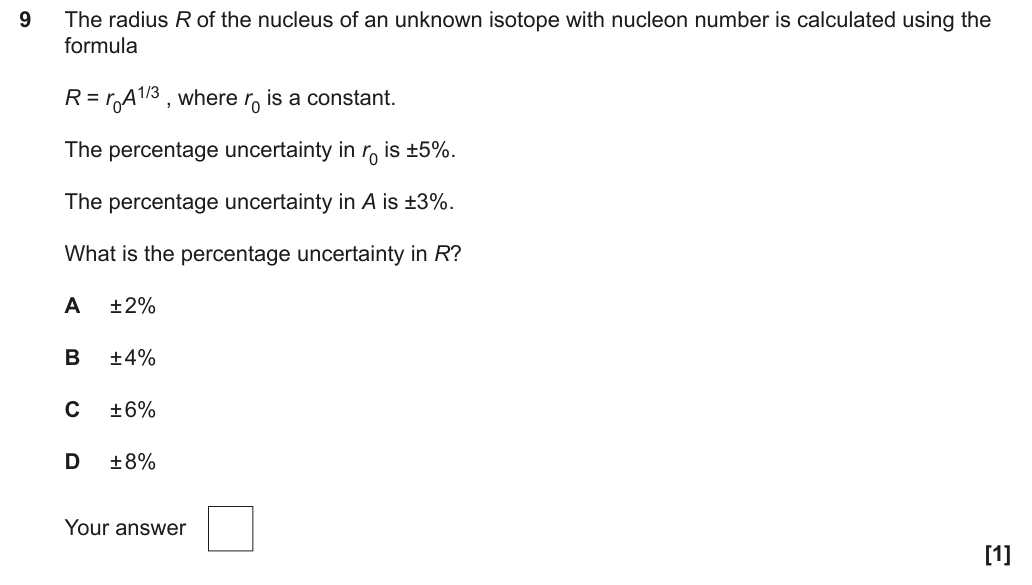
C
Most candidates were able to calculate the correct percentage uncertainty even though uncertainty questions can be challenging. Response D was the most common incorrect response.
Skills: M1.5 Identify uncertainties in measurements and use simple techniques to determine uncertainty when data are combined
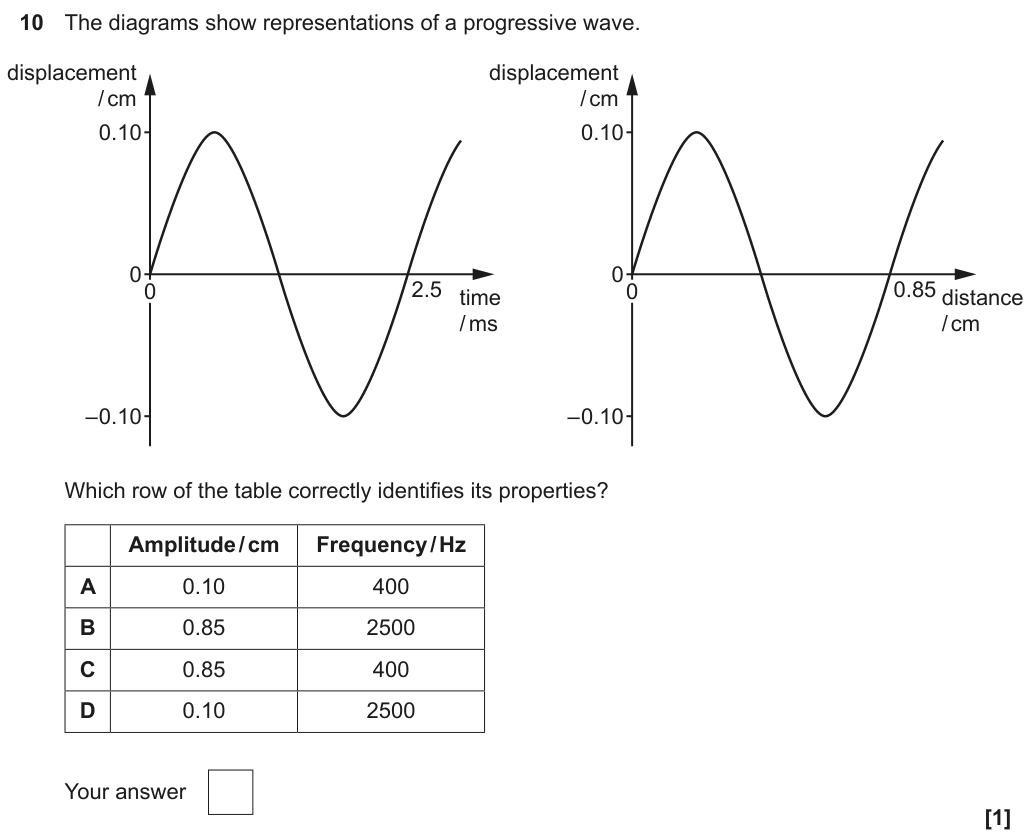
A
This relatively straightforward property of wave question was accessible to most candidates, with almost all candidates obtaining the correct answer. Candidates quite often cross incorrect responses and many put a cross against response B and C, as the correct amplitude was relatively simple to identify.
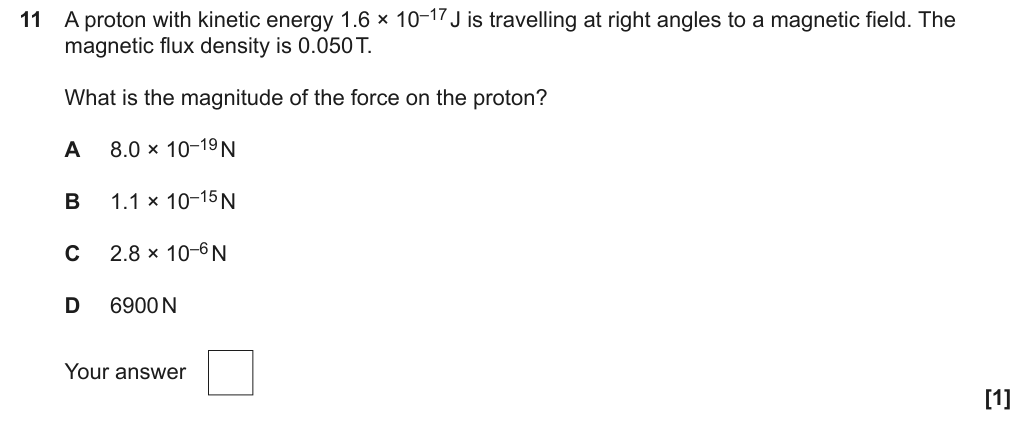
B
Many candidates were able to correctly complete this two-stage calculation. Most candidates showed clear working although several attempted to use a centripetal force equation. Many of the candidates who did not select the correct response did set up the equations correctly but seemed unable to recall the charge on the proton.
Skills: M0.2 Recognise and use expressions in decimal and standard form; M2.2 Change the subject of an equation, including non-linear equations; M2.3 Substitute numerical values into algebraic equations using appropriate units for physical quantities
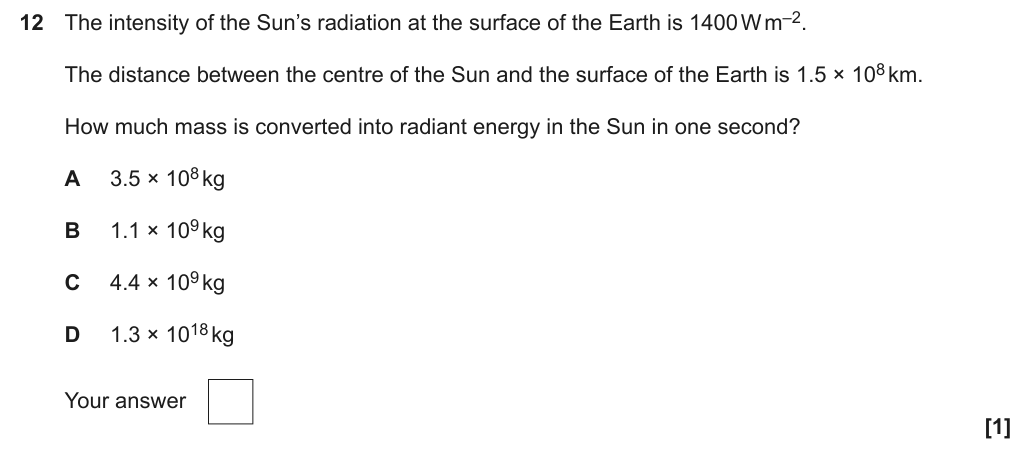
C
A little under half of candidates were able to correctly calculate the mass. While many were able to appreciate that 𝐼 = 𝐴 should be used, it was common not to be able to correctly calculate the area. A was the most popular incorrect response.
Skills: M0.1 Recognise and make use of appropriate units in calculations; M0.2 Recognise and use expressions in decimal and standard form; M4.3 Calculate areas of triangles, circumferences and areas of circles, surface areas and volumes of rectangular blocks, cylinders and spheres
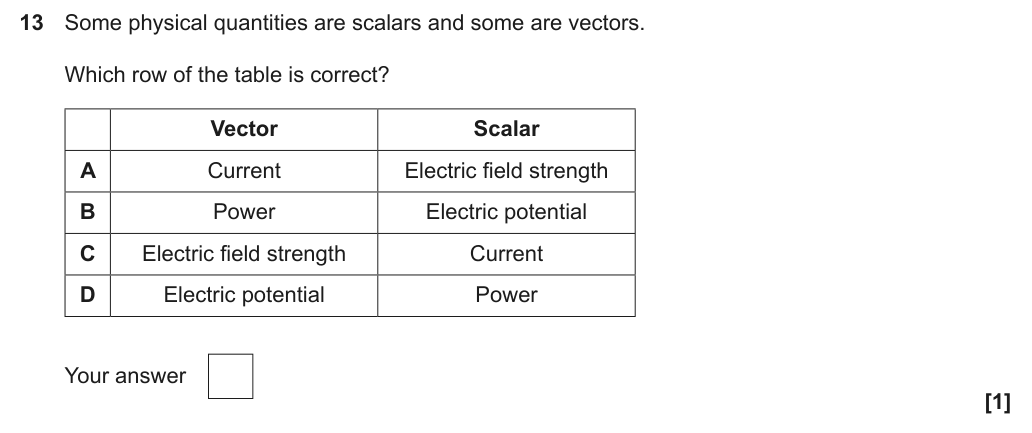
C
This was a challenging question. As is common in this style of question, candidates tick and cross those they know to be correct (or incorrect) but the inclusion of potential and field strength clearly made this more challenging. D was by far the most common incorrect response as candidates seemed to know that power was a scalar.
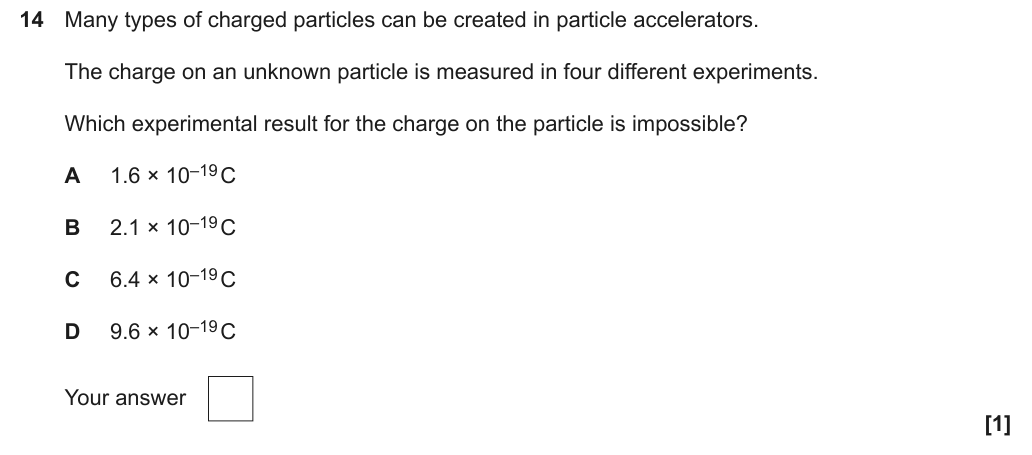
B
Most candidates appreciated that the change should be a multiple of the elementary charge and many were able to calculate the correct response. D was the most common incorrect response.
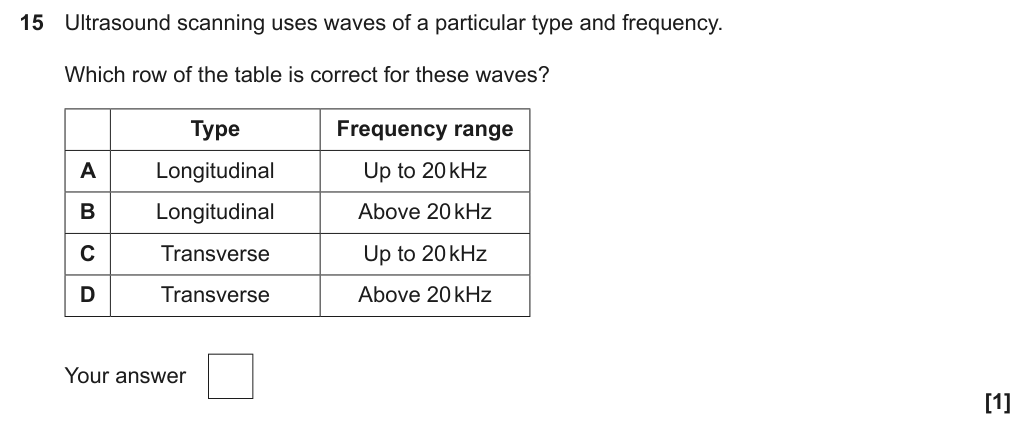
B
Many candidates were able to correctly identify the pair. The most common incorrect response was D which suggested that there is uncertainty between which type of wave ultrasound is.
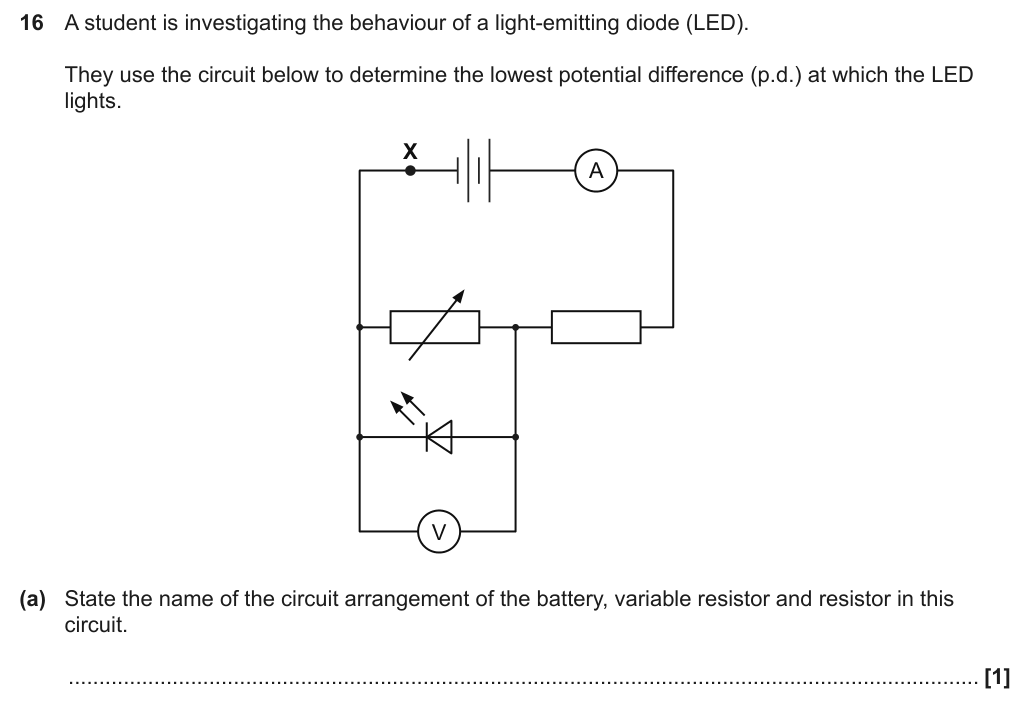
The anticipated response was potential divider. However, many candidates gave the response series, which is also correct. Common incorrect responses were ‘potentiometer’ and ‘parallel’, presumably thinking of the variable resistor and diode combination.

The vast majority of candidates were able to correctly identify the direction. This was indicated in many ways, from a single arrow on a point on the circuit, to multiple loops around each separate part. Few candidates did not attempt this, which may be due to missing the question rather than a lack of understanding. Candidates are encouraged to take care to look for questions where there is no clear answer space.
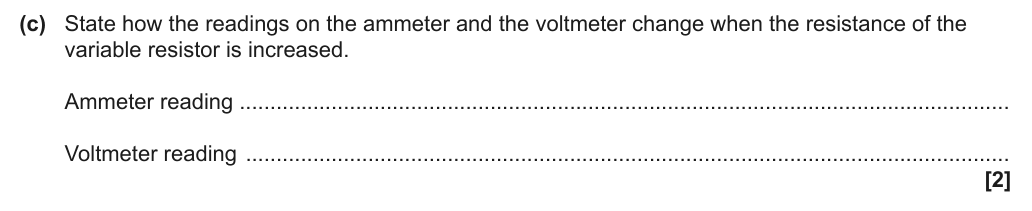
Most candidates were able to appreciate that the voltmeter reading would increase while carrying out the described investigation. Many scripts stated that the ammeter reading would stay the same. A few attempted to justify this (although it was not required) by quoting Kirchhoff’s 1st law and stating that current remained the same in a circuit.
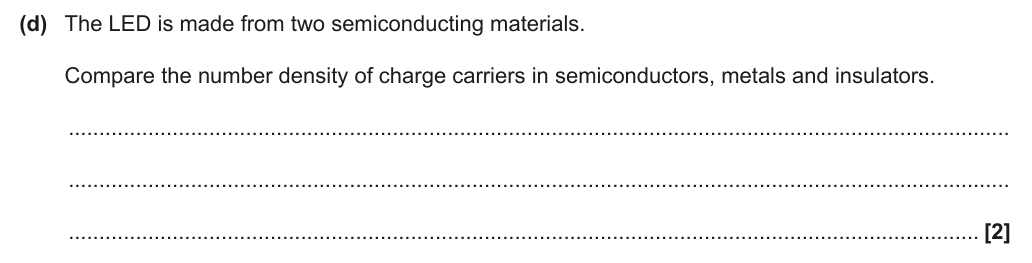
Most candidates were able to appreciate the order of number density of charge carriers. Many candidates gave numerical values to support their answer, although this was not required, and in many cases their values were accurate. Candidates should be encouraged to use comparative terms (highest, higher) rather than simple stating that values are high, as this can lead to ambiguity.
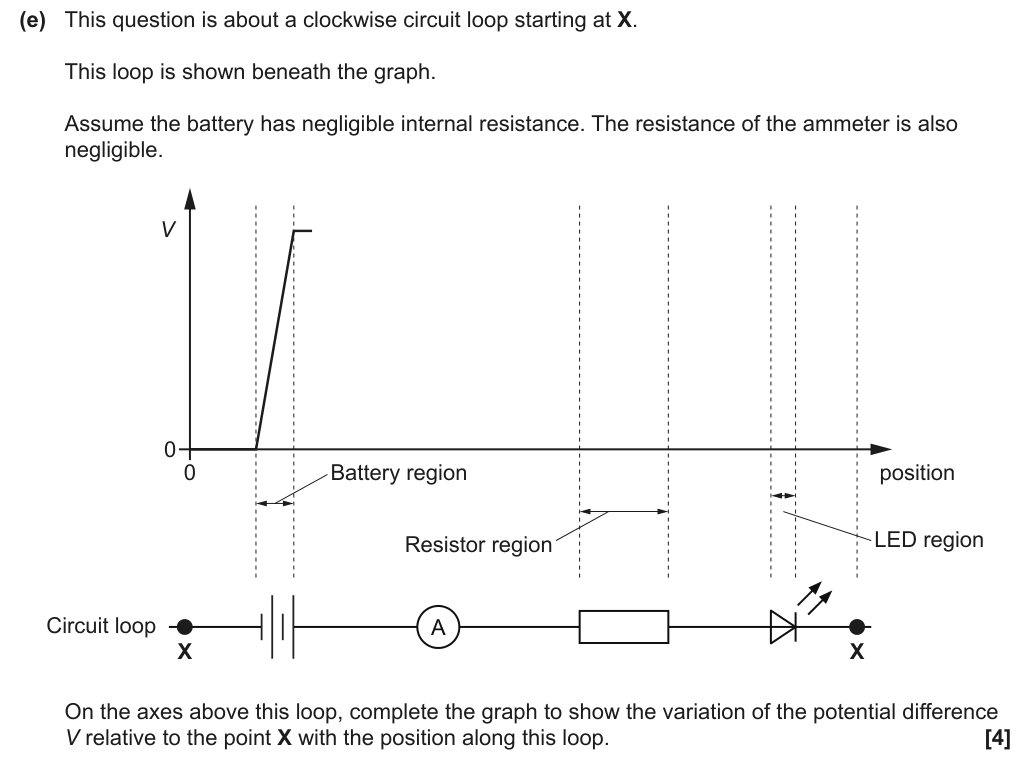
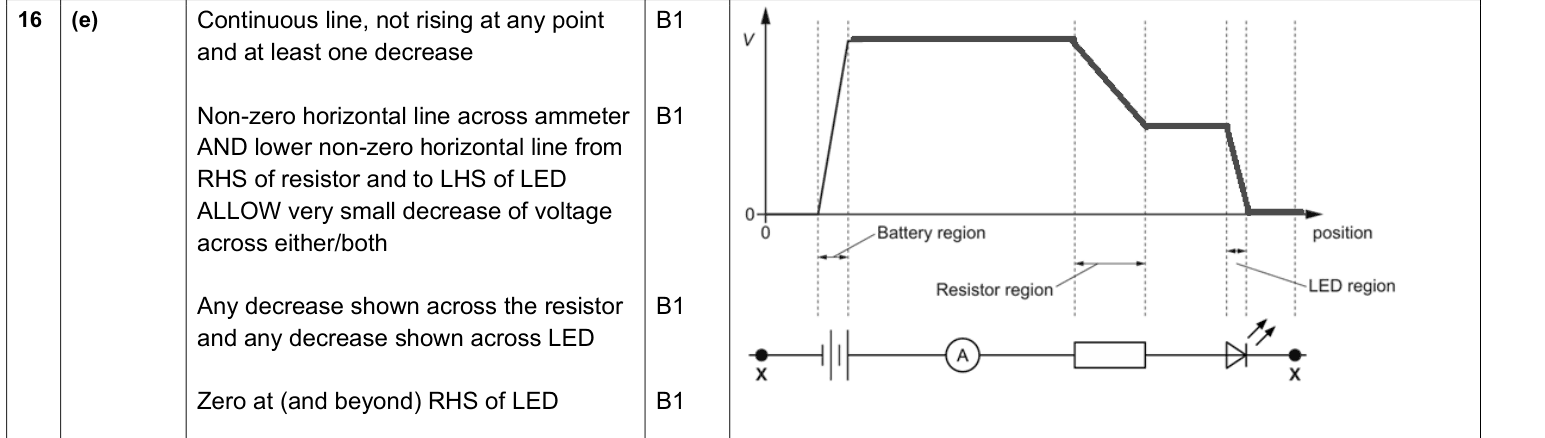
This is a novel way of showing how the potential difference varies across components in a circuit. Many candidates were able to score all 4 marks. Common incorrect responses included having sudden jumps at the start or end of a component, having significant falling p.d. across wires, and most commonly having a non-zero p.d. after the diode. Several candidates showed a rising p.d. at some points, demonstrating a lack of appreciation of what p.d. represents in a circuit.
Skills: M3.12 Sketch relationships which are modelled by y = k/x, y = kx², y = k/x², y = kx, y = sin x, y = cos x, y = e^(±x) and y = sin²x, y = cos²x as applied to physical relationships

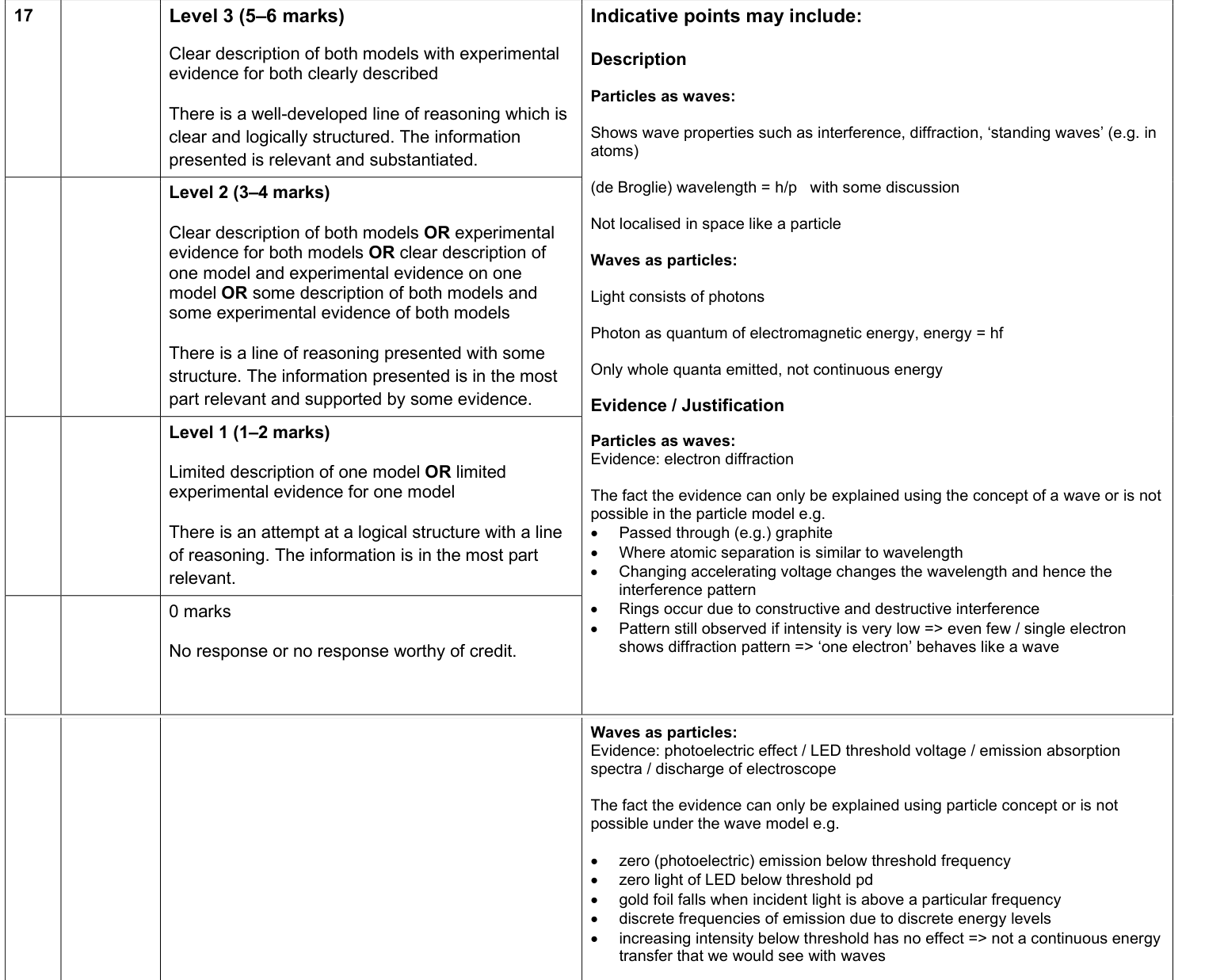
This Level of Response question was designed to assess the candidates’ knowledge of various aspects of wave-particle duality, in particular each model and experimental evidence. The key points in the description that examiners were looking for were: • a description of a model of how particles can be described as waves, and some experimental evidece to support this • a description of how waves can be described as particles, and some experimental evidence to support this. To obtain Level 3, it is important that all four aspects of this are approached. For the most part, it was clear that candidates had a general knowledge of this topic. Many were able to give some descriptions of electron diffraction and ‘the gold leaf experiment’, but not all gave sufficient detail in terms of the requirements of the question. Although not always required, it would be expected that candidates may use an equation in their description (the de Broglie relationship and E = hf) to support how the particle can be considered to act as a wave, and vice versa. More successful candidates used this in conjunction with the experimental evidence to draw their conclusions. The most common experimental evidence, which could achieve Level 3 if approached correctly, were electron diffraction through graphite and some form of the photoelectric effect. Anticipated detail for experimental evidence would be to explain how a diffraction pattern leads to the idea of waves, and with the idea of a threshold frequency. These can only be explained by use of the correct model and would support the response. Common weak points were to describe the electrons passing through a double slit, describing the interference pattern as fringes rather than concentric rings and explaining the photoelectric effect theoretically without any evidence. The question stated that there was no requirement to explain the experimental detail (as evidence was required) but several candidates used time doing so. Using the gold leaf electroscope (which many candidates had seen) is a good way to demonstrate the photoelectric effect, however there seemed to be some confusion about whether it was initially charged, and if so whether it was positive or negative, The statement ‘one to one interaction’ was common, although was often used without support and it was clearly something that had been learnt. Most candidates used the space, including the additional space, to answer this question. It is always possible to obtain a Level 3 in the given space by carefully answering the question rather than giving superfluous information and candidates are encouraged to think a little about their response before starting. This exemplar shows a good response, but not sufficient to reach Level 3. The candidate has given a fair, yet brief, description of the experimental evidence for electron diffraction, showing particles acting as waves. Similarly, the photoelectric effect is explained to some level of detail about how it demonstrates where a wave acts like a particle. There is little in terms of the descriptions of the model in either of these. There is a reference to diffraction for the wave model and use of the term ‘photon’ for the particle model. Considering the level guidance, this has some description of both model and experimental evidence so falls into Level 2. The experimental evidence has some valid details, so can be awarded the top of this level, 4 marks.
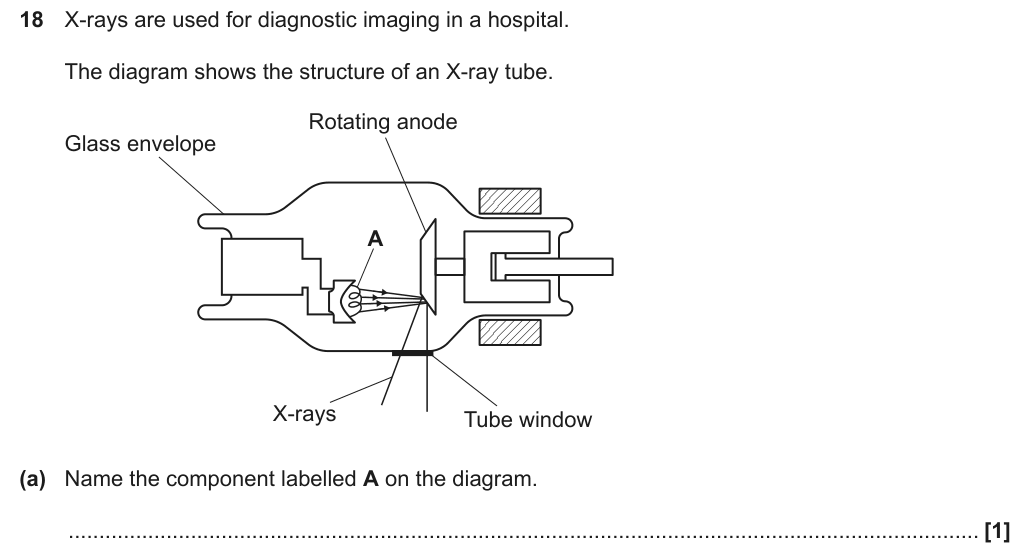
Component A can correctly be described by several terms, although cathode is the most appropriate. Several candidates called the component a coil, which is more a description. ‘Electron emitter’ and ‘thermionic emitter’ similarly describe its function rather than name it.

The main point of the rotation is to avoid overheating and so any statement about the heating of the anode would score a mark here. There were several vague responses to do with the anode wearing out and the electrons hitting evenly, in additional to a common response about the anode becoming negatively charged. The command word ‘suggest’ implies that candidates should use their knowledge to draw a possible conclusion. Only a few candidates did not attempt this question.
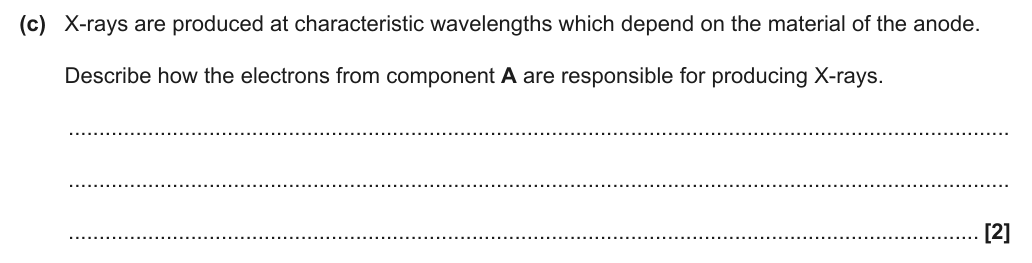
There are two possible ways to answer this question, and most candidates chose to follow only one. The first method is to describe the production of characteristic X-rays. Many candidates explained this in terms of excitation and de-excitation rather than removal of the electrons and vacancy filling. The alternative way is to describe the production of bremsstrahlung, via slowing down and loss of kinetic energy. Detail is required in this response, such as where the deceleration occurs. Overall, it was clear that the candidates had a general understanding of one of these processes.
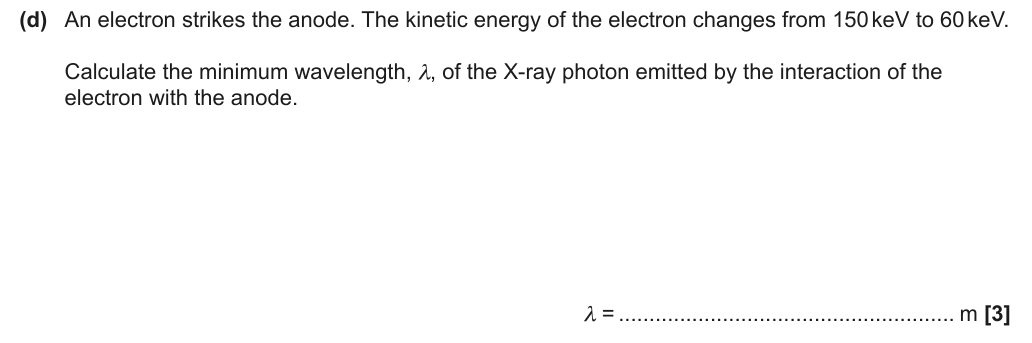
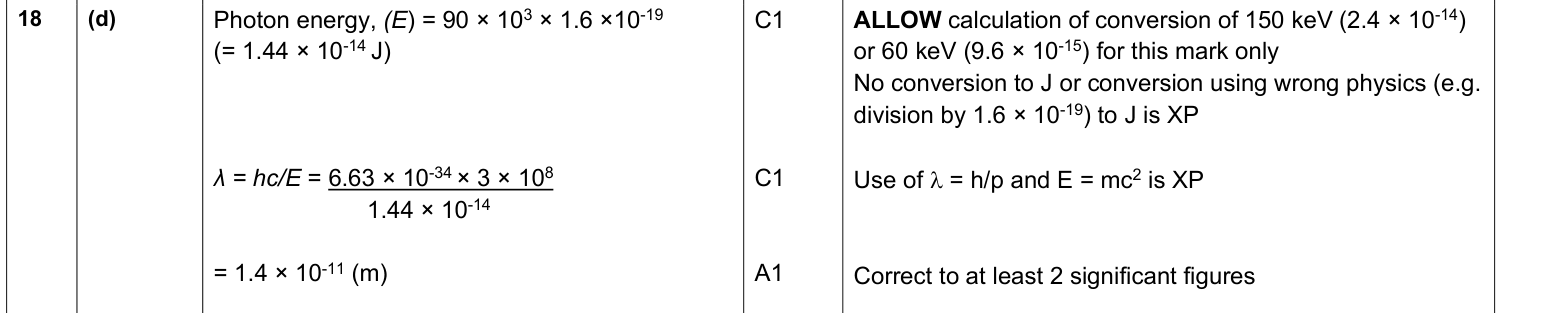
This two-step calculation was correctly carried out by nearly three quarters of candidates. Most appreciated that the change in kinetic energy was needed, and so correctly determined 90 keV as the required energy and were able to use this in determining the wavelength. Few candidates determined the frequency first and then went on to calculate the wavelength separately. Common errors included missing that the photon energy was in keV, rather than eV, and using the wrong energy. A mark was available for correct conversion of either 150 keV or 60 keV to joules, but there could be no further credit.
Skills: M0.2 Recognise and use expressions in decimal and standard form; M2.2 Change the subject of an equation, including non-linear equations; M2.3 Substitute numerical values into algebraic equations using appropriate units for physical quantities
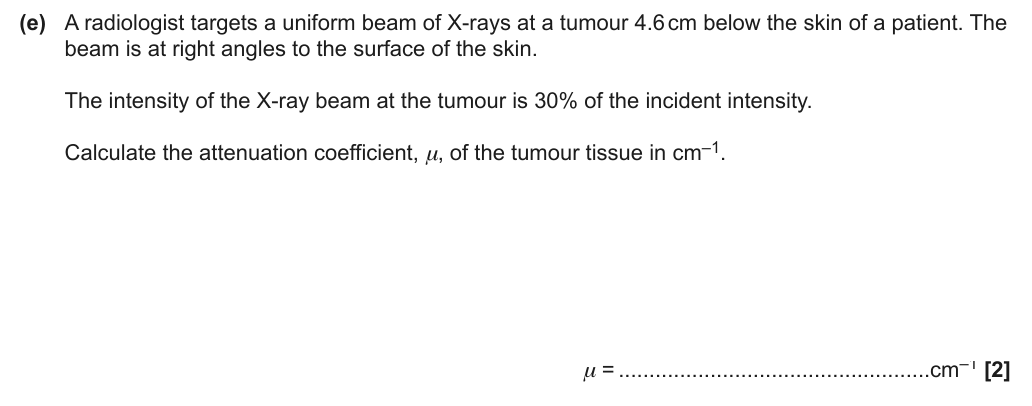
This calculation was correctly done by many candidates. The ability to manipulate the exponential and take logs caused few difficulties and candidates set out the working carefully and clearly for the most part. Several candidates tried to use a value of 70%, which could not score any marks. There was occasional confusion over the units, with candidates attempting to move in or out of cm to m.
Skills: M0.5 Use calculators to find and use power, exponential and logarithmic functions; M2.3 Substitute numerical values into algebraic equations using appropriate units for physical quantities; M2.5 Use logarithms in relation to quantities that range over several orders of magnitude
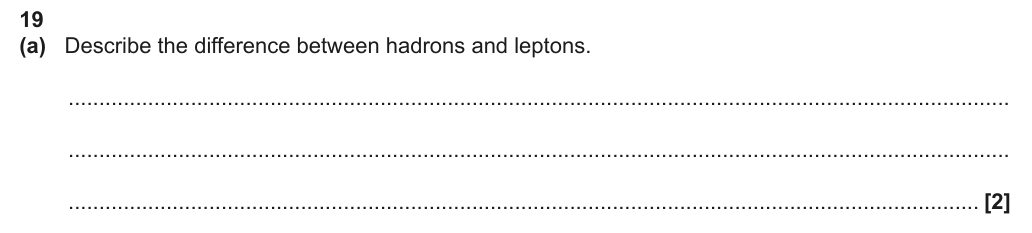
The two main answers to this were either in terms of the strong force, or in terms of the composition. Several candidates gave both of these, although a wrong answer could negate a correct one. Responses in terms of mass, charge, location, etc were ignored. A few candidates confused leptons for baryons and stated that they were formed from a quark and an antiquark
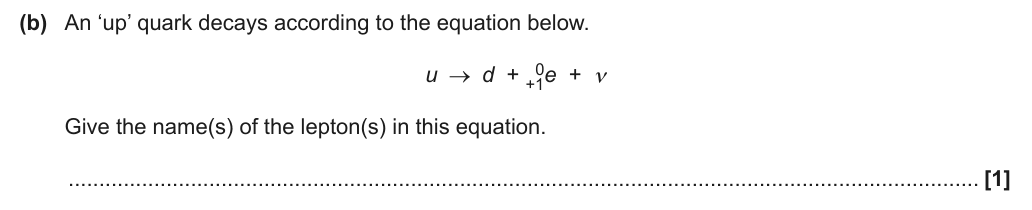
Most candidates were able to correct name both leptons. A significant number called the positron an electron, and many incorrect answers only gave one particle. A small number gave the symbols which would not score the mark.
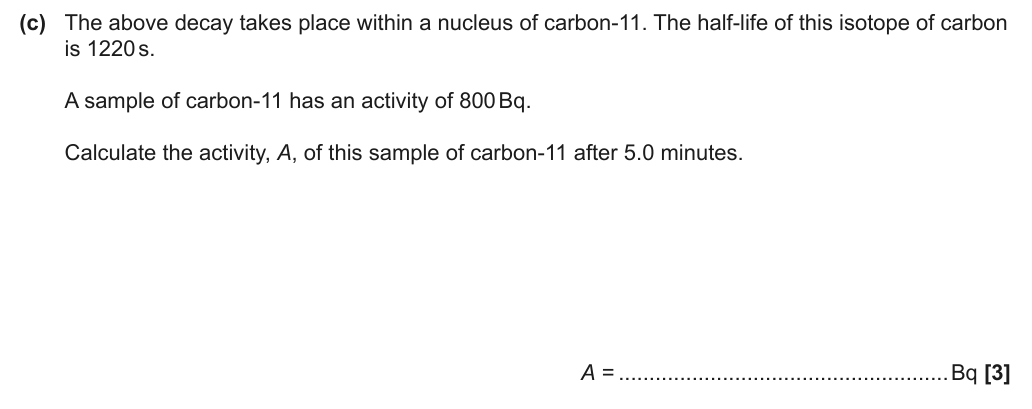
The majority of the candidates were correctly able to calculate the activity. Setting out of the working was helpful to the candidates, especially with a separate calculation of the decay constant. There was little confusion over time units, and most candidate chose to work in seconds. The data is given to 2 significant figures and the expected answer should be correct to 2 significant figures also (670 Bq). With some intermediate rounding, several candidates ended up at 680 Bq which will lose the final mark. Candidate are encouraged to store any intermediate calculations in calculator memory to maintain the full significant figures.
Skills: M0.1 Recognise and make use of appropriate units in calculations; M0.5 Use calculators to find and use power, exponential and logarithmic functions; M2.3 Substitute numerical values into algebraic equations using appropriate units for physical quantities
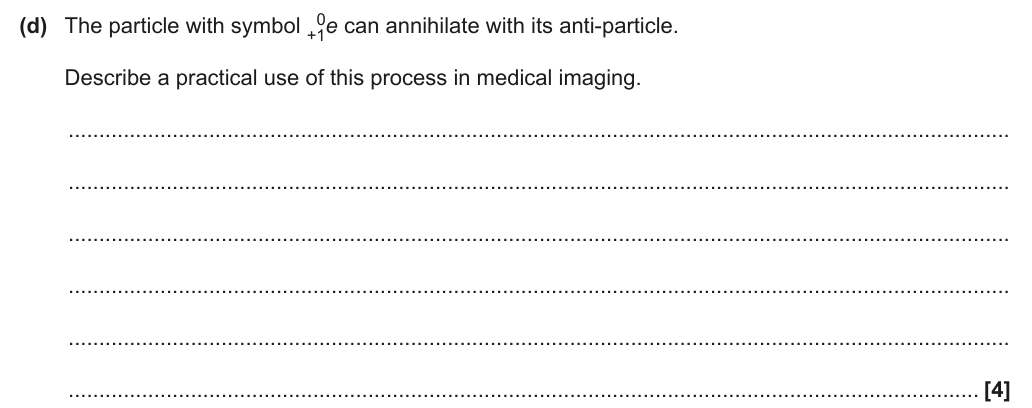
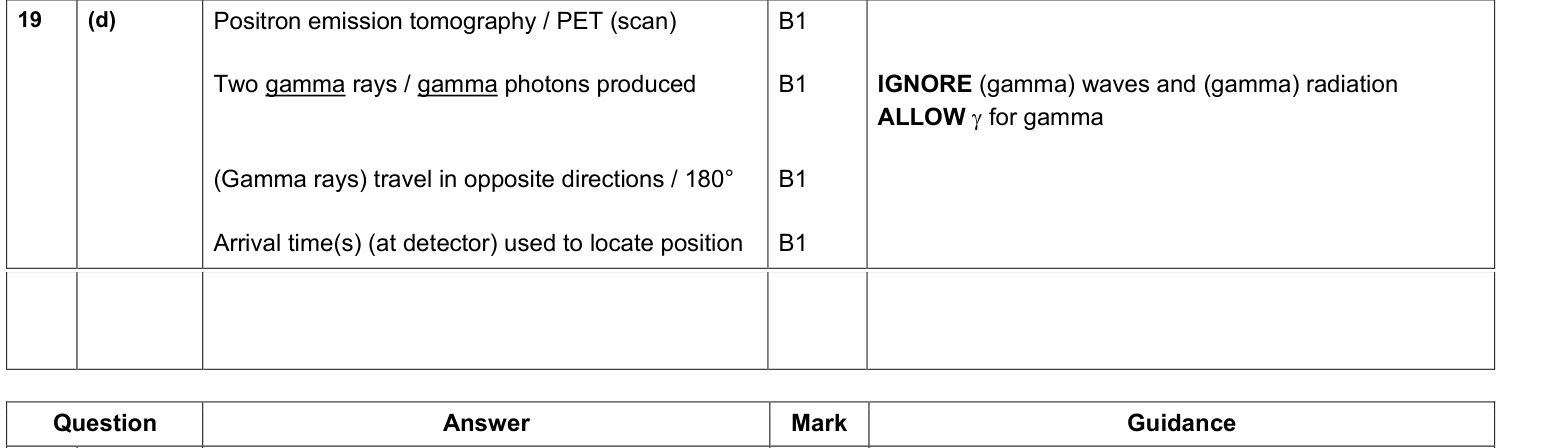
Most candidates appreciated that the use required in this question was a PET scanner, although a small number incorrectly called it a CAT scanner. The general principles were given, but detail is required for clarity. Such as, there need to be two gamma photons, they need to travel in opposite (not different) directions and the time delay needs to be recorded at the detector. There was some confusion that the positron-electron pair were being detected.
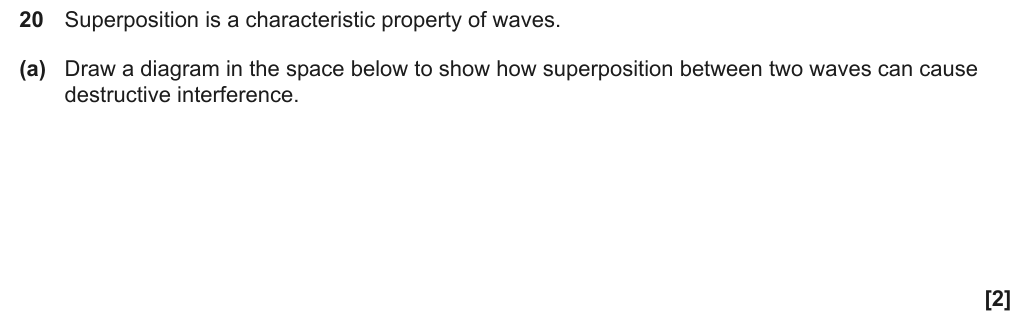
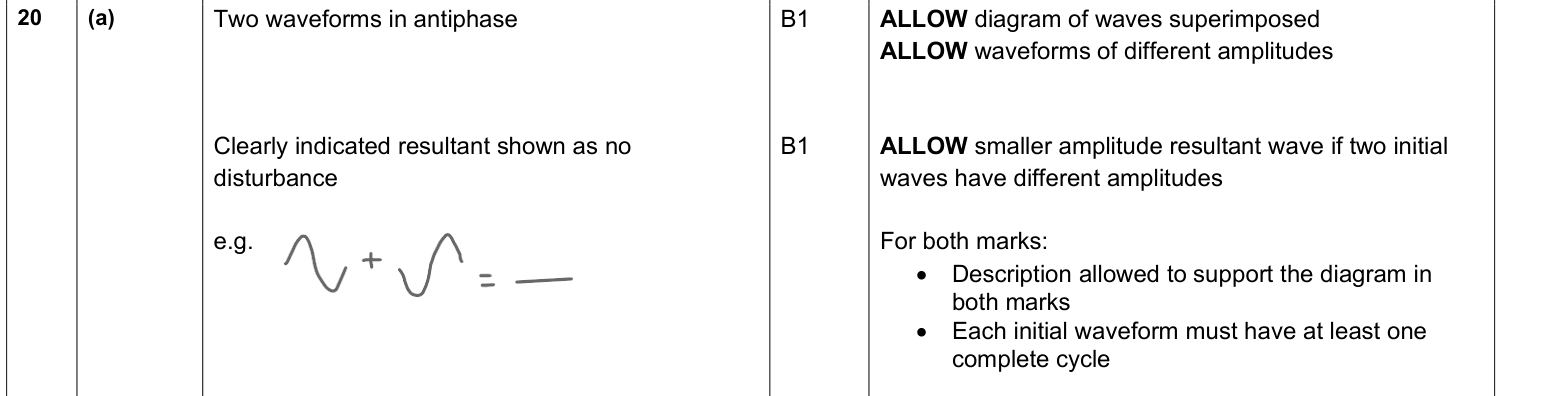
This question required the drawing of two transverse waves in antiphase, and a resultant shown with zero amplitude. Examiners need to use their professional judgement regarding the clarity of the diagrams and so annotations can help. Several candidates stated, but did not draw, the resultant and so could not be awarded the second mark. Some candidates drew the initial waves with different amplitudes and it was acceptable to draw a non-zero resultant, as long as it demonstrated destructive interference. A few candidates drew interference from circular wavefronts, but this was very unlikely to be awarded any marks.
Skills: M3.12 Sketch relationships which are modelled by y = k/x, y = kx², y = k/x², y = kx, y = sin x, y = cos x, y = e^(±x) and y = sin²x, y = cos²x as applied to physical relationships
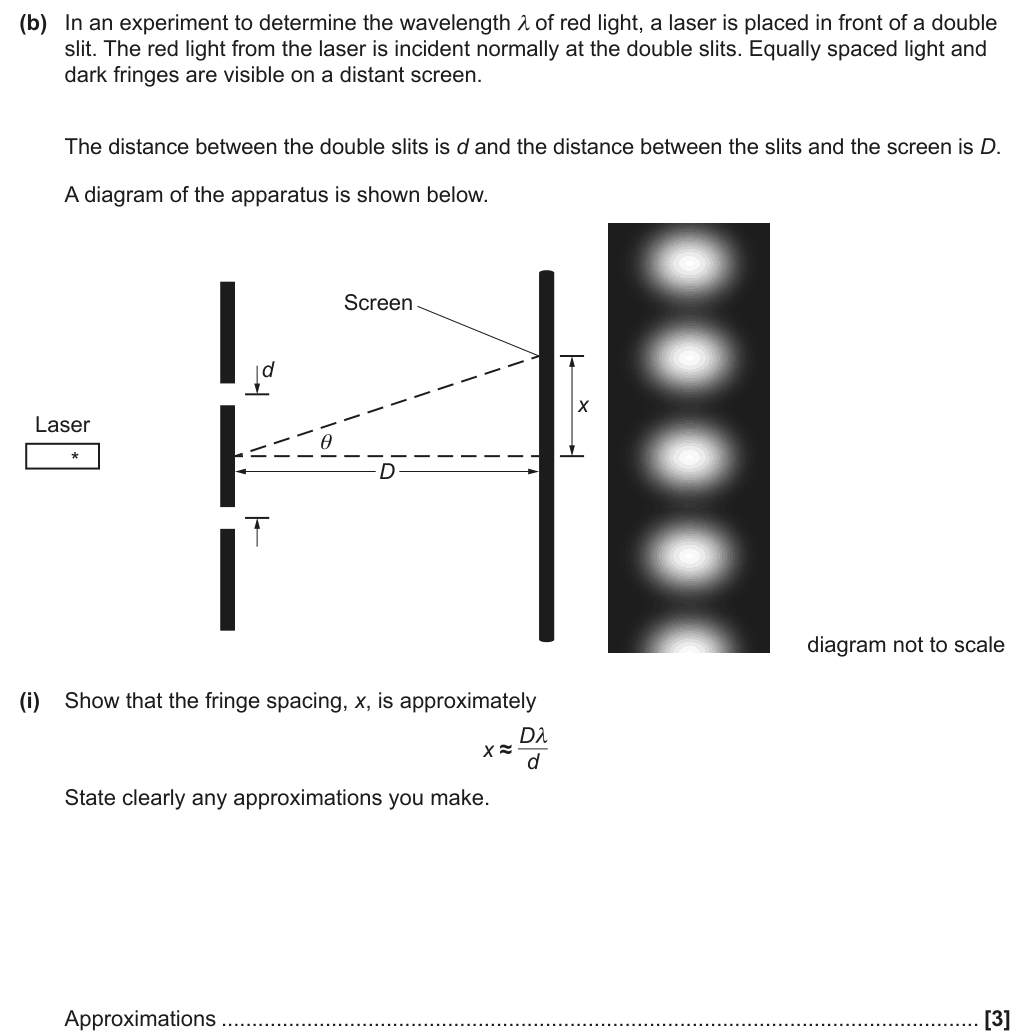
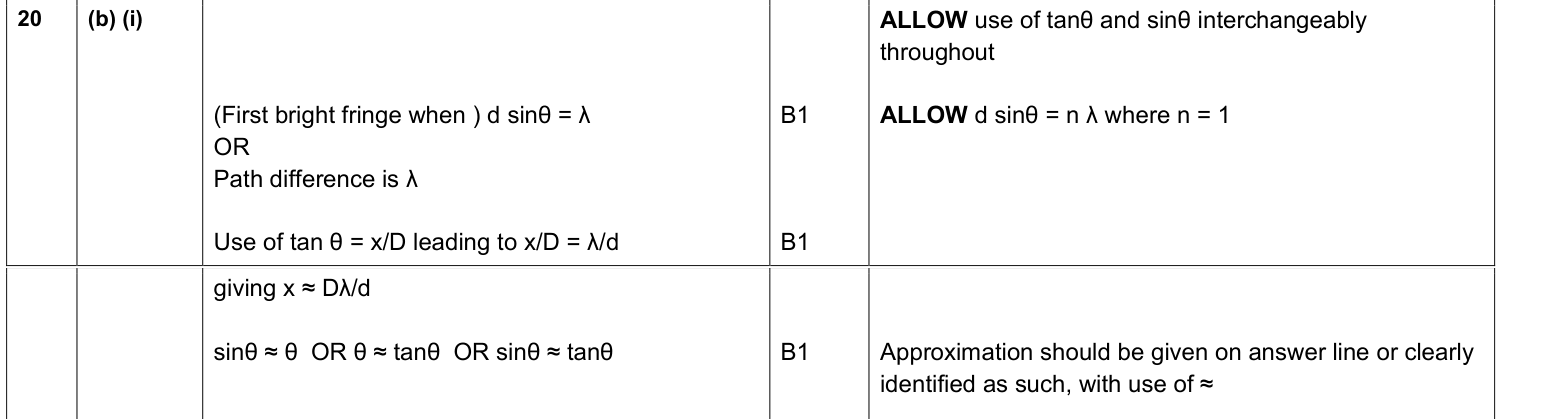
This was a challenging question, using mathematical skills and requiring candidates to apply two equations, one based on path difference and one of geometry and equate them. This is demonstrated in the exemplar that follows. The most common issue was a misapplication of geometry. The small angle approximation needed to be applied and a statement of how this was used was necessary for the approximation mark. Few candidates attempted to use Pythagoras to different degrees of success but often found the approximation difficult to express. This exemplar shows a candidate who has a clear understanding of this question and is able to set out their working clearly. On the left is the diffraction equation, which can be found in the Data, Formulae and Relationships Booklet), with n = 1 clearly identified. In the middle is the geometric expression for tan θ, and the approximation of tan θ is approximately θ This approximation is also shown in the booklet. This is also used for the sin equation, linking the two clearly and then resulting in the required expression. This gets all 3 marks, and it is evident that the candidate appreciates what they are doing at each stage.
Skills: M2.2 Change the subject of an equation, including non-linear equations; M4.5 Use sin, cos and tan in physical problems; M4.6 Use of small angle approximations including sin θ ≈ θ, tan θ ≈ θ, cos θ ≈ 1 for small θ where appropriate
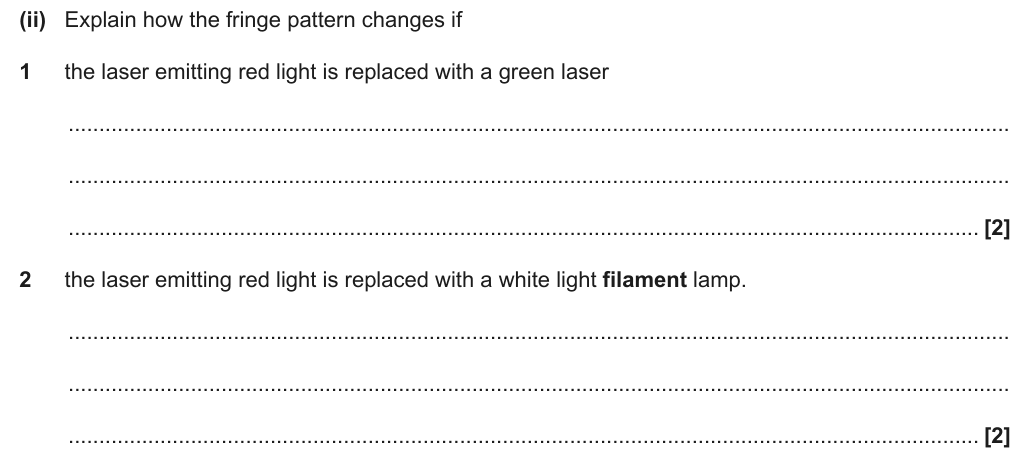
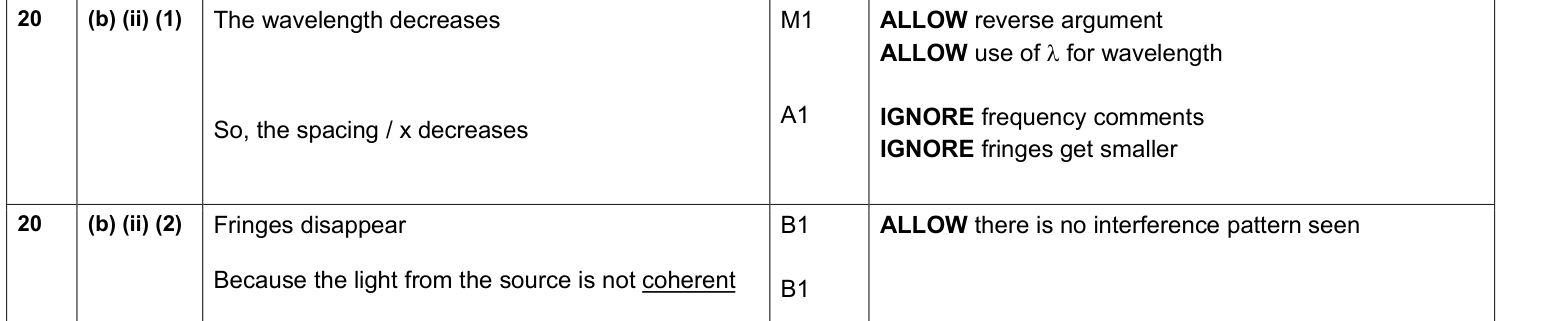
Most candidates were correctly able to give the required response to this question, however some stated that the wavelength of green light was larger than that of red. Symbols were accepted here, but it is always best to write the full words. Notation such as a lambda symbol followed by a downwards arrow is not sufficient to indicate the wavelength decreases. The M (method) mark for the wavelength meant that the candidates needed to make the link between wavelength and fringe separation, as this is the key point of the question. Care should be taken to distinguish between the fringe separation being narrower and the actual fringes being narrower. This question is asking about what happens to the fringes when white light from the filament lamp is used. The word filament is emboldened to emphasise that it is important. In the context of the question, as the light is no longer coherent, the fringes that existed with the red light will cease to be present. A fair fraction of candidates appreciated that this was the required response. Many candidates stated that there would be coloured fringes or ‘a rainbow’.
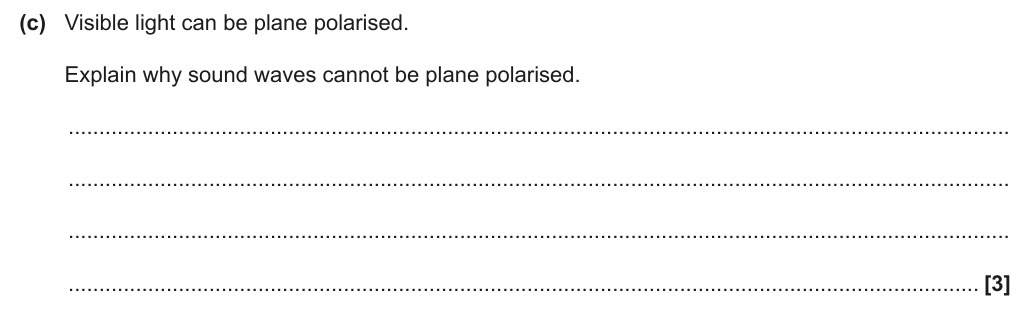
Few candidates were able to clearly explain polarisation in terms of oscillation, however most candidates knew that sound waves were longitudinal and could describe this type of wave. A number of candidates used movement for oscillation and this is not clear enough.
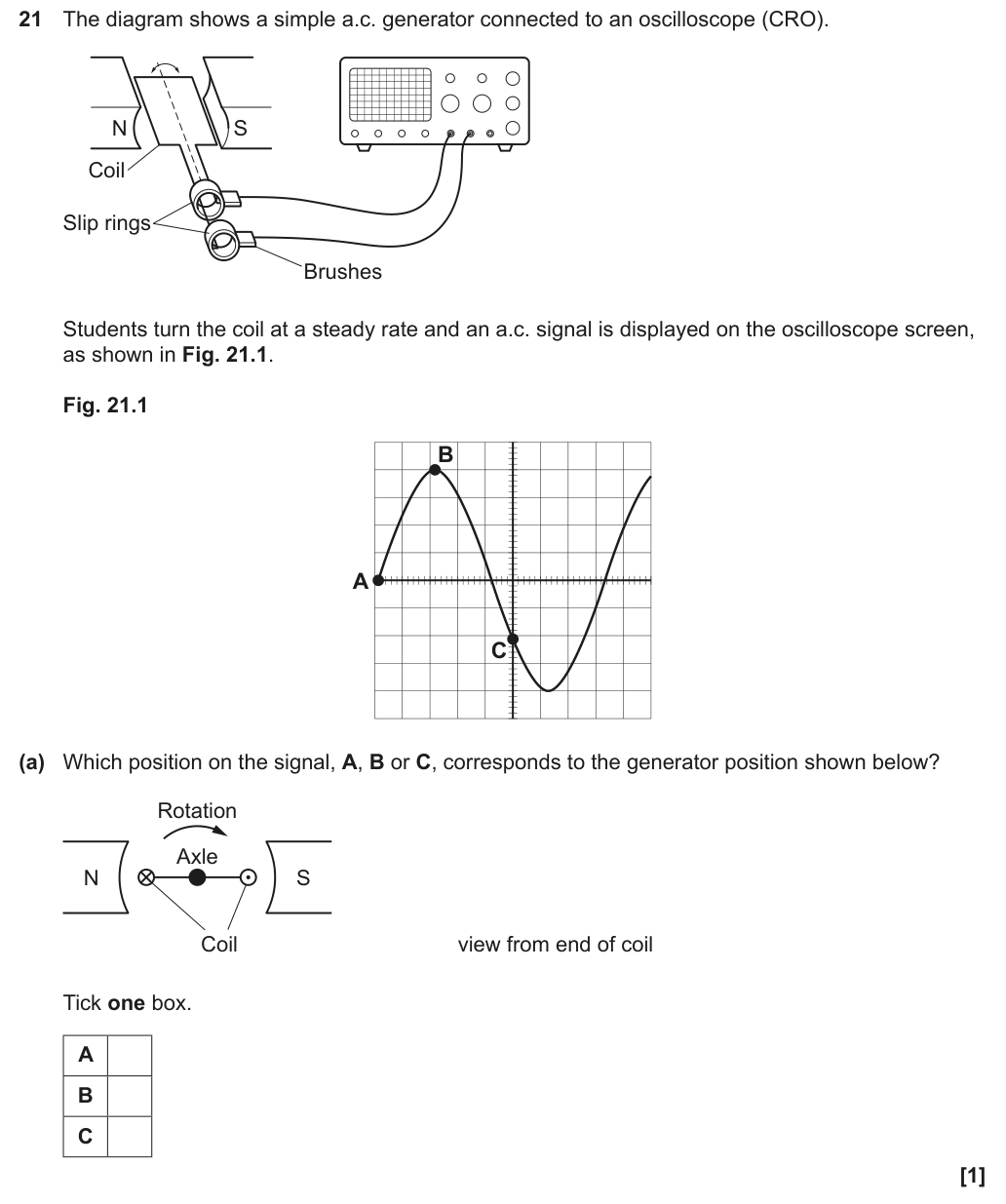
A very common incorrect response was A, presumably confusing flux linkage with induced e.m.f.

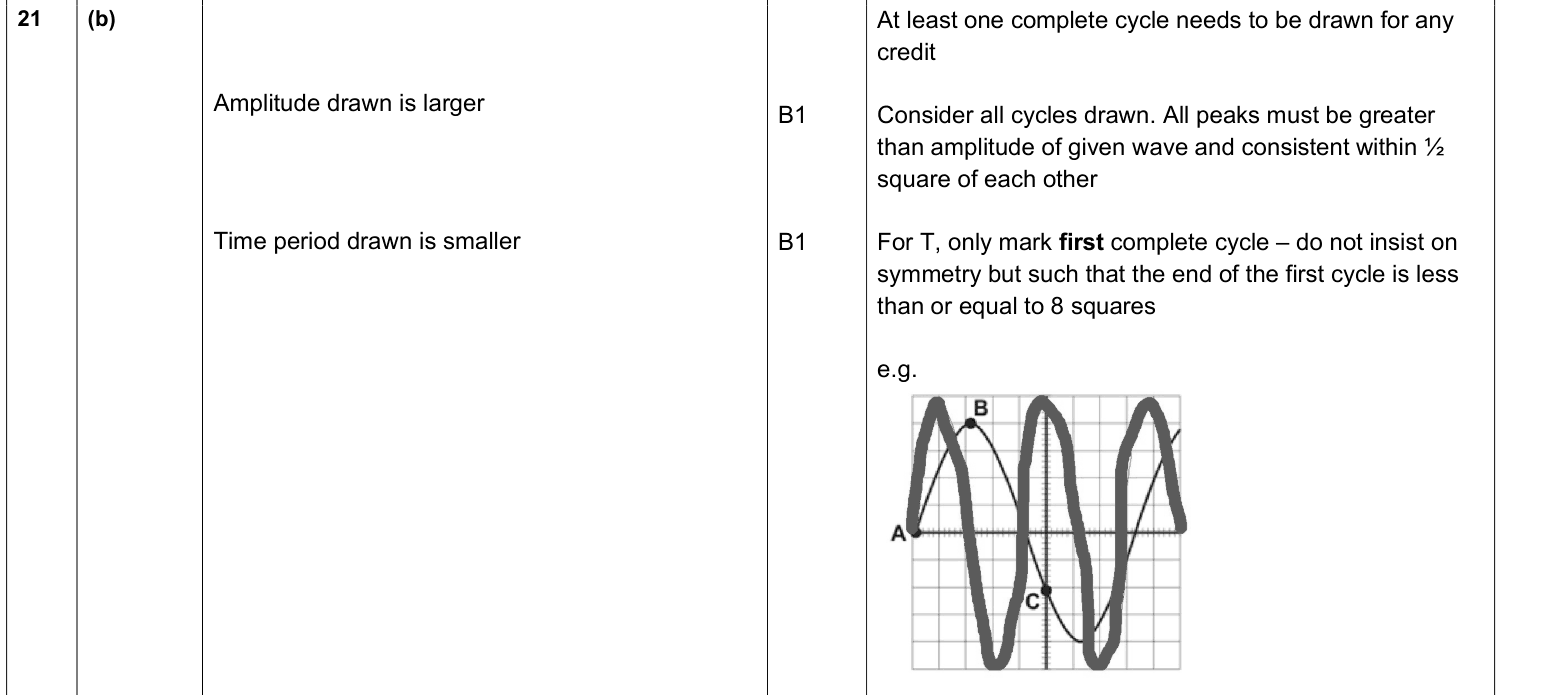
The vast majority of candidates appreciated that an increased frequency results in a reduced time period and were able to show this on the graph. Not all were able to show a constant (reduced) time period, although this was not required on this occasion. Fewer candidates appreciated that the increased rate of change of flux linkage would produce a greater e.m.f. and drew the amplitude of the wave higher. The quality of wave drawing was not always good and care should be taken to aim to keep a consistent amplitude and time period in this sketch.
Skills: M3.12 Sketch relationships which are modelled by y = k/x, y = kx², y = k/x², y = kx, y = sin x, y = cos x, y = e^(±x) and y = sin²x, y = cos²x as applied to physical relationships
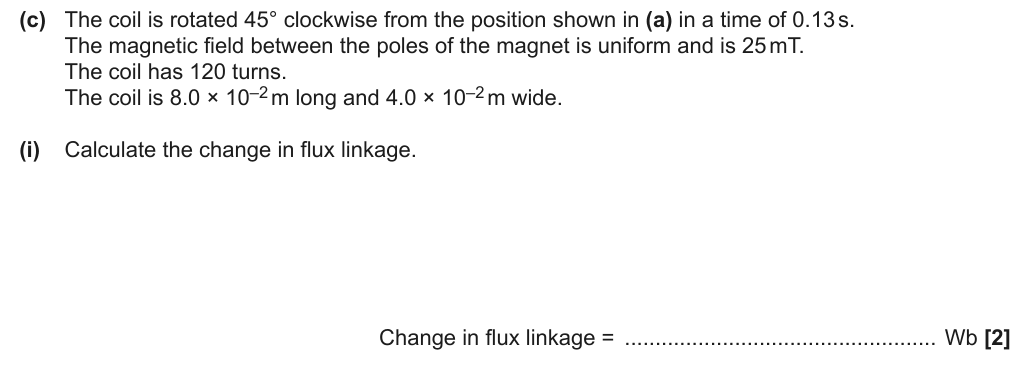
The terms flux and flux linkage can clearly be confused by candidates and they are often incorrectly interchanged. Many candidates simply calculated the flux. There were a significant number who calculated the area incorrectly, usually considering the appropriate area to be a circle. Several candidates attempted to calculate a change between two different angles, which resulted in an incorrect answer.
Skills: M0.6 Use calculators to handle sin x, cos x and tan x when x is expressed in degrees or radians; M2.3 Substitute numerical values into algebraic equations using appropriate units for physical quantities; M4.5 Use sin, cos and tan in physical problems
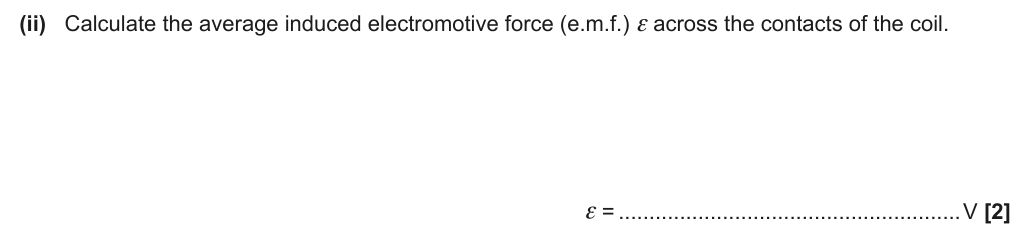
Those who obtained the correct response for part (c) (i) generally went on to obtain both marks in this question. Allowance of an “error carried forward” also helped many candidates, and a little over half were able to score both marks. Many candidates rounded their answer to 1 significant figure, thereby losing a mark. Candidates should always be encouraged to give their answers in keeping with the significant figures of the data provided in the question.
Skills: M2.3 Substitute numerical values into algebraic equations using appropriate units for physical quantities
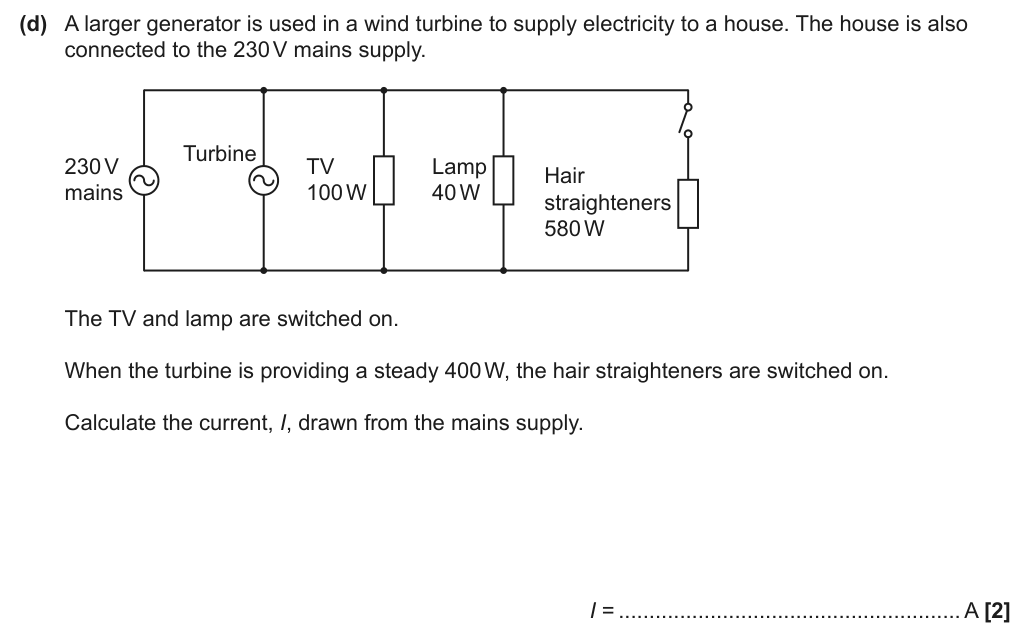
Some candidates were able to correctly calculate the current. Most incorrect answers came from adding together all the powers, including the turbine, or simply just dividing the turbine power by the mains voltage.

While most candidates had an awareness of the unit, some of them wrote their response as kilowatt per hour, either in words or units. Other incorrect, but not uncommon answers, were watts, joules and megawatt-hours.
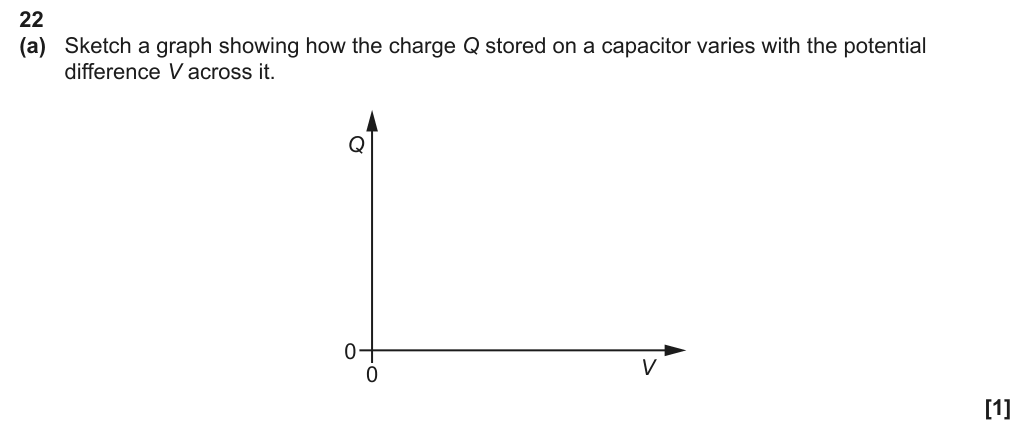
Most candidates were able to correctly draw a straight line through the origin. It is important to draw this line with a ruler to avoid any ambiguity. The most common incorrect response was to draw a curve of decreasing gradient.
Skills: M3.12 Sketch relationships which are modelled by y = k/x, y = kx², y = k/x², y = kx, y = sin x, y = cos x, y = e^(±x) and y = sin²x, y = cos²x as applied to physical relationships
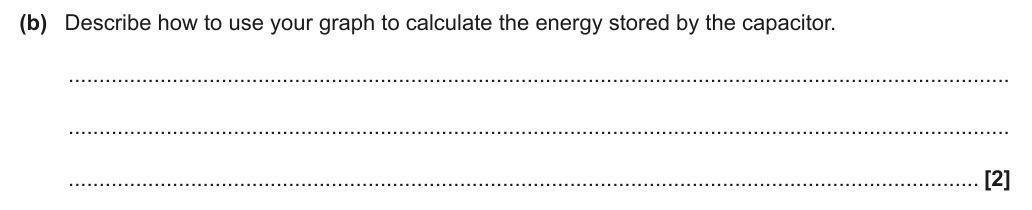
Most candidates were able to appreciate that the area under the line would produce the energy stored and that this relates to 2 𝑄𝑉. A reasonable number of candidates attempted to use the gradient in their explanation either by using it as a capacitance, or simply considering it was the energy stored.
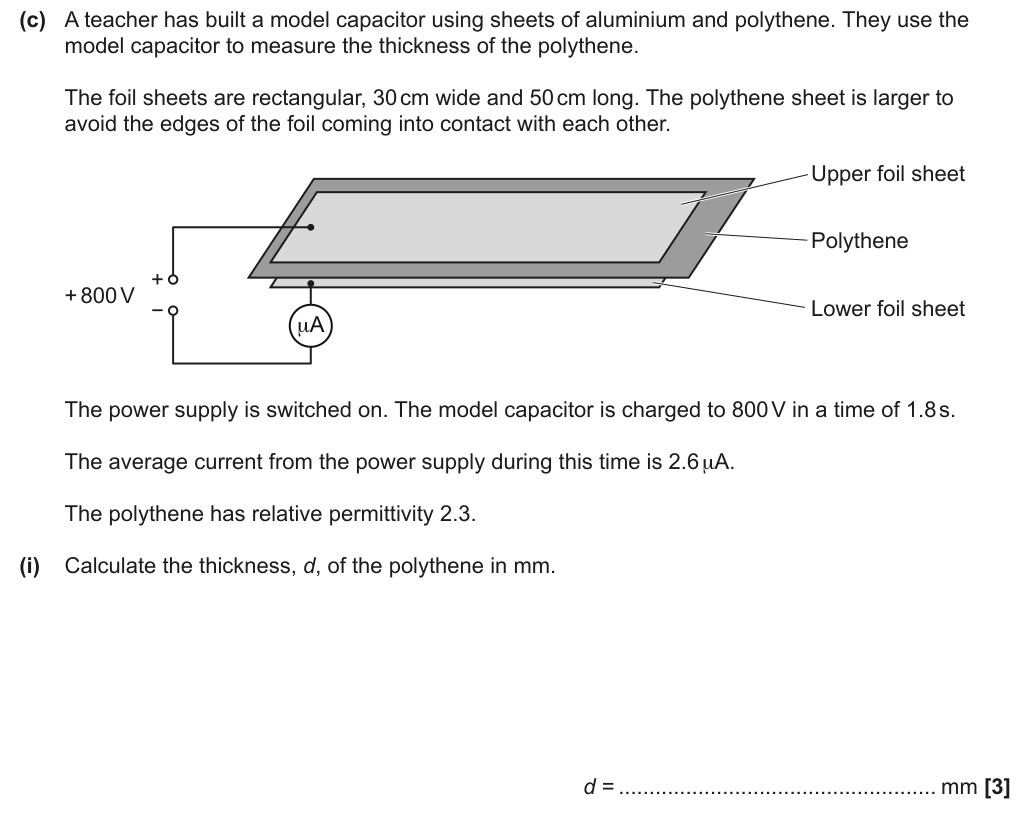
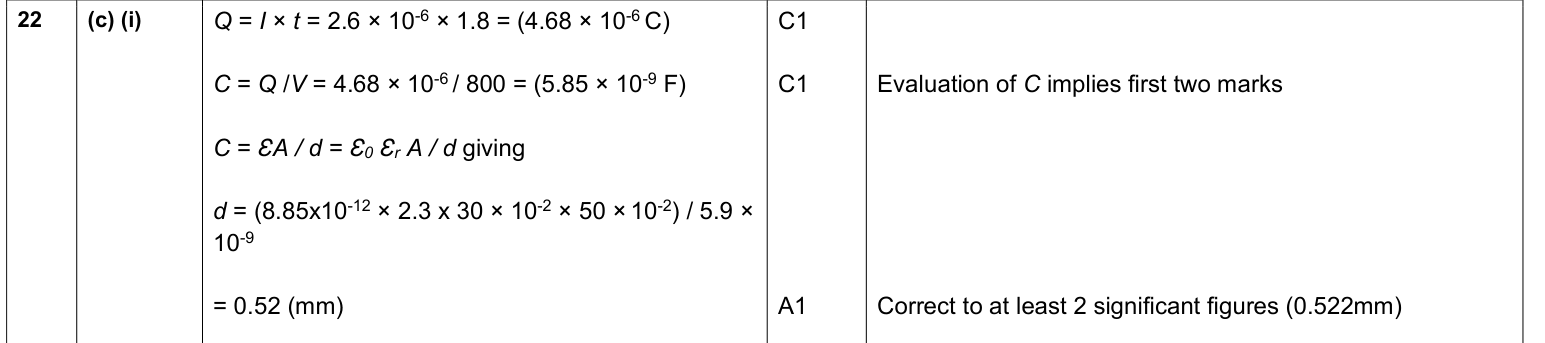
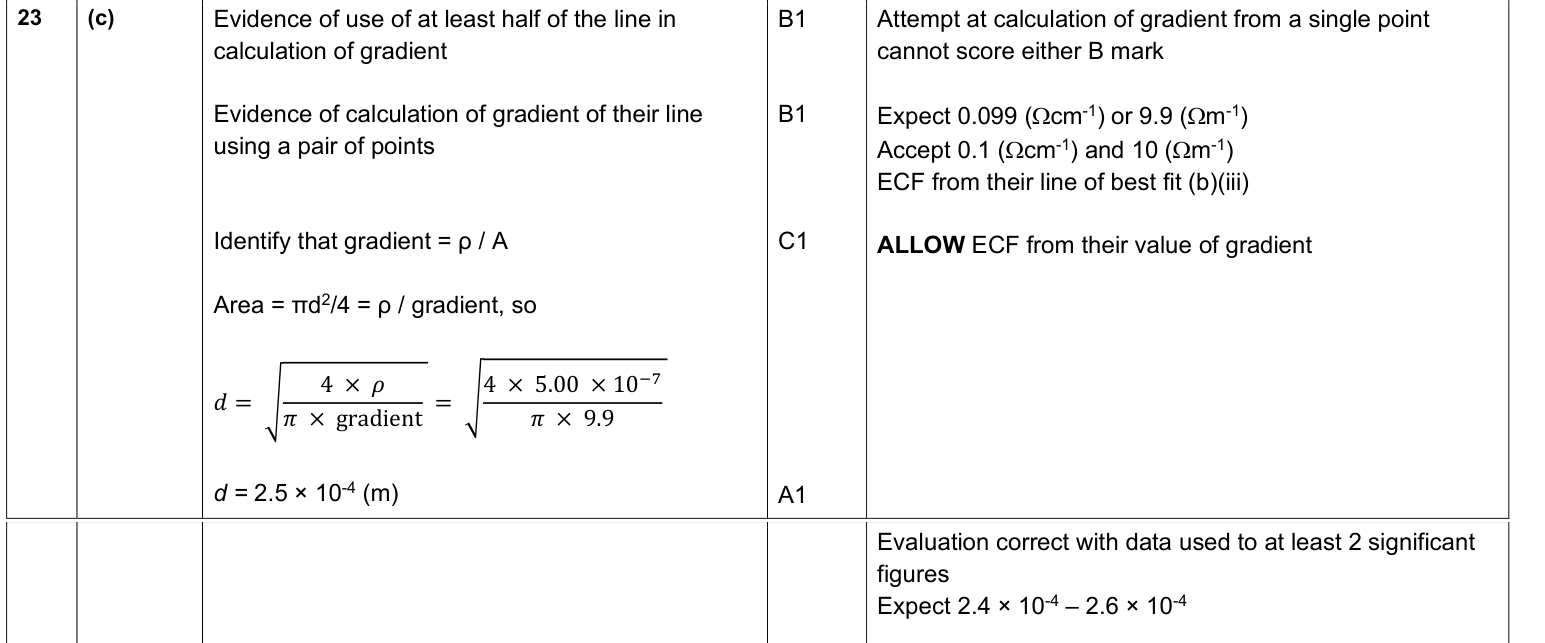
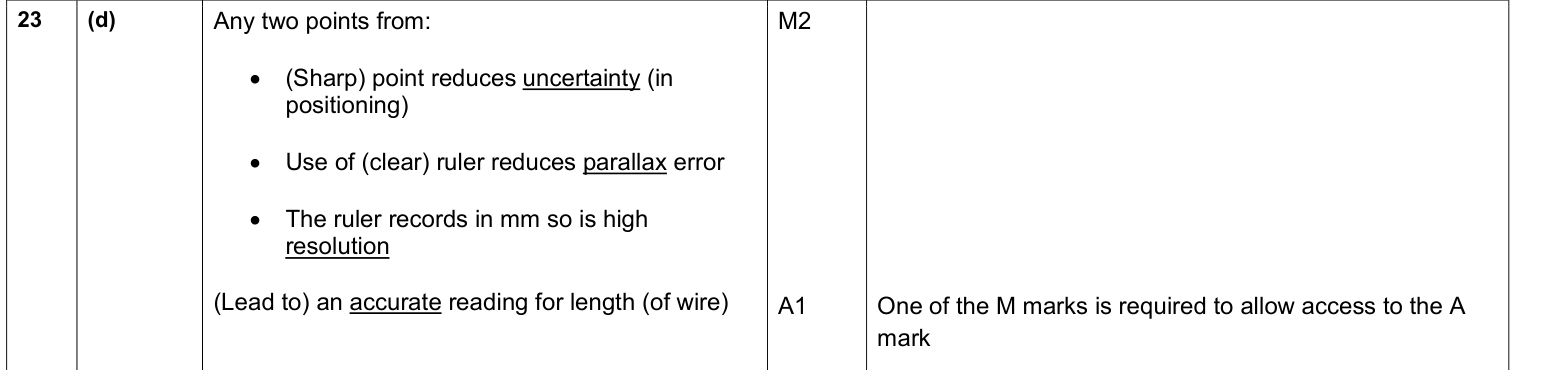
• used calculators effectively with careful consideration of unit conversions, such as in Questions 18 (d) and 22 (c) (i) • demonstrated an ability with logarithms and manipulation of exponential equations, such as in Questions 18 (e) and 19 (c) • gave suitable detail and care in responses to Level of Response questions, paying particular attention to the specifics of the question • had a clear appreciation of command words • gave appropriate use of scientific language and terms, in particular in Questions 22 (c) (ii) and 23 (d) • applied consideration of significant figures in calculations, especially in Question 21 (c) (ii). • did not attempt all of the multiple-choice questions, and this did not appear to be a timing issue • did not show suitable working in extended calculations, such as Question 21 (c) (i), which means that it was not possible to award C marks • only gave limited detail in the Level of Response questions, such as not explaining the description of both models in Question 17 • drew a poor line of best fit in Question 23 (b) (iii), assuming that the line would pass through the false origin • chose too small a range for a gradient calculation in Question 23 (c), or just used a pair of points • were unable to differentiate terms such as precision, resolution and accuracy, especially in Question 23 (d) • did not express scientific knowledge with sufficient accuracy, such as in Question 20 (c). Just under half of candidates were able to calculate the thickness correctly. The most common way was to calculate the capacitance and then use the parallel plate capacitor formula. This allowed clarity in setting up the calculation and generally resulted in the correct answer. Several candidates attempted to carry out the calculation in one go. This often resulted in an error, such as using 2.3 in place of the actual permittivity of the polythene. Another common error was to use the formula for the capacitance for a sphere. There seemed to be little difficulty in converting all the units correctly, either in the initial calculation or by converting to mm at the end. As always with this type of calculation, structuring it carefully allows for intermediate marks to be awarded should the final answer be incorrect. This exemplar shows how clear and careful setting out of a calculation can lead to C (compensatory) marks. This candidate has shown the working for (and then calculated) the charge, Q, separately on the top of the right-hand side. This gains the first mark. The candidate has then re-arranged the equation in the centre, with the capacitance in the denominator. The calculation for the capacitance is clearly shown (4.68 x 10⁻⁶ ÷ 800) which is all that is required for the second C mark. It is almost always the working that gains the C mark, not the evaluation. The evaluation is required for the A (accuracy or answer) mark, and in this case there is an error leading to an incorrect final answer. However, this good structuring of the solution leads to 2 out of the 3 marks.
Skills: M0.1 Recognise and make use of appropriate units in calculations; M2.2 Change the subject of an equation, including non-linear equations; M2.3 Substitute numerical values into algebraic equations using appropriate units for physical quantities
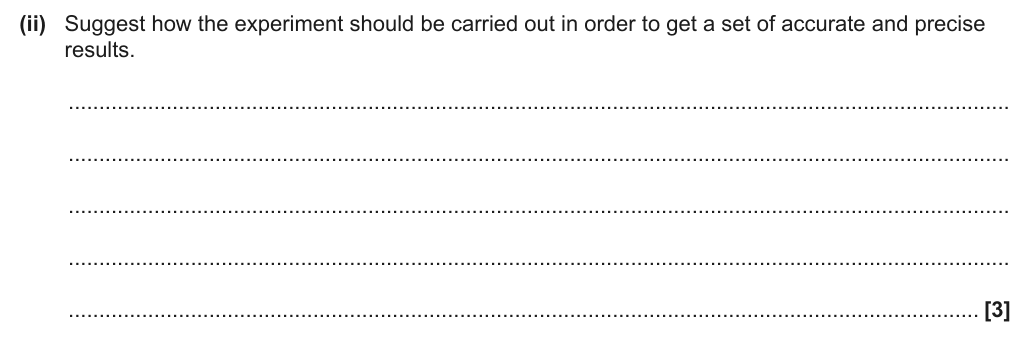
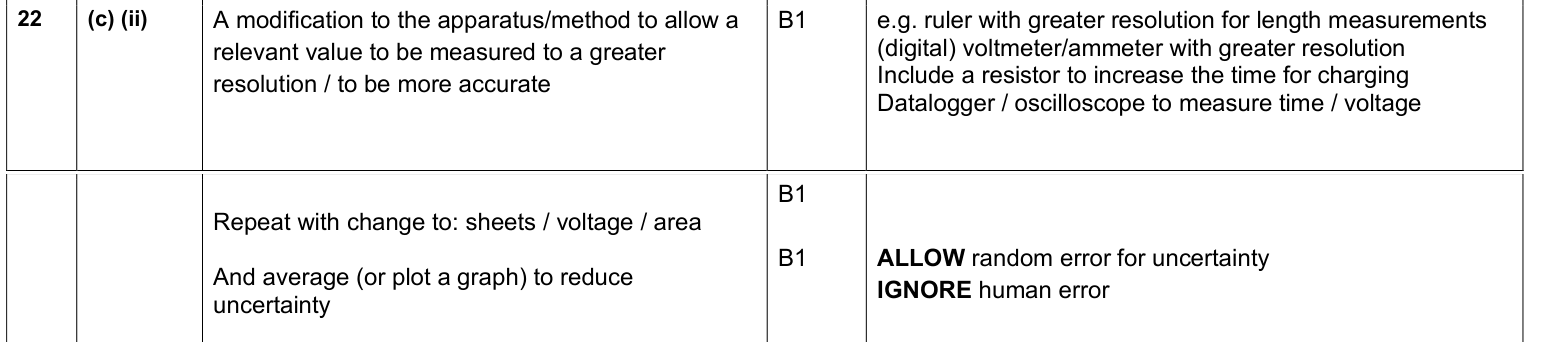
This question was specific in asking for accuracy and precision. Most candidates only addressed one of these aspects of the question. A simple repeat and average was not considered to be of sufficient detail. A change to the experiment was required, such as using a higher voltage. Many candidates made sensible alterations, for example adding a series resistor to increase the time as 1.8 s is relatively short. Questions of this style are often challenging for candidates; however a fair number were able to obtain 2 or more marks.
Skills: PAG9 Investigating capacitors
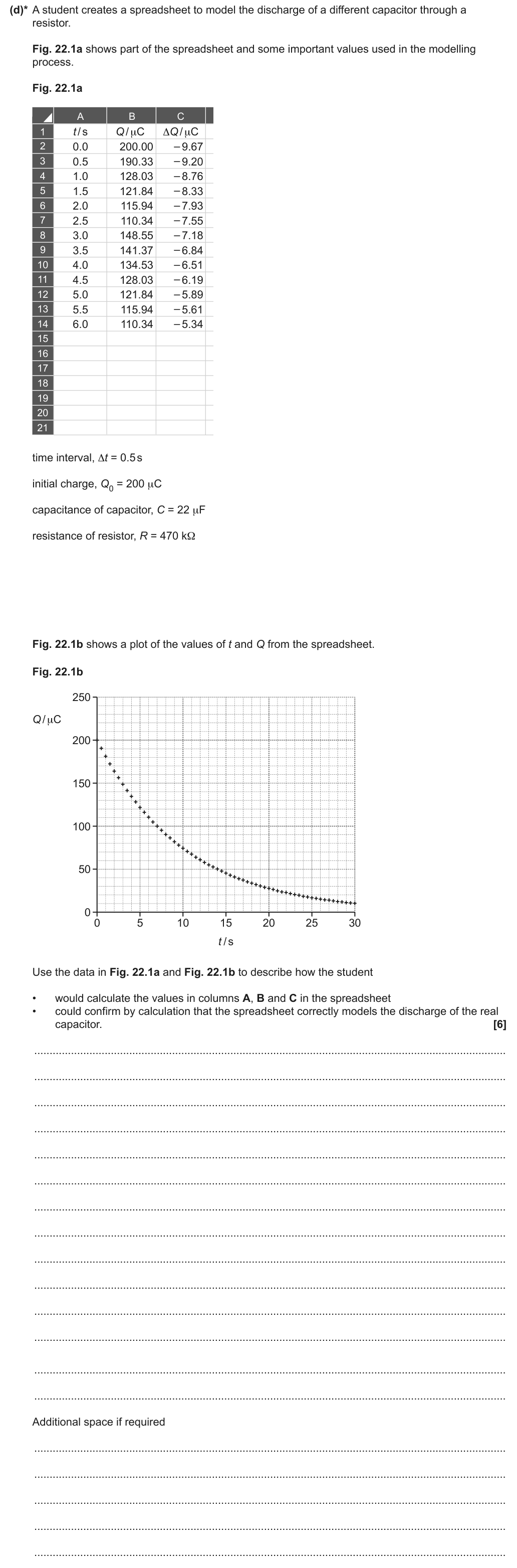
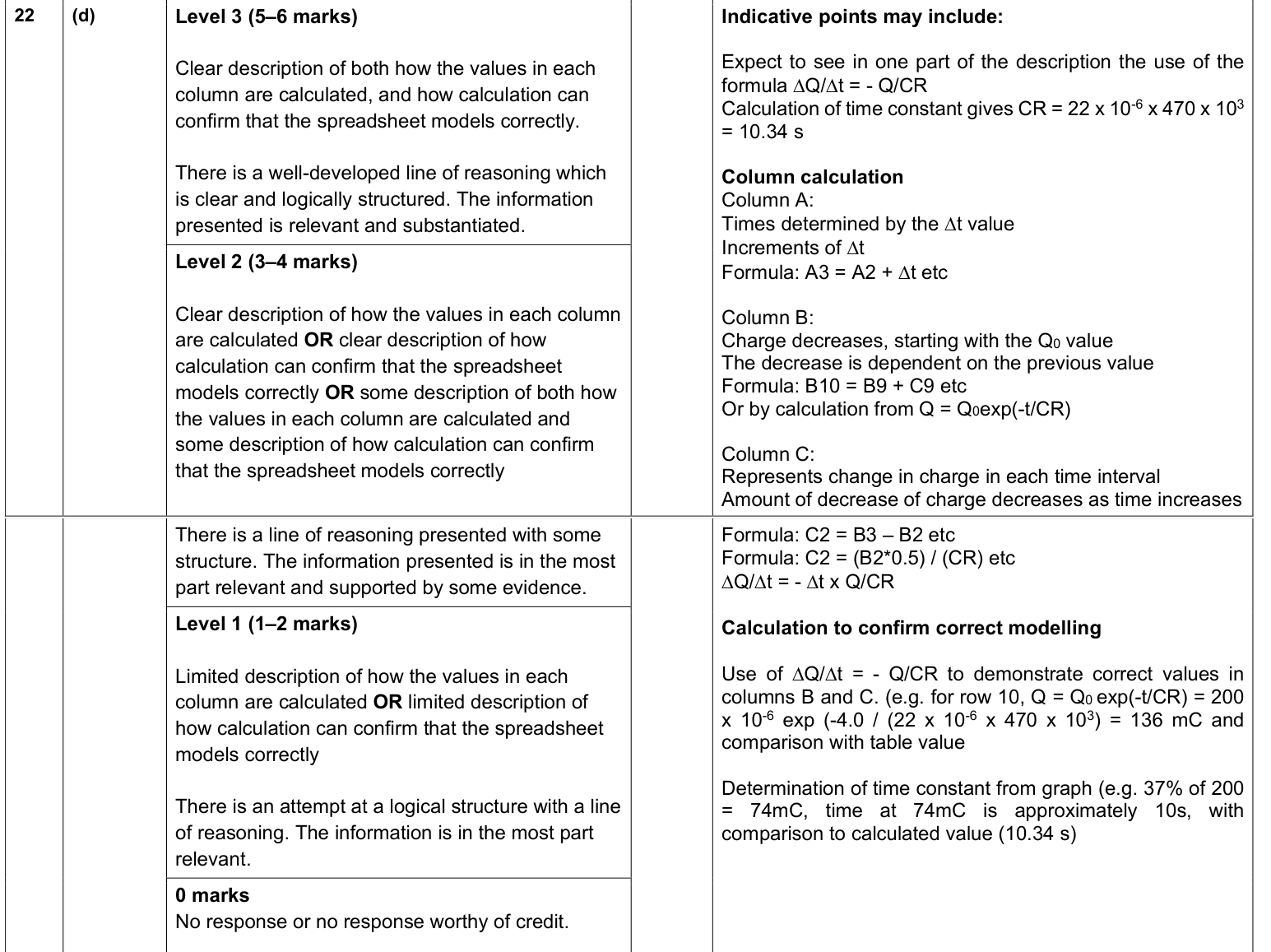
There was an error with this question which affected the candidates’ ability to answer it. To make sure all candidates were treated fairly, we have awarded full marks to all candidates for this question.
Skills: M0.5 Use calculators to find and use power, exponential and logarithmic functions; M3.9 Apply the concepts underlying calculus (but without requiring the explicit use of derivatives or integrals) by solving equations involving rates of change using a graphical method or spreadsheet modelling
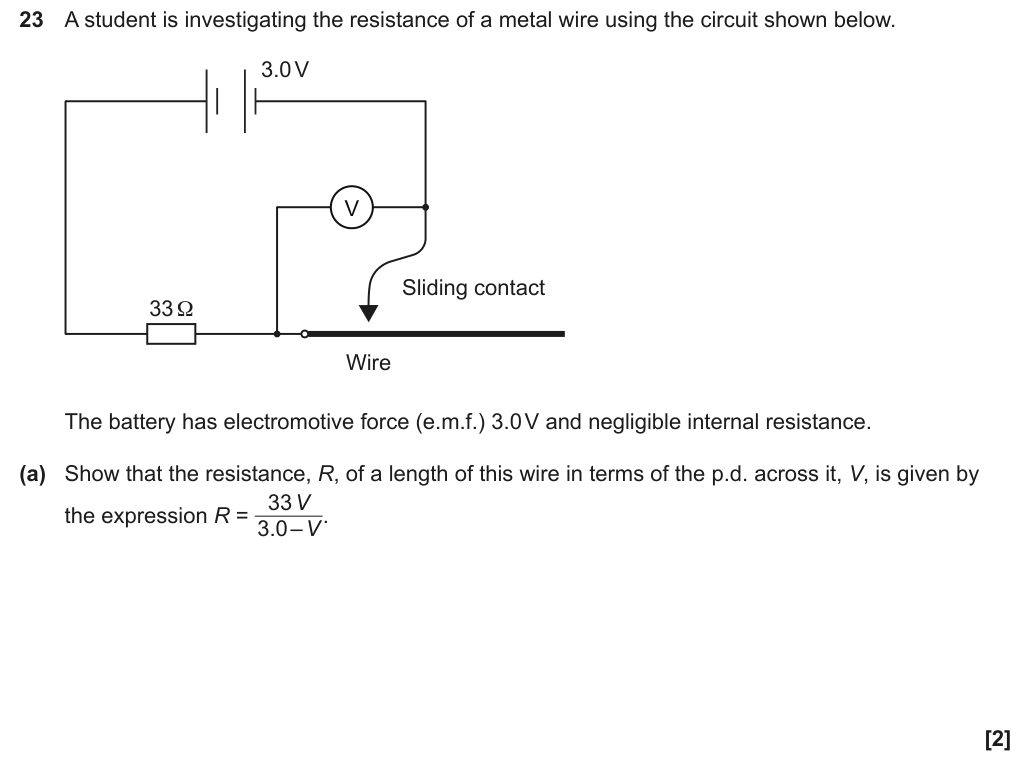
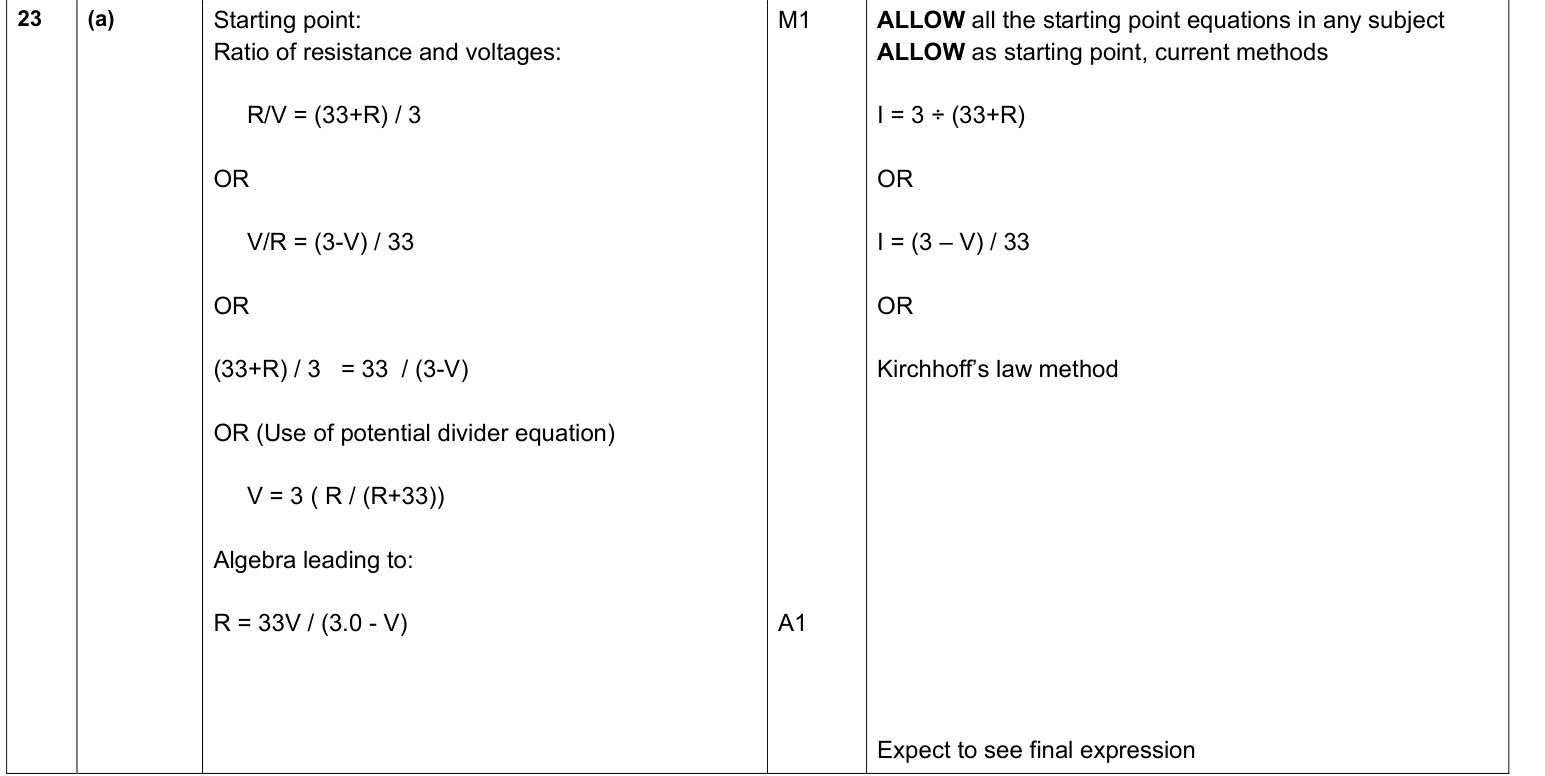
This was a challenging question and depended on the candidate’s choice of starting point. The simplest approach was to consider ratios of resistances and voltages, as long as numerical values were placed where appropriate. A majority of candidates used the potential divider as a starting point but this required a little more algebraic manipulation, as did starting with a current calculation. For the most part this calculation was completed well, although some candidates clearly could go no further with their algebra and just wrote the given expression. As always with a ‘show that’ question, it is very important to clearly show each stage.
Skills: M2.2 Change the subject of an equation, including non-linear equations
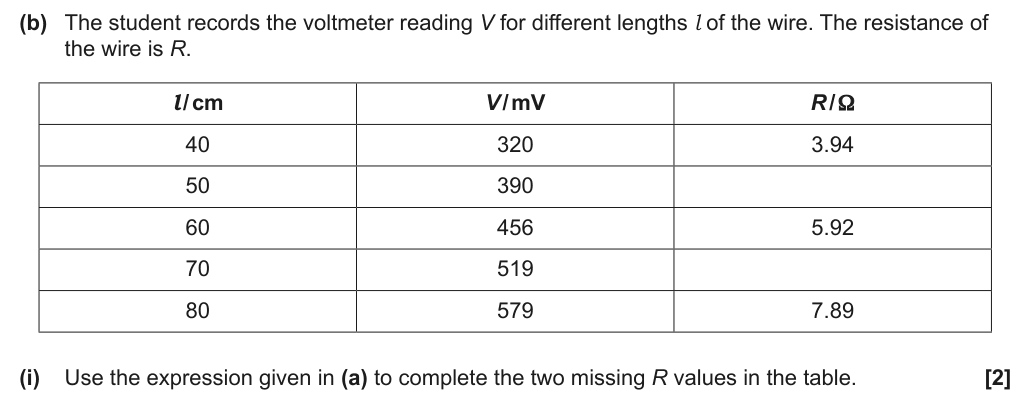
The vast majority of candidates were able to calculate the two numbers correctly and gave them to the required 2 decimal places. A small number of candidates calculated to the second number incorrectly (for some unknown reason).
Skills: M1.1 Use an appropriate number of significant figures; M2.3 Substitute numerical values into algebraic equations using appropriate units for physical quantities
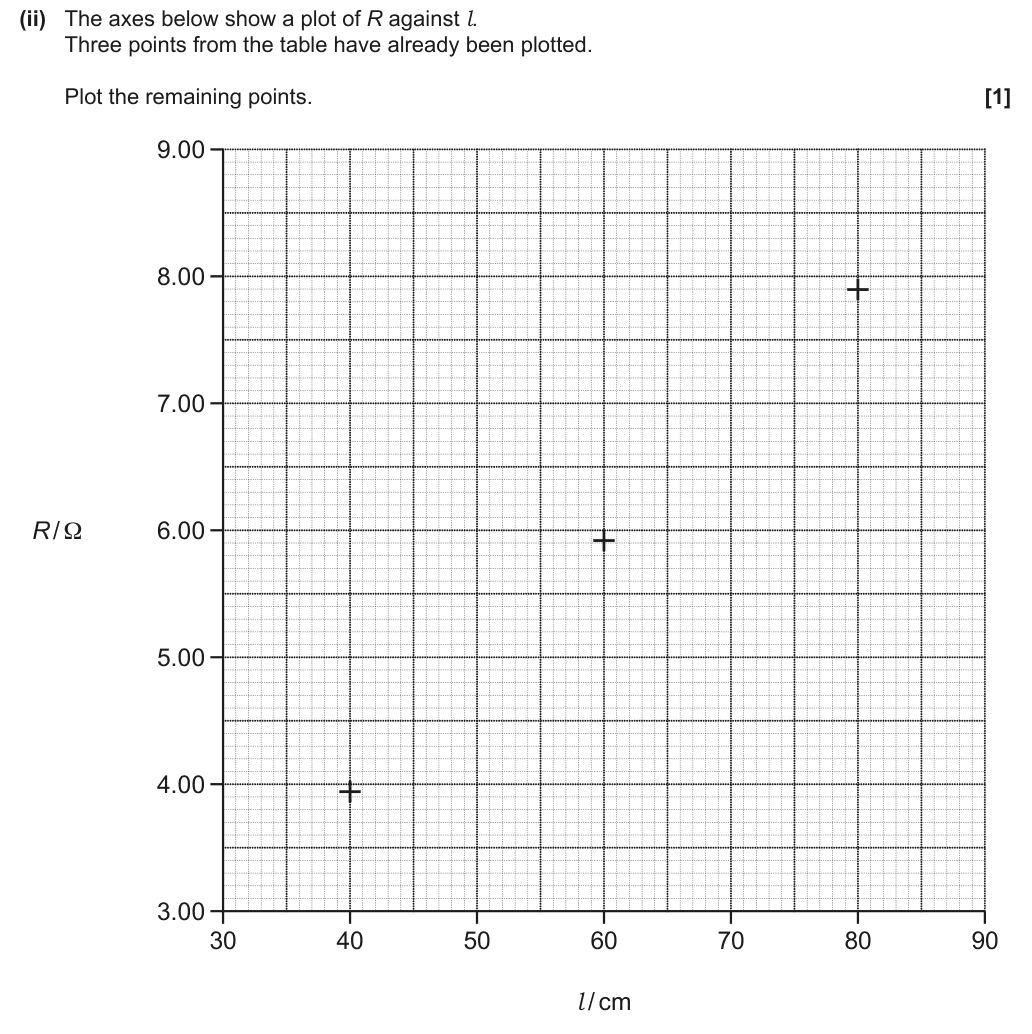
The two calculated points, if calculated correctly, should lie pretty much on the straight line and therefore be relatively easy to plot within the usual tolerance of half of a small square. Almost all candidates plotted these correctly and the most common error was a mis-plot of the lower point.
Skills: M3.2 Plot two variables from experimental or other data
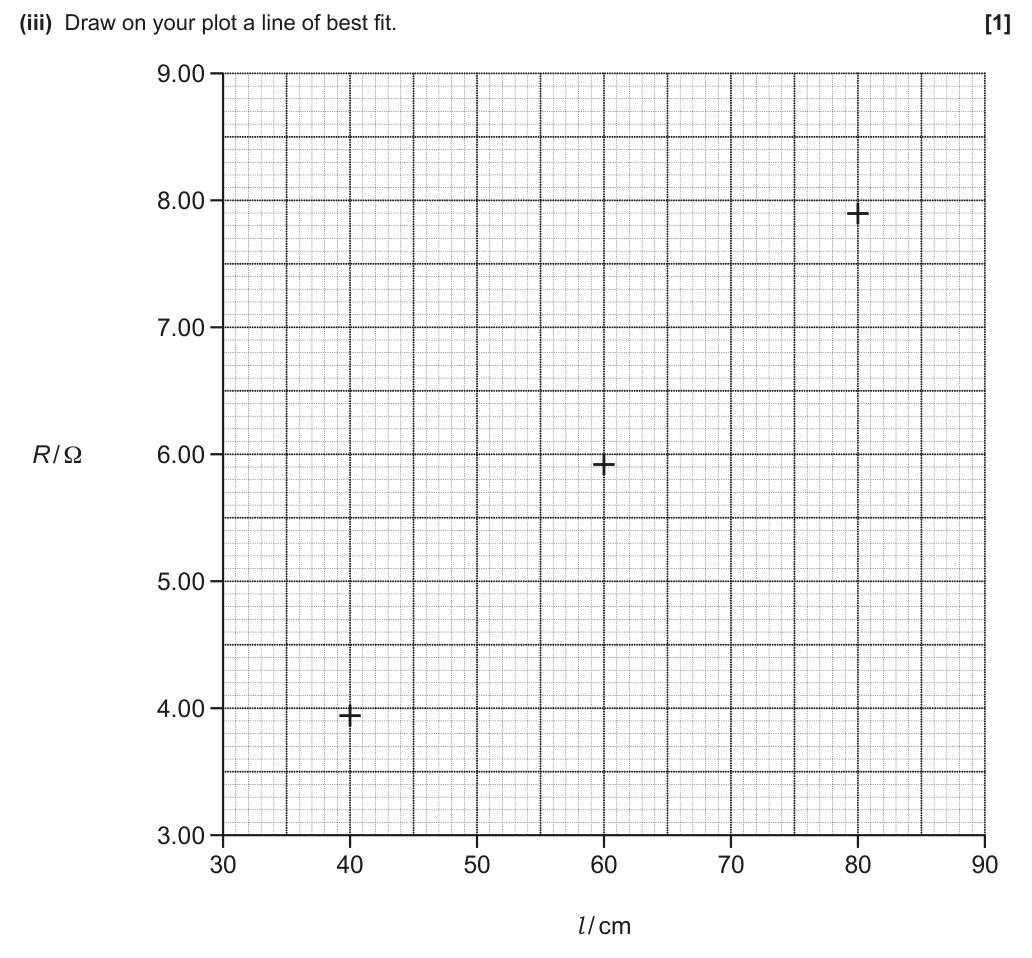
Although the points were pretty much on a straight line, only around half of the candidates drew a suitable line of best fit. Drawing a line through the false origin would likely (but not always) mean that the line missed some of the three given points by some degree. Double lines, thick lines and disjointed lines will all likely not score this mark. Candidates are encouraged to take great care in selecting and drawing their line.
Skills: M3.2 Plot two variables from experimental or other data
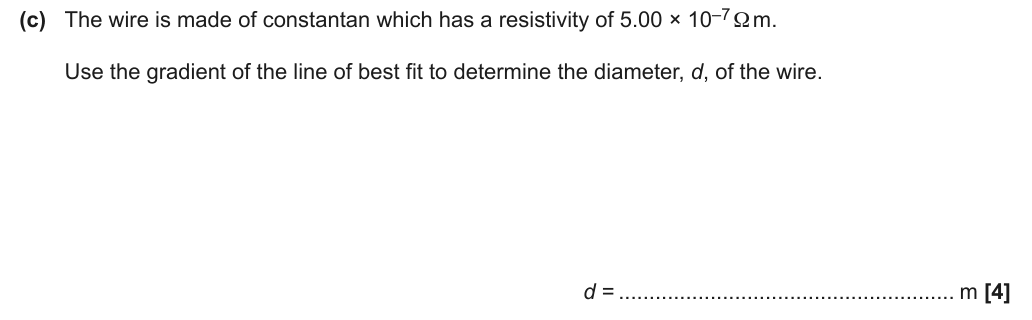
Two marks for this calculation were given for a correct method to calculate the gradient. The first mark is for using a pair of points – it was possible in this case to use points from the table as they lay so close to the line – however most candidate chose a pair by drawing lines on the graph. The second mark is for a sufficiently large range – at least half of the graph. Many candidates simply chose a single point or showed they had used (0,0) in their calculation, although they could not tell that it passed close to the origin. It was possible to still obtain an answer within the expected range even if a single point was used. For the most part, this calculation was done well, including the challenging area to diameter calculation. There was some occasional difficulty seen in converting the cm scale on the graph into the required m scale on the answer line. Overall, a little over half of the candidates were able to get all 4 marks.
Skills: M0.1 Recognise and make use of appropriate units in calculations; M3.4 Determine the slope and intercept of a linear graph; M4.3 Calculate areas of triangles, circumferences and areas of circles, surface areas and volumes of rectangular blocks, cylinders and spheres; PAG3 Investigating electrical properties
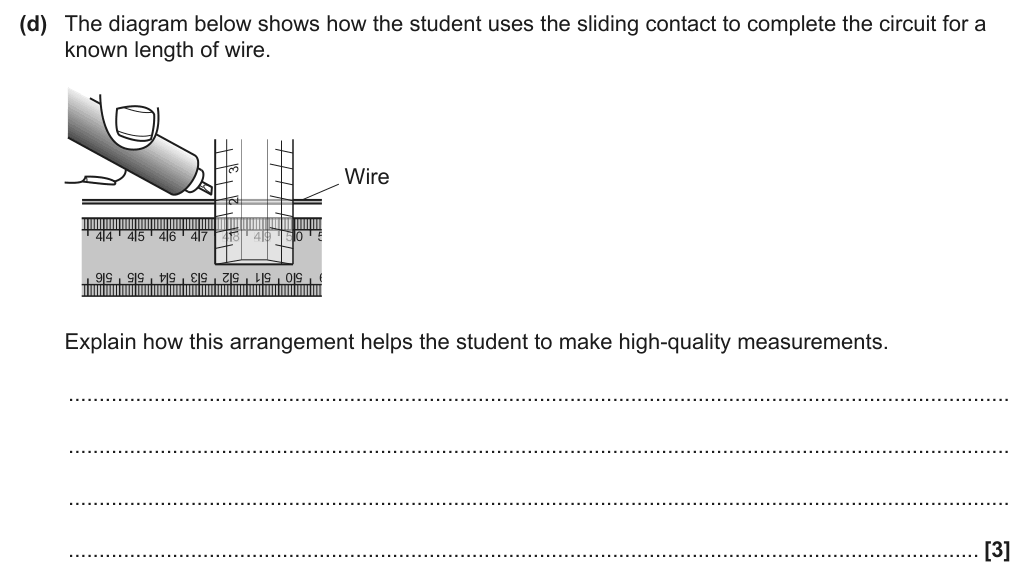
This question required candidates to use correct terms when describing data. Answers not using these terms would not be able to score marks. Many candidates were able to use these correctly, and a good fraction were able to explain how it reduced a parallax error. The term precision was used in place of resolution on a lot of occasions and candidates are encouraged to learn the appropriate use of these terms.
Skills: PAG3 Investigating electrical properties
Want a paper marked and gone through with you? Message us.