Answer
A
Mark scheme

Examiner's comment
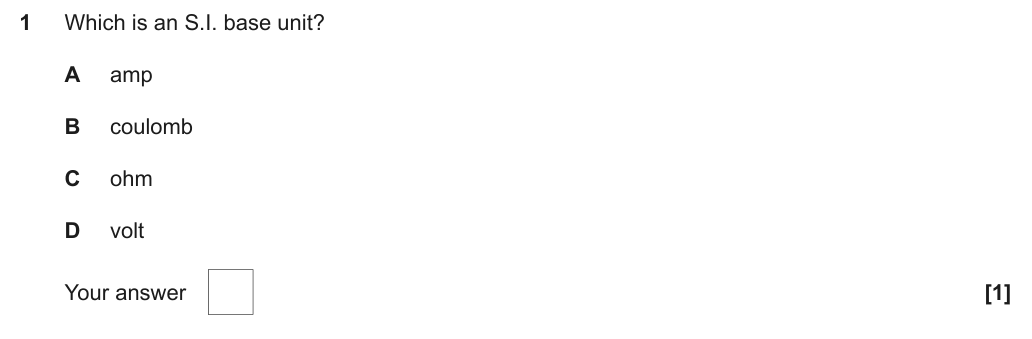
This should have been a straightforward starting question for all the candidates in identifying the correct S.I. base unit but only some gave the correct response of A. The most common distractor was B.
70 marks · 39 question parts · Paper, mark scheme and report on OCR's site · Have the Data, Formulae and Relationships Booklet beside you
A
This should have been a straightforward starting question for all the candidates in identifying the correct S.I. base unit but only some gave the correct response of A. The most common distractor was B.
D
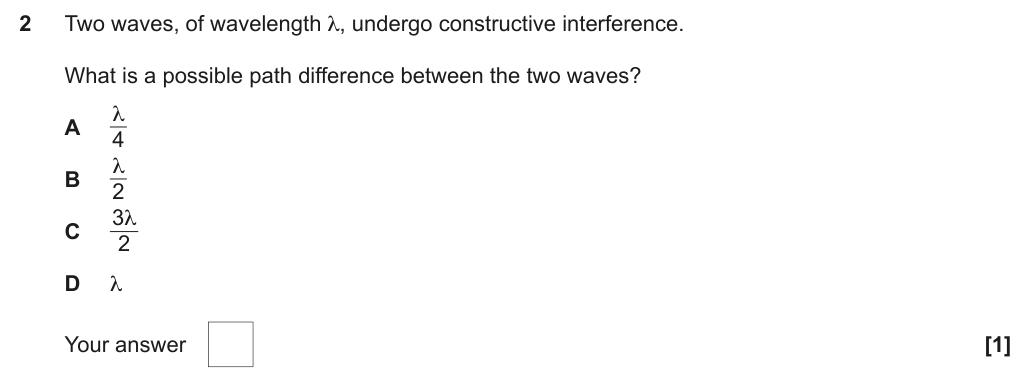
Overall, candidates performed well on this question as they correctly identified that the path difference for constructive interference is λ to give answer D. The most common distractor was B as some candidates confused the path difference for constructive interference with destructive interference.
C
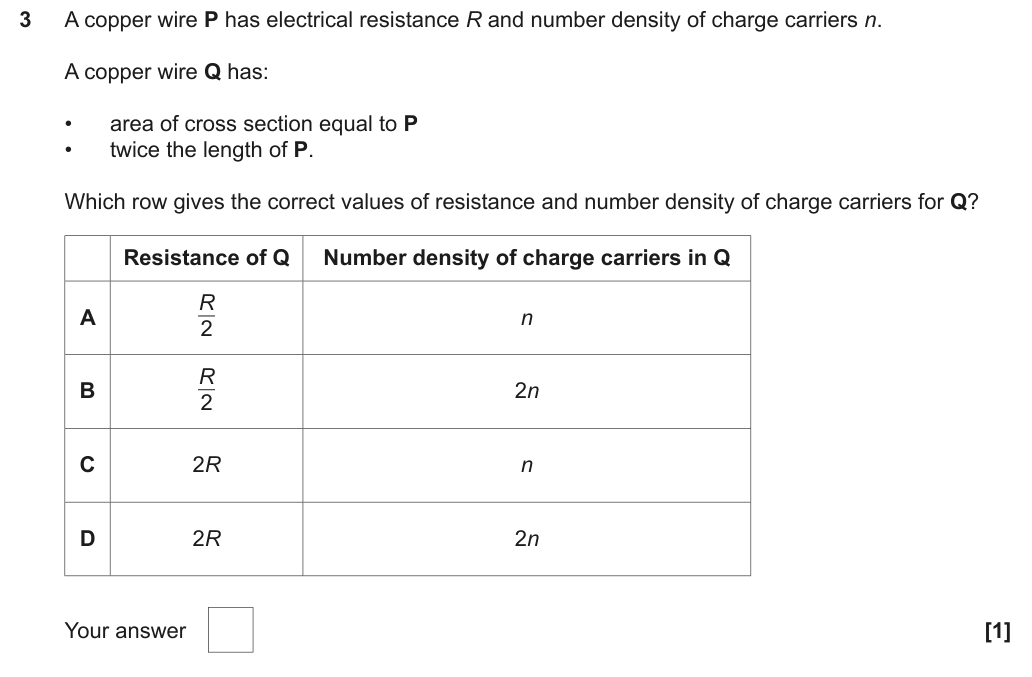
Overall, candidates performed well. They correctly determined that because the copper wire, Q, has an equal cross-sectional area to copper wire, P, that n (the number density of charge carriers) is the same for both wires. Most candidates determined that the resistance of Q would double in size due to the length of wire Q being twice as long, hence why the most common distractor was D.
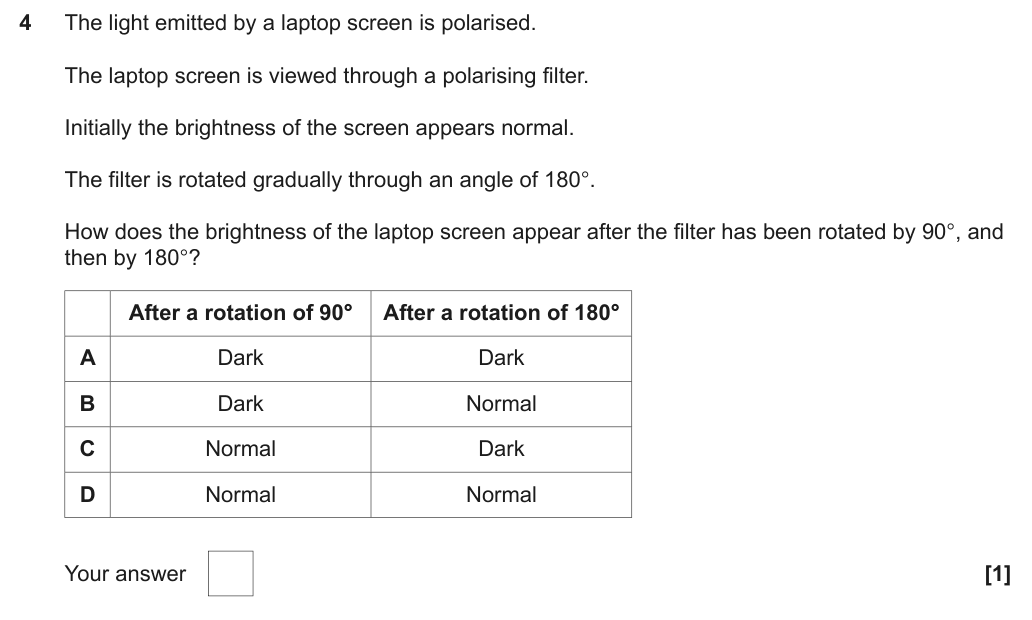
B
This question was answered well as candidates were able to apply knowledge and understanding of electromagnetic waves passing through a polarising filter to give the correct answer B.
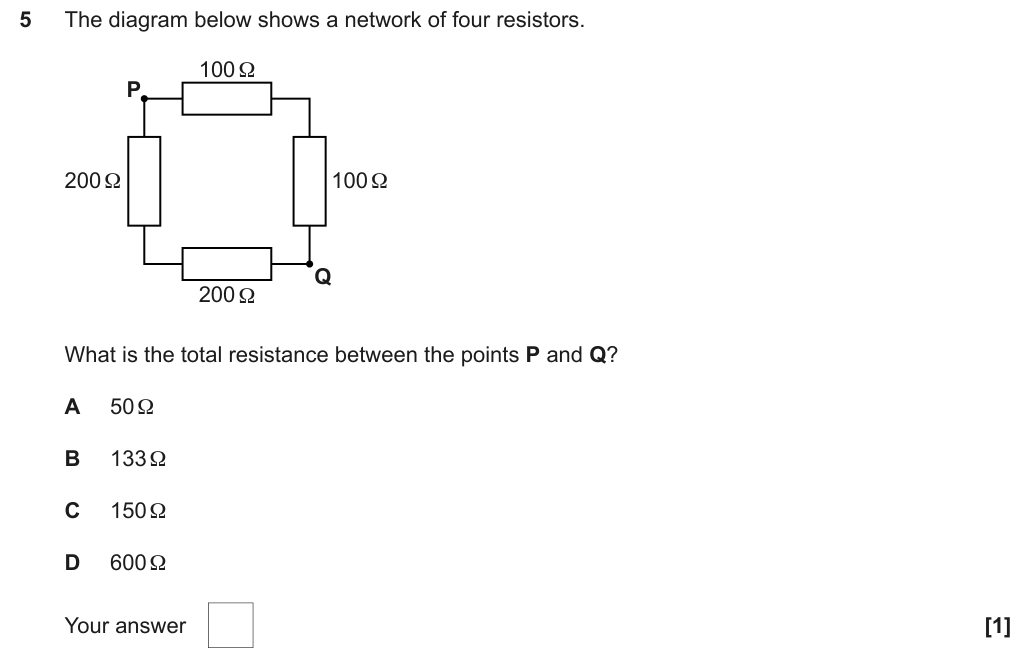
B
Overall, candidates performed well on this question as many correctly applied their understanding of resistance in series and parallel to give a total resistance between P and Q as 133 Ω. The most common distractor was D, where candidates incorrectly calculated the total resistance as the sum of each individual resistance as they did not apply understanding that each pair of resistors where in a parallel arrangement around points P and Q.
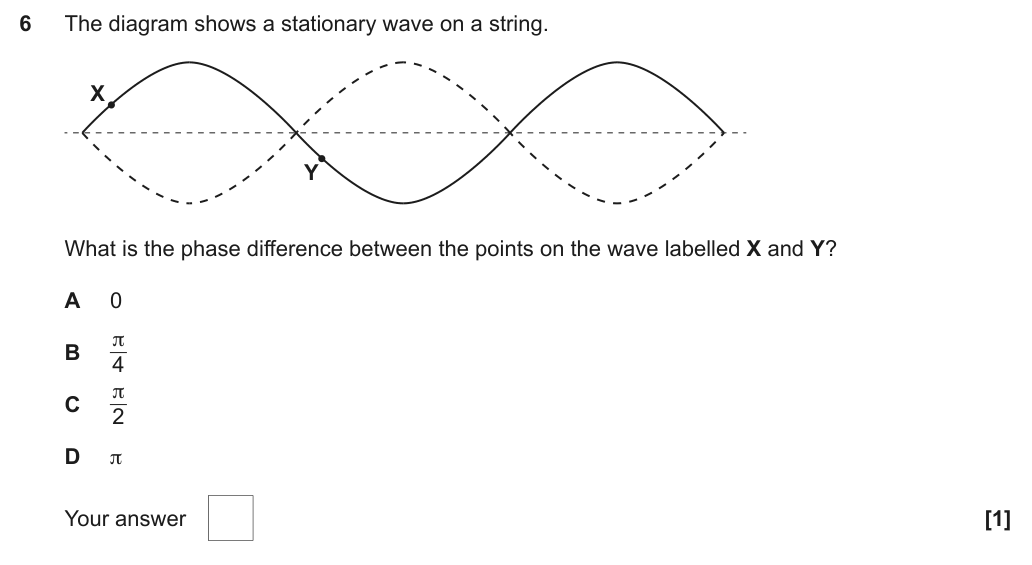
D
Many candidates correctly determined the correct phase difference as π between points X and Y as they interpretated that the fraction of the wave between points X and Y was the equivalent to λ/2. The most common distractor was C.
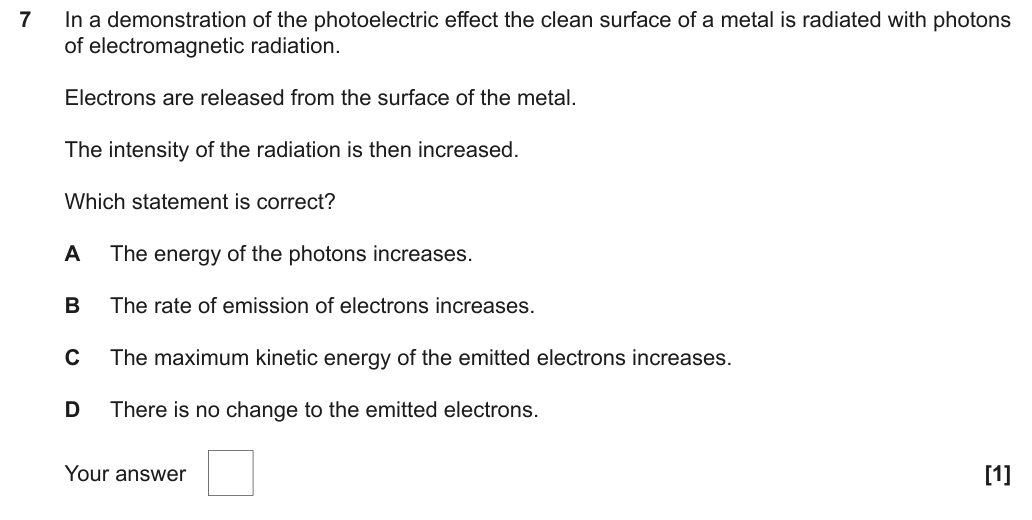
B
Candidates performed well on this question with many correctly relating an increase in intensity of radiation to an increase in the rate of emission of electrons.
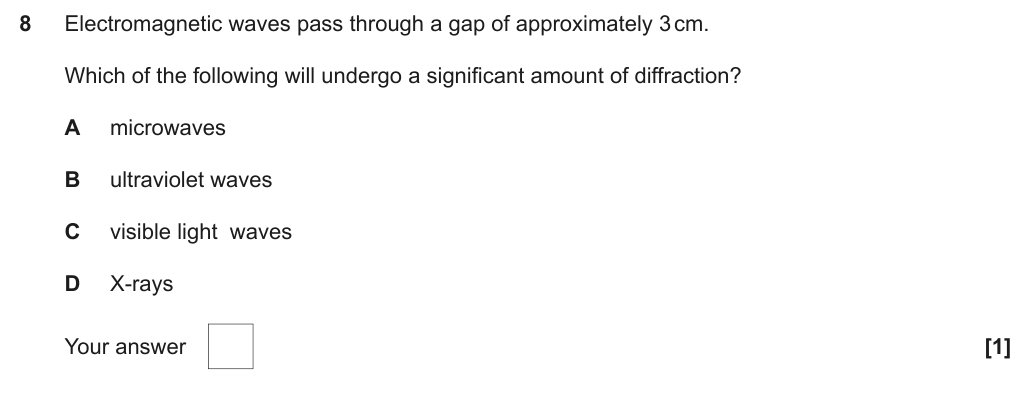
A
Candidates performed well on this question as they determined that when a wave passes through a gap with a similar size to its wavelength, it results in greater diffraction to give the response A.
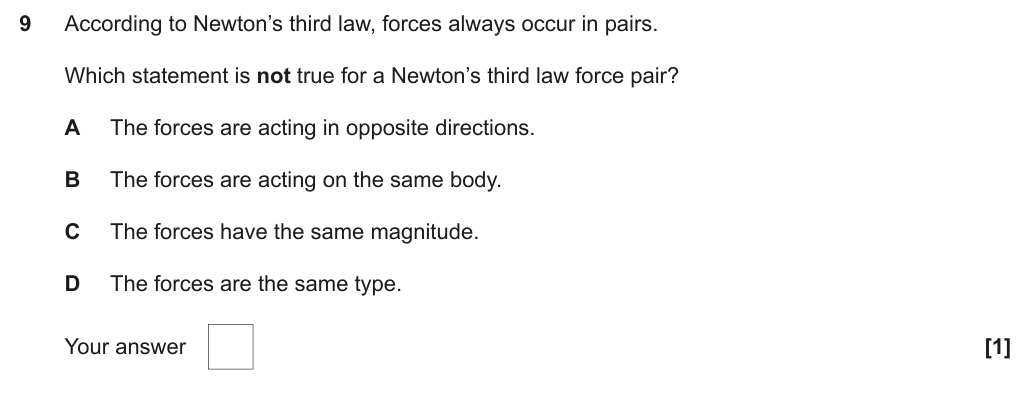
B
Many candidates correctly identified the correct response, B, by applying their understanding that an interaction pair of forces according to Newton’s third law do not act on the same body. The most common distractor answer was D.
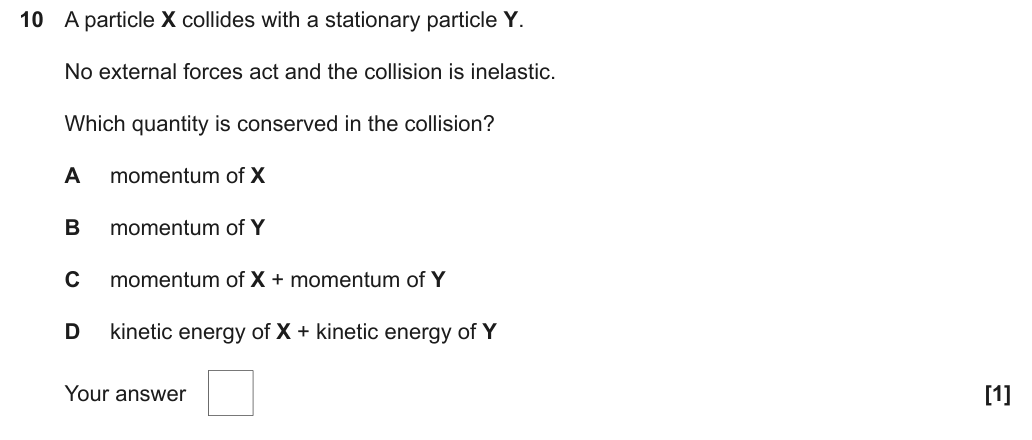
C
Many candidates correctly applied understanding of inelastic collisions that momentum is conserved, but the kinetic energy is not conserved to give the correct answer C.
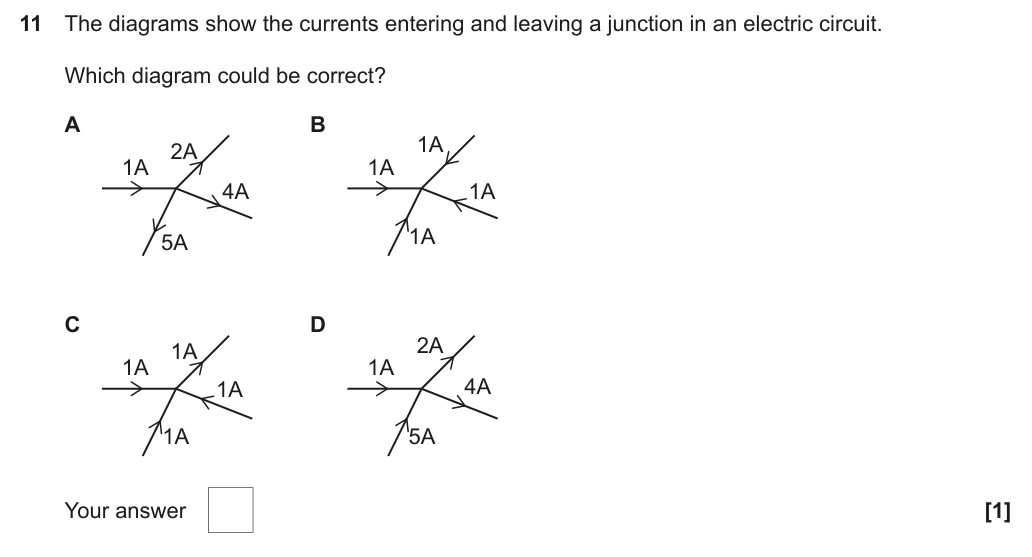
D
Candidates performed well on this question by correctly applying Kirchoff’s current law that the current flowing into a junction must be equal to the current flowing out of it to give the correct answer D.
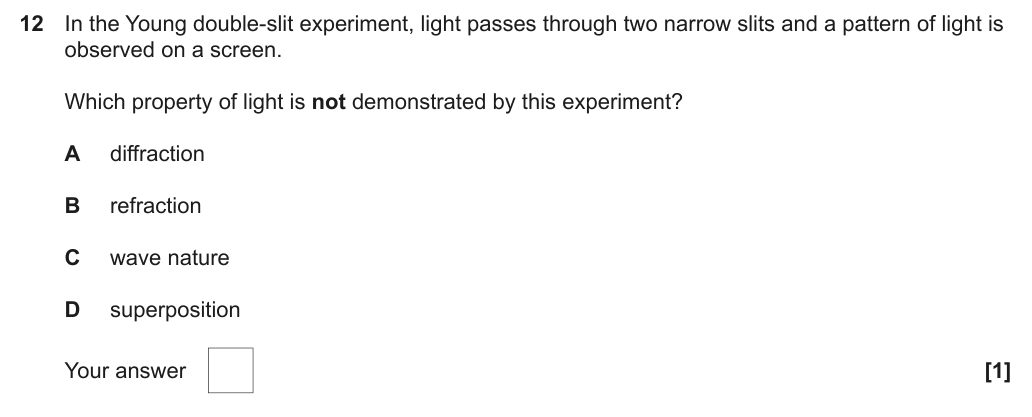
B
Candidates performed well on this question by correctly identifying that the Young’s double-slit experiment does not demonstrate the property of refraction of light to give the correct answer B.
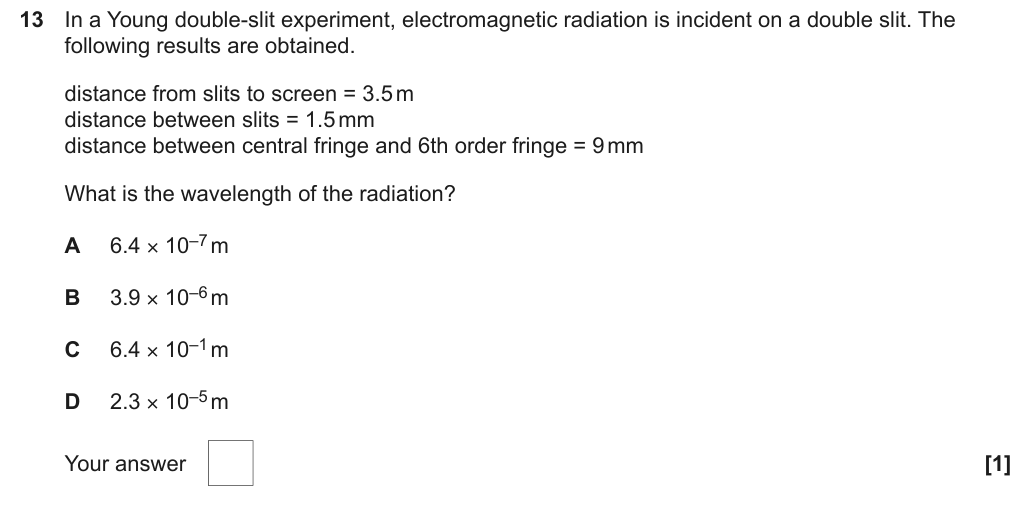
A
Some candidates correctly calculated the wavelength of radiation to be 6.4x10 -7m by determining that the fringe width was 9 mm/6 = 1.5 mm. Therefore, the most common distractor was answer B as candidates had used the value of 9 mm as the fringe width and had therefore not understood that the fringe width is the distance between successive bright fringes. Giving the answer B did demonstrate an understanding of consistent units by correctly converting mm to m.
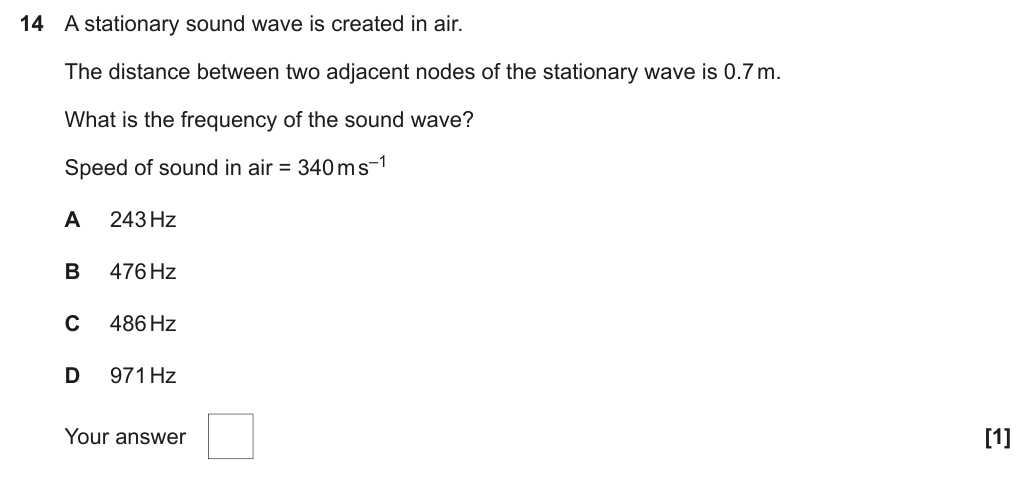
A
Candidates performed well on this question with many candidates correctly determining the wavelength of the standing wave as 1.4 m to then use this value to calculate the frequency of the wave as 243 Hz. This demonstrated understanding that the distance between adjacent nodes is λ/2 and not λ which was indicative of the most common distractor given by the answer B.
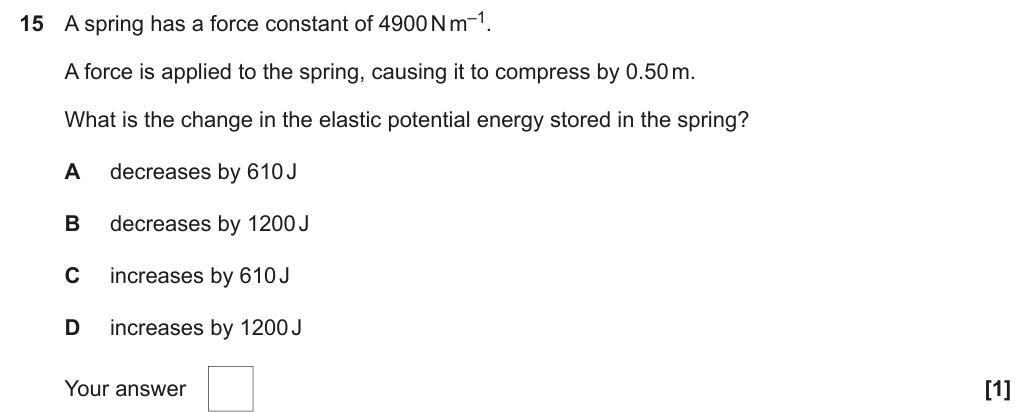
C
Overall, candidates performed well on this question with many correctly calculating the change in elastic potential energy as 610 J. The most common distractor was answer A, with candidates relating compression to a decrease in the change of elastic potential energy rather than an increase in the store of elastic potential energy.
Skills: M2.3 Substitute numerical values into algebraic equations using appropriate units for physical quantities
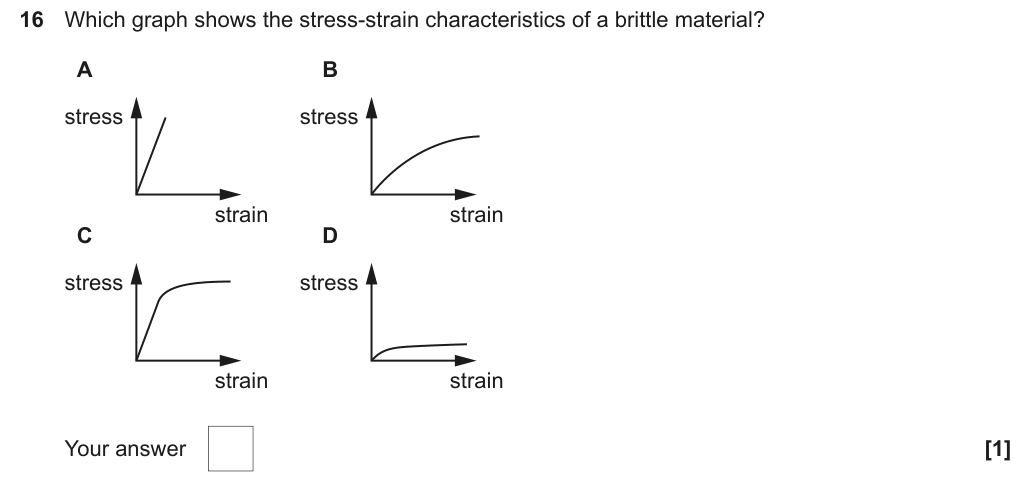
A
Candidates performed well on this question with most candidates correctly identifying graph A as most indicative of the stress-strain characteristics for a brittle material, as brittle materials exhibit minimal plastic deformation and the relationship between stress and strain is linear.
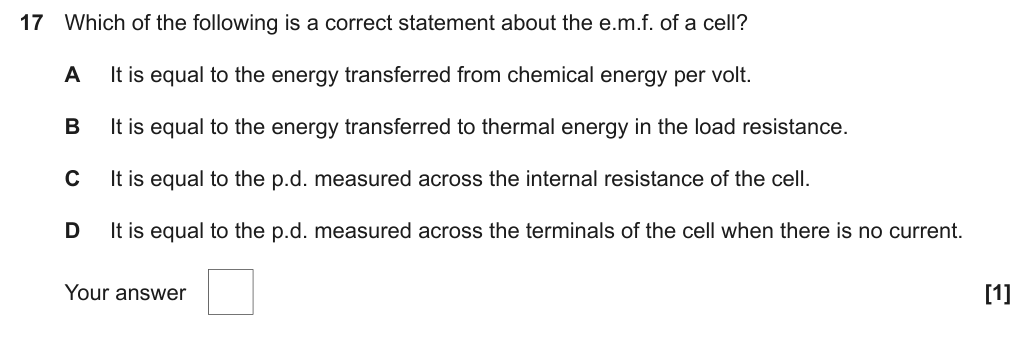
D
Some candidates correctly identified the statement defining e.m.f as answer D. The most common distractor was answer A, as candidates confused the definition of e.m.f as the energy transferred per coulomb of charge with per volt.
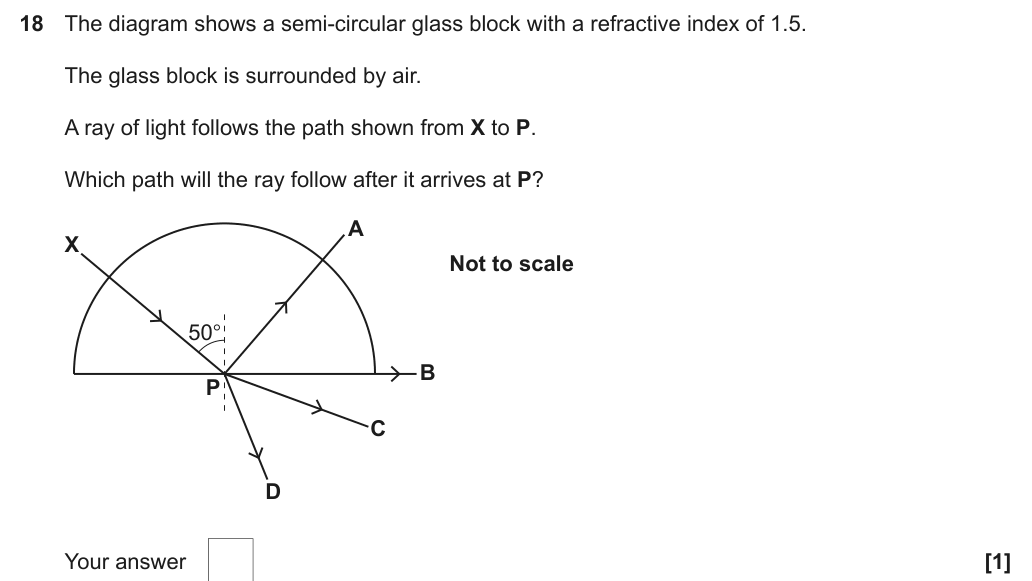
A
Some candidates correctly identified that the ray would follow path A after arriving at point P. To determine the correct path that the ray of light would follow, candidates were required to calculate the critical angle from the refractive index of the glass block to give 42°. If candidates calculated the critical angle they could determine that Total Internal Reflection would occur (as angle of incidence > critical angle) and hence that the ray would follow path A. The most common distractors were answers C and D.
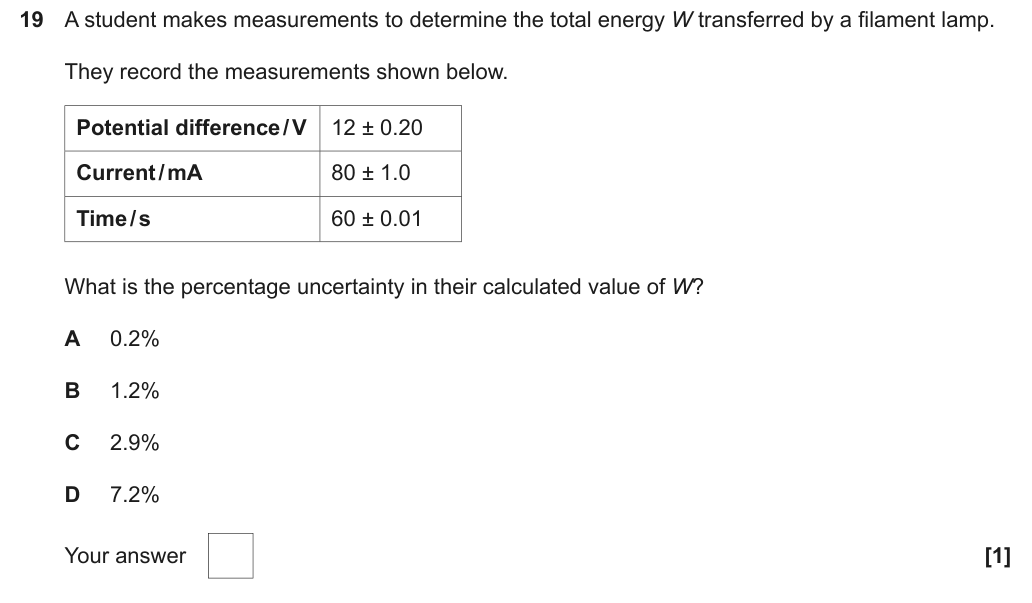
C
Candidates performed well on this question to correctly calculate the percentage uncertainty in the calculated value of W as answer C, by calculating the sum of each individual percentage uncertainty in each measurement.
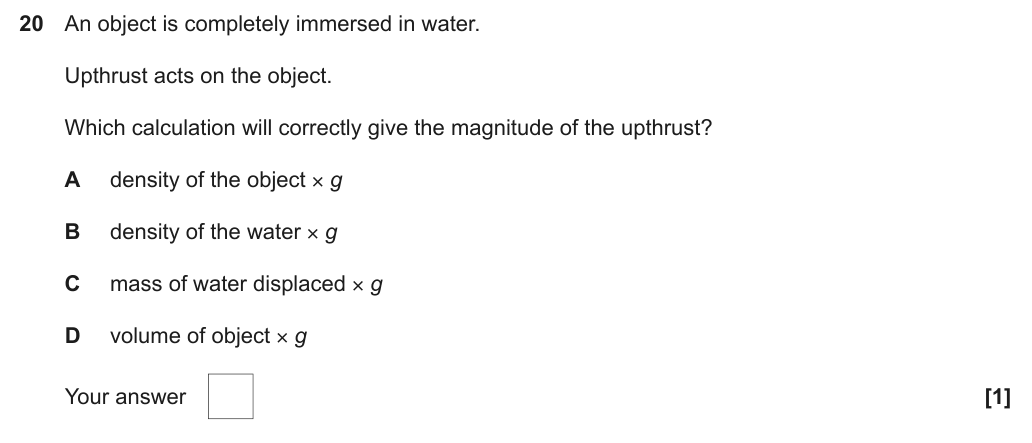
C
Candidates performed well on this question to correctly give that the magnitude of the upthrust of an object in a fluid is the weight of the fluid displaced by the object.
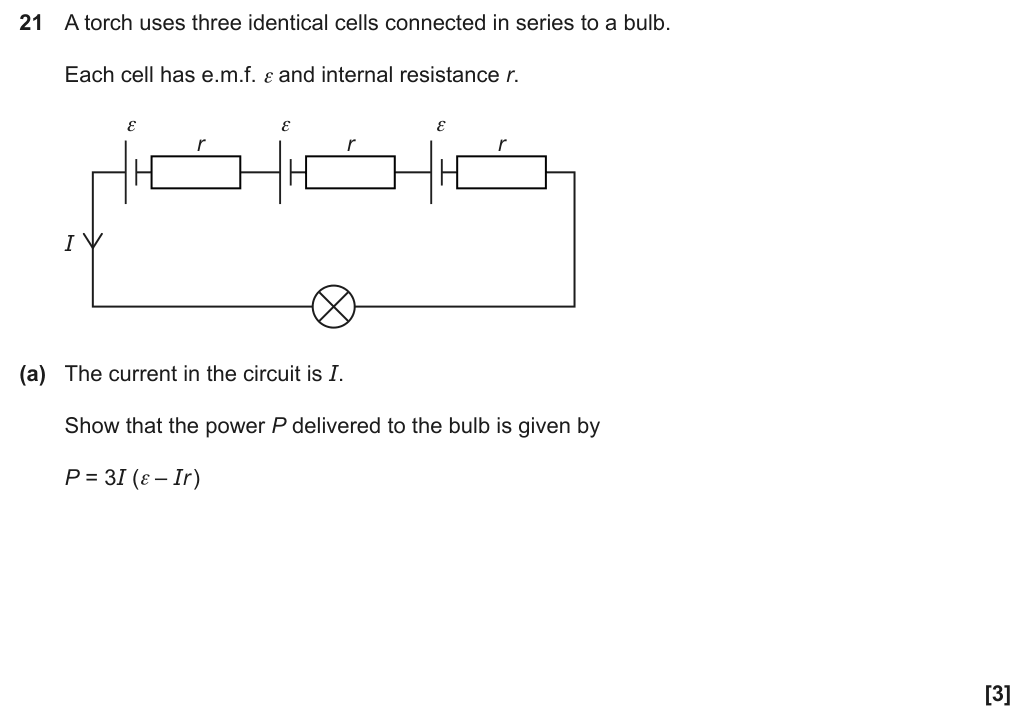
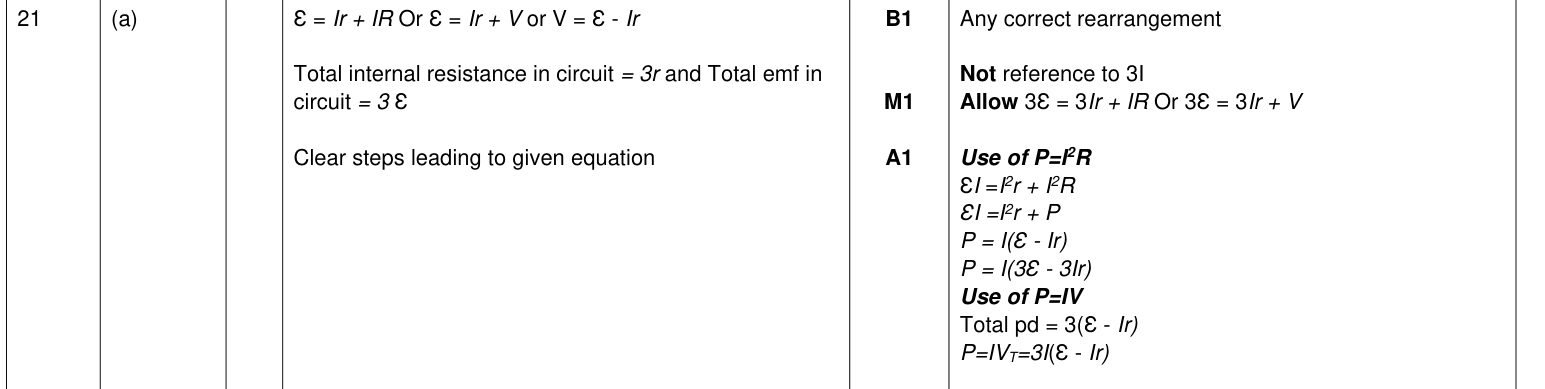
Most candidates achieved 1 mark for this question, for stating the correct expression for e.m.f, ɛ, e.g. ɛ = Ir + V with some candidates showing clearly that the power, P delivered to the bulb is given by the expression P = 3I(ɛ - Ir). Responses that were given 1 mark did not give clear working to express their understanding that the e.m.f. ɛ and internal resistance, r, were increased by 3. Often, candidates would just give an unqualified expression for P, e.g. P = 3 x I(ɛ - Ir), but from this expression it was not clear whether the factor of 3 was for current I or ɛ and r despite the correct application of P=IV. The responses that achieved 3 marks showed a clear rationale in their working and that for the 3 cells in series the total e.m.f. was 3ɛ, and the total internal resistance was 3r. These candidates then showed clear steps in finding an expression for the potential difference across the bulb using ɛ = Ir + V to be, e.g. V = 3ɛ - 3Ir. By showing clear working, it was evident that candidates understood that the potential difference across the bulb was equal to the total terminal potential difference across the three cells in series. These candidates then correctly substituted their expression for the potential difference into an equation for power, e.g. P=IV to show the power P delivered to the bulb given in the stem of the question. delivered to the bulb. The response is given 3 marks.
Skills: M2.2 Change the subject of an equation, including non-linear equations
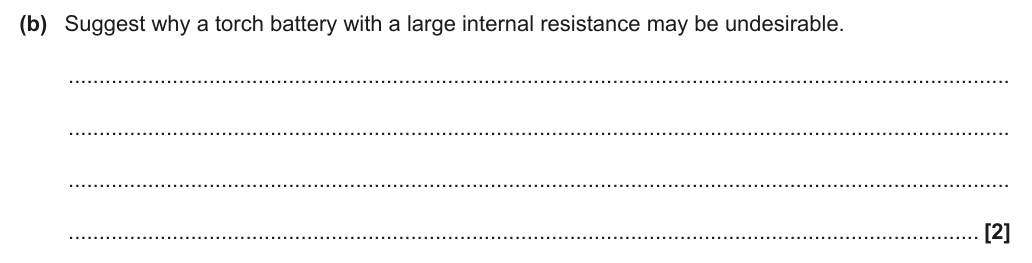
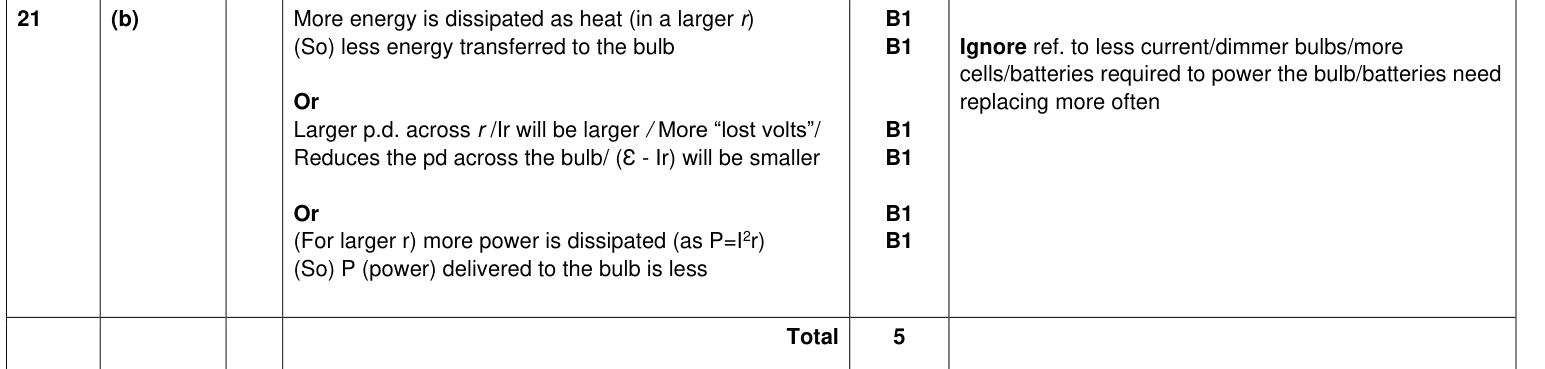
Some candidates achieved 1 mark for this question for suggesting the most common response that the potential difference across the bulb would decrease or that there would be more lost volts across the cells but only a few linked these suggestions to achieve 2 marks. Most candidates mixed suggestions by referencing energy transfer and potential difference which meant that they only achieved 1 mark. Some candidates gave suggestions in terms of current and efficiency, which did not link to the undesirability of a large internal resistance and so were not given any marks.
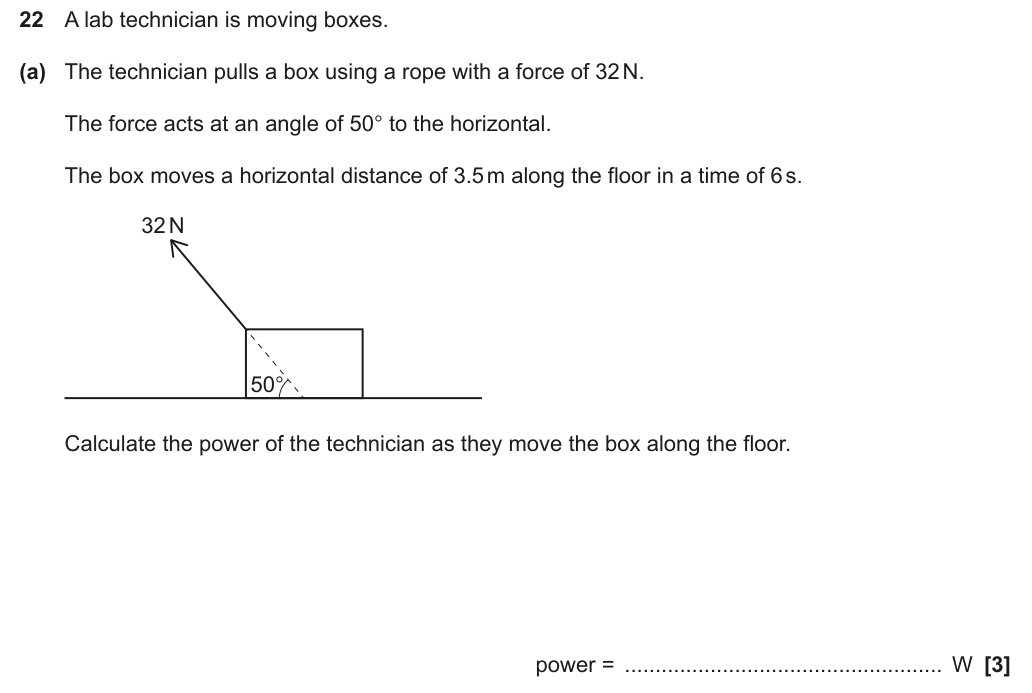
Candidates performed well on this question by correctly applying P=Fv by calculating the horizontal component of the 32N force acting on the box and the velocity as it moved along the floor to calculate the power of the technician as 12W.
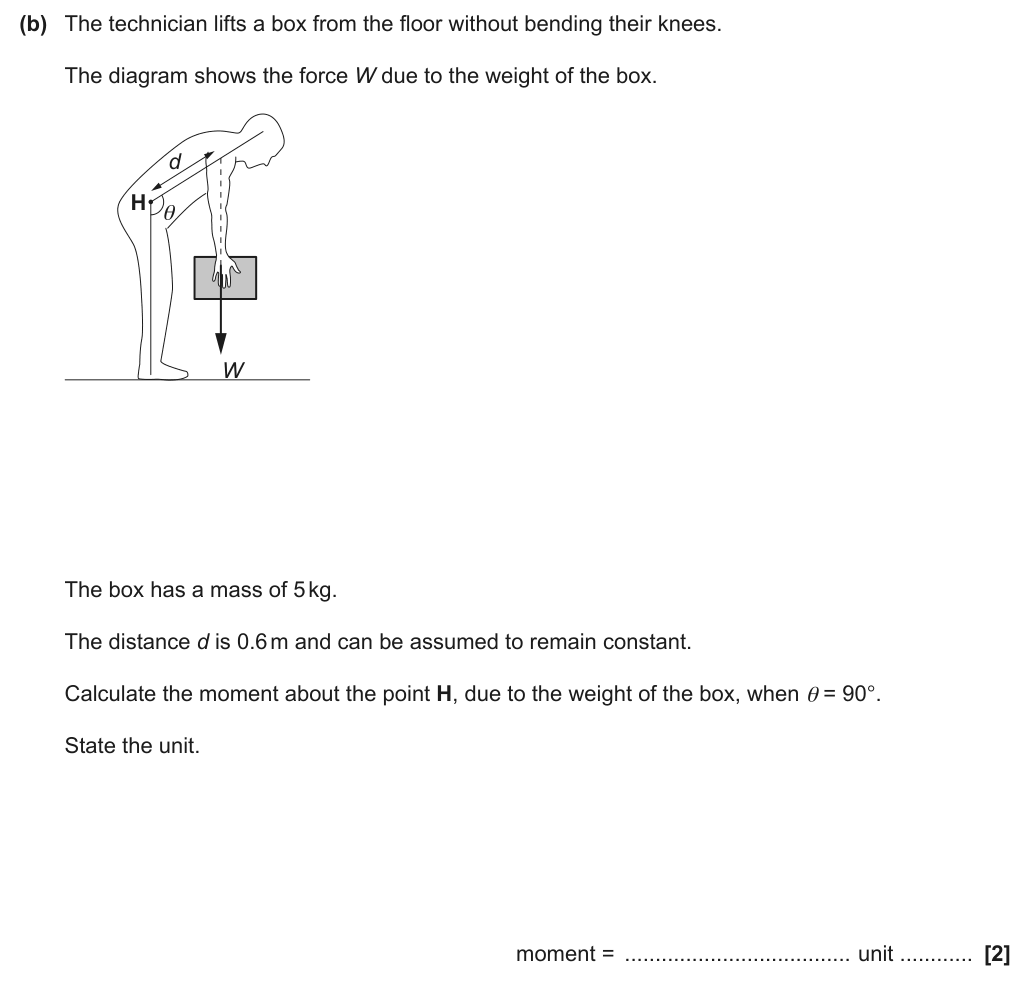
Candidates performed well on this question as they correctly applied the equation moment = force x perpendicular distance from the pivot to calculate the moment as 29.4 Nm and most also gave the correct unit for moment as Nm.
Skills: M0.1 Recognise and make use of appropriate units in calculations; M2.3 Substitute numerical values into algebraic equations using appropriate units for physical quantities
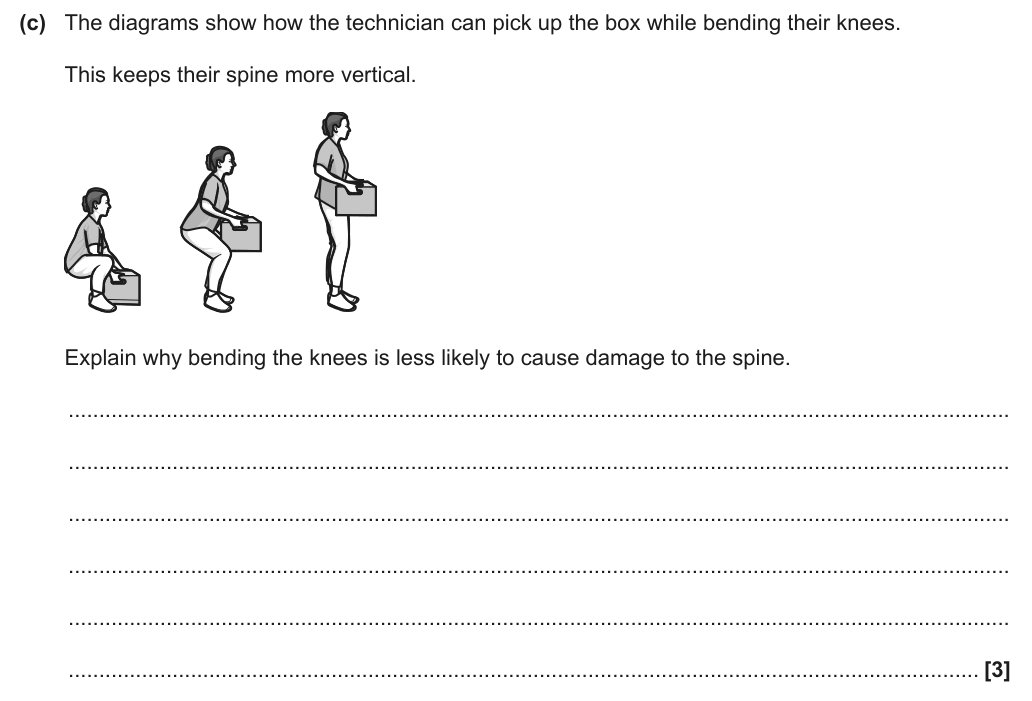
There were not many successful responses for this question and many were given 0 marks. Most responses were often vague and unspecific descriptions of a change in the centre of mass, or a distribution of the weight of the box. Most candidates did not establish that by bending the knees, the perpendicular distance to the pivot/hips decreased. Hence the moment about the pivot/hips would be reduced, which in turn reduced the force acting on the spine, resulting in less damage. Some candidates did describe that the moment about the pivot/hips would be reduced by bending the knees. However, a significant number of candidates would then follow this by explaining that there would be ‘less stress’ on the spine, rather than less force acting on the spine.
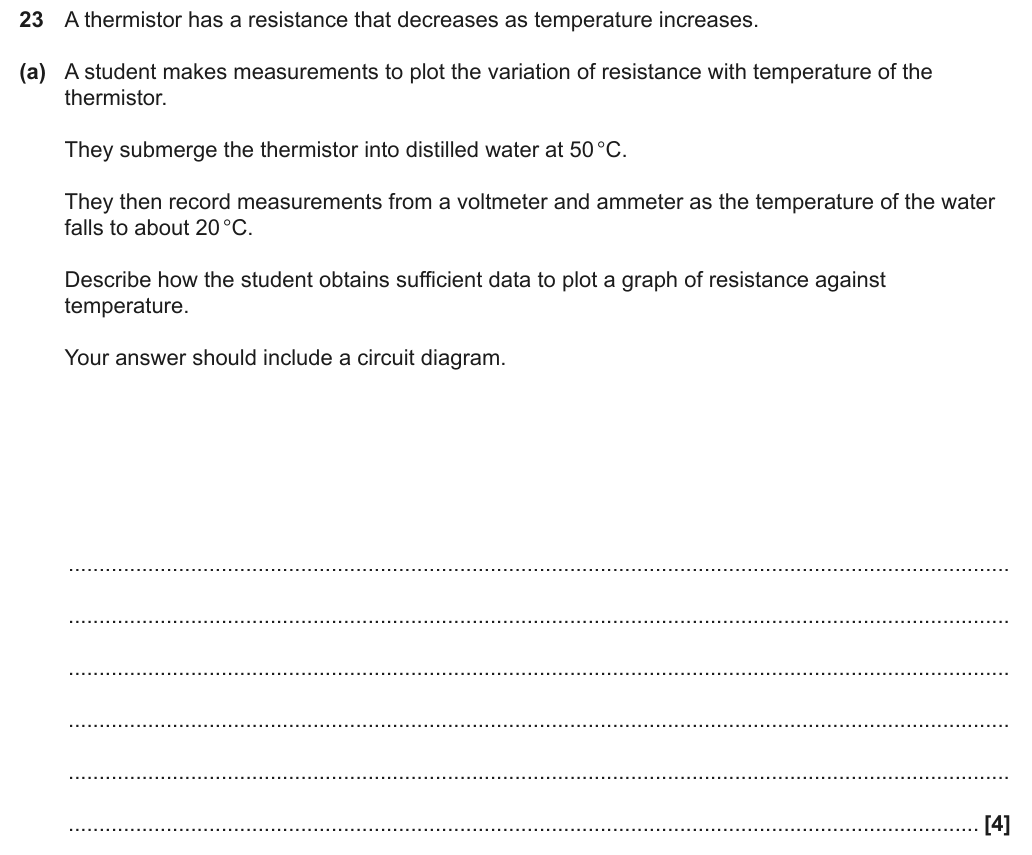
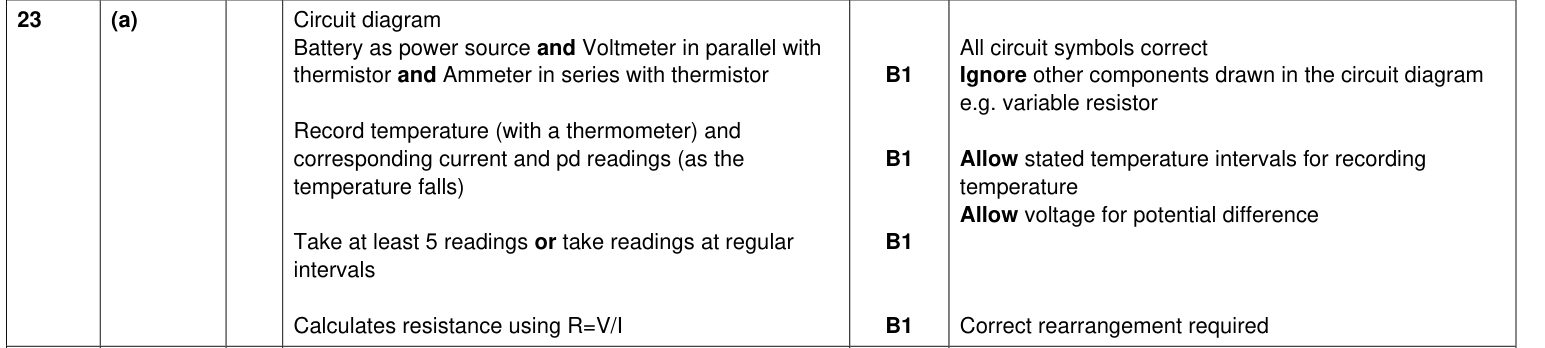
Overall, candidates performed well on this question with most achieving at least 1 mark and some achieving over 2 marks. Most candidates were given marks for a correctly drawn circuit diagram (including current circuit symbols for the components required for the investigation) and for a correct rearrangement of V=IR to be able calculate the resistance. Some candidates would describe that measurements would need to be read from the ammeter and voltmeter, which was insufficient as the measurements of current and potential difference needed to be specified to achieve the mark.
Skills: PAG3 Investigating electrical properties
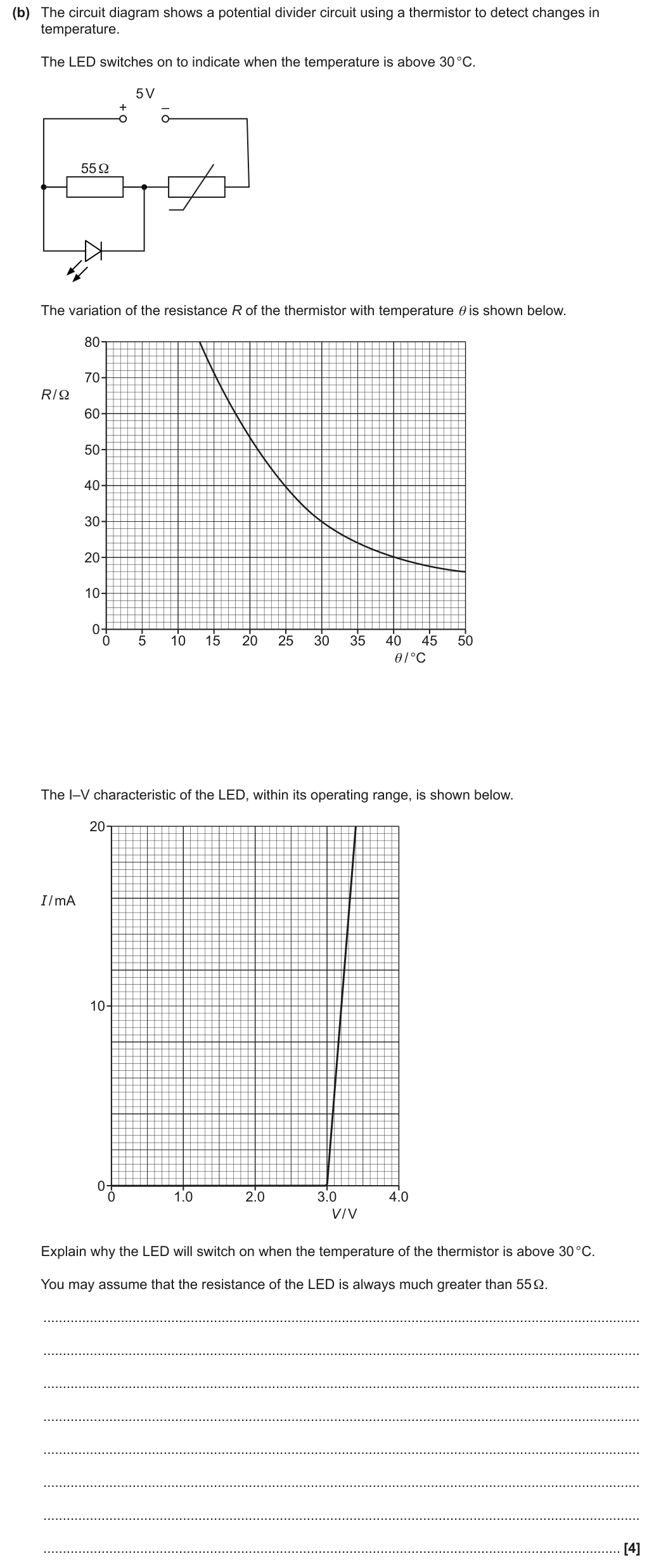
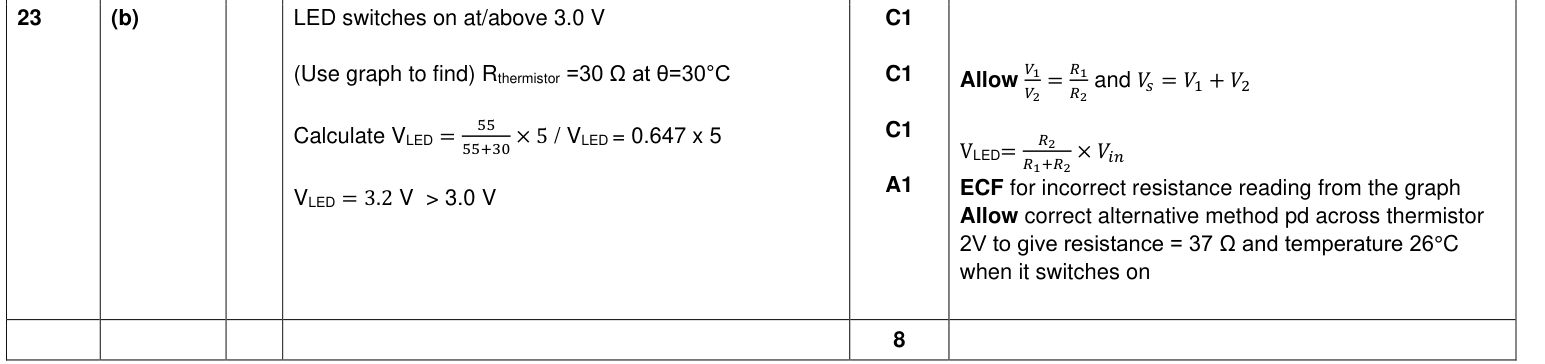
Candidate performance on this question was variable as some were given 0 marks because they did not reference and interpret the data from the two graphs given in the question. temperature and resistance of the thermistor, and then they relate this to the potential difference across the LED but without any reference to the data given in the two graphs. temperature θ/°C to find the resistance at 30°C and then applies the equation for a potential divider to calculate the potential difference across the LED. They then clearly compare their calculated value of potential difference to the I-V characteristic for the LED to explain why the LED switches on above a threshold potential difference of 3V.
Skills: M2.3 Substitute numerical values into algebraic equations using appropriate units for physical quantities; M3.1 Translate information between graphical, numerical and algebraic forms; PAG4 Investigating electrical circuits
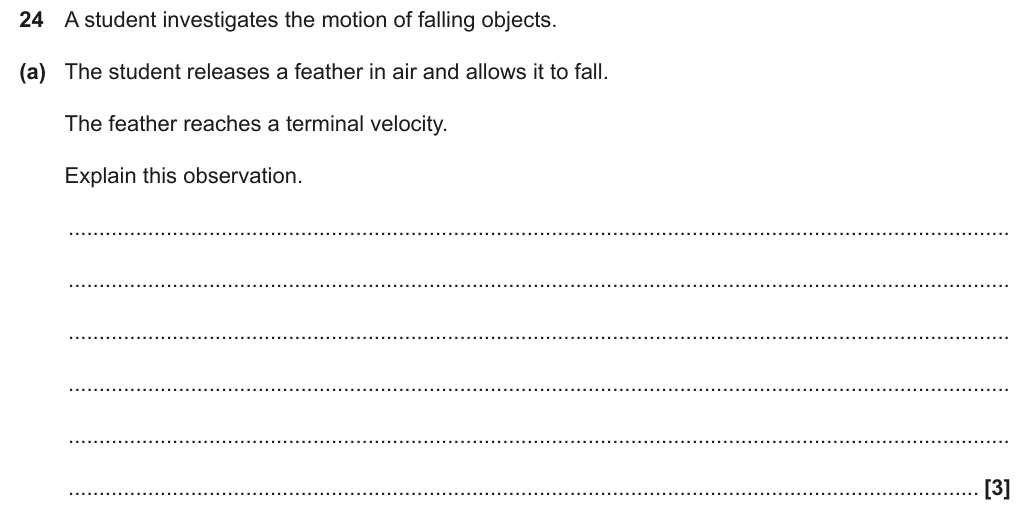
Candidates generally performed well on this question as many were given 1 or 2 marks for correctly explaining that the feather was falling at a constant speed because the weight acting on the feather was equal to the opposing force of air resistance. Some candidates explained this further by stating that the resultant force acting on the feather was 0.
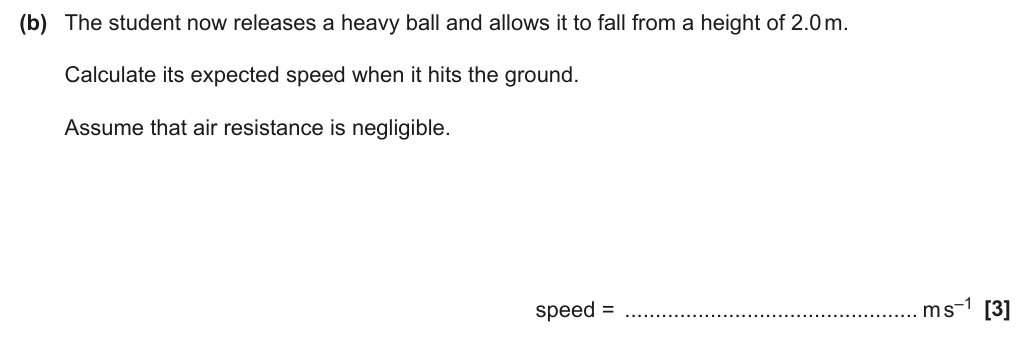
Candidates performed very well on this question by selecting and applying the correct equation of motion to calculate the speed of the ball when it hit the ground. Selection and application of formulae Candidates performed well on the selection and application of equations of motion from Module 3: Forces and motion.
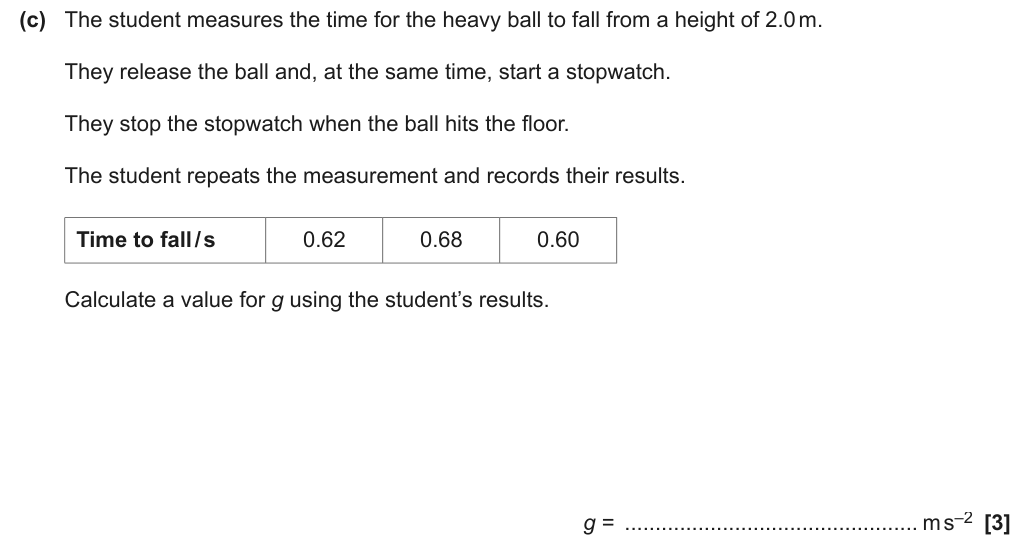
Candidates performed well on this question as many candidates correctly calculated the mean time to fall/s and then selected and applied the equation of motion s = ut + ½at 2 to calculate a value of g for the falling ball. Some candidates calculated a mean from the time values 0.62 s and 0.60 s, by omitting the result 0.68 s and this was given marks if they clearly identified the omittance of this value by identifying the result as anomalous.
Skills: M1.2 Find arithmetic means; M2.2 Change the subject of an equation, including non-linear equations; M2.3 Substitute numerical values into algebraic equations using appropriate units for physical quantities; PAG1 Investigating motion
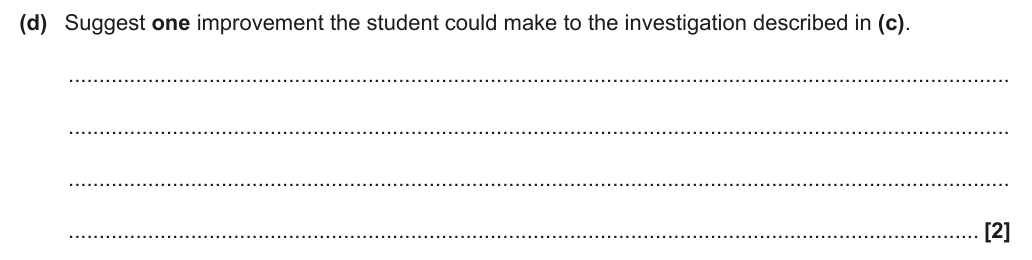
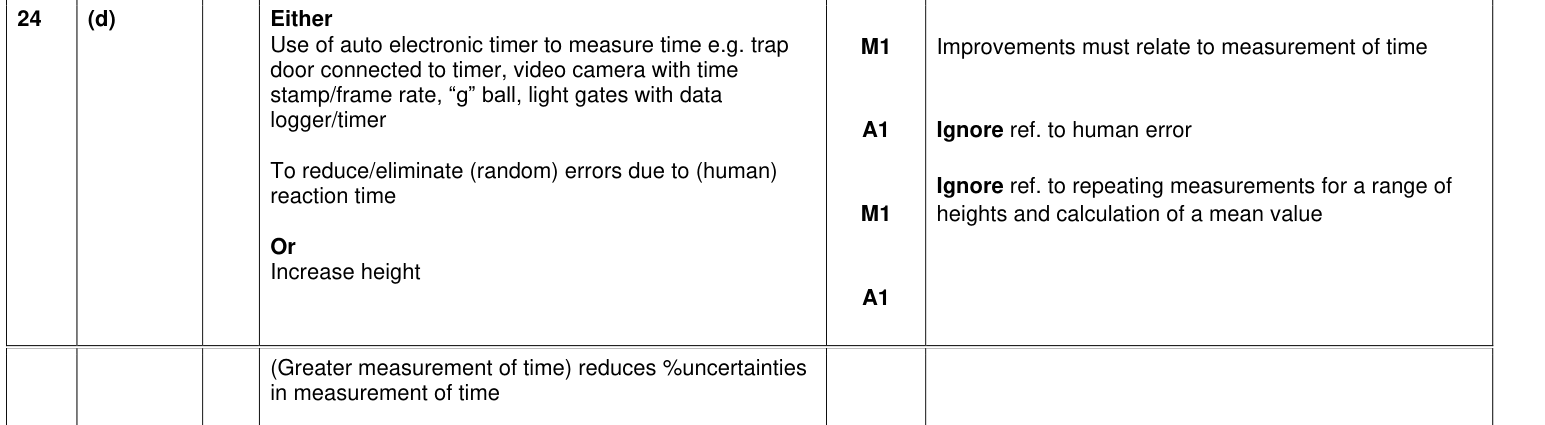
There were not many successful responses to this question, with most given 0 marks. Many candidates made attempts to suggest suitable improvements, but these were often vague and unspecific, e.g. use light gates but without any reference on how this piece of equipment would be used to time (such as by connecting to a data logger or (electronic) timer). To be given 2 marks, candidates had to achieve the first method mark for a correct improvement. Therefore, most candidates were not able to access the second mark as they had not achieved the first method mark for a correct improvement. Many candidates attempted to give reasons for their improvement but again these explanations were superficial as they were expressed without relating to the error due to reaction time. Some candidates did give a suggested improvement in terms of increasing the height of the fall of the ball, which meant they were given the first method mark but corresponding explanations linked to reducing the percentage uncertainty was not always fully developed to award the second mark.
Skills: M1.5 Identify uncertainties in measurements and use simple techniques to determine uncertainty when data are combined; PAG1 Investigating motion
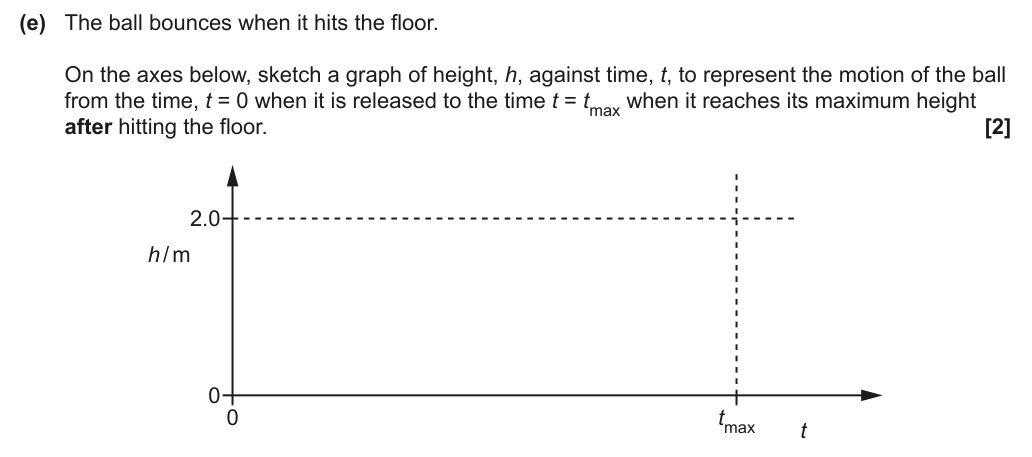
There were not many successful responses to this question, as many were given 0 marks for an incorrect sketch graph of the motion of the ball when it bounced after hitting the floor. Many candidates sketched a graph for a ball falling with constant velocity or for their graph drawn to a maximum height of 2.0m at time, tmax which represented an elastic collision when the ball hit the floor.
Skills: M3.12 Sketch relationships which are modelled by y = k/x, y = kx², y = k/x², y = kx, y = sin x, y = cos x, y = e^(±x) and y = sin²x, y = cos²x as applied to physical relationships
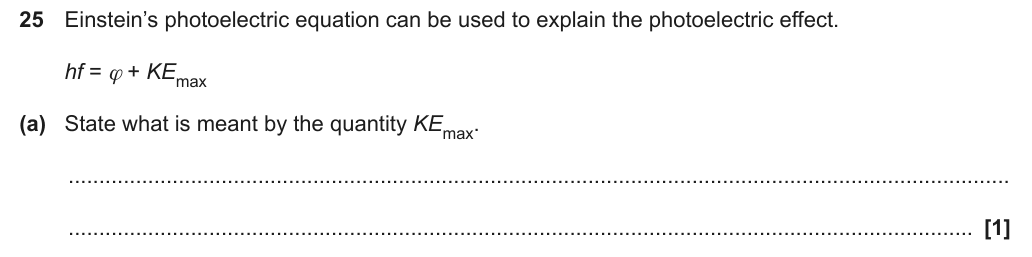
This should have been a straightforward definition of the maximum kinetic energy of electrons when they are emitted from the surface of a metal but many candidates were not given the mark as their definitions lacked specific scientific language.
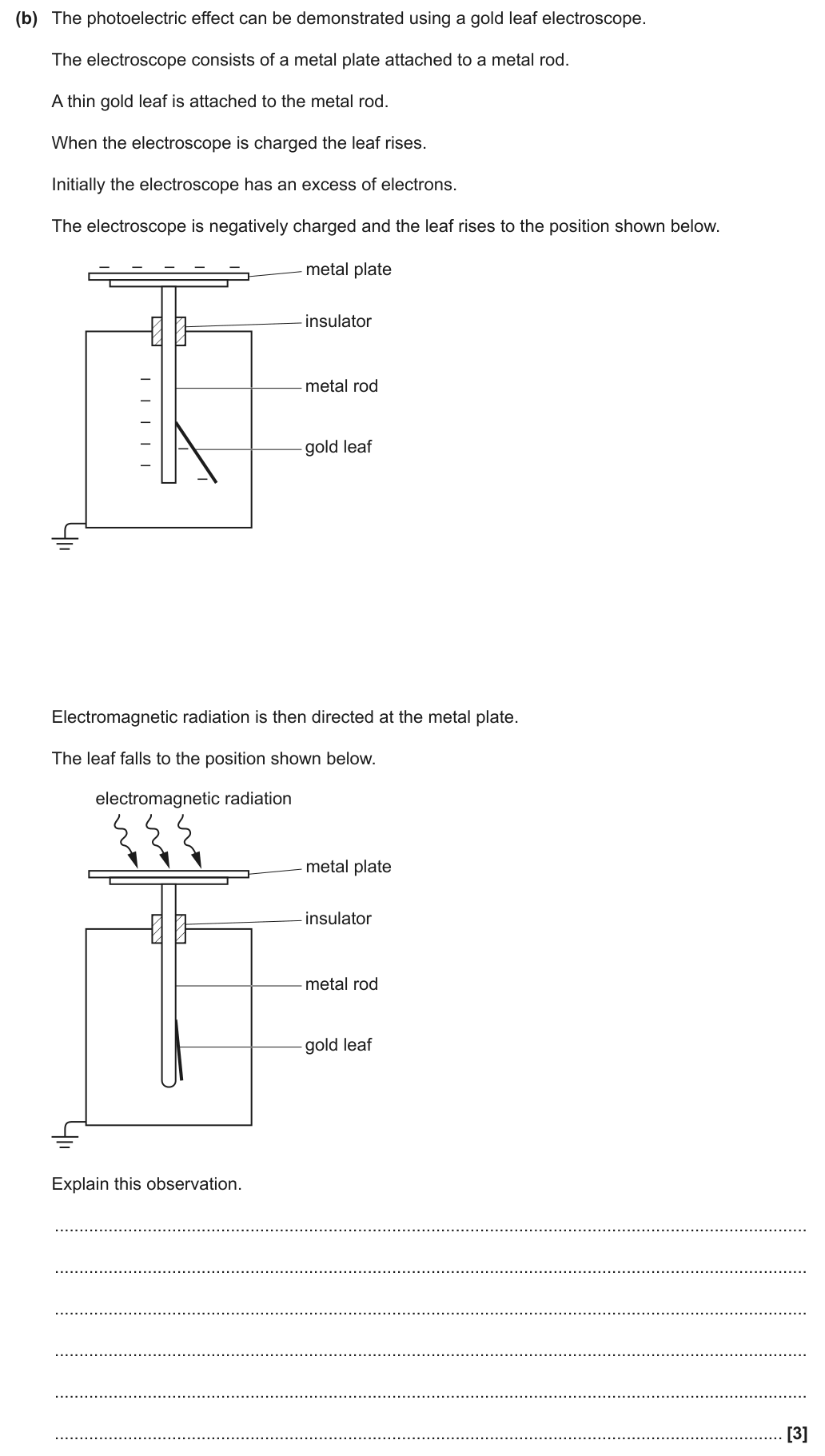
Most candidates were given at least 1 mark for this question for the explanation that when electromagnetic radiation is incident on the metal plate electrons are emitted. Some candidates were then given a further mark for explaining that the gold leaf fell due to losing negative charge but there were a significant number of responses that referred to positive charge and that as the leaf was losing negative charge it became positively charged. While candidates may not have observed a demonstration of a gold leaf electroscope, the question assessed their understanding and explanation of the photoelectric effect and that is only the removal of excess electrons when there is a one-to-one interaction with a photon.
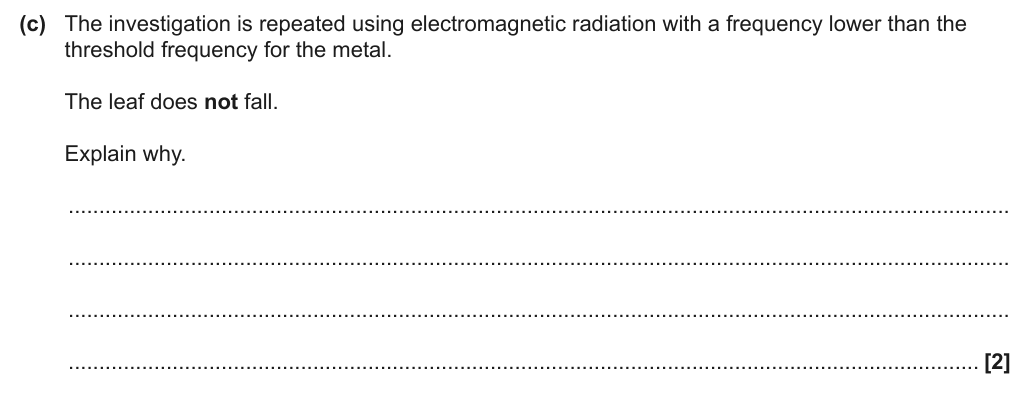
There were not many successful responses for this question and many responses were given 0 marks. These responses did not explain the reason for the leaf not falling in relation to photon energy and the work function, and hence that the electron does not receive enough energy to be emitted. Typical responses that were not given marks were for a description of threshold frequency as the minimum frequency required for electrons to be emitted and/or for simple stating that the leaf does not fall as electrons are not emitted. While these descriptions were valid, candidates had not applied Ep=hf and Φ=hfo to explain that the energy of the photon was less than the work function required for electrons to be emitted.
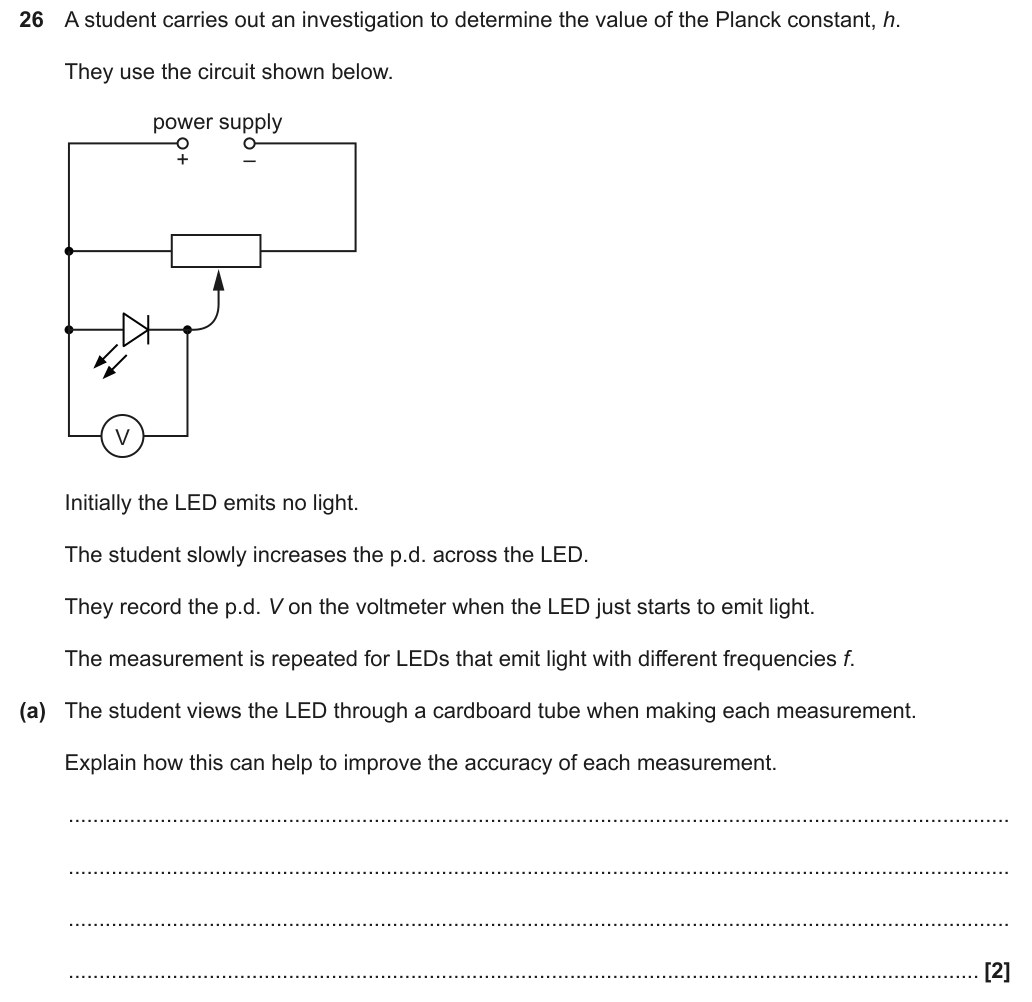
There were many successful responses for this question. Many responses were given 2 marks because they explained why a cardboard tube improves the accuracy of each measurement due to removing light from the surroundings, which enabled the light from the LED to be observed when it was first emitted.
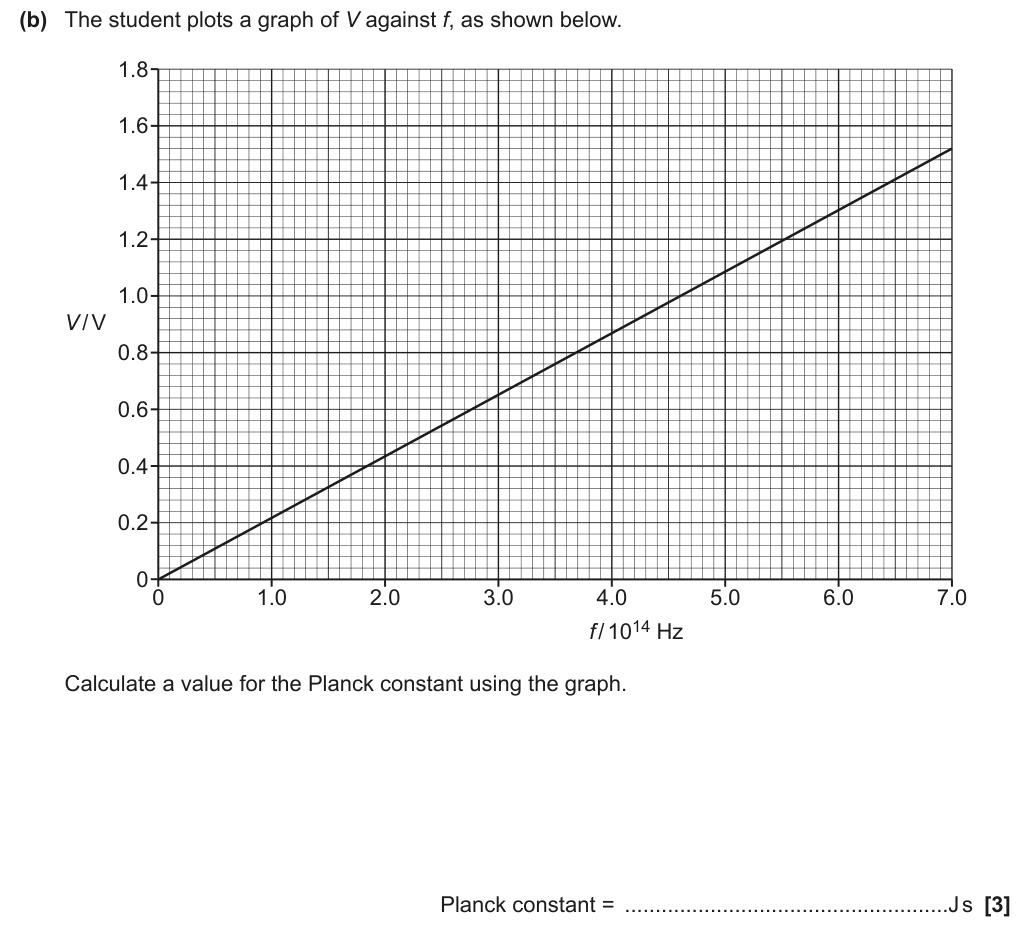
There was some variability in performance with this question, but many responses achieved 3 marks for a correct calculation and value for the Planck constant using data from the graph. The most common reason for responses being given 0 marks were for an error in their gradient calculations for either taking readings from less than half the graph, or for not including the correct power for frequency 10 14. Some candidates did correctly calculate the gradient from the graph, but then did not select and apply eV=hf to calculate a value of the Planck constant.
Skills: M0.2 Recognise and use expressions in decimal and standard form; M2.2 Change the subject of an equation, including non-linear equations; M3.4 Determine the slope and intercept of a linear graph; PAG6 Investigating quantum effects
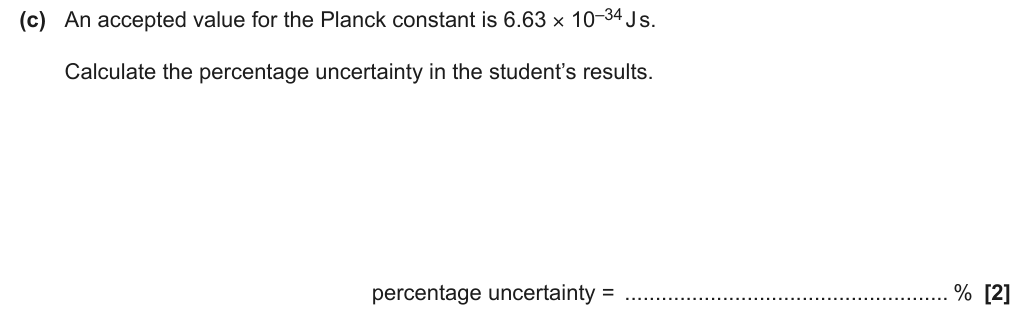
Candidates did not perform well on this question as many candidates were given 0 marks. The most common reason for candidates not achieving marks was for not calculating a difference between the calculated and accepted value for the Planck constant with many candidates carrying out the calculation calculated value/accepted value x 100%.
Skills: M0.3 Use ratios, fractions and percentages; M1.5 Identify uncertainties in measurements and use simple techniques to determine uncertainty when data are combined
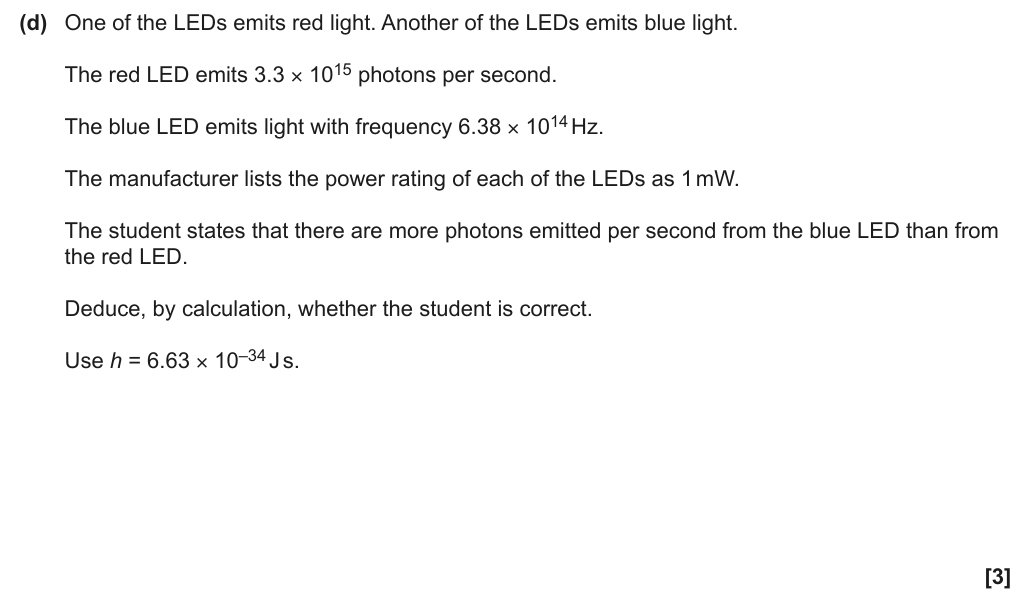
Most candidates were given 1 mark for correctly calculating the energy of one photon of blue light by selecting and applying E=hf. Some candidates correctly converted the power of the LED to calculate the number of blue photons emitted in 1 second by using and applying P=E/t. Where candidates did not achieve any further marks, this was for selecting an incorrect equation and not applying P=E/t.
Want a paper marked and gone through with you? Message us.