June 2024: Paper 1, Modelling physics

100 marks · 50 question parts · Paper, mark scheme and report on OCR's site · Have the Data, Formulae and Relationships Booklet beside you

Question by question

QTopicMarksAOType
1 Physical quantities and S.I. units 1Multiple choice
2 Physical quantities and S.I. units 1Multiple choice
3 Circular motion and centripetal force 1Multiple choice
4 Linear motion: the suvat equations and free fall 1Multiple choice
5 Density, pressure and upthrust 1Multiple choice
6 Equilibrium: moments, couples and centre of mass 1Multiple choice
7 Kinematics: displacement, velocity and motion graphs, Linear motion: the suvat equations and free fall 1Multiple choice
8 Scalars and vectors 1Multiple choice
9 Simple harmonic motion, damping and resonance 1Multiple choice
10 Simple harmonic motion, damping and resonance 1Multiple choice
11 Circular motion and centripetal force 1Multiple choice
12 Simple harmonic motion, damping and resonance 1Multiple choice
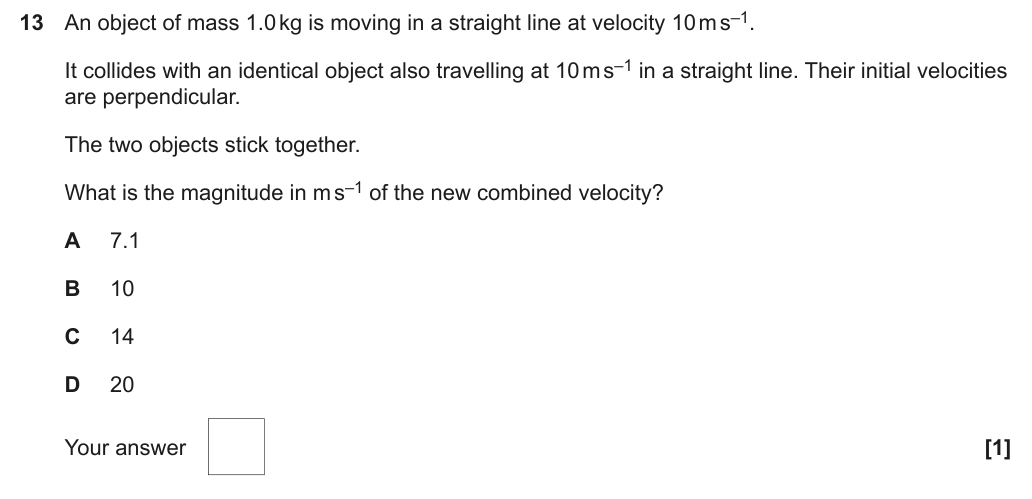
13 Collisions: conservation of momentum, Scalars and vectors, Newton's laws of motion and momentum 1Multiple choice
14 Gravitational fields, Newton's law of gravitation and gravitational potential 1Multiple choice
15 Cosmology: parallax, the Doppler effect, Hubble's law and the Big Bang 1Multiple choice
16(a)(i) Dynamics, drag and terminal velocity, Kinematics: displacement, velocity and motion graphs 2Diagram or graph
16(a)(ii) Dynamics, drag and terminal velocity 2Explanation
16(a)(iii) Scalars and vectors, Dynamics, drag and terminal velocity 3Show that
16(b) Work, energy and power 3Calculation
16(c) Work, energy and power 2Explanation
17(a) Newton's laws of motion and momentum 1Short answer
17(b)(i) Scalars and vectors 2Calculation
17(b)(ii) Newton's laws of motion and momentum 2Explanation
17(b)(iii) Newton's laws of motion and momentum 3Calculation
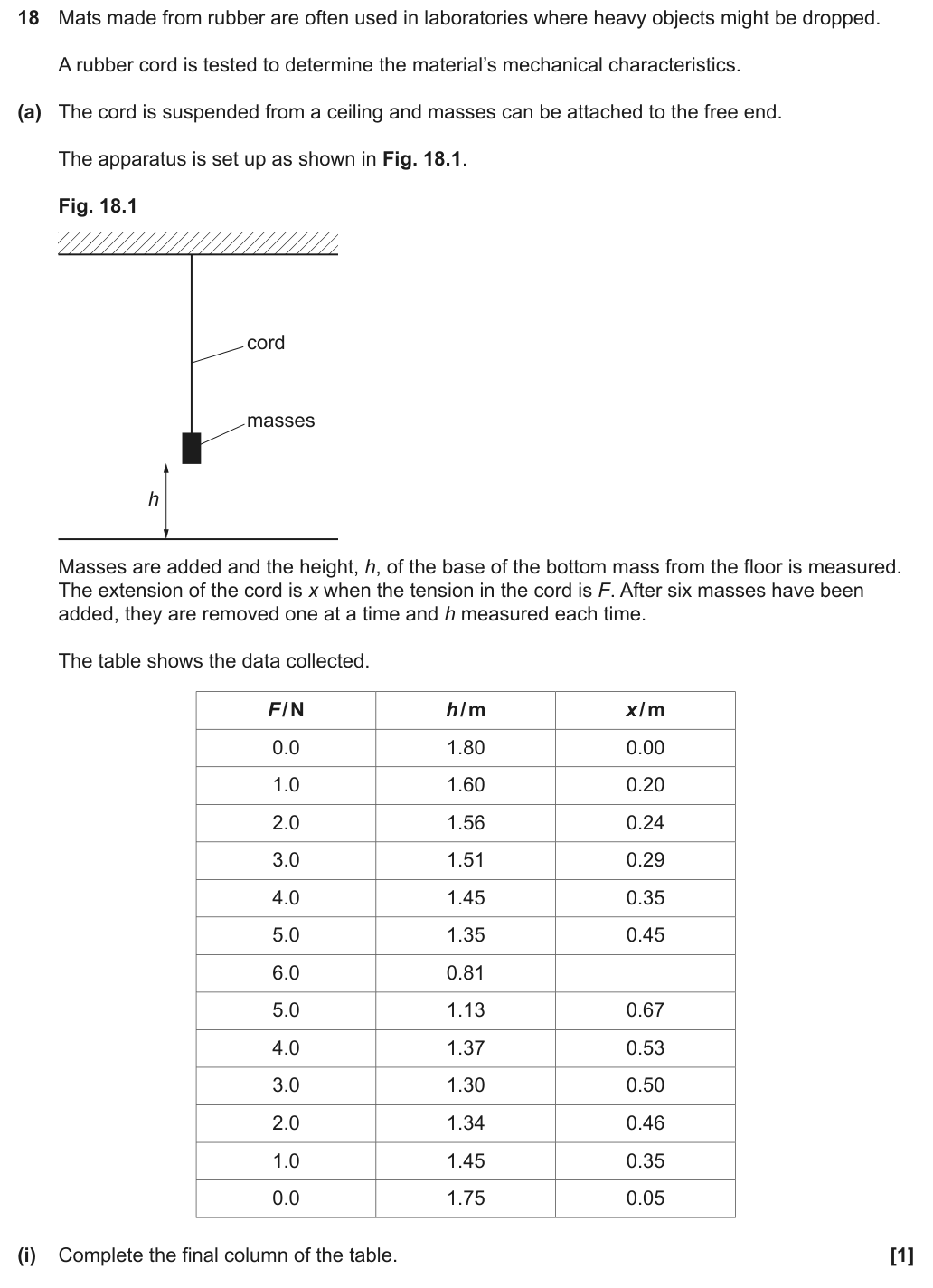
18(a)(i) Springs and Hooke's law, Practical skills: planning, analysis and evaluation 1Short answer
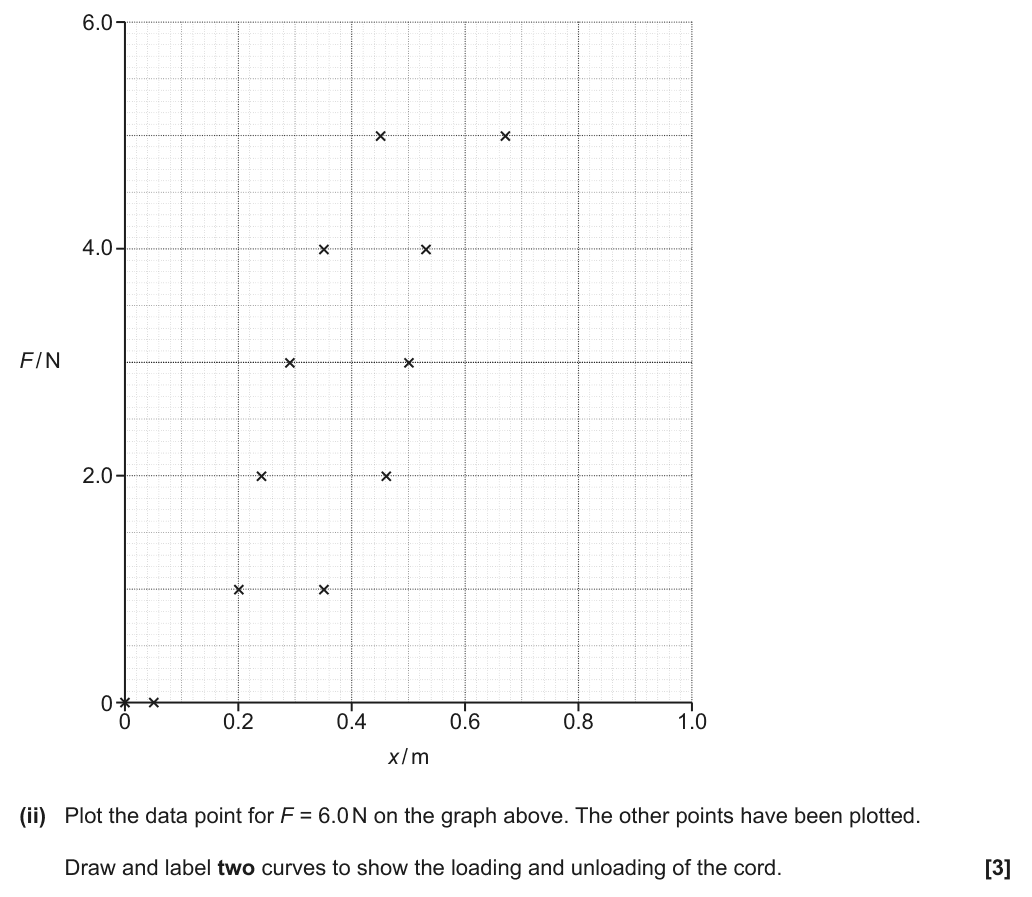
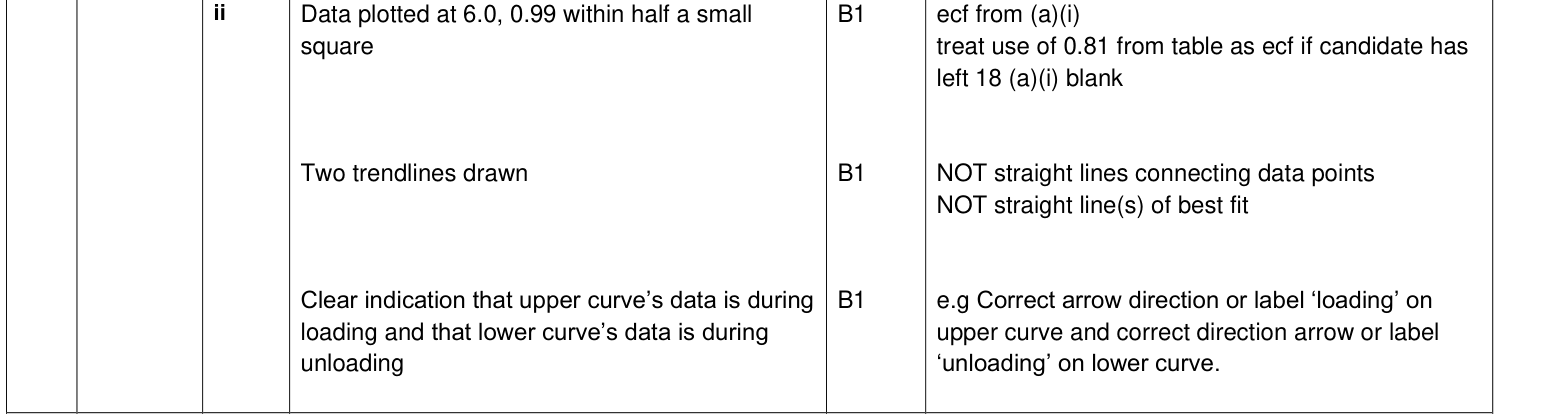
18(a)(ii) Springs and Hooke's law, Practical skills: planning, analysis and evaluation, Mechanical properties of matter: stress, strain and the Young modulus 3Diagram or graph
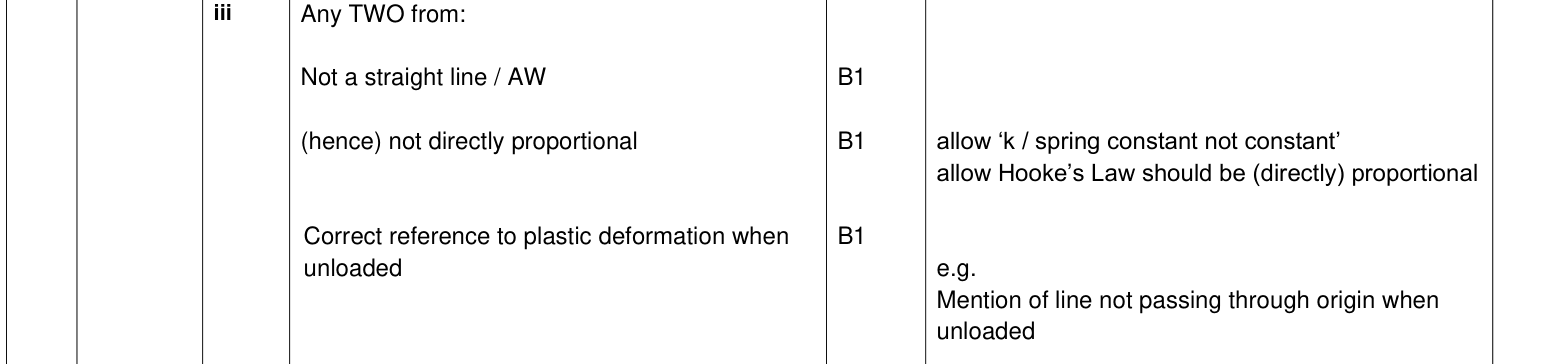
18(a)(iii) Springs and Hooke's law, Mechanical properties of matter: stress, strain and the Young modulus 2Explanation
18(a)(iv) Mechanical properties of matter: stress, strain and the Young modulus, Work, energy and power 3Explanation
18(b) Practical skills: planning, analysis and evaluation 2Explanation
19 Stars: stellar evolution, energy levels, spectra, Wien's law and Stefan's law, Practical skills: planning, analysis and evaluation 6Extended response
20(a)(i) Ideal gases and the kinetic theory, Thermal physics: temperature, internal energy and specific heat capacity 1Short answer
20(a)(ii) Ideal gases and the kinetic theory 2Show that
20(b)(i) Ideal gases and the kinetic theory 2Show that
20(b)(ii) Ideal gases and the kinetic theory 3Calculation
20(c)(i) Work, energy and power, Thermal physics: temperature, internal energy and specific heat capacity 3Explanation
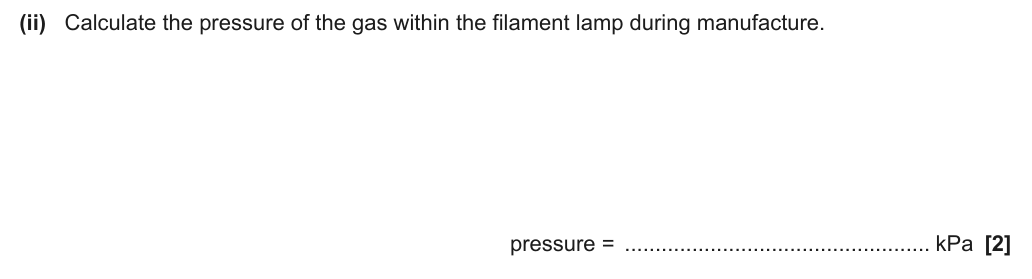
20(c)(ii) Ideal gases and the kinetic theory 2Calculation
21(a)(i) Stars: stellar evolution, energy levels, spectra, Wien's law and Stefan's law 2Show that
21(a)(ii) Stars: stellar evolution, energy levels, spectra, Wien's law and Stefan's law 3Calculation
21(b)(i) Work, energy and power 2Show that
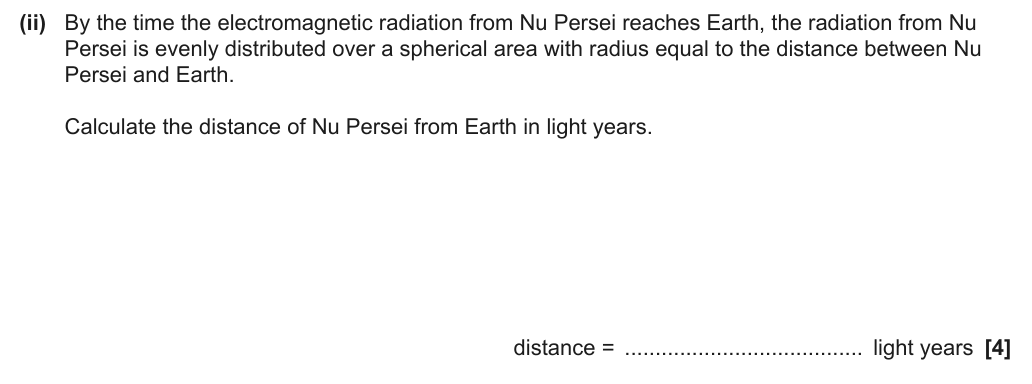
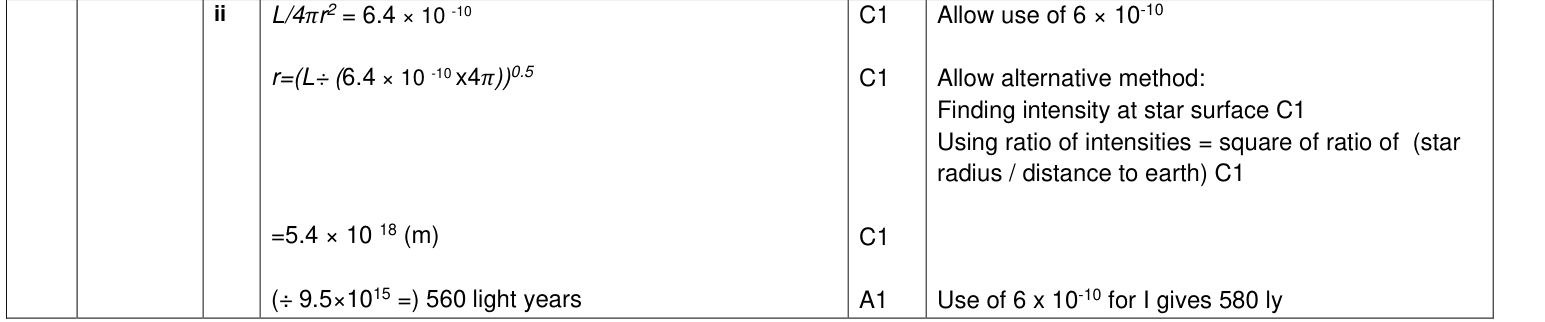
21(b)(ii) Cosmology: parallax, the Doppler effect, Hubble's law and the Big Bang, Stars: stellar evolution, energy levels, spectra, Wien's law and Stefan's law 4Calculation
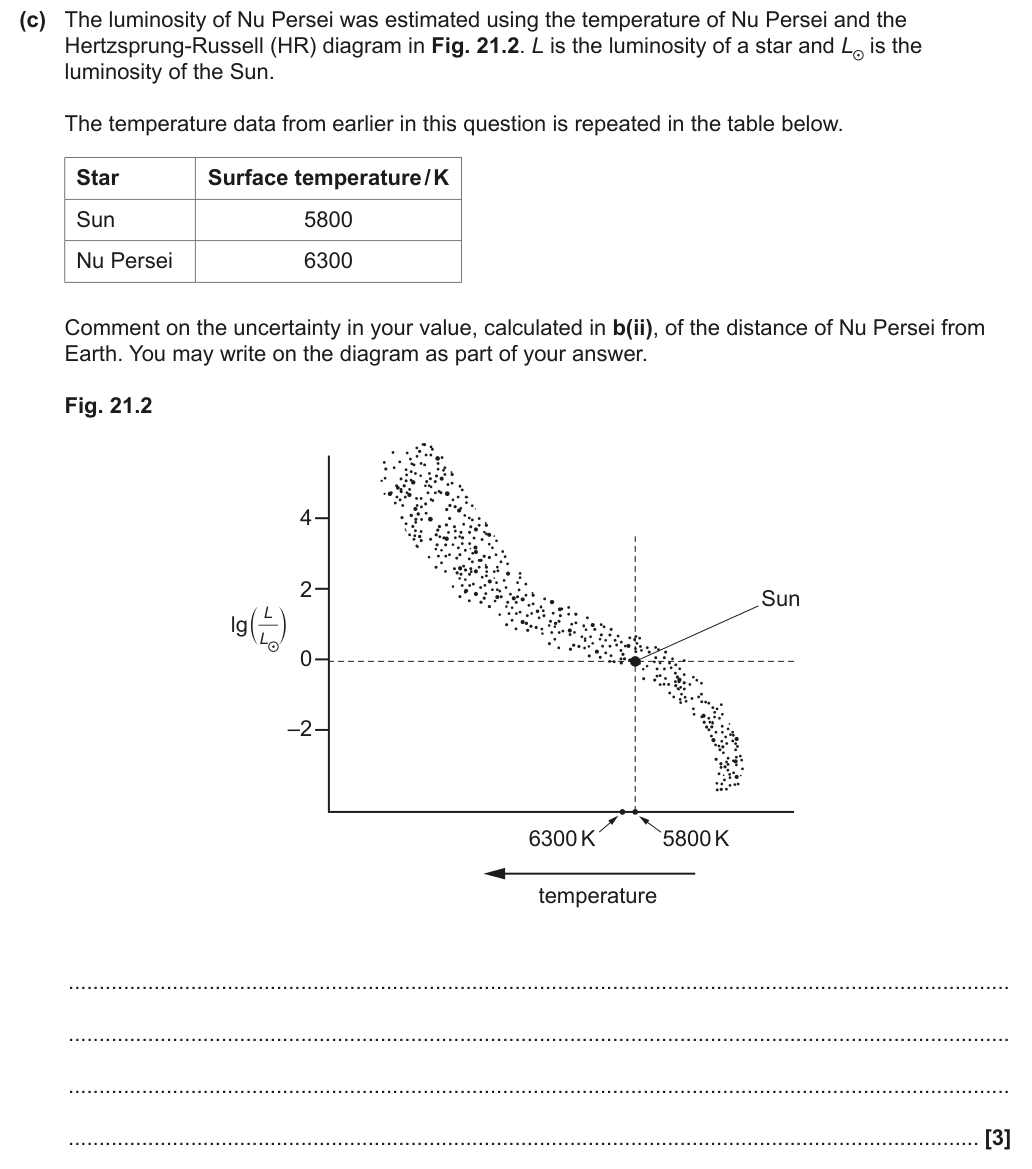
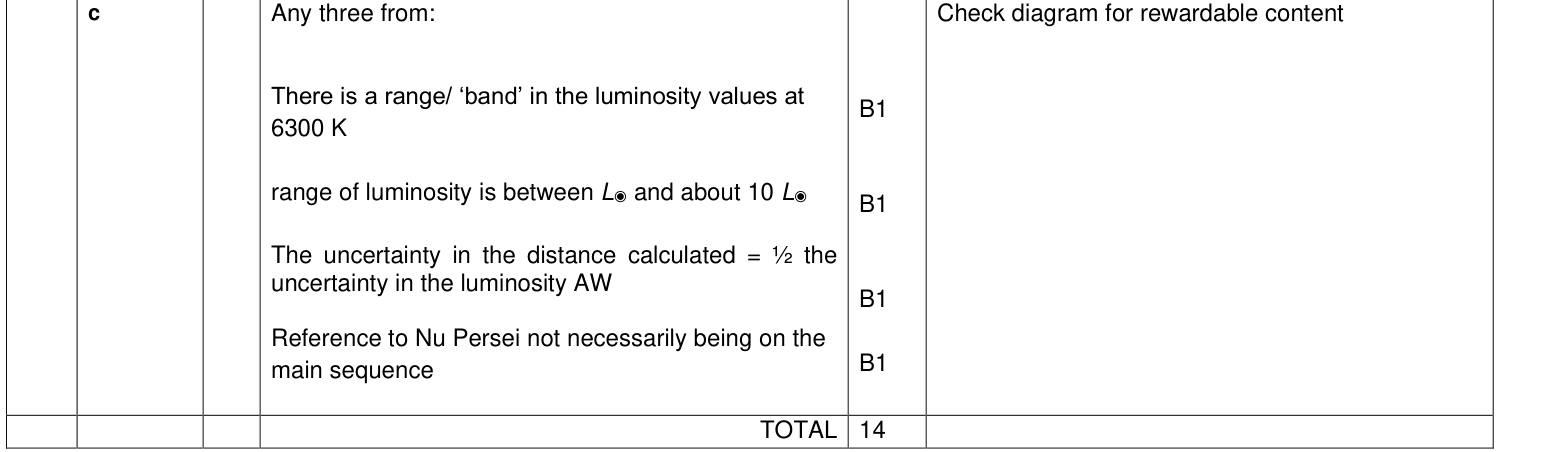
21(c) Stars: stellar evolution, energy levels, spectra, Wien's law and Stefan's law, Measurements and uncertainties 3Practical and data analysis
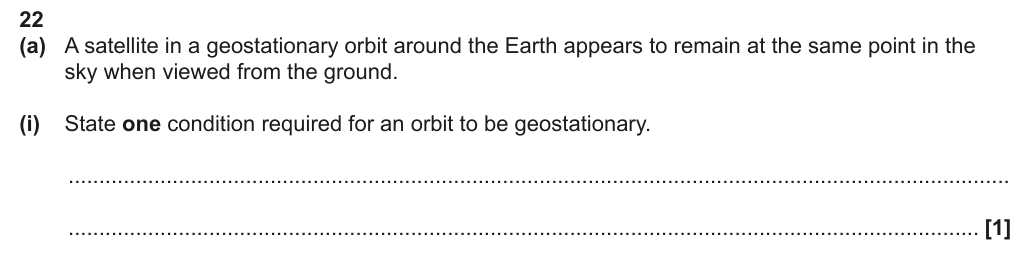
22(a)(i) Planetary motion: Kepler's laws and satellites 1Short answer
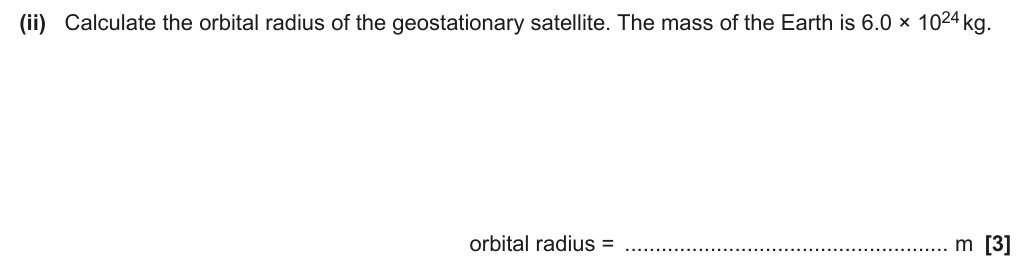
22(a)(ii) Planetary motion: Kepler's laws and satellites 3Calculation
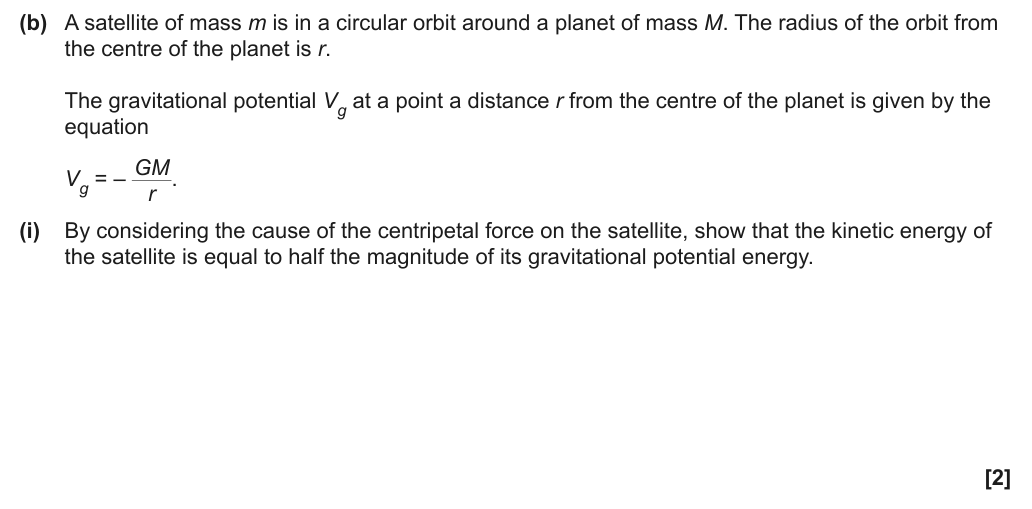
22(b)(i) Gravitational fields, Newton's law of gravitation and gravitational potential, Circular motion and centripetal force, Planetary motion: Kepler's laws and satellites 2Show that
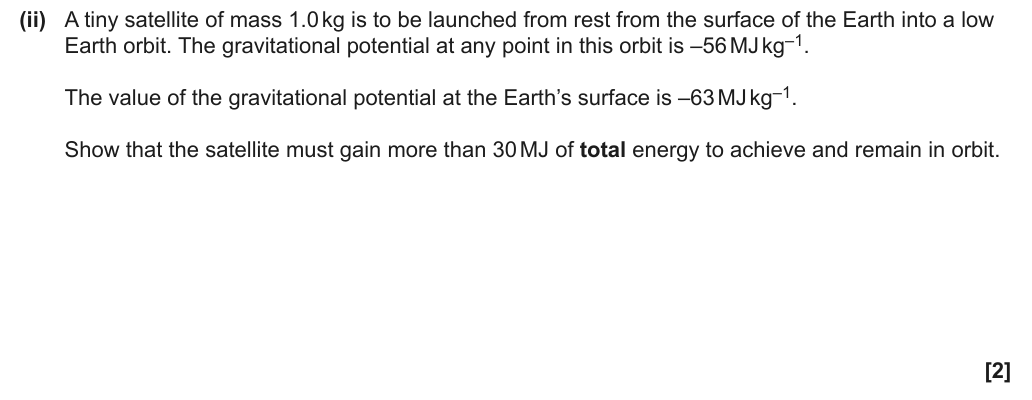
22(b)(ii) Gravitational fields, Newton's law of gravitation and gravitational potential 2Show that
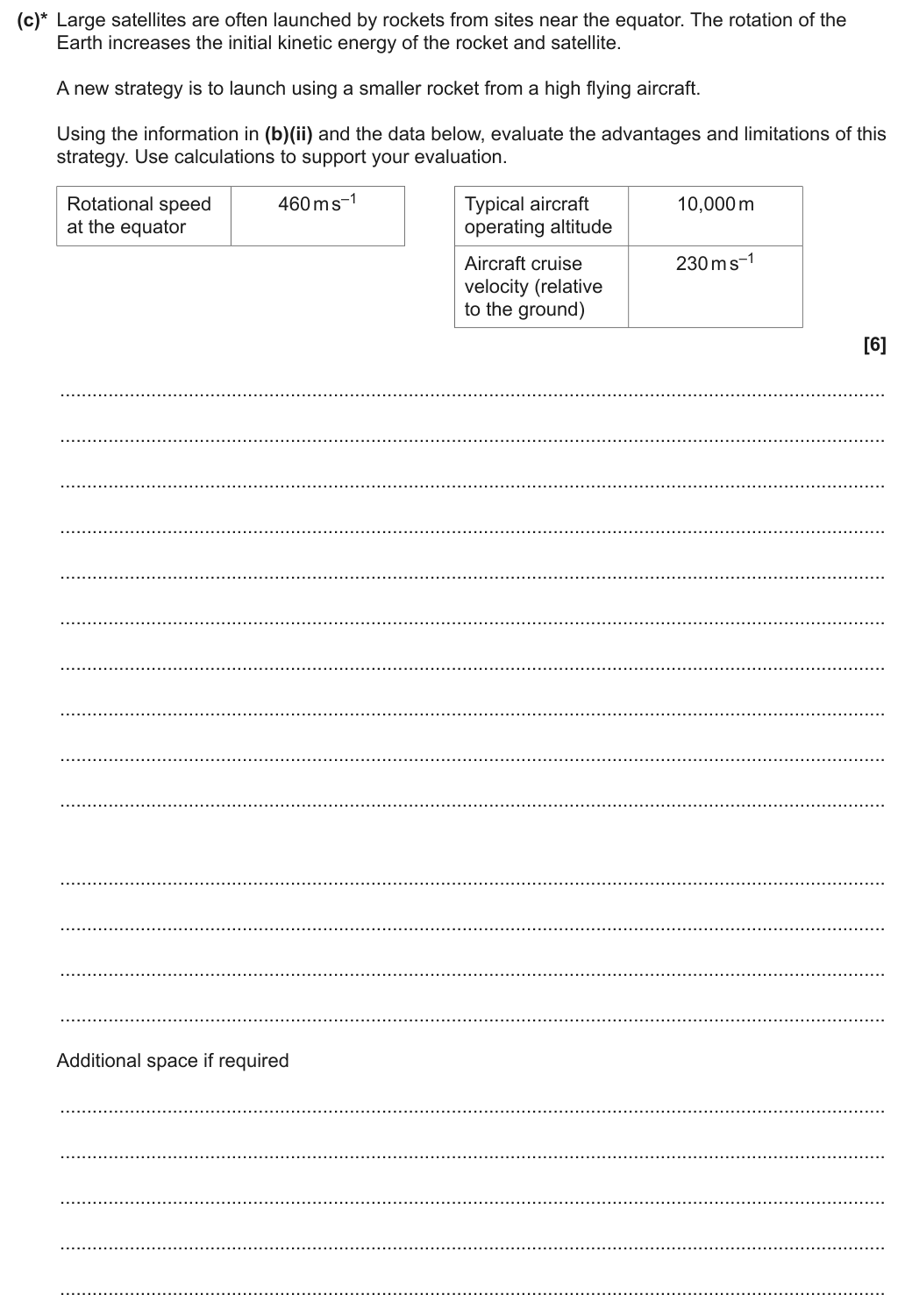
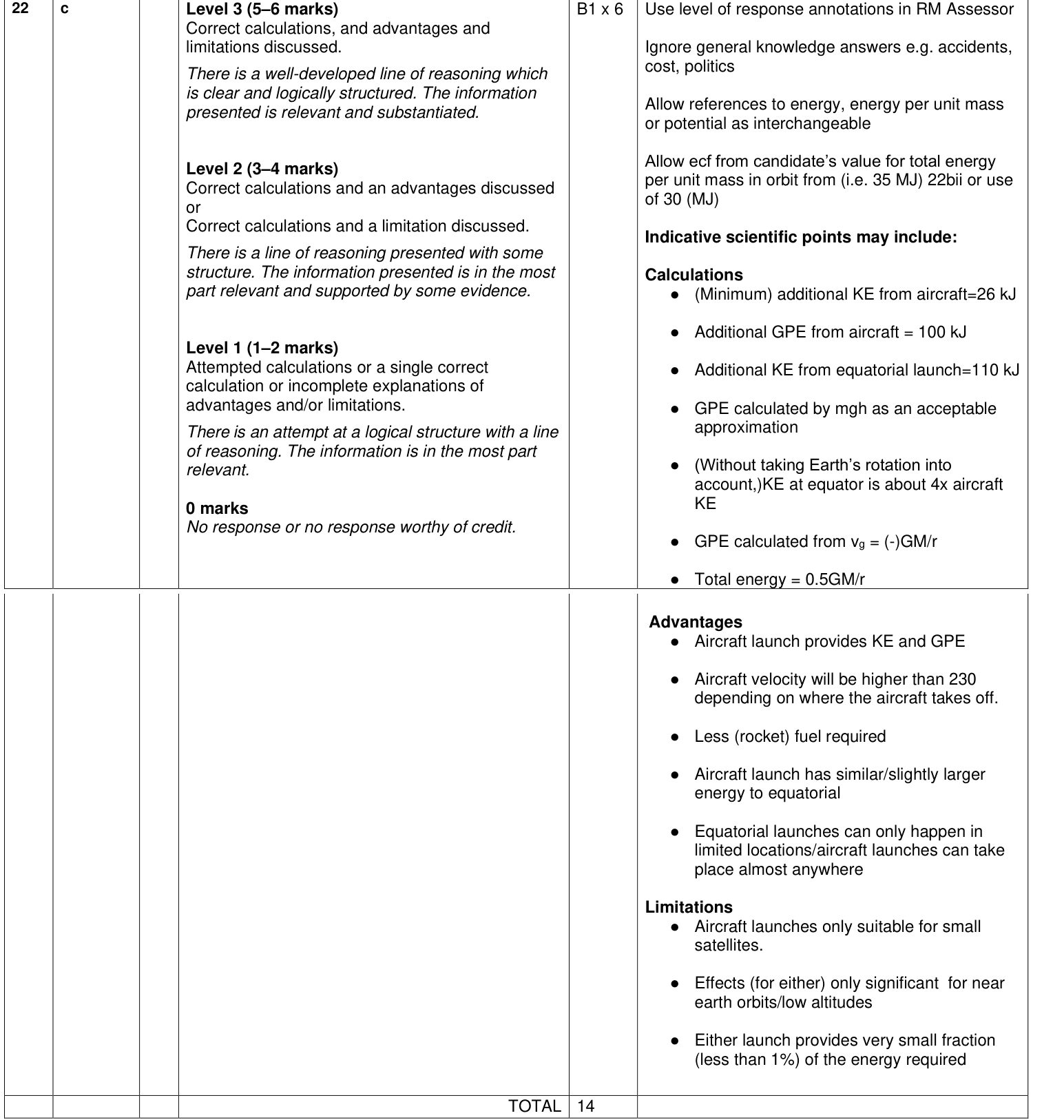
22(c) Gravitational fields, Newton's law of gravitation and gravitational potential, Work, energy and power 6Extended response
23(a) Stars: stellar evolution, energy levels, spectra, Wien's law and Stefan's law 2Show that
23(b)(i) Stars: stellar evolution, energy levels, spectra, Wien's law and Stefan's law 2Explanation
23(b)(ii) Cosmology: parallax, the Doppler effect, Hubble's law and the Big Bang 2Calculation
23(b)(iii) Cosmology: parallax, the Doppler effect, Hubble's law and the Big Bang 1Short answer

The questions

12345678910111213141516(a)(i)16(a)(ii)16(a)(iii)16(b)16(c)17(a)17(b)(i)17(b)(ii)17(b)(iii)18(a)(i)18(a)(ii)18(a)(iii)18(a)(iv)18(b)1920(a)(i)20(a)(ii)20(b)(i)20(b)(ii)20(c)(i)20(c)(ii)21(a)(i)21(a)(ii)21(b)(i)21(b)(ii)21(c)22(a)(i)22(a)(ii)22(b)(i)22(b)(ii)22(c)23(a)23(b)(i)23(b)(ii)23(b)(iii)
June 2024 · Paper 1 · Q1 1 mark Multiple choice Medium quantities and units
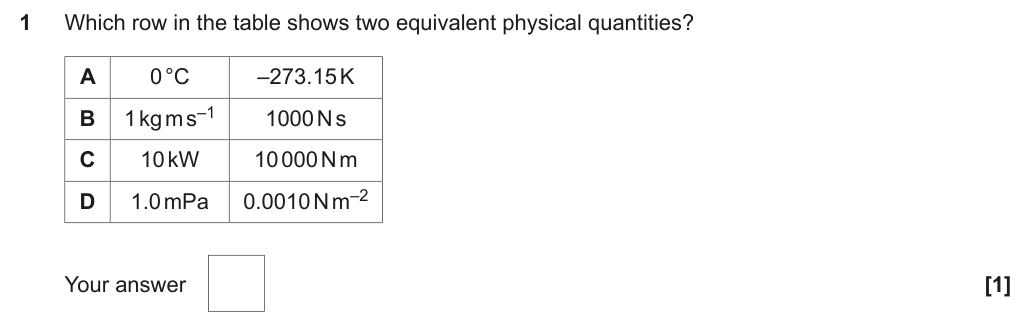
1 Which row in the table shows two equivalent physical quantities?
A 0 °C –273.15 K
B 1 kg m s–1 1000 N s
C 10 kW 10 000 N m
D 1.0 mPa 0.0010 N m–2
Your answer [1]
June 2024 · Paper 1 · Q2 1 mark Multiple choice Medium quantities and units
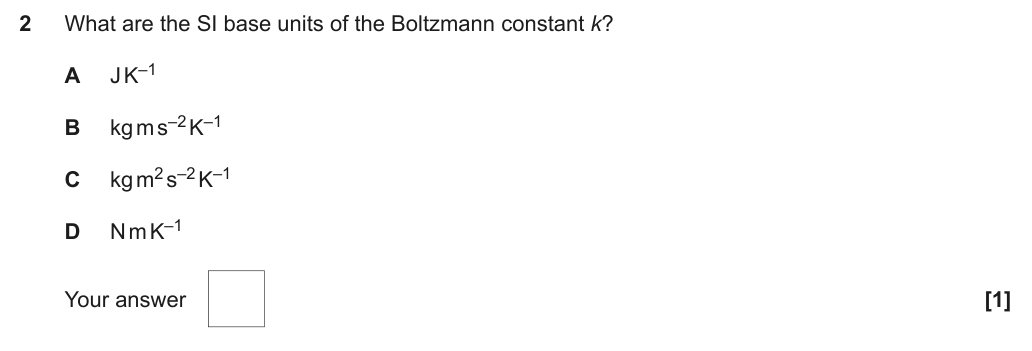
2 What are the SI base units of the Boltzmann constant k?
A J K–1
B kg m s–2 K–1
C kg m2 s–2 K–1
D N m K–1
Your answer [1]
June 2024 · Paper 1 · Q3 1 mark Multiple choice Medium circular motion
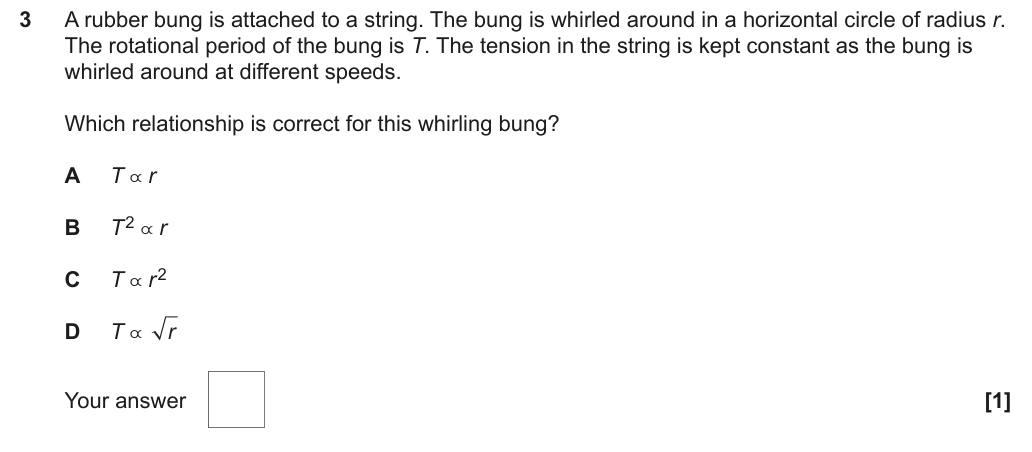
3 A rubber bung is attached to a string. The bung is whirled around in a horizontal circle of radius r.
The rotational period of the bung is T. The tension in the string is kept constant as the bung is
whirled around at different speeds.
Which relationship is correct for this whirling bung?
A T \ r
B T 2 \ r
C T \ r 2
D T \ r
Your answer [1]
June 2024 · Paper 1 · Q4 1 mark Multiple choice Medium linear motion
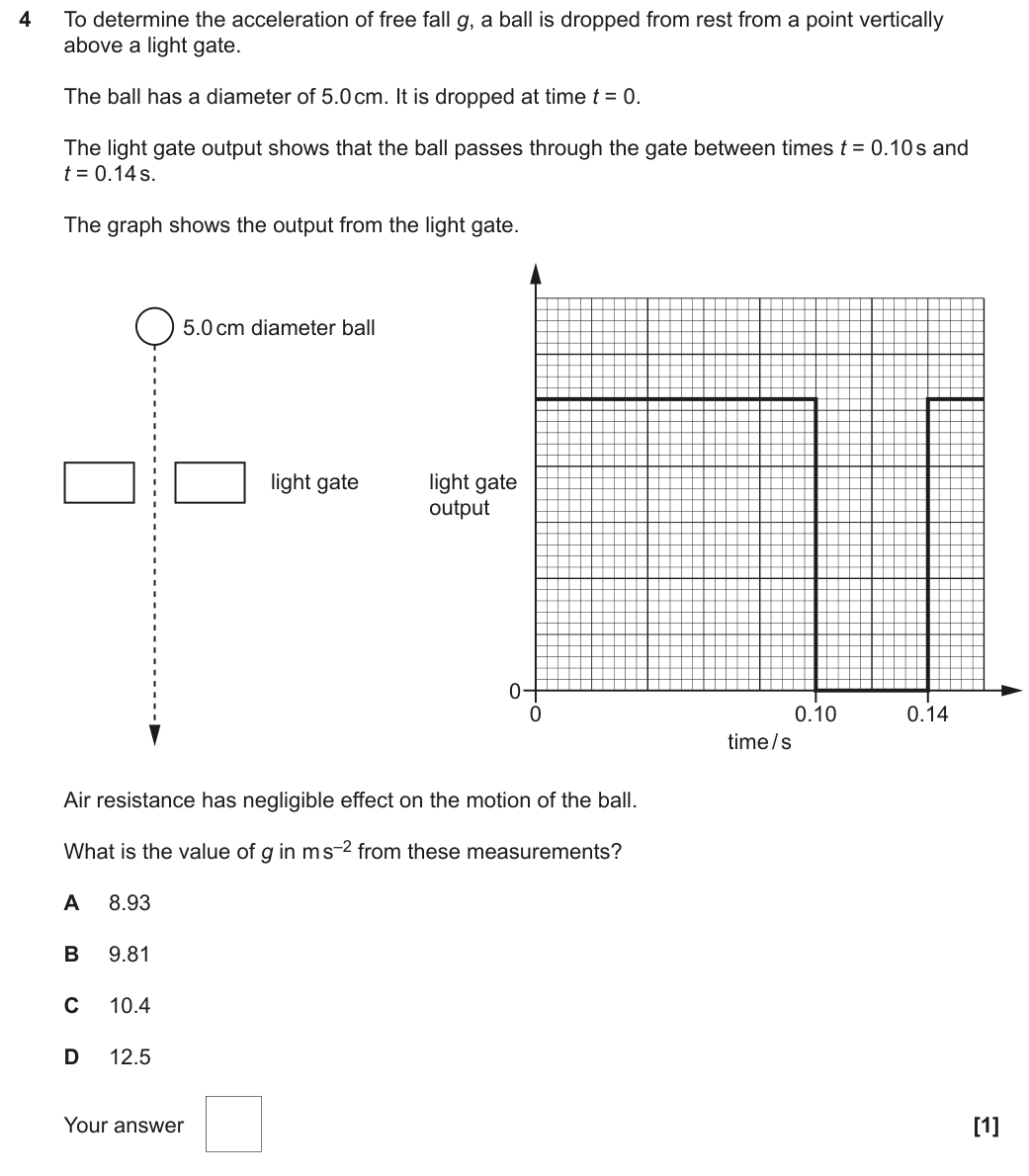
4 To determine the acceleration of free fall g, a ball is dropped from rest from a point vertically
above a light gate.
The ball has a diameter of 5.0 cm. It is dropped at time t = 0.
The light gate output shows that the ball passes through the gate between times t = 0.10 s and
t = 0.14 s.
The graph shows the output from the light gate.
5.0 cm diameter ball
light gate light gate
output
0
0 0.10 0.14
time / s
Air resistance has negligible effect on the motion of the ball.
What is the value of g in m s–2 from these measurements?
A 8.93
B 9.81
C 10.4
D 12.5
Your answer [1]
June 2024 · Paper 1 · Q5 1 mark Multiple choice Medium density and pressure
5 A block of wood is floating in calm water.
The density of the wood is 700 kg m–3. The density of water is 1000 kg m–3.
What percentage of the volume of the block is above the waterline?
A 30
B 50
C 70
D 89
Your answer [1]
June 2024 · Paper 1 · Q6 1 mark Multiple choice Hard equilibrium and moments
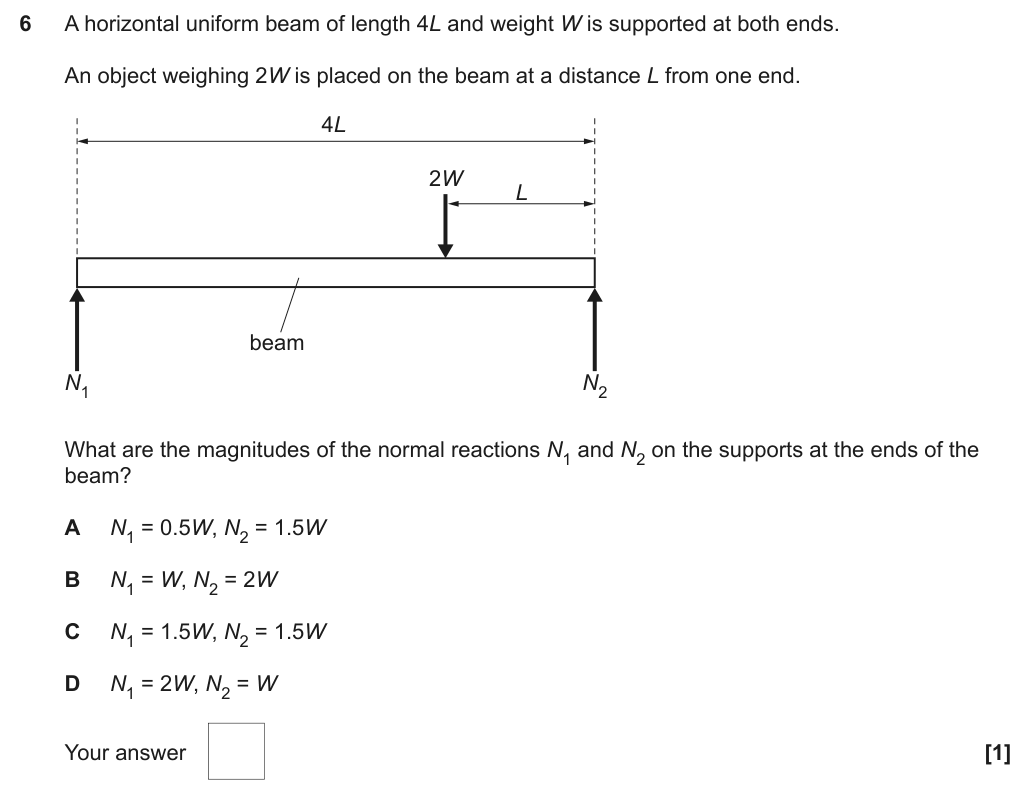
6 A horizontal uniform beam of length 4L and weight W is supported at both ends.
An object weighing 2W is placed on the beam at a distance L from one end.
4L
2W
L
beam
N1 N2
What are the magnitudes of the normal reactions N1 and N2 on the supports at the ends of the
beam?
A N1 = 0.5W, N2 = 1.5W
B N1 = W, N2 = 2W
C N1 = 1.5W, N2 = 1.5W
D N1 = 2W, N2 = W
Your answer [1]
June 2024 · Paper 1 · Q7 1 mark Multiple choice Medium kinematicslinear motion
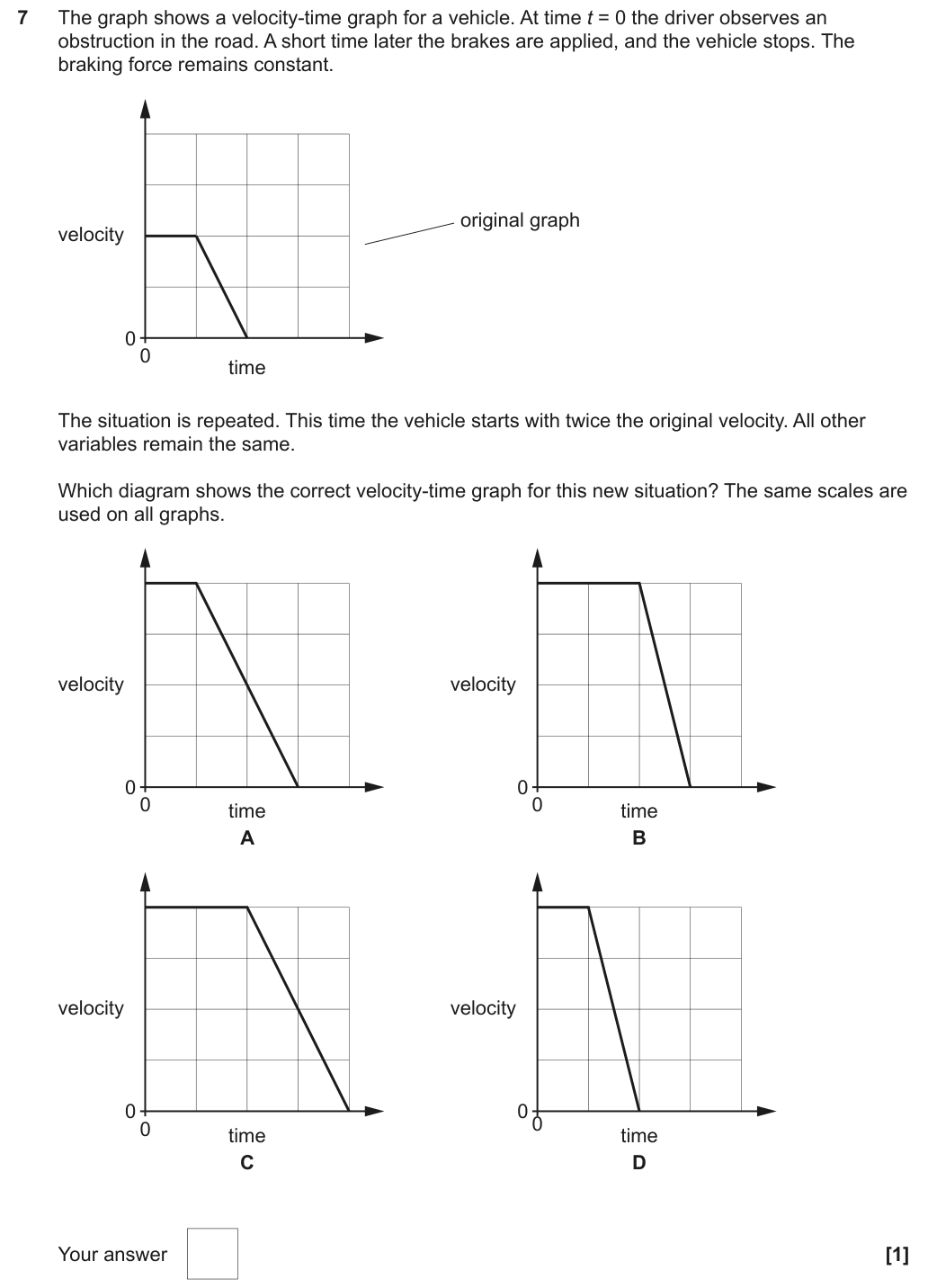
7 The graph shows a velocity-time graph for a vehicle. At time t = 0 the driver observes an
obstruction in the road. A short time later the brakes are applied, and the vehicle stops. The
braking force remains constant.
original graph
velocity
0
0
time
The situation is repeated. This time the vehicle starts with twice the original velocity. All other
variables remain the same.
Which diagram shows the correct velocity-time graph for this new situation? The same scales are
used on all graphs.
velocity velocity
0 0
0 time 0 time
A B
velocity velocity
0 0
0 0
time time
C D
Your answer [1]
June 2024 · Paper 1 · Q8 1 mark Multiple choice Medium scalars and vectors
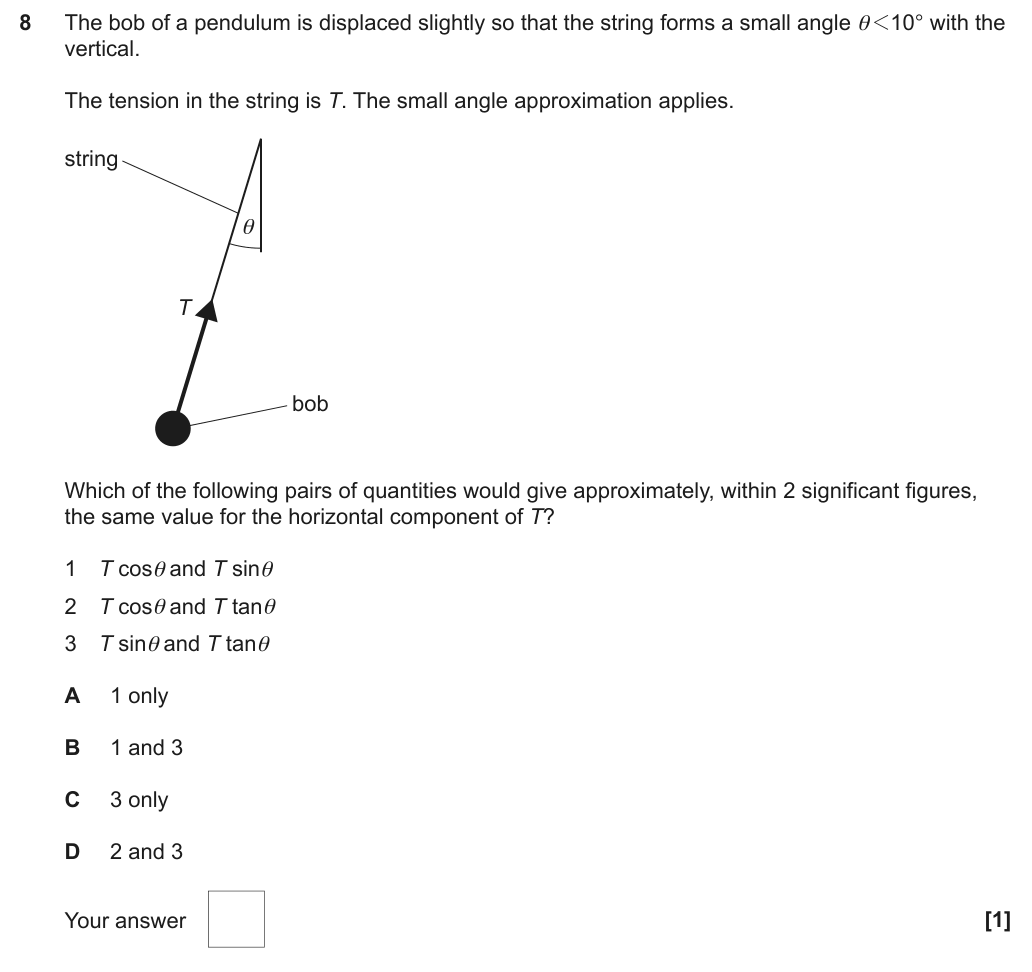
8 The bob of a pendulum is displaced slightly so that the string forms a small angle θ 110° with the
vertical.
The tension in the string is T. The small angle approximation applies.
string
θ
T
bob
Which of the following pairs of quantities would give approximately, within 2 significant figures,
the same value for the horizontal component of T?
1 T cosθ and T sinθ
2 T cosθ and T tanθ
3 T sinθ and T tanθ
A 1 only
B 1 and 3
C 3 only
D 2 and 3
Your answer [1]
June 2024 · Paper 1 · Q9 1 mark Multiple choice Medium simple harmonic motion
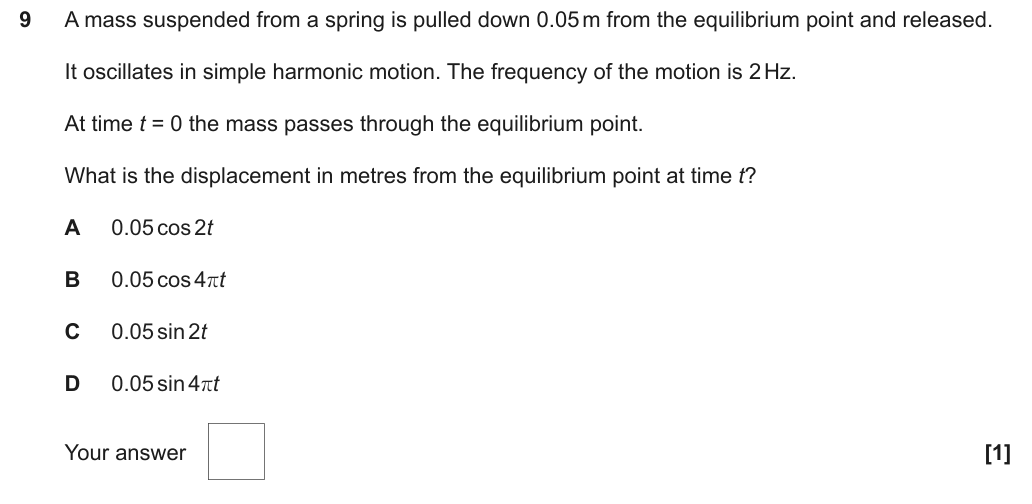
9 A mass suspended from a spring is pulled down 0.05 m from the equilibrium point and released.
It oscillates in simple harmonic motion. The frequency of the motion is 2 Hz.
At time t = 0 the mass passes through the equilibrium point.
What is the displacement in metres from the equilibrium point at time t?
A 0 05 . cos t 2
B 0 05 . cos 4 r t
C 0 05 . sin t 2
D 0 05 . sin 4 r t
Your answer [1]
June 2024 · Paper 1 · Q10 1 mark Multiple choice Medium simple harmonic motion
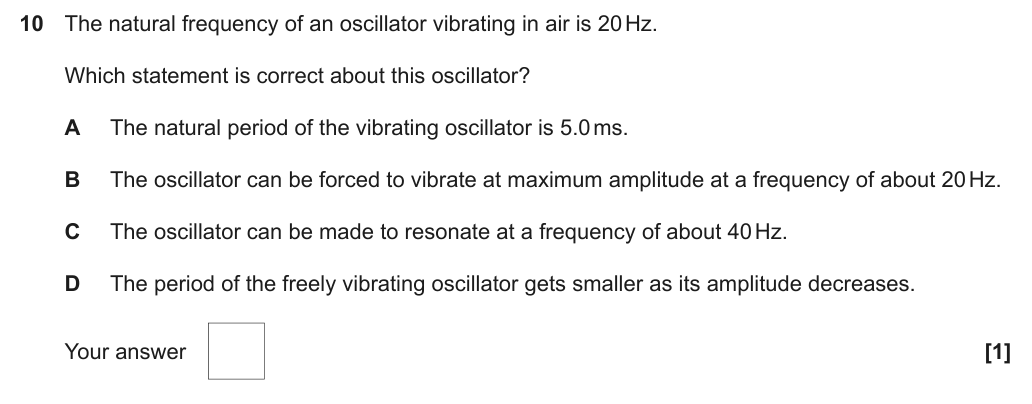
10 The natural frequency of an oscillator vibrating in air is 20 Hz.
Which statement is correct about this oscillator?
A The natural period of the vibrating oscillator is 5.0 ms.
B The oscillator can be forced to vibrate at maximum amplitude at a frequency of about 20 Hz.
C The oscillator can be made to resonate at a frequency of about 40 Hz.
D The period of the freely vibrating oscillator gets smaller as its amplitude decreases.
Your answer [1]
June 2024 · Paper 1 · Q11 1 mark Multiple choice Medium circular motion
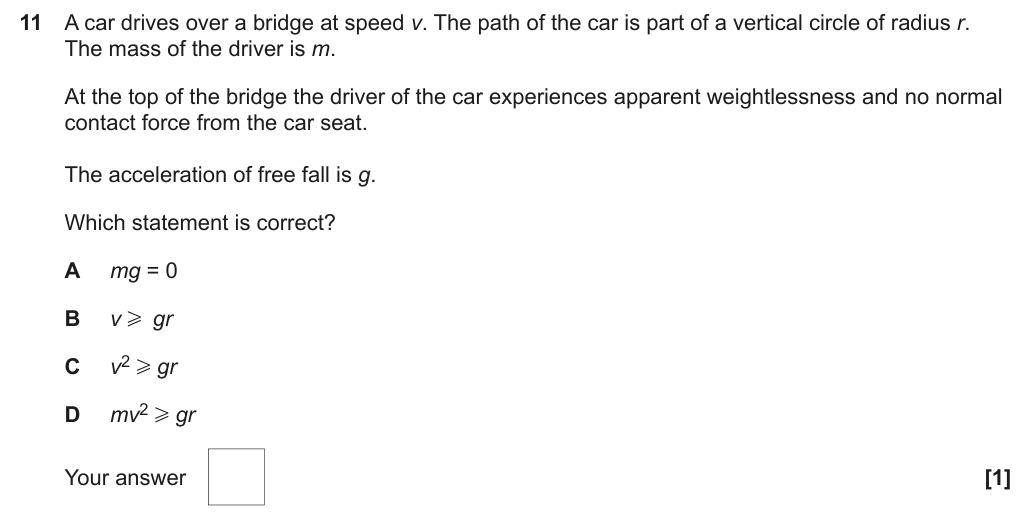
11 A car drives over a bridge at speed v. The path of the car is part of a vertical circle of radius r.
The mass of the driver is m.
At the top of the bridge the driver of the car experiences apparent weightlessness and no normal
contact force from the car seat.
The acceleration of free fall is g.
Which statement is correct?
A mg = 0
B v H gr
C v2 H gr
D mv2 H gr
Your answer [1]
June 2024 · Paper 1 · Q12 1 mark Multiple choice Medium simple harmonic motion
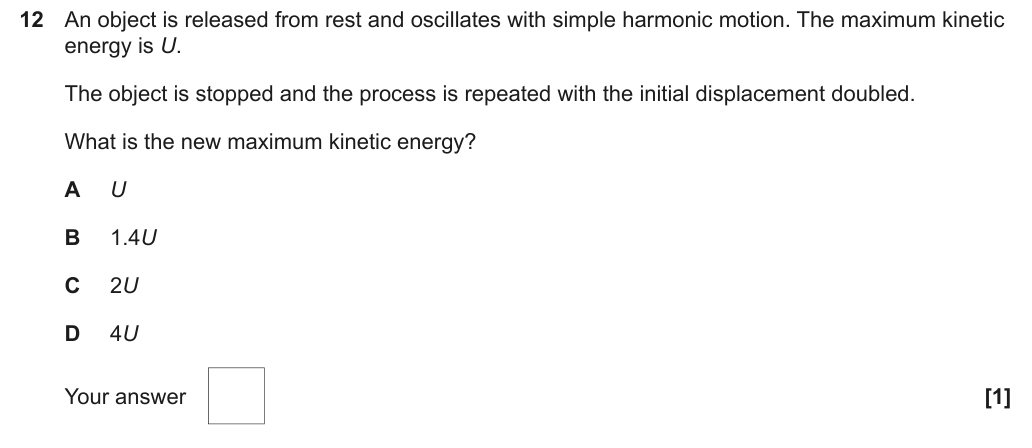
12 An object is released from rest and oscillates with simple harmonic motion. The maximum kinetic
energy is U.
The object is stopped and the process is repeated with the initial displacement doubled.
What is the new maximum kinetic energy?
A U
B 1.4U
C 2U
D 4U
Your answer [1]
June 2024 · Paper 1 · Q13 1 mark Multiple choice Medium collisionsscalars and vectorsnewtons laws and momentum
13 An object of mass 1.0 kg is moving in a straight line at velocity 10 m s–1.
It collides with an identical object also travelling at 10 m s–1 in a straight line. Their initial velocities
are perpendicular.
The two objects stick together.
What is the magnitude in m s–1 of the new combined velocity?
A 7.1
B 10
C 14
D 20
Your answer [1]
June 2024 · Paper 1 · Q14 1 mark Multiple choice Medium gravitational fields
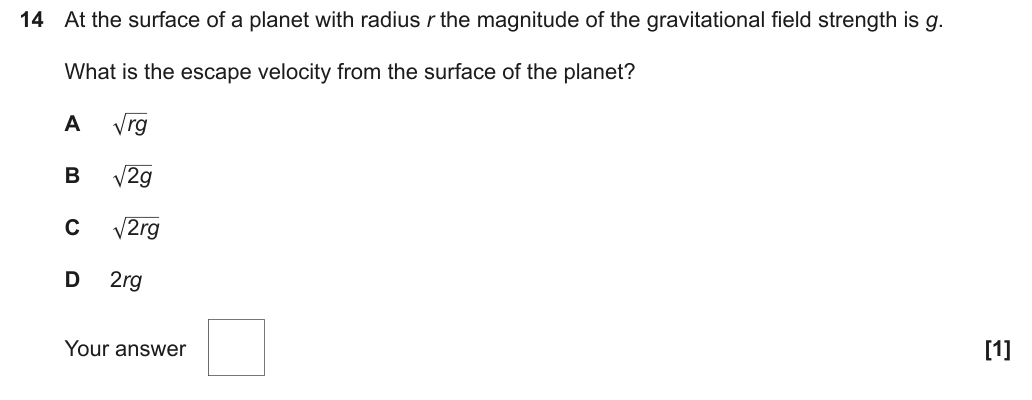
14 At the surface of a planet with radius r the magnitude of the gravitational field strength is g.
What is the escape velocity from the surface of the planet?
A rg
B 2 g
C 2 rg
D 2rg
Your answer [1]
June 2024 · Paper 1 · Q15 1 mark Multiple choice Medium cosmology
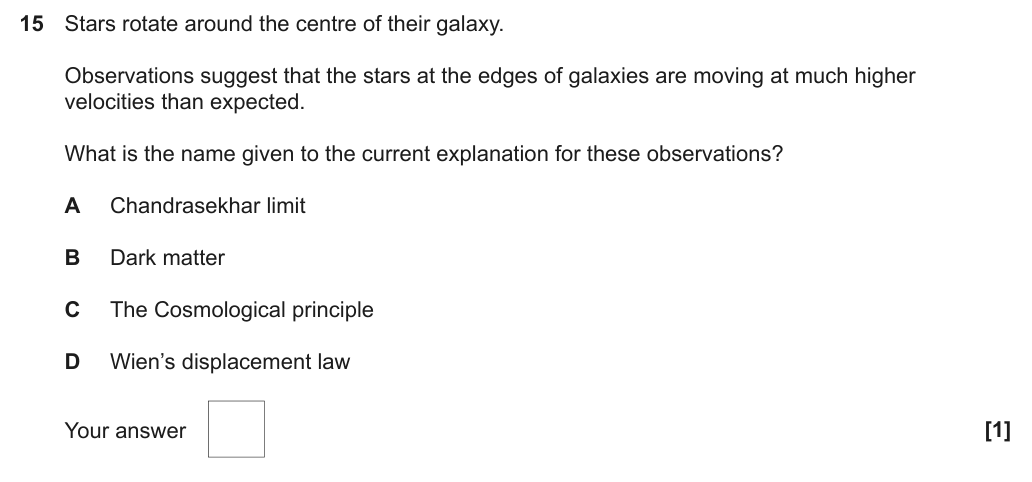
15 Stars rotate around the centre of their galaxy.
Observations suggest that the stars at the edges of galaxies are moving at much higher
velocities than expected.
What is the name given to the current explanation for these observations?
A Chandrasekhar limit
B Dark matter
C The Cosmological principle
D Wien’s displacement law
Your answer [1]
June 2024 · Paper 1 · Q16(a)(i) 2 marks Diagram or graph Medium dynamics and terminal velocitykinematics
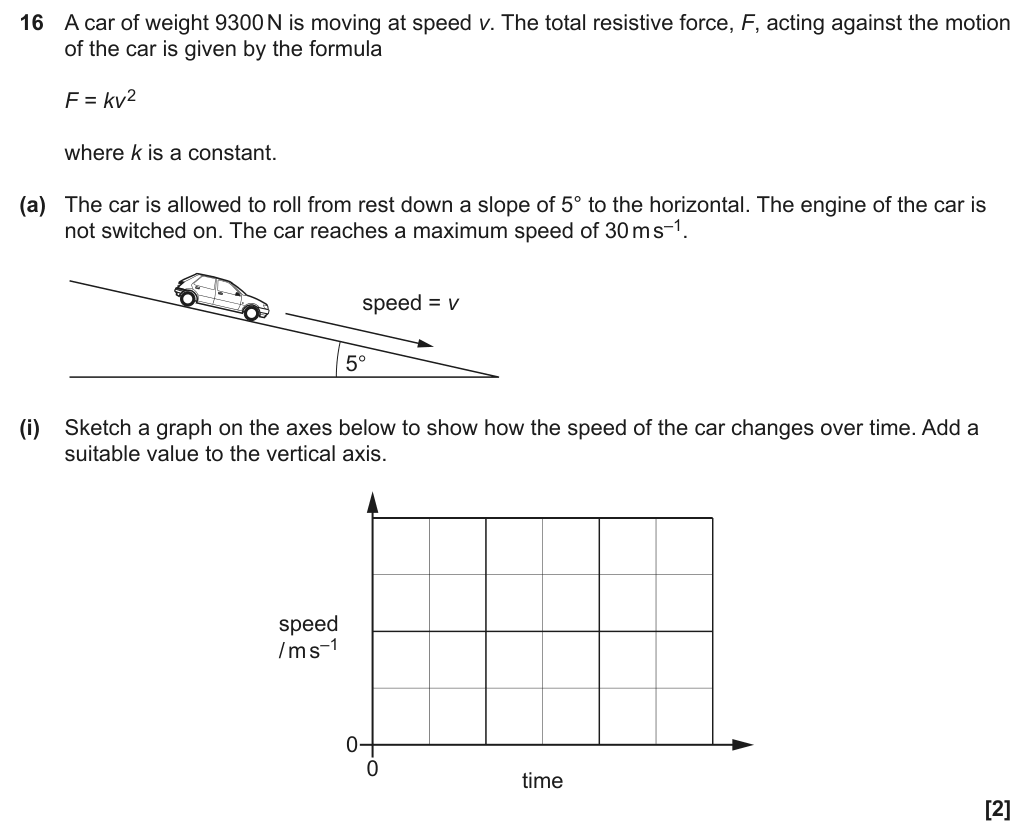
16 A car of weight 9300 N is moving at speed v. The total resistive force, F, acting against the motion
of the car is given by the formula
F = kv 2
where k is a constant.
(a) The car is allowed to roll from rest down a slope of 5° to the horizontal. The engine of the car is
not switched on. The car reaches a maximum speed of 30 m s–1.
speed = v
5°
(i) Sketch a graph on the axes below to show how the speed of the car changes over time. Add a
suitable value to the vertical axis.
speed
/ m s–1
0
0
time
[2]
June 2024 · Paper 1 · Q16(a)(ii) 2 marks Explanation Hard dynamics and terminal velocity
Earlier part of question 16 that this part usesEarlier part of June 2024 Paper 1 question 16
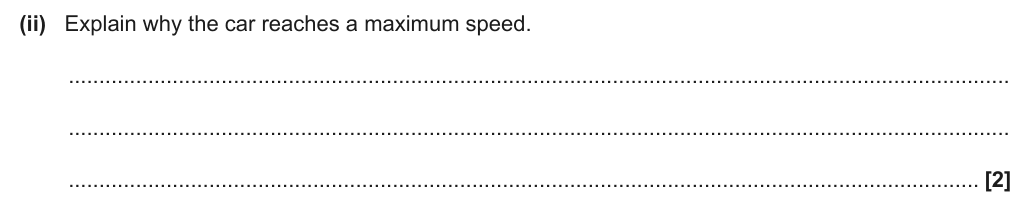
(ii) Explain why the car reaches a maximum speed.
..........................................................................................................................................................
..........................................................................................................................................................
..................................................................................................................................................... [2]
June 2024 · Paper 1 · Q16(a)(iii) 3 marks Show that Medium scalars and vectorsdynamics and terminal velocity
Earlier part of question 16 that this part usesEarlier part of June 2024 Paper 1 question 16
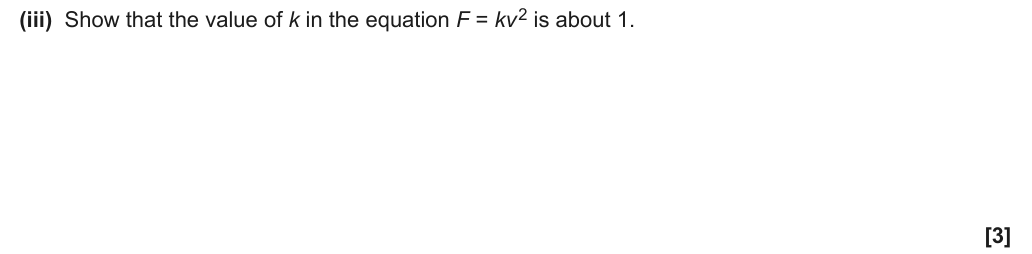
(iii) Show that the value of k in the equation F = kv 2 is about 1.
[3]
June 2024 · Paper 1 · Q16(b) 3 marks Calculation Medium work energy and power
Earlier parts of question 16 that this part usesEarlier part of June 2024 Paper 1 question 16Earlier part of June 2024 Paper 1 question 16
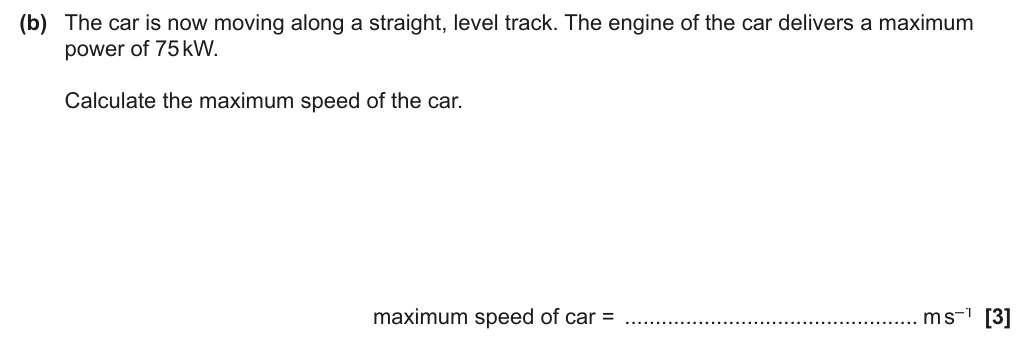
(b) The car is now moving along a straight, level track. The engine of the car delivers a maximum
power of 75 kW.
Calculate the maximum speed of the car.
maximum speed of car =  ................................................ m s–1 [3]
June 2024 · Paper 1 · Q16(c) 2 marks Explanation Medium work energy and power
Earlier parts of question 16 that this part usesEarlier part of June 2024 Paper 1 question 16Earlier part of June 2024 Paper 1 question 16
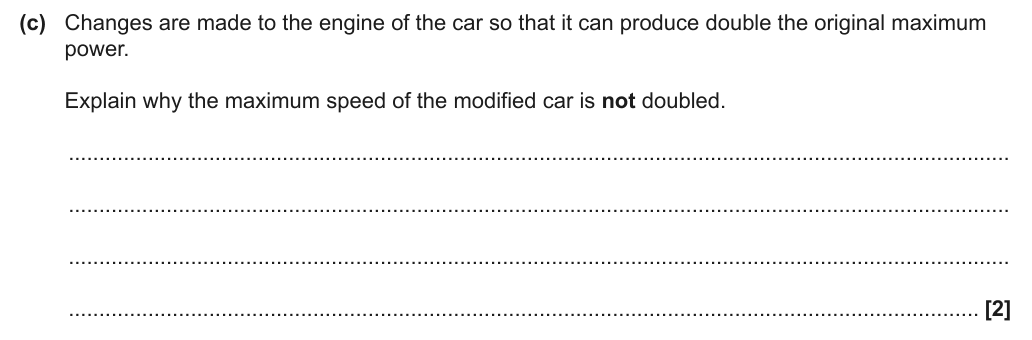
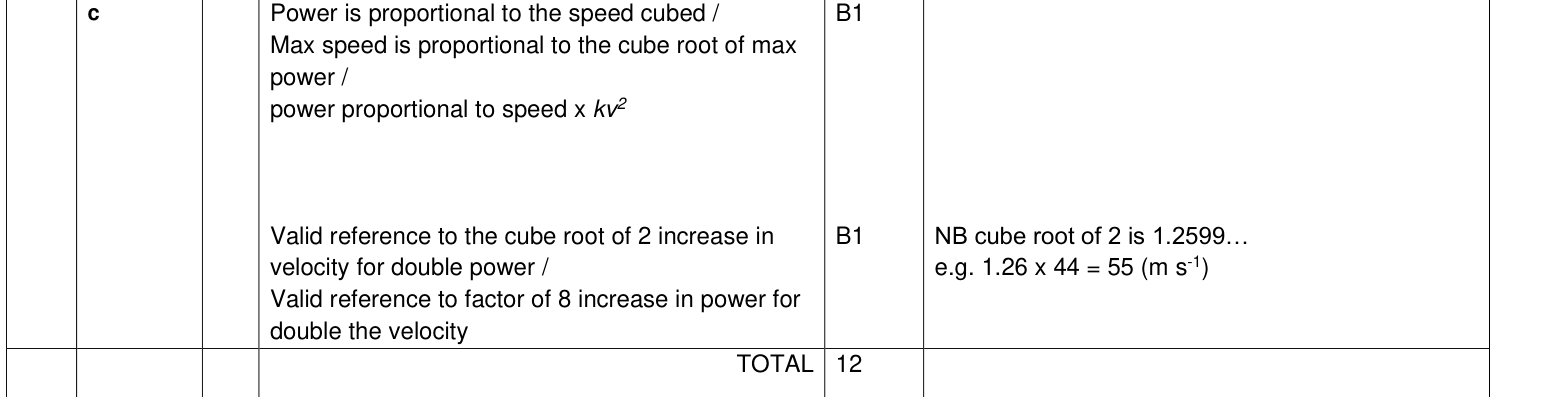
(c) Changes are made to the engine of the car so that it can produce double the original maximum
power.
Explain why the maximum speed of the modified car is not doubled.
..........................................................................................................................................................
..........................................................................................................................................................
..........................................................................................................................................................
..................................................................................................................................................... [2]
June 2024 · Paper 1 · Q17(a) 1 mark Short answer Medium newtons laws and momentum
17
(a) State Newton’s second law of motion.
..........................................................................................................................................................
..................................................................................................................................................... [1]
June 2024 · Paper 1 · Q17(b)(i) 2 marks Calculation Medium scalars and vectors
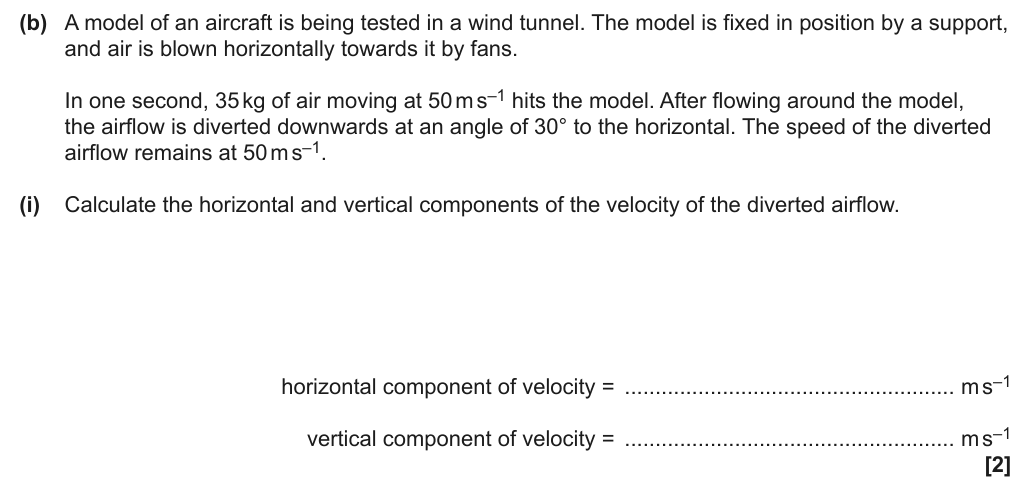
(b) A model of an aircraft is being tested in a wind tunnel. The model is fixed in position by a support,
and air is blown horizontally towards it by fans.
In one second, 35 kg of air moving at 50 m s–1 hits the model. After flowing around the model,
the airflow is diverted downwards at an angle of 30° to the horizontal. The speed of the diverted
airflow remains at 50 m s–1.
(i) Calculate the horizontal and vertical components of the velocity of the diverted airflow.
horizontal component of velocity =  ...................................................... m s–1
vertical component of velocity =  ...................................................... m s–1
[2]
June 2024 · Paper 1 · Q17(b)(ii) 2 marks Explanation Medium newtons laws and momentum
Earlier part of question 17 that this part usesEarlier part of June 2024 Paper 1 question 17
(ii) Explain how the airflow around the model produces a force on the model.
..........................................................................................................................................................
..........................................................................................................................................................
..................................................................................................................................................... [2]
June 2024 · Paper 1 · Q17(b)(iii) 3 marks Calculation Medium newtons laws and momentum
Earlier part of question 17 that this part usesEarlier part of June 2024 Paper 1 question 17
(iii) Calculate the vertical lift force F acting on the model due to the airflow around it.
F =  ...................................................... N [3]
June 2024 · Paper 1 · Q18(a)(i) 1 mark Short answer Medium springspractical skills
18 Mats made from rubber are often used in laboratories where heavy objects might be dropped.
A rubber cord is tested to determine the material’s mechanical characteristics.
(a) The cord is suspended from a ceiling and masses can be attached to the free end.
The apparatus is set up as shown in Fig. 18.1.
Fig. 18.1
cord
masses
h
Masses are added and the height, h, of the base of the bottom mass from the floor is measured.
The extension of the cord is x when the tension in the cord is F. After six masses have been
added, they are removed one at a time and h measured each time.
The table shows the data collected.
F / N h / m x / m
0.0 1.80 0.00
1.0 1.60 0.20
2.0 1.56 0.24
3.0 1.51 0.29
4.0 1.45 0.35
5.0 1.35 0.45
6.0 0.81
5.0 1.13 0.67
4.0 1.37 0.53
3.0 1.30 0.50
2.0 1.34 0.46
1.0 1.45 0.35
0.0 1.75 0.05
(i) Complete the final column of the table. [1]
June 2024 · Paper 1 · Q18(a)(ii) 3 marks Diagram or graph Easy springspractical skillsmaterials and young modulus
Earlier part of question 18 that this part usesEarlier part of June 2024 Paper 1 question 18
6.0
4.0
F / N
2.0
0
0 0.2 0.4 0.6 0.8 1.0
x / m
(ii) Plot the data point for F = 6.0 N on the graph above. The other points have been plotted.
Draw and label two curves to show the loading and unloading of the cord. [3]
June 2024 · Paper 1 · Q18(a)(iii) 2 marks Explanation Medium springsmaterials and young modulus
Earlier parts of question 18 that this part usesEarlier part of June 2024 Paper 1 question 18Earlier part of June 2024 Paper 1 question 18
(iii) Discuss whether Hooke’s law can be applied to the cord.
..........................................................................................................................................................
..................................................................................................................................................... [2]
June 2024 · Paper 1 · Q18(a)(iv) 3 marks Explanation Medium materials and young moduluswork energy and power
Earlier parts of question 18 that this part usesEarlier part of June 2024 Paper 1 question 18Earlier part of June 2024 Paper 1 question 18
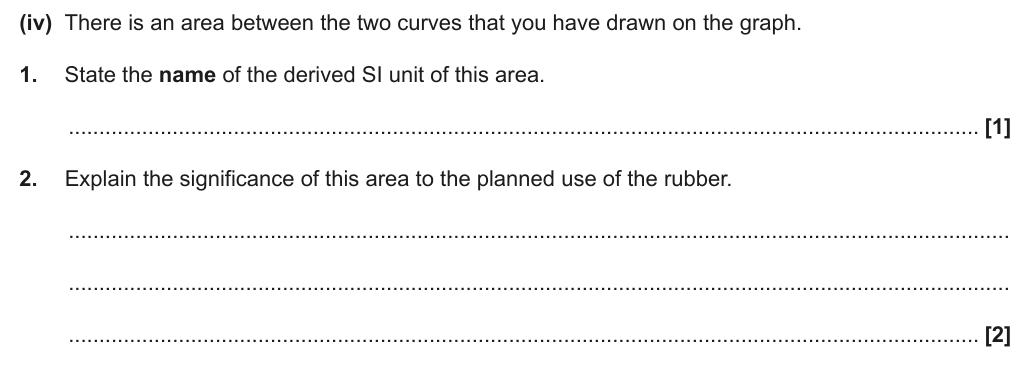
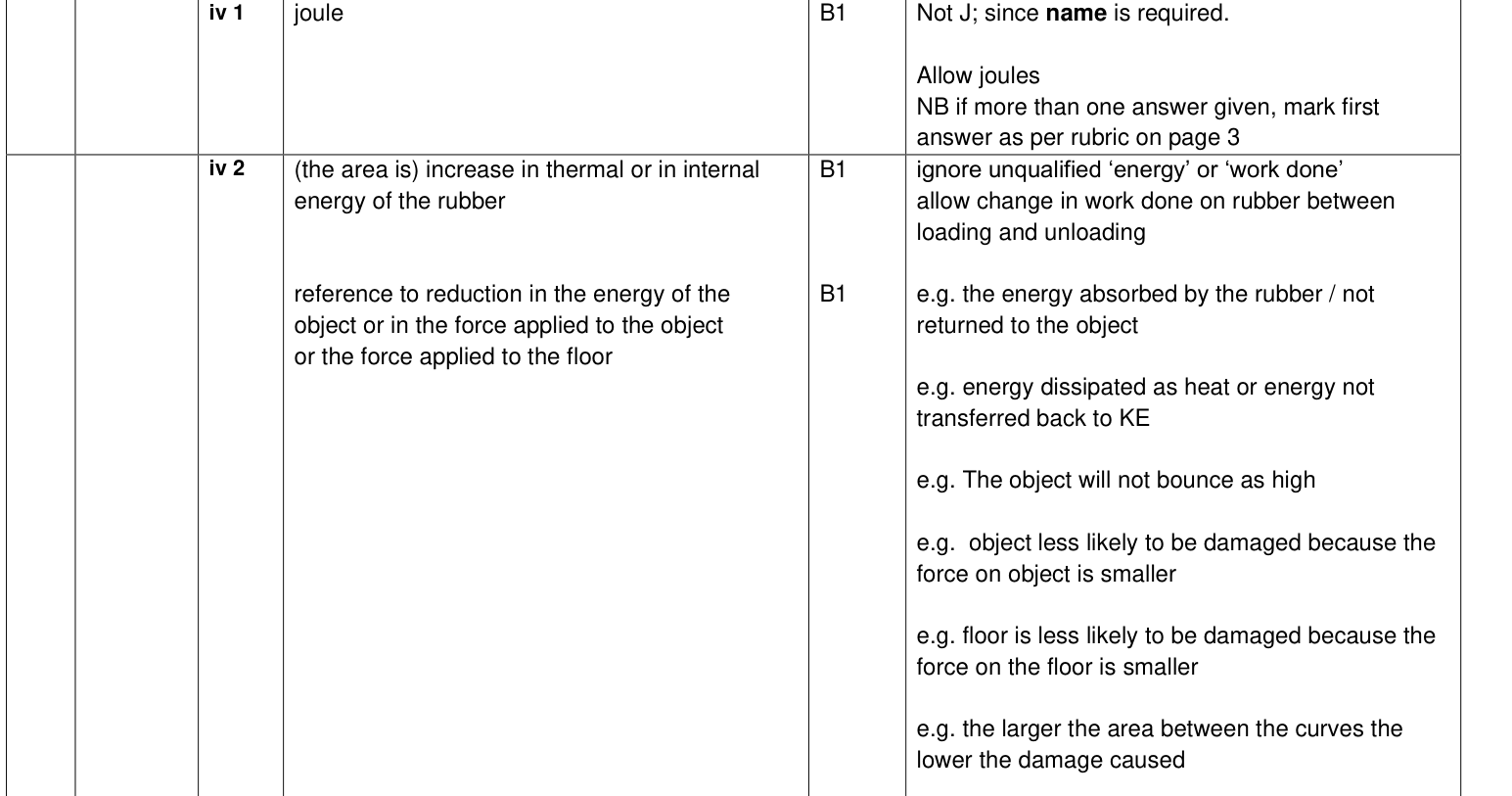
(iv) There is an area between the two curves that you have drawn on the graph.
1. State the name of the derived SI unit of this area.
..................................................................................................................................................... [1]
2. Explain the significance of this area to the planned use of the rubber.
..........................................................................................................................................................
..........................................................................................................................................................
..................................................................................................................................................... [2]
June 2024 · Paper 1 · Q18(b) 2 marks Explanation Medium practical skills
Earlier part of question 18 that this part usesEarlier part of June 2024 Paper 1 question 18
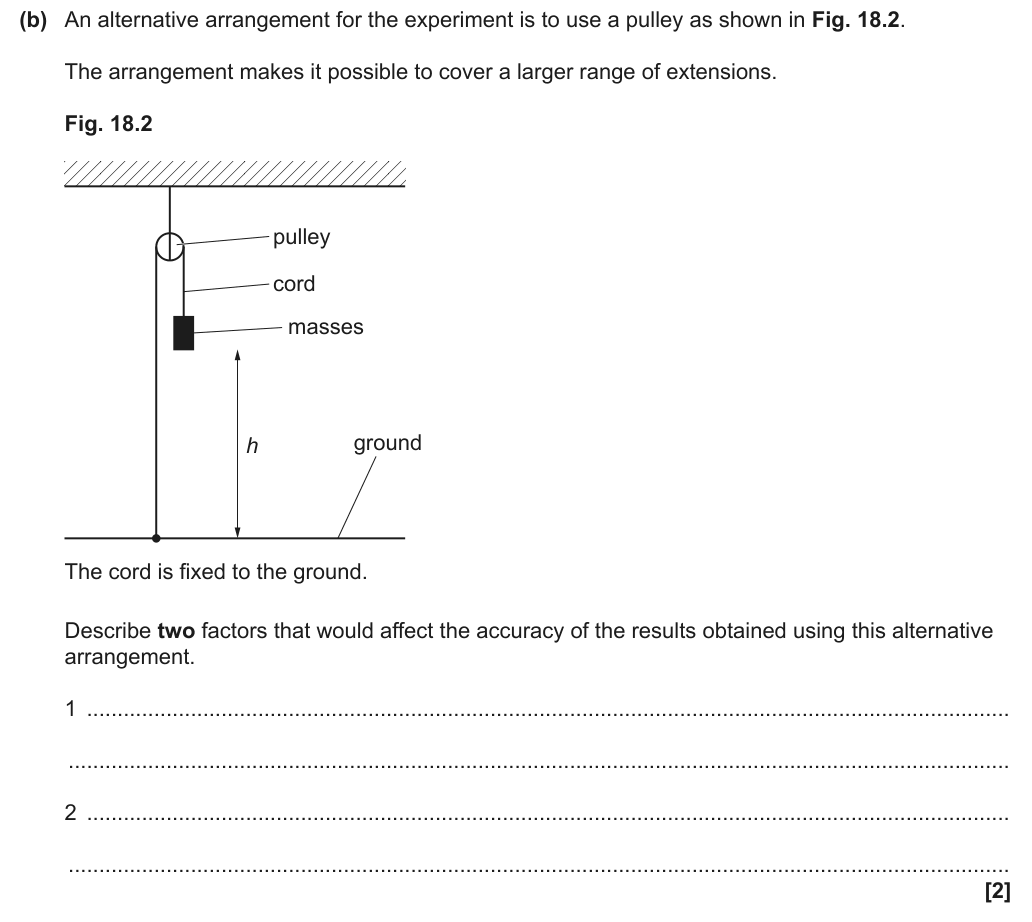
(b) An alternative arrangement for the experiment is to use a pulley as shown in Fig. 18.2.
The arrangement makes it possible to cover a larger range of extensions.
Fig. 18.2
pulley
cord
masses
h ground
The cord is fixed to the ground.
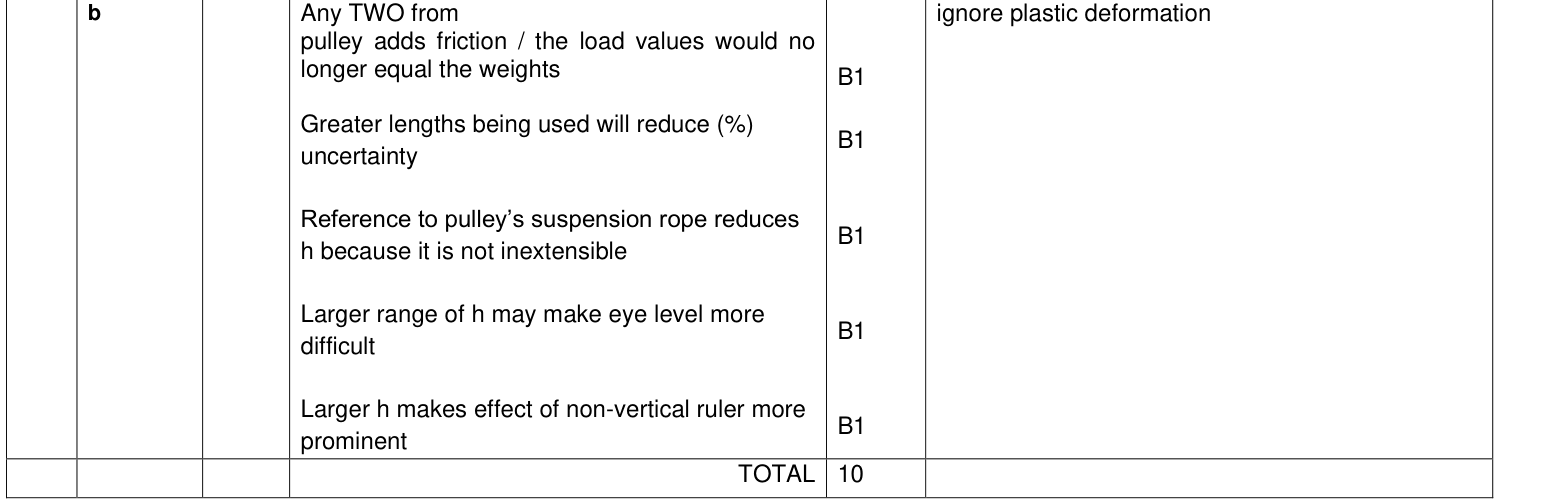
Describe two factors that would affect the accuracy of the results obtained using this alternative
arrangement.
1  .......................................................................................................................................................
..........................................................................................................................................................
2  .......................................................................................................................................................
..........................................................................................................................................................
[2]
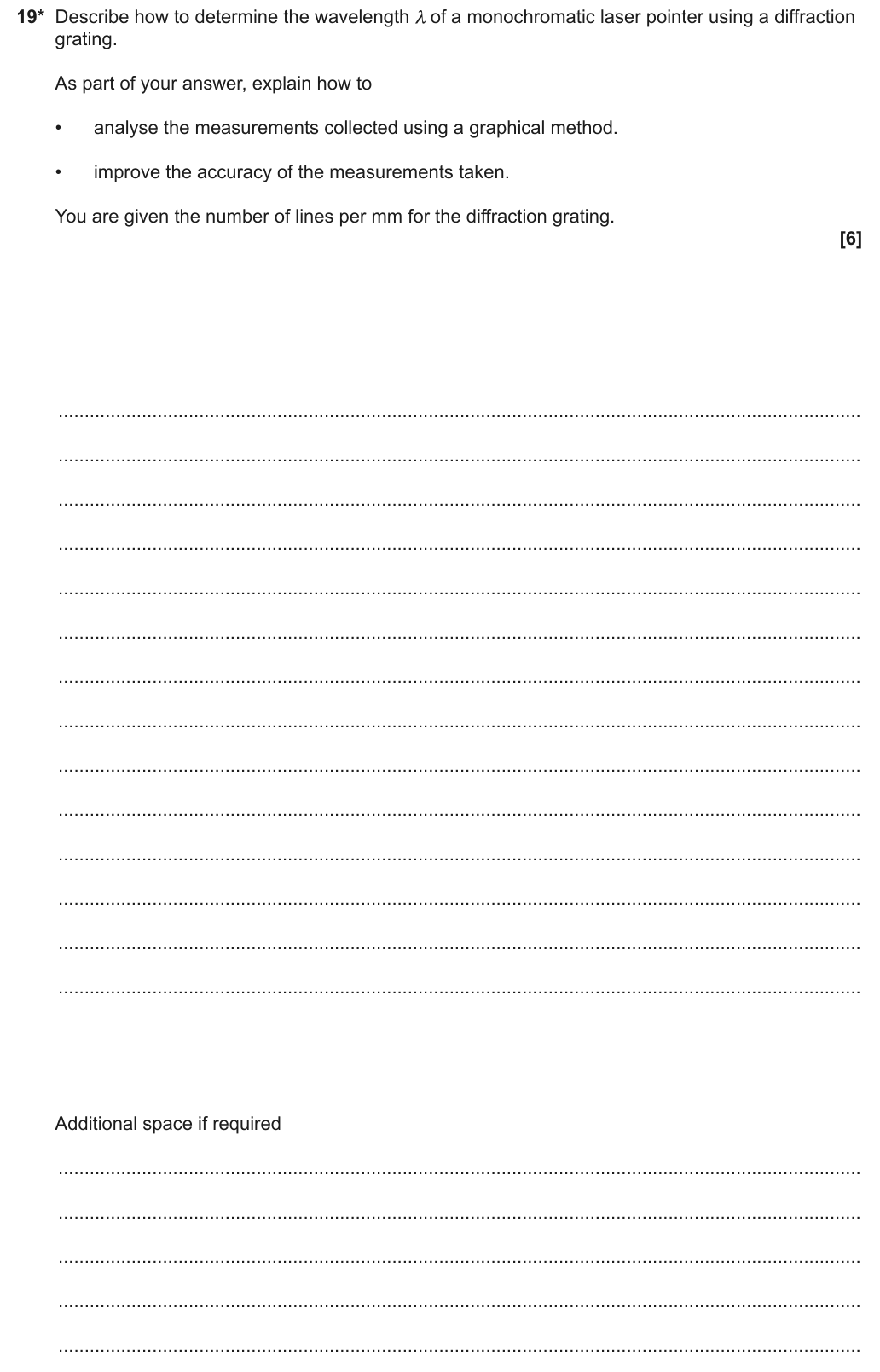
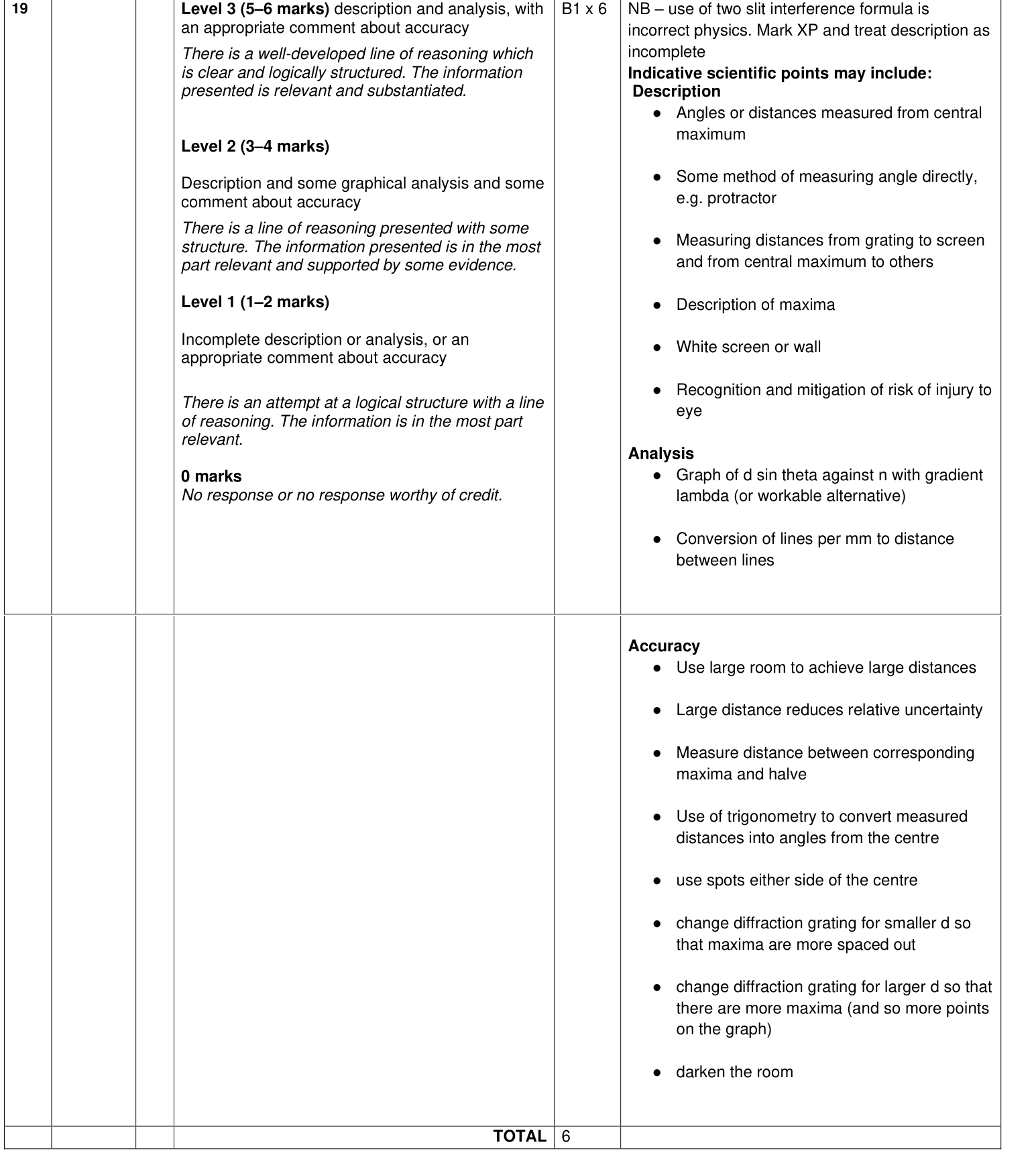
June 2024 · Paper 1 · Q19 6 marks 6-mark extended response Medium starspractical skills
19* Describe how to determine the wavelength λ of a monochromatic laser pointer using a diffraction
grating.
As part of your answer, explain how to
• analyse the measurements collected using a graphical method.
• improve the accuracy of the measurements taken.
You are given the number of lines per mm for the diffraction grating.
[6]
..........................................................................................................................................................
..........................................................................................................................................................
..........................................................................................................................................................
..........................................................................................................................................................
..........................................................................................................................................................
..........................................................................................................................................................
..........................................................................................................................................................
..........................................................................................................................................................
..........................................................................................................................................................
..........................................................................................................................................................
..........................................................................................................................................................
..........................................................................................................................................................
..........................................................................................................................................................
..........................................................................................................................................................
Additional space if required
..........................................................................................................................................................
..........................................................................................................................................................
..........................................................................................................................................................
..........................................................................................................................................................
..........................................................................................................................................................
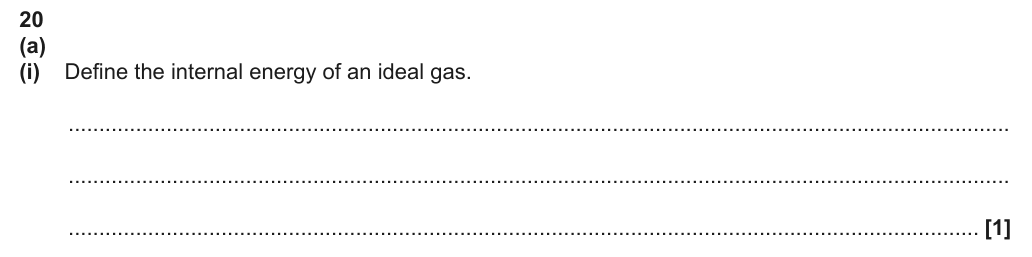
June 2024 · Paper 1 · Q20(a)(i) 1 mark Short answer Easy ideal gasesthermal physics
20
(a)
(i) Define the internal energy of an ideal gas.
..........................................................................................................................................................
..........................................................................................................................................................
..................................................................................................................................................... [1]
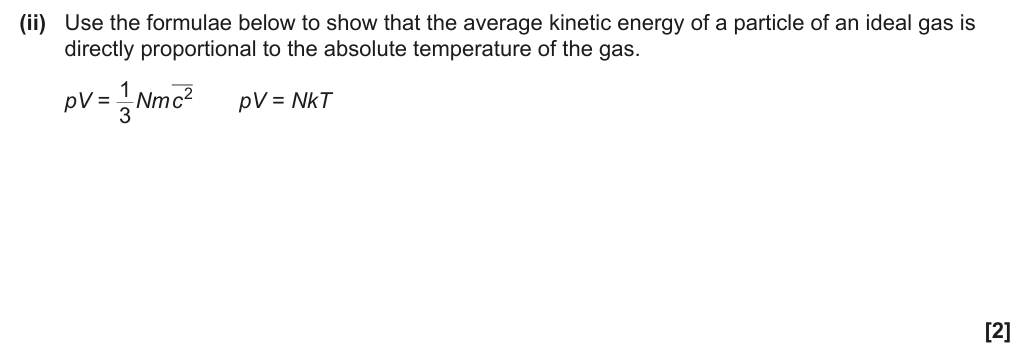
June 2024 · Paper 1 · Q20(a)(ii) 2 marks Show that Easy ideal gases
(ii) Use the formulae below to show that the average kinetic energy of a particle of an ideal gas is
directly proportional to the absolute temperature of the gas.
pV = 1
3 Nmc2  pV = NkT
[2]
June 2024 · Paper 1 · Q20(b)(i) 2 marks Show that Medium ideal gases
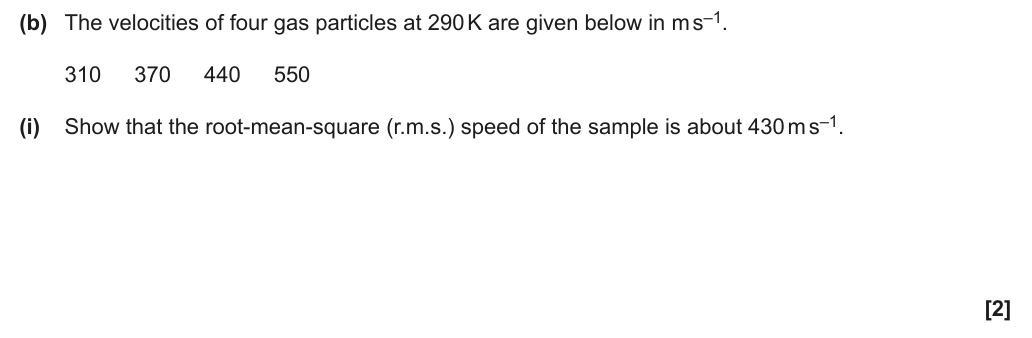
(b) The velocities of four gas particles at 290 K are given below in m s–1.
310   370   440   550
(i) Show that the root-mean-square (r.m.s.) speed of the sample is about 430 m s–1.
[2]
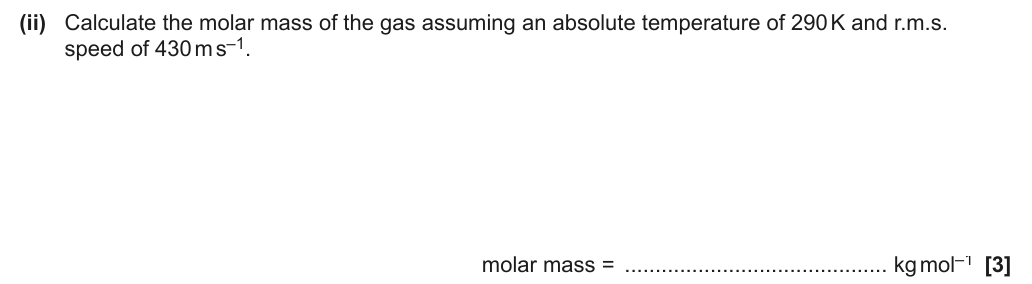
June 2024 · Paper 1 · Q20(b)(ii) 3 marks Calculation Hard ideal gases
(ii) Calculate the molar mass of the gas assuming an absolute temperature of 290 K and r.m.s.
speed of 430 m s–1.
molar mass =  ........................................... kg mol–1 [3]
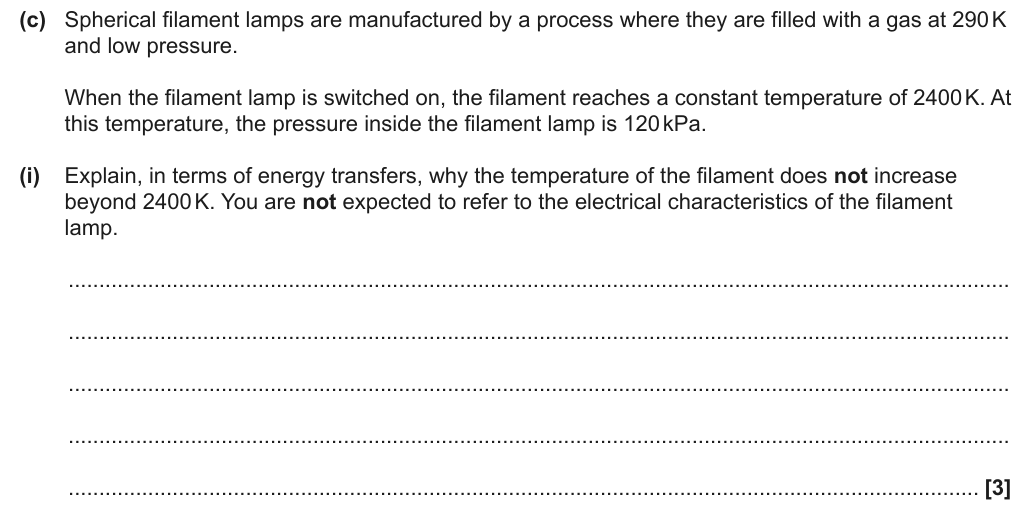
June 2024 · Paper 1 · Q20(c)(i) 3 marks Explanation Hard work energy and powerthermal physics
(c) Spherical filament lamps are manufactured by a process where they are filled with a gas at 290 K
and low pressure.
When the filament lamp is switched on, the filament reaches a constant temperature of 2400 K. At
this temperature, the pressure inside the filament lamp is 120 kPa.
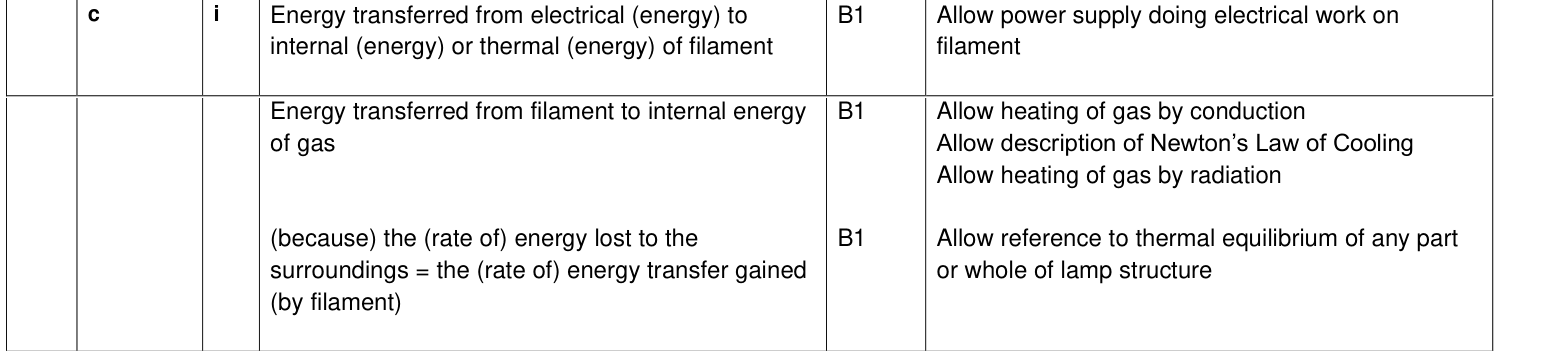
(i) Explain, in terms of energy transfers, why the temperature of the filament does not increase
beyond 2400 K. You are not expected to refer to the electrical characteristics of the filament
lamp.
..........................................................................................................................................................
..........................................................................................................................................................
..........................................................................................................................................................
..........................................................................................................................................................
..................................................................................................................................................... [3]
June 2024 · Paper 1 · Q20(c)(ii) 2 marks Calculation Medium ideal gases
Earlier part of question 20 that this part usesEarlier part of June 2024 Paper 1 question 20
(ii) Calculate the pressure of the gas within the filament lamp during manufacture.
pressure =  .................................................. kPa [2]
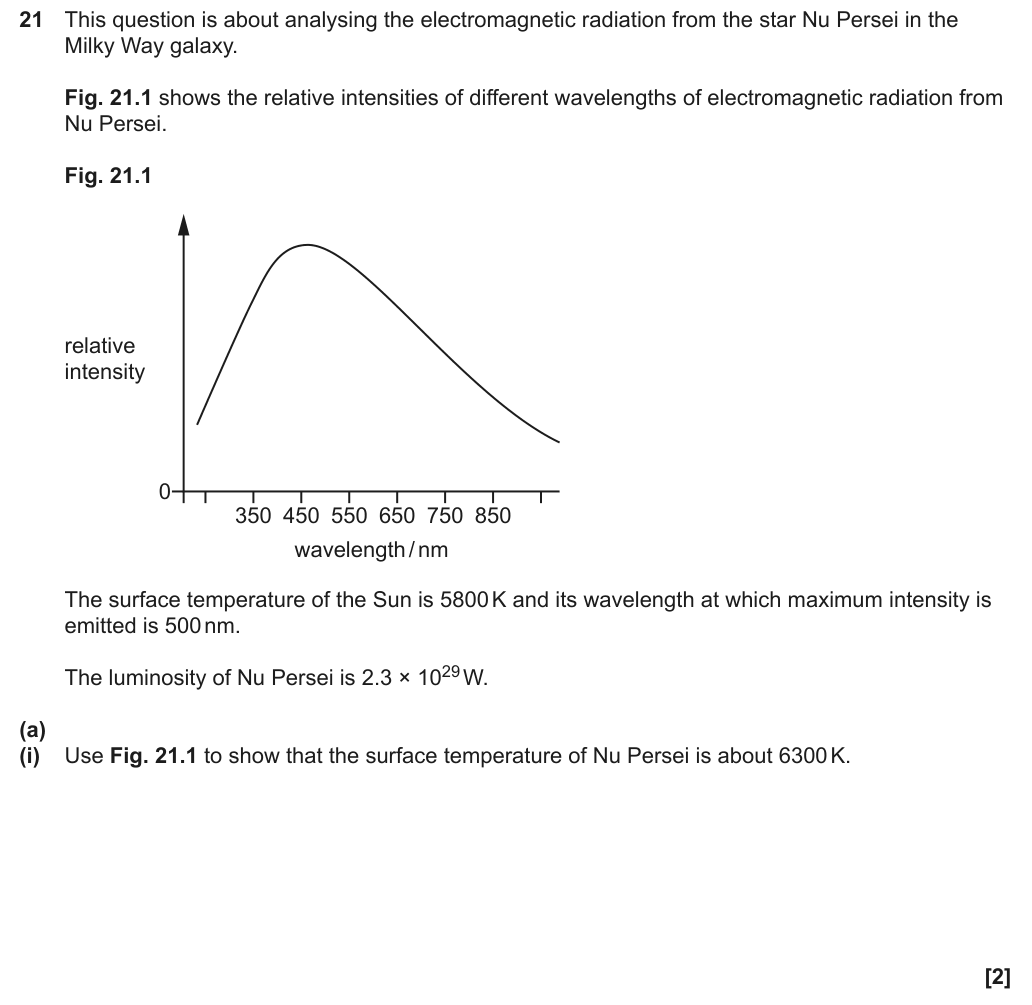
June 2024 · Paper 1 · Q21(a)(i) 2 marks Show that Medium stars
21 This question is about analysing the electromagnetic radiation from the star Nu Persei in the
Milky Way galaxy.
Fig. 21.1 shows the relative intensities of different wavelengths of electromagnetic radiation from
Nu Persei.
Fig. 21.1
relative
intensity
0
350 450 550 650 750 850
wavelength / nm
The surface temperature of the Sun is 5800 K and its wavelength at which maximum intensity is
emitted is 500 nm.
The luminosity of Nu Persei is 2.3 × 1029 W.
(a)
(i) Use Fig. 21.1 to show that the surface temperature of Nu Persei is about 6300 K.
[2]
June 2024 · Paper 1 · Q21(a)(ii) 3 marks Calculation Medium stars
Earlier part of question 21 that this part usesEarlier part of June 2024 Paper 1 question 21
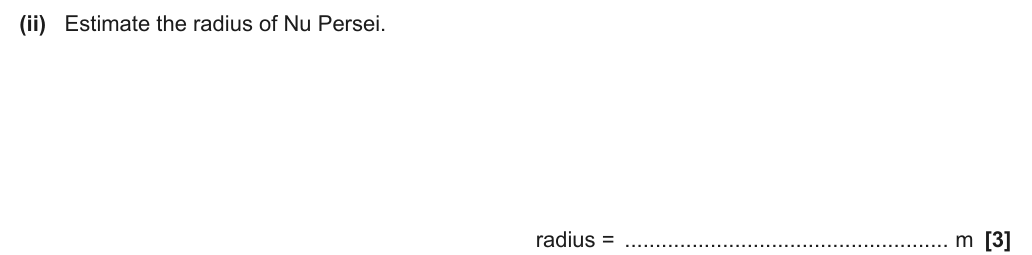
(ii) Estimate the radius of Nu Persei.
radius =  ..................................................... m [3]
June 2024 · Paper 1 · Q21(b)(i) 2 marks Show that Medium work energy and power
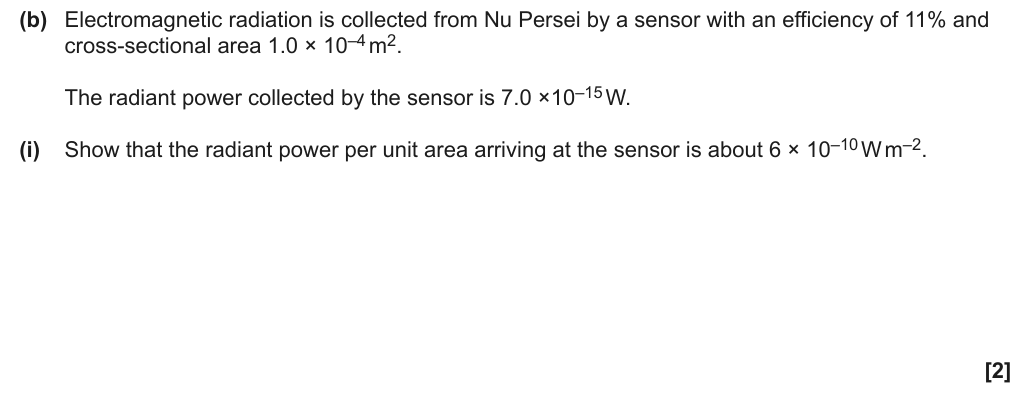
(b) Electromagnetic radiation is collected from Nu Persei by a sensor with an efficiency of 11% and
cross-sectional area 1.0 × 10⁻⁴ m2.
The radiant power collected by the sensor is 7.0 ×10⁻¹⁵ W.
(i) Show that the radiant power per unit area arriving at the sensor is about 6 × 10⁻¹⁰ W m–2.
[2]
June 2024 · Paper 1 · Q21(b)(ii) 4 marks Calculation Hard cosmologystars
Earlier parts of question 21 that this part usesEarlier part of June 2024 Paper 1 question 21Earlier part of June 2024 Paper 1 question 21
(ii) By the time the electromagnetic radiation from Nu Persei reaches Earth, the radiation from Nu
Persei is evenly distributed over a spherical area with radius equal to the distance between Nu
Persei and Earth.
Calculate the distance of Nu Persei from Earth in light years.
distance =  ....................................... light years [4]
June 2024 · Paper 1 · Q21(c) 3 marks Practical and data analysis Hard starsmeasurements and uncertainties
Earlier part of question 21 that this part usesEarlier part of June 2024 Paper 1 question 21
(c) The luminosity of Nu Persei was estimated using the temperature of Nu Persei and the
Hertzsprung-Russell (HR) diagram in Fig. 21.2. L is the luminosity of a star and L is the
luminosity of the Sun.
The temperature data from earlier in this question is repeated in the table below.
Star Surface temperature / K
Sun 5800
Nu Persei 6300
Comment on the uncertainty in your value, calculated in b(ii), of the distance of Nu Persei from
Earth. You may write on the diagram as part of your answer.
Fig. 21.2
4
2
Sun
a L k
lg L
0
–2
6300 K 5800 K
temperature
..........................................................................................................................................................
..........................................................................................................................................................
..........................................................................................................................................................
..................................................................................................................................................... [3]
June 2024 · Paper 1 · Q22(a)(i) 1 mark Short answer Easy planetary motion
22
(a) A satellite in a geostationary orbit around the Earth appears to remain at the same point in the
sky when viewed from the ground.
(i) State one condition required for an orbit to be geostationary.
..........................................................................................................................................................
..................................................................................................................................................... [1]
June 2024 · Paper 1 · Q22(a)(ii) 3 marks Calculation Easy planetary motion
(ii) Calculate the orbital radius of the geostationary satellite. The mass of the Earth is 6.0 × 1024 kg.
orbital radius =  ..................................................... m [3]
June 2024 · Paper 1 · Q22(b)(i) 2 marks Show that Medium gravitational fieldscircular motionplanetary motion
(b) A satellite of mass m is in a circular orbit around a planet of mass M. The radius of the orbit from
the centre of the planet is r.
The gravitational potential Vg at a point a distance r from the centre of the planet is given by the
equation
Vg = – GM
r .
(i) By considering the cause of the centripetal force on the satellite, show that the kinetic energy of
the satellite is equal to half the magnitude of its gravitational potential energy.
[2]
June 2024 · Paper 1 · Q22(b)(ii) 2 marks Show that Medium gravitational fields
Earlier part of question 22 that this part usesEarlier part of June 2024 Paper 1 question 22
(ii) A tiny satellite of mass 1.0 kg is to be launched from rest from the surface of the Earth into a low
Earth orbit. The gravitational potential at any point in this orbit is –56 MJ kg–1.
The value of the gravitational potential at the Earth’s surface is –63 MJ kg–1.
Show that the satellite must gain more than 30 MJ of total energy to achieve and remain in orbit.
[2]
June 2024 · Paper 1 · Q22(c) 6 marks 6-mark extended response Hard gravitational fieldswork energy and power
Earlier parts of question 22 that this part usesEarlier part of June 2024 Paper 1 question 22Earlier part of June 2024 Paper 1 question 22
(c)* Large satellites are often launched by rockets from sites near the equator. The rotation of the
Earth increases the initial kinetic energy of the rocket and satellite.
A new strategy is to launch using a smaller rocket from a high flying aircraft.
Using the information in (b)(ii) and the data below, evaluate the advantages and limitations of this
strategy. Use calculations to support your evaluation.
Rotational speed 460 m s–1 Typical aircraft 10,000 m
at the equator operating altitude
Aircraft cruise 230 m s–1
velocity (relative
to the ground)
[6]
..........................................................................................................................................................
..........................................................................................................................................................
..........................................................................................................................................................
..........................................................................................................................................................
..........................................................................................................................................................
..........................................................................................................................................................
..........................................................................................................................................................
..........................................................................................................................................................
..........................................................................................................................................................
..........................................................................................................................................................
..........................................................................................................................................................
..........................................................................................................................................................
..........................................................................................................................................................
..........................................................................................................................................................
Additional space if required
..........................................................................................................................................................
..........................................................................................................................................................
..........................................................................................................................................................
..........................................................................................................................................................
..........................................................................................................................................................
June 2024 · Paper 1 · Q23(a) 2 marks Show that Medium stars
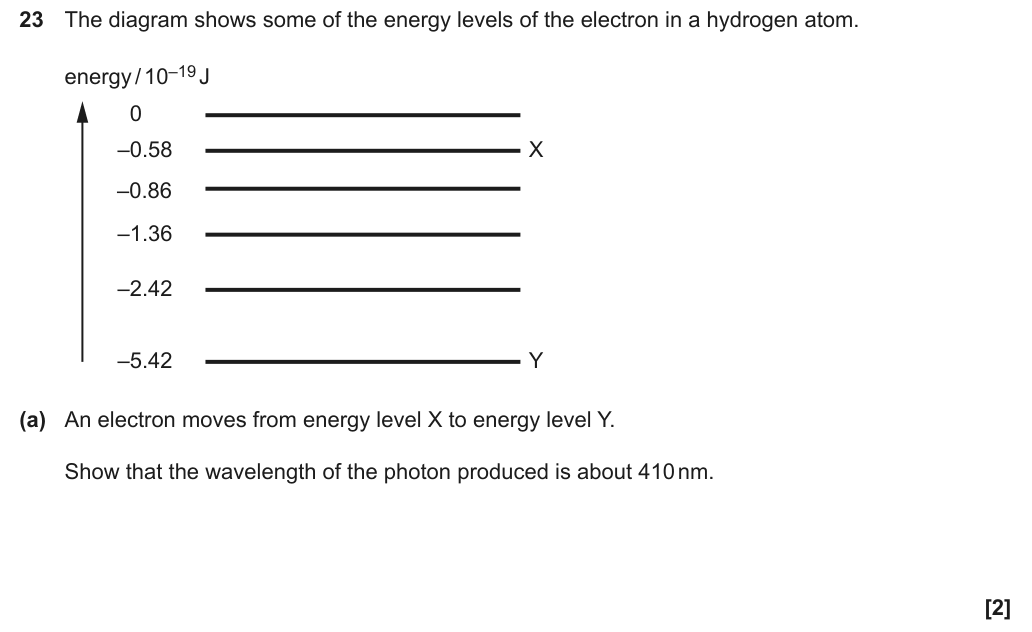
23 The diagram shows some of the energy levels of the electron in a hydrogen atom.
energy / 10–19 J
0
–0.58 X
–0.86
–1.36
–2.42
–5.42 Y
(a) An electron moves from energy level X to energy level Y.
Show that the wavelength of the photon produced is about 410 nm.
[2]
June 2024 · Paper 1 · Q23(b)(i) 2 marks Explanation Medium stars
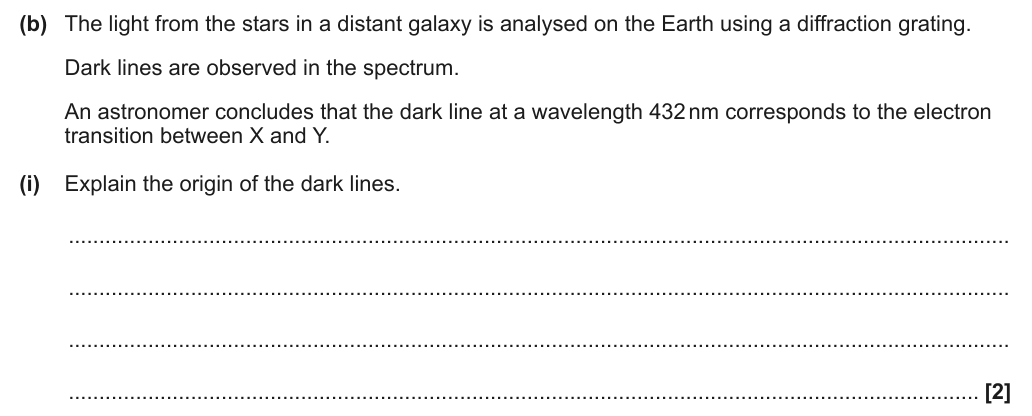
(b) The light from the stars in a distant galaxy is analysed on the Earth using a diffraction grating.
Dark lines are observed in the spectrum.
An astronomer concludes that the dark line at a wavelength 432 nm corresponds to the electron
transition between X and Y.
(i) Explain the origin of the dark lines.
..........................................................................................................................................................
..........................................................................................................................................................
..........................................................................................................................................................
..................................................................................................................................................... [2]
June 2024 · Paper 1 · Q23(b)(ii) 2 marks Calculation Medium cosmology
Earlier part of question 23 that this part usesEarlier part of June 2024 Paper 1 question 23
(ii) Calculate the recession velocity v of the galaxy.
v =  ................................................ m s–1 [2]
June 2024 · Paper 1 · Q23(b)(iii) 1 mark Short answer Medium cosmology
(iii) State the name of the theory that is supported by evidence from the measurement of the
recession velocities of galaxies in the universe.
..................................................................................................................................................... [1]

Work with an OCR physics tutor

Want a paper marked and gone through with you? Message us.

Prefer email? Send an enquiry

If you are under 18, please include a parent's contact details. Enquiries go to enquiries@physicsaleveltutor.com and are deleted once handled. All tutoring is online.