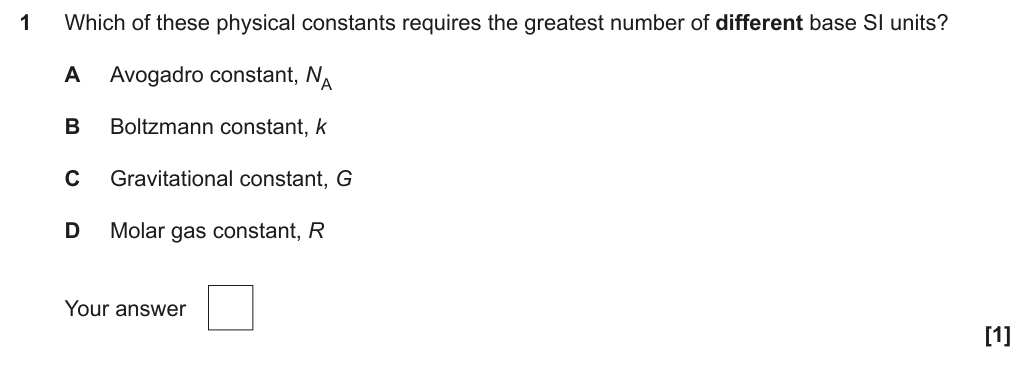
Answer
D
Mark scheme

Examiner's comment
Candidates got the right answer often by writing relevant formulas with these constants in them and performing ‘unit algebra’.
100 marks · 53 question parts · Paper, mark scheme and report on OCR's site · Have the Data, Formulae and Relationships Booklet beside you
D
Candidates got the right answer often by writing relevant formulas with these constants in them and performing ‘unit algebra’.
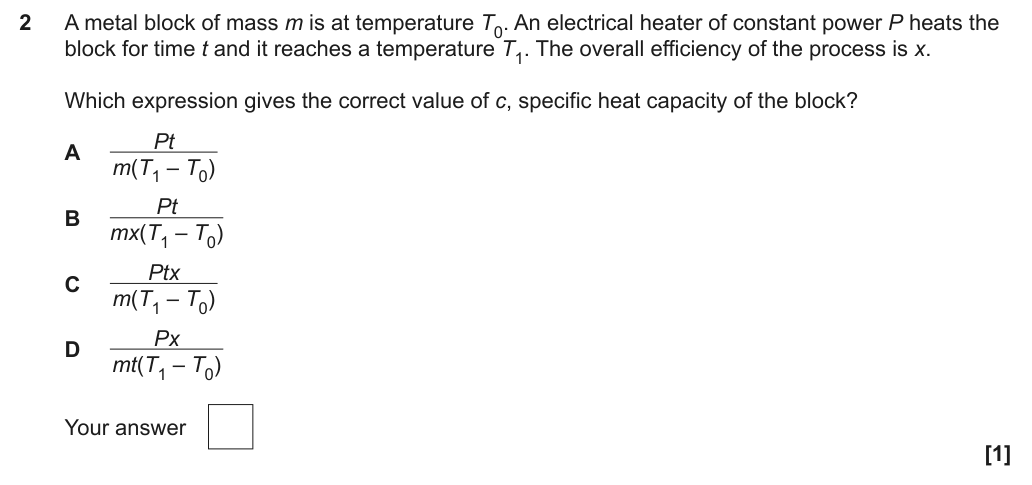
C
This question was answered successfully by the majority of candidates who rearranged and substituted accurately.
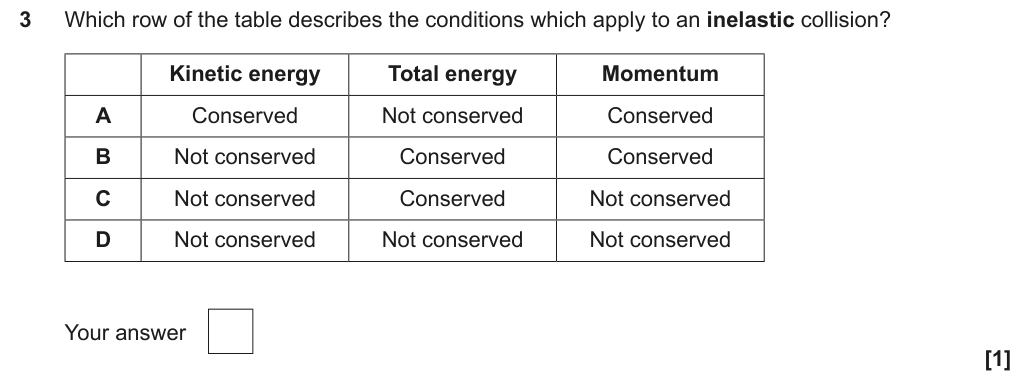
B
Total energy and momentum are always conserved in inelastic collisions (unless there is an external force, which would have been mentioned). This leaves B as the only possible answer.
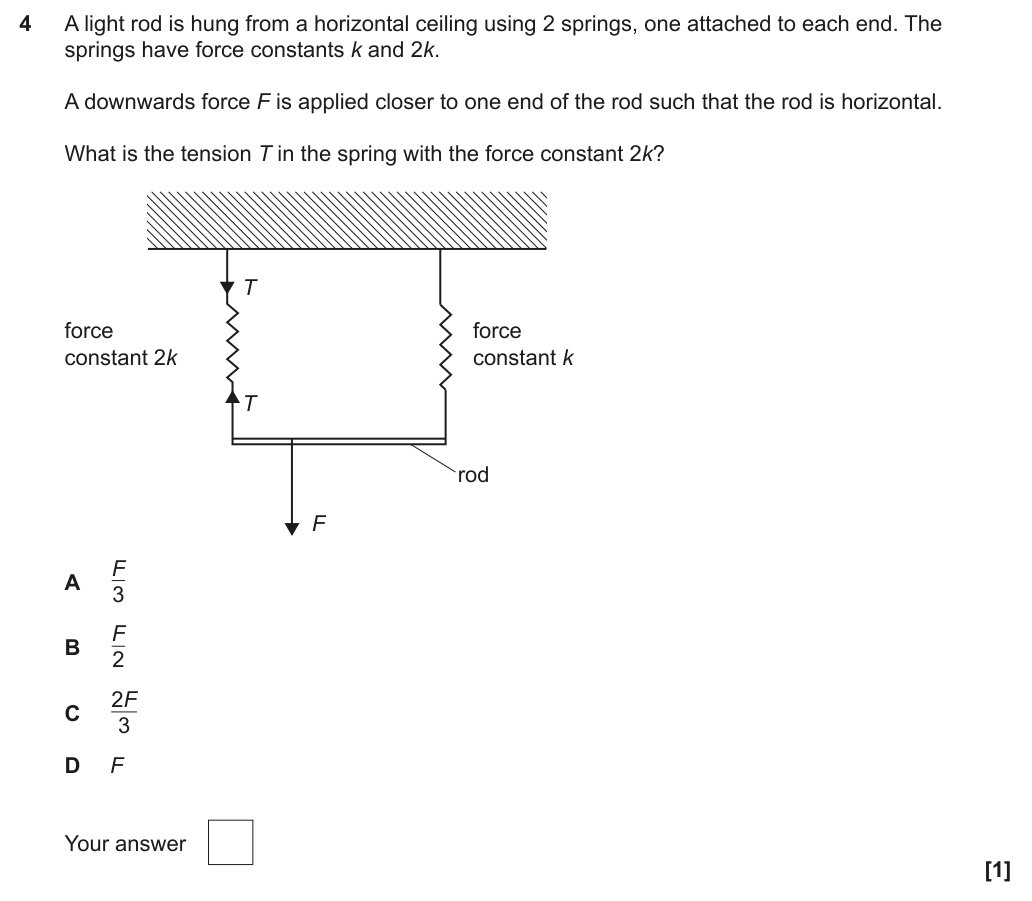
C
The rod ensures that the extension of both springs is the same. This means that the tension in the left spring must be twice the tension in the right spring. This in turn means that F must equal three times the tension of the right spring, since the sum of the two tensions must equal F. Finally, this gives the tension in the right spring as 3 and hence the tension in the left spring must be 2 3.
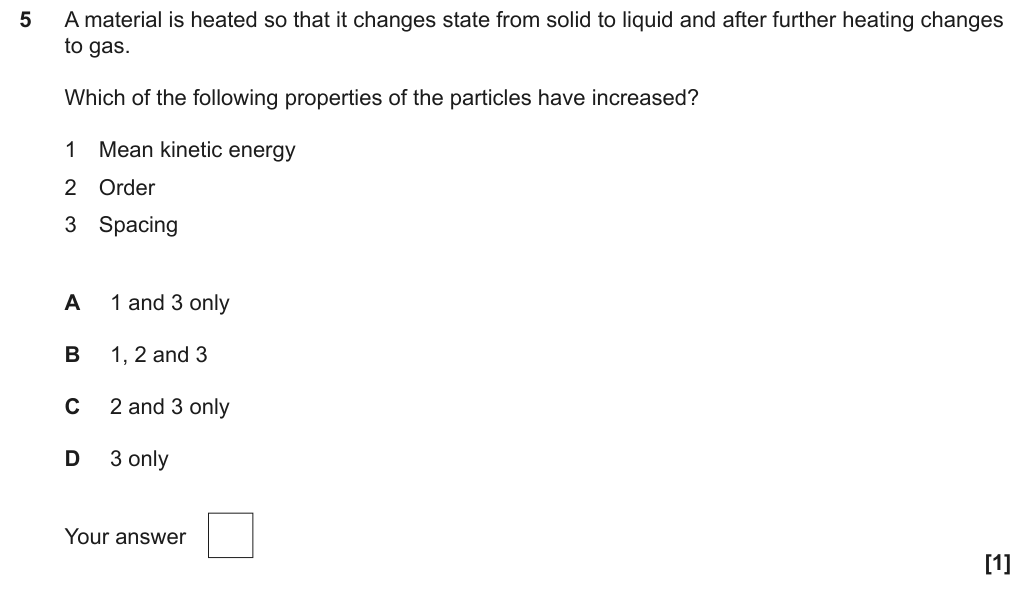
A
The heating process decreases the order, whereas the spacing and mean kinetic energy of the particles increases, giving the correct answer as A.
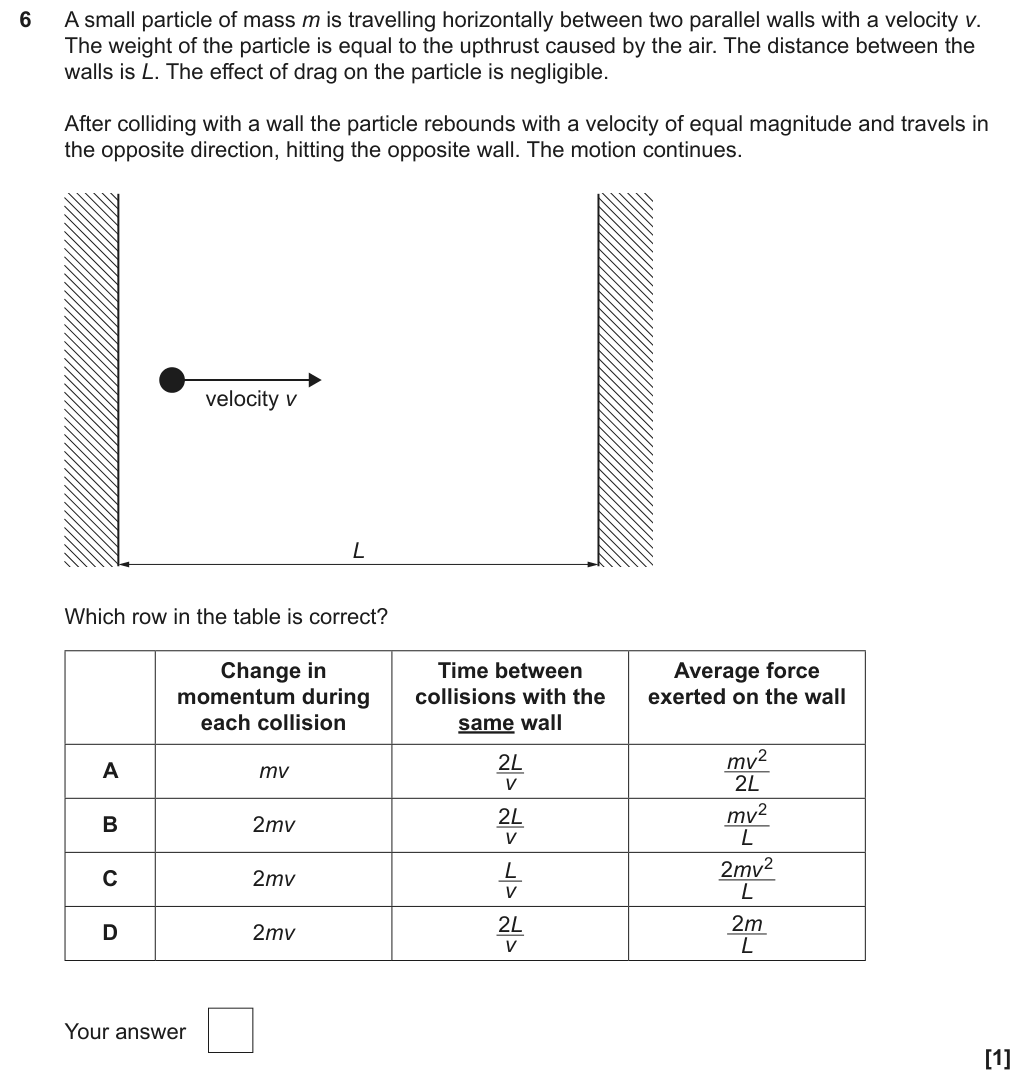
B
This question is the introduction to the derivation of the ideal gas equation. The particle changes direction after the elastic collision with the wall, so that the momentum change is 2𝑚𝑣. If the particle starts having just collided with the left wall, the time taken to return to that wall is the distance divided by the speed i.e. 2 𝑣. Average force exerted on the wall must be the change in momentum ÷ time between collisions so the final column must be calculated accordingly. The only row that satisfies this and the two previous conditions is answer B.
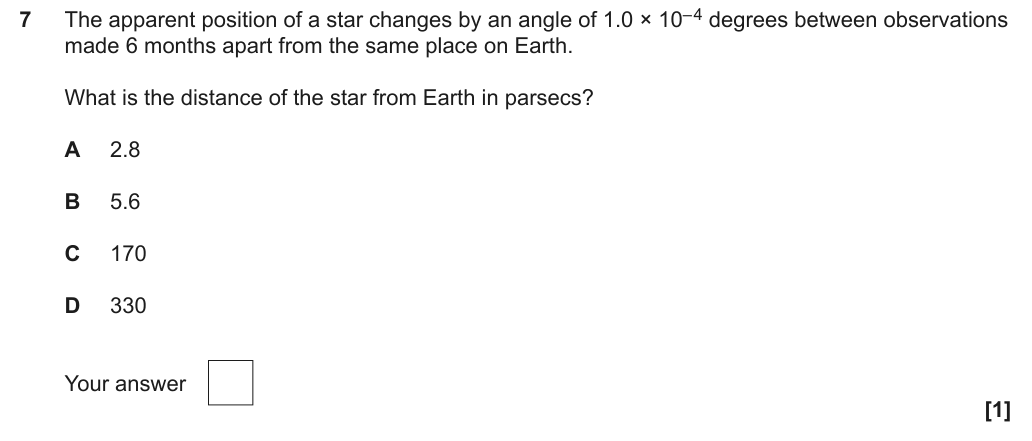
B
The data in the question gives a parallax angle of 0.5 × 10⁻⁴ degrees. This equates to 0.18 arcseconds. Parallax angle and distance in parsecs are inversely proportional, with 1 arcsecond giving a distance of 1 parsec. 0.18 arcseconds gives a distance of (1 ÷ 0.18) = 5.6 parsecs.
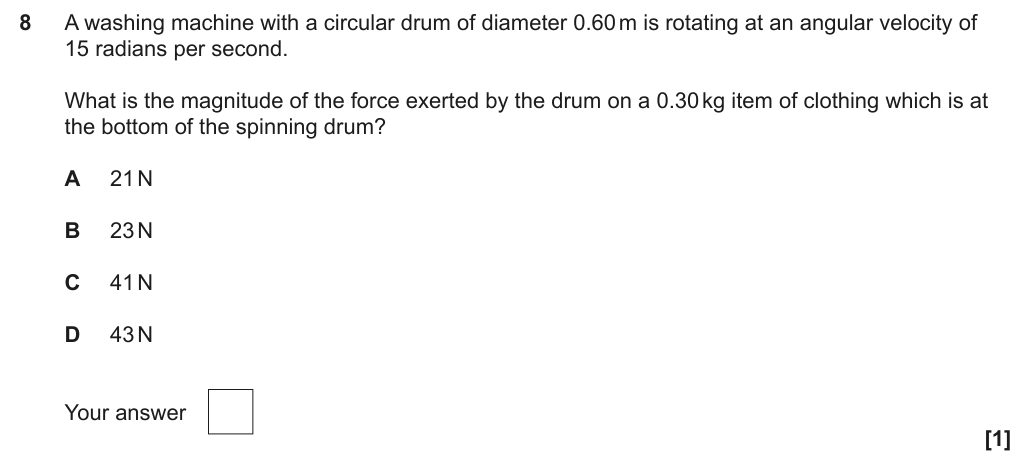
B
The data in the first sentence gives the centripetal force required to make the clothing perform circular motion i.e. 𝑚𝜔2𝑟= 20.25 N, which caused candidates to pick answer A. Those that used a radius of 0.60 m would get answer C at this point. Although, at the bottom of the drum, the centripetal force is given by the contact force from the drum – the weight of the clothing. To find the contact force, we must add the weight of the clothing (2.94 N) to the centripetal force, giving 23.2 N, i.e. answer B is correct. Those that used a radius of 0.60 m would get answer D.
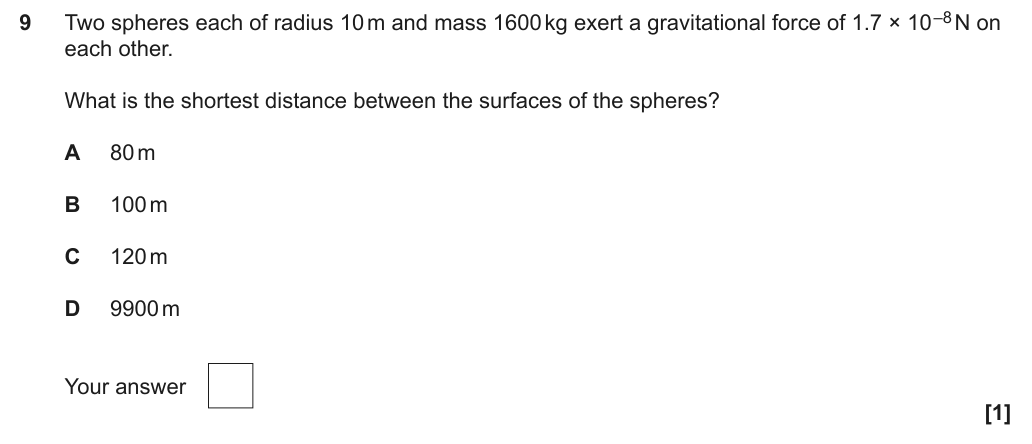
A
The key here is to use the formula for gravitational force (𝐹 = 𝑟2 ) to find the distance between the centres of the spheres. This gives 100.2 m. The question asks for the distance between the surfaces of the two spheres, which is 20 m less than the distance between their centres. Hence A is the correct answer.
C
Many students remembered that the mass of the core is the crucial factor in determining whether a super red giant evolves into a black hole.
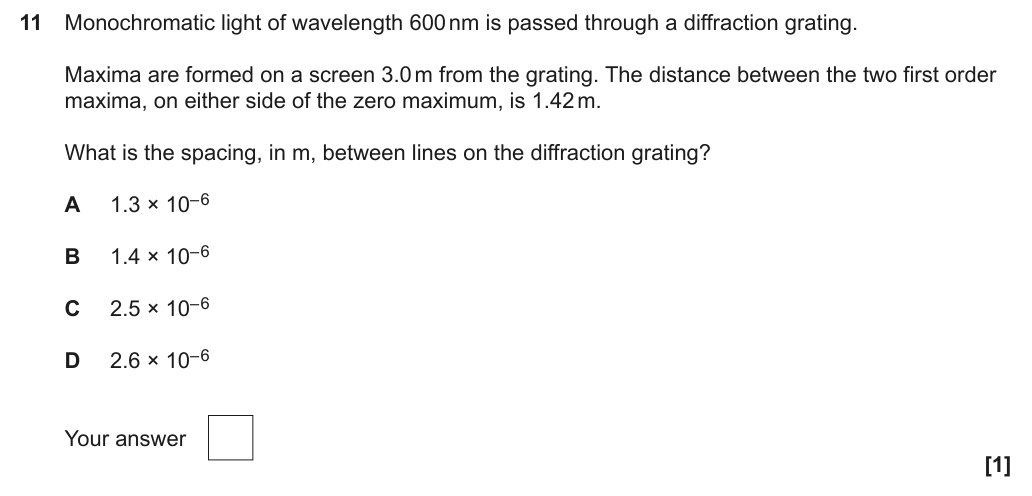
D
Candidates often confused which formula to use. Some used the two-slit formula and others, correctly, used the diffraction grating formula. Here using 𝑑𝑠𝑖𝑛𝑞 = 𝑛𝑙 is the correct approach. The question gives the distance between the two first- order maxima. This means that the distance from the centre to the first-order maximum is half of that i.e. 0.71 m. Consequently, the angle q is tan-1(0.71 ÷ 3.0) = 13.3.... degrees. Substituting in the wavelength (600 ×10-9 m) and n=1 gives d as 2.61 × 10⁻⁶ m. Therefore the answer is D.
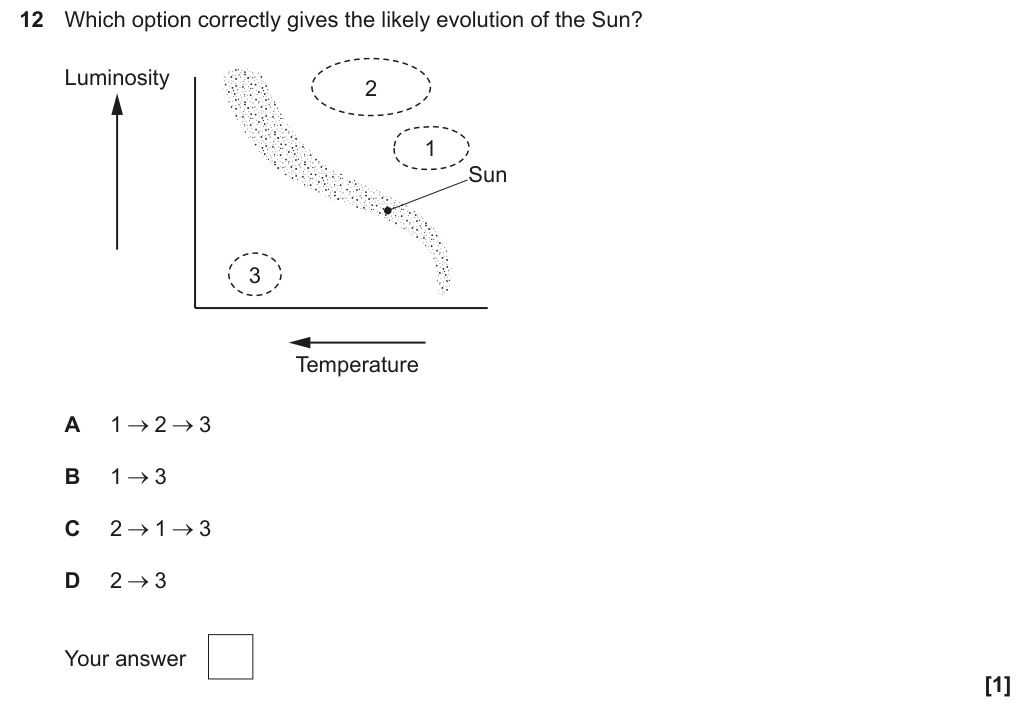
B
Most candidates remembered that the correct sequence for the Sun is main sequence, red giant, white dwarf (i.e. answer B). Any answer that includes red super giant cannot be correct.
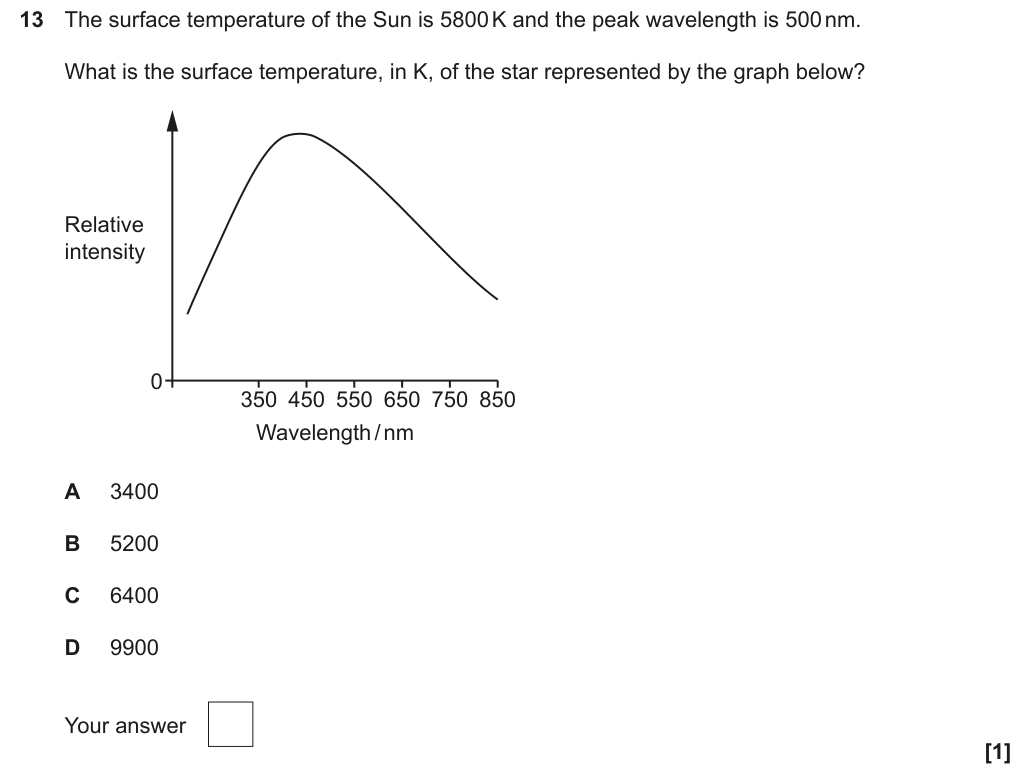
C
This question tests knowledge of Wien’s Law, 𝑙𝑚𝑎𝑥𝑇= constant. Using the given data for the Sun, the constant here is 2.9 × 10⁶ nm K. The wavelength of maximum intensity on the graph is roughly 450 nm so the temperature = 2.9 × 10⁶ ÷ 450 = 6444 K, giving the correct answer as C.
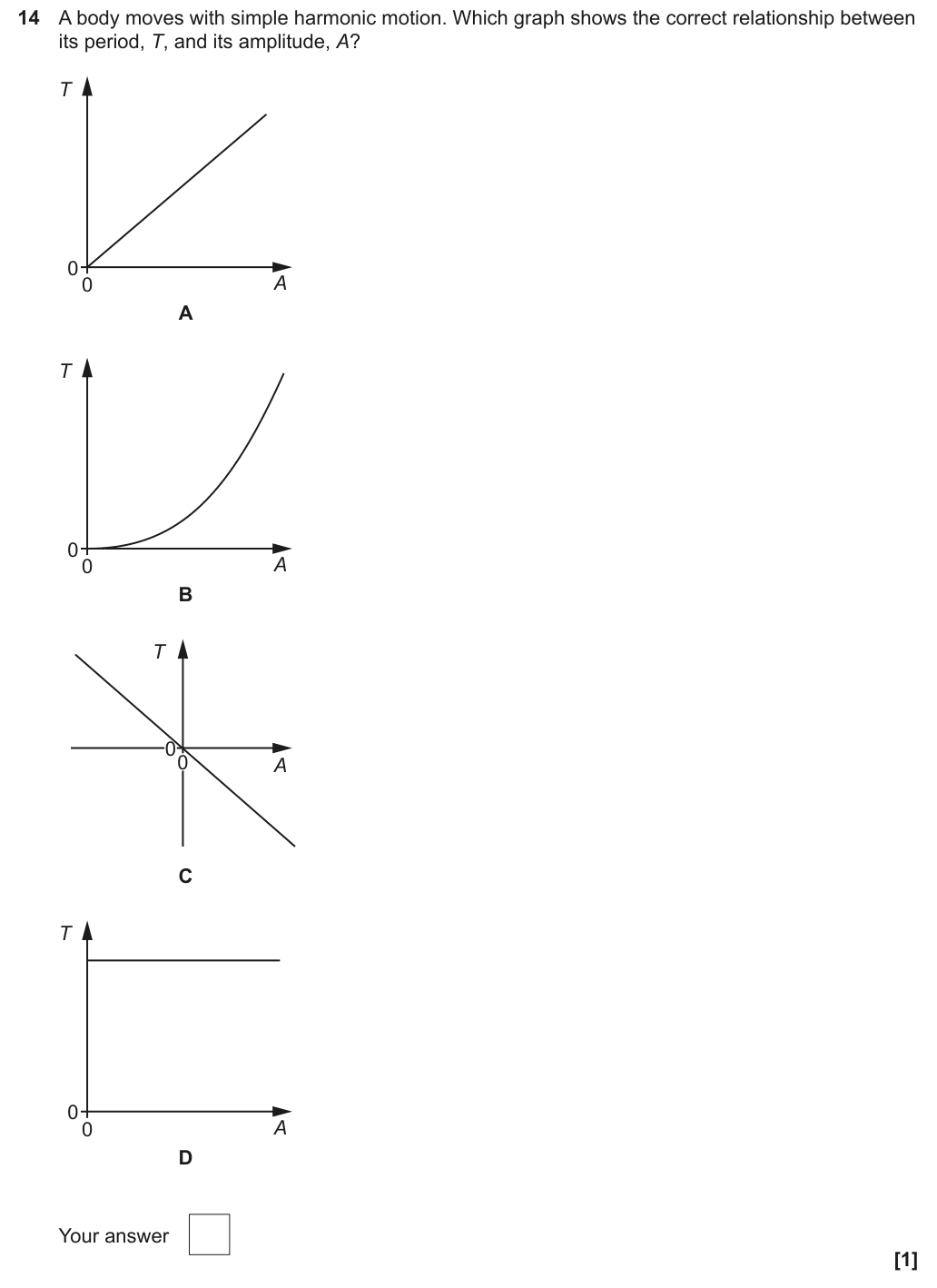
D
Any object performing simple harmonic motion is isochronous, which means that the period is independent of the amplitude of motion. The only graph that shows this is graph D.
B
The Cosmological principle is that on a large scale, the universe is homogeneous (the same everywhere) and isotropic (the same in all directions). Answers A, C and D are not implied by this, although they may be true statements. Answer B is correct here.
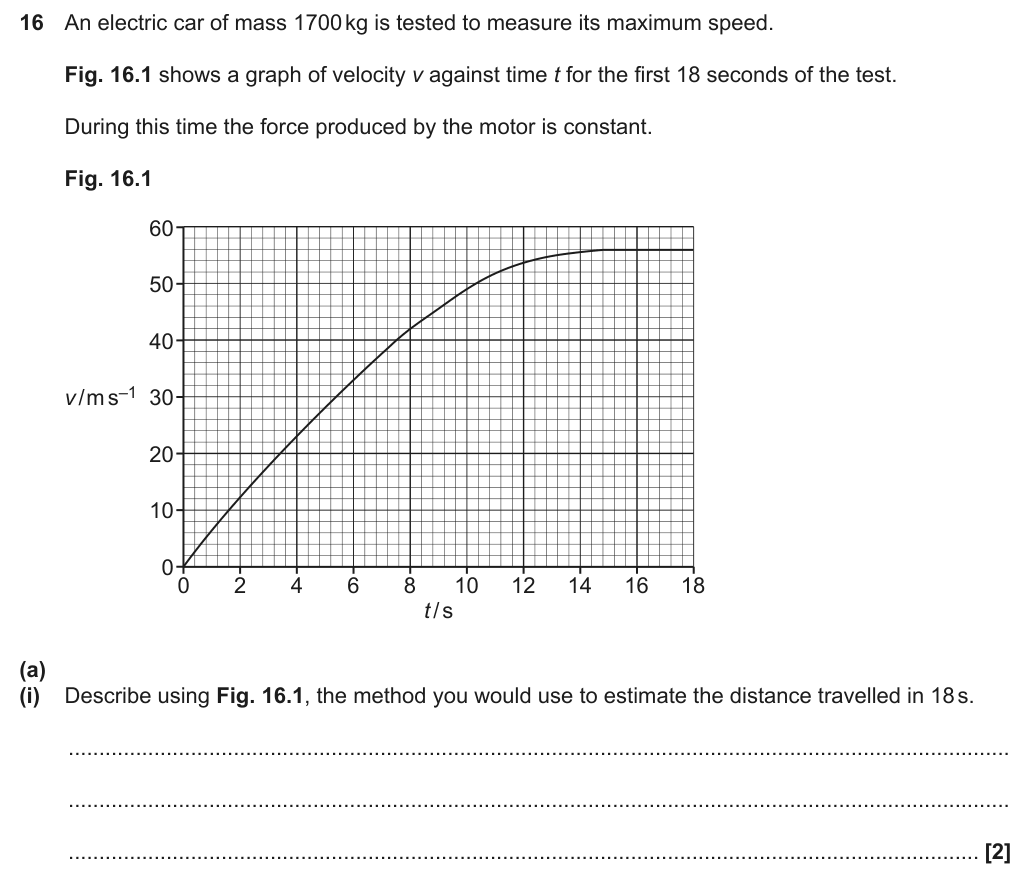
Most candidates stated that they would find the area under the curve. Any valid method was acceptable, ranging from counting squares and multiplying by the area of one square up to using mathematical methods such as the trapezium rule. Integration was not accepted (there’s no function to integrate here) however, successful candidates went on to describe one of the numerical methods already described.
Skills: M0.4 Estimate results; M3.8 Understand the possible physical significance of the area between a curve and the x axis and be able to calculate it or estimate it by graphical methods as appropriate
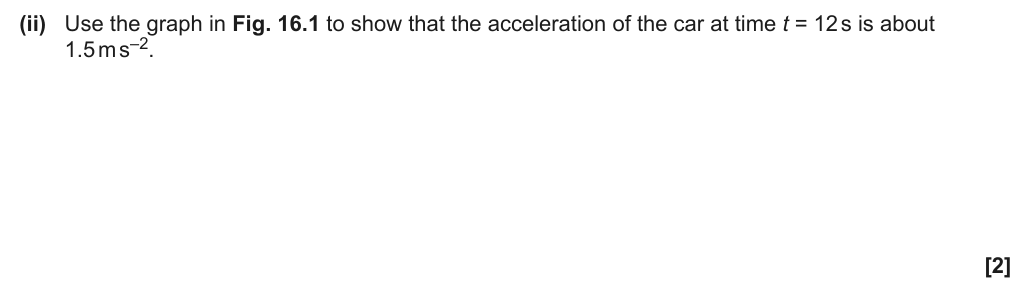
Most candidates successfully drew a tangent to the curve, although a small number drew a line that was too steep, too shallow or not touching the curve at the 12 second point. This limited those candidates to maximum of 1 mark.
Skills: M3.4 Determine the slope and intercept of a linear graph; M3.6 Draw and use the slope of a tangent to a curve as a measure of rate of change
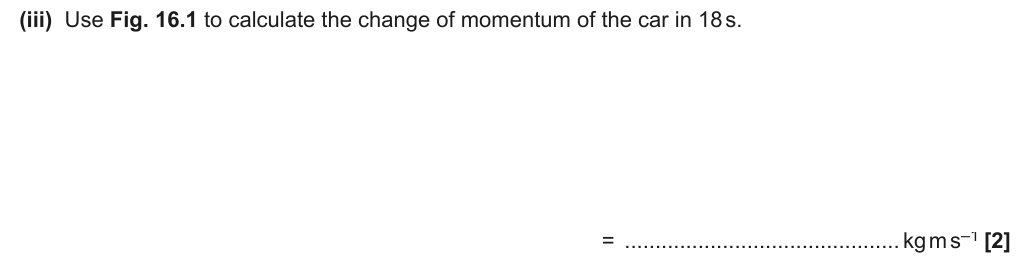
Almost all candidates read the velocity at 18 s correctly and then multiplied by the mass of the car. A small number misread the question and calculated the average rate of change of momentum by dividing the correct answer by 18 seconds.
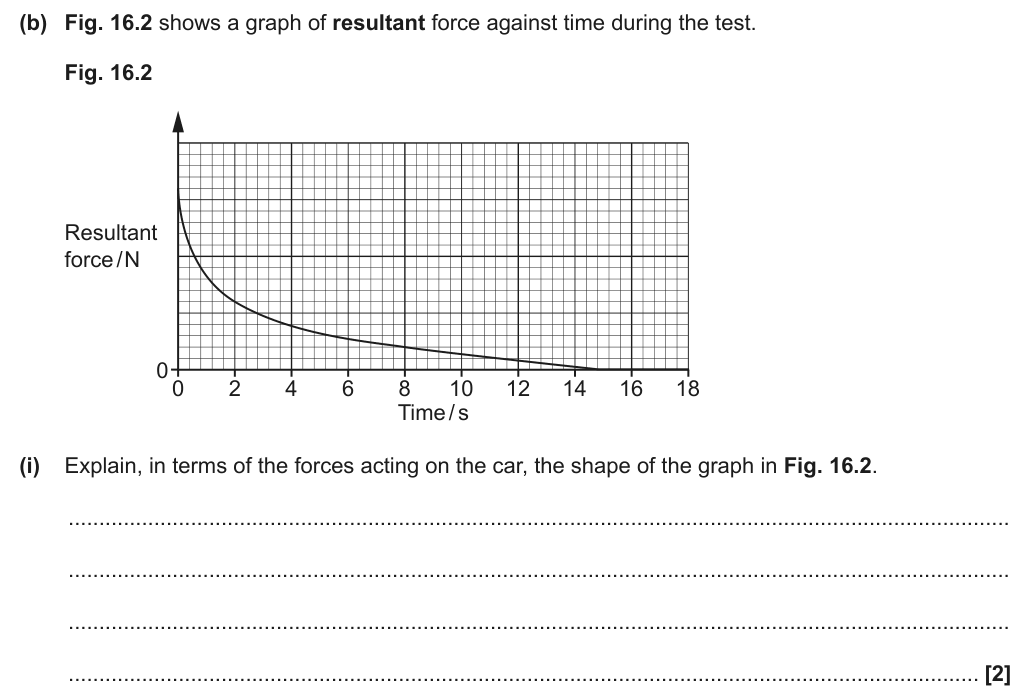
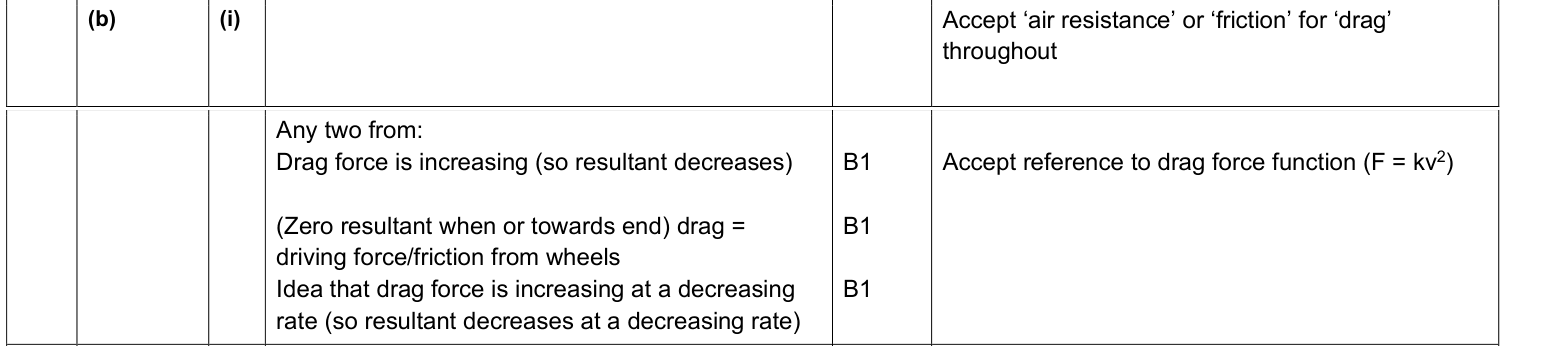
Describing the shape of the curve was not required here and so comments that did that without explanation, such as ‘the curve starts steep, decreases at a decreasing rate and then the resultant becomes zero’ scored no marks. The question required explanations in terms of forces. Successful responses mentioned drag, how that changes with speed and the condition that the drag must equal the thrust.
Skills: M3.1 Translate information between graphical, numerical and algebraic forms
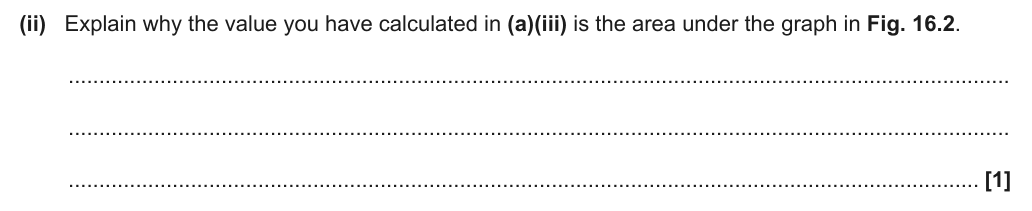
Many candidates used the correct term of ‘impulse’ here, often by referring to the product of average force and time taken as representative of the area of a small square.
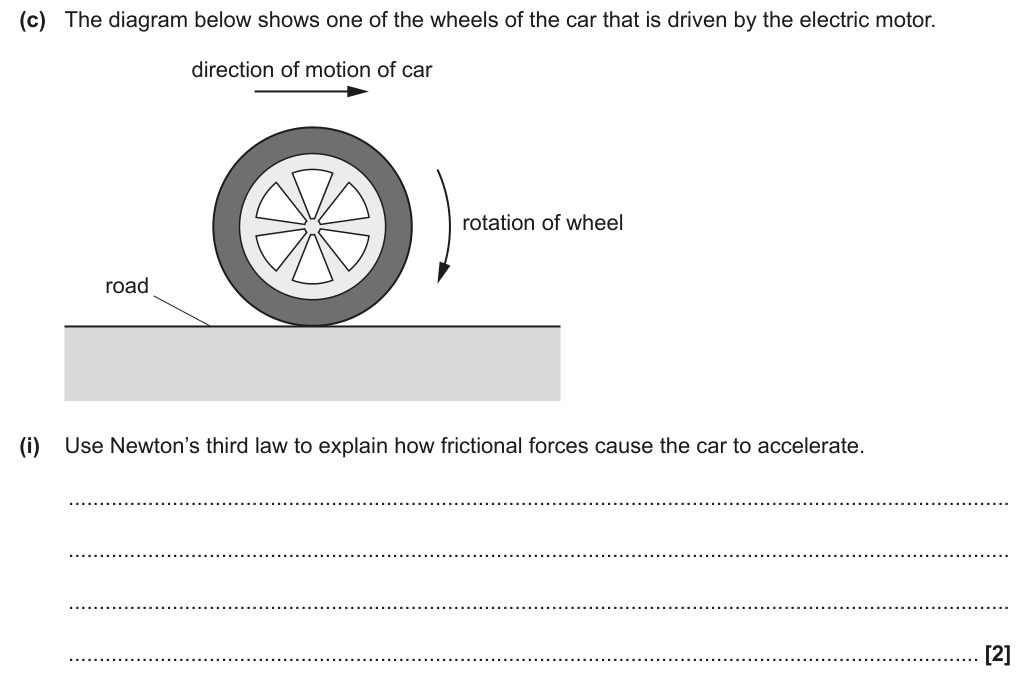
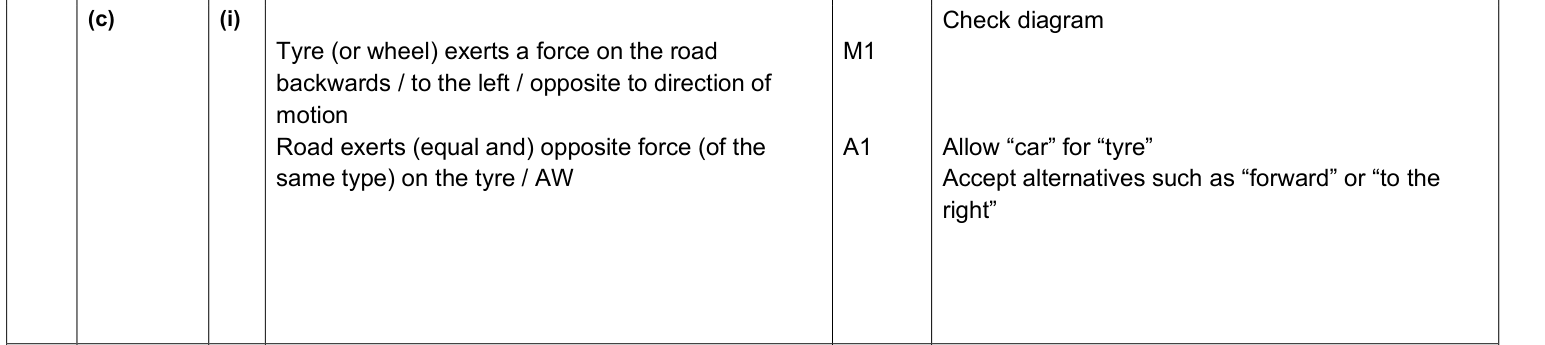
Candidates often described Newton’s Third Law in generic terms. The question requires application to this specific context such as ‘There’s a force on the road to the left from the wheel’ or ‘There’s a force on the wheel from the road to the right’.
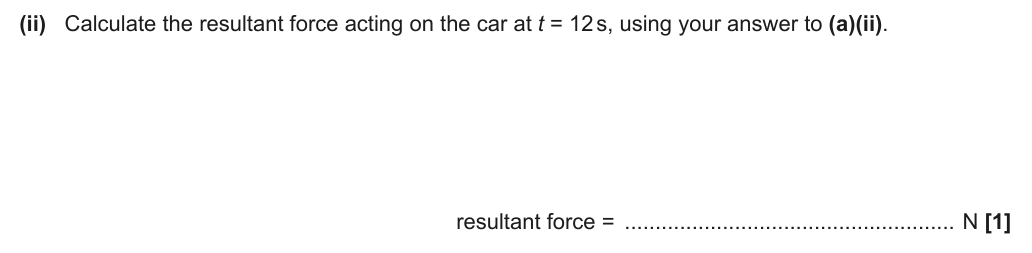
Less successful candidates did not use their answer from part (a) (ii), often by dividing their answer to part (a) (iii) and dividing by either 12 or 18 seconds. This found the average force over that time and so was incorrect. The correct method is simply to multiply the acceleration at t = 12 s by the mass of the car.
Skills: M2.3 Substitute numerical values into algebraic equations using appropriate units for physical quantities
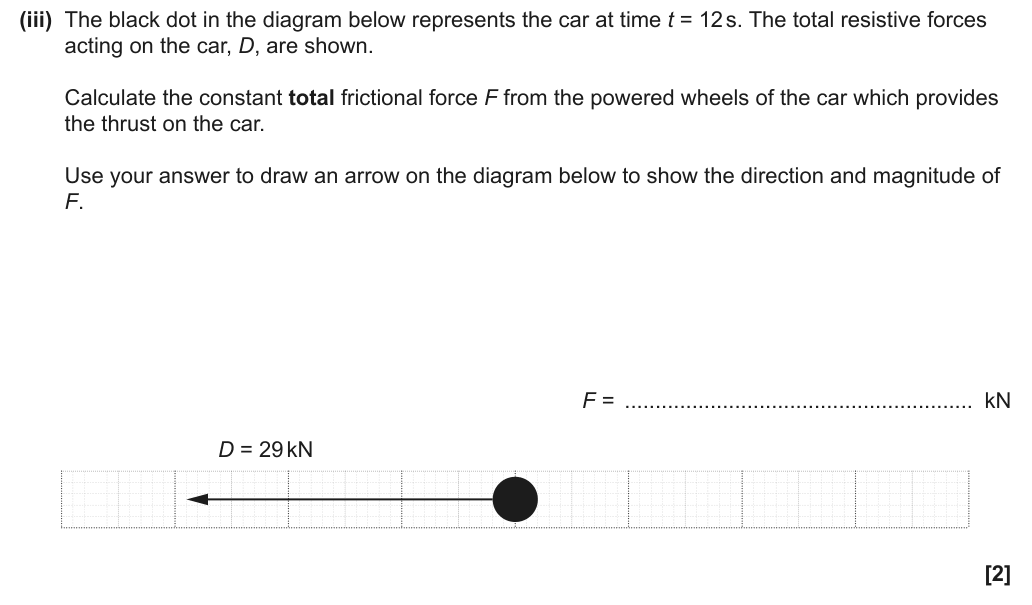
The correct approach here is to make sure that the thrust – drag = resultant force calculated in the previous part of the question. Many candidates still gained full marks even though their previous answer was incorrect as ‘error carried forward’ was applied, as long as the arrow matched the numerical answer. The answer line includes the unit kN – candidates should be careful to give their answer in the required unit.
Skills: M0.1 Recognise and make use of appropriate units in calculations
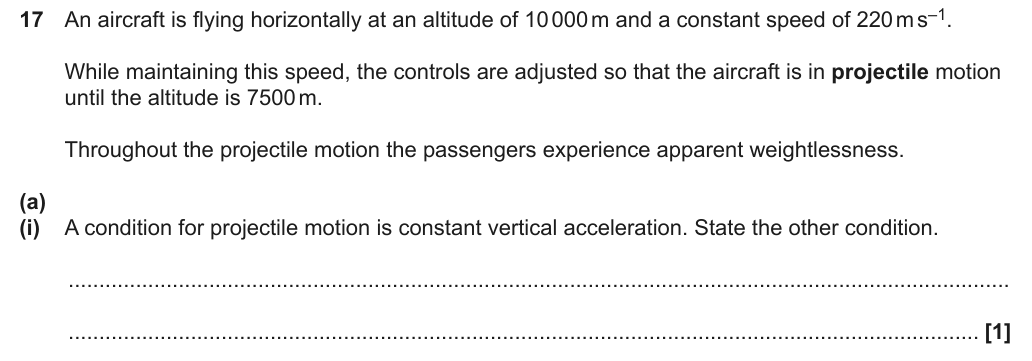
There were many ways to express the idea that the horizontal velocity should stay constant.
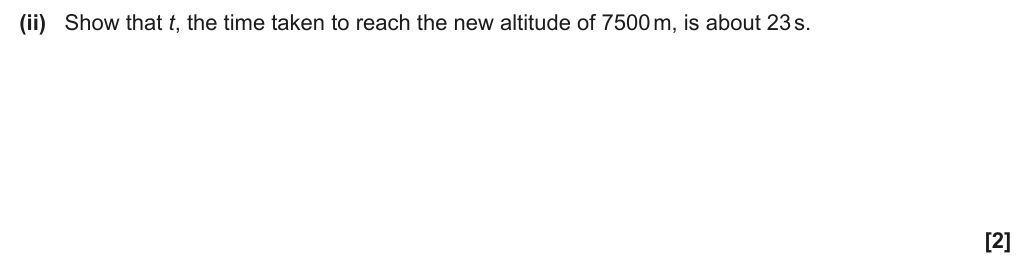
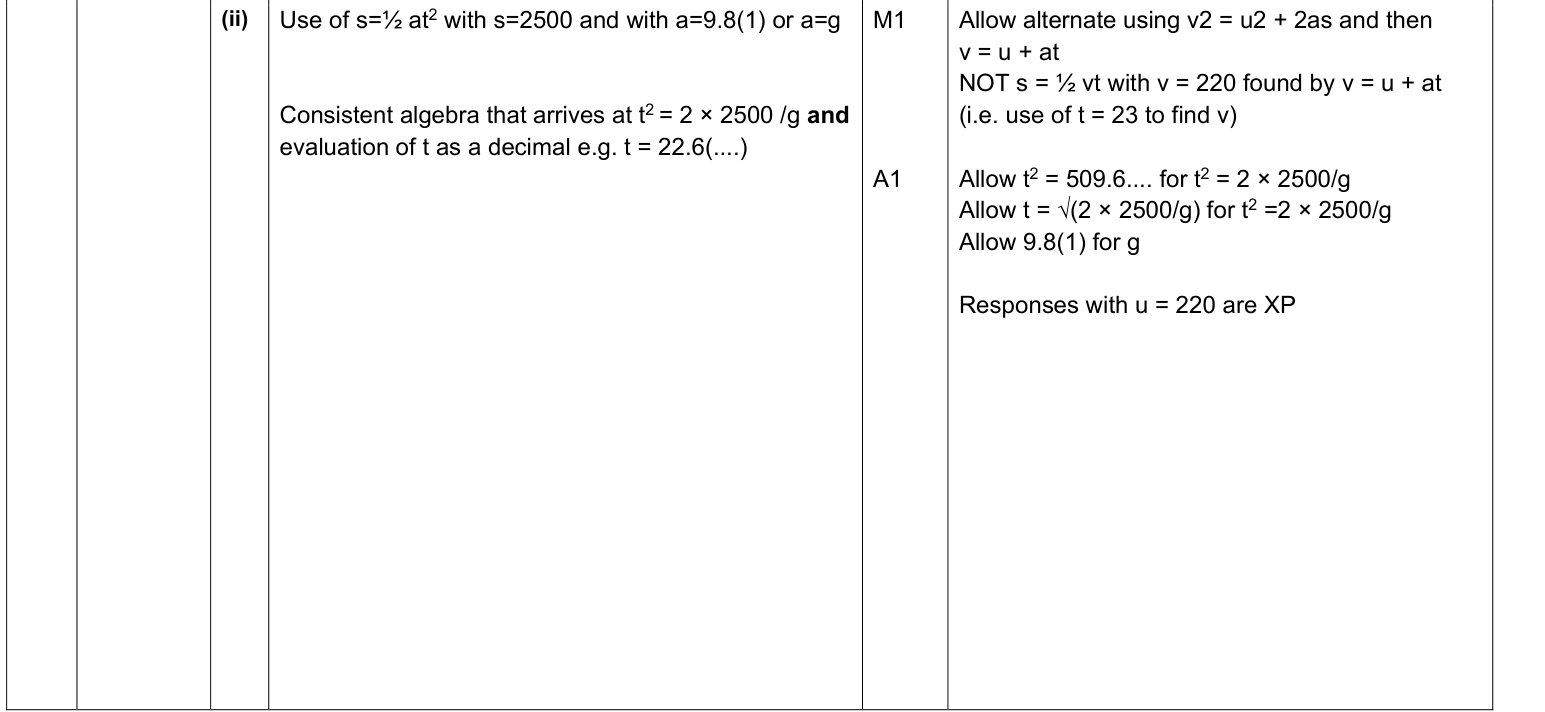
This question tests the idea of independence of horizontal and vertical motion. There are lots of letters involved in the algebra that are applicable to both motions, e.g. u, v, a, and s. Successful candidates made the distinction between horizontal and vertical motion as clear as possible, either by using a two- column table with the headings ‘vertical’ and ‘horizontal’ or by using V and H subscripts on the relevant letters. Once candidates got to the starting point of a displacement of 2500 m with zero initial vertical velocity and an acceleration of ‘g’, they often arrived at the correct answer.
Skills: M2.2 Change the subject of an equation, including non-linear equations; M2.3 Substitute numerical values into algebraic equations using appropriate units for physical quantities
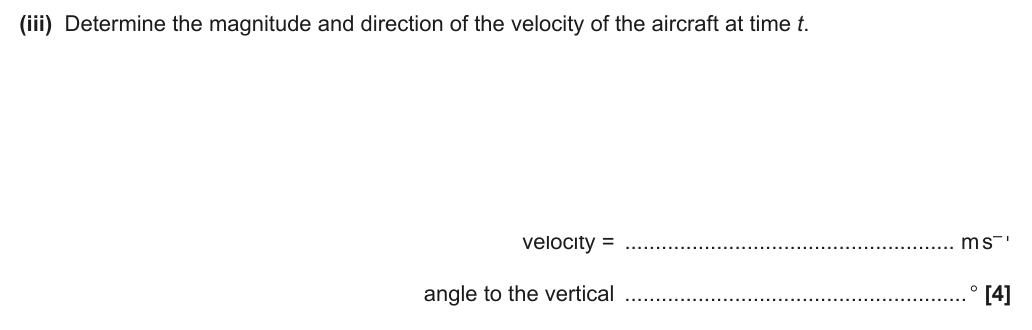
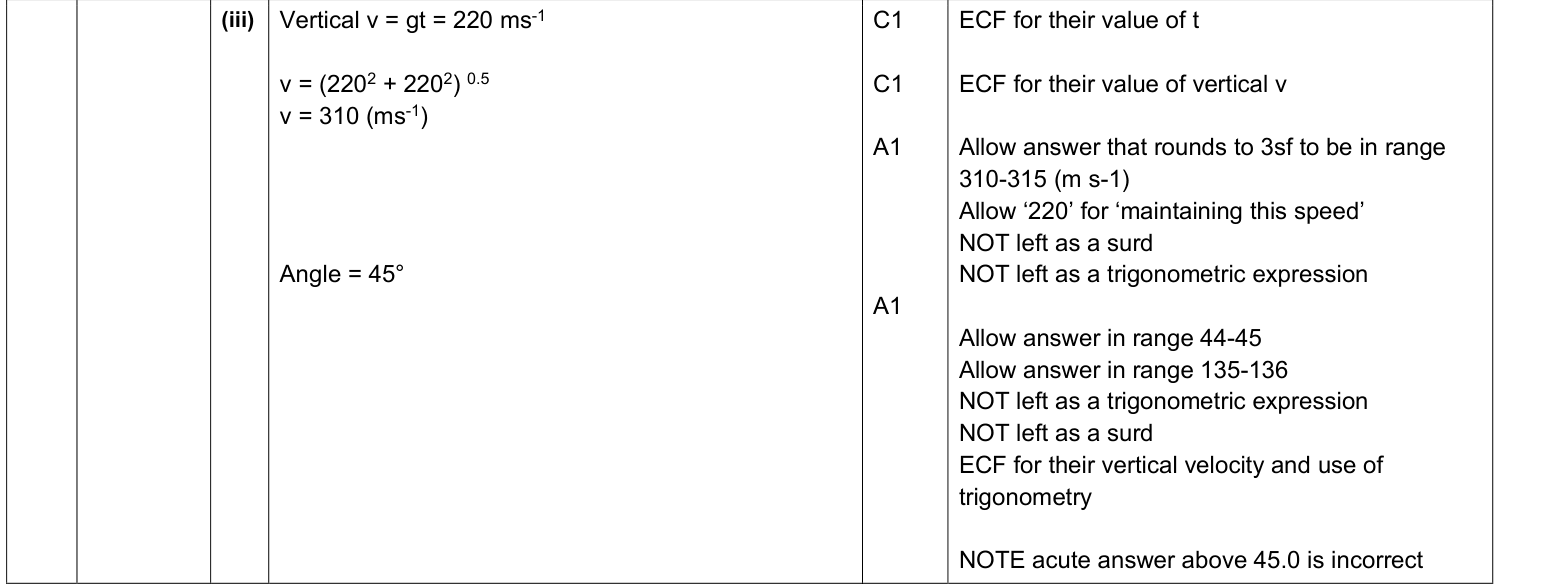
A diagram of the two components of the velocity here was not mandatory; however, it makes it clear in the mind of the candidate what they are doing. The most successful candidates drew a triangle with the two components of velocity with an angle indicated between the vertical and the resultant velocity. They were then clear about how to work out the resultant velocity (Pythagoras) and the required angle. Both acute and obtuse angles to the vertical were acceptable. Acute angles over 45 degrees indicated an error in the trigonometry and so the last mark was unavailable. Few candidates were able to correctly interpret the question’s description of ‘maintaining this speed’ to suggest that the velocity of the plane was 220 m s-1 throughout.
Skills: M0.6 Use calculators to handle sin x, cos x and tan x when x is expressed in degrees or radians; M4.4 Use Pythagoras’ theorem, and the angle sum of a triangle; M4.5 Use sin, cos and tan in physical problems
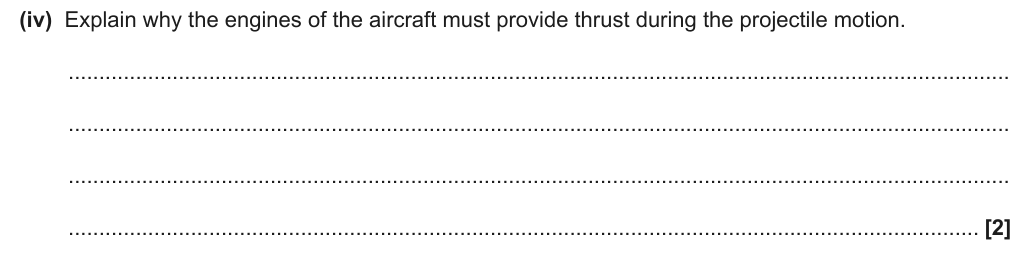
There were lots of ways the candidates used to express the right ideas. As in previous series, phrases such as ‘balanced forces’ were not specific enough. ‘Thrust is required for horizontal net force’ is one example of using more specific language to gain credit here.
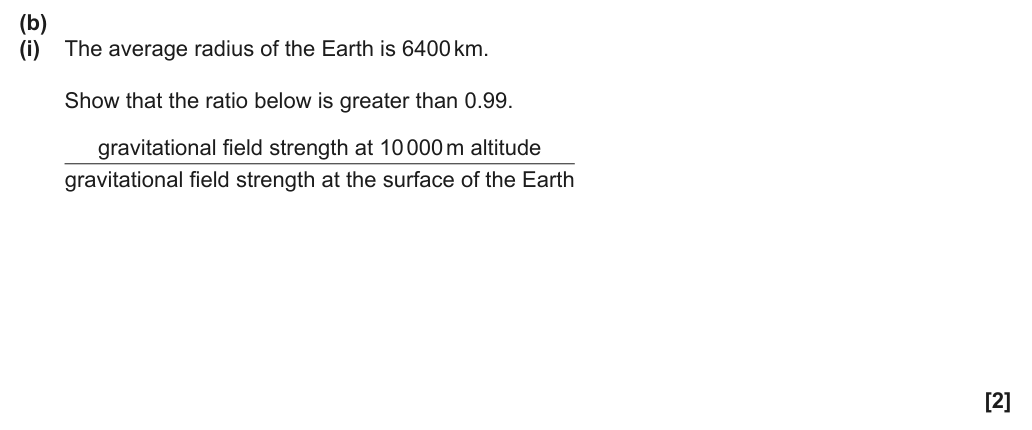
The mark scheme indicates two alternative approaches to this item, which covered most attempts by candidates. Common errors, however, included missing the ‘squared’ sign off the distance from the centre of the Earth either on paper or on the calculator, or getting the fraction upside-down.
Skills: M0.3 Use ratios, fractions and percentages
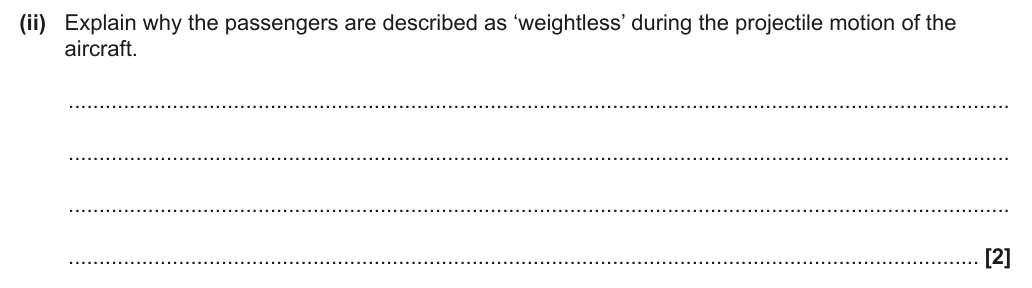
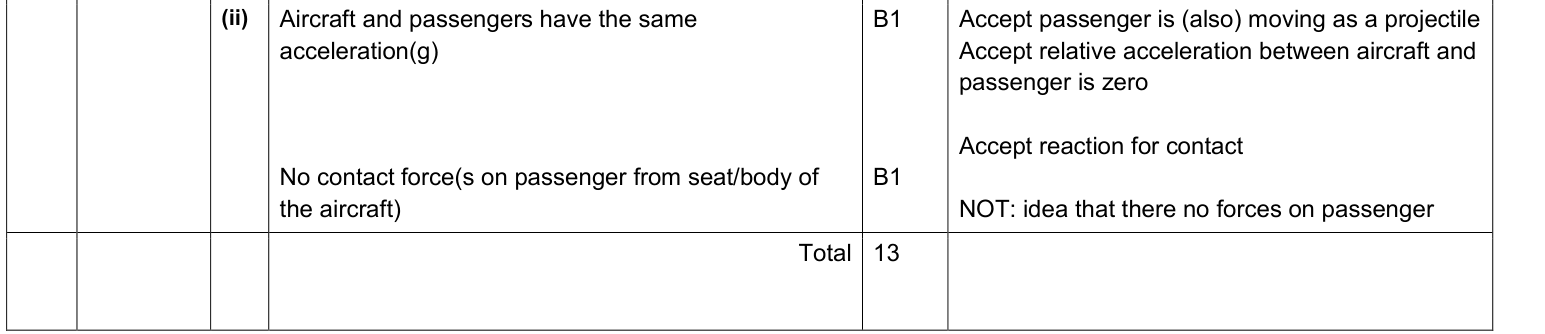
There were two separate ideas here. Firstly that the objects are travelling at the same acceleration (i.e. ‘g’) and the effect this has on the normal contact force between the plane and the passenger (i.e. there is none).
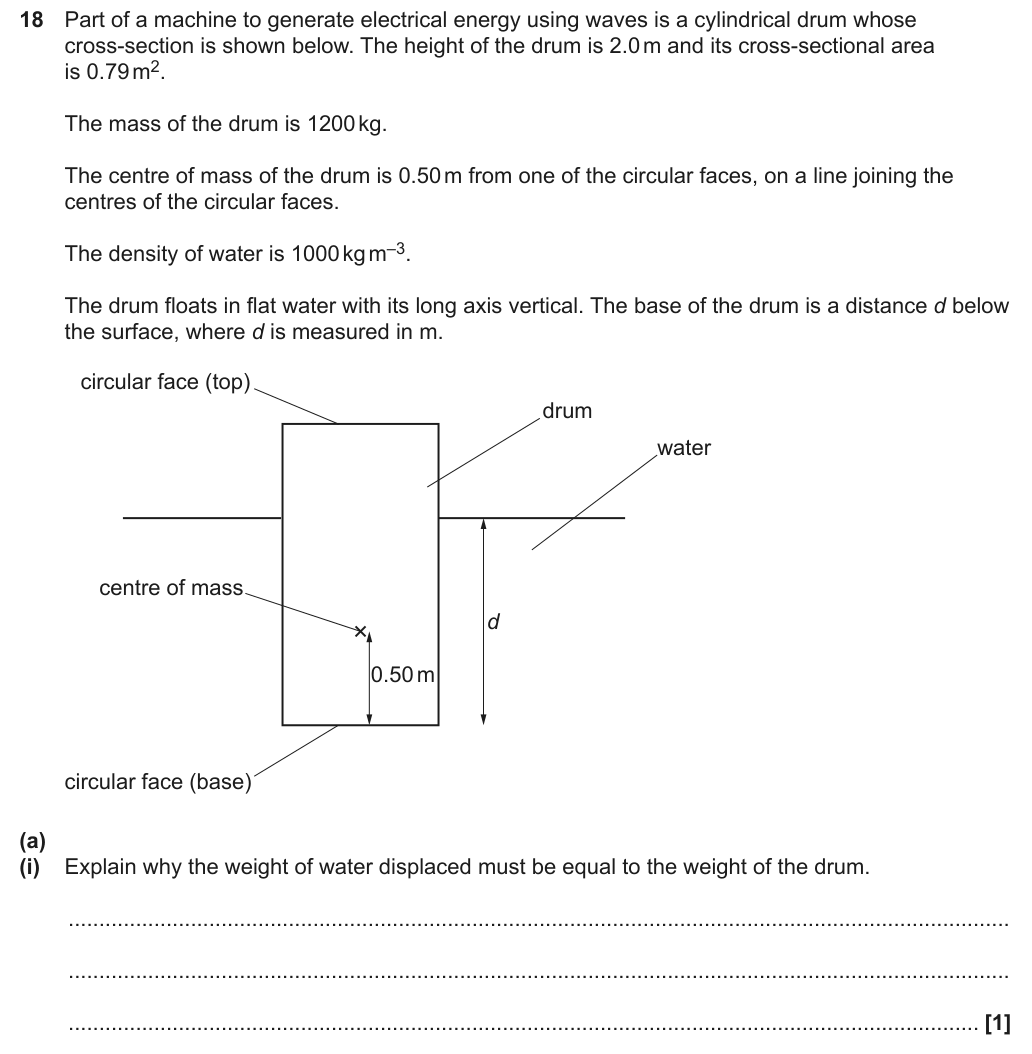
The key term here is ‘upthrust’. Candidates scored no mark for describing that the weight of the water displaced must be equal to the weight of the drum as stated in the question.
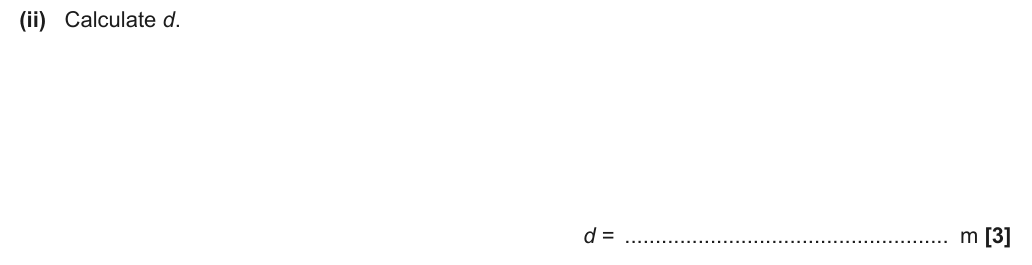
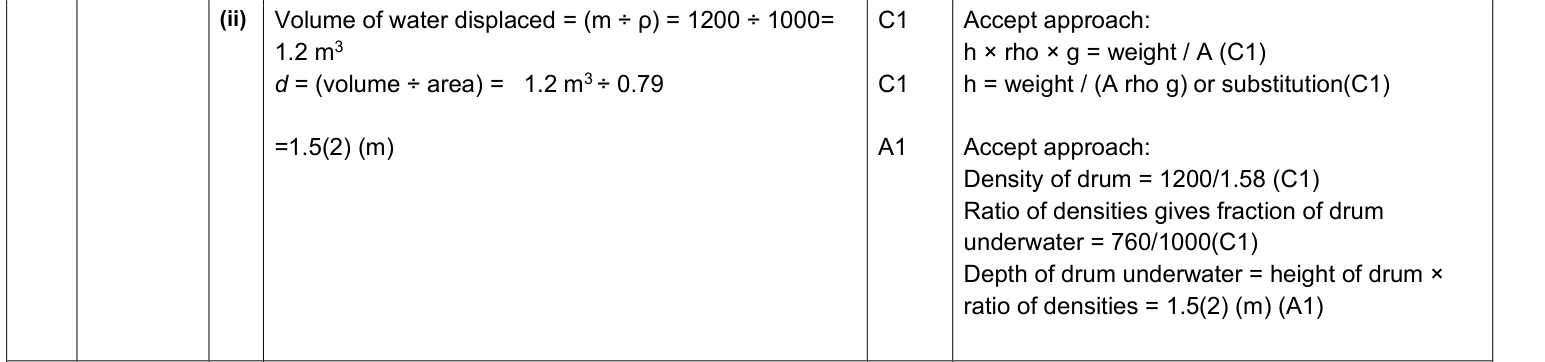
The most straightforward way to answer this question successfully is to equate the weight of the water displaced (density of water × volume of the drum from the bottom to depth d) to the weight of the drum (1200 x g). A neat approach was to find the density of the drum and using the ratio of the densities of the drum and water to work out the fraction of the drum (and hence the depth of the drum) that must be underwater.
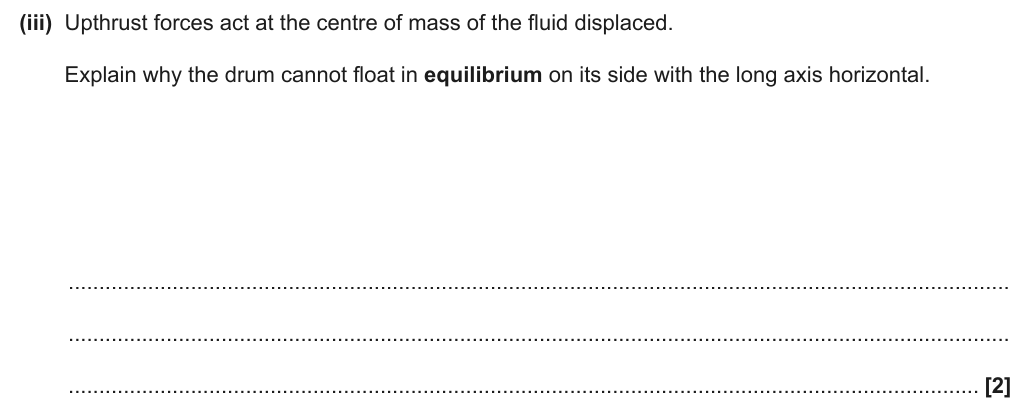
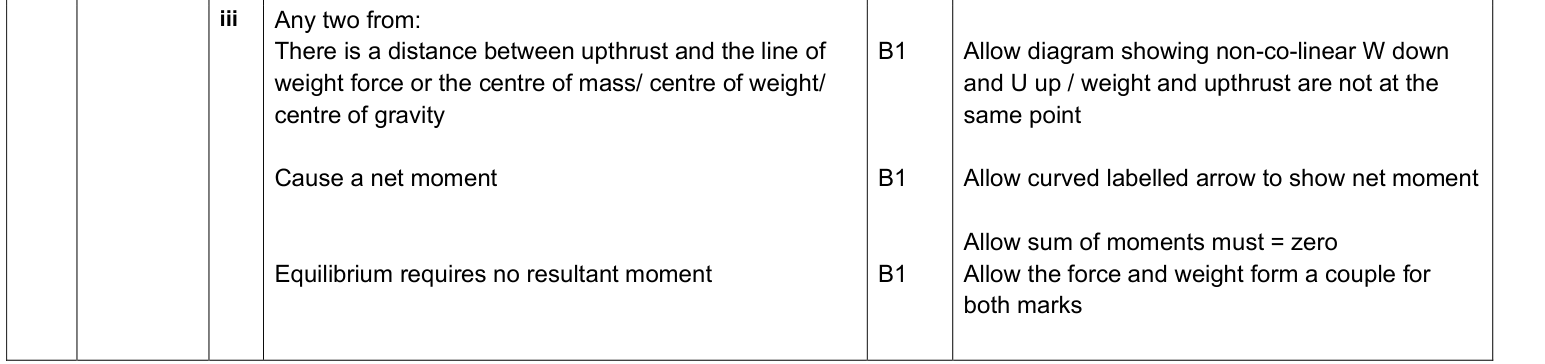
The language of the question here is quite subtle. The upthrust acts at the centre of mass of the fluid displaced. This is not the centre of mass of the drum. Successful candidates drew a labelled diagram to represent this and from there could make a valid assertion about why the drum could not be in equilibrium.
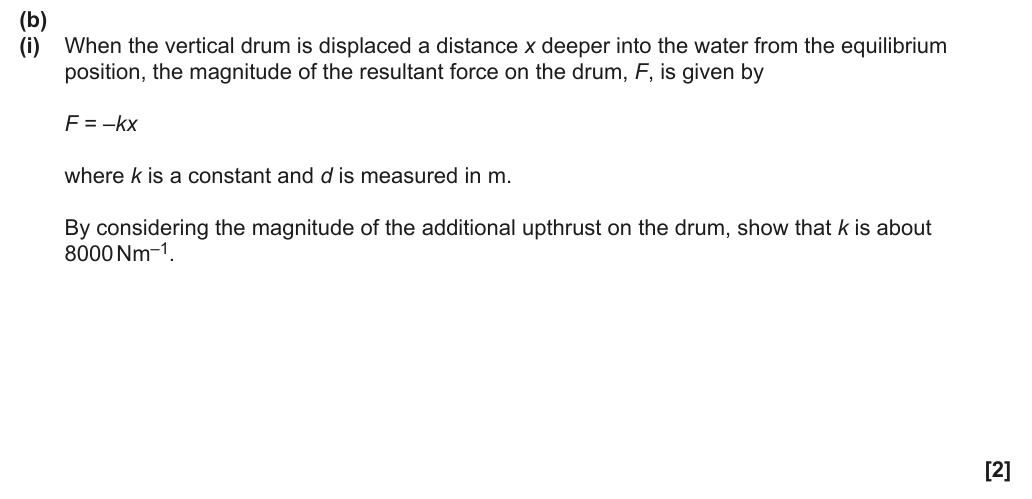
Erratum Notice The erratum did not appear to have any effect on the ability of candidates to answer the question. The best way to answer this is to find an expression for the additional upthrust provided by displacing the drum by the distance, x, as this is equal to the resultant force. The candidate then needed to be clear about how they had cancelled ‘x’ from both sides of the equation, giving a value consistent with 8000 Nm-1.
Skills: M2.2 Change the subject of an equation, including non-linear equations; M2.3 Substitute numerical values into algebraic equations using appropriate units for physical quantities
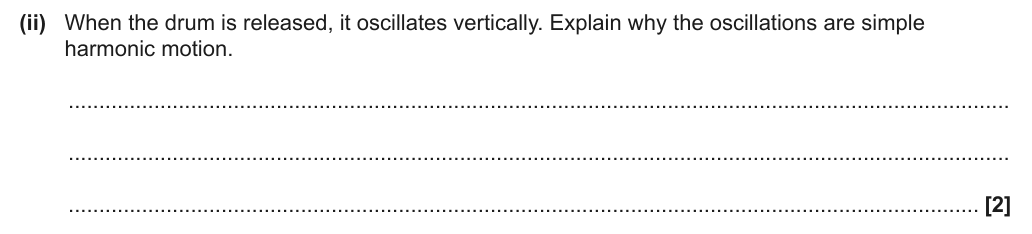
Successful candidates related the conditions for simple harmonic motion i.e. that the force or acceleration is directly proportional to the displacement and that the force or acceleration is acting towards a fixed point. The idea that the acceleration is opposite to the direction of motion is incorrect. Any reference to ‘negative displacement’ was insufficient – there needed to be an interpretation of what that minus sign meant.
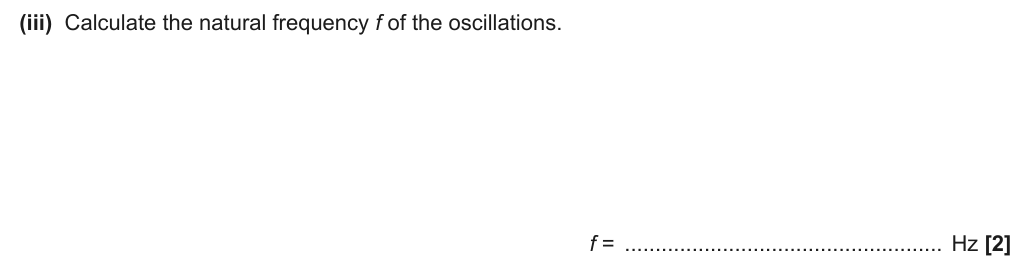
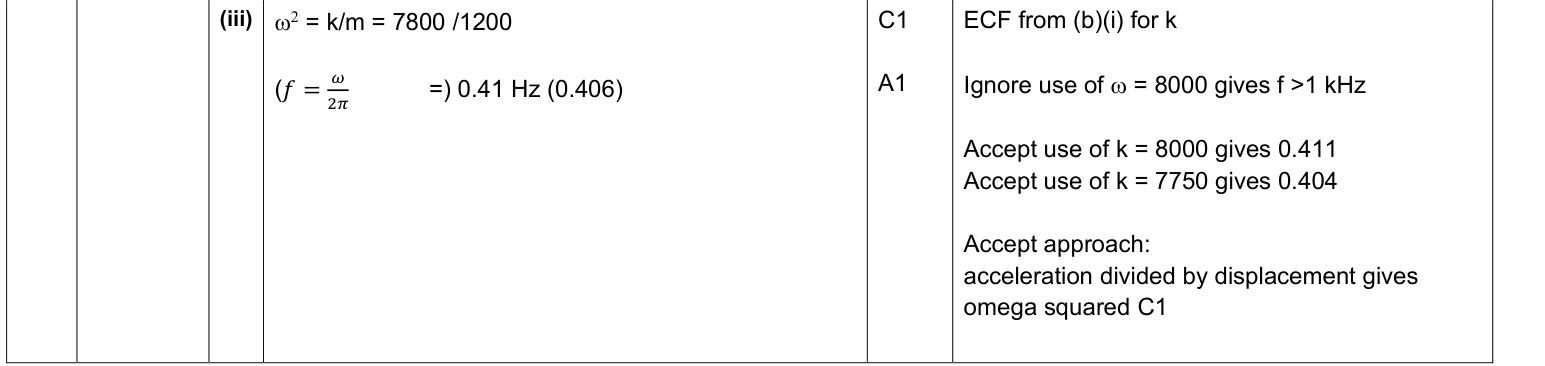
Most candidates completed this calculation correctly. Those who did not did not gain marks for not dividing the value of k by the drum’s mass.
Skills: M2.2 Change the subject of an equation, including non-linear equations; M2.3 Substitute numerical values into algebraic equations using appropriate units for physical quantities
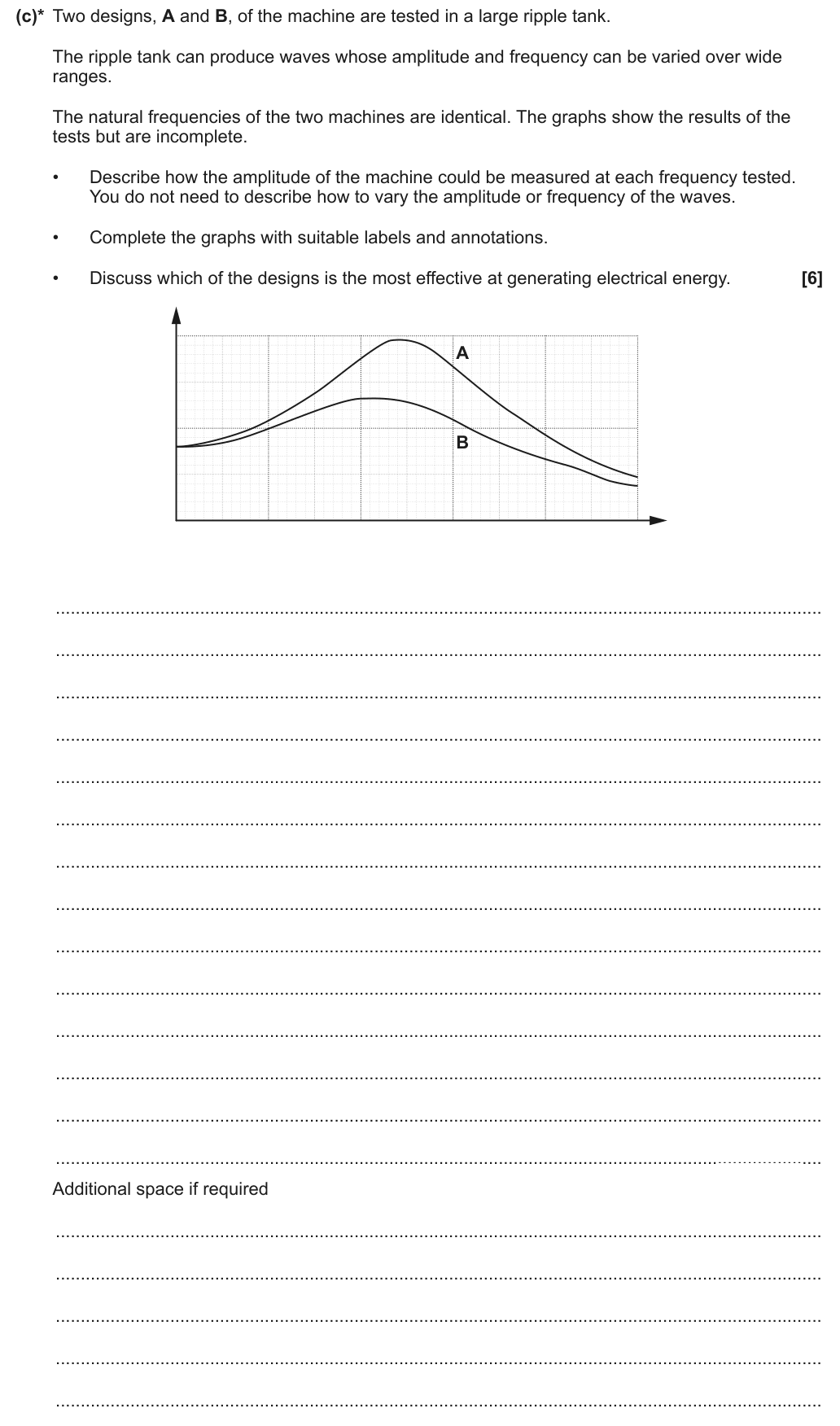
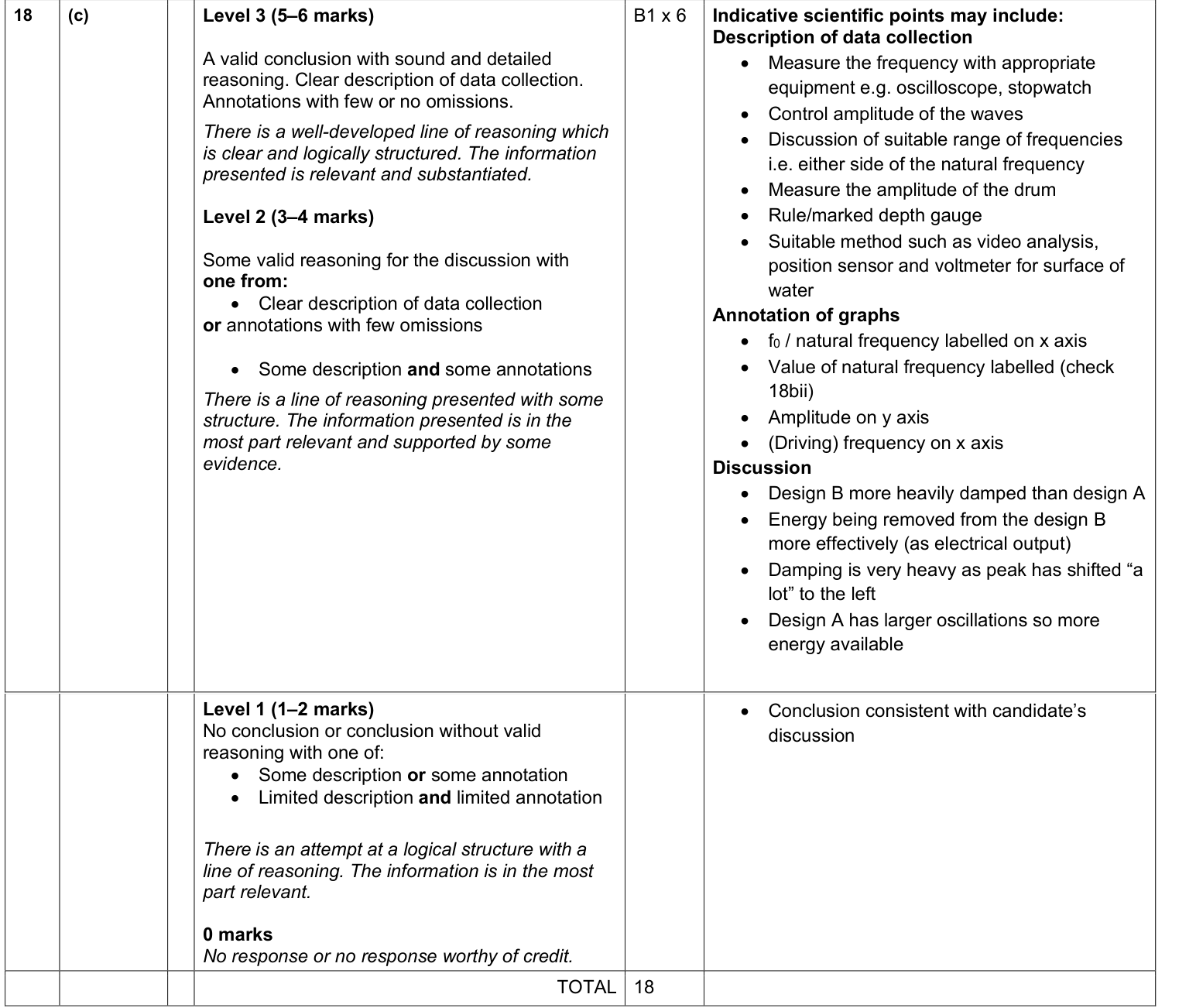
Many candidates gave themselves the best chance of scoring well on this question by ensuring that they attempted responses to each of the three bullet points outlining what to cover. Most candidates kept answers suitably simple by suggesting a vertically mounted ruler and some way of capturing the largest displacement of the wave from the undisturbed water. Finding the speed of the wave horizontally and relating that to the wave’s angular frequency to arrive at the amplitude was incorrect. Those candidates confused the horizontal speed of the wave and maximum vertical speed of particles that made up the wave. Most candidates correctly annotated the graph up to a point – perfection was not required (e.g. there is a distinction between ‘natural’ and ‘resonant’ frequency) yet in some cases labels were contradictory or simply unphysical. The real challenge here was the analysis and interpretation of the graphs. As the mark scheme indicates, there are valid arguments for either design A or design B. Provided that the conclusion was consistent with the candidate’s discussion, either answer was acceptable. This candidate has fulfilled the rubric of the question by completing all three tasks, namely annotating the graph, describing how to find the amplitude and then discussed which of the designs would be most effective. The annotations are clearly imperfect – the x-axis is labelled as power, rather than the crossed-out ‘frequency’. The crossed-out ‘natural frequency’ labels for curves A and B would have been acceptable if they had been ‘resonant’ frequency. The method for the amplitude would work, despite its simplicity. There is an attempt to link the higher amplitude of curve A for all frequencies to a larger power draw although the link isn’t explained in any depth. Overall, this was awarded at the lower end of Level 2. This candidate has made a more complete and accurate attempt at annotating the graph and curves. The method for finding the amplitude of the motion is more sophisticated that in exemplar 1 and would probably yield better quality results. The analysis and discussion uses much more technical language in an organised and logical fashion. The candidate has connected the idea to larger amplitude of motion to a larger induced e.m.f. Overall, this was awarded Level 3, 6 marks.
Skills: M3.1 Translate information between graphical, numerical and algebraic forms; PAG10 Investigating simple harmonic motion
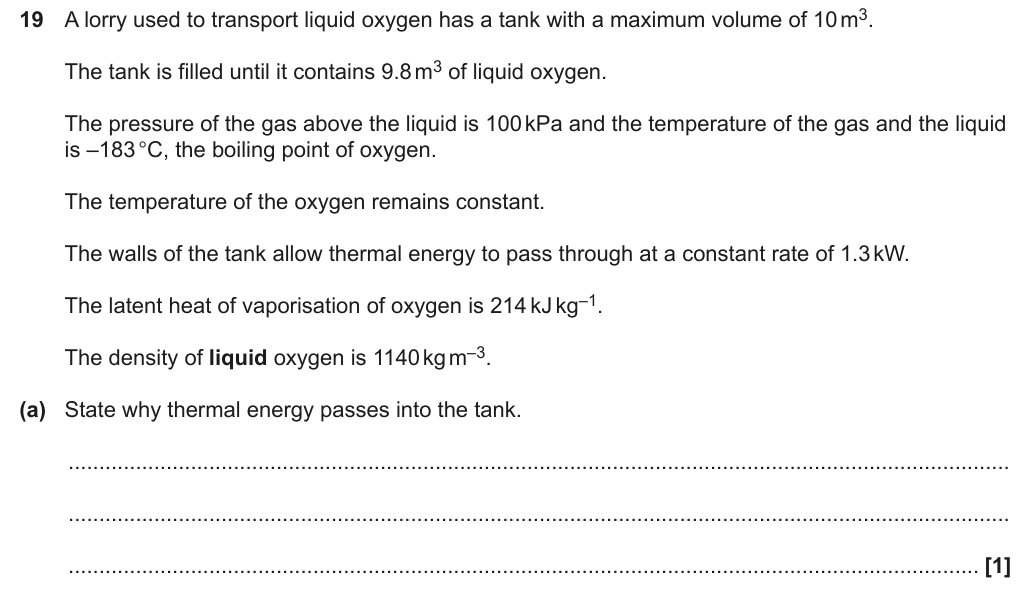
This was a straightforward question that most candidates got correct.
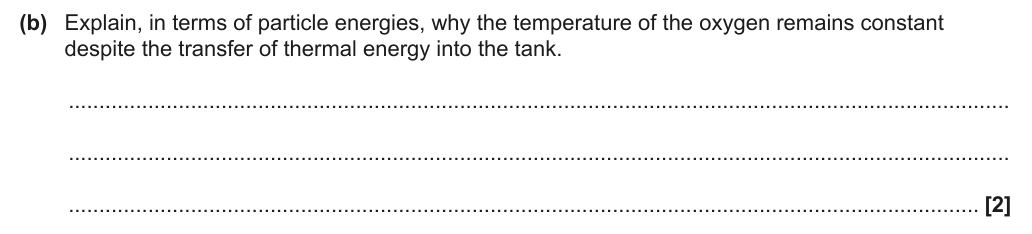
As in previous series, there is a requirement to be explicit about the change in potential energy of the particles (it increases) and about the kinetic energy remaining unchanged. Statements such as ‘KE doesn’t increase’ are consistently insufficient throughout.
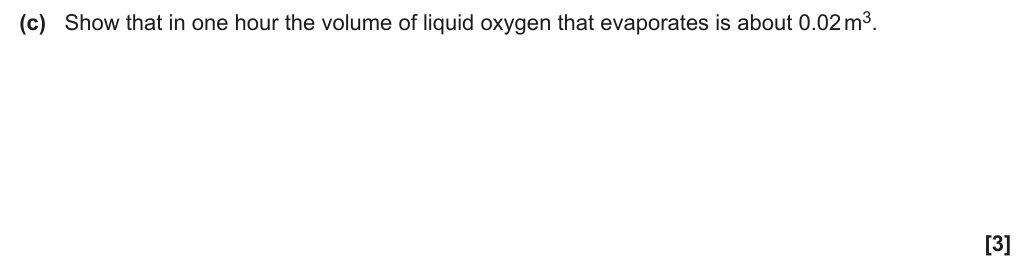
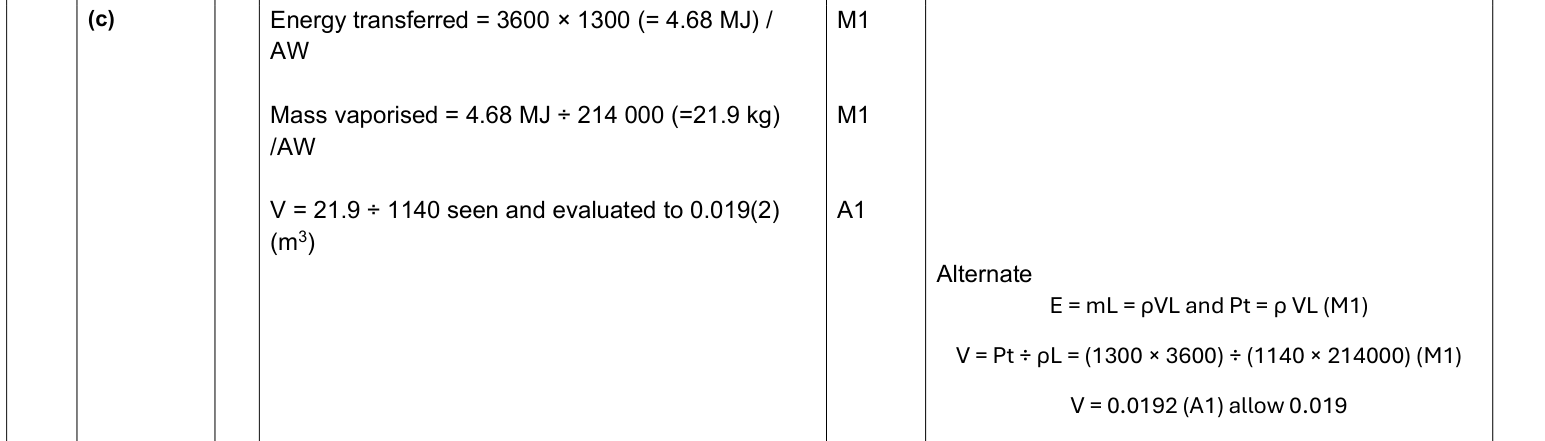
Successful candidates either rearranged all of the variables into a viable expression and then substituted into that expression or they performed each calculation separately. The common thread to all of the best answers was that the working was clear, with words often accompanying the calculations.
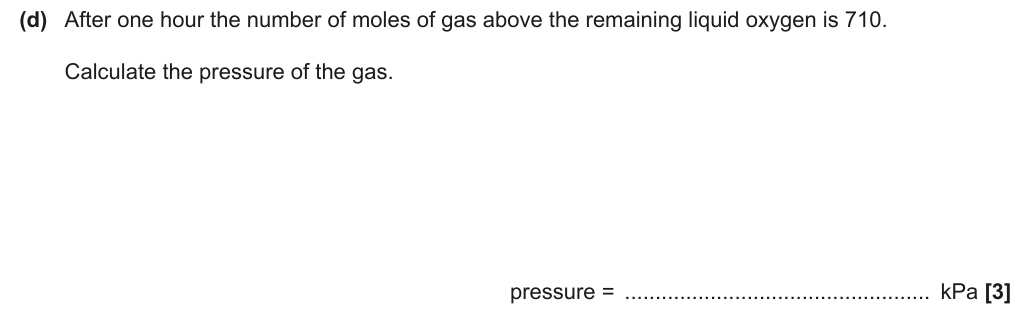
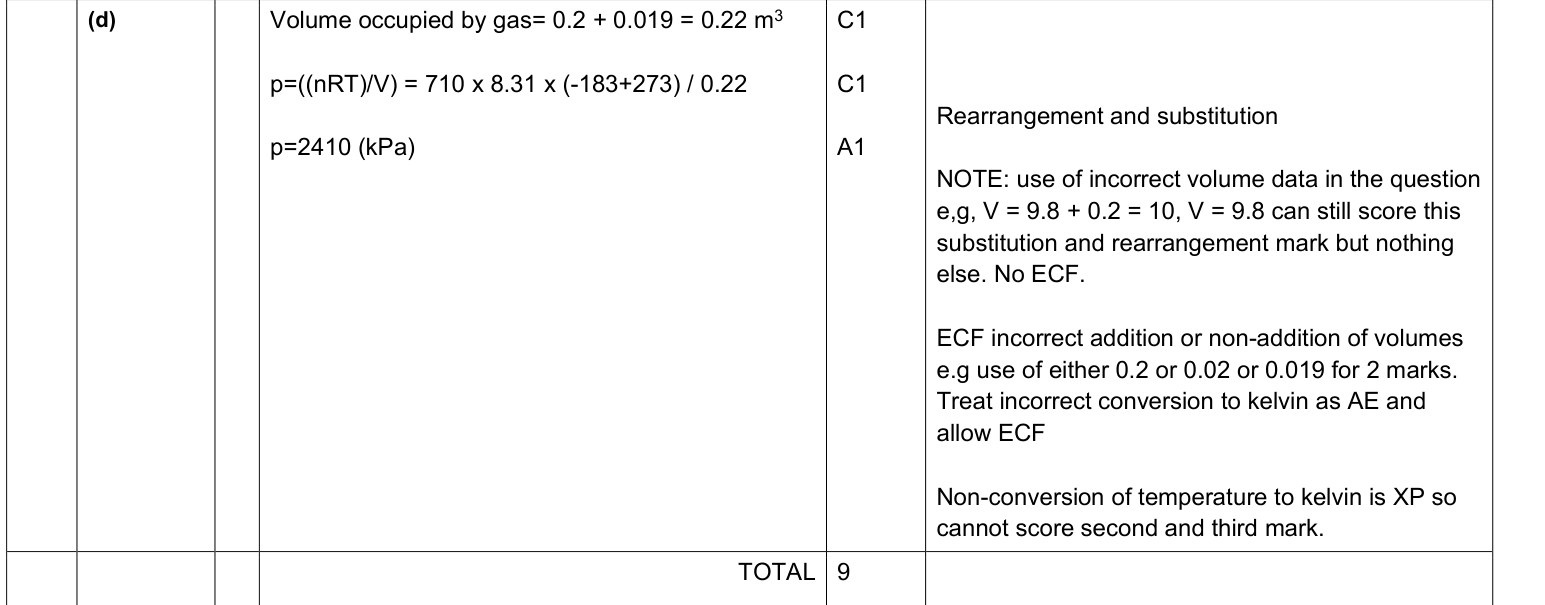
Candidates used a wide variety of volumes in the ideal gas equation to arrive at pressure values that were all broadly sensible. The correct volume was the original volume of the gas (0.2 m3) added to the volume of liquid oxygen that had evaporated after 1 hour (0.02 m3) giving a volume of 0.22 m3. There was still some credit available for volumes that were incorrect as shown in the mark scheme. Almost all candidates remembered to convert the temperature of the gas into kelvin and then rearrange the ideal gas equation correctly.
Skills: M0.1 Recognise and make use of appropriate units in calculations; M2.2 Change the subject of an equation, including non-linear equations; M2.3 Substitute numerical values into algebraic equations using appropriate units for physical quantities
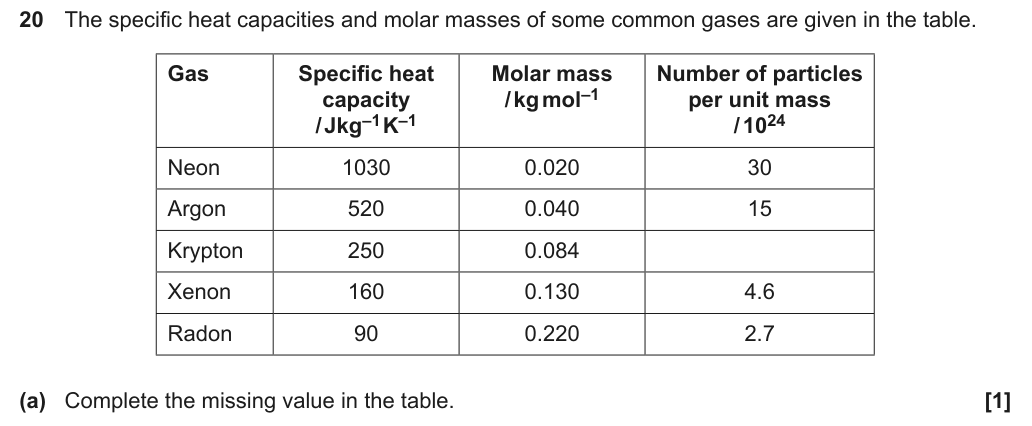
Most candidates recorded a correct value in the table. Question (20) (b) Most candidates plotted their data point correctly and drew a line of best fit that was consistent with the data. Some lines were incorrect as they did not have sufficient points either side of the line.
Skills: M0.2 Recognise and use expressions in decimal and standard form; M1.1 Use an appropriate number of significant figures
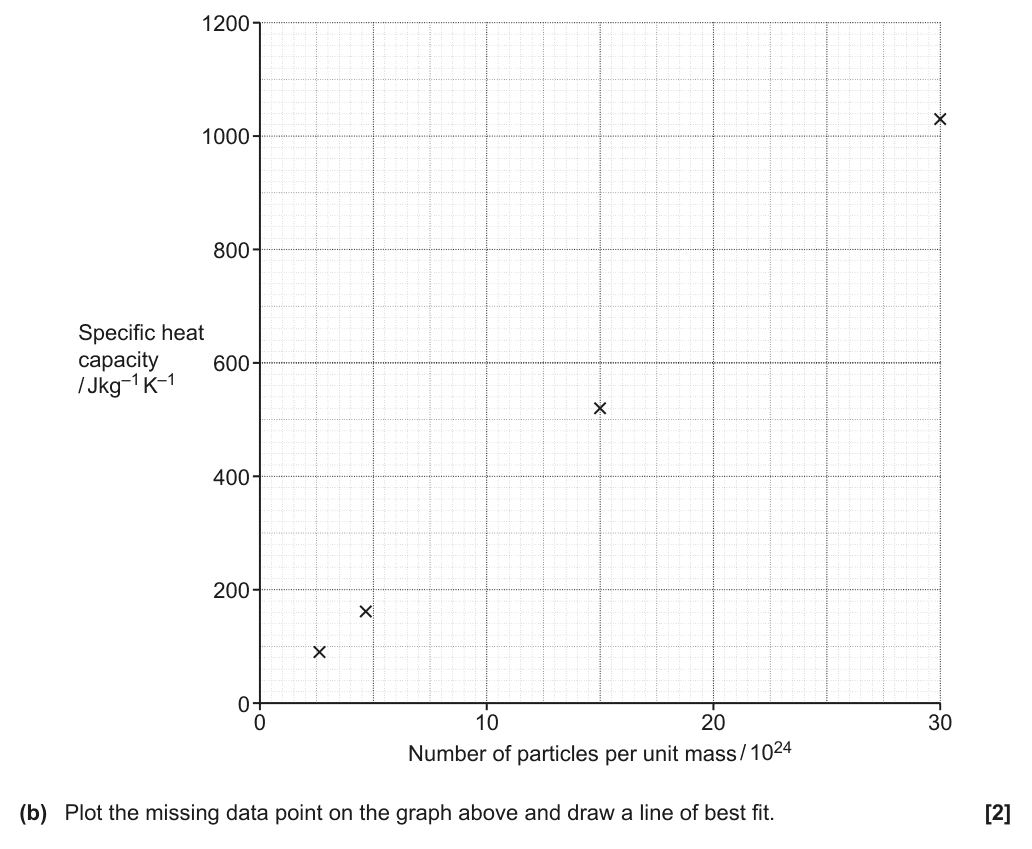
Skills: M3.2 Plot two variables from experimental or other data
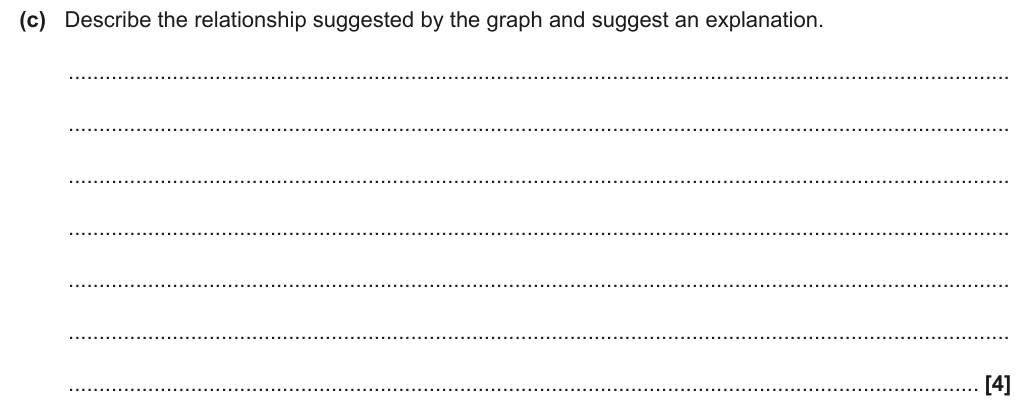
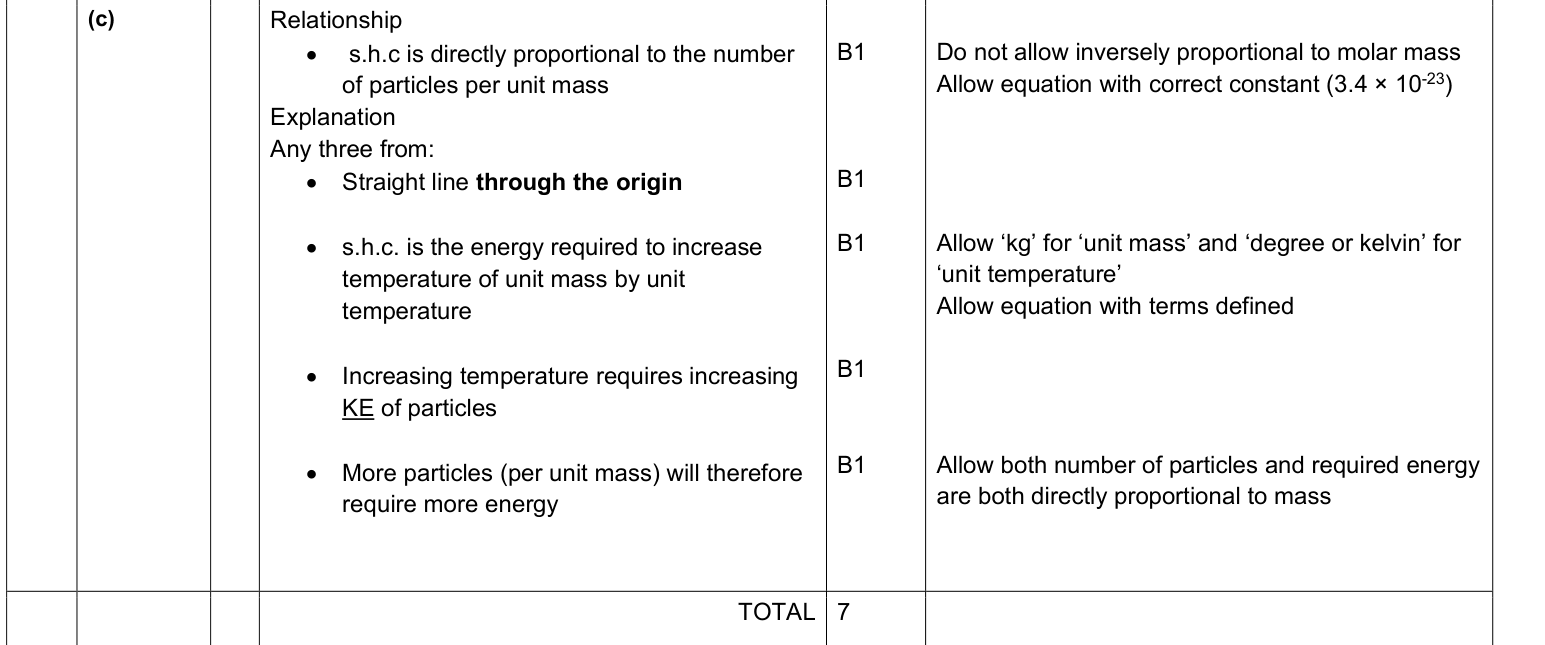
Candidates produced excellent answers here. Most scored two marks straight away by stating the directly proportional nature of the relationship and justifying that with a statement about a straight line of best fit passing through the origin. Although a small number of candidates incorrectly asserted that the mass of each of the particles would change depending on the number density, many correctly suggested that there was a link to the average kinetic energy of the particles.
Skills: M3.1 Translate information between graphical, numerical and algebraic forms; M3.3 Understand that y = mx + c represents a linear relationship
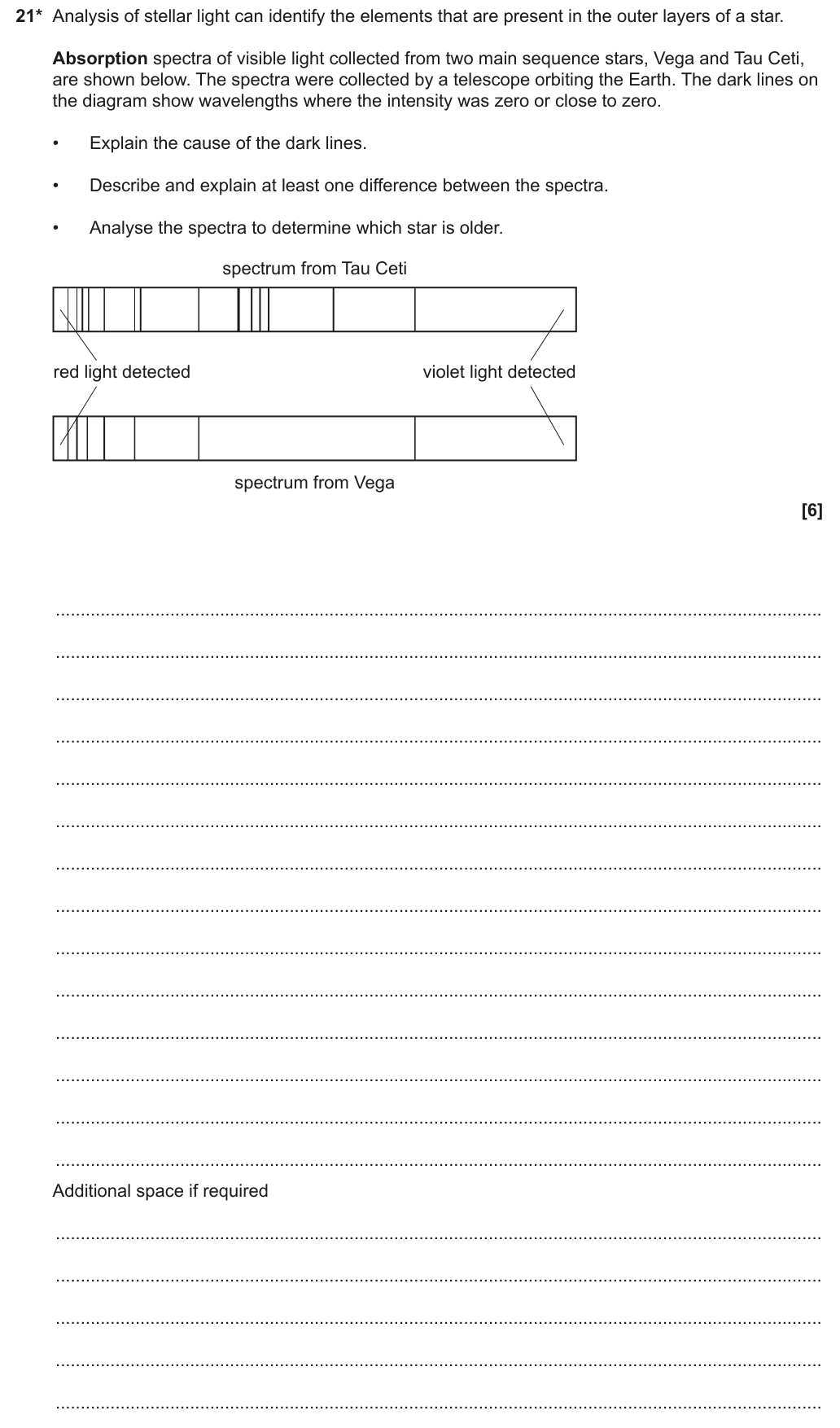
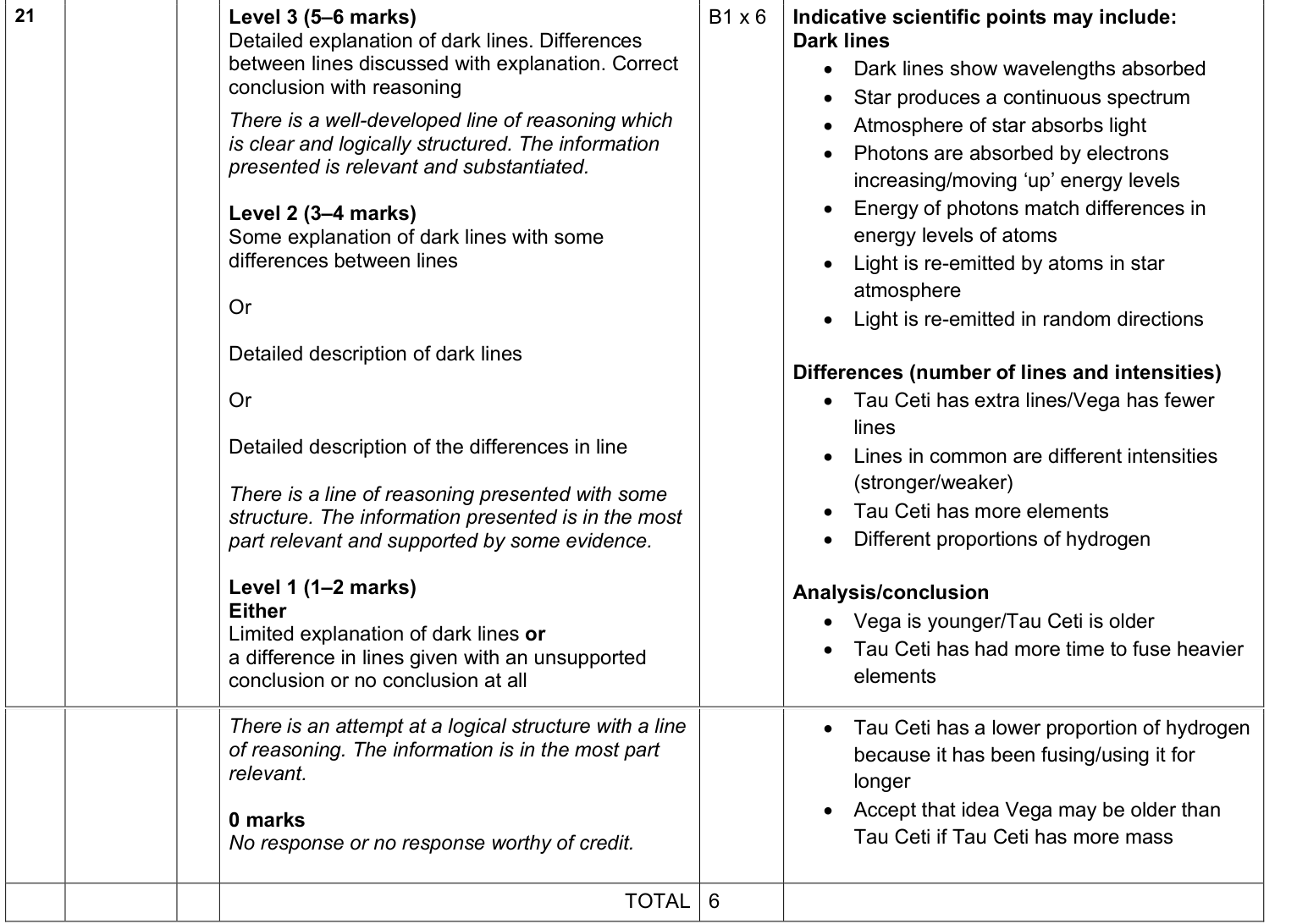
Many candidates spotted that the spectral lines from Vega exactly matched up to the corresponding lines in the spectrum from Tau Ceti. This rules out the idea that one star’s spectrum has been red shifted by more than the other, as suggested by many candidates. The principal difference is that Tau Ceti has more lines because its atmosphere has more elements in it than that of Vega. A small number of candidates also spotted that one of the lines in Tau Ceti’s spectrum is darker than the rest. Many candidates produced exceptionally detailed explanations of how absorption spectra occur. Very few attributed the spectra to such phenomena as destructive interference or something to do with the Earth’s atmosphere. The key to accessing Level 3 for this question lay in explaining why the two spectra were different. Many candidates suggested that there were more elements in the atmosphere of Tau Ceti because it had been fusing hydrogen for so long that some of those products were also fusing together to produce even heavier elements. A few candidates linked the darker line in Tau Ceti’s spectrum to a large abundance of an element that wasn’t hydrogen. The first paragraph of this response is a detailed description of how continuous light from a star can be selectively absorbed by the atmosphere of that star. The candidate doesn’t add in the details about de- excitation or of re-emission of the light in random directions; however, they have included everything up to that point. The candidate has also spotted that there are more lines for Tau Ceti than for Vega and attributes this to elements that are present in the photosphere of Tau Ceti that are not present in that of Vega. The argument about red shift is incorrect. Having said that, the candidate has gone on to mention about the fusion products other than helium and attributes this to Tau Ceti being the older star. At the end, the mention of Tau Ceti maybe being a red giant and no longer main sequence is incorrect (the question says that both stars are main sequence). On balance, this response was awarded Level 3.
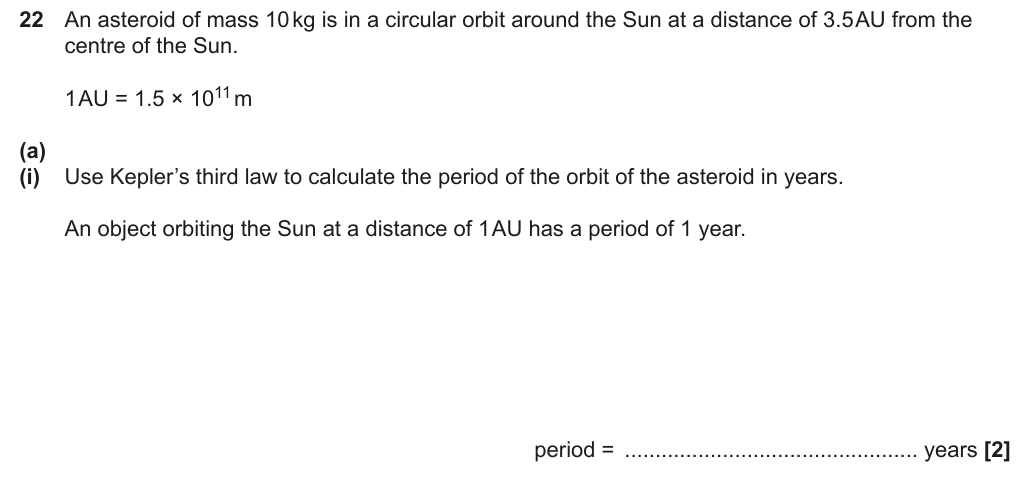
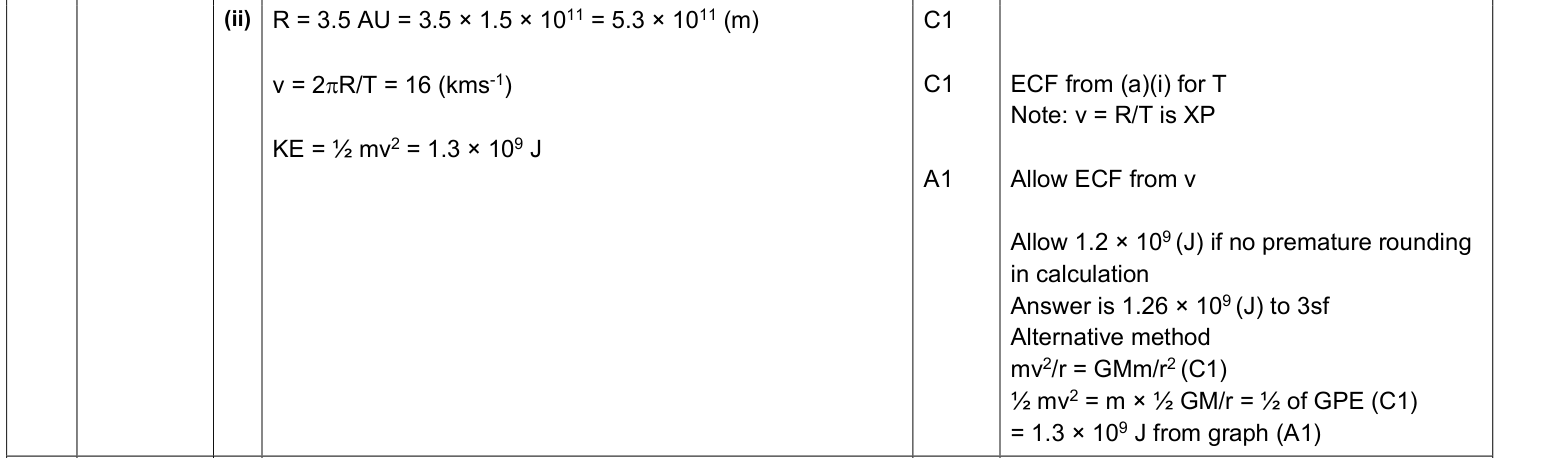
While some candidates missed off the correct power for either time or orbital radius, many knew which relationship to use. The challenge here was to get the right units for both time and orbital radius. By using the units of AU and years, it was possible simply to write that 𝑇2 = 𝑅3 and to work from there. The full relationship involving the mass of the Sun and working in SI units was less straightforward; however, many candidates managed to complete this correctly. Errors were made with the mass (using 10 kg instead of the mass of the Sun) or the radius (which needed to be in metres) for the time to be calculated in seconds (requiring a further conversion to be able to give the period in the required unit of years.)
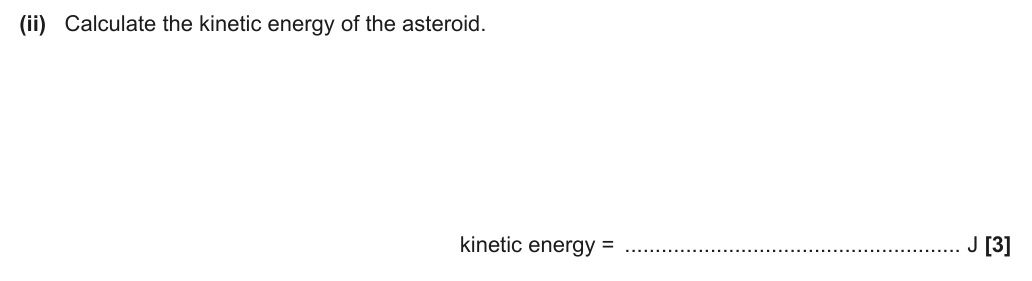
The ‘error carried forward’ rule was applied here in the case of the wrong value for the orbital period and again if the orbital velocity was incorrectly calculated. Otherwise this question was successfully completed.
Skills: M0.1 Recognise and make use of appropriate units in calculations; M2.3 Substitute numerical values into algebraic equations using appropriate units for physical quantities
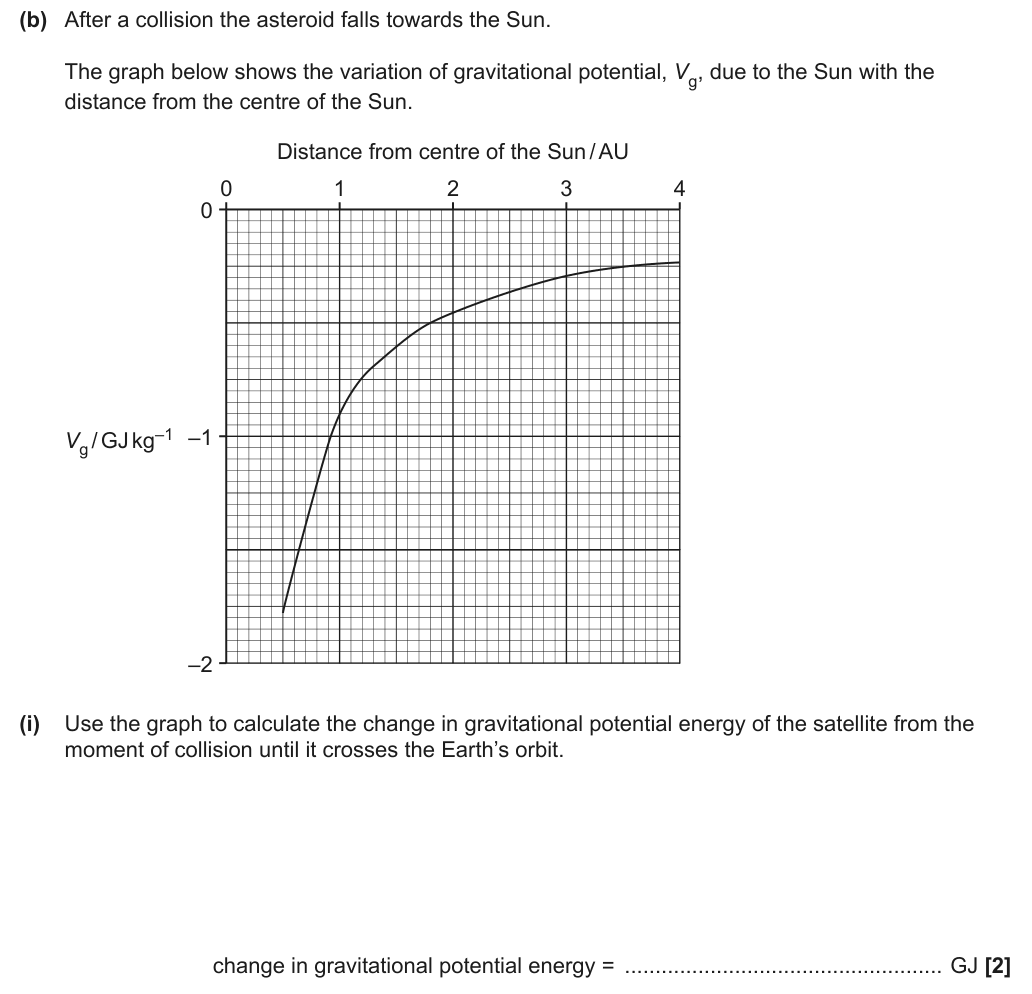
Candidates found this challenging. The graph gives the gravitational potential. The correct approach is to find the difference in the gravitational potential at 1 AU and at 3.5 AU and then multiply this difference by the mass of the satellite.
Skills: M0.1 Recognise and make use of appropriate units in calculations; M3.1 Translate information between graphical, numerical and algebraic forms
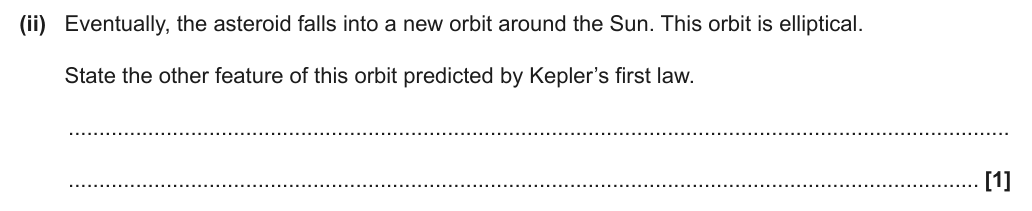
A large proportion of candidates successfully identified that the other feature was that the Sun lay at one of the foci of an orbit.
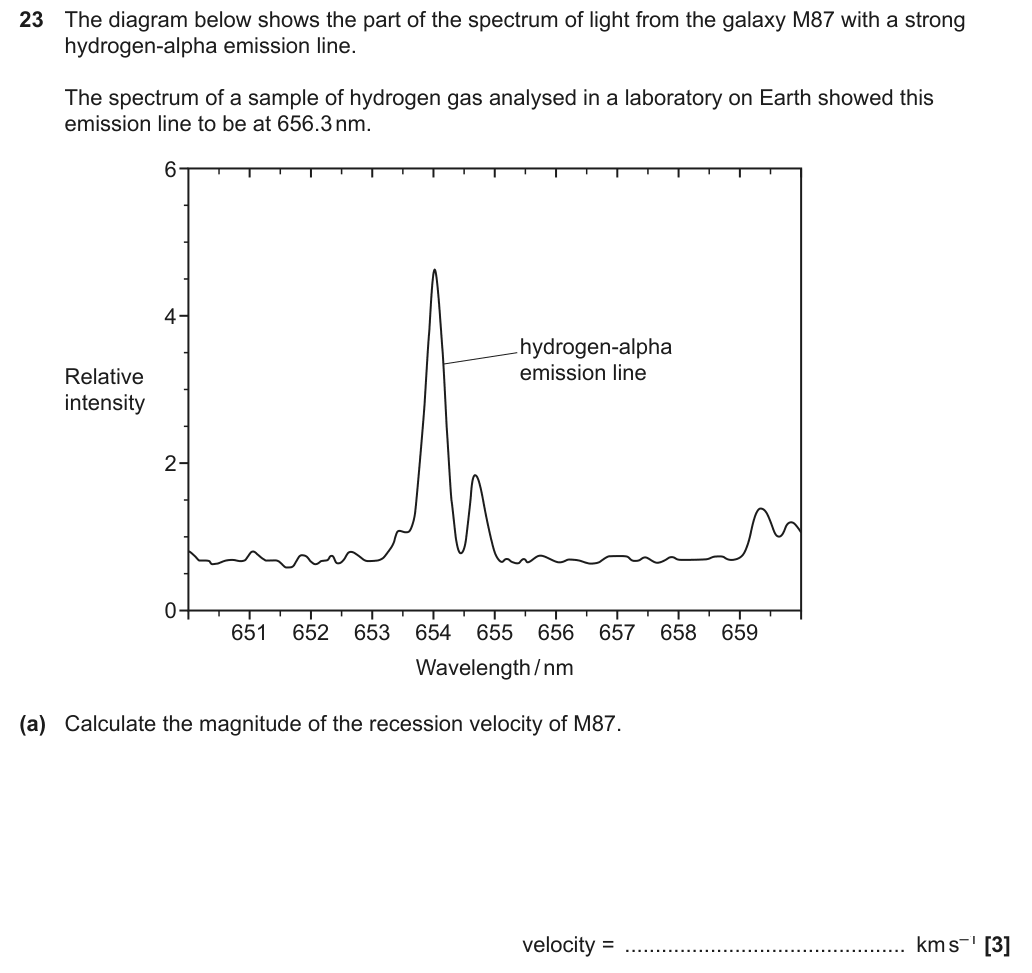
The approach here is to find the wavelength corresponding to the peak of the hydrogen-alpha emission line and find the difference between that and the laboratory wavelength of the same line. The shift in wavelength as a fraction of the original wavelength is equal to the velocity of M87 as a fraction of the speed of light. Answers that used the wavelength 654 nm as the denominator were judged as ‘XP’ i.e. wrong physics, just as in previous series, even though this gave a very similar answer to the correct value for the velocity. Finally the unit on the answer line is km s-1, so there was a conversion to complete. Most candidates completed all of these steps.
Skills: M0.1 Recognise and make use of appropriate units in calculations; M2.3 Substitute numerical values into algebraic equations using appropriate units for physical quantities; M3.1 Translate information between graphical, numerical and algebraic forms
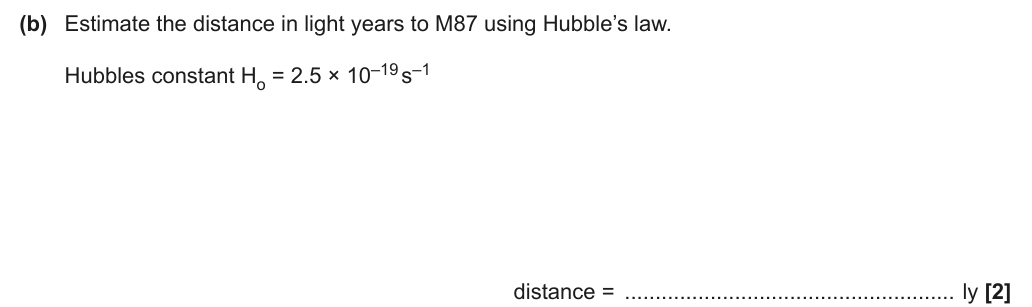
Erratum Notice By using the candidate’s value from part (a), quoted in ms-1 for this part, most candidates used an appropriate value for Hubble’s constant to arrive at a distance in metres to M87. Once more there is a conversion to complete to get the value in the required unit. The mark scheme allows full credit for the correct use of the original value of H0 if the erratum was not used, as well as use of any handwritten replacement value for H0 used correctly.
Skills: M0.1 Recognise and make use of appropriate units in calculations; M0.2 Recognise and use expressions in decimal and standard form; M2.2 Change the subject of an equation, including non-linear equations
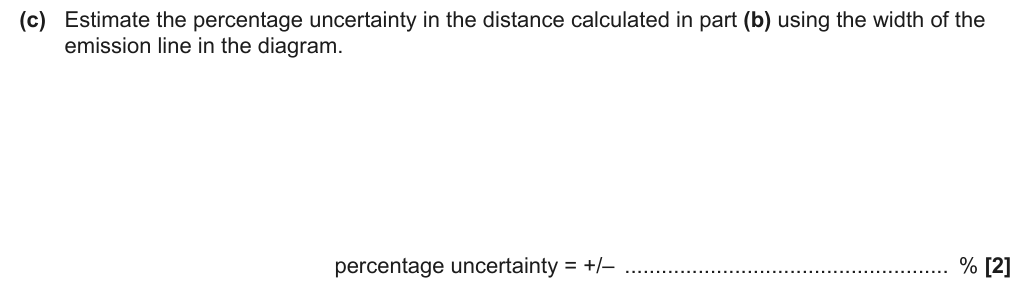
This was a challenging item. Many candidates correctly found the width of the emission line according to the scale on the diagram. Others completed this incorrectly by using mm or cm. The percentage uncertainty in the distance is the same as the percentage uncertainty in the change in wavelength. Hence the correct expression to evaluate is the ratio of the width of the line (roughly 0.8 nm but there is a significant allowable range here) to the shift in the line (2.3 nm). Many candidates did not use the shift in the line but incorrectly used either the observed or the original wavelength instead.
Skills: M1.5 Identify uncertainties in measurements and use simple techniques to determine uncertainty when data are combined; M3.1 Translate information between graphical, numerical and algebraic forms
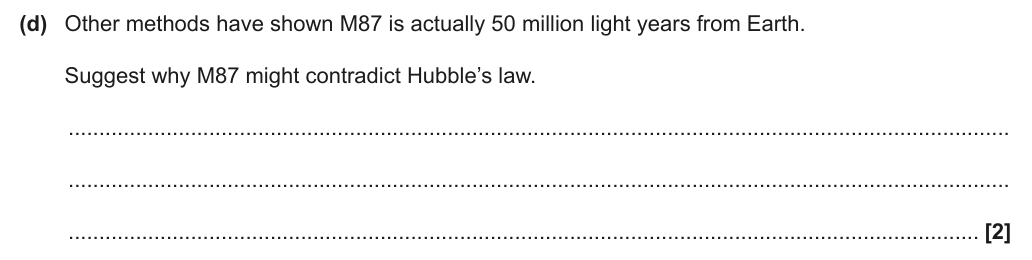
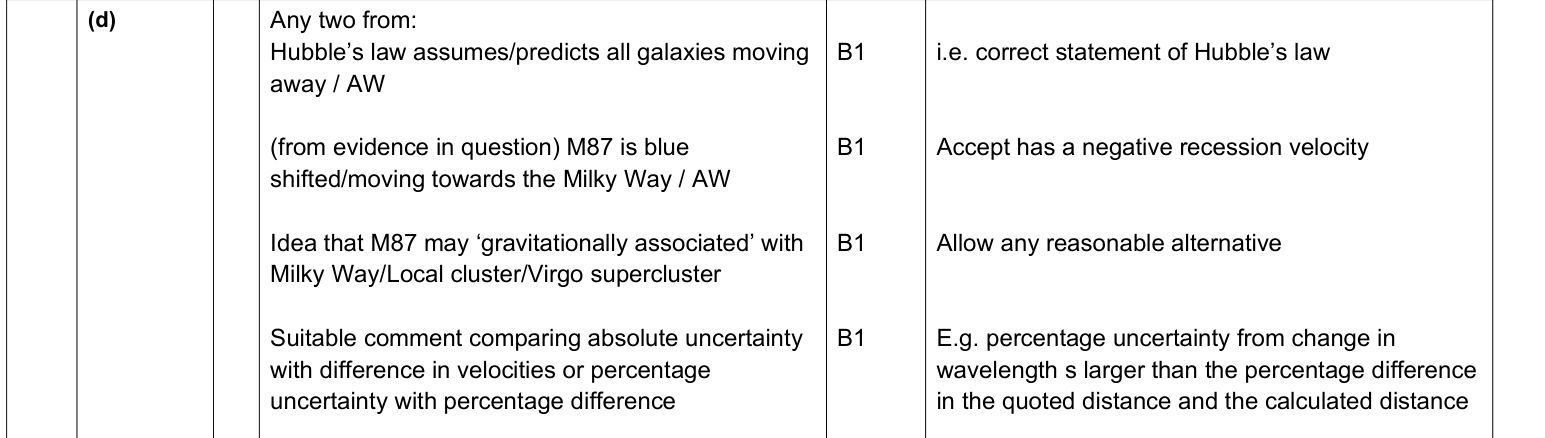
The mark scheme shows a wide variety of acceptable ideas that were creditworthy for this item. Many candidates provided one acceptable idea with some providing at least two.

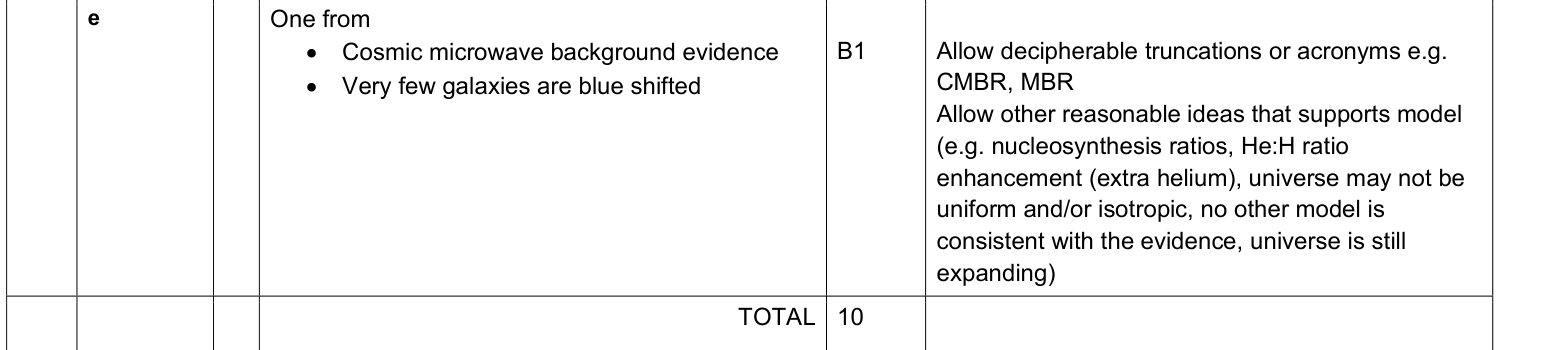
There were also a wide variety of acceptable candidate responses to this question.
Want a paper marked and gone through with you? Message us.