November 2021: AS Paper 1, Breadth in physics

70 marks · 41 question parts · Paper, mark scheme and report on OCR's site · An autumn series using the paper written for the cancelled summer exams · Have the Data, Formulae and Relationships Booklet beside you

Question by question

QTopicMarksAOType
1 Density, pressure and upthrust 1Multiple choice
2 E.m.f., p.d., resistance and I–V characteristics 1Multiple choice
3 Photons and the Planck constant 1Multiple choice
4 Dynamics, drag and terminal velocity 1Multiple choice
5 Work, energy and power 1Multiple choice
6 Electrical power and energy, Series and parallel circuits: Kirchhoff's laws 1Multiple choice
7 Mechanical properties of matter: stress, strain and the Young modulus 1Multiple choice
8 Physical quantities and S.I. units, Mechanical properties of matter: stress, strain and the Young modulus 1Multiple choice
9 Charge, current and mean drift velocity 1Multiple choice
10 Resistivity, Series and parallel circuits: Kirchhoff's laws, Potential dividers 1Multiple choice
11 Superposition, interference and the double slit 1Multiple choice
12 Resistivity 1Multiple choice
13 Stationary waves 1Multiple choice
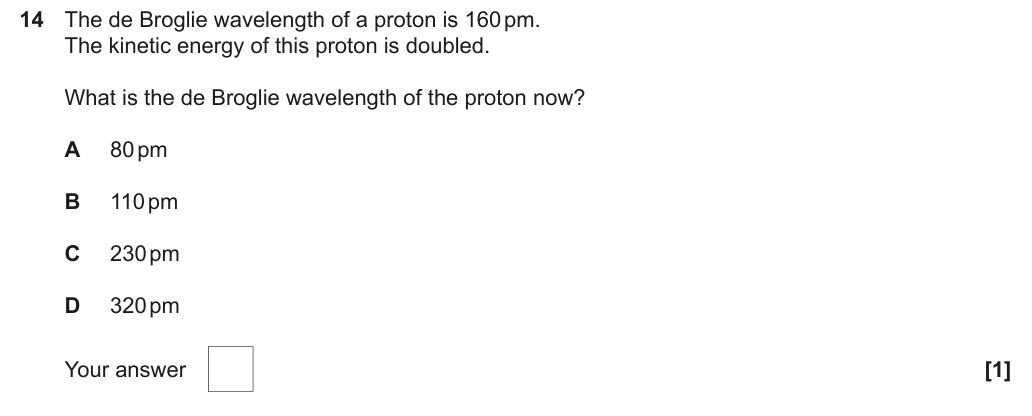
14 Wave–particle duality and the de Broglie equation, Work, energy and power, Newton's laws of motion and momentum 1Multiple choice
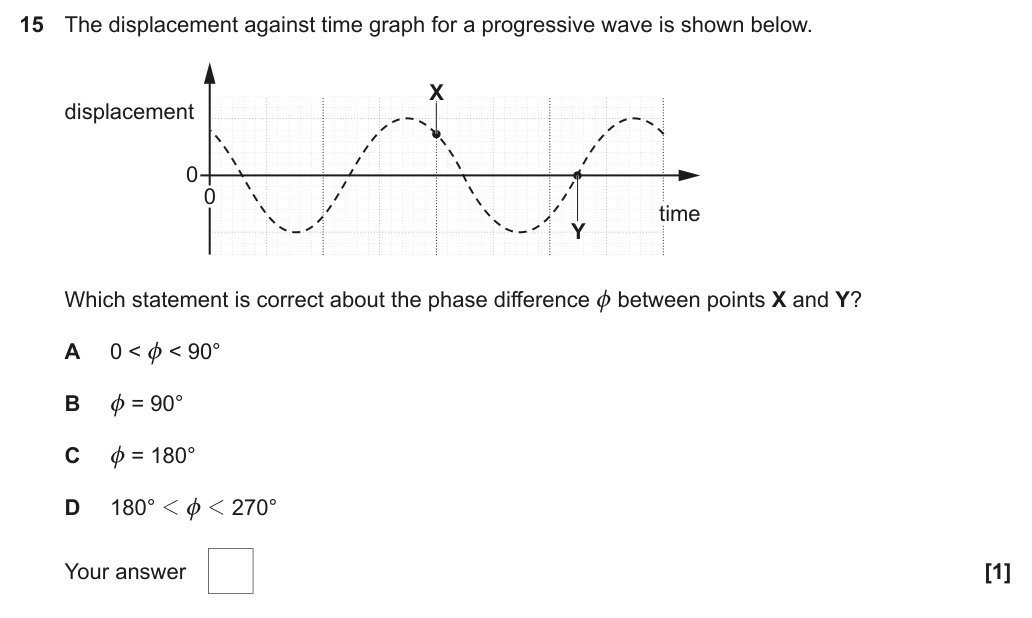
15 Wave motion: progressive waves, the wave equation and intensity 1Multiple choice
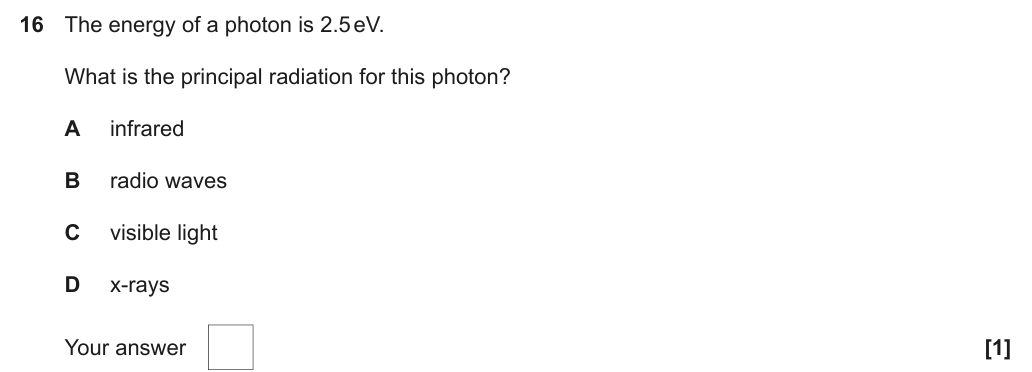
16 Photons and the Planck constant, Electromagnetic waves, polarisation and refraction 1Multiple choice
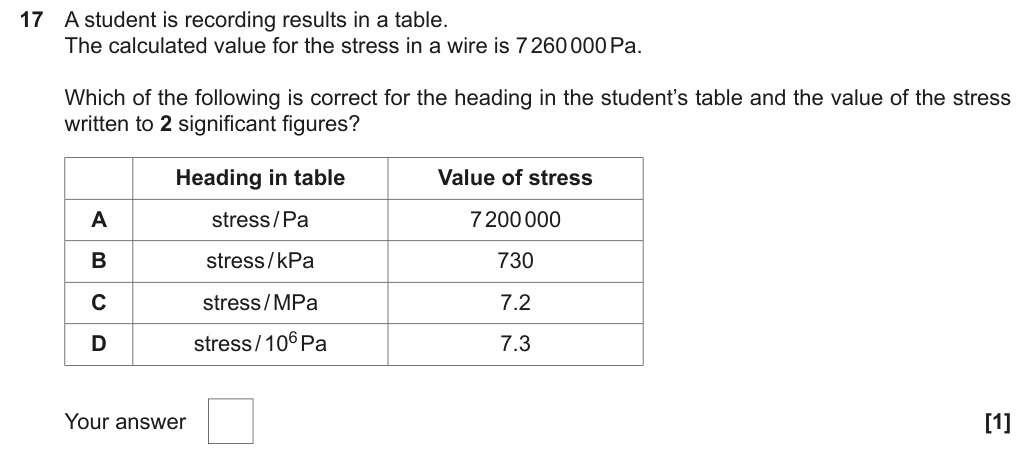
17 Physical quantities and S.I. units, Practical skills: planning, analysis and evaluation 1Multiple choice
18 Projectile motion, Scalars and vectors 1Multiple choice
19 Wave–particle duality and the de Broglie equation 1Multiple choice
20 Newton's laws of motion and momentum 1Multiple choice
21(a) Kinematics: displacement, velocity and motion graphs 1Explanation
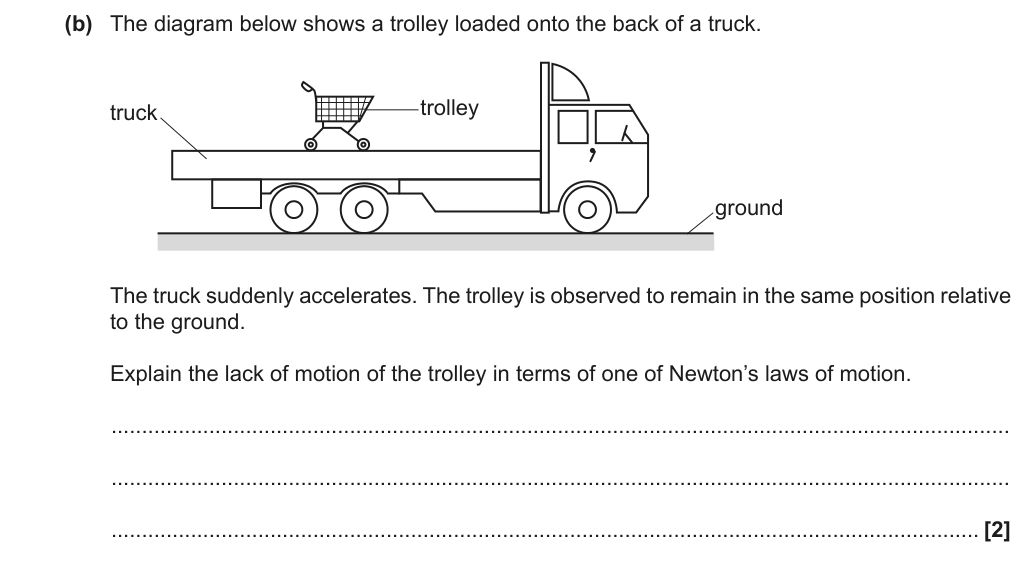
21(b) Newton's laws of motion and momentum, Dynamics, drag and terminal velocity 2Explanation
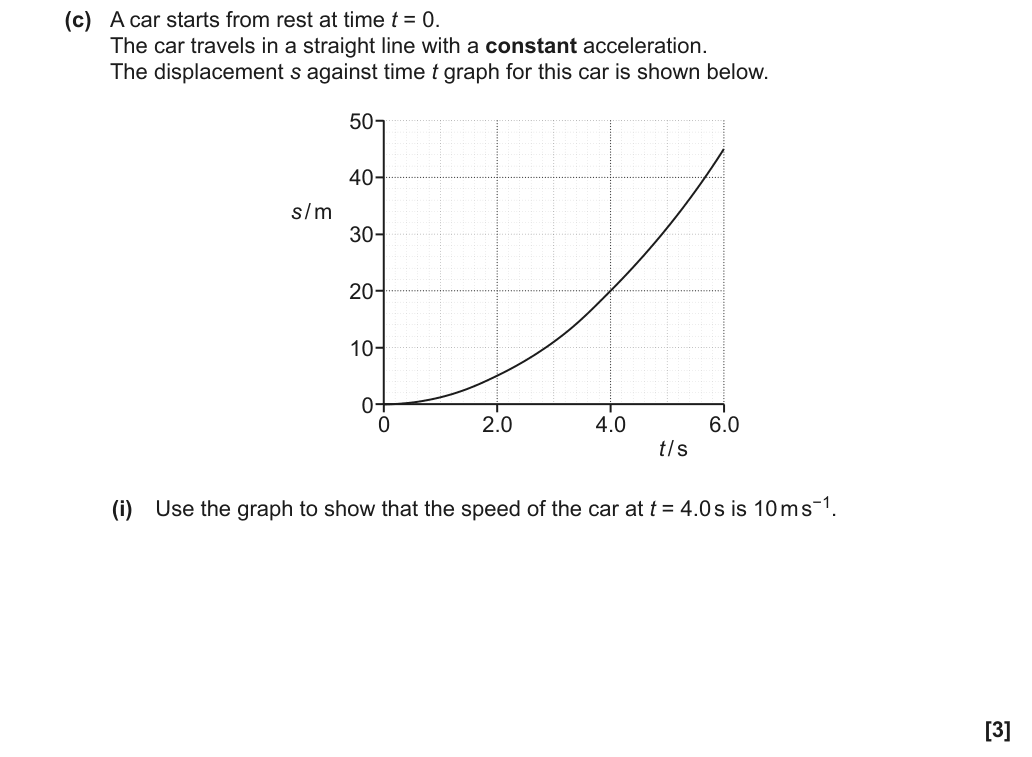
21(c)(i) Kinematics: displacement, velocity and motion graphs, Linear motion: the suvat equations and free fall 3Show that
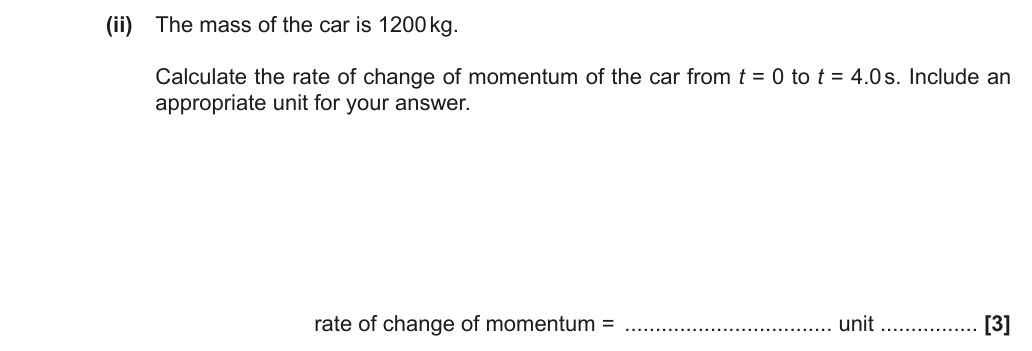
21(c)(ii) Newton's laws of motion and momentum, Physical quantities and S.I. units 3Calculation
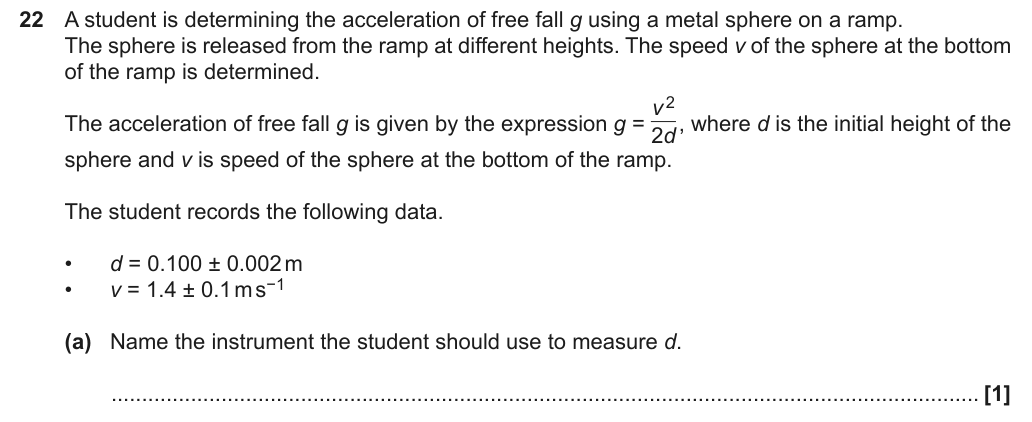
22(a) Practical skills: planning, analysis and evaluation 1Short answer
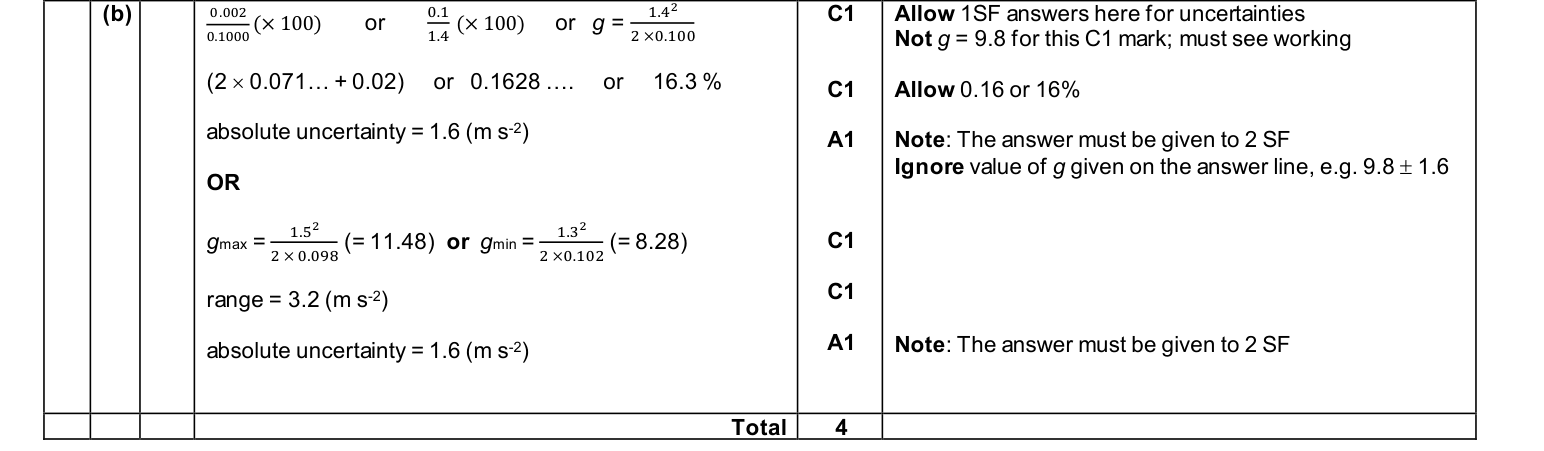
22(b) Measurements and uncertainties 3Calculation
23(a) E.m.f., p.d., resistance and I–V characteristics, Practical skills: planning, analysis and evaluation 3Explanation
23(b)(i) Charge, current and mean drift velocity 2Calculation
23(b)(ii) Charge, current and mean drift velocity 3Calculation
23(c)(i) Resistivity, Potential dividers 2Explanation
23(c)(ii) Potential dividers, E.m.f., p.d., resistance and I–V characteristics, Series and parallel circuits: Kirchhoff's laws 3Calculation
24(a) Electromagnetic waves, polarisation and refraction 1Short answer
24(b) Wave motion: progressive waves, the wave equation and intensity, Electromagnetic waves, polarisation and refraction 2Calculation
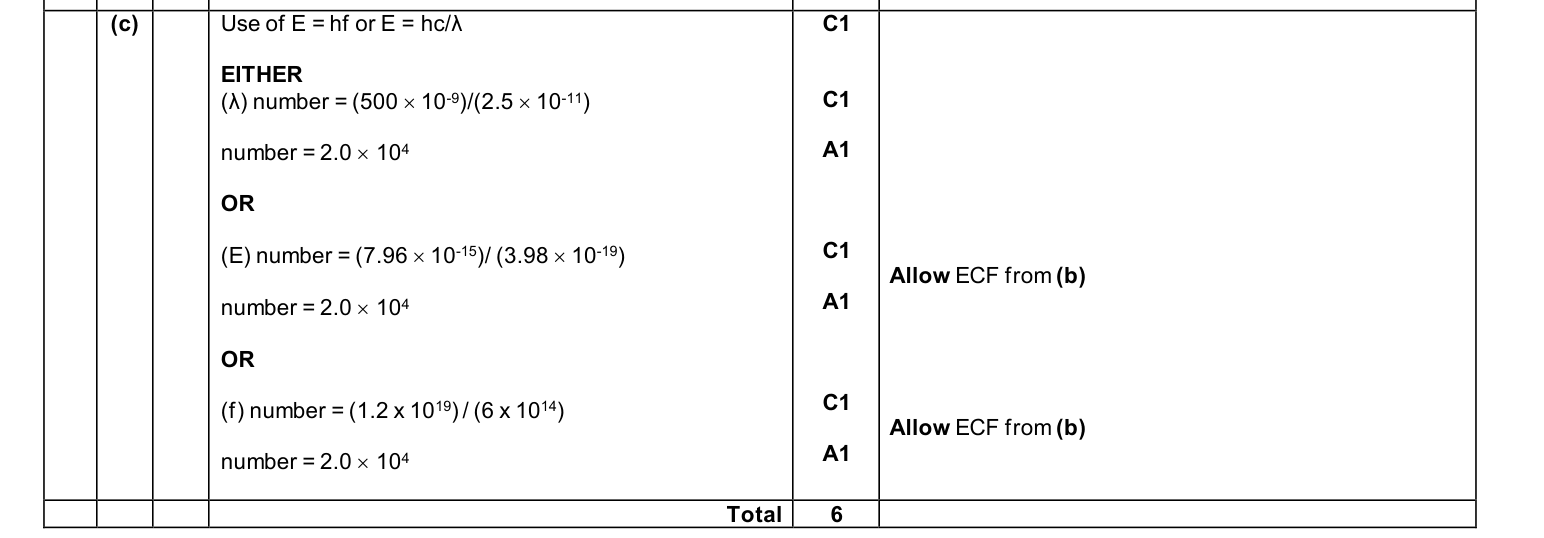
24(c) Photons and the Planck constant 3Calculation
25(a)(i) Wave motion: progressive waves, the wave equation and intensity 1Short answer
25(a)(ii) Wave motion: progressive waves, the wave equation and intensity, Practical skills: planning, analysis and evaluation 3Explanation
25(b)(i) Electromagnetic waves, polarisation and refraction 1Short answer
25(b)(ii) Electromagnetic waves, polarisation and refraction, Wave motion: progressive waves, the wave equation and intensity 6Calculation
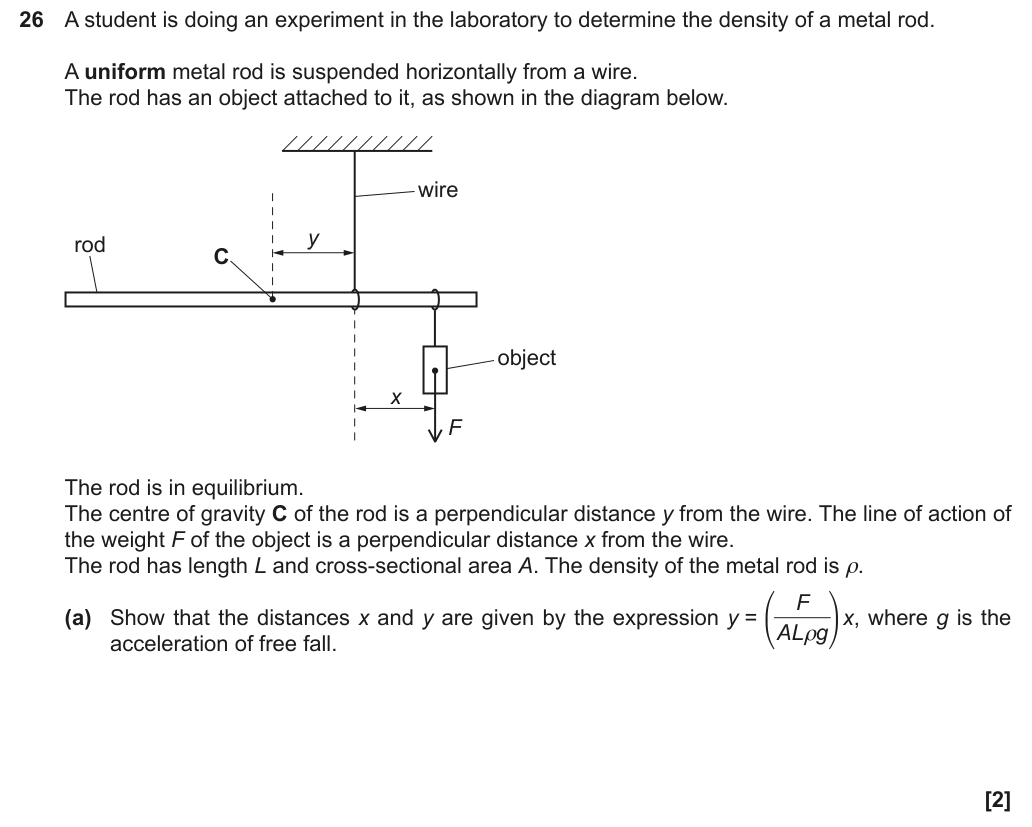
26(a) Equilibrium: moments, couples and centre of mass, Dynamics, drag and terminal velocity, Density, pressure and upthrust 2Show that
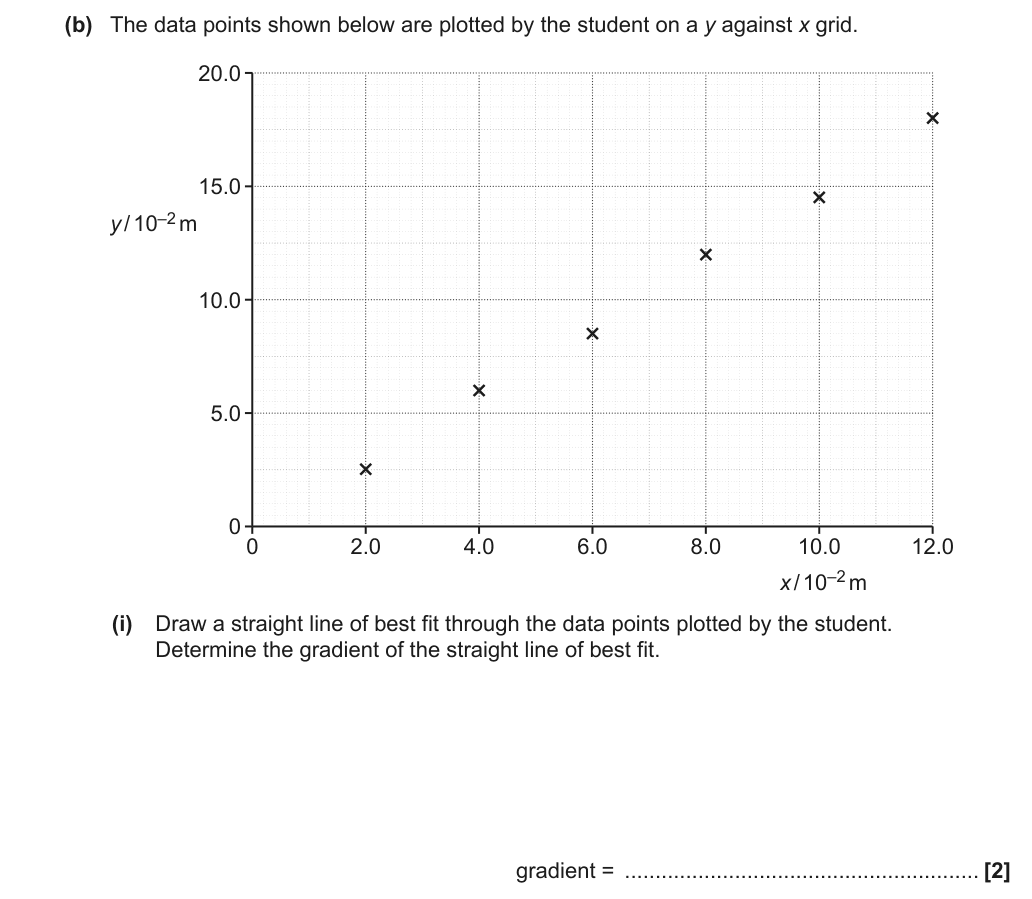
26(b)(i) Practical skills: planning, analysis and evaluation, Measurements and uncertainties 2Diagram or graph
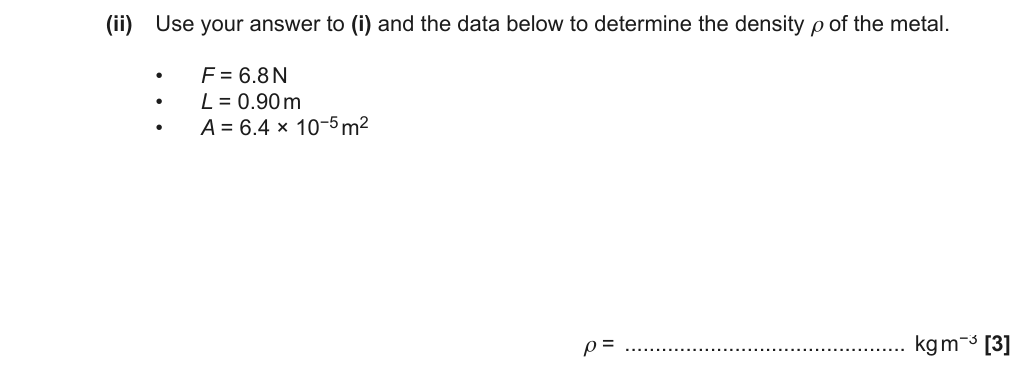
26(b)(ii) Density, pressure and upthrust, Practical skills: planning, analysis and evaluation, Equilibrium: moments, couples and centre of mass 3Calculation

The questions

123456789101112131415161718192021(a)21(b)21(c)(i)21(c)(ii)22(a)22(b)23(a)23(b)(i)23(b)(ii)23(c)(i)23(c)(ii)24(a)24(b)24(c)25(a)(i)25(a)(ii)25(b)(i)25(b)(ii)26(a)26(b)(i)26(b)(ii)
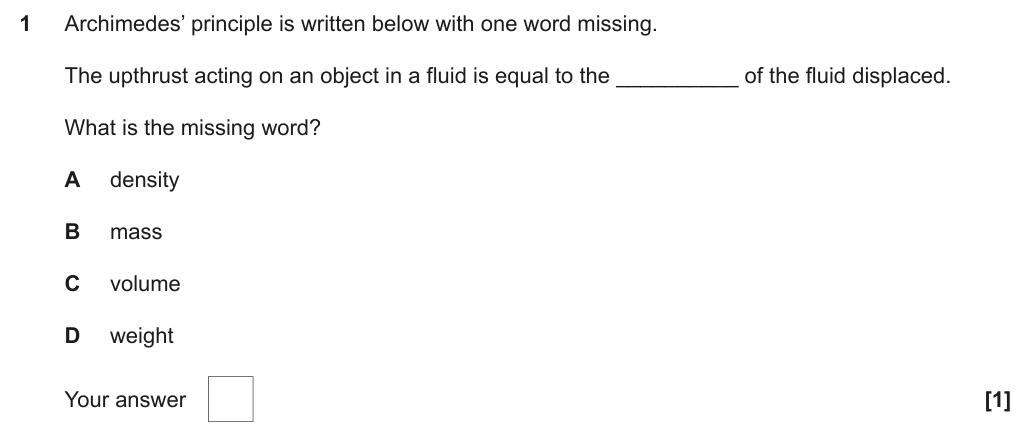
November 2021 · AS Paper 1 · Q1 1 mark Multiple choice density and pressure
1 Archimedes’ principle is written below with one word missing.
The upthrust acting on an object in a fluid is equal to the __________ of the fluid displaced.
What is the missing word?
A density
B mass
C volume
D weight
Your answer [1]
November 2021 · AS Paper 1 · Q2 1 mark Multiple choice emf pd and resistance
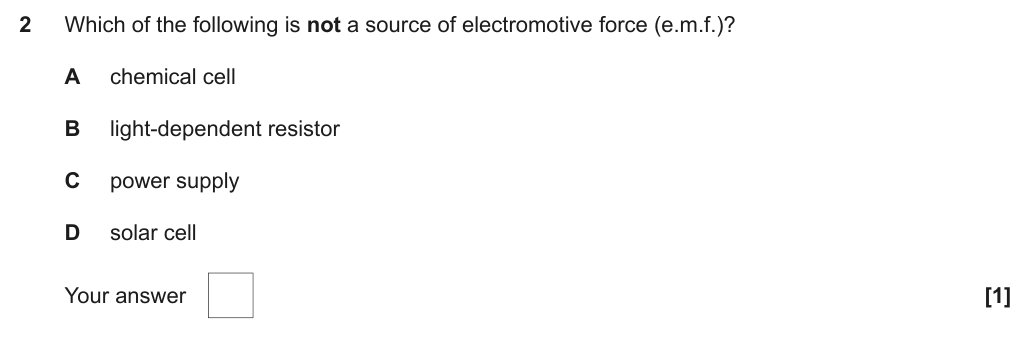
2 Which of the following is not a source of electromotive force (e.m.f.)?
A chemical cell
B light-dependent resistor
C power supply
D solar cell
Your answer [1]
November 2021 · AS Paper 1 · Q3 1 mark Multiple choice photons
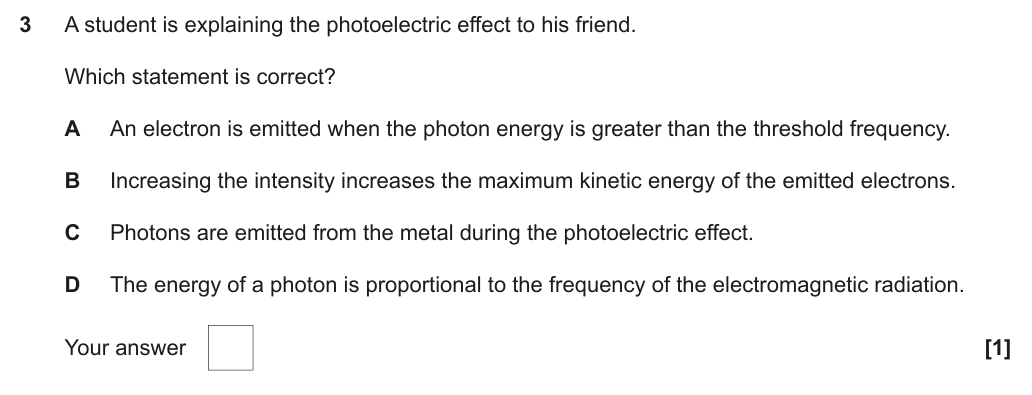
3 A student is explaining the photoelectric effect to his friend.
Which statement is correct?
A An electron is emitted when the photon energy is greater than the threshold frequency.
B Increasing the intensity increases the maximum kinetic energy of the emitted electrons.
C Photons are emitted from the metal during the photoelectric effect.
D The energy of a photon is proportional to the frequency of the electromagnetic radiation.
Your answer [1]
November 2021 · AS Paper 1 · Q4 1 mark Multiple choice dynamics and terminal velocity
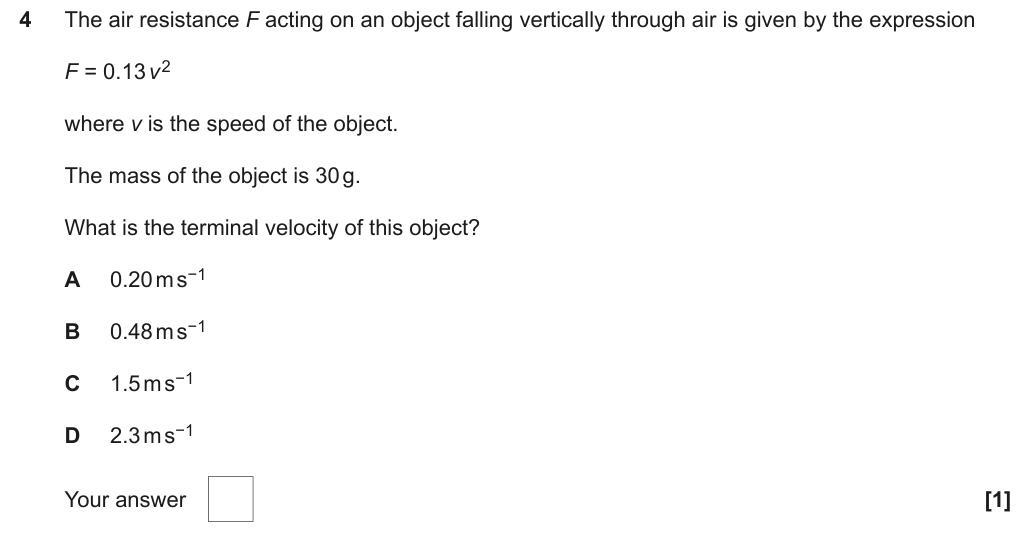
4 The air resistance F acting on an object falling vertically through air is given by the expression
F = 0.13 v 2
where v is the speed of the object.
The mass of the object is 30 g.
What is the terminal velocity of this object?
A 0.20 m s−1
B 0.48 m s−1
C 1.5 m s−1
D 2.3 m s−1
Your answer [1]
November 2021 · AS Paper 1 · Q5 1 mark Multiple choice work energy and power
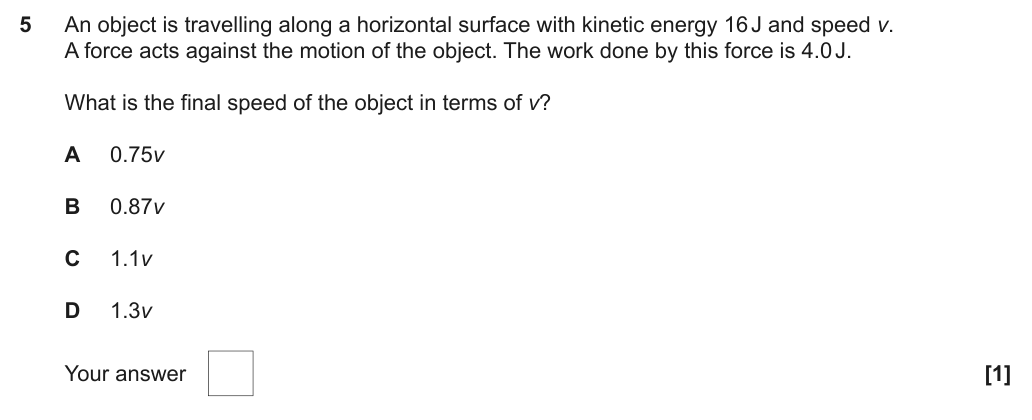
5 An object is travelling along a horizontal surface with kinetic energy 16 J and speed v.
A force acts against the motion of the object. The work done by this force is 4.0 J.
What is the final speed of the object in terms of v?
A 0.75v
B 0.87v
C 1.1v
D 1.3v
Your answer [1]
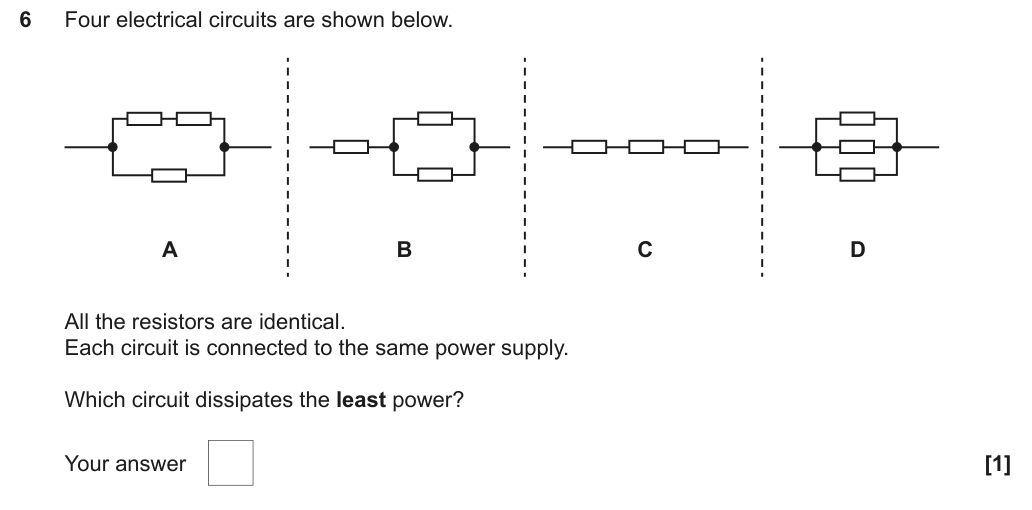
November 2021 · AS Paper 1 · Q6 1 mark Multiple choice electrical powerseries and parallel circuits
6 Four electrical circuits are shown below.
A B C D
All the resistors are identical.
Each circuit is connected to the same power supply.
Which circuit dissipates the least power?
Your answer [1]
November 2021 · AS Paper 1 · Q7 1 mark Multiple choice materials and young modulus
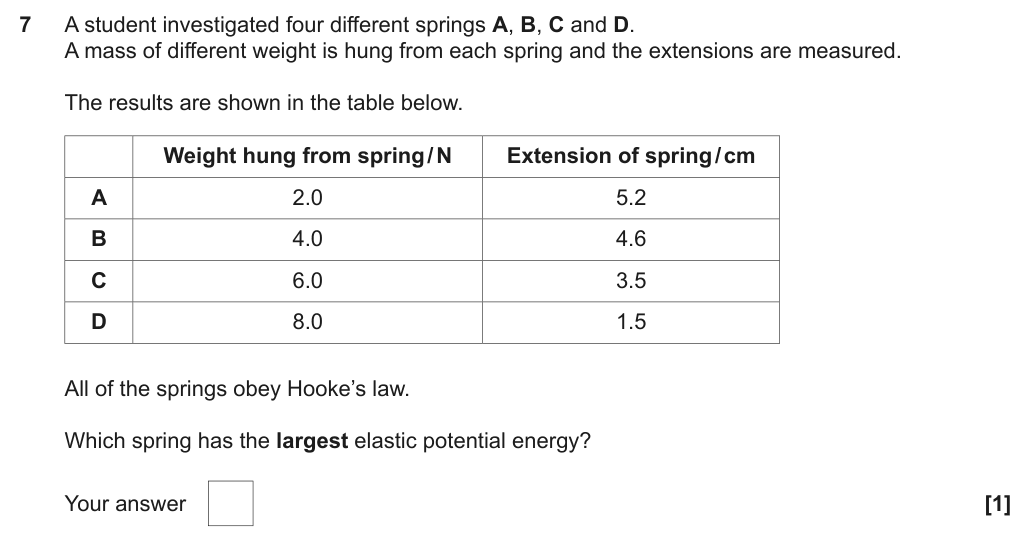
7 A student investigated four different springs A, B, C and D.
A mass of different weight is hung from each spring and the extensions are measured.
The results are shown in the table below.
Weight hung from spring / N Extension of spring / cm
A 2.0 5.2
B 4.0 4.6
C 6.0 3.5
D 8.0 1.5
All of the springs obey Hooke’s law.
Which spring has the largest elastic potential energy?
Your answer [1]
November 2021 · AS Paper 1 · Q8 1 mark Multiple choice quantities and unitsmaterials and young modulus
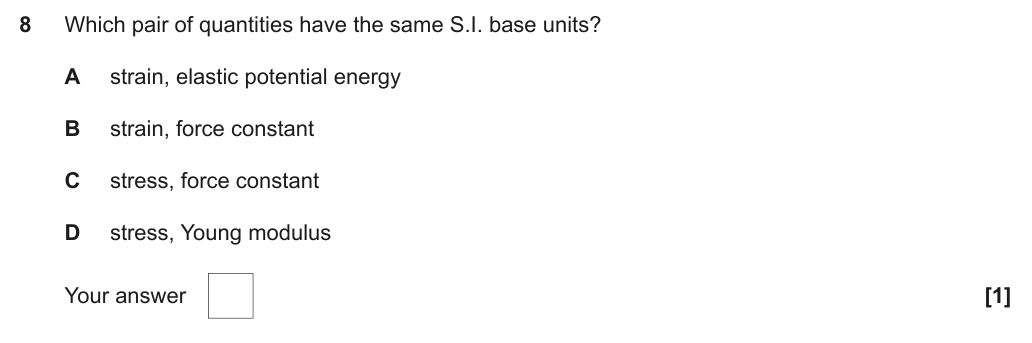
8 Which pair of quantities have the same S.I. base units?
A strain, elastic potential energy
B strain, force constant
C stress, force constant
D stress, Young modulus
Your answer [1]
November 2021 · AS Paper 1 · Q9 1 mark Multiple choice charge and current
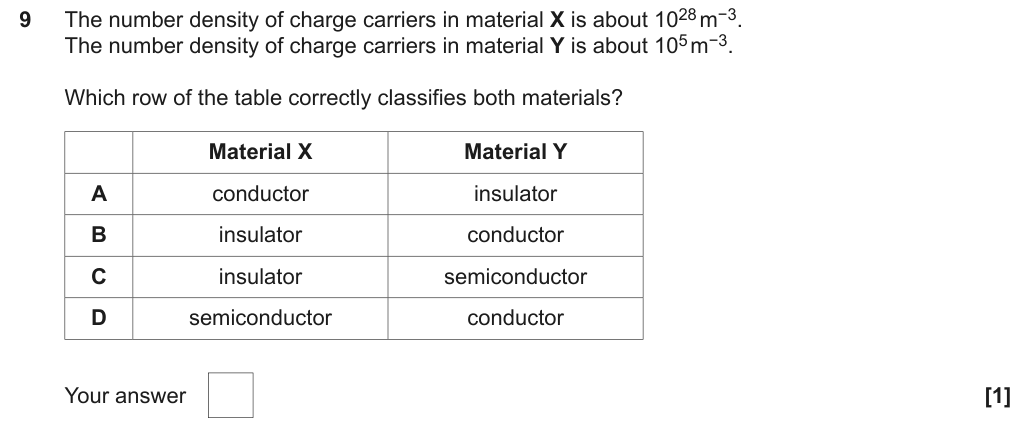
9 The number density of charge carriers in material X is about 1028 m−3.
The number density of charge carriers in material Y is about 105 m−3.
Which row of the table correctly classifies both materials?
Material X Material Y
A conductor insulator
B insulator conductor
C insulator semiconductor
D semiconductor conductor
Your answer [1]
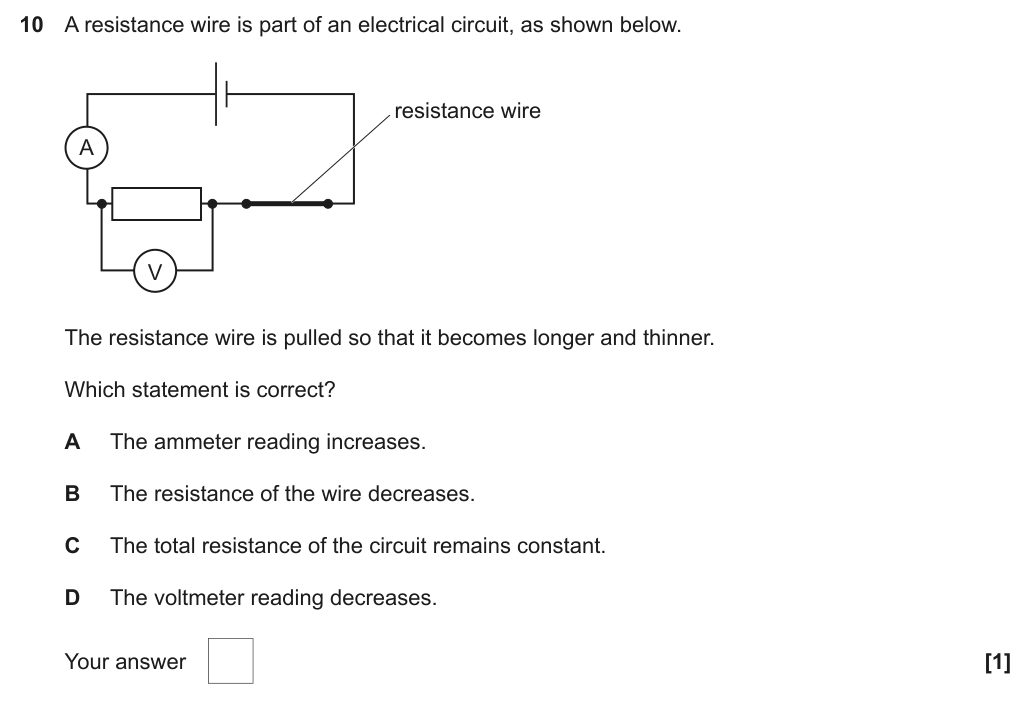
November 2021 · AS Paper 1 · Q10 1 mark Multiple choice resistivityseries and parallel circuitspotential dividers
10 A resistance wire is part of an electrical circuit, as shown below.
resistance wire
A
V
The resistance wire is pulled so that it becomes longer and thinner.
Which statement is correct?
A The ammeter reading increases.
B The resistance of the wire decreases.
C The total resistance of the circuit remains constant.
D The voltmeter reading decreases.
Your answer [1]
November 2021 · AS Paper 1 · Q11 1 mark Multiple choice superposition and interference
11 Monochromatic light is incident on a double slit.
A pattern of dark and bright fringes is formed on a distant screen.
Which term, together with diffraction, can be used to explain these fringes?
A interference
B polarisation
C reflection
D refraction
Your answer [1]
November 2021 · AS Paper 1 · Q12 1 mark Multiple choice resistivity
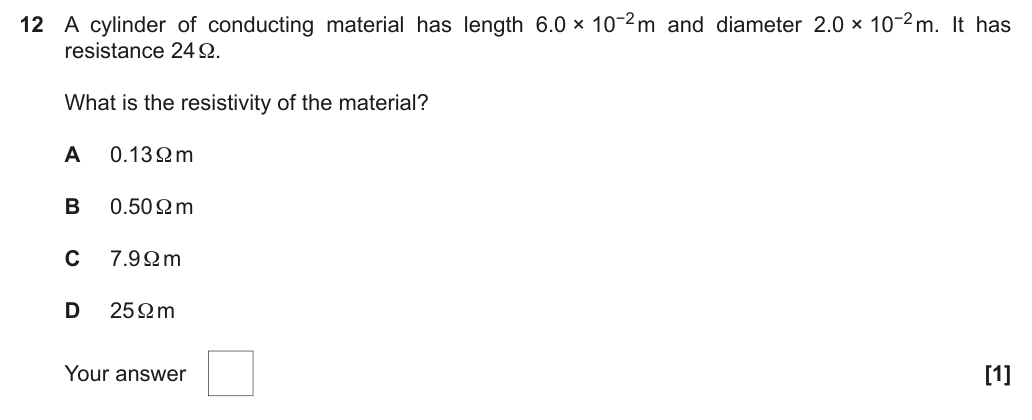
12 A cylinder of conducting material has length 6.0 × 10⁻² m and diameter 2.0 × 10⁻² m. It has
resistance 24 Ω.
What is the resistivity of the material?
A 0.13 Ω m
B 0.50 Ω m
C 7.9 Ω m
D 25 Ω m
Your answer [1]
November 2021 · AS Paper 1 · Q13 1 mark Multiple choice stationary waves
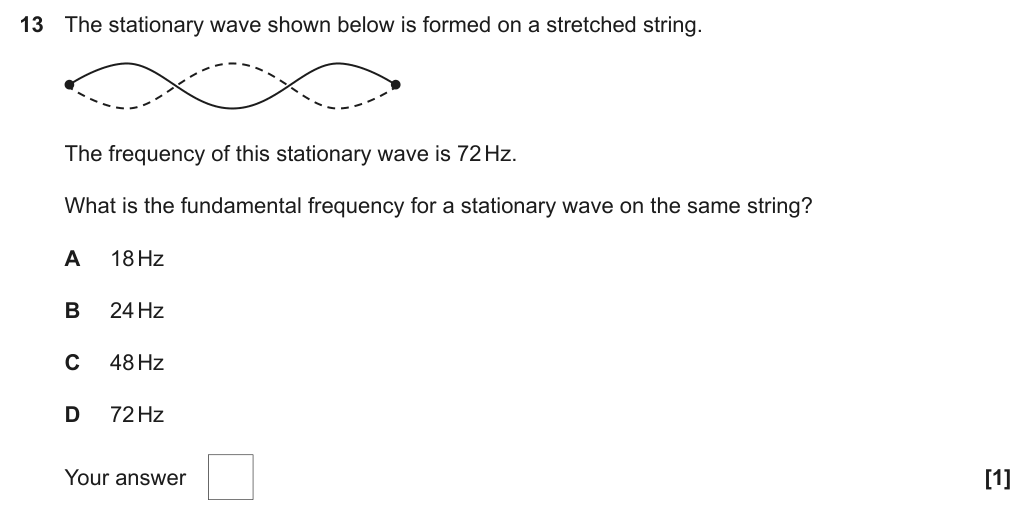
13 The stationary wave shown below is formed on a stretched string.
The frequency of this stationary wave is 72 Hz.
What is the fundamental frequency for a stationary wave on the same string?
A 18 Hz
B 24 Hz
C 48 Hz
D 72 Hz
Your answer [1]
November 2021 · AS Paper 1 · Q14 1 mark Multiple choice wave particle dualitywork energy and powernewtons laws and momentum
14 The de Broglie wavelength of a proton is 160 pm.
The kinetic energy of this proton is doubled.
What is the de Broglie wavelength of the proton now?
A 80 pm
B 110 pm
C 230 pm
D 320 pm
Your answer [1]
November 2021 · AS Paper 1 · Q15 1 mark Multiple choice wave motion
15 The displacement against time graph for a progressive wave is shown below.
X X
displacement
0
0
time
Y Y
Which statement is correct about the phase difference z between points X and Y?
A 0 < z < 90°
B z = 90°
C z = 180°
D 180° 1 z 1 270°
Your answer [1]
November 2021 · AS Paper 1 · Q16 1 mark Multiple choice photonselectromagnetic waves and refraction
16 The energy of a photon is 2.5 eV.
What is the principal radiation for this photon?
A infrared
B radio waves
C visible light
D x-rays
Your answer [1]
November 2021 · AS Paper 1 · Q17 1 mark Multiple choice quantities and unitspractical skills
17 A student is recording results in a table.
The calculated value for the stress in a wire is 7 260 000 Pa.
Which of the following is correct for the heading in the student’s table and the value of the stress
written to 2 significant figures?
Heading in table Value of stress
A stress / Pa 7 200 000
B stress / kPa 730
C stress / MPa 7.2
D stress / 106 Pa 7.3
Your answer [1]
November 2021 · AS Paper 1 · Q18 1 mark Multiple choice projectile motionscalars and vectors
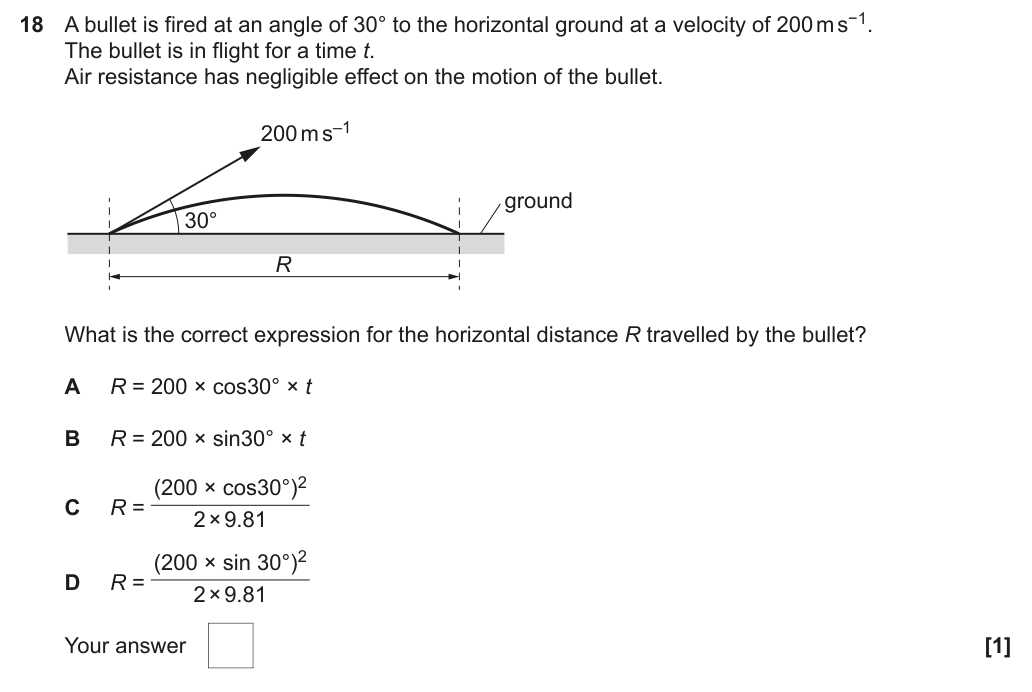
18 A bullet is fired at an angle of 30° to the horizontal ground at a velocity of 200 m s−1.
The bullet is in flight for a time t.
Air resistance has negligible effect on the motion of the bullet.
200 m s–1
ground
30°
R
What is the correct expression for the horizontal distance R travelled by the bullet?
A R = 200 × cos30° × t
B R = 200 × sin30° × t
(200 × cos30°)2
C R =
2 × 9.81
(200 × sin 30°)2
D R =
2 × 9.81
Your answer [1]
November 2021 · AS Paper 1 · Q19 1 mark Multiple choice wave particle duality
19 What can be deduced from the diffraction of electrons by graphite atoms?
A Electrons are electromagnetic waves.
B Electrons can also become photons.
C Electrons interact with photons on a one-to-one basis.
D Electrons show wave-like behaviour.
Your answer [1]
November 2021 · AS Paper 1 · Q20 1 mark Multiple choice newtons laws and momentum
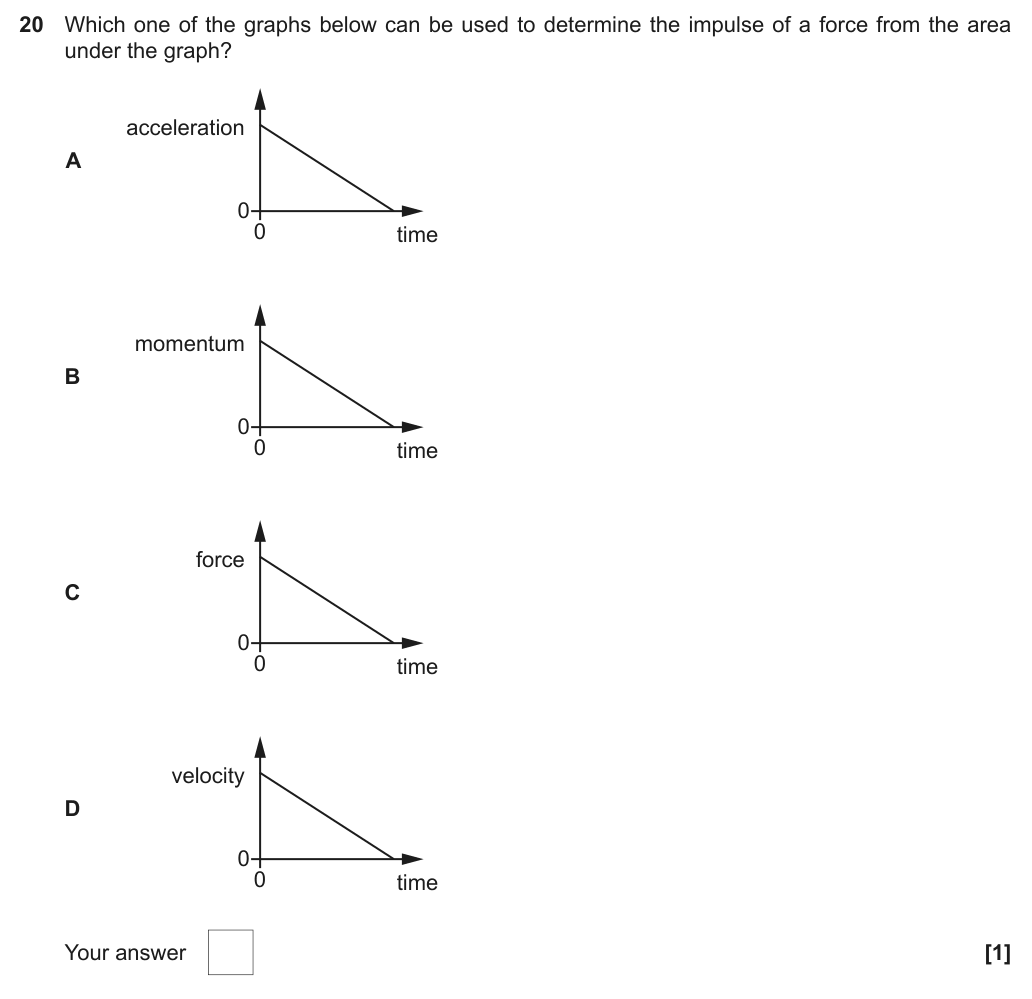
20 Which one of the graphs below can be used to determine the impulse of a force from the area
under the graph?
acceleration
A
0
0 time
momentum
B
0
0 time
force
C
0
0 time
velocity
D
0
0 time
Your answer [1]
November 2021 · AS Paper 1 · Q21(a) 1 mark Explanation kinematics
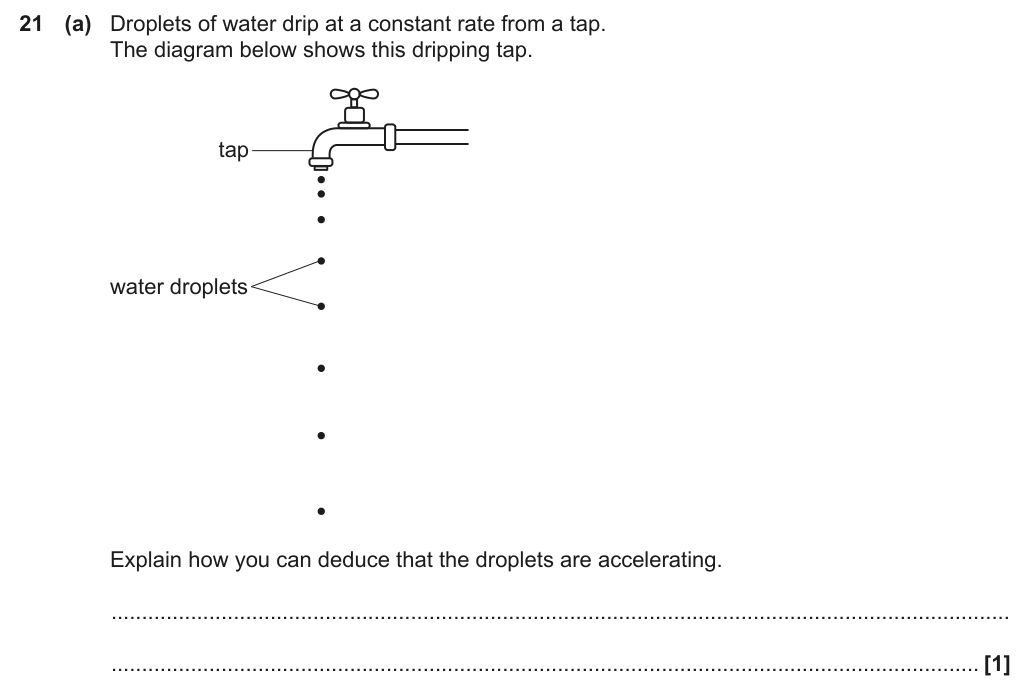
21 (a) Droplets of water drip at a constant rate from a tap.
The diagram below shows this dripping tap.
tap
water droplets
Explain how you can deduce that the droplets are accelerating.
...................................................................................................................................................
.............................................................................................................................................. [1]
November 2021 · AS Paper 1 · Q21(b) 2 marks Explanation newtons laws and momentumdynamics and terminal velocity
(b) The diagram below shows a trolley loaded onto the back of a truck.
truck trolley
ground
The truck suddenly accelerates. The trolley is observed to remain in the same position relative
to the ground.
Explain the lack of motion of the trolley in terms of one of Newton’s laws of motion.
...................................................................................................................................................
...................................................................................................................................................
.............................................................................................................................................. [2]
November 2021 · AS Paper 1 · Q21(c)(i) 3 marks Show that kinematicslinear motion
(c) A car starts from rest at time t = 0.
The car travels in a straight line with a constant acceleration.
The displacement s against time t graph for this car is shown below.
50
40
s / m
30
20
10
0
0 2.0 4.0 6.0
t / s
(i) Use the graph to show that the speed of the car at t = 4.0 s is 10 m s−1.
[3]
November 2021 · AS Paper 1 · Q21(c)(ii) 3 marks Calculation newtons laws and momentumquantities and units
Earlier part of question 21 that this part usesEarlier part of November 2021 Paper 1 question 21
(ii) The mass of the car is 1200 kg.
Calculate the rate of change of momentum of the car from t = 0 to t = 4.0 s. Include an
appropriate unit for your answer.
rate of change of momentum =  .................................. unit ................ [3]
November 2021 · AS Paper 1 · Q22(a) 1 mark Short answer practical skills
22 A student is determining the acceleration of free fall g using a metal sphere on a ramp.
The sphere is released from the ramp at different heights. The speed v of the sphere at the bottom
of the ramp is determined.
The acceleration of free fall g is given by the expression g = v 2
2d , where d is the initial height of the
sphere and v is speed of the sphere at the bottom of the ramp.
The student records the following data.
• d = 0.100 ± 0.002 m
• v = 1.4 ± 0.1 m s−1
(a) Name the instrument the student should use to measure d.
.............................................................................................................................................. [1]
November 2021 · AS Paper 1 · Q22(b) 3 marks Calculation measurements and uncertainties
Earlier part of question 22 that this part usesEarlier part of November 2021 Paper 1 question 22
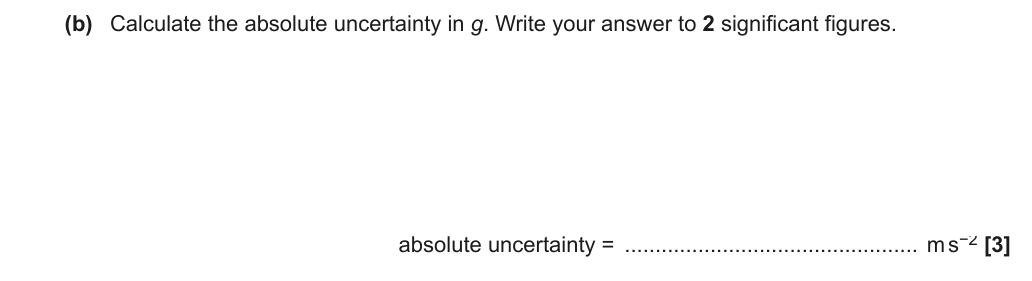
(b) Calculate the absolute uncertainty in g. Write your answer to 2 significant figures.
absolute uncertainty =  ................................................ m s−2 [3]
November 2021 · AS Paper 1 · Q23(a) 3 marks Explanation emf pd and resistancepractical skills
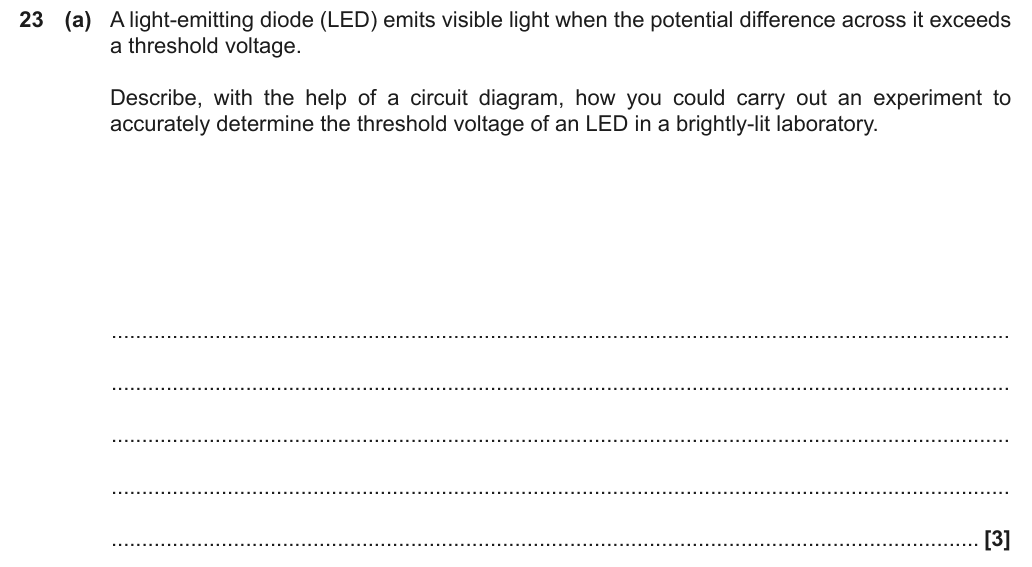
23 (a) A light-emitting diode (LED) emits visible light when the potential difference across it exceeds
a threshold voltage.
Describe, with the help of a circuit diagram, how you could carry out an experiment to
accurately determine the threshold voltage of an LED in a brightly-lit laboratory.
...................................................................................................................................................
...................................................................................................................................................
...................................................................................................................................................
...................................................................................................................................................
.............................................................................................................................................. [3]
November 2021 · AS Paper 1 · Q23(b)(i) 2 marks Calculation charge and current
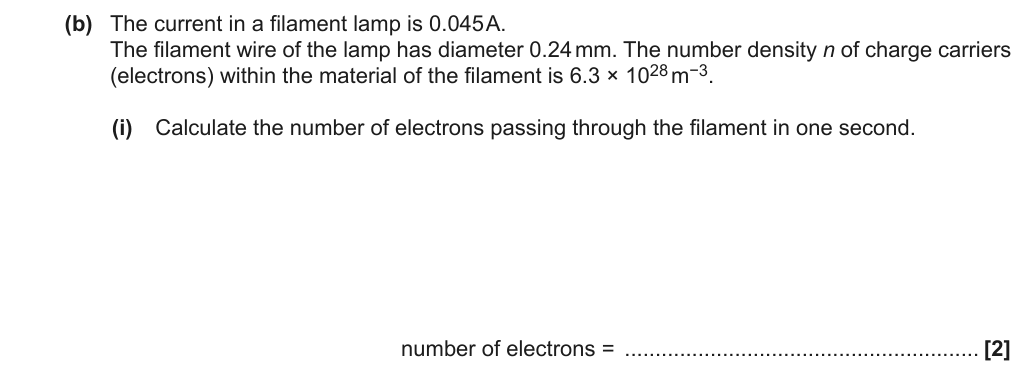
(b) The current in a filament lamp is 0.045 A.
The filament wire of the lamp has diameter 0.24 mm. The number density n of charge carriers
(electrons) within the material of the filament is 6.3 × 1028 m−3.
(i) Calculate the number of electrons passing through the filament in one second.
number of electrons =  .......................................................... [2]
November 2021 · AS Paper 1 · Q23(b)(ii) 3 marks Calculation charge and current
Earlier part of question 23 that this part usesEarlier part of November 2021 Paper 1 question 23
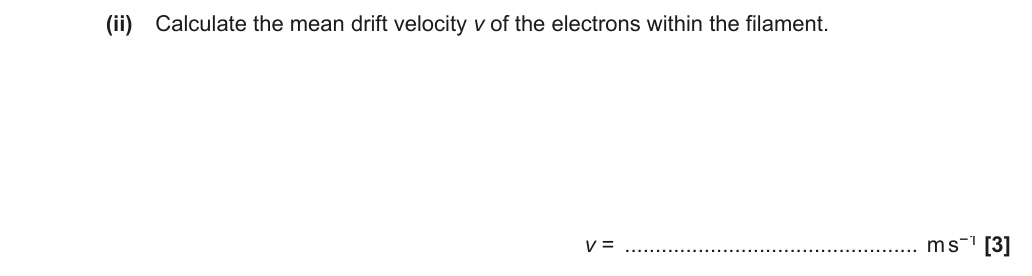
(ii) Calculate the mean drift velocity v of the electrons within the filament.
v =  ................................................ m s−1 [3]
November 2021 · AS Paper 1 · Q23(c)(i) 2 marks Explanation resistivitypotential dividers
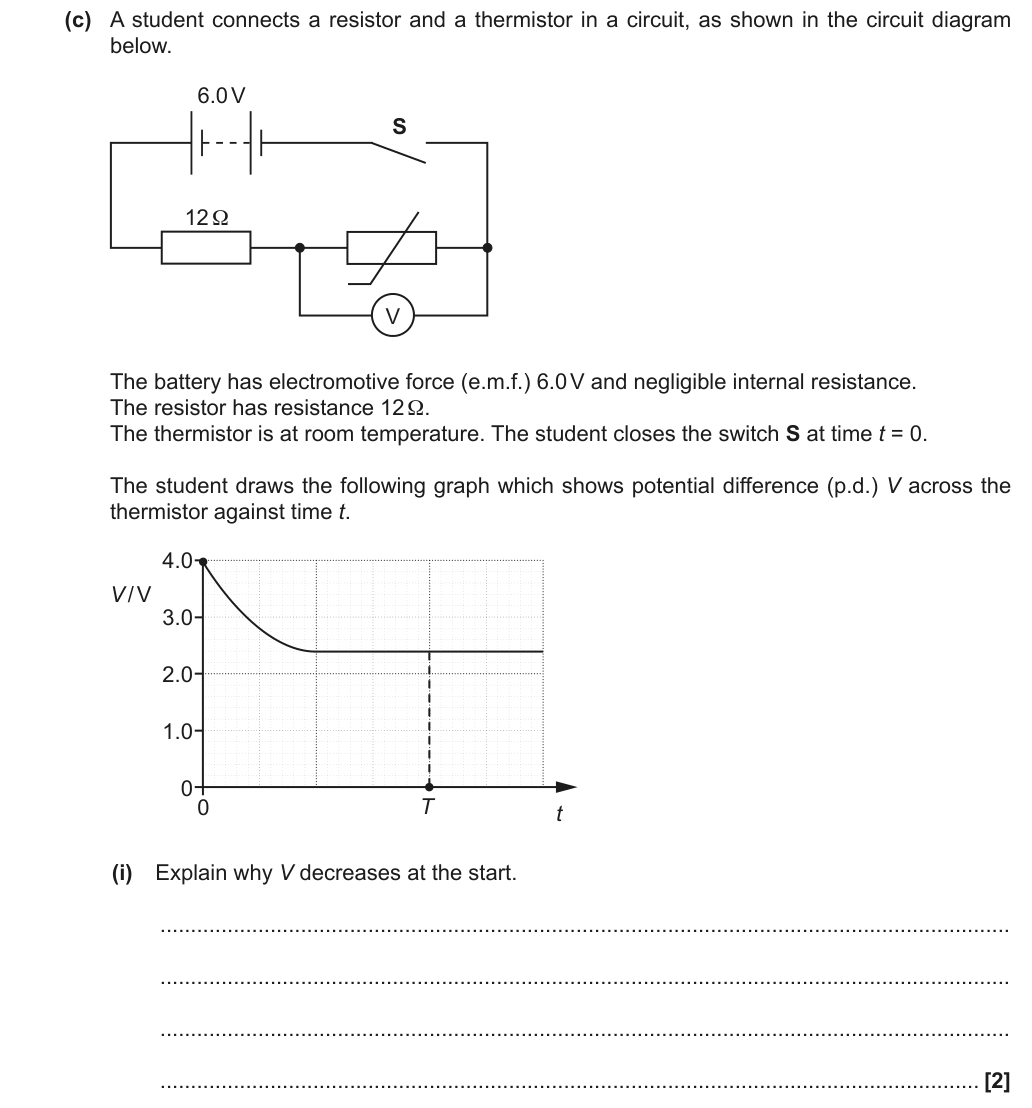
(c) A student connects a resistor and a thermistor in a circuit, as shown in the circuit diagram
below.
6.0 V
S
12 Ω
V
The battery has electromotive force (e.m.f.) 6.0 V and negligible internal resistance.
The resistor has resistance 12 Ω.
The thermistor is at room temperature. The student closes the switch S at time t = 0.
The student draws the following graph which shows potential difference (p.d.) V across the
thermistor against time t.
4.0
V / V
3.0
2.0
1.0
0
0 T t
(i) Explain why V decreases at the start.
...........................................................................................................................................
...........................................................................................................................................
...........................................................................................................................................
...................................................................................................................................... [2]
November 2021 · AS Paper 1 · Q23(c)(ii) 3 marks Calculation potential dividersemf pd and resistanceseries and parallel circuits
Earlier part of question 23 that this part usesEarlier part of November 2021 Paper 1 question 23
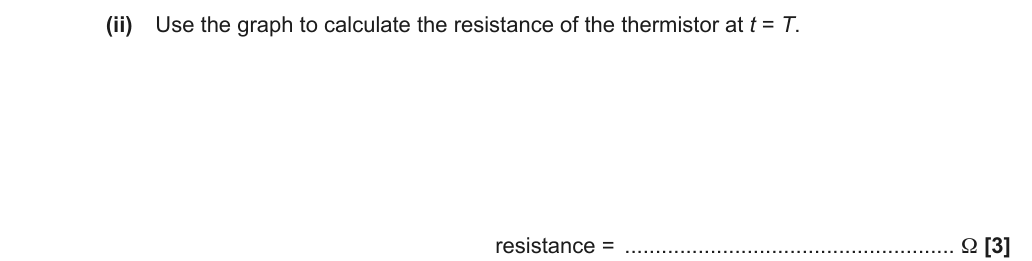
(ii) Use the graph to calculate the resistance of the thermistor at t = T.
resistance =  ...................................................... Ω [3]
November 2021 · AS Paper 1 · Q24(a) 1 mark Short answer electromagnetic waves and refraction
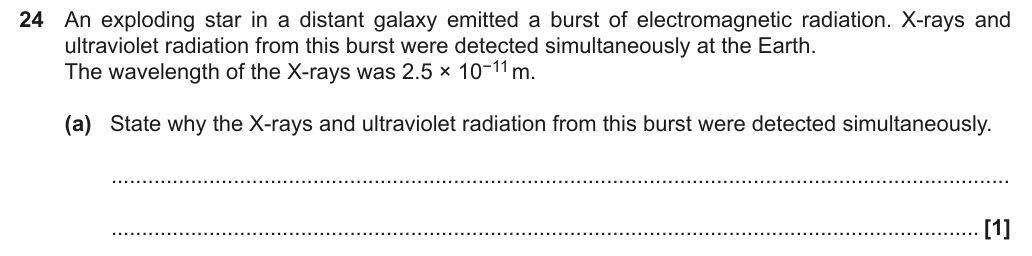
24 An exploding star in a distant galaxy emitted a burst of electromagnetic radiation. X-rays and
ultraviolet radiation from this burst were detected simultaneously at the Earth.
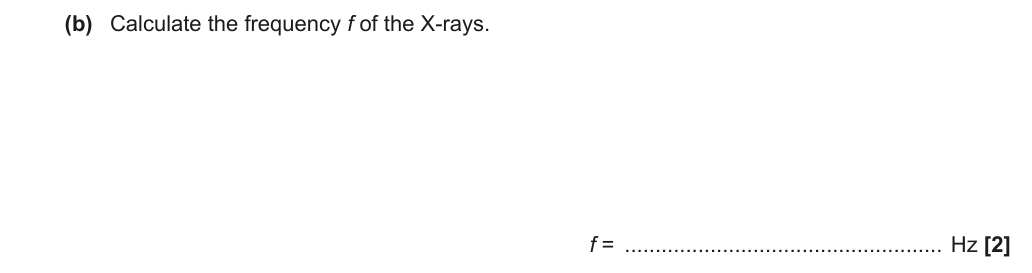
The wavelength of the X-rays was 2.5 × 10⁻¹¹ m.
(a) State why the X-rays and ultraviolet radiation from this burst were detected simultaneously.
...................................................................................................................................................
.............................................................................................................................................. [1]
November 2021 · AS Paper 1 · Q24(b) 2 marks Calculation wave motionelectromagnetic waves and refraction
Earlier part of question 24 that this part usesEarlier part of November 2021 Paper 1 question 24
(b) Calculate the frequency f of the X-rays.
f =  .................................................... Hz [2]
November 2021 · AS Paper 1 · Q24(c) 3 marks Calculation photons
Earlier part of question 24 that this part usesEarlier part of November 2021 Paper 1 question 24
(c) Special detectors at the Earth were used to detect the individual X-ray photons.
In one type of detector, the interaction of a single X-ray photon with the material of the detector
produced many photons of visible light with wavelength of about 500 nm.
Estimate the number of visible light photons emitted in each interaction.
number of visible light photons =  .......................................................... [3]
November 2021 · AS Paper 1 · Q25(a)(i) 1 mark Short answer wave motion
25 (a) Sound waves cannot be polarised, but they do show diffraction.
(i) State why sound waves cannot be polarised.
...........................................................................................................................................
...................................................................................................................................... [1]
November 2021 · AS Paper 1 · Q25(a)(ii) 3 marks Explanation wave motionpractical skills
(ii) Describe and explain how you could demonstrate the diffraction of sound waves in the
laboratory.
...........................................................................................................................................
...........................................................................................................................................
...........................................................................................................................................
...........................................................................................................................................
...........................................................................................................................................
...................................................................................................................................... [3]
November 2021 · AS Paper 1 · Q25(b)(i) 1 mark Short answer electromagnetic waves and refraction
(b) Light can be refracted. Light can also show total internal reflection.
(i) Define refractive index of a material.
...........................................................................................................................................
...................................................................................................................................... [1]
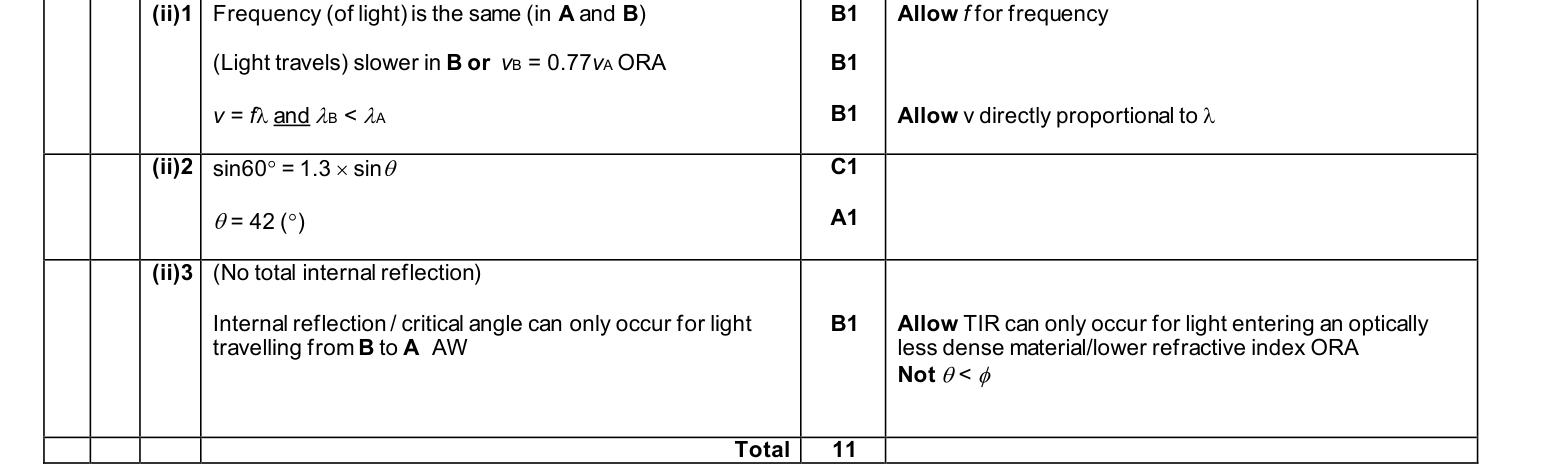
November 2021 · AS Paper 1 · Q25(b)(ii) 6 marks Calculation electromagnetic waves and refractionwave motion
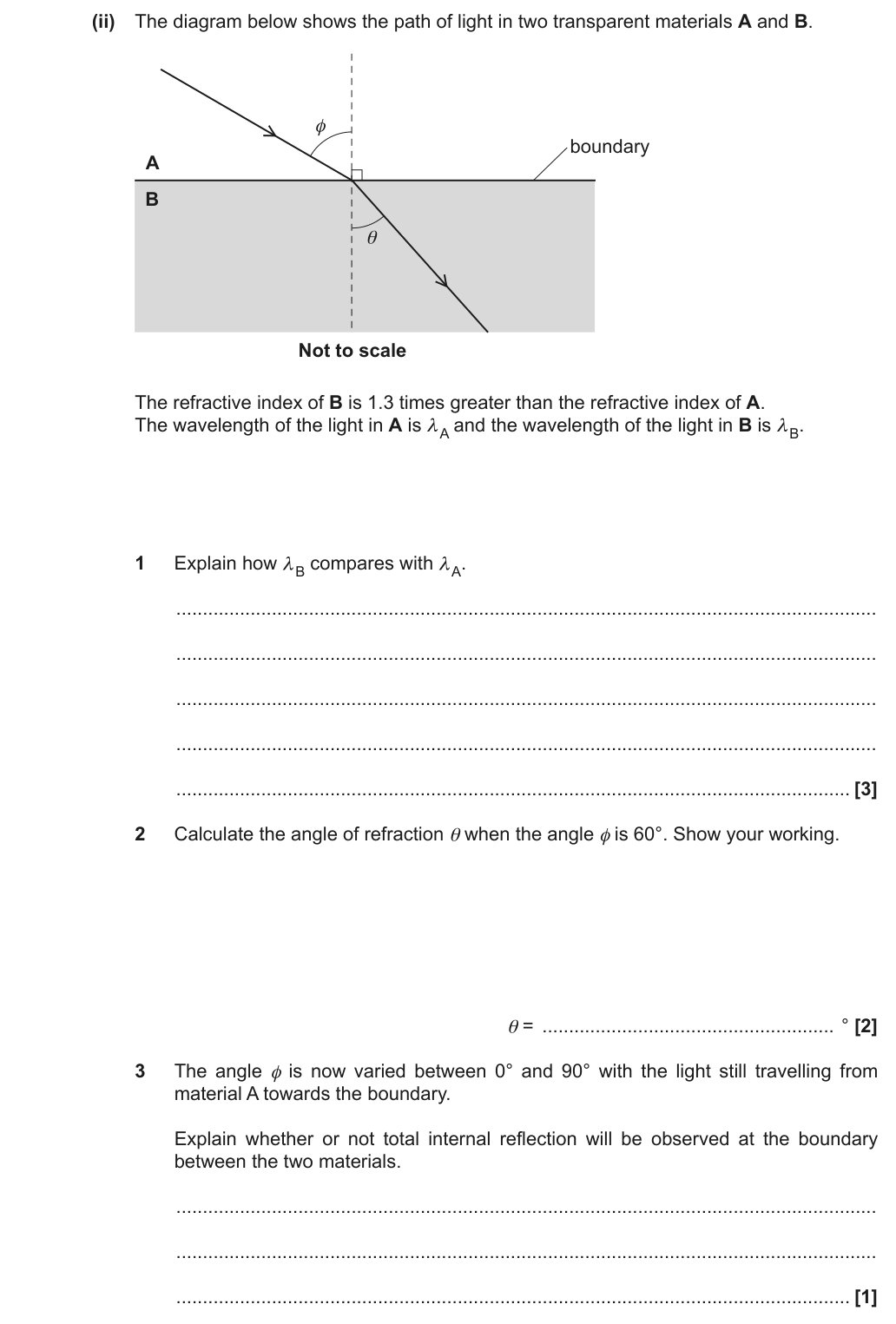
(ii) The diagram below shows the path of light in two transparent materials A and B.
φ
boundary
A
B
θ
Not to scale
The refractive index of B is 1.3 times greater than the refractive index of A.
The wavelength of the light in A is λ A and the wavelength of the light in B is λ B.
1 Explain how λ B compares with λ A.
....................................................................................................................................
....................................................................................................................................
....................................................................................................................................
....................................................................................................................................
............................................................................................................................... [3]
2 Calculate the angle of refraction θ when the angle φ is 60°. Show your working.
θ =  ....................................................... ° [2]
3 The angle φ is now varied between 0° and 90° with the light still travelling from
material A towards the boundary.
Explain whether or not total internal reflection will be observed at the boundary
between the two materials.
....................................................................................................................................
....................................................................................................................................
............................................................................................................................... [1]
November 2021 · AS Paper 1 · Q26(a) 2 marks Show that equilibrium and momentsdynamics and terminal velocitydensity and pressure
26 A student is doing an experiment in the laboratory to determine the density of a metal rod.
A uniform metal rod is suspended horizontally from a wire.
The rod has an object attached to it, as shown in the diagram below.
wire
rod y
C
object
x
F
The rod is in equilibrium.
The centre of gravity C of the rod is a perpendicular distance y from the wire. The line of action of
the weight F of the object is a perpendicular distance x from the wire.
The rod has length L and cross-sectional area A. The density of the metal rod is ρ.
(a) Show that the distances x and y are given by the expression y = ⎛ F ⎞
x, where g is the
⎝ ALρg ⎠
acceleration of free fall.
[2]
November 2021 · AS Paper 1 · Q26(b)(i) 2 marks Diagram or graph practical skillsmeasurements and uncertainties
(b) The data points shown below are plotted by the student on a y against x grid.
20.0
15.0
y / 10–2 m
10.0
5.0
0
0 2.0 4.0 6.0 8.0 10.0 12.0
x / 10–2 m
(i) Draw a straight line of best fit through the data points plotted by the student.
Determine the gradient of the straight line of best fit.
gradient =  .......................................................... [2]
November 2021 · AS Paper 1 · Q26(b)(ii) 3 marks Calculation density and pressurepractical skillsequilibrium and moments
Earlier parts of question 26 that this part usesEarlier part of November 2021 Paper 1 question 26Earlier part of November 2021 Paper 1 question 26
(ii) Use your answer to (i) and the data below to determine the density ρ of the metal.
• F = 6.8 N
• L = 0.90 m
• A = 6.4 × 10⁻⁵ m2
ρ =  .............................................. kg m−3 [3]

Work with an OCR physics tutor

Want a paper marked and gone through with you? Message us.

Prefer email? Send an enquiry

If you are under 18, please include a parent's contact details. Enquiries go to enquiries@physicsaleveltutor.com and are deleted once handled. All tutoring is online.