June 2018: AS Paper 1, Breadth in physics

70 marks · 45 question parts · Paper, mark scheme and report on OCR's site · Have the Data, Formulae and Relationships Booklet beside you

Question by question

QTopicMarksAOType
1 Kinematics: displacement, velocity and motion graphs 1Multiple choice
2 E.m.f., p.d., resistance and I–V characteristics, Physical quantities and S.I. units 1Multiple choice
3 Scalars and vectors, Dynamics, drag and terminal velocity 1Multiple choice
4 Collisions: conservation of momentum, Newton's laws of motion and momentum 1Multiple choice
5 Resistivity 1Multiple choice
6 Electrical power and energy, Series and parallel circuits: Kirchhoff's laws 1Multiple choice
7 Internal resistance and e.m.f., E.m.f., p.d., resistance and I–V characteristics, Series and parallel circuits: Kirchhoff's laws 1Multiple choice
8 Measurements and uncertainties 1Multiple choice
9 Equilibrium: moments, couples and centre of mass 1Multiple choice
10 Linear motion: the suvat equations and free fall, Kinematics: displacement, velocity and motion graphs 1Multiple choice
11 Newton's laws of motion and momentum 1Multiple choice
12 Mechanical properties of matter: stress, strain and the Young modulus, Dynamics, drag and terminal velocity 1Multiple choice
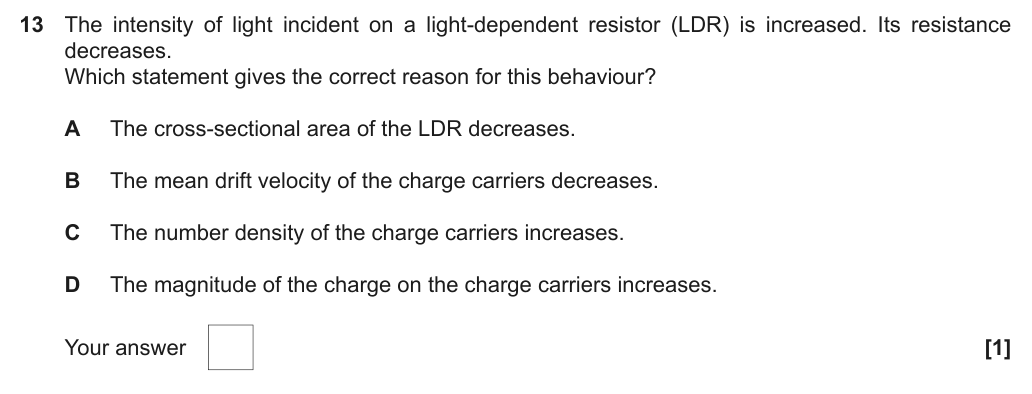
13 E.m.f., p.d., resistance and I–V characteristics, Charge, current and mean drift velocity 1Multiple choice
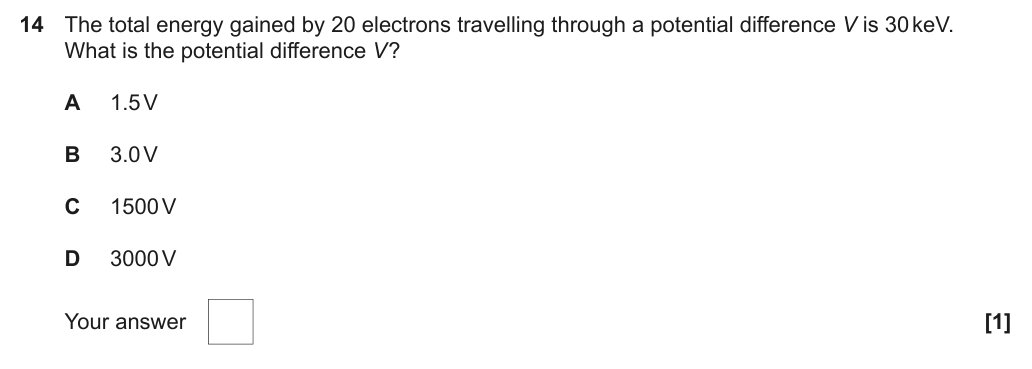
14 Photons and the Planck constant, E.m.f., p.d., resistance and I–V characteristics 1Multiple choice
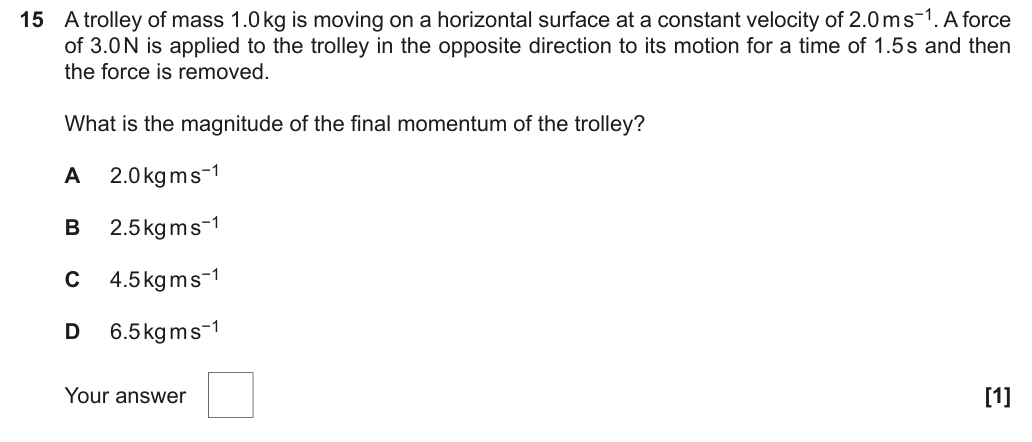
15 Newton's laws of motion and momentum 1Multiple choice
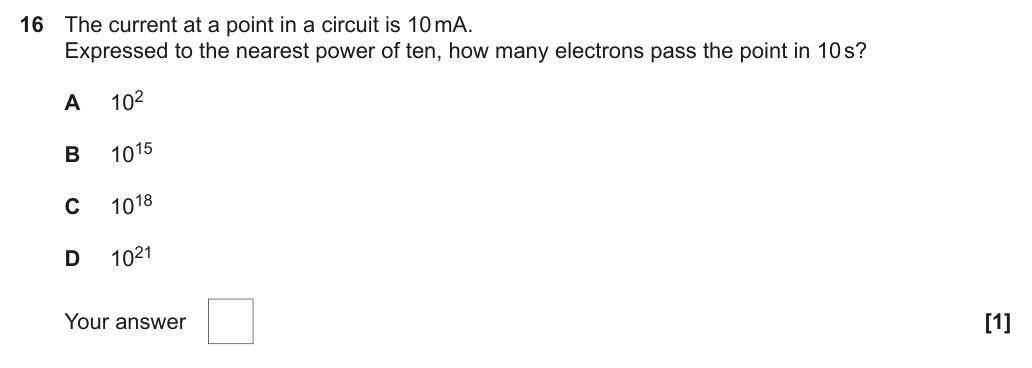
16 Charge, current and mean drift velocity 1Multiple choice
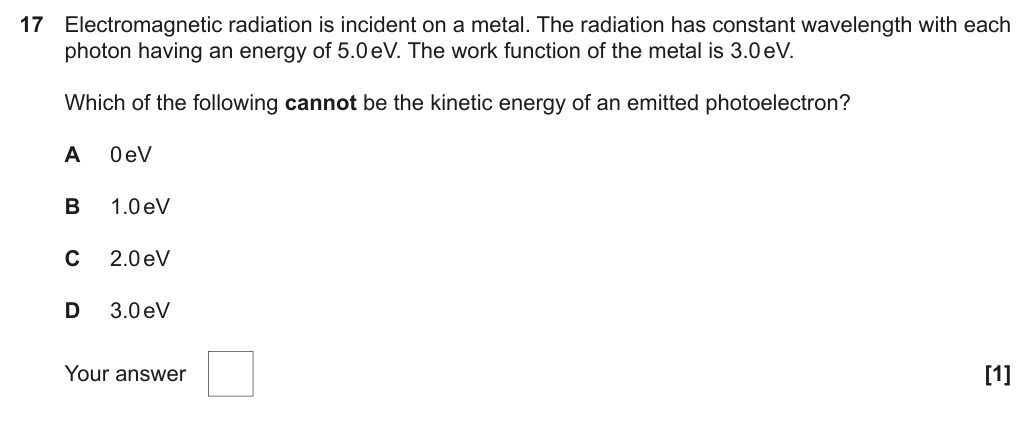
17 The photoelectric effect 1Multiple choice
18 Superposition, interference and the double slit 1Multiple choice
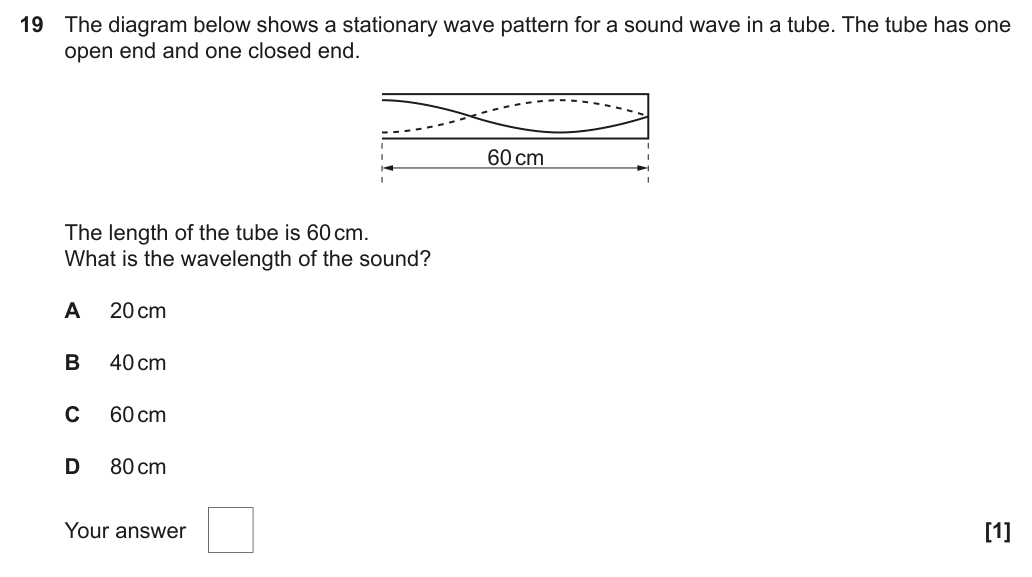
19 Stationary waves 1Multiple choice
20 Physical quantities and S.I. units 1Multiple choice
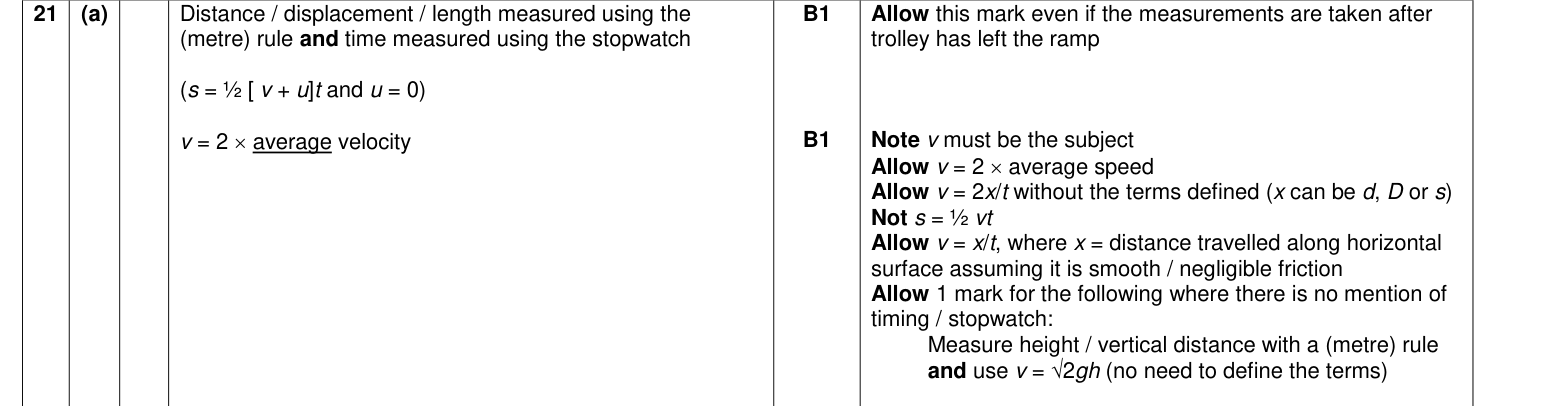
21(a) Linear motion: the suvat equations and free fall, Practical skills: planning, analysis and evaluation 2Explanation
21(b)(i) Linear motion: the suvat equations and free fall 2Calculation
21(b)(ii) Scalars and vectors 2Calculation
22(a) Equilibrium: moments, couples and centre of mass 2Explanation
22(b) Equilibrium: moments, couples and centre of mass, Scalars and vectors 2Diagram or graph
22(c) Scalars and vectors, Equilibrium: moments, couples and centre of mass 2Show that
22(d) Mechanical properties of matter: stress, strain and the Young modulus, Springs and Hooke's law 2Calculation
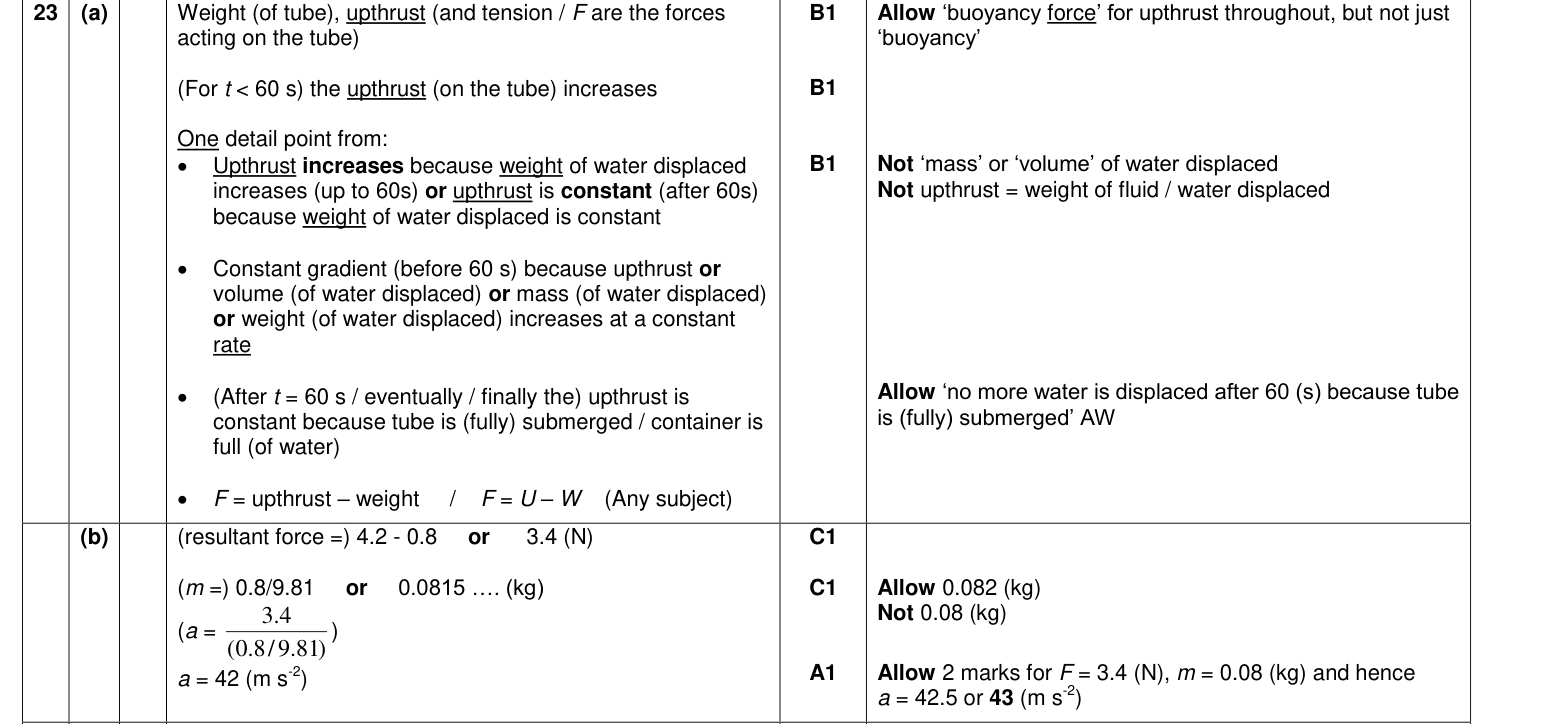
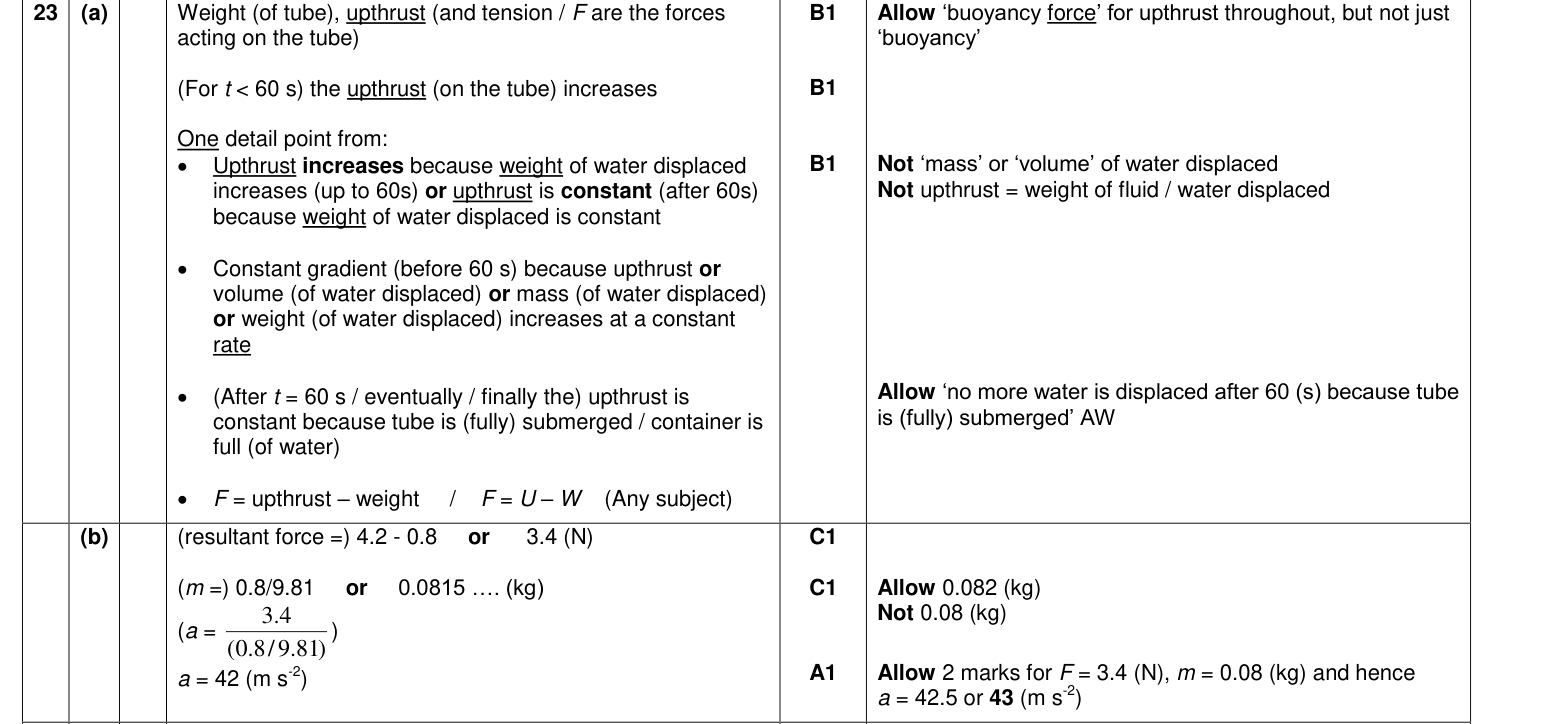
23(a) Density, pressure and upthrust, Dynamics, drag and terminal velocity, Equilibrium: moments, couples and centre of mass 3Explanation
23(b) Dynamics, drag and terminal velocity 3Calculation
23(c) Dynamics, drag and terminal velocity 1Short answer
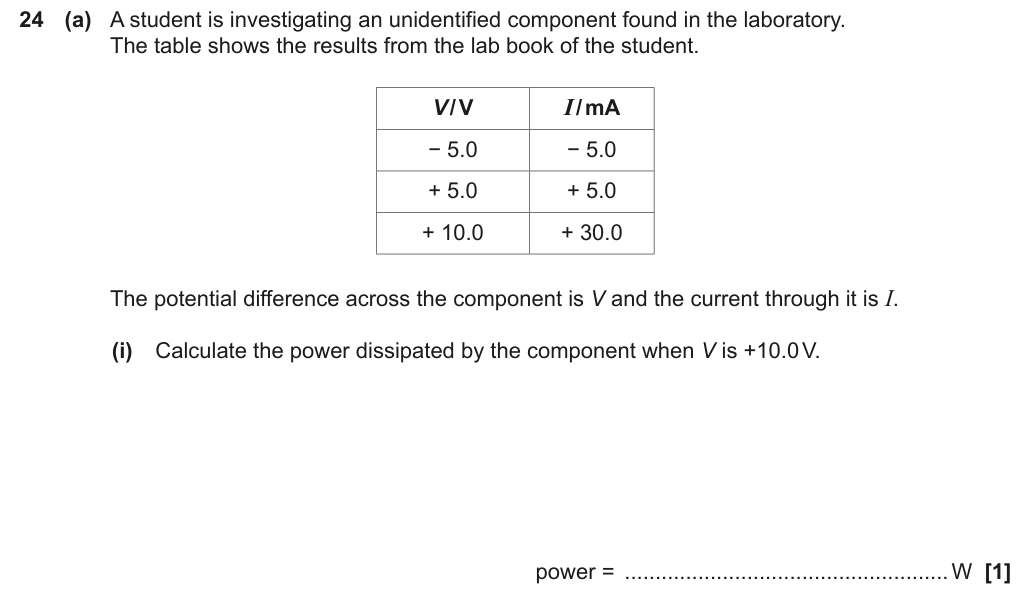
24(a)(i) Electrical power and energy 1Calculation
24(a)(ii) E.m.f., p.d., resistance and I–V characteristics, Resistivity 3Practical and data analysis
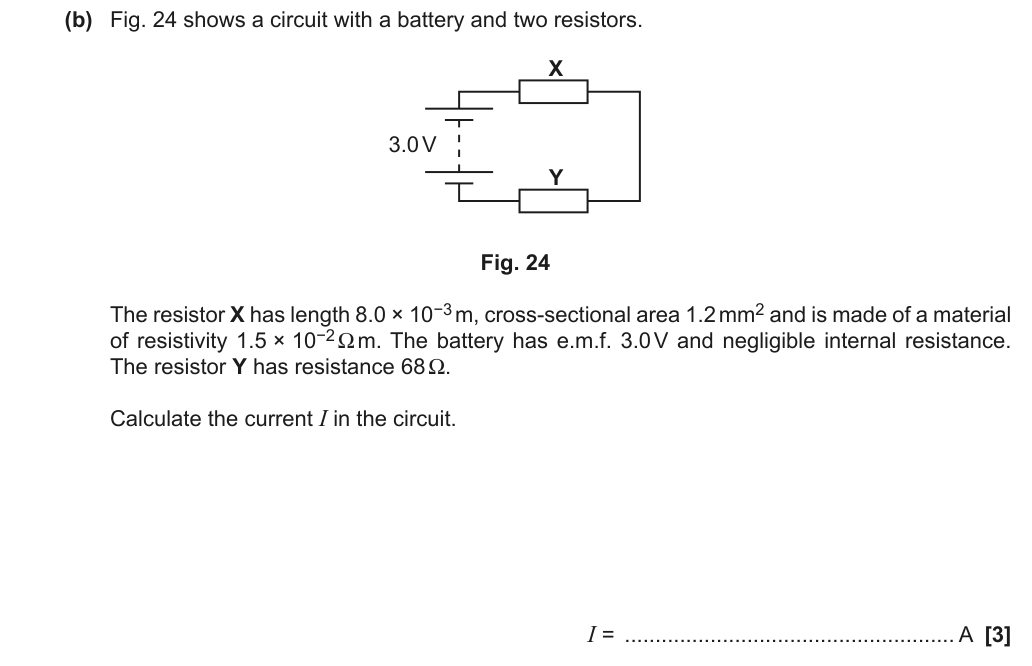
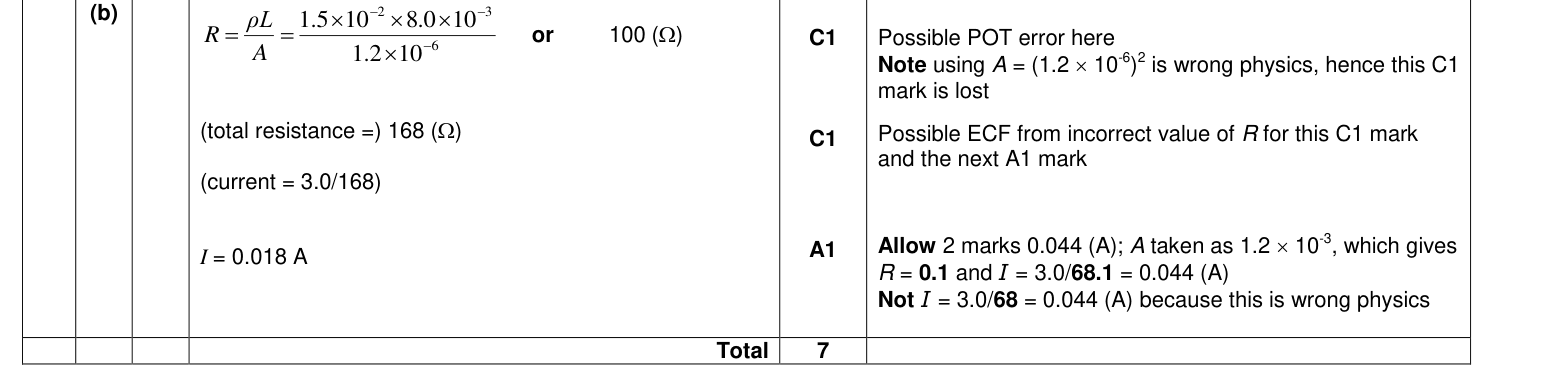
24(b) Resistivity, E.m.f., p.d., resistance and I–V characteristics, Series and parallel circuits: Kirchhoff's laws 3Calculation
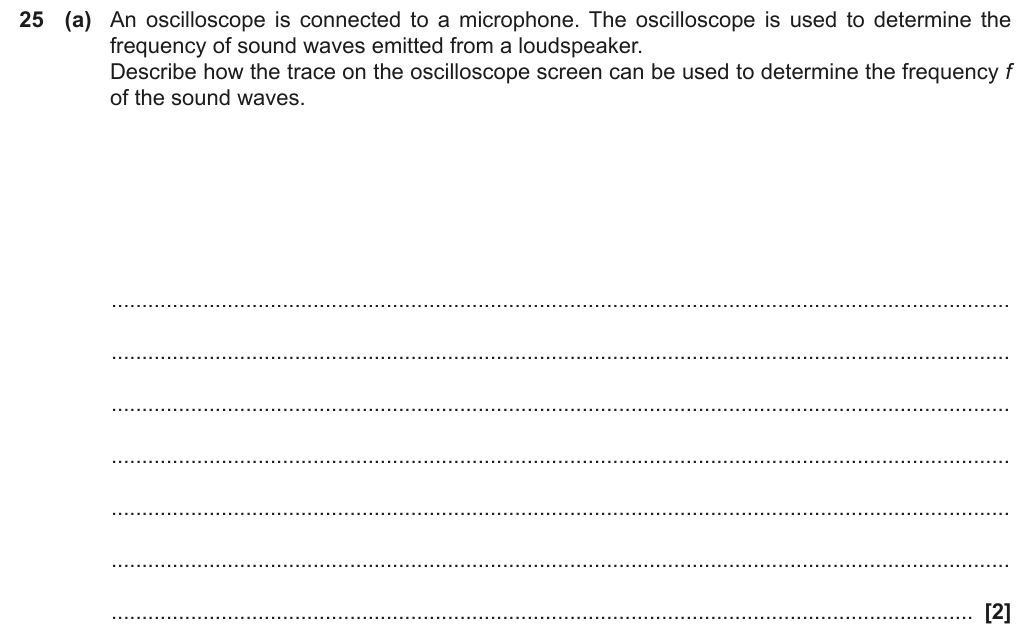
25(a) Wave motion: progressive waves, the wave equation and intensity 2Explanation
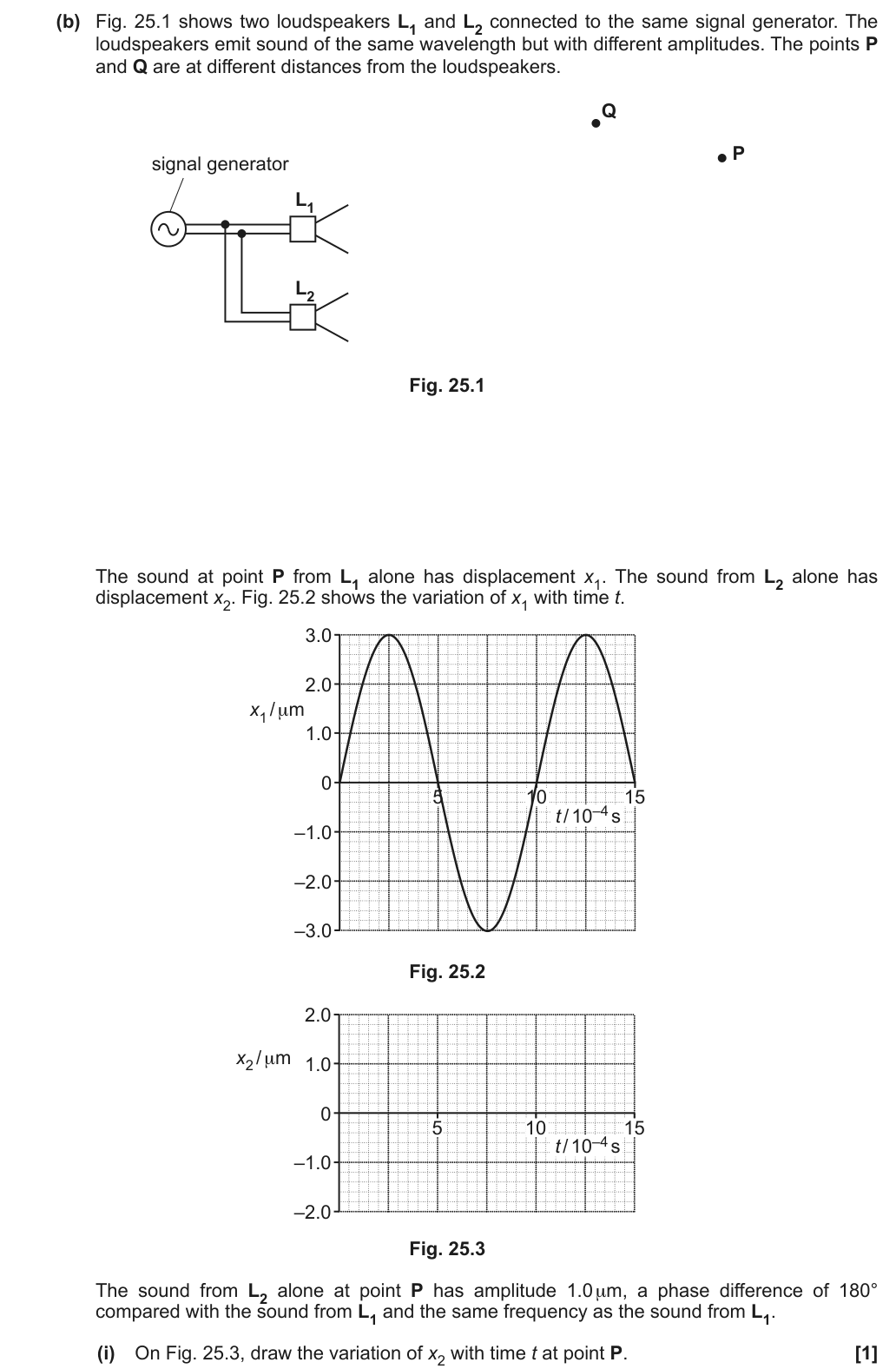
25(b)(i) Wave motion: progressive waves, the wave equation and intensity 1Diagram or graph
25(b)(ii) Wave motion: progressive waves, the wave equation and intensity, Superposition, interference and the double slit 2Explanation
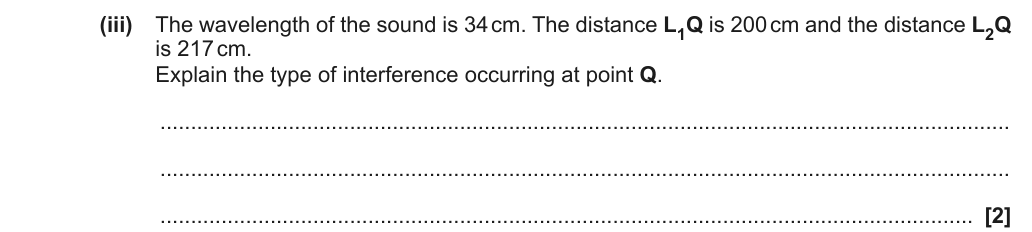
25(b)(iii) Superposition, interference and the double slit 2Explanation
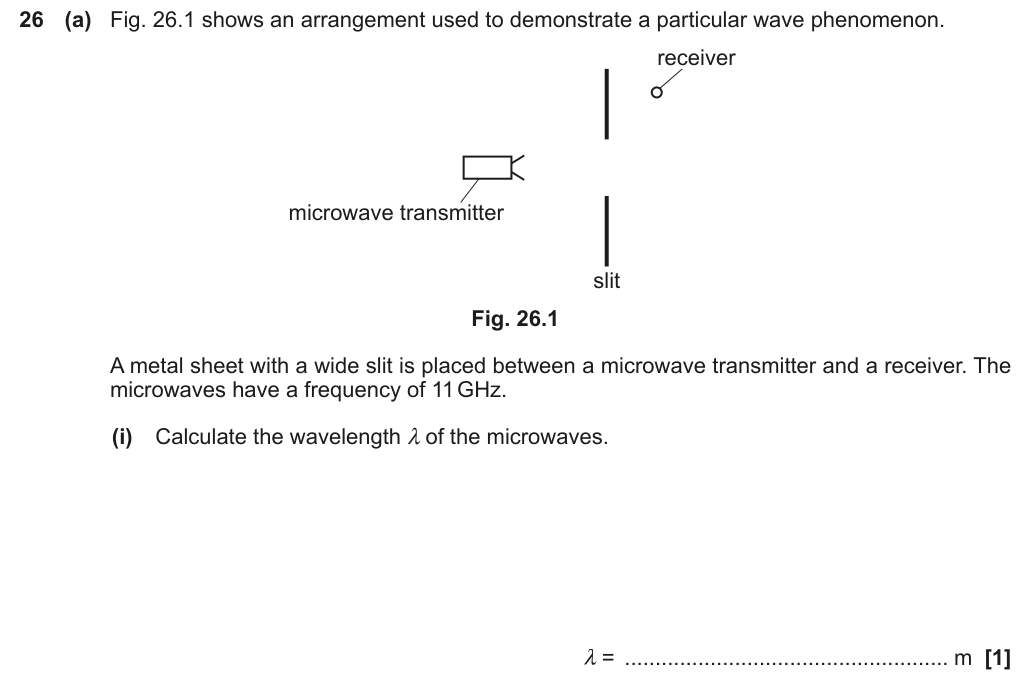
26(a)(i) Wave motion: progressive waves, the wave equation and intensity, Electromagnetic waves, polarisation and refraction 1Calculation
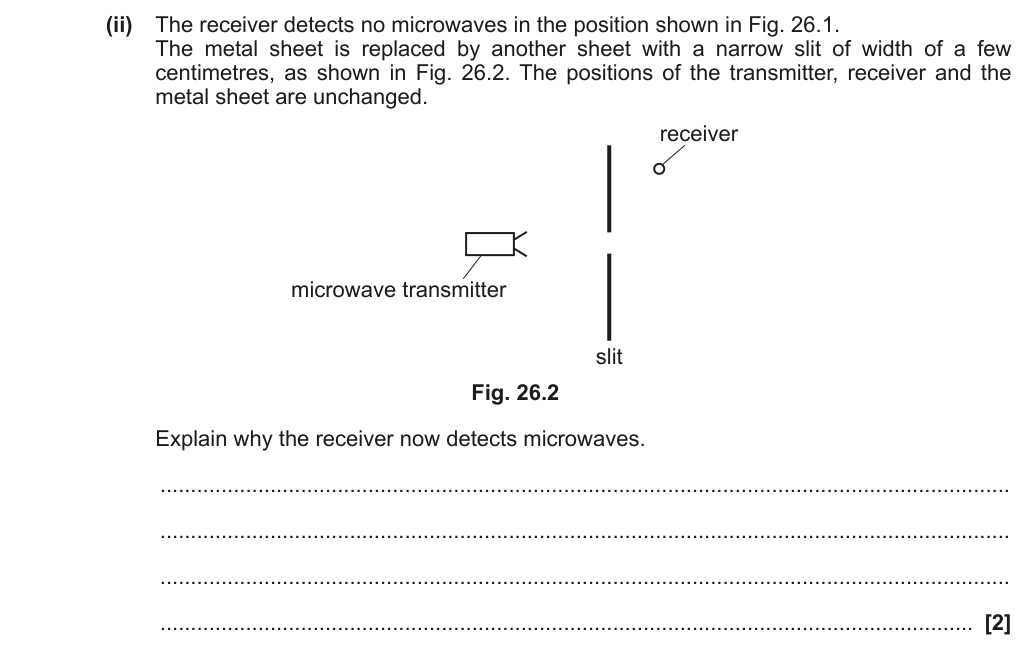
26(a)(ii) Wave motion: progressive waves, the wave equation and intensity 2Explanation
26(b) Electromagnetic waves, polarisation and refraction, Wave motion: progressive waves, the wave equation and intensity 3Explanation
26(c) Electromagnetic waves, polarisation and refraction, Practical skills: planning, analysis and evaluation 3Explanation
27(a) Electromagnetic waves, polarisation and refraction 1Short answer
27(b)(i) Wave motion: progressive waves, the wave equation and intensity 2Show that
27(b)(ii) Photons and the Planck constant 2Calculation
27(b)(iii) Photons and the Planck constant 1Calculation

The questions

123456789101112131415161718192021(a)21(b)(i)21(b)(ii)22(a)22(b)22(c)22(d)23(a)23(b)23(c)24(a)(i)24(a)(ii)24(b)25(a)25(b)(i)25(b)(ii)25(b)(iii)26(a)(i)26(a)(ii)26(b)26(c)27(a)27(b)(i)27(b)(ii)27(b)(iii)
June 2018 · AS Paper 1 · Q1 1 mark Multiple choice Easy kinematics
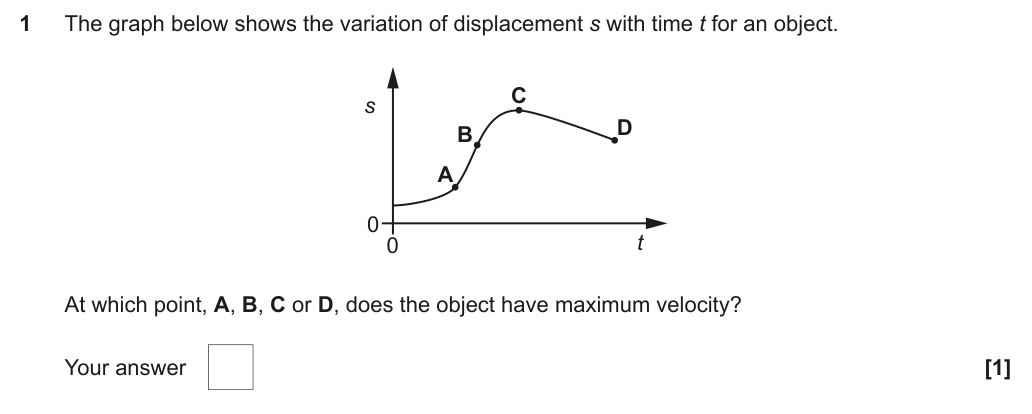
1 The graph below shows the variation of displacement s with time t for an object.
C
s
B D
A
0
0 t
At which point, A, B, C or D, does the object have maximum velocity?
Your answer [1]
June 2018 · AS Paper 1 · Q2 1 mark Multiple choice emf pd and resistancequantities and units
2 Which definition is correct and uses only quantities rather than units?
A Acceleration is the change in velocity per second.
B Resistance is potential difference per ampere.
C Intensity is energy per unit cross-sectional area.
D Electromotive force is energy transferred per unit charge.
Your answer [1]
June 2018 · AS Paper 1 · Q3 1 mark Multiple choice Medium scalars and vectorsdynamics and terminal velocity
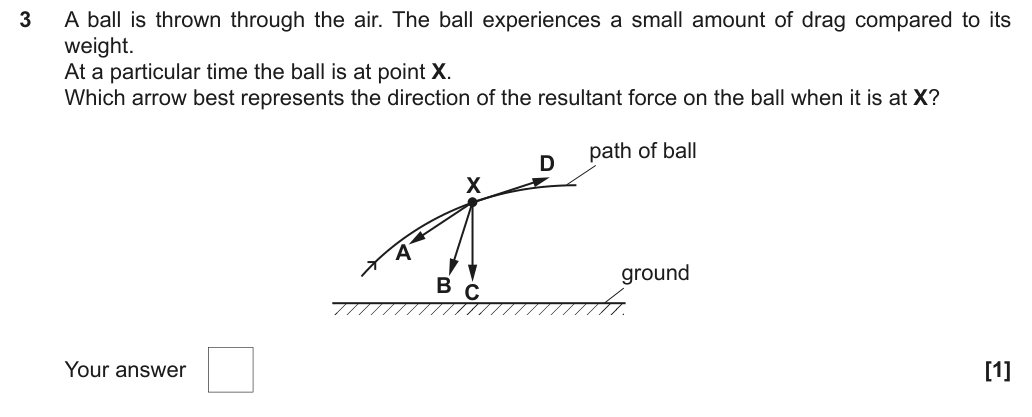
3 A ball is thrown through the air. The ball experiences a small amount of drag compared to its
weight.
At a particular time the ball is at point X.
Which arrow best represents the direction of the resultant force on the ball when it is at X?
path of ball
D
X
A
ground
B C
Your answer [1]
June 2018 · AS Paper 1 · Q4 1 mark Multiple choice Medium collisionsnewtons laws and momentum
4 An object P is travelling to the right with a momentum of 40 kg m s−1. It collides with another object
Q travelling to the left along the same path.
The final momentum of P is 10 kg m s−1 to the right.
What is the change in the momentum of Q?
A 0 kg m s−1
B 10 kg m s−1
C 30 kg m s−1
D 50 kg m s−1
Your answer [1]
June 2018 · AS Paper 1 · Q5 1 mark Multiple choice resistivity
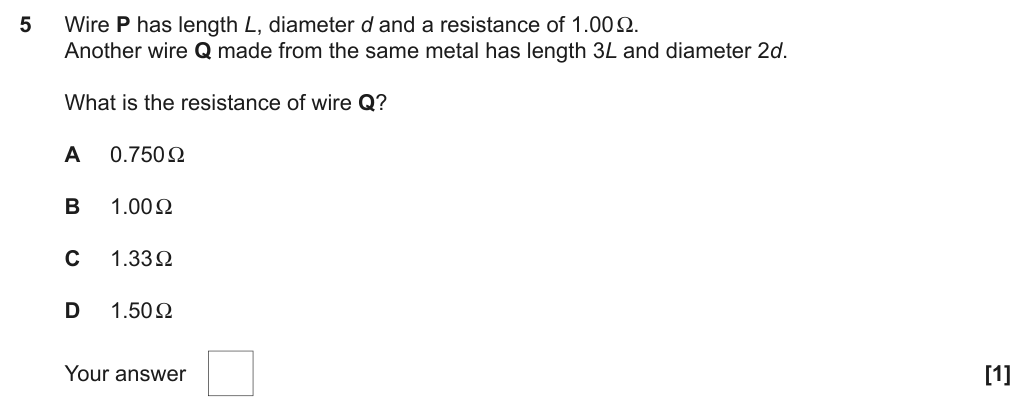
5 Wire P has length L, diameter d and a resistance of 1.00 Ω.
Another wire Q made from the same metal has length 3L and diameter 2d.
What is the resistance of wire Q?
A 0.750 Ω
B 1.00 Ω
C 1.33 Ω
D 1.50 Ω
Your answer [1]
June 2018 · AS Paper 1 · Q6 1 mark Multiple choice Medium electrical powerseries and parallel circuits
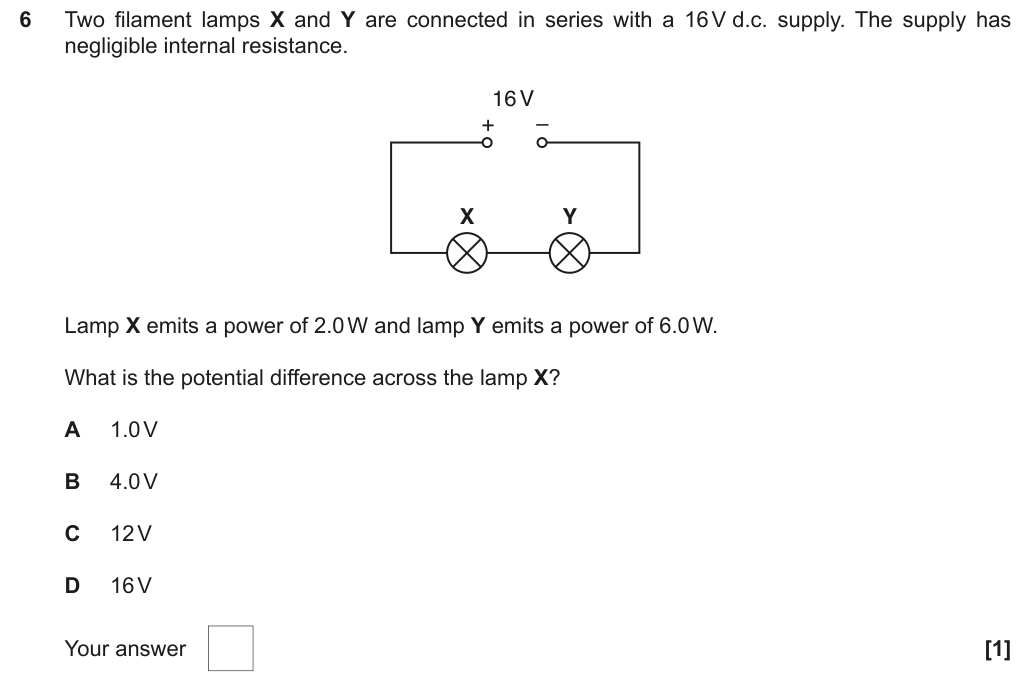
6 Two filament lamps X and Y are connected in series with a 16 V d.c. supply. The supply has
negligible internal resistance.
16 V
+ –
X Y
Lamp X emits a power of 2.0 W and lamp Y emits a power of 6.0 W.
What is the potential difference across the lamp X?
A 1.0 V
B 4.0 V
C 12 V
D 16 V
Your answer [1]
June 2018 · AS Paper 1 · Q7 1 mark Multiple choice internal resistanceemf pd and resistanceseries and parallel circuits
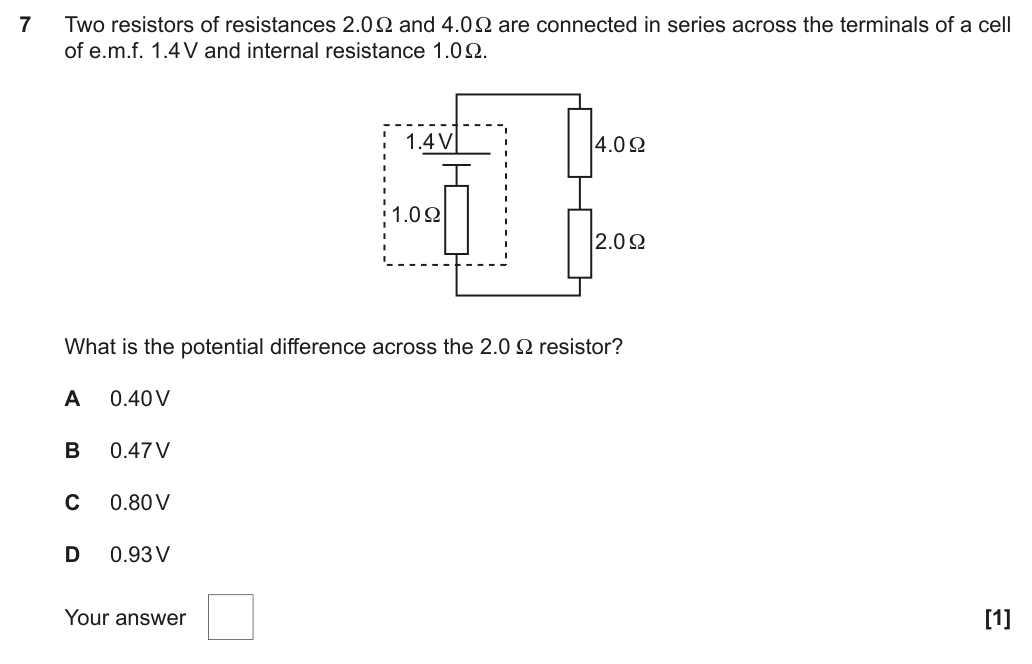
7 Two resistors of resistances 2.0 Ω and 4.0 Ω are connected in series across the terminals of a cell
of e.m.f. 1.4 V and internal resistance 1.0 Ω.
1.4 V 4.0 Ω
1.0 Ω
2.0 Ω
What is the potential difference across the 2.0  Ω resistor?
A 0.40 V
B 0.47 V
C 0.80 V
D 0.93 V
Your answer [1]
June 2018 · AS Paper 1 · Q8 1 mark Multiple choice Hard measurements and uncertainties
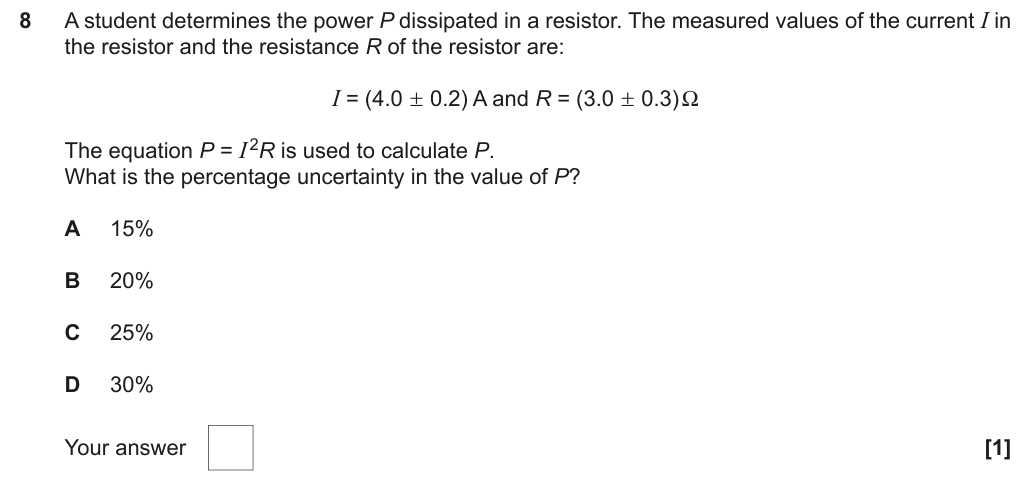
8 A student determines the power P dissipated in a resistor. The measured values of the current I in
the resistor and the resistance R of the resistor are:
I = (4.0 ! 0.2) A and R = (3.0 ! 0.3) Ω
The equation P = I 2R is used to calculate P.
What is the percentage uncertainty in the value of P?
A 15%
B 20%
C 25%
D 30%
Your answer [1]
June 2018 · AS Paper 1 · Q9 1 mark Multiple choice Hard equilibrium and moments
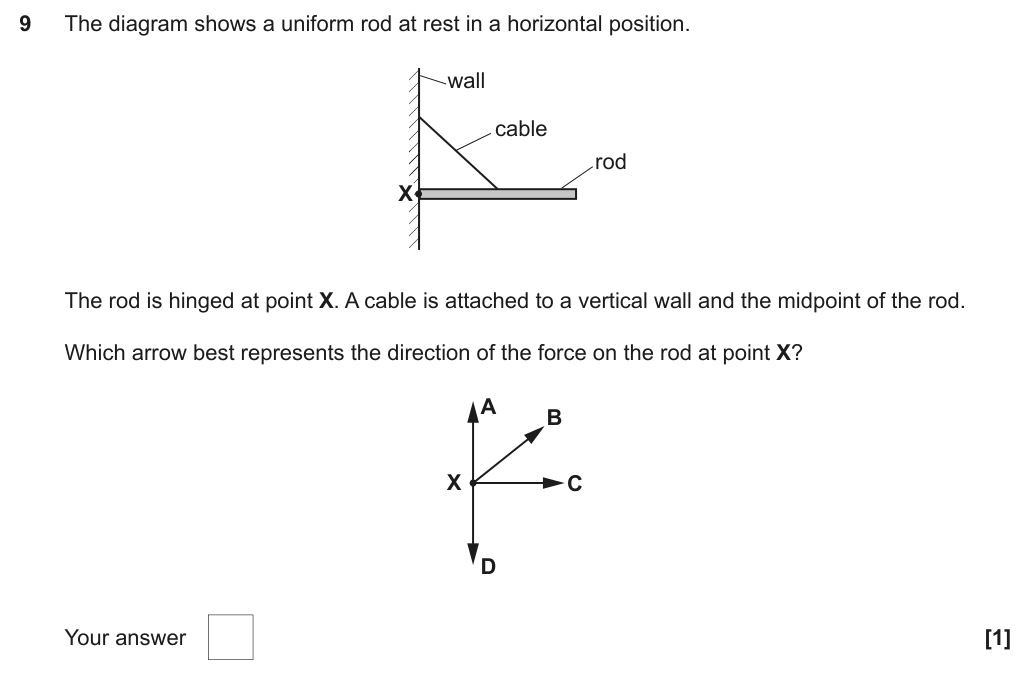
9 The diagram shows a uniform rod at rest in a horizontal position.
wall
cable
rod
X
The rod is hinged at point X. A cable is attached to a vertical wall and the midpoint of the rod.
Which arrow best represents the direction of the force on the rod at point X?
A
B
X C
D
Your answer [1]
June 2018 · AS Paper 1 · Q10 1 mark Multiple choice Medium linear motionkinematics
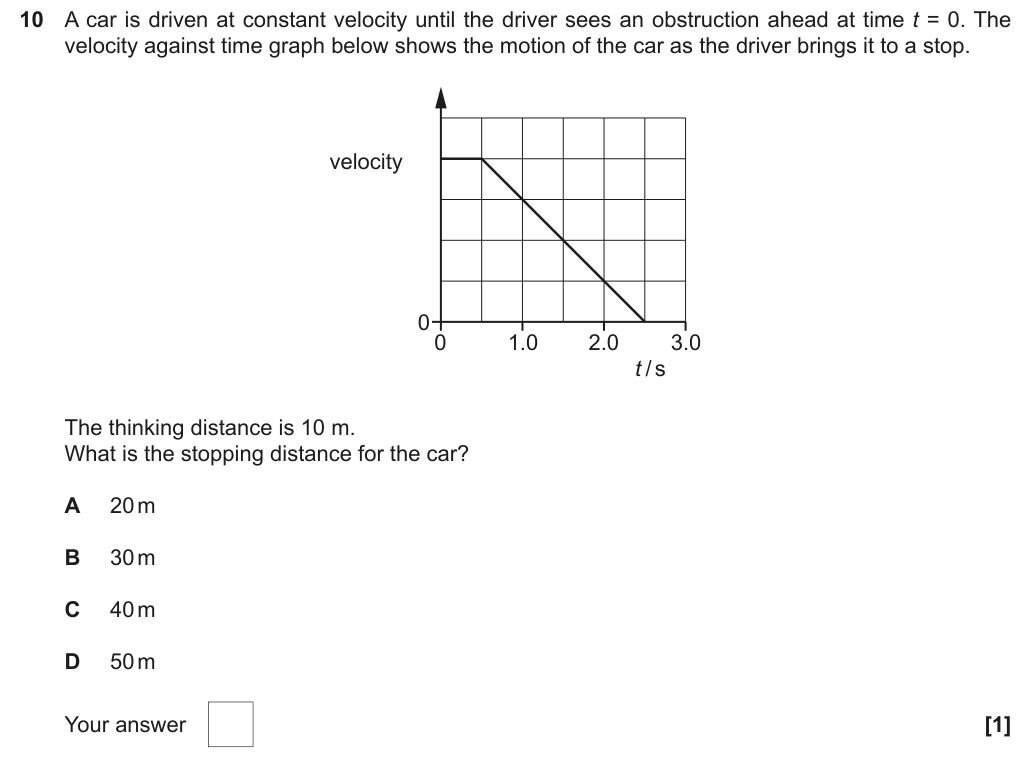
10 A car is driven at constant velocity until the driver sees an obstruction ahead at time t = 0. The
velocity against time graph below shows the motion of the car as the driver brings it to a stop.
velocity
0
0 1.0 2.0 3.0
t / s
The thinking distance is 10 m.
What is the stopping distance for the car?
A 20 m
B 30 m
C 40 m
D 50 m
Your answer [1]
June 2018 · AS Paper 1 · Q11 1 mark Multiple choice Medium newtons laws and momentum
11 A javelin thrower exerts a force of 100 N on a javelin for a time of 0.30 s.
The javelin has a mass of 0.80 kg.
What is the rate of change of the momentum of the javelin?
A 24 kg m s−2
B 30 kg m s−2
C 100 kg m s−2
D 125 kg m s−2
Your answer [1]
June 2018 · AS Paper 1 · Q12 1 mark Multiple choice materials and young modulusdynamics and terminal velocity
12 One end of a wire is fixed to the ceiling and a 3.0 kg object is suspended from its other end.
The wire has diameter 0.62 mm and negligible mass.
What is the tensile stress in the wire?
A 1.5 × 10⁴ Pa
B 2.5 × 10⁶ Pa
C 2.4 × 10⁷ Pa
D 9.7 × 10⁷ Pa
Your answer [1]
June 2018 · AS Paper 1 · Q13 1 mark Multiple choice emf pd and resistancecharge and current
13 The intensity of light incident on a light-dependent resistor (LDR) is increased. Its resistance
decreases.
Which statement gives the correct reason for this behaviour?
A The cross-sectional area of the LDR decreases.
B The mean drift velocity of the charge carriers decreases.
C The number density of the charge carriers increases.
D The magnitude of the charge on the charge carriers increases.
Your answer [1]
June 2018 · AS Paper 1 · Q14 1 mark Multiple choice photonsemf pd and resistance
14 The total energy gained by 20 electrons travelling through a potential difference V is 30 keV.
What is the potential difference V?
A 1.5 V
B 3.0 V
C 1500 V
D 3000 V
Your answer [1]
June 2018 · AS Paper 1 · Q15 1 mark Multiple choice newtons laws and momentum
15 A trolley of mass 1.0 kg is moving on a horizontal surface at a constant velocity of 2.0 m s−1. A force
of 3.0 N is applied to the trolley in the opposite direction to its motion for a time of 1.5 s and then
the force is removed.
What is the magnitude of the final momentum of the trolley?
A 2.0 kg m s−1
B 2.5 kg m s−1
C 4.5 kg m s−1
D 6.5 kg m s−1
Your answer [1]
June 2018 · AS Paper 1 · Q16 1 mark Multiple choice charge and current
16 The current at a point in a circuit is 10 mA.
Expressed to the nearest power of ten, how many electrons pass the point in 10 s?
A 102
B 1015
C 1018
D 1021
Your answer [1]
June 2018 · AS Paper 1 · Q17 1 mark Multiple choice Medium photoelectric effect
17 Electromagnetic radiation is incident on a metal. The radiation has constant wavelength with each
photon having an energy of 5.0 eV. The work function of the metal is 3.0 eV.
Which of the following cannot be the kinetic energy of an emitted photoelectron?
A 0 eV
B 1.0 eV
C 2.0 eV
D 3.0 eV
Your answer [1]
June 2018 · AS Paper 1 · Q18 1 mark Multiple choice superposition and interference
18 The waves emitted from two sources are coherent.
Which quantity must be constant for these emitted waves?
A amplitude
B frequency
C intensity
D phase difference
Your answer [1]
June 2018 · AS Paper 1 · Q19 1 mark Multiple choice stationary waves
19 The diagram below shows a stationary wave pattern for a sound wave in a tube. The tube has one
open end and one closed end.
60 cm
The length of the tube is 60 cm.
What is the wavelength of the sound?
A 20 cm
B 40 cm
C 60 cm
D 80 cm
Your answer [1]
June 2018 · AS Paper 1 · Q20 1 mark Multiple choice quantities and units
20 What are the correct base units for work done or energy?
A kg m
B kg m s−2
C kg m2 s−1
D kg m2 s−2
Your answer [1]
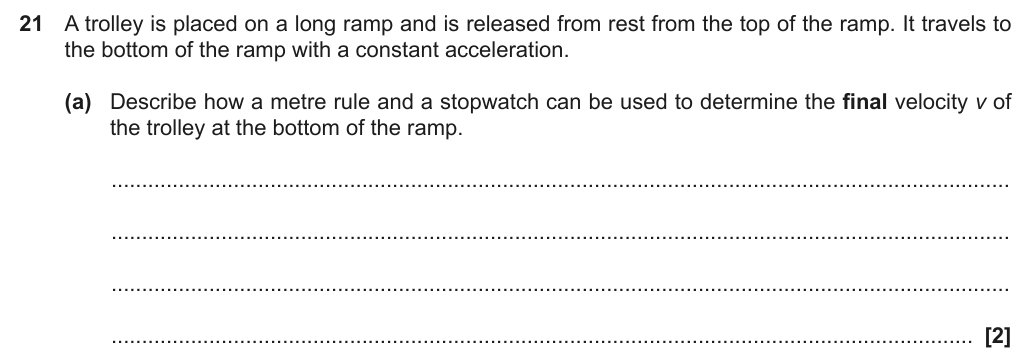
June 2018 · AS Paper 1 · Q21(a) 2 marks Explanation Hard linear motionpractical skills
21 A trolley is placed on a long ramp and is released from rest from the top of the ramp. It travels to
the bottom of the ramp with a constant acceleration.
(a) Describe how a metre rule and a stopwatch can be used to determine the final velocity v of
the trolley at the bottom of the ramp.
...................................................................................................................................................
...................................................................................................................................................
...................................................................................................................................................
............................................................................................................................................. [2]
June 2018 · AS Paper 1 · Q21(b)(i) 2 marks Calculation Medium linear motion
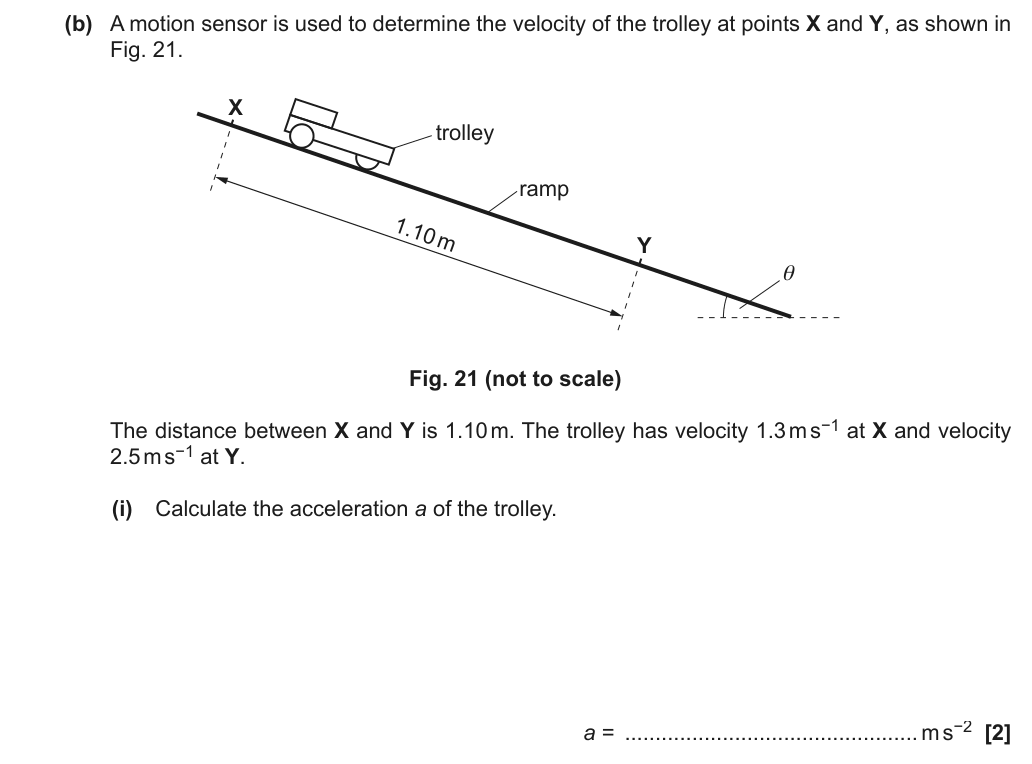
(b) A motion sensor is used to determine the velocity of the trolley at points X and Y, as shown in
Fig. 21.
X
trolley
ramp
1.10 m
Y
θ
Fig. 21 (not to scale)
The distance between X and Y is 1.10 m. The trolley has velocity 1.3 m s−1 at X and velocity
2.5 m s−1 at Y.
(i) Calculate the acceleration a of the trolley.
a =  ................................................ m s−2  [2]
June 2018 · AS Paper 1 · Q21(b)(ii) 2 marks Calculation scalars and vectors
Earlier part of question 21 that this part usesEarlier part of June 2018 Paper 1 question 21
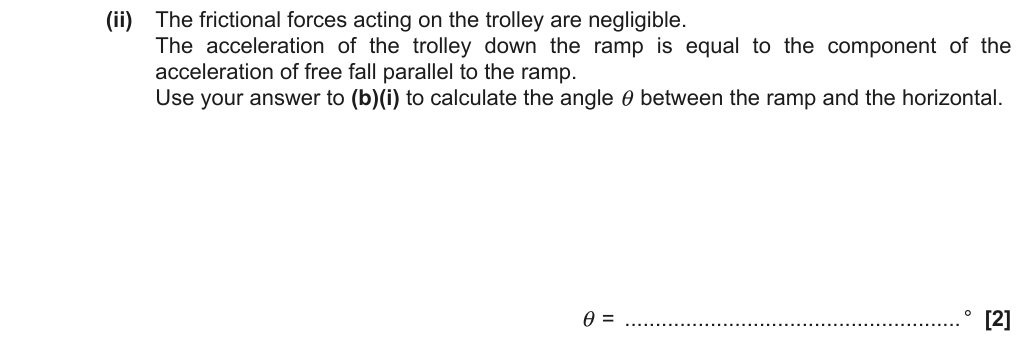
(ii) The frictional forces acting on the trolley are negligible.
The acceleration of the trolley down the ramp is equal to the component of the
acceleration of free fall parallel to the ramp.
Use your answer to (b)(i) to calculate the angle θ  between the ramp and the horizontal.
θ  =  ....................................................... °  [2]
June 2018 · AS Paper 1 · Q22(a) 2 marks Explanation Hard equilibrium and moments
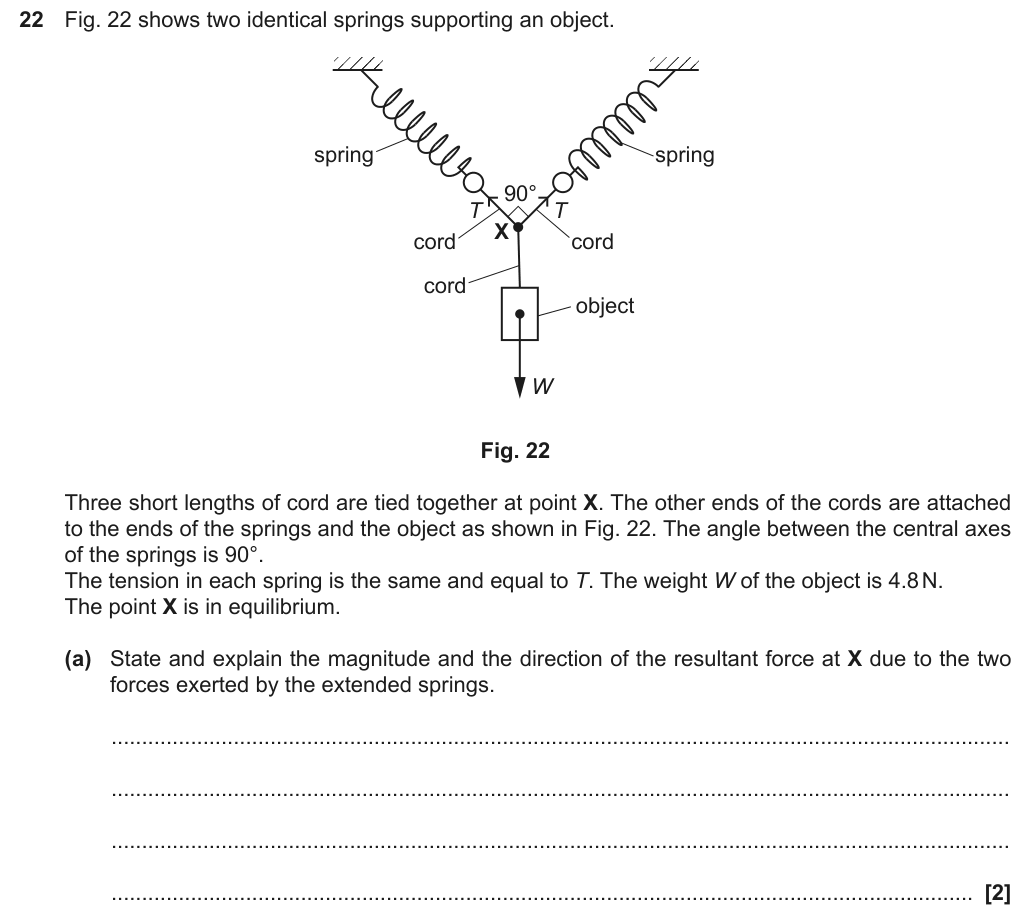
22 Fig. 22 shows two identical springs supporting an object.
spring spring
90°
T T
X
cord cord
cord
object
W
Fig. 22
Three short lengths of cord are tied together at point X. The other ends of the cords are attached
to the ends of the springs and the object as shown in Fig. 22. The angle between the central axes
of the springs is 90°.
The tension in each spring is the same and equal to T. The weight W of the object is 4.8 N.
The point X is in equilibrium.
(a) State and explain the magnitude and the direction of the resultant force at X due to the two
forces exerted by the extended springs.
...................................................................................................................................................
...................................................................................................................................................
...................................................................................................................................................
............................................................................................................................................. [2]
June 2018 · AS Paper 1 · Q22(b) 2 marks Diagram or graph Hard equilibrium and momentsscalars and vectors
Earlier part of question 22 that this part usesEarlier part of June 2018 Paper 1 question 22
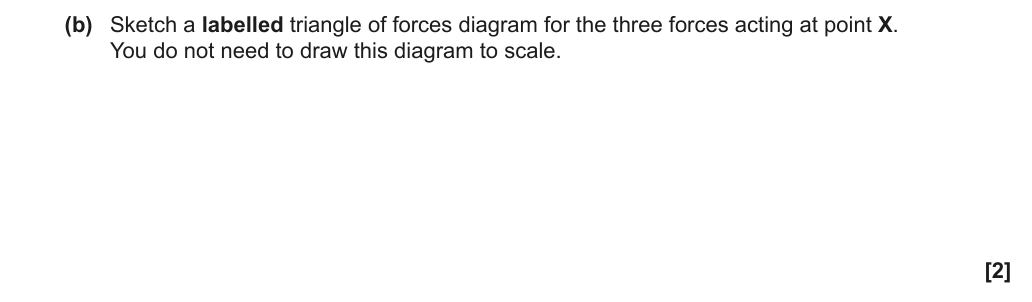
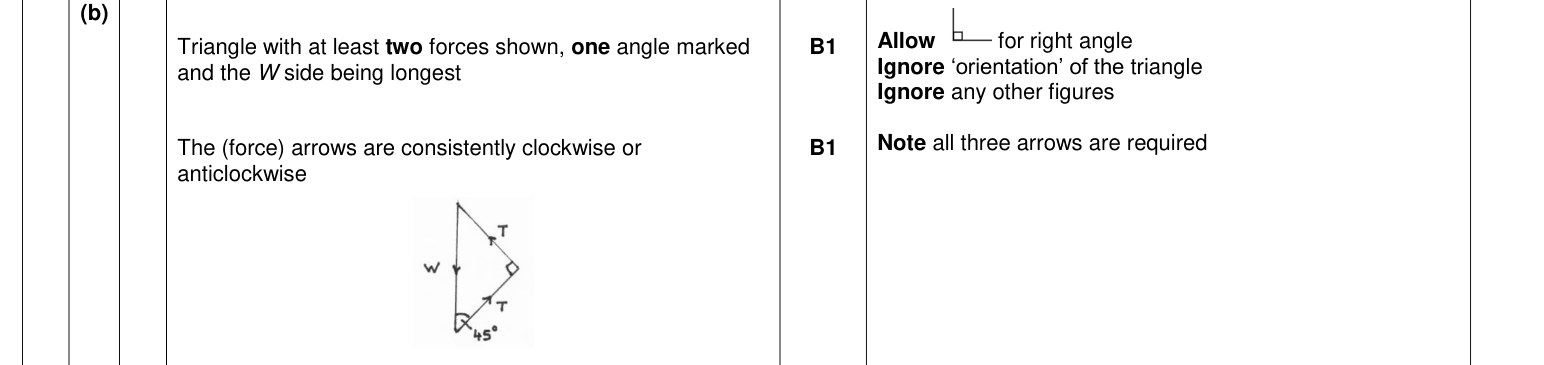
(b) Sketch a labelled triangle of forces diagram for the three forces acting at point X.
You do not need to draw this diagram to scale.
[2]
June 2018 · AS Paper 1 · Q22(c) 2 marks Show that Hard scalars and vectorsequilibrium and moments
Earlier part of question 22 that this part usesEarlier part of June 2018 Paper 1 question 22
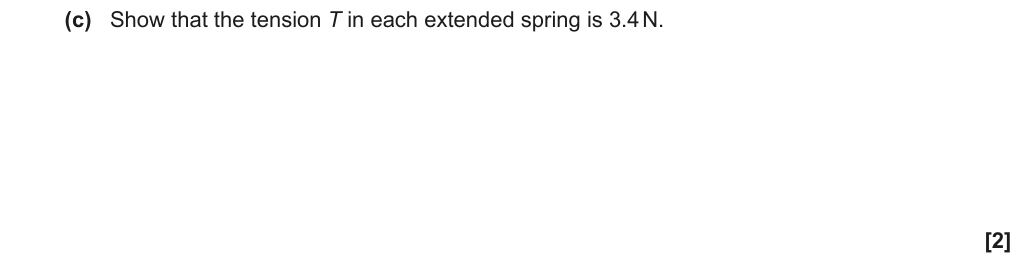
(c) Show that the tension T in each extended spring is 3.4 N.
[2]
June 2018 · AS Paper 1 · Q22(d) 2 marks Calculation materials and young modulussprings
Earlier part of question 22 that this part usesEarlier part of June 2018 Paper 1 question 22
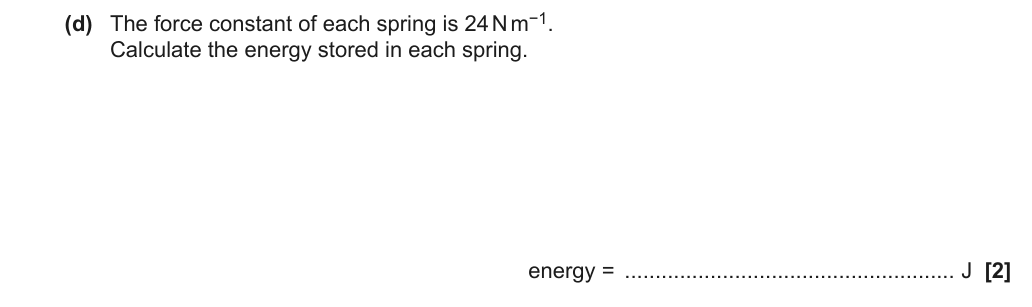
(d) The force constant of each spring is 24 N m−1.
Calculate the energy stored in each spring.
energy =  ...................................................... J  [2]
June 2018 · AS Paper 1 · Q23(a) 3 marks Explanation Hard density and pressuredynamics and terminal velocityequilibrium and moments
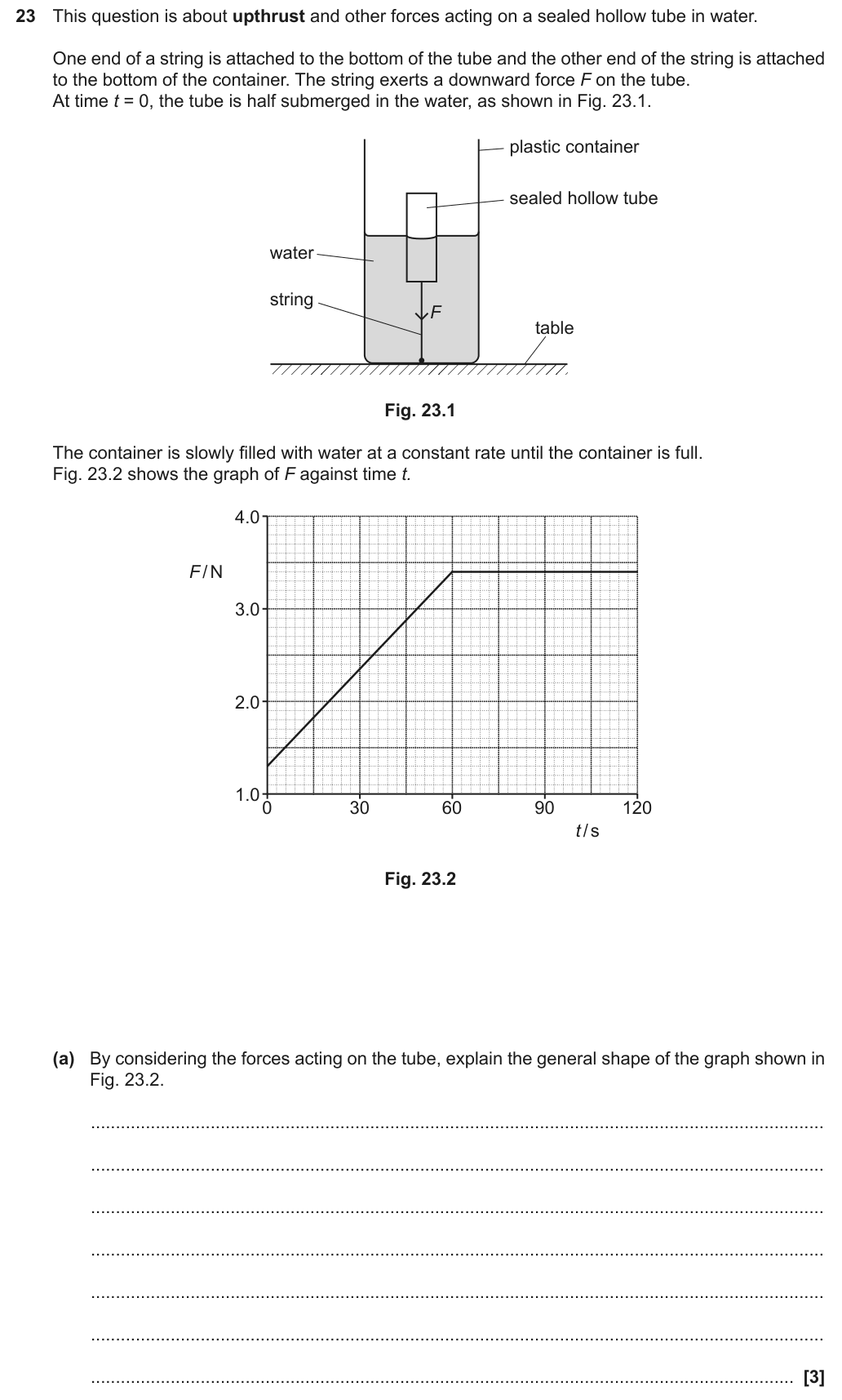
23 This question is about upthrust and other forces acting on a sealed hollow tube in water.
One end of a string is attached to the bottom of the tube and the other end of the string is attached
to the bottom of the container. The string exerts a downward force F on the tube.
At time t = 0, the tube is half submerged in the water, as shown in Fig. 23.1.
plastic container
sealed hollow tube
water
string
F
table
Fig. 23.1
The container is slowly filled with water at a constant rate until the container is full.
Fig. 23.2 shows the graph of F against time t.
4.0
F / N
3.0
2.0
1.0
0 30 60 90 120
t / s
Fig. 23.2
(a) By considering the forces acting on the tube, explain the general shape of the graph shown in
Fig. 23.2.
...................................................................................................................................................
...................................................................................................................................................
...................................................................................................................................................
...................................................................................................................................................
...................................................................................................................................................
...................................................................................................................................................
............................................................................................................................................. [3]
June 2018 · AS Paper 1 · Q23(b) 3 marks Calculation Medium dynamics and terminal velocity
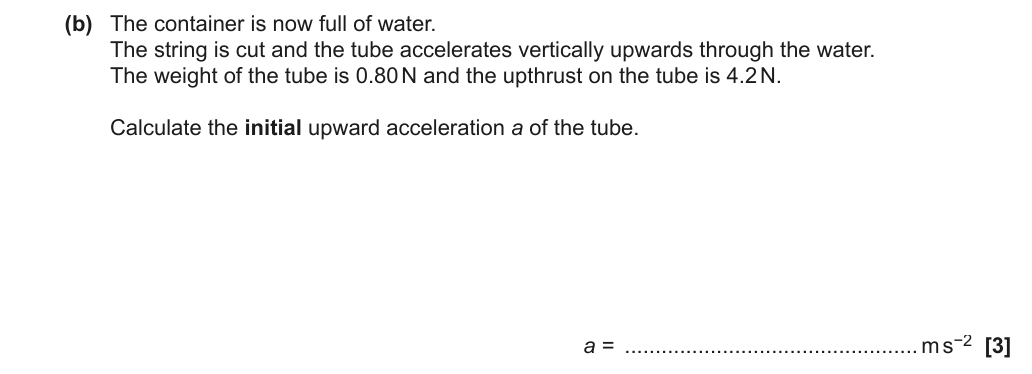
(b) The container is now full of water.
The string is cut and the tube accelerates vertically upwards through the water.
The weight of the tube is 0.80 N and the upthrust on the tube is 4.2 N.
Calculate the initial upward acceleration a of the tube.
a =  ................................................ m s−2  [3]
June 2018 · AS Paper 1 · Q23(c) 1 mark Short answer dynamics and terminal velocity
Earlier part of question 23 that this part usesEarlier part of June 2018 Paper 1 question 23
(c) State why the acceleration of the tube decreases as it travels vertically upwards through the
water.
...................................................................................................................................................
............................................................................................................................................. [1]
June 2018 · AS Paper 1 · Q24(a)(i) 1 mark Calculation Medium electrical power
24 (a) A student is investigating an unidentified component found in the laboratory.
The table shows the results from the lab book of the student.
V / V I / mA
− 5.0 − 5.0
+ 5.0 + 5.0
+ 10.0 + 30.0
The potential difference across the component is V and the current through it is I.
(i) Calculate the power dissipated by the component when V is +10.0 V.
power =  ..................................................... W  [1]
June 2018 · AS Paper 1 · Q24(a)(ii) 3 marks Practical and data analysis Easy emf pd and resistanceresistivity
Earlier part of question 24 that this part usesEarlier part of June 2018 Paper 1 question 24
(ii) Analyse the data in the table and hence identify the component.
...........................................................................................................................................
...........................................................................................................................................
...........................................................................................................................................
...........................................................................................................................................
...........................................................................................................................................
...........................................................................................................................................
...........................................................................................................................................
..................................................................................................................................... [3]
June 2018 · AS Paper 1 · Q24(b) 3 marks Calculation Hard resistivityemf pd and resistanceseries and parallel circuits
(b) Fig. 24 shows a circuit with a battery and two resistors.
X
3.0 V
Y
Fig. 24
The resistor X has length 8.0 × 10⁻³ m, cross-sectional area 1.2 mm2 and is made of a material
of resistivity 1.5 × 10⁻² Ω m. The battery has e.m.f. 3.0 V and negligible internal resistance.
The resistor Y has resistance 68 Ω.
Calculate the current I in the circuit.
I =  ...................................................... A  [3]
June 2018 · AS Paper 1 · Q25(a) 2 marks Explanation Medium wave motion
25 (a) An oscilloscope is connected to a microphone. The oscilloscope is used to determine the
frequency of sound waves emitted from a loudspeaker.
Describe how the trace on the oscilloscope screen can be used to determine the frequency f
of the sound waves.
...................................................................................................................................................
...................................................................................................................................................
...................................................................................................................................................
...................................................................................................................................................
...................................................................................................................................................
...................................................................................................................................................
............................................................................................................................................. [2]
June 2018 · AS Paper 1 · Q25(b)(i) 1 mark Diagram or graph Medium wave motion
(b) Fig. 25.1 shows two loudspeakers L1 and L2 connected to the same signal generator. The
loudspeakers emit sound of the same wavelength but with different amplitudes. The points P
and Q are at different distances from the loudspeakers.
Q
P
signal generator
L1
L2
Fig. 25.1
The sound at point P from L1 alone has displacement x1. The sound from L2 alone has
displacement x2. Fig. 25.2 shows the variation of x1 with time t.
3.0
2.0
x1 / μm
1.0
0
5 10 15
t / 10–4 s
–1.0
–2.0
–3.0
Fig. 25.2
2.0
x2 / μm
1.0
0
5 10 15
t / 10–4 s
–1.0
–2.0
Fig. 25.3
The sound from L2 alone at point P has amplitude 1.0 μm, a phase difference of 180°
compared with the sound from L1 and the same frequency as the sound from L1.
(i) On Fig. 25.3, draw the variation of x2 with time t at point P. [1]
June 2018 · AS Paper 1 · Q25(b)(ii) 2 marks Explanation Medium wave motionsuperposition and interference
Earlier part of question 25 that this part usesEarlier part of June 2018 Paper 1 question 25
(ii) Explain why the intensity at P due to the sound from both L1 and L2 is not the same as
the intensity of the sound at P from only L1.
...........................................................................................................................................
...........................................................................................................................................
...........................................................................................................................................
..................................................................................................................................... [2]
June 2018 · AS Paper 1 · Q25(b)(iii) 2 marks Explanation Medium superposition and interference
Earlier part of question 25 that this part usesEarlier part of June 2018 Paper 1 question 25
(iii) The wavelength of the sound is 34 cm. The distance L1Q is 200 cm and the distance L2Q
is 217 cm.
Explain the type of interference occurring at point Q.
...........................................................................................................................................
...........................................................................................................................................
..................................................................................................................................... [2]
June 2018 · AS Paper 1 · Q26(a)(i) 1 mark Calculation Easy wave motionelectromagnetic waves and refraction
26 (a) Fig. 26.1 shows an arrangement used to demonstrate a particular wave phenomenon.
receiver
microwave transmitter
slit
Fig. 26.1
A metal sheet with a wide slit is placed between a microwave transmitter and a receiver. The
microwaves have a frequency of 11 GHz.
(i) Calculate the wavelength λ of the microwaves.
λ =  ..................................................... m  [1]
June 2018 · AS Paper 1 · Q26(a)(ii) 2 marks Explanation wave motion
Earlier part of question 26 that this part usesEarlier part of June 2018 Paper 1 question 26
(ii) The receiver detects no microwaves in the position shown in Fig. 26.1.
The metal sheet is replaced by another sheet with a narrow slit of width of a few
centimetres, as shown in Fig. 26.2. The positions of the transmitter, receiver and the
metal sheet are unchanged.
receiver
microwave transmitter
slit
Fig. 26.2
Explain why the receiver now detects microwaves.
...........................................................................................................................................
...........................................................................................................................................
...........................................................................................................................................
..................................................................................................................................... [2]
June 2018 · AS Paper 1 · Q26(b) 3 marks Explanation Easy electromagnetic waves and refractionwave motion
(b) Light travels from air to water. The refractive index of water is greater than the refractive index
of air.
Compare the speed, frequency and wavelength of light in air and in water.
...................................................................................................................................................
...................................................................................................................................................
...................................................................................................................................................
...................................................................................................................................................
............................................................................................................................................. [3]
June 2018 · AS Paper 1 · Q26(c) 3 marks Explanation Medium electromagnetic waves and refractionpractical skills
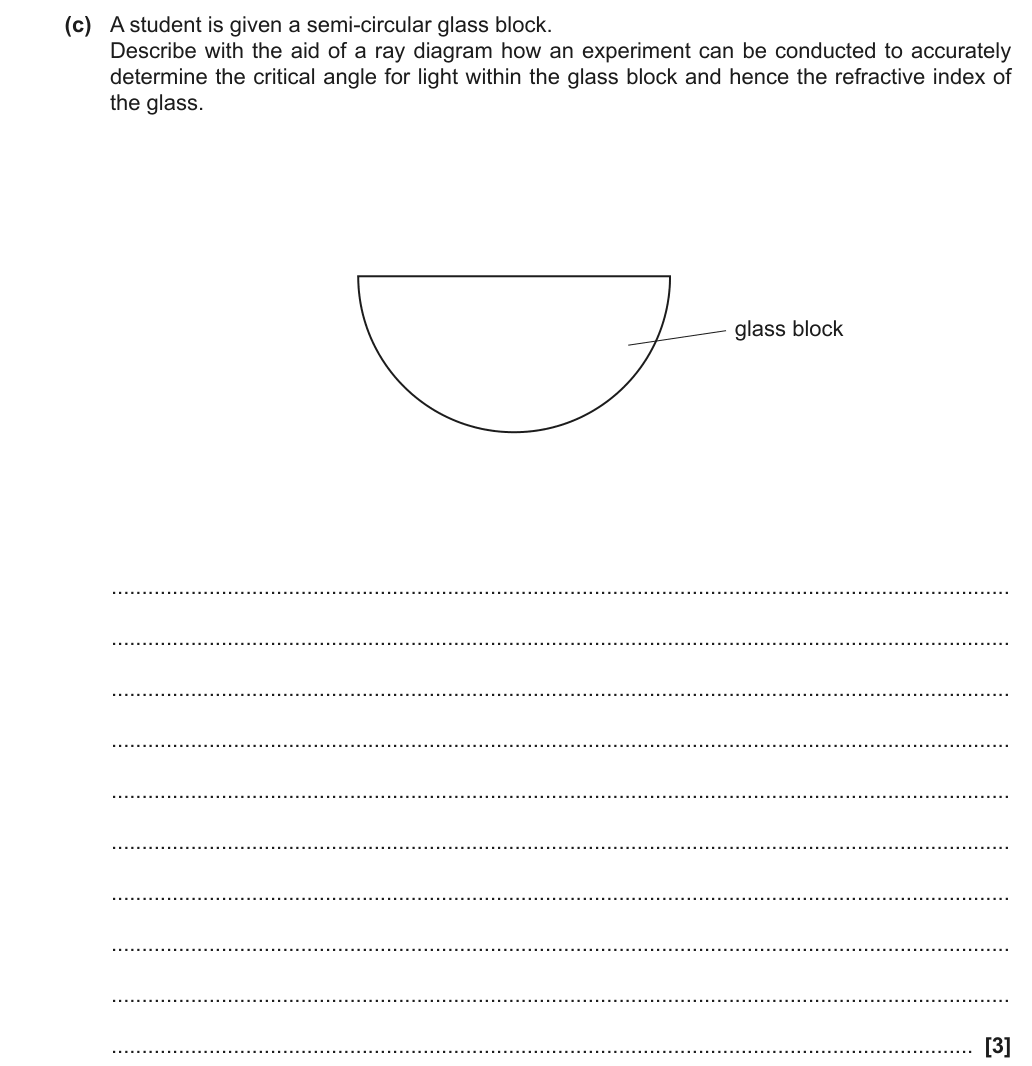
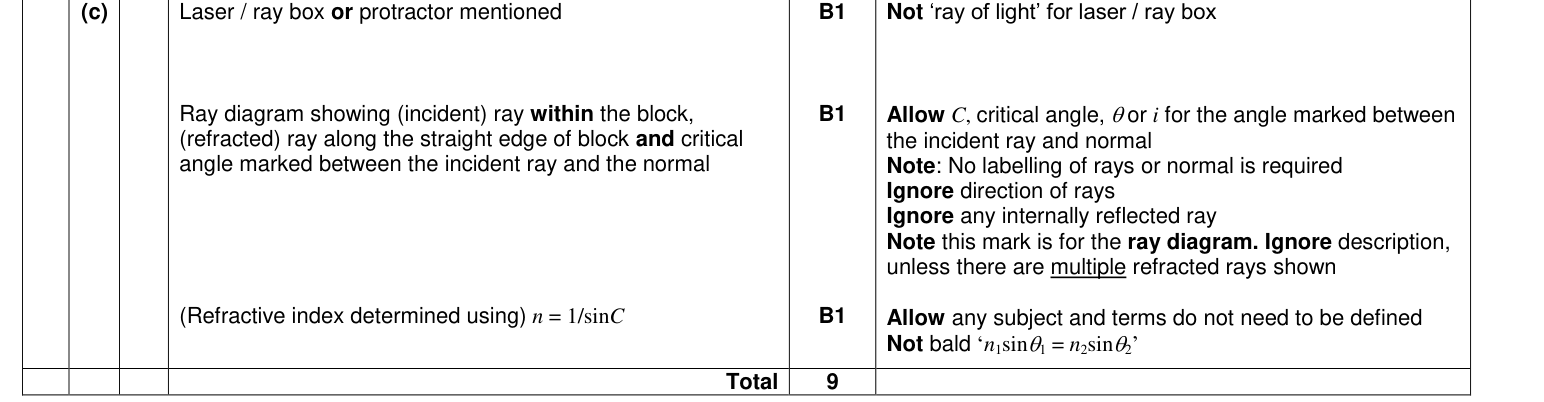
(c) A student is given a semi-circular glass block.
Describe with the aid of a ray diagram how an experiment can be conducted to accurately
determine the critical angle for light within the glass block and hence the refractive index of
the glass.
glass block
...................................................................................................................................................
...................................................................................................................................................
...................................................................................................................................................
...................................................................................................................................................
...................................................................................................................................................
...................................................................................................................................................
...................................................................................................................................................
...................................................................................................................................................
...................................................................................................................................................
............................................................................................................................................. [3]
June 2018 · AS Paper 1 · Q27(a) 1 mark Short answer electromagnetic waves and refraction
27 (a) Radio waves and X-rays are both electromagnetic waves.
State one difference between radio waves and X-rays.
...................................................................................................................................................
............................................................................................................................................. [1]
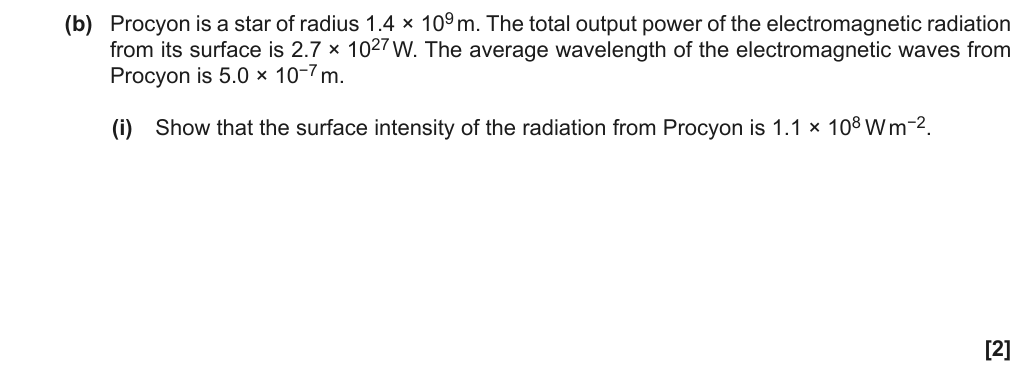
June 2018 · AS Paper 1 · Q27(b)(i) 2 marks Show that Medium wave motion
(b) Procyon is a star of radius 1.4 × 10⁹ m. The total output power of the electromagnetic radiation
from its surface is 2.7 × 1027 W. The average wavelength of the electromagnetic waves from
Procyon is 5.0 × 10⁻⁷ m.
(i) Show that the surface intensity of the radiation from Procyon is 1.1 × 10⁸  W m−2.
[2]
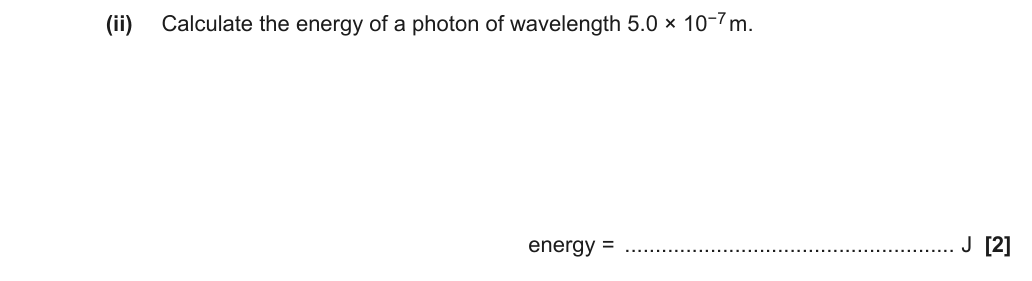
June 2018 · AS Paper 1 · Q27(b)(ii) 2 marks Calculation Medium photons
Earlier part of question 27 that this part usesEarlier part of June 2018 Paper 1 question 27
(ii)  Calculate the energy of a photon of wavelength 5.0 × 10⁻⁷ m.
energy =  ...................................................... J  [2]
June 2018 · AS Paper 1 · Q27(b)(iii) 1 mark Calculation Medium photons
Earlier parts of question 27 that this part usesEarlier part of June 2018 Paper 1 question 27Earlier part of June 2018 Paper 1 question 27
(iii) Estimate the total number of photons emitted per second from the surface of Procyon.
number per second =  ................................................... s−1  [1]

Work with an OCR physics tutor

Want a paper marked and gone through with you? Message us.

Prefer email? Send an enquiry

If you are under 18, please include a parent's contact details. Enquiries go to enquiries@physicsaleveltutor.com and are deleted once handled. All tutoring is online.