June 2019: AS Paper 1, Breadth in physics

70 marks · 42 question parts · Paper, mark scheme and report on OCR's site · Have the Data, Formulae and Relationships Booklet beside you

Question by question

QTopicMarksAOType
1 Charge, current and mean drift velocity, Physical quantities and S.I. units 1Multiple choice
2 Measurements and uncertainties 1Multiple choice
3 Springs and Hooke's law 1Multiple choice
4 Newton's laws of motion and momentum 1Multiple choice
5 Work, energy and power, Equilibrium: moments, couples and centre of mass 1Multiple choice
6 E.m.f., p.d., resistance and I–V characteristics 1Multiple choice
7 Electrical power and energy 1Multiple choice
8 Work, energy and power 1Multiple choice
9 Resistivity 1Multiple choice
10 Potential dividers 1Multiple choice
11 Superposition, interference and the double slit 1Multiple choice
12 Electromagnetic waves, polarisation and refraction 1Multiple choice
13 Work, energy and power 1Multiple choice
14 Electrical power and energy, Physical quantities and S.I. units 1Multiple choice
15 Charge, current and mean drift velocity 1Multiple choice
16 Scalars and vectors 1Multiple choice
17 Physical quantities and S.I. units, Wave motion: progressive waves, the wave equation and intensity 1Multiple choice
18 Linear motion: the suvat equations and free fall 1Multiple choice
19 Electromagnetic waves, polarisation and refraction 1Multiple choice
20 Stationary waves 1Multiple choice
21(a) Equilibrium: moments, couples and centre of mass 1Short answer
21(b)(i) Newton's laws of motion and momentum 1Short answer
21(b)(ii) Newton's laws of motion and momentum 1Short answer
21(c)(i) Scalars and vectors 2Calculation
21(c)(ii) Dynamics, drag and terminal velocity, Equilibrium: moments, couples and centre of mass 2Calculation
21(c)(iii) Mechanical properties of matter: stress, strain and the Young modulus 2Calculation
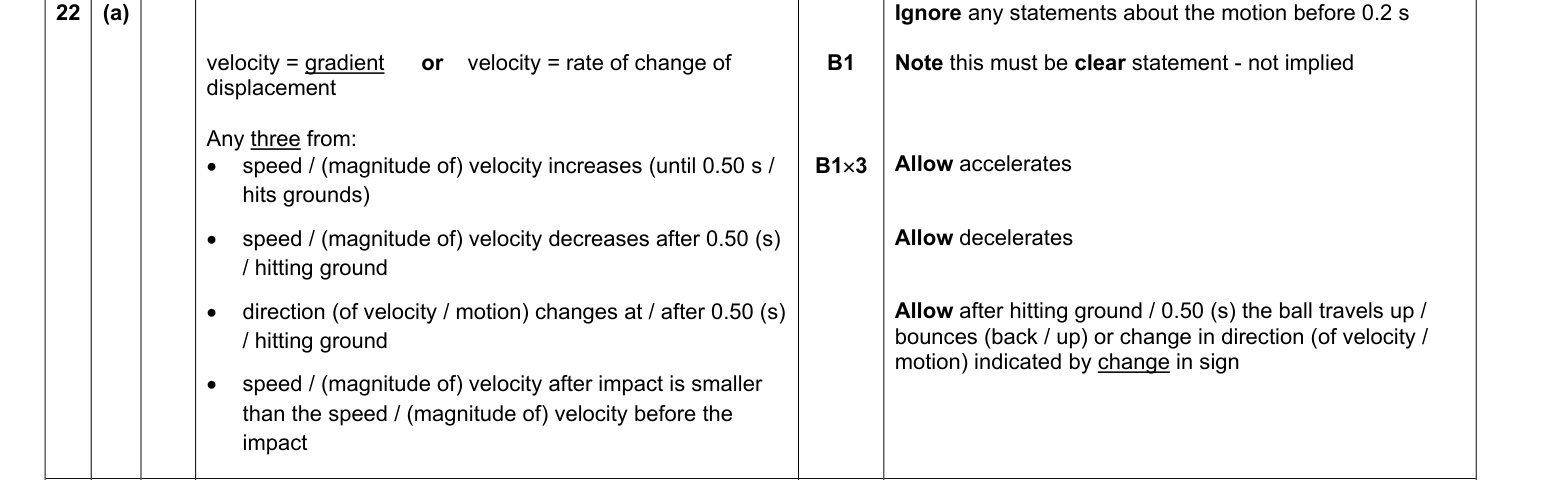
22(a) Kinematics: displacement, velocity and motion graphs 4Explanation
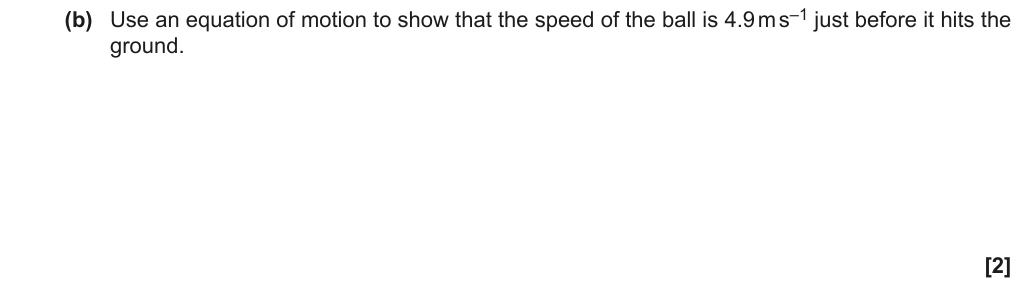
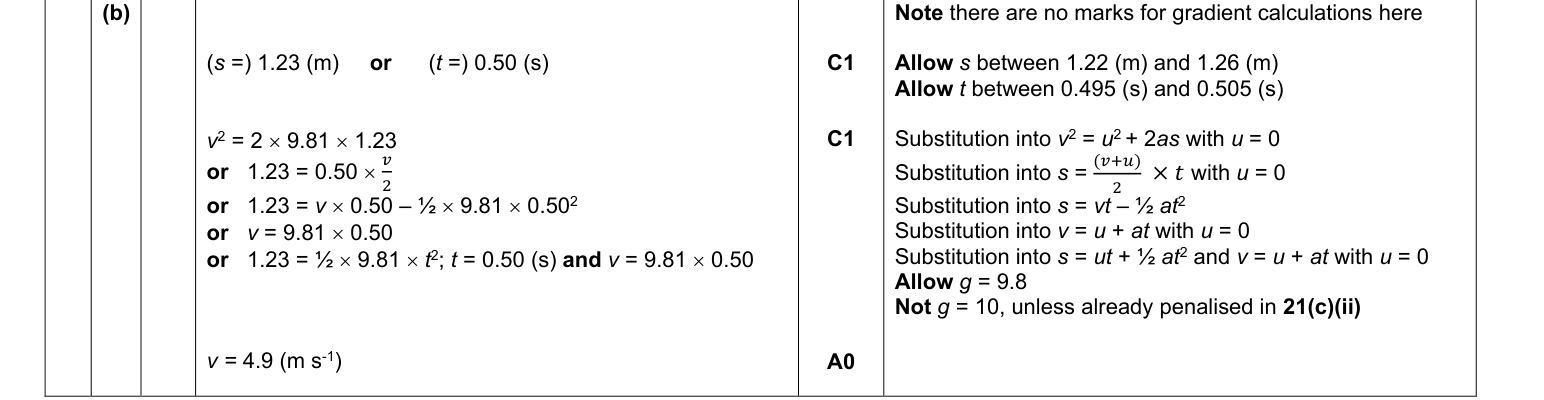
22(b) Linear motion: the suvat equations and free fall 2Show that
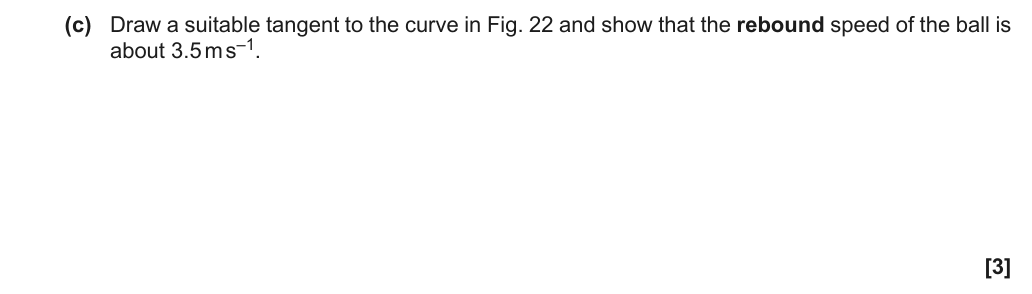
22(c) Kinematics: displacement, velocity and motion graphs 3Show that
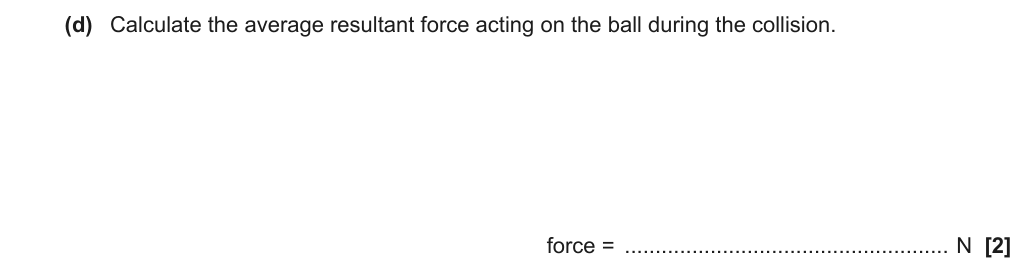
22(d) Newton's laws of motion and momentum 2Calculation
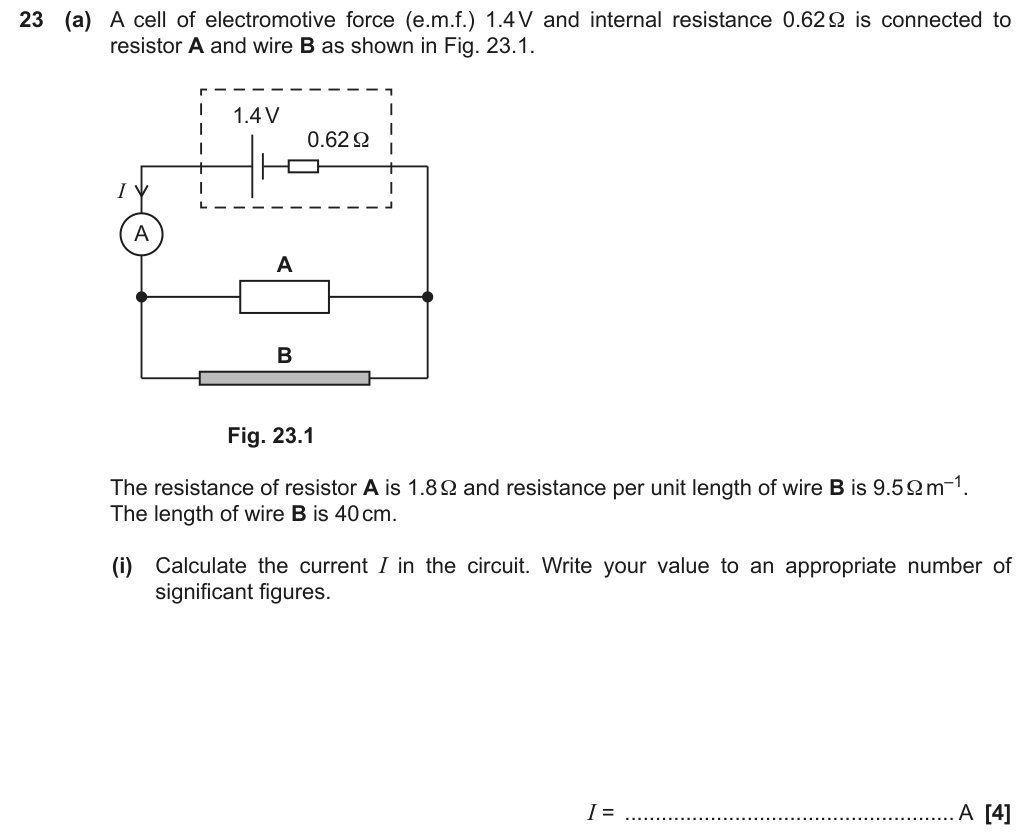
23(a)(i) Internal resistance and e.m.f., Practical skills: planning, analysis and evaluation, Series and parallel circuits: Kirchhoff's laws 4Calculation
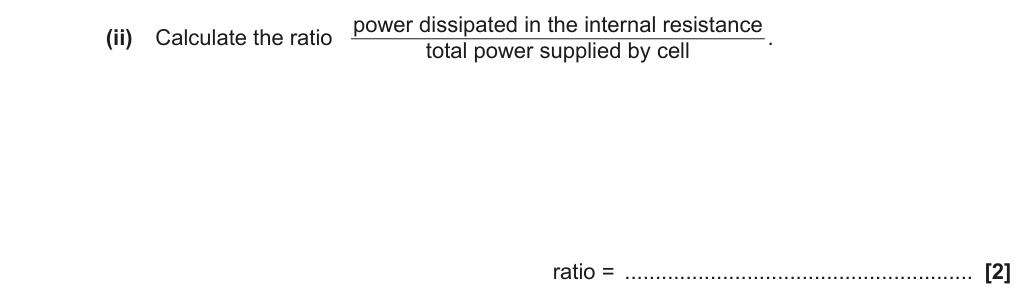
23(a)(ii) Electrical power and energy, Internal resistance and e.m.f. 2Calculation
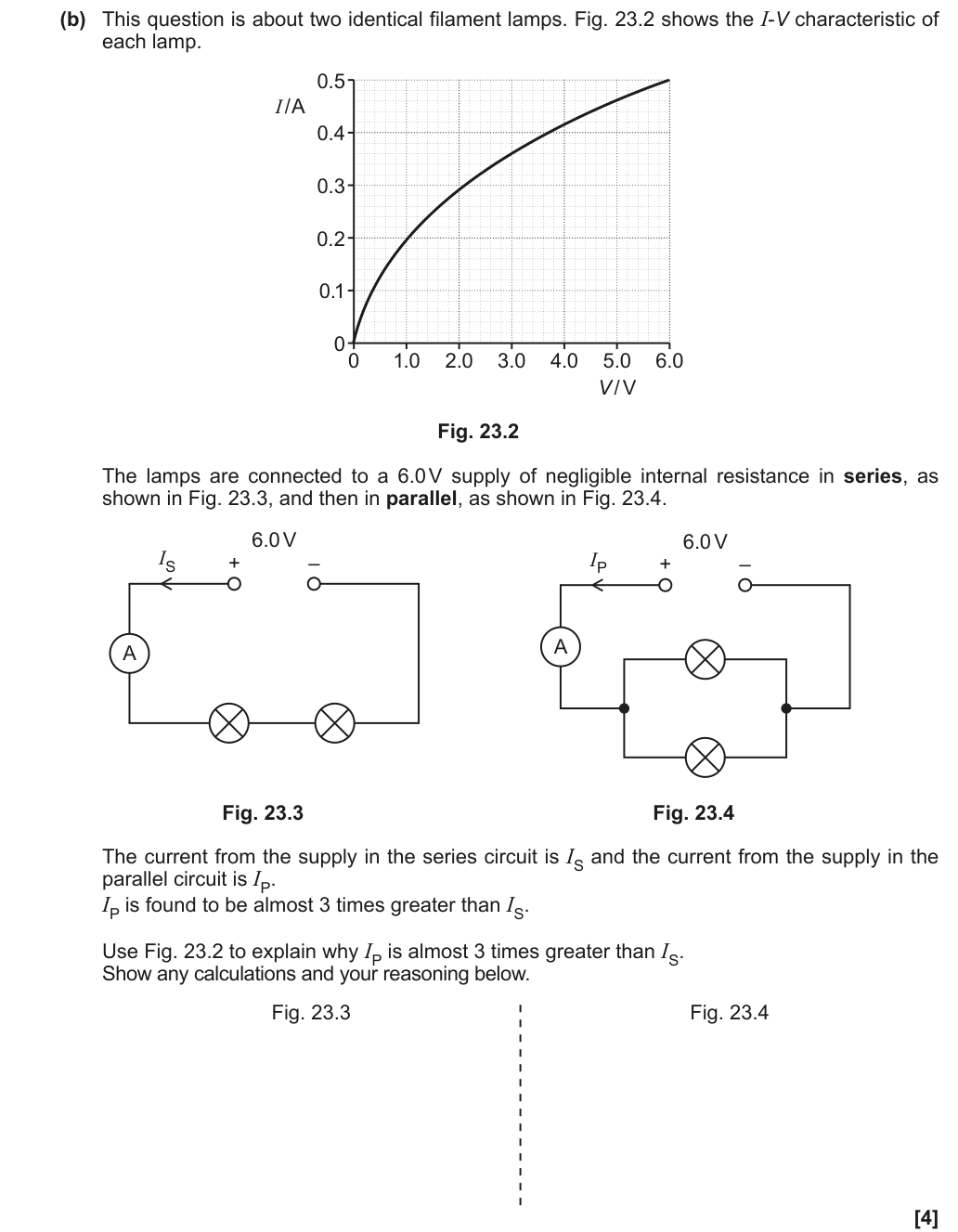
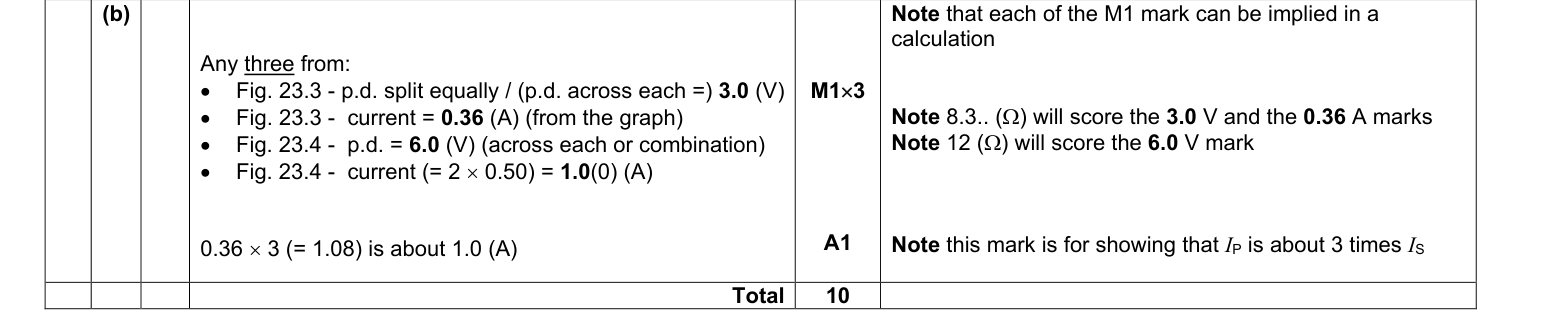
23(b) E.m.f., p.d., resistance and I–V characteristics, Series and parallel circuits: Kirchhoff's laws 4Practical and data analysis
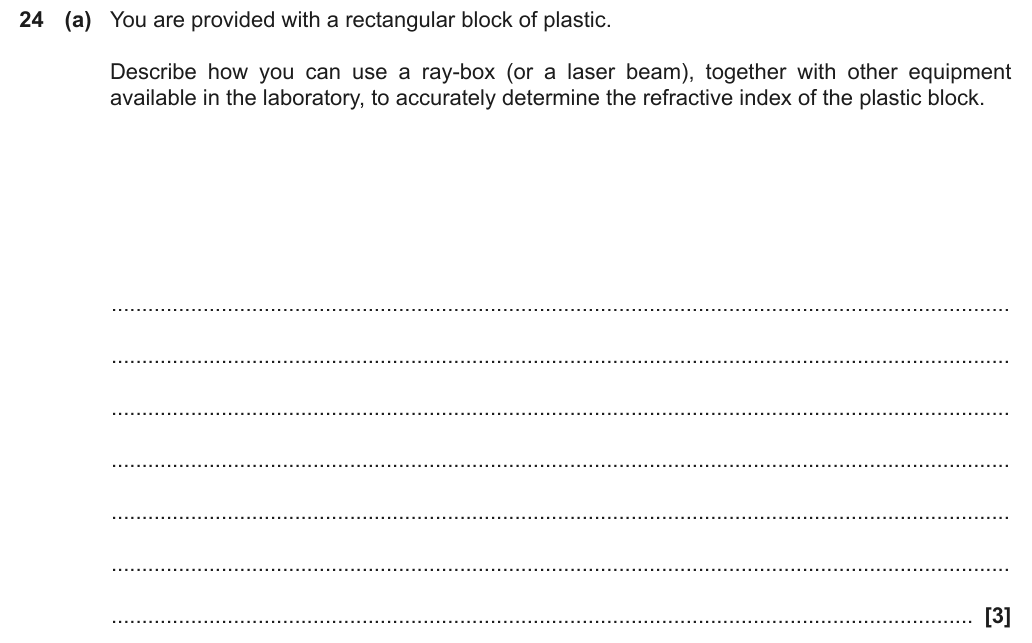
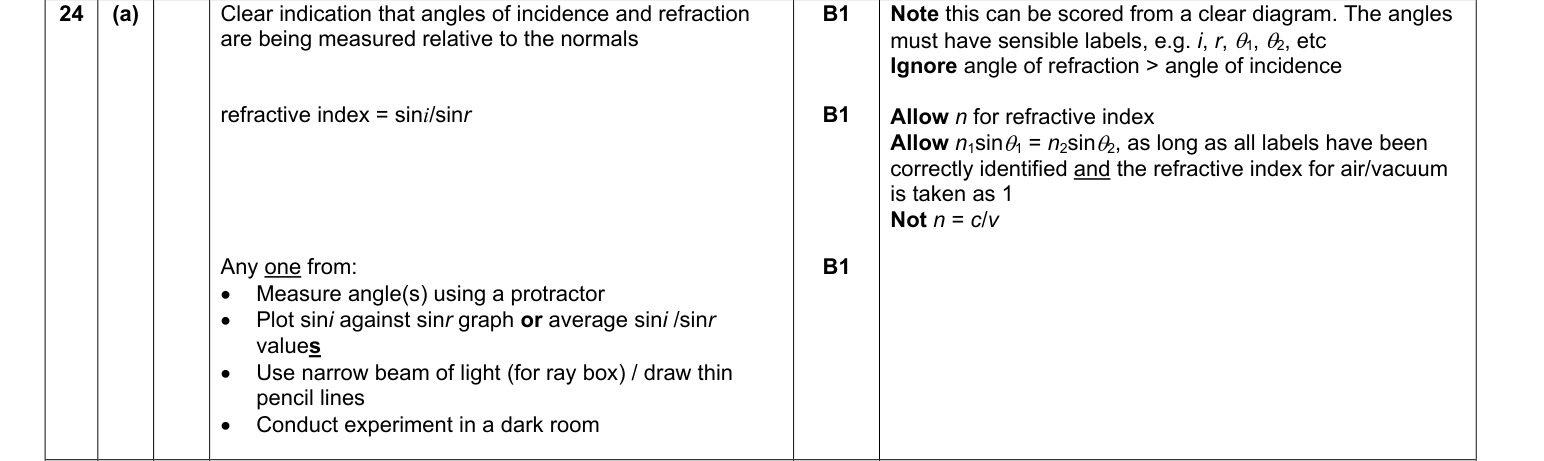
24(a) Electromagnetic waves, polarisation and refraction, Practical skills: planning, analysis and evaluation 3Explanation
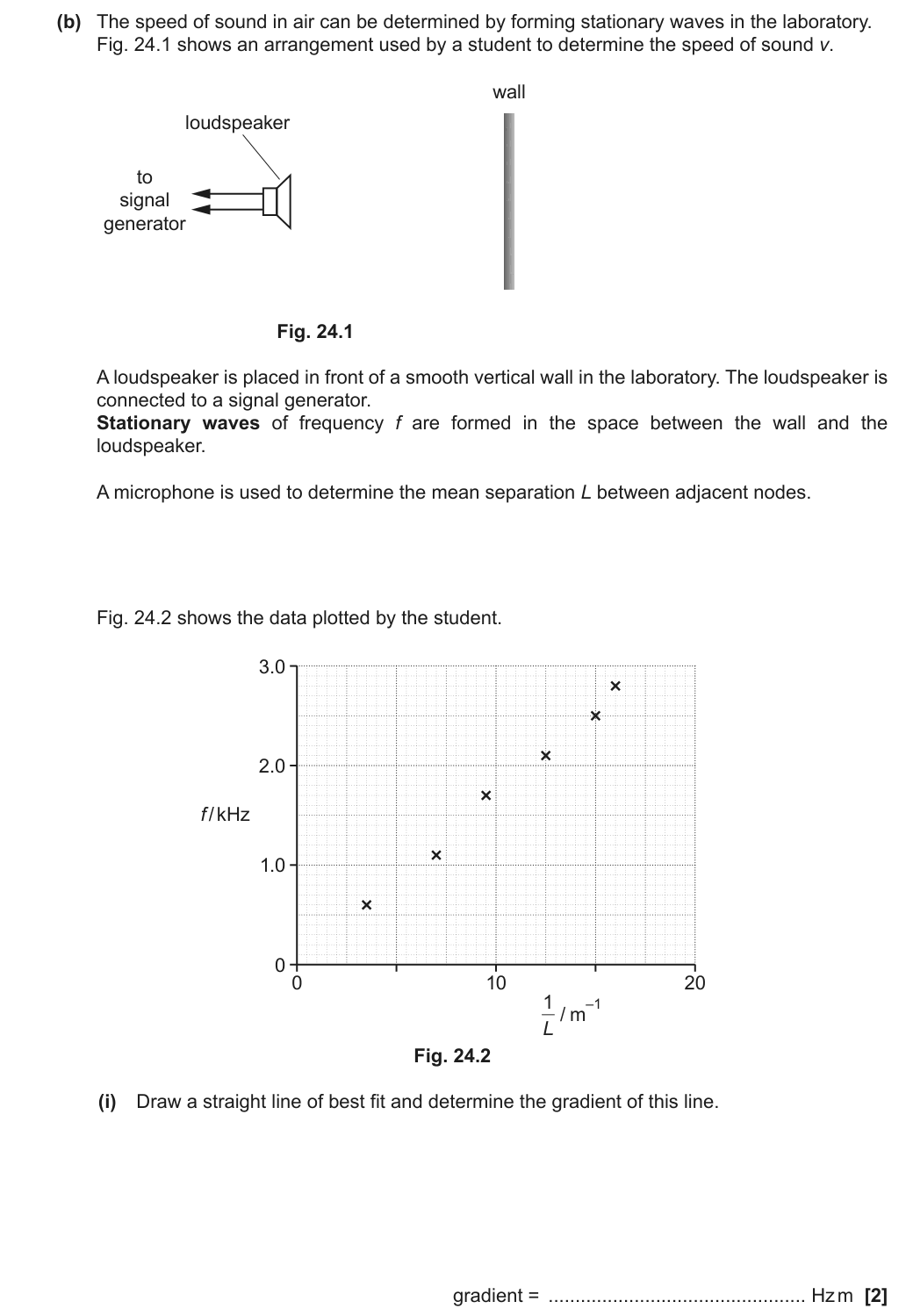
24(b)(i) Practical skills: planning, analysis and evaluation, Measurements and uncertainties 2Diagram or graph
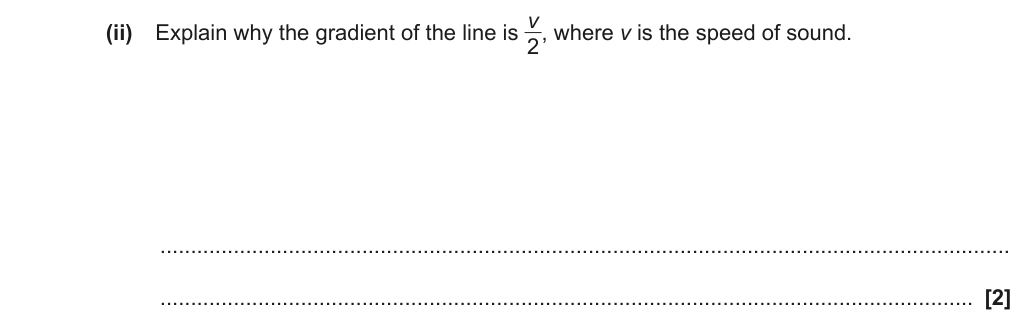
24(b)(ii) Stationary waves, Wave motion: progressive waves, the wave equation and intensity 2Explanation
24(b)(iii) Practical skills: planning, analysis and evaluation, Stationary waves 1Calculation
24(b)(iv) Practical skills: planning, analysis and evaluation, Measurements and uncertainties 2Explanation
25(a) Wave–particle duality and the de Broglie equation 1Short answer
25(b)(i) Photons and the Planck constant, Work, energy and power 3Show that
25(b)(ii) Wave–particle duality and the de Broglie equation, Newton's laws of motion and momentum 2Calculation
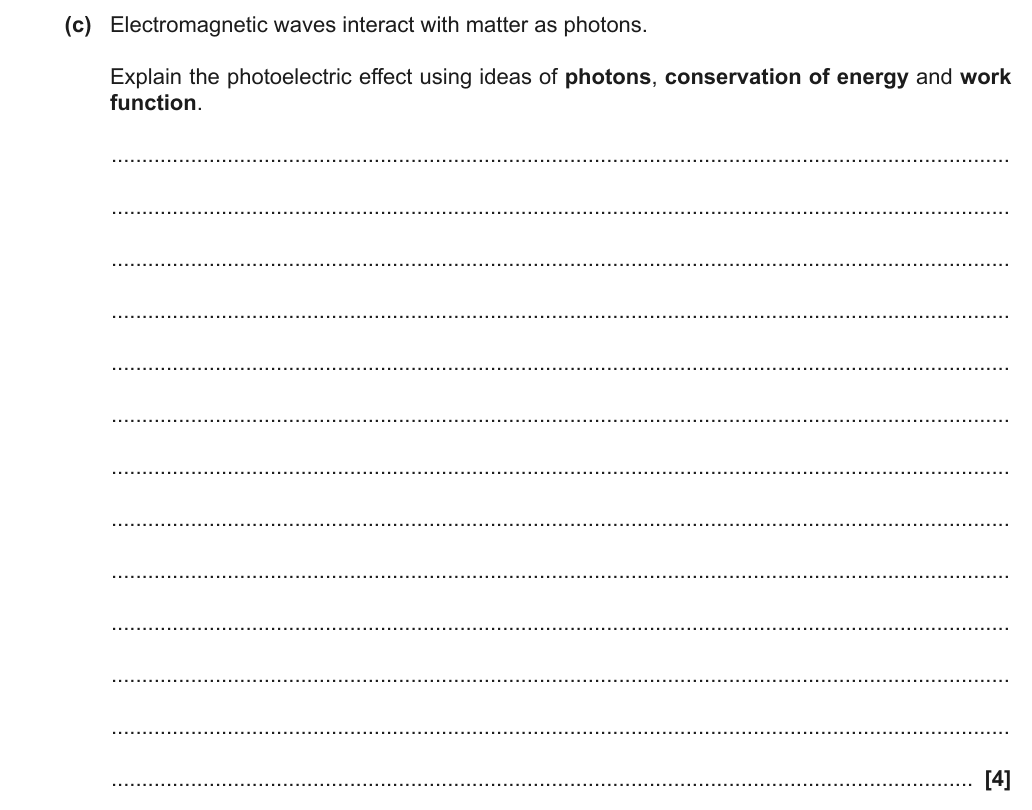
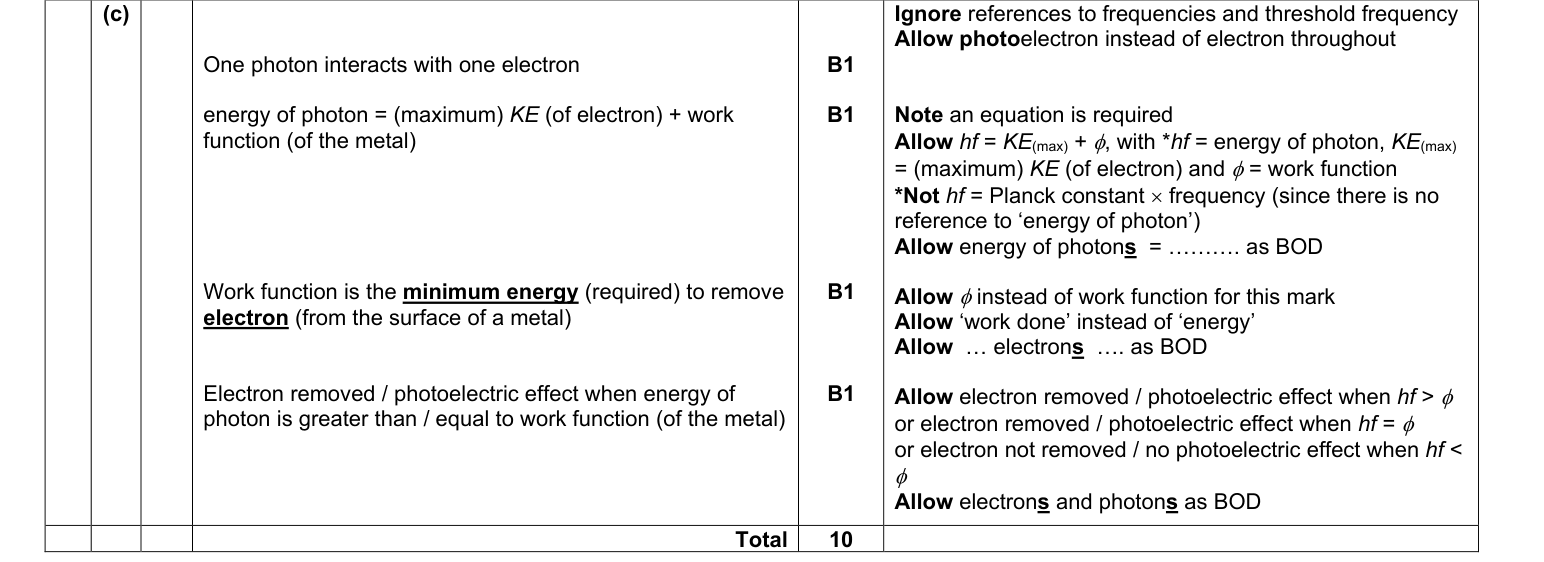
25(c) The photoelectric effect, Photons and the Planck constant 4Explanation

The questions

123456789101112131415161718192021(a)21(b)(i)21(b)(ii)21(c)(i)21(c)(ii)21(c)(iii)22(a)22(b)22(c)22(d)23(a)(i)23(a)(ii)23(b)24(a)24(b)(i)24(b)(ii)24(b)(iii)24(b)(iv)25(a)25(b)(i)25(b)(ii)25(c)
June 2019 · AS Paper 1 · Q1 1 mark Multiple choice Medium charge and currentquantities and units
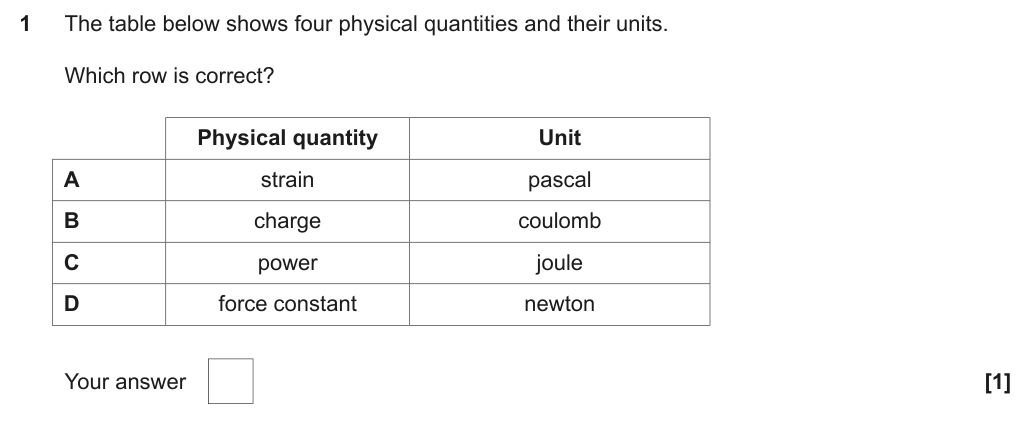
1 The table below shows four physical quantities and their units.
Which row is correct?
Physical quantity Unit
A strain pascal
B charge coulomb
C power joule
D force constant newton
Your answer [1]
June 2019 · AS Paper 1 · Q2 1 mark Multiple choice Medium measurements and uncertainties
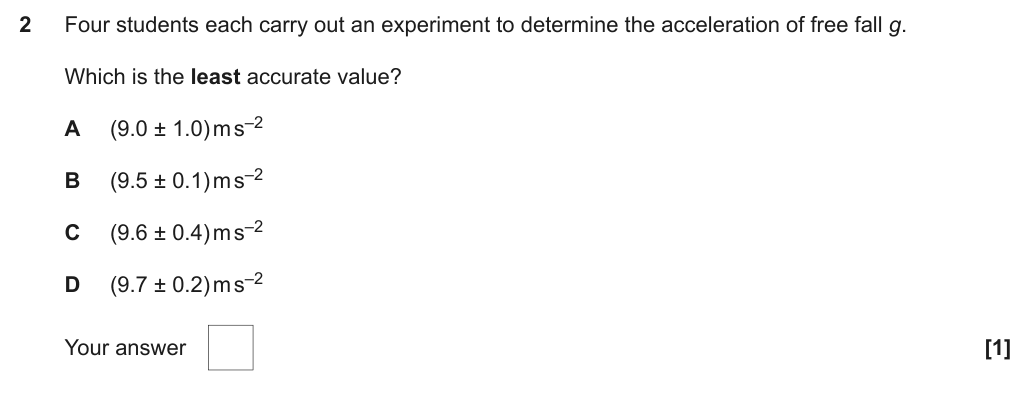
2 Four students each carry out an experiment to determine the acceleration of free fall g.
Which is the least accurate value?
A (9.0 ± 1.0) m s–2
B (9.5 ± 0.1) m s–2
C (9.6 ± 0.4) m s–2
D (9.7 ± 0.2) m s–2
Your answer [1]
June 2019 · AS Paper 1 · Q3 1 mark Multiple choice Medium springs
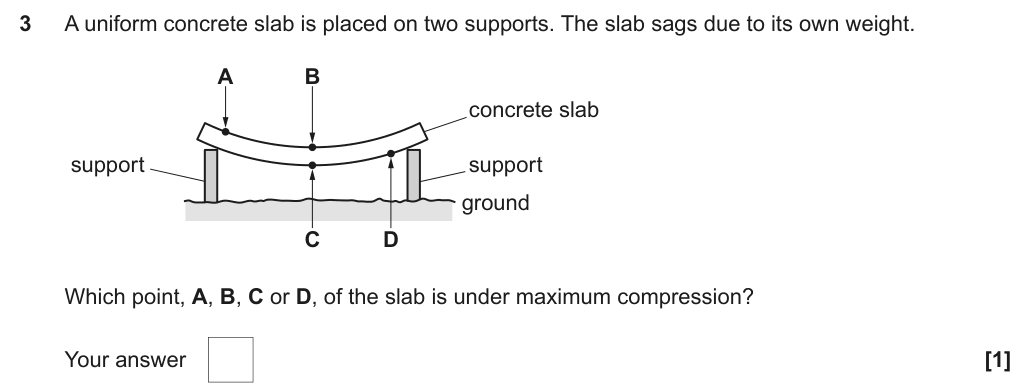
3 A uniform concrete slab is placed on two supports. The slab sags due to its own weight.
A B
concrete slab
support support
ground
C D
Which point, A, B, C or D, of the slab is under maximum compression?
Your answer [1]
June 2019 · AS Paper 1 · Q4 1 mark Multiple choice Medium newtons laws and momentum
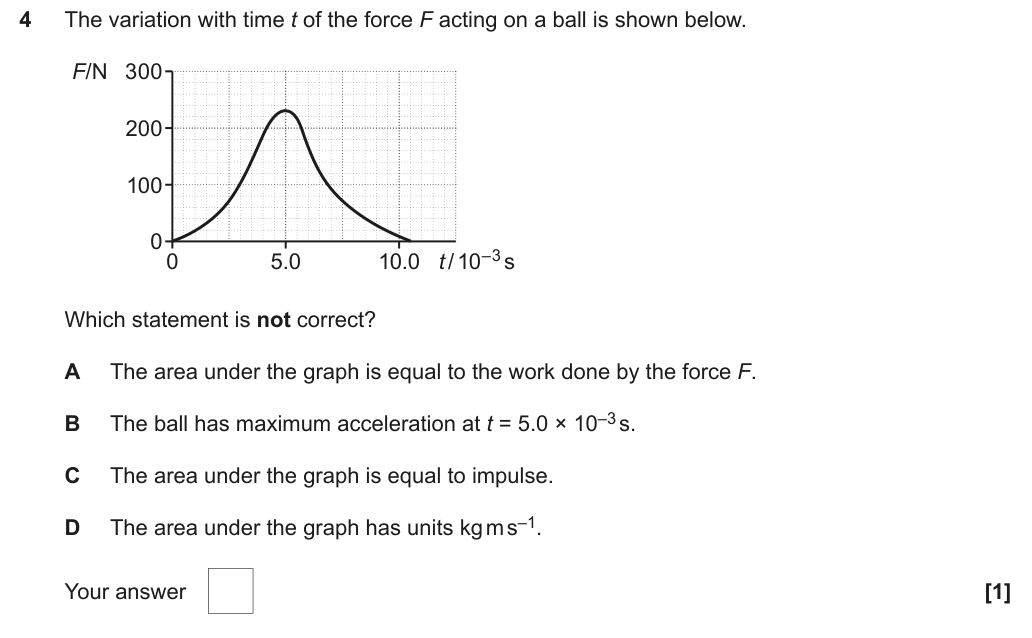
4 The variation with time t of the force F acting on a ball is shown below.
F/N 300
200
100
0
0 5.0 10.0 t / 10–3 s
Which statement is not correct?
A The area under the graph is equal to the work done by the force F.
B The ball has maximum acceleration at t = 5.0 × 10⁻³ s.
C The area under the graph is equal to impulse.
D The area under the graph has units kg m s–1.
Your answer [1]
June 2019 · AS Paper 1 · Q5 1 mark Multiple choice Medium work energy and powerequilibrium and moments
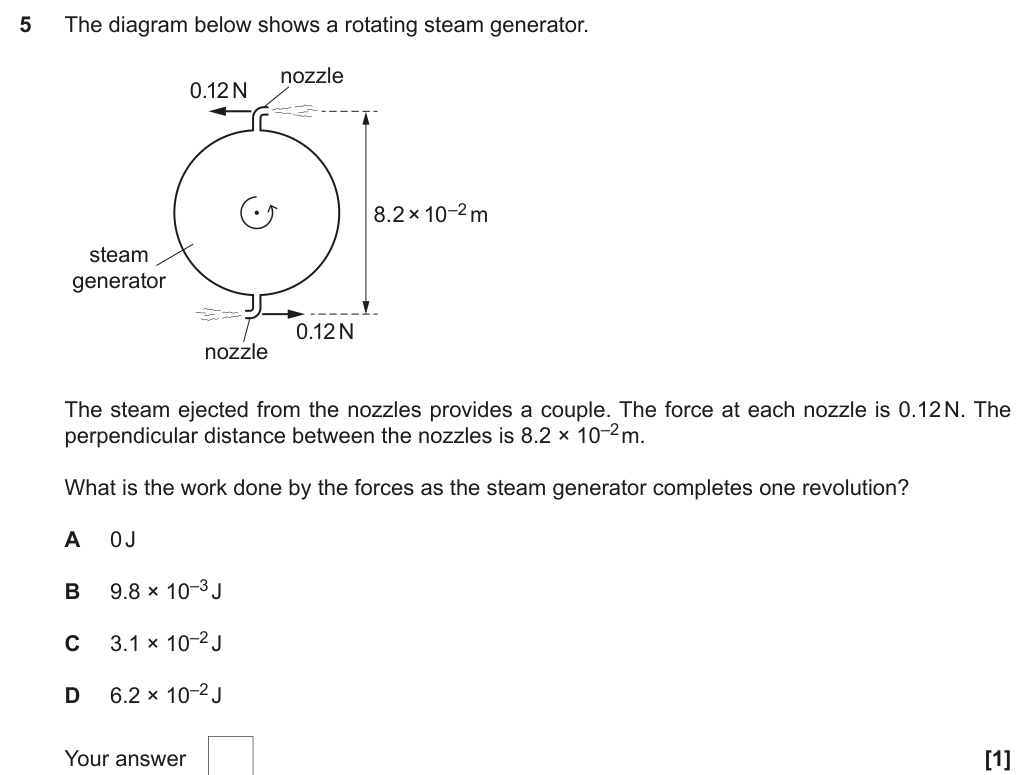
5 The diagram below shows a rotating steam generator.
nozzle
0.12 N
8.2 × 10⁻² m
steam
generator
0.12 N
nozzle
The steam ejected from the nozzles provides a couple. The force at each nozzle is 0.12 N. The
perpendicular distance between the nozzles is 8.2 × 10⁻² m.
What is the work done by the forces as the steam generator completes one revolution?
A 0 J
B 9.8 × 10⁻³ J
C 3.1 × 10⁻² J
D 6.2 × 10⁻² J
Your answer [1]
June 2019 · AS Paper 1 · Q6 1 mark Multiple choice Easy emf pd and resistance
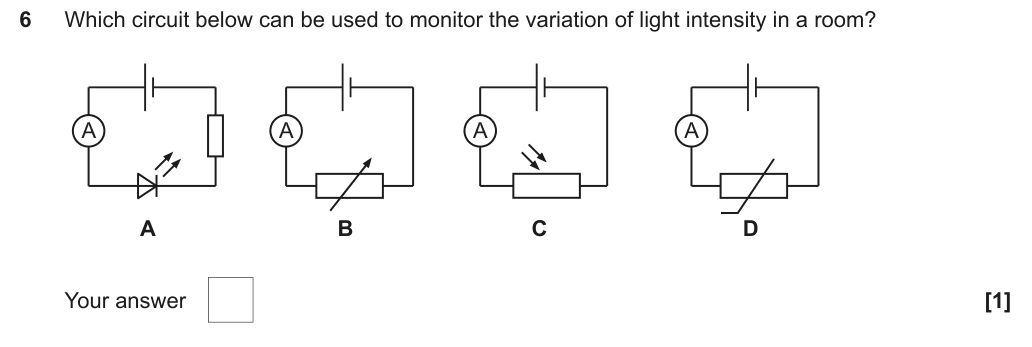
6 Which circuit below can be used to monitor the variation of light intensity in a room?
A A A A
A B C D
Your answer [1]
June 2019 · AS Paper 1 · Q7 1 mark Multiple choice Easy electrical power
7 A household is planning to change all their 60 W filament bulbs to 12 W LED bulbs.
The household has a total of 10 bulbs.
Each bulb will be used for about 2000 hours in one year.
The cost of 1 kWh is 15.4 p.
What would the annual saving be?
A £7.39
B £36.96
C £147.84
D £184.80
Your answer [1]
June 2019 · AS Paper 1 · Q8 1 mark Multiple choice work energy and power
8 A force of 12 N moves an object at an angle θ to the force. The object travels 9.6 m and the work
done by the force is 52 J.
What is the angle θ?
A 1.1°
B 27°
C  63°
D 90°
Your answer [1]
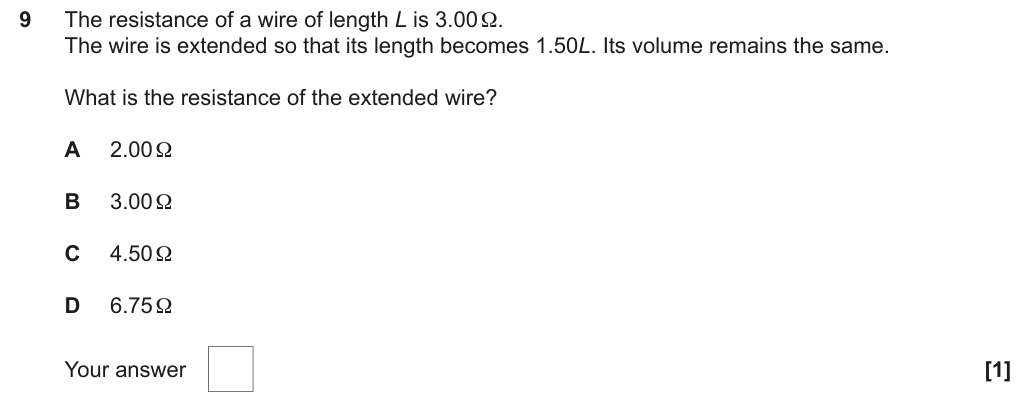
June 2019 · AS Paper 1 · Q9 1 mark Multiple choice Hard resistivity
9 The resistance of a wire of length L is 3.00 Ω.
The wire is extended so that its length becomes 1.50L. Its volume remains the same.
What is the resistance of the extended wire?
A 2.00 Ω
B 3.00 Ω
C 4.50 Ω
D 6.75 Ω
Your answer [1]
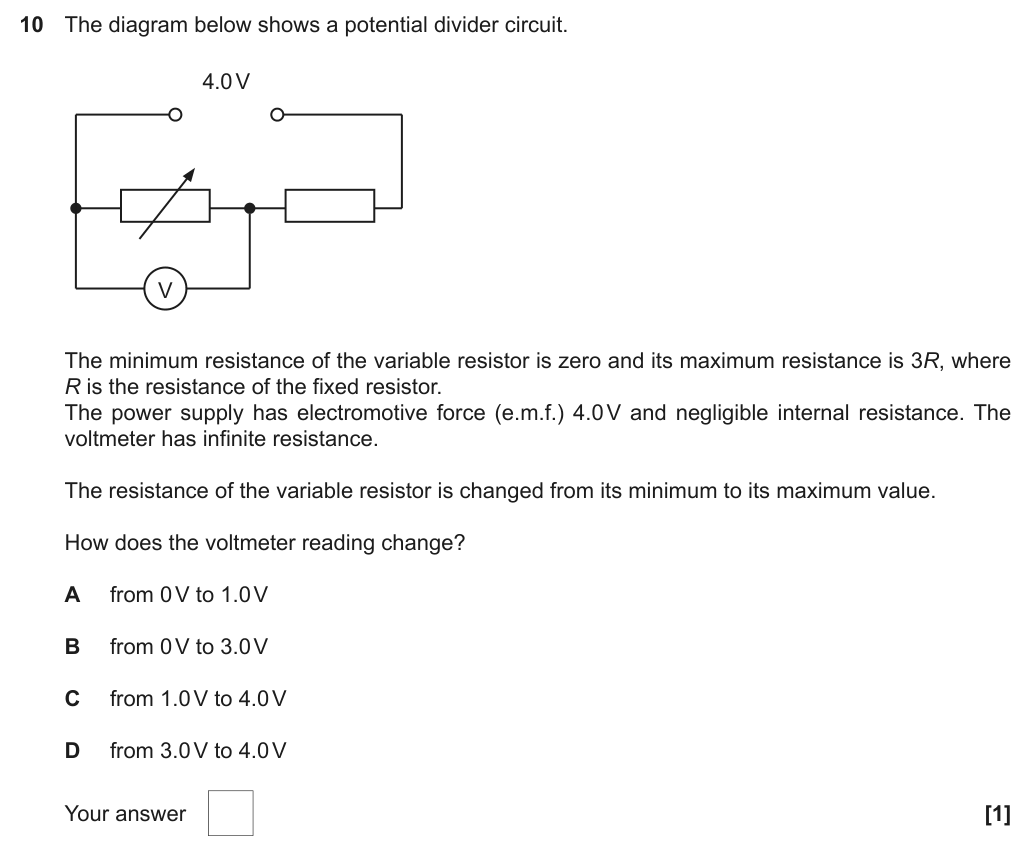
June 2019 · AS Paper 1 · Q10 1 mark Multiple choice potential dividers
10 The diagram below shows a potential divider circuit.
4.0 V
V
The minimum resistance of the variable resistor is zero and its maximum resistance is 3R, where
R is the resistance of the fixed resistor.
The power supply has electromotive force (e.m.f.) 4.0 V and negligible internal resistance. The
voltmeter has infinite resistance.
The resistance of the variable resistor is changed from its minimum to its maximum value.
How does the voltmeter reading change?
A from 0 V to 1.0 V
B from 0 V to 3.0 V
C from 1.0 V to 4.0 V
D from 3.0 V to 4.0 V
Your answer [1]
June 2019 · AS Paper 1 · Q11 1 mark Multiple choice superposition and interference
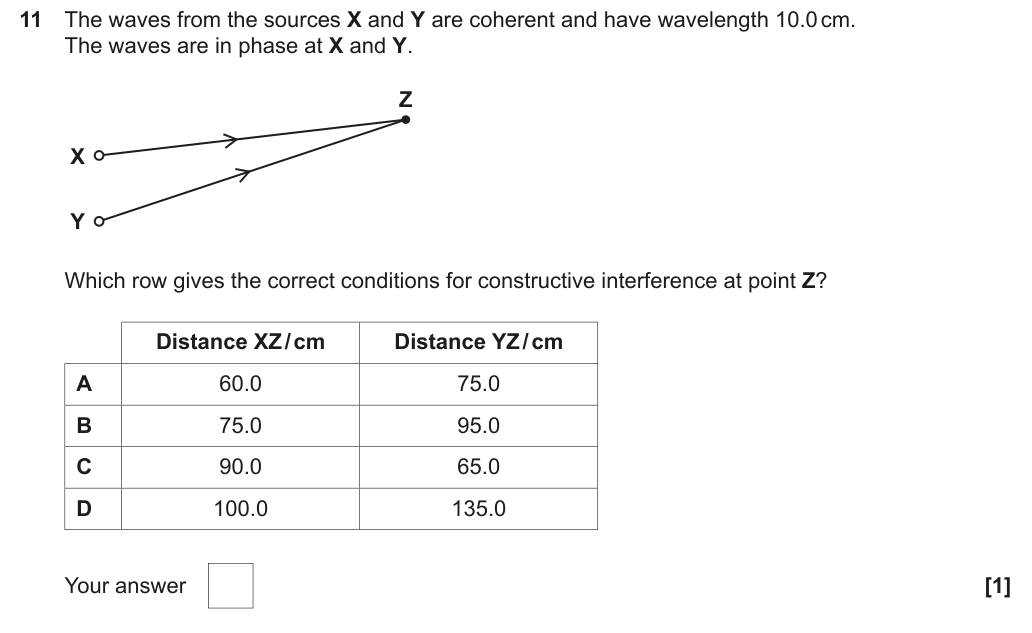
11 The waves from the sources X and Y are coherent and have wavelength 10.0 cm.
The waves are in phase at X and Y.
Z
X
Y
Which row gives the correct conditions for constructive interference at point Z?
Distance XZ / cm Distance YZ / cm
A 60.0 75.0
B 75.0 95.0
C 90.0 65.0
D 100.0 135.0
Your answer [1]
June 2019 · AS Paper 1 · Q12 1 mark Multiple choice Medium electromagnetic waves and refraction
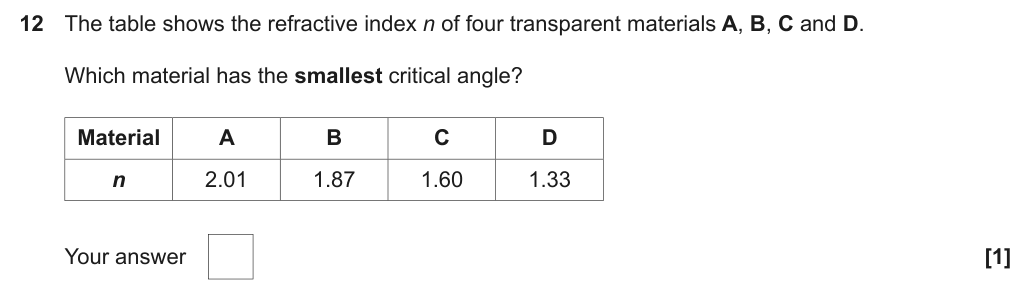
12 The table shows the refractive index n of four transparent materials A, B, C and D.
Which material has the smallest critical angle?
Material A B C D
n 2.01 1.87 1.60 1.33
Your answer [1]
June 2019 · AS Paper 1 · Q13 1 mark Multiple choice Hard work energy and power
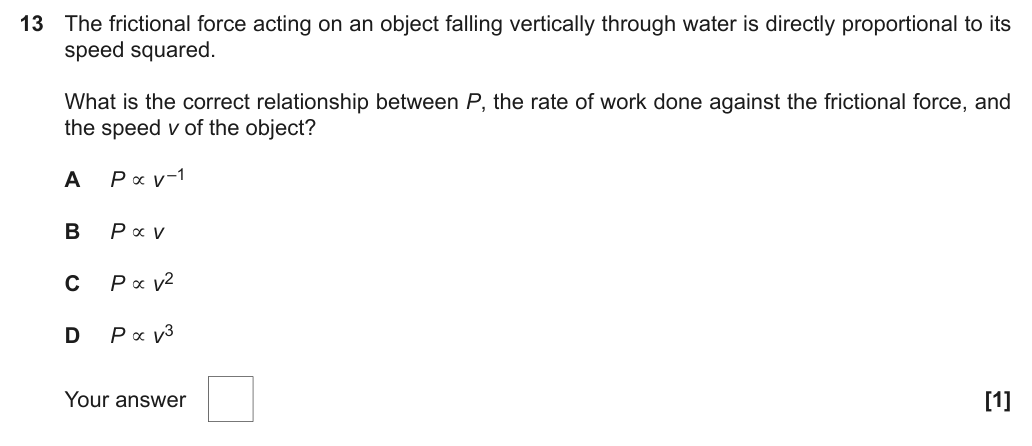
13 The frictional force acting on an object falling vertically through water is directly proportional to its
speed squared.
What is the correct relationship between P, the rate of work done against the frictional force, and
the speed v of the object?
A P ∝ v –1
B P ∝ v
C P ∝ v2
D P ∝ v3
Your answer [1]
June 2019 · AS Paper 1 · Q14 1 mark Multiple choice electrical powerquantities and units
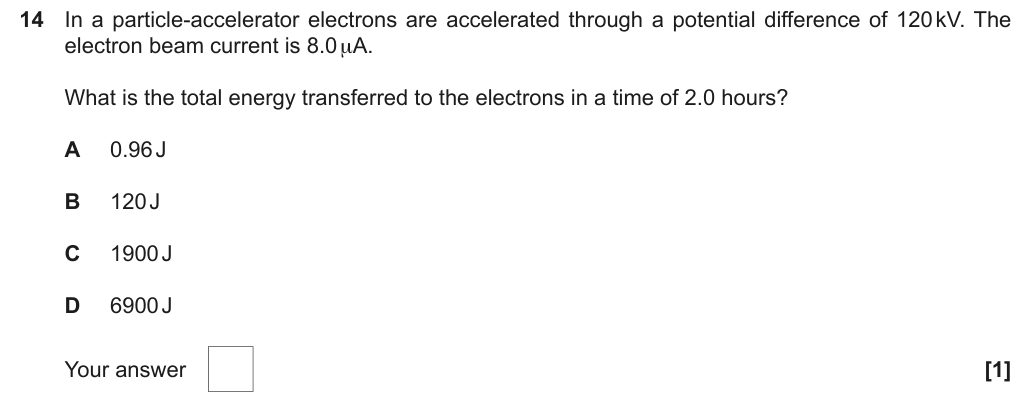
14 In a particle-accelerator electrons are accelerated through a potential difference of 120 kV. The
electron beam current is 8.0 µA.
What is the total energy transferred to the electrons in a time of 2.0 hours?
A 0.96 J
B 120 J
C 1900 J
D 6900 J
Your answer [1]
June 2019 · AS Paper 1 · Q15 1 mark Multiple choice charge and current
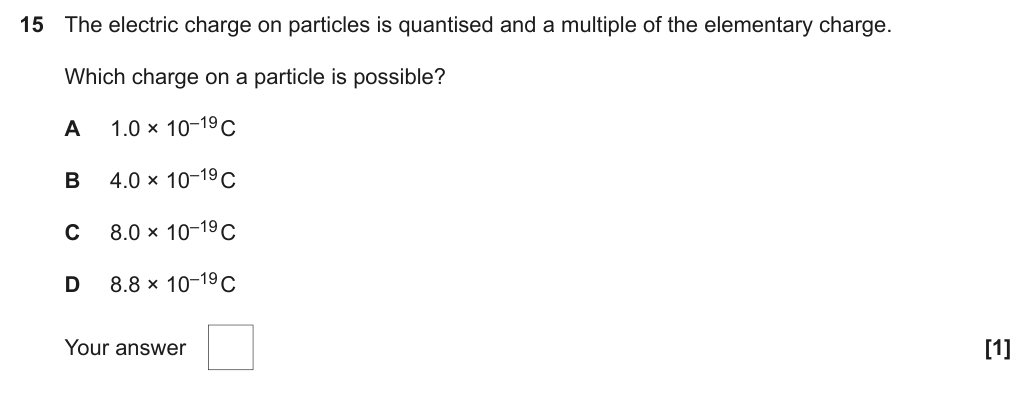
15 The electric charge on particles is quantised and a multiple of the elementary charge.

Which charge on a particle is possible?
A 1.0 × 10⁻¹⁹ C
B 4.0 × 10⁻¹⁹ C
C 8.0 × 10⁻¹⁹ C
D 8.8 × 10⁻¹⁹ C
Your answer [1]
June 2019 · AS Paper 1 · Q16 1 mark Multiple choice scalars and vectors
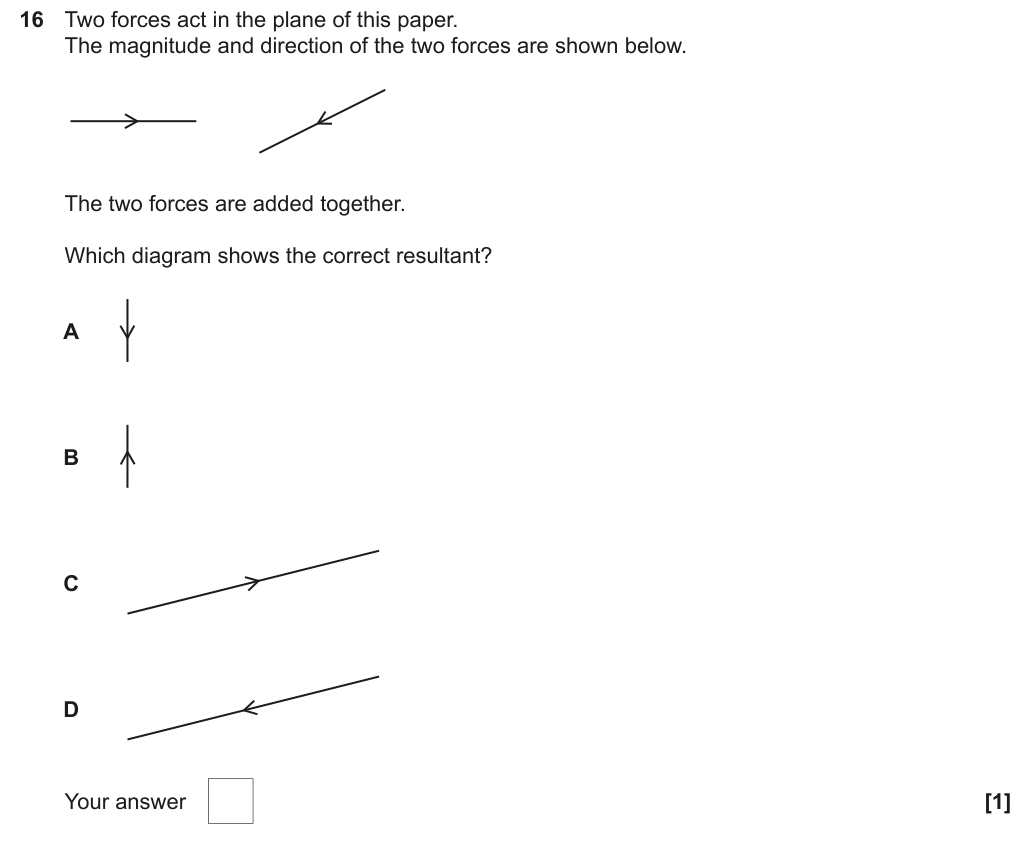
16 Two forces act in the plane of this paper.
The magnitude and direction of the two forces are shown below.
The two forces are added together.
Which diagram shows the correct resultant?
A
B
C
D
Your answer [1]
June 2019 · AS Paper 1 · Q17 1 mark Multiple choice quantities and unitswave motion
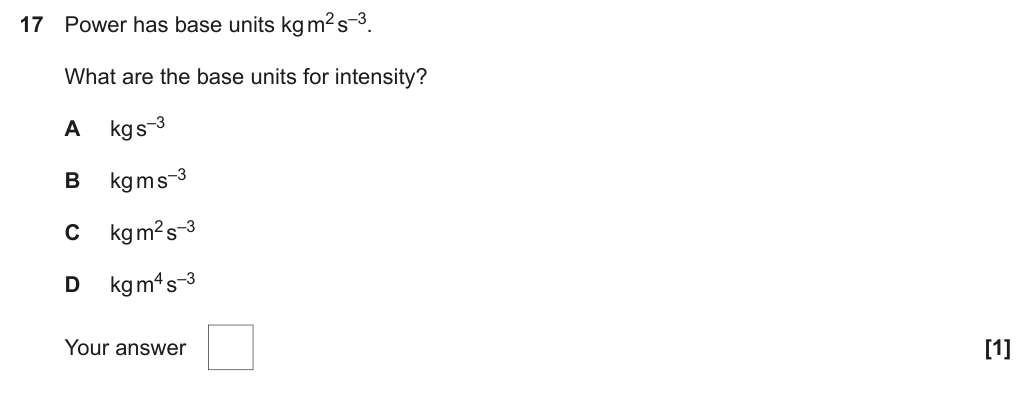
17 Power has base units kg m2 s–3.
What are the base units for intensity?
A kg s–3
B kg m s–3
C kg m2 s–3
D kg m4 s–3
Your answer [1]
June 2019 · AS Paper 1 · Q18 1 mark Multiple choice Medium linear motion
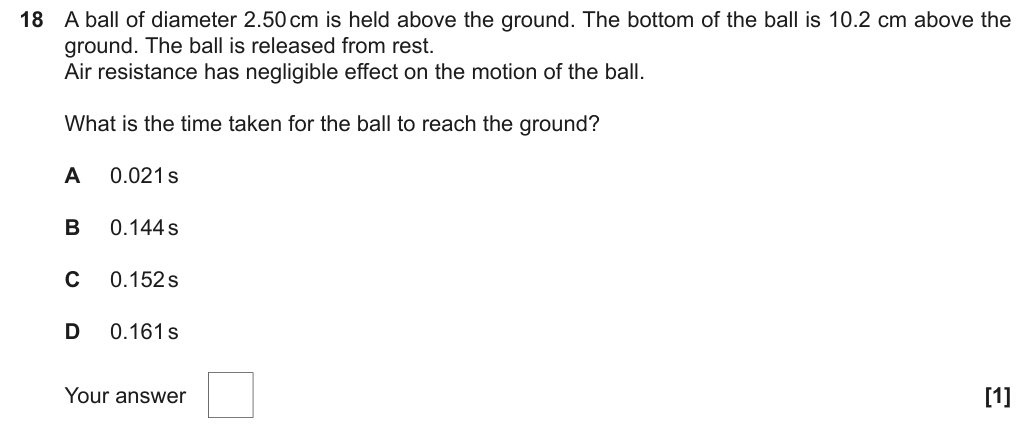
18 A ball of diameter 2.50 cm is held above the ground. The bottom of the ball is 10.2 cm above the
ground. The ball is released from rest.
Air resistance has negligible effect on the motion of the ball.
What is the time taken for the ball to reach the ground?
A 0.021 s
B 0.144 s
C 0.152 s
D 0.161 s
Your answer [1]
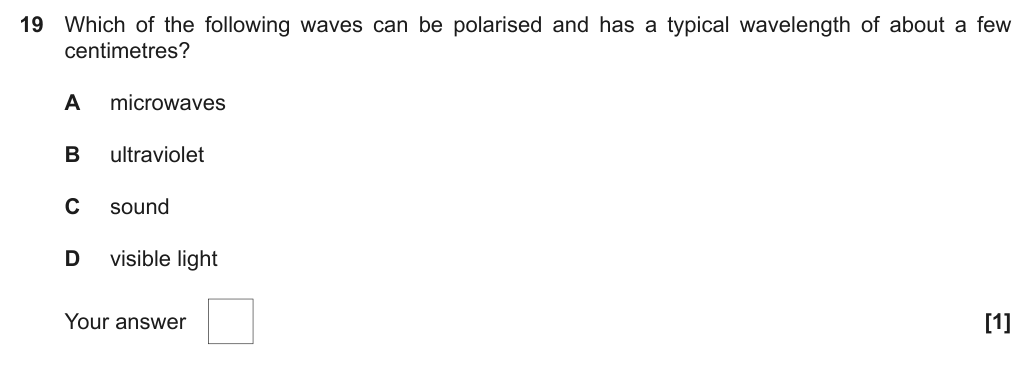
June 2019 · AS Paper 1 · Q19 1 mark Multiple choice electromagnetic waves and refraction
19 Which of the following waves can be polarised and has a typical wavelength of about a few
centimetres?
A microwaves
B ultraviolet
C sound
D visible light
Your answer [1]
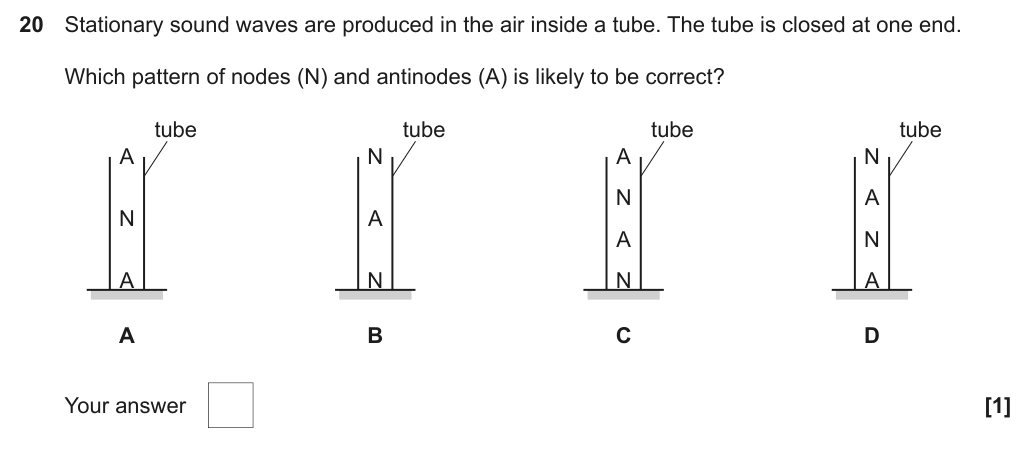
June 2019 · AS Paper 1 · Q20 1 mark Multiple choice stationary waves
20 Stationary sound waves are produced in the air inside a tube. The tube is closed at one end.
Which pattern of nodes (N) and antinodes (A) is likely to be correct?
tube tube tube tube
A N A N
N A
N A
A N
A N N A
A B C D
Your answer [1]
June 2019 · AS Paper 1 · Q21(a) 1 mark Short answer Hard equilibrium and moments
21 (a) For a system to be in equilibrium, the resultant force must be zero.
State another condition that must be satisfied for the system to be in equilibrium.
...................................................................................................................................................
............................................................................................................................................. [1]
June 2019 · AS Paper 1 · Q21(b)(i) 1 mark Short answer Hard newtons laws and momentum
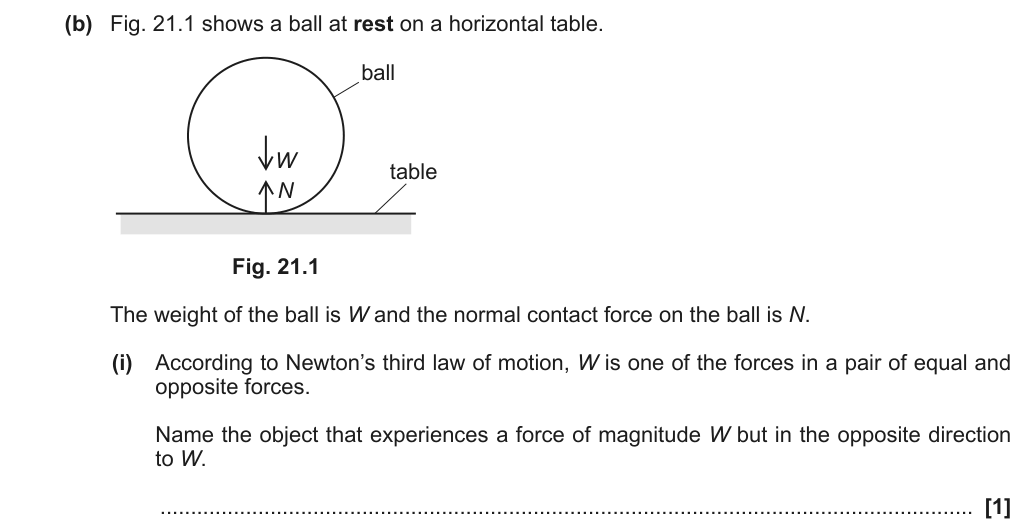
(b) Fig. 21.1 shows a ball at rest on a horizontal table.
ball
W
table
N
Fig. 21.1
The weight of the ball is W and the normal contact force on the ball is N.
(i) According to Newton’s third law of motion, W is one of the forces in a pair of equal and
opposite forces.
Name the object that experiences a force of magnitude W but in the opposite direction
to W.
..................................................................................................................................... [1]
June 2019 · AS Paper 1 · Q21(b)(ii) 1 mark Short answer Medium newtons laws and momentum
Earlier part of question 21 that this part usesEarlier part of June 2019 Paper 1 question 21
(ii) According to a student, W = N is a consequence of Newton’s third law of motion.
State why this is incorrect.
..................................................................................................................................... [1]
June 2019 · AS Paper 1 · Q21(c)(i) 2 marks Calculation Easy scalars and vectors
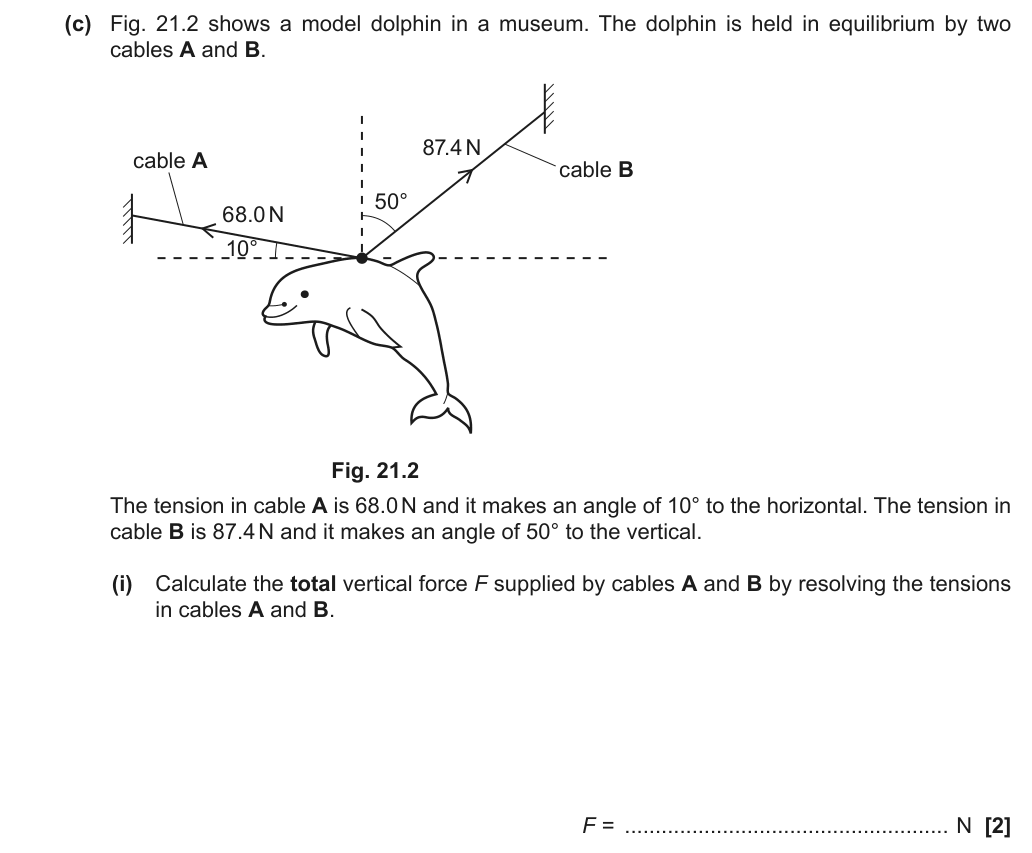
(c) Fig. 21.2 shows a model dolphin in a museum. The dolphin is held in equilibrium by two
cables A and B.
87.4 N
cable A
cable B
50°
68.0 N
10°
Fig. 21.2
The tension in cable A is 68.0 N and it makes an angle of 10° to the horizontal. The tension in
cable B is 87.4 N and it makes an angle of 50° to the vertical.
(i) Calculate the total vertical force F supplied by cables A and B by resolving the tensions
in cables A and B.
F =  ..................................................... N  [2]
June 2019 · AS Paper 1 · Q21(c)(ii) 2 marks Calculation Medium dynamics and terminal velocityequilibrium and moments
Earlier part of question 21 that this part usesEarlier part of June 2019 Paper 1 question 21
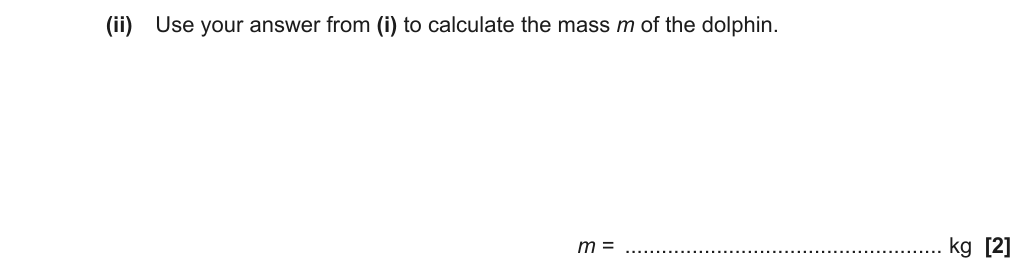
(ii) Use your answer from (i) to calculate the mass m of the dolphin.
m =  .................................................... kg  [2]
June 2019 · AS Paper 1 · Q21(c)(iii) 2 marks Calculation Medium materials and young modulus
Earlier part of question 21 that this part usesEarlier part of June 2019 Paper 1 question 21
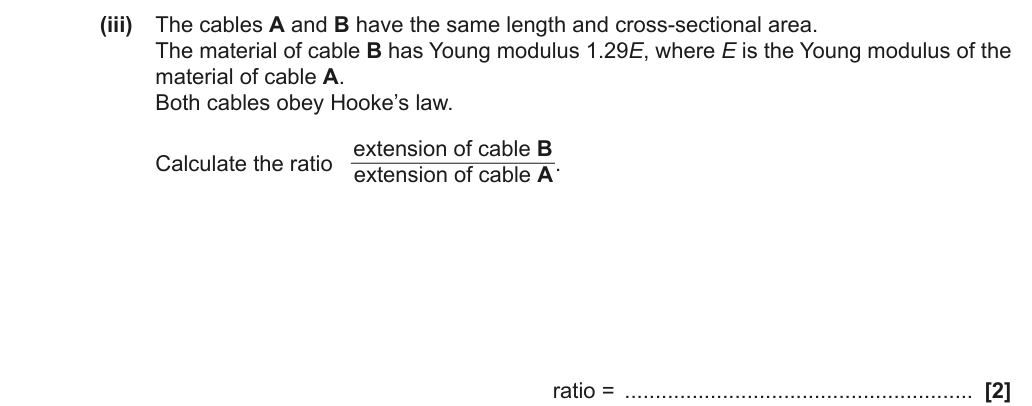
(iii) The cables A and B have the same length and cross-sectional area.
The material of cable B has Young modulus 1.29E, where E is the Young modulus of the
material of cable A.
Both cables obey Hooke’s law.
Calculate the ratio   extension of cable B
extension of cable A.
ratio =  ......................................................... [2]
June 2019 · AS Paper 1 · Q22(a) 4 marks Explanation Hard kinematics
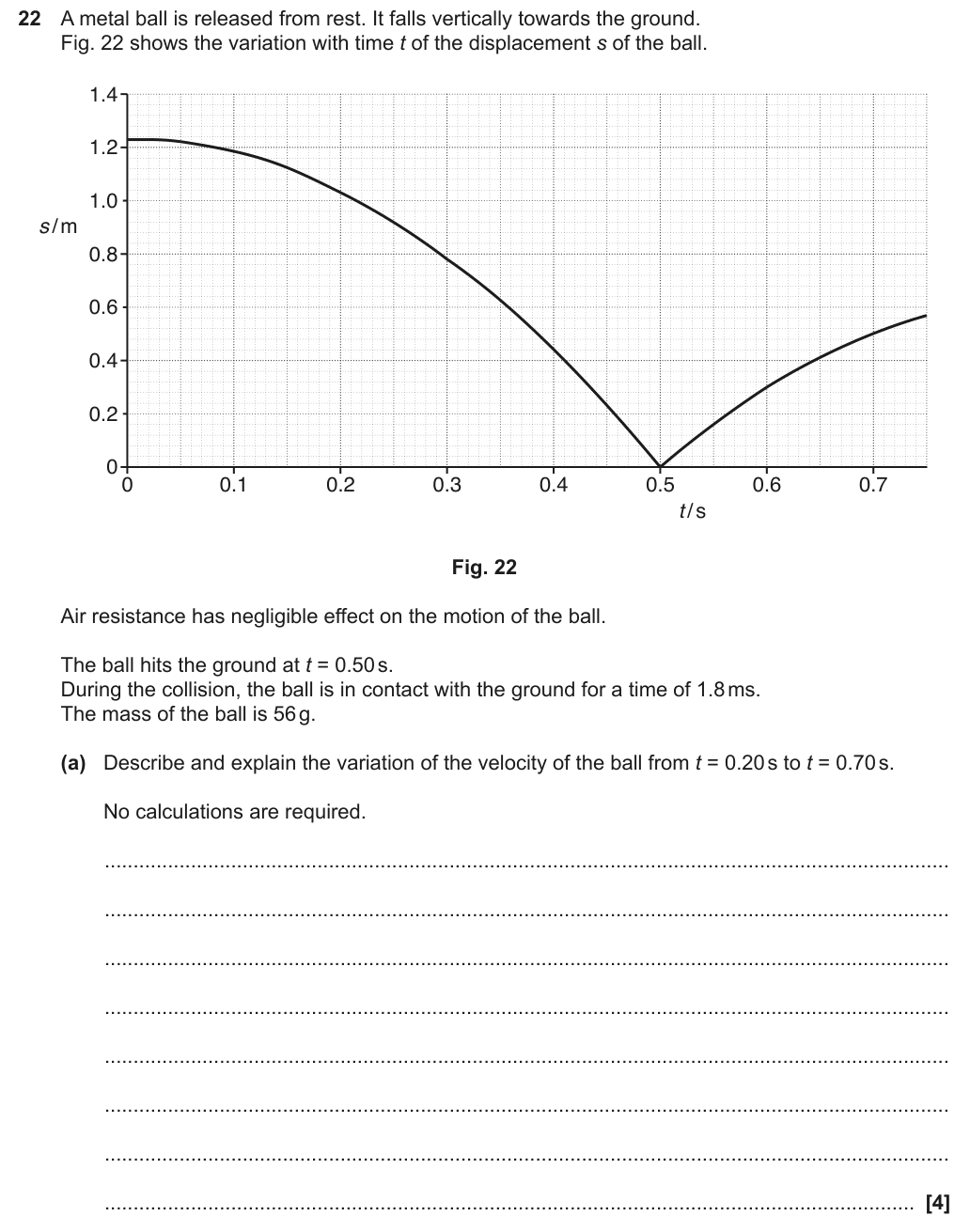
22 A metal ball is released from rest. It falls vertically towards the ground.
Fig. 22 shows the variation with time t of the displacement s of the ball.
1.4
1.2
1.0
s / m
0.8
0.6
0.4
0.2
0
0 0.1 0.2 0.3 0.4 0.5 0.6 0.7
t / s
Fig. 22
Air resistance has negligible effect on the motion of the ball.
The ball hits the ground at t = 0.50 s.
During the collision, the ball is in contact with the ground for a time of 1.8 ms.
The mass of the ball is 56 g.
(a) Describe and explain the variation of the velocity of the ball from t = 0.20 s to t = 0.70 s.
No calculations are required.
...................................................................................................................................................
...................................................................................................................................................
...................................................................................................................................................
...................................................................................................................................................
...................................................................................................................................................
...................................................................................................................................................
...................................................................................................................................................
............................................................................................................................................. [4]
June 2019 · AS Paper 1 · Q22(b) 2 marks Show that Medium linear motion
Earlier part of question 22 that this part usesEarlier part of June 2019 Paper 1 question 22
(b) Use an equation of motion to show that the speed of the ball is 4.9 m s–1 just before it hits the
ground.
[2]
June 2019 · AS Paper 1 · Q22(c) 3 marks Show that Easy kinematics
Earlier part of question 22 that this part usesEarlier part of June 2019 Paper 1 question 22
(c) Draw a suitable tangent to the curve in Fig. 22 and show that the rebound speed of the ball is
about 3.5 m s–1.
[3]
June 2019 · AS Paper 1 · Q22(d) 2 marks Calculation Medium newtons laws and momentum
Earlier parts of question 22 that this part usesEarlier part of June 2019 Paper 1 question 22Earlier part of June 2019 Paper 1 question 22Earlier part of June 2019 Paper 1 question 22
(d) Calculate the average resultant force acting on the ball during the collision.
force =  ..................................................... N  [2]
June 2019 · AS Paper 1 · Q23(a)(i) 4 marks Calculation Hard internal resistancepractical skillsseries and parallel circuits
23 (a) A cell of electromotive force (e.m.f.) 1.4 V and internal resistance 0.62 Ω is connected to
resistor A and wire B as shown in Fig. 23.1.
1.4 V
0.62 Ω
I
A
A
B
Fig. 23.1
The resistance of resistor A is 1.8 Ω and resistance per unit length of wire B is 9.5 Ω m–1.
The length of wire B is 40 cm.
(i) Calculate the current I in the circuit. Write your value to an appropriate number of
significant figures.
I =  ...................................................... A  [4]
June 2019 · AS Paper 1 · Q23(a)(ii) 2 marks Calculation Easy electrical powerinternal resistance
Earlier part of question 23 that this part usesEarlier part of June 2019 Paper 1 question 23
(ii) Calculate the ratio   power dissipated in the internal resistance
.
total power supplied by cell
ratio =  ......................................................... [2]
June 2019 · AS Paper 1 · Q23(b) 4 marks Practical and data analysis Medium emf pd and resistanceseries and parallel circuits
(b) This question is about two identical filament lamps. Fig. 23.2 shows the I-V characteristic of
each lamp.
0.5
I / A
0.4
0.3
0.2
0.1
00
1.0 2.0 3.0 4.0 5.0 6.0
V / V
Fig. 23.2
The lamps are connected to a 6.0 V supply of negligible internal resistance in series, as
shown in Fig. 23.3, and then in parallel, as shown in Fig. 23.4.
6.0 V 6.0 V
IS + – IP
+ –
A
A
Fig. 23.3 Fig. 23.4
The current from the supply in the series circuit is IS and the current from the supply in the
parallel circuit is IP.
IP is found to be almost 3 times greater than IS.
Use Fig. 23.2 to explain why IP is almost 3 times greater than IS.
Show any calculations and your reasoning below.
Fig. 23.3 Fig. 23.4
[4]
June 2019 · AS Paper 1 · Q24(a) 3 marks Explanation Medium electromagnetic waves and refractionpractical skills
24 (a) You are provided with a rectangular block of plastic.
Describe how you can use a ray-box (or a laser beam), together with other equipment
available in the laboratory, to accurately determine the refractive index of the plastic block.
...................................................................................................................................................
...................................................................................................................................................
...................................................................................................................................................
...................................................................................................................................................
...................................................................................................................................................
...................................................................................................................................................
............................................................................................................................................. [3]
June 2019 · AS Paper 1 · Q24(b)(i) 2 marks Diagram or graph Medium practical skillsmeasurements and uncertainties
(b) The speed of sound in air can be determined by forming stationary waves in the laboratory.
Fig. 24.1 shows an arrangement used by a student to determine the speed of sound v.
wall
loudspeaker
to
signal
generator
Fig. 24.1
A loudspeaker is placed in front of a smooth vertical wall in the laboratory. The loudspeaker is
connected to a signal generator.
Stationary waves of frequency f are formed in the space between the wall and the
loudspeaker.
A microphone is used to determine the mean separation L between adjacent nodes.
Fig. 24.2 shows the data plotted by the student.
3.0
2.0
f / kHz
1.0
0
0 10 20
1 – 1
/ m
L
Fig. 24.2
(i) Draw a straight line of best fit and determine the gradient of this line.
gradient =  ................................................ Hz m  [2]
June 2019 · AS Paper 1 · Q24(b)(ii) 2 marks Explanation Easy stationary waveswave motion
Earlier part of question 24 that this part usesEarlier part of June 2019 Paper 1 question 24
(ii) Explain why the gradient of the line is v
2, where v is the speed of sound.
...........................................................................................................................................
..................................................................................................................................... [2]
June 2019 · AS Paper 1 · Q24(b)(iii) 1 mark Calculation Easy practical skillsstationary waves
Earlier parts of question 24 that this part usesEarlier part of June 2019 Paper 1 question 24Earlier part of June 2019 Paper 1 question 24
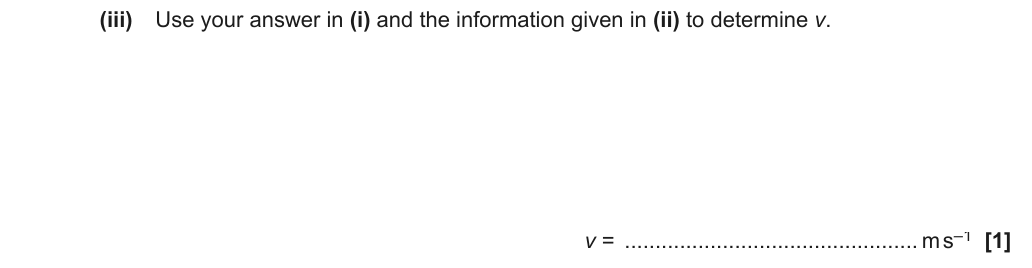
(iii) Use your answer in (i) and the information given in (ii) to determine v.
v =  ................................................ m s–1  [1]
June 2019 · AS Paper 1 · Q24(b)(iv) 2 marks Explanation Hard practical skillsmeasurements and uncertainties
Earlier part of question 24 that this part usesEarlier part of June 2019 Paper 1 question 24
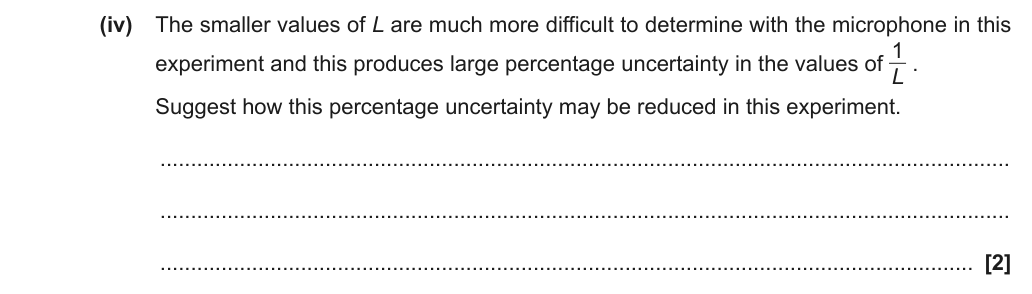
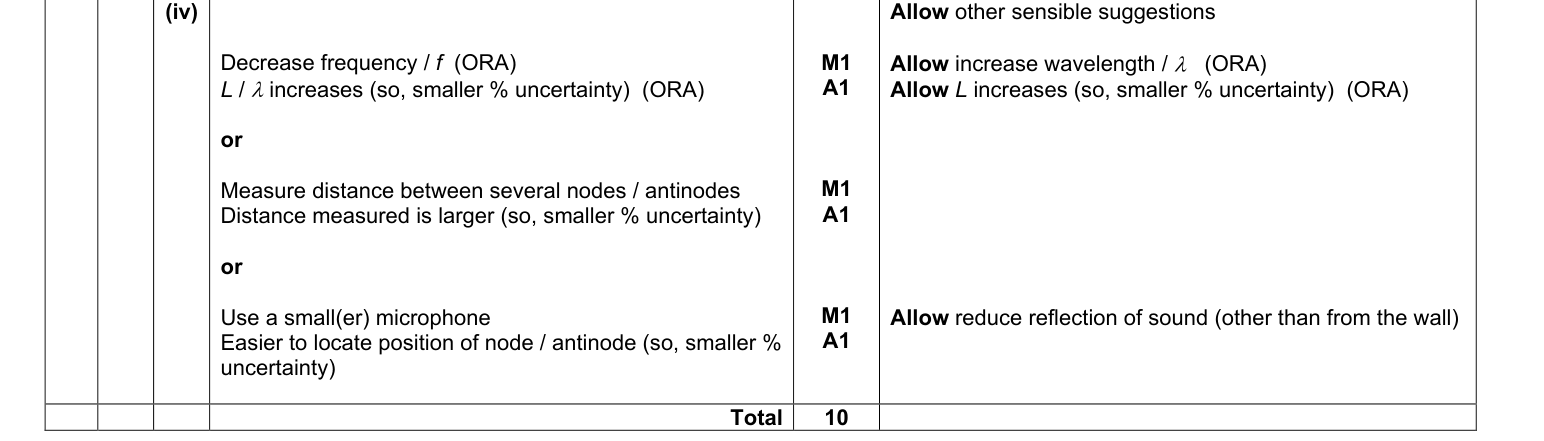
(iv) The smaller values of L are much more difficult to determine with the microphone in this
experiment and this produces large percentage uncertainty in the values of 1
L .
Suggest how this percentage uncertainty may be reduced in this experiment.
...........................................................................................................................................
...........................................................................................................................................
..................................................................................................................................... [2]
June 2019 · AS Paper 1 · Q25(a) 1 mark Short answer Medium wave particle duality
25 (a) State one piece of evidence for the wave-like behaviour of electrons.
...................................................................................................................................................
............................................................................................................................................. [1]
June 2019 · AS Paper 1 · Q25(b)(i) 3 marks Show that Hard photonswork energy and power
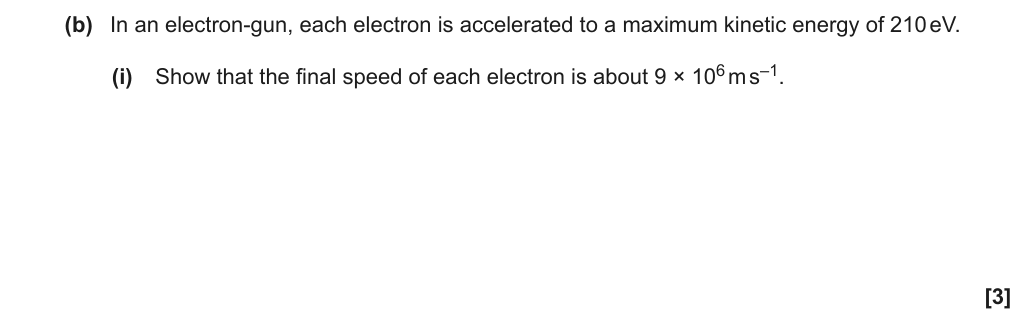
(b) In an electron-gun, each electron is accelerated to a maximum kinetic energy of 210 eV.
(i) Show that the final speed of each electron is about 9 × 10⁶ m s–1.
[3]
June 2019 · AS Paper 1 · Q25(b)(ii) 2 marks Calculation Medium wave particle dualitynewtons laws and momentum
Earlier part of question 25 that this part usesEarlier part of June 2019 Paper 1 question 25
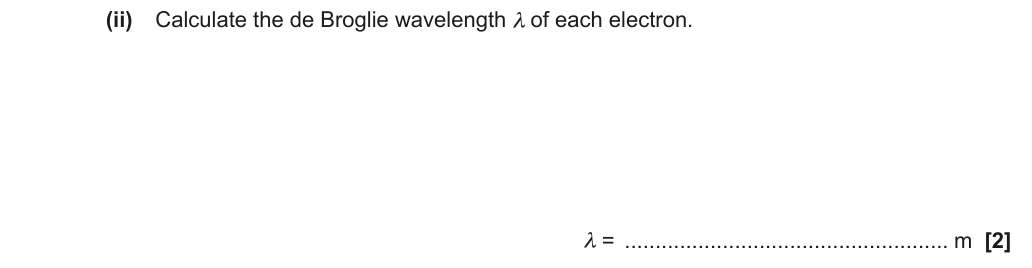
(ii) Calculate the de Broglie wavelength λ of each electron.
λ =  ..................................................... m  [2]
June 2019 · AS Paper 1 · Q25(c) 4 marks Explanation Hard photoelectric effectphotons
(c) Electromagnetic waves interact with matter as photons.
Explain the photoelectric effect using ideas of photons, conservation of energy and work
function.
...................................................................................................................................................
...................................................................................................................................................
...................................................................................................................................................
...................................................................................................................................................
...................................................................................................................................................
...................................................................................................................................................
...................................................................................................................................................
...................................................................................................................................................
...................................................................................................................................................
...................................................................................................................................................
...................................................................................................................................................
...................................................................................................................................................
............................................................................................................................................. [4]

Work with an OCR physics tutor

Want a paper marked and gone through with you? Message us.

Prefer email? Send an enquiry

If you are under 18, please include a parent's contact details. Enquiries go to enquiries@physicsaleveltutor.com and are deleted once handled. All tutoring is online.