June 2022: AS Paper 1, Breadth in physics

70 marks · 44 question parts · Paper, mark scheme and report on OCR's site · Have the Data, Formulae and Relationships Booklet beside you

Question by question

QTopicMarksAOType
1 Electromagnetic waves, polarisation and refraction 1Multiple choice
2 Charge, current and mean drift velocity, Series and parallel circuits: Kirchhoff's laws 1Multiple choice
3 Electromagnetic waves, polarisation and refraction 1Multiple choice
4 Superposition, interference and the double slit 1Multiple choice
5 Work, energy and power 1Multiple choice
6 Superposition, interference and the double slit 1Multiple choice
7 Series and parallel circuits: Kirchhoff's laws 1Multiple choice
8 Internal resistance and e.m.f., E.m.f., p.d., resistance and I–V characteristics 1Multiple choice
9 Equilibrium: moments, couples and centre of mass 1Multiple choice
10 Charge, current and mean drift velocity 1Multiple choice
11 Work, energy and power 1Multiple choice
12 Electromagnetic waves, polarisation and refraction 1Multiple choice
13 Mechanical properties of matter: stress, strain and the Young modulus 1Multiple choice
14 Resistivity 1Multiple choice
15 Equilibrium: moments, couples and centre of mass 1Multiple choice
16 E.m.f., p.d., resistance and I–V characteristics 1Multiple choice
17 The photoelectric effect 1Multiple choice
18 E.m.f., p.d., resistance and I–V characteristics, Charge, current and mean drift velocity 1Multiple choice
19 Stationary waves 1Multiple choice
20 Wave motion: progressive waves, the wave equation and intensity 1Multiple choice
21(a) Kinematics: displacement, velocity and motion graphs 3Calculation
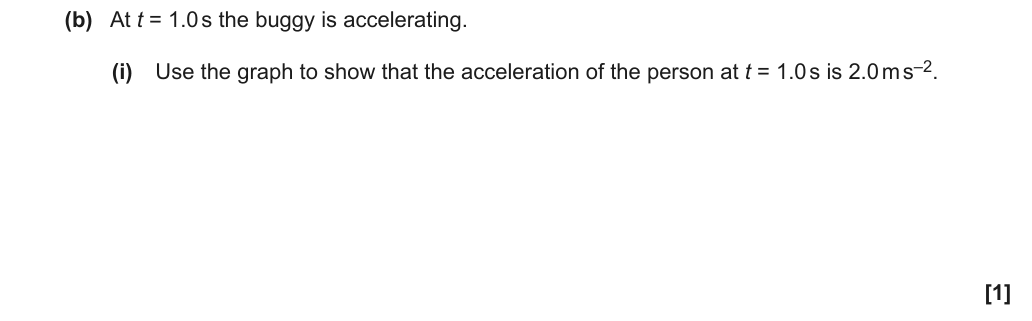
21(b)(i) Kinematics: displacement, velocity and motion graphs 1Show that
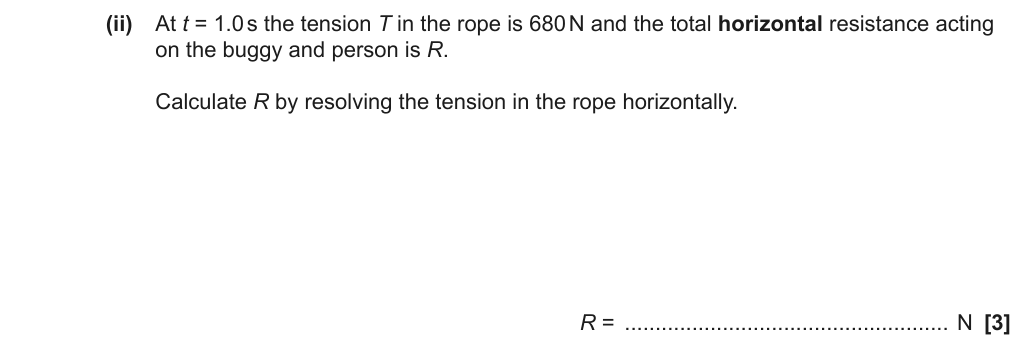
21(b)(ii) Scalars and vectors, Dynamics, drag and terminal velocity 3Calculation
22(a) Springs and Hooke's law, Practical skills: planning, analysis and evaluation 2Explanation
22(b) Work, energy and power 1Explanation
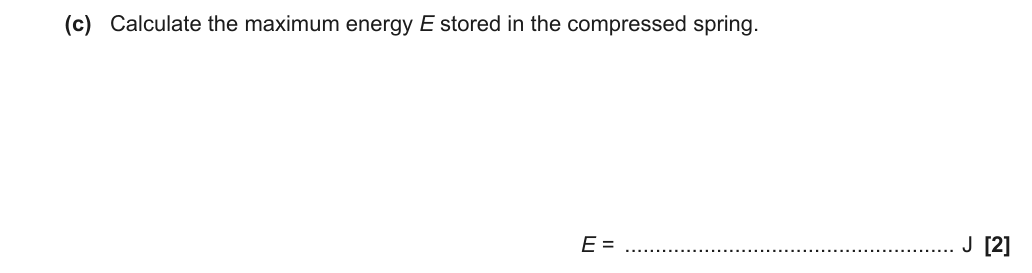
22(c) Mechanical properties of matter: stress, strain and the Young modulus 2Calculation
22(d) Work, energy and power 1Explanation
23(a) Newton's laws of motion and momentum 2Explanation
23(b) Collisions: conservation of momentum, Newton's laws of motion and momentum 2Show that
23(c) Collisions: conservation of momentum, Newton's laws of motion and momentum 2Calculation
23(d) Projectile motion, Linear motion: the suvat equations and free fall 3Calculation
24(a) Stationary waves 1Short answer
24(b)(i) Wave motion: progressive waves, the wave equation and intensity, Practical skills: planning, analysis and evaluation 2Explanation
24(b)(ii) Stationary waves, Measurements and uncertainties, Wave motion: progressive waves, the wave equation and intensity 5Calculation
25(a) E.m.f., p.d., resistance and I–V characteristics 1Short answer
25(b)(i) Potential dividers, Series and parallel circuits: Kirchhoff's laws 2Diagram or graph
25(b)(ii) Potential dividers, Series and parallel circuits: Kirchhoff's laws 2Explanation
25(c)(i) Resistivity, E.m.f., p.d., resistance and I–V characteristics, Series and parallel circuits: Kirchhoff's laws 4Calculation
25(c)(ii) Charge, current and mean drift velocity 2Calculation
26(a)(i) The photoelectric effect 1Explanation
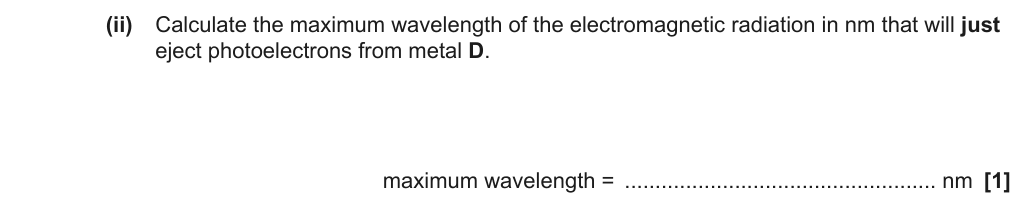
26(a)(ii) The photoelectric effect, Photons and the Planck constant 1Calculation
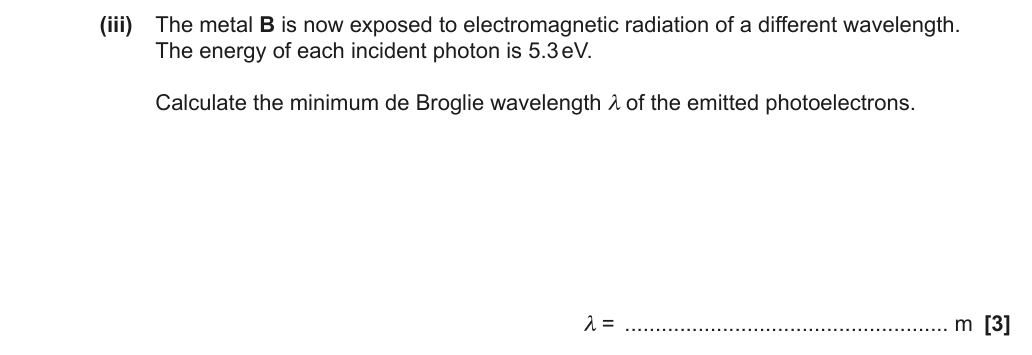
26(a)(iii) Wave–particle duality and the de Broglie equation, Work, energy and power, Photons and the Planck constant, The photoelectric effect 3Calculation
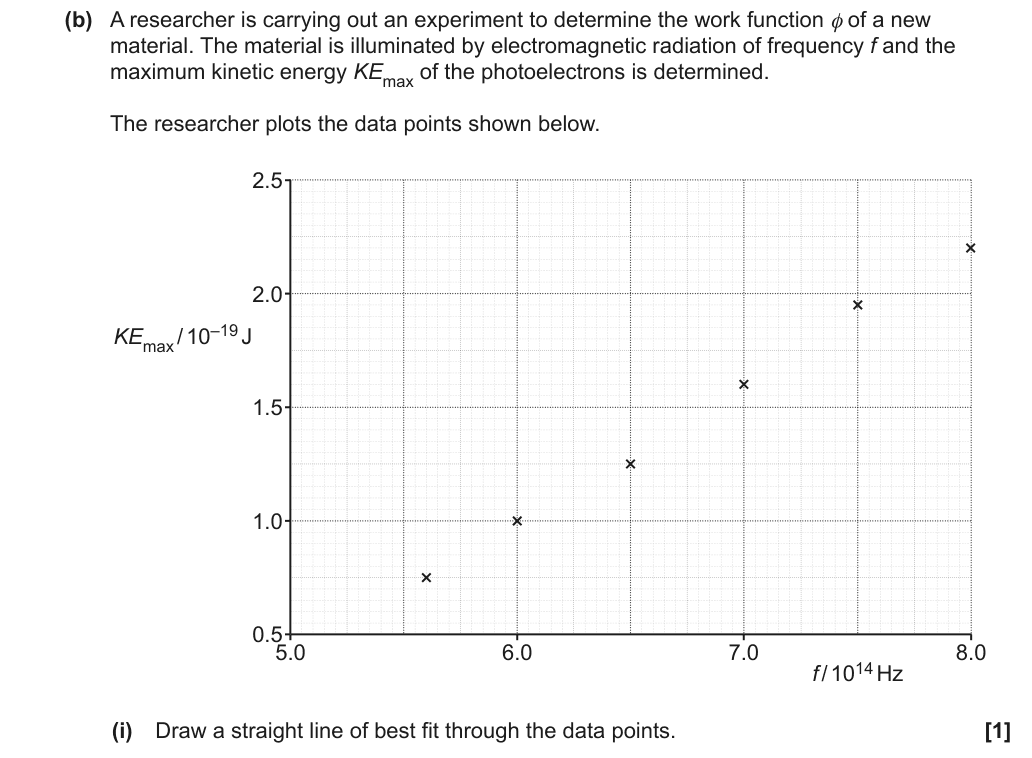
26(b)(i) Measurements and uncertainties, Practical skills: planning, analysis and evaluation 1Diagram or graph
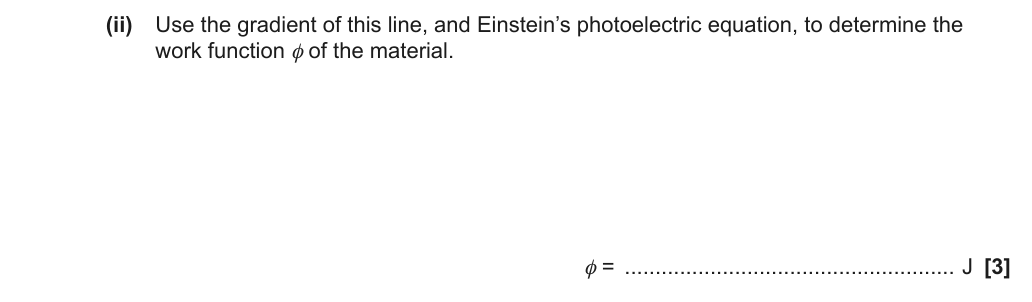
26(b)(ii) The photoelectric effect, Practical skills: planning, analysis and evaluation 3Calculation

The questions

123456789101112131415161718192021(a)21(b)(i)21(b)(ii)22(a)22(b)22(c)22(d)23(a)23(b)23(c)23(d)24(a)24(b)(i)24(b)(ii)25(a)25(b)(i)25(b)(ii)25(c)(i)25(c)(ii)26(a)(i)26(a)(ii)26(a)(iii)26(b)(i)26(b)(ii)
June 2022 · AS Paper 1 · Q1 1 mark Multiple choice Easy electromagnetic waves and refraction
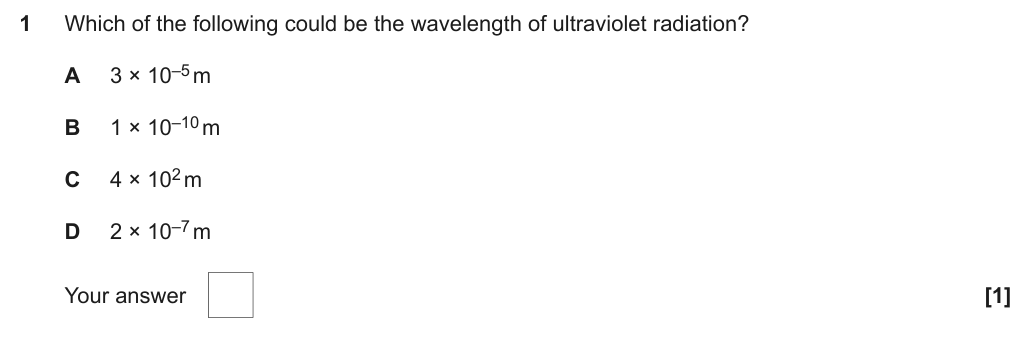
1 Which of the following could be the wavelength of ultraviolet radiation?
A 3 × 10⁻⁵ m
B 1 × 10⁻¹⁰ m
C 4 × 10² m
D 2 × 10⁻⁷ m
Your answer [1]
June 2022 · AS Paper 1 · Q2 1 mark Multiple choice Medium charge and currentseries and parallel circuits
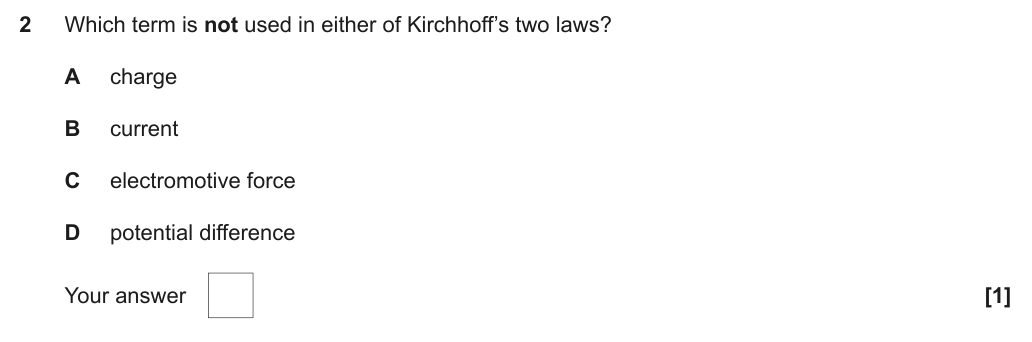
2 Which term is not used in either of Kirchhoff’s two laws?
A charge
B current
C electromotive force
D potential difference
Your answer [1]
June 2022 · AS Paper 1 · Q3 1 mark Multiple choice Medium electromagnetic waves and refraction
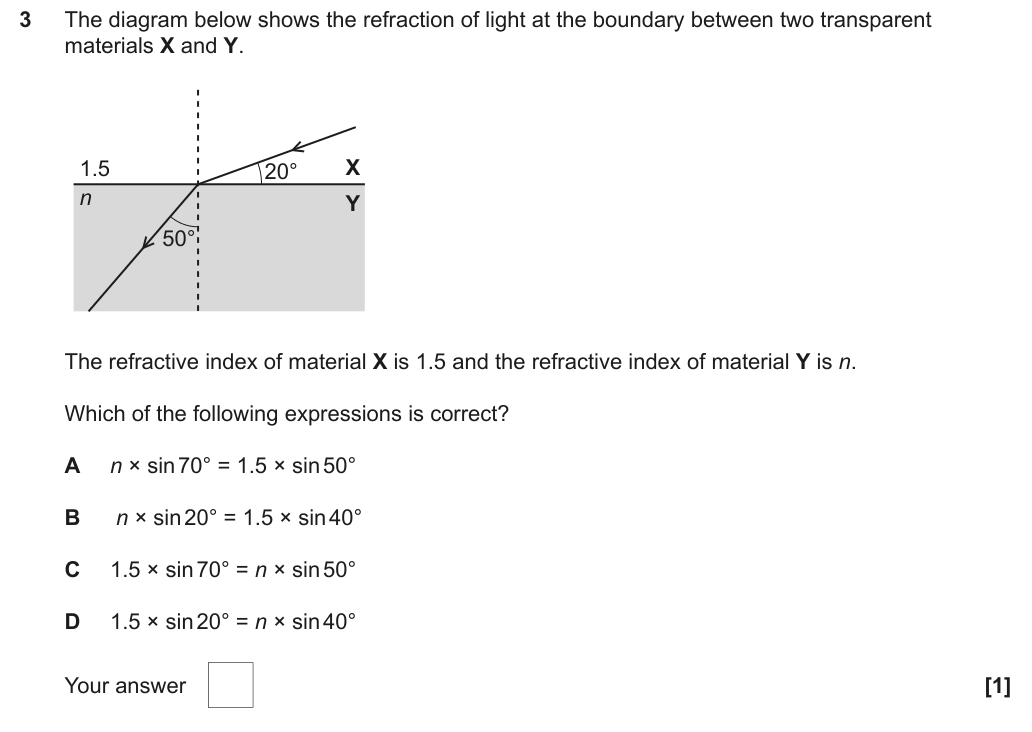
3 The diagram below shows the refraction of light at the boundary between two transparent
materials X and Y.
1.5 20° X
n Y
50°
The refractive index of material X is 1.5 and the refractive index of material Y is n.
Which of the following expressions is correct?
A n × sin 70° = 1.5 × sin 50°
B n × sin 20° = 1.5 × sin 40°
C  1.5 × sin 70° = n × sin 50°
D  1.5 × sin 20° = n × sin 40°
Your answer [1]
June 2022 · AS Paper 1 · Q4 1 mark Multiple choice Medium superposition and interference
4 A student is carrying out the Young double-slit experiment using visible light.
The distance between the slits and the screen is kept constant.
The wavelength of light is λ and the separation of the slits is a.
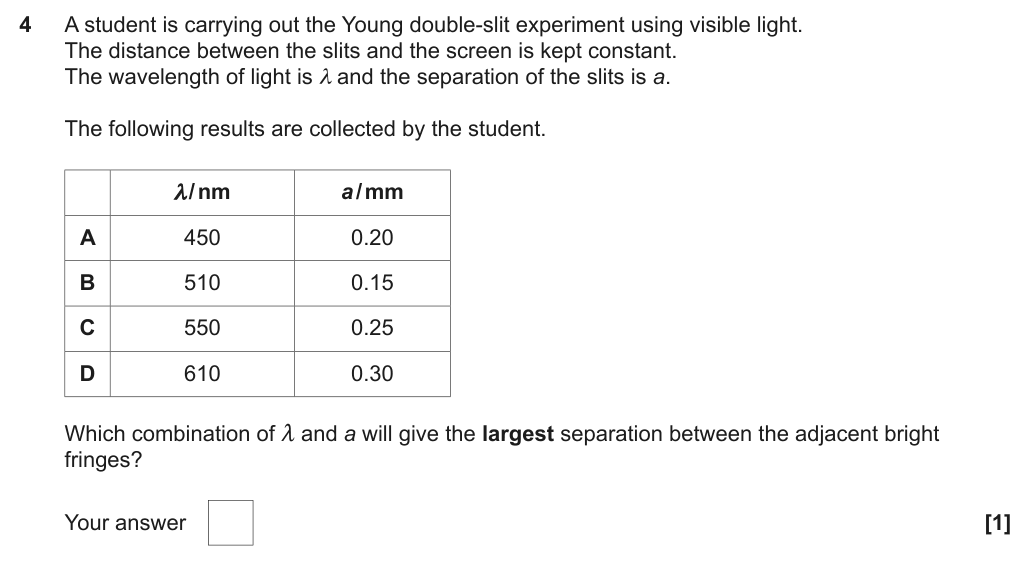
The following results are collected by the student.
λ / nm a / mm
A 450 0.20
B 510 0.15
C 550 0.25
D 610 0.30
Which combination of m and a will give the largest separation between the adjacent bright
fringes?
Your answer [1]
June 2022 · AS Paper 1 · Q5 1 mark Multiple choice Medium work energy and power
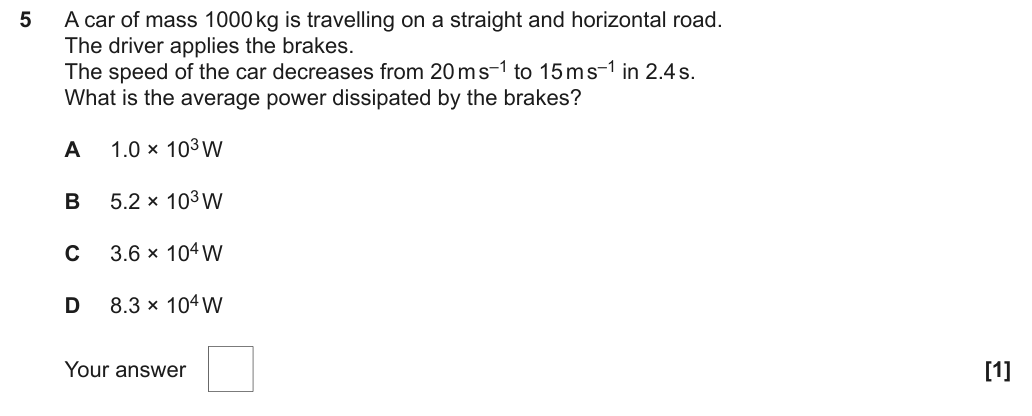
5 A car of mass 1000 kg is travelling on a straight and horizontal road.
The driver applies the brakes.
The speed of the car decreases from 20 m s–1 to 15 m s–1 in 2.4 s.
What is the average power dissipated by the brakes?
A 1.0 × 10³ W
B 5.2 × 10³ W
C 3.6 × 10⁴ W
D 8.3 × 10⁴ W
Your answer [1]
June 2022 · AS Paper 1 · Q6 1 mark Multiple choice Medium superposition and interference
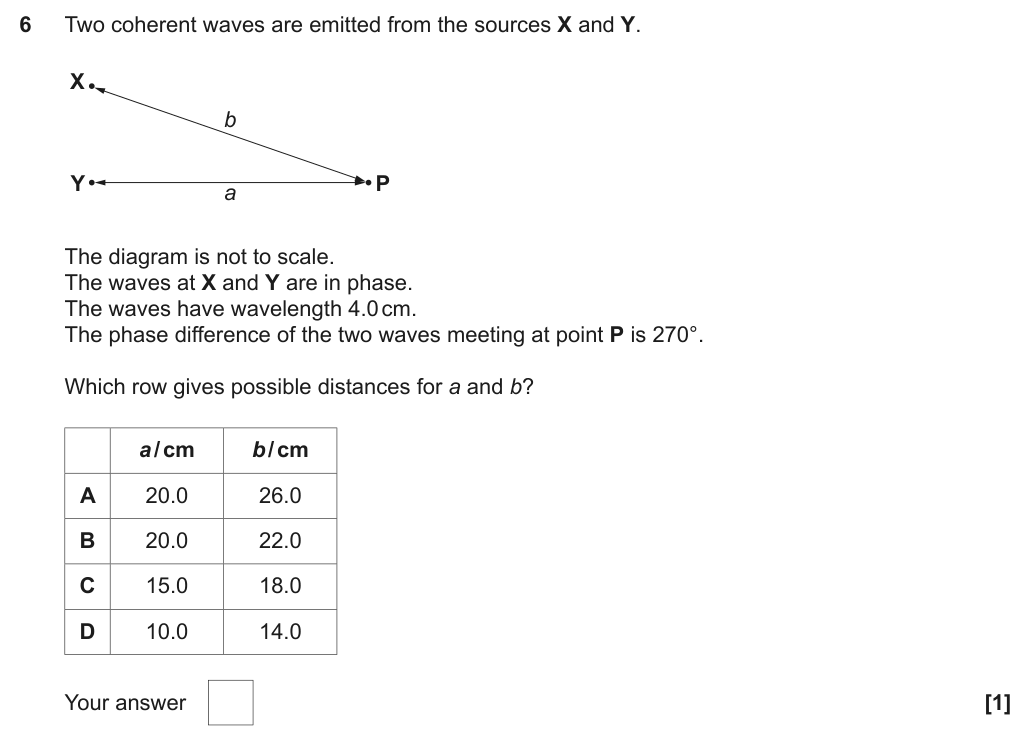
6 Two coherent waves are emitted from the sources X and Y.
X
b
Y P
a
The diagram is not to scale.
The waves at X and Y are in phase.
The waves have wavelength 4.0 cm.
The phase difference of the two waves meeting at point P is 270°.
Which row gives possible distances for a and b?
a / cm b / cm
A 20.0 26.0
B 20.0 22.0
C 15.0 18.0
D 10.0 14.0
Your answer [1]
June 2022 · AS Paper 1 · Q7 1 mark Multiple choice Medium series and parallel circuits
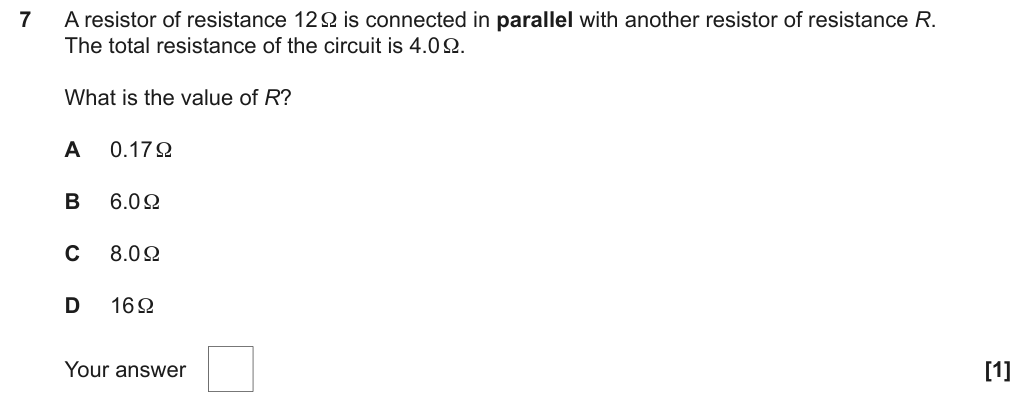
7 A resistor of resistance 12 Ω is connected in parallel with another resistor of resistance R.
The total resistance of the circuit is 4.0 Ω.
What is the value of R?
A 0.17 Ω
B 6.0 Ω
C 8.0 Ω
D 16 Ω
Your answer [1]
June 2022 · AS Paper 1 · Q8 1 mark Multiple choice Medium internal resistanceemf pd and resistance
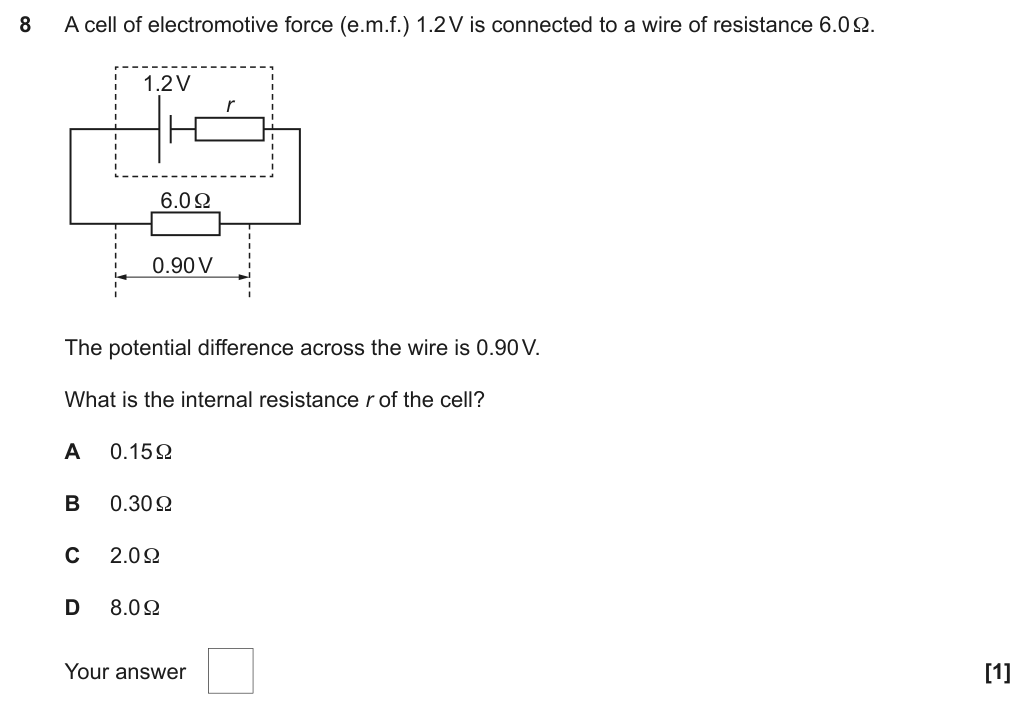
8 A cell of electromotive force (e.m.f.) 1.2 V is connected to a wire of resistance 6.0 Ω.
1.2 V
r
6.0 Ω
0.90 V
The potential difference across the wire is 0.90 V.
What is the internal resistance r of the cell?
A 0.15 Ω
B 0.30 Ω
C 2.0 Ω
D 8.0 Ω
Your answer [1]
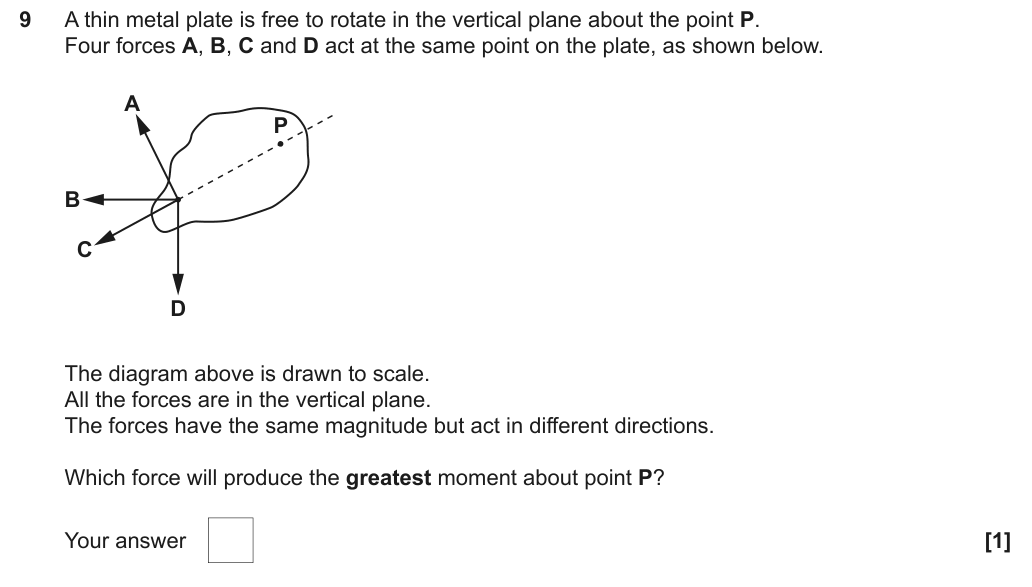
June 2022 · AS Paper 1 · Q9 1 mark Multiple choice Medium equilibrium and moments
9 A thin metal plate is free to rotate in the vertical plane about the point P.
Four forces A, B, C and D act at the same point on the plate, as shown below.
A
P
B
C
D
The diagram above is drawn to scale.
All the forces are in the vertical plane.
The forces have the same magnitude but act in different directions.
Which force will produce the greatest moment about point P?
Your answer [1]
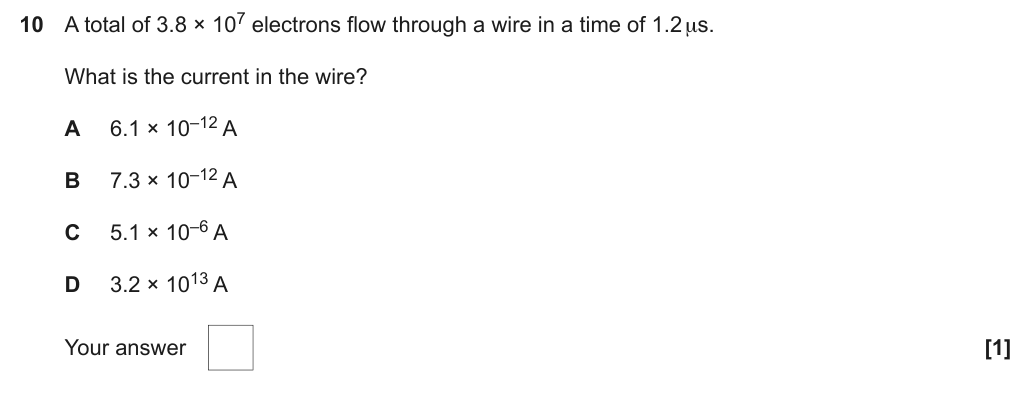
June 2022 · AS Paper 1 · Q10 1 mark Multiple choice Easy charge and current
10 A total of 3.8 × 10⁷ electrons flow through a wire in a time of 1.2 μs.
What is the current in the wire?
A 6.1 × 10⁻¹² A
B 7.3 × 10⁻¹² A
C 5.1 × 10⁻⁶ A
D 3.2 × 10¹³ A
Your answer [1]
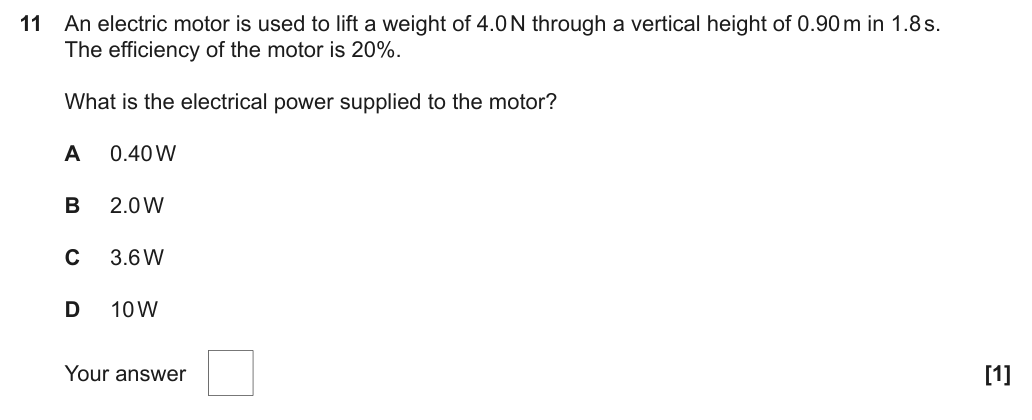
June 2022 · AS Paper 1 · Q11 1 mark Multiple choice Medium work energy and power
11 An electric motor is used to lift a weight of 4.0 N through a vertical height of 0.90 m in 1.8 s.
The efficiency of the motor is 20%.
What is the electrical power supplied to the motor?

A 0.40 W
B 2.0 W
C 3.6 W
D 10 W
Your answer [1]
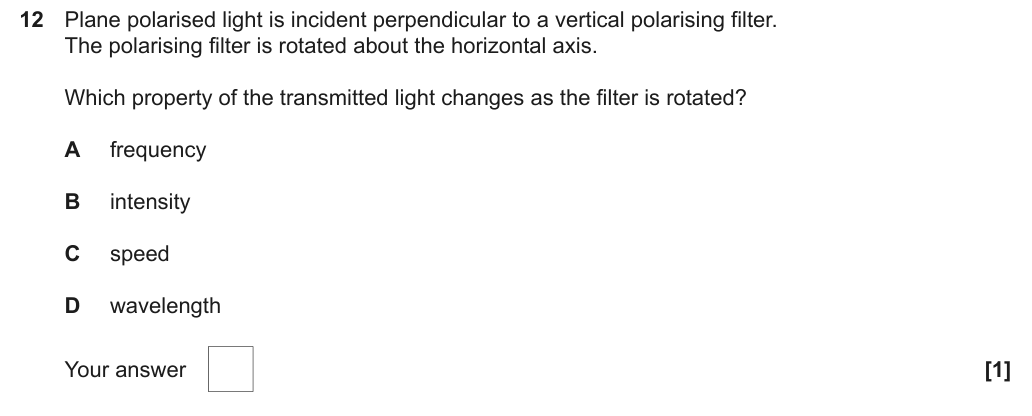
June 2022 · AS Paper 1 · Q12 1 mark Multiple choice Medium electromagnetic waves and refraction
12 Plane polarised light is incident perpendicular to a vertical polarising filter.
The polarising filter is rotated about the horizontal axis.
Which property of the transmitted light changes as the filter is rotated?
A frequency
B intensity
C speed
D wavelength
Your answer [1]
June 2022 · AS Paper 1 · Q13 1 mark Multiple choice Medium materials and young modulus
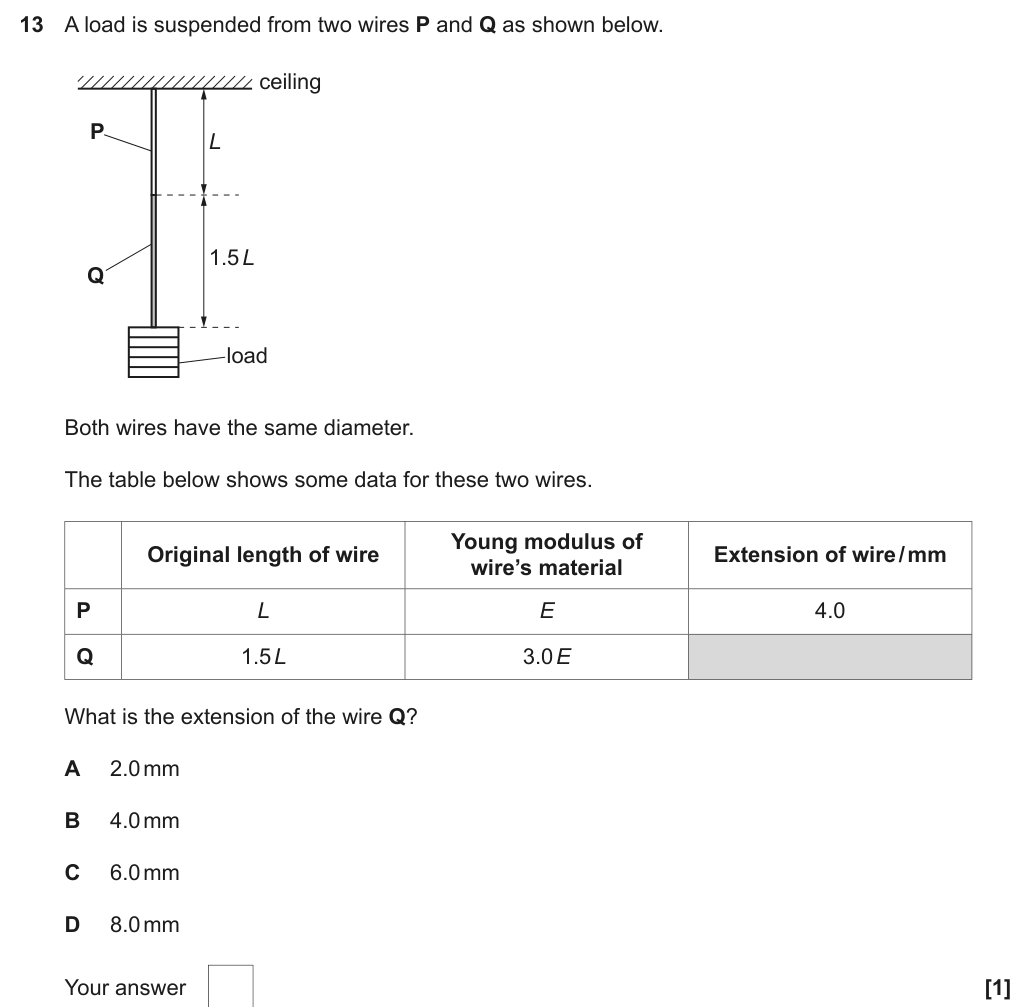
13 A load is suspended from two wires P and Q as shown below.
ceiling
P
L
1.5 L
Q
load
Both wires have the same diameter.
The table below shows some data for these two wires.
Young modulus of
Original length of wire Extension of wire / mm
wire’s material
P L E 4.0
Q 1.5 L 3.0 E
What is the extension of the wire Q?
A 2.0 mm
B 4.0 mm
C 6.0 mm
D 8.0 mm
Your answer [1]
June 2022 · AS Paper 1 · Q14 1 mark Multiple choice Medium resistivity
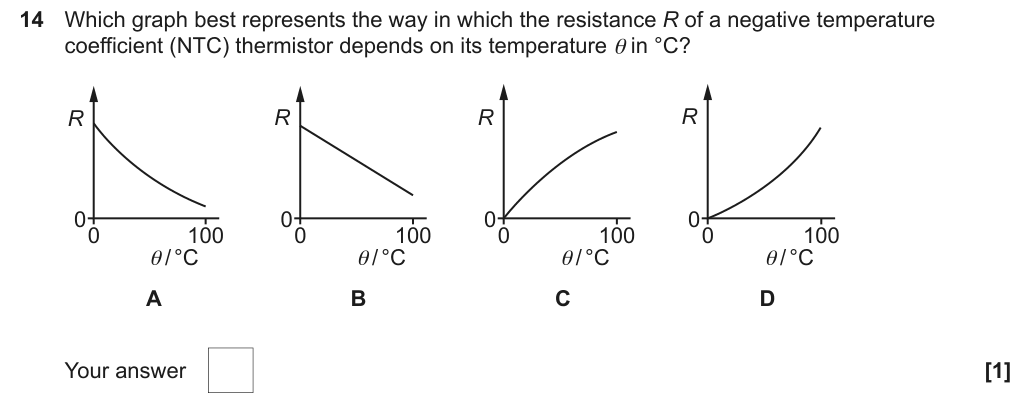
14 Which graph best represents the way in which the resistance R of a negative temperature
coefficient (NTC) thermistor depends on its temperature θ in °C?
R R R R
0 0 0 0
0 100 0 100 0 100 0 100
θ / °C θ / °C θ / °C θ / °C
A B C D
Your answer [1]
June 2022 · AS Paper 1 · Q15 1 mark Multiple choice Medium equilibrium and moments
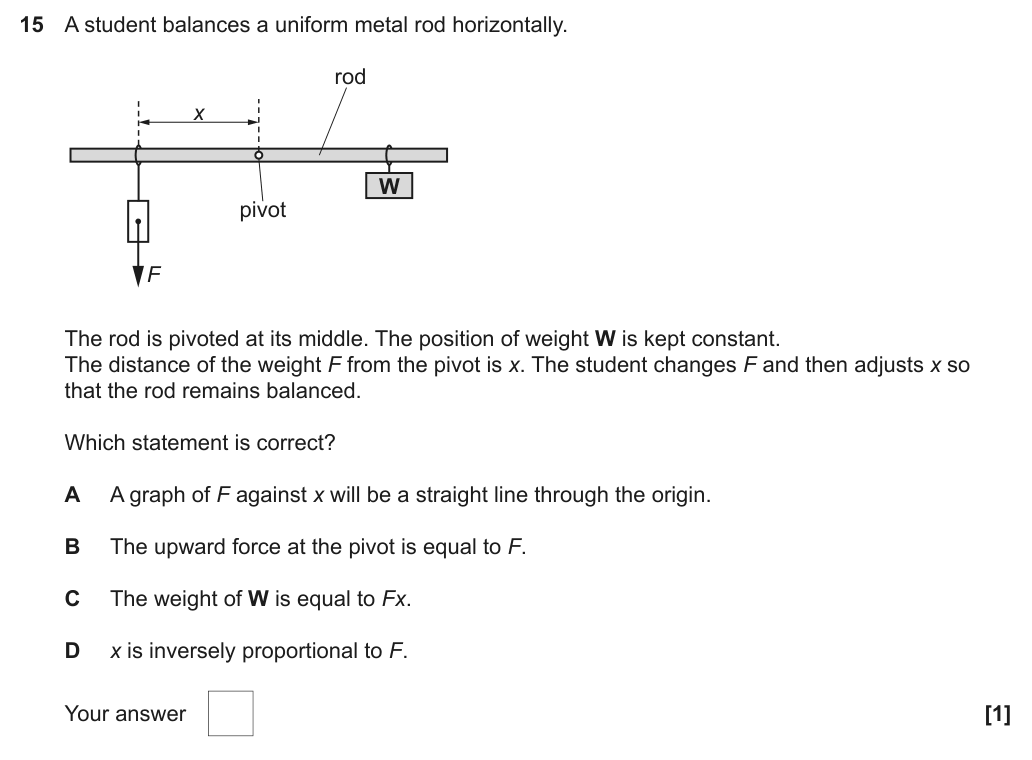
15 A student balances a uniform metal rod horizontally.
rod
x
W
pivot
F
The rod is pivoted at its middle. The position of weight W is kept constant.
Th e distance of the weight F from the pivot is x. The student changes F and then adjusts x so
that the rod remains balanced.
Which statement is correct?
A A graph of F against x will be a straight line through the origin.
B The upward force at the pivot is equal to F.
C The weight of W is equal to Fx.
D x is inversely proportional to F.
Your answer [1]
June 2022 · AS Paper 1 · Q16 1 mark Multiple choice Easy emf pd and resistance
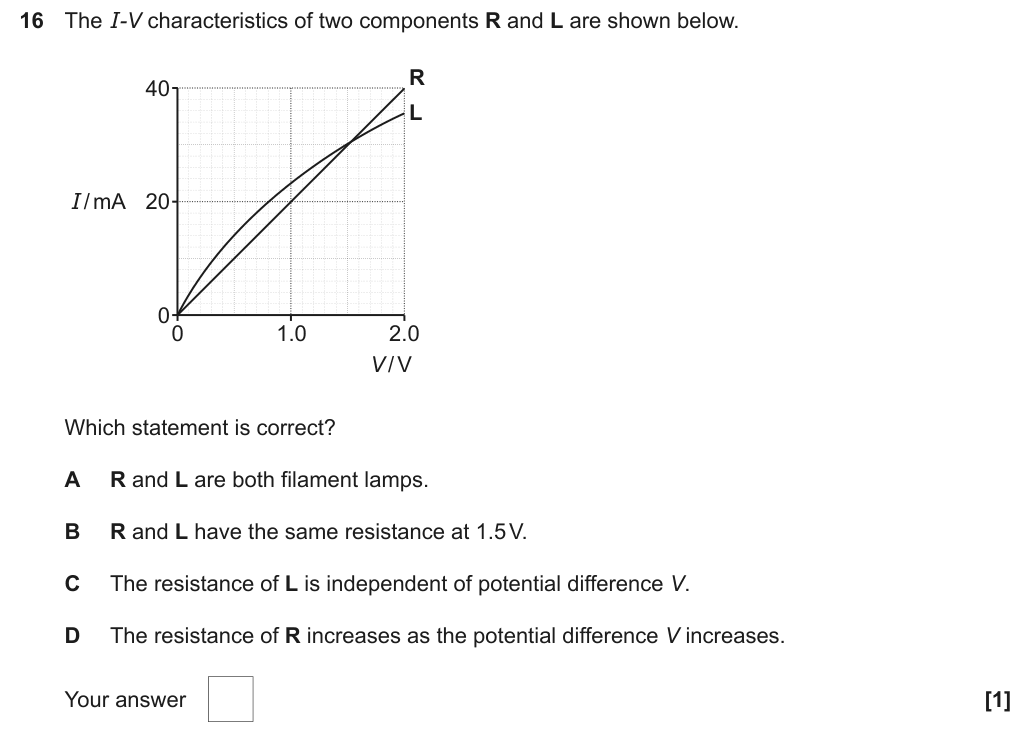
16 The I-V characteristics of two components R and L are shown below.
R
40
L
I / mA 20
0
0 1.0 2.0
V / V
Which statement is correct?
A R and L are both filament lamps.
B R and L have the same resistance at 1.5 V.
C The resistance of L is independent of potential difference V.
D The resistance of R increases as the potential difference V increases.
Your answer [1]
June 2022 · AS Paper 1 · Q17 1 mark Multiple choice Medium photoelectric effect
17 The photoelectric effect can be demonstrated using a gold-leaf electroscope.
The zinc plate of the electroscope is negatively charged.
Ultraviolet radiation incident on the zinc collapses the gold leaf.
What is removed from the zinc plate by the incident radiation?
A electrons
B ions
C  photons
D protons
Your answer [1]
June 2022 · AS Paper 1 · Q18 1 mark Multiple choice Easy emf pd and resistancecharge and current
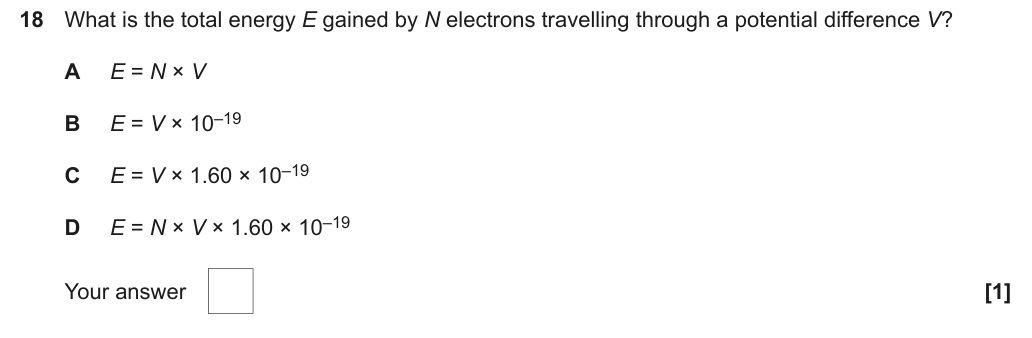
18 What is the total energy E gained by N electrons travelling through a potential difference V?
A E = N × V
B E = V × 10–19
C E = V × 1.60 × 10⁻¹⁹
D E = N × V × 1.60 × 10⁻¹⁹
Your answer [1]
June 2022 · AS Paper 1 · Q19 1 mark Multiple choice Medium stationary waves
19 A student is experimenting with sound waves of wavelength 3.0 cm and electromagnetic waves
also of wavelength 3.0 cm.
Which statement is correct about both of these waves?
A They can be polarised.
B They can form stationary waves.
C They have the same frequency.
D They have the same speed.
Your answer [1]
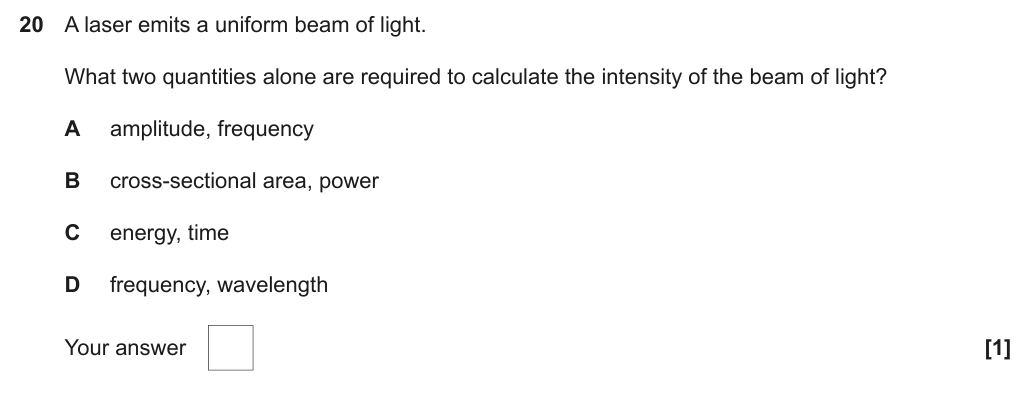
June 2022 · AS Paper 1 · Q20 1 mark Multiple choice Medium wave motion
20 A laser emits a uniform beam of light.
What two quantities alone are required to calculate the intensity of the beam of light?
A amplitude, frequency
B cross-sectional area, power
C energy, time
D frequency, wavelength
Your answer [1]
June 2022 · AS Paper 1 · Q21(a) 3 marks Calculation Medium kinematics
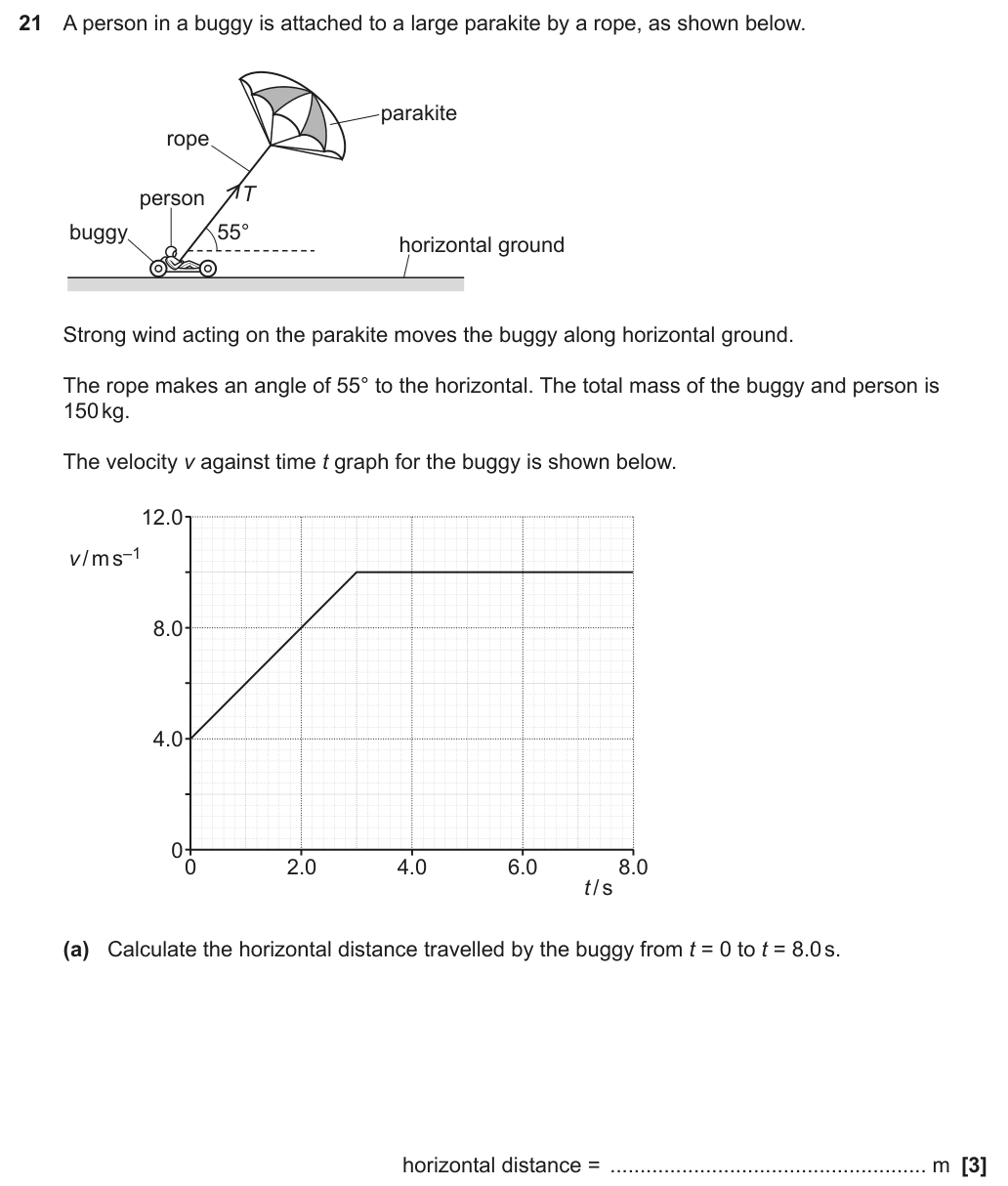
21 A person in a buggy is attached to a large parakite by a rope, as shown below.
parakite
rope
person T
buggy 55°
horizontal ground
Strong wind acting on the parakite moves the buggy along horizontal ground.
The rope makes an angle of 55° to the horizontal. The total mass of the buggy and person is
150 kg.
The velocity v against time t graph for the buggy is shown below.
12.0
v / m s–1
8.0
4.0
0
0 2.0 4.0 6.0 8.0
t / s
(a) Calculate the horizontal distance travelled by the buggy from t = 0 to t = 8.0 s.
horizontal distance =  ..................................................... m [3]
June 2022 · AS Paper 1 · Q21(b)(i) 1 mark Show that Medium kinematics
Earlier part of question 21 that this part usesEarlier part of June 2022 Paper 1 question 21
(b) At t = 1.0 s the buggy is accelerating.
(i) Use the graph to show that the acceleration of the person at t = 1.0 s is 2.0 m s–2.
[1]
June 2022 · AS Paper 1 · Q21(b)(ii) 3 marks Calculation Medium scalars and vectorsdynamics and terminal velocity
Earlier parts of question 21 that this part usesEarlier part of June 2022 Paper 1 question 21Earlier part of June 2022 Paper 1 question 21
(ii) At t = 1.0 s the tension T in the rope is 680 N and the total horizontal resistance acting
on the buggy and person is R.
Calculate R by resolving the tension in the rope horizontally.
R =  ..................................................... N [3]
June 2022 · AS Paper 1 · Q22(a) 2 marks Explanation Medium springspractical skills
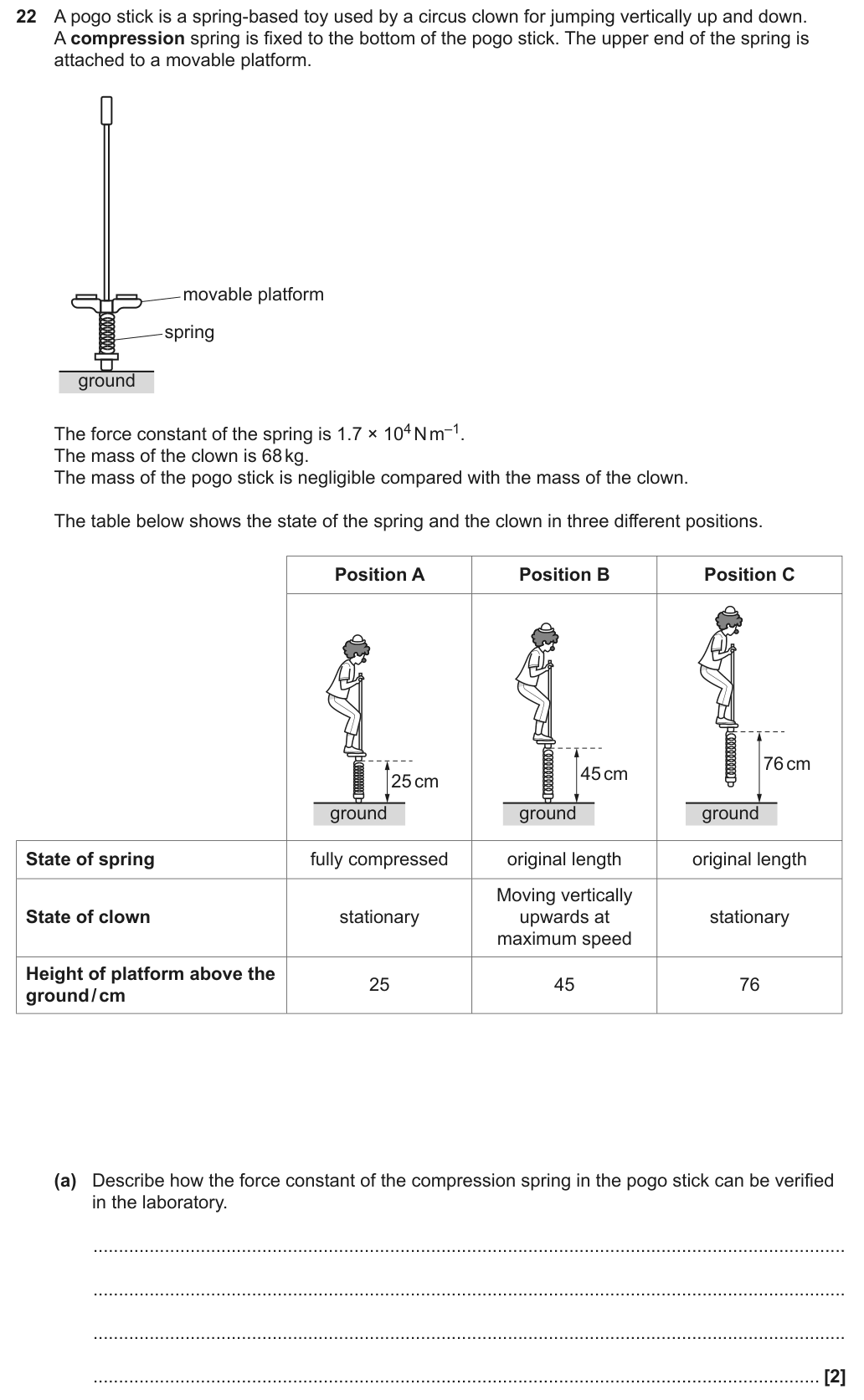
22 A pogo stick is a spring-based toy used by a circus clown for jumping vertically up and down.
A compression spring is fixed to the bottom of the pogo stick. The upper end of the spring is
attached to a movable platform.
movable platform
spring
ground
The force constant of the spring is 1.7 × 10⁴ N m–1.
The mass of the clown is 68 kg.
The mass of the pogo stick is negligible compared with the mass of the clown.
The table below shows the state of the spring and the clown in three different positions.
Position A Position B Position C
76 cm
45 cm
25 cm
ground ground ground
State of spring fully compressed original length original length
Moving vertically
State of clown stationary upwards at stationary
maximum speed
Height of platform above the
25 45 76
ground / cm
(a) Describe how the force constant of the compression spring in the pogo stick can be verified
in the laboratory.
...................................................................................................................................................
...................................................................................................................................................
...................................................................................................................................................
.............................................................................................................................................. [2]
June 2022 · AS Paper 1 · Q22(b) 1 mark Explanation Medium work energy and power
Earlier part of question 22 that this part usesEarlier part of June 2022 Paper 1 question 22
(b) Describe the energy changes taking place between positions B and C.
...................................................................................................................................................
.............................................................................................................................................. [1]
June 2022 · AS Paper 1 · Q22(c) 2 marks Calculation Medium materials and young modulus
Earlier part of question 22 that this part usesEarlier part of June 2022 Paper 1 question 22
(c) Calculate the maximum energy E stored in the compressed spring.
E =  ...................................................... J [2]
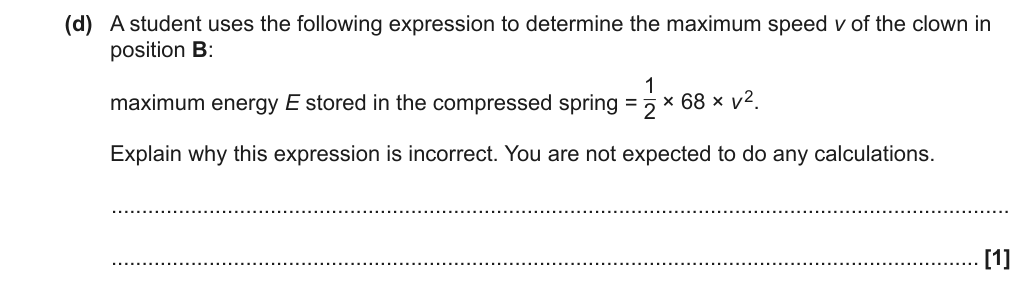
June 2022 · AS Paper 1 · Q22(d) 1 mark Explanation Hard work energy and power
Earlier part of question 22 that this part usesEarlier part of June 2022 Paper 1 question 22
(d) A student uses the following expression to determine the maximum speed v of the clown in
position B:
maximum energy E stored in the compressed spring = 1
2 × 68 × v 2.
Explain why this expression is incorrect. You are not expected to do any calculations.
...................................................................................................................................................
.............................................................................................................................................. [1]
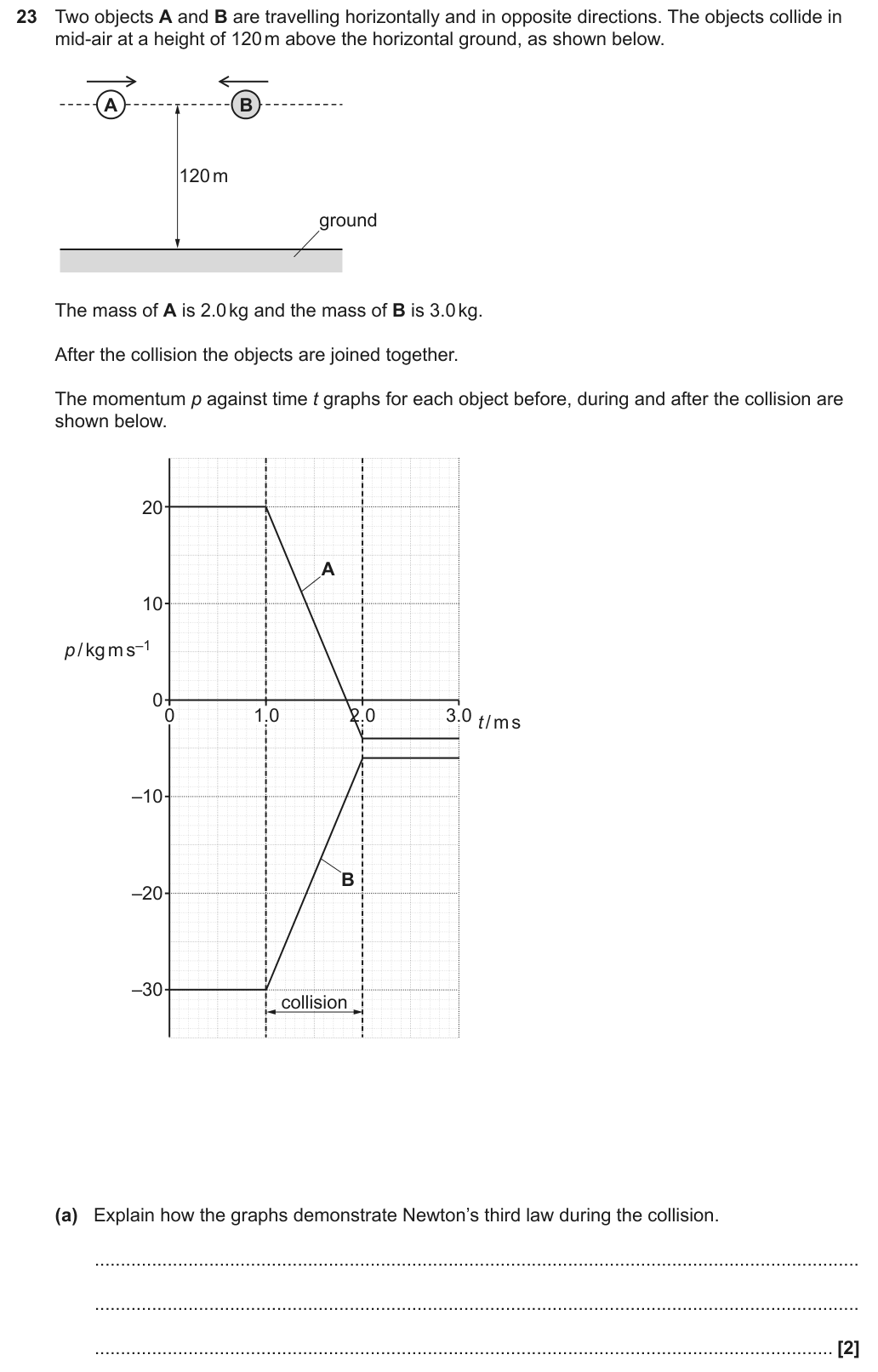
June 2022 · AS Paper 1 · Q23(a) 2 marks Explanation Hard newtons laws and momentum
23 Two objects A and B are travelling horizontally and in opposite directions. The objects collide in
mid-air at a height of 120 m above the horizontal ground, as shown below.
A B
120 m
ground
The mass of A is 2.0 kg and the mass of B is 3.0 kg.
After the collision the objects are joined together.
The momentum p against time t graphs for each object before, during and after the collision are
shown below.
20
A
10
p / kg m s–1
0
0 1.0 2.0 3.0
t / m s
–10
B
–20
–30
collision
(a) Explain how the graphs demonstrate Newton’s third law during the collision.
...................................................................................................................................................
...................................................................................................................................................
.............................................................................................................................................. [2]
June 2022 · AS Paper 1 · Q23(b) 2 marks Show that Medium collisionsnewtons laws and momentum
Earlier part of question 23 that this part usesEarlier part of June 2022 Paper 1 question 23
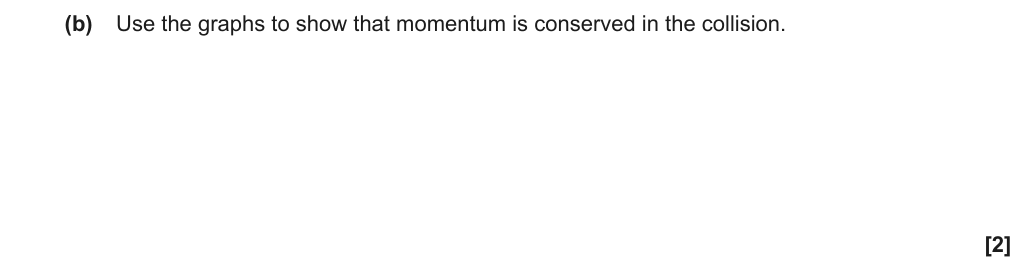
(b)  Use the graphs to show that momentum is conserved in the collision.
[2]
June 2022 · AS Paper 1 · Q23(c) 2 marks Calculation Medium collisionsnewtons laws and momentum
Earlier part of question 23 that this part usesEarlier part of June 2022 Paper 1 question 23
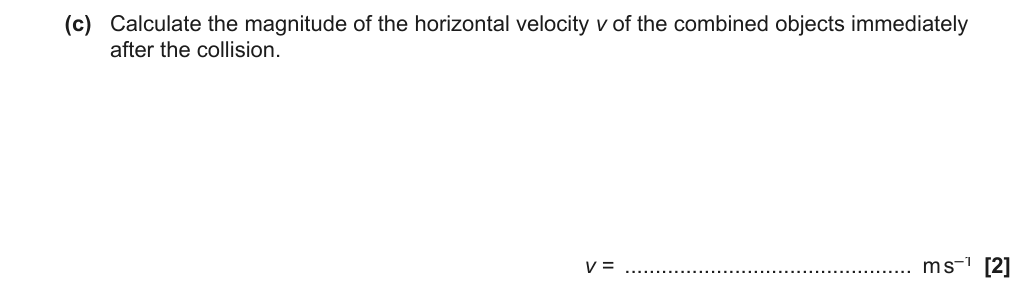
(c) Calculate the magnitude of the horizontal velocity v of the combined objects immediately
after the collision.
v =  ............................................... m s–1 [2]
June 2022 · AS Paper 1 · Q23(d) 3 marks Calculation Medium projectile motionlinear motion
Earlier part of question 23 that this part usesEarlier part of June 2022 Paper 1 question 23
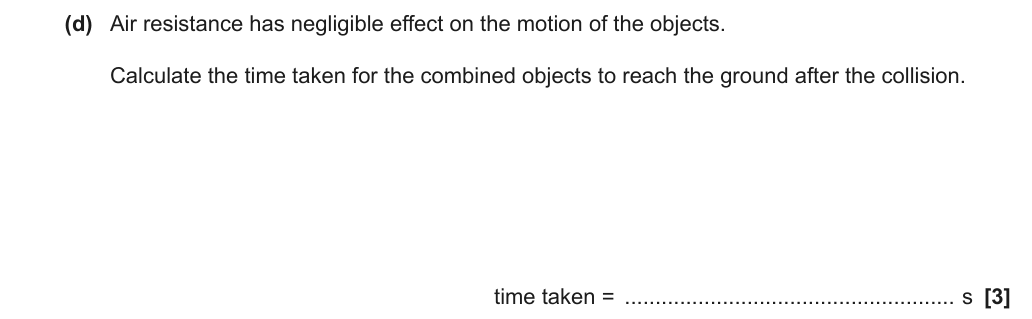
(d) Air resistance has negligible effect on the motion of the objects.
Calculate the time taken for the combined objects to reach the ground after the collision.
time taken =  ...................................................... s [3]
June 2022 · AS Paper 1 · Q24(a) 1 mark Short answer Medium stationary waves
24 (a) Stationary waves are formed on the surface of seawater in a harbour as incoming waves
are reflected off the harbour wall.
An observer is looking at these stationary waves.
State how the observer can tell that these are stationary waves.
...................................................................................................................................................
.............................................................................................................................................. [1]
June 2022 · AS Paper 1 · Q24(b)(i) 2 marks Explanation Hard wave motionpractical skills
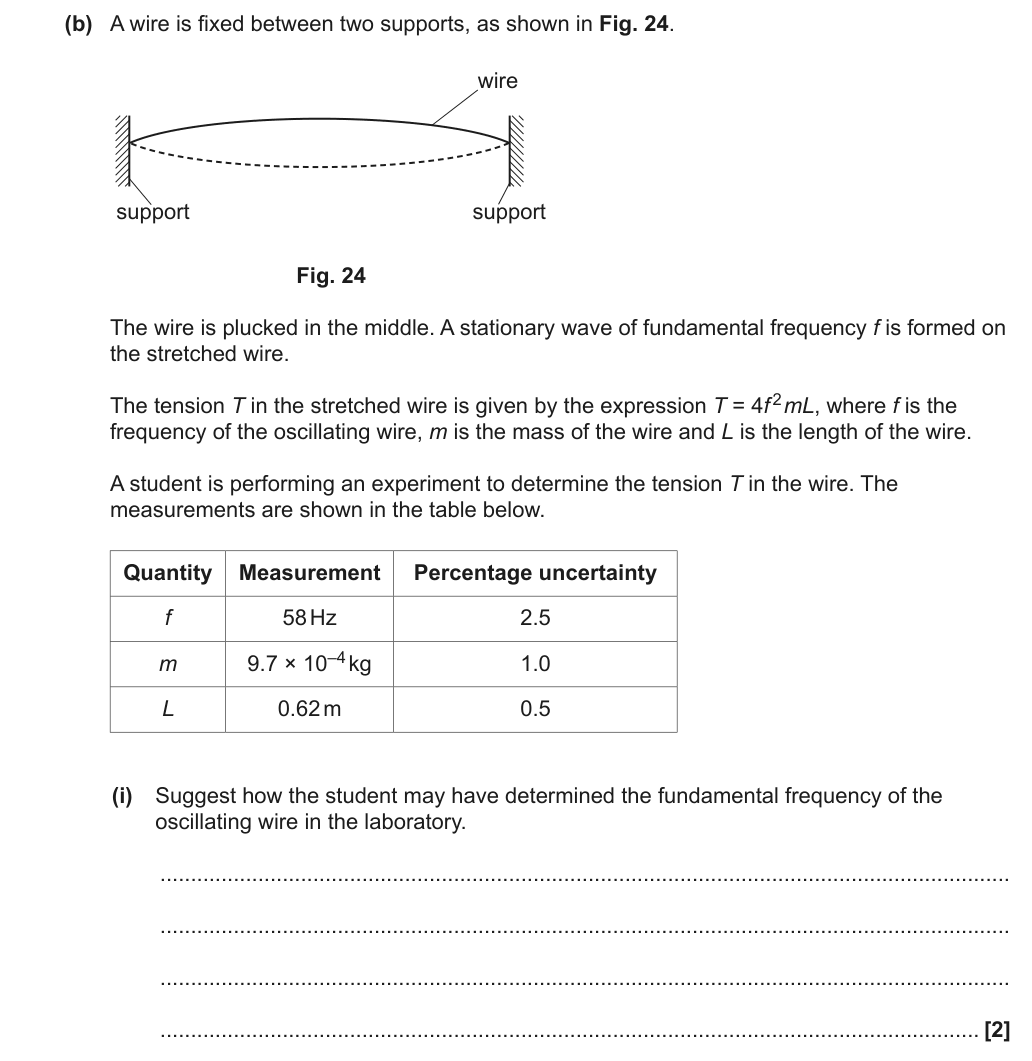
(b) A wire is fixed between two supports, as shown in Fig. 24.
wire
support support
Fig. 24
The wire is plucked in the middle. A stationary wave of fundamental frequency f is formed on
the stretched wire.
The tension T in the stretched wire is given by the expression T = 4f 2 mL, where f is the
frequency of the oscillating wire, m is the mass of the wire and L is the length of the wire.
A student is performing an experiment to determine the tension T in the wire. The
measurements are shown in the table below.
Quantity Measurement Percentage uncertainty
f 58 Hz 2.5
m 9.7 × 10⁻⁴ kg 1.0
L 0.62 m 0.5
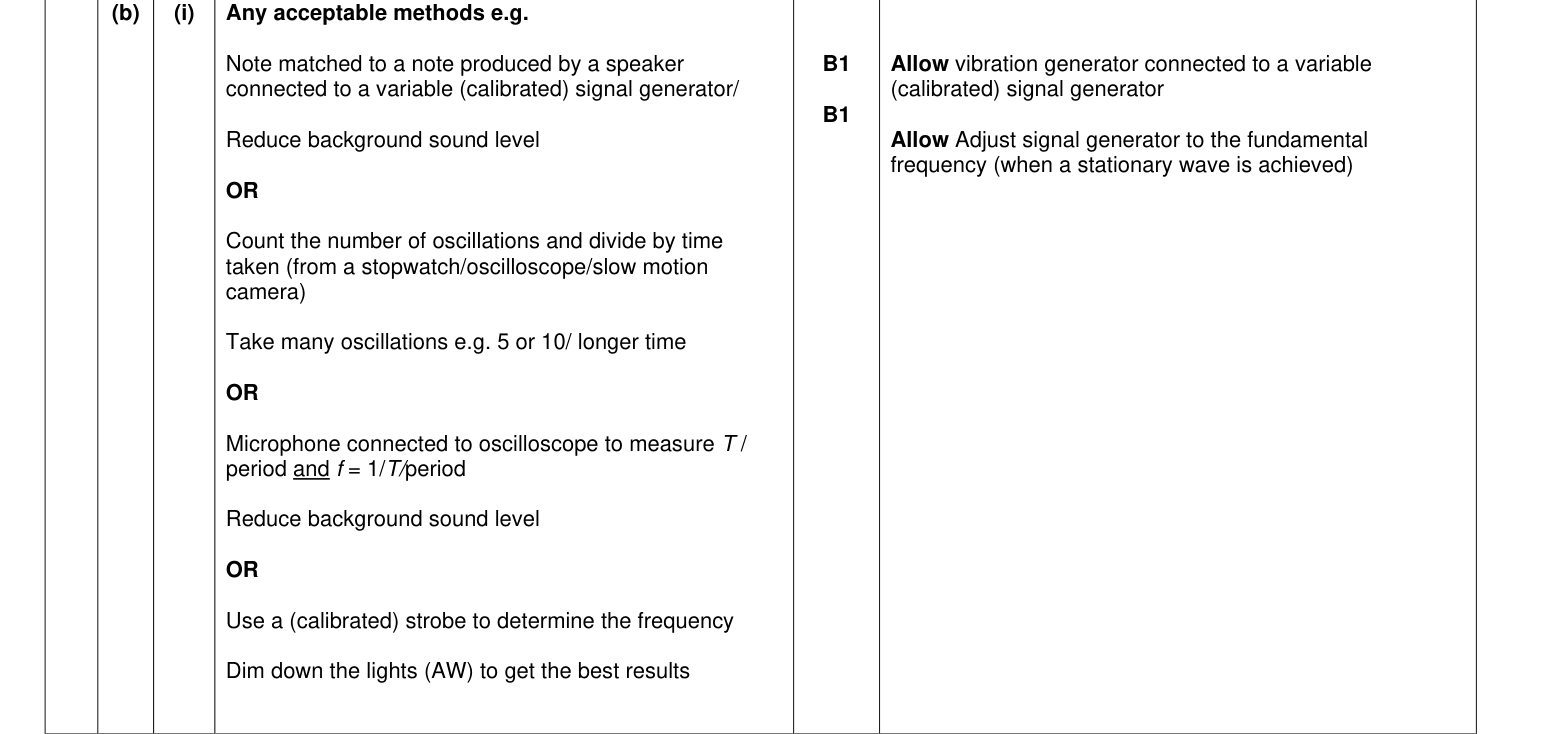
(i) Suggest how the student may have determined the fundamental frequency of the
oscillating wire in the laboratory.
...........................................................................................................................................
...........................................................................................................................................
...........................................................................................................................................
...................................................................................................................................... [2]
June 2022 · AS Paper 1 · Q24(b)(ii) 5 marks Calculation Easy stationary wavesmeasurements and uncertaintieswave motion
Earlier part of question 24 that this part usesEarlier part of June 2022 Paper 1 question 24
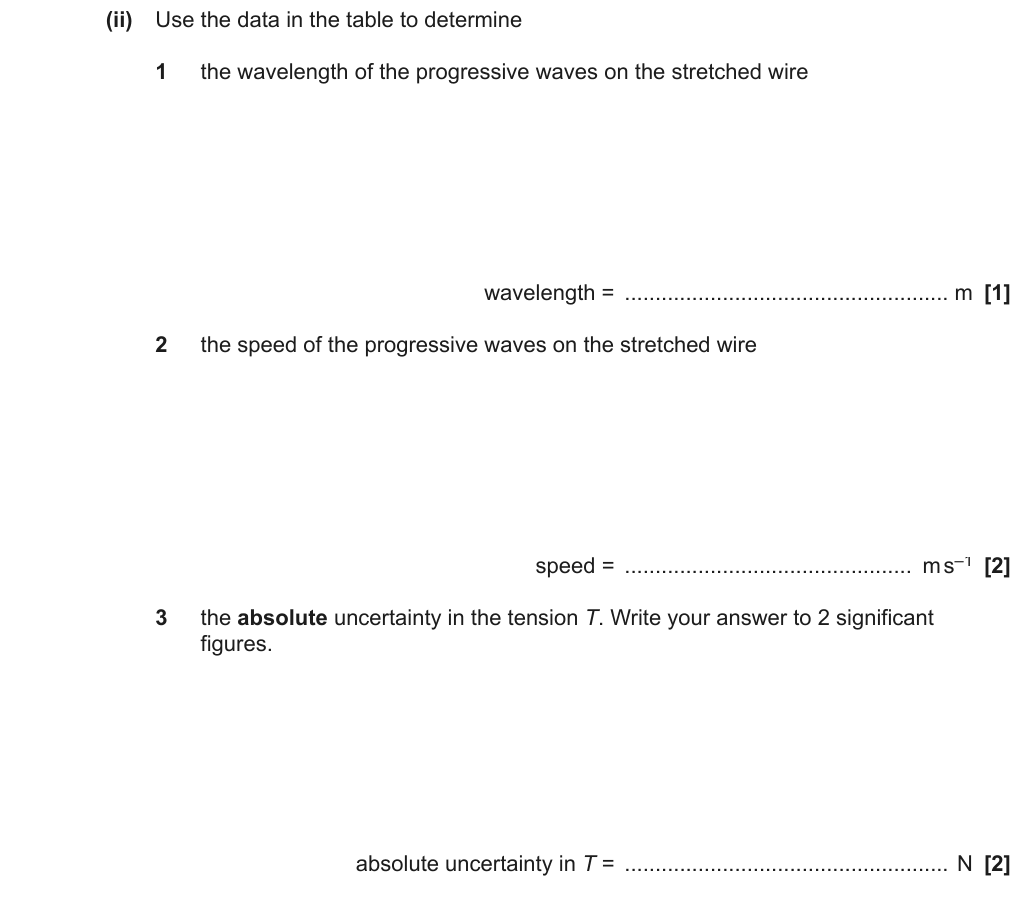
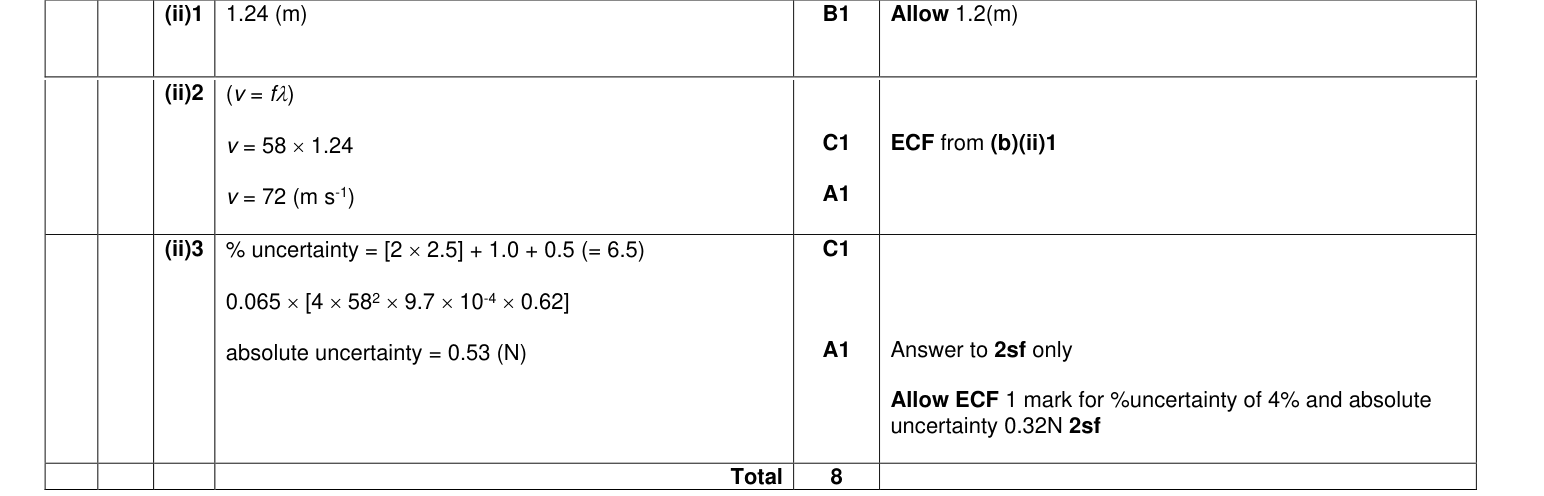
(ii) Use the data in the table to determine
1 the wavelength of the progressive waves on the stretched wire
wavelength =  ..................................................... m [1]
2 the speed of the progressive waves on the stretched wire
speed =  ............................................... m s–1 [2]
3 the absolute uncertainty in the tension T. Write your answer to 2 significant
figures.
absolute uncertainty in T =  ..................................................... N [2]
June 2022 · AS Paper 1 · Q25(a) 1 mark Short answer Medium emf pd and resistance
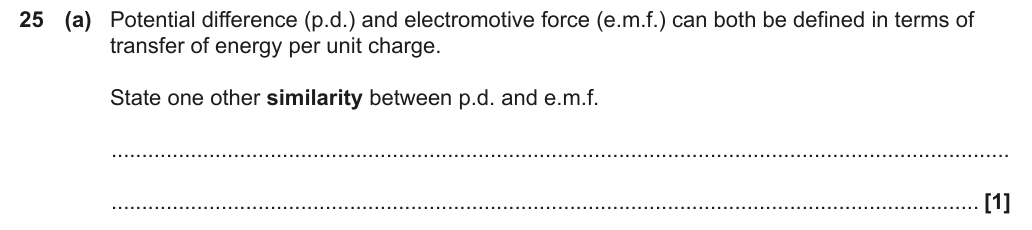
25 (a) Potential difference (p.d.) and electromotive force (e.m.f.) can both be defined in terms of
transfer of energy per unit charge.
State one other similarity between p.d. and e.m.f.
...................................................................................................................................................
.............................................................................................................................................. [1]
June 2022 · AS Paper 1 · Q25(b)(i) 2 marks Diagram or graph Hard potential dividersseries and parallel circuits
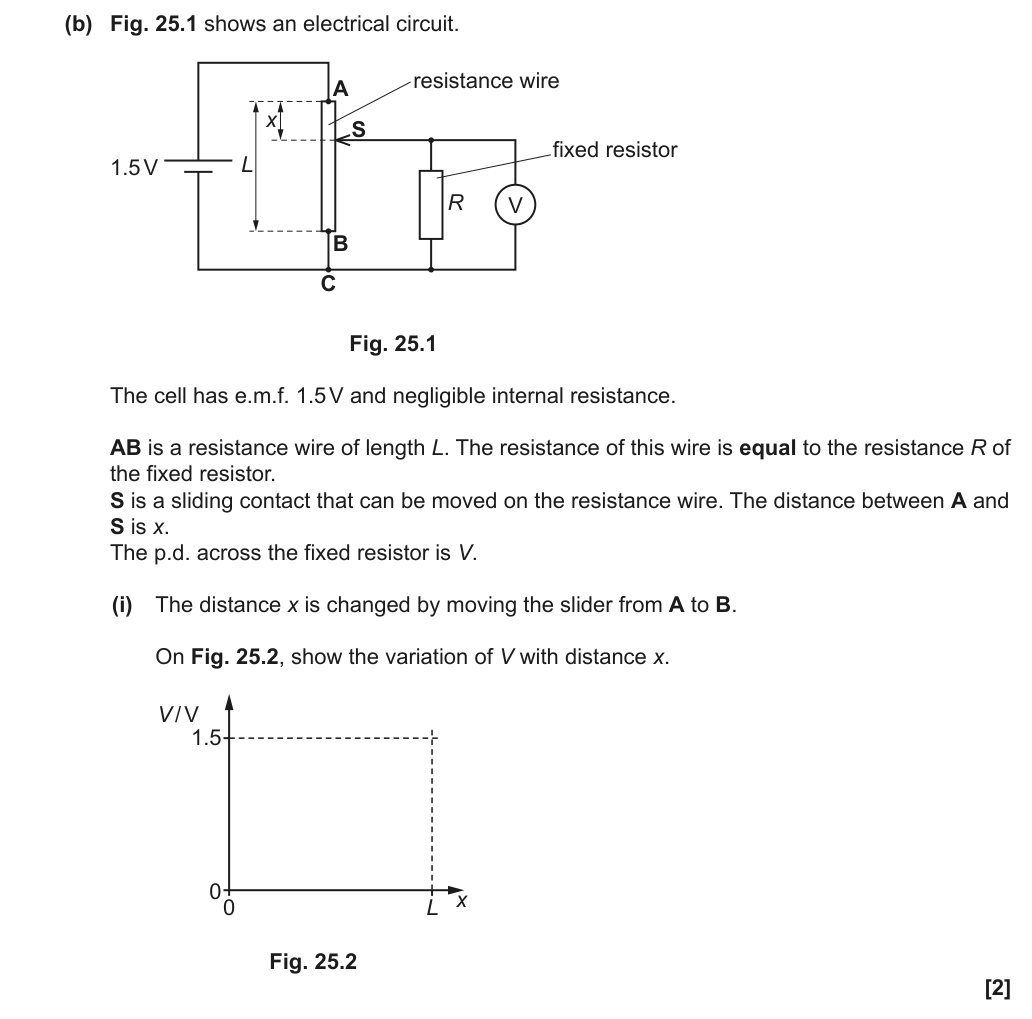
(b) Fig. 25.1 shows an electrical circuit.
resistance wire
A
x
S
fixed resistor
1.5 V L
R V
B
C
Fig. 25.1
The cell has e.m.f. 1.5 V and negligible internal resistance.
AB is a resistance wire of length L. The resistance of this wire is equal to the resistance R of
the fixed resistor.
S is a sliding contact that can be moved on the resistance wire. The distance between A and
S is x.
The p.d. across the fixed resistor is V.
(i) The distance x is changed by moving the slider from A to B.
On Fig. 25.2, show the variation of V with distance x.
V / V
1.5
00
x
L
Fig. 25.2
[2]
June 2022 · AS Paper 1 · Q25(b)(ii) 2 marks Explanation Medium potential dividersseries and parallel circuits
Earlier part of question 25 that this part usesEarlier part of June 2022 Paper 1 question 25
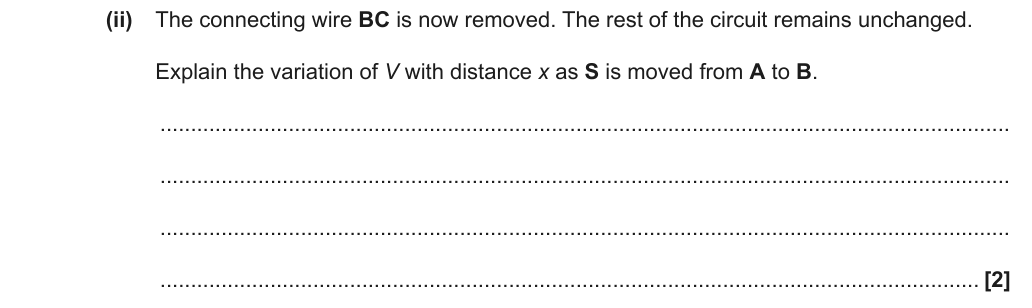
(ii) The connecting wire BC is now removed. The rest of the circuit remains unchanged.
Explain the variation of V with distance x as S is moved from A to B.
...........................................................................................................................................
...........................................................................................................................................
...........................................................................................................................................
...................................................................................................................................... [2]
June 2022 · AS Paper 1 · Q25(c)(i) 4 marks Calculation Medium resistivityemf pd and resistanceseries and parallel circuits
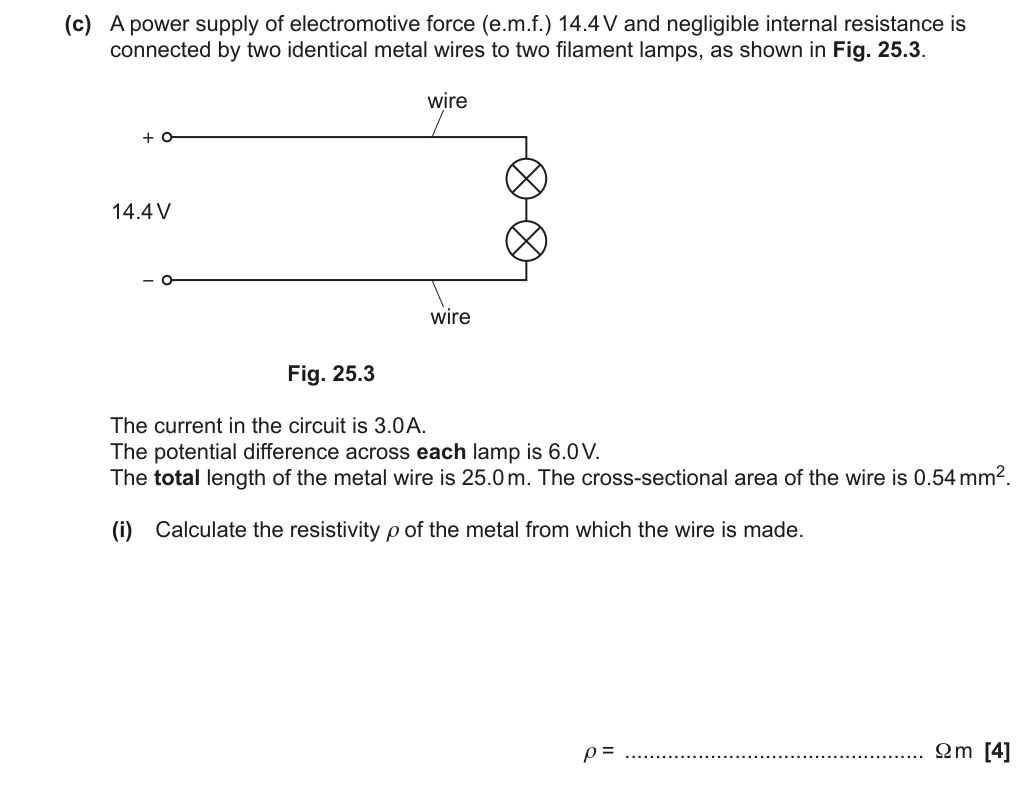
(c) A power supply of electromotive force (e.m.f.) 14.4 V and negligible internal resistance is
connected by two identical metal wires to two filament lamps, as shown in Fig. 25.3.
wire
+
14.4 V
−
wire
Fig. 25.3
The current in the circuit is 3.0 A.
The potential difference across each lamp is 6.0 V.
The total length of the metal wire is 25.0 m. The cross-sectional area of the wire is 0.54 mm2.
(i)  Calculate the resistivity ρ of the metal from which the wire is made.
ρ =  ................................................. Ω m [4]
June 2022 · AS Paper 1 · Q25(c)(ii) 2 marks Calculation Medium charge and current
Earlier part of question 25 that this part usesEarlier part of June 2022 Paper 1 question 25
(ii) The number of electrons per unit volume n in the metal wire is 8.5 × 1028 m–3.
Calculate the mean drift velocity v of the electrons in the metal.
v =  ............................................... m s–1 [2]
June 2022 · AS Paper 1 · Q26(a)(i) 1 mark Explanation Medium photoelectric effect
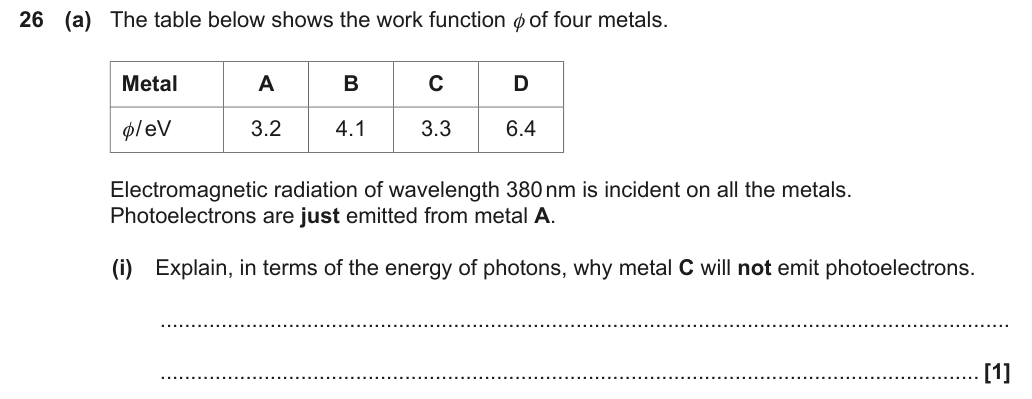
26 (a) The table below shows the work function φ of four metals.
Metal A B C D
φ / eV 3.2 4.1 3.3 6.4
Electromagnetic radiation of wavelength 380 nm is incident on all the metals.
Photoelectrons are just emitted from metal A.
(i) Explain, in terms of the energy of photons, why metal C will not emit photoelectrons.
...........................................................................................................................................
...................................................................................................................................... [1]
June 2022 · AS Paper 1 · Q26(a)(ii) 1 mark Calculation Hard photoelectric effectphotons
Earlier part of question 26 that this part usesEarlier part of June 2022 Paper 1 question 26
(ii) Calculate the maximum wavelength of the electromagnetic radiation in nm that will just
eject photoelectrons from metal D.
maximum wavelength =  ................................................... nm [1]
June 2022 · AS Paper 1 · Q26(a)(iii) 3 marks Calculation Medium wave particle dualitywork energy and powerphotonsphotoelectric effect
Earlier part of question 26 that this part usesEarlier part of June 2022 Paper 1 question 26
(iii) The metal B is now exposed to electromagnetic radiation of a different wavelength.
The energy of each incident photon is 5.3 eV.
Calculate the minimum de Broglie wavelength λ of the emitted photoelectrons.
λ =  ..................................................... m [3]
June 2022 · AS Paper 1 · Q26(b)(i) 1 mark Diagram or graph Hard measurements and uncertaintiespractical skills
(b) A researcher is carrying out an experiment to determine the work function φ of a new
material. The material is illuminated by electromagnetic radiation of frequency f and the
maximum kinetic energy KEmax of the photoelectrons is determined.
The researcher plots the data points shown below.
2.5
2.0
KEmax / 10–19 J
1.5
1.0
0.5
5.0 6.0 7.0 8.0
f / 1014 Hz
(i) Draw a straight line of best fit through the data points. [1]
June 2022 · AS Paper 1 · Q26(b)(ii) 3 marks Calculation Hard photoelectric effectpractical skills
Earlier part of question 26 that this part usesEarlier part of June 2022 Paper 1 question 26
(ii) Use the gradient of this line, and Einstein’s photoelectric equation, to determine the
work function φ of the material.
φ =  ...................................................... J [3]

Work with an OCR physics tutor

Want a paper marked and gone through with you? Message us.

Prefer email? Send an enquiry

If you are under 18, please include a parent's contact details. Enquiries go to enquiries@physicsaleveltutor.com and are deleted once handled. All tutoring is online.