June 2022: Paper 1, Modelling physics

100 marks · 45 question parts · Paper, mark scheme and report on OCR's site · Have the Data, Formulae and Relationships Booklet beside you

Question by question

QTopicMarksAOType
1 Scalars and vectors 1Multiple choice
2 Measurements and uncertainties, Practical skills: planning, analysis and evaluation 1Multiple choice
3 Kinematics: displacement, velocity and motion graphs 1Multiple choice
4 Dynamics, drag and terminal velocity 1Multiple choice
5 Equilibrium: moments, couples and centre of mass 1Multiple choice
6 Collisions: conservation of momentum, Scalars and vectors 1Multiple choice
7 Thermal physics: temperature, internal energy and specific heat capacity 1Multiple choice
8 Ideal gases and the kinetic theory 1Multiple choice
9 Ideal gases and the kinetic theory 1Multiple choice
10 Simple harmonic motion, damping and resonance 1Multiple choice
11 Physical quantities and S.I. units 1Multiple choice
12 Stars: stellar evolution, energy levels, spectra, Wien's law and Stefan's law 1Multiple choice
13 Stars: stellar evolution, energy levels, spectra, Wien's law and Stefan's law, Cosmology: parallax, the Doppler effect, Hubble's law and the Big Bang 1Multiple choice
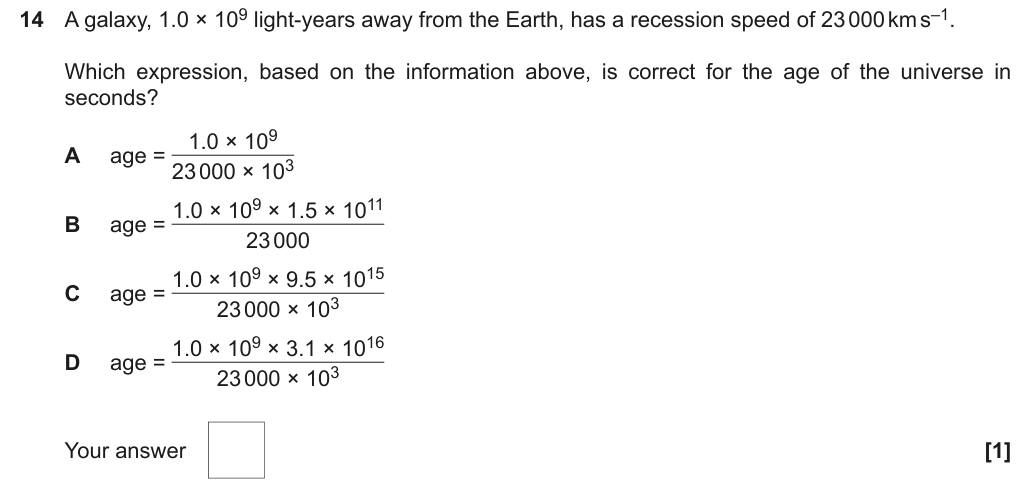
14 Cosmology: parallax, the Doppler effect, Hubble's law and the Big Bang 1Multiple choice
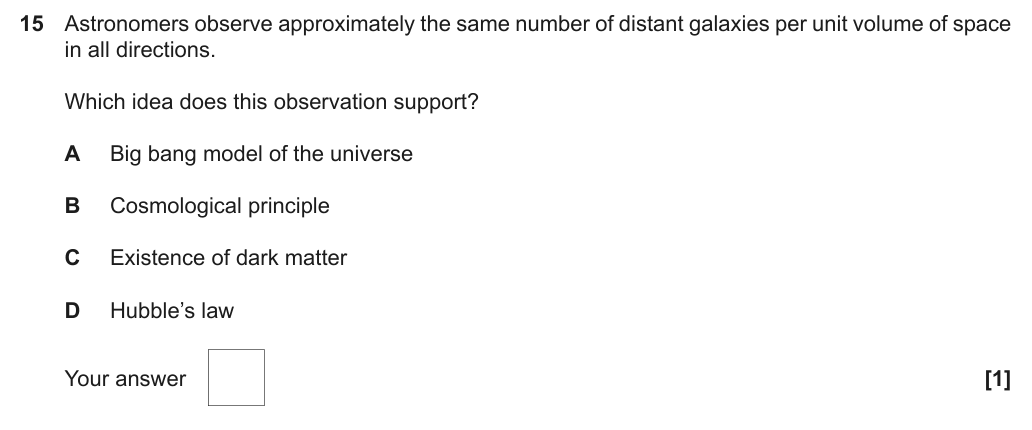
15 Cosmology: parallax, the Doppler effect, Hubble's law and the Big Bang 1Multiple choice
16(a) Springs and Hooke's law, Practical skills: planning, analysis and evaluation 4Explanation
16(b)(i) Mechanical properties of matter: stress, strain and the Young modulus 3Show that
16(b)(ii) Work, energy and power 2Show that
16(b)(iii) Projectile motion, Linear motion: the suvat equations and free fall 3Calculation
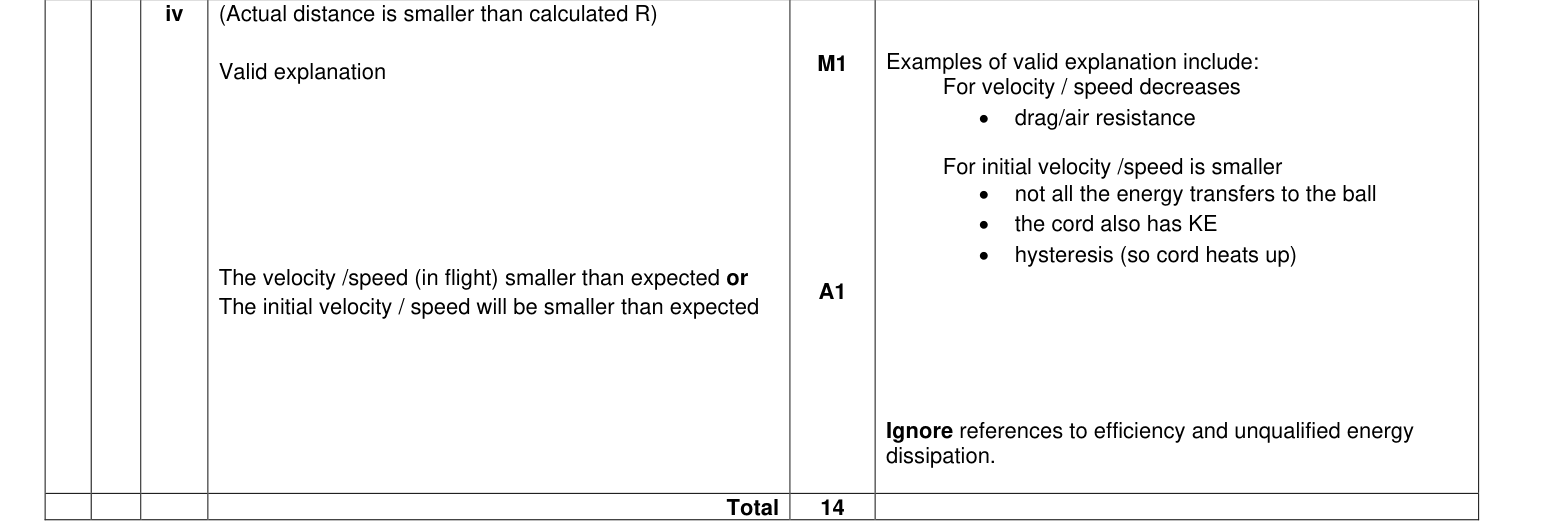
16(b)(iv) Dynamics, drag and terminal velocity, Work, energy and power 2Explanation
17(a) Work, energy and power 1Show that
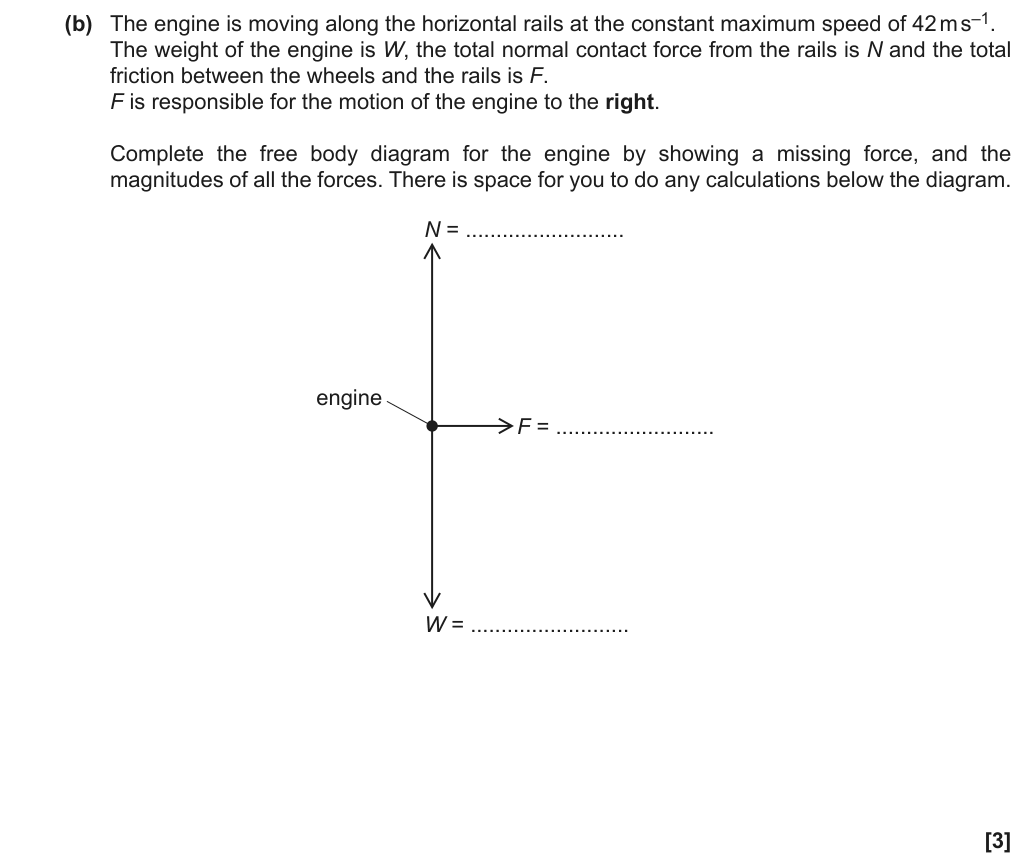
17(b) Dynamics, drag and terminal velocity, Work, energy and power 3Diagram or graph
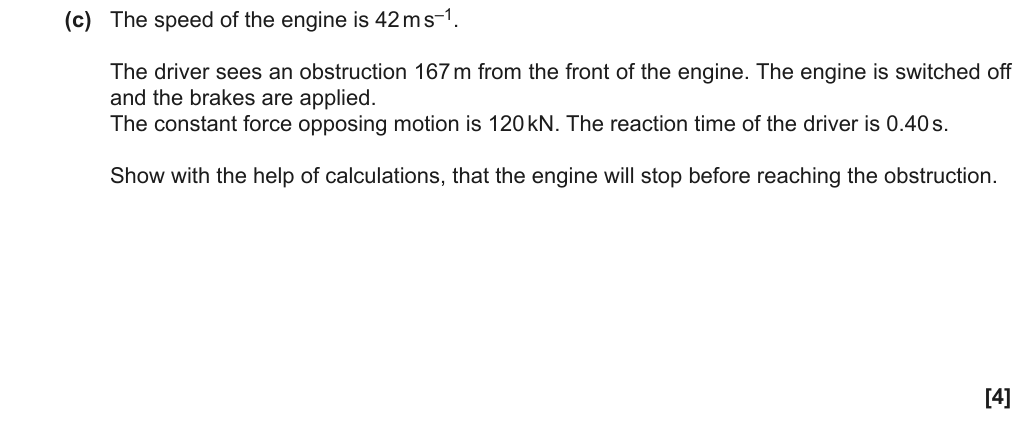
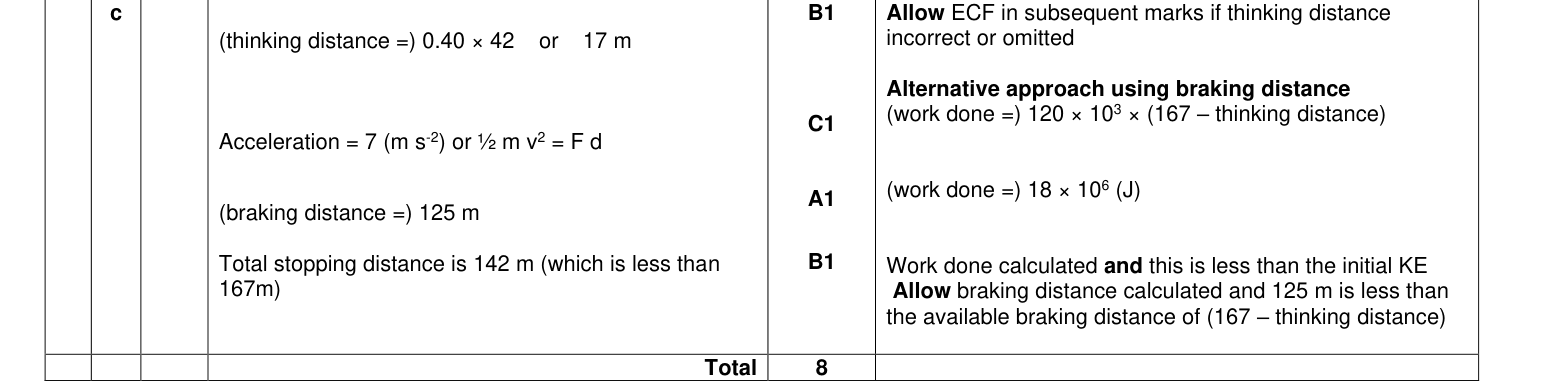
17(c) Linear motion: the suvat equations and free fall, Dynamics, drag and terminal velocity 4Short answer
18(a)(i) Density, pressure and upthrust 3Show that
18(a)(ii) Newton's laws of motion and momentum 2Calculation
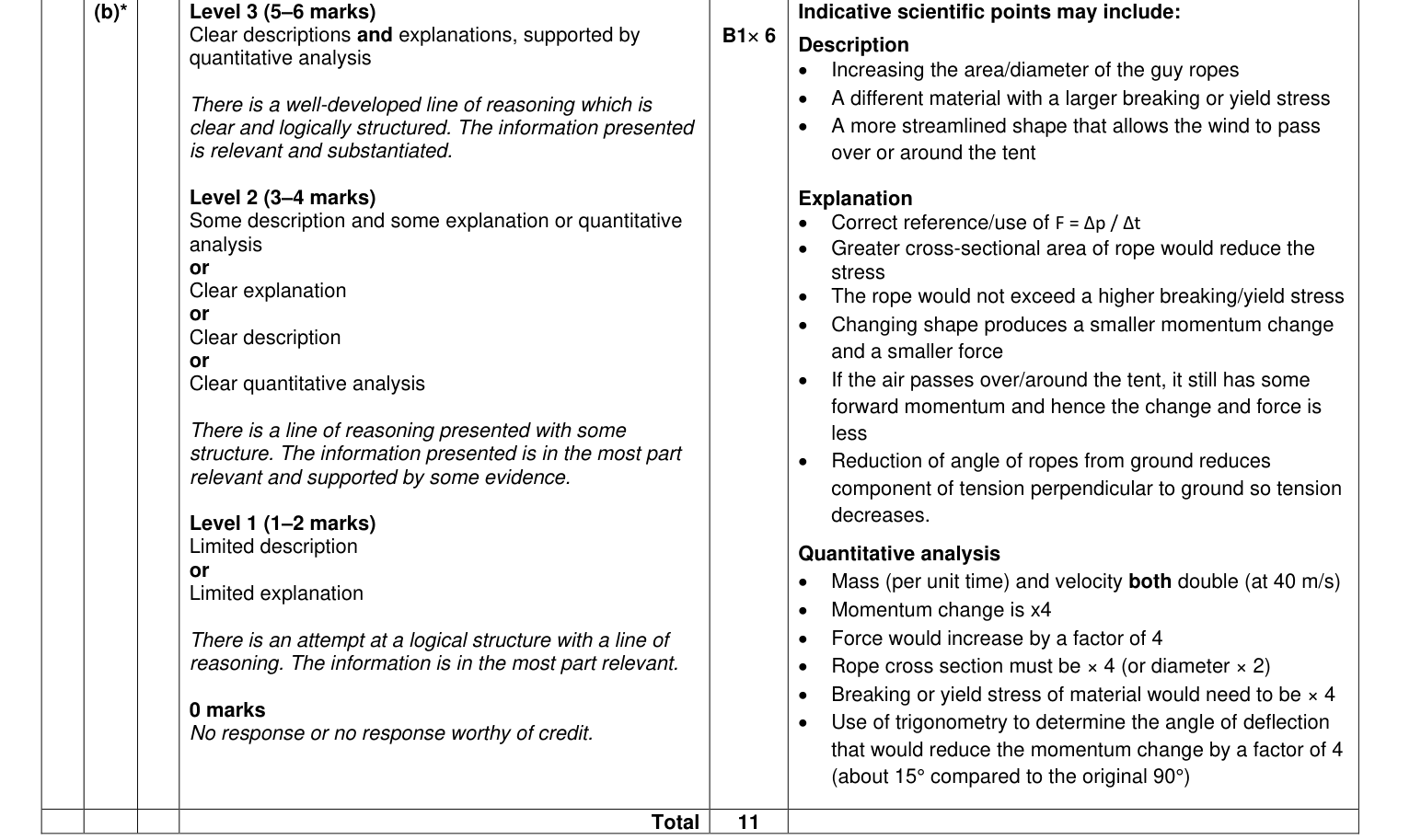
18(b) Newton's laws of motion and momentum, Scalars and vectors, Mechanical properties of matter: stress, strain and the Young modulus 6Extended response
19(a) Thermal physics: temperature, internal energy and specific heat capacity 2Explanation
19(b)(i) Ideal gases and the kinetic theory, Thermal physics: temperature, internal energy and specific heat capacity 3Show that
19(b)(ii) Ideal gases and the kinetic theory 1Calculation
19(b)(iii) Ideal gases and the kinetic theory 1Short answer
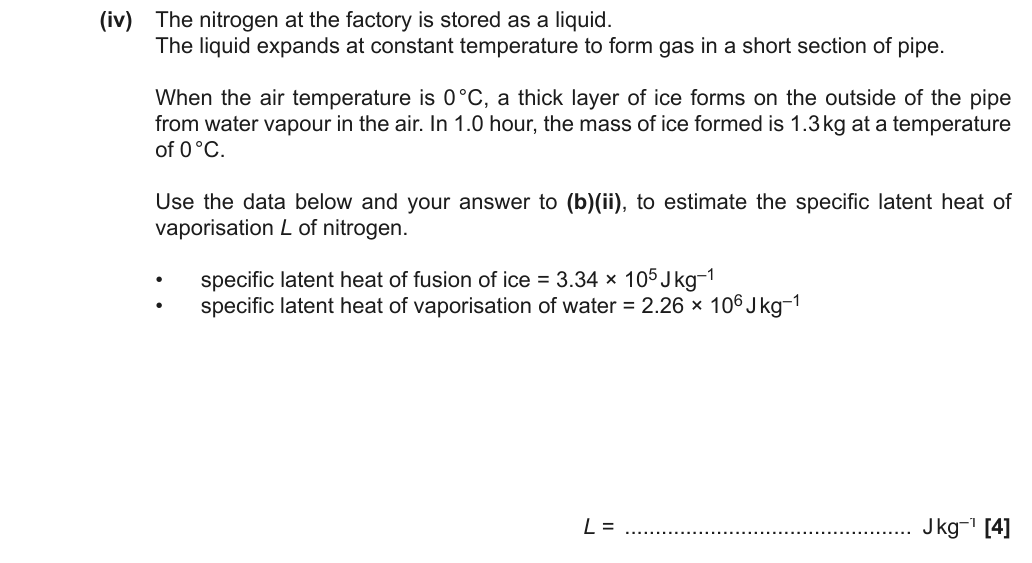
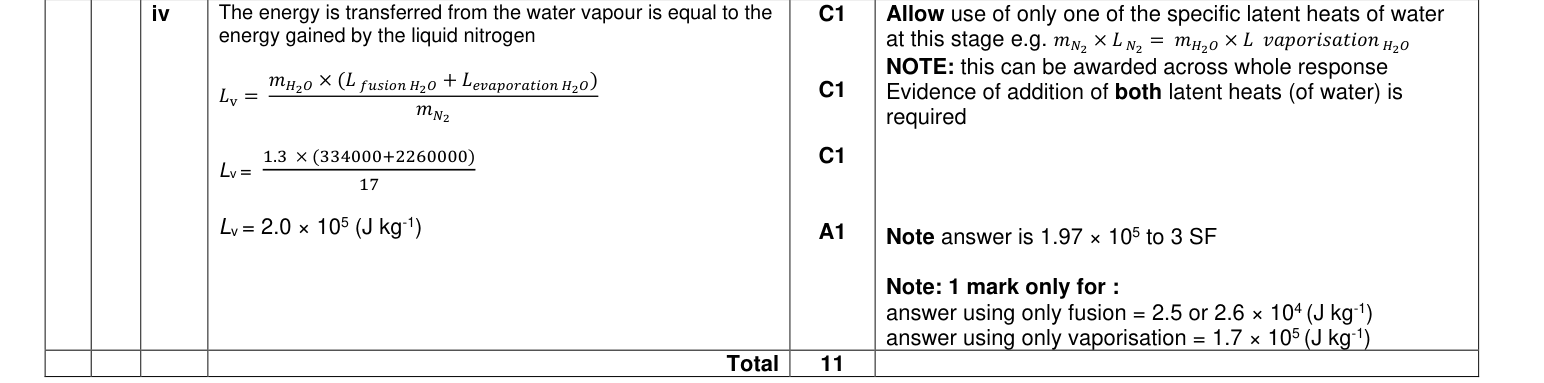
19(b)(iv) Thermal physics: temperature, internal energy and specific heat capacity, Work, energy and power 4Calculation
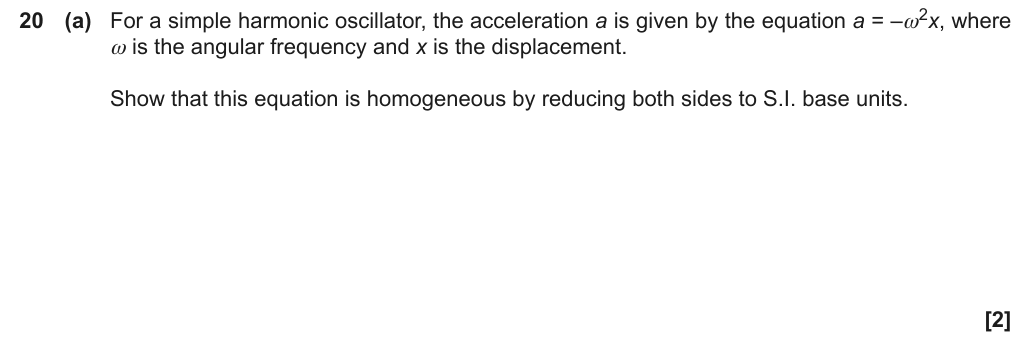
20(a) Physical quantities and S.I. units 2Show that
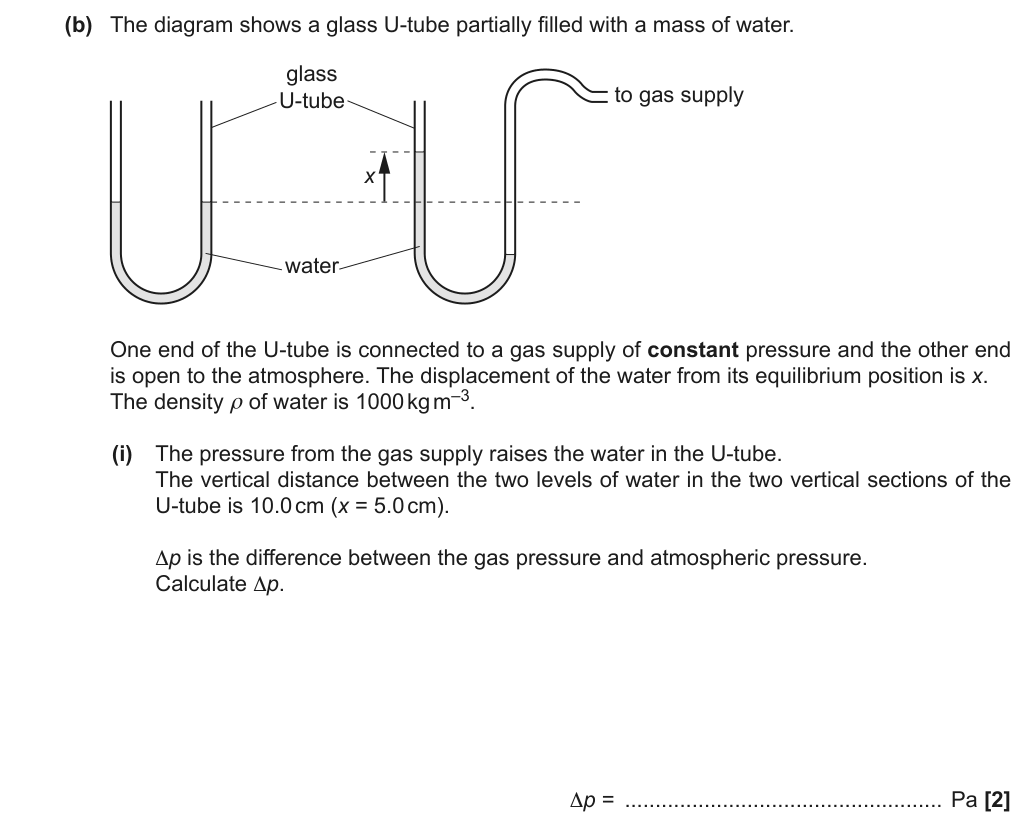
20(b)(i) Density, pressure and upthrust 2Calculation
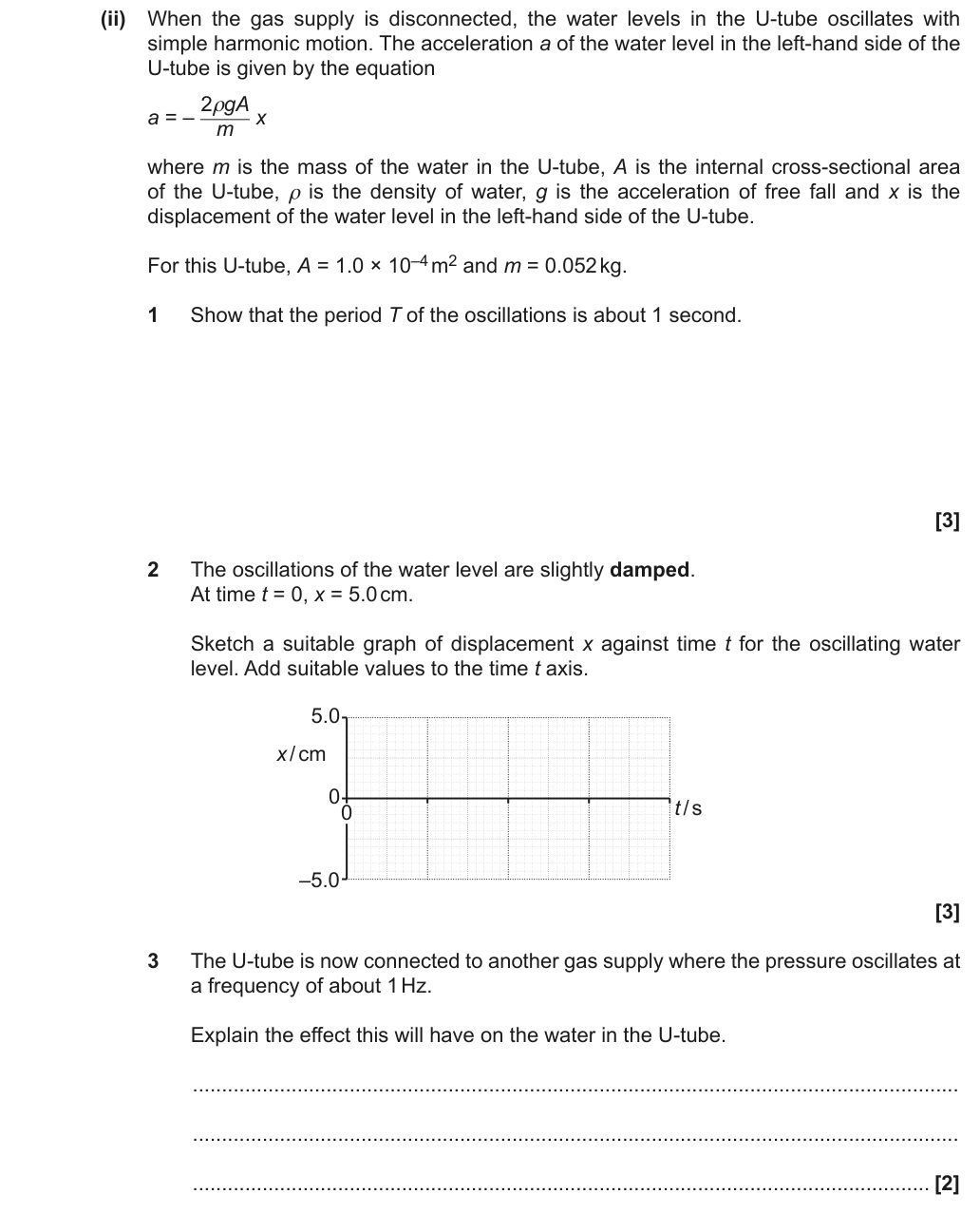
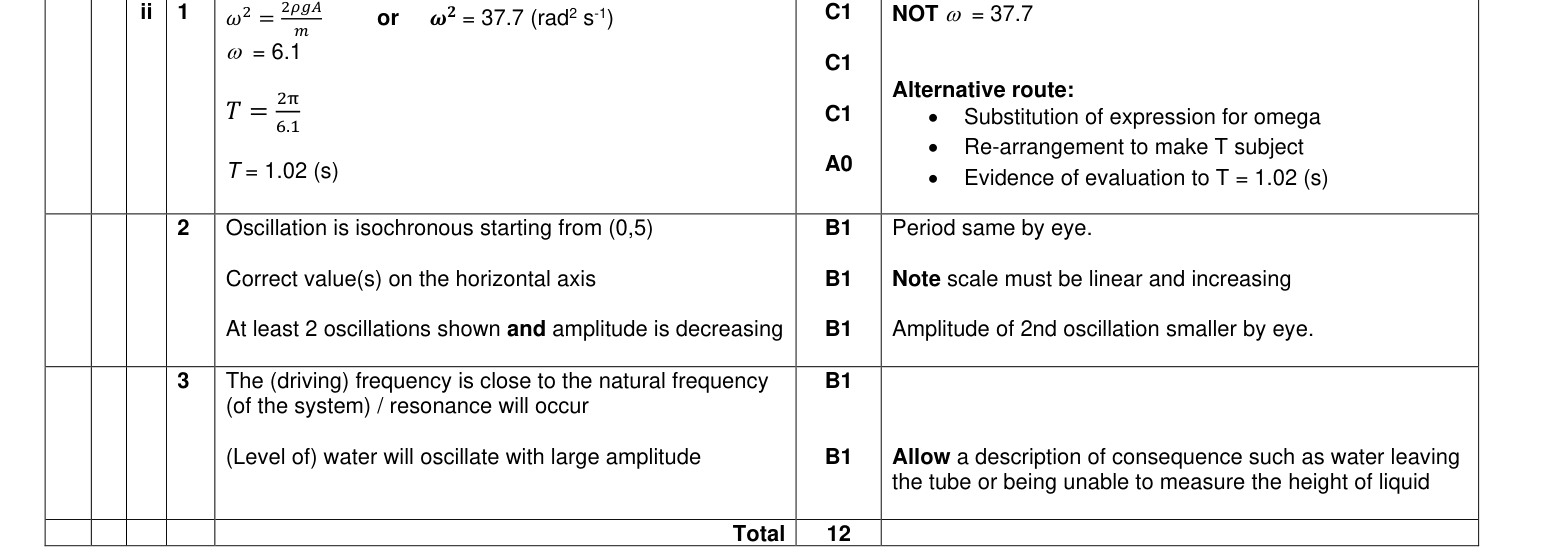
20(b)(ii) Simple harmonic motion, damping and resonance 8Show that
21(a) Stars: stellar evolution, energy levels, spectra, Wien's law and Stefan's law 1Short answer
21(b)(i) Cosmology: parallax, the Doppler effect, Hubble's law and the Big Bang 2Show that
21(b)(ii) Ideal gases and the kinetic theory 3Calculation
21(c)(i) Density, pressure and upthrust 2Calculation
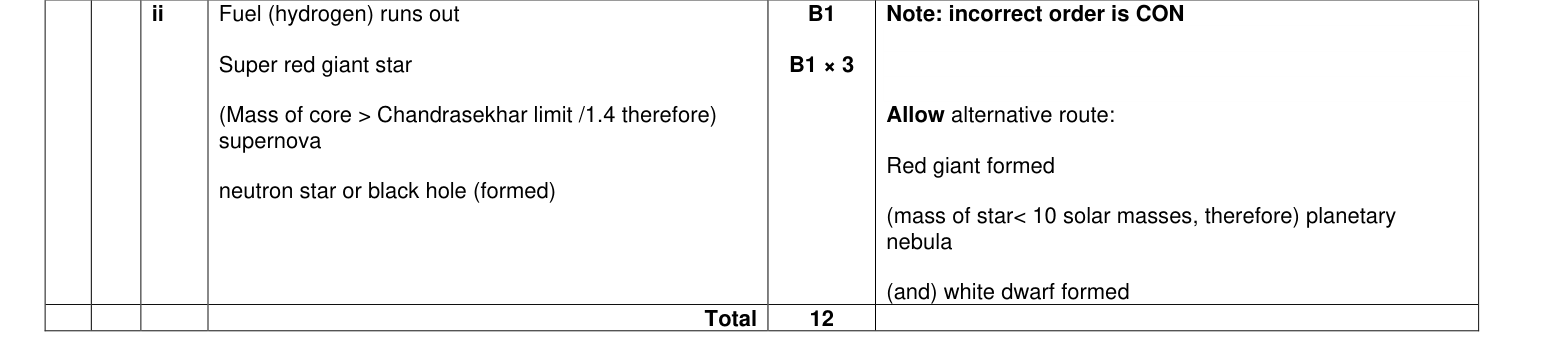
21(c)(ii) Stars: stellar evolution, energy levels, spectra, Wien's law and Stefan's law 4Explanation
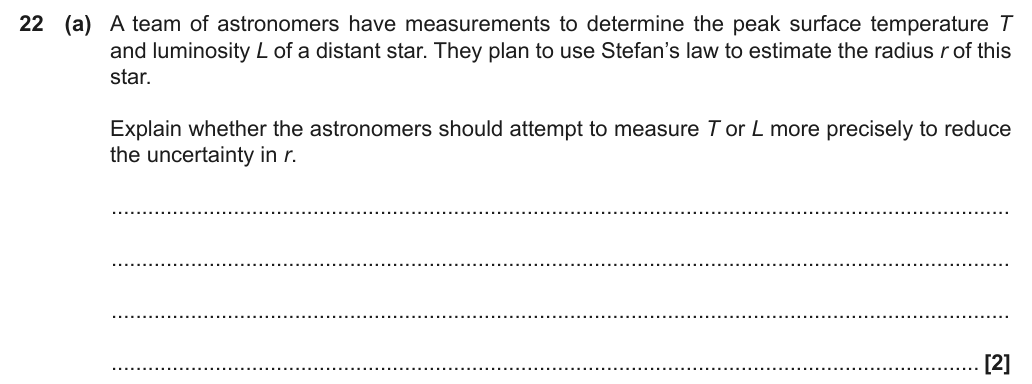
22(a) Stars: stellar evolution, energy levels, spectra, Wien's law and Stefan's law, Measurements and uncertainties 2Explanation
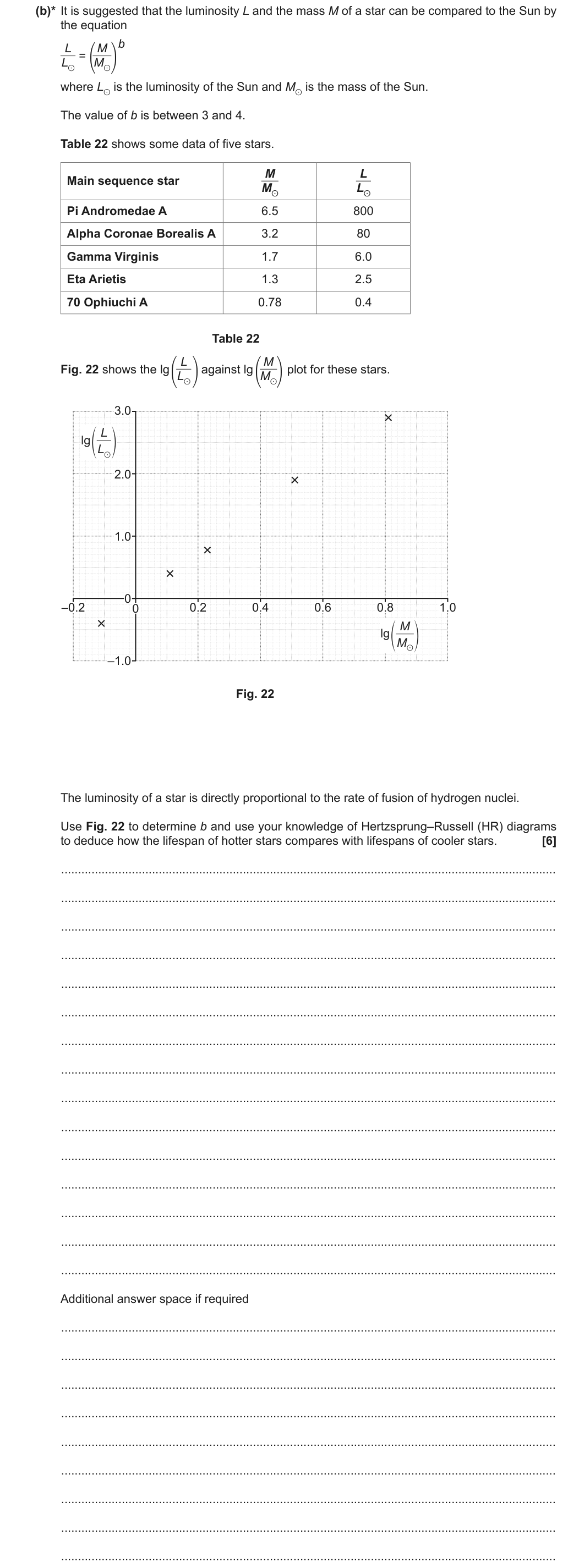
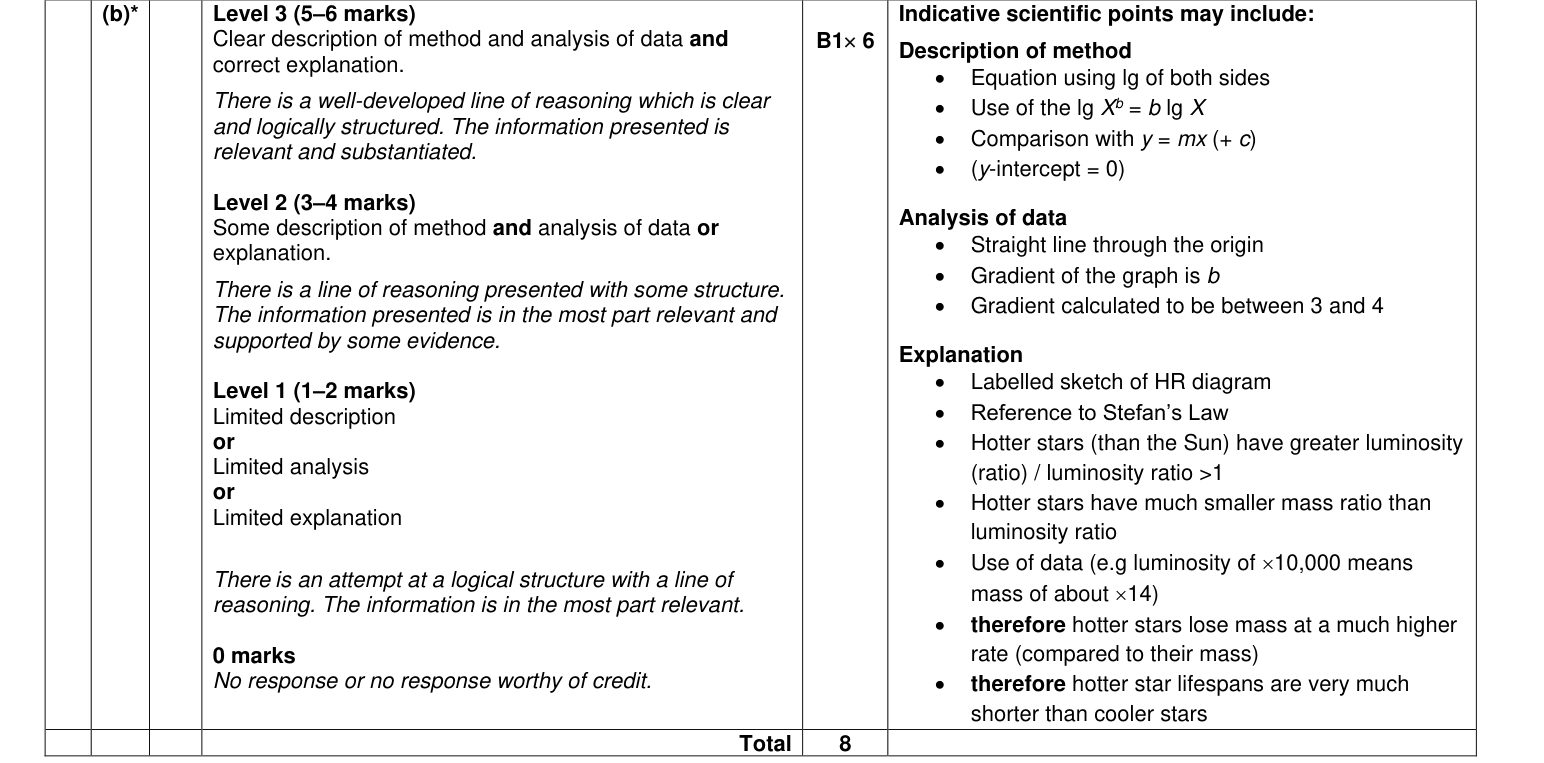
22(b) Stars: stellar evolution, energy levels, spectra, Wien's law and Stefan's law, Practical skills: planning, analysis and evaluation 6Extended response
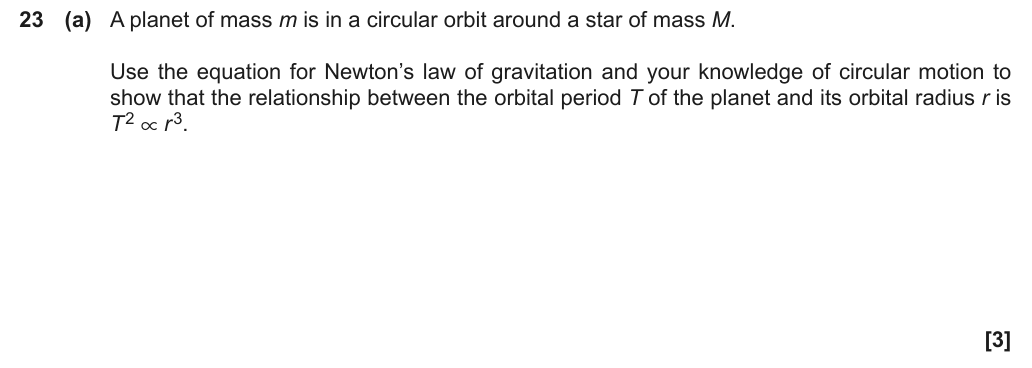
23(a) Planetary motion: Kepler's laws and satellites, Circular motion and centripetal force, Gravitational fields, Newton's law of gravitation and gravitational potential 3Show that
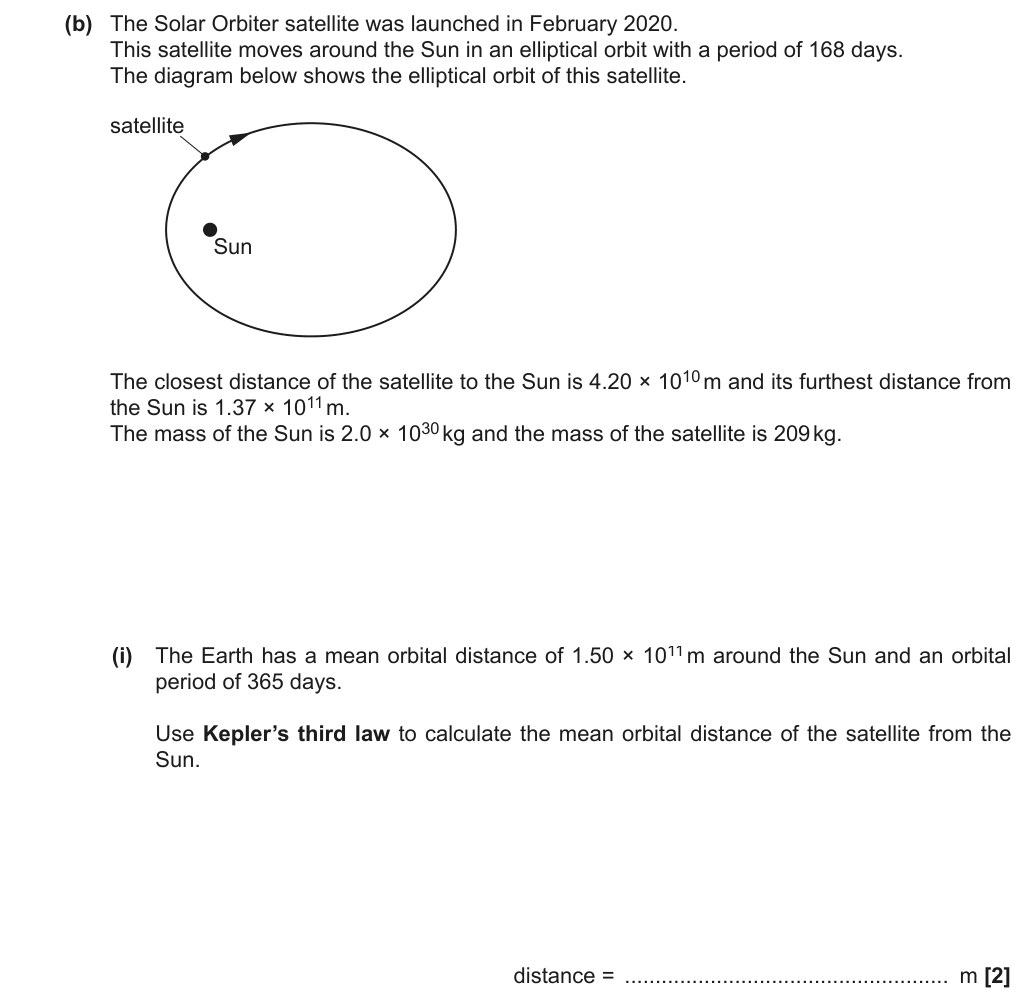
23(b)(i) Planetary motion: Kepler's laws and satellites 2Calculation
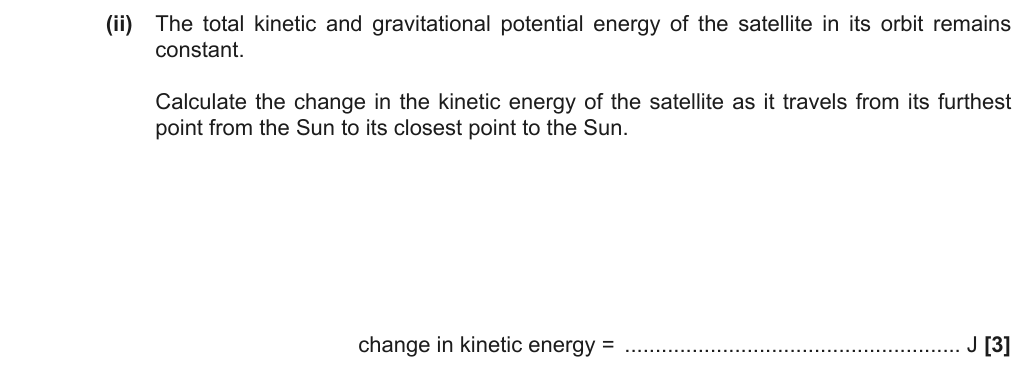
23(b)(ii) Gravitational fields, Newton's law of gravitation and gravitational potential 3Calculation
23(b)(iii) Work, energy and power, Gravitational fields, Newton's law of gravitation and gravitational potential 1Explanation

The questions

12345678910111213141516(a)16(b)(i)16(b)(ii)16(b)(iii)16(b)(iv)17(a)17(b)17(c)18(a)(i)18(a)(ii)18(b)19(a)19(b)(i)19(b)(ii)19(b)(iii)19(b)(iv)20(a)20(b)(i)20(b)(ii)21(a)21(b)(i)21(b)(ii)21(c)(i)21(c)(ii)22(a)22(b)23(a)23(b)(i)23(b)(ii)23(b)(iii)
June 2022 · Paper 1 · Q1 1 mark Multiple choice Medium scalars and vectors
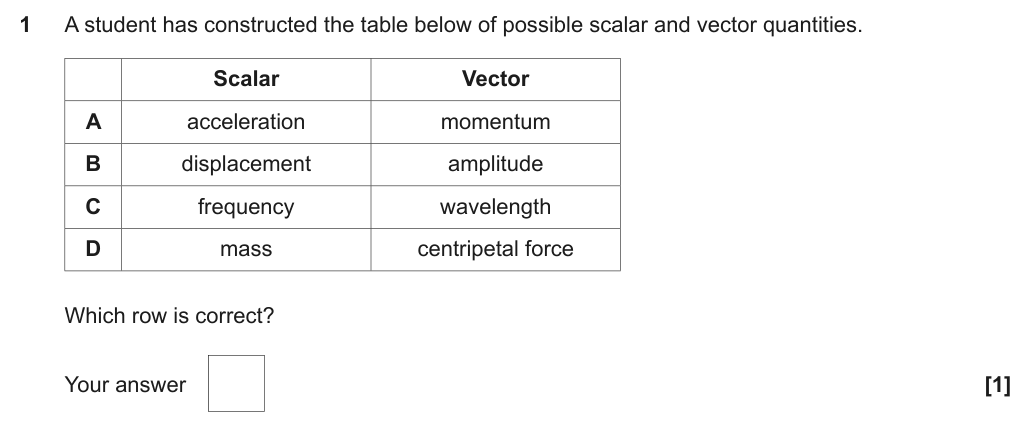
1 A student has constructed the table below of possible scalar and vector quantities.
Scalar Vector
A acceleration momentum
B displacement amplitude
C frequency wavelength
D mass centripetal force
Which row is correct?
Your answer [1]
June 2022 · Paper 1 · Q2 1 mark Multiple choice Medium measurements and uncertaintiespractical skills
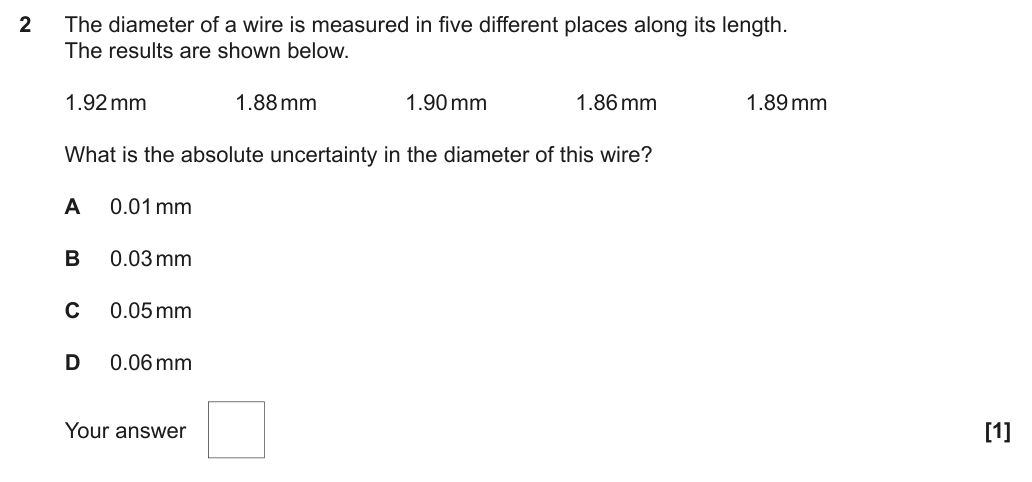
2 The diameter of a wire is measured in five different places along its length.
The results are shown below.
1.92 mm    1.88 mm    1.90 mm    1.86 mm    1.89 mm
What is the absolute uncertainty in the diameter of this wire?
A 0.01 mm
B  0.03 mm
C  0.05 mm
D  0.06 mm
Your answer [1]
June 2022 · Paper 1 · Q3 1 mark Multiple choice Easy kinematics
3 A student has plotted a velocity against time graph for a trolley moving down a ramp.
Which of the following pair of quantities can be determined from the gradient of the graph and the
area under the graph?
A acceleration, displacement
B  acceleration, impulse
C  displacement, kinetic energy
D  force, work done
Your answer [1]
June 2022 · Paper 1 · Q4 1 mark Multiple choice Medium dynamics and terminal velocity
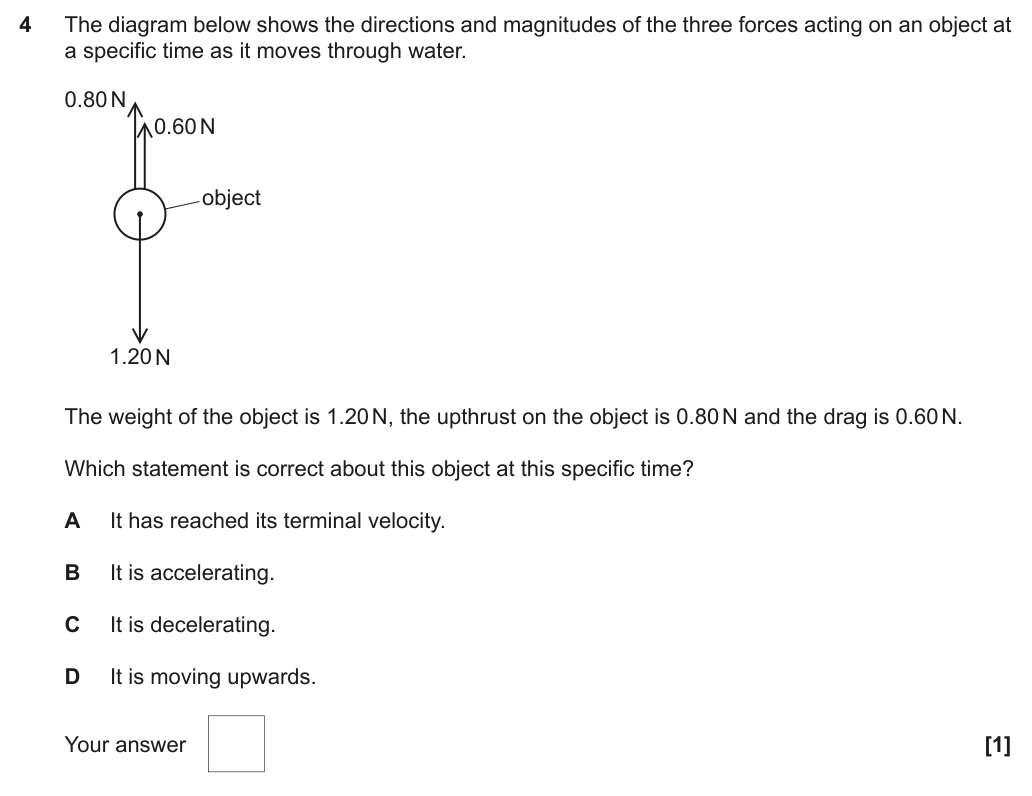
4 The diagram below shows the directions and magnitudes of the three forces acting on an object at
a specific time as it moves through water.
0.80 N
0.60 N
object
1.20 N
The weight of the object is 1.20 N, the upthrust on the object is 0.80 N and the drag is 0.60 N.
Which statement is correct about this object at this specific time?
A It has reached its terminal velocity.
B It is accelerating.
C It is decelerating.
D It is moving upwards.
Your answer [1]
June 2022 · Paper 1 · Q5 1 mark Multiple choice equilibrium and moments
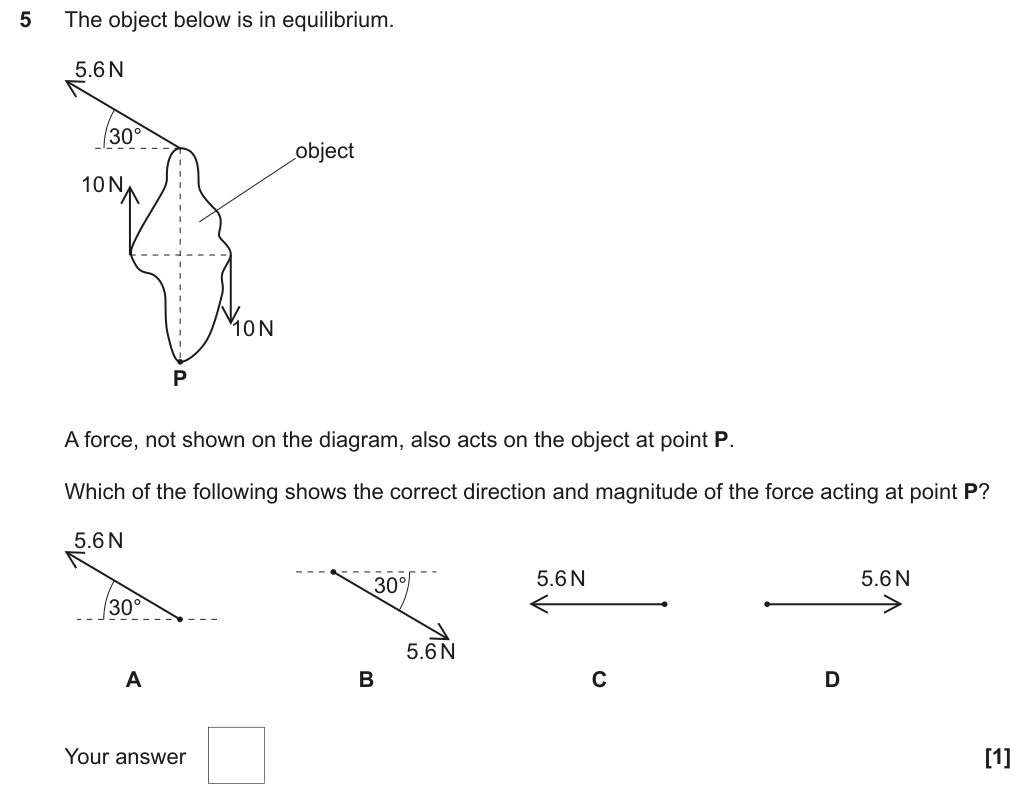
5 The object below is in equilibrium.
5.6 N
30°
object
10 N
10 N
P
A force, not shown on the diagram, also acts on the object at point P.
Which of the following shows the correct direction and magnitude of the force acting at point P?
5.6 N
30° 5.6 N 5.6 N
30°
5.6 N
A B C D
Your answer [1]
June 2022 · Paper 1 · Q6 1 mark Multiple choice Hard collisionsscalars and vectors
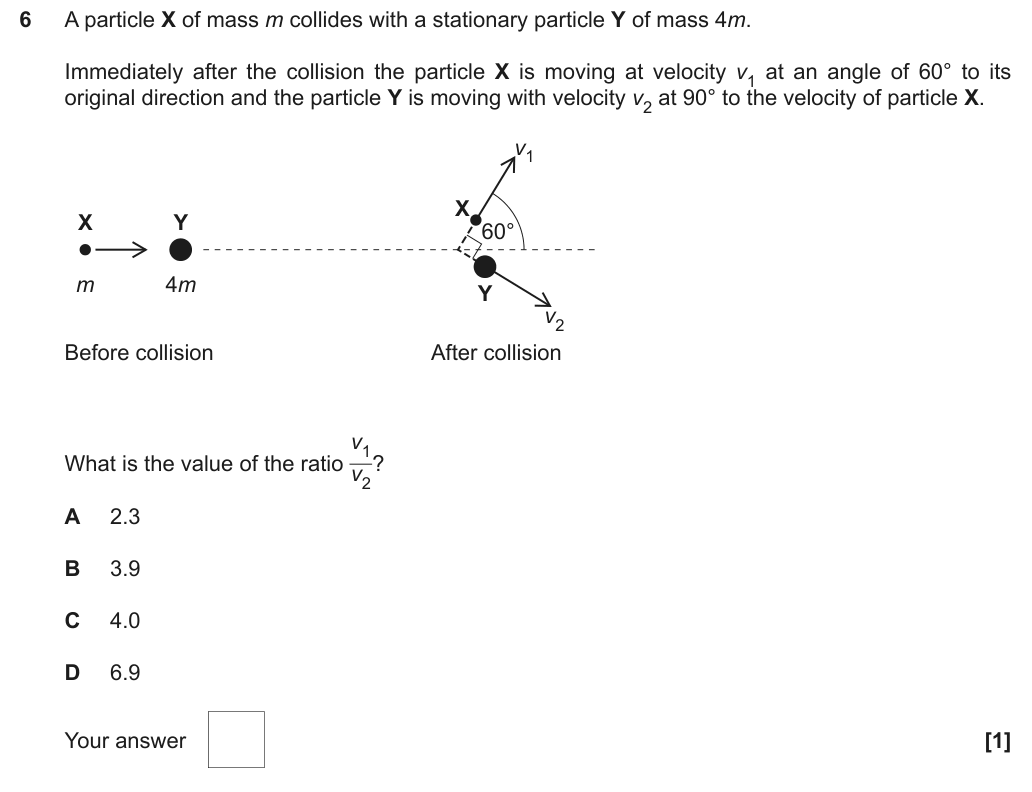
6 A particle X of mass m collides with a stationary particle Y of mass 4m.
Immediately after the collision the particle X is moving at velocity v1 at an angle of 60° to its
original direction and the particle Y is moving with velocity v2 at 90° to the velocity of particle X.
v1
X
X Y
60°
m 4m
Y
v2
Before collision After collision
v1
What is the value of the ratio ?
v2
A 2.3
B 3.9
C 4.0
D 6.9
Your answer [1]
June 2022 · Paper 1 · Q7 1 mark Multiple choice Medium thermal physics
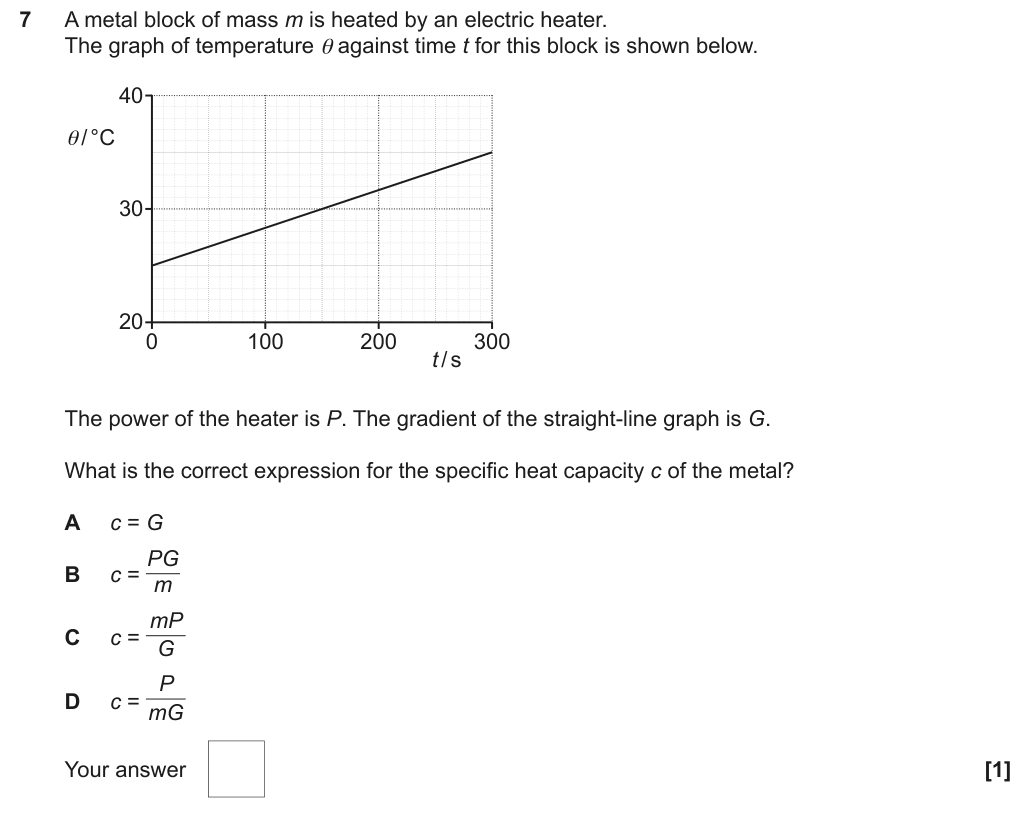
7 A metal block of mass m is heated by an electric heater.
The graph of temperature θ against time t for this block is shown below.
40
θ / °C
30
20
0 100 200 300
t / s
The power of the heater is P. The gradient of the straight-line graph is G.
What is the correct expression for the specific heat capacity c of the metal?
A c = G
c = PG
B
m
c = mP
C
G
c = P
D
mG
Your answer [1]
June 2022 · Paper 1 · Q8 1 mark Multiple choice Medium ideal gases
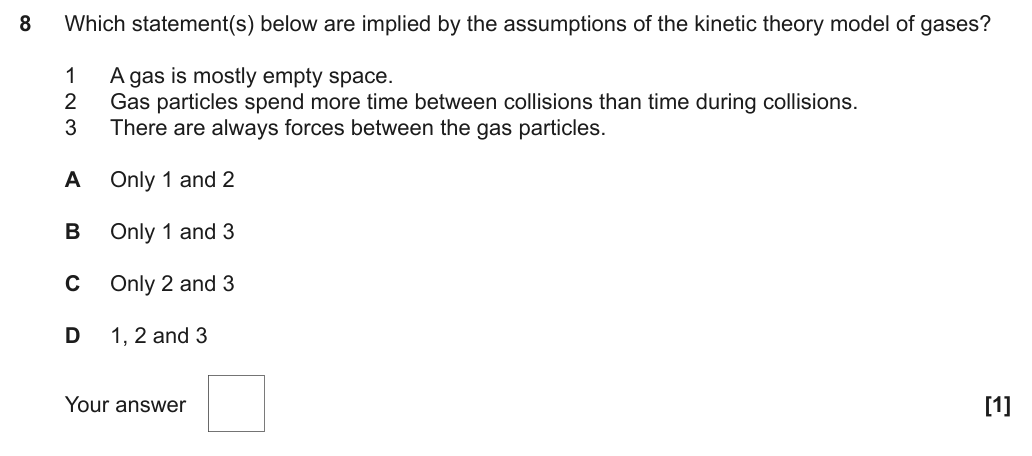
8 Which statement(s) below are implied by the assumptions of the kinetic theory model of gases?
1 A gas is mostly empty space.
2 Gas particles spend more time between collisions than time during collisions.
3 There are always forces between the gas particles.
A Only 1 and 2
B Only 1 and 3
C Only 2 and 3
D 1, 2 and 3
Your answer [1]
June 2022 · Paper 1 · Q9 1 mark Multiple choice Medium ideal gases
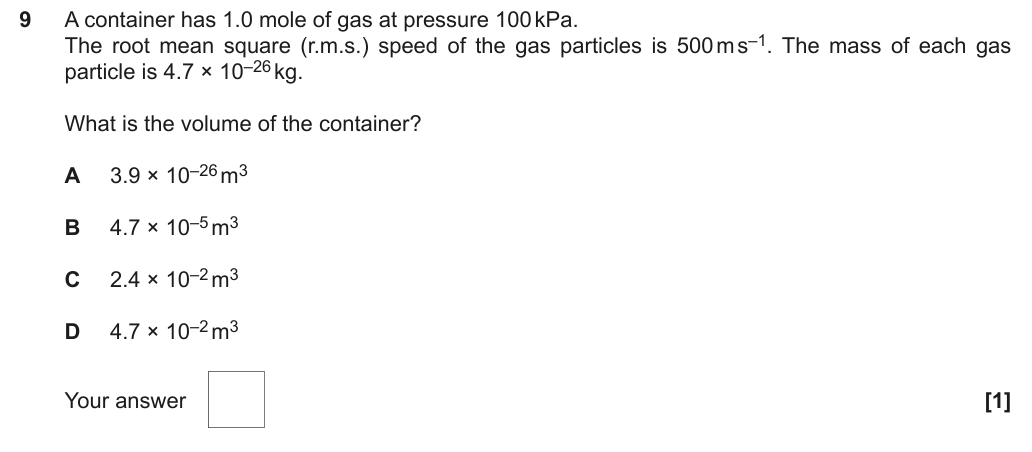
9 A container has 1.0 mole of gas at pressure 100 kPa.
The root mean square (r.m.s.) speed of the gas particles is 500 m s–1. The mass of each gas
particle is 4.7 × 10⁻²⁶ kg.
What is the volume of the container?
A 3.9 × 10⁻²⁶ m3
B 4.7 × 10⁻⁵ m3
C 2.4 × 10⁻² m3
D 4.7 × 10⁻² m3
Your answer [1]
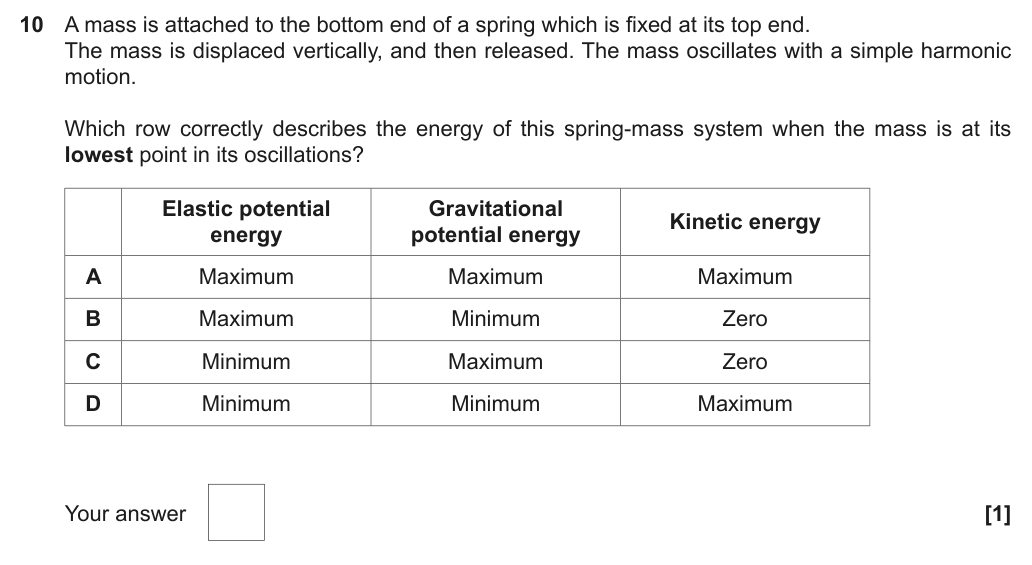
June 2022 · Paper 1 · Q10 1 mark Multiple choice Medium simple harmonic motion
10 A mass is attached to the bottom end of a spring which is fixed at its top end.
The mass is displaced vertically, and then released. The mass oscillates with a simple harmonic
motion.
Which row correctly describes the energy of this spring-mass system when the mass is at its
lowest point in its oscillations?
Elastic potential Gravitational
Kinetic energy
energy potential energy
A Maximum Maximum Maximum
B Maximum Minimum Zero
C Minimum Maximum Zero
D Minimum Minimum Maximum
Your answer [1]
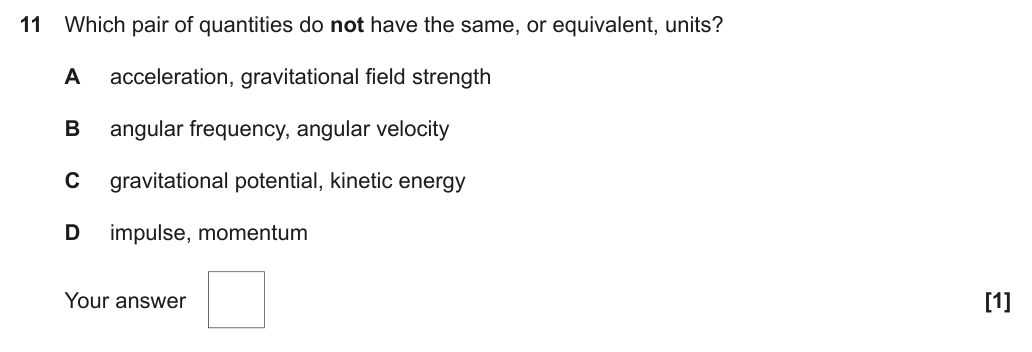
June 2022 · Paper 1 · Q11 1 mark Multiple choice Medium quantities and units
11  Which pair of quantities do not have the same, or equivalent, units?
A acceleration, gravitational field strength
B angular frequency, angular velocity
C gravitational potential, kinetic energy
D impulse, momentum
Your answer [1]
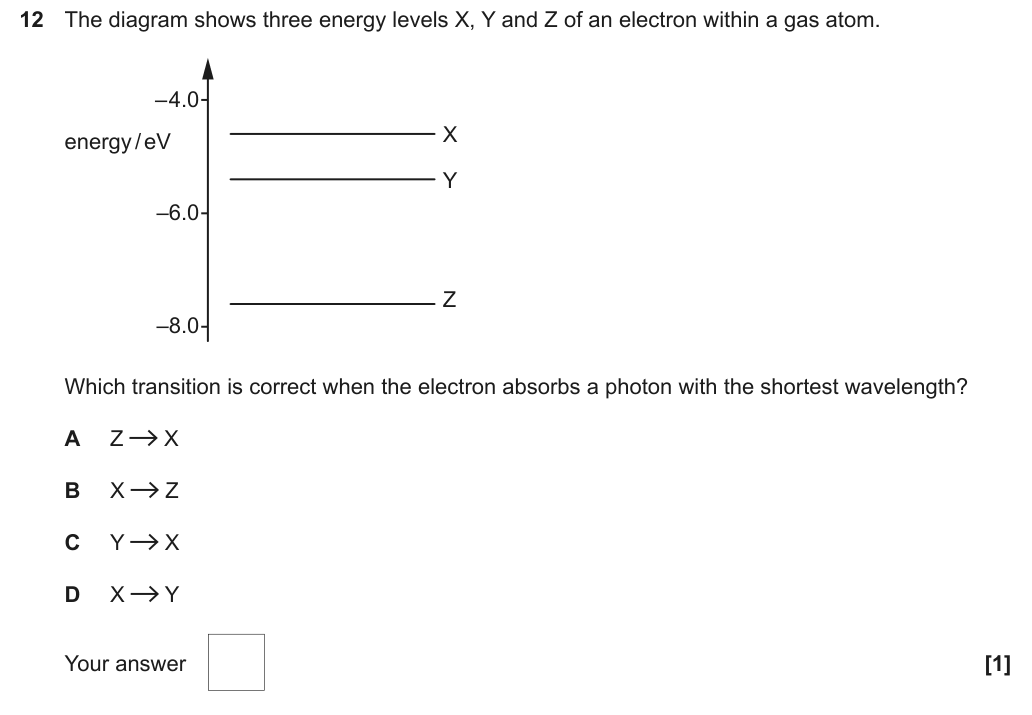
June 2022 · Paper 1 · Q12 1 mark Multiple choice Medium stars
12  The diagram shows three energy levels X, Y and Z of an electron within a gas atom.
– 4.0
energy / eV X
Y
–6.0
Z
–8.0
Which transition is correct when the electron absorbs a photon with the shortest wavelength?
A Z X
B  X Z
C  Y X
D  X Y
Your answer [1]
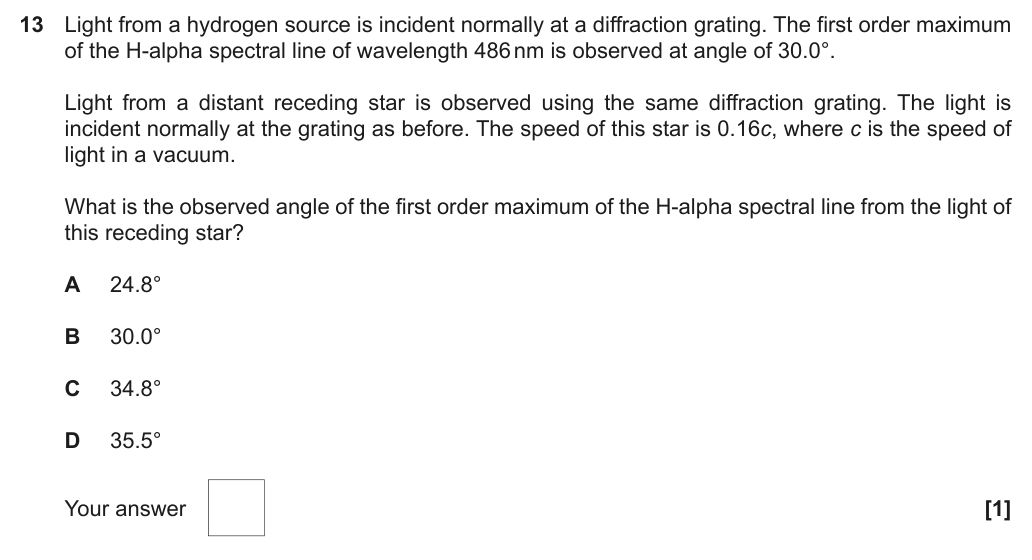
June 2022 · Paper 1 · Q13 1 mark Multiple choice Medium starscosmology
13  Light from a hydrogen source is incident normally at a diffraction grating. The first order maximum
of the H-alpha spectral line of wavelength 486 nm is observed at angle of 30.0°.
Light from a distant receding star is observed using the same diffraction grating. The light is
incident normally at the grating as before. The speed of this star is 0.16c, where c is the speed of
light in a vacuum.
What is the observed angle of the first order maximum of the H-alpha spectral line from the light of
this receding star?
A 24.8°
B 30.0°
C 34.8°
D 35.5°
Your answer [1]
June 2022 · Paper 1 · Q14 1 mark Multiple choice cosmology
14 A galaxy, 1.0 × 10⁹ light-years away from the Earth, has a recession speed of 23 000 km s–1.
Which expression, based on the information above, is correct for the age of the universe in
seconds?
age = 1.0 × 10⁹
A
23 000 × 103
age = 1.0 × 109 × 1.5 × 1011
B
23 000
age = 1.0 × 109 × 9.5 × 1015
C
23 000 × 103
age = 1.0 × 109 × 3.1 × 1016
D
23 000 × 103
Your answer [1]
June 2022 · Paper 1 · Q15 1 mark Multiple choice cosmology
15  Astronomers observe approximately the same number of distant galaxies per unit volume of space
in all directions.
Which idea does this observation support?
A Big bang model of the universe
B Cosmological principle
C Existence of dark matter
D Hubble’s law
Your answer [1]
June 2022 · Paper 1 · Q16(a) 4 marks Explanation Easy springspractical skills
16 (a)  Describe how an experiment can be carried out to determine the force constant of an elastic
cord in the laboratory by plotting a suitable graph. You may assume that the cord obeys
Hooke’s law.
...................................................................................................................................................
...................................................................................................................................................
...................................................................................................................................................
...................................................................................................................................................
...................................................................................................................................................
...................................................................................................................................................
...................................................................................................................................................
...................................................................................................................................................
.............................................................................................................................................. [4]
June 2022 · Paper 1 · Q16(b)(i) 3 marks Show that Easy materials and young modulus
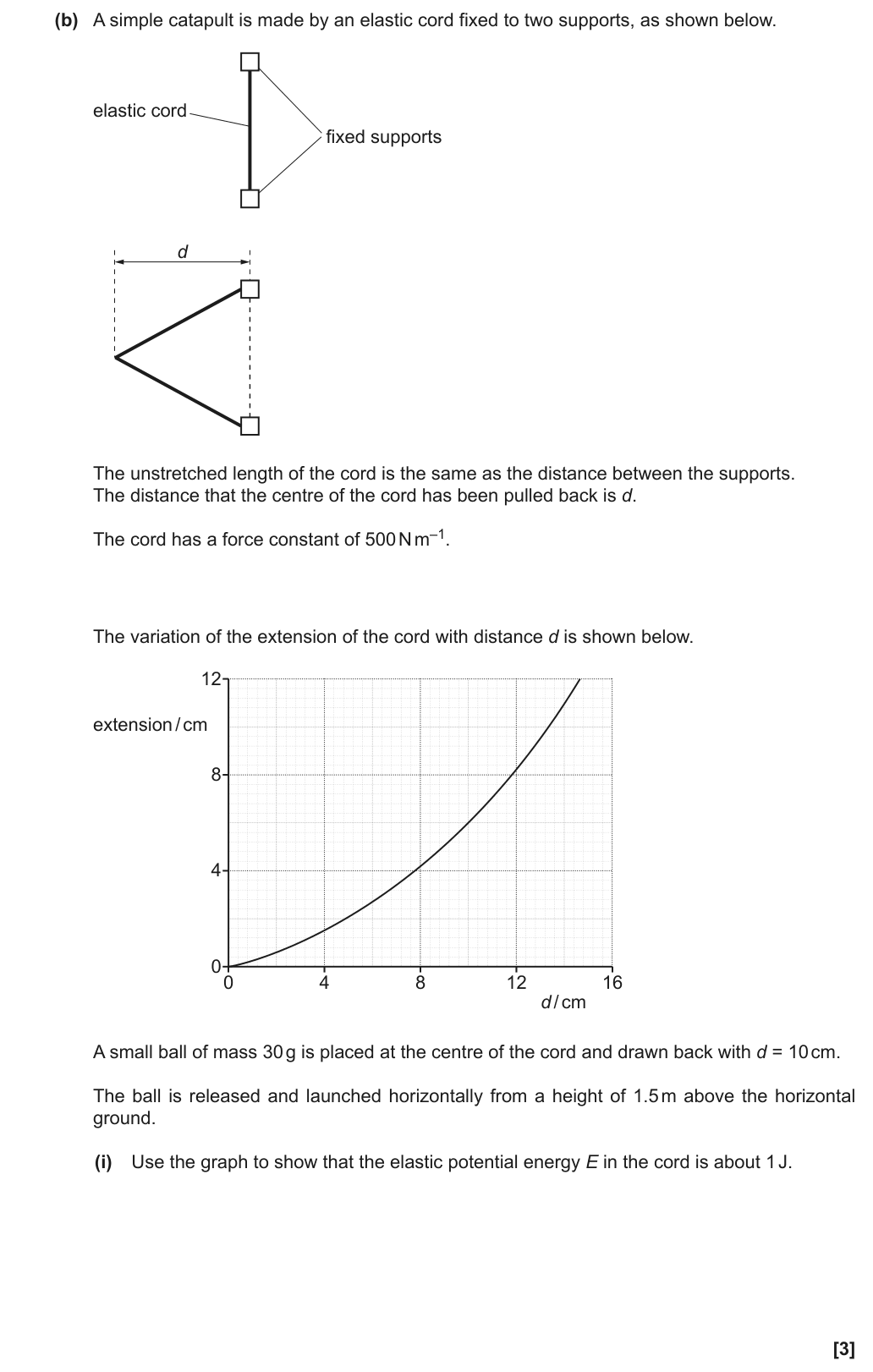
(b)  A simple catapult is made by an elastic cord fixed to two supports, as shown below.
elastic cord
fixed supports
d
The unstretched length of the cord is the same as the distance between the supports.
The distance that the centre of the cord has been pulled back is d.
The cord has a force constant of 500 N m–1.
The variation of the extension of the cord with distance d is shown below.
12
extension / cm
8
4
0
0 4 8 12 16
d / cm
A small ball of mass 30 g is placed at the centre of the cord and drawn back with d = 10 cm.
The ball is released and launched horizontally from a height of 1.5 m above the horizontal
ground.
(i)  Use the graph to show that the elastic potential energy E in the cord is about 1 J.
[3]
June 2022 · Paper 1 · Q16(b)(ii) 2 marks Show that Easy work energy and power
Earlier part of question 16 that this part usesEarlier part of June 2022 Paper 1 question 16
(ii)  Show that the maximum speed at which the ball leaves the catapult is about 8 m s–1.
[2]
June 2022 · Paper 1 · Q16(b)(iii) 3 marks Calculation Easy projectile motionlinear motion
Earlier parts of question 16 that this part usesEarlier part of June 2022 Paper 1 question 16Earlier part of June 2022 Paper 1 question 16
(iii)  Calculate the horizontal distance R travelled by the ball before it strikes the horizontal
ground.
Ignore the effects of air resistance in your calculation.
R =  ..................................................... m [3]
June 2022 · Paper 1 · Q16(b)(iv) 2 marks Explanation Easy dynamics and terminal velocitywork energy and power
Earlier parts of question 16 that this part usesEarlier part of June 2022 Paper 1 question 16Earlier part of June 2022 Paper 1 question 16
(iv)  Explain how the value of R calculated in (iii) compares with the actual value.
...........................................................................................................................................
...........................................................................................................................................
...........................................................................................................................................
...................................................................................................................................... [2]
June 2022 · Paper 1 · Q17(a) 1 mark Show that Medium work energy and power
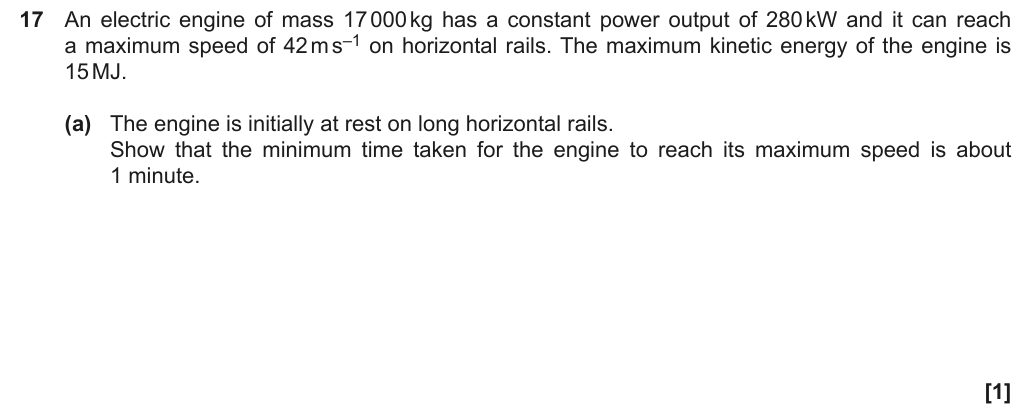
17  An electric engine of mass 17 000 kg has a constant power output of 280 kW and it can reach
a maximum speed of 42 m s–1 on horizontal rails. The maximum kinetic energy of the engine is
15 MJ.
(a)  The engine is initially at rest on long horizontal rails.
Show that the minimum time taken for the engine to reach its maximum speed is about
1 minute.
[1]
June 2022 · Paper 1 · Q17(b) 3 marks Diagram or graph Easy dynamics and terminal velocitywork energy and power
Earlier part of question 17 that this part usesEarlier part of June 2022 Paper 1 question 17
(b)  The engine is moving along the horizontal rails at the constant maximum speed of 42 m s–1.
The weight of the engine is W, the total normal contact force from the rails is N and the total
friction between the wheels and the rails is F.
F is responsible for the motion of the engine to the right.
Complete the free body diagram for the engine by showing a missing force, and the
magnitudes of all the forces. There is space for you to do any calculations below the diagram.
N = ..........................
engine
F = ..........................
W = ..........................
[3]
June 2022 · Paper 1 · Q17(c) 4 marks Short answer Medium linear motiondynamics and terminal velocity
Earlier part of question 17 that this part usesEarlier part of June 2022 Paper 1 question 17
(c)  The speed of the engine is 42 m s–1.
The driver sees an obstruction 167 m from the front of the engine. The engine is switched off
and the brakes are applied.
The constant force opposing motion is 120 kN. The reaction time of the driver is 0.40 s.
Show with the help of calculations, that the engine will stop before reaching the obstruction.
[4]
June 2022 · Paper 1 · Q18(a)(i) 3 marks Show that Medium density and pressure
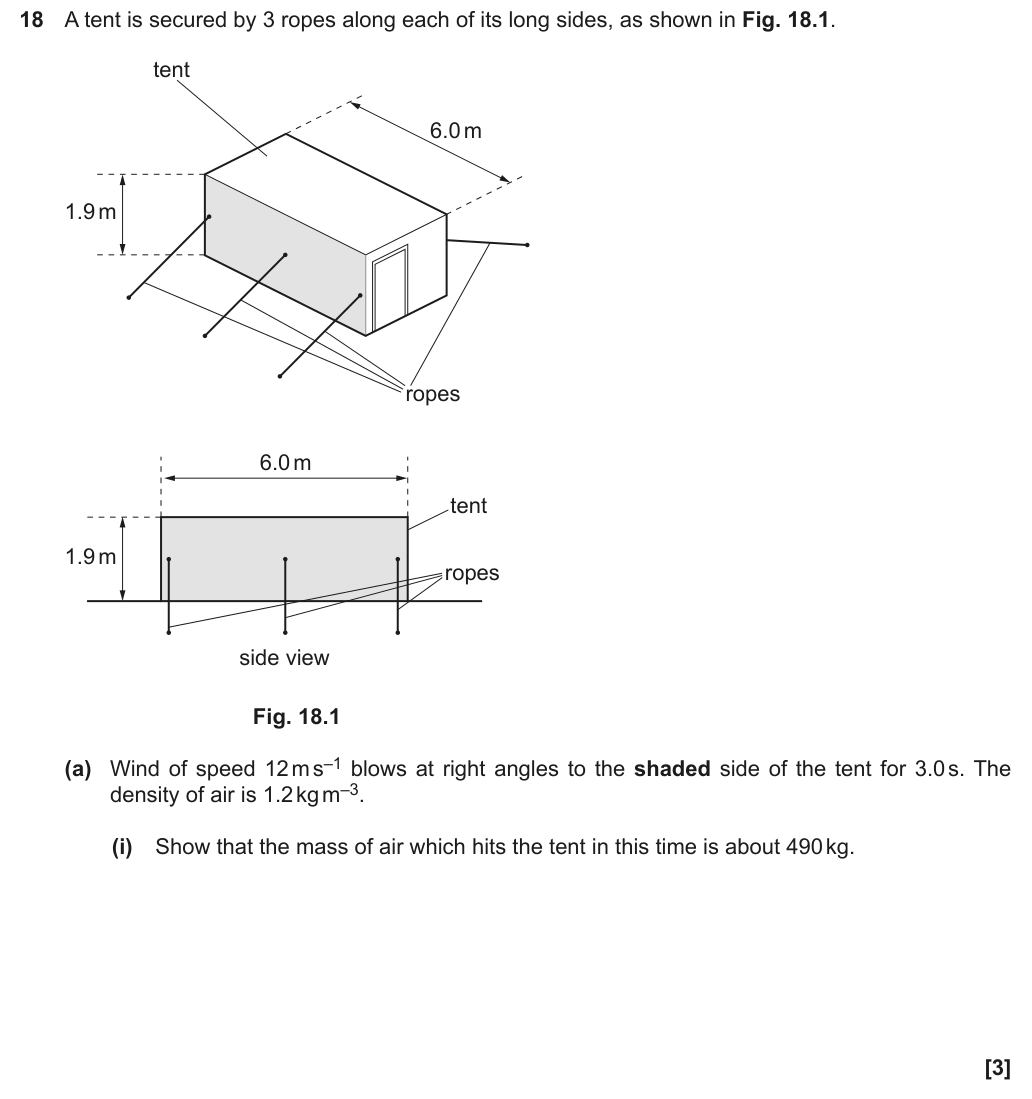
18  A tent is secured by 3 ropes along each of its long sides, as shown in Fig. 18.1.
tent
6.0 m
1.9 m
ropes
6.0 m
tent
1.9 m
ropes
side view
Fig. 18.1
(a)  Wind of speed 12 m s–1 blows at right angles to the shaded side of the tent for 3.0 s. The
density of air is 1.2 kg m–3.
(i) Show that the mass of air which hits the tent in this time is about 490 kg.
[3]
June 2022 · Paper 1 · Q18(a)(ii) 2 marks Calculation Medium newtons laws and momentum
Earlier part of question 18 that this part usesEarlier part of June 2022 Paper 1 question 18
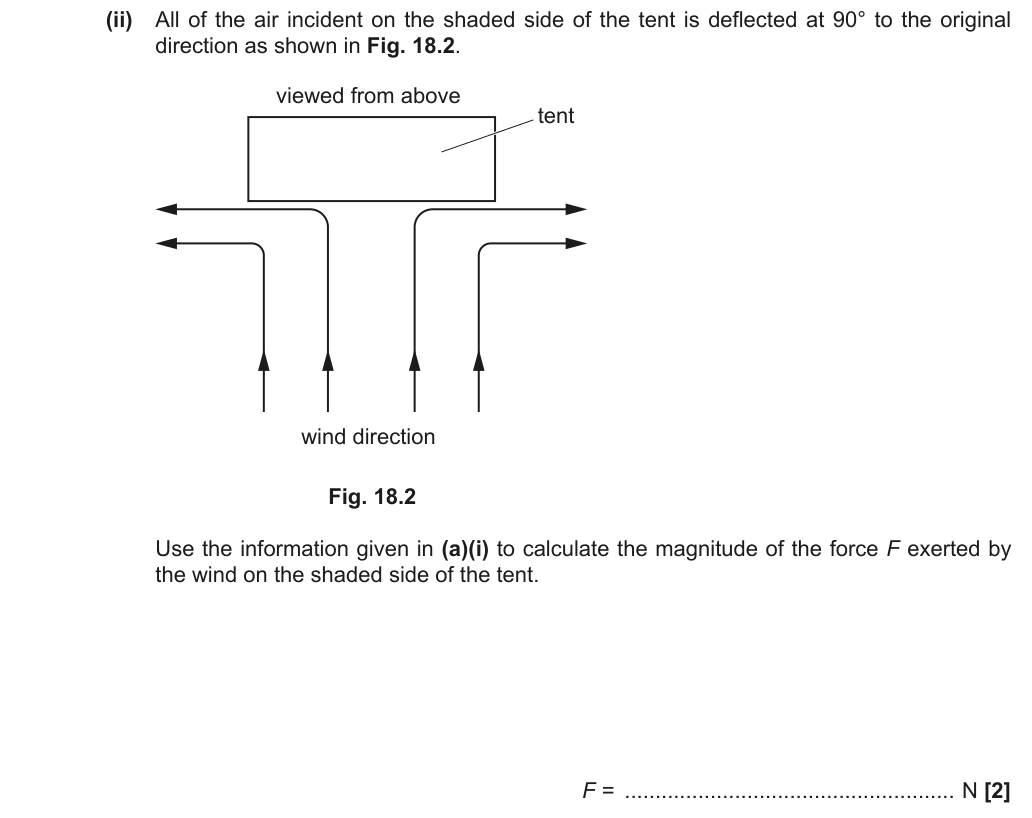
(ii) All of the air incident on the shaded side of the tent is deflected at 90° to the original
direction as shown in Fig. 18.2.
viewed from above
tent
wind direction
Fig. 18.2
Use the information given in (a)(i) to calculate the magnitude of the force F exerted by
the wind on the shaded side of the tent.
F =  ...................................................... N [2]
June 2022 · Paper 1 · Q18(b) 6 marks 6-mark extended response Medium newtons laws and momentumscalars and vectorsmaterials and young modulus
Earlier parts of question 18 that this part usesEarlier part of June 2022 Paper 1 question 18Earlier part of June 2022 Paper 1 question 18
(b)* When the wind speed exceeds 20 m s–1 the ropes securing the tent break.
Describe, and explain in terms of forces, how the ropes and the shape of the tent could be
modified to withstand wind speed exceeding 40 m s–1. [6]
...................................................................................................................................................
...................................................................................................................................................
...................................................................................................................................................
...................................................................................................................................................
...................................................................................................................................................
...................................................................................................................................................
...................................................................................................................................................
...................................................................................................................................................
...................................................................................................................................................
...................................................................................................................................................
...................................................................................................................................................
...................................................................................................................................................
...................................................................................................................................................
...................................................................................................................................................
...................................................................................................................................................
Additional answer space if required
...................................................................................................................................................
...................................................................................................................................................
...................................................................................................................................................
...................................................................................................................................................
...................................................................................................................................................
...................................................................................................................................................
...................................................................................................................................................
...................................................................................................................................................
...................................................................................................................................................
...................................................................................................................................................
June 2022 · Paper 1 · Q19(a) 2 marks Explanation Medium thermal physics
19 (a)  A fixed mass of nitrogen changes phase from liquid to gas at a constant temperature.
Explain the change in the total internal energy of nitrogen.
...................................................................................................................................................
...................................................................................................................................................
...................................................................................................................................................
.............................................................................................................................................. [2]
June 2022 · Paper 1 · Q19(b)(i) 3 marks Show that Easy ideal gasesthermal physics
(b)  In a factory, nitrogen gas is added to packets of food to keep it fresh for longer.
In 1.0 hour, the factory uses 15 m3 of nitrogen at pressure 100 kPa and temperature 23 °C.
(i)  Show that the number of moles n, of nitrogen used per hour is about 600.
[3]
June 2022 · Paper 1 · Q19(b)(ii) 1 mark Calculation Easy ideal gases
Earlier part of question 19 that this part usesEarlier part of June 2022 Paper 1 question 19
(ii) Calculate the mass of nitrogen gas used in one hour.
molar mass of nitrogen = 0.028 kg mol–1
mass =  ..................................................... kg [1]
June 2022 · Paper 1 · Q19(b)(iii) 1 mark Short answer Medium ideal gases
Earlier part of question 19 that this part usesEarlier part of June 2022 Paper 1 question 19
(iii) The volume of nitrogen being used cannot be changed.
State how the rate of mass of nitrogen used can be reduced.
...........................................................................................................................................
...................................................................................................................................... [1]
June 2022 · Paper 1 · Q19(b)(iv) 4 marks Calculation Medium thermal physicswork energy and power
Earlier parts of question 19 that this part usesEarlier part of June 2022 Paper 1 question 19Earlier part of June 2022 Paper 1 question 19
(iv)  The nitrogen at the factory is stored as a liquid.
The liquid expands at constant temperature to form gas in a short section of pipe.
When the air temperature is 0 °C, a thick layer of ice forms on the outside of the pipe
from water vapour in the air. In 1.0 hour, the mass of ice formed is 1.3 kg at a temperature
of 0 °C.
Use the data below and your answer to (b)(ii), to estimate the specific latent heat of
vaporisation L of nitrogen.
• specific latent heat of fusion of ice = 3.34 × 10⁵ J kg–1
• specific latent heat of vaporisation of water = 2.26 × 10⁶ J kg–1
L =  ............................................... J kg–1 [4]
June 2022 · Paper 1 · Q20(a) 2 marks Show that Medium quantities and units
20  (a)  For a simple harmonic oscillator, the acceleration a is given by the equation a = –ω 2x, where
ω  is the angular frequency and x is the displacement.
Show that this equation is homogeneous by reducing both sides to S.I. base units.
[2]
June 2022 · Paper 1 · Q20(b)(i) 2 marks Calculation Medium density and pressure
(b) The diagram shows a glass U-tube partially filled with a mass of water.
glass
U-tube to gas supply
x
water
One end of the U-tube is connected to a gas supply of constant pressure and the other end
is open to the atmosphere. The displacement of the water from its equilibrium position is x.
The density ρ  of water is 1000 kg m–3.
(i)  The pressure from the gas supply raises the water in the U-tube.
The vertical distance between the two levels of water in the two vertical sections of the
U-tube is 10.0 cm (x = 5.0 cm).
Δp is the difference between the gas pressure and atmospheric pressure.
Calculate Δp.
Δp =  .................................................... Pa [2]
June 2022 · Paper 1 · Q20(b)(ii) 8 marks Show that Hard simple harmonic motion
Earlier part of question 20 that this part usesEarlier part of June 2022 Paper 1 question 20
(ii) When the gas supply is disconnected, the water levels in the U-tube oscillates with
simple harmonic motion. The acceleration a of the water level in the left-hand side of the
U-tube is given by the equation
a = – 2ρgA
m x
where m is the mass of the water in the U-tube, A is the internal cross-sectional area
of the U-tube, ρ is the density of water, g is the acceleration of free fall and x is the
displacement of the water level in the left-hand side of the U-tube.
For this U-tube, A = 1.0 × 10⁻⁴ m2 and m = 0.052 kg.
1 Show that the period T of the oscillations is about 1 second.
[3]
2 The oscillations of the water level are slightly damped.
At time t = 0, x = 5.0 cm.
Sketch a suitable graph of displacement x against time t for the oscillating water
level. Add suitable values to the time t axis.
5.0
x / cm
0
0 t / s
–5.0
[3]
3 The U-tube is now connected to another gas supply where the pressure oscillates at
a frequency of about 1 Hz.
Explain the effect this will have on the water in the U-tube.
....................................................................................................................................
....................................................................................................................................
............................................................................................................................... [2]
June 2022 · Paper 1 · Q21(a) 1 mark Short answer Medium stars
21 (a) A nebula is a giant cloud of gas and dust in space. The nebula can produce a star over a long
period of time.
State what causes the initial collapse of the nebula.
.............................................................................................................................................. [1]
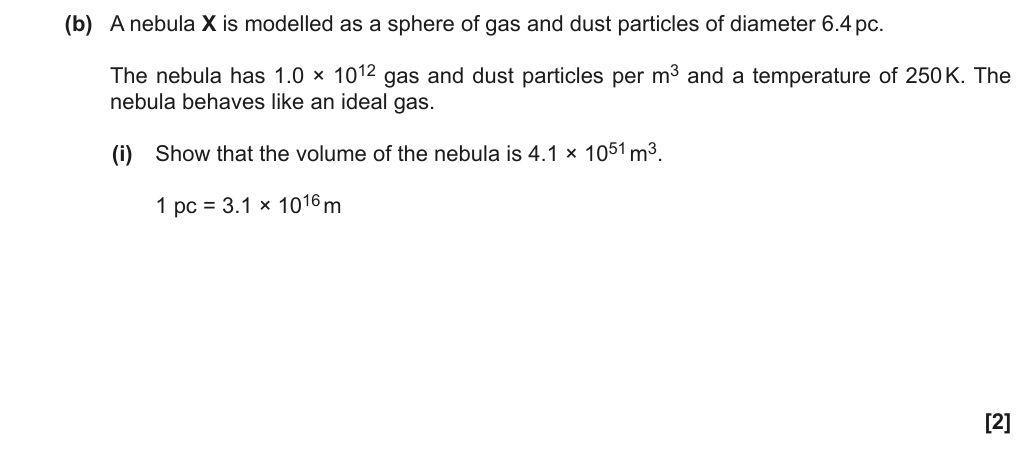
June 2022 · Paper 1 · Q21(b)(i) 2 marks Show that Medium cosmology
(b)  A nebula X is modelled as a sphere of gas and dust particles of diameter 6.4 pc.
The nebula has 1.0 × 10¹² gas and dust particles per m3 and a temperature of 250 K. The
nebula behaves like an ideal gas.
(i)  Show that the volume of the nebula is 4.1 × 1051 m3.
1 pc = 3.1 × 10¹⁶ m
[2]
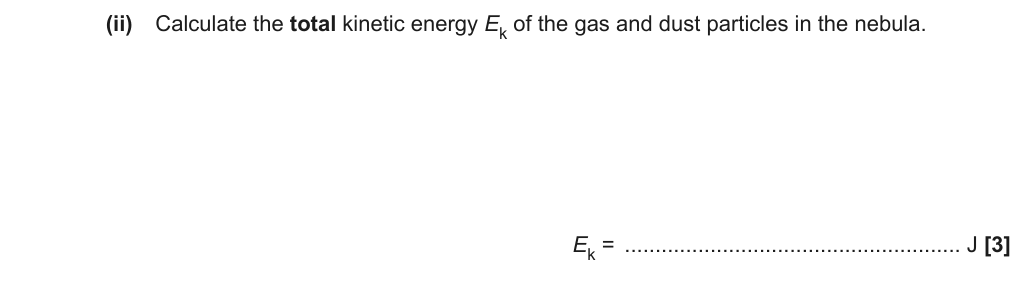
June 2022 · Paper 1 · Q21(b)(ii) 3 marks Calculation Hard ideal gases
Earlier part of question 21 that this part usesEarlier part of June 2022 Paper 1 question 21
(ii)  Calculate the total kinetic energy Ek of the gas and dust particles in the nebula.
Ek =  ....................................................... J [3]
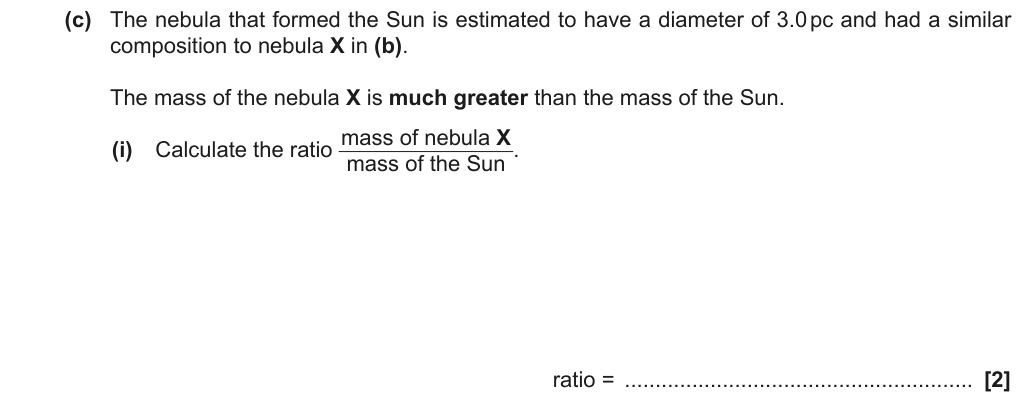
June 2022 · Paper 1 · Q21(c)(i) 2 marks Calculation Medium density and pressure
Earlier part of question 21 that this part usesEarlier part of June 2022 Paper 1 question 21
(c)  The nebula that formed the Sun is estimated to have a diameter of 3.0 pc and had a similar
composition to nebula X in (b).
The mass of the nebula X is much greater than the mass of the Sun.
(i)  Calculate the ratio mass of nebula X
mass of the Sun .
ratio =  ......................................................... [2]
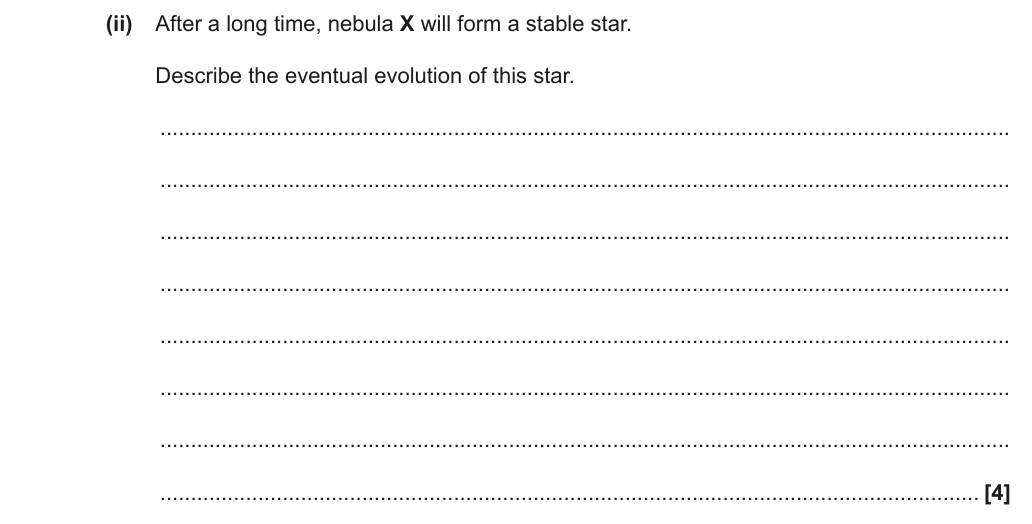
June 2022 · Paper 1 · Q21(c)(ii) 4 marks Explanation Medium stars
Earlier parts of question 21 that this part usesEarlier part of June 2022 Paper 1 question 21Earlier part of June 2022 Paper 1 question 21
(ii)  After a long time, nebula X will form a stable star.
Describe the eventual evolution of this star.
...........................................................................................................................................
...........................................................................................................................................
...........................................................................................................................................
...........................................................................................................................................
...........................................................................................................................................
...........................................................................................................................................
...........................................................................................................................................
...................................................................................................................................... [4]
June 2022 · Paper 1 · Q22(a) 2 marks Explanation Medium starsmeasurements and uncertainties
22  (a)  A team of astronomers have measurements to determine the peak surface temperature T
and luminosity L of a distant star. They plan to use Stefan’s law to estimate the radius r of this
star.
Explain whether the astronomers should attempt to measure T or L more precisely to reduce
the uncertainty in r.
...................................................................................................................................................
...................................................................................................................................................
...................................................................................................................................................
.............................................................................................................................................. [2]
June 2022 · Paper 1 · Q22(b) 6 marks 6-mark extended response Medium starspractical skills
(b)* It is suggested that the luminosity L and the mass M of a star can be compared to the Sun by
the equation
b
L =  M ⎛ ⎞
L9 ⎝ M9 ⎠
where L9 is the luminosity of the Sun and M9 is the mass of the Sun.
The value of b is between 3 and 4.
Table 22 shows some data of five stars.
M L
Main sequence star
M9 L9
Pi Andromedae A 6.5 800
Alpha Coronae Borealis A 3.2 80
Gamma Virginis 1.7 6.0
Eta Arietis 1.3 2.5
70 Ophiuchi A 0.78 0.4
Table 22
Fig. 22 shows the lg  L ⎛ against lg  M ⎞ ⎛ ⎞
plot for these stars.
⎝ L9 ⎠ ⎝ M9 ⎠
3.0
f L p
lg L
9
2.0
1.0
0
–0.2 0 0.2 0.4 0.6 0.8 1.0
f M p
lg M
9
–1.0
Fig. 22
The luminosity of a star is directly proportional to the rate of fusion of hydrogen nuclei.
Use Fig. 22 to determine b and use your knowledge of Hertzsprung–Russell (HR) diagrams
to deduce how the lifespan of hotter stars compares with lifespans of cooler stars. [6]
...................................................................................................................................................
...................................................................................................................................................
...................................................................................................................................................
...................................................................................................................................................
...................................................................................................................................................
...................................................................................................................................................
...................................................................................................................................................
...................................................................................................................................................
...................................................................................................................................................
...................................................................................................................................................
...................................................................................................................................................
...................................................................................................................................................
...................................................................................................................................................
...................................................................................................................................................
...................................................................................................................................................
Additional answer space if required
...................................................................................................................................................
...................................................................................................................................................
...................................................................................................................................................
...................................................................................................................................................
...................................................................................................................................................
...................................................................................................................................................
...................................................................................................................................................
...................................................................................................................................................
...................................................................................................................................................
June 2022 · Paper 1 · Q23(a) 3 marks Show that Easy planetary motioncircular motiongravitational fields
23  (a) A planet of mass m is in a circular orbit around a star of mass M.
Use the equation for Newton’s law of gravitation and your knowledge of circular motion to
show that the relationship between the orbital period T of the planet and its orbital radius r is
T 2 ? r 3.
[3]
June 2022 · Paper 1 · Q23(b)(i) 2 marks Calculation Medium planetary motion
(b)  The Solar Orbiter satellite was launched in February 2020.
This satellite moves around the Sun in an elliptical orbit with a period of 168 days.
The diagram below shows the elliptical orbit of this satellite.
satellite
Sun
The closest distance of the satellite to the Sun is 4.20 × 10¹⁰ m and its furthest distance from
the Sun is 1.37 × 10¹¹ m.
The mass of the Sun is 2.0 × 1030 kg and the mass of the satellite is 209 kg.
(i)  The Earth has a mean orbital distance of 1.50 × 10¹¹ m around the Sun and an orbital
period of 365 days.
Use Kepler’s third law to calculate the mean orbital distance of the satellite from the
Sun.
distance =  ..................................................... m [2]
June 2022 · Paper 1 · Q23(b)(ii) 3 marks Calculation Medium gravitational fields
Earlier part of question 23 that this part usesEarlier part of June 2022 Paper 1 question 23
(ii)  The total kinetic and gravitational potential energy of the satellite in its orbit remains
constant.
Calculate the change in the kinetic energy of the satellite as it travels from its furthest
point from the Sun to its closest point to the Sun.
change in kinetic energy =  ....................................................... J [3]
June 2022 · Paper 1 · Q23(b)(iii) 1 mark Explanation Hard work energy and powergravitational fields
Earlier part of question 23 that this part usesEarlier part of June 2022 Paper 1 question 23
(iii)  Suggest why the total energy of the satellite in its orbit around the Sun is not the same as
the total energy of the satellite during its launch from the surface of the Earth.
...........................................................................................................................................
...................................................................................................................................... [1]

Work with an OCR physics tutor

Want a paper marked and gone through with you? Message us.

Prefer email? Send an enquiry

If you are under 18, please include a parent's contact details. Enquiries go to enquiries@physicsaleveltutor.com and are deleted once handled. All tutoring is online.