June 2023: AS Paper 1, Breadth in physics

70 marks · 40 question parts · Paper, mark scheme and report on OCR's site · Have the Data, Formulae and Relationships Booklet beside you

Question by question

QTopicMarksAOType
1 Electromagnetic waves, polarisation and refraction 1Multiple choice
2 Equilibrium: moments, couples and centre of mass 1Multiple choice
3 Wave–particle duality and the de Broglie equation 1Multiple choice
4 Resistivity 1Multiple choice
5 Electromagnetic waves, polarisation and refraction 1Multiple choice
6 Work, energy and power, Scalars and vectors 1Multiple choice
7 Internal resistance and e.m.f., Series and parallel circuits: Kirchhoff's laws 1Multiple choice
8 Photons and the Planck constant 1Multiple choice
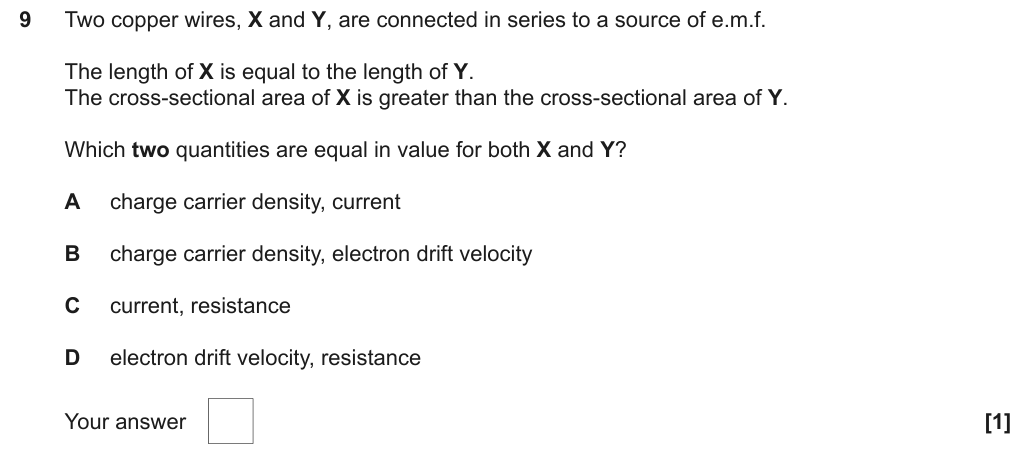
9 Charge, current and mean drift velocity 1Multiple choice
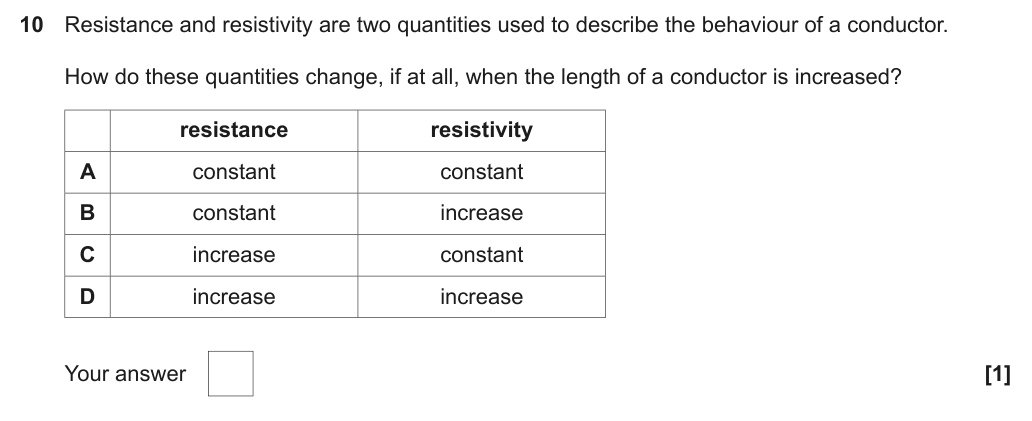
10 Resistivity 1Multiple choice
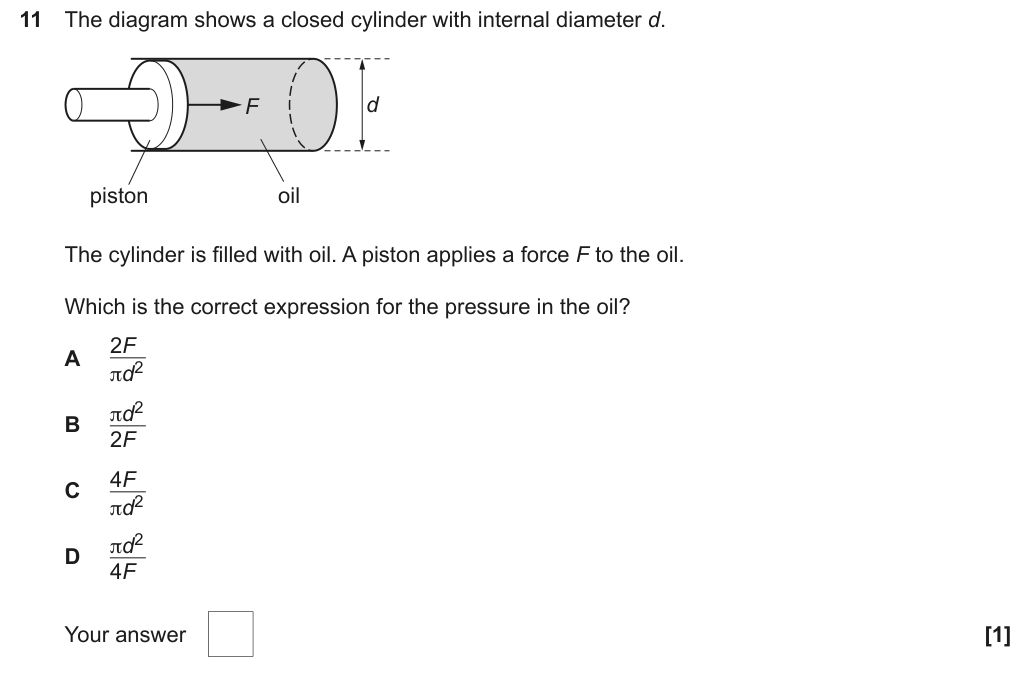
11 Density, pressure and upthrust 1Multiple choice
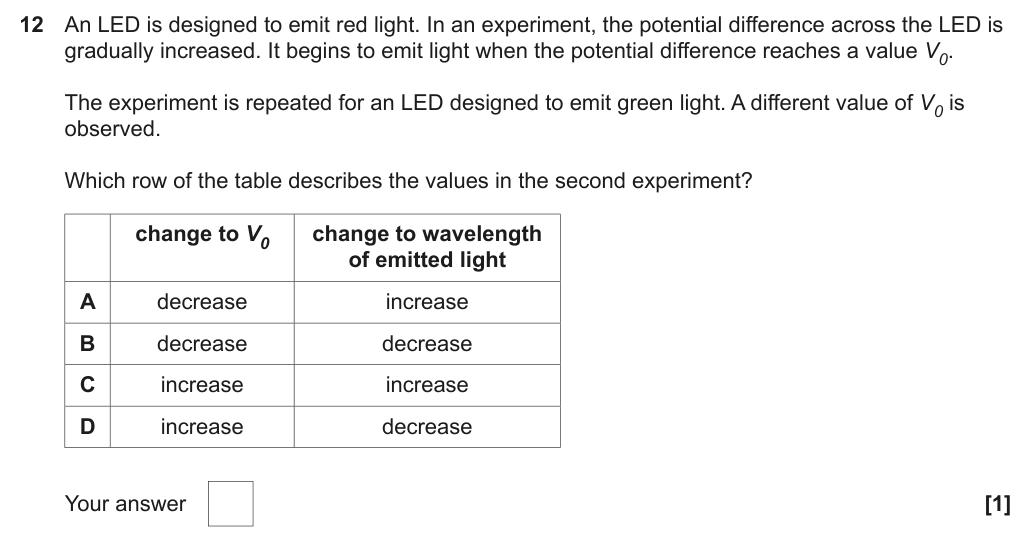
12 Photons and the Planck constant 1Multiple choice
13 Electromagnetic waves, polarisation and refraction, Wave motion: progressive waves, the wave equation and intensity 1Multiple choice
14 Kinematics: displacement, velocity and motion graphs, Linear motion: the suvat equations and free fall 1Multiple choice
15 Scalars and vectors, Equilibrium: moments, couples and centre of mass 1Multiple choice
16 Equilibrium: moments, couples and centre of mass, Newton's laws of motion and momentum 1Multiple choice
17 Wave motion: progressive waves, the wave equation and intensity 1Multiple choice
18 E.m.f., p.d., resistance and I–V characteristics, Potential dividers 1Multiple choice
19 Charge, current and mean drift velocity 1Multiple choice
20 Charge, current and mean drift velocity 1Multiple choice
21(a) Springs and Hooke's law 2Calculation
21(b) Mechanical properties of matter: stress, strain and the Young modulus, Practical skills: planning, analysis and evaluation 3Explanation
21(c)(i) Mechanical properties of matter: stress, strain and the Young modulus, Springs and Hooke's law 2Show that
21(c)(ii) Mechanical properties of matter: stress, strain and the Young modulus, Measurements and uncertainties 3Calculation
21(c)(iii) Measurements and uncertainties, Practical skills: planning, analysis and evaluation 2Calculation
22(a) Wave motion: progressive waves, the wave equation and intensity 3Explanation
22(b)(i) Stationary waves, Superposition, interference and the double slit 3Explanation
22(b)(ii) Stationary waves, Wave motion: progressive waves, the wave equation and intensity, Superposition, interference and the double slit 3Explanation
22(b)(iii) Stationary waves, Wave motion: progressive waves, the wave equation and intensity 2Calculation
22(b)(iv) Practical skills: planning, analysis and evaluation 1Explanation
23(a) E.m.f., p.d., resistance and I–V characteristics, Charge, current and mean drift velocity 2Calculation
23(b) The photoelectric effect, Photons and the Planck constant 3Explanation
23(c)(i) The photoelectric effect, Charge, current and mean drift velocity 3Explanation
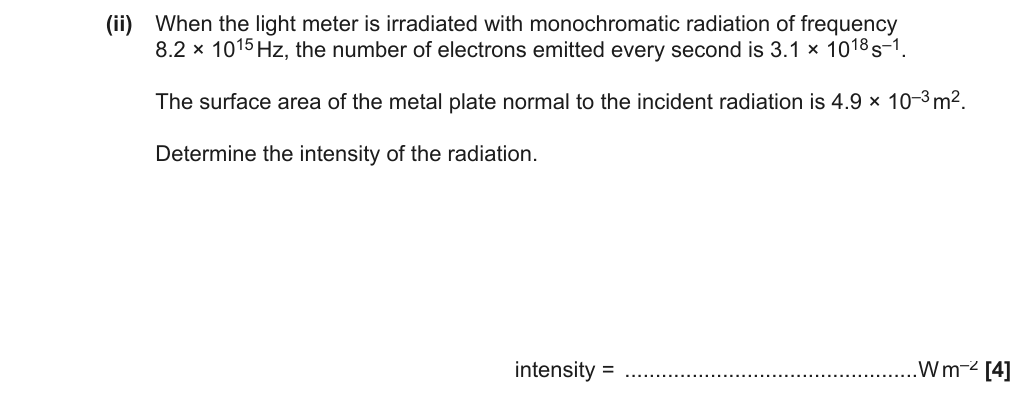
23(c)(ii) Photons and the Planck constant, Wave motion: progressive waves, the wave equation and intensity, The photoelectric effect 4Calculation
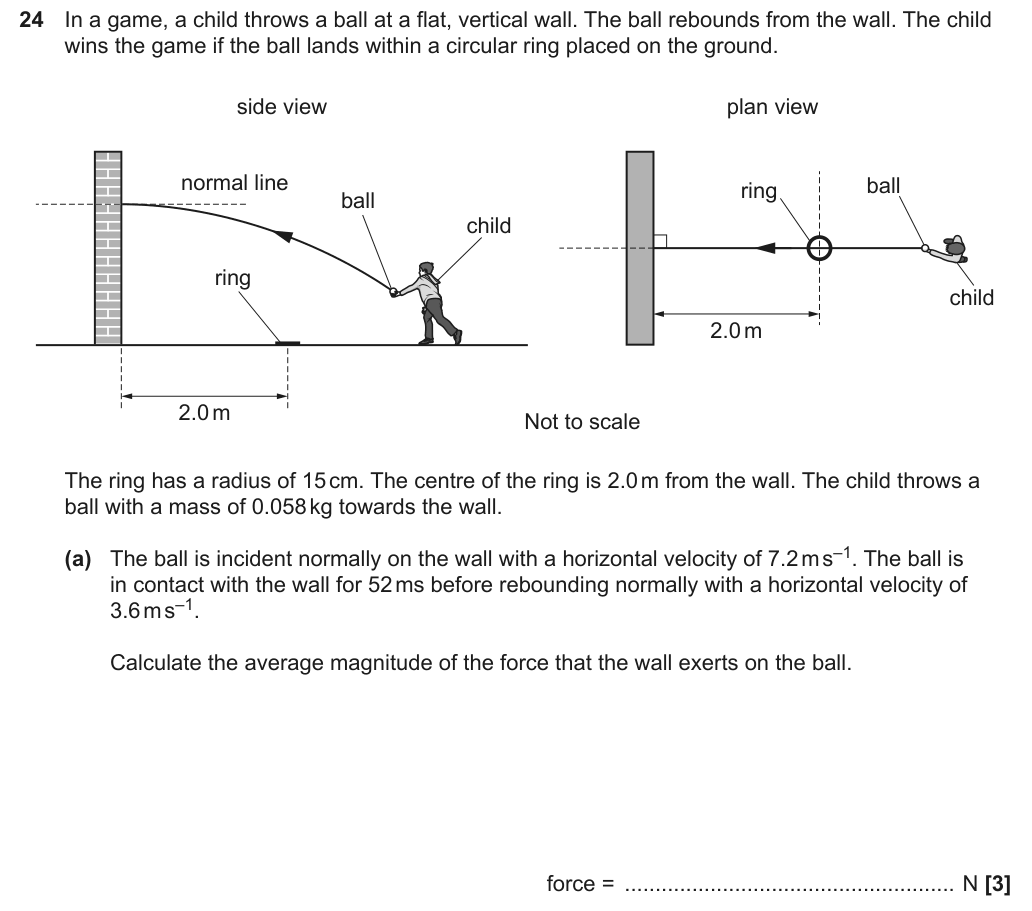
24(a) Newton's laws of motion and momentum 3Calculation
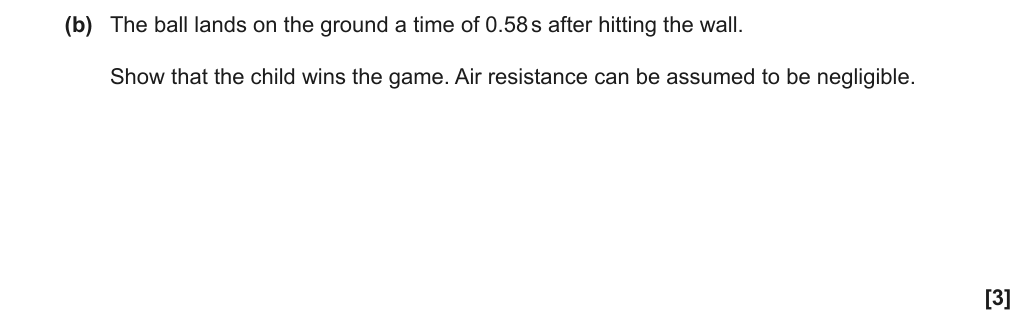
24(b) Projectile motion 3Show that
25(a) Practical skills: planning, analysis and evaluation 2Explanation
25(b) Practical skills: planning, analysis and evaluation, Dynamics, drag and terminal velocity 1Explanation
25(c) Dynamics, drag and terminal velocity, Practical skills: planning, analysis and evaluation, Kinematics: displacement, velocity and motion graphs 2Show that
25(d) Dynamics, drag and terminal velocity, Practical skills: planning, analysis and evaluation 3Calculation

The questions

123456789101112131415161718192021(a)21(b)21(c)(i)21(c)(ii)21(c)(iii)22(a)22(b)(i)22(b)(ii)22(b)(iii)22(b)(iv)23(a)23(b)23(c)(i)23(c)(ii)24(a)24(b)25(a)25(b)25(c)25(d)
June 2023 · AS Paper 1 · Q1 1 mark Multiple choice Easy electromagnetic waves and refraction
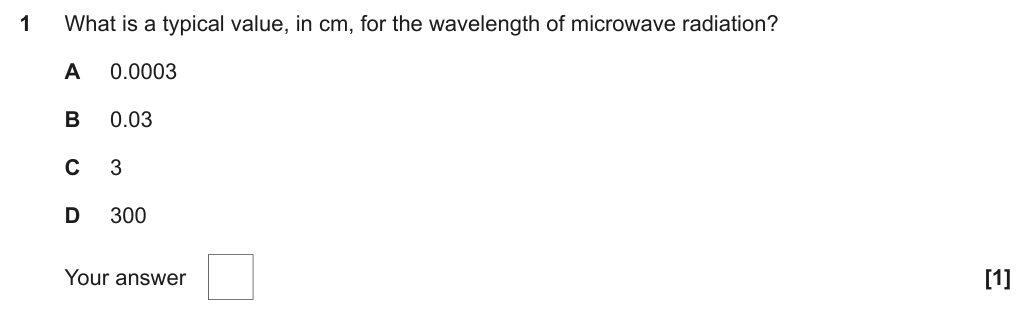
1 What is a typical value, in cm, for the wavelength of microwave radiation?
A 0.0003
B 0.03
C 3
D 300
Your answer [1]
June 2023 · AS Paper 1 · Q2 1 mark Multiple choice Medium equilibrium and moments
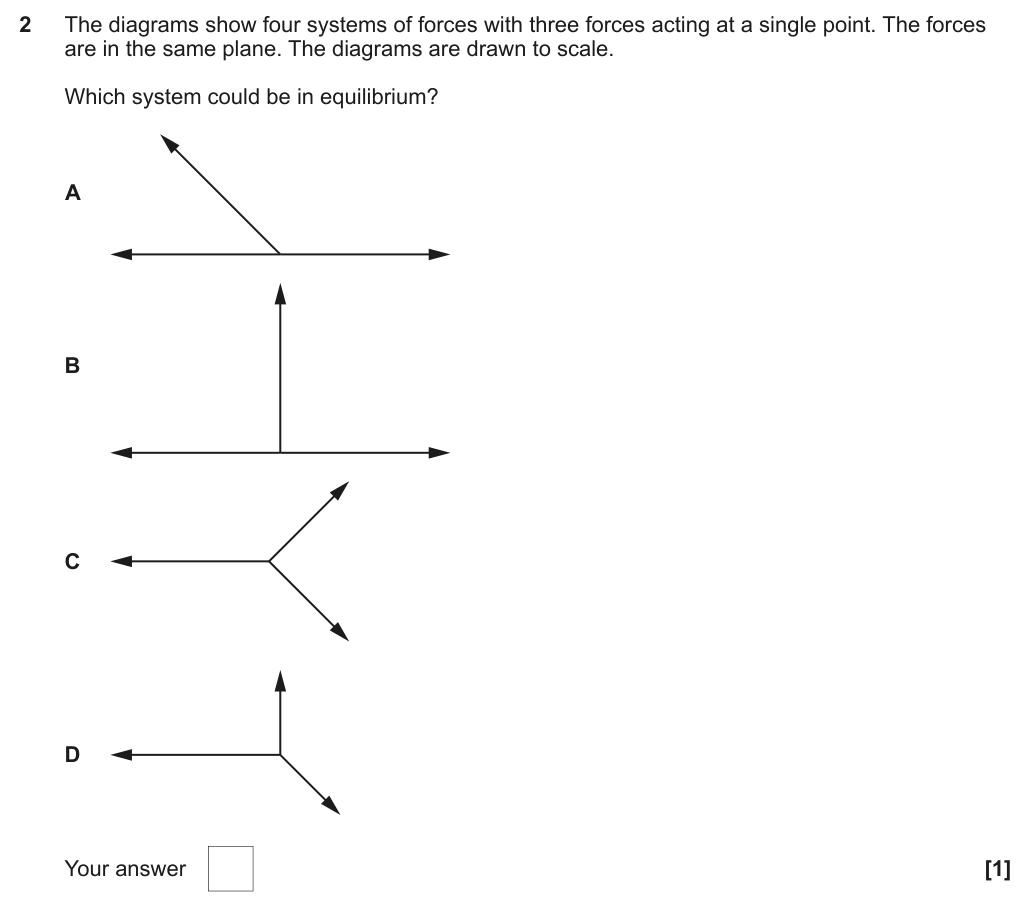
2 The diagrams show four systems of forces with three forces acting at a single point. The forces
are in the same plane. The diagrams are drawn to scale.
Which system could be in equilibrium?
A
B
C
D
Your answer [1]
June 2023 · AS Paper 1 · Q3 1 mark Multiple choice Medium wave particle duality
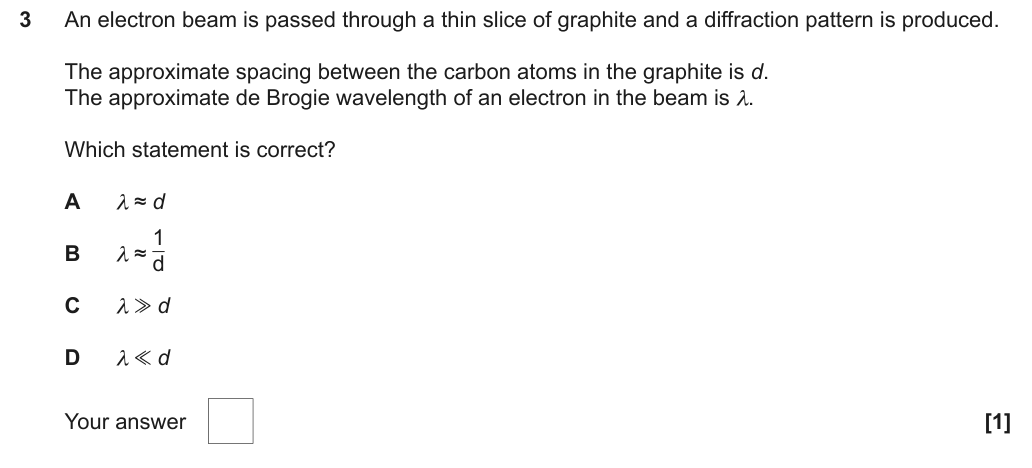
3 An electron beam is passed through a thin slice of graphite and a diffraction pattern is produced.
The approximate spacing between the carbon atoms in the graphite is d.
The approximate de Brogie wavelength of an electron in the beam is λ.
Which statement is correct?
A λ ≈ d
λ ≈ 1
B
d
C λ & d
D λ % d
Your answer [1]
June 2023 · AS Paper 1 · Q4 1 mark Multiple choice Easy resistivity
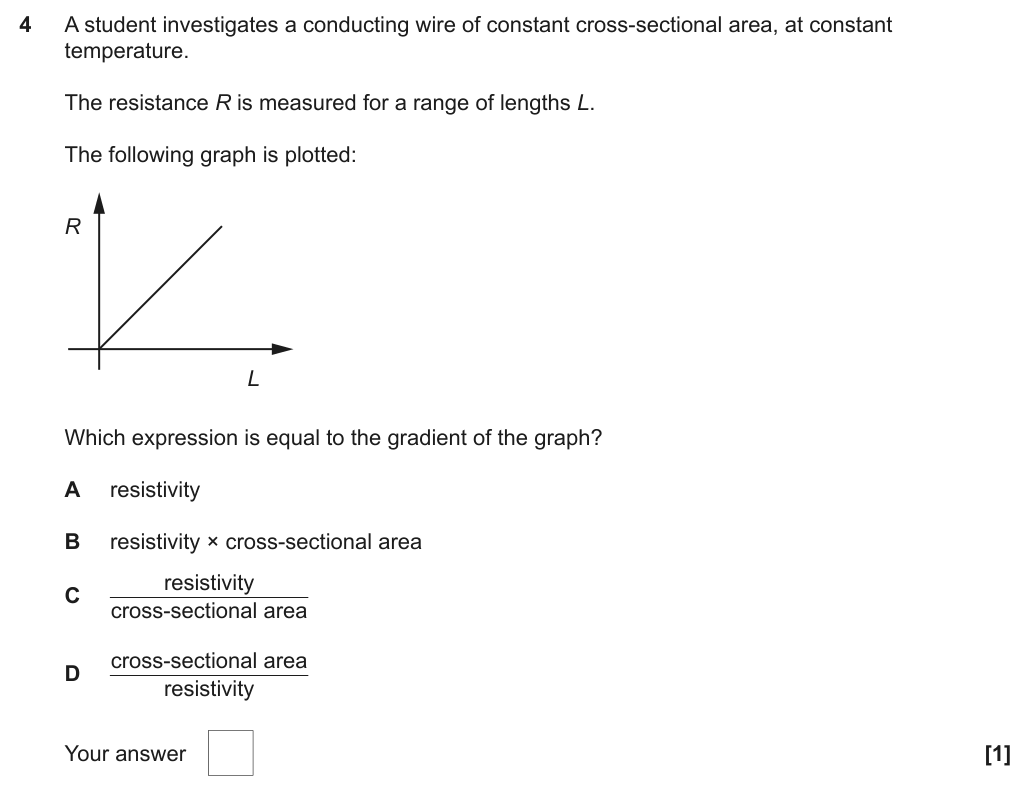
4 A student investigates a conducting wire of constant cross-sectional area, at constant
temperature.
The resistance R is measured for a range of lengths L.
The following graph is plotted:
R
L
Which expression is equal to the gradient of the graph?
A resistivity
B resistivity × cross-sectional area
resistivity
C
cross-sectional area
D
resistivity
Your answer [1]
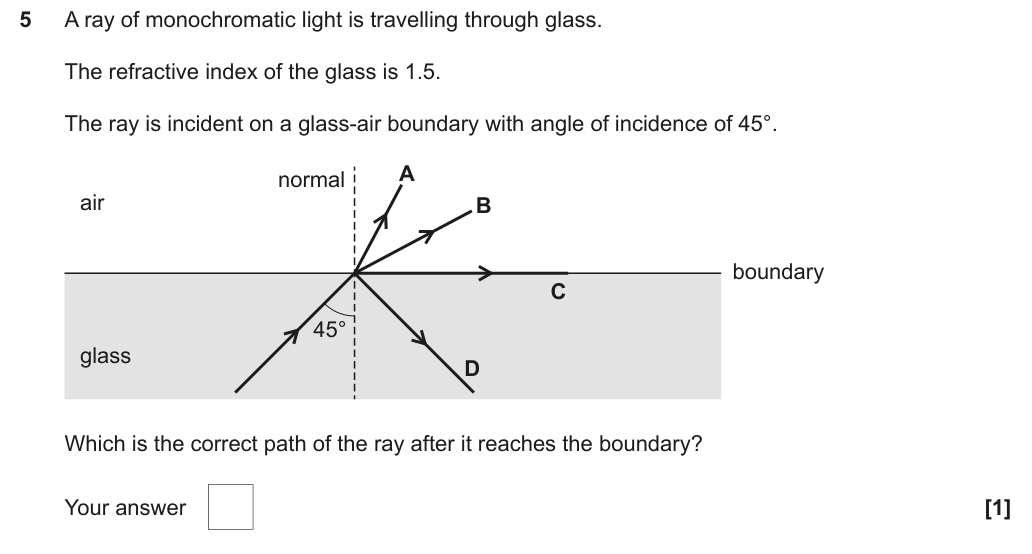
June 2023 · AS Paper 1 · Q5 1 mark Multiple choice Medium electromagnetic waves and refraction
5 A ray of monochromatic light is travelling through glass.
The refractive index of the glass is 1.5.
The ray is incident on a glass-air boundary with angle of incidence of 45°.
normal A
air B
boundary
C
45°
glass
D
Which is the correct path of the ray after it reaches the boundary?
Your answer [1]
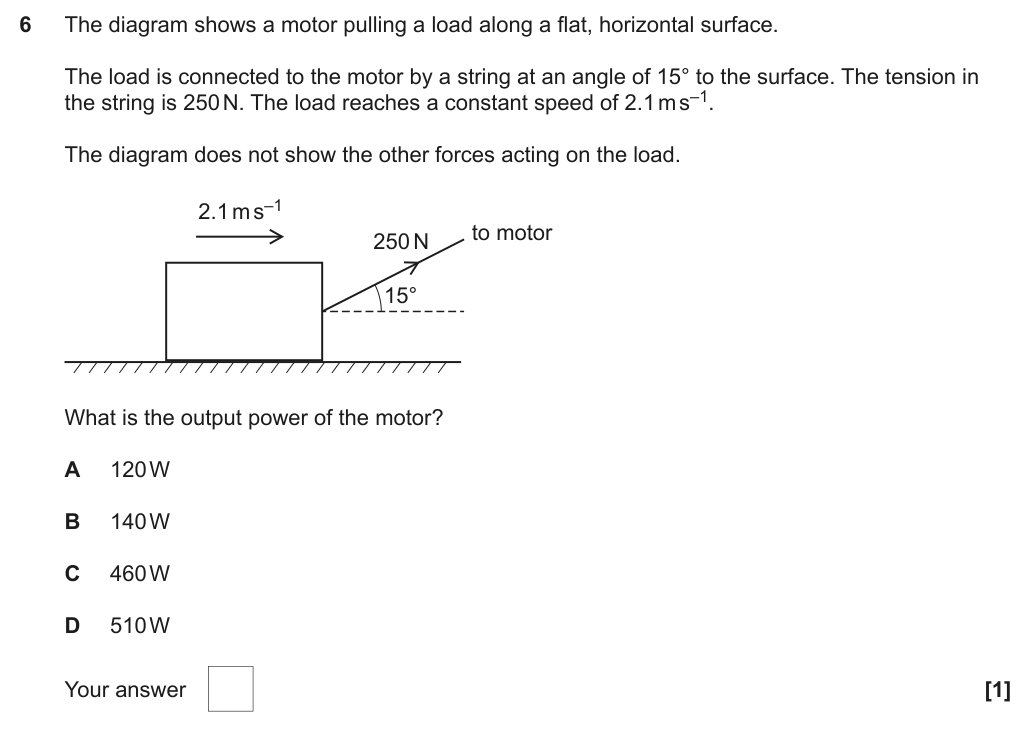
June 2023 · AS Paper 1 · Q6 1 mark Multiple choice Easy work energy and powerscalars and vectors
6 The diagram shows a motor pulling a load along a flat, horizontal surface.
The load is connected to the motor by a string at an angle of 15° to the surface. The tension in
the string is 250 N. The load reaches a constant speed of 2.1 m s–1.
The diagram does not show the other forces acting on the load.
2.1 m s–1
to motor
250 N
15°
What is the output power of the motor?
A 120 W
B 140 W
C 460 W
D 510 W
Your answer [1]
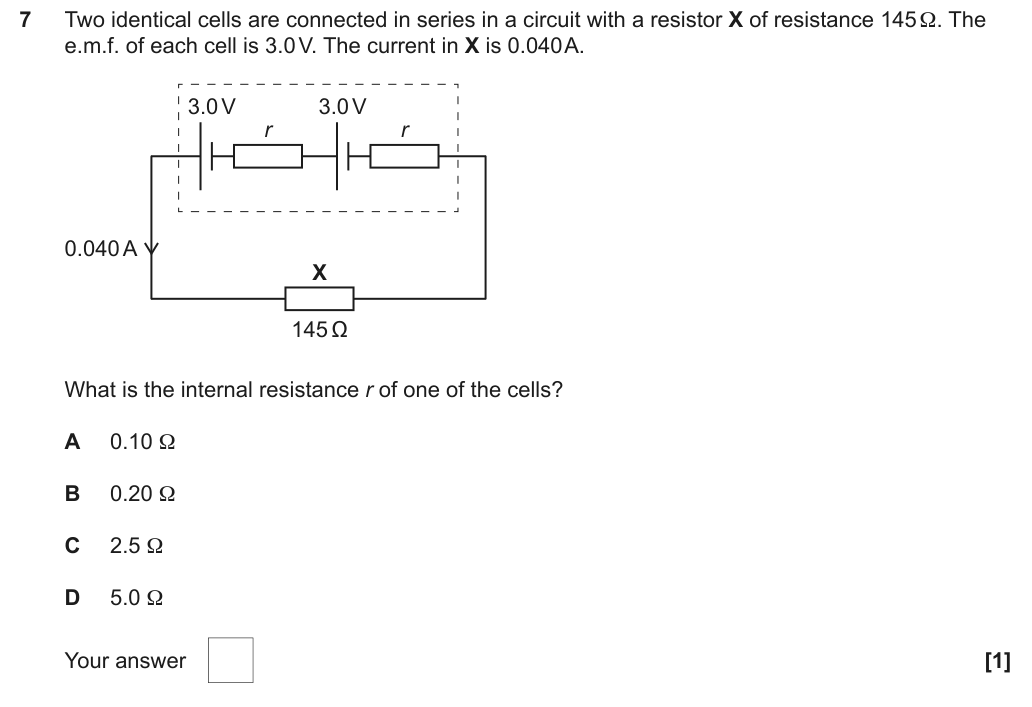
June 2023 · AS Paper 1 · Q7 1 mark Multiple choice Medium internal resistanceseries and parallel circuits
7 Two identical cells are connected in series in a circuit with a resistor X of resistance 145 Ω. The
e.m.f. of each cell is 3.0 V. The current in X is 0.040 A.
3.0 V 3.0 V
r r
0.040 A
X
145 Ω
What is the internal resistance r of one of the cells?
A 0.10 Ω
B 0.20 Ω
C 2.5 Ω
D 5.0 Ω
Your answer [1]
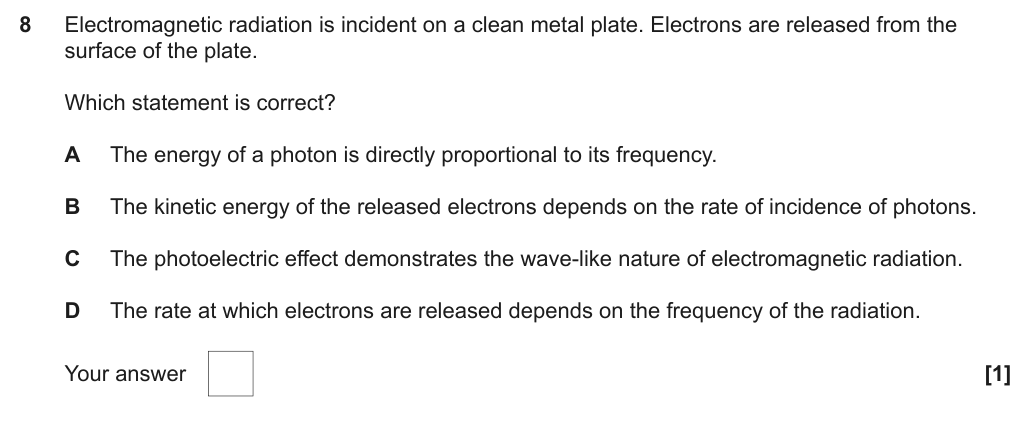
June 2023 · AS Paper 1 · Q8 1 mark Multiple choice Easy photons
8 Electromagnetic radiation is incident on a clean metal plate. Electrons are released from the
surface of the plate.
Which statement is correct?
A The energy of a photon is directly proportional to its frequency.
B The kinetic energy of the released electrons depends on the rate of incidence of photons.
C The photoelectric effect demonstrates the wave-like nature of electromagnetic radiation.
D The rate at which electrons are released depends on the frequency of the radiation.
Your answer [1]
June 2023 · AS Paper 1 · Q9 1 mark Multiple choice Medium charge and current
9 Two copper wires, X and Y, are connected in series to a source of e.m.f.
The length of X is equal to the length of Y.
The cross-sectional area of X is greater than the cross-sectional area of Y.
Which two quantities are equal in value for both X and Y?
A charge carrier density, current
B charge carrier density, electron drift velocity
C current, resistance
D electron drift velocity, resistance
Your answer [1]
June 2023 · AS Paper 1 · Q10 1 mark Multiple choice Easy resistivity
10 Resistance and resistivity are two quantities used to describe the behaviour of a conductor.
How do these quantities change, if at all, when the length of a conductor is increased?
resistance resistivity
A constant constant
B constant increase
C increase constant
D increase increase
Your answer [1]
June 2023 · AS Paper 1 · Q11 1 mark Multiple choice Easy density and pressure
11 The diagram shows a closed cylinder with internal diameter d.
F d
piston oil
The cylinder is filled with oil. A piston applies a force F to the oil.
Which is the correct expression for the pressure in the oil?
2F
A
πd2
πd2
B
2F
4F
C
πd2
πd2
D
4F
Your answer [1]
June 2023 · AS Paper 1 · Q12 1 mark Multiple choice Medium photons
12 An LED is designed to emit red light. In an experiment, the potential difference across the LED is
gradually increased. It begins to emit light when the potential difference reaches a value V0.
The experiment is repeated for an LED designed to emit green light. A different value of V0 is
observed.
Which row of the table describes the values in the second experiment?
change to V0 change to wavelength
of emitted light
A decrease increase
B decrease decrease
C increase increase
D increase decrease
Your answer [1]
June 2023 · AS Paper 1 · Q13 1 mark Multiple choice Medium electromagnetic waves and refractionwave motion
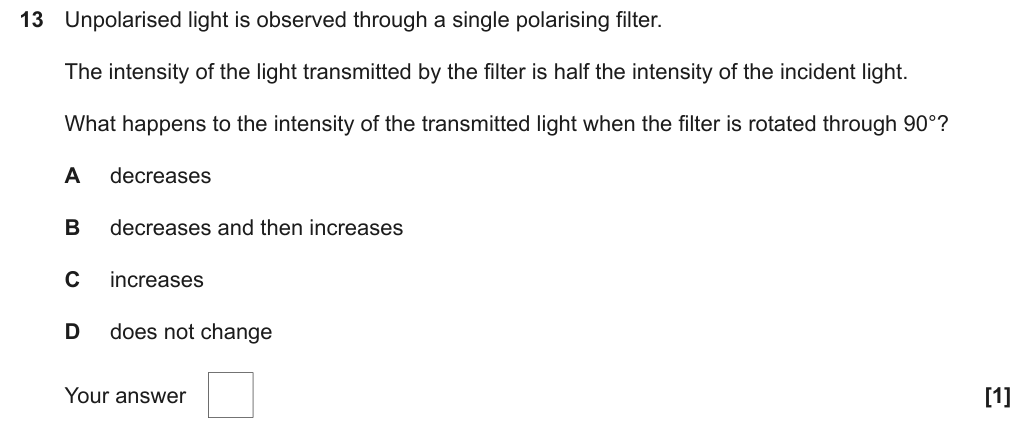
13 Unpolarised light is observed through a single polarising filter.
The intensity of the light transmitted by the filter is half the intensity of the incident light.
What happens to the intensity of the transmitted light when the filter is rotated through 90°?
A decreases
B decreases and then increases
C increases
D does not change
Your answer [1]
June 2023 · AS Paper 1 · Q14 1 mark Multiple choice Medium kinematicslinear motion
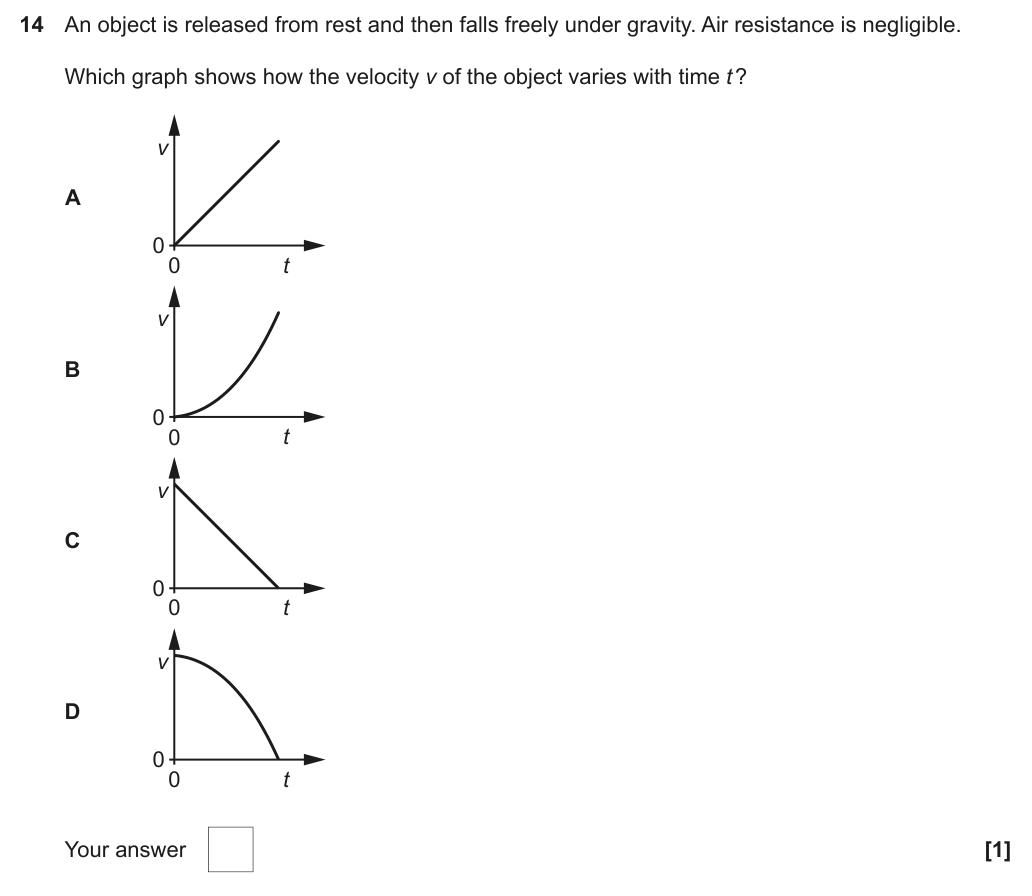
14 An object is released from rest and then falls freely under gravity. Air resistance is negligible.
Which graph shows how the velocity v of the object varies with time t ?
v
A
0
0 t
v
B
0
0 t
v
C
0
0 t
v
D
0
0 t
Your answer [1]
June 2023 · AS Paper 1 · Q15 1 mark Multiple choice Easy scalars and vectorsequilibrium and moments
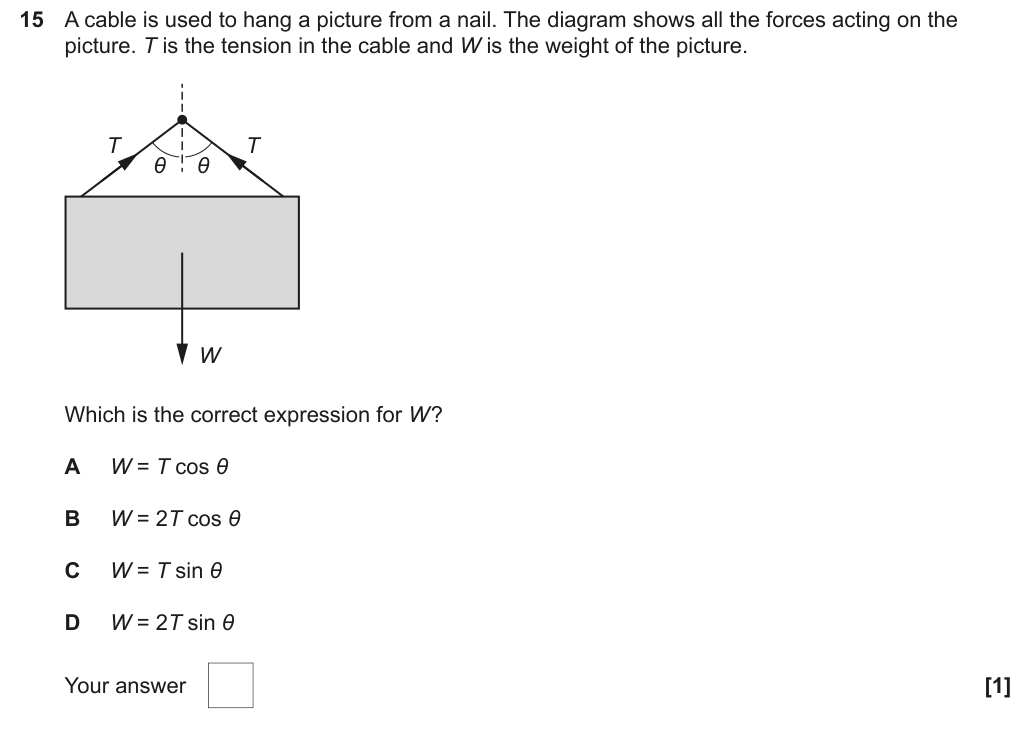
15 A cable is used to hang a picture from a nail. The diagram shows all the forces acting on the
picture. T is the tension in the cable and W is the weight of the picture.
T T
θ θ
W
Which is the correct expression for W ?
A W = T cos θ
B W = 2T cos θ
C W = T sin θ
D W = 2T sin θ
Your answer [1]
June 2023 · AS Paper 1 · Q16 1 mark Multiple choice Medium equilibrium and momentsnewtons laws and momentum
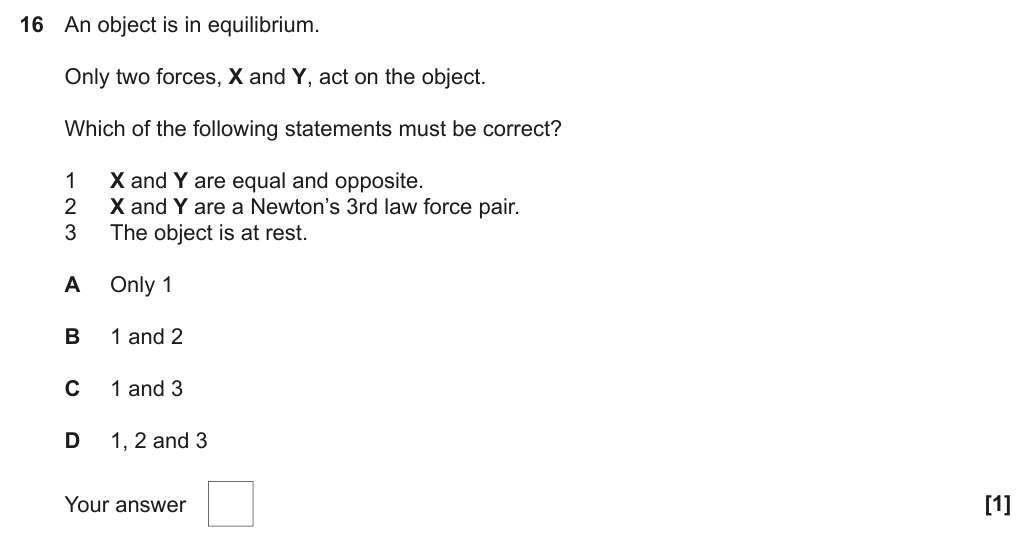
16 An object is in equilibrium.
Only two forces, X and Y, act on the object.
Which of the following statements must be correct?
1 X and Y are equal and opposite.
2 X and Y are a Newton’s 3rd law force pair.
3 The object is at rest.
A Only 1
B 1 and 2
C 1 and 3
D 1, 2 and 3
Your answer [1]
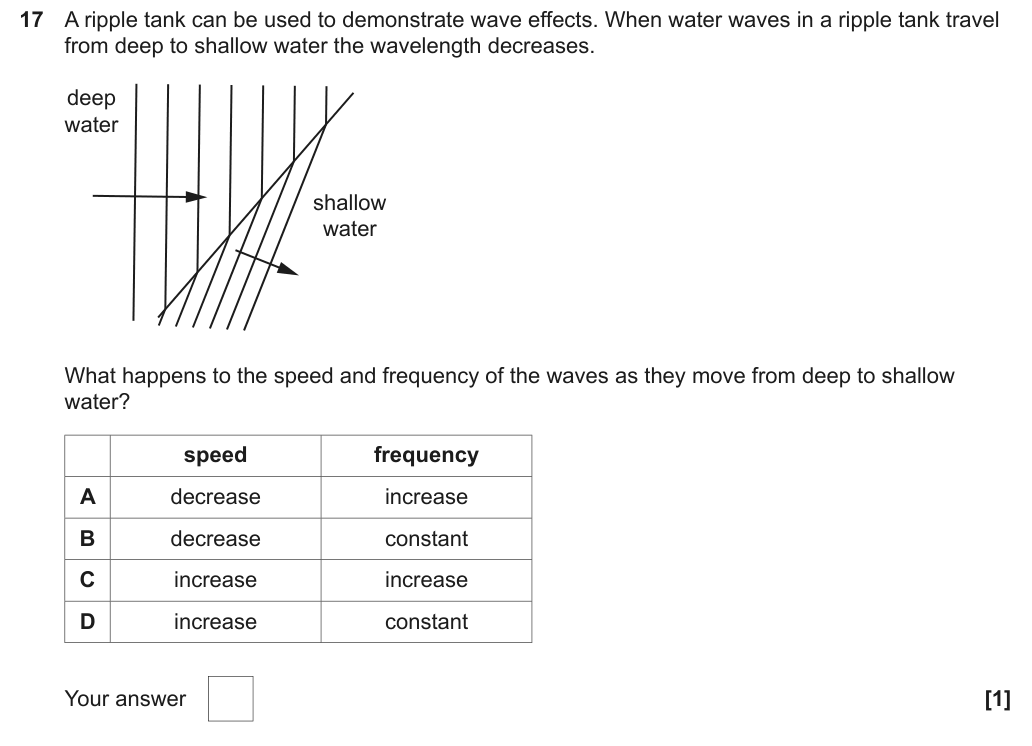
June 2023 · AS Paper 1 · Q17 1 mark Multiple choice Medium wave motion
17 A ripple tank can be used to demonstrate wave effects. When water waves in a ripple tank travel
from deep to shallow water the wavelength decreases.
deep
water
shallow
water
What happens to the speed and frequency of the waves as they move from deep to shallow
water?
speed frequency
A decrease increase
B decrease constant
C increase increase
D increase constant
Your answer [1]
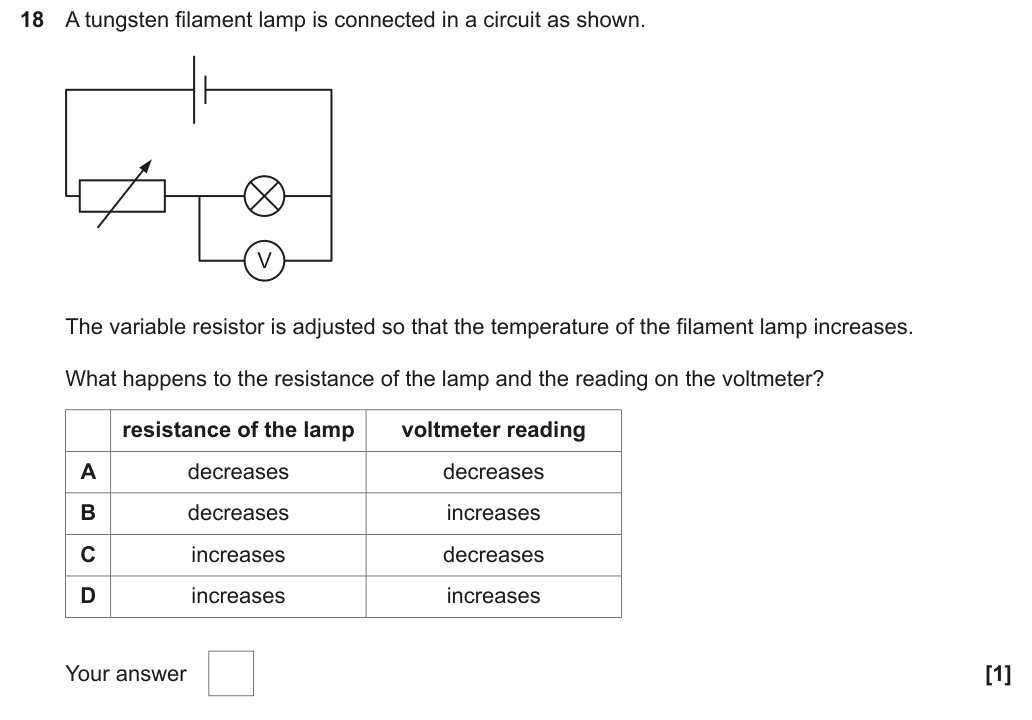
June 2023 · AS Paper 1 · Q18 1 mark Multiple choice Easy emf pd and resistancepotential dividers
18 A tungsten filament lamp is connected in a circuit as shown.
V
The variable resistor is adjusted so that the temperature of the filament lamp increases.
What happens to the resistance of the lamp and the reading on the voltmeter?
resistance of the lamp voltmeter reading
A decreases decreases
B decreases increases
C increases decreases
D increases increases
Your answer [1]
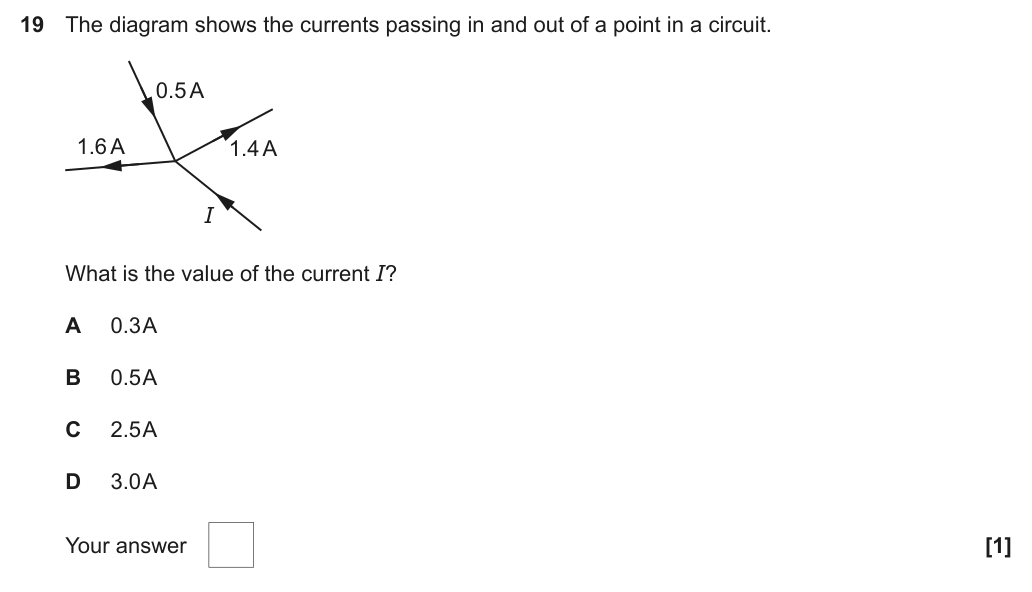
June 2023 · AS Paper 1 · Q19 1 mark Multiple choice Easy charge and current
19 The diagram shows the currents passing in and out of a point in a circuit.
0.5 A
1.6 A 1.4 A
I
What is the value of the current I?
A 0.3 A
B 0.5 A
C 2.5 A
D 3.0 A
Your answer [1]
June 2023 · AS Paper 1 · Q20 1 mark Multiple choice Easy charge and current
20 An uncharged oil drop gains a charge of +4.0 × 10⁻¹⁸ C.
What is the change in the number of electrons on the oil drop?
A Gained 25 electrons
B Gained 64 electrons
C Lost 25 electrons
D Lost 64 electrons
Your answer [1]
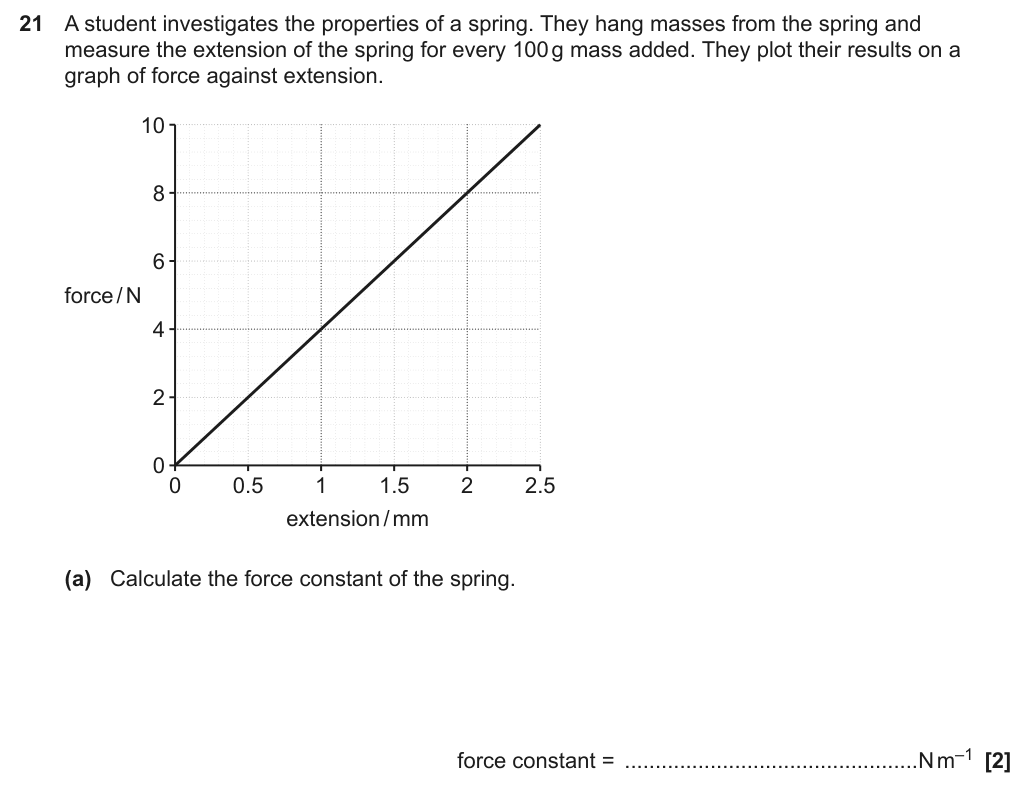
June 2023 · AS Paper 1 · Q21(a) 2 marks Calculation Medium springs
21 A student investigates the properties of a spring. They hang masses from the spring and
measure the extension of the spring for every 100 g mass added. They plot their results on a
graph of force against extension.
10
8
6
force / N
4
2
0
0 0.5 1 1.5 2 2.5
extension / mm
(a) Calculate the force constant of the spring.
force constant =  ................................................N m–1 [2]
June 2023 · AS Paper 1 · Q21(b) 3 marks Explanation Easy materials and young moduluspractical skills
(b) The student extends their investigation to determine the Young modulus of copper. They
make measurements to determine the length and the cross-sectional area of a copper wire.
Describe how they should determine the cross-sectional area of the wire.
...................................................................................................................................................
...................................................................................................................................................
...................................................................................................................................................
...................................................................................................................................................
...................................................................................................................................................
.............................................................................................................................................. [3]
June 2023 · AS Paper 1 · Q21(c)(i) 2 marks Show that Medium materials and young modulussprings
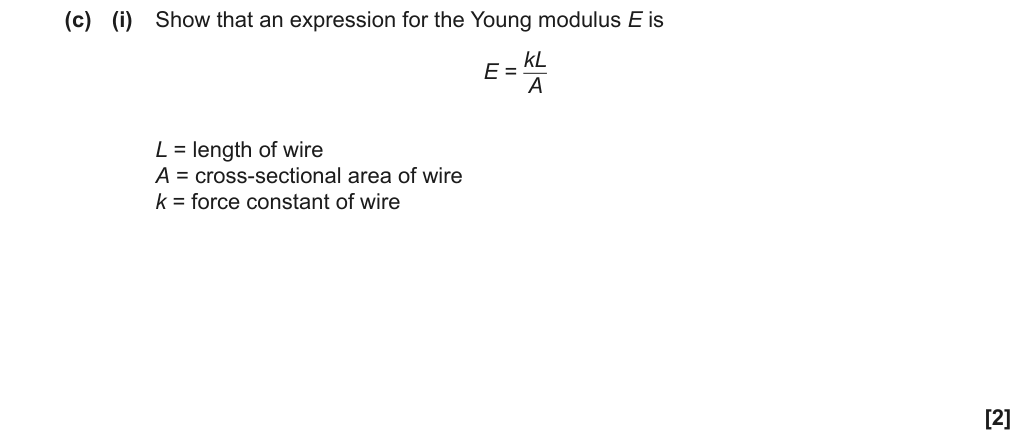
(c) (i) Show that an expression for the Young modulus E is
E = kL
A
L = length of wire
A = cross-sectional area of wire
k = force constant of wire
[2]
June 2023 · AS Paper 1 · Q21(c)(ii) 3 marks Calculation Easy materials and young modulusmeasurements and uncertainties
Earlier part of question 21 that this part usesEarlier part of June 2023 Paper 1 question 21
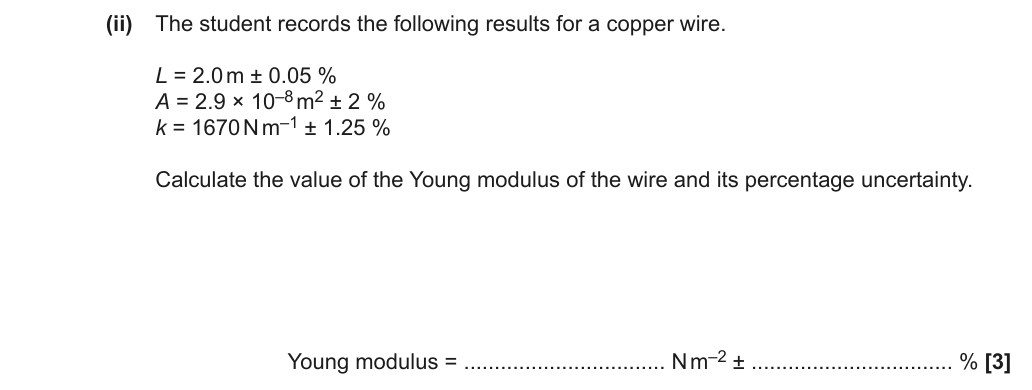
(ii) The student records the following results for a copper wire.
L = 2.0 m ± 0.05 %
A = 2.9 × 10⁻⁸ m2 ± 2 %
k = 1670 N m–1 ± 1.25 %
Calculate the value of the Young modulus of the wire and its percentage uncertainty.
Young modulus = ................................. N m–2 ± ................................. % [3]
June 2023 · AS Paper 1 · Q21(c)(iii) 2 marks Calculation Medium measurements and uncertaintiespractical skills
Earlier part of question 21 that this part usesEarlier part of June 2023 Paper 1 question 21
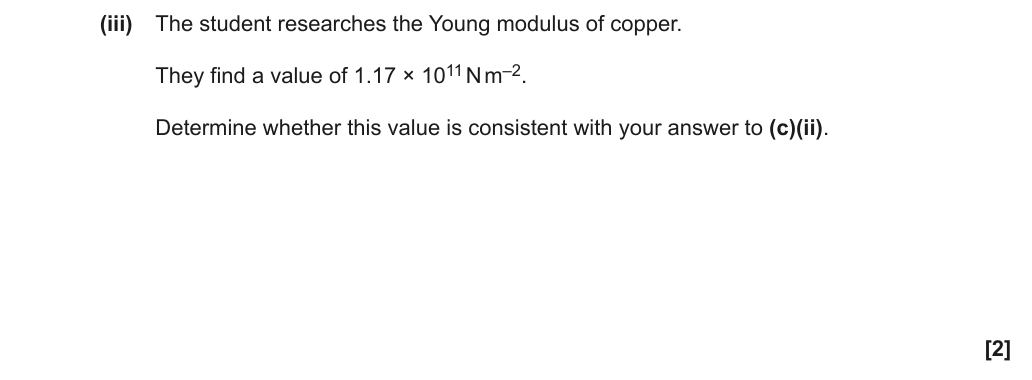
(iii) The student researches the Young modulus of copper.
They find a value of 1.17 × 10¹¹ N m–2.
Determine whether this value is consistent with your answer to (c)(ii).
[2]
June 2023 · AS Paper 1 · Q22(a) 3 marks Explanation Hard wave motion
22 Sound waves in air are longitudinal waves consisting of compressions and rarefactions.
(a) Explain how the movement of air molecules creates compressions and rarefactions.
...................................................................................................................................................
...................................................................................................................................................
...................................................................................................................................................
...................................................................................................................................................
...................................................................................................................................................
...................................................................................................................................................
............................................................................................................................................. [3]
June 2023 · AS Paper 1 · Q22(b)(i) 3 marks Explanation Easy stationary wavessuperposition and interference
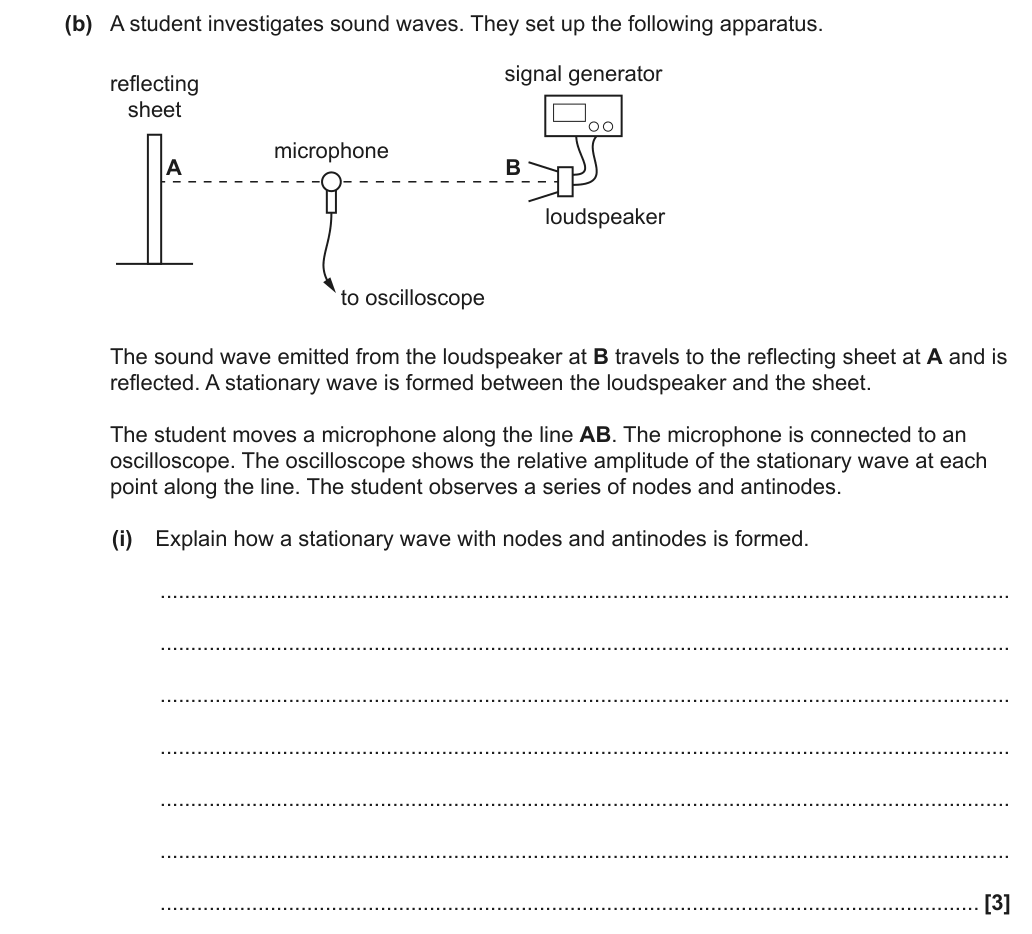
(b) A student investigates sound waves. They set up the following apparatus.
signal generator
reflecting
sheet
microphone
A B
loudspeaker
to oscilloscope
The sound wave emitted from the loudspeaker at B travels to the reflecting sheet at A and is
reflected. A stationary wave is formed between the loudspeaker and the sheet.
The student moves a microphone along the line AB. The microphone is connected to an
oscilloscope. The oscilloscope shows the relative amplitude of the stationary wave at each
point along the line. The student observes a series of nodes and antinodes.
(i) Explain how a stationary wave with nodes and antinodes is formed.
...........................................................................................................................................
...........................................................................................................................................
...........................................................................................................................................
...........................................................................................................................................
...........................................................................................................................................
...........................................................................................................................................
...................................................................................................................................... [3]
June 2023 · AS Paper 1 · Q22(b)(ii) 3 marks Explanation Medium stationary waveswave motionsuperposition and interference
Earlier part of question 22 that this part usesEarlier part of June 2023 Paper 1 question 22
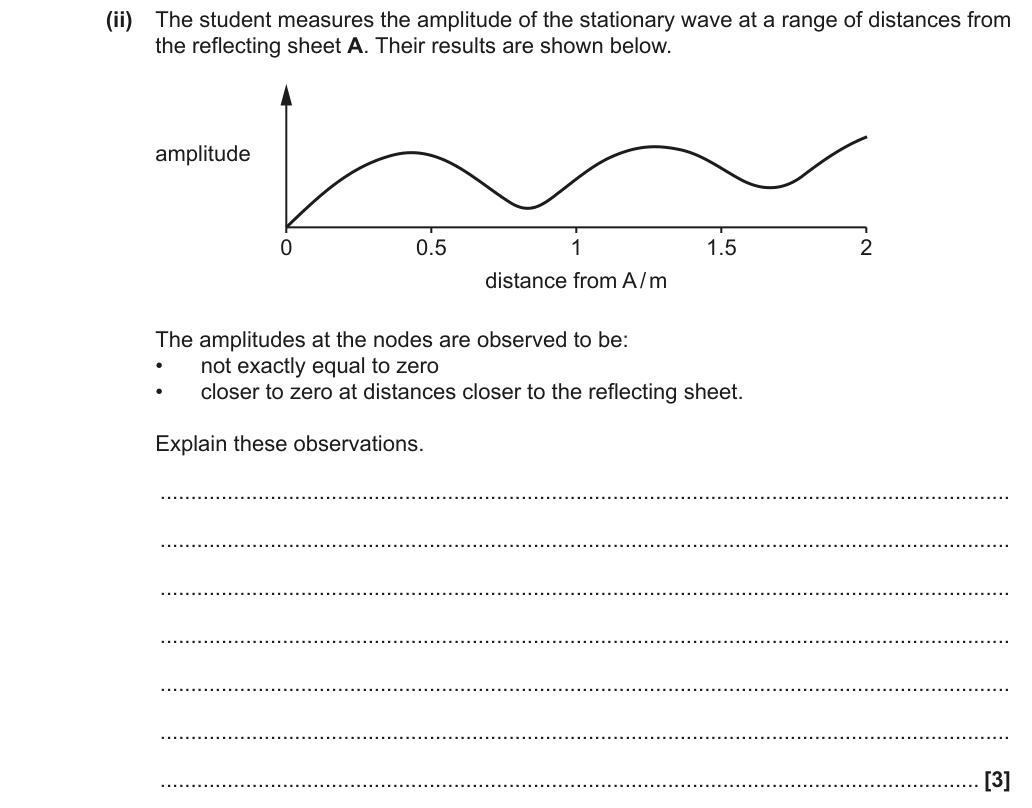
(ii) The student measures the amplitude of the stationary wave at a range of distances from
the reflecting sheet A. Their results are shown below.
amplitude
0 0.5 1 1.5 2
distance from A / m
The amplitudes at the nodes are observed to be:
• not exactly equal to zero
• closer to zero at distances closer to the reflecting sheet.
Explain these observations.
...........................................................................................................................................
...........................................................................................................................................
...........................................................................................................................................
...........................................................................................................................................
...........................................................................................................................................
...........................................................................................................................................
...................................................................................................................................... [3]
June 2023 · AS Paper 1 · Q22(b)(iii) 2 marks Calculation Medium stationary waveswave motion
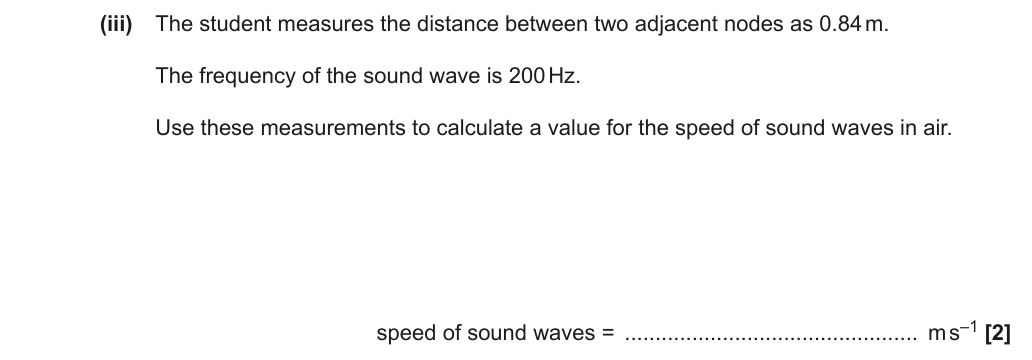
(iii) The student measures the distance between two adjacent nodes as 0.84 m.
The frequency of the sound wave is 200 Hz.
Use these measurements to calculate a value for the speed of sound waves in air.
speed of sound waves =  ................................................ m s–1 [2]
June 2023 · AS Paper 1 · Q22(b)(iv) 1 mark Explanation Medium practical skills
Earlier parts of question 22 that this part usesEarlier part of June 2023 Paper 1 question 22Earlier part of June 2023 Paper 1 question 22
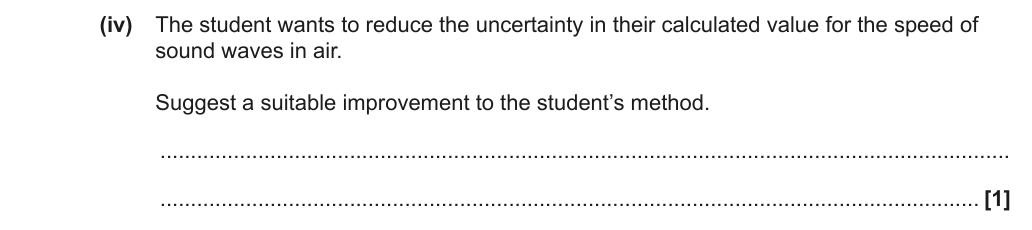
(iv) The student wants to reduce the uncertainty in their calculated value for the speed of
sound waves in air.
Suggest a suitable improvement to the student’s method.
...........................................................................................................................................
...................................................................................................................................... [1]
June 2023 · AS Paper 1 · Q23(a) 2 marks Calculation Easy emf pd and resistancecharge and current
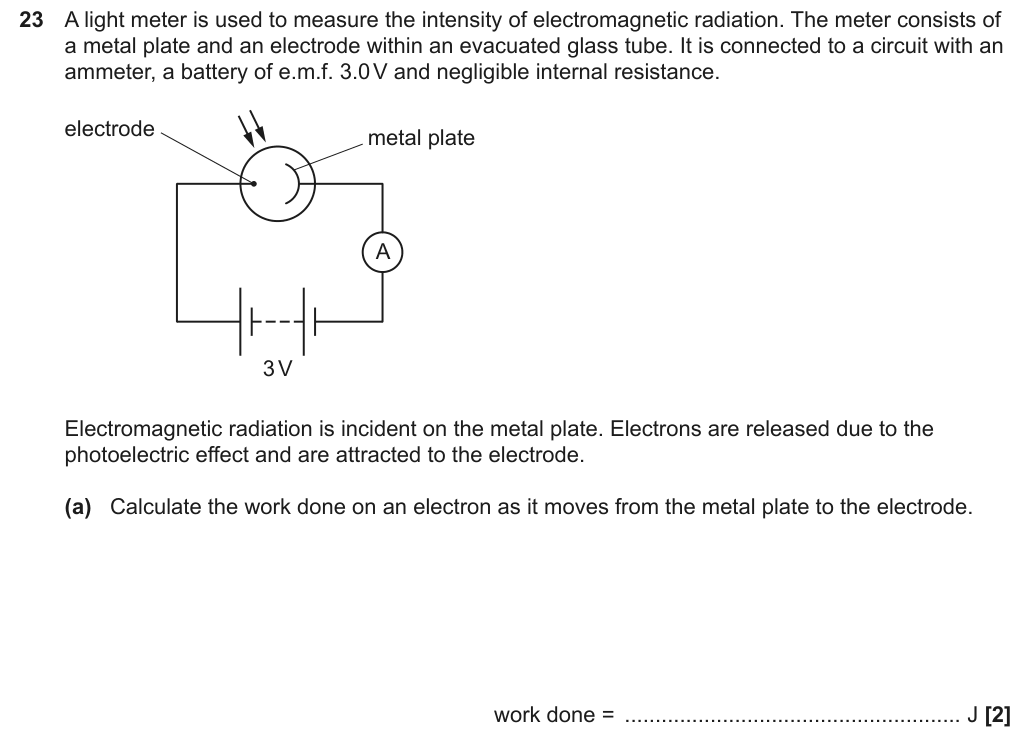
23  A light meter is used to measure the intensity of electromagnetic radiation. The meter consists of
a metal plate and an electrode within an evacuated glass tube. It is connected to a circuit with an
ammeter, a battery of e.m.f. 3.0 V and negligible internal resistance.
electrode
metal plate
A
3 V
Electromagnetic radiation is incident on the metal plate. Electrons are released due to the
photoelectric effect and are attracted to the electrode.
(a)  Calculate the work done on an electron as it moves from the metal plate to the electrode.
work done =  ....................................................... J [2]
June 2023 · AS Paper 1 · Q23(b) 3 marks Explanation Medium photoelectric effectphotons
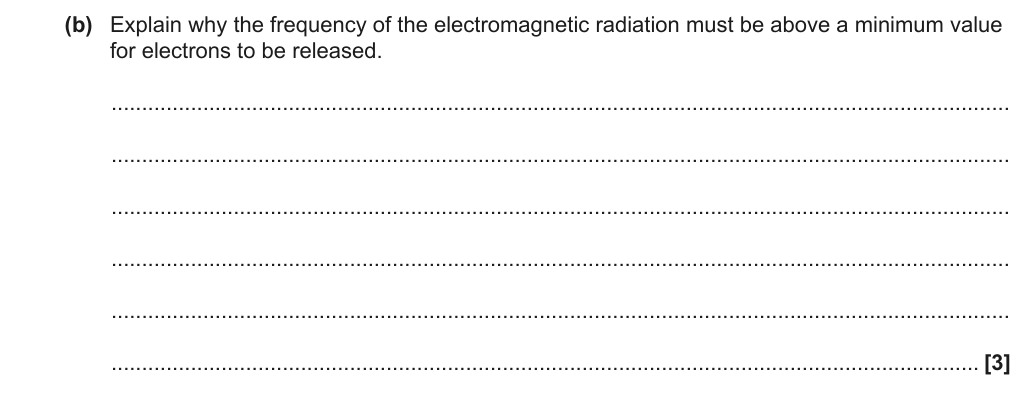
(b)  Explain why the frequency of the electromagnetic radiation must be above a minimum value
for electrons to be released.
...................................................................................................................................................
...................................................................................................................................................
...................................................................................................................................................
...................................................................................................................................................
...................................................................................................................................................
.............................................................................................................................................. [3]
June 2023 · AS Paper 1 · Q23(c)(i) 3 marks Explanation Easy photoelectric effectcharge and current
Earlier part of question 23 that this part usesEarlier part of June 2023 Paper 1 question 23
(c)  (i)  The reading on the ammeter is proportional to the intensity of the radiation. Use your
knowledge of the photoelectric effect to explain why.
...........................................................................................................................................
...........................................................................................................................................
...........................................................................................................................................
...........................................................................................................................................
...........................................................................................................................................
...................................................................................................................................... [3]
June 2023 · AS Paper 1 · Q23(c)(ii) 4 marks Calculation Medium photonswave motionphotoelectric effect
(ii)  When the light meter is irradiated with monochromatic radiation of frequency
8.2 × 10¹⁵ Hz, the number of electrons emitted every second is 3.1 × 10¹⁸ s–1.
The surface area of the metal plate normal to the incident radiation is 4.9 × 10⁻³ m2.
Determine the intensity of the radiation.
intensity =  ................................................W m–2 [4]
June 2023 · AS Paper 1 · Q24(a) 3 marks Calculation Medium newtons laws and momentum
24  In a game, a child throws a ball at a flat, vertical wall. The ball rebounds from the wall. The child
wins the game if the ball lands within a circular ring placed on the ground.
side view plan view
normal line ball
ring
ball
child
ring
child
2.0 m
2.0 m
Not to scale
The ring has a radius of 15 cm. The centre of the ring is 2.0 m from the wall. The child throws a
ball with a mass of 0.058 kg towards the wall.
(a) The ball is incident normally on the wall with a horizontal velocity of 7.2 m s–1. The ball is
in contact with the wall for 52 ms before rebounding normally with a horizontal velocity of
3.6 m s–1.
Calculate the average magnitude of the force that the wall exerts on the ball.
force =  ...................................................... N [3]
June 2023 · AS Paper 1 · Q24(b) 3 marks Show that Easy projectile motion
Earlier part of question 24 that this part usesEarlier part of June 2023 Paper 1 question 24
(b) The ball lands on the ground a time of 0.58 s after hitting the wall.
Show that the child wins the game. Air resistance can be assumed to be negligible.
[3]
June 2023 · AS Paper 1 · Q25(a) 2 marks Explanation Medium practical skills
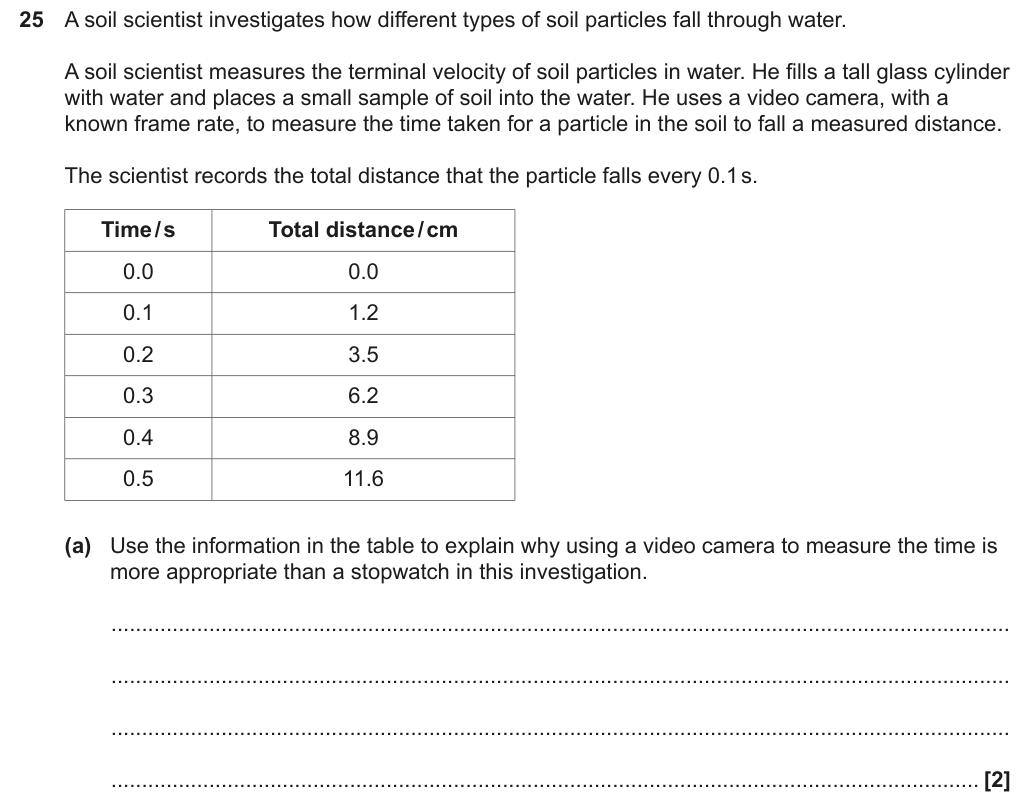
25  A soil scientist investigates how different types of soil particles fall through water.
A soil scientist measures the terminal velocity of soil particles in water. He fills a tall glass cylinder
with water and places a small sample of soil into the water. He uses a video camera, with a
known frame rate, to measure the time taken for a particle in the soil to fall a measured distance.
The scientist records the total distance that the particle falls every 0.1 s.
Time / s Total distance / cm
0.0 0.0
0.1 1.2
0.2 3.5
0.3 6.2
0.4 8.9
0.5 11.6
(a) Use the information in the table to explain why using a video camera to measure the time is
more appropriate than a stopwatch in this investigation.
...................................................................................................................................................
...................................................................................................................................................
...................................................................................................................................................
.............................................................................................................................................. [2]
June 2023 · AS Paper 1 · Q25(b) 1 mark Explanation Medium practical skillsdynamics and terminal velocity
Earlier part of question 25 that this part usesEarlier part of June 2023 Paper 1 question 25
(b) Suggest one other precaution that the scientist should take to ensure that the terminal
velocity is determined as accurately as possible.
...................................................................................................................................................
.............................................................................................................................................. [1]
June 2023 · AS Paper 1 · Q25(c) 2 marks Show that Medium dynamics and terminal velocitypractical skillskinematics
Earlier part of question 25 that this part usesEarlier part of June 2023 Paper 1 question 25
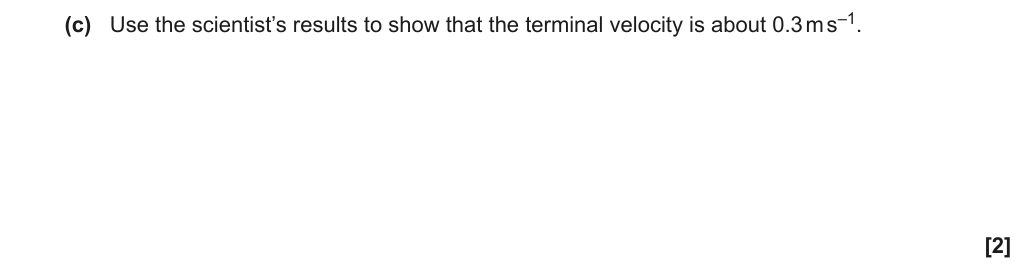
(c) Use the scientist’s results to show that the terminal velocity is about 0.3 m s–1.
[2]
June 2023 · AS Paper 1 · Q25(d) 3 marks Calculation Medium dynamics and terminal velocitypractical skills
Earlier parts of question 25 that this part usesEarlier part of June 2023 Paper 1 question 25Earlier part of June 2023 Paper 1 question 25
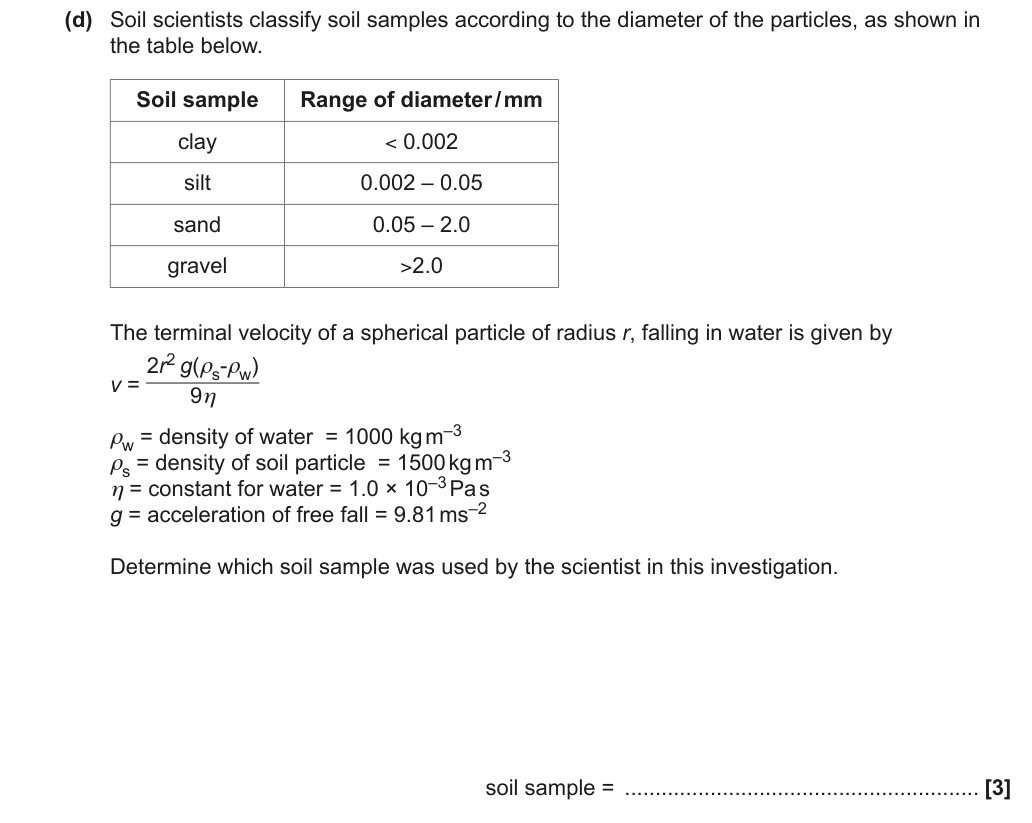
(d) Soil scientists classify soil samples according to the diameter of the particles, as shown in
the table below.
Soil sample Range of diameter / mm
clay < 0.002
silt 0.002 – 0.05
sand 0.05 – 2.0
gravel >2.0
The terminal velocity of a spherical particle of radius r, falling in water is given by
2r2 g(ρs-ρw)
v =
9η
ρw = density of water  = 1000 kg m–3
ρs = density of soil particle  = 1500 kg m–3
η = constant for water = 1.0 × 10⁻³ Pa s
g = acceleration of free fall = 9.81 ms–2
Determine which soil sample was used by the scientist in this investigation.
soil sample =  .......................................................... [3]

Work with an OCR physics tutor

Want a paper marked and gone through with you? Message us.

Prefer email? Send an enquiry

If you are under 18, please include a parent's contact details. Enquiries go to enquiries@physicsaleveltutor.com and are deleted once handled. All tutoring is online.