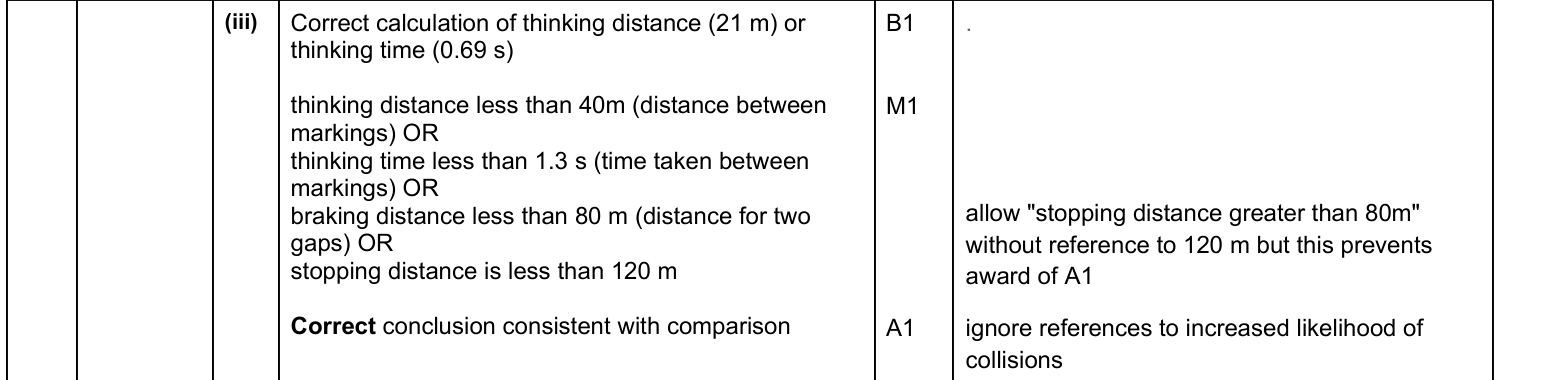
Answer
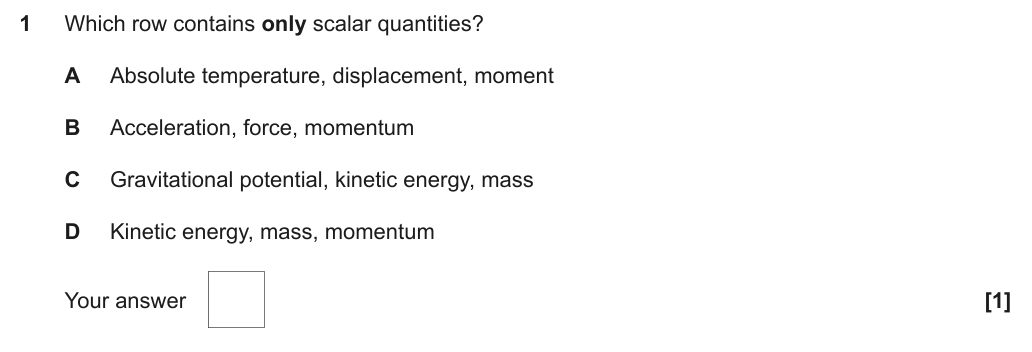
C
Mark scheme

100 marks · 52 question parts · Paper, mark scheme and report on OCR's site · Have the Data, Formulae and Relationships Booklet beside you
C
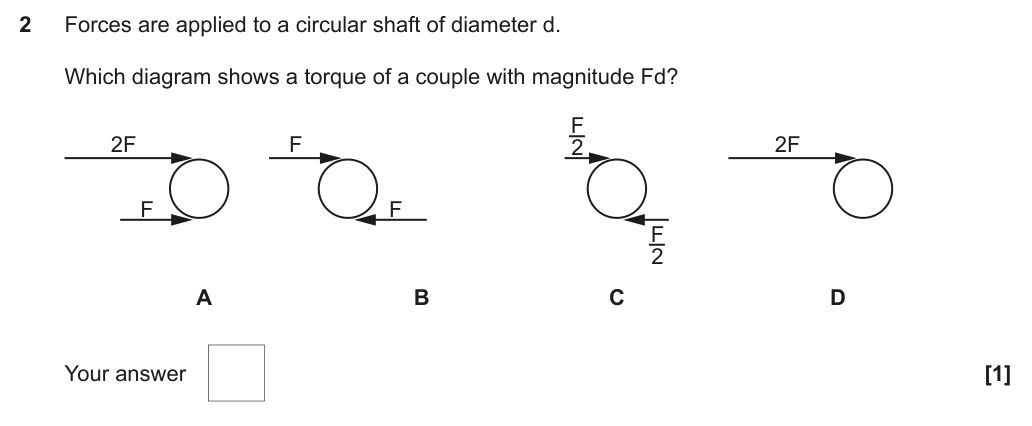
B
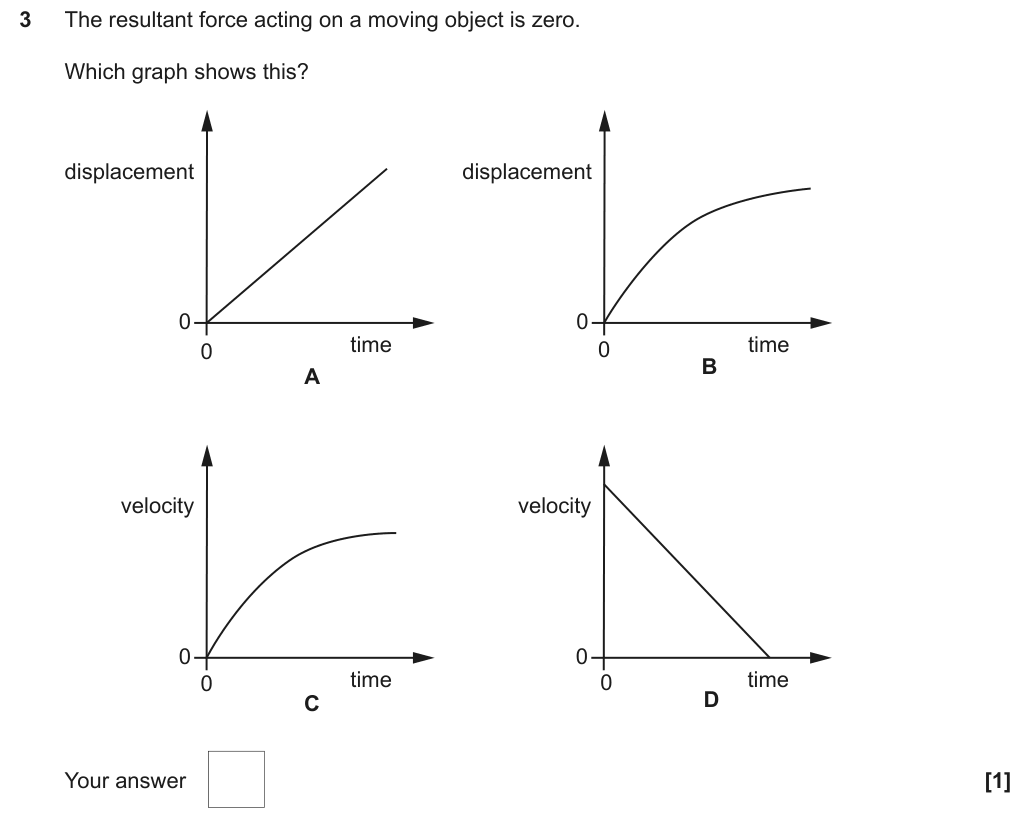
A
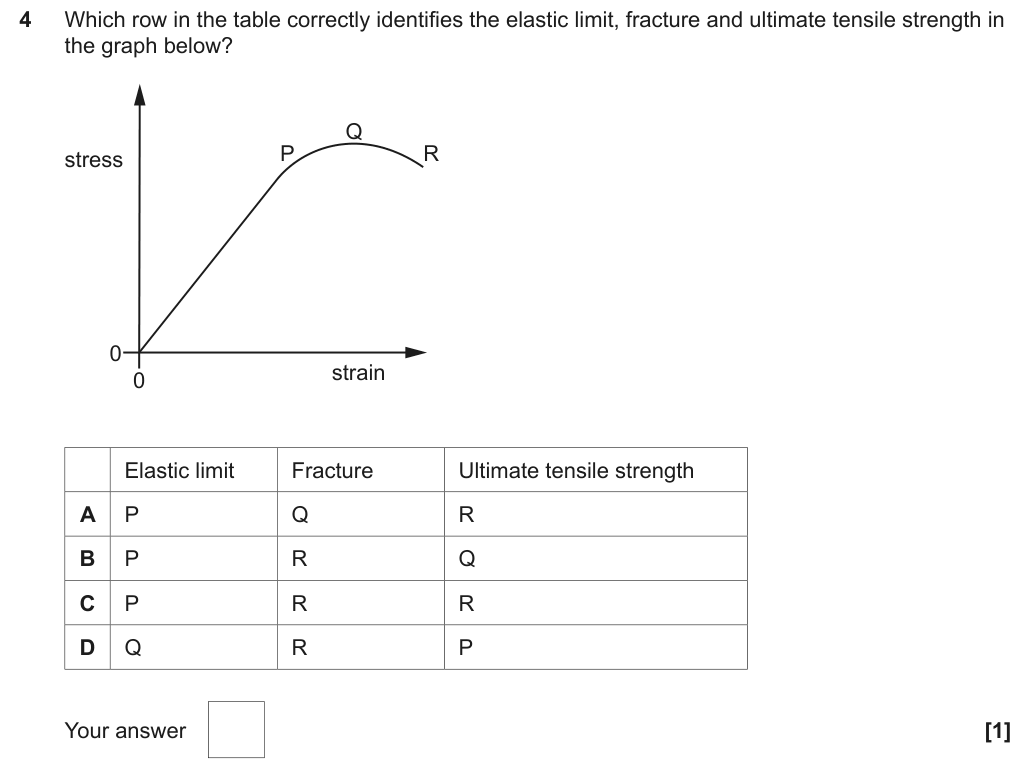
B
Most candidates deduced the correct answer by remembering that the ultimate tensile strength is given by the highest point on the graph, in this case, point Q.
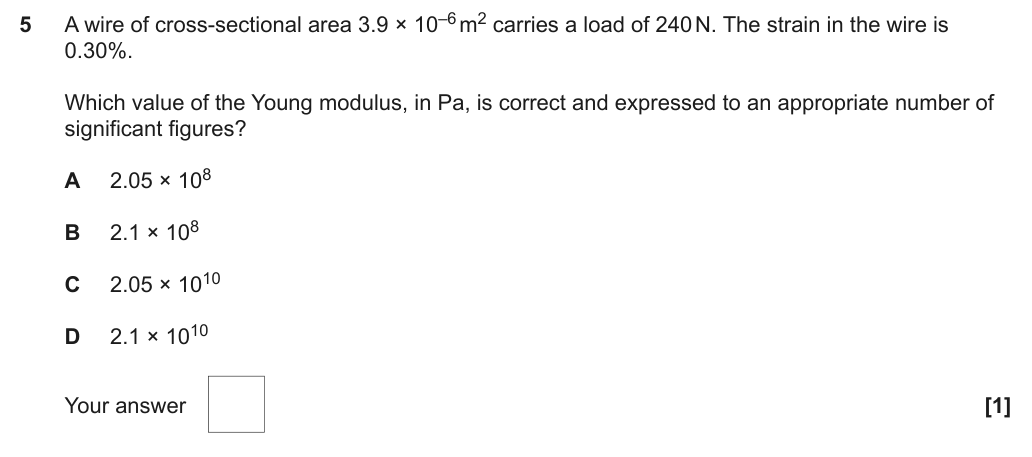
D
Just under half of all candidates got this correct. While the stress, given by force/area was straightforward to calculate, the strain was given as a percentage. This should have been converted to a decimal, i.e. 0.0030 to get the correct value of Young modulus.
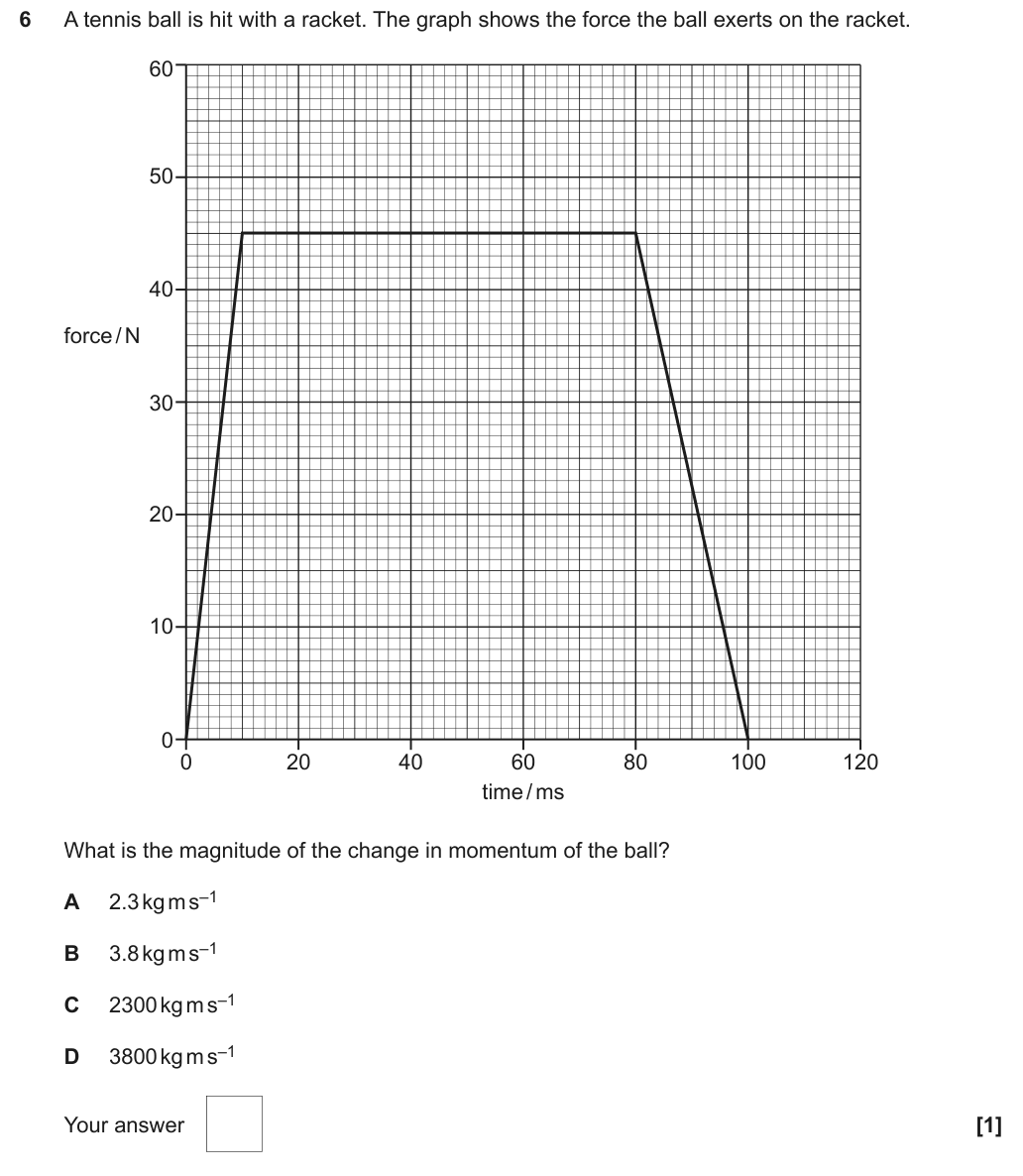
B
While virtually all candidates calculated the area of the trapezium correctly, candidates that forget that the time was measured in milliseconds picked answer D rather than the correct answer, B.
B
C
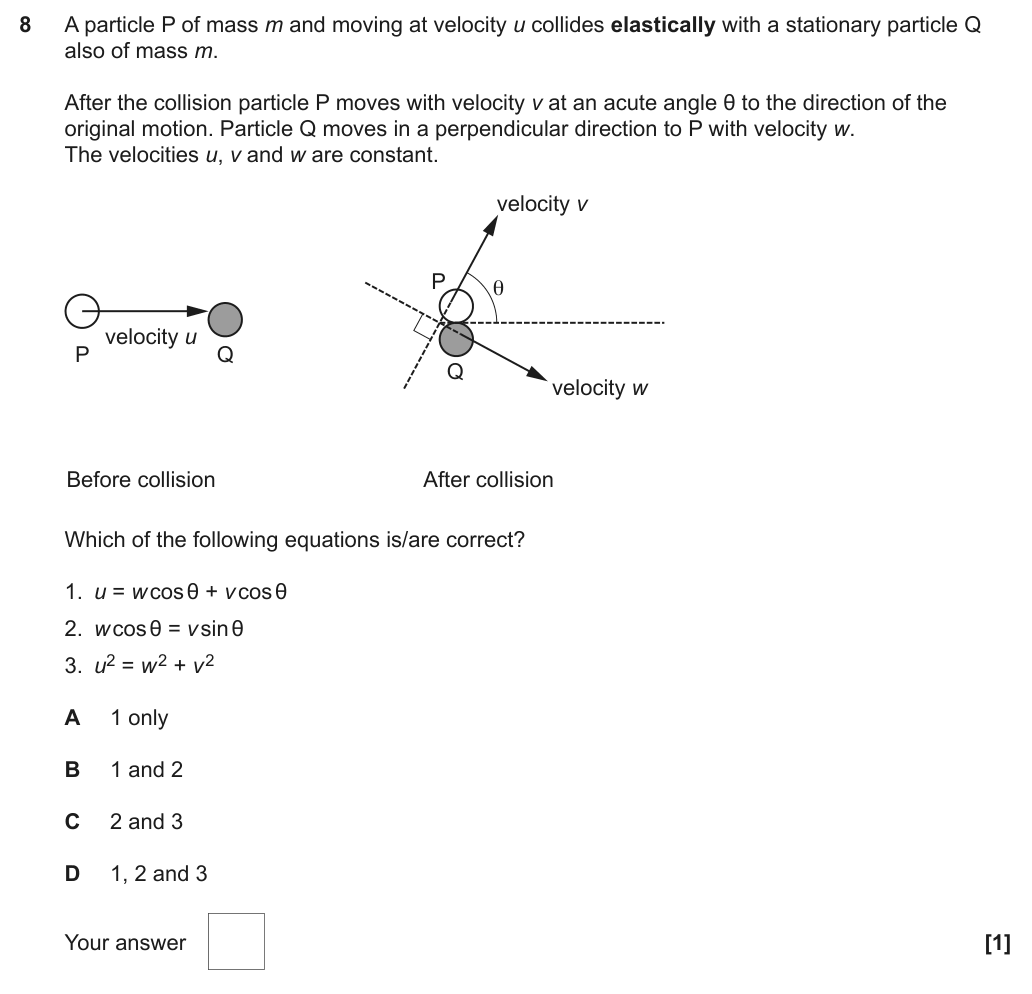
A good number of candidates answered this correctly. As this collision is elastic, the total kinetic energy (KE) for the collision, ½mu2 remains unchanged. The total KE after the collision is ½mv2 + ½mw2. Equating these expressions gives statement 3 as correct, eliminating answers A and B. Statement 2 must also be correct and comes from conservation of momentum at right angles to the dashed line. Looking along the dashed line, the momentum is mu before the collision. After the collision, the component of momentum along the dashed line for P is mvcosθ. The angle Q makes with the dashed line is not θ, so the component of momentum along that dashed line for Q cannot be mwcosθ. This makes statement 1 false and so the correct answer is C.
D
C
D
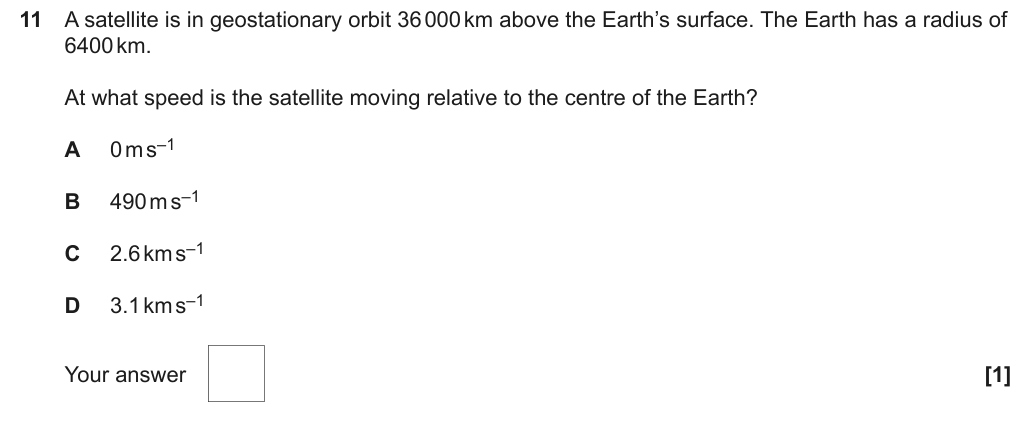
The question is asking for the candidate to calculate the speed of an object in a circular orbit with radius 42 400 km, i.e. 42.4 × 10⁶ m. To do this, the candidate equates the gravitational force, FG = GMm/r2. with the centripetal force required for that orbit, FC = mv2/r, where M is the mass of the Earth and m is the mass of the satellite. Rearranging gives v = √GM/r. Substituting the correct values for G, M and r will give answer D.
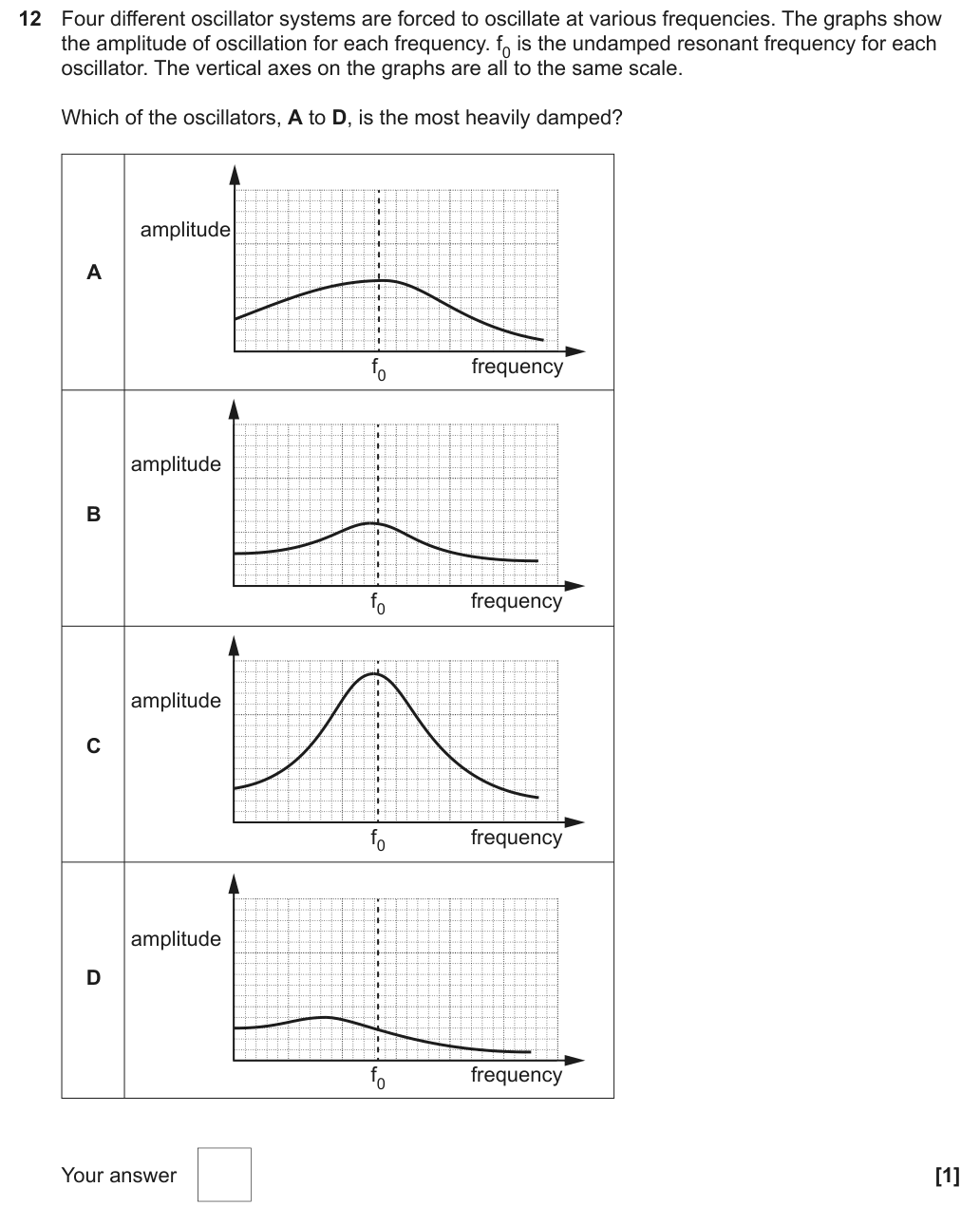
D
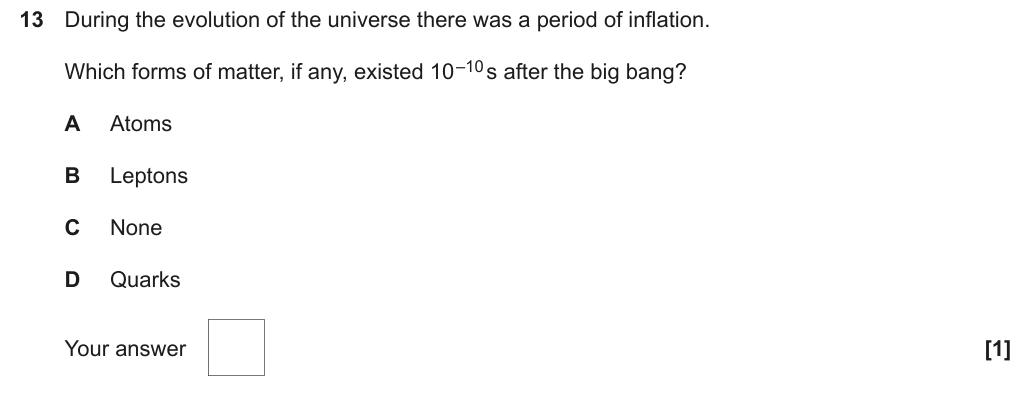
C
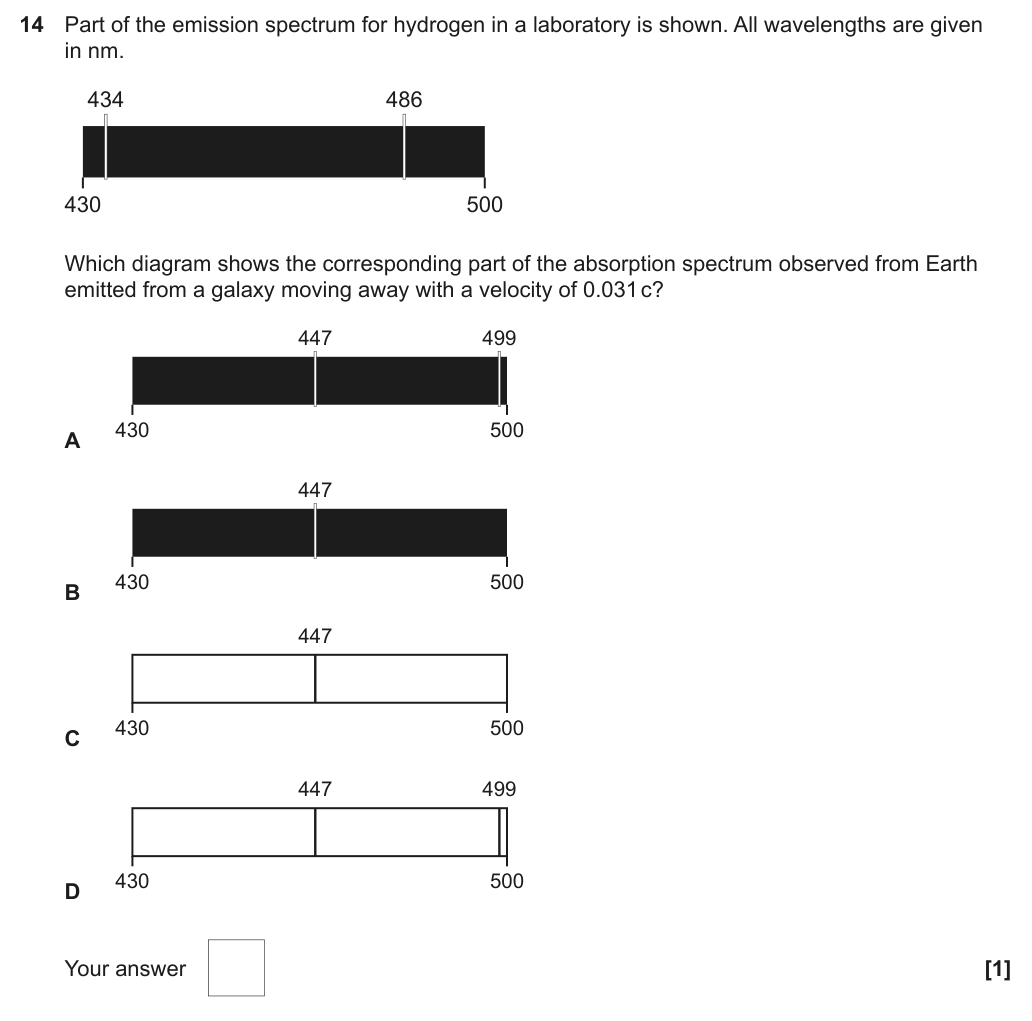
C
The spectrum in the question and those for answers A and B depict emission spectra. Spectra C and D are absorption spectra. The question asks for the absorption spectrum from distant galaxies so only answers C and D could be correct. With the recession velocity of 0.031c, both wavelengths will be increased by 3.1 percent. The laboratory wavelength of 434 nm becomes 447 nm after the redshift. The laboratory wavelength of 486 nm becomes 501 nm and so lies outside the range for these diagrams. This makes the correct answer C.
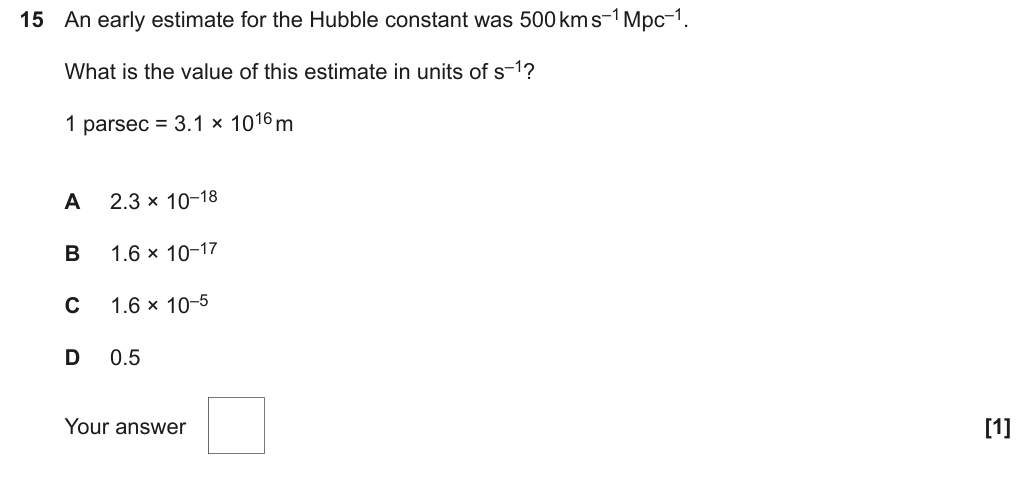
B
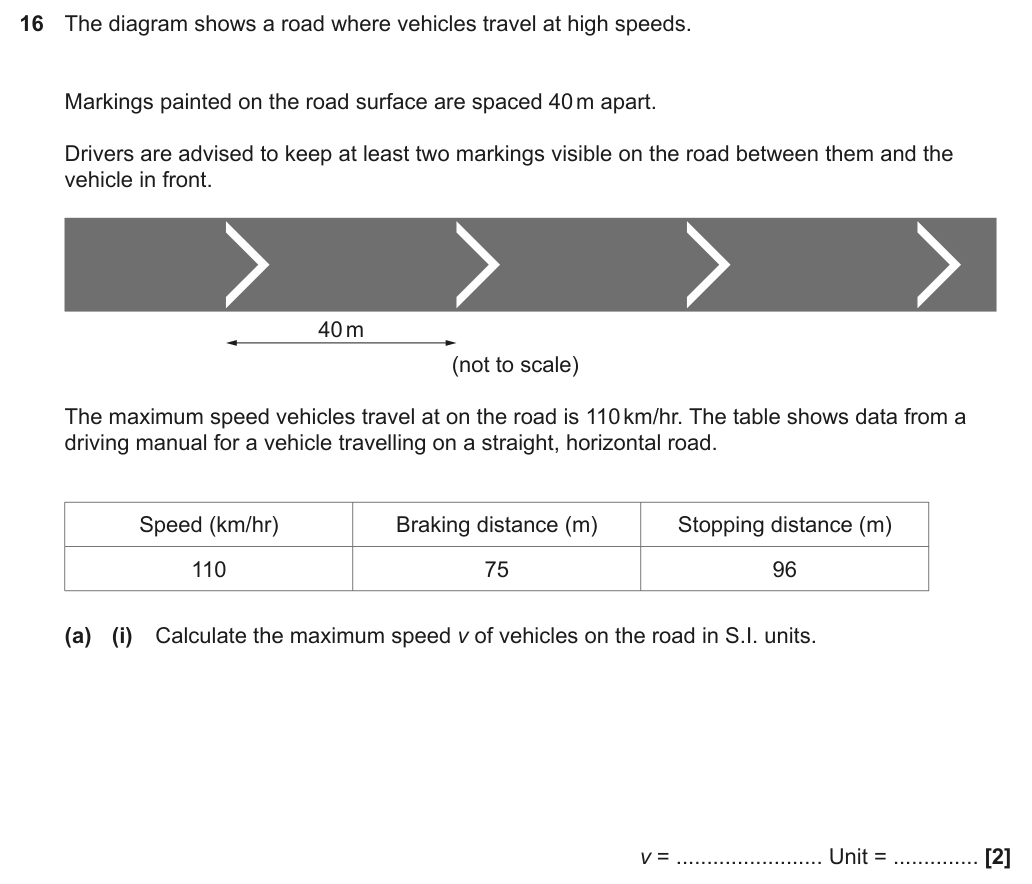
Skills: M0.1 Recognise and make use of appropriate units in calculations
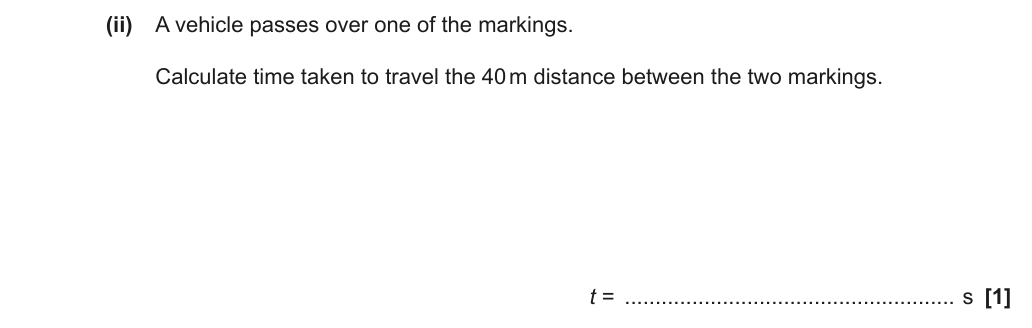
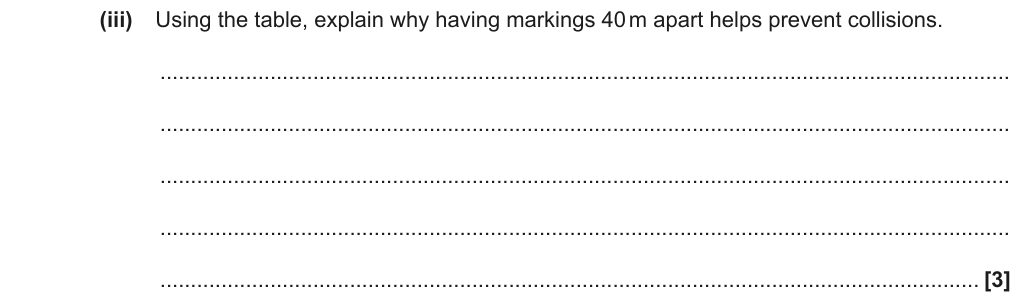
Skills: M0.3 Use ratios, fractions and percentages
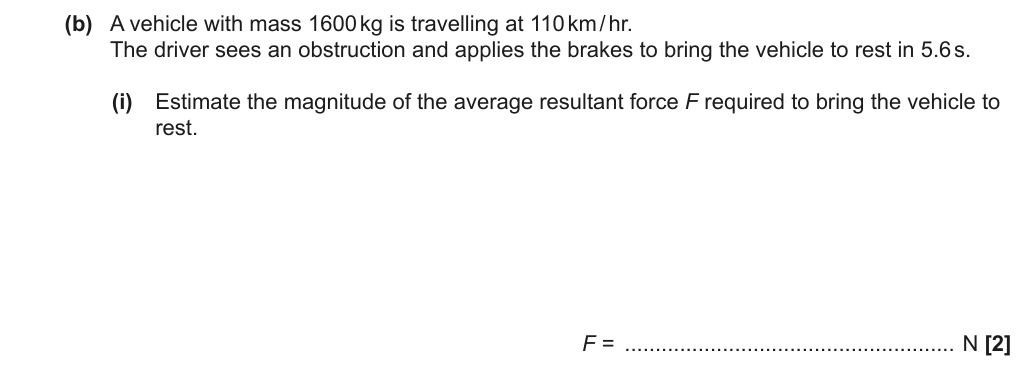
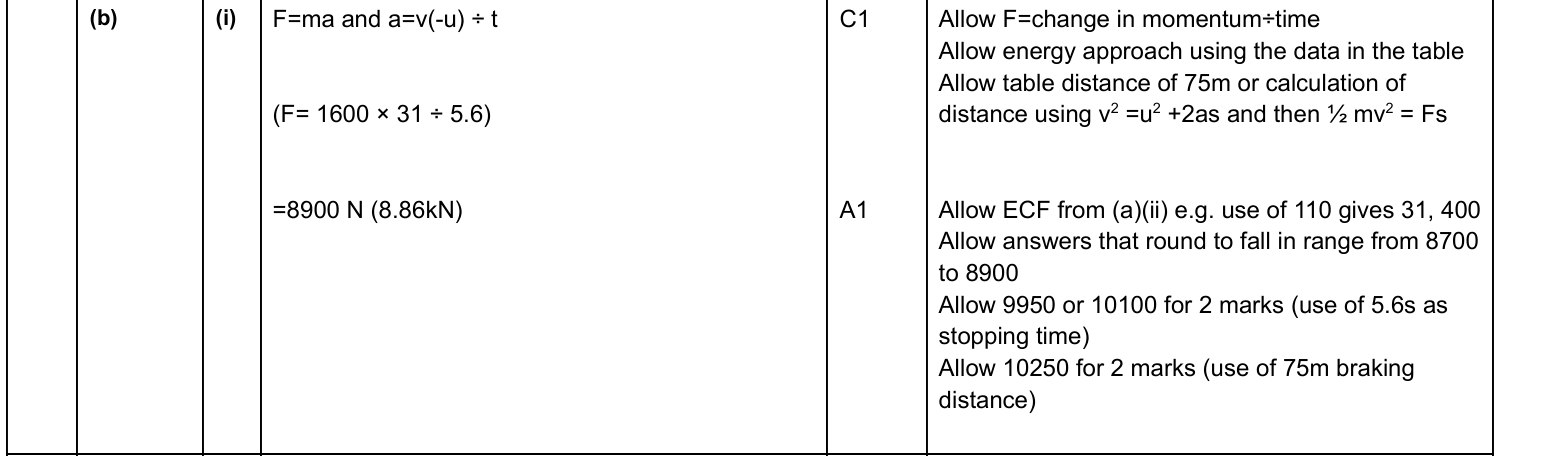
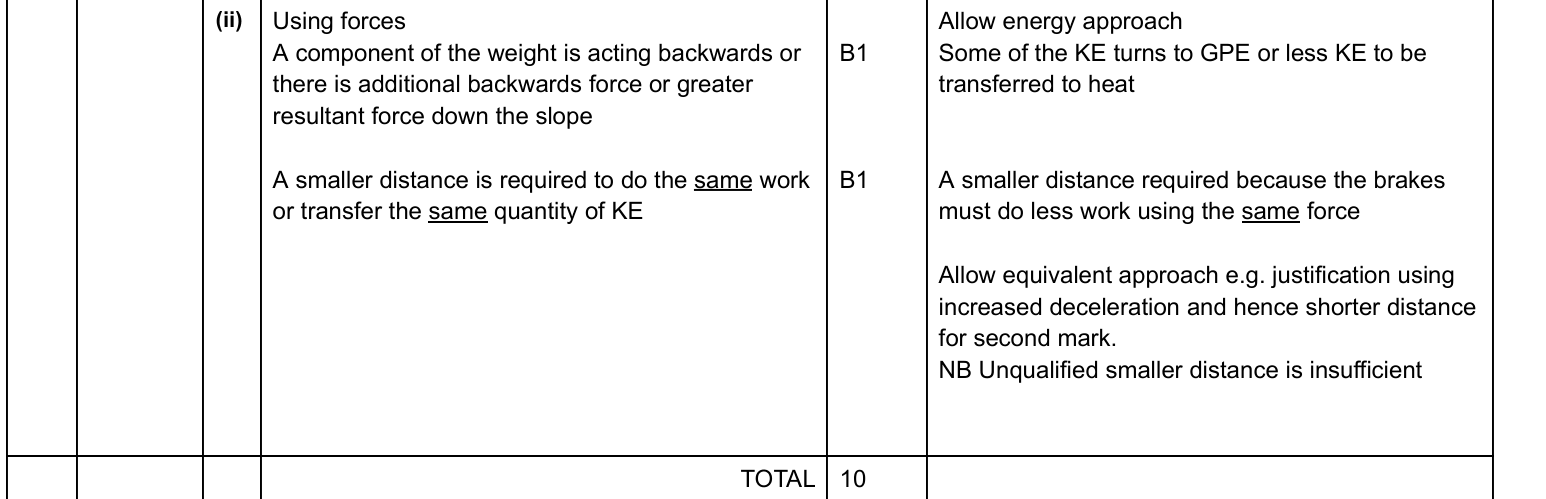
Question 16 (b) (i) Question 16 (b) (ii) In Question 16 (b) (i), most candidates used the data available in the question to calculate an acceleration and hence a resultant force.
Skills: M0.4 Estimate results; M2.3 Substitute numerical values into algebraic equations using appropriate units for physical quantities
In Question 16 (b) (i), most candidates used the data available in the question to calculate an acceleration and hence a resultant force. In part (b) (ii), rather fewer used acceptable technical language to communicate their ideas. Useful phrases for explanations on this idea were ‘resultant force’ and ‘component of weight parallel to the slope’ rather than ‘extra force’ or ‘some of the vehicle’s gravity helped’.
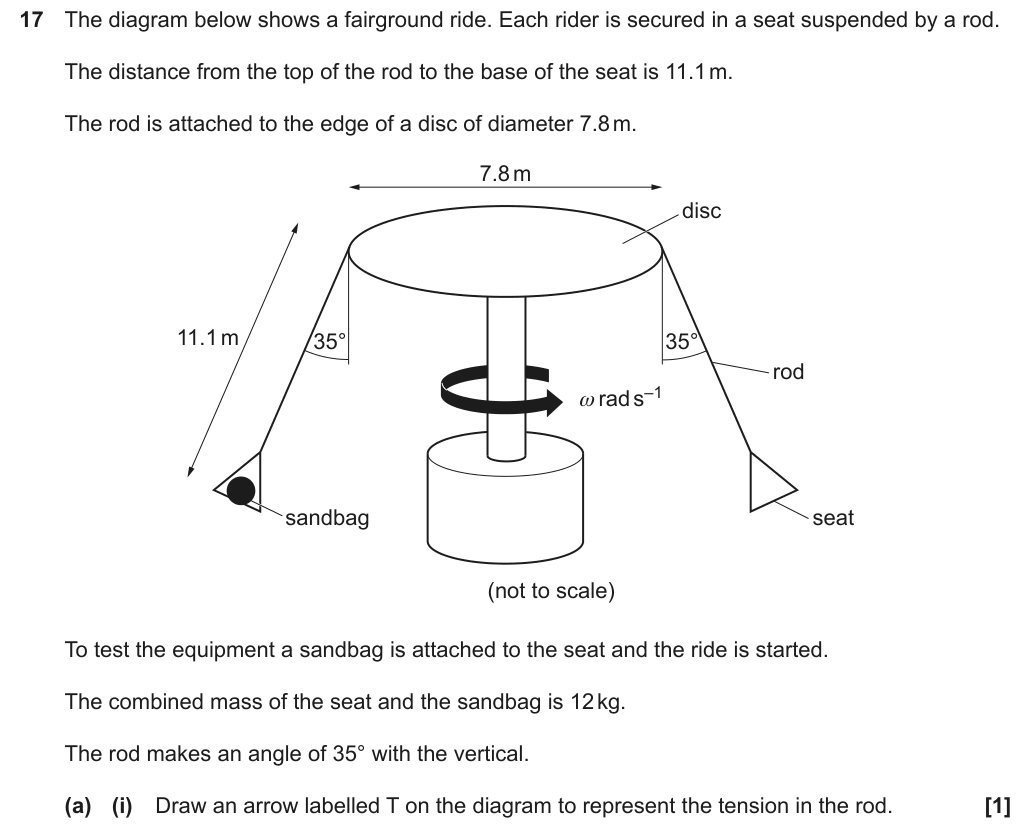
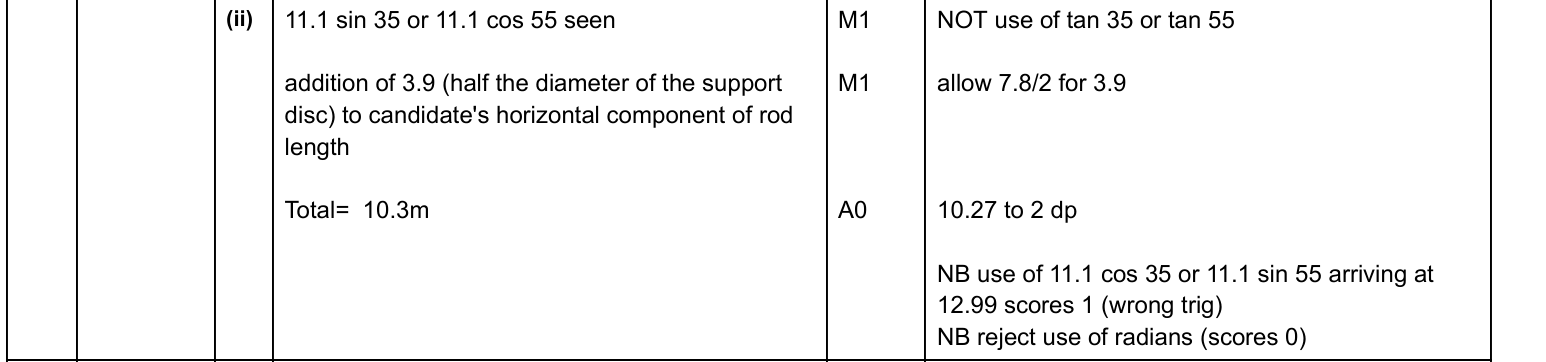
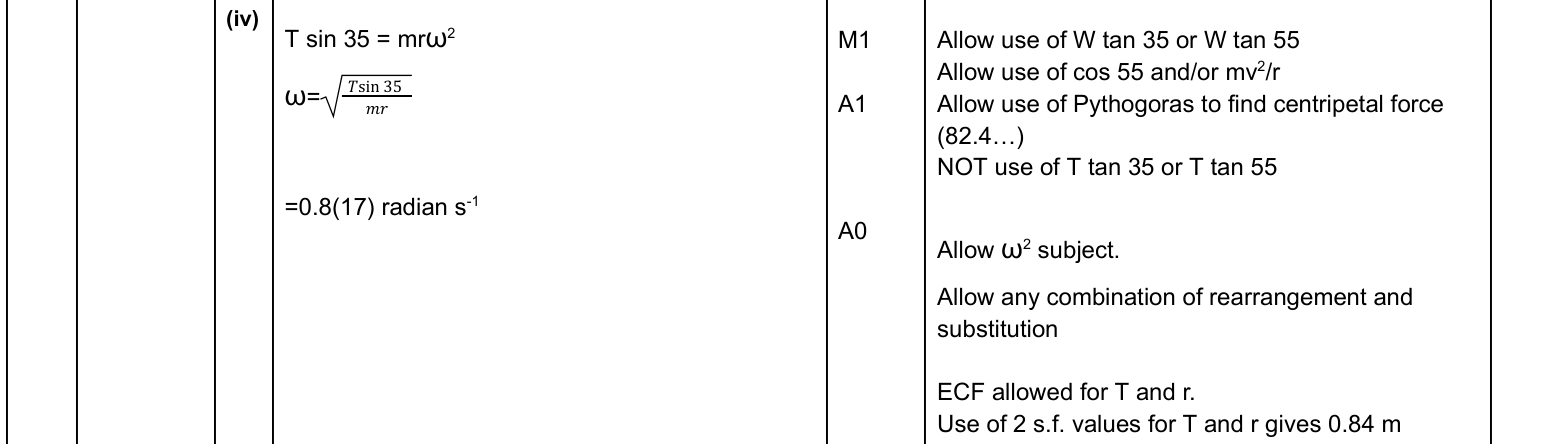
In Question 17 (a) (i) of this question, the phrase ‘tension in the rod’ can mean several different things, all of which were given in the mark scheme. Many candidates approached part (ii) with some confidence, spotting that the horizontal portion of the rod was 11.1 sin(35) and that it should be added to the radius of the disc. Parts (a) (iii) and (iv) were more challenging, requiring good knowledge of both circular motion and how to calculate components of forces. Again there were several legitimate routes to the right answer, all of which were mentioned in the mark scheme. Very logical approaches were in part (a) (iii), to equate the vertical component of the tension with the weight of the sandbag. In part (a) (iv), the quickest approach was to equate the horizontal component of the tension with the centripetal force. The data booklet provides a convenient expression for the centripetal force in terms of the angular velocity, without the need for finding the tangential velocity.
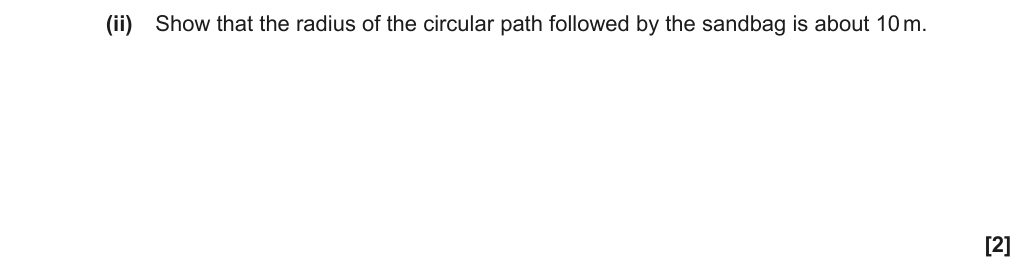
In Question 17 (a) (i) of this question, the phrase ‘tension in the rod’ can mean several different things, all of which were given in the mark scheme. Many candidates approached part (ii) with some confidence, spotting that the horizontal portion of the rod was 11.1 sin(35) and that it should be added to the radius of the disc. Parts (a) (iii) and (iv) were more challenging, requiring good knowledge of both circular motion and how to calculate components of forces. Again there were several legitimate routes to the right answer, all of which were mentioned in the mark scheme. Very logical approaches were in part (a) (iii), to equate the vertical component of the tension with the weight of the sandbag. In part (a) (iv), the quickest approach was to equate the horizontal component of the tension with the centripetal force. The data booklet provides a convenient expression for the centripetal force in terms of the angular velocity, without the need for finding the tangential velocity.
Skills: M0.6 Use calculators to handle sin x, cos x and tan x when x is expressed in degrees or radians; M4.5 Use sin, cos and tan in physical problems
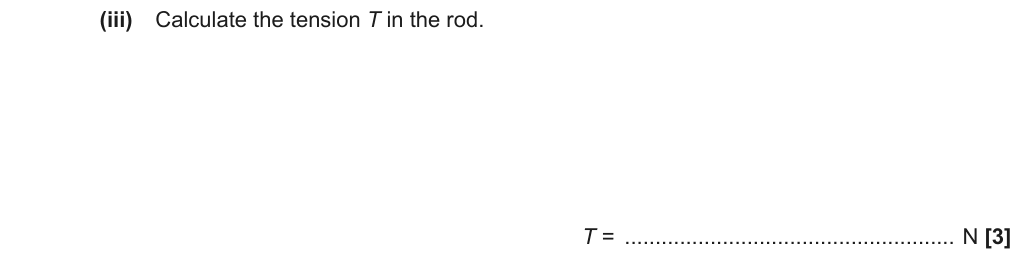
In Question 17 (a) (i) of this question, the phrase ‘tension in the rod’ can mean several different things, all of which were given in the mark scheme. Many candidates approached part (ii) with some confidence, spotting that the horizontal portion of the rod was 11.1 sin(35) and that it should be added to the radius of the disc. Parts (a) (iii) and (iv) were more challenging, requiring good knowledge of both circular motion and how to calculate components of forces. Again there were several legitimate routes to the right answer, all of which were mentioned in the mark scheme. Very logical approaches were in part (a) (iii), to equate the vertical component of the tension with the weight of the sandbag. In part (a) (iv), the quickest approach was to equate the horizontal component of the tension with the centripetal force. The data booklet provides a convenient expression for the centripetal force in terms of the angular velocity, without the need for finding the tangential velocity.
Skills: M0.6 Use calculators to handle sin x, cos x and tan x when x is expressed in degrees or radians; M2.2 Change the subject of an equation, including non-linear equations; M4.5 Use sin, cos and tan in physical problems
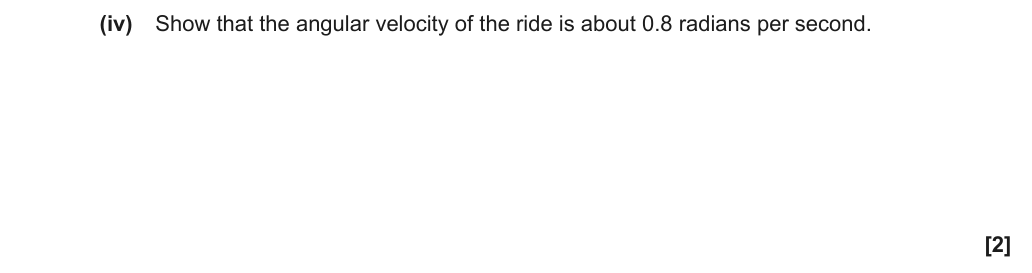
In Question 17 (a) (i) of this question, the phrase ‘tension in the rod’ can mean several different things, all of which were given in the mark scheme. Many candidates approached part (ii) with some confidence, spotting that the horizontal portion of the rod was 11.1 sin(35) and that it should be added to the radius of the disc. Parts (a) (iii) and (iv) were more challenging, requiring good knowledge of both circular motion and how to calculate components of forces. Again there were several legitimate routes to the right answer, all of which were mentioned in the mark scheme. Very logical approaches were in part (a) (iii), to equate the vertical component of the tension with the weight of the sandbag. In part (a) (iv), the quickest approach was to equate the horizontal component of the tension with the centripetal force. The data booklet provides a convenient expression for the centripetal force in terms of the angular velocity, without the need for finding the tangential velocity.
Skills: M0.6 Use calculators to handle sin x, cos x and tan x when x is expressed in degrees or radians; M2.2 Change the subject of an equation, including non-linear equations; M2.3 Substitute numerical values into algebraic equations using appropriate units for physical quantities
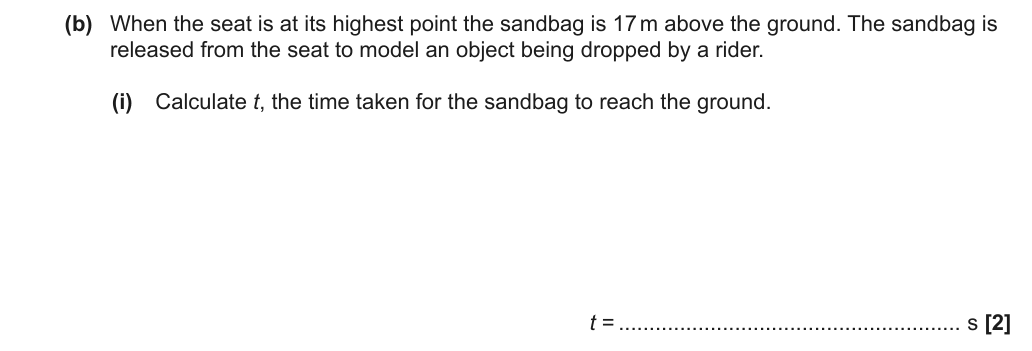
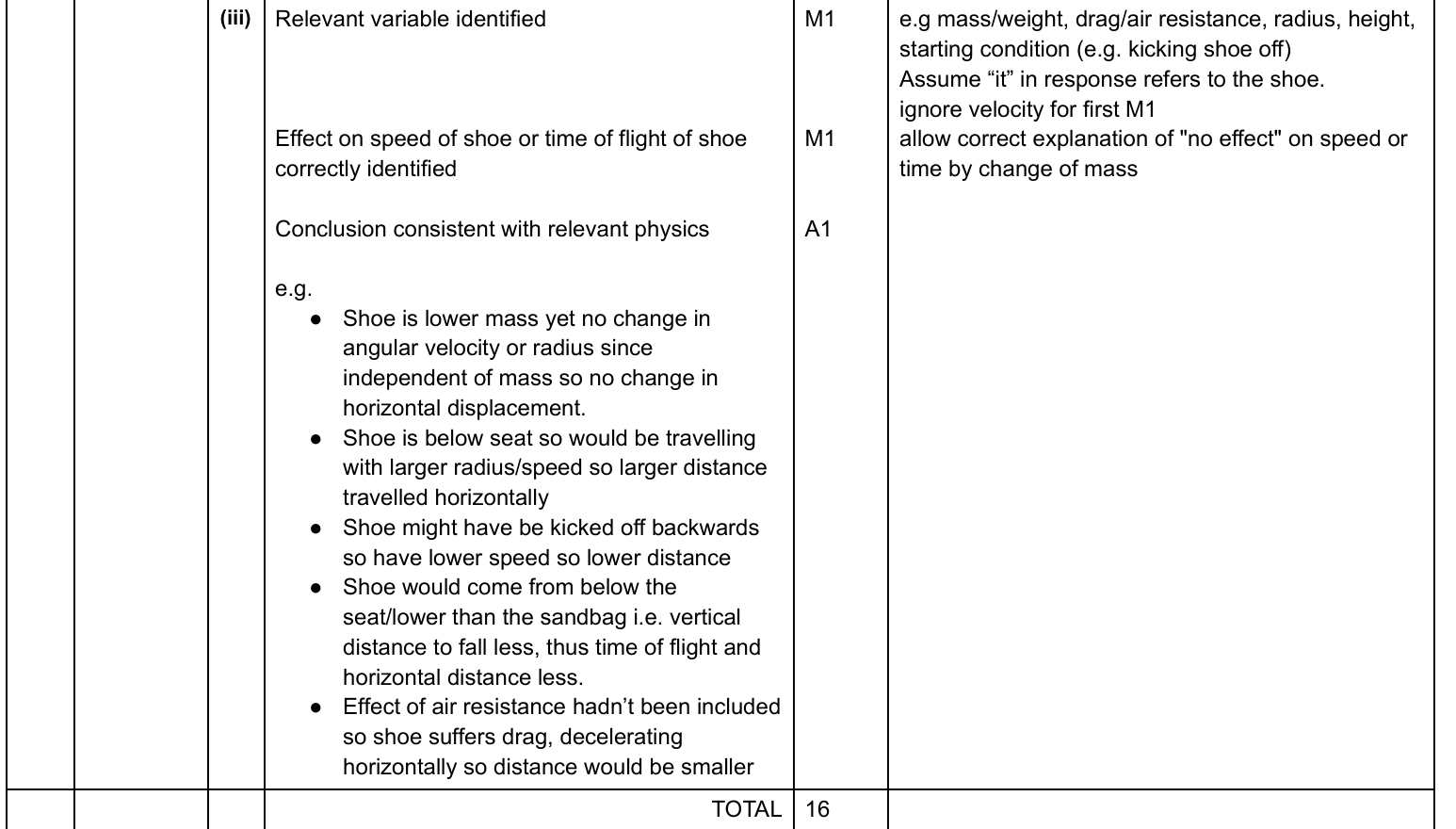
Question 17 (b) explored ideas about parabolic flight due to gravitation. The only force acting on the sandbag and the shoe after they have been released is the weight force, which acts vertically downwards. Many candidates realised that the vertical velocity of the sandbag when it left the swing was zero, enabling them to calculate the time for the bag to fall 17m vertically downwards (using s = ½gt2) To calculate the horizontal distance travelled required both the horizontal velocity (from v = rω) and the time of flight from part (b) (iii). There was lots of scope for applying error carried forward rules as mentioned in the mark scheme.
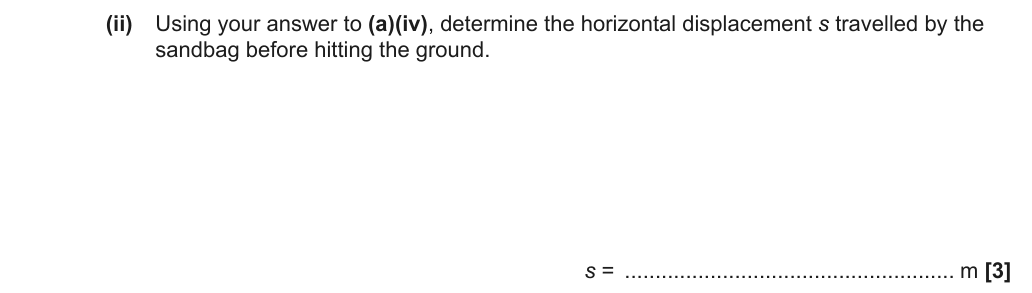
Question 17 (b) explored ideas about parabolic flight due to gravitation. The only force acting on the sandbag and the shoe after they have been released is the weight force, which acts vertically downwards. Many candidates realised that the vertical velocity of the sandbag when it left the swing was zero, enabling them to calculate the time for the bag to fall 17m vertically downwards (using s = ½gt2) To calculate the horizontal distance travelled required both the horizontal velocity (from v = rω) and the time of flight from part (b) (iii). There was lots of scope for applying error carried forward rules as mentioned in the mark scheme.
Skills: M2.3 Substitute numerical values into algebraic equations using appropriate units for physical quantities
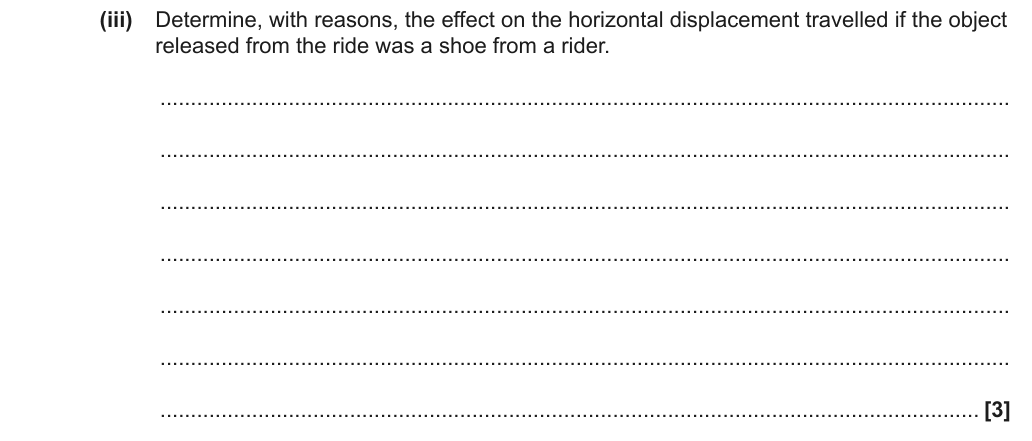
Question 17 (b) explored ideas about parabolic flight due to gravitation. The only force acting on the sandbag and the shoe after they have been released is the weight force, which acts vertically downwards. Many candidates realised that the vertical velocity of the sandbag when it left the swing was zero, enabling them to calculate the time for the bag to fall 17m vertically downwards (using s = ½gt2) To calculate the horizontal distance travelled required both the horizontal velocity (from v = rω) and the time of flight from part (b) (iii). There was lots of scope for applying error carried forward rules as mentioned in the mark scheme.
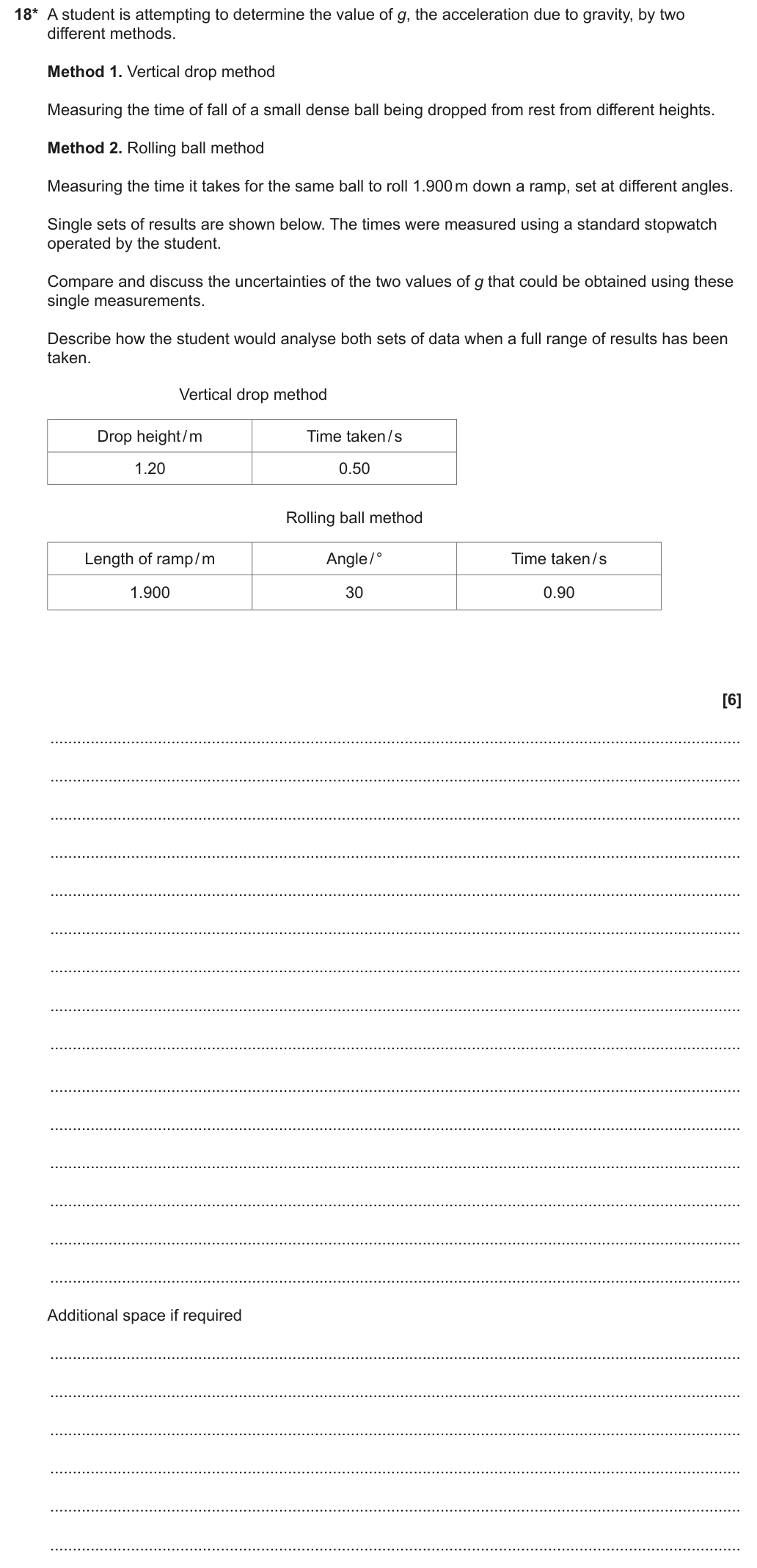
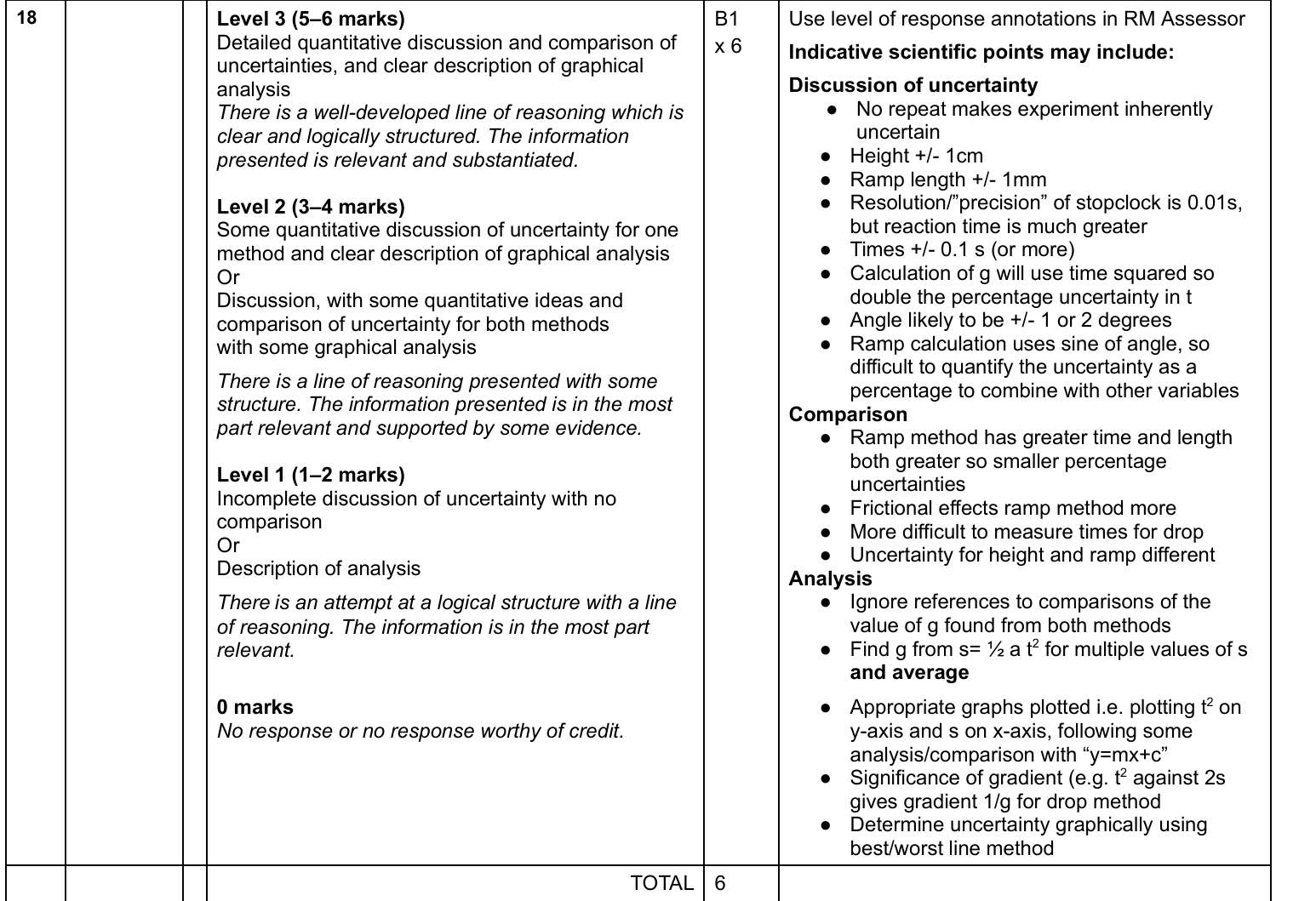
The easiest way to score well on this question was to look carefully at what was required. There is no mention of calculating g using either set of data nor any mention of steps the candidate could take to minimise the uncertainties. It is largely a question of what analysis would be used if there was a full range of results and how the uncertainties in both experiments can be compared. Almost all experiments and investigations at A2 Level require the use of an appropriate graph to represent and analyse data. Here there are two graphs: s against t2 for the falling object and t2 against sinθ for the rolling object. By rearranging the equations relating the variables, it is possible to work out the relevance of the gradient in both graphs. The data tables gave significant clues about how uncertain these experiments are, such as the number of significant figures for the raw data and the instruments with which these measurements would have been taken. Very successful candidates took the information and correctly propagated the instrumental uncertainties, even remembering to double the uncertainty in the time measurement because of the appearance of t2 in the analysis. Once they did this, they had a valid way of comparing the uncertainties in both experiments, coming to a valid conclusion. The exemplar 1 response came from an otherwise successful candidate. Their first statement about the uncertainty in the time values is true yet not true regarding the uncertainty in the distance measurements. There is some discussion about the percentage uncertainties in the length due to the differences in size of those length measurements and extra uncertainty due to the use of a protractor. Crucially, there is not much discussion about the actual values of those uncertainties. The candidate proceeds to calculate g from the single data points provided in the question. While this has been done correctly, it does not answer the question. There is no reference to graphical analysis at all. This resulted in this response being marked as a Level 1 response. This candidate has gone to great trouble to calculate the uncertainties each measurement would contribute to the overall uncertainty in the value of g for both methods, allowing a valid comparison of the two. In contrast to exemplar 1, there is a full description of the required graphical analysis, justifying which variable should be plotted on which axis and how a value of g could be obtained from such a graph in each case. This response was therefore marked as a Level 3 response.
Skills: M1.5 Identify uncertainties in measurements and use simple techniques to determine uncertainty when data are combined; M3.3 Understand that y = mx + c represents a linear relationship; M3.4 Determine the slope and intercept of a linear graph; PAG1 Investigating motion
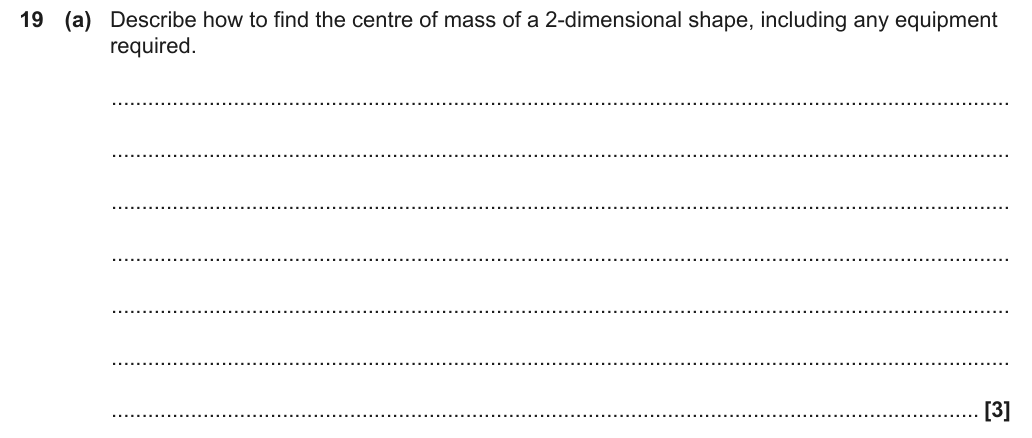
This question was answered well by the majority of candidates, especially those that mentioned a good method of showing where the vertical was. Explicit use of the term ‘plumb-bob’ or ‘plumbline’ was not required i.e. ‘mass on a string’ or ‘pendulum’ or ‘string with an object on the end’ were all perfectly acceptable alternate wordings. Methods that relied on balancing the 2-D shape horizontally on a point could only score a maximum of 1 mark, even though it is a viable way of checking the results of the more detailed and expected procedure.
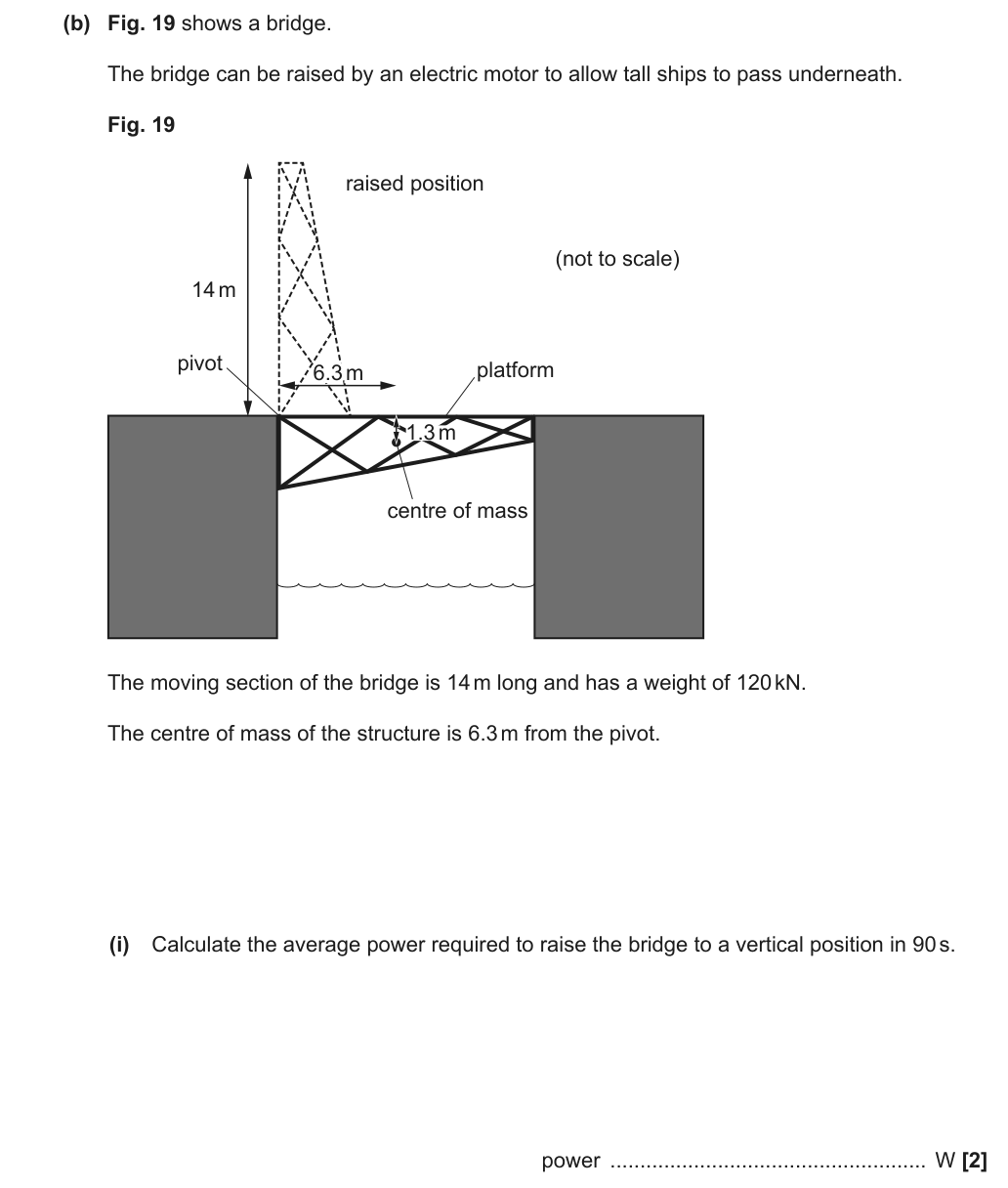
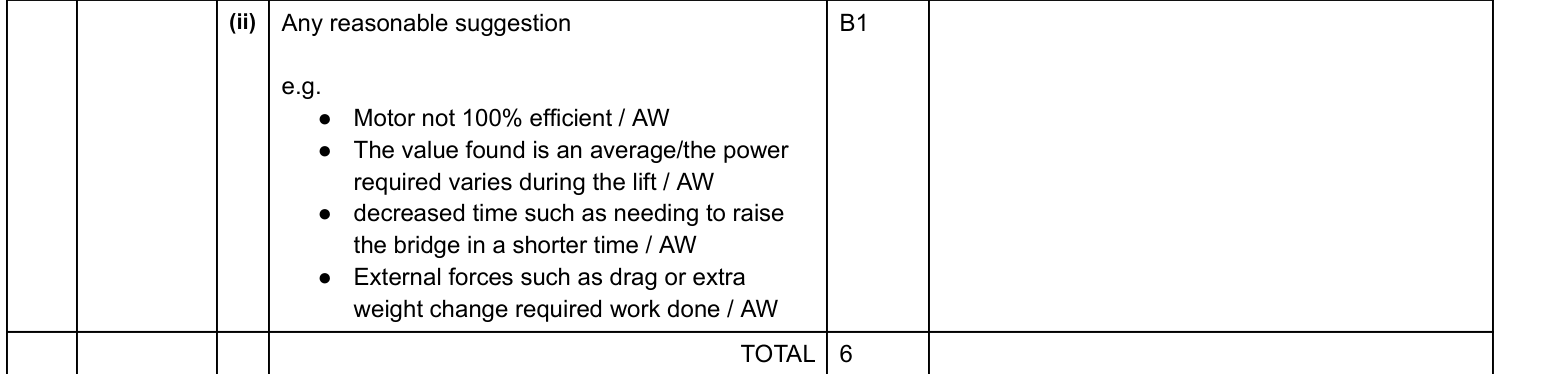
In Question 19 (b) (i), many candidates spotted the need to calculate the GPE required to raise the bridge using the relationship GPE = mgh although there was some confusion about the value of h. The centre of mass goes from a position 1.3 m below the top of the grey boxes to a position 6.3m above those same grey boxes, making the total value of h 7.6 m. Once the candidates had calculated the GPE, the successful ones divided by the time taken to lift the platform i.e. 90 seconds. Candidates that forgot the extra 1.3 m but otherwise completed the calculation correctly scored 1 mark out of the 2 available. No other distances were given credit. In part (b) (ii), there were lots of very sensible answers, many of which gained credit.
Skills: M0.1 Recognise and make use of appropriate units in calculations; M2.3 Substitute numerical values into algebraic equations using appropriate units for physical quantities
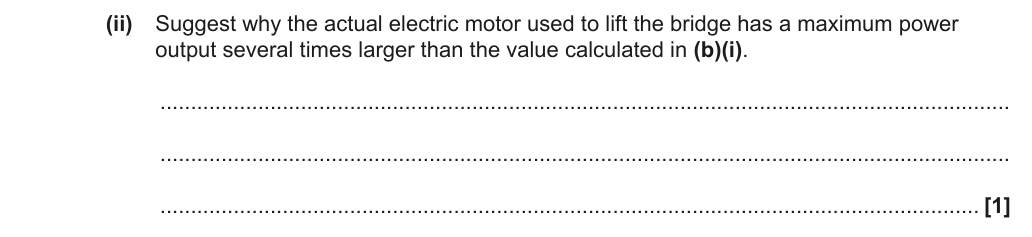
In Question 19 (b) (i), many candidates spotted the need to calculate the GPE required to raise the bridge using the relationship GPE = mgh although there was some confusion about the value of h. The centre of mass goes from a position 1.3 m below the top of the grey boxes to a position 6.3m above those same grey boxes, making the total value of h 7.6 m. Once the candidates had calculated the GPE, the successful ones divided by the time taken to lift the platform i.e. 90 seconds. Candidates that forgot the extra 1.3 m but otherwise completed the calculation correctly scored 1 mark out of the 2 available. No other distances were given credit. In part (b) (ii), there were lots of very sensible answers, many of which gained credit.
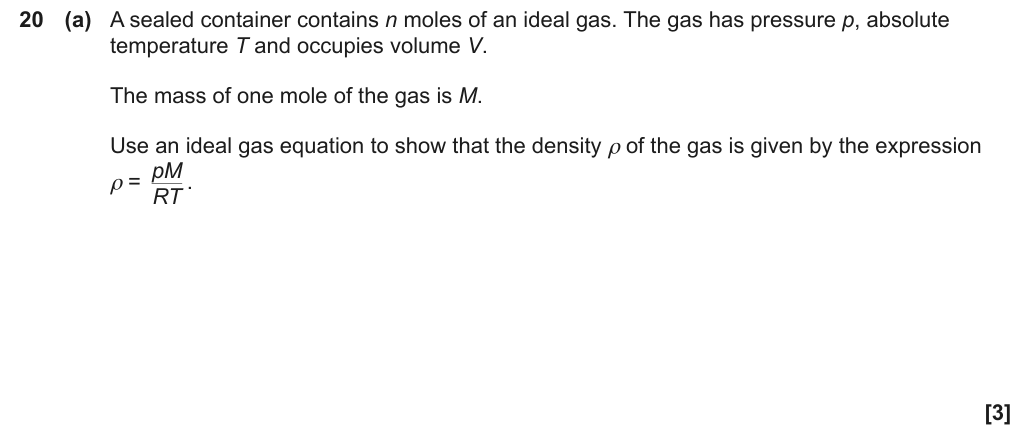
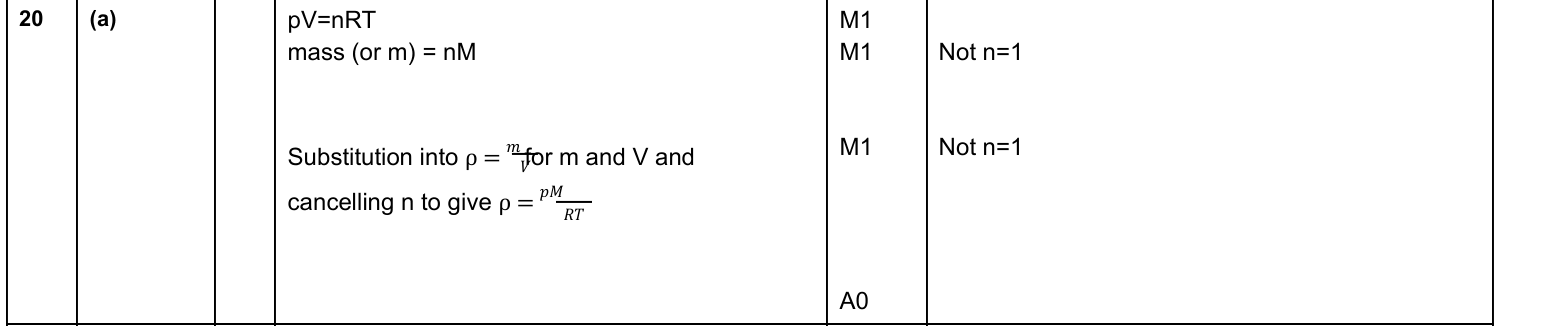
Successful candidates correctly identified the starting point for this question as the ideal gas equation, pV = nRT. Many candidates took the approach that n = 1 which was not sufficient. A more sufficient proof used the idea that the total mass of the gas was n × M, allowing cancelling of the n in the ideal gas equation.
Skills: M2.2 Change the subject of an equation, including non-linear equations
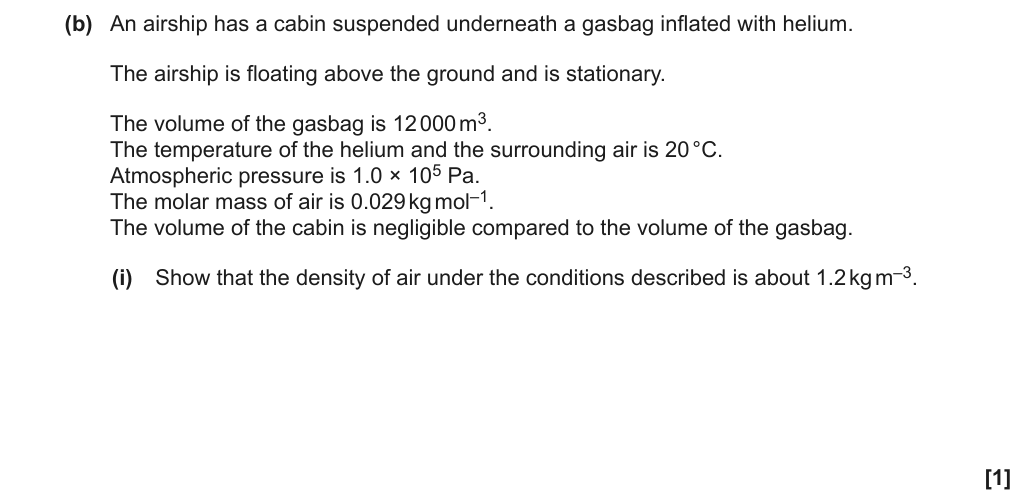
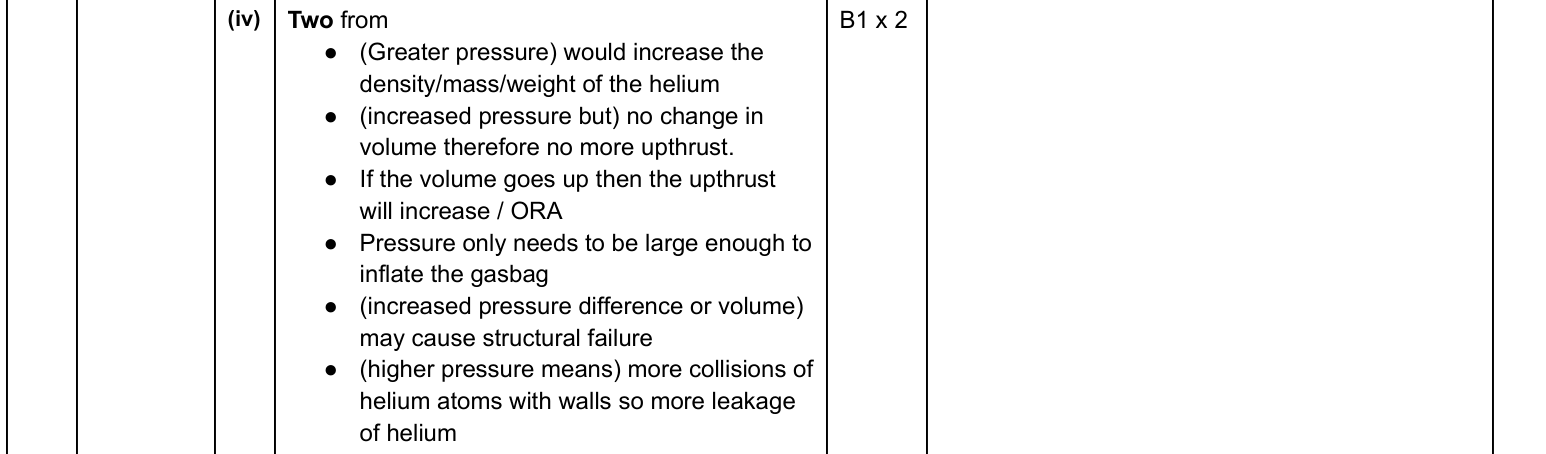
The vast majority of candidates correctly substituted values into the given formula, also remembering to convert the temperature from celsius into kelvin. Good practice for “show that” questions is to calculate the quantity required to at least one more significant figure in the question. In this example, that would mean evaluating the density to 1.19 kg m–3. In part (b) (ii), finding the weight was a matter of finding the mass and then finding the weight, all by using data in the question. Part (b) (iii) required understanding of Archimedes’ principle, rather than merely referring to it. Most candidates successfully related the principle to this context, writing about the upthrust being equal to the weight of fluid or air displaced by the gasbag. This is always true, regardless of the other forces that may be in play. References to displacement of water at this point were rejected. Fewer candidates completed the explanation by mentioning that the upthrust must be equal to the weight of the gas bag because we know that the gas bag is in equilibrium. Most candidates scored a mark in part (b) (iv) because they referred to some sort of structural failure if the pressure increased. Others delved a bit deeper, correctly stating that an increase in mass without an increase in volume (and hence upthrust) would cause the gas bag to sink.
Skills: M2.3 Substitute numerical values into algebraic equations using appropriate units for physical quantities
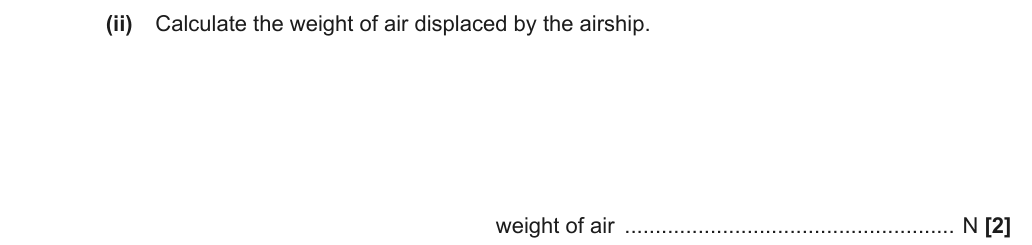
The vast majority of candidates correctly substituted values into the given formula, also remembering to convert the temperature from celsius into kelvin. Good practice for “show that” questions is to calculate the quantity required to at least one more significant figure in the question. In this example, that would mean evaluating the density to 1.19 kg m–3. In part (b) (ii), finding the weight was a matter of finding the mass and then finding the weight, all by using data in the question. Part (b) (iii) required understanding of Archimedes’ principle, rather than merely referring to it. Most candidates successfully related the principle to this context, writing about the upthrust being equal to the weight of fluid or air displaced by the gasbag. This is always true, regardless of the other forces that may be in play. References to displacement of water at this point were rejected. Fewer candidates completed the explanation by mentioning that the upthrust must be equal to the weight of the gas bag because we know that the gas bag is in equilibrium. Most candidates scored a mark in part (b) (iv) because they referred to some sort of structural failure if the pressure increased. Others delved a bit deeper, correctly stating that an increase in mass without an increase in volume (and hence upthrust) would cause the gas bag to sink.
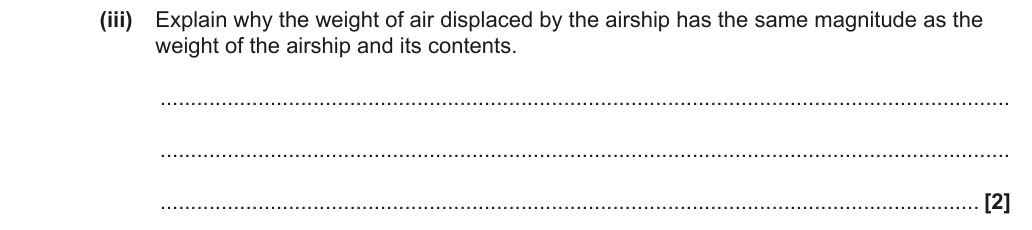
The vast majority of candidates correctly substituted values into the given formula, also remembering to convert the temperature from celsius into kelvin. Good practice for “show that” questions is to calculate the quantity required to at least one more significant figure in the question. In this example, that would mean evaluating the density to 1.19 kg m–3. In part (b) (ii), finding the weight was a matter of finding the mass and then finding the weight, all by using data in the question. Part (b) (iii) required understanding of Archimedes’ principle, rather than merely referring to it. Most candidates successfully related the principle to this context, writing about the upthrust being equal to the weight of fluid or air displaced by the gasbag. This is always true, regardless of the other forces that may be in play. References to displacement of water at this point were rejected. Fewer candidates completed the explanation by mentioning that the upthrust must be equal to the weight of the gas bag because we know that the gas bag is in equilibrium. Most candidates scored a mark in part (b) (iv) because they referred to some sort of structural failure if the pressure increased. Others delved a bit deeper, correctly stating that an increase in mass without an increase in volume (and hence upthrust) would cause the gas bag to sink.
The vast majority of candidates correctly substituted values into the given formula, also remembering to convert the temperature from celsius into kelvin. Good practice for “show that” questions is to calculate the quantity required to at least one more significant figure in the question. In this example, that would mean evaluating the density to 1.19 kg m–3. In part (b) (ii), finding the weight was a matter of finding the mass and then finding the weight, all by using data in the question. Part (b) (iii) required understanding of Archimedes’ principle, rather than merely referring to it. Most candidates successfully related the principle to this context, writing about the upthrust being equal to the weight of fluid or air displaced by the gasbag. This is always true, regardless of the other forces that may be in play. References to displacement of water at this point were rejected. Fewer candidates completed the explanation by mentioning that the upthrust must be equal to the weight of the gas bag because we know that the gas bag is in equilibrium. Most candidates scored a mark in part (b) (iv) because they referred to some sort of structural failure if the pressure increased. Others delved a bit deeper, correctly stating that an increase in mass without an increase in volume (and hence upthrust) would cause the gas bag to sink.
Question 20 (c) Question 20 (d) Question 20 parts (c) and (d) group well here.
Skills: M2.3 Substitute numerical values into algebraic equations using appropriate units for physical quantities
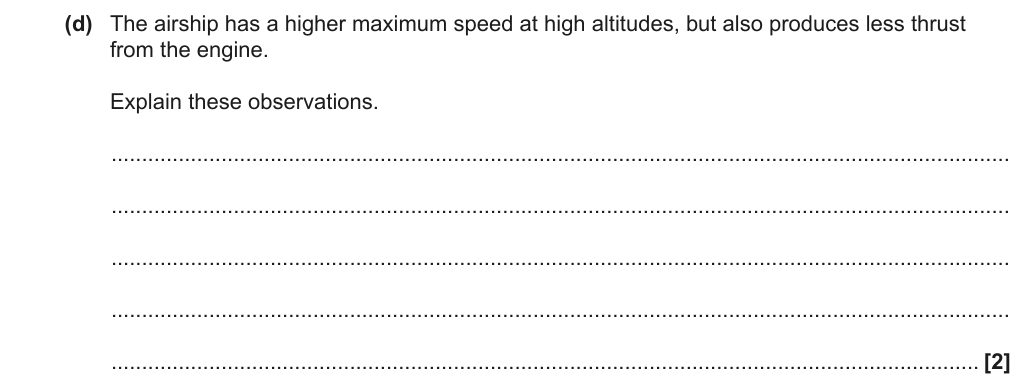
Question 20 parts (c) and (d) group well here. Part (c) is similar in nature to previous questions about rate of change of momentum. We rejected the use of the idea F=ma as it is wrong physics, even though the numerical value is the same. The idea of rate of momentum transfer carries on in part (d). Most candidates correctly assumed that the density of air at high altitudes is much lower than at low altitudes. Many candidates implied that this meant a reduction in drag, which is correct. Far fewer correctly described the reduction of rate of change of momentum, causing less thrust.
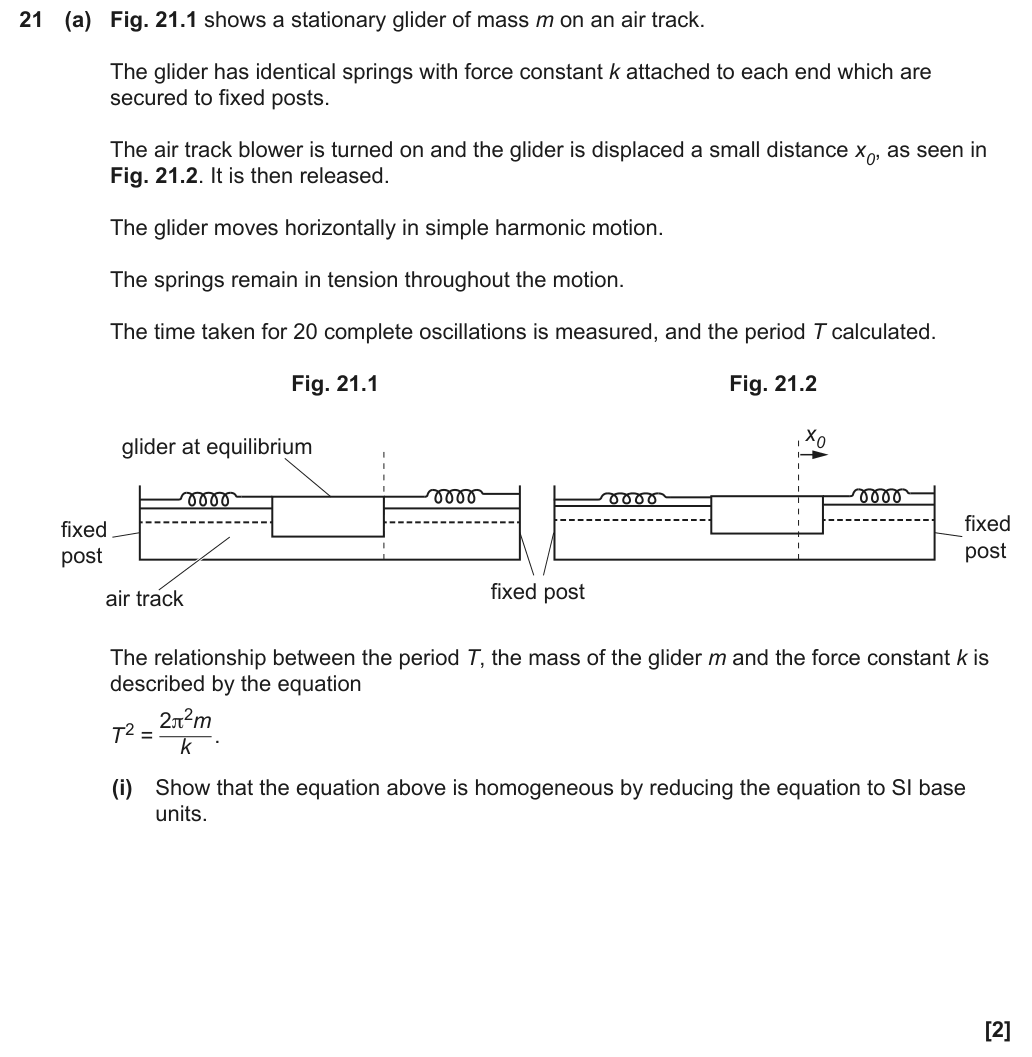
Many candidates successfully derived or remembered how to express the newton in SI base units. From there, working out the base units for the spring constant and cancelling kilograms proved straightforward for many. Question 21 (a) (ii) is considerably more challenging. The two springs are not in series nor are they in parallel. When there is a displacement x one spring is extended by an extra amount x i.e. an extension of (e + x) and the other is extended by a reduced amount x i.e. an extension of (e – x) where e is the equilibrium extension. This meant that the resultant force was k(e + x) – k(e – x), which is clearly 2kx. Neither spring goes into compression, although we condoned candidates who suggested that a reduction in extension meant the same as a compression.
Skills: M0.1 Recognise and make use of appropriate units in calculations
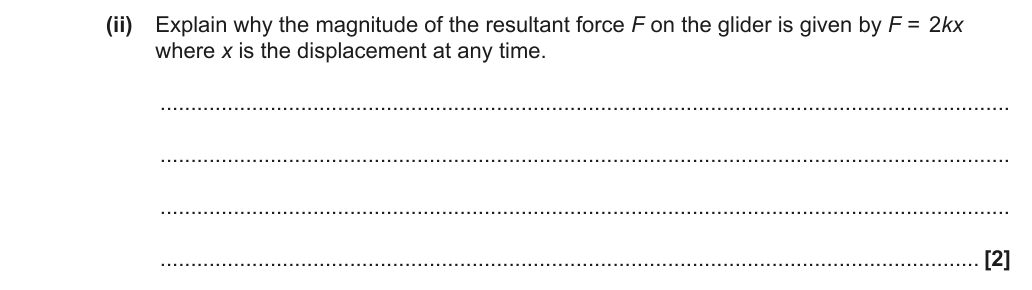
Many candidates successfully derived or remembered how to express the newton in SI base units. From there, working out the base units for the spring constant and cancelling kilograms proved straightforward for many. Question 21 (a) (ii) is considerably more challenging. The two springs are not in series nor are they in parallel. When there is a displacement x one spring is extended by an extra amount x i.e. an extension of (e + x) and the other is extended by a reduced amount x i.e. an extension of (e – x) where e is the equilibrium extension. This meant that the resultant force was k(e + x) – k(e – x), which is clearly 2kx. Neither spring goes into compression, although we condoned candidates who suggested that a reduction in extension meant the same as a compression.

A reasonably large proportion of candidates did not link the idea of initial displacement to the amplitude of this motion. Those that did often scored both marks as they also recalled that SHM is isochronous.
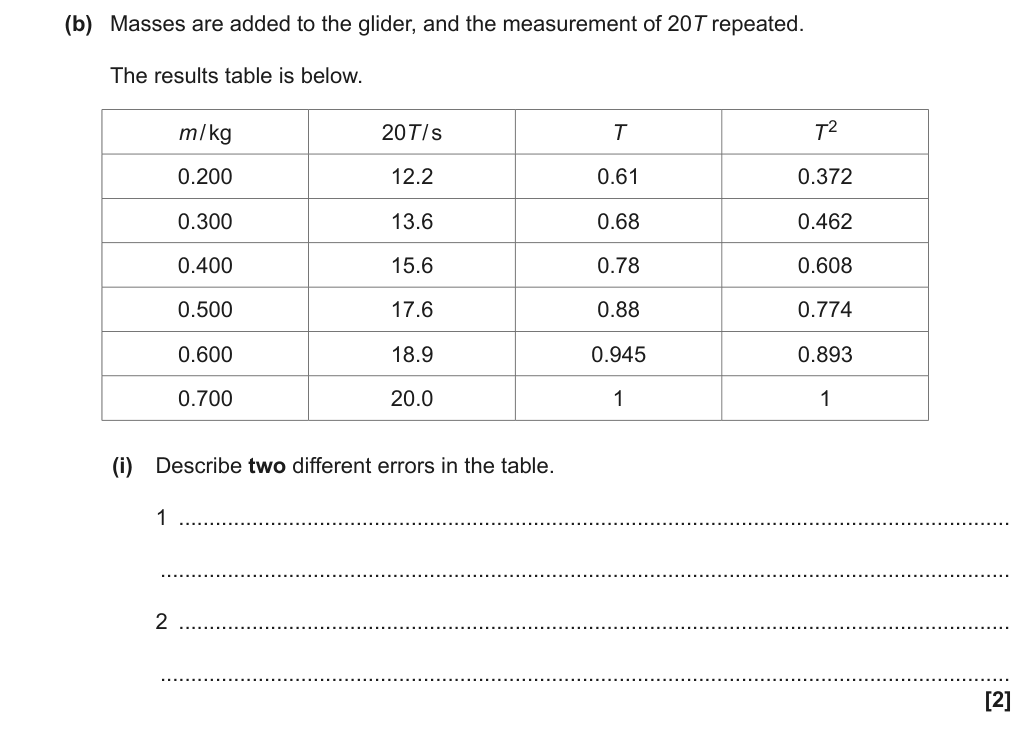
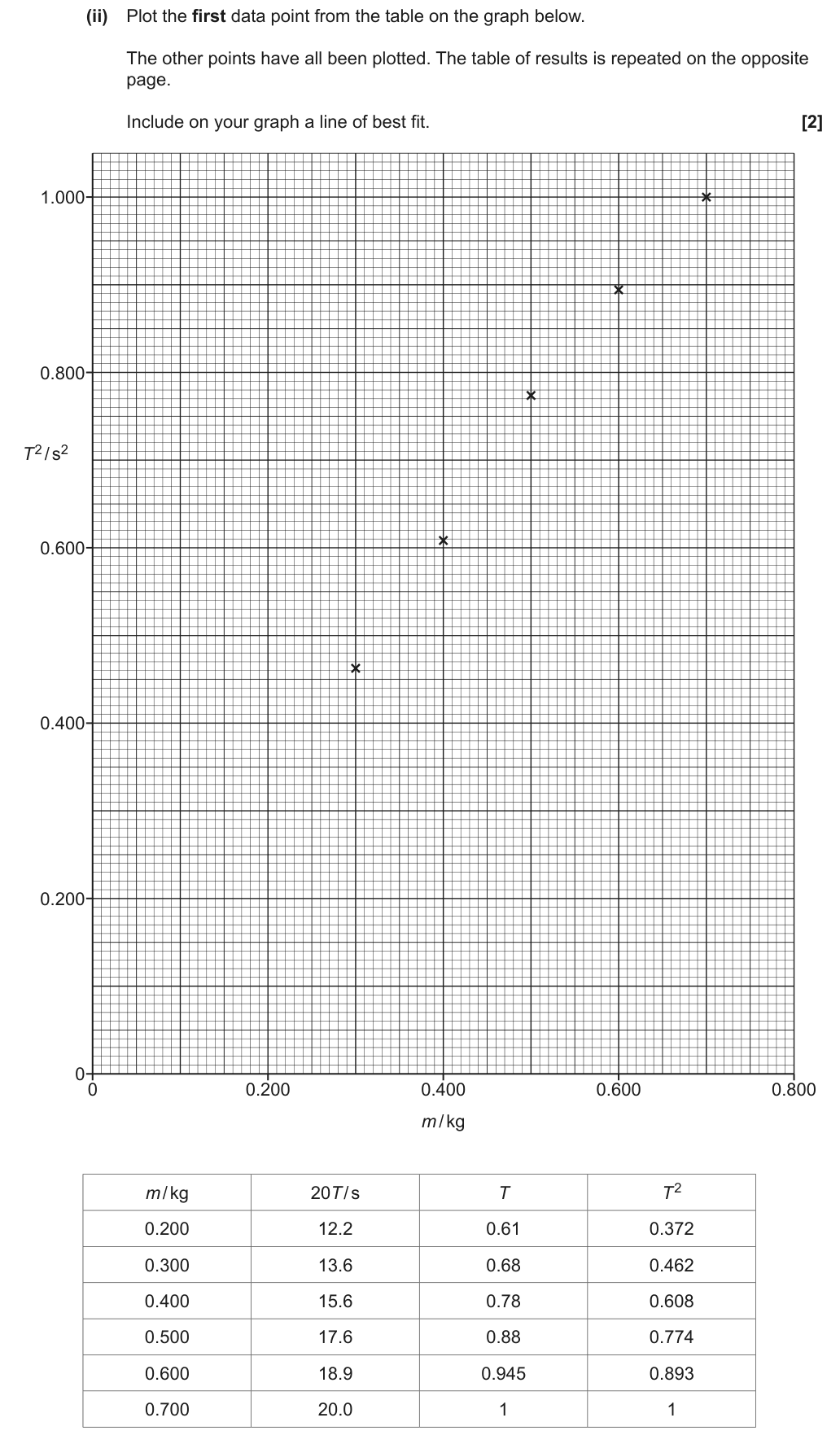
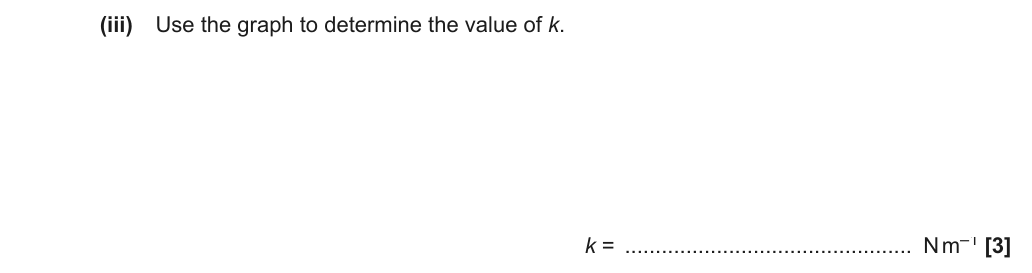
Most candidates spotted the two different errors namely the lack of units for both T and T2 and the inconsistent presentation of the digits in the data. Almost all candidates correctly plotted the data point at (0.200, 0.372). Most candidates constructed an acceptable line of best fit with a minority insisting that the best fit line should go through the origin. Best fit lines are judged on two criteria: the number of points above and below the proposed line and a fair distribution of points away from the line. Consider the line that starts at the origin and has three points above and below it. The first and last points are some distance away from the line and the points get progressively closer towards the middle. This cannot happen with the best fit line. Most candidates used the relationship correctly, recognising that the gradient = 2π2/k. Nearly all candidates correctly calculated the gradient, going on to evaluate k. Gradients from incorrect best fit lines were acceptable under error carried forward rules for all 3 marks. A minority of candidates misread their graphs or made algebraic errors.
Skills: M1.1 Use an appropriate number of significant figures; PAG10 Investigating simple harmonic motion
Question 21 (b) (i) Most candidates spotted the two different errors namely the lack of units for both T and T2 and the inconsistent presentation of the digits in the data.
Skills: M3.2 Plot two variables from experimental or other data; PAG10 Investigating simple harmonic motion
Question 21 (b) (i) Most candidates spotted the two different errors namely the lack of units for both T and T2 and the inconsistent presentation of the digits in the data.
Skills: M2.2 Change the subject of an equation, including non-linear equations; M3.3 Understand that y = mx + c represents a linear relationship; M3.4 Determine the slope and intercept of a linear graph; PAG10 Investigating simple harmonic motion
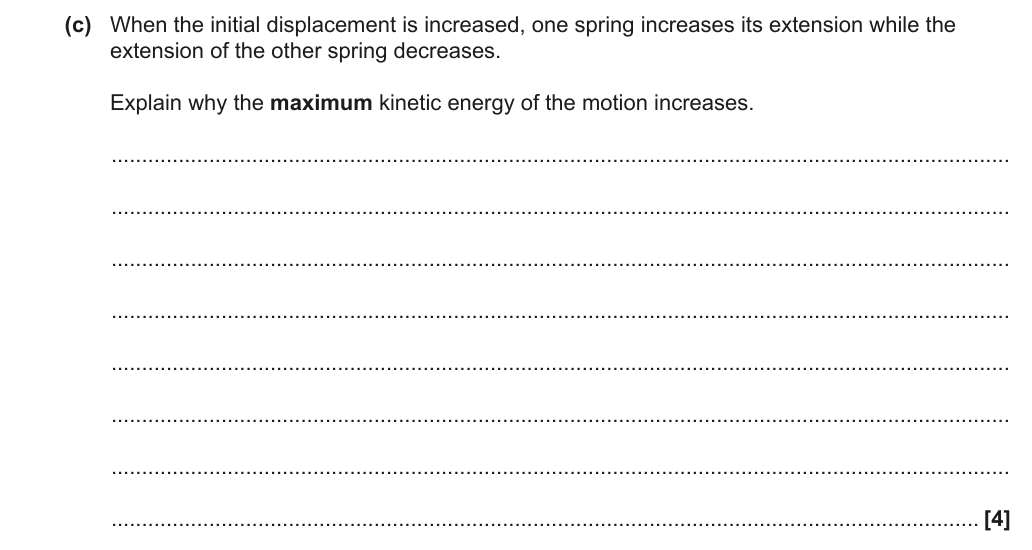
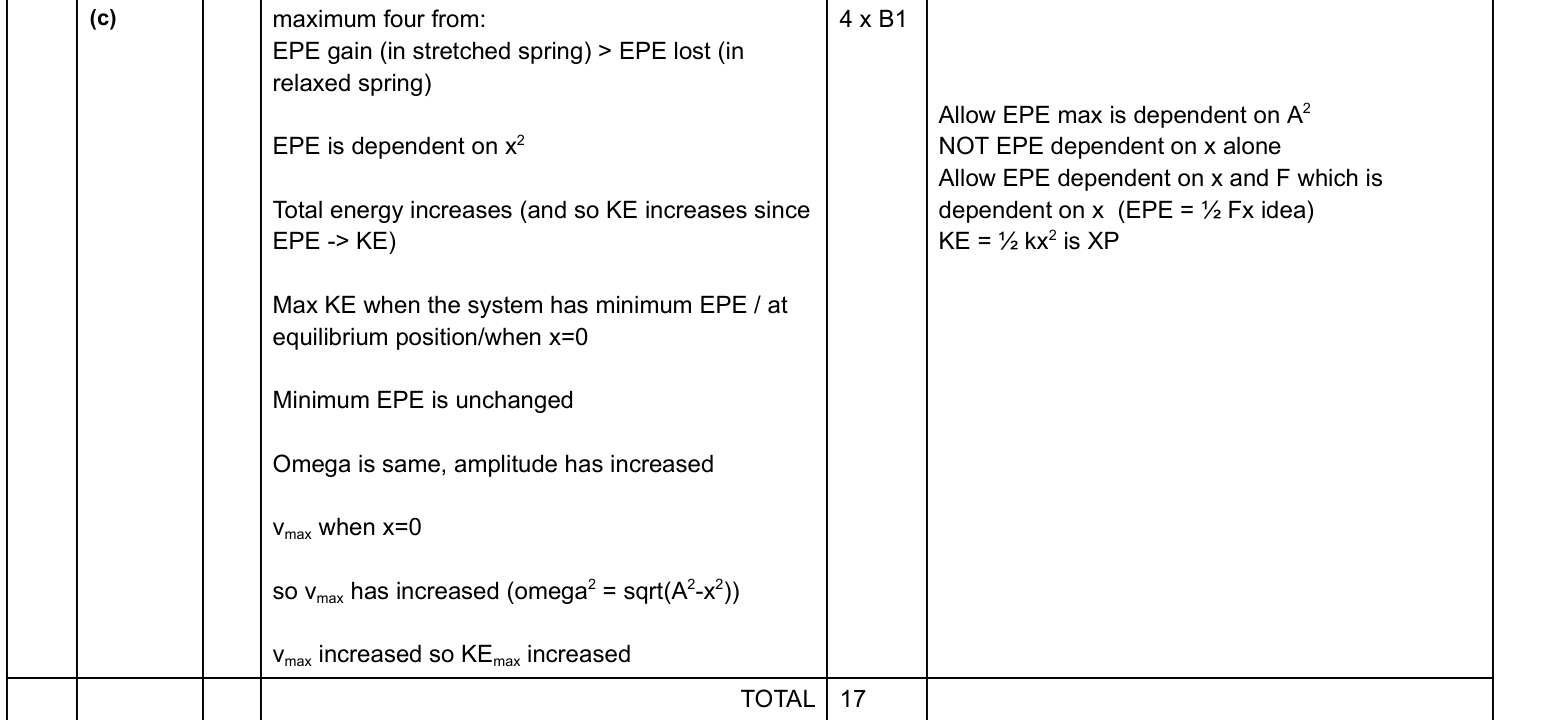
The language around energy and energy transfers is challenging and this question was pitched as a high demand question. Once more, the technical language needed to be relatively accurate for marks to be given. As soon as the glider is displaced, the total elastic potential energy (EPE) is increased. The spring that is longer than at equilibrium stores more energy than before and the spring that is shorter than at equilibrium stores less. Since the amount of EPE is given by ½kx2, the increase in EPE in the longer spring is larger than the decrease in EPE for the shorter spring. A few candidates attempted to prove this algebraically which was not required. Finally, the EPE at equilibrium position is not zero but a minimum. This is why the maximum KE occurs at this point. Some candidates attempted the slightly more accessible route of comparing vmax with the amplitude yet did not mention that the angular velocity was the same, although there was still some credit available.
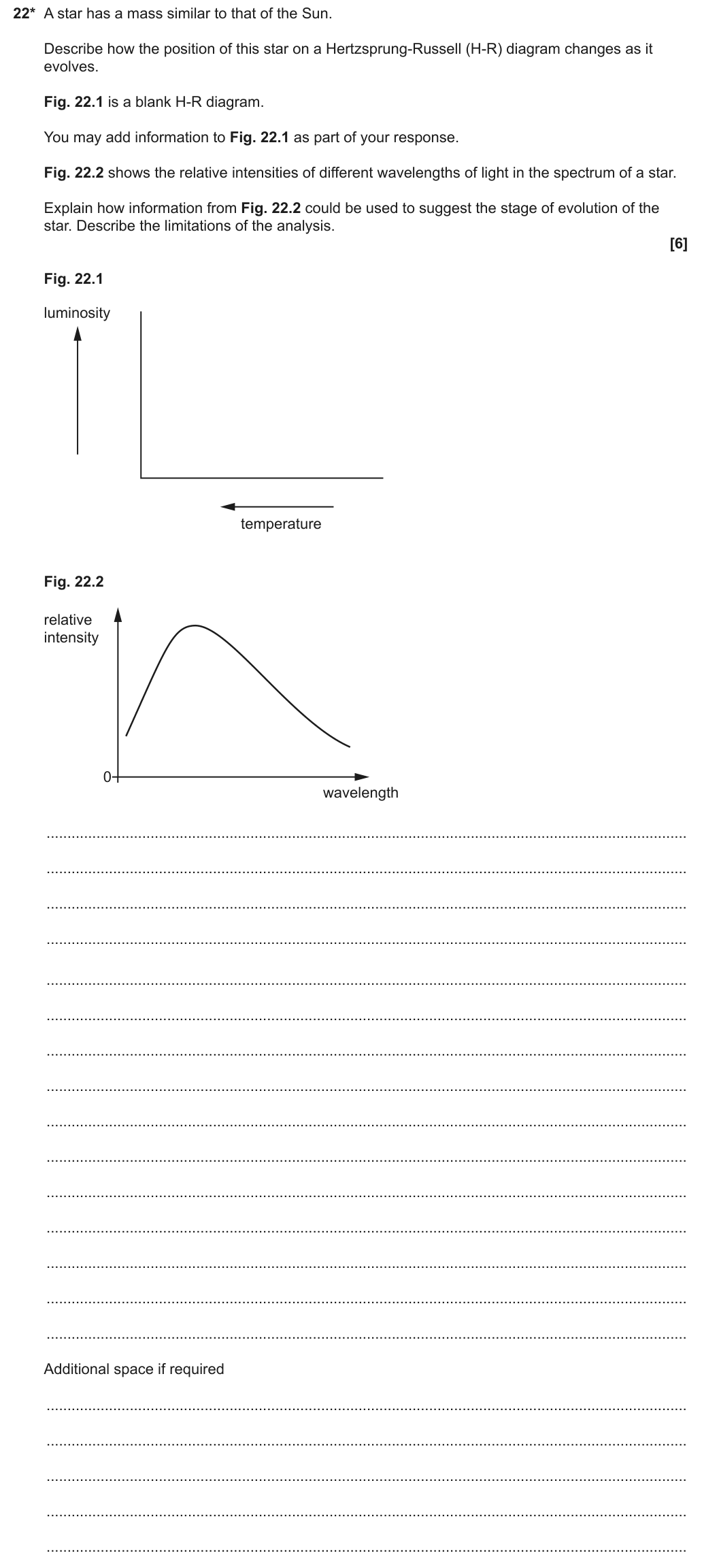
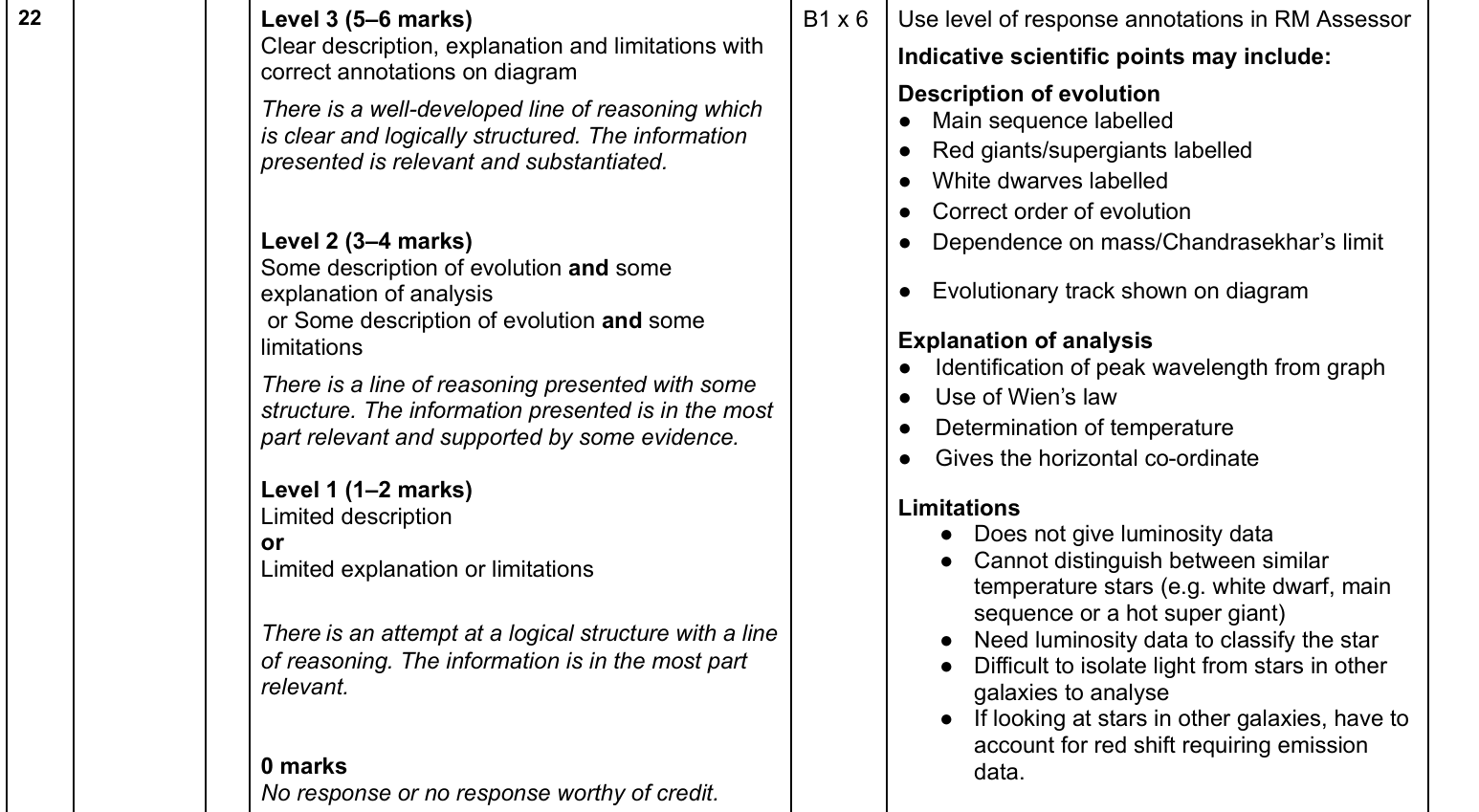
Most Level of Response (LoR) questions have multiple parts to them. The first task the candidates are asked is to describe the life of a star similar to the Sun with the added complexity of showing or describing how that affects the star’s position on the H-R diagram. Many candidates enjoyed considerable success here. Fig 22.2 proved more challenging to interpret. As there are no scales on the axes, it is difficult to say what colour this star is, however λmax is relatively low, which points in the direction of early-mid-life (yellow or yellow white). Candidates rightly suggested that Wien’s law was applicable and that as the star grew older and expanded into a red giant, the curve’s peak would move to the right. The most challenging aspect of this question is suggesting what limitations this approach has. The lack of scales has already been mentioned. The colour alone cannot uniquely define a star’s position on the H-R diagram and thus the stage of life of the star. The graph only gives a relative intensity, which means that the total output of the star, or its luminosity cannot be measured. This candidate described the life cycle of sun-like stars in great depth, completed an excellent HR diagram and in the text described the path of the star on the H-R diagram throughout its lifetime. The references in the last paragraph are what makes this response worthy of a Level 3. The candidate has answered all aspects of the question, explaining both Wien’s law and how the luminosity (and hence position on the H-R diagram) is impossible from the data presented.
Skills: M3.1 Translate information between graphical, numerical and algebraic forms
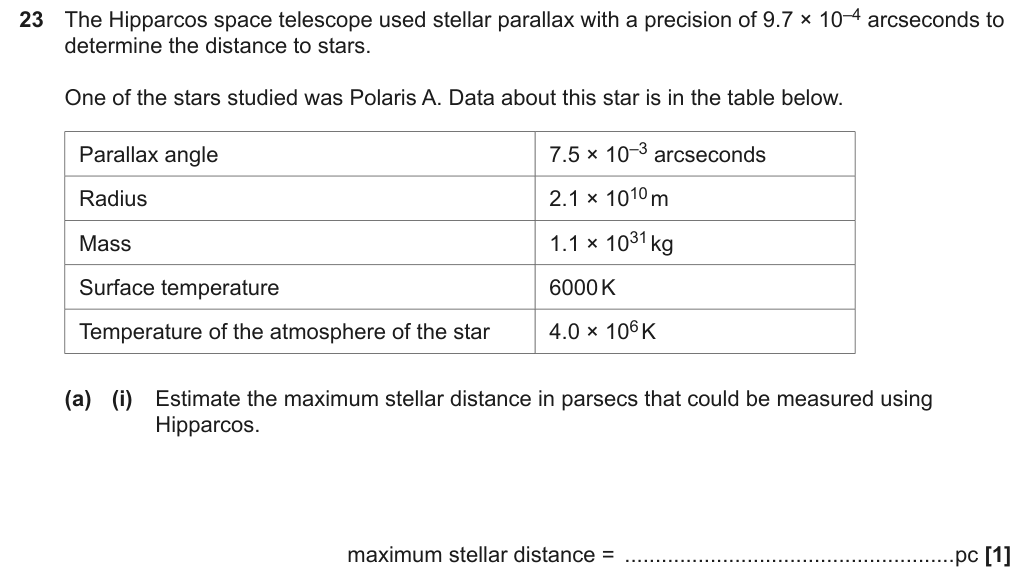
The maximum stellar distance is given by the smallest parallax Hipparcos can measure, i.e. 9.7 × 10⁻⁴ arcsec. The distance corresponding to this parallax is 1/9.7 × 10–4 = 1030 pc. To find the percentage uncertainty in the distance, candidates needed to divide the smallest detectable change in the parallax by the parallax itself. This is equivalent to the percentage uncertainty in the distance because of the reciprocal relationship of distance with parallax. Many candidates correctly determined both quantities. A minority of candidates confused the two similar sounding quantities.
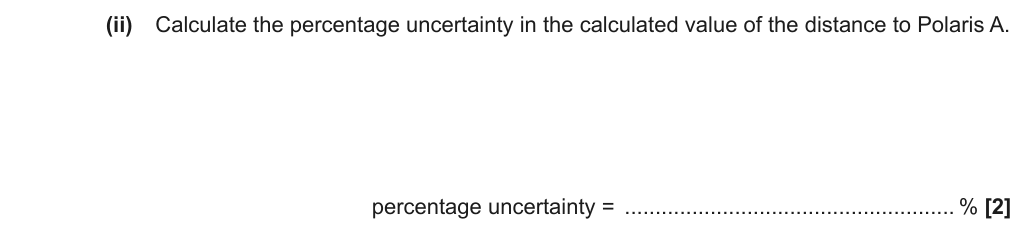
The maximum stellar distance is given by the smallest parallax Hipparcos can measure, i.e. 9.7 × 10⁻⁴ arcsec. The distance corresponding to this parallax is 1/9.7 × 10–4 = 1030 pc. To find the percentage uncertainty in the distance, candidates needed to divide the smallest detectable change in the parallax by the parallax itself. This is equivalent to the percentage uncertainty in the distance because of the reciprocal relationship of distance with parallax. Many candidates correctly determined both quantities. A minority of candidates confused the two similar sounding quantities.
Skills: M0.3 Use ratios, fractions and percentages; M1.5 Identify uncertainties in measurements and use simple techniques to determine uncertainty when data are combined
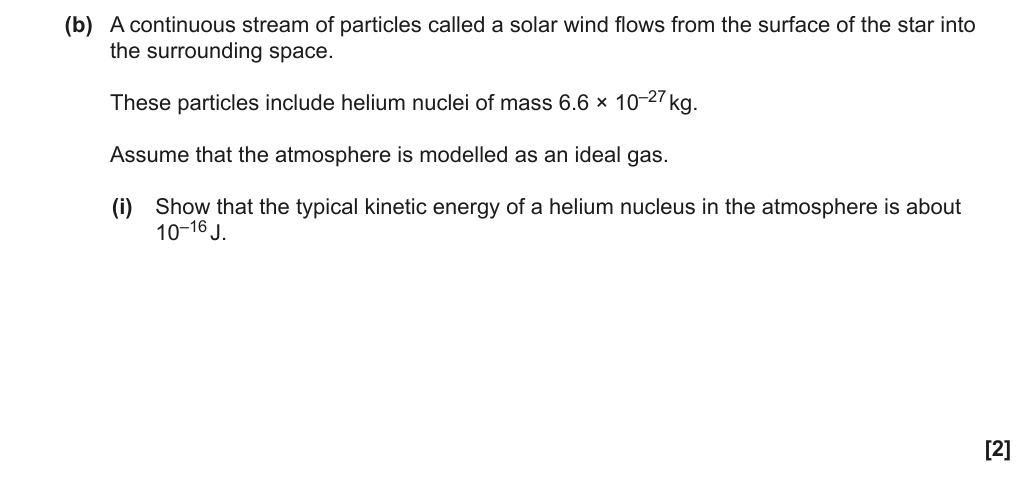
Question 23 (b) (i) Question 23 (b) (ii) Question 23 (b) (iii) Question 23 (b) (iv) Candidates answered Question 23 (b) (i) well, provided that they used the correct temperature i.e. that of the stellar atmosphere and not the surface temperature. Question 23 (b) (iv) has several acceptable responses yet the predominant correct candidate answers were that the solar wind particles might be lighter (i.e. hydrogen) or that the Maxwell-Boltzmann distribution of KE values in a gas of particles would mean that some particles would have greater than average KE.
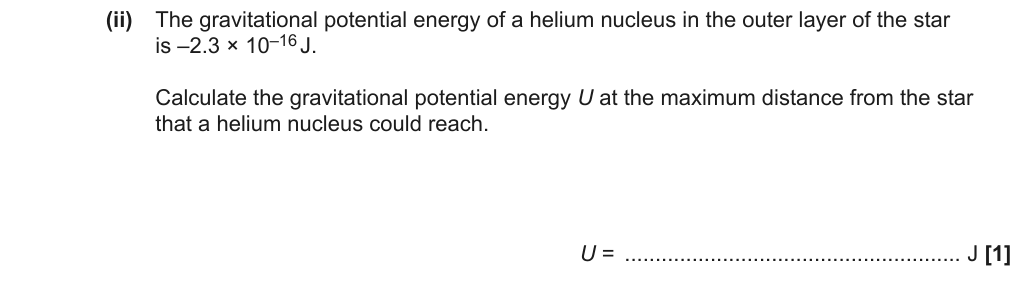
Question 23 (b) (i) Question 23 (b) (ii) Question 23 (b) (iii) Question 23 (b) (iv) Candidates answered Question 23 (b) (i) well, provided that they used the correct temperature i.e. that of the stellar atmosphere and not the surface temperature. Question 23 (b) (iv) has several acceptable responses yet the predominant correct candidate answers were that the solar wind particles might be lighter (i.e. hydrogen) or that the Maxwell-Boltzmann distribution of KE values in a gas of particles would mean that some particles would have greater than average KE.
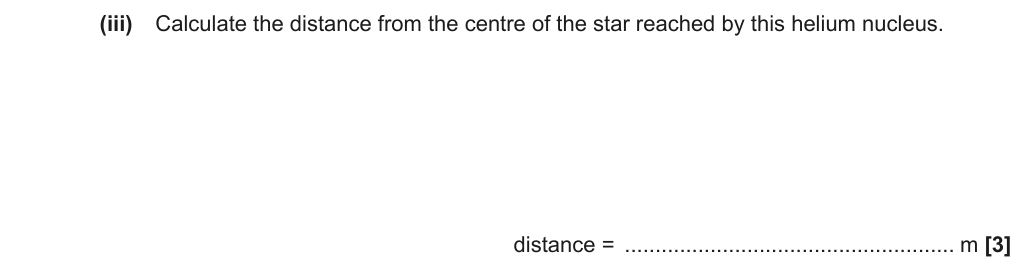
Question 23 (b) (i) Question 23 (b) (ii) Question 23 (b) (iii) Question 23 (b) (iv) Candidates answered Question 23 (b) (i) well, provided that they used the correct temperature i.e. that of the stellar atmosphere and not the surface temperature. Question 23 (b) (iv) has several acceptable responses yet the predominant correct candidate answers were that the solar wind particles might be lighter (i.e. hydrogen) or that the Maxwell-Boltzmann distribution of KE values in a gas of particles would mean that some particles would have greater than average KE.
Skills: M0.2 Recognise and use expressions in decimal and standard form; M2.2 Change the subject of an equation, including non-linear equations; M2.3 Substitute numerical values into algebraic equations using appropriate units for physical quantities

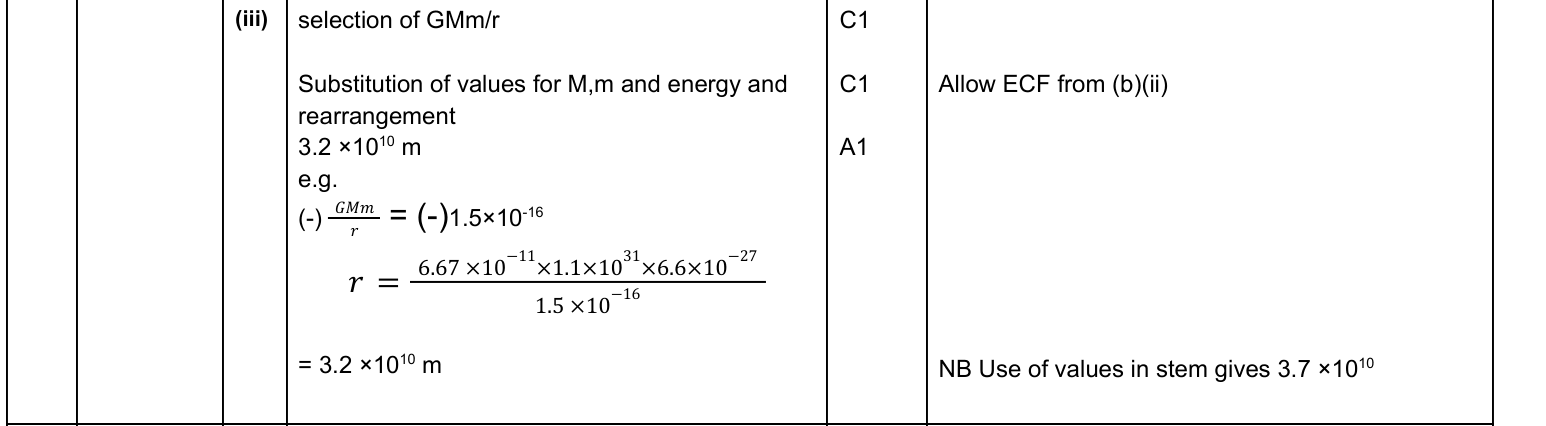
Candidates answered Question 23 (b) (i) well, provided that they used the correct temperature i.e. that of the stellar atmosphere and not the surface temperature. The helium nucleus in parts (b) (ii) and (b) (iii) has a KE of 10–16 J and a GPE of -2.3 × 10⁻¹⁶ J. This helium nucleus cannot therefore escape and so the GPE at the further possible point of the helium nucleus must be negative. The GPE at this furthest possible point is where the KE is zero and there has been a gain of 10–16 J of GPE, giving the GPE = –1.3 × 10⁻¹⁶ J, using the values in the question. Of course, we used the exact value calculated in part (b) (i) instead of 10–16 J, giving U = –1.5 × 10⁻¹⁶ J as the ‘correct’ answer. Question 23 (b) (iv) has several acceptable responses yet the predominant correct candidate answers were that the solar wind particles might be lighter (i.e. hydrogen) or that the Maxwell-Boltzmann distribution of KE values in a gas of particles would mean that some particles would have greater than average KE.
Want a paper marked and gone through with you? Message us.