Examiner's comment
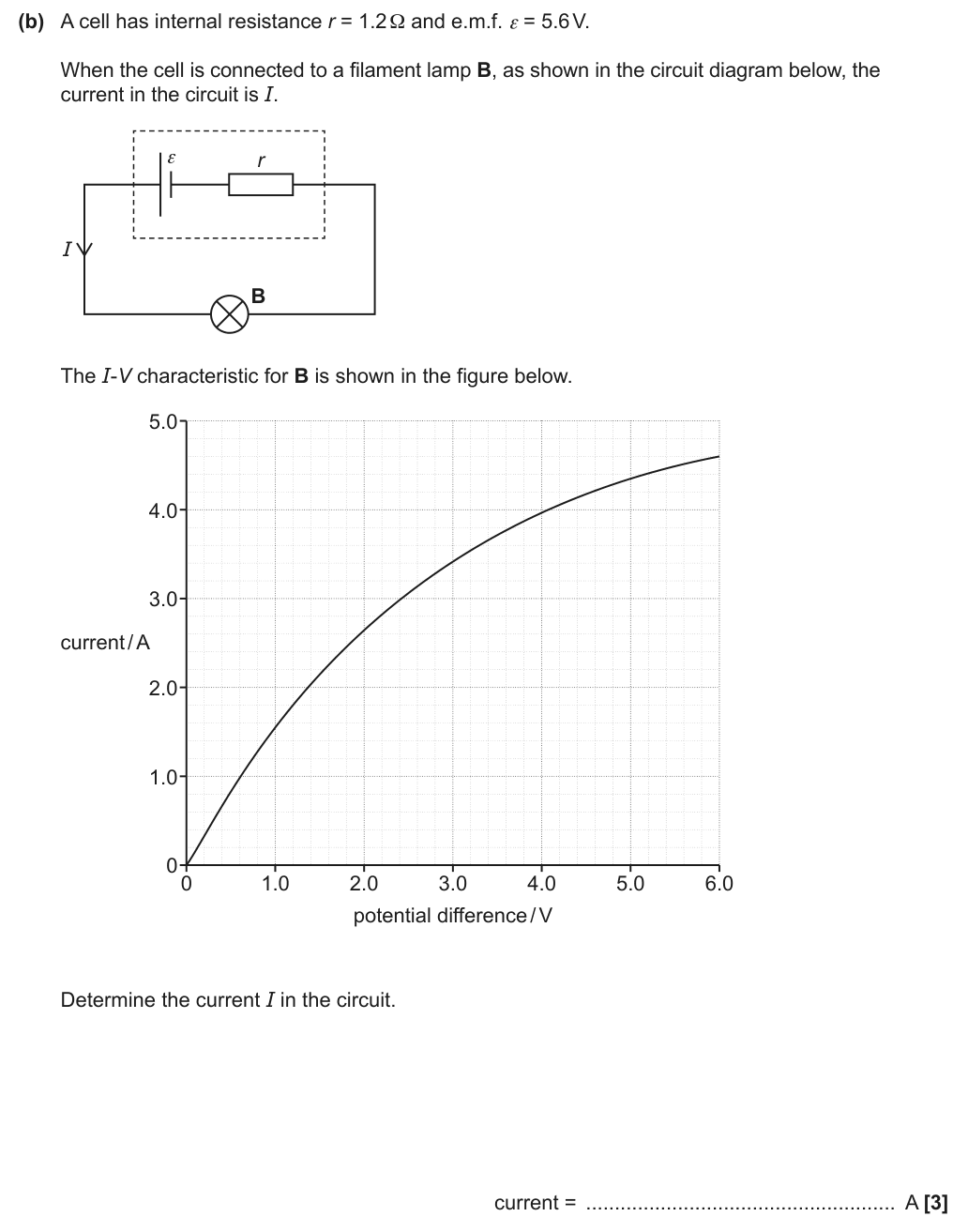
5 (b) (ii) was a question aimed at stretch and challenge level candidates with good problem-solving abilities.. Voltage V and current I are related through the formula ε = V + Ir so, given the values in the question, 5.6 = V + 1.2I. The relationship between V and I is also shown graphically. The problem is to find a pair of corresponding values for V and I which match both relationships. One way of solving this problem is to draw the relationship 5.6 = V + 1.2I onto the graph. This can be done by arranging it into a y = mx + c form i.e. I = 4.7 – 0.83V. The solution to the problem can then be found where the two lines cross, which is the point (2.2, 2.8). So, the values I = 2.8A (and V = 2.2V) fit both relationships. This method of solution is shown in Exemplar 2. An alternative method of solution is trial and improvement. Pick a point on the V-I graph; say (1.2, 1.8). Calculate ε = V + 1.2I = 1.2 + 2.16 = 3.36V. This is lower than the 5.6V we need for the emf. So, try a point higher on the graph: say (3.0, 3.4). Calculate ε = = 3.0 + 4.08 = 7.08V. This value is too high. In this way we can eventually reach the correct point at (2.2, 2.8). There are, of course, other methods of solving this problem. The majority of candidates attempted to work out the resistance of an arbitrary point on the graph (often by finding the gradient, or 1/gradient, at a tangent) and then evaluated a current using 5.6 = I(R + 1.2). If they ended up with I = 2.8A, it was usually by luck rather than by good judgment.
Notes from the mark scheme and report
- load line V = 5.6 − 1.2I drawn on the characteristic, or trial and improvement
- 2.70 to 2.90 A
- If you are given the I-V characteristic of a non-Ohmic device, you should never try to evaluate the resistance of the device using 1/gradient; this is incorrect physics. The gradient of the graph gives ΔI/ΔV, which is not the same as I/V.
- For example, for the graph in this question, when V = 4.0V, the gradient of the graph is approximately 0.5 Ω-1, but I/V = 4.0/4.0 = 1.0 Ω-1
Skills: M2.2 Change the subject of an equation, including non-linear equations; M3.1 Translate information between graphical, numerical and algebraic forms; M3.3 Understand that y = mx + c represents a linear relationship