November 2020: Paper 1, Modelling physics

100 marks · 51 question parts · Paper, mark scheme and report on OCR's site · An autumn series using the paper written for the cancelled summer exams · Have the Data, Formulae and Relationships Booklet beside you

Question by question

QTopicMarksAOType
1 Physical quantities and S.I. units, Work, energy and power 1Multiple choice
2 Physical quantities and S.I. units 1Multiple choice
3 Dynamics, drag and terminal velocity 1Multiple choice
4 Simple harmonic motion, damping and resonance 1Multiple choice
5 Gravitational fields, Newton's law of gravitation and gravitational potential 1Multiple choice
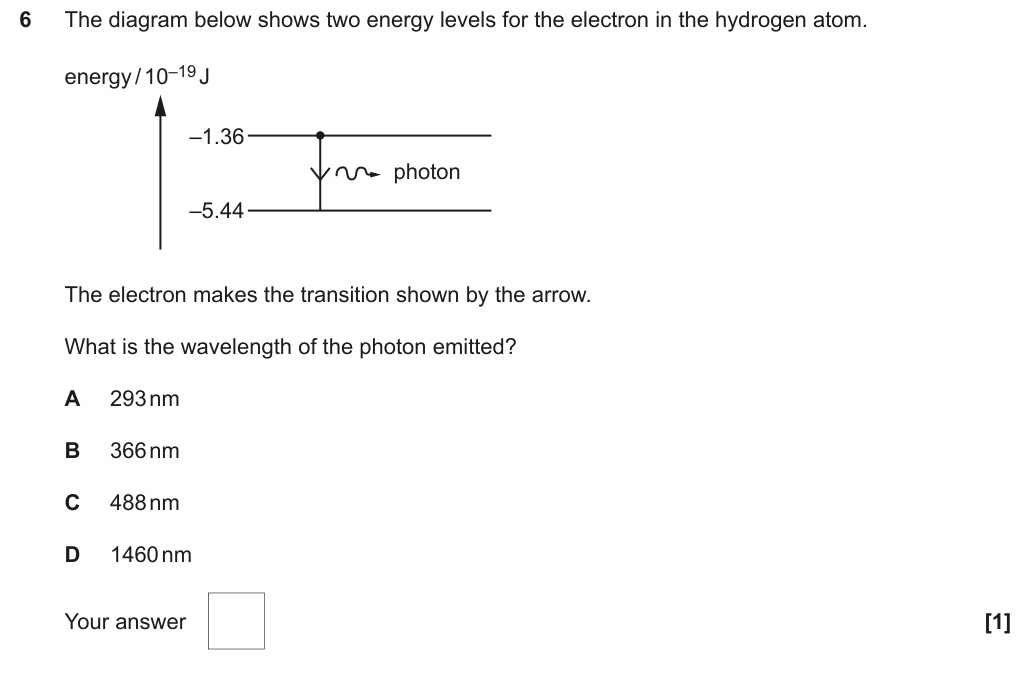
6 Stars: stellar evolution, energy levels, spectra, Wien's law and Stefan's law 1Multiple choice
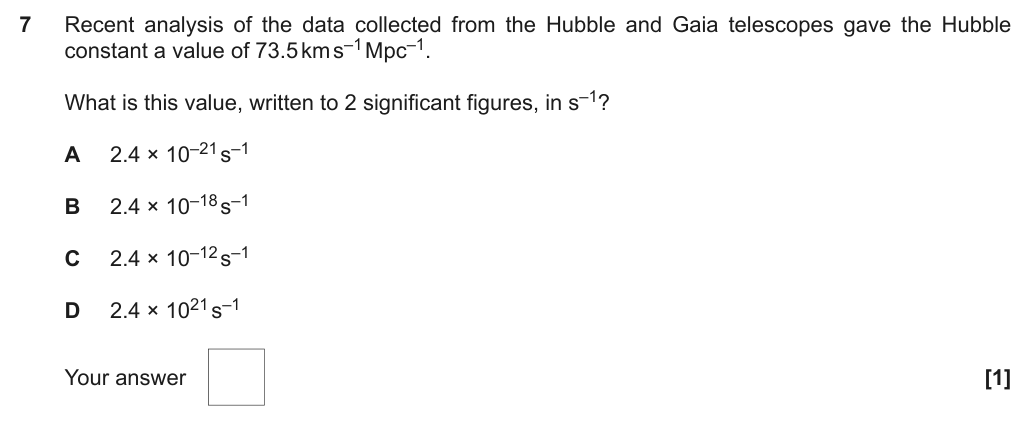
7 Cosmology: parallax, the Doppler effect, Hubble's law and the Big Bang 1Multiple choice
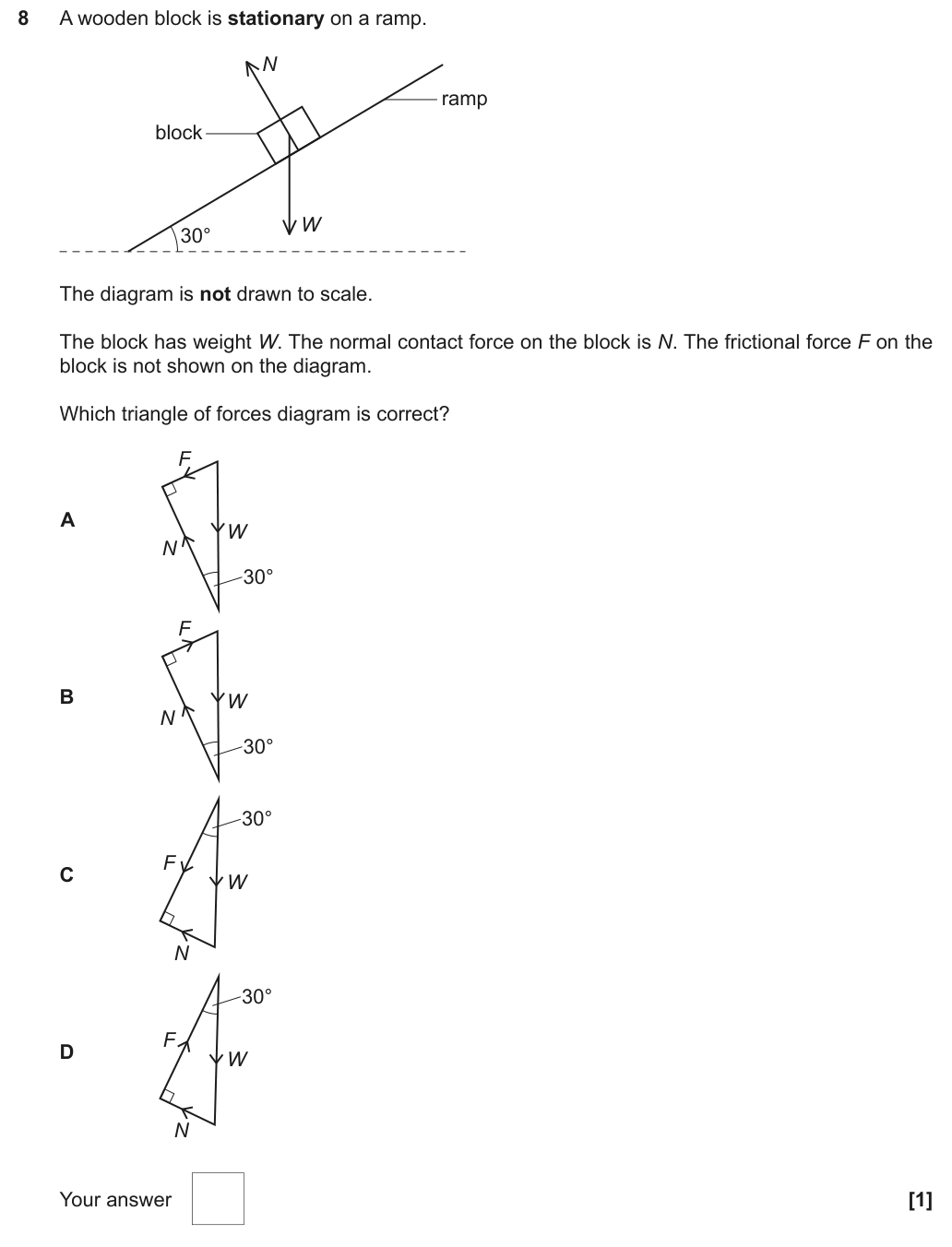
8 Equilibrium: moments, couples and centre of mass, Scalars and vectors 1Multiple choice
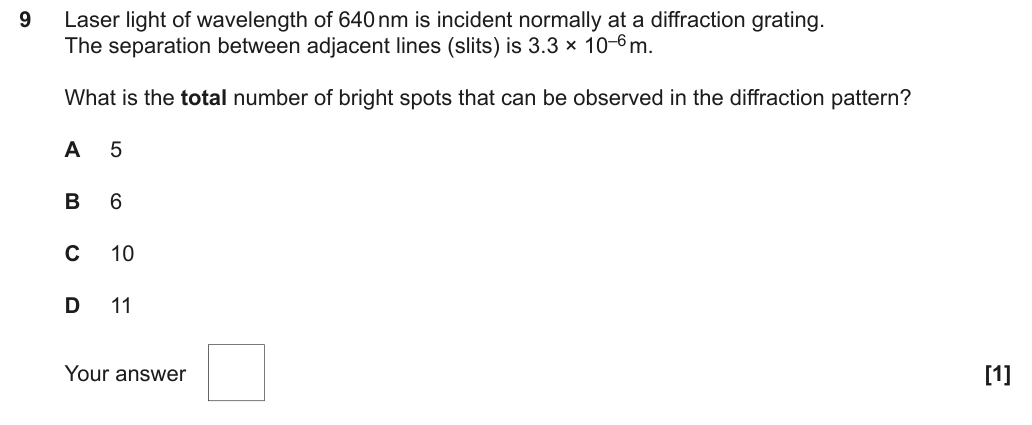
9 Stars: stellar evolution, energy levels, spectra, Wien's law and Stefan's law 1Multiple choice
10 Mechanical properties of matter: stress, strain and the Young modulus, Dynamics, drag and terminal velocity, Springs and Hooke's law 1Multiple choice
11 Cosmology: parallax, the Doppler effect, Hubble's law and the Big Bang 1Multiple choice
12 Simple harmonic motion, damping and resonance 1Multiple choice
13 Measurements and uncertainties 1Multiple choice
14 Kinematics: displacement, velocity and motion graphs 1Multiple choice
15 Ideal gases and the kinetic theory 1Multiple choice
16(a) Dynamics, drag and terminal velocity 2Diagram or graph
16(b) Scalars and vectors, Dynamics, drag and terminal velocity 1Show that
16(c) Equilibrium: moments, couples and centre of mass, Newton's laws of motion and momentum 1Calculation
16(d) Work, energy and power 3Calculation
16(e) Mechanical properties of matter: stress, strain and the Young modulus 3Calculation
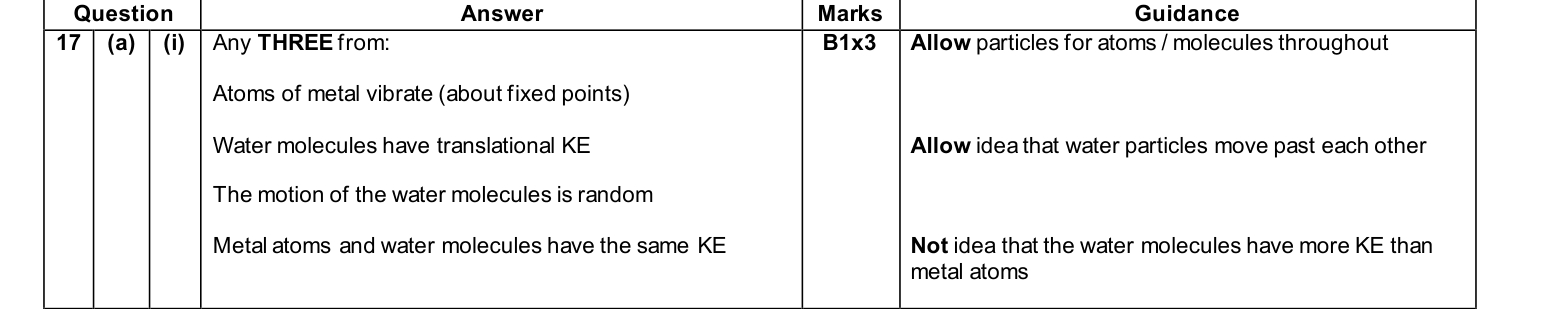
17(a)(i) Thermal physics: temperature, internal energy and specific heat capacity 3Explanation
17(a)(ii) Thermal physics: temperature, internal energy and specific heat capacity, Work, energy and power 3Calculation
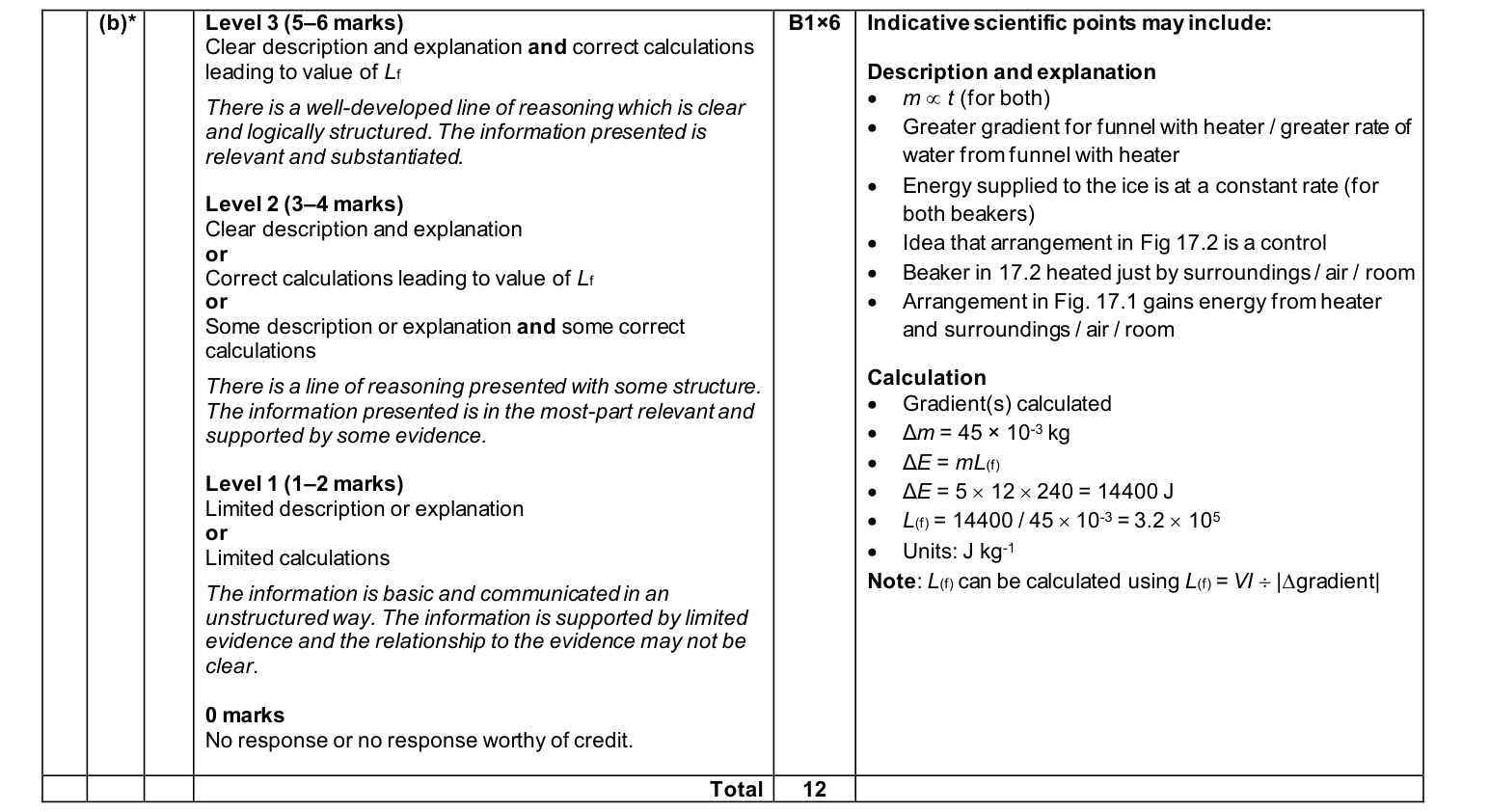
17(b) Thermal physics: temperature, internal energy and specific heat capacity, Practical skills: planning, analysis and evaluation 6Extended response
18(a) Work, energy and power, Projectile motion 2Explanation
18(b) Projectile motion, Scalars and vectors, Linear motion: the suvat equations and free fall 2Show that
18(c) Projectile motion, Scalars and vectors 3Calculation
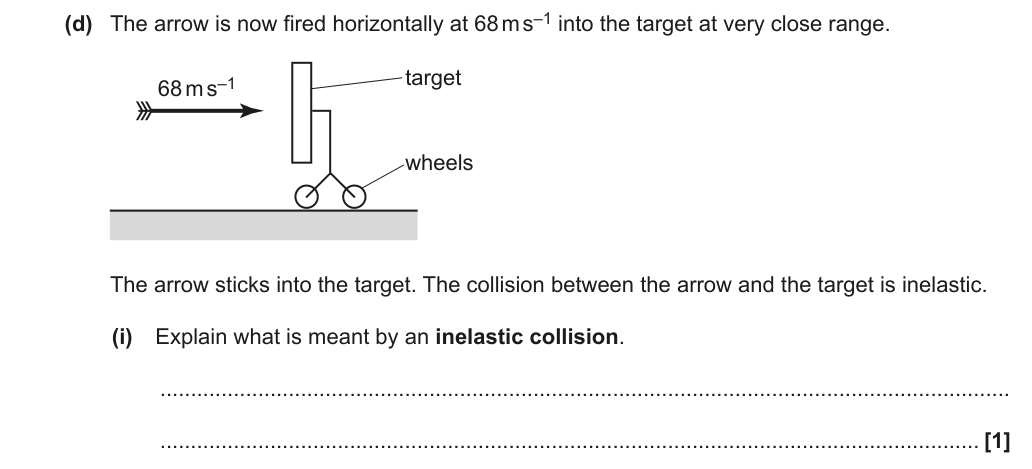
18(d)(i) Collisions: conservation of momentum 1Explanation
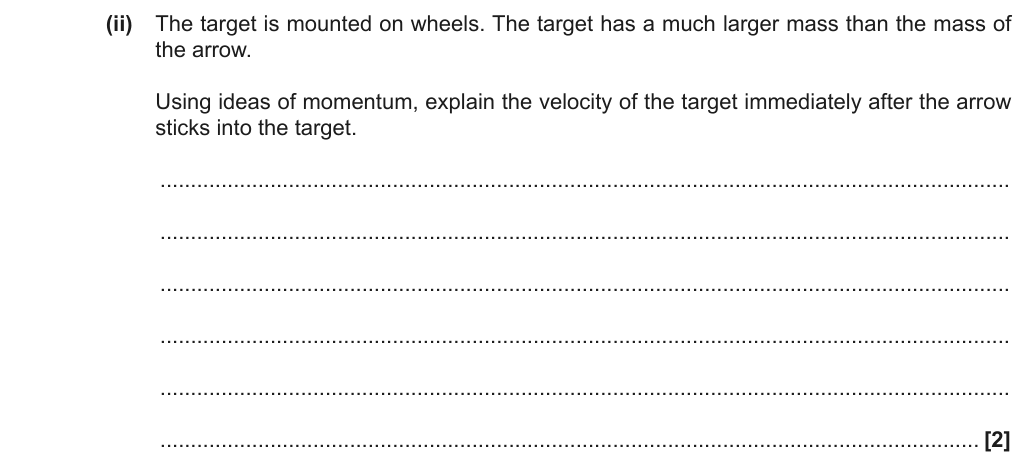
18(d)(ii) Collisions: conservation of momentum, Newton's laws of motion and momentum 2Explanation
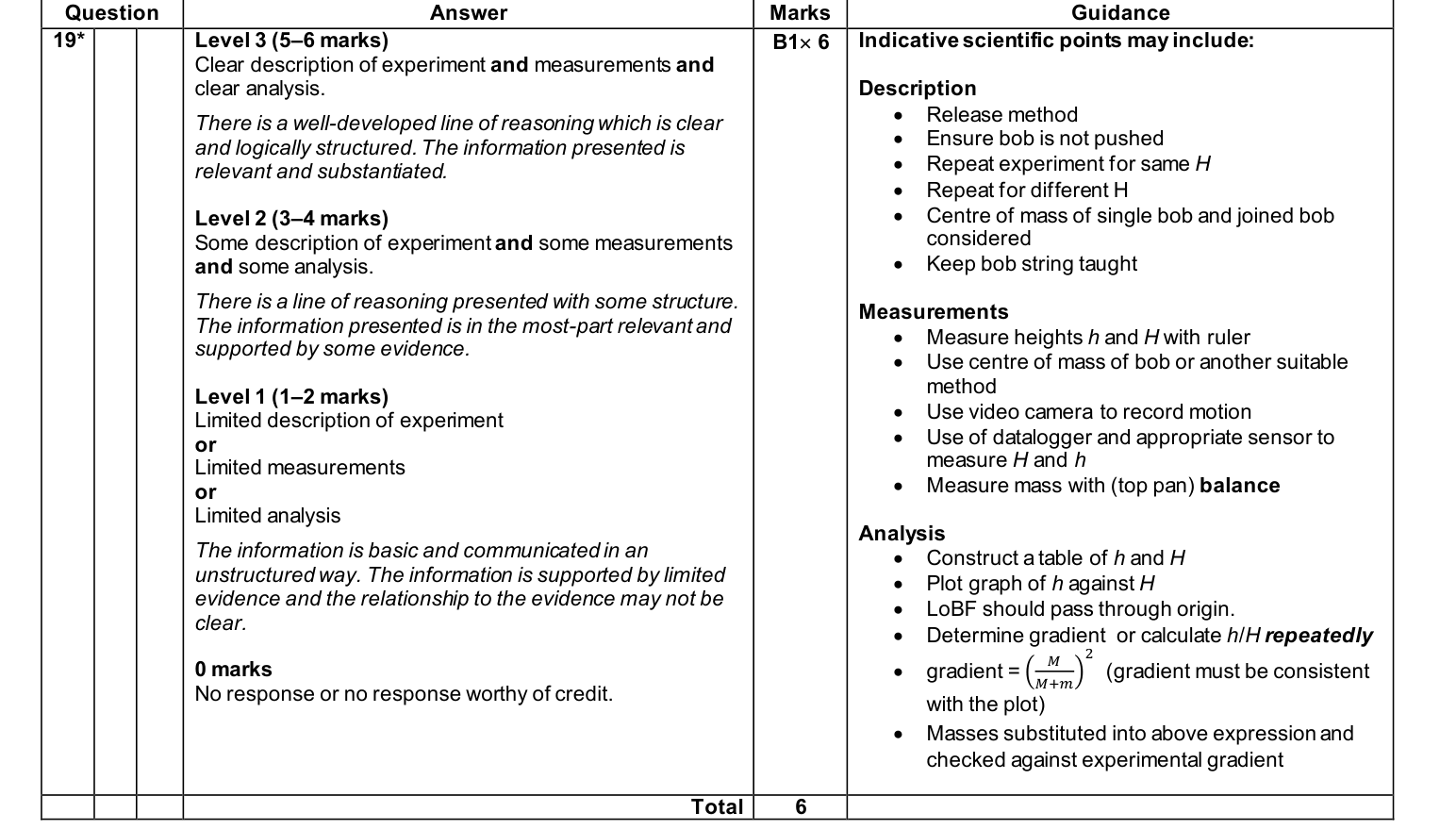
19 Linear motion: the suvat equations and free fall, Practical skills: planning, analysis and evaluation 6Extended response
20(a) Circular motion and centripetal force 3Show that
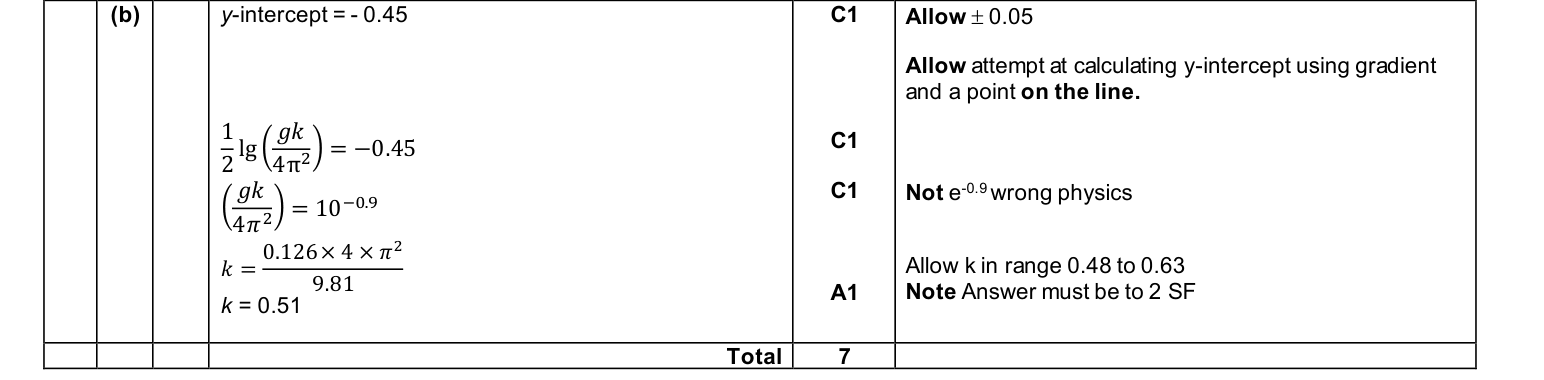
20(b) Practical skills: planning, analysis and evaluation 4Calculation
21(a)(i) Ideal gases and the kinetic theory, Thermal physics: temperature, internal energy and specific heat capacity 2Calculation
21(a)(ii) Ideal gases and the kinetic theory, Thermal physics: temperature, internal energy and specific heat capacity 2Calculation
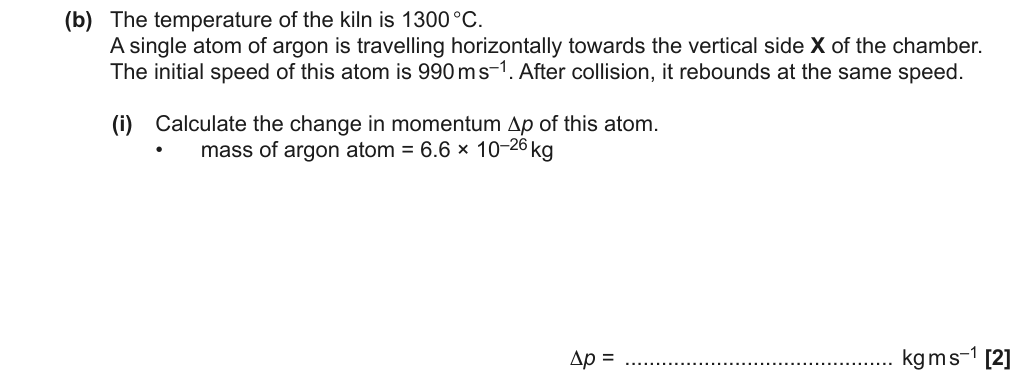
21(b)(i) Newton's laws of motion and momentum 2Calculation
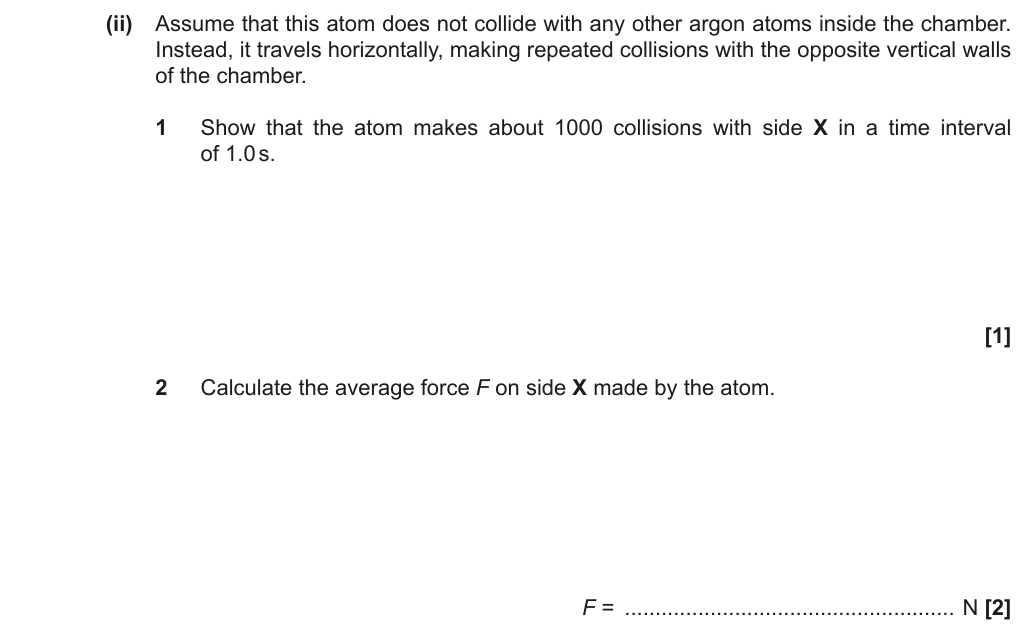
21(b)(ii) Newton's laws of motion and momentum, Kinematics: displacement, velocity and motion graphs, Ideal gases and the kinetic theory 3Show that
21(b)(iii) Ideal gases and the kinetic theory, Density, pressure and upthrust 2Explanation
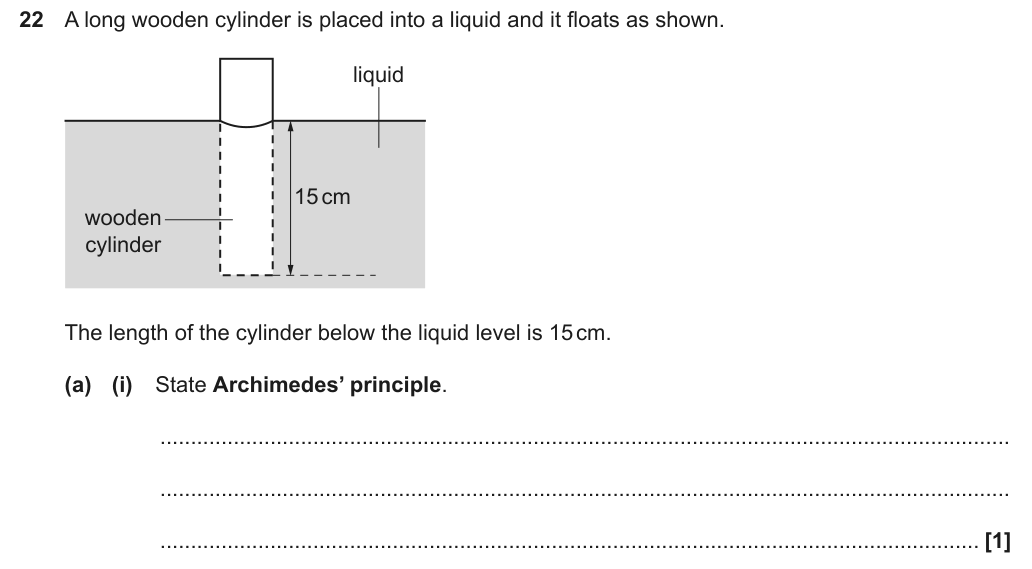
22(a)(i) Density, pressure and upthrust 1Short answer
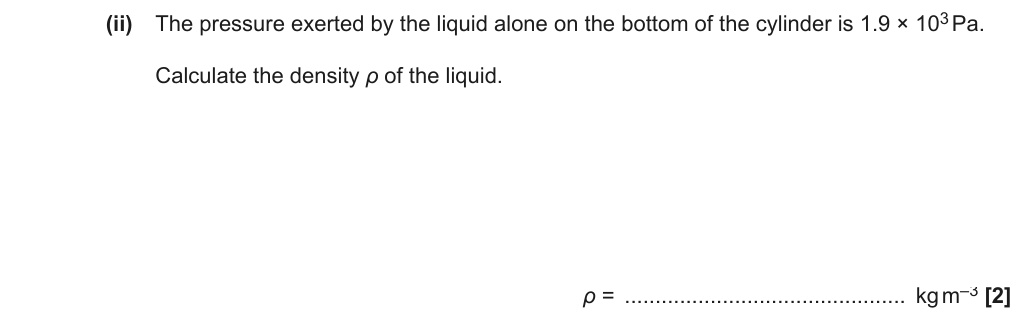
22(a)(ii) Density, pressure and upthrust 2Calculation
22(b)(i) Simple harmonic motion, damping and resonance 3Calculation
22(b)(ii) Simple harmonic motion, damping and resonance 2Calculation
22(b)(iii) Simple harmonic motion, damping and resonance 2Short answer
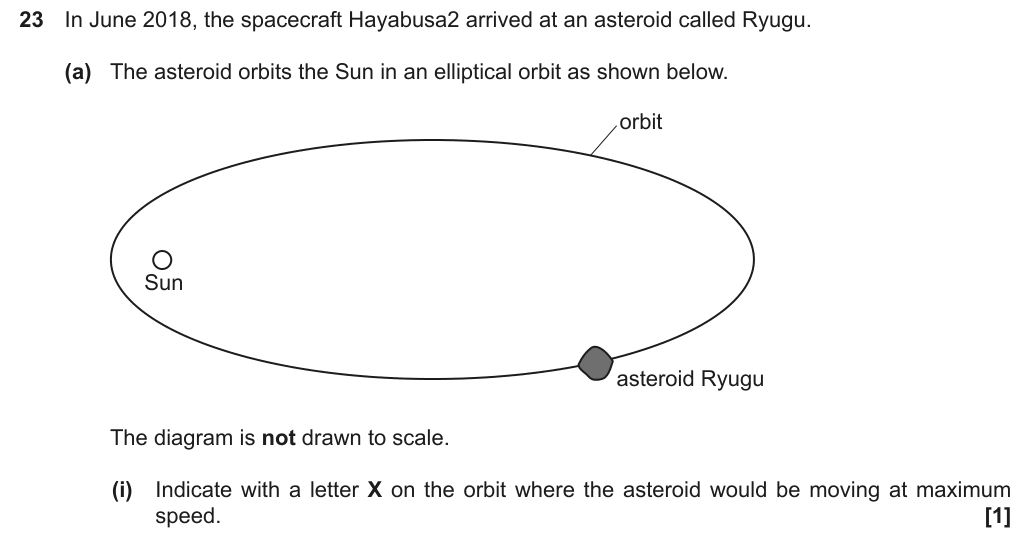
23(a)(i) Planetary motion: Kepler's laws and satellites 1Short answer
23(a)(ii) Planetary motion: Kepler's laws and satellites 2Explanation
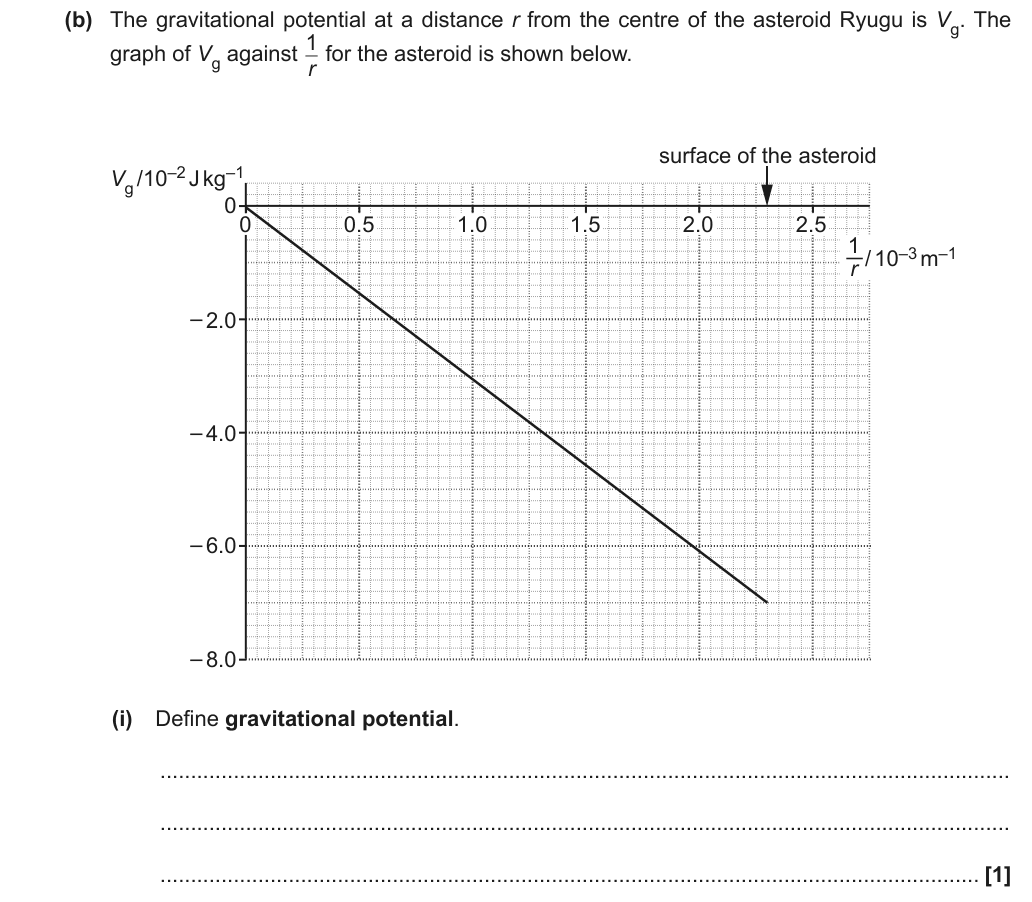
23(b)(i) Gravitational fields, Newton's law of gravitation and gravitational potential 1Short answer
23(b)(ii) Gravitational fields, Newton's law of gravitation and gravitational potential 1Show that
23(b)(iii) Gravitational fields, Newton's law of gravitation and gravitational potential, Practical skills: planning, analysis and evaluation 2Show that
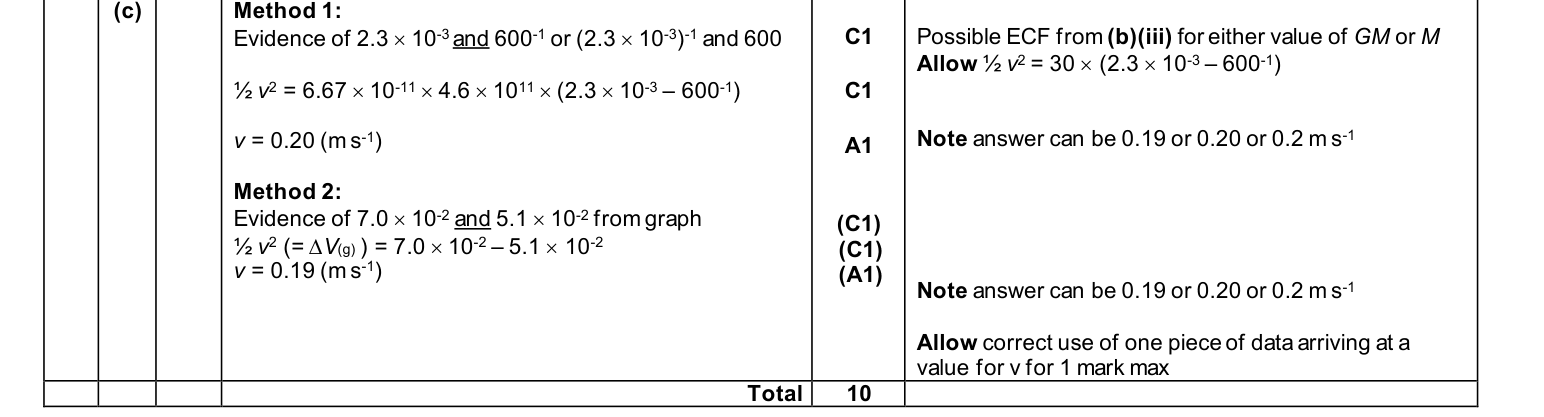
23(c) Gravitational fields, Newton's law of gravitation and gravitational potential, Work, energy and power 3Calculation
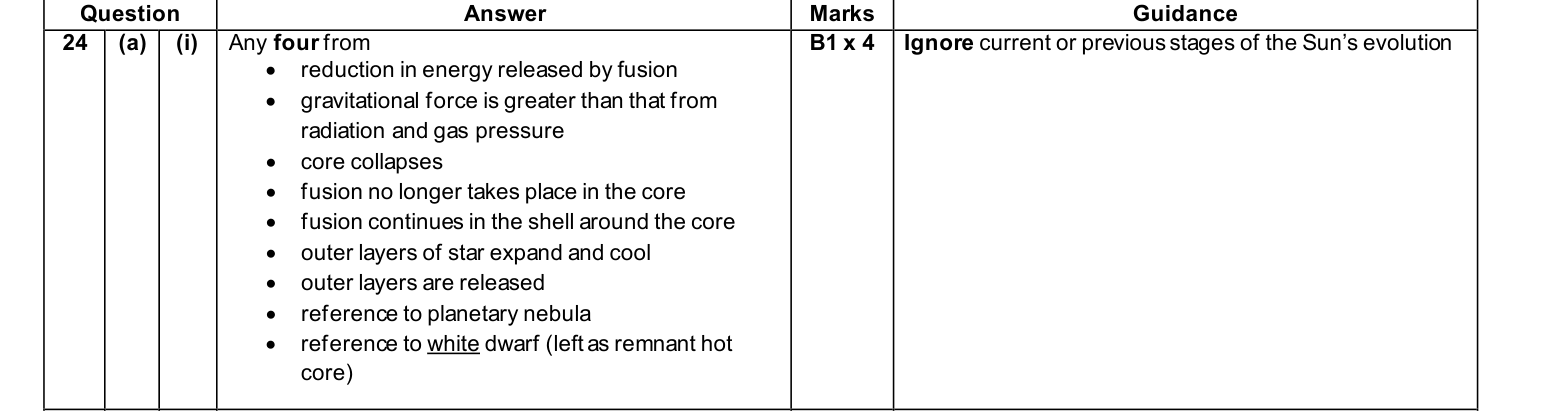
24(a) Stars: stellar evolution, energy levels, spectra, Wien's law and Stefan's law 4Explanation
24(b)(i) Stars: stellar evolution, energy levels, spectra, Wien's law and Stefan's law 2Show that
24(b)(ii) Stars: stellar evolution, energy levels, spectra, Wien's law and Stefan's law 2Calculation
24(c) Stars: stellar evolution, energy levels, spectra, Wien's law and Stefan's law 1Explanation

The questions

12345678910111213141516(a)16(b)16(c)16(d)16(e)17(a)(i)17(a)(ii)17(b)18(a)18(b)18(c)18(d)(i)18(d)(ii)1920(a)20(b)21(a)(i)21(a)(ii)21(b)(i)21(b)(ii)21(b)(iii)22(a)(i)22(a)(ii)22(b)(i)22(b)(ii)22(b)(iii)23(a)(i)23(a)(ii)23(b)(i)23(b)(ii)23(b)(iii)23(c)24(a)24(b)(i)24(b)(ii)24(c)
November 2020 · Paper 1 · Q1 1 mark Multiple choice Easy quantities and unitswork energy and power
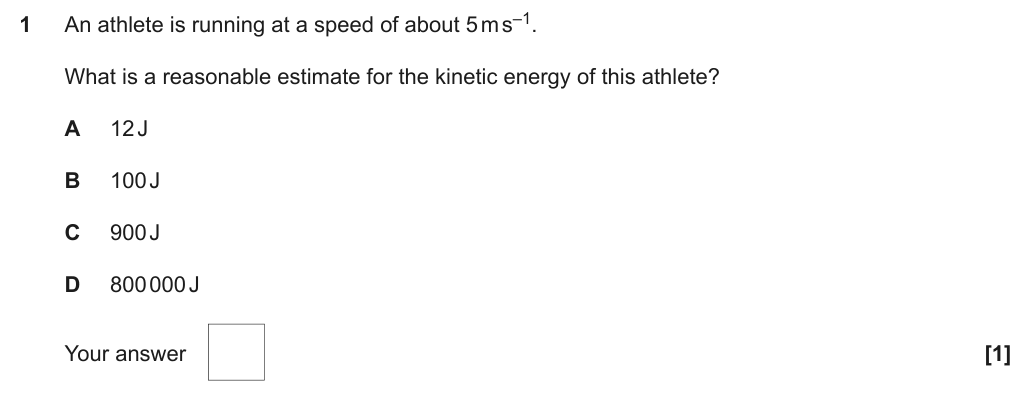
1 An athlete is running at a speed of about 5 m s–1.
What is a reasonable estimate for the kinetic energy of this athlete?
A 12 J
B 100 J
C 900 J
D 800 000 J
Your answer [1]
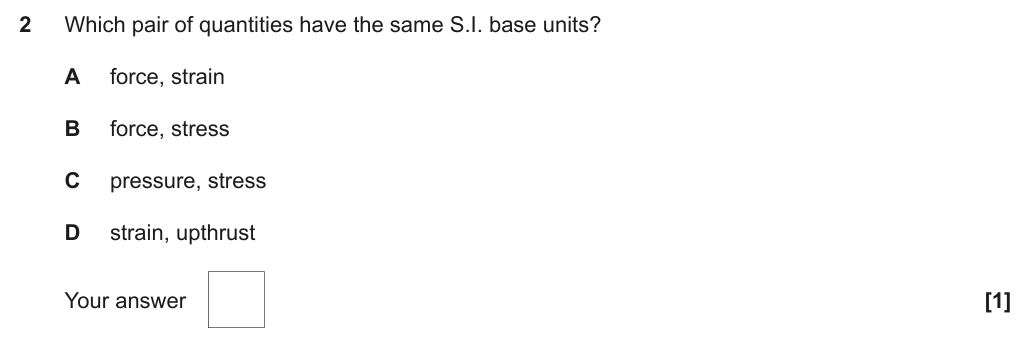
November 2020 · Paper 1 · Q2 1 mark Multiple choice Easy quantities and units
2 Which pair of quantities have the same S.I. base units?
A force, strain
B force, stress
C pressure, stress
D strain, upthrust
Your answer [1]
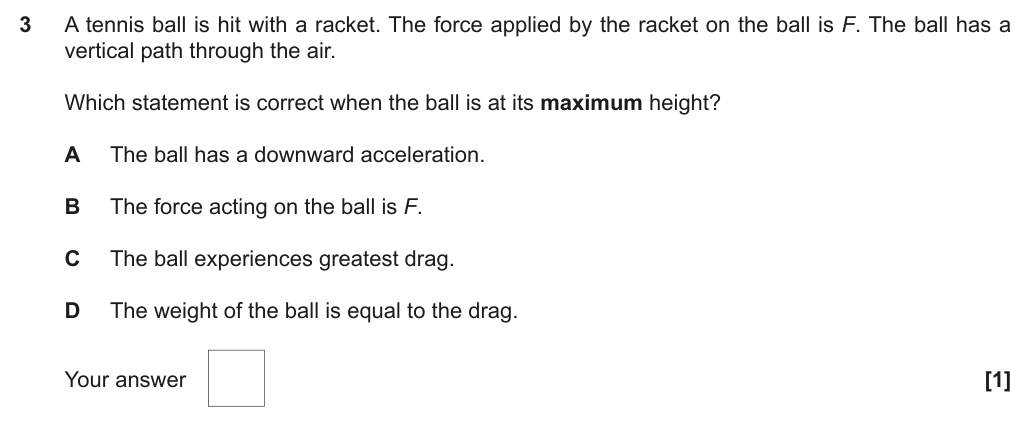
November 2020 · Paper 1 · Q3 1 mark Multiple choice dynamics and terminal velocity
3 A tennis ball is hit with a racket. The force applied by the racket on the ball is F. The ball has a
vertical path through the air.
Which statement is correct when the ball is at its maximum height?
A The ball has a downward acceleration.
B The force acting on the ball is F.
C The ball experiences greatest drag.
D The weight of the ball is equal to the drag.
Your answer [1]
November 2020 · Paper 1 · Q4 1 mark Multiple choice simple harmonic motion
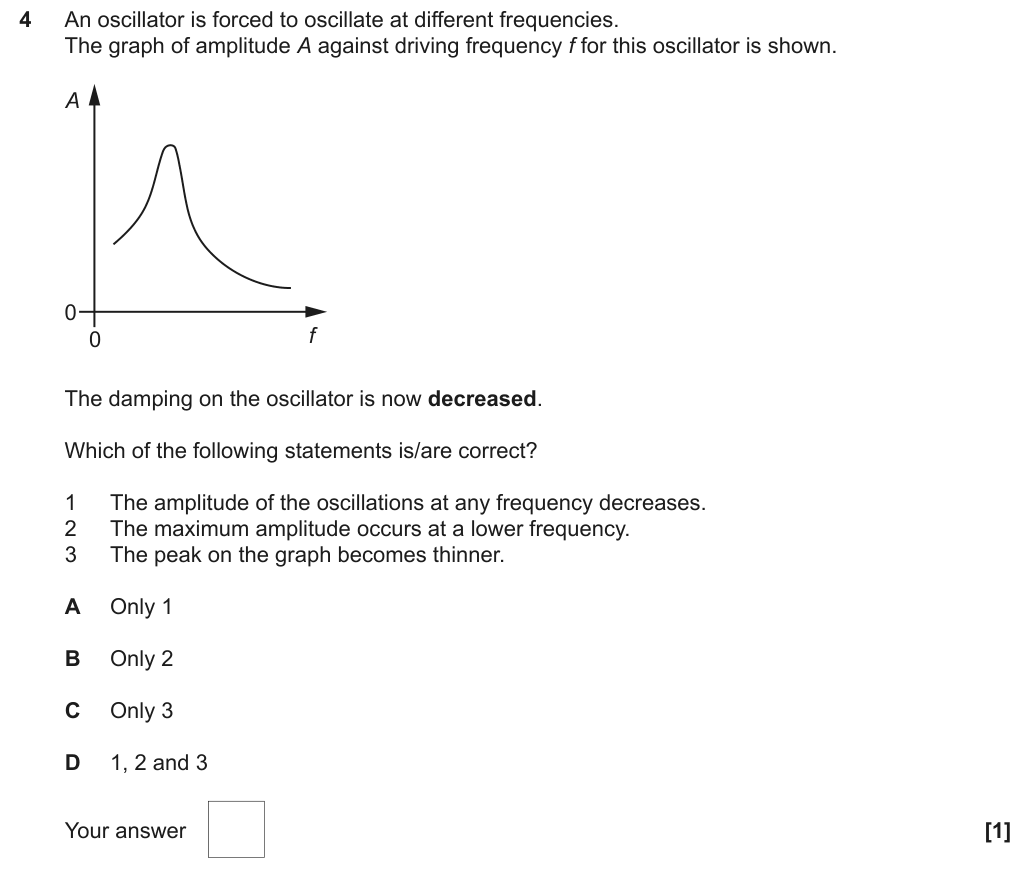
4 An oscillator is forced to oscillate at different frequencies.
The graph of amplitude A against driving frequency f for this oscillator is shown.
A
0
0 f
The damping on the oscillator is now decreased.
Which of the following statements is/are correct?
1 The amplitude of the oscillations at any frequency decreases.
2 The maximum amplitude occurs at a lower frequency.
3 The peak on the graph becomes thinner.
A Only 1
B Only 2
C Only 3
D 1, 2 and 3
Your answer [1]
November 2020 · Paper 1 · Q5 1 mark Multiple choice gravitational fields
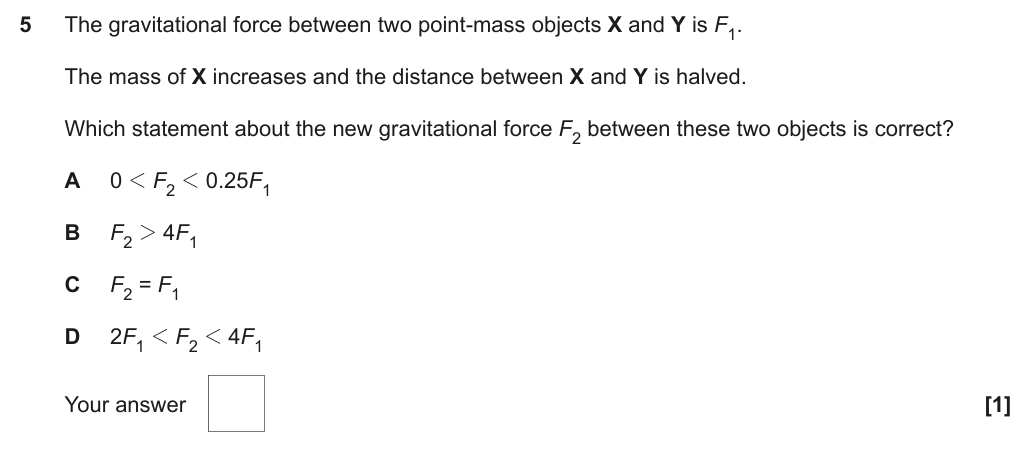
5 The gravitational force between two point-mass objects X and Y is F1.
The mass of X increases and the distance between X and Y is halved.
Which statement about the new gravitational force F2 between these two objects is correct?
A 0 1 F2 1 0.25F1
B F2 2 4F1
C F2 = F1
D 2F1 1 F2 1 4F1
Your answer [1]
November 2020 · Paper 1 · Q6 1 mark Multiple choice stars
6 The diagram below shows two energy levels for the electron in the hydrogen atom.
energy / 10–19 J
–1.36
photon
–5.44
The electron makes the transition shown by the arrow.
What is the wavelength of the photon emitted?
A 293 nm
B 366 nm
C 488 nm
D 1460 nm
Your answer [1]
November 2020 · Paper 1 · Q7 1 mark Multiple choice cosmology
7 Recent analysis of the data collected from the Hubble and Gaia telescopes gave the Hubble
constant a value of 73.5 km s–1 Mpc–1.
What is this value, written to 2 significant figures, in s–1?
A 2.4 × 10⁻²¹ s–1
B 2.4 × 10⁻¹⁸ s–1
C 2.4 × 10⁻¹² s–1
D 2.4 × 10²¹ s–1
Your answer [1]
November 2020 · Paper 1 · Q8 1 mark Multiple choice equilibrium and momentsscalars and vectors
8 A wooden block is stationary on a ramp.
N
ramp
block
W
30°
The diagram is not drawn to scale.
The block has weight W. The normal contact force on the block is N. The frictional force F on the
block is not shown on the diagram.
Which triangle of forces diagram is correct?
F
A
W
N
30°
F
B W
N
30°
30°
F
C
W
N
30°
F
D
W
N
Your answer [1]
November 2020 · Paper 1 · Q9 1 mark Multiple choice Hard stars
9 Laser light of wavelength of 640 nm is incident normally at a diffraction grating.
The separation between adjacent lines (slits) is 3.3 × 10⁻⁶ m.
What is the total number of bright spots that can be observed in the diffraction pattern?
A 5
B 6
C 10
D 11
Your answer [1]
November 2020 · Paper 1 · Q10 1 mark Multiple choice Hard materials and young modulusdynamics and terminal velocitysprings
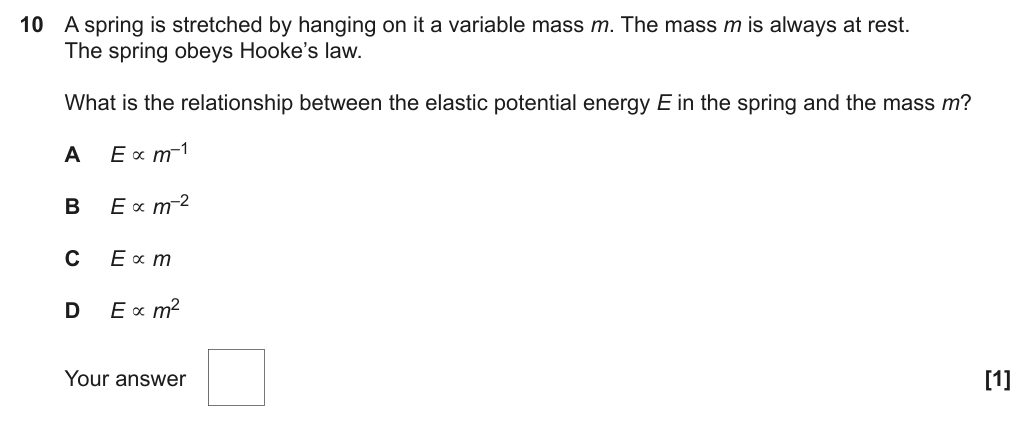
10 A spring is stretched by hanging on it a variable mass m. The mass m is always at rest.
The spring obeys Hooke’s law.
What is the relationship between the elastic potential energy E in the spring and the mass m?
A E ∝ m–1
B E ∝ m–2
C E ∝ m
D E ∝ m2
Your answer [1]
November 2020 · Paper 1 · Q11 1 mark Multiple choice cosmology
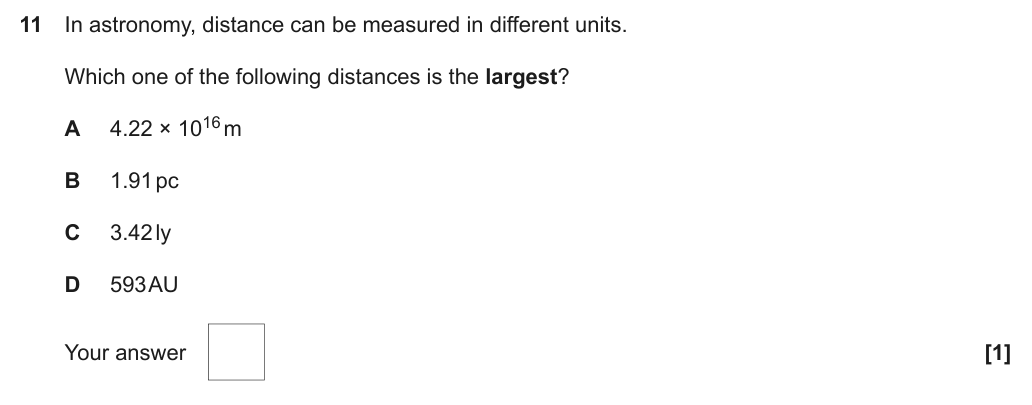
11 In astronomy, distance can be measured in different units.
Which one of the following distances is the largest?
A 4.22 × 10¹⁶ m
B 1.91 pc
C 3.42 ly
D 593 AU
Your answer [1]
November 2020 · Paper 1 · Q12 1 mark Multiple choice simple harmonic motion
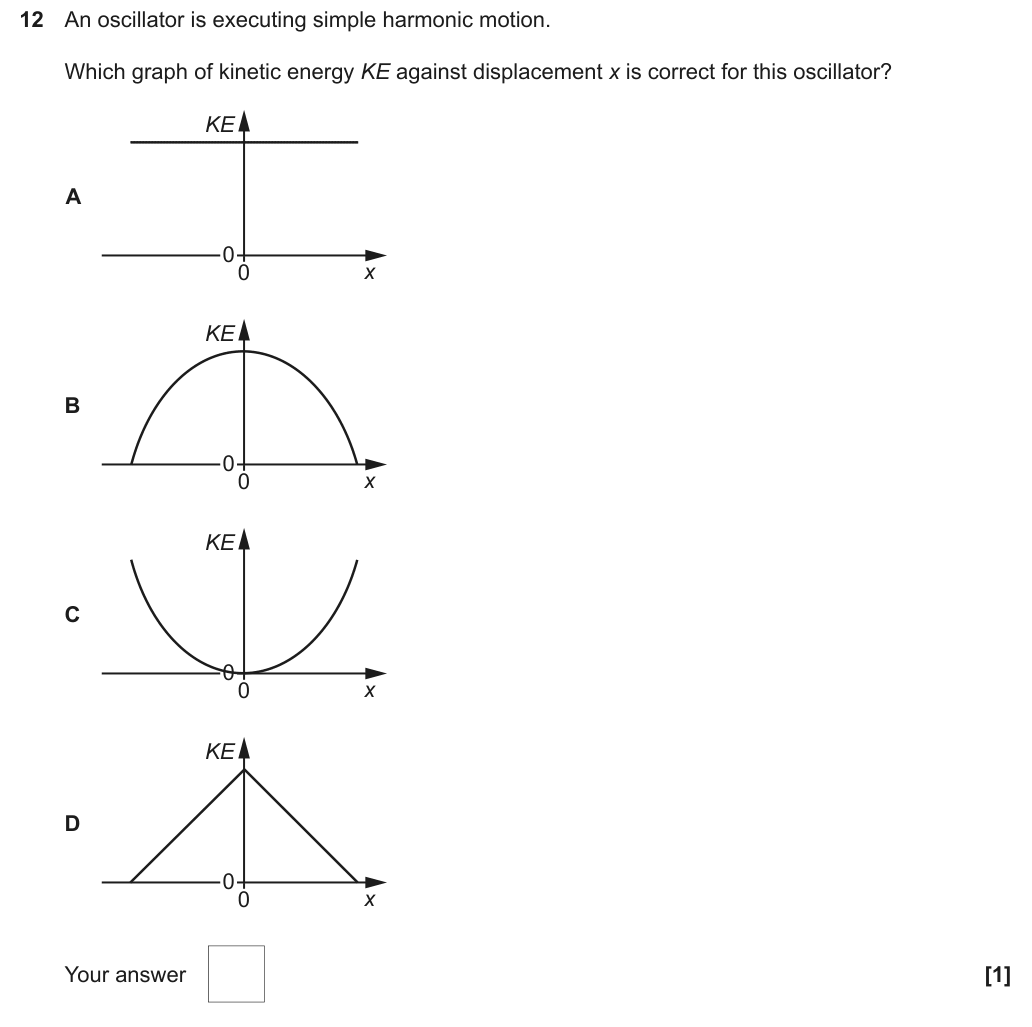
12 An oscillator is executing simple harmonic motion.
Which graph of kinetic energy KE against displacement x is correct for this oscillator?
KE
A
0
0 x
KE
B
0
0 x
KE
C
0
0 x
KE
D
0
0 x
Your answer [1]
November 2020 · Paper 1 · Q13 1 mark Multiple choice measurements and uncertainties
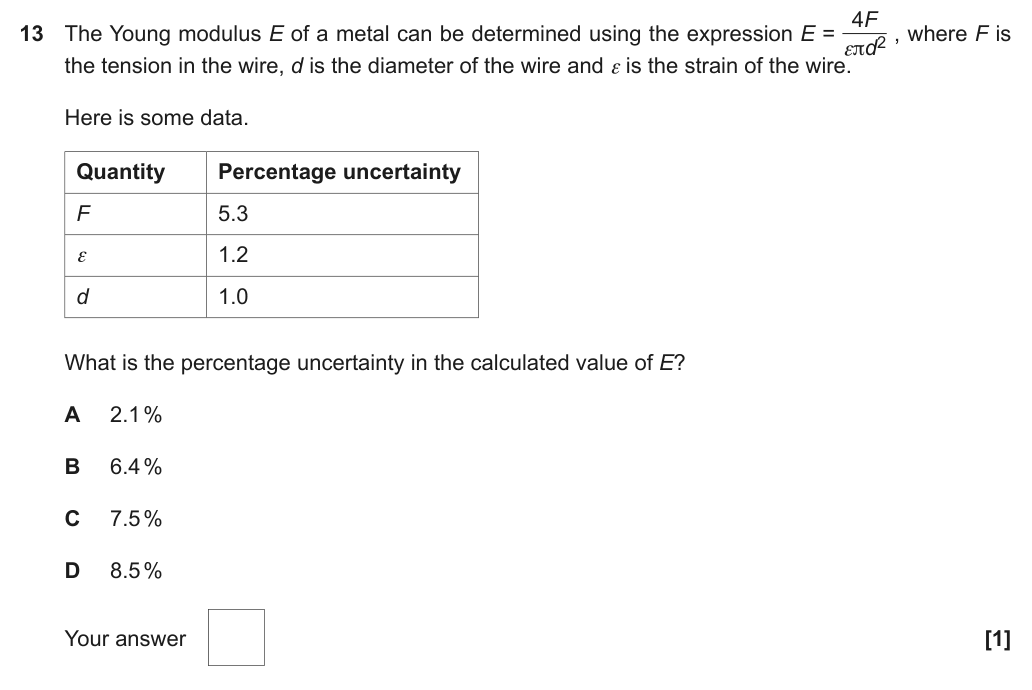
13 The Young modulus E of a metal can be determined using the expression E = 4F
επd2 , where F is
the tension in the wire, d is the diameter of the wire and ε is the strain of the wire.
Here is some data.
Quantity Percentage uncertainty
F 5.3
ε 1.2
d 1.0
What is the percentage uncertainty in the calculated value of E?
A 2.1 %
B 6.4 %
C 7.5 %
D 8.5 %
Your answer [1]
November 2020 · Paper 1 · Q14 1 mark Multiple choice kinematics
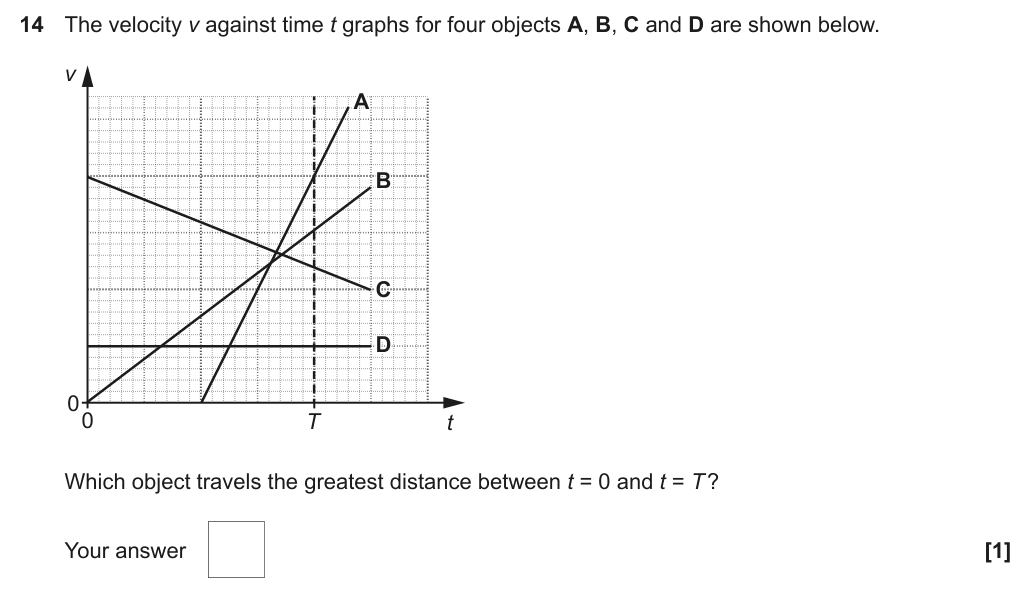
14 The velocity v against time t graphs for four objects A, B, C and D are shown below.
v
A A
B B
C C
D D
00
T t
Which object travels the greatest distance between t = 0 and t = T ?
Your answer [1]
November 2020 · Paper 1 · Q15 1 mark Multiple choice Easy ideal gases
15 The kinetic theory of matter is a model used to describe the behaviour of particles (atoms or
molecules) in an ideal gas. There are a number of assumptions made in the kinetic model for an
ideal gas.
Which one of the following assumptions is not correct?
A The collisions of particles with each other and the container walls are perfectly inelastic.
B The electrostatic forces between particles are negligible except during collisions.
C The particles occupy negligible volume compared to the volume of the gas.
D There are a large number of particles in random motion.
Your answer [1]
November 2020 · Paper 1 · Q16(a) 2 marks Diagram or graph dynamics and terminal velocity
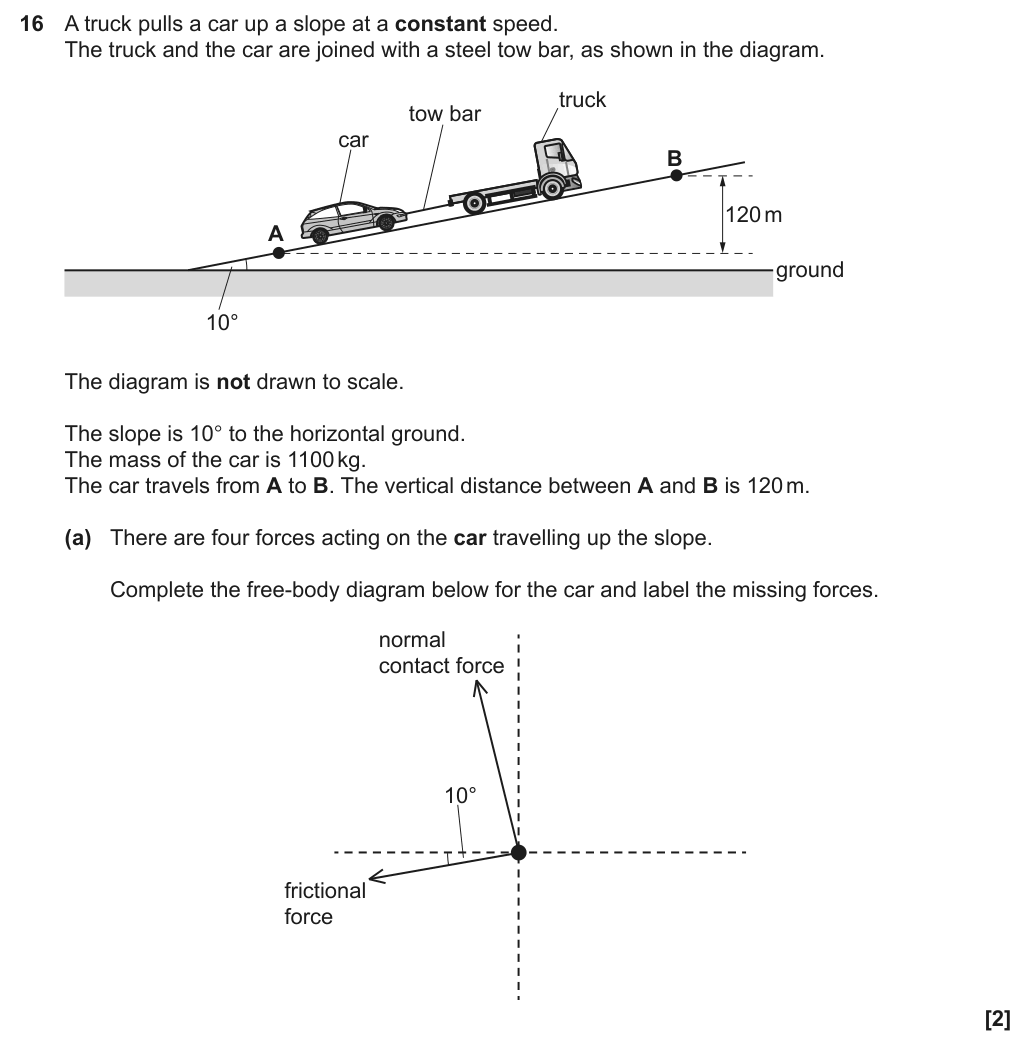
16 A truck pulls a car up a slope at a constant speed.
The truck and the car are joined with a steel tow bar, as shown in the diagram.
truck
tow bar
car
B
truck
120 m
A
ground
10°
The diagram is not drawn to scale.
The slope is 10° to the horizontal ground.
The mass of the car is 1100 kg.
The car travels from A to B. The vertical distance between A and B is 120 m.
(a) There are four forces acting on the car travelling up the slope.
Complete the free-body diagram below for the car and label the missing forces.
normal
contact force
10°
frictional
force
[2]
November 2020 · Paper 1 · Q16(b) 1 mark Show that scalars and vectorsdynamics and terminal velocity
Earlier part of question 16 that this part usesEarlier part of November 2020 Paper 1 question 16
(b) Show that the component of the weight of the car Ws acting down the slope is about 1900 N.
[1]
November 2020 · Paper 1 · Q16(c) 1 mark Calculation equilibrium and momentsnewtons laws and momentum
Earlier parts of question 16 that this part usesEarlier part of November 2020 Paper 1 question 16Earlier part of November 2020 Paper 1 question 16
(c) The total frictional force acting on the car as it travels up the slope is 300 N.
Calculate the force provided by the tow bar on the car.
force =  ...................................................... N [1]
November 2020 · Paper 1 · Q16(d) 3 marks Calculation work energy and power
Earlier parts of question 16 that this part usesEarlier part of November 2020 Paper 1 question 16Earlier part of November 2020 Paper 1 question 16
(d) Calculate the work done by the force provided by the tow bar as the car travels from A to B.
work done =  ....................................................... J [3]
November 2020 · Paper 1 · Q16(e) 3 marks Calculation materials and young modulus
Earlier part of question 16 that this part usesEarlier part of November 2020 Paper 1 question 16
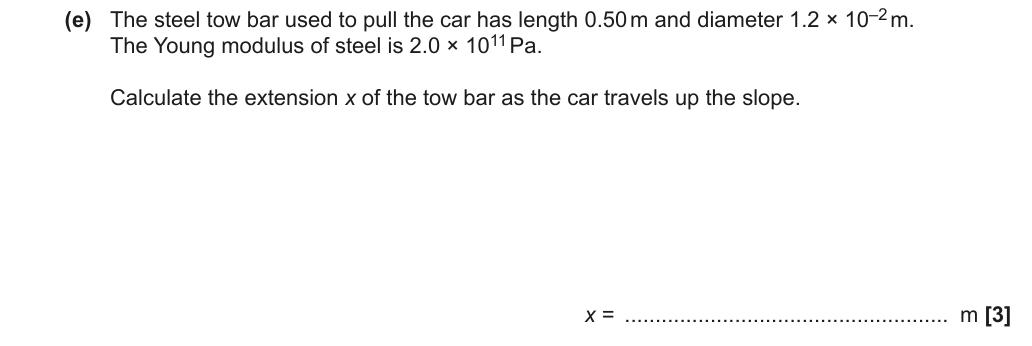
(e) The steel tow bar used to pull the car has length 0.50 m and diameter 1.2 × 10⁻² m.
The Young modulus of steel is 2.0 × 10¹¹ Pa.
Calculate the extension x of the tow bar as the car travels up the slope.
x =  ..................................................... m [3]
November 2020 · Paper 1 · Q17(a)(i) 3 marks Explanation Hard thermal physics
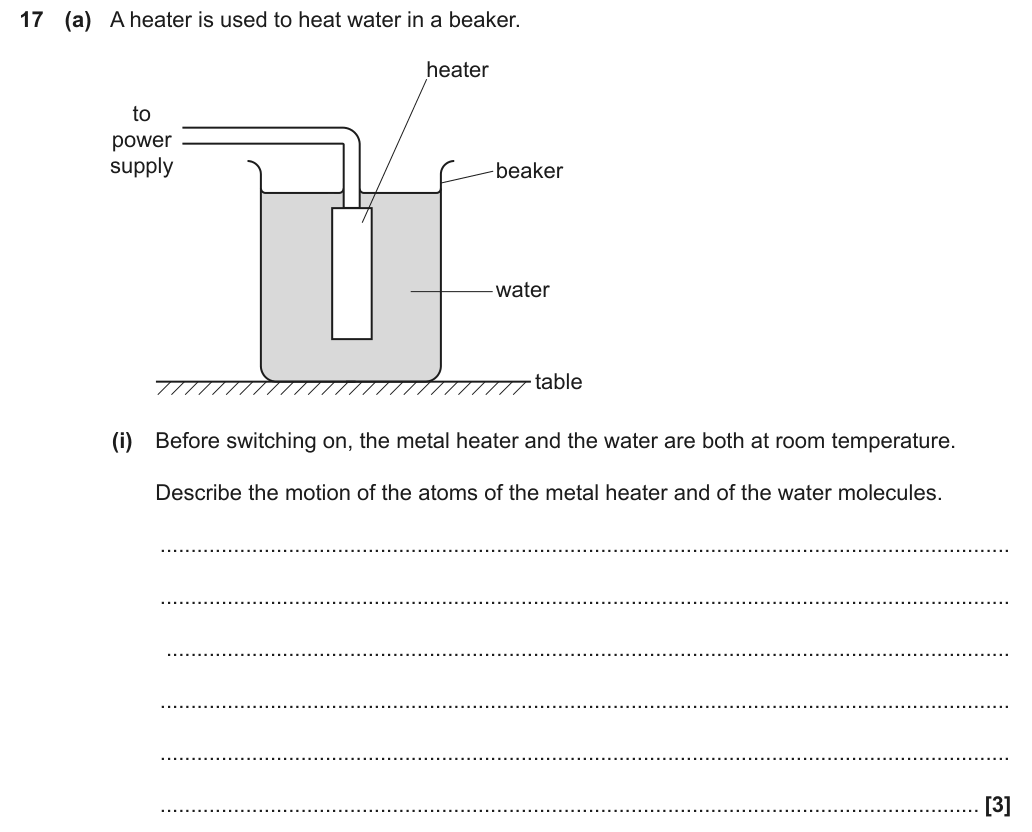
17 (a) A heater is used to heat water in a beaker.
heater
to
power
supply beaker
water
table
(i) Before switching on, the metal heater and the water are both at room temperature.
Describe the motion of the atoms of the metal heater and of the water molecules.
...........................................................................................................................................
...........................................................................................................................................
..........................................................................................................................................
...........................................................................................................................................
...........................................................................................................................................
...................................................................................................................................... [3]
November 2020 · Paper 1 · Q17(a)(ii) 3 marks Calculation Hard thermal physicswork energy and power
(ii) The heater is now switched on.
The power of the heater is 200 W.
The mass of the water in the beaker is 500 g.
It takes 10.0 minutes to increase the temperature of the water in the beaker from 20 °C to
60 °C.
Calculate the energy transferred from the water to the beaker and the surroundings.
• specific heat capacity of water = 4200 J kg–1 K–1
energy transferred =  ....................................................... J [3]
November 2020 · Paper 1 · Q17(b) 6 marks 6-mark extended response Hard thermal physicspractical skills
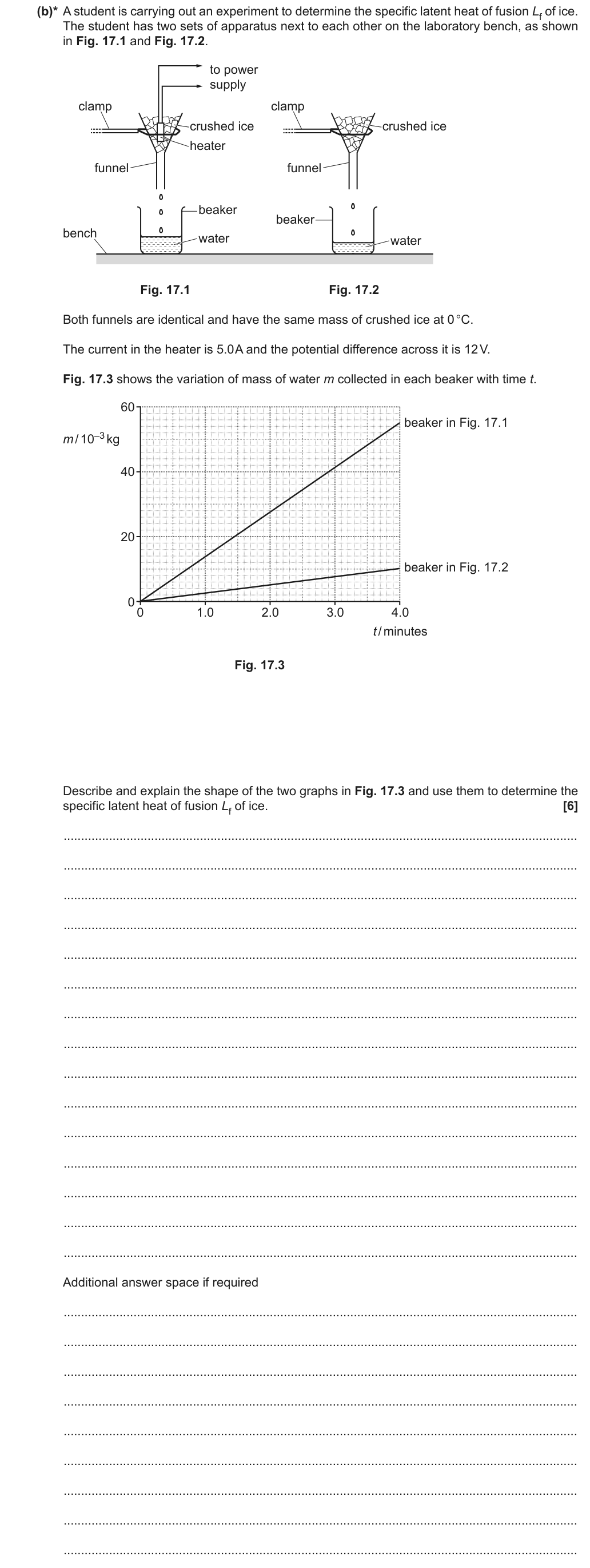
(b)* A student is carrying out an experiment to determine the specific latent heat of fusion Lf of ice.
The student has two sets of apparatus next to each other on the laboratory bench, as shown
in Fig. 17.1 and Fig. 17.2.
to power
supply
clamp clamp
crushed ice crushed ice
heater
funnel funnel
beaker
beaker
bench
water water
Fig. 17.1           Fig. 17.2
Both funnels are identical and have the same mass of crushed ice at 0 °C.
The current in the heater is 5.0 A and the potential difference across it is 12 V.
Fig. 17.3 shows the variation of mass of water m collected in each beaker with time t.
60
beaker in Fig. 17.1
m / 10–3 kg
40
20
beaker in Fig. 17.2
0
0 1.0 2.0 3.0 4.0
t / minutes
Fig. 17.3
Describe and explain the shape of the two graphs in Fig. 17.3 and use them to determine the
specific latent heat of fusion Lf of ice. [6]
...................................................................................................................................................
...................................................................................................................................................
...................................................................................................................................................
...................................................................................................................................................
...................................................................................................................................................
...................................................................................................................................................
...................................................................................................................................................
...................................................................................................................................................
...................................................................................................................................................
...................................................................................................................................................
...................................................................................................................................................
...................................................................................................................................................
...................................................................................................................................................
...................................................................................................................................................
...................................................................................................................................................
Additional answer space if required
...................................................................................................................................................
...................................................................................................................................................
...................................................................................................................................................
...................................................................................................................................................
...................................................................................................................................................
...................................................................................................................................................
...................................................................................................................................................
...................................................................................................................................................
...................................................................................................................................................
November 2020 · Paper 1 · Q18(a) 2 marks Explanation work energy and powerprojectile motion
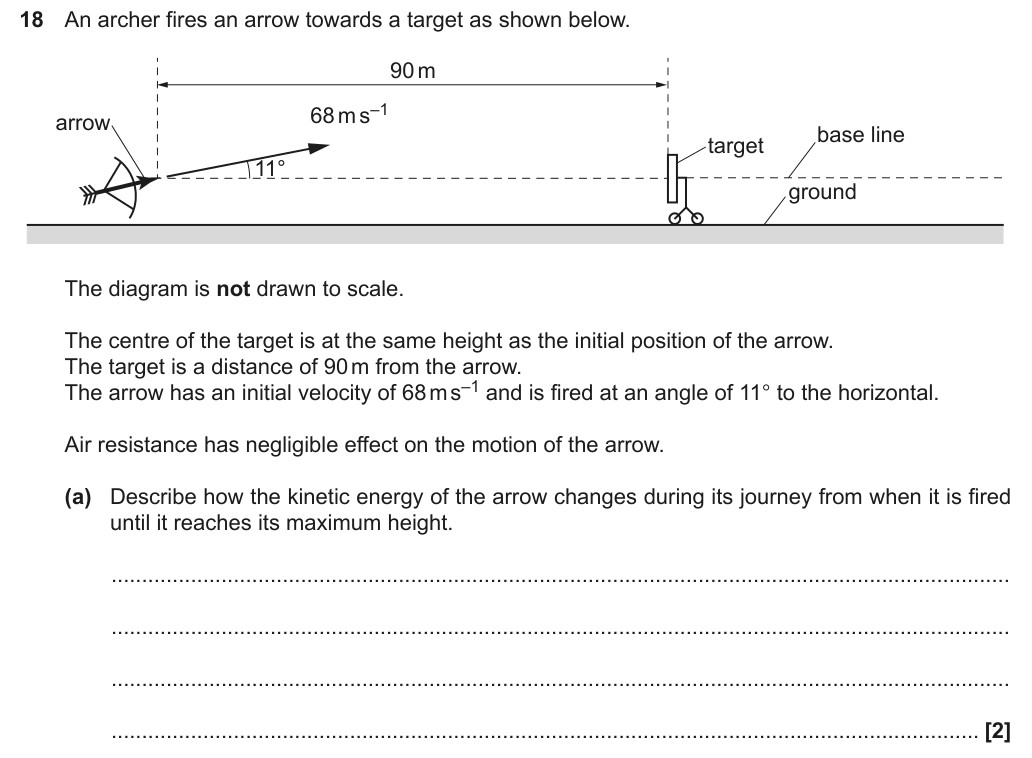
18 An archer fires an arrow towards a target as shown below.
90 m
68 m s–1
arrow
base line
target
11°
ground
The diagram is not drawn to scale.
The centre of the target is at the same height as the initial position of the arrow.
The target is a distance of 90 m from the arrow.
The arrow has an initial velocity of 68 m s–1 and is fired at an angle of 11° to the horizontal.
Air resistance has negligible effect on the motion of the arrow.
(a) Describe how the kinetic energy of the arrow changes during its journey from when it is fired
until it reaches its maximum height.
...................................................................................................................................................
...................................................................................................................................................
...................................................................................................................................................
.............................................................................................................................................. [2]
November 2020 · Paper 1 · Q18(b) 2 marks Show that projectile motionscalars and vectorslinear motion
Earlier part of question 18 that this part usesEarlier part of November 2020 Paper 1 question 18
(b) Show that the time taken for the arrow to reach its maximum height is about 1.3 s.
[2]
November 2020 · Paper 1 · Q18(c) 3 marks Calculation projectile motionscalars and vectors
Earlier parts of question 18 that this part usesEarlier part of November 2020 Paper 1 question 18Earlier part of November 2020 Paper 1 question 18
(c) The arrow misses the target.
Calculate the horizontal distance, measured along the base line, by which the arrow misses
the target.
horizontal distance =  ..................................................... m [3]
November 2020 · Paper 1 · Q18(d)(i) 1 mark Explanation collisions
(d) The arrow is now fired horizontally at 68 m s–1 into the target at very close range.
target
68 m s–1
wheels
The arrow sticks into the target. The collision between the arrow and the target is inelastic.
(i) Explain what is meant by an inelastic collision.
...........................................................................................................................................
...................................................................................................................................... [1]
November 2020 · Paper 1 · Q18(d)(ii) 2 marks Explanation collisionsnewtons laws and momentum
Earlier part of question 18 that this part usesEarlier part of November 2020 Paper 1 question 18
(ii) The target is mounted on wheels. The target has a much larger mass than the mass of
the arrow.
Using ideas of momentum, explain the velocity of the target immediately after the arrow
sticks into the target.
...........................................................................................................................................
...........................................................................................................................................
...........................................................................................................................................
...........................................................................................................................................
...........................................................................................................................................
...................................................................................................................................... [2]
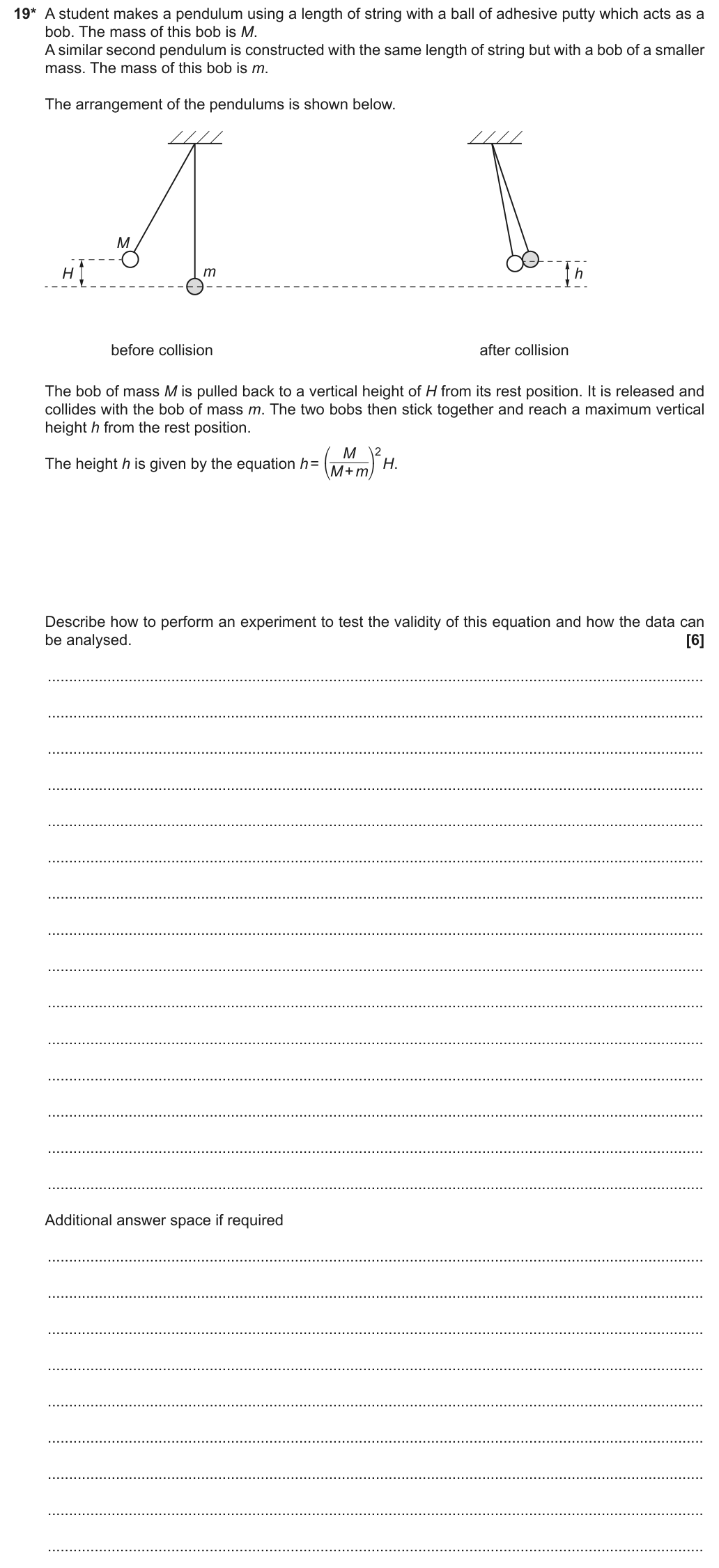
November 2020 · Paper 1 · Q19 6 marks 6-mark extended response Medium linear motionpractical skills
19* A student makes a pendulum using a length of string with a ball of adhesive putty which acts as a
bob. The mass of this bob is M.
A similar second pendulum is constructed with the same length of string but with a bob of a smaller
mass. The mass of this bob is m.
The arrangement of the pendulums is shown below.
M
H m h
before collision after collision
The bob of mass M is pulled back to a vertical height of H from its rest position. It is released and
collides with the bob of mass m. The two bobs then stick together and reach a maximum vertical
height h from the rest position.
⎛     ⎞ Μ 2 H.
The height h is given by the equation h = Μ + m
⎝      ⎠
Describe how to perform an experiment to test the validity of this equation and how the data can
be analysed. [6]
..........................................................................................................................................................
..........................................................................................................................................................
..........................................................................................................................................................
..........................................................................................................................................................
..........................................................................................................................................................
..........................................................................................................................................................
..........................................................................................................................................................
..........................................................................................................................................................
..........................................................................................................................................................
..........................................................................................................................................................
..........................................................................................................................................................
..........................................................................................................................................................
..........................................................................................................................................................
..........................................................................................................................................................
..........................................................................................................................................................
Additional answer space if required
..........................................................................................................................................................
..........................................................................................................................................................
..........................................................................................................................................................
..........................................................................................................................................................
..........................................................................................................................................................
..........................................................................................................................................................
..........................................................................................................................................................
..........................................................................................................................................................
..........................................................................................................................................................
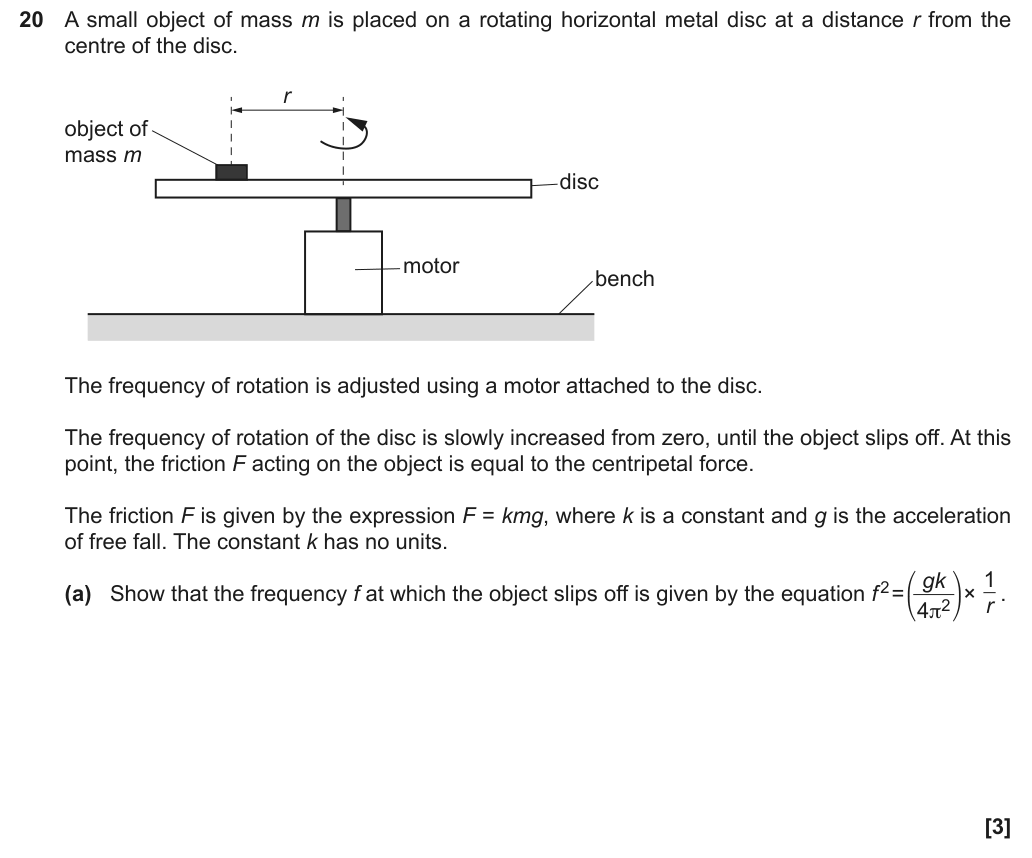
November 2020 · Paper 1 · Q20(a) 3 marks Show that circular motion
20 A small object of mass m is placed on a rotating horizontal metal disc at a distance r from the
centre of the disc.
r
object of
mass m
disc
motor
bench
The frequency of rotation is adjusted using a motor attached to the disc.
The frequency of rotation of the disc is slowly increased from zero, until the object slips off. At this
point, the friction F acting on the object is equal to the centripetal force.
The friction F is given by the expression F = kmg, where k is a constant and g is the acceleration
of free fall. The constant k has no units.
(a) Show that the frequency f at which the object slips off is given by the equation f 2 =  gk ⎛     ⎞ 4π2  × 1
r .
⎝     ⎠
[3]
November 2020 · Paper 1 · Q20(b) 4 marks Calculation practical skills
Earlier part of question 20 that this part usesEarlier part of November 2020 Paper 1 question 20
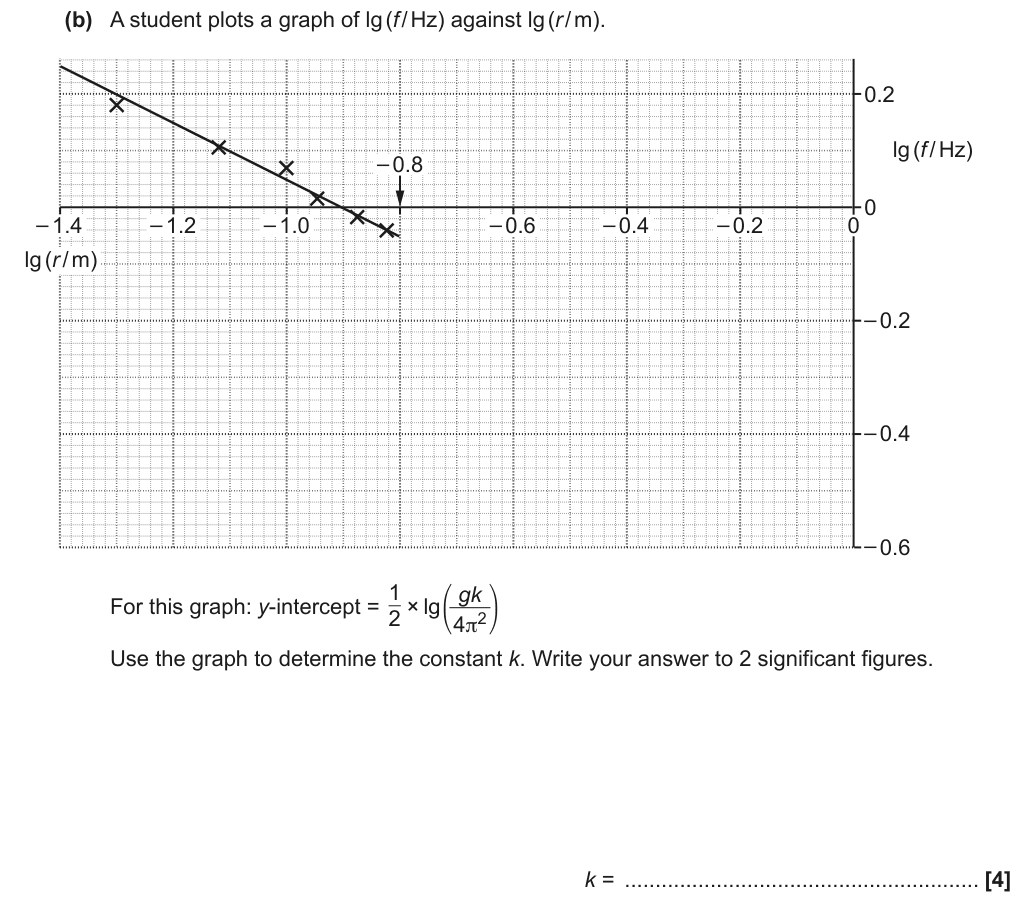
(b) A student plots a graph of lg (f / Hz) against lg (r / m).
0.2
lg (f / Hz)
– 0.8
0
– 1.4 – 1.2 – 1.0 – 0.6 – 0.4 – 0.2 0
lg (r / m)
– 0.2
– 0.4
– 0.6
For this graph: y-intercept = 1 2 × lg  gk ⎛     ⎞
4π2
⎝     ⎠
Use the graph to determine the constant k. Write your answer to 2 significant figures.
k =  .......................................................... [4]
November 2020 · Paper 1 · Q21(a)(i) 2 marks Calculation Medium ideal gasesthermal physics
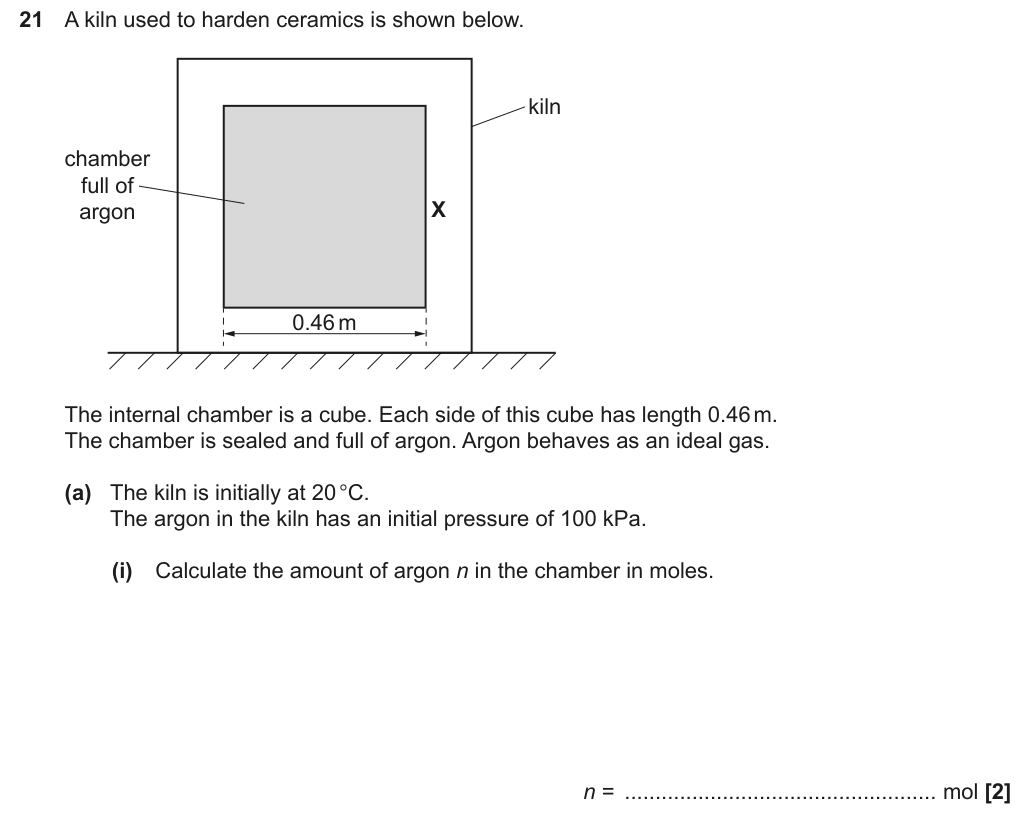
21 A kiln used to harden ceramics is shown below.
kiln
chamber
full of
argon X
0.46 m
The internal chamber is a cube. Each side of this cube has length 0.46 m.
The chamber is sealed and full of argon. Argon behaves as an ideal gas.
(a) The kiln is initially at 20 °C.
The argon in the kiln has an initial pressure of 100 kPa.
(i) Calculate the amount of argon n in the chamber in moles.
n =  ................................................... mol [2]
November 2020 · Paper 1 · Q21(a)(ii) 2 marks Calculation Medium ideal gasesthermal physics
Earlier part of question 21 that this part usesEarlier part of November 2020 Paper 1 question 21
(ii) The temperature of the kiln is increased from 20 °C to 1300 °C.
Calculate the pressure in kPa at 1300 °C.
pressure =  .................................................. kPa [2]
November 2020 · Paper 1 · Q21(b)(i) 2 marks Calculation Medium newtons laws and momentum
(b) The temperature of the kiln is 1300 °C.
A single atom of argon is travelling horizontally towards the vertical side X of the chamber.
The initial speed of this atom is 990 m s–1. After collision, it rebounds at the same speed.
(i) Calculate the change in momentum Δp of this atom.
• mass of argon atom = 6.6 × 10⁻²⁶ kg
Δp =  ............................................ kg m s–1 [2]
November 2020 · Paper 1 · Q21(b)(ii) 3 marks Show that Medium newtons laws and momentumkinematicsideal gases
Earlier parts of question 21 that this part usesEarlier part of November 2020 Paper 1 question 21Earlier part of November 2020 Paper 1 question 21
(ii) Assume that this atom does not collide with any other argon atoms inside the chamber.
Instead, it travels horizontally, making repeated collisions with the opposite vertical walls
of the chamber.
1 Show that the atom makes about 1000 collisions with side X in a time interval
of 1.0 s.
[1]
2 Calculate the average force F on side X made by the atom.
F =  ...................................................... N [2]
November 2020 · Paper 1 · Q21(b)(iii) 2 marks Explanation Medium ideal gasesdensity and pressure
Earlier parts of question 21 that this part usesEarlier part of November 2020 Paper 1 question 21Earlier part of November 2020 Paper 1 question 21
(iii) Without calculation, explain how your answer to (ii)2 could be used to estimate the total
pressure exerted by the atoms of the argon gas in the kiln.
...........................................................................................................................................
...........................................................................................................................................
...........................................................................................................................................
...................................................................................................................................... [2]
November 2020 · Paper 1 · Q22(a)(i) 1 mark Short answer density and pressure
22 A long wooden cylinder is placed into a liquid and it floats as shown.
liquid
15 cm
wooden
cylinder
The length of the cylinder below the liquid level is 15 cm.
(a) (i) State Archimedes’ principle.
...........................................................................................................................................
...........................................................................................................................................
...................................................................................................................................... [1]
November 2020 · Paper 1 · Q22(a)(ii) 2 marks Calculation density and pressure
Earlier part of question 22 that this part usesEarlier part of November 2020 Paper 1 question 22
(ii) The pressure exerted by the liquid alone on the bottom of the cylinder is 1.9 × 10³ Pa.
Calculate the density ρ of the liquid.
ρ =  .............................................. kg m–3 [2]
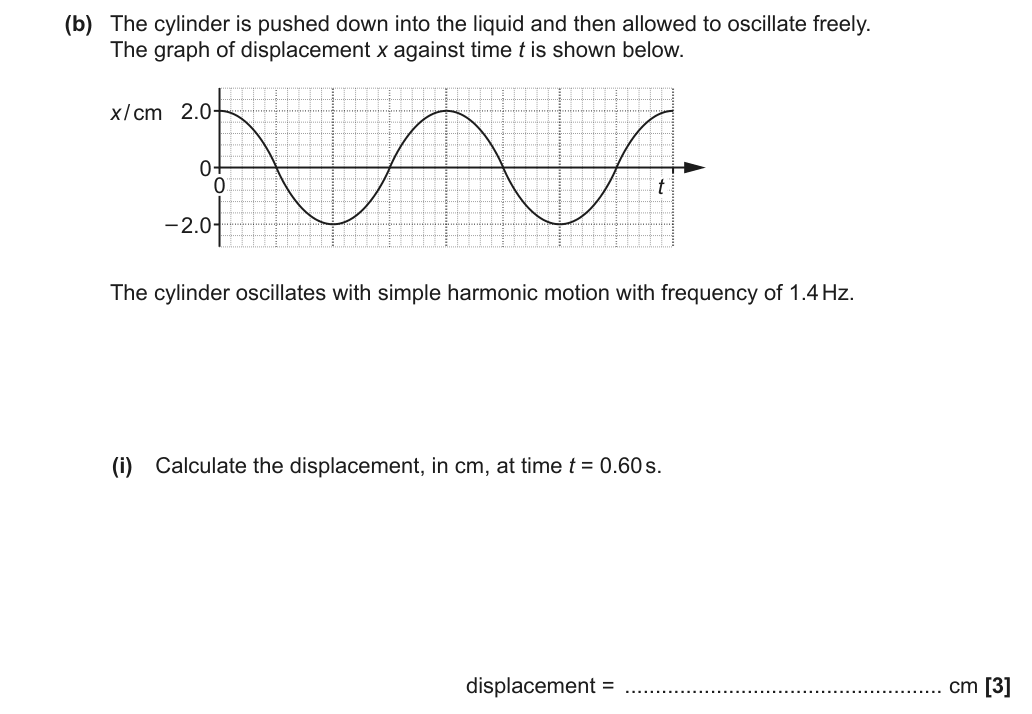
November 2020 · Paper 1 · Q22(b)(i) 3 marks Calculation simple harmonic motion
(b) The cylinder is pushed down into the liquid and then allowed to oscillate freely.
The graph of displacement x against time t is shown below.
x / cm 2.0
0
0 t
– 2.0
The cylinder oscillates with simple harmonic motion with frequency of 1.4 Hz.
(i) Calculate the displacement, in cm, at time t = 0.60 s.
displacement =  .................................................... cm [3]
November 2020 · Paper 1 · Q22(b)(ii) 2 marks Calculation simple harmonic motion
Earlier part of question 22 that this part usesEarlier part of November 2020 Paper 1 question 22
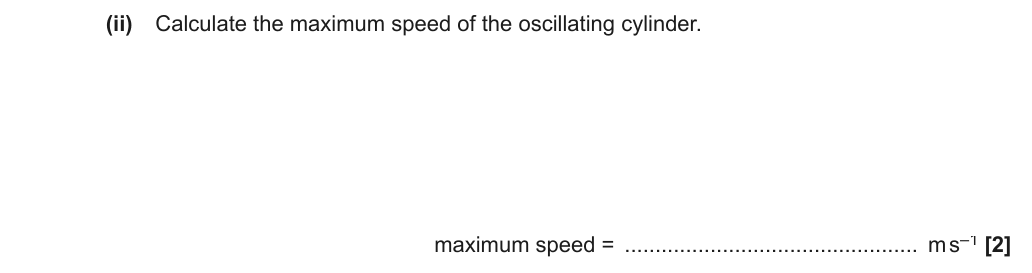
(ii) Calculate the maximum speed of the oscillating cylinder.
maximum speed =  ................................................ m s–1 [2]
November 2020 · Paper 1 · Q22(b)(iii) 2 marks Short answer simple harmonic motion
Earlier part of question 22 that this part usesEarlier part of November 2020 Paper 1 question 22
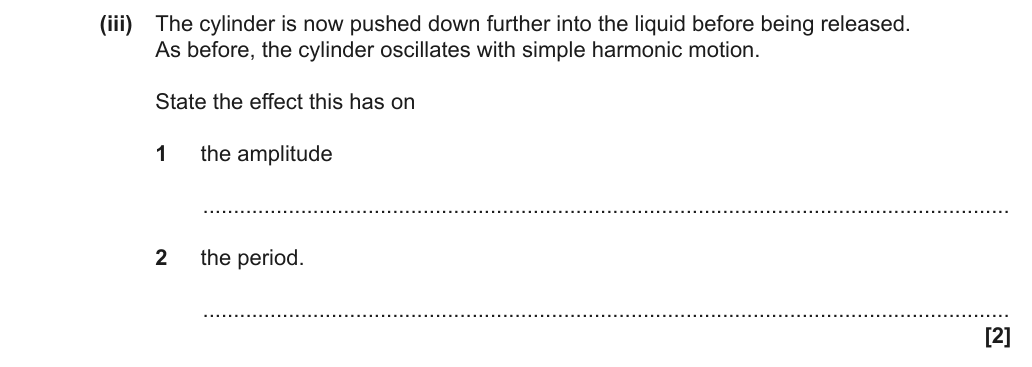
(iii) The cylinder is now pushed down further into the liquid before being released.
As before, the cylinder oscillates with simple harmonic motion.
State the effect this has on
1 the amplitude
....................................................................................................................................
2 the period.
....................................................................................................................................
[2]
November 2020 · Paper 1 · Q23(a)(i) 1 mark Short answer Medium planetary motion
23 In June 2018, the spacecraft Hayabusa2 arrived at an asteroid called Ryugu.
(a) The asteroid orbits the Sun in an elliptical orbit as shown below.
orbit
Sun
asteroid Ryugu
The diagram is not drawn to scale.
(i) Indicate with a letter X on the orbit where the asteroid would be moving at maximum
speed. [1]
November 2020 · Paper 1 · Q23(a)(ii) 2 marks Explanation Medium planetary motion
Earlier part of question 23 that this part usesEarlier part of November 2020 Paper 1 question 23
(ii) Use Kepler’s second law to explain your answer to (a)(i).
...........................................................................................................................................
...........................................................................................................................................
...........................................................................................................................................
...................................................................................................................................... [2]
November 2020 · Paper 1 · Q23(b)(i) 1 mark Short answer Medium gravitational fields
(b) The gravitational potential at a distance r from the centre of the asteroid Ryugu is Vg. The
graph of Vg against 1
r for the asteroid is shown below.
surface of the asteroid
Vg /10–2 J kg–1
0
0 0.5 1.0 1.5 2.0 2.5
1
r / 10–3 m–1
– 2.0
– 4.0
– 6.0
– 8.0
(i) Define gravitational potential.
...........................................................................................................................................
...........................................................................................................................................
...................................................................................................................................... [1]
November 2020 · Paper 1 · Q23(b)(ii) 1 mark Show that Medium gravitational fields
Earlier part of question 23 that this part usesEarlier part of November 2020 Paper 1 question 23
(ii) Show that the magnitude of the gradient of the graph is equal to GM, where M is the
mass of the asteroid and G is the gravitational constant.
[1]
November 2020 · Paper 1 · Q23(b)(iii) 2 marks Show that Medium gravitational fieldspractical skills
Earlier parts of question 23 that this part usesEarlier part of November 2020 Paper 1 question 23Earlier part of November 2020 Paper 1 question 23
(iii) Use the gradient of the graph to show that the mass M of the asteroid is about
4.6 × 10¹¹ kg.
M =  ..................................................... kg [2]
November 2020 · Paper 1 · Q23(c) 3 marks Calculation Medium gravitational fieldswork energy and power
Earlier parts of question 23 that this part usesEarlier part of November 2020 Paper 1 question 23Earlier part of November 2020 Paper 1 question 23
(c) In October 2018, the probe Mobile Asteroid Surface Scout (MASCOT) was released from
rest from the Hayabusa2 spacecraft from a distance of 600 m from the centre of the asteroid.
Assume that the spacecraft was stationary relative to the asteroid when MASCOT was
dropped.
Use information from (b) to calculate the speed of the impact v when MASCOT landed on the
surface of the asteroid.
v =  ................................................ m s–1 [3]
November 2020 · Paper 1 · Q24(a) 4 marks Explanation Medium stars
24 (a) Our Sun will eventually become a red giant.
Describe and explain the next stages of evolution of our Sun.
...................................................................................................................................................
...................................................................................................................................................
...................................................................................................................................................
...................................................................................................................................................
...................................................................................................................................................
...................................................................................................................................................
...................................................................................................................................................
...................................................................................................................................................
.............................................................................................................................................. [4]
November 2020 · Paper 1 · Q24(b)(i) 2 marks Show that Medium stars
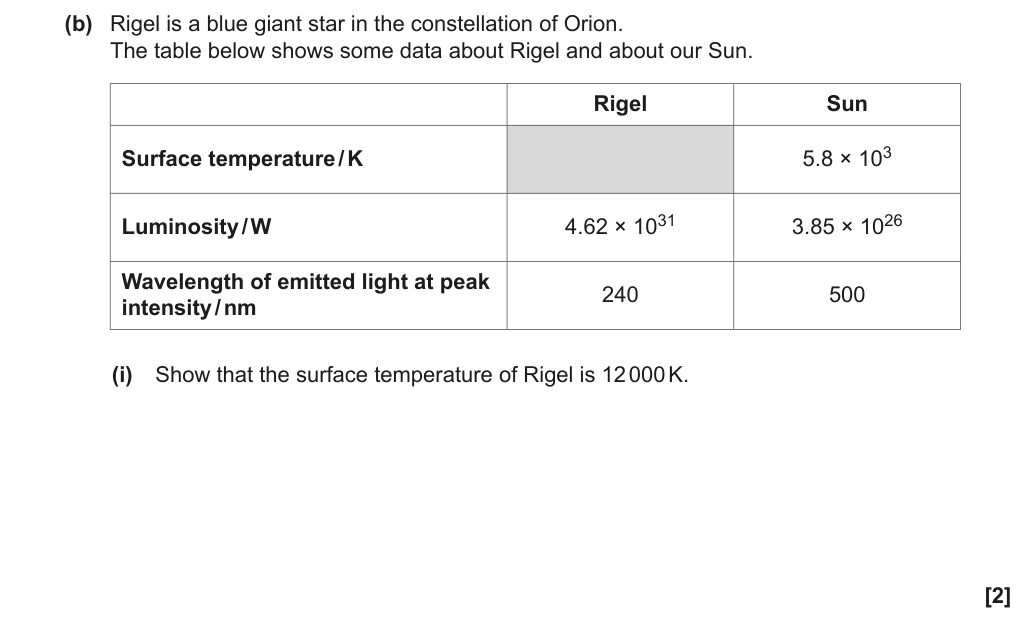
(b) Rigel is a blue giant star in the constellation of Orion.
The table below shows some data about Rigel and about our Sun.
Rigel Sun
Surface temperature / K 5.8 × 10³
Luminosity / W 4.62 × 1031 3.85 × 1026
Wavelength of emitted light at peak
240 500
intensity / nm
(i) Show that the surface temperature of Rigel is 12 000 K.
[2]
November 2020 · Paper 1 · Q24(b)(ii) 2 marks Calculation Medium stars
Earlier part of question 24 that this part usesEarlier part of November 2020 Paper 1 question 24
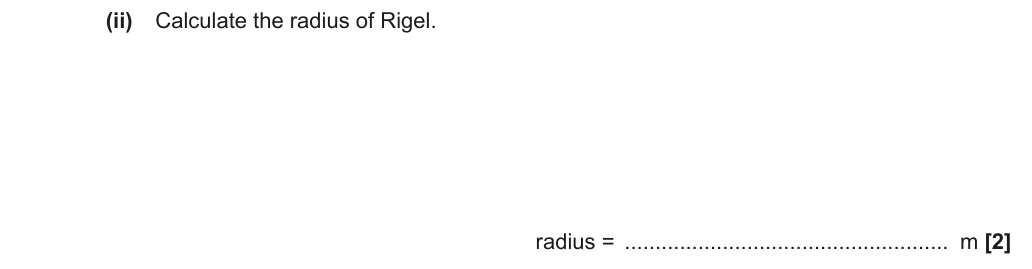
(ii) Calculate the radius of Rigel.
radius =  ..................................................... m [2]
November 2020 · Paper 1 · Q24(c) 1 mark Explanation Medium stars
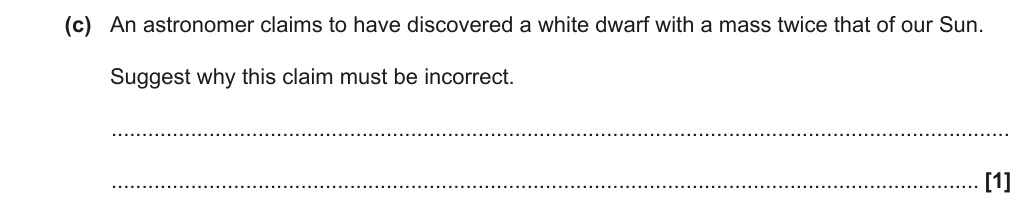
(c) An astronomer claims to have discovered a white dwarf with a mass twice that of our Sun.
Suggest why this claim must be incorrect.
...................................................................................................................................................
.............................................................................................................................................. [1]

Work with an OCR physics tutor

Want a paper marked and gone through with you? Message us.

Prefer email? Send an enquiry

If you are under 18, please include a parent's contact details. Enquiries go to enquiries@physicsaleveltutor.com and are deleted once handled. All tutoring is online.