Answer
B
Mark scheme

Examiner's comment
This question was answered well. High scoring candidates often wrote an equation in the white space and substituted into their expression the data.
70 marks · 41 question parts · Paper, mark scheme and report on OCR's site · Have the Data, Formulae and Relationships Booklet beside you
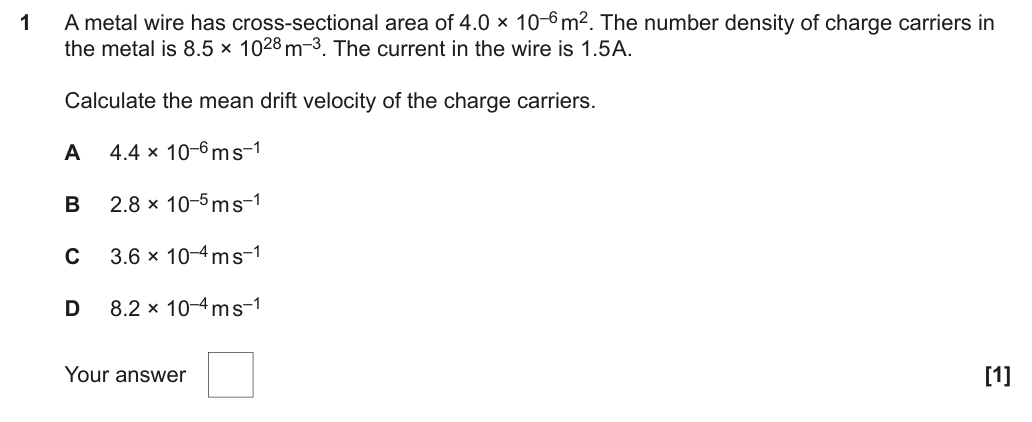
B
This question was answered well. High scoring candidates often wrote an equation in the white space and substituted into their expression the data.
C
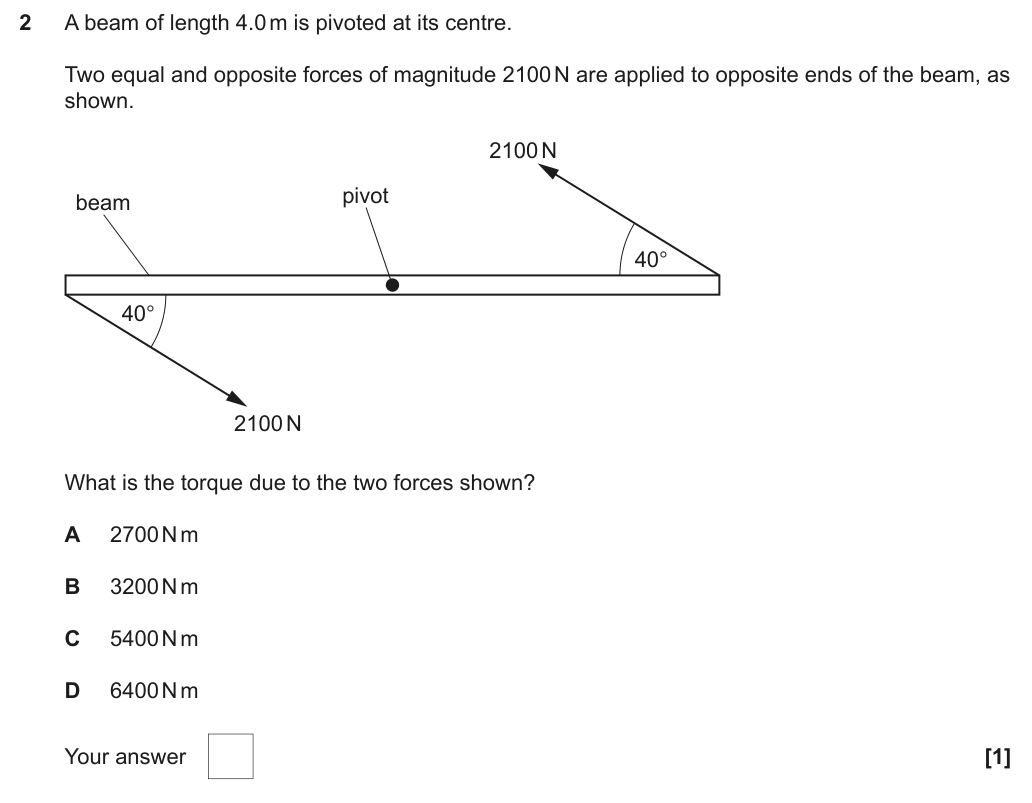
The majority of the candidates who did not gain the correct answer, selected answer A. These candidates correctly calculated the force but found the moment of the pivot for one of the forces rather than the torque of the two forces shown.
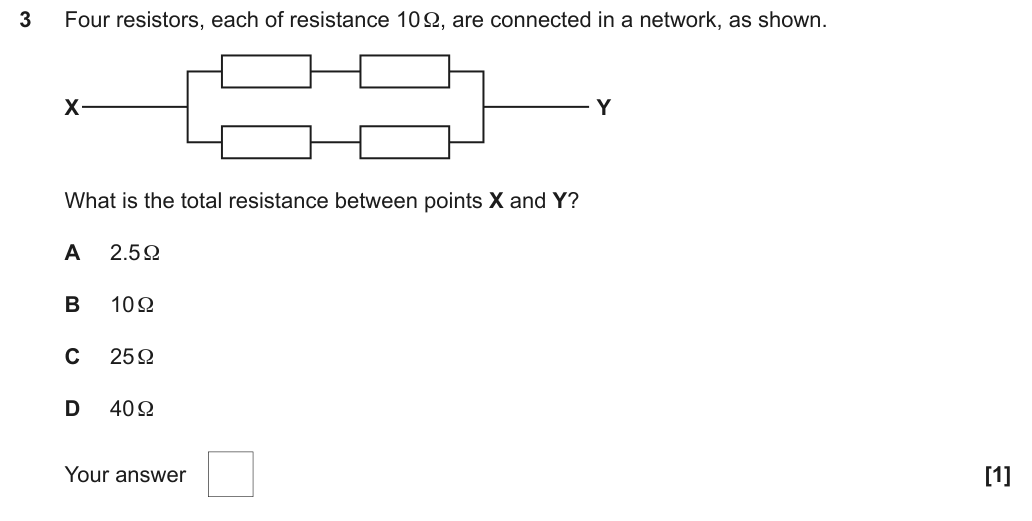
B
Most candidates correctly gave the answer as B. The common distractors for low scoring candidates were either A or D (dividing by four or multiplying by four).
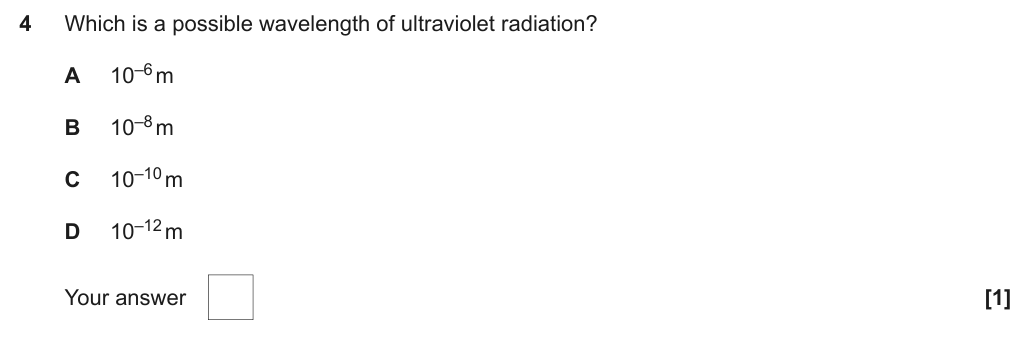
B
This question was generally answered well, although across the cohort several incorrect responses were observed. These were usually either A (infra-red) or C (X-rays). Candidates should know the orders of magnitude of the wavelengths of the principal radiations of electromagnetic waves in a vacuum.
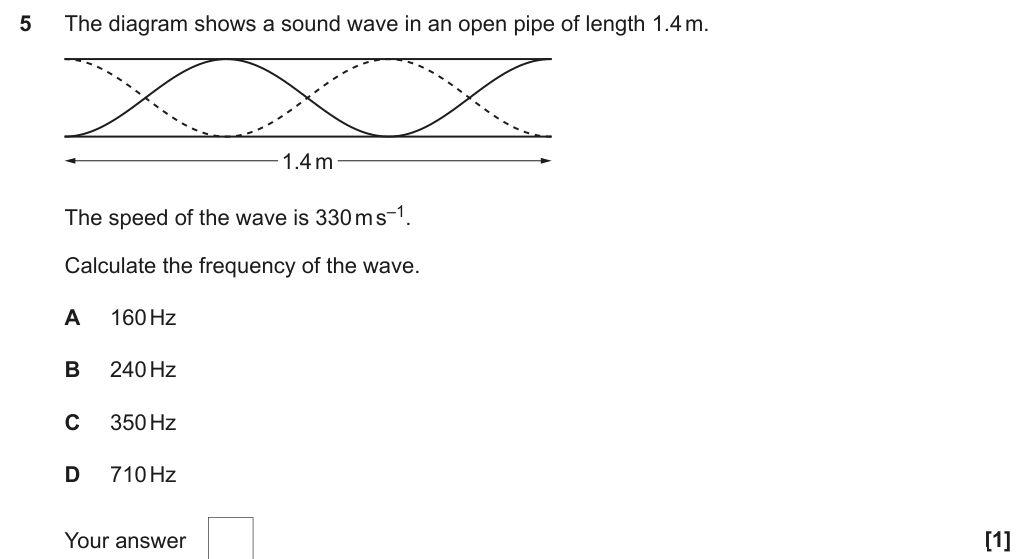
C
Most candidates correctly understood that the length of the tube was 1.5 wavelengths and gained the correct answer. Low scoring candidates often assumed that the length of the tube was equal to the wavelength and selected B as their answer.
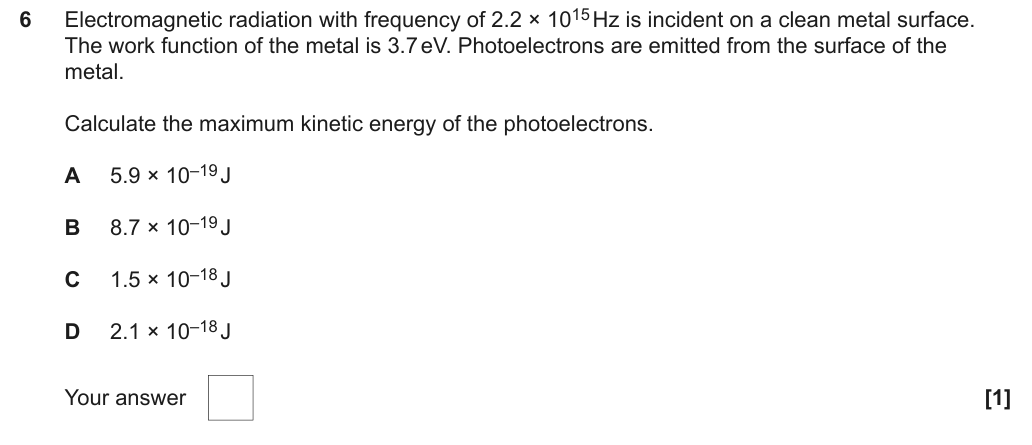
B
A common incorrect answer was A, where candidates had converted 3.7 eV to joule.
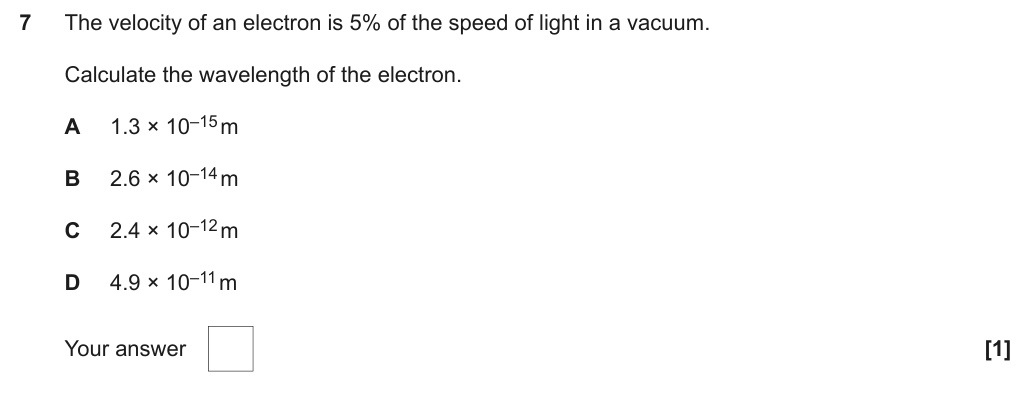
D
A range of answers were observed. High scoring candidates effectively used the white space to work out the speed of the electron and then wrote the equation and substituted the data.
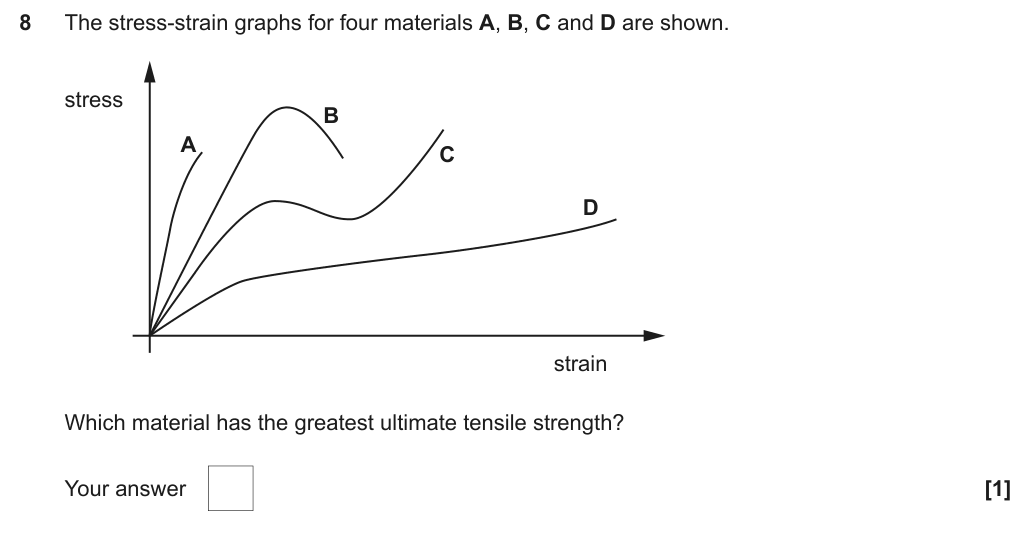
B
The majority of the candidates correctly identified B. The common distractors were C and D.
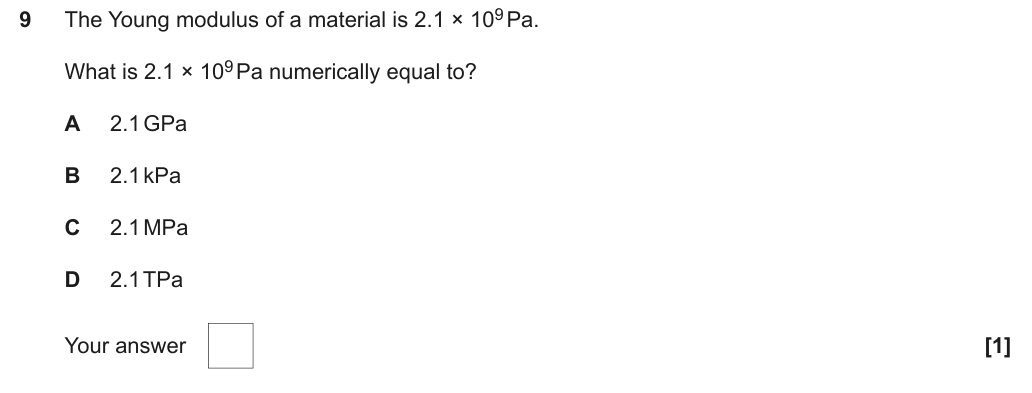
A
Where errors were made it was usually selecting D or to a lesser extent C.
Skills: M0.2 Recognise and use expressions in decimal and standard form
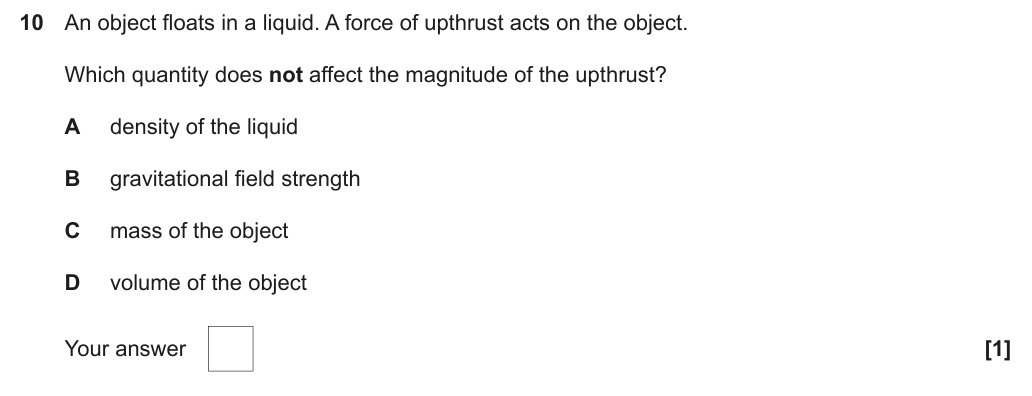
There were many incorrect answers to this question. A significant minority of candidates selected the gravitational field strength option.
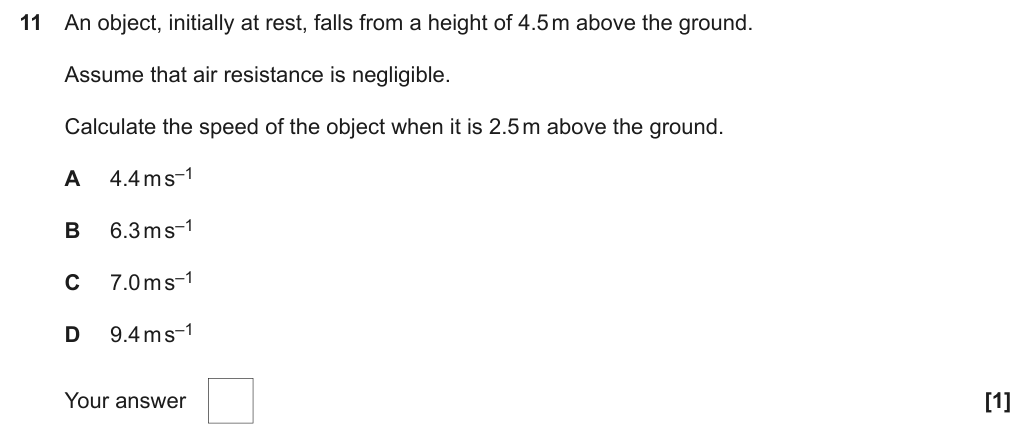
B
The majority of the candidates correctly identified B as the correct answer. The two common errors from lower scoring candidates were to choose D (ignoring the 2.5 m) or to select C where candidates had found the speed after 2.5 m rather than the speed at 2.5 m. Some candidates usefully sketched a diagram to show the arrangement of the ball falling which then enabled these candidates to identify the correct distance.
Skills: M2.3 Substitute numerical values into algebraic equations using appropriate units for physical quantities
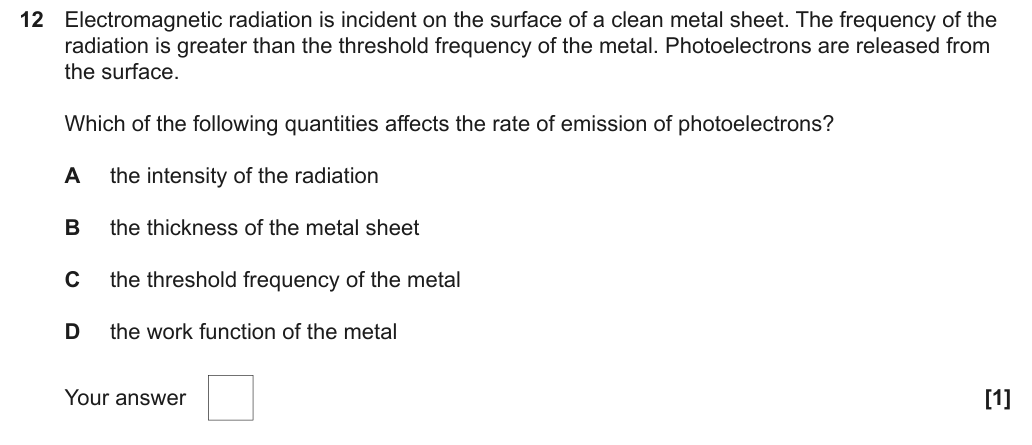
A
This question was assessing a standard learning outcome from the specification. Low scoring candidates often selected either C or D without reference to Einstein’s photelectric equation.
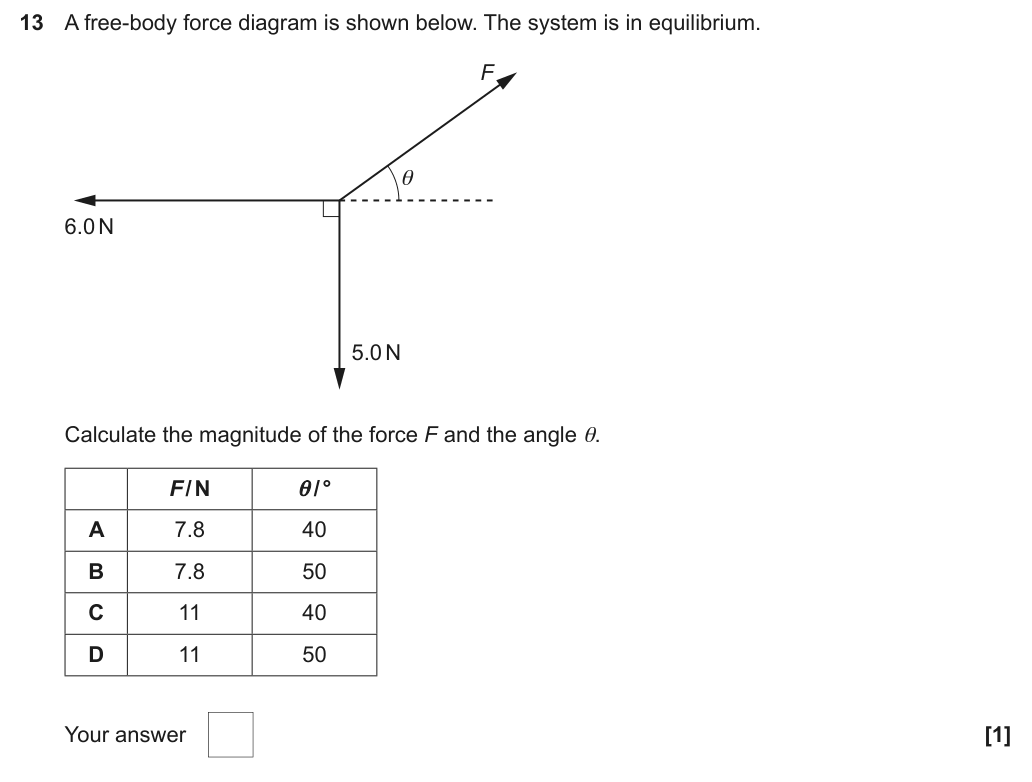
A
A few candidates incorrectly selected C – adding the two forces 5.0 N and 6.0 N to equal11 N.
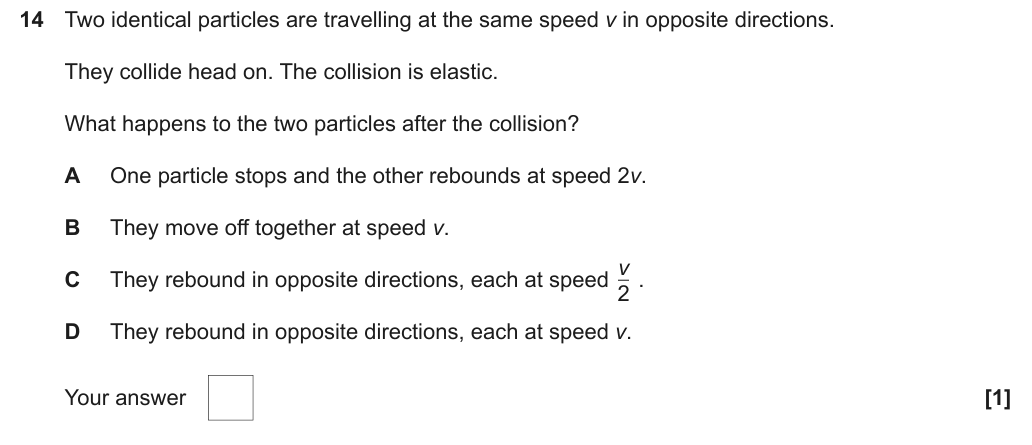
D
The question was answered well. Candidates usually correctly identified that the particles would rebound in opposite directions but the common error was to suggest the speed of the particles would be halved. If this was the case, then the kinetic energy would not be conserved.
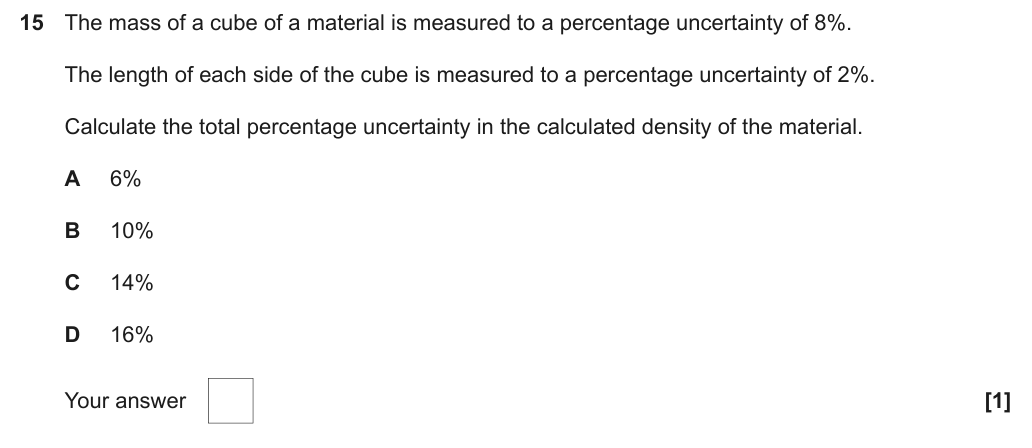
C
High scoring candidates often used the white space for their working. Often it could be seen that candidates considered that the volume of the cube was given by L3 where L is the length of one side. These candidates then wrote 3 2% = 6% before adding the 6% and the 8% to equal 14%. Common incorrect answers were B (omitting the information that the 2% referred to the length and not the volume) or D (multiplying 2% by 8%).
Skills: M1.5 Identify uncertainties in measurements and use simple techniques to determine uncertainty when data are combined
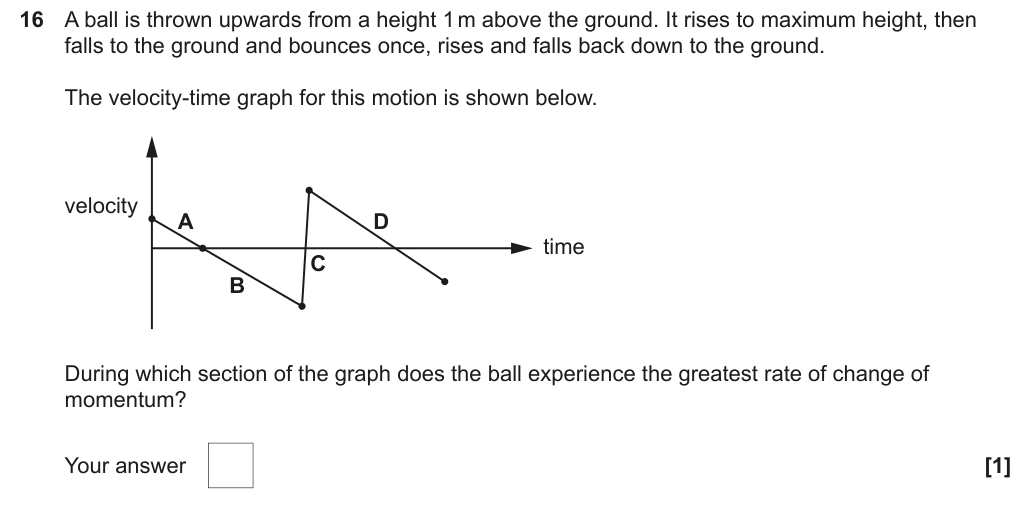
C
When this question was answered incorrectly, it was often either B or D selected.
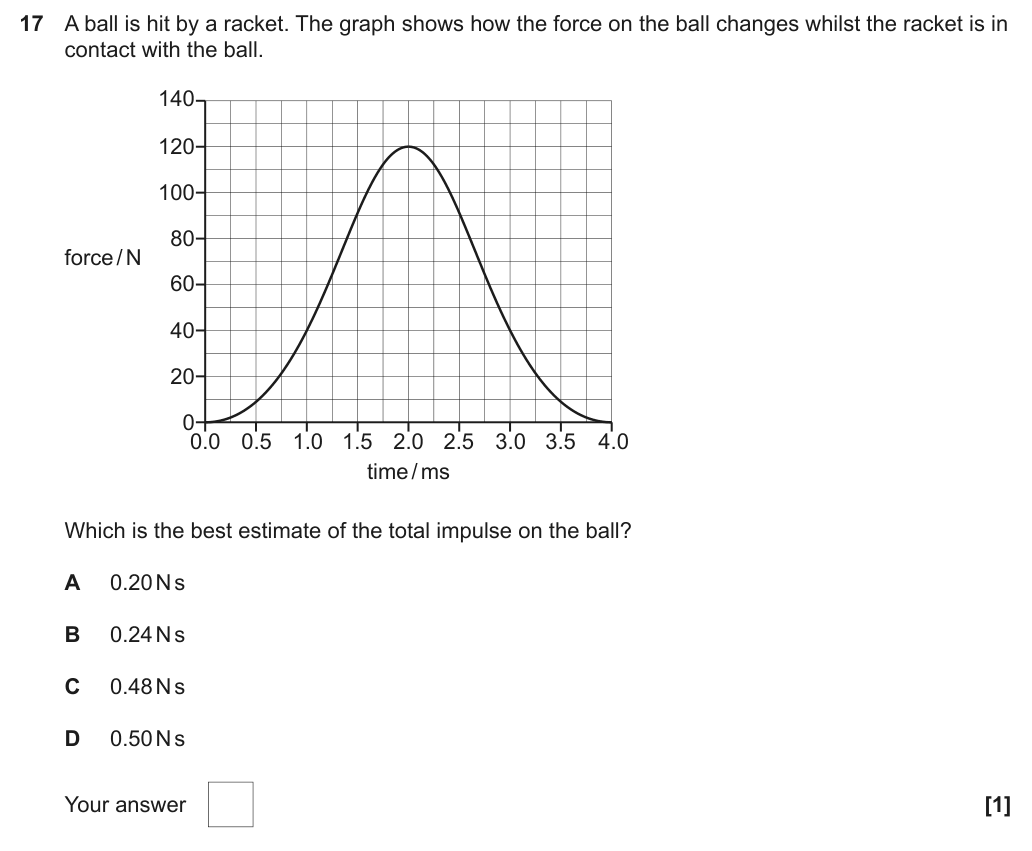
A
Candidates found this question more challenging. Some candidates realised that the total impulse was given from the area under the graph but then did not calculate the area correctly. Some clearly drew a triangle and gained an answer of 0.24 N s without allowing for the area inside the triangle. Other candidates multiplied.
Skills: M0.1 Recognise and make use of appropriate units in calculations; M3.8 Understand the possible physical significance of the area between a curve and the x axis and be able to calculate it or estimate it by graphical methods as appropriate
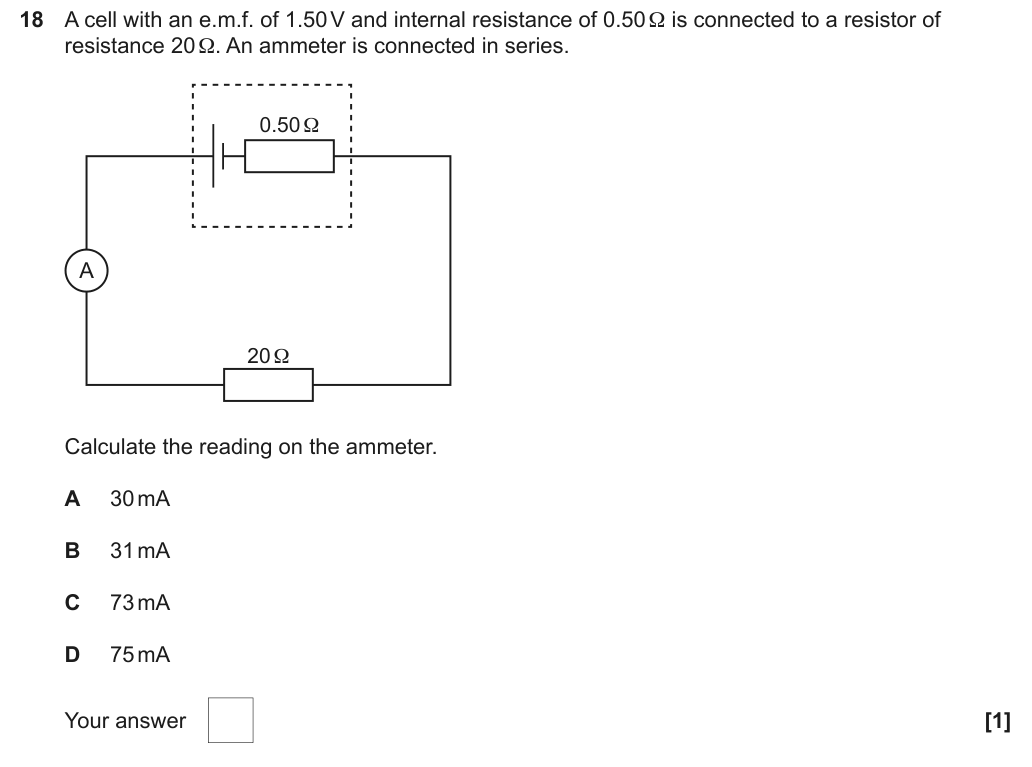
C
A significant minority of lower scoring candidates correctly calculated the total resistance of 20.5 but then incorrectly multiplied by 1.5 to give answer B.
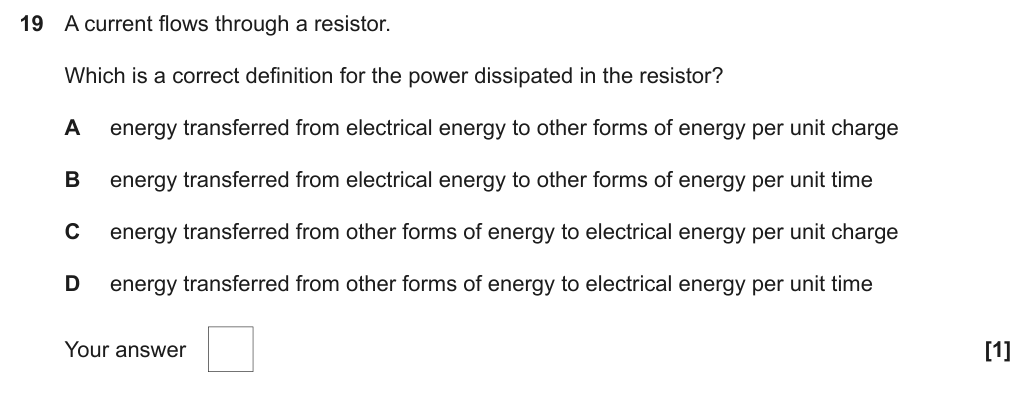
B
This question was assessing candidates’ knowledge of the definition of power. Many candidates confused the definition of power with the definition of potential difference and gave answer A.
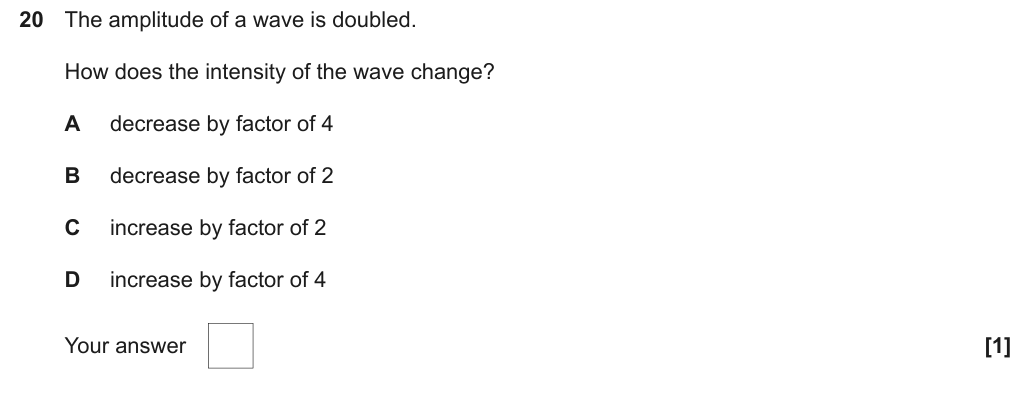
D
This question was generally answered well. The common error was selecting C (not understanding that intensity is proportional to amplitude2) or A (not understanding the direct proportion).
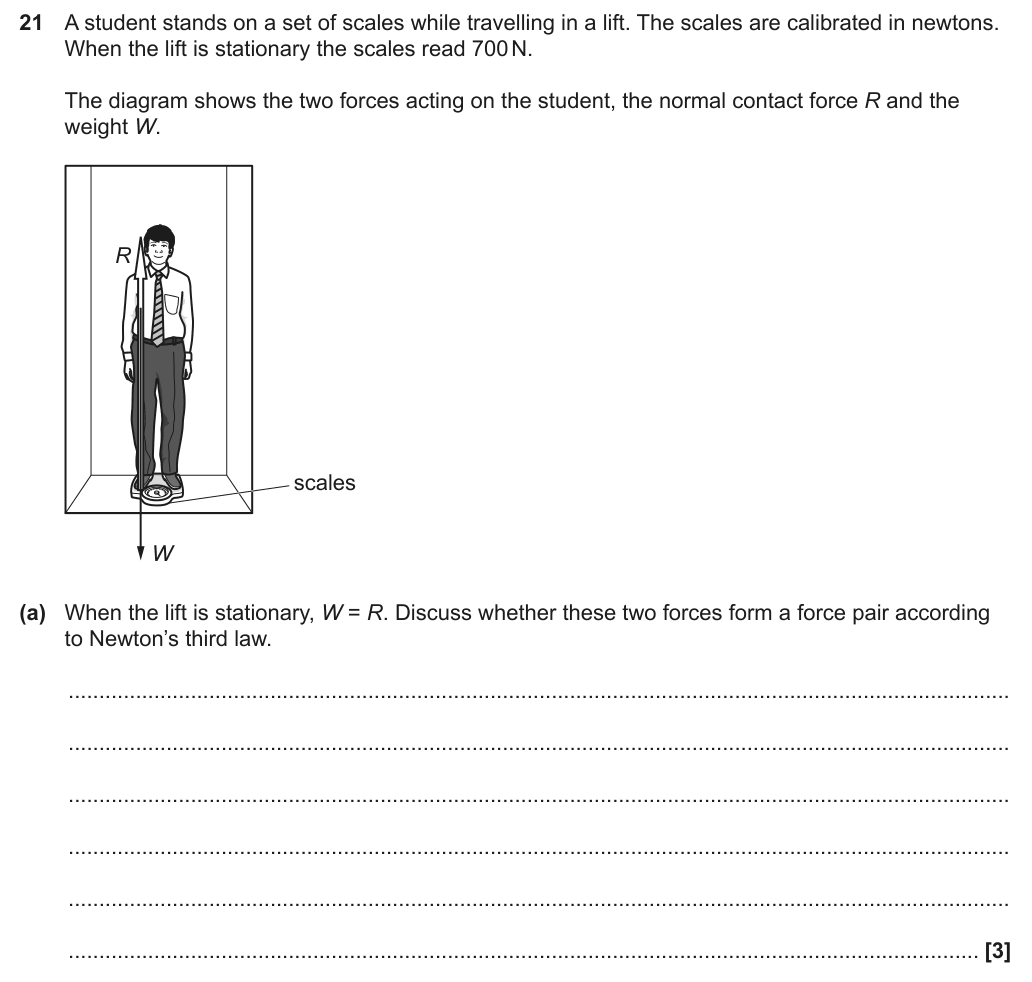
Many candidates understand the basic detail of Newton’s third law but do not appreciate the finer detail that it applies to two bodies and that the forces have to be of the same type. The states that there are two forces are acting on the student, so therefore only one body. Candidates should also have realised that the force of gravity or weight is a non-contact force and that the normal contact force is a contact force. A significant minority of candidates gave an incomplete answer where they referred to one of the two reasons as why the forces did not form a force pair without thinking about the answer space or the number of marks for the question. A few candidates did not state whether or not a force pair was formed. Candidates should be encouraged to think about the space to answer and the number of marks for each question. In this case there were 3 marks available so three distinct points should be included in their discussion.
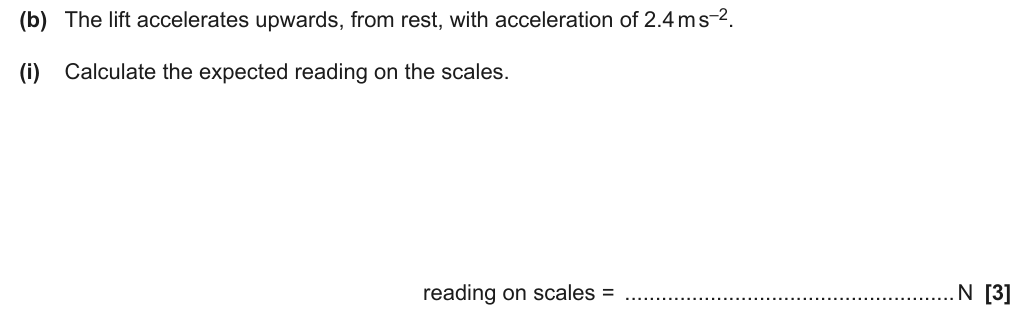
The majority of the candidates correctly calculated the mass of the student and used this value to calculate the resultant force causing the acceleration. Most candidates either gave this resultant force as their final answer or subtracted it from the weight.
Skills: M2.2 Change the subject of an equation, including non-linear equations; M2.3 Substitute numerical values into algebraic equations using appropriate units for physical quantities
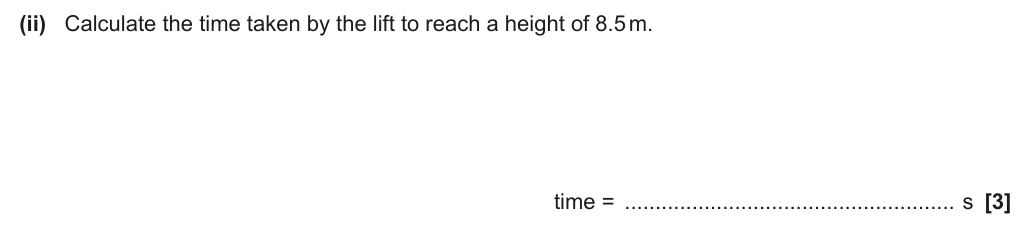
This question was generally well answered. High scoring candidates correctly stated the appropriate equation of uniform motion and then substituted in the data. Some candidates were confused as to when to use the acceleration of 2.4 m s−2 and when to use 9.81 m s−2.
Skills: M2.2 Change the subject of an equation, including non-linear equations; M2.3 Substitute numerical values into algebraic equations using appropriate units for physical quantities
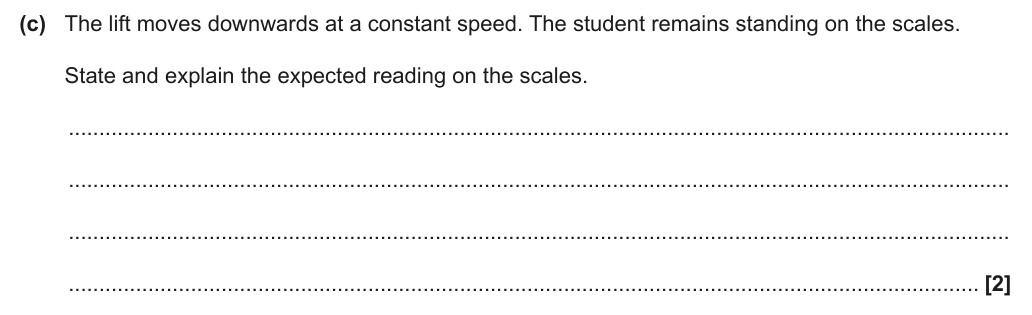
The command word ‘state’ in the question meant that candidates needed to state a value (700 N) for the reading on the scales. It was not good enough to simply state that the reading would be the same. The explanation needed to refer to the resultant force being zero. The term ‘equilibrium’ is not quite enough – it implies that the resultant force is zero but soes not demonstrate that the candidate understand that the resultant force is zero.
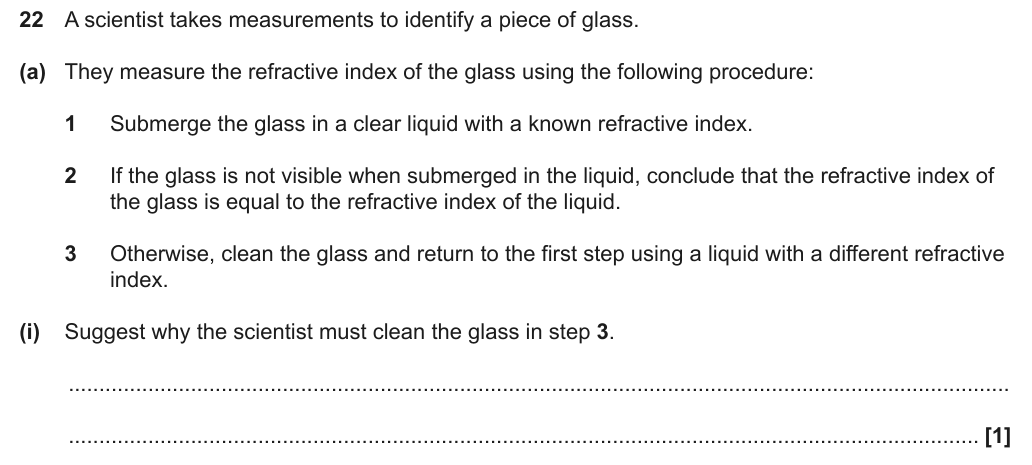
This was a challenging question in that there were many vague answers that did not state that by not cleaning the glass the refractive index could be different.

This was a challenging question designed to assess a candidate’s understanding of refractive index. Very few candidates were able to state that the frequency or wavelength of the light used. There are several vague responses in terms of the intensity of the light or temperature. However, examiners allowed the temperature of the liquid or the density of the liquid.
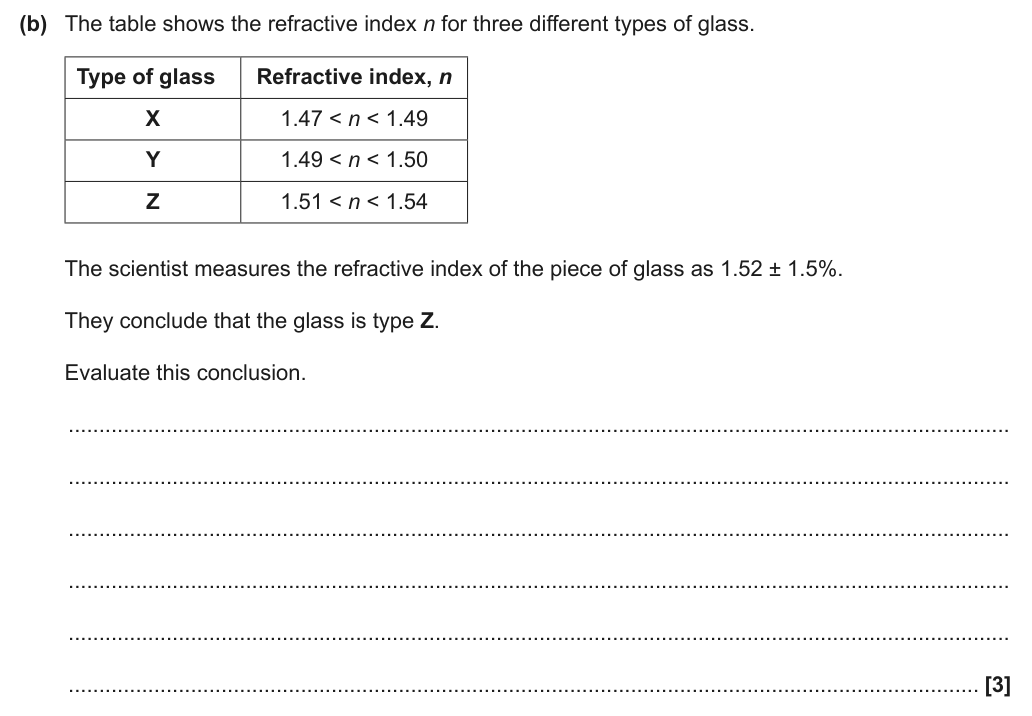
This question required candidates to calculate the minimum and maximum values before stating whether the conclusion is valid. High scoring candidates clearly demonstrated the maximum and minimum values of the refractive index before stating that the range included both glass Y and glass Z. Since glass Y was between 1.49 and 1.50, candidates should be calculating the minimum value of 1.497. Vague responses in terms of it being more likely to be glass Z did not gain credit.
Skills: M0.3 Use ratios, fractions and percentages; M1.5 Identify uncertainties in measurements and use simple techniques to determine uncertainty when data are combined
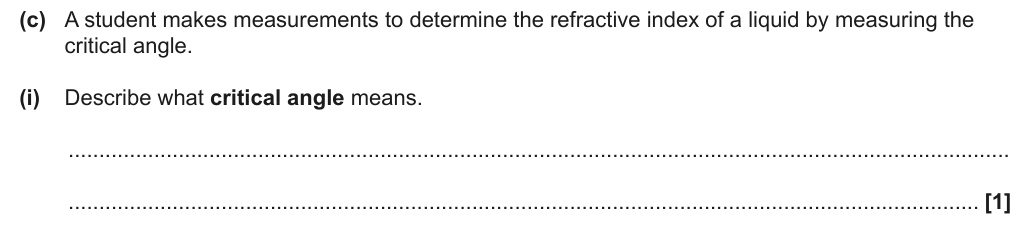
Many candidates answered this question by stating that the critical angle is the angle at which total internal reflection occurs. High scoring candidates stated it was the angle of incidence which gives an angle of refraction of 90. Examiners on this occasion allowed where the refracted ray travelled along the boundary. Some candidates were confused with terminology between reflection and refraction.
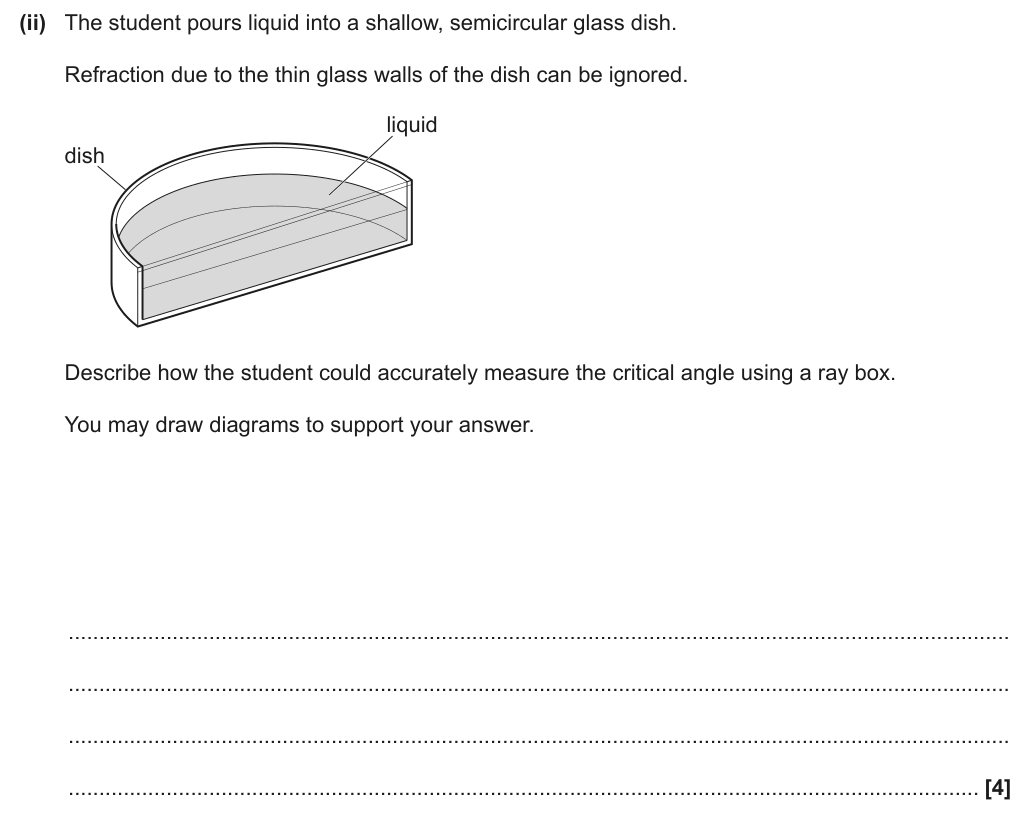
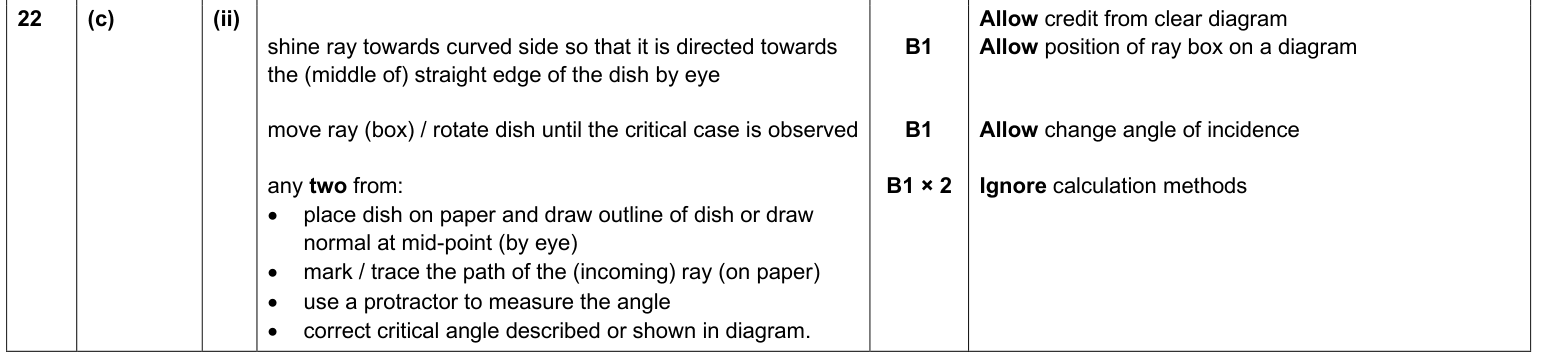
As part of their practical skills candidates should be able to design experiments and describe the techniques to carry out a safe experiment within a school laboratory setting. Most lower scoring candidates drew diagrams where the ray of light either entered the straight edge of the container or was reflected from the curved surface. High scoring candidates drew helpful diagrams, clearly showing an incident ray on the curved surface travelling towards the centre of the straight edge with the ray splitting into a reflected ray and a ray refracted at 90. Other high scoring candidates drew three diagrams showing the three cases of an angle of incidence less than the critical angle, equal to the critical angle and greater than the critical angle. When carrying out the experiment, the angle of incidence needed to be adjusted until the critical case is observed. Candidates needed to state then the critical angle would be measured using a protractor. Further credit was available for discussions of drawing around the container and/or indicating how the rays would be marked. This candidate has stared answering the question by drawing a diagram of the semicircular glass dish. The incident ray of light is indicated entering the curved surface and refracted at 90 at the centre of the curved surface. The text clearly states that the angle needs to be changed until the angle of refraction reaches 90 and that the critical angle will be measured with a protractor. The candidate clearly answers the question set with a practical plan.
Skills: PAG6 Investigating quantum effects
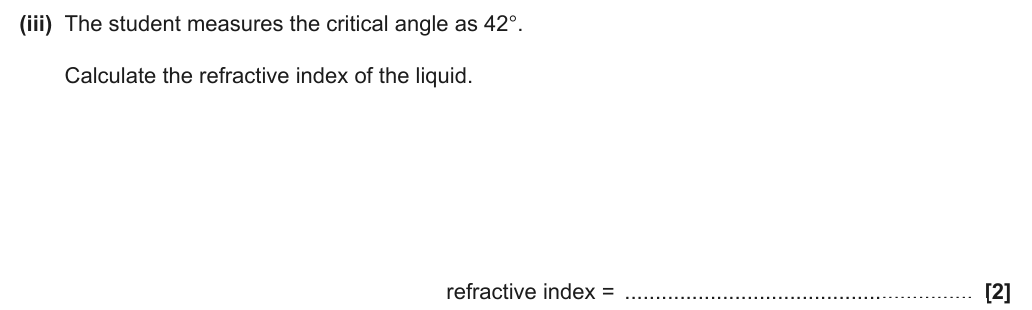
This question was generally well answered. High scoring candidates usually wrote down the equation and substituted data.
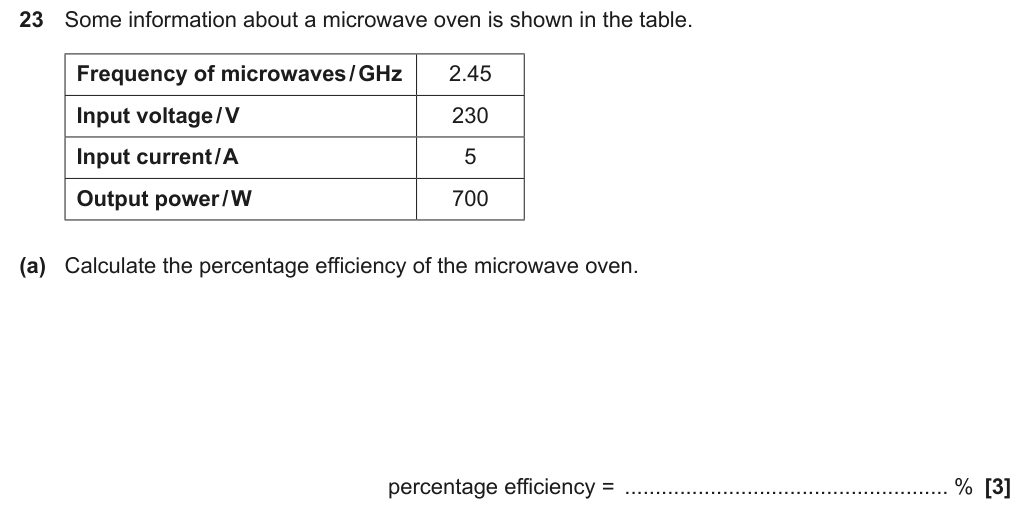
This question was usually answered well. Since this was a multi-stage calculation candidates should be encouraged to show all their working in their answers. In this question high scoring candidates showed the calculation of input power before substituting the data into the efficiency equation.
Skills: M0.3 Use ratios, fractions and percentages; M2.3 Substitute numerical values into algebraic equations using appropriate units for physical quantities
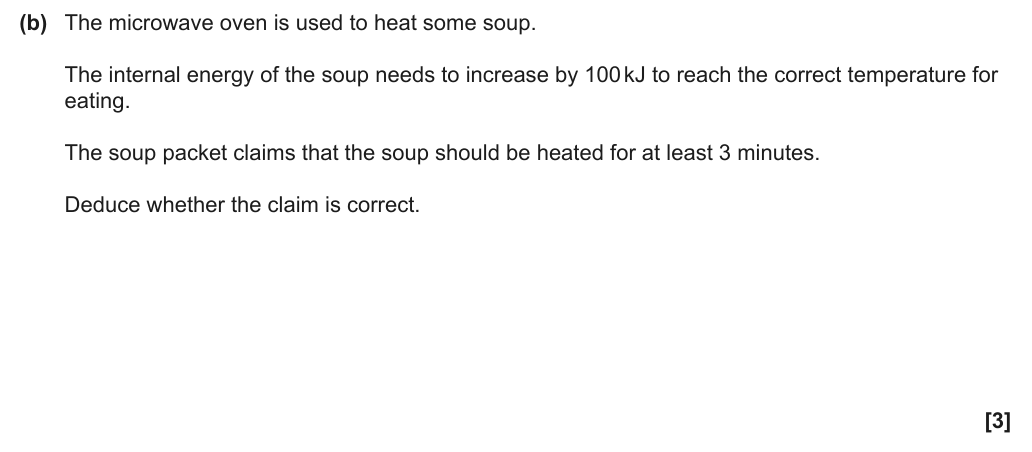
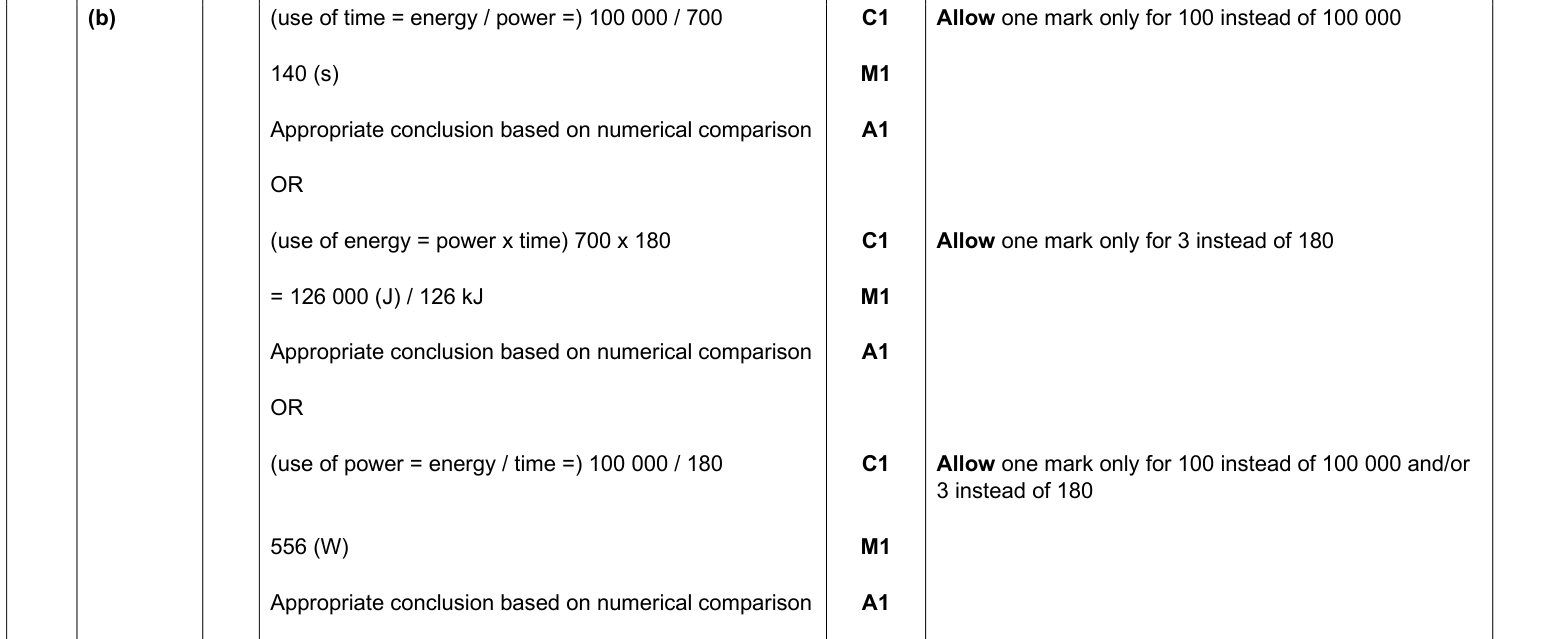
There were many different ways to answer this question which required candidates to demonstrate their knowledge and understanding of the definition of power. Candidates needed to demonstrate the use of this equation with appropriate conversion of units, including time. To gain full credit candidates needed to explain whether their calculation showed whether the claim was correct.
Skills: M0.1 Recognise and make use of appropriate units in calculations; M2.2 Change the subject of an equation, including non-linear equations
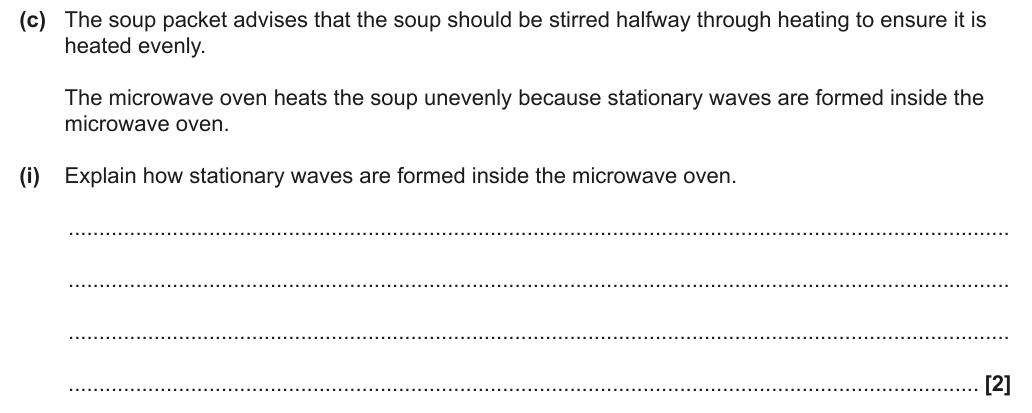
Many candidates discussed the general conditions for stationary waves or described stationary waves. High scoring candidates related their answers to the microwave oven by stating that the emitted microwaves would reflect from the metal walls of the oven and that the emitted and reflected waves would interfere or superpose. Lower scoring candidates did not always use correct terms.
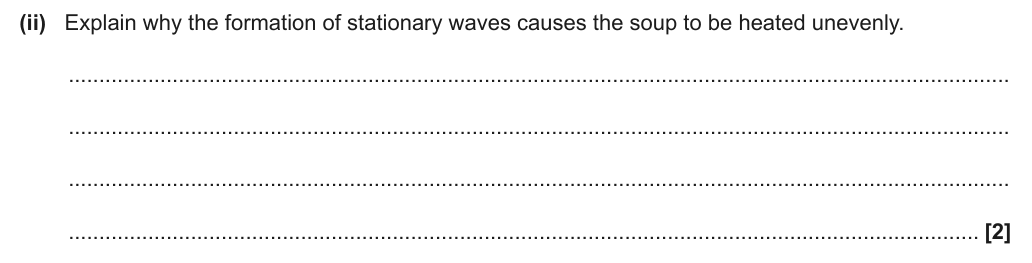
Candidates needed to relate their answers to nodes and antinodes. To gain full credit candidates needs to explain what was meant by a node and an antinode in terms of amplitude or intensity and then relate the nodes and antinodes to whether there was transfer of energy to the soup.
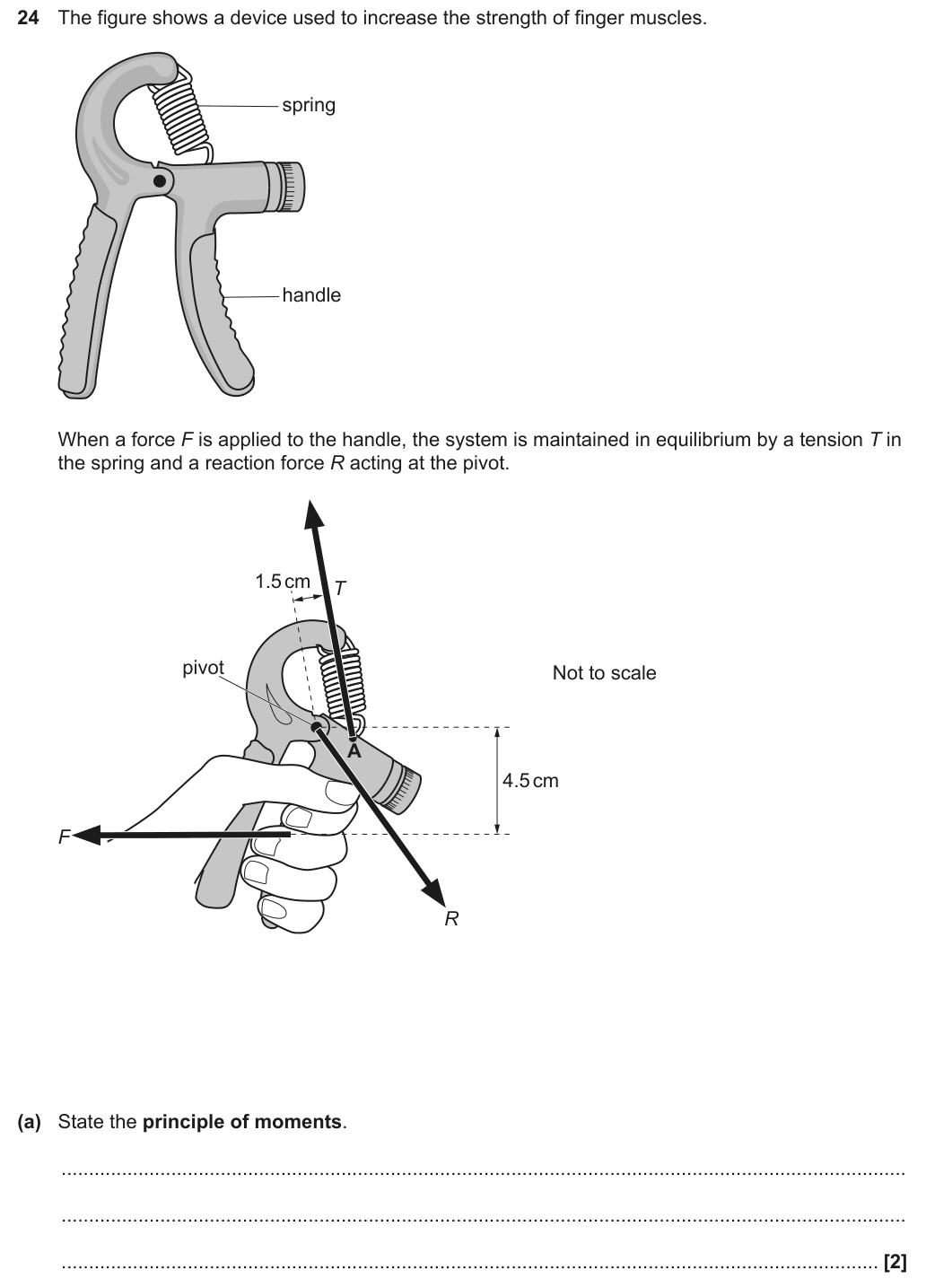
The majority of the candidates were able to state the principle of moments in terms of the sum of the clockwise moments and the sum of the anticlockwise moments being equal. Higher scoring candidates stated that this occurred when a body was in (rotational) equilibrium to gain full marks. Where marks were not scored, it was usually because candidates omitted the ‘sum of’ clockwise moments, etc. or stated the definition of a moment of a force.
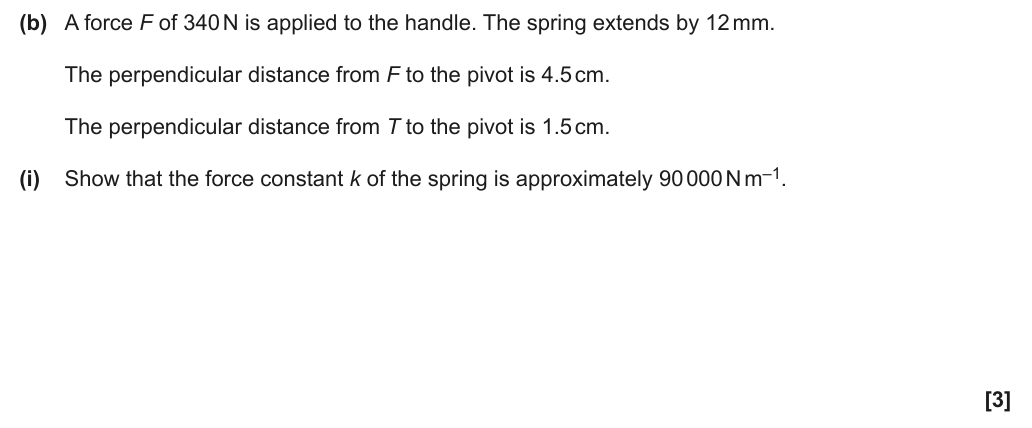
In this calculation it is essential that candidates show all stages of the calculation. Candidates needed to apply the principle of moments using the distances to give a value for the tension T. This value was then used in the equation to determine the force constant k. To gain full credit the value of 85000 needed to be seen. High scoring candidates clearly wrote down relevant equations and substituted into the equations the data provided. A common error made by some low scoring candidates was to subtract the distances. This candidate has clearly demonstrated knowledge and understanding. They have stated the principle of moments, substituted in the data and converted the distances correctly to metres to determine a value for the tension in the spring. The candidate has then stated an equation relating the force constant to the force and extension, rearranged the equation and substituted in the data to calculate an answer. This answer has then been used to get to the value given in the question.
Skills: M0.1 Recognise and make use of appropriate units in calculations; M2.2 Change the subject of an equation, including non-linear equations
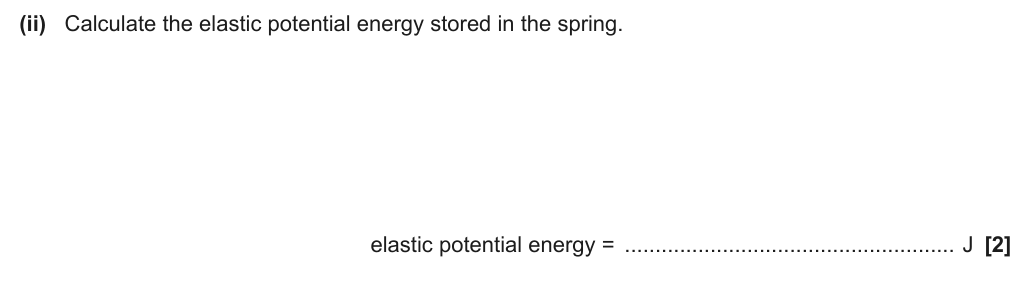
This question was generally well answered. Where errors occurred, it was often not squaring the extension.
Skills: M0.1 Recognise and make use of appropriate units in calculations; M2.3 Substitute numerical values into algebraic equations using appropriate units for physical quantities
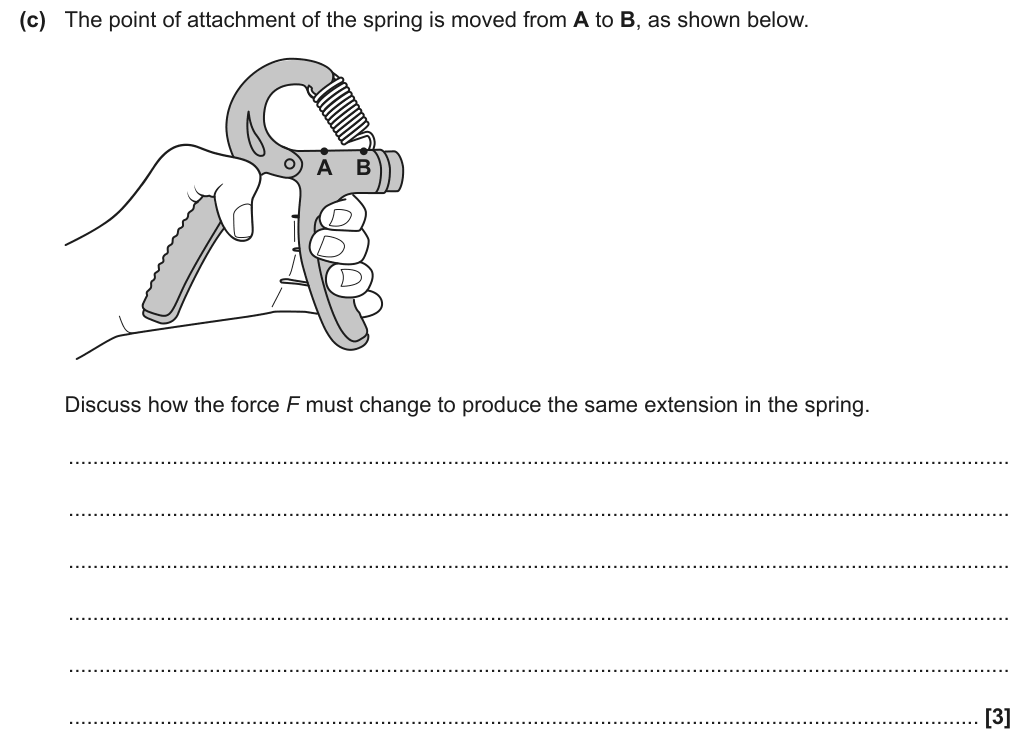
This question was challenging. Candidates needed to identify that for the extension to remain constant, the tension needed to remain the same but the perpendicular distance between the pivot and the line of action of T had increased so that the moment due to T increases. Thus, the moment for F needs to increase. Since the perpendicular distance between the pivot and the line of action of F has stayed the same, the force F must be larger. Many candidates did not refer to T remaining constant. Other candidates did not refer to perpendicular distances. This candidate has clearly explained their answer and included relevant equations. A step-by-step approach has been included and at each stage there is a clear explanation of the physics.
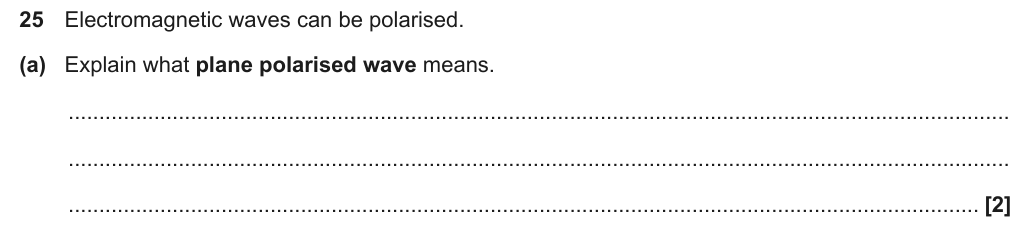
To gain full credit for this question, candidates needed to understand that only transverse waves could be polarised and thus the oscillations of vibrations of the wave were perpendicular to the direction of the wave. The majority of the candidates were able to state that in a plane polarised wave the oscillations are only in one direction or plane .Some candidates omitted any references to the oscillations or vibrations of the wave but instead answered the question in terms of ‘a wave travelling in a single plane’. Other lower scoring candidates stated that ‘polarising blocks some waves’.
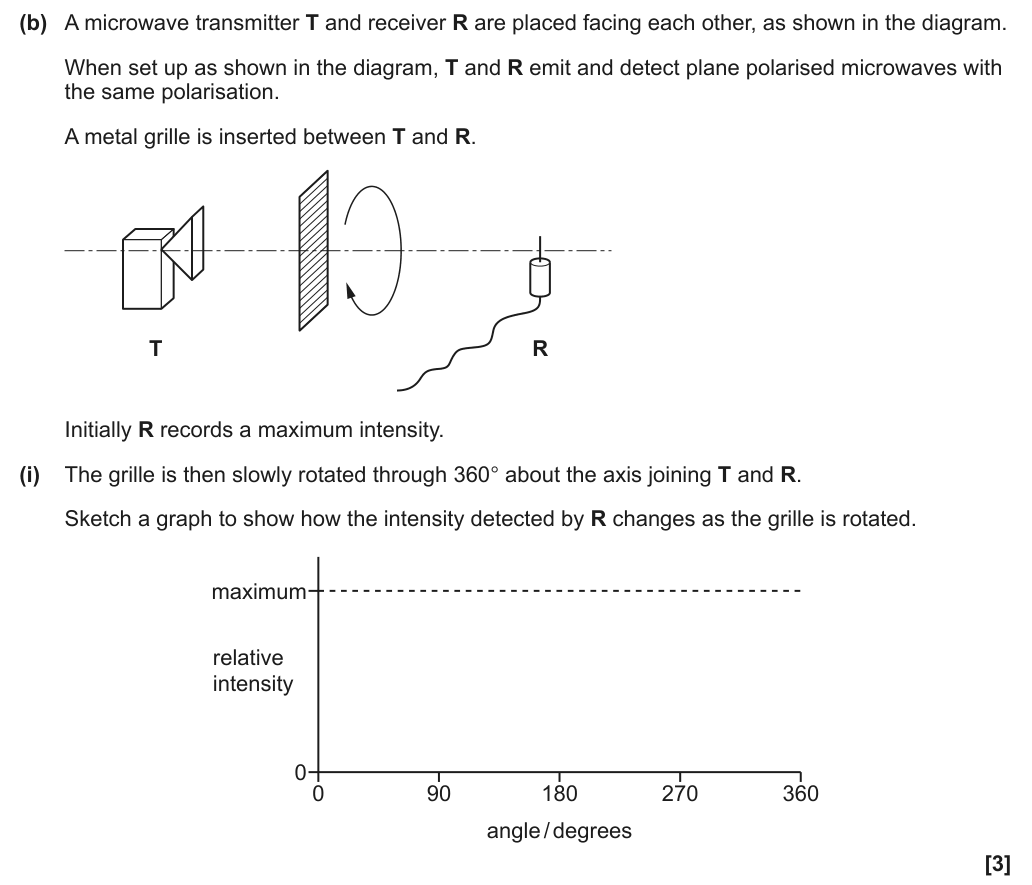
Most candidates correctly understood that maximum intensity occurred at 0 180 360 and that the minimum values would be at 90 and 270. Many candidates incorrectly drew straight lines between the maximum and minimum values. While Malus’ law is not part of the specification a qualitative understanding of the how the intensity changes when a polariser is used is expected.
Skills: M3.12 Sketch relationships which are modelled by y = k/x, y = kx², y = k/x², y = kx, y = sin x, y = cos x, y = e^(±x) and y = sin²x, y = cos²x as applied to physical relationships; PAG5 Investigating waves
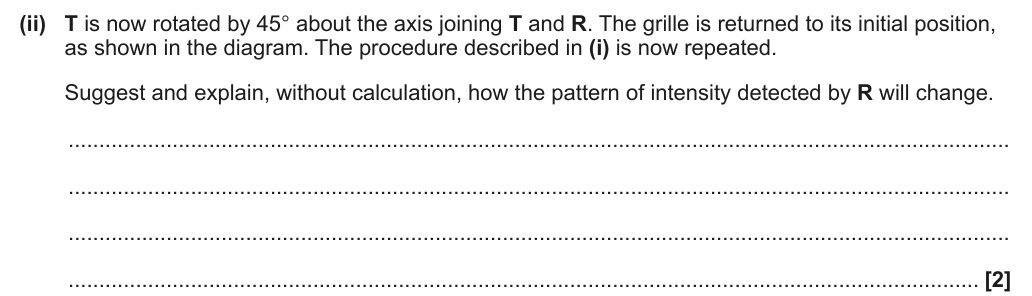
Most candidates discussed that the pattern would be shifted without realising that the maximum intensity of the pattern would be reduced. Very few candidates explained that the reason for the decrease maximum intensity was due to the detector receiving a smaller component of the transmitted wave.
Skills: PAG5 Investigating waves
Want a paper marked and gone through with you? Message us.